
JAPAN NRG WEEKLY
APRIL 19, 2021
JAPAN NRG WEEKLY
April 19, 2021
NEWS
TOP
- Japan and U.S. set out terms for climate action partnership; focus shifting to 2030 (from 2050), emissions targets, batteries; nuclear development included as part of long list of target areas
- Antitrust regulator raids several major power & gas utilities, claims cartel behavior in several segments; potentially massive fines
- Japan officially decides to release treated Fukushima wastewater raising protests among several neighboring countries
ENERGY TRANSITION & POLICY
- Japan auto group sees EVs at 20%-30% of new car sales in 2030
- Carbon emissions from energy sector dropped 3.4% in FY2019
- New battery alliance vows to deliver policy goals to govt. by May
- METI forecasts renewables to generate 14% above target in 2030
- Marubeni, Syouei plan giant 981 MW solar farm in Laos
- Mitsubishi Heavy, Osaka Gas invest in U.S. green ammonia startup
- METI to revoke permits of solar firms that break fencing rules
- TEPCO, Toray set up JV for green hydrogen … [MORE]
ELECTRICITY MARKETS
- Japan’s biggest coal power generator scraps plan for new plant
- Japan to double capacity of Interregional transmission lines to accommodate offshore wind
- More power retailer bankruptcies expected; F Power collapses but to stay in business; Daiwa facing huge losses from F Power
- Ex-PM Abe joins LDP lobby group for nuclear power as advisor
- Lawmakers propose new nuclear waste facility in Fukui prefecture
- Kansai Electric restarts Takahama NPP Unit 4; but, the restart of its older reactors is again in turmoil
- President Editorial: Japan should nationalize its nuclear plants
GAS & MINING
- Japan to boost funding for rare earths exploration via JOGMEC
- Japanese firms look to methanation to provide CO2-free ship fuel
- Saito Takeshi joins race to be the next ENEOS president
- Mitsubishi Heavy to build world’s largest CCS at Texas LNG plant
ANALYSIS
SHIFT TO EVs FACES LEGAL AND COST ISSUES
AMID GROWING WRANGLING OVER IP
The global shift to electric vehicles (EV) is turning more complicated, and potentially much more costly than initially imagined. A growing power struggle over the intellectual property (IP) of the core components that make up an EV, including its core battery tech and charging infrastructure, threatens to derail plans of governments, including that of Japan, to have their transport sector move away from the internal combustion engine (ICE) in the next decade or so.
This patent war has pit traditional automakers against information and communication technology (ICT) firms, which own the IP to many of the components for EVs. Japan has heavyweights on both sides.
GUEST COLUMN BY BRAZIL AMBASSADOR TO JAPAN: BIOENERGY – A ROUTE TO DECARBONIZATION
As Japan reconsiders its energy mix in light of the country’s pledge to decarbonize by 2050, one option that makes sense to consider more deeply is bioenergy. This energy source could in the near term drastically lower Japan’s CO2 emissions from road transport, aviation, power generation and even stimulate quick growth of clean hydrogen. To date, bioenergy utilization in Japan has been modest. The current energy mix sees biomass at 3.7% to 4.6% of total by 2030. The potential of this renewable energy source is much higher. Brazil can act as an example and a partner for Japan in developing bioenergy.
GLOBAL VIEW
IEA and OPEC boost global oil demand forecasts for 2021. Cryptocurrency power demand seen at the level of Italy. UK emissions drop to lowest ever. China rails at the U.S. on climate policy. Details on these and other stories in our global wrap of major developments.
2021 EVENT CALENDAR
DATA SECTION
JAPAN NRG WEEKLY
PUBLISHER
K. K. Yuri Group
Sponsored
Editorial Team
Yuriy Humber (Editor-in-Chief)
Tom O’Sullivan (Japan, Middle East, Africa)
John Varoli (Americas)
Regular Contributors
Mayumi Watanabe (Japan)
Daniel Shulman (Japan)
Takehiro Masutomo (Japan)
Art & Design
22 Graphics Inc.
SUBSCRIPTIONS & ADVERTISING
Japan NRG offers individual, corporate and academic subscription plans. Basic details are our website or write to subscriptions@japan-nrg.com
For marketing, advertising, or collaboration opportunities, contact sales@japan-nrg.com
For all other inquiries, write to info@japan-nrg.com
OFTEN USED ACRONYMS
METI The Ministry of Energy, Trade and Industry
ANRE Agency for Natural Resources and Energy
NEDO New Energy and Industrial Technology Development Organization
TEPCO Tokyo Electric Power Company
KEPCO Kansai Electric Power Company
EPCO Electric Power Company
JCC Japan Crude Cocktail
JKM Japan Korea Market, the Platt’s LNG benchmark
CCUS Carbon Capture, Utilization and Storage
mmbtu Million British Thermal Units
mb/d Million barrels per day
mtoe Million Tons of Oil Equivalent
kWh Kilowatt hours (electricity generation volume)
NEWS: ENERGY TRANSITION & POLICY
Japan and U.S. set out terms for climate action partnership
(Japan NRG, April 18)
- Terms of the U.S. Japan Climate Partnership can be found here, with the wider cooperation terms included under the aegis of resilience and available here.
- Main takeaway of the partnership seems to be the shift in attention from the 2050 timeline for decarbonization to “taking decisive action by 2030”.
- Both countries expected to announce shortly amended Nationally Determined Contributions (NDCs) – i.e., the scope of emission cuts they will undertake by 2030. The U.S. is said to be pushing for a 50% cut for itself and its close allies, including Japan.
- Mutual focus will be on renewable energy, batteries and other form of “long-duration energy storage”, smart grids, hydrogen, carbon capture technology, and carbon recycling.
- Advanced nuclear power is included in the list of cooperation areas and will likely refer to Small Modular Reactors (SMRs) that the U.S. has been developing over the past decade or so.
- CONTEXT: Japan’s JGC Corp earlier this month announced an investment in NuScale, the most advanced U.S. company in terms of realizing SMR projects. The Japanese engineering firm will also work with NuScale on its SMR construction in Idaho.
- Importantly, the two countries agreed on supporting “realistic transition paths” for developing economies in the Indo-Pacific region. That likely references support for LNG as a transition fuel.
- A key topic that is noticeably missing from the Climate Partnership document is carbon pricing / a tax on CO2. Both countries are still studying the best way to introduce pricing on carbon and building industry support for it. We would expect some form of agreement on this to come later in the year and for the EU to play an important role in it.
Japan auto group sees EVs accounting for 20%-30% of new car sales in 2030
(Japan NRG, April 16)
- Japan Automobile Manufacturers Association (JAMA) made a presentation to METI, in which it outlined the industry’s vision for decarbonization.
- JAMA said securing supply of low-cost, carbon-neutral electricity is one of their biggest issues and appealed for government policy and financial aid on this.
- EVs made up just 0.5% of total new car sales in FY2019, with plugin hybrids (PHEV) accounting for another 0.4%. The two categories should account for 20%-30% of total sales by FY2030, JAMA forecast.
- Fuel cell cars (FCV) made up 0.02% of FY2019 sales, or just 70,000 units. By FY2030, that share will rise to about 3%, JAMA said.
- Hybrid vehicles are expected to retain their 34% share over the next decade to cover 30%-40% of total sales, with green diesel also expected to increase its presence to 5%-10% of total.
- Gasoline cars are expected to account for 30% to 50% of total new sales by FY2030, down from 61% in FY2019, JAMA forecast.
TAKEAWAY: With Japan set to ban sales of new gasoline cars from 2035 and Tokyo area from 2030, it’s surprising to see gasoline’s share at such a high level in a decade. Most likely, the industry is trying to dampen expectations and play for time as it tests a switch to EVs, and to a lesser extent FCVs.
Carbon emissions from the energy sector dropped 3.4% in FY2019
(Japan NRG, April 16)
- METI has published figures for energy supply and demand for the fiscal year between April 2019 and March 2020 (FY2019).
- Final energy consumption fell 2.5% YoY.
- Oil consumption was down 2.5%, coal down 2.1%, power down 1.9% YoY.
- Power generation dropped 2.4%; share of non-fossil power was 24.3% of total, increasing for the seventh straight year; nuclear’s contribution at lowest level in five years.
- Carbon emissions from the energy sector fell 3.4% to 1.03 billion tons of CO2.
New Battery Alliance vows to deliver policy goals to govt. by May
(Japan NRG, April 15)
- The newly established Japanese Battery Association for Supply Chain (BASC), headed by Sumitomo Metal Executive Officer Abe Isao, held its inaugural meeting on April 14. More than 50 Japanese firms attended, almost double the expected number, amid rising industry concern about the sourcing of raw materials for the wider rollout of batteries for EVs and energy storage.
- The alliance made a presentation to a METI and Ministry of Land, Infrastructure, Transport and Tourism committee. In it, the alliance asked for more comprehensive battery-related policies, pointing to Japan’s weakening industrial competitiveness, supply chain issues, and high energy prices. The alliance also warned about increasing cobalt, lithium, and other core raw material prices.
- The BASC intends to make its policy proposals for subsidies to the government by May.
- CONTEXT: The government is expected to announce a new mid/long-term energy mix vision for the country this summer.
TAKEAWAY: Japan’s GDP growth over the last two decades owes much to the automaking sector. The domestic companies, however, are somewhat behind in the move away from gasoline engine vehicles and will be in a strong position to petition large funds from the state to help them catch up and retain their global competitiveness. Batteries could also play a major role in the energy mix. The alliance may be leaving it late to have a strong influence on the latest iteration of the long-term energy mix that METI will publish this summer. But, arguably batteries may have a bigger role to play in Japan’s energy mix than hydrogen, at least in the next decade.
Renewable energy adoption to exceed targets by up to 14% by 2030: METI
(Kankyo Business, April 9)
- The Ministry of Economy, Trade and Industry said on April 7 that it projects Japan’s total renewable energy capacity to reach 2.71 terawatt hours by 2030/31.
- This represents a 14% increase over the 2.37 TW hours the government set as the lower end of its target range.
- SIDE DEVELOPMENT:
Growth of renewable energy brings challenges
(NHK, April 13)- The Ministry of Economy, Trade and Industry has said that while Japan will generate over 40% more renewable electricity by 2030, land suitable for solar farms is fast running out.
- A select committee convened on April 13 to discuss mid-to long-term energy policy calculated that if disused agricultural land can be commandeered for solar power generation as well, it will be possible to boost renewable electricity capacity by some 56% by 2030.
- As land suitable for solar farms becomes increasingly scarce, however, there is also a need to join forces with the Ministry of Land, Infrastructure and Transport to encourage more homeowners to install solar panels, said the committee.
Syouei Create and Marubeni plan giant solar farm for Laos
(Kankyo Business, April 12)
- Syouei Create said on April 8 that it had signed a deal with a major Thai investment fund to build two solar farms in Laos with a combined output of 981 MW.
- Work on the plant will begin in May, and the plant is due to begin supplying the grid in March 2023.
- Funding for the project was provided by the SEF Group of Singapore.
Mitsubishi Heavy and Osaka Gas invest in Green ammonia start-up
(Kankyo Business, April 13)
- Mitsubishi Heavy Industries and Osaka Gas said on April 9 that they had invested in U.S.-based start-up Starfire Energy, which is developing a system to synthesize carbon-free “green” ammonia from air and water.
- Mitsubishi and Osaka Gas are joined by the likes of UK venture capital fund AP Ventures, Chevron Technology Ventures, and Australian investment fund New Energy Technology in investing in Starfire.
- Founded in 2007, Starfire develops small-scale, distributed green ammonia synthesis modules, as well as technology for breaking down ammonia into hydrogen and nitrogen.
METI threatens to revoke licenses of solar operators that break fencing rules
(Smart Japan, April 8)
- The Agency for Natural Resources and Energy issued a repeated warning about the need to erect fencing and signage around solar farms participating in the feed-in tariff scheme.
- Fences need to be high enough and robust enough to prevent members of the public from entering facilities, and fences need to be a reasonable distance from panels.
- Operators that do not comply with this requirement could have their license revoked, said the Agency.
TEPCO and Toray set up joint business to handle green hydrogen
(Denki Shimbun, April 16)
- Yamanashi Prefecture, Tokyo Electric (TEPCO), and Toray Industries announced the creation of a joint company to develop a business in green hydrogen.
- The venture will supply and retail hydrogen made with renewable energy inside and outside Yamanashi prefecture using a power-to-gas (P2G) system that produces hydrogen with electricity. At first, the venture will supply hydrogen to local factories and supermarkets at a test level.
- The entity will be set up this year and begin full operations in FY2022.
- The three parties started construction of a P2G facility at the Yonekurayama Solar Power Plant (Kofu City) in FY2016. This facility can generate 400 normal m3 of hydrogen per hour.
- The venture will also seek government funds from the newly established green growth fund.
Itochu Enex to boost synthetic diesel use
(Nikkei Business Daily, April 16)
- Fuel trader Itochu Enex plans to expand sales of gas to liquid (GTL) synthetic diesel, currently only available in Kansai, Kanto, and Chubu, to Kyushu as well.
- Itochu Enex will principally market the fuel to construction companies.
- The trader aims to achieve a five-fold increase in the volume of the fuel it sells to 100,000 kL/year by 2023/24.
- Construction machinery manufacturers Caterpillar and Hitachi have given GTL diesel, which has a lower carbon footprint and is also responsible for less atmospheric pollution, their stamp of approval.
Osaka Gas plans biomass power station for Miyazaki
(Sankei Biz, April 16)
- Osaka Gas said on April 15 it would build a biomass fired power station in Miyazaki.
- The 50 MW plant will cost ¥35 billion to build and is due to begin supplying the grid in 2024.
- Around 10% of the fuel stock for the power station will take the form of locally sourced timber.
Toyota Tsusho invests in manufacturer of fuel cells and water electrolysis systems
(New Energy Business News, April 15)
- Toyota Tsusho invested in Enoa (Toyota City, Aichi prefecture), which designs and manufactures hydrogen fuel cells and water electrolysis systems. The trading company’s goal is to build a renewable energy supply chain that utilizes hydrogen.
- Toyota Tsusho plans to develop new use cases for hydrogen fuel cells, and for smart community projects for local governments.
- The company will promote the use of hydrogen fuel cells as an emergency power supply.
Tohoku Electric sets up units to win business related to renewable power
(New Energy Business News, April 16)
- The power utility established three companies, Tohoku Electric Power Renewable Energy Service, Tohoku Electric Power Solar e-Charge and Tohoku Electric Power Frontier. The new companies will provide O&M (operation and maintenance) services for renewable energy generation facilities, as well as install residential solar equipment and storage batteries for free, and offer energy management services.
- Tohoku Electric believes the Tohoku and Niigata areas will be home to 10 GW of onshore and offshore wind power and wants to win business with at least half of that capacity.
Japan’s Penta-Ocean ties up with Belgium firm to build offshore wind projects
(New Energy Business News, April 16)
- Japan’s Penta-Ocean Construction has agreed with Belgium’s DEME Offshore Holding to establish a JV for offshore wind power construction in Japan. The Japanese firm will have a 51% stake and DEME the rest.
- The new JV will use three self-elevating platform (SEP) ships, changing their flag registration to Japan.
Renewable Japan raises ¥10 billion for solar farm
(New Energy Business News, April 12)
- Renewable Japan has raised ¥10 billion through a bond issue to finance a 25 MW solar farm in Kyushu that went online in 2020.
- Renewable Japan owns a stake in the farm.
- Electricity generated by the solar farm is sold for ¥36 per kilowatt hour under the feed-in tariff scheme. The “green bonds” issued have been rated GA1.
Daiwa Securities Group to invest in next-generation power storage
(Kankyo Business, April 13)
- Daiwa Energy & Infrastructure said on April 9 that it will subscribe to a debt issue released by Tokyo-based Exergy Power Systems, a developer and manufacturer of next-generation storage battery systems.
- Exergy is a start-up founded by Tokyo University researchers that develops and manufactures high-response power storage systems, as well as offering related services. Exergy currently operates in the UK and Ireland, but is considering expanding operations to other markets, including Japan.
GS Yuasa installs storage batteries in Kyoto hub
(Smart Japan, April 6)
- Major manufacturer GS Yuasa says it has installed an energy storage system in its Kyoto hub.
- The system is designed to interface with virtual power plants, and was partially funded with a government grant to support the trialing of virtual power plant infrastructure.
NEWS: POWER MARKETS
| No. of operable nuclear reactors | 33 | |
| of which | applied for restart | 25 |
| approved by regulator | 16 | |
| restarted | 9 | |
| in operation today | 7 | |
| able to use MOX fuel | 4 | |
| No. of nuclear reactors under construction | 3 | |
| No. of reactors slated for decommissioning | 27 | |
| of which | completed work | 1 |
| started process | 4 | |
| yet to start / not known | 22 | |
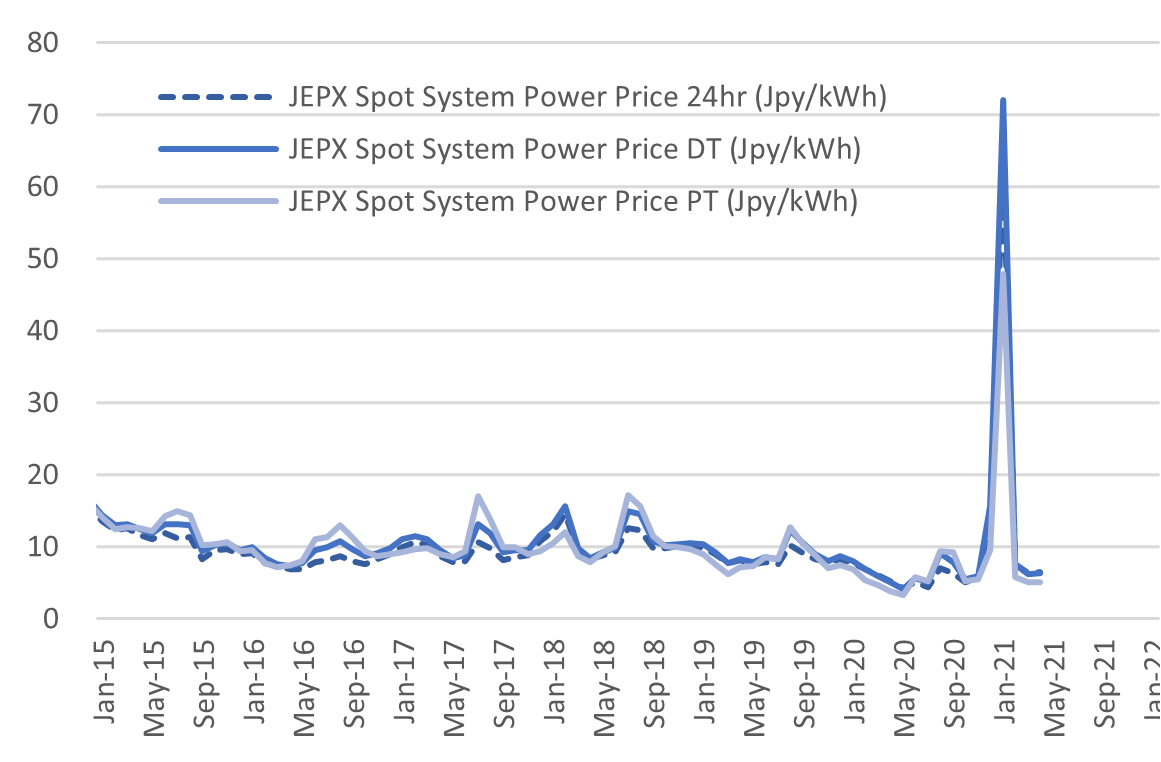
Spot Electricity Prices, Monthly Avg.
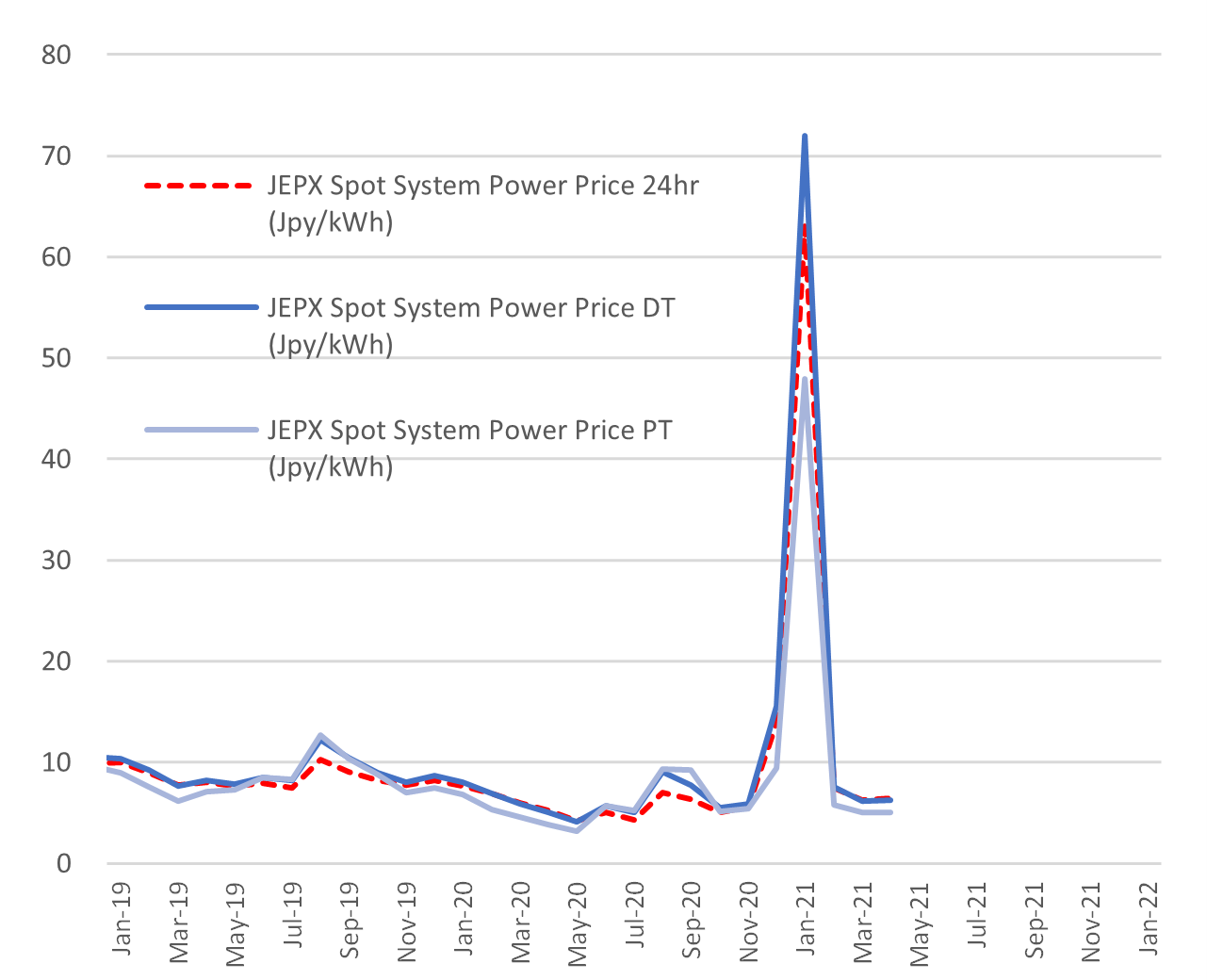
Source: Company websites, JANSI and JAIF, as of April. 16, 2021
Antitrust agency accuses Japanese utilities of cartel behavior in power, gas
(Denki Shimbun, April 14)
- Japan’s antitrust agency suspects several major electricity and gas providers in western Japan of cartel-like behavior.
- Japan’s Fair Trade Commission (JFTC) started inspections of five companies including Chubu Electric, Toho Gas, Kansai Electric, and Chugoku Electric. The JFCT is probing them for potentially violating the Antimonopoly Act and colluding in the sale of electricity and gas.
- The officials suspect the firms conspired to fix prices for household electricity and city gas, and to limit competition for each other’s commercial gas customers.
- The JFTC believes that each company held discussions on these actions at multiple levels, including at the executive level.
- The electricity market was liberalized in 2016 and the gas market in 2017. This is the first antitrust probe since then.
- Regulators suspect that Toho Gas and Chubu Electric struct deals over the prices of electricity and gas in certain markets.
- They also suspect that Chubu Electric, Kansai Electric, and Chugoku Electric agreed not to acquire corporate clients in each other’s original geographical areas, as defined before the market liberalization.
- JFTC believes the companies formed a cartel to protect themselves amid intensifying competition due to entry of new gas / power retailers into the market.
- SIDE DEVELOPMENT:
Kansai Electric, Chubu Electric cancels bond sales after antitrust inspectors visit
(Jiji press, April 16)- Kansai Electric said it will cancel a ¥60 billion bond sale due to an on-site inspection by Japan’s Fair Trade Commission (JFTC). The utility apologized to potential investors and said the cancellation is due to protect investors and prevent market disruption that could follow the inspection.
- Chubu Electric has also called off plans this month to issue ¥10 billion in 10-year bonds.
TAKEAWAY: That the utilities were paid a visit by the JFTC does not immediately mean they had violated the antitrust law. What’s more, it will take at least a year until the JFTC will reach a decision. Typically, the commission takes two years to formally publish its charges.
It’s unclear at this point whether the companies will be charged for restraining competition or price cartels. The latter is more serious and does not allow for leniency programs.
If charged of cartels, and if seen as extremely malicious, the antitrust authority would escalate the case to prosecutors to file criminal charges.
What’s more, once antitrust behaviors is established, company officials are likely to face litigation from shareholders seeking damages.
At the very least, the government will suspend the guilty parties from public tenders.
Chances are, companies will deliberately offer more information to the investigators to be eligible for discounts in fines, the base amounts of which were raised at the end of last year.
However, Chugoku Electric’s press release did not say that it will cooperate with the authority, or that it regrets the raid. Could it be that the company challenges the allegation?
If regulators fail to collect enough evidence, the companies will still be given a warning, as happened in a recent case against Mazda automaker. Warnings suggest that there were potential law violations. Shareholders can still file litigations based on that, but are unlikely to win.
However, several of the power companies clearly decided to minimize their penalties risk by immediately stopping bond sales. That’s because fines tend to be set at 10% of the value of activities deemed to have been antitrust and ongoing business will count towards the fineable amount.
Should the utilities be found guilty of manipulations in the high-voltage power market for large corporate customers, the size of the fines would be very considerable. That market is worth around ¥1 trillion / year, which would mean that in total, fines could run into the tens of billions of yen (hundreds of millions of dollars).
The probe may still widen. If such violations were occurring in the western areas, why not in the eastern catchment area of TEPCO?
Japan officially announced plans to discharge treated Fukushima water into ocean
(Japan NRG, April 13)
- Japan’s Cabinet made an official decision on April 13 to start releasing into the ocean treated wastewater from the Fukushima nuclear site.
- The water is extracted from the wrecked Fukushima Dai-Ichi nuclear plant and is treated to remove most of the radioactive elements.
- One element that is near impossible to extract, however, is tritium, which is a radioactive form of hydrogen. The levels of tritium in the water are well below the international norms. This water will still be diluted more than 100-fold using seawater before release.
- The International Atomic Energy Agency has said it supports Japan’s actions and deems the proposed radiation levels in the water to be entirely safe.
- However, the release has drawn opposition from local fishermen and others, including neighboring countries.
- SIDE DEVELOPMENTS:
Chinese Foreign Ministry protests release of radioactive water
(NHK, April 16)- The Chinese Ministry of Foreign Affairs has summoned the Japanese Ambassador to Beijing to convey China’s opposition to plans to dump radioactive water stored on the site of the Fukushima Daiichi nuclear disaster into the sea.
- China is calling on Japan to allow Chinese scientists to perform tests at the site and reach consensus with international agencies before discharging any radioactive water.
- Meanwhile, the Russian Ministry of Foreign Affairs criticized Japan for not consulting its neighbors before deciding to discharge the water.
- SIDE DEVELOPMENT:
More tanks to be built despite discharge of waste
(Asahi Shimbun, April 15)- The planned discharge into the sea of radioactive water stored on the site of the Fukushima Daiichi nuclear disaster is unlikely to reduce the number of storage tanks required because the contaminated water continues to be transferred to storage tanks faster that it can be processed.
- The constant influx of rain and groundwater onto the site means that the volume of water that needs to be treated is also rising constantly, to the tune of around 140 metric tons per day.
- As emptying existing tanks will take time, it looks like TEPCO will need to yet build more tanks to cover the ever-rising volumes.
- As it can take up to two years to construct additional tanks, government officials say construction work needs to begin well in advance, based on future projections of waste volume.
- SIDE DEVELOPMENT:
Why the decision to release treated Fukushima water took a decade
(Asia Nikkei, April 13)- Distrust of TEPCO and of the government after a series of missteps and basic errors hindered plans for discharge
Japan’s biggest coal generator scraps plan for new plant, citing global pushback
(Nikkei, April 17)
- J-Power said it has canceled plans to build a coal-fired power plant in Yamaguchi prefecture to better align its emissions with growing global pushback against fossil fuels.
- J-Power will now focus on curbing CO2 at existing thermal power assets and try to do so at the lowest cost possible.
- Originally projected as a two-unit 1,200 MW coal-fired power plant in Ube City, it was scaled down to a one-unit station after one of the project partners, Osaka Gas, withdrew in 2019. Now, even the one-unit facility does not make economic sense, J-Power said.
- The global pushback against coal generation also contributed to the decision, according to J-Power.
TAKEAWAY: J-Power is a state-backed power company and it’s unlikely that this decision was made due to economics alone. Raising financing for a coal project today is difficult and probably one of the factors that made J-Power scrap the plan. However, another weightier reason was probably government strategy. With PM Suga meeting with President Biden last week and attending Earth Summit this week, it’s a good time for Japan’s government to show support for the green movement. Having a state-backed firm announce plans to ditch a coal-fired station is part of the government’s messaging.
As importantly, this announcement makes it highly unlikely for any other Japanese coal-fired projects that have yet to begin construction to do so.
Japan to double capacity of Interregional transmission lines to accommodate offshore wind
(Nikkei, April 15)
- The Ministry of Economy, Trade and Industry released plans to boost the capacity of the Japanese grid to transmit electricity between regions by an additional 23 GW.
- Undersea cables linking Hokkaido to Eastern Honshu will free up to an additional 12 GW. New transmission lines will also join Kyushu to Shikoku and Chugoku, and Shikoku to the Kansai region.
- Historically, Japanese authorities have tended not to invest in distributed transmission infrastructure. In 2019/20, only 8.5% of the electricity transmitted in Japan travelled along interregional transmission lines.
- The new lines will make it easier to transport power generated by wind farms to population centers.
Survival of the fittest in the wake of F Power collapse
(Shukan Economist, April 20)
- After sustaining losses of ¥46 billion, long established electricity retailer F Power was forced to file for protection under the Company Rehabilitation Act in March, shocking recent entrants into the industry.
- With an increase in divestments and mergers behind the scenes, F Power is unlikely to be the only power retailer to go to the wall.
- As of June 2020, Japan had over 1,400 electricity retailers, and dedicated retailers that lack their own generation facilities commanded an 18% share of the market.
- While excessive exposure to the Japan Electric Power Exchange was a factor in the January crisis, even Tokyo Gas, whose exposure to JPX is only 10%, has been forced to report a ¥13 billion loss on its electricity retail operations in the third quarter of 2020/21.
- SIDE DEVELOPMENT:
Bankrupt electricity retailer, F Power, expected to stay in business, shocking Daiwa
(Sentaku, April issue)- F Power’s filing for bankruptcy on March 24 shocked Daiwa Group. The electricity retailer should be able to ask for a 100% capital reduction. As a result, the equity of Daiwa, which owns over 80% of F Power via various of its funds, will be wiped out.
- F Power has debts of over ¥46 billion, including imbalance fee liabilities of up to ¥20 billion. But since F Power will not be able to settle during the fiscal year ending June 2021, it will not face insolvency.
- F Power will not lose its JEPX membership, and as long as it can pay it can continue business operations.
- F Power already has several strong sponsors, which should allow it to cover all liabilities, and the company imagines itself transforming into a new clean power company.
- The company rehabilitation law, under which F Power has filed for bankruptcy, is a 1951 legislation that has never been applied to a power company. Feeling guilty for its part in the January price spike, METI will not object to F Power seeking court protection under this 1951 law.
- That means, F Power will be able to emerge free of Daiwa. What’s more, F Power was buying about 60% of its electricity from Daiwa’s thermal power assets, but now it will be able to buy all of its electricity from renewables sources.
- This leaves Daiwa with a major problem, since it has yet to pay off the cost of construction for the coal-fired Kushiro power station, which only went online last year. Daiwa will have to sell the electricity from Kushiro to JEPX.
- Daiwa’s IDI Infrastructure funds, which own over 50% of F Power, are expected to post over ¥23 billion in losses connected with this affair. While the funds are not consolidated by Daiwa, the financial group won’t be left unscathed.
- TEPCO too is upset, since it has long-term agreements to sell fuel to IDI Infrastructure’s thermal power plants. If F Power is restructured, these contracts will likely be terminated.
- Daiwa’s foray into the energy business did not consider the risks involved.
- SIDE DEVELOPMENT:
Power company bankruptcies: it’s time for reform
(Nikkei opinion, April 16)- A push by F-Power to increase its subscribers between 2017 and 2019 caused the company’s margins to fall.
- F-Power’s investors also became distrustful of the company’s executives, who in March denied that they are personally liable to compensate the company for losses sustained during the January power shortage.
- Many new entrants into the retail market do not have any generation facilities of their own and are therefore completely dependent on the wholesale market.
- The author hopes that the collapse of F-Power will prompt the government to reform the environment in which power companies operate, so that we see true deregulation aimed at reducing the cost to the consumer.
Ex-PM Abe joins LDP lobby group for nuclear power
(Denki Shimbun, April 14)
- A group of LDP diet members officially launched what it is calling the confederation for the modernization of nuclear power. The group is calling for the modernization and replacement of Japan’s existing nuclear power stations in the interests of carbon neutrality and energy security.
- The group is led by prominent LDP politician Inada Tomomi. Former Prime Minister Abe Shinzo is an official advisor to the group, and 44 Diet members attended the initial meeting.
- In an address to the group, former Prime Minister Abe called for the greater utilization of nuclear energy, which he described as an inexpensive source of electricity and a way for Japan to maintain its geopolitical power while achieving carbon neutrality.
Nuclear waste facility proposed for Tsuruga
(Mainichi Shimbun, April 16)
- A group based in Tsuruga City (Fukui Prefecture) proposed that an interim storage facility for nuclear waste be constructed in the municipality.
- Proponents of the plan say it would allow Fukui, which is currently home to several nuclear power stations, to meet its obligations to store the nuclear waste generated by its reactors, as well as providing an ongoing source of revenue after existing reactors have been decommissioned.
- The proposal looks to encounter significant opposition, however, since the removal of waste from Fukui is currently a prerequisite of KEPCO’s negotiations with the local authorities.
Kansai Electric restarts Takahama NPP Unit 4, connects it to the grid
(Japan NRG, April 10)
- The utility said it would restart nuclear reactor Unit 4 at the Takahama NPP from April 12 and connect it to the grid from April 15.
- The original plans were for January but the facility had problems with heat pipes.
- CONTEXT: This is the utility’s third reactor restart in the last few months.
- SIDE DEVELOPMENT:
Kansai Electric older reactor restart plans again in turmoil
(Sentaku, April issue)- METI is frustrated as it seems Kansai Electric (KEPCO) may have again messed up plans to restart older reactors, those already over 40 years in operation.
- METI Minister Kajiyama personally persuaded Fukui prefecture governor Sugimoto in February to let the utility restart operations at its Mihama NPP Unit 3 and Takahama NPP Units 1 and 2. The minister promised that used nuclear fuel would be disposed outside of Fukui prefecture.
- Kajiyama thought he had reached an agreement with the newly completed Mutsu nuclear waste storage facility in Aomori prefecture to take in KEPCO’s old fuel. However, the local government assembly announced that the city of Mutsu did not agree with such plans.
- As a result, Fukui prefecture is delaying final approvals for the restart of KEPCO’s three older units.
- KEPCO initially wanted to start up Mihama NPP before the summer peak and run it until Oct. 25. That period would act as evidence that the older reactors work well. Now these plans are in disarray.
- Where the utility has messed up is in not getting in place agreements with local prefecture governments. That’s likely because the people who were in charge of those government relations, and were good at them, were kicked out of the company after last year’s scandals.
EDITORIAL: Nuclear plants should be nationalized to ensure stable electricity supply
(President, April 9)
- CONTEXT: President is one of the four major business magazines in Japan.
- Since Kawamura Takashi stood down as TEPCO chair, no one has put up a hand for the unenviable role, especially in the wake of recent scandals. The current acting chair, Utsuda Shoei, is due to stand down at the end of June.
- Not only is TEPCO Holdings ¥16 trillion in debt, but the deregulation of the electricity market has seen it lose customers to competition.
- Kansai Electric too has problems as it has yet to find a disposal facility that will accept its stockpile of nuclear waste.
- With most nuclear reactors idle, Japan came close to blackouts in January when electricity consumption surged due to a cold snap.
- The Japanese government and the country’s major power companies have a lot to answer for, having done nothing to improve reactor safety or energy security in the 10 years since the Fukushima disaster.
- As the government plans a major review of its energy policy this year, the case for nationalizing all nuclear power stations is strong.
NEWS: OIL, GAS & MINING
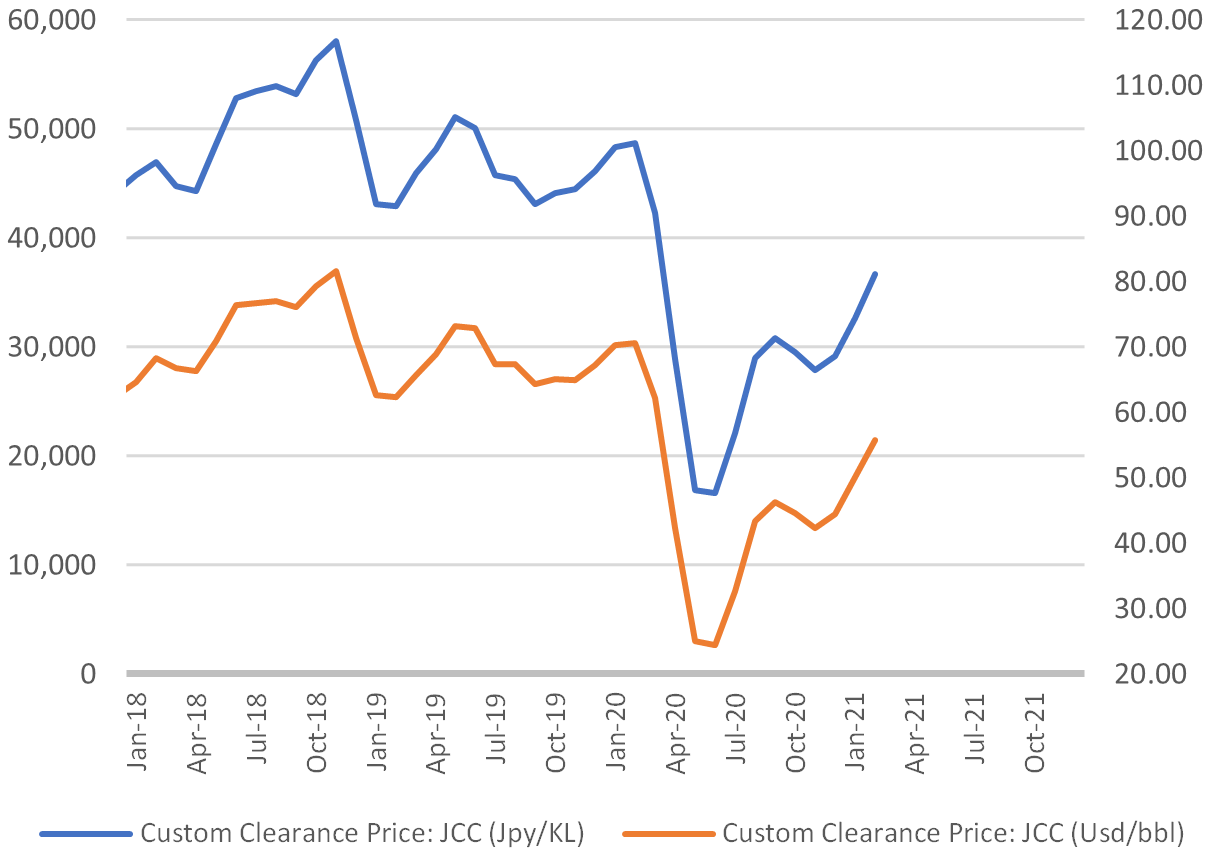
Japan Oil Price: $55.80/ barrel
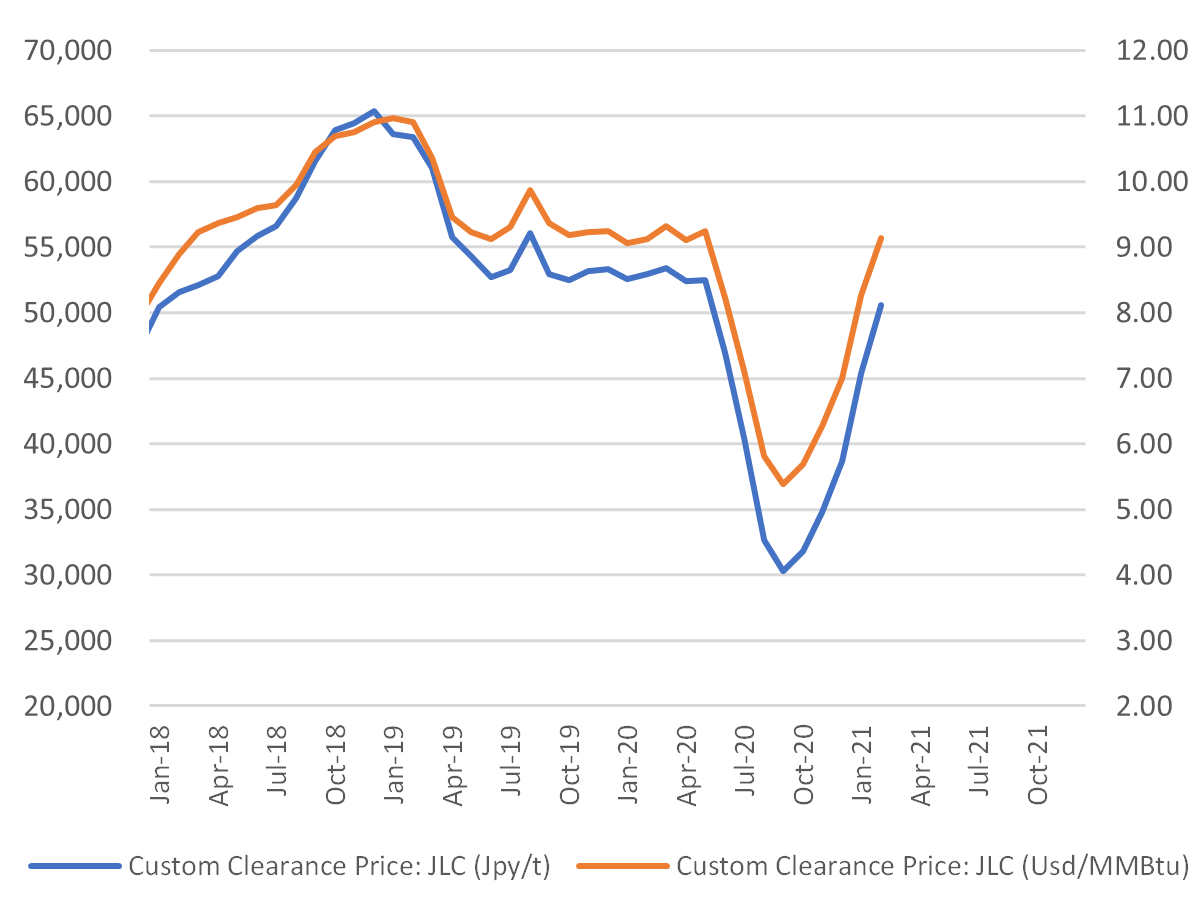
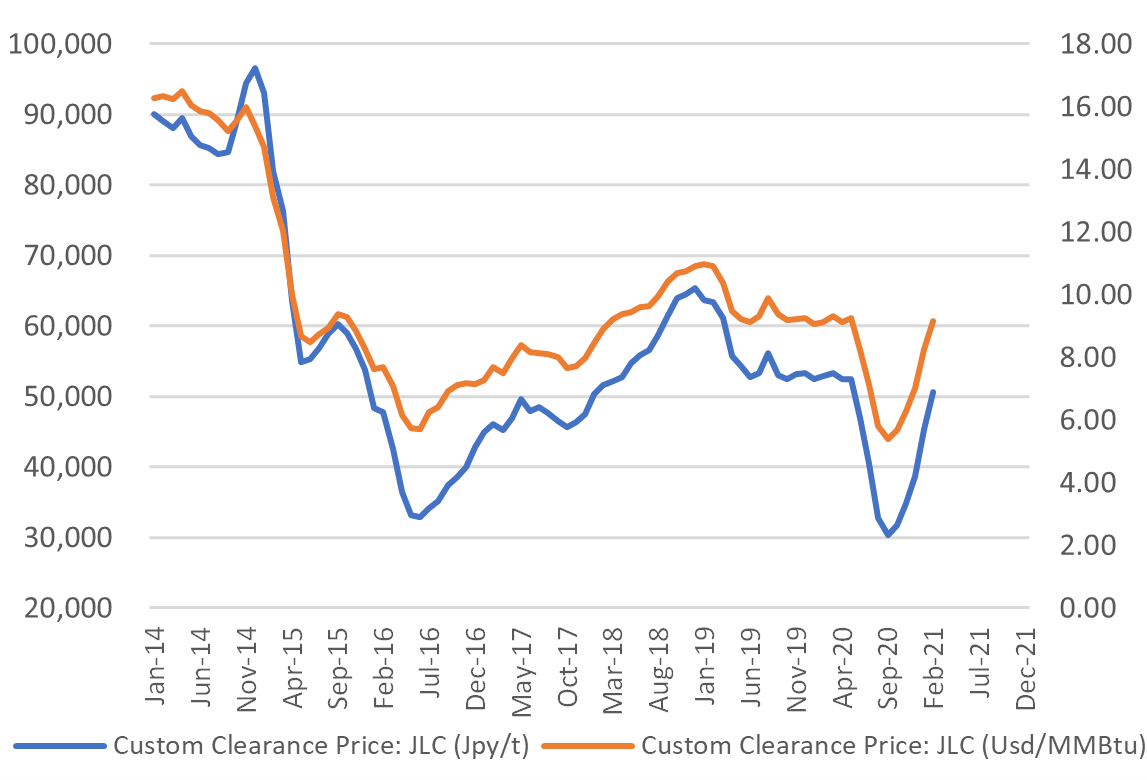
Japan (JLC) LNG Price: $9.14/ mmbtu
Japan to boost funding for rare earths exploration; give JOGMEC more powers
(Nikkei, April 12)
- The government plans to increase funding for exploration of critical raw materials such as rare earths. Competition for these resources is intensifying as the world shifts to electric vehicles and renewable energy.
- The ceiling on how much funding for a particular exploration project can come from the state will be lifted. At present, it is capped at 50%.
- This would allow state-backed Japan Oil, Gas and Metals National Corp. (JOGMEC) to shoulder more than half of the costs of exploring and developing natural resource mines.
- Exploration for new sources of raw materials is risky and expensive, and can take over a decade.
- CONTEXT: The government is concerned that Japan’s access to future supplies of rare earths may be restricted due to competition with other nations and China in particular.
- JOGMEC’s expanded role will be limited to lithium, cobalt, cerium and a few other rare earths critical to EV battery production. The company will still be precluded from owning or funding an entire project.
TAKEAWAY: Any impact from this rule change will take over a decade to materialize, but it is sensible to start approaching material procurement on a more national, strategic level. The main firms charged with finding new resources in Japan have been trading houses. However, these firms have diversified heavily away from natural resources and have a much lower mining profile and risk tolerance than what Japan needs to secure the resources for its future. It will be interesting to see which firms will partner with JOGMEC under the new conditions.
Saito Takeshi joins race to be the next ENEOS presidente
(Sentaku, April issue)
- Saito Takeshi was promoted to Vice President on April 1. He is a protege of the Group CEO, Sugimori Tsutomu.
- Now, ENEOS’ top management consists of Sugimori, Saito, and Nishikawa Shinji (who was promoted to Managing Director). All three come from sales; Saito and Nishikawa are close friends, and supported by Sugimori.
- The influence of the sales department is becoming stronger inside the company and causing concern among other staff. If all the company chiefs are sales people, and not those with a technical background, it may impact ENEOS efforts to form a strategy to shift away from oil.
- Sugimori seems likely to stay on as CEO until his term as Keidanren business lobby group vice chairman ends in 2022.
- ENEOS president Ota Katsuyuki is expected to step down next April.
Japanese shippers led by Mitsui OSK explore employing methanation for ship fuel
(Bloomberg, April 15)
- Mitsui OSK Lines (MOL) is head of a group of nine Japanese firms, which includes Nippon Steel, to look at the possibility of producing and using methane to power “zero-emission ships.”
- Methane is seen as an alternative to LNG or other fossil fuels. It could be employed for a new type of ship that will transport CO2.
- Methanation is “the most realistic solution” for MOL to achieve net-zero emissions by 2050, company CEO Hashimoto told Bloomberg in an interview. Methane, unlike hydrogen or ammonia, can be transported with existing natural gas infrastructure, according to Hashimoto.
- Methanation is a process of turning CO2 and hydrogen into methane. When the latter is burned to generate power, the CO2 captured earlier in the process is released back into the atmosphere, thus making it a net-zero carbon emissions cycle.
Mitsubishi Heavy signs accord to build CCS at NextDecade’s LNG plant in Texas
(Company statement, April 14)
- NextDecade Corporation and Mitsubishi Heavy Industries America, Inc. signed an engineering services agreement (ESA) for the design, license, and performance guarantee of a post-combustion carbon capture technology to be applied at NextDecade’s Rio Grande LNG project in the port of Brownsville, Texas.
- NextDecade is developing one of the largest carbon capture and storage (CCS) projects in North America at Rio Grande LNG. NEXT Carbon Solutions’ CCS project at Rio Grande LNG is expected to enable the capture and permanent geologic storage of more than 5 million tons of CO2 per year.
- CONTEXT: Mitsubishi Heavy has built 13 carbon capture systems around the world.
Marubeni, Tokyo Gas sign sales accord for $1.9 billion LNG-to-Power project in Vietnam
(Various, April 10)
- Marubeni and Tokyo Gas signed an agreement for the Phase-1 development of the Amata City Halong Project in Vietnam. It is an industrial park located about 200 km from Hanoi, and includes an LNG regasification terminal and an integrated power plant. Earlier reports said that the project would cost around ¥200 billion yen ($1.9 billion) and will include an LNG-fueled power station
ANALYSIS
BY MAYUMI WATANABE
Shift to Electric Vehicles Faces Legal and Cost Issues
Amid Growing Wrangles Over IP
The global shift to electric vehicles (EV) is turning more complicated, and potentially much more costly than initially imagined.
A growing power struggle over the intellectual property (IP) of the core components that make up an EV, including its core battery tech and charging infrastructure, threatens to derail plans of governments, including that of Japan, to have their transport sector move away from the internal combustion engine (ICE) in the next decade or so.
This patent war has pit traditional automakers like Toyota and Honda against information and communication technology (ICT) firms, which own the IP to many of the components and tech needed for EVs.
Tech firms are asking for a new royalty scheme that fairly compensates their innovation. The auto industry says this would bump up the price of EVs and open them up to more legal wrangling at a time when there is government pressure to make EVs competitive with vehicles running on gasoline and diesel.
In Japan, this escalation is doubly complicated by the fact that it has heavyweights on both sides. Panasonic, Sony, Sharp and Fujitsu are among the seven Japanese members of the global consortium leading the charge against the automakers.
Who “owns” the car of the future?
After decades of development, traditional automakers have created – and patented –nearly all the parts of an ICE vehicle. The increased use of connectivity and computerization in today’s cars, however, leaves traditional automakers reliant on sourcing more and more components from the high-tech industry. The underlying IP for them lies with technology firms such as Nokia, NEC, Siemens, and others.
Toyota ranks fourth and Honda fifth in Japan’s ranking of approved patents, with a strong presence in power trains and control systems. Yet, this is not enough.
The age of EVs is raising automakers’ reliance on the IP of the tech industry to a new level. Sensing a business opportunity, last year the tech firms grouped together to demand from Japanese automakers better compensation mechanism for their 5G networks R&D.
A large part of the tech patents relate to connectivity, which is provided by micro baseband chips, which alone involve more than 30,000 patents.
The majority of the IP for baseband chips is classified as standardized essential patents (SEPs), which should be offered to automakers on fair, reasonable and non-discriminatory (FRAND) terms. However, what exactly constitutes “fair” is now under dispute.
Automakers want to pay the patent fees based on the cost of the component. A baseband chip used in a car typically costs around $20 per unit.
Tech companies would like to apply the cost formula not to the component but to the final product. That would apply the percentage-based royalty fee to, say, a $50,000 vehicle.
While the EV market was small, the dispute was a distraction. As Japan and other governments rolled out pledges to ban sales of new ICE vehicles by 2035 or earlier, this changed the nature of the dispute.
“At this point, SEP licensing is not having a visible impact on EV development, but there are potential issues in the future,” said an executive at a major Japanese automaker. “If licensing fees are demanded inappropriately, such as on the basis of the prices of a final product such as a car,” it will create many complications.
Automakers argue that to make EVs a reality, all technology IP owners need to work together to create industry standards and compatible platforms. Without this, a mass rollout of EVs and related infrastructure will be costly and troublesome.
For example, a lot of IP that’s related to wireless charging and electricity smart meters is also under SEP terms. This technology has yet to be introduced and commercialized in Japan.
Another 30,000 patents relate to positioning and route navigation systems. Many are important for the development of automated driving.
With such a wide array of core EV technologies under patent protection, it makes sense to combine all the royalty fees and calculate payments based on the final product price, according to the technology firms.
Such technology development has required vast resources and innovation should be rewarded, said a Japanese holder of some of the patents. ICT firms need to remain incentivized to innovate further, the holder added.
Decisions affecting Japan taken in European courts
Patent disputes are often resolved via courts, and plenty of lawsuits around the issue have already flared up in Germany, the U.S., the UK, China, and Japan.
Some of the suits resulted in negotiated settlements, such as Sharp’s filing against Tesla in Tokyo last year. However, the cases that end up with a ruling can have a far greater consequence than for the firms involved in them.
A 2019 court decision in the UK stated that its judgment would apply globally, leaving Japanese policymakers scrambling.
Japan’s government and courts have been understandably wary of rushing in to rule on one side or the other. As well as being home to some of the world’s biggest auto companies, Japan also has major companies on the tech side. Around 10% of SEPs at the center of the dispute are held by Japanese companies.
Once the European rulings started to come through, the Japanese government decided to take a more active role in the matter. METI set up an expert panel on SEP in March 2020, and the Cabinet Office created a separate committee to step up its review IP issues.
Historically, Japanese government would aim to resolve the situation through the creation of a dispute settlement framework. However, many in the industry are skeptical of how much influence the government can have in this case. Most of the licensing rule enforcement so far has come from the courts.
This is where Japan is again at a disadvantage. German courts take decisions within six months. Japan’s judiciary processes is much lengthier. What’s more, the monetary value of compensation in Japanese rulings tends to be small compared with Europe and the U.S. This makes it less attractive for patent owners to start legal proceedings in Japan and thus moving the decision-making center elsewhere.
The Japan Patent Office has promised to reform the patent dispute system. Until that happens, Japanese automakers have another incentive to speed up their innovation in EVs – to secure their rights to the technology that should define the new era of mobility.
ANALYSIS
BY EDUARDO SABOIA
AMBASSADOR OF BRAZIL TO JAPAN

Bioenergy: a route to decarbonization for Japan
As Japan reconsiders its energy mix in light of the country’s pledge to decarbonize by 2050, one option that makes sense to consider more deeply is bioenergy. This energy source could in the near term drastically lower Japan’s CO2 emissions from road transport, aviation, power generation and even stimulate quick growth of clean hydrogen.
To date, bioenergy utilization in Japan has been modest. The current version of the nation’s energy mix sees biomass accounting for 3.7% to 4.6% of the total by 2030.
The potential of this renewable energy source is much higher, and Brazil can serve both as an example of how this works in practice and a partner in developing Japan’s bioenergy industry.
Thanks also to our strong reliance on bioenergy, Brazil was recently able to submit a Nationally Determined Contribution (NDC) commitment of a 43% reduction in greenhouse gas (GHG) emissions by 2030, from 2005 levels. That’s the highest NDC target of all non-European members of the G20.
A greater embracing of bioenergy could give a boost to Japan’s decarbonization plans. Recognizing that countries will find their own routes to decarbonization, Brazil stands ready to work with Japan on the environmental, business, and economic possibilities that the bioenergy path could create.
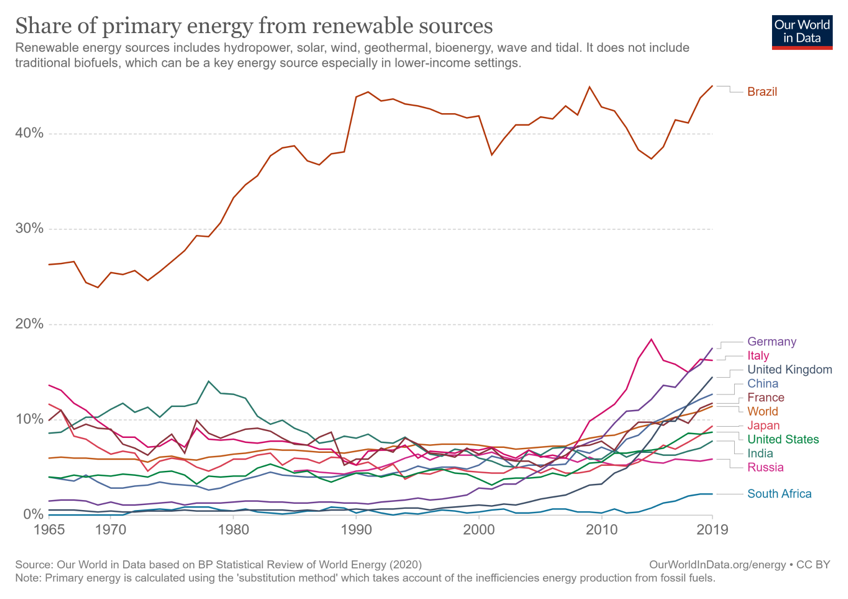
Brazil’s energy model
Despite being one of the world’s biggest nations in terms of land size and population, Brazil has been able to elevate renewables to 83% of our electricity mix. Renewables also represent 41% of the total primary mix.
Both figures are three times higher than the world average, and as a result Brazil’s exports are cleaner too. This is something that will surely play a role as nations consider ways to put a value on the carbon component of goods.
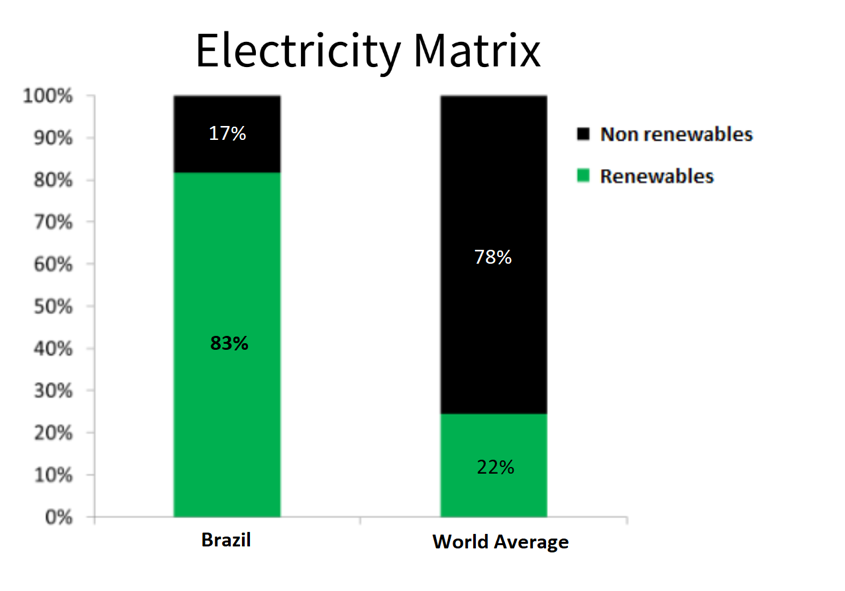
One of the “secrets” behind Brazil’s position as the world’s No. 3 producer of renewables electricity is its strength in bioenergy. In fact, bioenergy accounted for a third of Brazil’s total energy supply in 2019.
Modern bioenergy is now responsible for half of all global renewables generation. Yet, according to both IEA and IRENA, bioenergy in the final energy consumption needs to double by 2030, and the use of biofuels in transport needs to triple in the same timeframe, to keep global warming in check.
The world needs quick, ready solutions, and Brazil can play an important role in providing solutions to climate change. As the world and Japan move to decarbonize their economies, Brazil and Japan have a lot of potential synergies in the energy and related fields that would create increased trade, investment, and joint research.
In fact, I should say that these synergies are already being explored.
Brazil-Japan energy solution: Gasoline
Brazilian biofuel made of sugarcane is currently being exported to Japan in the form of ethyl tert-butyl ether (ETBE). ETBE is then blended with gasoline at a ratio of 3%.
Brazil’s sugarcane ethanol reduces CO2 emissions by 90% on average compared to gasoline and does not disseminate suspended particulate matter, considered an aggravating factor for respiratory diseases, including COVID-19.
Still, the 3% blend is low, which means there is ample room to cut emissions more severely by using more ethanol in Japan’s transport sector. The ratio could be easily raised to 10% with no change to the conventional engines. In Brazil, the rate of ethanol in gasoline is now at 27%.
Of course, we are aware of the global push towards electric vehicles and fuel cell transport, which will play a very important role in the future of transportation. However, that moment when the majority of cars on the roads are non-gasoline is many years away. Switching to a higher ethanol blend is a low-hanging fruit that helps us reduce emissions now. What’s more, biofuels can be transported using tankers and other existing infrastructure.
Given these characteristics, I am convinced that increasing the use of Brazilian sugarcane ethanol could be the single most powerful policy to quickly reduce emissions in Japan’s transport sector.
For the oil industry, the increased use of ethanol in the gasoline holds the promise of a soft energy transition. There are opportunities for Japanese companies to invest in this sector both in Brazil and Japan, in terms of expanding the infrastructure and in industrial processes.
The development of sugarcane biofuel for use as aviation fuel is also advancing fast. Airplanes are known as hard to electrify and Japanese airlines have spent a lot of resources trying to source sustainable fuel. Among their challenges has been scale. That is where Brazil’s vast bioenergy complex can come in as a solution.
Brazil-Japan energy solution: Electricity
The use of solid biomass to produce electricity is another promising area for Brazilian and Japanese companies. The sector is set to grow strongly.
In a recent report, IRENA predicts that biomass’ role in the electricity mix will have to increase from 4% to 16% by 2050. IRENA ranks Brazil as the top electricity generator from solid biofuels.
According to a recent study from the Brazilian Association of Pellets and Briquettes Biomass Industries, the production of biomass pellets has been growing at the rate of 35% per year for seven years. The study also provides an estimate of the biomass production potential in Brazil – around 577 million tons per year.
Some Japanese companies are already exploring this space. Trading house Sumitomo Corporation formed a JV with Cosan/Raízen of Brazil to develop sugarcane bagasse pellets. This material is ideal for repurposing coal power plants. It is versatile, being able to substitute coal, natural gas and fuel oil for the generation of electricity and heat.
Another major advantage of sugarcane pellets: their GHG emissions are reabsorbed within a year, whereas emissions from wood pellets take at least 10 years, according to data from the companies involved in the project.
Coupled with carbon capture and storage (CCS), biomass will become a key technology to deliver negative emissions. Japan has named CCS as an essential part of its path to net-zero emissions and Brazil is ready to work with Japan in researching, realizing and investing in this technology.
Japanese and Brazilian companies could have a first-mover advantage in this segment, shaping the move to repurpose coal and natural gas power plants across the world.
Brazil-Japan energy solution: hydrogen
Bioenergy may also be key to unlocking the potential of hydrogen as an economically viable source of energy.
Hydrogen is enjoying unprecedented momentum of late, with many countries pursuing its development and adaptation. However, according to IRENA, 95% of all hydrogen is generated from natural gas and coal. There is no significant hydrogen production from renewable source. For this reason, IRENA highlights that production of hydrogen is responsible for around 830 million tons of CO2 emissions per year, equivalent to the output of the UK and Indonesia combined.
However, hydrogen can also be made from clean primary sources and there are meaningful developments in this field. For example, Nissan, in partnership with the University of Campinas and the University of São Paulo in Brazil, is developing an electric fuel cell car based on hydrogen made with ethanol.
Besides being much cleaner than hydrogen derived from coal, ethanol-backed hydrogen benefits from ethanol’s existing infrastructure. This an avenue that Brazilian and Japanese firms could explore further.
Bioenergy: a route to decarbonization
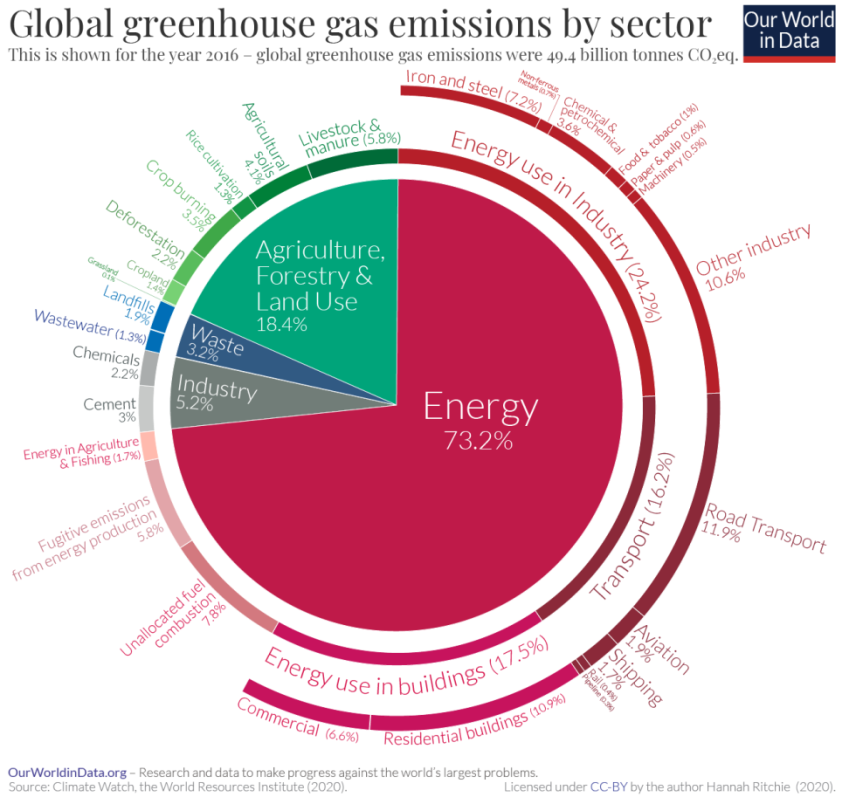
Climate change requires decisive action. The climate challenge is mostly an energy challenge, since the energy that powers our daily lives accounts for three quarters of global emissions. As all countries search for ways to reduce emissions, bioenergy is a viable and proven option. The opportunities in bioenergy sector are many. Together, Brazil and Japan are well positioned to seize them.
GLOBAL VIEW
BY TOM O’SULLIVAN
Below are some of last week’s most important international energy developments monitored by the Japan NRG team because of their potential to impact energy supply and demand, as well as prices.
Oil Prices:
WTI and Brent prices rose $4 a barrel following IEA and OPEC projections that global oil demand should increase 6 mb/d YoY in 2021 due to vaccine campaigns and a strengthening global economy. WTI closed the week at $63 and Brent at $67. IEA is now projecting total global oil consumption will average 97 mb/d in 2021. Japan’s crude oil imports averaged 2.5 mb/d in FY2020.
Aviation:
France is planning to ban all short-haul internal flights of less than 2.5 hours where electric train alternatives exist in an attempt to reduce CO2 emissions. These plans are expected to impact travel between Paris and the cities of Nantes, Lyon and Bordeaux.
EVs:
XPeng, the Chinese EV manufacturer, unveiled its third production vehicle, the P5, that has a 600km driving range. The P5 will compete against Tesla models manufactured in China.
Nuclear:
Agreement was reached between the State of New York, Entergy, and Holtec to provide for the transfer of Indian Point NPP to Holtec for decommissioning and site remediation after the station’s Unit 3 finally shuts down on Apr. 30. Unit 3 was first commissioned in 1976. Unit 1 closed in 1974 and Unit 2 in 2020.
Cryptocurrencies:
With the IPO of Coinbase last week, a new forecast for energy consumed in mining cryptocurrencies put it at the equivalent of the energy consumption of Saudi Arabia or Italy, with emissions estimated to be equivalent to that of Nigeria by 2024.
China:
John Kerry was expected to press China on its 2030 peak carbon and 2060 carbon-neutral goals when he met Chinese Vice-Premier Han Zheng in Shanghai last week. Kerry was also expected to push China to green the Belt and Road Initiative. Meanwhile China has accused the U.S. of being like a “truant getting back to class” after its exit from the Paris Agreement in 2017 and is pushing the U.S. to take more responsibility. Japan’s Environment Ministry is also publicly pushing China to be more proactive on climate change. Meanwhile Xi Jinping has not yet committed to attending the Earth Day Summit convened by the U.S. on April 22.
South Korea:
SK and LG, two South Korean conglomerates, resolved a multi-billion EV battery dispute over intellectual property that will allow SK to resume battery supply to Ford and Volkswagen EV factories in the U.S. SK has invested $2.6 billion in a battery production facility in the State of Georgia.
Taiwan:
Taiwan is facing its worst water shortages in more than half a century, which is impacting chip production. The government recently issued its first water red alert in five years with water levels at some reservoirs dropping below 15% of capacity. Water rationing has started. Taiwan periodically suffers power blackouts.
Myanmar:
POSCO, the South Korean steelmaker, will terminate its JV with the military-controlled MEHL.
Australia:
Attempts to introduce EVs to the Australian market are floundering according to Electric Vehicle Council in Australia with take-up rates among the worst in the G20 due to a lack of incentives.
New Zealand (NZ):
The government has introduced a new law that will require all banks, insurers, and asset managers with assets of more than $700 million to report the impact of climate change on their business. Around 200 NZ companies would be affected by the legislation.
UAE:
Taqa, the state backed utility, plans to boost RE energy output six-fold to 30% of its energy mix by 2030, and to increase overall power capacity from 18 GW to 30 GW by 2030. Solar power will be the major RE power source at two facilities, Noor Abu Dhabi and Al Dhafra. Marubeni and Jinko Solar are co-investors in the 1.2 GW Noor Abu Dhabi solar facility.
Iran:
Iran will seek to increase uranium enrichment to 60% following the explosion at the Natanz uranium enrichment facility on Apr.11 thereby endangering the success of the JCPOA talks in Vienna. This could defer Iran’s attempts to fully restore oil production and exports. However, Iranian oil production was 2.3 mb/d in March, the highest since May 2019 on the back of increased exports to China. Iranian authorities have described the explosions at Natanz as “nuclear terrorism” and plan to add 1,000 more centrifuges.
Israel:
Another Israeli commercial vessel, the Hyperion, was attacked off the coast of the UAE, near Fujairah Port, on Tuesday in what appears to be a continuation of the tit-for-tat strikes between Israel and Iran.
Russia:
The U.S. imposed new sanctions on Russia but notably exempted Nord Stream 2 from this round. Ukraine is expected to apply pressure on the U.S. to sanction the project.
Uganda:
Uganda and Tanzania signed the East African Oil Pipeline Project that will transport oil from Albertine in Uganda to Tanga in Tanzania. China’s CNOOC and France’s Total operate the oil fields in Uganda. The pipeline will be over 1,400 km long.
South Africa:
Karpowership, a unit of Turkey’s Karadeniz Energy Group, has been named as the preferred supplier of electricity from three floating vessels to South Africa in a deal worth $15 billion. Karpowership provides floating electricity generation fueled by LNG and will provide 1.2 GW of power to South Africa. The project is aimed at closing a supply gap in South Africa that results in periodic blackouts. The 20-year deal will cost as much as $760 million annually.
Spain:
Acciona Energy, the Spanish energy conglomerate, will IPO its RE business which aims to increase installed capacity to 25 GW by 2025. The company is expected to achieve a valuation of $14 billion.
U.K.:
1). The UK achieved its lowest ever CO2 emissions per kWh (39g) on Apr. 7 when clean energy sources exceeded 80% of the electricity mix.
2). Royal Dutch Shell outlined its first energy transition strategy that will include more focus on electricity and biofuels. This will be put to a shareholder vote next month, the first time an oil major has adopted this strategy of seeking shareholder approval.
3). Global Energy Monitor, a UK non-profit, will develop a global registry of fossil fuels to track the embedded CO2 in fossil fuel reserves.
4). Private equity groups’ ownership of UK North Sea oil and gas assets is thought to exceed 30% as oil and gas majors such as Exxon sell out.
U.S.:
JP Morgan has committed $2.5 trillion to climate-focused investments over the next decade. This follows similar commitment by other Wall Street banks including Bank of America.
EVENTS CALENDAR
A selection of domestic and international events we believe will have an impact on Japanese energy.
| February | Approval of Fiscal 2021 Budget by Japanese parliament including energy funding projects;
CMC LNG Conference |
| March | 10th Anniversary of Fukushima Nuclear Accident;
Smart Energy Week – Tokyo; Quarterly OPEC Meeting; Japan LPG Annual Conference; Full completion of all aspects of the multi-year deregulation of Japan’s electricity market; End of 2020/21 Fiscal Year in Japan; |
| April | Japan Atomic Industrial Forum – Annual Nuclear Power Conference;
38th ASEAN Annual Conference-Brunei; Japan LNG & Gas Virtual Summit (DMG)-Tokyo Three crucial by-elections in Hokkaido, Nagano & Hiroshima – April 25th |
| May | Bids close in first tender for commercial offshore wind projects in Japan;
Prime Minister Suga to visit the U.S.-tentative |
| June | Release of New Japan National Basic Energy Plan-2021;
G7 Meeting – U.K. Forum for China-Africa Cooperation Summit (Senegal) |
| July | Tokyo Metropolitan Govt. Assembly Elections;
Commencement of 2020 Tokyo Olympics |
| August | Hydrogen Ministerial Conference in conjunction with IEA World Economic Forum in Singapore – Deferred from May |
| September | Ruling LDP Presidential Election;
UN General Assembly Annual Meeting that is expected to address energy/climate challenges; IMF/World Bank Annual Meetings (multilateral and central banks expected to take further action on emissions disclosures and lending to fossil fuel projects); End of H1 FY2021 Fiscal Year in Japan; Japan-Russia: Eastern Economic Forum (Vladivostok)-tentative |
| October | Last possible month for holding Japan’s 2021 General Election;
METI Sponsored LNG Producer/Consumer Conference; Innovation for Cool Earth Forum – Tokyo Conference; Task Force on Climate-Related Financial Disclosure (TCFD) – Tokyo Conference; G20 Meeting-Italy |
| November | COP26 (Glasgow);
Asian Development Bank (‘ADB’) Annual Conference; Japan-Canada Energy Forum; East Asia Summit (EAS) – Brunei |
| December | Asia Pacific Economic Cooperation (APEC) Forum – New Zealand;
Final details expected from METI on proposed unbundling of natural gas pipeline network scheduled for 2022. |
DATA
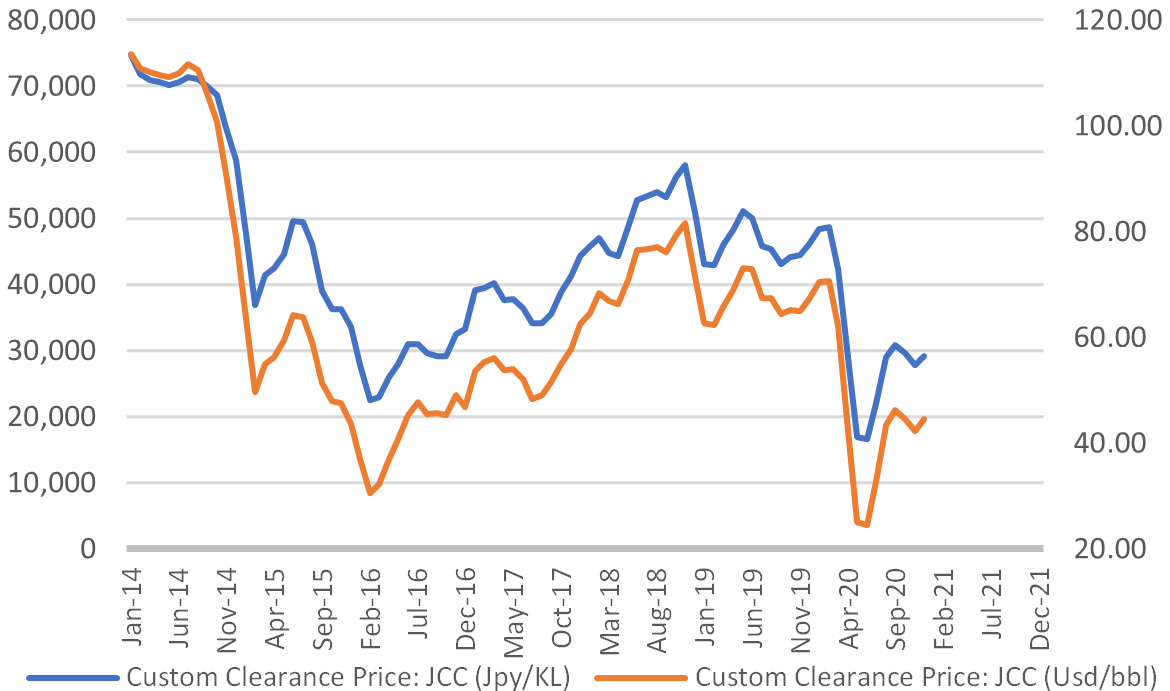
Japan Oil Price
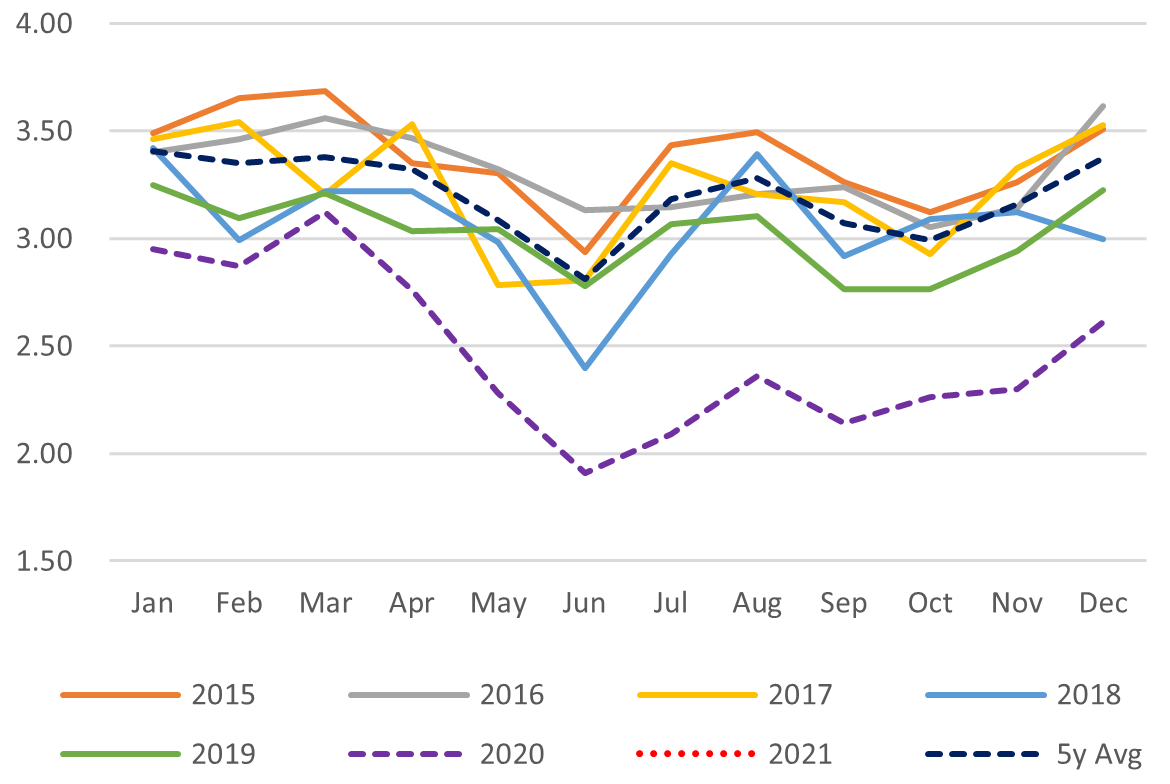
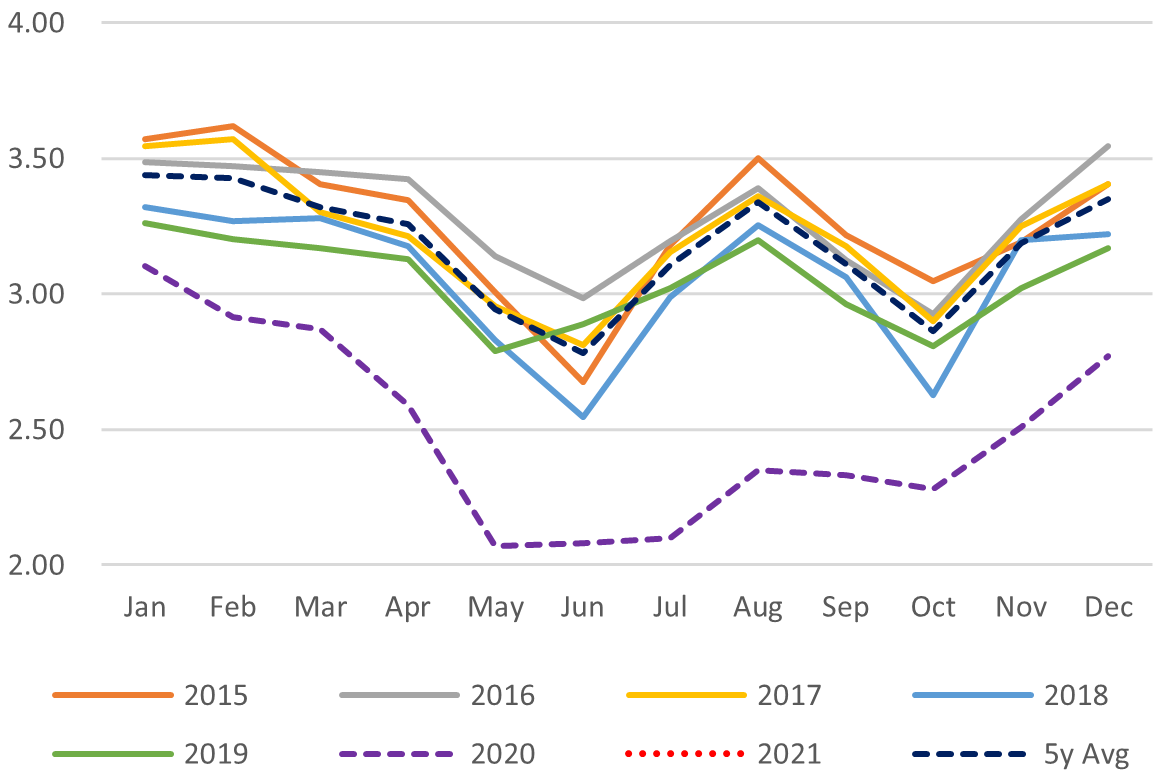
Crude Imports Vs Processed Crude
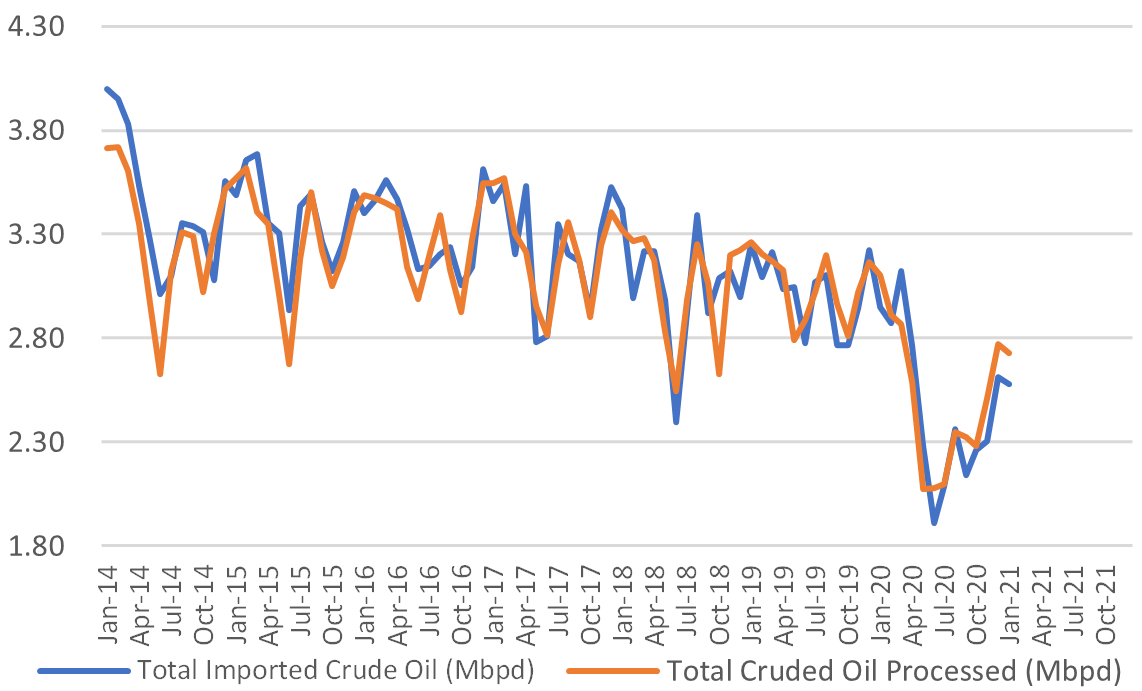
Monthly Oil Import Volume (Mbpd)
Monthly Crude Processed (Mbpd)
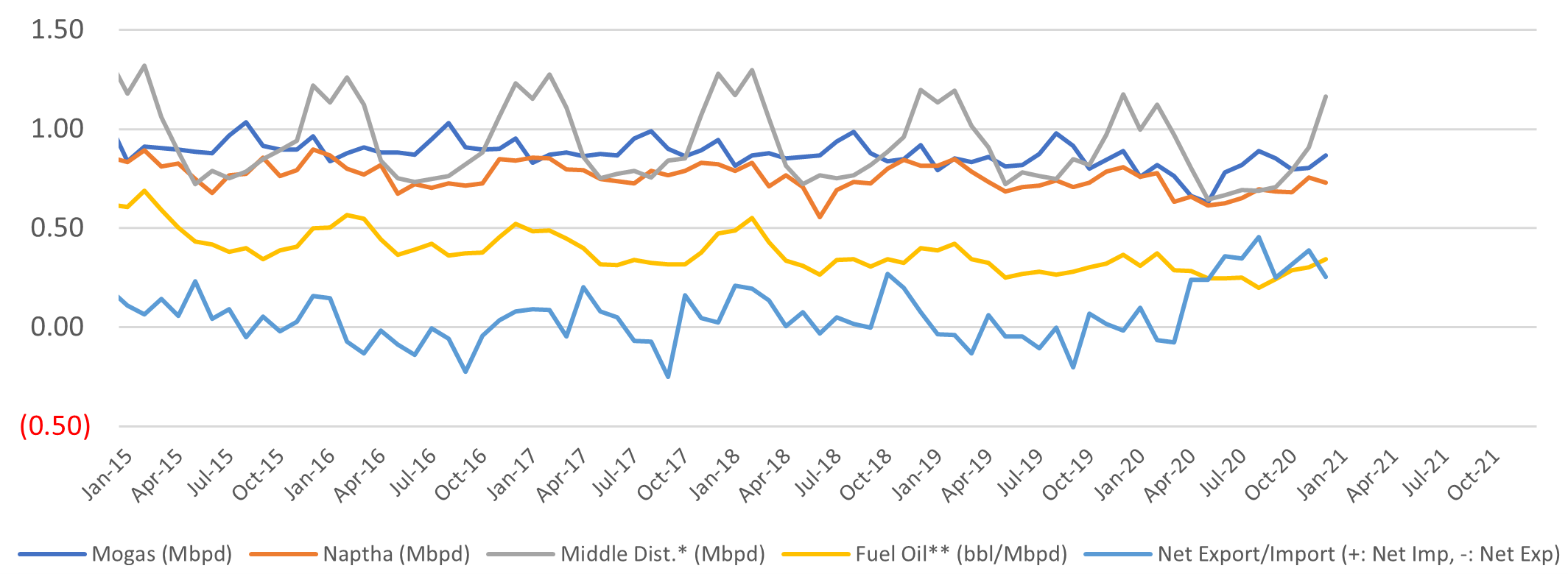
Domestic Fuel Sales
SOURCES: Ministry of Economy, Trade, and Industry (METI), Ministry of Finance, and the Petroleum Association of Japan
Japan LNG Price
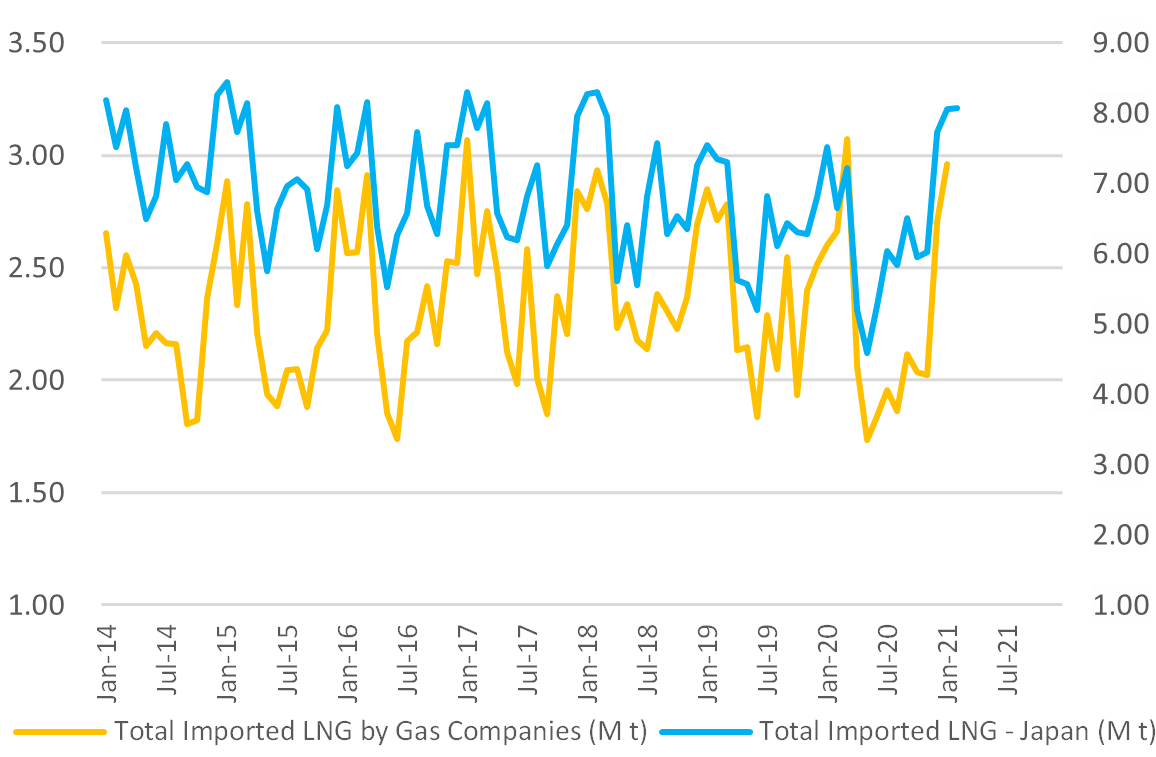
LNG Imports: Japan Total vs Gas Utilities Only
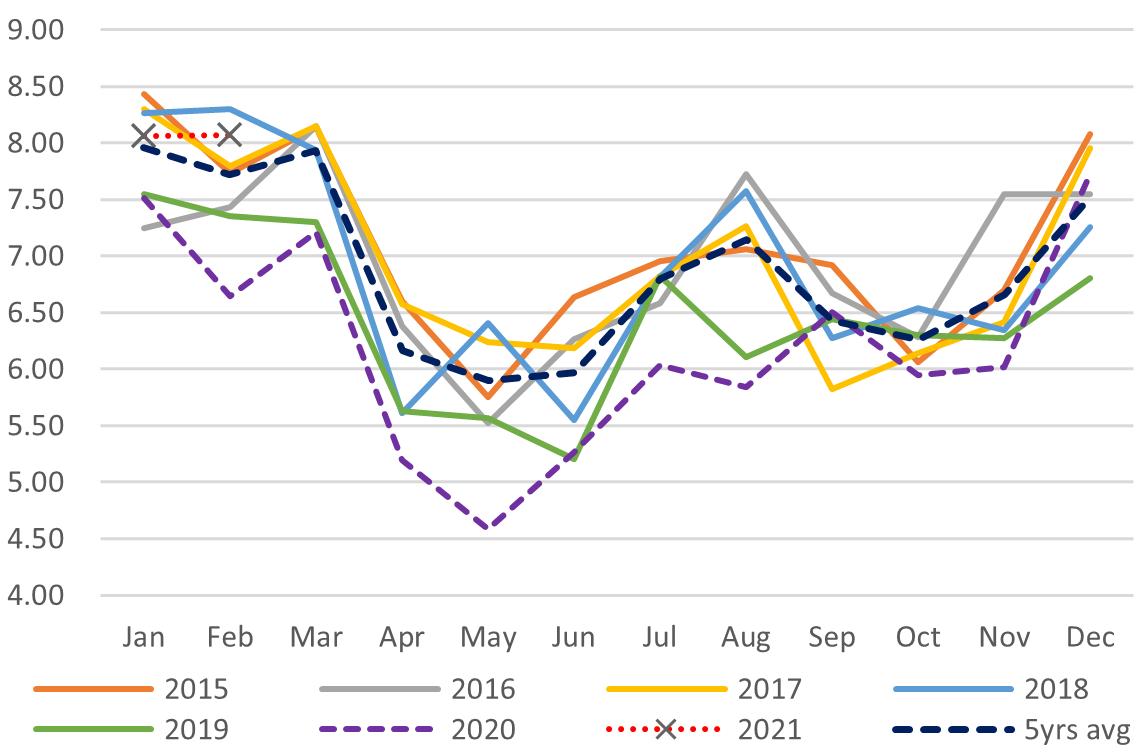
Total LNG Imports (M t)
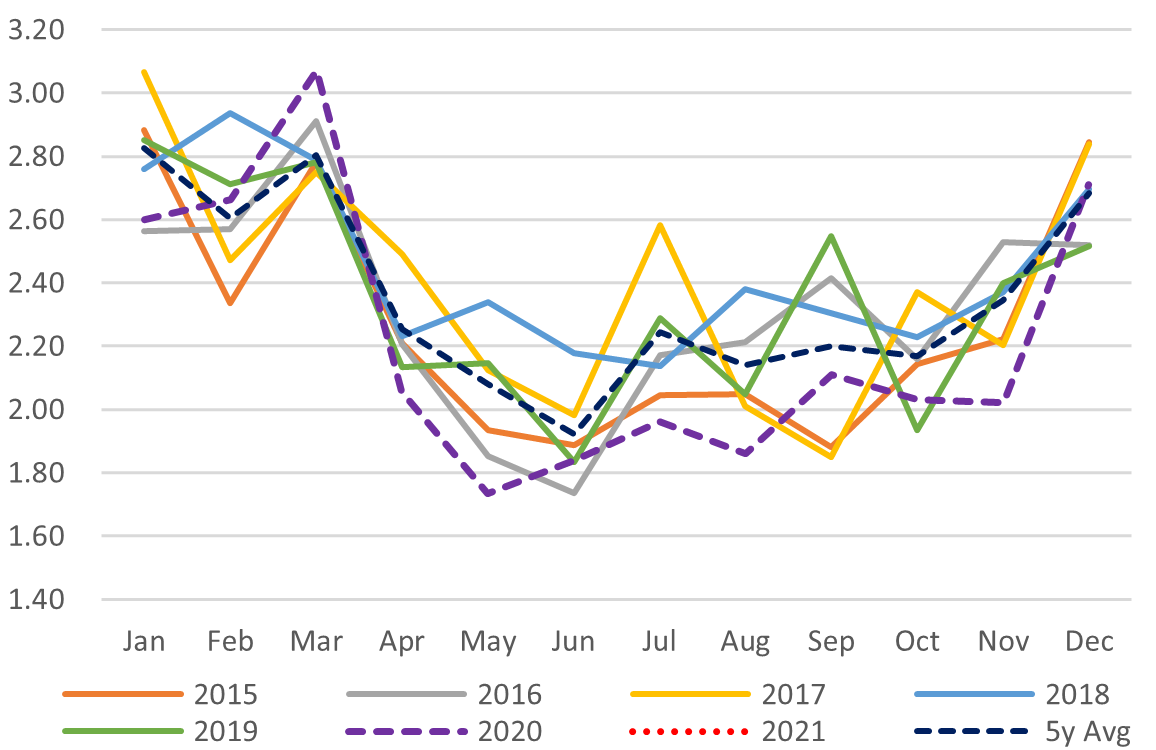
LNG Imports by Gas Firms Only (M t)
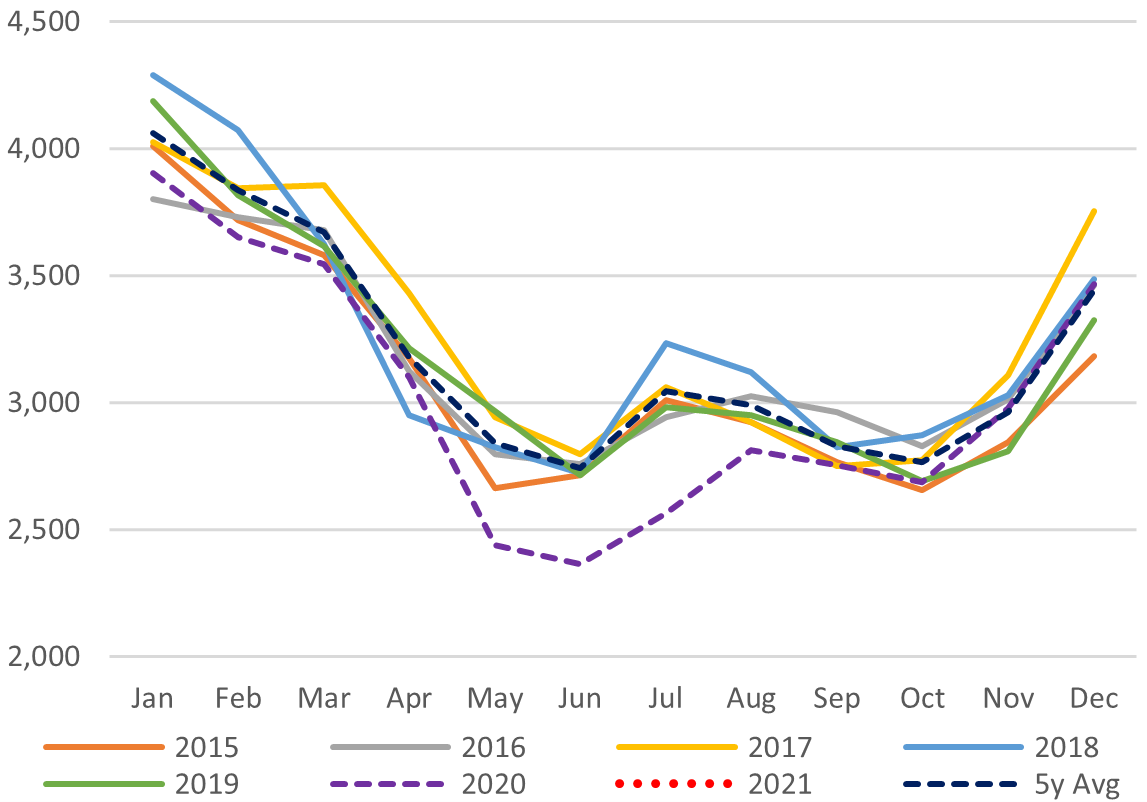
City Gas Sales – Total (M m3)
City Gas Sales by Sector (M m3)
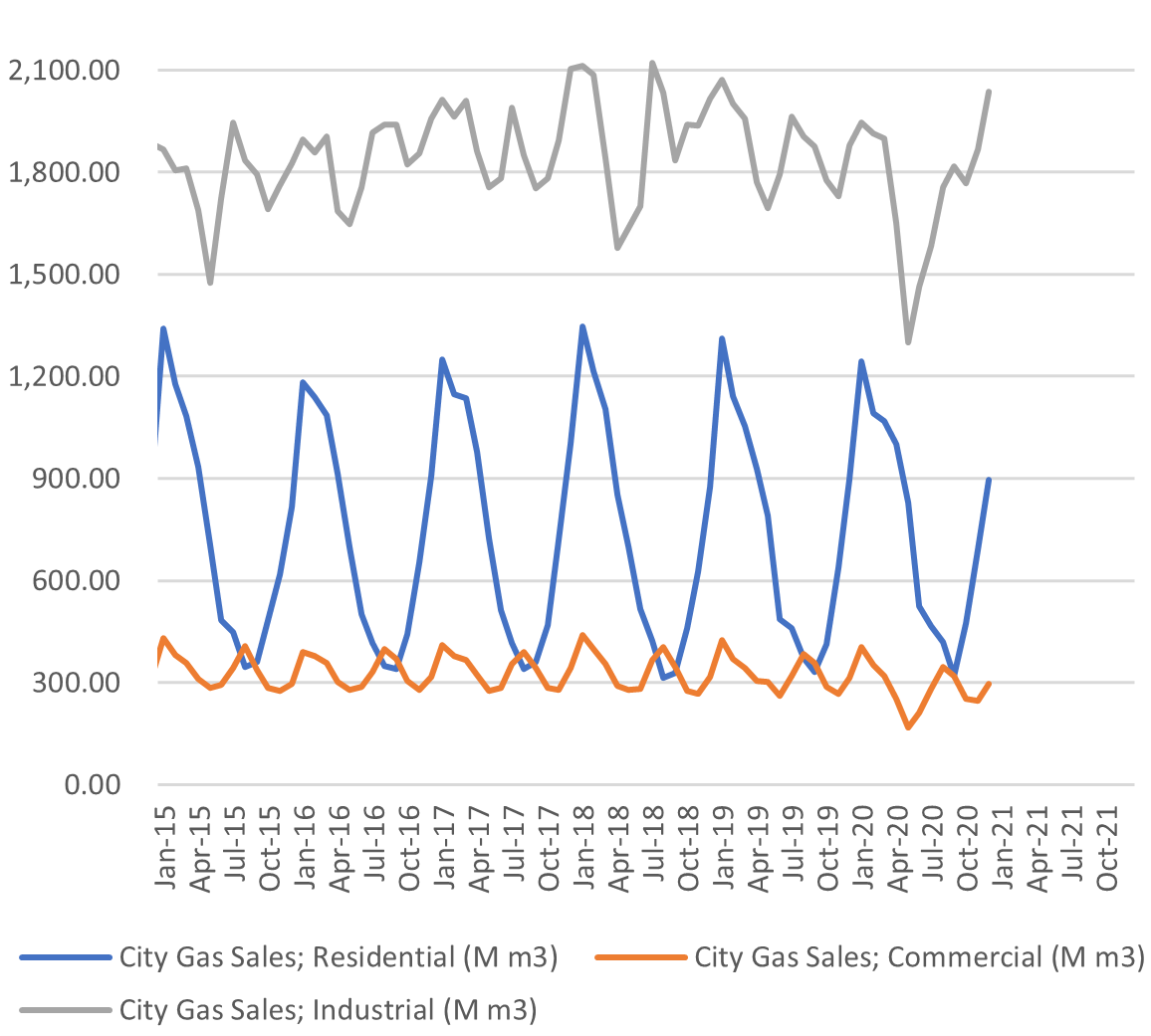
SOURCES: Ministry of Economy, Trade, and Industry (METI),
Ministry of Finance
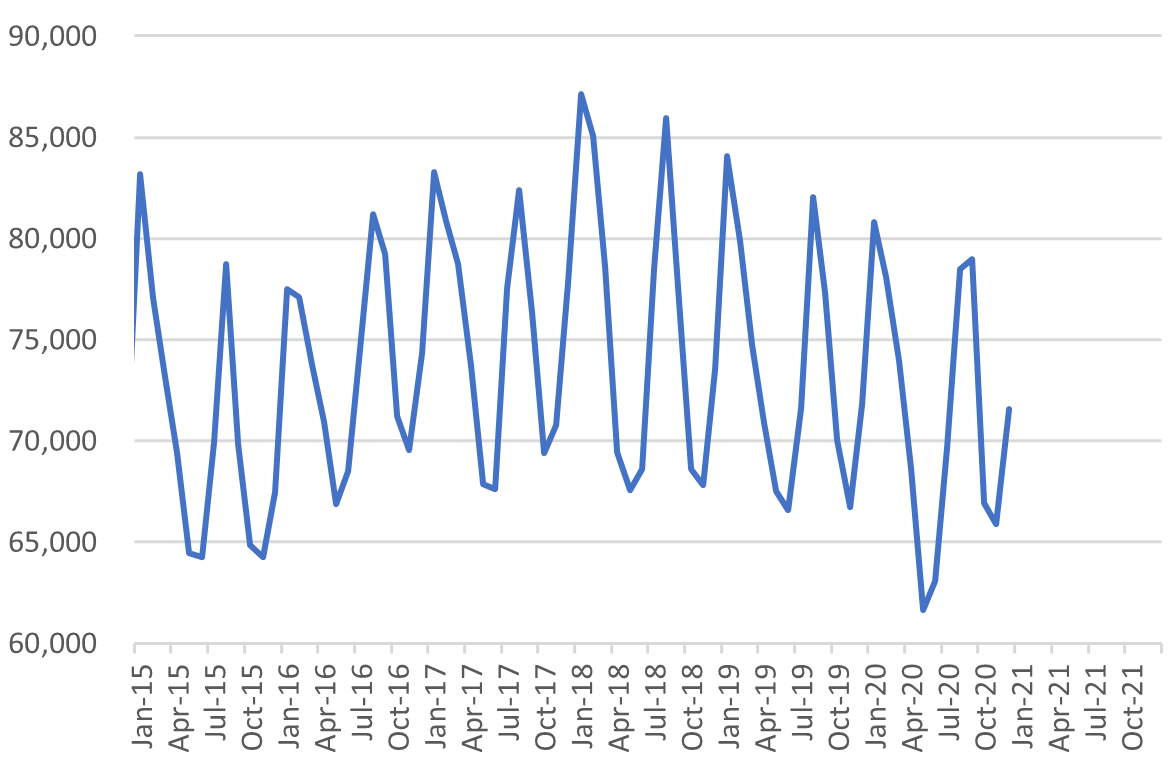
Japan Total Power Demand (GWh)
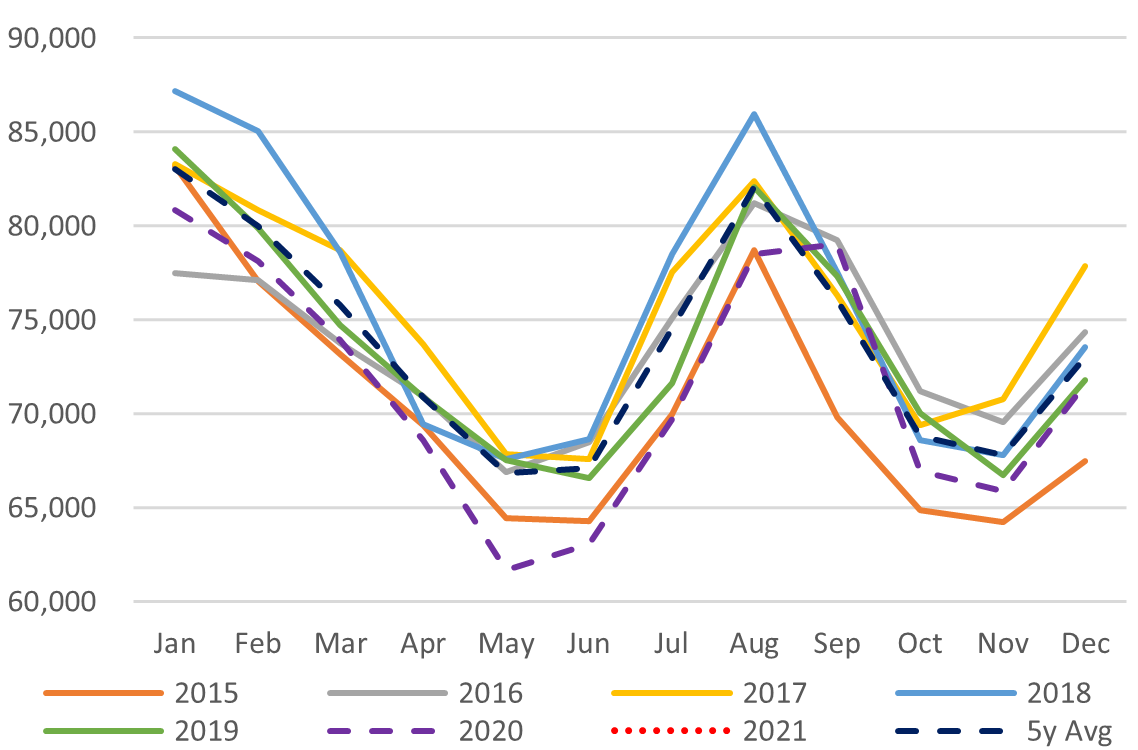
Current Vs Historical Demand (GWh)
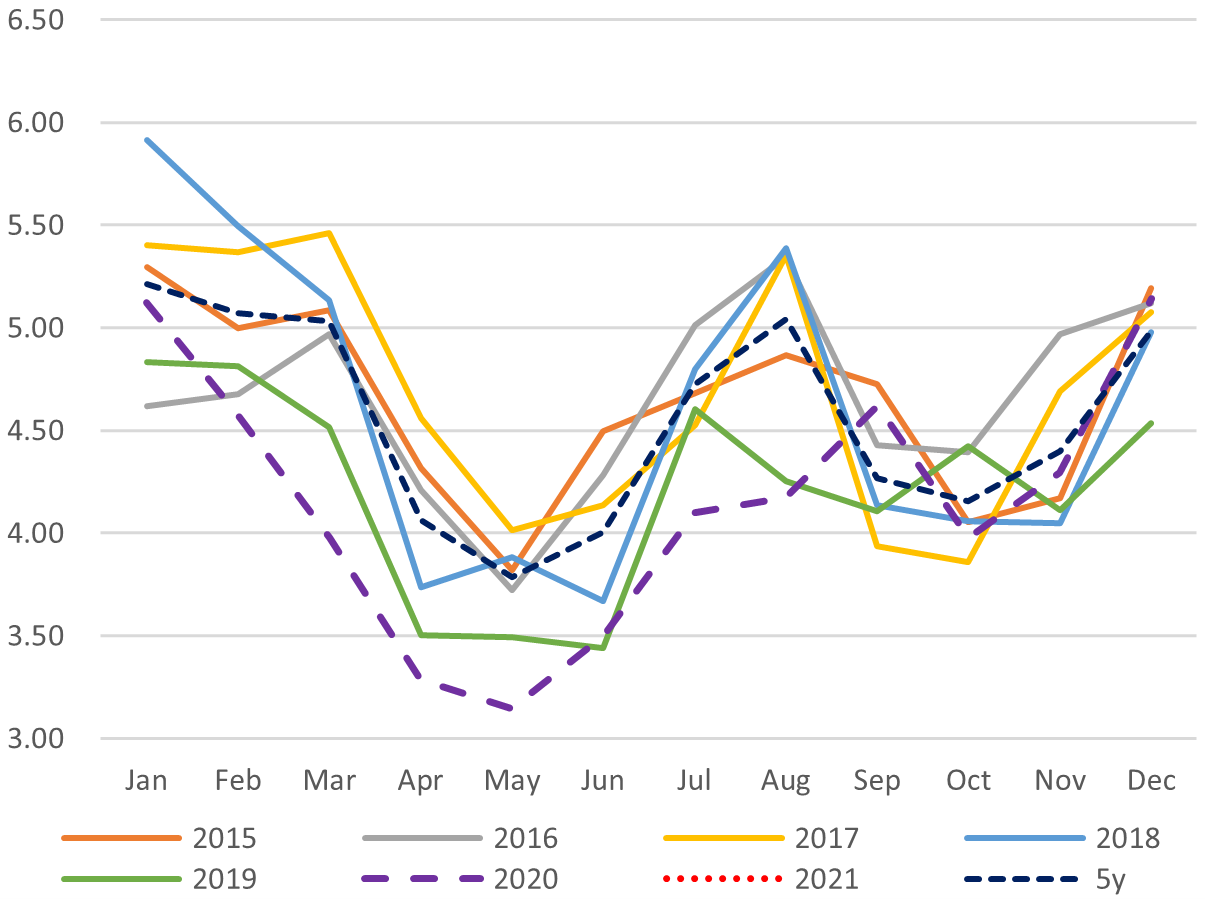
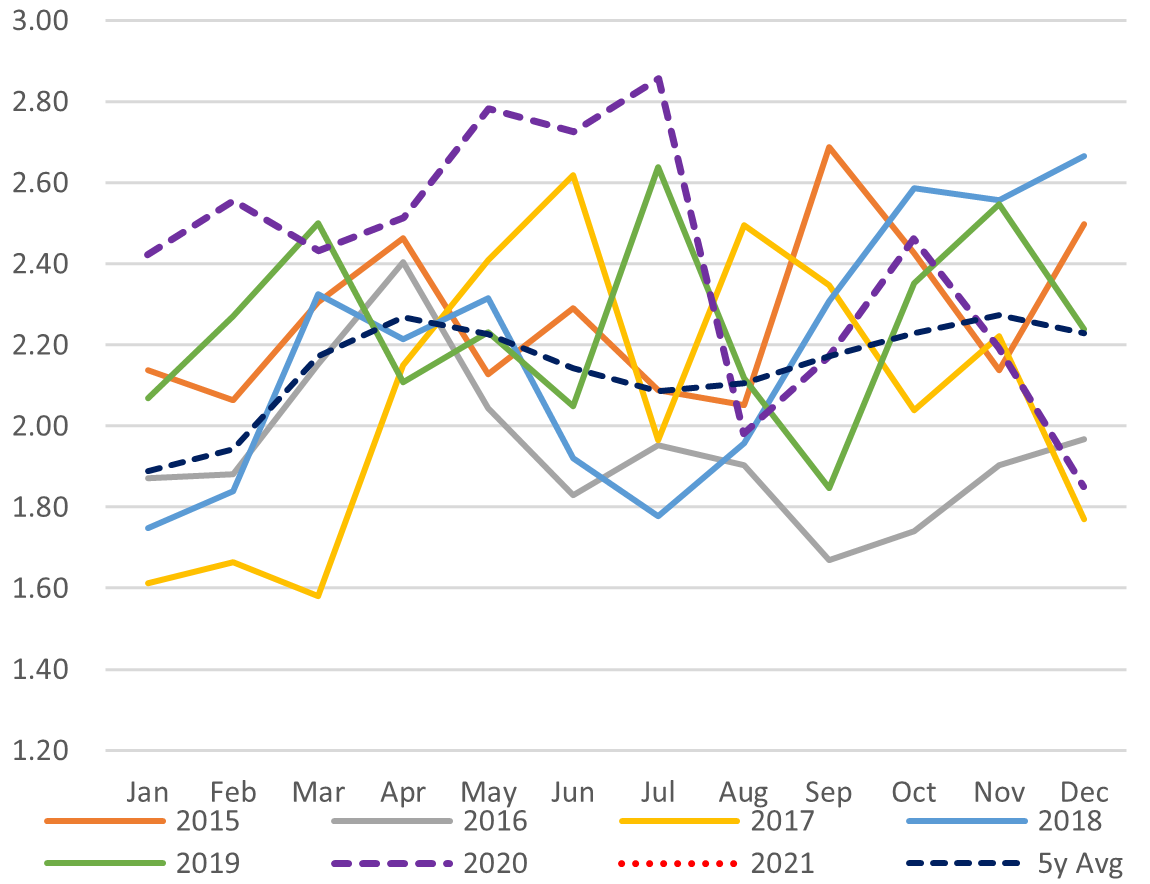
Day-Ahead Spot Electricity Prices
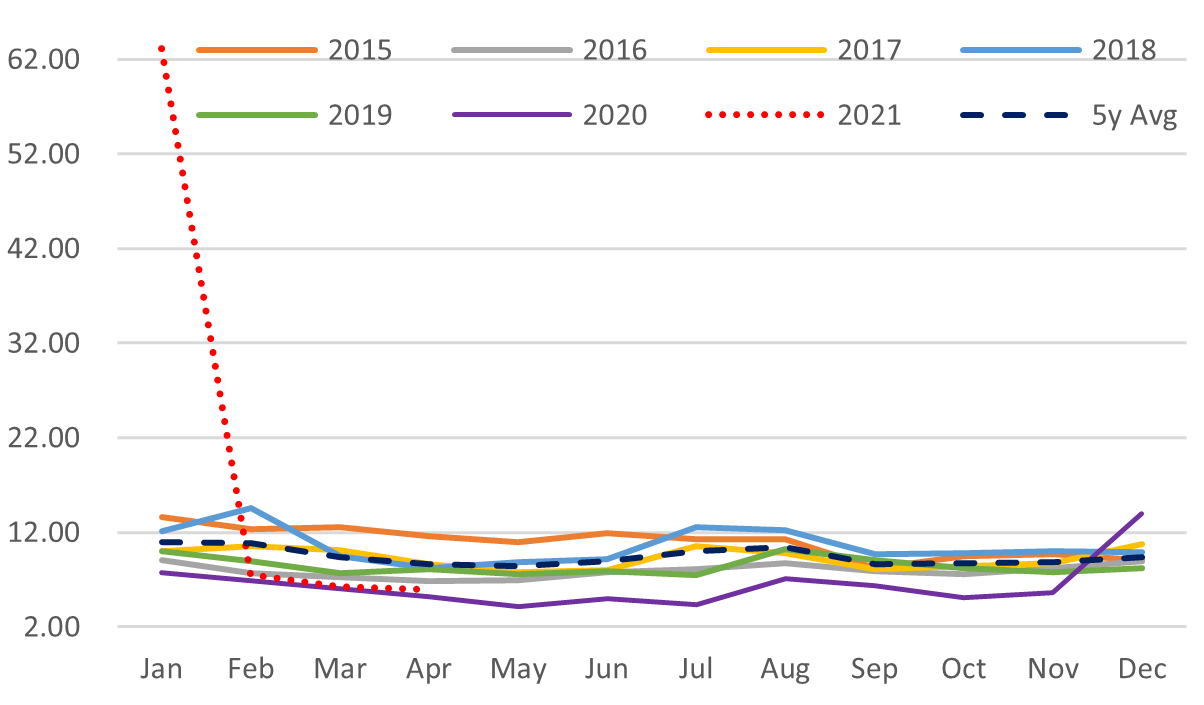
Day-Ahead Vs Day Time Vs Peak Time
LNG Imports by Electricity Utilities
LNG Stockpiles of Electricity Utilities
SOURCES: Ministry of Economy, Trade, and Industry (METI), and the Japan Electric Power Exchange
Disclaimer
This communication has been prepared for information purposes only, is confidential and may be legally privileged. This is a subscription-only service and is directed at those who have expressly asked K.K. Yuri Group or one of its representatives to be added to the mailing list. This document may not be onwardly circulated or reproduced without prior written consent from Yuri Group, which retains all copyright to the content of this report.
Yuri Group is not registered as an investment advisor in any jurisdiction. Our research and all the content express our opinions, which are generally based on available public information, field studies and own analysis. Content is limited to general comment upon general political, economic and market issues, asset classes and types of investments. The report and all of its content does not constitute a recommendation or solicitation to buy, sell, subscribe for or underwrite any product or physical commodity, or a financial instrument.
The information contained in this report is obtained from sources believed to be reliable and in good faith. No representation or warranty is made that it is accurate or complete. Opinions and views expressed are subject to change without notice, as are prices and availability, which are indicative only. There is no obligation to notify recipients of any changes to this data or to do so in the future. No responsibility is accepted for the use of or reliance on the information provided. In no circumstances will Yuri Group be liable for any indirect or direct loss, or consequential loss or damages arising from the use of, any inability to use, or any inaccuracy in the information.
K.K. Yuri Group: Oonoya Building 8F, Yotsuya 1-18, Shinjuku-ku, Tokyo, Japan, 160-0004.