
JAPAN NRG WEEKLY
APRIL 26, 2021
JAPAN NRG WEEKLY
April 26, 2021
NEWS
TOP
- Japan pledges to cut FY2030 emissions by 46% from FY2013; plan predicated on wider use of solar, energy saving, lower steel output, restart of nuclear plants, and other efforts; Ruling party committee says Japan will need to build new nuclear plants
- Erex plans to build Japan’s first hydrogen-fired power plant
- Energy Agency to create new renewable energy trading scheme
ENERGY TRANSITION & POLICY
- J-Power to convert one of its coal-fired power units to natural gas
- Toyota announces new EV lineup, aims for 25 EV models by 2025; Honda vows to sell only EVs and fuel cell cars by 2040; Nidec says auto market will double on cheap EVs; Toyota and Chevron form strategic alliance on hydrogen with an eye on fuel cell vehicles
- Tokyo Gas, Toshiba, Hitachi Zosen ally to develop wind turbines; GE to bring typhoon-resistant offshore wind turbines to Japan
- Suntory to half emissions by 2030 and set an internal carbon price
- Porsche will help drivers buy offsets for their carbon emissions
- Idemitsu trials lead acid batteries as a low-cost storage solution
- Japan Post, TEPCO to create quick EV charger network …[MORE]
ELECTRICITY MARKETS
- Federation pushes govt. to promote electrification and nuclear
- Kyushu Electric, Saibu Gas may jointly build LNG-fired plant
- Major power, gas companies to raise prices in June on LNG cost
- Work begins on one of Japan’s largest solar farms
- Takenaka to build geothermal power plant in central Japan
- Mitsubishi Chemical chair to take over same role at TEPCO
- Kansai Electric says won’t meet deadline for reactor upgrades
OIL, GAS & MINING
- Saibu Gas begins year-round shipping of LNG to China
- Japan targets Vietnam for first oil-sharing reserve deal in SE Asia
- JOGMEC’s plan for decarbonization includes a risk-money fund for LNG, financing for carbon-neutral mining, CCS and ammonia
- Toyo Engineering wins license to capture CO2 from “sour” gas
ANALYSIS
AS JAPAN LOOKS OFFSHORE FOR ENERGY, WATER OFFERS EVEN MORE POTENTIAL THAN WIND
Japan is betting a significant chunk of its new power generation capacity on energy potential that’s above the ocean. It might do better to invest below. The country’s territorial waters and Exclusive Economic Zone (EEZ) have an energy potential of 1,326 GW, according to state-sponsored research. That’s almost 30 times more than the size of Japan’s offshore wind program for the next two decades. After many delays, test projects in ocean energy are now underway. One group has even set a cost target for its floating ocean current turbine that would make it competitive with other renewable power sources.
JAPAN HAS CREATED A NEW ELECTRICITY MARKET; WHAT ROLE WILL THIS BALANCING MARKET PLAY?
This month a key new structure of Japan’s electricity market was rolled out. The balancing market seeks to address the emerging disparities and inefficiencies in Japan’s power since the industry’s liberalization. To date, the role of balancing the electricity network was fulfilled by power transmission companies. This has become more difficult and expensive of late with an increase in the volume of solar and wind power plants, which are non-dispatchable. In other words, operators of solar PV and wind farms cannot control the volume of power they will deliver on a given day, complicating the work of balancing power supply with demand. The advent of the balancing market is supposed to address this issue, as well as create more competition.
GLOBAL VIEW
Many countries pledge to cut emissions at the Earth Summit. Yet, this year’s emissions will jump aggressively. Exxon has a $100B plan for where to store those emissions. Saudi Aramco may sell stakes in its gas fields. Details on these and other stories in our global wrap.
2021 EVENT CALENDAR
DATA SECTION
JAPAN NRG WEEKLY
PUBLISHER
K. K. Yuri Group
Editorial Team
Yuriy Humber (Editor-in-Chief)
Tom O’Sullivan (Japan, Middle East, Africa)
John Varoli (Americas)
Regular Contributors
Mayumi Watanabe (Japan)
Daniel Shulman (Japan)
Takehiro Masutomo (Japan)
Art & Design
22 Graphics Inc.
Sponsored
SUBSCRIPTIONS & ADVERTISING
Japan NRG offers individual, corporate and academic subscription plans. Basic details are our website or write to subscriptions@japan-nrg.com
For marketing, advertising, or collaboration opportunities, contact sales@japan-nrg.com
For all other inquiries, write to info@japan-nrg.com
OFTEN USED ACRONYMS
METI The Ministry of Energy, Trade and Industry
ANRE Agency for Natural Resources and Energy
NEDO New Energy and Industrial Technology Development Organization
TEPCO Tokyo Electric Power Company
KEPCO Kansai Electric Power Company
EPCO Electric Power Company
JCC Japan Crude Cocktail
JKM Japan Korea Market, the Platt’s LNG benchmark
CCUS Carbon Capture, Utilization and Storage
mmbtu Million British Thermal Units
mb/d Million barrels per day
mtoe Million Tons of Oil Equivalent
kWh Kilowatt hours (electricity generation volume)
NEWS: ENERGY TRANSITION & POLICY
Japan pledges to cut FY2030 emissions by 46% compared with FY2013
- The announcement was made on April 22 as PM Suga attended the online Earth Summit, which was convened by U.S. President Biden.
- PM Suga went further to say that Japan will “strive” to hit 50%, even if its official pledge is 46%.
- This stimulated a vast amount of news coverage, looking at how Japan might be able to reach the new target, the complications, and the ramifications.
- Below is a selection of the most pertinent media angles, followed by our brief analysis.
Big focus on renewables, energy saving and nuclear restarts
(Nikkei, April 22)- At a press conference after the April 16 Japan-U.S. summit, PM Suga said the two countries would lead global efforts to decarbonize and had agreed to cooperate to fulfill their obligations under the Paris Agreement.
- With Europe pledging to cut emissions 55% by 2030 against 1990 levels, and the UK saying it will cut emissions 78% by 2035 against 1990 levels, some are calling for Japan to do even more.
- The big focus on cutting emissions will be on the energy industry, which accounts for 40% of Japan’s CO2.
- The government intends to restart nuclear reactors, increase electricity from renewable sources, and save energy to reduce the sector’s carbon footprint.
- SIDE DEVELOPMENT:
Ministers fight over emissions pledge as govt. data predicts only a 40% reduction
(Asahi Shimbun, April 23)- Suga stressed that tackling climate change would not limit economic activity, but would rather be a catalyst for resilient and long-term growth in the global economy.
- Government sources say the size of the target had yet to be agreed even just a day before the announcement.
- A bottom-up calculation of future reductions based on figures from related government agencies puts the actual expected reduction from Japan at close to 40% against FY2013 levels.
- Ultimately, the decision on what figure to announce was left to PM Suga.
- The announcement has highlighted differences in opinion between Suga, Environment Minister Koizumi, and METI Minister Kajiyama. While Koizumi welcomed the ambitious target, saying it would encourage private sector investors and businesses to maximize efforts, Kajiyama said the govt. will have to negotiate on what is possible with industry because businesses won’t comply with an arbitrary target.
- SIDE DEVELOPMENT:
Suga was prepared for 50% emissions cut, but Biden never asked
(Asia Nikkei, April 24)- At the two-and-a-half-hour meeting with Biden in the White House on April 16, Suga was surprised that the American president had not personally demanded a carbon emissions target from Japan.
- American climate envoy John Kerry earlier had urged Tokyo to aim for a 50% cut.
- Hours before the summit, METI Minister Kajiyama and MoE Minister Koizumi told Suga at the prime minister’s office that Japan could go as high as a 46% emissions cut.
- SIDE DEVELOPMENT:
Environment Minister Koizumi says the 46% number just “popped into my head”
(JNN News, April 24)- Minister says in a TV interview that the figure came to him in a haze and he saw the “silhouette” of the number 46.
- SIDE DEVELOPMENT:
Greenhouse gas reductions pledge based on wider solar usage ambitions
(Jiji, April 16)- The govt. hopes to achieve the 2030 target by constructing solar farms on disused farmland and installing more rooftop photovoltaic panels.
- Limited transmission capacity means the govt. will also be encouraging electricity users to generate their own solar power on site where possible.
- CONTEXT: Environment Minister Koizumi later even suggested that Japan should require homes and office buildings to have solar panels. The U.S. state of California began mandating the installation of solar panels on most new homes last year.
- SIDE DEVELOPMENT:
Cutting Japan’s steel production one of core strategies to reduce emissions
(Nikkei, April 24)- More solar, energy saving, and reducing Japan’s steel output are the pillars of the government strategy to reduce emissions by FY2030.
- Wind power is expected to play a role later, with solar seen as more likely to contribute to the FY2030 target.
- SIDE DEVELOPMENT:
Ruling party committee pushes government to consider new nuclear plants
(Nikkei, April 23)- Hosoda, chairman of the ruling Liberal Democratic Party’s Parliamentary Assembly for the Promotion of Stable Power Supply, and others lobbied Chief Cabinet Secretary Kato to change the government stance on nuclear power. At present, building new nuclear plants is not part of the government’s decarbonization.
- Lawmakers argued that nuclear power needs to be utilized more and new plants have to be built to replace aging facilities.
- The current government target has nuclear power at 20% to 22% of the energy mix in FY2030. Hosoda and others said this should be raised higher in the new plan due this summer.
- On the same day, Secretary-General of Komeito, the junior partner in the ruling coalition, also showed support for nuclear development.
- SIDE DEVELOPMENT:
Japan’s defense minister says global warming will hurt Self-Defense Forces
(Nikkei, April 23)- Defense Ministry Kishi acknowledged that the rise in sea level due to global warming would reduce territory and “intensify conflicts between territory and natural resources.” He expressed concern that increased disaster response “may adversely affect the capabilities of the Self-Defense Forces.”
- Climate change is impacting regional stability, and Japan’s defense authorities will step up their response, the minister said.
- SIDE DEVELOPMENT:
Top business lobby group asks govt. to take lead on policy, not follow Western rules
(Organization’s statement, April 23)- Keidanren, the top business lobby group in Japan, issued a statement from its chairman Nakanishi, who is also the chairman of Hitachi Ltd.
- The statement supported the govt. in tackling climate change but also asked for Japan to mobilize policy resources “commensurate with the ambitions of the goal”, and also to set policies that work for Japan and are not “subordinated to America and Europe”.
- SIDE DEVELOPMENT:
Japan Climate Initiative calls for accelerated phase out of coal in favor of renewables
(Organization’s statement, April 23)- CONTEXT: JCI was established in 2018 by over 100 Japanese companies, local governments, research institutions and NGOs. Its members have increased more than fivefold since then and include some of Japan’s biggest companies. It is also supported by the Renewable Energy Institute (REI) of Japan.
- The organization said Japan as a developed economy had to commit to at least a 45% emissions reduction, and preferably more.
- It called for the government to urgently phase out coal and make a stronger commitment to introducing more renewable energy.
- SIDE DEVELOPMENT:
Japan’s lofty climate pledge demands radical energy innovation
(Asia Nikkei, April 23)- A sober look at the challenges of decarbonization.
TAKEAWAY: Stories in the week or so leading up to the announcement varied on what Japan’s final GHG reduction percentage will be. They ranged from 40% to 50%. That’s a large range and indicates how fraught the negotiations were inside the Japanese government. In the end, PM Suga decided to meet President Biden almost in the middle even as if verbal caveat promised more. Should PM Suga be unable to secure a new term in office after his current one ends this autumn, that “bonus” promise of a 50% reduction will mean little.
Most of the big announcements at the Earth Summit did not carry details, and that in of itself is not strange. However, in the coming weeks Japan’s businesses will want to hear PM Suga’s plan for how to execute an accelerated decarbonization strategy.
As the much more conservative comments from METI Minister Kajiyama indicate, we should not assume that all companies are on-board with the idea or that they have a sense of how to implement the government’s new targets. Last month, the top business groups of the Kansai region, Japan’s top industrial heartland after Tokyo, said a greater shift to renewables “must be strongly avoided” because it will mean a jump in power prices and it will ruin the competitiveness of domestic industry.
Perhaps it’s too easy to note that the 46% GHG reduction doesn’t match the government’s current plan for the nation’s 2030 Energy Mix. This will be revised in the summer and will almost certainly see renewables’ share increased to at least 40%. Nuclear will likely remain at the currently envisioned 20% level. Some media reports say ammonia / hydrogen will account for 1% of the new electricity mix, but it should surely be more to make a dent in the CO2 numbers.
Still, boosting renewables to 40% and more won’t be simple. It will require an overhaul of the grid system –technically, operationally, and economically – and a similar scale revolution in the country’s land legislation. The latter is a highly political matter and unlikely to proceed smoothly.
Meanwhile, the elephant in the room remains Japan’s 150 coal-fired power units. There has been much talk of closures. There has been much discussion about switching thermal generation to run on ammonia or hydrogen. However, that transition was initially planned over a course of two decades or more. The new accelerated emissions target suggests the transition also needs to accelerate.
Perhaps the biggest winners in the short-term will be those retailing carbon credits. That market is already growing rapidly. Now, it will surely explode.
Erex and a Tokyo startup to build Japan’s first hydrogen-fueled power plant
(New Energy Business News, April 23)
- Erex Co., an independent power company, has signed and MoU with Tokyo-based startup Hydrogen Technology to develop hydrogen-fired generation and produce hydrogen for fuel cells vehicles (FCVs).
- The two will work on hydrogen-only combustion and build a 360 kW test plant in Yamanashi prefecture to start operation during FY2021. An application to TEPCO Grid for connection has already been made.
- The companies aim to develop larger hydrogen-fired power plants once the test scale station proves economically viable.
- If commercial operation of the hydrogen-fired power plant commences, it will be the first in Japan.
TAKEAWAY: In future, Erex sees the hydrogen power plants business scaling to 50 MW or 100 MW stations that can generate power at less than ¥20/ kWh. The question is how soon that future is possible. From the Erex side, the expectation is that such ambitions can be met within five years. One premise is that winning large power contracts with big users that want CO2-free electricity will help bring down the price. Erex’s shareholders include Taiyo Cement and Sumitomo Real Estate. Both of these would benefit from lowering their operating business emissions. And yet, the best catalysts for the hydrogen-powered electricity business will likely be the introduction of a carbon price. Without it, other renewables options look more attractive.
Energy Agency to create renewable energy trading scheme
(Japan NRG, April 15)
- The Agency for Natural Resources and Energy will revamp the current scheme for trading “non-fossil value certificates”, and create a new scheme that enables businesses to trade “renewable energy value certificates”.
- The current scheme is under-utilized, partly because it is only open to electricity retailers. Corporations lobbied the government to change this.
- Under the new scheme, major corporations can also trade certificates for electricity sold and purchased under the feed-in tariff scheme.
- The Agency has yet to determine the requirements for participating in the scheme. Corporations may need to demonstrate annual energy usage above a certain threshold, or be a member of RE100 or a similar platform.
- The new trading scheme may impact carbon credit prices.
- SIDE DEVELOPMENT:
Japan looks to redesign capacity auctions
(Japan NRG, April 15)- Capacity of main auction to be reduced by 2%.
- Dominant operators to be subject to surveillance two months before auctions.
- For the next two years, winner names and their total capacities to be disclosed; winner of each power segment will be disclosed.
J-Power to convert Nagasaki coal power plant to gas
(New Energy Business News, April 20)
- J-Power has begun the environmental assessment process to convert Unit 2 at its Matsushima thermal power plant in Nagasaki to natural gas.
- Unit 2 currently burns coal and is rated at 500 MW.
- J-Power will use integrated gasification combined cycle technology to convert coal to syngas, which will be used to power a gas turbine. Waste heat from the turbine will then be used to power a steam turbine.
- The modifications are scheduled to begin in 2024 and the modified unit will begin operating in 2026/27.
Toyota announces new electric vehicle lineup
(New Energy Business News, April 21)
- Toyota recently unveiled the Toyota bZ4X concept vehicle at the Shanghai Motor Show, bringing it one step closer to its goal of manufacturing a full lineup of electric vehicles.
- The bZ will be sold in China, the U.S., Europe and other markets with high demand for electric vehicles or plentiful renewable electricity.
- Toyota aims to have 15 electric models on the market by 2025.
- SIDE DEVELOPMENT:
Honda pledges to sell only EVs and FCVs globally by 2040
(Nikkei, April 23) - SIDE DEVELOPMENT:
Nidec forecasts auto demand will double on cheap EVs
(Asia Nikkei, April 22)- Growth of the EV market will be led by smaller cars and Chinese sales, and this will more than double the auto market, according to the president of Nidec, the world’s largest maker of electric motors.
- SIDE DEVELOPMENT:
Toyota and Chevron form strategic alliance around hydrogen
(Company statement, April 21)- Chevron and Toyota Motor announced an MoU to explore a strategic alliance to catalyze and lead the development of commercially viable, large-scale businesses in hydrogen.
- Chevron and Toyota are seeking to work on three main strategic priorities: collaborating on hydrogen-related public policy measures that support the development of hydrogen infrastructure; understanding current and future market demand for light-duty and heavy-duty fuel cell electric vehicles and supply opportunities for that demand; and exploring opportunities to jointly pursue research and development in hydrogen powered transportation and storage.
Tokyo Gas, Toshiba, Hitachi Zosen partner to develop Japanese wind turbines
(Various, April 21)
- Toshiba Energy Systems, Hitachi Zosen, Tokyo Gas, Japan Renewable Energy and Kyushu University signed a research agreement for the development of Japanese wind turbine technologies.
- Kyushu University’s research is focused on assessing the commercial viability of large offshore wind farms and turbine wake dynamics.
- In addition to field testing and wind tunnel testing, the University also uses supercomputers to model wake dynamics and determine optimum turbine configurations. Exposure to the wake from upwind turbines results in decreased electricity output, and in some cases turbine malfunction.
- Tokyo Gas will be in charge of wind tunnel experiments, numerical simulations, and wind condition measurement verification at wind farms.
https://www.nikkei.com/article/DGXZQOUC14EJN0U1A410C2000000/ - SIDE DEVELOPMENT:
GE develops typhoon-resistant offshore wind turbines eyeing Japan market
(Nikkei, April 23)- GE has for the first time developed typhoon resistance for its large offshore wind power turbines which it plans to introduce to the Japanese market.
- GE hopes to offer them for offshore wind power projects in the waters off Akita and Chiba prefectures, where the deadline for project bids is May.
- The resistance factor would allow power companies to plan wind farms in areas where typhoons are known to pass.
- The turbines are 248 meter high and 12 MW in capacity.
Suntory to halve greenhouse gas emissions by 2030
(Kankyo Business, April 21)
- Suntory Holdings said it would increase its target for greenhouse gas reductions to 50% by 2030, versus 2019 levels.
- This represents a significant increase from the corporation’s former target of a 25% reduction by 2030 versus 2015 levels.
- Toward this end, Suntory will progressively roll out internal carbon pricing across its organization.
- Suntory already packages some of its products in recycled plastic bottles. The corporation plans to expand its use of recycled plastic.
Porsche Japan launches scheme to allow drivers to buy own carbon offsets
(Kankyo Business, April 21)
- Porsche Japan said on April 17 it was introducing a scheme known as “Porsche Impact” that lets Porche owners offset their carbon emissions. Drivers participating in the scheme are billed for carbon offsets based on their car’s fuel consumption and how far they have travelled.
Idemitsu trialing lead acid batteries as low-cost storage solution
(Smart Japan, April 21)
- Idemitsu Kosan subsidiary SI Energy said that it was collaborating with Iguazu to trial a low-cost energy storage solution that used recycled lead acid batteries.
- The trial will utilize post-market emergency backup batteries, and will leverage Iguazu’s experience with reconditioning used forklift batteries.
- SI Energy and Iguazu say they aim to offer renewable energy generators low-cost storage solutions for one tenth the cost of lithium-ion batteries.
Japan Post and TEPCO to develop quick EV charger network in rural Japan
(Jiji, April 23)
- Japan Post and TEPCO formed a partnership to promote “carbon neutrality”, including by developing a network of 1,100 quick chargers for electric vehicles (EVs) at post office collection stations in local areas.
- The Post Office will also aim to switch its power source to renewable energy and utilize solar power generation.
Toyota CEO as the antiestablishment rebel of today
(FACTA, May 2021 edition)
- Saigo Takamori is a historical figure known for leading a war with the government that he had no intention to start. He ended up being a magnet for all those who rebelled against the rulers and had no place to run. Toyota President Toyoda finds himself in a similar position.
- PM Suga has said pro-climate legislation is not a break on economic growth. He promised tremendous growth by triggering changes in industrial structures and society. However, the auto and steel sector won’t simply not and accept several trillion yen of investments they will now need to embark on.
- Toyoda has said “the business models of the auto industry will collapse” if the government sets a policy to get rid of gasoline vehicles by 2030. Moreover, Toyoda says “just transitioning to EV does not reduce CO2” because it depends on how the electricity is produced.
- Toyoda ran TV ads during the New Year’s break to stress that the auto industry employs 5.5 million people and pays ¥15 trillion to the country in taxes. His message was: if the country doesn’t allow for a smooth transition 5.5 million people will lose their job but the emissions won’t go down either.
- Currently, Japan’s auto industry is working on a new synthetic fuel based. Last December, this R&D was set up as a special project. Part of tis aims is to develop gasoline and diesel engines that can run on the new fuel.
- Commercialization of this new e-fuel is set for after 2030, but according to a specialist this current fuel has very low manufacturing efficiency and it’s hard to secure hydrogen for it.
- Most likely, hydrogen powered vehicles and e-fuel development will collapse as the EV wave takes over. Where Toyoda and his 5.5 million troops will go is uncertain.
The ruling part of Japan has lawmakers who strongly oppose nuclear energy
(FACTA, May edition)
- CONTEXT: This article profiles one of the up-and-coming lawmakers in the ruling party, the LDP and shows that he is vociferously against nuclear power, which puts him at odds with the party’s position on the matter. This is his website.
- The No.1 anti-nuclear man in the LDP is Akimoto Masatoshi. The lawmaker held a reception for his newly published book “A first inside the LDP: Declaring for a country without nuclear”. This caused enough of a stir that METI minister Kajiyama wanted the event stopped and party secretary general Nikai were asked to intervene.
- Akimoto is a member of the “zero nuclear” group in parliament. Senior Cabinet minister Kono Taro is also a member.
- While Kono has not been publicly speaking out against nuclear recently, Akimoto is understood to be speaking on his behalf.
- Kono is a very likely candidate to be the next prime minister. If he does, Akimoto is certain to be in line for a senior government role.
NEWS: POWER MARKETS
| No. of operable nuclear reactors | 33 | |
| of which | applied for restart | 25 |
| approved by regulator | 16 | |
| restarted | 9 | |
| in operation today | 7 | |
| able to use MOX fuel | 4 | |
| No. of nuclear reactors under construction | 3 | |
| No. of reactors slated for decommissioning | 27 | |
| of which | completed work | 1 |
| started process | 4 | |
| yet to start / not known | 22 | |
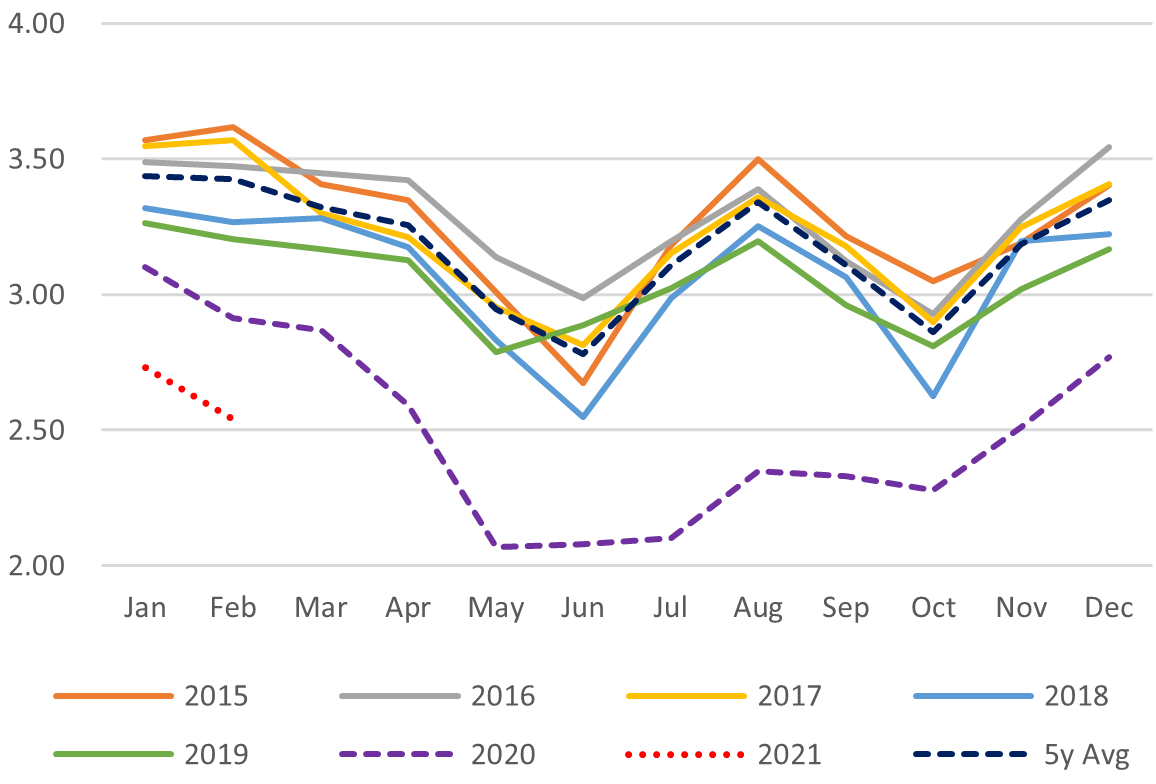
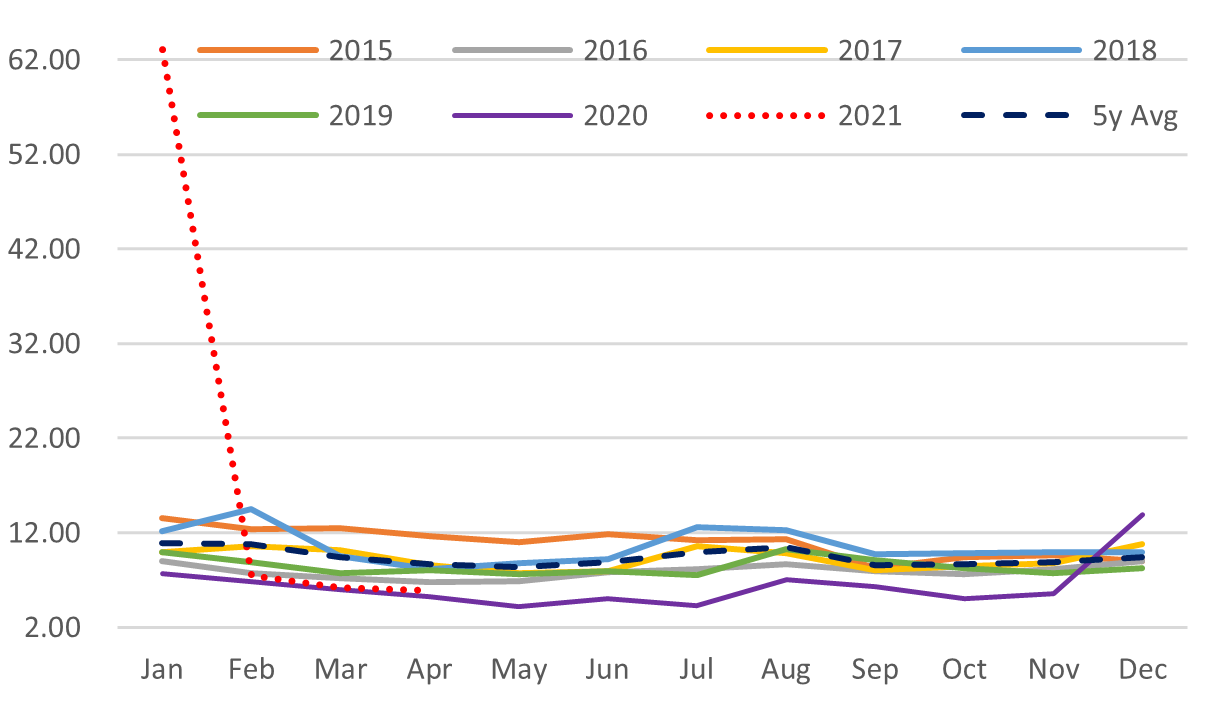
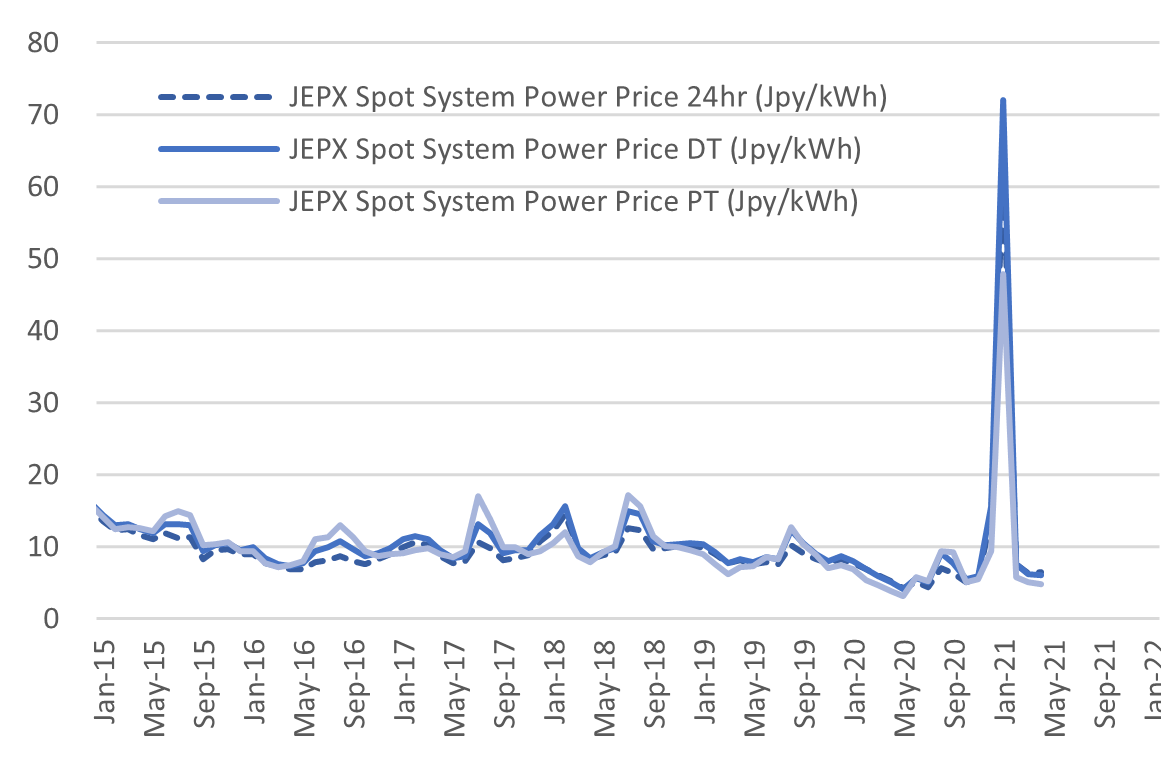
Spot Electricity Prices, Monthly Avg.
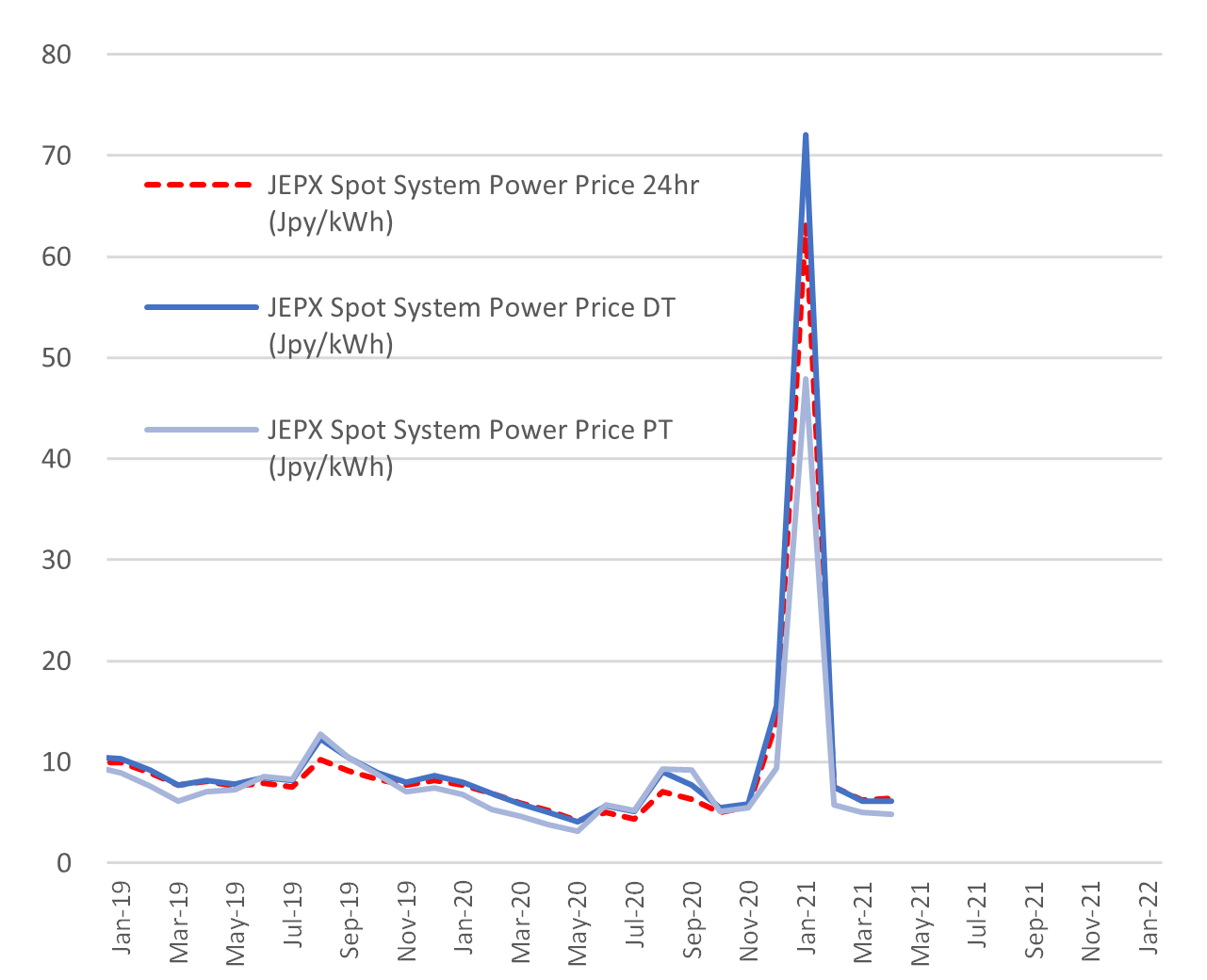
Source: Company websites, JANSI and JAIF, as of April. 16, 2021
Federation calls on government to promote electricity and be upfront about nuclear plans
(Denki Shimbun, April 19)
- On April 16, Ikebe Kazuhiro, Chair of the Federation of Electric Power Companies of Japan, said that in order to achieve its target of carbon neutrality by 2050, the govt. should promote both decarbonization and the conversion of non-electric infrastructure to run on electricity.
- Stressing the need to maintain Japan’s nuclear industry, Ikebe called on the government to articulate its plans for nuclear power as soon as possible.
- Ikebe said that by 2030, between 20 and 22% of Japan’s electricity should be sourced from nuclear power stations.
- Ikebe also called for a progressive transition to greener forms of thermal power generation.
- Commenting on a recent raid of three power companies on suspicion of collusion, Ikebe said cartel behavior was unacceptable in any industry and said that reports of cartel behavior were unfortunate.
Kyushu Electric and Saibu Gas may jointly build LNG-fired power plant in Japan
(Nikkei, April 20)
- Kyushu Electric and Saibu Gas began talks to partner up on an LNG-fired power station adjacent to Saibu’s Hibiki LNG terminal in Kita-Kyushu.
- Saibu’s original plan was to build four units at the power station with a total capacity of 1.68 GW, but that was derailed by Kyushu Electric’s restart of its nuclear reactors, which alleviated the need for new thermal capacity.
- The international trend toward decarbonization has forced Kyushu Electric to explore alternatives to coal-fired electricity generation.
- While the two companies compete in electricity and gas retailing, they’ll cooperate on this power generation project that’s due to start in 2025.
TAKEAWAY: Kyushu is one of the most over-supplied regions for electricity in Japan thanks to its strong solar sector and its nuclear reactors, all four of which have restarted and are in operation. The LNG station could only work as a replacement for Kyushu Electric’s coal-fired generation. But, the time scale of the development makes this plan somewhat tenuous at this stage.
Japan’s major power and gas companies to raise prices in June on LNG costs
(Mainichi Shimbun, April 20)
- All 10 major electric power companies are expected to raise their household electricity prices in June. This is due to a rise in the average import price of LNG and coal used as fuel for thermal power generation.
- Four major city gas companies are also expected to raise prices in response to rising LNG and LPG procurement costs.
- Okinawa EPCo plans the biggest price hike of regional power utilities. Kyushu Electric and Kansai Electric will have the least increase
- CONTEXT: Kyushu EPCo and Kansai EPCo are the only Japanese utilities that currently operate nuclear power plants.
Work begins on one of Japan’s largest solar farms
(Gas Energy Shimbun, April 19)
- Renewable energy developer Juwi, a member of the Shizen Energy Group, said on April 8 that it had commenced work on the Azuma Kofuji Dai-Ichi solar farm in Fukushima.
- The farm will be Japan’s largest, with a capacity of around 100 MW on a 186-hectare site.
- The projected annual output of 110 GW hours is enough to supply over 30,000 households.
- Electricity generated will be sold to the Tohoku Electric Power Network for ¥36 per kilowatt hour under the feed-in tariff system.
Takenaka to build geothermal power plant in Gifu
(Nikkei, April 21)
- Major construction company Takenaka said on April 20 that it will participate in the construction of a geothermal power plant in Hida, Gifu as part of an alliance with the local thermal spring association.
- Takenaka is the latest major construction company to enter the geothermal power market, which is seen as having good long-term growth prospects.
Mitsubishi chemical and ex-business lobby chief likely to be TEPCO chair
(Kyodo, April 22)
- Tokyo Electric (TEPCO) plans to invite Kobayashi Yoshimitsu (74) as its new chairman. Final checks with the government about the appointment are taking place. The government owns a controlling stake in TEPCO since the company was bailed out after the 2011 Fukushima disaster.
- Kobayashi is the former head of Japan Association of Corporate Executives, a major business lobby group. He is also chairman of Mitsubishi Chemical Holdings
- Kobayashi would face numerous issues at the company, whose nuclear business is in tatters following an effective ban by Japan’s nuclear watchdog on restarting its largest facility, the Kashiwazaki-Kariwa plant in Niigata Prefecture, due to safety flaws.
- TEPCO also needs to step up efforts toward decarbonization and address local opposition to the government’s recent decision to release, in small amounts, treated radioactive water accumulating at the Fukushima Dai-Ichi nuclear complex into the Pacific Ocean.
- Former TEPCO Chairman Kawamura Takashi left the post in June last year and the seat has been vacant since.
- SIDE DEVELOPMENT:
South Korean group sues TEPCO over planned Fukushima water discharge
(Shikoku Shimbun, April 23)- A Busan-based residents group said it filed a petition with the Busan District Court calling for TEPCO to be prohibited from discharging treated water stored on the site of the Fukushima Daiichi nuclear power plant into the sea.
- The group says if discharged, radioactive water would reach Busan and contaminate fish and shellfish.
- Legal counsel for the group says the residents decided to pursue legal action because it was the only option available to them.
Kansai Electric says won’t meet deadline for upgrades at Takahama reactors
(Jiji, April 22)
- Kansai Electric said the completion of anti-terrorism facility upgrades at Units 1 and 2 of its Takahama NPP won’t meet the June 9 deadline. The utility currently lists the expected date for completion as “undecided”.
- Units 1 and 2 are in cold shutdown due to work on the upgrades and facility inspections.
Mitsui & Hokutaku launch wind turbine maintenance venture
(Kankyo Business, April 19)
- Hokutaku, Japan’s largest wind turbine maintenance provider, announced it’s entering into a partnership with Mitsui & Co that will see the establishment of a new entity, Horizon Ocean Management.
- Mitsui holds the controlling stake in the new company, which will undertake all aspects of wind farm maintenance and inspection.
NEWS: OIL, GAS & MINING
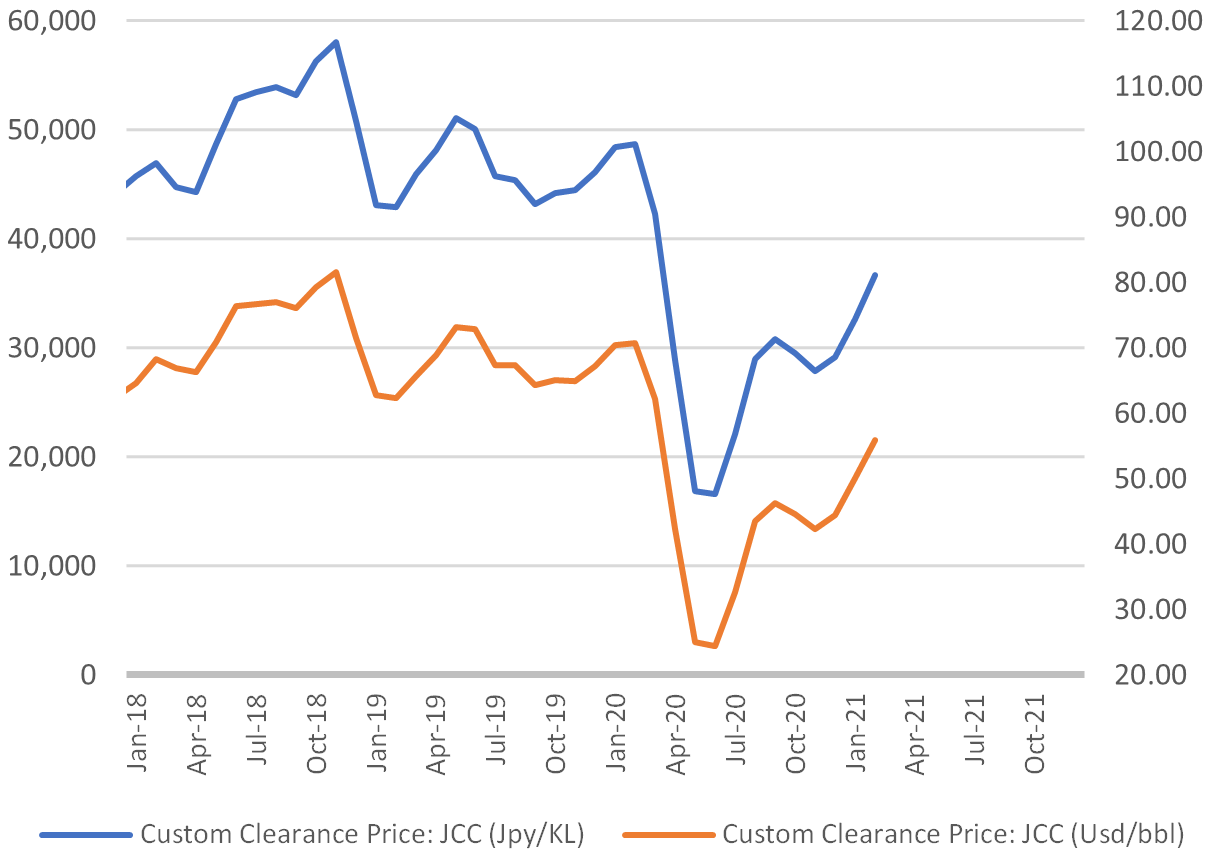
Japan Oil Price: $55.80/ barrel
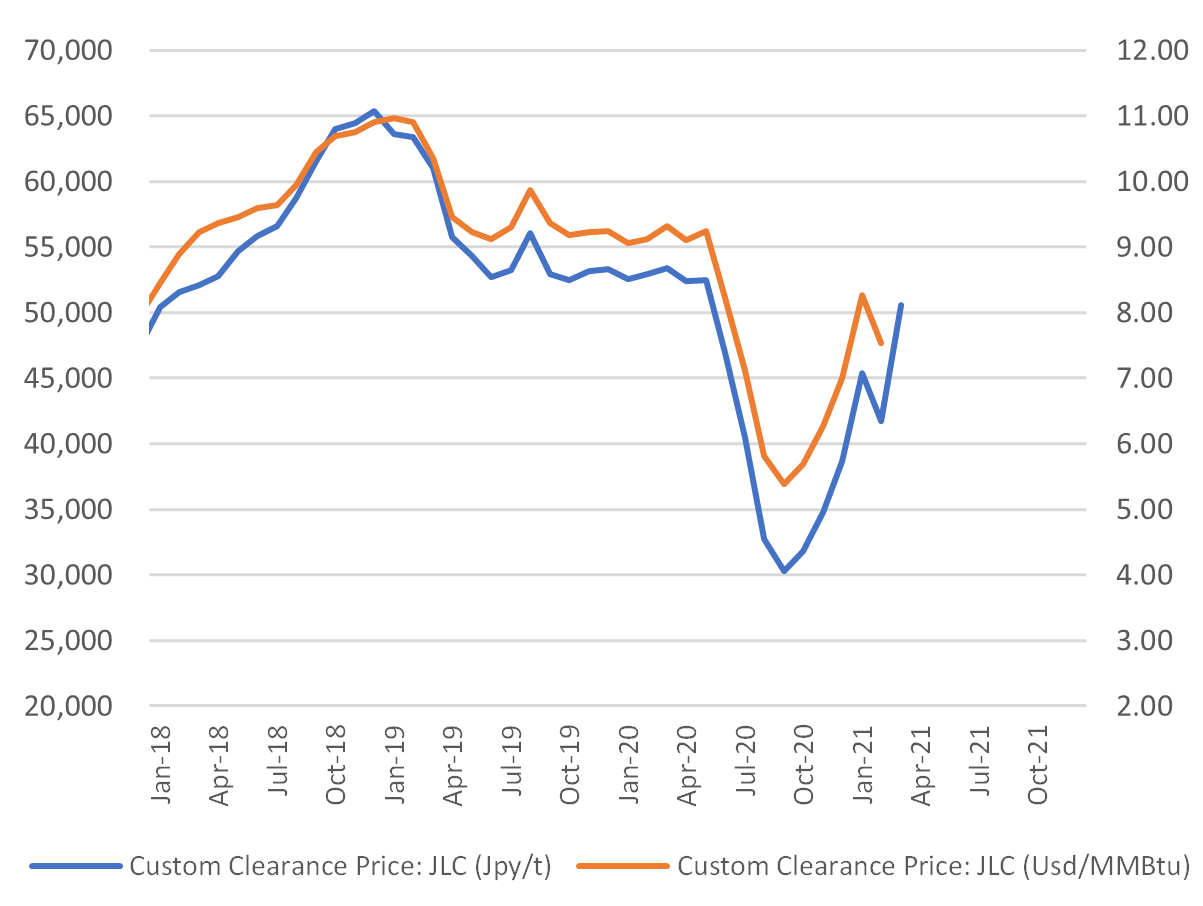
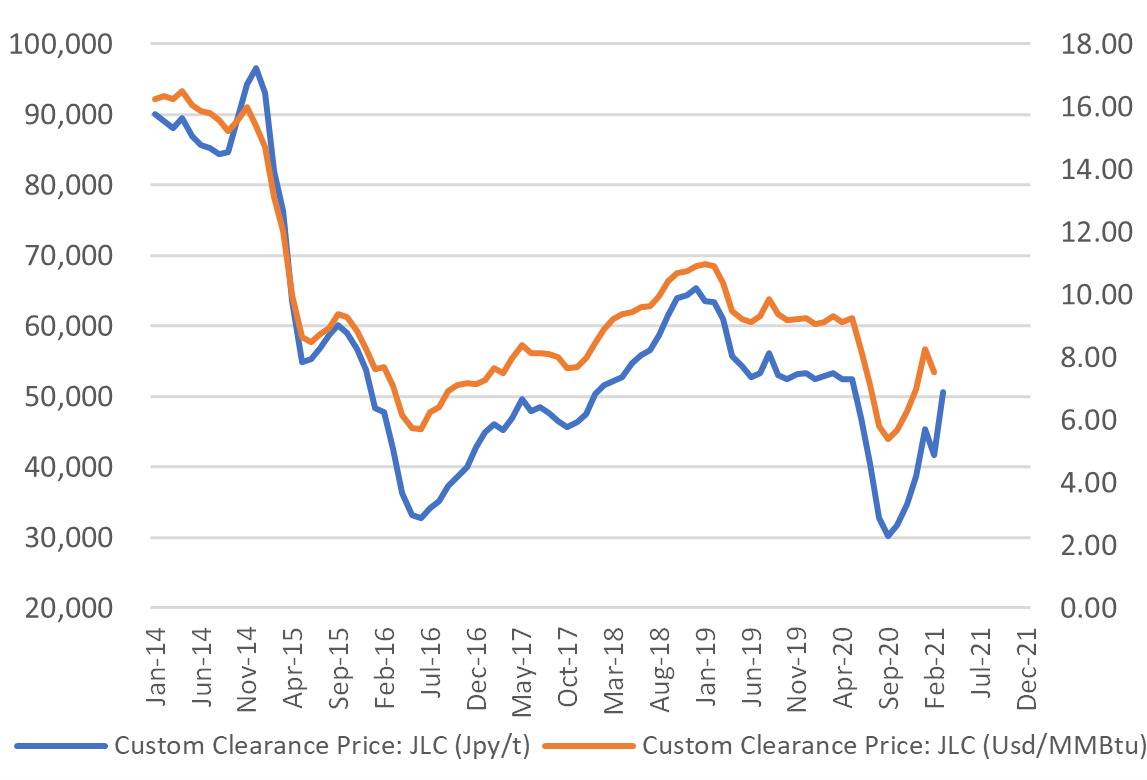
Japan (JLC) LNG Price: ¥50,592/ mmbtu
Saibu now shipping containerized LNG to China year-round
(Gas Energy Shimbun, April 19)
- On April 12, in a first for a Japanese company, Saibu Gas said it began shipping LNG to China on a year-round basis in dedicated shipping containers.
- Saibu plans to ship around 330 of the 18-metric ton LNG tank-containers to Shanghai-based JUSDA Energy Technology each year: a total of 59,000 tons of LNG.
- Recent expansions to the Kita-Kyushu container terminal and the relaxation of regulations mean up to 100 containers (1,800 tons of LNG) can be loaded at once. Previously, no more than 1,440 tons could be loaded onto a single ship.
- The regulations were relaxed after Saibu gas demonstrated the safety of its procedures to the authorities.
Japan targets Vietnam for first ASEAN oil-sharing deal
(Asia Nikkei, April 21)
- Japan hopes to strike an oil-sharing deal with Vietnam, which will be its first such agreement with a Southeast Asian nation.
- The agreement is part of Japan’s strategy to create an uninterrupted supply of petroleum to overseas supply chains in the event of a disruption. Japanese companies have a lot of their manufacturing base in Southeast Asia, including auto components.
- Japan is attempting to broker similar oil-sharing arrangements with a number of Southeast Asian countries in the ASEAN group. Talks are ongoing with Indonesia, Thailand, Malaysia and others.
- The idea is that each member of the emergency supply network sets up an individual reserve of crude oil, gasoline, diesel fuel and other petroleum products.
- CONTEXT: Japan and other ASEAN countries rely heavily on Middle Eastern oil. Japan maintains its own petroleum reserve that is enough to meet domestic consumption for over half a year. However, many other Southeast Asian nations only have a month’s supply in stock.
JOGMEC’s action plan for decarbonization
(Company statement, April 20)
- Japan Oil, Gas and Metals National Corporation (JOGMEC) committed to sustainable development goals (SDGs) in 2018 and established a dedicated team focused on carbon neutrality in 2020. The JOGMEC Carbon Neutral Initiative, announced on April 20 articulates three central pillars of decarbonization and lays out a concrete plan of action.
- JOGMEC will deploy financial incentives to encourage decarbonization initiatives at oil and gas wells and in coal mines.
- JOGMEC will create a risk money fund for LNG traders to ensure a more consistent supply of LNG and boost its LNG trade with the rest of Asia.
- JOGMEC will support the expansion of geothermal operations, both in Japan and overseas.
- JOGMEC will provide financial support for carbon neutral mineral mining initiatives.
- JOGMEC will support initiatives to produce carbon free hydrogen and ammonia.
- JOGMEC will support initiatives for, and research into, carbon capture and storage.
Toyo Engineering gets license to capture CO2 from “sour” gas
(New Energy Business News, April 19)
- Toyo Engineering has entered into a comprehensive agreement with U.S. company 8 Rivers Capital to use its proprietary TarT process under license.
- The agreement gives Toyo exclusive rights to use TarT, which Toyo plans to combine with existing work to build a supply chain for recovered CO2.
- The TarT process enables operators to capture, store and utilize carbon dioxide from “sour” gas (natural gas that contains hydrogen sulfide).
- Toyo Engineering says that the high CO2 and hydrogen sulfide content of sour gas means those deposits tend to be underdeveloped because of the technical difficulty of removing impurities.
ANALYSIS
BY TAKEHIRO MASUTOMO
As Japan Looks Offshore for Energy,
Water Offers Even More Potential Than Wind
Japan is betting a significant chunk of its new generation capacity on energy potential that’s above the ocean. It might do better to invest below.
The country’s territorial waters and Exclusive Economic Zone (EEZ) have an energy potential of 1,326 GW, according to state-sponsored research. That’s almost 30 times more than the size of Japan’s offshore wind program for the next two decades.
Development of technology to tap this energy source has been slow, but test projects are now underway and reaching commercialization in some countries. Japan too has launched a series of demonstration tests of ocean energy. One engineering group has even set a cost target that would make its floating ocean current turbine competitive with several other renewable power sources. Early tests also indicate the energy efficiency of ocean currents is above 40%.
As research on ocean energy grows, so does Japan’s opportunity to get more out of its offshore energy program.
Water-based energy outside of hydropower
Most people are familiar with hydropower as a form of power generation from rivers and dams. There are other ways to generate power from water, and most are referred to as ocean energy, which is naturally renewable.
Ocean energy comes in four main types.
1) Ocean current turbines utilize a strong ocean current in the open sea to rotate turbine rotors
2) Wave power generation captures the vertical motion of the wave
3) Tidal turbines use tidal flow in a strait, or similar, to rotate turbine rotors
4) Ocean thermal energy conversion relies on temperature differences between the water’s surface and the seabed
In those four categories, Japan’s 440,000 km2 of territorial waters (No. 6 globally) has energy potential for 205 GW, 195 GW, 22 GW, and 904 GW, respectively, based on a NEDO estimate published in 2011.
As of today, Japan’s ocean energy output is negligible, lagging rapid developments in Europe. The European Ocean Energy Association predicts that gross capacity of installed ocean energy generators, including tidal power, as well as wave power, will grow to nearly 200 GW by 2050.
That’s building on early developments in the region, such as in France, which launched the world’s first tidal power station in 1966. The Rance Tidal Power Station has 240 MW of capacity and supplies about 0.1% of France’s electricity.
Ocean energy was also part of the New Ocean Action Agenda proposed by 14 maritime nations including Japan and Australia in December 2020.
Originally, Japan was one of the pioneers in ocean energy development. It built what is believed to be the world’s first practical wave power generator. The Masuda-type navigation buoy was adopted by the Japan Coast Guard in 1965. Japan also began to develop ocean energy technologies, but relevant research activities stalled for two decades from 1990.
Interest revived soon after the massive earthquake, tsunami and Fukushima nuclear accident of 2011. In the short term, Japan’s government promoted the rollout of solar. In the longer term, it hoped to nurture an energy source that was less intermittent. Marine power generation was seen as a more stable source for the future.
Back and forth on development
In 2014, Japan’s Cabinet Office designated six demonstration areas for ocean energy in Niigata, Saga, Nagasaki, and Okinawa Prefectures. The policy was inspired by the European Marine Energy Center (EMEC), which was established in the Orkney Islands, UK in 2003.
Ever since, Japan has focused on carrying out a series of demonstration projects, often assisted by NEDO. The 2013 Basic Plan on Ocean Policy ambitiously vowed to “develop actual power generation machines that aim to achieve ¥40/ kWh” and “carry out multifaceted technological R&D so that power generation costs will be further reduced”. The Basic Energy Plan in 2014 also expressed high hope for ocean-related renewable energy.
More recently, progress slowed as interest in offshore wind generation became mainstream, with many in government and business seeing it as the top pathway to decarbonization of Japan’s energy system. Offshore wind headed the list of 14 action points in the recent Green Growth Strategy announced by Prime Minister Suga in December 2020.
The latest Basic Plan on Ocean Policy was released in 2018. It barely touched on marine power and set no clear numerical goals. The Basic Energy Plan of the same year almost ignored this energy source altogether. Maritime energy was equally absent from the Green Growth Strategy.
Outside central government policy, however, there is movement. A 2019 NEDO panel reported that Japan has entered the stage of verifying long-term reliability of underwater floating ocean current power generation and that further progress is expected. The panel called for more experimental projects to build up the data necessary for future technology commercialization.
Given the risky nature of developing early-stage energy systems, the panel confirmed that NEDO will continue to take the lead in this area.
There are multiple reasons why ocean energy is hard to develop on a commercial level in Japan.
First, Japan’s waves are generally weaker than those of European countries. Secondly, the country’s maritime areas in the Pacific Ocean side are often hit by typhoons in summer. This means facilities built in the sea must be solid and reliable, pushing up the cost. Lastly, coordination with stakeholders such as the fishing, sightseeing, and shipping industries is tricky.
Ocean energy projects around Japan
Nonetheless, some academic institutions and the private sector, especially heavy industry and shipbuilding companies, are keen to pursue the dream of taming ocean energy.
Tidal and wave power in particular are close to practical use, according to the Ministry of the Environment. It lists promising areas for tidal power in Japan as the Seto Inland Sea, where the Akashi and Naruto Straits are located, and the Tsugaru Strait, between the Honshu island and Hokkaido. Those tidal currents have speeds of two to five meters per second.
In 2017, IHI, along with NEDO, conducted a demonstration experiment of the world’s first floating type ocean current turbine called the Kairyu. The 100 kW turbine was lowered 50 m below sea level off the coast of Kuchinoshima Island, Kagoshima prefecture, in the path of the Kuroshio Current.
“Kairyu” — 100 kW-class floating type ocean current turbine for demonstration
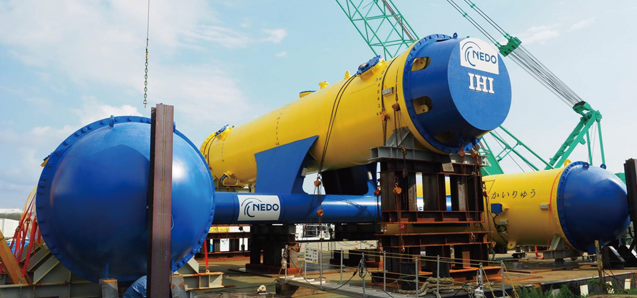
Source: IHI Corporation
Over seven days, 30 kW of electric power was generated from that ocean current, validating the concept and collecting key data.
IHI planned to conduct the second phase of the test in the same location in FY2019, but had to delay it due to a local typhoon and then the outbreak of the Covid-19 pandemic, the company told Japan NRG
IHI still aims to install the Kairyu turbine at a remote island location and believes it can operate at a cost of ¥40/ kWh. The longer-term goal is to bring down the cost to half that.
Other players in Japan have turned to wave power. In 2017, Mitsui Engineering & Shipbuilding Co. launched a demonstration experiment of wave power near Kozushima Island in Tokyo prefecture.
In a bid to commercialize wave power generation, Professor Tsumoru Shintake of Okinawa Institute of Science and Technology Graduate University (OIST) also tested prototype Wave Energy Converter units (WEC-units) in the Maldives in August 2018.
A team of the University of Tokyo’s Institute of Industrial Science, led by Professor Rheem Chang-Kyu, began testing a wave power generator at a fishing port in Hiratsuka, Kanagawa prefecture in June 2020. Professor Rheem also initiated a tidal current trial in Shiogama City, Miyagi prefecture.
Sunpower Co., a venture company spun out of Keio University, conducted a wave power generator experiment off the island of Nakanoshima, Shimane prefecture in March 2021. The company plans to conduct another experiment in Kumejima Island, Okinawa prefecture.
While the number of projects is still few, the country’s embrace of offshore wind may actually help with development of the energy potential under the water. Given the large acreage offshore wind farms will occupy, it will make sense to use the space also for ocean power.
ANALYSIS
BY DANIEL SHULMAN
PRINCIPLE
SHULMAN ADVISORY
Japan’s New Balancing Market: What It Means and Its Impact
This month a key new structure of Japan’s electricity market was rolled out. The balancing market seeks to address the emerging disparities and inefficiencies in Japan’s power since the industry’s liberalization.
To date, the role of balancing the electricity network was fulfilled by power transmission companies. This has become more difficult and expensive of late with an increase in the volume of solar and wind power plants, which are non-dispatchable assets. In other words, operators of solar PV and wind farms cannot control the volume of power they will deliver on a given day, complicating the work of balancing power demand with supply.
The advent of the balancing market is supposed to address this issue, as well as create more competition in supplying the resources used to keep the grid stable.
We take a look at how this new market segment works.
The birth of the balancing market
Japan has a relatively active power trading market (kWh, traded on the JEPX) and has introduced a capacity auctions system (kW, managed by OCCTO) in FY2020 to iron out the imbalances between potential supply and demand. However, that alone has not been enough to fine-tune the power network on any given day.
Here’s why.
Power generators (except those under the FIT scheme) and power retailers are responsible to provide supply/demand forecasts on a 30-minute basis up to one hour before they deliver the electricity (also known as the time of gate closure).
Generators send their estimates to the Organization for Cross-regional Coordination of Transmission Operators (OCCTO), and must pay penalties proportional to the difference between their forecast and actual power supply. These discrepancies between forecasted and actual volumes are tracked and reported by the regional grid operators, and centrally aggregated by OCCTO.
Historically, power balancing was managed regionally. From April, however, a new balancing market started to be implemented. The goal is that by April 2024, when the balancing market rollout is expected to be completed, transmission and distribution (T&D) firms will be fully able to procure the volumes of power they need to balance their local system on a national level.
The new balancing market works as an auction mechanism through which T&Ds will be able to procure power from generators or aggregators after gate closure. The participating assets will need to be registered, and this balancing power will be traded on a new platform – the Electric Power Reserve Exchange (EPRX) that was established in March by the nine former regional utilities. (Note, Okinawa EPCo is not involved).
Both power and negawatts (i.e. the megawatts of power saved by increasing efficiency or reducing consumption) will be traded on this new exchange. Only companies with net assets of at least ¥10 million will be able to participate.
Today, power sources that participate in balancing are classified based on their response time and control mechanism. Depending on the type of power source, providers of balancing power are paid for capacity (kW) and/or supplied volume (kWh). The transition to the balancing market will be progressive and the timing at which power sources can participate will depend on their type.
A new system of power source classification has also been created, based on how fast, how often, and how long the power sources can be solicited. With the establishment of this new market, the government expects to create more competition overall and reduce the cost of balancing supply and demand.
From the industry side, a new entity was created by Japan’s 10 major T&D companies to support the developments. The Transmission & Distribution Grid Council (TDGC) was also launched in April, the same time as the balancing market, and promises to help guide the new market segment as well as supporting the broader development of the power transmission and distribution business in Japan.
TDGC’s existence is significant in that for the first time it creates a power industry group that is independent of the 10 regional utilities (EPCOs) and their generation assets. The utilities traditionally were represented only via The Federation of Electric Power Companies (FEPC).
The Market’s Framework
In order to join the balancing market, generation facilities will have to go through an assessment process performed by the T&D company responsible for the zone in which the power source is located. A member of EPRX will sign a contract only with its local T&D company, and T&D companies will sign contracts with each other to settle payments among themselves.
The power sources that will participate in the balancing market will be classified into five categories, and sources in all five will be able to bid per unit of 1 kW. While the markets for four out of the five categories are expected to be launched between FY2022 and FY2024, the balancing market for III-2 sources (the replacement reserve for FIT) was launched at the beginning of FY2021.
The total volume of power traded on the first day of the balancing market (auction: March 31; delivery April 1) was 29.3 GW. There was 41.9 GW of supply offered and 31.1 GW of demand. The highest bid was at ¥13.48/ kW from 9 a.m. to noon in the Kansai area, and the lowest bid price (excluding ¥0/ kW) was ¥0.03/ kW from 9 a.m. to noon in the Hokkaido area.
The Aggregation Market
Balancing power providers will allow for the aggregation of multiple sources to meet the minimum bid requirement, as detailed in Figure 1. Aggregators that will provide balancing power above 1 MW (main aggregators, also called asset coordinators) will require a license. METI will start accepting applications for these licenses from April 2022. Resource aggregators that will not participate directly in the market but instead provide resources to main aggregators will not need a license.
Over the past five years (FY2016 through FY2020), the government promoted VPP pilot projects to support the development of the necessary technology and the emergence of players that would aggregate and manage energy resources including EVs and storage batteries. During this time METI allocated more than ¥21 billion for these projects. In FY2020 alone, 74 companies and organizations received subsidies for such pilots.
Examples of companies participating in the aggregation business include the former utilities (Tohoku EPCo, Chubu EPCo, Chugoku EPCo, Kyushu EPCo, Chubu Electric Power Miraiz), oil and gas companies (Saibu Gas, Osaka Gas, Toho Gas, ENEOS), new power retailers (SB Energy, Shizen Energy, Direct Power), engineering firms (Yachiyo Engineering, Toda Corporation, MHI Engine & Turbocharger, Hanwha Q CELLS Japan), and entirely new entrants to Japan power (KDDI, Toyota Tsusho, Lawson).
We expect that the balancing market will be the main source of revenue for providers of demand-response resources. However, METI has also advertised its support for other use cases, such as balancing at the retailer level or trading of power on JEPX.
The Japanese VPP market is still in development, and the business models, use cases, technology, and players are likely to change in the coming months and years. One thing is certain, however: the trajectory of the power market points to growth as decarbonization policies promote wider electrification. The balancing market is another mechanism that will support the market’s maturation.
Figure 1: Overview of Balancing Market Structure
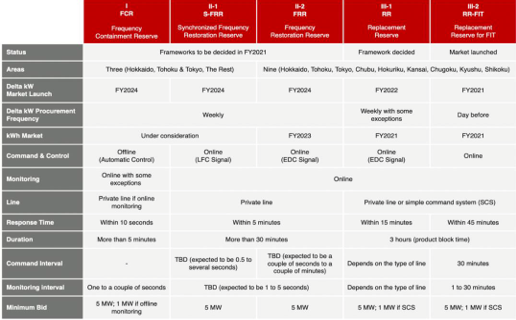
Source: Ministry of Economy, Trade and Industry
GLOBAL VIEW
Below are some of last week’s most important international energy developments monitored by the Japan NRG team because of their potential to impact energy supply and demand, as well as prices.
Earth Summit:
U.S. President Biden invited 40 world leaders to the Leaders Summit on Climate, which was held on Earth Day (April 22) and the following day. The following is a list of the more interesting pledges and statements that came from it:
– U.S. will target reducing emissions by 50%-52% by 2030 compared to 2005 levels
– U.K. will target a cut in emissions of 78% by 2035 from 1990 levels
– China will aim to peak CO2 emissions before 2030
– Canada increased its emissions reduction target to 40%-45% by 2030 from 2005 levels
– France and Germany both want carbon pricing introduced as soon as possible
– Germany will follow the EU target of a 55% reduction in emissions by 2030 compared with 1990 levels
– Brazil will become emissions neutral by 2050, 10 years earlier than prior plans, but it wants financial assistance to help it end illegal deforestation by 2030
– South Korea will halt state funding of overseas coal power plants
– Russia is testing a carbon pricing system in Sakhalin, and plans to have that region become carbon neutral by 2025
– Australia is setting up A$1.5 billion in climate financing focusing on the Pacific region and is focused on hydrogen
– Mexico will use the oil discovered from new sources only for domestic purposes
– Indonesia will accelerate pilot projects for net-zero emissions
– India welcomes partners to help it build sustainably
Emissions:
Energy-related carbon emissions are on track to surge by nearly 5% this year, according to the International Energy Agency, reversing most of last year’s decline caused by the coronavirus pandemic. Emissions will rise by the second-highest rate in history. Surging use of coal, the dirtiest fossil fuel, for electricity is largely driving the emissions rise, especially across Asia but also in the US.
Oil and Gas:
1) Saudi Aramco will make a strategic review of its upstream business and may sell stakes in some of its oil and gas assets to external investors. Entering into JVs with large energy companies to develop new gas assets is another option being considered. resources, according to the people. The goal is to raise financing that would flow back to the state to help finance Saudi Arabia’s economic transformation plan.
2) Qatar Petroleum is planning its first ever dollar-denominated bond sale.
3) California governor seeks end to oil drilling in state by 2045 and to ban new fracking permits within three years.
4). It’s reasonable to expect oil prices to be in the $60 to $75 range in a year’s time as countries recover from the coronavirus crisis, according to industry expert Dan Yergin.
5) BP joined with other Permian Basin oil producers in calling for an end to the practice burning off surplus natural gas.
Carbon Capture and Storage (CCS):
1) Royal Dutch Shell, Harbour Energy, and Storegga Geotechnologies signed an agreement for the development of the Acorn CCS and hydrogen project in Scotland. The companies are equal partners in the project that is expected to store at least 5 million tons a year of CO2 by 2030, half the emissions set out in the U.K. government’s targets for 2030.
2) ExxonMobil unveiled a plan to build one of the world’s largest CCS projects along the Houston Ship Channel in Texas. The proposed project would cost $100 billion and would capture and store 100 million metric tons of CO2 per year. It could be fully operational by 2040. Exxon said it will need major public funding and the introduction of a price on carbon for the project to be economically viable.
Coal:
Mississippi Power said it plans to retire the majority of its fossil steam fleet. It will shut its coal units by 2027.
Carbon price:
The price of benchmark EU carbon permits rose to a record 45 euros ($54) a ton since the Emissions Trading System (ETS) was launched in 2005. The move comes as the EU agreed tougher climate targets.
Renewables:
New report from think tank Carbon Tracker predicts that if wind and solar power continued on their current growth trajectory, they will take over all electricity generation from fossil fuels by the mid-2030s.
Aviation:
Aviation industry leaders gathered last week at an industry forum to discuss the industry’s recovery after the pandemic. The main view was that the recovery process will be slow. Several airlines will need to close operations as executives expect business travel will not recover to the pre-Covid levels due to the widespread adaptation of online meetings and conferences. The rise of corporate awareness of carbon emissions is also expected to reign in long-haul business travel.
India / energy consumption:
A deadly second wave of Covid-19 infections is threatening to derail the country’s economic recovered. Consumption of diesel and gasoline is forecast to drop as much as 20% in April from the previous month due to lockdowns in places like New Delhi.
EVENTS CALENDAR
A selection of domestic and international events we believe will have an impact on Japanese energy.
| February | Approval of Fiscal 2021 Budget by Japanese parliament including energy funding projects;
CMC LNG Conference |
| March | 10th Anniversary of Fukushima Nuclear Accident;
Smart Energy Week – Tokyo; Quarterly OPEC Meeting; Japan LPG Annual Conference; Full completion of all aspects of the multi-year deregulation of Japan’s electricity market; End of 2020/21 Fiscal Year in Japan; |
| April | Japan Atomic Industrial Forum – Annual Nuclear Power Conference;
38th ASEAN Annual Conference-Brunei; Japan LNG & Gas Virtual Summit (DMG)-Tokyo Three crucial by-elections in Hokkaido, Nagano & Hiroshima – April 25th |
| May | Bids close in first tender for commercial offshore wind projects in Japan;
Prime Minister Suga to visit the U.S.-tentative |
| June | Release of New Japan National Basic Energy Plan-2021;
G7 Meeting – U.K. Forum for China-Africa Cooperation Summit (Senegal) |
| July | Tokyo Metropolitan Govt. Assembly Elections;
Commencement of 2020 Tokyo Olympics |
| August | Hydrogen Ministerial Conference in conjunction with IEA World Economic Forum in Singapore – Deferred from May |
| September | Ruling LDP Presidential Election;
UN General Assembly Annual Meeting that is expected to address energy/climate challenges; IMF/World Bank Annual Meetings (multilateral and central banks expected to take further action on emissions disclosures and lending to fossil fuel projects); End of H1 FY2021 Fiscal Year in Japan; Japan-Russia: Eastern Economic Forum (Vladivostok)-tentative |
| October | Last possible month for holding Japan’s 2021 General Election;
METI Sponsored LNG Producer/Consumer Conference; Innovation for Cool Earth Forum – Tokyo Conference; Task Force on Climate-Related Financial Disclosure (TCFD) – Tokyo Conference; G20 Meeting-Italy |
| November | COP26 (Glasgow);
Asian Development Bank (‘ADB’) Annual Conference; Japan-Canada Energy Forum; East Asia Summit (EAS) – Brunei |
| December | Asia Pacific Economic Cooperation (APEC) Forum – New Zealand;
Final details expected from METI on proposed unbundling of natural gas pipeline network scheduled for 2022. |
DATA
Japan Oil Price
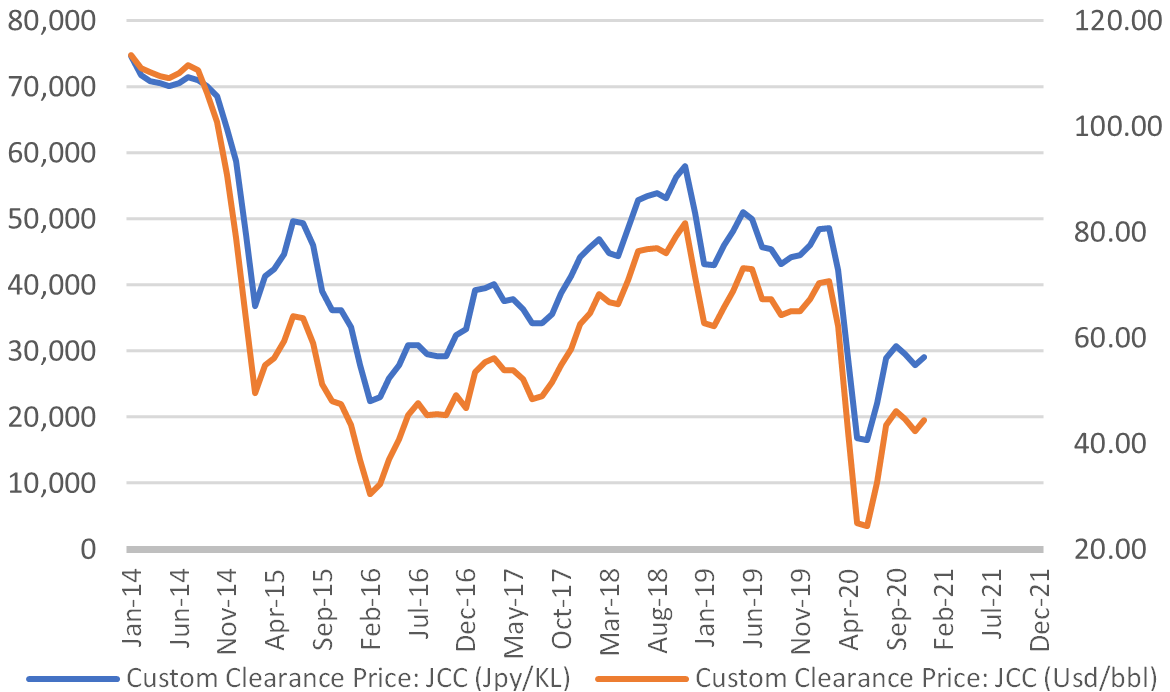
Crude Imports Vs Processed Crude
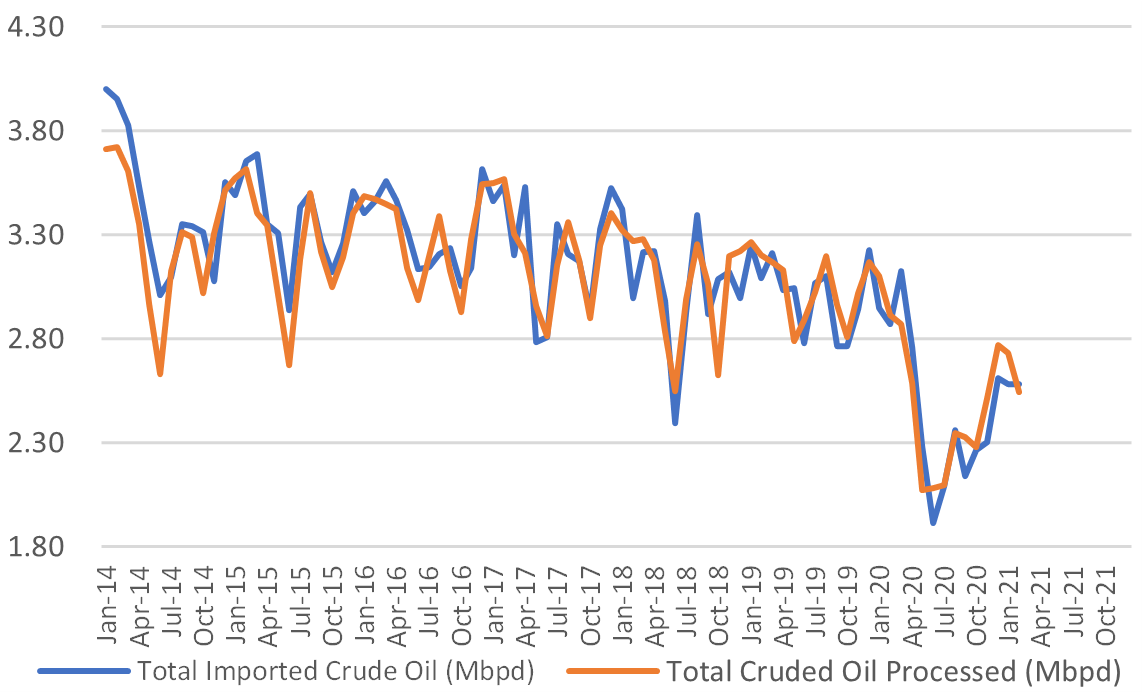
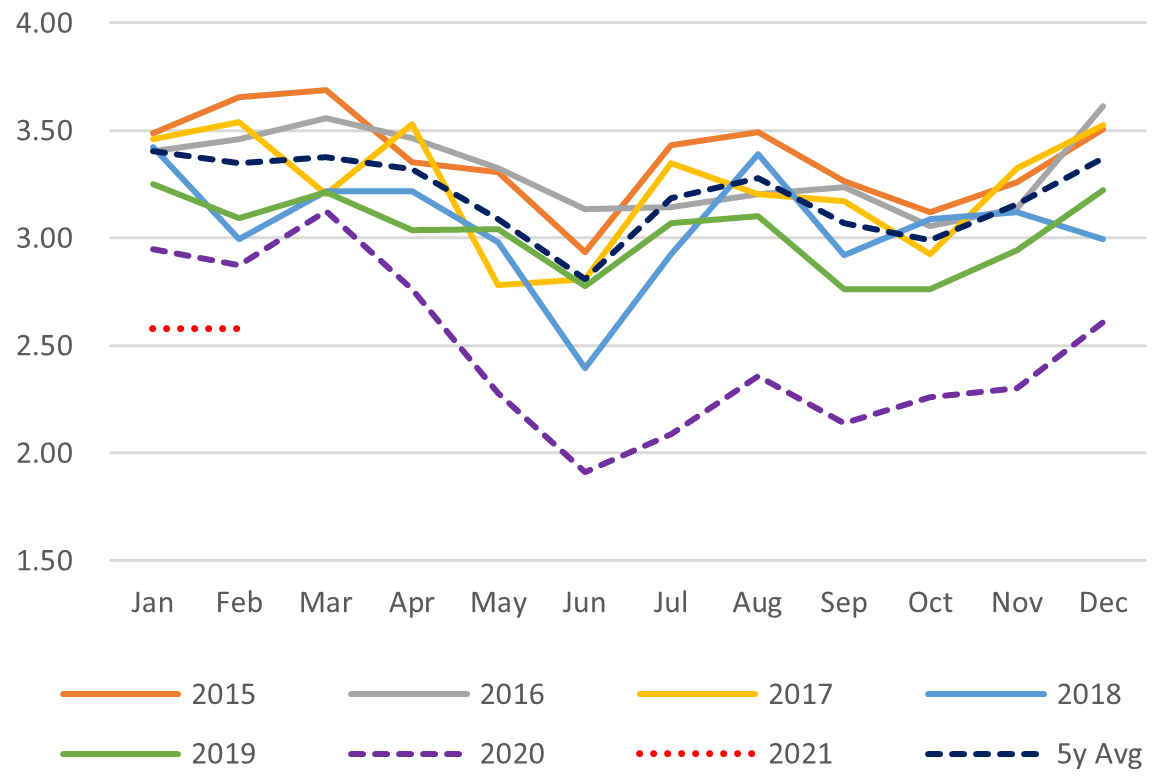
Monthly Oil Import Volume (Mbpd)
Monthly Crude Processed (Mbpd)
Domestic Fuel Sales
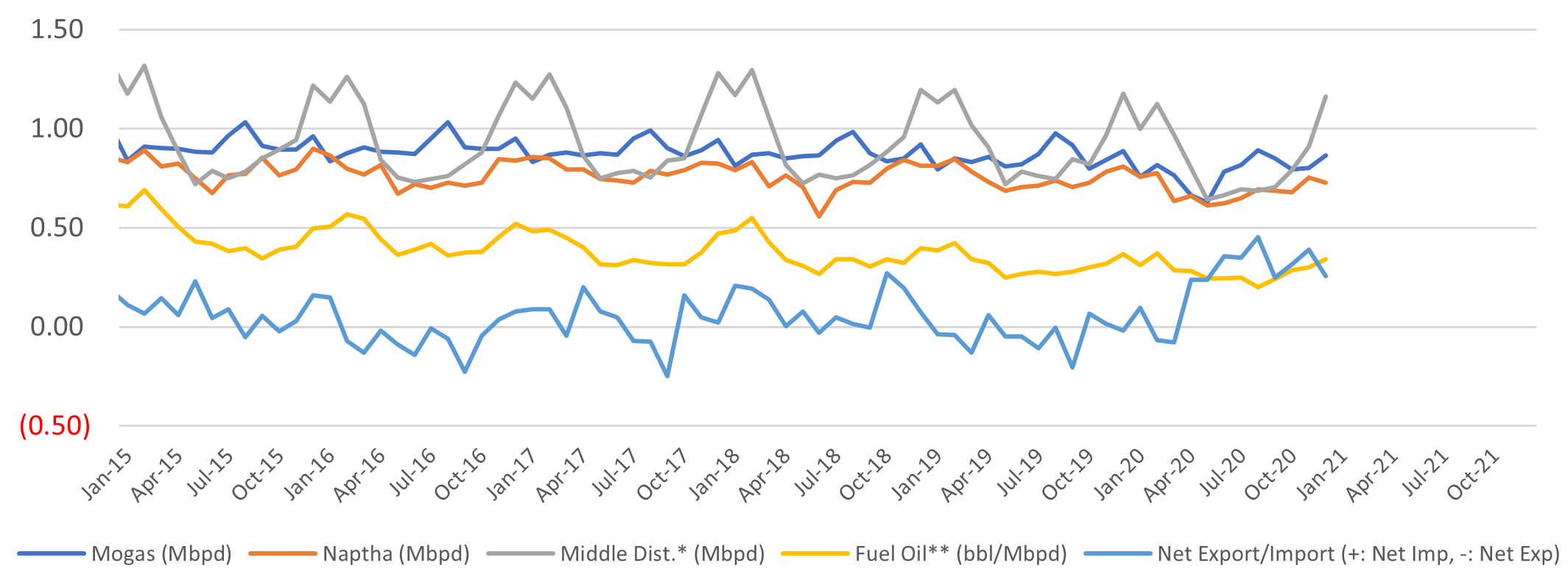
SOURCES: Ministry of Economy, Trade, and Industry (METI), Ministry of Finance, and the Petroleum Association of Japan
Japan LNG Price
LNG Imports: Japan Total vs Gas Utilities Only
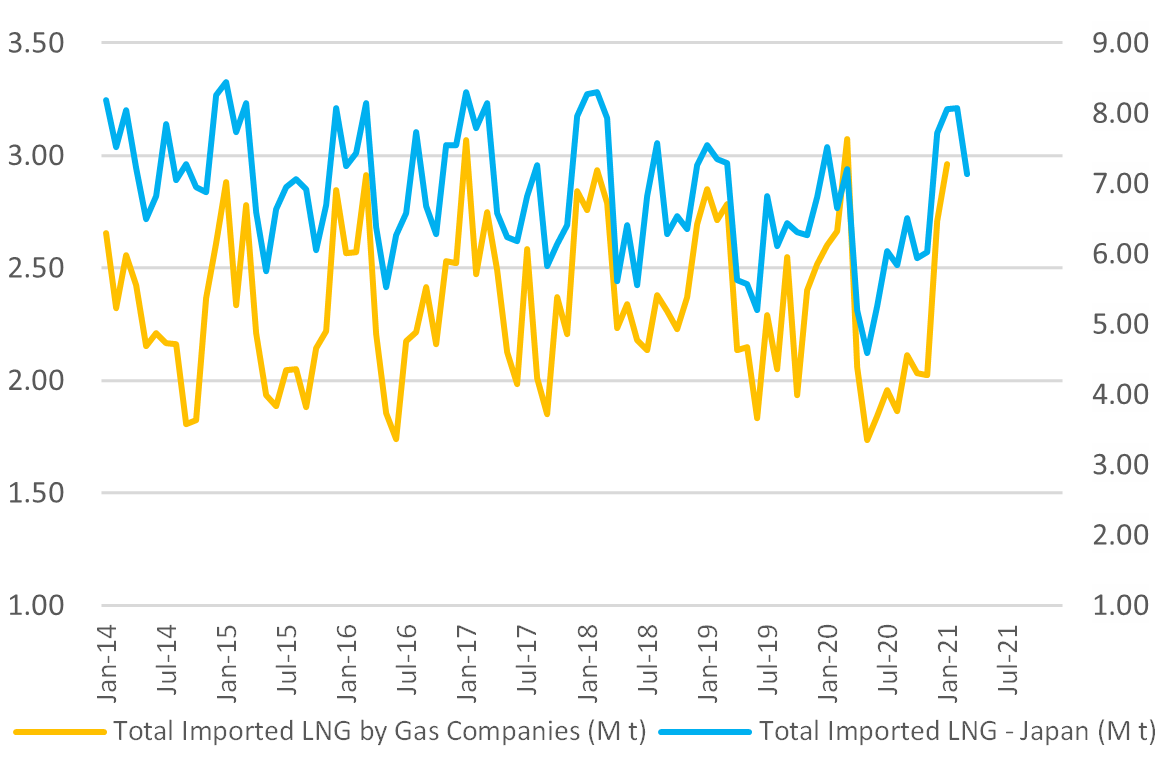
Total LNG Imports (M t)
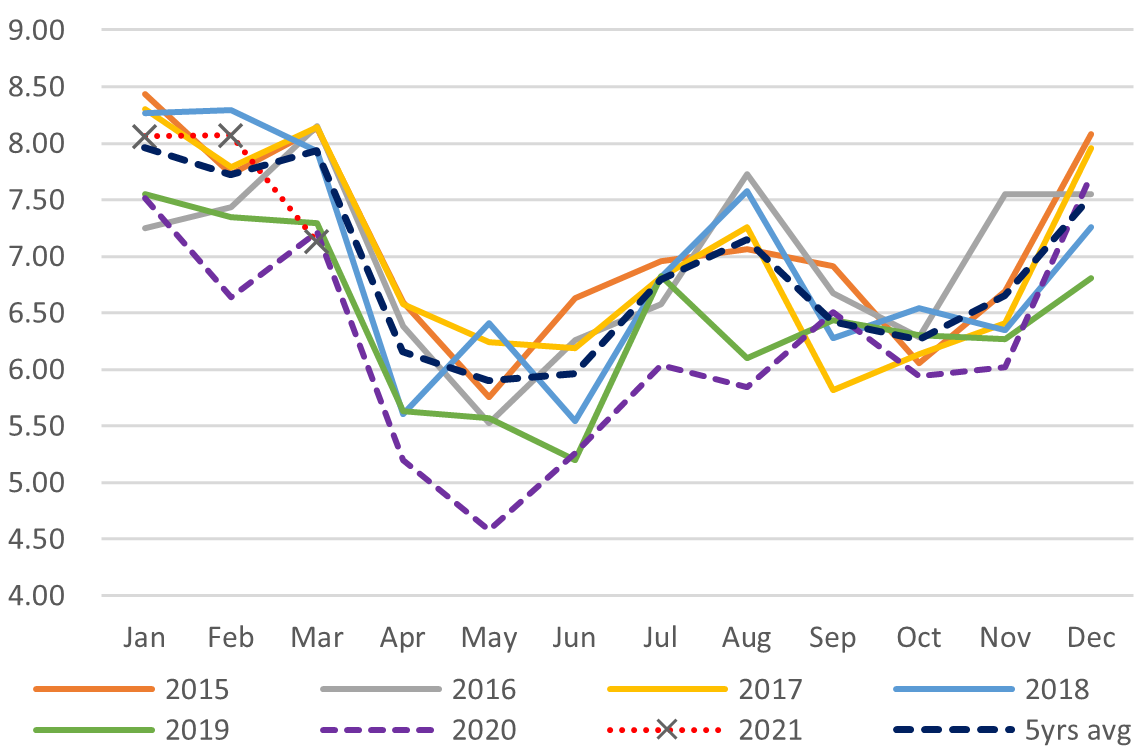
LNG Imports by Gas Firms Only (M t)
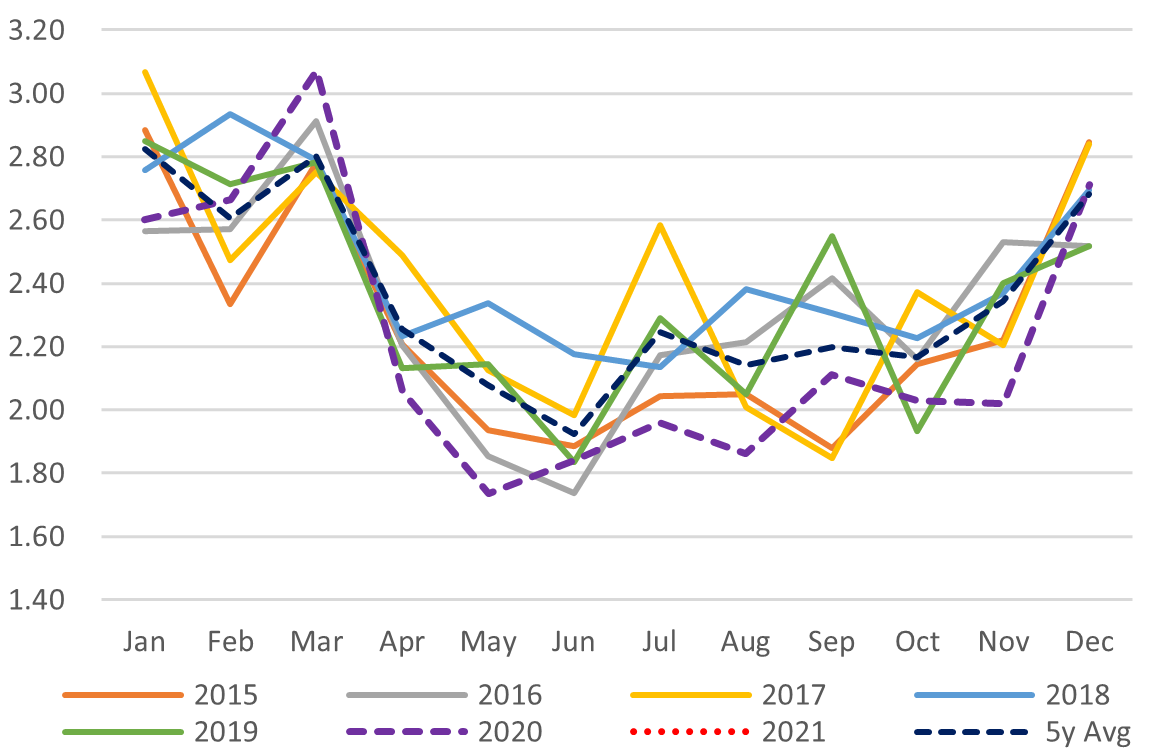
City Gas Sales – Total (M m3)
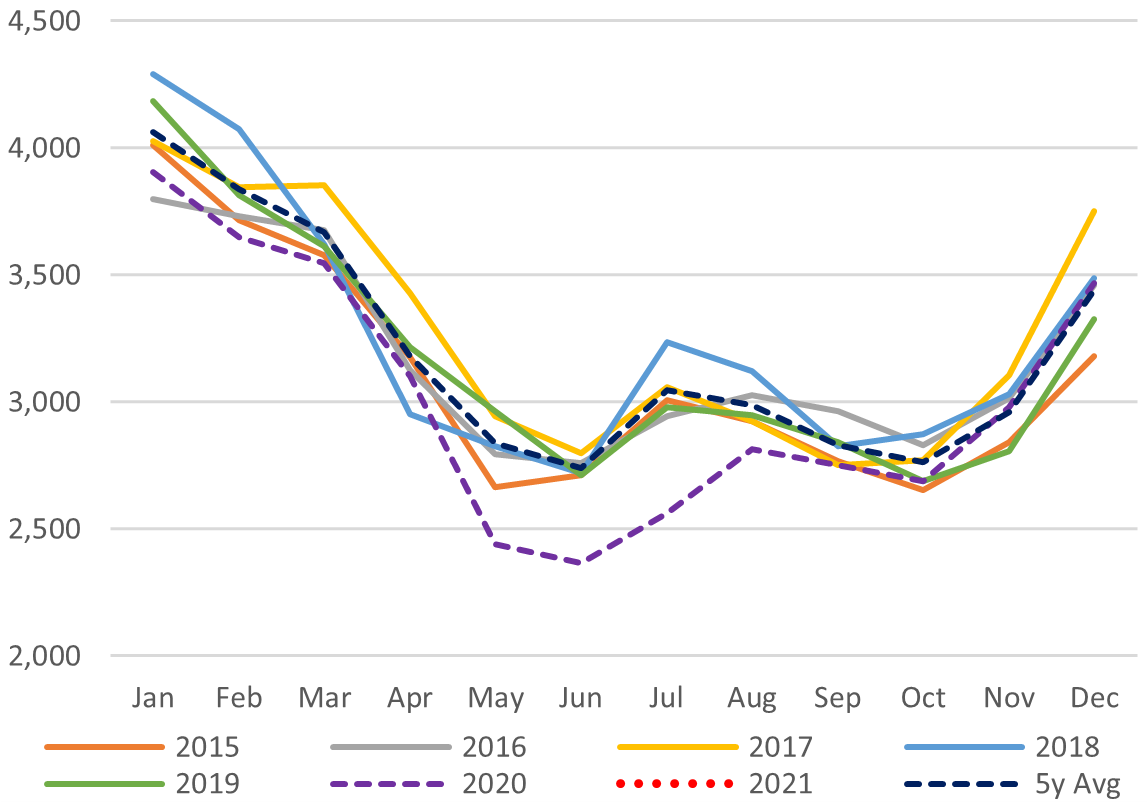
City Gas Sales by Sector (M m3)
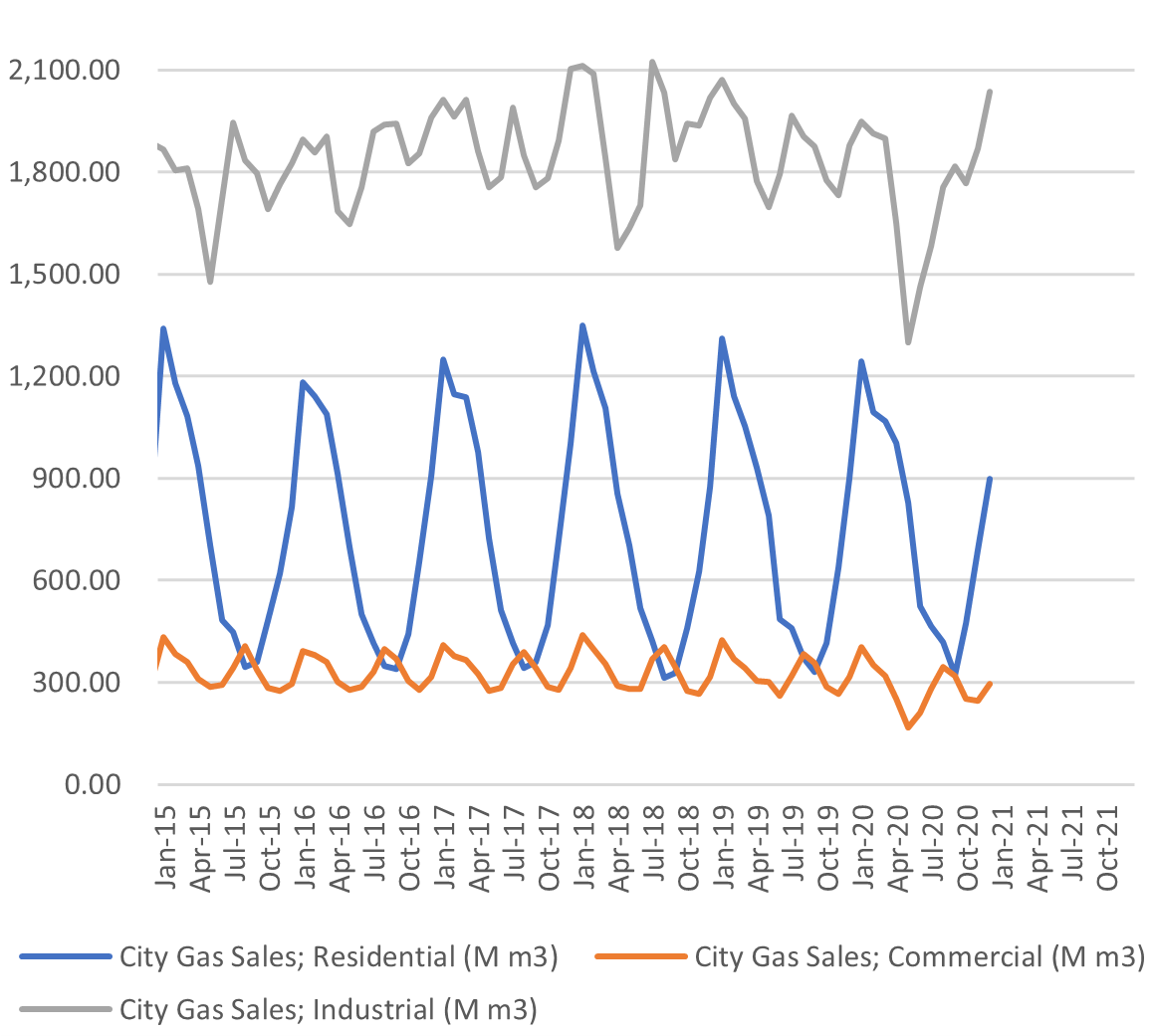
SOURCES: Ministry of Economy, Trade, and Industry (METI),
Ministry of Finance
Japan Total Power Demand (GWh)
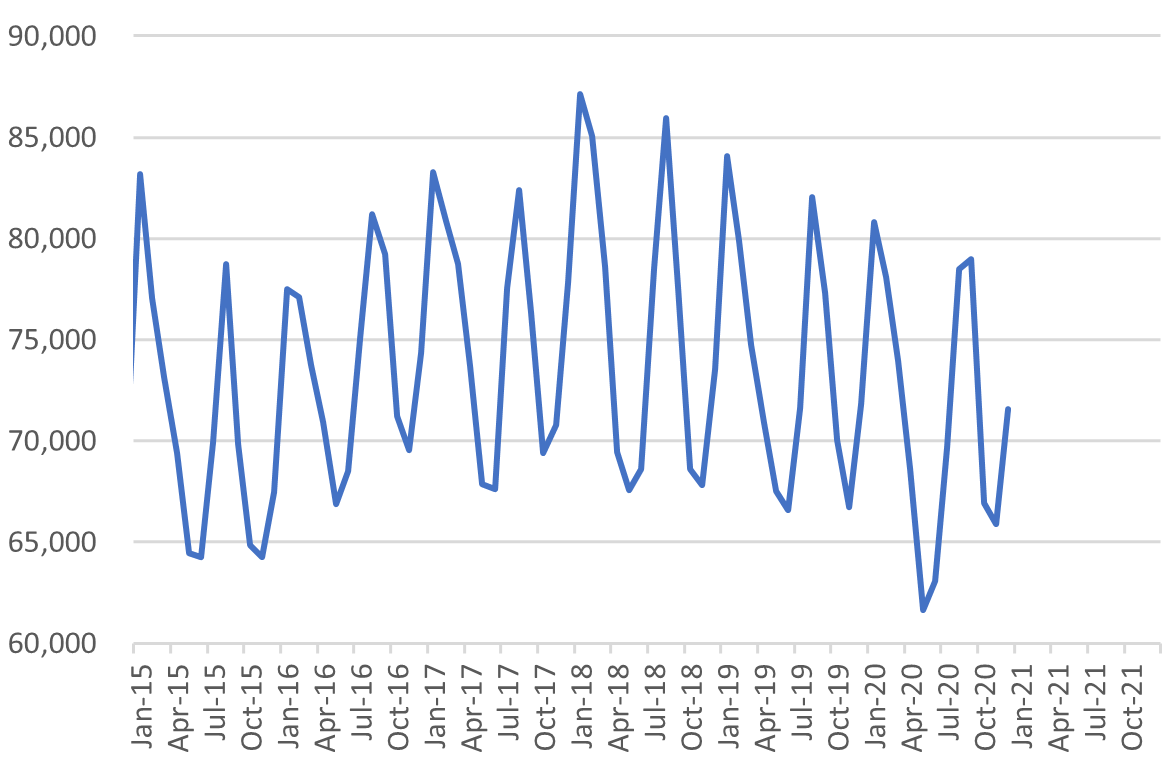
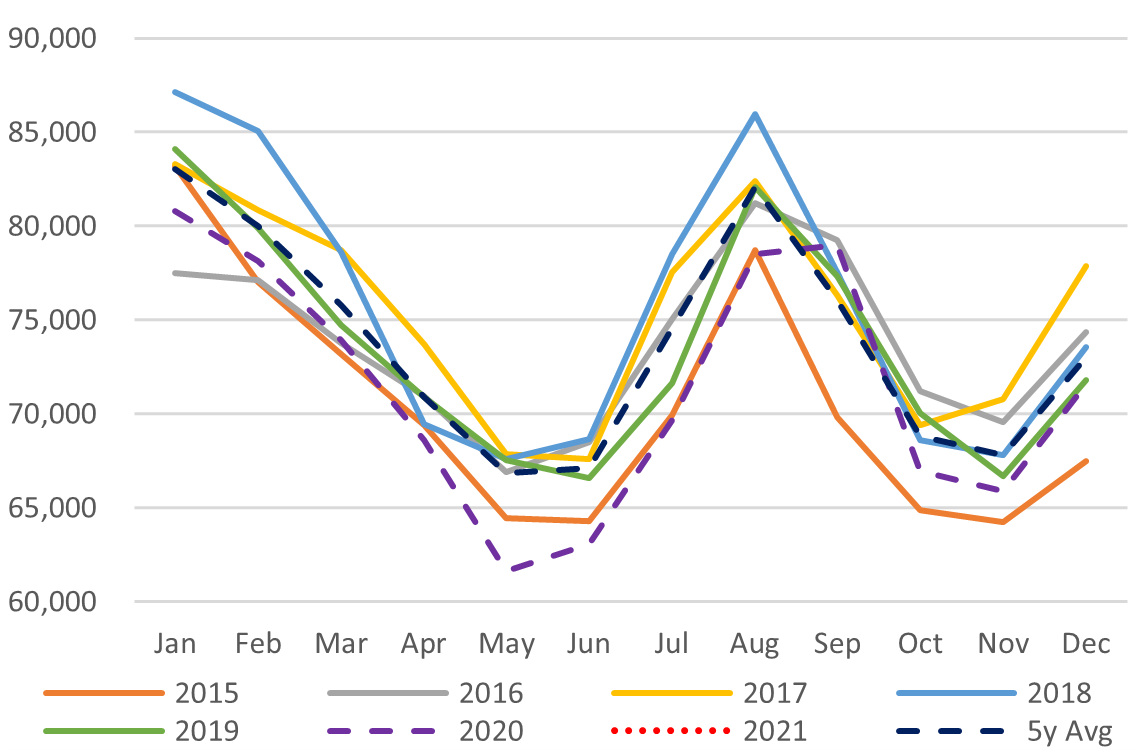
Current Vs Historical Demand (GWh)
Day-Ahead Spot Electricity Prices
Day-Ahead Vs Day Time Vs Peak Time
LNG Imports by Electricity Utilities
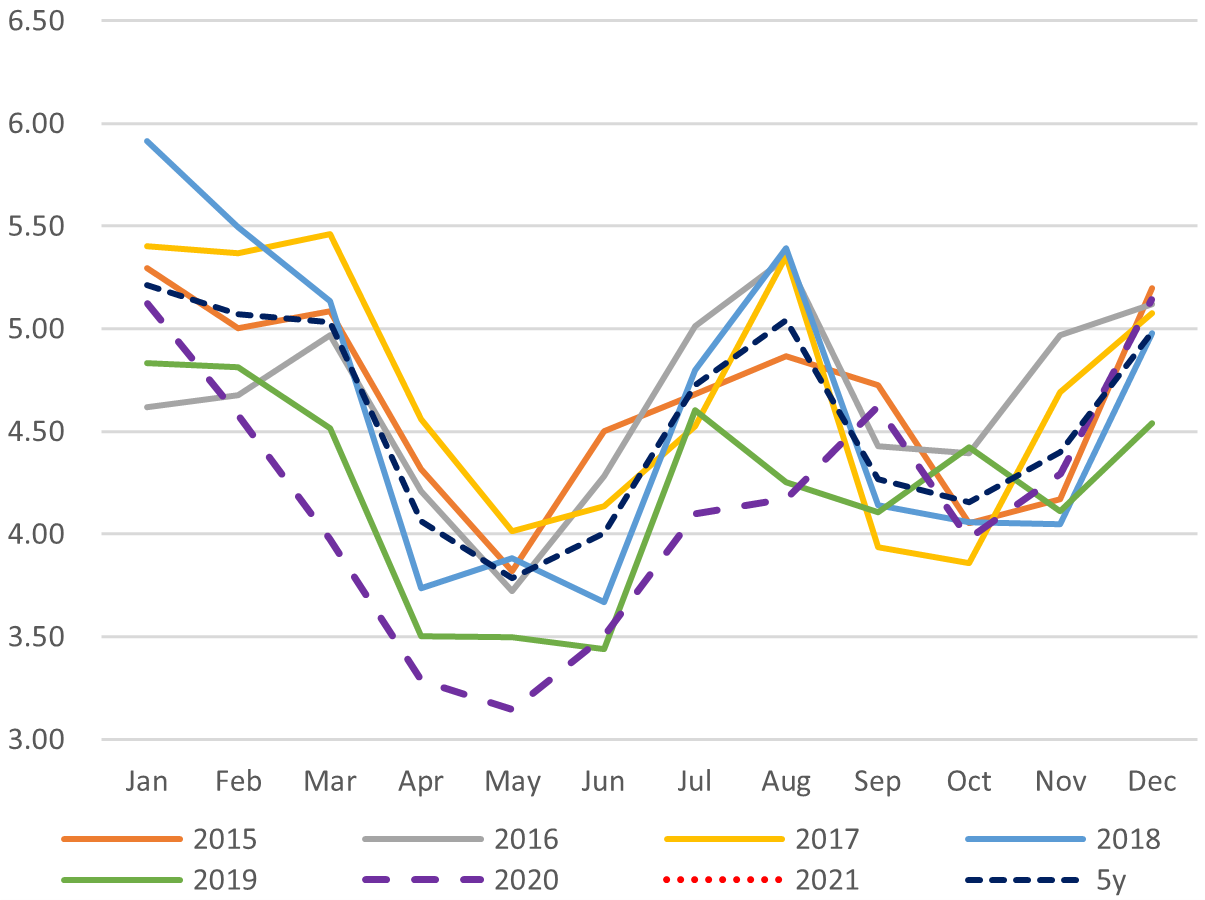
LNG Stockpiles of Electricity Utilities
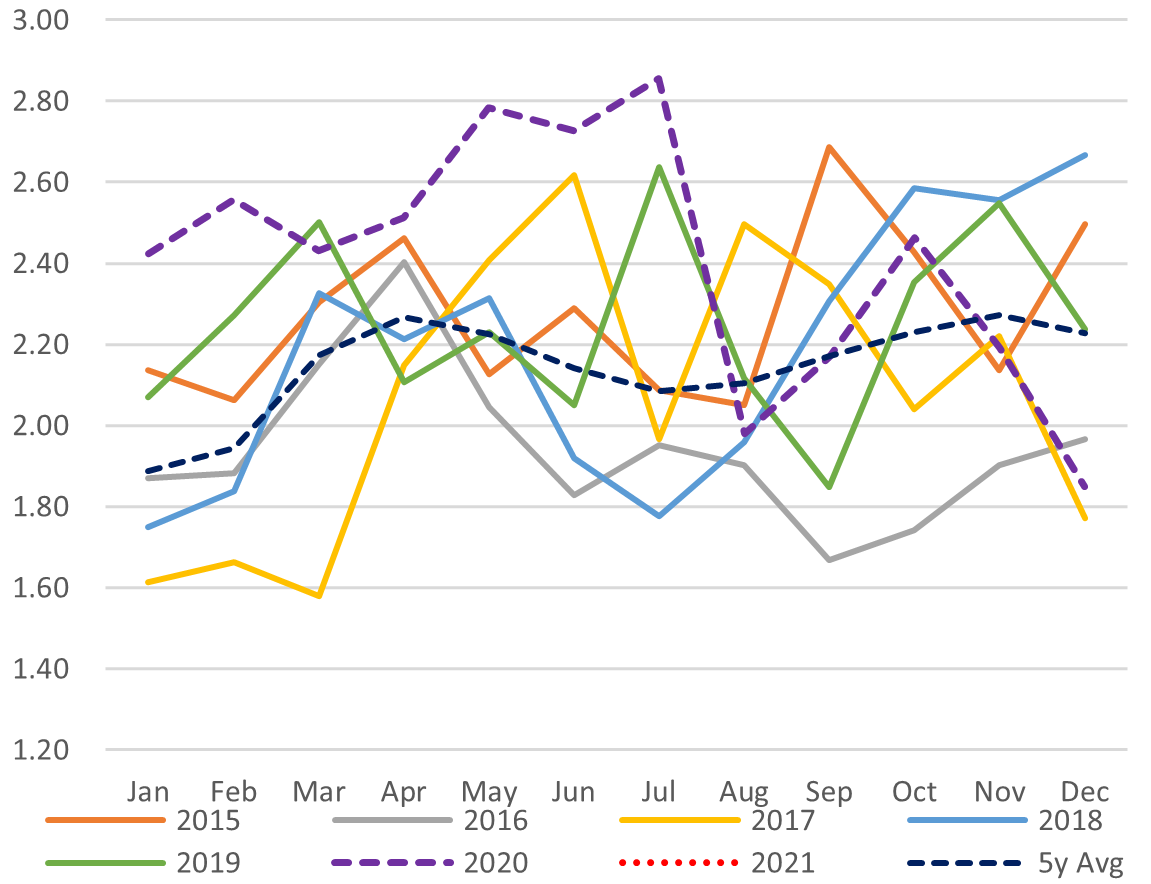
SOURCES: Ministry of Economy, Trade, and Industry (METI), and the Japan Electric Power Exchange
Disclaimer
This communication has been prepared for information purposes only, is confidential and may be legally privileged. This is a subscription-only service and is directed at those who have expressly asked K.K. Yuri Group or one of its representatives to be added to the mailing list. This document may not be onwardly circulated or reproduced without prior written consent from Yuri Group, which retains all copyright to the content of this report.
Yuri Group is not registered as an investment advisor in any jurisdiction. Our research and all the content express our opinions, which are generally based on available public information, field studies and own analysis. Content is limited to general comment upon general political, economic and market issues, asset classes and types of investments. The report and all of its content does not constitute a recommendation or solicitation to buy, sell, subscribe for or underwrite any product or physical commodity, or a financial instrument.
The information contained in this report is obtained from sources believed to be reliable and in good faith. No representation or warranty is made that it is accurate or complete. Opinions and views expressed are subject to change without notice, as are prices and availability, which are indicative only. There is no obligation to notify recipients of any changes to this data or to do so in the future. No responsibility is accepted for the use of or reliance on the information provided. In no circumstances will Yuri Group be liable for any indirect or direct loss, or consequential loss or damages arising from the use of, any inability to use, or any inaccuracy in the information.
K.K. Yuri Group: Oonoya Building 8F, Yotsuya 1-18, Shinjuku-ku, Tokyo, Japan, 160-0004.