
JAPAN NRG WEEKLY
MAY 17, 2021
JAPAN NRG WEEKLY
May 17, 2021
NEWS
TOP
- The great future energy mix debate:
Renewables may jump to 36-38% of energy mix in new plan: NHK
Japan should create several energy mix scenarios: METI panel; Renewables at 50+% of the mix may double power prices: RITE; Japan will struggle to install mass new solar capacity: CRIEPI - Japan’s electricity supply faces toughest time in years this summer
- More carbon credits needed to expand C-neutral LNG: JOGMEC
ENERGY TRANSITION & POLICY
- Renewables to share cost of grid upgrades based on the power assets’ capacity and utilization rates, market watchdog says
- New agriculture strategy calls for carbon neutral action and more organic farming
- Housing sector cooperation essential for Japan to cut emissions
- Amazon in talks to buy own renewable energy projects in Japan
- TDK to ally with Chinese lithium battery manufacturer, form JV
- ENEOS, Toyota will use hydrogen in new concept city … [MORE]
ELECTRICITY MARKETS
- Kansai Electric finds local partner to ramp up renewables push
- Kansai Electric restarts Takahama NPP Unit 4; aims for Mihama Unit 3 to be online end of June; unsure on Takahama Unit 1
- Toshina to manufacture parts for GE’s offshore wind turbines
- Cosmo Energy to run all its gasoline stations on wind power
- Renova to build 450 MW offshore wind farm in Chiba prefecture
- TEPCO Grid installs smart grids throughout its catchment area
- TEPCO may discharge Fukushima site water via offshore pipe
- Sumitomo Corp, Shikoku Electric invest in Singapore solar firm
- TEPCO reveals details of the unauthorized NPP entry … [MORE]
OIL, GAS & MINING
- ENEOS says will exit the coal business completely, including sales
- INPEX sues JGC, Chiyoda, KBR of the U.S. for Ichthys LNG costs
- INPEX chief vows to diversify away from Ichthys, add hydrogen
- JAPEX exits Canadian shale gas project and book $360M loss
ANALYSIS
ELECTRICITY GRID ACCESS DUE TO OPEN UP,
GIVING RENEWABLES MORE OPPORTUNITIES
Japan has promised renewables operators preferential access to the grid in a bid to boost green energy in the mix. Some solar and wind operators would settle for regular access instead of the usual curtailments their power facilities face. The recent Golden Week holidays was another example of how solar and wind power is held back on certain days due to, what grid operators say, is a lack of spare capacity in the system. On some days, as much as half of the solar power in a particular region is curtailed.
Change, however, is on its way. From next year, access to the grid will move to a merit-based order with environmental impact of the power source one of the determining factors. We assess the changes.
PROFIT IN THE TIME OF COVID:
HOW THE PANDEMIC HAS AFFECTED FINANCIALS
Japan went into its first lockdown and state of emergency almost at the start of the previous fiscal year. In the last two weeks, most big firms in the energy or related industries reported results, showing the extent of the impact COVID-19 (and the onset of the decarbonization narrative) has had on their operations. We review a selection of the most interesting takeaways from the results and how much commodity price volatility has affected the companies.
GLOBAL VIEW
A cyber-attack caused the U.S.’s worst critical energy infrastructure outage. Global investments in renewables are at the fastest pace since 1999. IEA cut its oil growth demand forecast for this year. Copper prices are at their highest in a decade. Details on these and more in our global wrap.
2021 EVENT CALENDAR
DATA SECTION
JAPAN NRG WEEKLY
PUBLISHER
K. K. Yuri Group
Editorial Team
Yuriy Humber (Editor-in-Chief)
Tom O’Sullivan (Japan, Middle East, Africa)
John Varoli (Americas)
Regular Contributors
Mayumi Watanabe (Japan)
Daniel Shulman (Japan)
Takehiro Masutomo (Japan)
Art & Design
22 Graphics Inc.
Sponsored
SUBSCRIPTIONS & ADVERTISING
Japan NRG offers individual, corporate and academic subscription plans. Basic details are our website or write to subscriptions@japan-nrg.com
For marketing, advertising, or collaboration opportunities, contact sales@japan-nrg.com
For all other inquiries, write to info@japan-nrg.com
OFTEN USED ACRONYMS
METI The Ministry of Energy, Trade and Industry
ANRE Agency for Natural Resources and Energy
NEDO New Energy and Industrial Technology Development Organization
TEPCO Tokyo Electric Power Company
KEPCO Kansai Electric Power Company
EPCO Electric Power Company
JCC Japan Crude Cocktail
JKM Japan Korea Market, the Platt’s LNG benchmark
CCUS Carbon Capture, Utilization and Storage
mmbtu Million British Thermal Units
mb/d Million barrels per day
mtoe Million Tons of Oil Equivalent
kWh Kilowatt hours (electricity generation volume)
NEWS: ENERGY TRANSITION & POLICY
Japan needs to pursue several energy mix scenarios amid uncertainty
(Japan NRG, May 13)
- The Energy Basic Policy Subcommittee met to discuss potential energy mix options for Japan. The panel’s main recommendation was to choose several scenarios and think through the potential cost and resource implications for them.
- Knowing that these inputs may change over time, Japan should move forward with several scenarios to give room for maneuver, the panel said, pointing to a similar multiple-scenario approach in the EU and UK.
- While 100% renewable is among those scenarios, a presentation by the RITE institute suggested that it’s not feasible in Japan due to the major jump in electricity costs that it would involve. Cost of raw materials, and lack of available land and sea areas were listed among the factors.
- The 100% renewables scenario would necessitate the addition of capacity that can generate around 300 TWh, which is would be increase of 40% on Japan’s current network. If that new volume were to be achieved in equal measures by solar and wind, Japan would need to add about 110 GW of solar (to generate 130 TWh of electricity). That would mean each of Japan’s 1,700 cities, towns and villages would have to secure an average of 65 sites, according to RITE calculations.
- For wind, the renewables-only scenario would require an additional 45 GW of offshore wind capacity to be installed by 2040, according to RITE.
- SIDE DEVELOPMENT:
Electricity costs to double or even quadruple if renewables more than 50% of the energy mix
(TV Asahi, May 14)- The TV report cited the above-mentioned Energy Basic Policy panel meeting in a news item that led with the mention of what the impact on electricity prices would be from having renewable energy provide at least 50% (or all) of Japan’s power.
- The news report noted that costs would double with renewables at 54% of the mix and nuclear power at 10%. If all of the electricity came from renewable sources, the costs covering storage batteries and new power transmission lines would push the price of electricity up by a factor of four.
- SIDE DEVELOPMENT:
Solar installation pace could not keep pace with emission cuts targets
(CRIEPI Discussions paper, May 14)- CONTEXT: The Central Research Institute of Electric Power Industry (CRIEPI) is one of the most authoritative voices in the electricity industry in Japan. It put out a discussion paper looking at Prime Minister Suga’s 46% emissions reduction by FY2030 goal.
- The institute said it examined renewable energy and PV in particular, and found that the feasibility of reducing the nation’s emission with more solar by FY2030 is low.
- The institute calculated what it would take to cut 810 million tons of CO2 equivalent from emissions and said this would require the introduction of at least 15 GW of solar a year for 10 straight years, which is 50% more than the nation has managed to ever install within 12 months.
- “It is difficult to image the construction facility” stretching to this kind of level, according to CRIEPI.
TAKEAWAY: With PM Suga’s 46% announcement, the already heated debate on the future of Japan’s energy mix has become even more intense. In the coming weeks, all the industry heavyweight institutes, think tanks, lobby groups and more will be putting out their thoughts on what energy strategy the country should take. Everyone will hope to have some influence on METI’s energy mix that the ministry is due to publish in early summer. Japan NRG offered our vision of the paths Japan could take to reduce emissions in the May 10 edition.
The intensity of the debate, and uncertainty of the numbers on all sides, however, is leading Japan NRG to believe that the country will for the first time announce several scenarios, or at the very least leave the main scenario open to adjustments. For one, the contribution from nuclear energy is an intangible that the government cannot seem to control.
We believe the government ideally wants to have various energy sources compete for survival and supremacy over the next decade, and may encourage all sides of the energy spectrum for now.
Renewables may be allocated 36-38% of the power mix in new Basic Energy Plan
(Kyodo, NHK, May 11-15)
- The Ministry of Economy, Trade and Industry plans to announce a new environmental target whereby Japan will aim to generate 36 to 38% of its electricity needs from renewable sources by 2030.
- This is a significant increase from the current target of 20 to 24%, and reflects the government’s recent pledge to reduce greenhouse gas emissions by 46% by 2030.
- Once finalized, the target will form the basis for METI’s revised mid-to long-term Energy Basic Plan.
- The current version of the plan has renewables at 22% to 24% of the total, with nuclear set aside 20% to 22% and thermal power at 56%.
- The new 46% emissions reduction target for FY2030 inevitably means increasing the reliance on renewables and METI believes high 30s percentage is the best proportion.
- Nuclear is likely to remain at the same level in the revised energy plan, while thermal power’s component will drop to about 40%.
- METI aims to present a draft of the new plan next month and is coordinating with related ministries and companies to make sure a final decision can be made this summer.
- METI is aware that promoting large scale solar will be tricky given the lack of available land in Japan and the feasibility of nuclear energy meeting its expected range is also under question.
Renewables expected to share cost of power transmission upgrades from 2023
(Japan NRG, May 12)
- The Electricity and Gas Market Surveillance Commission held its latest meeting on May 12. At the meeting, it was suggested to reform the electricity consignment (transmission) fee structure.
- As a result, renewable energy project operators will start to share in the costs of the transmission system from FY2023.
- Currently, electricity retailers pay the full consignment fee based on the rationale that end-users benefit from interconnections of multiple power generators
- The new scheme will see generation companies cover 10% of the fee, and the retailers 90%. This cost sharing is expected to improve the cost awareness of renewables and generate stable income to be used to upgrade the grid.
- The same payment rate will be applied across all energy types.
- The commission has proposed setting the initial fee at ¥41,000/kW plus running fees, which would combine fixed fees based on capacity (kW) with variable fees based on power volume (kWh). Currently, only capacity is taken into consideration.
TAKEAWAY: Japan NRG from Feb. 1, 2021 carried a detailed analysis of how the grid funding model is changing and why. In short, the growing renewables component of the electricity mix requires a more flexible, complex and updated transmission system. For example, the flow of power is no longer uni-directional. The debate on this issue for the last six months has centered on how to apply payment to power generators on a fair basis since the utilization rates of many renewables projects are lower than for thermal power. Creating a payment based on both capacity and volume is the compromise that the market watchdog is proposing. We expect there’ll be further dialog with industry on this matter but a final decision is likely in the coming months.
Is it agriculture’s turn to go carbon neutral?
(Mainichi Shimbun, May 11)
- On May, 11, the Ministry of Agriculture, Forestry and Fisheries released a new mid-to long-term strategy that calls for zero agricultural CO2 emissions by 2050 and an increase in the use of environmentally friendly fertilizers and pesticides.
- The strategy also calls for a 25% increase in organic farms by 2050, to reduce chemical fertilizer use.
- The ambitious nature of the targets means that considerable technological innovation and the cooperation of farmers will be essential if the government is to have a hope of achieving them.
Housing sector cooperation essential if Japan to hit carbon targets, says Koizumi
(Nikkei X-tech, March 12)
- Environment Minister Koizumi Shinichiro says that despite the global movement to reduce greenhouse gas emissions, Japanese industry and consumers continue to take a “business as usual” attitude to the environment, leaving the nation out on its own. This concerns him and has made him such a vocal advocate of carbon neutrality, he says.
- While 2050 may seem like a long way off, whether we can halt global warming comes down to what we do in the next 5 to 10 years, says Koizumi.
- Koizumi has consistently identified electric vehicles, housing and renewable energy as the three pillars of decarbonization. He says around 60% of consumers’ CO2 emissions are determined by their lifestyles—specifically, what they eat, how they travel, and, most importantly, where they live.
- By insulating their homes, consumers are able to not only reduce their environmental impact but also save money, says Koizumi. Living in a well-insulated home also has health benefits.
- Many dwellings in Japan do not meet the standards set forth in the WHO’s 2018 housing and health guidelines, namely that the indoor temperature should not fall below 18°C in winter.
- Japan also lacks a mandatory performance labelling system for residential dwellings. There is a need for Japan to implement such regulations, and also promote “net zero energy” (ZEH) housing, says Koizumi.
TAKEAWAY: Decarbonization in housing is going to be a major part of the government’s push to cut emissions. This is an oft-overlooked area, but it has potential for considerable CO2 reductions since it utilizes a lot of cement and steel, and sets the tone for choosing non-fossil-fuel power supply. Bureaucrats in Japan see the ZEH program as a way to have the public participate and feel the impact of decarbonization. As such, METI is opening to the public its next May 19 meeting of the Panel to Consider How to Achieve Carbon Neutrality in the Housing and Construction Sector. The panel’s ideas delivered at its recent meeting include promoting lifestyle changes at a personal level, growing trees to absorb carbon, and improving housing stock utilization.
Amazon in talks to procure renewable energy in Japan via own wind and solar farms
(Nikkei, May 13)
- Multiple sources have confirmed that Amazon is considering constructing its own wind and solar farms in Japan to supply its seven data centers with electricity.
- The retailer is already in talks with trading companies and electricity utilities.
- One of the trading companies approached is bidding to build a wind farm off the coast of Akita. If successful, the electricity generated by that wind farm could go to Amazon.
- While Japan’s data centers consumed around 10 terawatt-hours of electricity in 2005, this is projected to reach 20 TWh by 2030. Amazon aims to switch all its data centers across the globe to renewably-generated electricity by 2025.
TDK forms alliance with Chinese lithium battery manufacture
(Kankyo Business, May 10)
- TDK entered into an alliance with Chinese battery manufacturer Contemporary Amperex Technology Ltd (CATL). The deal involves cross licensing agreements and the two corporations will establish a joint venture.
- TDK says the joint venture will pool the two corporations’ expertise in rechargeable battery technology and focus on the development, manufacture and sale of batteries for residential power storage systems, electric motorcycles, and other mid-size rechargeable battery applications.
ENEOS and Toyota agree to use hydrogen in concept city
(New Energy Business News, May 12)
- ENEOS and Toyota agreed to discuss the use of hydrogen as an energy source in a concept development known as “Woven City” that Toyota is developing in Shizuoka.
- It is proposed that ENEOS will operate a “green” hydrogen synthesis plant and hydrogen filling stations near Woven City.
- Toyota for its part would install stationary fuel cells around Woven City for use as a power source.
Mitsui OSK Lines, Kawasaki Heavy to develop hydrogen supply chain in Singapore
(Kankyo Business, May 13)
- Mitsui OSK Lines, Kawasaki Heavy Industries, Keppel Data Centers, Linde Gas Singapore, and Vopak LNG Holding BV signed a memorandum of understanding to jointly develop a concept for the introduction of hydrogen to Singapore to provide electricity for the Keppel group’s data centers.
- The initiative will involve the construction of liquid hydrogen manufacturing plants and export terminals in exporting countries, the procurement of suitable vessels, and the construction of importing terminal storage units’ regasification equipment, and other such infrastructure in Singapore.
- Keppel is scheduled to complete its technical and commercial evaluation of the project by the end of FY2021.
Mitsui OSK Lines mulls introduction of hydrogen powered cargo cranes
(New Energy Business News, May 11)
- A subsidiary of Mitsui OSK ordered a “near zero-emission” rubber tired gantry crane, developed by Mitsui E&S Machinery, for introduction into service in Kobe in May 2022.
- By using a smaller diesel engine, the new crane is able to cut emissions by up to 30%.
- The move is part of an agreement between Mitsui OSK Lines and Mitsui E&S Machinery to investigate the possibility of converting wharf-side cargo loading equipment to hydrogen.
- The crane’s diesel engine is able to be replaced with a hydrogen fuel cell once suitable infrastructure becomes available.
NEWS: POWER MARKETS
|
No. of operable nuclear reactors |
33 | |
|
of which |
applied for restart |
25 |
|
approved by regulator |
16 | |
|
restarted |
9 | |
|
in operation today |
7 | |
|
|
able to use MOX fuel |
4 |
|
No. of nuclear reactors under construction |
3 | |
|
No. of reactors slated for decommissioning |
27 | |
|
of which |
completed work |
1 |
|
started process |
4 | |
|
|
yet to start / not known |
22 |
Spot Electricity Prices, Monthly Avg.
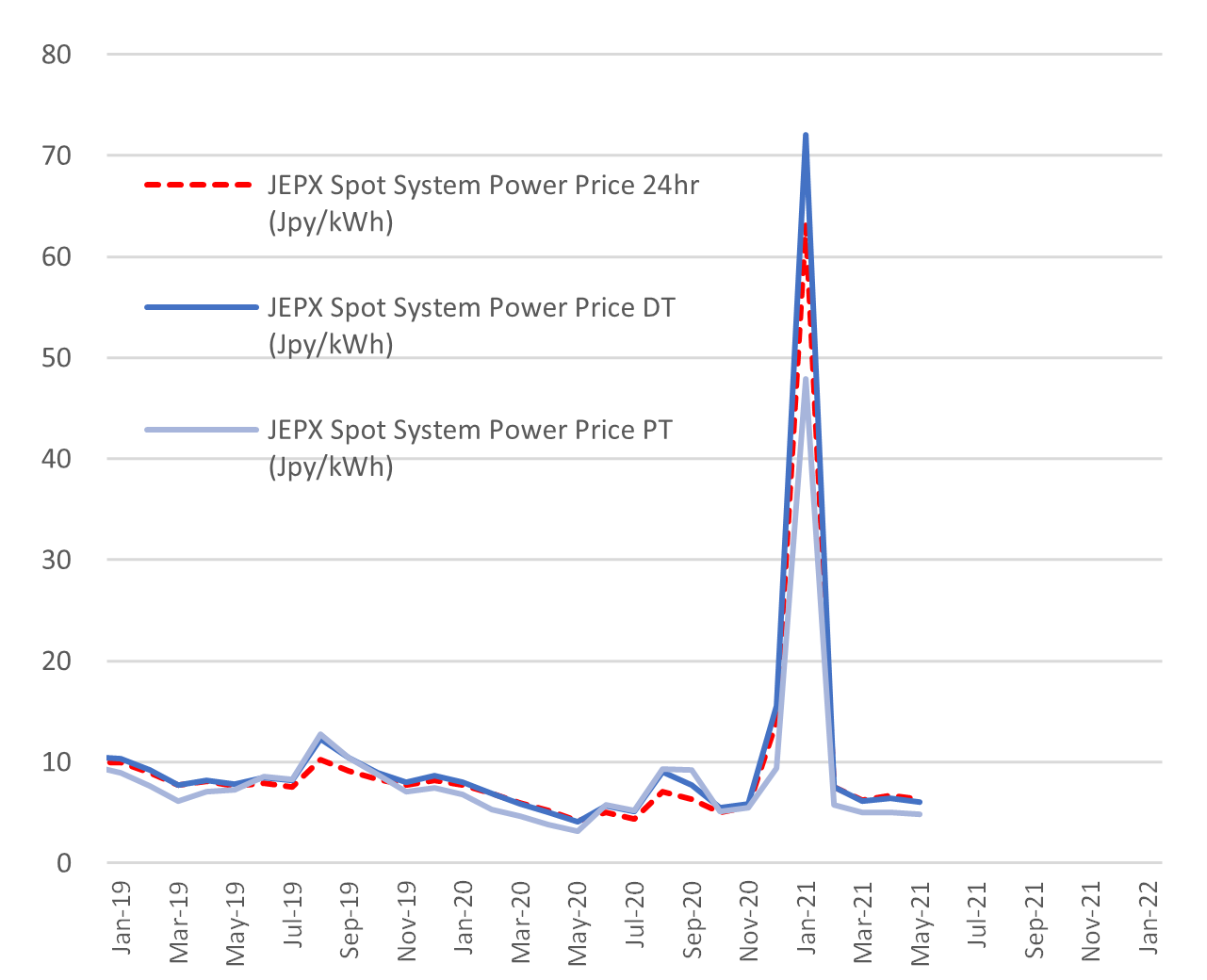
Source: Company websites, JANSI and JAIF, as of May. 14, 2021
Japan’s power supply-demand expected to be tightest in years this summer
(NHK, May 14)
- METI ministry Kajiyama said the power supply-demand situation this summer will be the toughest in years.
- As the country plans to withdraw slowly from thermal generation, there will be less predictability in supply other that in areas such as Hokkaido and Okinawa (which will continue to rely heavily on thermal power sources).
- Industry regulator OCCTO expects the extra generation capacity held in reserve to drop to as low as 3.7% of total in most areas of the country. That is close to what is considered the bare minimum required for reserve capacity.
- Japan’s summer is expected to be warmer than usual this year.
- Ministry Kajiyama appealed to businesses and households to be efficient in their use of electricity.
- The stability of supply is expected to become worse in the winter of this calendar year, especially in the Tokyo area where TEPCO is the dominant power provider.
TAKEAWAY: The weather patterns of recent years in Japan have been more and more unusual. Last year’s rainy season lasted an almost record number of weeks. This year, it sems to be starting early. This makes forecasting supply and demand more complicated, and adds to the difficulties that Japan’s power grid will have in balancing greater variable renewable energy loads with thermal capacity against demand. Irrespective of energy source preferences, all this points to a more urgent need for Japan to invest in an upgrade of its transmission system and add more sophisticated tools to regulate market balance. Several ministry panels are also working through the issue. Demand for power storage and VPP business models is sure to be high.
Kansai Electric partners with Ecostyle to develop numerous renewables projects
(Kankyo Business, May 12)
- Osaka-based Ecostyle said that it signed a comprehensive agreement with Kansai Electric (KEPCO) to cooperate on renewable energy solutions with the aim of promoting the uptake of renewable energy.
- Under the agreement, the two companies aim to build several hundred megawatts of distributed solar generation capacity.
- The two companies will also discuss the best way of distributing the electricity generated, be it on a wholesale basis to power retailers, or via corporate power purchase agreements, and formulate long-term solutions pertaining to renewable energy.
Kansai Electric’s Takahama Unit 4 nuclear reactor has restarted commercial operations
(Ehime Shimbun, May 14)
- KEPCO said on May 13 that the Unit 4 reactor at its Takahama Nuclear Power Plant had recommenced commercial operation after finishing scheduled maintenance.
- This means that KEPCO now has a total of three reactors operating at the Takahama and Ohi NPPs.
- The Takahama Unit 4 was taken off-line in October to undergo improvements to make it more resistant to terrorist attacks. However, delays in this work and defects discovered in equipment caused the reactor to remain off-line.
- SIDE DEVELOPMENT:
Kansai Electric aims to restart Mihama Unit 3 end of June
(Denki Shimbun, May 12)- Mihama Unit 3 last operated in May 2011, which means it will be over 10 years since it has been online.
- Mihama No. 3 is expected to restart in the last week or so of June. Fuel loading will start later this month.
- The restart of Takahama Unit 1, however, will take longer because upgrades to the facility won’t be completed by the end of June deadline.
Toshiba partners with GE on component production for Japanese offshore wind farms
(New Energy Business News, May 13)
- TEPCO Toshiba Energy Systems signed a strategic partnership with GE Renewable Energy, to do significant parts of the manufacturing process for GE’s Haliade-X turbine in Japan.
- The partnership will see the two companies pool expertise in technology, manufacturing facilities, construction, operation and maintenance.
- GE will share technology pertaining to the Haliade-X and supply nacelle components, while Toshiba can assemble the nacelles.
Cosmo to run all gasoline service stations on wind power
(Sekiyu Tsushin, May 12)
- Cosmo decided to power the entirety of its network of 589 filling stations and 16 garages with electricity generated by wind turbines.
- The petrochemical company says it will progressively switch to renewably generated electricity.
- The initiative will save around 16,000 metric tons of CO2 every year, says Cosmo.
Renova to build 450 MW offshore wind farm in Chiba
(Nikkei, May 10)
- Renewable energy developer Renova plans to construct an offshore wind farm in Isumi, Chiba.
- The farm will have an output of up to 450 MW, and will be Isumi’s second.
- The project is still awaiting government approval.
TEPCO Grid says installs smart-meters in all of its catchment areas
(Denki Shimbun, May 9)
- TEPCO Power Grid said it has completed the installation of smart meters in its entire catchment areas. About 28.4 million units have been installed in the Kanto region around Tokyo.
- The smart meters were installed in all households and business establishments.
TEPCO may discharge processed water from Fukushima site via an offshore pipe
(Sankei, May 10)
- TEPCO is considering laying pipes on the seafloor to carry processed water, currently stored on the site of the Fukushima Dai-Ichi nuclear power plant, 1 km out to sea before discharging it.
- Core samples of the seafloor will need to be taken to determine whether such an approach is possible.
Kashiwazaki-Kariwa NPP employee used his father’s nuclear station entry pass
- An employee of a contractor hired by TEPCO’s Kashiwazaki-Kariwa nuclear power plant used his father’s ID card to access restricted areas in 2015.
- The revelations were uncovered by investigators analyzing the causes of recent security breaches at the plant.
- The employee says he only realized he had the wrong card when an alarm sounded as he attempted to enter a more secure zone.
- TEPCO had reported the breach to the Nuclear Regulation Committee.
Sumitomo invests in Singaporean solar firm
(New Energy Business News, May 10)
- Sumitomo Corporation, the Shikoku Electric Power company, and Sumitomo Mitsui Finance and Lease invested in Singapore’s Sunseap Group, which operates distributed solar generation operations and large-scale solar farms in the Asia-Pacific.
- With 220 MW of distributed generation capacity, Sunseap owns the largest share of the Asia-Pacific market, and is also a major electricity retailer.
NYK signs bareboat charter with Northern Offshore to transport wind farm contractors
(New Energy Business News, May 10)
- Shipping giant NYK signed a 10-year bareboat charter agreement with Sweden’s Northern Offshore Services, a subsidiary of the Northern Offshore Group, under which it will own and lease out a crew transfer vessel used to transport wind farm construction contractors.
- Northern Offshore is Europe’s largest operator of crew transfer vessels, and operates a fleet of 60 such vessels.
NEWS: OIL, GAS & MINING
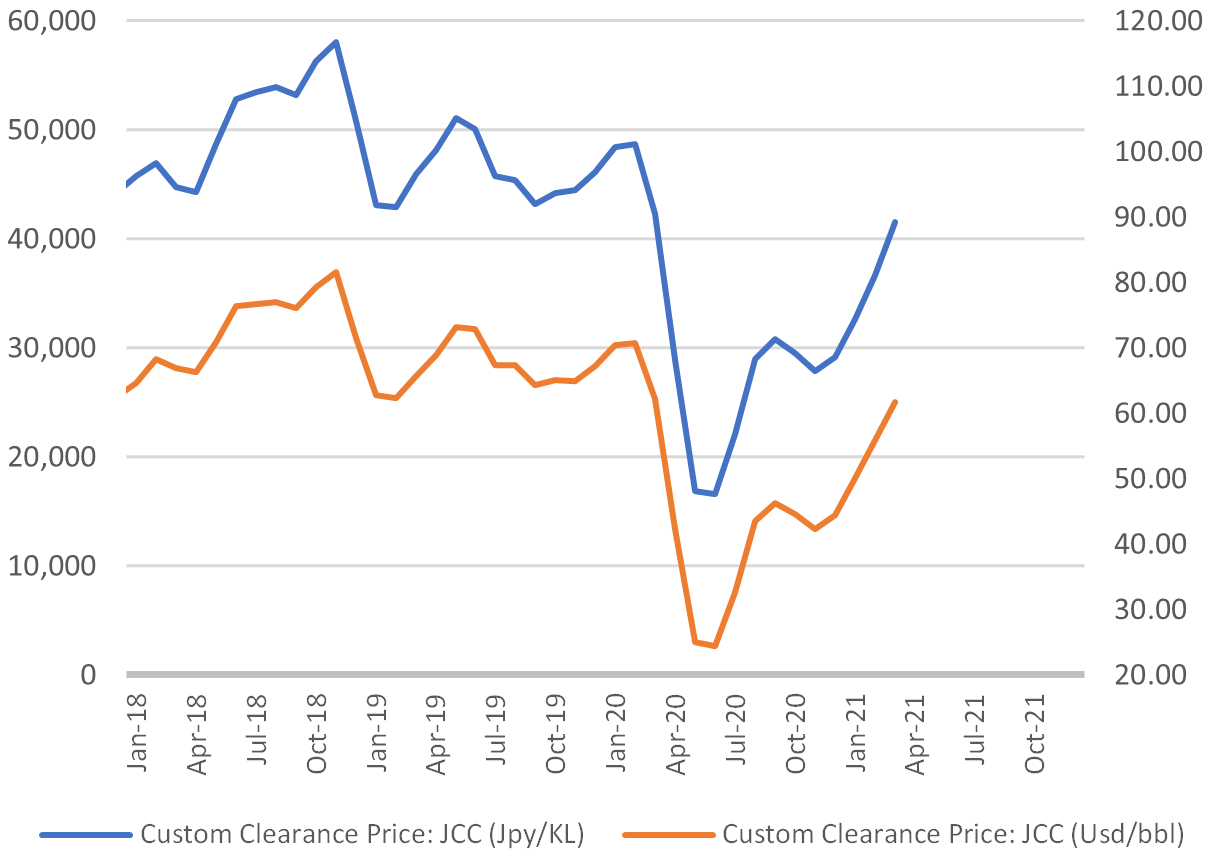
Japan Oil Price: $61.62/ barrel
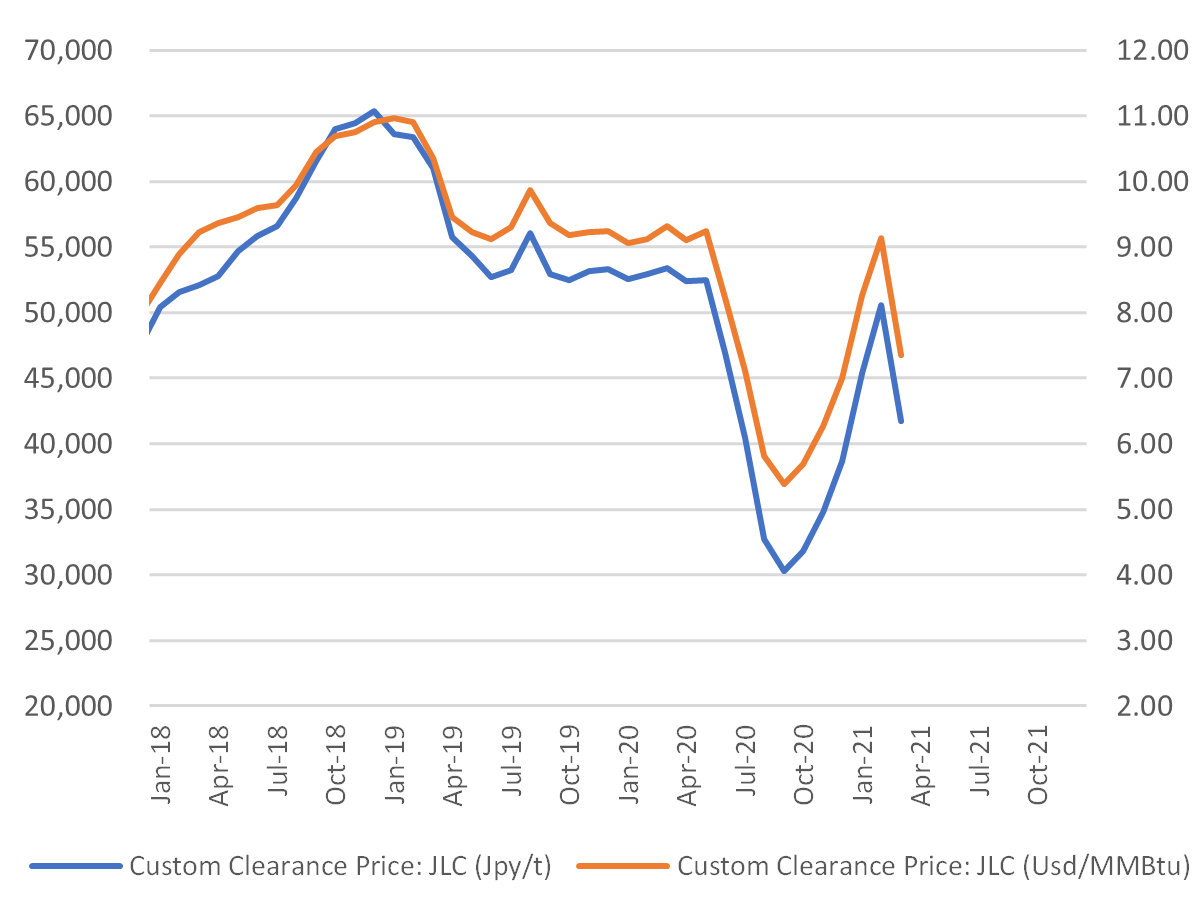
Japan (JLC) LNG Price: $7.35/ mmbtu
More carbon credit supply needed to grow C-neutral LNG business: JOGMEC
(Gas Energy News Co, May 10)
- CONTEXT: This is an interview with Shirakawa Yutaka, a former Tokyo Gas executive who joined state-backed Japan Petroleum and Natural Gas and Metal Mineral Resources Organization (JOGMEC) in 2019 and now is a research in their LNG information and analysis team.
- Shirakawa notes that the commercialization of carbon-neutral LNG has very much begin in Japan, with Tokyo Gas now joined by Hokkaido Gas, Osaka Gas and Toho Gas in the sales of the product.
- Problems to further developments of the C-neutral LNG industry include the lack of unified methodology for calculating emissions and the lack of credit offsets.
- Forestry offset programs around the world can maybe amount 1 to 5 billion tons of CO2 equivalent per year, but the amount of CO2 emitted from the LNG supply chain was 1 billion tons last year. There are many needs for offsets other than for LNG, so there is a risk that prices for offsets will jump.
- Shirakawa notes that the cost of carbon offsetting using a reforestation project is estimated to be about $ 0.60 / mmbtu. However, the EU’s European Methane Strategy launched last year bans or imposes a penalty on import of natural gas / LNG whose anthropogenic methane emissions exceed a certain standard value. So, if methane emissions are also offset, the total cost would to rise to around $ 0.75.
- CONTEXT: That’s getting close to a tenth of the LNG price, which is currently trading in the $8 – $10 range.
- Shirakawa also notes how difficult it is to reduce methane emissions from smaller shale fields, as opposed to large gas fields in places like Qatar. He expressed hope for the introduction of CCS as a way to cut emissions in upstream, with carbon credits offsetting the CO2 from the mid to downstream.
ENEOS to exit the coal business
(Denki Shimbun, May 12)
- ENEOS Holdings will withdraw from the coal business. The company will first sell its upstream assets you hold.
- If domestic (Japanese) buyers of coal agree, ENEOS will also stop the sale of coal, President Ota said, citing the major trends in environmental protection.
INPEX sues JGC Holdings over cost overruns at the Ichthys LNG project
(Jiji, Company Statements, May 12)
- INPEX has filed a lawsuit against JGC Holdings’ subsidiary, JGC Global, at the Yokohama District Court, seeking the performance of guarantees made in relation to the Ichthys LNG project in Australia.
- INPEX claims JGC and its affiliates agreed to reimburse INPEX for AU$758 million in settlements paid to project contractors, but failed to do so.
- JGC, Chiyoda Corp. and KBR Inc. of the U.S. were responsible for the contract, working via a joint entity called JKC Australia LNG.
- INPEX said that as part of the dispute with subcontractors of JKC Australia, it agreed to pay JKC AU$757.73 million. Based on a deed agreement, JKC was then supposed to forward the money to its subcontractors to facilitate project completion and repay the full amount to INPEX by Dec. 31, 2020.
- As the repayment to INPEX was not made, the parties are now in a court dispute.
- JGC acknowledged the lawsuit, and said that in the course of the project, the subcontractors requested an additional sum of AU$757.73 million. After its payment, a dispute arose between INPEX and JKC Australia and arbitration is ongoing in Singapore.
- JKC Australia is refusing to make the payment to INPEX claiming that the correct settlement procedures under the deed agreement were not followed.
- JGC owns 40% of JKC Australia. KBR and Chiyoda each hold 30%.
TAKEAWAY: This is an unusual situation to have Japanese companies taken to court to resolve such matters. It indicates how difficult the vast Ichthys development was for INPEX – its maiden lead investment into a new LNG project – and how expensive and over-budget the facility became. Perhaps, this also indicates that INPEX is not rushing to develop any other major asset, such as its Abadi LNG project in Indonesia.
INPEX chief pledges to diversify portfolio, grow hydrogen, renewables
(Toyo Keizai, May 7)
- INPEX CEO Ueda Takayuki says he agrees with criticism that his firm is overly reliant on the Ichthys LNG project. He says it would only take an accident at Ichthys to jeopardize INPEX’s bottom line, which is why the company is also investing in the Abadi project in Indonesia.
- Ueda defends INPEX’s continued focus on LNG, which he says is relatively environmentally friendly as it has a much lower carbon footprint than coal or oil. The firm will continue to increase its focus on LNG while reducing the percentage of its business that is based on oil.
- INPEX will decide whether to invest in a proof-of-concept project for a blue hydrogen plant in Niigata in 2021/22. The CO2 produced as a result of hydrogen synthesis would be sequestered in a depleted Niigata gas field.
JAPEX sells Canadian shale gas stake and says will books $360M loss
(Nikkan Kogyo Shimbun, May 14)
- Japan Petroleum Exploration (JAPEX) said that it will sell its 10% interest in the mining area held by Shale Gas Project in Canada to operating firm Petronas Energy Canada.
- JAPEX said it decided that it would be difficult to improve the business in the future due to the fall in the price of LNG in response to the trend of decarbonization.
- JAPEX will post an extraordinary loss of ¥39.4 billion on the sale in its current fiscal year.
Sojitz invests in IWPP in UAE
(Denki Shimbun, May 7)
- Sojitz Corporation says it will invest in a gas-fired power plant and desalination plant in the United Arab Emirates, in a partnership with UAE and French operators. This is Sojitz’s first foray into the Middle Eastern integrated water and power plant sector.
- The plant is capable of generating 1.6 gigawatts of electricity, and produces around 240,000 kL of fresh water each day. The plant’s contract to sell electricity and water is valid for another 22 more years.
- The size of Sojitz’s stake has not been disclosed.
ANALYSIS
BY MAYUMI WATANABE
Electricity Grid Access Due to Open Up in FY2022,
Giving Renewable Energy Projects More Opportunities
Japan has promised renewables operators preferential access to the grid in a bid to boost green energy in the mix. Currently, some solar and wind operators may settle for regular access instead of the usual curtailments their power facilities face.
During Golden Week holidays at the start of this month, sunny weather increased potential solar output even as power demand waned. And yet, the southern Kyushu area asked solar facilities to curtail supply six times. Even the northern Hokkaido area threatened curtailments for renewables projects before cloudy weather naturally lowered solar output. In the same period, nationwide online gas-fired capacity was largely unchanged while coal-fired capacity shrunk only about 10%.
Last week, a METI panel admitted that if all the solar farms seeking to connect to the grid were allowed to do so, in Kyushu area alone 30% of renewable capacity would be regularly curtailed. The panel’s message was: this is why it doesn’t make sense to connect all comers to the grid.
Change, however, is on its way. Starting in FY2022, access to the power grid is due to move to a merit-based order, with ‘merit’ defined in part by the environmental impact of the generating power source. The volume of spare capacity in a power grid will also be calculated in a different way, which should offer room for more renewables.
This will mark a profound change in Japan’s electricity markets, not only because it should ease solar and wind power access to the grid, but because it could uproot the entire hierarchy and structure of the industry.
Years of delays
In addition to operating most of Japan’s thermal power generation, the 10 regional Electric Power Companies (EPCos) also handle grid access requests from third-parties. Once connected, third party operators (many of which run solar or wind farms) are at the mercy of the EPCo-owned grid company, which can ask them to stop operating on days when supply exceeds demand.
“Connecting to the transmission network has been a bottleneck for renewables. One concern is after you connect, a request can come asking you to curb power output, and then it’s the same as being told you cannot connect” to the grid, says an official for the Renewable Energy Association for Sustainable Power Supply (REASP).
Kyushu EPCo, operating on the southern island of Kyushu, made 26 curtailment requests in FY2018. That jumped to 93 requests in FY2019, and 87 in FY2020. On a few days, such as March 26, 2021, around half of the solar capacity in Kyushu was curtailed.
A few of the power utilities like Shikoku EPCo and Tohoku EPCo claim they are trying to keep renewables online longer and sometime disconnecting thermal power first. Shikoku also utilize excess renewables output for pump storage and shares information with renewables operators to improve communication.
These are small steps, however, and renewables projects claim their output is still being constrained by a grid working to protect thermal power.
A common refrain from the EPCos is that they cannot allow new grid connections because there is no spare capacity in the system after taking account of the power stations that utilities need to keep in active reserve. This becomes even more problematic in regions like Hokkaido where renewables capacity already exceeds the region’s average demand capacity.
To make grid access fairer, last year the government asked EPCos to split off their transmission networks from their power plants business, which is mostly thermal and nuclear. Many utilities, however, kept the power lines business inside the same holding as their electricity generation assets, thus essentially retaining everything under the same roof.
Regulation and policies have so far either condoned or ignored the potential conflicts of interest, but a rule change could now make a difference.
Grid operators can conveniently decline new connections to the grid, or curtail capacity, by claiming that the system has no room for additional power capacity. Utilities use the “nameplate capacity” (or rated capacity) model to measure utilization rates. This model factors in the capacity that EPCos hold back for emergencies.
Internationally, however, it’s more common to use a “power flow” model to estimate capacity utilization.
In 2018, the Organization for Cross-Regional Coordination of Transmissions Operators (OCCTO) ran calculations based on both of the models and concluded that with the power flow model, the volume of available capacity is 4% to 15% higher than with the rated output capacity model.
Following the study, OCCTO urged EPCos to reassess their spare capacity based on the power flow calculation. After a small trial, the scheme was approved and agreed on for a nationwide rollout, which took place in January 2021.
The nationwide program will be activated in two phases, first for the trunk lines, and then for local transmission lines in 2024. Trials of the latter started last month. TEPCO Grid and New Energy and Industrial Technology Development Organization (NEDO) are also conducting tests on interconnections between different grid systems.
New rules of grid engagement and new lines
Grid access rules will also be changing. Currently, connections are made on a first come, first served basis. This means traditional thermal power plants have the advantage. However, the government plans to introduce a “merit-order system”, in which connection priority is determined by power generation costs, environmental impact and other parameters.
The Federation of Electric Power Companies proposed to METI to launch the new access rules in 2022.
Also, the government plans to add more transmission lines to improve the grid’s flexibility. As of March 2021, the plan calls for adding another 665 kilometers of transmission lines and 25,590 substations.
The additional grid lines are especially important for offshore wind. The government aims to build at least 10GW of offshore wind capacity by 2030 and 30 GW to 45 GW by 2040. Of this, 80% of the generation capacity will be in the northern Hokkaido, Akita and Aomori prefectures, as well as in the southern Kyushu region. That will require long-distance transmission lines from the country’s tips to its central areas, like Tokyo, Kansai, and Chubu, where most of the demand lies.
The OCCTO is proposing the introduction of the High Voltage Direct Current (HVDC) system, which is suited for moving electricity over distances of 500 km and more. A cost analysis of this is under way, as it will require adding equipment that converts DC to AC. So far, early estimates indicate that HVDC would be economically feasible if it connected around 45 GW of capacity.
If Japan proceeds with the rollout of HVDC then it will also open opportunities for many foreign firms because few local companies deal with the technology.
Conclusion
As Japan re-configures its future electricity mix strategy, it’s likely that renewables will play an increasing role in the country’s 2030 market and beyond. To accommodate them, the country will need to revamp its grid structure, and likely push through a more coherent separation between the power generation and transmission assets of legacy regional power utilities.
Opening up the grid and adding more transmission lines will enable easier and more profitable operations for renewable energy generators, which in turn will spur more green energy projects in Japan. Achieving this in the nearest future will be crucial now that the country has pledged a 46% emissions cut by FY2030, as well as lower tariffs for renewables by putting them onto a new Feed-In Premium (FIP) pricing model starting in 2022.
ANALYSIS
BY TOM O’SULLIVAN
Profit in the time of Covid:
How the Pandemic is Reflected in Japan’s Corporate Financials
Japan went into its first lockdown and state of emergency on April 7, 2020[1], almost at the start of Fiscal Year 2020. In the last two weeks, most major Japanese players in the significant energy and commodity space reported their FY2020 results.
The results were affected by commodity price volatility and the accelerated decarbonization narrative, as well as the COVID-19 pandemic, leading several key players in Japan’s energy scene to post record losses and write-downs. And while the broader Nikkei 225 stock index rose 60% during FY2020, many energy-related stocks dropped as investors punished those slow to respond to the energy transition narrative and closer scrutiny over the environmental footprint.
Below is a selection of interesting points from the financial results. Please note that all the Yen-denominated figures have been converted to USD at a rate of ¥110 to $1.
Background: Commodity price volatility
Firstly, it should be noted that the Covid fiscal year saw the highest volatility in minerals and energy commodity prices in a decade.
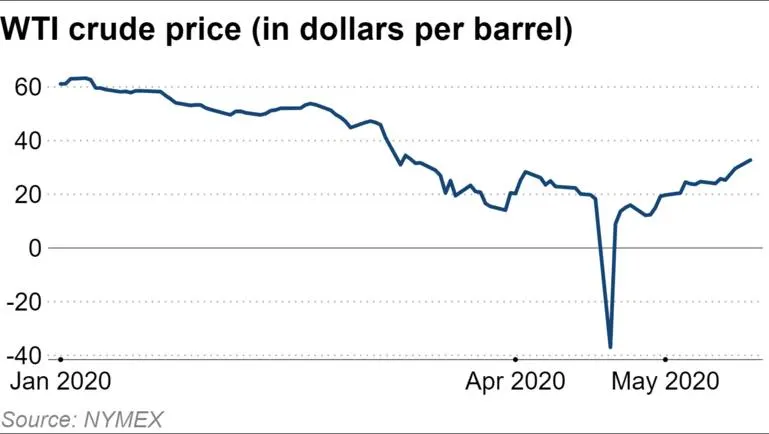
International oil prices lurched from mid-teens (and even posted a record, negative $37.63 / barrel of WTI on April 20, 2020) to reach mid $60s level in late March 2021. In Japan, this reaction was delayed by 1-2 months. The average price of oil recorded at customs dropped to ¥16,527, or $22.40, per barrel in June 2020. That’s the lowest since 1999.
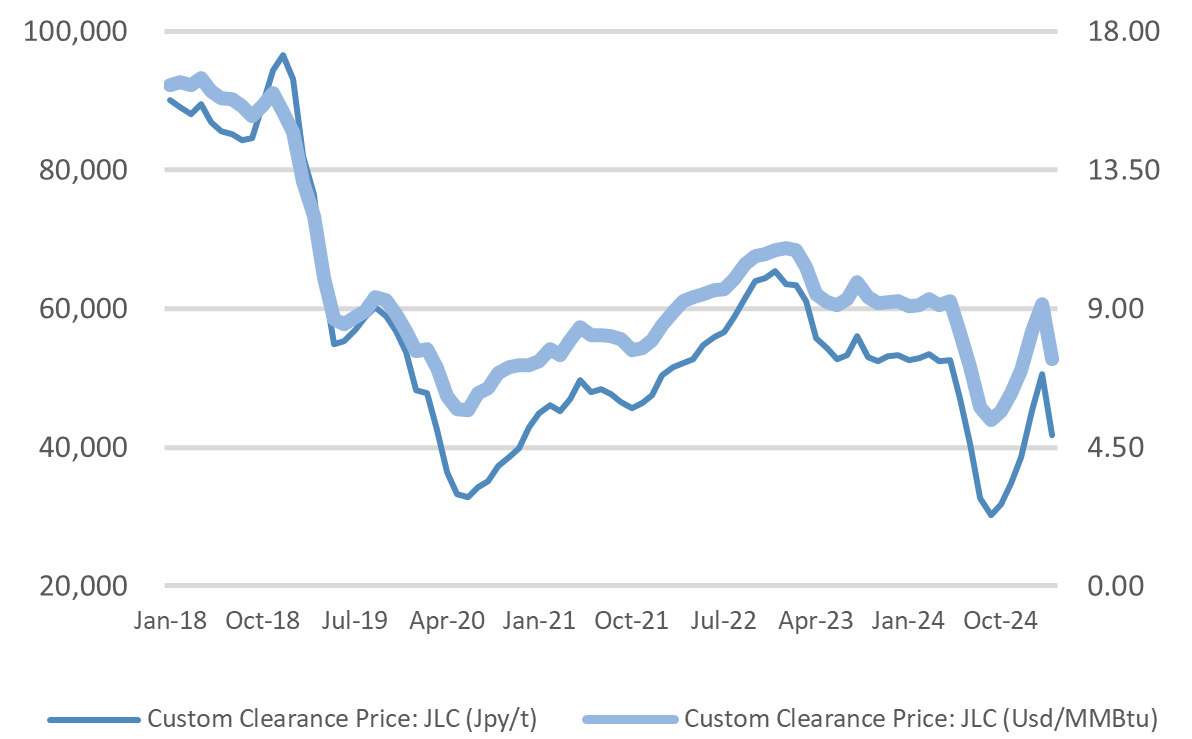
In LNG, the story was Asia LNG benchmarks shrank to a record low sub $2 / mmbtu level in May 2020, only to bounce back and achieve a record high of $32.494 on Jan. 12, according to the S&P Global Platts JKM assessment.
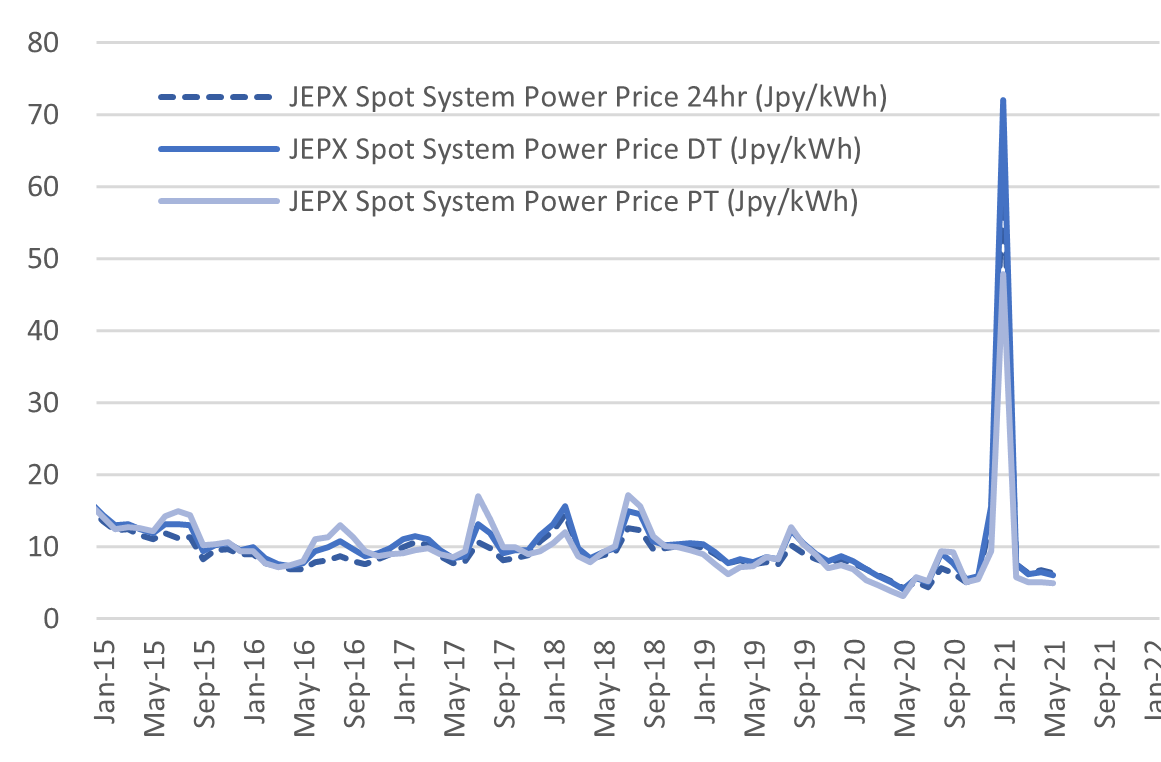
Japan’s electricity prices had probably the wildest peak of all, jumping to middle figures in Dec. 2020 for only the second time in two years, and then surging to ¥63.07 per kWh in January 2021 before dropping to ¥7.50 the following month.
Trading Companies
Sumitomo Corporation recorded its worst ever performance as it suspended a Nickel project in Madagascar for a year and incurred large associated impairment charges. The IPP power business in Australia and the rising cost of power infrastructure also contributed to the record loss. As a result of the decarbonization trend, the company vowed to exit all shale oil businesses in the U.S. and all coal projects by the end of 2040s. The firm is also closing its crude and fuel oil trading desks in Singapore.
Sumitomo expects the current bullish trend in commodities to continue this fiscal year. Its oil forecast is 10% higher for this fiscal year, copper estimate is 18% higher, and the expectations for coking coal and nickel are also up.
[1] Japan registered its first Covid-19 case in January 2020, but the virus did not start to spread noticeably until late February to early March
WTI Oil Price: Extreme Volatility During Covid
JCC Oil (Customs) Price: L-T contracts Smooth Volatility
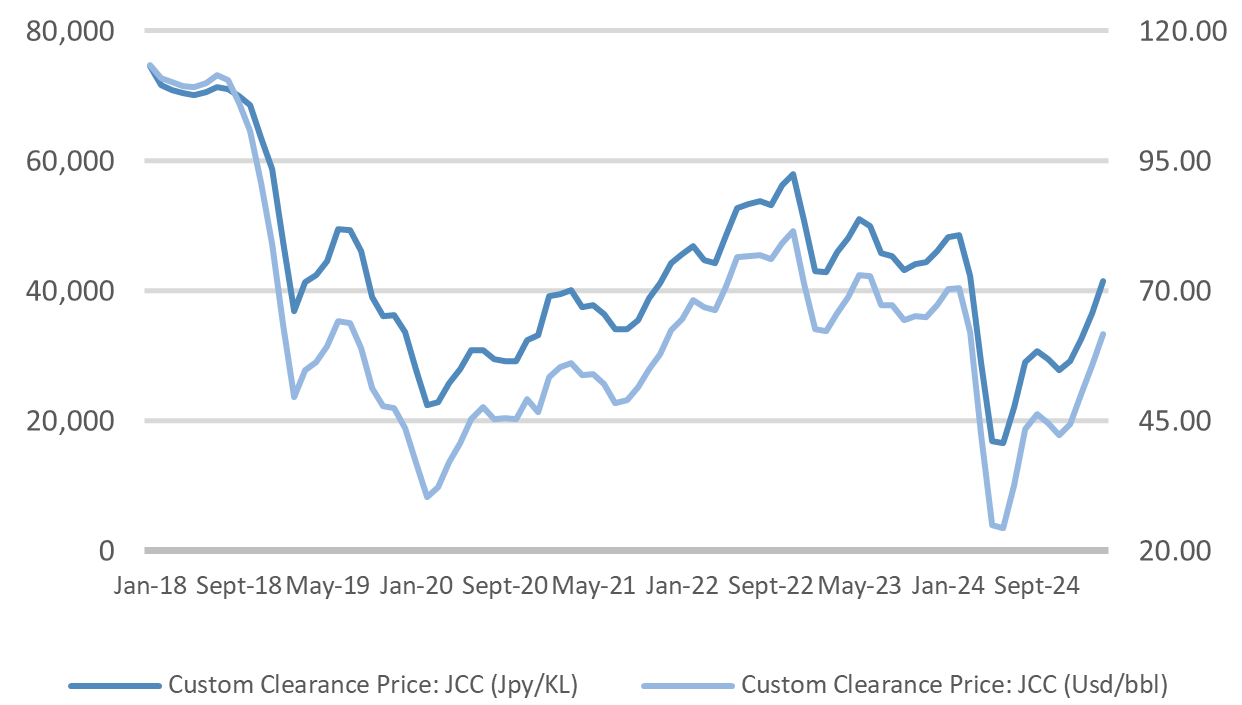
|
April 2020 price : $16.55 / barrel |
April 2020 price : $42.21 |
|
March 2021 price : $62.33 / barrel |
March 2021price : $61.62 |
JLC LNG (Customs) Price: Strong Recovery After Drop
Japan’s LNG import data vs 5Y average
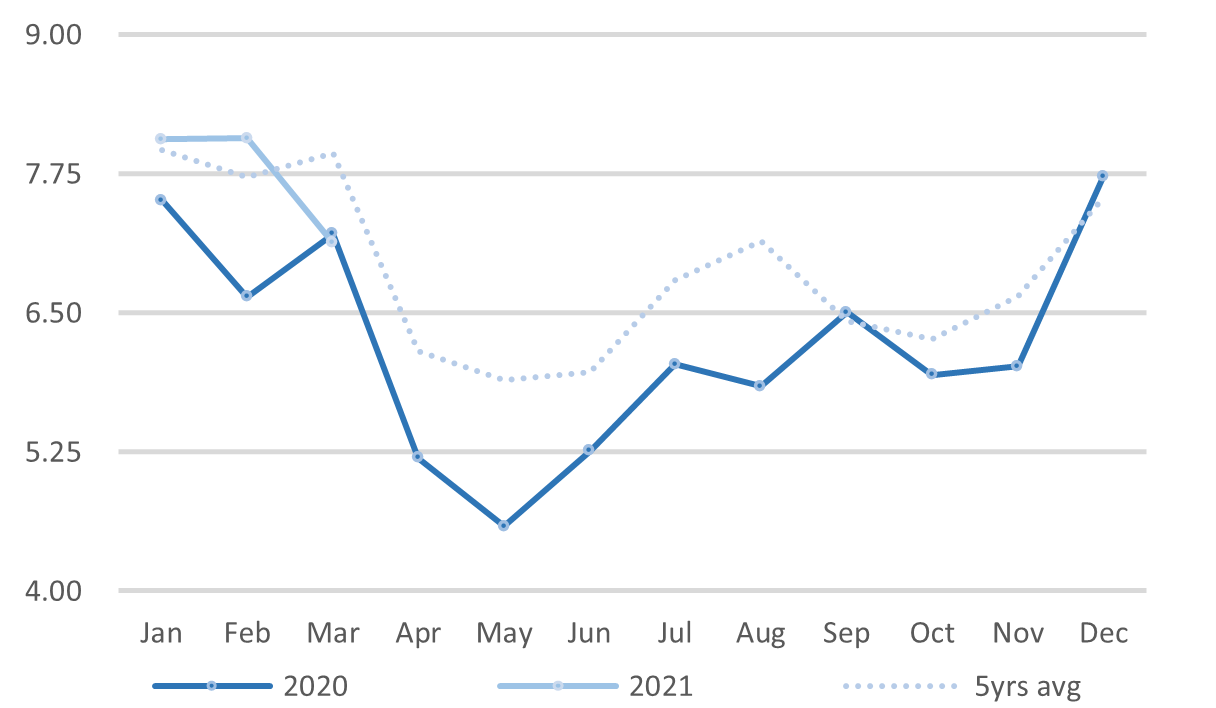
|
April 2020 price : $9.25 / mmbtu | |
|
March 2021 price : $7.35 / mmbtu |
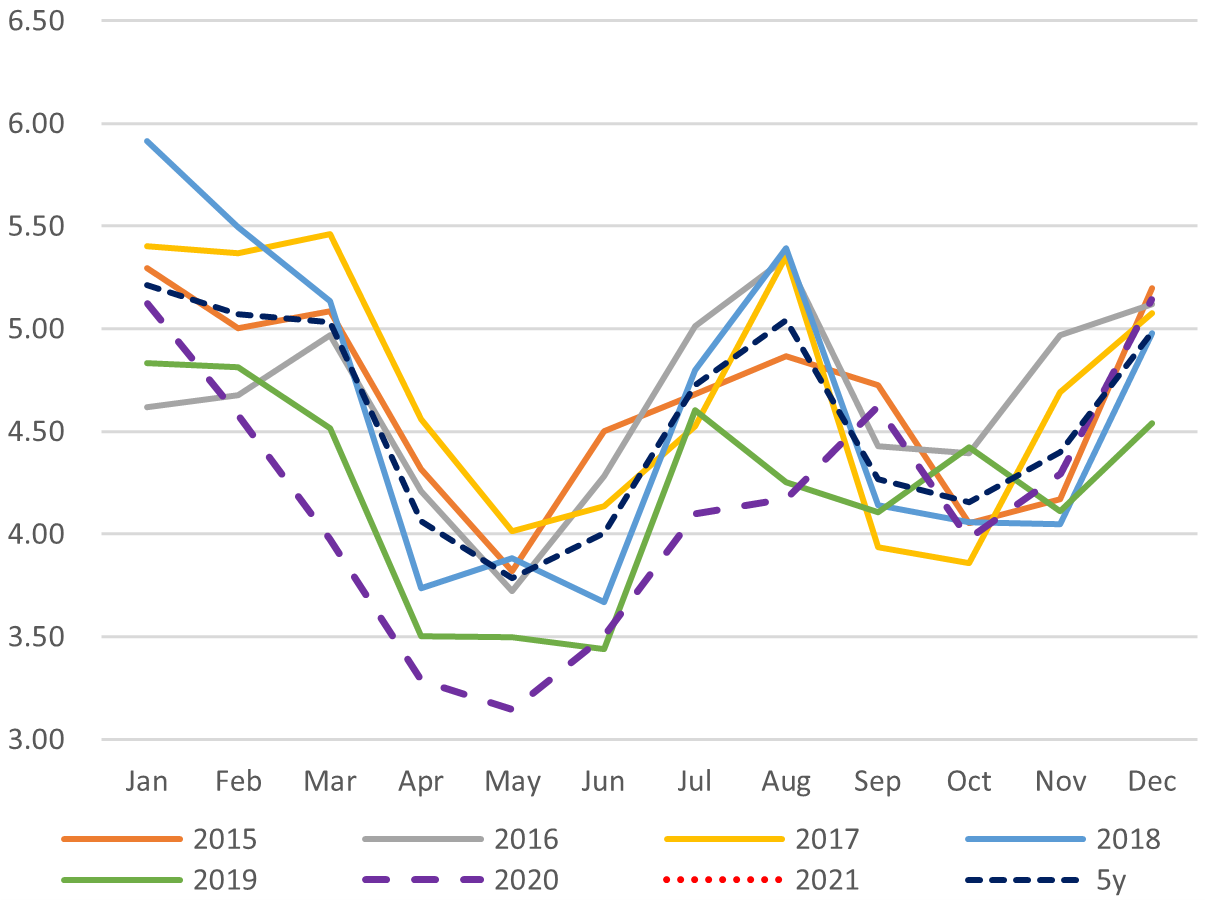
Electricity demand vs 5Y average: the Covid drop
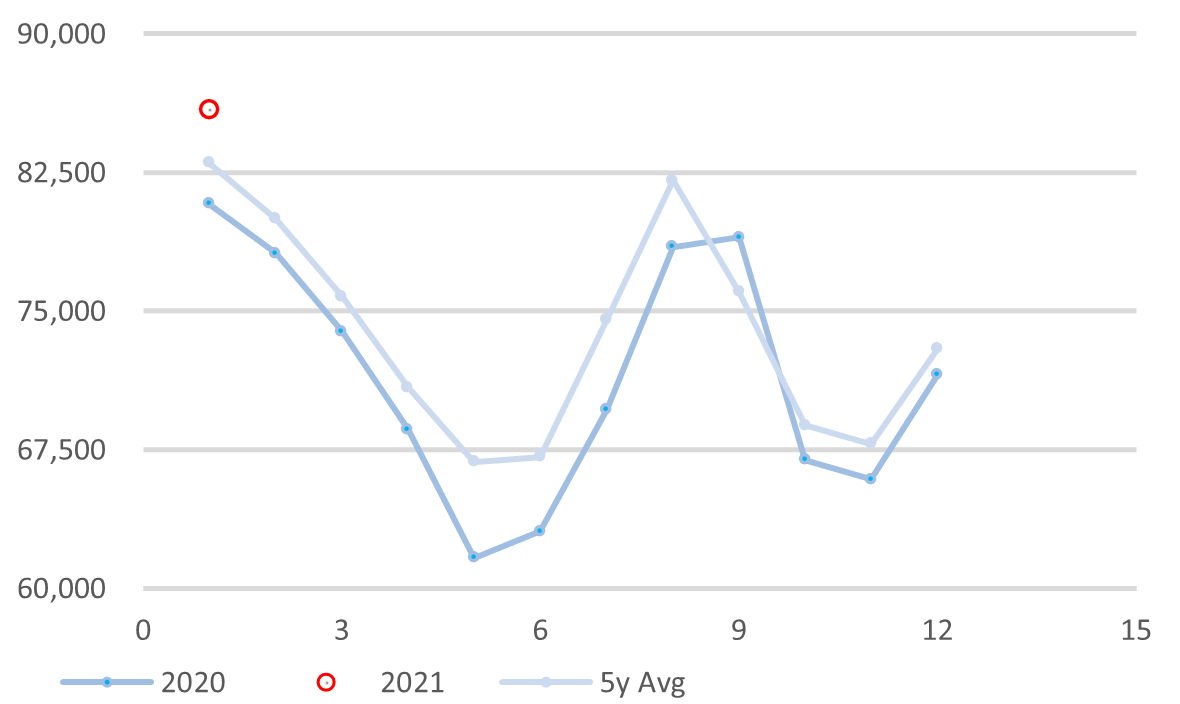
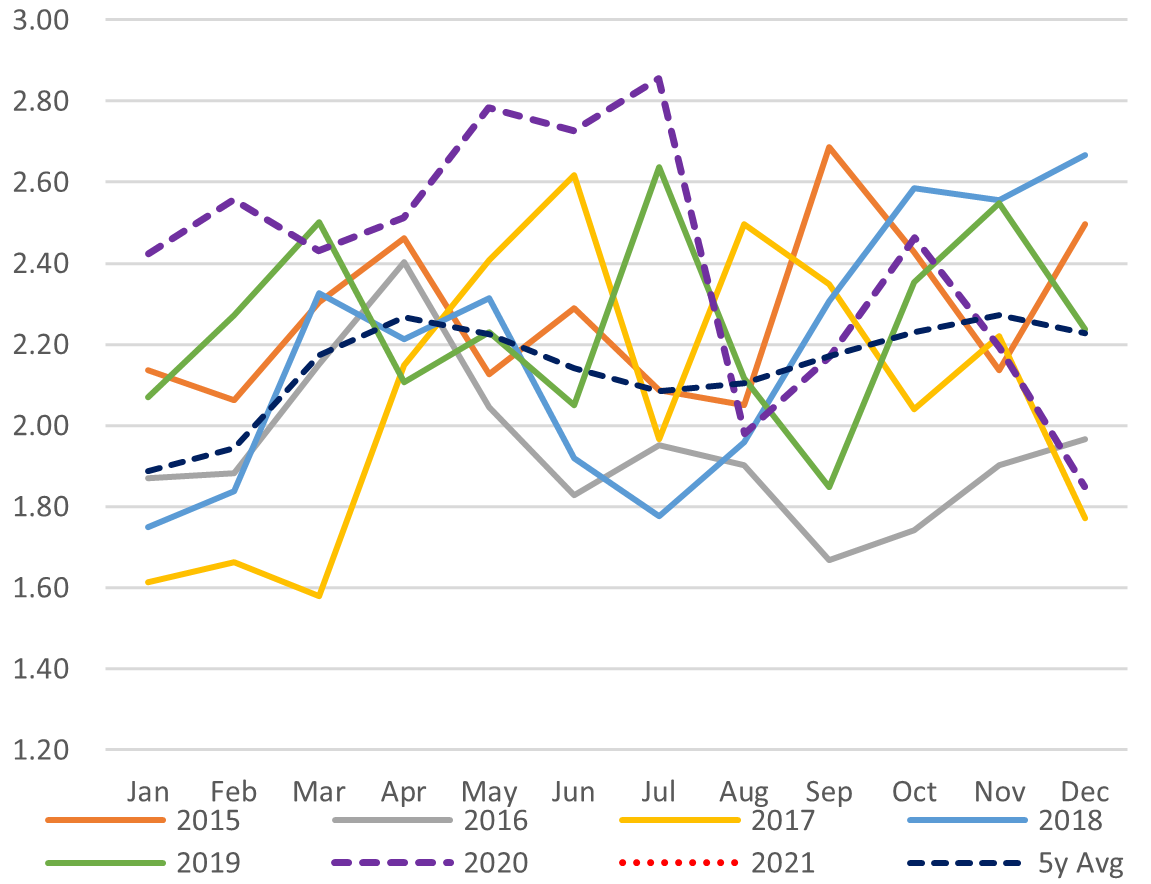
Japan’s 24h electricity price Yen vs 5Y average
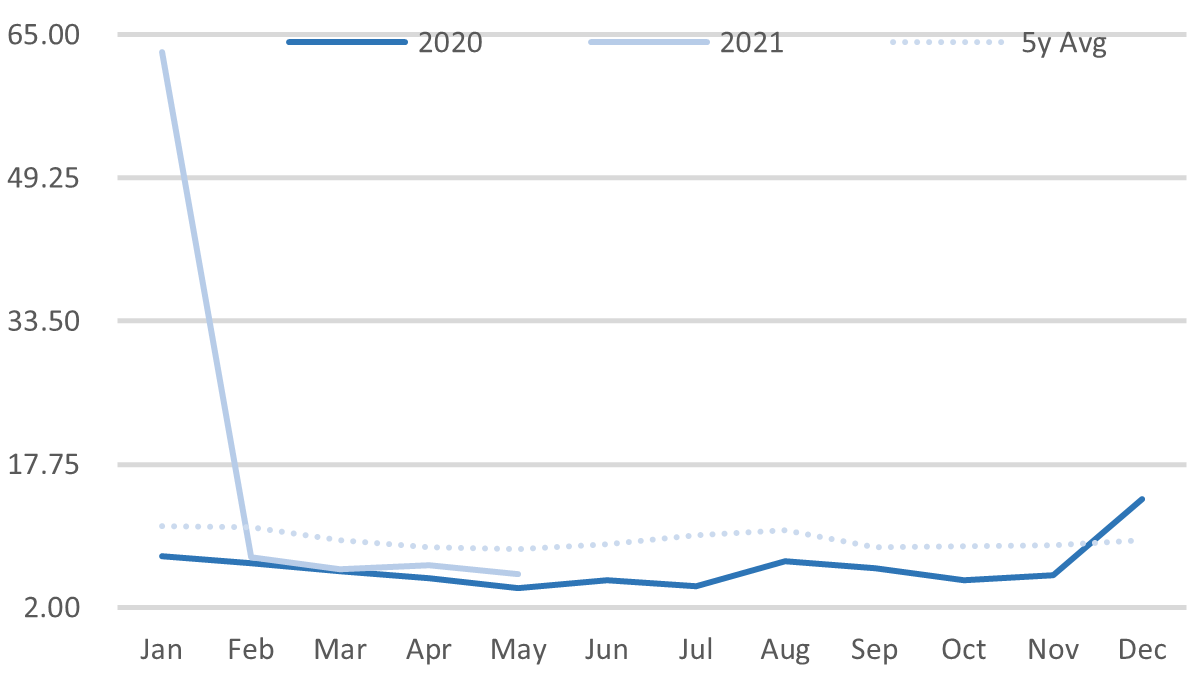
Mitsubishi Corporation’s net profit slumped almost 70% YoY due to lower coking coal prices, plummeting profits in LNG, and an impairment charge on its Lawson investment. Mitsubishi is still Japan’s largest trading company by asset value.
Mitsubishi sees a strong recovery in the LNG market this year, and healthy gains in oil and copper, but expects the market for coking coal and iron ore minerals to be largely unchanged.
Mitsui, Itochu, and Marubeni all reported profits due mainly to higher iron ore prices, although lower oil prices negatively impacted performances during the year.
Oil Companies/Refineries
ENEOS had a very strong Q4 on the back of improved oil prices, but its power business suffered a loss of over $300 million due to higher LNG prices in Q4 and the need to buy power on the spot market due to the cold weather in January. It is anticipating over $2 billion of lower sales in FY2021 due to Covid-19’s impact on jet fuel and lubricant consumption. ENEOS is also buying JSR’s elastomer business for $1 billion. Higher copper and oil prices should benefit ENEOS in FY2021.
Idemitsu Kosan also benefited from higher oil valuation gains in Q4 but took an impairment charge of almost $200 million on a Vietnamese investment. It also lowered its outlook for FY2021 and beyond due to ESG concerns that will impact its refinery, thermal coal, and oil and gas businesses.
Electric Power Companies
Chugoku Electric reported full-year net income of $130 million, 2H dividend of Y25 /share, and is forecasting net income of $150 million for FY2021.
Hokkaido Electric reported full-year net income of $330 million, a 2H dividend of Y15/share, and is forecasting net income of $200 million for FY2021.
Kyushu Electric reported full-year net income $300 million, a 2H dividend of Y17.5 share, and is forecasting net income of $450 million for FY2021.
Tokyo Electric (TEPCO) reported lower fuel costs but also lower electricity sales due to increased market competition and the pandemic. The state-backed utility’s sales dropped 13.9%, while operating income fell 68% to $1.3 billion. Income from retail electricity sales fell 20%.
Kansai Electric reported a 3.7% drop in revenue, but a slight 1% rise in operating income to $1.32 billion. The utility acknowledged a recent raid on its offices by the Japan Fair Trade Commission on suspicion of restricting competition in the high voltage power services, and vowed to fully cooperate with the probe.
LNG importer / Electricity supplier
JERA managed to grow operating income by 49.4% during the pandemic even as its revenues fell 16.8% due to lower electricity sales and lower gas prices. Japan’s biggest LNG importer said it lost about $85 million on LNG sales last fiscal year and slightly more on fuel upstream projects. However, the impact of the deep freeze in Texas helped bring in $91 million in gas trading profits in North America. An improvement in the Freeport LNG project in the U.S. also added to profits.
Engineering, Procurement, and Construction Cos.
Chiyoda Corp. recorded a net profit of $100 million for FY2020, and is projecting lower profits for FY2021 and FY2022. It is forecasting an order book of $3 billion for FY2021 that does not include any new LNG projects. Chiyoda won the Qatar LNG expansion project last year.
Mitsubishi Heavy Industries reported a pre-tax profit of $500 million.
Metals
Nippon Steel reported a profit of $1 billion for FY2020 on higher steel margins and lower production costs.
Kobe Steel reported a net profit of $200 million for FY2020, but is cautious about FY2021 due to lower iron ore prices and flat coking coal prices and losses at its power generation business. Some power generation facilities will need to be closed for inspections in FY2021.
Transportation
JR East reported its first ever annual loss since its privatization three decades ago of $5.5 billion as lockdowns played havoc with passenger numbers. All Japanese rail companies may look to increase travel tariffs if low passenger loads persist and will likely lobby for lower power prices for any external electricity they source.
Nissan Motors reported a net loss of $4.5 billion on sales of four million units. Revenues dropped by $18 billion YoY because of Covid-19.
Gas/Hydrogen
Iwatani posted a record Q4 on the back of a better performance in its energy division. FY2020 earnings were $300 million. Sales of liquid hydrogen and LP Gas were stronger. Iwatani is forecasting stronger revenue growth in FY2021 because of the introduction of METI’s revised energy plan.
GLOBAL VIEW
BY TOM O’SULLIVAN
Below are some of last week’s most important international energy developments monitored by the Japan NRG team because of their potential to impact energy supply and demand, as well as prices. We see the following as relevant to Japanese and international energy investors.
Pipeline Outages:
1). A cyber-attack caused the worst critical energy infrastructure outage in U.S. history last week, closing an 8,800 km pipeline that supplies 45% of the gasoline to the East Coast, or 15% of total U.S. fuel demand, equivalent to 2.5 million bpd. The operators of the Colonial Pipeline Company that connects Texas to New York are now thought to have paid DarkSide, the perpetrators of the extortion attack, a ransom of $5 million. Seventy five percent of the gas stations in the U.S. capital were without gasoline for several days last week, and average prices across the country hovered around $3 per gallon, the highest since 2014. The pipeline reopened last Wednesday.
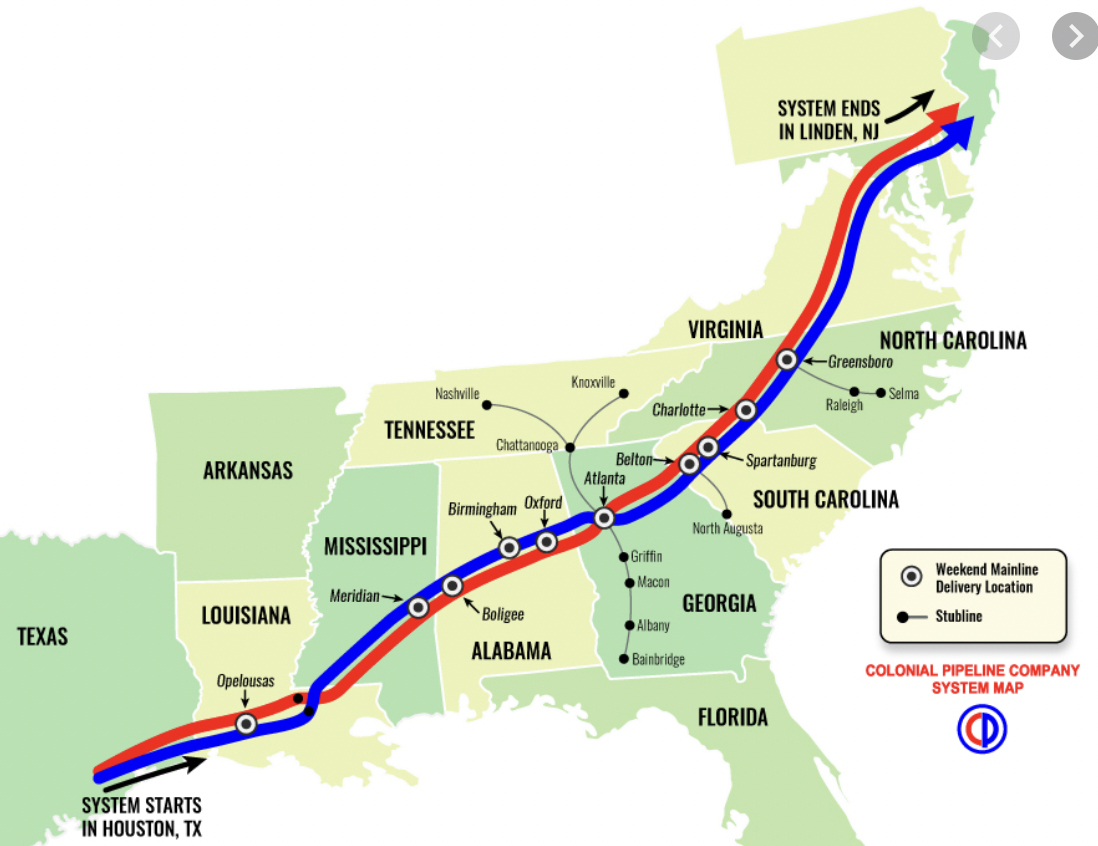
Energy, oil/gas, and utilities have a high propensity to be hit by ransomware, and almost 80% of U.S. energy companies have reported such attacks.
Toshiba’s European subsidiary was also hit by a major cyber-attack last week.

2). An Israeli oil pipeline that runs from the Red Sea port of Eilat to Ashkelon on the Mediterranean was hit by rockets during the country’s conflict with Palestine last week.
3). Governor Whitmer of the U.S. State of Michigan is threatening to seize profits from Enbridge, the Canadian operator of the Line 5 oil pipeline, that runs along Lake Michigan, unless the pipeline is closed. Whitmer claims the pipeline poses serious environmental risks.
Renewable Energy Investments:
The IEA reported that investments in global RE energy in 2020 increased at the fastest pace since 1999, with over 250 GW of solar and wind installed last year. The IEA has increased RE forecasts for 2021 and 2022 by 25%.
Oil:
1). OPEC cut expected U.S. oil production for 2021 and is now expecting a YoY fall of 100,000 bpd following an 800,000 cut in 2020.
2). The IEA also cut its oil growth demand forecast for 2021 by 270,000 bpd, to 5.4 mbpd, because of weaker Q1 demand numbers in the U.S., the EU, and India.
Coal:
Three UK banks – HSBC, Barclays, and Standard Chartered – are now thought to have increased their credit exposure to coal companies by over $30 billion in 2019 in a clear contravention of the Paris Agreement.
EVs:
1). Nio, the Chinese EV maker is now betting that battery swapping will play the most important refueling role for EVs in a departure from the Tesla recharging strategy. Nio is working with Sinopec, the Chinese state-run oil company, to double its network across China. It also plans to open battery-swapping stations in Norway.
2). Sales of EVs are now $120 billion per year.
3). The CEO of Glencore warns that car industries in the U.S. and EU could be sidelined unless supplies of cobalt are secured. Cobalt is critical for in lithium-ion batteries.
4). Tesla announced it will no longer accept Bitcoin for purchase of its vehicles due to its dirty fuel consumption, which is mainly in Inner Mongolia in China. Bitcoin mining consumes over 120 TWh of power, mostly in China, but some in Iceland.
Copper:
Copper prices rose to over $10,200 per ton last week, doubling since a pandemic low in March 2020, and hitting their highest levels since 2011 on the back of increased investment in electrification. Iron ore prices in Singapore also hit a record high last week.
Aviation:
EU governments have now invested $24 billion in European aviation companies. France now owns 30% of Air France-KLM; Germany owns 20% of Lufthansa; and Italy owns 100% of Alitalia.
Automobiles:
Chip shortages are now estimated to cost the global automobile sector $110 billion of revenues in 2021.
Rail:
1). Cracks were discovered on several UK trains that were manufactured by Hitachi, forcing GWR and LNER, two UK train operators, to withdraw over 100 trains. The compensation bills for Hitachi have still to be determined.
2). With an increased offer of $34 billion Canadian National has overtaken Canadian Pacific in a bid for Kansas City Southern.
Buildings-Emissions:
Real estate, commercial and residential, generate 40% of global emissions and are now expected to face increasing scrutiny of sustainability credentials. In 2023 it will be illegal in the Netherlands to lease buildings that score below a C on the EU sustainability scale. The EU plans to overhaul 35 million inefficient buildings by 2030 as part of a “Renovation Wave”.
Shipping:
The Baltic Dry Index rose to its highest level in a decade last week, and a YoY increase of over 700% as the international commodity boom gains momentum. Capesize vessels, 180,000 dwt, are now charging $41,500 a day.
South Korea:
Hyundai will invest $7.4 billion in the U.S. by 2025 for the production of EVs and for smart mobility solutions.
China:
1). China now produces 80% of the world’s solar cells using coal-fired power electricity mainly in Xinjiang and Inner Mongolia. Calls are being made to introduce carbon border adjustment taxes for these imports.
2). Tesla has halted plans to expand its Shanghai factory due to uncertainties in US-China trade relations.
Australia:
Australian coal producers are facing increasing difficulty securing insurance cover for coal mining operations due to ESG concerns and are asking the government for support.
India:
Japanese automaker Suzuki has been forced to suspend all earnings guidance for FY2021 due to the impact of the pandemic in India.
Kurdistan:
The region is significantly revising down its royalties paid to oil producers.
Norway:
As part of efforts to redress the impact of the pandemic that caused the worst Norwegian economic downturn since WWII, the country is expected to spend a record $50 billion from its $1.3 trillion sovereign oil fund this year.
Sweden:
Chinese-owned Volvo may seek an IPO listing on the Nasdaq Stockholm stock exchange later this year, although Geely will remain a major shareholder.
U.K.
1). Calpers, one of the largest pension funds in the U.S., and current chair of the CA100 group of institutional investors controlling $54 trillion in assets, voted against a BP climate resolution that would have forced that company into closer alignment with the Paris Agreement. Calpers claims BP is already developing a robust climate strategy.
U.S.
1). Stellantis, the carmaker formed through the alliance of PSA and Fiat Chrysler, terminated a plan to buy hundreds of millions of dollars of emissions credits from Tesla.
2). Elliott, the activist investor, has taken a stake in Duke Energy that has a market capitalization of $80 billion. Elliott may force Duke to offload assets. Duke also has long-term debt of $55 billion. Duke provides electricity to eight million customers and is facing lawsuits relating to its coal-powered plants.
3). Two oil and gas producers from Colorado, Bonanza Creek Energy and Extraction Oil & Gas, will combine in an all-stock no-premium merger to form a $2.3 billion company.
4). The $2.8 billion Vineyard Wind project off Nantucket, Massachusetts has been approved by the U.S. government. The project comprises 84 turbines and is now expected to be operational by 2023.
EVENTS CALENDAR
A selection of domestic and international events we believe will have an impact on Japanese energy.
|
February |
Approval of Fiscal 2021 Budget by Japanese parliament including energy funding projects; CMC LNG Conference |
|
March |
10th Anniversary of Fukushima Nuclear Accident; Smart Energy Week – Tokyo; Quarterly OPEC Meeting; Japan LPG Annual Conference; Full completion of all aspects of the multi-year deregulation of Japan’s electricity market; End of 2020/21 Fiscal Year in Japan; |
|
April |
Japan Atomic Industrial Forum – Annual Nuclear Power Conference; 38th ASEAN Annual Conference-Brunei; Japan LNG & Gas Virtual Summit (DMG)-Tokyo Three crucial by-elections in Hokkaido, Nagano & Hiroshima – April 25th |
|
May |
Bids close in first tender for commercial offshore wind projects in Japan; Prime Minister Suga to visit the U.S.-tentative |
|
June |
Release of New Japan National Basic Energy Plan-2021; G7 Meeting – U.K. Forum for China-Africa Cooperation Summit (Senegal) |
|
July |
Tokyo Metropolitan Govt. Assembly Elections; Commencement of 2020 Tokyo Olympics |
|
August |
Hydrogen Ministerial Conference in conjunction with IEA |
|
September |
Ruling LDP Presidential Election; UN General Assembly Annual Meeting that is expected to address energy/climate challenges; IMF/World Bank Annual Meetings (multilateral and central banks expected to take further action on emissions disclosures and lending to fossil fuel projects); End of H1 FY2021 Fiscal Year in Japan; Japan-Russia: Eastern Economic Forum (Vladivostok)-tentative |
|
October |
Last possible month for holding Japan’s 2021 General Election; METI Sponsored LNG Producer/Consumer Conference; Innovation for Cool Earth Forum – Tokyo Conference; Task Force on Climate-Related Financial Disclosure (TCFD) – Tokyo Conference; G20 Meeting-Italy |
|
November |
COP26 (Glasgow); Asian Development Bank (‘ADB’) Annual Conference; Japan-Canada Energy Forum; East Asia Summit (EAS) – Brunei |
|
December |
Asia Pacific Economic Cooperation (APEC) Forum – New Zealand; Final details expected from METI on proposed unbundling of natural gas pipeline network scheduled for 2022. |
DATA
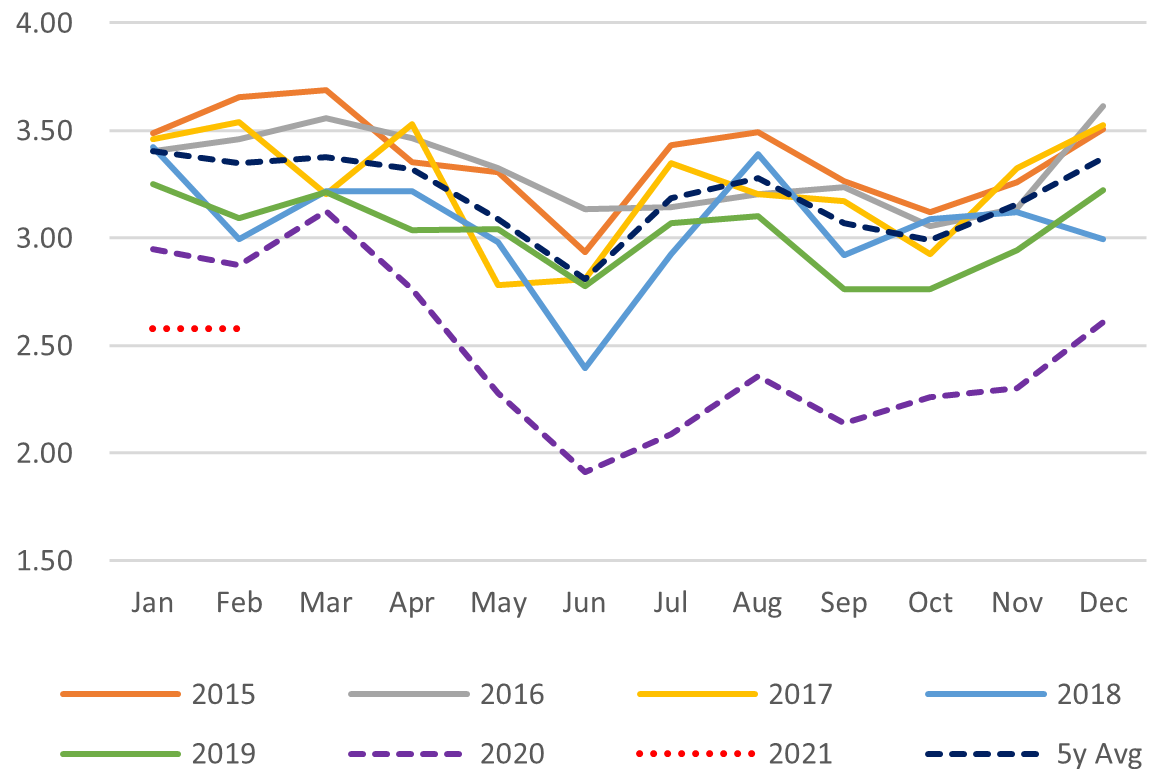
Japan Oil Price
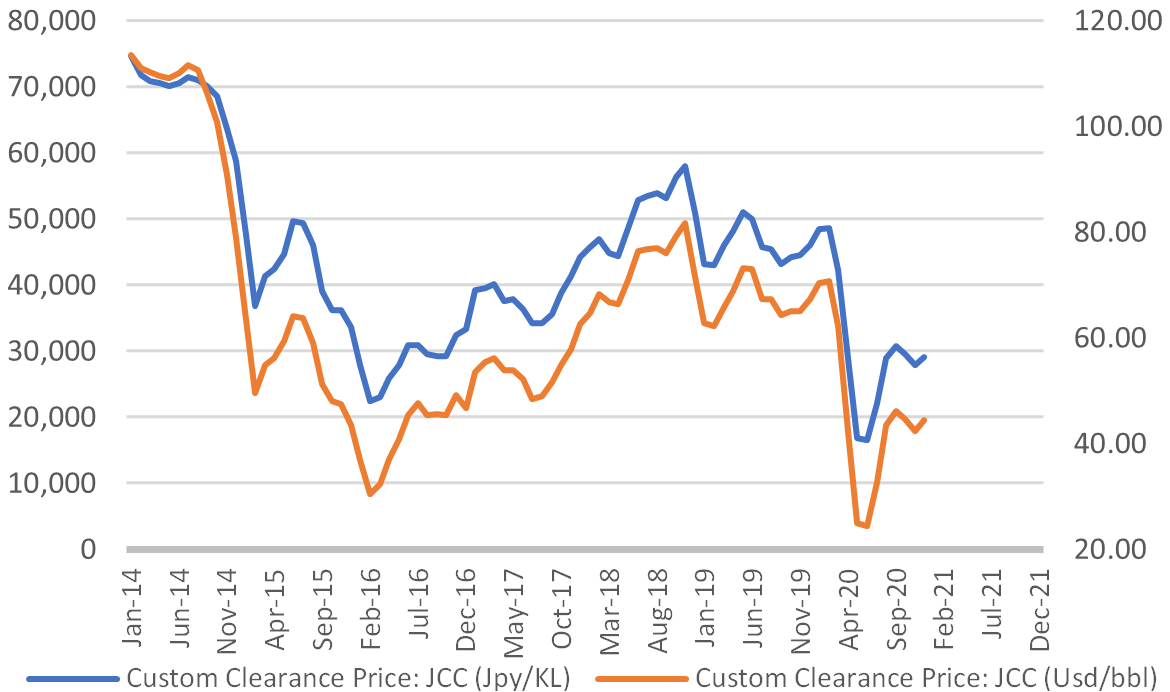
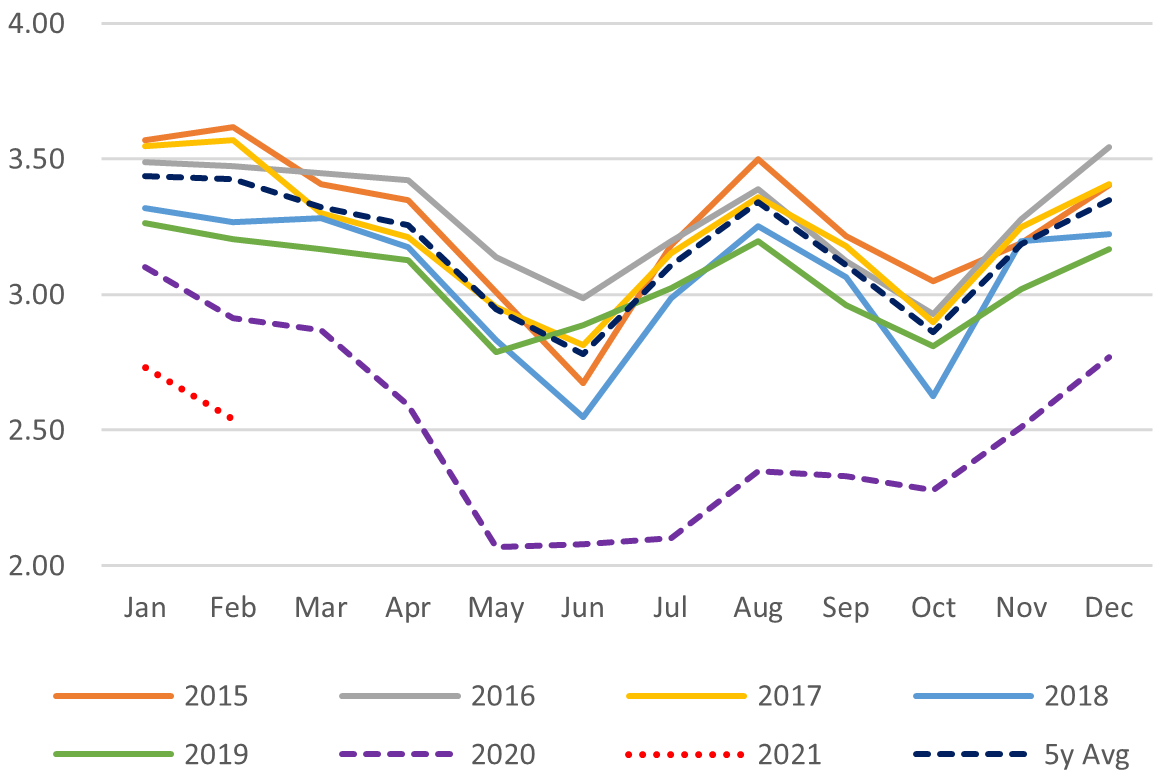
Crude Imports Vs Processed Crude
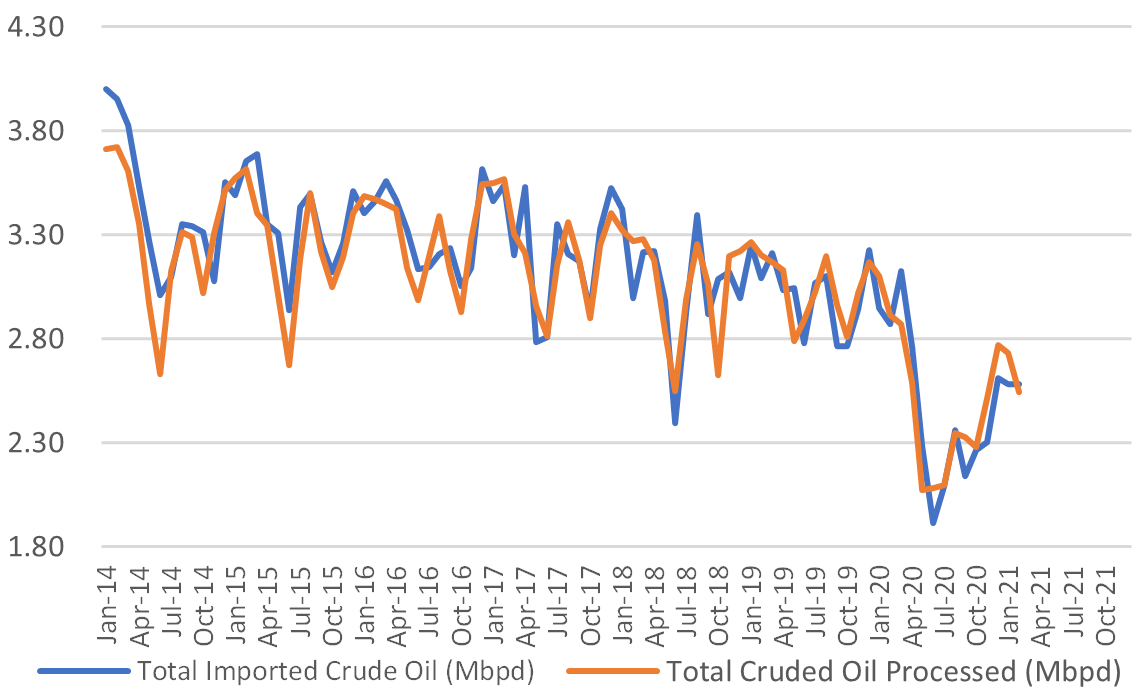
Monthly Oil Import Volume (Mbpd)
Monthly Crude Processed (Mbpd)
Domestic Fuel Sales
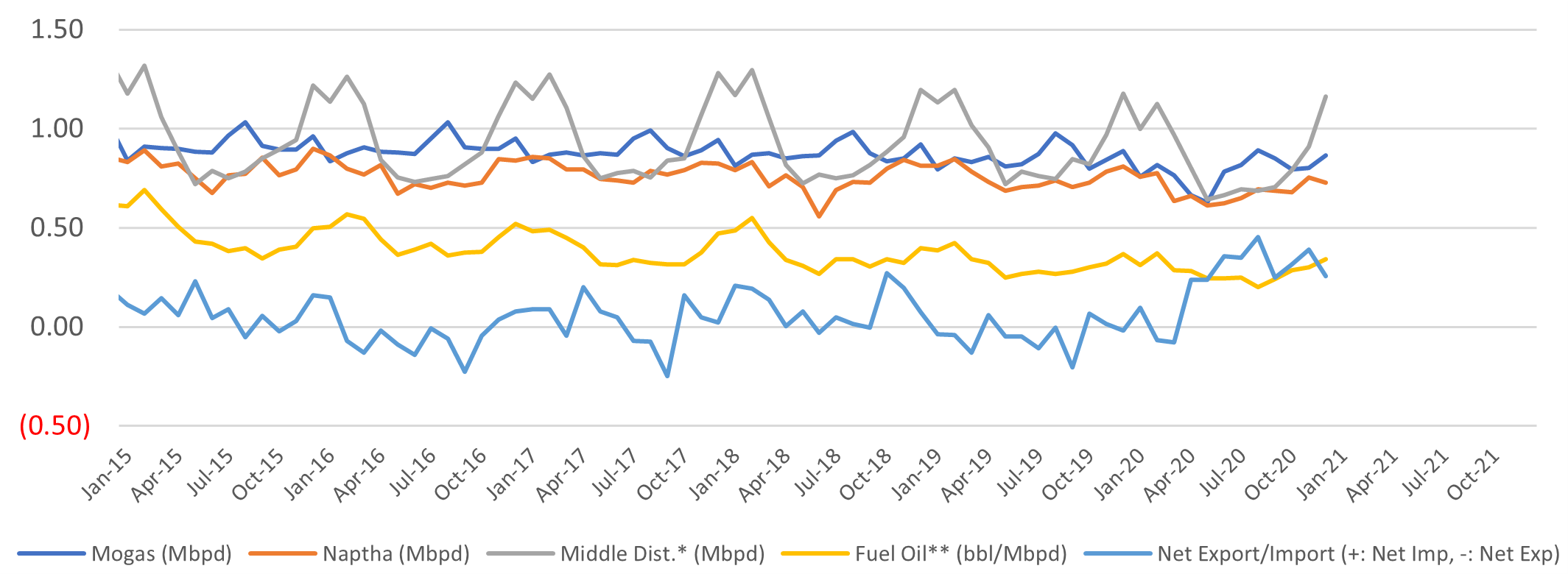
SOURCES: Ministry of Economy, Trade, and Industry (METI), Ministry of Finance, and the Petroleum Association of Japan
Japan LNG Price
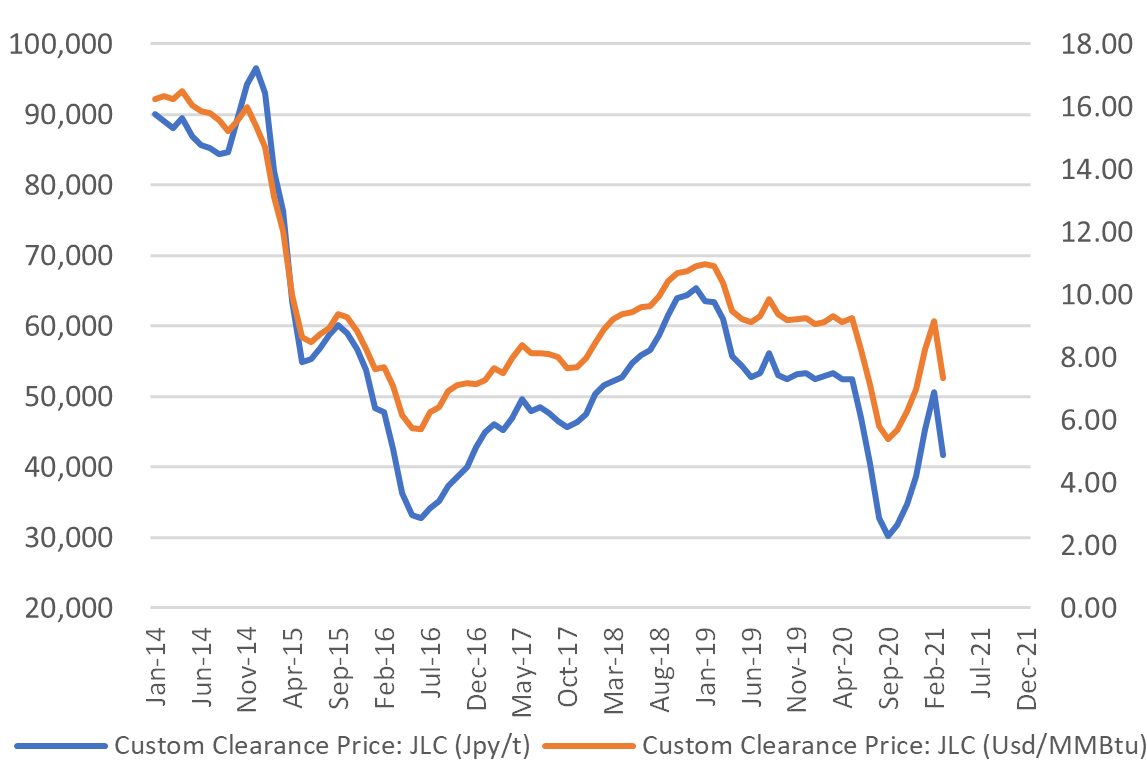
LNG Imports: Japan Total vs Gas Utilities Only
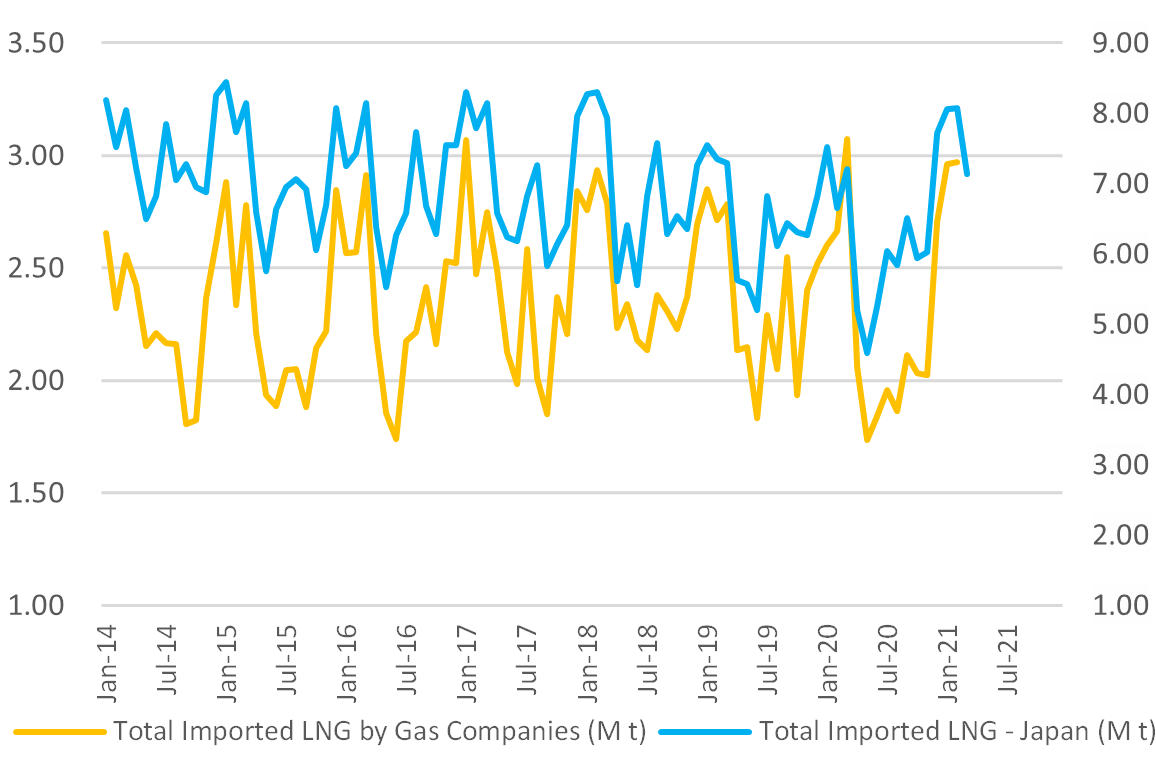
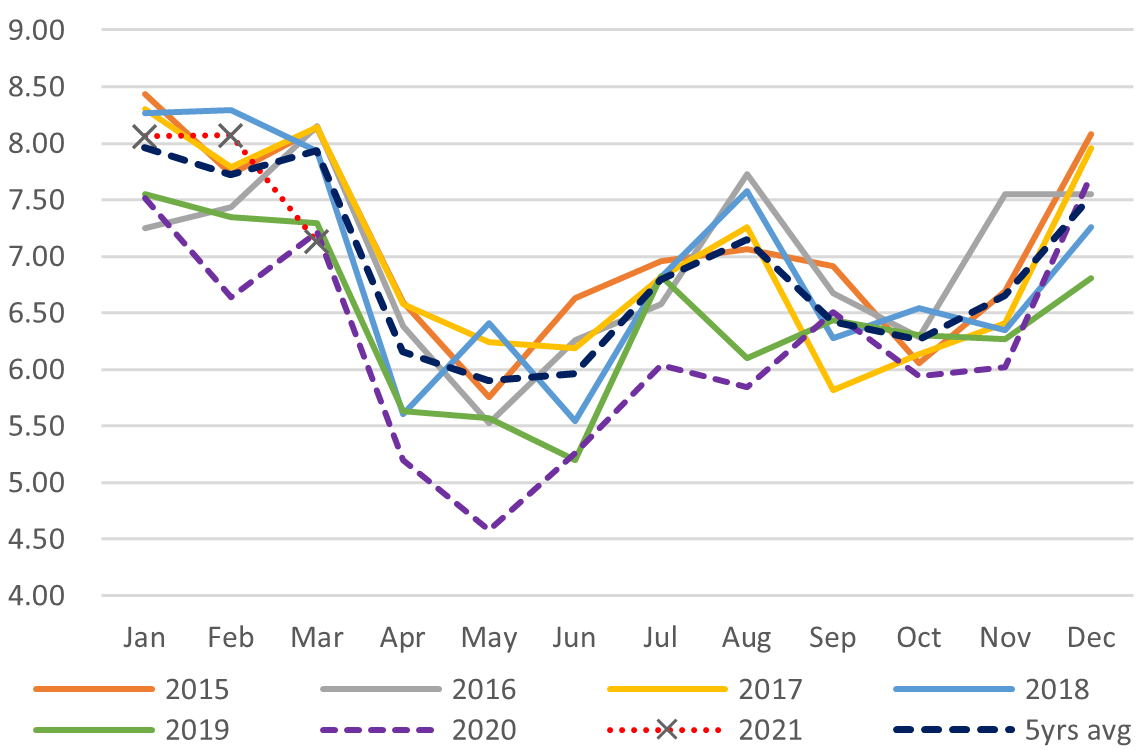
Total LNG Imports (M t)
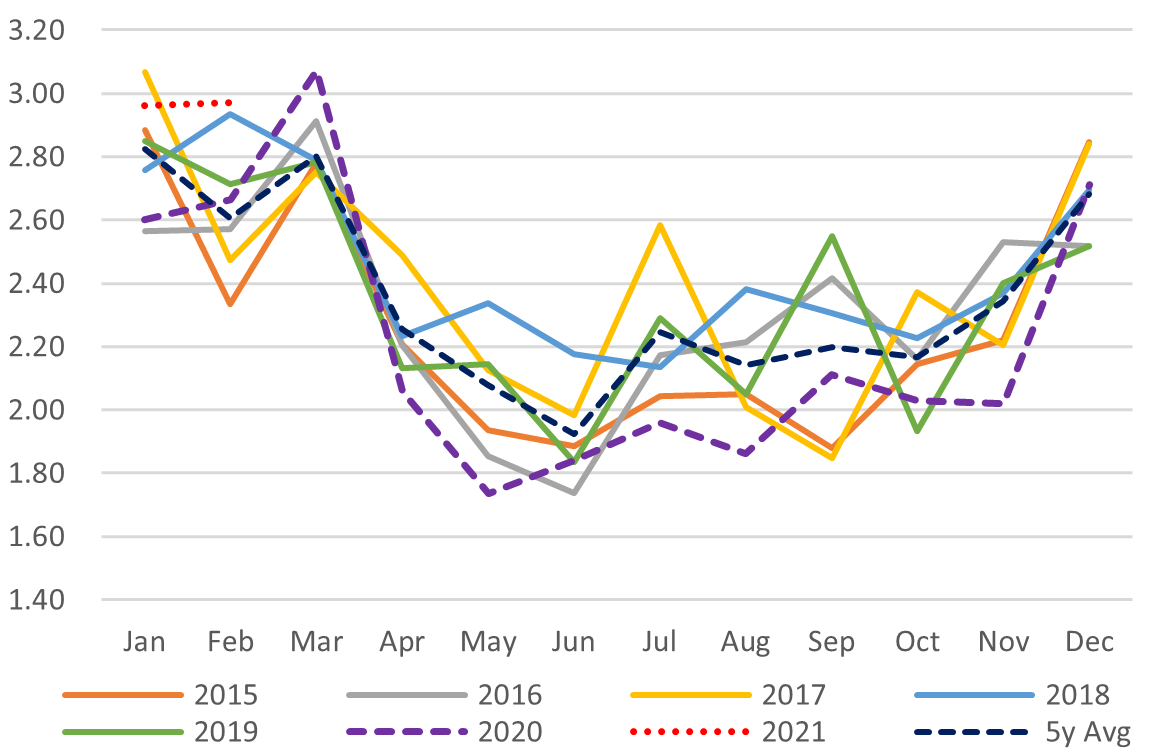
LNG Imports by Gas Firms Only (M t)
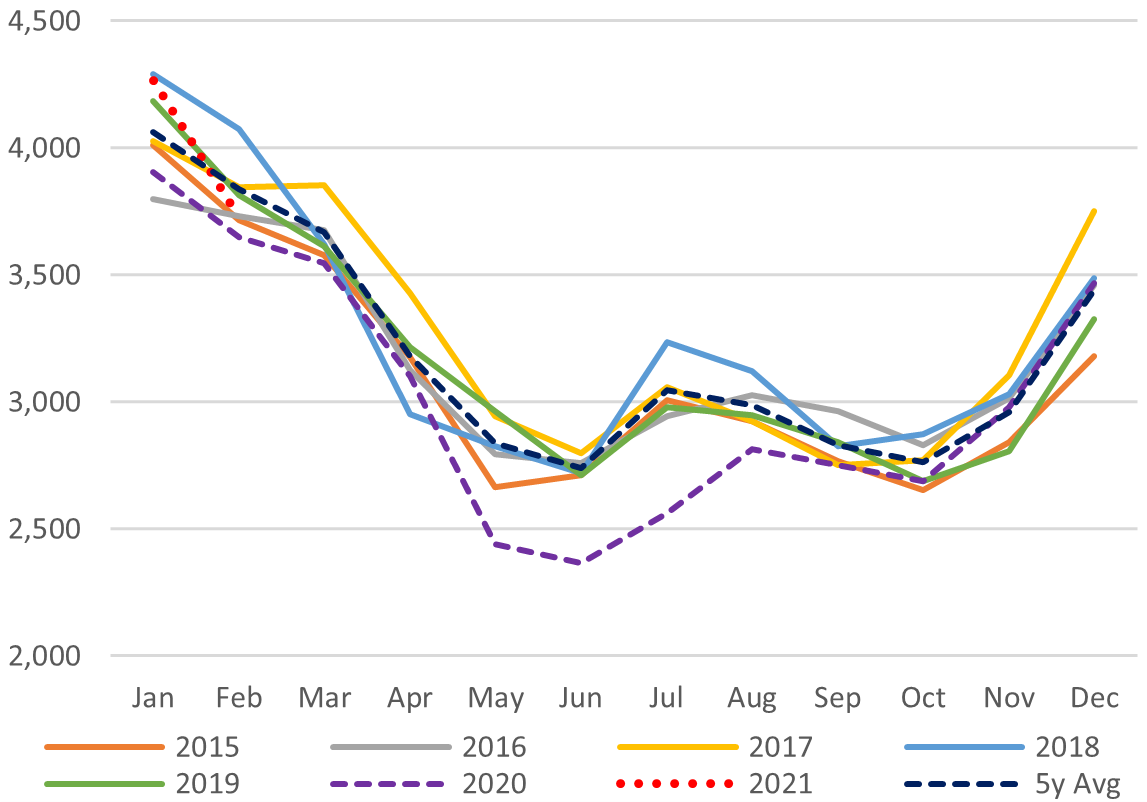
City Gas Sales – Total (M m3)
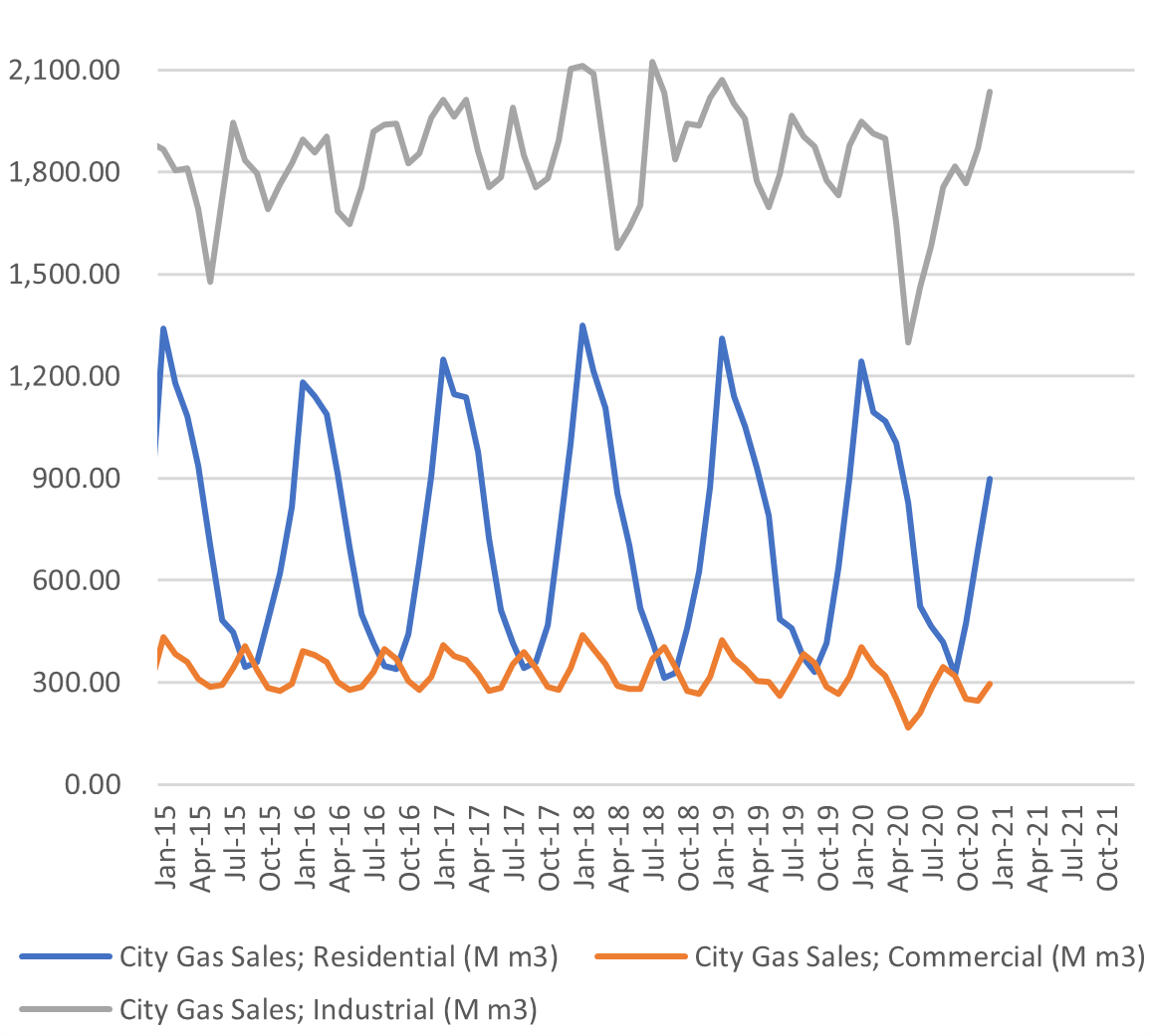
City Gas Sales by Sector (M m3)
SOURCES: Ministry of Economy, Trade, and Industry (METI),
Ministry of Finance
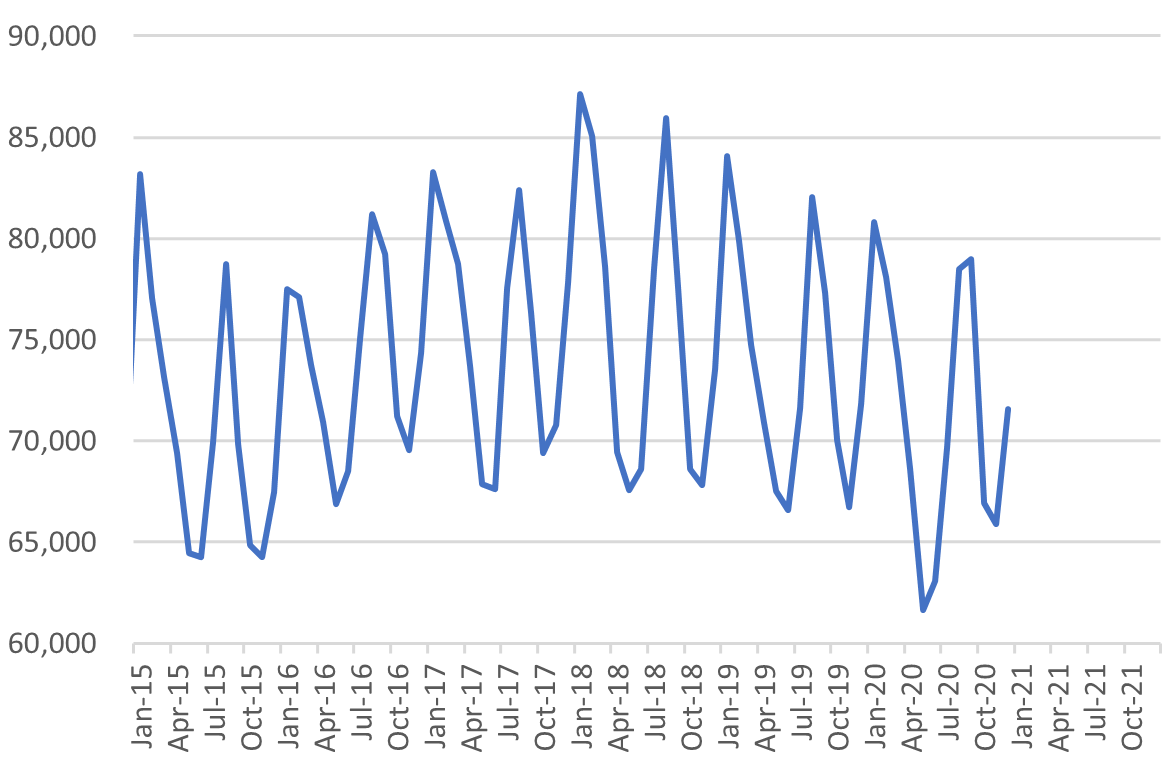
Japan Total Power Demand (GWh)
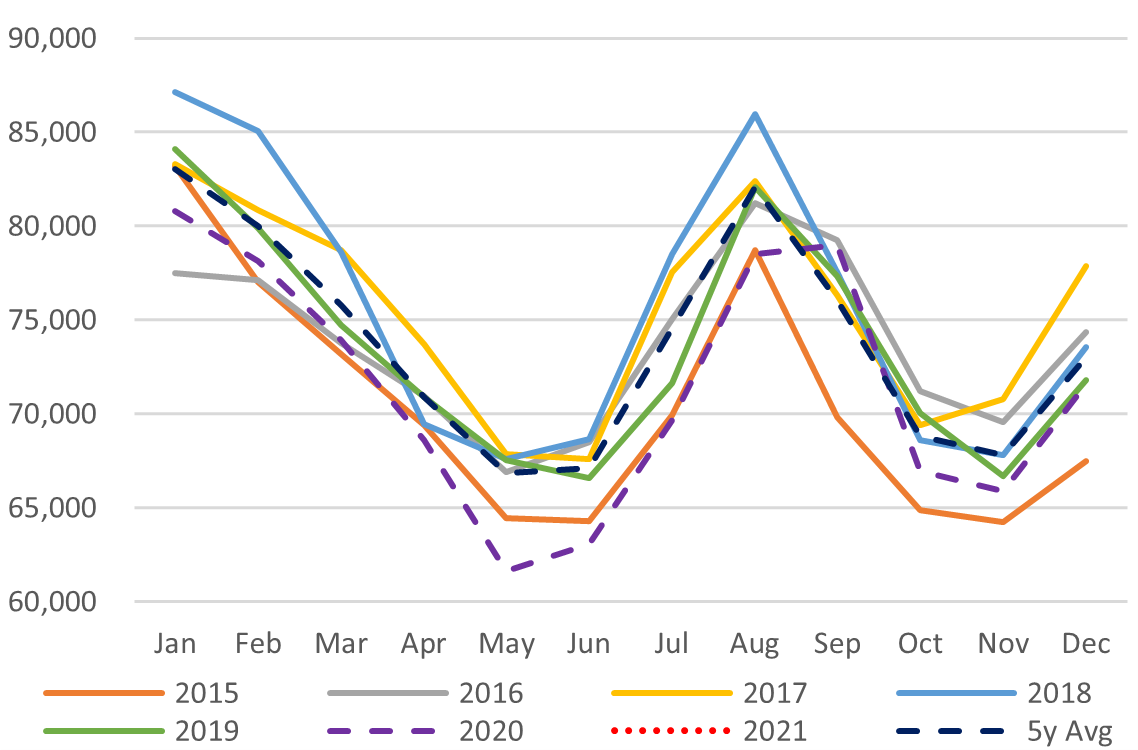
Current Vs Historical Demand (GWh)
Day-Ahead Spot Electricity Prices
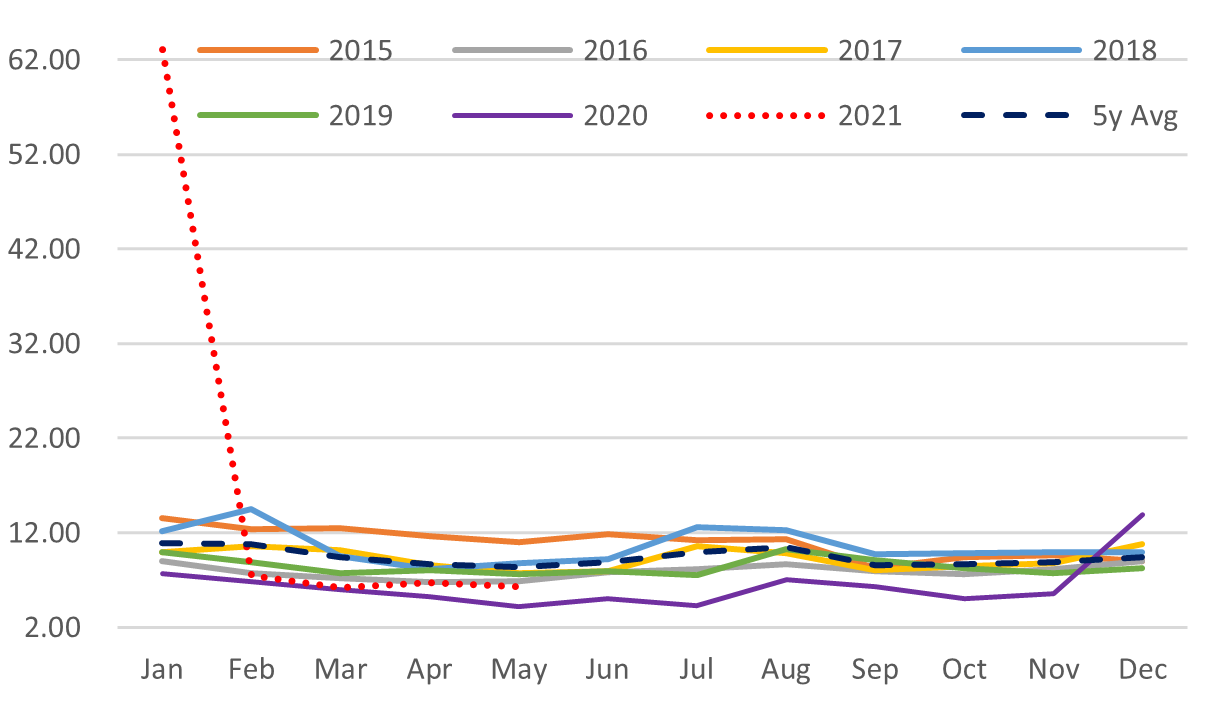
Day-Ahead Vs Day Time Vs Peak Time
LNG Imports by Electricity Utilities
LNG Stockpiles of Electricity Utilities
SOURCES: Ministry of Economy, Trade, and Industry (METI), and the Japan Electric Power Exchange
Disclaimer
This communication has been prepared for information purposes only, is confidential and may be legally privileged. This is a subscription-only service and is directed at those who have expressly asked K.K. Yuri Group or one of its representatives to be added to the mailing list. This document may not be onwardly circulated or reproduced without prior written consent from Yuri Group, which retains all copyright to the content of this report.
Yuri Group is not registered as an investment advisor in any jurisdiction. Our research and all the content express our opinions, which are generally based on available public information, field studies and own analysis. Content is limited to general comment upon general political, economic and market issues, asset classes and types of investments. The report and all of its content does not constitute a recommendation or solicitation to buy, sell, subscribe for or underwrite any product or physical commodity, or a financial instrument.
The information contained in this report is obtained from sources believed to be reliable and in good faith. No representation or warranty is made that it is accurate or complete. Opinions and views expressed are subject to change without notice, as are prices and availability, which are indicative only. There is no obligation to notify recipients of any changes to this data or to do so in the future. No responsibility is accepted for the use of or reliance on the information provided. In no circumstances will Yuri Group be liable for any indirect or direct loss, or consequential loss or damages arising from the use of, any inability to use, or any inaccuracy in the information.
K.K. Yuri Group: Oonoya Building 8F, Yotsuya 1-18, Shinjuku-ku, Tokyo, Japan, 160-0004