
JAPAN NRG WEEKLY
MAY 24, 2021
JAPAN NRG WEEKLY
May 24, 2021
NEWS
TOP
- Japan may restrict foreign tech in its power grid and other key infrastructure after U.S. pipeline cyberattack raises concerns
- Utilities warn of power outages in Tokyo area from 2022, pushing for more nuclear capacity to be allowed back online
- Japan’s SoftBank sells India renewables business in $3.5B deal in one of the biggest cross-border M&A in the sector
ENERGY TRANSITION & POLICY
- State development bank to boost ESG financing by 80% to $50B
- Kansai Electric wants to make hydrogen with nuclear generation
- Panel votes against MoE plan to make rooftop solar compulsory
- Panasonic to sell system combining fuel cells, solar, and batteries
- Itochu forges ammonia supply chain for shipping; and, buys into semisolid battery manufacture that will start output this year
- Chubu Electric restructures to accelerate its renewables projects
- Ministry offers subsidies of up to $1M for non-traditional solar
- Mitsubishi Corp aims to start carbon credits business with partner
- Group asks for options to buy renewables electricity outside FIT
- Hydropower back in fashion: Hokuriku plans expansion … [MORE]
ELECTRICITY MARKETS
- Renewables supplied up to 88% of Tohoku power during holidays
- Kansai Electric aims to restart Mihama NPP Unit 3 on June 23; loads nuclear fuel into Takahama NPP Unit 1
- Orsted joins JWD and Eurus in bidding for offshore wind in Akita
- Ministry asks JERA to discuss Tsugaru wind farm site with locals
- TEPCO EP enters power adjustment market with a VPP, battery
- Another energy retailer files for bankruptcy on power price spike
OIL, GAS & MINING
- Japan’s oil refiners to speed up asset sales over decarbonization
- Japanese fuel sales drop 8% in FY2020, jet fuel sales cut in half
- JAPEX aims to be profitable with oil at $50; to cut emissions 40%
- Tokyo Gas buys back $30 million in stock
ANALYSIS
JAPAN’S BIGGEST FOSSIL FUEL EMPIRE
PIVOTS TO AMMONIA AND OFFSHORE WIND
The fate of Japan’s recently-announced and ambitious decarbonization pledge will in large part depend on the future course determined by the country’s largest utility, JERA. The company is a vast network of fossil fuel assets and trading, and the world’s No.1 importer of LNG. If such a colossus of old-energy can make a drastic transition to clean energy, then Japan has a chance.
The company accounts for about 10% of Japan’s CO2 emissions. Now, it is pivoting to ammonia and offshore wind in order to reinvent its energy portfolio.
THE IEA AND JAPAN DO NOT SEE EYE TO EYE
ON PATHWAYS TO DECARBONIZATION
In the last two weeks, Japan and the International Energy Agency (IEA) unveiled key reports on routes to decarbonization. While the reports speak on similar issues and technologies, each has quite different outlooks. The IEA calls for a swift end to coal, oil and even natural gas, as well as for investments of $5 trillion by 2030. Japan urges pragmatism, incremental change, and cost-awareness, seeing a place for fossil fuels (albeit with carbon capture tech) well into the second half of this century.
We outline the key takeaways from the reports on both sides and contrast their conclusions.
GLOBAL VIEW
The U.S. makes a major U-turn on the Russia-Germany gas pipeline. G7 agrees to stop all financing for coal this year. In the future, less energy will be traded, Rystad says. And, uranium prices are up 20% in just the last 18 months.
Details on these and more in our global wrap.
2021 EVENT CALENDAR
DATA SECTION
JAPAN NRG WEEKLY
PUBLISHER
K. K. Yuri Group
Sponsored
Editorial Team
Yuriy Humber (Editor-in-Chief)
Tom O’Sullivan (Japan, Middle East, Africa)
John Varoli (Americas)
Regular Contributors
Mayumi Watanabe (Japan)
Daniel Shulman (Japan)
Takehiro Masutomo (Japan)
Art & Design
22 Graphics Inc.
SUBSCRIPTIONS & ADVERTISING
Japan NRG offers individual, corporate and academic subscription plans. Basic details are our website or write to subscriptions@japan-nrg.com
For marketing, advertising, or collaboration opportunities, contact sales@japan-nrg.com
For all other inquiries, write to info@japan-nrg.com
OFTEN USED ACRONYMS
METI The Ministry of Energy, Trade and Industry
ANRE Agency for Natural Resources and Energy
NEDO New Energy and Industrial Technology Development Organization
TEPCO Tokyo Electric Power Company
KEPCO Kansai Electric Power Company
EPCO Electric Power Company
JCC Japan Crude Cocktail
JKM Japan Korea Market, the Platt’s LNG benchmark
CCUS Carbon Capture, Utilization and Storage
mmbtu Million British Thermal Units
mb/d Million barrels per day
mtoe Million Tons of Oil Equivalent
kWh Kilowatt hours (electricity generation volume)
NEWS: ENERGY TRANSITION & POLICY
Development Bank of Japan to raise ESG financing 80% to $50B
(Asia Nikkei, May 20)
- State-backed Development Bank of Japan will be raising the financing it allocates to environmental, social and corporate governance (ESG) projects to ¥5.5 trillion (about $50 billion) over the next five years.
- That means the bank will allocate about 40% of its investments and lending to ESG projects in the period to FY2025. That’s a jump of as much as 80% from previous years.
- The bank’s role will be to support the introduction and popularization of new energy technologies, including in hydrogen, electric vehicles and tech to cut emissions. Equally, the financing will go to companies that are changing their business models as a consequence of the energy transition and the COVID pandemic.
Kansai Electric says nuclear stations will power hydrogen production
(Nikkei, May 21)
- Kansai Electric Chairman Sakakibara said he the utility will seek to produce hydrogen using electricity and heat from nuclear generation. The hydrogen can then be used as fuel at the company’s thermal power plants. This is part of the utility’s strategy to decarbonize by 2050, he said.
- Kansai Electric hopes to become a leader in hydrogen utilization, he said. It hopes to work with Iwatani Corp, which is one of the leaders in hydrogen production equipment.
- KEPCO is also involved in the power generation business overseas, and “it is possible to make hydrogen overseas and import it to Japan. I would like to create a business model with a newly established organization in charge of hydrogen as the center.”
- The power utility has no concrete plans to build new nuclear plants, but Sakakibara said he supported the development of Small Modular Reactors (SMR) and other new nuclear tech to make sure older plants are replaced and nuclear stays part of the national energy policy.
Panel votes against making solar rooftops compulsory, challenging the MoE
(Energy Shift, May 19)
- A government panel looking at the proposal to make rooftop solar mandatory voted against., dealing a blow to Environment Minister Koizumi who has championed the idea as a way to raise the renewables component in Japan.
- At least eight of 13 members of the Study Group on Energy Saving Measures for Houses and Buildings for a Carbon-Decarbonized Society, which is part of the Ministry of Land, Infrastructure, Transport and Tourism, declined to support the idea. Only three experts expressed their support.
- Experts noted that not all areas of the country have equal sunlight potential and snow cover is an issue. In addition, experts feared that some grid operators would struggle with balancing of their system. Chugoku Electric and Shikoku Electric would face the hardest task with a need for widespread curtailments.
- One of the experts who supported the idea said it may still be possible to introduce mandatory installations at a later date after giving advanced notice to industry that change is coming.
Panasonic to offer systems that combine hydrogen, solar and batteries
(Nikkei, May 21)
- The company aims to create a system that can provide stable power by combining fuel cells, solar power generation, and storage batteries as a CO2-free electricity source. The system would be offered to companies by FY2023.
- The system will charge fuel cells and batteries with sun power when the weather is good and utilize the former sources at night and during bad weather, compensating for the intermittent nature of solar PV.
- Panasonic will reduce prices for the system by utilizing current tech that is already used to extract hydrogen from city gas to generate electricity. It will compete against Toshiba and overseas companies.
Itochu pushes ahead with marine ammonia supply chain
(Kankyo Business, May 18)
- On May 17, Itochu Corporation and its subsidiary Itochu Enex said that Mitsui OSK Lines and Total Marine Fuels had joined a project by Itochu and Vopak Terminal Singapore to investigate the establishment of a supply chain in Singapore to provide ships with ammonia fuel.
- In June 2020, Itochu Corp and Itochu NX signed a memorandum of understanding with Vopak, the Singaporean ammonia storage service provider, regarding joint research.
- SIDE DEVELOPMENT:
Itochu takes stake in semisolid state battery technology firm
(Nikkei, May 18)- Japanese trading house led a $56.8 million fundraising round for 24M Technologies, which is building a semisolid state battery, which can be used for energy storage.
- The tech is ready to begin mass manufacture in Thailand this year.
- Semisolid batteries are a half-way to the solid-state batteries that Toyota and other auto manufacturers hope to introduce for EVs.
Chubu Electric restructures in bid to accelerate renewable projects
(New Energy Business News, May 18)
- The Chubu Electric Power Company has agreed to create a new independent division to handle all of the utility’s new wind, solar, biomass and geothermal ventures, effective July 1.
- The utility’s planning division, which has thus far handled all renewables, will continue to oversee matters of renewable energy strategy.
- Chubu’s hydroelectric division will also be revamped.
Environment ministry grants up to ¥100 million for non-traditional solar
(Kankyo Business, May 18)
- On May 14, Japan’s Environment Ministry began accepting applications for subsidies from operators of solar generation systems that are not mounted on roofs or on vacant plots of land. The subsidy is designed to encourage the uptake of less traditional forms of solar power.
- The new subsidy covers such cases as “solar carports”, and “floatovoltaics”—the name given to photovoltaic arrays that float on bodies of water.
- To be eligible for the grant, generators must consume the electricity generated themselves.
Mitsubishi Corporation to sell carbon credits from carbon capture
(Kankyo Business, May 14)
- Mitsubishi Corporation said that it would begin working with Swiss company South Pole, the world’s largest developer and seller of carbon credits, on the development and sale of carbon credits created by the removal and storage of atmospheric CO2.
- The business represents a new source of revenue for operators of “negative emission” technologies that enable carbon dioxide to be captured.
Hokuriku to boost hydro by 30%
(Nikkei, May 21)
- Toyama prefecture is Japan’s largest producer of hydroelectricity.
- Local electric utility Hokuriku Electric Power aims to increase its hydroelectric capacity 30% by 2030, against 2018 levels, and is upgrading its existing hydro dams, as well as constructing new ones.
- Hokuriku Electric also offers an electricity plan that allows subscribers to use 100% renewably generated electricity.
- SIDE DEVELOPMENT:
100 years on, hydro is back in fashion in Japan
(Sankei Shimbun, May 16)- The Ohkuwa hydroelectric power station (Nagano) marks 100 years of operation this year.
- Hydro dams are back in the spotlight, both as sources of renewable electricity and because of their ability to reduce flooding.
- However, the Ohkuwa power station has an output of only 13 MW, orders of magnitude less than the average nuclear power station.
- The Nagano government currently operates 23 hydro dams in the prefecture, and plans to increase this number to 36 by 2025.
Industry group calls for more non-FIT renewable energy options
(Kankyo Business, May 14)
- In a submission to the Ministry of Economy, Trade and Industry, the Japan Climate Leaders’ Partnership, which represents around 180 corporate members, has called for more options for those purchasing renewable energy but not utilizing the Feed-In-Tariff scheme.
- The group says they want to be able to sign long-term, virtual power purchase agreements directly with power producers, and that currently, systemic obstacles make it difficult to enter into such agreements.
J Power and Green Earth Institute mull Malaysian biofuels venture
(New Energy Business News, May 17)
- J-Power and the Green Earth Institute may begin using waste timber from Malaysian palm oil plantations as a source of fuel and chemicals.
- Currently, Malaysia’s palm oil plantations send waste timber from felled palms to landfill. However, these trees have a high sugar and moisture content, and inappropriate disposal can lead to the production of greenhouse gases.
- J-Power and the Green Earth Institute propose fermenting sap extracted from the waste timber so that it can be refined into useful compounds. Residual wood tissue could then be converted into biomass pellets for use in thermal power stations.
The race is on to create carbon-neutral tire
(Nikkei X-Tech, May 18)
- Tire manufacturer Bridgestone has pledged to reduce CO2 emissions by 30% by 2030 against 2011 levels, and aims to become completely carbon neutral by 2050.
- When calculating its carbon footprint, Bridgestone takes into account not only the manufacturing process but also emissions generated during the life of the tire and at the time of disposal.
- As part of this initiative, Bridgestone aims to manufacture tires from 40% sustainable resources, including recycled materials, by 2030. It also plans to use a greater proportion of natural than synthetic rubber in future.
Nagoya researchers successfully break down CO2 using sunlight
(Smart Japan, May 18)
- A group from Nagoya Institute of Technology say they have combined carbon nanotubes with silver iodide to produce a photosensitive catalyst that is able to break down CO2.
- Previous technologies were unable to break down CO2 using visible light.
SoftBank subsidiary branches into micro solar operation
(Nikkei, May 18)
- In 2021/22, SoftBank Group subsidiary SB Energy will begin procuring electricity from micro solar farms with capacities in the tens of kilowatts.
- Currently, SB Energy generates all of its renewably-produced electricity in large solar farms with capacities of between one and 100 MW for sale to electric utilities using the feed-in tariff scheme.
- Electricity generated by the micro farms will be sold directly to corporate clients, from which there is increasing demand for renewably sourced electricity.
Mitsubishi HC Capital invests in Vietnamese wind operator
(New Energy Business News, May 19)
- Mitsubishi HC Capital has acquired a 35.1% stake in Vietnam’s Trung Nam Wind Power (TNWP), a subsidiary of the Trung Nam Construction Investment Corporation.
- Mitsubishi HC Capital says that Vietnam enjoys high social and economic growth, with domestic electricity demand growing at a rate of up to 10% per annum. The country is also geographically well suited to wind farms.
- TNWP currently has 152 megawatts of generation capacity in Ninh Thuan Province, which will soon be complemented by the addition of more renewable capacity.
Sharp offers solar packages with zero initial outlay
(Kankyo Business, May 19)
- Sharp Energy Solution said that its PPA (Power Purchase Agreement)-based service, which it provides in conjunction with Tokyo-based Trende, would be available from June 30.
- Builders of new homes utilizing the service can have solar panels and storage batteries installed for no initial cost and are free to use the electricity generated, but are charged a flat monthly fee.
Takeda signs agreement with Delta Airlines on sustainable fuel
(New Energy Business News, May 20)
- Takeda Pharmaceutical is the latest of Delta airlines’ corporate clients to sign an agreement regarding the use of sustainable aviation fuel.
- Delta pledged to invest $1 billion into carbon neutrality through the reduction and elimination of CO2 emissions as well as cooperative agreements with other corporations.
ENEOS to provide battery recycling platform
(Sekiyu Tsushin, May 21)
- ENEOS Holdings said that it will cooperate with MaaS service provider Mirai-Labo on a battery recycling scheme that takes a holistic approach to the life-cycle of a storage battery.
- By putting in place a Battery as a Service (BaaS) platform that enables post-market electric vehicle batteries to be reused efficiently, ENEOS aims to reduce its carbon footprint.
- Under the scheme, degraded electric vehicle batteries will be reused as storage batteries in ENEOS service stations and charging stations, as well as commercial and residential premises.
- Once capacity has fallen to the point where the batteries can no longer be used for these purposes, they’ll be coupled with solar panels and used to power street lighting systems and similar applications.
JERA appoints European energy leader to head up offshore wind operation
(Denki Shimbun, May 21)
- Effective May 1, Natalie Oosterlinck, who was head of special projects at Belgium’s offshore Marine engineering company, DME, was appointed to head up JERA’s offshore wind development business.
- Ms. Oosterlinck, who has been involved in offshore wind since 2012, brings to the job over 20 years’ experience in the renewable energy sector.
TAKEAWAY: See the Analysis section for a full story of JERA’s move into renewable energy.
NEWS: POWER MARKETS
| No. of operable nuclear reactors | 33 | |
| of which | applied for restart | 25 |
| approved by regulator | 16 | |
| restarted | 9 | |
| in operation today | 7 | |
| able to use MOX fuel | 4 | |
| No. of nuclear reactors under construction | 3 | |
| No. of reactors slated for decommissioning | 27 | |
| of which | completed work | 1 |
| started process | 4 | |
| yet to start / not known | 22 | |
Source: Company websites, JANSI and JAIF, as of May. 21, 2021
Japan may restrict foreign equipment use in power grids after U.S. pipeline attack
(Asia Nikkei, May 18)
- Japan’s govt. plans to add regulations that would restrict foreign suppliers of equipment to 14 key infrastructure fields, including electricity, after the cyberattack on Colonial Pipeline in the U.S.
- The government will ask operators of such infrastructure to consider national security issues when procuring foreign-made equipment. This will include considering how data from the equipment is stored, cloud server connections, and more.
- The government will monitor companies for compliance and will suspend or cancel their license should any major issues arise.
- Current rules only ask government agencies not to purchase equipment that might carry national economic security risk.
TAKEAWAY: Japan’s concern stems from data leaking via Chinese-made equipment, although the Colonial Pipeline is not seen as being related to China. Still, how these restrictions will impact on foreign firms seeking to do business in smart grids, VPPs, and even main grid updates related to renewable energy is as yet unclear. If new regulations are too tight, they will be seen as protectionist and a “favor” to domestic companies such as NTT Group.
SoftBank sells India renewables business to Adani Green Energy in $3.5B deal
(Various media, May 20)
- SoftBank agreed to sell its SB Energy India business, a JV between the Japanese investment group and Bharti Enterprises, to local tycoon Gautam Adani’s green energy group in a deal valued at $3.5 billion.
- This is one of the biggest cross-border deals in renewable energy and among the top deals involving Japan and India. The value includes $2.9 billion in debt and liabilities, such as pending CAPEX, according to The Economic Times.
- The newspaper estimates that SoftBank and Bharti will be exiting the business at a loss. Last year, the two valued the business, which has 4,954 MW of operating capacity, at $1.2 billion.
- The buyer, Adani Green Energy, will expand its portfolio to 10 GW, with 15 GW more under construction, making it one of the largest global players in renewables.
- SoftBank, led by Masayoshi Son, grew the Indian business in solar and wind but has struggled to unlock the values it sought. All SB Energy projects have 25 year PPAs with sovereign rated counterparties.
- SoftBank turned down an earlier offer for SB Energy from Canada Pension Plan Investment Board. It promised a higher valuation but that was for only 80% of the company.
- CONTEXT: This sale is unrelated to SB Energy Corp, which is a separate entity pursuing renewable energy projects in Japan and Mongolia, and also owned by SoftBank.
TAKEAWAY: Cross-border deals into energy projects in developing markets can be complex and can struggle to be profitable as financial incentives are ramped down and economies of scale max out. There are issues unique to SoftBank also as the holding company has activist investors who are forcing Masayoshi Son to streamline his asset portfolio. Details emerged last week that SoftBank may sell down its entire remaining stake in T-Mobile, valued at $14 billion, to Deutsche Telekom in a major reversal of its global telecoms strategy. Son is expected to focus his investments exclusively on technology-related sectors. This raises the question of what happens to the Japanese SB Energy company in the mid to longer term.
Utilities forecast power outages in Tokyo from 2022 without nuclear online
(Shukan Economist, May 17)
- Power utilities are worried that a shortage of electricity may force scheduled power outages in greater Tokyo in early 2022.
- According to a report published in March by the Organization for Cross-regional Coordination of Transmission Operators, electricity consumption in the area served by TEPCO is projected to outstrip supply by over 1% in January and over 2% in February.
- The situation is not much better in central and western Japan, where buffer capacity has now fallen below the 3% deemed necessary to survive unusually cold weather.
- The main reason for the nationwide shortage of electricity is the 13 GW reduction in electricity generated by nuclear plants due to maintenance.
Renewable energy provided up to 88% of power in Tohoku area during holidays: Utility
(Kankyo Business, May 19)
- The rate of electricity supplied from renewable energy sources jumped to 87.8% between 11am and noon on May 4, during the Golden Week holidays, Tohoku Power Grid reported.
- The grid operator said there were days during the holidays when power supply from renewable energy facilities was very high. The operator had to work hard to avoid curtailments and instead took some thermal power capacity offline while also relying on pumped storage during peak hours.
- Tohoku’s solar output was 8% higher and wind output more than double that of a year earlier in the same period, the grid company said.
- Tohoku Grid vowed to continue trying to include as much renewable power in the total supply as possible going forward.
TAKEAWAY: Forget that the peak is only for an hour on one specific day, the big news here is that Tohoku managed to avoid curtailments for solar and wind power operators in the area. As described in the Analysis piece in last week’s Japan NRG, in areas such as Kyushu renewables operators see output curtailed at least once a week. If Tohoku is able to regulate thermal capacity more flexibly outside of the holiday period, this could mark a major shift in Japan’s power mix. Of course, one caveat in this case is that Tohoku has a lot of hydro power, and some of what it terms “thermal” is actually biomass and geothermal.
Kansai Electric begins loading fuel into Mihama NPP Unit 3, start seen in June
(Tokyo Shimbun, Kyodo News, May 23)
- On May 20, Kansai Electric began loading fuel into Unit 3 reactor at the Mihama nuclear power plant (NPP). A total of 157 fuel rods were inserted into the reactor by May 23.
- The reactor has not been fueled since May 2011.
- The utility aims to start operations on June 23. It will be Japan’s first reactor to be restarted that is older than 40 years. Commercial operations would then be achieved around July 27.
- The unit is one of several to receive a 20-year service life extension from the industry.
- SIDE DEVELOPMENT:
Kansai Electric finishes loading fuel into Takahama NPP Unit 1
(Denki Shimbun, May 18)
TAKEAWAY: Japan faces a shortage of power capacity this summer, which is expected to be hotter than usual, according to the major utilities. While the restart of nuclear power is not a popular option in Japan, the greater concerns around the pandemic and the Olympic Games have taken nuclear power off the top news agenda. That’s possibly helped utilities that are keen to move quicky with restarts of nuclear reactors. Should the summer really turn into an energy emergency, and the restarts of reactors go smoothly, the utilities will win back some support for the sector. However, nothing has been easy for Japan’s nuclear industry in recent years and there are still many IFs.
Offshore wind tenders: Orsted throws hat into ring in Akita region projects
(Kensetsu Tsushin Shimbun, May 21)
- Denmark-based Orsted, the world’s largest operator of offshore wind turbines, says it has submitted bids in tenders to build wind farms off the coast of Akita, in conjunction with Japan Wind Development and Eurus Energy Holdings.
- Japan Wind Development has been assessing wind conditions, surveying the seafloor, and performing environmental assessments in the area since 2017.
- The wind farm proposed for the sea off Noto, Mitane, and Oga will have a nameplate capacity of 415 MW, while that located off Yurihonjo will have a capacity of 730 MW.
- Tenders close on May 27, and the successful contract will be announced in October.
JERA’s Tsugaru wind farm: Environment Minister calls for consultation on siting
(New Energy Business News, May 18)
- On May 13, the Ministry of the Environment called on JERA to consult with the Aomori prefectural government and other stakeholders to determine a site for the proposed Tsugaru offshore wind farm.
- The Ministry was reacting to JERA’s environmental assessment of the project.
- JERA plans to erect up to 63 wind turbines over an area of 120 km². The farm would produce up to 15 MW of electricity.
TEPCO Energy Partner enters adjustment market with VPP, storage battery
(Denki Shimbun, May 19)
- TEPCO Energy Partner (EP) has entered the supply-demand adjustment market using its VPP (Virtual power plant) and 1 MW storage battery in Ibaraki prefecture.
- The company says it’s the first time in Japan that a VPP is being utilized in the supply-demand adjustment market. A VPP used the customers’ own resources to regulate supply to meet demand.
- TEPCO EP has secured 1 MW of adjustment power from a NAS (sodium sulphur) battery installed at Mitsubishi Materials Tsukuba Works, in Joso City, Ibaraki.
- TEPCO EP has experience with regulating about 10 MW of storage battery capacity on the customer side as a Demand Response (DR) mechanism. The company hopes to have access to the same kind of battery capacity to make adjustments, but will start with a smaller 1 MW facility before gradually ramping up.
Japanese energy startup latest victim of power price peak – files for bankruptcy
(Mainichi Shimbun, May 18)
- Panair, a Tokyo-based energy venture that aimed to build a cloud-based operating system, filed for bankruptcy protection from creditors under the Civil Rehabilitation Act.
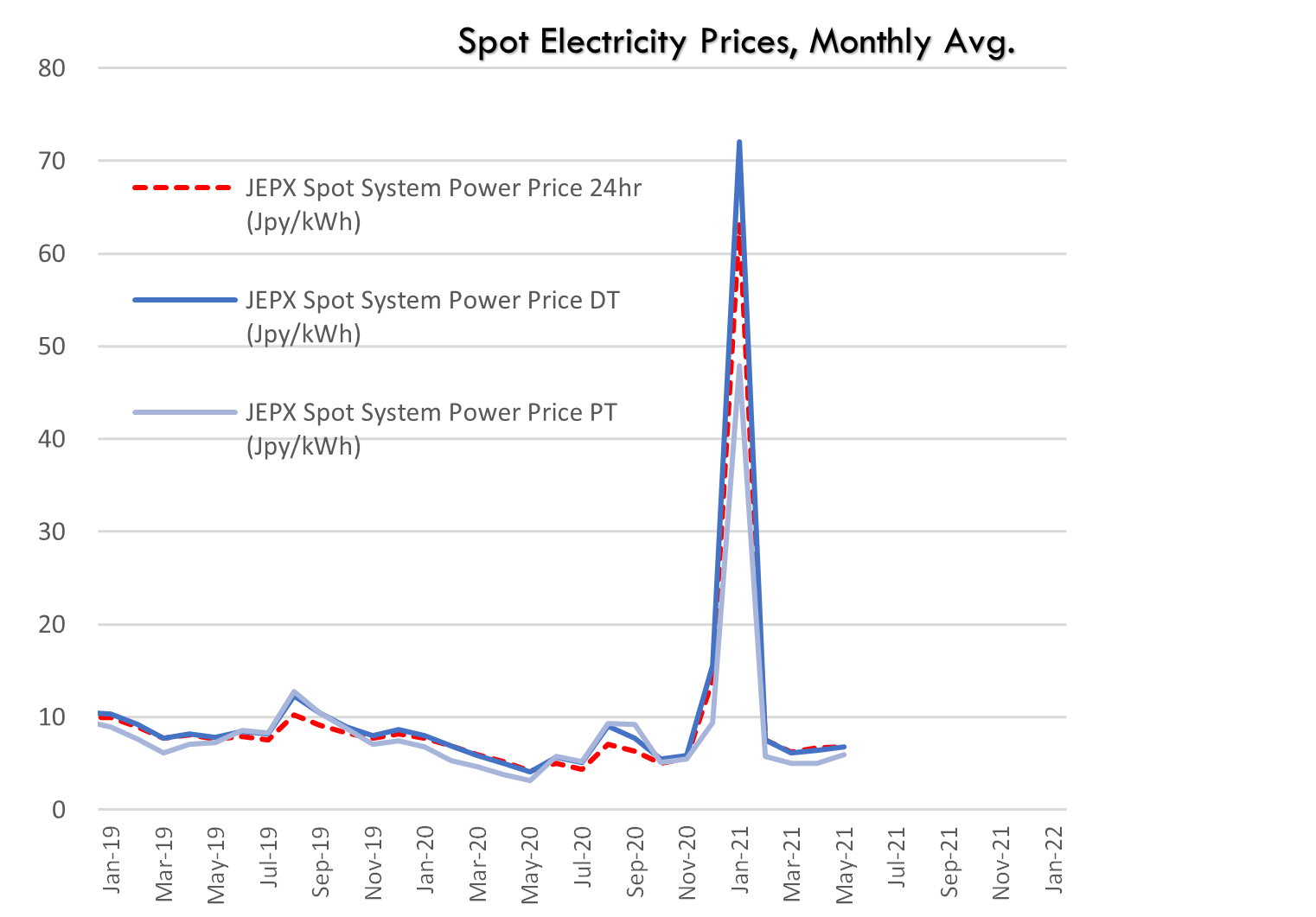
- The startup has debt of about ¥6 billion in part due to being caught out in the power wholesale market, which saw prices hit a sudden spike in January.
TAKEAWAY: Panair is only the third firm widely reported as going bankrupt after the January price spike, but more electricity retailers are expected to seek court protection in the coming month as their bills to the grid operators become due.
NEWS: OIL, GAS & MINING
Japan’s oil refiners vow to speed up asset sales in light of the decarbonization trend
(Reuters, May 17)
- Oil refining major Idemitsu now sees Japanese fossil fuel demand contracting 30% by 2030, more than the previously estimated 20%, compared with 2019.
- Idemitsu will focus on low-carbon fuels such as ammonia and plant-derived black pellets, which are advanced wood pellets that can be used in place of coal. It will also pursue renewable energy projects, including geothermal and biomass.
- Rival ENEOS will also scale down upstream oil assets, but could raise its stake in the downstream by buying more of Vietnam National Petroleum Group (Petrolimex), as well as expanding gas operations in Southeast Asia.
- ENEOS is building out a clean energy value chain by working in renewables, storage batteries and EVs. The company is also interested in expanding the hydrogen and synthetic fuels business.
Japan fuel sales drop 8% in Fiscal 2020 due to the pandemic
(Sekiyu Tsushin, May 18)
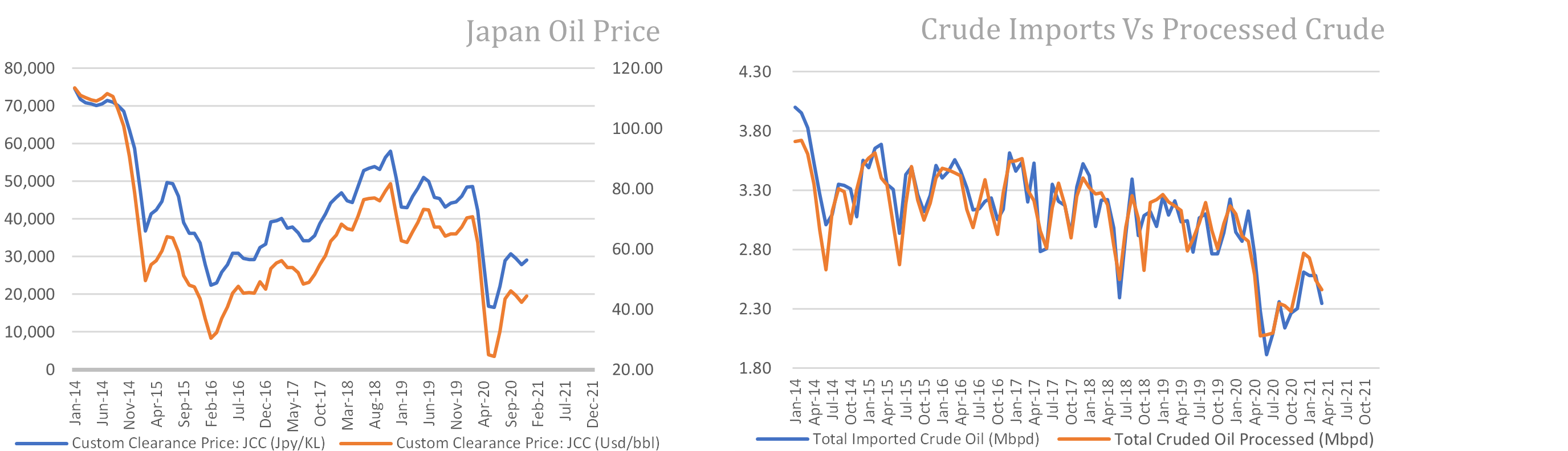
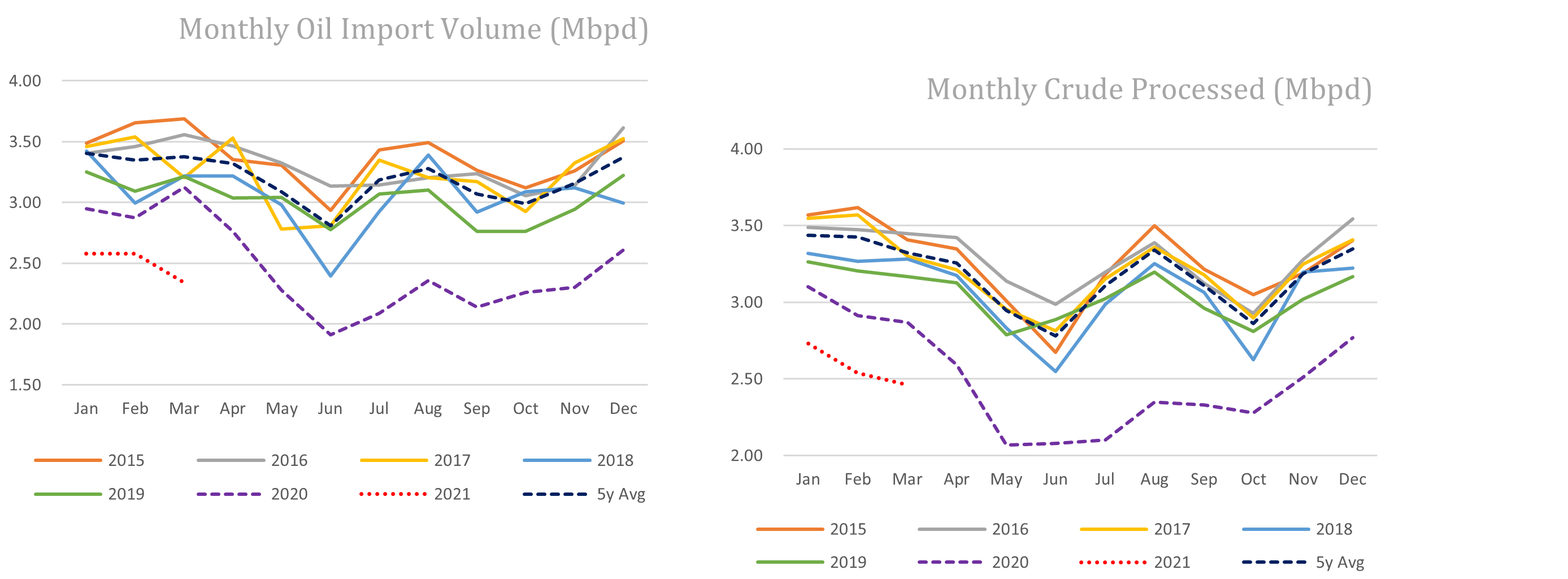
- Based on financial results of the three oil refining majors in Japan (ENEOS, Idemitsu, and Cosmo Energy), fuel oil sales in fiscal 2020 (April 2020 to March 2021) were down 8% to 110,108 kl.
- Gasoline demand dropped 8.33%.
- Naphtha sales dropped 15.2%, also due to the chips supply shortage that has hampered automobile production.
- Jet fuel oil sales dropped 46.2% as air travel was severely restricted.
- Kerosene was up 0.9% due to winter heating, but heating demand is expected to be volatile in the coming years and switching to cleaner fuels will restrict total demand.
- Diesel oil was down 5.0%, partly due to a sharp drop in tourist activity and bus demand.
- Exports plunged 50.2% as the pandemic restricted overseas demand and also the operation of refineries.
- SIDE DEVELOPMENT:
Propane trade volume falls 3.6% in 2020/21
(Gas Energy News, May 17)- The Japan LP Gas Association says that 9.7 million metric tons of propane were shipped in FY2020, a decrease of 3.6% on the previous year.
- The fall in demand from the steelmaking and chemical sectors was particularly pronounced at 28%.
JAPEX sees oil prices trend lower post COVID, aims to grow even with oil at $50
(Sekiyu Tsushin, May 17)
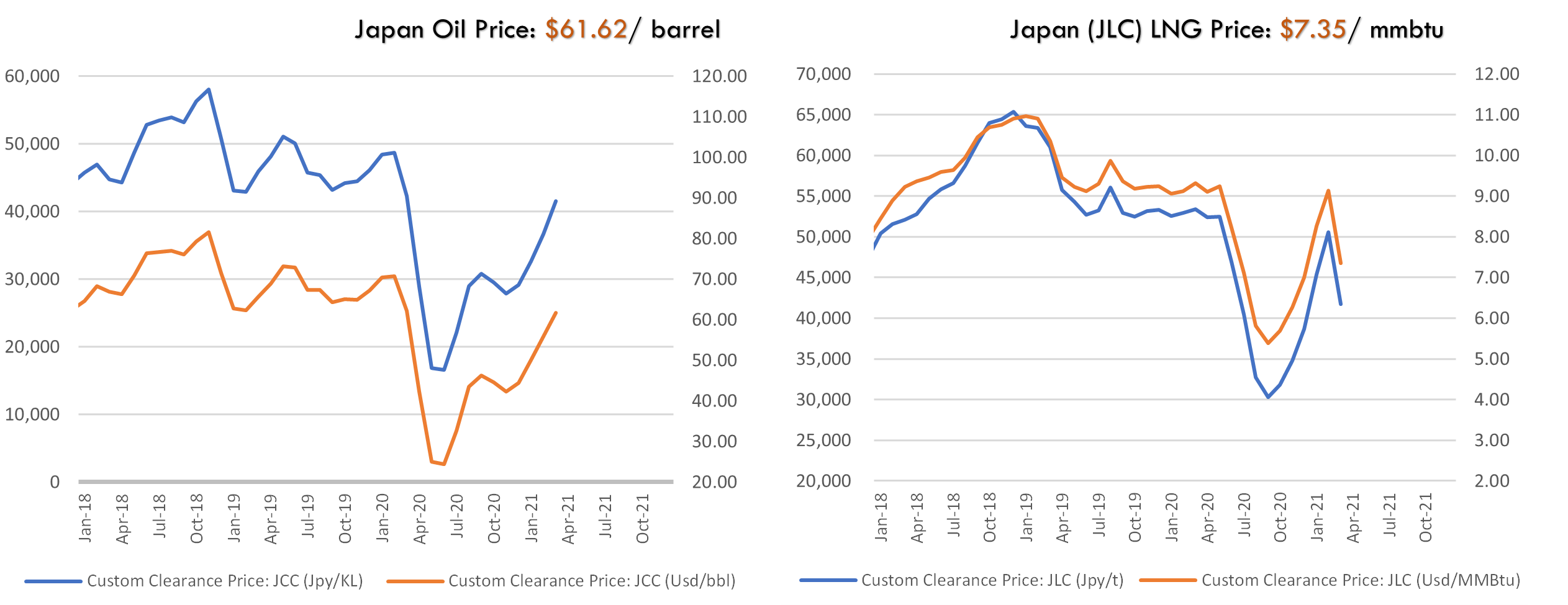
- Although the oil price is currently over $60, this is supported by OPEC+ coordinated production cuts. After the pandemic is over, JAPEX does not expect crude oil demand to return to prior levels due to the energy transition trend.
- JAPEX assumes that oil prices will trend lower and it aims to be a company that can grow with oil at $50 / barrel level, said Yamashita Michio, Director and Managing Executive Officer.
- Separately, JAPEX said it will aim to reduce emissions by 40% by FY2030 from FY2019 levels. This will not mean a complete withdrawal from oil and gas, but the introduction of carbon capture technology, an expansion into offshore wind, biomass power generation, and methanation projects.
Tokyo Gas buys back $30 million in stock
(Denki Shimbun, May 20)
- Tokyo Gas said it had completed a share repurchase for ¥3.3 billion. The company bought back almost 1.44 million shares in the period between May 10 and May 18.
ANALYSIS
BY TAKEHIRO MASUTOMO
The Fate of Japan’s Decarbonization Largely Rests With JERA:
Japan’s LNG King Tries Pivot to Ammonia and Offshore Wind
The fate of Japan’s recently-announced and ambitious decarbonization pledge will in large part depend on the future course determined by the country’s largest utility, JERA. The company is a vast network of fossil fuel assets and trading, and the world’s No.1 importer of LNG. If such a colossus of old-energy can make a drastic transition to clean energy, then Japan has a chance.
About 10% of Japan’s CO2 emissions can be traced to JERA. The company operates more than two dozen thermal power stations with 70 GW of capacity, equivalent to one-third of Japan’s total.
Despite such an entrenched fossil fuel asset base, JERA has pledged to embrace the clean energy revolution. The company says it is betting big on ammonia and hydrogen, and has strong ambitions in offshore wind.
JERA’s influence on Japan’s national energy strategy is unmistakable. Last October, JERA took center stage when it unveiled a strategy toward zero CO2 emissions by 2050. Two weeks later, Prime Minister Suga made the national pledge to achieve decarbonization by mid-century. A JERA executive admitted to Japan NRG that the company exchanged views with the government agencies beforehand.
Both JERA and the government identify hydrogen and offshore wind as the essential pillars of the zero-emission goals. Inspired by JERA’s strategy, Kansai Electric Power Co. and Chugoku Electric Power Co. in February also announced plans to promote the use of ammonia to achieve zero greenhouse gas emissions. As a reference, METI has projected that 10% of power generation will use hydrogen and ammonia in 2050.
Unique ammonia and hydrogen Solutions
JERA says a pilot project on co-firing of ammonia with coal will begin at Hekinan Thermal Power Plant in Aichi prefecture starting this fiscal year. The company expects the co-firing rate to hit 20% at all its coal plants by the first half of the 2030s, followed by the operation of solo ammonia firing in the 2040s.
Ammonia, rather than hydrogen, is seen as more promising in the medium-term transition period, as the former is commonly used, often as fertilizer, and already internationally traded. According to JERA’s calculation, it would eventually need 500,000 tons of ammonia per plant annually, which is roughly equivalent to half of the amount Japan currently imports every year. The government recently set a target of using 3 million tons of ammonia fuel per year by 2030.
Hydrogen, which needs to be transported below -252.87 °C, is nowhere close to that. Japan and Australia just launched the world’s first Hydrogen Energy Supply Chain (HESC) project in February 2021.
Given this reality, JERA plans to wait for the full-scale operation of the co-firing of gas and hydrogen at its LNG power plants until the 2030s.
If this co-firing blueprint goes successful, this unique solution pursued by Japan may come in handy for many thermal power-dependent Asian economies, which tend to grow faster with poor geographical and climate conditions for renewable energy. Indeed, JERA’s official mission is “to establish new energy supply models for Japan” while also offering these models to “other countries” with similar challenges.
A JERA executive told Japan NRG that the company may be able to contribute to countries with progressive eco-policy policies such as Vietnam and Bangladesh, “helping them not just for a project but as a portfolio”.
JERA said in February that it signed an MOU with Petronas, a Malaysian state-owned oil and natural gas company, to cooperate in the production and supply of ammonia and hydrogen fuels. The Malaysian company is currently producing about 2 million tons of ammonia per year. More specifically, JERA aims to produce green ammonia using electricity from hydroelectric power generation in Malaysia and import it to Japan.
Furthermore, this month, JERA announced that it signed another MOU with Yara International, a Norwegian fertilizer company and one of the world’s largest ammonia producers, to cooperate in the ammonia value chain business, including the development of a blue ammonia production plant. Yara produces ammonia from natural gas at its Pilbara Fertilizer plant in Australia, and both firms will work together to improve the process by potentially adopting CCS. The two reportedly also are considering to build new plants overseas.
Ready for offshore wind big bang at home
The Tokyo-headquartered company endeavors to rocket-start its renewable business to be recognized as a serious player in the sector. JERA aims to expand the size of its installed capacity of renewable energy from the current 1.1GW to 5GW by 2025. It has acquired 10% stake in India’s leading renewable energy firm, ReNew Power.
In particular, JERA is betting on the offshore wind business, and the company invested in three offshore wind power projects in Taiwan, namely, Formosa 1 through 3. Located in the Taiwan Straits, these three sites are under similar geographical and climate conditions to sea areas off Akita’s coasts in Northern Japan, a up-and-coming hub of the country’s offshore wind business.
The company is set to apply the acquired know-how for projects in Japan. JERA, together with Norwegian energy company Equinor ASA and J-Power, is preparing to bid for offshore wind power projects in Akita prefecture and opened its Akita branch in April to collect relevant information.
In March, JERA revealed a plan for an offshore wind farm, consisting of about 63 wind turbines, off the coast of Aomori prefecture. The maximum output is expected to reach 0.6 GW.
This month, JERA hired offshore wind specialist Nathalie Oosterlinck from Belgium’s offshore marine engineering firm DEME to be its senior operating officer in renewables. Oosterlinck is due to move to Japan this year and lead JERA’s global offshore wind operations.
JERA has also moved to build a joint venture with French firms, including IDEOL, to be technically ready for the installment of the next generation floating offshore wind power stations that appear essential for Japan’s rapid offshore wind expansion.
JERA’s push is well aligned with the government’s Green Growth Strategy unveiled by Prime Minister Suga last December, and whereby Japan aims to expand the installed capacity of offshore wind power to 10 GW by 2030 and up to 30-45 GW by 2040.
According to a JERA executive, to rapidly grow offshore capacity, the Japanese government should minimize overlapping pre-project surveys among bidding companies and allow early negotiations with local stakeholders so that “construction can start the day after winning the bid.”
Considering its vast resources and political power, JERA is uniquely positioned to decide the outcome of Japan’s effort to transition to clean energy in the coming decades, including meeting goals for CO2 emissions cuts by 2030. Considering its ambitious clean energy agenda, the country certainly has the will to forge ahead with such plans.
Nevertheless, in the foreseeable future, no matter how noble its intentions, JERA’s vast profits will still owe much to fossil fuels, especially LNG imports, and the company might find it far too tempting to give up that cash cow so easily.
ANALYSIS
BY YURIY HUMBER
Two Views on the Strategy to Decarbonize:
IEA Calls for Superlatives, Japan Asks for Realism
In the last two weeks, Japan and the International Energy Agency (IEA) unveiled key reports on routes to decarbonization. While the reports speak on similar issues and technologies, each has quite different outlooks.
The IEA’s Net Zero by 2050 is a 224-page blueprint for an outright revolution, calling an end to coal, oil and even natural gas use, as well as for investments of $5 trillion by 2030 to remake the world’s power system from top to bottom.
In contrast, Japan’s view on energy transition, published a week earlier, urges pragmatism, incremental change, and cost-awareness. In six of the seven scenarios presented by the Research Institute of Innovative Technology for the Earth (RITE), which is Japan’s leading energy think tank, fossil fuels will retain at least a 20% share of the electricity in 2050. Albeit, with the hope that carbon capture is also deployed.
Where the IEA casts renewables as the lynchpin of the global economy, accounting for two-thirds of energy supply, RITE’s reference scenario for Japan has renewables at just over half of the total by 2050.
Where the IEA paints extraordinary numbers for solar and wind capacity additions, the views presented by RITE and other Japanese experts at the recent METI meeting on decarbonization use extraordinary numbers to suggest that a total shift towards solar and wind is not feasible in Japan.
Clearly, at least for now, the world’s top energy agency and one of the world’s top energy consumers do not see eye to eye on the paths to net-zero.
Many ways from A to B
METI officials have been unusually curt when commenting on the IEA report, noting that it provides but “one suggestion” on how to reduce emissions by 2050. Since Japan also needs to think about energy security and power grid stability, fossil fuels won’t be going away any time soon, said one top Japanese energy bureaucrat.
Such comments should come as no surprise after METI’s Basic Energy Subcommittee meeting in the middle of this month, at which leading energy experts pooled their calculations on various energy transition options for Japan.
The keynote was delivered by Akimoto Keigo, leader of the Systems Analysis Group at RITE. (Please see Japan NRG Weekly from Dec. 7 and Dec. 14 for a detailed directory of Who’s Who in Japan’s energy policy universe and which ministry committees are involved in decarbonization discussions.)
Preparing the floor for Akimoto’s 71-page presentation, METI noted that RITE’s analysis takes a broad look at various scenarios for Japan, including transforming its entire energy system to renewables. The essence of such a broad approach is that it contains many “uncertainties in terms of technological innovation, social implementation, and so on.” This means, METI warned, that the findings are only “drawing a picture” and should not be interpreted as final numbers.
METI also promised to regularly review and rethink its energy scenarios, a departure from its past approach of giving definitive plans.
There was no such caution in IEA’s blueprint to 2050. The agency also acknowledged that as much as half of the forecasted emission reductions are based on actions and technologies that are either at a demonstration stage or yet to be invented. In some sectors like hydrogen, the technology gaps are even higher.
Despite the uncertainties, the IEA set out very specific timelines, money and capacity additions that it sees as necessary, and concrete actions the agency advocates for both governments and citizens. (See table below)
Recommendations and Notes from IEA’s report, Net Zero by 2050
| Solar | Annual additions of 630 GW of PV during this decade |
| Wind | Annual additions of 390 GW during this decade |
| Fossil fuels | No new FIDs on coal, oil or gas projects from now on |
| Hydrogen | 150 million tons of “low-carbon” hydrogen and 850 GW of electrolyzers (i.e. green hydrogen) by 2030 |
| Nuclear | Maintains its global share of the electricity mix at around 10% of in 2050, which means capacity up 15% between 2020 and 2035 |
| Carbon Capture | 4 gigatons of CO2 are captured for storage / recycling |
| Housing | All new buildings are zero-carbon-ready |
| EVs | Rise from 5% of global car sales to 60+% by 2-3- |
| Critical Raw Materials (CRM) | Demand surges to over 40 million tons in 2050 from 8 million tons in 2020 |
The recommendations from the IEA discuss similar issues to those being debated by the energy experts in Japan, but the conclusions in the energy complex of Asia’s No. 2 economy are quite different.
Recommendations and Notes from RITE’s report on moving Japan to net zero
- RITE classifies thermal power with CCUS as a non-fossil-fuel energy source. Even in case carbon capture is not practical or used, RITE claims fossil fuels will be offset by negative emissions technology, making them “carbon-neutral”. The institute notes that gas is likely to remain in the energy picture because not all industries will be easy to electrify.
This stance is surely a way for Japan to retain LNG, and to a smaller degree oil, in the energy picture for 2050 and beyond. The rationale is not only based on what is best for a balanced grid and the costs of adopting more variable renewables. For Japanese bureaucrats, sourcing oil and gas from diversified nations around the world is seen as an issue of security and geopolitical tool.
- RITE models seven different scenarios for Japan, one of which is the Reference case. In that scenario: renewables account for 54% of the electricity mix, nuclear for 10%, ammonia / hydrogen for 13%, and fossil fuels with CCUS for 23%. The table below is a summary of the Reference case.
| Energy Source | Percentage of the Mix | Estimated Cost per kWh |
| Renewables | 54% (730 TWh) | ¥10 – ¥17 (solar) ¥11 – ¥20 (wind) |
| Nuclear | 10% (140 TWh) | ¥13 |
| Hydrogen and ammonia | 13% (180 TWh) | ¥16 – ¥27 |
| Thermal power + CCUS | 23% (310 TWh) | ¥13 – ¥16 (based on 90 million tons of CO2 stored in Japan and 230 million tons exported) |
| TOTAL | 1,350 TWh | Ceiling price: ¥24.9 |
- Nuclear’s share is seen at 10% in nearly all scenarios. It is missing in the 100% Renewables scenario, but that model is also painted as the most unrealistic and unsuitable for Japan. According to a separate METI presentation, this 10% ratio is based on:
-
-
- All current reactors listed as operational (33 units) being brought back online and the reactors currently listed as under construction (3) being completed;
- All 36 reactors having their 40-year license extended by 20 years, as has already happened for a few of Kansai Electric’s units
- This would see 23 units still operating in 2050, generating 166.3 billion kWh of power, or 10% of the nation’s total
- Without license extensions (but assuming that all reactors are brought online and the three mid-construction are completed) nuclear will only amount for 2% of Japan’s electricity in 2050
-
-
- Confidence in ammonia / hydrogen is high, but uncertainties are even higher. Their role in the 2050 power mix is as low as 2% in two of RITE’s seven scenarios, and as high as 23% in the Hydrogen Innovation pathway. Still, RITE concludes that whatever scenario wins out, “significant amounts of hydrogen, ammonia and synthetic fuels will be imported” to Japan.
- Electrification will expand power demand by 20% to 40% in all scenarios other than 100% Renewables.
- Renewables will play a bigger role in Japan in any scenario. However, if their share rises above the Reference case of 54%, the cost of systems integration will rise sharply, raising power prices and hurting demand for electricity. The cost of more power lines and other transmissions equipment could add ¥10 per kWh to electricity prices.
Scenarios heavily depend on how you choose the inputs
Just as the IEA decarbonization report offers eye-popping figures, Japan’s analyses also
depend on many figures that could be questioned. For example:
- RITE claims that the cost of building nuclear power facilities will be little changed between 2020 and 2050.
- The institute’s reference scenario for CCS sees the technology absorbing just 91 million tons of CO2 a year at its peak in 2050 – a capacity that would surely struggle to accommodate the emissions from the remaining thermal power stations that it also expects to be online at that time.
Still, as RITE and METI both point out in their presentations, these are best-effort
estimates for energy development as it is understood today, and they will form a basis for
discussions inside Japanese industry and government.
Where the IEA paints a picture of certainty for change, the Japanese decarbonization
roadmap offers an entirely different certainty – that every energy source, existing and
future, still has a chance to be part of 2050.
GLOBAL VIEW
BY TOM O’SULLIVAN
Below are some of last week’s most important international energy developments monitored by the Japan NRG team because of their potential to impact energy supply and demand, as well as prices. We see the following as relevant to Japanese and international energy investors.
Nuclear Power:
1). Pakistan Prime Minister Imran Khan inaugurated Karachi Unit 2 Nuclear Power Reactor, a Chinese 1.1 GW Hualong unit (HPR1,000), operated by Pakistan Atomic Energy Commission. The Karachi units are the first exports of China’s Hualong technology and have an expected life of 60 years. Construction of Unit 2 began in 2015 and was connected to Pakistan’s grid in March. Karachi Unit 3 is expected to be connected to the grid early in 2022. The Chinese Atomic Energy Authority is now expecting nuclear cooperation between Pakistan and China “to reach new heights”.
2). Uranium prices are up 20% since the end of 2019, even though some mines in Namibia and Canada have closed.
Nord Stream 2:
In a major U-turn, the U.S. is waiving sanctions on the operator of Nord Stream 2, the Russian-German natural gas pipeline, at Germany’s request. Ukraine is objecting and is demanding the sanctions be reinstated.
IEA:
In another major U-turn, the IEA is calling for a halt to all new oil and gas projects this year if the global warming target of 1.5C is to be met, according to a new report. The agency is also calling for investments of $5 trillion per annum in low-carbon tech, double the current expenditure levels. Denmark is the only country so far that has cancelled new oil and gas license sales. Oil prices fell by almost $5 a barrel last week.
G7/Coal:
The world’s seven largest advanced economies agreed to stop international financing of coal projects that emit carbon by the end of 2021, and phase out such support for all fossil fuels, to meet globally agreed climate change targets. In the G7 communique the G7 nations – the U.S., Britain, Canada, France, Germany, Italy and Japan – plus the European Union said “international investments in unabated coal must stop now”.
Energy Transition:
As part of its analysis of the global energy transition Norway’s Rystad Energy predicts that “while 55% of the energy mix is currently traded on global markets – oil, coal and LNG – by 2050 only about 15% will be traded due to a decline in fossil fuel demand and the continued rise of renewable energy that is traded at local and regional levels. Investments will shift almost completely to renewables, batteries and grid upgrades. The transportation and industrial sectors will be almost fully decarbonized”.
This development could have a major negative impact on Japan’s trading companies and the international oil and gas traders such as Trafigura.
Shipping:
Japan is now expected to establish an international rating system for fuel efficiency of ocean-going ships sailing in international waters by 2023.
Natural Gas:
The new EU taxonomy on dirty fuels may re-classify natural gas as not climate friendly, creating significant legacy asset issues for BP, Shell and other upstream investors.
Aviation:
Air France-KLM conducted it first long-haul flight from Montreal to Paris using a sustainable aviation fuel mix of petroleum combined with a synthetic jet fuel derived from cooking oil.
Carbon Offsets:
Sylvera Ltd., a UK company that analyses carbon offset arrangements, believes that over half of the carbon offset arrangements fail to deliver, and 10% are junk.
Central Banks – Climate:
Ninety Central Banks, part of the Central Banks and Supervisory Network for Greening the Financial System, that includes China, Russia, and Japan as well as Western countries, will meet for the first time in June to discuss frameworks and capital charges for dealing with climate-related financial risks.
Arctic Council:
U.S. Secretary of State Blinkin visited Iceland, Denmark and Greenland, stressing the U.S. commitment to green technology and environmental preservation. Japan and South Korea have observer status on the Arctic Council. The Arctic 21 network claimed in a report issued last Monday that the Arctic region is “disintegrating”.
EVs:
Renault and Nissan expect to be among the first carmakers to sell one million EVs annually using a standardized joint battery system. The initiative may be expanded to Mitsubishi Motors.
China:
Daqo New Energy Corp, a Xinjiang-based poly-silicon maker for solar panels, has initiated a campaign to avoid possible U.S. sanctions in connection with allegations of the use of forced labor in Xinjiang. It will conduct a human rights audit of operations.
Taiwan:
1). Gogoro, the Taiwanese electric scooter vendor, will partner with Chinese firms Dachangjiang Group and Yadea to market battery-sharing infrastructure across China.
2). Taiwan is facing its most serious water shortages in half a century that are causing power blackouts.
India:
1). Suzuki, Toyota, Yamaha and Honda have halted all auto production in India because of Covid-19.
2). Cyclone Tauktae displaced 150,000 people in Gujarat. It’s the worst cyclone to hit India in two decades.
3). India is cancelling several LNG deliveries because of the impact of the pandemic.
Russia:
1). Polymetal, the Anglo-Russian precious metals mining company that operates in Russia and Kazakhstan, will spend $850 million to cut emissions 30% by 2030. Russia is the world’s fifth largest carbon emitter and Kazakhstan ranks 21st.
2). Rusal, the aluminum producer, plans to spin off its high carbon emitting smelters and refineries into a new company to enable it to focus on green aluminum.
3). Russia may be the most impacted country from the imposition of the EU carbon border adjustment mechanism. It could cost Russia up to $60 billion this decade.
Kyrgyzstan:
Centerra Gold, a Canadian gold miner, has been fined $3 billion by the Kyrgyzstan government in what some commentators regard as an attempted nationalization.
Iran:
Ebrahim Raisi, the conservative head of Iran’s judiciary is expected to run for president in the June 18th election. Raisi is also mentioned as a possible successor to Supreme Leader Ayatollah Ali Khamenei. The U.S. is thought to be close to re-entering the JCPOA agreement that would release two million bpd of Iranian oil into markets.
Sudan:
France has cancelled $5 billion of Sudan’s sovereign debt as the country attempts to double oil production to 300,000 bpd.
Norway:
Norway’s oil sovereign wealth fund has disinvested from two Israeli companies because of settlement activities in the West Bank: Shapir Engineering and Mivne Real Estate.
Germany:
A German Court has demanded that the German government must deliver intermediate carbon reduction targets by the end of 2022 to back up their 2050 net-zero commitment.
UK:
1). Royal Dutch Shell’s shareholders have approved its energy transition plan.
2). The UK carbon futures price hit Stg50 a tonne in inaugural trading which saw six million credits traded last week. Prices exceeded those on the EU Emissions Trading Scheme.
Canada:
Certain Canadian National shareholders including Chris Hohn are calling for the rail company to abandon its bid for Kansas City Southern.
U.S.:
1). Vistra Corporation which owns 36 natural-gas power stations across the U.S. will invest $1 billion in battery storage units in Texas and California as it attempts to diversify electricity production and storage.
2). Baker Hughes released its latest weekly oil and gas rig count with U.S. oil rigs increasing w-o-w by eight and gas rigs reducing by three. Baker Hughes’ stock price is up 30% in May.
3). Berkshire cut its stake in Chevron by 50%, reducing it by almost $2 billion.
4). Stonepeak Infrastructure Partners and Nuuve Holding Corp. are establishing a JV to accelerate the transition to electric school buses and will invest $750 million in a new entity.
5). Elliot, the activist investor that has taken a stake in Duke Energy, is calling for the company to split into three different entities based on geography: the Carolinas, Florida, and the Mid-West.
6). President Biden urged U.S. carmakers to build their zero-emissions vehicles at home rather than overseas as he promoted his $174 billion EV proposal in Dearborn, Michigan.
7). Ford and South Korea’s SK Innovation announced a battery joint venture to produce 60GWh annually in battery cells. Ford’s share price has doubled over the last 12 months and it plans to launch an F-150 electric pick-up.
Brazil:
Ricardo Salles, the Brazilian Environment Minister, has been placed under investigation in connection with illegal logging activities in the Amazon, and Eduardo Bim, the head of Brazil’s Environmental Protection Agency (Ibama), was removed from office.
EVENTS CALENDAR
A selection of domestic and international events we believe will have an impact on Japanese energy.
| February | Approval of Fiscal 2021 Budget by Japanese parliament including energy funding projects;
CMC LNG Conference |
| March | 10th Anniversary of Fukushima Nuclear Accident;
Smart Energy Week – Tokyo; Quarterly OPEC Meeting; Japan LPG Annual Conference; Full completion of all aspects of the multi-year deregulation of Japan’s electricity market; End of 2020/21 Fiscal Year in Japan; |
| April | Japan Atomic Industrial Forum – Annual Nuclear Power Conference;
38th ASEAN Annual Conference-Brunei; Japan LNG & Gas Virtual Summit (DMG)-Tokyo Three crucial by-elections in Hokkaido, Nagano & Hiroshima – April 25th |
| May | Bids close in first tender for commercial offshore wind projects in Japan;
Prime Minister Suga to visit the U.S.-tentative |
| June | Release of New Japan National Basic Energy Plan-2021;
G7 Meeting – U.K. Forum for China-Africa Cooperation Summit (Senegal) |
| July | Tokyo Metropolitan Govt. Assembly Elections;
Commencement of 2020 Tokyo Olympics |
| August | Hydrogen Ministerial Conference in conjunction with IEA World Economic Forum in Singapore – Deferred from May |
| September | Ruling LDP Presidential Election;
UN General Assembly Annual Meeting that is expected to address energy/climate challenges; IMF/World Bank Annual Meetings (multilateral and central banks expected to take further action on emissions disclosures and lending to fossil fuel projects); End of H1 FY2021 Fiscal Year in Japan; Japan-Russia: Eastern Economic Forum (Vladivostok)-tentative |
| October | Last possible month for holding Japan’s 2021 General Election;
METI Sponsored LNG Producer/Consumer Conference; Innovation for Cool Earth Forum – Tokyo Conference; Task Force on Climate-Related Financial Disclosure (TCFD) – Tokyo Conference; G20 Meeting-Italy |
| November | COP26 (Glasgow);
Asian Development Bank (‘ADB’) Annual Conference; Japan-Canada Energy Forum; East Asia Summit (EAS) – Brunei |
| December | Asia Pacific Economic Cooperation (APEC) Forum – New Zealand;
Final details expected from METI on proposed unbundling of natural gas pipeline network scheduled for 2022. |
DATA
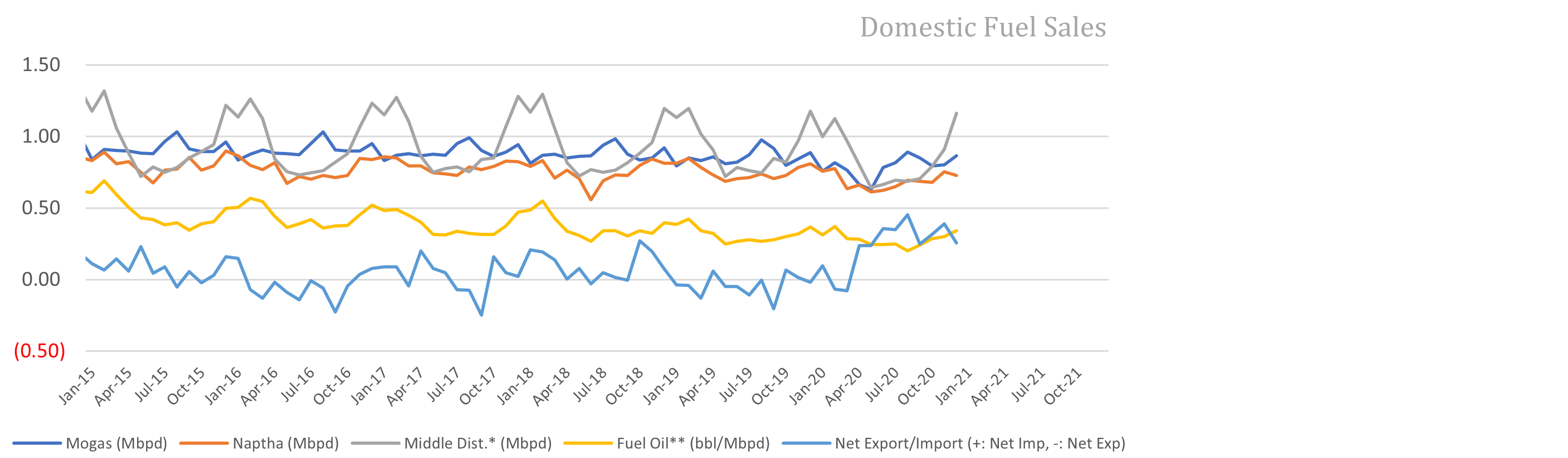
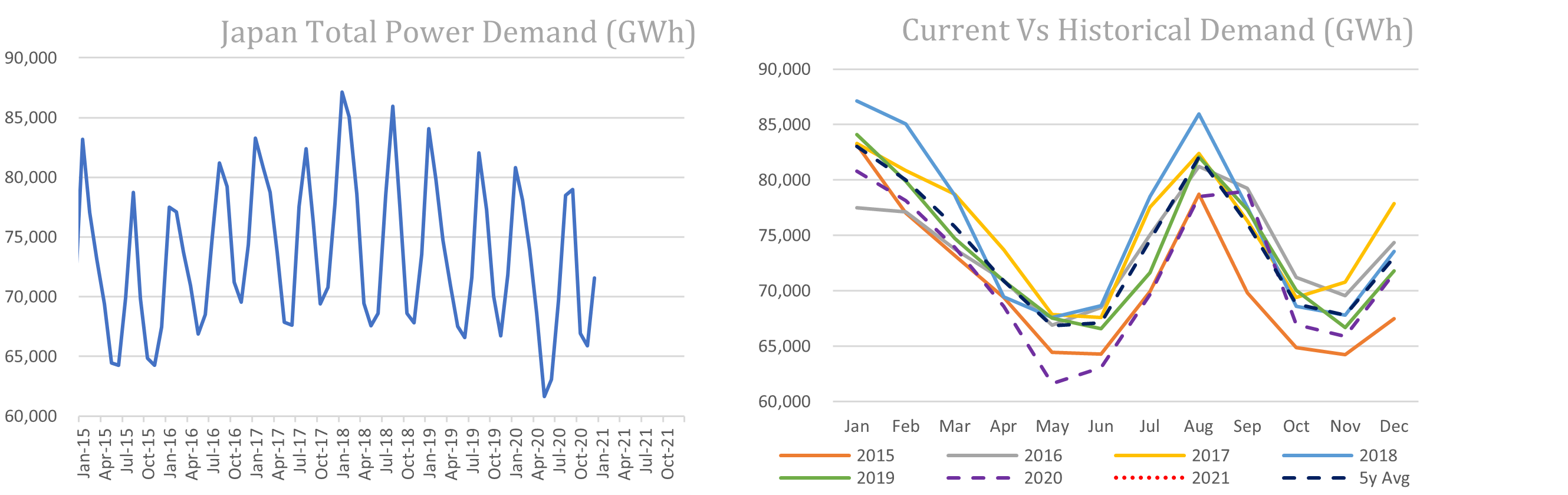
SOURCES: Ministry of Economy, Trade, and Industry (METI), Ministry of Finance, and the Petroleum Association of Japan
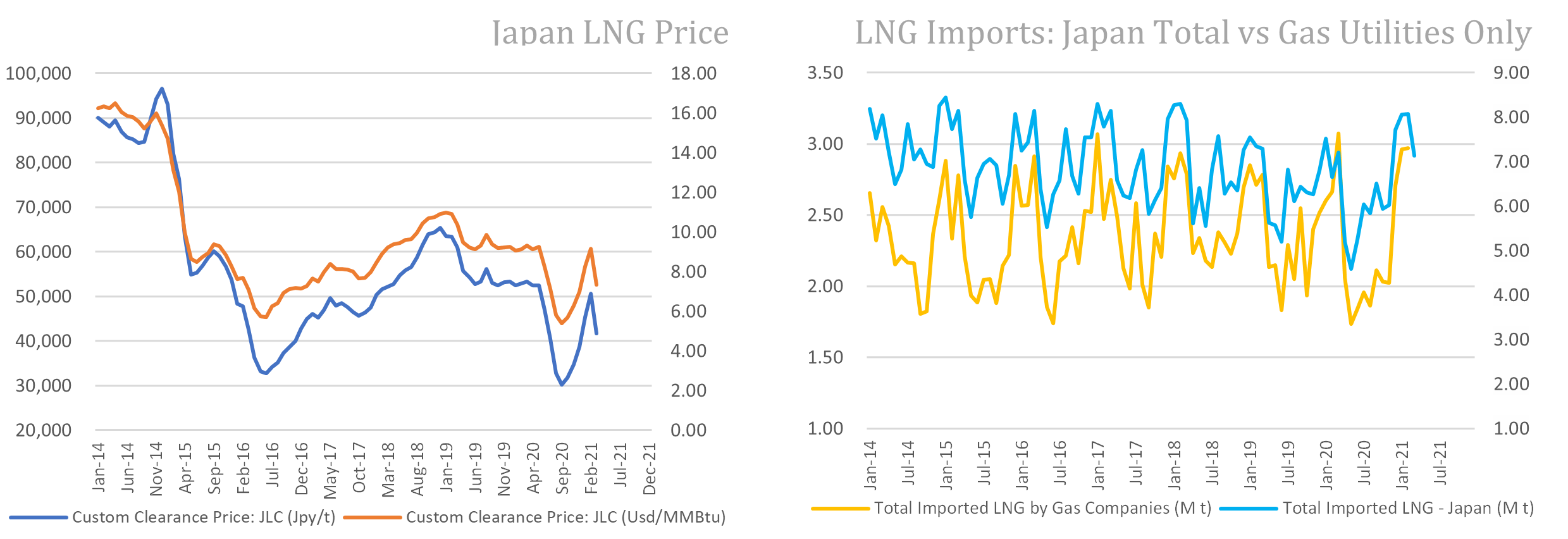
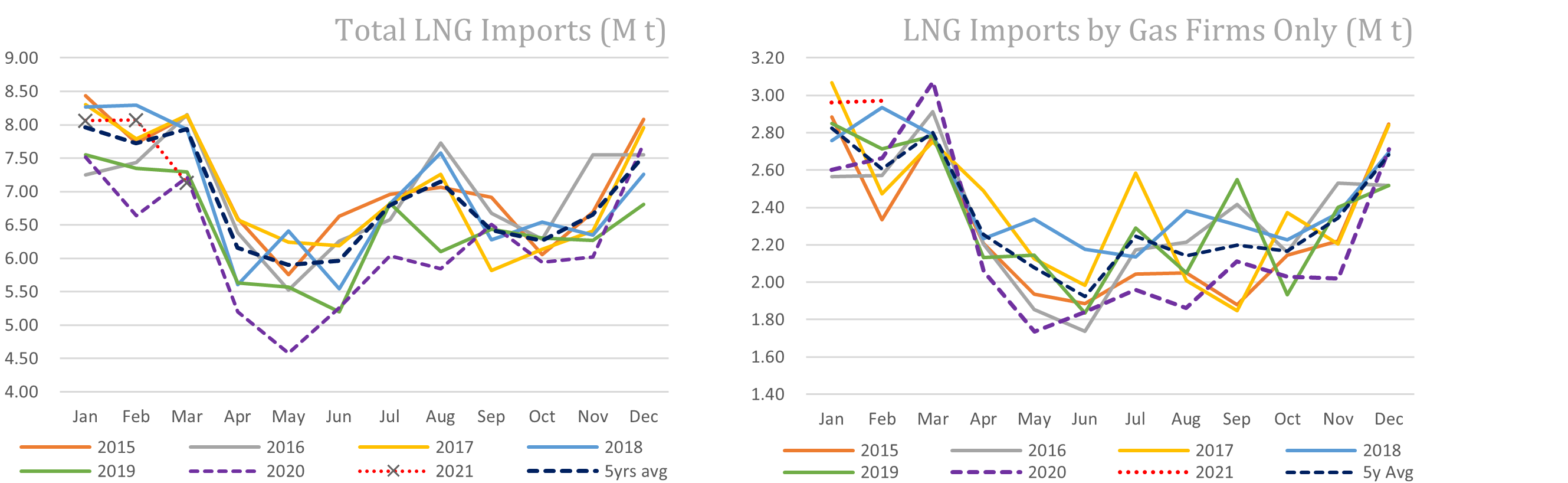
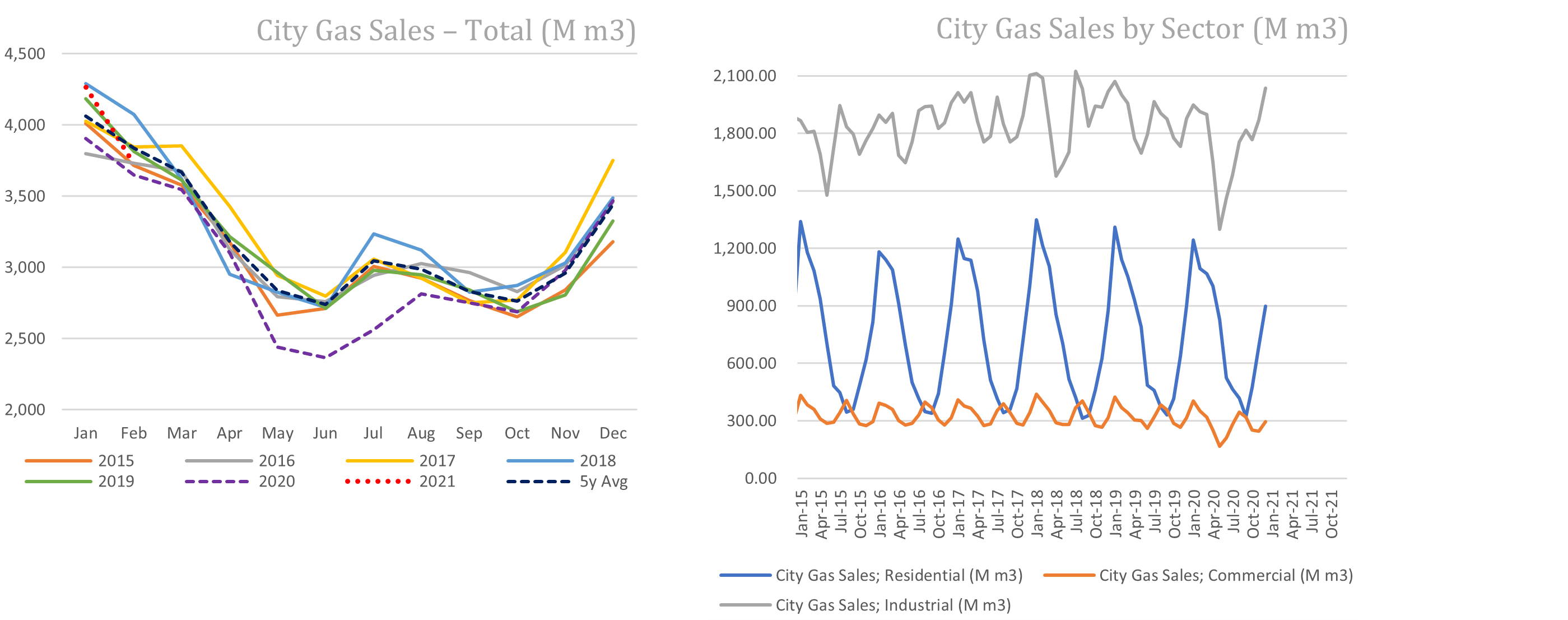
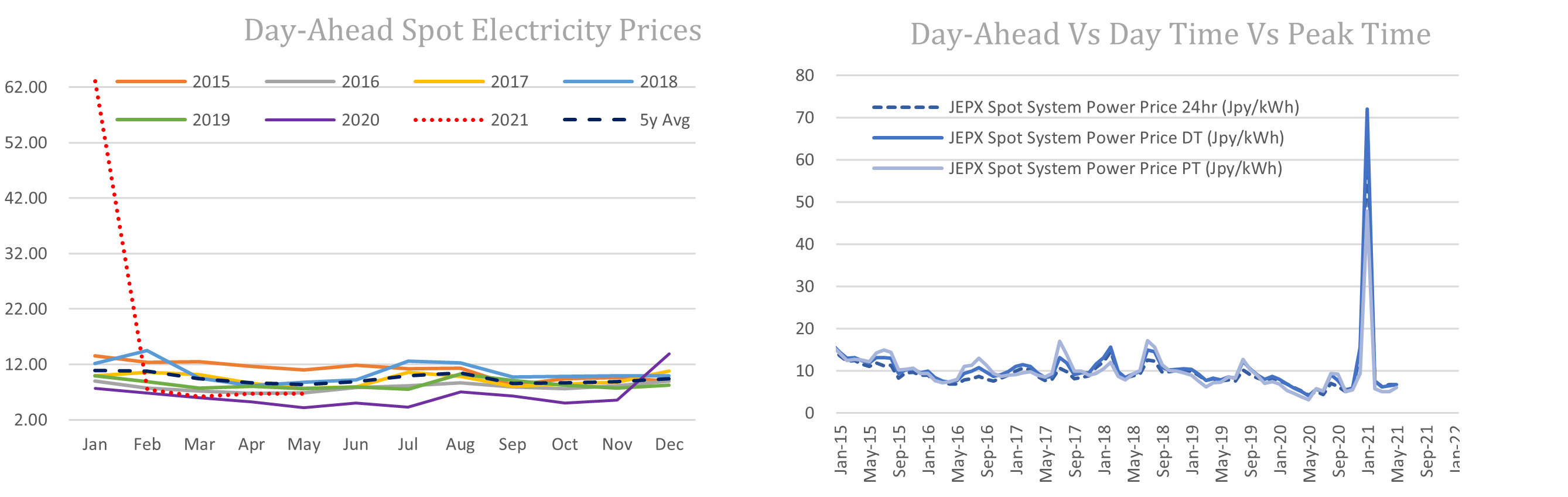
SOURCES: Ministry of Economy, Trade, and Industry (METI),
Ministry of Finance
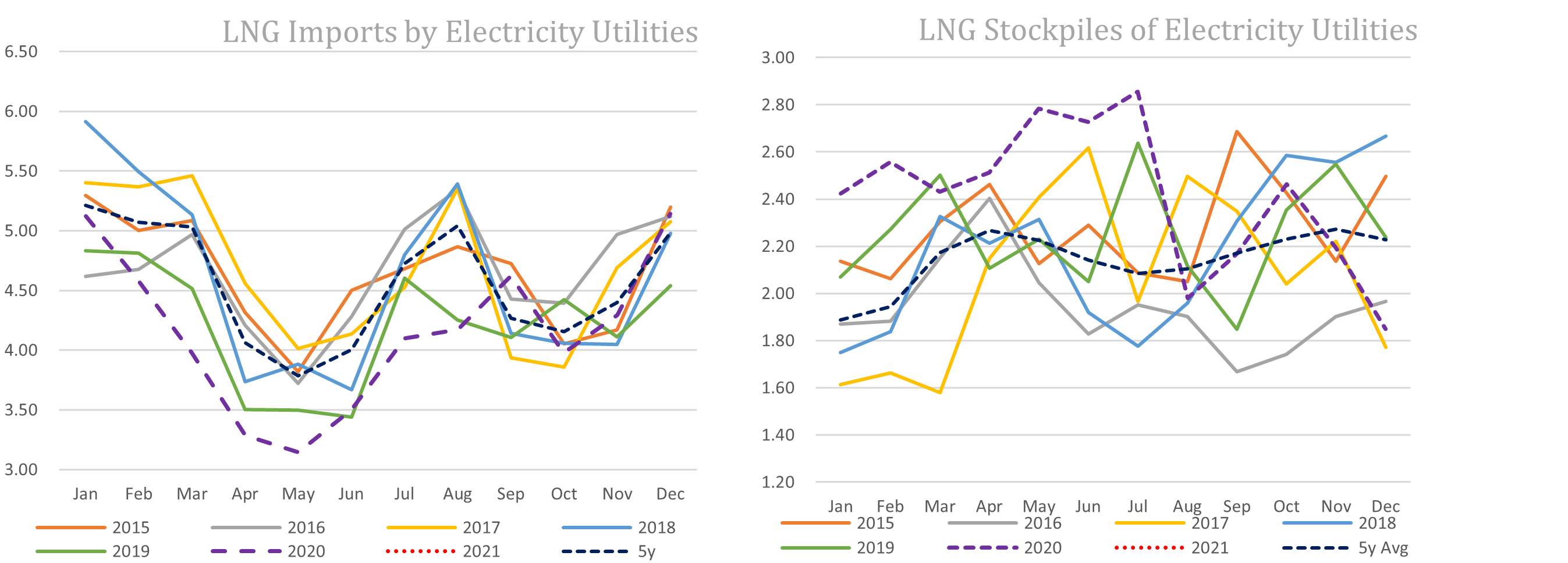
SOURCES: Ministry of Economy, Trade, and Industry (METI), and the Japan Electric Power Exchange
Disclaimer
This communication has been prepared for information purposes only, is confidential and may be legally privileged. This is a subscription-only service and is directed at those who have expressly asked K.K. Yuri Group or one of its representatives to be added to the mailing list. This document may not be onwardly circulated or reproduced without prior written consent from Yuri Group, which retains all copyright to the content of this report.
Yuri Group is not registered as an investment advisor in any jurisdiction. Our research and all the content express our opinions, which are generally based on available public information, field studies and own analysis. Content is limited to general comment upon general political, economic and market issues, asset classes and types of investments. The report and all of its content does not constitute a recommendation or solicitation to buy, sell, subscribe for or underwrite any product or physical commodity, or a financial instrument.
The information contained in this report is obtained from sources believed to be reliable and in good faith. No representation or warranty is made that it is accurate or complete. Opinions and views expressed are subject to change without notice, as are prices and availability, which are indicative only. There is no obligation to notify recipients of any changes to this data or to do so in the future. No responsibility is accepted for the use of or reliance on the information provided. In no circumstances will Yuri Group be liable for any indirect or direct loss, or consequential loss or damages arising from the use of, any inability to use, or any inaccuracy in the information.
K.K. Yuri Group: Oonoya Building 8F, Yotsuya 1-18, Shinjuku-ku, Tokyo, Japan, 160-0004.