
JAPAN NRG WEEKLY
MAY 31, 2021
JAPAN NRG WEEKLY
May 31, 2021
NEWS
TOP
- Japan’s parliament passes carbon neutrality act that calls on the country’s decarbonization by 2050; govt. pinning hopes on solid-state batteries and hydrogen, among others
- METI asks utilities to restart idled LNG plants, warns of potential power shortages this summer; Hokkaido to help cover mainland
- Shells sells LNG to Japan utility in exchange for physical electricity
ENERGY TRANSITION & POLICY
- Confusion over Japan’s energy mix target ahead of new strategy
- Tidal generation system gets official approval near Nagasaki
- German ESG platform lists Japan’s biggest polluters: J-Power, Mitsubishi Corp, ENEOS, Mitsui are among the worst
- Japan to boost hydrogen refueling stations sixfold by FY2030; target for EV quick charger units also to quadruple this decade
- Toyota CEO warns switch to EVs could cost 1 million Japan jobs
- METI raises 2030 energy saving targets for multiple industries
- METI calls on industry to boost supply chains with allied nations
- Kawasaki Heavy unveils world’s first liquid hydrogen transporter
- Tokyo Gas and Screen HD to partner on electrolytic cell stacks
- Tesla to enter Japan market with grid storage batteries for solar
- TEPCO to create $92M fund to invest in promising SMEs
- Top agriculture bank sets aside $92B for ESG projects … [MORE]
ELECTRICITY MARKETS
- JERA, IHI start testing ammonia as a co-firing fuel at coal plant
- IHI invests in NuScale to enter small modular reactor market
- Japan closes bids on first set of major offshore wind auctions;
– Cosmo / Acacia / Hitachi Zosen bid for Aomori site
– Mitsubishi Corp / Venti / Hokuto Bank seek Akita projects
– Vena Energy submits plan for 350 MW Fukui project - Japan seeks to create own offshore wind power manufacturing
- Kansai Electric sets date to restart Ooi nuclear reactor No. 3
OIL, GAS & MINING
- Idemitsu, rivals worry how to fill earnings hole post fossil fuel exit
ANALYSIS
LNG CONTRACT DESTINATION CLAUSE
DRAWS REGULATORY CONCERN, AGAIN
In Japan, January’s rapid rise in LNG prices stirred more than just anxiety over costs. After years of silence on the issue, the government is once again turning its eye to the contract terms of international LNG purchases. Japanese firms and officials have discussed bringing more flexibility to purchasing terms for years, winning some minor concessions from sellers in the process. The events that sparked a 1,680% rally in LNG prices over six months to January 2021, however, raised major alarm bells. The thinking is that while Japan still has its world-leading position in the market, and influence over Asia trade, it needs to act. A new review has been launched.
HYDROPOWER IS BACK IN FAVOR AS EMISSIONS REDUCTIONS, SHIFT TO EVS RENEW INTEREST
One of the biggest immediate beneficiaries of Japan’s more active decarbonization agenda, so far, has been hydropower. In recent months, most major domestic power utilities have unveiled corporate and household plans offering predominantly, or only, electricity derived from hydro. An energy source that’s often been considered stable but largely tapped-out, hydro is experiencing a revival. At a recent government meeting, utilities revealed plans to build at least six new hydropower stations within four years and also expand capacity at existing plants. Some of this hydro might even help Japan make hydrogen.
GLOBAL VIEW
Black Wednesday in Big Oil as Shell, Exxon and Chevron suffer setbacks. Carbon price tools raised $53B during 2020. Total changes its name. EU prepares sanctions on Belarus energy products.
Details on these and more in our global wrap.
2021 EVENT CALENDAR
DATA SECTION
JAPAN NRG WEEKLY
PUBLISHER
K. K. Yuri Group
Sponsored
Editorial Team
Yuriy Humber (Editor-in-Chief)
Tom O’Sullivan (Japan, Middle East, Africa)
John Varoli (Americas)
Regular Contributors
Mayumi Watanabe (Japan)
Daniel Shulman (Japan)
Takehiro Masutomo (Japan)
Art & Design
22 Graphics Inc.
SUBSCRIPTIONS & ADVERTISING
Japan NRG offers individual, corporate and academic subscription plans. Basic details are our website or write to subscriptions@japan-nrg.com
For marketing, advertising, or collaboration opportunities, contact sales@japan-nrg.com
For all other inquiries, write to info@japan-nrg.com
OFTEN USED ACRONYMS
METI The Ministry of Energy, Trade and Industry
ANRE Agency for Natural Resources and Energy
NEDO New Energy and Industrial Technology Development Organization
TEPCO Tokyo Electric Power Company
KEPCO Kansai Electric Power Company
EPCO Electric Power Company
JCC Japan Crude Cocktail
JKM Japan Korea Market, the Platt’s LNG benchmark
CCUS Carbon Capture, Utilization and Storage
mmbtu Million British Thermal Units
mb/d Million barrels per day
mtoe Million Tons of Oil Equivalent
kWh Kilowatt hours (electricity generation volume)
NEWS: ENERGY TRANSITION & POLICY
Japan’s parliament passes the carbon neutrality act
(Hokkoku Shimbun, May 26)
- On May 26, the House of Councilors unanimously voted in favor of the amended Act on Promotion of Global Warming Countermeasures, which calls for the decarbonization of Japanese society by 2050.
- To leverage decarbonization initiatives to revitalize regional economies, the act allows local bodies to designate decarbonization zones.
- The act becomes law in April 2022.
- With decarbonization carved into law, the government hopes to stimulate long-term investments into new technologies.
- SIDE DEVELOPMENT:
Law seeks to push Japan ahead in solid-state batteries, hydrogen race
(Nikkei, May 27)- The law will encourage companies to bet on the energy transition. The government wants Japan to maintain its edge in solid-state batteries and hydrogen, while also matching rivals in a race to develop carbon storage.
- Japan has carbon capture demonstration projects in six different locations, compared to 37 facilities built or under construction in the U.S.
- Japan’s steel companies are researching how to shift to hydrogen.
- Toyota is due to release an EV with the new solid-state battery by 2025.
- Although Japan has lost its positions in solar, domestic manufacturers such as PV, Toshiba and Ricoh are among those trying to win back the market with the next-generation perovskite solar panels.
- SIDE DEVELOPMENT:
Can Japan and Toyota win the solid-state battery race?
(Asia Nikkei, May 28)- Toyota’s lead in the battery field is being challenged by overseas auto rivals.
- SIDE DEVELOPMENT:
PPES to increase lithium battery production lines in West Japan
(New Energy Business News, May 27)- Panasonic/Toyota joint venture Prime Planet Energy and Solutions is set to open new lithium battery production lines at its Himeji and Chugoku plants.
- The move will see the company’s lithium-ion battery production capacity increase to 80,000 units per year.
- SIDE DEVELOPMENT:
Panasonic bets its future profits on batteries and hybrid energy systems
(Asia Nikkei, May 27)- The company is a battery supplier for Tesla. It is also developing a small-scale energy system that can power offices and factories without using fossil fuel. The system combines fuel cells, solar panels and storage batteries, which means it can generate solar power on sunny days, uses fuel cells on cloudy days or at night, and then stores electricity in batteries to even out supply.
- Panasonic claims the system will be capable of producing electricity at or below the current electricity rates.
TAKEAWAY: The politicians have done their part and decarbonization action is now enshrined in Japanese law. But, how decarbonization will take place is the bigger challenge, and the public policy and business communities are divided on the issue. See the next news item and our comment for details.
Confusion over Japan’s energy mix target
(World Economic Review, May 24)
- CONTEXT: A column by Professor Kikkawa Takeo, the noted energy expert and academic at the International University of Japan.
- Prime Minister Suga’s announcement that Japan will reduce greenhouse gas emissions as much as 50% by FY2030 has caused confusion amongst those attempting to implement the new policy.
- While previous targets, like the 26% target announced in 2015, were based on projected changes to Japan’s energy mix set forth in the government’s Basic Energy Plan, this new top-down, target will require much more aggressive reductions than what can be achieved under the energy plan.
- In order to meet the new target, over 35% of Japan’s electricity would have to be sourced from renewable sources. With no evidence that such a massive increase is possible, one cannot but have misgivings about the likelihood of achieving the new target, says Kikkawa.
- The government is now attempting to revise down the nation’s total energy’s consumption estimate for FY2030, including a major downward revision of production targets for crude steel. This could be interpreted as a message to Japanese industry that it has no future, says Kikkawa.
- The government’s stated aim of sourcing over 20% of electricity from nuclear sources by 2030 is also clearly impossible, says Kikkawa.
- Furthermore, the aggressive reduction in thermal coal use required to meet the new target might jeopardize the stability of electricity supply and increasing costs, says Kikkawa.
- Japan would not be in nearly so difficult a situation if, in 2015, the government had aimed to procure 15% of electricity from nuclear sources and 30% from renewables, as Kikkawa says he has consistently advocated.
TAKEAWAY: We are all awaiting the new Basic Energy Plan from METI, due in late June or early July. Whatever it says, most people are likely to be disappointed. One of the reasons is the divergence between views on the energy future. Another is the enormity of the challenge that comes with meeting recent decarbonization pledges. Though it is often used in a positive sense, “disruption” in energy is a lot more painful and broader in its economic reach than for the tech sector.
As Prof. Kikkawa’s piece suggests, there is strong resistance in Japan’s industry and bureaucracy to shifting entirely to solar and wind. Equally, there is a vocal pro-renewables corporate voice that does not accept such resistance. The Basic Energy Plan, in theory, should stop these tensions and unify the country in pursuit of decarbonization goals. In reality, it may do the opposite, exposing the ever-growing divisions. That, in turn, may lead to organizational restructuring. Companies will split off “green” units. Government agencies will demarcate along their views on climate action. Responsibility for energy policy, research and funding have always been spread across several entities in Japan, but most of these have been under the METI umbrella. That’s unlikely to satisfy green activists for much longer.
Tidal generation system gets official approval
(Smart Japan, May 24)
- On May 20, Kyuden Mirai Energy said its prototype for a system to generate electricity from tidal energy has preliminary approval from METI.
- The system is installed along a 40m stretch of the Nagasaki seabed and generates 500 kW of electricity.
German ESG platform creates list that names and shames Japan’s polluters
(Nikkei, May 27)
- German ESG scoring platform Arabesque S-Ray has published a list that ranks Japanese corporations by their levels of greenhouse gas emissions in a move designed to encourage consumers to boycott polluting companies.
- Each corporation’s greenhouse gas emissions are converted into a warming score.
- J Power, Mitsubishi Corporation, ENEOS, and Mitsui & Co. are the worst polluters on the list. Their activities are projected to increase Earth’s average temperature by over 2.7° by 2050.
- Next are TEPCO Holdings, SoftBank, and Hokuriku Electric, whose contribution to global warming is estimated at 2.7° by 2050.
- Faring slightly better was Hitachi, which is estimated to contribute to a 2° increase in temperature by 2050.
- The greenest companies on the list included Honda and Toshiba, which are only estimated to contribute to a 1.5° warming by 2050.
- Mitsui said it takes the assessment seriously, but pointed out that its practice of including joint operations in emissions disclosures causes its operations to be perceived as more polluting than they really are.
- Mitsubishi and ENEOS said they’re working to decarbonize their operations.
- J Power, on the other hand, was critical of the assessment, saying it was unclear what information Arabesque based its scores on.
- Many major global investors, including Alliance, Axa, Dai-Ichi Life, Black Rock, and Vanguard aim to transition to a carbon neutral investment portfolio by 2050.
TAKEAWAY: This kind of consumer-led boycott is not a strategy that has traditionally worked in Japan. Few campaigns are successful and even fewer are energy / climate-related. However, the younger generation in the country are more attuned to the message. The current list of big polluters does not provide an easy consumer product to target. Still, such a campaign may be successful in dissuading some of Japan’s brightest new grads from joining these companies. That is something businesses would take notice of.
Japan to boost hydrogen refueling station count sixfold by 2030; EV charger units also
(Nikkei, May 29)
- As part of the new Basic Energy Plan, which is due in June or so, the government will unveil plans to set a goal of having 1,000 refueling stations for hydrogen by FY2030, which is six times as many as today.
- The EV charging network should also quadruple and number about 30,000 quick EV charger units by the end of the decade, the Plan will show.
- The goal is to make EVs and hydrogen fuel cell vehicles equally convenient and economic to own as gasoline-run vehicles.
- The new Basic Energy Plan will focus heavily on green strategies and supply chain strengthening with the goal of having net zero greenhouse gas emissions by 2050.
- Energy security will also play a role in the new Plan.
- SIDE DEVELOPMENT:
ENEOS and NEC cooperate on electric vehicle charging
(New Energy Business News, May 24)- ENEOS and NEC signed an agreement to collaborate on growing ENEOS’ network of 13,000 vehicle charging stations, as well as using the network to deliver new services.
- Through the venture, NEC hopes to leverage its expertise in charging technology, maintenance, and system management.
Toyota CEO warns that a total switch to EVs would kill 1M jobs; Tests Hydrogen Racer
(Asia Nikkei, May 25)
- Toyota Motor CEO said that if the entire auto industry switches to EVs then Japan will lose 1 million jobs, adding that the goal of carbon neutrality can be met in different ways, including through hydrogen cars.
- Toyota entered its hydrogen fuel cell engine Corolla Sport into this year’s endurance race, the Super Taikyu Series held in the Shizuoka prefecture.
- The vehicle is the first with a hydrogen engine to complete a 24-hour endurance test. The car used a repurposed gasoline internal combustion engine, with slight modifications.
- The car had almost no CO2 emissions, but it had to stop to refuel almost twice as often and ultimately traveled about half the distance at around half the average speed of gas-powered rivals.
Japan raises 2030 energy saving targets for industry
(Japan NRG, May 21)
- METI has increased the FY2030 energy saving targets across industries as the ministry looks for ways to reduce emissions.
- The ministry revised expected energy savings up by 12 million kl to 62 million lk in the timeframe.
- METI believes the introduction of inverters for fans and pumps will lead to an energy saving of 1.23 million kl.
- However, METI revised down its expected energy savings from the steel industry based on a higher than previously forecast output of 90 million tons of crude steel a year by FY2030.
METI calls on industry to boost supply chains with allied nations
(Nikkei, May 24)
- METI outlined its updated policy on economic security.
- The Ministry will promote the establishment of supply chains with the U.S. and other allied nations.
- The Ministry also wants stricter control over exports.
- At the same time, the Ministry said those trading with China won’t have to implement measures above and beyond legal compliance, to the point of excluding Chinese operators.
Kawasaki Heavy unveils world’s first liquid hydrogen transporter
(Sankei News, May 24)
- On May 24, Kawasaki Heavy Industries unveiled the 80,000-metric ton Suiso Furontia, the world’s first liquid hydrogen transportation ship.
- The ship is capable of carrying over 1,200 cubic meters of liquid hydrogen.
- As part of a plan to establish a hydrogen supply chain to transport large volumes of the fuel at low cost, the ship will carry its first payload in a test voyage from Australia to Kobe later this year.
- The hydrogen carried in the pilot voyage will be synthesized from lignite.
Tokyo Gas and Screen Holdings partner on electrolytic cell stack technology
(New Energy Business News, May 27)
- Tokyo Gas and Screen Holdings agreed to cooperate on the development of technology for manufacturing electrolytic stacks.
- Screen has proprietary technology for continuous roll-to-roll production of cell stacks.
- The technology will enable hydrogen to be produced at the government’s cost target of ¥30 per N㎥ by 2030.
Tesla to enter Japan market with grid storage batteries for renewables projects
(Nikkei, May 27)
- Tesla Motors Japan plans to start offering storage batteries for utility-scale renewables projects. So far, the company has only offered batteries for home use in the country.
- Tesla recently delivered a “Megapack” large storage battery to the Takasago Thermal Engineering Innovation Center, in Ibaraki prefecture. “Megapack” has the capacity of about 3,000 kWh, which is equivalent to the amount of electricity consumed by about 250 households each day.
Japan’s top bank for agriculture sets aside $92B for ESG projects
(Nikkei, May 25)
- Norinchukin Bank, which caters to Japan’s agriculture industry, plans to set aside ¥10 trillion ($92 billion) for investments and loans in projects that promote environmental, social and corporate governance goals over the next decade.
- This would be up by about 70% from current allocations.
- Norinchukin will use its financing to promote a 50% reduction in greenhouse gases by FY2030 compared with FY2013.
TEPCO to create $92M fund to invest in promising SMEs to expand returns
(Nikkei Shimbun, May 27)
- TEPCO set up a fund to invest ¥10 billion ($92M) in promising small and medium-sized enterprises and startups.
- TEPCO’s earnings from power sales are declining as market competition increases and traditional customers switch to other providers. The company wants to find new business avenues.
- The new fund will invest not only in the electricity industry.
- By the end of September, details such as investment quotas will be finalized, and the first investment destination will be decided during the fiscal year ending March 2022.
- Hyodo Ken, an executive officer of TEPCO HD, will be president of this new investment company.
Nissan to build EV battery plants in Japan and UK
(Nikkei, May 28)
- Nissan Motor will partner with Chinese battery maker Envision AESC Group and invest over ¥200 billion in building new battery plants for EVs in Japan and the U.K.
- The factories will start production as early as 2024 and have a total capacity to equip 700,000 EVs a year, all of which will be supplied to the Renault-Nissan-Mitsubishi alliance.
- Nissan holds a 20% stake in Envision AESC.
- SIDE DEVELOPMENT:
Toyota and JERA to recycle EV batteries for power storage
(Nikkei, May 30)- Toyota Motor and JERA aim to develop technology to reuse batteries from EVs and hybrid vehicles for use as energy storage systems.
- Used auto batteries will be recycled and made into storage batteries that can stabilize the supply of variable renewable energy. Reusing older batteries will make storage options cheaper, helping renewable energy gain momentum.
- The two partners aim to develop a storage battery during FY2021. It will be developed from used lithium-ion and used nickel-metal hydride batteries, aiming to increase efficiency by borrowing from the two technologies.
- Demonstration tests are due to take place in FY2022.
Mitsubishi Power and Iberdrola establish industrial decarbonization venture
(Kankyo Business, May 24)
- Mitsubishi Power agreed to collaborate with Spanish utility Iberdrola on clean and competitive renewable energy solutions.
- Mitsubishi and Iberdrola plan to begin work on systems for green hydrogen synthesis, battery storage systems, and electric heat supply systems.
- Both corporations have expertise in energy storage and renewable energy products and facilities.
- Iberdrola CEO Aitor Moso Ragioso said the project represented a very important milestone in the utility’s long-term strategy to convert industrial subscribers from other energy sources to electricity.
NEWS: POWER MARKETS
|
No. of operable nuclear reactors |
33 | |
|
of which |
applied for restart |
25 |
|
approved by regulator |
16 | |
|
restarted |
9 | |
|
in operation today |
7 | |
|
|
able to use MOX fuel |
4 |
|
No. of nuclear reactors under construction |
3 | |
|
No. of reactors slated for decommissioning |
27 | |
|
of which |
completed work |
1 |
|
started process |
4 | |
|
|
yet to start / not known |
22 |
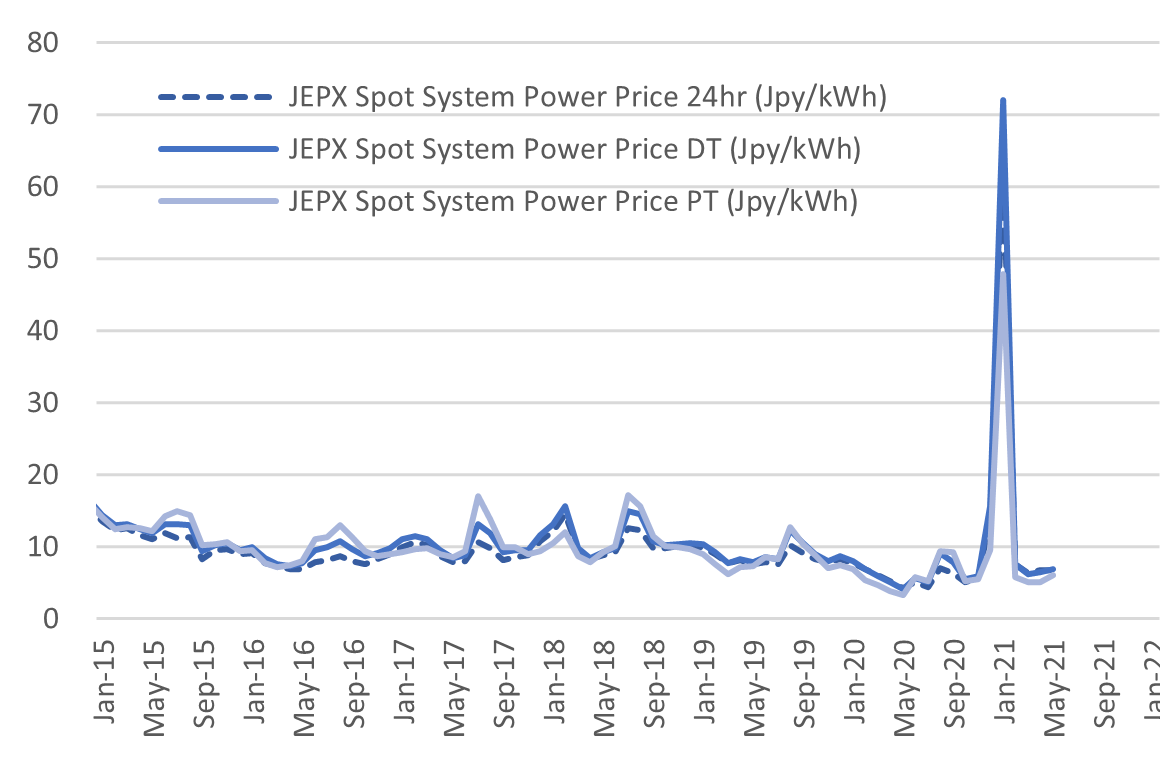
Spot Electricity Prices, Monthly Avg.
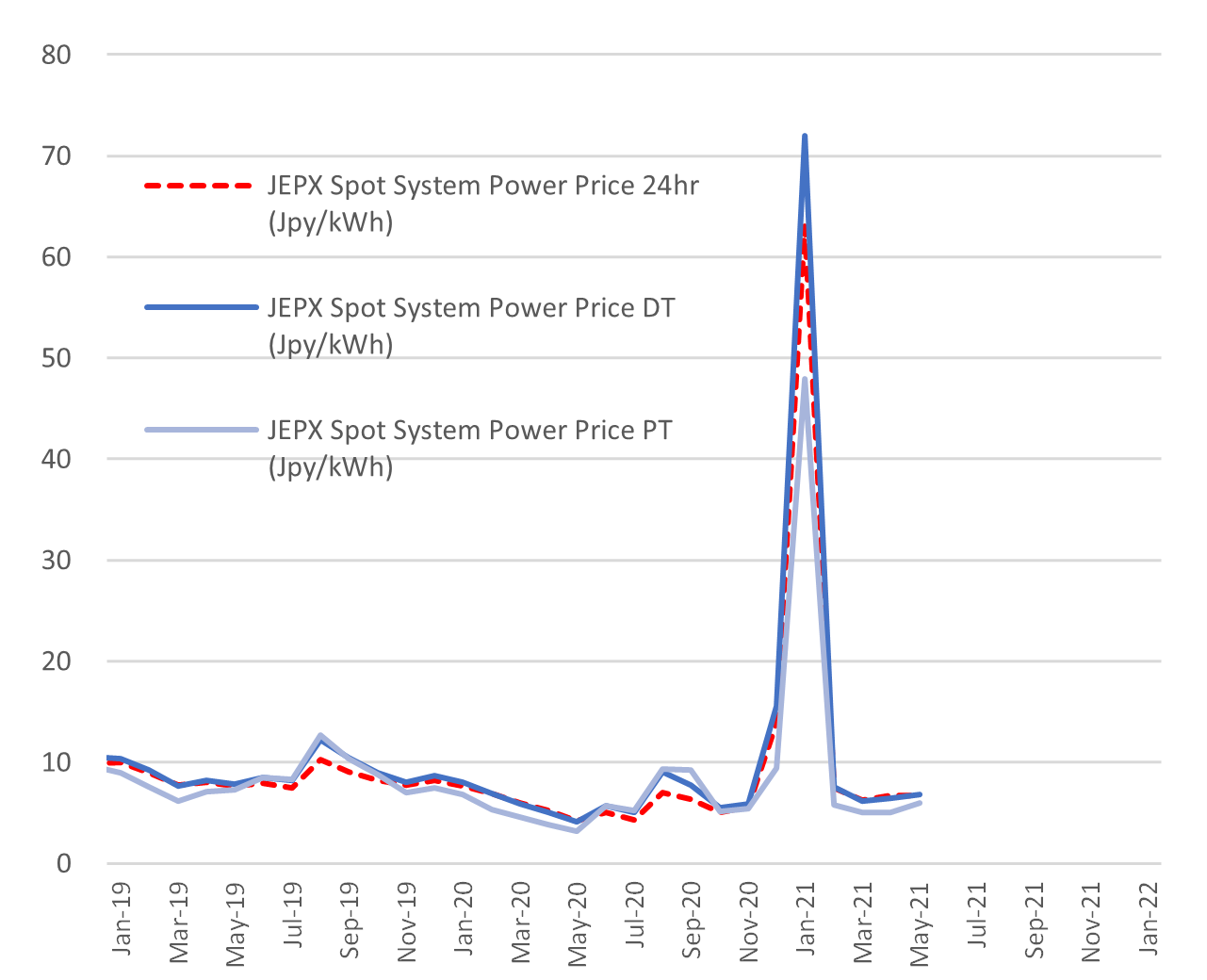
Source: Company websites, JANSI and JAIF, as of May. 21, 2021
METI calls for restart of idled LNG plants
(Nikkei, May 24)
- To avert winter power shortages, METI is pushing to restart LNG-fired power plants that are currently offline.
- Among these is JERA’s Anegasaki Thermal Power Station, which stopped the operation of two older units in April. The utility needs time to repair and upgrade the facilities that have operated for 50+ years, but the ministry hopes it they will be back online before winter. This would add enough capacity to almost cover the 3% “buffer” that METI wants in the system in case of power demand surges.
- In the mid-to long-term, the Ministry says it will require operators to give advance notice before taking LNG-fired plants offline. It will also create a scheme to provide operators of new plants with guaranteed income.
- The Ministry will also boost the use of surplus electricity from roof-mounted solar, as well as having power stations reschedule maintenance to periods of lower demand.
- As more thermal power plants are taken offline and decommissioned, the supply of electricity has become tight in summer and winter, particularly in the TEPCO network.
- It is projected that demand will outstrip supply by 0.3% in TEPCO’s network in February 2022.
- SIDE DEVELOPMENT:
Hokkaido Electric to boost power deliveries to mainland this summer
(Nikkei, May 25)- Hokkaido Electric plans to send as much as 14% more power to mainland Japan this summer to help with potential shortages due to an expected wave of hot weather.
- The Kitamoto interconnector between the island of Hokkaido and mainland will be expanded in July.
TAKEAWAY: METI is also asking utilities to be better stocked with fuel for this summer, especially on LNG, be more cautious on plant shutdowns and maintenance schedules, and gently prodding consumers to be aware of their energy use. But more extreme measures will be needed if this summer turns out as hot as is currently being forecast.
Interesting, METI’s power and gas panel has also urgent power market participants to lean more heavily on the futures markets to hedge, something the ministry has not really pressed before. This bodes well for the power derivatives markets being run by TOCOM and EEX, among others.
JERA, IHI win grant and the two start trials of ammonia as a co-firing fuel
(Company statements, May 24)
- JERA and IHI Corporation said they won a grant application from state research organ NEDO and will start to conduct a demonstration project to use ammonia as a fuel at its 1 GW Hekinan thermal power plant in central Japan from June. The test will eventually involve using ammonia at a co-firing rate of 20%.
- The test aims to establish ammonia co-firing technology by co-firing coal and ammonia at a large-scale commercial coal-fired power plant and evaluating both boiler heat absorption and environmental impact characteristics, such as exhaust gases. The project will run for approximately 4 years from June 2021 to March 2025.
- JERA hopes to achieve the 20% co-firing ration for two straight months in FY2024. That would allow the utility to switch its thermal power plants entirely to ammonia fuel in the 2040s.
- IHI’s role is to develop the burners to be used in the demonstration.
- CONTEXT: This is the world’s first demonstration project in which a large amount of ammonia will be co-fired in a large-scale commercial coal-fired power plant.
- SIDE DEVELOPMENT:
JERA plans to procure 30,000-40,000 mt of ammonia by FY2024 for Hekinan station
(S&P Global, May 24)
Japan’s IHI enters Small Modular Reactor market by buying into NuScale
(Company Statements, Nikkei, May 27)
- Engineering group IHI said it will invest into NuScale, a U.S. developer of new nuclear reactor technology known as Small Modular Reactor (SMR).
- IHI is investing together with JGC Corp., another Japanese engineering firm that announced a similar investment in April.
- IHI called this a “strategic partnership” and said it “can support rapid deployment of NuScale’s technology by leveraging IHI’s extensive engineering and manufacturing experience in the nuclear industry.” NuScale’s SMRs are the closest to commercialization in the industry, IHI said.
- NuScale Power is building a 600 to 700 MW nuclear power plant composed of about seven small reactors in the U.S. state of Idaho. It plans to start commercial operations as early as 2029.
- IHI will develop containment structures to enclose reactor cores, as well as other components. It will invest about ¥2 billion yen ($18 million) into NuScale next month, and could double that later.
TAKEAWAY: SMRs have already been mentioned by the government in the Green Growth Strategy, without details. Notable involvement of two major Japanese engineering firms in the U.S. project in Idaho suggests the technology could be on its way to Japan pending successful NuScale operations at the maiden plant. Still, we are unlikely to see SMR construction start in Japan this decade.
Cosmo Energy, Acacia, Hitachi Zosen set up JV for 600 MW Aomori offshore wind project
(New Energy Business News, May 28)
- Cosmo Eco Power, Acacia Renewables, and Hitachi Zosen have invested in a limited liability company, Aomori Seihoku Offshore Wind Power Co. The company will develop an offshore wind farm with a maximum capacity of 600 MW off the coast of Tsugaru City, Aomori prefecture.
- The project is expected to utilize approximately 12,634 ha in the coastal areas and offshore. It will contain as many as bottom-fixed 64 turbines, each with a capacity of 9.5 MW to 15 MW.
- Construction will start in 2025, and operation is planned to start in 2028.
- SIDE DEVELOPMENT:
Private and public sector cooperate on Akita offshore wind project
(Kankyo Business, May 24)- On May 13, Akita University, Mitsubishi Corporation Energy Solutions, Venti Japan, and Hokuto Bank signed an agreement to collaborate in the field of wind energy, with the aim of developing the local renewable energy industry.
- Under the agreement, the three corporations will share local and international wind data with Akita University.
- The University will in turn share the outcomes of its analysis and research.
- The parties will also discuss ways to make further use of renewables, including hydrogen and ammonia.
- SIDE DEVELOPMENT:
Vena Energy submits plan for 350 MW offshore wind plan in Fukui area
(New Energy Business News, May 24)- Vena Energy plans to develop a 350 MW offshore wind farm off the coast of Awara City, Fukui prefecture. The renewables energy development company submitted its environmental assessment documents for the project on May 19.
- The company aims to start operation at the Fukui Offshore Wind Farm in 2028. It would utilize 37 turbines with a capacity in the range of 8 MW to 14 MW each. Construction is due to start in 2026.
Government moves to create Japan’s own offshore wind manufacturers
(Nikkei, May 24)
- JFE Holdings will invest ¥40 billion between now and 2024 in a project to manufacture towers and substructures for offshore wind turbines in Japan.
- For its part, Toshiba will produce turbine nacelles at its Yokohama factory.
- Most wind turbines used in Japan tend to be manufactured overseas. Currently, no Japanese manufacturers produce monopile towers, which are mostly imported from Europe.
- It costs around ¥700 million to procure enough monopiles to construct the average offshore farm, and the Japanese government says transporting the piles from Europe costs an additional ¥300 million.
- The government says that industry stands to make significant savings by manufacturing turbine equipment in Japan.
- JFE Holdings aims to begin manufacturing monopiles in April 2024, and hopes to capture 50% of the domestic market.
- SIDE DEVELOPMENT:
Japan lags Europe by 20 years in offshore wind
(Nikkei, May 23)- Surrounded by ocean Japan is spoilt for choice for sites to build offshore wind farms, making it the envy of overseas wind farm developers.
- Japan’s government and industry had long dismissed wind as an option, believing that wind could never be a significant part of Japan’s energy mix. Developers instead focused on lucrative solar projects.
- In the absence of a government policy on wind farm development, Japanese operators were historically reluctant to take risks on wind farm projects, even at a feed-in tariff of ¥36 per kilowatt hour.
- Transmission network operators have not helped either. Applications to construct wind farms tend to be refused, citing insufficient grid capacity, even in cases where spare capacity was available.
- Because of this, Japan now lags northern European nations by 20 years in wind turbine technology.
- It is hoped that a major project off Akita, made possible by Marubeni’s purchase of a UK-based wind farm developer, will be the first step in closing the technological gulf with Europe.
J Power invests in Australia’s renewable energy developer Genex
(Kankyo Business, May 21)
- J Power acquired a 10% stake in Sydney-based renewable energy developer Genex Power.
- J Power plans to use its expertise to grow the renewable energy businesses of both corporations.
- Genex is involved in developing a total of 770 MW of renewable capacity, including pumped hydro.
Kansai Electric sets date for restart of Ooi NPP’s Unit 3 after extra maintenance work
(Denki Shimbun, May 26)
- Kansai Electric said it started work to replace piping at Unit 3 of its Ooi nuclear power plant, which is due to complete on June 6. The facility will then be switched back on July 3, ramping up to full capacity.
- The reactor will have a comprehensive load performance inspection on July 30.
- The unit was in the middle of its regular maintenance inspection last summer when cracks in the welded part of the pressurizer spray system piping were discovered. The utility applied to the industry regulator for approval to carry out piping replacement work, which is now on-going.
TAKEAWAY: If there are no unexpected problems, Kansai Electric should have at least six of its seven reactors back online mid-summer. Mihama NPP Unit 3 is due online June 23. Takahama NPP Unit 1 has also finished loading fuel into the core and is gearing up for a restart. This would be a boon not only to the utility itself but the broader nuclear industry in Japan, which has not had more than 9 reactors online at the same time since shortly after the Fukushima accident a decade ago.
Toshiba to acquire power plant monitoring software operation
(New Energy Business News, May 27)
- Toshiba Energy Systems signed an agreement to acquire the operations of the EtaPro power plant monitoring software solution from U.S.-based GP Strategies Corporation.
- GP Strategies was founded in 1966 and is now a global provider of consulting engineering and training services.
- EtaPro monitors the thermal efficiency and operational status of power plants to detect deterioration and signs of abnormalities.
- The software is used in power plants in 40 countries, having a combined capacity of around 700 GW.
Kyocera, Rexev and Shonan Power sign regional micro-grid agreement
(New Energy Business News, May 27)
- On April 28, Kyocera, Rexev, Shonan Power, and ALI Technologies signed a micro-grid energy management agreement with Odawara City.
- The agreement will enable local generators and power users to establish a regional micro-grid using existing transmission infrastructure.
- The agreement will also see the installation of 50 kW of solar generation capacity and over 1500 kW of storage batteries.
- Containerized datacenter equipment with a power consumption of 26 kW will also be installed.
Kyuden Mirai Energy to produce biomass pellets in Laos
(New Energy Business News, May 26)
- In its first significant foray into international operations, Kyushu Mirai Energy purchased a 20% stake in a venture to manufacture biomass pellets in southern Laos for use as fuel in thermal power stations.
- Kyuden and its partners will oversee every step of the logging, manufacturing, and sale process to ensure a consistent supply of high-grade pellets to power stations.
- The other partners in the venture are pellet manufacturer Sipandone Ratch-Lao, Thailand-based Buriram Green Energy, Ratch-Lao Services, and Siphandone Bolaven Development.
NEWS: OIL, GAS & MINING
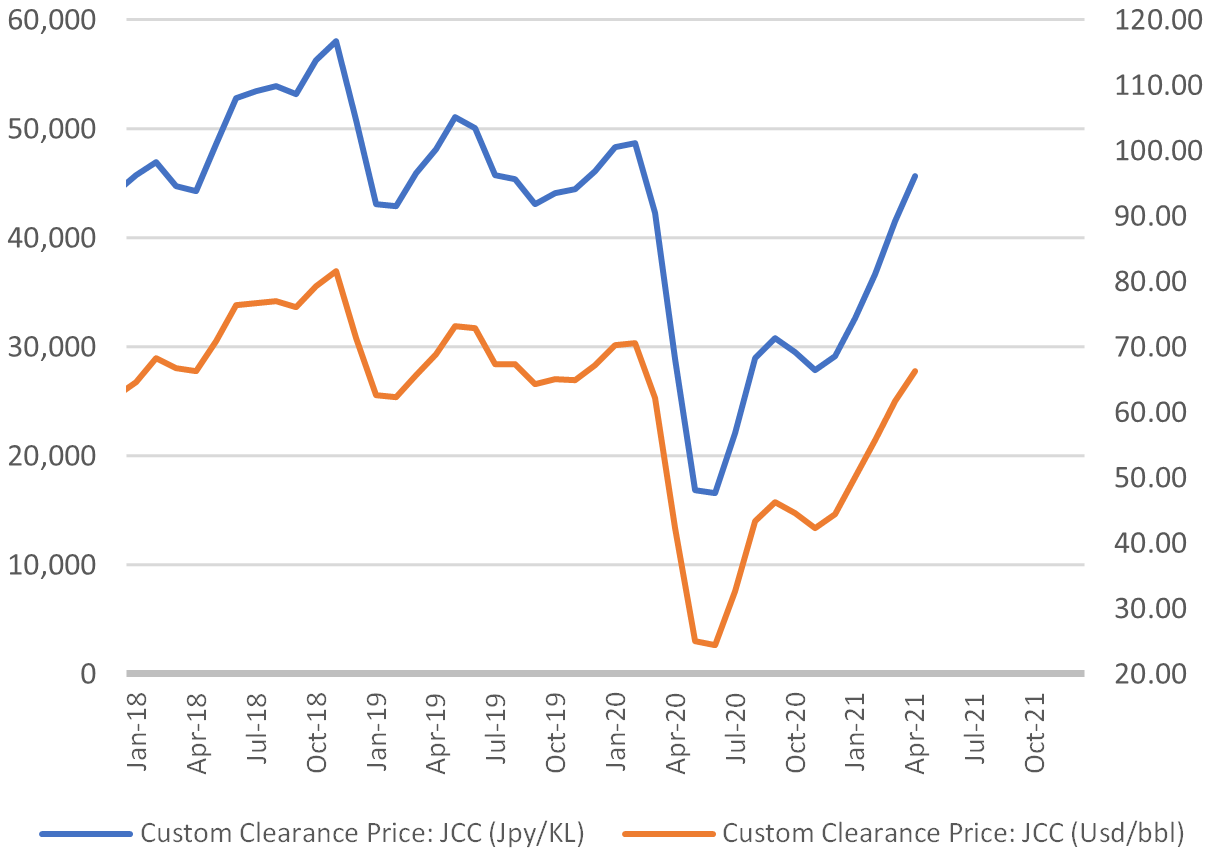
Japan Oil Price: $66.26/ barrel
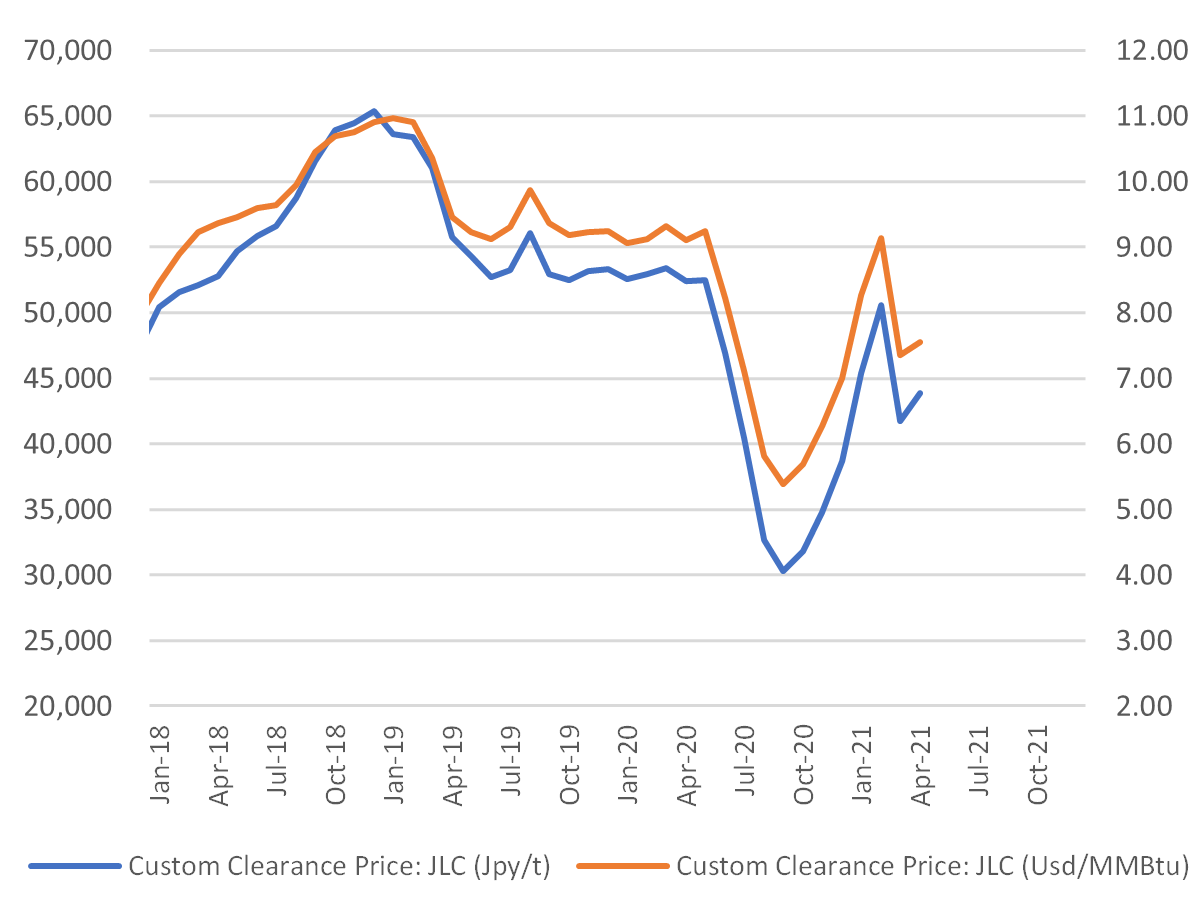
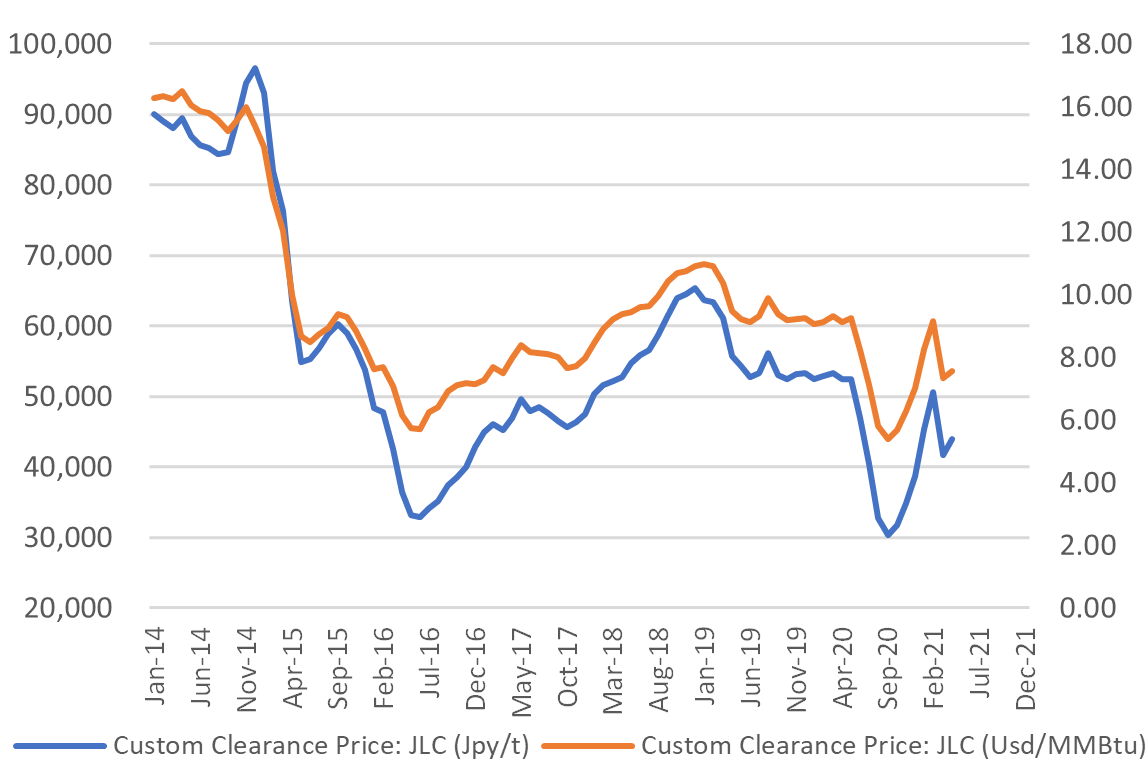
Japan (JLC) LNG Price: $7.56/ mmbtu
Shell sells LNG to Japan in exchange for electricity, seeking arbitrage profits
(Bloomberg, May 28)
- Royal Dutch Shell has delivered LNG cargoes to Japan in exchange for electricity, according to people familiar. Shell had an agreement with a local utility that allows it to claim power as payment. The energy company can then sell the electricity on the Japanese spot market for a profit.
- Other traders such as Vitol are keen to copy the strategy and be further involved in Japan’s growing power market. The trade would be a physical spark spread, looking for an arbitrage between North Asia LNG prices and the spot rates for physical electricity sold in Japan.
- Such trading strategies are welcome from the government side, which wants to stimulate further competition in Japan’s $136 billion power market to lower its dependence on a few regional electricity utilities.
- Shell, RWE and other global power companies have set up power trading desks in Japan.
- Japan’s power futures trading volume is still small compared with Europe, but it is steadily growing, making spark spreads more viable.
Idemitsu, ENEOS worry how to fill earnings hole post fossil fuel exit
(Nikkei Business, May 24)
- As ENEOS, Idemitsu and other upstream Japanese energy companies consider withdraw from fossil fuels, they worry how their customers will react and also what businesses can take the place and fill the hole in earnings that is sure to emerge.
- Companies worry that government declarations don’t fit well with contracts to supply customers with coal, or coal-fired electricity, among other issues. There are strong concerns how to protect job security.
- ENEOS has already promised to withdraw from the coal business. It will sell its upstream interests in overseas coal mines and will withdraw from coal sales in the future while consulting with customers. Current upstream oil and coal assets bring in ¥220 billion in cash flow.
- ENEOS also announced that it will acquire a synthetic rubber “elastomer” business from JSR in order to bring in a new business direction to the company. EVs have a heavier body due to the weight of batteries, thus lightweight materials are indispensable for improving fuel efficiency. SSBR (solution-polymerized styrene-butadiene rubber), which is the main product of JSR’s elastomer business, is used as a raw material for fuel-efficient and high-performance tires, and its demand is expected to grow.
- ENEOS is expected to invest over ¥100 billion in the new business.
ANALYSIS
BY MAYUMI WATANABE
LNG Contracts’ `Destination Clause’
Draws Regulatory Concerns, Again
In Japan, January’s rapid rise in LNG prices stirred more than just anxiety over costs. After years of silence on the issue, the government is once again turning its eye to the contract terms of international LNG purchases.
Japanese firms and officials have discussed bringing more flexibility to purchasing terms for years, winning some minor concessions from sellers in the process. The events that sparked a 1,680% rally in LNG prices over six months to January 2021, however, raised major alarm bells. The thinking is that while Japan still has its world-leading position in the market, and influence over Asia trade, it needs to act.
An oil and gas ministry panel last month asked for a follow-up to the 2017 study into LNG long-term contract terms that was conducted by the Japanese competition authority. The stated rationale: a need to improve LNG market liquidity.
A matter of anti-trust
LNG contracts typically bind buyers to receiving a certain volume (number of cargos) of the fuel at certain times and at a specified location. Most also correlate the price to that of oil, the degree of which is known as the slope.
In June 2017, the Japan Fair Trade Commission (JFTC) presented a report after a thorough review of clauses typically inserted in long-term contracts for LNG imported to Japan. The Commission noted that some of the contract terms may not fully comply with Japan’s domestic competition law.
The following month, Japan and the European Commission signed a Memorandum of Cooperation to develop a competitive and liberalized LNG market. The two agreed to work together to ensure flexibility in LNG contracts. After all, as another major buy of LNG the EC also wanted more freedom in terms of how, when and for how much its companies could receive cargos. The EC had been working on reviews of LNG contracts as far back as 2000.
The JFTC and EC saw a chance to pool forces and both labeled the destination and profit-sharing clauses in LNG contracts as competition concerns. Destination clauses limit the buyer’s capacity to resell or change the delivery destinations of cargoes. If an LNG buyer does find another party for its contracted amount, a profit-sharing clause would make them share revenue from the re-sale with the original supplier.
The EC’s main targets were Russia (Gazprom), Nigeria (Nigeria LNG), and Algeria (Sonatrach), and it carried out formal investigations into the actions of these and other LNG suppliers within its jurisdiction. The bloc then ordered sellers to remove destination and profit-sharing clauses from their contracts with European buyers.
The JFTC took a less dictatorial approach, perhaps mindful of the fact that LNG accounted for a much higher percentage of Japan’s domestic energy needs.
So, Japan’s antitrust officials carried out a fact-finding survey, which refers to an inquiry that seeks to correctly understand the background and context of the sector. Such surveys do not identify violations of the law as such, but provide general guidelines on how to improve antitrust compliance within the sector.
While the EC’s findings were used as a basis to engage with corresponding governments and talk EU competition law, the JFTC did not get further than publishing its study. The Japanese regulators didn’t even set out any guidelines.
The JFTC’s 2017 report was careful not to inflame the LNG suppliers. It concluded that destination, profit-sharing and “take-or-pay” clauses – where buyers pay for volumes they commit to, rather than volumes they actually receive – were potential competition issues. But they were not “potential law infringement”.
Without anyone breaking the law, there was no scope for further regulatory action.
Playing a weak hand
Of course, Japanese power and gas utilities tried to use the JFTC report as leverage to negotiate further flexibility in delivery terms with new suppliers. However, the terms for the vast majority of supply, which depended on contracts signed before 2017, remained unchanged, according to studies by the Institute of Energy Economics, Japan, and Mitsubishi UFJ Research and Consulting. These studies were contracted by METI.
The studies showed that most Japanese LNG buyers did not feel confident to reopen negotiations for existing contracts. Of Japan’s 14 buyers, only Tokyo Gas and JERA attempted to renegotiate outstanding contract terms. Most of the rest feared that doing so would strain relations with suppliers, and the JFTC study did not exactly provide the strongest of openers at the negotiating table.
A year after the report was published, Tokyo Gas, JERA, and also Osaka Gas and Toho Gas started to report success in signing new contracts with North American and Mexican suppliers that were “destination-free”. This trend, however, was more due to the market conditions of that time rather than regulatory pressure, confides one LNG contract expert.
The U.S. was reaching out to Asia to establish new outlets for its shale gas products. Buyers had more bargaining power in some regions due to oversupply, and in some cases were able to take advantage of price arbitrage across regions.
Meanwhile, the Japanese buyers kept developments in their contracts very secret, leaving officials wondering if there had been any progress on improving the delivery flexibility. An expert on the subject said that aside from the destination clause, there are other contractual mechanisms preventing flexible LNG transactions, such as the profit-sharing clause and the take-or-pay principle.
Asked about destination clauses and other contract terms at last week’s Japan LNG & Gas Digital Session, run by dmg, Takeuchi Atsunori, an Executive Officer at Tokyo Gas’s LNG Business Department said: “We are currently making efforts to raise our negotiating power with vendors.”
The new white knight
As this debate over LNG clauses re-opens in Japan there is a change in approach. This time, the METI panel is due to commission Japan Oil, Gas and Metals National Corporation (JOGMEC) to lead the charge and follow up on the JFTC study.
This is odd because while JOGMEC is a state-backed company it is not a regulatory organ. JOGMEC surveys geographical, mining and financing conditions. It does not seem to have the authority to uncover details of multi-national contracts, which are protected by confidentiality clauses.
There are many other questions about Japan’s strategy this time around. For one, the government panel seems focused only on the destination clauses, rather than all of the previously stated terms. And yet, it would be almost impossible to review only one set of clauses in a contract. Moreover, it might be misleading to do so as other parts of the document could give a different context to the destination issue.
Finally, will Japanese buyers gladly offer up their contractual information to JOGMEC at the risk of being identified by the sellers?
Still, where JOGMEC has an advantage over antitrust officials is its line of contact. It should be able to talk directly and cooperatively with high-level company officials at buyer companies.
Ultimately, if JOGMEC uncovers issues that could be interpreted as Antimonopoly Act violations and causes of distorting local market competition, it can request the JFTC to open an investigation. That investigation process can take around a year or two, and while it is ongoing it offers Japanese buyers a shield in new negotiations.
Moves by the JFTC may also trigger competition authorities in the U.S. and other Asian countries to take up the issue, according to METI.
As recent antitrust raids by the JFTC against Japanese power and gas utilities show, the regulators are starting to get very interested in not only the fuels (such as LNG) but also the electricity market itself. How the strategy will evolve is not yet clear, but the first move has been made.
ANALYSIS
BY YURIY HUMBER
Emission Reduction, Shift to EVs
Driving Renewed Interest in Hydro in Japan
One of the biggest immediate beneficiaries of Japan’s more active decarbonization agenda, so far, has been hydropower. In recent months, most major domestic power utilities have unveiled corporate and household plans offering predominantly, or only, electricity derived from hydro.
An energy source that’s often been considered stable but largely tapped-out, hydro is experiencing somewhat of a revival. At a recent government meeting, utilities revealed plans to build at least six new hydropower stations within four years and also expand capacity at four existing plants by FY2022.
One of the country’s biggest owners of hydro facilities has set a target for the renewable source to hit 30% of its total energy production within a decade. Some of that hydro might even go to a burgeoning hydrogen manufacturing facility in the area, helping Japan open up more sources of supply for CO2-free (green) hydrogen.
Rising demand for blue ‘green’ electricity
Hydropower ticks many boxes. Small and medium sized hydropower plants are classified as a renewable resource. In Japan, hydro plants with a capacity of 5 MW or more deliver electricity for less than the average cost of wind or solar (for more details see the Feb. 15, 2021 issue of Japan NRG Weekly).
Over the last five decades hydro has proven to be a reliable resource, providing Japan with a stable volume of energy, and since at least the mid 1990s hydro’s share in the national electricity mix has hovered at around 9%. In terms of installed hydropower capacity, Japan has around 49 GW, a fifth of which is in small and medium-sized stations.
What’s more, dams act as systems for flood control and local water management, and help protect against landslides. These factors endear hydropower not only to the METI but also the Ministry of Land, Infrastructure, Transport and Tourism (MLIT), which championed the idea of a dam upgrades program in 2017.
The introduction of Feed-In Tariffs (FIT) in 2012 to spur growth in renewables mostly promoted the development of solar and wind, but it also helped add 670 MW of small-to-medium-sized hydro capacity. As of May 2021, projects that could add an additional 1.42 GW are already approved under FIT.
Outside FIT, a further 232 MW of hydropower stations, each with capacity of 30 MW or less, is said to be under development.
Hokuriku Electric, a utility servicing central Japan and based in Toyama prefecture, announced plans to raise hydropower to 30% of its power mix by FY2030, from 28% today.
Incidentally, Toyama is also home to a new continuous hydrogen production facility being developed by aluminum maker Alhytec Inc. Working with Toyota Motor, the company has tested a method of manufacturing hydrogen from a reaction solution fueled by aluminum shavings. If powered by Hokuriku Electric’s hydro, the hydrogen that Alhytec and Toyota make would be classified as ‘green’.
The country could add 573 MW of new, small-to-medium hydro capacity by FY2030 and expand existing facilities by 56 MW in the coming nine years, according to an assessment by four public and business groups associated with the industry, including the National Small Hydropower Utilization Promotion Council, published by Shin Energy Shimpo. That would push smaller hydro’s electricity output to 2.5 billion kWh, up from 2.26 billion kWh.
New Cars, New Electricity
In the last six months, another key demand driver for hydro has emerged. To promote the switch to electric vehicles, the government is offering as much as ¥800,000 ($7,300) in subsidies for an EV purchase. However, in order to qualify, buyers are required to power their autos with electricity from renewable sources.
As a growing number of corporate clients inquire about ‘green’ electricity, Japan’s regional power utilities, which have to date mostly avoided investing in solar and onshore wind, are turning to hydro-generated electricity packages to meet the demand.
Chubu Electric Power Miraiz went as far as to announce on May 27 that it will pump all profits from its Shinshu Green Power electricity plan, which is based on hydro, into new renewables projects in Nagano prefecture. New hydro features heavily in Chubu Electric’s plans for the mountainous region.
Even ENEOS, better known as an oil refining group, is getting into the sale of electricity from hydro. The company registered to be a sales agent for several hydro stations owned by the city of Tokyo and now retails water generated power to corporate clients.
Hydro plants are also attracting smaller electricity retail firms, which market the energy as a locally made, locally sold product, which is also CO2-free.
The idea of local revitalization, much discussed by the government but rarely executed, fits well with the idea of developing more small, local hydro resources. And, unlike the growing list of municipalities introducing ordinances against solar and wind farms, hydro also has strong support from local governments.
A notable portion of the country’s hydro resources lies in the hands of the local authorities. Developing more hydro helps them demonstrate steps towards carbon neutrality, while also supporting a business that contributes to the local economy.
The authorities in Gunma prefecture, for example, have joined with TEPCO Energy Partners to create a CO2-free electricity plan based on power generated at local hydro facilities owned by the government. The electricity is marketed to local businesses, including factories of major companies such as Meidensha Corp. The prefecture has even vowed to plough extra profits from hydro electricity sales into local conservation projects.
More cost effective than solar and wind, hydro is increasingly the preferred ‘green’ energy choice for both large and small power firms that are keen to market an emissions free energy source as ‘locally made’. Equally significant is the fact that hydro is the one energy source that doesn’t arouse controversy and conflict with local governments.
With so many advantages, what’s hindering hydro from capturing a greater share of Japan’s national energy mix? The first problem is scale: building lots of small hydro generating capacity is not as cost effective as larger installations. Major utilities prefer to undertake gigawatt-scale energy projects, not many small ones.
Nevertheless, hydro is an energy source with significant potential, and despite the structural limitations it’s getting more attention than a year ago. As Japan strives to meet its ambitious 2030 and 2050 emissions goal, the country’s hydro power capacity looks set to grow.
|
Utility |
Electricity Plan based on Hydro |
Corporate (C) or Household (H) |
|
Chubu Electric Miraiz |
Shinshu Green Power |
C and H |
|
TEPCO EP |
Aqua Energy 100 |
H |
|
TEPCO EP |
Aqua Premium |
C |
|
Hokuriku Electric |
Aqua Eco Plan |
C and H |
|
Hokuriku Electric |
Aqua Green |
C and H |
|
Hokuriku Electric |
Toyama Water Town |
C |
|
Chugoku Electric |
Okayama CO2-Free Power |
C and H |
|
Kyushu Electric |
Renewable ECO Plan |
C |
|
Tohoku Electric |
Eco Power Premium |
C and H |
|
Tohoku Electric |
Iwate Revival Power Hydro Premium |
C |
|
Tohoku Electric |
Akita E-ne! Option 100% Hydro |
C |
|
Tohoku Electric |
Yamagata Hydro Premium |
C |
Source: Shin Energy Shimpo
GLOBAL VIEW
BY TOM O’SULLIVAN
Below are some of last week’s most important international energy developments monitored by the Japan NRG team because of their potential to impact energy supply and demand, as well as prices. We see the following as relevant to Japanese and international energy investors.
Oil & Gas: Black Wednesday
The fossil fuels industry suffered three major setbacks last Wednesday, a day now described as one of the worst in its history
1). A Dutch court ruled that Royal Dutch Shell must cut carbon emissions 45% by 2030 vs. 2019 levels;
2). at Exxon, shareholders backed an activist investor resolution that warned of an “existential risk” because of the oil major’s exclusive focus on fossil fuels; over $60 million was spent on promoting the resolution; and
3). Chevron shareholders voted for a resolution that called for a significant reduction in Scope 3 CO2 emissions.
IEA:
Australia and Japan, both OECD member countries that fund the IEA, are vigorously disputing the findings of a recent IEA report on reaching net zero by 2050, which called for a complete and immediate end to fossil fuel exploration and spending on new oil, gas, and coal projects.
Cryptocurrencies:
1). Crypto miners in the U.S. are sending mobile trailers with super computers to oil fields to access natural gas to generate cheap electricity for crypto mining purposes, avoiding flaring of natural gas.
2). South Korea may ban up to 200 crypto exchanges as it tightens regulations and removes licenses.
3). Iran has banned bitcoin mining to preserve scarce electricity.
Finance:
The Biden administration is considering establishing a “United States Green Bank” and a “National Climate Bank” as direct financing conduits for green investments.
Global Carbon Pricing:
The 64 global carbon pricing instruments in place are now thought to have raised $53 billion in revenues in 2020 according to the World Bank.
Cap & Trade:
Climate Vault, a U.S. non-profit, is looking to create a secondary market that would allow companies to offset carbon emissions with pollution permits.
EVs:
1). Ford will raise capital spending on EVs to $30 billion and plans to make EVs account for 40% of global sales by 2030.
2). The U.S. EV maker, Fisker, has signed a letter of intent with Scandinavia’s Mekonomen Group to provide after sales services in the region.
3). The U.S. Senate is expected to approve an EV vehicle tax credit of $12,500 for EVs assembled by union workers inside the U.S.
4). Tesla is expected to prepay for semiconductor chips to secure supply in the ever-tightening market, including with suppliers in South Korea and Taiwan.
Wind Power:
The U.S. is considering two Californian projects on the Pacific, at Morro Bay and off Humboldt County, that could power up to 1.6 million homes. These would be the first wind power investments on the Pacific.
Climate:
The World Meteorological Organization now predicts a 40% chance that the mean global temperature will exceed 1.5 C in one of the next five years.
Aviation Fuel:
The EU is planning to introduce a Europe-wide tax on jet fuel as it attempts to meet its goal of a 55% cut in CO2 by 2030.
China:
The National Development and Reform Commission threatened punishment for metals traders as copper, aluminum, iron ore and steel prices soared to 10-year highs with iron ore prices reached $230 per ton and copper prices reaching $5 per pound.
South Korea:
Hyundai Hydrogen Mobility (HHM) is planning to ship a new series of fuel cell trucks, the Xcient Hyundai truck, to Europe later this year as the company ramps up hydrogen investments. HHM is a joint venture with Switzerland’s H2 Energy.
Australia:
An Australian Federal court has ruled that the government must ensure that newly approved coal projects won’t pose a threat to the health of children.
India:
Renault, Nissan, and Hyundai are suspending local manufacturing due to Covid-19.
Iran:
The speaker of the Iranian parliament, Mohammad Bagher Qalibaf, announced that a temporary deal between the IAEA and Iran to preserve satellite images at Iranian nuclear facilities had ended. The IAEA is warning that Iran is enriching uranium at “bomb-making levels”, endangering the possibility of Iran’s return to international oil markets.
Abu Dhabi:
The oil-rich emirate sold $2 billion in seven-year bonds last week at 45 bps over U.S. treasuries in its first bond financing of 2021.
Saudi Arabia:
The government is planning a $55 billion privatization program over the next four years involving 160 projects in 16 sectors to address a growing budget deficit.
Russia:
President Biden is scheduled to meet with President Putin on June 16. This comes in the wake of cyber-attacks on U.S. oil and technology infrastructure, which are thought to have originated inside Russia.
Belarus:
EU is preparing to sanction $4 billion of Belarusian exports of oil, petrochemicals, potash, and metals in retaliation for the grounding of the Ryanair jet in Minsk, and the detention of dissident blogger Roman Protasevich.
Sweden:
H2 Green Steel raised over $100 million in its first funding round with the Maersk, Wallenberg, and Agnelli families as investors. The company plans to commence green steel production by 2024 just below the Arctic Circle with a target production of 5 million tonnes.
Norway/Denmark:
Three Hedge Funds, Taconic Capital, CQS, and Kite Capital, are attempting to turn around Denmark’s second largest oil and gas producer, Noreco, that is facing financial difficulties because of low oil prices. Noreco is hoping to double Danish oil production by 2023. Noreco also bought Shell’s Danish upstream assets in 2018.
Greece:
A forest fire last weekend in the Geraneia mountains, 90 km west of Athens, is now described as an “ecological disaster on an immense scale”, and the first major forest fire of the summer with 55 sq km of pine forest destroyed.
France:
Total, the French oil and gas giant, with a market capitalization of over $120 billion, changed its name to TotalEnergies as it expands and broadens activities as part of the global energy transition.
Arctic:
Paul Bledsoe, a former member of the White House Climate Change Task Force, is calling for a ban on Russia’s plan to develop the Arctic’s oil and gas resources.
U.S.:
1). Cimarex Energy and Cabot Oil & Gas, with shale energy assets in the Permian and Marcellus fields, will merge to create a company with an enterprise value of $17 billion and a combined market capitalization of $14 billion.
2). The TSA is considering mandatory rules for U.S. pipeline operators to provide notice of cyber-attacks following the attack on the Colonial pipeline.
3). Vertex Energy will buy Mobile refinery from Shell for $75 million. The refinery has a capacity of 90,000 bpd.
4). Tellurian signed an agreement with Gunvor to deliver 3 million tons of LNG per annum over the next 10 years.
Brazil:
Tarcisio Gomes de Freitas, Brazil’s infrastructure minister, announced $50 billion in one-off investments in railways, highways, airports, and ports, which is equivalent to 30 years of Brazilian public infrastructure investment.
EVENTS CALENDAR
A selection of domestic and international events we believe will have an impact on Japanese energy.
|
February |
Approval of Fiscal 2021 Budget by Japanese parliament including energy funding projects; CMC LNG Conference |
|
March |
10th Anniversary of Fukushima Nuclear Accident; Smart Energy Week – Tokyo; Quarterly OPEC Meeting; Japan LPG Annual Conference; Full completion of all aspects of the multi-year deregulation of Japan’s electricity market; End of 2020/21 Fiscal Year in Japan; |
|
April |
Japan Atomic Industrial Forum – Annual Nuclear Power Conference; 38th ASEAN Annual Conference-Brunei; Japan LNG & Gas Virtual Summit (DMG)-Tokyo Three crucial by-elections in Hokkaido, Nagano & Hiroshima – April 25th |
|
May |
Bids close in first tender for commercial offshore wind projects in Japan; Prime Minister Suga to visit the U.S. |
|
June |
Release of New Japan National Basic Energy Plan-2021; G7 Meeting – U.K. Presidents Biden and Putin are due to meet at a summit in Geneva Forum for China-Africa Cooperation Summit (Senegal) |
|
July |
Tokyo Metropolitan Govt. Assembly Elections; Commencement of 2020 Tokyo Olympics |
|
August |
Hydrogen Ministerial Conference in conjunction with IEA |
|
September |
Ruling LDP Presidential Election; UN General Assembly Annual Meeting that is expected to address energy/climate challenges; IMF/World Bank Annual Meetings (multilateral and central banks expected to take further action on emissions disclosures and lending to fossil fuel projects); End of H1 FY2021 Fiscal Year in Japan; Japan-Russia: Eastern Economic Forum (Vladivostok)-tentative |
|
October |
Last possible month for holding Japan’s 2021 General Election; METI Sponsored LNG Producer/Consumer Conference; Innovation for Cool Earth Forum – Tokyo Conference; Task Force on Climate-Related Financial Disclosure (TCFD) – Tokyo Conference; G20 Meeting-Italy |
|
November |
COP26 (Glasgow); Asian Development Bank (‘ADB’) Annual Conference; Japan-Canada Energy Forum; East Asia Summit (EAS) – Brunei |
|
December |
Asia Pacific Economic Cooperation (APEC) Forum – New Zealand; Final details expected from METI on proposed unbundling of natural gas pipeline network scheduled for 2022. |
DATA
Japan Oil Price
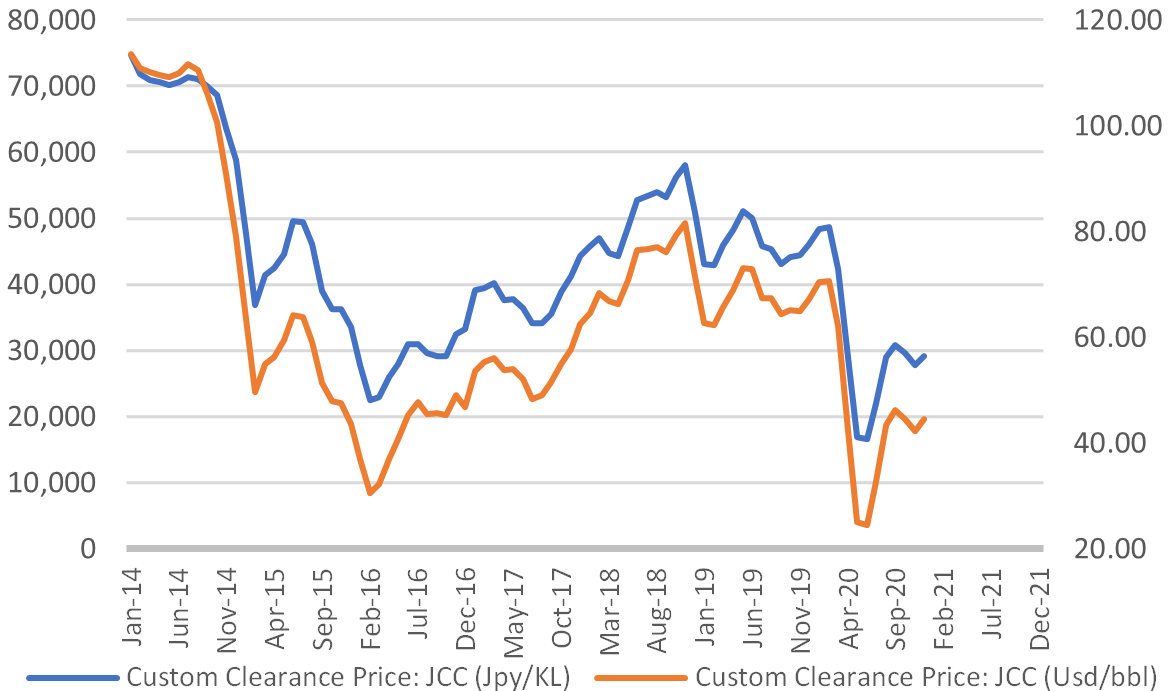
Crude Imports Vs Processed Crude
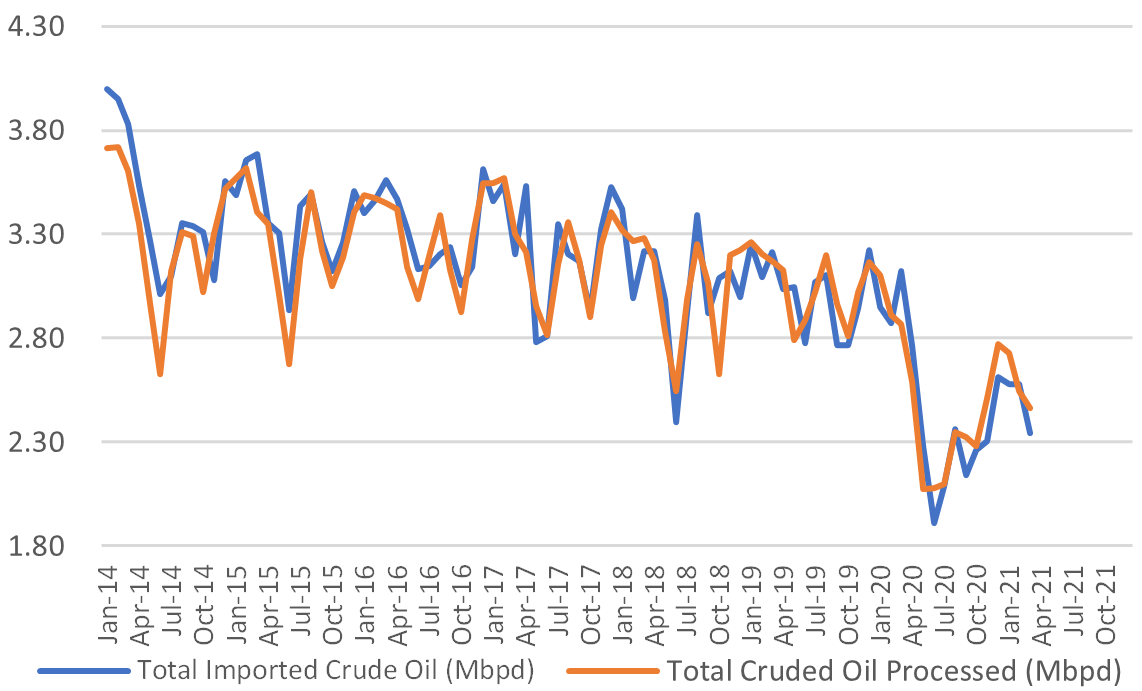
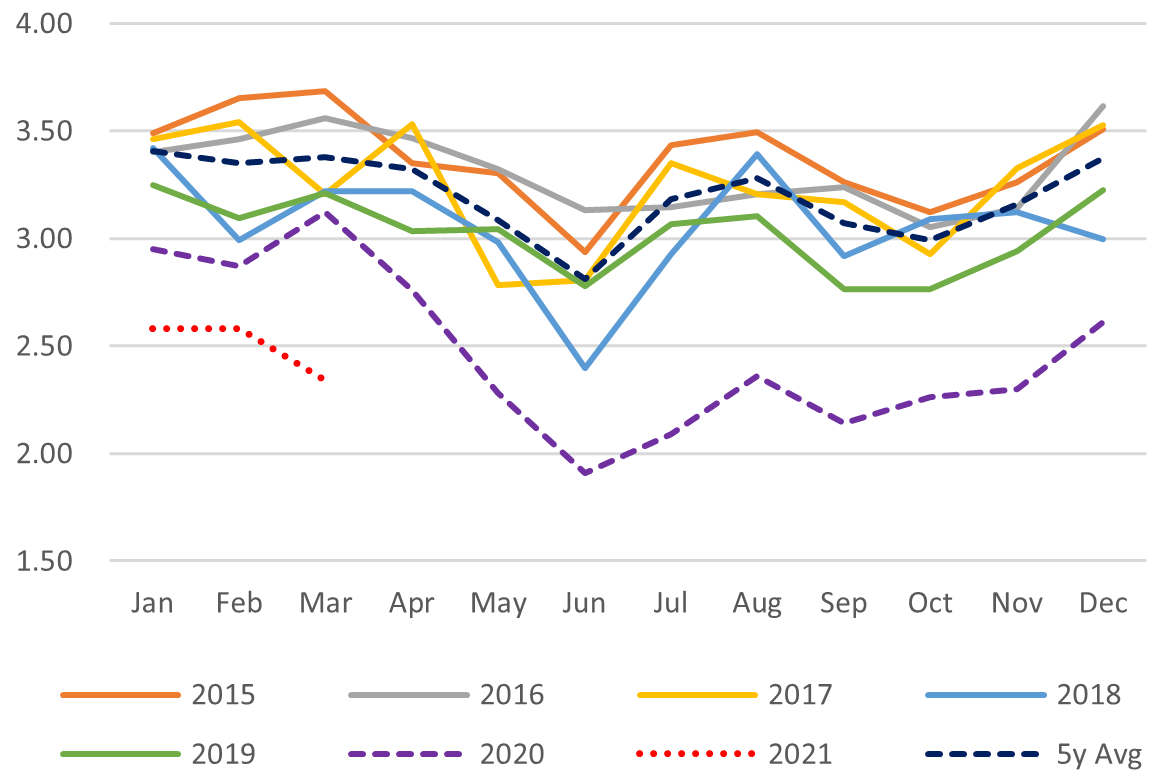
Monthly Oil Import Volume (Mbpd)
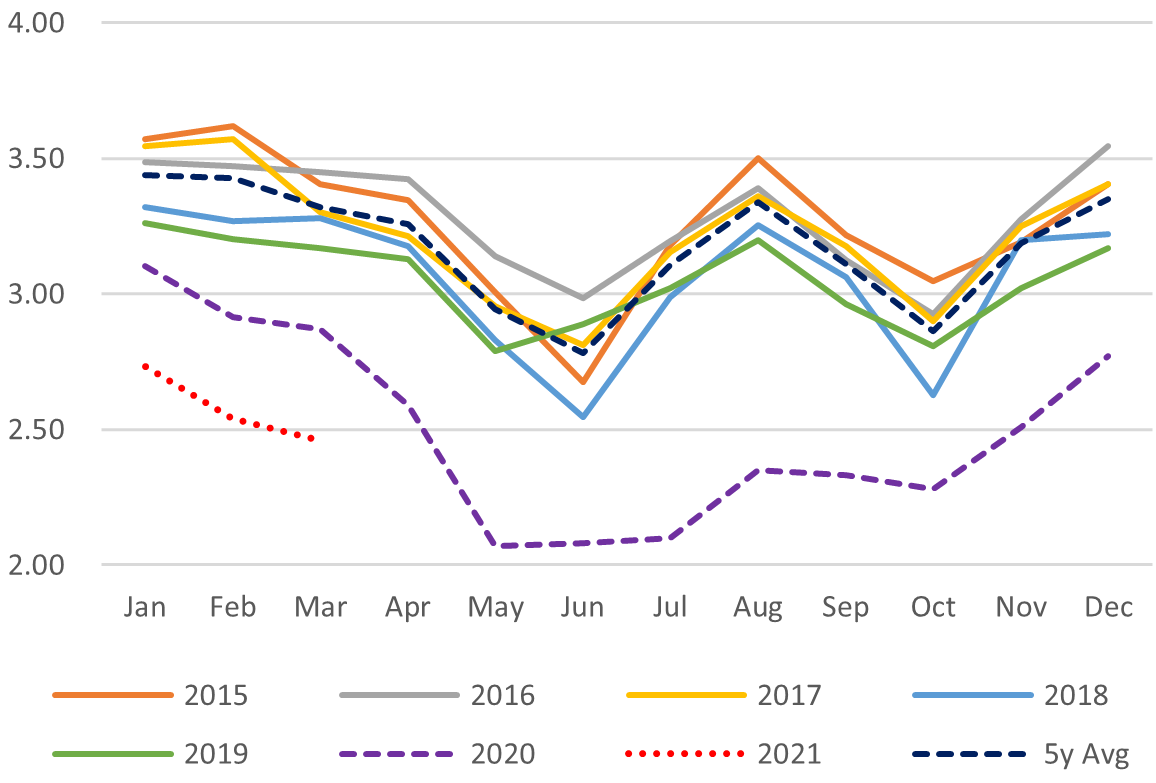
Monthly Crude Processed (Mbpd)
Domestic Fuel Sales
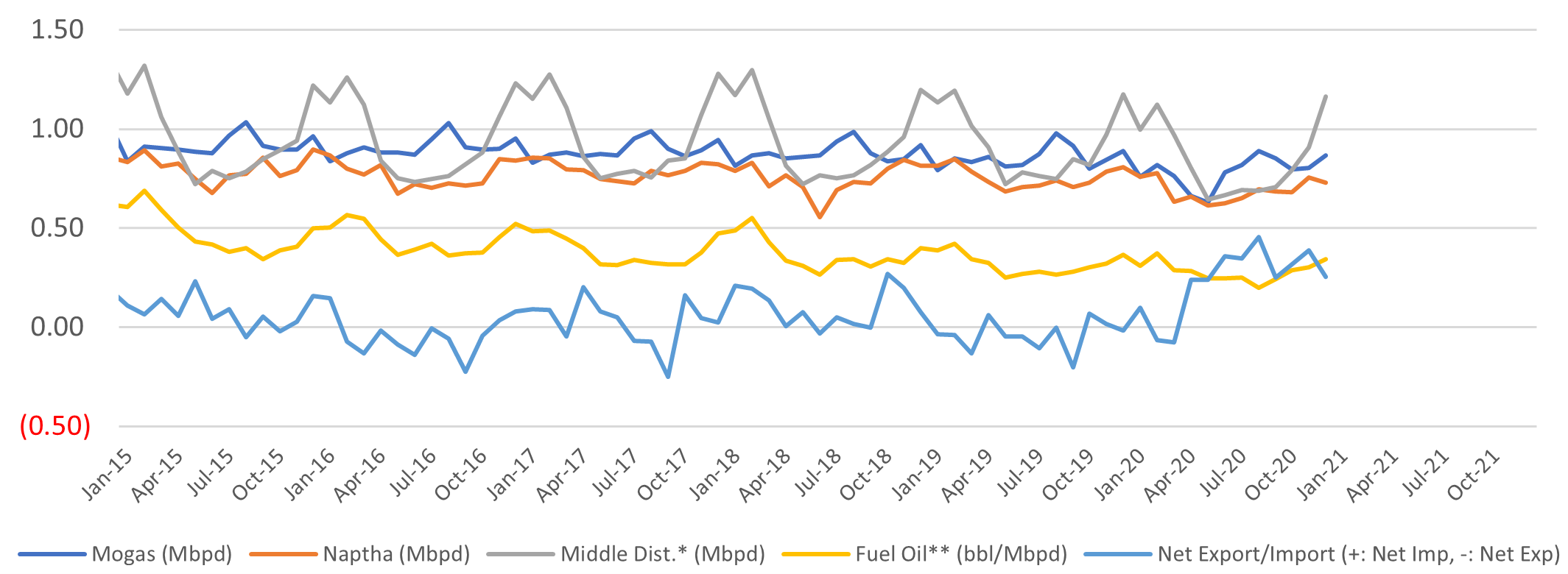
SOURCES: Ministry of Economy, Trade, and Industry (METI), Ministry of Finance, and the Petroleum Association of Japan
Japan LNG Price
LNG Imports: Japan Total vs Gas Utilities Only
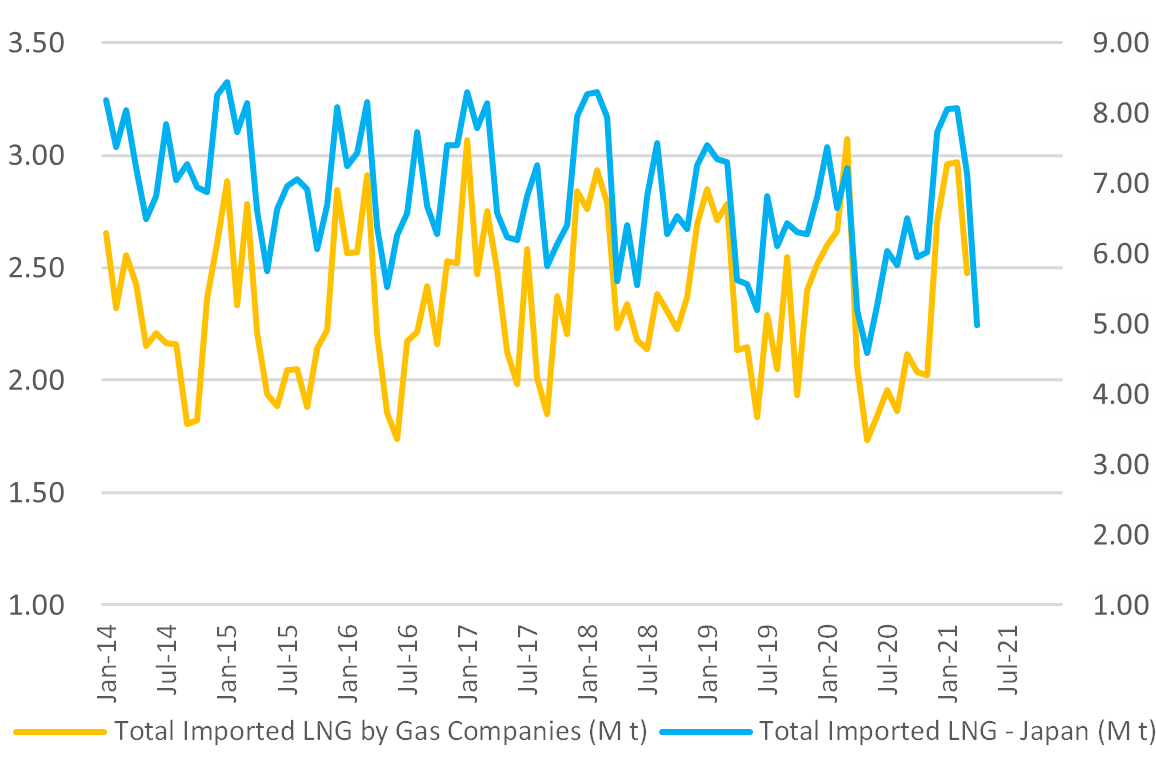
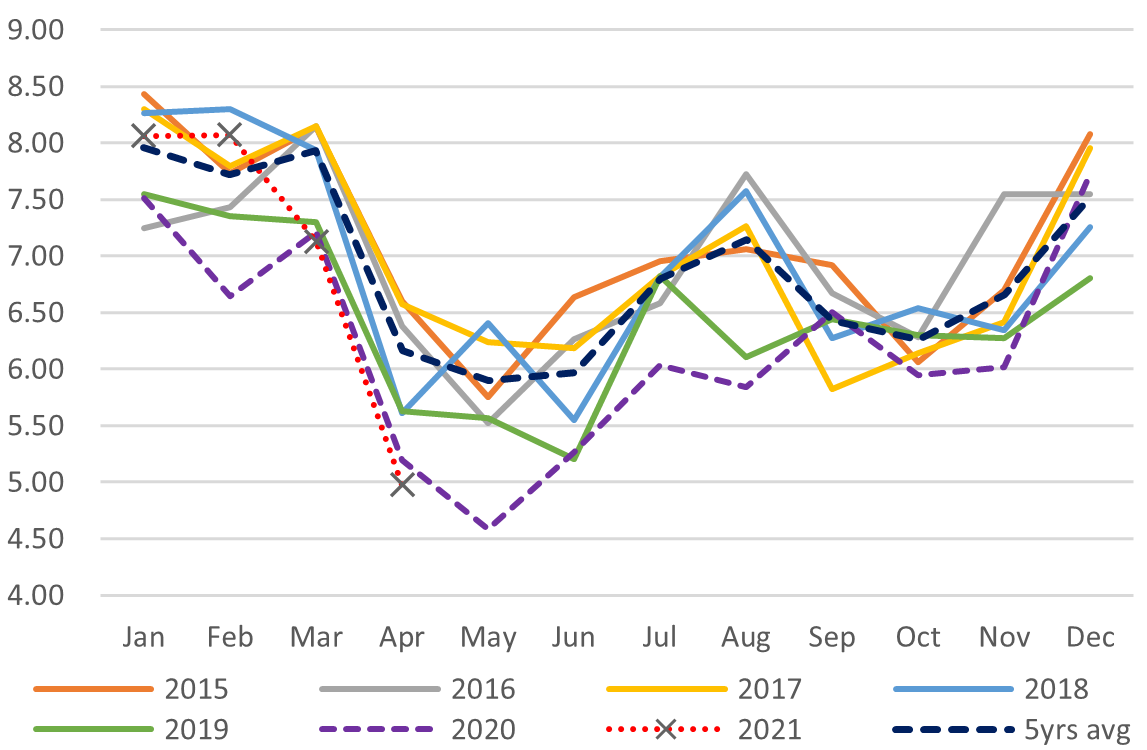
Total LNG Imports (M t)
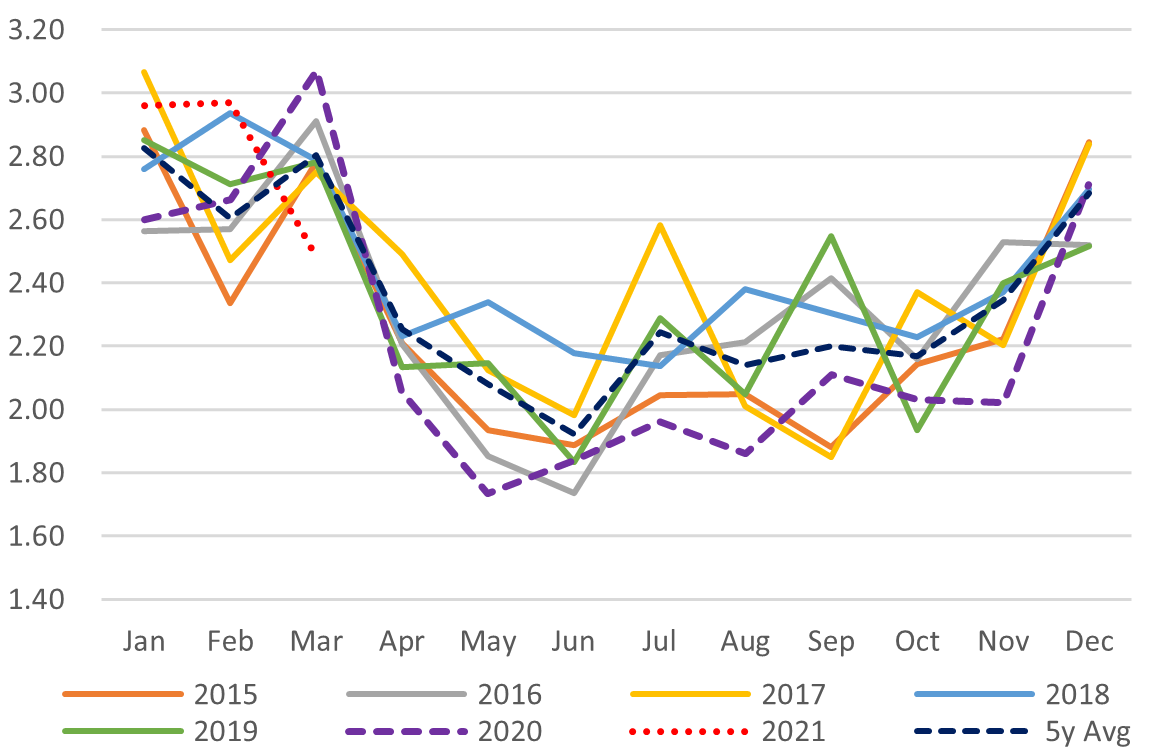
LNG Imports by Gas Firms Only (M t)
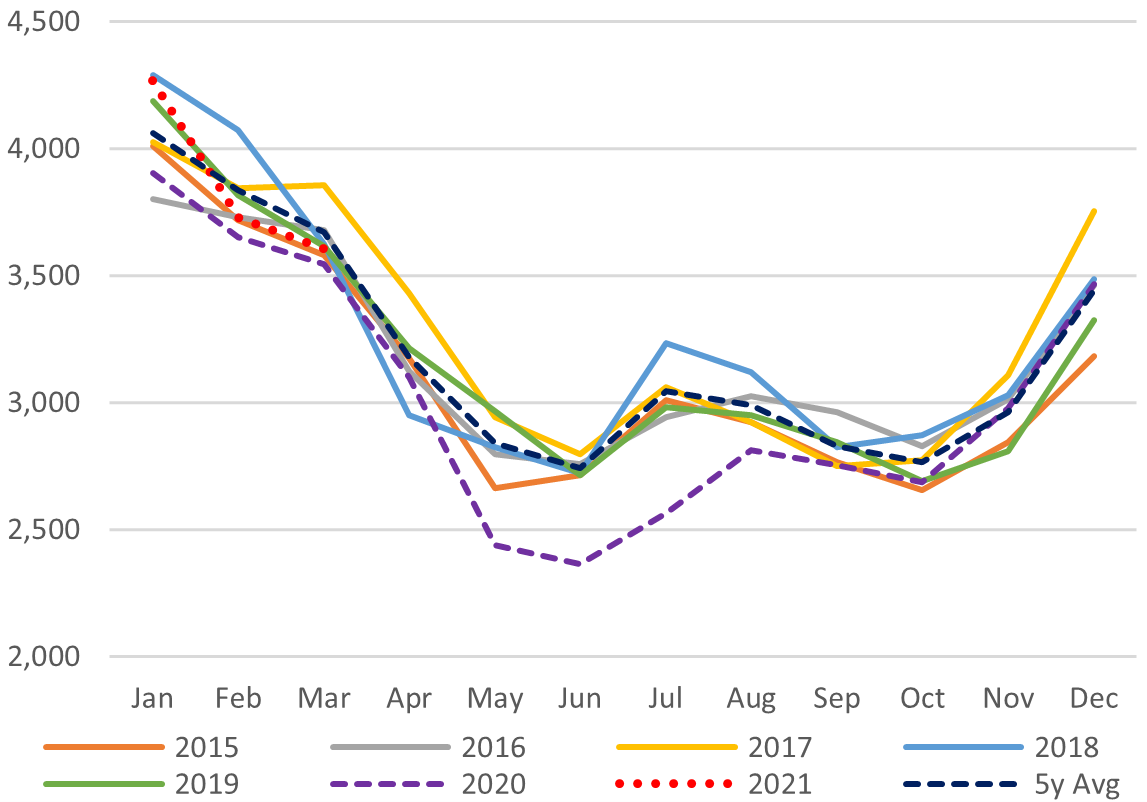
City Gas Sales – Total (M m3)
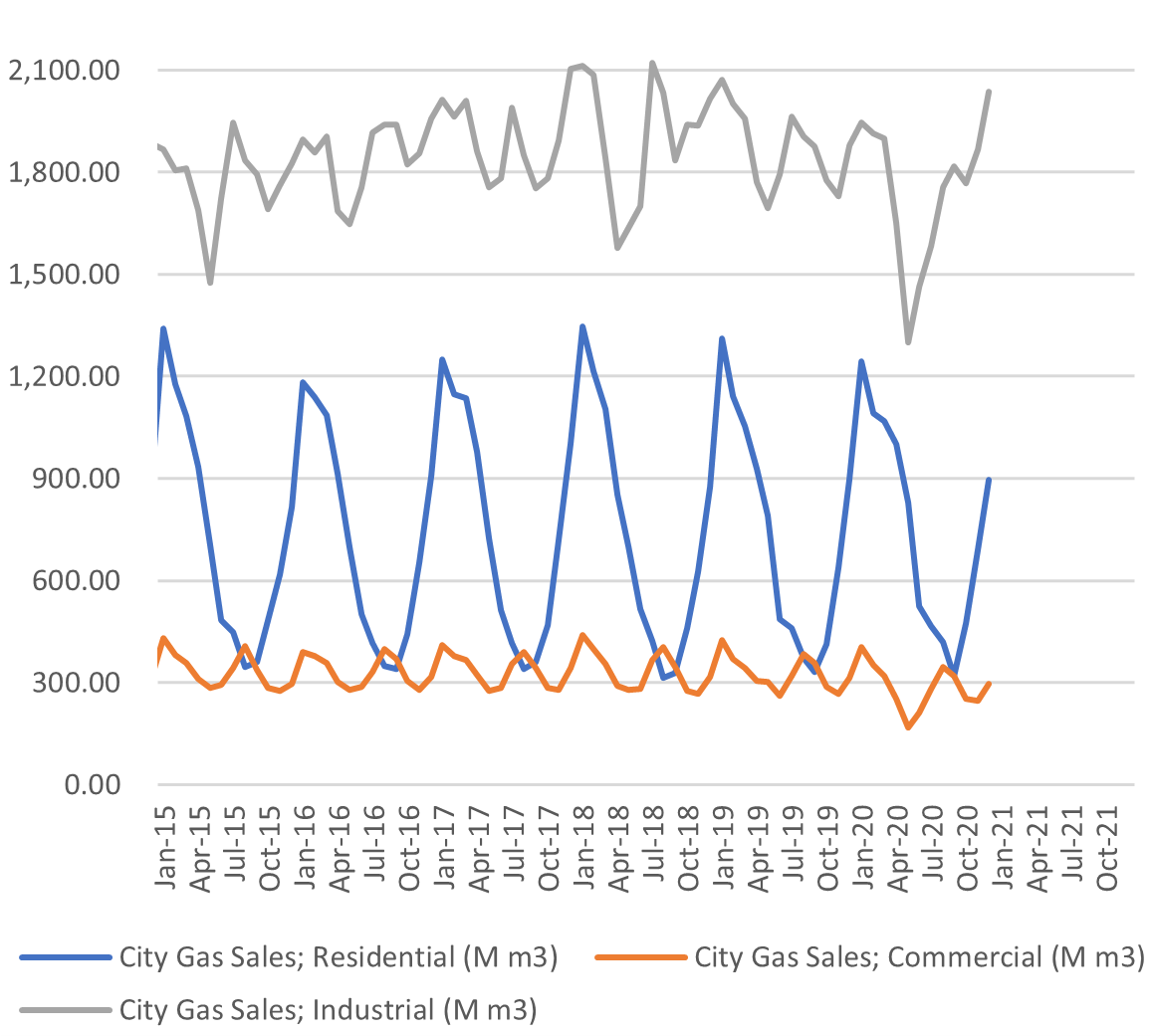
City Gas Sales by Sector (M m3)
SOURCES: Ministry of Economy, Trade, and Industry (METI),
Ministry of Finance
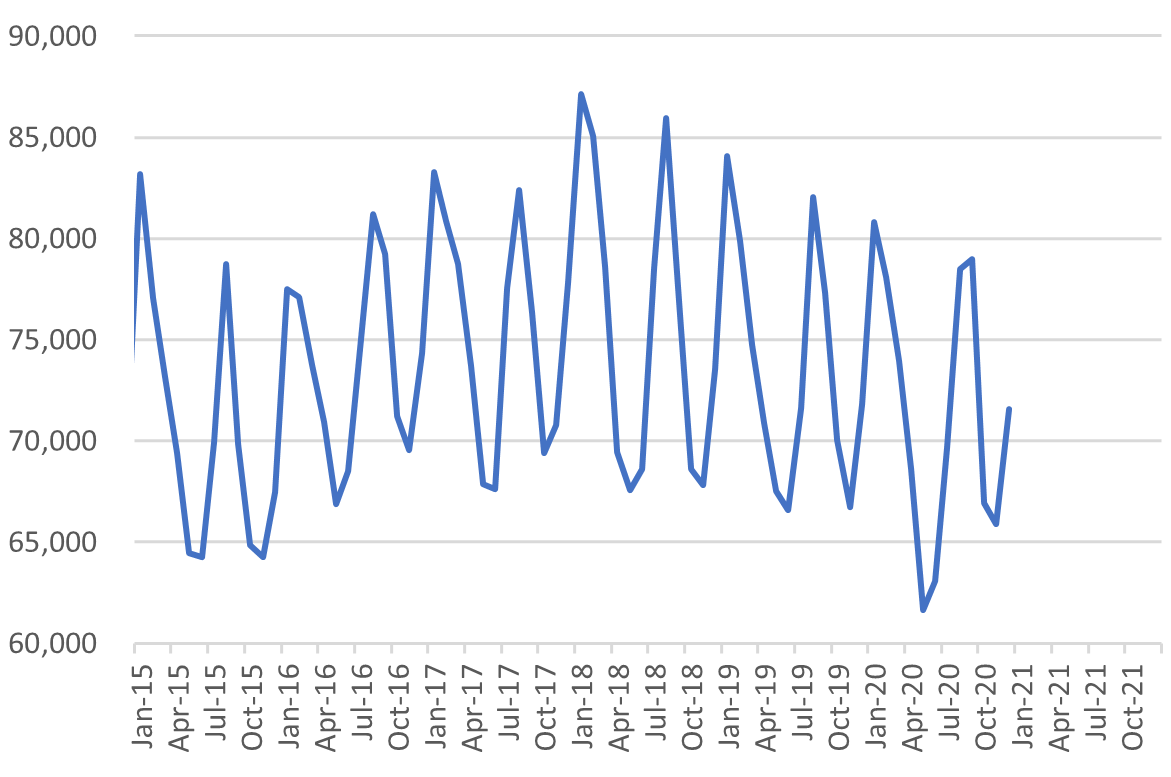
Japan Total Power Demand (GWh)
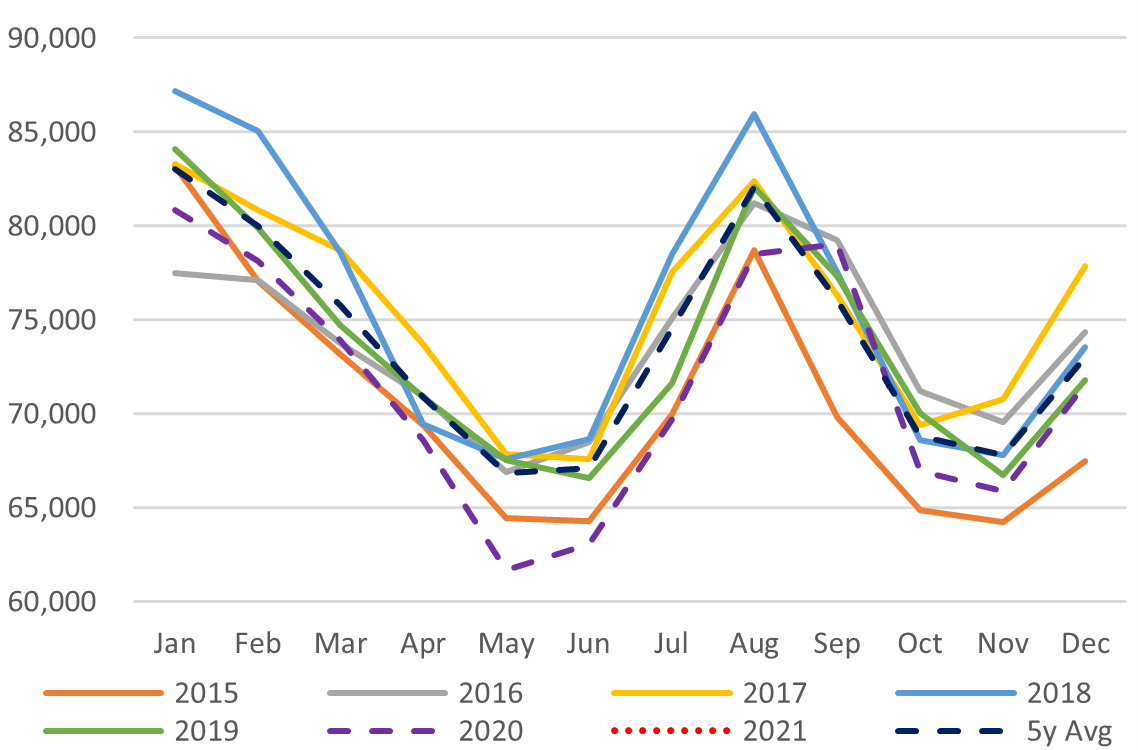
Current Vs Historical Demand (GWh)
Day-Ahead Spot Electricity Prices
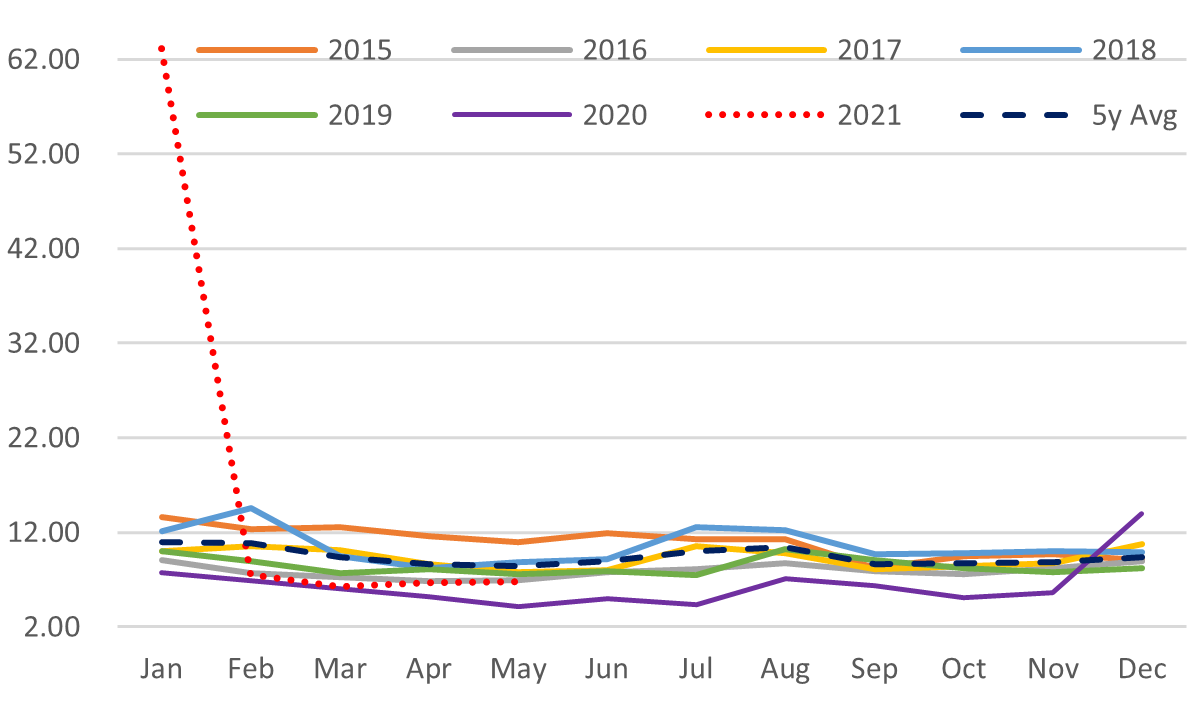
Day-Ahead Vs Day Time Vs Peak Time
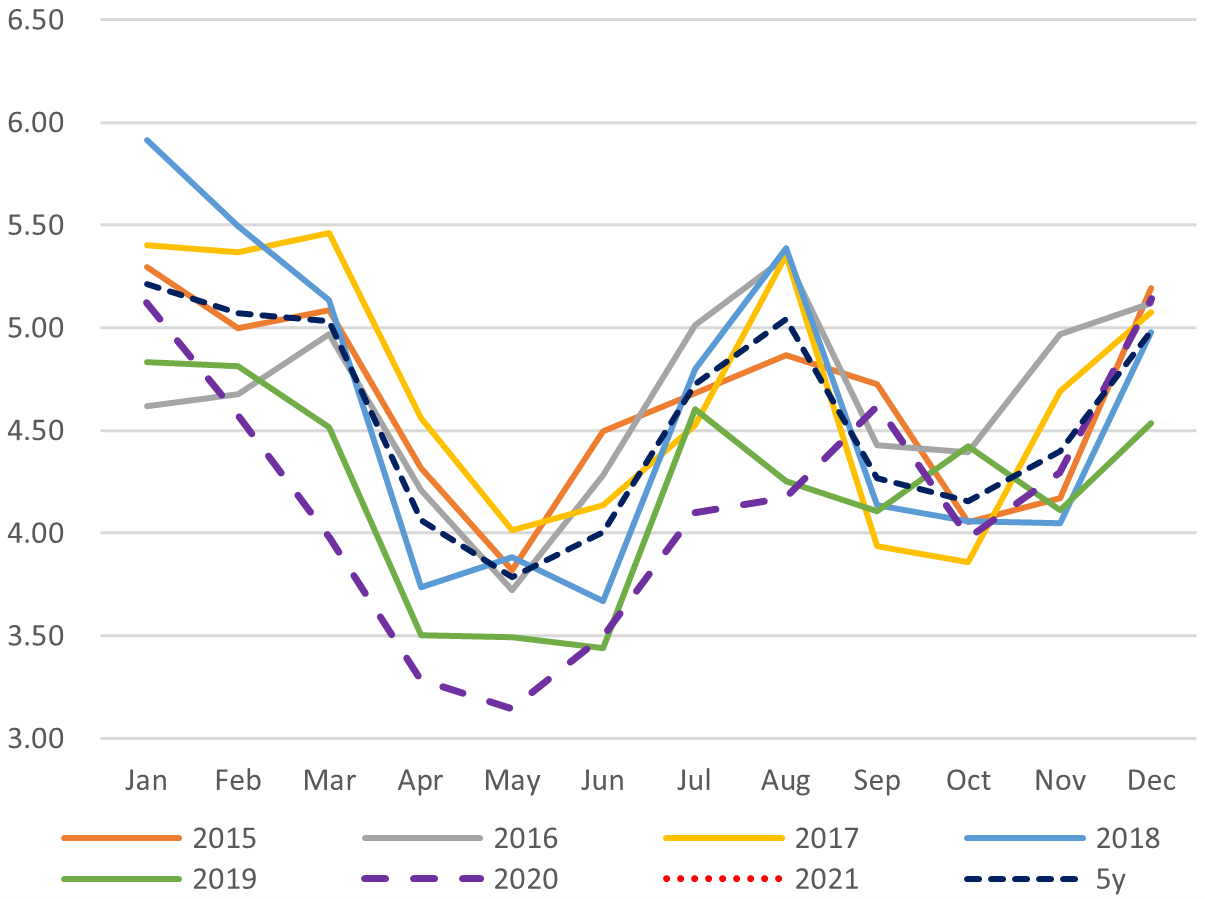
LNG Imports by Electricity Utilities
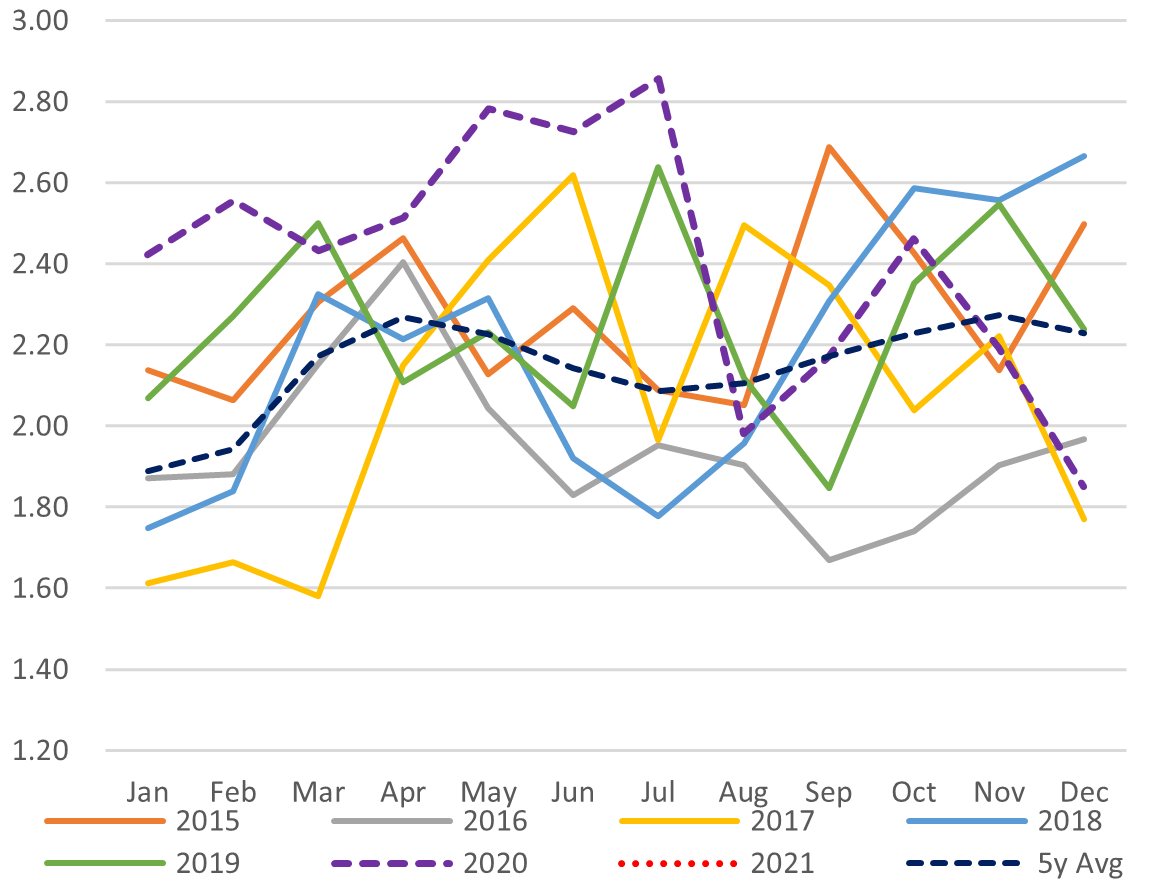
LNG Stockpiles of Electricity Utilities
SOURCES: Ministry of Economy, Trade, and Industry (METI), and the Japan Electric Power Exchange
Disclaimer
This communication has been prepared for information purposes only, is confidential and may be legally privileged. This is a subscription-only service and is directed at those who have expressly asked K.K. Yuri Group or one of its representatives to be added to the mailing list. This document may not be onwardly circulated or reproduced without prior written consent from Yuri Group, which retains all copyright to the content of this report.
Yuri Group is not registered as an investment advisor in any jurisdiction. Our research and all the content express our opinions, which are generally based on available public information, field studies and own analysis. Content is limited to general comment upon general political, economic and market issues, asset classes and types of investments. The report and all of its content does not constitute a recommendation or solicitation to buy, sell, subscribe for or underwrite any product or physical commodity, or a financial instrument.
The information contained in this report is obtained from sources believed to be reliable and in good faith. No representation or warranty is made that it is accurate or complete. Opinions and views expressed are subject to change without notice, as are prices and availability, which are indicative only. There is no obligation to notify recipients of any changes to this data or to do so in the future. No responsibility is accepted for the use of or reliance on the information provided. In no circumstances will Yuri Group be liable for any indirect or direct loss, or consequential loss or damages arising from the use of, any inability to use, or any inaccuracy in the information.
K.K. Yuri Group: Oonoya Building 8F, Yotsuya 1-18, Shinjuku-ku, Tokyo, Japan, 160-0004.