
JAPAN NRG WEEKLY
JUNE 7, 2021
JAPAN NRG WEEKLY
June 7, 2021
NEWS
TOP
- Japan to launch new auction system offering renewable energy certificates directly to end-users; companies will be able to buy certs to show they are using electricity from renewable sources
- Incoming TEPCO chairman likely to seek wholesale restructuring; new chief knows utility well and isn’t afraid to take on METI
- INPEX signs “carbon-neutral” gas supply deal with regional utility in central Japan, including Scope 3 emissions, backed by offsets
ENERGY TRANSITION & POLICY
- New five-year, $150 billion resilience plan includes upgrades to power supply, grid, renewables and batteries; Govt. advisor says not enough money in Japan’s current carbon neutral strategy
- Ministry to check nation’s dams for additional hydro potential
- JERA says its U.S. gas power plants preparing to co-fire hydrogen
- Japan may see green and blue hydrogen prices converge by 2030
- Toyota Motor asks suppliers to cut CO2 emissions 3% each year
- Itochu to exit coal-fired power as trading houses give up on coal
- Yara joins Japanese group developing liquified ammonia tanker; Mitsui OSK to create tanker optimized for carrying biomass pellets
- Sumitomo Heavy generates electricity from sewage – world’s first
- Binary geothermal tech experiencing a boom in Japan … [MORE]
ELECTRICITY MARKETS
- All new public buildings will be required to add solar panels
- TEPCO, Orsted plan a 370 MW offshore wind plant in Chiba; TEPCO also wants a 500 MW offshore wind farm in Yamagata
- J-Power to upgrade older wind power plants to boost capacity
- Eurus to build Chile solar power plant; Marubeni to add solar farm in Bangladesh; Dai-Ichi to invest in a solar project in Niigata
- Hokkaido to add 240 MW of storage to complement wind farms
OIL, GAS & MINING
- Japan to set up public-private council to promote methanation
- Nikkei calls for Japan to diversify rare earths supply, mine in EEZ
- Novatek to start Arctic route LNG shipments to Asia a month late
ANALYSIS
JAPAN’S PLAN TO DECARBONIZE THE GAS INDUSTRY DEPENDS ON PERFECTING METHANATION
These are challenging times for natural gas. Yet for Japan moving away from gas is not an option. Here, it is not only a “transition fuel”. Gas is the source of heat for industrial plants and co-power generation systems that cannot easily electrify. Gas-fired power balances out supply gaps from variables sources like solar and wind. Even the Renewable Energy Institute in Japan backs calls for more gas, not less. So, how will Japan keep using carbon-emitting natural gas in an age of decarbonization? The answer lies in methanation, according to a recent government plan.
COAL IS DEAD, LONG LIVE COAL? JAPAN’S “EXIT” FROM COAL LOOKS MORE LIKE A REPURPOSING
A year ago, METI announced plans to phase out “low-efficiency” coal power generation. Since then, the government has added ever more ambitious commitments to decarbonization. Still, this is highly unlikely to spell the end of coal-fired electricity in the country. A new energy efficiency benchmark for thermal power, and rules linked to how much a coal-fired station is utilized, could help a significant number of facilities survive the near-term energy transition. That would help Japan’s energy planners balance the grid amid the push to embrace more variable renewable power sources.
GLOBAL VIEW
Soaring energy prices are the leading contributor to global inflation. Nord Stream 2 could start to pipe Russian gas to Germany this month. Climate change risks to be fixed in corporate reporting. The EU prepares to add carbon border tax on steel.
Details on these and more in our global wrap.
2021 EVENT CALENDAR
DATA SECTION
JAPAN NRG WEEKLY
PUBLISHER
K. K. Yuri Group
Editorial Team
Yuriy Humber (Editor-in-Chief)
Tom O’Sullivan (Japan, Middle East, Africa)
John Varoli (Americas)
Regular Contributors
Mayumi Watanabe (Japan)
Daniel Shulman (Japan)
Takehiro Masutomo (Japan)
Art & Design
22 Graphics Inc.
Sponsored
SUBSCRIPTIONS & ADVERTISING
Japan NRG offers individual, corporate and academic subscription plans. Basic details are our website or write to subscriptions@japan-nrg.com
For marketing, advertising, or collaboration opportunities, contact sales@japan-nrg.com
For all other inquiries, write to info@japan-nrg.com
OFTEN USED ACRONYMS
METI The Ministry of Energy, Trade and Industry
ANRE Agency for Natural Resources and Energy
NEDO New Energy and Industrial Technology Development Organization
TEPCO Tokyo Electric Power Company
KEPCO Kansai Electric Power Company
EPCO Electric Power Company
JCC Japan Crude Cocktail
JKM Japan Korea Market, the Platt’s LNG benchmark
CCUS Carbon Capture, Utilization and Storage
mmbtu Million British Thermal Units
mb/d Million barrels per day
mtoe Million Tons of Oil Equivalent
kWh Kilowatt hours (electricity generation volume)
NEWS: ENERGY TRANSITION & POLICY
Energy agency to launch new auction system to offer renewables certs directly to end-users
(Japan NRG, June 3)
- The Agency of Natural Resources and Energy (ANRE) is launching another auction system to offer renewable power certificates directly to end-users, according to METI, under which ANRE operates.
- The sub-committee for next-generation power networks of the Energy Research Council is designing a Renewable Value Market in which non-fossil-fuel power certificates from the Feed-In-Tariff (FIT) framework will be sold to electricity users through quarterly auctions.
- Up to 90 billion kWh/year worth of contracts will offered. The volume is calculated on the basis of recent power generation figures.
- Buyers will be primarily end-users, but the sub-committee is also proposing to include brokers. The first auction is planned for Q4 of this year. It will be held by the Green Investment Promotion Organization.
- The decision on whether to set a bottom price for the contracts is pending. Some experts fear a bottom price could dampen demand and, at worst, auctions may not attract enough buyers.
- In addition to power generation type, certificates may need to specify the power plant location.
Japan’s Cabinet announces five-year, ¥15 trillion national resiliency plan that includes energy
(Japan NRG, May 31)
- The Cabinet announced a five-year “National Resilience” plan that replaces the three-year plan to March 2021. The cross-ministry plan addresses issues related to climate change-driven natural disasters, aging infrastructure and digitization.
- The new plan has a budget of ¥15 trillion, which will be allocated to over 400 programs in the three categories: ¥12.3 trillion for anti-disaster programs; ¥2.7 trillion for upgrading old infrastructure; and ¥0.2 trillion for digitization. The budget will be finalized after a follow up review.
- The three categories have123 measures. This year’s resilience plan calls for METI to strengthen the resiliency of power supplies and transmission systems, and build service stations that supply refined oil products during emergencies.
- The Ministry of Environment is tasked with building sustainable energy including renewable energy and battery power systems, and to diversify energy sources.
- As part of the national resilience strategy, municipalities also need to prepare local plans. About 80% of municipalities have done so.
- Progress on improving the resilience of Japan’s energy supplies and infrastructure, as well as other resilience areas, will be measured by 344 indices.
- SIDE DEVELOPMENT:
Japan’s Green Push Is Sorely Lacking Funds, Former Abe Aide Says
(Bloomberg, June 1)- Japan needs to spend as much as ¥3 trillion each year to achieve carbon neutrality by 2050, said Imai Takaya, who has been described as “onetime right-hand man” to former PM Abe Shinzo.
- The funds could come from the state sales tax, or via green bonds, said Imai.
- He added that the hydrogen supply chain needs government support, and domestic production is necessary, even if expensive, in order to avoid dependency on Japan’s neighbors for imports.
Ministry looks to multi-purpose dams, hydropower to boost decarbonization efforts
(Jiji, June 6)
- The Ministry of Land, Infrastructure, Transport and Tourism (MLIT) is considering ways to increase hydropower capacity from multi-purpose dams that are used for flood control and water management.
- The ministry will initially study how much capacity could be procured by adding hydropower generation to 570 of Japan’s dams that don’t currently have such installations. They study is due to be completed by end of July.
- MLIT is looking to use Japan’s dams more effectively while also accelerating the spread of renewable energy as part of the government’s FY2030 target to cut GHG emissions by 46%. In addition, officials would like to formulate a new roadmap for expanding hydropower generation in Japan. The study of the dams will help set targets for the industry’s development.
TAKEAWAY: Please see last week’s edition of Japan NRG Weekly for details of how hydropower is benefitting from the nation’s decarbonization efforts.
JERA says planning to use hydrogen co-firing at several U.S. plants where it is invested
(Denki Shimbun, June 1)
- JERA is looking to co-fire hydrogen as several of the U.S. gas-burning power plants it is invested in, said Onoda Satoshi, President of JERA. The company hopes to lift hydrogen’s ratio to 40% of the total in the plant’s fuel mix.
- The U.S. plant operators are in the process finalizing contracts for installation of equipment needed to make the fuel switch.
- JERA wants to start using hydrogen in power generation in countries where it is available, Onoda said.
- JERA is also working with power companies, resource companies, ship-related companies, and power plant equipment makers to create a global supply chain for clean ammonia, Onoda said.
METI plans to establish large-scale hydrogen supply chain
(New Energy Business News, May 31)
- The Ministry of Economy, Trade and Industry kicked off an ambitious project to establish an industrial scale supply chain for hydrogen fuel.
- By 2050, METI aims to lower the supply cost of hydrogen to ¥20 per Nm3, which is on a par with the cost for fossil fuels.
- The project encompasses the development and assessment of technologies that enable hydrogen to be transported at scale, as well as revolutionary liquidation, hydrogenation and dehydrogenation technologies.
- METI will also develop co-firing technologies for thermal power generation and eventually technologies that support the use of pure hydrogen in thermal power plants.
- METI envisages that the project will boost the hydrogen turbine market by ¥23 trillion by 2050.
- SIDE DEVELOPMENT:
Japan may see green and blue hydrogen prices at a similar level as soon as in 2030
(Nikkei Shimbun, May 28)- This is a feature piece that seeks to pull together the latest developments in the industry.
- “Green” hydrogen is expected to become as cheap as its “blue” counterpart (hydrogen extracted from fossil fuels) in all major markets by the 2030s, before eventually becoming cheaper than blue hydrogen.
- Fossil fuel producing nations tend to concentrate more on producing blue hydrogen, although some, such as Saudi Arabia and Australia, are investing in both blue and green variants. Australia recently started synthesizing hydrogen from lignite.
- Many oil companies are banking on blue hydrogen market for their survival.
- There are also hopes that hydrogen could replace jet fuel in the future. Unlike other forms of transport, aircraft are difficult to convert to electric propulsion.
- Costs remain an obstacle, though. While the price of hydrogen needs to fall to around $1 per kilogram to make it viable for steel production, blue hydrogen currently costs over twice that, while green hydrogen can cost as much as $9 per kilogram.
Toyota Motor is working to cut carbon dioxide emissions throughout its supply chain
(Nikkei, June 2)
- Toyota asked its main suppliers to cut CO2 emissions by 3% this year.
- This would lead to a 30% reduction in the next 10 years compared with last year, and a 45% cutback in the next 15 years. This would meet the govt’s 2030 goal of cutting emissions by 46% to 50% below 2013 levels.
- When figuring in secondary and tertiary manufacturers in Toyota’s supply chain, the move will impact nearly 30,000 companies over the long term, and might inspire other industries to set clear goals to tackle climate change.
Itochu to withdraw completely from coal-fired power stations
(Diamond, May 31)
- Itochu will sell its stake in a 2000 MW ultra-super critical coal-fired power station that it’s helping to build in Indonesia once construction is finished.
- Itochu holds a 32% stake in the project, which it originally planned to participate in for 25 years.
- The move shows Japan’s trading companies are not immune to pressures to go carbon neutral. In fact, Itochu is the first Japanese trading company to aim to fully divest from coal-fired power.
- Of the trading companies, Sumitomo Corporation has the largest exposure to coal-fired stations, representing about 50% of its electricity portfolio.
- While Sumitomo also pledged to divest from coal-fired electricity by the late 2040s, it remains heavily involved in coal projects, including a project to expand Indonesia’s Tanjung Jati B plant.
Yara joins Japanese shipping group to jointly develop tankers to transport liquified ammonia
(Kankyo Business, June 3)
- Yara International, the world’s largest ammonia player, will join the R&D project to build the world’s first liquefied ammonia gas transport vessel (AFAGC) that is currently being led by ship owner Nippon Yusen (NYK Line), ship maker Nihon Shipyard Co., and Nippon Kaiji Kyokai, a Japanese ship NGO classification society that’s also known as ClassNK.
- The parties signed a MoU on the joint study for practical application of liquefied ammonia gas transport dedicated ships. Yara will work with the Japanese entities to consider the practical side of the transportation, such as ship design, operational methods, and regulatory compliance.
- SIDE DEVELOPMENT:
Mitsui OSK Lines to supply tankers to transport biomass pellets
(New Energy Business News, May 31)- Mitsui OSK Lines is working on a new tanker optimized to efficiently carry biomass pellets.
- The 82,000-ton, 229 m tanker will feature a wider hatch and a total of seven cargo holds, and is scheduled to enter service in 2023.
Sumitomo Heavy generates electricity from sewage – world’s first
(Kankyo Business, May 28)
- In a world first, Sumitomo Heavy Industry says it succeeded in generating electricity directly from sewage.
- Anaerobic bacteria can be used to create to methane gas from sewage, but residual organic compounds still require additional processing to stop them from causing water pollution.
- Sumitomo’s process exploits the chemical reaction between these compounds and submerged electrodes to generate electricity, which could be used to power sewage to methane plants
- The research team succeeded in generating around 0.3 kWh of electricity from a single cubic meter of sewage.
Binary geothermal experiencing a boom in Japan’s market
(Sustainable Brands, May 31)
- Japan has the third largest geothermal reserves in the world, surpassed only by the U.S. and Indonesia, and is also a leader in geothermal power generation technology.
- Despite this, the cost and difficulty of tapping geothermal reserves for electricity means that only 2% of Japan’s reserves are currently exploited for electricity production.
- However, the current boom in binary geothermal plants, which utilize water/ammonia mixtures and other media with low boiling points, could see a significant increase in Japan’s geothermal capacity, making geothermal power a part of the country’s baseload supply.
- The government’s fifth energy plan aims to treble geothermal capacity to 1.5 GW by 2030. The nation’s total reserves are estimated at 5 GW.
- Spa resorts in Fukushima are particularly interested in the technology as a way of generating additional revenue. The number of tourists visiting these resorts fell sharply after the nuclear disaster.
Solar panel shipments fall 25% during the first quarter of 2021
(Kankyo Business, May 31)
- The Japan Photovoltaic Energy Association said that 1.2 GW worth of photovoltaic panels were shipped in the three months to March, a reduction of 25% on the same period last year.
- The drop was mainly attributed to non-residential users, particularly solar farms.
- Panel exports during the period fell 75% against last year to just 16 MW.
Mitsui OSK in Lithuanian carbon capture project
(Kankyo Business, May 31)
- Mitsui OSK and Larvik Shipping said are partnering with Lithuanian state owned Klaipedos Nafta to develop infrastructure for hydrogen synthesis as well as the transportation of liquefied CO2 from the port of Kalipeda.
- Mitsui and Larvik bring to the project their expertise in the secure transportation of liquefied CO2.
AIST and Toyota produce flexible CIS solar panel with 18.6% efficiency
(Kankyo Business, June 2)
- The National Institute of Advanced Industrial Science and Technology said that in conjunction with Toyota it achieved efficiencies of 18.6% with a new flexible copper-iridium-selenium (CIS) photovoltaic module. The existing efficiency record for CIS modules is 16.9%.
- AIST says its improvement in efficiency with light and flexible CIS modules promises more applications for the technology in future.
- AIST says that if commercialized, manufacturing costs for the technology could be brought down to ¥35 per watt or less.
- The achievement will be announced at the 2021 International Conference on Solid State Devices and Materials in September.
Tokyu conglomerate promotes renewable energy
(Kankyo Business, June 2)
- A group of 10 companies including Tokyu Land Corporation, Tokyo Gas, Osaka Gas, Shimizu, Japan Wind Development, and Looop established a new entity to support regions that operate renewable generation facilities by providing a forum for sharing knowledge and expertise.
- The group will also offer consulting services to those facilities.
- The group was established in accordance with a philosophy of “reciprocal and regional revitalization with renewable energy”.
Tesla installs battery in Ibaraki
(New Energy Business, June 4)
- Tesla installed a large power storage system at the Takasago Thermal Engineering Innovation Center in Ibaraki.
- Capable of storing nearly 3 MWh, the system’s output totals about 430 kW, and will complement biomass and solar generation facilities at the Centre.
IHI and Marubeni partner on green ammonia project
(New Energy Business News, June 4)
- IHI and Marubeni are partnering with Australia’s Woodside Energy to produce “green” ammonia in Tasmania using electricity from hydro-dams.
- The required hydrogen will be generated using electrolysis. The partners aim to eventually scale up the hydrogen production facility to 250 MW.
Mitsubishi and NYK support green start-ups
- Mitsubishi Corporation and NYK announced the launch of their support program for start-ups.
- The initial phase of the program aims at companies registered with leading accelerator Startupbootcamp Australia, which has experience in energy focused programs, and looks for start-ups with potential in the field of decarbonization.
- 10 start-ups will be selected to participate in Mitsubishi and NYK’s business support program, which will run between September and December.
Chubu Electric branches outside of power market with Mitsubishi’s help
(Zaiten, June edition)
- Chubu Electric’s Miraiz subsidiary set up a joint venture with Mitsubishi Corporation as part of efforts to expand beyond energy markets. The JV aims to provide “lifestyle services” that include everything from life planning and insurance, to shopping and even elderly monitoring services.
- Chubu Electric Miriam Connect, as the JV is called, started offering shopping support by collaborating with local supermarkets and stores. This involves home delivery of cooked food and fresh food items. They are in talks with firms such as the local Costco and convenience store operator Lawson.
- The JV will also tie up with Tokio Marine & Nichido Fire Insurance Co. to offer life planning and insurance products that reflect an aging population.
- Chubu Electric wants more digital and cutting-edge tech in its products.
NEWS: POWER MARKETS
|
No. of operable nuclear reactors |
33 | |
|
of which |
applied for restart |
25 |
|
approved by regulator |
16 | |
|
restarted |
9 | |
|
in operation today |
7 | |
|
|
able to use MOX fuel |
4 |
|
No. of nuclear reactors under construction |
3 | |
|
No. of reactors slated for decommissioning |
27 | |
|
of which |
completed work |
1 |
|
started process |
4 | |
|
|
yet to start / not known |
22 |
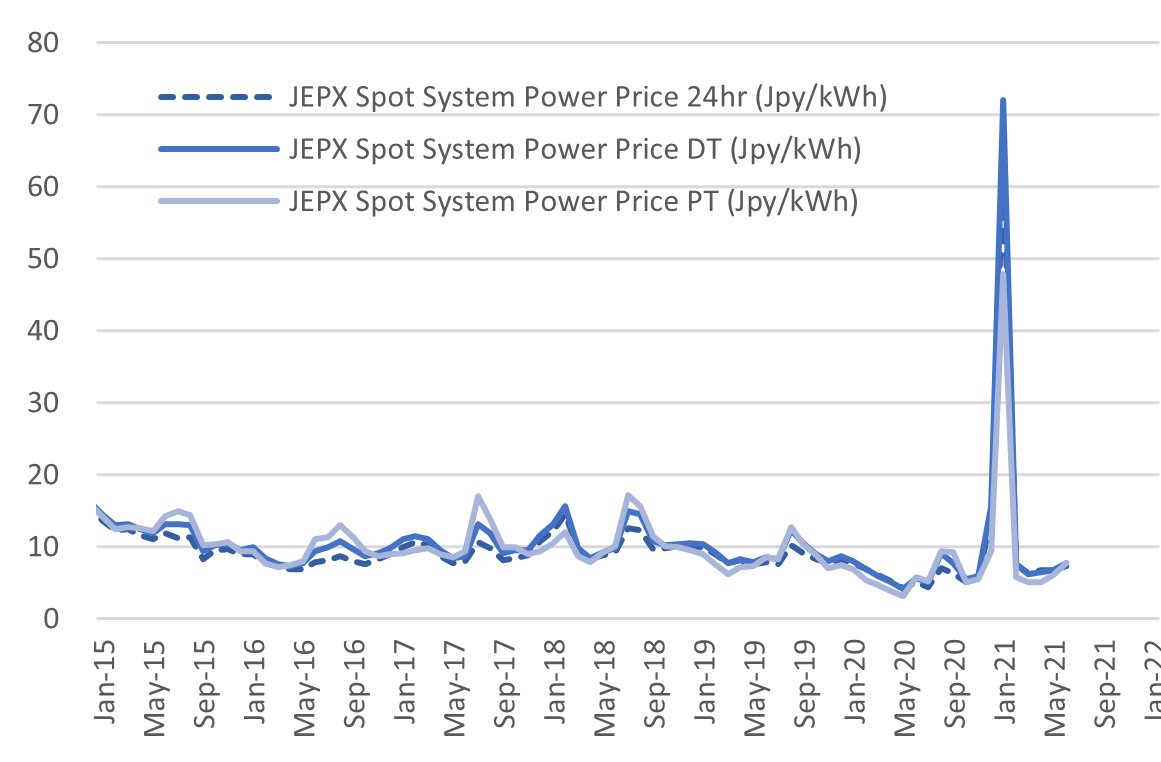
Spot Electricity Prices, Monthly Avg.
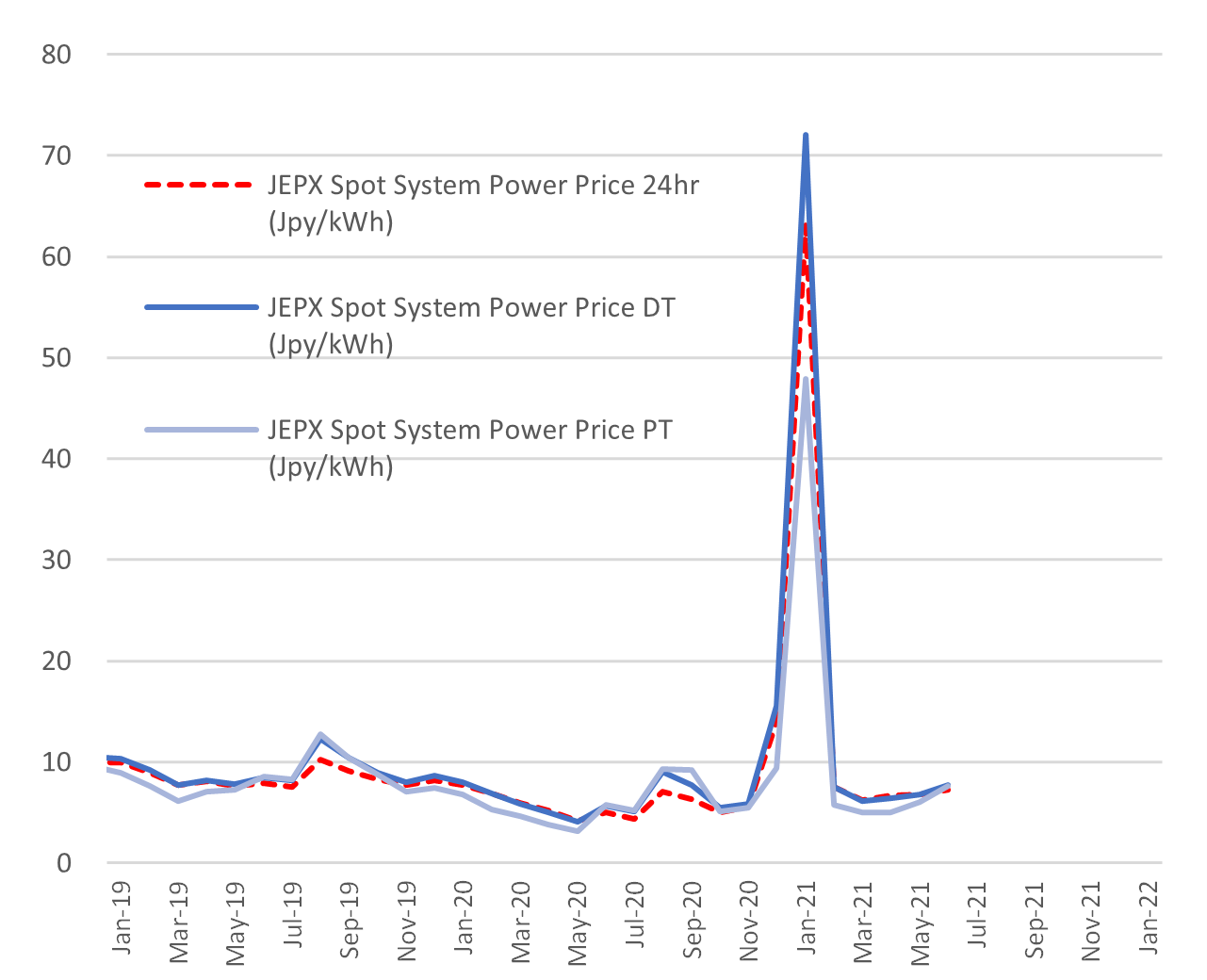
Source: Company websites, JANSI and JAIF, as of May. 31, 2021
Backers of mandatory solar panels on buildings lose battle, but aim to win the war
(Asia Nikkei, June 4)
- An expert panel advised that Japan should change regulations to require mandatory solar panel installations on all new public building. This stops well short of an earlier proposal to force all new buildings, public and private, to have the panels. Still, this is progress towards that wider rollout.
- The panel made the proposal to the METI.
- Following the proposal, the government said it will make solar panels a regular part of all new schools, cultural facilities, government offices and other public use buildings.
- CONTEXT: The housing and construction sector accounts for about a third of Japan’s CO2 emissions.
- The Ministry of Environment is leading the push for a broad rollout of solar panels on all buildings. It estimates that Japan could add 19 GW of solar capacity with just the addition of panels to existing public buildings.
- The expert panel has also advised the government to tighten regulations that would promote use of super-insulated walls and windows, efficient climate control systems, LED lighting and other upgrades to accelerate energy saving.
New TEPCO chairman likely to seek wholesale restructuring; METI is nervous
(ZAITEN, June edition)
- TEPCO morale is at rock bottom due to the behavior of current CEO Kobayakawa Tomoaki, who is seen as only following METI instructions. The low morale is cited as the reason behind many recent scandals at the company, including poorly completed anti-terrorism measure upgrades at Kashiwazaki Kariwa NPP and a broken seismometer left unfixed for over six months at the Fukushima Dai-Ichi NPP site.
- TEPCO’s “safety culture and organization are seriously deteriorating,” a well-connected power industry insider said.
- The METI has brought in various people from the outside to help reform TEPCO. These included Shimokobe Kazuhiro (a lawyer), Sudo Fumio (the former president of steelmaker JFE), Kawamura Takashi (the former Hitachi chairman). Shimokobe and Sudo were unable to make any progress and grew tired of internal fighting with board members loyal to former TEPCO chairman Katsumata Tsunehisa.
- METI brought in Kobayakawa as CEO three years ago to revamp the company. He obeys METI completely, but has had little impact at TEPCO.
- Many inside and outside TEPCO were upset after Kobayakawa canceled plans to visit the Fukushima site on the 10th anniversary of the disaster. He cited COVID-19 as the reason.
- Now, METI has brought in Kobayashi Yoshimitsu, the chairman of Mitsubishi Chemical, as chairman of TEPCO. Kobayashi agreed to join the board under two conditions: the processed water at the Fukushima site is released into the ocean; and that the restart schedule for Kashiwazaki Kariwa is finalized.
- Neither of those two have been resolved, but Kobayashi joined TEPCO all the same. This indicates that he knows what needs to be done.
- Kobayashi was an outside director at TEPCO for three years from June 2012. He was also involved with the official state owner of TEPCO, the Nuclear Damage Compensation and Decommissioning Facilitation Corporation (NDF).
- Kobayashi reformed Mitsubishi Chemical by selling over 150 of its affiliated companies. He will try the same approach at TEPCO, selling off everything apart from TEPCO Power Grid, TEPCO Renewable Power and the assets involved in decommissioning work at the Fukushima site.
- This “Dismantling TEPCO” scenario will require pumping in more tax money and will likely be criticized. But, Kobayashi is a “super realist”, and he’ll push METI to accept this.
- Meanwhile, METI will hope they can control Kobayashi. They will send in former METI bureaucrat Yoshino Shigehiro to the TEPCO board. Whether that will be enough for the ministry to retain control of the process is uncertain.
TAKEAWAY: Both the magazine source and the article are admittedly somewhat speculative. Yet, a hard shake-up at TEPCO has been building for years and recent delays to restart plans for the utility’s only operable nuclear facility is more than just another setback. There are many reasons why the company that once bore the title of Asia’s No.1 utility would do well to restructure, as detailed in the March 22, 2021 edition of Japan NRG Weekly. But what’s been missing so far is a leader willing to make it happen. Kobayashi looks like that kind of leader. For METI, this is both a plus and a minus. On the whole, the ministry wants to see TEPCO restructured and revamped, especially if this can raise significant sums. It worries, however, that a purely corporate approach would see it lose control of both which assets are spun out and the new-look TEPCO.
TEPCO RP, Orsted submit plan for 370 MW offshore wind plant in Chiba area
(New Energy Business News, May 31)
- TEPCO Renewable Power (TEPCO RP) and Denmark’s Orsted, through a joint-venture company, Choshi Offshore Wind Farm, have prepared a project for the sea area off the coast of Choshi, Chiba prefecture, and submitted it to the relevant ministries.
- The plan is to build a 370 MW capacity farm that can start operation after FY2024. Construction would begin around FY2022.
- TEPCO RP has been conducting research on offshore wind power generation off the coast of Choshi, which is been designated as a promotion area in the Renewable Energy Sea Area Utilization Act since 2009.
- TEPCO RP and Orsted signed a MoU on the Choshi Wind Farm Project in 2019 and formed the JV in March last year.
- SIDE DEVELOPMENT:
TEPCO Renewable Power planning 500 MW wind farm for Yamagata
(New Energy Business News, June 2)- Tokyo Renewable Power plans to build a 500 MW offshore wind farm in Yamagata, and issued an environmental assessment statement.
- If approved, the wind farm, which will cover 40 km² and comprise as many as 53 turbines, will begin supplying the grid as soon as 2028.
J Power Group upgrades largest wind farm
(Kankyo Business, May 28)
- J Power subsidiary, J Wind, began to upgrade its aging Shimamaki wind farm in Hokkaido.
- The six existing 750 kW turbines will be replaced with a single 4.3 MW turbine manufactured by Siemens.
- The turbine is scheduled to begin commercial operation in 2022.
- J Power is planning a phased upgrade of its older wind farms.
Dai-Ichi Life invests in Niigata solar farm
(Nikkei, June 2)
- Insurance giant Dai-Ichi Life has partnered with Renewable Japan in investing in a project to construct a 45 MW solar farm in Niigata.
- Renewable Japan will handle project development and asset management, and Dai-Ichi Life will provide the equity for the project.
- SIDE DEVELOPMENT:
Eurus Energy building 60 MW of solar capacity in Chile
(Denki Shimbun, June 2)- Eurus Energy Holdings said that its U.S. subsidiary would construct 10 solar farms in Chile that will generate a total of 68 MW.
- All 10 farms are scheduled to begin feeding the grid by 2022.
- The new project will increase Eurus’ solar capacity in Chile to 86 MW.
- Receiving around double the sunlight of Japan, Chile is well suited to solar energy generation.
- SIDE DEVELOPMENT:
Marubeni signs MoU to build solar farm in Bangladesh
(New Energy Business News, May 31)- Marubeni signed a memorandum of agreement with the Electricity Generation Company of Bangladesh, a subsidiary of the Bangladesh Power Development Board, to collaborate on the construction of a 100 MW solar farm in South East Bangladesh.
- To date, Marubeni has been involved in constructing 1.3 MW of generation capacity, both gas and hydroelectric, in Bangladesh.
- The Bangladesh government aims to boost its total renewable generation capacity by 10%.
Northern Hokkaido wind farms to get storage battery
(New Energy Business News, June 2)
- As part of work to run extra transmission lines to carry electricity generated by wind farms in Northern Hokkaido to population centers, a 720 MWh battery, capable of supplying up to 240 MW, is being installed to complement the 600 MW of wind generation capacity in the region.
- Tests will be performed to optimize battery use, as well in determining whether the battery could be used as a backup power supply in the event of a power outage.
- It may also be possible to use the battery to avoid blackouts, by instantly activating it whenever a load variation is detected.
NEWS: OIL, GAS & MINING
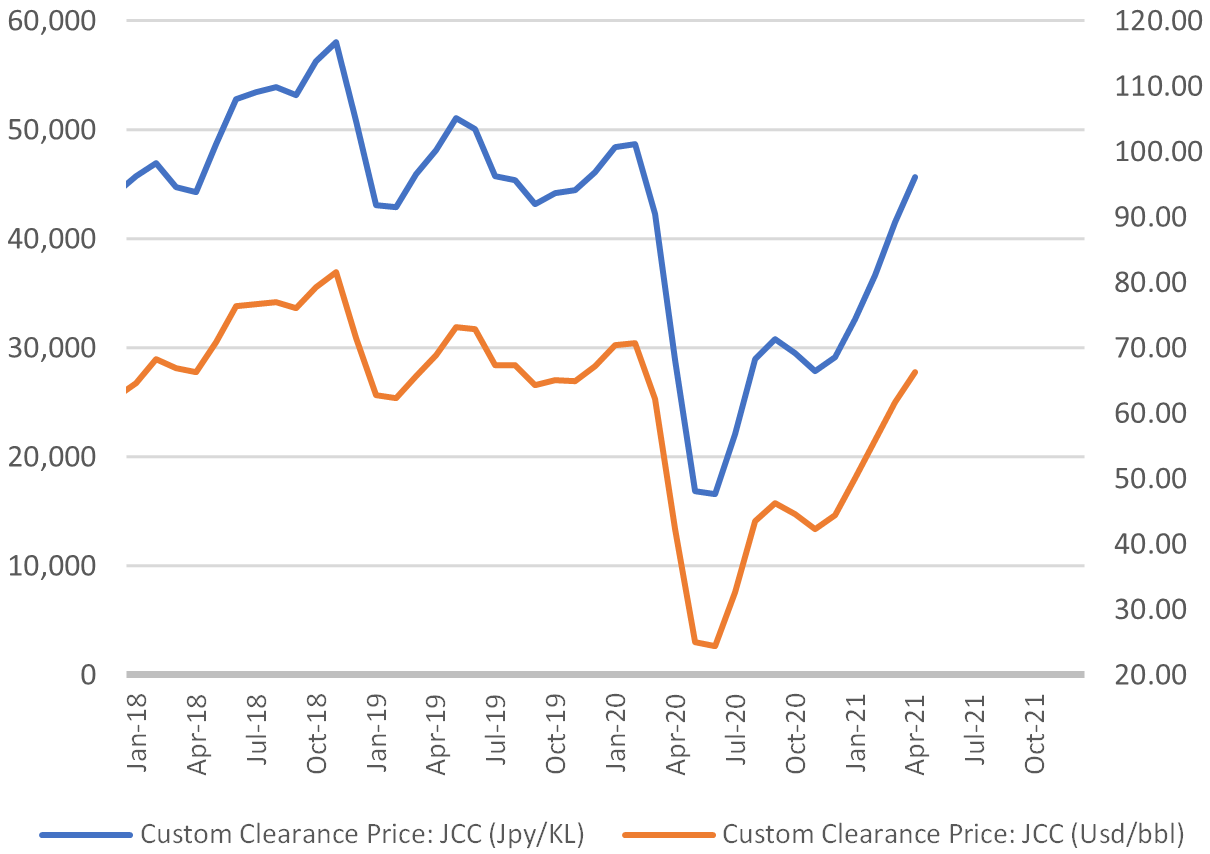
Japan Oil Price: $66.26/ barrel
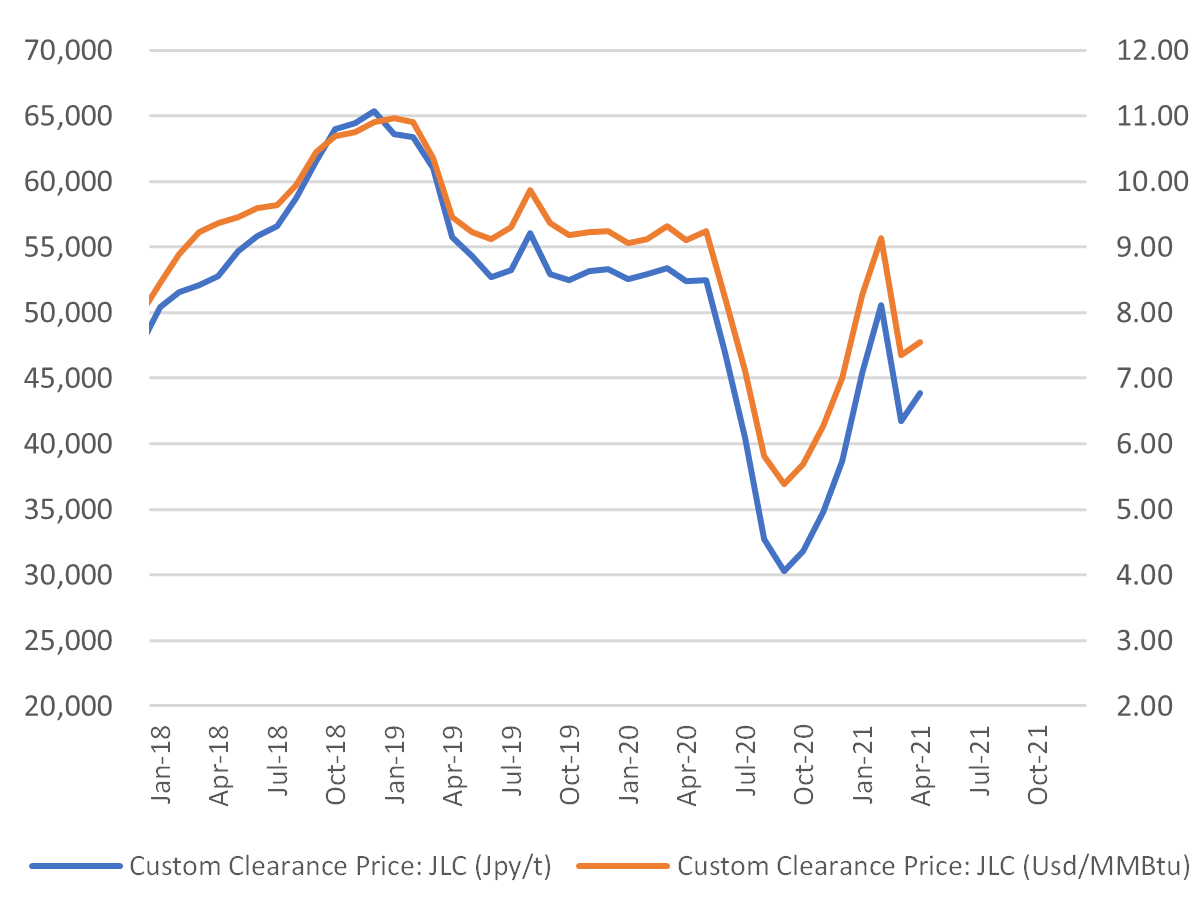
Japan (JLC) LNG Price: $7.56/ mmbtu
Japan to set up public-private council focused on rollout of methane
(Nikkei, June 2)
- The government aims to set up a public-private council that will lead the charge on developing the methanation industry in the country. Japan sees methane synthetic fuel almost completely taking over from natural gas as the source of heating by 2050.
- The technology recycles CO2 into a “green” burnable fuel.
- The METI will create a council focused on methane as soon as this month. Nineteen private companies may be involved including Tokyo Gas, TEPCO, Nippon Steel, Mitsubishi Corp., and marine shipper Nippon Yusen.
- Council members will share relevant technology for turning captured CO2 into methane. The council will also deliberate on rules governing CO2 trading.
- METI plans to have synthetic methane comprise at least 1% of heating gas in 2030, then raise that proportion to 90% in 2050. Those percentages can reduce carbon emissions by 800,000 tons and 80 million tons respectively, according to estimates by the Japan Gas Association.
TAKEAWAY: This is a major development not only for the gas and heating sector, but potentially for power generation too. Please see our detailed analysis of the situation in this week’s Analysis section.
Regional utility in Japan secures “carbon-neutral” gas supply from INPEX backed by offsets
(Denki Shimbun, June 3)
- Nihonkai Gas, a regional gas utility, signed a contract with INPEX Corp. to take delivery of “carbon-neutral” gas. This refers to the fact that all the emissions related to the natural gas, from its extraction and shipping to combustion will be offset by carbon credits procured by INPEX.
- Nihonkai Gas said it will use the gas for its HQ and related facilities in Toyama City, and will also sell some volumes to commercial and industrial customers from this summer.
- CONTEXT: This is the first time that INPEX has supplied a “carbon-neutral” gas plan. INPEX secured carbon credits after investing in a project to protect peat wetland forests in Indonesia. Those credits are meant to offset CO2 emissions from INPEX operations in Australia, including its Ichthys LNG project.
- Over five years, INPEX will have credits that offset about 5 million tons of CO2 equivalent.
EDITORIAL: Diversification needed in Japan’s rare earth supply
(Nikkei, June 1)
- 70% of global cobalt supply comes from the Democratic Republic of the Congo, while 60% of the world’s neodymium demand comes from China.
- Concern about reliance on China for important minerals has driven some manufacturers to buy their own mines.
- Designating rare-earths as strategic commodities essential to maintain and strengthen U.S. global competitiveness, the Biden administration embarked on a review of the rare earth supply chain.
- It is estimated that in order to produce 1 million electric vehicles per year, Japan will need to double its current lithium and cobalt imports. The Japanese government therefore needs to review its strategy toward these commodities and diversify procurement.
- Japan should also prepare to develop and exploit the significant deposits of cobalt and manganese that lie within its exclusive economic zone.
Novatek to send LNG to Asia across the Arctic in mid-June, one month later than last year
(Bloomberg, June 3)
- Novatek, Russia’s largest LNG producer, plans to start shipments to Asia across the Arctic in mid-June, one month later than last year. This is due to shortage of tankers for the route.
- The route is riskier than through the Suez Canal due to thick ice. It needs ice-class tankers to navigate the passage.
- Novatek’s Yamal LNG facility on an Arctic peninsula has been operating at 114% of its production capacity due to strong Asia demand, especially with Chinese buyers seeking suppliers for the summer.
- Novatek expects year-round eastbound navigation across the Arctic starting in the 2023-2024 season.
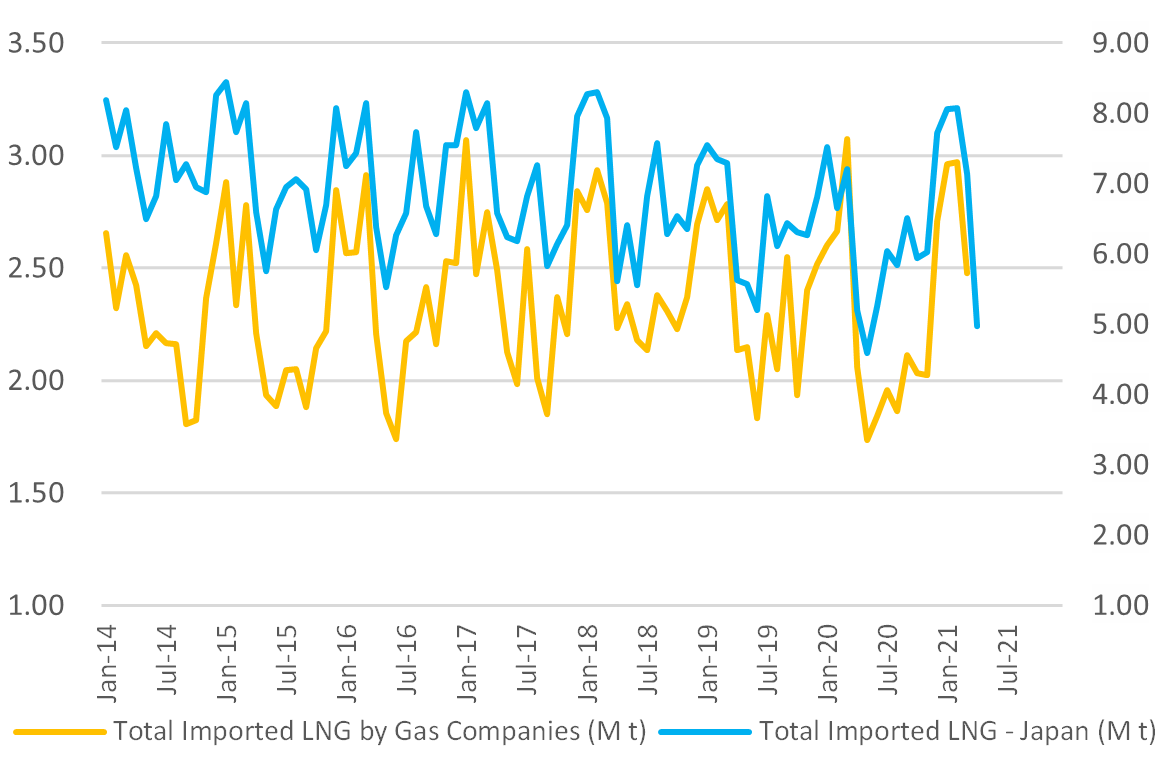
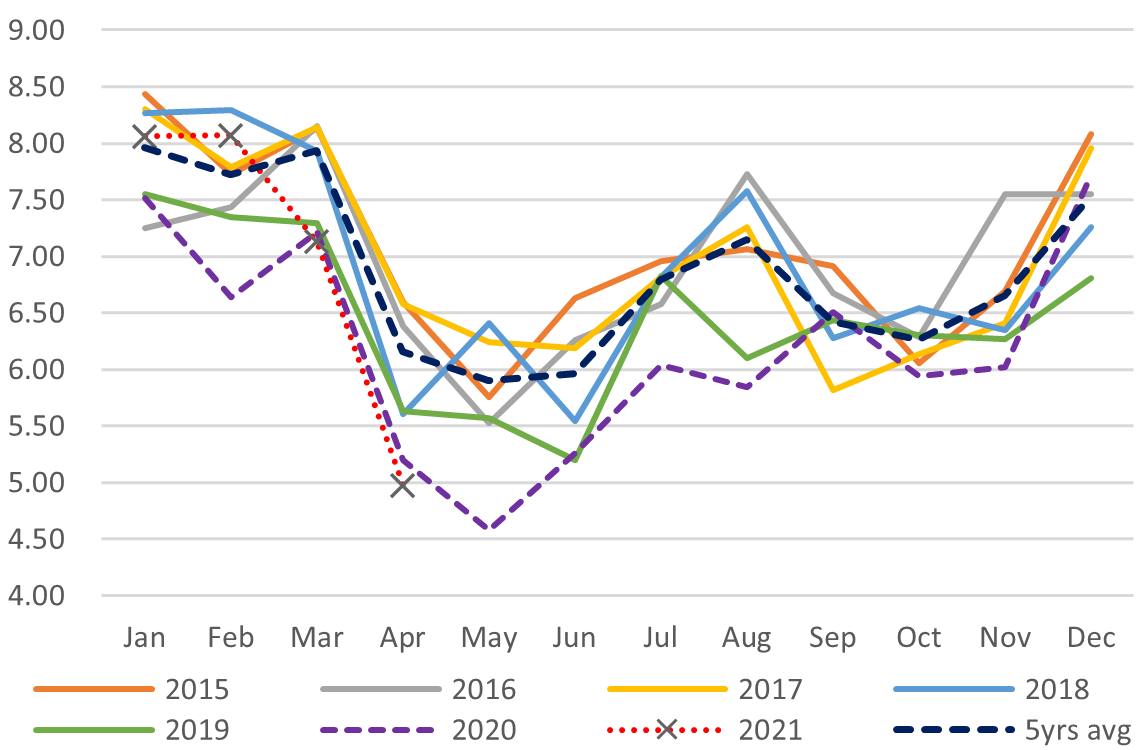
- CONTEXT: Japan’s LNG imports in April were at their lowest level during this month since at least 2013.
ANALYSIS
BY MAYUMI WATANABE
Japan’s Plans to Decarbonize the Gas Industry (and more)
Rely on Methanation
These are challenging times for natural gas. Less than a decade ago, it seemed that gas was entering a golden age, taking over from its dirtier cousins, coal and oil. Recently, international bodies, including the IEA and the World Bank, have walked back their earlier support and now classify gas as just another fossil fuel.
For Japan, however, moving away from gas is not an option. It is not seen as a “transition fuel” only. Gas is a source of heat for industrial plants and co-power generation systems that cannot easily electrify. Gas-fired power balances the supply gaps from variable renewables sources. Even the Renewable Energy Institute (REI) in Japan is backing calls for more use of gas, not less.
So, how does Japan plan to keep using carbon-emitting natural gas in an age of decarbonization? The answer is methanation, according to a recent government plan.
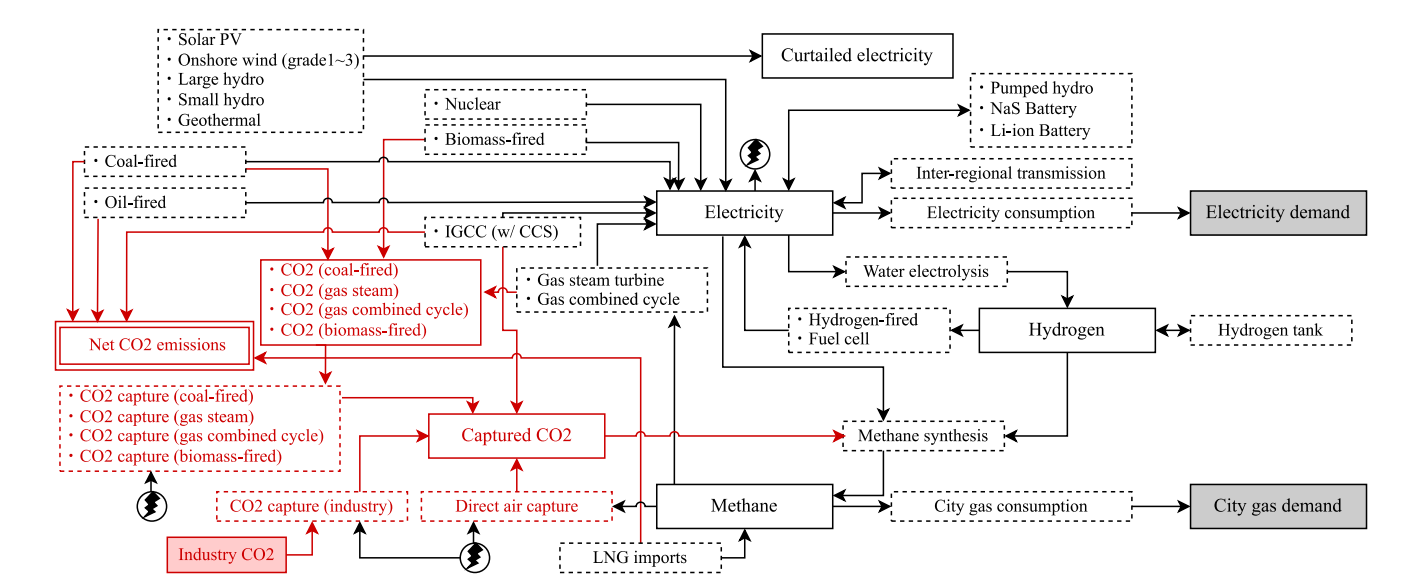
Source: Journal of Japan Society of Energy and Resources, Vo. 41, No. 6
A little science
Natural gas emissions are 45% lower than from coal and 27% less than from oil. Still, they’re not small. Gas produces one in six tons of CO2 equivalent in Japan.
In April, the Agency of Natural Resources and Energy (ANRE), which is under the METI umbrella, published its view on how to position natural gas in the carbon neutrality process. The position states that methanation is the most realistic carbon neutrality option for Japan. This is a process through which carbon oxides react with hydrogen to create methane and water.
Methanization allows for carbon to be extracted and even re-used. It is a key carbon neutralization method for the gas sector and the most realistic option for Japan, in the view of ANRE. The process is cost-efficient, has a low environmental impact, and would not be difficult to organize if Japan secured the hydrogen domestically, according to the agency.
In energy officials’ scenario, methanation can absorb 90% of carbon produced by the gas sector in 2050. Hydrogen will absorb a further 5%, and a combination of carbon capture, utilization and storage (CCUS), bio gas, carbon credits from green initiatives overseas, tree planting, and direct air capture with carbon storage (DACCS) would account for the remaining 5%
The end-product of the reaction, methane, will have two main applications: heat for industrial plants and energy source for fuel cells. The latter are currently conceived as hydrogen fuel cells. However, studies in the last five years show that fuel cells in which methane is used directly, without being converted to hydrogen first, are more efficient and could generation more energy than regular combustion.
Why this is cost effective
Methanation is cost-effective because its processes can utilize Japan’s existing gas infrastructure: the 135 gas storage terminals, LNG carriers, and 262,868 km of city gas pipelines.
Additional infrastructure would only be necessary to deliver methane to power plants. Trucks could transport methane to power stations, which would then use methane, ammonia or hydrogen as fuel, according to the Institute of Applied Energy studies.
Sticking with gas by turning to methane would also carry important energy security and resilience implications since the gas industry’s infrastructure has held up very well in the face of natural disasters in recent years, including the 2011 tsunami and earthquake in northeast Japan. There are very few incidents in general around underground gas pipelines.
Commercialization of methanation may be achieved by 2030, as the government pushes to kick-start it as soon as possible. The methane production process in Japan is not fully established, but the government already forecasts that methane will account for at least 1% of the volumes going through city gas pipelines in 2030.
There are two methods to produce methane from carbon:
- Sabatier, which has hydrogen reacting with a nickel catalyst at temperatures of around 300 to 400 degrees Celsius. It requires hydrogen to be pumped in.
- The solid oxide electrolyzer cell (SOEC) method, which synthetizes methane directly in SOEC cathodes.
In Japan, the Sabatier reaction is likely to roll out first, with the SOEC process likely to be commercialized around 2035, according to METI.
Rollout schedule
In 2019, INPEX, Hitachi Zosen and New Energy and Technology Development Organization (NEDO) started a trial run of methane production in Niigata prefecture. A trial methane-generating plant, on the site of a INPEX facility, uses the Sabatier method and produces 8 Nm3 of methane an hour.
The ¥180 million plant should help verify the viability of the production process and lead to the construction of a larger, ¥2.6 billion plant with a throughput of 400 Nm3/ hour, according to INPEX. The partners will then focus on enhancing the total production cycle, especially the working of the main methane reactor.
Following further improvements in design and work to standardize components, a commercial-scale prototype methane facility is scheduled to launch around 2030. The prototype plant will start with a 10,000 Nm3/h operating capacity that could later be expanded to a commercial-level of 60,000 Nm3/h.
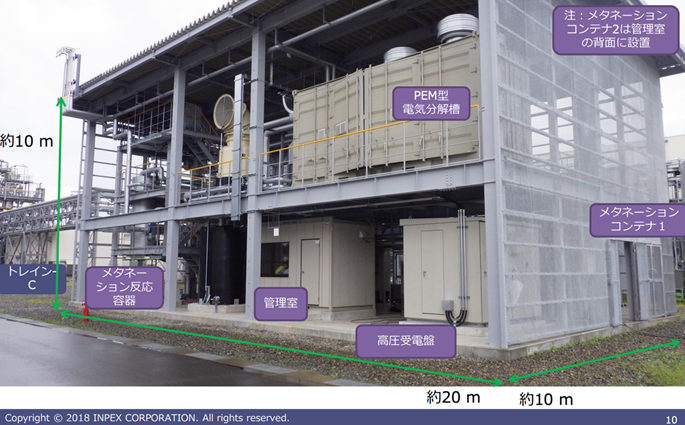
Source: INPEX Corp.
In terms of SOEC, the second methanation process, Japan’s leader is Osaka Gas. In January 2021, the utility announced it had developed a new metal-based material for a SOEC methanation reactor that is stronger and cheaper than the ceramics used in existing SOEC systems. The company will work with partners to put this technology on a more established footing by 2030.
Other companies looking at methanation seriously are Mitsubishi Gas Chemical and JAPEX, which recently agreed to jointly examine this business possibility. The two jointly operate the Higashinigata oil and gas field in Niigata prefecture, which could provide the CO2 raw material after carbon capture technology is installed.
Whichever process wins, Japan will also need to adapt existing gas infrastructure to methane distribution. This includes further research on how methane behaves inside natural gas pipelines, how to control its temperature so that it flows safely, and what additional equipment of managerial resources are required. It is also necessary to improve the durability of catalysts and prolong the life cycle of components used in methanation reactors.
The cost of success
Just like INPEX, Osaka Gas and others beginning to harness this new gas processing industry must be mindful that its initial success will depend on whether they can deliver carbon-free energy. But methanation’s long-term adoption will depend on a factor that’s much more banal: cost.
Synthetic methane can only be considered “green” if the hydrogen used for the methanation is also “green”. In other words, this hydrogen has to be generated via water electrolysis using solar or wind energy, or perhaps hydropower. In that case, a cost reduction in variable renewable energy and a high carbon price (around $1,000/ ton of CO2) may be necessary to spread deployment of methane synthesis in Japan. For the methanation strategy to work, a significant amount of VRE capacity will be required, according to research by the Institute of Energy Economics, Japan (IEEJ) published in the Journal of Japan Society of Energy and Resources late last year.
Ultimately, for methane to become a serious energy choice for Japan, it will need to compete on price with LNG. That may take until 2050, according to Japan Gas Association. The government will be hoping it happens much sooner.
ANALYSIS
BY DANIEL SHULMAN
PRINCIPLE
SHULMAN ADVISORY
Coal is Dead, Long Live Coal?
Japan’s “Exit” From Coal Is More a… Repurposing
A year ago, Japan’s METI announced plans to phase out “low-efficiency” coal power generation. Since then, the government has added ever more ambitious commitments to decarbonization. Still, this is highly unlikely to spell the end of coal-fired electricity in the country.
A new energy efficiency benchmark for thermal power, and rules linked to how much a coal-fired station is utilized, could help a significant number of facilities survive the near-term energy transition. That would help Japan’s energy planners balance the grid amid the push to embrace more variable renewable power sources.
Keeping the coal plants alive is not only a short-term fix. The government is hoping advances in carbon-capture technology will allow power stations running on fossil fuels to produce effectively CO2-free power. The more efficient coal (and gas) power plants of today would also serve as platforms for clean-burning ammonia and hydrogen generation in the future.
METI has rolled out regulatory and other measures to phase out little-used, low-efficiency coal power plants. But these are not meant to kill all coal-fired facilities. The industry will have a second life.
Coal in Japan: Overview
- 31% of Japan’s power in 2019 was generated by coal-fired plants
- Annual electricity volume from coal: about 330,000 GWh
- Japan’s coal units produce on average 1Kg C02 / kWh (1 million kWh is 1 GWh)
- Coal’s emissions are twice the average for Japan’s power plants
- There are 150 coal-fired units in Japan with a 48 GW capacity in operation
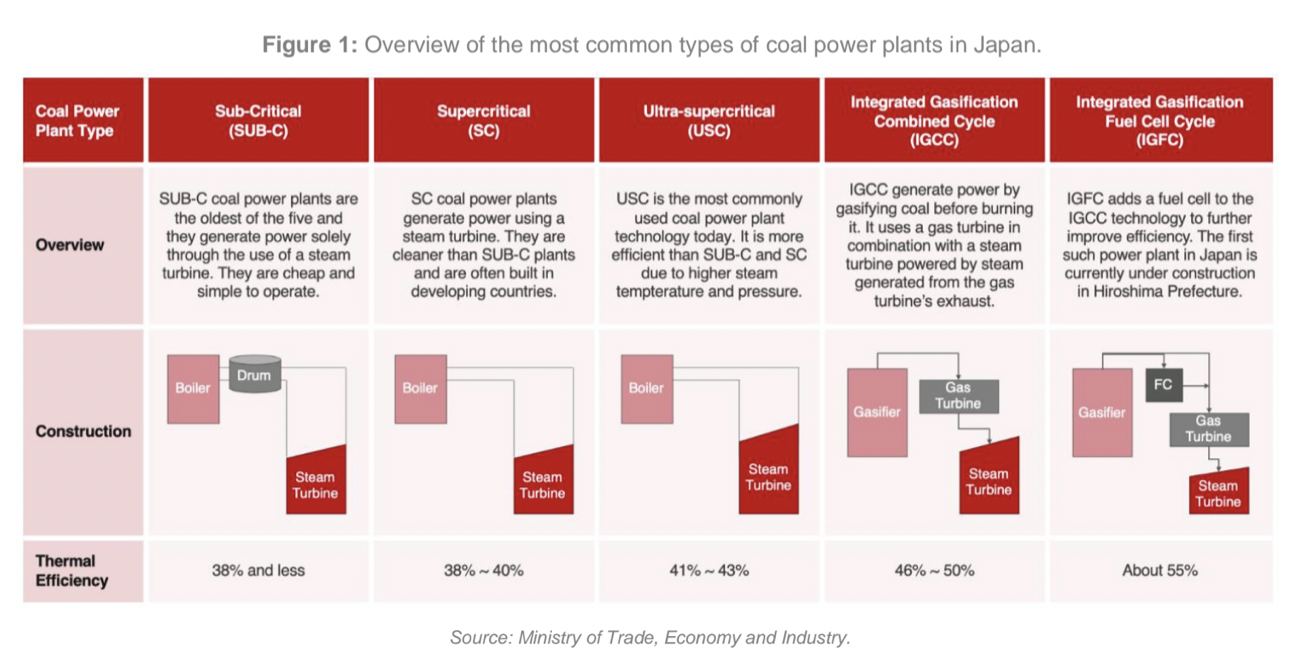
Coal technology is categorized by its energy efficiency. These categories and no. of units installed in Japan are:
- sub-critical (SUB-C) : 98 units
- supercritical (SC) : 20 units
- ultra-supercritical (USC) : 28 units
- integrated gasification combined cycle (IGCC) : 2 units
- and integrated gasification fuel cell cycle (IGFC) : 2 units
METI classified the top two categories as “inefficient,” as they produce less power from the fuel with higher emissions. Roughly 16% of the country’s total generation is generated with inefficient coal units.
METI announcements on phaseout of coal power plants
METI announced in July 2020 its goal to phase out low-efficiency coal power plants that emit large volumes of CO2 by FY2030. In its 5th Basic Energy Plan, published in 2018, the government also set the goal to reduce the percentage of electricity generated using coal to 26% by FY2030 (down from 31% in 2019). At the same time, it noted that coal is an important resource both in terms of cost as well as stable supply.
The Basic Energy Plan is due for an update in June 2021, and with the recent announcement of a GHG emissions reduction target of 46% by 2030 and the continuing efforts to restart nuclear power plants, it is likely that the 2030 coal power generation share will be lower than the current 26% target. However, depending on the share of gas generation it is possible that coal generation assets will have to be kept online, even with low utilization rates, to cover for the times of low renewable generation.
An Introduction to thermal power plant generation efficiency
METI uses two definitions of energy efficiency. The first one is the actual achieved thermal efficiency of the plant and is used in the calculation of indexes A & B below. The second one is not the actual achieved thermal efficiency (since it may vary depending on operations, curtailment, etc.), but is measured based on energy efficiency at design rated operation.
The efficiency of the plant depends directly on the sound operations of each component of the plant in which an energy conversion happens – in particular the boiler, the turbine and the generator. It also depends on fuel quality.
A high efficiency plant can maximize power output for a given amount of fossil fuel burned; this reduces the amount of CO2 emitted for each kWh produced. By introducing efficiency targets for thermal power plants METI aims to ensure that only lower CO2 emitting plants will remain.
Regulatory measures under the Energy Efficiency Act
The Energy Efficiency Act was enacted in 1979 to promote the rational use of energy in factories, buildings, transportation and machinery and equipment. Under the latest version of this act, power generators that consume more than 1,500 kl (crude oil equivalent)/ year must meet the following power generation efficiency rates for new thermal power plants:
- Coal power generation efficiency target 42%
- LNG power generation efficiency target 50.5%
- Oil power generation efficiency target 39%
For existing thermal power plants the generators will have to meet two criteria by 2030:
The first, Index A, measures the average efficiency of all thermal generation assets and compares them to the targets. The index must be at least equal to one. In other words, if the generator operates low efficiency coal plants but also operates high efficiency gas plants, they can still pass the first criteria.
The second criteria, Index B, measures the average efficiency of the thermal energy mix of the generator and compares it to METI’s 2030 power generation mix target. It must be at least equal to 44.3%. In other words, if the generator operates only a few low efficiency coal plants but also operates several high efficiency gas plants they can still pass the second criteria.
Indexes A and B show that the criteria for existing plants are not as strict as for new plants. Generators can compensate for their low efficiency coal plants by adding efficient LNG or oil plants.
There are also special provisions for co-firing thermal plants with low CO2 fuel such as biomass or biogas. In that case, plant efficiency can be calculated differently to account for this.
Example, if a 41% energy efficient coal-fired power plant co-fires 5% biomass fuel, its efficiency will be counted as 43% (41/(100-5)=43%).
The same formula will likely be used if coal power plants co-fire ammonia or hydrogen, as JERA has just started to do at its Hekinan thermal facility. Note, currently, ammonia and hydrogen can be used and accounted for in the efficiency calculation even if CO2 was emitted during their production.
As you can see, co-firing is a way for generators to virtually increase the efficiency of their coal plants while communicating on their SDG goals. In the past two years, several coal-fired power plants started co-firing with biomass fuel.
Also, METI is considering new efficiency criteria for coal-fired power plants. Under the current rules, Indexes A and B can be achieved while keeping a certain amount of inefficient coal plant production if generators have efficient LNG and oil plants in their portfolio.
Requirements to submit phaseout schedules
To periodically evaluate the impact of these regulatory and incentive measures, and update them if necessary, METI will require former utilities and other major coal plant owners to submit a phaseout schedule for 2030 for their coal-fired power plants every year. As about 80% of coal power generation comes from the former utilities, METI expects this schedule to give an efficient way to track its 2030 power generation mix goals.
Going Forward
Under the current energy plan, METI forecasts low efficiency coal generation capacity owned by large utilities to decrease by 6% while integrated gasification combined cycle capacity would increase together by 2%. However, it is unclear if these regulations will be sufficient to meet the upcoming 6th Basic Energy Plan goals. Still, renewable generation is unlikely to replace coal by 2030.
A major factor in the phasing out of coal generation, and the elephant in the room when talking about the Japanese power generation mix and CO2 reduction, is the role that nuclear power will play in the coming years. The expectations for carbon capture technology and hydrogen/ammonia co-firing appear high within the Japanese government, but for the moment, none of these solutions comes with any proven large-scale deployment.
GLOBAL VIEW
BY TOM O’SULLIVAN
Below are some of last week’s most important international energy developments monitored by the Japan NRG team because of their potential to impact energy supply and demand, as well as prices. We see the following as relevant to Japanese and international energy investors.
Oil & La La Land:
Despite the recent IEA report that called for a moratorium on all new oil and gas exploration, which the Saudi Energy Minister recently described as “La La Land”, oil prices soared this week to multi-year highs. WTI closed the week marginally shy of $70 a barrel and Brent closed the week at $72, the highest levels since 2018. Soaring international energy prices are now the leading contributor to inflation risks in Japan and around the world. Inflation in Brazil is running at 7% over the last 12 months. OPEC+ also believes oil demand may increase by 6 mbpd in H2 2021.
OPEC+ announced that they’ll only gradually hike oil production, bringing total increases in the three months to July to 2 million barrels per day. Concerns around Covid-19 cases were cited as reasons for the slow resumption of production.
The IEA recommendation on oil and gas exploration would have a major negative economic impact on oil and gas exporting countries, many of which are developing economies.
Shipping:
The European industry has agreed to boost energy efficiency by 40% by 2030 and cut greenhouse gas emissions 50% by 2050 vs. 2008.
Nord Stream 2:
President Putin announced the completion of the first pipeline and that natural gas deliveries to Germany could commence in 10 days time.
Exxon:
A third new board member was appointed to the Board of Directors of Exxon last week following the activist resolution tabled by the investor, Engine No. 1 : Alexander Karsna, a senior strategist at Google, will join the Exxon Board. He will join two new directors, Geoffrey Goff, who works at the refiner, Andeavor, and formerly was with Conoco Phillips; and Kaisa Hietala, a Finnish environmentalist who had worked with Neste, the Finnish refiner. Both Goff and Hietala are experienced in biofuels.
LNG:
U.S. LNG developer Venture Global will install carbon capture and storage at its new LNG plant in Louisiana. Venture Global will capture 1 million tons of CO2/ year.
Forests:
A new report from a coalition of companies including Amazon, Nestle, and McKinsey is showing that GHG emissions from the loss of tropical forests now exceeds the combined emissions from Europe’s five largest economies: Germany, France, Italy, Spain, and the Netherlands.
Aviation:
1). United Airlines will acquire 15 Overture jets from Boom Technology to spearhead a drive into clean-energy supersonic travel that is expected to halve travel times from 2029.
2). The cost of carbon credits in Europe that hit a new high of E60 per tonne last week is negatively impacting airlines’ balance sheets as they struggle to meet carbon costs that have doubled since the onset of Covid-19.
Central Banks & Climate Risk:
At last week’s Green Swan Conference, a meeting of international central banks, the governor of France’s central bank announced that a standard framework for disclosing corporate climate change risks will be adopted at COP26 in Glasgow in November. This may be overseen by the IFRS outside the U.S., and the SEC inside the U.S.
ESG:
Morningstar reported that $2 billion a day flowed into ESG funds in Q1 in Europe.
Green Steel:
The European Steel Association is requesting the EU not to reduce allocations of free carbon allowances too fast as the EU also seeks to introduce a carbon border adjustment mechanism in 2023.
China:
Cities in the south of China including Guangzhou, Foshan, and Dongguan, are suffering serious power outages as the economic recovery accelerates. Demand for electricity is far exceeding supply.
South Korea:
South Korea’s emissions trading scheme is forcing a reduction in coal usage and is accelerating the transition to LNG.
Vietnam:
Vingroup, the country’s largest conglomerate, will either IPO its autonomous EV car business in the U.S., or combine it in a SPAC merger, and appointed JPMorgan and Deutsche Bank as advisers.
Singapore:
The city-state will establish a new global carbon exchange by the end of 2021.
Indonesia:
The largest ASEAN economy will stop the development of all coal power plants except those where financing has already been arranged or where plants are already under construction.
Myanmar:
The Beijing-based AIIB has announced that it may continue to fund projects in Myanmar despite the coup.
New Zealand:
Heavy rains caused extensive flooding in the Canterbury area on New Zealand’s South Island last week that forced hundreds of evacuations.
India:
Cairn Energy, an oil and gas company based in Scotland, is looking to sue Air India and seize aircraft in a $1.7 billion tax dispute with the Indian government.
Sri Lanka:
The island country may be facing one of the worst environmental disasters in its history due to the sinking of the MV X-Press Pearl container ship near the capital, Colombo, that was carrying large amounts of fuel oil and chemicals.
Russia:
1). Novatek brought the 4th train of Yamal LNG into production.
2). President Putin’s government is spending more than $10 billion to upgrade railroads used for the transportation and export of Russia’s coal stocks mainly to Far Eastern ports.
3). Putin also announced at the St. Petersburg International Economic Forum that it will drop the dollar from Russia’s sovereign-wealth fund because of U.S. sanctions.
Belarus:
Following the Putin-Lukashenko summit in Sochi last week, Russia agreed to provide a second loan of $500 million to Belarus, a significant refined oil exporter to Europe. Roman Protasevich and his Russian partner, Sofia Sapega, continue to be detained in Minsk. The EU and the U.S. are thought to be formulating new sanctions against Lukashenko’s government.
Iran:
1). The government fired the head of Iran’s Central Bank, Abdolnaser Hemmati, following his decision to contest the June 18th presidential election.
2). Iran’s production of nuclear fuel fell in the last three months following a fire at the Natanz nuclear facility in April.
3). Iran also suffered a major fire at a refinery near Tehran last week and suffered the sinking of an important navy vessel in the Gulf of Oman, also due to a fire.
Israel:
The Israeli government is expected to raise the quotas on natural gas exports. benefiting the Leviathan and Tamar natural gas projects. An inter-ministerial committee headed by Ministry of Energy director general Udi Adir is set to recommend the expansion of gas exports. The expected policy change follows strengthening of renewable energy production in Israel, that has reduced domestic natural gas needs. Increased exports would make up for the shortfall in natural gas consumption in Israel.
Africa:
The construction of the $5 billion Grand Ethiopian Renaissance Dam on the Blue Nile tributary continues to strain relations between Egypt, Ethiopia and Sudan, making a military conflict a possibility as the second filling of the dam approaches. Ethiopia plans to begin generating power from the dam during the upcoming rainy season between June and August.
Sweden:
By 2030, Heidelberg Cement will build the first carbon-neutral cement plant in its Swedish plant at Slite.
Spain:
The Spanish government is legislating to make the 2050 carbon neutrality goal legally enforceable. Spain is Europe’s second largest onshore wind market although concerns are being raised about the extent of land absorption of solar and wind projects and the environmental impact on wildlife and fauna.
U.S.
1). Major cities in the U.S., such as San Francisco, Seattle, Denver, and New York, are looking to ban natural gas for cooking and heating in new homes as they strive to deal with climate change goals.
2). Jim Justice, the governor of West Virginia, may be personally liable for $700 million of loans his coal company, Bluestone Resources, took from Greensill Capital, the now-bankrupt UK supply-chain financer.
3). The Biden administration will suspend Arctic oil drilling rights sold in the final days of the Trump administration pending environmental and legal reviews.
4). The Public Utility Commission of Texas is warning that the state needs to strengthen ‘black start’ resources if the power grid collapses.
5). Kinder Morgan has agreed to buy Stagecoach Gas Services LLC for $1.2 billion as the pipeline operator expands into the northeast U.S. market. Stagecoach is a natural gas pipeline and storage joint venture between Consolidated Edison and Crestwood Equity Partners.
Brazil:
Brazil is facing its worst water crisis in a century which is impacting hydropower output that accounts for 75% of electricity production. Brazil is the world’s second largest hydropower country after China with over 100 GW of capacity. LNG is being used to make up the shortfall.
EVENTS CALENDAR
A selection of domestic and international events we believe will have an impact on Japanese energy.
|
February |
Approval of Fiscal 2021 Budget by Japanese parliament including energy funding projects; CMC LNG Conference |
|
March |
10th Anniversary of Fukushima Nuclear Accident; Smart Energy Week – Tokyo; Quarterly OPEC Meeting; Japan LPG Annual Conference; Full completion of all aspects of the multi-year deregulation of Japan’s electricity market; End of 2020/21 Fiscal Year in Japan; |
|
April |
Japan Atomic Industrial Forum – Annual Nuclear Power Conference; 38th ASEAN Annual Conference-Brunei; Japan LNG & Gas Virtual Summit (DMG)-Tokyo Three crucial by-elections in Hokkaido, Nagano & Hiroshima – April 25th |
|
May |
Bids close in first tender for commercial offshore wind projects in Japan; Prime Minister Suga to visit the U.S. |
|
June |
Release of New Japan National Basic Energy Plan-2021; G7 Meeting – U.K. Presidents Biden and Putin are due to meet at a summit in Geneva Forum for China-Africa Cooperation Summit (Senegal) |
|
July |
Tokyo Metropolitan Govt. Assembly Elections; Commencement of 2020 Tokyo Olympics |
|
August |
Hydrogen Ministerial Conference in conjunction with IEA |
|
September |
Ruling LDP Presidential Election; UN General Assembly Annual Meeting that is expected to address energy/climate challenges; IMF/World Bank Annual Meetings (multilateral and central banks expected to take further action on emissions disclosures and lending to fossil fuel projects); End of H1 FY2021 Fiscal Year in Japan; Japan-Russia: Eastern Economic Forum (Vladivostok)-tentative |
|
October |
Last possible month for holding Japan’s 2021 General Election; METI Sponsored LNG Producer/Consumer Conference; Innovation for Cool Earth Forum – Tokyo Conference; Task Force on Climate-Related Financial Disclosure (TCFD) – Tokyo Conference; G20 Meeting-Italy |
|
November |
COP26 (Glasgow); Asian Development Bank (‘ADB’) Annual Conference; Japan-Canada Energy Forum; East Asia Summit (EAS) – Brunei |
|
December |
Asia Pacific Economic Cooperation (APEC) Forum – New Zealand; Final details expected from METI on proposed unbundling of natural gas pipeline network scheduled for 2022. |
DATA
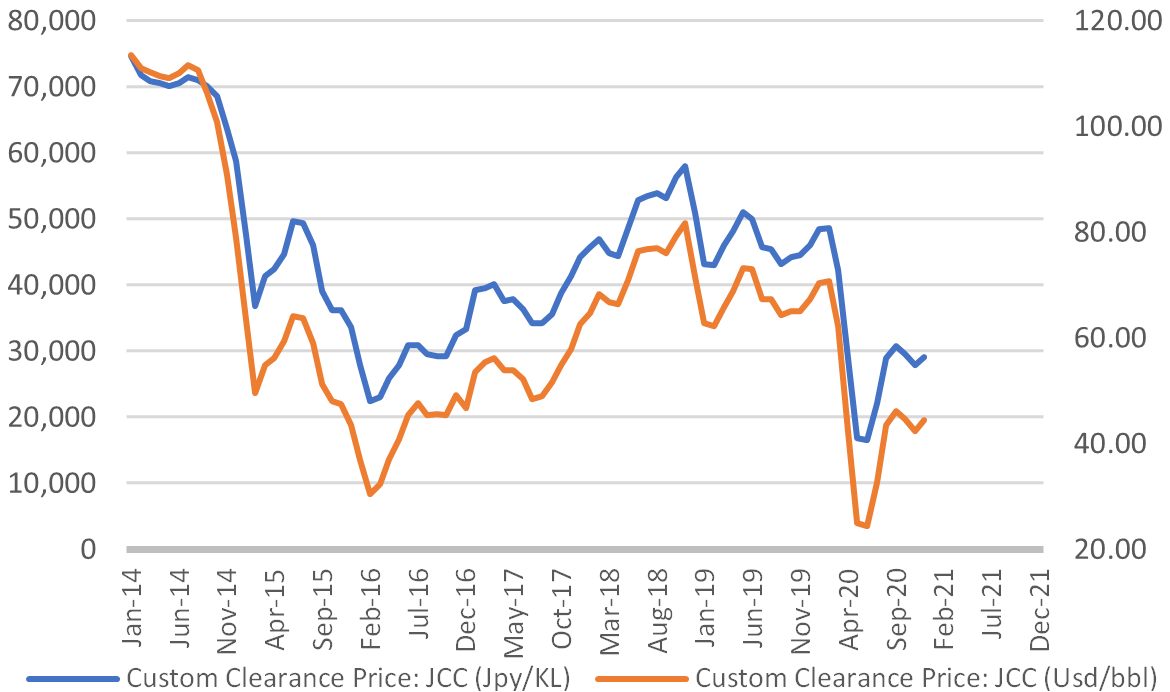
Japan Oil Price
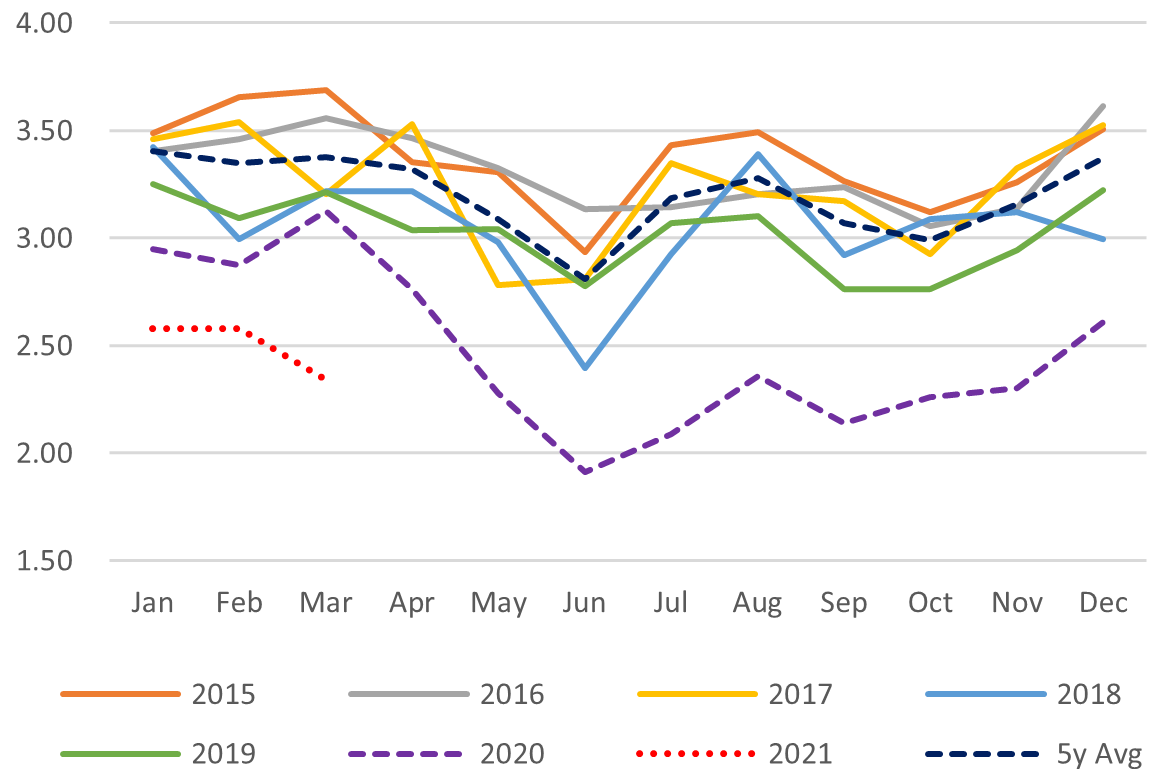
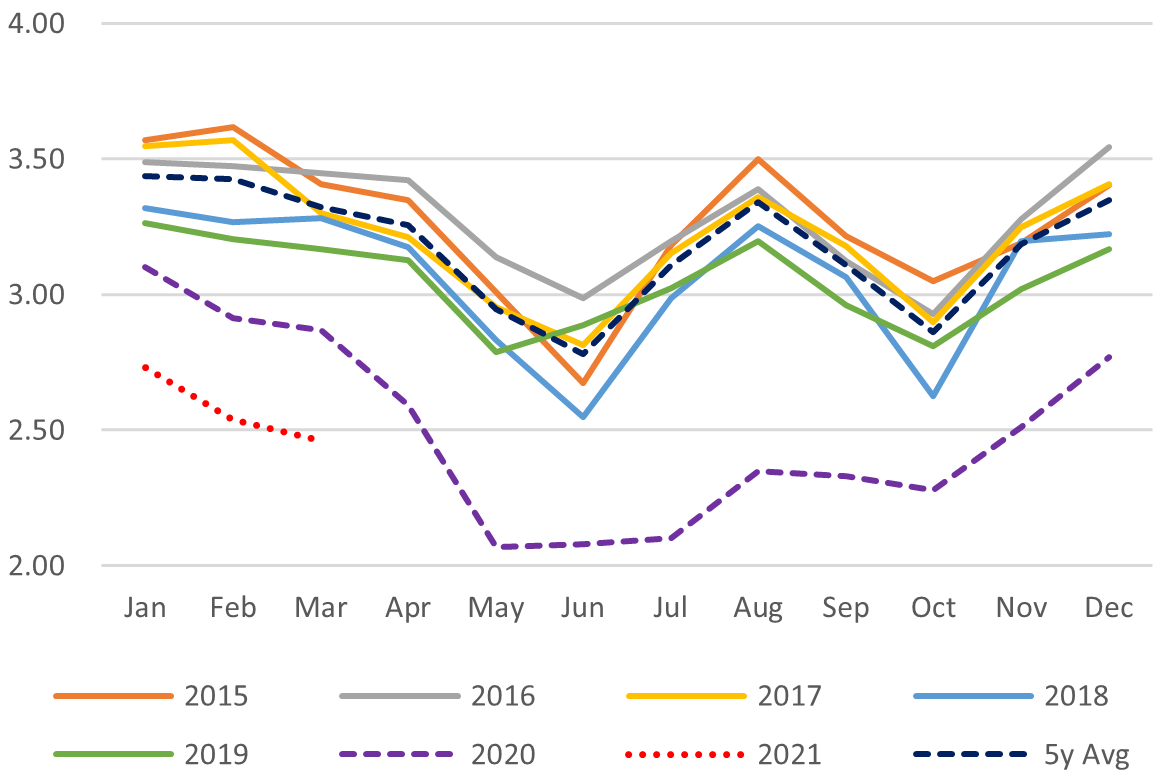
Crude Imports Vs Processed Crude
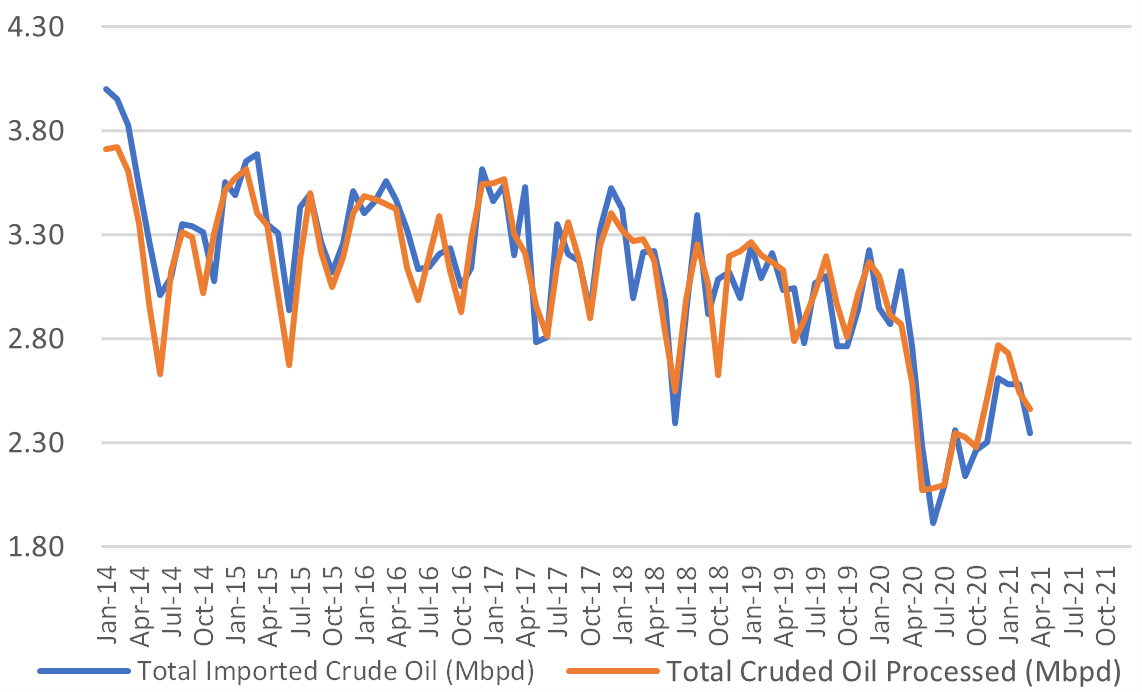
Monthly Oil Import Volume (Mbpd)
Monthly Crude Processed (Mbpd)
Domestic Fuel Sales
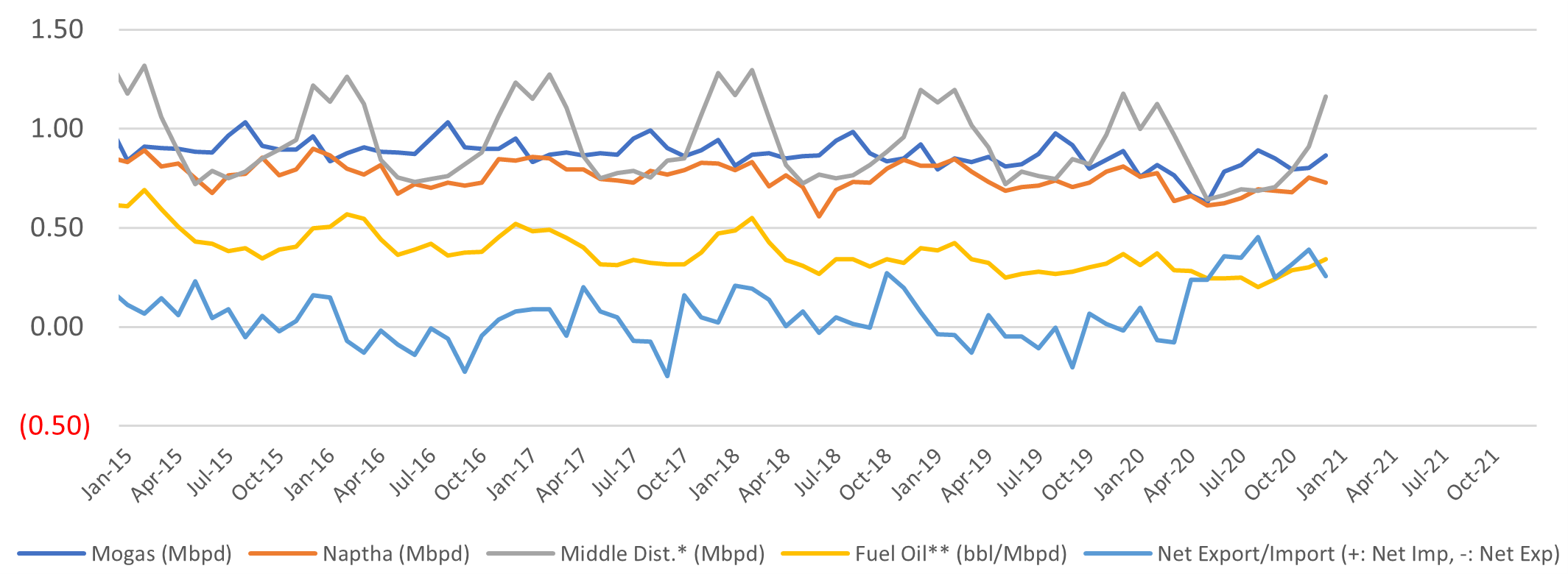
SOURCES: Ministry of Economy, Trade, and Industry (METI), Ministry of Finance, and the Petroleum Association of Japan
Japan LNG Price
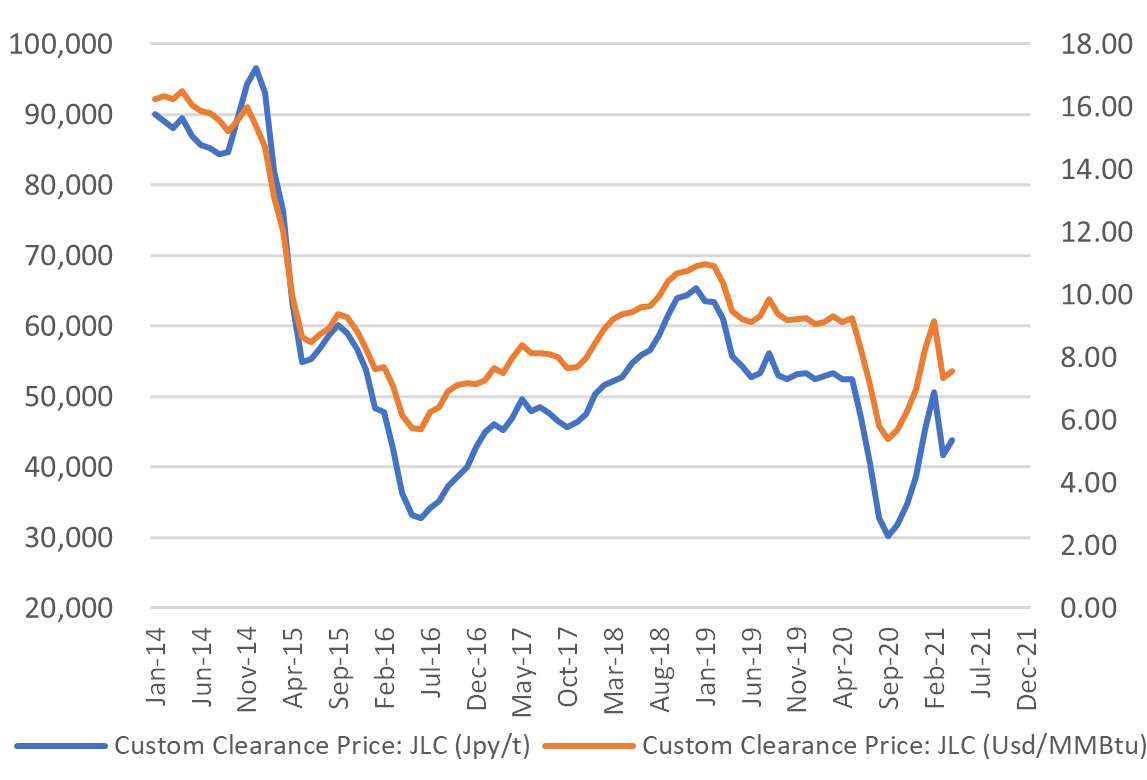
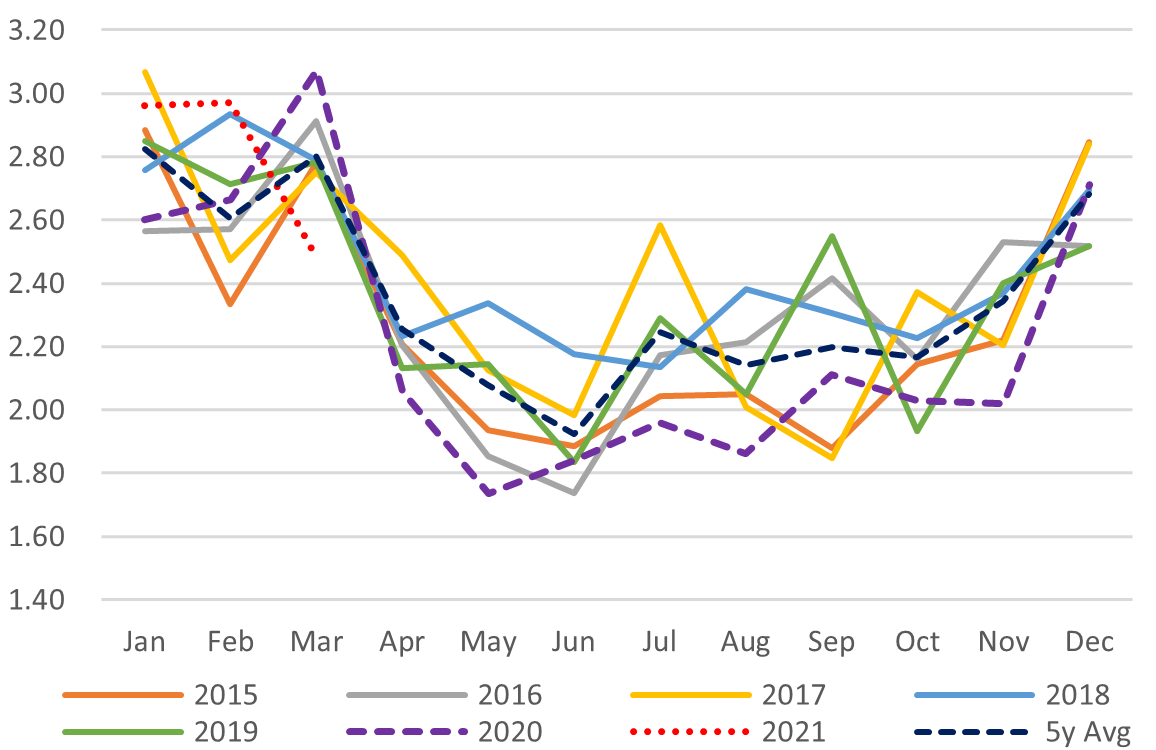
LNG Imports: Japan Total vs Gas Utilities Only
Total LNG Imports (M t)
LNG Imports by Gas Firms Only (M t)
City Gas Sales – Total (M m3)
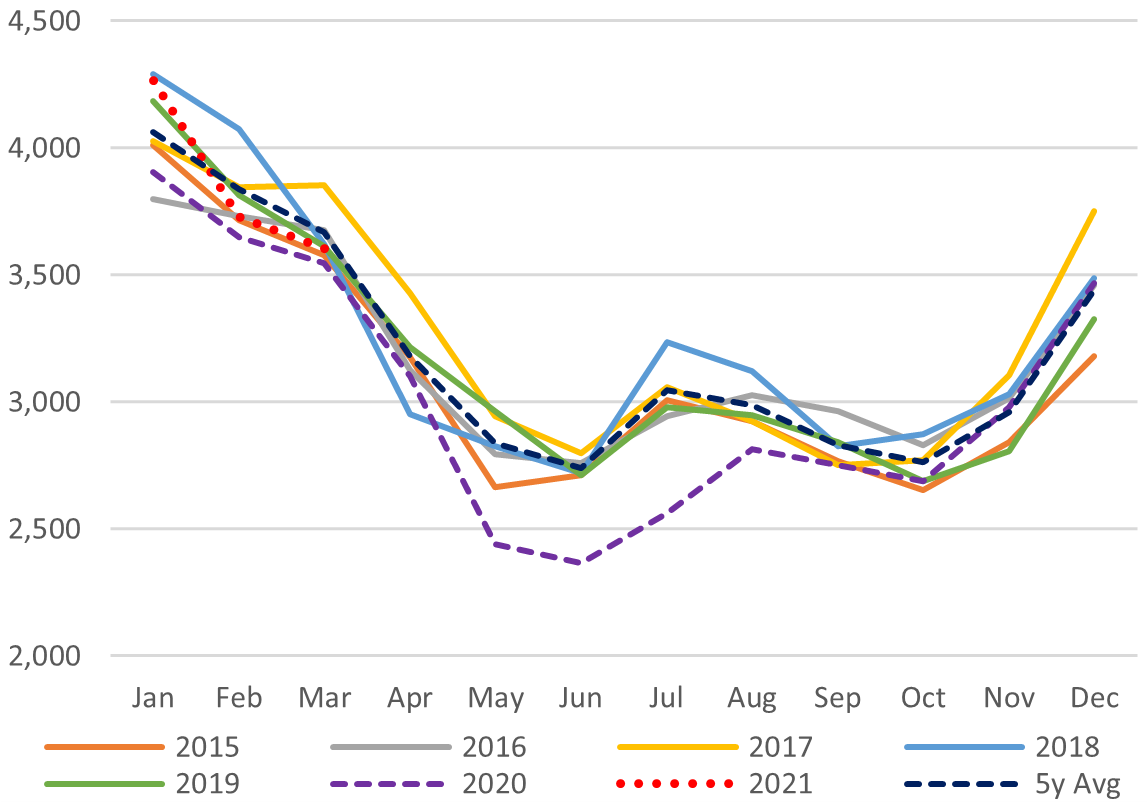
City Gas Sales by Sector (M m3)
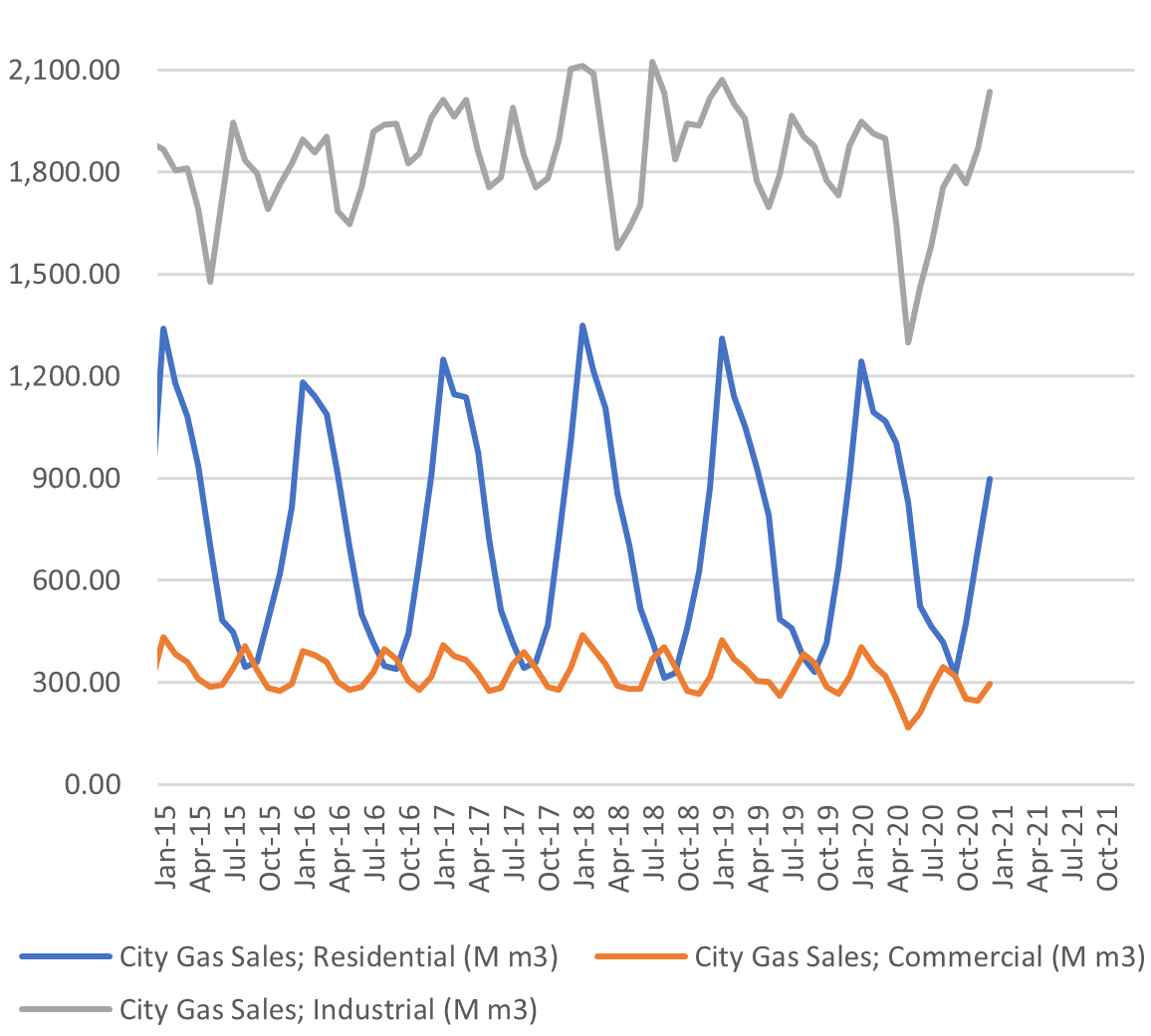
SOURCES: Ministry of Economy, Trade, and Industry (METI),
Ministry of Finance
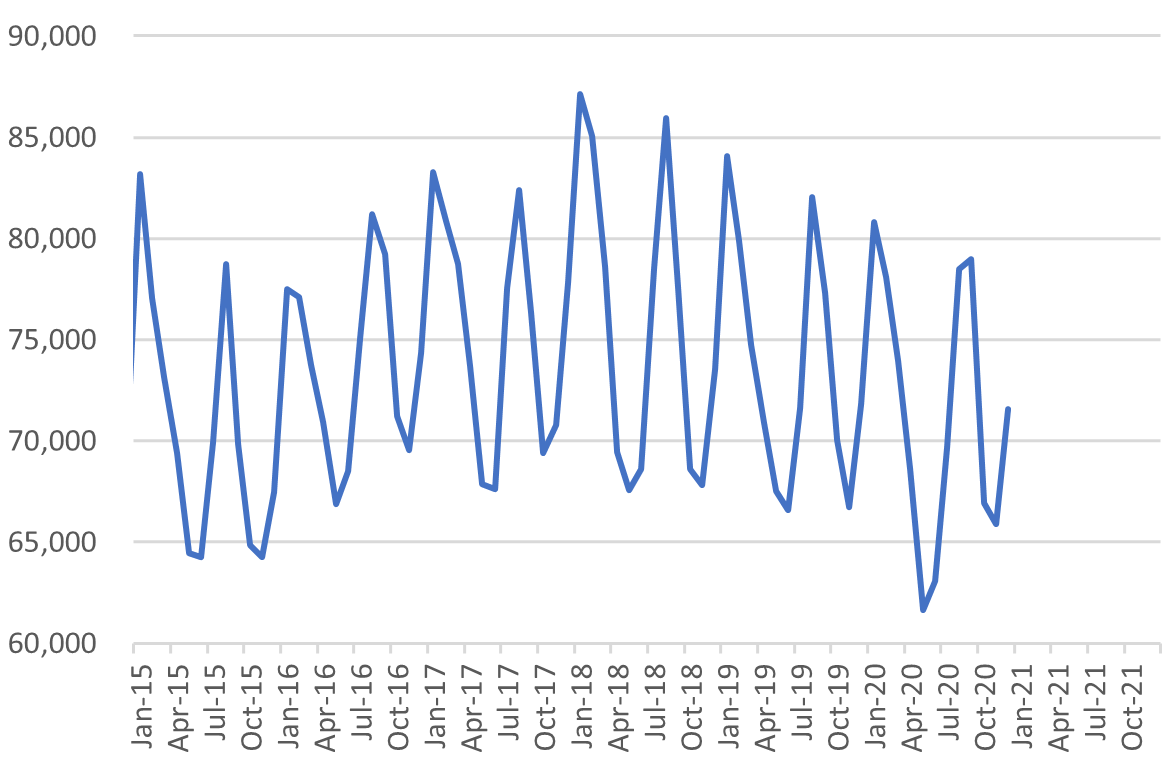
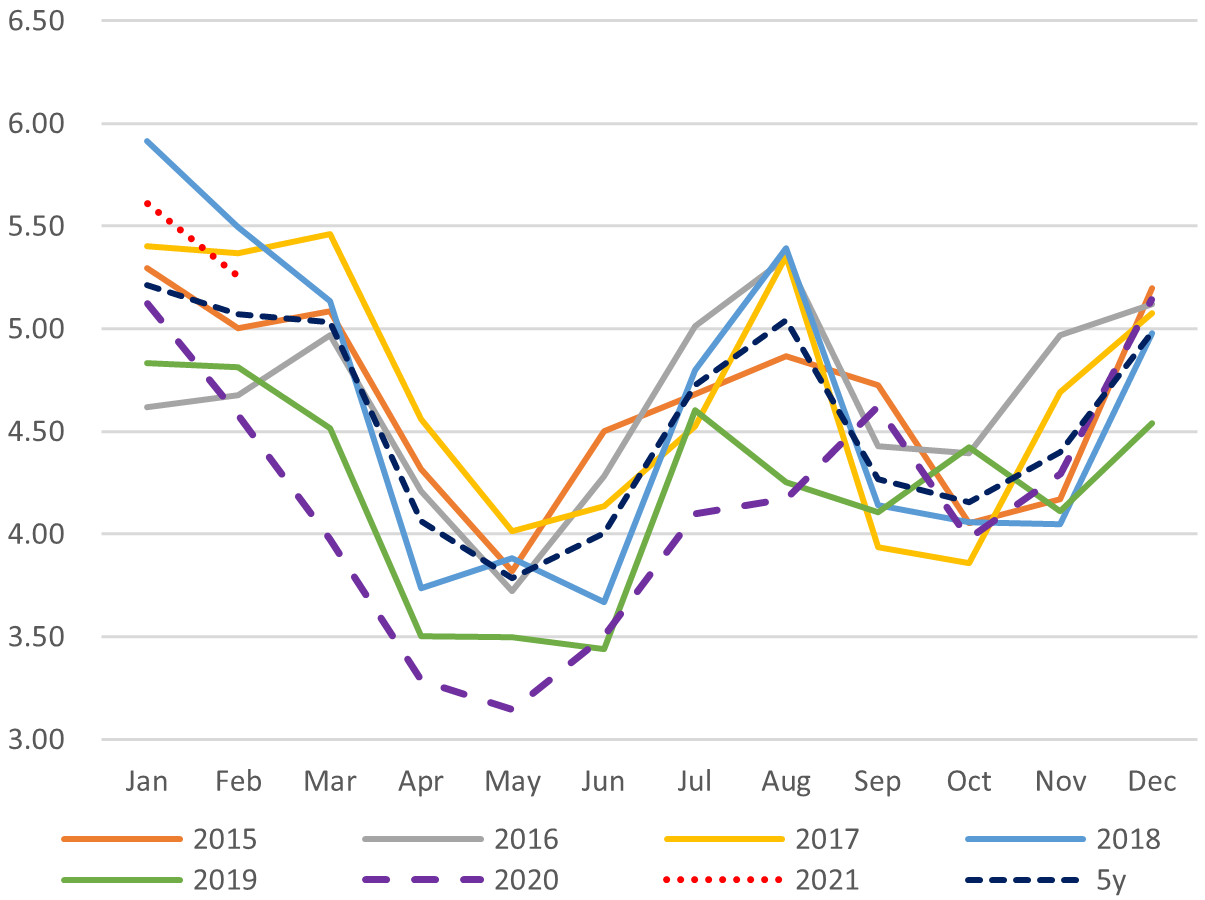
Japan Total Power Demand (GWh)
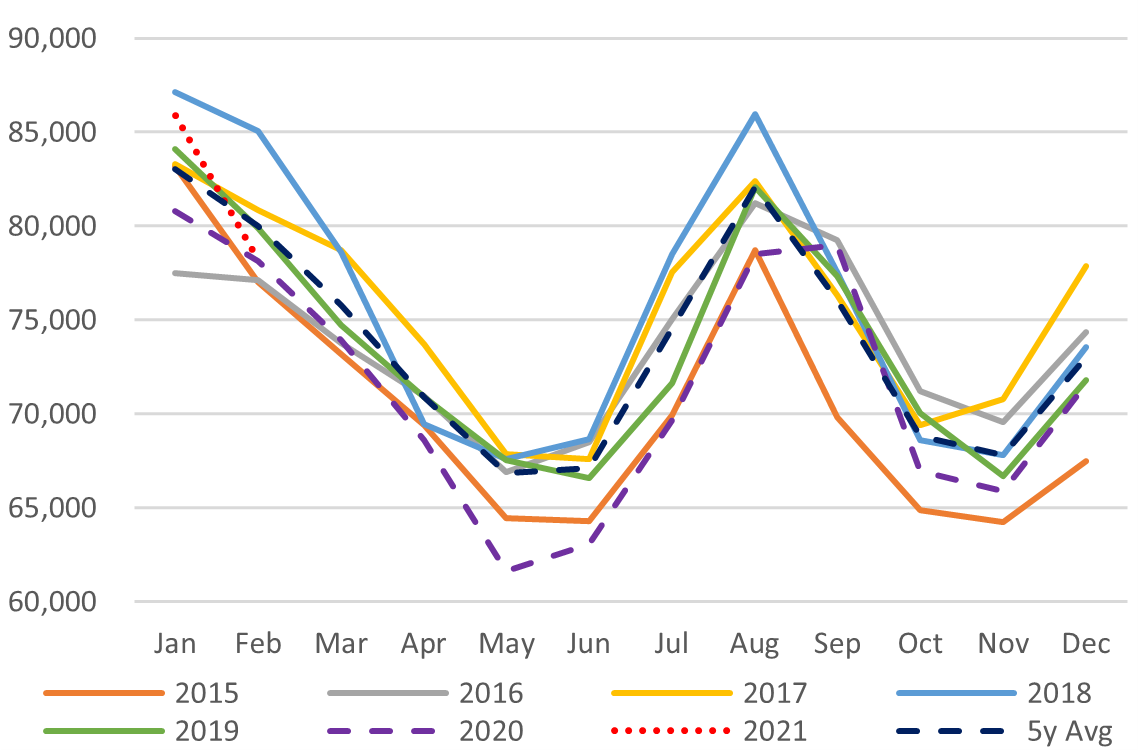
Current Vs Historical Demand (GWh)
Day-Ahead Spot Electricity Prices
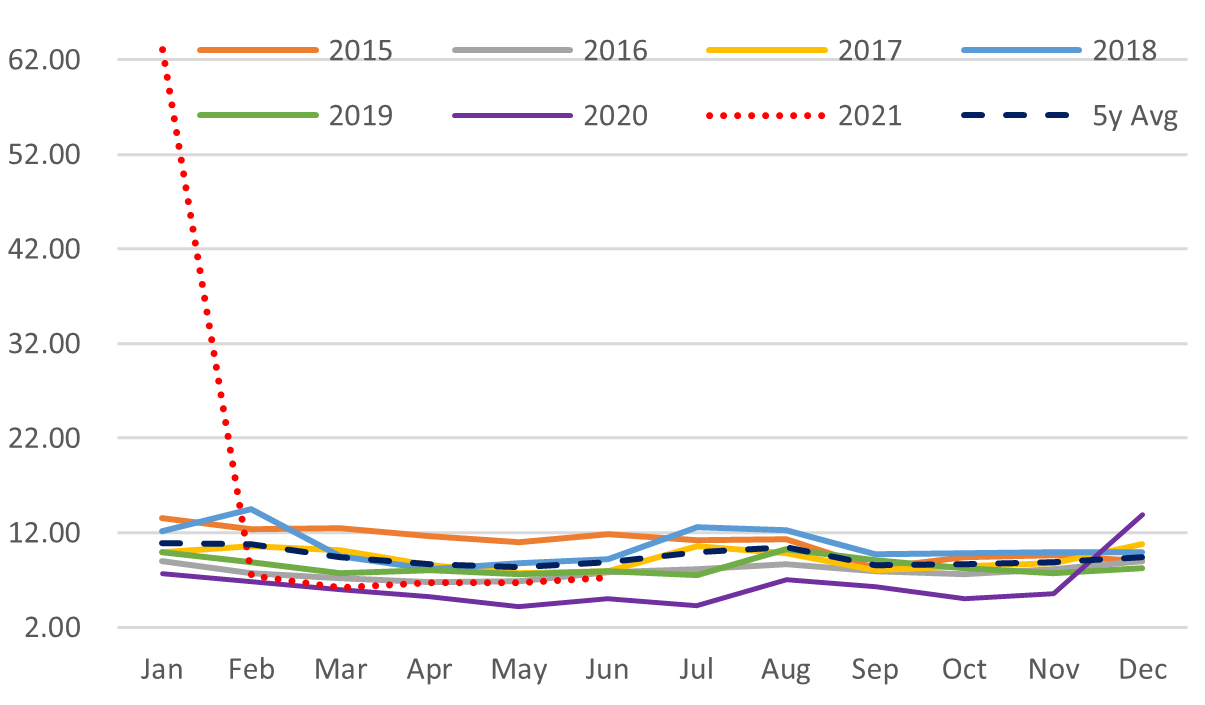
Day-Ahead Vs Day Time Vs Peak Time
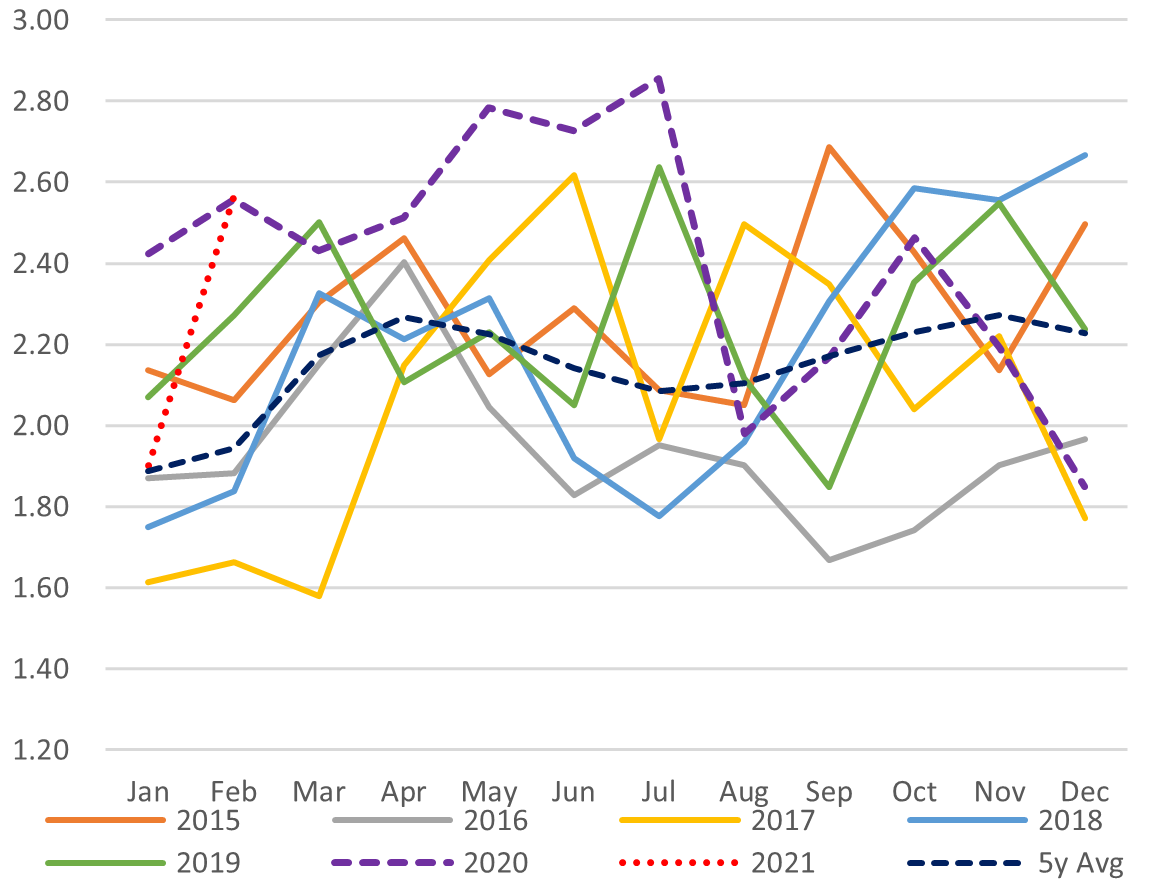
LNG Imports by Electricity Utilities
LNG Stockpiles of Electricity Utilities
SOURCES: Ministry of Economy, Trade, and Industry (METI), and the Japan Electric Power Exchange
Disclaimer
This communication has been prepared for information purposes only, is confidential and may be legally privileged. This is a subscription-only service and is directed at those who have expressly asked K.K. Yuri Group or one of its representatives to be added to the mailing list. This document may not be onwardly circulated or reproduced without prior written consent from Yuri Group, which retains all copyright to the content of this report.
Yuri Group is not registered as an investment advisor in any jurisdiction. Our research and all the content express our opinions, which are generally based on available public information, field studies and own analysis. Content is limited to general comment upon general political, economic and market issues, asset classes and types of investments. The report and all of its content does not constitute a recommendation or solicitation to buy, sell, subscribe for or underwrite any product or physical commodity, or a financial instrument.
The information contained in this report is obtained from sources believed to be reliable and in good faith. No representation or warranty is made that it is accurate or complete. Opinions and views expressed are subject to change without notice, as are prices and availability, which are indicative only. There is no obligation to notify recipients of any changes to this data or to do so in the future. No responsibility is accepted for the use of or reliance on the information provided. In no circumstances will Yuri Group be liable for any indirect or direct loss, or consequential loss or damages arising from the use of, any inability to use, or any inaccuracy in the information.
K.K. Yuri Group: Oonoya Building 8F, Yotsuya 1-18, Shinjuku-ku, Tokyo, Japan, 160-0004.