
JAPAN NRG WEEKLY
JUNE 14, 2021
JAPAN NRG WEEKLY
June 14, 2021
NEWS
TOP
- Energy Basic Policy plan publication delayed, maybe till autumn:
- Major govt. disagreements over fate of nuclear generation
- Political infighting inside ruling party spills over into energy
- Renewables supporters push back against “expensive” tag
- Ex-PM Abe-led group proposes subterranean nuclear plants
- Govt. wants Japan to top international hub for green bonds
ENERGY TRANSITION & POLICY
- High-profile lawmakers form group to support zero-carbon steel
- Govt. mulls ranking municipalities based on carbon neutrality
- Study shows 60% of Japan’s sectors behind CO2 reduction goals
- METI to launch CCUS forum for ASEAN countries later this month
- Toshiba trials carbon capture in at biomass plant in Kyushu area
- Mitsubishi Power to have zero emission hydrogen turbine in 2027
- Japan researchers develop process to make plastic from CO2
- University invents new catalyst for hydrogen to replace platinum
- Toyota begins Singapore trial of biodiesel made from cooking oil
- Toray and TEPCO begin pilot of power-to-gas for green hydrogen
- Chugoku Electric invests in storage batteries control technology
- New tech to lower cost of hydrogen filling stations … [MORE]
ELECTRICITY MARKETS
- TOCOM seeks jump in power futures trading parties, volumes
- Coal, oil plants fail to curtail power as asked citing safety concerns
- IEEJ: Japan’s economically viable renewables capacity is ~1.1TWh
- Hitachi seeks to develop HVDC business in Japan with new tech
- Toshiba group tests a 1.2 GW clean power aggregation scheme
- TEPCO: Fukushima water tanks need replacing due to damage
OIL, GAS & MINING
- Japan aims to be self-sufficient in copper, other metals by 2050
- Conditions growing ripe for a surge in natural gas prices
- ENEOS to issue $2.8B in hybrid bonds to fund diversification
ANALYSIS
TOYOTA-BACKED FIRM FINDS COST-EFFECTIVE WAY TO MAKE HYDROGEN FROM ALUMINUM
Due to the vast amounts of power required to produce each ingot, aluminum is known as ‘electricity in metal form’. Now, scientists hope aluminum can give back some of that energy and become one more resource in the arsenal of clean energy. A Japanese aluminum firm backed by Toyota Motor has successfully tested a method to generate hydrogen from the metal’s castoffs, and at a cost on par with specialist hydrogen manufacturers. This development might have significant ramifications for Japan’s energy sector, and especially for the country’s goal to reduce carbon emissions by 2030, as well as by 2050.
CYBER SECURITY A GROWING CONCERN FOR JAPAN’S ENERGY INFRASTRUCTURE AS ATTACKS ON THE RISE
Japan’s preparedness for cyber attacks against its energy infrastructure remains low and the issue will only become more urgent as the country moves to a clean energy economy, industry experts warn. Last month, Toshiba, a major nuclear equipment supplier, became the latest Japanese firm to reveal that its systems were breached amid a dramatic surge in ransomware attacks against the nation’s companies. Toshiba’s adversary was DarkSide, the same group that committed the high-profile takedown of Colonial Pipeline in the U.S. A shift to clean energy will only increase the digitalization and remote connectivity of Japan’s power grids and other crucial energy areas.
GLOBAL VIEW
Korea announces plans to work on floating nuclear plants. Iraq to build 8 nuclear reactors. G7 launch a Belt & Road rival scheme. Biofuel demand surges in the U.S. Hawaii CO2 readings are at highest in 65 years. And, global oil prices surge to 2018 levels.
Details on these and more in our global wrap.
EVENT CALENDAR / DATA SECTION
JAPAN NRG WEEKLY
PUBLISHER
K. K. Yuri Group
Sponsored
Editorial Team
Yuriy Humber (Editor-in-Chief)
Tom O’Sullivan (Japan, Middle East, Africa)
John Varoli (Americas)
Regular Contributors
Mayumi Watanabe (Japan)
Daniel Shulman (Japan)
Takehiro Masutomo (Japan)
Art & Design
22 Graphics Inc.
SUBSCRIPTIONS & ADVERTISING
Japan NRG offers individual, corporate and academic subscription plans. Basic details are our website or write to subscriptions@japan-nrg.com
For marketing, advertising, or collaboration opportunities, contact sales@japan-nrg.com
For all other inquiries, write to info@japan-nrg.com
OFTEN USED ACRONYMS
METI The Ministry of Energy, Trade and Industry
ANRE Agency for Natural Resources and Energy
NEDO New Energy and Industrial Technology Development Organization
TEPCO Tokyo Electric Power Company
KEPCO Kansai Electric Power Company
EPCO Electric Power Company
JCC Japan Crude Cocktail
JKM Japan Korea Market, the Platt’s LNG benchmark
CCUS Carbon Capture, Utilization and Storage
mmbtu Million British Thermal Units
mb/d Million barrels per day
mtoe Million Tons of Oil Equivalent
kWh Kilowatt hours (electricity generation volume)
NEWS: ENERGY TRANSITION & POLICY
Politics is taking over energy strategy: New Energy Plan may be delayed
- The publication of Japan’s most eagerly awaited Basic Energy Plan in recent decades was initially scheduled for May. Then, it became June. Or, possibly early July…. The latest news reports suggest the Plan may not arrive until autumn.
- This has a number of repercussions. Prime Minister Suga must call a general election by November and before that has to win over his own party, the ruling LDP, to extend his leadership terms. If the Basic Energy Plan is not ready by early September, it may struggle to debut until late 2021.
- Proximity to elections cause politicians to discard or delay unpopular policies, which in Japan include the utilization of nuclear generation.
- Meanwhile, Japan will need to go to the COP26 meeting in Glasgow (the start of November) with an energy strategy that backs PM Suga’s key pledges from the last six months. Namely, the promise to achieve net-zero 2050 and a 46% emissions reduction by FY2030 in Japan.
- Without a defined role for nuclear, PM Suga will have a bigger “hole” in the power mix that would need to be filled by 2030 with other CO2-free energy sources.
- The reasons for the current delays to the publication of the Basic Energy Plan are cited as internal differences over the government’s stance on nuclear. This debate has been brewing for months, but it is not the only cause of the delay.
- Internal ministerial conflicts over the energy mix happen often, but the latest iteration of the Basic Energy Plan, which is updated every three years, has become embroiled in Big Politics. The Plan is now part of a growing struggle between various top figures withing the ruling LDP.
- One of the big fights is playing out between former PM Abe, allied with current deputy PM Aso and Amari Akira, head of the LDP’s powerful tax commission. The three men, known as the “Three As” and are in direct confrontation with LDP Secretary-General Nikai (nicknamed “2F”). Current PM Suga won his position largely thanks to early support from Nikai. However, Suga was the Chief Cabinet Secretary to Abe for his entire term.
- These political standoffs have a direct impact on the energy industry. For example, Abe has become a senior advisor or chairman to several new energy groups, including new task forces overseeing Japan’s battery and semiconductor industries, and a caucus lobbying for the building of new nuclear plants in the country.
- Implications will extend to national security, including for energy supply chains and the sourcing of energy infrastructure overseas. The domestic automobile industry, the rollout of EVs and fuel cell vehicles are also at stake.
- The existential debate over nuclear energy is now central to many of the disagreements, none more than how much Japan’s energy supply should come from variable renewable sources like solar and wind. In an example of how that battleground is progressing, it is worth keeping an eye on the discourse around the findings published by The Research Institute of Innovative Technology for the Earth (RITE). As reported in the May 10 edition of Japan NRG Weekly, RITE modeled several scenarios for Japan’s energy mix and found that a strategy based on 100% renewables would be the most costly and impractical. These findings have now been aggressively challenged by the task force under Kono Taro, one of the key Cabinet members of PM Suga’s administration, the Renewable Energy Institute (REI), and the Kiko Network, among others.
- Finally, the current COVID-19 vaccination drive, upcoming Tokyo Olympic and Paralympic Games, and the Tokyo metropolitan elections in July could all play a role.
- For Japan, the biggest risk will be progress on energy policy stalls and the new edition of the Basic Energy Plan is either vague, overly general, or late. With carbon price / tax policies likely to emerge in the EU, China and maybe the U.S. in the course of the year, Japan simply cannot put off making the hard decisions on its energy strategy.
- SIDE DEVELOPMENT:
Japan may delay publication of the new Basic Energy Plan
(Nikkei, June 12)- The METI is struggling to formulate a medium to long-term energy plan due to divisions within the government and the ruling party, mainly centered on what role nuclear power plants will play in decarbonization of the country.
- An outline of the plan was due in May, and then in June ahead of the G7 Summit, but neither deadline was met. It’s possible that it will now be formulated after the House of Representatives election in autumn.
- Evidence of how Japan will actually decarbonize is not yet forthcoming.
- The METI would like nuclear to form at least 20% of the power mix in 2050. However, to reach that target new reactors will need to be built. Without evidence from the govt. that it is committed to such a path, industry know-how may be lost.
- The Komeito party, a partner in the ruling coalition, has put forward a proposal that says Japan should wean itself off nuclear power.
- SIDE DEVELOPMENT:
LDP group calls for prioritization of nuclear energy
(Denki Shimbun, June 11)- A group of LDP diet members campaigning for the promotion of nuclear power will meet with representatives of the Agency for Natural Resources and Energy on June 14 to ask what is likely to be included in the upcoming revision to the government’s Basic Energy Plan.
- While the group lobbied the government in April to include a commitment to maximize utilization of nuclear energy in the Plan, the phrase “maximize utilization” was later removed from the draft.
- SIDE DEVELOPMENT:
LDP faction lobbies to build nuclear power plants underground
(Group statement, May 21)- A group of LDP diet members that includes former PM Abe met to discuss the benefits of building nuclear power plants deep underground, as well as related issues to introduce such a technology.
- The group sees many advantages to situating nuclear plants in artificial caverns deep underground. There’s no need for the local municipalities that host such plants to prepare evacuation plans, and underground facilities are exempt from mandatory anti-terrorism measures.
- Such a facility would be also more resilient to earthquakes, and the rock surrounding the plant would provide natural radiation shielding.
- The group says that recent advances in tunneling technology mean that construction costs need not be significantly higher than for traditional plants.
- SIDE DEVELOPMENT:
RITE’s modeling of a surge in electricity prices due to using 100% renewables is challenged
(Kiko Network, June 8 and REI, June 10)- One of Japan’s most prominent environmental NGOs, Kiko Network, hosted an online event to discuss the recently published report by RITE, which said the country’s electricity prices would double or quadruple with greater use of renewable power.
- The NGO argues that the calculations by RITE do not reflect all the hidden costs of nuclear power and carbon capture, thus making it seem as if keeping nuclear reactors and thermal power plants online is the more efficient option.
- The Renewable Energy Institute in Japan questioned the veracity of RITE’s cost calculations. The institute said the researchers at RITE focused too much on days with cloudy weather or no wind, which do not give a fair representation on the contribution from variable renewable sources as a whole.
- The institute also claimed RITE used different assumptions for solar power costs from the METI, and also doubted that the assumed number of new nuclear reactors would be built in Japan.
- Finally, the institute cast doubt on RITE’s idea that Japan will export large volumes of CO2 for storage overseas after the emissions are captured at fossil fuel burning facilities.
- SIDE DEVELOPMENT:
New Japanese battery alliance calls for more state funding and industrial policies
(XTech Nikkei, June 11)- A new LDP task force was set up, aiming to improve the competitiveness of Japan’s battery industry. The body is chaired by veteran lawmakers Amari and has former PM Abe as an advisor.
- Industry members who spoke at the task force’s inaugural meeting said the Japanese battery makers and materials suppliers are on the cliff edge and need much greater funding and state support for the rollout of EVs in the country. The slow uptake in EVs has hurt the domestic battery industry.
- Both Amari and Abe said the industry, which is key to power generation as well as EVs, needs state support and cannot be left to fend for itself when competing globally.
- The task force agreed to make sure battery projects are promoted to the new state-backed Green Innovation Fund, that the government does more to help Japanese manufacturers build out global supply chains for storage batteries and to grow exports to Europe and other regions. Measures to popularize EVs and in the power industry the uptake of Virtual Power Plants (VPPs) should also be taken.
- SIDE DEVELOPMENT:
Government unveils updated core economic policies focused on clean energy
(Japan NRG, June 9)- The government unveiled this year’s Basic Policies for Economic and Fiscal Management and Reform, also known as “big bone” or core focus policies. They include making green financing a priority and mandating a reduction in the use of natural gas in order to meet 2030 and 2050 decarbonization targets.
- Green investment is supposed to drive development of offshore wind, hydrogen and storage battery technologies.
- Japan aims to become the world’s top International Green Finance Center in trading of green bonds.
- The document said the government will also seek to design a Green GDP framework, a new concept.
- The policy stated that renewable energy will be the main energy source for Japan. It also reiterated that thermal power should be tied to carbon capture and recycling. The need to pursue hydrogen and ammonia was also confirmed.
- The policy noted that effort should be made to reduce dependency on nuclear power, while the restart of nuclear reactors should be based on top safety considerations. The need to pursuing R&D into ultra-safe nuclear reactors was also included.
- The government also pledges to increase foreign direct investment to ¥80 trillion by 2030, accounting for 12% of the Japan’s GDP. Target areas for FDI include joint ventures with foreign partners in advanced semiconductors, offshore wind power generation systems and components, and other areas relevant to green energy and digitalization.
Japanese lawmakers to form group to support zero-carbon steel
(Sankei Shimbun, June 7)
- Ruling party lawmakers will establish a new federation to support steelmakers efforts to achieve carbon neutrality. Key group members include Hosoda Hiroyuki, the former LDP deputy secretary-general, and Harada Yoshiaki, the former Minister of Environment.
- The federation is due to be officially inaugurated on June 11. It will bring together the government and research organizations to support the decarbonization initiatives of steel and heavy industries.
- Steelmakers release significant volumes of carbon and are also potentially a huge hydrogen consumer. METI studies showed the steel sector will require 7 million tons of hydrogen to decarbonize, on par with the requirement of the power sector seen at 5-10 million tons.
- Steelmakers have also been vocal critics of government measures, notably the carbon tax.
Japan government mulls ranking municipalities based on carbon neutrality
(Japan NRG, June 7)
- The Japanese Cabinet unveiled a Regional Decarbonization Roadmap to drive carbon neutrality initiatives at municipalities. The plan calls for a competition mechanism to speed up decarbonization.
- The government will rank municipalities’ activities, and this may push some to achieve full carbon neutrality earlier. The Cabinet targets 100 zero-carbon municipalities by 2030.
- Other plans include installing solar panel rooftops where possible, energy efficient housing, electric and fuel cell vehicles, and the launch of food loss prevention programs. The “Conference for Decarbonization at National and Local Levels” will formalize the carbon neutrality plan during a meeting at the prime minister’s office in coming weeks.
Government study shows 60% of sectors behind 2030 emission goals
(Japan NRG, June 7)
- A joint study by METI and the Ministry of Environment showed that over half of Japanese industries were behind in their FY2030 carbon reduction goals.
- The ministries studied progress in 44 sectors in FY2019 to achieve their FY2030 reduction goals. 17 sectors met their 2019 targets for long-term goals; 23 reported CO2 reductions from the previous year but did not reach their 2019 targets; two sectors saw increases in emissions and failed to reach targets.
- Two more sectors did not provide data. The study did not identify the sectors.
- For 2020, the ministries plan two decarbonization assessments, one factoring in COVID impacts and the other not.
METI plans to establish Asian CCUS network
(Kankyo Business, June 8)
- The Ministry of Economy, Trade and Industry and the Economic Research Institute for ASEAN and East Asia will convene the inaugural Asian Carbon Capture, Utilization and Storage Network forum on June 22, with the aim of establishing a carbon capture network in the greater Asian region, as well as encouraging investment in the sector, and facilitating joint research.
- The event will include workshops designed to facilitate the sharing of information and experience regarding CCUS.
Toshiba trials carbon capture tech in Kyushu, aims to broaden adoption
(SankeiBiz, June 7)
- Toshiba is trialing CO2 recovery technology at a biomass-fired power plant in Kyushu.
- The system can isolate over 600 metric tons of CO2 a day, roughly half of the plant’s output, and this can be used in gas and coal-fired power plants.
- Toshiba’s process takes advantage of the properties of amines, which absorb CO2 at low temperatures and release it again at high temperatures.
- In addition to CO2 capture, Toshiba is working on technologies to enable the gas to be used in the production of jet fuel and ethanol.
Mitsubishi’s hydrogen turbine promises zero emissions
(Sankei News, June 7)
- Mitsubishi Power plans to convert one turbine of the Magnum power plant in the Netherlands to run on pure hydrogen by 2027.
- The manufacturer’s experimental combined cycle hydrogen turbine in Hyogo has achieved efficiencies of over 64%, among the world’s highest.
- Mitsubishi Power chief engineer Tanimura Satoshi says despite having a budget over 10 times smaller than main rival GE, Mitsubishi will not allow itself to be beaten by GE in the hydrogen fired turbine market.
- Tanimura says South Korean and Chinese manufacturers are unlikely to be a threat, due to their inexperience with turbine technology.
Researchers use bacteria to create plastic from CO2
(Nikkei, June 7)
- Researchers at Hiroshima University have developed a fermentation-based technology for synthesizing acetone from CO2 or carbon monoxide.
- If scaled up, the process could synthesize around 400 kg of acetone per day from one metric ton of CO2 and 120 kg of hydrogen.
- While acetone is traditionally synthesized from hydrocarbons, the new process is environmentally friendly and has a similar cost.
- The technology has implications for carbon capture.
University of Hyogo develops new hydrogen catalyst
(Mynavi Tech, June 7)
- A team from the University of Hyogo invented a catalyst on a par with platinum in its ability to oxidize hydrogen.
- The catalyst is able to “unlock” hydrogen stored in the form of hydrazine or ammonia borane, giving it applications for fuel cells.
Toyota trials marine biofuel in Singapore
(New Energy Business News, June 7)
- In partnership with the Maritime and Port Authority of Singapore and universities, Toyota Tsusho is trialing biodiesel made from discarded cooking oil and vegetable oil in the bunker barges it charters in Singapore.
- The biofuel is manufactured by Dutch manufacturer Good Fuels.
- The trial is a first for Singapore and for a Japanese company.
Toray, TEPCO and Takaoka in power-to-gas green hydrogen trial
(New Energy Business News, June 9)
- Chugoku Toray, TEPCO Holdings, Takaoka Toko and the Yamanashi prefectural government have begun trialing a power-to-gas system to produce “green hydrogen” from solar generated electricity.
- The system splits tap water into hydrogen and oxygen using electrolysis, then uses a hydrogen-absorbing alloy to store the hydrogen generated.
- The four parties were commissioned by the state-affiliated New Energy and Industrial Technology Development Organization to pursue the project.
- They hope to scale up hydrogen production to 300 N㎥ per hour by year’s.
Toyota considers building hydrogen supply chain in Fukushima
(New Energy Business News, June 9)
- Toyota is considering transporting hydrogen generated in the Fukushima Hydrogen Research Field to filling stations, stationary fuel cells, and other users with a network of fuel-cell equipped trucks, leveraging what it calls “connected technology” to optimize fleet utilization and delivery schedules.
- Several manufacturers, retail chains, and government organizations, including Asahi, Aeon, Isuzu, Seven Eleven Japan, Denso, Family Mart, Lawson, and the New Energy and Industrial Technology Development Organization, plan to participate in the initiative.
New technology promises cheaper hydrogen filling stations
(Newswitch, June 9)
- Kaji Technology says it will release a new hydrogen compressor in FY2021 that will reduce the cost of hydrogen filling stations.
- The compressor has an output of 340 normal cubic meters per hour and a standard pressure of 82 mega-pascals.
- The government’s strategic roadmap for hydrogen and fuel cells calls for a reduction in the cost of the technology to 45% below 2016 levels by 2025.
Chugoku Electric invests in tech firm that controls storage batteries
(New Energy Business News, June 8)
- The Chugoku Electric Power company has invested in NExT-e Solutions, a provider of control technologies for storage batteries.
- The adoption of storage battery technology is seen as key to achieving carbon neutrality, and NExT-e’s technology is able to overcome the issues of inconsistent performance that often plague storage batteries.
- Chugoku Electric Power believes that by combining its own expertise with NExT-e products and services, it will be able to launch new services.
NEWS: POWER MARKETS
| No. of operable nuclear reactors | 33 | |
| of which | applied for restart | 25 |
| approved by regulator | 16 | |
| restarted | 9 | |
| in operation today | 7 | |
| able to use MOX fuel | 4 | |
| No. of nuclear reactors under construction | 3 | |
| No. of reactors slated for decommissioning | 27 | |
| of which | completed work | 1 |
| started process | 4 | |
| yet to start / not known | 22 | |
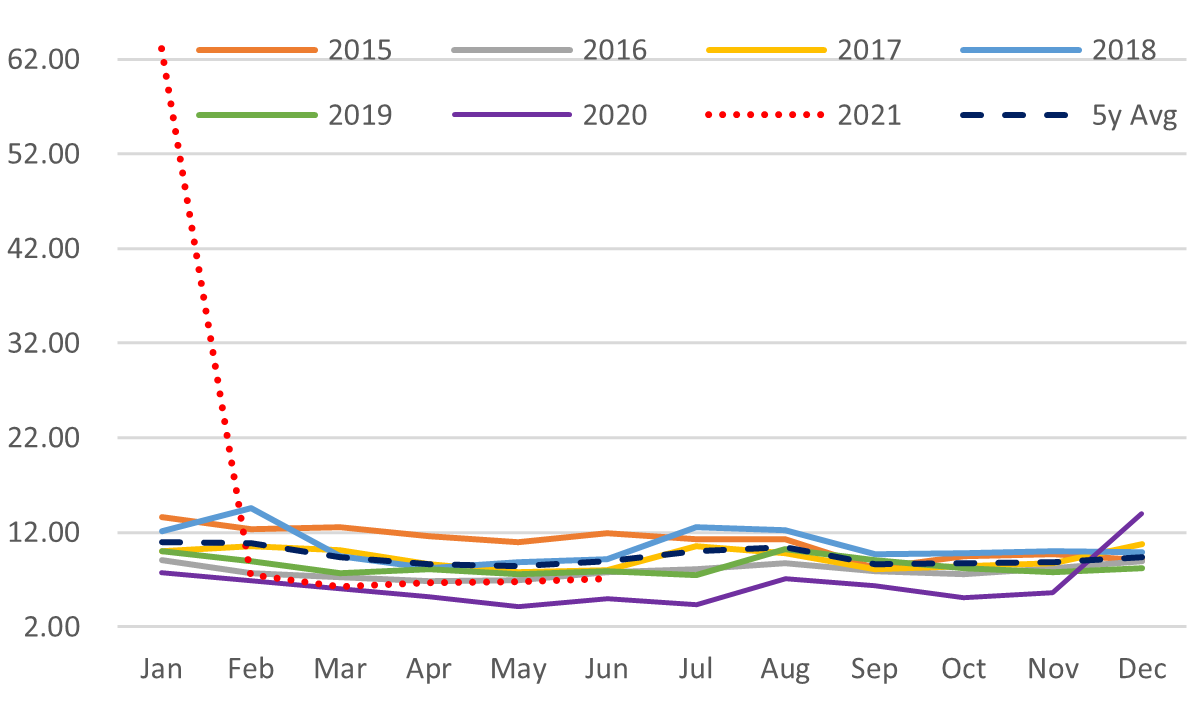
Spot Electricity Prices, Monthly Avg.
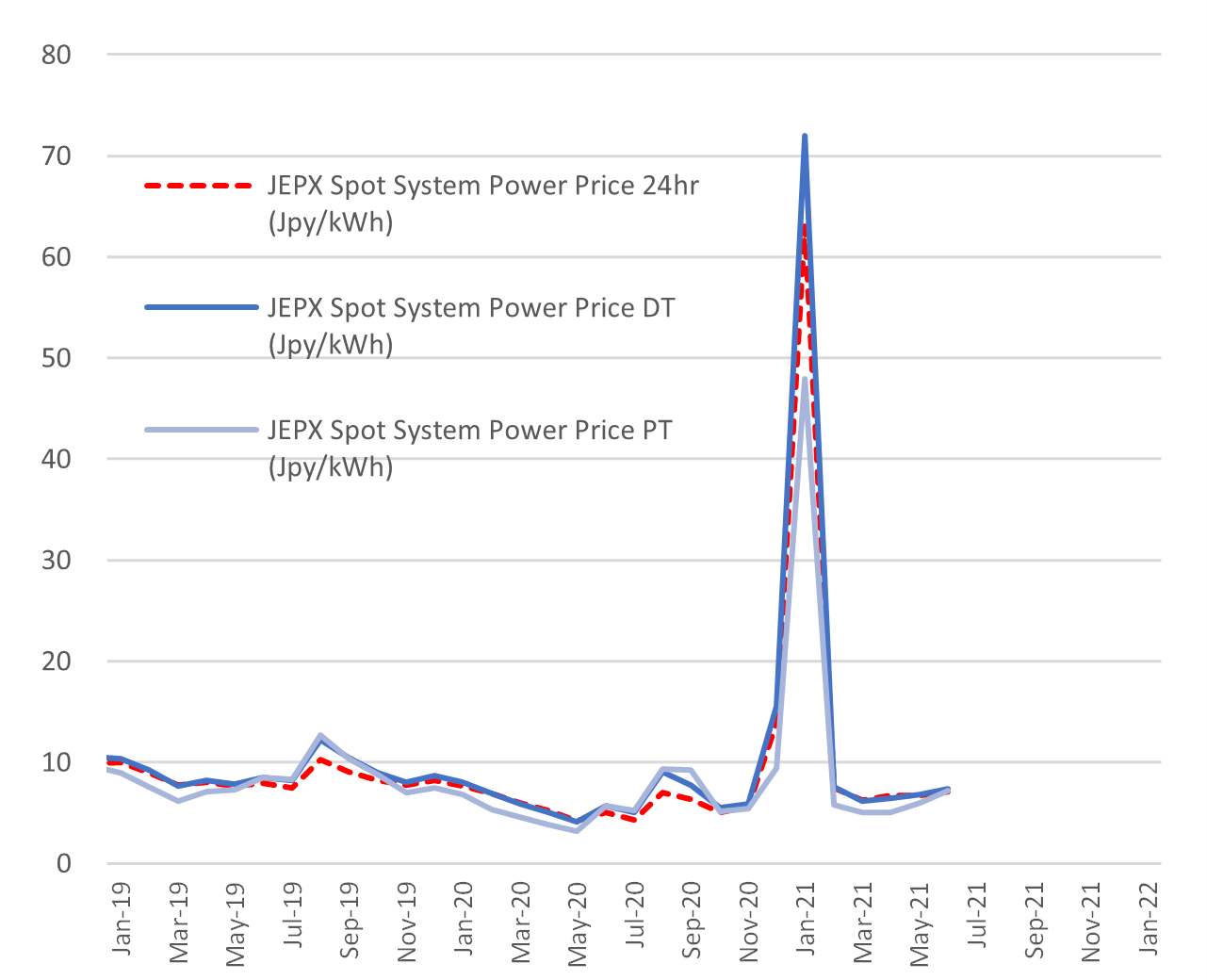
Source: Company websites, JANSI and JAIF, as of June. 9, 2021
TOCOM sees jump in power futures trading parties and volumes also surge
(Jiji, June 9)
- The Tokyo Commodity Exchange (TOCOM), which runs a marketplace for electricity futures trading, saw the number of registered market participants rise to 90 in May, a jump from 57 participants in December 2020. Of these, 75 trading accounts related to domestic power utilities; overseas power traders make up another 7 participants.
- The volume of power traded on the TOCOM gained for three straight months through May, up more than four times last year’s numbers. Contracts for about 187 GWh of electricity traded on the exchange in May, twice the power output traded a year ago.
- Another power futures marketplace, the European Energy Exchange (EEX) saw its trading volume decrease for the last two months, but it was still at 397 GWh for May, double that of TOCOM.
- Growing concern about tight power supply during the peak summer and winter periods are driving the rising futures trading volumes.
- Most of the traded contracts are tied to baseload electricity in the Tokyo area.
- TOCOM and EEX both expect the market for power futures to continue its expansion in Japan as more utilities seek to lower the risk of electricity price volatility.
TAKEAWAY: A small drop-off in volumes on the EEX recently is in part due to the market place starting to charge fees after waving them during the launch period. Still, EEX volumes continue to be high while that of rival TOCOM are growing. This indicates that the power market as a whole is in expansion mode spurred on by memories of the January power price spike and ongoing pressure from the government to have more industry participants embrace risk-hedging in their operations. The next test for the nascent power futures market may be the summer peak period.
Some thermal plants not able to cut output during power curtailment phases
(Japan NRG, June 8)
- On June 8, the energy conservation panel of Energy Research Council revealed some thermal power plants had maintained high run rates when they had been asked to curtail output. 5.1% of oil-fired plants and 5.8% of coal-fired plants were running above 50% capacities when power transmission systems were occupied.
- The plants cited safety, plant design, supply chain, as well as high costs in reforming equipment for not cutting power output. All LNG-fired plants had curtailed output below 50% in times of power over-supplies.
- Also, Tohoku Electric reported 145 requests from renewable operators for connections to their grids. The Aomori area received more requests than its bandwidth and the company will revamp transmission systems there.
How Japan aims to grow offshore wind market by a factor of 7,000 in 20 years
(Asahi Shimbun Globe, June 7)
- While Japan’s total offshore wind capacity is currently a mere 4 MW, the government aims to install up to 45 GW of offshore wind capacity by 2040.
- While power producers aim to source 60% of generation infrastructure domestically by 2040, the recent spate of manufacturers announcing their departure from the turbine market means Japan is likely to be reliant on European technology for the foreseeable future.
- Kato Jin of the Japan Wind Power Association believes that if European turbine manufacturers build factories in Japan, a local component supply market will form to meet the demand for cheap components.
- However, Kato says Japanese industrialists need to take the turbine market seriously, and realize it’s going to become a major industry in future.
IEEJ Researcher: Japan’s economic renewables capacity likely around 1.1 TWh
(Yomiuri Shimbun, June 10)
- CONTEXT: This is a column by Shibata Yoshiaki, Chief Researcher at The Institute of Energy Economics, Japan (IEEJ), one of the country’s top energy think tanks. He outlines the potential and what he sees as limitations of renewables power in Japan.
- Japan’s annual renewable electricity capacity now stands at 160 TWh, with some 18% of all electricity generated from renewable sources.
- While the government’s 2012 feed-in tariff scheme has been responsible for the rapid uptake of renewables, in particular solar, in recent years, the scheme is being phased out in favor of a feed-in premium scheme under which generators will be more exposed to fluctuations in the energy market.
- Both solar and wind energy are intermittent and variable by nature, although when electricity from multiple sources is aggregated over a wide area, fluctuations in supply are evened out somewhat. In Japan’s case, however, both wind and solar output tends to peak in the middle of the day, which means that these two sources alone can’t supply all electricity needs.
- To make up the shortfall at times of low supply, renewable generation must be coupled with thermal plants, whose output can be more easily controlled, as well as pumped hydro and storage batteries.
- Another problem with solar and wind power is the difficulty in forecasting prolonged still periods and low sunlight periods. For example, no one foresaw the La Niña weather patterns experienced in the summer of 2020.
- In Japan’s case, legal restrictions and the prohibitive cost of installing transmission lines and obtaining land means that while the nation is theoretically capable of installing a whopping capacity of 4 TWh of renewable (solar, wind, hydro, pumped hydro and geothermal), in reality, the maximum that can be installed economically is around 1.1 TWh. (By comparison, in 2019 Japan consumed about 1.2 TWh of electricity.)
Hitachi’s DC power grid ambitions
(Nikkei, June 7)
- In collaboration with Switzerland’s ABB, Hitachi recently rolled out a range of high-voltage direct current grid systems in Japan.
- While electricity is generally transmitted as alternating current, the establishment of a direct current grid in Japan could make it easier to transmit electricity from solar farms and other renewable sources.
- Recent technological advances mean that “self-excited” methods of DC generation are now an efficient and scalable alternative to traditional, “separately-excited” generation technology.
- Hitachi’s HVDC Light technology can transmit DC at 1000 V and above, and is capable of transmitting over 1 GW of power over hundreds of kilometres.
- Because high-voltage DC cables can be buried, they’re a cost-efficient alternative to high-tension lines and pylons.
- However, Hitachi says a lack of awareness and understanding of the technology in Japan means the take-up of the technology lags Europe.
Toshiba consortium to aggregate 1.2 GW of renewable capacity
(Kankyo Business, June 10)
- On June 9, Toshiba Next Kraftwerke began evaluating a renewable energy aggregation scheme that would see a consortium of 28 corporations centrally control a large number of renewable generation plants, with the aim of maximizing revenue and reducing imbalance risk.
- Toshiba Next Kraftwerke draws on the experience of Germany’s largest virtual power producer, Next Kraftwerke, and will offer insurance services as a means of hedging risk.
- The trial comes in response to a public tender held by the Ministry of Economy, Trade and Industry. Participants include Toshiba Energy Systems, the Japan Weather Association, and Tokyu Land Corporation.
- Hokkaido Electric Power and Chugoku Electric Power will also participate in the scheme, and will explore the possibilities of agricultural biogas generation and solar/energy storage systems, respectively.
- SIDE DEVELOPMENT:
Toshiba VP on challenge of reducing emissions
(Sankei, June 7)- Toshiba Vice President Hatazawa Mamoru says that, unlike its competitors, Toshiba Energy Systems is able to provide its own generation, transmission and energy management solutions, enabling it to solve any manner of infrastructure challenge without relying on third parties.
- Hatazawa is hopeful that carbon capture utilization and storage, as well as power-to-gas technologies, will come into their own in the near future.
- Toshiba will invest ¥160bn in decarbonization through FY2022.
- While Toshiba has withdrawn from overseas nuclear energy projects, the company will continue serving Japanese clients because it’s one of the few manufacturers with expertise in nuclear power stations.
Fukushima storage tanks to be replaced over leakage concerns
(NHK, June 7)
- TEPCO says it will replace some of the tanks used to store contaminated water on the site of the Fukushima Daiichi nuclear disaster over concerns that exposure to radiation has compromised the tanks’ integrity.
- The Nuclear Regulation Authority says exposure to radiation is causing the tanks’ polyethylene lining to degrade more quickly than was initially expected, causing a risk of leakage.
- SIDE DEVELOPMENT:
Only Kobayashi can save TEPCO
(Nikkei, June 7)- METI officials expressed relief at Mitsubishi Chemical Holdings chair Kobayashi Yoshimitsu’s agreement to take over as the chair of TEPCO Holdings, saying Kobayashi was “the only person for the job.”
- The post was vacant since former chair Kawamura Takashi retired in June.
- While Kobayashi initially turned down the offer, saying that he would prefer to just sit on the board, METI officials convinced him that he needed to head up the operation to make a difference.
NEWS: OIL, GAS & MINING
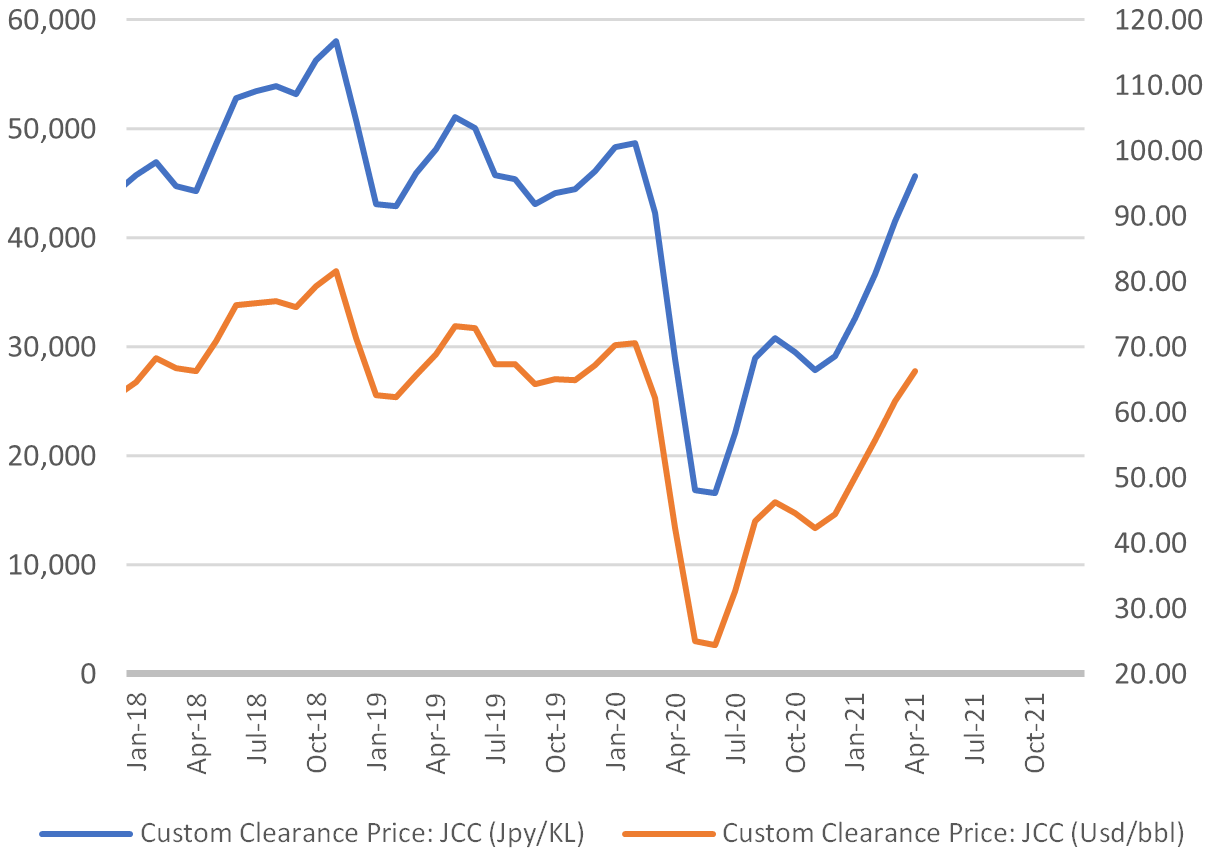
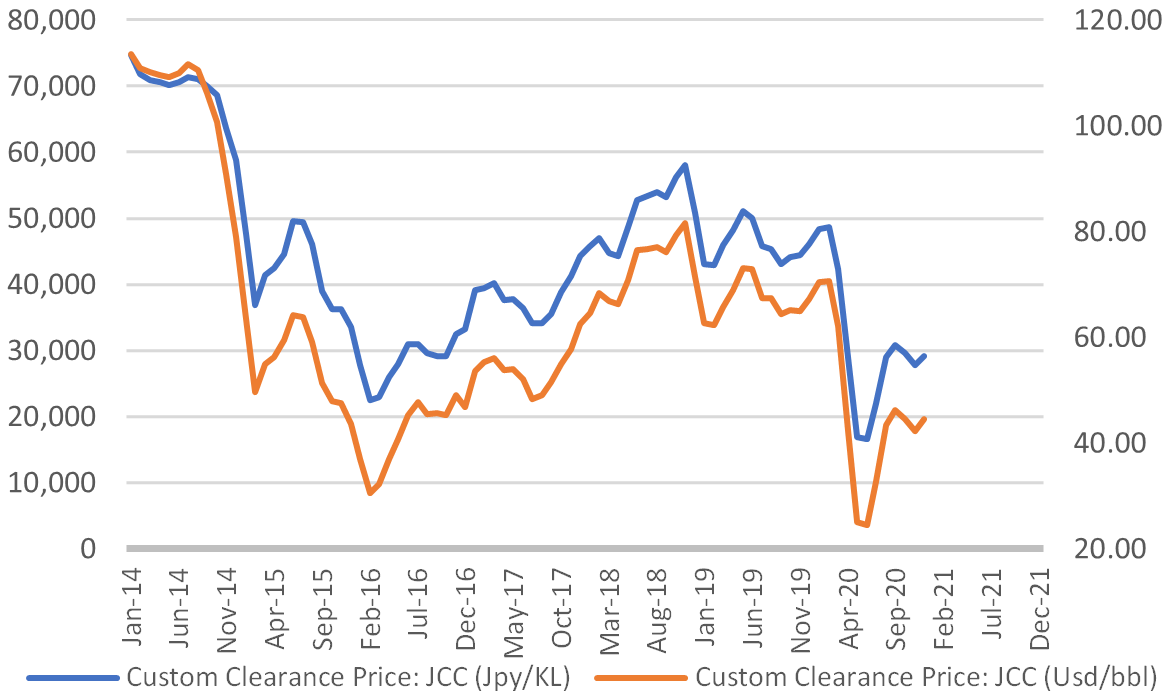
Japan Oil Price: $66.26/ barrel
¥ $
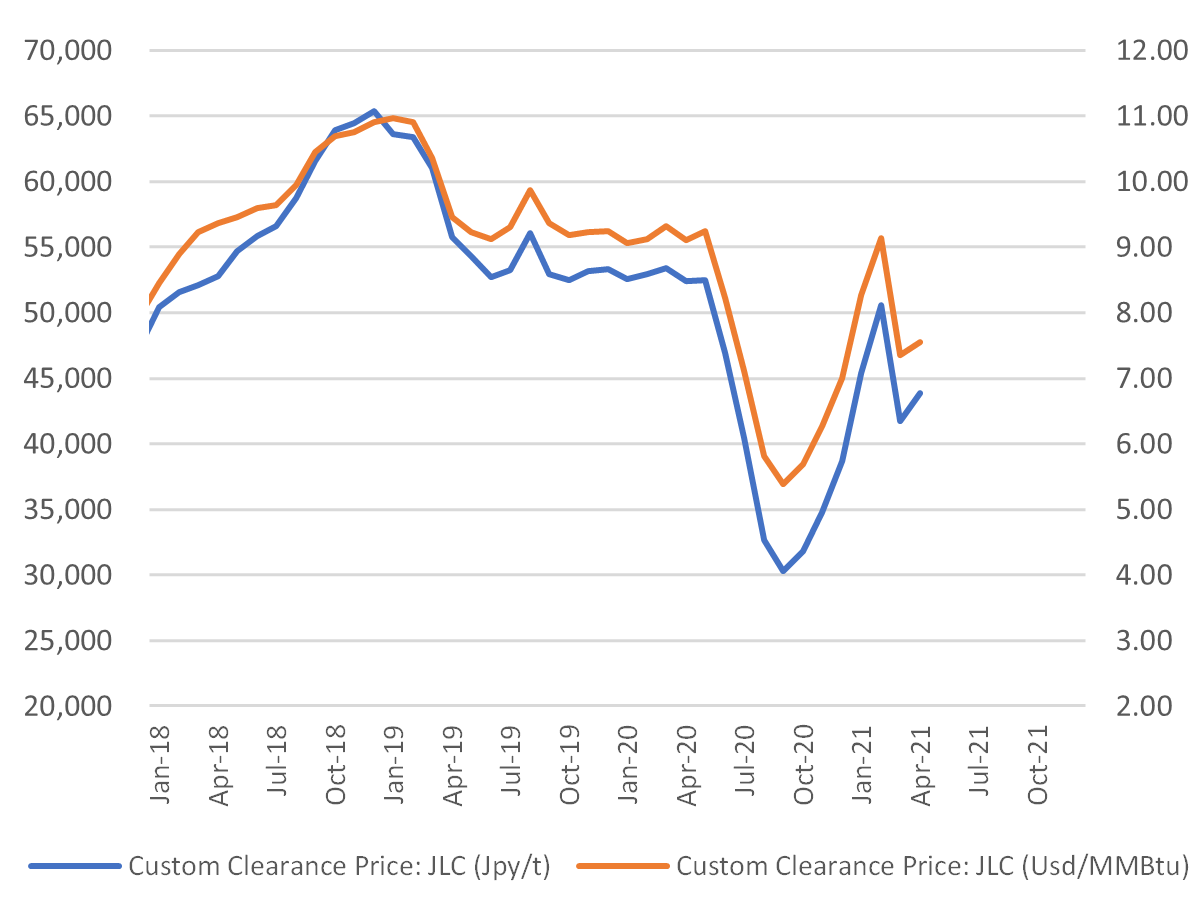
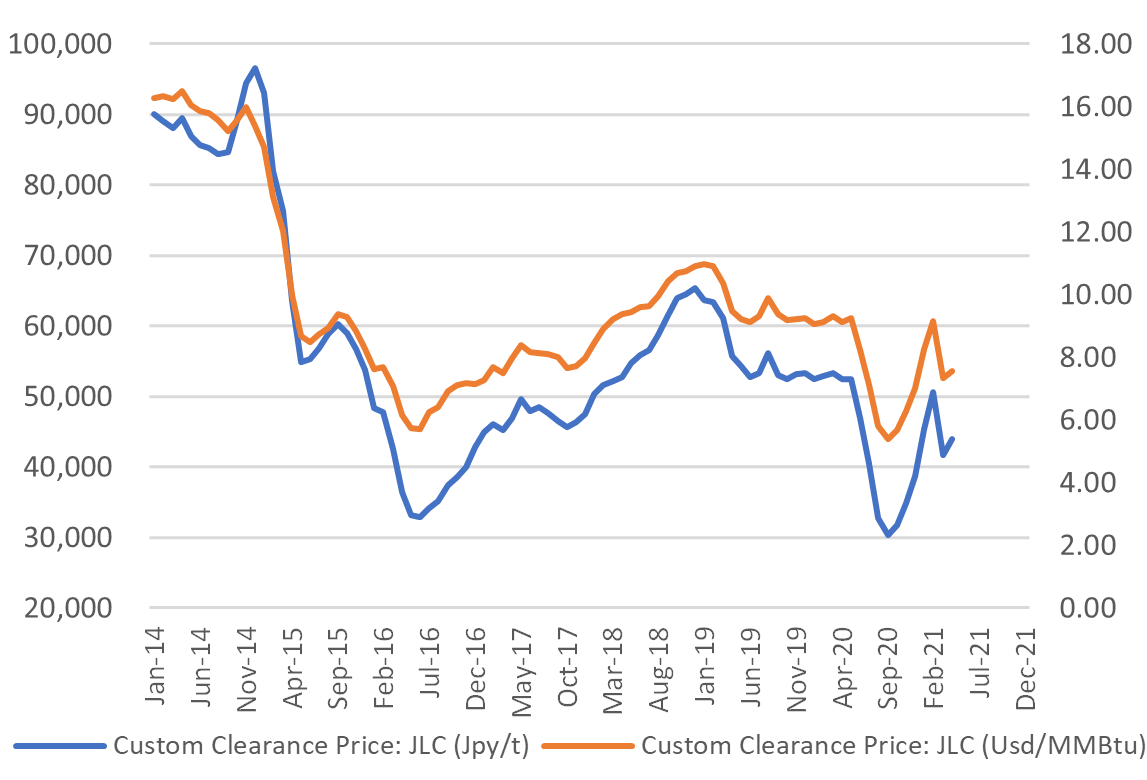
Japan (JLC) LNG Price: $7.56/ mmbtu
¥ $
Japan aims to be self-sufficient in copper by 2050
(SankeiBiz, June 7)
- On June 7, the government announced plans to make Japan self-sufficient in copper and other nonferrous metals by 2050.
- Japan currently depends on imports for around half of these resources.
- As users of other energy sources switch to electricity in an effort to reduce greenhouse gas emissions, demand for electrical wires is driving up the price of copper.
- Electric vehicle manufacture is also copper intensive, with EVs on average requiring three times more copper than their gasoline counterparts.
- Increasing Chinese demand for the commodity has led to concern those future shortages could jeopardize Japanese plans to electrify infrastructure.
TAKEAWAY: Wishing to be self-sufficient and actually achieving it are quite different things. The news shows at least that the government is becoming away of the critical raw material supply shortages that are propping up all over the world. However, Japan’s current strategy seems skewed towards hoping there will be enough recycled metal to maintain future production.
Conditions ripe for surge in gas prices
(Business Journal, June 7)
- On June 7, oil futures momentarily reached $70 a barrel, amid bullish forecasts for a post-Covid economy and reluctance by OPEC and Russia to increase supply.
- While the International Energy Agency had stated demand for crude would not recover until 2023, it recently revised this forecast, and is now saying demand will recover in the next year.
- If tight supply in the U.S. combines with geopolitical risks in the Middle East, the price of crude could easily go above $100 again.
ENEOS to raise ¥300 billion in bond issue to invest in decarbonization, materials
(Nikkei, June 4)
- ENEOS Holdings says it is issuing ¥300 billion of hybrid bonds.
- Amid poor prospects for the growth of the company’s petroleum business, the funds raised will be invested in hydrogen renewables, materials development, and debt repayment.
- ENEOS has an A+ rating from R&I.
ANALYSIS
BY MAYUMI WATANABE
Toyota-backed firm hopes to utilize aluminum to produce hydrogen-based energy
Due to the vast amounts of power required to produce each ingot, aluminum is sometimes known as ‘electricity in metal form’. Now, scientists hope aluminum can give back some of that power and become one more resource in the arsenal of clean energy.
A Japanese aluminum firm backed by Toyota Motor has successfully tested a method to generate hydrogen from the metal’s castoffs, and at a cost on par with specialist hydrogen manufacturers. This development might have significant ramifications for Japan’s energy sector, and especially for the country’s goal to reduce carbon emissions by 2030, as well as by 2050.
Alhytec Ltd., a company based in the Toyama prefecture, says it can already produce enough hydrogen each hour to power a fuel cell vehicle (FCV) for a total run of 700 km. While such capacity is still modest, it’s a milestone for Toyota, Japan’s leading maker of FCVs, as well as for the government’s effort to shift the transport sector toward electric and hydrogen power, away from gasoline.
Aluminum is an energy intensive metal, with electricity comprising an estimated 30-40% of its production costs. Anywhere between 12,500-15,000 kWh of power is needed to turn two tons of white granule alumina into a ton of silver aluminum metal. Alumina is processed from red-colored bauxite mineral, consuming roughly 2,250 kWh to convert four tons of bauxite into a ton of alumina.
Japan has no reserves of bauxite, nor alumina, nor aluminum plants. Resourceful Japanese technology venture firms are not daunted, however, and instead are exploring ways to produce energy from aluminum scrap and waste, making use of aluminum’s innate capability to separate hydrogen from water.
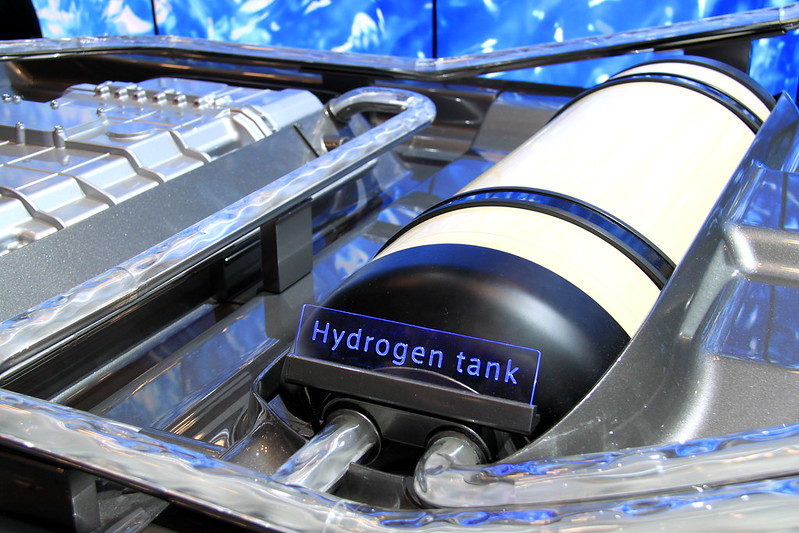
“Toyota hydrogen fuel cell at the 2014 New York International Auto Show” by Joseph Brent is licensed with CC BY-SA 2.0.
The separation method is as simple as soaking aluminum beverage cans in water. However, household aluminum products are coated by chemical layers to protect the metal from outside reactions, possibly causing corrosion and even explosion. Aluminum also has its own water protection mechanism, and automatically forms a layer of aluminum oxide on the surface. This prevents chemical reactions that will separate hydrogen in the water from oxygen.
For decades, research in the U.S., Japan and other countries explored how to prevent the formation of aluminum oxide and to uncover aluminum’s natural hydrogen production potential. Other bottlenecks were making the reaction happen repeatedly for continuous hydrogen production and the separation of gases. Even in its purest state aluminum contains iron, silicon, manganese and other elements that could generate gases.
Alhytec produces mobility-grade hydrogen
About 9-10 kilos of aluminum will produce a kilo of hydrogen. But first it’s important to be aware that there are two categories of aluminum: 1) primary or “virgin” aluminum straight from smelters; and 2) recycled “secondary” aluminum made from used cans, old window frames, and other used material. The price gap is roughly $2/kg between the super-pure 99.999% grade and the 99% recycled grade.
In May, Alhytec announced the launch of its continuous hydrogen production process using aluminum shreds generated at a manufacturing plant. The shreds were cut and reshaped for optimal chemical reaction, and were added into a solution comprised of sodium hydroxide and an unidentified catalyst.
A fuel cell vehicle requires about 5 kg of hydrogen for a full tank, according to the Japan Automobile Research Institute. ↑
Alhytec produced 5 kg of hydrogen in an hour, achieving a purity good enough to run a fuel cell vehicle[1]. The production cost, excluding that of aluminum shreds, was ¥1,000 ($9.20)/ kg, which is on par with prices of major hydrogen suppliers ENEOS and Iwatani. Toyota Motor has verified that Alhytec hydrogen was good enough for its vehicles[2].
The key to continuous production was found in the shape of the aluminum shreds; and an innovative technique effectively prevented air contact with the aluminum feedstock before dumping it into a solution that would not depreciate or degrade after generating hydrogen.
The company plans to work with Toyota on scaling up the equipment capacity and commercializing the hydrogen-making machine. The output could be used to fuel small vehicles and eventually power stations.
The company also sees opportunity in the Toyama prefecture with its large community of aluminum component makers due to the nearby Russian ports of Vladivostok and Vanino, from where primary and semi-recycled aluminum are shipped to Japan. Some of those manufacturing plants might be looking for alternative ways to re-use left-over aluminum.
Using lowest-grade aluminum
According to Alhyte’s model, the feedstock comes from a plant where the production environment has been controlled, providing complete visibility into the kind of aluminum in supply. A Kyoto-based technology firm, KK DFC, is also developing a process to re-use aluminum waste for hydrogen production.
Aluminum shreds and sheets typically contain 99% aluminum and are resold for recycling. Old aluminum window panels from dismantled houses trade at about $2/kg, and at such a price there’s more incentive to resell the scrap rather than use it for hydrogen production. For example, about 10 kg of aluminum, which costs in the range of $18-20, is needed to produce 1 kg of hydrogen that retails at $9.20.
Aluminum waste with 20-30% aluminum content is found at recycling plants and incinerators. In contrast to scrap, the waste has little economical value. The 20-30% aluminum in the waste could be removed and traded like used beverage cans, but the cost of separation, which involves washing it in running water, re-sizing of the material to fit various analysis equipment, analyzing the composition of each material and crafting a different chemical treatment solution for each, would not be recouped.
DFC has tested soaking the waste in a calcium hydroxide solution to produce hydrogen. But along with hydrogen, ammonia was produced, which isn’t compatible with fuel cells.
There are other challenges to scaling up such production. The main one is the need to build a local or international supply chain. Japan does not restrict the import of waste aluminum, also known as mixed metal. China, Taiwan, Malaysia and Vietnam categorize mixed metal as environmentally hazardous material and restrict its import, but exports are not regulated.
The 20 or so aluminum recyclers in Japan would be the best source of waste supply, but many are understaffed and do not have the bandwidth to develop new business lines. Nevertheless, the country’s largest aluminum recycler, Asahi Seiren, has shown enthusiasm for the “waste-to-energy” business.
Hydrogen boom attracts interest
So far, local governments and research institutes have shied away from approving funding for DFC’s R&D into metal-to-energy applications despite the recent boom in hydrogen. Alhytec has been more fortunate. It was deemed eligible to apply for funding from Japan’s state-backed research body NEDO.
Once the gas separation technique is perfected and other commercial issues are sorted, waste aluminum could indeed become an effective technology to produce green energy and make a contribution to Japan’s efforts to slash CO2 emissions.
According to Japanese hydrogen fuel standards, gas must be of a 99.97% purity. This means controlling 14 impurities (including carbon monoxide, helium, etc.) to keep them below a certain level. ↑
ANALYSIS
BY JOHN VAROLI
Cyber attacks an Increasing Concern for Japan
As Nation Prepares to Upgrade its Energy Infrastructure
Japan’s preparedness in defending its energy infrastructure against cyber attacks remains low and the issue will only become more urgent as the country moves to a clean energy economy, industry experts warn.
Toshiba, a major supplier of nuclear equipment and other energy infrastructure, last month became the latest Japanese firm to reveal that its systems had been hacked amid a dramatic surge in ransomware attacks against the nation’s companies in the last 18 months. Toshiba’s adversary was DarkSide, the same group that committed the high-profile takedown of Colonial Pipeline, the largest pipeline for refined fuel products in the U.S.
Because of digitalization and increased remote connectivity, power grids and other crucial areas of the energy industry are increasingly vulnerable to cyber attack. So far, Japan is viewed as not having done enough to strengthen energy security and protect its grid and other infrastructure against malignant criminal and state actors.
Growing concerns in Japan
While the Colonial attack grabbed global headlines, a recent swell in cyber attacks in Japan has gone largely unnoticed. However, research by CrowdStrike, a leading international security firm, revealed that more than half of the 200 major Japanese companies surveyed had recently fallen victim to ransomware cyber attacks. About 35% of those companies paid, on average, about the equivalent of $1 million in ransom to criminal groups, according to media reports.
In some cases like the ransomware attack against Honda in June 2020, the company’s computers across the globe were affected.
The attacks are coming from both criminal groups, such as DarkSide, and state-backed actors. Many of Japan’s recent attacks, for example, targeted companies in aerospace and were judged to be likely perpetrated by hackers associated with the Chinese military.
Cyber attacks are no longer the remit of rogue nations. In June 2019, the U.S. government was implicated in energy sector cyber attacks on the Russian power grid. The attacks were ostensibly in response to alleged Kremlin hacking of America’s power system, as well as alleged Russian interference in U.S. elections, according to a report in The New York Times.
Modern power systems, including nuclear generation facilities, are more vulnerable to such attacks as they embrace digitalization and the benefits of connectivity. That makes energy infrastructure especially attractive to state-sponsored hackers, who seek to cause damage more than financial gain.
Well aware of these dangers, in May the Biden administration launched a plan to thwart adversaries and to improve security of the U.S. power grid against cyber attacks. But in this uncertain atmosphere of vulnerability, what exactly is Japan doing to improve the cyber security of its energy sector? Unfortunately, as if to underline the country’s vulnerability to attack, there’s not much to report.
Experts are almost unanimous that Japan has much work to do to improve cyber security and protect its energy sector. Arai Hisamitsu, a former vice minister for international affairs at the METI, said in a recent interview with the Nikkei that Tokyo “lacks a sense of urgency” in confronting such threats.
Arai pointed to the U.S. as an example of where the military, police and security officials work together to detect attackers’ moves, and share information with companies to forewarn them. Such intelligence exchange between the state and the private sector has yet to be formalized in Japan, according to Arai.
Japan needs to “show the international community that it is serious about defense,” Arai said in the interview.
Those sentiments are shared by other cyber defense experts in Japan. The country is “lagging significantly” compared with other leading nations when it comes to assessing current cyber threats, Nawa Toshio, a senior director at the Cyber Defense Institute in Tokyo told the Japan Times.

An image of cyber attacks in real time. Source: “Cyber attacks” by Christiaan Colen, licensed with CC BY-SA 2.0.
Recent steps forward
While all of this is deeply concerning, there have been encouraging signs that at least some major companies in Japan’s energy sector are taking action. Japan’s first big effort to boost cyber security for the energy sector came in early 2020, when the Israel Electric Corporation (IEC), that country’s top electricity provider, signed an agreement with “a top Japanese energy utility… for cyber services, including support at the Tokyo Olympics,” said Yiftah Ron-Tal, director of the IEC, and a former major general in the Israel Defense Force.
Mr. Ron-Tal didn’t disclose the company’s name, but with a significant amount of certainty we can narrow it down to either TEPCO or Kansai Electric, two of the top power utilities. Neither company has publicly commented on their cyber security relationships and strategy.
TEPCO’s Kashiwazaki-Kariwa nuclear power plant was recently plagued by security breaches, though those were not related to cyber attacks. Earlier this year, it was revealed that an unauthorized worker had entered the station’s control room in breach of security protocols.
The fact that Japan’s energy companies are reaching out to partners such as IEC is encouraging. The Israeli company claims to be “subjected to an average 11,000 suspected cyber events per second in 2019, and is one of the most targeted organizations for cyberattacks in the world.” This exceptional experience has forced the IEC to develop some of the finest cyber security measures in the world. Clearly, Japan’s energy sector will certainly benefit from such cooperation.
The rest of Japan’s energy sector needs to follow suit, and begin to address the serious threats of cyber attacks.
To date, most Japanese power companies have worried about blackouts due to fuel shortages or sudden surges of internal demand. Cyber defense is now a new front line that Japan must prepare for in order to avoid even more devastating power blackouts.
GLOBAL VIEW
BY TOM O’SULLIVAN
Below are some of last week’s most important international energy developments monitored by the Japan NRG team because of their potential to impact energy supply and demand, as well as prices. We see the following as relevant to Japanese and international energy investors.
Nuclear Power:
1). The Korea Atomic Energy Research Institute and Samsung Heavy Industries will cooperate to develop a molten salt reactor for marine propulsion and floating nuclear power plants. Samsung Heavy is also looking into the use of ammonia and hydrogen to power ships as alternative low-emission propulsion options.
2). Rosatom will submit to the Russian government a plan to invest $7 billion in new nuclear technologies by 2030. The ‘New Atomic Energy’ plan was presented for assessment to Russia’s State Council on Energy. If approved it will be included in the government’s socio-economic development strategy over the next decade and will include $2 billion of state support.
3). Unit 1 of the Ostrovets Plant, Belarus’ first nuclear power station, began commercial operation on June 10. The unit is the first VVER-1200 outside Russia.
4). Iraq is planning to build eight nuclear reactors to tackle crippling power shortages that have afflicted the country since the Allied invasion in 2003.
5). Canada’s oil sands producers have formed an alliance with federal and provincial governments to achieve net-zero greenhouse gas emissions from operations by 2050. The Oil Sands Pathways to Net Zero initiative will include an evaluation of small modular nuclear reactors as part of plans to accelerate the application of emerging emissions-reducing technologies.
6). Southern Co., the U.S. utility based in Georgia that is building the Vogle Nuclear power plant, announced that construction would be delayed by a year until Summer 2022 and would cost an additional $2 billion.
G7: Build Back Better vs. Belt & Road:
The G7 countries launched a new global infrastructure initiative, Build Back Better World (B3W), an infrastructure partnership led by major democracies to help build the $40+ trillion infrastructure need in the developing world, that has been exacerbated by the global pandemic.
The investments will be made in a manner consistent with achieving the goals of the Paris Climate Agreement.
Investments will be focused on developing economies in the Indo-Pacific, Caribbean, Africa, and Latin America.
Biofuels:
Demand for biofuels, including renewable diesel, has pushed prices of soyabean oil up by 70% in the U.S., YTD.
Wind Energy/Clean Energy Investments:
1). The Chairman of BASF and the CEO of Siemens Gamesa have called for a radical and urgent expansion of renewable energy inside the EU, including an easing of national planning rules and more energy integration in order to meet 2030 and 2050 decarbonization targets.
2). The IEA is also calling for clean energy investments in developing economies to increase by a factor of seven if the 2050 net-zero target is to be met.
Power Grid:
Texas approved new measures to deal with last January’s power outage including forcing power-plant owners to ensure fleets can operate during extreme cold weather, and forcing state agencies to map and fund critical infrastructure.
ESG:
Investors with almost $9 trillion in AUM, including JP Morgan and Fidelity, have targeted three Asian power companies, China Resources Power Holdings, Malaysia’s Tenaga, and Hong Kong’s CLP Holdings, because of their continuing use of coal-fired plants. Two Japanese companies were also targeted.
GHGs:
1). The European Court of Justice found Germany guilty of “systematically and persistently” exceeding NO2 emissions from diesel engines in 26 out of 89 regions between 2010 and 2016. The violating areas included Berlin, Hamburg, Munich, Stuttgart, and Frankfurt.
2). The U.S. National Oceanic and Atmospheric Administration reported the highest levels of C02 concentrations in 65 years at the Mauna Loa Atmospheric Observatory in Hawaii, 419 parts per million, up from 417 in May 2020. The ppm readings have been over 400 for the last seven years.
3). French anti-fraud prosecutors charged Renault and Peugeot with emissions fraud in connection with sales of their diesel automobile businesses between 2009 and 2015, and set bail and bank guarantee terms.
4). International investors controlling $41tn in assets have called for governments to end support for fossil fuels and set targets for rapid reductions in carbon emissions to limit damage from global warming. The 457 investors, who account for a third of global AUM, signed a statement calling for governments to significantly strengthen plans to cut carbon emissions in the next decade and to introduce detailed targets for net zero emissions by 2050 or sooner.
EVs:
1). A China-based EV company, SAIC-GM-Wuling Automotive Co., a JV with GM, is now the best-selling EV manufacturer in China, having sold 270,000 units of the HongguangMini YTD. The retail cost is $4,500 compared with a Tesla Model 3, which costs $39,000 in China. Tesla sold 22,000 vehicles in China in May.
2). Rumors circulated last week that Lordstown Motors, the U.S. EV truck manufacturer, might file for bankruptcy protection due to cashflow difficulties. The company IPO’d via a SPAC in October 2020 and has a market capitalization of over $2 billion. It was scheduled to commence production in Ohio in September.
Hybrid Vehicles:
A Brussels-based transportation and environmental think-tank estimates that emission reductions from use of hybrid vehicles are negligible due to weak electric motors, large engines, and slow charging.
Aviation:
Vertical Aerospace, an electric vertical takeoff and landing aircraft (eVTOL) maker, backed by American Airlines (AA) will go public in a SPAC deal valued at $2.2 billion. Vertical Aerospace has $4 billion of pre-orders for up to 1,000 eVTOL aircraft with launch customers including Avolon, AA, and Virgin Atlantic.
Archer Aviation also unveiled its first flying taxi last week.
Oil:
Oil prices continued to soar last week with WTI @ $71 and Brent @ $73 and US gasoline prices above $3 a gallon, the highest levels since 2018. $100 oil options are now the most widely owned options on the NY Mercantile Exchange with the World Bank now forecasting 5.6% economic growth this year. The IEA is predicting oil demand will recover to pre-pandemic levels in 2022. Rystad Energy is also now predicting oil demand will be 94 mbpd in 2030, falling to 36 mbpd in 2050.
Pipelines:
1). The FBI said it recovered most of the ransom paid by the Colonial Pipeline to a group known as, DarkSide. The ransom paid was 75 bitcoin or $4.4 million.
2). TC Energy cancelled the 2,000 km XL crude oil pipeline project last week that was meant to transport oil from Alberta to Nebraska.
Carbon Offset Market:
Mark Carney and Bill Winters believe that the market for carbon offsets could generate $100 billion of revenues this decade, up from $300 million in 2018 and plan to launch a new pilot program before COP26 in Glasgow in November. Some market participants are calling for these revenues to be used to construct cleaner mini-grids in developing countries.
China:
1). China Three Gorges Renewables IPO’d in Shanghai with a market capitalization of $17 billion and raised $3.5 billion.
2). China will halt subsidies for all commercial solar and onshore wind projects in 2021 due to falling manufacturing prices. Subsidies had reached $63 billion.
3). China has passed a law against foreign sanctions in response to U.S. and EU trade pressure including issues in Hong Kong and human rights in Xinjiang. Individuals or companies, including energy companies, involved in implementing international sanctions against Chinese interests could be put on an anti-sanctions list and may be denied entry into China or expelled from the country. Assets within China could be seized or frozen and the related individuals or corporations could be restricted from doing business there.
Saudi Arabia:
Saudi Arabia’s sovereign wealth fund will become the anchor investor in a new $800m Gulf infrastructure fund set up by Aberdeen Standard Investments and Investcorp.
Iran:
The U.S dropped energy sanctions on three Iranian officials and two companies as JCPOA talks proceed in the Austrian capital, Vienna. Iran will also hold a presidential election on Friday.
Russia:
Dutch energy trader Vitol will lead a consortium to acquire a 5% stake in Rosneft’s Arctic project, Vostok Oil, which has estimated reserves of six billion barrels of oil.
Africa:
1). Frazer Solar, a German solar company, started seizing offshore Lesotho assets to enforce contracts worth $60 million that the government signed to acquire and finance solar assets developed by Frazer, but the contracts were reneged on.
2). South Africa has introduced new legislation to allow companies to produce their own electricity as the country tries to deal with chronic power shortages and blackouts. Eskom, the state monopoly, currently generates over 90% of South Africa’s power requirements.
France:
The French government is calling for a reorganization of EDF, the majority state-owned nuclear energy monopoly, as it seeks higher prices for its nuclear output, and to split the operator into a nuclear/hydroelectric unit, and a ‘green’ unit.
Sweden:
Northvolt, the EV battery maker, raised $2.8 billion from investors in a private placement. VW recently signed a $14 billion order with Northvolt and is a 20% shareholder.
Italy:
Prime Minister Draghi has halted China’s Belt & Road engagement with Italy reversing the approval for some Chinese investments in the G7 country.
UK:
Britain’s banks and insurers will be tested by the UK central bank on how well-prepared they are to cope with climate change emergencies. The Bank of England will examine the risks rising temperatures and sea levels will create for the UK’s big banks and insurers. It will put 19 firms through stress tests involving three climate scenarios projected over the next 30 years.
U.S.:
1). U.S. Drought Monitor is reporting the worst drought in 20 years in parts of the Western U.S., causing severe depletions in some reservoirs.
2). DTE Energy will close all three coal-fired generating units at its Rover Rouge plant in Michigan. The units were built in 1958 and were the world’s largest at the time.
3). First Solar, the largest solar-panel manufacturer in the U.S. will build a new solar-panel plant in Ohio at an investment of $680 million, one of the largest investments in solar manufacturing in the U.S. in a decade.
Puerto Rico:
Puerto Rico suffered another catastrophic power outage this week when Luma Energy assumed responsibility for the island’s grid. It was compounded by a cyber-attack that generated two million hits per second on the company’s computer systems.
Mexico:
President Lopez Obrador maintained his Morena Party’s house majority in Mexico’s congressional mid-term elections last week, allowing him to continue with his program of nationalizing and re-regulating parts of Mexico’s energy complex. This includes Mexico’s electricity market, and rolling back energy deregulation. Lopez Obrador’s approval ratings stand at around 65% after three years in office.
EVENTS CALENDAR
A selection of domestic and international events we believe will have an impact on Japanese energy.
| February | Approval of Fiscal 2021 Budget by Japanese parliament including energy funding projects;
CMC LNG Conference |
| March | 10th Anniversary of Fukushima Nuclear Accident;
Smart Energy Week – Tokyo; Quarterly OPEC Meeting; Japan LPG Annual Conference; Full completion of all aspects of the multi-year deregulation of Japan’s electricity market; End of 2020/21 Fiscal Year in Japan; |
| April | Japan Atomic Industrial Forum – Annual Nuclear Power Conference;
38th ASEAN Annual Conference-Brunei; Japan LNG & Gas Virtual Summit (DMG)-Tokyo Three crucial by-elections in Hokkaido, Nagano & Hiroshima – April 25th |
| May | Bids close in first tender for commercial offshore wind projects in Japan;
Prime Minister Suga to visit the U.S. |
| June | Release of New Japan National Basic Energy Plan-2021;
G7 Meeting – U.K. Presidents Biden and Putin are due to meet at a summit in Geneva Forum for China-Africa Cooperation Summit (Senegal) |
| July | Tokyo Metropolitan Govt. Assembly Elections;
Commencement of 2020 Tokyo Olympics |
| August | Hydrogen Ministerial Conference in conjunction with IEA |
| September | Ruling LDP Presidential Election;
UN General Assembly Annual Meeting that is expected to address energy/climate challenges; IMF/World Bank Annual Meetings (multilateral and central banks expected to take further action on emissions disclosures and lending to fossil fuel projects); End of H1 FY2021 Fiscal Year in Japan; Japan-Russia: Eastern Economic Forum (Vladivostok)-tentative |
| October | Last possible month for holding Japan’s 2021 General Election;
METI Sponsored LNG Producer/Consumer Conference; Innovation for Cool Earth Forum – Tokyo Conference; Task Force on Climate-Related Financial Disclosure (TCFD) – Tokyo Conference; G20 Meeting-Italy |
| November | COP26 (Glasgow);
Asian Development Bank (‘ADB’) Annual Conference; Japan-Canada Energy Forum; East Asia Summit (EAS) – Brunei |
| December | Asia Pacific Economic Cooperation (APEC) Forum – New Zealand;
Final details expected from METI on proposed unbundling of natural gas pipeline network scheduled for 2022. |
DATA
Japan Oil Price
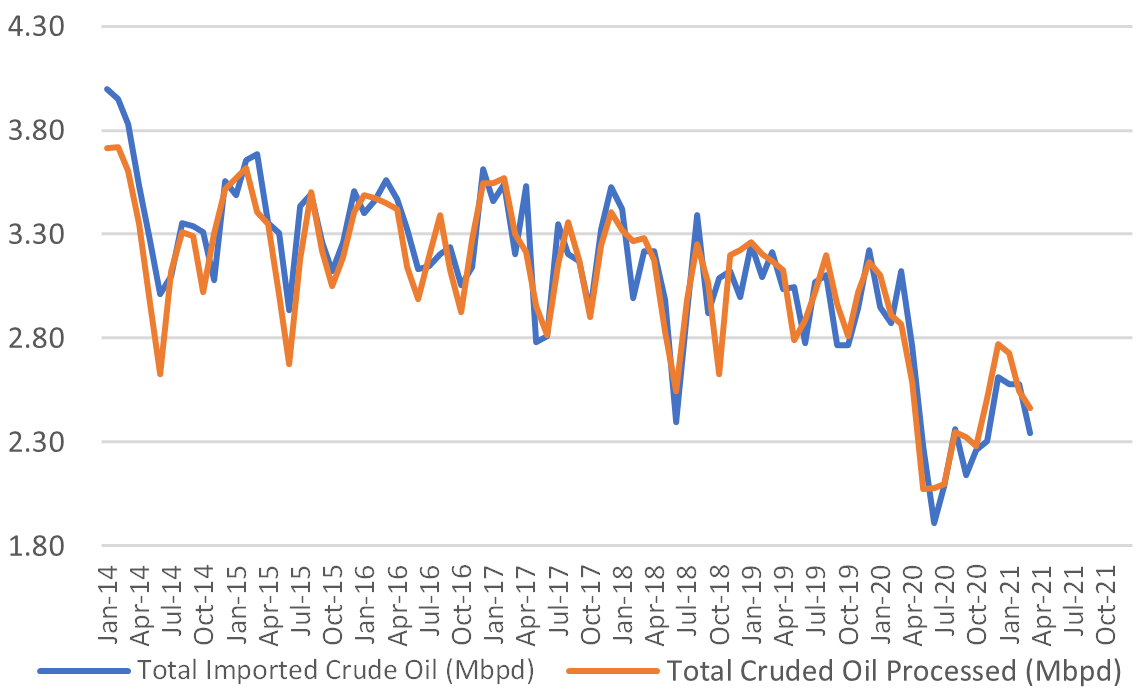
Crude Imports Vs Processed Crude
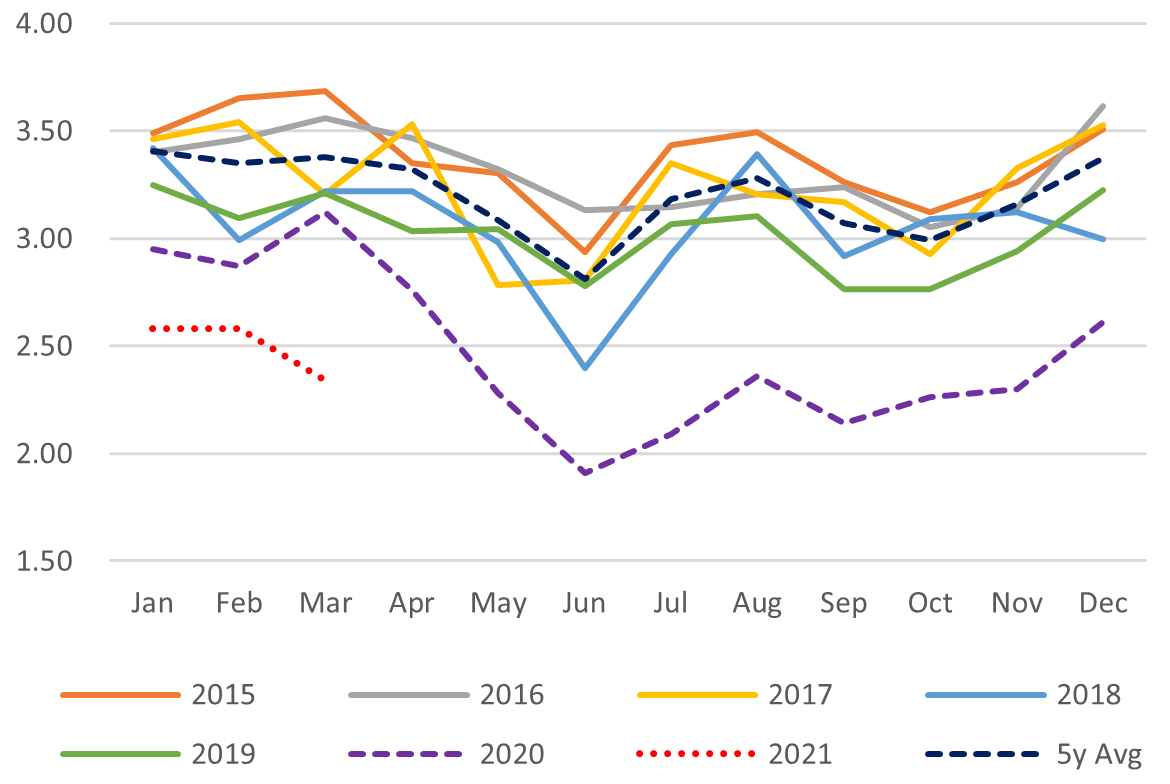
Monthly Oil Import Volume (Mbpd)
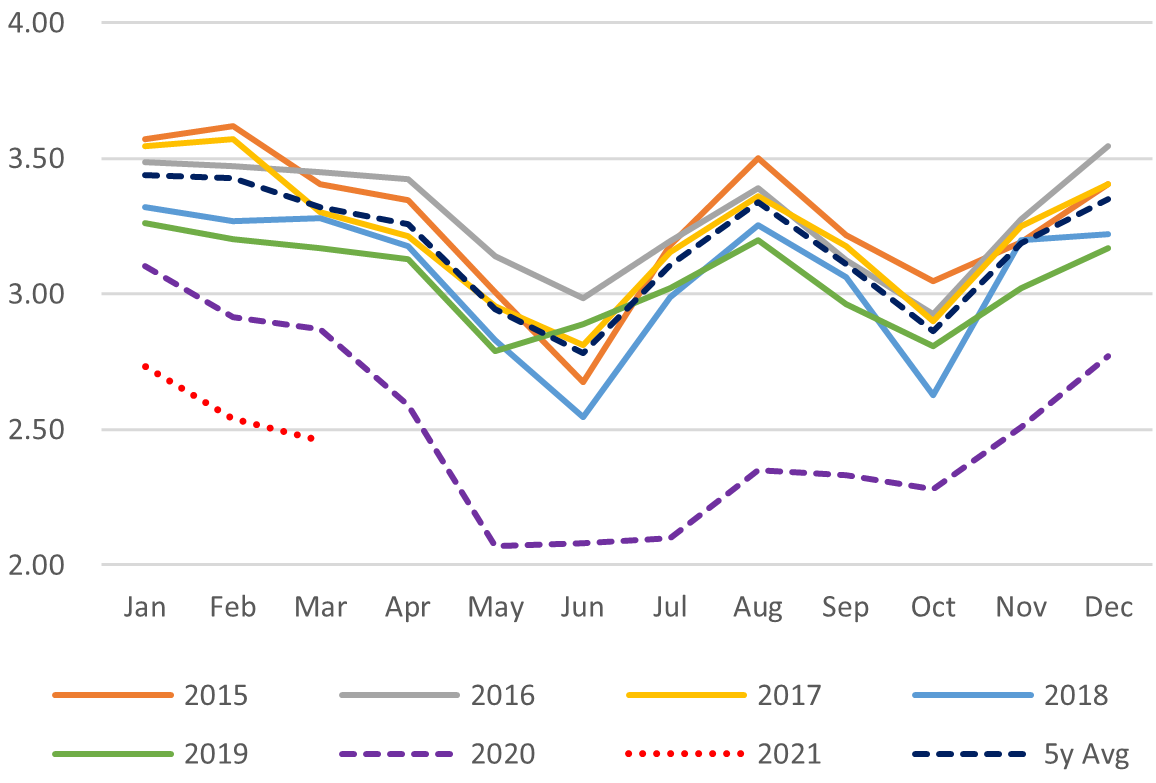
Monthly Crude Processed (Mbpd)
Domestic Fuel Sales
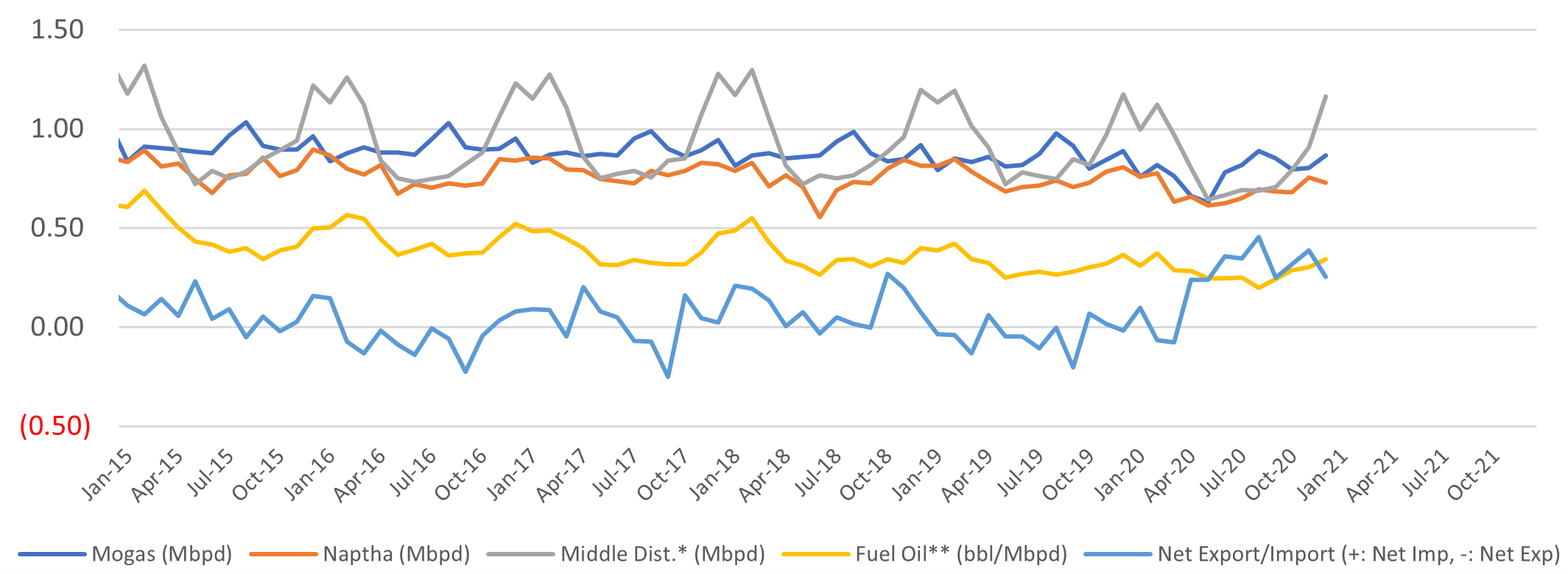
SOURCES: Ministry of Economy, Trade, and Industry (METI), Ministry of Finance, and the Petroleum Association of Japan
Japan LNG Price
LNG Imports: Japan Total vs Gas Utilities Only
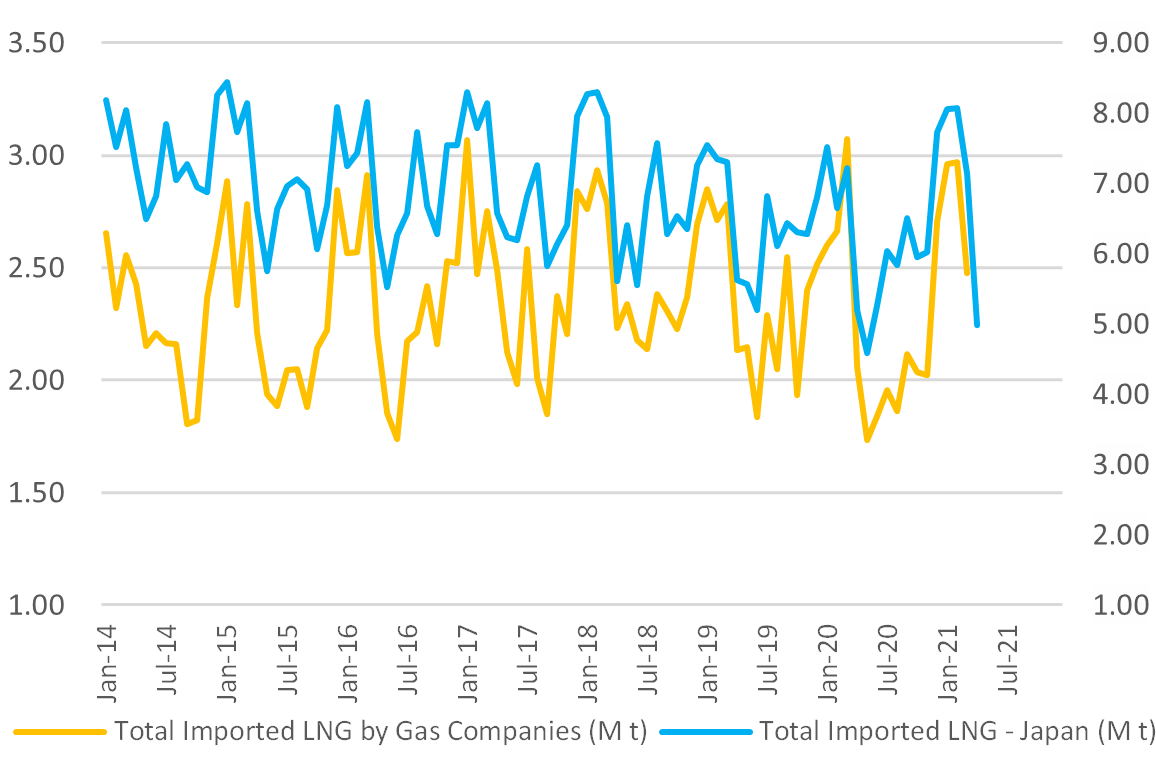
Total LNG Imports (M t)
LNG Imports by Gas Firms Only (M t)
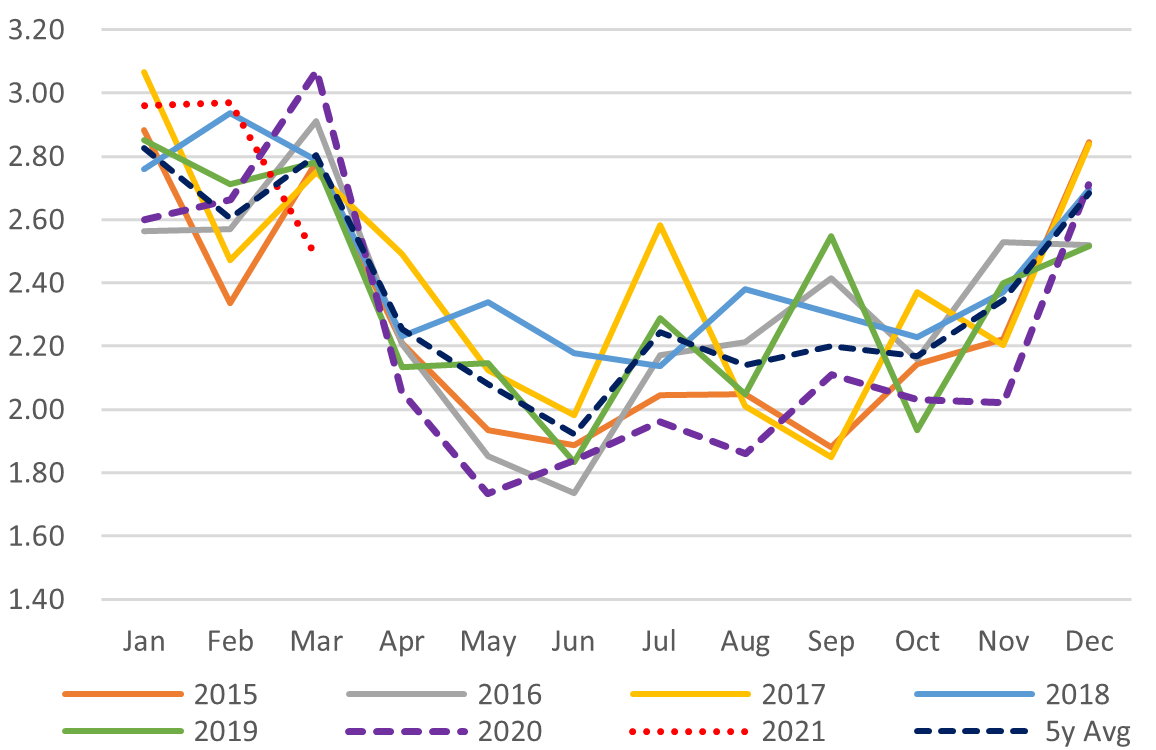
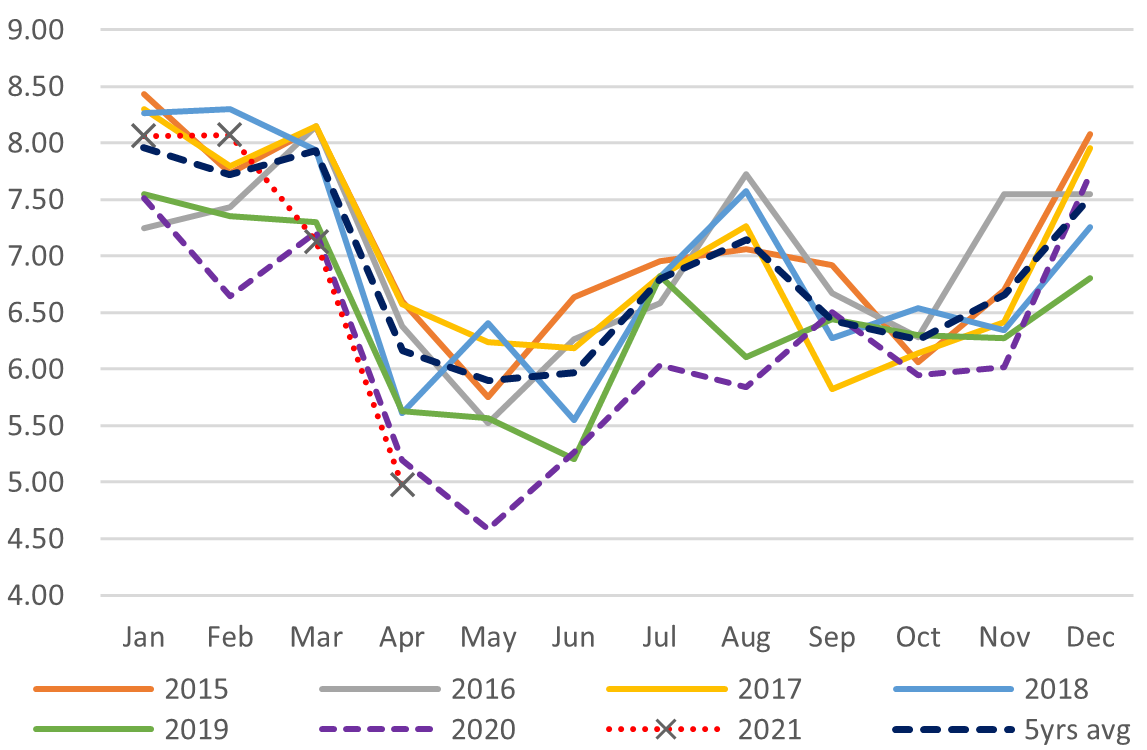
City Gas Sales – Total (M m3)
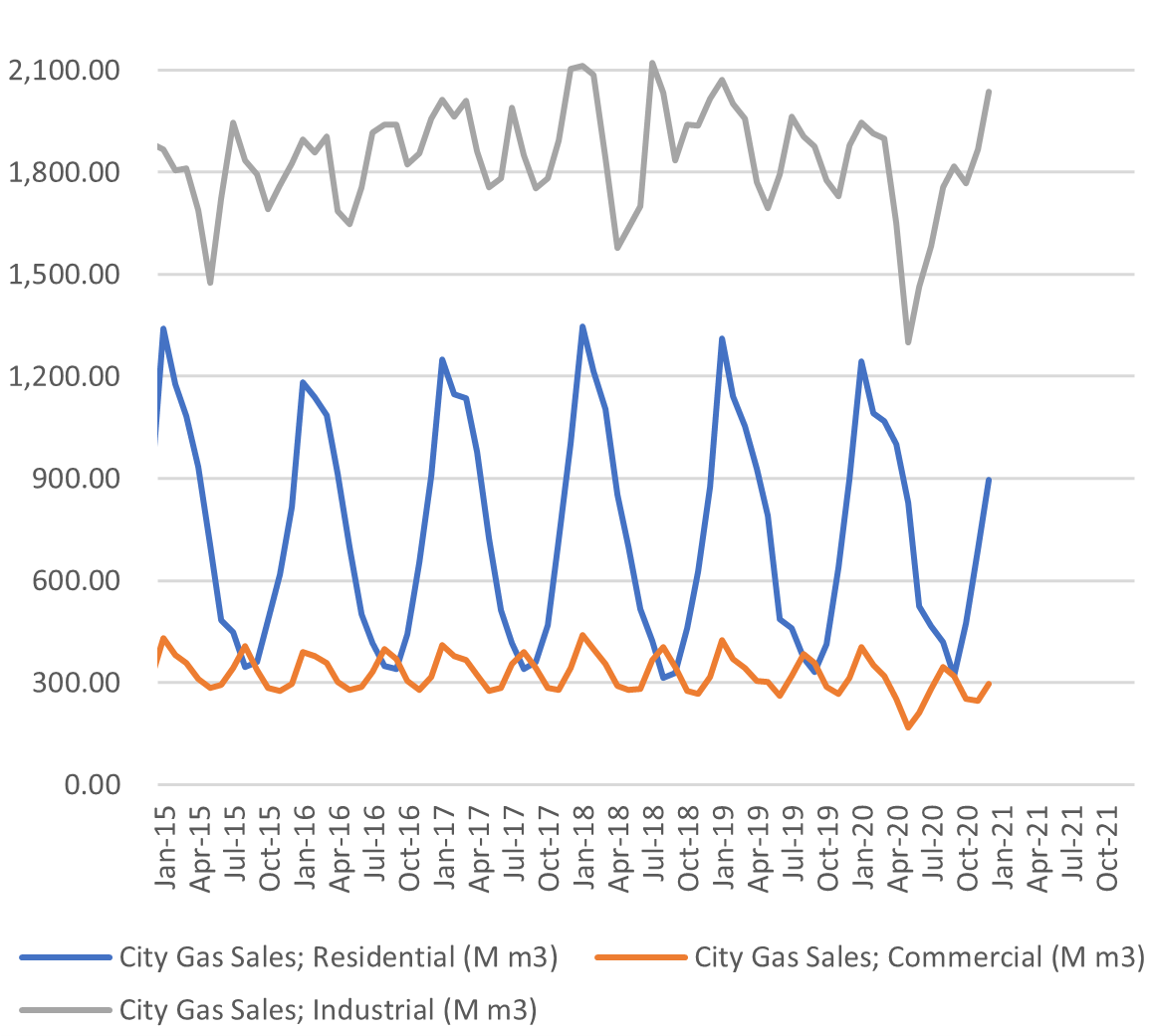
City Gas Sales by Sector (M m3)
SOURCES: Ministry of Economy, Trade, and Industry (METI),
Ministry of Finance
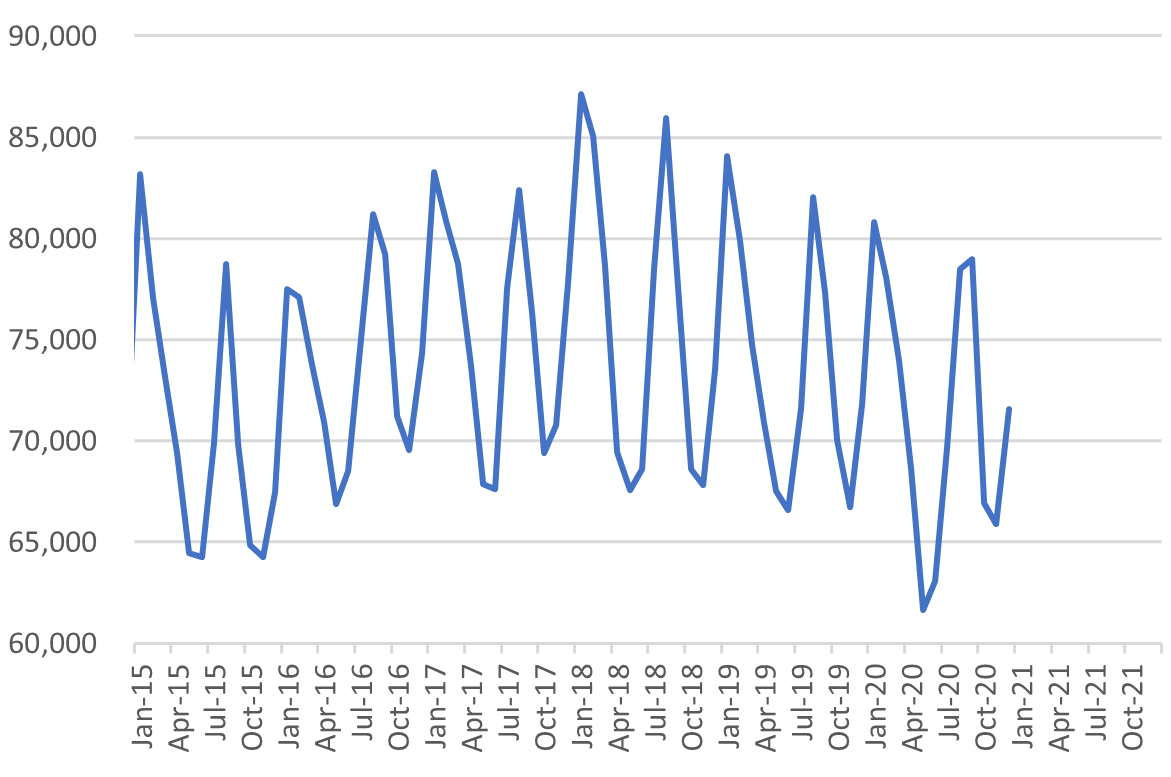
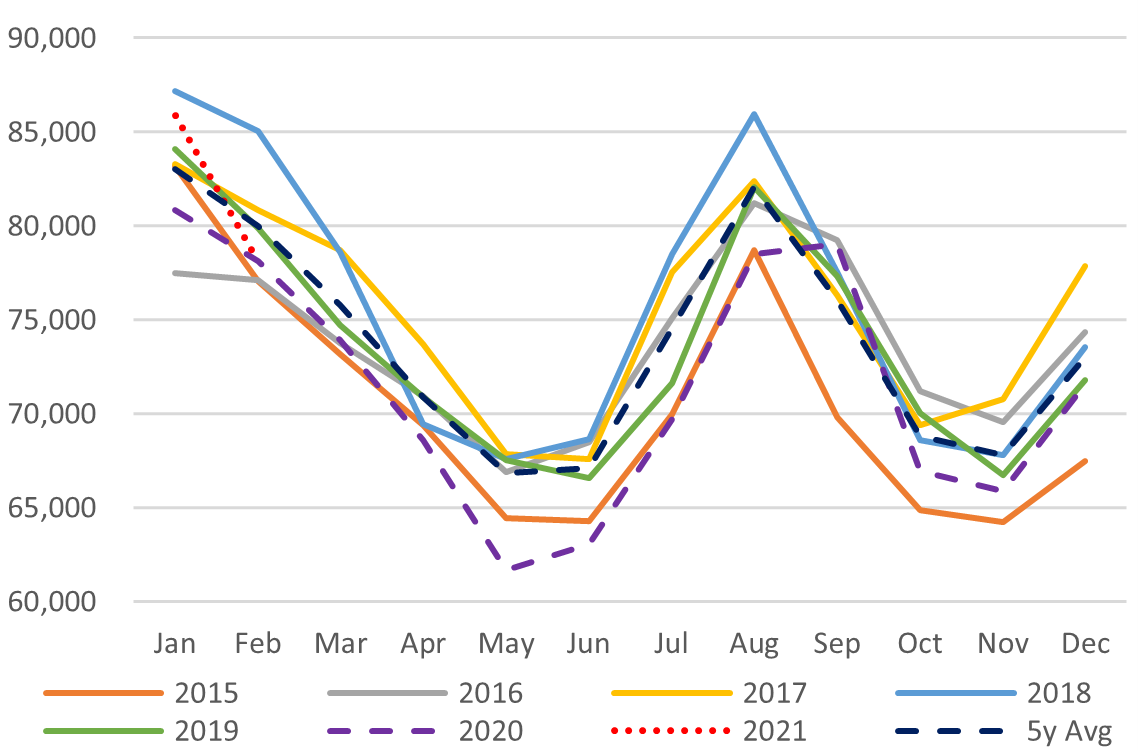
Japan Total Power Demand (GWh)
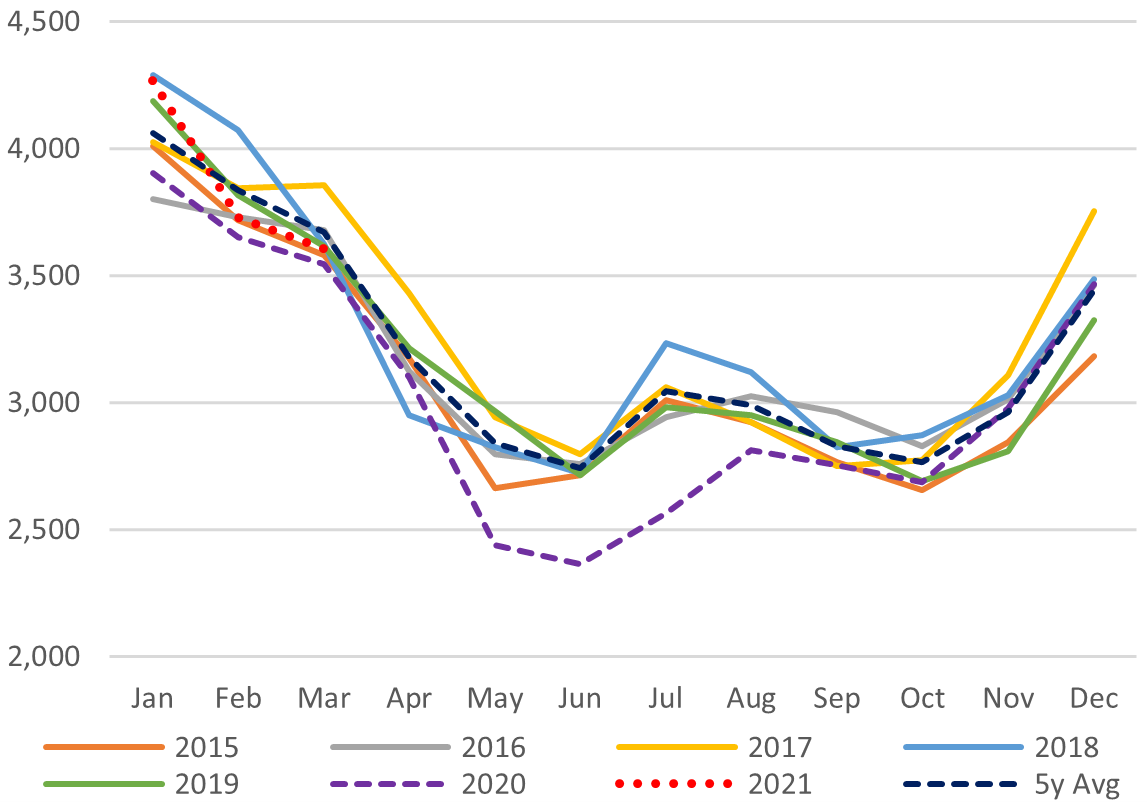
Current Vs Historical Demand (GWh)
Day-Ahead Spot Electricity Prices
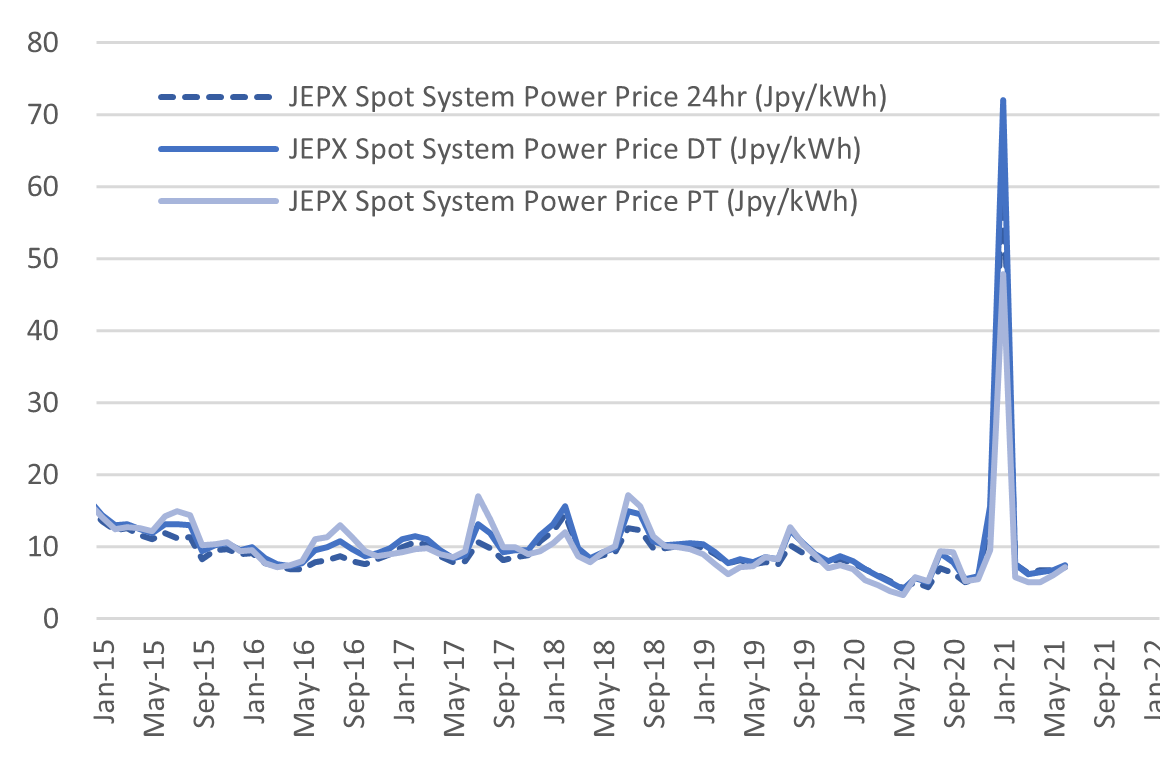
Day-Ahead Vs Day Time Vs Peak Time
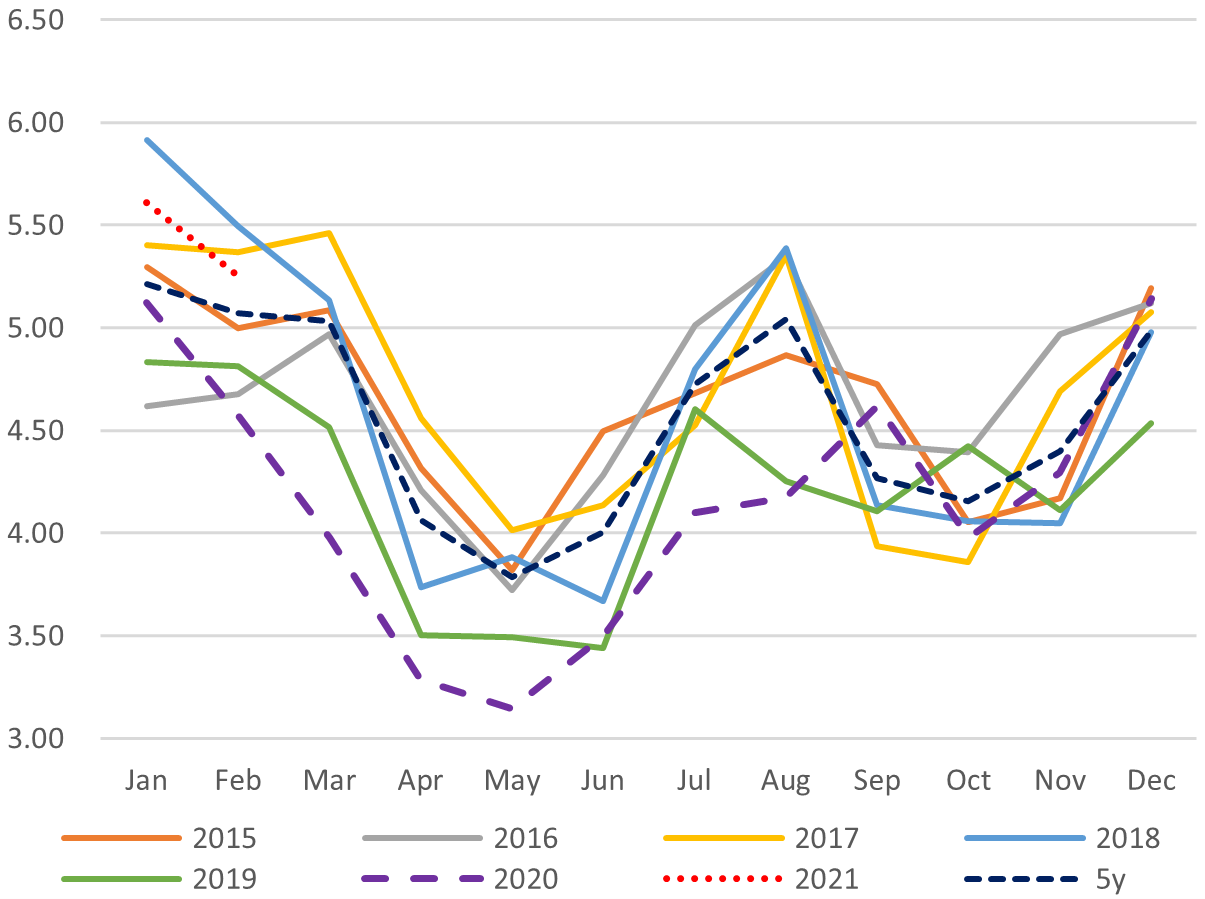
LNG Imports by Electricity Utilities
LNG Stockpiles of Electricity Utilities
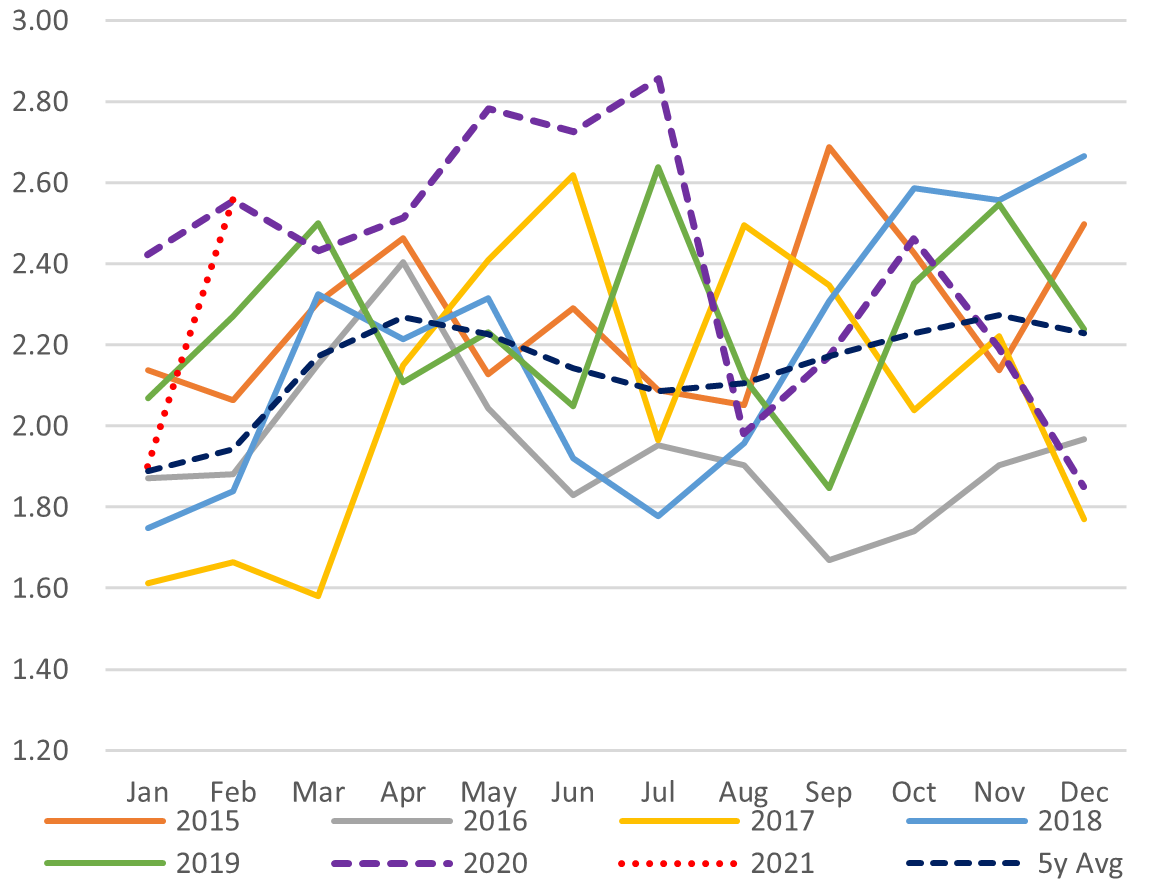
SOURCES: Ministry of Economy, Trade, and Industry (METI), and the Japan Electric Power Exchange
Disclaimer
This communication has been prepared for information purposes only, is confidential and may be legally privileged. This is a subscription-only service and is directed at those who have expressly asked K.K. Yuri Group or one of its representatives to be added to the mailing list. This document may not be onwardly circulated or reproduced without prior written consent from Yuri Group, which retains all copyright to the content of this report.
Yuri Group is not registered as an investment advisor in any jurisdiction. Our research and all the content express our opinions, which are generally based on available public information, field studies and own analysis. Content is limited to general comment upon general political, economic and market issues, asset classes and types of investments. The report and all of its content does not constitute a recommendation or solicitation to buy, sell, subscribe for or underwrite any product or physical commodity, or a financial instrument.
The information contained in this report is obtained from sources believed to be reliable and in good faith. No representation or warranty is made that it is accurate or complete. Opinions and views expressed are subject to change without notice, as are prices and availability, which are indicative only. There is no obligation to notify recipients of any changes to this data or to do so in the future. No responsibility is accepted for the use of or reliance on the information provided. In no circumstances will Yuri Group be liable for any indirect or direct loss, or consequential loss or damages arising from the use of, any inability to use, or any inaccuracy in the information.
K.K. Yuri Group: Oonoya Building 8F, Yotsuya 1-18, Shinjuku-ku, Tokyo, Japan, 160-0004.