
JAPAN NRG WEEKLY
JULY 05, 2021
JAPAN NRG WEEKLY
July 5, 2021
NEWS
TOP
- Basic Energy Plan: publication timing unclear, debate centers on whether to build new nuclear units and the renewables portion
- No. of nuclear units online now at highest since year of Fukushima accident as Kansai Electric switches on one more reactor
- 2021 solar auction sees price drop to ¥10/ kWh, lowest on record
ENERGY TRANSITION & POLICY
- Govt. begins review of energy savings to encourage off-peak use
- Energy Agency starts rethink of Japan’s hydropower strategy
- Ministries to draft new FCV safety standard by end of this year
- Japan forms Methanation Council to promote CO2-free gas use
- IHI, Idemitsu to establish ammonia business at former oil refinery
- JAPEX, JFE to collaborate on CO2 isolation, launch CCUS study
- City blocks biomass plant project claiming lack of consultation
- Hitachi creates internal carbon price to aid in emission reductions
- COSMO buys stake in EV maker to create a green supply chain
- Marubeni launches solar panel recycling trial using blockchain
- Japan steel firm to build hydrogen plant in Sweden … [MORE]
ELECTRICITY MARKETS
- Industry warns number of nuclear energy professionals is shrinking
- Renewables market prepares for major structural upheaval in 2035
- Each GW of offshore wind capacity will require ¥550B, MRI says
- Osaka Gas invests in new solar plants in Japan and the U.S.
- Tokyo Gas expands its solar power portfolio to 100 MW
- Construction firm Shimizu ties up with Fred Olsen in offshore wind
- TEPCO launches ¥10B investment fund aimed at seeding SMEs
- Solar developer afterFit gets serious about retail market… [MORE]
OIL, GAS & MINING
- INPEX agrees sale of carbon-neutral LNG to local firm Kiryu Gas
- Mitsui E&P to supply LPG in Western Australia
- Japan hosts international Critical Raw Materials (CRM) conference
ANALYSIS
DÉTENTE IN JAPAN’S NUCLEAR WINTER?
OR, CALM BEFORE THE STORM?
Japan’s nuclear power industry has faced its most difficult decade since the March 2011 disaster at the Fukushima Dai-Ichi NPP. All the nation’s reactor were entirely shut down at one point. Now, after years of headwinds, the industry is starting to gather positive momentum. Eight reactors have restarted in the last six months or so. One or two more may come online later this year. If they do, Japan will have the most functioning nuclear capacity since the accident. So, why is the industry feeling anxious?
METI SUDDENLY DIALS BACK THE POWER CRUNCH WARNINGS THIS SUMMER, BUT ALL IS NOT WELL
First, the ministry responsible for Japan’s energy systems warned of critical power shortages and blackout risk during this summer. Then, it dialed down the alarm and proclaimed the system was fine. The conflicting messaging that started in May has since continued, but the reason is less to do with the state of the system and more with the big Olympic event due to start in Tokyo later this month. However, the short-term measures that Japan is taking to ensure stability could come back to bite during a critical 2021-22 winter period.
GLOBAL VIEW
Gas prices jump 40% in three months. International air travel may hit pre-Covid levels only in 2023, says Rystad. Nissan and China’s AESC to build the UK’s biggest EV battery factory. Taiwan closes nuclear unit earlier than planned. China overtakes Japan as world’s largest LNG importer. Gabon gets money for saving trees. Hundreds die in Canada and U.S. due to heat waves. Details on these and more in our global wrap.
EVENT CALENDAR / DATA SECTION
JAPAN NRG WEEKLY
PUBLISHER
K. K. Yuri Group
Editorial Team
Yuriy Humber (Editor-in-Chief)
Tom O’Sullivan (Japan, Middle East, Africa)
John Varoli (Americas)
Regular Contributors
Mayumi Watanabe (Japan)
Daniel Shulman (Japan)
Takehiro Masutomo (Japan)
Art & Design
22 Graphics Inc.
Sponsored
SUBSCRIPTIONS & ADVERTISING
Japan NRG offers individual, corporate and academic subscription plans. Basic details are our website or write to subscriptions@japan-nrg.com
For marketing, advertising, or collaboration opportunities, contact sales@japan-nrg.com
For all other inquiries, write to info@japan-nrg.com
OFTEN USED ACRONYMS
METI The Ministry of Energy, Trade and Industry
MOE Ministry of Environment
ANRE Agency for Natural Resources and Energy
NEDO New Energy and Industrial Technology Development Organization
TEPCO Tokyo Electric Power Company
KEPCO Kansai Electric Power Company
EPCO Electric Power Company
JCC Japan Crude Cocktail
JKM Japan Korea Market, the Platt’s LNG benchmark
CCUS Carbon Capture, Utilization and Storage
mmbtu Million British Thermal Units
mb/d Million barrels per day
mtoe Million Tons of Oil Equivalent
kWh Kilowatt hours (electricity generation volume)
NEWS: ENERGY TRANSITION & POLICY
Basic Energy Plan – Timing Again Uncertain, Content Under Dispute
- As covered in last month’s reports, we showed that Japan’s Basic Energy Plan, which defines the government strategy and vision for the mid-term electricity mix among other things, was due to be published in late spring, then summer, and then delayed.
- Reports over the last week first suggested the delays might be removed. Then further reports reiterated that autumn will be the most likely timing of publication.
- In short, there is a fight between “pro-renewables / anti-nuclear” officials, such as Minister of the Environment Koizumi, and Minister for Administrative Reforms Kono, and the “pro-nuclear / cautious on renewables” group that includes METI’s Kajiyama. The latter are not against renewables, but wish its ratio in the national energy mix to be restrained, believing that a high renewables component is not feasible in Japan. The former ideally see renewables at 100% of the energy mix and view the nuclear sector as their main “enemy”.
- The winners of the above standoff are fossil fuel power operators, whose slice of the pie is less discussed. Biomass and hydro are another two sectors that have seen recent gains.
- SIDE DEVELOPMENT:
Nuclear plant replacements left out of energy plan
(Nikkei, June 30)- METI won’t include a provision for nuclear power plant replacements in its revised basic energy plan.
- METI feels public faith in nuclear energy is still low after a series of scandals at TEPCO’s Kashiwazaki-Kariwa plant.
- However, by not explicitly including plant replacements, the achievement of net zero CO2 emissions by 2050 becomes more difficult.
- Under existing law, nuclear reactors must be retired after 60 years of service.
- Many argue that without nuclear power stations, it’ll be difficult to prevent significant increases in the cost of electricity.
- SIDE DEVELOPMENT:
Tug of war due to rising share of renewable energy
(Jiji, July 4)- Making adjustments to the Basic Energy Plan is proving difficult. PM Suga set a goal of reducing greenhouse gas emissions to net-zero by 2050; the latest plan is supposed to carry important revisions that incorporate concrete measures on how to meet that goal.
- However, a tug of war has broken out within government over the spread of renewable energy, and now it seems the Plan’s publication may be delayed.
- Recently, the government suggested the ratio of thermal power may drop to about 40% while renewables increase to just under 40% by the end of the decade.
- Voices in the Ministry of the Environment are calling for more ambitious goals for renewables. METI is reluctant to agree, arguing that there’s a limit to the land on which solar panels can be installed, and even close to 40% is a difficult target to achieve.
- Regarding nuclear, voices in the Liberal Democratic Party and industry want a clear policy to proceed with new expansion and rebuilding, but the ruling party’s coalition partner, Komeito, is against.
- The government is also cautious about the fact that public concern over nuclear still lingers after the Fukushima accident.
- The difficulty in adjusting the Basic Energy Plan means it may be postponed to after autumn’s general election. However, it must be revised before the 26th Conference of the Parties to the U.N. Framework Convention on Climate Change (COP26) in November.
- Procrastination could give the international community the impression that Japan is reluctant to follow through with environmental measures.
Government begins review of energy saving to encourage use of off-peak generation
(Japan NRG, June 30)
- A review of energy conservation standards and regulatory framework has started, eyeing new reporting obligations for electricity consumption. The system will encourage a shift to consumption during low demand hours and to green electricity from fossil power.
- Consumption measurement will positively reflect power use during off peak hours. Businesses will also be required to achieve a 1% reduction in electricity consumption intensity every year.
- Under the current energy conservation law, businesses only report energy intensity converted in kiloliters, rather than the total amount of energy consumption, which will be a mandatory reporting item, according to the METI draft proposal.
- METI will introduce the new framework in 2023 at the earliest, then run the system for three-years before formalizing it.
Energy Agency rethinks hydropower strategy
(Denki Shimbun, June 25)
- The Agency for Natural Resources and Energy began a series of closed-door consultations with hydropower energy stakeholders to encourage operators to build new dams and optimize the use of existing ones.
- The last of Japan’s large-scale hydro dams was built in the 1990s, although limited pumped hydro development continued as late as 2015.
- The Energy Agency wants to challenge the assumption that Japan lacks any more sites suitable for dams, as well as leveraging technologies like artificial intelligence to optimize the performance of existing dams.
- Hydro dams currently generate around 9% of Japan’s electricity needs.
TAKEAWAY: As discussed in detail in the May 31 edition of Japan NRG Weekly, hydropower has been one of the winners so far from the shift in the national energy policies due to decarbonization. The extent of its increase is unlikely to be large and won’t be comparable to offshore wind, but this energy source will be talked about more and more as both a generation source and a resilience strategy to combat heavy rains, landslides, and other natural disasters.
Government to draft FCV safety standard by year end
(Japan NRG, June 28)
- METI and Ministry of Land, Infrastructure, Transport and Tourism (MLIT), which have oversight of fuel cell vehicles, will draft a vehicle safety standard by year’s end, according to an interim report.
- The ministries agreed to separate vehicle safety standards from those defined by High Pressure Gas Safety Act for city gas operators. Fuels for FCV hydrogen will include natural gas and LNG.
- The ministries will continue reviews with a focus on small and standard passenger vehicles and will publish their regulatory proposal by year’s end.
Methanation Council holds its first meeting
(Japan NRG, June 28)
- 28 representatives from the private sector and government held their first Methanation Private Sector-Government Council meeting to identify technological, social and regulatory issues related decarbonization of natural gas.
- Corporate participants included utilities, manufacturers, shipping and shipbuilding firms. From the government were officials from METI, Agency of Natural Resources and Energy, Environment Ministry and Ministry of Land, Infrastructure, Transport and Tourism.
- Japan Gas Association proposed deploying hydrogen pipelines in coastal areas, for local production and consumption of hydrogen. INPEX, now conducting a methanation trial with NEDO, suggested a regulatory framework that authorizes methanation using renewable energy.
Two-tier power imbalancing rate takes effect July 1
(Japan NRG, July 1)
- The reformed power imbalancing rate with a two-tier structure took effect on July 1, METI said. There will be a cap on the imbalancing rates to protect consumers from extreme price volatilities.
- A ¥200/ kWh cap will be in place when the power reserve ratio plunges below 3%. The cap will be at ¥80/ kWh at other times.
- TAKEAWAY: See the story on the power crunch in this week’s Analysis section for more details on the reserve ratio.
IHI and Idemitsu to establish ammonia supply chain
(Kankyo Business, June 29)
- IHI and Idemitsu will begin joint trials at Idemitsu’s Tokuyama plant, the first step in a process to establish an ammonia supply chain.
- Existing storage and processing facilities at the plant will be converted for use with ammonia, and existing naphtha cracking furnaces will be converted to run on ammonia blends.
- The Tokushima plant was built in 1957, although its refinery facilities were shut down in 2014. Since then, the plant has functioned as a manufacturing hub for petrochemical products.
- IHI is a leader in technology for blending ammonia with legacy fuels such as coal and natural gas, and was the world’s first operator to run a 2 MW gas turbine on a 70% blend of liquid ammonia. IHI wants to use the Tokuyama facility to test ammonia storage and combustion technology.
JAPEX and JFE to collaborate on CO2 isolation, recovery
(Kankyo Business, June 28)
- JAPEX and JFE Engineering said on June 24 that they would begin joint discussions on solutions to technical challenges to the establishment of systems for transporting carbon dioxide, hydrogen and ammonia.
- By pooling their expertise, the two companies plan to identify challenges and strategies surrounding carbon dioxide isolation and recovery, as well as discussing carbon dioxide pipelines and other transport infrastructure.
- JAPEX and JFE also aim to perfect CO2 storage technologies that involve injecting carbon dioxide into depleted gas fields in the near future.
- SIDE DEVELOPMENT:
JAPEX and JFE plan to launch Indonesian CCUS operation
(New Energy Business News, June 30)- JAPEX agreed to collaborate with the Indonesian Pertamina Group and LEMIGAS—the Indonesian Research and Development Centre for Oil and Gas Technology—on a study to assess the feasibility of a CCUS project in the Sukowati oil field in East Java.
- JAPEX has experience with domestic gas fields, high pressure gas pipelines and LNG bunkering stations. JFE Engineering, for its part, has expertise with plants and pipelines.
Citizens block construction of biomass plant claiming lack of consultation
(Kahoku Shimpo, June 30)
- The city of Tome in Miyagi prefecture has blocked the plans of Toshikaihatsu Research Institute to build a biomass power plant in the locality.
- Residents and local authorities claimed that the Institute failed to provide information about the project to the city government and to properly inform the locals.
- The city will create a policy and guidelines for renewable energy projects, including biomass, and will push developers to hold prior consultations with residents on future projects so that locals are involved from the very first stage.
TAKEAWAY: We often discuss how the restart of nuclear reactors in Japan is difficult partly because it involves consultations and both tacit and explicit approvals from local governments and residents. This process, however, is not reserved only for nuclear facilities. As detailed in last week’s Japan NRG Weekly, more and more renewables projects are asked to get local clearance. The local voice is very strong in new developments and pushing through purely on the basis of a national policy does not work. In turn, this complicates the ability of the national government to implement major changes in energy policy since it requires approvals from many disparate local stakeholders. Thus, what the national government often resorts to is “buying” local approval through sector-specific subsidies, which in turn pushes up the cost of energy. The cheapest way to enact energy transition in Japan is to convert existing power facilities to another energy source. That’s why it’s highly likely that coal-fired power stations will survive in Japan, even if they’ll not be burning coal in the future.
- SIDE DEVELOPMENT:
Meiken completes second biomass generation plant
(Nikkei, July 1)- On July 1, major laminate manufacturer Meiken fired up a second biomass-fired generation plant on the grounds of its Okayama factory.
- The new 5 MW plant takes the total output of the factory’s biomass-fired generation facilities to 7 MW. Of this, up to 3 MW will be used to supply the factory, with the remainder sold to the grid.
- The plants are fueled by wood scraps, in addition to locally sourced branches and bark.
Hitachi leads Japan in adopting carbon pricing system
(Nikkei; June 30, 2021)
- Hitachi adopted an internal carbon price (ICP) in FY2019 at ¥5,000/ton to quantify efforts to reduce CO2 emissions.
- The Hitachi ICP program led the company to invest ¥260m in 35 projects, including some that were considered inefficient investments.
- Hitachi achieved a CO2 reduction of 1,356 tons in FY2019.
Cosmo aims to establish green supply chain
(Sekiyu Tsushin, July 2)
- Cosmo Energy signed an agreement with EV developer ASF that’s the first step toward a green supply chain in which lease and maintenance operations for EVs are powered by electricity generated by wind farms.
- The arrangement involves Cosmo acquiring a stake in ASF via a third-party share allotment.
- EVs manufactured by ASF will be available through Cosmo’s lease and car share services.
- The vehicles will be recharged using “Cosmo Denki Green” power, which is sourced from wind turbines and other renewable sources.
Marubeni launches solar panel recycling trial
(New Energy Business News, June 29)
- Marubeni has launched a three-year trial in which it will build an information platform that aims to make the recovery, reuse and recycling of post-market solar panels more efficient.
- The platform will enable users to access information on every stage in a solar panel’s life-cycle, from the time it was discarded by its initial owner to information on reuse and recycling, as well as making available information on performance in tests.
- The system will also use block chain technology to prevent the falsification of tracing records.
Sanyo Special Steel will build a hydrogen manufacturing plant in Sweden
(New Energy Business News, June 29)
- The Ovako Group, which is owned by Sanyo Special Steel, has embarked on the construction of a carbon-free hydrogen plant on the grounds of a Swedish steel plant.
- Upon its completion in 2022, the plant will be able to generate 3500 normal cubic meters of hydrogen every hour by electrolyzing water.
- The supply of carbon-free hydrogen will enable the plant to reduce its carbon dioxide emissions by 50%.
Solar-powered, automated shelf labelling system developed by Ricoh, Nichikon
(Kankyo Business, June, 28)
- Kyoto-based Nichikon teamed up with Ricoh and Enecoat Technologies to develop a maintenance-free shelf label system powered by film-type perovskite solar panels.
- The companies say the system is the first of its kind in the world.
- By using a highly efficient DC to DC converter optimized for energy harvesting applications, the system lowers voltage supplied by solar cells to levels suitable for charging a lithium ion battery.
- The system incorporates a bluetooth communication module, enabling displayed prices to be updated quickly and remotely.
- The new system overcomes battery life issues that had plagued traditional technologies.
NEWS: POWER MARKETS
|
No. of operable nuclear reactors |
33 | |
|
of which |
applied for restart |
25 |
|
approved by regulator |
17 | |
|
restarted |
10 | |
|
in operation today |
9 | |
|
|
able to use MOX fuel |
4 |
|
No. of nuclear reactors under construction |
3 | |
|
No. of reactors slated for decommissioning |
27 | |
|
of which |
completed work |
1 |
|
started process |
4 | |
|
|
yet to start / not known |
22 |
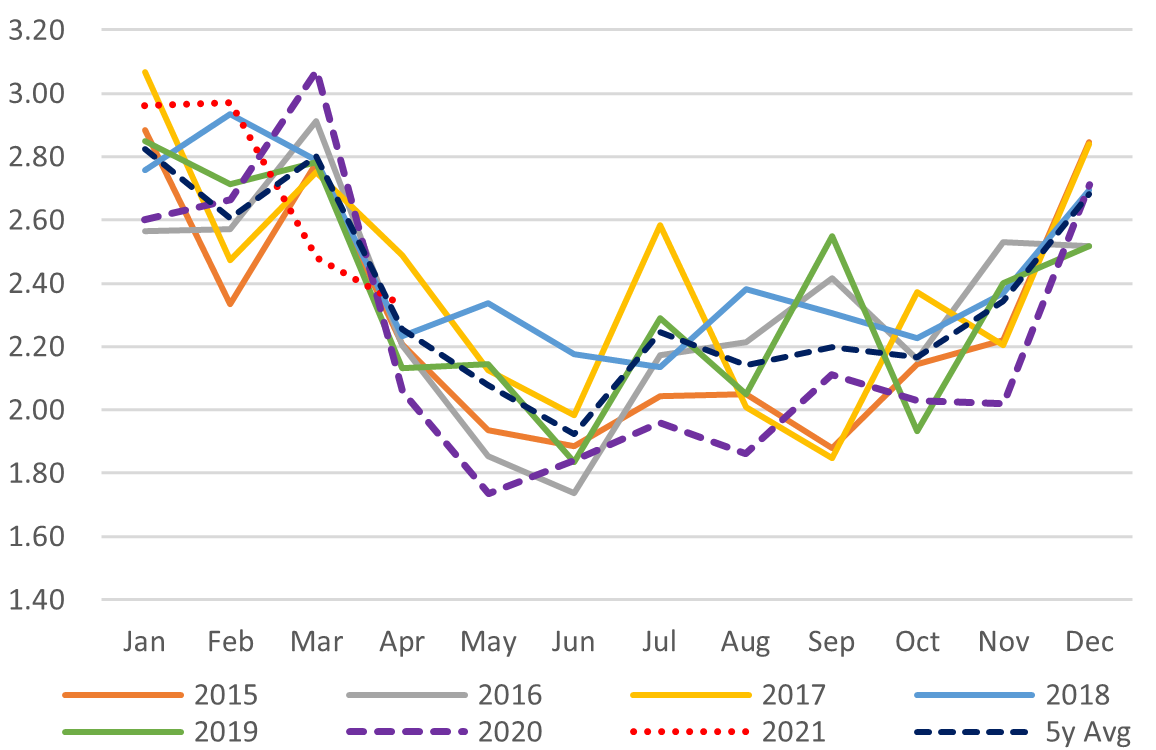
Spot Electricity Prices, Monthly Avg.
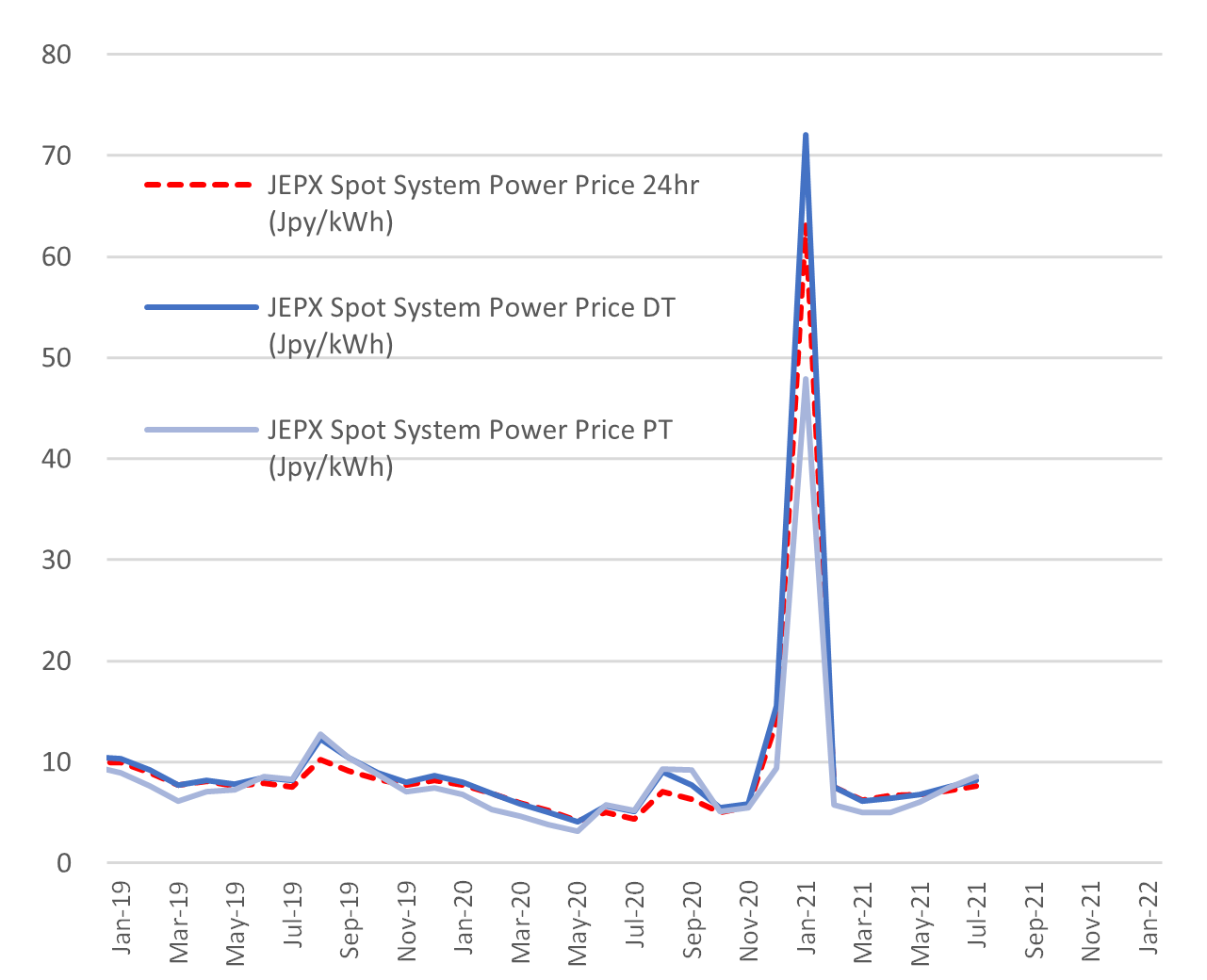
Source: Company websites, JANSI and JAIF, as of July 4, 2021
Kansai Electric restarts Ooi NPP No. 3, secures more fuel for reactors
(Kyodo News, various, July 3)
- Kansai Electric restarted reactor unit No. 3 at the Ooi nuclear power plant on July 3. Commercial operations are due to start at the end of July, providing there are no technical glitches.
- The unit has completed all checks.
- The restart brings the utility back to operating five units, the most it has had online since the year of the Fukushima accident.
- The company has also taken delivery of new fuel for Takahama NPP units No. 3 and No. 4, which are already in operation.
TAKEAWAY: This restart marks a remarkable turnaround in nuclear fortunes in Japan over the last six-seven months. Please see this week’s Analysis section for a full analysis of what is happening in the nuclear industry in Japan.
Deteriorating nuclear plants face lack of personnel support from Hitachi and others
(Nikkei; July 1, 2021)
- Around 80 staff members were appointed to perform nuclear-related work in FY2020 by six major companies (inc. Hitachi and Toshiba), according to a survey by the Japan Atomic Industrial Forum.
- That’s an approx. 70% decrease from FY2009 when the number peaked.
- Lack of such personnel indicates a lack of interest in nuclear energy.
- This is also noticeable at Japanese universities where the no. of students majoring in nuclear energy dropped from around 670 in FY1992 to around 260 in FY2018.
- It seems that METI, MEXT, and other ministries as well as the industry has not taken this personnel situation seriously, according to the article.
First solar auction of 2021 sees bid prices drop to a record low ¥10/ kWh
(New Energy Business News, July 1)
- There were 135 winning bids in the latest solar capacity auctions and the first in Japan this year. Participants included ENEOS, the oil refining major, DMM, the online retailer, and Genex Partners consultancy, which is part of Cordence Worldwide.
- There were two winning bids at the price of ¥10 per kWh by Fukuhara Kogyo, a Osaka-based company engaged in construction projects. That matched the lowest price offered by a developer in such auctions.
- A total of 208 MW of capacity was auctioned. The upper limit on the bid price was ¥11. The highest winning bid was at ¥10.98.
- There were 185 bids in total for almost 249 MW.
- The weighted average winning bid was ¥10.82.
TAKEAWAY: The positive trend from the government point of view is that there are still plenty of bidders in solar auctions and the price is trending lower. However, there is a concern on both the developer side and the government side about how to lower prices further. Rising costs of solar panel materials are forcing up input costs. New synergies, business models, or technologies may be needed to significantly change prices going forward.
Renewables market prepares for major structural upheaval in 2035
(Smart Japan, June 30)
- The Fuji Keizai Group released the results of a survey on the Japanese market for renewable energy generation systems.
- Based on the results, Fuji Keizai projects the market will shrink slightly between 2020 and 2035.
- Since peaking in 2014, the rate at which solar systems are installed has continued to decline.
- Rapidly declining installation costs for solar systems mean that the quantum value of the solar market is projected to fall by nearly 40% by 2035.
- Meanwhile, significant growth is projected in the wind sector, with the value of the wind market projected to more than quadruple by 2035.
Offshore wind: Each GW of capacity will cost ¥550B, MRI says
(Kankyo Business, June, 28)
- Japan has ability to support over 500 GW of offshore wind capacity.
- According to the Mitsubishi Research Institute, every additional gigawatt of capacity will require a direct investment of ¥550 billion. When secondary effects on the greater economy are figured in, this translates into over ¥1 trillion.
- To encourage industries to invest in wind technology, the government has increased its target for wind capacity (including floating wind farms) to 40-45 GW by 2040.
Osaka Gas to develop new solar farms in Japan and abroad
(Kankyo Business, June 25)
- Osaka Gas will join forces with Tokyo-based GPSS Holdings to develop and operate a number of small to medium sized solar farms.
- Some of the farms would operate under a feed in tariff arrangement whereas others would not.
- Small-scale solar farms are getting a lot of attention in Japan due to a shortage of sites suitable for new large-scale developments.
- Osaka Gas and GPSS say they intend to cooperate on other forms of renewable energy as well, including wind, geothermal and small-scale hydro.
- SIDE DEVELOPMENT:
Osaka Gas to join distributed solar power projects in U.S.
(Kankyo Business, July 2)- Osaka Gas USA Corporation signed a contract with Summit Ridge Energy (SRE), a U.S. distributed solar power development company, to work on distributed solar businesses.
- The two will acquire and operate a decentralized solar power plant newly developed by SRE in Maine. The power will be sold to household, commercial and industrial customers under the application of the Net Energy Billing System, a renewable energy support system in Maine.
- CONTEXT: Osaka Gas is invested in the Freeport LNG facility, shale gas, and power generation in the U.S. The latter business has been growing in line with the utility’s zero-net carbon goals.
Tokyo Gas installs hundredth megawatt of solar capacity
(Jiji, July 2)
- A 23MW solar farm in Yamaguchi operated by Tokyo Gas began supplying the grid on July 1, bringing Tokyo Gas’ Japan-based solar generation capacity to 100 MW.
- Tokyo Gas’ worldwide renewable energy capacity now sits at 1.38 GW.
Construction major Shimizu ties up with Norway’s Fred Olsen for offshore wind
(New Energy Business News, July 2)
- Shimizu Corporation has signed a MoU with Fred Olsen Ocean (FOO) of Norway to work together in the field of offshore wind power construction. The two hope to win orders to build new projects in Japan.
- The Norwegian partner will help Shimizu train on how to install offshore wind turbines. FOO is one of Europe’s leading offshore wind power construction companies engaged in the self-elevating workbench (SEP) ship charter business and the transportation and installation of offshore wind turbines.
TEPCO launches its ¥10 billion investment fund
(Nikkei, July 1)
- TEPCO Holdings said on July 1 that it had launched its first investment fund targeting small and medium-sized businesses with annual sales in the order of billions to tens of billions of yen. The goal is to diversify profits.
- The ¥10 billion fund, which will be administered by subsidiary TEPCO Timeless Capital, aims to turn a profit within seven years.
- TEPCO says it has already received inquiries from dozens of retailers and manufacturers.
- TEPCO plans to launch a second fund in the near future.
afterFit gets serious about retail market
(Nikkei, July 2)
- Tokyo-based solar developer afterFit says it is ramping up efforts to gain a share of the retail electricity market.
- The company had been selling green electricity on a trial basis since August.
- Purchasing electricity from the Japan Electric Power Exchange, afterFit sells electricity under the brand “Shirokuma [polar bear] Power”.
- afterFit also operates its own renewable generation facilities.
- CEO Tanimoto Kanzo says afterFit will utilise storage technologies and demand forecasting systems to improve the efficiency of its green power operations.
Chubu blames gusts of air for anomalies at Hamaoka NPP Unit 3
(Shizuoka Shimbun, July 2)
- Chubu Electric said on July 1 that it believes fragments of a tarpaulin found in the torus of its Hamaoka Unit 3 reactor in April were the result of changes in air currents that caused the tarpaulin to vibrate violently.
- The power company says that in future it will shut down ventilation systems at the plant whenever performing operations that could result in a change in airflow, to reduce the risk of foreign objects being sucked into the reactor via inspection hatches.
NEWS: OIL, GAS & MINING
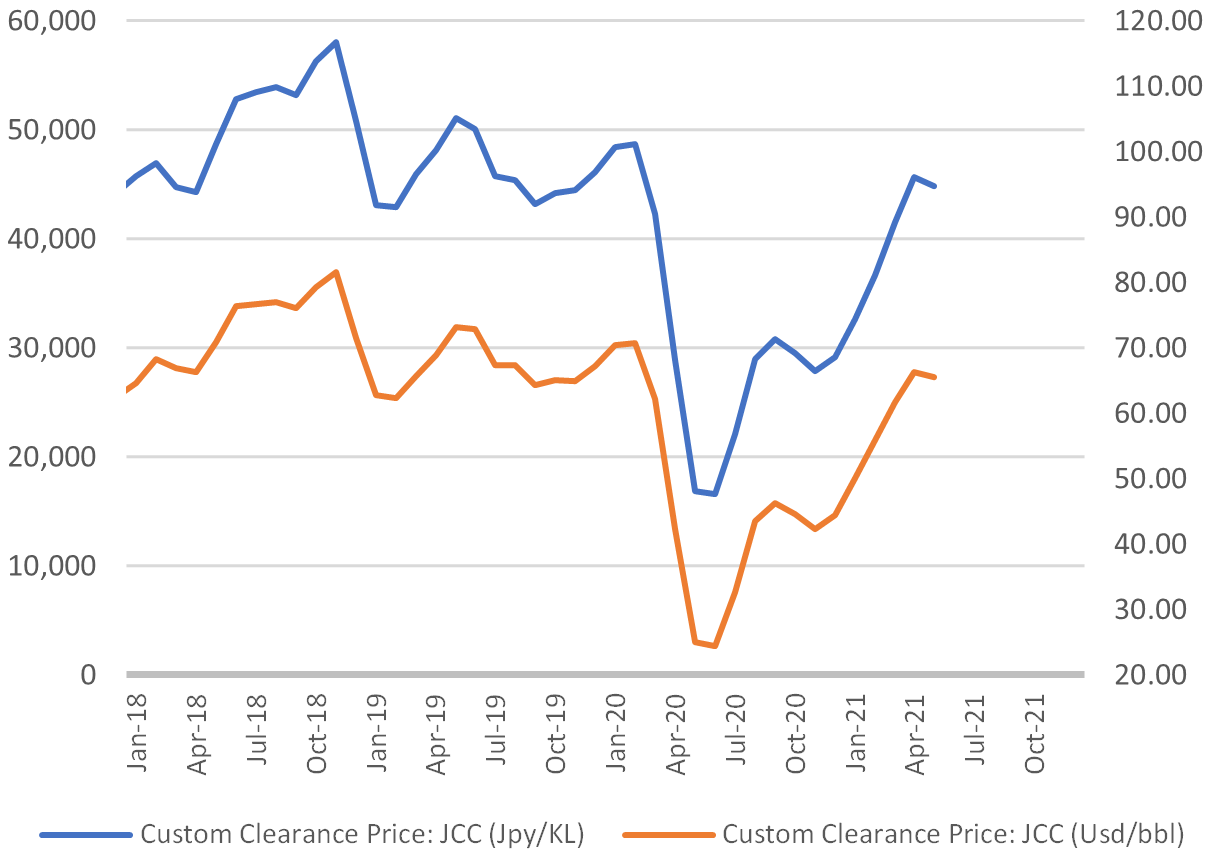
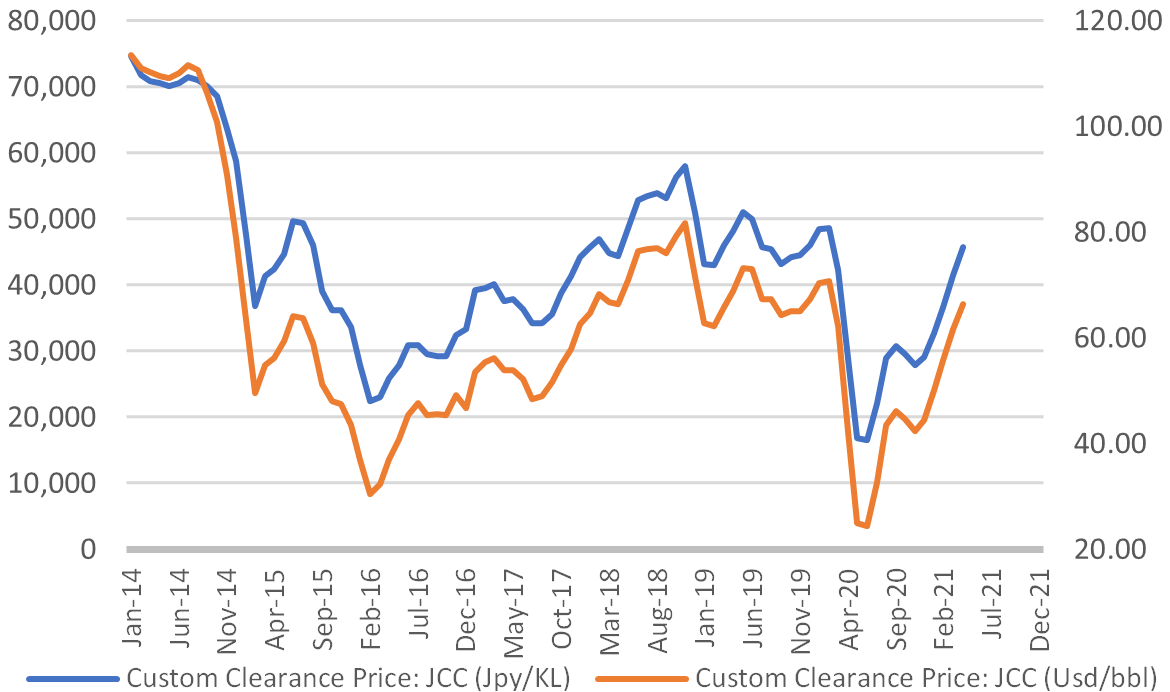
Japan Oil Price: $65.45/ barrel
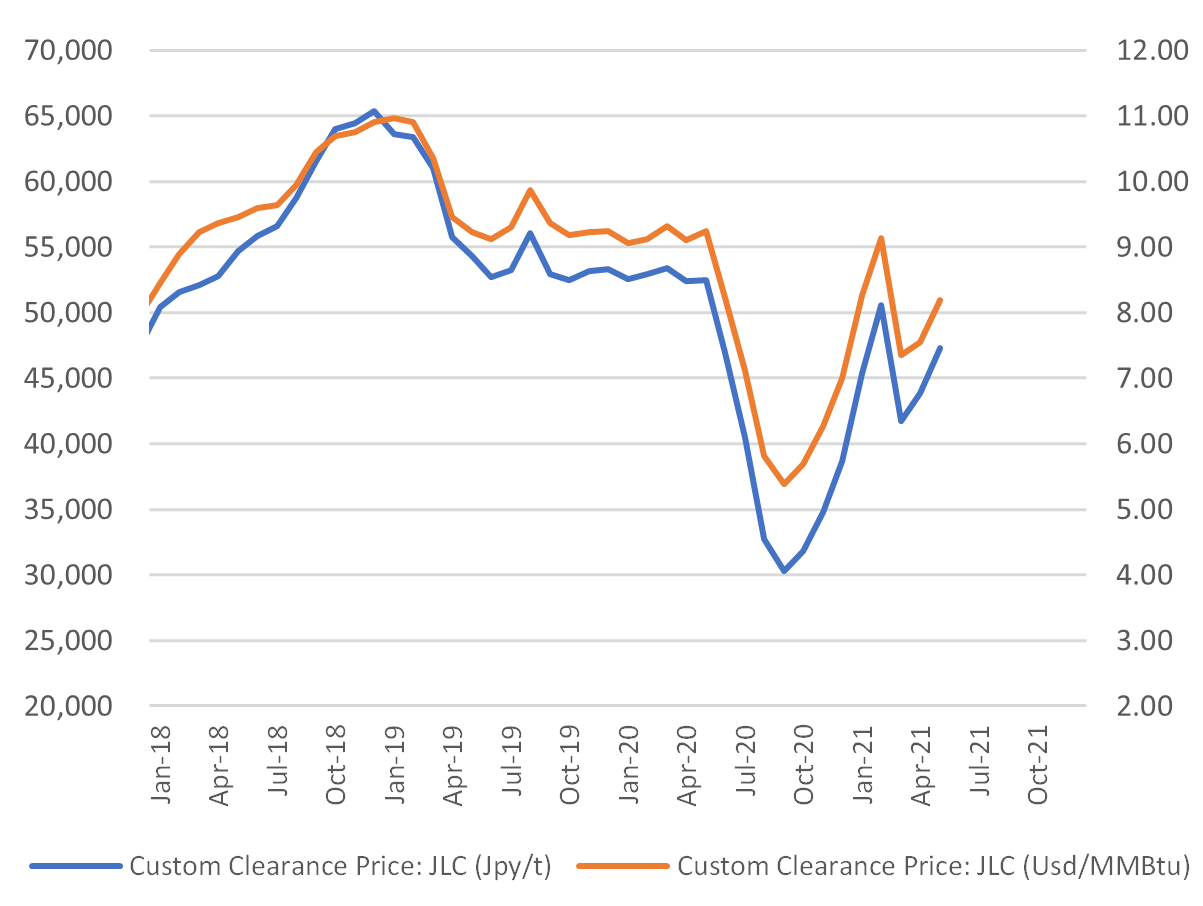
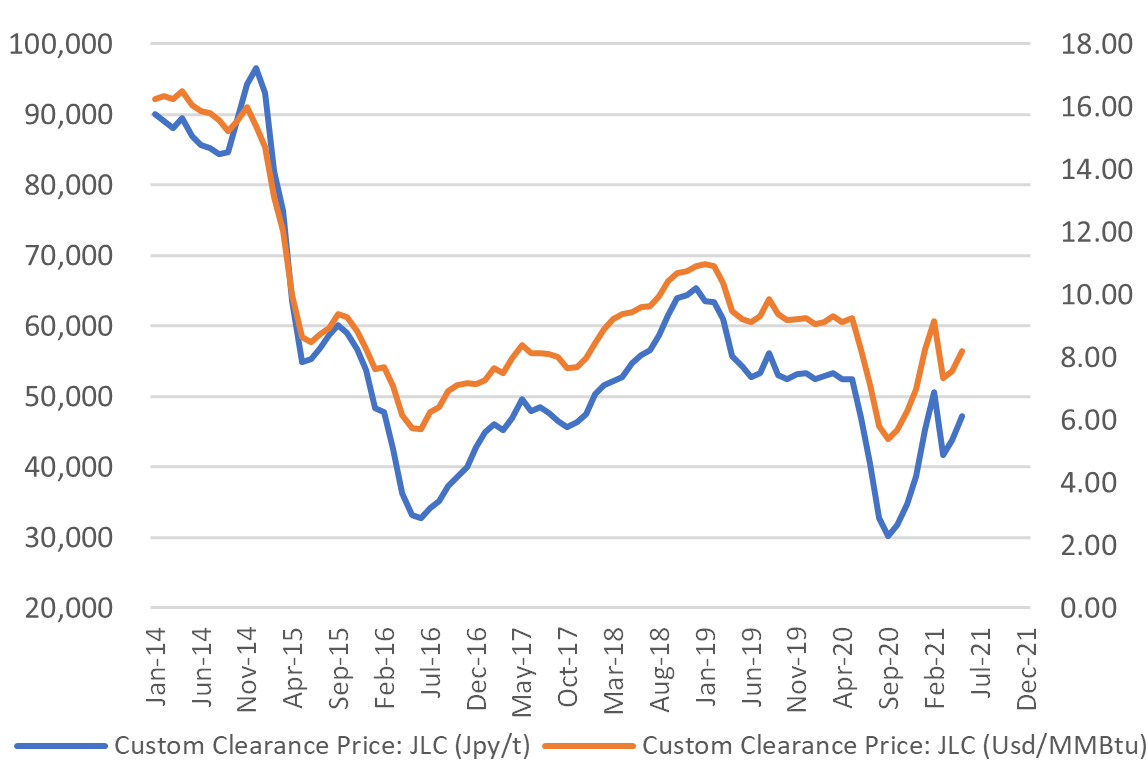
Japan (JLC) LNG Price: $8.19/ mmbtu
INPEX, Kiryu begin supplying carbon-neutral gas
(Sekiyu Tsushin, July 2)
- INPEX and Gunma-based Kiryu Gas agrees on the sale of carbon-neutral gas.
- Kiryu Gas will purchase carbon-neutral gas from INPEX to use in its offices and to supply domestic subscribers.
- INPEX is working to boost the percentage of renewables in the energy supply as part of its January pledge to become carbon neutral by 2050.
TAKEAWAY: Kiryu Gas is an unlisted, small gas supply based in the Gunma prefecture. While the scale of the purchases is small, this news shows that the market for carbon-neutral LNG, which only appeared in 2019, is starting to spread. The INPEX sale extends the number of major supplies in carbon-neutral LNG to at least four: Tokyo Gas, Mitsubishi Corp.’s Diamond Gas International, Mitsui & Co., and INPEX. The biggest of those is Tokyo Gas, which announced half a dozen supply deals for domestic players, mostly for small volumes. The other three players also have small-scale deals with local gas retailers like Kiryu as a way to test the waters and offer it as a menu item to local industry. For example, Mitsui agreed in February to supply Hokkaido Gas, aiming to popularize carbon-neutral LNG locally. Apart from the obvious issue of clients being reluctant to pay more for the same gas, there’s a bottleneck at present in procuring enough high-quality carbon credits to offer the product in Japan. Still, it’s likely that Japan will emerge as one of the world’s largest markets for carbon-neutral LNG (if it is not already) in the next few years. Japan may have lost its crown as the world’s biggest LNG importer to China, but it’ll be a leader in this premium market niche for quite a while.
Mitsui E&P to supply LPG in Western Australia
(NNA Asia, July 2)
- It has been learned that Mitsui&Co subsidiary Mitsui E&P Australia, in collaboration with Australian-owned Beach Energy, has agreed to supply local utility Midwest LNG with two terajoules of LPG per day.
- Midwest, a subsidiary of Perth-based Clean Energy Fuels Australia targets Inland mining and residential users of LNG.
Japan hosts 11th Critical Materials Conference
(Japan NRG, June 30)
- The governments of Australia, Canada, the EU and the U.S. took part in the Critical Materials Conference, hosted by Japan. They discussed the current state of the rare earths industry and issues of critical raw minerals, which are vital for EVs and other decarbonization technologies.
- The next meeting will be held this autumn, under the chairmanship of Japan.
TAKEAWAY: CRMs are a vital part of the energy transition and are often overlooked in the discussions. There was little communicated from Japan about what was discussed at this latest conference, other than the mention of EVs. However, there are many vital issues that need addressing in CRMs, not least how “green” is the state of their production. METI has often discussed Japan being self-sufficient in various CRMs by around 2030, but there are few facts suggesting this will actually be possible. Developments in this area will be key for many industries, not only for energy.
ANALYSIS
BY TAKEHIRO MASUTOMO
Détente in Japan’s Nuclear Winter?
Or, Calm Before the Storm?
Japan’s nuclear power industry has faced its most difficult decade since the March 2011 disaster at the Fukushima Dai-Ichi NPP. All the nation’s reactor were entirely shut down at one point. Now, after years of headwinds, the industry is starting to gather positive momentum.
Eight reactors (over 7 GW) have restarted in the last six and a half months. One or two more may come online later this year. If they do, Japan will have the most functioning nuclear capacity since the accident.
Still, amid the optimism inside the nuclear industry, there are still a number of challenges, and not only about critical public opinion or the volatility of courts and local government decisions. “Carbon-neutral” solutions for thermal plants will give nuclear a tight race as a provider of large-scale CO2-free baseload power.
A Decade in Nuclear: an Overview
- Before the March 2011 accident, Japan had the world’s third-largest nuclear capacity. When counting reactors under construction, it had 57 units on the books. For comparison, France, has 58 operational reactors today.
- After the Fukushima event, Japan introduced much stricter technical and operational rules and set up a new regulatory body, the NRA, with a mandate to be tougher and a lot more independent than its predecessor, which enjoyed close relations with industry players.
- As a result of the shakeup, 27 reactors were slated for decommissioning. All new construction (3 units) was halted. The NRA began re-examining all the facilities to check whether they passed the new standards. Today, the number of reactors that could be operated in Japan is down to 33.
- Nuclear’s contribution to the total electricity mix was a mere 6% in 2019.
|
No. of operable nuclear reactors |
33 | |
|
of which |
applied for restart |
25 |
|
approved by regulator |
17 | |
|
restarted |
10 | |
|
in operation today |
9 | |
|
No. of nuclear reactors under construction |
3 | |
|
No. of reactors slated for decommissioning |
27 | |
|
of which |
completed work |
1 |
|
started process |
4 | |
|
|
yet to start / not known |
22 |
Strategically extending the age of reactors
The most recent Basic Energy Plan, formed three years ago, envisioned nuclear power providing 20-22% of total electricity in 2030. Given the slow pace of the industry’s recovery in the public’s eyes, that looked extremely unlikely until recently.
What’s more, reactors are originally licensed to operate for only 40 years. The average age of the reactor fleet in Japan has not reached over 29 years old. (It was about 24 years in 2011.) So, if no new reactors were built and there were no extensions, the average age would almost be at the limit by 2030. The current 20-22% target would be impossible to reach, as would the task of retaining specialist staff and industry know-how.
As in other countries, Japan decided to allow a 20-year license extension, provided the facilities pass the regulator’s approval. So far, only four units have done so: three owned by Kansai Electric and one by Japan Atomic Power Co. However, it has taken almost five years for the first of the older facilities to actually restart due to the extra upgrades mandated by the NRA and difficulty in winning over a skeptical local public.
On June 23, Kansai Electric (KEPCO) restarted its 44-year-old Mihama NPP Unit 3, the first time a 40+ unit operated in Japan. On July 3, Unit 3 of Ooi NPP was switched on. Next, KEPCO plans to bring back online Takahama NPP Units 1 and 2. The former may be online this year but still needs to complete updates to its anti-terrorism standards. The second unit’s timeline is less certain.
A big plus for KEPCO is that local governments have given the green light to the older reactor units. Now the challenge lies mostly on the operational side. That’s a major plus for a company whose total capacity and financials are more sensitive to nuclear than any of its regional peers.
At a later date, industry experts expect Japanese nuclear operators to lobby for a second 20-year operating life extension, something that has already taken place in the U.S. In addition, utilities will ask the regulators to discount the years spent in NRA review as part of a reactor’s lifespan. That could make a massive difference for utilities such as Hokkaido Electric, whose Tomari NPP has been under the regulator’s microscope since 2013.
License extensions is a strategy forced on operators because building an entirely new nuclear power plant in Japan is a huge challenge, says an industry insider. Apart from Kansai Electric, few regional utilities are likely to take that on. Even Kyushu Electric, which has operated its reactors the most of any utility post 2011 is unlikely to pursue new projects unless it has a co-investor, the person said. Kyushu’s large and growing solar sector makes new nuclear projects risky.
Political sentiment improving
The government’s pro-active stance seems to have made the difference for nuclear in the last year. METI minister Kajiyama personally held talks with local governors to progress restarts.
Former prime minister Abe rarely spoke up for nuclear energy during his 2012 to 2020 term in office, but in April this year he formed a new parliamentary group calling for new nuclear power construction and technological advances to replace the aging fleet.
Current PM Suga’s decarbonization agenda has also bolstered the arguments of the nuclear lobby.
Even opposition leader Edano Yukio, who served as Chief Cabinet Secretary at the time of the Fukushima accident, and who is generally against nuclear power, said in an April interview with the nation’s biggest newspaper, the Yomiuri, that he considers the task of phasing out nuclear power to be a “100-year job.” With this, Edano suggested to the pro-nuclear Yomiuri that he would not take any immediate measures to dismantle the industry.
Meanwhile, as METI prepares the latest edition of the Basic Energy Plan, early indications are that it will retain nuclear energy’s 20% ratio for 2030. Should the current pace of restarts continue over the next few years, this target no longer seems outlandish.
The big concern within the nuclear industry, however, is the subtle shift that METI has introduced in the categorization of nuclear power. In recent documentation, such as the Green Growth Strategy published in December 2020, nuclear is lumped with thermal power as one category, which is expected to account for 30% to 40% of Japan’s electricity by 2050.
One member of an expert committee at METI sees this as an abandonment of nuclear power. The 30%-40% number implies that nuclear’s share could drop to 10% by 2050 – an idea that would cause a political uproar in regions that currently host nuclear facilities, the person said.
With so much effort to decarbonize thermal power plants by co-firing them with biomass, ammonia and hydrogen, as well as adding on carbon capture, the nuclear industry’s selling point of being the sole generator of mass CO2-free baseload is also being eroded, the committee member said.
Utility by Utility Breakdown
For the time being, most nuclear utilities in Japan are more concerned with the near-term issues. After spending billions of dollars on upgrading their nuclear facilities, as mandated by the NRA, several of the smaller EPCos could collapse if these reactors are never restarted. Tohoku Electric, Hokkaido Electric, and Chugoku Electric are three such firms.
The key litmus test will be the fate of Tohoku’s Onagawa NPP, Unit 2. In November 2020, the Miyagi prefecture governor and other local authorities agreed to the restart of Onagawa-2. Tohoku still has to complete more upgrades, but with local approval a restart during FY2022 looks much more certain. If it does happen, it will be the first nuclear plant to operate in northeastern Japan, the region at the epicenter of the earthquake and tsunami that caused the Fukushima accident.
Onagawa would also be the first BWR technology to restart in Japan since 2011. The Fukushima Dai-Ichi plant used BWRs, while the reactors that have restarted to date have all been PWR.
Risks remain. This fall, the Miyagi governor faces re-election and his nuclear decision will be in the spotlight. Then, there’s the ongoing courts risk. Local residents are preparing lawsuits to scupper Tohoku’s plans based on claims that the utility’s evacuation plans are inadequate. Finally, there is a chance of another strong earthquake or aftershock in the area.
At least the Onagawa NPP restart is proceeding. Tohoku’s Higashidori NPP Unit 1 has been stuck in limbo over geological concerns and any restart is not seen until at least FY2024.
Hokkaido Electric has inched forward with a restart of its Tomari NPP and its three reactors. Earlier this year, the NRA acknowledged the operator’s claim that there are no active faults under the site. Still, the inspection is only halfway through, according to the NRA, and still needs to identify the scale of the maximum expected earthquake and tsunami. Once that’s done, the utility will need to install upgrades to meet any potential threats. Two of Tomari’s units are over 30 years old.
Chugoku Electric last month won NRA approval for the restart of its BWR model Shimane NPP Unit 2. It’s the only reactor on the utility’s books. But, local leaders, especially the new mayor of Izumo City, are uncertain whether to back the plant, which would require the evacuation of 400,000 residents in case of an emergency. As such, the earliest restart is currently seen around FY2025.
Evacuation planning is equally a concern for Japan Atomic and its Tokai Daini NPP, which is the only reactor inside the Tokyo metropolitan region. In March 2021, a court ordered the utility to suspend operations of the NPP, even though it was not close to a restart.
TEPCO’s Uncertain Future
These risks, however, can’t compare with the uphill task facing TEPCO, the Fukushima station operator. The utility has lurched from one scandal and problem to the next, and earlier this year received a “red card” from the regulator for a security incident. This will prevent TEPCO from operating its remaining active NPP, the Kashiwazaki Kariwa until 2H2022 at the earliest.
A likely scenario, however, is that TEPCO will need to transfer its operational nuclear assets to another company. Tohoku and Japan Atomic are sometimes named in the local media as candidates. Another would be Kansai Electric. Should it take over TEPCO’s plants, it would also win access to a nuclear waste storage facility in northern Japan – something that Kansai Electric badly needs to make go
ANALYSIS
BY MAYUMI WATANABE
Japan Is Not Powerless – at Least During the Summer
Why did METI Dial Down Earlier Warnings of a Power Crunch?
First, the ministry responsible for Japan’s energy systems, METI, warned of critical
power shortages and blackout risk during this summer and winter. Then, it dialed
down the alarm and proclaimed the system was fine – at least for this summer.
The conflicting messaging that started in May has since continued with METI’s
reassurances, soon followed by mandates for electricity retailers to be on guard and
for power generators to make sure their fuel stocks are ample.
As Tokyo prepares to host the Olympic and Paralympic Games starting later this
month – an event advertised as 100% powered by renewable energy – the country
cannot afford to lose face and let the capital’s power shortage spill into the open.
However, the short-term measures that Japan is taking to ensure stability in July and August could come back to bite. The initial panic over summer demand peaks may have been premature, but the reality will be only too visible come the winter months.
Good cop, bad cop
In mid-May, METI minister Kajiyama said the power supply-demand balance was “at its worst for several years.” He claimed METI would strongly push consumers to conserve electricity and announce power saving targets. If demand rose to critical levels, the government would sound the alarm.
About 10 days later, and Kajiyama’s words were washed over with a much rosier
report from the ministry. It turns out the power balance would be fine this summer,
even with the expected seasonal air-conditioning demand. While power conservation efforts are appreciated, the report claimed that METI would be making no additional regulatory push to save energy.


The Tokyo Olympic games will run on solar power from the Tamakawa, Naraha and Okuma facilities in the Fukushima region, as well as wood biomass power from ENEOS. The latter’s Kanagawa plant is due to deliver 24 million kWh of electricity to 49 stadiums, halls, warm up areas and other facilities. The biomass is made up of construction waste and tree clippings.
The Games will also offset “unavoidable CO2 emissions” with work to reduce emissions elsewhere.
How a ministry’s view could switch in a matter of less than two weeks is a puzzle.
The most probable rationale, said a utility official, is to maintain a positive façade during the Olympics. Asking the population, which has turned critical of the event because of the COVID-19 pandemic and a perceived tardiness in the vaccination rollout, to endure power savings would be extremely risky for the government ahead of the autumn general election.
In terms of how METI has justified the about-face, the answer lies in a modified interpretation of the original supply-demand forecast.
The ministry projected a misleading image of “power reserve ratio”, that if an area cleared a reserve power ratio of 3% there was no power supply concern.
The forecast, completed by the Organization for Cross-Regional Coordination of Transmissions Operators (OCCTO), put nationwide power supply in July at 173 million kW and demand at 165.9 million kW, leaving 7.1 million kW or 4.3% of the capacity in reserve. This nationwide figure is above the 3% reserve that the government requests, but that’s due to a very large surplus expected in the northernmost Hokkaido region (16.2%). The forecast reserve ratio in the three main consumption areas of Tokyo, Chubu and Kansai is at only 3.7%.
If power interconnections between regions are not utilized (or do not function), the reserve ratio for Tokyo drops to 2.6%; the Toyota Motor heartland of Chubu is at zero; the Kansai region is in the red with a minus 3.5% ratio. A similar picture is painted by OCCTO for August. Nationwide, the reserve ratio looks a healthy 4.9%. In Tokyo, Chubu and Kansai it sits at 3.8%. But, take away the interconnection link capacity and Kansai is in deficit, and Tokyo and Chubu are below the 3% market.
According to the utilities, even at 3% in reserve it’s hard to guarantee a stable supply. Energy planners usually aim for double the amount. But, asking the public to save power during the Olympics is simply not an option. As TV stations cover the well-lit stadiums, warming up centers and adjacent facilities, local resentment might swell. News of power shortages during the event would also generate global headlines and potentially hurt Japan’s attractiveness for investors.
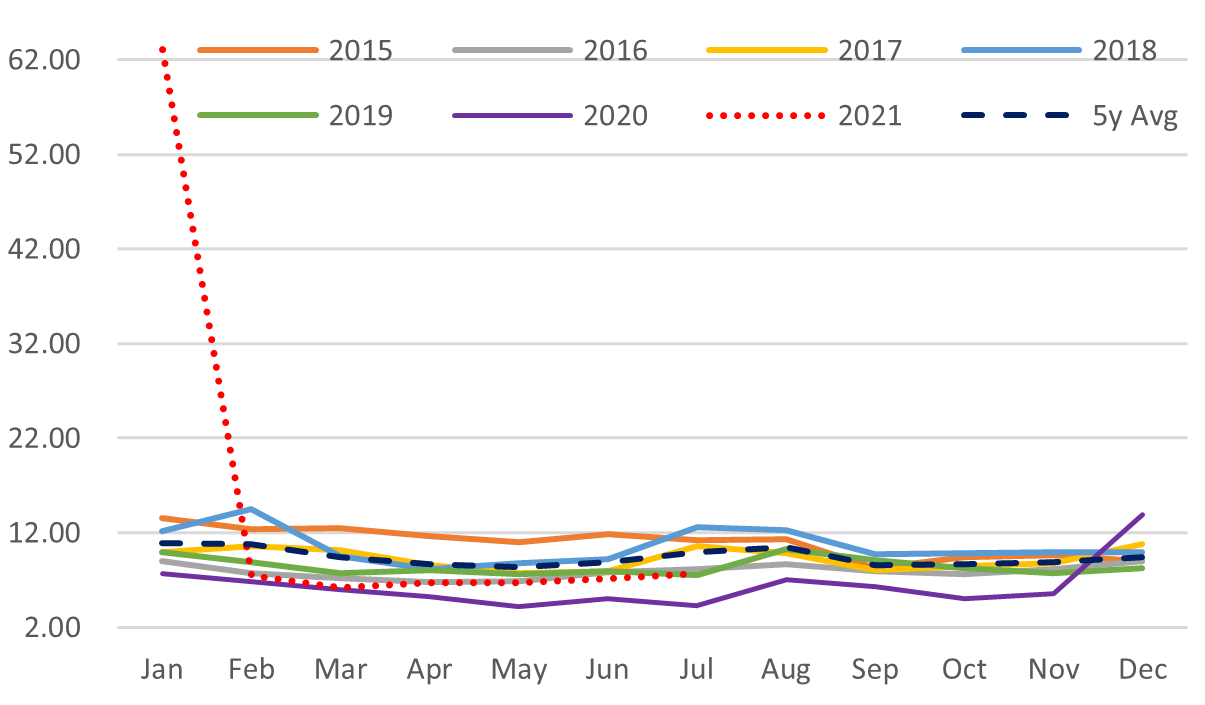
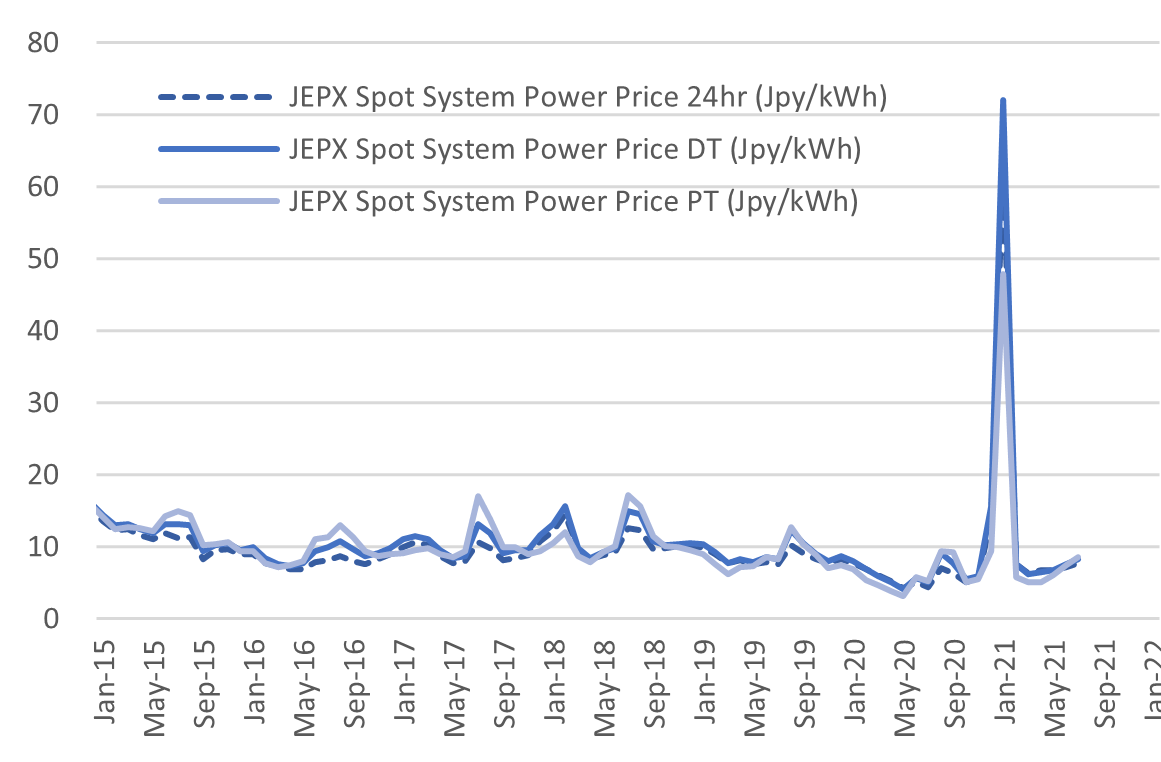
Another risk is a repeat of January, when a shortage in LNG and other available power capacity quickly spiraled into one of the highest spot electricity prices ever recorded.
Pushing old facilities to the limit
Of course, fudging the numbers is not a realistic strategy to get through the summer peaks. For that, the government has used all its effort to restart nuclear reactors at a record pace (See the other article in this week’s Analysis section). Over 7 GW of nuclear capacity has come online in the last six and a half months.
Over the weekend, Kansai Electic restared its 1.18 GW Ooi NPP Unit 3. Meanwhile, Kyushu Electric is bringing online a 360 MW coal-fired Karita power plant.
Switching back on older coal stations and nuclear reactors will vastly improve the August power reserve ratio in Kansai to 10.8%, and in Kyushu to 8.9%. For Tokyo and Chubu, however, the situation remains tense. Tokyo’s 3.7% reserve is predicated on getting extra supplies of electricity from neighboring regions. Yet, one of its neighbors is Chubu, which is in a similar if not worse predicament. In OCCTO’s worst-case scenario, Japan would be short of 400 MW of capacity in July and 190 MW in August.
What’s most concerning, according to an official at the Federation of Electric Power Companies of Japan (FEPC), is that some plants running this month and in August, technically, should be shut down for maintenance. That raises the possibility of trouble occurring due to delayed check-ups.
Kansai Electric, JERA and Kyushu Electric have started to use drones to increase
the frequency of patrol of their facilities. Digital and other advanced technologies are being installed to quickly detect abnormalities in furnace temperatures or turbine conditions, but once malfunctions are detected, the plants will still need to idle.
Certainly, such prolonged running of stations without maintenance cannot continue
for every peak season, which raises questions about the strategy for the winter.
Should power shortages occur, a further concern is price volatility. After market
liberalization, the number of electricity retailers in Japan has risen to 725. However, only 54 of those have their own generation facilities. The remainder buy power either directly from generators or from the open market.
At times of shortage, large generators can prioritize their own delivery over selling into the spot market. As in January, this could leave several hundred retailers scrambling to secure volumes in the spot market, sending prices sky high. False alarms may also trigger price volatilities.
METI held online meeting with retailers in June urging them to increase the ratio of power supply sourced directly from power generators, and to hedge in the futures market.
Emergency Options
OCCTO says there’s a system in place that automatically curbs demand from big
power users. In a power crunch, retailers and large consumers have contracts
according to which consumers systematically cut power usage during shortages.
Under this arrangement, up to 430 MW of capacity can be freed up, OCCTO says.
The big users can forego volumes to retailers because many have their own
emergency generators. Last January, for example, Asahi Brewery activated its
emergency power units and supported not only its factories but even local needs.
METI data shows that Japanese businesses have 5,857 power units for internal use
during emergencies, with a combined maximum capacity of 28.8 GW. However, this capacity is not meant to run for months on end. It’s a short-term solution.
There’s only a 40% change of summer temperatures being above average this year, according to JMA data. So, most likely, this summer should pass without too much trouble.
The numbers for the coming winter, however, are another matter. Even on a
nationwide basis, OCCTO sees reserves of only 3.8% in January and just 2.4% in
February. For Tokyo, the reserve ratio goes into the red.
GLOBAL VIEW
BY TOM O’SULLIVAN
Below are some of last week’s most important international energy developments monitored by the Japan NRG team because of their potential to impact energy supply and demand, as well as prices. We see the following as relevant to Japanese and international energy investors.
Batteries:
Nissan and its Chinese partner, Envision AESC, will build the UK’s first gigafactory to manufacture 9 GWh of batteries for EVs in Sunderland at a cost of $1.4 billion, creating 6,000 jobs. The UK has banned sales of petrol and diesel vehicles from 2030.
Nuclear Power:
1). In Taiwan, Taipower announced the permanent closure of unit 1 at the Guosheng nuclear power plant. The 985 MW BWR had been scheduled to be decommissioned in December but a shortage of used fuel storage capacity has forced the state-owned company to take the unit offline early.
2). In Egypt, the Nuclear Power Plants Authority (NPPA) applied to the Nuclear Regulatory Authority for a construction permit for units 1 and 2 of the El Dabaa nuclear power plant. Russia’s Rosatom will start construction once the permit is granted.
3). The U.S. Nuclear Regulatory Commission is considering granting permits to allow 100-year operating lives for the U.S. reactor fleet.
4). Brazil’s National Bank for Economic and Social Development (BNDES) hired a consortium to structure the project for the completion of the Angra 3 nuclear power plant in Rio de Janeiro. BNDES has been providing technical services to the Angra plant’s owner, Eletronuclear, since 2019.
Coal:
1). The UK is accelerating its target to end coal use in electricity generation by one year to October 2024 as it prepares to host COP26 in November. Coal accounted for only two percent of the UK’s electricity mix in 2020, compared with 40 percent 10 years ago.
2). Glencore will buy out minority owners of the Cerrejon thermal coal mine in Colombia for almost $300 million as coal prices hit highest levels in a decade due to stronger Asian demand, coal shortages in China, and low levels of investment.
3). Industrial and Commercial Bank of China has abandoned plans to build a $3 billion coal-fired power plant in Zimbabwe.
Oil & Gas:
1). WTI and Brent both exceeded $75 a barrel for the first time since 2018 as OPEC+ failed to reach an agreement on production increases due to objections from the UAE.
2). Nymex natural gas prices in the U.S. was the world’s best performing asset class in Q2, rising by 40% over three months.
3). U.S. oil and gas rig count fell by one to 456, according to Baker Hughes. Total rig count is up 172 rigs or 61%, YoY. It is also up 87% since falling to a record low of 244 in August 2020.
4). Progressives in the U.S. Democratic Party are now thought to be pressuring the Biden administration to reduce U.S. reliance on natural gas.
EVs:
1). The Southern Chinese city of Liuzhou has become the effective capital of China’s growing EV industry, with EV sales penetration of 30%, the second highest in the world, after Oslo.
2). Tesla has been forced to “recall” 300,000 EVs in China due to a software glitch.
3). Honda will introduce a new electric SUV, the Prologue, and an electric Acura SUV in the U.S. in 2024.
Aviation:
United Airlines will order 200 Boeing 737 Maxes and 70 Airbus A321neos as demand for air travel picks up across the U.S., an order worth $30 billion. The investment is expected to generate 26,000 jobs. However, Rystad Energy expects global jet fuel consumption to be nearly 3 million bpd lower in 2021 than in 2019. Rystad believes international travel will revert to 2019 levels only in 2023.
Electric Drones:
1). The UK’s BAE Systems is building the world’s first solar-electric powered communications drone that can operate in the stratosphere at an altitude of 21km for as long as one year.
2). Zipline, a drone delivery service based in California, has raised $250 million in new capital, and increased its valuation to almost $3 billion.
Solar Power:
1). China now accounts for 34% of installed global PC capacity and over 70% of PV module production, according to a recent report from Japan’s RTS.
2). Elon Musk is seeking to dramatically increase the installations of his Solar Roof residential home product across the U.S., aiming at 1,000 installations per week, a five-fold increase on current installations.
CO2:
A billion tons of CO2 must be removed from the atmosphere by 2025 if the terms of the Paris Agreement are to be met and a billion tons per annum thereafter according to a report by ‘Coalition for Negative Emissions’ and McKinsey.
Clean Electricity Standard:
President Biden is thought to be preparing legislation and standards that will mandate all U.S. electric utilities to generate at least 80% of electricity from clean sources by 2030, and 100% by 2035. Currently, the U.S. $1 trillion infrastructure plan only includes budgets for EV charging infrastructure.
Carbon Taxes:
Kemper Capital Management, the $86 billion asset management company, has estimated that a $75 per ton carbon tax could knock 20% off the valuation of global equities markets. A tax of $150 per ton could eliminate 40% of global equities valuations or over $40 trillion.
Heat Waves:
Temperature records in Oregon, Washington State, and British Columbia were obliterated last week with records sometimes exceeding 50 Celsius, creating a “heat dome”. Seventy six people are thought to have died in Oregon and Washington, and hundreds may have died in Canada. Hydroelectric power plants in Canada were also impacted by ensuing fires.
China:
China overtook Japan as the world’s largest importer of LNG in the 12 months to June 2021, with 76.3 million tons of imports vs. Japan’s 76.1 million tons.
India:
Reliance Industries has committed to invest $10 billion in clean power over the next three years. India’s Adani Green Energy is also seeking to be the world’s largest producer of renewable energy by 2030.
Bangladesh:
Bangladesh has scrapped plans to build 10 new coal-powered plants.
Australia:
J-Power, Iwatani, Marubeni, Kawasaki Heavy Industries and Sumitomo Corp. continue to invest in hydrogen production from brown coal in the State of Victoria and are seeking to transport hydrogen to a storage facility in Kobe before March 2022, using New South Wales as a “Hydrogen Valley” hub.
Qatar:
Qatar Petroleum raised $12.5 billion in the largest emerging markets bond offering this year to finance the expansion of its LNG business. Citi and JP Morgan were global coordinators, and the issue was four times oversubscribed.
Iraq:
A power outage hit most of Iraq’s 22 GW electricity infrastructure on Friday causing extensive blackouts and triggering the resignation of the Electricity Minister. Sabotage has not been ruled out.
Lebanon:
Fuel subsidies may be costing the Lebanese Central Bank $500 million per month as the country struggles to import fuel to overcome chronic fuel shortages. The EU is considering sanctions on Lebanese politicians unless a political solution is found.
Africa : Gabon:
Gabon is the first African country to receive results-based payments for curbing deforestation under the UN-sponsored Central African Forest Initiative (Cafi). Gabon was awarded $17 million from Norway through Cafi because of lower emissions from forest loss in 2016 and 2017. The payment is part of a 2019 agreement between Gabon and Cafi to provide funding worth $150m for reducing emissions from deforestation. The scheme may eventually enable Gabon to sell its emissions reductions as credits on the carbon market. Nearly 90% of Gabon is covered by forest, which captures more carbon than the country emits.
Norway:
Parliament has set a target of a 50% cut in emissions for Norway’s offshore oil and gas explorers by 2030, forcing them to rely on onshore hydropower to power their offshore oil and gas facilities. Oil and gas exports account for 40% of Norwegian exports.
Switzerland:
Gunvor, the international energy trader, is being investigated by Swiss federal prosecutors for bribery and money laundering in its Ecuadorian oil trading business.
U.K.:
Hurricane Energy, the North Sea oil and gas producer, failed to have its restructuring plan approved by the High Court in London making it likely the company will default on $230 million of bond payments in 2022.
U.S.:
1). Hitachi is planning to centralize its semi-conductor research business in Oregon to take advantage of the $1 trillion+ U.S. infrastructure investment plans and to meet the global shortage of semi-conductors which is having a major impact on the transportation sector.
2). 22,000 customers in Michigan suffered power outages last week following flooding around Detroit and Wayne County.
3). A record $6.2 billion has been invested, YTD, in green-energy ETFs in the U.S.
4). Chevron is expected to sell $1 billion of oil and gas assets in the Permian Basin, with oil and gas prices at multi-year highs.
5). The Federal Trade Commission ordered Japan’s 7-Eleven to sell over 200 fuel outlets as part of the FTC approval of the $21 billion acquisition of the Speedway chain from Marathon Petroleum.
Mexico:
The appointment of an operator for the Zama offshore oil field in the Gulf of Mexico, which is thought to have reserves of 1.4 to two billion barrels of oil, is regarded as another major test of Mexico’s energy strategy with state-owned Pemex and Texas’ Talos Energy vying for the operator position.
Panama:
Droughts are impacting the operation of the 50-mile Panama Canal, with four of the past seven years the driest since 1950, reducing rainwater needed to operate the canal. Alternative transportation routes for the four percent of global trade that passes through the canal would create significantly higher emissions.
Brazil:
Brazil’s imports of liquefied natural gas hit a record high of 660,000 tons in June due to its worst drought in a century. Brazil is the world’s third largest generator of hydropower with over 100 GW of capacity.
EVENTS CALENDAR
A selection of domestic and international events we believe will have an impact on Japanese energy.
|
February |
Approval of Fiscal 2021 Budget by Japanese parliament including energy funding projects; CMC LNG Conference |
|
March |
10th Anniversary of Fukushima Nuclear Accident; Smart Energy Week – Tokyo; Quarterly OPEC Meeting; Japan LPG Annual Conference; Full completion of all aspects of the multi-year deregulation of Japan’s electricity market; End of 2020/21 Fiscal Year in Japan; |
|
April |
Japan Atomic Industrial Forum – Annual Nuclear Power Conference; 38th ASEAN Annual Conference-Brunei; Japan LNG & Gas Virtual Summit (DMG)-Tokyo Three crucial by-elections in Hokkaido, Nagano & Hiroshima – April 25th |
|
May |
Bids close in first tender for commercial offshore wind projects in Japan; Prime Minister Suga to visit the U.S. |
|
June |
Release of New Japan National Basic Energy Plan-2021; G7 Meeting – U.K. Presidents Biden and Putin are due to meet at a summit in Geneva Forum for China-Africa Cooperation Summit (Senegal) |
|
July |
Tokyo Metropolitan Govt. Assembly Elections; Commencement of 2020 Tokyo Olympics |
|
August |
Hydrogen Ministerial Conference in conjunction with IEA |
|
September |
Ruling LDP Presidential Election; UN General Assembly Annual Meeting that is expected to address energy/climate challenges; IMF/World Bank Annual Meetings (multilateral and central banks expected to take further action on emissions disclosures and lending to fossil fuel projects); End of H1 FY2021 Fiscal Year in Japan; Japan-Russia: Eastern Economic Forum (Vladivostok)-tentative |
|
October |
Last possible month for holding Japan’s 2021 General Election; METI Sponsored LNG Producer/Consumer Conference; Innovation for Cool Earth Forum – Tokyo Conference; Task Force on Climate-Related Financial Disclosure (TCFD) – Tokyo Conference; G20 Meeting-Italy |
|
November |
COP26 (Glasgow); Asian Development Bank (‘ADB’) Annual Conference; Japan-Canada Energy Forum; East Asia Summit (EAS) – Brunei |
|
December |
Asia Pacific Economic Cooperation (APEC) Forum – New Zealand; Final details expected from METI on proposed unbundling of natural gas pipeline network scheduled for 2022. |
DATA
Japan Oil Price
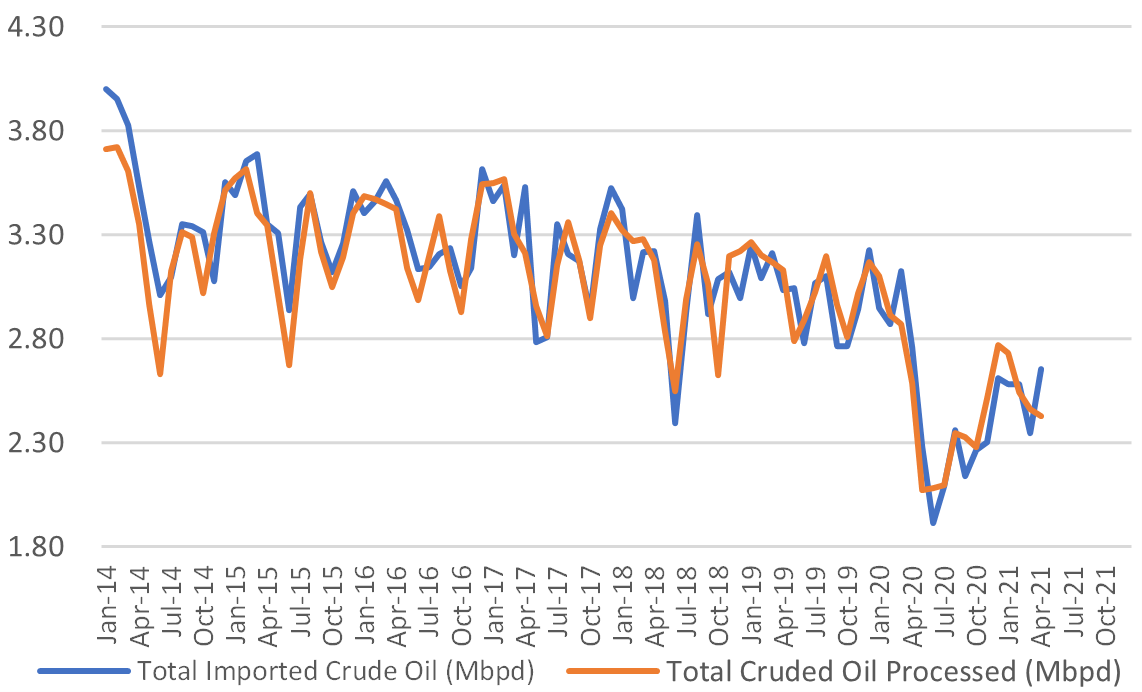
Crude Imports Vs Processed Crude
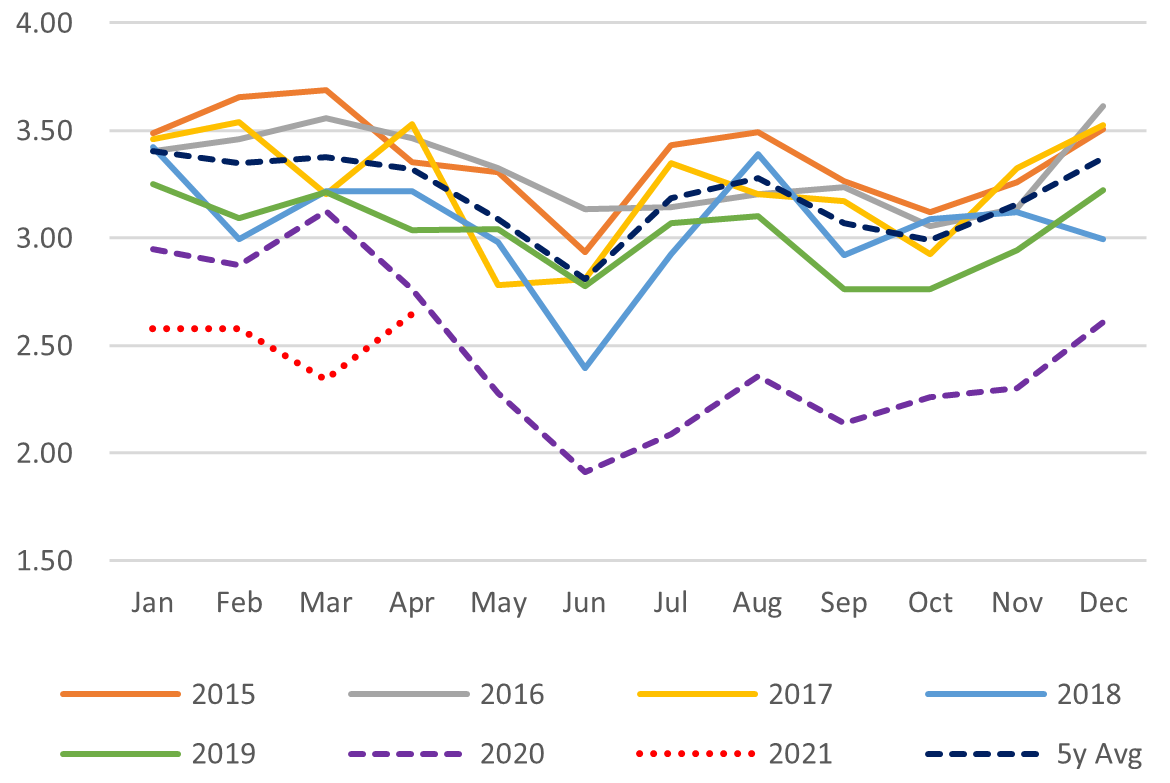
Monthly Oil Import Volume (Mbpd)
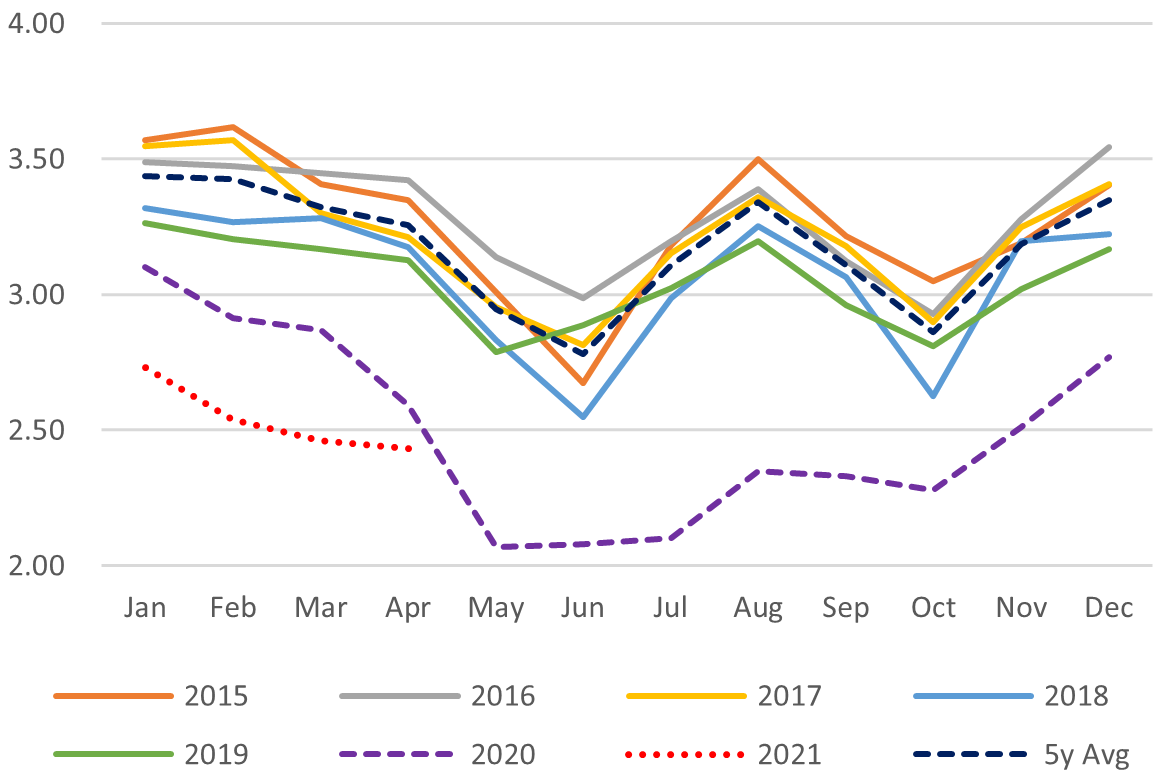
Monthly Crude Processed (Mbpd)
Domestic Fuel Sales
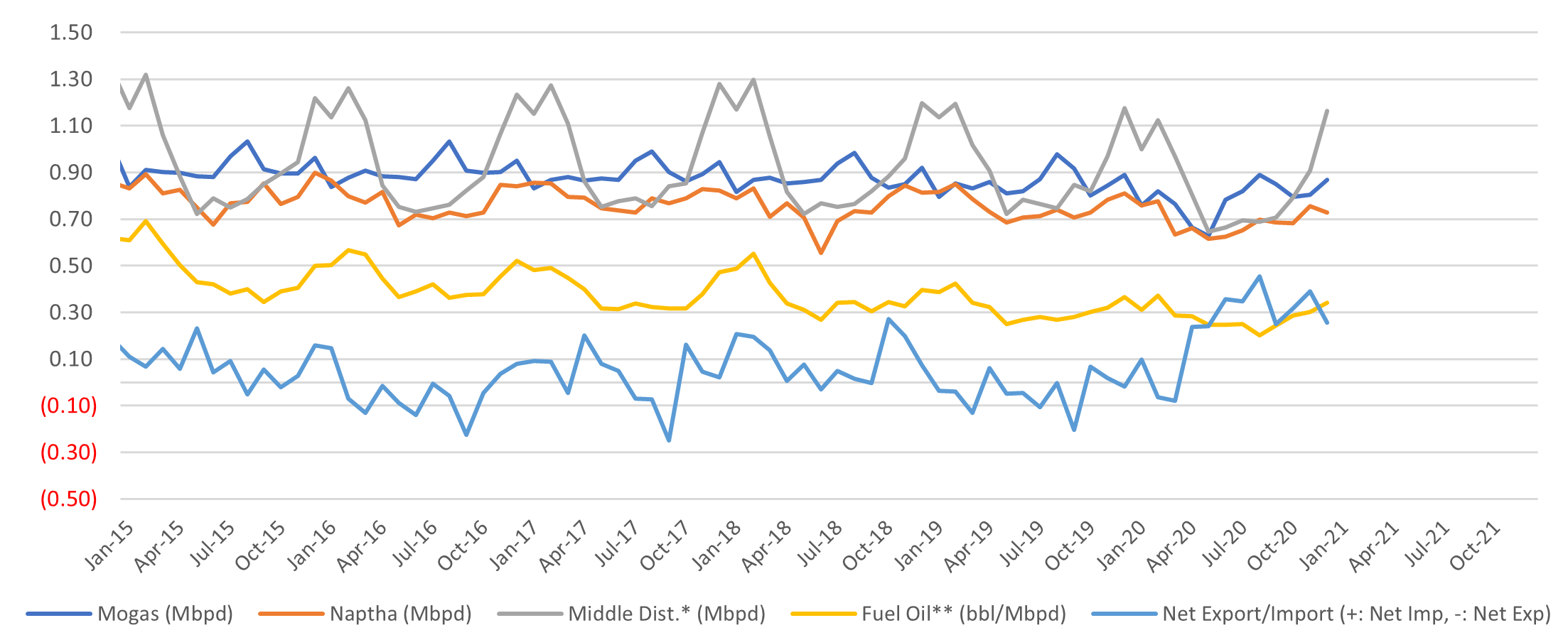
SOURCES: Ministry of Economy, Trade, and Industry (METI), Ministry of Finance, and the Petroleum Association of Japan
Japan LNG Price
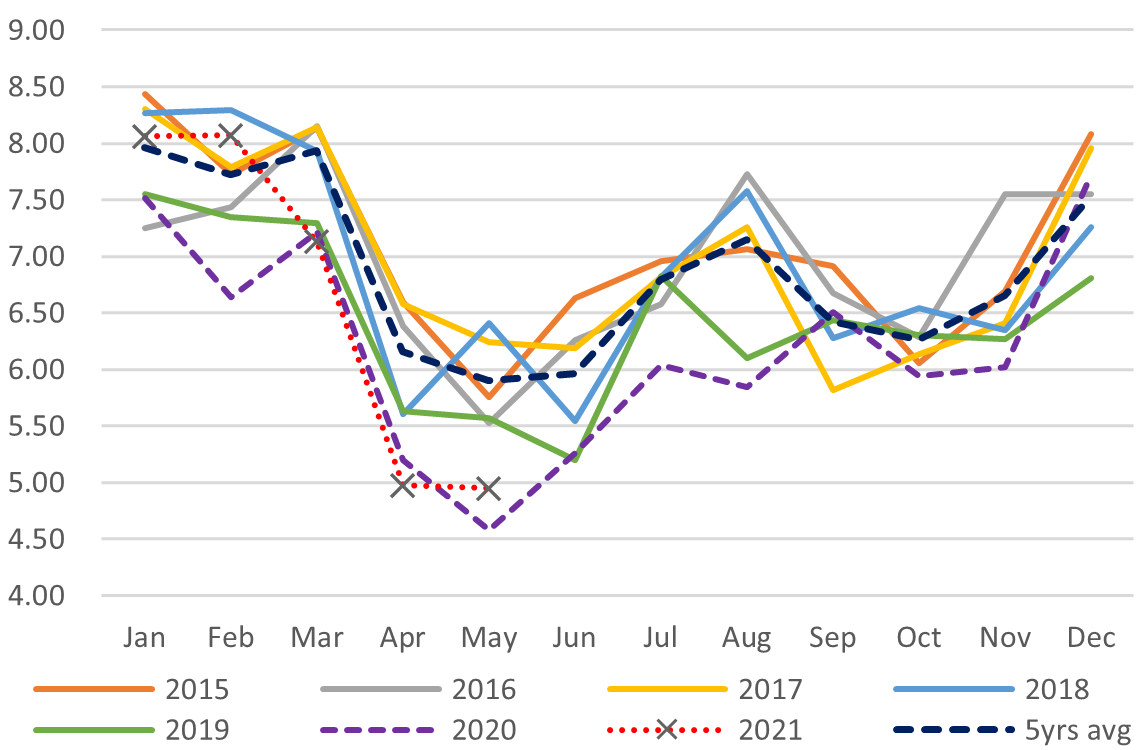
LNG Imports: Japan Total vs Gas Utilities Only
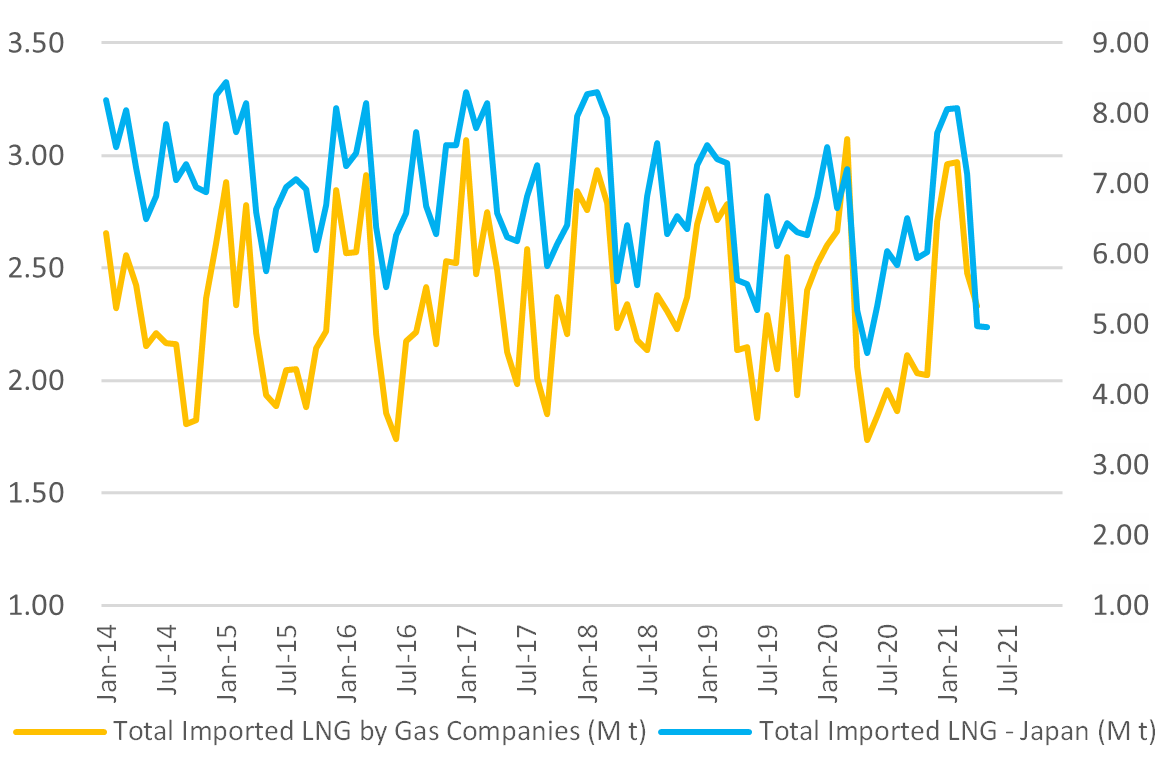
Total LNG Imports (M t)
LNG Imports by Gas Firms Only (M t)
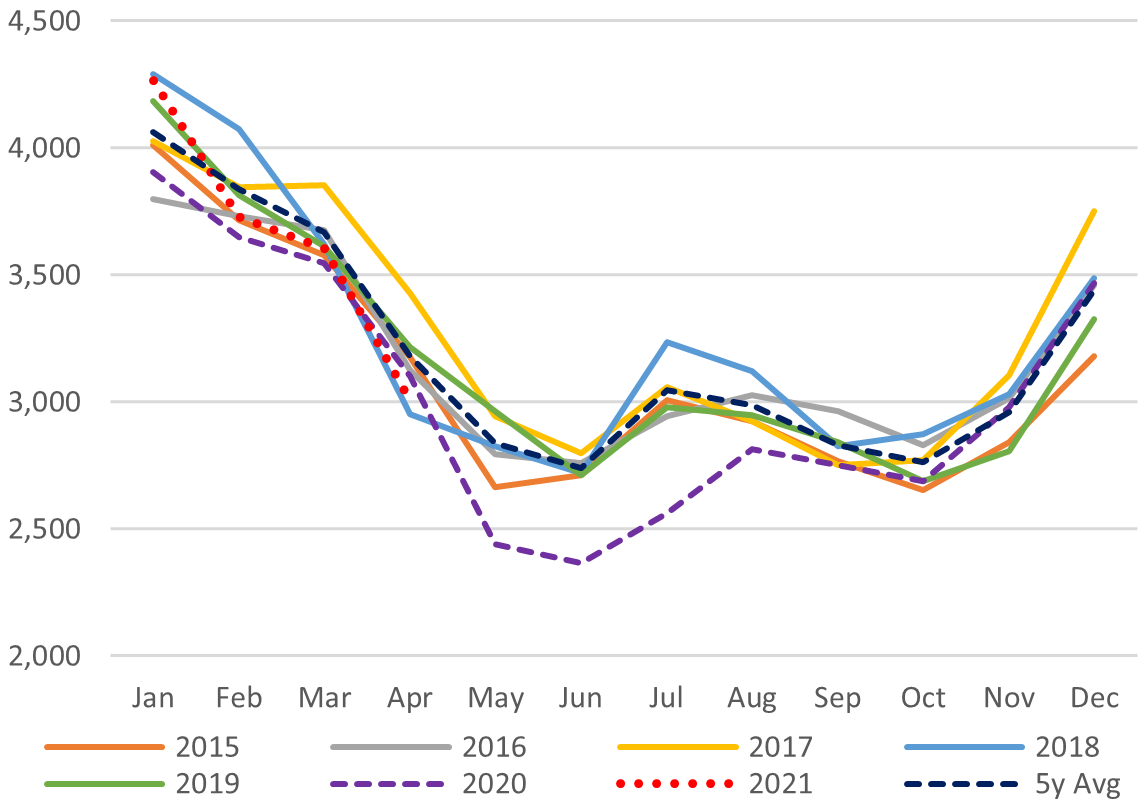
City Gas Sales – Total (M m3)
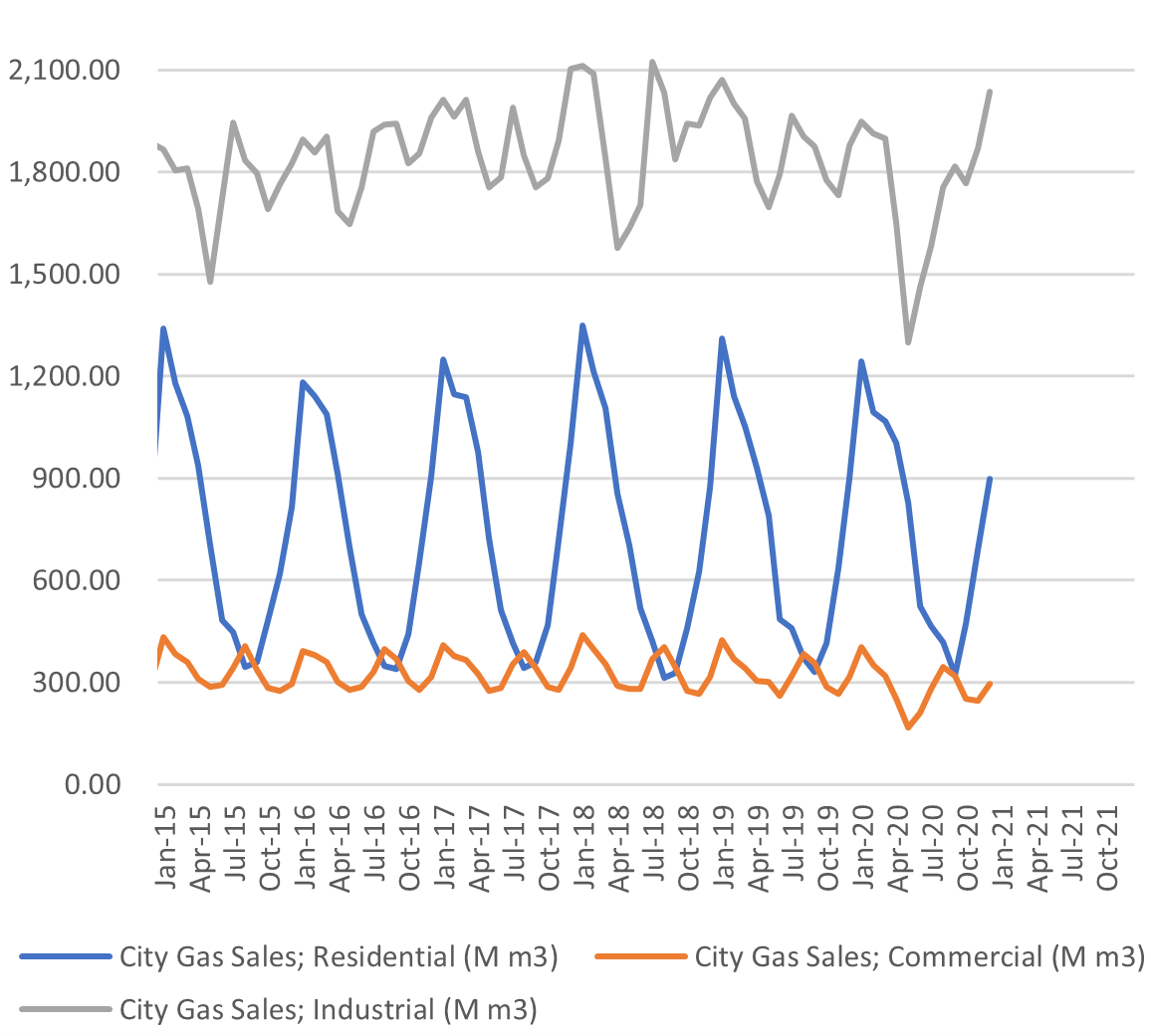
City Gas Sales by Sector (M m3)
SOURCES: Ministry of Economy, Trade, and Industry (METI),
Ministry of Finance
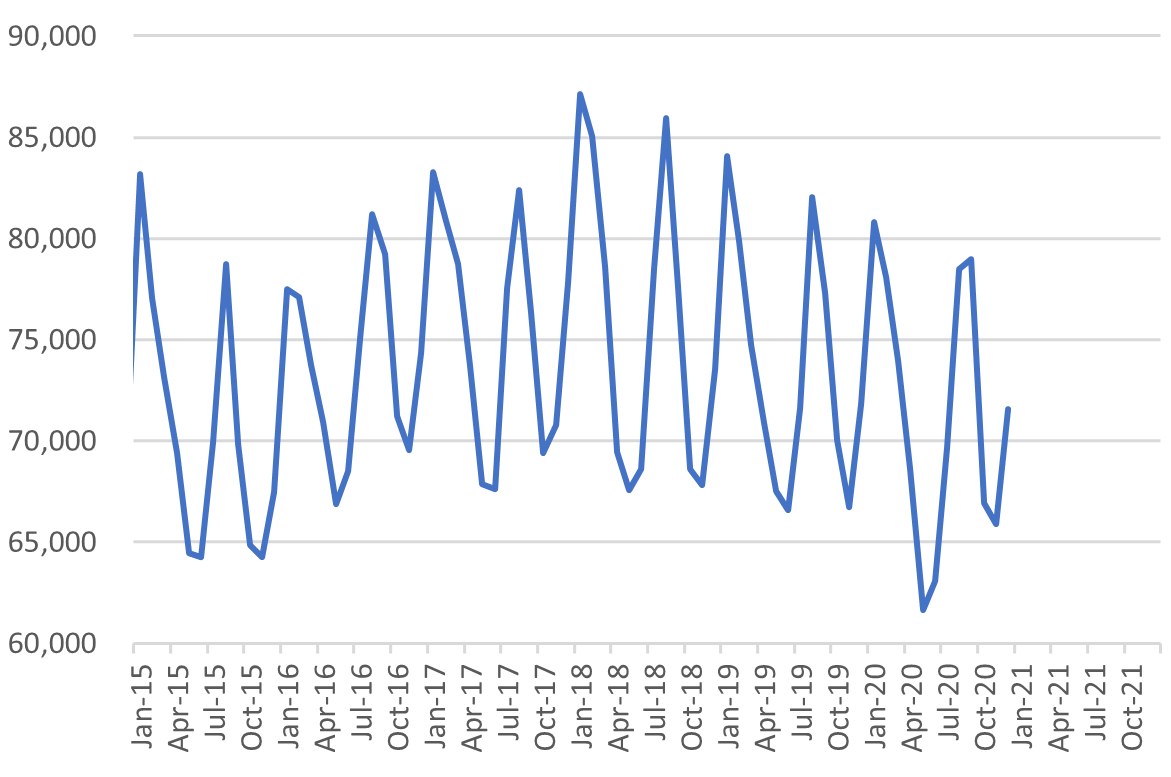
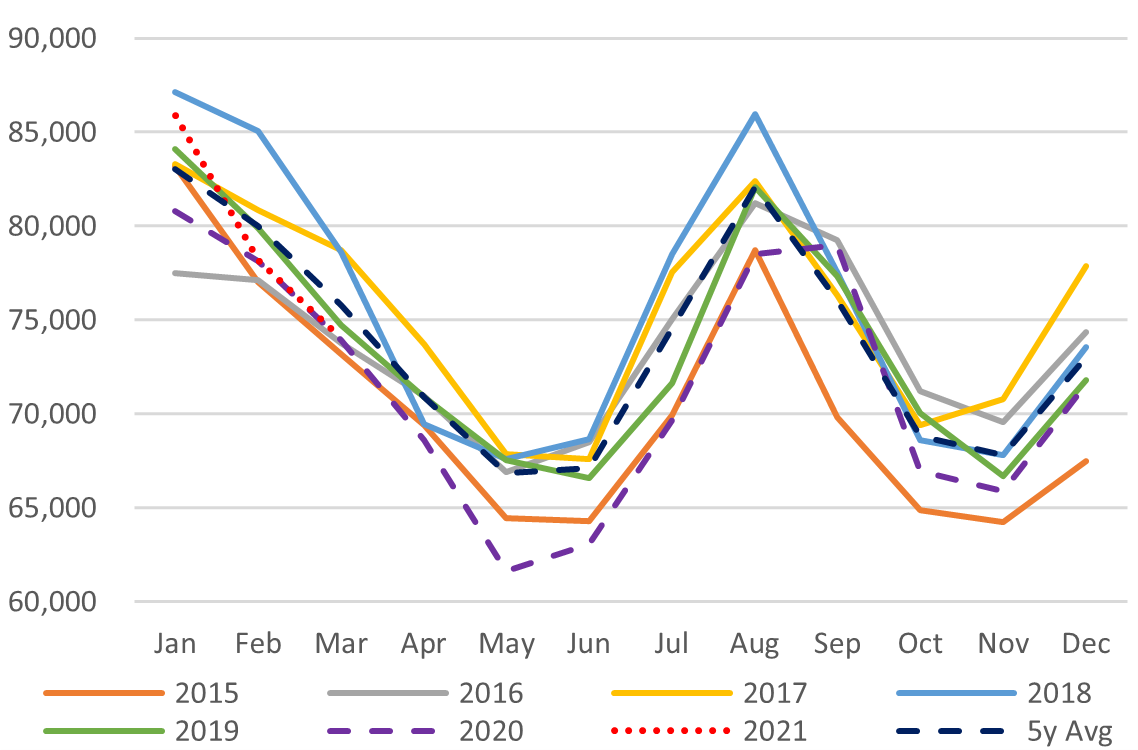
Japan Total Power Demand (GWh)
Current Vs Historical Demand (GWh)
Day-Ahead Spot Electricity Prices
Day-Ahead Vs Day Time Vs Peak Time
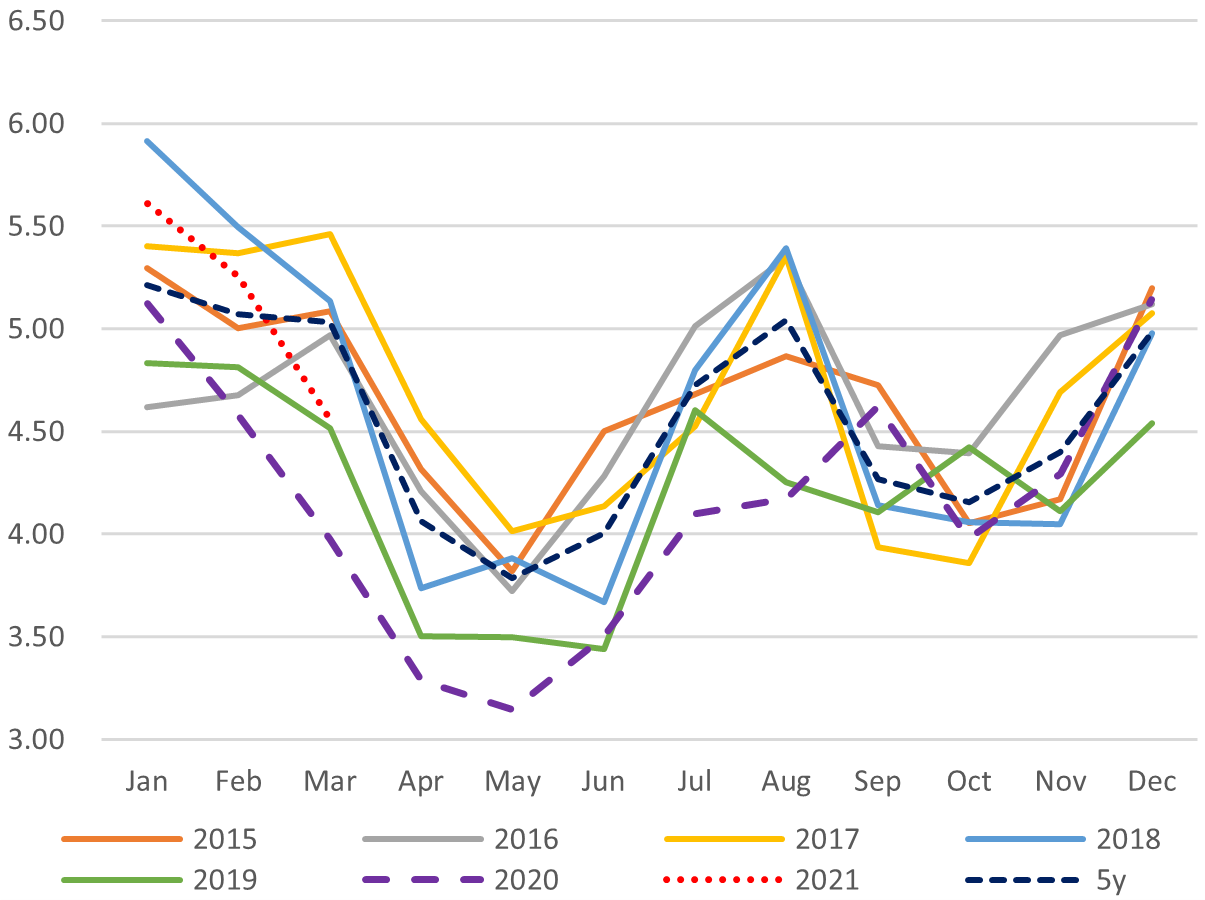
LNG Imports by Electricity Utilities
LNG Stockpiles of Electricity Utilities
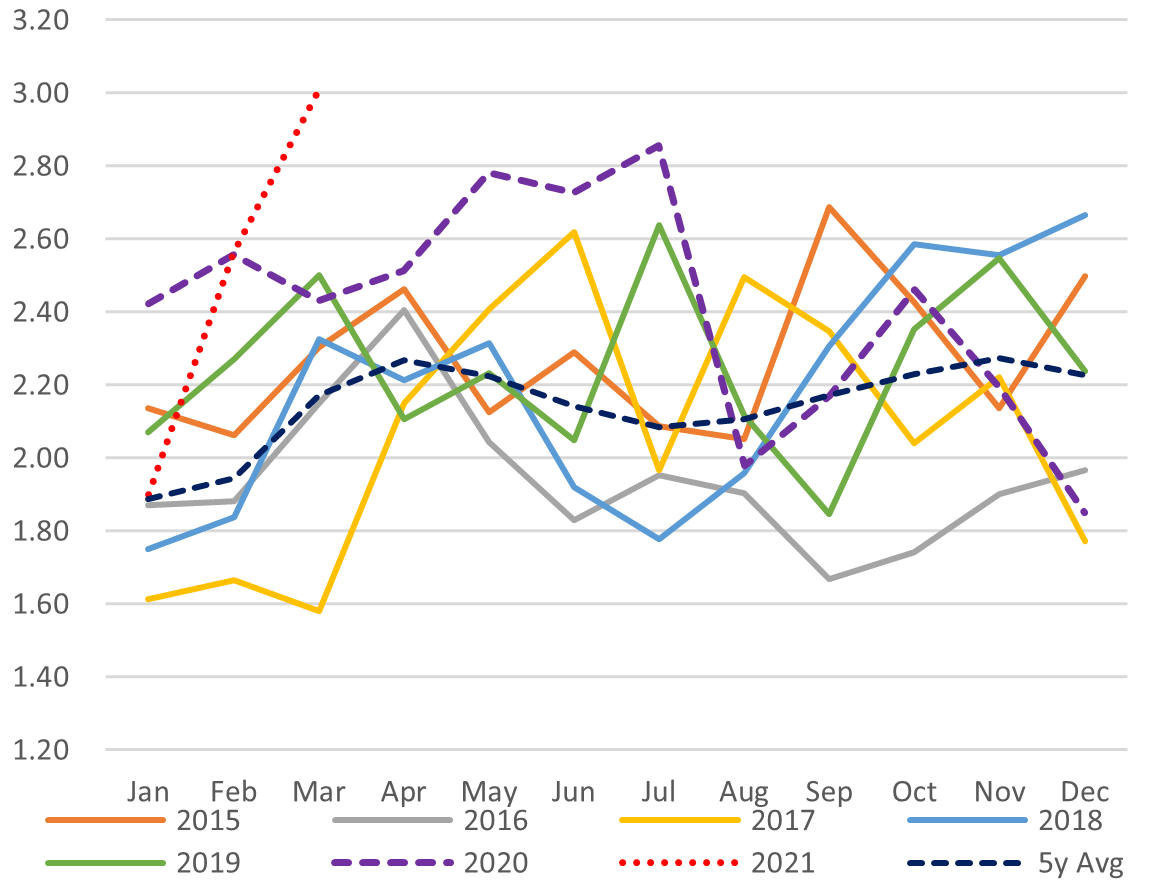
SOURCES: Ministry of Economy, Trade, and Industry (METI), and the Japan Electric Power Exchange
Disclaimer
This communication has been prepared for information purposes only, is confidential and may be legally privileged. This is a subscription-only service and is directed at those who have expressly asked K.K. Yuri Group or one of its representatives to be added to the mailing list. This document may not be onwardly circulated or reproduced without prior written consent from Yuri Group, which retains all copyright to the content of this report.
Yuri Group is not registered as an investment advisor in any jurisdiction. Our research and all the content express our opinions, which are generally based on available public information, field studies and own analysis. Content is limited to general comment upon general political, economic and market issues, asset classes and types of investments. The report and all of its content does not constitute a recommendation or solicitation to buy, sell, subscribe for or underwrite any product or physical commodity, or a financial instrument.
The information contained in this report is obtained from sources believed to be reliable and in good faith. No representation or warranty is made that it is accurate or complete. Opinions and views expressed are subject to change without notice, as are prices and availability, which are indicative only. There is no obligation to notify recipients of any changes to this data or to do so in the future. No responsibility is accepted for the use of or reliance on the information provided. In no circumstances will Yuri Group be liable for any indirect or direct loss, or consequential loss or damages arising from the use of, any inability to use, or any inaccuracy in the information.
K.K. Yuri Group: Oonoya Building 8F, Yotsuya 1-18, Shinjuku-ku, Tokyo, Japan, 160-0004.