
JAPAN NRG WEEKLY
JULY 19, 2021
JAPAN NRG WEEKLY
July 19, 2021
NEWS
TOP
- METI publishes forecast cost of generation by sector in 2030; solar appears cheapest, but spurs debate on methodology
- Bank of Japan creates scheme to drive capital to firms that seek to invest in decarbonization; BoJ vows to buy more green bonds
- Power consumption expected to drop by 10% within decade; the estimate will be a core pillar of the new Basic Energy Plan
ENERGY TRANSITION & POLICY
- Japan mulls dropping 60-year limit for operating nuclear reactors; Share of renewables to be at 36%-38%, thermal share to drop
- METI unveils roadmap for creating materials that recycle carbon
- Govt. panel studies ways to share imbalance settlement revenue
- Kyocera develops buoy that taps tidal energy to power sensors
- Sumitomo, Tokyo Gas trial hydrogen production at scale in Japan
- Toyota invests in renewable natural gas manufacturer in the U.S.
- Itochu to import Russian blue ammonia … [MORE]
ELECTRICITY MARKETS
- Local govt. says solar farm not responsible for deadly landslide; NHK probe claims 10% of solar farms are in areas of landslide risk
- Antitrust officials conduct further checks on western power firms
- Over 18 GW of offshore wind farms in environmental assessment; insiders advocate for quicker development of floating turbines
- Kyushu Electric, RWE release plan for 730 MW offshore wind farm
- Vena Energy’s Kagoshima offshore wind farm gets govt. caution
- Solar bankruptcies down in 1H21 but size of failures rising
- ENEOS to boost solar capacity 40% at former oil storage sites
- Osaka Gas to build as much as 200 MW of solar farms in the U.S.
- Could TEPCO Energy Partners be for sale? … [MORE]
OIL, GAS & MINING
- Panasonic joins Schlumberger project to extract lithium from brine
- JAPEX considers selling out from the Canadian oil sands project
- Sumitomo Electric, U.S. partner to extract rare earths from waste
ANALYSIS
FLOATING SLOT IS (RE)GAINING ATTENTION TO ALLEVIATE SPACE CONTRAINTS FOR RENEWABLES
Japan has tens of thousands of man-made reservoirs, only a fraction of which are currently utilized. In a country that lacks vast, flat, open space, installing panels on such bodies of water solves both energy issues and contributes to better water management. What’s more, Japan was the pioneer of floating solar. Since those initial strides, domestic progress for the technology has somewhat stalled. However, with government officials desperately looking for more spaces to install solar panels to meet national carbon neutrality pledges, reservoirs and other untapped locations are starting to gain attention.
BIOGAS EMERGING AS POPULAR ENERGY SOURCE FOR RURAL JAPAN AND NICHE RIVAL TO LNG
Japan has scant oil and gas resources, but it has plenty of cow dung. And, apparently, that could emerge as raw material for a niche, clean energy source that could displace LNG in some rural areas. We feature a new biogas project in Hokkaido, the northern island of Japan, and show how it aims to turn excrement into energy and heat. This process has the potential to replace as much as half of Hokkaido’s factory LNG consumption. And the project is not an isolated case. With a new rural policy and state tariffs, biogas is emerging as a popular energy source.
GLOBAL VIEW
OPEC oil producers reach agreement to boost oil supply. The EU published its 13 proposals to cut emissions by 55% this decade. Canada extends the lifespan of a nuclear reactor by 40 years. Gas prices in Europe jump to the highest since 2004. EVs will be more profitable than gasoline cars in the EU by 2025, says Volkswagen. China starts what will likely be the world’s largest carbon trading scheme. Details on these and more in our global wrap.
EVENT CALENDAR / DATA SECTION
JAPAN NRG WEEKLY
PUBLISHER
K. K. Yuri Group
Editorial Team
Yuriy Humber (Editor-in-Chief)
Tom O’Sullivan (Japan, Middle East, Africa)
John Varoli (Americas)
Regular Contributors
Mayumi Watanabe (Japan)
Daniel Shulman (Japan)
Takehiro Masutomo (Japan)
Art & Design
22 Graphics Inc.
Sponsored
SUBSCRIPTIONS & ADVERTISING
Japan NRG offers individual, corporate and academic subscription plans. Basic details are our website or write to subscriptions@japan-nrg.com
For marketing, advertising, or collaboration opportunities, contact sales@japan-nrg.com
For all other inquiries, write to info@japan-nrg.com
OFTEN USED ACRONYMS
METI The Ministry of Energy, Trade and Industry
MOE Ministry of Environment
ANRE Agency for Natural Resources and Energy
NEDO New Energy and Industrial Technology Development Organization
TEPCO Tokyo Electric Power Company
KEPCO Kansai Electric Power Company
EPCO Electric Power Company
JCC Japan Crude Cocktail
JKM Japan Korea Market, the Platt’s LNG benchmark
CCUS Carbon Capture, Utilization and Storage
mmbtu Million British Thermal Units
mb/d Million barrels per day
mtoe Million Tons of Oil Equivalent
kWh Kilowatt hours (electricity generation volume)
NEWS: ENERGY TRANSITION & POLICY
Solar to beat nuclear as cheapest power source in 2030: METI expert group
(Japan NRG, July 12)
- The METI working group on power generation costs published forecasts for 2030; solar is expected to be the cheapest of 15 different sources of electricity.
- The cost assumptions didn’t include potential costs associated with the expansion of the power grid to accommodate more renewable energy capacity. These costs would include adding power lines and broadening the capacity of interconnectors between regional grid systems.
- The higher installed capacity would bring down solar costs, while nuclear costs would rise due to upgrading facilities to meet new “severe accident” safety measures.
- For thermal energy cost forecasts, the group used coal, oil and gas price forecasts from the World Bank and other international organizations. The bank expects coal prices to fall from current levels, while gas and oil would be higher in 2030.
Cost Assumption in Yen per kWh for Power Sources from a METI panel
|
Generation source |
2030 (new) |
2020 (old) |
Assumed operating rate |
|
Thermal (coal) |
13.5 – 22 |
12.5 |
70% for 40 years |
|
Thermal (LNG) |
10.5 – 14 |
10.5 |
70% for 40 years |
|
Nuclear |
11.5 |
11.5 |
70% for 40 years |
|
Thermal (oil) |
24.5 – 27.5 |
26.5 |
30% for 40 years |
|
Onshore wind |
9.5 – 17 |
10.5 |
25.4% for 25 years |
|
Offshore wind |
26 |
30 |
30% for 25 years |
|
Solar (utility scale) |
8 – 11.5 |
12.5 |
17.2% for 25 years |
|
Solar (residential) |
9.5 – 14 |
17.5 |
13.8% for 25 years |
|
Small hydro |
25 |
25 |
60% for 40 years |
|
Mid-size hydro |
10.5 |
10.5 |
60% for 40 years |
|
Geothermal |
16.5 |
16.5 |
83% for 40 years |
|
Biomass (co-firing) |
12 – 22.5 |
13 |
70% for 40 years |
|
Biomass (pure) |
29.5 |
29.5 |
87% for 40 years |
|
Gas co-generation |
9.5 – 10.5 |
9 – 10.5 |
72.3% for 30 years |
|
Oil co-generation |
21 – 25.5 |
19.5 – 24 |
36% for 30 years |
- CONTEXT: The numbers for offshore wind contrast quite strongly with the forecast for the sector in the government’s Green Growth Strategy published in Dec. 2020. The government said it wants to lower the cost of fixed-bottom offshore wind turbine-generated power to ¥8 to ¥9/ kWh by 2030 – 2035. That target is based on a higher ratio of components manufactured in Japan.
TAKEAWAY: The numbers above are and will be contested by various industry groups, and you can see some examples in the Side Developments section below. However, it should be noted that the 11-person group is led by President / Director-General of RITE (Research Institute of Innovative Technology for the Earth), Yamaji Kenji, who is one of the most prominent voices in the energy policy sphere of Japan, as noted in previous editions of Japan NRG. See our “Who’s Who in Decarbonization” of Japan in the Dec. 7 and Dec. 14, 2020 issues.
The immediate reaction to the numbers has been to focus on how solar has “beaten” nuclear generation. Opponents of nuclear will use this to argue that nuclear no longer deserves its place in the future energy mix. After all, one of the original rationales for pursuing nuclear was that it was a cheap source of energy. But, supporters of nuclear do not concede this point, noting that these forecasts do not factor in the cost of expanding the grid to accommodate the higher percentage of decentralized power (namely, solar and wind). Thus, they say, the “real” cost of solar and wind is higher.
What’s interesting about this report, since it’s published on the eve of the new Basic Energy Plan, is that it indicates where energy trends should go, not where they will go. It also offers plenty of caveats (including in the utilization rate assumptions) that each energy lobby can exploit to make their case.
Overall, we expect this to be an oft-referred document that will carry significant weight in government discussions going forward.
- SIDE DEVELOPMENT:
Environment Minister hails new solar cost estimate as “game-changer”
(FNN Prime Online, July 13)- Environment Minister Koizumi has lauded a projection that by 2030 solar panels will be the cheapest method of generating electricity.
- “We used to think of nuclear power as being the cheapest option. This assumption is no longer true, and it’s a game changer.”
- SIDE DEVELOPMENT:
METI cost estimates are vague on nuclear, ignore solar’s grid price tag
(NRI, July 14)- The article sets out the opinions of Nomura Research Institute’s executive and economist Kiuchi Takahide.
- Kiuchi criticizes METI’s presentation of the estimates, noting there’s no maximum figure put on nuclear power.
- CONTEXT: The report shows some costs as a range while others are given as an “at least” number.
- The cost of decontaminating areas affected by the Fukushima disaster, and the new safety upgrades of NPPs since, mean that METI can no longer claim that nuclear power is the cheapest form of electricity.
- However, extending nuclear reactor lifetimes by 20 years will likely make electricity generation at existing assets cheaper.
- Kiuchi also has the impression that the estimate for solar costs is deliberately set low to reassure consumers worried about the impact of renewables on their power bill.
- He notes that Bloomberg NEF projects that the cost of solar power will remain higher than the cost of electricity from coal-fired thermal stations until at least 2045.
- Notably, METI’s numbers do not build in the cost of “buffering” capacity, which is necessary to absorb fluctuations in output from wind and solar sources. If the soon-to-be-released revision to Japan’s official energy mix includes increased solar capacity, it’s likely that the actual generation cost of solar will increase significantly, Kiuchi concludes.
- SIDE DEVELOPMENT:
METI’s new Basic Energy Plan may keep nuclear as cheapest source
(Sankei Shimbun, July 15)- The new national energy vision, due later this month, may retain the view that nuclear is the cheapest power source for Japan.
- The higher costs for nuclear in the latest METI calculations are based on the assumption that new nuclear power plants will be built. That is highly unlikely in the current climate in Japan. The cost of running existing nuclear plants, whose lifespan is being expanded, is therefore cheaper than suggested by the recent METI working group report.
- For solar, costs are likely to climb as the lack of readily available flat land pushes developers further into mountainous terrain. That makes local residents nervous and this ultimately pushes up the cost of development.
- Solar’s other “weakness” is its weather dependence. Backup power must be available to cover it, and that should be factored into cost estimates.
Bank of Japan unveils plan to boost funding to counter climate change
(Nikkei Asia, July 11 and July 16)
- Japan’s central bank is creating a new funding scheme designed to support companies that wish to go green.
- The Bank of Japan will offer zero-interest loans to commercial banks for up to one year, with a possibility of rollover until FY2030. Also, the BoJ will exempt commercial bank reserves held at the central bank from negative interest rates – equal to twice the amount the banks loan out for climate friendly projects.
- The scheme encourages financial institutes to provide low-interest loans for companies to invest in decarbonization. Banks will need to show the BoJ how they plan to use the borrowed funds.
- The new scheme will be implemented by the end of this year.
- Still, some in the private sector are concerned that the rates offered by the BoJ are not attractive enough to make a difference.
- SIDE DEVELOPMENT:
BoJ to purchase foreign currency-denominated green government bonds
(Nikkei Shimbun, July 16)- The Bank of Japan announced its Climate Change Imitative Policy. Among other things, it plans to assess how climate change impacts the economy and markets, and verify that financial institutions can cope with these changes.
- The bank intends to proceed with the purchase of foreign currency-denominated green government bonds and also to “green” its own assets.
- The bank will also push for better information disclosure on climate risks in Japan and support “transition finance” – fund-raising by companies that want to decarbonize and lower emissions.
Japan mulls dropping 60-year limit for operating nuclear reactors
(Nikkei, July 16)
- The government is considering dropping the current restrictions on the operating life of nuclear reactors. Current rules offer initially a 40-year license, which can be extended by 20 years after an application from the operator to the industry regulator.
- With the prospect of building new nuclear plants dim in the current climate, this would offer a way to run the equipment for an unlimited period, providing it meets safety and regulatory criteria.
- The next Basic Energy Plan is expected to discuss the issue of expanding operating life of reactors. A ministry working group would then take up the issue for discussion.
- Changing operating lifespans would require an amendment of current laws. It is expected that if this does go ahead, additional safety measures will also be part of the amendment.
- SIDE DEVELOPMENT:
Share of renewables to be at 36-38% in the new Basic Energy Plan
(Nikkei, July 17)- Nuclear’s share will remain at 20-22%, which supposes that all 27 reactors that have applied for a restart are operating
- Thermal generation’s share will drop to 41%
- Ammonia and hydrogen generation will get 1% of the mix
TAKEAWAY: The percentages have been leaked previously and seem to be the same as reported earlier.
METI group unveils roadmap for developing materials that utilize captured carbon
(Japan NRG, July 15)
- The Green Innovation Project working group, which operates under the METI umbrella, unveiled a roadmap for developing materials produced with CO2 that’s collected through carbon capture technology. This includes concrete, efficient plastic-to-plastic recycling system, and other ideas.
- The group wants international standards for materials that recycle carbon by 2030.
- Experts noted that work is under way to study the properties of raw materials used to make concrete. Meanwhile, the petrochemical sector aims to start test runs of a low-carbon naphtha unit by around 2030, and also to promote plastic-to-plastic recycling.
- SIDE DEVELOPMENT:
Tokyo Gas and Kashima to jointly develop CO2-absorbent concrete
(Gas Energy News, July 12)- Tokyo Gas and Kashima will jointly develop manufacturing technology for CO2-absorbent concrete using CO2 contained in exhaust gas of city gas appliances.
- This is the world’s first attempt to manufacture concrete using exhaust gas from gas appliances. The companies hope to make the tech commercially viable.
- CO2 can help to reinforce precast concrete products such as foundation blocks for solar power generation equipment and pedestrian road boundary blocks.
Panel studies framework for sharing imbalance settlement revenue
(Japan NRG, July 12)
- Electricity and gas systems panel mulls a framework to share and distribute proceeds from the power imbalance settlements collected by network system operators.
- From April 2020 to Jan. 2021, power network operators collected ¥56-¥66 billion.
- METI proposed a scheme to pass the money back to network users as a whole as a consignment fee, rather than providing funds to specific companies. The panel will study if current regulations would allow operators to cover their losses for past years.
METI picks electricity price pilot projects ahead of the aggregation scheme launch in 2022
(Japan NRG, July 14)
- Dynamic pricing, diversified energy resources, and combining renewable energy sources are the themes chosen for 2021 pilot projects by METI ahead of next year’s launch of the aggregator licensing system.
- Project participants include Idemitsu, Kansai Electric, Waseda University and SB Energy. Idemitsu’s group will use its pilot project to study if moves in wholesale electricity prices could be used to even out demand.
- Kansai Electric and Waseda University will study how diversified energy resources could be combined and linked to imbalancing and capacity markets.
- SB Energy will study combinations of various renewable energy sources.
- The government has said it will finance aggregation scheme studies. This year’s budget allocation for this is ¥4.52 billion.
Kyocera develops energy harvesting buoy in variant of tidal power
(New Energy Business News, July 16)
- Kyocera and Nagasaki University developed a “smart” buoy that uses electricity from energy harvesting to power data-logging functions.
- The buoys generated electricity using what are known as tidal turbines, which generate an average of 16 watt-hours per day.
- The electricity is used to power sensors that monitor various parameters, including acceleration, temperature, humidity, magnetic field, current direction, and speed of current.
Sumitomo, Tokyo Gas trial hydrogen production at scale
(Kankyo Business, July 9)
- Starting next year Sumitomo Corp. and Tokyo Gas will trial a commercial-scale electrolysis system developed by UK-based ITM Power, in Yokohama.
- The 2 MW system can produce 31 kg of hydrogen per hour.
- The system will be modified to enable it to provide hydrogen at pressures of below 1MPa, as required under Japanese regulations.
Itochu to import Russian blue ammonia
(Kankyo Business, July 9)
- Toyo Engineering will join the second phase of a project by Russia-based Irkutsk Oil Company, JOGMEC, and Itochu Corporation to establish a “blue ammonia” value chain stretching from eastern Siberia to Japan.
- The parties will work together on a concept for producing hydrogen and ammonia from natural gas sourced from Irkutsk’s East Siberian oil wells, and consider the use of rail and pipelines to transport ammonia overland.
- Toyo and Itochu were commissioned by JOGMEC to devise a master plan for a value chain for the conversion of Siberian natural gas to ammonia and the transportation of this ammonia to Japan.
Tokyo Gas to trial new methanation technology in Yokohama
(New Energy Business News, July 13)
- Tokyo Gas plans to begin trialing new methanation technology in Yokohama in 2021/2022, and hopes to gain expertise in producing synthetic methane from renewably-generated electricity.
- In addition to utilizing the traditional (catalyst-based) Sabatier process, Tokyo Gas will trial the newer “hybrid Sabatier” and “bioreactor” processes to boost efficiency and reduce expenses.
- Tokyo Gas will use ITM Power’s polymer electrode membrane electricity process to provide the hydrogen required for methanation. This will also enable it to produce methane using locally produced, renewable electricity.
Hitachi Zosen acquires German biomass companies
(New Energy Business News, July 14)
- Hitachi Zosen agreed to acquire German-based Schmack Biogas Service (SBS) and microbEnergy, via its European subsidiary HZI.
- SBS’ parent company, Schmack, provides wet fermentation services in Germany.
- The acquisition will enable HZI to provide services for both wet and dry fermentation processes.
- HZI constructed 100 methane production facilities in Europe and North America that feature its proprietary Kompogas dry fermentation process.
Toyota invests in renewable natural gas
(New Energy Business News, July 15)
- Toyota Tsusho invested in California-based Merced Pipeline, which manufactures and sells renewably synthesized natural gas.
- Toyota hopes the investment will help establish a value chain that enables hydrogen extracted from renewable natural gas to be used as a fuel. Toyota already introduced fuel-cell powered cranes at Los Angeles Port.
- Merced Pipeline, which produces methane from agricultural effluent, plans to begin commercial operations in 2022.
TAKEAWAY: See this week’s Analysis section for a detailed look at what is happening in the biogas / renewable natural gas industry in Japan.
Idemitsu and NYK develop system for optimum biomass cofiring calculations
(Sekiyu Tsushin, July 16)
- Idemitsu Kosan and Nippon Yusen Group, through their JV, have developed a system that calculates and automatically controls the optimum co-firing rate of biomass fuel in coal boilers. The system will go on sale in August.
- Biomass fuel tends to be inferior in crushability and calorific value to coal, so the amount of feedstock that gets used in large pulverized coal boilers is high. Idemitsu Kosan has developed a semi-carbonized wood pellet, (“Black Pellet”), that has good crushability and calorific value, and can be handled in almost the same way as coal in order to expand biomass co-firing at coal-fired power plants.
ClassNK and Carbon Trust agree to support Japanese wind power
(New Energy Business News, July 14)
- In response to the government’s green growth strategy, Maritime accreditation body ClassNK signed a memorandum of understanding with UK-based climate change consultants, Carbon Trust, to support the progress of offshore wind power generation in Japan.
- The two entities hope to collaborate on assisting national initiatives to improve progress in areas critical to the successful implementation of offshore wind projects, including acceleration of industrial development and technical innovation, regulatory and policy reform, standardization and increasing skills in the industry.
NEWS: POWER MARKETS
|
No. of operable nuclear reactors |
33 | |
|
of which |
applied for restart |
25 |
|
approved by regulator |
17 | |
|
restarted |
10 | |
|
in operation today |
9 | |
|
|
able to use MOX fuel |
4 |
|
No. of nuclear reactors under construction |
3 | |
|
No. of reactors slated for decommissioning |
27 | |
|
of which |
completed work |
1 |
|
started process |
4 | |
|
|
yet to start / not known |
22 |
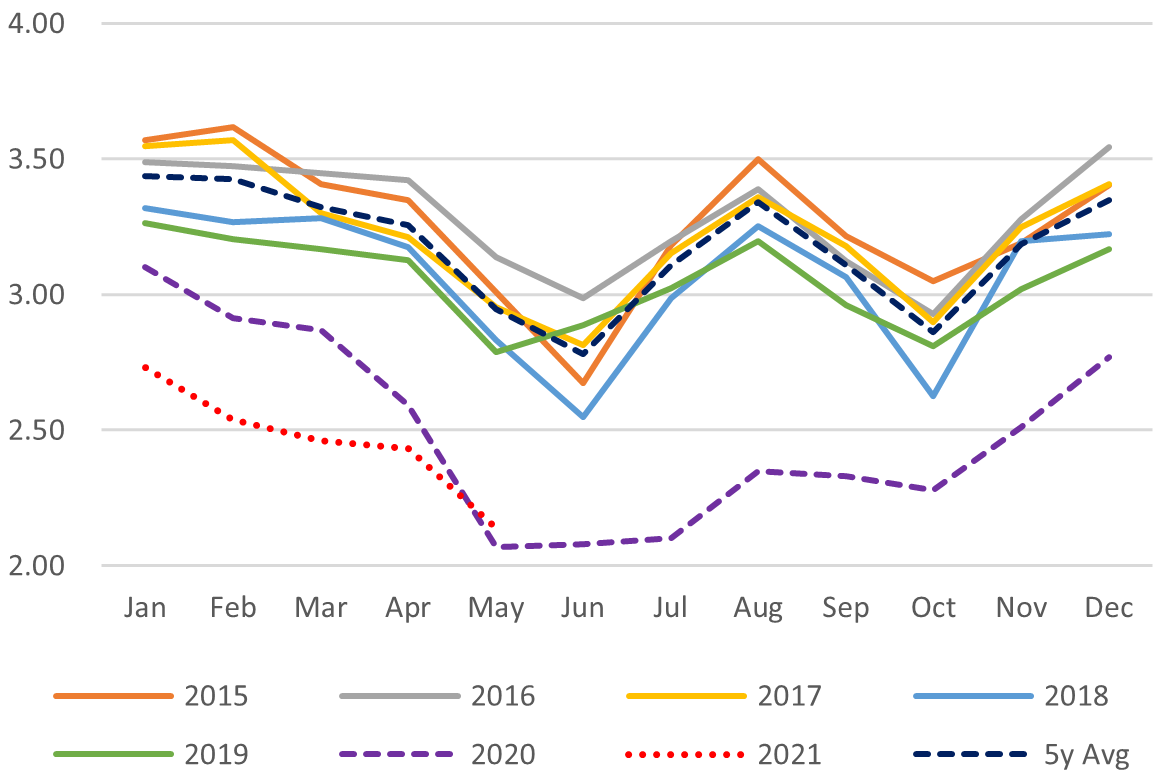
Spot Electricity Prices, Monthly Avg.
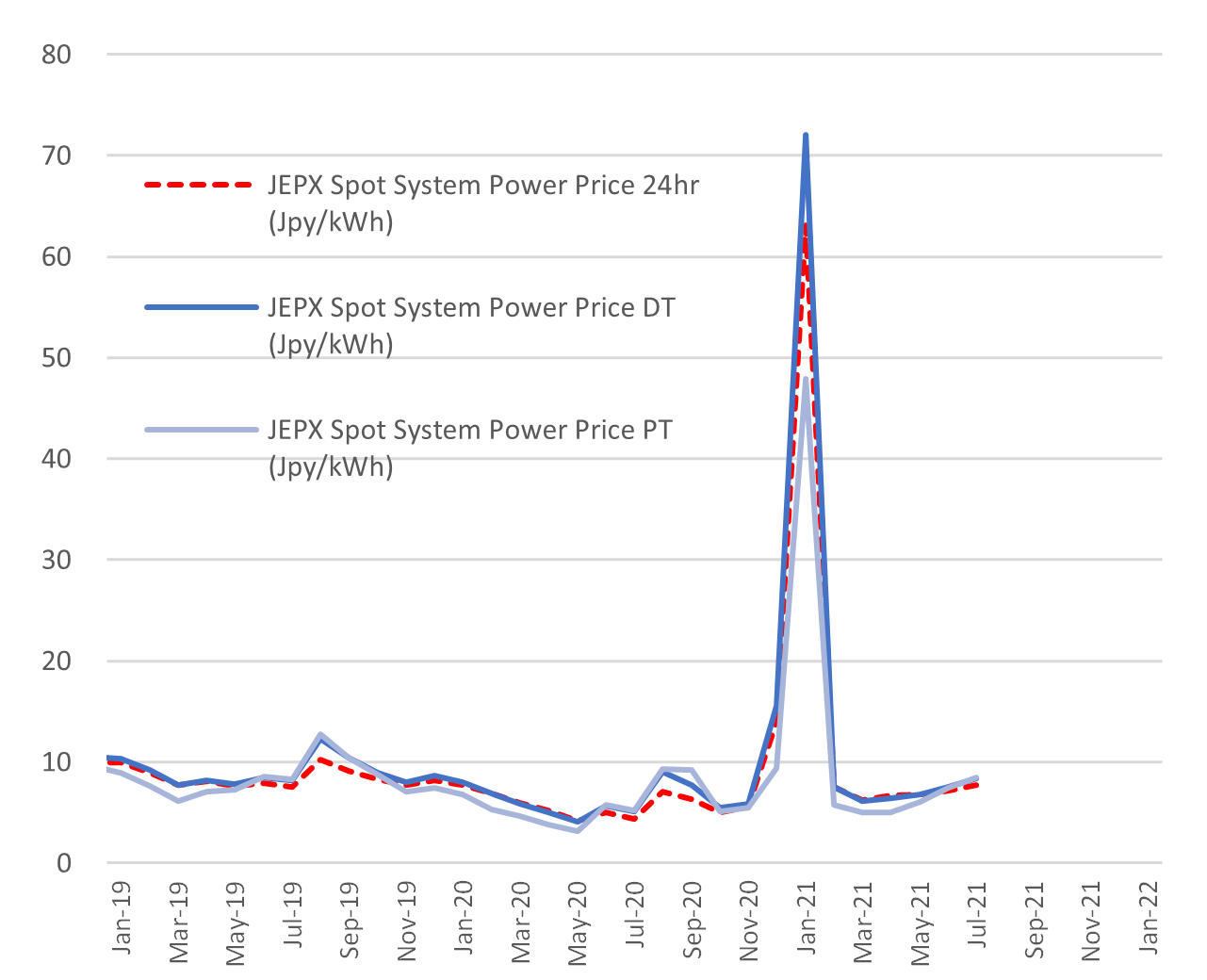
Source: Company websites, JANSI and JAIF, as of July 4, 2021
Japan’s power consumption to be 10% lower by 2030: METI forecast
(Nikkei, July 12)
- By 2030, METI plans an approximate 10% reduction in the estimate for total electricity use that forms the basis of its Basic Energy Plan.
- The change means that the target for total electricity use in 2030 is now less than 1 Terawatt-hours. Under the new plan, around one-third of this will be supplied by renewable sources.
- CONTEXT: Japan currently consumes around 1.065 terawatt-hours of electricity each year.
Shizuoka government says solar farm not responsible for Atami landslide
(New Energy Business News, July 15)
- The Shizuoka govt. released the results of its urgent investigation into the relationship between solar farms and a recent landslide.
- Finding no evidence that the rainwater and earth that triggered the disaster had flowed from the site of a nearby solar farm, the survey concluded that the farm did not directly contribute to the disaster.
- The investigation found that on the section of the hill where the landslide began, drainage and retention measures were inadequate.
TAKEAWAY: As detailed in last week’s Japan NRG, the deadly landslide in Atami two weeks ago, fairly or not, spurred criticism of solar projects from many locals and regional politicians. The govt. of the prefecture where the landslide took place has now released the results of an initial probe that exonerates a nearby solar farm from any blame. It will be important to see if the initial wave of criticism against solar dies down, although the investigation by NHK, see below, indicates that the media will pursue the story for a while yet. As discussed last week, the criticism was sparked by the land disaster but perhaps owes more to other issues in the industry. In order to boost public sentiment towards the sector, we expect the MoE to push for more national govt funding for municipalities that support solar projects.
- SIDE DEVELOPMENT:
NHK investigation claims 10% of solar locations carry landslide risk - (NHK, July 18)
- Japan’s national broadcaster says it has carried out an investigation of land used by solar facilities around the country and mapped it against areas deemed to be at risk of landslides or other “sediment-related disaster”.
- The report says that due to the rapid spread of solar power, there have disasters at several facilities located on slopes. There were 11 cases recorded in western Japan three years ago due to heavy rains, NHK says, citing METI data.
- Analysis of the locations of solar farms of 500 watts of more shows that there are more than 1,100 facilities nationwide that partially overlap with “earth and sand disaster risk areas”, NHK says. A total of 9,809 solar plant locations were analyzed.
- NHK says this suggests about 10% of current solar facilities are in areas that carry risk of a sediment-related disaster that could endanger houses.
Antitrust officials conduct further on-site checks in power cartel probe
(Denki Shimbun, July 13)
- Japan’s Fair Trade Commission made an on-site inspection of Kansai Electric, Chugoku Electric, Kyushu Electric, and the latter’s Kyuden Mirai Energy unit, suspecting Antimonopoly Act violations in electricity sales.
- The authorities are continuing the probe started in April over suggestions that the companies engaged in anti-competitive behavior and colluded with other power firms in their catchment areas around high-voltage electricity sales.
- The officials suspect that the Chubu, Kansai and Kyushu areas are involved in potential antitrust behavior.
- CONTEXT: These are follow-up inspections to the checks conducted by the officials in April.
More than 18 GW of offshore wind projects undergoing environmental assessment in Japan
(Kankyo Business, July 15)
- The magazine reviewed materials from several ministerial committees, which show that as of March 2021, offshore wind projects totaling a maximum capacity of 18,244 MW are currently undergoing environmental assessment.
- This is a strong acceleration in terms of proposed capacity, compared to 3 years ago.
- Based on these assessments, Japan’s current offshore wind capacity, seen adding just 22 MW this year, could jump by 299 MW in 2022. After zero additions in 2023, 1,248 MW of projects may enter service in 2024 and 1,389 MW would come online in 2025.
- The busiest period for new capacity, provided all the projects pass the assessment and proceed at maximum scale, would be in 2026: 8,488 MW in new offshore wind farm capacity. That would be followed by 4,370 MW in 2027 and 1,849 MW in 2028, before dropping to minimal levels through to 2031.
- The biggest capacity additions would come in Hokkaido and Kyushu areas, followed by the Aomori / Akita northeast areas of the main island.
TAKEAWAY: These numbers are useful in illustrating the scale of ambition rather than as an accurate picture of the growth in offshore wind in Japan. Most likely, some of the projects will be scrapped because they fail the assessment, or due to cost considerations, or a lack of local approval. Note, that the numbers are very different from the 2030 operating capacity forecasts for offshore wind that METI published earlier this month (1.7 GW to 3.7 GW).
Putting aside the valid argument that some projects will simply take longer to develop than currently expected, the discrepancy between industry plans and government expectations suggests that METI is not actually interested in rushing the rollout of offshore wind. There are three reasons for this stance:
-
- The national grid needs substantial upgrades to accommodate a significant new volume of offshore wind, and most likely an underwater grid system must be created to connect to the new projects; this takes time to plan and build
- METI sees more value in floating wind than fixed-bottom turbines, but the former is expected to take another decade to reach commercial levels; A go-slow approach is a way to “save space” for floating projects
- The govt. wants to give big power utilities time to adjust their asset portfolios to incoming offshore wind capacity, aware that for some utilities (esp. Hokkaido, Kyushu and Tohoku) this new generation will cause major upheaval
- SIDE DEVELOPMENT:
Lower costs, increased competitiveness key to creating new wind markets
(Kankyo Business, July 15)- In just a few years, Japan’s wind generation sector has gone from a predominantly experimental industry to a rapidly growing one.
- Of 11 areas designated by the govt. as appropriate for wind farm development, four (two in Akita and one each in Chiba and Nagasaki) have so far been the subject of public tender.
- Once installed, turbines must be maintained during their 25-year service life. This maintenance industry is expected to revitalize local economies.
- Port facilities will have to be upgraded to handle turbine blades and towers.
- At a recent public-private sector conference for discussing competitiveness in the wind farm industry, attendees advocated the rapid commercialization of floating turbine technologies, for which there is expected to be demand in other Asian markets in future.
- Compared to Europe, Japan is more prone to typhoons, earthquakes, and lightning. Wind speeds also tend to be lower, so making nacelles and blades lighter is one way of reducing costs.
Kyushu Electric, RWE release assessment for 730 MW offshore wind farm
(New Energy Business News, July 14)
- Kyushu Electric’s Kyuden Mirai Energy unit and RWE Renewables Japan released their environmental impact assessment for a proposed 730 MW wind farm off the coast of Akita.
- The parties plan to begin work on the 130 km² site in 2024. The placement of the 67 eleven MW turbines would be performed using a self-elevating platform rated at 1,600 metric tons.
Vena Energy’s floating wind farm in Kyushu gets Environment Ministry caution
(New Energy Business News, July 14)
- The MoE submitted its opinion in response to the environmental assessment filed by Vena subsidiary JWEA and Nangoku Corporation in relation to a proposed 1.5 GW wind farm off the coast of Kagoshima.
- The parties plan to erect 100 turbines, 50 of which would be floating. The project is expected to take three years to build.
- The Ministry believes the operator must rethink the placement of turbines to reduce the impact on the local bird population, and notes that turbines could be a collision risk for birds and impede their movement.
Solar bankruptcies down, but size of failures rising due to debt
(Teikoku Databank, July 12)
- 10% fewer solar power businesses filed for bankruptcy in the first half of this year, compared with the same period last year, according to a recent survey by Teikoku Databank.
- However, companies that go bankrupt tend to be more indebted, and the total liabilities of bankrupt businesses have increased.
- 29% of the bankrupt companies had liabilities of ¥10 to ¥50 million, and the same number again had liabilities of between ¥100 and ¥500 million.
- Over 40% of the bankrupt companies were based in the Kanto area.
ENEOS to boost its solar capacity by 40% on former oil storage sites
(Kankyo Business, July 9)
- ENEOS will build 20 MW of solar farms on sites in Niigata, Kagawa, and Kumamoto that were formerly occupied by oil storage tanks.
- The first of the farms will go online in 2022 and all three farms will be connected to the grid by 2025.
- The new facilities will take ENEOS’ total solar capacity to 69 MW.
TAKEAWAY: The company’s solar development is supported by local governments through the chisan-chisho local development scheme. For more information on that scheme, see our article on biogas in this week’s Analysis section.
Osaka Gas to build 200 MW solar farms in US
(Kankyo Business, July 15)
- In a joint venture with Michigan-based Novi Energy, Osaka Gas says it plans to build several large solar farms in the US.
- The farms will have an output of between 100 and 200 MW and most will be located in the Midwest or Northeast United States.
Mitsubishi opens “solar sharing” facility in Saitama
(New Energy Business News, July 16)
- A network of photovoltaic panels erected above a grape and berry farm in Saitama began supplying the grid. The facility is rated at just under 1 MW.
- The solar panels are created by Mitsubishi HC Capital in collaboration with Seibu Agribusiness, and were partially financed by grants from the MoE, as well as a “smart housing” grant provided by the local body.
- Seibu Agribusiness will harvest grapes and berries grown on the 1.3 ha site.
Nuclear Regulation Authority inspects TEPCO HQ over compliance breach
(Nikkei, July 13)
- The Nuclear Regulation Authority conducted an on-site audit of TEPCO’s Tokyo headquarters in response to revelations of security breaches at the utility’s Kashiwazaki-Kariwa nuclear power plant.
- NRA representatives spent around an hour questioning CEO Obayagawa about his response to the revelations.
- This is the first time that TEPCO was audited by the NRA.
Could embattled TEPCO Energy Partners be for sale?
(Diamond, July 8)
- In June, the Consumer Affairs Agency banned TEPCO Energy Partners from operating for a period of six-months, in response to revelations of inappropriate sales practices.
- Employees of TEPCO EP contractors falsely informed consumers that they could reduce their power bills by signing up for recommended services.
- One TEPCO EP sales consultant says the latest ban could be the last straw for the company.
- Tellingly, TEPCO Holdings recently added an M&A expert to its executive team. Many say TEPCO is preparing to sell its retail division.
NEWS: OIL, GAS & MINING
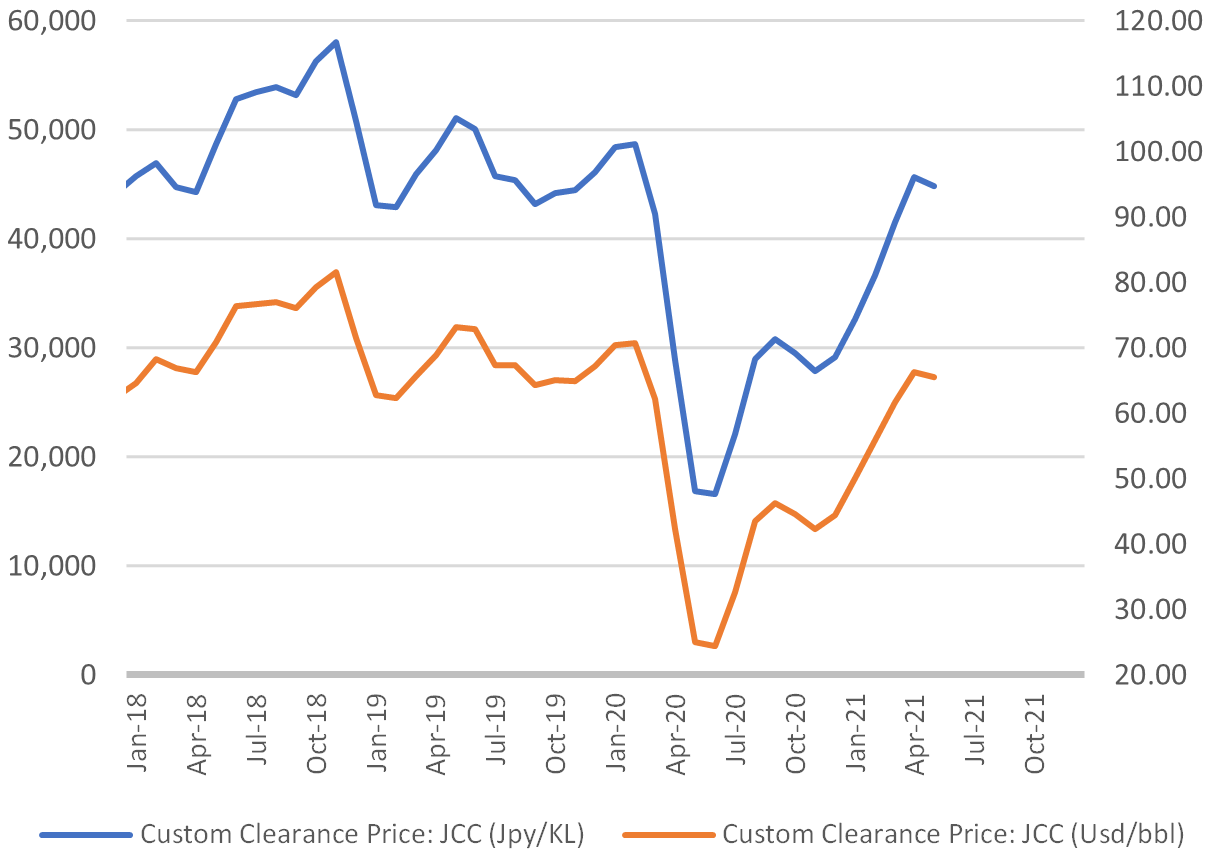
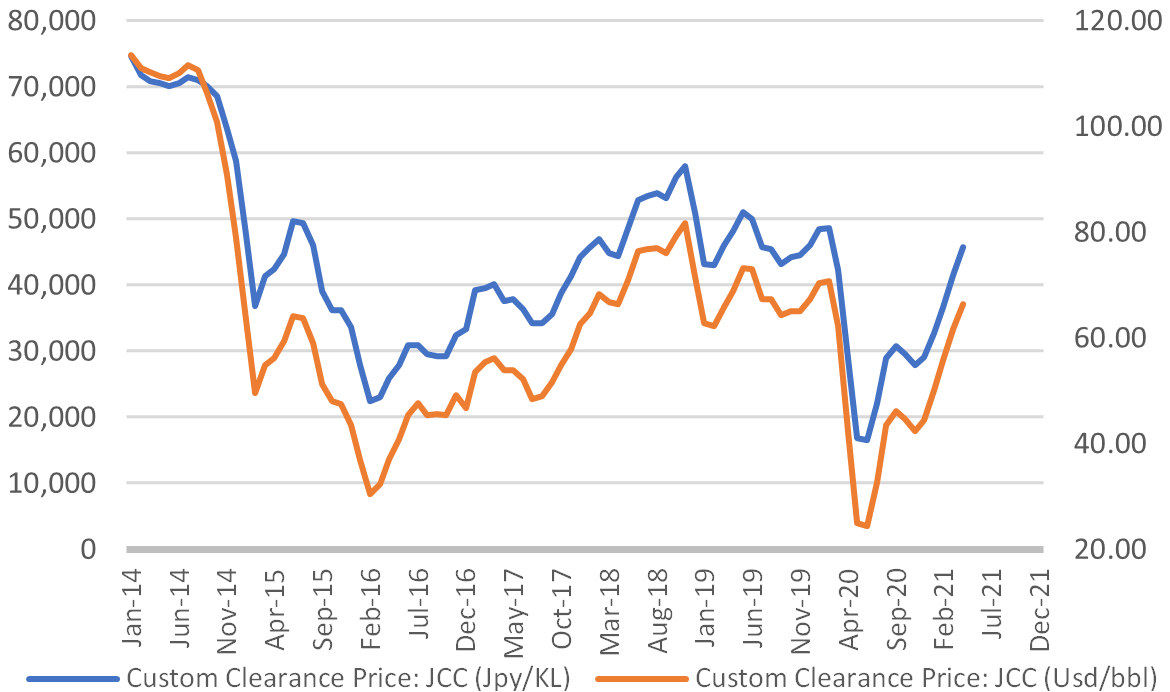
Japan Oil Price: $65.45/ barrel
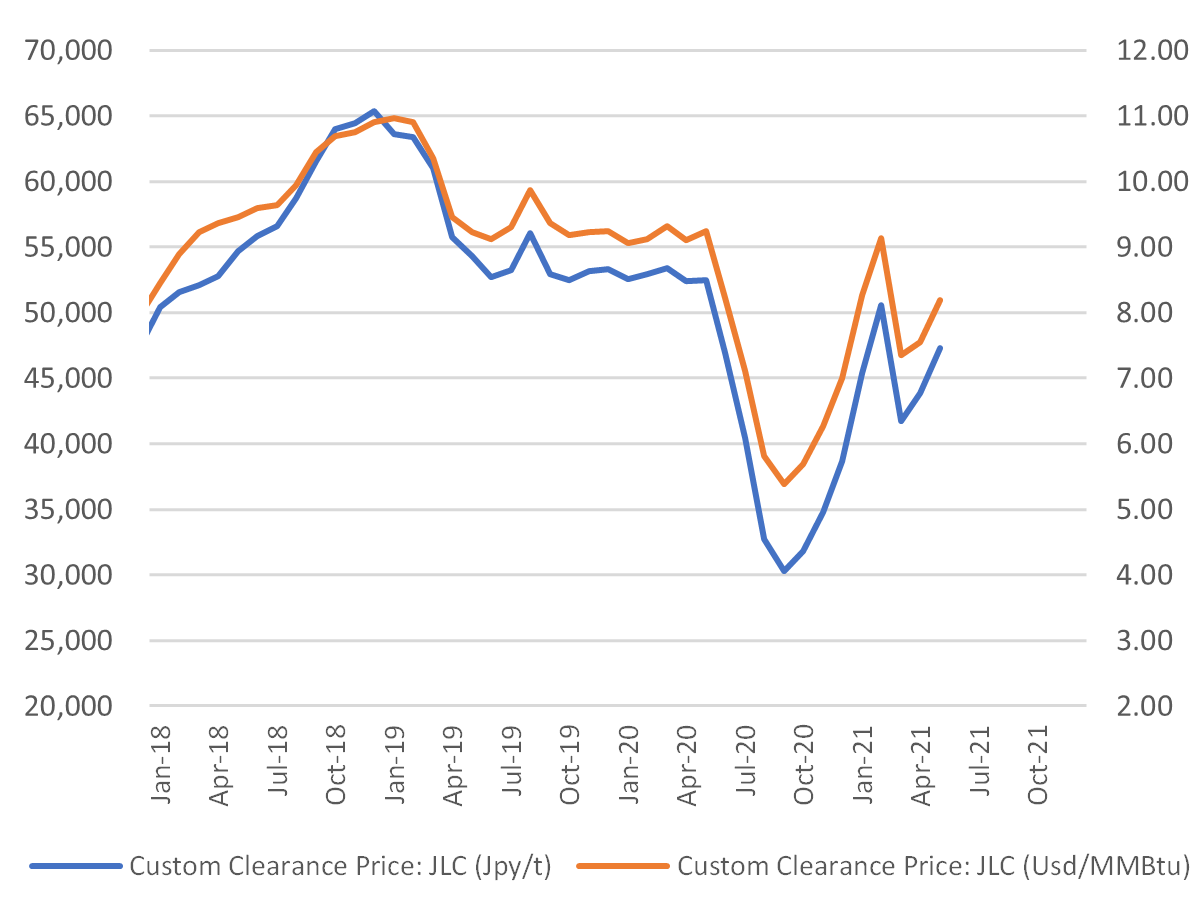
Japan (JLC) LNG Price: $8.19/ mmbtu
Panasonic joins U.S. Schlumberger project to extract lithium from salt water
(Asia Nikkei, July 17)
- Panasonic will take part in a project led by U.S. oil services leader Schlumberger in which lithium is expected to be extracted from underground salt water. This process is believed to take a fraction of the time compared with traditional mining.
- Schlumberger has started a pilot plant to extract lithium from underground salt water in the U.S. state of Nevada. Panasonic will test samples of the extracted lithium to check if it can be used for EV batteries.
- Traditionally, lithium is mined from ore bodies or extracted from brine in evaporation ponds. The brine itself comes from underground salt lakes.
- However, evaporating the brine to get lithium typically takes more than a year. It also involves dealing with large quantities of impurities. Schlumberger’s technology directly extracts lithium from brine, which the company says can shorten the production schedule to just a few weeks.
JAPEX considers exit from Canadian oil sands project
(Reuters, July 8)
- JAPEX is looking at selling its stake in the Hangingstone oil sands project in Canada. The company is looking for a buyer for its 75% share of the facility.
- There are concerns about the high production costs and emissions impact.
- China’s CNOOC owns the rest of the shares in Hangingstone.
- The sale could generate more than C$200 million ($160 million) for JAPEX as the asset has abundant oil reserves.
- JAPEX has confirmed the potential for a sale, as well as its intention to consider other options, such as cutting Hangingstone production costs.
Sumitomo Electric, U.S partner on tech to extract rare earths from waste
(New Energy Business News, July 16)
- Sumitomo Electric Industries signed an accord with KMX Technologies of the U.S. to develop a membrane distillation for water treatment. This distillation allows for recovery of valuable metal from metal waste.
- Pooling proprietary technology from both sides, the two companies aim to provide a way to economically recover rare earth metal from mine wastewater, as well as offering a way to also recover key materials such as lithium, gold, silver, and nickel.
Chiyoda wins $2.7B order to build Indonesia copper smelter on EV demand
(Asia Nikkei, July 15)
- A unit of Freeport-McMoRan awarded the $2.7 billion order to Chiyoda to build a copper smelting plant in Indonesia.
- The plant will be one of the world’s largest as companies rush to meet demand for copper spurred by decarbonization and the shift to EVs. It starts operating in 2025.
- Copper is a key component of EV motors, batteries and cables.
Japanese oil majors show declining profits despite rising crude prices
(Diamond, July 9)
- Profit margins for the first three months of this calendar year (the 4Q of their fiscal year) were down 2.4% at INPEX, down 4.7% at ENEOS, and down 9.4% at Idemitsu.
- All three companies suffered from declining oil and gas prices to their customers, as well as lower sales volumes for jet fuel, light oil and gasoline due to the pandemic.
ANALYSIS
BY CHISAKI WATANABE
Sink or Swim: How Japan Is (Re)Turning to Floating Solar
To Alleviate Space Constraints
Japan has no more readily available land for solar – that’s one argument often used by industry skeptics. Whatever your stance, there’s an alternative space where solar power can be installed, and in Japan it’s available in abundance.
The nation has tens of thousands of man-made reservoirs, only a fraction of which are currently utilized. In a country that lacks vast, flat, open space, installing panels on such bodies of water solves both energy issues and contributes to better water management.
What’s more, Japan was the pioneer of floating solar technology. Since those initial strides, the domestic progress for the technology has somewhat stalled. However, with government officials desperately looking for more spaces to install solar panels to meet national carbon neutrality pledges, reservoirs and other untapped locations are starting to gain attention.
The first floating solar project
The world’s first floating solar was built in Japan in 2007, a 20 kW project in Aichi prefecture, according to a report by the World Bank and the Solar Energy Research Institute of Singapore (SERIS).
Japan was also home to the first megawatt-scale floating solar project. It was set up in Saitama prefecture in 2013, a year after Japan introduced a feed-in tariff (FIT) program for clean energy. The 1.18 MW station, developed by West Holdings, was built on a reservoir. The company has since added several more floating solar installations across the country.
Solar panels can be installed in many different places though they are commonly mounted on the ground. However, putting panels on a floating platform, often made with high density polyethylene (HDPE) and anchored to the bottom, brings several advantages.
For one, floating solar photovoltaic (FPV) offers a new space for the energy source that doesn’t compete with other land-use. That’s important for countries with high population density.
On a global scale, FPV potential runs to more than 400 GW – and that’s based on the idea that panels are installed on 1% of the total surface area of freshwater man-made reservoirs, according to World Bank calculations.
Japan could be among the top countries to benefit from FPV due to its existing and extensive man-made reservoir system. There are 160,000 such bodies of water, which were created to help manage water levels for farming. Japan remains a major rice grower with rice paddies spread throughout the nation.
There are other advantages that FPV brings for Japan:
- Better energy yield: the cooling effects of water beneath solar panels helps boost energy yields by as much as 6%, according to some studies
- Proximity to electricity demand: the reservoirs are naturally placed near settlements
- Cost: there’s no need for land preparation work
- Access: land rights in Japan are complicated, while access to water is more straightforward since it’s under state ownership and oversight
As of 2018, Japan had 145 MW of floating solar capacity installed, mainly on reservoirs and small lakes, according to a solar industry report by the state-backed New Energy and Industrial Technology Development Organization (NEDO).
That leaves a lot of room for growth. The nation’s FPV capacity could increase to 2 GW by 2030 and 23.3 GW by 2050, according to the Japan Photovoltaic Energy Association, a solar industry group that is promoting such development. Japan’s natural capacity for floating solar could be as high as 38.8 GW, NEDO said in 2013. Recent advances in PV efficiency suggest the above numbers could even be conservative.
Faster growth elsewhere in Asia
More recently, however, growth in FPV is proceeding faster in other parts of Asia. Worldwide, FPV is utilized in more than 35 countries with a combined capacity of about 2.6 GW as of August 2020. Capacity is projected to grow annually above 20% on average through 2025, but currently China, India, South Korea, Taiwan, Thailand and Vietnam are driving demand, writes Frank Haugwitz, a senior advisor for clean energy advisory firm Apricum.
One of the major suppliers for floating platforms in Japan is France’s Ciel & Terre, which provided equipment for the 13.7 MW station in Chiba, the largest FPV in Japan, and developed by Kyocera Corp. While Ciel & Terre has supplied combined solar systems for a total of 157 MW in capacity in Japan, most of its projects range between 1 MW and 3 MW.
Meanwhile, some Asian projects have much bigger capacity, utilizing hydro dams or even open sea areas:
- South Korea will build a 2.1 GW floating solar, the largest FPV in the world, near the Saemangeum tidal flats on the coast of the Yellow Sea. This project will combine 0.3 GW in onshore solar with 0.1 GW of wind and 0.1 GW of fuel cell power, adding up to be Korea’s largest renewable energy generation complex.
- India plans to build a 600 MW floating solar project at the Omkareshwar dam in Madhya Pradesh. It is slated to start operations as early as next year.
- Hangzhou Fengling Electricity Science Technology completed a 320 MW floating solar-aquaculture project on reservoirs in China’s Zhejiang province in early 2020.
- A venture between a subsidiary of Indonesia’s state power company PT PLN and Masdar of United Arab Emirates is developing Indonesia’s first floating solar station with a capacity of 145 MW in West Java. The Indonesian government may develop 60 more floating solar plants, using its more than 600 lakes and reservoirs.
- Singapore’s Blueleaf Energy is developing a 500 MW floating solar project with a battery energy storage system of up to 200 MWh capacity in Vietnam’s Dong Nai province. The Southeast Asia Clean Energy Facility (SEACEF), a group of international foundations including Microsoft, has invested in the project to help Vietnam address its power shortages. The government of Gia Lai province approved in June an investment plan for a 500 MW solar project that combines floating and ground-mounted solar panels.
Resilience solutions
One issue that’s preventing similar large-scale developments of FPV in Japan may be investor concern about typhoons and other extreme weather conditions. In September 2019, one of the strongest typhoons to hit Tokyo and its surrounding area damaged the platforms at the 13.7 MW floating solar project causing dozens of panels to pile up and burn.
‘’An increase in strong typhoons and torrential rains is causing more wind and water damage to solar power stations. We will continue to need safety measures,’’ NEDO said in its solar industry report, adding that it plans to put together safety guidelines for stations built on water.
Still, weather concern is slowly being overcome. Several wind turbines that can withstand typhoon conditions have come on the market recently and additional resilience solutions are being considered for solar too.
For Japan, FPV will be among the six areas expected to increase solar capacity installations alongside wall mounts, car roofs and on agricultural land. ‘’In order to allow for massive solar power generation in 2050, it is essential to develop technologies’’ so that solar power can be generated at locations that to date have not been fully utilized, NEDO said.
ANALYSIS
BY SAKI ISETANI
Biogas Emerging as a Popular Energy Source for Rural Japan
And a Niche Rival to LNG
Japan has scant oil and gas resources, but it has plenty of cow dung. And, apparently, that could emerge as raw material for a niche, clean energy source that could displace LNG in some rural areas.
A new biogas project in Hokkaido, the northern island of Japan, aims to demonstrate how excrement at a dairy farm could be turned into energy and heat. This process has the potential to replace as much as half of Hokkaido’s factory LNG consumption, while also reducing greenhouse gas (GHG) emissions by more than 60%.
The project is not an isolated case. Since the introduction of state-supported tariffs for renewable energy, the role and number of biomass facilities has steadily grown. Biogas in particular has recently gained government attention because, in addition to its green credentials, it fits with the state chisan-chisho policy of promoting projects that directly benefit immediate communities.
Below, we feature standout projects in Japan’s biogas industry, at home and overseas.
Think global, act local
In the light of the 2011 earthquake, tsunami and nuclear disaster, a major focus of Japan’s energy policy has been to increase energy self-sufficiency by shifting to more a decentralized energy system. While there has also been plenty of resistance at bureaucratic and industry level to such an approach, one of the rationales behind PM Suga’s support for renewable energy is to be the country’s main source by 2050.
In terms of utility-scale projects, the government expects most GW-sized additions to come from the offshore wind sector and solar. Still, other renewable sources also play an important role in future planning, and at a regional level biogas is emerging as a favorite for its premise of delivering stable, self-sustaining CO2-free energy.
Biogas plays into the broader circular economy and recycling theme by offering an effective way to utilize waste, thus reducing the need for disposal, and by contributing to the resilience of local infrastructure resilience as an independent energy source. These qualities fit well with the chisan-chisho (地産地消) state policy that promotes locally-produced and locally-consumed products. The policy was initially devised as an agriculture promotion, but it has been expanded to the energy sector and is being adapted for local biomass-to-energy projects.
As more biomass projects develop in rural areas, they also help local manufacturers more easily access the “green” electricity that their global clients demand.
Biogas production process
Biogas is generated from the anaerobic digestion and fermentation of biomass derived from food waste, animal waste, sewage, and plant matter. In general, biogas contains about 60% methane and about 40% CO2.
Since methane is more potent than CO2, instead of allowing it to be emitted a biogas plant uses it as fuel to drive a combined heat and power (CHP) turbine and generate electricity. The captured thermal energy can also be utilized for heating and cooling systems, and industrial purposes.
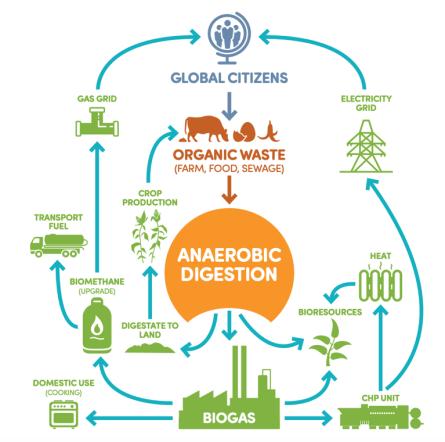
Biogas can also be processed (upgraded) into biomethane, also known as Renewable Natural Gas (RNG). Biomethane has a higher methane concentration of 90%, but it qualifies as a renewable source because it’s sourced from fresh organic matter. Biomethane can be moved by pipeline and is fully interchangeable with natural gas, according to the U.S. Dept. of Energy.
Finally, RNG can also be converted to compressed natural gas (CNG) or liquified natural gas (LNG) and used as vehicle fuel. According to the National Renewable Energy Laboratory, RNG can replace about 5% of the natural gas used for electricity and 56% used for vehicle fuel.
Scale of biogas industry in Japan
Although the development of biogas technology has a long history in Japan, full commercialization of biogas as a renewable energy source is still a work in progress. Back in 2014, there were only 42 methanation fermentation facilities that actively converted sewage into biogas for energy, compared to a national total of about 2,150 sewage plants, MoE data show.
Source: World Biogas Association
In the last five years, however, the industry has expanded at a growing pace. As of March 2020, there were 228 biogas power generation facilities implemented under the state-supported feed-in-tariff (FIT) scheme, with a total capacity of 86.1 MW. That’s almost a quadrupling of the capacity compared with 2012 levels.
Biogas-generated power can claim an FIT of ¥39, which is more than triple that of solar and several yen higher than offshore wind.
The number of certified biogas facilities is growing at 15 to 30 per year. The average capacity of a biogas power generator in Japan stands at about 400 kW, with most at 2 MW or under, according to 2020 data from the Japan Organics Recycling Association.
Challenges and future trends
At the moment, the share of biogas in Japan’s energy mix is small. As well as the high costs, the constraints for the sector includes access to adequate amounts of biomass resources. These tend to be available mostly in rural areas and are specific to certain industries, like dairy agriculture or food and beverage manufacturers.
This makes biogas unlikely to displace LNG and other energy sources on a national level. However, it does offer niche opportunities in certain regions and because of the chisan-chisho policy, a number of municipalities are pushing for more biogas projects to be developed, seeing them as a better fit for development of the local economy instead of other renewable energy sources, such as solar.
A SELECTION OF BIOGAS PROJECTS IN JAPAN
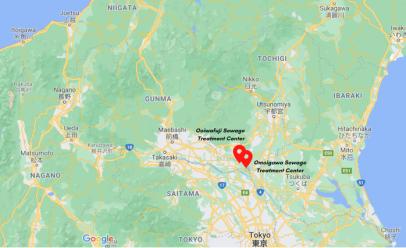
YANMAR ENERGY FARM IN TOCHIGI
|
Location: Omoigawa Sewage Treatment Center (思川浄化センター) and Ooiwafuji Sewage Treatment Center (大岩藤浄化センター) |
Image of the biogas plant: 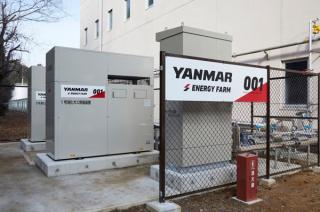 Source: Yanmar Holdings |
|
Start of operations: Feb. 27, 2020 and April 1, 2020 |
 |
|
Project operator: Yanmar Holdings, Yanmar Energy Systems | |
|
Expected power generation (annual): 560 MWh *Equivalent to the annual consumption of 100 households | |
|
Feedstock: sewage sludge |
LIQUEFIED BIOMETHANE FROM COW EXCREMENT IN HOKKAIDO
|
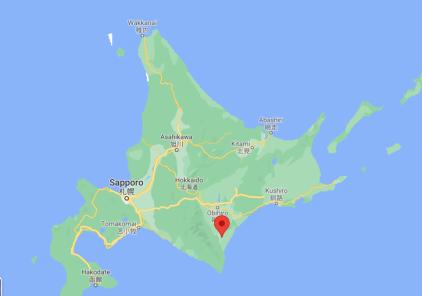
Location: Taiki Town (大樹町) , Tokachi region, Hokkaido |
Image of the biogas fermenter: 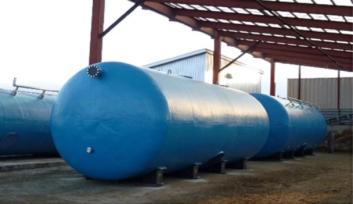 Image source: Nikkei |
|
Project Date: April 2021~March 2023 (2 years) Commercial Operation: expected from August 2022 |
 |
|
Project Operator: Air Water | |
|
Expected (annual) generation volume: NA. The project is expected to produce 360 tons of biomethane fuel. | |
|
Feedstock: cow excrement |
The treated biogas collected from the two dairy farms in Taiki Town will be processed as LBM at a factory in Obihiro City, and used as a fuel for Yotsuba Milk Products’s factory at Otofuke town. This supply chain model is Japan’s first attempt to produce LBM from biogas. Once realized, it’s expected to help demonstrate the potential for LBM to replace LNG. If the project’s capacity of 360 tons of biomethane is consumed instead of LNG, it will result in a CO2 reduction across the entire supply chain of 7,740 tons annually, equivalent to a 60% or more cut in GHG. According to Air Water, Hokkaido has the potential to produce 300,000 tons of biomethane annually, which is equivalent to about 50% of the annual LNG consumption at factories in the Hokkaido prefecture.
AOMORI TOHOKU-MACHI SOLAR POWER PLANT
|
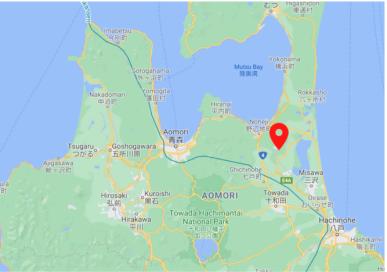
Location: Touhoku-machi, Kamikita-district, Aomori (青森県上北郡東北町) |
Image of power plant: 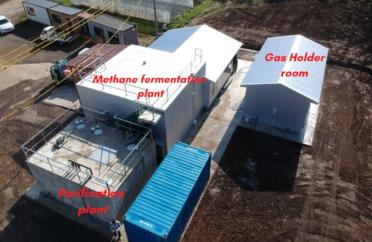 Source: Japan Asia Investment Co., Ltd |
|
Start of operation : November 2018 |
 |
|
Project Operator: E-power and JA Yuuki Aomori | |
|
Expected power generation (annual): 160MWh *Equivalent to 33 households | |
|
Feedstock: Naga-imo (Japanese Yam) residue |
By using the residue of nagaimo (Japanese yam), the Aomori Tohoku Town Power Plant can help reduce waste treatment cost by over ¥20 million yen per year. This is a game changer for JA Yuuki Aomori, Japan’s top supplier of nagaimo. JA Yuuki Aomori also plans to utilize this solar power plant to develop a co-generation system where the exhaust heat collected from the biogas generator is used to operate a greenhouse during winter.
ASAHI GROUP’S BEER WASTE TO POWER
|
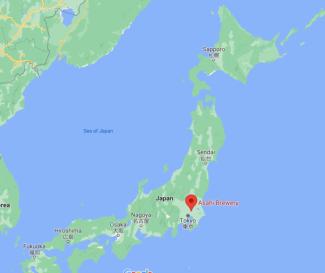
Location: Asahi Beer’s Ibaraki Plant |
Image of power plant: 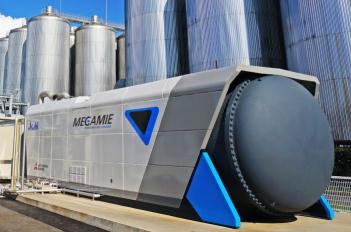 Source: Asahi Group Holdings |
|
Start of project: October 2020 |
 |
|
Project Operator: Asahi Beer, Asahi Quality and Innovations (AQI) | |
|
Expected power generation (annual): 1,600 MWh *Equivalent to power consumption of 350 households | |
|
Feedstock: factory wastewater |
Asahi Beer’s biogas project will use a newly developed power generation technology based on Mitsubishi Power’s solid oxide fuel cell called the “MEGAMIE”. This is a hybrid power generation system that combines fuel cells with a gas turbine. The biogas improves energy efficiency by suppressing emissions by 1,000 tons of CO2 per year.
JAPANESE BIOGAS PROJECTS OVERSEAS
HZI’S KOMPOGAS DRY ANAEROBIC DIGESTION (AD) PROJECT IN SWEDEN
|
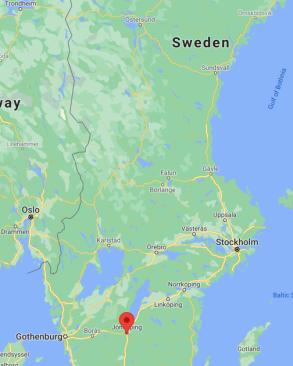
Location: Jönköping, Sweden |
Image of biogas plant: 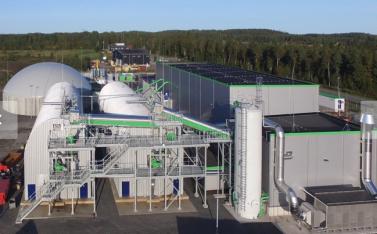 Source: Hitachi Zosen INOVA |
|
Start of operation: expected to start in 2021 |
 |
|
Project Operator: Hitachi Zosen Inova (subsidiary of Hitachi Zosen Inova) | |
|
Expected power generation (annual): 3,500 MWh | |
|
Feedstock: organic waste (40,000 tons/annual) |
HZI’s Kompogas consists of two digesters, which will produce a total of 2,816,000 Nm3/a of biomethane that’s then upgraded in the form of compressed natural gas (bio-CNG) as a carbon-neutral transportation fuel for local buses, the municipality, and private gas distributors for their local CNG fueling stations.
BIOGAS FROM PINEAPPLE RESIDUE – DOLE PHILIPPINES
|
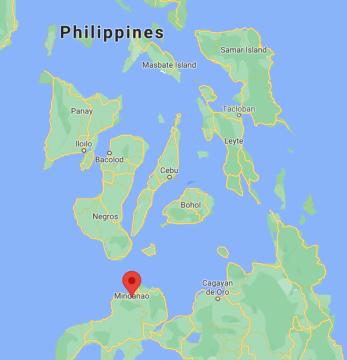
Location: Mindanao, Philippines |
Image of the plant: 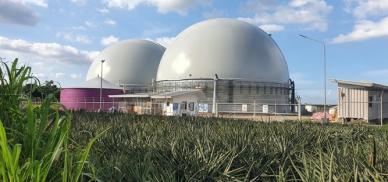 Source: Lipp Systems |
|
Commercial operation: expected to start in 2021 |
 |
|
Project Operator: Itochu Corporation Business Partner: MET Power Venture Partners Holdings, Surallah Biogas Ventures Corporation | |
|
Expected power generation (annual): Volume figure is not available. The expected capacity of the installation is 5.7 MW. | |
|
Feedstock: pineapple residue |
Fruit residue collected at the two Dole Philippines’s pineapple factories in Surallah and Polomolok will be used to collect biogas at plants on Mindanao island and then to generate electricity, replacing existing fossil fuel generating facilities. Once completed, the project will help to cut 100,000 tons of CO2 a year.
GLOBAL VIEW
BY TOM O’SULLIVAN
Below are some of last week’s most important international energy developments monitored by the Japan NRG team because of their potential to impact energy supply and demand, as well as prices. We see the following as relevant to Japanese and international energy investors.
Fit for 55; EU “Aims for the Moon” on Carbon Emissions Reductions:
On Wednesday, EU Commissioner Frans Timmerman adopted a package of 13 historic proposals to make the EU’s climate, energy, land use, transport and taxation policies consistent with reducing net greenhouse gas emissions 55% by 2030 vs. 1990 levels.
The goal is to make the EU the world’s first climate-neutral continent by 2050.
The 13 proposals include:
1). A reduction of the emissions cap in the Emissions Trading System (ETS) and the elimination of free emissions for the aviation industry, and inclusion of emissions for the shipping industry for the first time.
2). Establishing an overall EU target for carbon removals by natural sinks equivalent to 310 million tons of CO2 emissions by 2030.
3). The EU Renewable Energy Directive will set an increased target to produce 40% of EU energy from renewable sources by 2030.
4). The public sector will renovate 3% of buildings each year to bring down energy use and costs to taxpayers.
5). All new cars registered in the EU as of 2035 must be zero-emission.
6). The EU Alternative Fuels Infrastructure Regulation requires that aircraft and ships have access to clean electricity supply in major EU ports and airports. The ‘ReFuelEU Aviation Initiative’ will oblige fuel suppliers to blend increasing levels of sustainable aviation fuels in jet fuel taken on-board at EU airports, including synthetic low carbon fuels (E-fuels).
7). A new Carbon Border Adjustment Mechanism (CBAM) will put a carbon price on imports of a targeted selection of products to avoid ‘carbon leakage’.
8). The establishment of an E72 billion package to alleviate energy poverty across the EU.
All of the proposals will require approval by the EU Parliament and the EU Council of 27 members states and are expected to meet some resistance from EU industry. EU aluminum producers have already requested an exclusion from the CBAM. China, Brazil, India, and South Africa may also object to the CBAM or may apply retaliatory measures.
Nuclear Power:
1). Work has been completed to remove the internal components of reactor unit 6 of the Bruce Nuclear Power Plant in Ontario, Canada. As part of a 48-month refurbishment project, replacement parts will be installed in the Candu reactor in order to extend the life of the unit by 40 years.
Bruce units 3-8 are to be refurbished, including the replacement of key reactor components such as steam generators, pressure tubes, calandria tubes and feeder tubes. The refurbishment is part of Bruce Power’s Life-Extension Program, which started in January 2016 and involves the gradual replacement of older systems in the company’s eight reactor units. Units 1 and 2 at the plant have already been refurbished. Work to refurbish unit 6 began in January 2020 and is expected to be completed in January 2024. Work is scheduled to begin on unit 3 in 2023 and unit 4 in 2025, with each refurbishment planned to be shorter in duration, and ultimately more cost-effective, than the previous one. The refurbishment of the final reactor, unit 8, is scheduled to be completed in July 2033.
2). South Korea’s Ministry of Trade, Industry and Energy is still planning for the construction of a nuclear power plant project in Dukovany, Czech Republic. Local South Korean companies are vying with more established players from the U.S. and France to win the contract.
Natural Gas Prices:
Gas prices in the Netherlands hit their highest levels since 2004, $13 mmbtu, as global demand surges to meet increased need for electricity in markets such as Brazil, Canada, and China where droughts have reduced hydropower output. The IEA will issue its first ever Special Markets Report on hydropower tomorrow.
Oil:
OPEC released its monthly oil report. For 2021, OPEC is now predicting that world oil demand growth is forecast at 6.0 mb/d, unchanged from the June assessment. Total oil demand is projected to average 96.6 mb/d in 2021. World oil demand is anticipated to rise by 3.3 mb/d y-o-y in 2022, while total world oil demand is projected to average 99.9 mb/d for 2022, with the 100 mb/d mark exceeded in 2H 2022. WTI prices closed the week @ $72 with Brent @ $74. OPEC+ is now expected to reach a compromise agreement with the UAE on production increases that may take effect from September instead of August.
Aviation:
1). United Airlines (UA) and Mesa Air Group have agreed to purchase 100 small electric-powered planes from Sweden’s Heart Aerospace and will invest $35 million in the company. The acquisition of the aircraft is subject to successful development of the planes. UA has also agreed to a conditional purchase of Archer Aviation’s four-seat electric air taxi that has vertical takeoff capability.
2). Boeing will scale up production of biofuels through a partnership with SkyNRG.
Shipping:
Rosatom is building four new nuclear-powered icebreakers at St. Petersburg’s Baltic Shipyard that will be used year-round on the Northern Sea Route to Asia that will cut 15 days from the traditional Suez Canal route. The vessels will cost $400 million each, and require a construction period of five to seven years. The ice breakers are expected to be game changers for Russia’s oil and gas industry.
Global Electricity Demand:
A new IEA report on global electricity released last Thursday anticipates a 5% rise in global electricity demand in 2021 vs. 2020, and another 4% in 2022, with 50% of the increase met by fossil fuels, mainly coal, threatening to push CO2 emissions from the power sector to record levels in 2022. China and India are driving most of the increase in global electricity demand. Globally, coal-fired electricity generation is set to increase by almost 5% in 2021, and by a further 3% in 2022, possibly reaching an all-time high in 2022.
GHG Emissions:
GHG emissions by over 9,000 of the largest globally listed companies will exceed limits set in the Paris Agreement in less than six years despite numerous net zero pledges according to MSCI. The limits established in the Paris Agreement were established to limit global temperature increases to 1.5 C. Former U.S. Vice President Al Gore also warned this week that green-washing could risk a successful transition away from fossil fuels.
EVs:
1). Volkswagen now estimates that internal combustion engine (ICEs) cars manufactured in the EU will be less profitable than EVs by 2025 when new Euro 7 engine standards requiring expensive emissions reduction equipment for ICE vehicles become applicable.
2). The market capitalization of CATL, China’s largest battery company, exceeded $200 billion for the first time as the stock price soared more than 60% YTD. CATL is a major battery supplier to Tesla.
Tesla:
Elon Musk was in court last week defending Tesla’s $2.1 billion acquisition of SolarCity in 2016. Tesla shareholders are seeking compensation for the acquisition which they claim was a bail-out benefiting the Musk family.
Crypto Mining/Power Consumption:
China’s share of electricity usage for crypto currency mining dropped below 50% for the first time in April, according to a recent survey. The U.S. came in second and Kazakhstan jumped to third place for the first time, increasing its share by a factor of six, as miners were forced to exit China. Mining of the Bitcoin currency is now thought to generate 64 million tons of CO2 per annum, around twice what it takes to operate the global ATM system.
China:
On Friday, China’s national carbon emissions trading scheme (ETS) made its global debut on the Shanghai Environment and Energy Exchange. The ETS is part of China’s plans to reduce carbon emissions – now the world’s highest – to a peak before 2030 and to net zero by 2060. The ETS system is expected to be the largest carbon trading market in the world; it will initially cover 2,225 power plants, responsible for over four billion tons of CO2 emissions per annum, which is 40% of China’s total emissions, or a seventh of total global carbon emissions from fossil fuel combustion.
South Korea:
LG Chem, one of South Korea’s largest petrochemicals and battery manufacturers, will invest $9 billion through 2025 to build sustainable production capabilities. This follows similar commitments by SK Innovation to invest $30 billion in its green business portfolio, and Lotte Chemical Corp. which will invest $4 billion to increase hydrogen output.
LG also plans to invest $5.2 billion in building battery materials production including mining, smelting, and refining investments.
Russia:
Russia agreed to forge close cooperation with the U.S. on climate change following a visit by John Kerry to Moscow last week when he met with Russian Foreign Minister Sergei Lavrov. Russia is the fourth largest emitter of GHGs and is a signatory to the Paris Agreement.
Ukraine:
Ukrainian authorities continue to argue that the Nord Stream 2 natural gas pipeline linking Russia with Germany threatens Ukrainian security. President Zelensky took up the matter with Chancellor Merkel last week and President Biden also discussed the issue with the German chancellor during meetings in Washington on Friday.
Saudi Arabia:
Saudi Aramco chose two U.S. investment banks to advise on a planned sale of a stake in its domestic natural gas pipeline network worth several billion dollars. Aramco’s gas pipeline network connects its production with processing sites throughout the country and has a capacity of 9.6 billion cf/day.
UAE:
The emirate opened an embassy in Israel for the first time.
Spain:
Siemens Gamesa, the wind turbine maker, warned of sharply increasing raw materials prices as metals prices continue to soar. The stock price dropped by 10% on Wednesday.
UK:
1). Last week the government launched a groundbreaking transport decarbonization plan to create cleaner, quieter cities and communities for better quality of life and to improve the way people and goods move around. The plan includes ending the sale of all new, polluting road vehicles by 2040 and net zero aviation emissions by 2050. It also includes smart electric vehicle charging that could reduce energy bills, and a commitment to electrify the entire fleet of government cars and vans by 2027.
2). Good Energy, an RE energy provider, rejected a takeover bid by Ecotricity, a wind energy company.
United States:
1). Altus Power, a builder and operator of solar-power projects on roofs and parking lots, will list through a CBRE-sponsored SPAC that will value the company at $1.6 billion.
2). The U.S. National Highway Traffic Safety Administration urged owners of GM’s Chevrolet Bolt vehicles to park vehicles away from homes due to the risk of fire in the vehicles’ cell packs.
3). U.S. federal prosecutors at the SEC are investigating Lordstown Motors, the EV company, in connection with falsification of data prior to its SPAC listing with DiamondPeak Holdings in 2020. The stock price has collapsed by almost 70% over the last six months.
4). Aurora, the self-driving technology company focused on passenger and trucking, is planning to list via a SPAC that will give it an initial valuation of close to $11 billion.
Colombia:
Canadian Solar won a utility-scale battery storage project awarded by the Colombian government. The 45MWh lithium-ion energy system is expected to operate commercially by mid-2023.
Brazil:
Raizen, a Brazilian JV between Shell and Cosan that produces biofuels and ethanol, is expected to list on Sao Paulo’s B3 bourse and raise $1.3 billion, making it one of the 10 largest IPOs on record in Brazil. Proceeds will be used to expand renewable biofuels projects.
EVENTS CALENDAR
A selection of domestic and international events we believe will have an impact on Japanese energy.
|
February |
Approval of Fiscal 2021 Budget by Japanese parliament including energy funding projects; CMC LNG Conference |
|
March |
10th Anniversary of Fukushima Nuclear Accident; Smart Energy Week – Tokyo; Quarterly OPEC Meeting; Japan LPG Annual Conference; Full completion of all aspects of the multi-year deregulation of Japan’s electricity market; End of 2020/21 Fiscal Year in Japan; |
|
April |
Japan Atomic Industrial Forum – Annual Nuclear Power Conference; 38th ASEAN Annual Conference-Brunei; Japan LNG & Gas Virtual Summit (DMG)-Tokyo Three crucial by-elections in Hokkaido, Nagano & Hiroshima – April 25th |
|
May |
Bids close in first tender for commercial offshore wind projects in Japan; Prime Minister Suga to visit the U.S. |
|
June |
Release of New Japan National Basic Energy Plan-2021; G7 Meeting – U.K. Presidents Biden and Putin are due to meet at a summit in Geneva Forum for China-Africa Cooperation Summit (Senegal) |
|
July |
Tokyo Metropolitan Govt. Assembly Elections; Commencement of 2020 Tokyo Olympics |
|
August |
Hydrogen Ministerial Conference in conjunction with IEA |
|
September |
Ruling LDP Presidential Election; UN General Assembly Annual Meeting that is expected to address energy/climate challenges; IMF/World Bank Annual Meetings (multilateral and central banks expected to take further action on emissions disclosures and lending to fossil fuel projects); End of H1 FY2021 Fiscal Year in Japan; Japan-Russia: Eastern Economic Forum (Vladivostok)-tentative |
|
October |
Last possible month for holding Japan’s 2021 General Election; METI Sponsored LNG Producer/Consumer Conference; Innovation for Cool Earth Forum – Tokyo Conference; Task Force on Climate-Related Financial Disclosure (TCFD) – Tokyo Conference; G20 Meeting-Italy |
|
November |
COP26 (Glasgow); Asian Development Bank (‘ADB’) Annual Conference; Japan-Canada Energy Forum; East Asia Summit (EAS) – Brunei |
|
December |
Asia Pacific Economic Cooperation (APEC) Forum – New Zealand; Final details expected from METI on proposed unbundling of natural gas pipeline network scheduled for 2022. |
DATA
Japan Oil Price
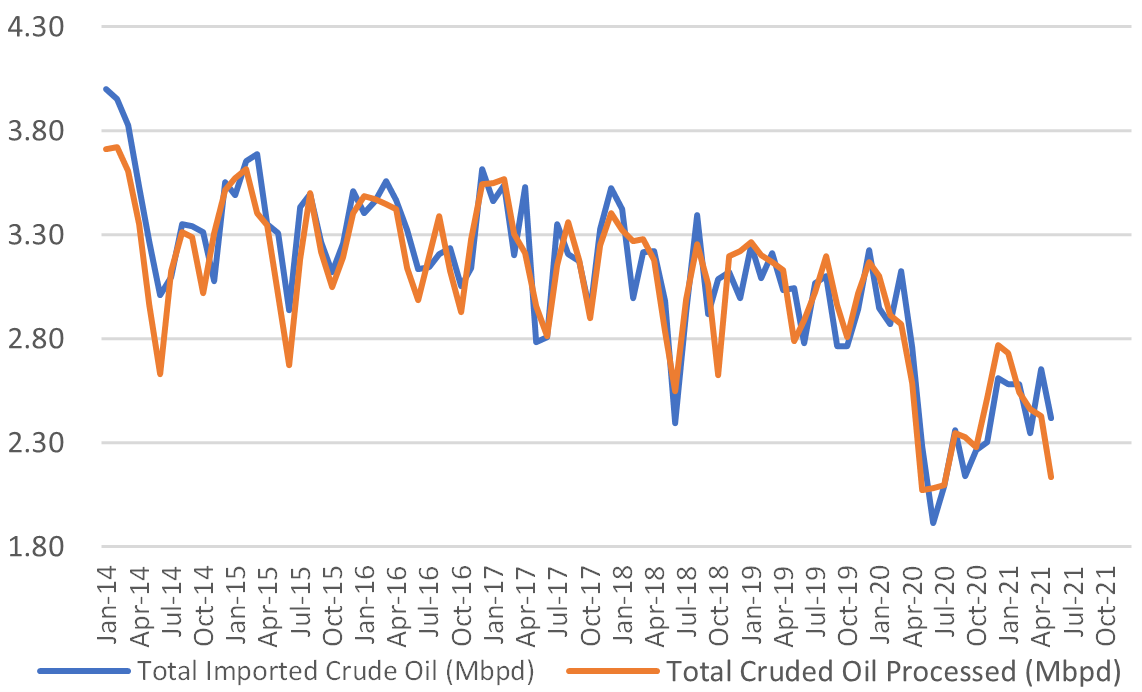
Crude Imports Vs Processed Crude
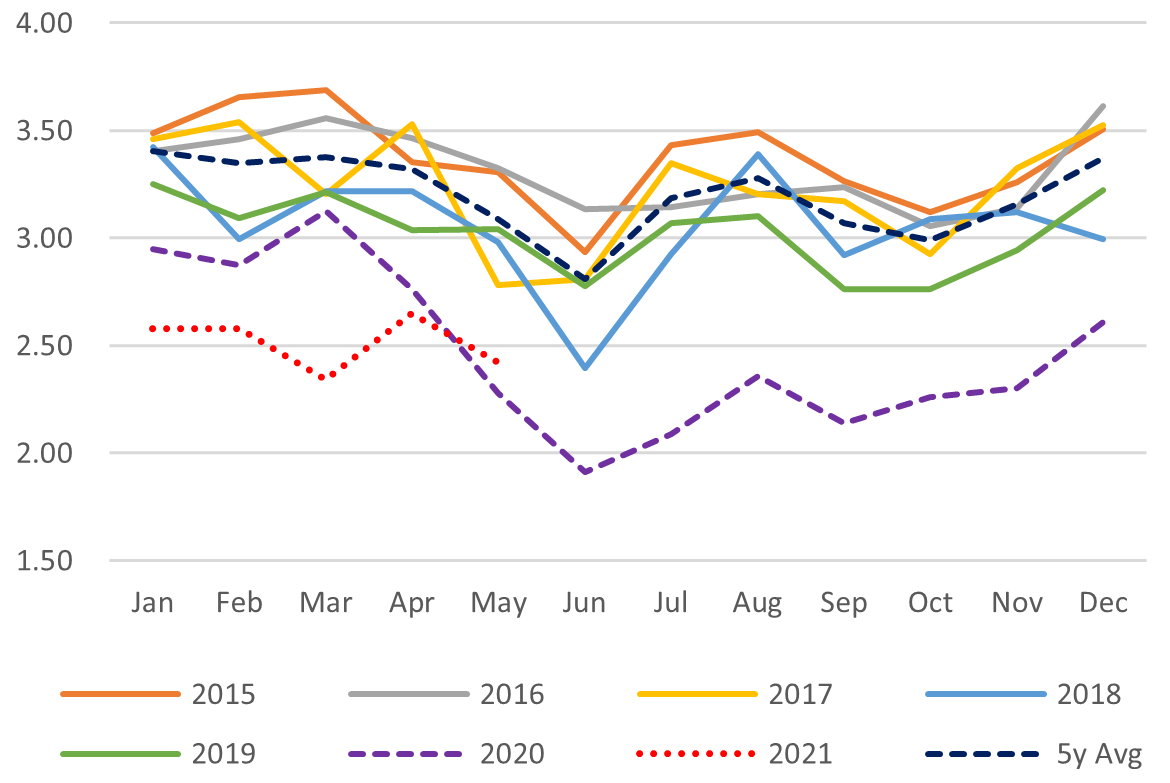
Monthly Oil Import Volume (Mbpd)
Monthly Crude Processed (Mbpd)
Domestic Fuel Sales
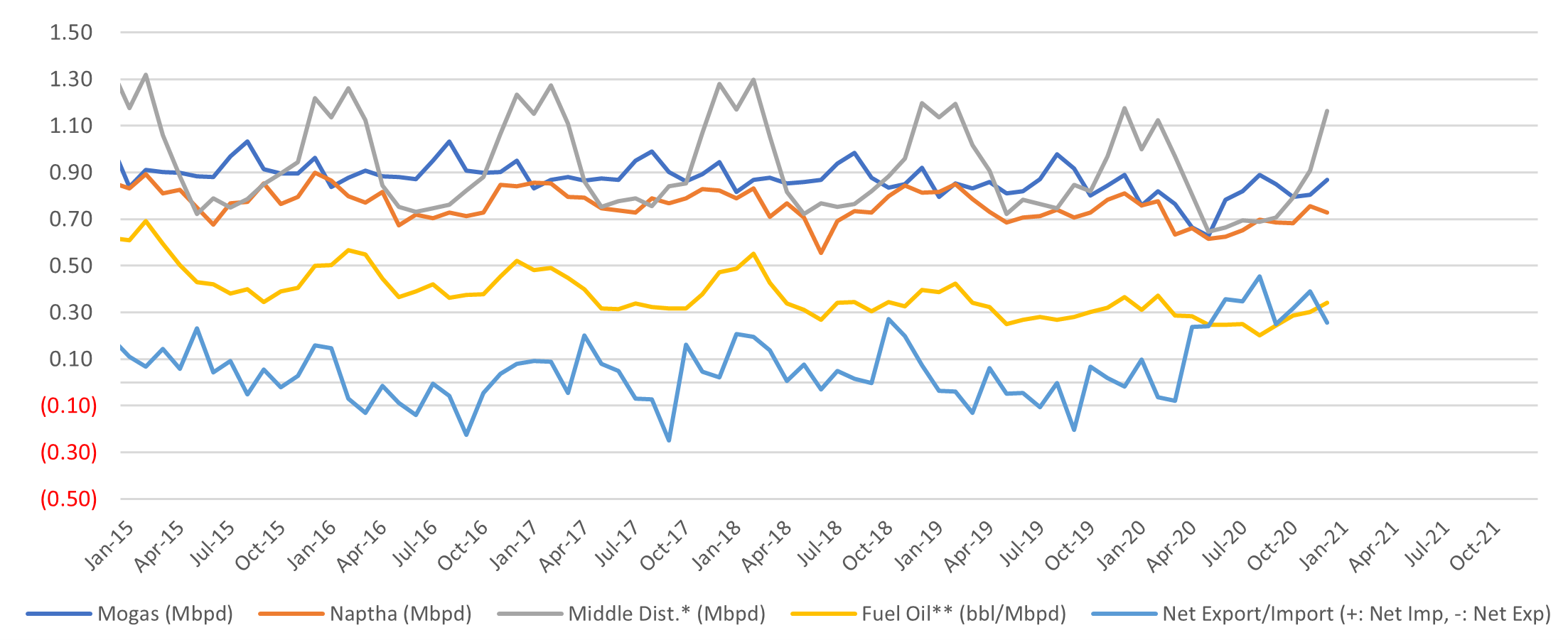
SOURCES: Ministry of Economy, Trade, and Industry (METI), Ministry of Finance, and the Petroleum Association of Japan
Japan LNG Price
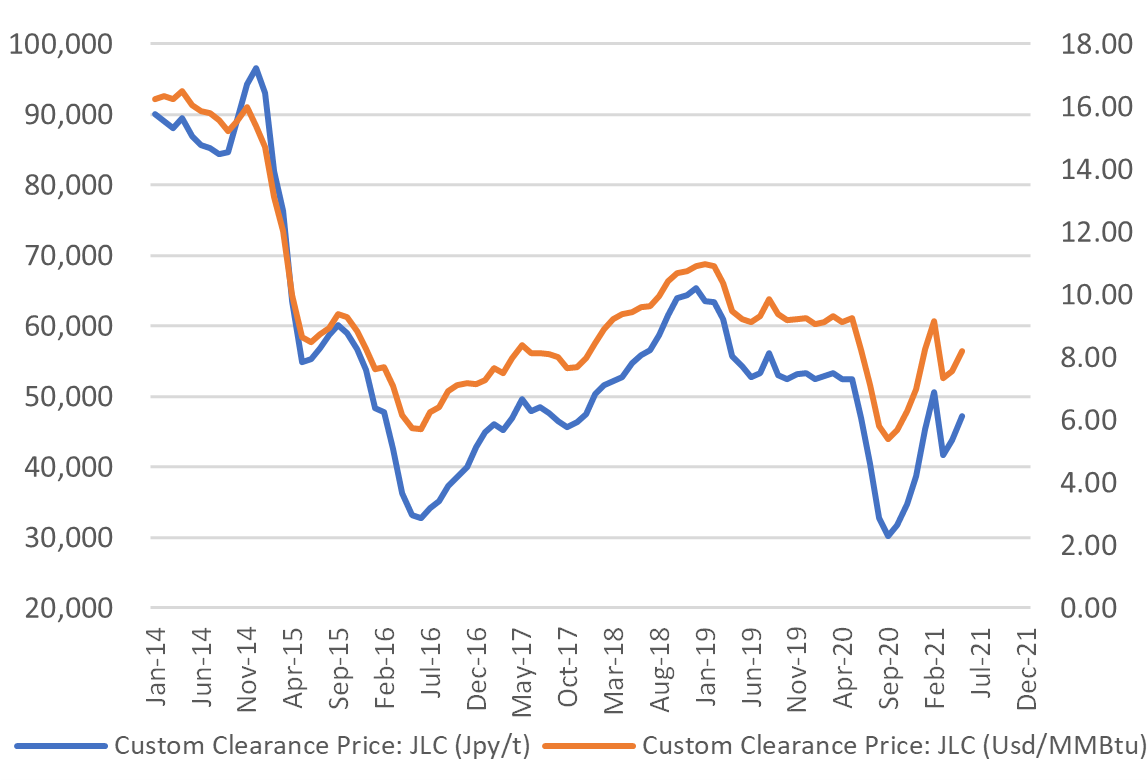
LNG Imports: Japan Total vs Gas Utilities Only
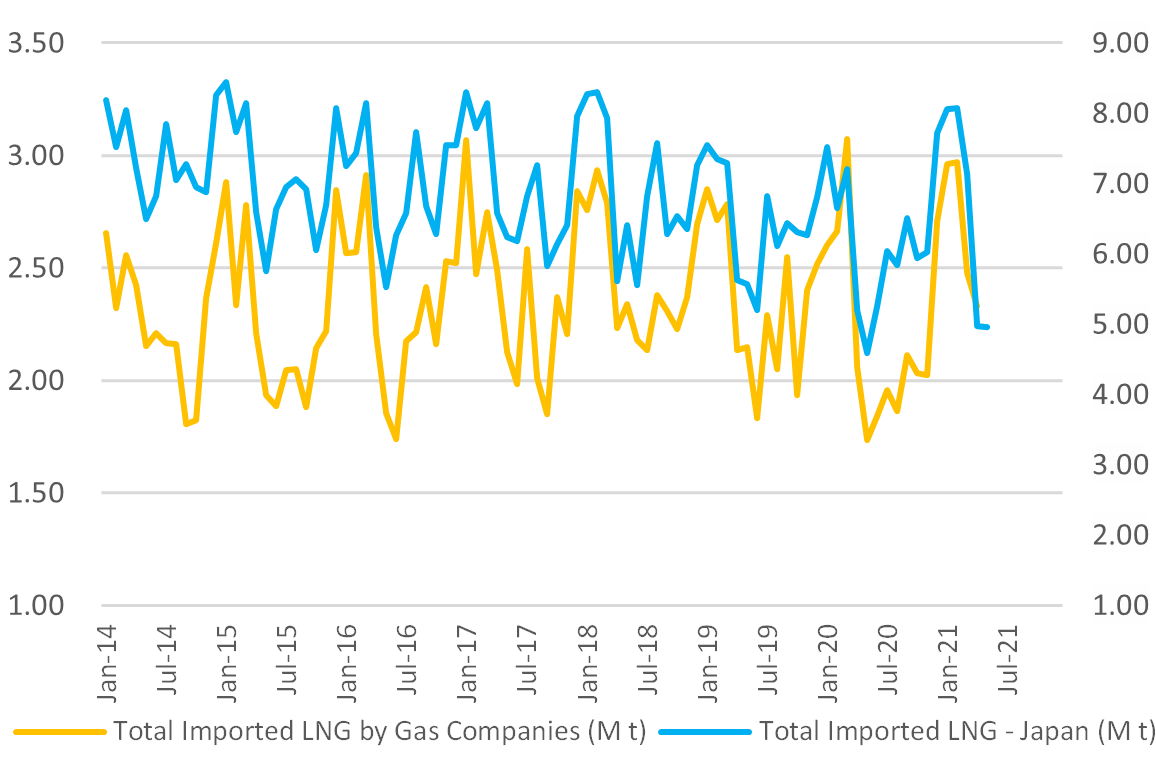
Total LNG Imports (M t)
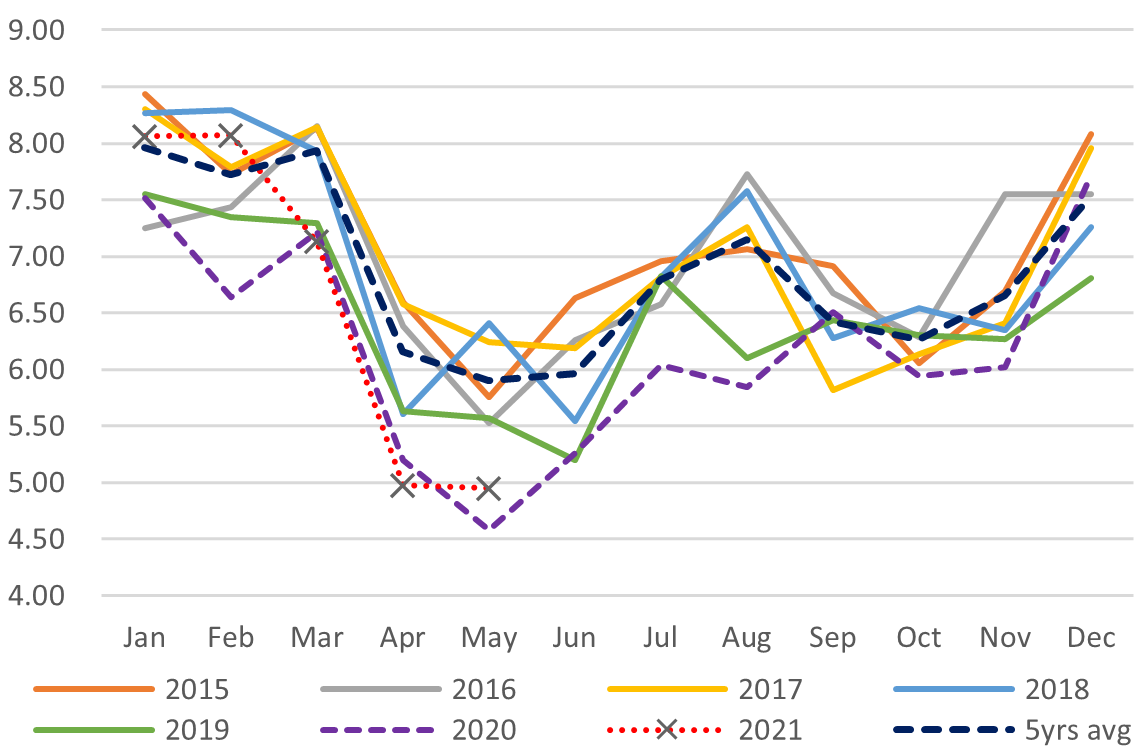
LNG Imports by Gas Firms Only (M t)
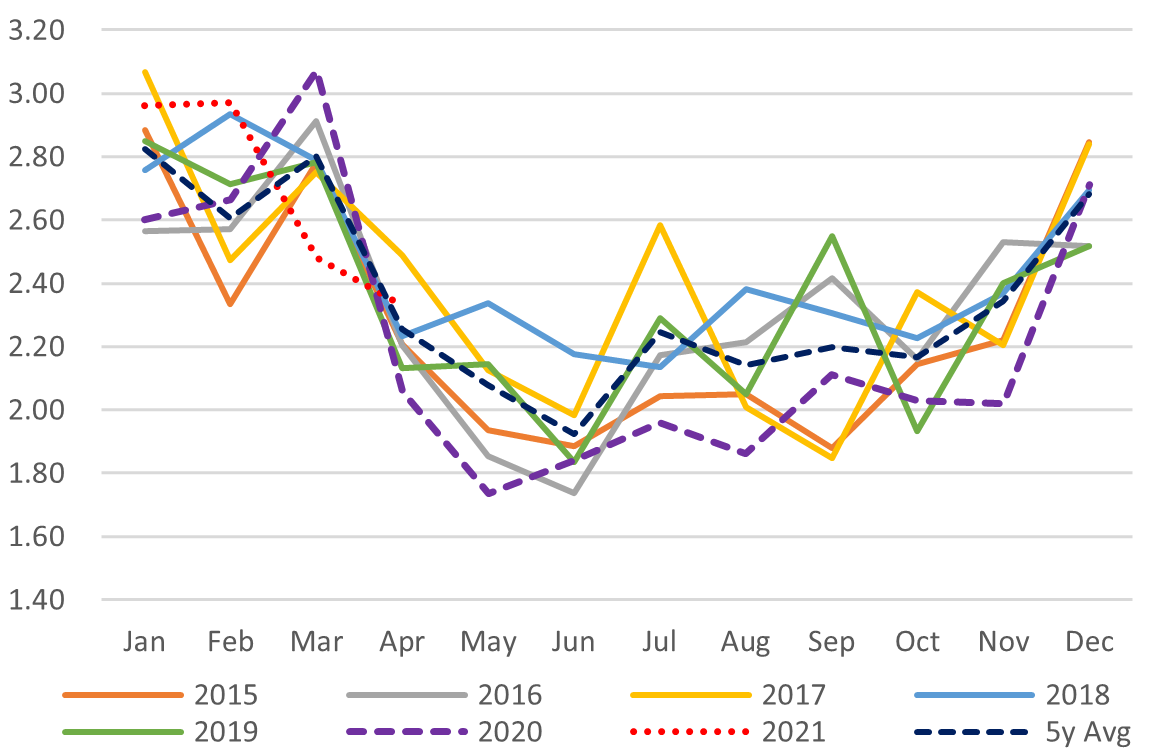
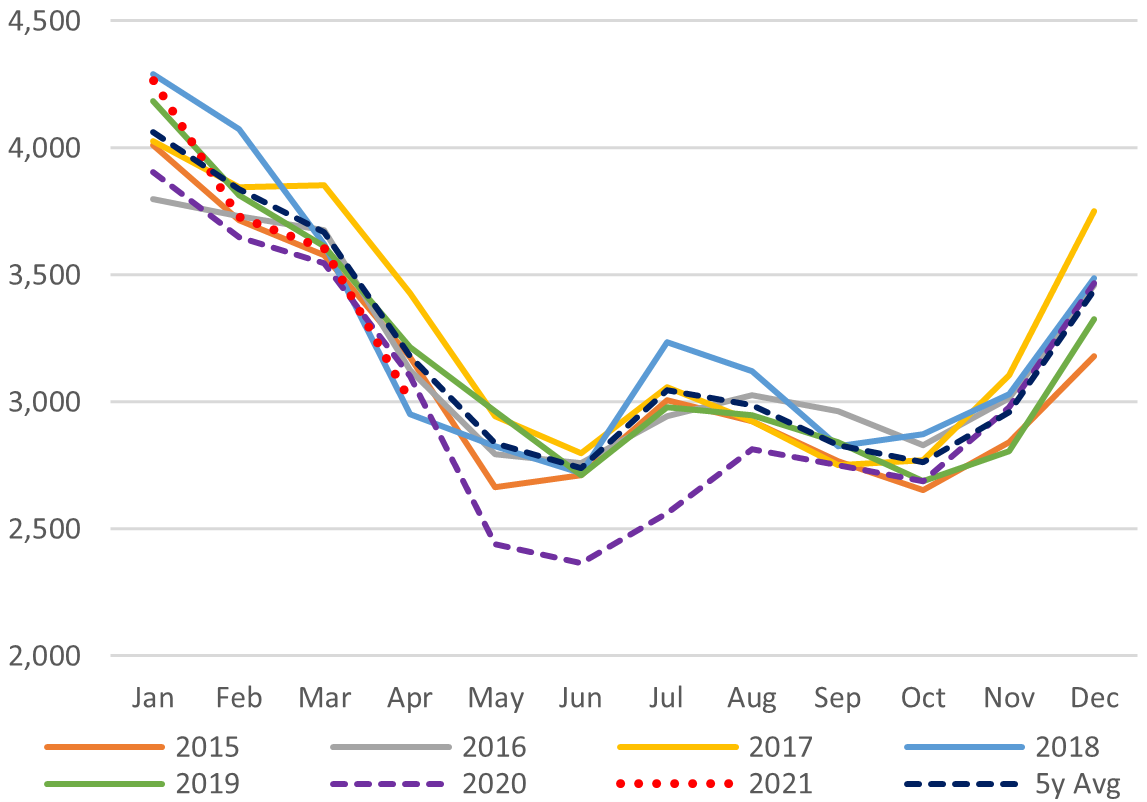
City Gas Sales – Total (M m3)
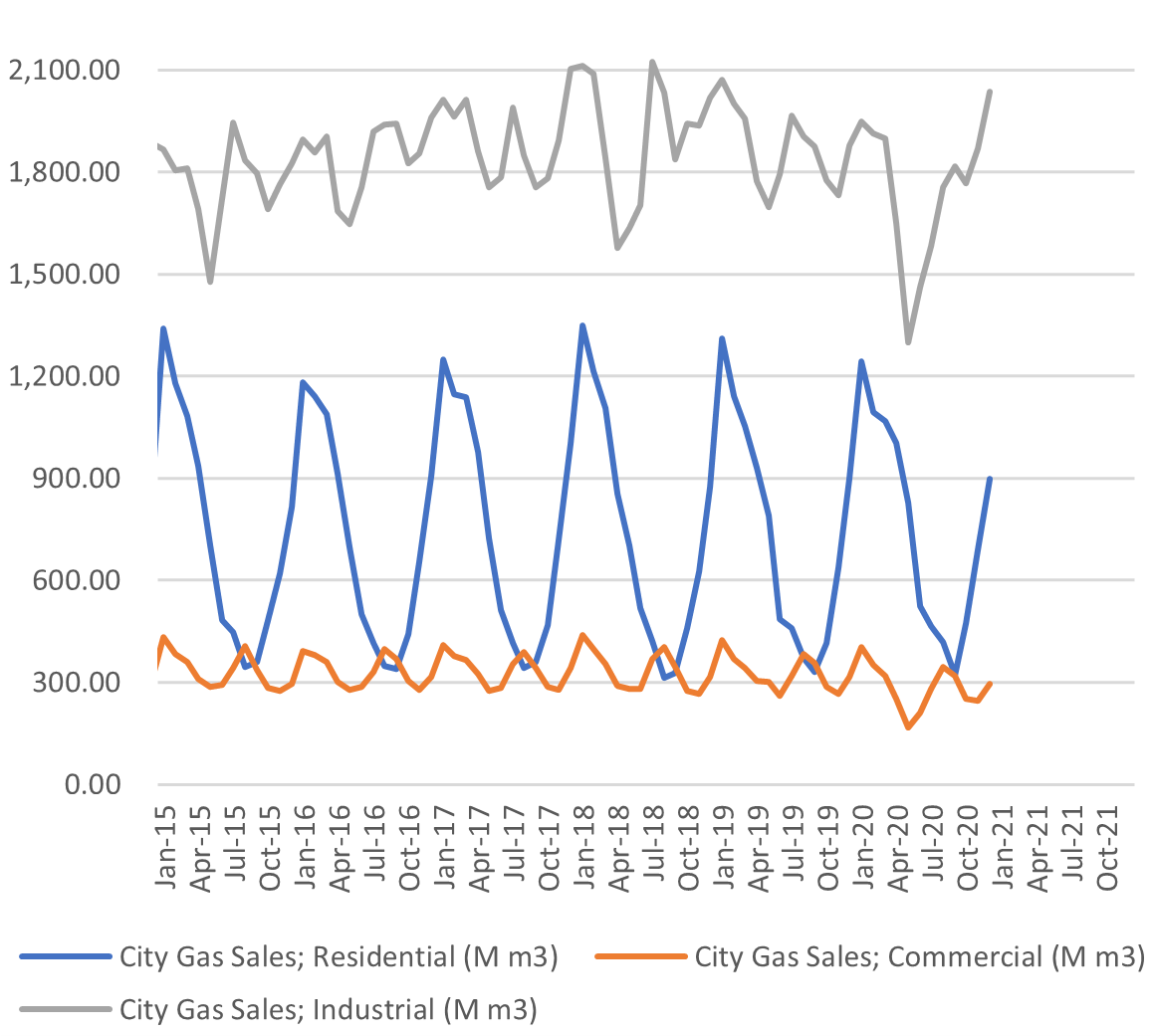
City Gas Sales by Sector (M m3)
SOURCES: Ministry of Economy, Trade, and Industry (METI),
Ministry of Finance
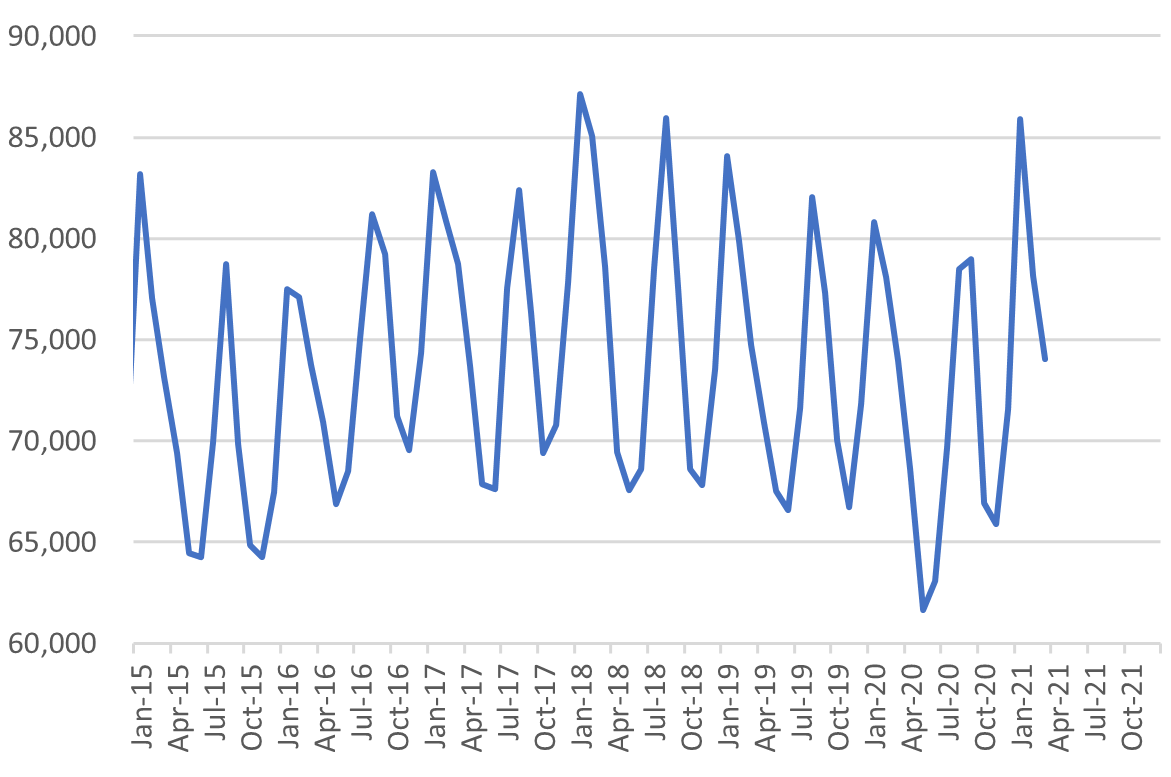
Japan Total Power Demand (GWh)
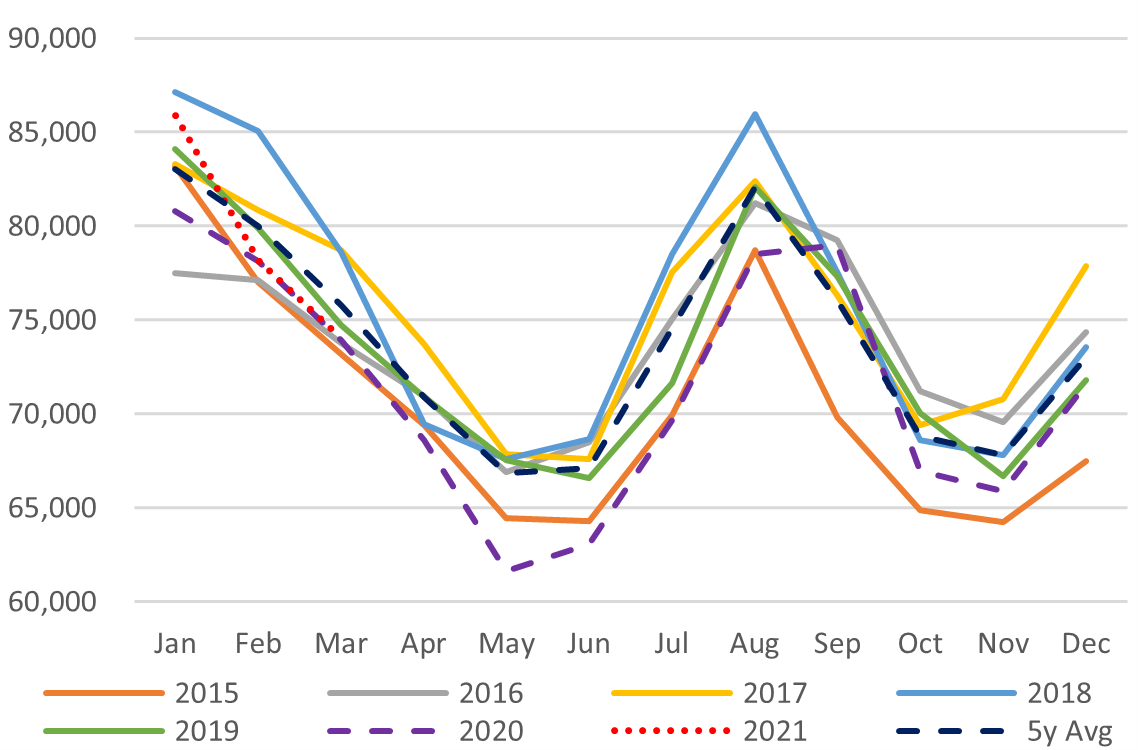
Current Vs Historical Demand (GWh)
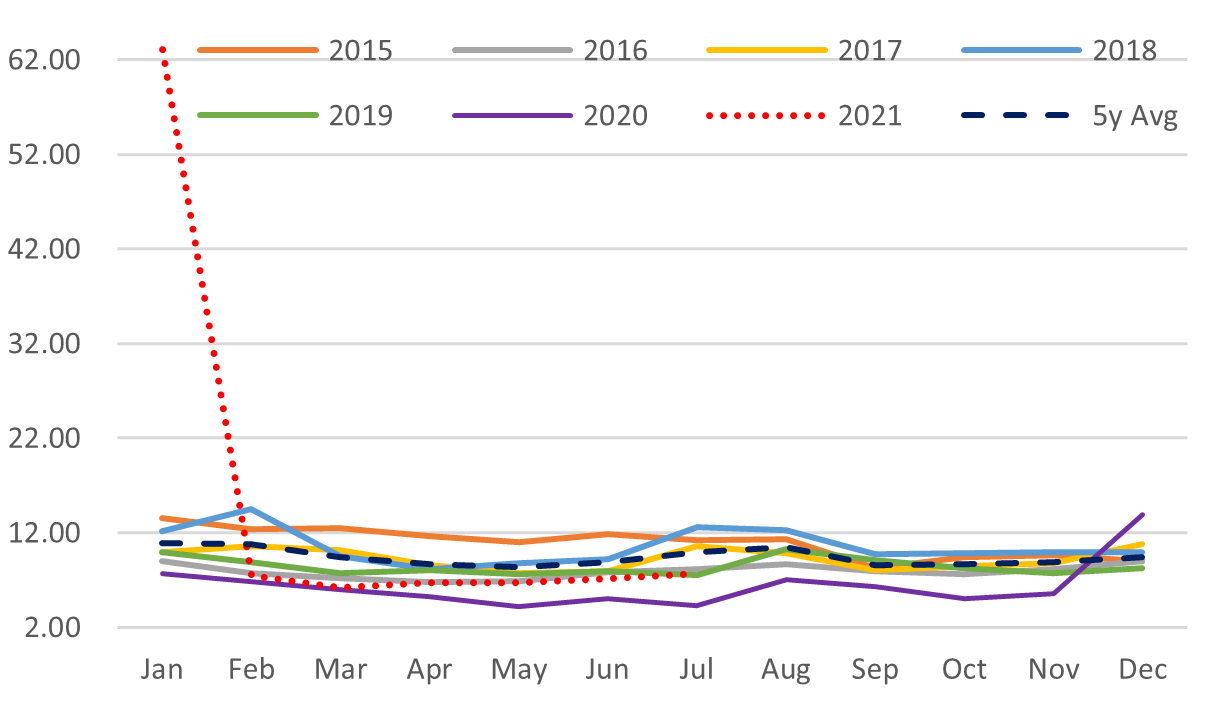
Day-Ahead Spot Electricity Prices
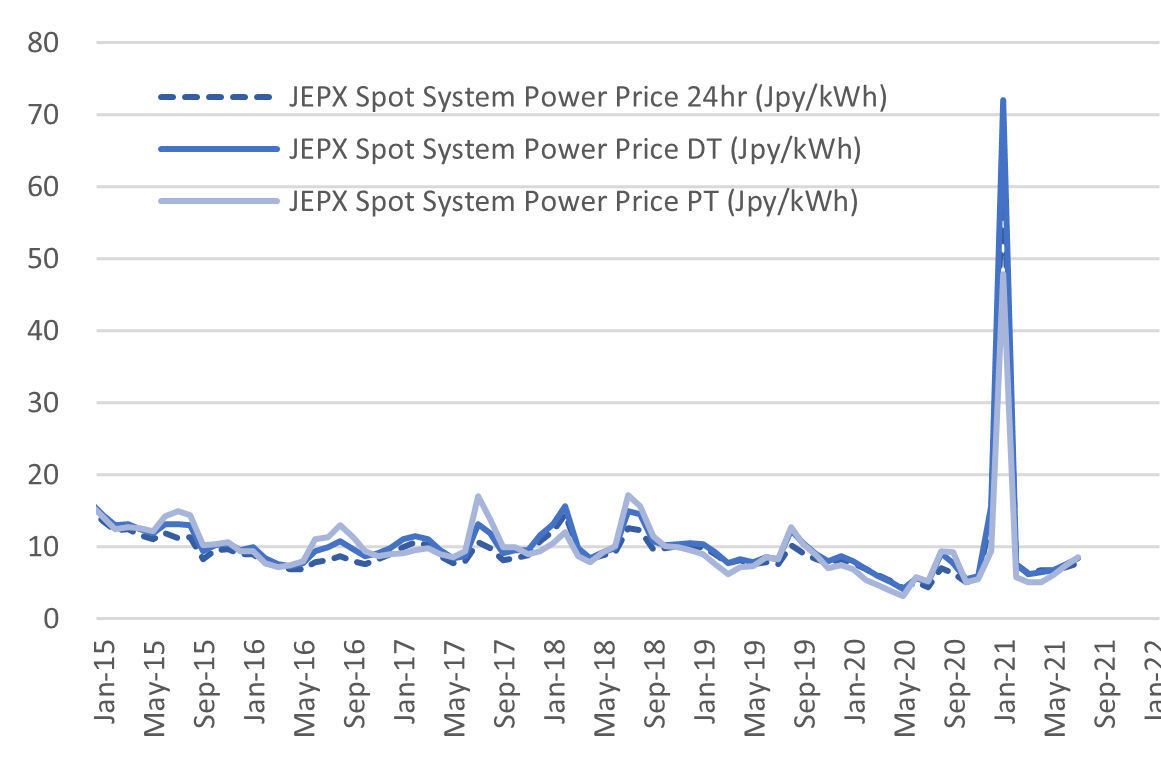
Day-Ahead Vs Day Time Vs Peak Time
LNG Imports by Electricity Utilities
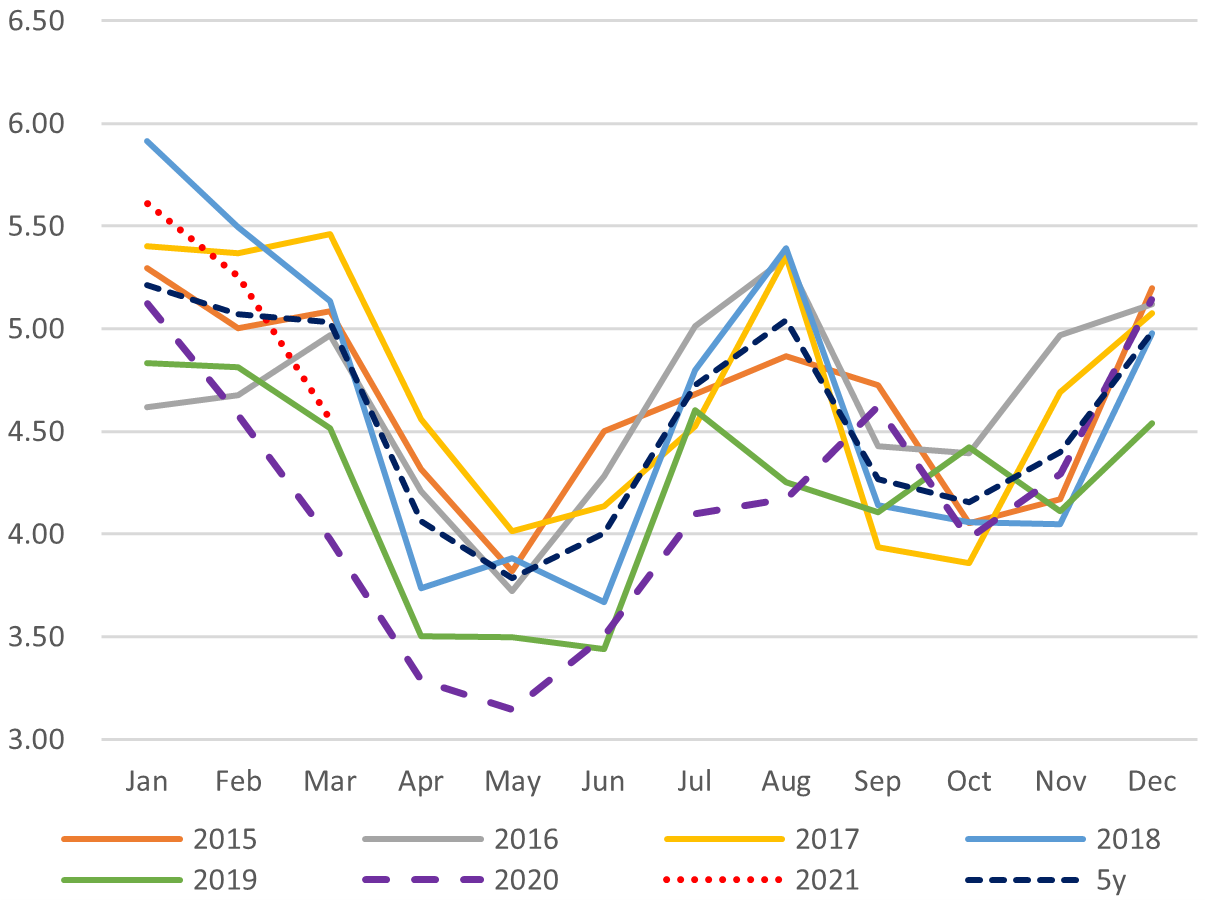
LNG Stockpiles of Electricity Utilities
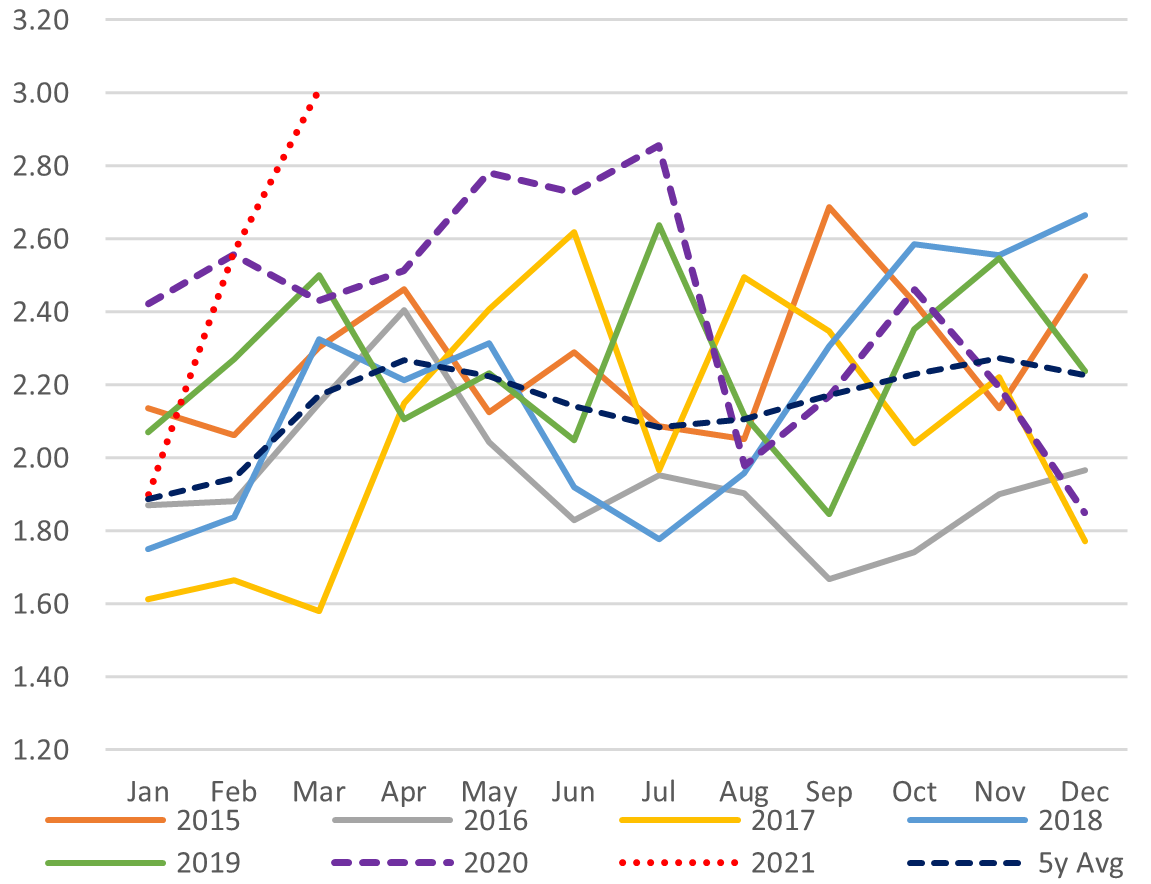
SOURCES: Ministry of Economy, Trade, and Industry (METI), and the Japan Electric Power Exchange
Disclaimer
This communication has been prepared for information purposes only, is confidential and may be legally privileged. This is a subscription-only service and is directed at those who have expressly asked K.K. Yuri Group or one of its representatives to be added to the mailing list. This document may not be onwardly circulated or reproduced without prior written consent from Yuri Group, which retains all copyright to the content of this report.
Yuri Group is not registered as an investment advisor in any jurisdiction. Our research and all the content express our opinions, which are generally based on available public information, field studies and own analysis. Content is limited to general comment upon general political, economic and market issues, asset classes and types of investments. The report and all of its content does not constitute a recommendation or solicitation to buy, sell, subscribe for or underwrite any product or physical commodity, or a financial instrument.
The information contained in this report is obtained from sources believed to be reliable and in good faith. No representation or warranty is made that it is accurate or complete. Opinions and views expressed are subject to change without notice, as are prices and availability, which are indicative only. There is no obligation to notify recipients of any changes to this data or to do so in the future. No responsibility is accepted for the use of or reliance on the information provided. In no circumstances will Yuri Group be liable for any indirect or direct loss, or consequential loss or damages arising from the use of, any inability to use, or any inaccuracy in the information.
K.K. Yuri Group: Oonoya Building 8F, Yotsuya 1-18, Shinjuku-ku, Tokyo, Japan, 160-0004.