
JAPAN NRG WEEKLY
JULY 26, 2021
JAPAN NRG WEEKLY
July 26, 2021
NEWS
TOP
- METI publishes a draft proposal for the new Basic Energy Plan; as expected, energy mix moves to favor renewables at the expense of LNG and coal generation
- One of Japan’s main emissions trading schemes will be expanded and split into two groups this year to help consumers
- World’s first compact ammonia engine to be produced by Osaka Gas in partnership with Toyota
ENERGY TRANSITION & POLICY
- Land Ministry creates group to champion environmental works
- NEDO announces 24 new research areas including around fuel cells
- Japanese sake byproduct being tested for use in storage batteries
- New sodium-ion batteries outperform lithium counterparts
- J-Power, JGC to trial carbon capture and storage in Indonesia
- Hitachi to build EV parts factories in the U.S., China and Japan as part of $2.7 billion investment in the sector
ELECTRICITY MARKETS
- Government asks generators to delay scrapping older power plants, fearing capacity shortages
- Toho Gas aims to expands its renewables portfolio to 500 MW
- Sumitomo Forestry unveils Japan’s largest wood-fired power plant
- Canadian Solar reveals plans for a new solar project in Miyagi
- Will we see more Atami-style landslide disasters in the future?
- Toshiba supplies Kyushu utility with wireless rain monitoring tech
- Kansai Electric denies media reports that Takahama NPP reactor restarts may be delayed to 2023
OIL, GAS & MINING
- 1H Japan LNG import volumes jump; oil and coal imports fall
- Europe joining battle for LNG supplies means higher Japan price
ANALYSIS
This section will return next week
GLOBAL VIEW
This section will return next week.
THE LONG READ
We feature a couple of longer news summaries from monthly magazines. Both focus on the energy developments in Hokkaido, the northernmost island.
- The Politics of Nuclear Waste
This lengthy feature explores what happened at the two small towns in Hokkaido that put their hand up last summer to host a nuclear waste storage facility. It also includes the key players involved in the developments.
- Dreams of CCS, and its Realities
A feature that considers the scale of the current carbon capture and storage (CCS) test project in Japan against the demand and the challenges it faces. It names the firms eager to be involved but raises concerns also for the geological implications.

JAPAN NRG WEEKLY
PUBLISHER
K. K. Yuri Group
Editorial Team
Yuriy Humber (Editor-in-Chief)
Tom O’Sullivan (Japan, Middle East, Africa)
John Varoli (Americas)
Sponsored
Regular Contributors
Mayumi Watanabe (Japan)
Daniel Shulman (Japan)
Takehiro Masutomo (Japan)
Art & Design
22 Graphics Inc.
SUBSCRIPTIONS & ADVERTISING
Japan NRG offers individual, corporate and academic subscription plans. Basic details are our website or write to subscriptions@japan-nrg.com
For marketing, advertising, or collaboration opportunities, contact sales@japan-nrg.com
For all other inquiries, write to info@japan-nrg.com
OFTEN USED ACRONYMS
METI The Ministry of Energy, Trade and Industry
MOE Ministry of Environment
ANRE Agency for Natural Resources and Energy
NEDO New Energy and Industrial Technology Development Organization
TEPCO Tokyo Electric Power Company
KEPCO Kansai Electric Power Company
EPCO Electric Power Company
JCC Japan Crude Cocktail
JKM Japan Korea Market, the Platt’s LNG benchmark
CCUS Carbon Capture, Utilization and Storage
mmbtu Million British Thermal Units
mb/d Million barrels per day
mtoe Million Tons of Oil Equivalent
kWh Kilowatt hours (electricity generation volume)
NEWS: ENERGY TRANSITION & POLICY
METI releases the draft for Japan’s latest Basic Energy Plan, dividing opinions
(Nikkei Shimbun, Various, July 22)
- METI released a draft of its updated Basic Energy Plan, which calls for between 36% and 38% of electricity to be sourced from renewable sources by 2030. This is a significant increase on the former target of 22% to 24%. To achieve this goal, the current level of renewables capacity must be doubled.
- Since adding significant volumes of wind capacity is not possible in such a short timeframe, Japan will have to rely on solar power to reach the target. However, solar has its own issues: Japan is rapidly running out of suitable sites for it.
- LNG’s role in 2030, according to the Plan, will be reduced by almost half to 20% of the mix at the end of the decade, compared with 37% in FY2019. In the previous iteration of the plan, LNG was due to have a 27% share of the mix.
- At the same time, coal-fired generation will decline to 19% of the mix from 32% in FY2019 and 26% in the previous version of the Plan.
- In total, coal and LNG would combine to give fossil fuels a 41% share of the mix in 2030.
- The percentage of electricity to be sourced from nuclear power plants remains unchanged at 20% to 22%. To achieve this level of supply, 27 of Japan’s operable reactors would have to be turned on; 17 more than the number online today.
- The Plan also fails to address the issue of reactor replacement. Many of Japan’s existing reactors will reach their 60-year maximum service life in the 2030s.
- This is the first time that hydrogen and ammonia appear in the Plan (which is updated every three years). The latest iteration calls for 1% of electricity to be generated from these fuels by 2030.
- Energy policy expert Kikkawa Takeo criticized the Plan as unrealistic, arbitrary, and failing to address fundamental issues, such as keeping coal-fired generation alive.
- The draft also calls for a 10-fold increase in grid battery storage to 24 gigawatt hours by 2030. However, even using the most conservative estimate available for battery cost, this will require an investment of at least ¥1.3 trillion.
- The Plan’s 2030 numbers are based on Japan annual power generation dropping 9% from current levels to 930 terawatt hours in 2030.
- Based on the new plan and data from the International Energy Agency, generating 1 kW of energy in Japan in fiscal 2030 would emit 0.26 kg of carbon dioxide, according to calculations by the Federation of Electric Power Companies of Japan. This would be a significant reduction from 0.45 kg in 2018.
TAKEAWAY: The Plan, as expected, produced a very divided reaction. It tries to please all sides and seemingly left almost no one content. We will produce an in-depth look at the plan and its issues next week, but for now please see some of the various reactions to it below.
- SIDE DEVELOPMENT:
Lower LNG and coal targets will make it tougher for Japan to negotiation new contracts
(Sankei, July 21)- The right-leaning daily uses comments from Kikkawa to note that a major drop in LNG and coal targets will make it harder for Japanese companies to negotiate new supply deals on favorable terms.
- Gas and coal supplying countries may “misunderstand” the Plan as to mean that Japan will stop buying their fossil fuels in the future.
- Kikkawa says Japan will likely end up buying carbon credits to glue things together.
- SIDE DEVELOPMENT:
Renewable Energy Institute calls Japan’s new renewables energy target far too low
(Institute’s statement, July 21)- The Institute (REI) notes that renewables mark up a much higher part of the future energy mix in the EU and elsewhere.
- REI casts doubt on nuclear’s future role calling it unrealistic to expect so many of the country’s reactors to restart in the face of continued public opposition to the energy source.
- REI slams the government for continuing to support coal-fired generation despite the phaseout trend elsewhere.
- SIDE DEVELOPMENT:
Land for solar and wind is limited, while the cost of power could go up
(Yomiuri Shimbun, July 210- Japan’s biggest daily newspaper lists the concerns around expanding the use of renewable energy, adding that many municipalities are restricting the development of new solar projects. It also notes that Japan has plenty of good areas for geothermal but there doesn’t seem to be progress with new projects.
- The paper cites CRIEPI data to show that electricity prices are 26% higher for households and 32% higher for industry in the decade since the 2011 Fukushima accident and the start of the renewables boom in Japan.
- The cost of needing to update the grid to work well with a high percentage of renewables is also cited as a factor for rising power prices.
Changes in store for Japan’s emissions trading system
(Denki Shimbun July 21)
- Changes are coming for Japan’s emissions trading system, the “non-fossil fuel energy value”. There’ll be two schemes: one for electricity retailers to achieve statutory emissions targets, and another allowing electricity consumers to participate directly.
- The new schemes will be launched in August and November, respectively.
- Use of these schemes increased greatly in 2020/21, a result of legislation requiring power retailers to purchase certificates for around 9% of the electricity they sell.
Osaka Gas, Toyota partner on ammonia powered engine
(Kankyo Business, July 19)
- In conjunction with Toyota Industries, Osaka Gas will develop the world’s first compact ammonia-powered engine.
- To ensure combustion is sustained, the engine will convert a portion of the ammonia supplied into hydrogen gas before burning it.
- Osaka Gas has significant expertise in engine design through its work with gas heat pumps and cogeneration systems, and hopes to incorporate ammonia powered engines into cogeneration systems in the future.
New government group to champion environmental projects
(Kankyo Business, July 16)
- The Ministry of Land, Infrastructure, Transport and Tourism has established a new division to facilitate Japan’s transition to a more environmentally friendly society.
- The new division will implement six strategic projects:
- the boosting of renewables use and energy efficiency,
- the harnessing of infrastructure,
- establishment of logistics and infrastructure systems for electric vehicles,
- implementation of digital, green, “connected” transit and logistics services,
- establishment of carbon neutral ports and shipping, and
- achievement of life-cycle carbon neutrality.
NEDO announces 24 new research areas
(Kankyo Business, July 19)
- The government-backed New Energy and Industrial Technology Development Organization (NEDO) announced 24 new research themes, all selected to overcome obstacles to the uptake of fuel cell technology.
- The areas of research include the development of surface treatment technologies for the separators used in polymer electrolyte fuel cells, and the gas dispersion layer. NEDO is also interested in the application of fuel cells to new areas, including farming and construction equipment, port equipment, and drones.
- Currently-available fuel cell vehicles are too expensive and inefficient to be competitive. NEDO hopes that improvements in fuel cell technology will enable a “giant leap” in the uptake of fuel cells in vehicles and elsewhere.
Japanese sake byproduct to be used in batteries
(Kankyo Business, July 16)
- Sake manufacturer Satsuma Shuzo is working on a system that would convert “lees”—a byproduct of the sake brewing process—into battery electrodes.
- The project is in conjunction with the Fukuoka Institute of Technology and Kagoshima-based BlueForce.
- In the process, the lees are first separated into their liquid and solid components, which is then carbonized. Energy for the process is derived from fermenting the liquid component of the lees and burning the resulting methane.
- The initiative will help achieve the goal of making Japan carbon neutral by 2050.
- Over 10,000 metric tons of sake lees are produced as a byproduct of Satsuma Shuzo’s brewing every year.
New sodium-ion batteries outperform lithium counterparts
(Nikkei X-Tech, July 20)
- Finnish battery developer BroadBit has released a sodium ion battery that can achieve energy densities of 330 W hours per kilogram, around five times higher than traditional sodium technologies. The manufacturer says that future models will be able to store 400 W hours per kilogram, which is more than can be achieved with lithium-ion batteries.
- The batteries are shipped in their discharged state, in which the anode comprises crystalline sodium chloride and the cathode comprises hard carbon. When charged, metallic sodium forms on the anode.
- Traditional sodium battery technologies create safety issues due to the way metallic sodium reacts violently with oxygen and water. BroadBit’s new battery presents a solution to these issues.
- BroadBit hopes to deploy its new battery in the electric vehicle market.
J-Power to trial carbon capture and storage in Indonesia
(Nikkan Kogyo Shimbun, July 21)
- J-Power and JGC Holdings are trialing carbon capture and storage technology in the Gundih gas field in Central Java, Indonesia.
- In collaboration with state-owned Pertamina and the Bandung Institute of Technology, the Japanese companies will perform a feasibility study, the outcomes of which will be announced by February.
- The parties hope to begin CO2 sequestration and monitoring as early as 2025.
- Currently, CO2 released in the natural gas production process rises into the atmosphere. The project aims to capture and store the entirety of the 300,000 metric tons of CO2 released annually at the gas field.
Hitachi to build EV parts factories in U.S., China and Japan by 2022
(Nikkei Asia, July 24)
- Hitachi is investing ¥300 billion ($2.7 billion) in EV components and will build new factories in Japan, the U.S. and China by the end of next year to expand its manufacturing capacity of them by a factor of six.
- An EV motor factory will be located in the U.S. state of Kentucky while inverter plants will be built in Japan’s Miyagi prefecture and in Guangdong Province in China. The facilities will raise Hitachi’s annual production capacity from under a million units each for motors and inverters to a few million units apiece. The added capacity will include components for hybrid vehicles.
- Hitachi engages in automotive parts mostly through the subsidiary Hitachi Astemo. The Japanese technology group is responsible for about 10% of the world’s EV motors.
NEWS: POWER MARKETS
| No. of operable nuclear reactors | 33 | |
| of which | applied for restart | 25 |
| approved by regulator | 17 | |
| restarted | 10 | |
| in operation today | 9 | |
| able to use MOX fuel | 4 | |
| No. of nuclear reactors under construction | 3 | |
| No. of reactors slated for decommissioning | 27 | |
| of which | completed work | 1 |
| started process | 4 | |
| yet to start / not known | 22 | |
Spot Electricity Prices, Monthly Avg.
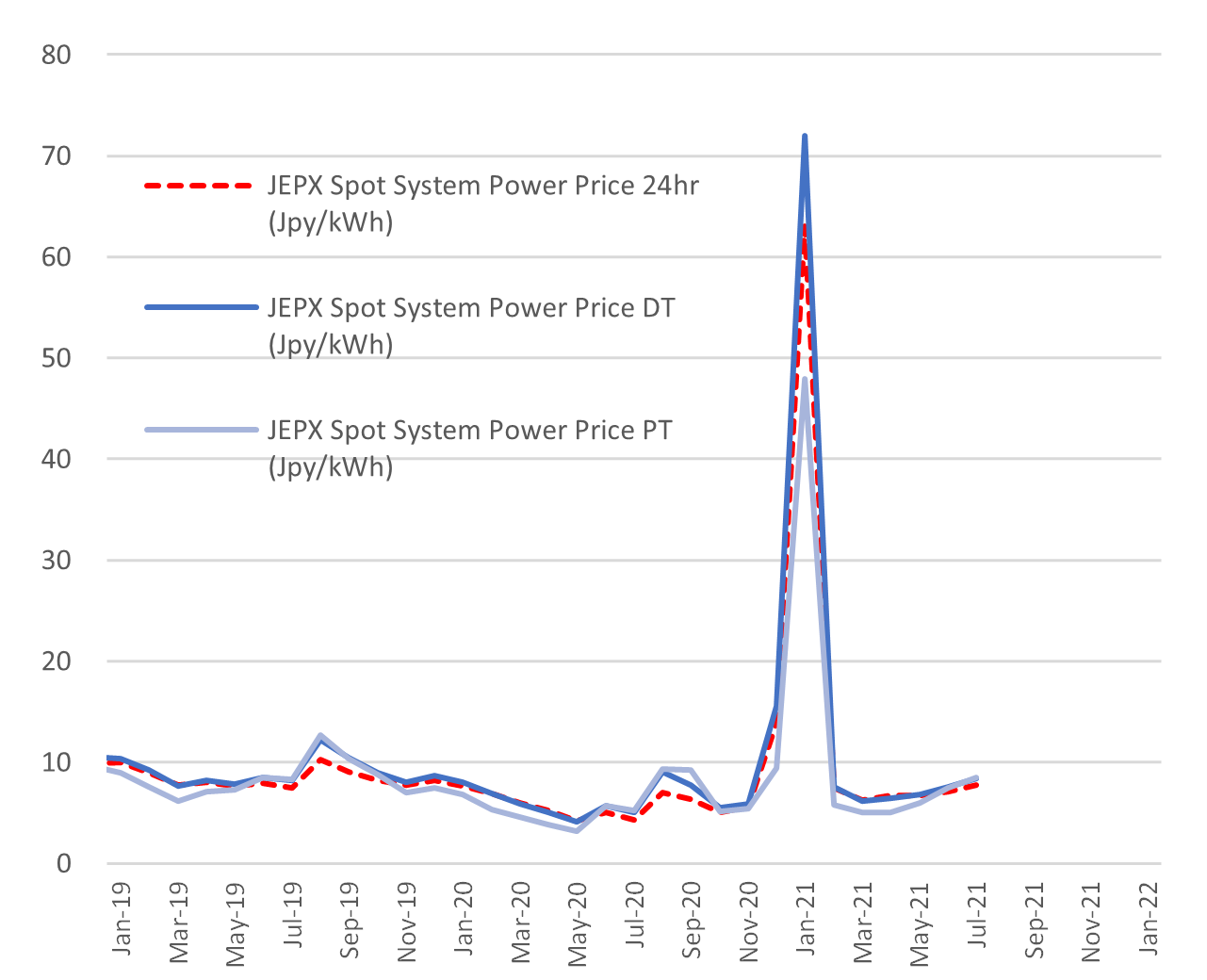
Source: Company websites, JANSI and JAIF, as of July 21, 2021
Government asks generators to delay scrapping old power plants, fearing shortages
(Japan NRG, July 16)
- METI’s power and gas basic policy panel, one of the ministry’s key policy tools, recommends that Japan delay plans to scrap older thermal power plants even as it puts renewable energy at the core of its electricity system.
- A sudden withdrawal of capacity could leave the country with supply constraints, the panel warned.
- METI plans to conduct an impact analysis of plant closures on regional power supplies, checking various scenarios until 2024. The impact on cost of electricity will be included.
- The panel recommends the government to offer support if local utilities find it challenging to secure finances to sustain the operation of thermal plants.
- In 2021-2025, about 18.85 GW of capacity is expected to be shuttered, with only 14.44 GW due to come online in the same period.
Toho Gas aims to expand its renewables capacity to 500 MW by 2030
(New Energy Business News, July 20)
- Toho Gas has a newly-formulated 2050 carbon neutral plan. It sees its future in the gas / LPG, hydrogen and electricity businesses.
- By 2030, the utility plans to expand renewable energy generation capacity to 500 MW, up from 40 MW today. This total includes domestic and overseas projects, and will include the company’s own as well as new acquisitions.
- Other efforts to decarbonize will see Toho Gas purse business in hydrogen, methanation, biogas, carbon-neutral LNG, carbon recycling and reforestation.
- Toho Gas is currently building a hydrogen filling station network in its home Chubu region to support the rollout of fuel cell vehicles.
Sumitomo unveils Japan’s largest wood-fired power plant
(Kankyo Business, July 16)
- A consortium that includes Sumitomo Forestry and Renova opened Japan’s largest wood-fired power station on July 15.
- Located in Kyushu, the biomass fired plant has an output of 75 MW. It’ll be fueled by locally-sourced wood scraps, in addition to imported pellets and palm kernels.
Canadian Solar reveals plans for 80 MW plant in Miyagi prefecture
(New Energy Business News, July 21)
- Canadian Solar released a planning stage environmental assessment for a 80 MW capacity solar power project in Miyagi prefecture.
- The tentative name of the project is CS Miyagi Kami Town Solar Power Generation Project. It will employ 650-watt solar panels.
- Operation is scheduled from Dec. 2026. Construction would start in April 2024.
Will we see more Atami-style disasters in future?
(World Economic Review, July 19)
- CONTEXT: This is an opinion piece by Todokoro Takashi, a Specially Appointed Professor at the Graduate Institute for Entrepreneurial Studies. He is also the former chair of the Association of Japanese Geographers.
- The Atami landslide on July 3 left 10 dead and 17 missing; experts suspect that 54,000 cubic meters of soil used to fill in a valley became dislodged in heavy rain.
- Many natural springs are also present on the landslide site, and it was suggested that a combination of deforestation and water flowing through the subsoil also contributed to the disaster.
- 73% of Japan’s land area is mountainous, unsuitable for habitation. Increasingly, solar farms are built on steep sites on the tops of hills and mountains.
- Increased solar development in mountainous areas, combined with a tendency to insufficiently regulate civil engineering work in isolated areas, has created concerns that events similar to the Atami landslide will become more frequent.
Toshiba supplying wireless rainfall monitoring solution for Kyushu utility
(New Energy Business News, July 20)
- Toshiba Energy Systems has supplied Kyushu based Meikosha with a low-power IoT (Internet of Things) solution for monitoring rainfall in isolated areas.
- The system is powered by batteries that are recharged by photovoltaic panels.
- The monitors are mounted on power pylons and relay data to a call center over the 920 MHz communications band.
Kansai Electric denies reports that Takahama NPP reactor restarts may be delayed to 2023
(Company statement and local media reports, July 21)
- The power utility issued a statement to say that it did not disseminate any information about a possible delay to the restart of Takahama NPP Units 1 and 2, as well as Mihama NPP Unit 3. The company is currently conducting checks on the facilities which are being upgraded with anti-terrorist measures as per the new standards introduced by the nuclear regulator.
- Kansai Electric said it would announce the restart schedule for the reactors after its checks are complete.
- The company’s statement comes after local media reports that the work to install the anti-terrorism facilities at the Takahama units might not be completed until around May 2023 – much later than originally planned. The reports cited interviews with related parties.
- CONTEXT: Takahama NPP Units 1 and 2 are not currently operating, although reactors 3 and 4 at the station are online. The first two units are older, both over the 40-year original license lifespan. The facilities have received a license extension of 20 years.
- Reactors are not allowed to operate unless they have installed the new anti-terrorist measures.
- Kansai Election is expected to publish a new timetable for the reactors as early as this month.
- The company had said in April of 2019 that work to upgrade the Takahama units would be delayed by more than two years.
NEWS: OIL, GAS & MINING
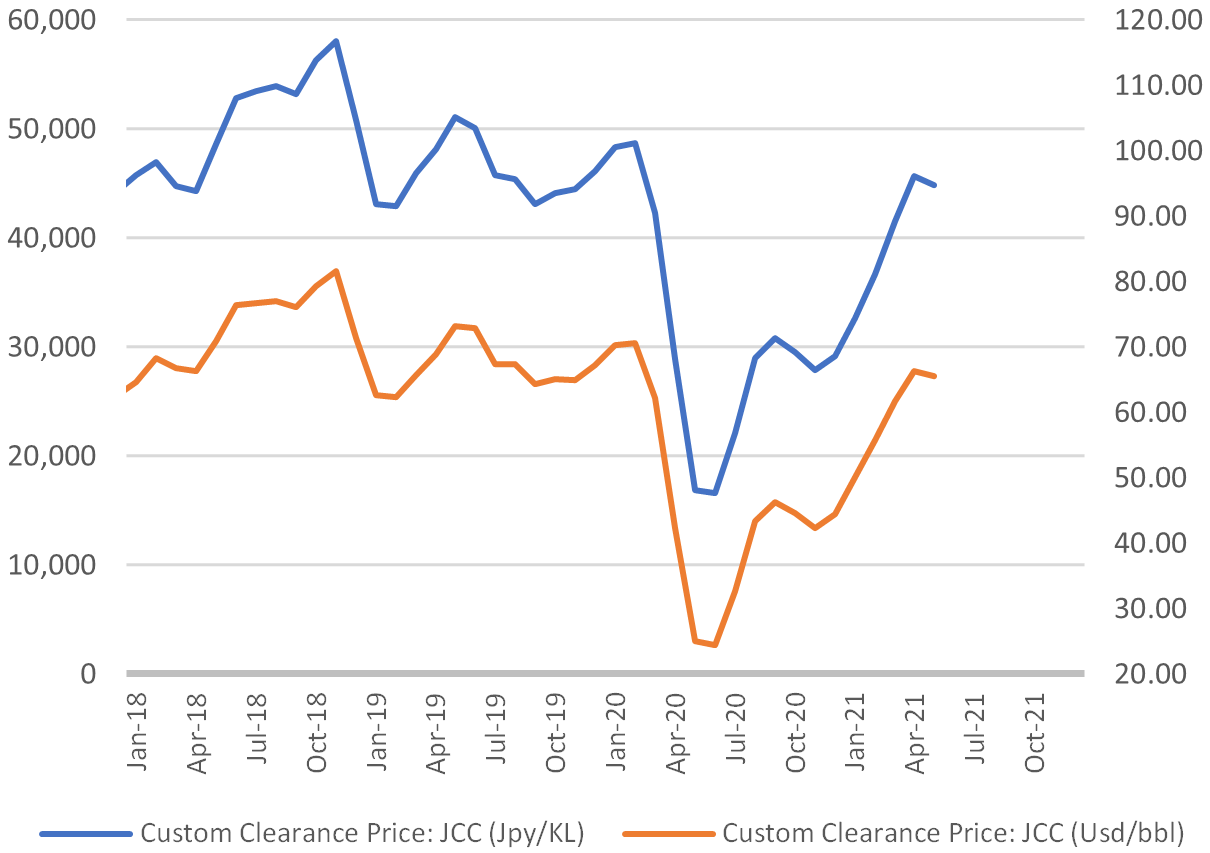
Japan Oil Price: $65.45/ barrel
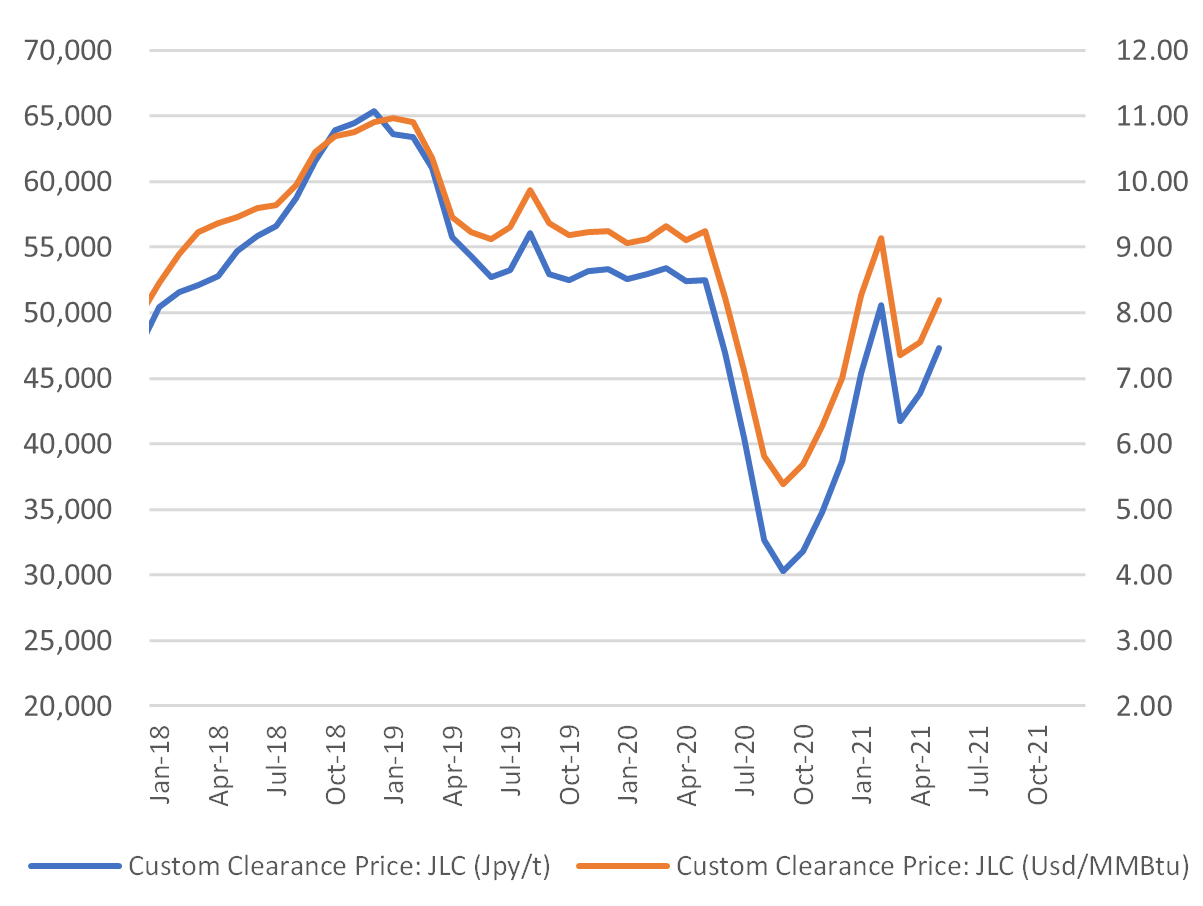
Japan (JLC) LNG Price: $8.19/ mmbtu
Japan’s Jan-Jun LNG imports rise, coal and crude oil imports fall
(Japan NRG, July 21)
- Japan’s LNG imports in the first half of 2021 increased from a year ago, while coal and crude oil imports fell, according to customs data. Japan imported 38.9 million tons of LNG from January to June, up 6.8% YoY.
- Coal imports were down 1.5%, to 52.2 million tons. Crude oil imports dropped 9.7%, to 68.5 million kl.
- In terms of monetary value, the total of LNG imports fell 3.3%, to ¥1.8 trillion, while coal rose 5.6%, to ¥531 billion. Crude oil import value also increased to ¥2.8 trillion, up 5.7%.
- For the month of June, Japan imported 5.7 million tons of LNG, up 8.5% YoY. The value of that was up 21.6%, to ¥293.6 billion.
Europe joins battle for LNG
(Nikkei, July 21)
- With many in the energy sector predicting that the coming northern hemisphere winter will see a repeat of recent LNG shortages, it’s believed European buyers will join the scramble for resources.
- Low supply from Russia and increased demand from East Asia means that European natural gas reserves are unusually low.
- As the global economy recovers from the coronavirus pandemic, demand from China in particular is driving up the gas price.
- State-backed JOGMEC says European LPG inventory levels are 33% lower than average.
- Any increase in the LNG price means higher power bills for Japanese consumers.
THE LONG READ
The politics of agreeing on a site for nuclear waste in Japan
(Sentaku, July edition)
- CONTEXT: This lengthy article goes into some of the politics behind the scenes in Japan’s search for a long-term nuclear waste repository. All opinions expressed below are from the original article.
- CONTEXT: Japan currently has no place for long-term storage of its nuclear waste. A specialist agency, NUMO, was set up in 2000 to find a town willing to host such a facility. In almost two decades, only one locality put its name forward (Toyo, Kochi prefecture, in 2007). However, it promptly canceled the application after the town’s mayor was defeated in an election.
- Last summer, Suttsu and Kamoenai, two towns in the northern island of Hokkaido, volunteered to host a waste facility. Their interest was confirmed despite local and prefecture-level opposition.
- As a first step, in November 2020, NUMO started a so-called literature survey of both towns. This is a two-year process of checking geographical layers and the properties of the bedrock in the municipalities, based on geological maps and published academic papers. Should the preliminary checks pass, the investigation would move to a second phase, which involves drilling.
- The initial progress was in part thanks to the efforts of Hokkaido’s ruling party chairman, Yoshikawa Takamori, who is a former minister of agriculture. However, he left in January over bribe accusations.
- His “successor” in the nuclear waste site research is Suzuki Muneo, a lawmaker from the Nippon Ishin (Japan Innovation Party). Suzuki is much less enthused and has attacked NUMO Chairman Kondo Shunsuke for pursuing the project.
- From industry’s side, the key negotiator with the two towns is Ueda Masatoshi, a director in charge of long-term waste storage with the Federation of Electric Power Companies (FEPC). Ueda hails from Chubu Electric and has late-stage cancer. He’s said to be willing to give up his life to deliver a final destination for storage of long-term nuclear waste in Japan. Ueda’s determination has won the trust of Suttsu mayor Kataoka Haruo.
- Since Kataoka volunteered Suttsu as a site, many locals have turned against him. In October, his former assistant, Echizenya Yoshiki, said he’ll run against Kataoka in the next election, promising to withdraw from the NUMO survey.
- The situation is complicated by NUMO Chairman Kondo’s mixed reputation.
- At 41, Kondo became a Tokyo University professor and many of his students are now officials at TEPCO and other nuclear companies. He rose to be a member of the Cabinet’s nuclear committee, serving for 10 years from 2004. This included the time of the Fukushima disaster, when PM Kan asked Kondo to make a simulation of the accident fallout. Kondo’s worst-case scenario painted a picture where 50 million people [about 40% of Japan’s population] might need to be evacuated. Other experts criticized this as scaremongering.
- Kondo and his deputy, Fuji, were also involved in a NUMO scandal in 2017, when it was revealed that the agency paid students to attend fake meetings supporting the agency’s agenda. Kondo didn’t resign, but blamed another person for the inappropriate actions.
- Thus, NUMO is now forbidden to do promotions via advertising companies, which is why it’s unable to make much ‘noise’ in Suttsu.
- Despite all this, the biggest hurdle will come when NUMO tries to move to the survey’s second-stage, to the drilling work. For that, the agency needs approval from Hokkaido Governor Suzuki, who already said he’s against the plan. As long as that’s the case, it’s the money spent on the initial surveys that will end up being wasted rather than creating a place for waste.
Dreams of Carbon Capture Storage (CCS) do not sit well with its realities
(Sentaku, July edition)
- CONTEXT: This is an article in the monthly business and politics magazine, Sentaku. All opinions expressed below are from the article.
- Carbon Capture and Storage (CCS) technology is an important part of Japan’s plans to reach carbon neutral goals. However, CCS demonstration tests at Tomakomai port in Hokkaido pose questions over this technology’s viability.
- The Tomakomai test project has been in place since 2012. So far, the total volume of CO2 sequestered in underground storage at the site is 300,000 tons. That’s equivalent to 0.03% of Japan’s annual emissions.
- CONTEXT: Japan’s emissions in FY 2019 dropped to 1.213 billion metric tons of CO2 equivalent, their lowest since FY1990.
- An executive at a major Japanese power company says: “there are no climate measures with a greater gap between expectations and reality than CCS.”
- CCS is unrealistic because the amount of land suitable for underground storage is extremely limited [in Japan]. Currently, Japan has only 5.73 million tons of CCS capacity. METI’s goal is to secure space for 486 million tons of CO2. To fulfill this goal, much larger CCS facilities will be needed.
- A few months ago, INPEX Corp., which is morphing to be more of a gas than an oil company, volunteered to host CCS facilities, hoping to use exhausted fields for decarbonization, thus turning a negative asset into a cash-generator.
- CCS verification tests, however, show such facilities can cause earthquakes. In Oklahoma, where Shell conducted fracking, there was an average of one earthquake a year or less until 2008. In 2014, there were over 300 earthquakes.
- CONTEXT: Hydraulic fracturing, or fracking, involves many of the same operations and risks as carbon storage.
- There’s a similar trend in Hokkaido, where in Sept. 2018, a 6.7-magnitude earthquake hit tens of kilometers away from the site of the CCS verification test. Although METI says there’s no connection between the earthquake and the CCS site, published studies show that CCS uses similar mechanisms to Shell’s fracking methods and this incites earthquake activity.
- The storage site is not the only cost that CCS technology brings. CCS locations tend to be far from power generation plants that produce the large CO2 volumes. That requires the construction of pipelines for long distance delivery of CO2, or infrastructure to compress CO2, for delivery by ship and / or truck.
- These factors raise doubts in the creation of many CCS projects in Japan.
Disclaimer
This communication has been prepared for information purposes only, is confidential and may be legally privileged. This is a subscription-only service and is directed at those who have expressly asked K.K. Yuri Group or one of its representatives to be added to the mailing list. This document may not be onwardly circulated or reproduced without prior written consent from Yuri Group, which retains all copyright to the content of this report.
Yuri Group is not registered as an investment advisor in any jurisdiction. Our research and all the content express our opinions, which are generally based on available public information, field studies and own analysis. Content is limited to general comment upon general political, economic and market issues, asset classes and types of investments. The report and all of its content does not constitute a recommendation or solicitation to buy, sell, subscribe for or underwrite any product or physical commodity, or a financial instrument.
The information contained in this report is obtained from sources believed to be reliable and in good faith. No representation or warranty is made that it is accurate or complete. Opinions and views expressed are subject to change without notice, as are prices and availability, which are indicative only. There is no obligation to notify recipients of any changes to this data or to do so in the future. No responsibility is accepted for the use of or reliance on the information provided. In no circumstances will Yuri Group be liable for any indirect or direct loss, or consequential loss or damages arising from the use of, any inability to use, or any inaccuracy in the information.
K.K. Yuri Group: Oonoya Building 8F, Yotsuya 1-18, Shinjuku-ku, Tokyo, Japan, 160-0004.