
JAPAN NRG WEEKLY
AUGUST 10, 2021
JAPAN NRG WEEKLY
August 10, 2021
NEWS
TOP
- 2030 power generation costs updated with spending on the grid; new calculations push up solar price tag, make gas the cheapest
- Japan publishes 2030 expected breakdown for CO2 reductions; govt. expectations lean heavily on carbon offsets, nuclear usage
- Japan to launch a new carbon credits trading exchange based on domestic credit mechanisms, some of which will be revamped
ENERGY TRANSITION & POLICY
- METI committee approves Basic Energy Plan, moves to comments; numerous newspaper editorials criticize Plan as unrealistic
- Environment Ministry to allocate $6.8b for green vehicle subsidies
- First non-fossil fuel certs auction opens to end-users from Nov.
- Japan may lose as many as 84,000 jobs in auto shift to EVs
- Itochu to export blue ammonia from Canada to Japan by 2026
- Land Ministry criticized for not supporting residential solar
- Tokyo govt. to invest in zero-emissions startups
- Govt. to audit domestic airports’ green credentials
- Chiyoda and Mitsubishi consider Netherlands as a hydrogen hub
- Liquid synthetic fuel manufacture of interest for ENEOS … MORE]
ELECTRICITY MARKETS
- Tohoku Electric to halve emissions by 2030 with ammonia, biomass
- Government to consider three more areas for offshore wind farms
- Prices for July baseload power auctions jump from a year earlier
- Pacifico Energy plans 121 MW solar plant in the Hyogo area
- Osaka Gas, Mitsui group plan 400 MW offshore wind farm in Akita
- Kansai Electric announces nuclear reactor restart schedule after a planned completion of anti-terrorism measures
- Japan restarts High-Temperature Test Reactor after a decade
- Kawasaki Kisen, Chubu Electric to build tidal plant in Canada
- Mitsui invests in Indian biofuels manufacturer … [MORE]
OIL, GAS & MINING
- Researchers find way to store hydrogen without using rare metals
ANALYSIS
JAPAN CONTINUES TO EXPAND COAL CAPACITY
DESPITE DECARBONIZATION PLEDGES
A year ago, Japan’s government vowed to close three-quarters of the country’s coal-fired power plants by 2030. Today’s situation, however, looks drastically different. New coal capacity is being added, with more scheduled to come online in the first half of this decade. The new coal units are bigger than their predecessors and promise to hook up the equivalent of almost seven nuclear reactors to Japan’s grid. Meanwhile, recent METI edicts are asking power utilities to pause plans to scrap older thermal units due to fear of capacity shortages. The country will need to make a drastic turnaround no later than 2025 if it’s to meet 2030 decarbonization goals.
POWER GRID TO OPEN UP TO COMPETITION WITH A NEW DISTRIBUTION LICENSE SYSTEM
From next April, Japan will introduce a licensing system for companies that wish to run power lines. The government hopes this will increase grid efficiency, speed up a shift to a more open power market and help to decarbonize the sector. To date, all the electricity in Japan was transmitted by subsidiaries of the country’s 10 regional power companies. From April 2022, that will change, opening up the grid to new companies and business models. The energy transition in generation will now extend to distribution.
GLOBAL VIEW
The world’s most powerful tidal turbine is installed in Scotland. U.S. coal reliance will rise to 26% of the power mix this year. Germany’s coal emissions are up. China and India fail to submit GHG reduction plans for COP26 by set deadline. Wildfires rage across at least six countries. Details on these and more in our global wrap.
EVENT CALENDAR / DATA SECTION
JAPAN NRG WEEKLY
PUBLISHER
K. K. Yuri Group
Editorial Team
Yuriy Humber (Editor-in-Chief)
Tom O’Sullivan (Japan, Middle East, Africa)
John Varoli (Americas)
Regular Contributors
Mayumi Watanabe (Japan)
Daniel Shulman (Japan)
Takehiro Masutomo (Japan)
Art & Design
22 Graphics Inc.
Sponsored
SUBSCRIPTIONS & ADVERTISING
Japan NRG offers individual, corporate and academic subscription plans. Basic details are our website or write to subscriptions@japan-nrg.com
For marketing, advertising, or collaboration opportunities, contact sales@japan-nrg.com
For all other inquiries, write to info@japan-nrg.com
OFTEN USED ACRONYMS
METI The Ministry of Energy, Trade and Industry
MOE Ministry of Environment
ANRE Agency for Natural Resources and Energy
NEDO New Energy and Industrial Technology Development Organization
TEPCO Tokyo Electric Power Company
KEPCO Kansai Electric Power Company
EPCO Electric Power Company
JCC Japan Crude Cocktail
JKM Japan Korea Market, the Platt’s LNG benchmark
CCUS Carbon Capture, Utilization and Storage
mmbtu Million British Thermal Units
mb/d Million barrels per day
mtoe Million Tons of Oil Equivalent
kWh Kilowatt hours (electricity generation volume)
NEWS: ENERGY TRANSITION & POLICY
Cost of renewables pushed up when transmission connection included: study
(Japan NRG, Aug. 3)
- Electricity transmission connection costs could bump up solar’s total cost by 69% and wind by 26%, according to Energy Research Council working group estimates.
- Power grid costs affect solar power more because output varies greatly depending on hours of the day and weather conditions; but wind output is more stable.
- The group re-assessed costs of building new power generation facilities in 2030 to take into account the recent draft Basic Energy Plan, which calls for a drop in reliance on coal and an expansion of renewables.
- The latest study shows the final cost of using renewable power jumps after pricing in the expense of modifying and operating the nation’s power transmission network. Taken into account were the intermittency of renewables and estimates what the grid would need to do to adapt, including reducing the run rates of thermal power plants.
- Depending on supply and demand, renewable energy operators may still be asked to curb output, affecting their operational efficiency, the study says.
- The authors note actual grid costs may be higher as their calculations didn’t take into account interconnection fees, demand response system costs, and some other factors.
|
|
Costs without transmission network cost (Yen/kWh) | Total costs (Yen/kWh) |
|
Solar (utility scale) |
11.2 |
18.9 |
|
On-shore wind |
14.7 |
18.5 |
|
Nuclear |
11.7 |
11.7 |
|
Gas |
10.7 |
10.7 |
|
Coal |
13.6 |
13.9 |
- Without grid and systems costs, utility scale solar is forecasted to be the second cheapest energy source after gas. With those costs, solar was expected to be the most expensive power source.
- Japan will need to spend an additional ¥847 billion to upgrade its power transmission system if renewables output rises by 15% or 145 tWh, the study said.
- Also, the country needs a policy on sharing network connections and system costs.
- Other costs factored into the study calculations were taxes, carbon associated social costs, fuel, facility operating costs, and capital expenditure.
Ministries reveal expected CO2 reductions from current government initiatives
(Japan NRG, Aug. 4)
- METI’s Industry Structure Council and Environment Ministry’s Central Environmental Council jointly compiled an overview of the government’s 2030 carbon reduction programs, including those under the oversight of other ministries.
- The overview included all the decarbonization programs of 150 industry associations and the 68 various govt. initiatives, as well as the benchmark 2013 or 2015 carbon output levels and energy efficiency figures, as well as the 2030 goal figures.
- Among govt. programs, local forest ecosystems were expected to absorb 38 million tons of carbon by 2030.
- Joint Credit Mechanism with overseas partners was seen as a way to reduce CO2 emissions by 100 million tons by 2030.
- The ministries also noted that a renewables and nuclear power combination would cut emissions considerably more than if the country only employed renewables “at their maximum involvement”.
- Various govt. programs also called for lifestyle changes such as car sharing, cutting food waste, and replacing cars with bicycles for short-distance commutes.
- SIDE DEVELOPMENT:
METI releases breakdown of renewables goals
(Nikkei, Aug. 4)- METI released a breakdown how it plans to achieve a 46% reduction in greenhouse gas emissions by 2030.
- Under the plan:
- up to 8% of the reduction will come from the increased use of renewably-generated electricity
- 2% will come from automobiles (with up to 70% of new vehicles being hybrids, electric vehicles or fuel cell vehicles)
- the rest will come from a range of policies such as those to reduce waste and encouraging households to buy energy-efficient appliances.
Japan to launch a carbon exchange in 2022
(Japan NRG, Aug. 4)
- In 2022 Japan plans to launch a new exchange to trade carbon credits that will be open to participants from overseas, said METI. The exchange will trade J-Credit, Joint Credit Mechanism (JCM) credits and high-standard voluntary credits overseas, and it will post trading levels to be used as references for carbon pricing.
- Separately, METI will reform the current J-Credit and JCM frameworks in a bid to expand their usage.
- Also, the ministry plans to set up a carbon footprint measurement framework that will employ the latest IT tech. Design of the framework will start this year.
- SIDE DEVELOPMENT:
Proposed J-Credit reforms finalized, subject to public feedback later this year
(Japan NRG, Aug. 4)- METI said proposed reforms for the J-Credit carbon offset system were finalized and are now subject to public feedback later this year before implementation.
- The proposed reforms include a renewed push to promote residential solar, diversification of power supply sources, and the consolidation of methodologies to assess carbon impact from various manufacturing processes. Die-casting will be added to the manufacturing processes subject to carbon impact review.
- To drive more interest in projects to plant forests to absorb and remove carbon, new measuring tools on drones and helicopters will be introduced. A new mechanism to calculate carbon on the basis of logging rates, and clarifications on certification timeframe for bio charcoal will also be provided, METI said.
METI committee approves Basic Energy Plan, moves it to public comments
(NHK, Aug. 4)
- METI’s deliberation committee approved the Basic Energy Plan draft, and it moves to the stage of collecting public comments.
- Mid-October, the final version will go before the Cabinet for approval
- SIDE DEVELOPMENT:
Concerns over the Basic Energy Plan
(Smart Japan, Aug. 2)- CONTEXT: This is a commentary piece in an energy focused publication.
- While pledging to rapidly grow solar capacity by 2030, the govt’s draft basic energy plan fails to implement the policies necessary to make this possible. Tougher compliance requirements on solar operators mean the cost reductions claimed by the govt. may be difficult to achieve.
- The existing feed-in tariff (FIT) and feed-in premium (FIP) schemes were not designed for the kind of rapid growth that the govt. proposes. It should reform such schemes to encourage faster uptake of solar technology.
- While the FIT scheme created a boom in solar farms when introduced, the govt’s failure to implement appropriate policies to support the industry has since caused many players to leave the market. The ensuing decrease in competition caused installation costs to rise, not fall.
- The draft plan also focuses entirely on electricity generation. However, only around 30% of the energy used in heating applications will be electric in 2030. The govt. should aim to increase the use of renewable energy in non-electric heating applications.
- Finally, the draft plan explicitly calls for a doubling of solar capacity, although considering that the ambiguously defined “additional projected growth” target will probably also have to come from solar, we should assume that a trebling of current capacity is required, meaning the installation of nearly 100 GW. However, many major operators have already left the market, and the plan doesn’t say who is going to do this work.
- SIDE DEVELOPMENT:
Govt’s unpreparedness will come back to bite it
(President Online, Aug. 4)- After delegates from other nations piled criticism on Japan at the COP25 conference in 2019 for failure to rein in coal-fired power plants, the MoE wanted to avoid Japan being singled out for criticism at the July 23 G20 ministerial meeting on environment, climate and energy.
- While Japan escaped criticism at that conference, questions remain surrounding its new draft Basic Energy Plan announced at the recent G7 summit. Many say the pledged targets are arbitrary and unrealistic.
- This criticism stems from the fact that the govt. arbitrated the 46% figure for total reductions before working out how to achieve it. Indeed, the 38% figure renewables by 2030 was calculated on the basis of the 46% total, rather than from by a bottom-up analysis of what’s possible.
- While there’s considerable optimism over the potential of offshore wind power, wind farm construction comes with an eight year lead time.
- Solar farms can be built more quickly, but the solar industry is currently plagued by issues of cowboy operators and environmental destruction.
- The govt’s emissions pledge also failed to indicate whether aging nuclear power plants would be replaced.
- Even under the 2030 plan, 41% of electricity will still be generated by thermal power stations, 19% of that from coal-fired stations. By comparison, France, the UK and Germany have pledged to shut down all coal-fired power stations by 2022, 2024 and 2038, respectively.
- One utility executive expressed dissatisfaction with the govt’s decision to continue to explicitly include coal in the energy plan, and that he fears reprisals from investors and environmental groups.
Environment Ministry allocates $6.8 billion for green commercial vehicle subsidies
(Japan NRG, July 26)
- The MoE opened the second track of applications for low-carbon commercial vehicle subsidies for the current fiscal year. The grants will cover up to two-thirds of electric bus or truck purchase costs, up to half for hybrid and natural gas commercial vehicles, and up to half for charging systems.
- Approved vehicle brands are Toyota, Hino, Mitsubishi, BYD, Alpha Bus Japan, and Asia Motor Coach. Bus and trucking services operators and companies leasing the vehicles are eligible to apply.
- Subsidies are available before applicants make the purchases. The ministry is running another program that started earlier, on April 1, to subsidize companies that have already purchased vehicles. The total budget for the two programs allotted for this fiscal year is ¥750 billion (about $6.8 billion).
- Applications for both programs close on Jan. 31 2022.
First non-fossil fuel power certificate auction slated for November 19-26
(Japan NRG, Aug. 5)
- The first non-fossil fuel power certificate auction will be held on Nov. 19-26 following a public comment period in October, METI said.
- The auction, to be held four times a year, is open to end-users for the first time, in addition to power suppliers and brokers.
- A recent govt. survey showed that 70% of companies are open to using the certificates to cut their fossil-fuel power use.
- The auction will be in a multi-price format, with a framework in place to prevent players buying certificates beyond their actual need.
Japan to lose as many as 84,000 jobs in shift from gasoline engine to EVs
(Asia Nikkei, Aug. 7)
- EVs have a simple construction that doesn’t require more than half of the 30,000 components that go into a gasoline powered vehicle. This will lead to elimination of auto industry jobs.
- Japan alone could see as many as 84,000 people lose their jobs by 2050, according to consulting group Arthur D. Little Japan.
- Honda Motor will close a powertrain factory north of Tokyo in 2025 as part of a pivot to EVs. Honda offered an early retired package to staff of 55 years and older and over 2,000 people have accepted – roughly 5% of Honda’s full-time employees.
Itochu to set up blue ammonia supply from Canada to Japan from 2026
(Nikkei, Aug. 2)
- Itochu Corporation, the trading house, plans to begin commercial production of ammonia in Canada in 2026 to be exported to Japan.
- The Canadian facility, operated by the local subsidiary of Malaysian state energy firm Petronas, could become one of the world’s largest ammonia production hubs, focused on the “blue” version of the gas. This refers to emissions of gas captured, preventing escape into the atmosphere.
- The $1.3 billion plant will make ammonia from natural gas extracted from a field owned by Petronas’ subsidiary. Annual output will be 1 mln tons.
- After a feasibility study, Itochu hopes construction could start in an Alberta industrial zone in 2023. Itochu will set up a JV for the facility and will handle most of sales and transportation.
Land Ministry criticized over lack of support for residential solar
(EnergyShift, July, 28)
- Administrative Reform Minister Kono Taro criticized the Ministry of Land, Infrastructure, Transport and Tourism for not making itself accountable for the achievement of the govt’s goal of installing an additional 7 GW of residential solar capacity by 2030.
- At a meeting to review regulations governing renewable energy, Kono said the Ministry was not doing enough to achieve the target of carbon neutrality by 2050, and demanded the Ministry assume accountability for the target.
Tokyo Government to invest in zero emission start-ups
(Kankyo Business, July 30)
- On July 21 the Tokyo Metropolitan government announced grants each worth up to ¥600 million over three years aimed at start-ups and small businesses developing zero emissions technology.
- Zero emissions technology is seen as the key to achieving the govt’s goal of net zero C02 emissions by 2050.
- Eligible for the grants are initiatives that:
- facilitate the transition to renewables as a core energy source
- facilitate the uptake of hydrogen fuel
- increase the number of zero emissions office buildings
- encourage the uptake of zero emissions vehicles
- encourage the reuse, reduction and recycling of resources
- combat plastics issues
- combat food waste
- reduce CFC emissions
- help citizens and businesses adapt to global warming.
Government to audit airports’ ‘green’ credentials
(Kankyo Business, July 30)
- The Ministry of Land, Infrastructure and Transport designated 21 airports to have their emissions reduction initiatives audited.
- The audits focus on CO2 emissions of airport facilities and vehicles, and will examine the viability and economics of measures to reduce emissions.
- The list includes major hubs: Shin-Chitose, Narita, Haneda, Chubu and Kansai.
- SIDE DEVELOPMENTS:
Keikyu airport line to be zero emission
(Kanagawa Shimbun, Aug. 2)- Keikyu Corporation says trains running on its airport line will be powered by renewable electricity.
- This will enable Keikyu to reduce annual CO2 emissions by over 4%.
- Around 400 trains traverse the 6.5 km line joining Haneda airport to Keikyu-Kamata station every day.
Nagase to manufacture batteries in Aichi
(Various, Aug. 5)
- Subsidiary Captex will build two more factory buildings on its Okazaki (Aichi) site to mass produce lithium iron rechargeable battery modules.
- The new production lines go online in April and will increase the company’s annual production capacity to 100 MWh.
- Captex provides rechargeable battery modules for a range of applications, including backup and emergency power supplies and storage for solar applications.
Chiyoda and Mitsubishi consider using a Netherlands port for hydrogen supply chain
(New Energy Business News, Aug 6)
- Chiyoda Corporation and Mitsubishi Corporation are conducting a feasibility study with the Rotterdam Port Authority of the Netherlands and Tale Terminal for the potential to use the sea hub as part of a hydrogen supply chain.
- The partners see potential to build a hydrogen storage and transportation facility at the port, to handle the gas in its MCH form (methylcyclohexane, which is produced from toluene and hydrogen). Chiyoda uses the trade name, SPERA, for this technology.
- The study, which will take a year, considers the potential for the port to handle 100,000 tons of hydrogen in 2025, a volume that could at least triple by 2030.
- CONTEXT: MCH is a liquid at normal temperature and pressure, making it easier to transport. Chiyoya is also working with Brunei to test MCH in hydrogen delivery.
Liquid synthetic fuel perfect way to achieve carbon neutrality goals
(Nikkan Kogyo Shimbun, Aug. 6)
- The govt. wants to commercialize synthetic fuel by 2040.
- Environmentally friendly synthetic fuel has the advantage of being able to be used by the existing vehicle fleet.
- Future synthetic fuels will likely combine existing processes with new ones.
- Regarding the former, ENEOS is planning to build a production scale synthetic fuel plant that will be operational by 2030. The plant will convert CO2 into carbon monoxide via the reverse water gas shift process to create syngas, which is then converted to liquid fuel using the Fisher Tropsch process. Currently, the reverse water gas shift process requires temperatures of 700° and expensive catalysts, so innovation will be required to make it more cost efficient.
- Efforts to develop new technologies will be led by state-backed NEDO.
- ENEOS has also partnered with Seikei University in a project to create synthetic fuel by directly reacting CO2 and hydrogen.
NEWS: POWER MARKETS
|
No. of operable nuclear reactors |
33 | |
|
of which |
applied for restart |
25 |
|
approved by regulator |
17 | |
|
restarted |
10 | |
|
in operation today |
9 | |
|
|
able to use MOX fuel |
4 |
|
No. of nuclear reactors under construction |
3 | |
|
No. of reactors slated for decommissioning |
27 | |
|
of which |
completed work |
1 |
|
started process |
4 | |
|
|
yet to start / not known |
22 |
Spot Electricity Prices, Monthly Avg.
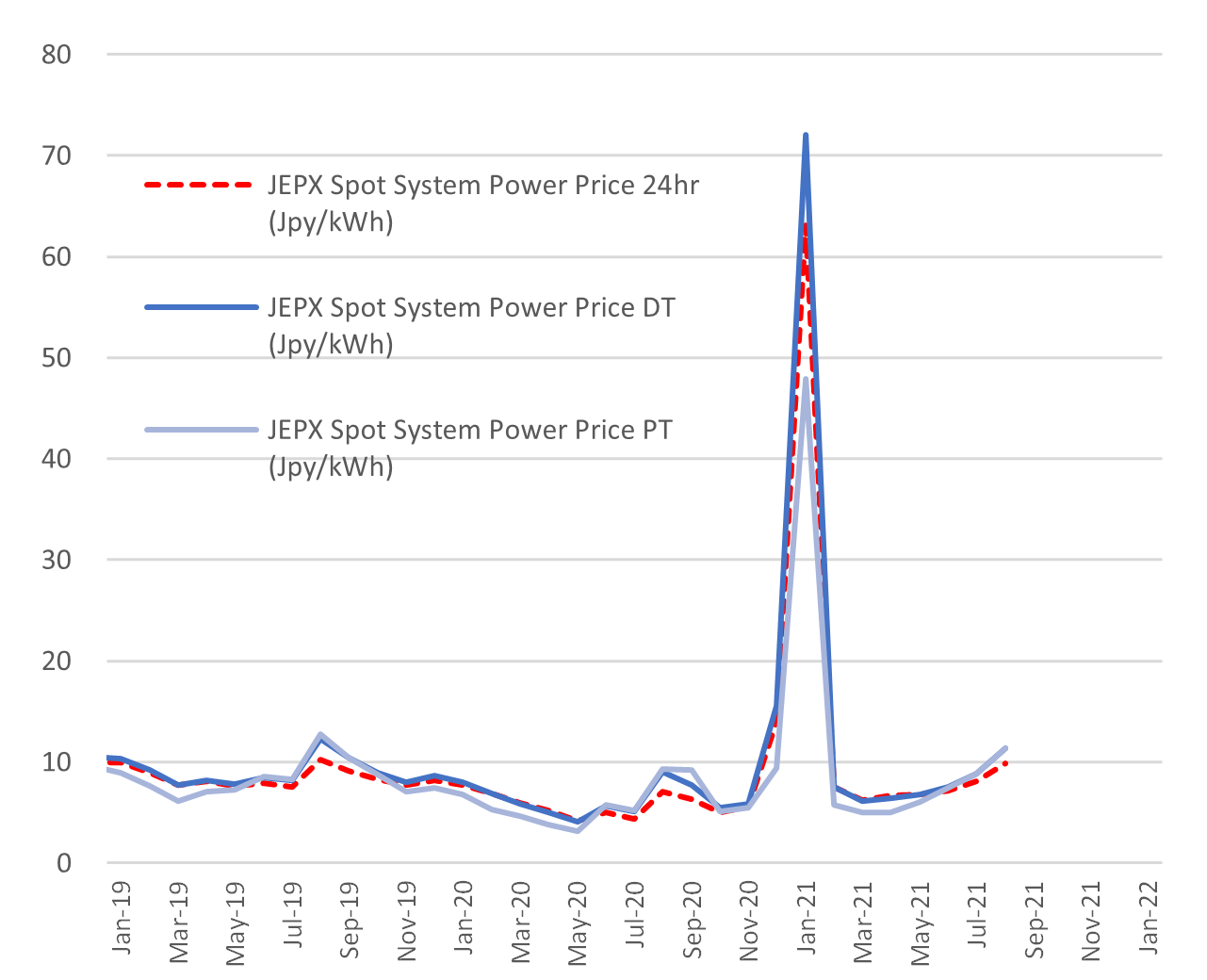
Source: Company websites, JANSI and JAIF, as of Aug 9, 2021
Tohoku Electric to halve emissions by 2030 with ammonia and biomass
(Kankyo Business, Aug. 3)
- Tohoku Electric said it’s committed to reducing CO2 emissions 50% by the end of the decade versus 2013 levels.
- To this end, the utility is trialing the co-firing of LNG at Unit 5 of its Niigata plant with hydrogen and ammonia.
- Tohoku is also trialing blending biomass pellets and ammonia with the coal used to fire its Noshiro power plant, as well as conducting research into the methanation of waste CO2.
TAKEAWAY: Tohoku and JERA are the only major Japanese power utilities so far to discuss in detail their plans to test co-firing of ammonia or hydrogen, although this looks like a solution that most major electricity firms in Japan will pursue. Tohoku’s schedule also looks more aggressive than that of JERA, though it is a smaller company in terms of capacity.
Govt. to survey additional offshore wind project areas
(Yomiuri, Various, Aug. 1)
- METI will survey three areas off the coasts of Hokkaido, Yamagata and Iwate to determine suitability for wind farm development.
- The 1-year survey will assess windspeed, seabed firmness, and weather conditions.
- At present, the govt. sees fixed-bottom wind turbines as suitable for Hokkaido and Yamagata, while floating turbines as appropriate for Iwate.
- The assessment will also consider impact on local fisheries.
TAKEAWAY: While the results of the tenders in the first four offshore wind areas are yet to be announced, industry participants say many of the big players from Japan and overseas won’t win the first allocations. However, interest in offshore wind is very high and the govt. is trying to move forward in preparing new areas for auctions so more projects can start in the next few years. Hokkaido is widely expected to be among the next list of areas to win government approval as an offshore wind promotion zone.
July baseload power auction price jumps by ¥3/ kWh from a year ago
(Japan NRG, Aug. 5)
- The July 20-30 baseload power auction price settlements were up ¥3/ kWh from a year ago, METI said. Hokkaido settled at ¥11.53/ kWh, east Japan at ¥10.92/ kWh, and west Japan at ¥9.47/kWh.
- While the Hokkaido price was lower than its 2019 level, east and west Japan settlements were up on previous years.
- The settlements for all regions remained below the June average in the respective areas. Total auction volume was 38.7 MW, down 65% YoY.
- The next auction closes on Sept. 30.
Pacifico Energy plans to build 121 MW solar plant in Hyogo area
(New Energy Business News, Aug 5)
- Pacifico Energy will build a 121 MW solar power plant in Sanda City, Hyogo prefecture. The plant will be built mainly on the site of a golf course.
- Commercial operation is scheduled to begin at the end of 2023.
- Juwi Shizen Energy is in charge of construction.
- Electricity sales period under the FIT system will be about 18 years.
- Lenders for the project include Mitsubishi UFJ Bank and Mitsubishi HC Capital
- CONTEXT: Pacifico Energy has operating capacity of 930 MW, one of Japan’s largest solar / renewables portfolios.
TAKEAWAY: As stated in last week’s report, the solar industry is changing and will develop larger solar power companies than seen before. This plant’s completion will push Pacifico Energy over the 1 GW mark. It’s interesting to note that the FIT period is 18 years, less than the 20-year duration most FIT projects have, which suggests the operator knows it can generate a profit in less time than usual.
Osaka Gas, Mitsui and others plan to develop 400 MW offshore wind project in Akita
(New Energy Business News, Aug 6)
- Osaka Gas, Mitsui & Co., United Project, and Northland Power Development Services Japan plan to develop an offshore wind farm near Katagami City, Akita prefecture. The maximum capacity would be 400 MW.
- The group submitted its environmental assessment documents for the project.
- The estimated project area is about 5,421 ha in the coastal areas and offshore areas of Katagami City, Oga City, and Akita City, all in Akita prefecture. The project would install between 26 and 42 turbines, each with a capacity of between 9,500 kW and 15,000.
- The construction period is estimated to be 36 months.
- The sea area around Katagami City is expected to be revised as a renewable energy promotion zone.
Kansai Electric announces schedule for completing anti-terrorism measures at its reactors
(Asahi Shimbun, Aug. 3)
- Kansai Electric laid out a schedule for when it will complete additional anti-terrorism measures at five of its nuclear reactor units, including at plants that are over 40 years in operation. At some facilities, the work will be about 2 years behind original plans.
- The measures include the ability to withstand the impact of a jumbo jet on the plant.
- The company said the same measures will be completed at Mihama NPP Unit 3 around Sept. 2022; Takahama NPP Units 1 and 2 – around May 2023; Ooi NPP Unit 3 – around December 2022; Ooi NPP Unit 4 – around July 2022.
- Kansai Electric expects it can restart Takahama Unit 2 and Ooi Unit 4 the month after the upgrades are completed. The other three units will be fired up the same month that the work is done. All the units already passed for restart by the regulator.
- The utility said its current forecast is that Mihama Unit 3 will be online from Oct. 20, 2022; Takahama Unit 1 from June 20, 2023; Takahama Unit 2 from July 20, 2023.
- SIDE DEVELOPMENT:
Leak found in Ooi NPP Unit 3
(Denki Shimbun, August 6)- Workers found a 4-cm hole in a section of pipe connecting the circulating water system to a venting valve at Ooi nuclear power plant Unit 3.
- The discovery was made after seawater leaked at the plant, sounding an alarm. The reactor is currently running at 65% capacity while the cause is investigated.
Japan restarts the High-Temperature Test Reactor after 10 years
(Denki Shimbun, Aug. 2)
- The Japan Atomic Energy Agency resumed operation of the high-temperature engineering test reactor, or the HTTR, in Oarai Town, Ibaraki prefecture on July 30.
- It’s the first operation for the facility since January 2011.
- The unit will be stopped again in October after checking functionality. It will then again be switched on around January 2022 for a series of safety verification tests such as LOFC (core forced cooling loss) as part of a safety project with the OECD / NEA (Nuclear Energy Agency).
Government approves TEPCO recovery plan
(Nikkei, Aug. 4)
- The govt. approved a recovery plan submitted by TEPCO Holdings in July.
- The plan outlines how TEPCO will handle the aftermath of the 2011 Fukushima disaster and raise the funds necessary to do this.
- According to the plan, the Kashiwazaki Kariwa nuclear plant could restart as early as 2022/23.
- TEPCO’s intention to pay off ¥50 billion in compensation annually while also posting a profit of ¥45 billion remains largely unchanged, as does the total cleanup bill for Fukushima of ¥22 trillion.
- SIDE DEVELOPMENT:
TEPCO in nuclear staff reshuffle
(Denki Shimbun, Aug. 4)- TEPCO said Nishikawa Tetsu and Yamada Kiyofumi, who currently hold positions in strategic planning and nuclear plant management divisions, will take on additional roles related to reform of the utility’s nuclear operations.
- In the wake of scandals involving the Kashiwazaki-Kariwa nuclear plant, TEPCO identified the regaining of the public’s faith in its nuclear operations as a matter of priority.
Kawasaki Kisen to build tidal power plant in Canada
(Kensetsu News, Aug. 6)
- Kawasaki Kisen and Chubu Electric Power signed an agreement with Irish renewables company DP Energy to build a tidal farm in Nova Scotia.
- This is the first time that Japanese companies have participated in overseas tidal energy developments.
- The first 1.5 MW tidal stream generator will begin operating in 2023. Eventually, a total of three tidal stream generators will be deployed.
Erex plans ultra-supercritical biomass plant for Niigata
(New Energy Business News, Aug. 4)
- Erex submitted its environmental impact statement on a 300 MW biomass fired power plant planned for Niigata.
- The plant, which is scheduled to begin supplying the grid in 2026, will use an imported wood and vegetation-based feed stock and feature an ultra-supercritical boiler.
Mitsui invests in Indian biofuels
(Nikkan Kogyo Shimbun, Aug. 6)
- Mitsui & Co. invested ¥400 million in Indian biofuels manufacturer Punjab Renewable Energy Systems.
- Mitsui won’t disclose what percentage of Punjab Renewable it now owns.
- Punjab Renewable process crop waste into biofuel briquettes.
NEWS: OIL, GAS & MINING
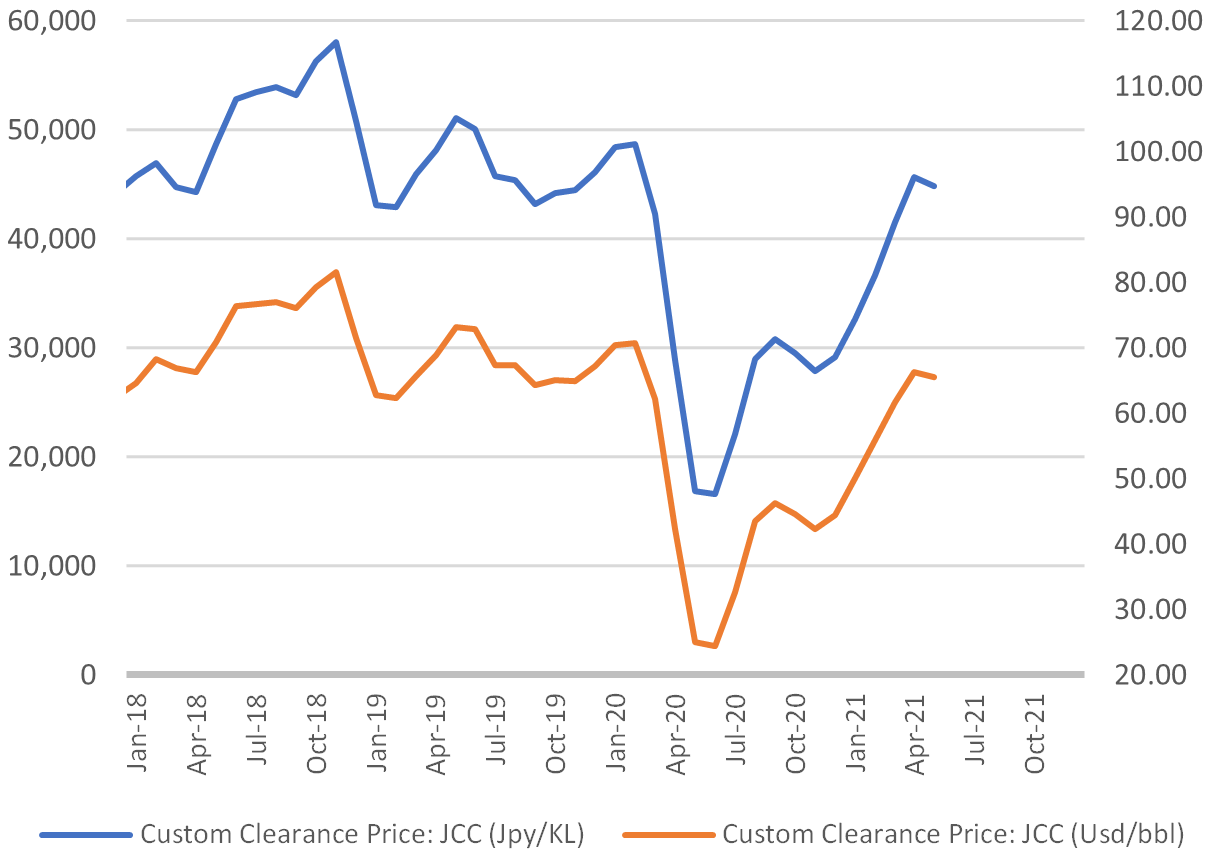
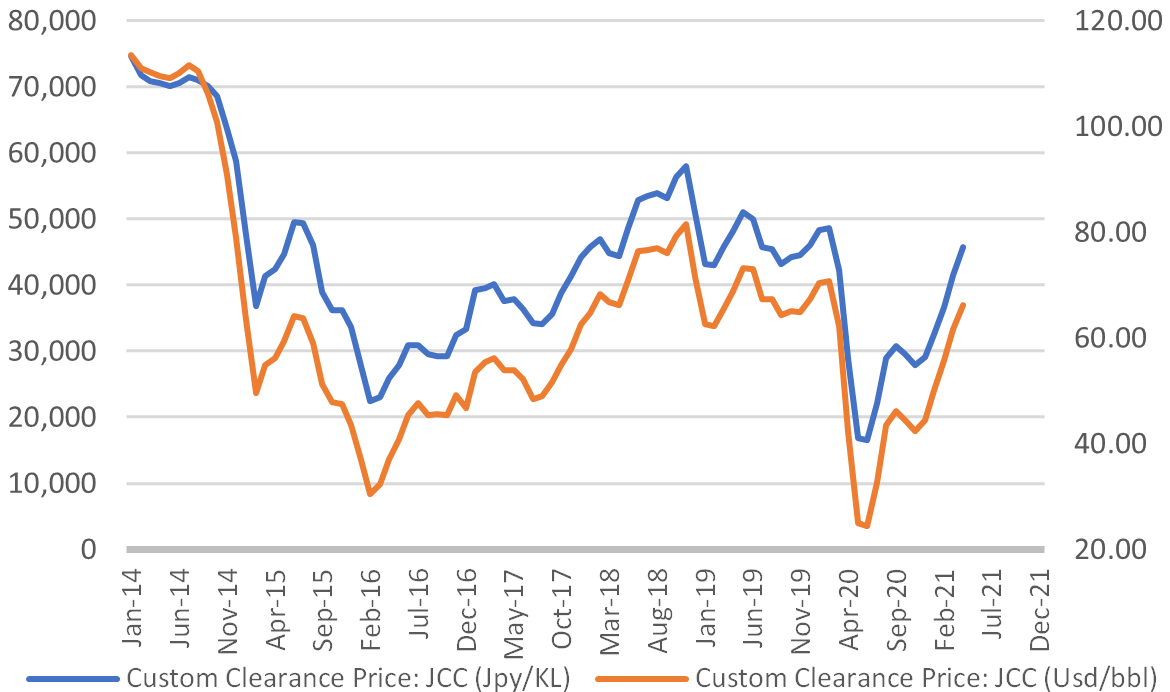
Japan Oil Price: $65.45/ barrel
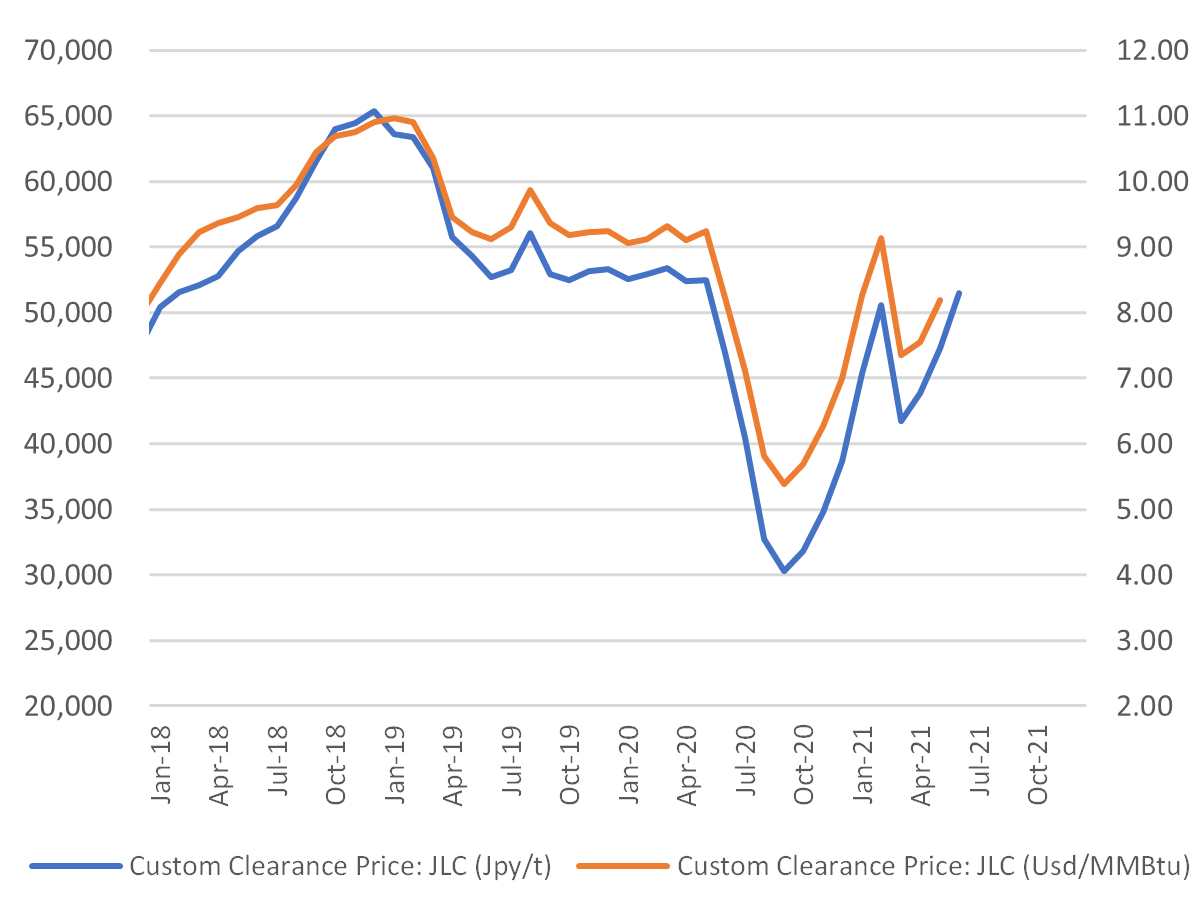
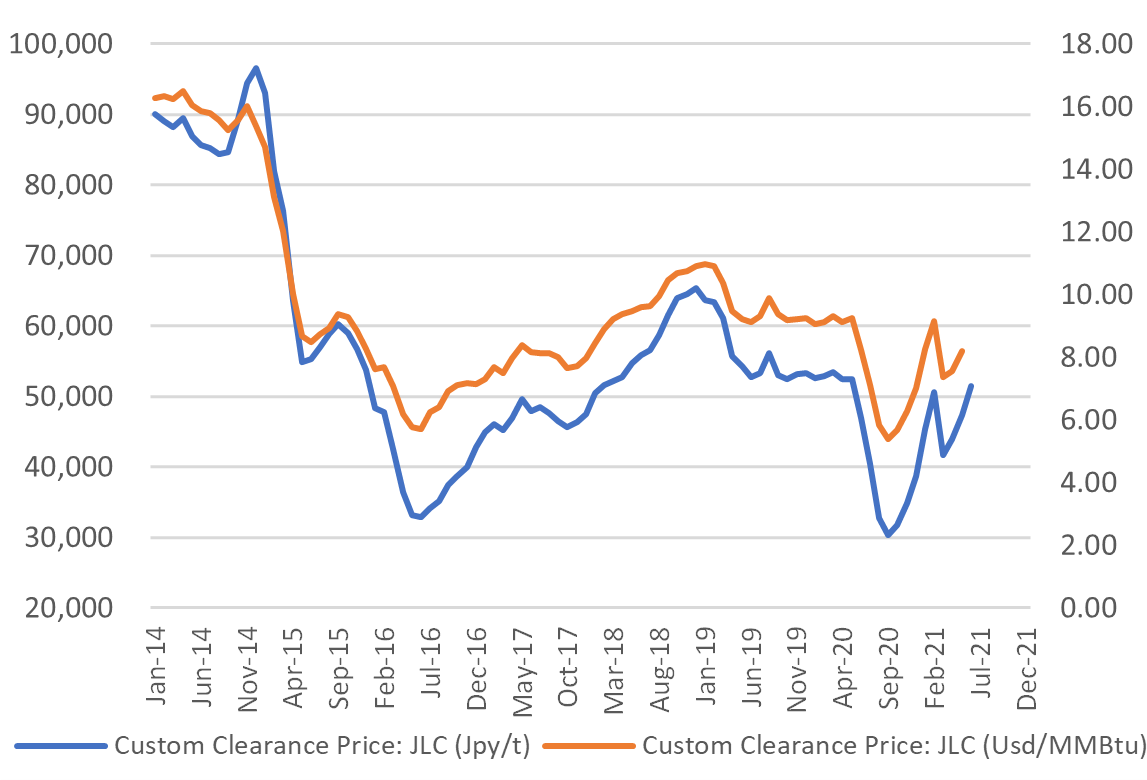
Japan (JLC) LNG Price: $8.19/ mmbtu
Researchers find way to store hydrogen without using rare metals
(Kankyo Business, Aug. 3)
- A team of researchers from the National Institutes for Quantum and Radiological Science and Technology, Tohoku University, and the Institute of Materials Structure Science say they discovered a way to use an iron-aluminum alloy to store hydrogen gas.
- Rare metals such as palladium are now used to absorb and store hydrogen.
- If the discovery leads to the development of an alloy made from readily-available metals able to store hydrogen at close to atmospheric pressure, the researchers said they believe it will help achieve the UN’s sustainable development goal of ensuring access to affordable, reliable, sustainable and modern energy for all.
- SIDE DEVELOPMENT:
Platts to launch hydrogen pump prices for California, Europe and Japan
(Company statement, Aug. 2)- S&P Global Platts will launch new monthly assessments for hydrogen pump prices in the California market, based on a survey of hydrogen fuel station operators. It will also republish posted pump prices for Germany and Japan hydrogen fuel stations.
- For Japan, the prices will come from gas company Iwatani. All Japanese prices will be published in Japanese Yen, U.S. Dollars and Euros.
- Japanese prices will be for the Tohoku, Metropolitan, Chubu, Kinki, Chugoku and Kyushu regions.
ANALYSIS
BY MAYUMI WATANABE
Japan Continues to Expand Coal Capacity
Despite International Pressures to Reduce Coal Reliance
A year ago, Japan’s government vowed to close three-quarters of the country’s coal-fired power plants by 2030. Today’s situation, however, looks drastically different. New coal capacity is being added, with more scheduled to come online in the first half of this decade.
The new coal units are bigger than their predecessors and promise to hook up the equivalent of almost seven nuclear reactors to Japan’s grid. Meanwhile, recent METI edicts are asking power utilities to pause plans to scrap older thermal units due to fear of capacity shortages.
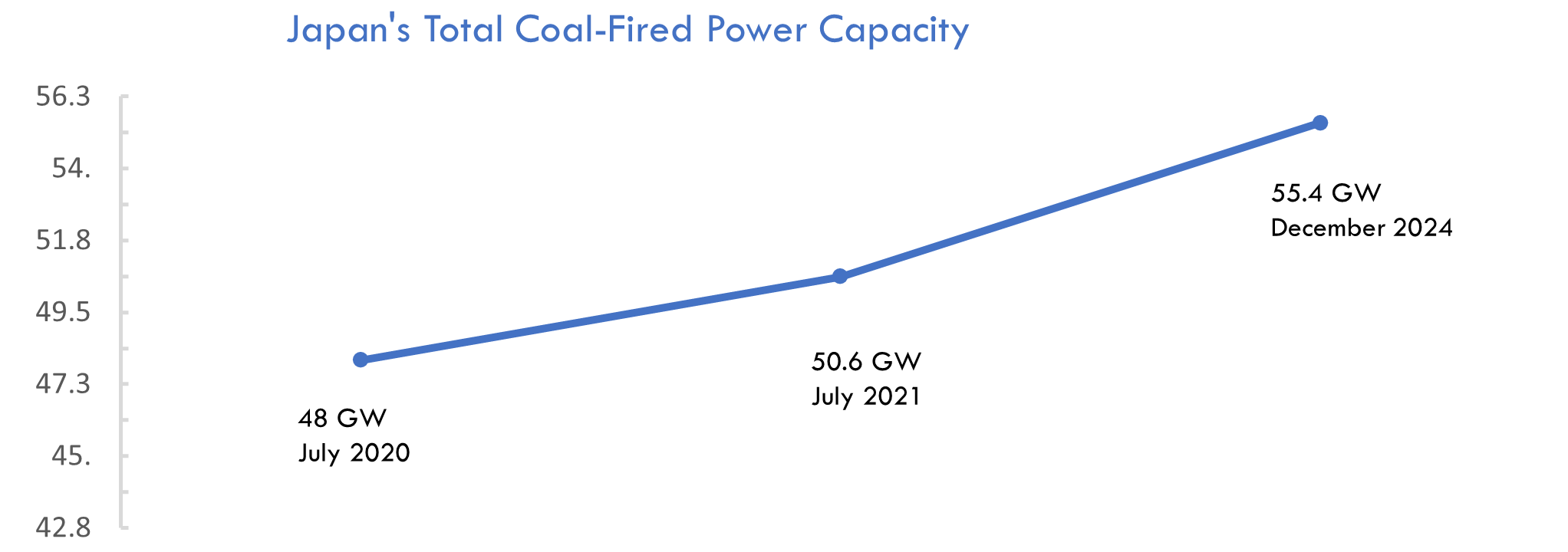
With Japan’s coal-fired capacity set to balloon to 55.4 GW by the middle of the decade, the country needs to make a drastic turnaround no later than 2025 if it’s to meet 2030 decarbonization goals.
We look at the main players in coal power in Japan and what they have at risk in the energy transition.
The big declaration
Japan had 150 coal-fired power units in July 2020 when Kajiyama Hiroshi, the Minister of Economy, Trade and Industry, pledged to phase out all inefficient coal power plants by 2030. Media reports at the time suggested METI wanted 114 units to retire.
A year later, the government set another numerical goal for coal in the draft of the Sixth Basic Energy Plan. Coal-fired power is supposed to deliver 19% of Japan’s electricity in 2030, down from the current 32%.
Since Minister Kajiyama’s big announcement, no coal station has yet to retire, or announce firm plans to do so. On the contrary, in the past year four new coal-fired units were brought online and two more were commissioned (and started running on a trial basis). The operators claim these facilities showcase the best-available technology to reduce carbon, sulfur and dust. These new units increased Japan’s coal-fired capacity to 50.6 GW from 48 GW.
Seven more units are due to start operation in 2022-2024, which will boost capacity further to 55.4 GW.
The new units are increasing in size, too. The six launched in the past year average a capacity of 0.43 GW. The seven to follow average 0.69 GW.
Currently, Japan’s biggest coal-fired facilities are the two 1.05 GW units at the Tachibana-wan thermal power station owned by J-Power in Tokushima prefecture on Shikoku Island. Next May, however, JERA plans to bring online the 1.07 GW Taketoyo station in Aichi prefecture.
All this runs counter to the country’s energy policy. According to the latest energy strategy, in 2030 coal should supply 180 TWh of electricity, a sharp decline from the 326.2 TWh it provided in the fiscal year that ended March 2020.
Coal-Fired Power Plants Brought Online in the Past Year
|
Name |
Operator |
Output |
Launch date |
|
Kushiro Fossil Power Station |
KCM, IDI Infrastructures |
112 MW |
December 2020 |
|
Fukushima Reconstruction IGCC |
Nakoso IGCC Power |
543 MW |
September 2020 |
|
Fukushima Reconstruction IGCC |
Hirono IGCC Power |
543 MW |
commissioned March 2021 |
|
Hitachinaka Joint Thermal Plant |
Hitachinaka Generation |
650 MW |
January 2021 |
|
Kaita Biomass-Coal Combustion |
Kaita Biomass Power |
112 MW |
April 2021 |
|
Kobelco Power Kobe No. 2 |
Kobe Steel |
650 MW |
commissioned May 2021 |
JERA and J-Power dominate Japan’s coal power
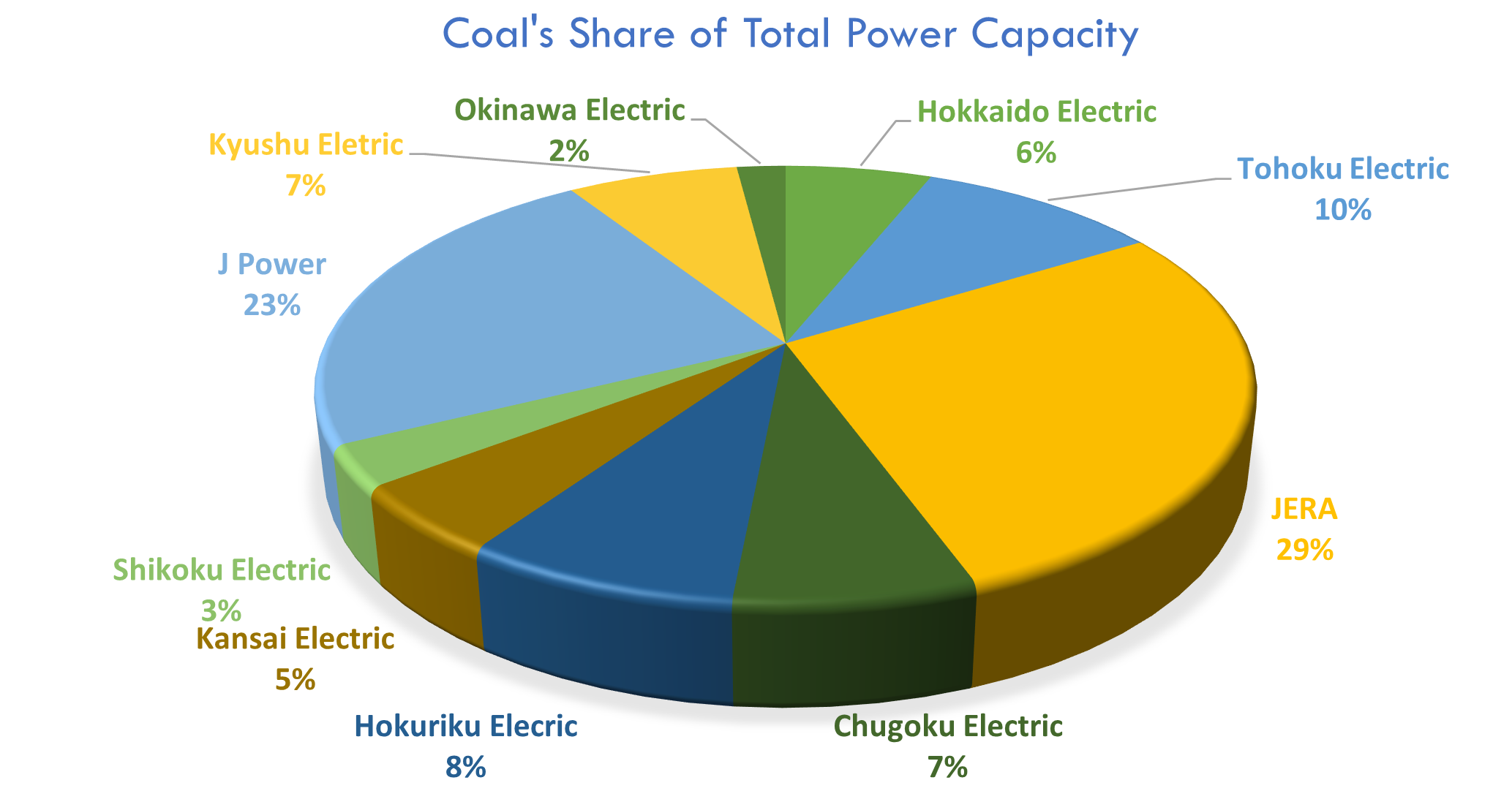
Over half of the 150 coal-fired units are small facilities meant for in-house use by manufacturing and trading firms, according to METI data. Some units are as tiny as 2.6 MW. In contrast, the 70 coal units operated by the 10 big power utilities, the former regional monopolies, account for 81% of all coal-fired capacity or 39 GW.
J-Power, along with JERA, which is a JV of Tokyo Electric and Chubu Electric, are the two biggest coal operators. They account for over half of Japan’s coal-fired capacity.
JERA ranks first with 10.3 GW. Established in 2015, the company focuses on large-scale generation. All of its plants exceed 500 MW in capacity: It runs four 1-GW plants and five 600-700 MW plants. Its oldest coal-fired facility is the first unit of the Hekinan thermal station in Aichi prefecture, which went into service in 1991. Aichi is an important center of Japan’s automobile industry, home to Toyota’s headquarters and a significant part of domestic manufacturing capacity. Toyota has also committed to carbon neutrality by 2050.
J-Power has 8.4 GW of capacity, and it runs 14 units at seven power stations. The facilities are more diverse compared to JERA. Power station sizes range from two 156 MW units in Okinawa to two 1.05 GW units at the Tachibana-wan facility in Tokushima Prefecture. Its oldest is the 250 MW Takasago plant in Hyogo prefecture that became operational in 1968; the newest is the 600 MW Takehara plant in Hiroshima prefecture launched in 2020.
Tohoku Electric, the No. 3 coal player, has an asset profile similar to JERA. All their units are over 500 MW in size and relatively new. It has 3.8 GW of coal-fired capacity, and the oldest, the Noshiro No. 1 unit in Akita prefecture, went operational in 1993; the newest, Noshiro No. 3 unit, came onstream in March 2020. Separately, the company has a JV with local manufacturers that run smaller coal plants.
Coal dependency
While JERA is the biggest owner of coal generation, it’s not the most dependent utility on the fuel. JERA’s main fuel source is LNG, which accounts for 71% of its generation assets.
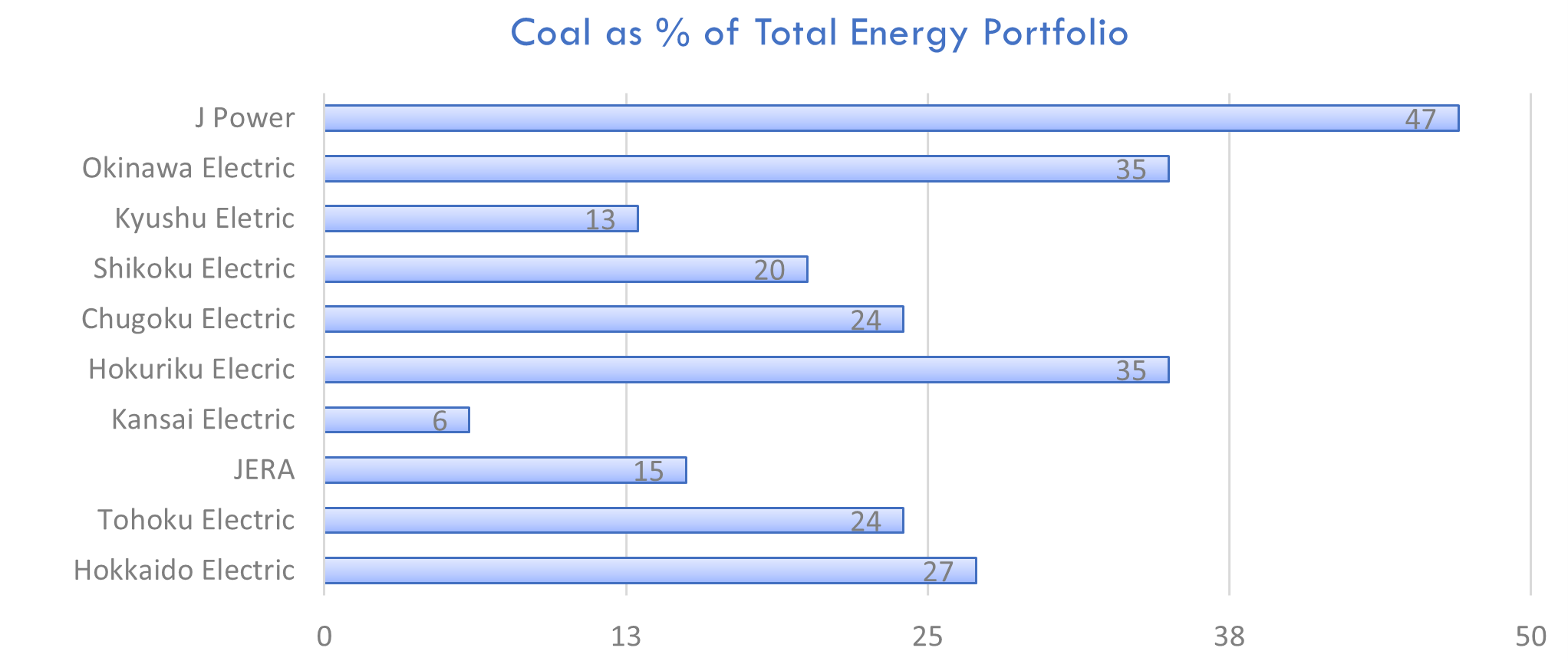
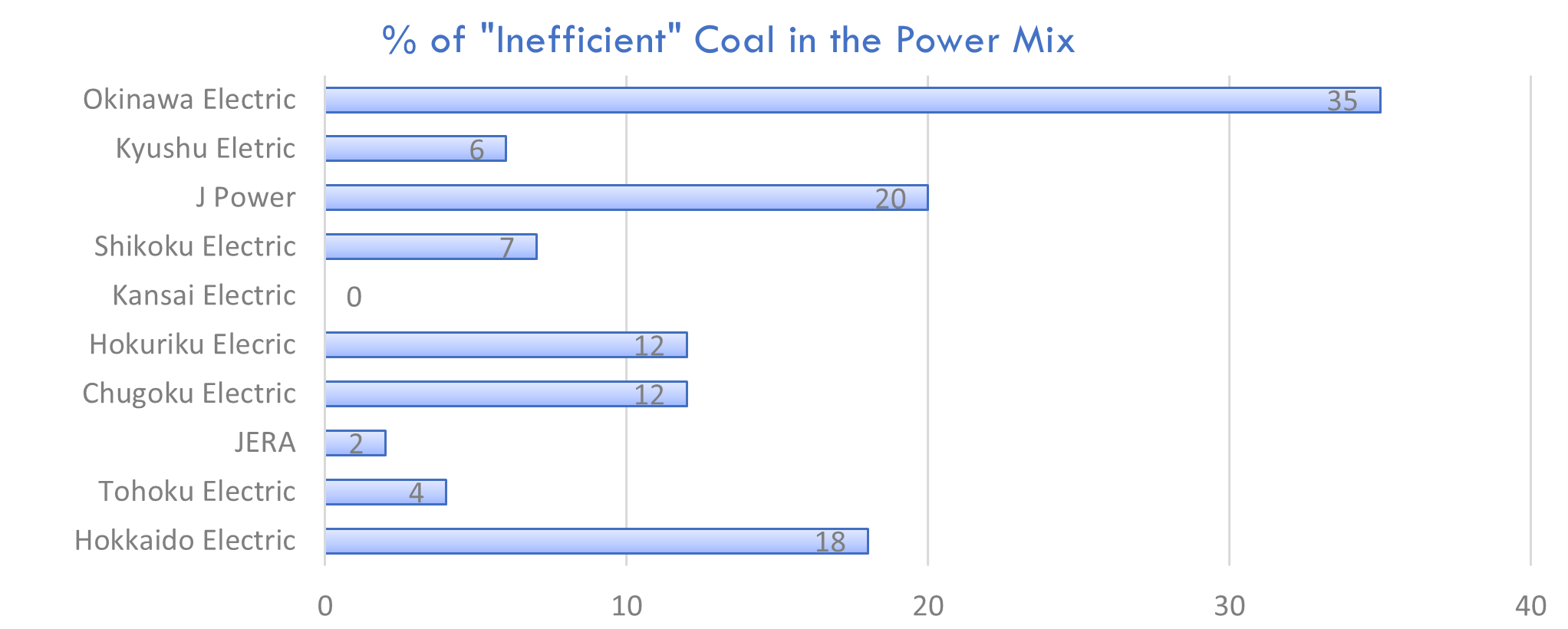
J-Power has the highest coal dependency of Japanese power firms, at 47%, followed by Okinawa Electric and Hokuriku Electric, both at 35%. The three utilities share another unfortunate circumstance: reliance on older coal technologies such as the sub-critical (SUB-C) and supercritical (SC) pressure systems. METI has suggested these are categorized as “inefficient” systems, because they typically deliver less than 41% energy efficiency. That said, efficiency levels can vary based on a power plant’s usage (its run rate) and other conditions.
Of J-Power’s 14 coal units, 8 are SUB-C and SC systems. Their combined output is 3,512 MW, accounting for 20% of the company’s entire generation portfolio (17,725 MW). Note: these figures are for the plants wholly owned by J-Power and do not include joint ventures.
Okinawa Electric is in an even worse predicament. All four of its coal-fired units use SUB-C systems. The utility is also heavily dependent on coal as these stations account for 35% of Okinawa Electric’s total output – almost twice the level of J-Power.
Hokuriku Electric has six coal units, of which two are SUB-C and one SC. The older facilities account for 12% of its total power generation capacity.
Sustaining coal power
J-Power said its inefficient SC and SUB-C facilities will be replaced with USC or integrated gasification combined cycle (IGCC) technologies by 2025. The company is also active in carbon separation and capture (CCUS) space, locally and internationally.
Climate activists argue, however, that these initiatives are misguided, questioning the rationale of putting additional resources into more coal units and CCUS, which critics claim is unproven and many years away from even potentially making a contribution to cutting Japanese emissions.
Since CCUS tech has yet to be fully developed, it also requires further funds to research, build and install. That is not an option for smaller utilities like Okinawa Electric, the revenues of which are the lowest of the regional majors in Japan. The Okinawa company has sales that are just a quarter of J-Power’s.
The circumstances of the smaller utilities may be the reason behind the recent announcement by METI’s power and gas basic policy panel, which advised the government to revisit plans to scrap old thermal generation plants, warning of looming power shortages in the country this summer and upcoming winter.
METI said it plans to conduct a stress test / impact analysis of power plant closures on regional electricity supplies. The ministry wants to look into the background of closures tabled through 2024, notably the impact on power costs. In the meantime, if some localities face challenges in securing financial resources to sustain plant operations (due to banks being averse to lend to coal-fired power plants, for example), the government may offer support, the METI panel said.
What this all suggests is that a small, isolated player like Okinawa Electric, whose grid is not connected to Japan’s main island, could be given a pass and continue with running its coal plants irrespective of the national standards. Already, METI has allowed Okinawa Electric a waiver on the unbundling of generation, transmission and retail that legally applies to the rest of the country, claiming the region’s small market size made it impractical.
Should Okinawa get to keep its coal plants, the number of units that can survive in the rest of Japan by 2030 will drop further.
Other regional power generators could appeal to METI on similar grounds, claiming financial hardship, the need to preserve social and energy stability, and with promises of future transformation.
All of this leaves Japan’s plans to slash coal’s share of the electricity mix by 50% within this decade rather ambiguous and unconvincing. For sure, part of the current coal plants will follow JERA’s lead and mix in ammonia as a fuel in the hope of switching over entirely to the CO2-free gas in the future. That “future”, however, is currently penciled in for 2040 or later.
Which firms will be forced to close their coal plants by 2030 is also unclear.
List of “Inefficient” Coal-Fired Units Owned by Power Utilities
|
Operator |
Plant name |
Number |
Type |
Output (MW) |
Operational year |
|
Hokkaido Electric |
Tomatoh Atsuma |
1 |
SUB-C |
350 |
1980 |
|
Tomatoh Atsuma |
2 |
SC |
600 |
1981 | |
|
Sunagawa |
3 |
SUB-C |
125 |
1977 | |
|
Sunagawa |
4 |
SUB-C |
125 |
1982 | |
|
Naie |
1 |
SUB-C |
175 |
1968 | |
|
Naie |
2 |
SUB-C |
175 |
1970 | |
|
Tohoku Electric |
Noshiro |
1 |
SC |
600 |
1993 |
|
JERA |
Hekinan |
1 |
SC |
700 |
1991 |
|
Hekinan |
2 |
SC |
700 |
1992 | |
|
Chugoku Electric |
Mizushima |
2 |
SUB-C |
112 |
1963 |
|
Shimonoseki |
1 |
SUB-C |
175 |
1967 | |
|
Shinonoda |
1 |
SC |
500 |
1986 | |
|
Shinonoda |
2 |
SC |
500 |
1987 | |
|
Hokuriku Electric |
Toyama Shinko |
1 |
SUB-C |
250 |
1971 |
|
Toyama Shinko |
2 |
SUB-C |
250 |
1972 | |
|
Tsuruga |
1 |
SC |
500 |
1991 | |
|
Shikoku Electric |
Saijo |
1 |
SUB-C |
156 |
1965 |
|
Saijo |
2 |
SUB-C |
250 |
1970 | |
|
J Power |
Takasago |
1 |
SUB-C |
250 |
1968 |
|
Takasago |
2 |
SUB-C |
250 |
1969 | |
|
Takehara |
3 |
SC |
700 |
1983 | |
|
Matsushima |
1 |
SC |
500 |
1961 | |
|
Matsushima |
2 |
SC |
500 |
1981 | |
|
Matsuura |
1 |
SC |
1000 |
1990 | |
|
Ishikawa |
1 |
SUB-C |
156 |
1986 | |
|
Ishikawa |
2 |
SUB-C |
156 |
1987 | |
|
Kyushu Electric |
Matsuura |
1 |
SC |
500 |
1986 |
|
Reihoku |
1 |
SC |
500 |
1987 | |
|
Okinawa Electric |
Gushikawa |
1 |
SUB-C |
156 |
1994 |
|
Gushikawa |
2 |
SUB-C |
156 |
1995 | |
|
Kin |
1 |
SUB-C |
220 |
2002 | |
|
Kin |
2 |
SUB-C |
220 |
2003 | |
|
TOTAL |
32 units |
11,507 MW |
ANALYSIS
BY DANIEL SHULMAN
PRINCIPAL
SHULMAN ADVISORY
Japan to Open Up Power Distribution Industry to Competition
With the Introduction of a New Distribution License System
From next April, Japan will introduce a licensing system for companies that wish to run power lines. A revision to the Electricity Business Act will allow new operators to distribute electricity in a move that the government hopes will increase grid efficiency, speed up a shift to a more open power market and help to decarbonize the sector.
To date, all the electricity in Japan was transmitted by subsidiaries of the country’s 10 regional power companies. From April 2022, that will change, opening up the grid to new companies and business models.
The energy transition in power generation will now extend to power distribution.
The rationale
There are three reasons for the change, which was passed into law in June 2020. The first is to increase the grid’s resilience to natural disaster and emergency situations. Local grids need to become physically independent from the national transmission network so that they can function in case of emergency and in order to prioritize supply to local consumers.
The second goal is to encourage competition in power distribution. Aside from the 10 regional power utilities, only a few large industrial players have built and managed power lines between their own generation assets and load centers.
The last goal is to encourage local consumption of locally produced energy, which in turn could increase integration of renewables assets into the grid and reduce upgrade costs.
Details of the new distribution license
There are just 34 companies in Japan currently licensed to run power from their own generation to factories via a so-called “specific transmission and distribution license”. Such a license requires the firms to install power lines and register all their supply points with METI. The task is also capital-intensive, which is why only companies in the biggest industries (such as JR East, JFE Steel, and Oji Paper) have taken the trouble to do so.
For the rest, all distribution runs through 10 regional transmission and distribution (T&D) firms, that once were an integral part of utilities like TEPCO, Kansai Electric, and others. The utilities, also known as EPCos, have unbundled the T&D business in line with the 2016 law on market deregulation. However, most of the units continue to have a close relationship with their parent holdings.
In theory, a new distribution license is due to break up such a dynamic. It will allow companies with less capital to enter the power distribution business. New entrants will be able to lease existing power distribution systems from the 10 regional T&D firms. They will also have the option to purchase or build grid systems.
New entrants will sign consignment and power balancing contracts with power generators and retailers that were historically clients of the 10 big T&Ds. That will make them responsible for the power distribution and balance in their service areas, maintaining and operating infrastructure of 7,000V or less as well.
Distribution license owners will have three main tasks: 1) ensure stable and high-quality power distribution by managing current and frequency (including in times of disaster); 2) billing-related tasks such as meter reading and the purchase of Feed-in-Tariff renewable power; and 3) maintain the infrastructure.
Interestingly, new power distribution companies can subcontract these services to the 10 large T&D firms, if there’s no risk of impeding fair competition. METI expects the balancing related services and metering tasks to be subcontracted. However, all new power distributors are required to have these technical capabilities at an early stage and METI’s goal is for the newbies to manage these services in the long term.
As per the 2016 deregulation, distributors will be prohibited from engaging in power generation or retail in in areas where they provide grid services. The exception to this rule is if the number of customers in the distribution area is lower than 50,000. This allows for more efficient management of the power needs of remote islands, for example.
METI’s evaluation of applications for the new license will focus on the company’s long term financial and technical capabilities, as well as its business plan and adequate communication of its business to consumers and local governments. METI also wants to avoid applicants that would focus only on high-profit areas.
A way to build resilience
In October 2019 a typhoon hit the Kanto region, damaging 2,000 powerline poles and leaving 930,000 households in the dark. It took TEPCO 12 days to resolve 99% of the blackout. In 2018, a similar event damaged 1,300 poles in the Kansai region and left 1.68 million households in the dark. It took 5 days to resolve 99% of the blackouts.
METI’s stance is that because the big T&D firms manage the grid at a macro-level, when there’s an issue with the main transmission line, the distribution systems are impacted. Under the new system, the ministry expects that in times of emergency the transmission grid could be disconnected from selected distribution networks and operate independently. In effect, it would become a microgrid. Local distribution companies are better positioned to identify and prioritize consumers with needs for immediate power.
In preparing for emergency situations, distributors are also more likely to consider local generation assets. METI believes this will lead to better care for distributed generation, which is generally smaller in capacity than the big thermal or nuclear stations around which the EPCOs have built their business. Favoring local energy in times of need, and in general, is also a way to lower the cost of grid upgrades to move large volumes across big distances at a snap.
In terms, the introduction of competition and a focus on profitability in power grids could unlock options like the value of investing in underground power lines. With new companies entering the distribution business, METI expects T&Ds to partner with IT companies to offer new services such as platforms for P2P trading, dynamic pricing, and demand response. It also expects that municipalities might join the market with technical partners to ensure the robustness of business continuity plans for emergencies and to improve public services such as the development of EV stations.
Final Remarks
A license is unlikely to throw the sector open to hundreds of players, as we have seen in retail. Electricity distribution is still a regulated industry that requires specialized technical capabilities. The barrier to entry will be higher than for retail, and with regulated wheeling charges the business case might not even be obvious for new entrants.
Still, this new system is a step forward in developing local networks in which decentralized generation and demand can meet around a microgrid model. It is, however, unclear at this stage as to why this license system would promote a more efficient distribution network than one managed by the 10 big T&Ds, especially when considering the resources and technical knowledge necessary for its operation and maintenance.
Perhaps one part of METI’s agenda is to further define the unbundling of the big regional power utilities, which have on occasion leaned on their T&D units to prop up other parts of the holding, thus casting doubt on the business separation. Any competition, no matter how small, could foster a different dynamic in the distribution sector and make it more likely to act independently.
It would be curious to see if new business models and investments in local grids also follow. For now, there seems to be a gap between METI’s aspirations for the new system and actual moves by new companies to enter the business. The next eight months will show us if the grid system too is ready for an energy transition.
Overview of grid operation
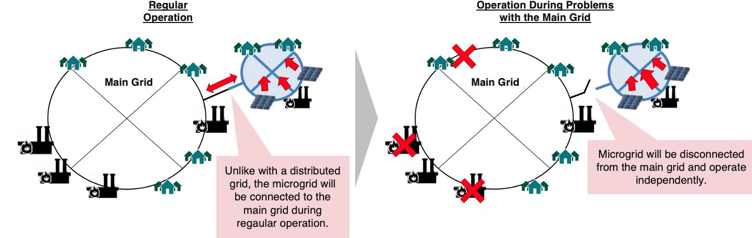
Source: OCCTO
GLOBAL VIEW
BY TOM O’SULLIVAN
Below are some of last week’s most important international energy developments monitored by the Japan NRG team because of their potential to impact energy supply and demand, as well as prices. We see the following as relevant to Japanese and international energy investors.
Tidal Power:
A tidal-powered turbine, one of the world’s most powerful, has started to generate electricity on the grid in Scotland. The 680-tonne Orbital O2 turbine can power 2,000 homes for 15 years; it was assembled over 18 months and is now anchored off the Orkney Islands in North East Scotland where a subsea cable connects the 2MW unit to the local onshore electricity network. This is Orbital Marine Power’s first commercial turbine and the company hopes to develop it globally. The turbine also provides power to an onshore electrolyzer to generate green hydrogen.
Coal:
1). According to the EIA, U.S. reliance on coal powered electricity is now expected to be 26% of the electricity mix in 2021, up 4 percentage points vs. 2020. Germany’s emissions from coal- power plants also increased 36% YoY in H1 2021, due partly to falling output from wind energy.
2). A plan by the Asian Development Bank will enable governments and coal power investors to put coal assets in public-private partnerships that would be wound down over a 15-year period. The final plan will be unveiled at COP26. The president of COP26 has stated that he would like to “consign coal to history” during the event in November. Japanese and South Korean lenders are also reducing coal commitments.
3). Meanwhile, coal prices in South Africa, Europe, and Australia are hitting record highs as demand in China and other geographies surges.
Oil & Gas:
1). BP announced a $1.4 billion share buyback after better-than-expected Q2 results due to higher oil prices, and will also raise its dividend by 4%.
2). U.S. natural gas prices continue to hit record highs with Henry Hub at $4.10 mmbtu on Friday, up 40% since April, and up 100% YoY.
3). Oil prices, however, declined sharply, with Brent and WTI down $5 a barrel due to concerns over the global pandemic. Brent closed Friday @ $71 and WTI @ $68.
EVs:
The U.S. EV truck maker, Nikola, is scaling back sales forecasts for 2021 due to supply chain issues for semi-conductors.
Nuclear Power:
1). Romania and Canada agreed to strengthen cooperation in nuclear energy enabling the completion, refurbishment and possible expansion of the Cernavoda nuclear power plant, east of Bucharest, which produces 20% of Romania’s electricity. The signing of a MoY in Bucharest follows similar agreements with the U.S. and France. The Cernavoda plant uses Canada’s Candu heavy water nuclear technology.
2). In the U.S., Talen Energy Corporation announced a JV with U.S.-based bitcoin mining company, TeraWulf, to develop 300 MW of zero-carbon bitcoin mining capacity. Talen’s Susquehanna nuclear plant will power the Nautilus Cryptomine.
3). Struggling nuclear power reactors in the U.S. are slated to receive $6 billion of support under the infrastructure bill currently in the U.S. Senate. A program to evaluate nuclear reactors at risk of shutdown will be created within the Department of Energy under terms of the $550 billion infrastructure package.
4). Several U.S. utilities, such as Energy Northwest, Utah Associated Municipal Power Systems, and PacifiCorp, are entering partnerships to build small modular reactors as demand for carbon-free, 24-hour power grows.
Shipping:
A record 10 tankers crossed the Northern Sea Route in July to deliver Yamal LNG to Asian buyers vs. seven vessels in July 2020, by-passing the longer Suez route.
Aviation:
Boeing recently estimated that a single aircraft emits more than one million tons of CO2 over 20 years of use, which is equivalent to having 10,000 cars on the road.
COP26:
China and India are among several countries that missed the U.N. deadline for submitting proposed national cuts to greenhouse gas emissions for a COP26 report for governments attending the Glasgow conference. The IPCC is expected to issue a ground-breaking report on global temperature increases this week.
Wildfires:
The Kemerkoy coal power plant in the south-west province of Mugla, Turkey was spared as 55,000 hectares burned and 36,000 people were evacuated in one of the worst wildfires in Turkish history. The plant close to the Mediterranean is a 630 MW facility owned by Limak Holdings, the Turkish infrastructure conglomerate. Other recent wildfires that pose risk to power infrastructure include Yakutsk, Russia; Bootleg, Oregon; California; British Colombia, Canada; Athens, Greece (81 wildfires); Albania; and Sardinia, Italy. Forest destruction also reduces the potential for carbon offsets.
Energy/Climate Data:
1). News Corp. (owner of the Wall Street Journal) will buy IHS Markit’s oil, coal, metals and mining, and petrochemicals price information services for $1 billion following S&P’s acquisition of IHS Markit last year. Regulatory approval for the S&P/IHS $40+ billion merger was contingent on the sale of certain assets.
2). Moody’s will acquire RMS, a UK-based catastrophe and risk management firm, for $2 billion as it acquires climate-change data to better service insurance clients.
Rail:
France’s Thales Group will sell its railway signaling business to Hitachi for $2 billion.
Hydrogen:
France’s EDF is looking to produce hydrogen (‘pink hydrogen’) at the $28 billion Sizewell C nuclear power plant currently under construction on the UK’s southeast coast. The plant could produce 14% of the UK’s hydrogen requirements.
China:
China could face larger crude-steel output cuts as it attempts to reduce emissions in key sectors, according to China’s Iron & Steel Association.
Australia:
1). Oil Search has recommended a buyout offer from Santos worth $6.2 billion in a deal that will create a top-20 global oil and gas company based in Oceania. Santos is Australia’s second largest gas producer, and Oil Search is the largest oil and gas exploration company in Papua New Guinea. The combined company will have assets in Australia, Timor-Leste, Papua New Guinea and North America with a market capitalization of $16 billion, placing the merged entity in the top-20 ASX-listed companies and the 20 largest global oil and gas companies. The new company will have a combined 2021 production of 116 million barrels of oil equivalent, and will have a combined resource base of 4,983 million barrels of oil equivalent.
2). A fire last week at the 450 MW Victorian Big (lithium ion) Battery Project, which uses the Tesla Megapack, took three days to extinguish. The project is managed by Neoen, the French renewable energy developer.
India:
1). According to a recent IEA report, India is set to see the largest increase in energy demand of any country over next 20 years. India’s energy future will depend on buildings and factories yet to be built, and vehicles and appliances yet to be bought. Based on India’s current policy, nearly 60% of its CO2 emissions in the late 2030s will come from infrastructure and machines that don’t exist today. India’s energy transformations – on a scale no country has achieved in history – will require huge advances, strong partnerships and vast capital. The additional funding for clean energy tech required to put India on a sustainable path over the next 20 years may be $1.4 trillion.
India faces a range of evolving energy security challenges. India’s combined import bill for fossil fuels is projected to triple over the next two decades, with oil by far the largest component. Domestic production of oil and gas continues to fall behind consumption trends and net dependence on imported oil rises above 90% by 2040, up from 75% today. This continued reliance on imported fuels creates vulnerabilities to price cycles and volatility, as well as possible disruptions to supply. Energy security hazards could arise in India’s domestic market as well, notably in the electricity sector in the absence of significant increases in system flexibility, improvements to the financial health of many electricity distribution companies, and other reform efforts.
2). India may have a reached a $1 billion tax refund settlement with the UK’s Cairn Energy after India’s lower house of parliament approved a draft law that cancels retrospective tax on foreign investments. Cairn had threatened to appropriate offshore Indian state assets unless a refund was received.
Russia:
Russia is planning to subsidize the purchase of domestically manufactured EVs up to $8,500 per vehicle and plans to produce 220,00 EVs annually by 2030. Russia is planning to cut emissions 70% vs. 1990 levels by 2030.
Spain:
Spain is calling on the EU to implement a price ceiling for electricity prices as consumer tariffs hit record highs with Spanish retail power charges at E10 cents/kWh. Higher power prices have become a big domestic political issue in Spain. Spain relies heavily on imported LNG, the prices of which are currently soaring.
U.S.:
1). President Biden signed an executive order on Friday that calls for 50% of all U.S. automobile sales to be EVs by 2030. GM, Ford, and Stellantis are thought to have signed up to this commitment. The required electrification investment for the U.S. auto industry is thought to be $330 billion over the next five years.
2). Exxon is considering a net-zero CO2 scope 1 and scope 2 commitment by 2050.
EVENTS CALENDAR
A selection of domestic and international events we believe will have an impact on Japanese energy.
|
February |
Approval of Fiscal 2021 Budget by Japanese parliament including energy funding projects; CMC LNG Conference |
|
March |
10th Anniversary of Fukushima Nuclear Accident; Smart Energy Week – Tokyo; Quarterly OPEC Meeting; Japan LPG Annual Conference; Full completion of all aspects of the multi-year deregulation of Japan’s electricity market; End of 2020/21 Fiscal Year in Japan; |
|
April |
Japan Atomic Industrial Forum – Annual Nuclear Power Conference; 38th ASEAN Annual Conference-Brunei; Japan LNG & Gas Virtual Summit (DMG)-Tokyo Three crucial by-elections in Hokkaido, Nagano & Hiroshima – April 25th |
|
May |
Bids close in first tender for commercial offshore wind projects in Japan; Prime Minister Suga to visit the U.S. |
|
June |
Release of New Japan National Basic Energy Plan-2021; G7 Meeting – U.K. Presidents Biden and Putin are due to meet at a summit in Geneva Forum for China-Africa Cooperation Summit (Senegal) |
|
July |
Tokyo Metropolitan Govt. Assembly Elections; Commencement of 2020 Tokyo Olympics |
|
August |
Hydrogen Ministerial Conference in conjunction with IEA |
|
September |
Ruling LDP Presidential Election; UN General Assembly Annual Meeting that is expected to address energy/climate challenges; IMF/World Bank Annual Meetings (multilateral and central banks expected to take further action on emissions disclosures and lending to fossil fuel projects); End of H1 FY2021 Fiscal Year in Japan; Japan-Russia: Eastern Economic Forum (Vladivostok)-tentative |
|
October |
Last possible month for holding Japan’s 2021 General Election; METI Sponsored LNG Producer/Consumer Conference; Innovation for Cool Earth Forum – Tokyo Conference; Task Force on Climate-Related Financial Disclosure (TCFD) – Tokyo Conference; G20 Meeting-Italy |
|
November |
COP26 (Glasgow); Asian Development Bank (‘ADB’) Annual Conference; Japan-Canada Energy Forum; East Asia Summit (EAS) – Brunei |
|
December |
Asia Pacific Economic Cooperation (APEC) Forum – New Zealand; Final details expected from METI on proposed unbundling of natural gas pipeline network scheduled for 2022. |
DATA
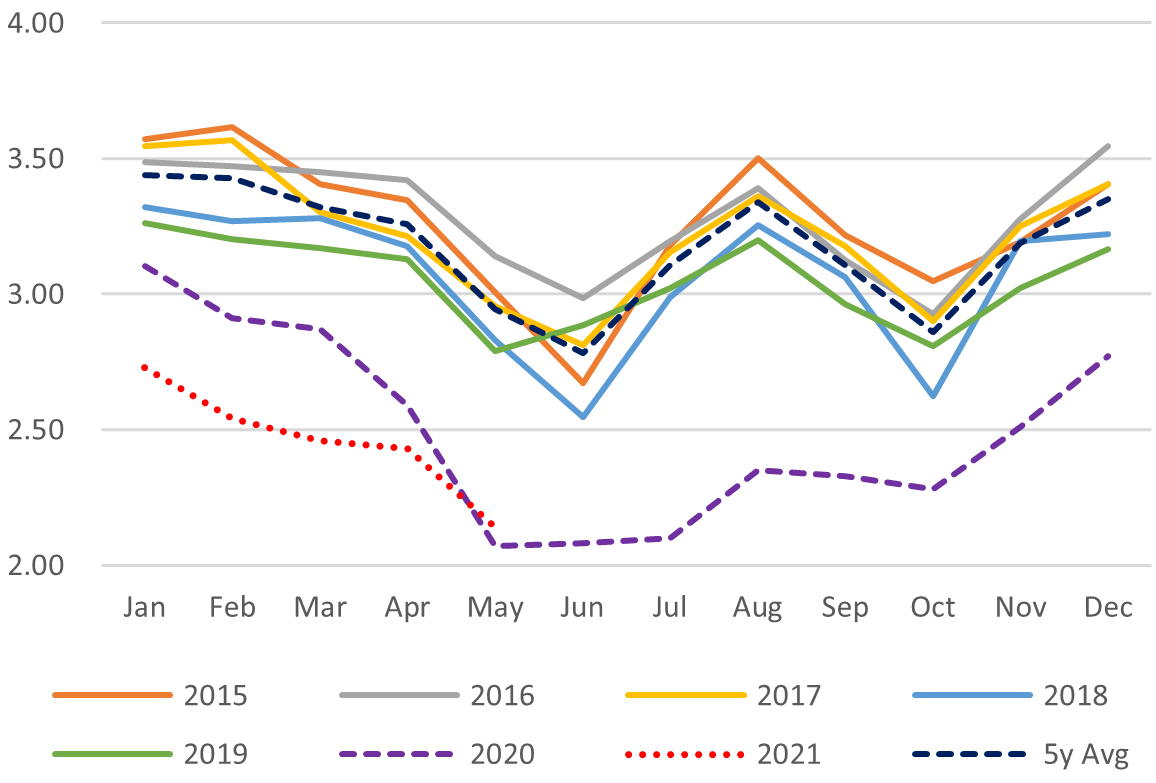
Japan Oil Price
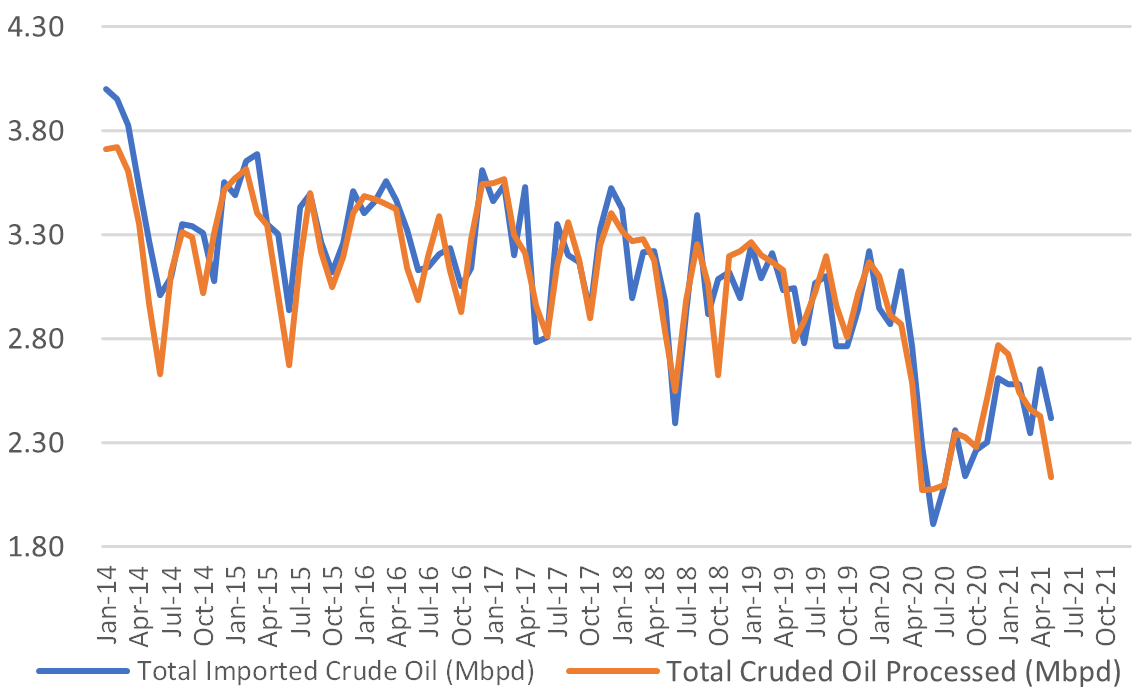
Crude Imports Vs Processed Crude
Monthly Oil Import Volume (Mbpd)
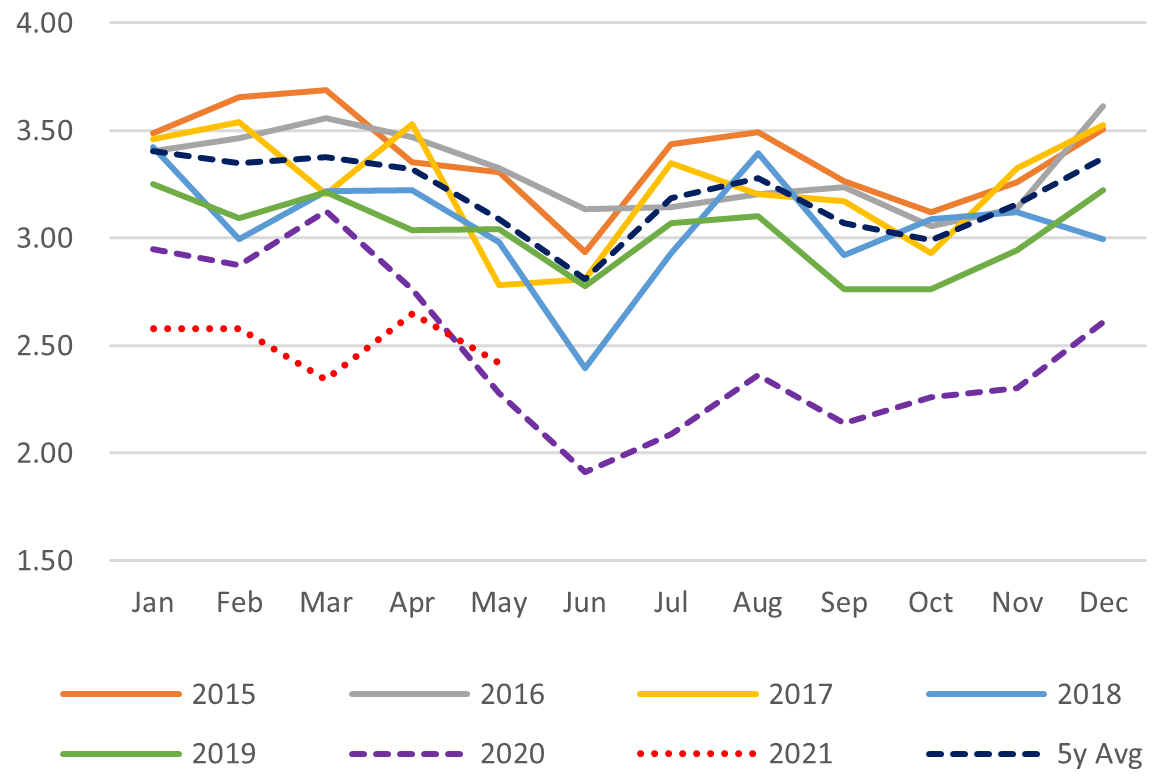
Monthly Crude Processed (Mbpd)
Domestic Fuel Sales
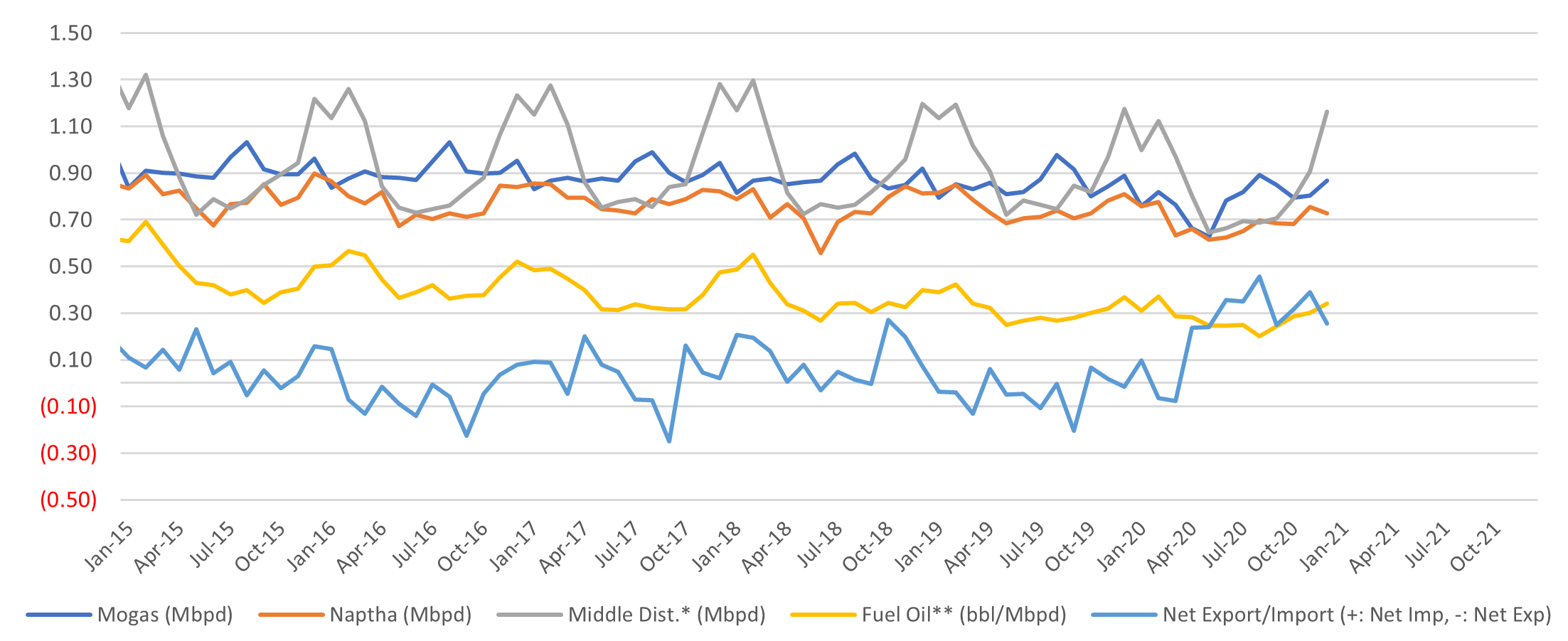
SOURCES: Ministry of Economy, Trade, and Industry (METI), Ministry of Finance, and the Petroleum Association of Japan
Japan LNG Price
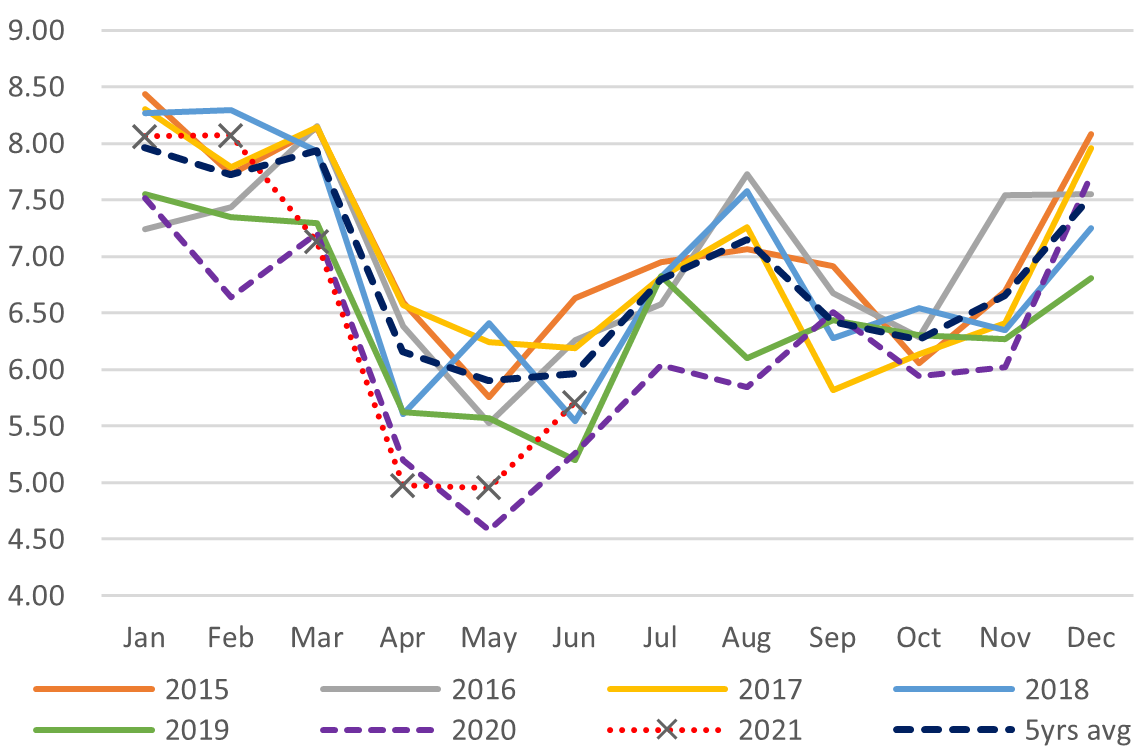
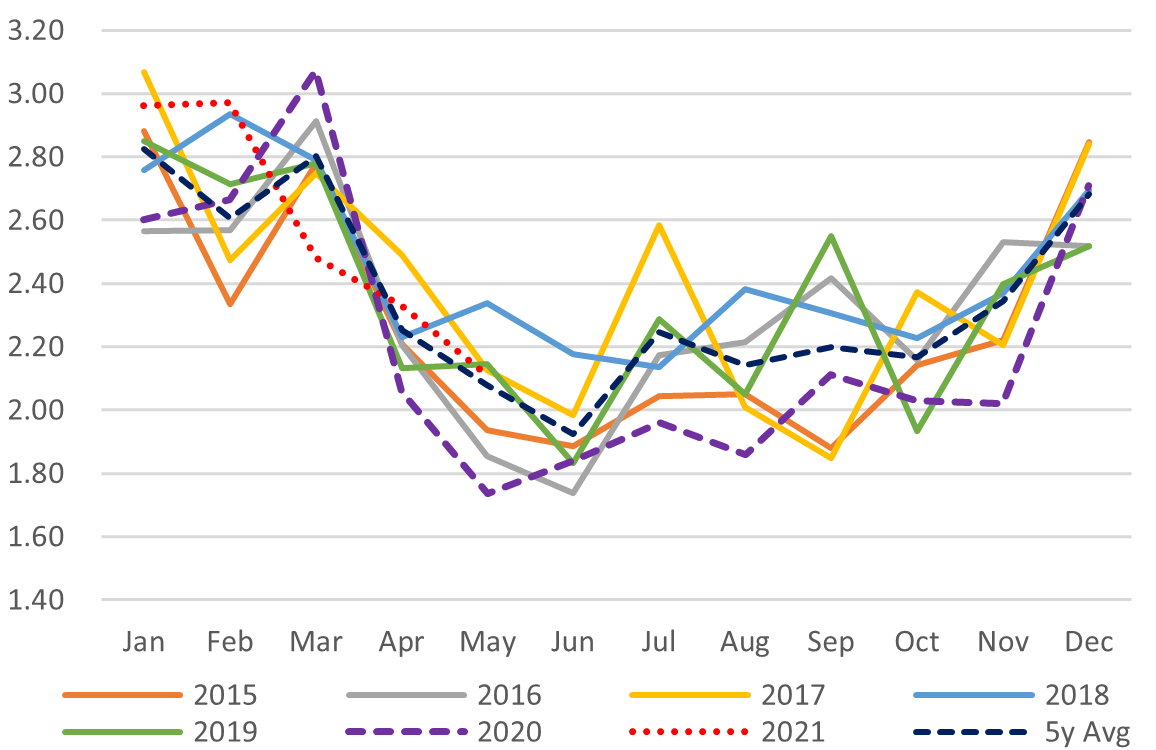
LNG Imports: Japan Total vs Gas Utilities Only
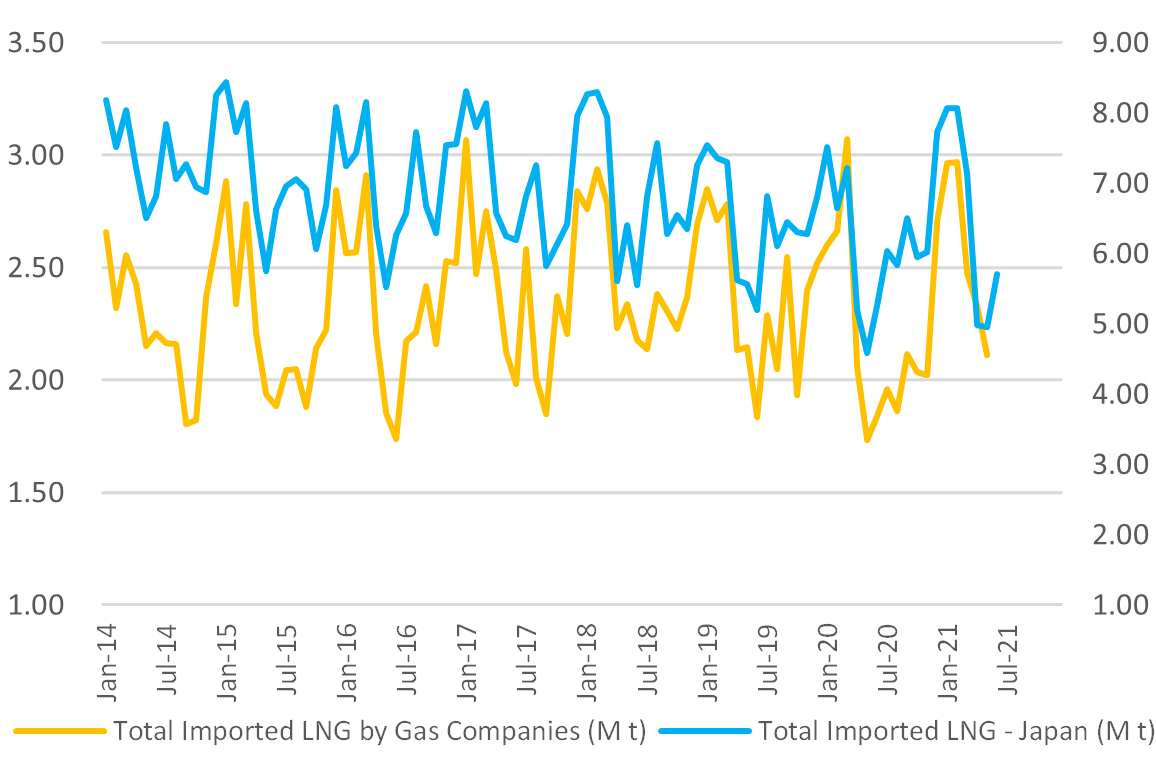
Total LNG Imports (M t)
LNG Imports by Gas Firms Only (M t)
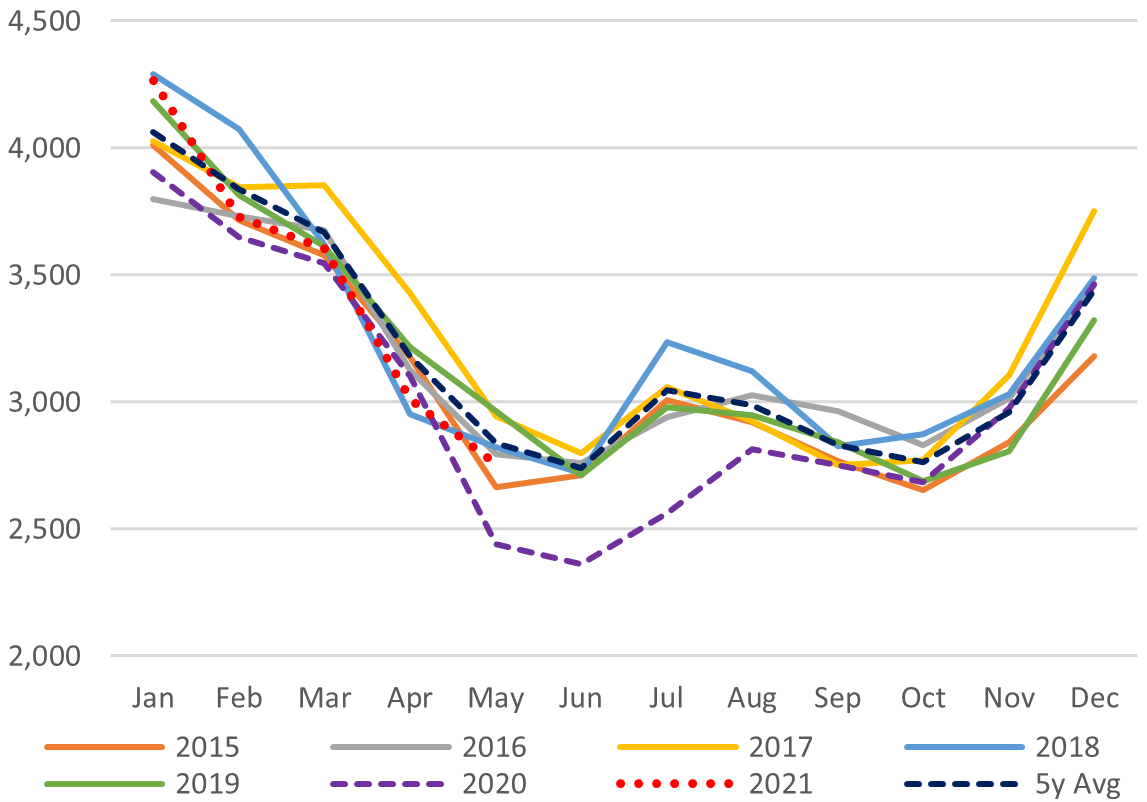
City Gas Sales – Total (M m3)
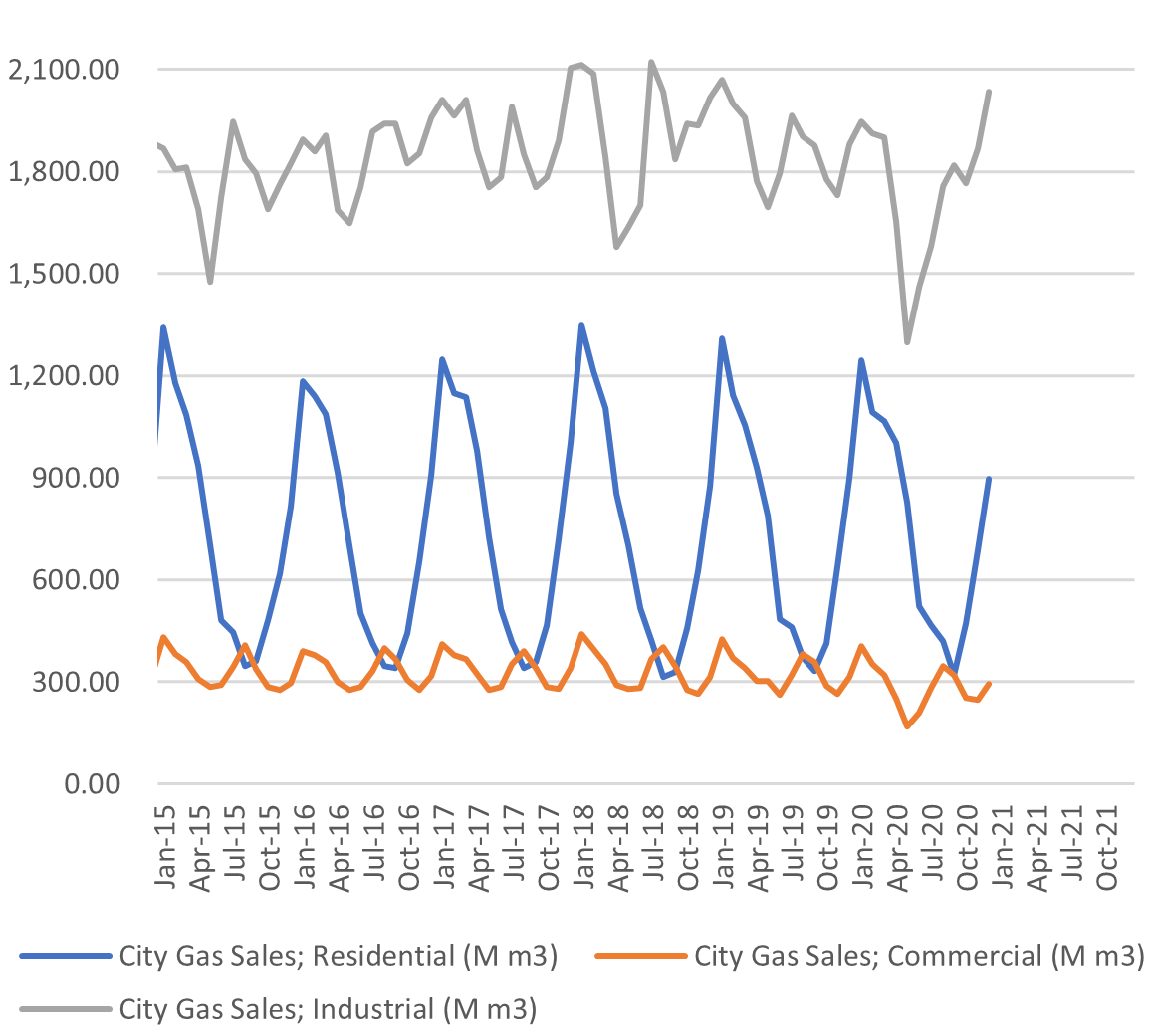
City Gas Sales by Sector (M m3)
SOURCES: Ministry of Economy, Trade, and Industry (METI),
Ministry of Finance
Japan Total Power Demand (GWh)
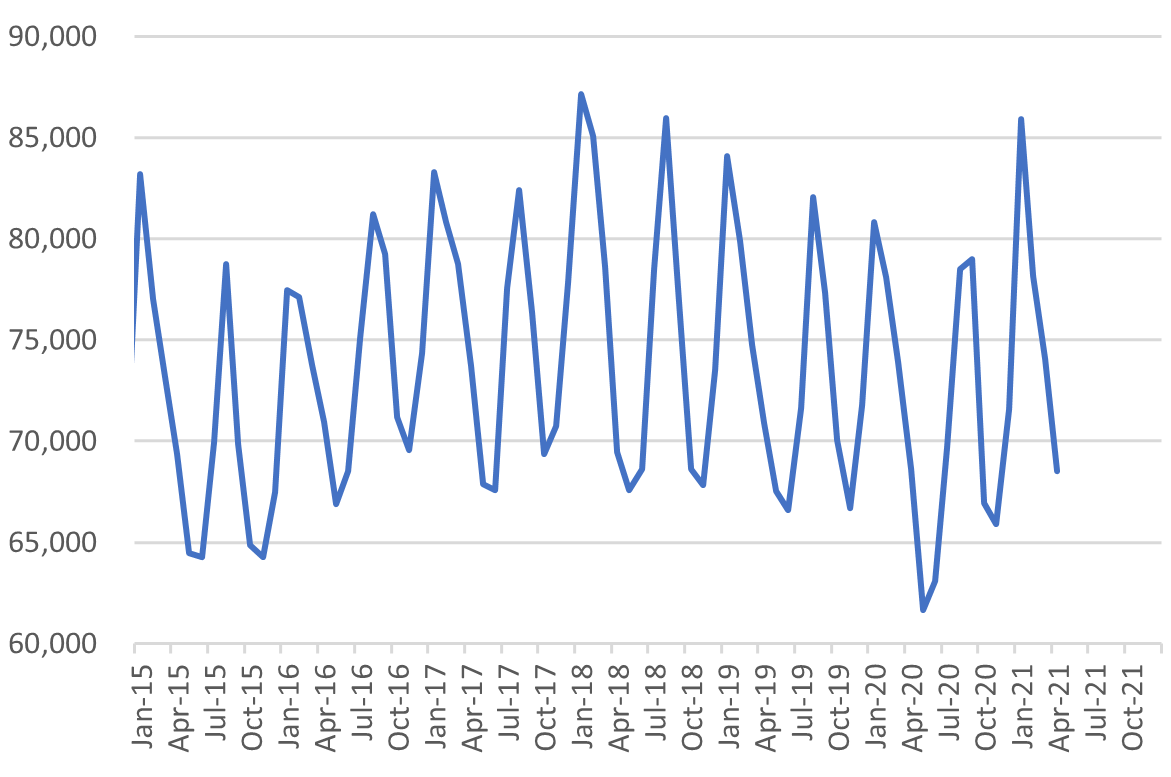
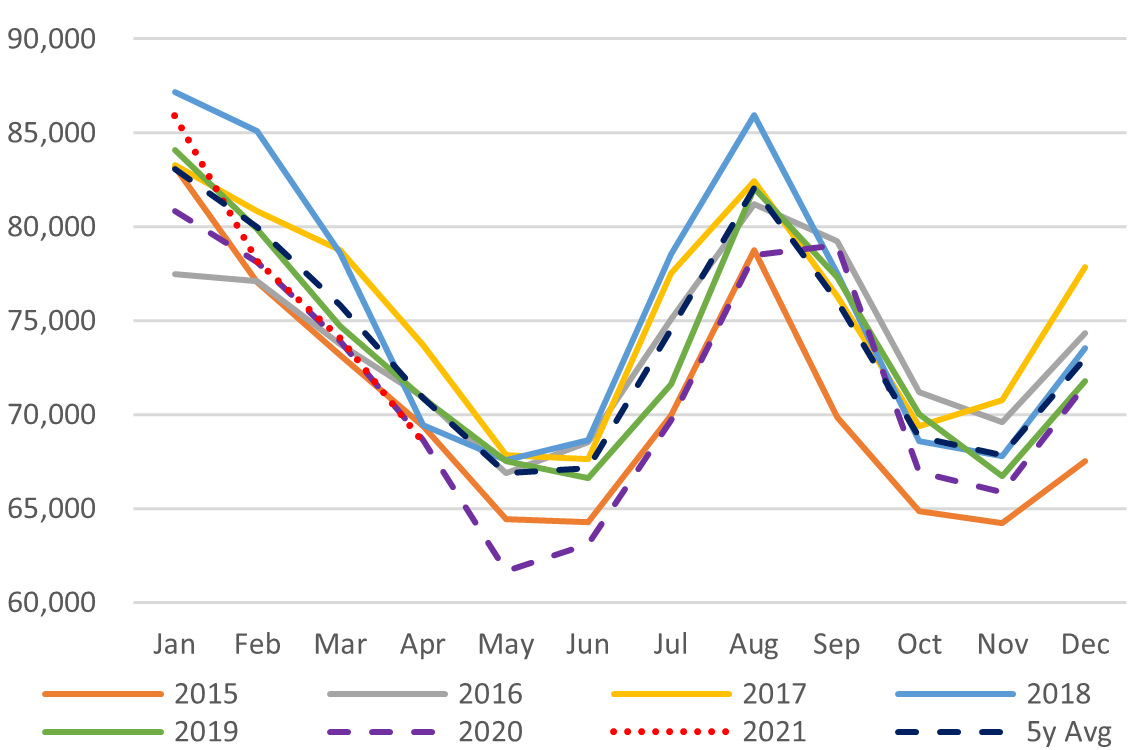
Current Vs Historical Demand (GWh)
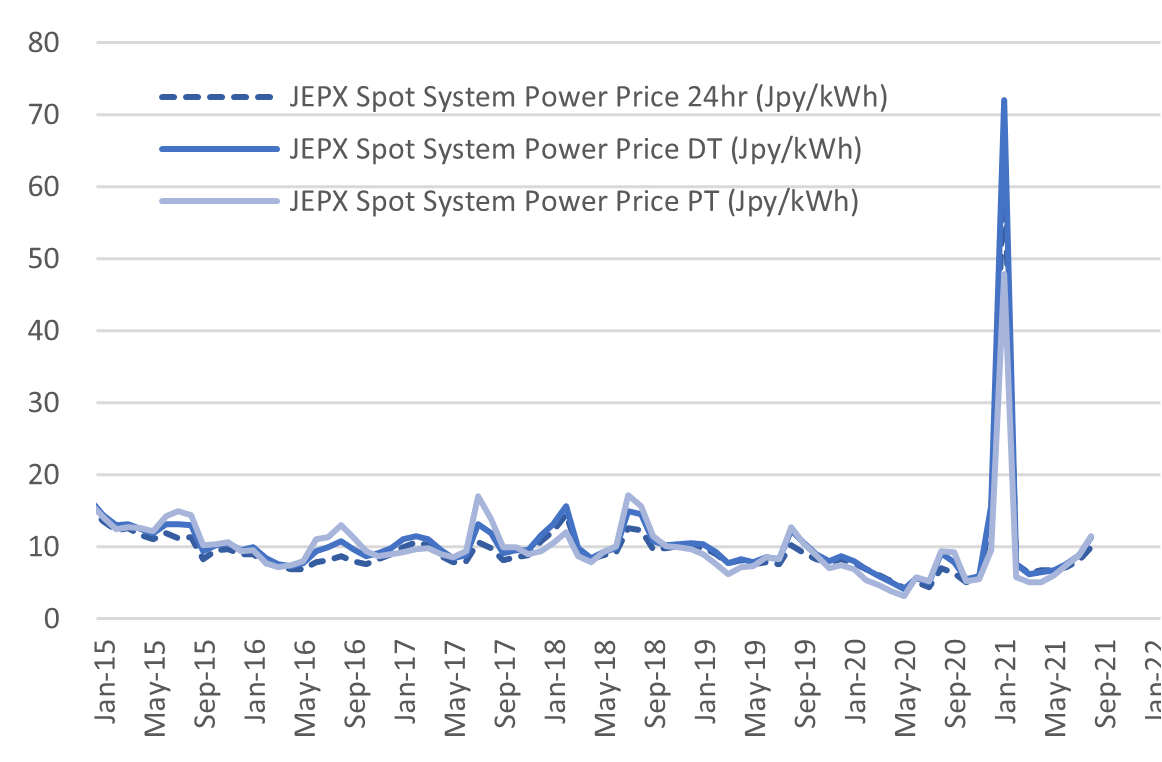
Day-Ahead Spot Electricity Prices
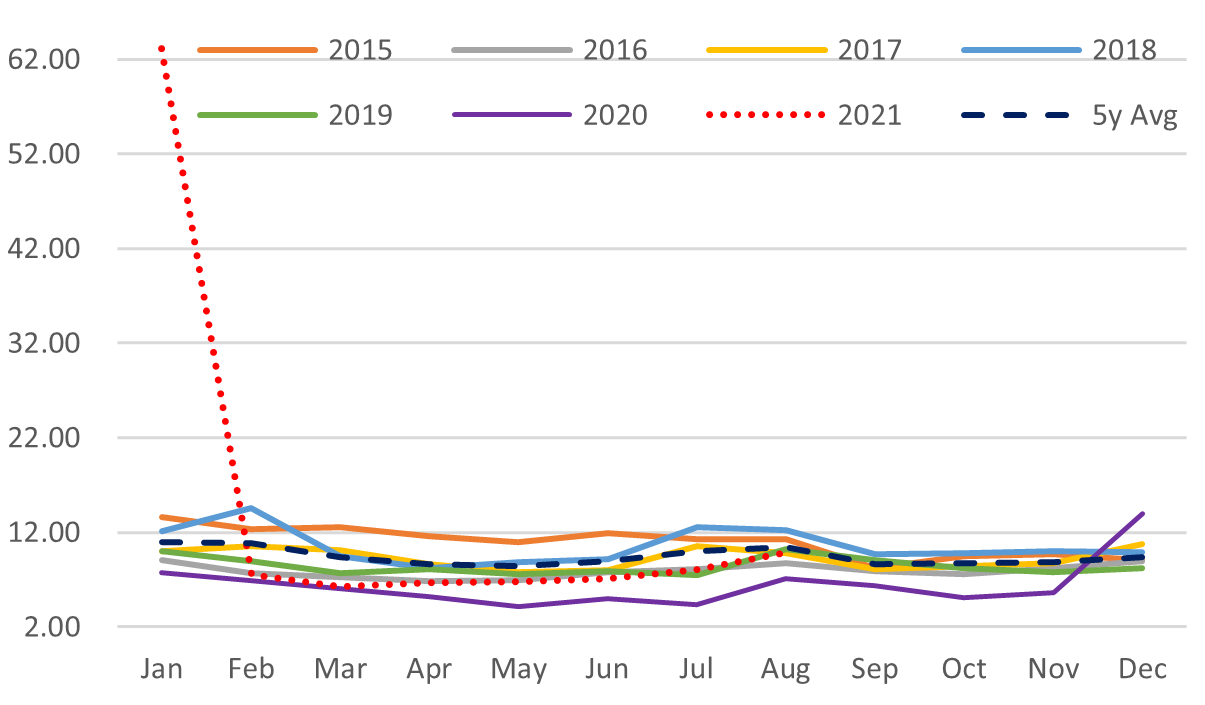
Day-Ahead Vs Day Time Vs Peak Time
LNG Imports by Electricity Utilities
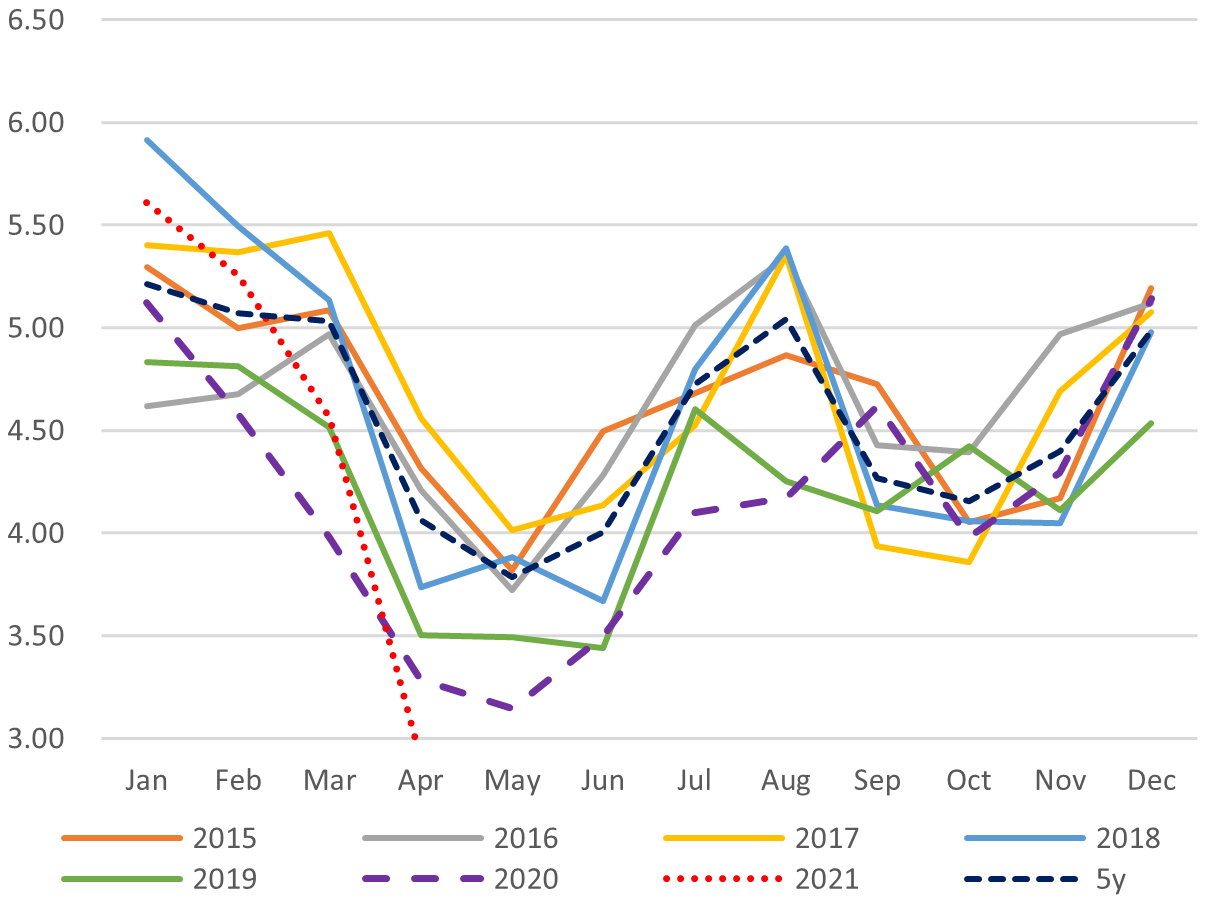
LNG Stockpiles of Electricity Utilities
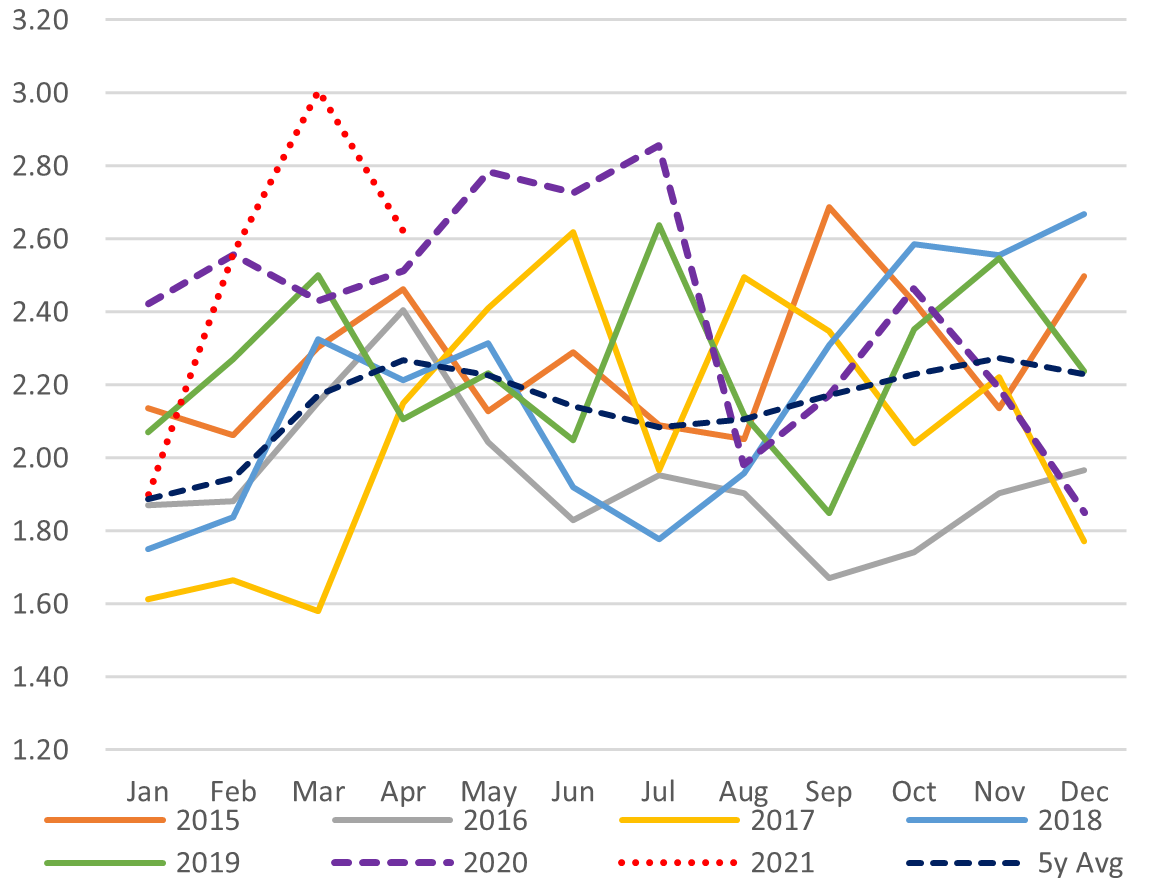
SOURCES: Ministry of Economy, Trade, and Industry (METI), and the Japan Electric Power Exchange
Disclaimer
This communication has been prepared for information purposes only, is confidential and may be legally privileged. This is a subscription-only service and is directed at those who have expressly asked K.K. Yuri Group or one of its representatives to be added to the mailing list. This document may not be onwardly circulated or reproduced without prior written consent from Yuri Group, which retains all copyright to the content of this report.
Yuri Group is not registered as an investment advisor in any jurisdiction. Our research and all the content express our opinions, which are generally based on available public information, field studies and own analysis. Content is limited to general comment upon general political, economic and market issues, asset classes and types of investments. The report and all of its content does not constitute a recommendation or solicitation to buy, sell, subscribe for or underwrite any product or physical commodity, or a financial instrument.
The information contained in this report is obtained from sources believed to be reliable and in good faith. No representation or warranty is made that it is accurate or complete. Opinions and views expressed are subject to change without notice, as are prices and availability, which are indicative only. There is no obligation to notify recipients of any changes to this data or to do so in the future. No responsibility is accepted for the use of or reliance on the information provided. In no circumstances will Yuri Group be liable for any indirect or direct loss, or consequential loss or damages arising from the use of, any inability to use, or any inaccuracy in the information.
K.K. Yuri Group: Oonoya Building 8F, Yotsuya 1-18, Shinjuku-ku, Tokyo, Japan, 160-0004.