
JAPAN NRG WEEKLY
AUGUST 16, 2021
JAPAN NRG WEEKLY
August 16, 2021
NEWS
TOP
- The future of TEPCO: media reports suggest the company may finally be edging to a mass reorganization and asset sales
- Government relaxes rules to qualify more offshore wind zones; part of effort to get more wind projects up and running faster
- Marubeni to create Japan’s first marketplace for older solar panels to reduce waste and make some panels available for export
ENERGY TRANSITION & POLICY
- Officials worry power market liberalization hurt backup capacity
- METI asks steel, chemicals, other sectors for net-zero roadmaps
- Government pushing for solar panels to be on 60% of new homes
- Mitsubishi Heavy, IBM to create carbon capture trading market
- Japan to strengthen monitoring of investors near key energy sites
- Panasonic to turn fuel-cell factory in Japan into a hydrogen plant
- Adnoc, Fertiglobe to sell blue ammonia to Japan’s Idemitsu
- Mitsubishi Electric to acquire British energy software company
- Sompo Japan releases insurance policy for tidal generation plants
- METI discloses offshore wind project details for Akita … [MORE]
ELECTRICITY MARKETS
- Sumitomo Mitsui ramps up investments in renewables as race to buy solar assets in Japan heats up
- New sites for solar farms scarce; companies look at new spaces
- ENEOS invests in a large-scale solar project in Japan
- Locals in Nara prefecture oppose a new large-scale solar project
- Transmission line catches fire at Chubu’s Hamaoka nuclear plant
- Chugoku Electric’s nuclear restart faces local distrust issues
- Chubu Electric unit rolls out a CO2-free power plan … [MORE]
OIL, GAS & MINING
- Japan banks worry about participating in Russia’s Artic LNG 2
- JAPEX back in the black on stronger crude prices and power sales
- Higher petrol prices hit households hard
- Last Japanese trader leaves London Metals Exchange trading floor
ANALYSIS
JAPAN’S MR. HYDROGEN SEES HIS DREAM REALIZED
AFTER 60-YEAR WAIT: THE STORY OF IWATANI
There’s a lot of excitement around hydrogen in Japan and many companies want to get involved Only one company, however, can currently produce the sought-after liquid form of hydrogen, a gas that burns without emitting CO2. Iwatani Corporation is Japan’s biggest (and in many segments only) hydrogen player. The quiet firm born in Osaka was one of the early believers in the fuel and now controls 70% of Japan’s hydrogen market. Not stopping there, it’s betting big that today’s hydrogen mania is based on real demand and is putting billions of dollars into a rapid output expansion over the next two-three years.
MITSUI SEES LNG BONANZA IN INDIA AS MORE JAPANESE FIRMS CONSIDER OVERSEAS GAS MARKETS
With future domestic demand becoming less certain, Japanese LNG traders like Mitsui & Co. are looking at overseas opportunities to sustain their strong global positions. One of these will be the potential gasification of India’s economy. Helping India switch from coal to gas will require more than just LNG procurement. It spells investments in pipelines and other delivery infrastructure, a factor that’s starting to offer contracts for Japan’s broader energy-industrial complex. Beyond the economic needs, India and Japan both view energy as a security issue.
GLOBAL VIEW
The IPCC releases its latest and most dramatic report on climate change. China signs off on huge new coal-reliant ironmaking capacity. North Sea wind capacity was at its lowest in 22 years in Q2. More M&A in U.S. shale. Germany prepares to start several gigafactories for EV batteries. Details on these and more in our global wrap.
EVENT CALENDAR / DATA SECTION
JAPAN NRG WEEKLY
PUBLISHER
K. K. Yuri Group
Editorial Team
Yuriy Humber (Editor-in-Chief)
Tom O’Sullivan (Japan, Middle East, Africa)
John Varoli (Americas)
Regular Contributors
Mayumi Watanabe (Japan)
Daniel Shulman (Japan)
Takehiro Masutomo (Japan)
Art & Design
22 Graphics Inc.
Sponsored
SUBSCRIPTIONS & ADVERTISING
Japan NRG offers individual, corporate and academic subscription plans. Basic details are our website or write to subscriptions@japan-nrg.com
For marketing, advertising, or collaboration opportunities, contact sales@japan-nrg.com
For all other inquiries, write to info@japan-nrg.com
OFTEN USED ACRONYMS
METI The Ministry of Energy, Trade and Industry
MOE Ministry of Environment
ANRE Agency for Natural Resources and Energy
NEDO New Energy and Industrial Technology Development Organization
TEPCO Tokyo Electric Power Company
KEPCO Kansai Electric Power Company
EPCO Electric Power Company
JCC Japan Crude Cocktail
JKM Japan Korea Market, the Platt’s LNG benchmark
CCUS Carbon Capture, Utilization and Storage
mmbtu Million British Thermal Units
mb/d Million barrels per day
mtoe Million Tons of Oil Equivalent
kWh Kilowatt hours (electricity generation volume)
NEWS: ENERGY TRANSITION & POLICY
METI/MLIT relax rules to qualify more offshore wind farm zones
(Japan NRG, Aug. 6)
- The METI and the Ministry of Land, Infrastructure, Transport and Tourism will allow regulatory flexibility in a bid to have more coastal areas qualify as offshore wind generation zones.
- Some companies may need to cancel potential projects as they have yet to secure guaranteed transmission network bandwidth from local grids. The ministries say operators can still have projects approved by the government if the grid connection has a high chance. In other words, operators need to have received a final grid commitment for their project at this stage.
- The govt. is also under pressure to speed up feasibility studies for wind power projects.
- In a bid to broaden the area on offer to wind power operators, NEDO in July launched studies around the Hirono coast of Iwate prefecture, the Sakata coast of Yamagata prefecture and the Iwanai-Minami Shiribeshi coast of Hokkaido. The three were selected out of 19 coastal candidate areas for offshore wind power development.
- SIDE DEVELOPMENT:
- METI discloses offshore wind project details for the Akita area
- (Japan NRG, Aug. 11)
- METI publicly disclosed details around the potential offshore wind projects in the coastal areas in Akita prefecture.
- The area was proposed as a Renewable Promotion Sea Zone on June 29.
- The Akita coastal area covers Happo-cho and Noshiro City.
- The disclosure period ends on Aug. 25.
Officials worry power market liberalization forces idling of backup capacities
(Nikkei, Aug. 12)
- State officials are increasingly worried that power market liberalization has removed motivation for power utilities to keep running older, more costly thermal power plants for backup, which is a risk for periods of high electricity demand.
- Utilities have idled older plants, while the restart of nuclear generation has consistently struggled. This is leading to more and more capacity crunch periods. On July 19, the operator of the Kanto area power grid (TEPCO) said the electricity system was operating at 95% capacity, which leaves little in reserve. That was the lowest reserve capacity level in the TEPCO grid system since 2019.
- Meanwhile, use of variable renewable energy sources, such as solar and wind, is increasing. Renewables made up about 20% of the electricity last fiscal year. But, when the sun does not shine and the wind does not blow, it’s important to have backup generation. With utilities closing some thermal plants, that available backup supply is no longer what it used to be, which makes the nation’s power system less stable.
- A METI executive said the ministry doesn’t want to see the power crunch in Texas earlier this year take place in Japan. Some in the power industry bureaucracy are concerned that liberalization has been a great burden on the industry.
- TAKEAWAY: These kinds of voices that question the market’s liberalization have been more vocal in the last year or so. This speaks more to the transitional nature of the industry in Japan and the fact that the old system was based on stable supply at all cost (literally). It’s highly unlikely that Japan would go back to the old system, but it does mean that the government is likely to look at ways to incentivize utilities to retain backup (thermal and nuclear) power.
METI asks steel, chemical, cement, power, gas and oil sectors for transition road maps
(Japan NRG, Aug. 6)
- METI asked companies in the steel, chemical, cement, power, oil and gas sectors to draw up carbon neutrality transition roadmaps during the current fiscal term (which ends March 2022).
- Firms in each sector must list technologies they will deploy for decarbonization, as well as the scientific data that backs up their effectiveness. The reports to METI should also include a description of how the transition to new technologies will be financed.
- A panel on transition finance will review the scenarios in an upcoming session. METI is also soliciting input from the public on best practices in transition financing.
- METI then plans to publish selected approaches from those submitted as an example of best practices and to serve as models for others. Among criteria high on METI’s agenda are effectiveness of financing, corporate governance and transparency, the scale of ambition behind the plans, and impact on Japan.
Marubeni to create a market to buy and sell used solar panels
(Nikkei, Aug. 11)
- Marubeni is entering the solar panel resale market and will use blockchain technology to authenticate and link panels to performance data and information on use history.
- The company plans to launch a website as early as next fiscal year where buyers and sellers can provide information and make trades. Marubeni will participate in the market, looking to make money from buying, selling, exporting and generating power from used panels.
- By mid-2030s, 800,000 metric tons of second-hand solar panels are forecasted for resale annually.
- Increased reuse of panels is expected to reduce the number of panels dumped illegally.
- CONTEXT: There’s no real market in Japan for resale of solar panels and this would create an entirely new marketplace.
Government pushes for solar panels on 60% of new houses by 2030
(Asahi Shimbun, Aug. 10)
- The Ministry of Land, Infrastructure, Transport and Tourism has set a target for 60% of new houses to have solar panels on their roofs by 2030. As an incentive, the Ministry plans new subsidies.
- Currently, only around 15% of new houses are fitted with solar panels.
- The Ministry stopped short of making panels mandatory, but said such a step will be an option.
Mitsubishi Heavy and IBM to create a carbon capture trading market by 2025
(Asia Nikkei, Aug. 14)
- Mitsubishi Heavy Industries and IBM Japan plant to create a carbon capture trading market. Trial operations in Japan may start next year leading up to full trading as early as 2025.
- Power companies and steelmakers are among the expected sellers, with chemical and fuel producers as buyers. Some chemical firms have come up with innovative goods that rely on CO2 as a raw material, such as polycarbonate and urethane plastics.
- Trading of captured carbon currently takes place directly between companies. But there’s no general market with buyers and sellers. By providing better access to buyers, a trading system helps fuel innovation while sellers become more willing to invest in sequestration facilities.
- The idea is that the trading of CO2 leads to more productivity and help companies decarbonize.
- CONTEXT: Mitsubishi Heavy holds a 70% share of the global market for carbon capture plants. In terms of operations, the company will place sensors throughout the distribution chain, including the transport network and sequestration facilities. This will allow the trading system to be developed with IBM Japan to cover the entire process from carbon capture to carbon storage. The data will be secured with blockchain technology.
- CONTEXT: Whether the new market catches on will hinge on compatibility with carbon trading mechanisms in the EU and elsewhere. Under the existing cap-and-trade framework, it’s unclear if captured carbon sold to a chemical manufacturer counts toward carbon credit for the seller.
Japan to strengthen monitoring of investors near key energy and security sites
(Asia Nikkei, Aug. 12)
- Japan’s government has begun weighing sites for new restrictions on land transactions involving foreign buyers, a task expected to span roughly 600 defense installations as well as areas around nuclear power plants and other vital infrastructure.
- Site designations will begin in fall 2022.
- In 2020, the authorities discovered that a Chinese-owned buyer had bought land and built wind turbines only about 1 km away from an Air Self-Defense Force radar site in Wakkanai, a city on the northern tip of the island of Hokkaido. This was deemed as potentially hindering Japan’s warning capabilities of foreign warplanes.
Panasonic to turn fuel-cell factory in Japan into a hydrogen plant
(Bloomberg, Aug. 10)
- Panasonic is turning a fuel-cell factory in the lakeside city of Kusatsu in central Japan into what could be the world’s first hydrogen-based plant powered entirely by renewable energy.
- The government’s carbon-neutral policy is a “tailwind” for Panasonic’s hydrogen-factory project, and the company intends to commercialize the system by fiscal 2023 and sell it globally.
Adnoc and Fertiglobe to sell blue ammonia to Japan’s Idemitsu
(Reuters, Aug. 10)
- The Abu Dhabi National Oil Co (ADNOC) and Fertiglobe have agreed to sell blue ammonia to Japan’s Idemitsu for use in its refining and petrochemicals operations.
- The sale builds upon recently announced joint efforts to enhance industrial cooperation between the United Arab Emirates and Japan.
- Earlier this month, UAE made its first sale of a blue ammonia cargo to trading house Itochu Corp.
Mitsubishi Electric to acquire British energy software company
(Nikkei, Aug. 10)
- Mitsubishi Electric will acquire UK-based Smarter Grid Solutions in August.
- While the sale value is undisclosed, it’s expected to be in the billions of yen.
- Smarter Grid Solutions supplies software solutions for controlling distributed generation grids.
Sompo Japan to insure tidal power
(Nikkan Kogyo Shimbun, Aug. 11)
- Major insurance company Sompo Japan released a comprehensive insurance policy to cover operators of tidal generation systems.
- The policy insures operators against damage to equipment caused by a wide range of events, including natural disasters and employee negligence.
- Sompo hopes the new policy will encourage growth of the sector, thereby contributing to the reduction of carbon emissions.
NEWS: POWER MARKETS
| No. of operable nuclear reactors | 33 | |
| of which | applied for restart | 25 |
| approved by regulator | 17 | |
| restarted | 10 | |
| in operation today | 9 | |
| able to use MOX fuel | 4 | |
| No. of nuclear reactors under construction | 3 | |
| No. of reactors slated for decommissioning | 27 | |
| of which | completed work | 1 |
| started process | 4 | |
| yet to start / not known | 22 | |
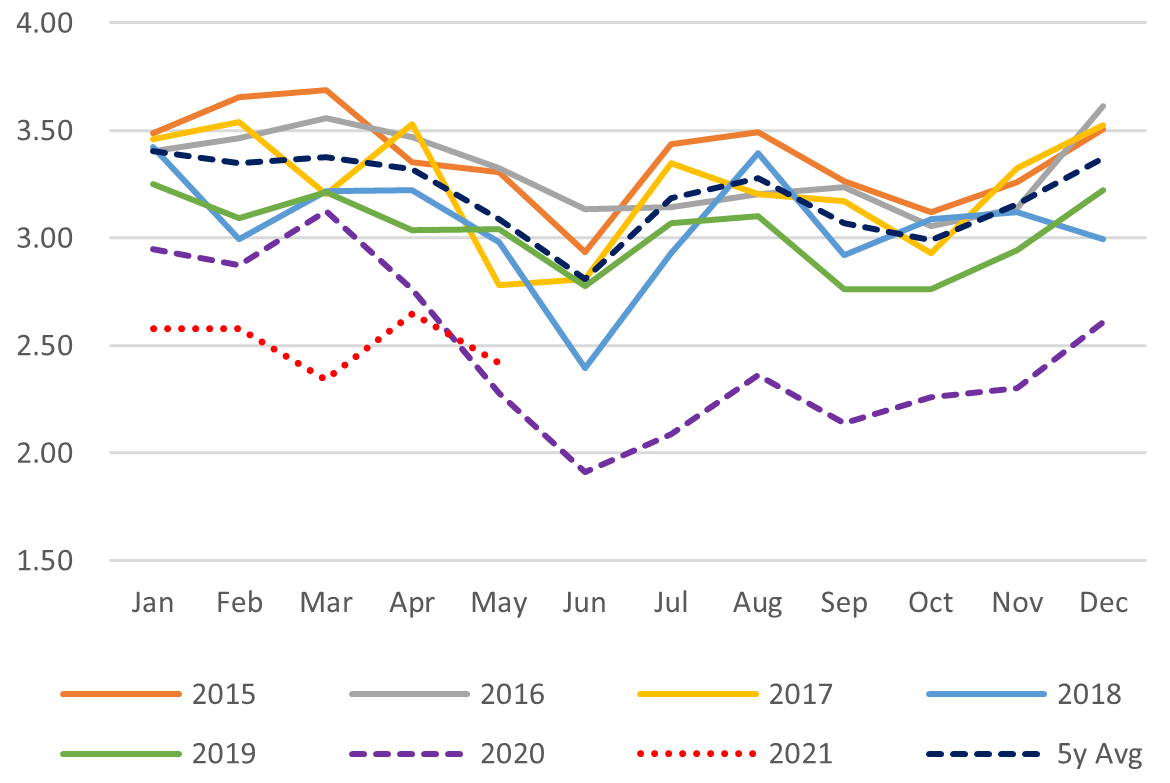
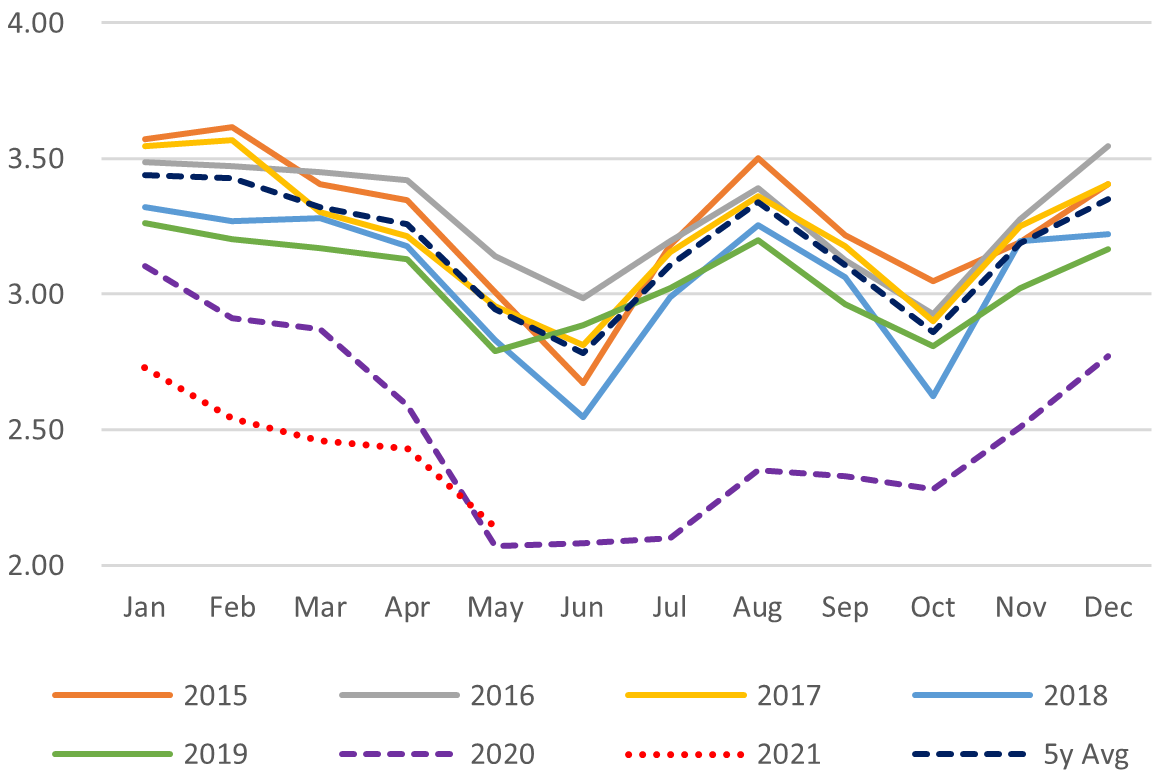
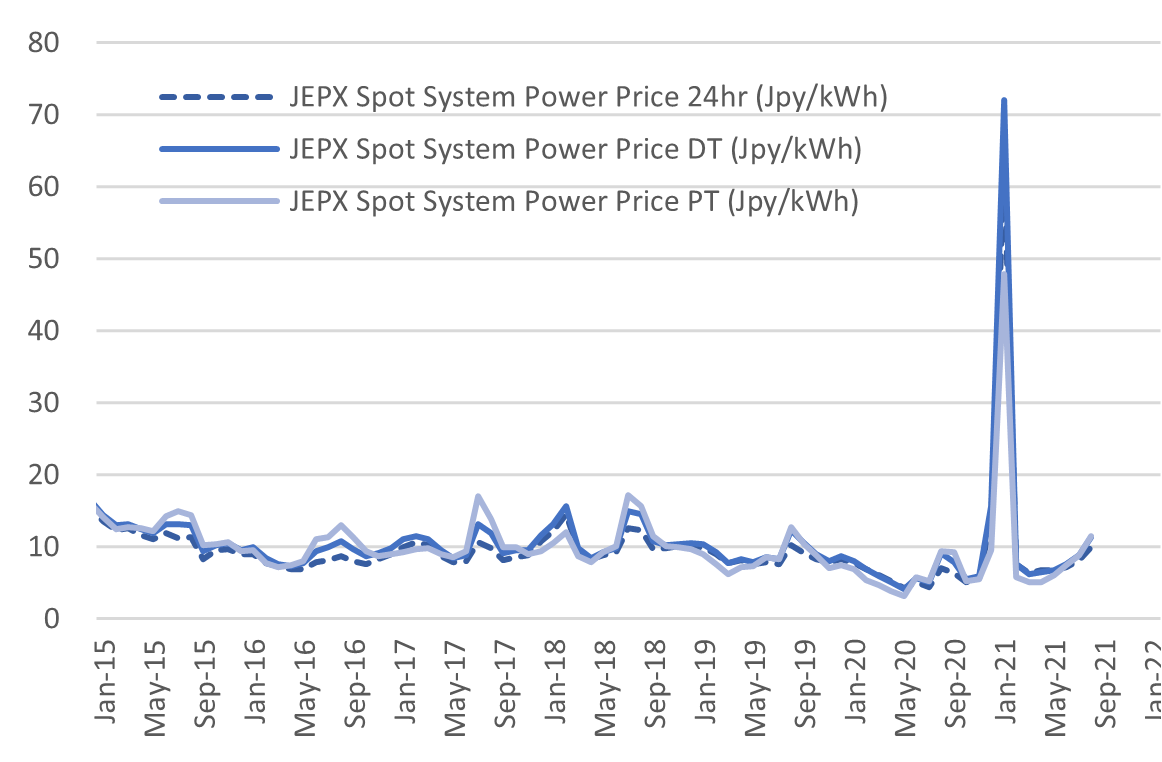
Spot Electricity Prices, Monthly Avg.
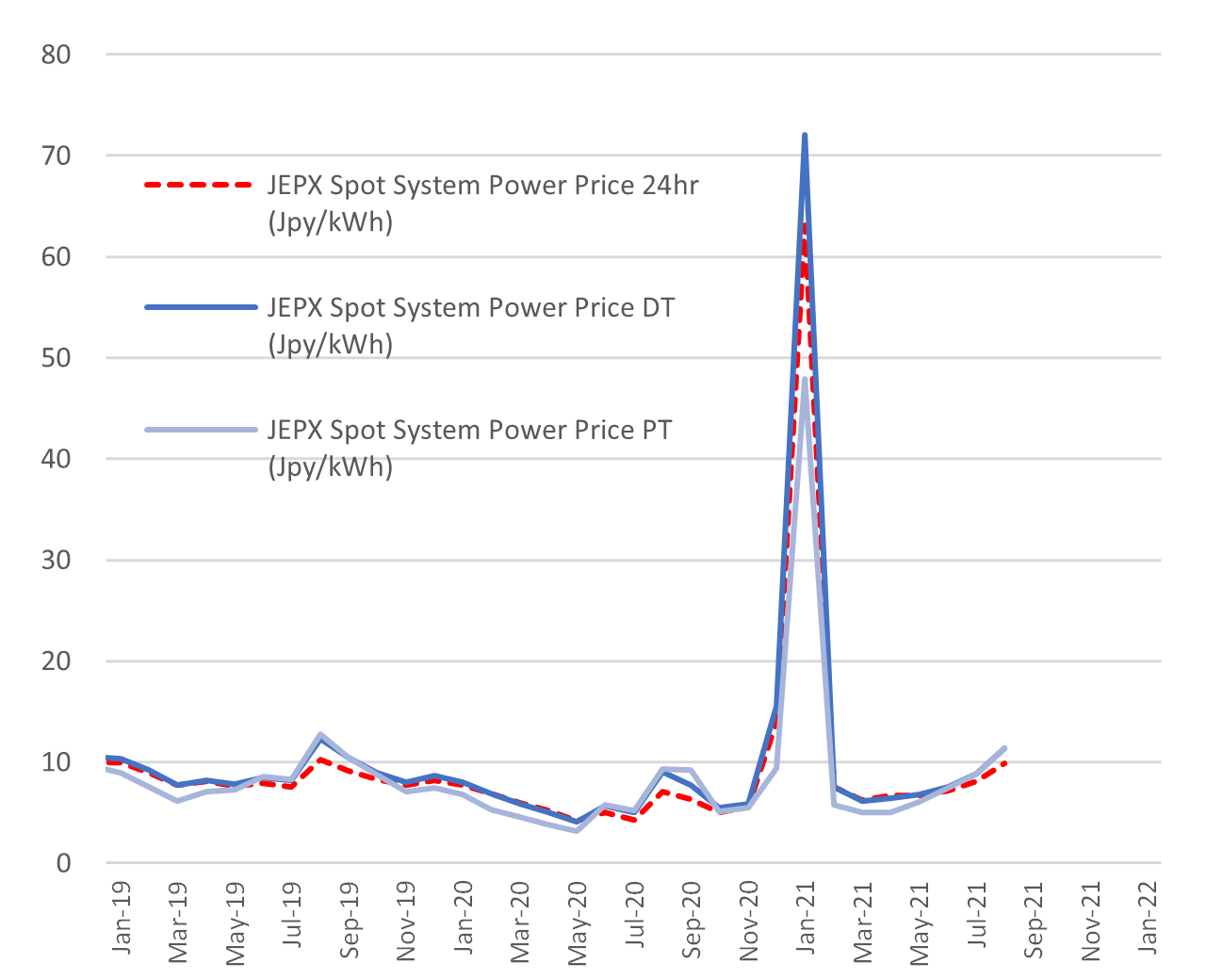
Source: Company websites, JANSI and JAIF, as of Aug 10, 2021
What is the future of Japan’s largest power utility – TEPCO?
- It was once one of the world’s biggest electricity companies with ambitions to expand globally. The 2011 accident at the Fukushima Dai-Ichi NPP changed all that. Faced with fantastic liabilities, the utility saw its stock and management taken over by the government.
- The idea was that the government control would be temporary. But, more than 10 years on, TEPCO Group doesn’t look like a company that can crawl back to independence and business success. It has and continues to face multiple scandals, not only related to its nuclear segment.
- For many industry insiders and experts, TEPCO is on a path to a mass restructuring. Below are some recent articles that explain its troubles and potential future developments.
- SIDE DEVELOPMENT:
- Carving up TEPCO; Part 1: Shocking details of TEPCO sell-off emerge
- (Diamond Online, Aug. 10)
- A recent TEPCO strategy document casually declared that the TEPCO group would withdraw from or downsize unprofitable operations or those that didn’t significantly contribute to value creation, and would embark on major restructuring of its portfolio.
- A member of TEPCO management attributed the statement to new chair Kobayashi, saying that no career TEPCO official would use such cold and calculating language.
- The retail arm, TEPCO Energy Partners, saw profits in the year to March fall 90% over the year before. An ex-employee says it’s a matter of time before Energy Partners is sold.
- However, sources confirm that TEPCO is considering selling the ‘crown jewel’: renewable energy service provider TEPCO Renewable Power (RP). This is astonishing when one considers the value of renewable operations as utilities attempt to cut carbon emissions. TEPCO RP owns 9.9 GW of renewable generation capacity, almost all of it hydroelectric.
- Sources estimate the current value of TEPCO RP, which posted an ordinary profit of ¥48 billion in the year to March, at over ¥1 trillion. The high premium over the company’s ¥400 billion book value is attributable to the current boom in renewable energy.
- TEPCO intends to use the revenue from the sale of TEPCO RP to defray the cost of the Fukushima clean-up, estimated at more than ¥21 trillion.
- SIDE DEVELOPMENT:
- Carving up TEPCO; Part 2: speculation rife over TEPCO EP buyer
- (Diamond Online, Aug. 11)
- Many corporations are seen as potential buyers of TEPCO’s retail arm TEPCO Energy Partners (EP), including ENEOS, Tokyo Gas, Marubeni, Chubu Electric Power Miraiz, Kyuden Mirai Energy, and NTT affiliate Ennet.
- There’s speculation that TEPCO group may sell its thermal generation operation, TEPCO Fuel & Power, by 2030, leaving only transmission arm TEPCO Power Grid and the nuclear power, reactor decommissioning, and Fukushima clean-up operations.
- SIDE DEVELOPMENT:
- Carving up TEPCO; Part 3: who will be TEPCO’s next CEO?
- (Diamond Online, Aug. 12)
- TEPCO Holdings CEO Kobayagawa Tomoaki’s appointment in 2017 created waves: he was the youngest to fill the position.
- Market insiders have harsh words for Kobayagawa, saying he might be a great salesman but he’s poor at running the business.
- In the five years since Kobayagawa took over as CEO, TEPCO’s share price has slid from nearly ¥800 to less than ¥300.
- Sources expect Kobayagawa to stand down by no later than next year.
- The person most likely to replace Kobayagawa is VP Fubasami Seiichi, who has worked for the utility since 1985. Skeptics say Fubasami could bring a return to the ‘old TEPCO’.
- The other three candidates are executive director Nagasaki Momoko, who would be TEPCO’s first female CEO, retail arm head Akimoto Nobuhide, and TEPCO Renewable Power head Nagasawa Masashi.
- SIDE DEVELOPMENT:
- Carving up TEPCO; Part 4: the reality of TEPCO salaries post-Fukushima
- (Diamond Online, Aug. 13)
- Before the 2011 Fukushima nuclear disaster, the average TEPCO full-time employee earned an annual salary of around ¥8 million.
- After the disaster, this figure fell to just over ¥6 million after a round of steep pay cuts saw new recruits earn a mere ¥2 million.
- Thanks to a cost-cutting campaign, however, TEPCO has managed to increase the salary of its average employee to over ¥8 million.
- Higher salaries come at a price though. TEPCO downsized its workforce by over 10,000 since 2011, causing employees to be overworked and more prone to making mistakes, says one senior TEPCO Energy Partner official.
- SIDE DEVELOPMENT:
- TEPCO Energy Partner changes tack, pursues added value
(Nikkei, Aug. 120- Facing market share decline and losses, TEPCO Energy Partner will reconsider strategy.
- CEO Akimoto Nobuhide indicated a departure from discounting strategies, saying subscribers are no longer purely interested in low rates.
- Instead, Energy Partner hopes to add value by offering service packages that include gas, appliance maintenance and even plumbing.
- SIDE DEVELOPMENT:
- TEPCO long-term debt given A rating
- (Japan Credit Rating Agency, Aug. 13)
- The Japan Credit Rating Agency assigned an A rating to long term bonds issued by TEPCO Holdings, TEPCO Power Grid, and TEPCO Renewable Power in recognition in part of the fact that arrangements regarding the Fukushima clean-up effort being conducted jointly between TEPCO and the government remain unchanged.
- While questions hang over the restart of the Kashiwazaki-Kariwa plant, JCR said it has no concerns in regard to TEPCO’s relationships with its lenders.
- SIDE DEVELOPMENT:
- The never-ending TEPCO “slump” caused by its inept retail subsidiary
(Sentaku, Aug. 2021 edition)- CONTEXT: This article drills into problems that plague Japan’s biggest power utility, focusing on how its retail unit caused many problems. It relates many of the events in January 2021, when domestic power prices spiked.
- TEPCO’s liabilities around the Fukushima nuclear accident are now at ¥16 trillion and the company shows little sign of ever recovering the money. Staff morale is low, client numbers are declining, and the restart of its one operable nuclear power plant, the Kashiwazaki Kariwa, has been delayed further.
- TEPCO needs annual earnings of at least ¥450 billion to service debts. For FY2020, it only achieved ¥189.8 billion, a YoY 28% decrease.
- CONTEXT: The above refers to “ordinary income”, a measure that’s more popular in Japan than operating income. TEPCO also posted a 32.3% drop in operating income YoY in the same period.
- Those associated with the company think this means TEPCO will have to remain under state management forever.
- Last year’s profit drop is mostly due to poor results from TEPCO Energy Partner whose management is mostly inexperienced, and business performance reflects this.
- One example is when power prices spiked in January 2021, in part due to TEPCO EP stopping sales to its own subsidiary, TCS, in order to prioritize sales to the Tokyo area. This caused TCS to dive into the spot market, causing the price to jump. As a result, TCS posted ¥25 billion in losses last fiscal year, which affected TEPCO EP financials.
- Although TEPCO EP stopped supplying TCS, it found power for clients Erex, SoftBank and Nippon Gas, selling them electricity for ¥7-¥8 per kilowatt-hour. Erex then resold this power in the spot market for over ¥200, then reporting record earnings last year.
- Erex isn’t just any client. TEPCO EP set up a JV with it in March 2019. Erex owns 66% and TEPCO EP the rest. Last summer, the JV took over all Erex corporate power contracts.
- A few years ago, market insiders believed Erex would be absorbed by TEPCO. However, Erex CEO Honna Hitoshi shrewdly recruited former J-Power executive Takemata Kuniharu and used the latter’s connections to lure TEPCO into a JV instead. Honna also got close to Kyushu Electric and invited Kimura Shigeru, a former VP of TEPCO, to join the Erex board. This helped Erex continue to receive power from TEPCO EP at a low price.
- The January price spike upset Kyushu Electric, leading to Takemata resigning from Erex this June. On the other hand Kimura remains with Erex.
- Meanwhile, Honna has added Erex’s household power retail business to the TEPCO JV, and has increased his company’s stake to 77%. Now, TEPCO is in a JV in which it can’t oppose decisions made by Erex.
- TEPCO EP is mostly ruled by its vice president, Sato Michio. But, Sato, much like the president, Akimoto Nobuhide, has little sales experience. When it came to internal TEPCO EP discussions about whether to continue to supply TCS and other clients in January, Sato strongly opposed stopping sales to Erex, Softbank and Nippon Gas.
- According to internal TEPCO EP chatter, Sato’s son works in the Erex accounting department. Given his age, it’s unlikely Sato will be promoted to top positions at TEPCO Group; most consider he’ll move to Erex, like Kimura.
- If TEPCO EP’s troubles continue they could engulf the TEPCO group, leading to a reorganization. The govt. is considering whether to split the Fukushima decommissioning work from TEPCO and take away some other assets.
- METI is advised by people like Erex’s Honna to put all of TEPCO’s residential power retail business into TCS. That customer base could number more than 20 million users in the Tokyo area. Then, the company will be a very attractive prize that many firms like Erex, Chubu Electric, Osaka Gas, ENEOS and Mitsubishi Corp wish to acquire.
Sumitomo Mitsui hikes investments in renewables as race to buy solar heats up
(Newswitch, Aug. 10)
- Sumitomo Mitsui Finance and Lease is ramping up investment in renewables, with plans to spend ¥100 billion on solar farms by 2025.
- The company plans more solar operator acquisitions, and to enter the wind and biomass markets.
- Meanwhile, competitor Tokyo Century more than doubled long-term renewables investment budget to ¥350 billion.
- In terms of size and capacity, Orix still dominates the market, investing ¥500 billion in renewables and more than doubled capacity target for 2025, to 8 GW.
- The carbon neutrality boom caused M&A costs to increase, and suitable land is scarce. Lease operators must be agile, exercise good judgement, and have sufficient resources to survive.
Finding new solar sites in Japan proving tough; calls for innovation
(Nikkei, Aug. 10)
- As land suitable for solar farms becomes increasingly scarce, the battle is on to find new sites suitable for erecting photovoltaic panels.
- In addition to the mounting of panels over cultivated land, there’s interest in building solar roofs over parking lots, floating solar farms on lakes and ponds, attaching solar panels to the walls of office buildings, and mounting solar panels on unused land in airports.
- Construction company Taisei Corporation even started integrating photovoltaic panels into the glass used for office building windows.
ENEOS invests in a large-scale solar project
(SankeiBiz, Aug. 13)
- Major petrochemical company ENEOS invested in a 120 MW solar farm to be built in Hyogo.
- The farm is scheduled to begin feeding the grid by the end of 2023.
- The project represents ENEOS’ largest to date.
Locals oppose solar farm in western Japan
(NHK, Aug. 11)
- Over 600 residents of Yamazoe (Nara) signed a petition sent to the village council opposing construction of a large solar farm.
- This is the fourth such petition, bringing the total number of signatures to over 2,200. Opponents cite environmental destruction from solar farms.
- The prospective developer will host an information session aimed at residents in the hope of gaining their approval of the farm.
- SIDE DEVELOPMENT:
- Solar energy faces backlash amid landslide concerns
- (Nikkei, Aug. 11)
- Amid concerns that solar farms create visual pollution, damage ecosystems, and increase landslide risks and other calamities, more local bodies are passing bylaws to impose restrictions on solar developments.
- While before 2014 such action was rare, today over 150 local bodies restrict solar development.
- To address environmental concerns developers such as ETS Holdings have started surveying the ecosystems of solar sites before developing them and dispersing microorganisms to maintain the health of the soil.
Transmission line catches fire at Hamaoka nuclear plant
(Shizuoka Shimbun, Aug. 13)
- On Aug. 12 a section of transmission line on the grounds of the Hamaoka nuclear power plant caught fire, causing some damage.
- Chubu Electric says the plant was not affected and is investigating.
Chugoku Electric nuclear restart will come up against local distrust
(Zaiten, September 2021 edition)
- CONTEXT: This magazine article examines Chugoku Electric’s plans to restart Shimane NPP Unit 2, the nuclear facility in Matsue City.
- While the industry regulator approved installed safety measures necessary for the restart of the Shimane reactor, it won’t be plain sailing for Chugoku Electric; the company isn’t trusted by locals due to several past incidents.
- The magazine cites cases in which confidential documents were thrown away by the utility, improper records of facility inspections, staff accidents inside the plant, and even a case of a minor fire at Unit 1 of the Shimane NPP.
- The main scandal around Chugoku Electric occurred 11 years ago. In March 2010, the company failed to inspect over 500 areas at the Unit 1 and Unit 2 reactors. The incident was serious enough for METI to order administrative action in June of the same year. Also, a manager in charge of an internal company probe into the matter committed suicide.
- The Shimane station has been shut for almost a decade, almost since the Fukushima accident. Almost half of the current staff who operate the reactors have no experience doing so.
- The magazine notes that the inspection of Shimane’s restart documentation has gone on longer than for nuclear units of other power companies, and speculates this is due to the regulator not trusting Chugoku Electric.
- The same attitude of distrust is apparent locally. The governor of Shimane prefecture, Hirai Shinji, has insisted that Chugoku Electric wins over the mayors of nearby cities (Maizu, Sakai Minato, Izumo and Yunnan) before any moves to switch the reactor back on are made. This promises to be a long road back to nuclear generation for the company.
Chubu Electric Power Miraiz supplying carbon-free electricity in Mie
(Nikkan Kogyo Shimbun, Aug. 9)
- Chubu Electric Power Miraiz began supplying green electricity in Mie prefecture sourced from local hydroelectric power stations.
- Subscribers are issued with certificates attesting to the fact that their electricity was not generated using fossil fuels.
NEWS:
OIL, GAS & MINING
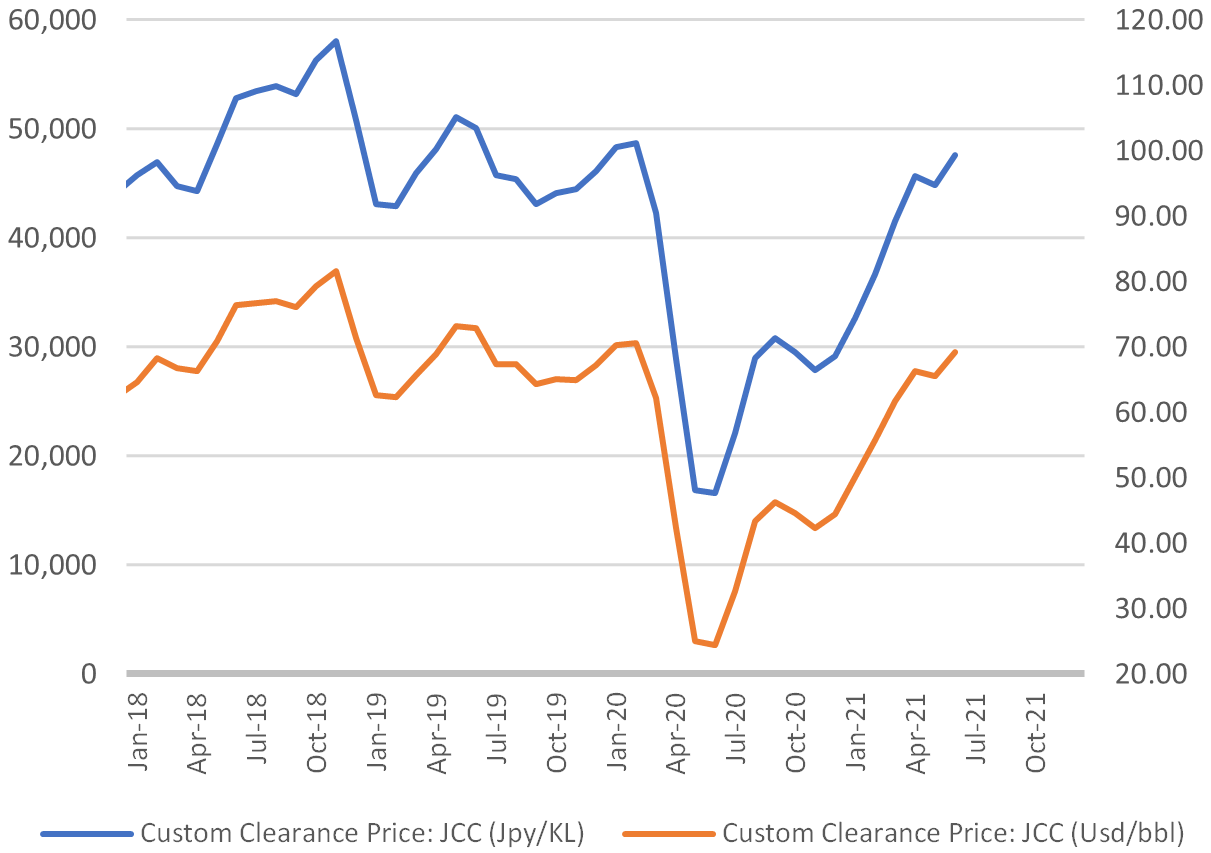
Japan Oil Price: $69.11/ barrel
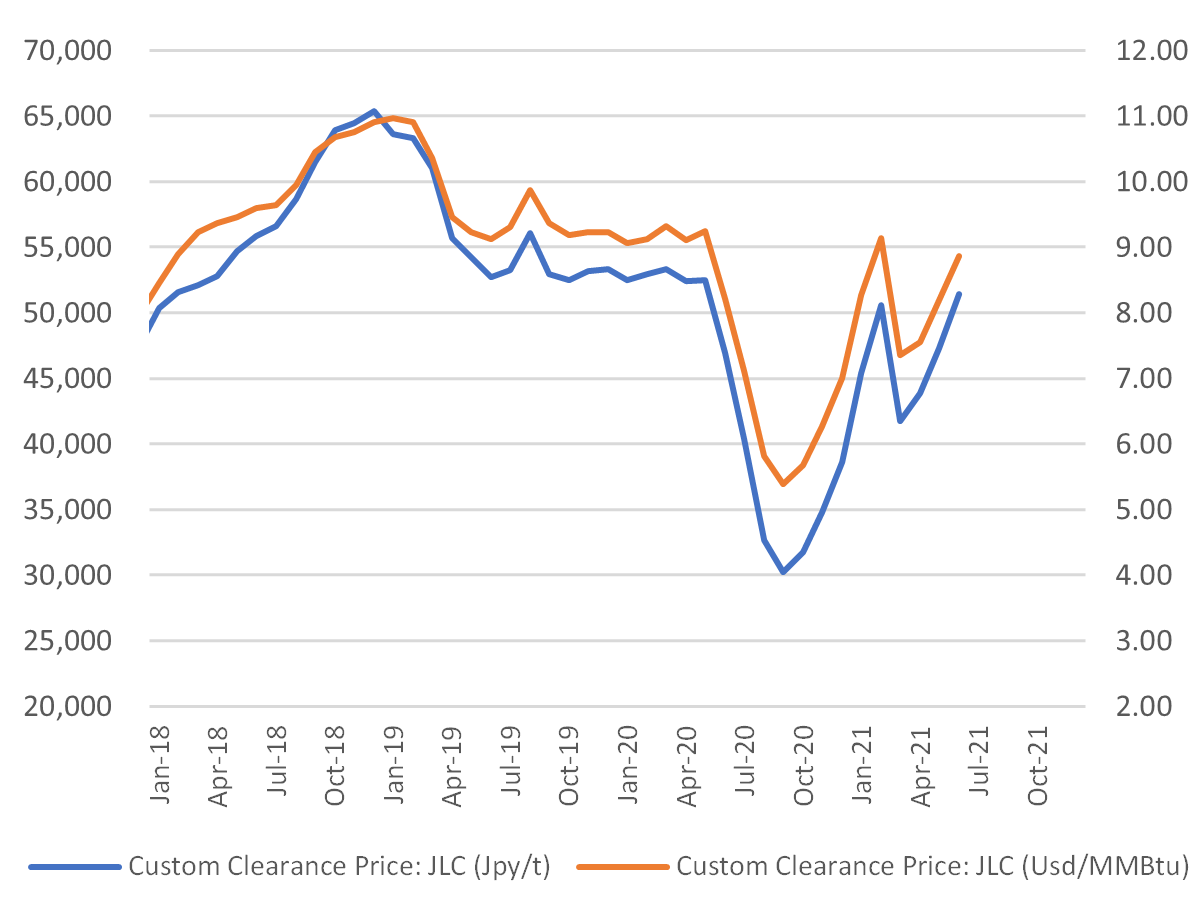
Japan (JLC) LNG Price: $8.86/ mmbtu
Japanese banks worry about participating in Russia’s Arctic LNG 2 project
(Sentaku, Aug. 2021 edition)
- The article repeats earlier reports in Japan about an Italian bank that was involved in funding the Arctic LNG 2 project had pulled out in June. The Italian bank cited environmental issues, but whatever the real reason it leaves Japanese banks with a predicament.
- Initially, the Japan Bank for International Cooperation (JBIC) rallied Japanese lenders to get involved. They planned to collectively provide about ¥200 billion for the Arctic LNG 2 development.
- Since this is a Russian project, few western countries are involved. With Italy pulling out, Japanese banks like Mitsui Sumitomo are getting cold feet.
- Japan’s participation in Arctic LNG 2 was part of former PM Abe’s foreign policy to improve ties with Russia. But this carried political risks from the start.
TAKEAWAY: This $21 billion project is controlled by Russian gas producer Novatek, which has good relations with Japanese energy companies. Indeed, Mitsui & Co is one of the investors, as is state-backed JOGMEC. However, European Parliament lawmakers have been lobbying leaders in Germany, France and Italy not to support the Arctic LNG development due to climate change concerns. That may be the reason for the Italian bank’s withdrawal.
It’s very unlikely that Japanese buyers would walk away from this project given the country’s LNG demand and goal of supply diversification. Still, wavering by some Japanese lenders could impact the project timeline and / or supply to Japanese buyers. The situation also highlights the growing geopolitical risks in Japan’s energy strategy.
JAPEX back in the black on stronger crude prices and power sales
(Denki Shimbun, Aug. 11)
- JAPEX released its financial statements for the three months to June.
- It reported a profit of ¥10.4 billion during the period, a favorable result compared to the ¥9.5 billion loss on the same period last year.
- While turnover fell slightly against the year before, stronger crude prices boosted profits.
- Electricity sales were also up, thanks to a recently constructed LPG fired power station.
Higher petrol prices hit households hard
(Nikkei, Aug. 8)
- On Aug. 10, the Agency for Natural Resources and Energy will announce the average price of regular gasoline, forecasted to exceed ¥160 per liter.
- Amidst the Covid 19 pandemic, demand for petrol has remained steady since traveling by private car poses less infection risk than public transport.
- Hot weather, which means greater air-conditioning use, is also pushing up demand for petrol.
Last Japanese trader leaves London Metals Exchange trading floor
(Tekko Shimbun, Aug. 13)
- Mitsubishi affiliate Triland Metals will no longer station traders at the London Metal Exchange, saying the advent of electronic trading means a physical presence is no longer required.
- Triland was the last remaining Japanese trader with a physical presence at the exchange.
ANALYSIS
BY TAKEHIRO MASUTOMO
After a 60-Year Wait, Japan’s Mr. Hydrogen
Sees His Dreams Realized
There’s a lot of excitement around hydrogen in Japan and many companies want to get involved in the fuel’s value chain. Only one company, however, can currently produce the sought-after liquid form of hydrogen, a gas that burns without emitting CO2.
Iwatani Corporation is Japan’s biggest (and in many segments only) hydrogen player. The quiet firm originally from Osaka already controls 70% of the country’s hydrogen market, but it’s betting big that today’s hydrogen mania is based on real demand and is putting billions of dollars into a rapid output expansion over the next two-three years.
Not stopping there, Iwatani plans to grow its own brand of hydrogen service stations, lead Japan’s development of hydrogen fuel cells for ships, help commercialize Australia’s green hydrogen sector, and boost production abroad.
While many see that as a big gamble on a next-generation energy source that’s as yet unproven at scale in power generation, transport, and in manufacturing, Iwatani is not one that recently stumbled across hydrogen’s potential. It’s been waiting 60 years for everyone else to wake up to the advantages of the clean-burning fuel.
Living the hydrogen dream since 1941
The company’s involvement in the hydrogen business has deep roots. In 1941, founder, Iwatani Naoji, began selling surplus hydrogen obtained from hydrogen oil manufacturers to meet emerging domestic demand. Imported new welding machines used hydrogen.
In the 1970s, as the Oil Shock and pollution crises hit, Iwatani became more serious about the hydrogen business, believing that “the 21st century will be an era of environmentally-friendly hydrogen”. Despite fierce opposition within his own firm, Mr. Iwatani built a liquid hydrogen plant, ignoring its immediate (lack of) profitability. A milestone came in 1986 when Iwatani provided hydrogen as a fuel for Japan’s H1 space rocket.
In recent years, the company has tried to shift focus to hydrogen away from liquefied petroleum gas (LPG), the main sales generator for much of Iwatani’s corporate history. This is because domestic petroleum gas demand has been in decline. Still, hydrogen-related sales stood at just ¥20 billion or 3% of total in fiscal 2019.
Those sales represent 100% of Japan’s market for liquified hydrogen and a dominant part of the country’s compressed hydrogen market.
Iwatani currently produces hydrogen from by-products of chemical production and fossil fuels. Its goal is to handle everything from the upstream to the downstream of the hydrogen supply chain: from production, fuel station operation, to sales of equipment for hydrogen facilities.
Recognized as the standout name in the sector, Iwatani’s stock price rose to a 30-year high after Prime Minister Suga set a decarbonization goal for Japan, which includes a target of producing 3 million tons of hydrogen by 2030.
Reflecting Japan’s and Iwatani’s ambitions, the company’s hydrogen produced at the Fukushima Hydrogen Energy Research Field facility was used to ignite the Olympic flame during the Opening Ceremony of Tokyo 2020.
Setting the hydrogen standard
Today, Iwatani has three liquefied hydrogen production plans and 11 compressed hydrogen production plants across Japan, while owning 38 hydrogen refueling stations for FCVs, mainly in the four major metropolitan areas of Tokyo, Kansai, Nagoya, and Fukuoka. An additional 15 hydrogen stations are planned.
According to the mid-term plan for FY 2021-2023 revealed in June, Iwatani aims to “build a CO2-free hydrogen supply chain as the No. 1 supplier of hydrogen in Japan”. Toward this goal, the plan calls for investing in overseas hydrogen production, further strengthening the domestic supply base, participating in the operation of receiving bases, selling hydrogen-related facilities, and expanding the maintenance business.
Iwatani plans to invest ¥60 billion ($5.5 billion) in the hydrogen business over the next three years, and also pledges to add about 20 more hydrogen station locations to their portfolio in FY 2021, while promising to bring the total number to 83 by FY 2023. After establishing hydrogen stations in metropolitan areas, the company hopes to install a hydrogen station every 150 to 200 kilometers across Japan.
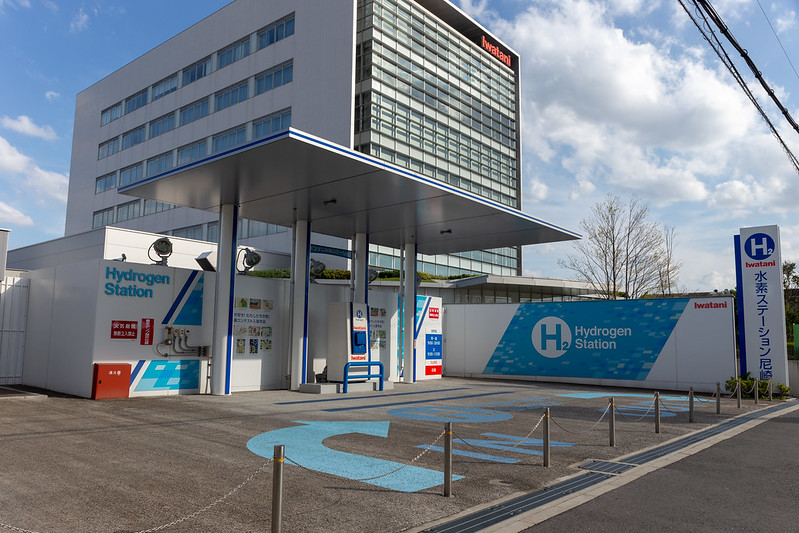 The ambition is clear, but it has not been plain sailing for the company even with its unshaken faith in hydrogen’s future. In FY 2020, the sales volume of liquefied hydrogen stood at 67 million m3, short of the planned 90 million m3. Similarly, Iwatani has struggled to install hydrogen stations at the pace it promised.
Part of the travails reflects a recent shift in priorities for hydrogen in Japan. Once seen primarily as a fuel for transport, such as fuel cell cars made by Toyota, the gas is now expected to play a bigger immediate role in power generation with JERA among the country’s utilities testing co-firing of ammonia and hydrogen at its thermal power plants.
Hydrogen’s development also demands government support – which includes a quick approval of industry standards for technologies that Iwatani has already developed. Unless Japan takes the lead in setting global hydrogen safety standards, the technology that Iwatani has today won’t be adopted worldwide, according to Makino Akiji, Iwatani Chairman and CEO.
“イワタニ水素ステーション尼崎” by junicorn is licensed under CC BY-ND 2.0
To this end, the Hydrogen Value Chain Promotion Council, established in December 2020, may come in handy. Co-chaired by Iwatani, alongside Toyota Motor and Sumitomo Mitsui Financial Group, the Council counts nearly 200 companies, municipalities, and universities.
In March 2021, the Council requested that the government amend the Act on Sophisticated Methods of Energy Supply Structures to recognize hydrogen, including blue hydrogen, as a non-fossil fuel energy source. Also, the council called on the government to expand the functions of hydrogen stations, each of which can currently cost up to ¥500 million to build.
Building the market for the fuel
Meanwhile, Iwatani is busy creating the market for its product. Below is a selection of their ongoing business development projects.
- The company is considering the deployment of Japan’s first hydrogen-powered passenger ship, which has a gross tonnage of 60 tons and capacity for about 100 passengers, at the Osaka-Kansai World Expo in 2025. The hydrogen ship would link Yumeshima, the venue of the Expo, with tourist destinations in Osaka. Iwatani also plans to develop an onshore hydrogen refueling station, and hopes to build both the ship and the station by 2023, with demonstration tests planned for 2024.
- In 2021, Iwatani announced a blue hydrogen production business in Hokkaido, a region rich in brown coal. Soon after, the company announced the start of studies to commercialize a 50 MW biomass power generation and green liquefied hydrogen production project.
- Iwatani is working on the “Hydrogen Town” project with Kitakyushu City, Fukuoka. Hydrogen produced at the local Yahata Steel Works is sent through a pipeline to supply fuel cells for use in homes.
- In 2018, the firm announced hydrogen cooperation with Saudi Aramco, its longstanding partner in LPG.
- The following year, Iwatani paid ¥500-¥600 million to Messer Group, a major German industrial gas company for four hydrogen refueling stations in California. The goal was to gain business know-how that can be applied in Japan. The company intends to increase the number of hydrogen stations in North America to 23 by FY 2023.
- In 2020, Iwatani began to consider how to commercialize production of green hydrogen in cooperation with Stanwell, a power company in Australia.
- Also last year, Iwatani announced plans to commercialize green hydrogen with Kawasaki Heavy Industries and Fortescue Metals Group, an Australian iron ore producer. They plan to liquefy and import hydrogen to Japan.
- Regarding possible expansion in China, Iwatani told Japan NRG that “we are producing hydrogen in Dalian and Jiaxing [in Zhejiang], China, but further expansion of the hydrogen business is still at the discussion stage”. Earlier this year, Iwatani was reportedly preparing to open a new hydrogen plant on the premises of Jiaxing Iwatani, a Chinese subsidy.
This impressive list of accomplishments and active plans didn’t materialize overnight. They are the fruit of seeds planted more than half a century ago. Such persistent vision and determination are precisely the factors that look to guarantee Iwatani’s leading role in Japan’s nascent but rapidly growing hydrogen industry.
ANALYSIS
BY SNEHA RANI
Japan’s Mitsui Sees LNG Bonanza in India
Even as Domestic Market’s Demand Becomes More Uncertain
With future domestic demand becoming less certain, Japanese LNG traders are looking at overseas opportunities to sustain their strong global positions. One of these will be the potential gasification of India’s economy.
Helping India switch from coal to gas will require more than just LNG procurement. Wider use of gas in India requires investments in pipelines and other delivery infrastructure, a factor that’s starting to offer contracts for Japan’s broader energy-industrial complex – engineering firms like IHI Corp.
Beyond the economic needs, the two countries both view energy as a security issue and hope their joint work in LNG, as well as other fields, will help with geopolitical goals, such as countering China’s growing influence in the region and global energy markets.
Starting small
One of the most significant Indo-Japanese LNG projects launched in mid-April when Mitsui & Co. signed an accord with India’s Inoxcva. The two plan to build “small-scale LNG infrastructure” across India to help local automotive, mining, shipping and other transport companies switch to LNG – even when there are no pipelines in the vicinity to deliver gas.
Inoxcva, an engineering firm that specializes in industrial gases and cryogenic liquid storage, has already started to build other channels of distribution in India. With its own tanker fleet under the brand GoLNG, it makes and operates 18-million-ton LNG trucks.
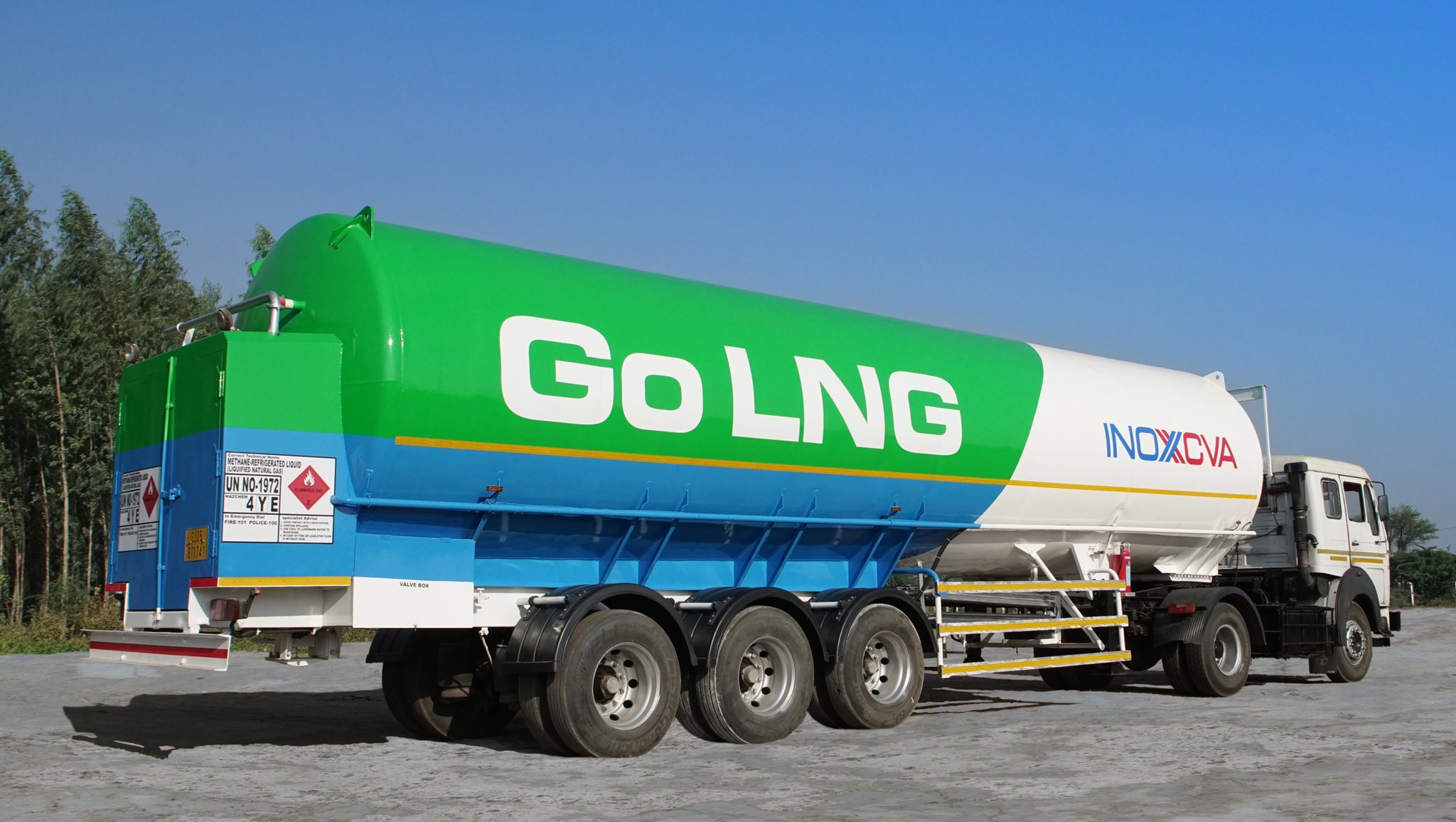 So far, India’s take of LNG has been slow, in part due to the lack of pipelines to carry gas to end-clients. So, Inoxcva ends up exporting more than half of its LNG tanker output. With Mitsui, the firm hopes to accelerate LNG penetration to India’s industrial and transport customers.
Potential solutions will include building receiving facilities at the customer end and other logistics to help deliver gas to industrial clusters that currently lack pipeline connections. The end goal is to create a working and profitable “virtual LNG distribution pipeline.”
Source: INOXCVA
Inoxcva certainly has the experience, installing 35 such small-scale LNG installations since 2010. The company also has plants in Brazil and Europe, as well as its Indian facilities.
With Mitsui, the gasification efforts should speed up. The Japanese trading house has been involved in gas distribution in Brazil since 2006, expanding its footprint from an equity interest in local companies in several states to owning almost half of Petrobras Gas. In Mexico it has a stake in the largest gas distributor and an LNG receiving terminal, as well as owns part of a gas pipeline in Arizona, among other gas-related infrastructure assets.
Mitsui already has a presence in India’s energy scene via investments in a renewable energy mini grid operator, OMC Power, and a stake in a biomass supply-chain management firm, Punjab Renewable Energy Systems. The LNG tie-up with Inoxcva would continue the Japanese firm’s efforts to build up an Indian energy business through select, small but scalable opportunities that could resonate on a national level.
Growth potential for LNG in India
In time, helping grow the Indian gas market could pay dividends for Japanese companies as they currently import the world’s largest LNG volumes, much of which comes from long-term contracts.
At present, India’s need for gas is at just 25 million tons a year, about a third of Japan’s use despite the vast difference in the population. By 2030, that demand could easily rise to 45 million tons, according to Rystad Energy. With India’s domestic gas production waning, LNG purchases could surge to 85 million tons by 2040.
Mitsui is not the only Japanese firm hoping to exploit the growth opportunity, especially as further LNG ties between the countries are encouraged at the government level. The two countries have discussed LNG cooperation in a bilateral energy dialog for several years, with then India’s minister of petroleum and natural gas, Dharmendra Pradhan, in 2018 calling on Japanese partners to build India’s LNG infrastructure during a meeting with then METI minister Seko Hiroshige.
On a commercial level, the two countries both would like to see the abolition of LNG cargo destination restriction clauses, as well as the establishment of a reliable Asia-wide LNG spot price in order to have destination flexibility and cargo swaps between countries.
LNG also serves a geopolitical objective. The two countries in 2017 teamed up on a $300 million LNG import terminal project near Colombo, Sri Lanka, their first collaboration with an eye on countering China’s growing influence in the island nation.
The floating terminal is expected to handle as much as 2.7 million tons a year, almost twice its original plan, and the terminal is expected to begin operation by the second half of 2022. India’s Petronet has a 47.5% stake in the project, with trading houses Mitsubishi Corp and Sojitz Corp holding another 37.5% and a Sri Lankan company the rest.
Other India-Japan LNG partnerships of note
- GAIL India Ltd and Japan’s Sumitomo Corporation have a MoU for cooperation in gas procurement and petrochemicals. Under the MoU, GAIL and Sumitomo will seek to pursue opportunities in natural gas and the LNG value chain business globally, as well as pipelines. GAIL and Sumitomo each have an offtake contract for 2.3 million tons of LNG from the Dominion Energy’s Cove Point LNG export plant in Maryland, U.S.
- Indian state-owned gas transportation utility GAIL has a similar agreement with Japan’s Chubu Electric to explore possibilities for collaboration in procuring LNG and shipping optimization.
- India’s Petronet LNG Ltd chose a group led by Japan’s IHI to build a liquefied natural gas (LNG) import and regasification terminal at Dahej in the western state of Gujarat.
GLOBAL VIEW
BY TOM O’SULLIVAN
Below are some of last week’s most important international energy developments monitored by the Japan NRG team because of their potential to impact energy supply and demand, as well as prices. We see the following as relevant to Japanese and international energy investors.
Wind Energy:
The lowest wind energy output in 22 years in the North Sea had material negative impacts on the Q2 operating performances of Orsted, RWE, and SSE as kWh output from offshore and onshore wind assets fell considerably in the quarter.
Coal:
China is now thought to have signed off on 35 million tons of new coal-dependent ironmaking capacity in H1 2021 and 43 new coal-fired power plants. Their total emissions will exceed 150 million tons, equivalent to 15% of Japan’s total, and makes nearly impossible China’s goal of peak CO2 emissions by 2030.
IPCC 6th Assessment Report/Catastrophic Climate Losses:
1). The IPCC science-based report issued last Monday forecasts that average global temperature increases are likely to reach 1.5 Celsius before 2040 and 1.6 Celsius by 2060. CO2 concentrations are already at their highest level in two million years. Annual global CO2 emissions reductions of more than 15 giga tons may be required by 2030 to stabilize the global climate after 2050. This would require an “unprecedented global transformational change” according to IPCC. The reduction is equivalent to 10x Japan’s annual emissions or 50% of global emissions. The report was authored by 234 scientists and endorsed by 195 countries, including Japan, ahead of Glasgow COP26, which will take place in about 70 days. The report also highlighted the negative impact of methane emissions.
However, according to the 4,000-page IPCC report, the temperature increases, heat waves, wildfires, droughts, and rising sea levels, currently being experienced around the world, are unlikely to be reversed over the coming three decades through mid-century, and accordingly the focus may increasingly have to be on adaptation. On a business-as-usual basis, sea level rises are expected to reach 1 meter by 2100 and temperature increases could reach 5.7 Celsius by 2100 in a high-emissions scenario. The sea level rises could pose existential threats to some East Asian countries including Vietnam. Two other IPCC working groups will issue reports on mitigation and adaptation in 2022.
2). Global insurance losses of $40 billion related to weather and climate events were incurred in H1 2021, the highest level since the Great East Japan and the New Zealand earthquakes in 2011. Losses relating to the recent floods in Germany are also now expected to reach $8 billion. Over 90% of climate-related losses in China are not insured.
Oil:
1). IEA reduced its most recent global oil consumption forecast for H2 2021 by 500,000 bpd because of increased global incidence of Covid-19 infections. The correction to pre-pandemic levels of consumption of over 100 mbpd is not now expected until 2023. August oil prices continue to be $5 lower than July-end prices. Covid-19 infection rates in Japan exceeded 20,000 for the first time on Friday.
2). The U.S. administration is calling on OPEC to increase oil production as U.S. gasoline prices are now well over $3/gallon, 40% higher than July 2020. The administration has also asked the U.S. Fair Trade Commission to investigate higher U.S. gasoline prices. The administration faces a mid-term congressional election in November 2022.
Nuclear Power:
1). Preparations have begun for construction of the fourth unit at Turkey’s Akkuyu nuclear power plant in Mersin Province on the Mediterranean. Separately, a Dutch geotechnical survey company, Fugro, completed a six-month offshore site characterization project on the Sinop peninsula – a possible site northeast of Ankara on the Black Sea for a second nuclear power plant – on behalf of Turkish utility EUAS Intl. Russia’s state atomic energy corporation, Rosatom, is building four VVER-1200 reactors at Akkuyu, under a BOO (build-own-operate) model. Construction of the first unit began in 2018, and is expected to commence operation in 2023. The 4.8 GW nuclear plant will meet about 10% of Turkey’s electricity needs.
2). Nuclear safety regulators in Canada and the U.S. completed their first collaborative project on licensing of SMRs. The Canadian Nuclear Safety Commission and the U.S. Nuclear Regulatory Commission have issued a joint report on feedback to X-energy, a Generation IV nuclear developer based out of Maryland, on the manufacturing codes it proposes to use in both countries for the reactor pressure vessel of its Xe-100 design, which is a high-temperature, gas-cooled small modular reactor.
Biofuels:
Exxon and Chevron are looking to scale up their production of sustainable aviation fuels with Exxon, planning to produce 40,000 barrels per day by 2025.
Palm Oil:
Human rights groups in Indonesia are calling for a permanent ban on new palm oil plantations that are blamed for forest destruction. Currently, there is a three-year ban in place following the catastrophic fires in 2015. Indonesia has committed to carbon neutrality by 2070.
China:
Tesla exported almost 30,000 Model 3 and Model Y EVs from its Shanghai plant in Q2. The Shanghai plant has a production capacity of 450,000 vehicles.
Cambodia:
The Lower Sesan 2 hydroelectric dam, constructed on the Mekong River in 2018 in Stung Treng Province in northeastern Cambodia, was classified as a human rights disaster by Human Rights Watch (HRW). The 400 MW dam was financed by China as part of the Belt & Road initiative. HRW claims it destroyed the livelihoods of local fishing and farming communities.
Indonesia:
South Korea’s Hyundai Motor and LG Energy Solutions are joining forces to build a $1.1 billion EV battery plant in Karawang near Jakarta that will produce 10 GWh of lithium-ion batteries annually. These batteries could power 150,000 EVs. The plant is expected to commence production in 2024.
India:
Reliance New Energy Solar will invest $50 million in Ambri, a U.S. energy storage start-up, with plans to establish a large-scale battery storage manufacturing plant in Jamnagar, Gujarat.
Saudi Arabia:
Aramco reported a profit of $26 billion in Q2 , the highest profits since 2018, on the back of higher oil prices, and will pay a $19 billion dividend to the Saudi government. Aramco is planning to increase oil production capacity from 12 mbpd to 13 mbpd and will invest $35 billion in capital expenditure this year. It bought Sabic, the chemical company, in 2020.
Algeria:
At least 65 people have been killed in Algeria due to wildfires with temperatures at 50 Celsius. Algeria is a major supplier of LNG to Europe and Asia, and the fires caused significant power outages across the country.
Mozambique:
Rwandan and Mozambican troops have regained control of Mocimboa Da Praia Port in Cabo Delgado Province in Northern Mozambique. In July TotalEnergies suspended the construction of its $20 billion LNG plant near the port. Up to 3,000 Mozambicans have been killed by Islamic insurgents over the last several years. Japan’s Mitsui is also a partner in the LNG project.
Germany:
In October Tesla CEO Elon Musk plans to commence production of EVs at his gigafactory in Gruenheide, Berlin, following his visit to the German capital last week. VW is also planning to build it first battery plant in Germany in 2022.
United Kingdom:
1). The UK has committed to reduce GHG emissions 78% vs. 1990 levels by 2035 as part of preparations for COP26. Wind energy is already 25% of the electricity mix. Other areas for investment include power storage and transmission, EVs, buildings, carbon capture, and hydrogen.
2). Powerhouse Energy Group, a UK-based hydrogen producer, will buy Ensolve an engineering consultancy to enhance production of hydrogen from plastics.
3). The Competition and Markets Authority in the UK has sided with Ofgem, the national energy regulator, which insisted on capping cable and gas pipe investment returns to protect British retail electricity customers from excessive price hikes.
4). The UK’s green economy is now worth more than $280 billion, almost 4x the size of the country’s manufacturing sector, with growth expected to accelerate in the coming years, according to a recent study by kMatrix.
Canada:
Cenovus Energy, one of Alberta’s major oil sands developers, is calling on the Canadian government to fund 70% of the cost of decarbonizing oil sands production. The decarbonization effort, which is a CCUS project, is expected to cost up $60 billion, with the CO2 storage planned for Cold Lake in Alberta.
United States:
1). The Biden administration is committed to increase vehicle mileage performance to 52 miles per gallon by 2026, up from the current 40 miles per gallon.
2). Chesapeake Energy, the largest U.S. LNG exporter, will buy Vine Energy for $2.2 billion. The combined company will be worth $9 billion and based mainly out of Louisiana, close to the LNG exporting complex on the Gulf of Mexico.
3). The U.S. utilities sector is now the best performer on the stock market, with residential power now approaching 50% of sales as more people work from home and consume more electricity. Margins from residential power sales are considerably higher than commercial and industrial sales.
4). Secretary of State Antony Blinken appointed former diplomat Amos Hochstein as a senior advisor for energy security issues, including overview of the Russia-German Nord Stream 2 pipeline. Hochstein previously worked as senior vice president of marketing at Tellurian, the LNG company. He is a former member of the supervisory board of Naftogaz, the Ukrainian gas company.
Peru:
The new left-wing government in Lima, headed by President Pedro Castillo, hinted at increased state involvement in natural gas and hydroelectric projects. They may also seek to nationalize uranium, copper, and lithium mining projects.
EVENTS CALENDAR
A selection of domestic and international events we believe will have an impact on Japanese energy.
| February | Approval of Fiscal 2021 Budget by Japanese parliament including energy funding projects;
CMC LNG Conference |
| March | 10th Anniversary of Fukushima Nuclear Accident;
Smart Energy Week – Tokyo; Quarterly OPEC Meeting; Japan LPG Annual Conference; Full completion of all aspects of the multi-year deregulation of Japan’s electricity market; End of 2020/21 Fiscal Year in Japan; |
| April | Japan Atomic Industrial Forum – Annual Nuclear Power Conference;
38th ASEAN Annual Conference-Brunei; Japan LNG & Gas Virtual Summit (DMG)-Tokyo Three crucial by-elections in Hokkaido, Nagano & Hiroshima – April 25th |
| May | Bids close in first tender for commercial offshore wind projects in Japan;
Prime Minister Suga to visit the U.S. |
| June | Release of New Japan National Basic Energy Plan-2021;
G7 Meeting – U.K. Presidents Biden and Putin are due to meet at a summit in Geneva Forum for China-Africa Cooperation Summit (Senegal) |
| July | Tokyo Metropolitan Govt. Assembly Elections;
Commencement of 2020 Tokyo Olympics |
| August | METI committee approves draft of Japan’s 6th Basic Energy Plan |
| September | Ruling LDP Presidential Election;
UN General Assembly Annual Meeting that is expected to address energy/climate challenges; IMF/World Bank Annual Meetings (multilateral and central banks expected to take further action on emissions disclosures and lending to fossil fuel projects); End of H1 FY2021 Fiscal Year in Japan; Japan-Russia: Eastern Economic Forum (Vladivostok)-tentative |
| October | Last possible month for holding Japan’s 2021 General Election; Hydrogen Ministerial Conference in conjunction with IEA METI Sponsored LNG Producer/Consumer Conference; Innovation for Cool Earth Forum – Tokyo Conference; Task Force on Climate-Related Financial Disclosure (TCFD) – Tokyo Conference; G20 Meeting-Italy |
| November | COP26 (Glasgow);
Asian Development Bank (‘ADB’) Annual Conference; Japan-Canada Energy Forum; East Asia Summit (EAS) – Brunei |
| December | Asia Pacific Economic Cooperation (APEC) Forum – New Zealand;
Final details expected from METI on proposed unbundling of natural gas pipeline network scheduled for 2022. |
DATA
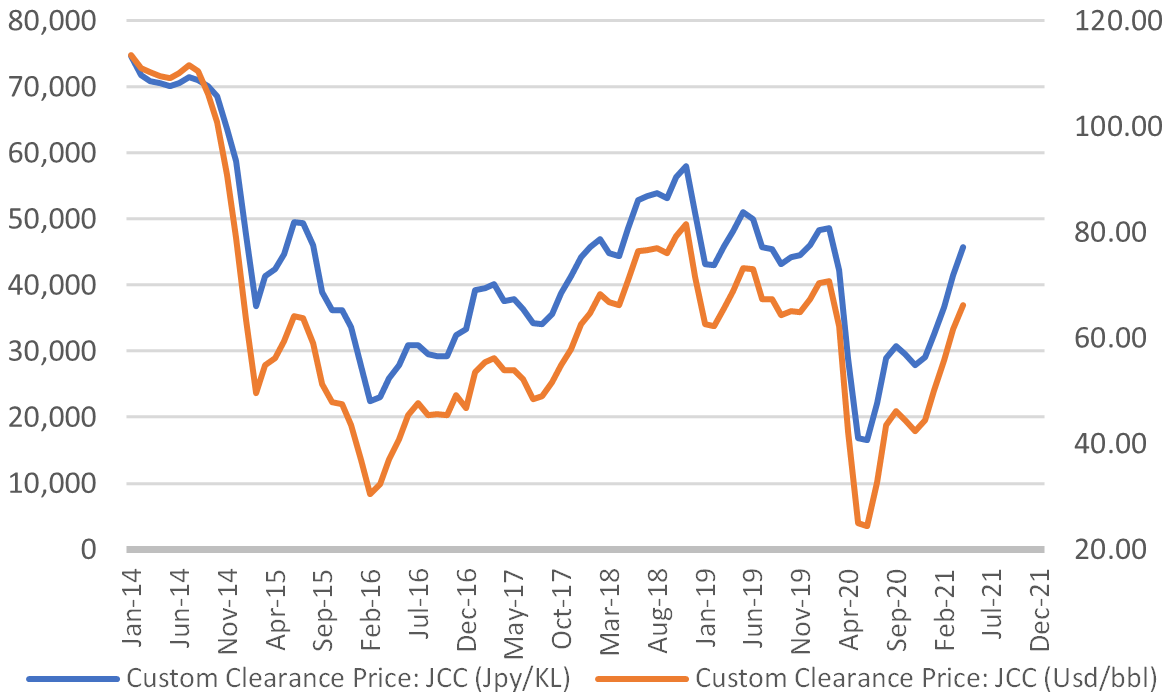
Japan Oil Price
Crude Imports Vs Processed Crude
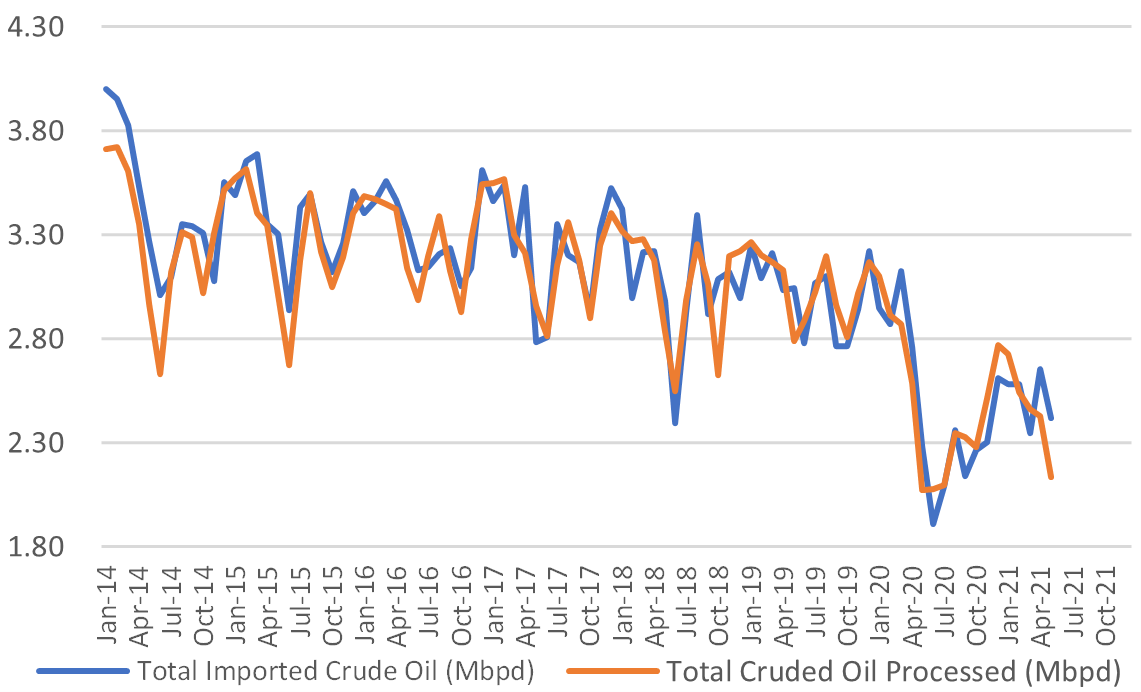
Monthly Oil Import Volume (Mbpd)
Monthly Crude Processed (Mbpd)
Domestic Fuel Sales
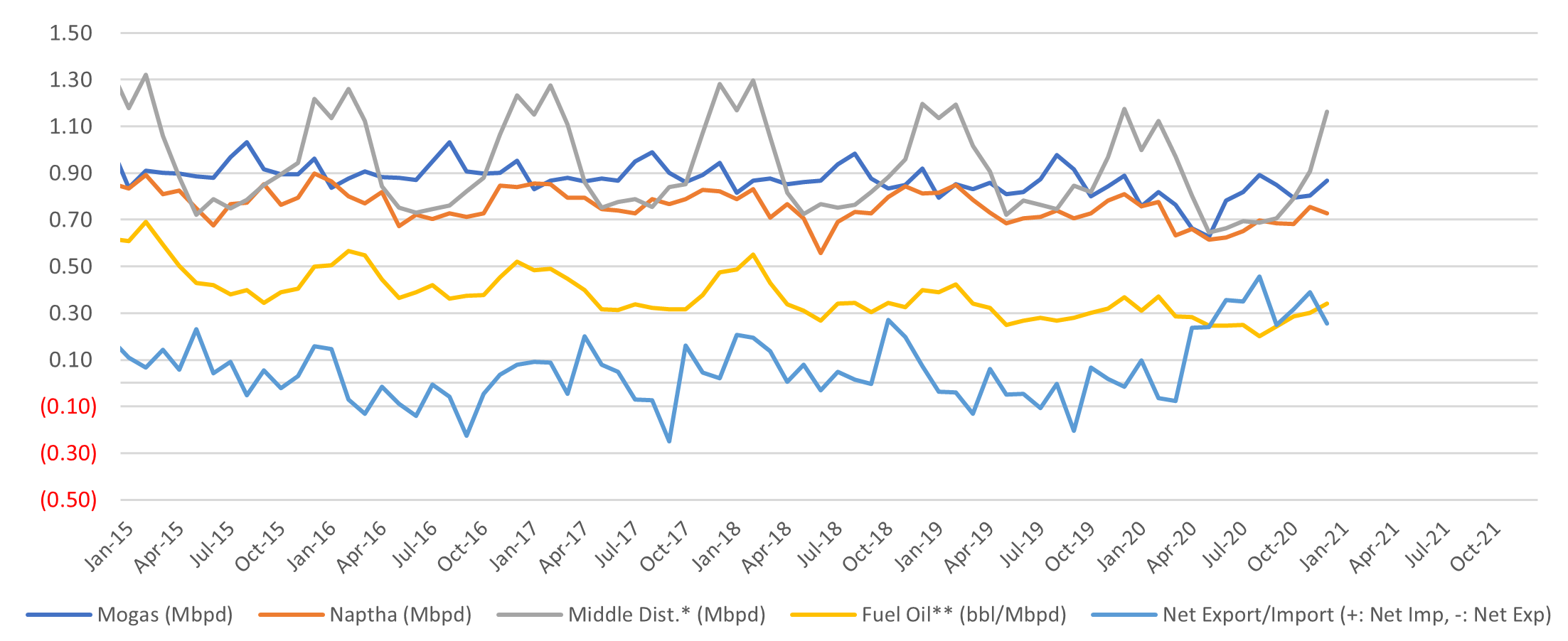
SOURCES: Ministry of Economy, Trade, and Industry (METI), Ministry of Finance, and the Petroleum Association of Japan
Japan LNG Price
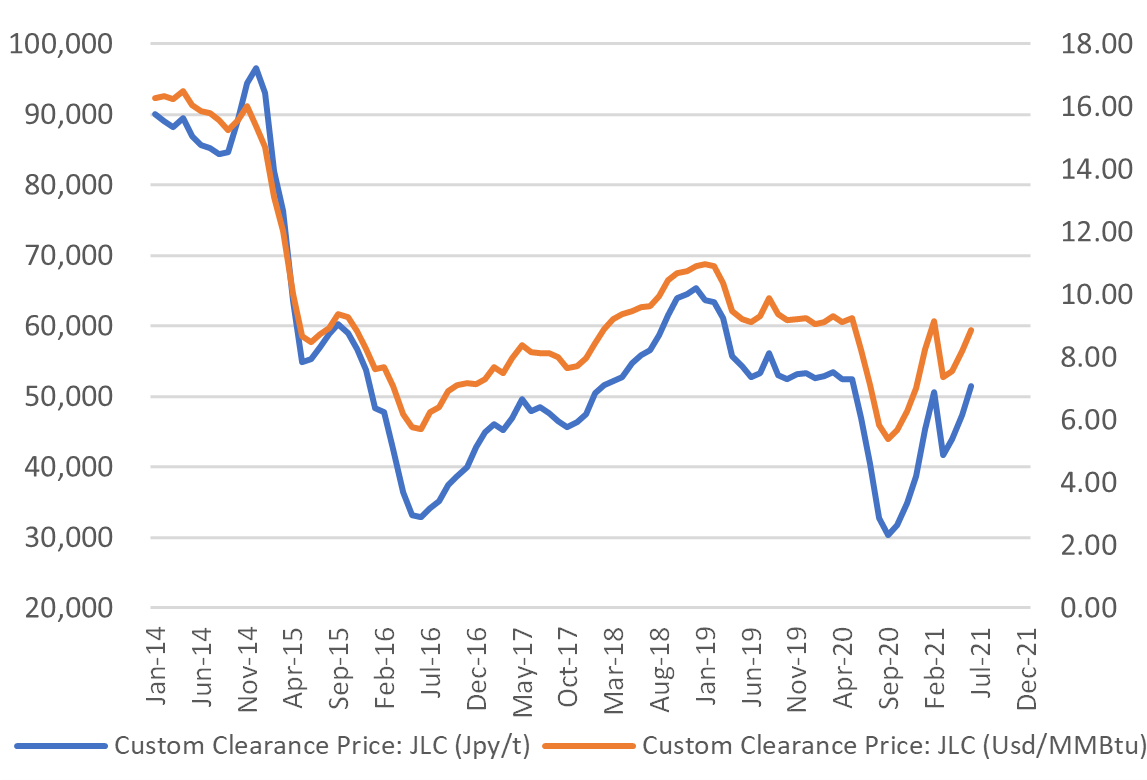
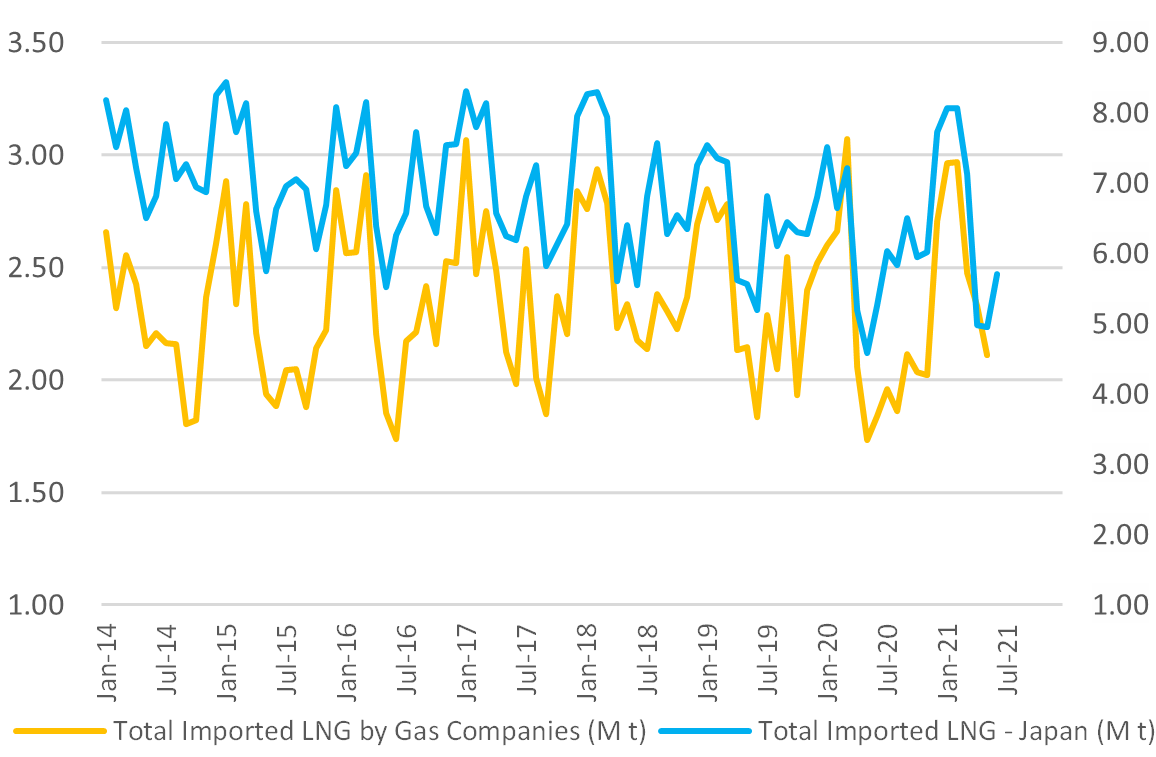
LNG Imports: Japan Total vs Gas Utilities Only
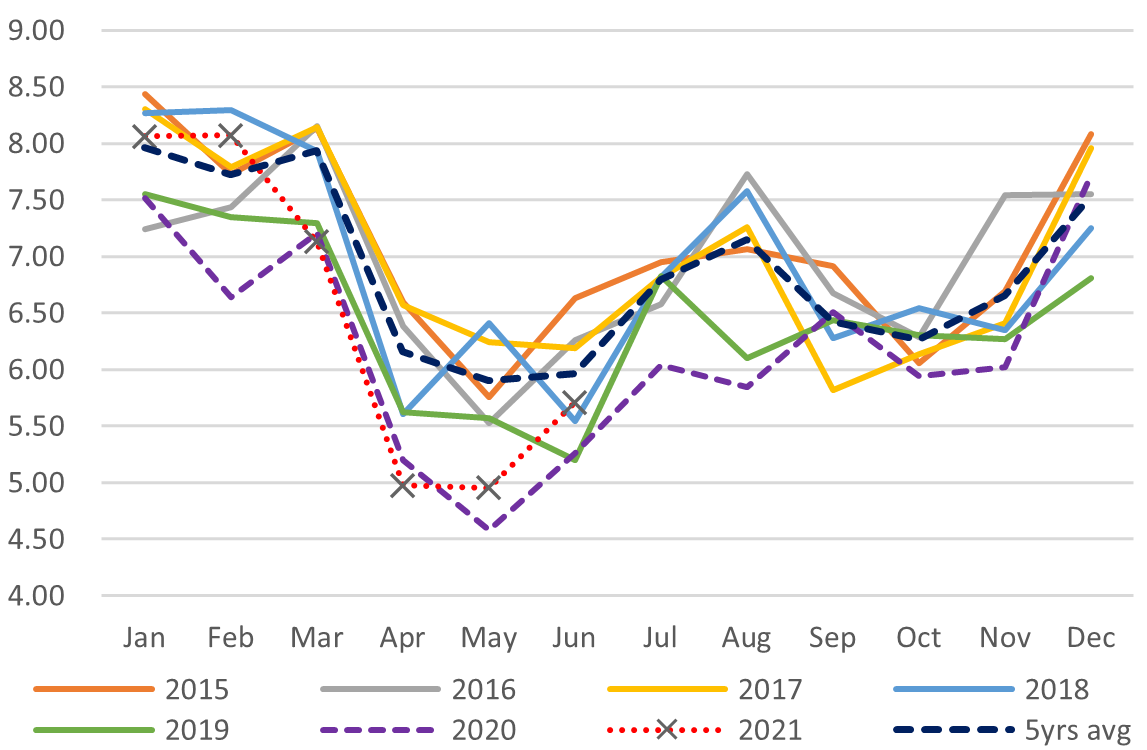
Total LNG Imports (M t)
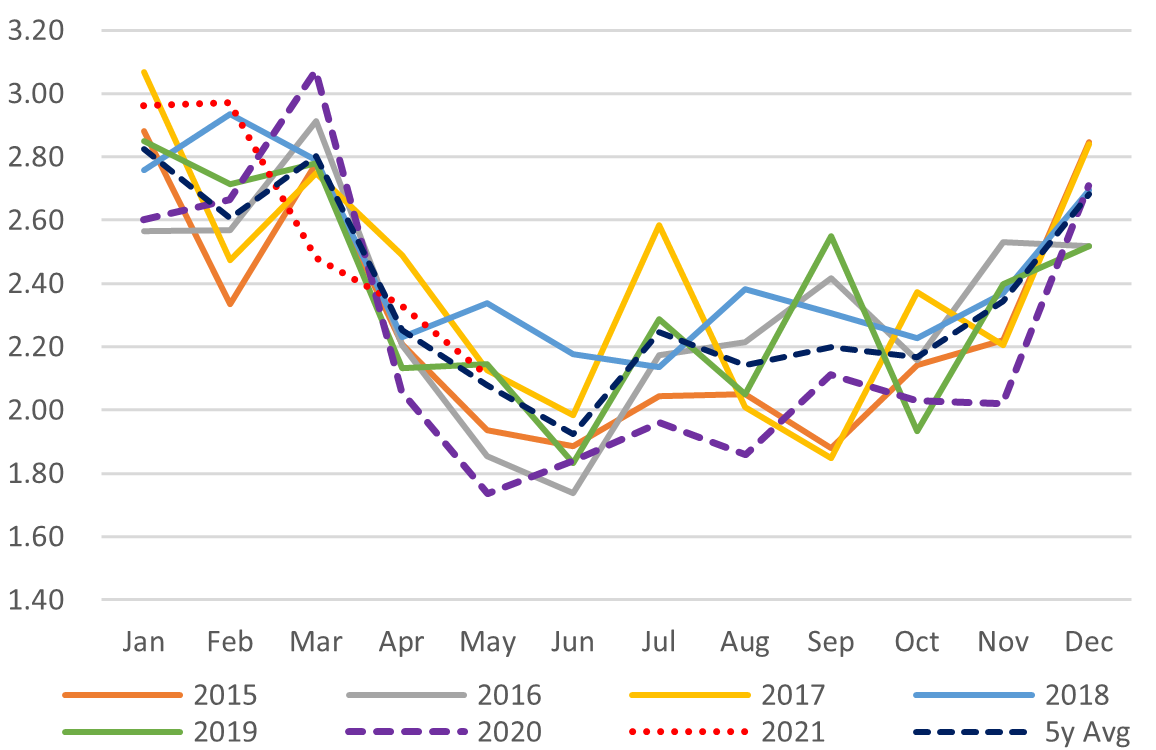
LNG Imports by Gas Firms Only (M t)
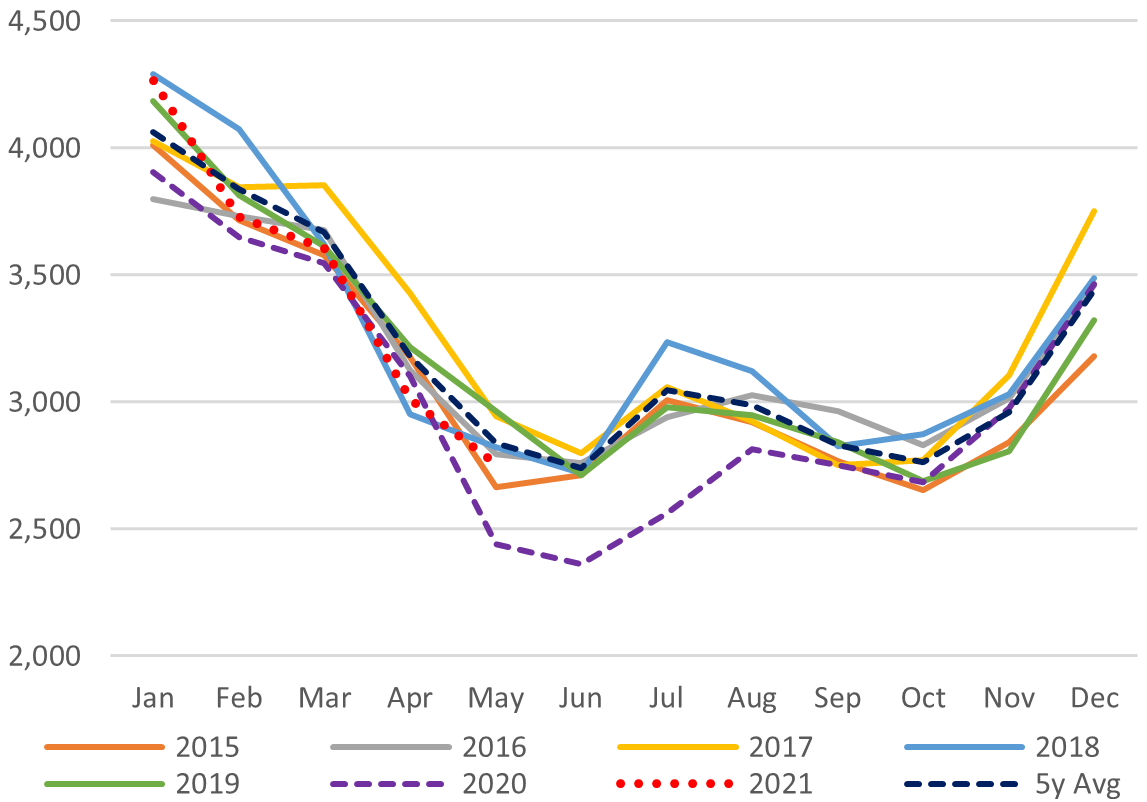
City Gas Sales – Total (M m3)
City Gas Sales by Sector (M m3)
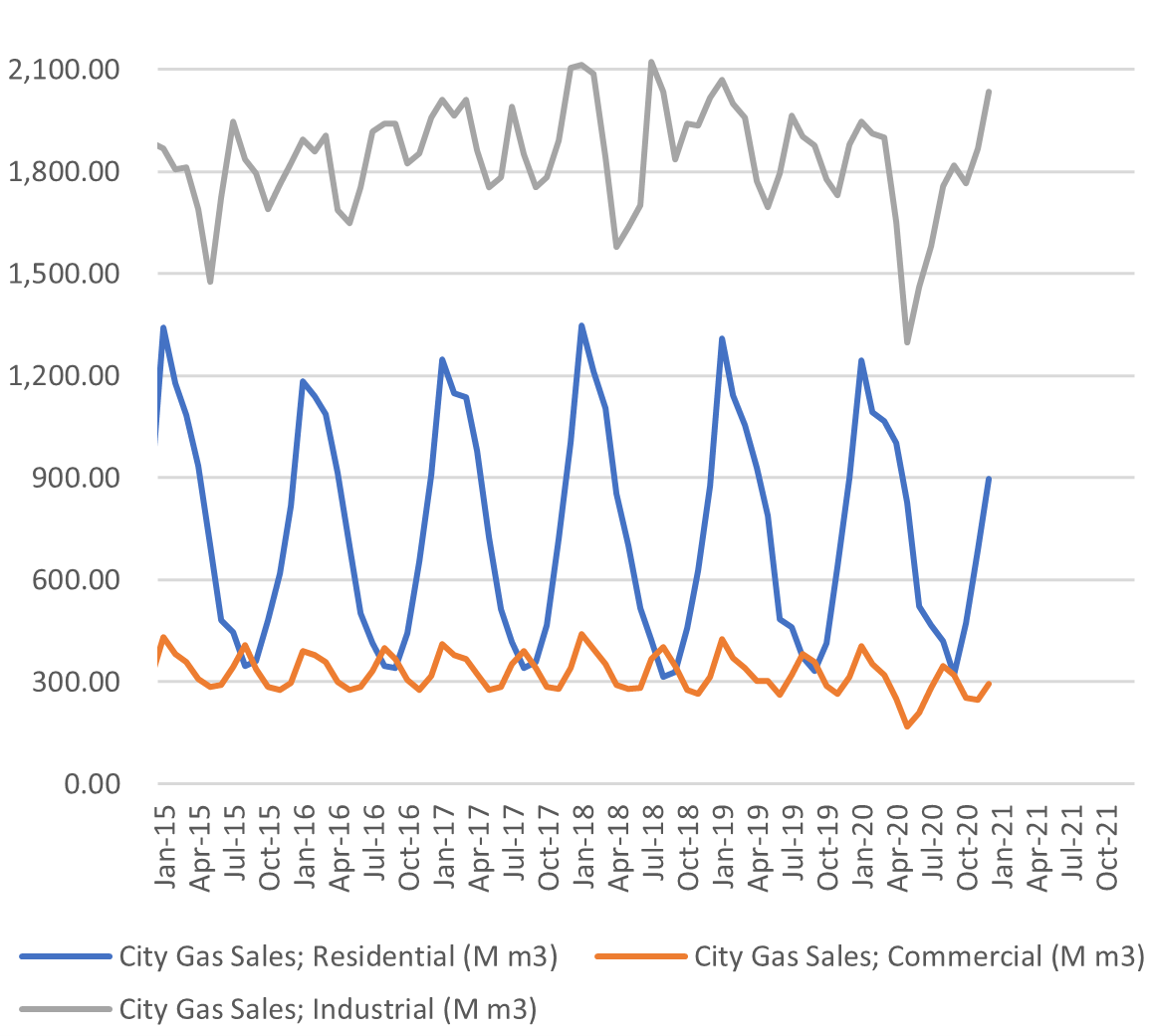
SOURCES: Ministry of Economy, Trade, and Industry (METI),
Ministry of Finance
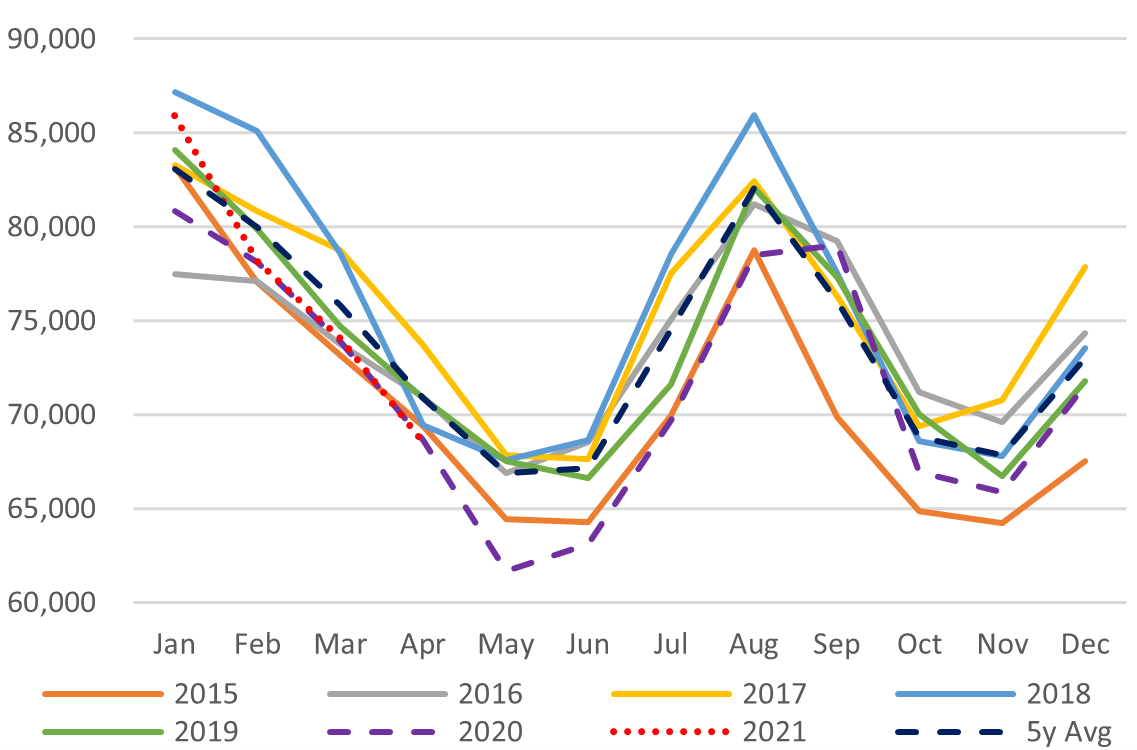
Japan Total Power Demand (GWh)
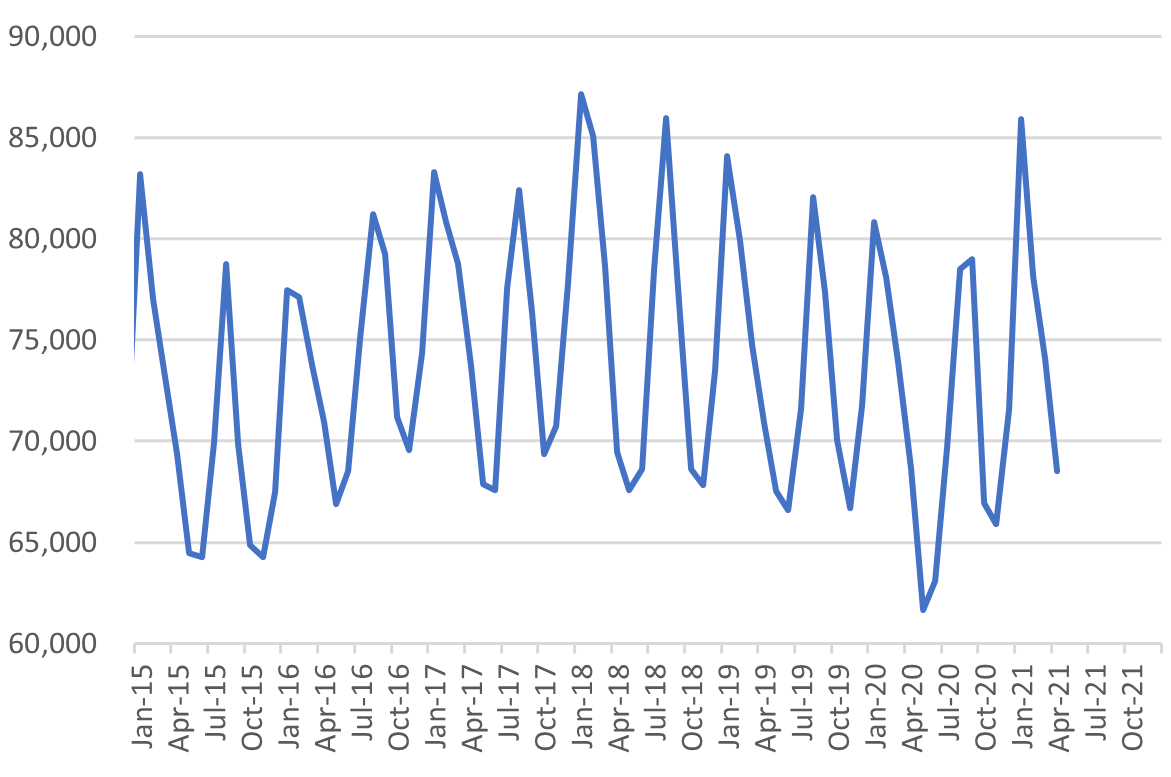
Current Vs Historical Demand (GWh)
Day-Ahead Spot Electricity Prices
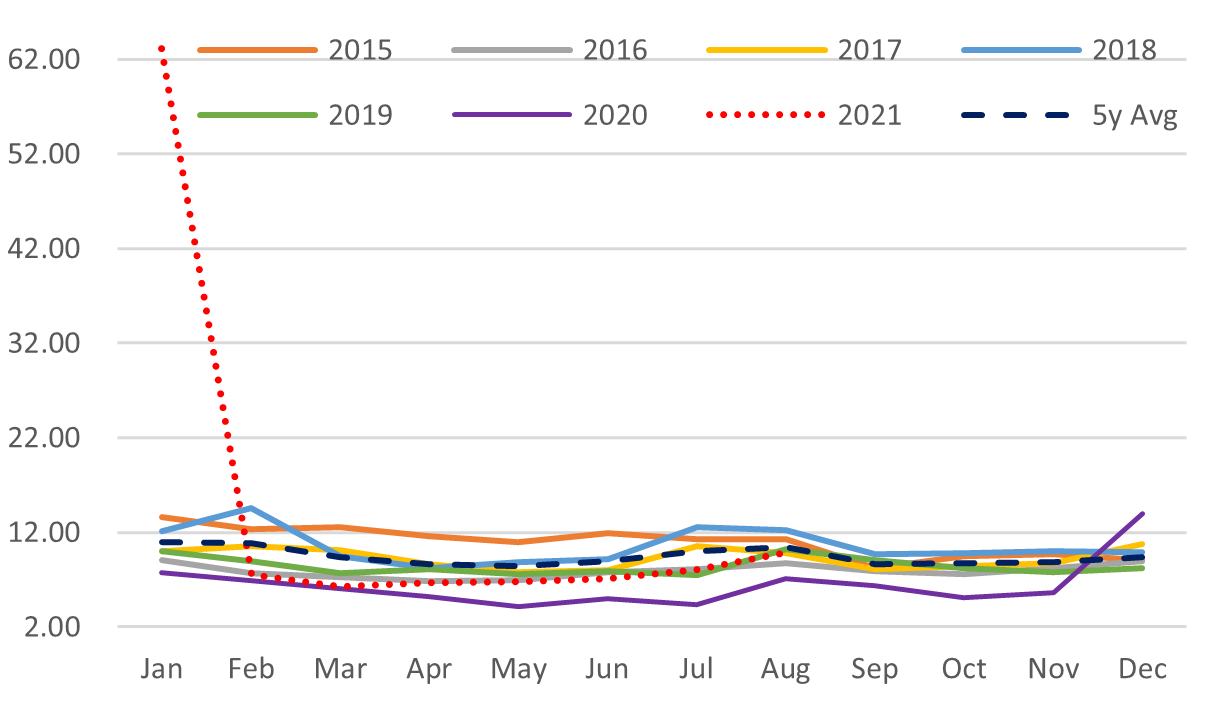
Day-Ahead Vs Day Time Vs Peak Time
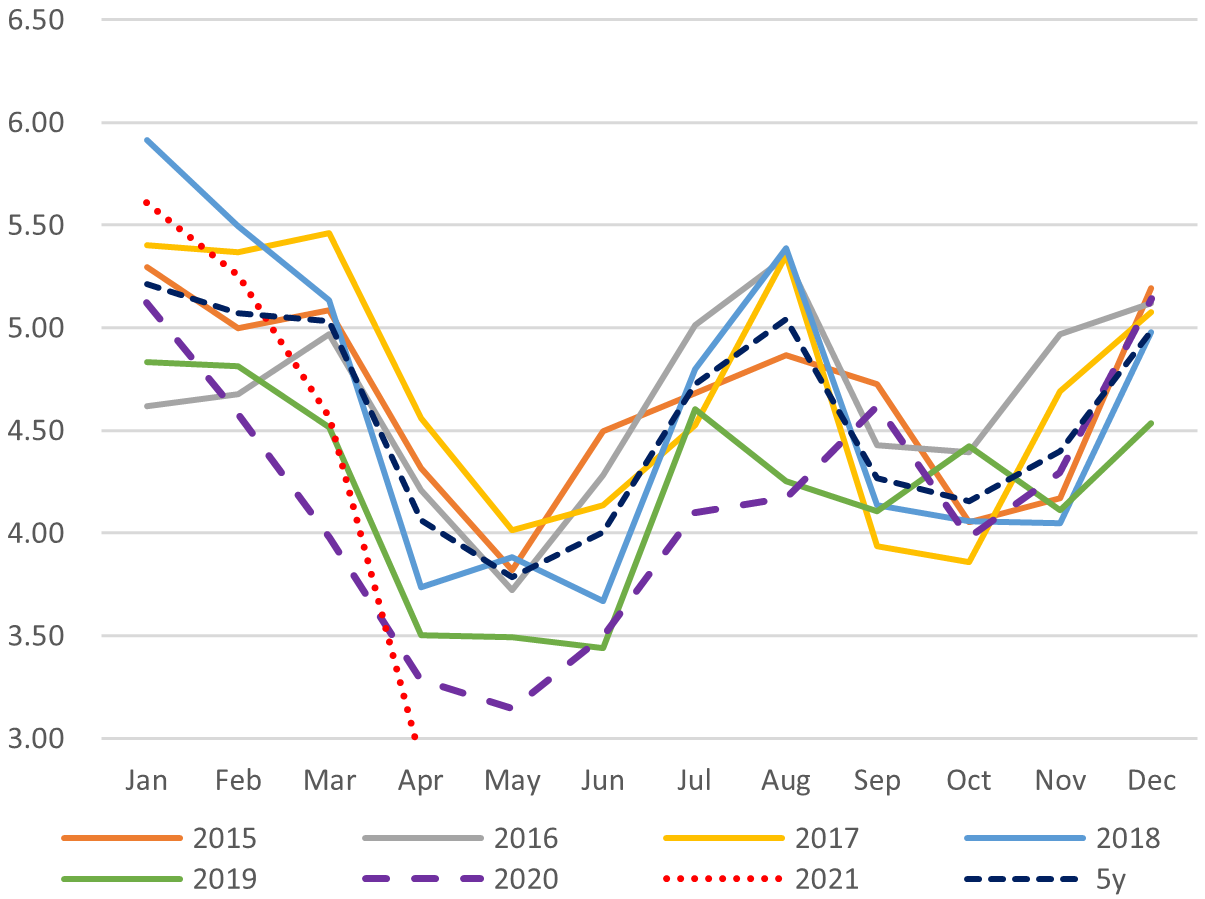
LNG Imports by Electricity Utilities
LNG Stockpiles of Electricity Utilities
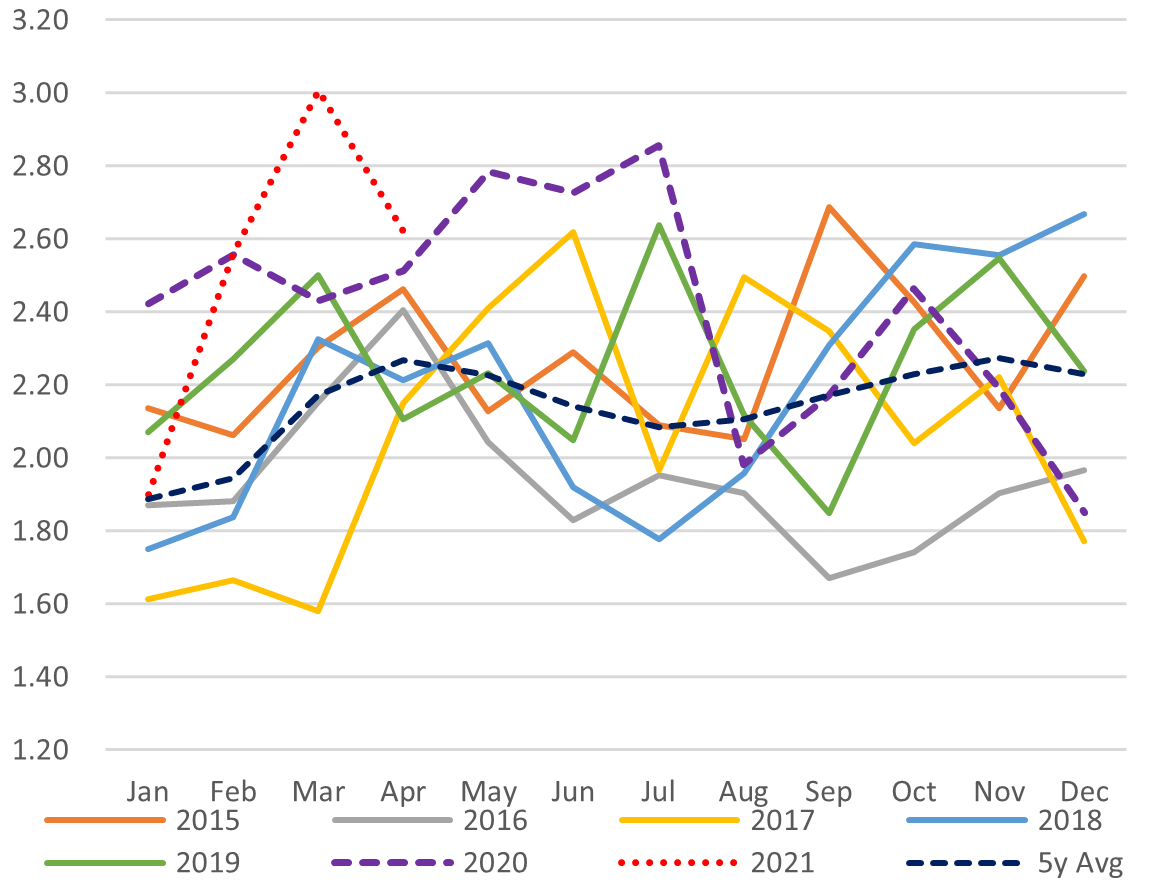
SOURCES: Ministry of Economy, Trade, and Industry (METI), and the Japan Electric Power Exchange
Disclaimer
This communication has been prepared for information purposes only, is confidential and may be legally privileged. This is a subscription-only service and is directed at those who have expressly asked K.K. Yuri Group or one of its representatives to be added to the mailing list. This document may not be onwardly circulated or reproduced without prior written consent from Yuri Group, which retains all copyright to the content of this report.
Yuri Group is not registered as an investment advisor in any jurisdiction. Our research and all the content express our opinions, which are generally based on available public information, field studies and own analysis. Content is limited to general comment upon general political, economic and market issues, asset classes and types of investments. The report and all of its content does not constitute a recommendation or solicitation to buy, sell, subscribe for or underwrite any product or physical commodity, or a financial instrument.
The information contained in this report is obtained from sources believed to be reliable and in good faith. No representation or warranty is made that it is accurate or complete. Opinions and views expressed are subject to change without notice, as are prices and availability, which are indicative only. There is no obligation to notify recipients of any changes to this data or to do so in the future. No responsibility is accepted for the use of or reliance on the information provided. In no circumstances will Yuri Group be liable for any indirect or direct loss, or consequential loss or damages arising from the use of, any inability to use, or any inaccuracy in the information.
K.K. Yuri Group: Oonoya Building 8F, Yotsuya 1-18, Shinjuku-ku, Tokyo, Japan, 160-0004.