
JAPAN NRG WEEKLY
AUGUST 23, 2021
JAPAN NRG WEEKLY
August 23, 2021
NEWS
TOP
- Japan signals it will keep its coal plants in Paris Agreement report; the government says adding ammonia to the fuel mix will cut CO2
- Tighter rules on foreign investment in Japan’s raw materials firms proposed by MoF, which seeks closer monitoring of the sector
- Nuclear regulator confirms it will suspend safety review of Tsuruga NPP after finding Japan Atomic rewrote some geological data
ENERGY TRANSITION & POLICY
- Cabinet approves a raft of top energy initiatives, including plans to expand use of hydropower, solar panels, geothermal plants
- Tokyo City starts trial of hydrogen fuel cell garbage trucks; top three convenience store chains also trialing fuel cell trucks
- Hitachi seeks business in verifying carbon emissions of factories
- Ricoh unveils development of small, light, flexible solar panels
- Taisei sees demand for improving energy efficiency of buildings
- Envision AESC to build Gigafactory for auto batteries in Ibaraki
- Hokkaido Electric mulls hydrogen production from offshore wind
- Sumitomo, Toyota to consider hydrogen import hub in Chubu
- Toyota, Toho Gas to collaborate on biogas, hydrogen … [MORE]
ELECTRICITY MARKETS
- ‘Nuclear club’ collapsing as Chubu, Kansai stop payments to peer
- JERA to invest $900M into a new gas-fired power plant in Taiwan
- Kansai Electric buys half of a Finnish renewable energy company
- TEPCO power retail arm aims to roll out more services; former company employees say it’s time TEPCO was dismantled
- Shizuoka Gas aims to acquire 200 MW of renewables capacity
- TEPCO renewables arm to issue first green bonds … [MORE]
OIL, GAS & MINING
- Astomos Energy imports Japan’s first “carbon neutral” LPG cargo
- Mitsui demonstrates that cryogenic regas system can cut emissions
- Gasoline sales fail to recover to pre-Covid levels in April-June
- INPEX signs contract for more blue ammonia delivery from UAE
ANALYSIS
PART I : BIOFUEL FINALLY IN DEMAND IN JAPAN AS TRANSPORT LOOKS FOR WAYS TO DECARBONIZE
Renewables have made steady inroads in the power and heating sectors in Japan, but transport has long been a holdout, relying on fossil fuels for 97% of its energy. That could change rapidly in the next five years, and not only because of electrification for cars and the introduction of hydrogen fuel cells for trucks, trains, and other transport types. Biofuels offer another route for decarbonization and hint at more innovation in fuels in the coming years. The most immediate area of demand lies in aviation. The search for the best raw materials for biofuels has companies sifting through garbage, seaweed and even discarded clothing.
PART II : BIOFUEL’S TAKEOFF IN JAPAN DEPENDS ON RAPID DEMAND BOOM FROM AVIATION
European and American companies currently make up four-fifths of the nascent global market for SAF (Sustainable Aviation Fuel). Most Japanese projects are only at a testing stage. However, the speed of development in Japan is set to increase, bolstered by the arrival of new emissions standards in global aviation and strong policy support. A number of older projects are edging towards the stage of commercialization, while trading firms and airlines are also pushing domestic oil refineries to get more involved in the new sector. We look at some of the most promising new projects.
GLOBAL VIEW
U.S. makes $6 bn available for battery materials plants. Ikea to start retailing renewable electricity in Sweden and then globally. Europe overtook China in terms of EV sales. Study says blue hydrogen worse than natural gas. BHP to merge all its oil assets with Woodside. The U.S. records its highest ever hourly electricity demand. Details on these and more in our global wrap.
EVENT CALENDAR / DATA SECTION
JAPAN NRG WEEKLY
PUBLISHER
K. K. Yuri Group
Editorial Team
Yuriy Humber (Editor-in-Chief)
Tom O’Sullivan (Japan, Middle East, Africa)
John Varoli (Americas)
Sponsored
Regular Contributors
Mayumi Watanabe (Japan)
Daniel Shulman (Japan)
Takehiro Masutomo (Japan)
Art & Design
22 Graphics Inc.
SUBSCRIPTIONS & ADVERTISING
Japan NRG offers individual, corporate and academic subscription plans. Basic details are our website or write to subscriptions@japan-nrg.com
For marketing, advertising, or collaboration opportunities, contact sales@japan-nrg.com
For all other inquiries, write to info@japan-nrg.com
OFTEN USED ACRONYMS
METI The Ministry of Energy, Trade and Industry
MOE Ministry of Environment
ANRE Agency for Natural Resources and Energy
NEDO New Energy and Industrial Technology Development Organization
TEPCO Tokyo Electric Power Company
KEPCO Kansai Electric Power Company
EPCO Electric Power Company
JCC Japan Crude Cocktail
JKM Japan Korea Market, the Platt’s LNG benchmark
CCUS Carbon Capture, Utilization and Storage
mmbtu Million British Thermal Units
mb/d Million barrels per day
mtoe Million Tons of Oil Equivalent
kWh Kilowatt hours (electricity generation volume)
NEWS: ENERGY TRANSITION & POLICY
Japan signals it will keep its coal plants in Paris Agreement action report
(Japan NRG, Aug. 18)
- MoE and METI signaled the possibility that Japan will keep most of its coal-fired power plants, according to a draft on the Paris Agreement action program submitted to the two ministries’ expert panels.
- The report repeated Japan’s previous announcements to phase out coal-fired power as soon as possible, and the commitment from 2022 not to be involved in new coal plant construction overseas.
- The government, however, signaled that Japan’s coal plants could continue while switching to ammonia / hydrogen. The report said that when ammonia makes up 20% of a coal-fired power plant’s fuel mix, CO2 is cut by 20%. Thus, if ammonia achieves the 20% level at all of Japan’s coal-fired plants, the power sector will achieve a 10% reduction in total CO2 levels.
- Research is also under way to replace coal with hydrogen for iron reduction in steelmaking. The govt. concluded that reducing steel output at home in order to cut CO2 is not a logical option since the idled output would simply be added in other countries that would emit the same or worse levels of carbon.
- The draft Long Term National Growth Strategy under the Paris Agreement summarized decarbonization programs in energy, transport, manufacturing, and other sectors, as well as Japan’s commitment to reduce other greenhouse gases (GHG) such as freon.
Finance Ministry proposes regulating foreign investment in critical materials firms
(Japan NRG, Aug. 18)
- The Ministry of Finance (MOF) seeks public feedback on a proposal to regulate foreign investment into companies involved in exploration and mining of 34 critical raw materials (CRMs), including rare earth metals.
- The 34 CRMs are part of the national stockpile. For national security purposes, the MOF wants more restrictions on foreign investment in the following:
- Miners of CRMs
- Those conducting geographical surveys, operating exploration vessels, drilling and other equipment associated with exploration
- Related manufacturers of equipment and software, and companies offering equipment repair
- Those offering mineral sample analytical services
- Construction firms engaged in infrastructure projects on remote islands
- Foreign investors acquiring over 1% of companies in a “core sector” category, both public and private, are required to report their investment plans to the MOF and the Bank of Japan prior to making the purchase.
- In the past, the MOF has blocked a UK-based fund from acquiring a stake in a core domestic energy company.
- Feedback period ends on Sept. 17, and the MOF will revise relevant regulations if the feedback is in favor of the proposal.
- Japan’s list of 34 CRMs includes: lithium, cobalt, nickel, vanadium, and manganese used for batteries, rare earths and platinum group metals used as catalysts in zero-emission cars, molybdenum, tungsten, chrome, and niobium used for specialty steel, titanium used for weaponry, as well as indium, magnesium and silicon.
- CONTEXT: Previously, the threshold for screening investors was a 10% stake.
TAKEAWAY: The MOF announcement suggests Japan may be preparing to start mineral explorations in the zones around Okinotori Island south of Tokyo Bay, which has been subject to international territorial disputes.
The seabed around Japan is believed to hold deposits of manganese, cobalt and rare earth elements that can be used in batteries. However, the high cost of underwater exploration has hitherto discouraged development of such areas.
Japan’s Western name hails from the word “Jipang” (gold country), and it was once a robust mining zone producing coal, copper, silver, and zinc among others. The mines closed in the 20th century due to reserve depletion. Japan still has some small-scale gold mining in operation.
Japan also has very limited refining capacity for many of the minerals. Mitsui Mining and Smelting has experience in processing rare earths but no dedicated facility. Sumitomo Metal Mining runs the country’s only nickel-cobalt refinery.
Cabinet approves raft of top energy initiatives, including on hydro and solar
(Japan NRG, Aug. 17)
- The Cabinet task force on renewables met to update policy directions and approve measures currently in discussion at ministry level. The following were some of the initiatives approved or outlined in the latest meeting:
- Cabinet backed plans to have solar panels on 60% of new homes by 2030 as part of the “net zero energy home (ZEH)” and “net zero energy building (ZEB)” initiatives
- The Ministry of Land, Infrastructure, Transport and Tourism (MLIT) will establish low interest loans and tax schemes to promote ZEH and ZEB
- By 2030, new homes should see their energy consumption drop by at least 20% from use of low-energy appliances and building materials, as well as a shift to renewable energy
- All dams in Japan will install hydro-power stations (MLIT); 8 dams under MLIT oversight currently don’t have power stations. In September, MLIT will produce a roadmap to increase the capacity and number of hydro power plants.
- Dams managed by municipalities and local governments have until the end of the year to draw up a roadmap on how they’ll add to hydro power generation.
- Plans to revise 2015 legislation that prohibits installation of geothermal plants in natural parks was approved (MoE). Notice of change will come in September and there’ll be a three-month consultation period.
- Japan Oil Gas and Metals National Corporation (JOGMEC) will fund some local geothermal projects and has already started feasibility studies.
- Renewable power operators delivered a presentation to the Cabinet urging a halt to coal-fired power generation, especially in the Kyushu area. In April this year, Kyushu-based renewable operators were forced to curtail output by 20%, which is equivalent to 8% of their annual output. Renewables firms want financial compensation for the curbed output.
Tokyo City starts trial of fuel cell garbage trucks
(New Energy Business News, Aug. 18)
- The Tokyo Metropolitan Government, Minato Ward, and Waseda University started trial operation of a fuel cell garbage truck in Minato Ward that will operate until end of February 2022. They will verify the effect of introduction by running and collecting garbage on the actual garbage collection route, evaluating energy consumption and conducting interviews with collection staff.
- The fuel cell garbage truck has a cruising range of 70 to 80 km, and it can carry 4.2 kg of hydrogen. Filling time is 3 to 5 minutes. It can carry 1,750 kg of garbage, and will be used on 3 routes such as Roppongi, Shibaura, and Minami Azabu. Fuel cell vehicles don’t emit CO2 when driving and are quiet, which improves working and living environments.
- SIDE DEVELOPMENT:
Three main convenience store operators are set to trial fuel cell trucks
(New Energy Business News, Aug. 18)
TAKEAWAY: This seems like small fry, but it’s a fairly interesting development. For a new vehicle type or fuel system to take hold, introduction in public services is always key. Garbage trucks are a fleet of vehicles known to be progressive in Japan, and were early users of LPG and biofuels as gasoline alternatives. That they’re moving to fuel cells is interesting, because although this is a public service much of the collection is done by private contractors whose number in the central 23 wards of Tokyo is close to 30. Something that trials well in central Tokyo could predictably spread around the country through private business purchases backed by public fee contracts. Fuel cell engines are also being trialed on smaller Tokyo bus routes. So, while sales of private FCVs are still low, public sector and private firms are starting to apply these new technologies. Of course, it depends on how the vehicles perform. Should things progress smoothly, we should see a notable uptick in sales of FCVs about a year or so from now and in 2023.
Hitachi seeks business in verifying carbon emissions of factories
(Asia Nikkei, Aug. 16)
- Hitachi is developing a system to monitor energy consumption and the use of renewable energy in factories. This system would suggest ways to optimize energy use in at least three of its factories, before being made available for other manufacturers and suppliers from 2022.
- The idea is to use the system as a tool for companies to prove that their supply chains are carbon neutral.
- Demand for proof of decarbonization is rising from investors, which are now considering companies’ green credentials as part of the overall investment assessment.
- Hitachi’s goal is for all its factories to be carbon neutral in 10 years. Three of its factories, under semiconductor manufacturing equipment subsidiary Hitachi High-Tech, have so far achieved carbon neutrality by switching all electricity to renewable energy.
Ricoh unveils more flexible solar panels
(Kankyo Business, Aug. 19)
- Ricoh will launch a new range of flexible miniature solar panels for energy harvesting applications, samples of which will be available from September.
- The flexible panels measure 41 x 47 mm. Each panel is capable of generating 4.2 mW at a light level of 10,000 lx.
TAKEAWAY: As often mentioned in Japan NRG Weekly, flexible solar panels such as this one by Ricoh could significantly transform solar power generation from mostly a utility-scale business and some residential panels to an essential building block of all construction and a vehicle accessory. The usual factors of cost and supply volumes mean this transformation will take time. However, the transition is not decades away. It could well start in the second half of this decade.
Taisei on mission to slash energy consumption at offices and factories
(Nikkei, Aug. 16)
- Taisei launched a project to halve the energy consumption of existing office buildings and factories by using thermally efficient glazing and implementing other energy saving measures.
- These buildings can then be transformed into ‘zero energy’ buildings by adding roof-mounted solar panels.
- While retrofitting energy-efficient features is more time-consuming than installing them at the time of construction, Taisei believes there’s significant demand for the service.
Envision AESC to build Gigafactory for vehicle batteries in Ibaraki
(New Energy Business News, Aug. 16)
- Envision AESC Japan plans to build a factory in Ibaraki to manufacture electric vehicle batteries, and has already acquired a 360,000 square meter site for the purpose.
- The factory is due to produce 6 GW hours of batteries per year and employ 400 people.
- This represents an investment of ¥50 billion.
Hokkaido Electric, Green Power mull hydrogen synthesis from surplus wind power
(NHK, Aug. 16)
- A consortium of six companies, including Hokkaido Electric and Green Power Investment, began a trial in which hydrogen is synthesized from surplus electricity generated at the Ishikarai Bay wind farm.
- The hydrogen is produced using electrolysis. The parties are discussing using the hydrogen to fuel local vehicles or transport it elsewhere in Hokkaido or further afield.
Mitsubishi, Mitsui, NYK to supply ENEOS with hydrogen
(Newswitch, Aug. 16)
- A conglomerate that includes Mitsubishi Corporation, Mitsui & Co., Chiyoda Corporation, and NYK is preparing to synthesize hydrogen in Brunei for use in ENEOS oil refineries.
- The initiative will enable ENEOS to reduce CO2 emissions.
Sumitomo, Toyota to study creation of hydrogen import hub in Chubu
(New Energy Business News, Aug. 17)
- Sumitomo Corporation, Chiyoda Corporation, Toyota, the Japan Research Institute, and Sumitomo Mitsui Banking Corporation have been contracted by the government’s research hub NEDO to perform a feasibility study on establishing a hydrogen importation hub in the Chubu area.
- The parties aim to perform a more substantive review of the proposed project based on the findings of a survey conducted by a local association of hydrogen consumers in February.
Marubeni invents innovative way to reuse photovoltaic panels
(Newswitch, Aug. 17)
- Marubeni is ramping up efforts to recycle photovoltaic (PV) panels.
- By firing panels at high temperatures, it’s possible to transform them into porous glass, which can be used in deodorizers for livestock and as a substrate for growing strawberries.
- PV panels begin to degrade after about 20 years, and with no market for secondhand panels, the illegal dumping of panels is an issue.
- CONTEXT: This action is part of Marubeni’s plan to also create an online marketplace for second-hand solar panels, as featured in last week’s report.
Tokyo Gas develops system to assess solar panel degradation
(Nikkei, Aug. 17)
- In collaboration with researchers at Tokyo University of Science, Tokyo Gas developed a system for diagnosing the degradation of PV panels.
- Ten times more accurate than traditional technology, the system promises to be useful in modeling panels’ future efficiency.
- Traditionally, performance has been assessed using a simple measurement of current and voltage output, but this can only be done in sunny conditions.
- The new system measures a cell’s impedance under alternating current, and yields a much larger dataset not affected by changes in sunlight.
Sumitomo successfully recycles anodes
(Sangyo Shimbun, Aug. 17)
- Sumitomo Metal Mining successfully retrieved and purified cobalt and other metals in used lithium-ion batteries to a point where they can be reused.
- SMM is the first company in the world to successfully recycle copper, nickel, cobalt and lithium from rechargeable batteries.
- SMM hopes to make the process commercially viable by 2023.
TAKEAWAY: An important development going forward, especially in terms of how much metal volume is actually reprocessed. Studies today suggest recycling will not deliver as much metal back as many expect, which would keep the pressure on finding new mining channels.
Toyota and Toho Gas collaborate on hydrogen, biogas
(Kankyo Business, Aug. 18)
- Toyota’s trading arm Toyota Tsusho and Aichi-based Toho Gas will work together on an initiative to reduce the region’s carbon footprint.
- Specifically, Toyota and Toho will promote the use of hydrogen and biogas in the transport sector.
- Toyota Tsusho recently established a carbon neutral task force as part of its goal to halve greenhouse gas emissions by 2030.
- For its part, Toho Gas committed to making its entire supply chain carbon neutral by 2050, and to this end would focus on establishing a new energy supply infrastructure centered around LPG, hydrogen, and electricity.
Why hybrids are actually greener than EVs
(Best Car Web, Aug. 16)
- While there’s no doubt that EVs are gentle on the environment, many drivers remain skeptical of the EV boom.
- Currently, electric vehicles manufactured, driven and scrapped in Japan are responsible for significant CO2 emissions over their lifetimes.
- In fact, when one takes into account the carbon footprint of the scrapping process, EVs place a surprisingly large burden on the environment.
- Ironically, more CO2 is emitted in the manufacture of an EV than its petrol-driven counterpart.
Itochu enters smart battery market
(Kankyo Business, Aug. 16)
- Itochu Corporation and Tokyo Century have established a company called IBeeT which will offer grid sharing services and related equipment.
- Specifically, IBeeT will offer subscriptions to the Smart Star storage battery system, which is aimed at domestic consumers and was developed by Itochu in collaboration with NF Blossom Technologies.
- As of June 2021, 45,000 Smart Star units had been installed. This represents 450 MWh of capacity.
NEWS: POWER MARKETS
| No. of operable nuclear reactors | 33 | |
| of which | applied for restart | 25 |
| approved by regulator | 17 | |
| restarted | 10 | |
| in operation today | 9 | |
| able to use MOX fuel | 4 | |
| No. of nuclear reactors under construction | 3 | |
| No. of reactors slated for decommissioning | 27 | |
| of which | completed work | 1 |
| started process | 4 | |
| yet to start / not known | 22 | |
Spot Electricity Prices, Monthly Avg.
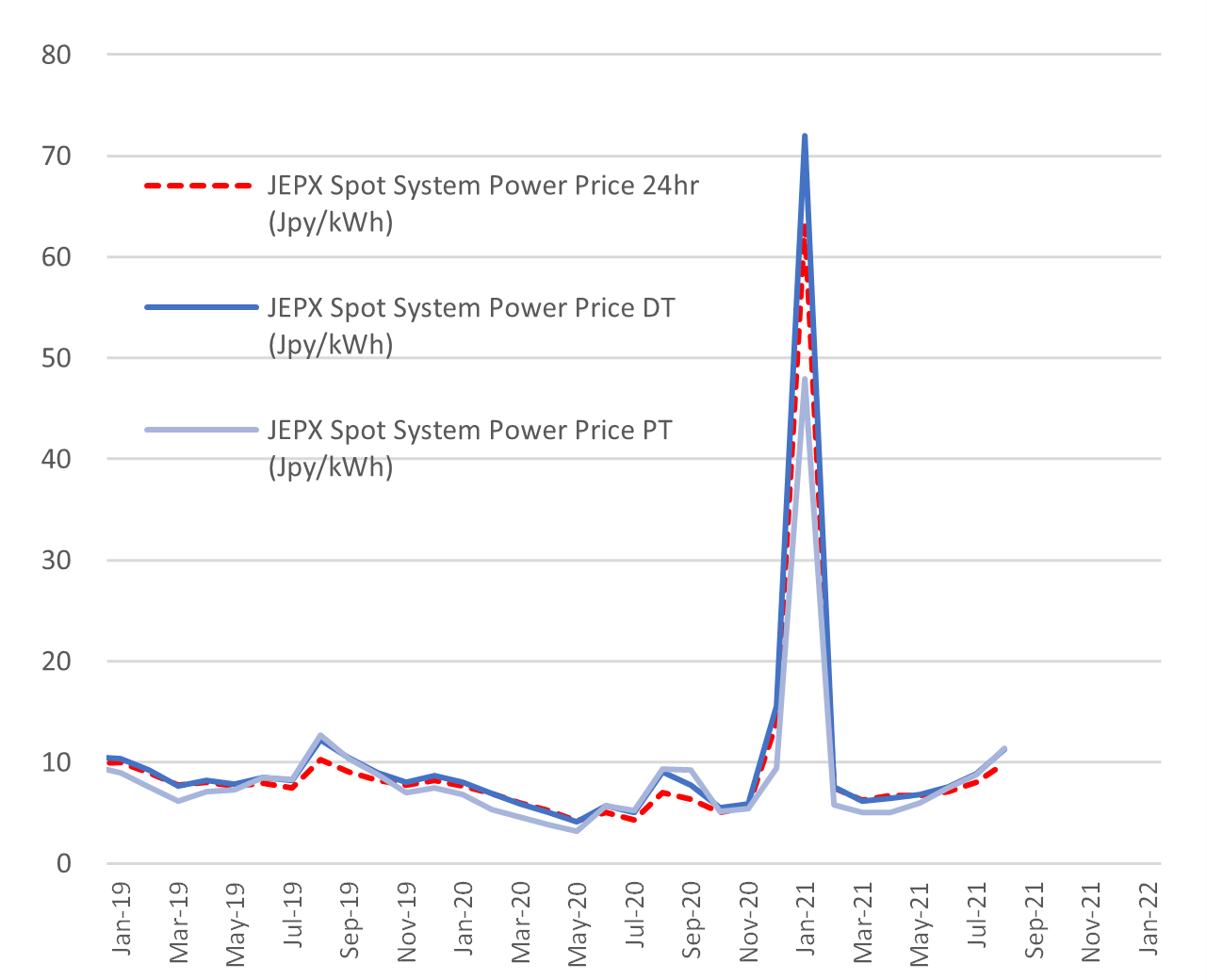
Source: Company websites, JANSI and JAIF, as of Aug 10, 2021
Regulator suspends safety review of J-Atomic’s nuclear plant over fraud
(Nikkei, Aug. 18)
- The Nuclear Regulation Authority (NRA) will suspend its seismological audit of Unit 2 of the Tsuruga nuclear power station in Fukui, after revelations that some geological data submitted by the plant operator had been falsified.
- The Authority had investigated the suspected rewriting of some data and found that it had indeed taken place. The regulator said the revelations cast doubt on the credibility of other data from the company.
- CONTEXT: The issue first surfaced at a regular NRA meeting on July 18. The geological data is being collected to consider whether the NPP lies under an active geological fault.
- This is the second time that plant operator Japan Atomic Power has been caught altering the data records for the plant. Issues with data authenticity were discovered in Feb. 2020, which led to a temporary suspension of the regulator’s safety review of the NPP. The review restarted in October 2029.
TAKEAWAY: While it does not affect any immediate nuclear restarts, this is potentially a very big issue, and not just for the operator. For Japan Atomic, which argues that its Tsuruga facility is not standing on top of an active fault, this affects the restart of both this station and the Tokai Daini NPP, where local residents have voiced concerns about the data-meddling allegations.
For the industry more broadly, it is another scandal that will sour the public mood on nuclear energy. What’s more, Japan Atomic was often seen as the company to take over TEPCO’s operable nuclear stations should the government entirely give up on the latter.
For Japan’s nuclear energy industry to move forward and carry its positive momentum from this year, a company other than Kansai Electric and Kyushu Electric has to bring online its reactors. The likelihood of this is less certain at this moment.
‘Nuclear club’ collapsing as Chubu, Kansai stop subsidizing peers’ idle plants
(FACTA, September edition)
- Despite the Shiga nuclear power plant in Ishikawa not having produced electricity since the 2011 Fukushima disaster, under a ‘gentleman’s agreement’ between plant operator Hokuriku Electric and major utilities Chubu Electric and the Kansai Electric (KEPCO), the latter two companies continue to pay the former an estimated ¥15 billion per year under the pretext of payment for electricity.
- In March 2021, however, Chubu and KEPCO abruptly halted these payments. While a spokesperson said the change was contractual, there’s speculation that harsh economic realities and opposition from shareholders were the real reasons.
- For the last 10 years, the ‘gravy train’ that is the nuclear energy club has sustained operators of idle reactors. The change in attitude to propping up such assets indicates just how dire things are for the industry.
- The Shiga plant is a white elephant for Tohoku Electric, which built it in the 1990s to keep up with other electricity providers in the country, despite being only 1/9 the size of TEPCO, the biggest power company.
JERA to invest about $900 million into a new gas-fired plant in Taiwan
(Asia Nikkei, Aug. 18)
- JERA plans to develop a 1 GW gas-fired power plant in Taiwan as the island’s economy expands rapidly on semiconductor demand.
- A local affiliate in which JERA has a 19.5% stake won a bid in June to expand the Fong Der Power Station of Taiwan Power, the island’s public utility. New investment at the plant will total about ¥100 billion ($912.74 million). Other stakeholders in the affiliate include Taiwan Cogeneration.
- The new unit at Fong Der is due to begin operating in 2024 and will double the site’s capacity.
TAKEAWAY: The investment looks like a continued move by JERA to move into gas and away from coal-fired projects. Last week, the company also said it has sold its entire stake in the Paiton 2 GW coal-fired power plant in Indonesia. A few months earlier, trading house Mitsui also sold off its stake in Paiton.
KEPCO acquires half of Finnish wind operator
(New Energy Business News, Aug. 18)
- Kansai Electric acquired a 49% stake in Finnish renewable energy company Ilmatar Energy.
- Ilmatar is embarking on a project to construct 36 wind turbines with a total nominal capacity of 216 MW in Finland.
- The project takes KEPCO’s total overseas renewables portfolio capacity to over 1 GW.
TEPCO Energy Partner adds value with additional options
(Sankei Shimbun, Aug. 18)
- After facing sanctions from the Consumer Affairs Agency over inappropriate marketing practices, TEPCO Energy Partner says it will improve the quality of marketing operations and restore the public’s trust.
- The company intends to offer a greater range of services.
- From autumn, subscribers can use their own PV panels to power water heaters during the day.
- TEPCO EP will also launch a new service that enables subscribers to install electrical systems and infrastructure with zero initial outlay.
Carving up TEPCO; Part 5: Time to put TEPCO out of its misery
(Diamond, Aug. 18)
- CONTEXT: This is the last of a five-part article series. The previous articles in the series were featured in last week’s report.
- New TEPCO chair Kobayashi Yoshimitsu implemented a rationalization program that saw many of the ‘old guard’ leave the company.
- However, former employees say the restructuring destroyed morale, and that TEPCO was rendered moribund when its administration, planning and public relations divisions were closed.
- It’s now time to put the utility out of its misery, they say.
- At the same time, the unique environment at TEPCO means skills are not easily transferable to other employers.
Shizuoka Gas aims to have 200 MW of renewables capacity by 2030
(New Energy Business News, Aug. 17)
- Shizuoka Gas announced its 2050 net-zero strategy, and it will raise its renewable energy portfolio in Japan and overseas to 200 MW.
- The gas utility plans to cut CO2 by about 2 million tons this decade through efficiency measures, renewable energy and forest conservation projects. It also seeks in the mid-term to develop new technologies that utilize methane, hydrogen and ammonia.
OPINION: The electricity market needs a caretaker
(Nikkei X-tech opinion, Aug. 18)
- CONTEXT: This is an editorial piece in the technology-focused publication of Nikkei, the biggest business news company in Japan. The article is part of a longer series that has examined the transformation of the electricity market in the country. The author is not named.
- All markets require regulation. For example, the Japanese currency is regulated by the Bank of Japan through monetary policy. Markets for securities and commodities are regulated by governmental bodies such as the Japan Fair Trade Commission.
- Oversight is equally important in electricity markets. However, it’s precisely a lack of such oversight that led to recent crises, such as the recent winter price surge and problems with the capacity auction mechanism.
- METI’s lack of proper market oversight has led to many problems, including the establishment of large capacity reserves in 2016 and generators’ refusal to share power with utilities to conserve fuel in 2017/18.
- Despite initially pledging to ‘democratize’ the electricity market and establish an ‘electricity cycle’ akin to blood circulation in the body, METI’s policies have actually impeded the free flow of electricity, a result of its lack of experience in guiding free markets.
TEPCO renewables unit to issue ¥10 billion in green bonds
(Denki Shimbun, Aug. 19)
- TEPCO Renewable Power (RP) will issue a ¥10 billion, three-year green bond. Details such as interest rates will be decided in September.
- This is TEPCO Group’s first green bond; the investment will go towards making renewable energy its main power source, including spending on hydropower at home and overseas and offshore wind generation.
NEWS: OIL, GAS & MINING
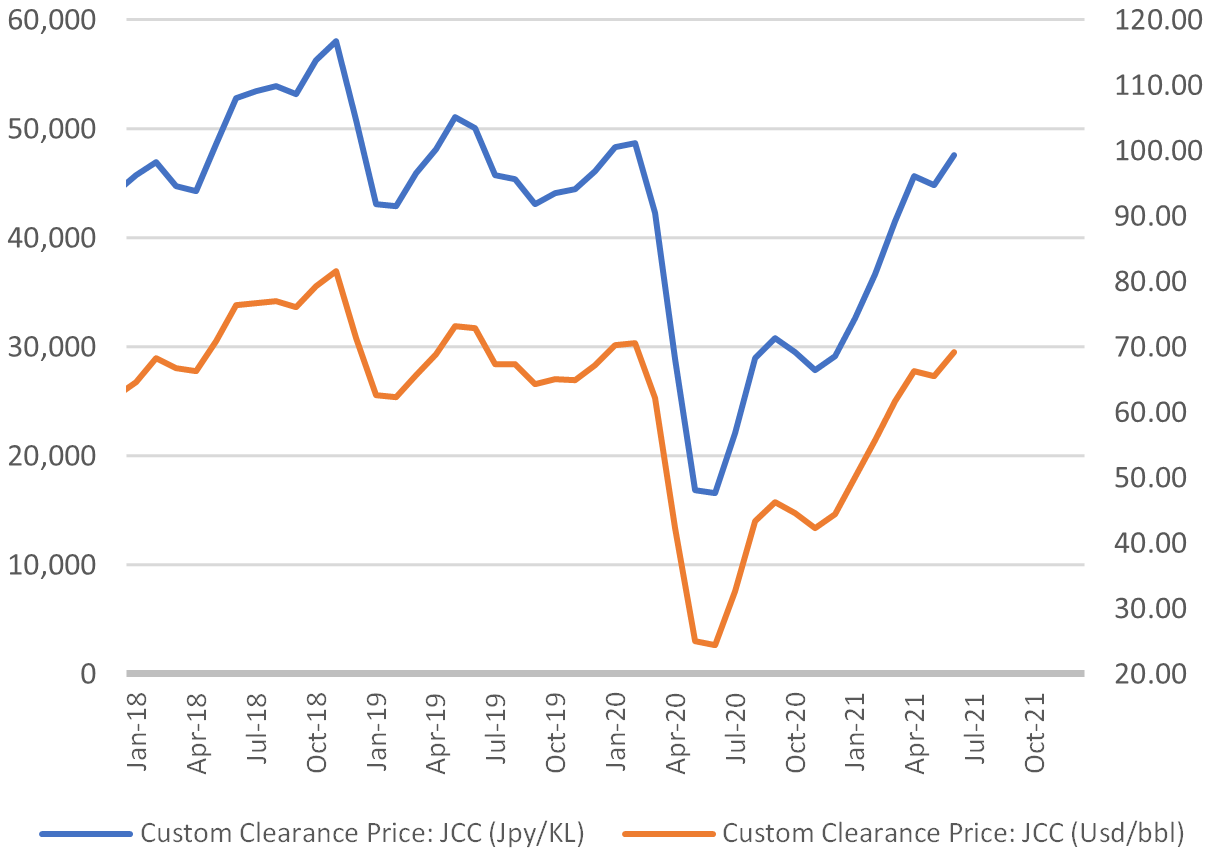
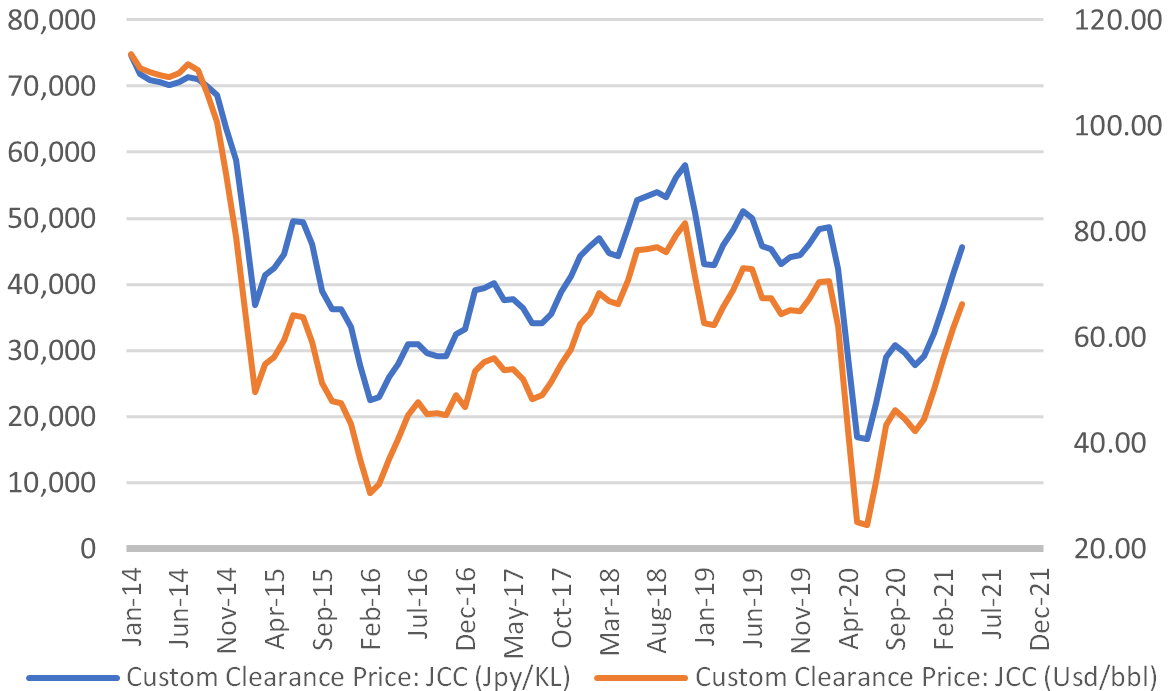
Japan Oil Price: $69.11/ barrel
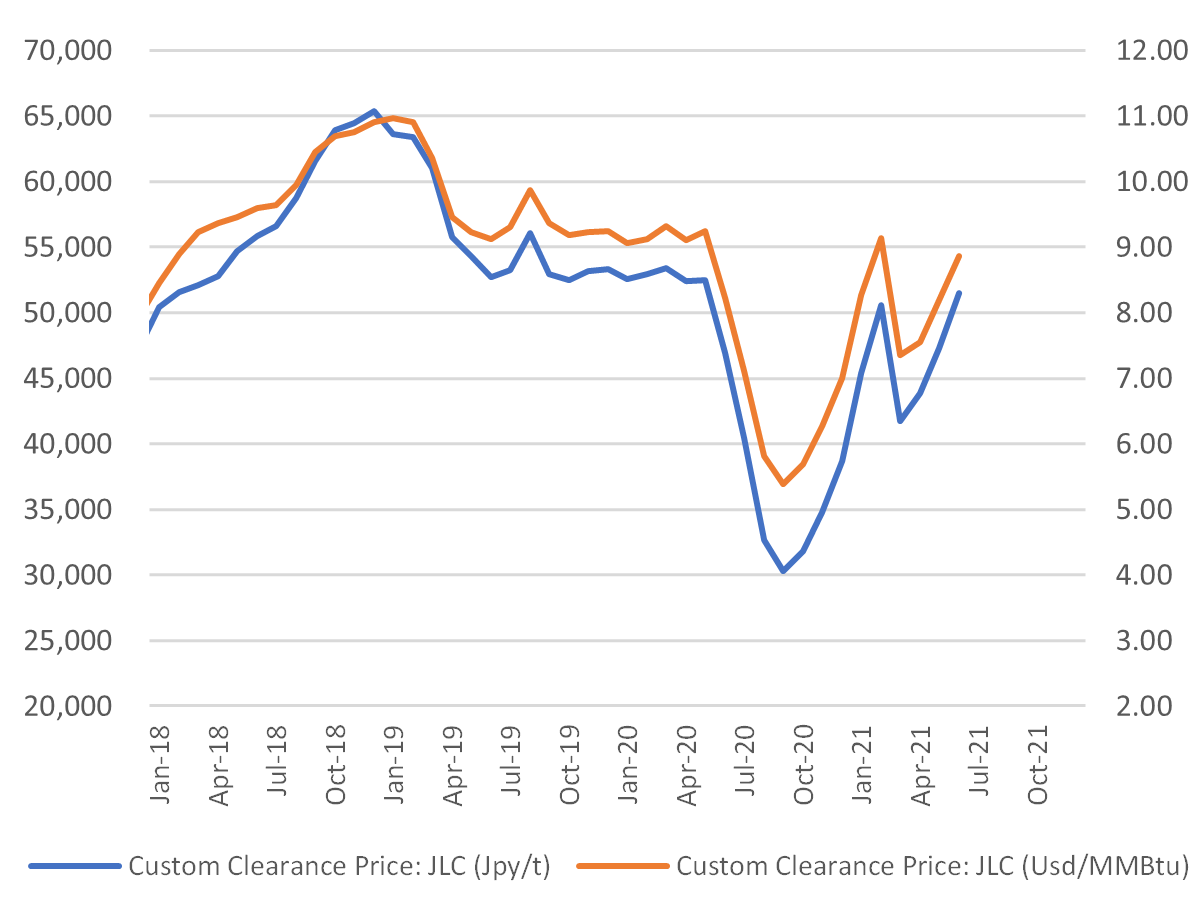
Japan (JLC) LNG Price: $8.86/ mmbtu
Astomos Energy imports Japan’s first “carbon neutral” LPG shipment
(Sekiyu Tsushin, Aug. 19)
- Astomos Energy Corporation claimed to have Japan’s first carbon-neutral LP gas (LPG) cargo.
- Astomos bought about 47,000 tons of LPG from Shell International Eastern Trading Company. The CO2 emissions associated with the cargo are offset by Shell-sponsored environmental conservation projects.
- The cargo was delivered to Astomos’ own VLGC tanker “Astomos Earth” at Ruwais Port in Abu Dhabi. It was unloaded at Idemitsu’s Chiba Plant.
- CONTEXT: Astomos is a JV between oil refiner Idemitsu Kosan and Mitsubishi Cop., with the former owning 51%.
Mitsui demonstrates cryogenic regasification system can cut FRSU emissions
(Kankyo Business, Aug. 19)
- Mitsui OSK Lines and South Korea’s DSME built a prototype cryogenic re-gasification system for floating storage and regasification units (FRSU).
- The prototype uses power generation technology based on the organic Rankine cycle.
- The technology can halve greenhouse gas emissions of FRSUs.
Gasoline sales fail to recover to pre-Covid levels during April-June
(Sekiyu Tsushin, Aug. 17)
- Petroleum product sales in the first fiscal quarter of 2021, (April to June), totaled 25,059 kl, a 4.3% YoY rise but still below 2019, pre-Covid levels. This figure is drawn from the financial statements of the three oil majors (ENEOS Holdings, Idemitsu Kosan, and Cosmo Energy Holdings).
- The state of emergency issued in Tokyo and other areas reduced demand for gasoline, which sold 9.2% less than in 2019.
- Among the petroleum products, jet fuel is down the most due to Covid. Although there’s a recovery trend in domestic flights, international flights are still limited. Sales were down 63.9% compared to 2019.
Inpex signs contracts for blue ammonia delivery from UAE
(Sekiyu Tsushin, Aug. 20)
- INPEX signed a sales contract for “clean” ammonia with Abu Dhabi National Oil Company (ADNOC) to demonstrate the supply chain for the product between the United Arab Emirates (UAE) and Japan.
- ADNOC will produce the ammonia from natural gas at an existing plant. “Most of the CO2 emitted from the production” will be sequestered at Abu Dhabi onshore oil fields, in which INPEX has a stake.
- Liquid transportation containers will carry it from Abu Dhabi to Japan.
- INPEX is working on a “clean” ammonia supply chain in Abu Dhabi in cooperation with Japan’s JERA and JOGMEC, as well as ADNOC.
- CONTEXT: Ammonia produced from natural gas, where the CO2 emitted during the process is captured and sequestered, is referred to as ‘blue ammonia’; as opposed to ‘green ammonia’ which is ammonia made from electrolysis powered by renewable energy.
ANALYSIS
BY TAKEHIRO MASUTOMO
AND SAKI ISETANI
Biofuels: How the “New Oil” May Revolutionize Japan’s Transport;
Aviation Sector Leading the Charge to Slash CO2 Emissions
What do seaweed, used cooking oil and discarded clothing have in common? All three are part of plans for the decarbonization of Japan’s transport, acting as key ingredients for new biofuels being tested by Japanese airlines with an eye on full commercialization inside this decade.
While cars and other means of transportation are more convinced by eco-solutions in hydrogen and electrification, domestic aviation is reviving the idea that biofuels can become the “new oil”, phasing out petroleum with biological alternatives which can work with existing aircraft technology.
The government has identified demand for clean fuels in aviation as one of the 14 pillars of its Green Growth Strategy. It’s hoping that biofuels used in aviation, where the urgency is greatest due to new emissions standards, will drive broader innovation in the fuels sector and extend to other transport types.
In this two-part feature, we look at the current market for biofuels in Japan and outline new avenues for its near-term expansion in the aviation sector.
PART I – Transport, the Last Bastion of Fossil Fuels
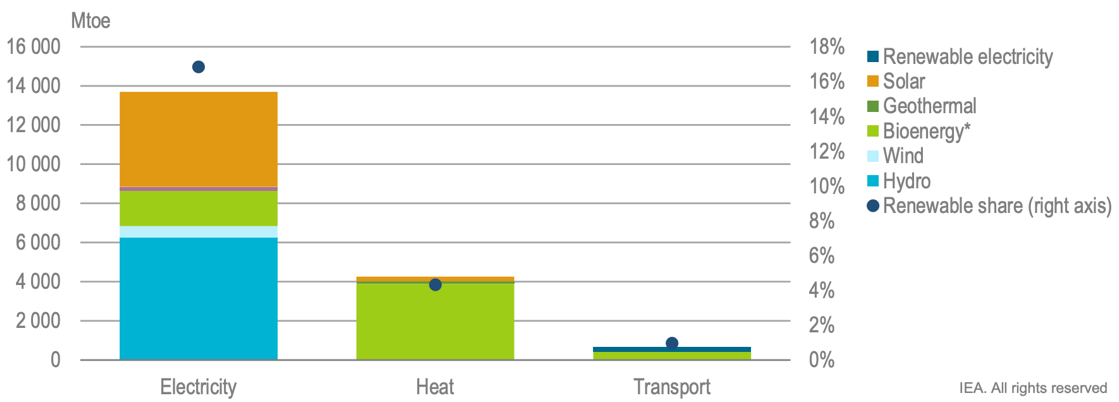
While the emergence of renewables has diminished hydrocarbons’ role in power generation, it has barely made a dent in Japan’s transport sector. Fossil fuels make up 97% of the sector’s total energy consumption, while renewables are at 1% (and biofuels at just 0.6%).
Without strong policy incentives, the copious research into bioethanol and biodiesel has so far failed to be used widely, and so transport’s share of Japan’s CO2 emissions remains at a fifth of the total.
Figure1. Share of Renewable Energy in Consumption by Source and Energy Carrier 2018, Japan
Source: IEA
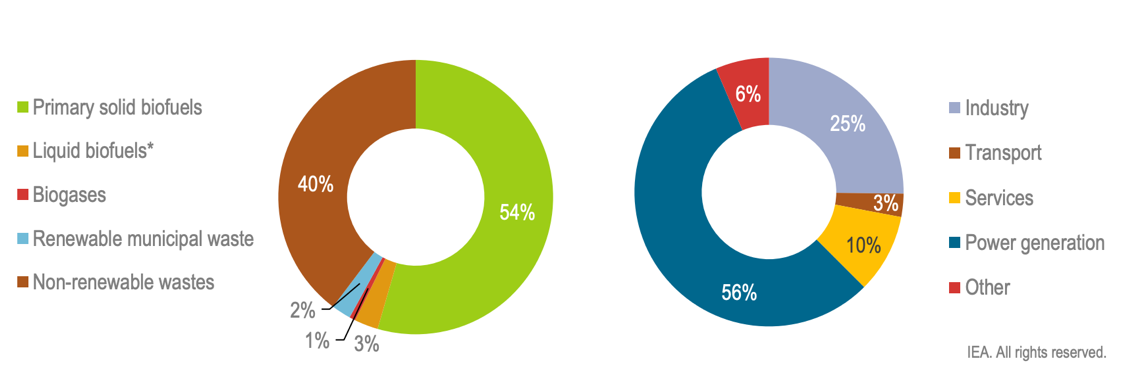
Today, the majority of bioenergy that Japan consumes is solid biofuel for power generation, namely woody biomass or palm kernel shells used as fuel in biomass and coal power stations.
Figure 2. Biofuel Consumption and Sector, Japan, 2018
Source: IEA
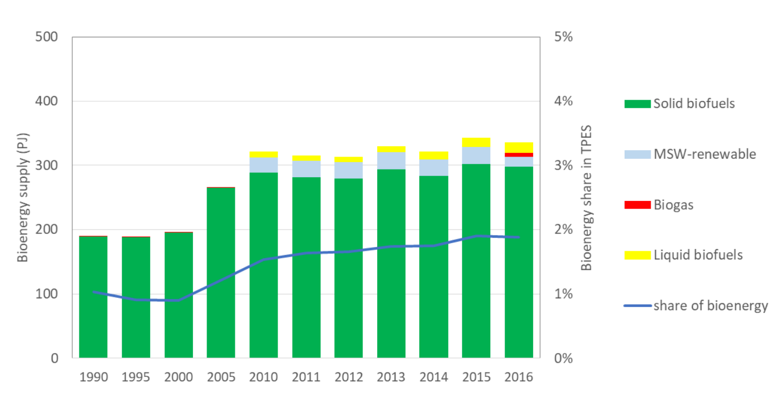
The expansion of biomass power in Japan helped boost demand for solid biofuels by about 60% around the turn of the century, but there has been relatively little volume development since. The exception is the quick growth of the relatively new biogas sector, (featured in the July 19 edition of the Weekly), albeit from a very small base.
Figure 3. Trend in Biofuel Consumption in Japan from 1990 to 2016
Source: IEA
Bioethanol
Transport, which utilizes liquid biofuel, has mostly hitherto relied on bioethanol imports, and initially only from Brazil. The trade started with the 2009 passing of the Act on Sophisticated Methods of Energy Supply Structure, which set a voluntary target of utilizing a crude oil equivalent of 500 million liters of bioethanol by 2017 (on a cumulative basis).
In April 2018, the target was extended to aim for 500 million liters of biofuels per year until 2022. The government also revised its policy to allow up to 44% of the imports to come from U.S. corn-based ethanol. Brazil supplies Japan with sugar-cane based ethanol.
Table 1. Bioethanol Utilization in Japan (ETBE)
| 2009 | 14,733 kL (ETBE) |
| 2010 | 22,154 kL (ETBE) |
| 2011 | 22,237 kL (ETBE) |
| 2012 | 24,421 kL (ETBE) |
| 2015 | approx 63,000 kL (ETBE) |
Source: METI
Although the utilization rate has steadily increased, Japan has one of the lowest penetration rates for bioethanol among countries with a biofuel program. Domestic gasoline is blended with ethanol at a rate of only 3%.
Biodiesel
Similar to bioethanol, biodiesel seems to have virtually no presence in Japan’s market, making up just 0.04% of on-road transportation demand in 2018. The latest data available for biodiesel production in the country was 16 million liters in 2016, according to the National Biodiesel Fuel Utilization Council (NBUC). This is unlikely to change due to a lack of distribution channels and the fact that consumption is limited to small fleets of municipal vehicles in local and regional programs.
Dec. 2020: Change in Policy Focus
When the government’s headline Green Growth Strategy was announced in December 2020 it identified the airline industry as one of the 14 key pillars of the country’s decarbonization. Aviation was one of only five industrial sectors selected.
Short summaries of the Strategy describe aviation’s road to decarbonization as mostly based on the hybrid electric engine and on hydrogen fuel cell – and research into these technologies is also being done in Japan. However, the full Strategy discusses in greater detail the need to develop bio jet fuel and other biofuel technologies, such as FT synthesis, ATJ, and microalgae-based compounds.
Policy actions even since that December 2020 publication indicate that the government’s near-term ambitions for aviation are more focused on biofuels than hydrogen or electric solutions.
In March 2021, the transport ministry (MLIT) launched a public-private study group the aim of which is to report how to commercialize biofuels for aircraft, also known as sustainable aviation fuel (SAF), by 2030.
Backing for the R&D efforts is also coming from the new ¥2 trillion-yen Green Innovation Fund being administered by NEDO. The state research hub has six support programs with annual subsidies of about ¥5 billion for private biofuel projects starting from FY 2020. It is focused on supporting three core technologies: microalgae cultivation, FT synthesis, and ATJ.
The government is also considering setting targets for the blending ratio of SAF with conventional fuels. Currently, the ratio is capped at 50% for safety reasons.
By 2027, Japan even plans to start stockpiling SAF at its major national airports, especially the Tokyo hubs of Haneda and Narita.
ANALYSIS
PART II – Biofuel’s Takeoff in Japan Depends on Aviation
A major reason for Japan’s recent push into SAF (Sustainable Aviation Fuel) lies outside the country.
In 2016, the International Civil Aviation Organization (ICAO) agreed with governments and industry to create a new Global Market Based Measure (GMBM) program to reduce CO2 from flying. The program was due to begin a pilot phase from 2021, followed by a first phase from 2026, with participation before 2027 entirely voluntary.
With the Covid pandemic decimating global travel, it was initially assumed that such as ambitious environmental program might be delayed. Instead, the GMBM program commenced this year as planned. (GMBM also includes the Carbon Offsetting and Reduction Scheme for International Aviation, CORSIA).
According to the program, airlines have to maintain annual CO2 emissions below the average level of 2019 and 2020. Any emissions in excess of that baseline must be paid for by purchasing offsets. This leaves Japan’s air carriers, such as ANA and JAL, on the hook for payments unless they cut emissions.
From Phase II in 2027, airlines in most countries will be obliged to reduce emissions further.
Japan’s airlines are not the only ones to be affected. If Japan is unable to supply SAF at its airports, the country’s appeal as a transport hub would dim and foreign airlines could curtail takeoffs and landings.
International flights to and from Japan used about 8.9 million kiloliters of fuel in 2019, and the MLIT estimates that this amount could increase by as much as 3.4 million kiloliters by 2030. In order not to increase CO2 emissions, Japan would need to replace up to 46% of domestic fuel volume with SAF by the end of the decade.
Japan’s biofuel development status
At present, European and American companies account for four-fifths of the nascent global SAF market, with Japan’s efforts in the sector so far at a testing stage.
The onset of the new emissions standards has brought urgency to SAF development in Japan, with trading firms and airlines also pushing domestic oil refining companies to get more involved in a sector they hitherto viewed with distrust.
Cosmo Energy is due to become the first of Japan’s three petroleum refining majors to cross over to the green side. This month the company announced plans to create a bio-jet fuel manufacturing hub that would utilize used cooking oil as a raw material and begin full scale product by 2025. Cosmo is working with engineering firm JGC Holding on the project, and reportedly plans to cover 30% of Japan’s needs by produce 30,000 kiloliters of biofuel a year at its Osaka factory.
Cosmo will still need to prove its competitiveness as Japan’s two major airlines, JAL and ANA, are exploring plenty of other options for biofuel supply.

Japan Airlines Co. (JAL)
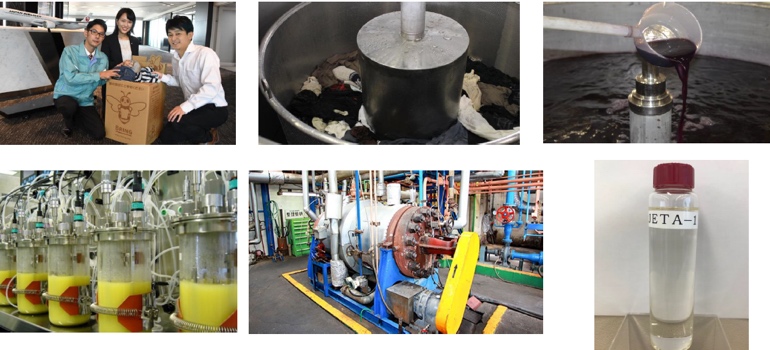
To get the ball rolling, JAL launched the country’s first domestically produced SAF program, producing a trial batch of fuel from 250,000 pieces of unused clothing. The fuel was used on a Boeing 787-8 domestic flight from Tokyo to Fukuoka in early February.
The project began in October 2018 and involved technology developed by the startup Green Earth Institute., Ltd and the Research Institute of Innovative Technology for the Earth (RITE).
Timeline of SAF production by JAL
Source: JAL Press Release
A more likely supply of raw materials for biofuel, however, is general waste. In 2018, JAL formed a partnership with Marubeni and the Overseas Infrastructure Investment Corporation for Transport & Urban Development (JOIN) to invest ¥900 million in the U.S startup Fulcrum BioEnergy, which has the technology to make SAF from household garbage. As a result, JAL aims to start commercial operation of aircrafts using biofuel made from household waste as early as the fiscal year starting March 2022.
Also with Marubeni, and ENEOS, an oil refining rival of Cosmo, JAL has begun to study the feasibility of manufacturing and selling alternative aviation fuel made from waste plastic. This would also deploy Fulcrum’s technology. Demonstration tests are slated for early in this decade with the start of construction of a commercial-level production facility seen around 2025.

All Nippon Airways Co. (ANA)
ANA started investing in biofuels even earlier than JAL, but its initial target – a Japanese biotech startup Euglena Corp. – has so far struggled to deliver on its promise of abundant and affordable fuels made from a type of seaweed.
As early as in 2011, ANA formed a partnership with Euglena in the belief that a biofuel based on the eponymous single-cell microalgae could be commercially viable in 2020.
The Made-in-Japan Biofuel Project attracted some of the country’s top corporates including Chiyoda, Itochu Enex, and Isuzu Motors with the promise that an aglae-based fuel could reduce GHG emissions by 80% compared to petroleum fuels. Euglena’s algae cultivation facilities in Indonesia and Mie prefecture, Japan, promised plentiful supply throughout the year.
The partnership led to the first flight of a commercial aircraft using bio-jet fuel produced from euglena and used cooking oil in June 2021. However, cost control remains a major problem.
Euglena’s demonstration plant in Yokohama has a current annual capacity of only 125 kiloliters and produces biofuel for ¥10,000 ($88.6) per liter – far more than the global biofuel average of ¥150~¥180 per liter. The biotech company plans to expand capacity to 250,000 kiloliters by 2025 and to 1 million kiloliters by 2030, which it says will drop the cost to ¥100-¥200/ liter by 2025. Petroleum-based jet fuel sells at about ¥70.
Euglena’s R&D has also established that its next-generation biofuel has the potential to entirely replace petroleum-based diesel. Today’s biodiesel can only make up to 5% of the fuel fix of a standard vehicle, but Euglena’s product could be used as-is in diesel engines without any blending, according to recent tests conducted with Isuzu Motors.
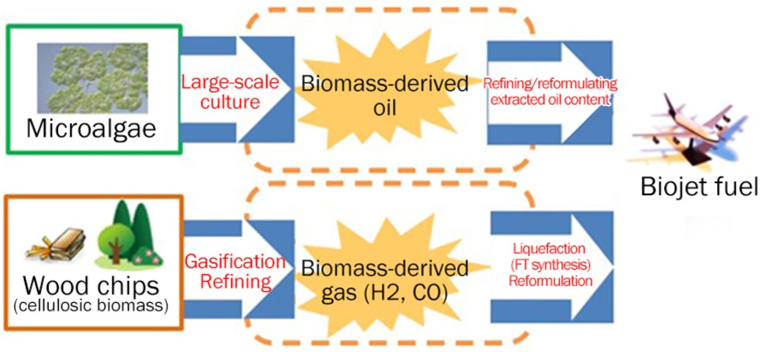
While microalgae as a raw material still cannot compete on cost with almost-free materials like waste oil and unused clothing, it promises to be a more sustainable feedstock should Euglena and others tame the commercial aspects.
NEDO, the state research agency, is another in Japan to pursue microalgae cultivation, as well as biofuels from woody cellulose, and is building a pilot facility to run until FY 2024 with the goal of commercial-level output by 2030.
Source: NEDO
Other Algae-Based Japanese Projects of Note:
- IHI is also involved in the cultivation of algae for bio-jet fuel. It conducted a demonstration experiment in Thailand. In June 2020, it obtained ASTM certification for SAF generated from the microalgae. The company is discussing the establishment of a supply system for SAF with Showa Shell, and their SAF was recently adopted by both JAL and ANA.
- ENEOS has invested ¥15 billion in Chitose-Bio Evolution, a Japan-originated biotechnology start-up in Singapore. The latter is operating an algae cultivation facility on a large scale in Malaysia.
- J-Power is involved in the cultivation of algae for jet fuel. Where J-Power is different is its attempts to produce algae that can be cultivated in cold climates so they can grow in Japan throughout the year. J-Power plans to install cultivation facilities in its research center in Fukuoka prefecture and aims for practical application in 2030.
- Denso, the auto parts firm, has an algae cultivation facility in Kumamoto. Since 2008 the company has worked on research to produce biofuel from new types of algae through CO2 absorption.
Hedging bets with alcohol
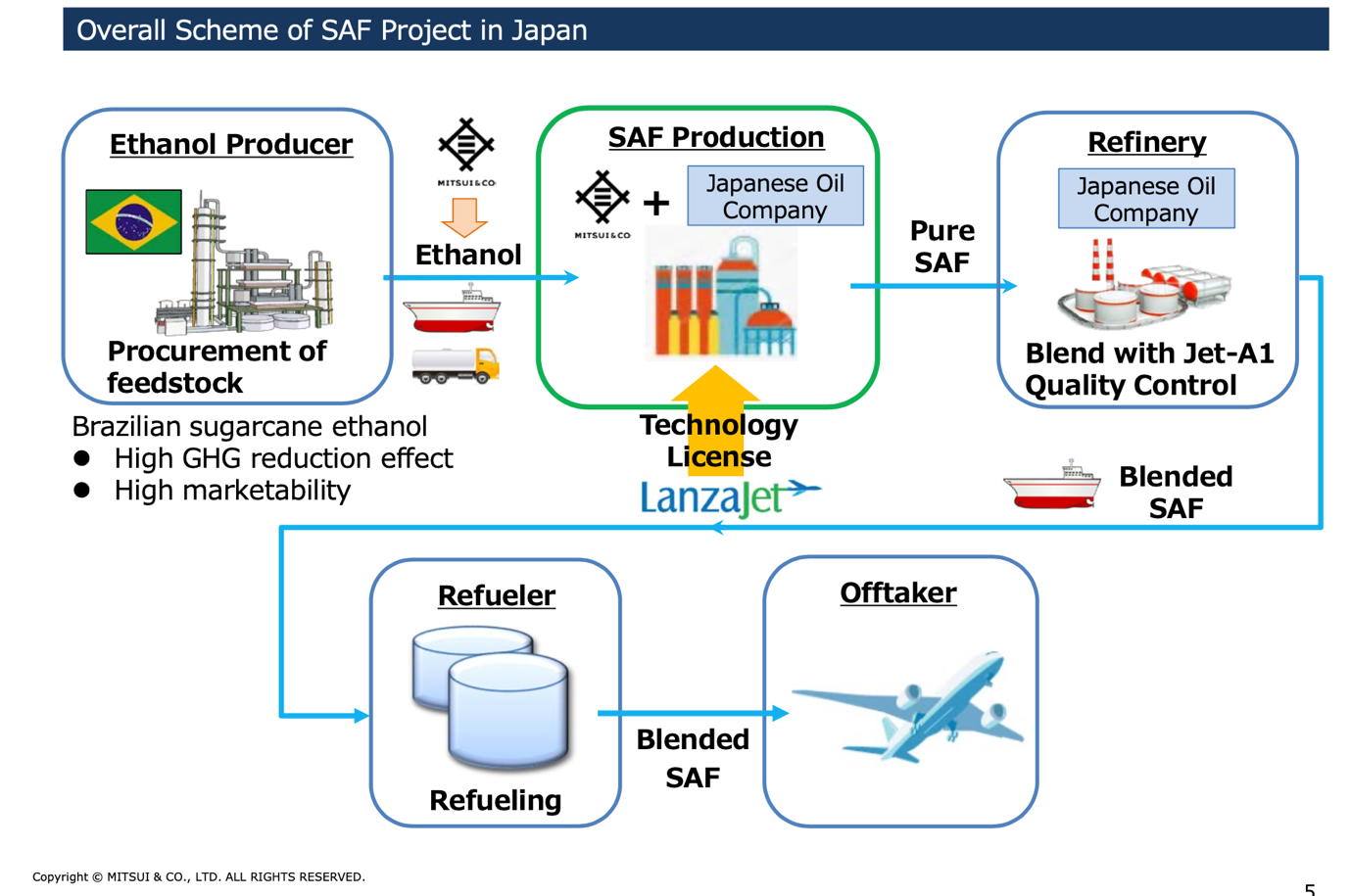
If algae-based fuels don’t work out, Japan wants to have other technologies in place. ANA, for example, has hedged its bets by partnering with trading house Mitsui & Co. and investing in a U.S. startup working to commercialize a process that converts ethanol alcohol into fuel.
Japanese investment in LanzaJet has helped the U.S. startup build a lab-scale pilot plant that will grow to a demonstration-scale facility next year. ANA agreed to buy LanzaJet’s biofuel from this year, but the Japanese investors end-goal is to have the technology brought here via a full-scale commercial SAF factory by 2025. It would use Brazilian sugarcane ethanol as feedstock, according to Mitsui.
One reason for bringing the technology to Japan is to avoid the CO2 associated with carrying SAF by ship to the country, according to a top ANA executive. “Local production for local consumption is important,” the executive said.
This time it’s different?
For those who watched Exxon Mobil, then the world’s biggest company, proclaim algae as the fuel of the future in 2009, only to wrap up their $600 million green biofuel program less than four years later, the latest boom may seem fanciful. What’s different this time is that there is a cost on the other side – the emissions penalty for airlines that works like a carbon tax. This changes the fuel cost calculations.
Furthermore, more of Japan’s biofuel ambitions are now global. Rather than stubbornly sticking to domestic algae-based projects, as ANA initially did, Japanese firms are investing in overseas startups to gain an edge. They are also pursuing several biofuel technologies – with government policy and funding in support.
Fuel innovation stretches further. JAL, for example, is also pursuing a project with Toshiba to commercialize technology that converts CO2 from factory exhaust gases into a fuel.
Electric motors may be the most popular green option today, but the fight to be the fuel of the future in transport is still very much alive.
GLOBAL VIEW
BY TOM O’SULLIVAN
Below are some of last week’s most important international energy developments monitored by the Japan NRG team because of their potential to impact energy supply and demand, as well as prices. We see the following as relevant to Japanese and international energy investors.
Woodside Petroleum/BHP: Oil & Gas M&A:
Australia’s Woodside will acquire BHP’s oil and gas division in an all-stock transaction possibly worth $13 billion. BHP’s oil production is around 300,000 barrels per day, but the company plans to divest all of its fossil fuel assets including coal. Perth-based Woodside is capitalized at $15 billion. BHP will also move its primary listing to Sydney from London where it was the second largest company by market capitalization. Annual cost savings arising from the M&A are estimated to be $400 million. Woodside will be one of the world’s 10 largest producers of LNG after the combination.
Hydrogen:
A recent study by Robert Howarth and Mark Davidson at Cornell University examined the lifecycle GHG emissions of blue hydrogen accounting for emissions of both CO2 and fugitive methane.
Most hydrogen is produced by steam reforming of methane in natural gas (“grey hydrogen”), with high CO2 emissions. Increasingly, many market participants propose using carbon capture and storage to reduce these emissions, producing so-called “blue hydrogen.” The study found that GHG emissions from blue hydrogen were not low, as expected, but high. While blue hydrogen’s CO2 emissions are lower, fugitive methane emissions for blue hydrogen are higher than for grey hydrogen because of an increased use of natural gas to power the carbon capture technology. Thus, blue hydrogen’s GHG footprint is more than 20% greater than burning natural gas or coal for heat, and 60% greater than burning diesel oil for heat.
Natural Gas:
1). Nord Stream 2, the new gas pipeline linking Russia and Germany, could ship 5.6 billion m3 or about 10% of annual capacity in 2021, according to its owner, Gazprom. On Friday Germany’s Chancellor Merkel met with President Putin in Moscow.
2). China overtook Japan as Australia’s top LNG buyer in the year to June 2021, with 29.8 million tons (39%) of volume vs. 29.4 million tons (37%) in the year to June 2020.
3). EIA now forecasts that U.S. natural gas exports will exceed natural gas imports by an average of 11 billion cubic feet per day (Bcf/d) in 2021, or almost 50% more than the 2020 average of 7.5 Bcf/d. Increases in LNG exports and in pipeline exports to Mexico are driving this growth in U.S. exports. For the first time since U.S. LNG exports from the Lower 48 states began in 2016, annual LNG exports are expected to outpace pipeline exports—by an estimated 0.6 Bcf/d—this year.
Solar Supply Chains:
Several large solar developers in the U.S. have had solar components detained at U.S. ports due to sanctions on Chinese solar component manufacturers such as Hoshine Silicon Industry Limited that manufactures in Xinjiang Province. Canadian Solar is one developer severely impacted by restrictions on Chinese solar imports.
EVs:
Europe overtook China in terms of EV sales for the first time in 2020, with registrations soaring to 1.4 million, compared with 1.2 million in China.
EV Batteries:
Glencore acquired a stake in Britishvolt, a UK battery start-up, with plans to build a $3.5 billion Gigafactory in Northumberland to equip the UK EV industry. Glencore will supply the Gigafactory with cobalt.
Aviation:
1). Embraer, the Brazilian aircraft maker, announced carbon emissions cuts of 50% by 2040 vs. 2018 levels, as well as plans for all aircraft produced after 2030 to run on low-carbon sustainable aviation fuel. Boeing plans to produce commercial aircraft that run only on SAFs by 2030, and Airbus plans to introduce zero-emissions aircraft by 2035.
2). Last week, Joby Aviation, the electric vertical-take-off-and-landing (e-VTOL) air taxi company, IPO’d through a SPAC. The e-VTOL taxi market may hit $1 trillion in 2040.
Nuclear Fuel:
Ukraine’s new central spent nuclear fuel storage facility has been completed, following approval from local inspectors. Energoatom, Ukraine’s nuclear operator, and Holtec, a U.S. company, began construction of the dry storage site in 2017. It is designed to store as many as 16,530 used fuel assemblies. As a result, Ukraine will no longer need to export spent fuel to Russia. Most Ukrainian used fuel is currently stored inside NPPs and over time it will be moved to the new storage facility. Vitrified high-level waste from the reprocessing of Ukrainian fuel will be returned from Russia to be stored there also. Cost savings associated with the site are estimated at $140 million per annum.
Critical Raw Materials Supply Chain:
In the U.S. infrastructure bill, $6 billion is earmarked for battery materials processing and manufacturing projects. Another $140 million has been allocated for a rare earths’ demonstration plant, part of a broader investment drive across the full length of the metallic supply chain. The investment in U.S. domestic critical metals production capacity is an attempt to reduce U.S. reliance on imports of rare earth compounds, with 80% of shipments coming from China in 2020.
Weather/Climate:
The U.S. recorded its highest ever hourly electricity demand on August 12, reaching 720 gigawatt hours (GWh) for the hour ending 5:00 p.m. EDT with temperatures across the lower 48 states averaging 32 Celsius. The previous hourly high was 718 GWh in July 2017, while July 2021 was the hottest month globally ever recorded according to the U.S. National Center for Environmental Administration.
China:
China’s CSI New Energy index rose by 55% over the last three months as efforts intensify to peak emissions by 2030 and achieve carbon neutrality by 2060.
South Korea:
LNG remains a critical fuel for South Korea and imports will rise to 53m tons by 2040 according to a recent analysis. LNG consumption in 2020 was 40 million tons. Consumption is expected to decline to 48 million tons by 2050 when South Korea plans to reach net-zero C02.
Thailand:
PTT, Thailand’s state-owned listed oil and gas company, announced investments of $10 billion to build its EV and renewable energy businesses in Asia and Europe. PTT is targeting Vietnam, India, Taiwan and Europe for investments.
India:
1). Last week Prime Minister Modi launched a $1.35 trillion infrastructure package on the 74th anniversary of India’s independence. It includes investments in electric mobility, solar energy and green hydrogen, with a goal to make India energy independent by 2047.
2). In the first two weeks of August gasoline, diesel, and jet fuel sales started to show some recovery as the impact of the pandemic starts to wane across India.
Iran:
In 2020, Iran produced less than two million barrels per day of crude oil, an almost 40-year low for the country, according to the EIA. Several factors contributed to this, including the global economic decline precipitated by the COVID-19 pandemic and international sanctions limiting crude oil exports. EIA also estimates that Iran’s exports of crude oil and condensate fell from more than 2.5 million barrels per day in 2017 to an average of less than 0.4 million barrels per day in 2020.
Afghanistan:
As Taliban rule spreads across Afghanistan, it’s now thought to be the major supplier of fuel oil to U.S. and NATO forces operating from the Hamid Karzai International Airport in Kabul. It’s also thought to generate over $40 million per annum taxing fuel shipments.
Poland:
Poland plans to construct its first nuclear power plant by 2033 as it attempts to reduce its 70% reliance on coal for electricity production. Five more nuclear power plants will be constructed by 2043, effectively reversing a 1990 plan to shelve nuclear development. The Polish government has set aside $35 billion for these nuclear investments and will establish a ‘bad bank’ structure for legacy coal assets.
Sweden:
In September, Ikea, the world’s largest furniture store, will start selling wind and solar renewable energy to Swedish households and later internationally.
U.S.:
1). The EIA now forecasts that U.S. motorists will burn through 8.8m barrels of gasoline this year, up 10% YoY, but below the 9.3m barrels per day in 2019. This is benefiting refiners such as Valero and Philips 66.
2). The EIA also estimates that coal consumption for U.S. electricity production will rise 17% YoY in 2021 to 512 million tons.
3). Nexamp, the Boston-based solar developer will get a capital infusion of $240 million from Generate Capital, the sustainable infrastructure investment firm. The capital will be used to expand Nexamp’s solar footprint across the U.S.
4). Tennessee Valley Authority, the largest government-owned utility in the U.S., plans to switch 1,200 of its vehicle fleet to EVs by 2030, one third of the total, and to introduce EV charging stations every 80km along major thoroughfares in Tennessee.
Brazil:
Jair Bolsonaro announced that Brazil is negotiating with Argentina to build a billion-dollar pipeline from the Vaca Muerta shale gas reserves in Northern Patagonia. Natural gas prices are soaring in Brazil due to a prolonged drought, the worst in a century, that has reduced output from hydropower stations
EVENTS CALENDAR
A selection of domestic and international events we believe will have an impact on Japanese energy.
| February | Approval of Fiscal 2021 Budget by Japanese parliament including energy funding projects;CMC LNG Conference |
| March | 10th Anniversary of Fukushima Nuclear Accident;Smart Energy Week – Tokyo;
Quarterly OPEC Meeting; Japan LPG Annual Conference; Full completion of all aspects of the multi-year deregulation of Japan’s electricity market; End of 2020/21 Fiscal Year in Japan; |
| April | Japan Atomic Industrial Forum – Annual Nuclear Power Conference;38th ASEAN Annual Conference-Brunei;
Japan LNG & Gas Virtual Summit (DMG)-Tokyo Three crucial by-elections in Hokkaido, Nagano & Hiroshima – April 25th |
| May | Bids close in first tender for commercial offshore wind projects in Japan;Prime Minister Suga to visit the U.S. |
| June | Release of New Japan National Basic Energy Plan-2021;G7 Meeting – U.K.
Presidents Biden and Putin are due to meet at a summit in Geneva Forum for China-Africa Cooperation Summit (Senegal) |
| July | Tokyo Metropolitan Govt. Assembly Elections;Commencement of 2020 Tokyo Olympics |
| August | METI committee approves draft of Japan’s 6th Basic Energy Plan |
| September | Ruling LDP Presidential Election;UN General Assembly Annual Meeting that is expected to address energy/climate challenges;
IMF/World Bank Annual Meetings (multilateral and central banks expected to take further action on emissions disclosures and lending to fossil fuel projects); End of H1 FY2021 Fiscal Year in Japan; Japan-Russia: Eastern Economic Forum (Vladivostok)-tentative |
| October | Last possible month for holding Japan’s 2021 General Election; Hydrogen Ministerial Conference in conjunction with IEAMETI Sponsored LNG Producer/Consumer Conference; Innovation for Cool Earth Forum – Tokyo Conference; Task Force on Climate-Related Financial Disclosure (TCFD) – Tokyo Conference; G20 Meeting-Italy |
| November | COP26 (Glasgow);Asian Development Bank (‘ADB’) Annual Conference;
Japan-Canada Energy Forum; East Asia Summit (EAS) – Brunei |
| December | Asia Pacific Economic Cooperation (APEC) Forum – New Zealand;Final details expected from METI on proposed unbundling of natural gas pipeline network scheduled for 2022. |
DATA
Japan Oil Price
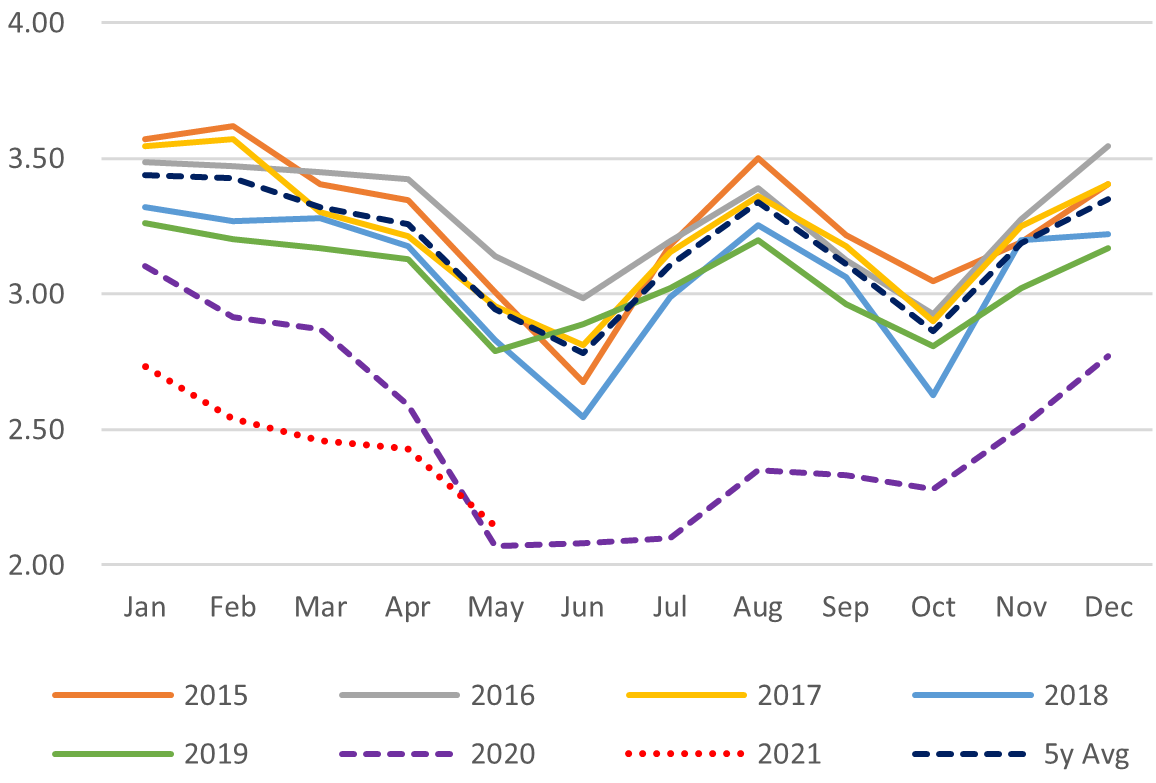
Crude Imports Vs Processed Crude
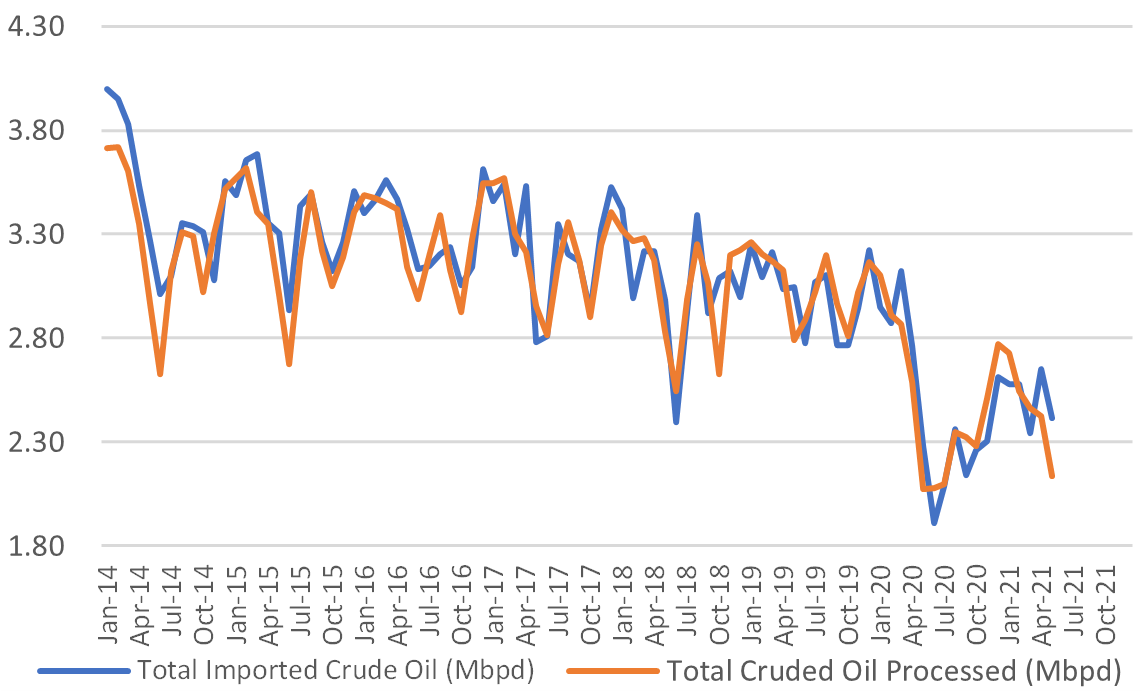
Monthly Oil Import Volume (Mbpd)
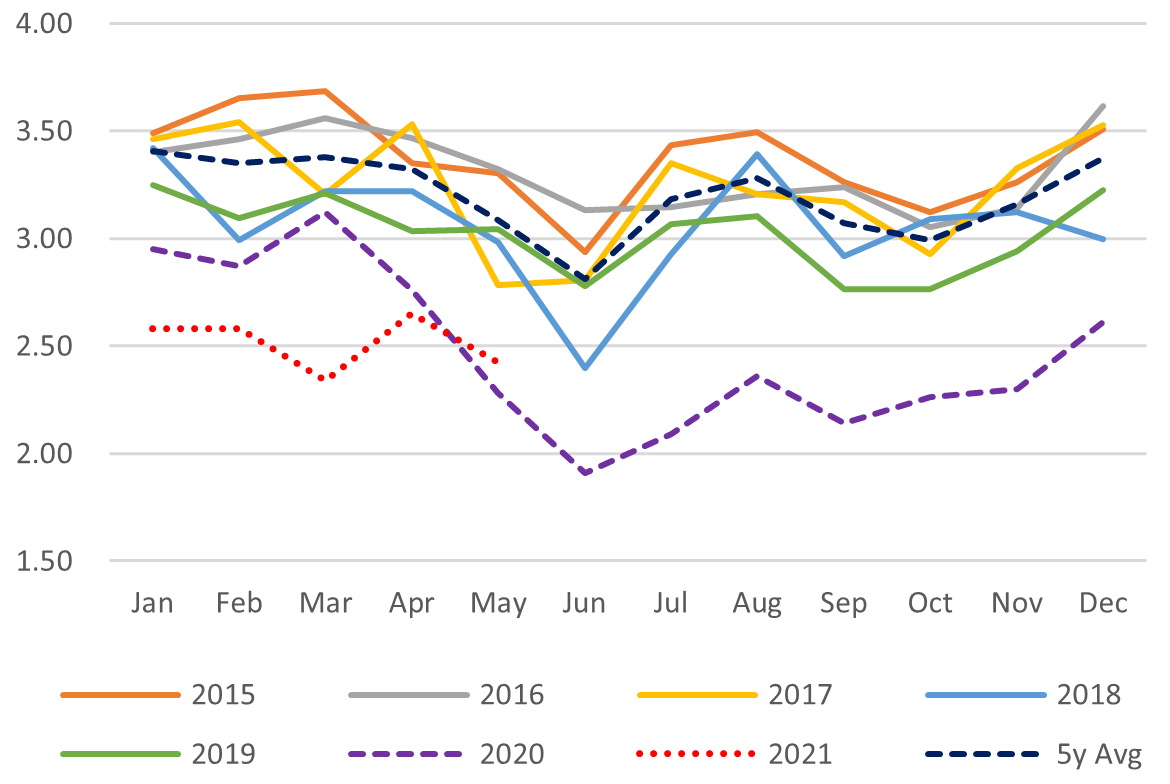
Monthly Crude Processed (Mbpd)
Domestic Fuel Sales
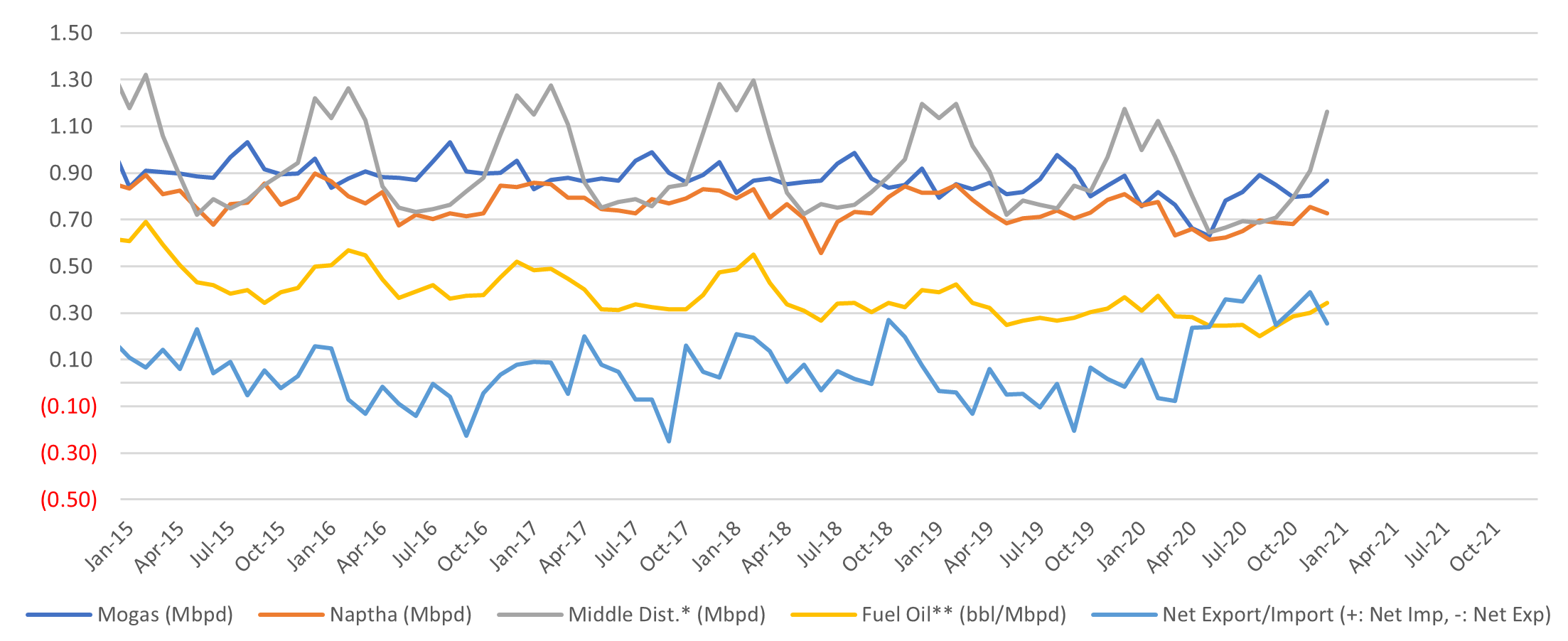
SOURCES: Ministry of Economy, Trade, and Industry (METI), Ministry of Finance, and the Petroleum Association of Japan
Japan LNG Price
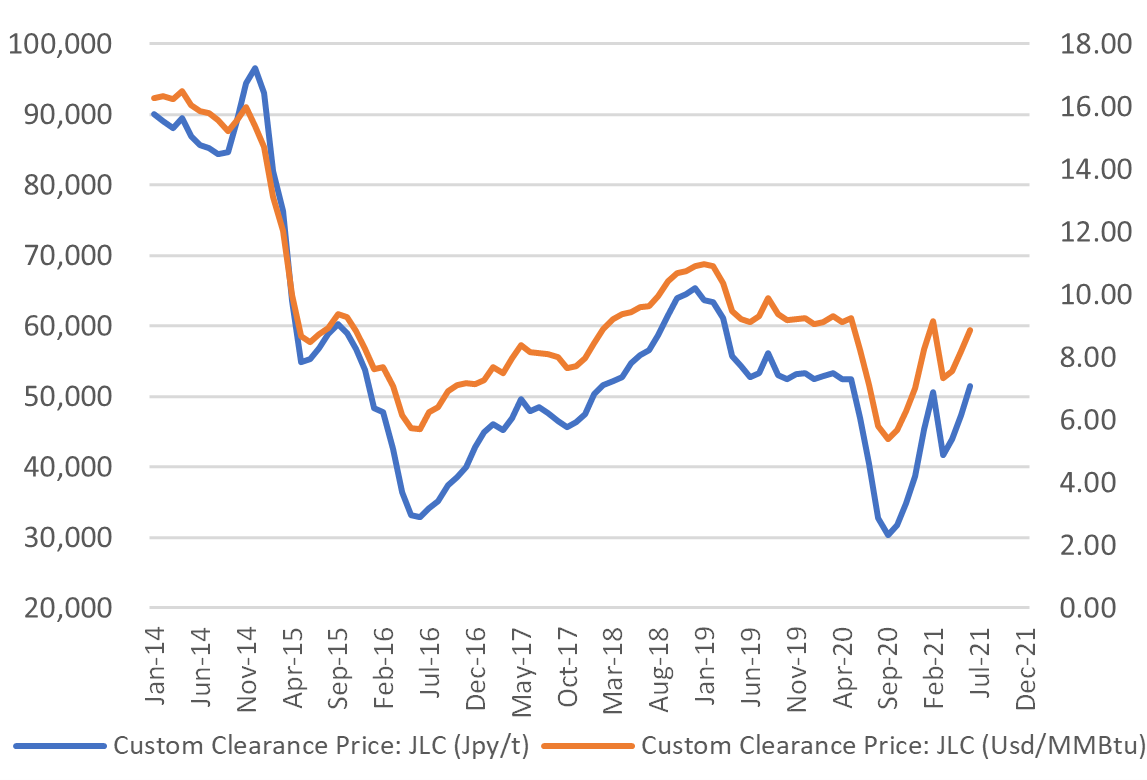
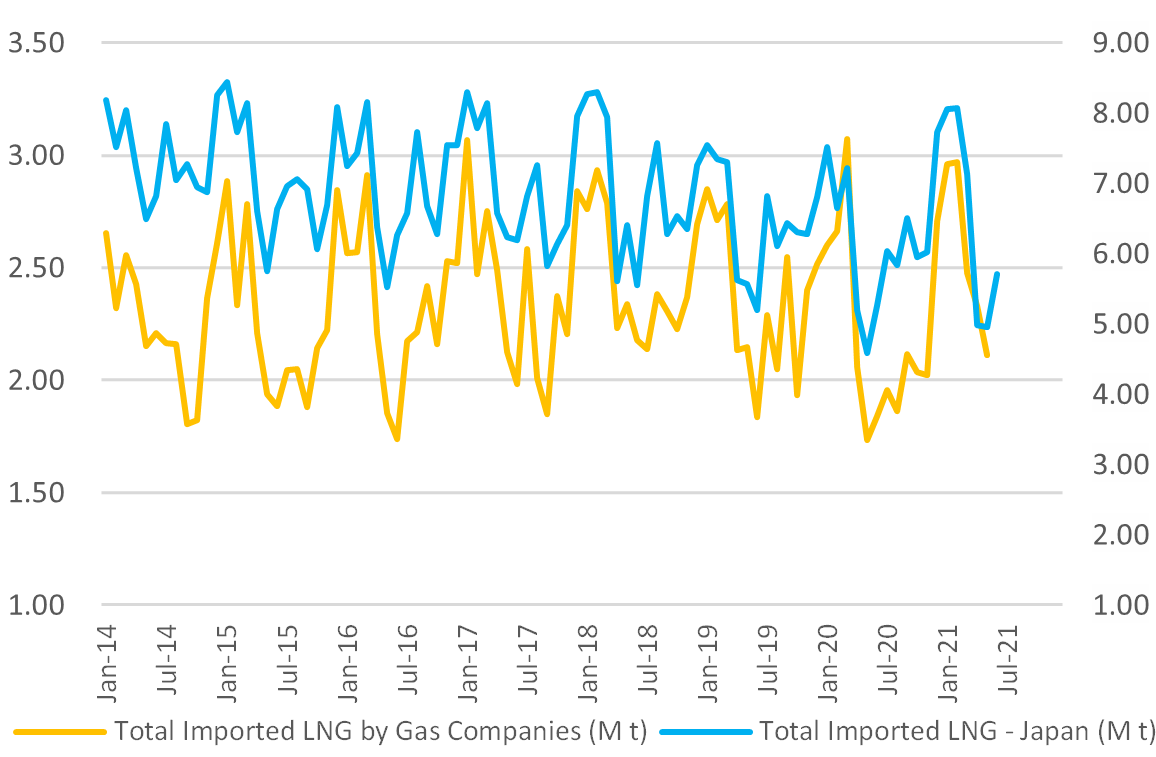
LNG Imports: Japan Total vs Gas Utilities Only
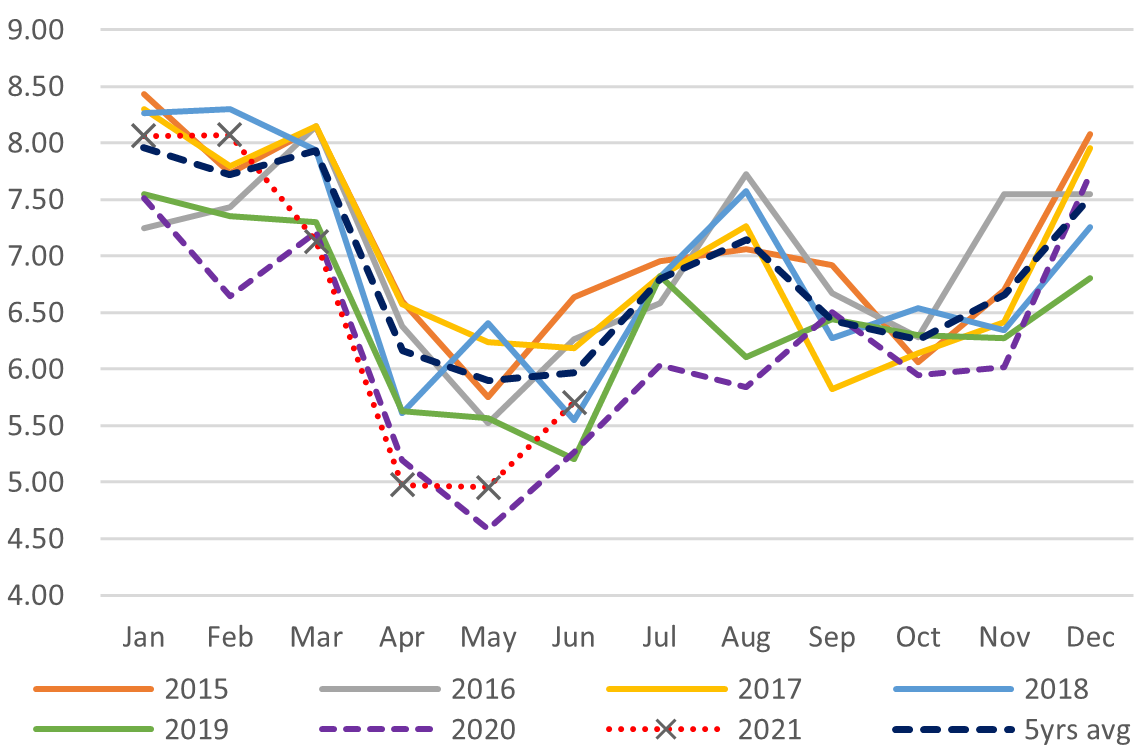
Total LNG Imports (M t)
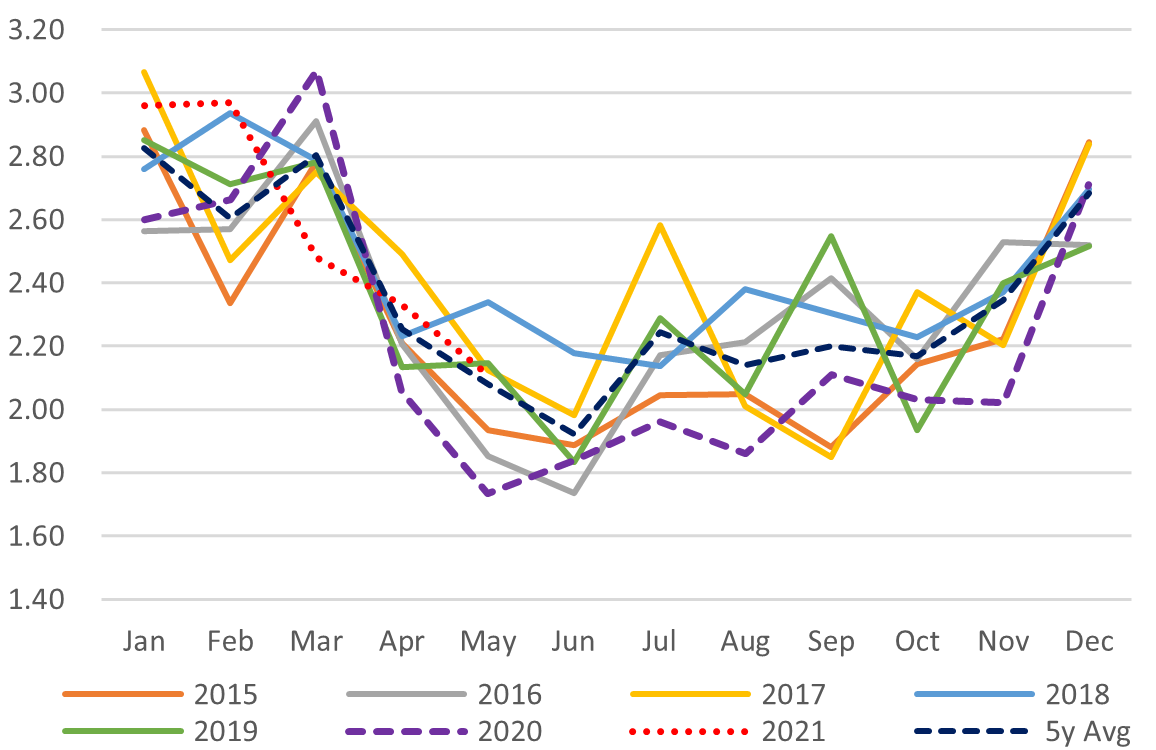
LNG Imports by Gas Firms Only (M t)
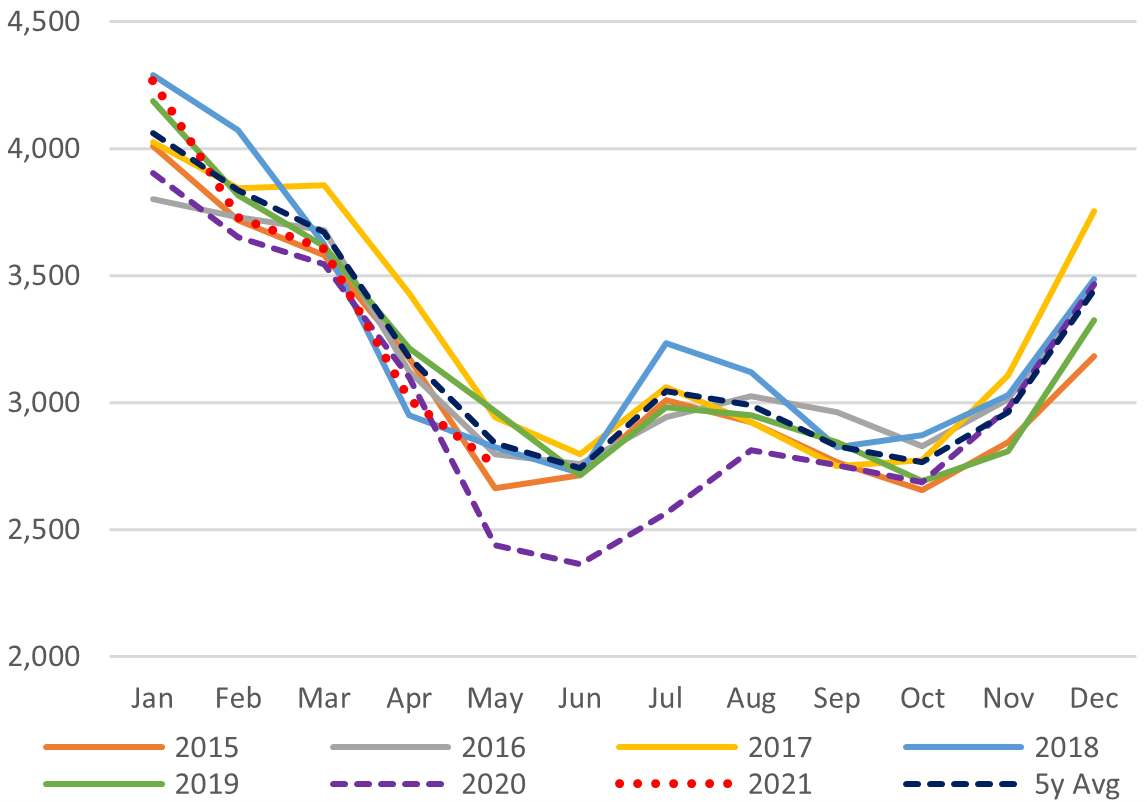
City Gas Sales – Total (M m3)
City Gas Sales by Sector (M m3)
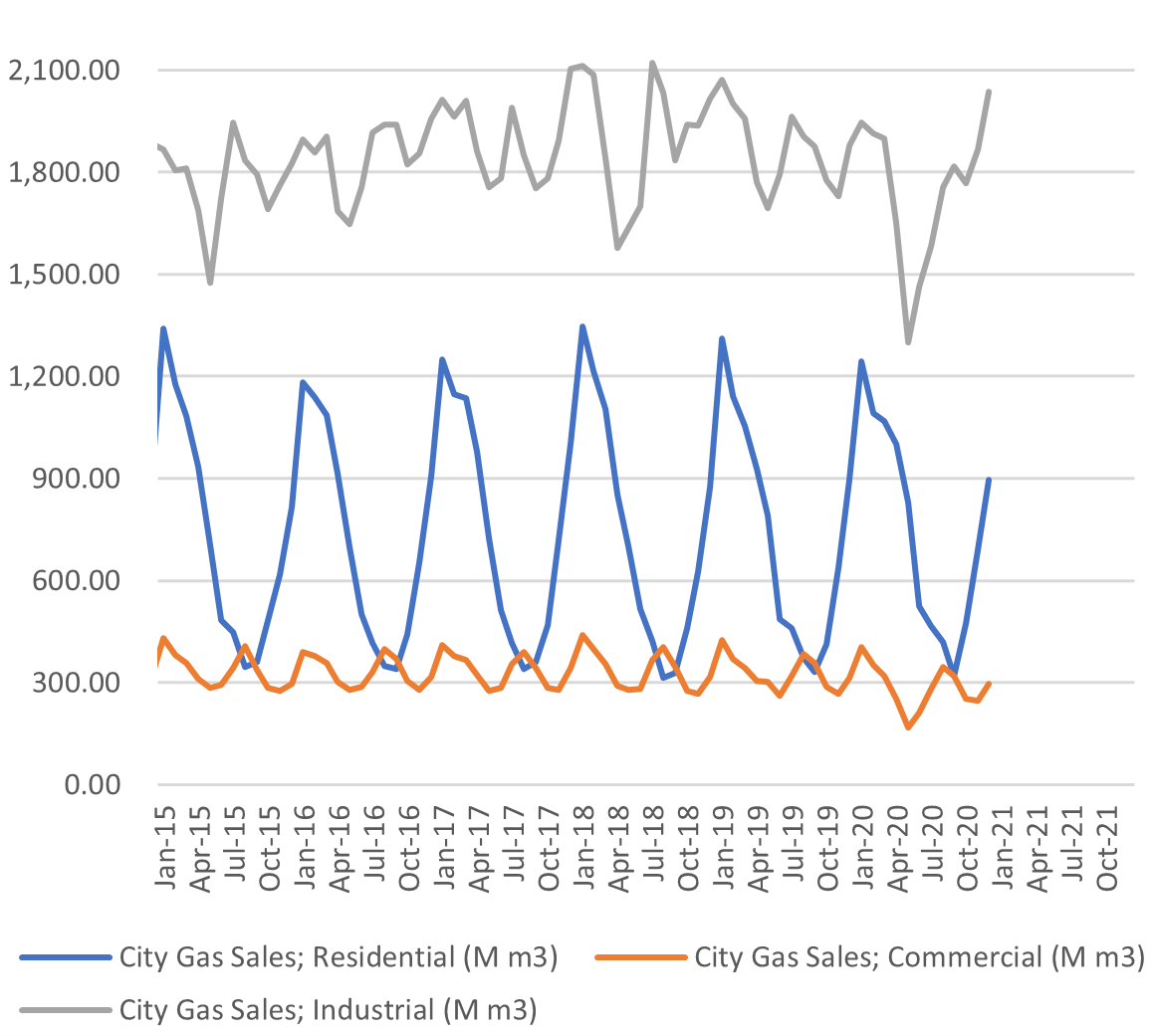
SOURCES: Ministry of Economy, Trade, and Industry (METI),
Ministry of Finance
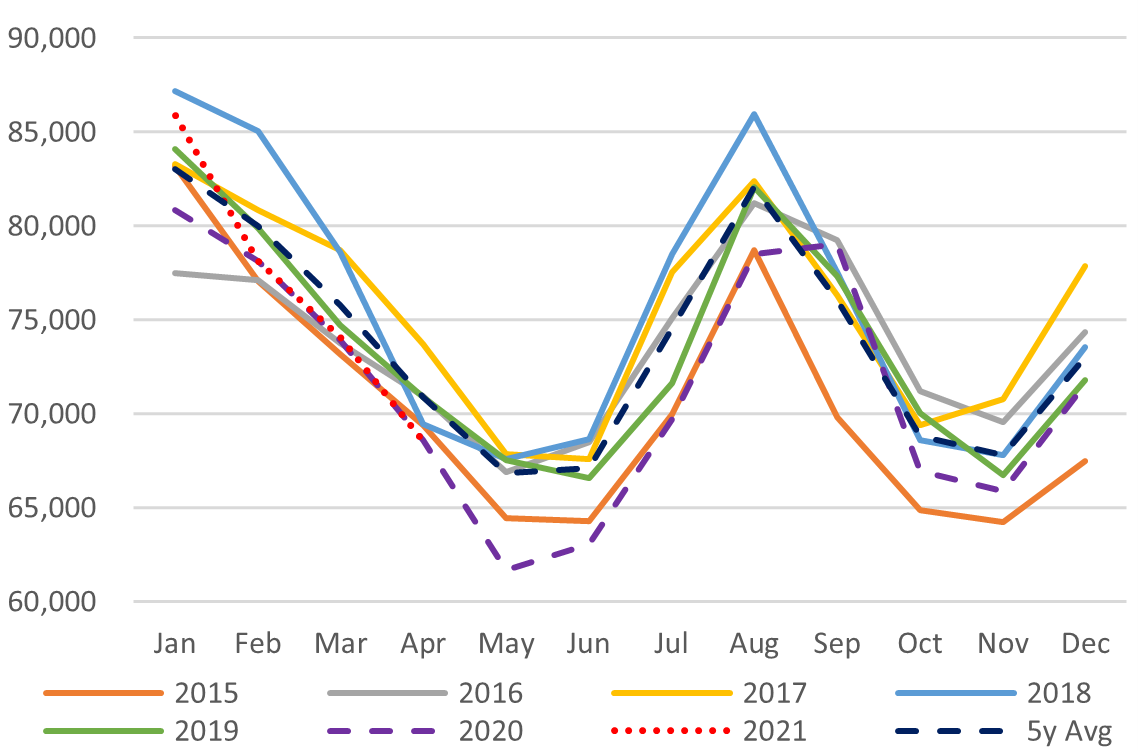
Japan Total Power Demand (GWh)
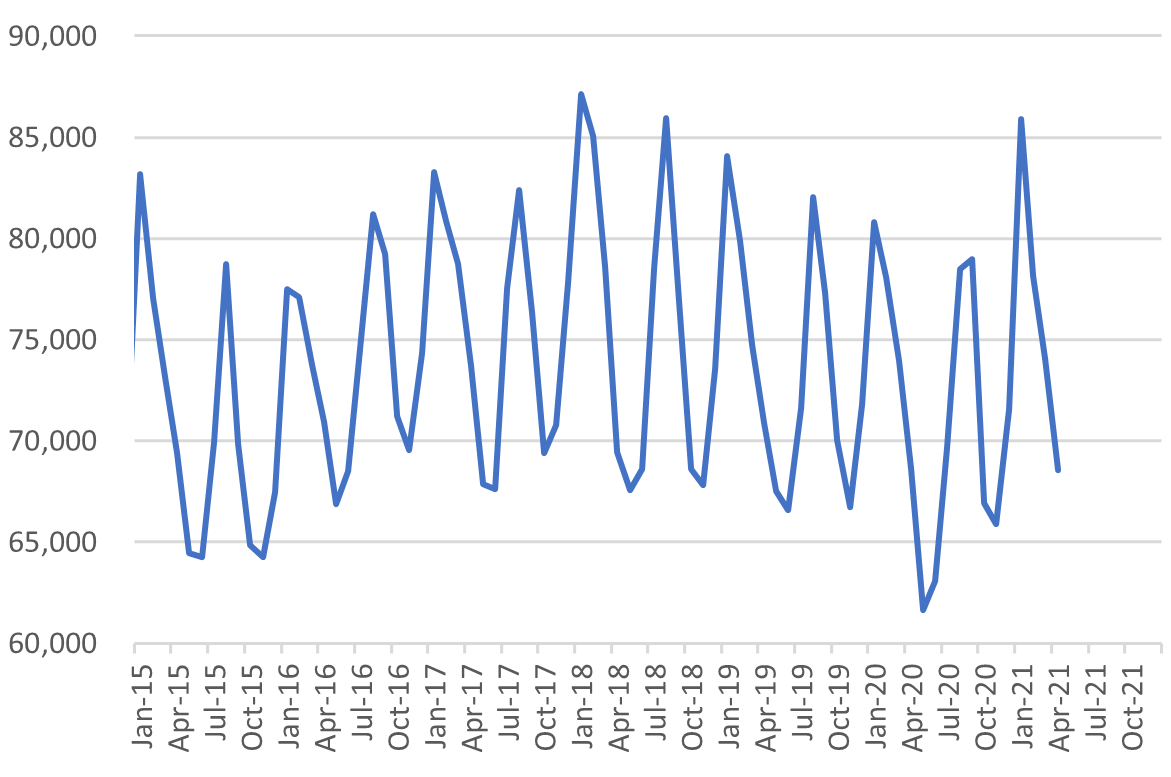
Current Vs Historical Demand (GWh)
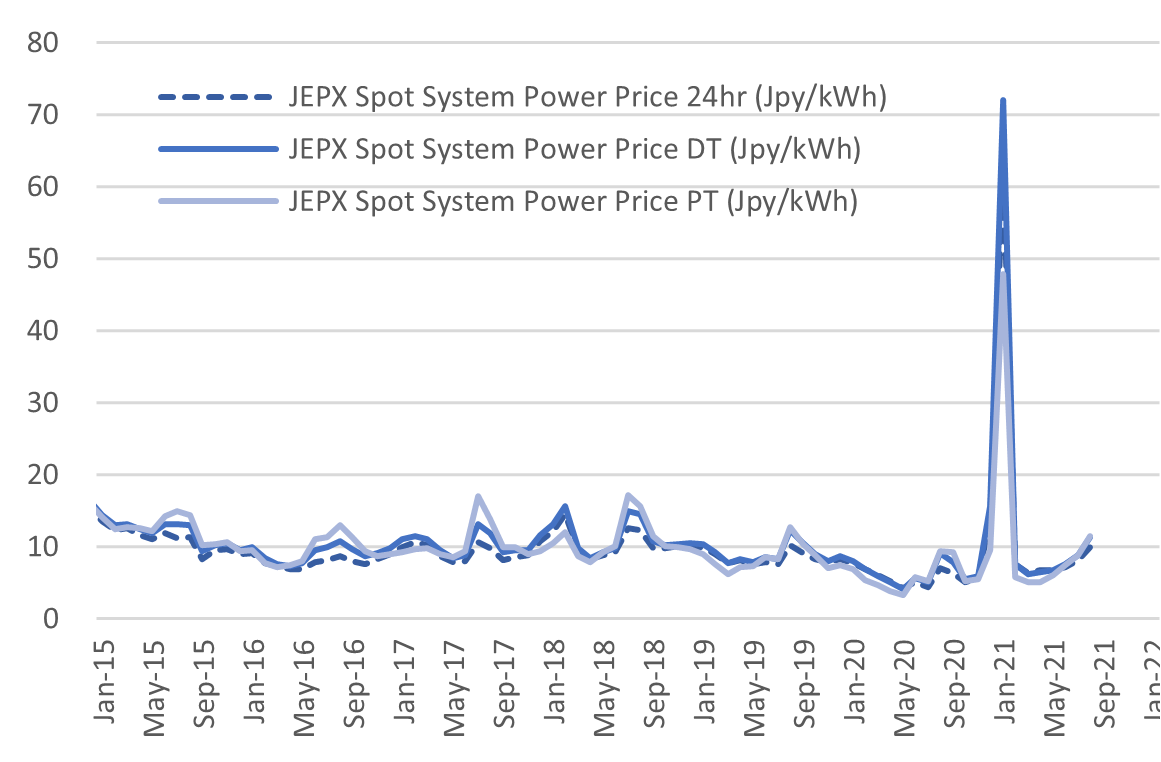
Day-Ahead Spot Electricity Prices
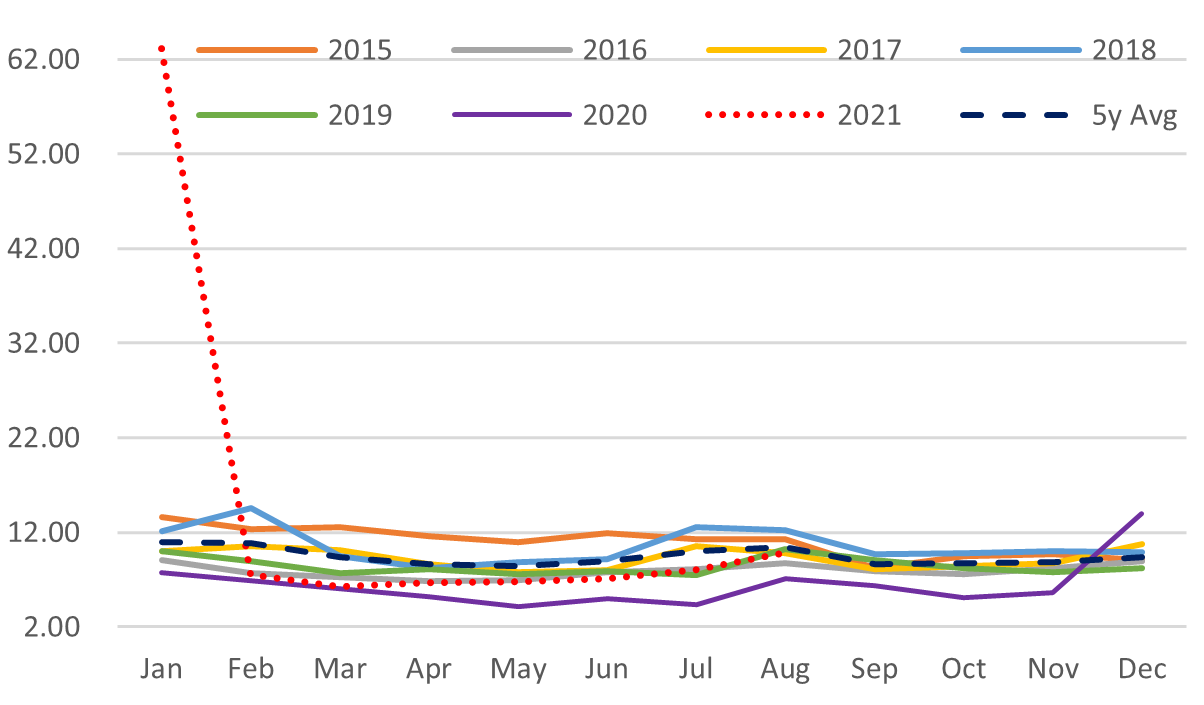
Day-Ahead Vs Day Time Vs Peak Time
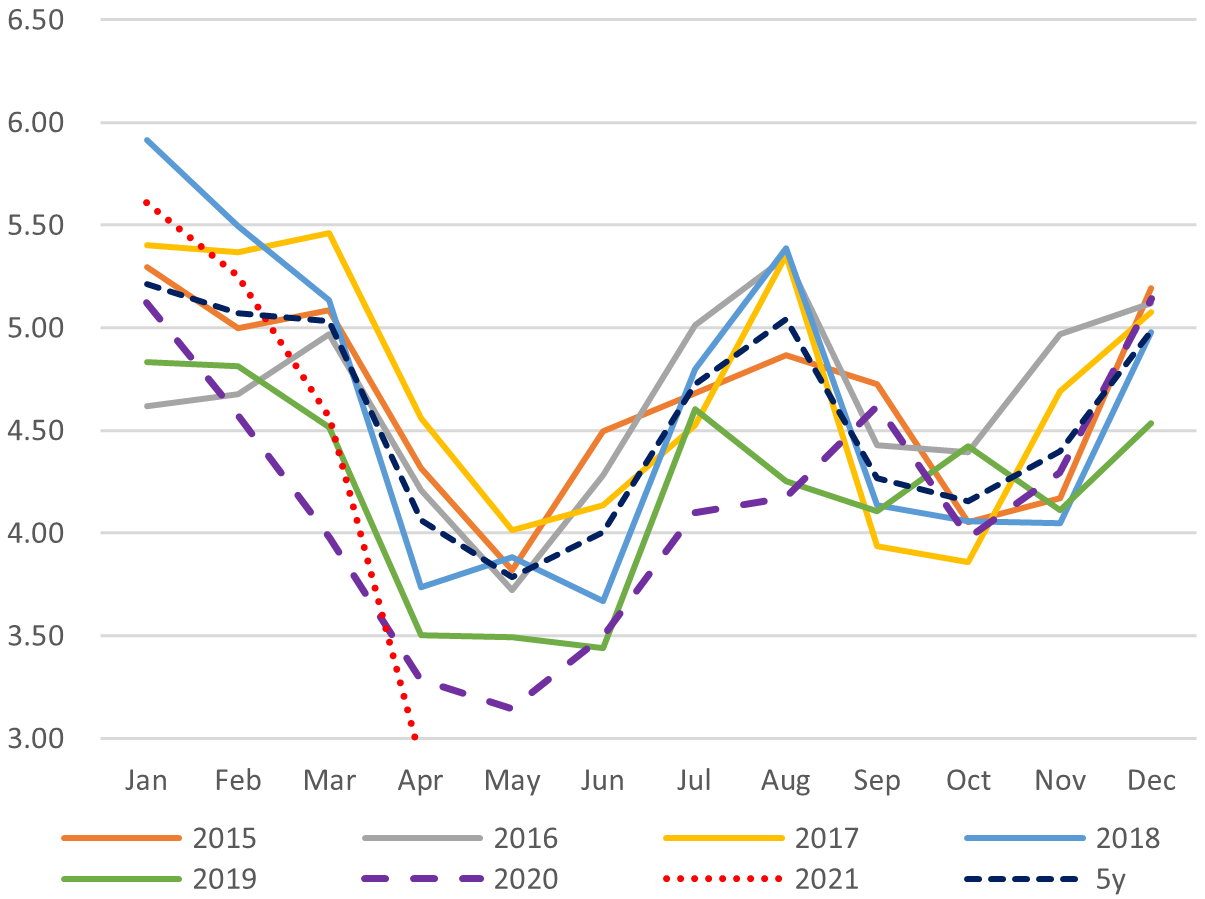
LNG Imports by Electricity Utilities
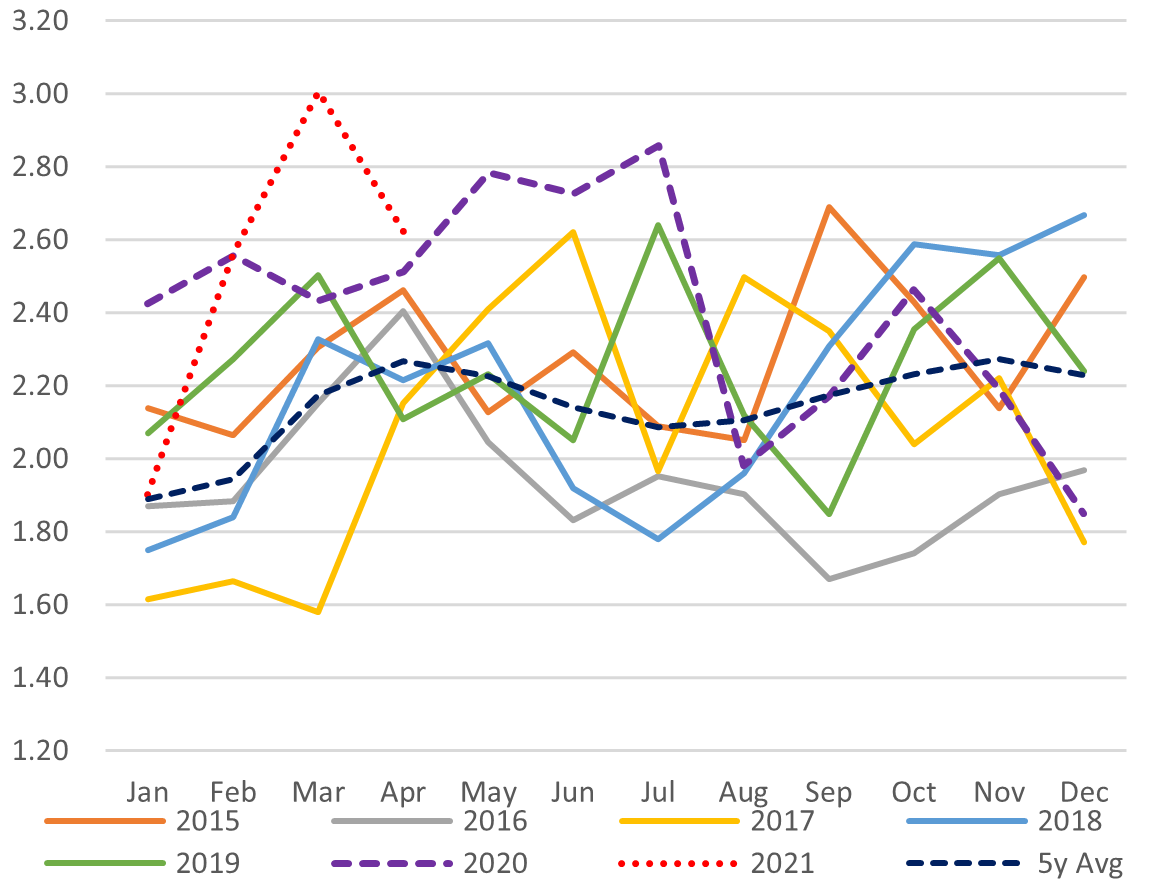
LNG Stockpiles of Electricity Utilities
SOURCES: Ministry of Economy, Trade, and Industry (METI), and the Japan Electric Power Exchange
Disclaimer
This communication has been prepared for information purposes only, is confidential and may be legally privileged. This is a subscription-only service and is directed at those who have expressly asked K.K. Yuri Group or one of its representatives to be added to the mailing list. This document may not be onwardly circulated or reproduced without prior written consent from Yuri Group, which retains all copyright to the content of this report.
Yuri Group is not registered as an investment advisor in any jurisdiction. Our research and all the content express our opinions, which are generally based on available public information, field studies and own analysis. Content is limited to general comment upon general political, economic and market issues, asset classes and types of investments. The report and all of its content does not constitute a recommendation or solicitation to buy, sell, subscribe for or underwrite any product or physical commodity, or a financial instrument.
The information contained in this report is obtained from sources believed to be reliable and in good faith. No representation or warranty is made that it is accurate or complete. Opinions and views expressed are subject to change without notice, as are prices and availability, which are indicative only. There is no obligation to notify recipients of any changes to this data or to do so in the future. No responsibility is accepted for the use of or reliance on the information provided. In no circumstances will Yuri Group be liable for any indirect or direct loss, or consequential loss or damages arising from the use of, any inability to use, or any inaccuracy in the information.
K.K. Yuri Group: Oonoya Building 8F, Yotsuya 1-18, Shinjuku-ku, Tokyo, Japan, 160-0004.