
JAPAN NRG WEEKLY
AUGUST 30, 2021
JAPAN NRG WEEKLY
Aug. 30, 2021
NEWS
TOP
- MoE unveils plan to subsidize 75% of green initiatives (solar farms, batteries, EVs, etc.); METI also plans more funding for EVs
- Japan picks 11 hydrogen projects to support from new ¥2T fund; focus on liquid hydrogen supply, co-firing with LNG, ammonia
- Govt. to begin close monitoring of LNG stockpiles of utilities and spare power capacity; will mediate LNG sharing domestically
ENERGY TRANSITION & POLICY
- METI group sounds alarm over Japan’s slow progress in batteries
- More details released on Japan’s new carbon credits exchange
- Govt. urges steelmakers to speed up move to CO2-free furnaces
- Japan urged by U.S., EU to join new methane reduction program
- Toho Gas, Mitsubishi Heavy successfully trial hydrogen co-firing
- Australia hydrogen projects draw Japanese interest: ENEOS, Mitsui OSK, Itochu, Sumitomo Corp among firms to unveil plans
- Nuclear reactor program that can make hydrogen is back in favor
- Itochu invests in U.S. venture that makes hydrogen from waste
- Lawmakers from ruling coalition raided over solar fraud links
- Osaka Gas trials cooling material that doesn’t require energy
- Toshiba group starts trial of SAF from recycled CO2 … [MORE]
ELECTRICITY MARKETS
- TEPCO announces plan to discharge waste water from Fukushima
- Former prime minister candidate flips to be opponent of nuclear
- Kansai Electric, RWE to study floating wind turbines project
- JRE resubmits plans for an offshore wind farm near Nagasaki
- Idemitsu, Nissan trial dynamic power pricing for EVs … [MORE]
OIL, GAS & MINING
- Sumitomo Metal first to recover nickel, cobalt from used batteries; Daikin to halve use of copper in air conditioners on soaring prices
- Japan’s July crude oil imports fall in volume by surge in value
- LPD imports drop by a quarter; reliance on the Middle East falling
- INPEX to extend Tokyo gas pipeline as capital’s demand on the up
ANALYSIS
JAPAN’S GREEN ENERGY HERO WANTS TO REMAKE FOSSIL FUEL PLANTS INTO CLEAN GENERATORS
Few companies have such outsized ambitions to transform Japan’s power industry as Erex Co. In the last few months, the firm of 182 people has engaged in talks to take over several coal plants and convert them to renewable energy. It also filed plans to build Japan’s first ever hydrogen-fired generation facility.
Once a small-scale electricity retailer in rural Japan, the company was quick to seize the opportunities for new players in the industry since 2011. It has grown from retailer to producer, and in the process became a listed company. It has just posted its best ever results.
HOW LIKELY IS JAPAN’S ELECTRICITY PRICE TO SPIKE AGAIN, REPEATING THE SCENARIO FROM JANUARY?
In January, Japan’s wholesale electricity price jumped 2,400% as the country battled a cold snap. Such an extreme move had immediate consequences; several power retail firms went bankrupt. Yet the longer-term impact is likely to be even more powerful as many of the fundamentals that caused the price spike are still in place and unresolved. Which suggests last January was not a one-off event.
As both METI and the electricity grid oversight body, OCCTO, come out with warnings of another shortage of generation capacity this coming winter, we look at the likelihood that the price surge repeats itself.
GLOBAL VIEW
Maersk picks “green” methanol to help shipping industry cut emissions. China ready to launch a 210 MW high-temp. gas-cooled reactor. Top wind turbine makers say raw material costs are hurting profits. India seeks $80 billion from sales of state infrastructure. Details on these and more in our global wrap.
EVENT CALENDAR
JAPAN NRG WEEKLY
PUBLISHER
K. K. Yuri Group
Editorial Team
Yuriy Humber (Editor-in-Chief)
Tom O’Sullivan (Japan, Middle East, Africa)
John Varoli (Americas)
Regular Contributors
Mayumi Watanabe (Japan)
Daniel Shulman (Japan)
Takehiro Masutomo (Japan)
Art & Design
22 Graphics Inc.
Sponsored
SUBSCRIPTIONS & ADVERTISING
Japan NRG offers individual, corporate and academic subscription plans. Basic details are our website or write to subscriptions@japan-nrg.com
For marketing, advertising, or collaboration opportunities, contact sales@japan-nrg.com
For all other inquiries, write to info@japan-nrg.com
OFTEN USED ACRONYMS
METI The Ministry of Energy, Trade and Industry
MOE Ministry of Environment
ANRE Agency for Natural Resources and Energy
NEDO New Energy and Industrial Technology Development Organization
TEPCO Tokyo Electric Power Company
KEPCO Kansai Electric Power Company
EPCO Electric Power Company
JCC Japan Crude Cocktail
JKM Japan Korea Market, the Platt’s LNG benchmark
CCUS Carbon Capture, Utilization and Storage
mmbtu Million British Thermal Units
mb/d Million barrels per day
mtoe Million Tons of Oil Equivalent
kWh Kilowatt hours (electricity generation volume)
NEWS: ENERGY TRANSITION & POLICY
Environment Ministry wants to subsidize up to 75% of green initiatives
(Nikkei, Aug 23)
- The MoE allocated ¥20 billion for subsidies to local bodies attempting to reduce their carbon footprint.
- Former subsidies schemes could only cover half the cost of green projects, but the new program will allow up to 75% of project costs to be met. It will be less for towns with a larger population.
- To be eligible, local bodies need to submit a nine-year plan detailing how they will reduce their carbon footprint, and are required to make maximum use of solar energy, storage batteries, electric vehicles, hydrogen fuel, building insulation, and other measures to cut CO2.
TAKEAWAY: A lack of adequate financial incentives for local governments has been MoE’s major weakness in pushing through a higher uptake of renewables in the countryside. A higher coverage ration could tip the scales for some municipalities, making them more open to solar, wind and other renewable energy projects. However, it will still require the rest of costs (at least a quarter of total) to come from the local budget, which might be hard for sparsely populated areas with more land available for new development.
- SIDE DEVELOPMENT:
METI seeks a 11.1% increase in budget for next fiscal year to support EVs
(Jiji, Aug. 24)- METI’s budget request for next fiscal year is for ¥1.4 trillion, an increase of 11.1% from the initial FY2021 budget. The ministry needs the funds to support the wider rollout of electric vehicles (EVs) and renewable energy, as well as the ongoing recovery work in Fukushima.
- The requested budget allocation for EVs is double last year’s level at ¥33.5 billion, and includes subsidies to support the purchase of EVs. Another ¥400 million is penciled in to help manufacturers of auto components for gasoline-powered vehicles shift to new business areas.
- METI also wants ¥650 million to subsidies training programs for offshore wind power generation specialists.
Industrial Structure Council alarmed at slow progress in battery investment
(Japan NRG, Aug 23)
- The Industrial Structure Council, one of the key METI policy organizations, sounded the alarm on what it considers to be slow progress in the national project to build a stronger battery supply chain.
- Japan had previously set the goal of boosting battery output capacity to 100 GWh by 2030. Capacity now stands at 22 GWh, far below the 47 GWh in the U.S., the 66 GWh in the EU, and China’s 182 GWh.
- By 2025, the U.S., EU and China expect to more than double battery capacity. At the same time, Japan’s capacity will rise by a mere 77%, the Council said.
- Japanese companies still maintain a high global share in the individual anode, separator and other battery component markets, but the nation’s overall battery supply chain needs to be strengthened. That includes, the sourcing of critical raw minerals, the manufacture of components, cells, and cell packing systems, and the development of zero-emission vehicles, the Council said.
- To promote large investments into batteries, the govt. introduced new tax breaks of up to 10% until 2023.
- CONTEXT: Setting up large battery production and strengthening the entire battery supply chain topped the govt’s list of core green industrial policies for 2022, as outlined in fiscal budget discussions. Other core green policies the govt. wants to focus on are building charging stations and other infrastructures for zero-emission vehicles, boosting wind, solar, ammonia and hydrogen energy development, ensuring energy supply security while transitioning away from fossil fuel generation, and building a carbon pricing mechanism.
METI starts to prepare more detailed plans for a new carbon credits exchange
(Japan NRG, Aug 25)
- Japan will start building a framework for its new carbon exchange, which is slated to start trial runs in 2022, METI said.
- The exchange will trade carbon credits backed by the local J-Credit system, the international joint credit mechanism (JCM), and an initiative from a group of companies that will publicly pledge and disclose their emission reduction targets.
- The latter is tentatively dubbed the “Carbon Neutral Top League”, and participants will be disclosed by the time the exchange launches. The CO2 reductions achieved will be measured and certified as credits by the government. The credits will be tradable on the exchange.
- CONTEXT: Although METI has yet to disclose which companies will join the “Top League”, earlier reports from the Study Group on Economic Approaches to Carbon Neutrality said that 124 companies in 14 sectors announced plans to be fully carbon-neutral.
- METI stressed that the carbon trading system, which will be the first in Japan to operate on a nationwide level, is meant to promote corporate investments in decarbonization and innovation, helping Japanese businesses remain competitive in global markets. It should also help identify the positive and negative aspects of the energy transition, trigger improvements to energy policy and changes to consumer behaviors.
METI tightens deadlines for developing low-emission steel
(Japan NRG, Aug 24)
- The govt. urges domestic steelmakers to accelerate development of manufacturing processes that rely on hydrogen rather than coal, according to the Green Innovation Project Working Group report.
- Officials pushed the industry to start trials of hydrogen reduction in steelmaking from 2022, rather than 2024, as currently planned. This process will possibly cut steelmaking emissions by 30%.
- CONTEXT: Developing the new process is partly state financed. Currently, steelmaking relies on coking coal to heat furnaces.
- Officials also warn that if the prototype hydrogen furnace fails to achieve its expected CO2 reduction goal, the whole project will face review.
- Steel mills are testing a carbon recycling process for medium-sized furnaces. The trials were due by 2027, but have been pushed to 2026.
TAKEAWAY: Earlier this month, Sweden became the first country to produce steel made entirely without coal. This “green” steel was forged using hydrogen for heat, proving the technical aspect of the process. Japanese steelmakers are not the only ones left chasing their peers in Sweden; the world’s top steel companies are racing to develop new furnace technology that runs on hydrogen or other CO2-free alternatives. It’s interesting the government became more assertive with domestic steelmakers soon after Sweden announced its breakthrough.
Japan urged by US, EU to join methane reduction program ahead of COP26
(NHK, Aug. 24)
- The U.S. and European Union would like to introduce a program that aims to cut global methane emission by 30% by 2030, compared with 2020 levels, and want Japan to take part in the program.
- Methane is 20 times more damaging to the environment than CO2. Most global methane emissions come from livestock, such as through belching by cows.
- About 80% of Japan’s methane emissions come from cattle and rice fields, and it would be difficult for Japan to significantly reduce them, according to government officials, which are now considering the idea.
METI panel says consumers need better access to and info on green electricity
(Japan NRG, Aug 26)
- Consumers need to see the benefits of green power and have more incentives to use it, METI’s Subcommittee on Basic Power and Gas Policy said in a report, adding that consumers need better access to the purchase of green electricity.
- Part of the Subcommittee’s suggestions are already coming to life as METI plans to give electricity buyers direct access to non-fossil-fuel power certificate auctions from November. Currently, consumers need to buy them from power companies.
- Still, many consumers remain confused by the non-fossil-fuel power certificate scheme, and the government and power retailers need to do more to explain the system.
- The Subcommittee is also concerned that not enough of retailed power is from green sources. In the fiscal year to March 2020, only 24% of electricity sold by the country’s top 61 suppliers qualified as green.
Japan picks 11 hydrogen projects to support with new ¥2 trillion green fund
(Various, Aug 27)
- The new ¥2 trillion-yen Green Innovation Fund, which is administered by NEDO on behalf of the government, has picked an initial round of 11 projects in hydrogen to support.
- The projects include a feasibility study to build a commercial-scale supply chain for liquid hydrogen.
- Kawasaki Heavy Industries, ENEOS and Iwatani Corporation are behind the proposal to establish the world’s first commercial-scale, international liquid hydrogen supply chain, capable of transporting tens of thousands of tons of the fuel annually.
- The study will look at the logistics of liquefying, dispatching, shipping, and receiving shipments of the fuel. Kawasaki would be responsible for the shipping of the fuel from overseas. Iwatani is a specialist in hydrogen production. ENEOS is a refiner and distributor.
- The three firms aim to deliver 225,000 tons of liquid hydrogen in 2030 and cut the hydrogen costs to one third of the current levels.
- Other projects backed by NEDO include JERA’s plans to co-fire hydrogen and LNG in thermal power plants. JERA will start trials of the co-firing in October with the aim of burning 30% hydrogen at its LNG plants in Japan by FY2025.
- Kansai Electric has a similar plan to co-fire hydrogen at LNG power plants and eventually switch to hydrogen-only generation. Hydrogen-only power plant trials will begin from FY2025 and last for two years.
- Meanwhile, Asahi Kasei and JGC Holdings will work on a demonstration experiment to produce ammonia from hydrogen. The two will prepare the facilities and start production around 2024. The aim is to help the chemicals industry switch from crude oil to ammonia.
TAKEAWAY: On paper, plans to begin a switch from an oil to a hydrogen economy look very much a reality from the second half of this decade.
For a profile of Iwatani, the only company currently able to make liquid hydrogen in Japan, see the Aug. 16 edition of Japan NRG.
- SIDE DEVELOPMENT:
- Ammonia and hydrogen will primarily serve the power sector: METI group
- (Japan NRG, Aug 27)
- Although there are several potential applications for hydrogen and ammonia, Japan will focus on their use in power generation, where the need is most pressing.
- Hydrogen and ammonia will replace fossil fuels at thermal power plants, said the Green Innovation Project Working Group.
- The group estimated that if the 20 GW of coal-fired plants in Japan that employ the latest USC technology were switched to ammonia, the utilities would need to procure 50 million tons of the raw material a year.
- Japan considers a priority to identify and develop alternative ammonia production technologies to the Haber-Bosche process widely used today, and also to discover new electrolysis systems to make green hydrogen.
Toho Gas, Mitsubishi Heavy successfully trial hydrogen co-firing gas engine
(Company statements, Aug 26)
- Toho Gas and Mitsubishi Heavy Industries Engine & Turbocharger successfully operated a conventional gas engine and turbocharger on a fuel source containing 35% hydrogen by volume, with no loss in output.
- The success is significant given that the engine was not significantly modified. It is a gas engine used in cogeneration systems.
- The engine runs on reticulated gas and is rated at 450 kW.
- The successful trial is the first of its kinds in Japan.
TAKEAWAY: Many often ask how far away hydrogen is from becoming a realistic energy option. There remains a dose of skepticism around the potential. Tests like this one by Mitsubishi Heavy and Toho Gas indicate that the “future” of hydrogen is not so far away. Not only because the test was successful, but because it was performed with little modification of the existing equipment. As per the previous news item, test co-firing at several gas power plants in Japan is about to start and looks to grow quickly by 2025.
Of course, how well and how fast hydrogen co-firing develops also depends on the cost of the fuel, the availability and robustness of the supply chain, and the alternatives, including the business cases for ammonia and biomass.
We’ll probably see several Japanese thermal power plants test different co-firing technologies before utilities decide which is the more optimal solution. The impact in terms of lowering emissions is likely to arrive towards the end of this decade, even if the technical issues are resolved much earlier.
ENEOS considering green hydrogen supply chain
(Nikkan Kogyo Shimbun, Aug 24)
- In collaboration with Australia’s Origin Energy ENEOS is review a proposal to create a CO2-free hydrogen supply chain linking Australia to Japan.
- ‘Green hydrogen’ produced by electrolysis of water in Queensland using renewably-generated energy would be reacted with the organic solvent toluene to create methylcyclohexane (MCH), which is more stable and easier to handle, for shipping to Japan.
- Origin would be responsible for providing renewably generated energy and synthesizing the hydrogen, while ENEOS would be responsible for the efficient manufacture and shipping of MCH.
- After arriving at its destination, the MCH would be separated into hydrogen and toluene again, and the toluene returned to Australia for reuse.
- SIDE DEVELOPMENT:
- Mitsui OSK signs agreement with Origin Energy on ammonia project
- (New Energy Business News, Aug. 26)
- Shipper Mitsui OSK (also known as MOL) signed a memorandum of understanding with Origin Energy to consider jointly building a supply chain for renewable energy-derived ammonia.
- Origin is considering multiple green ammonia and hydrogen projects, including a green ammonia export project in Belbay, Tasmania, which aims to start exporting in 2026.
- MOL and Origin will conduct a survey by December 2021 on the shipping of green ammonia and potential demand in Japan and Asia, and then jointly consider forming a supply chain.
- SIDE DEVELOPMENT:
- Rio Tinto and Sumitomo to assess hydrogen pilot plant in Australia
(Company statement, Aug. 24)- Rio Tinto and Sumitomo Corporation announced a partnership to study the construction of a hydrogen pilot plant at Rio Tinto’s Yarwun alumina refinery in Gladstone and to explore the potential use of hydrogen at the refinery.
- The two companies signed a letter of intent that focuses on Yarwun as the location for a Gladstone hydrogen plant that Sumitomo has been studying. If the project proceeds, the pilot plant would produce hydrogen for the recently announced Gladstone Hydrogen Ecosystem.
- The study supports the efforts of Australian, Queensland and local governments to establish Gladstone as a clean hydrogen hub of the future.
Japan revamps HTTR nuclear reactor program with hydrogen in mind
(Denki Shimbun, Aug 26)
- The govt. restarted the High Temperature Engineering Test Reactor operated by the Japan Atomic Energy Agency. This move shows how serious the govt. has become about the hydrogen market,
- The reactor, which falls under the auspices of METI and the Ministry of Culture, Education, Culture, Sports, Science and Technology, has been idle for over 10 years. The two ministries allocated a total of over ¥30 billion to the reactor in this year’s budget.
- The development of high-temperature gas reactors, which can be used to produce hydrogen, is an integral part of the govt.’s green growth strategy.
Itochu teams up with Australian partners to study creating local hydrogen hub
(New Energy Business News, Aug. 23)
- ITOCHU will work with Australian state-owned port operator Dalrymple Bay Infrastructure, Australian port management company North Queensland Bulk Ports Corp, and Canada’s Brookfield Asset Management to create a green hydrogen production, storage and export hub in Australia.
- The group will jointly carry out a commercialization survey for the supply chain. The first stage is scheduled to start in 2021.
- The port is located in the center of a designated renewable energy development zone overseen by the Queensland government.
- SIDE DEVELOPMENT:
Itochu has invested in a U.S. venture that aims to make hydrogen from municipal waste
(New Energy Business News, Aug. 25)- The trading house invested in Raven SR, a U.S. startup that aims to produce hydrogen from municipal waste. Raven plans to start producing hydrogen for transport use, sourcing waste in California.
- Raven plans moving into renewable aviation fuel production and diesel fuel production.
- Raven is developing a unique technology to produce hydrogen-based synthetic gas. It gasifies municipal waste without combustion.
- Making hydrogen from urban waste has previously been technologically difficult to do.
Lawmakers from the ruling coalition raided over links to solar fraud
(Daily Shincho, Aug 25)
- Political party Komeito and the Soka Gakkai religious group that forms its support base were rocked by revelations that the special branch of the Tokyo Public Prosecutor’s Office raided the offices of two current and former Komeito lawmakers. The raids were conducted on Aug 4.
- Komeito is part of the ruling coalition with the LDP.
- An investigation last year of a solar energy company Technosystem centered on suspected fraudulent financial practices, revealing links between Technosystem and ex Komeito MP, Toyama Kiyohiko.
- According to a former adviser to Toyama, Tokyo Governor Koike Yuriko is also implicated in this scandal.
TAKEAWAY: The media that broke the story is one of a few well-known tabloids specializing in big-impact exclusives, and it claims the target of the prosecutors may be none other than Tokyo Governor Koike, who has toyed with the idea of returning to national politics, according to media gossip.
What this story also shows is the extent to which the energy industry and policy are being dragged into big politics ahead of the upcoming general election. As we have noted in previous editions, the energy debate at present is less focused on ways to cut CO2 and more on political alliances.
Osaka Gas trials radiative cooling material that doesn’t require energy
(Nikkan Kogyo Shimbun, Aug 27)
- Osaka Gas began trialing its proprietary material, Spacecool, on trucks, tents and electrical panels used on the site of Osaka, Kansai Expo 2025.
- Spacecool uses the principle of radiative cooling to reduce surface temperatures by up to 6° without using energy.
- If successful, Osaka Gas also plans to use the material on Expo pavilions.
Toshiba and five others start experiments for sustainable aviation fuel (SAF)
(Nikkei; August 24, 2021)
- Toshiba and five partner companies will start experiments for producing eco-friendly aviation fuel using recycled CO2.
- The goal is to test a prototype by the end of March 2025.
NEWS: POWER MARKETS
| No. of operable nuclear reactors | 33 | |
| of which | applied for restart | 25 |
| approved by regulator | 17 | |
| restarted | 10 | |
| in operation today | 9 | |
| able to use MOX fuel | 4 | |
| No. of nuclear reactors under construction | 3 | |
| No. of reactors slated for decommissioning | 27 | |
| of which | completed work | 1 |
| started process | 4 | |
| yet to start / not known | 22 | |
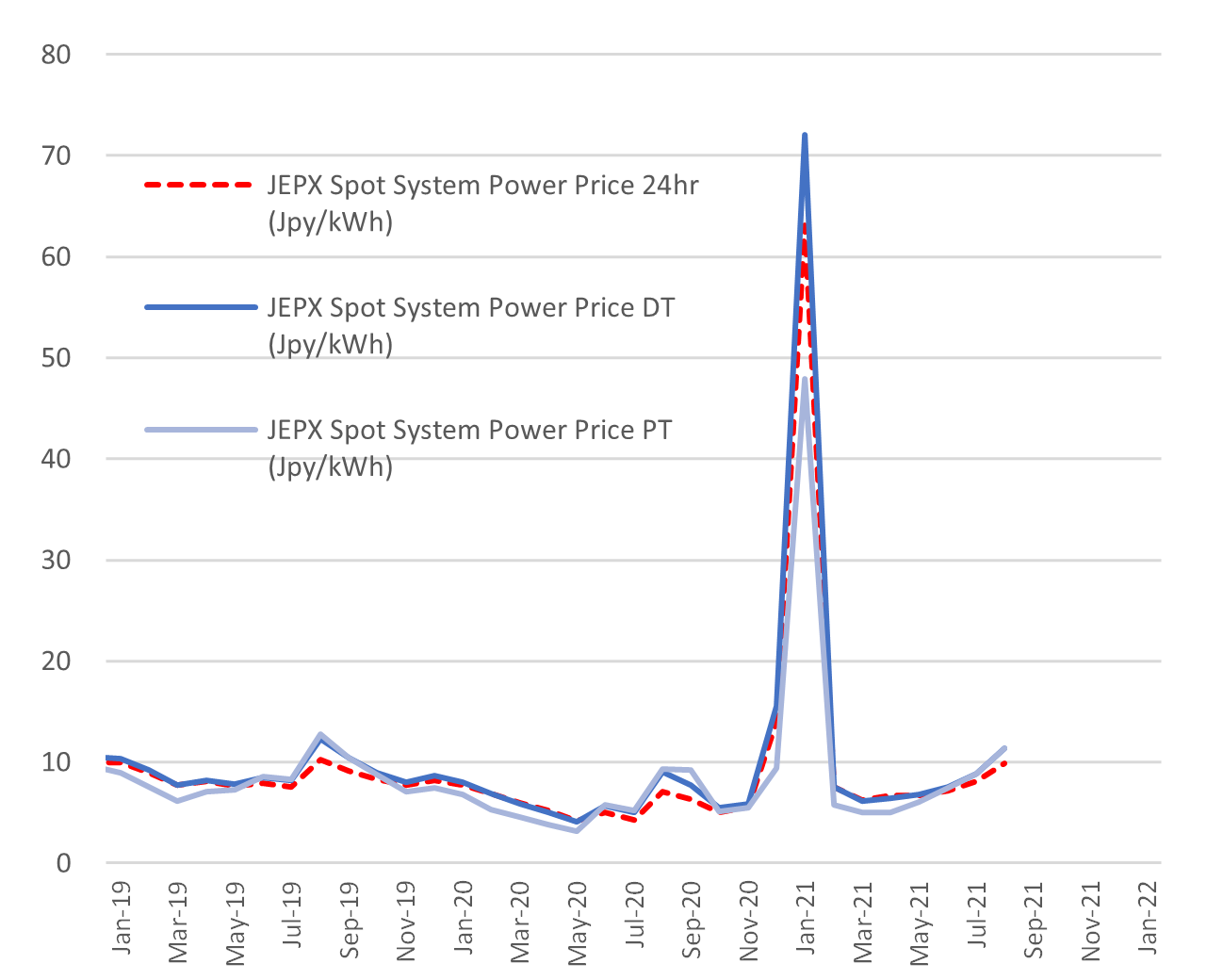
Spot Electricity Prices, Monthly Avg.
Source: Company websites, JANSI and JAIF, as of Aug 10, 2021
Government to tightly monitor utilities LNG stockpiles, help firms share the fuel
(Japan NRG, Aug. 27)
- METI has decided to begin more intensive monitoring of LNG inventories of the country’s power utilities, as well as the levels of spare power capacity at the disposal of the companies.
- The ministry wants each company to report their inventories and outlook, and will encourage firms to make additional procurement before shortages occur. In case of individual shortages, and when there are no spot cargoes available on the market, the government may come in to negotiate the sharing of fuel between companies.
- At present, LNG is procurement is decided by individual power and gas companies, and there is no mechanism for getting a real-time snapshot of the inventory levels for Japan as a whole.
- METI’s Electricity and Gas Basic Policy Subcommittee has drafted guidelines for reporting of the fuels by power generation and will start to enforce them from September. The guidelines say that having a timely understanding of the fuel inventory situation in summer and winter peaks is a national necessity.
- The inventory picture is supposed to help METI and OCCTO monitor what power capacity can be operational based on the actual fuel available.
- The individual LNG stock levels of each company are not published as it is seen to affect the competitiveness of the companies. This leaves each utility with info on only their own LNG inventory levels.
TAKEAWAY: The impact of the January electricity price spike is still being felt and reacted to by both industry and government. See the Analysis section for a more detailed breakdown.
One of the problems with the current reporting system is that a gas-fired power plant can be counted as “available” by the power grid even if it has no fuel to run. METI’s actions seek to address this. However, they also seem to transfer fuel management responsibilities to the government, which throws up a host of other questions.
TEPCO to start discharging treated waste water from Fukushima site
(NHK, Aug 25)
- TEPCO said treated water from the site of the Fukushima Dai-Ichi nuclear plant, which still contains traces of radioactive tritium, will start to be discharged from a point that is 1 km from the coastline.
- After the water is diluted with seawater to reduce the concentration of radioactive material to below mandated levels, it will be pumped out to sea via an underwater tunnel.
- TEPCO aims to complete construction of the tunnel by 2023.
- A local fisherman interviewed was skeptical whether TEPCO could safely dispose of the treated water given the utility’s record of hushing up scandals. He isn’t happy that the plan goes ahead despite public opposition.
- Meanwhile a representative of the South Korean government called for an immediate halt to the plan, saying it was unfortunate that Japan’s closest neighbor had not been consulted on the discharge.
Former prime minister candidate switches to opposing nuclear energy
(Toyo Keizai, Aug 22)
- CONTEXT: This is an interview with LDP politician Ishiba Shigeru, a former Minister of Defence and once the main challenger to former prime minister Abe. For many years he was seen as Japan’s likely future leader, although his standing has receded in the last year.
- Ishiba says the govt. is agonizing over its nuclear energy policy.
- In 2011, Ishiba slammed then PM Kan’s calls to end reliance on nuclear energy as ‘irresponsible’. Ishiba argued that nuclear power plants were an important source of plutonium, which has a role as a nuclear deterrent. Ishiba now denies he ever advocated arming Japan with nuclear weapons.
- Today, Ishiba says he’d like to put an end to nuclear power in Japan, but he isn’t yet in a position to support this because of unanswered questions how such a transition could be achieved.
- Ishiba cites the importance of energy security and the fact that energy shortages caused by blockades have driven Japan to war in the past.
- Ishiba says the govt. must make Japan’s nuclear reactors less vulnerable to terrorist attacks since they are dotted around the country, and the current network of Aegis destroyers and Patriot missiles cannot fully protect them. However, discussing such scenarios is almost taboo, he says.
Kansai Electric and RWE study floating wind farm proposal
(Nikkei, Aug 23)
- Kansai Electric (KEPCO) and Germany’s RWE Renewables will conduct a joint feasibility study on large-scale floating wind farms in Japan.
- KEPCO and RWE have worked together in the past on an anchored offshore wind farm project in the UK.
- RWE is already developing a wind farm with 2.5 GW of offshore capacity.
Japan Renewable Energy resubmits offshore wind project in Nagasaki
(New Energy Business News, Aug. 27)
- Japan Renewable Energy (JRE) published its environmental assessment document for the Saikai Eshima Offshore Wind Power Project. Although the preparatory documentation for the project had been completed, the project was reexamined and output increased to 299.5 MW.
- The fixed-bottom wind turbine project area takes up approximately 43.6 km2 off the coast of Eshima, Saikai City, Nagasaki prefecture.
- Current plans see construction starting in 2026 and operations in 2028.
Idemitsu and Nissan trial dynamic pricing of electricity
(New Energy Business News, Aug 23)
- In collaboration with Nissan, Idemitsu subsidiary Solar Frontier will trial a new EV recharging service that uses dynamic pricing.
- Around 50 TEPCO subscribers who drive Nissan Leafs will use a smart phone app that displays the discount applicable to the time of day in question, with the aim of encouraging drivers to recharge their vehicles either in the middle of the day, when there is surplus solar generated electricity, or late at night.
- The trial is subsidized by a grant from NEDO for next-generation technologies that utilize distributed energy sources.
Sharp releases all-black photovoltaic panels
(Smart Japan, Aug 23)
- Sharp will launch a new series of roof mounted photovoltaic panels named “Black Solar Zero” in October.
- The new panels are different from traditional ones in that the area around the photovoltaic cells is black, rather than white, making the boundaries between modules less obvious and improving the overall look of the roof.
- The largest panel in the range has a nominal output of 254 Watts, and an efficiency of 19.0%.
Marubeni group swaps stake in offshore wind installation firm for Enetti shares
(New Energy Business News, Aug. 26)
- Marubeni, INCJ, and Mitsui OSK (also known as MOL) plan to transfer all shares they jointly own in Seajacks International, a major offshore wind power installation company, to U.S.-listed Enetti.
- In return, the Japanese firms will take a 42% stake in Enetti, formerly Scorpio Bulkers, which operates a bulk shipping business.
- Enetti seeks to expand into the offshore wind installations business and plans to grow in this area together with Seajacks.
TEPCO wins Singapore consulting contract
(NNA, Aug 27)
- TEPCO Power Grid and Kandenko were awarded a contract to provide consulting services on a project to construct an underground substation in Singapore for Singaporean utility the SP Group. The 230 kV underground substation, due to be completed in 2024, will be the first of its type in Asia.
- TEPCO Holdings says its involvement will continue until 2026, as transmission infrastructure is connected to the new substation. The SP Group says it values TEPCO’s more than 40 years of experience with underground substations.
NEWS: OIL, GAS & MINING
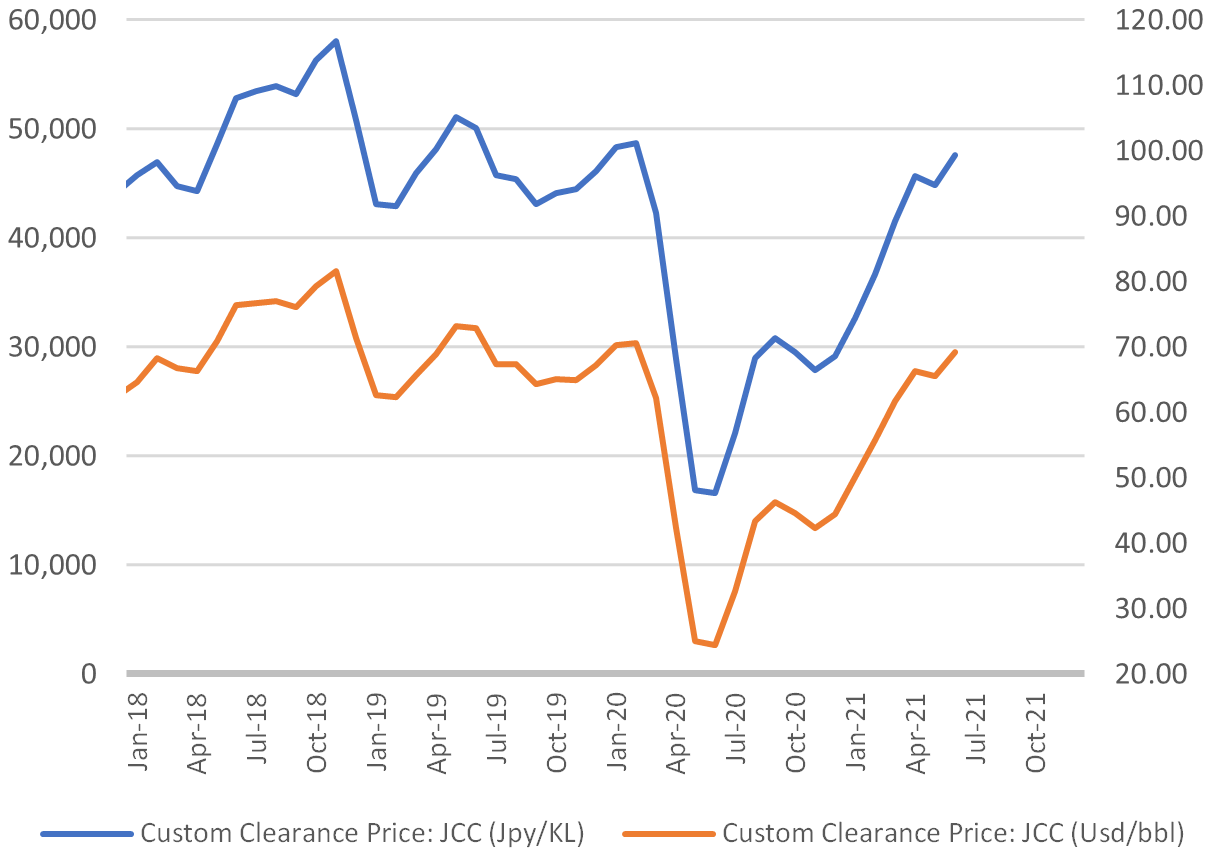
Japan Oil Price: $69.11/ barrel
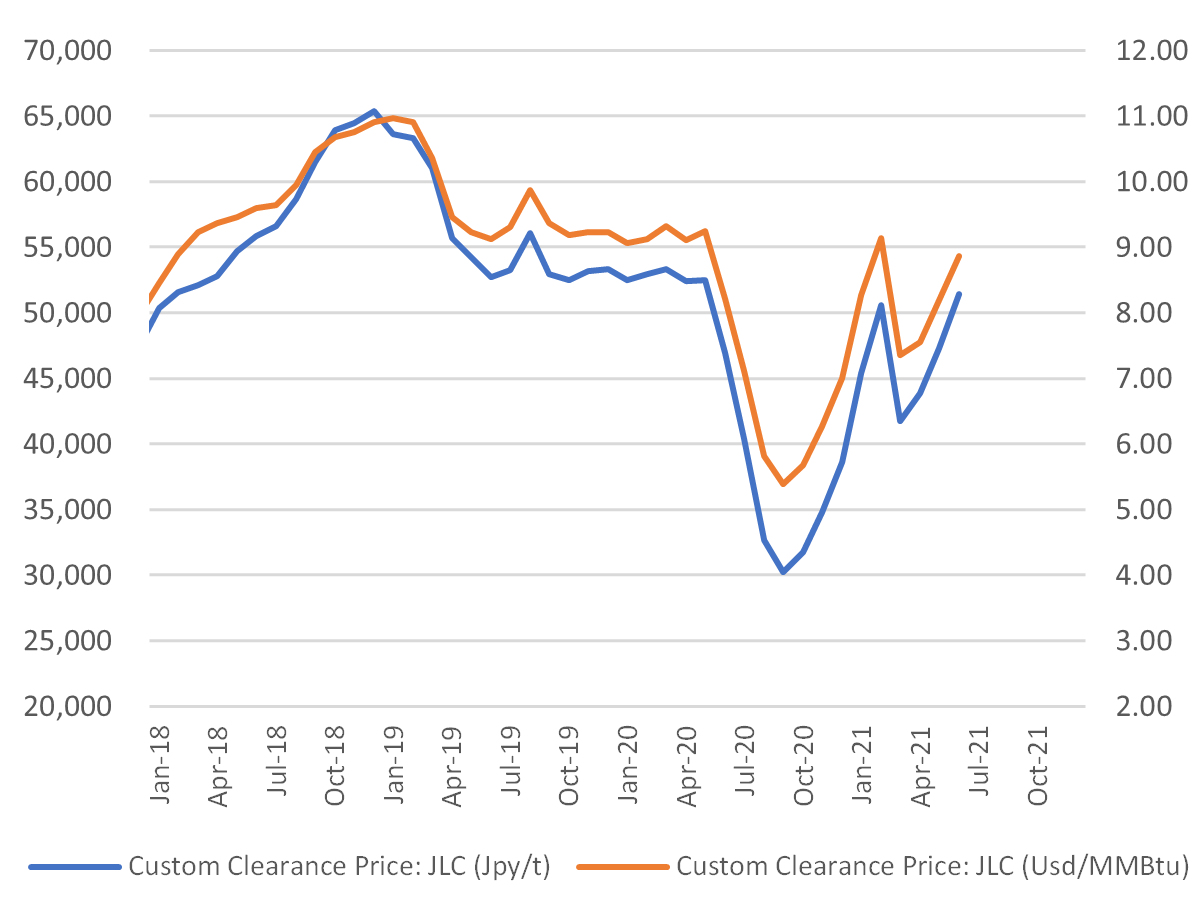
Japan (JLC) LNG Price: $8.86/ mmbtu
Sumitomo Metal recovers nickel and cobalt from used batteries in world first
(Kankyo Business, Aug. 23)
- Sumitomo Metal Mining recovered nickel and cobalt from used lithium-ion batteries (LIB) and refined them to make raw materials for positive electrode materials for new LIB. The recovered metal was a high-purity nickel-cobalt mixture and was a world-first, according to the company.
- The company said it has established a new recycling process that can recover copper, nickel, cobalt and lithium from used batteries using unique lithium recovery technology.
- SIDE DEVELOPMENT:
Daikin to halve copper in air conditioners as price soars
(Asia Nikkei, Aug. 24)- Daikin Industries, Japan’s top air conditioner maker, will halve the amount of copper used in air conditioners from the current 90,000 tons per year by fiscal year 2024.
- This is due to the 40-50% jump in copper prices in the last year, bolstered by a decarbonization trend. Green technologies tend to require more copper for their components.
- Daikin plans to use more materials like aluminum instead.
- Soaring copper prices may stimulate more R&D into switching to alternative materials.
Japan’s July crude oil imports fall in volume but surge in value; cost of LNG, coal jumped
(Japan NRG, Aug 26)
- Japan imported 11 million kiloliters of crude oil in July 2021, down 4% year-on-year, but the value of the imported cargoes surged to ¥551 billion, up 116% from a year ago, according to customs data.
- Similarly, the July LNG imports were up marginally by 2.5% to 6.2 million tons, while the total import value surged 41.9% to ¥344 billion.
- Thermal coal imports were 9.8 million tons, up 10.9%. The import value was ¥132 billion, up 84.1%
Japan’s imports of LPG down by over a quarter, reliance on U.S. supplies rises
(Sekiyu Tsushin, Aug 23)
- The Japan LP Gas Association says that LPG and butane imports in May fell for the third consecutive month and were over 25% down on last year. OPEC production cuts and poor domestic demand accounted for the drop.
- Imports from the Middle East fell by 73% on last year, while imports from the U.S., Australia, East Timor and Canada rose.
- As a result of the shift in suppliers, Japan is now only 3.9% reliant on Middle Eastern suppliers for its propane and butane requirements, while reliance on the U.S. increased slightly to 67.5%.
Niigata-Tokyo gas pipeline to be extended on increased demand
(Gas Energy Shimbun, Aug 23)
- INPEX said that the 213 km Shin-Tokyo gas pipeline that runs from Niigata to Gumma would be extended by 16 km to northern Saitama to satisfy increased demand for gas in greater Tokyo.
- The extended line will feed into the 322 km Tokyo pipeline that runs from Niigata to northern Tokyo.
- Work on the project will begin in 2022, and the extension will be completed by end of 2024.
- A raft of new industrial developments in northern Kanto means demand for natural gas in the region is likely to continue to grow.
Gas supply cut for a week in parts of central Tokyo after water enters pipes
(Various, Aug 27)
- Over 6,500 households in central Tokyo lost gas supplies after water and soil entered the pipeline system.
- Tokyo Gas was alerted to the situation on Aug. 21 and spent almost a week recovering and removing the blockage.
- The last homes to see gas supplies restored did so on Aug. 27.
ANALYSIS
BY MAYUMI WATANABE
Japan’s Green Energy Hero
Wants to Remake Fossil Fuel Plants into Clean Generators
Few companies have such outsized ambitions to transform Japan’s power industry as Erex Co. In the last few months, the firm of 182 people has engaged in talks to take over several coal power plants and convert them to renewable energy. It also filed plans to build Japan’s first ever hydrogen-fired generation facility.
Once a small-scale electricity retailer in Japan’s northeast, the company was quick to seize the opportunities for new players in the industry since 2011. Erex grew from a retailer to a producer and developer, and in the process became a listed company that posted its best ever results during the Covid-affected fiscal 2020/21.
As Erex bids to be a top player in Japan’s emerging biomass power market and a pioneer of hydrogen generation, investor interest has followed. The stock surged 60 percent in the first seven months of this year before a recent pullback.
With decarbonization a keystone of Japan’s recent energy policy, the decades-old order of the country’s electricity industry may be due for a disruption. And a new player like Erex seems to offer the perfect growth story. But just how realistic is it?
Market liberalization baby
Erex, short for Energy Resource Exchange, began as a regional electricity retail supplier. Founded in 1999 by a pan-Asian inter-dealer broker, Nittan Capital Group, the firm put its hopes on changes to open up Japan’s electricity market. Toward that goal, Nittan hired ex-Bank of Japan official Watanabe Hiroshi as the new firm’s first president.
The electricity reforms started in 1995 and were a 20-year journey until full liberalization. The second part of reforms, in 1999, expanded electricity retail options to the extra-high-voltage market (20,000V or higher), which generally covers factories and big office buildings. Erex took advantage of the new rules to enter the high voltage market in the southern island of Kyushu before expanding also to serve businesses in the Kanto area around Tokyo.
The company’s big break came in 2013. Two years earlier, the Fukushima accident led the government to introduce a feed-in-tariff (FIT) to guarantee operators of renewable energy projects a long-term fixed price for electricity. While most investors went for solar, and a few chose wind, Erex decided to pursue biomass. It built its first power plant on Shikoku Island, a 20-MW facility fueled by palm kernel shells.
Operations at the Tosa Biomass Plant began in June 2013, only a year after the FIT system was launched. The same year, Erex was spun out from Nittan, and a year later the electricity company conducted its own IPO in Tokyo.
Choosing biomass over solar wasn’t popular for several reasons. The biggest was surely the FIT figure. At launch, FIT offered ¥40/ kWh for solar farms. For biomass generation fueled by agricultural raw materials, the tariff was ¥24.
While the profits were less, Erex wanted to move into biomass generation because it allowed for a stable supply of power, says Yasunaga Takanobu, a managing director at the company. “We started as a retailer and had struggled to secure stable electricity supply for our customers,” he said.
Erex secured the site for the Tosa plant from Taiheiyo Cement, which was also one of its earliest investors. Taiheiyo offered Erex to convert an old coal-fired power unit on the premise of one of its manufacturing hubs. JFE Engineering was brought in to replace the coal-fired turbine with a circulating fluidized bed (CFB) boiler. The technology allowed a number of solid fuels to be burned, including coal. Erex, however, chose to switch out from coal altogether and make the station run entirely on biomass.
The makeover worked and Taiheyo, which today owns about 3.7% of Erex, extended the same offer at two other locations.
Since then Erex has grown to be Japan’s leading biomass power plant operator, running five stations with a total capacity of 270 MW. Its 75 MW plants in Bizen and Ofunato count as the country’s largest biomass power facilities in Japan, alongside a station run by Renova.
All Erex plants use CFB technology, which has an energy efficiency of between 25% and 40%.
Next, Erex plans to bring online a 75 MW biomass plant in Kagawa prefecture in 2025, and then a 300 MW plant, potentially the world’s largest, in the Niigata area the following year.
| Plant (location) | Output (MW) | Fuel | Boiler | Start | Major partners |
| Tosa (Kochi) | 20 | Palm Kernel Shell (PKS) | CFB | Jun-13 | Taiheiyo Cement |
| Saiki (Oita) | 50 | PKS | CFB | 2016 | Taiheiyo Cement |
| Bizen (Fukuoka) | 75 | PKS | CFB | Jan-20 | Kyushu Electric |
| Ofunato (Iwate) | 75 | PKS | CFB | Jan-20 | Taiheiyo Cement |
| Nakagusuku (Okinawa) | 50 | PKS, wood pellets | CFB | Jan-21 | Kyushu Electric |
| Sakaidehayashida (Kagawa) | 75 | PKS, wood pellets | NA | 2025 | NA |
| Niigata (Niigata) | 300 | Vietnamese sorghum | NA | 2026 | ENEOS |
Industry overview
As of Sept. 2020, Japan’s biomass generation capacity stood at 4.7 GW. This government figure includes coal-fired plants that mix in a small percentage of biomass. If such co-firing facilities are excluded, the capacity of the 100 or so pure biomass generators drops to 1 to 2 GW; most are 10 MW or less.
The industry will need to expand quickly to meet the government’s latest plans, which call for 8 GW of biomass generation (including co-firing capacity) by 2030.
At Erex, the state policy is viewed with respect as it shows Japan’s serious commitment to decarbonization. The company also feels that Japan has potential to add even more biomass capacity, but turning potential into reality is far from easy and a more concrete roadmap is needed, notes Yasunaga.
Proving the green credentials
Erex’s experience of converting coal plants to biomass, rather than only building from scratch is starting to draw attention from Japan’s big utilities. Regional power companies have close to 40 GW of coal-fired generation capacity on their books, which bodes ill in the age of decarbonization.
Some of the older coal plants have been idled for years, such as Hokkaido Electric’s 350 MW Naie and 250 MW Sunagawa facilities, and Chugoku Electric’s 250 MW Osaki unit, to name a few. Inviting an operator to transform a polluting asset into clean biomass, without writing down asset values, holds a lot of appeal.
Likewise, for Erex to grow its electricity retail without raising the CO2 associated with those sales it needs access to more green generation capacity.
The company faces other challenges to its green growth ambitions. Erex has certification to show that its fuel supplies and power stations meet high ecological standards, but it does not yet disclose total CO2 emissions data or future reduction goals, unlike some of its rivals.
What’s more, transporting biomass fuel from Southeast Asia results in emissions that are overlooked by its certifications. Erex imports over 500,000 tons of PKS a year.
Emissions from transport are beyond the company’s control, Erex told Japan NRG. Yet, with many companies globally starting to take on responsibility not only for Scope 1, but also Scope 2 and even Scope 3 emissions, Erex’s position may need to change in the future.
Details are equally sparse around Erex’s hydrogen power venture. The plant will be located on the premises of Tokyo Electric Power Co (TEPCO) in Fujiyoshida, a town near Mount Fuji. Erex has a joint venture in power retail with TEPCO and that relationship is also helping the 360-kW facility get a speedy connection to the grid. The plant is due to start trial generation by March 2022 and supply electricity to about 100 households.
The green credentials of the hydrogen plant, however, will depend on how its fuel is made. So far, Erex will only say the fuel will be produced by its partner, Hydrogen Technology, from locally sourced mafic minerals. The fuel manufacture won’t emit CO2, according to Erex.
With greater transparency, Erex has a chance to prove itself as a leader in Japan’s new energy sector. Its stock is already up 530% since August 2015, while the Electric Power & Gas Index of the country’s biggest utilities is down 40% in the same period.
Perhaps those same utilities are privately rooting for Erex to succeed, hoping it will work its green magic and transform their fossil fuel liabilities into CO2-free assets.
ANALYSIS
BY DANIEL SHULMAN
PRINCIPAL
SHULMAN ADVISORY
The Ghost of Christmas Past:
How Likely is Japan’s Electricity Price Spike Repeat Itself?
On Jan. 13, 2021 a power crunch sent Japan’s wholesale electricity price to a record ¥154.57/ kWh. The 2,400% jump in price in the course of a month was partly due to events outside Japan and the weather. These externalities were not, however, the only factors.
The extreme price move had immediate consequences as several power retail firms went bankrupt. The longer-term impact is likely to be even more powerful, both good and bad.
Most interestingly, however, the event and its aftermath raised the question of whether the price spike was a one-off event. In the last two months, both METI and the power grid oversight body, OCCTO, warned that Japan faces another power crunch this coming winter. Will the extreme price spike in electricity follow?
A recap of January
In December 2020 and January 2021, the JEPX system price reached several peaks above ¥100/ kWh, culminating in an unheard of 24-hour-average price of ¥154.57. Even the baseload contracts for January were selling at close to ¥100.
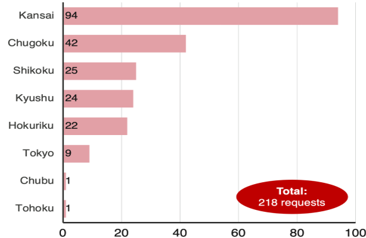
Number of times OCCTO needed to balance shortages by grid zone
Source: OCCTO
The causes are well known. Both nuclear and coal power production were low, with only three nuclear reactors online in December 2020 (compared to nine today). Over 4,639 MW of coal capacity was on unscheduled maintenance.
By mid-December, OCCTO was already coordinating inter-regional power balancing to tackle supply shortages in certain regions. It coordinated up to 4,200 MW in a single day to cover a supply gap in the Kansai area. Between Dec. 15 and Jan. 16, OCCTO coordinated 218 times to balance shortages across the country (excluding Okinawa and Hokkaido).
The LNG supply imbalance and issues in LNG stocks management by EPCos were the final straw. Utilities were not able to run their LNG plants at planned capacity to cover a demand surge from a winter cold snap. Some retailers ran short of electricity volumes from regular suppliers and dived into the spot market in a big way. Prices spiked for weeks.
Remaining Impact on Retailers and Consumers
Many retailers rely heavily on the JEPX Day ahead power market to procure their power, but they do little to hedge the market exposure. Only 3.3TWh was traded in the futures markets in Japan in 2020, 100 times less than on the day-ahead and intraday markets.
That’s a regular phenomenon in immature power markets, and let’s not forget that Japan only liberalized its electricity market in 2016. Among the hundreds of power retailers that arrived since then many are small and inexperienced.
A concern would be if risk awareness does not improve.
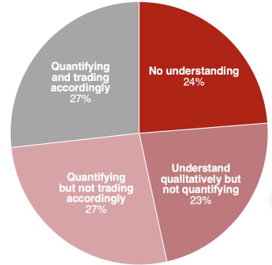
A recent survey by the Electricity and Gas Market Surveillance Commission suggests this risk remains, with 74% of retailers either not understanding the risks inherent in their procurement strategy or not carefully managing those risks.
Power retailers’ level of market risk understanding
Source: Survey conducted by the Electricity and Gas Market
Surveillance Commission between April 14, 2021, and April 23, 2021
A positive note is that trade volumes of derivative products are increasing. The European Energy Exchange (EEX) launched a futures market in Japan in May 2020 and now covers 88% of the volumes in Japan. EEX reported 3.5TWh of trade between January and June 2021, six times more than the prior six months.
Some retailers that exposed customers to market volatility are also reviewing their offerings. Many customers who had signed power supply contracts indexed to the power market were not aware of the possible consequences that the January spike might have on their bills. Some retailers did their best to manage the impact on customers’ bills, but many customers still switched contracts after January.
Many retailers now offer dynamic pricing power contracts linked to JEPX but with the addition of a ceiling price. For example, before the crisis Shizen Energy had around 12,000 retail customers on dynamic pricing contracts. It lost close to half of them. Since April it has offered a variable rate plan with both upper and lower limits. EcoStyle started a similar offering in July.
More Demand Response
The market crisis is also likely to boost the development of demand response (DR) services. Historically, the grid has been balanced from the generation side. In rare instances users were asked by utilities to reduce consumption. For example, this happened after the 2011 earthquake and nuclear accident.
According to Japan’s Demand Response Council, 10% of the power system cost is spent to accommodate peak demand (1% of the use time), but demand response and peak shaving services are still a nascent business in Japan.
With increased market volatility, retailers are getting interested in its potential. For example, SymEnergy started a DR service for its high voltage customers in January. Ennet is also expanding DR services, and shifted 3.17 GWh in January, with the cooperation of 2,212 participants. This was 2.8 times the volume Ennet accessed in August and September 2020.
Impact on Regulation
METI is pushing for better reporting of available generation capacity and also encouraging retailers to hedge some of their baseload needs. Since 2011, market players have been reporting available generation capacity (kW) and demand forecasts, as well as the power reserve available at peak time. However, this reporting standard showed its inadequacy during the December/January crisis.
A fuel shortage caused several generation assets to stop running, but their capacity was still reported as available. To add to the confusion, METI has revealed that grid operators have their own operations and forecasts standards. This means reported capacity numbers might not always be up-to-date and signals sent to the market may be confusing.
The above particularly affects pumped hydro storage and thermal power plants. For example, pumped hydro capacity could be reported as available even if the water can’t in fact be pumped up due to a power shortage. Thermal power plants can be reported as at-ready even if they don’t have the fuel to run.
The issue with transparency stretches to the systems oversight body, OCCTO, which collates all the demand-supply forecasts from the market. At present, however, the regulator only holds meetings to review demand-supply outlook twice a year, in spring and fall, to confirm the reserve supply rate (kW) for the summer and winter demand peaks. This may not be enough, and METI has now diplomatically communicated this.
A similar frequency issue plagues another market fundamental that affects power prices. METI launched a baseload market in July 2019 to encourage retailers to hedge their market positions via the JEPX. However, trade volumes for baseload were down 38% in FY2020. That’s partly because the baseload market trades only three times a year (July, September, November), and during times that do not coincide with the main procurement planning of retail companies (January-February).
What’s more, the deposit required to trade baseload power (3% of the purchase price) is too high for many retailers. It also has to be provided up to 21 months in advance. As mentioned above, most of Japan’s power retailers are still small and as yet unsophisticated businesses that struggle with long-term cash flow planning.
For now, METI will lower the deposit. But, long-term, the ministry is surely hoping for more industry consolidation.
Final assessment
METI has asked the big utilities to delay retirement of older thermal power plants. But, with decarbonization targets now in place, such delays can only be for a few years, at most.
As more variable renewable capacity is brought online, the need to better manage the grid and supply-demand balance increases tremendously. Fixing the vagaries of reporting the available capacity will be something METI has to standardize very soon or face a spike in market risks and volatility.
Volatility in global LNG markets is already becoming a regular rather than an occasional fixture. While the big utilities will surely be better prepared this winter, the flexibility of LNG fuel procurement is limited due to storage and delivery issues.
This winter, Tokyo’s power capacity held in reserve is forecast to be at -0.3% of total during February peaks. Shortages are seen in at least six other areas of the country.
Unless more of Japan’s retailers and major utilities engage in risk management, the question won’t be whether electricity prices can spike to another record. Rather, it will be: When?
GLOBAL VIEW
BY TOM O’SULLIVAN
Below are some of last week’s most important international energy developments monitored by the Japan NRG team because of their potential to impact energy supply and demand, as well as prices. We see the following as relevant to Japanese and international energy investors.
Lithium:
A Washington think-tank is calling for increased U.S. investments in what is referred to as the ‘Lithium Triangle’ that spans Argentina, Bolivia, and Chile. Lithium is a critical component in rechargeable, lightweight batteries that store large amounts of energy. CSIS estimates that of the world’s 86 million tons of identified lithium resources, Bolivia possesses 21 million tons, Argentina has 19 million tons, and Chile 10 million tons. The lithium industry is expected to grow nearly eightfold by 2027. CSIS is calling for the U.S. to host a clean energy forum for top lithium-producing nations, which, in addition to Argentina, Bolivia and Chile, could include Australia and Canada. Afghanistan is also thought to have 21 million tons of lithium deposits.
Shipping:
Maersk, the world’s biggest container liner, ordered eight new carbon-neutral vessels that run on “green” methanol. Their cost is expected to be $1.4 billion. South Korea’s Hyundai Heavy Industries will manufacture the vessels and expected delivery is 2024. The vessels are duel-fuel and can run on traditional bunker fuel, currently 50% cheaper than methanol. The ships are expected to have a working life of 20 to 30 years and could save one million tons of CO2 per year. The International Maritime Organization has committed to cut CO2 emissions 50% by 2050.
Nuclear Power:
1). Fuel loading began at the demonstration high-temperature gas-cooled reactor plant (HTR-PM) at Shidaowan, Shandong Province, China. The twin-unit plant took almost a decade to build and will start operation by the end of 2021; it features two small reactors that will drive a single 210 MW turbine. China Huaneng Group led the consortium to build the demonstration units together with China Nuclear Engineering Corporation (CNEC) and Tsinghua University. Chinergy, a joint venture of Tsinghua and CNEC, is the main contractor for the project. Nuclear power may generate 8% of China’s Electricity by 2030.
2). The UAE’s Nuclear Energy Corporation announced the start of the second unit at UAE’s Barakah nuclear plant, one year after Barakah unit 1 reached criticality. Unit 2’s start-up means Barakah is the Middle East’s first multi-unit nuclear power plant.
3). Sweden’s decision on a final waste repository will be delayed because of the launch of a public consultation on whether the repository’s application should be considered separately from the expansion of the existing interim repository for used fuel. Critics warn the delay could cause future disruptions to Sweden’s electricity supply due to a lack of interim used fuel storage capacity.
Wind Energy:
Siemens Gamesa and Vestas, two of two of world’s largest wind turbine manufacturers, have reduced profit forecasts for 2021 due to rising raw material costs and shipping issues associated with the pandemic. Increases in steel, copper, aluminum, oil, and carbon fiber costs are all negatively impacting margins.
ESG:
DWS, the Deutsche Bank affiliated asset manager, is being investigated by Bafin and the SEC, the German and U.S. regulators, respectively, for misrepresenting ESG parameters to investors. The company, which is separately listed on the Frankfurt Stock Exchange, manages $1.2 trillion in assets.
Jet Fuel:
According to Rystad Energy, Asian jet fuel demand has slipped below European levels for the first time in over a decade, a stunning setback due to the pandemic. Asian jet fuel demand had been 50% ahead of European demand in January 2020.
Pipelines:
A U.S. government watchdog found multiple problems with the construction, manufacture and design of the $9 billion Keystone pipeline that was cancelled by President Biden in January 2021. The pipeline was due to transport almost 1 million barrels of oil from Alberta to Nebraska.
China:
Hainan Mining, one of China’s largest iron ore miners, will invest over $160 million in a plant in Dongfang, Hainan to make battery-grade lithium hydroxide used in lithium-ion batteries. The plant will have a capacity of 20,000 tons per year.
Australia:
New York-based private equity firm KKR will acquire Spark Infrastructure, one of Australia’s leading energy investors, in a deal valued at $3.7 billion. Spark holds stakes in South Australia Power Networks, Victoria Power Networks, and Bomen Solar Farm in New South Wales.
New Zealand:
Z Energy, one of the country’s leading fuel distributors, has received a $1.4 billion takeover offer from Ampol, an Australian petroleum company, with a leadership position in transport fuels and service stations.
India:
India hopes to raise $80 billion selling state-owned infrastructure assets over the next four years. The sale will include power transmission lines and gas pipelines.
Russia:
The OPEC+ recent agreement to steadily raise oil production is paving the way for Russia to loosen Covid-19 oil production curtailments, according to Rystad Energy. The country is on track to set a new monthly oil output record of 11.6 million barrels per day in July 2022. Russia’s oil production may then accelerate further to peak at 12.2 million bpd in mid-2023.
Iran:
President Ebrahim Raisi called for the Japanese government to release $3 billion of frozen funds in Japanese bank accounts related to oil and gas exports hit by U.S. sanctions. Raisi met with Japanese Foreign Minister Motegi last week.
Lebanon:
The government raised gasoline prices by 66% to help rectify its dire fiscal position following the Lebanese currency’s 90% loss in value over the last two years.
Niger:
Toronto-based Global Atomic will set up a 90%-owned Niger uranium mining subsidiary after the Niger government signed off on a 10% ownership of the Dasa project. The company plans to commence uranium production by the end of 2024.
Sweden:
Last week, steelmaker SSAB shipped to Volvo the world’s first commercial shipment of steel made without fossil fuels.
Germany:
Leading utility RWE is warning the country may face power blackouts due to the closure of the final nuclear plant in 2022, and because coal plants may be forced to close earlier than planned. Peak power capacity in the EU’s largest economy is expected to decrease materially over the next two years.
Switzerland:
Landis+Gyr, the gas and electricity metering company, signed a five-year agreement with Louisville Gas and Electric Company and Kentucky Utilities in the U.S. to provide 1.2 million electricity and gas meters, and smart grid network infrastructure.
United Kingdom:
The opposition Liberal Democratic Party proposes that new listings of fossil fuel companies should be immediately banned on the London Stock Exchange. The plan also proposes to stop new bond issuance in London to finance oil, coal or gas exploration. Fossil fuel firms already listed in the UK would have two years to produce a plan on how to reach net zero emissions by 2045 or risk delisting. The plan advocates that pension funds disinvest from fossil fuels by 2035, and all companies with fossil fuel assets removed from the stock exchange by 2045.
U.S.:
1). Private equity firm TPG made its first climate fund investment, $240 million, in Form Energy, a battery developer based out of Massachusetts.
2). General Motors is continuing negotiations with LG Chem on the $1.8 billion cost associated with the recall of the Chevrolet Bolts due to battery fires. GM may also be negotiating with other battery companies such as Samsung, Panasonic and CATL to replace LG Chem.
3). Tesla filed an application with Texas’ Public Utility Commission to sell electricity directly to consumers. The EV maker doubles as an energy storage developer and has built a large battery storage facility in Houston. The 100 MW facility could power 20,000 households.
Mexico:
A fire at an offshore oil field on E-Ku-A2 platform at Pemex’s Ku-Maloob-Zaap oilfield in the Bay of Campeche on the Gulf of Mexico killed five employees last week and cut daily oil output at 125 Mexican oil wells by over 400,000 barrels. The fire started at a compression and power generation facility. This is one of several setbacks Pemex, the state-owned oil monopoly, has faced in recent months.
EVENTS CALENDAR
A selection of domestic and international events we believe will have an impact on Japanese energy.
| February | Approval of Fiscal 2021 Budget by Japanese parliament including energy funding projects; CMC LNG Conference |
| March | 10th Anniversary of Fukushima Nuclear Accident; Smart Energy Week – Tokyo; Quarterly OPEC Meeting; Japan LPG Annual Conference; Full completion of all aspects of the multi-year deregulation of Japan’s electricity market; End of 2020/21 Fiscal Year in Japan; |
| April | Japan Atomic Industrial Forum – Annual Nuclear Power Conference; 38th ASEAN Annual Conference-Brunei; Japan LNG & Gas Virtual Summit (DMG)-Tokyo Three crucial by-elections in Hokkaido, Nagano & Hiroshima – April 25th |
| May | Bids close in first tender for commercial offshore wind projects in Japan; Prime Minister Suga to visit the U.S. |
| June | Release of New Japan National Basic Energy Plan-2021; G7 Meeting – U.K. Presidents Biden and Putin are due to meet at a summit in Geneva Forum for China-Africa Cooperation Summit (Senegal) |
| July | Tokyo Metropolitan Govt. Assembly Elections; Commencement of 2020 Tokyo Olympics |
| August | METI committee approves draft of Japan’s 6th Basic Energy Plan |
| September | Ruling LDP Presidential Election; UN General Assembly Annual Meeting that is expected to address energy/climate challenges; IMF/World Bank Annual Meetings (multilateral and central banks expected to take further action on emissions disclosures and lending to fossil fuel projects); End of H1 FY2021 Fiscal Year in Japan; Japan-Russia: Eastern Economic Forum (Vladivostok)-tentative |
| October | Last possible month for holding Japan’s 2021 General Election; Hydrogen Ministerial Conference in conjunction with IEA METI Sponsored LNG Producer/Consumer Conference; Innovation for Cool Earth Forum – Tokyo Conference; Task Force on Climate-Related Financial Disclosure (TCFD) – Tokyo Conference; G20 Meeting-Italy |
| November | COP26 (Glasgow); Asian Development Bank (‘ADB’) Annual Conference; Japan-Canada Energy Forum; East Asia Summit (EAS) – Brunei |
| December | Asia Pacific Economic Cooperation (APEC) Forum – New Zealand; Final details expected from METI on proposed unbundling of natural gas pipeline network scheduled for 2022. |
Disclaimer
This communication has been prepared for information purposes only, is confidential and may be legally privileged. This is a subscription-only service and is directed at those who have expressly asked K.K. Yuri Group or one of its representatives to be added to the mailing list. This document may not be onwardly circulated or reproduced without prior written consent from Yuri Group, which retains all copyright to the content of this report.
Yuri Group is not registered as an investment advisor in any jurisdiction. Our research and all the content express our opinions, which are generally based on available public information, field studies and own analysis. Content is limited to general comment upon general political, economic and market issues, asset classes and types of investments. The report and all of its content does not constitute a recommendation or solicitation to buy, sell, subscribe for or underwrite any product or physical commodity, or a financial instrument.
The information contained in this report is obtained from sources believed to be reliable and in good faith. No representation or warranty is made that it is accurate or complete. Opinions and views expressed are subject to change without notice, as are prices and availability, which are indicative only. There is no obligation to notify recipients of any changes to this data or to do so in the future. No responsibility is accepted for the use of or reliance on the information provided. In no circumstances will Yuri Group be liable for any indirect or direct loss, or consequential loss or damages arising from the use of, any inability to use, or any inaccuracy in the information.
K.K. Yuri Group: Oonoya Building 8F, Yotsuya 1-18, Shinjuku-ku, Tokyo, Japan, 160-0004.