
JAPAN NRG WEEKLY
SEPT. 6, 2021
JAPAN NRG WEEKLY
Sept. 6, 2021
NEWS
TOP
- Prime Minister Suga to step down this month, unleashing debate over future of current govt. policies, including in energy
- Tokyo area power supply to remain tight until early 2023; a once in a decade cold snap would lead to a notable capacity shortage
- METI unveils schedule to roll out “dream” solar tech; perovskite cells rely on different materials, which would be a boon for Japan
ENERGY TRANSITION & POLICY
- Govt. outlines strategy to cut cost of offshore wind power by 2030
- U.S. climate envoy Kerry criticizes Japan over support for LNG
- Ministry seeks hydrogen projects to qualify for JCM carbon credits
- Russia and Japan agree to jointly produce hydrogen / ammonia
- Hitachi Zosen to commercialize waste CO2-to-methane fuel chain
- Mitsubishi Power group to make clean aviation fuel from biomass
- Toray and TEPCO-led group wins state funding for power-to-gas hydrogen scheme in Yamanashi
- Toyota leads world in EV patents, but lags far behind in EV sales
- Japan builds world’s first artificial photosynthesis panel system
- Utilities led by Kansai seek to develop flying cars … [MORE]
ELECTRICITY MARKETS
- Survey finds a third of Japan’s schools have solar panels on roof
- Shizuoka firms agree to pay 10-15% more for green electricity
- Kansai Electric mulls adding CCUS, ammonia to thermal plants
- Kansai Electric wins local support for restart of Takahama reactors
- Japan weather forecaster makes system for offshore wind industry
- Institute to create a local power grid synced with EVs for balance
- TEPCO partners with agency to sell ads based on electricity usage
- Renova invests in hydropower plant in the Philippines … [MORE]
OIL, GAS & MINING
- Japan’s LNG reserve volume fell about 30% MoM and YoY in July
- INPEX sells Venezuelan oil and gas interests to local energy group
- INPEX signs up another local gas retailer to “carbon-neutral” LNG
ANALYSIS
JAPAN’S 2022 DRAFT BUDGET SHOWS CLEAN ENERGY FOCUS WILL STAY IRRESPECTIVE OF WHO IS NEW PM
On Friday, Sept. 3, Prime Minister Suga announced that he will resign his post when his term as Liberal Democratic Party (LDP) president expires at the end of the month. Suga’s resignation will not alter energy policy and the focus on decarbonization, at least over the next few months. After that, Japan’s path to a lower carbon economy may change considerably depending on who succeeds Suga.
We examine the energy preferences of the candidates most likely to succeed Suga, and also take a detailed look at the energy-related budget items submitted by key ministries for FY2022. The latter is likely to dictate energy priorities for Japan over the next 12-18 months.
JAPAN’S MILITARY DECLARES WAR ON CLIMATE DESTRUCTION; STARTS SWITCHING TO RENEWABLES
In just one year, the state’s biggest emitter morphed into its most progressive clean power buyer. And more dramatic developments are yet to come. Japan’s Self-Defense Forces (SDF) are best known for their prowess in dealing with natural disasters. This experience has given the SDF a unique and hands-on understanding of climate change’s impact on national security. For the first time the SDF has framed its concerns as a national security issue in its latest report on Japan’s security.
The SDF also published impressive results from initial efforts to switch energy supplies to renewables.
GLOBAL VIEW
Value of global carbon markets jumped 23% last year to $281 bn. Chinese sales of “new energy vehicles” up 300% this year. Indian fuel prices skyrocket as travel resumes. U.S and Ukraine to deepen energy ties with nuclear at the core. Hurricane in U.S. disables 90% of offshore oil and gas assets for a week. Details on these and more in our global wrap.
EVENT CALENDAR
JAPAN NRG WEEKLY
PUBLISHER
K. K. Yuri Group
Editorial Team
Yuriy Humber (Editor-in-Chief)
Tom O’Sullivan (Japan, Middle East, Africa)
John Varoli (Americas)
Sponsored
Regular Contributors
Mayumi Watanabe (Japan)
Daniel Shulman (Japan)
Takehiro Masutomo (Japan)
Art & Design
22 Graphics Inc.
SUBSCRIPTIONS & ADVERTISING
Japan NRG offers individual, corporate and academic subscription plans. Basic details are our website or write to subscriptions@japan-nrg.com
For marketing, advertising, or collaboration opportunities, contact sales@japan-nrg.com
For all other inquiries, write to info@japan-nrg.com
OFTEN USED ACRONYMS
METI The Ministry of Energy, Trade and Industry
MOE Ministry of Environment
ANRE Agency for Natural Resources and Energy
NEDO New Energy and Industrial Technology Development Organization
TEPCO Tokyo Electric Power Company
KEPCO Kansai Electric Power Company
EPCO Electric Power Company
JCC Japan Crude Cocktail
JKM Japan Korea Market, the Platt’s LNG benchmark
CCUS Carbon Capture, Utilization and Storage
mmbtu Million British Thermal Units
mb/d Million barrels per day
mtoe Million Tons of Oil Equivalent
kWh Kilowatt hours (electricity generation volume)
NEWS: ENERGY TRANSITION & POLICY
Prime Minister Suga to step down at the end of this month
- PM Suga was widely expected to seek re-nomination as head of the ruling party, the LDP, at the leadership race at the end of this month. What remained uncertain was if Suga would engineer to have the general election before or after the LDP presidential vote.
- Instead, Suga decided against seeking re-election. This means, from Sept. 29 the country will have a new prime minister and a new Cabinet. A general election also has to take place within the next two-three months.
- Below are some of the early news stories discussing how Suga’s exit will impact energy policy. Many more will follow over the course of this month, adding an even stronger political flavor to what has already been a ferocious debate over the country’s energy strategy.
- Overall, we expect the main tenets of Japan’s decarbonization strategy to remain unchanged in the short term, irrespective of whoever succeeds Suga.
- We examine the full situation, Suga’s likely successors, and the various ramifications in the Analysis section. As part of our deep dive, we also dissect the proposed FY2022 budgets of the various key ministries and identify what this means for the energy industry over the next 12-18 months.
- SIDE DEVELOPMENT:
Continuity of govt. policies in question
(Nikkei Shimbun, Sept. 4)- Pursuit of digitalization and decarbonization are two of the key policies of PM Suga’s administration. Digital Minister Hirai has said the advance of the former will not change. Details of the latter are less fixed; Suga outlined a vision with his decarbonization targets for FY2030 and FY2050, but the plan’s implementation is still in the very early stages.
- The next administration will now be responsible for securing a budget to promote the wider introduction of renewable energy, especially solar, in the power mix and furthering regulatory reforms.
- PM Suga also made the decision to begin the release of treated waste water from TEPCO’s Fukushima Dai-Ichi Nuclear Power Plant site, an issue that has festered for years. Suga’s government touted the creation of a fund to buy seafood from fishermen that might be affected by the water release. That water release will not, however, begin until spring 2023.
- The challenge of decommissioning and rebuilding Fukushima remains.
- SIDE DEVELOPMENT:
What is the future of Suga’s digital and decarbonization policies?
(Asahi Shimbun, Sept. 3)- In PM Suga’s administration, Kono, the Minister of Administrative Reform, and Koizumi, the Minister of the Environment, are the big proponents of increasing Japan’s renewable energy reliance. Koizumi has also said that there are others in government who oppose such a direction.
- The government will work on the spread of solar power and make efforts in energy conservation, but it cannot be said that these policies have full govt. support.
- How Japan meets its international commitments on decarbonization is also yet to be clearly outlined.
- Japan needs competition between power sources and a large portion of renewables in the electricity mix in order to realize its CO2-free society. However, the future of nuclear power is still unclear. For now, what to do about building new nuclear plants or replacing the existing aging assets, as some in the LDP and the big utilities want to do, is an issue that has been postponed for now.
METI reveals development schedule for “dream” solar technology
(Japan NRG, Aug. 31)
- METI announced the development schedule for a “dream” solar tech, the perovskite solar cells. Development is a top priority in the country’s Green Growth Strategy.
- Perovskite solar cells feature a simpler module structure, which makes them thinner and lightweight. They comprise iodine and other chemical compounds that are less power-intensive to produce compared to silicon used for the current solar cells.
- Japan relies on import of silicon, which is classified as a critical raw material. On the other hand, Japan is a major supplier of iodine, with an estimated 30% global share.
- Low raw material cost make perovskite cells a viable alternative to silicon-based units. Technical challenges include enlarging module size and improving cell endurance.
- The current government strategy sees Japanese firms starting to produce prototypes in FY2023 and moving to commercialization thanks to the “Zero Emission Homes” program by 2030. The target cost level is ¥14/ kWh or less.
- CONTEXT: The government recently announced plans to have 60% of new homes built in 2030 equipped with solar panels.
TAKEAWAY: Japan has the world’s largest solar panel installation density at 147 kW per square kilometer. Despite the tripling of solar capacity in the last decade, domestic solar panels makers have mostly exited after losing out to Chinese and Korean competitors. Domestic solar cell production slumped to a record low of 367,142 kW in January 2021, according to the Japan Photovoltaic Energy Association data.
The development of the next-gen solar cells could be a chance for Japanese firms to reclaim their positions in the renewable industry. Among firms working on perovskite cells domestically are Ricoh, Nichicon, Samco, Hoshiden and Kaneka. Ricoh developed the cells for space exploration. However, they’ll need to move fast as the world’s first production line for perovskite cells already started earlier this year in Poland.
METI outlines offshore wind cost cutting strategy
(Japan NRG, Aug. 31)
- METI outlined a strategy to bring down the cost of offshore wind power generation to meet its FY2030 goal of installing 10 GW of offshore wind capacity.
- Presently Japan has 4 offshore wind facilities with a combined capacity of just 14 MW.
- The key to cost reduction lies in localizing manufacturing. The country lacks domestic suppliers of wind turbines, but it has makers of peripherals and devices. METI aims to raise local procurement rates to 60% of the total project by 2040 by supporting areas of the supply chain where Japanese firms are already strong. For example: power generation units, carbon fiber blades, magnets and other related components.
- METI wants local manufacturers to enhance product features while staying competitive on price. This means that scaling up turbine size isn’t a priority because overseas producers have a clear lead there.
- METI noted that Japanese firms have a higher chance of competing in floating wind turbines rather than fixed-bottom units since the former technology is still under development around the world.
- Meanwhile, METI will update the national power grid master plan to accommodate the expected increases in wind power capacity by March 2023.
- Several ministries, including METI, plan to review enforcement of nine separate laws that touch on offshore wind in order to help simplify procedures for siting surveys, construction, equipment installation and removal.
- METI maintained its aspiration to have offshore wind power costs drop to ¥8-9/ kWh by 2030 for fixed bottom turbines.
SIDE DEVELOPMENT:
Green Innovation Fund to allocate ¥120 billion to make wind power cheaper
(Nikkei, Aug. 31)
-
- METI will allocate up to ¥120 billion of its ¥2 trillion fund to develop carbon neutral technologies to reduce the costs of offshore wind development.
U.S. climate envoy Kerry visits Tokyo, prods Japan over LNG support
(Asia Nikkei, Sept. 1)
- U.S. Climate envoy John Kerry visited Japan and met top officials including PM Suga to promote climate response measures as one of the key pillars of the U.S.-Japan relationship.
- Kerry criticized Japan for supporting the development of LNG use in southeast Asia and urged the country to switch its support to renewables in the region.
- Japan and the U.S. will work together on exporting renewable energy and decarbonization infrastructure as part of their climate partnership.
TAKEAWAY: A few days after Kerry met with PM Suga, the latter said he’ll resign. However, the agenda Kerry is promoting will pass to Suga’s successor. Some in the Cabinet, such as MoE Minister Koizumi, fully support Kerry’s comments. Others, such as METI Minister Kajiyama, are less confident that throwing all of Japan’s weight behind renewables in Asia (and at home) is the right strategy. Japan will surely support most initiatives the U.S. wants to unveil at COP26, but it’s unlikely to back down from its promotion of LNG any time soon. Moreover, a lot of the new LNG capacity coming to market is from North America, so Kerry’s position may not also be one widely shared in the U.S.
However, fuel price is a more realistic deterrent for Southeast Asian countries to invest in LNG infrastructure and gas-fired power plants. Last week Bangladesh said it won’t buy more spot LNG cargos this year due to price hikes in the last six months.
Environment Ministry seeks hydrogen projects for JCM
(Japan NRG, Aug. 31)
- The MoE is soliciting applications for hydrogen projects seeking to be registered in the Joint Credit Mechanism (JCM). The projects would involve manufacturing hydrogen overseas for use in Japan.
- Hydrogen needs to be produced using renewable energy. Candidate projects should cover transport of hydrogen to Japan. Applications will be accepted until Sept. 30.
Russia and Japan agree to jointly produce hydrogen and ammonia
(Reuters, Nikkei Sept. 2)
- Japan and Russia signed an agreement to work together on hydrogen and ammonia production during the Eastern Economic Forum in Vladivostok, Russia.
- The agreement is part of Japan’s strategy to diversify the potential supply of hydrogen and other energy resources.
- The two countries agreed to cooperate in hydrogen R&D, as well as on development carbon capture and storage (CCS) and carbon capture and utilization (CCUS). Japan will set up a new working group that will lead the discussions.
- METI also signed an MoU with Russia’s largest LNG producer Novatek to work jointly on hydrogen, ammonia, CCS and CCUS.
- A similar accord might be signed with another Russia energy firm later this month.
- CONTEXT: Russia accounted for about 10% of global ammonia production in 2020.
Hitachi Zosen is changing the way we think about CO2
(Nikkei, Aug. 31)
- Hitachi Zosen began converting waste CO2 to methane, for use as fuel.
- In 2022, Hitachi Zosen will begin commercial-scale operations with the construction of a methanation plant next to a garbage furnace on its Kanagawa site. CO2 released by burning waste will be converted to methane, which can be used as a synthetic form of natural gas.
- The technology is the result of collaboration with Tohoku University and other institutions since the 1990s to develop a catalytic process that allows methanation at relatively low temperatures, around 200°C.
- SIDE DEVELOPMENT:
Asahi Group Holdings trials methanation technology
(New Energy Business News, Sept. 2)- A subsidiary of Asahi Group Holdings installed an experimental methanation system at its Ibaraki research center, making it the first Japanese food and beverage company to do so.
- The system was supplied by IHI.
- Asahi will subject the system to 10,000 continuous hours of operation to assess cost performance and methane quality.
Mitsubishi, JERA to manufacture aviation fuel from biomass
(New Energy Business News, Sept. 2)
- A consortium comprising Mitsubishi Power, JERA, Toyo Engineering, and Itochu is attempting to create a sustainable aviation fuel supply chain based around the Fischer-Tropsch process.
- Wood-based biomass will serve as the feedstock for the synthetic fuel.
- The project was commissioned by the NEDO and will run until 2024.
Ministry approves plans for 56 “green” building projects
(Kankyo Business, Sept. 1)
- The Ministry of Land, Infrastructure, Transport and Tourism gave the green light to 56 sustainable building projects that would use state-of-the-art technologies and materials to reduce their CO2 emissions.
- The ‘green’ buildings to be constructed include a development in the Shibaura area (Tokyo) by Nomura Real Estate and another development in the central Marunouchi business district (Tokyo) by Shimizu Corporation.
Group led by Toray and TEPCO wins funding for power-to-gas hydrogen
(New Energy Busines News, Sept. 3)
- A group of companies won funding from state-backed research body NEDO for a hydrogen and power-to-gas project in Yamanashi project.
- The Yamanashi Hydrogen Energy Society (H2-YES) project plans to produce hydrogen utilizing a modular renewable energy system and offer the fuel to local factories, eliminating the need for transportation. The size of the modular power-to-gas (P2G) system will reach 16 MW.
- NEDO will offer subsidies to build and test the business model until FY2025. This project is one of the pillars of the national strategy to cut the cost of electrolyzer to ¥65,000/ kW.
- The project consortium includes: TEPCO, which will install the P2G systems and hydrogen boilers for consumers; Toray, which will develop electrolyte membranes; Hitachi Zosen and Siemens Energy, which will increase the size of the electrolyzers; Kaji Tech, which will develop hydrogen compressors; Miura Co., which will develop hydrogen-fueled steam boilers; and Nichicon to develop power converters that are optimal for electrolyzers.
Toyota takes lead in EV patents, but lags behind Tesla and China rivals in sales
(Nikkei Asia, Sept. 2)
- Japan’s biggest automaker holds an advantage in critical EV technology, ranking first worldwide based on the importance of its U.S. patents, according to research done by Nikkei and Patent Results.
- In total, 21 Japanese companies are in the top 50 firms by EV patents. Honda ranks third and Nissan is sixth.
- Japanese success is down to work on hybrid vehicles.
- However, by EV sales the Japanese firms lag far behind. Nissan was 14th and Toyota 17th globally during 2020, with Tesla the sales leader, followed by seven Chinese firms and European automakers.
- SIDE DEVELOPMENT:
Nissan, Mitsubishi Motor to release cheap mini-EV in Japan within 8-10 months
(New Energy Business News, Sept. 2)- Nissan Motor and Mitsubishi Motors will begin sales of a new mini-class EV from early FY2022. The purchase price, after subsidies, is expected to be about ¥2 million.
- The EV will have a 20-kWh battery and will also be available as an emergency power source in times of outages, a feature known as vehicle-to-home (V2H).
Hitachi unveils multi-vehicle EV charger
(Kankyo Business, Aug. 27)
- Hitachi unveiled a new EV charging solution that can charge multiple cars simultaneously while featuring a more compact footprint.
- Hitachi’s prototype 350 kW multi-port charger is 70% lighter and 40% more compact than traditional models.
- The more compact size uses powerful semiconductors to drive the transformers at higher frequencies and replacing traditional transformers with solid-state transformers employing silicon carbide technology.
- SIDE DEVELOPMENT:
Daiwa Lease to develop solar-powered EV charging
(Smart Japan, Aug. 30)- Daiwa Lease unveiled the concept for a multilevel parking building clad in solar panels to provide power for EV charging.
- Surplus power can also be shared with adjacent buildings.
- The concept design features around 9,000 square meters of parking, enough for 300 cars, and sports PV panels with an output of 210 kW.
Japan builds world’s first artificial photosynthesis panel reactor system
(Kankyo Business, Aug. 27)
- The New Energy and Industrial Technology Development Organization (NEDO) and artificial photosynthesis specialist ARPChem have built the world’s first working artificial photosynthesis panel reactor system that combines a 100 square meter array of catalytic solar panels for electrolyzing water with a module for separating the hydrogen and oxygen.
- The oxygen generated by the system could be used to convert unwanted CO2 into CO, then to be combined with the hydrogen generated by the system to synthesized olefins, and then to be used in plastics manufacture.
Ron Herman launches solar sharing operation to neutralize own emissions
(Kankyo Business, Aug. 31)
- Fashion label Ron Herman, owned by Sazaby League, established a ‘solar sharing’ facility in Chiba, to reduce net CO2 emissions to zero by 2030.
- The 3,200 m² facility has an array of PV panels with output of 87 kW.
- Herman says the facility will generate enough electricity to neutralize the power consumption of its Nagoya branch.
TAKEAWAY: Given the dearth of readily available space for new large-scale solar farms, we expect the solar sharing business model to be one of the major developments in the industry over the next few years. As this example shows, the sharing model also appeals to non-power companies that can use the energy produced on-site to both power own facilities and claim CO2 emissions neutrality.
Yahoo to donate to local bodies committed to carbon neutrality
(Kankyo Business, Aug. 30)
- Yahoo Japan announced eight local bodies to which it will make donations in recognition of their commitment to carbon neutrality.
- The largest donation (¥100 million) goes to Mikasa in Hokkaido, which is working on sequestering CO2 in disused quarries.
- The donations are made under the furusato nozei tax scheme, which entitles corporations to tax breaks in return for donating to local governments.
KEPCO group to study flying cars
(Kankyo Business, Aug. 30)
- A KEPCO-led group comprising several entities, including Tokyo-based SkyDrive, was selected to receive a grant from the Osaka prefectural government to research flying car technology.
- The trial will take place between October and March, and will involve market research, the display of concept craft, and testing of related technologies (including charging technology and the construction of drone ports).
NEWS: POWER MARKETS
| No. of operable nuclear reactors | 33 | Electricity Price | Friday, Sept 3 | % Change WoW | ||
| Of which | restarted | 10 | JEPX 24-Hour Spot | ¥7.64/ kWh | -4.5% | |
| in operation today | 9 | TOCOM Sept. baseload (Tokyo area) | ¥8.80/ kWh | – | ||
Source: Company websites, JANSI and JAIF, as of Sept 1, 2021
Government forecasts that Tokyo will be under power constraints until Q1 2023
(Japan NRG, Aug. 27)
- Power supply in the Tokyo area will remain very tight until the first quarter of 2023, according to the near-term electricity supply demand outlook published by METI.
- If the region serviced by TEPCO were to experience a once in 10-year cold snap this coming winter, the electricity supply would fall 2.1% short of demand in January 2022 and 2.4% short in February, METI said.
- In February 2021, the TEPCO service area experienced a 0.3% shortfall in electricity supply.
- Thanks to the restarts of large thermal and nuclear plants, supply reserve rates are seen improving slightly in July 2022 and January-February 2023, but depending on the weather conditions, demand may outstrip supply notably in the winter months.
- The tightness is expected to ease slightly when new capacities of around 2.5 GW go online even as 1-2 GW go offline in east Japan in the summer of 2023.
- METI said that shuttering old plants may speed up with the launch of the power capacity market in 2024.
A third of Japan’s school roofs have solar panels, government survey shows
(New Energy Business News, Sept. 2)
- The Ministry of Culture, Education, Culture, Sports, Science and Technology released the results of a survey of solar panels and other renewable generation equipment installed at public schools.
- As of May 1, 34% of public schools had installed photovoltaic panels, an increase of three points from a year earlier.
- The total installed solar capacity of the schools surveyed was 215 MW, of which 184 MW was at elementary and junior high schools.
TAKEAWAY: The Environment Ministry wants the government to make the majority of public buildings add solar panels as a way to increase the spread of renewable energy in the country. This survey is part of the process to gauge how much available “real estate” is in state hands.
Shizuoka firms agree to pay 10-15% more for green electricity
(Nikkei, Aug. 31)
- Chubu Electric will roll out a special plan for companies in the Shizuoka area to retail only electricity generated by 22 local hydropower plants.
- The buyers, which include Shizuoka Bank, Yamaha, and other transport, tech and manufacturing firms, agreed to buy the plan that is priced 10-15% higher than the rates the utility can charge a general household.
- The corporate buyers believe this will increase their value and brand image as they’ll be supporting renewable energy from the local area.
Kansai Electric mulls adding CCUS and ammonia to its thermal plants: CEO
(Energy Forum, Various, Sept. 1)
- Kansai Electric is looking at adding carbon capture utilization and storage (CCUS) to its thermal power plants and co-firing or switching them to run on hydrogen or ammonia, CEO Morimoto Takashi said in an interview.
- The utility believes thermal plants are still needed to meet peak demand times.
- Morimoto also expressed hope that the utility can restart more of its nuclear reactors. Both nuclear and renewables will be necessary for Japan to meet its FY2030 decarbonization target, he said.
- The CEO declined to discuss how the utility plans to resolve the issue of finding a new place for its nuclear waste.
- CONTEXT: Kansai Electric won local government approval to restart its nuclear reactors based on a promise that it will move the used fuel rods and other nuclear waste outside Fukui prefecture, which houses the company’s nuclear plants. The deadline for resolving the issue was set as 2023.
Kansai Electric wins some local support for restart of two reactors at Takahama NPP
(Mainichi Shimbun, Aug. 26)
- Kansai Electric met with the Maizuru City Council Nuclear Disaster Prevention and Safety Committee to discuss the restart of Units 1 and 2 at the local Tahakama NPP.
- CONTEXT: Maizuru is the neighboring town of Takahama, where the plant is located, with some of its areas specified as the site for evacuation in case of emergency.
- While Maizuru officials expressed concerns about nuclear plant safety, they agreed that until renewables become the main power source nuclear power should be relied up for energy supply.
- SIDE DEVELOPMENT:
Anti-Terrorism measures approved for all three of Kansai Electric’s nuclear plants
(Chunichi Shimbun, Aug. 26)- Industry regulator NRA approved the construction plan for anti-terrorism measures submitted by Kansai Electric for its Ohi NPP Unit 3 and Unit 4 reactors.
- Anti-terrorism measures at all three of Kansai Electric’s nuclear plants have now received NRA approval.
- SIDE DEVELOPMENT:
Kyushu Electric suspends all work to upgrade Genkai NPP due to Covid outbreak
(Nishinippon Shimbun, Aug. 25)- Kyushu said it will temporarily suspend work to update its Genkai NPP with anti-terrorism measures at Units 3 and 4 due to rising COVID-19 cases among staff.
Japan weather forecaster launches system for the offshore wind industry
(Kankyo Business, Aug. 30)
- Osaka-based Japan Meteorological launched a web-based service, dubbed MetOcean Navi, that enables operators of offshore wind turbines to predict sea conditions, typhoons, winds, lightning air pressure, and other meteorological phenomena.
- The system also provides information on wind speed at altitudes of 50 to 150 meters, which is critical when constructing and maintaining turbines.
JRI explores creation of a local power grid to help solar
(Kankyo Business, Sept. 1)
- The Japan Research Institute is discussing the creation of a local energy grid in Fukuoka that’d use 6600 V high tension transmission lines and enable locally generated solar power to charge electric vehicles, as well as enabling EV batteries to feed the grid during power shortages.
TEPCO partners with ad agency to sell advertising based on electricity use
(Asia Nikkei, Aug. 31)
- TEPCO and advertising agency Hakuhodo will launch Japan’s first online ad service driven by electricity consumption trends.
- TEPCO and other Japanese utilities are now wading into the field armed with real-time data from smart meters, opening the door for new services while also fueling privacy concerns.
- The new service will be headed by Hakuhodo unit D.A. Consortium with Grid Data Bank Lab that counts TEPCO, Kansai Electric, Chubu Electric and NTT Data as investors. Electricity use in Tokyo’s 23 central wards will be analyzed to identify what types of households are most common in which postal codes.
- This work will lead to more tailored smartphone ads.
Renova invests in hydroelectric power in the Philippines
(Kankyo Business, Sept. 1)
- Tokyo-based Renova signed an agreement with the Development Bank of the Philippines to construct a 17 MW hydroelectric power station in Ifugao.
- This is Renova’s first foray into hydroelectric power in the Philippines.
Japan’s “new” nuclear reactors are making up for 10 years of lost time
(Sankei Shimbun, Aug. 25)
- On July 30, the High Temperature Engineering Test Reactor, operated by the Japan Atomic Energy Agency, was restarted after a 10-year ‘slumber’.
- High temperature gas reactors are considered a ‘secret weapon’ in the mission to reduce carbon emissions.
- An application to restart the reactor, which was shut down after the 2011 Fukushima disaster, was filed in 2014. It wasn’t until this year that work to implement a raft of safety enhancements demanded by the regulator, such as installing systems to protect cables from high temperatures during a fire, was finally completed.
- Instead of water, high temperature gas reactors are cooled by helium gas, which is then used to drive a turbine. These reactors are said to be inherently safe due to their ability to automatically shut down in the event of a burst pipe or other accidents.
- The high temperatures of nearly 1000° elicited by these reactors are also useful for separating water into hydrogen and oxygen, a process that requires less energy than electrolysis.
Chugoku Electric outlines compliance plan after shredding years of data
(NHK News Web, Sep 1)
- The Nuclear Regulation Authority accepted a proposal submitted by Chugoku Electric regarding compliance with document management regulations.
- The utility was required to make changes to its internal procedures after it accidentally discarded six-years’ worth of confidential documents on protecting the Shimane nuclear power station against terrorist attacks.
- In the future, Chugoku says it will store sensitive documents in a separate area, to avoid them being shredded accidentally.
Hokkaido Electric announces new tsunami measures for Tomari NPP
(Hokkaido Shimbun, Aug. 26)
- Hokkaido Electric announced the design outline for a new seawall to protect the Tomari NPP against potential tsunami. The previous seawall was judged to be inadequate.
Nuclear regulator askes TEPCO to review all pipe work at Kashiwazaki NPP Unit 7
(Niigata Nippo, Aug. 25)
- The NRA requested TEPCO to investigate the entire piping system at Unit 7 of the Kashiwazaki Kariwa NPP, which numbers thousands of units, after welding defects were found on fire extinguishing pipelines at Unit 6.
- Units 6 and 7 have similar piping.
TMECI releases a highly efficient, 15 MW class geothermal power generator
(Nikkei BP, August 30)
- Toshiba Mitsubishi Electric Industrial Systems Corporation (TMEIC) began sales of compact, geothermal power equipment that is 30% smaller in volume and takes up 26% less ground space than conventional equipment does. The company says it has the world’s highest efficacy of 98.1%.
NEWS: OIL, GAS & MINING
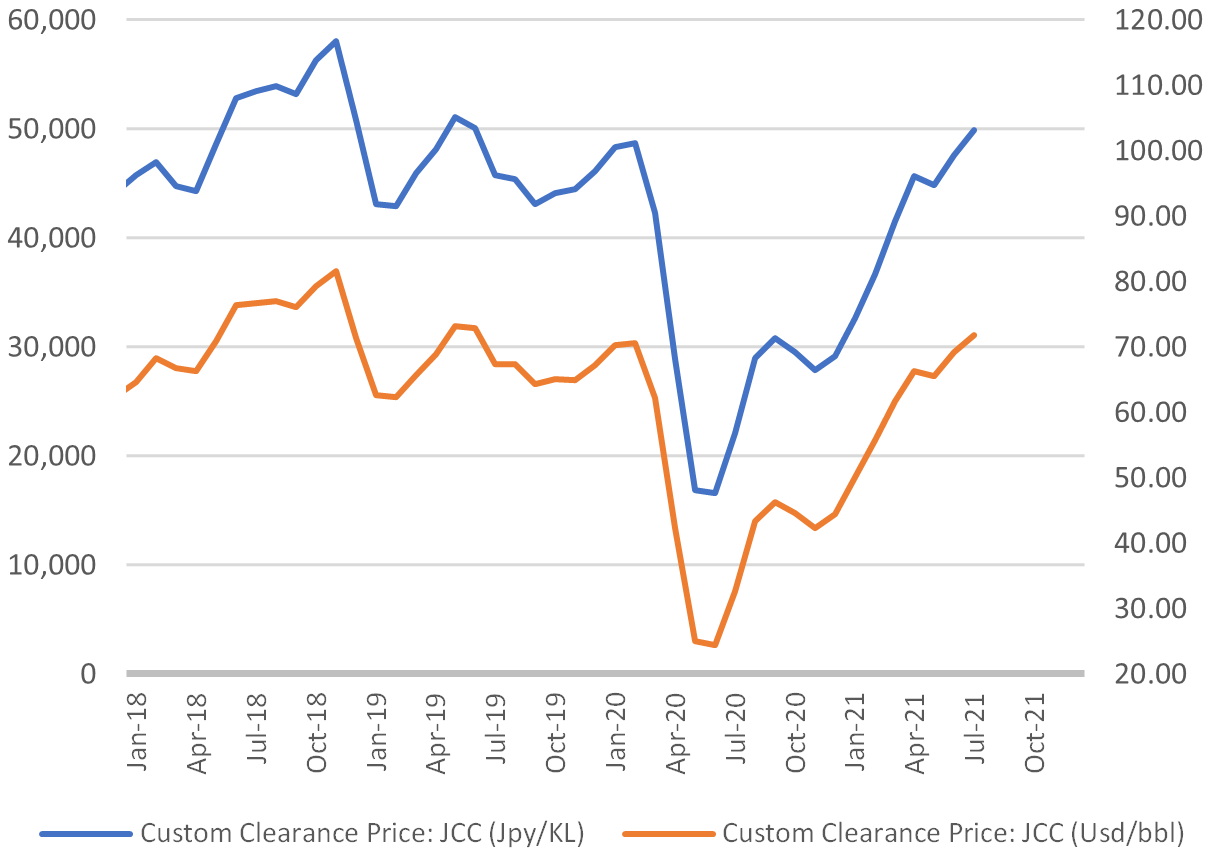
Japan Oil Price: $71.72/ barrel
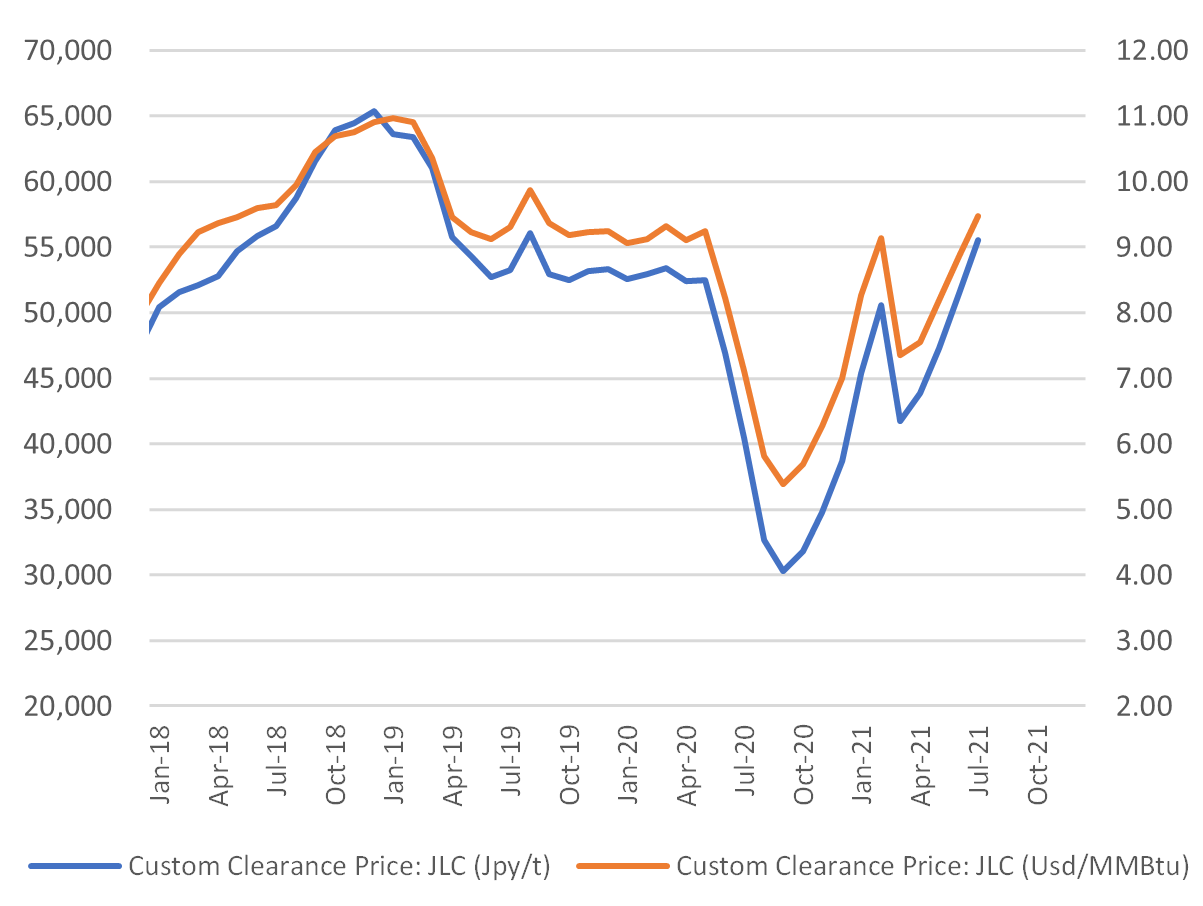
Japan (JLC) LNG Price: $9.47/ mmbtu
Japan’s LNG stocks fall more than 31% in a month
(Japan NRG, Sept. 1)
- Japan’s LNG stocks fell to 99,658 tons at the end of July, down 31.1% from a month earlier and 29.7% year-on-year, according to preliminary METI data.
- Japan consumes around 5 million tons of LNG monthly.
- Total fuel oil stocks were also down for the first time in six months, by 6.2% year-on-year to 9.03 million kl.
INPEX sells Venezuelan oil and gas interests
(Reuters, Aug. 30)
- Sources say INPEX sold its Venezuelan natural gas interests, as well as a stake in a local oil company, to the Caracas-based Sucre Energy Group.
INPEX signs up local gas distributor to “carbon-neutral” LNG purchases
(Sekiyu Tsushin, Sept. 2)
- INPEX agreed to supply Iruma Gas, based in Saitama prefecture, with “carbon-neutral” gas, which the latter will use at its headquarters.
- Iruma Gas is part of a local “Zero Carbon City” initiative that aims to build a smart energy network for a decarbonized society.
- INPEX said the offsets for the gas it supplies come from carbon credits gained from environmental conservation projects around the world and which are certified by a reliable agency.
ANALYSIS
BY YURIY HUMBER
AND
ANDREW DEWIT,
PROFESSOR OF ENERGY POLICY
SCHOOL OF ECONOMIC POLICY STUDIES
RIKKYO UNIVERSITY, TOKYO
Japan’s Change in Prime Minister Unlikely to Affect Energy Policy in the Short-Term;
Government Budget Requests Give Better Hints at the Focus
On Friday, Sept. 3, Prime Minister Suga announced that he will resign his post when his term as Liberal Democratic Party (LDP) president expires at the end of the month. Suga’s resignation will not alter energy policy and the focus on decarbonization, at least over the next few months. After that, Japan’s path to a lower carbon economy may change considerably depending on who succeeds Suga.
At present, the top candidates to take over as leader include Kono Taro, currently in charge of the vaccination program and administrative reforms, and former Foreign Minister Kishida Fumio. Ongoing intraparty politicking suggests they will be joined by others prior to the Sept. 17 start of the leadership race. The LDP presidential election will be held on Sept. 29, and is to be followed by a general election between Oct. 17 and Nov. 28.
Kono is a strong advocate of renewables, market-based solutions and a nuclear energy skeptic. Kishida is likely to stick to the traditional LDP support for large-scale infrastructure solutions such as CCUS and co-firing at thermal plants, and favors retaining a strong nuclear sector while gradually increasing the share of renewables. Thus, both support a shift to clean energy, though their policy preferences imply differences in weight given to renewables in addition to the relative roles of other decarbonization technologies.
In the short run, attention will focus on the fate of the recently drafted and quite contentious 6th Basic Energy Plan. The Plan was expected to be ratified by the Cabinet in mid-October, ahead of the COP26 climate meeting on Nov. 1 in Glasgow. A new Cabinet may well push back decisions on the Plan until after the general election, to minimize the risk of alienating any voting block during the campaign.
It’s too early to guess how a new – and presumably LDP – prime minister might influence the energy mix after the national vote. But a practical guide to Japan’s energy priorities over the next year can be found via dissecting individual ministry and agency requests for the fiscal year 2022 general budget. In late August, Japan’s various ministries and agencies submitted their funding requests for next year, and these documents reveal key themes and projects.
The total sought by all Japanese government entities for the fiscal year beginning April 2022 is around ¥111 trillion, up ¥6 trillion on the previous year. That amount does not include all the spending ministries say they require to combat the Covid-19 pandemic.
During the autumn months, as electoral politics play out, the ministries’ draft budgets will be negotiated with the powerful Ministry of Finance. Given Japan’s ¥1.2 quadrillion in public debt (over 250% of GDP), MoF’s conservative stance is certainly warranted. Yet the purse strings may well be loosened this year ahead of the general election – especially in areas related to decarbonization and digital transformation. These are the core directions set out by Suga, and are unlikely to change under his successors. Together with social spending and local revitalization, these four goals make up the bulk of the proposed budget.
Based on the various ministries’ requests, the areas that look set to receive the most support include renewable energy, electric vehicles (EV), hydrogen and 5G infrastructure.
No matter who becomes prime minister, Japan will need to present evidence of major movement in green tech at the COP26 meeting. That imperative suggests that the MoF Budget Bureau’s bean-counters – led by a fiscal hawk – may restrain their red pens in assessing the double-digit increases in energy-related budget requests.
Below are the standout energy-related budget requests.
Ministry of Economy, Trade and Industry (METI)
| Total budget request | ¥1,402.6 billion, up 11.9% YoY, of which ¥824.2 billion (up 10.6% YoY) is for energy related items |
| Key areas of focus as related to energy |
|
| Select items |
|
Ministry of the Environment (MoE)
| Total budget request | ¥407.7 billion, up 32% YoY (not including the special budget for revitalization work after the 2011 Great East Japan Earthquake and tsunami) |
| Key areas of focus as related to energy |
|
| Select items |
|
Ministry of Culture, Education, Culture, Sports, Science and Technology (MEXT)
| Total budget request | ¥5,916.1 billion, up 11.7% YoY |
| Key areas of focus as related to energy |
|
| Select items |
|
Ministry of Land, Infrastructure, Transport and Tourism (MILT)
| Total budget request | ¥6,934.9 billion, up 18% YoY |
| Key areas of focus as related to energy |
|
| Select items |
|
Ministry of Agriculture, Forestry and Fisheries (MAFF)
| Total budget request | ¥2,6842.2 billion, up 16% YoY |
| Key areas of focus related to energy |
|
| Select items |
|
Japan Oil, Gas and Metals National Corporation, JOGMEC
| Budget request
(via METI) |
|
ANALYSIS
BY CHISAKI WATANABE
Japan’s Self-Defense Forces See the Emergence of a New Front:
The War on Climate Destruction
In just one year, the Japanese state’s biggest emitter morphed into its most progressive clean power buyer. And more dramatic developments are yet to come.
Japan’s Self-Defense Forces (SDF) are best known for their prowess in dealing with natural disasters rather than for military exploits. This experience has given the SDF a unique and hands-on understanding of climate change’s impact on national security.
For the first time the SDF has framed its concerns as a national security issue, joining an array of militaries from around the world in publicly discussing climate challenges.
The SDF also published results of its initial efforts to switch energy supplies to renewable sources. The results are impressive.
From petals to samurai
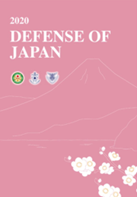
The publication of this year’s “Defense White Paper” by the Defense Ministry caught people’s attention. Gone were the usual placid tones and pink Sakura petals on the cover, which instead featured an ink painting of a mounted samurai.

The art and the more candid discussion of geopolitics were not the only thing new. Seemingly for the first time, the Defense Ministry identified climate change as a national security danger and devoted an entire section to the problems the country faces.
“The lack of water, food and land, resulting from complex impacts of climate change, may not only trigger and worsen conflicts over limited land and resources, but also lead to massive migrations, and cause social and political tensions and conflicts,” expounded the report.
It added that the occurrence of extreme weather events, such as heavy rains and floods, and more powerful typhoons, already pose a challenge to troops and could grow worse. The time required for rescue operations is longer. Meanwhile, the risk of conflicts and tensions triggered by such weather events is rising.
Similar sentiments have come from military and administrations elsewhere. U.S. President Joe Biden, upon taking office earlier this year, ordered the Secretary of Defense to consider the security implications of climate change in developing the National Defense Strategy, Defense Planning Guidance, and Chairman’s Risk Assessment.
In June, NATO issued a “Climate Change and Security Action Plan.” Calling climate change a “threat multiplier that impacts Allied security,” NATO said it will conduct an annual assessment to analyze the impact of climate change on the strategic environment and its assets, installations, missions and operations.
In Japan, national disasters often require troops to be sent in for disaster relief, so the SDF’s views on climate change are more than just the acknowledgement of a global issue.
Defense Minister Kishi Nobuo calls climate change a “spiral risk,” that creates a spillover from one country to another, threatening global peace and stability. In his speech at the Leaders’ Summit on Climate organized by the U.S. government in April, Kishi said climate change increases natural disasters such as floods and droughts, making the environment more difficult to live in and fostering conditions for crime and extremism to flourish. This will provoke more conflicts over territory and natural resources, he said.
Kishi pointed out three ways climate change can affect Japan’s security;
- Weaken capacity of the SDF due to the increase of climate change-induced natural disasters
More frequent torrential rains have led to an increase in troops deployed and the length of operations, affecting the readiness for national defense missions. The total number of troops involved in disaster relief topped 1 million (close to 1% of Japan’s population) for both 2018 and 2019, and reserves have to be called up for relief operations.
- Raise sea levels
Land loss from the encroaching sea will intensify struggle over territory and natural resources, and trigger mass migrations, threatening to cause region-wide destabilization. - Melt Arctic Sea ice
The melting of the Arctic Sea ice has increased the region’s strategic importance because of the potential for resources like oil and gas beneath the seabed and a shorter sea route from Japan to Europe.
Kishi also launched a task force on climate change. The first meeting comprised senior ministry officials and was held in May to analyze the impact of climate change on national security and to prepare measures. They talked about adopting cutting edge green technology and cooperating with allies, as well as the sourcing of renewable energy across the ministry.
The defense ministry’s decisions have a significant impact on the government’s overall emission footprint because it’s the largest power consumer, accounting for about 40% of all electricity used by Japan’s ministries and agencies.
The idea of increasing renewable electricity use by the ministry and the SDF was first floated by Kono Taro, then defense minister, in December 2019. Kono, now one of the candidates to become the next Japanese prime minister, said the defense ministry and the SDF will aim to:
- Significantly raise the share of clean energy and increase renewable’s share to 100% where possible
- Source electricity from local power providers near SDF’s facilities
- Ensure fair competitions
- Keep costs down
- Ensure power supply is stable
Kono said this will start as a trial to see how much clean energy can be added without adding more procurement cost and causing disruptions to power supply. He also stressed the benefit of using domestically produced energy. Resource-poor Japan’s self-sufficiency ratio of energy is 11.8 %, far below other OECD member countries.
The results
The policy has had immediate impact on the ministry’s roughly 1,000 power procurement contracts. For the fiscal year that ended in March 2021, 151 defense facilities signed renewable power contracts for 91 GWh of electricity, an equivalent of that used by 20,000 homes. Among the suppliers was Hamamatsu Energy, a small, regional clean energy provider owned by the city of Hamamatsu, a subsidiary of NTT, and local financial institutions and others.
This fiscal year, the number of military buildings using renewables rose by more than three times to 526, including 282 facilities that use only renewable energy such as Camp Higashi-Chitose in Hokkaido and Kanoya Air Base in Kagoshima. Estimated power consumption across the ministry and SDF facilities also rose nearly seven-fold to 620 GWh on year, equal to nearly half of the total estimated power consumption by the ministry and SDF.
Increasing the share of renewable electricity won’t be easy, partly due to the arduous sourcing process. It starts with research on the availability of renewable energy providers in the vicinity of each military facility. An auction will then be held if there are more than two providers of 100% renewable energy. If the first round fails to find a winner due to high costs, the second and third rounds will be held with providers of 50% renewable energy and 30% clean power, respectively. If still no winner, a fourth and last round will be held with non-renewable electricity suppliers.
Although nearly 60% of the Air Self-Defense Force’s facilities are using renewable power, further expansions may be difficult because some regions have no suppliers of solar, wind, geothermal, biomass or small hydro.
Despite these obstacles and challenges, the SDF’s mobilization and willingness to join the war against climate change is a huge boost to the common global cause, and will certainly prod and inspire other militaries in the Asia-Pacific region to follow suit. Militaries now have a new enemy, and hopefully this common threat will act as a unifying factor even among countries that have traditionally been hostile to each other.
GLOBAL VIEW
BY JOHN VAROLI
Below are some of last week’s most important international energy developments monitored by the Japan NRG team because of their potential to impact energy supply and demand, as well as prices. We see the following as relevant to Japanese and international energy investors.
Carbon-emissions markets
The value of the world’s carbon markets grew 23% last year to about $281 billion, Refinitiv reported. These markets could be worth as much as $22 trillion by 2050, Wood Mackenzie estimates. As governments around the world push to expand in this area, Vitol, Glencore and others that dominate oil trading are also building up their carbon-trading operations. Two of the oil majors, Shell and BP, have already amassed sizable carbon-emissions trading divisions.
Hydrogen
1) The U.S. needs to stop China from dominating the fast-growing hydrogen sector, top U.S. climate envoy John Kerry said during a virtual summit organized by the Department of Energy (DOE). “Hydrogen Shot” is the first in a series of DOE events that discuss how the U.S. will transition to clean energy. This past week, Kerry toured Asia, including almost 3 days in China, to discuss policy ahead of the COP26 climate summit. He said: “There is an enormous economic benefit for the U.S. to lead on developing clean technologies” in what will be a “multi-trillion dollar” global industry, adding that he believes China wants to dominate this market.
2) During the same hydrogen summit, billionaire Bill Gates said hydrogen is one of four technology areas to benefit from $1.5 billion in financing in a new partnership between his Breakthrough Energy climate fund and the DOE. Projects that jump start new tech can potentially garner ten times more investment thanks to public-private partnerships, Gates said. Hydrogen is likely to also benefit from significant government inflows thanks to the Infrastructure Investment and Jobs Act that includes $9.5 billion for hydrogen-related projects.
Australia
UK-based renewables firm, RES, will sell the Dulacca wind farm to Octopus Australia, which is part of the UK-based Octopus Group, a partner of Tokyo Gas. Once the deal is completed, the Australian wind project, which is located 350 kilometers (210 miles) northwest of Brisbane amid agricultural land, will consist of 43 wind turbines that can generate enough electricity to power approximately 124,000 homes. Dulacca is Octopus’ fourth renewable asset in Australia since entering the country in 2018.
China
1) China’s push to promote clean-fuel vehicles is producing strong results. Sales of “new energy vehicles” (NEVs) have soared almost 300% in the first eight months of 2021, compared to the same period in 2020, said Xin Guobin, deputy head of the Ministry of Industry and Information Technology. The number of NEVs sold in China from Jan. 1 to the end of August is projected to total about 1.7 million vehicles, compared to 600,000 for the same period last year.
2) Three Gorges South Asia Investment has teamed up with other Chinese investors to take over all of Alcazar Energy Partners, a leading renewables company in the Middle East and North Africa (MENA). Established in 2015, Alcazar said the deal would allow Three Gorges, which has mostly been focused on Pakistan and which is partly owned by China’s sovereign wealth fund, to gain more exposure to the renewable energy markets in the MENA region. Dubai-based Alcazar has a portfolio of five solar and two wind projects in Egypt and Jordan, with a total operational capacity of 411 MW. The MENA region has about 157 GW of renewable energy capacity, and as much as $175 billion is expected to be invested there over the next decade.
India
As India recovers from its Covid peak in spring and government restrictions are eased, the return of domestic travel for business and personal reasons has led to a high jump in demand for gasoline. The trend is labeled “revenge travel”. However, as health concerns remain, much of the travel is with private transport. Passenger vehicle sales rose by 45% to 264,442 units in July.
Ireland
State-controlled ESB acquired a majority stake in UK renewable energy supplier, So Energy, to strengthen its position in the British retail market. ESB is a diversified and vertically integrated Irish utility. It will take over 75% of So Energy. The merger will be completed in several months. ESB has operated in the UK for nearly 30 years.
Ukraine
During high level meetings in Washington D.C., Ukraine agreed with the U.S. to “deepen and intensify” their strategic cooperation in energy, with nuclear power at the top of the agenda. As a pilot project, Ukraine’s state-owned Energoatom and Westinghouse plan to complete the fourth reactor at the Khmelnitsky nuclear power plant. This expansion would see nuclear providing as much as 72% of Ukraine’s electricity, thus reducing coal’s share in the mix. Also, during a visit to the White House by President Volodymyr Zelensky, the countries agreed on measures to decarbonize Ukraine’s economy and to implement a plan to develop solar and wind energy, hydrogen, energy storage, as well as carbon capture utilization and storage.
U.S.
On Aug 29-30, the second-worst hurricane in Louisiana history battered the oil and gas-rich state on the Gulf of Mexico. The disaster incapacitated as much as 90% of offshore oil and gas operations, leaving them offline for almost a week. There are concerns that many oil wells in the region, which accounts for about 20% of total U.S. output, could be out of action for weeks. Crews are returning to offshore facilities, but many still remain vacant. Two pipelines, Nautilus and Garden Banks, which carry oil and natural gas, respectively, are reported to be operational. There are also reports that local oil refineries face electrical power shortages.
EVENTS CALENDAR
A selection of domestic and international events we believe will have an impact on Japanese energy.
| February | Approval of Fiscal 2021 Budget by Japanese parliament including energy funding projects;
CMC LNG Conference |
| March | 10th Anniversary of Fukushima Nuclear Accident;
Smart Energy Week – Tokyo; Quarterly OPEC Meeting; Japan LPG Annual Conference; Full completion of all aspects of the multi-year deregulation of Japan’s electricity market; End of 2020/21 Fiscal Year in Japan; |
| April | Japan Atomic Industrial Forum – Annual Nuclear Power Conference;
38th ASEAN Annual Conference-Brunei; Japan LNG & Gas Virtual Summit (DMG)-Tokyo Three crucial by-elections in Hokkaido, Nagano & Hiroshima – April 25th |
| May | Bids close in first tender for commercial offshore wind projects in Japan;
Prime Minister Suga to visit the U.S. |
| June | Release of New Japan National Basic Energy Plan-2021;
G7 Meeting – U.K. Presidents Biden and Putin are due to meet at a summit in Geneva Forum for China-Africa Cooperation Summit (Senegal) |
| July | Tokyo Metropolitan Govt. Assembly Elections;
Commencement of 2020 Tokyo Olympics |
| August | METI committee approves draft of Japan’s 6th Basic Energy Plan |
| September | Ruling LDP Presidential Election;
UN General Assembly Annual Meeting that is expected to address energy/climate challenges; IMF/World Bank Annual Meetings (multilateral and central banks expected to take further action on emissions disclosures and lending to fossil fuel projects); End of H1 FY2021 Fiscal Year in Japan; Japan-Russia: Eastern Economic Forum (Vladivostok)-tentative |
| October | Last possible month for holding Japan’s 2021 General Election; Hydrogen Ministerial Conference in conjunction with IEA METI Sponsored LNG Producer/Consumer Conference; Innovation for Cool Earth Forum – Tokyo Conference; Task Force on Climate-Related Financial Disclosure (TCFD) – Tokyo Conference; G20 Meeting-Italy |
| November | COP26 (Glasgow);
Asian Development Bank (‘ADB’) Annual Conference; Japan-Canada Energy Forum; East Asia Summit (EAS) – Brunei |
| December | Asia Pacific Economic Cooperation (APEC) Forum – New Zealand;
Final details expected from METI on proposed unbundling of natural gas pipeline network scheduled for 2022. |
Disclaimer
This communication has been prepared for information purposes only, is confidential and may be legally privileged. This is a subscription-only service and is directed at those who have expressly asked K.K. Yuri Group or one of its representatives to be added to the mailing list. This document may not be onwardly circulated or reproduced without prior written consent from Yuri Group, which retains all copyright to the content of this report.
Yuri Group is not registered as an investment advisor in any jurisdiction. Our research and all the content express our opinions, which are generally based on available public information, field studies and own analysis. Content is limited to general comment upon general political, economic and market issues, asset classes and types of investments. The report and all of its content does not constitute a recommendation or solicitation to buy, sell, subscribe for or underwrite any product or physical commodity, or a financial instrument.
The information contained in this report is obtained from sources believed to be reliable and in good faith. No representation or warranty is made that it is accurate or complete. Opinions and views expressed are subject to change without notice, as are prices and availability, which are indicative only. There is no obligation to notify recipients of any changes to this data or to do so in the future. No responsibility is accepted for the use of or reliance on the information provided. In no circumstances will Yuri Group be liable for any indirect or direct loss, or consequential loss or damages arising from the use of, any inability to use, or any inaccuracy in the information.
K.K. Yuri Group: Oonoya Building 8F, Yotsuya 1-18, Shinjuku-ku, Tokyo, Japan, 160-0004.