
JAPAN NRG WEEKLY
SEPT. 13, 2021
JAPAN NRG WEEKLY
Sept. 13, 2021
NEWS
TOP
- Ruling party leadership debate focuses on nuclear energy with top candidate Kono softening his opposition; rival Takaichi calls for creation of a new energy & environment agency
- TEPCO to add as much as 7 GW of renewables capacity by 2030; CEO outlines ¥1 trillion plan centered on offshore wind and hydro
- State-backed oil explorer JAPEX to revamp itself in green energy with ambitions to operate solar, biomass projects
ENERGY TRANSITION & POLICY
- Basic Energy Plan opened to public comments until Oct. 4
- Kawasaki Kisen (K Line) named a role model for transition finance
- Citizens group lodges complaint to govt. around solar projects; a number of METI panels discuss solar farm accidents; committee calls for a shared nationwide database of solar farms in risky areas
- METI says solar auctions helped cut tariffs by half over five years
- Japan and India consider working on JCM carbon credit projects
- Toyota to invest over $13 billion in EV batteries, hybrids by 2030
- Mitsubishi and Shell partner to produce blue hydrogen in Canada; JGC looks to produce green hydrogen in Azerbaijan
- Nippon Plate manufactures world’s first glass using hydrogen
- Toshiba to commercialize perovskite solar cells by 2025… [MORE]
ELECTRICITY MARKETS
- Daiwa Real Estate sells shares in ¥16 billion solar investment fund
- Tokyo Marine starts an insurance service for M&A in solar projects
- Amazon, Mitsubishi Corp. to build 450 solar plants around Japan
- JRE sets out plans for 300 MW wind farm with German partner
- Shimizu to partner with Dutch firm on offshore wind contracts
- Ministry seeks changes to Mitsubishi’s 180 MW offshore wind farm
- NUCLEAR REACTOR ROUND-UP: Leak at Hamaoka … [MORE]
OIL, GAS & MINING
- ENEOS criticized for potentially supplying crude to Myanmar army
- Nissan group unveils enhanced rare earth recycling process
- Oil tanker charter fees slump on surplus capacity, weak demand
ANALYSIS
JAPAN TO CREATE NEW EXCHANGE FOR CARBON CREDITS MADE DOMESTICALLY AND OVERSEAS
In 2022, Japan hopes to have a market price for carbon. The government wants to launch a new exchange that will trade carbon credits issued locally and overseas, creating a public and liquid price mechanism for CO2.
The impact could be immense. As well as setting a price on pollution in the world’s fifth largest CO2 emitting nation, it should provide a mechanism to define the value of green investments in energy, recycling and other spheres. This could unlock a range of clean energy projects that to date have struggled to justify initial high costs.
THE MOST EFFECTIVE WAY TO DECARBONIZE BUILDINGS? IT’S NOT (JUST) SOLAR
While adding solar panels to rooftops will help, recent research reveals an even more effective way for Japan to slash emissions from homes and offices: better heat insulation. This “discovery” may seem odd given how widespread heat insulation measures are around the world. However, house construction in Japan has its own particular history, and to date government efforts to promote building energy efficiency have been weak and unsuccessful.
Last year’s decarbonization vow changed the mood. The infrastructure ministry (MLIT) has committed ¥1.38 billion ($12.5 billion) to a program for energy efficiency of homes and buildings, with related initiatives also being launched by the METI and the MoE.
GLOBAL VIEW
China breaks out state oil reserve to cool prices. EU carbon markets hit another record. Europe faces high energy bills this winter on gas shortage. Russian crude back in vogue. California asks public to cut power use. Details on these and more in our global wrap.
WEATHER OUTLOOK
JAPAN NRG WEEKLY
PUBLISHER
K. K. Yuri Group
Editorial Team
Yuriy Humber (Editor-in-Chief)
Tom O’Sullivan (Japan, Middle East, Africa)
John Varoli (Americas)
Sponsored
Regular Contributors
Mayumi Watanabe (Japan)
Daniel Shulman (Japan)
Takehiro Masutomo (Japan)
Art & Design
22 Graphics Inc.
SUBSCRIPTIONS & ADVERTISING
Japan NRG offers individual, corporate and academic subscription plans. Basic details are our website or write to subscriptions@japan-nrg.com
For marketing, advertising, or collaboration opportunities, contact sales@japan-nrg.com
For all other inquiries, write to info@japan-nrg.com
OFTEN USED ACRONYMS
METI The Ministry of Energy, Trade and Industry
MOE Ministry of Environment
ANRE Agency for Natural Resources and Energy
NEDO New Energy and Industrial Technology Development Organization
TEPCO Tokyo Electric Power Company
KEPCO Kansai Electric Power Company
EPCO Electric Power Company
JCC Japan Crude Cocktail
JKM Japan Korea Market, the Platt’s LNG benchmark
CCUS Carbon Capture, Utilization and Storage
mmbtu Million British Thermal Units
mb/d Million barrels per day
mtoe Million Tons of Oil Equivalent
kWh Kilowatt hours (electricity generation volume)
NEWS: ENERGY TRANSITION & POLICY
Prime Minister contest has nuclear as front and center
- Three candidates have officially entered the race to succeed Suga Yoshihide as President of the ruling Liberal Democratic Party (LDP) and hence the country’s prime minister:
1) Kono Taro, the current minister for administrative reforms - 2) Kishida Fumio, a former minister of foreign affairs
3) Takaichi Sanae, a former internal affairs minister - Another one or two candidates are said to be considering their options, but will need to declare soon as the election campaign starts Sept. 17.
- The three official candidates have spoken on multiple issues, but one that keeps being talked about is their stance on nuclear energy.
- Kono is seen as the front-runner. He has traditionally spurned nuclear power as costly and problematic due to the unresolved issue of how to process and store spent uranium fuel. As the Nikkei reminded us last week, Kono formed a cross-party alliance against nuclear power a year after the Fukushima accident.
- However, Kono has walked back his anti-nuclear stance for the party leadership race. He said last week that restarting existing reactors is a “necessity” in order for Japan to meet its carbon neutrality goals.
- Kono also repeated his view that nuclear power would be phased out, but qualified it by saying this would happen “someday”. He said he would not try to stop the NPPs “tomorrow or next year”.
- It’s tempting to imagine that Kono was only referring to the 2030 target of reducing emissions by 46%, rather than the 2050 net-zero goal. However, he also said nuclear power is a “realistic” way to reach the 2050 numbers, even if renewables and energy saving would be the “primary” drivers.
- Most importantly, Kono said that building new reactors is not realistic “for now,” which again gives him leeway to support new nuclear technology like SMRs and HTTR. That’s important, because it’s not only an energy issue but a geopolitical one. The SMR program, for example, is led by the U.S. but has Japanese firms like IHI and JGC invested in new U.S. projects.
- Takaichi was quick to point out that Kono’s new tolerance of nuclear is at odds with his message in general election campaigns to the public. Still, it’s unlikely that his compromise will be seen as a negative.
- Takaichi has also called for the creation of a single agency to oversee all environmental and energy policy. The idea has been mooted for years and may take off no matter who becomes the new PM.
- Kishida’s nuclear stance is that existing reactors have to restart before new ones are built and that Japan needs a new agency to oversee economic security.
- For other energy-related issues, the conversation has been shallow. All three candidates said Japan needs to expand renewables, something that’s already part of government policy. The degree to which this must take place may vary greatly according to each candidate, but we are unlikely to hear concrete numbers during a campaign.
- SIDE DEVELOPMENT:
Taro Kono joins LDP leadership race with softened agenda
(Nikkei Asia, Sept. 10) - SIDE DEVELOPMENT:
Electricity stocks fall on concern about Kono’s antinuclear ambitions(Asahi Shimbun, Sept. 6)- KEPCO, Chubu Electric, Hokuriku Electric, and J-Power all saw their share prices fall today after Kono Taro topped a poll for preferred Prime Minister.
- SIDE DEVELOPMENT:
Electricity stocks jump on Kono’s nuclear comments
(Reuters, Sept. 9)- Electricity and gas providers including TEPCO Holdings and KEPCO saw share prices rise by over 9% today after LDP leadership candidate Kono Taro indicated he’d support the restart of idle nuclear reactors.
- Electricity and gas providers including TEPCO Holdings and KEPCO saw share prices rise by over 9% today after LDP leadership candidate Kono Taro indicated he’d support the restart of idle nuclear reactors.
- Electricity and gas providers including TEPCO Holdings and KEPCO saw share prices rise by over 9% today after LDP leadership candidate Kono Taro indicated he’d support the restart of idle nuclear reactors.
- SIDE DEVELOPMENT:
Small modular reactors secret weapon in fight for carbon neutrality
(Nikkan Kogyo Shimbun, Sept. 6)- Small modular reactors are gaining attention around the world due to their superior safety and lower cost of construction and operation.
- Japan is likely to partner with the U.S. on development of the technology.
- SIDE DEVELOPMENT:
OPINION: PM candidates divided on nuclear and role of renewables
(Gendai Business opinion, Sept. 8)- CONTEXT: This opinion piece looks at the energy stance of various top politicians in Japan while clearly backing Kono and renewables.
- Kono is wrangling with METI on the specifics of the new energy plan; he wants to increase the percentage of electricity generated from renewable sources to over 38%, but many politicians with ties to the manufacturing industry advocate restarting nuclear reactors en-masse.
- SIDE DEVELOPMENT:
OPINION: The significance of METI’s Kono-bashing
(Aera opinion, Sept. 7)- CONTEXT: The article defends Kono after a critical piece was published the previous week in the conservative Bunshun magazine that portrayed Kono as harassing his counterparts at the Agency for Natural Resources and Energy (which falls under the auspices of METI) during a debate on revisions to Japan’s Basic Energy Plan.
- What the Bunshun article didn’t mention was that Kono and his Ministry counterparts have already been debating the overhaul of regulations around renewable energy for nearly a year, in a debate that the Agency had lost fair and square.
- One of these regulations is a mechanism seen nowhere else in the world under which generators of variable renewable electricity have to pay a levy to the government to keep (more reliable) coal-fired stations running on the pretext of ensuring stable supply.
- The mechanism forces renewable operators to make large contributions to coal-fired power stations. Kono called for scrapping or radically reforming this mechanism but was ignored. No wonder he’s angry. Bunshun’s characterization of Kono’s frustration as ‘threats’ therefore is outrageous.
- METI keeps trying to add loopholes in the Basic Energy Plan to hold back renewables and ensure survival of the nuclear industry.
Public comments for the 2030 energy mix open until October 4
(Japan NRG, Sept. 3)
- The Agency of Natural Resources and Energy opened the 6th Basic Energy Basic Plan for public comments, which will close on Oct. 4. Individuals, companies and organizations can file comments.
- The plan calls for a boost of renewable energy as the main source of electricity in 2030, to account for 36-38% of power supplies, while cutting coal-fired power to 19% from the current 32%.
- Japan Business Federation, Federation of Electric Power Companies and other industry and issue-focused groups interviewed by ANRE during the planning process typically submit comments, disclosing them on their websites the day after the submission deadline.
- A month after the submission period is closed, government agencies usually disclose comments received, along with their final decisions. The comments rarely affect the general course of government policy but some details may be modified.
Kawasaki Kisen (K Line) picked as model of transition finance
(Japan NRG, Sept. 3)
- Five independent METI panelists selected shipping firm Kawasaki Kisen Kaisha (K Line) as the role model for transition financing. K Line is expected to showcase to other Japanese companies proven transition scenarios, and demonstrate strong governance and transparent transition. METI will next draw sector-specific transition roadmaps.
- K Line, which operates 446 vessels, has pledged by 2030 to cut carbon emission 50% from 2008 levels, and 70% by 2050. Its 2020 Scope 1 emissions were 9.2 million tons, Scope 2 were 25,000 tons, and Scope 3 were 1.2 million tons.
- Transition projects until 2030 include purchasing LNG-fueled ships, improving fuel efficiency of existing vessels, trial runs of its proprietary automatic navigation system propelled by wind energy, among others.
- Mizuho Bank will arrange the loans. K Line will set targets for GHG emission cuts, sea vessel emission per mile and CDP carbon disclosure rating before the loans mature.
Solar projects draw complaints from the public
(Japan NRG, Sept. 7)
- A citizens group, Nationwide Coalition on Renewable Issues, lodged complaints to the Cabinet task force on renewables regarding environmental damages caused by solar projects.
- The group requested restrictions over resale of Feed-in-Tariff licenses (oversight of METI), stricter enforcement of Forestry Act (Forestry Agency), and increased scrutiny for environmental impact of new projects (Environment Ministry). Landslides were caused by construction violating property development regulations and some were unauthorized, the group claimed.
- Concurrently, several METI panels discussed solar farm accidents during the week. METI reported to the New Energy Sub Committee that 738 complaints were lodged online to the Agency of Natural Resources and Energy since 2016, and 693 were on solar farms.
- METI will set up a centralized database of various municipality regulations on renewables, which increased five-hold from 2016 to 2020. It also plans to closely liaise with municipalities when companies apply to the national government for energy business licenses.
- Other approaches discussed during the Power Safety Sub-Committee meeting included sharing with municipalities details of solar farms in disaster-prone areas, and providing analysis of past incidents to solar power plant operators. It also plans to strictly enforce the Electricity Business Act with penalties including cancellation of licenses.
- SIDE DEVELOPMENT:
Landslide in Fukuoka derails plans for a solar farm
(TKU, Sept. 7)- A landslide on a solar farm construction site buried nearby rice paddies. Heavy rains in August played a major role.
- The 40-ha site is slated to accommodate a 40 MW solar farm but the local government has repeatedly suspended work over compliance breaches.
METI says solar auctions have helped cut tariffs by half in less than five years
(Japan NRG, Sept. 10)
- Following reforms, quarterly government solar power auctions were lower. The auctions in the first and second quarter of 2021 for solar for businesses attracted more bidders as frequency increased to quarterly from twice a year, floor price and other data were disclosed, time to review qualification of participants shortened, among other changes.
- The auction winners averaged ¥10.82/ kWh in Q1 2021, and ¥10.75/ kWh in Q2, compared to ¥11.2/ kWh in 2H2020. However, these levels are still high, twice as much as German levels, METI said.
Yen/kWh
*No auction in H1 2018
Japan and India consider working together on JCM carbon credit projects
(Japan NRG, Sept. 7)
- The MoE and the Indian Ministry of Environment, Forestry and Climate Change agreed to explore potential decarbonization projects under the Joint Credit Mechanism.
- The two will also share information on hydrogen and measures to spread low-emission cars.
- The Japanese ministry will hold a webinar on JCM during the Pacific Islands Leaders Meeting (PALM9) on September 22.
- CONTEXT: 17 nations have joined the JCM framework to date. They are Mongolia, Bangladesh, Ethiopia, Kenya, Maldives, Vietnam, Laos, Indonesia, Costa Rica, Palau, Cambodia, Mexico, Saudi Arabia, Chile, Myanmar, Thailand and the Philippines.
Toyota to invest over $13 billion in EV batteries and hybrids by 2030
(Nikkei XTech, Nikkei Asia, Sept. 7)
- Japan’s biggest automaker, Toyota Motor, will invest ¥1.5 trillion ($13.6 billion) in batteries used for electric and hybrid vehicles by 2030.
- This will increase its lithium-ion battery output to more than 200 GWh by the decade’s end, enough to accommodate more than 3 million electric vehicles (EVs), far exceeding existing plans.
- By 2030, the company wants a 50% drop of in-vehicle battery costs.
- Most spending will come in major markets, including China and the U.S. Toyota will expand domestic production via a JV with Panasonic.
- Toyota’s spending on batteries for EVs will reach about ¥160 billion in the fiscal year ending March 2022, double the previous year.
- CONTEXT: In May, Toyota set a goal to sell 8 million EV and hybrid vehicles by 2030. That target includes 2 million EVs and fuel cell vehicles.
Mitsubishi and Shell partner up to produce low-carbon hydrogen in Canada
(Company statement, various media, Sept. 8)
- Mitsubishi Corp. and Shell’s Canadian subsidiary signed an accord to produce low-carbon (blue) hydrogen in Canada for export to Japan.
- Mitsubishi will build a low-carbon hydrogen plant near Shell’s Scotford, Alberta, facility in the “latter half of this decade”.
- In the first phase, the project will produce 165,000 tons of hydrogen annually from local natural gas, to be converted to ammonia for export to Asian markets.
- Emissions would be sequestered in Shell’s Polaris carbon capture and storage (CCS) facility near Edmonton. This facility has yet to obtain a final investment decision from Shell and secure permits from local government. It’s planned to store more than 10 million tons of CO2 a year.
- CONTEXT: This year, the Edmonton region was announced as Canada’s first hydrogen hub and is also home to abundant natural gas resources.
TAKEAWAY: Canada has long been considered an obvious choice for Japan to source its hydrogen / ammonia due to the warm relations and the former’s strong resource base. This project helps to diversify Japan’s potential supplies routes to North America, Australia, Southeast Asia, Russia, and the Middle East.
So far, most of the announced projects focus on blue hydrogen, with carbon capture technology expected to reduce emissions. However, the government’s long-term vision sees a switch to renewables-based (green) hydrogen by the end of this decade. Given the long path for natural resource developments, it will be interesting to see how Japan makes the transition from blue to green hydrogen. Or, whether blue hydrogen becomes entrenched as the dominant supply channel.
JGC Holdings looks to produce green hydrogen in Azerbaijan
(New Energy Business News, Company Statement, Sept. 6)
- JGC commenced surveying work in Azerbaijan ahead of a bid to produce green hydrogen and ammonia there.
- The feasibility study will assess the potential for a facility using Japanese solar and wind power technology to make green hydrogen and ammonia.
- Azerbaijan enjoys strong winds and long sunlight hours, and is home to several ammonia plants in addition to domestic transportation infrastructure. Thus, JGC believes Azerbaijan has significant potential as a site for future green hydrogen and ammonia projects.
Nippon Plate manufactures world’s first glass using hydrogen at its UK unit
(Kankyo Business, Sept. 7)
- Nippon Plate Glass Co succeeded in producing architectural glass with the world’s first demonstration of glass manufacturing using hydrogen-fired energy at its UK office.
- This demo was held at the Greengate office of Pilkington UK Limited. It succeeded in seamlessly switching between two different fuels, natural gas and hydrogen, while maintaining the same high level of performance.
- This proves it’s possible to significantly reduce CO2 emitted from a glass melting kiln.
Toshiba develops a perovskite solar cell with 15% energy conversion efficiency
(Nikkan Kogyo Shimbun, Sept. 10, 2021)
- Toshiba developed a film type perovskite solar cell with a 15.1% energy conversion efficiency.
- The company will aim for commercialization by 2025.
Mitsubishi Heavy drastically reduces CO2 capture cost
(Nikkei, Sept. 9)
- Mitsubishi Heavy Industries plans to ramp up CO2 recovery technology to a commercial scale by 2023. Mitsubishi, which has a 70% share of the global market for carbon retrieval plants, says tech innovation will help it to halve the cost of the process.
ENEOS to sell controlling stake in road paving firm to cut CO2 footprint
(Diamond, Sekiyu Tsushin, Sept. 6-9)
- Oil refining major ENEOS will sell its 57.1% stake in Nippo Corporation, a construction and road paving firm, hoping to shed its overall CO2 footprint and to raise funds for investments in decarbonization. The overall deal is expected to raise about ¥170 billion for ENEOS.
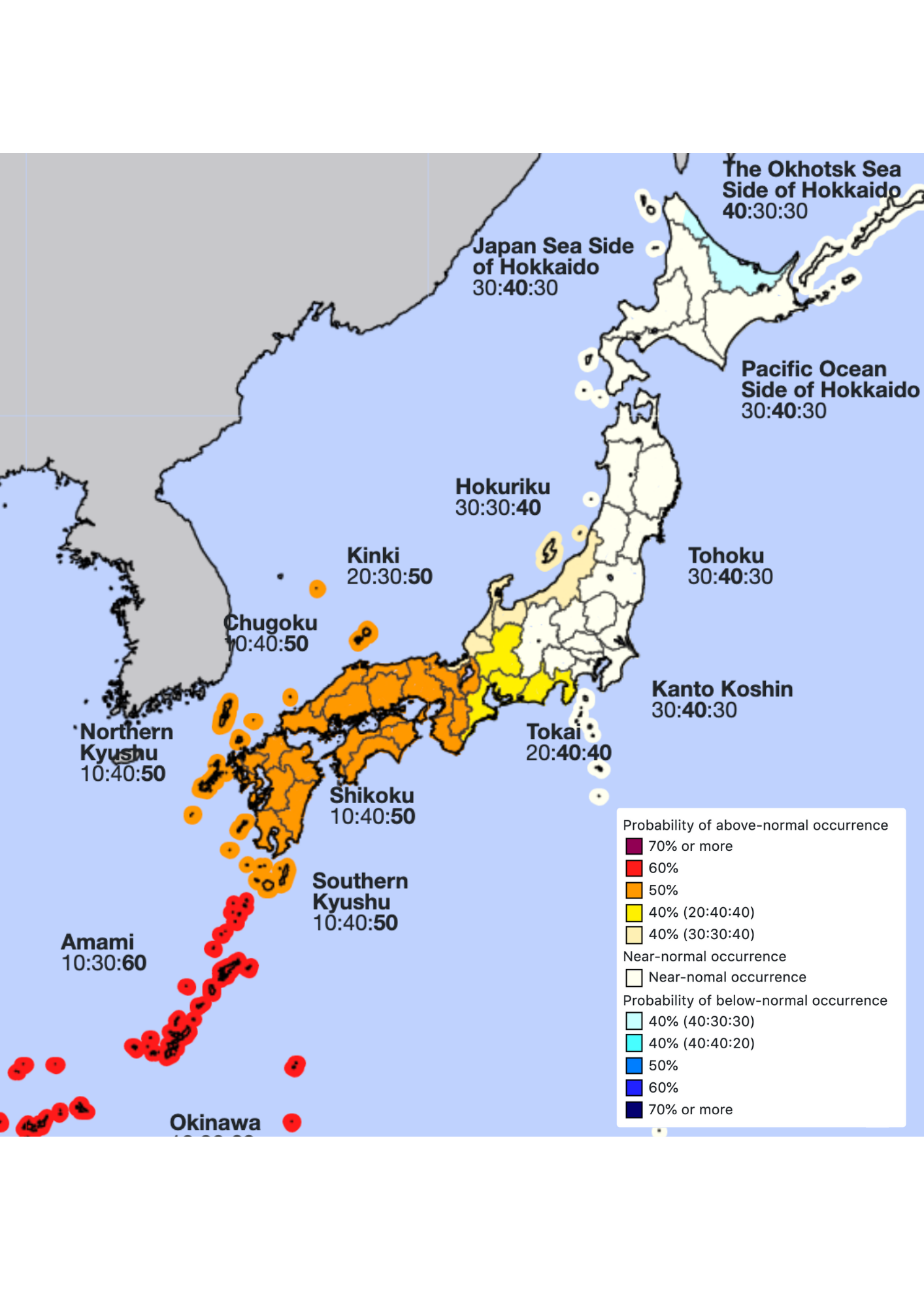
WEATHER OUTLOOK
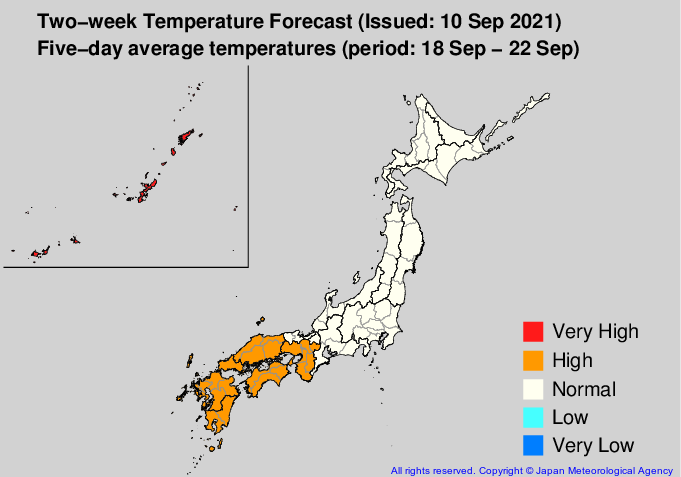
TWO-WEEK TEMPERATURE FORECASTS (SEP. 10 ~SEP. 22)
Nation-wide
 |
Tokyo area
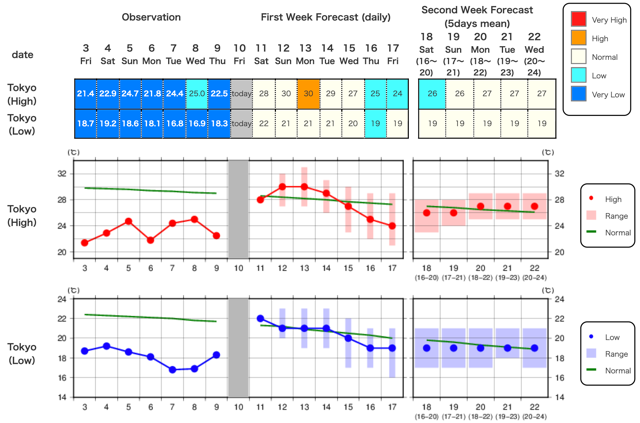
- Weather warning: Super Typhoon Chanthu has approached the Okinawa / Amami region, bringing heavy rain, stormy seas and thunderstorms. It’s forecast to reach Kyushu around Sept. 17.
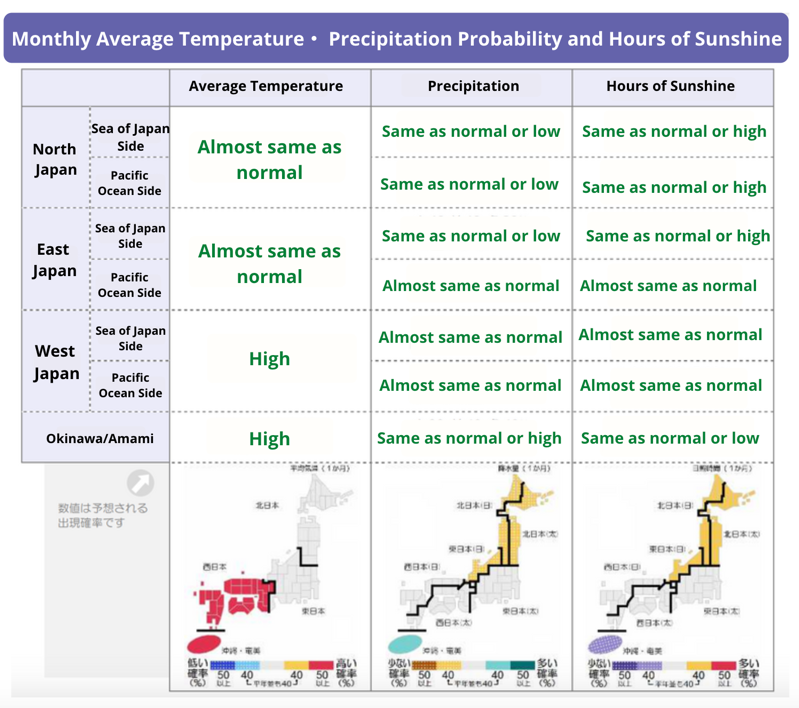
- Northern / Eastern Japan: cool, cloudy weather with occasional rain
- West Japan: mostly warm and humid; stormy seas and heavy rain on Sept. 15
- Okinawa: extreme heat with risk of heat illness from Sep.15
ONE-MONTH SEASONAL FORECAST (SEP. 11 ~ OCT. 10)
NEWS: POWER MARKETS
| No. of operable nuclear reactors | 33 | Electricity Price | Friday, Sept 10 | % Change WoW | ||
| Of which | restarted | 10 | JEPX 24-Hour Spot | ¥7.62/ kWh | -0.3% | |
| in operation today | 9 | TOCOM Sept. baseload (Tokyo area) | ¥8.29/ kWh | -5.8% | ||
Source: Company websites, JANSI and JAIF, as of Sept 1, 2021
TEPCO unit says will develop 7 GW of renewable energy in Japan, overseas
(Toyo Keizai, Denki Shimbun, Sept. 10)
- TEPCO Group CEO Fubasami Seiichi says renewables will be an important part of TEPCO’s mission to increase its corporate value.
- The group will install an additional 6 to 7 GW of renewable energy by 2030, primarily offshore wind (at home and abroad) and overseas hydro projects.
- About ¥1 trillion in investment is needed, to be financed by ‘green’ bonds.
- The group also implemented a more aggressive profit plan, under which net profit will treble to ¥100 billion by 2030. Of this, ¥55 billion will come from existing hydro, ¥15 billion from offshore hydro projects, and the remaining ¥30 billion from offshore wind projects, says Fubasami.
- Wind developments will initially use conventional anchored foundations, but in the latter half of the 2020s TEPCO plans deploying TetraSpar-type floating turbines, which are already feeding the grid in Norway.
- Fubasami said results of recent wind farm tenders in Chiba and Akita will be announced by November, and TEPCO and partners did their utmost to submit the best bid, in terms of pricing and technology. However, the Obayashi/KEPCO consortium represents formidable competition.
- TEPCO also plans to repurpose surplus pumped hydro capacity, initially established to store electricity generated by nuclear reactors overnight, to instead store cheaper daytime electricity purchased on the wholesale market until evening, when demand peaks and wholesale prices rise.
JAPEX, JA Mitsui Leasing, others form $100M fund to invest in solar plants
(New Energy Business News, Sept. 10)
- State-backed oil exploration company JAPEX, JA Mitsui Leasing and real estate firm Chuo-Nittochi Co. joined Photon Capital GK to create a new fund of up to ¥10 billion to invest in solar power projects in Japan.
- The fund will target solar power plants in both the development stage or already operational and which are outside of the Feed-In Tariff system. This means focusing on projects that utilize the FIP (Feed-in-Premium) system that starts in spring 2022, or a corporate PPA.
- JAPEX will participate in the operation of the solar plants, seeking to gain knowledge in managing renewables assets.
- The fund will potentially invest for five years and run the assets for 15 years over a 20-year cycle.
- SIDE DEVELOPMENT:
JAPEX joins group to invest in 75 MW biomass plant in Chofu
(New Energy Business News, Sept. 10)- JAPEX and four other companies will invest in Chofu Biopower LLC, the operator of a biomass power plant to be built in an industrial area of Shimonoseki, Yamaguchi prefecture.
- Construction on the 74.95 MW power plant, which will run on wood pellets, begins in June 2022; operation to start in January 2025. It secured a ¥21/ kWh electricity price for 20 years under the FIT scheme.
- JAPEX will take the biggest stake in the project, at 39.9%. It will also help to manage the project via a subsidiary, Japex Green Energy.
TAKEAWAY: The name JAPEX is short for Japan Petroleum Exploration Co. and represents what the company has traditionally been – an investor in oil development projects overseas with the idea of securing the resource for the home country. The decarbonization trend is pushing Japan’s state-backed oil firms to seek business elsewhere. This saw JAPEX exit a Canadian oil sands project at a considerable loss (over $800 million), and hold back from future developments in fossil fuels. Still, it’s not clear where JAPEX, an oil firm, goes from here if it can’t invest in oil. The solar and biomass news show the company is pursuing opportunities to “learn” how to manage renewable projects. It will be interesting to see how competitive JAPEX can become in this area.
Daiwa Real Estate selling shares in solar investment fund
(New Energy Business News, Sept. 7)
- Daiwa Real Estate Management announced a private share placement, in a fund that operates ‘brownfield’ solar developments, to Japanese institutional investors, including pension funds and life insurance companies.
- The ¥16 billion ‘DSREF Amaterasu Core Fund’ will purchase solar farms that are at least one-year-old. The fund will operate until 2041.
- The first portfolio acquisition will be the 29-MW farm in Miyagi.
Tokyo Marine starts insurance service around M&A in solar projects
(New Energy Business News, Sept. 10)
- Two insurance firms that are part of the Tokio Marine Group teamed up to offer a “Solar M&A Package Plan” that provides a risk assessment around the selling assets (including natural disaster risk) before a deal is made and post-acquisition compensation for breach of warranty.
- The new service from Tokio Marine & Nichido Fire Insurance and Tokio Marine dR Co. aims to provide buyers with more confidence in the secondary market for solar power plants.
- SIDE DEVELOPMENT:
Tokio Marine releases solar panel insurance
(New Energy Business News, Sept. 6)- Tokio Marine & Nichido Fire Insurance has partnered with the Japan Photovoltaic Energy Association in releasing a comprehensive new insurance policy for operators of photovoltaic panels.
- In addition to damage to modules from lightning, storms, floods and other natural disasters, the policy also offers optional insurance against information theft and other ‘cyber risks’ caused by hackers obtaining unlawful access to systems.
TAKEAWAY: The fact that one of Japan’s biggest insurance firms created such a package implies that major firms and entities want to partake in the purchase of solar power plants but need additional guarantees and insurance to de-risk the investments.
The secondary market for solar in Japan has been growing for years and doubled in the last three years, according to RTS Corporation and the Yano Research Institute. As the volume of new projects declines due to a lack of easily available land or uncertainty over the upcoming switch from FIT to FIP systems, investors are snapping up older projects with high tariffs guaranteed for a couple of decades. According to Nikkei, prices for operational assets can at times be twice the cost of new development.
Amazon and Mitsubishi to build 450 solar plants in Japan
(Nikkei, Sept. 7)
- Amazon will partner with Mitsubishi Corp. to build solar plants around Japan and procure their electricity to power its data centers.
- Amazon will offer a direct 10-year power purchasing agreement (PPA) for the solar facilities. To meet its green electricity demand, Mitsubishi and West Holdings, a solar developer, plan to set up 450 solar power projects in the Tokyo area and the northeast Tohoku region.
- Its large scale will alleviate the potential for energy supply fluctuations. While more expensive, the renewables option is expected to resonate with Amazon’s data center customers.
- West Holdings will be in charge of solar power installations; Mitsubishi will be responsible for creating the system aggregating electricity.
- This would be Japan’s biggest PPA contract, with supply to start in 2023.
- CONTEXT: Amazon aims to make 100% of electricity it needs for corporate activities from renewable energy by 2025.
JRE sets out plans for 300 MW wind farm development with Germany’s WPD
- Japan Renewable Energy plans a wind farm off the coast of Nagasaki in conjunction with Germany’s WPD.
- The 300 MW wind farm is scheduled to be completed by 2028.
Shimizu to partner with Heerema on wind farm development
(New Energy Business News, Sept. 6)
- Construction company Shimizu Corporation agreed with Netherlands-based Heerama Marine Contractors to work on offshore wind farms.
- A partnership with a European operator is regarded as essential in order to win EPC (Engineering, Procurement and Construction) contracts for Japanese offshore wind farms.
- In the past, Shimizu has worked with Norway-based Fred Olsen Ocean on the operation of self-elevating platforms and wind turbine construction.
Ministry recommends changes to Mitsubishi’s 180 MW offshore wind project
(New Energy Business News, Sept. 10)
- The MoE submitted its opinion on Mitsubishi Corp’s environmental assessment for a 180 MW offshore power plant off the coast of Happo Town and Noshiro City, Akita prefecture.
- The ministry asked the project to consider nearby housing and welfare facilities, and more ways to reduce the project’s environmental impact.
- The project calls for wind turbines with a capacity of 10 MW to 15 MW about 1 kilometer offshore.
NUCLEAR REACTOR NEWS ROUND-UP:
- Radioactive water leak at Chubu Electric’s nuclear plant
- (NHK, Sep. 8)
- About four liters of water leaked from a pipe used to discharge radioactive substance during cleaning at the Hamaoka NPP (Chubu Electric). A nearby worker was exposed, but did not suffer adverse health effects.
- The utility is investigating the incident and its impact.
- SIDE DEVELOPMENT:
Shikoku Electric receives warning from the NRA
(NHK News Web, Sep.8) - NRA held a safety review at Ikata NPP Unit 3 (Shikoku Electric), warning the operator after noting a plant operator left his post several times while on standby duty.
- SIDE DEVELOPMENT:
Chugoku Electric disaster evacuation plan approved by the NRA
(BSS San-in, Sep. 8) - https://news.yahoo.co.jp/articles/2296f453ac174a6703959aefec5f71d84648bd66
- Governor Maruyama of Shimane prefecture announced that the disaster evacuation plan for the Shimane NPP (Chugoku Electric) was approved by the NRA.
IAEA to review Fukushima treated water release plan in December
(Asahi Shimbun, Mainichi, Sep. 9)
- In December, the International Atomic Energy Agency (IAEA) will send a team to Fukushima to review plans to discharge treated radioactive water into the sea.
- The team will include experts from the IAEA and from 11 countries.
- The IAEA will conduct three stages of verification: before, during, and after the water release, which is scheduled for spring 2023.
NEWS: OIL, GAS & MINING
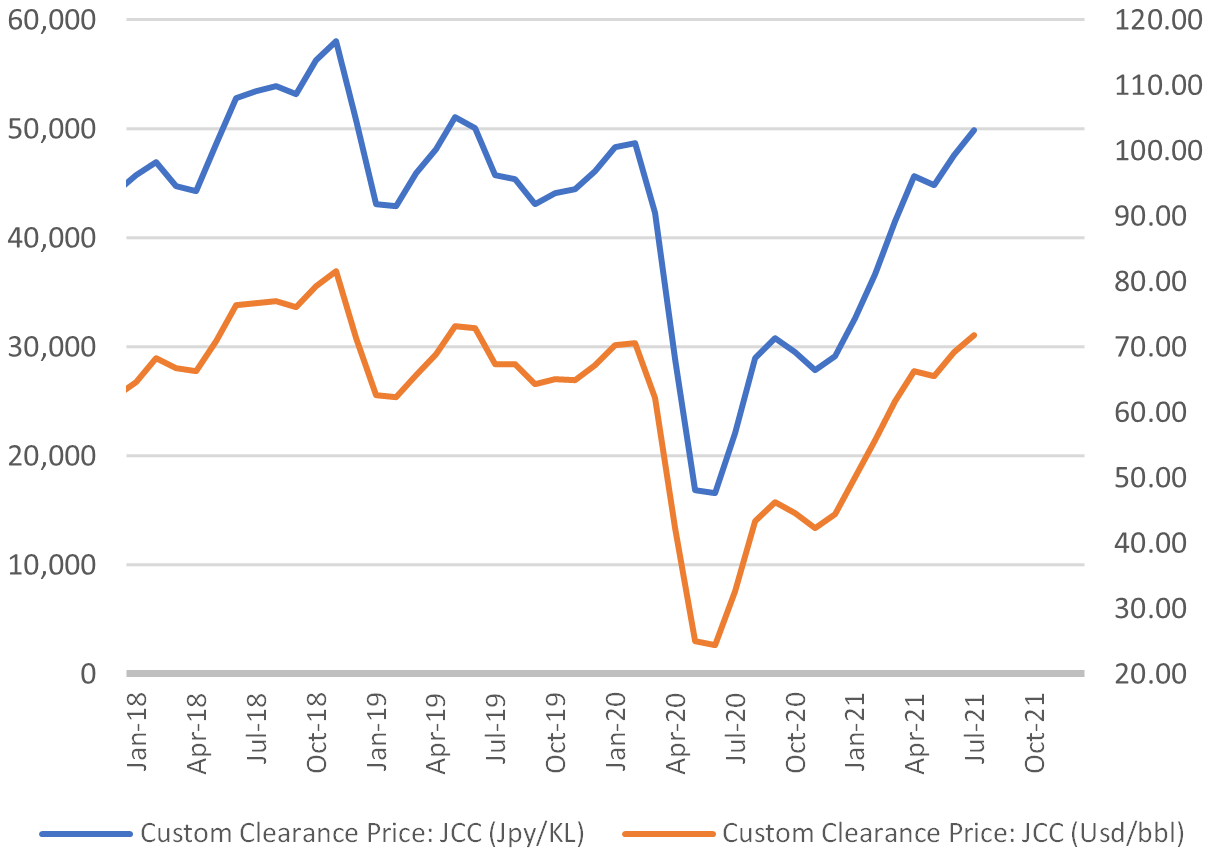
Japan Oil Price: $71.72/ barrel
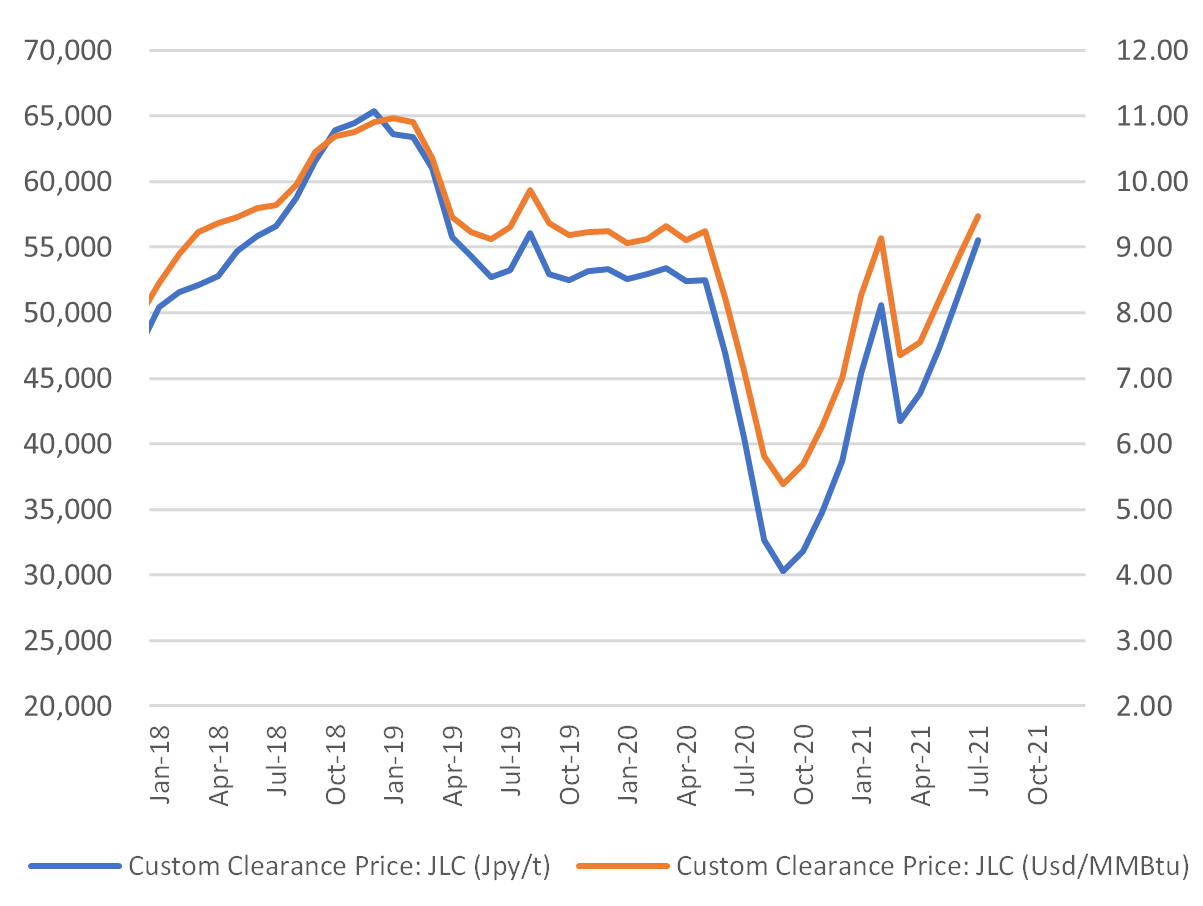
Japan (JLC) LNG Price: $9.47/ mmbtu
ENEOS criticized for potentially supplying Myanmar’s military rulers
(Zaiten, September edition)
- In late June, a tanker left Singapore, arriving at a port near Yangon. The ship operator was an ENEOS subsidiary, and the Panama-based managing company for the tankers is part of ENEOS Group.
- According to one source, ENEOS’s cargo of jet fuel to Myanmar could potentially be used by the country’s military rulers.
- The military seized power earlier this year and conducted air strikes against protests; as a result, hundreds of thousands fled their homes.
- NGOs say the delivery of this ENEOS cargo could assist the military dictatorship in persecution of the opposition.
- ENEOS said it ensures that deliveries to Myanmar don’t violate U.S. and European sanctions, and that its customers and their top executives were not under any sanctions.
- NGOs say that even if the direct customer is not under sanctions, the sale could still benefit the military rulers.
- NGOs also criticize ENEOS for not readily disclosing details about the June shipment. Similar shipments have been made since June, and yet, ENEOS refuses to disclose details, citing confidentiality clauses.
- The article ends by saying that ENEOS needs to prove to stakeholders that it’s living up to its policy of not abetting human rights abuse.
Nissan, Waseda U unveil enhanced rare earth recycling process
(New Energy Business News, Sept. 7)
- Nissan, in partnership with Waseda University, has developed a technique to recover rare earth compounds from discarded EV motors.
- The technique can recover 98% of rare earths contained in motor magnets.
- The motor is heated to over 1400°C, before iron oxides are added to oxidize dissolved rare earths. A small quantity of borate flux is added causing the solution to separate into an oxide layer on the top, which contains rare earths, and a denser iron/carbon layer on the bottom, which does not.
- The process does away with the need to manually extract motor magnets before processing, thereby reducing time.
Tanker charter fees slump on surplus capacity, weak demand
(Nikkei, Sept. 6)
- Fees for chartering oil tankers remain at historic lows.
- The sluggish market is due to worries that the rollout of the COVID vaccine won’t lead to higher crude prices.
ANALYSIS
BY MAYUMI WATANABE
Japan to Create New Exchange for Carbon Credits
With Domestic and Overseas Credits Able to Trade
In 2022, Japan hopes to have a market price for carbon. The government wants to launch a new exchange that will trade carbon credits issued locally and overseas, creating a public and liquid price mechanism for CO2.
The impact could be immense. As well as setting a price on pollution in the world’s fifth largest CO2 emitting nation, it should provide a market mechanism to define the value of green investments in energy, recycling and other spheres. This could unlock a range of clean energy projects that to date have struggled to justify initial high costs. It will also motivate companies to pursue a more pro-active energy strategy, either through higher efficiency or a switch to green technologies.
The government says the new exchange, and its inherent discount/premium valuation tool, will trigger a boom for the green economy rather than acting as another tax on emitters.
If the recent interest in the EU’s carbon trading platform is any indicator, Japan’s new CO2 market place could quickly become a hot commodity.
Faith in volunteerism
The Ministry of Economy, Trade and Industry (METI) made a low-key announcement of the new carbon trading market in late August, saying only that trial operations will begin after April 2022 (FY2022).
The exchange will offer transactions in four types of credits, all of which come from voluntary schemes. In addition to accepting carbon credits registered overseas, the exchange will trade credits accumulated via the domestic J-Credit program, bilateral credits registered via the Joint Credit Mechanism (JCM) and credits issued by METI to Japanese businesses. Overseas credits may include those recognized by The Taskforce on Scaling Voluntary Carbon Markets (TSVCM).
Since none of these credit schemes are mandatory, the exchange will essentially attract only those companies that have volunteered to combat climate change.
This focus on volunteerism has often drawn criticism abroad, but the government’s soft gloves approach merely reflects the less aggressive stance of Japanese companies towards decarbonization compared with some global peers. In the U.S., Google has powered its own operations with renewable energy since 2017. Facebook achieved the same in 2020. In Japan, the big tech firms are aiming to do so by 2030, and largely because their clients, such as Google and Apple, have set the deadline.
When it comes to carbon neutrality, most Japanese manufacturers and construction firms have set sites on the 2040 to 2050 period.
As such, METI has been at pains to downplay the idea that a new carbon exchange is a negative incentive for businesses. “Industries are under various challenges and they need to move to zero emission at their own pace,” the ministry said in its report on the new carbon trading scheme.
Similar to the rollout of corporate governance rules in 2015, METI hopes the voluntary nature of carbon trading will make it aspirational and that early success stories will motivate others to join.
In reality, the volunteer approach is a lot less free than it seems, says an official from a large Japanese corporation with a net-zero-carbon program. Through extensive dialog with the industry, ministry officials exercise a certain level of authority and nudge companies to comply. They like to refer to it as “co-regulation.”
“They won’t tell you what to do, but they will imply things. If you are falling behind on your targets, they will tell you, and remind you that it was your target, your decision. So, now you must deliver,” the official said.
Overall, companies are wary of challenging METI for fear that problems with other violations might suddenly arise.
Pressure on businesses is also applied elsewhere. Starting in April 2022, firms listed in the highest Prime section of the Tokyo Stock Exchange (TSE) will be required to disclose plans to cut emissions. Companies will be free to pursue decarbonization at their own pace, but the public nature of the disclosures will give ammunition to activist investors who may wish to challenge management.
Incentives to trade carbon
METI created two incentives to attract companies to the carbon exchange.
Participants will be described as “Top League Companies” and asked to disclose their 2030 carbon neutrality roadmaps in the format of the Taskforce on Climate-related Financial Disclosures (TCFD).
Officials tout the pride aspect of the “Top Leaguers” moniker and expect that it will have meaning beyond words. Early entrants will have the chance to gain know-how of an entirely new business area, which could offer opportunities in third-party advisory and as intermediaries for late-comers.
The second incentive is that METI will recognize the CO2 reductions that Top Leaguers make and register them as credits. Companies that don’t join the Top League will also be allowed to buy and sell voluntary carbon credits, but won’t be able to create their own.
So far, 124 Japanese companies declared they’ll be carbon neutral between 2040-2050. Not all of these companies will join the exchange, according to a METI official. On the other hand, METI will throw open the application to the Top League to all 4.2 million incorporated entities in Japan as long as they have disclosed TCFD-compliant plans; so, the number of early participants could be considerable.
Still, not all big companies are interested. The top shipper NYK Line (Nippon Yusen), for example, told the NRG that it has no current plans to participate in the Top League even though the company has an official target to cut emissions.
List of major Japanese firms that have set a net-zero emissions goal
| Sector | Company | Net-zero Deadline |
| Construction | Nishimatsu Construction | 2030 |
| Eco Works | 2035 | |
| Kajima, Obayashi, Tokyu Construction, Sekisui House | 2050 | |
| Food | Asahi, Kirin, Suntory, Sapporo | 2050 |
| Automotive | Denso | 2035 |
| Aisin, Ibiden, Isuzu, Toyota Industries, Toyota Boshoku, Nissan Motor, Honda Motor | 2050 | |
| Electronics | Konica Minolta, Siemens | 2030 |
| Asbil, Omron, Sharp, Sony, NEC, Panasonic, Sony, Murata Manufacturing, Ricoh, Maxell | 2050 | |
| Chemical, pharmaceutical | Takeda Pharmaceutical | 2040 |
| Ono Pharmaceutical, Kurita Water Industries, Denka, Sekisui Chemical, Chugai Pharmaceutical, Fuji Film, Mitsui Chemical, Sumitomo Bakelite, Lion, Tokuyama, JSR, Mitsubishi Chemical, Ube Kosan, Asahi Kasei, Kao, DIC | 2050 | |
| Industrial machinery | DMG Mori Seiki | 2021 |
| Hitachi, Hitachi High Technologies | 2030 | |
| Casio, Advantest, Kawasaki Heavy Industries, Citizen, Kubota, Daikin, Tsugami, Kawasaki Heavy Industries, Mitsubishi Heavy Industries, Yasukawa Electric | 2050 | |
| Other manufacturing | Oji Holdings, Sumitomo Osaka Cement, Teijin, Dai Nippon Printing, Fujikura, Hokuetsu, Uni Charm, Lixil, Bridgestone, Taiheiyo Cement, AGC, Nippon Steel, Mitsubishi Materials, Rengo, Kobe Steel, JFE Holdings, Nippon Paper, Daioh Paper, Furukawa Electric | 2050 |
| Power grids | TEPCO, HEPCO, Hokuriku Electric Power, Tohoku Electric Power, Chubu Electric Power, Chugoku Electric Power, J-Power, Okinawa Electric Power, KEPCO, Shikoku Electric Power | 2050 |
| Gas | Tokyo Gas, Osaka Gas, Tokai Holdings, Toho Gas | 2050 |
| Oil | ENEOS | 2040 |
| Fuji Oil, Idemitsu, Cosmo, | 2050 | |
| Transport | JR East, Yamato Transport, ANA, Tokyu, JAL | 2050 |
| Trading houses | Mitsui & Co, Sumitomo Corporation | 2050 |
| Finance | MUFJ, SMBC | 2030 |
| Daiichi Insurance, Nippon Life, Mizuho, Sumitomo Life, Meiji Yasuda Life Insurance | 2050 | |
| Services, others | Askul | 2030 |
| Aeon, Itochu Techno, J. Front Retailing, Seven & I Holdings, NRI, Japan Asia Group, Japan Unysis, Hitachi Capital, Family Mart, Lawson, Ezaki Glico | 2050 |
The METI official said the first list of Top Leaguers will be announced by March 2022. The ministry has an unofficial target of luring most of the country’s 3,759 public companies to be active on the carbon exchange.
“We want to avoid the risk of some sectors not being represented,” the official said.
Further details of the exchange — such as whether it will trade daily, over-the-counter or online, the mechanism for approving credits, and more — will be provided in the first quarter of 2022.
Japan will follow the recommendations of Taskforce on Scaling Voluntary Carbon Markets (TSVCM) regarding governance, credit integrity and legal principles.
Japan is short of green power
For some companies in Japan, the biggest fear is that the new carbon marketplace will become the only realistic tool to decarbonize in the short term, effectively pushing up the cost of doing business.
There is an objective lack of clean electricity in the market. Renewable energy only comprised about 20% of the electricity mix last year and METI’s proposed new target for FY2030 would only have it rise as high as 38%.
Japanese firms actively seeking to go green say they don’t necessarily have the energy resources to do so. For comparison, the share of renewable energy in the total power purchases of Japanese members of the RE100 club, an international association of multinationals that promote renewables, is around 14%. In the UK it is at 91%; in India it’s at 39%.
A carbon exchange alone will not transform the power market, but only act to create the incentives to switch to clean energy.
That may be another reason why METI is happy to start Japan’s first national carbon trading exchange on a voluntary basis. The supply side of clean energy is still not there.
ANALYSIS
BY SAKI ISETANI
The Most Effective Way to Decarbonize Buildings?
It’s Not (Just) Solar
While adding solar panels to rooftops will help, recent research reveals an even more effective way for Japan to slash emissions from homes and offices. Better heat insulation is now seen as the key in clamping down on CO2 from one of Japan’s top energy-consuming sectors.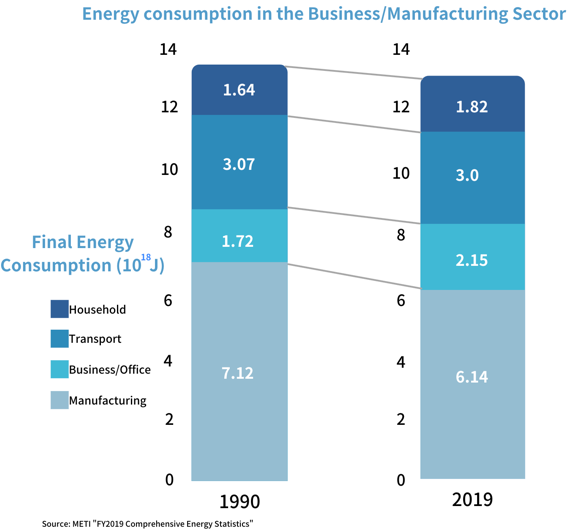
This “discovery” may seem odd given how widespread heat insulation measures are around the world. However, house construction in Japan has its own particular history, and to date government efforts to promote building energy efficiency have been weak and unsuccessful.
Last year’s decarbonization pledge changed the mood and budgetary allocations have followed. This summer, the infrastructure ministry (MLIT) committed ¥1.38 billion ($12.5 billion) to a program specifically tied to energy efficiency of homes and buildings, with related initiatives also launched by the METI and the MoE.
The new injection of funds is expected to revive and, this time, deliver results from two programs: Zero Energy Buildings (ZEB), and Zero Energy Houses (ZEH). If successful, electricity demand in a sector that currently makes up a third of national consumption, could decrease drastically.
Source: Agency for Natural Resources and Energy
| Energy consumption: 1973 to 2018 | |
| Total | Up 1.2 times |
| Transportation | up 1.7 times |
| Residential | up 1.9 times |
| Office/business | up 2.1 times |
| Manufacturing | up 0.8 times |
Why decarbonize buildings?
The business/manufacturing sector represents the largest share of Japan’s final energy consumption, accounting for 63% in FY2019. Of this, 16.6% comes from office buildings, which demand more power than the 12.6% share of their total in FY1990.
Between 1973 and 2018, Japan’s total energy consumption increased 120%. In the commercial sector, that increase was 210%, while for households it was 190%.
The history
In Japan, roughly 60% of houses are built with wood because it’s a material that has high resilience during a natural disaster, making it suitable for an earthquake-prone country.
Most Japanese houses, however, lack central heating. The nation’s architectural approach is strongly influenced by Buddhist teachings, which believe it’s more important to live comfortably in the summer than in winter. As a result, house design is based on dealing with summer heat, with thin walls and long eaves to prevent direct sunlight. It’s perfect for allowing heat to escape.
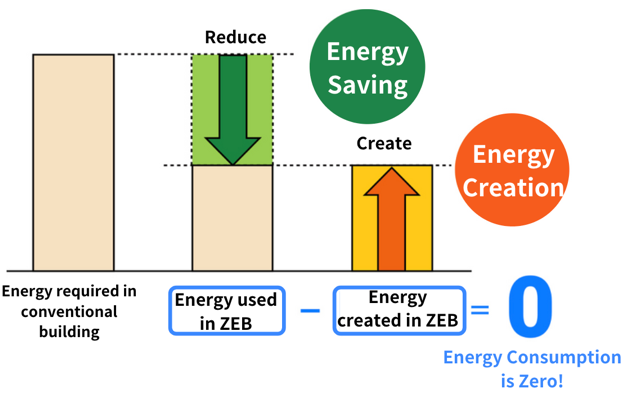
What is a Zero Energy Building/House?
The ZEB and ZEH concepts were introduced as a way to redraw the priorities of Japanese architecture to focus on heat insulation, better energy efficiency, and electricity from renewable sources.
Buildings and homes that create as much renewable energy as they consume in the course of the year qualify as net-zero energy constructions. ZEB and ZEH can still use power from other sources, but on a net basis their energy production on or off-site evens out the equation, thus contributing to a low carbon society vision.
Most of the media and government focus, especially from the MoE, has been on the renewable energy generation component, such as installing solar panels on roofs. Yet, research by several ministries shows that heat insulation will play a bigger role in net-zero energy goals by significantly lowering the demand side of the equation.
As one example, adding insulation material EPS (expanded polystyrene) to a home in the northern city of Sapporo could cut annual CO2 emissions by 1,571 kg, according to ministry research.
Since the construction methods and materials for residential homes and office buildings differ, the government has set different goals for them to qualify as net-zero energy. The ZEB standard requires energy savings of more than 50%, and residential houses can claim to be ZEH by shaving as little as 20% off their energy consumption.
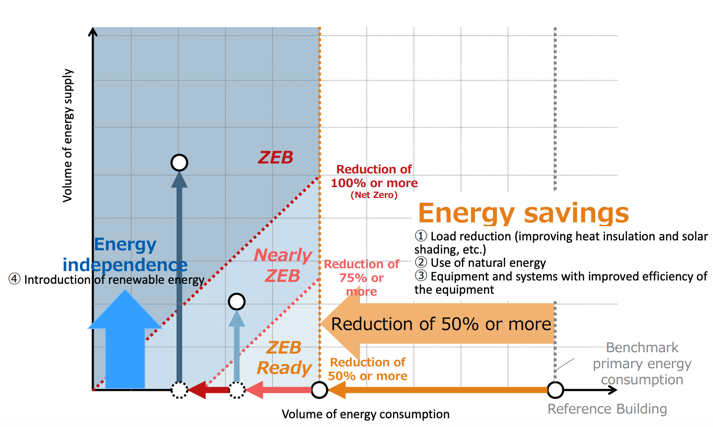
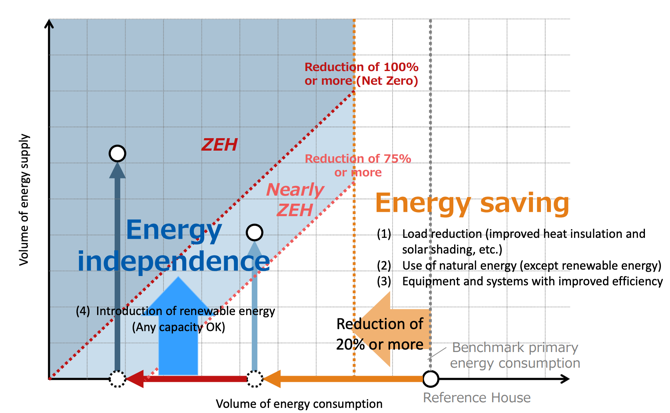
| Source: METI |
False start
In early 2015, Japan introduced roadmaps to ZEB and ZEH, but made scant progress. As of 2019, only 20.5% of the FY2020 target for ZEH was achieved. For ZEB, it was a paltry 0.25% of the target.
The initiative hasn’t been a total failure. Major home builders raised ZEH to 48% of total output in 2019, close to the 50% target. Local construction firms, however, mostly skipped the program. The lack of awareness around ZEH and budget constraints put off many buyers, according to a recent report by the ZEH Roadmap Committee.
| Target | Progress (As of 2019) | |
| ZEH | Realize ZEH in 50% of newly built houses by FY2020 | New Construction Total: 280,000 houses
Of which ZEH: 57,487 |
| ZEB | Realize ZEB in 50% of newly built public buildings by FY2020 | Newly Construction Total: 56,961 buildings
Of which ZEB: 144 |
Source: Sustainable Open Innovation Initiative 2020
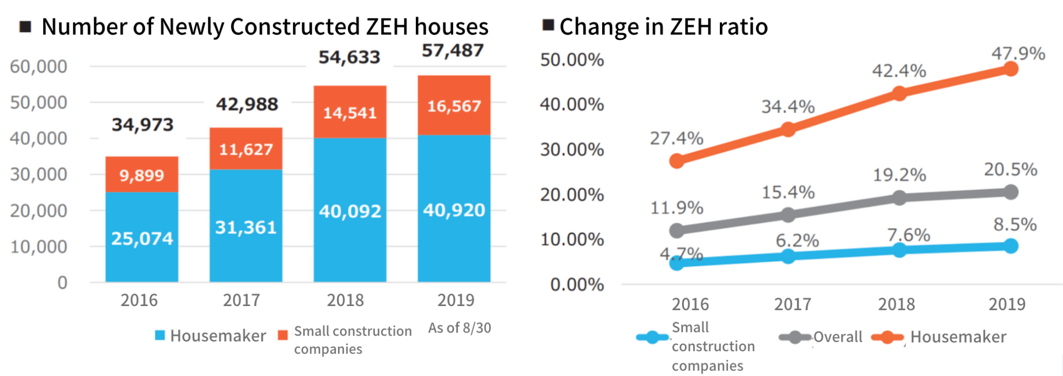 Those clients that knew about the ZEH program only saw it as a means to cut the electricity bill, which misses other factors such as increased comfort, safety and resilience, the Committee said, noting that smaller construction firms need incentives to implement ZEH.
Source: Sustainable Open Innovation Initiative 2020
Such incentives are soon expected after the Ministry of Land, Infrastructure, Transport and Tourism (MLIT) announced a MLIT Green Challenge 2050 program that includes a strong budget for promoting ZEB and ZEH.
The MoE has several other programs that relate to housing, as does METI. The two ministries also jointly launched a “ZEB demonstration fund” that disperses up to ¥500 million per year to building projects that aim to incorporate net-zero energy concepts.
A similar “demonstration fund” for residential housing offers as much as ¥600,000 per ZEH home and around ¥1 million for ZEH+ homes that achieve energy savings of 25% using means other than switching to renewable energy sources. This fund is run jointly by MoE, METI and also MLIT.
The government has also offered construction firms a new certification to help market the benefits of net-zero energy housing. A new “ZEH/ZEB mark” will give builders a chance to show off the environmentally friendly qualities of their offering. It’s linked to BELS (Building-House Energy Efficiency Labeling System), a rating that evaluates a building’s energy-saving performance on a scale of zero to five.
New policy impetus
While MLIT targets energy saving through insulation, materials and other heat control measures, MoE’s attention is on energy supply. In July, the ministry released a draft Global Warming Countermeasures Plan that seeks to reduce the country’s “energy-related CO2” to 680 million tons in FY2030. In 2018, it was at 1.06 billion tons of CO2.
As part of this target, the MoE wants the housing sector to cut GHG emissions by 66% compared to FY 2013, a more aggressive reduction than previous targets. In order to do this, the MoE wants at least 60% of new detached homes in Japan to install solar panels.
Next steps
So far, the majority of the ZEB/ZEH projects were in new construction. However, more and more of the existing housing stock will likely start to embrace the scheme. The prevalence of work-from-home since the onset of the Covid-19 pandemic seems to be a driving force for this.
In February, Kurume City’s office in Fukuoka prefecture became Japan’s first public office to claim full ZEB for an existing building. It achieves an energy saving rate of 106%, of which 67% comes from improved heat insulation.
Once fully operational, the building is expected to reduce GHG by about 80% compared to 2018 levels and shave off ¥2.9 million from its electricity bill annually.
As Japan accelerates its drive toward reaching ambitious emissions reduction targets by 2030, the country is going to have to pull out all the punches, slashing GHGs across the board, every way it can. The construction industry and existing building stock are two areas where Japan can reap huge results just by improving heat insulation and incorporating net-zero energy concepts into both residential and commercial buildings. Such innovative solutions in unexpected areas of the energy sector truly can make a significant difference in Japan’s future energy strategy.
Image of the Kurume City ZEB Office
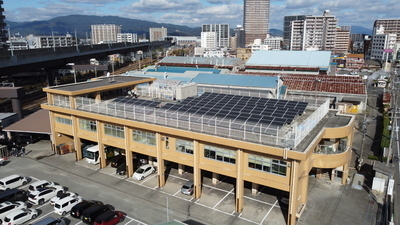
Source: Kurume City official website
A SELECTION OF ZEB AND ZEH PROJECTS AROUND JAPAN
Hokkaido ARIGA Zero Energy Building
| Location:
Minami Jonishi, Sapporo, Hokkaido prefecture | 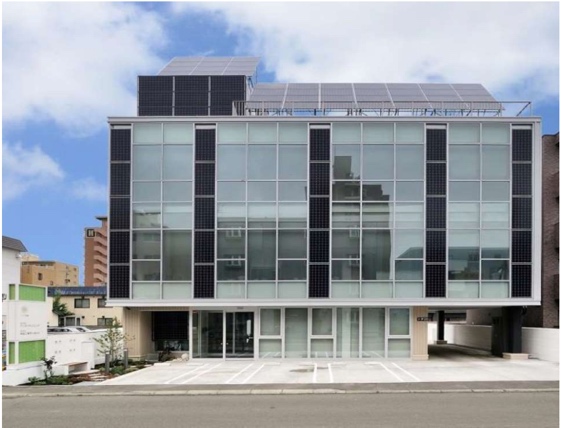 Source: Sustainable Open Innovation Initiative 2020 |
| Status: ZEB ready | |
| Achieved energy saving: 106% | |
Building features:
| |
| Renewable Energy Type:
Solar power generation and storage battery |
Kashiwazaki Kaiyo Center (Hotel: Sea Youth Lion)
| Location:
Nishi-minatocho, Kashiwazaki, Niigata prefecture | 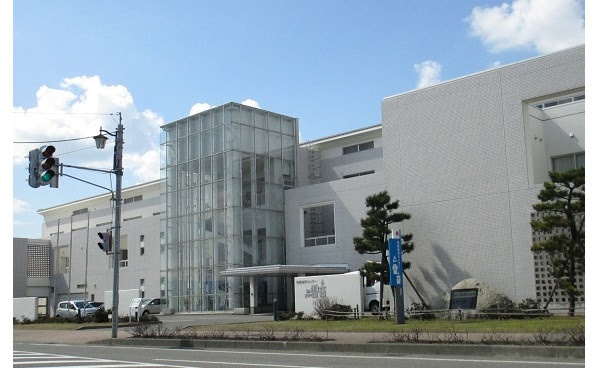 Source: MoE |
| Status: ZEB ready | |
| Achieved energy saving: 50.4% | |
Building features:
| |
| Renewable Energy Type:
Pellet Boiler Cogeneration System (using waste heat) |
Seicho-No-Ie’s Office (Shimizu Cooperation)
| Location:
Hokuto City, Yamanashi prefecture | 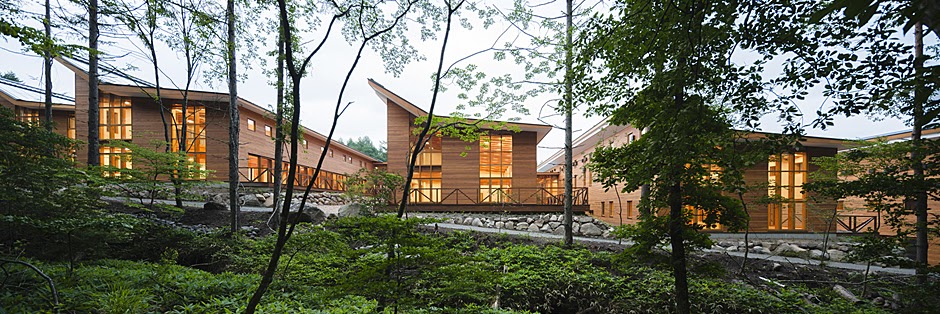 Source: Shimizu Cooperation This became the country’s first ZEB. Located in a forest, the office uses abundant wood-based biomass to generate electricity through a wood chip gasification system and pellet-fired boiler. It also meets 60% of its annual electricity consumption through solar power. |
| Status: ZEB | |
| Achieved energy saving rate: 108% | |
Building features:
| |
| Renewable Energy Type:
Solar Power, Wood chip gasification, and wood pellet boiler |
GLOBAL VIEW
BY JOHN VAROLI
Below are some of last week’s most important international energy developments monitored by the Japan NRG team because of their potential to impact energy supply and demand, as well as prices. We see the following as relevant to Japanese and international energy investors.
Australia
1) A new Australian law increases scrutiny of energy asset sales to ensure new owners have the financial and technical capacity to decommission. For example, it introduces trailing liability, based on the UK’s North Sea regime. If the current owner goes bust, it holds the former asset owners liable for decommissioning. According to Wood Mackenzie, in coming decades offshore decommissioning in Australia will have a price tag of $40 billion; while for the entire Asia-Pacific region the clean-up bill could reach $100 billion by 2050.
China
2) In an effort to push prices down, China is selling off some of its strategic oil reserves. This move is a first for the world’s biggest importer of oil. China’s State Bureau of Grain and Material Reserves is trying to stabilize the domestic market supply by releasing crude oil from its national reserve in batches to refining and petrochemical companies. However, the move only had a temporary effect, causing the price of Brent, the global benchmark, to dip slightly. By Friday, Brent prices rebounded and last traded at $72.92.
Carbon Markets
3) On Sept. 9, the benchmark European carbon price hit a record high of 62.75 euros a ton. The price has been climbing steadily since mid-August. In early summer, Frans Timmerman, the top EU official for climate issues, stated his willingness to see the price go higher.
Europe
4) Europe faces a winter of expensive energy bills, concluded Reuters’ energy team. A record run in global energy prices, in large part driven by Asian demand, is pushing European electricity costs higher and shows no sign of slowing in coming months. On Friday, the benchmark EU power contract, German Cal 2022 baseload power, set a new record of 97.25 euros/MWh. However, wind power supplies and Russian gas deliveries are unknown factors that could unexpectedly impact the final price.
Russia
5) Demand for Russian Urals crude is rising as traders fill gaps in the market following Hurricane Ida in the U.S. About two-thirds of U.S. offshore production remains shut two weeks after the hurricane. Trading firms, including Trafigura, Vitol and Litasco, secured about 5 million barrels of Russian Urals for loading in September and for delivery to the U.S. Urals oil arbitrage to the U.S. is rare.
Telecoms
6) The Telecom industry is looking for ways to cut GHG emissions, according to a survey of 19 top global operators by consultancy Oliver Wyman. Companies surveyed included Deutsche Telekom and Hitachi. Most company officials said that hydrogen fuel cells are seen to have the most potential because solar and wind are not reliable. Data and infrastructure networks need stable power sources; running these networks accounts for a third of a telecom company’s carbon footprint.
United Kingdom
7) In a milestone for clean energy, blended hydrogen now fuels the town of Winlaton, not far from Newcastle. Last month, the town began using a blend of 20% hydrogen and 80% natural gas to supply 668 homes, a school and small businesses. The project, called HyDeploy, is the UK’s first. In general, heating homes and buildings account for about 33% of the UK’s CO2 emissions. The road to a hydrogen future, however, will be a long one – the first 100% hydrogen-fueled town is only expected by 2030.
U.S.
8) Two weeks after Hurricane Ida, most of the nine Louisiana refineries shut by the storm have restarted or are restarting. The two largest are cack online. However, oil production is recovering more slowly. Nearly two-thirds of oil producing facilities are still not operational.
9) California once again saw its power system stretched thin, but remedied the problem by calling on the public to cut consumption. High temperatures led to greater air-conditioning use, which sent electricity demand surging. The California Independent System Operator (ISO) reacted by issuing a statewide Flex Alert for consumers to set thermostats to 78 degrees or higher. Flex Alerts are a crucial tool that the state uses to keep the power grid stable during tight supply conditions.
Wind
10) Ground was broken on the $350 million New Jersey Wind Port that’s part of a grand plan to turn the state into an offshore wind farm hub. The new port will be a staging point for assembly and transport for the 100 wind turbines that will stand 15 miles offshore. The port is next to PSEG’s Hope Creek NPP. Orsted is due to build the Ocean Winds I and II projects to add 1,100 MW of capacity. In July, EDF was tapped to develop New Jersey’s Atlantic Shores 1.5 GW offshore wind project.
EVENTS CALENDAR
A selection of domestic and international events we believe will have an impact on Japanese energy.
| February | Approval of Fiscal 2021 Budget by Japanese parliament including energy funding projects;
CMC LNG Conference |
| March | 10th Anniversary of Fukushima Nuclear Accident;
Smart Energy Week – Tokyo; Quarterly OPEC Meeting; Japan LPG Annual Conference; Full completion of all aspects of the multi-year deregulation of Japan’s electricity market; End of 2020/21 Fiscal Year in Japan; |
| April | Japan Atomic Industrial Forum – Annual Nuclear Power Conference;
38th ASEAN Annual Conference-Brunei; Japan LNG & Gas Virtual Summit (DMG)-Tokyo Three crucial by-elections in Hokkaido, Nagano & Hiroshima – April 25th |
| May | Bids close in first tender for commercial offshore wind projects in Japan;
Prime Minister Suga to visit the U.S. |
| June | Release of New Japan National Basic Energy Plan-2021;
G7 Meeting – U.K. Presidents Biden and Putin are due to meet at a summit in Geneva Forum for China-Africa Cooperation Summit (Senegal) |
| July | Tokyo Metropolitan Govt. Assembly Elections;
Commencement of 2020 Tokyo Olympics |
| August | METI committee approves draft of Japan’s 6th Basic Energy Plan |
| September | Ruling LDP Presidential Election;
UN General Assembly Annual Meeting that is expected to address energy/climate challenges; IMF/World Bank Annual Meetings (multilateral and central banks expected to take further action on emissions disclosures and lending to fossil fuel projects); End of H1 FY2021 Fiscal Year in Japan; Japan-Russia: Eastern Economic Forum (Vladivostok)-tentative |
| October | Last possible month for holding Japan’s 2021 General Election; Hydrogen Ministerial Conference in conjunction with IEA METI Sponsored LNG Producer/Consumer Conference; Innovation for Cool Earth Forum – Tokyo Conference; Task Force on Climate-Related Financial Disclosure (TCFD) – Tokyo Conference; G20 Meeting-Italy |
| November | COP26 (Glasgow);
Asian Development Bank (‘ADB’) Annual Conference; Japan-Canada Energy Forum; East Asia Summit (EAS) – Brunei |
| December | Asia Pacific Economic Cooperation (APEC) Forum – New Zealand;
Final details expected from METI on proposed unbundling of natural gas pipeline network scheduled for 2022. |
Disclaimer
This communication has been prepared for information purposes only, is confidential and may be legally privileged. This is a subscription-only service and is directed at those who have expressly asked K.K. Yuri Group or one of its representatives to be added to the mailing list. This document may not be onwardly circulated or reproduced without prior written consent from Yuri Group, which retains all copyright to the content of this report.
Yuri Group is not registered as an investment advisor in any jurisdiction. Our research and all the content express our opinions, which are generally based on available public information, field studies and own analysis. Content is limited to general comment upon general political, economic and market issues, asset classes and types of investments. The report and all of its content does not constitute a recommendation or solicitation to buy, sell, subscribe for or underwrite any product or physical commodity, or a financial instrument.
The information contained in this report is obtained from sources believed to be reliable and in good faith. No representation or warranty is made that it is accurate or complete. Opinions and views expressed are subject to change without notice, as are prices and availability, which are indicative only. There is no obligation to notify recipients of any changes to this data or to do so in the future. No responsibility is accepted for the use of or reliance on the information provided. In no circumstances will Yuri Group be liable for any indirect or direct loss, or consequential loss or damages arising from the use of, any inability to use, or any inaccuracy in the information.
K.K. Yuri Group: Oonoya Building 8F, Yotsuya 1-18, Shinjuku-ku, Tokyo, Japan, 160-0004.