
JAPAN NRG WEEKLY
SEPT. 27, 2021
JAPAN NRG WEEKLY
Sept. 27, 2021
NEWS
TOP
- Govt. publishes initial allocations from ¥2 trillion Green Fund; “green” steel, floating offshore wind, ammonia get biggest slice
- Japan adds four more offshore wind focus zones to speed up domestic development of the industry
- Japan’s LNG, coal, oil imports surge ahead of winter season; LNG stocks above average as buying beats pre-Covid volumes
ENERGY TRANSITION & POLICY
- Govt. to raise bar for solar’s environmental assessment to 50 MW
- Mitsubishi Corp seeks to build 1-million-ton U.S. ammonia factory
- METI urges incentives to popularize carbon-absorbed cement
- Japan joins ASEAN, other regional leaders to discuss gas storage
- ENEOS repurposes oil refineries to convert plastic to petrochems
- Hitachi Zosen to issue ¥10 bn of green bonds to build wind farm
- Meidensha trials AI-controlled smart hydropower stations
- Iwatani and Kawasaki Heavy study Australian green hydrogen plan
- NYK Line to invest in Australian carbon credits firm … [MORE]
ELECTRICITY MARKETS
- All regional power utilities to increase power tariffs in November
- Nikkei Opinion: Nuclear power is no longer that cheap
- TEPCO and Toyota-backed wind developer expands Dutch assets
- Osaka Gas joins Mitsubishi Heavy to invest in U.S. solar project
- JERA-led Japanese group sells out of Mexican gas-fired generator
- Retailer to offer households 100% renewable power at a premium
- Kansai Electric employs blockchain to directly trade electricity
- Probe into TEPCO’s Kashiwazaki NPP uncovers negligent culture; TEPCO to move its nuclear power division HQ to Niigata
- NUCLEAR REACTOR WRAP: Restart of Ikata NPP delayed [MORE]
OIL, GAS & MINING
- INPEX agrees “carbon-neutral” propane gas sale with Astomos
- Tokyo Gas sells “carbon-neutral” gas to several local retailers
- A doubling of rare earth prices in the last year worries industry
ANALYSIS
JAPANESE FIRMS RUSH TO SET THEIR OWN CARBON PRICE BUT THE RESULTS ARE WILDLY DIFFERENT
Japan is an internal carbon pricing (ICP) enthusiast. Of the 864 companies worldwide that used an ICP system last year to set their own internal value for one ton of CO2, 118 were from Japan. That ranked Japan second only to the U.S. in the ICP rollout.
While Japanese firms have rushed to put a monetary figure on CO2 emissions, a Japan NRG survey shows vast differences in methodology and outlook. CO2 pricing among Japanese firms varies by a factor of 1,000, which suggests that creating a single price for carbon is still at a formative stage.
JAPAN MAY BE LOSING ITS CLOUT IN LNG: THE COST OF CHINA’S RISE & THE DECARBONIZATION WAGER
For decades Japan has been the dominant buyer of LNG, holding sway over one of the world’s top energy markets. This summer, two developments suggest change is coming to Japan’s role and influence.
China’s LNG demand growth saw it surpass Japan in imports over the first six months of 2021. Meanwhile, the government’s draft for the next Basic Energy Plan forecasts a major reduction in LNG’s share of the nation’s electricity mix. The two events will have a significant impact on Japan’s future LNG contracts and buyer strategy. We analyze the impact on LNG prices.
GLOBAL VIEW
UK energy prices reach all-time highs and retailers go bust. Mercedes commits to buying “green” steel and net zero across entire value chain. China to stop financing coal plants abroad but keeps domestic expansion in place. The IEA questions Russia on gas supplies to the EU. Shell sells giant U.S. shale field. Details on these and more in our global wrap.
WEATHER OUTLOOK
Typhoon Mindulle approaching from Sept. 28. Extreme heat in the north and Kanto from Sept. 29.
JAPAN NRG WEEKLY
PUBLISHER
K. K. Yuri Group
Editorial Team
Yuriy Humber (Editor-in-Chief)
Tom O’Sullivan (Japan, Middle East, Africa)
John Varoli (Americas)
Regular Contributors
Mayumi Watanabe (Japan)
Daniel Shulman (Japan)
Takehiro Masutomo (Japan)
Art & Design
22 Graphics Inc.
Sponsored
SUBSCRIPTIONS & ADVERTISING
Japan NRG offers individual, corporate and academic subscription plans. Basic details are our website or write to subscriptions@japan-nrg.com
For marketing, advertising, or collaboration opportunities, contact sales@japan-nrg.com
For all other inquiries, write to info@japan-nrg.com
OFTEN USED ACRONYMS
METI The Ministry of Energy, Trade and Industry
MOE Ministry of Environment
ANRE Agency for Natural Resources and Energy
NEDO New Energy and Industrial Technology Development Organization
TEPCO Tokyo Electric Power Company
KEPCO Kansai Electric Power Company
EPCO Electric Power Company
JCC Japan Crude Cocktail
JKM Japan Korea Market, the Platt’s LNG benchmark
CCUS Carbon Capture, Utilization and Storage
mmbtu Million British Thermal Units
mb/d Million barrels per day
mtoe Million Tons of Oil Equivalent
kWh Kilowatt hours (electricity generation volume)
NEWS: ENERGY TRANSITION & POLICY
Prime Minister contest enters final days: XXXXX
- The ruling Liberal Democratic Party (LDP) will vote on Wednesday, Sept. 29, to decide on its new leader and, consequently, the nation’s prime minister.
- Four candidates are in the race:
- 1) Kono Taro, the current minister for administrative reforms
- 2) Kishida Fumio, a former minister of foreign affairs
3) Takaichi Sanae, a former internal affairs minister - 4) Noda Seiko, a former internal affairs minister
- The race is very tight. Polls suggest that Kono is the most popular candidate with the public as he is seen as more candid, straight-talking and a modernizer. However, polls among lawmakers show that Kishida leads and he also won the support of LDP’s largest faction. On the other hand, Takaichi has support from both former PM Abe and the powerful LDP secretary general Nikai.
- Unless one candidate gets an outright majority in the first round, which involves both lawmakers and LDP members, the second run-off round will be decided mostly by the lawmakers.
- Once a winner is declared, the Diet is expected to formally elect the new prime minister on Oct. 4. This makes an October general election very unlikely. Instead, it’s likely the current Diet session will complete its full term on Oct. 21 and the general election will be held on Nov. 7 or Nov. 14.
- The new PM is likely to announce their Cabinet also on Oct. 4.
- The above scenario suggests that Japan’s team will attend the COP26 Climate Change Conference in Glasgow (starting Nov. 1) on the eve of a general election, which would make them cautious about accepting initiatives that could be interpreted as damaging to Japanese businesses.
- The timing of the Cabinet formation and dissolution also suggests that the currently proposed draft of the new Basic Energy Plan, which sets out the energy mix for 2030, is unlikely to undergo notable changes.
- In the run-up to the LDP leadership vote, nuclear discussions again took center stage, creating a rift between Kono and the other three candidates. In part, this is because Kono himself has pushed the conversation to energy, using his manifesto pledge and various debate platforms to talk up the potential for green tech, and renewable energy in particular, to be a growth story for the overall economy.
- SIDE DEVELOPMENT:
Nuclear power the hot topic in the LDP leadership race
(Energy Shift, Sept. 22)- The four candidates in the race to become next LDP leader shared their views on renewable energy and nuclear power in a recent debate.
- Kono said he’d progressively phase out nuclear power plants as they reached the end of their service lives. Also, he’d work to shut down coal and oil-fired generation.
- Kono wants a more distributed power grid with greater spare capacity to reduce the risk of blackouts after earthquakes and other natural disasters.
- Takaichi took an opposing position, arguing that nuclear power plants are essential to ensure stable electricity supply. She advocated for small modular underground reactors, as well as more research into nuclear fusion. Takaichi envisages a government-led initiative to develop a commercially viable small modular fusion reactor.
- Noda was also critical of Kono’s energy policy, saying stable electricity can’t be guaranteed with renewables.
- Kishida criticized Kono for his aim to end the reprocessing of nuclear fuel. Kishida said that if Japan stopped reprocessing nuclear waste, it’d end up with a plutonium stockpile that would cause diplomatic issues.
- Kono replied that the Monju experimental fast breeder reactor was shut down in 2016 after a long string of technical problems and that the time had come for Japan to change its official support for the nuclear ‘fuel cycle’.
- SIDE DEVELOPMENT:
Final days of campaign see presidential candidates discuss energy
(NHK, Sept. 25)- Kono: renewable energy is vital not only for electricity but as a way for the regions create local employment and utilize what they generate locally.
- Kishida: while we net-zero emissions by 2050 is important, we must also consider the stability of power supplies and price.
- Takaichi: we have to consider how to support the weaknesses of renewable energy and ensure stable power supply.
- Noda: when switching to new energy systems, we must consider mitigating drastic changes such as in employment. I’d also like to support those who are working on alternative energy sources.
METI publishes initial allocation from ¥2T Green Fund, with steel and ammonia in focus
(Japan NRG, Sept. 15)
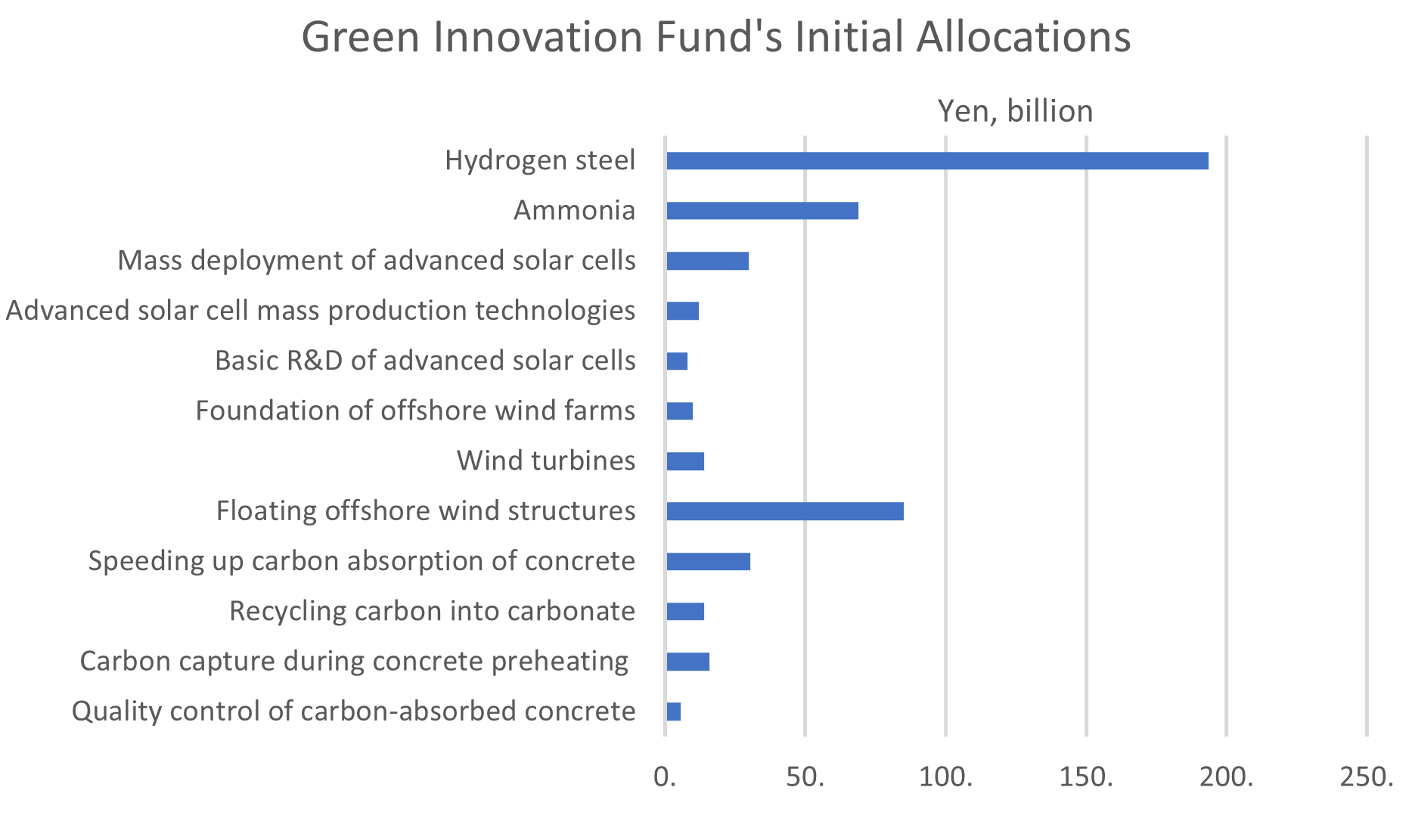
- METI is seeking applications for government funding of ¥193.5 billion for “green” steel and ¥68.8 billion for ammonia projects. The money will come from the ¥2 trillion Green Innovation Fund set up this year to support decarbonization technologies.
- METI is especially keen on iron ore reduction technologies that use hydrogen and re-use carbon generated in the reduction process, so as to eliminate the need for carbon capture and storage. The govt. is also interested in electric smelting tech to remove impurities from hot metal.
- CONTEXT: Nippon Steel, JFE Steel and Kobe Steel, together with state research hub NEDO, are working on such hydrogen reduction processes. Their tech is presently rated 4 out of 11 in terms of readiness.
- For ammonia, METI wants to support tech that can cut production costs by over 15%, as well as tech that works in low temperature and pressure environments, and which doesn’t require hydrogen as a raw material. Also, funding will go to makers of boilers and turbines that support co-firing when ammonia is more than half of the fuel mix.
- Fund applications close on Nov. 1 and winners will be announced in mid-December.
- Distribution of an initial ¥500 billion will be as follows.
- SIDE DEVELOPMENT:
METI modifies Green Innovation Fund rules
(Japan NRG, Sept. 17)- METI changed Green Innovation Fund rules to allow companies that receive financing to make their own progress reports. Initially, METI wanted each beneficiary of state funds to accept a NEDO official as a project manager.
- NEDO, which acts as the secretariat for the ¥2 trillion fund, now faces staff shortages.
- CONTEXT: The govt. has traditionally tried to make sure there’s strict compliance at firms that receive state funds and punish those that misuse them, not only by withdrawing the money but also by banning them from other state-backed projects.
Govt. announces four additional focus zones for offshore wind
(Kankyo Business, Sept. 14)
- Four more areas have been classified as focus zones for the development of offshore wind power, according to the announcements from the METI and the Ministry of Land, Infrastructure, Transport and Tourism.
- Akita Prefecture’s Happo Town and Noshiro City are now designated as preferred promotional areas for offshore wind. They will now formulate a public process to select operators for projects within the promotional area.
- Four new focus zones:
- Oki, Katagami and Akita (Akita prefecture)
- Yuza (Yamagata prefecture)
- Murakami and Tainai (Niigata prefecture)
- Izumi (Chiba prefecture)
- CONTEXT: The three existing areas classified as promising for offshore wind are the Japan Sea (north) side off the coast of Aomori prefecture, the Japan Sea (south) side off the coast of Aomori prefecture, and Saikai city, the Eshima offshore zone, Nagasaki Prefecture.
- To make the list of focus zones, a site needs to offer good environmental conditions, not interfere with existing fishing or shipping operations, and have access to sufficient transmission capacity. Getting a license to develop a project in the zones could give a business permit for up to 30 years.
- The ministries said that a list of 10 further sites, including Shimamaki in Hokkaido and Karatsu in Saga, may also be classified as ‘promising’ in the future, pending the identification of interested parties and the establishment of transmission capacity.
TAKEAWAY: Japan was expected to expand on its original focus areas for offshore wind. In fact, many companies already started to pursue projects outside of the original zones banking of their future inclusion in the government plans. Still, this is an important development. It will broaden the volume of projects in Japan’s burgeoning offshore wind industry and also cushion the blow for the many firms that will lose out after winners of the first round of offshore wind tenders are announced, likely within the next couple of months.
Govt. to raise trigger for solar’s environmental assessment to 50MW and more
(Nikkei, Sept. 14)
- The govt. wants to raise the bar at which an environmental assessment is needed for a solar power project from 10 MW to 50 MW. The change likely will be made this fiscal year.
- Officials are concerned that too many municipalities have passed ordinances that make it difficult to install or outright ban new solar projects. Almost a tenth of Japan’s municipalities have added such rules.
- MoE Minister Koizumi wants to reverse the trend of renewable energy facilities being seen as a nuisance by municipalities, and will introduce a “promotion zone” concept for renewable energy projects, which should be possible when the revised Global Warming Countermeasures Promotion Law comes into effect in FY2022.
- The MoE plans to exclude areas at risk of sediment-related disasters from such promotion zones.
- Local governments are expected to take the lead on the realization of the “promotion zone” concept by bringing together businesses and residents for discussion and overseeing the formulation of a renewable energy plan for the community. The inclusive approach is less likely to come unstuck from citizen protests.
- MoE wants 1,000 such “promotion zones” nationwide by 2030, and expects they’ll allow the installation of about 4.1 GW of solar capacity.
- Some will likely be added via agro-solar sharing arrangements, where solar panels are added to farmland. Adding energy generation to agricultural income is seen as an attractive business model.
Mitsubishi seeks to produce ammonia in U.S. for Japan export
(Nikkei, Sept. 21)
- Mitsubishi Corp. will begin manufacturing ammonia in the U.S. Gulf of Mexico in the latter half of the 2020s for export to Japan.
- The aim is to establish a production facility near the states of Louisiana and Texas with an annual output of 1 million tons of ammonia, which would be sold to Japanese power utilities and steelmakers for use as a fuel.
- The CO2 generated in the production process is due to be sequestered or converted into petrochemical products based on an agreement with U.S. energy company Denbury. Denbury uses CO2 for enhanced oil recovery.
TAKEAWAY: This is the third major project to manufacture ammonia overseas announced my Mitsubishi Corp within the last six months or so. Earlier in the month, the trading house announced plans for a 1-million-ton ammonia production hub in Canada. In March, it signed an MoU with Indonesia’s PT Panca Amara Utama (PAU) which is expected to lead to a manufacturing center that will deliver up to 700,000 tons of ammonia. These actions by Mitsubishi alone would bring 2.7 million tons of ammonia production online as soon as 2030, close to the Japanese govt. target of securing 3 million tons of ammonia by the end of this decade.
Mitsubishi is also involved in helping Saudi Aramco bring test deliveries of blue ammonia to Japan.
Given than Mitsubishi is far from the only company seeking to establish the global ammonia supply chain that connects to Japan, it will be interesting to see how much total volumes the Japanese investments will generate. At face value, it looks as if the capacities being planned are far beyond the currently expected demand scenario. This indicates either that the supply side projects are yet to be filtered out, or that the demand picture is being underestimated.
METI panel urges incentives to use carbon-absorbed concrete
(Japan NRG, Sept. 13)
- METI panel experts considering carbon recycling also suggest the launch of new schemes that allow users of carbon-absorbed concrete to receive offset credits.
- The cement industry produces 31 million tons of CO2 emissions a year, one of the top emitters after steel and chemicals. Japan’s top cement makers are working on developing a new type of concrete that absorbs carbon.
- This new concrete was first used last year by a consortium of Kajima, Chugoku Electric, Denka and Landes. The material went into construction of solar power plants for Chugoku Electric and condominiums in Tokyo.
- New companies such as Tokyo Gas are entering the sector. However, experts believe that further incentives are needed to popularize the use of new concrete. These could come in the form of offset credits and mechanisms that prevent carbon leakage.
- METI experts also suggested that the government start using the material for public buildings. So far, it has only been used in private projects.
Energy ministers from ASEAN, greater Asia meet online to talk gas storage, climate
(Japan NRG, Sept. 16)
- Energy ministers from ASEAN + 3 met online to share information on policies and the best practices of oil and gas stockpiling, as well as climate change mitigation.
- METI deputy minister, Ejima, attended the summit that included ASEAN countries, as well as China, South Korea, the U.S., India, Russia, Australia and New Zealand.
- CONTEXT: Japan has little gas storage, and all of it is short-term (max. 2-3 weeks). The government is pursuing the practice of alliance-building with regional neighbors in the hope of setting up gas stockpile hubs across Asia, which would also export opportunities for Japanese makers of gas tanks and other stockpile facilities.
ENEOS repurposes oil refineries to convert plastic to petrochemicals
(Nikkei Business, Sept. 21)
- In collaboration with UK-based Mura Technology, ENEOS and Mitsubishi Chemical are repurposing oil refineries to enable them to break down plastic waste using supercritical steam.
- The process produces high-quality recycled oil with low levels of impurities.
- The process can help put Japan’s surplus oil refinery capacity to good use.
Hitachi Zosen to issue ¥10 billion in green bonds
(Nikkan Kogyo Shimbun News Wave 21, Sept. 12)
- Hitachi Zosen is preparing to offer a green bond issue worth ¥10 billion. The five-year bonds will go on sale in October. Funds raised will be invested in a wind farm being built in the Mutsu-Ogawara region (Aomori) by ENEOS and Itochu Corporation.
- The 57 MW wind farm is scheduled to begin feeding the grid as early as 2024, and will be operated and maintained by Hitachi Zosen.
Meidensha trials AI-controlled smart hydropower plant system
(Kankyo Business, Sept. 16)
- Tokyo-based Meidensha was selected by Nagano Prefecture to design and trial an AI-based system to control hydropower stations.
- By analyzing historical data on rainfall and dam levels, the system will be trained to accurately predict future dam levels.
- More accurate modeling will enable power plant output to be maximized while ensuring hydro lake levels do not fall too low.
COSMO to bundle renewable energy services with electric vehicles
(Kankyo Business, Sept. 16)
- COSMO Oil Marketing launched a new service for local bodies to purchase carbon neutral electricity, EVs and related services in a single package.
- The “COSMO Zero Carbon Solution” includes lease and ownership options for installing PV panels, and leasing and car share services for EVs.
- COSMO Oil Marketing will offer more competitive prices by bundling new and existing services.
Iwatani, Kawasaki in Australia hydrogen project
- (New Energy Business News, Sept. 17)
- Iwatani, Kawasaki Heavy Industries, KEPCO and Marubeni signed a MoU with Australia-based Stanwell and APT Management Services for a feasibility study for a hydrogen plant in Queensland that would synthesize hydrogen at commercial scale from renewably generated electricity for shipping to Japan in liquid form.
- If the project goes ahead, output is projected to reach at least 100 metric tons per day by 2026, and 800 tons a day by 2031.
- The plant would ultimately consume over seven gigawatts of electricity.
Yamanashi hydrogen business no longer just about solar power
(Sankei Shimbun, Sept. 23)
- Yamanashi has long been associated with solar energy.
- Recently, the prefecture also began investing in ‘power to gas’ technology that uses electricity from renewable sources to synthesize and liquefy hydrogen for use as fuel.
- A partnership between the prefectural government, Toray, Hitachi Zosen, and other stakeholders uses a polymer electrolyte membrane process to produce hydrogen from renewably generated electricity – hydroelectric, wind and geothermal sources, in addition to power generated by solar farms.
- While the operation is still a small proof of concept system, the partners are working on a commercial system that generates 10 times more hydrogen.
- The hydrogen yielded is seen as an energy source for fuel cells and boilers.
Tokuyama and Panasonic run fuel cells on hydrogen byproducts
(New Energy Business News, Sept. 16)
- In conjunction with Panasonic, chemical manufacturer Tokuyama is trialing an initiative in which hydrogen gas generated as a byproduct of processes performed in Tokuyama’s Yamaguchi factory is used to run fuel cells.
- The hydrogen, which is produced as a byproduct of the manufacture of caustic soda by the electrolysis of brine using the ion exchange membrane process, will power up to six 700W fuel cells.
- Electricity generated can be used to supplement the factory’s requirements.
- The trial will run until March 2023.
Toshiba consortium awarded CCUS supply chain contract
(New Energy Business News, Sept. 14)
- MoE will fund a consortium comprising Toshiba and 12 other companies to research the establishment of an environmentally friendly carbon capture utilization and storage supply chain.
- The project aims to assess the feasibility of CO2 transportation and storage and improve understanding of related technologies.
Japan’s biggest shipper and BP join forces to decarbonization marine fuels
(Company Statements, Sept. 15)
- NYK and BP signed an MoU on decarbonization to promote a transition from traditional marine fuels to alternatives such as LNG, biofuels and methanol and to provide future zero-emission energy sources such as ammonia and hydrogen.
- In addition, the two companies will support other industries that are difficult to decarbonize by providing sea transportation of CO2 and other solutions, and will also seek to participate in the supply chain of ammonia and hydrogen used in heavy industry and power generation.
- SIDE DEVELOPMENT:
NYK invests in Australian reforestation and carbon credits firm
(Denki Shimbun, Sept. 24)- NYK Line will invest in Australian Integrated Carbon (AIC), a company involved in a primeval forest restoration project and the sale of carbon credits.
- The Japanese shipper plans to acquire business know-how regarding carbon credit creation and study how to offset CO2 emissions.
- NYK formed a JV with Mitsubishi Corporation, called Japan Integrated Carbon (JIC), to make the investment in AIC. Mitsubishi owns 60% of the JV and NYK the rest. The venture will own 40% of AIC shares.
- AIC helps farmers improve pasture management in order to regenerate primeval forest lost to overgrazing. The improvement will be certified as carbon credits by the Australian government.
One-Dot News:
- Mitsui & Co and partner Hiranga Energy will build 4 hydrogen stations in New Zealand. The two aim to commercialize green hydrogen during FY2022. (Nikkan Kogyo, Sept. 23)
- TEPCO, Sharp and Mitsubishi UFJ Trust Bank will form a venture to provide financing for upfront installation of rooftop solar in return for a portion of the returns from electricity sold. (Jiji, Sept. 21)
- TEPCO Power Grid wins advisory contract to help Laos national power company unbundle the local electricity industry, a project part-funded by JICA (Denki Shimbun, Sept. 24)
- Trading house Sojitz will become the biggest shareholder in Spanish power and gas retailer Nexus Energia, which sells only electricity made with renewable energy. (Company statement, Sept. 13)
- Japan’s Sompo Holdings agreed to buy Italian agricultural insurer as climate change drives demand for protection against increasingly severe extreme weather events. (Asia Nikkei, Sept. 21)
- Chemicals firm Asahi Kasei will start making separators for lithium-ion batteries in China with a local partner, Shanghai Energy New Materials Technology. (Asia Nikkei, Sept. 18)
- JERA is investing in Germany’s Hydrogenious LOHC Technologies, which develops hydrogen storage and transportation technology. JERA will jointly invest with Temasek, Chevron Technology Ventures and Pavilion Capital, for a total of around €15 million. (Company statement, Sept. 13)
- Hitachi Ltd. pledged to go carbon neutral across its entire value chain by FY2050, one of the first Japanese manufacturers to do so. It will as 30,000 suppliers to cut emissions. (Nikkei, Sept. 13)
- Mitsubishi Estate asks subcontractors to start disclosing emissions. This includes asking about the CO2 of construction materials like cement and steel. (Asia Nikkei, Sept. 17
- ALI Technologies has spun off its Zeroboard emissions projection service. The new company will assist the likes of KEPCO to calculate and reduce CO2 emissions. (Denki Shimbun, Sept. 24)
WEATHER OUTLOOK
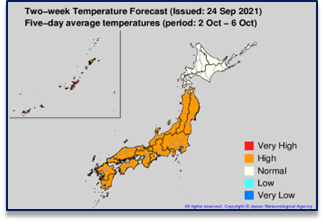
TWO-WEEK TEMPERATURE FORECASTS (SEP. 24 ~ OCT. 6)
Nation-wide
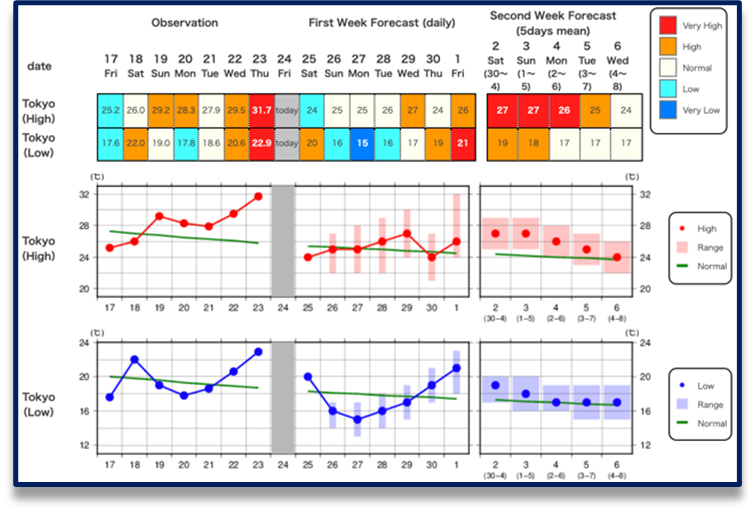
Tokyo area
- Weather warning: Typhoon Mindulle is approaching Japan, bringing heavy rain, thunderstorms, and cloudy weathers in Okinawa / Amami region from Sept. 28
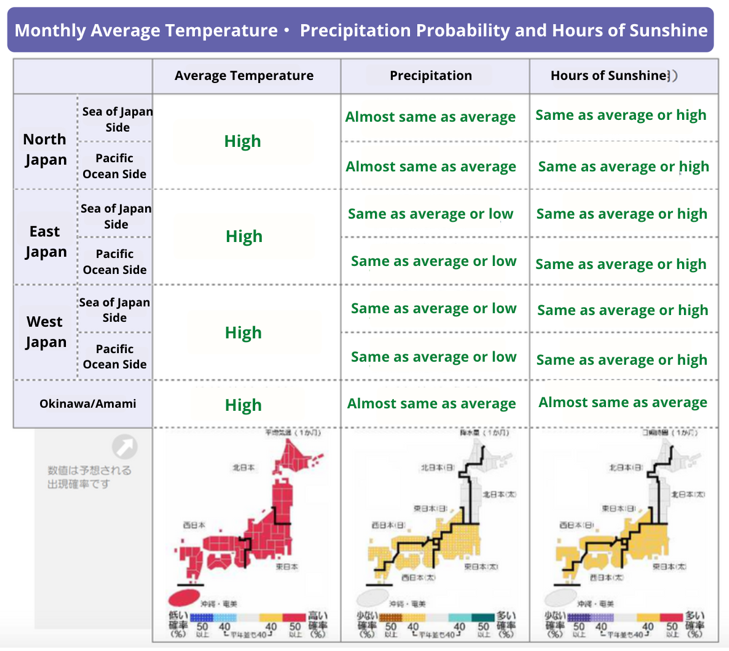
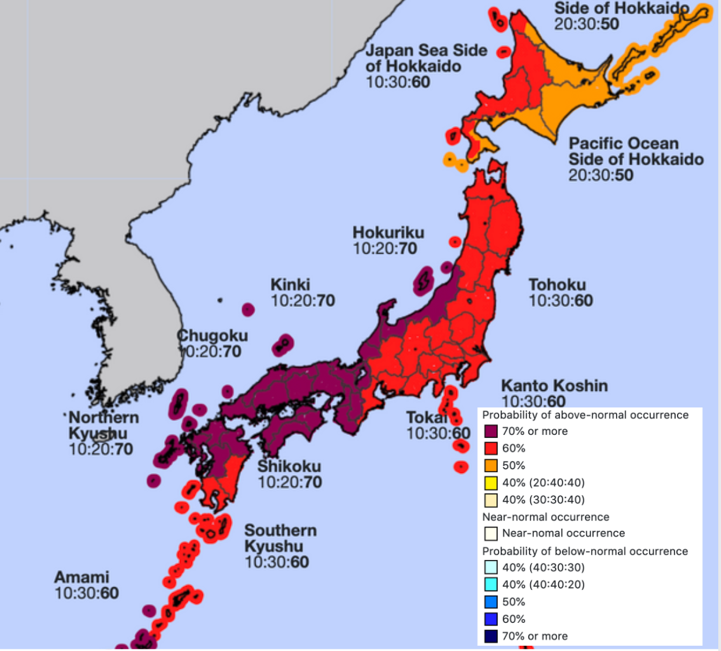
- Northern Japan/central Kanto region: Lower than average temperatures until Sept. 27, then extreme heat from Sept. 29 until Oct. 4.
- West Japan / Hokuriku / Amami region: mostly warm and humid
- Okinawa: extreme heat from Oct. 1
ONE-MONTH SEASONAL FORECAST (SEP. 25 ~ OCT. 24)
NEWS: POWER MARKETS
No. of operable nuclear reactors | 33 | |
Of which | restarted | 10 |
in operation today | 9 |
Electricity Price | Friday, Sept 24 | % Change WoW |
JEPX 24-Hour Spot | ¥8.76/ kWh | +3.4% |
TOCOM Oct. baseload (Tokyo area) | ¥8.28/ kWh |
Source: Company websites, JANSI and JAIF, as of Sept 24, 2021
All regional power utilities to increase tariffs in November
(Shikoku News, Sept. 16)
- Japan’s 10 major electricity suppliers will raise tariffs in November, amid rising LNG and coal costs.
- Okinawa Electric will register the biggest increase, as subscribers see monthly bills rise an average of ¥171. The next biggest are Chugoku Electric, TEPCO, and Chubu Electric.
TAKEAWAY: Rising energy raw materials prices, and as a consequence rising electricity prices, is a global issue and Japan is no exception. The rally in natural gas prices around the world is starting to filter through into the domestic power costs and may mean the winter price peak will come earlier than normal and even without any capacity shortages.
Japan already has one of the highest electricity prices in the world, while the cost of procuring green electricity locally often comes at a premium. As such, this winter will be a test for corporate commitment to decarbonize in the face of rising prices.
Nuclear power no longer that cheap: Opinion
(Nikkei Shimbun, Sept. 22)
- CONTEXT: This text was published as part of a recently launched daily “Deep Truth” column in Nikkei that attempts to give an analytical take.
- The author states that while latest govt. figures claim electricity from nuclear power plants will cost ¥11.7 per kw/ hour in 2030, putting it on par with wind, rising plant construction costs could mean this figure will be closer to ¥20.
- Govt. projections are based on a construction cost of ¥400,000 per kw/ hour, a figure that predates the Fukushima disaster.
- In fact, recent projects to construct nuclear plants in France, the UK and the U.S. have resulted in costs of over ¥1 million per kilowatt hour.
TAKEAWAY: That Nikkei, Japan’s top business daily, criticized nuclear power is a major change from even a couple of years ago. Nikkei has traditionally supported positions held by Keidanren (Japan’s top lobby group for big business) and the latter remains a stout backer of nuclear power.
Ignoring for a moment the thorny issue of estimating the true cost of any one energy source, it will be interesting to see if Nikkei’s new stance on nuclear survives the current PM leadership contest. The newspaper has been rather favorable towards top candidate Kono Taro, a major nuclear critic. Other candidates, however, are more favorable towards nuclear.
TEPCO and Toyota-backed wind developer expands Dutch wind assets to 154.8 MW
(New Energy Business News, Sept. 13)
- Eurus Energy Holdings began commercial operation of three wind farms near Groningen, the Netherlands. Total output is 154.8 MW. Eurus owns a total of 20 wind power plants in the Netherlands, with total installed capacity to 303.3 MW.
- The first power plant is “Windpark Vermeer” with an output of 86 MW, utilizing twenty 4.3 MW wind turbines made by Siemens Gamesa Renewable Energy. The second is “Wind Park Move” with an output of 30.1 MW, utilizing seven Vestas 4.3 MW wind turbines. Finally, ”Wind Park Mondrian” has 38.7 MW of capacity, utilizing nine Vestas 4.3 MW wind turbines.
- Electricity will be supplied to about 200,000 Dutch households.
- CONTEXT: Eurus Energy Holdings Corp. is part of the Eurus Energy Group, Japan’s largest wind power developer. Eurus Energy is a JV of Toyota Tsusho Corporation and TEPCO.
Osaka Gas joins forces with Mitsubishi Heavy to invest in U.S. solar project
(Company statements, Media, Sept. 14)
- Osaka Gas will join Mitsubishi Heavy Industries (MHI) in investing in a U.S. solar project under construction in North Carolina.
- The 15.7 MW Brighter Future Solar Farm will be run by Oriden LLC, an MHI subsidiary, and enter service in December 2021, selling power to a local electric cooperative under a 25-year contract. Osaka Gas and MHI will take equal stakes in the firm holding the solar farm asset.
- CONTEXT: Osaka Gas has set a goal for 2030 to have nearly 50% of its broader Daigas Group’s power assets in Japan as renewables. It also wants to develop 5 GW of renewables on a global basis by the end of this decade. The gas utility’s main investments in the U.S. so far have been into gas via the Freeport LNG business and shale gas fields.
Erex invests in Vietnam biomass power plant
(New Energy Business News, Sept. 17)
- Erex plants to build a 20 MW biomass power plant in Vietnam through a JV with a local partner.
- A construction site is being selected with local candidates such as Hau Giang Province. Operations could start in 2024/ 2025.
- The fuel will be selected from rice husks, palm coconut husks (PKS), wood pellets, and improved varieties of gramineous plants (woody plants with hollow jointed stems) that are in trial cultivation.
JERA-led Japanese owners to divest from Mexican thermal generation
(Japan Maritime Daily, Gas Energy News, Sept. 17-20)
- Japanese owners of MT Falcon Holding, a Mexican independent power generation company that runs gas-fired power plants agreed to sell all their shares to UK investment fund, Actis Capital.
- The price of the deal is not announced but it is due to close by March 2022, pending regulatory approval.
- JERA owns 20% of MT Falcom, with Tokyo Gas holding a further 30%, Mitsui & Co. 40%, and Tohoku Electric 10%.
Retailer to offer householders “100% Renewable” power at a premium
(Nikkei, Sept. 16)
- From Sept. 17, Hokkaido-based Ichitaka Gas One, and LPG supplier, will offer local households and businesses the option of buying renewables only electricity for an additional ¥1.5/ kWh. The clean electricity supply is backed by fossil-fuel-free certificates.
Blockchain technology allows direct electricity trading
(Kankyo Business, Sept. 10)
- Researchers from Kanazawa Institute of Technology announced the results of a trial conducted in conjunction with KEPCO into the use of blockchain technology to directly trade electricity.
- In the trial, users of a facility for staff at the university’s Hakusanroku campus “purchased” electricity generated elsewhere on campus using a blockchain-based trading system.
- The research team envisages a scheme whereby EVs are relocated to parts of the grid with insufficient electricity reserves so their batteries can provide additional power.
Kashiwazaki-Kariwa investigation uncovers negligent TEPCO culture
(Asahi Shimbun, Sept. 23)
- An investigation into breaches at TEPCO’s Kashiwazaki-Kariwa nuclear plant reveals a slack culture and the company’s inability to police itself.
- Ironically, the heavy financial losses sustained after the Fukushima disaster encouraged TEPCO to cut expenditure on mandatory anti-terrorist measures, the probe found.
- The resulting staff reductions and cost cuts spawned a culture of stopgap workarounds for equipment malfunctions rather than following protocol.
- The culture of complacency seems endemic to TEPCO’s nuclear division, which repeatedly ignored internal audit findings that criticized delays in rectifying sensor malfunctions.
- At the time, TEPCO’s executive was not informed of the breaches.
- SIDE DEVELOPMENT:
Ongoing scandals at TEPCO cast doubts on government’s nuclear policy
(Asahi Shimbun, Sept. 23)- The latest compliance breaches at TEPCO’s Kashiwazaki-Kariwa nuclear power plant has people asking why the utility didn’t learn from the Fukushima disaster.
- TEPCO Chair Kobayashi apologized and said if improvements aren’t made, the company will be seen as unfit to run nuclear plants.
- Kobayashi said he’s well aware this is TEPCO’s last chance to make good.
- SIDE DEVELOPMENT:
TEPCO to move its nuclear power division HQ to Niigata prefecture
(Denki Shimbun, Sept. 24)
TAKEAWAY: The bad news for TEPCO, especially and most damagingly from its nuclear division, continues and even grows. Whether the company survives in its current form will depend largely on who is the next prime minister. However, as new chairman Kobayashi said, the company has exhausted its “second chances”. Odds are high that the TEPCO group will undergo a major restructuring, as soon as next year.
NUCLEAR REACTOR NEWS ROUND-UP:
- Restart of Ikata nuclear plant in October now expected to be delay due to scandal
- (Yomiuri Shimbun, Sept.12)
- CONTEXT: The Ikata NPP owner (Shikoku) received a warning from the NRA after one of its plant operators left his post several times while on standby duty. The post is supposed to be manned continuously.
- Shikoku Electric submitted a report to the governor of Ikata city regarding the scandal around its staff. The local governor will review the report.
- This will delay the plant’s restart that’s scheduled for Oct. 12. The utility had already started to load fuel into the reactor.
- Shikoku’s report confirmed that its now former staff had left their post while on duty, clarifying this was done 46 times from 2016 to 2020.
- SIDE DEVELOPMENT:
Governor considers 20-year extension for Kyushu’s Sendai NPP
(MBC News, Sept. 21)- Governor Shioda of Kagoshima prefecture is in talks with the Japan Atomic Energy Commission (AEC) and industry experts around a potential 20-year extension of the operating license for Sendai NPP (Kyushu) Units 1 and 2.
- The facilities will reach their 40-year license limit in 2024 and 2025.
- In April, Kyushu Electric said it would apply for the 20-year permit extension for the Sendai units.
- SIDE DEVELOPMENT:
Shimae NPP passes regulator’s safety review
(Nikkei, Asahi Shimbun, Sept. 20-21)- Shimane NPP’s Unit 2 (Chugoku) has passed the more stringent NRA safety review and will hold meetings with local residents from October to gain their understanding and approval for a restart.
- The operator can’t restart the reactor without local government consent; briefings with residents are seen as key to winning over the public.
- SIDE DEVELOPMENT:
MOX fuel to be used at Takahama nuclear plant
(NHK News, Sept. 9)- Two ships loaded with uranium-plutonium mixed oxide (MOX) fuel from France departed for Japan for use at the Takahama NPP (Kansai).
- SIDE DEVELOPMENT:
More breaches discovered at TEPCO’s Kashiwazaki-Kariwa plant
(Asahi Shimbun, Sept. 20)- Around 100 fire alarms at TEPCO’s Kashiwazaki-Kariwa nuclear power plant were installed in the wrong place and don’t comply with regulations.
- Heat and smoke alarms were installed too close to ventilation ducts; thus, in case of a fire, the emergency response might be delayed.
- SIDE DEVELOPMENT:
Failure of Fukushima filters went unchecked
(Kyodo, Sept. 9)- An inspection of exhaust gas filters in an advanced liquid processing system (ALPS) used to remove radioactive material from waste water at the site of the Fukushima nuclear disaster found that all but one of the 25 glass fiber filters had failed.
- Shockingly, a similar failure was found at an inspection two years earlier, but TEPCO neither publicized the matter nor tried to identify the cause.
- SIDE DEVELOPMENT:
Nuclear operators vexed at government’s lack of support
(Nikkei Business, Sept. 10)- Like many Japanese nuclear power plants, Hamaoka NPP (Chubu) has not generated electricity for over 10 years. As staff retire, the NPP is losing workers with experience of operating a reactor.
- The plant even resorted to sending staff to visit a nearby thermal power station to experience the noise, heat and vibration of a working station.
- Japanese nuclear plant operators are unhappy with the govt’s proposed basic energy policy, claiming it doesn’t show commitment to nuclear energy or offer alternative energy sources as a baseload capacity.
- Industry experts say the tougher compliance standards that followed the Fukushima disaster make it almost impossible to pass inspections, which they say is demoralizing.
Chubu Electric gets nervous about green subsidiary’s “shady deal”
(Senkaku, September 2021 edition)
- Protest is heating up against the construction of a large solar power plant in Kannami Town, Shizuoka prefecture. The developer is Toenec Corp, a subsidiary of Chubu Electric. The area for the project is close to the site of the deadly landslide in Atami city earlier this year.
- Citizens of Kannami claim Toenec hasn’t provided sufficient safety measures or disclosed adequate information about the project. Locals are concerned that a similar landslide might occur in their area, and even took the matter to Chubu Electric at its latest AGM.
- The project was originally planned by a South Korean developer, Blue Capital Management, which is rumored to have been involved in the scandal around former MoE head, Akimoto Tsukasa.
- Chubu Electric’s Toenec is keen to expand in solar and has acquired projects in Oita prefecture and around Sendai. But the parent firm is concerned that its subsidiary may have walked in on a “shady deal” with the Kannami project and it governance issues come up, Chubu Electric will have to take responsibility.
NEWS: OIL, GAS & MINING
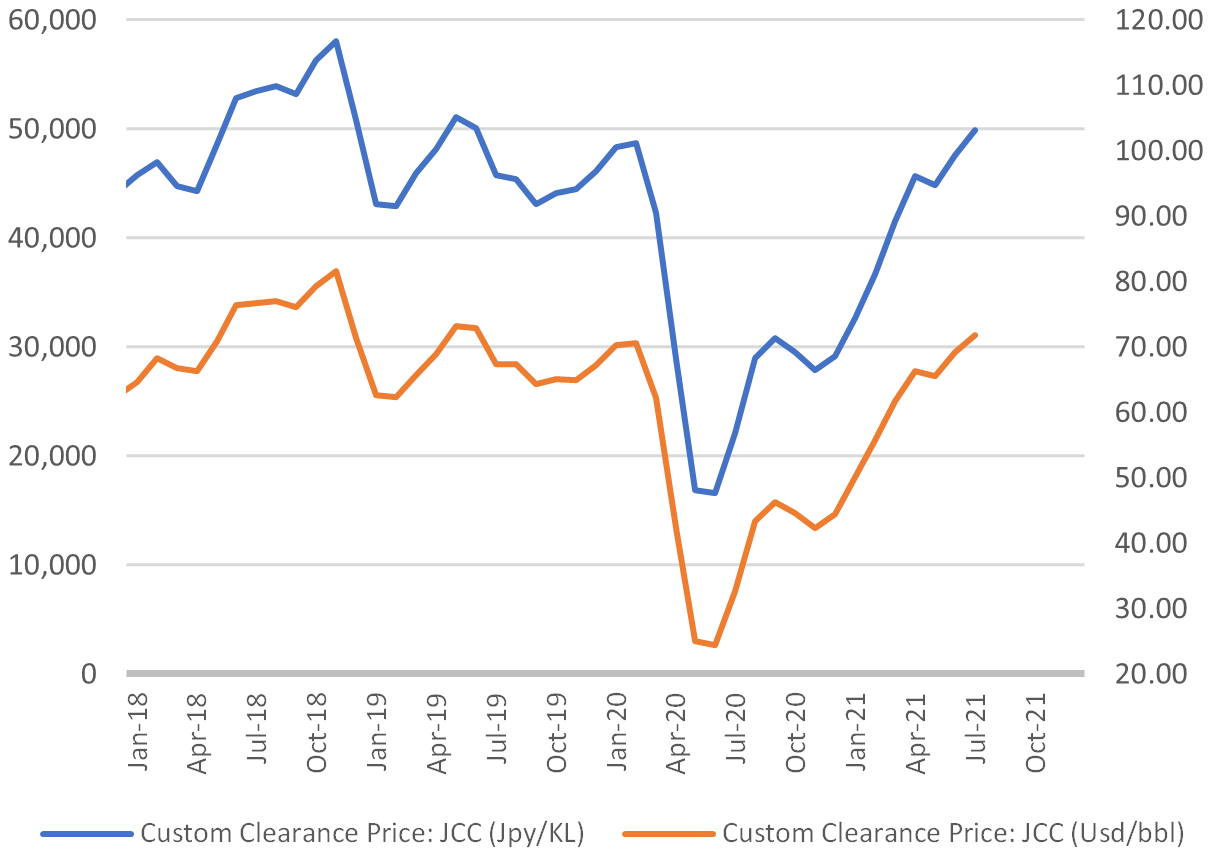
Japan Oil Price: $71.72/ barrel
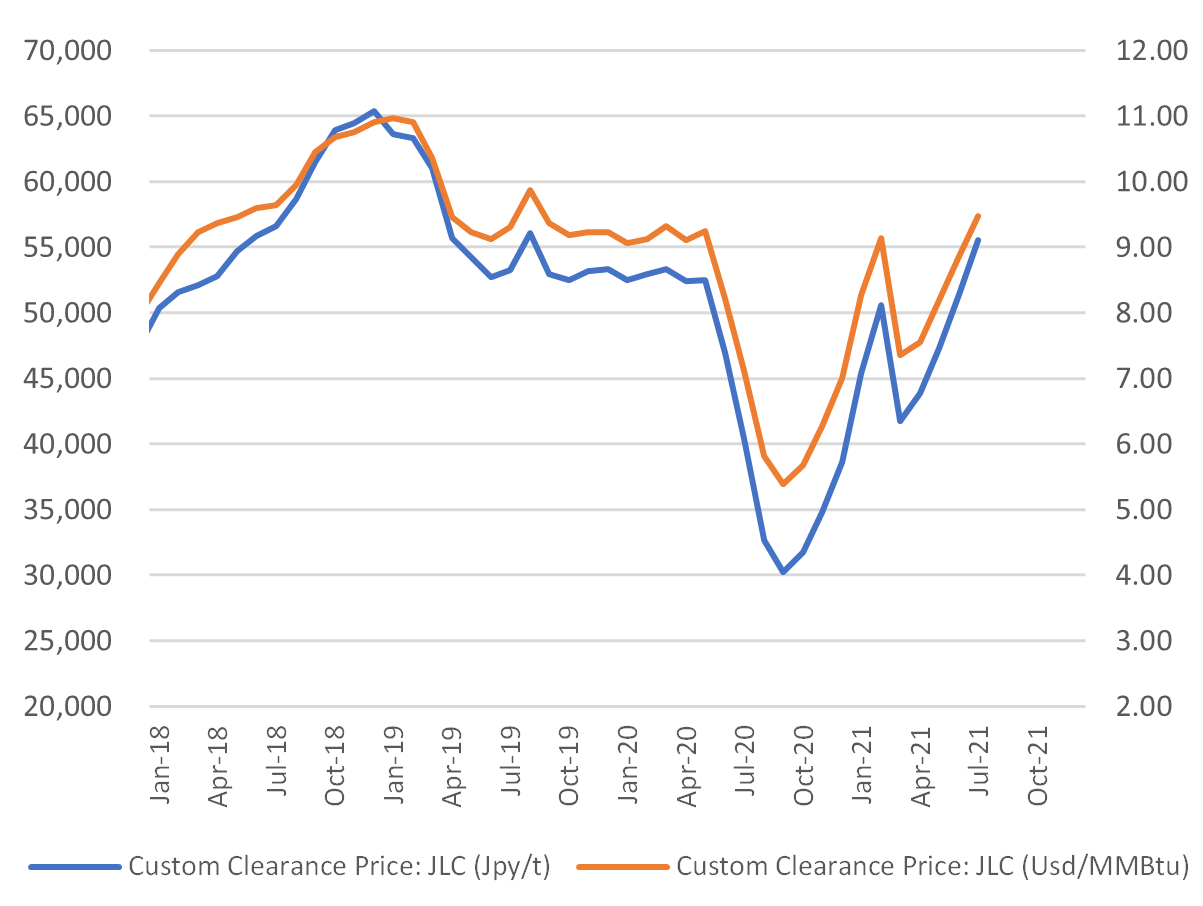
Japan (JLC) LNG Price: $9.47/ mmbtu
Japan’s Aug LNG imports back to pre-COVID level; coal purchases surge by a third
(Japan NRG, Sept. 24)
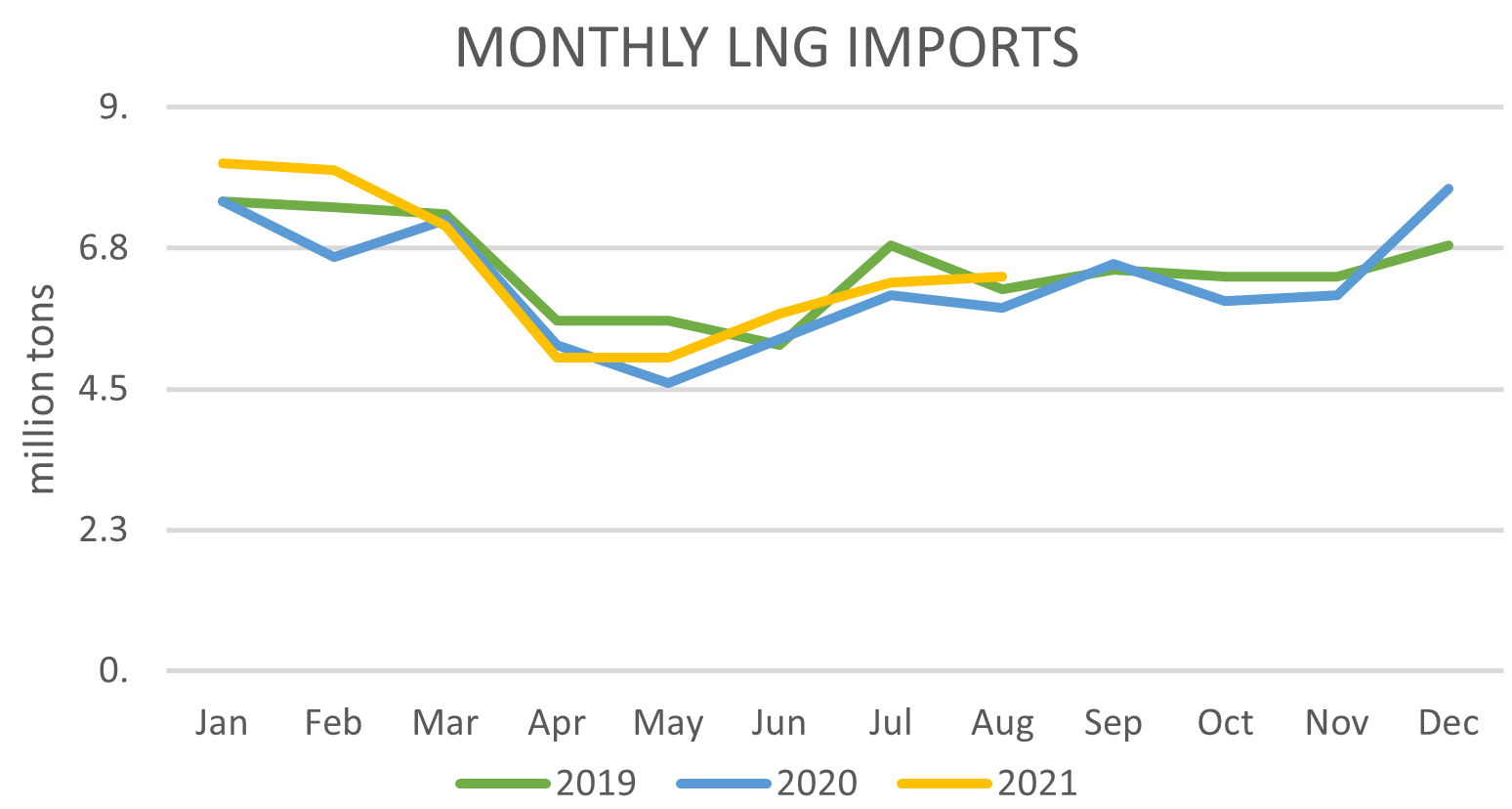
- Japan’s LNG imports rose, YoY, for four straight months and are returning to pre-Covid levels, according to preliminary customs data. Japan imported 6.3 million tons of LNG in August 2021, up 7.8% from a year ago.
- The volume was also higher than the 6.1 million tons of August 2019 (pre-Covid).
- This has Japan’s LNG stockpiles above a four-year average, according to METI, as the nation’s utilities follow government advice to secure winter peak supplies early.
- August crude oil imports were also up, by 22.7%, YoY, to 13.5 million kiloliters. Thermal coal imports were up 34.5% to 10.6 million tons.
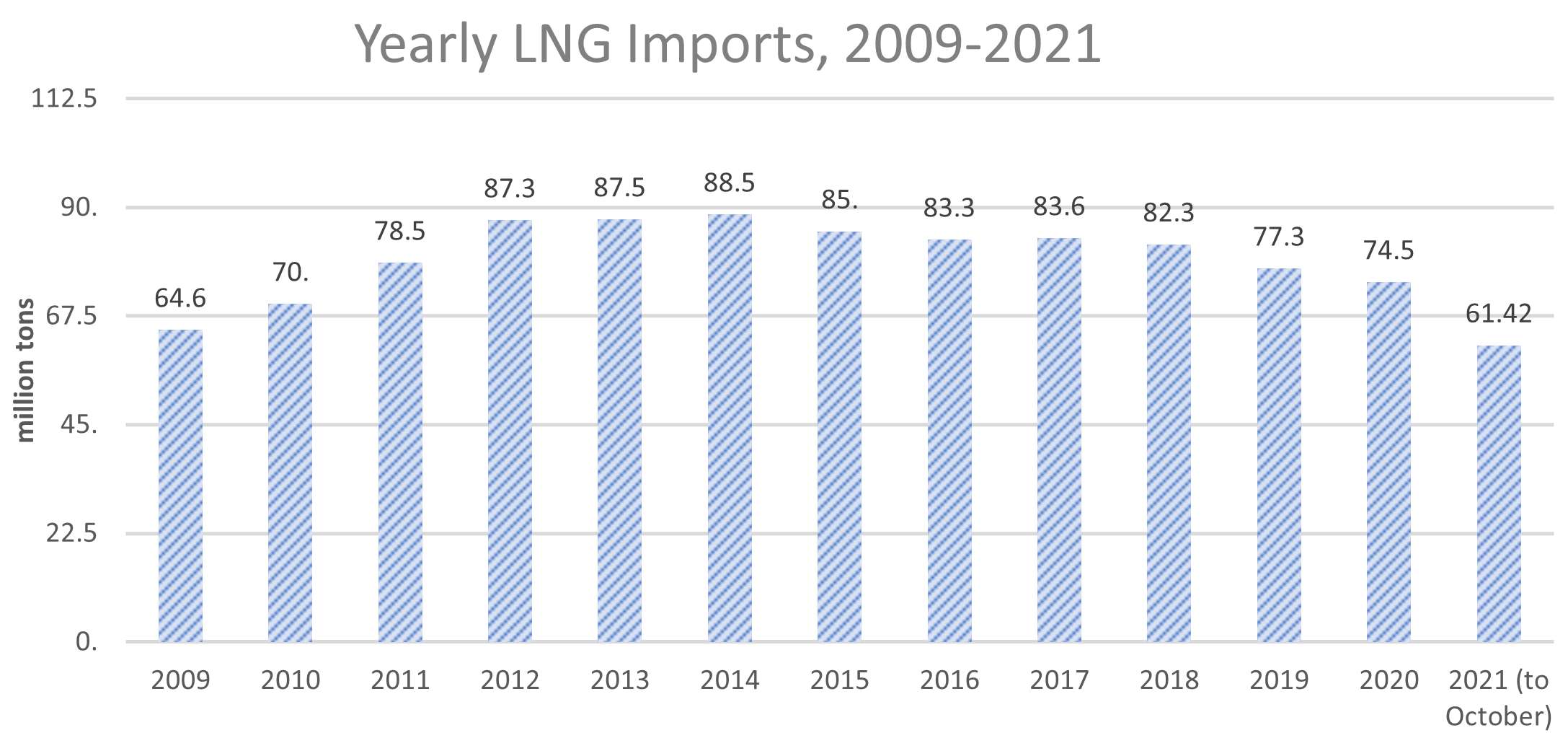
- When Covid hit, Japan’s LNG demand had already slumped to a nine-year low due to reduced heating demand, high stockpiles, and the restart of nuclear power plants.
- Earlier this year, the Japan Oil, Gas and Metals National Corporation (JOGMEC) had forecasted 2021 gas demand to decline 3% from last year on the back of nuclear restarts and an economic slowdown due to the pandemic.
- Japan’s January-August LNG imports jumped 6%, YoY, to 51.3 million tons.
- Early weather forecasts from the Japan Meteorological Agency suggest this winter is more likely to be colder than average at least for western and central Japan, including the Tokyo area.
INPEX agrees “carbon-neutral” propane gas contract with Astomos Energy
(Sekiyu Tsushin, Sept. 21)
- INPEX agreed to Japan’s first “carbon neutral” propane gas sale. It will supply Astomos Energy with propane that claims to have its emissions offset.
- The propane is produced at the company’s Ichthys LNG project. The volumes and price were not made public.
- INPEX will use carbon credits to offset greenhouse gases generated during all stages of the production process, extraction to liquefaction, sale, transportation, and combustion.
- CONTEXT: In recent months, INPEX has expanded its “carbon neutral” menu to natural gas, LNG, and now propane. Astomos, a major LPG supplier, has also recently agreed to buy “carbon neutral” LPG from Shell.
- SIDE DEVELOPMENT:
Tokyo Gas agrees “carbon-neutral” gas supply deal with Toko
(Kensetsu Tsushin Shimbun, Sept. 24)- Toko Electrical Construction signed a contract to purchase “carbon neutral” natural gas from Tokyo Gas. The contract is until Sept. 2024 and assumes offsets for 382 tons of CO2.
- SIDE DEVELOPMENT:
Tokyo Gas agrees two more “carbon-neutral” gas supply deals
(Gas Energy News, Sept. 20)- Local gas retailers Noda Gas and Buyo Gas agreed to procure “carbon-neutral” (CN) city gas from Tokyo Gas.
- As of now, at least 23 city gas companies in Japan have signed up to buy CN city gas or CN LNG.
- Noda Gas has started retailing the CN gas to corporate customers from August and is also using it for its own HQ.
- Buyo Gas started using CN gas at its facilities in September and plans to offer the product to clients in the future.
Rare earth material prices skyrocket partly due to U.S.-China tensions
(Asia Nikkei, Sept. 14)
- The price of some raw materials used in clean technology is up as much as 150% in the last 12 months.
ANALYSIS
BY MAYUMI WATANABE
Japanese Firms Rush to Set Their Own Carbon Prices;
Results Show Huge Variance in Opinion and Methodology
Japan is an internal carbon pricing (ICP) enthusiast. Of the 864 companies worldwide that used an ICP system last year to set an internal value for one ton of CO2, 118 were from Japan. That ranked Japan second only to the U.S. in the ICP rollout.
While Japanese firms have rushed to put a monetary figure on CO2 emissions, a Japan NRG survey shows a vast difference in methodology and outlook. In fact, the answers collected from public reports and conversations with over 30 companies and industry associations varied in their pricing by a factor of 1,000.
As nations prepare for November’s COP26 meeting in Glasgow, at which at least one global carbon pricing and trading scheme is expected to be announced, the wild variations in Japanese ICPs suggest that the prospects of CO2 becoming a broadly accepted and traded commodity is still at an early, formative stage. What one ton of CO2 represents for each company and industry differs greatly, and cost assumptions reflect this.
Still, our findings suggest that ICP, as it is today, is seen by many firms as a financial adjustment that must be included in risk calculations due to expected disruptions in supply and demand balances and marketplace rules during the energy transition.
The price is right?
The purpose of ICP is to measure the impact of carbon costs on capital and investments. When CO2 is understood to be a quantifiable risk with a monetary value, companies can change their operations, strategy, capital allocation and so on, to justify action as business-critical.
An ICP is used separately from a government-set tax on carbon emissions and doesn’t result in any fines or payments. However, it encourages businesses to make changes based on expectations of updates in the environment and market conditions that could lead to penalties for emissions.
Japan NRG carried out a survey of the leading Japanese companies to have engaged with ICP. The results showed the following:
- The approach to ICP calculations at Japanese firms vary based on how they plan to achieve net zero emissions. Carbon offsets; a total or partial shift to renewable power; plans for energy efficiency such as recycling of waste heat; a shift to low-impact fuels – all these and other decarbonization roadmaps tend to produce different pricing for a ton of CO2.
- Several firms said their understanding of ICP methodologies is still evolving and, as such, the current approach is either overhauled or temporarily suspended.
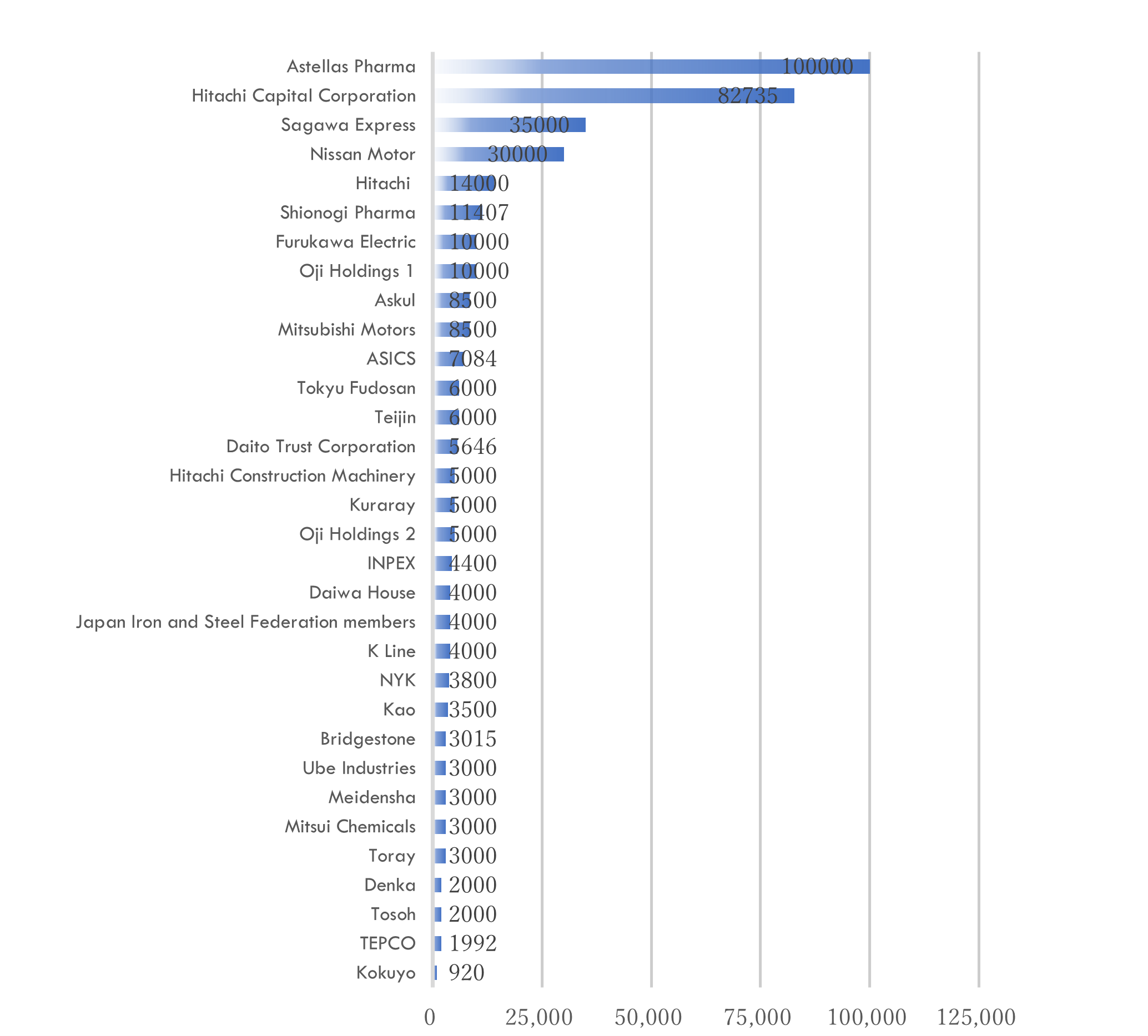
- The internal carbon price set by those surveyed ranged between ¥920/ ton of CO2 and ¥100,000.
- The median price points were ¥5,640/ ton and ¥6,000/ ton. The medium or average was ¥12,359/ ton. This shows that while there were a few exceptionally high ICP levels, about half of the companies set a carbon price of around $50/ ton. That compares with the 60 euros (~$70 level) recently reached by exchange-traded carbon prices in the EU.
- All companies, bar one, used a single carbon price and applied it to all their divisions and global operations. The exception was paper maker Oji Holdings, with two internal prices.
- Companies used three ICP calculation methodologies, with the number of respondents evenly spread across them: shadow pricing based on public indices; implicit pricing based on the cost of cutting emissions; and, an internal fee based on other cost models.
- For shadow pricing, the firms surveyed mostly relied on the European Emissions Trading Scheme (EU ETS), IEA price forecasts, local greenhouse tax rate forecasts, and the ICP of peers.
- For internal carbon costs, most firms counted taxes, thermal and renewable electricity rates, and the expense of offset credits as inputs. Past records on energy system upgrades were also used.
Internal carbon price of companies, 2020-2021
Source: Japan NRG survey
Reaching for the advanced stars
Japan’s biggest ICP-setter for years is Astellas Pharma, which uses the figure for stress tests. The firm says its ¥100,000/ ton level is based on the cost of building and running a “green” production plant in Ireland, a country that had the most advanced carbon regulations among Astellas’ global operations. The staggeringly high price is seen as a “fair reflection” of Japanese realities, and at present, that’s the rough cost of switching the firm’s power supplies from a thermal generator to wind farms, the official said, citing MoE data.
While the company hasn’t yet made its own in-depth analysis of Japan’s power and CO2 costs, Japanese ministry data was in line with Astellas’ figures for its Irish plant.
Runner-up Hitachi Capital Corporation said its ICP is based on shadow pricing and internal fees, while third-placed Sagawa Express said its ¥35,000/ ton estimate reflects the cost of switching from electricity delivered by thermal generation to solar power. Sagawa, one of Japan’s top logistics firms, mostly uses diesel fuel for delivery trucks, but it’s shifting the fleet to EVs.
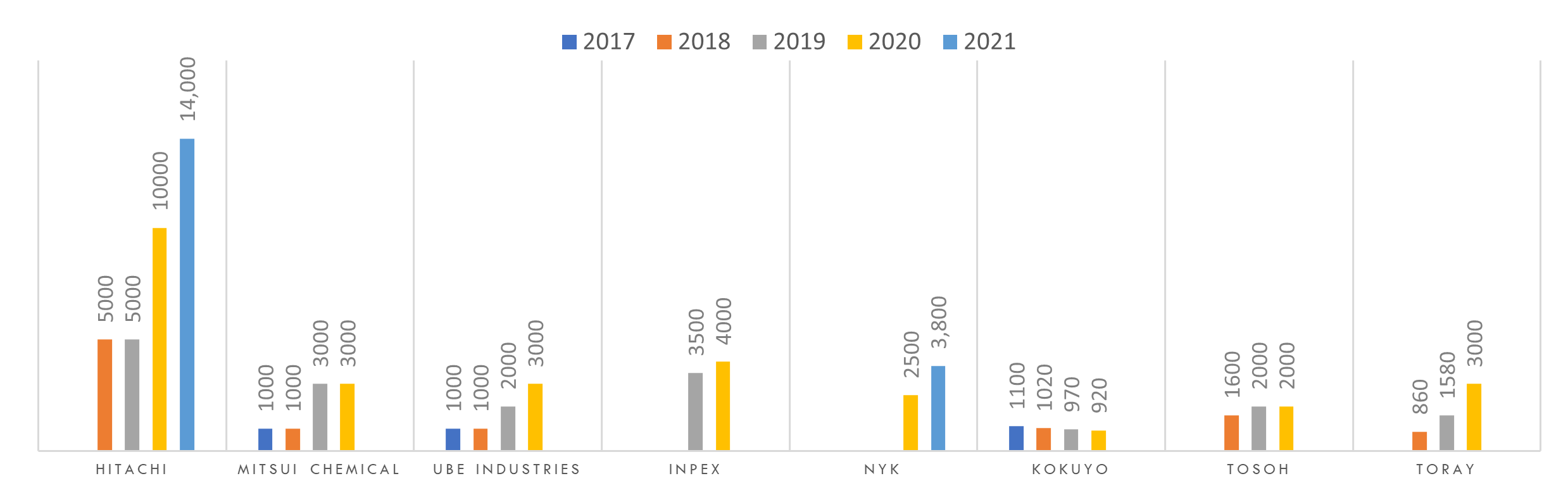
The lowest ICP value among respondents came from Kokuyo, a maker of office stationery, which bases its figure on the cost of deforestation, which has declined since 2017.
TEPCO had the second-lowest ICP of respondents, claiming its figure is based on the government-set model for utilities joining tenders to win compensation for building or replacing thermal power capacity. TEPCO has maintained an ICP at the same level since 2018.
Several firms took their ICP cue from the European ETS market, including materials maker Toray and chemicals major Teijin, which also blended the EU numbers with the ICP of global peers and carbon tax rates across several jurisdictions.
The Hitachi Group showcased how diverse ICP can be within a conglomerate despite the use of third-party data and shadow pricing. Hitachi Ltd. recently raised its ICP to ¥14,000 by combining EU ETS data with domestic greenhouse tax rates. Hitachi Capital Corp, combined third-party data and internal cost assumptions to come up with a figure almost six times higher. Meanwhile, Hitachi Construction Machinery set its ICP at ¥5,000.
Basing ICPs on EU ETS data has meant frequently updating the ICP as the price of the underlying benchmark has rapidly increased. For exactly this reason, shipper NYK now reviews its ICP twice a year rather than once, said a company official. Hitachi Ltd.’s carbon value has almost tripled in two years. Similarly, lower ICPs tend to be at companies that review calculations less often.
Not all ICP methodologies reviewed by Japan NRG make sense, at least at first glance. The Japan Iron and Steel Federation picked an ICP of ¥4,000 based on energy costs and greenhouse gas taxes. Given the energy-intensive nature of steelmaking, which also tops Japan’s rankings of emitters, the value seems low, especially in comparison with the ICPs of less energy-intensive manufacturers.
Select ICP Trends, 2017-2021
Source: Japan NRG survey based on company data
Creative ICP approaches
Service and trading firms seem to have opted for a more creative approach to evaluating carbon costs. Educational services provider Benesse Holdings used to analyze the environmental impact of customers traveling to its events, though the company says it has currently suspended ICP calculations.
Trading house Toyota Tsusho expresses ICP as a monthly fee of ¥110/ seat occupied by an office employee. The number represents what it would cost to offset the ¥530 million annual spending on electricity for its offices with carbon credits.
Meanwhile, Fujitsu sets an “internal tax” of ¥1,000/ ton for business units that don’t meet carbon reduction targets.
Integration of government schemes?
In 2020, 134 Japanese companies told non-profit organization CDP that they’ll introduce an ICP, which suggests carbon accounting will become a bigger part of day-to-day operations for in the country.
How ICPs will work with government-mandated carbon credits and trading schemes is less clear. METI plans to launch Japan’s first nationwide carbon exchange next year, which in theory could serve as the go-to benchmark for domestic firms in their ICP calculations. However, some firms that spoke with Japan NRG don’t plan to integrate their CO2 calculations with the domestic exchange, preferring instead to factor in international trends.
The diversity of methodology is likely to be another barrier for Japan, as well as other nations, in moving businesses over to accounting that factors in CO2 costs. Rather than setting up an exchange to trade CO2 certificates, the government could bring more benefit to the country’s business sector by first setting uniform rules for valuations.
ANALYSIS
BY NING LIN, Ph.D. & JIAXIN YANG (RBAC INC)
and
YOSHIKAZU KOBAYASHI,
NATIONAL GRADUATE INSTITUTE OF POLICY STUDIES (GRIPS)
The Decarbonization Wager;
How Japan May Lose Control of its LNG Prowess
For decades Japan has been the biggest, most dominant buyer in the LNG market, holding sway over one of the world’s top energy markets. This summer brought two significant developments that threaten to change Japan’s role and influence.
While Japan imported a world-leading 107 billion cubic meters of LNG in 2020[1], China’s demand growth saw it surpass both Japan and South Korea over the first six months of 2021. China’s demand for LNG is expected to continue rising.
The second factor was generated by Japan. In late July, METI released a draft of the 6th Basic Energy Plan. Its vision for the 2030 electricity mix has renewable energy climbing to almost 40% of total at the expense of fossil fuels. With nuclear’s ratio maintained at around 20%, the allocation for gas, coal and oil is squeezed to 41%.
This will have significant impact on Japan’s future LNG contracts, and buyer strategy will also need to carefully consider China’s gas purchases and structure.
The end of an era
Currently, Japanese buyers rely heavily on long-term LNG contracts to source natural gas. However, 56% of these contracts will expire within the next decade.
While buyers have the choice to extend or renegotiate their contracts, the strong government policy signals to reduce fossil fuels, plus more regional competition for LNG, is creating uncertainty for Japanese buyers when reconsidering long-term purchasing strategy.
Our analysis shows there are two specific factors that will drive the strategy of Japanese LNG buyers: 1) the pace of decarbonization in both China and Japan, and its correlation with natural gas demand; and 2) the possible introduction of a second gas pipeline from Russia to China.
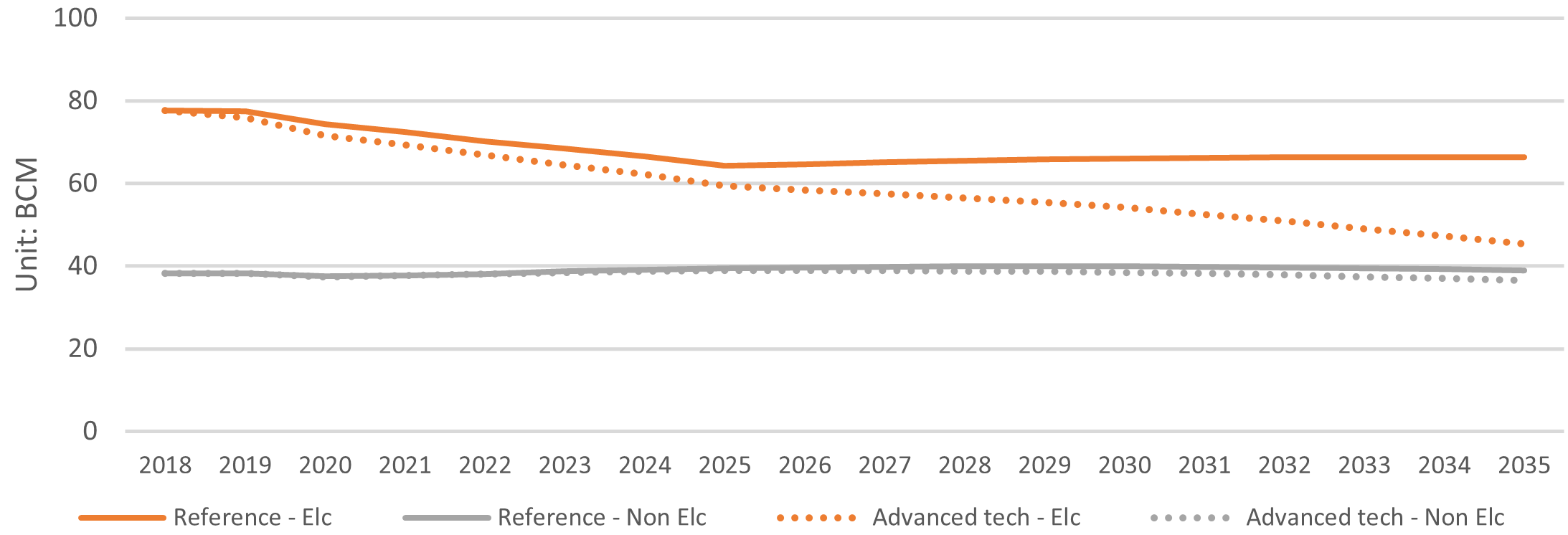
The first is far from a straightforward assumption that installing more renewable energy power plants will eat into gas purchase volumes. Indeed, both Japan and China face much uncertainty over the extent of decarbonization over the next 15-20 years. Hence, we propose an alternative, “advanced technology scenario,” in which domestic natural gas demand is reduced in case of accelerated decarbonization in between 2021-2035.
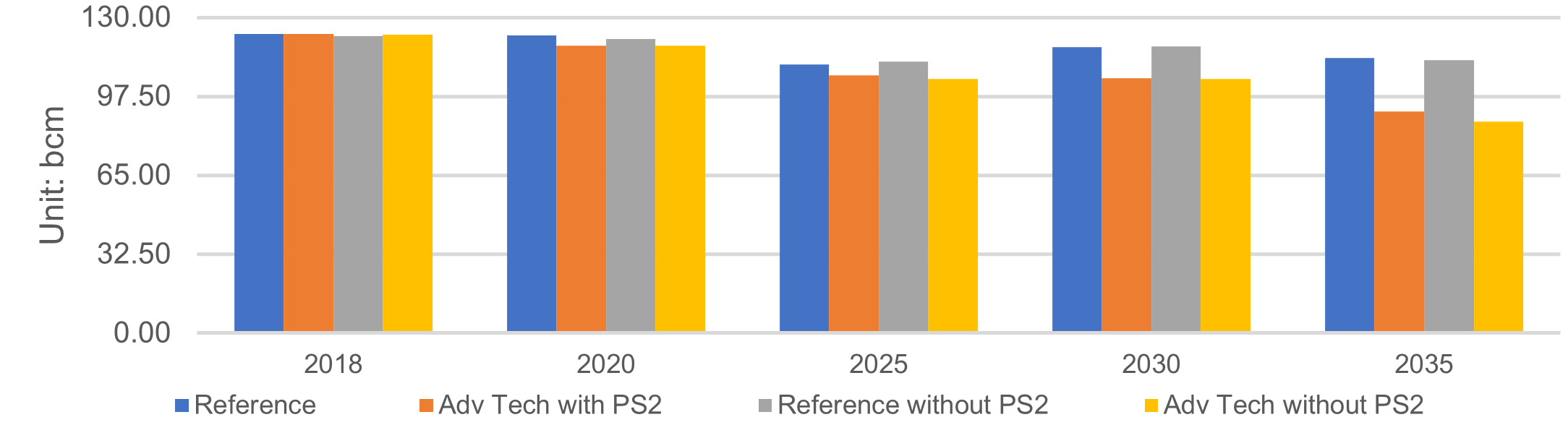
Figures 1 and 2 below show the demand assumptions for China and Japan based on our reference scenario, which assumes an annual growth rate for China at 4% and unchanged for Japan, and the advanced technology scenario. The latter assumes China transitions from fossil fuels at a quicker pace and that demand for natural gas averages +3% between 2021-2035. For Japan, the same advanced technology case sees annual demand shrink by 3%, driven largely by a reduction in gas use for electricity.
Figure 1: China’s Natural Gas Consumption
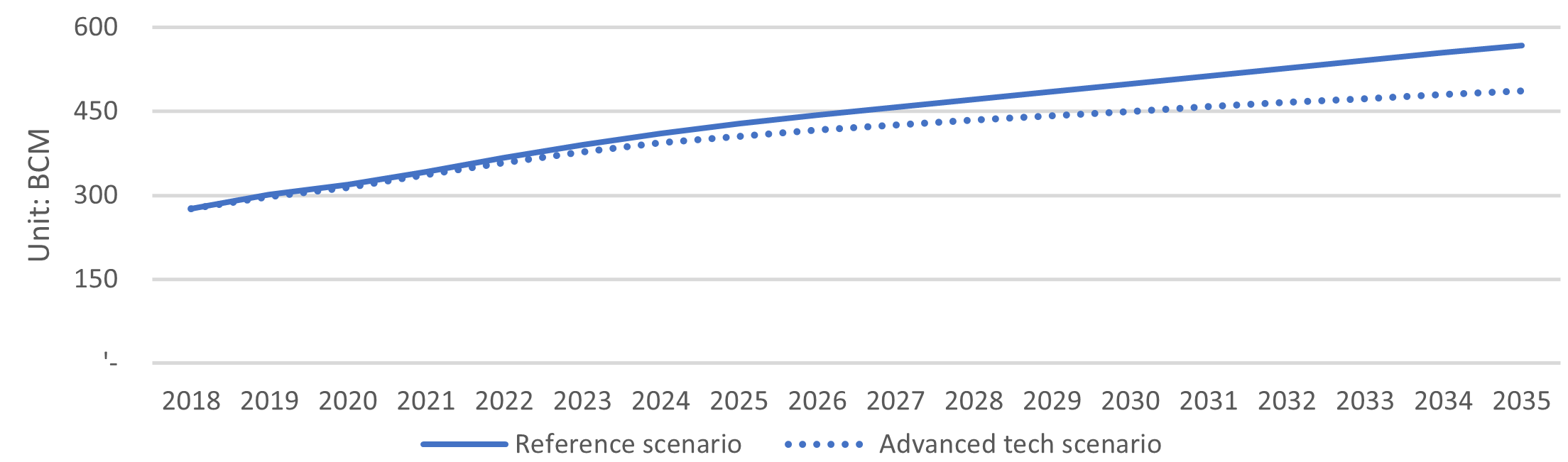
Figure 2: Japan’s Natural Gas Consumption[2]
The second factor mentioned earlier is the potential for China to add more pipeline capacity, which would potentially shrink its LNG demand and influence the purchasing of other Asian buyers. The main candidate is the “Power of Siberia 2” (PS2) pipeline proposed by Russia to run via Mongolia, carrying as much as 50 billion cubic meters (bcm) per year.
Figure 3 below demonstrates the effect of a substantial reduction in gas demand in China and Japan on LNG imports into Asia in total. In aggregate, the advanced technology scenario results in a 103 billion cubic meter reduction in LNG demand for the entire East Asia region including China, Taiwan, South Korea and Japan, and a $2/ mmbtu reduction in Asian LNG price through 2035, shown in Figure 6 below.
Figure 3: Imports of LNG into East Asia, Base Case vs. Adv Tech Case
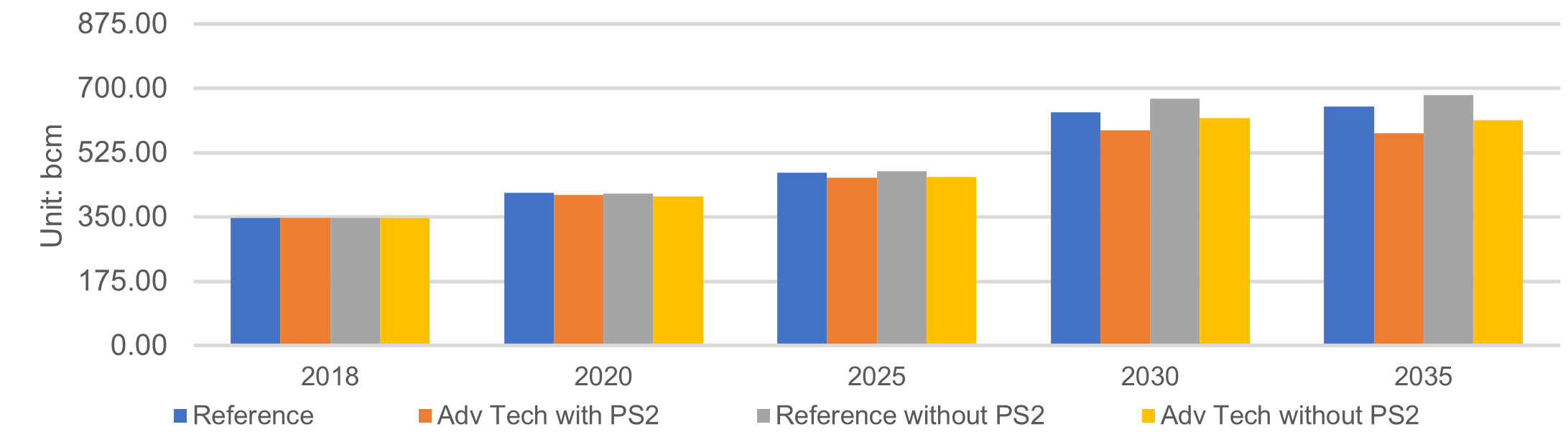
Figure 4: China LNG Imports: Base Case vs. Adv Tech Case
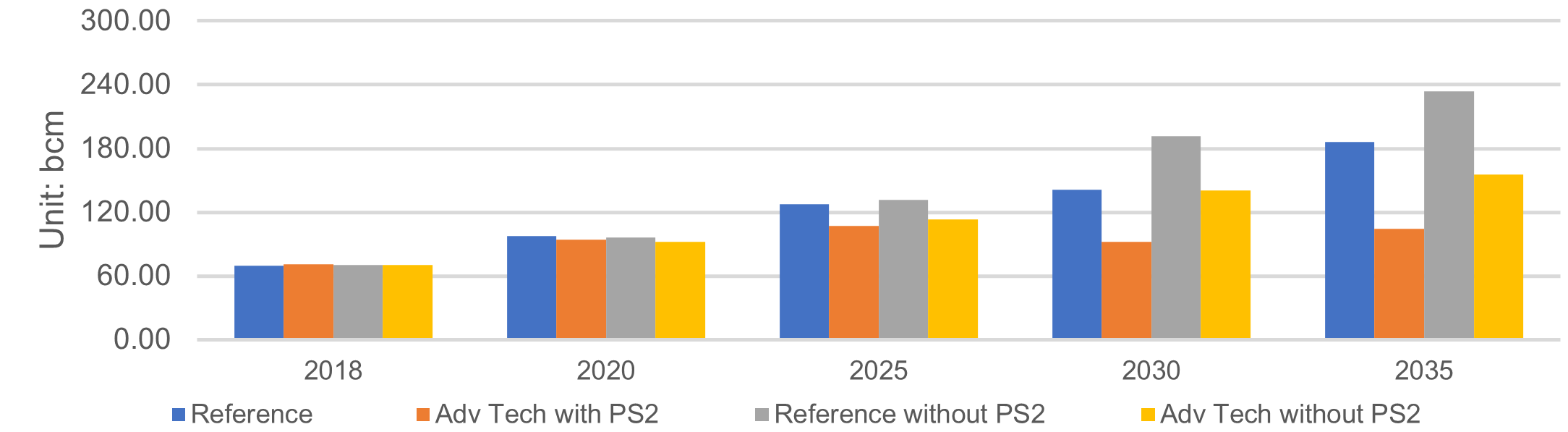
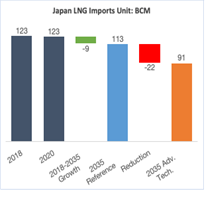
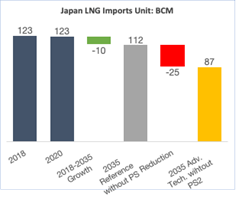
Figure 5: Japan LNG Imports: Base Case vs. Adv Tech Case
Pipeline impact on LNG imports
In both our reference and advanced technology scenarios, by 2035 more than 45 bcm of gas would be delivered to China via PS2, at a near 100% utilization rate. This means if demand is within a certain range, the efficiency of this project won’t be impacted. That also indicates that LNG would play the role of marginal supplier to China and pipeline gas would be the core source of imports.
The PS2 project holds attraction for China in several ways. It allows for flexibility of supply and a degree of control over price.
In a world without PS2, China would require an additional 47 bcm of LNG imports, making the Asian LNG market more aligned with Chinese demand growth trajectories. In effect, this would lead to an increase in Asian LNG prices of $1.30/ mmbtu in our reference case and $0.70/ mmbtu in the advanced technology scenario.
Figure 6 – Asian LNG Price by Scenario
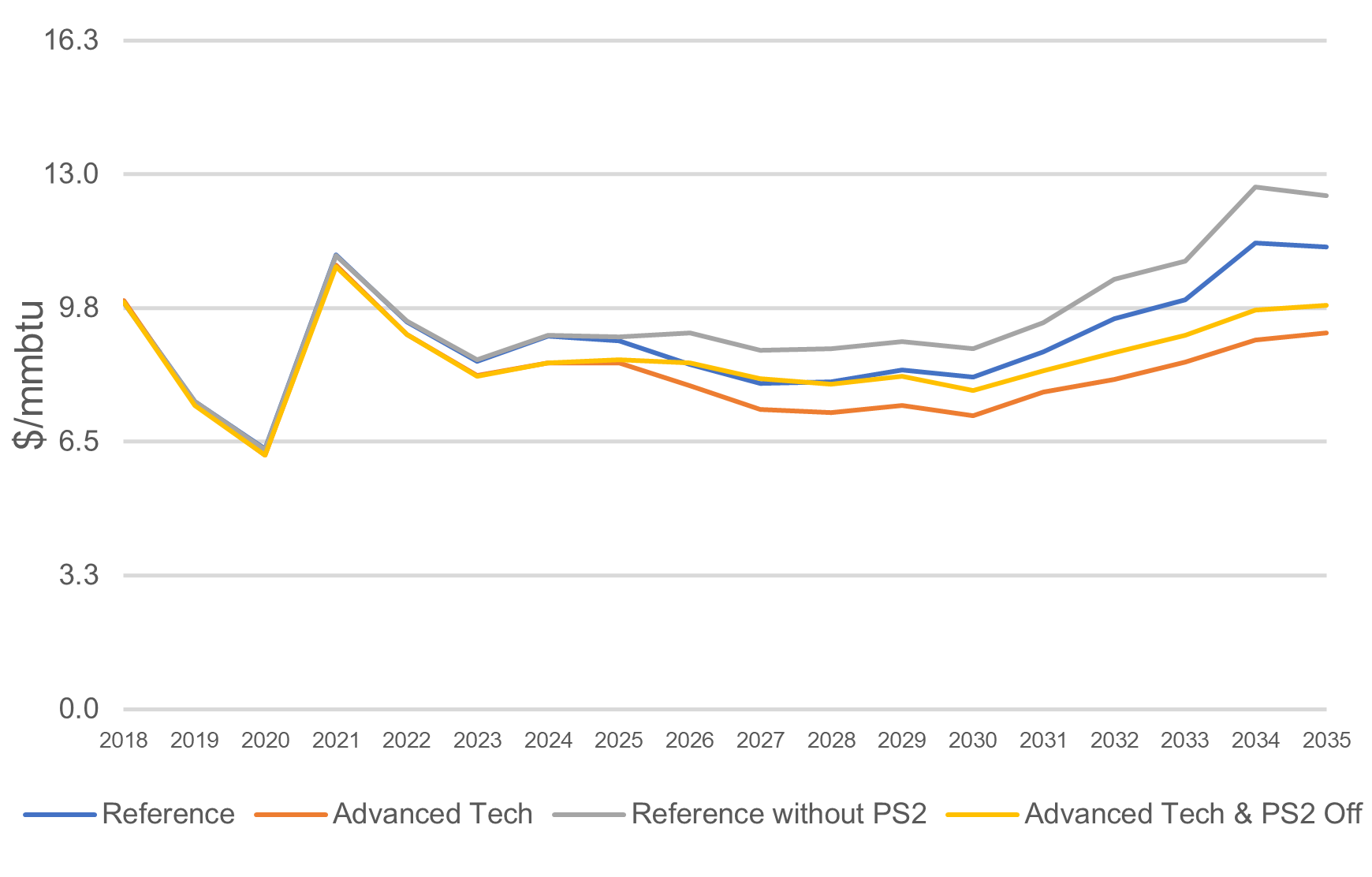
As you can see from the price modeling, it is to China’s advantage to negotiate with Russia for the construction of the PS2 pipeline. Whether they succeed or not will have a further impact on other Asian buyers, especially Japan.
In the situation where China has no additional Russia pipeline import volumes, there is a negative impact on Japanese imports due to there being more competition for LNG cargoes. Although we see Japan’s natural gas demand decline in all possible scenarios, our reference case assumes a small decline of less than 1% between 2020 and 2035 and about 2% in the advanced technology case.
Figure 7 – Japan LNG Impact by Scenario Waterfall Chart
About the authors
Dr. Lin is an energy industry economist and leader of the global gas and LNG modeling team at RBAC, a supplier of global and regional gas and LNG market simulation systems. Before joining RBAC, Dr. Lin managed global market analysis capabilities for Shell Trading, KOCH Industries and Tenaska.
Jiaxin Yang is a market research analyst with RBAC.
Yoshikazu Kobayashi is a senior economist and a natural gas and LNG expert from the National Graduate Institute for Policy Studies, or GRIPS, which is a research graduate school funded by the Japanese government
.
GLOBAL VIEW
BY JOHN VAROLI
Below are some of last week’s most important international energy developments monitored by the Japan NRG team because of their potential to impact energy supply and demand, as well as prices. We see the following as relevant to Japanese and international energy investors.
Auto Industry – green steel
Germany’s Mercedes-Benz said it wants all of its new cars to be “carbon neutral” across its value chain by 2039. Mercedes will work in partnership with Swedish steelmaker SSAB to source fossil-fuel-free metal. SSAB has developed a steelmaking process that uses (green) hydrogen rather than coking coal. SSAB’s partners in the hydrogen ironmaking tech are the miner LKAB and Swedish energy firm Vattenfall.
China – energy efficiency
Beijing is cracking down on energy-intensive projects after 20 of the country’s 30 regions failed to meet their energy consumption targets. The National Development and Reform Commission (NDRC) said local officials must limit absolute energy use and cut the amount of energy used per unit of GDP. However, highly important national projects will remain exempt from local energy consumption controls.
Coal – China’s overseas exit
Chinese President Xi Jinping pledged to end the financing of new coal power plants overseas. However, China will continue to support coal use at home. The country accounts for most new coal projects around the world and coal is the dominant fuel in its electricity mix. During the first half of 2021, China announced dozens of new coal-fired power and steel plants, which if realized would add 150 million tons in annual CO2 emissions, according to Global Energy Monitor.
Green finance – UK green bonds and Gates’ new fund
- The UK’s inaugural “green gilt” sale saw record demand as investors lined up to buy the 12-year government bond aimed at raising funds for environmental spending. The bond, due in 2033 with a yield of 0.87%, raised £10 billion for the government and is the largest sovereign green bond. More than £100 billion of bids were placed — the highest ever for a UK government bond sale. The UK plans to sell at least £15 billion of green gilts this year to channel money to projects including flood defense, renewable energy, and carbon capture and storage.
- With strong support from BlackRock Inc. and Microsoft Corp, billionaire Bill Gates’ innovation fund, Breakthrough Energy Catalyst (BEC), has raised more than $1 billion to support clean-energy projects. BlackRock made a five-year, $100 million grant from its charitable foundation, while Microsoft is chipping in another $100 million. Other major supporters include General Motors, Bank of America, and ArcelorMittal, which will contribute in the form of equity capital and offtakes, as well as purchase agreements related to projects. BEC focuses on green solutions: battery storage, carbon capture, green hydrogen, and sustainable aviation fuel.
LNG / natural gas – price spike
Citigroup more than doubled its Asian and European natural gas forecasts for next quarter and said prices could surge to as high as $100 per mmbtu in the event of a cold winter. LNG prices are skyrocketing due to seasonally low European inventories, booming Chinese demand and supply constraints from Russia and Nigeria. LNG’s Japan-Korea Marker (JKM) jumped almost 50% this month to near $30 per mmbtu. In Europe, LNG is up around 40% at close to $25. U.S. gas prices have so far been more subdued in terms of increases.
Oil – Shell exits Permian
Royal Dutch Shell will sell its Permian Basin oilfield, the largest in the U.S., to ConocoPhillips for $9.5 billion in cash. The Permian Basin has been one of Shell’s core oil and gas-producing regions, but the company has been facing intense pressure at home to accelerate its exit from fossil fuels. In May, a court in the Netherlands ordered the company to slash net carbon pollution by 45 per cent compared with 2019 levels. ConocoPhillips intends to use the purchase to deepen its push into the American southwest deposits.
Russia – gas supply
The IEA called on Russia to supply more gas to the EU in order to alleviate the energy crisis. Traders and officials in European countries that are often antagonistic to Russia have claimed that Moscow is restricting supplies. They question why Russia’s natural gas giant, Gazprom, has limited top-up sales in the spot market to Europe. Gazprom has also unsettled markets by keeping its underground storage facilities in Europe stocked at low levels compared with previous years.
UK – energy crisis
The country’s remaining coal power stations will be paid large sums to continue operating after one of the least windy summers on record locally sparked a jump in energy prices. While the UK has slashed coal-generated power in recent years, the few coal plants that remain are held on standby. The price of UK electricity during the past week’s peak hours reached a record of £1,750 per MWh, which is 2,900% higher than the average for the last decade. Seven local gas and electricity firms have now gone bankrupt in recent weeks due to the price spike.
U.S. – batteries
Battery recycler Redwood Materials Inc. is searching for a site in the U.S. to build a $1 billion battery-component plant, according to CEO JB Straubel, who was a Tesla Inc. co-founder. The move will make Redwood a major U.S. producer of cathodes that are used in EV batteries. Redwood’s new U.S. factory will produce material for 100 gigawatt hours of batteries annually by the end of 2025, which could help equip 1.3 million EVs a year. By 2030, the Redwood facility plans to rev up that figure to 500 gigawatt hours per year.
EVENTS CALENDAR
A selection of domestic and international events we believe will have an impact on Japanese energy.
|
February |
Approval of Fiscal 2021 Budget by Japanese parliament including energy funding projects; CMC LNG Conference |
|
March |
10th Anniversary of Fukushima Nuclear Accident; Smart Energy Week – Tokyo; Quarterly OPEC Meeting; Japan LPG Annual Conference; Full completion of all aspects of the multi-year deregulation of Japan’s electricity market; End of 2020/21 Fiscal Year in Japan; |
|
April |
Japan Atomic Industrial Forum – Annual Nuclear Power Conference; 38th ASEAN Annual Conference-Brunei; Japan LNG & Gas Virtual Summit (DMG)-Tokyo Three crucial by-elections in Hokkaido, Nagano & Hiroshima – April 25th |
|
May |
Bids close in first tender for commercial offshore wind projects in Japan; Prime Minister Suga to visit the U.S. |
|
June |
Release of New Japan National Basic Energy Plan-2021; G7 Meeting – U.K. Presidents Biden and Putin are due to meet at a summit in Geneva Forum for China-Africa Cooperation Summit (Senegal) |
|
July |
Tokyo Metropolitan Govt. Assembly Elections; Commencement of 2020 Tokyo Olympics |
|
August |
METI committee approves draft of Japan’s 6th Basic Energy Plan |
|
September |
Ruling LDP Presidential Election; UN General Assembly Annual Meeting that is expected to address energy/climate challenges; IMF/World Bank Annual Meetings (multilateral and central banks expected to take further action on emissions disclosures and lending to fossil fuel projects); End of H1 FY2021 Fiscal Year in Japan; Japan-Russia: Eastern Economic Forum (Vladivostok)-tentative |
|
October |
Potentially, Japan’s 2021 General Election; METI Sponsored LNG Producer/Consumer Conference; Innovation for Cool Earth Forum – Tokyo Conference; Task Force on Climate-Related Financial Disclosure (TCFD) – Tokyo Conference; G20 Meeting-Italy |
|
November |
COP26 (Glasgow); Asian Development Bank (‘ADB’) Annual Conference; Japan-Canada Energy Forum; East Asia Summit (EAS) – Brunei |
|
December |
Asia Pacific Economic Cooperation (APEC) Forum – New Zealand; Final details expected from METI on proposed unbundling of natural gas pipeline network scheduled for 2022. |
Disclaimer
This communication has been prepared for information purposes only, is confidential and may be legally privileged. This is a subscription-only service and is directed at those who have expressly asked K.K. Yuri Group or one of its representatives to be added to the mailing list. This document may not be onwardly circulated or reproduced without prior written consent from Yuri Group, which retains all copyright to the content of this report.
Yuri Group is not registered as an investment advisor in any jurisdiction. Our research and all the content express our opinions, which are generally based on available public information, field studies and own analysis. Content is limited to general comment upon general political, economic and market issues, asset classes and types of investments. The report and all of its content does not constitute a recommendation or solicitation to buy, sell, subscribe for or underwrite any product or physical commodity, or a financial instrument.
The information contained in this report is obtained from sources believed to be reliable and in good faith. No representation or warranty is made that it is accurate or complete. Opinions and views expressed are subject to change without notice, as are prices and availability, which are indicative only. There is no obligation to notify recipients of any changes to this data or to do so in the future. No responsibility is accepted for the use of or reliance on the information provided. In no circumstances will Yuri Group be liable for any indirect or direct loss, or consequential loss or damages arising from the use of, any inability to use, or any inaccuracy in the information.
K.K. Yuri Group: Oonoya Building 8F, Yotsuya 1-18, Shinjuku-ku, Tokyo, Japan, 160-0004.