
JAPAN NRG WEEKLY
OCT. 4, 2021
JAPAN NRG WEEKLY
Oct. 4, 2021
NEWS
TOP
- Kishida Fumio wins LDP vote, to be Japan’s next prime minister; new Cabinet to be announced today (See Analysis for details)
- METI sets up scheme to prolong service of aging thermal plants; Concern over shortages to delay power utilities’ closure plans
- Japan discloses new terms for offshore wind zones; expansion of areas to promote wind also gives rise to more specific demands
ENERGY TRANSITION & POLICY
- Ministry publishes policy for scrapping offshore wind facilities
- METI outlines risk management principles for the power sector
- 19 projects selected for Joint Carbon Mechanism for 2H 2021
- Tidal generation gets a boost as Kyushu Electric touts potential
- J-Power sees new form of carbon storage on seafloor via hydrates
- Tokyo governor plans to make rooftop solar mandatory
- Mitsui to invest over ¥100 billion in Australian blue ammonia plant
- Kyushu Electric partners with Yara on blue and green ammonia
- Toshiba to work with Brazil’s CBMM on next-generation batteries
- Kirin to install solar panels at all its Japanese factories … [MORE]
ELECTRICITY MARKETS
- Govt. wants utilities to offer cheaper daytime electricity with solar; ANRE studies ways to reduce curtailment of renewable plants
- JERA to invest $1.58bn in top Philippines utility to tap green shift
- JWD submits plans for 500 MW offshore wind farm in Yamagata; TEPCO bids to build 396 MW offshore wind project in Akita zone
- Vena Energy looking to develop wind farm in Aomori prefecture
- Tokyo Gas sells 240 MW Japan gas-fired plant to a power retailer
- Taiwan to send experts to review Fukushima water release plan
- NUCLEAR REACTOR WRAP: NRA to probe TEPCO, again [MORE]
OIL, GAS & MINING
- Japan continues to show appetite for smaller Africa LNG cargoes
- Domestic oil spot market dries up as TOCOM volumes plunge
- Saibu Gas tests drones for monitoring of gas pipelines
ANALYSIS
CHOICE OF JAPAN’S NEXT LEADER MEANS NO DRASTIC CHANGE IN ENERGY POLICY, FOR NOW
Japan will not ditch nuclear, and the energy mix will continue to be diversified: those are the key signals from last week’s ruling party leadership race that produced Japan’s next prime minister.
The win by former foreign affairs minister Kishida Fumio was a vote against radical shifts in current energy policy, rejecting both anti-nuclear and renewables-sceptic candidates. The strong focus on social equality in Kishida’s platform also suggests that his approach to the energy transition would prioritize affordability and seek to avoid major job losses and other disruptions.
JAPAN SEEKS A NEW CEMENT RECIPE
TO TAME THE HIGH-EMITTING SECTOR
As the main raw material for concrete, cement is responsible for 4% of Japan’s total CO2 emissions. To tackle the issue and improve the industry’s green credentials, Japan is switching to a new recipe that promises to suck up more CO2 than it emits.
Several groups of private Japanese companies and scientific institutions recently developed new cement and concrete techniques that create material from CO2 or absorb it. What’s more, many of the solutions seem to lie in waste materials from steelmaking.
GLOBAL VIEW
El Salvador not only adopts Bitcoin but tests volcano-powered generation to support crypto-mining. Tesla’s Musk lends support to nuclear power. ESG is helping banks reap record profits from underwriting associated bond sales. China power crunch has govt. claiming it will secure energy at all cost. Global gas, coal, and oil prices hit records or multi-year highs. Details on these and more in our global wrap.
WEATHER OUTLOOK
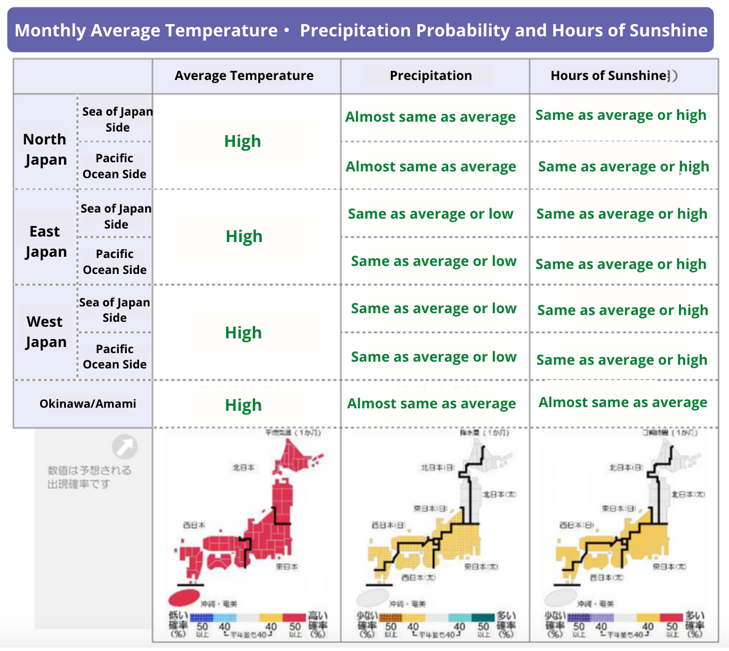
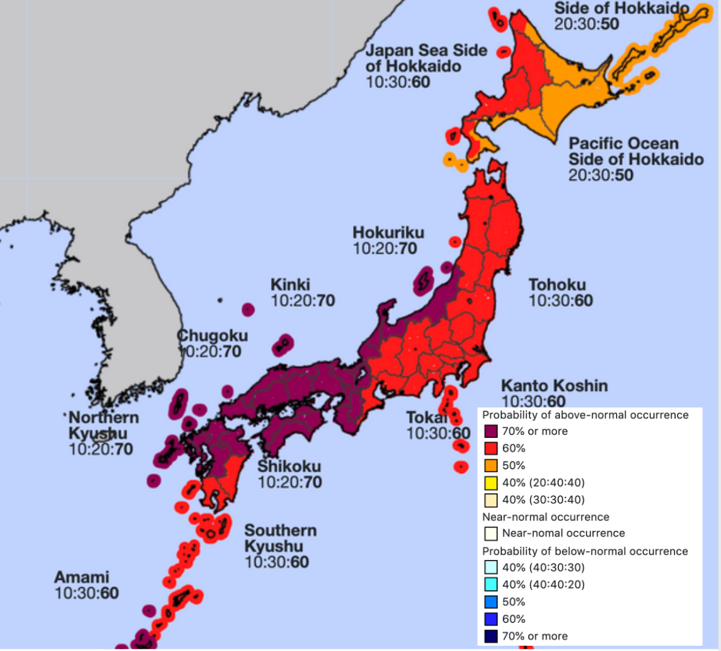
Higher than average temperatures seen nationwide.
JAPAN NRG WEEKLY
PUBLISHER
K. K. Yuri Group
Editorial Team
Yuriy Humber (Editor-in-Chief)
Tom O’Sullivan (Japan, Middle East, Africa)
John Varoli (Americas)
Sponsored
Regular Contributors
Mayumi Watanabe (Japan)
Daniel Shulman (Japan)
Takehiro Masutomo (Japan)
Saki Isetani (Japan)
Art & Design
22 Graphics Inc.
SUBSCRIPTIONS & ADVERTISING
Japan NRG offers individual, corporate and academic subscription plans. Basic details are our website or write to subscriptions@japan-nrg.com
For marketing, advertising, or collaboration opportunities, contact sales@japan-nrg.com
For all other inquiries, write to info@japan-nrg.com
OFTEN USED ACRONYMS
METI The Ministry of Energy, Trade and Industry
MOE Ministry of Environment
ANRE Agency for Natural Resources and Energy
NEDO New Energy and Industrial Technology Development Organization
TEPCO Tokyo Electric Power Company
KEPCO Kansai Electric Power Company
EPCO Electric Power Company
JCC Japan Crude Cocktail
JKM Japan Korea Market, the Platt’s LNG benchmark
CCUS Carbon Capture, Utilization and Storage
mmbtu Million British Thermal Units
mb/d Million barrels per day
mtoe Million Tons of Oil Equivalent
kWh Kilowatt hours (electricity generation volume)
NEWS: ENERGY TRANSITION & POLICY
Kishida Fumio voted in as LDP leader and Japan’s next prime minister
- Kishida’s win in the Sept. 29 in the second round against the favorite Kono Taro suggests no drastic changes from current energy policy. However, nuclear may be one big beneficiary.
- See the Analysis section for our full report.
Japan sets up scheme to prolong service of aging thermal plants as capacity shrinks
(Japan NRG, Sept. 24)
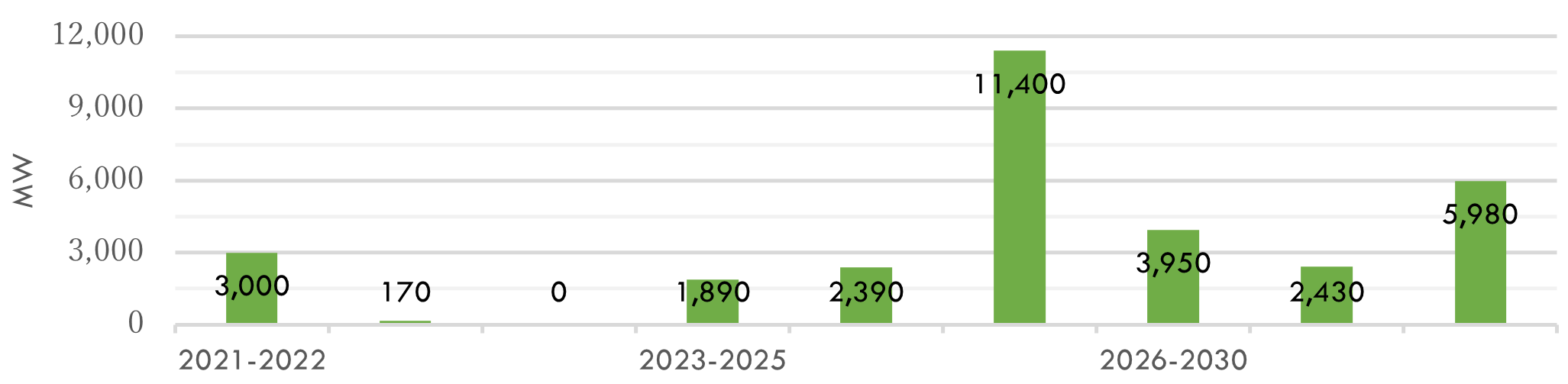
- By the end of 2022, Japan is due to lose 3.17 GW of thermal power capacity as aging plants close. So, with power supply-balance forecasts of shortages over the next few years, METI decided to launch a new “matchmaking” system to prolong the service of retiring plants.
- METI will allow electricity retail firms to offer bids to keep the facilities in business. If the offers are insufficient, the plants will close.
- To create this “matchmaking” process, METI will conduct a thorough review of each power unit that’s been scheduled by their owner for closure. At present, there’s 3 GW of LNG-fired capacity and 170 MW of coal-fired capacity due to close.
- Before being allowed to shutter the plants, operators will be asked to disclose all the key operating details and running costs to the grid oversight body, OCCTO. Based on this info, OCCTO will post online the cost of keeping the plant operational and other details, and open it to bids from other electricity companies.
- The first online matchmaking will start this or next month.
- METI will also continue to look for other ways to restart idled plants to secure more power capacity for FY2022. It’s encouraging local power suppliers in areas with shortages to cooperate to secure more capacity.
- CONTEXT: Both METI experts and OCCTO have warned that the Tokyo area, and other major urban centers will face power shortages over winter/spring in the next two years. In winter of 2023, Tokyo demand could outstrip supply by more than 2%, should the area experience a cold snap, according to OCCTO forecasts.
TAKEAWAY: Just a year after METI said it’d seek to close most coal-fired power plants, top grid officials now want to achieve the opposite. Based on OCCTO’s scenarios, the nation’s grid is simply not ready to ditch the old energy system because there is not enough new, clean generation to take its place. There are different ways to read it, but the numbers suggest there’s plenty of demand for new power capacity in Japan.
Scale of planned power plant closures: 2021-2030
Tokio Marine no longer insuring coal miners
(Kankyo Business, Sept. 27)
- As of October, Tokio Marine and Nichido won’t insure or finance coal development projects, making it the first Japanese insurance company to divest from the sector.
- Japan’s annual market for coal mining insurance is about ¥10 billion.
- CONTEXT: This makes the company Japan’s first insurer to pull out of the sector.
TAKEAWAY: The move by Tokyo Marine is likely to be followed by close rivals Sompo Japan and Mitsui Sumitomo. While the actions are very much in line with current trend to decarbonize, they are at odds with the power industry and government stance of trying to keep older coal-fired units online at least for the next few years in order to prevent capacity shortages. If the stations are kept, but their insurance and other support lapses, the cost of thermal power will rise.
Japan sets terms for offshore wind project bids in the Happo/Noshiro zone
(Japan NRG, Sept. 30)
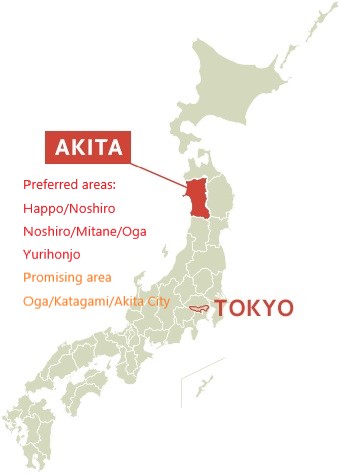
- METI disclosed the terms based on which operators will be selected to run offshore wind projects in the Happo Town and Noshiro City (Akita prefecture) zone.
- CONTEXT: This area was designated as a preferred promotional area for offshore wind a few weeks earlier, on Sept. 13.
- The terms include conditions that:
- The operator contributes 0.5% of revenue from power sales to a local community fund for a 20 year-period.
- The operator conducts studies on the potential impact from the project on the fishing community one year before the start of construction and honors the views presented by professionals close to the project and by the fishing community.
- The operator holds consultations with the fishing community and local boat operators on navigation rules in the waters around the offshore turbines.
- METI also clarified that the process of selecting operators for the promotion zone will take around eight months. The authorities will take two months to set area access rules and details. Pre-screening to determine the qualifications of the bidding company will take another two months. Final evaluations, with input from the Akita governor, the METI minister, the Minister of Land, Infrastructure and Transport and a third-party committee, will take three months.
The rules for Happo / Noshiro area also preclude applications from disclosing their project details before placing an official bid in order to avoid interactions with other applicants. This is different from the approach in previous wind zones.- Finally, applicants will need to describe their Covid prevention measures.
- The evaluation will be scored out of 120, 80 of which will represent an assessment of the technical specifications and the rest of the community engagement / relationship.
TAKEAWAY: The terms for this area seem more granular than in previous cases and more specific around surveys, ship navigation rules, and interactions with the local community.
Akita prefecture is now home to three of the five major offshore preferred zones set out by the government and it also has the Oga/Katagami/Akita City coastline that’s classified as “a promising area”. The latter signifies that consultations with the local community and field surveys are less advanced that in a “preferred zone”. There are seven coastal zones around Japan that are certified as “preferred”.
- SIDE DEVELOPMENT:
Hokkaido snubbed by government wind strategy
(Nikkei, Sept. 27)- Plans to build several wind farms off Hokkaido’s coast may come unstuck after it was revealed that not a single Hokkaido site made a recent METI list of promising sites for wind development.
- A similar list in 2020 classified Hokkaido sites Gan’u, Minami-Shiribeshi, and Hiyama as ‘likely to become promising in future’, but no Hokkaido sites made the grade this year; the honor instead went to Yamagata.
- To make the list, sites must demonstrate sufficient grid capacity.
- The large number of solar farms in Hokkaido means there’s little surplus grid capacity for wind generators; wind farms would have to settle for ‘non-firm’ grid connections that enable them to sell electricity at off-peak times.
TAKEAWAY: TEPCO is one of the companies seeking to build an offshore farm in the Happo / Noshiro zone (See the Power Markets section for details). Given the propensity of METI to give TEPCO a leg-up at many occasions, it would not be a surprise to see the fastest developments occur in zones where TEPCO is bidding.
Environment Ministry publishes general policies on scrapping offshore wind facilities
(Japan NRG, Sept. 30)
- The MoE has published the general policies on scrapping fixed foundation offshore wind turbines based on proposals from an expert panel.
- The policies allow for some equipment to be dumped in the sea due to the technical challenges of bringing it onshore. Operators will need to get prior ministry approval to make sure the action has limited environmental impact.
METI publishes risk management principles for the power sector
(Japan NRG, Sept. 24)
- A METI panel drafted a set of risk management principles for the power sector that are based on lessons from the January electricity price spike.
- The principles are not legally binding, but describe best practices for power firms to cope with unexpected events in the market. The ministry urges operators and retailers to spend time to identify and analyze supply side risks and to consider the potential for capacity to come offline.
- Over half of power retailers haven’t assessed the impact of spot market volatility, the panel on electricity and gas policy said in its principles document draft.
- The panel also suggested the formation of a group for retailers to negotiate with power generators and to oversee changes in the supply and demand balance.
- SIDE DEVELOPMENT:
EGC wants to revise power retail guidelines on market-linked rates
(Japan NRG, Sept. 24)- The Electricity and Gas Market Surveillance Commission (EGC) proposed to alter the guidelines for power retailers following consumer complaints over the price increase in January, when the electricity price suddenly spiked.
- The regulator wants retailers to provide written communication to consumers describing the risks associated with tariff plans that are linked to wholesale prices. The officials want consumers to be able to check the rate changes.
TAKEAWAY: The fallout from the power price spike in January continues and is all the more pertinent given the chance of a repeat this winter. Although METI’s surveys suggest many power retailers are still not taking adequate measures to protect their price risk exposure, in the event of a crisis the officials want to be able to say that everyone had been warned. The recent defaults of several UK power and gas retailers should act as another warning for companies in Japan.
Environment Ministry to subsidize 19 JCM projects in 2H 2021
(Japan NRG, Sept. 28)
- The MoE will subsidize 19 carbon reduction projects in six countries under the Joint Credit Mechanism (JCM) framework for the second half of this year. The projects promise to cut 100,000 tons of CO2/ year.
- Almost half of the projects involve installing solar panels at manufacturing plants.
IMO to release guidelines for carbon neutral shipping
(Kankyo Business, Sept. 24)
- The International Maritime Organization, the UN agency responsible for preventing marine pollution, began debating guidelines for assessing maritime greenhouse gas emissions.
- Japan, Australia and Norway proposed a scheme distinguishing between land-based greenhouse gas emissions (fuel production and supply) and emissions at sea, thereby preventing them being counted twice.
Tidal generation gets boost as Kyushu Electric touts its commercial promise
(Nikkei, Sept. 24)
- Kyushu Electric subsidiary Kyuden Mirai Energy recently began generating electricity from a tidal generation system installed in Nagasaki.
- Other operators, including Chubu Electric, have started investing in overseas tidal generation schemes.
- It’s estimated that Japanese waters could generate as much as 4 GW of tidal electricity.
- Electricity generated from tidal energy is less subject to fluctuation than that from solar or wind farms. Additionally, tidal generation systems, being underwater, do not raise issues of visual pollution.
- On the downside, tidal generation systems are not readily scalable.
J-Power touts new form of carbon storage under the sea via hydrates
(Newswitch, Sept. 27)
- J-Power is working on technology to store sequestered CO2 on the seafloor as CO2 hydrates–a technology that has so far received little attention.
- Comprising combinations of one molecule of CO2 and six molecules of water, CO2 hydrates are denser than water and do not rise to the surface.
- The technology involves first depositing a layer of solid CO2 on the seafloor to act as a barrier. Additional CO2 can then be injected under the barrier.
- The Research Institute of Innovative Technology for the Earth estimates 150 billion metric tons of CO2 could be stored around Japan as hydrates.
Tokyo governor may make rooftop solar mandatory
(Nikkei, Sept. 28)
- Tokyo Governor Koike Yuriko is considering making photovoltaic panels mandatory on new residential buildings.
- In future, the government will debate what section/building sizes would be subject to the new rules and when the rules should come into effect.
- The national government has set a target of having PV panels fitted to the roofs of 60% of all new residential buildings by 2030.
Mitsui to invest over ¥100 bn in Australian blue ammonia plant
(Nikkei Shimbun, Oct. 1)
- Trading house Mitsui & Co. plans to invest more than ¥100 billion to build a “blue” ammonia production plant in Western Australia. The plant would ship 1 million tons of the fuel to Japan annually.
- The ammonia would be produced with natural gas from a nearby gas field, in which Mitsui has a 50% stake. The CO2 generated during the process of converting natural gas to ammonia will be extracted, compressed, and stored in a waste gas field nearby.
- Mitsui hopes to start ammonia exports to Japan in 2028.
- Wesfarmers, an Australian conglomerate that already operates an ammonia plant in Western Australia, will work with Mitsui on the project, and Japan’s state-backed JOGMEC Corp. will be involved in the CO2 storage part.
Kyushu Electric partners with Yara to develop blue and green ammonia
(Company statement, Sept. 27)
- Kyushu Electric signed an accord with Yara International (Norway), the world’s largest manufacturer of nitrogenous fertilizers, to collaborate on both blue and green ammonia.
- The two companies will discuss (1) the establishment of a supply chain from production of clean ammonia to its use at power plants, and (2) the establishment of a receiving and shipping system for clean ammonia to be widely used in the Kyushu area.
- CONTEXT: Kyushu Electric hopes the alliance will enable it to establish supply for ammonia that will be used for co-firing at LNG power plants.
Toshiba works with Brazil’s CBMM to commercialize next-gen batteries
(New Energy Business News, Sept. 28)
- Toshiba and trading house Sojitz signed an agreement with Brazil’s CBMM for the commercialization of next-generation lithium-ion batteries (LiB) using niobium-titanium oxides (NTOs).
- NTO is a material with twice the theoretical volume capacity density compared to graphite, which is generally used as a negative electrode material for LiB.
- CBMM already has a contract with Volkswagen Kaminyois y Onibus, a developer of electric trucks in Latin America, and will demonstrate its next-generation LiB using NTO. Toshiba and Sojitz will cooperate in this demonstration and gather the data.
- Niobium is mainly used as an additive in high-grade steel materials such as high-strength steel and stainless steel. CBMM is the world’s biggest producer and seller of niobium. Sojitz is a shareholder in CBMM and the Brazilian firm’s distributor in Japan.
Kirin to install solar panels at all Japanese factories
(Smart Japan, Sept. 29)
- Kirin Beer will install photovoltaic panels at its Hokkaido, Ibaraki and Okayama factories in a bid to increase to over 30% the percentage of its electricity that’s renewably generated.
- Work to install the panels will be completed by January.
Sumitomo consortium retrofits diesel buses as EVs and starts trials
(New Energy Business News, Sept. 30)
- A consortium led by Sumitomo Corporation and Nishi-Nippon Railroad is preparing to trial electric buses at Nishi-Nippon’s Island City depot.
- The trial will begin in October and will evaluate bus performance and optimum charging practices.
- The trial will be expanded to additional depots.
- The buses are secondhand diesel-powered buses retrofitted with electric motors and batteries.
- Each bus has a 235 kWh lithium-ion battery, giving it a 150 km range.
JGC selected to research protocols for reporting GHG
(New Energy Business News, Sept. 30)
- JGC was chosen by JOGMEC to research protocols to measure, report and verify (MRV) greenhouse gas emissions and carbon intensity.
- Recent years have seen increased interest in procedures that ensure an accurate and transparent MRV process.
Tokio Marine developing battery management system
(Kankyo Business, Sept. 24)
- In collaboration with Waseda University start-up EC Sensing, major insurance company Tokio Marine and Nichido began work to commercialize a diagnostic system for storage batteries. The system is designed to increase the useful life and efficiency of these batteries.
- Tokio Marine will bundle the system with ESaaS (Energy Storage as a Service) services aimed at drivers of EVs.
One-Dot News:
- Shopper Kawasaki Kisen said it will procure eight LNG-fueled car carriers by 2025 in order to lower emissions (Kankyo Business, Sept. 24)
- Osaka Gas said its subsidiary has created an on-site system “D-Bio Methane” that processes food waste into biogas. The system will be available for installation at customer facilities. (Company statement, Sept. 27)
- Rubber and plastics maker Toyoda Gosei is investing in E-Thermogentech, a Japanese start-up with technology that converts waste heat from manufacturing into electricity. (Kankyo Business, Sept. 27)
- Asahi Kasei said it formed a joint venture with Shanghai EMCORP for the production of dry-type separators used in lithium-ion batteries. The Chinese partner will own 51% of the venture. (Kankyo Business, Sept. 27)
- Gunma Bank has established a ¥50 billion fund (both for investments and loans) called the GB Green Fund, which will support a wide range of efforts to popularize and promote renewable energy. (Kankyo Business, Oct. 1)
- The MoE has developed an online game to promote carbon reduction initiatives. It made the game available during the Tokyo Game Show VR 2021 event that ran from Sept. 30 to Oct. 3. (Japan NRG, Sept. 30)
WEATHER OUTLOOK
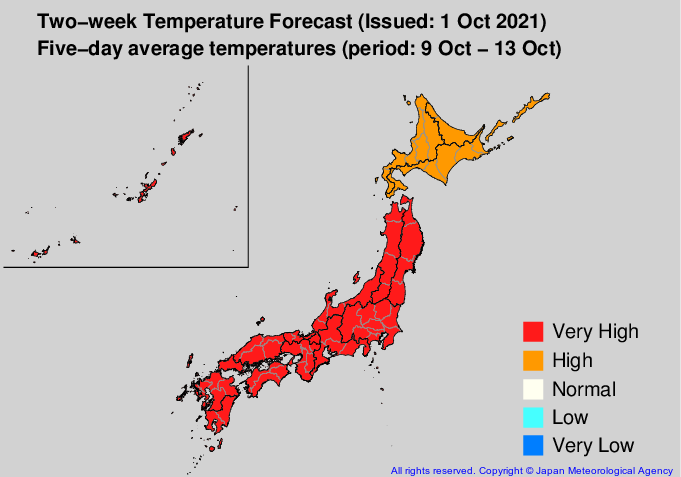
TWO-WEEK TEMPERATURE FORECASTS (OCT. 1 ~ OCT. 13)
Nation-wide
 |
Tokyo area
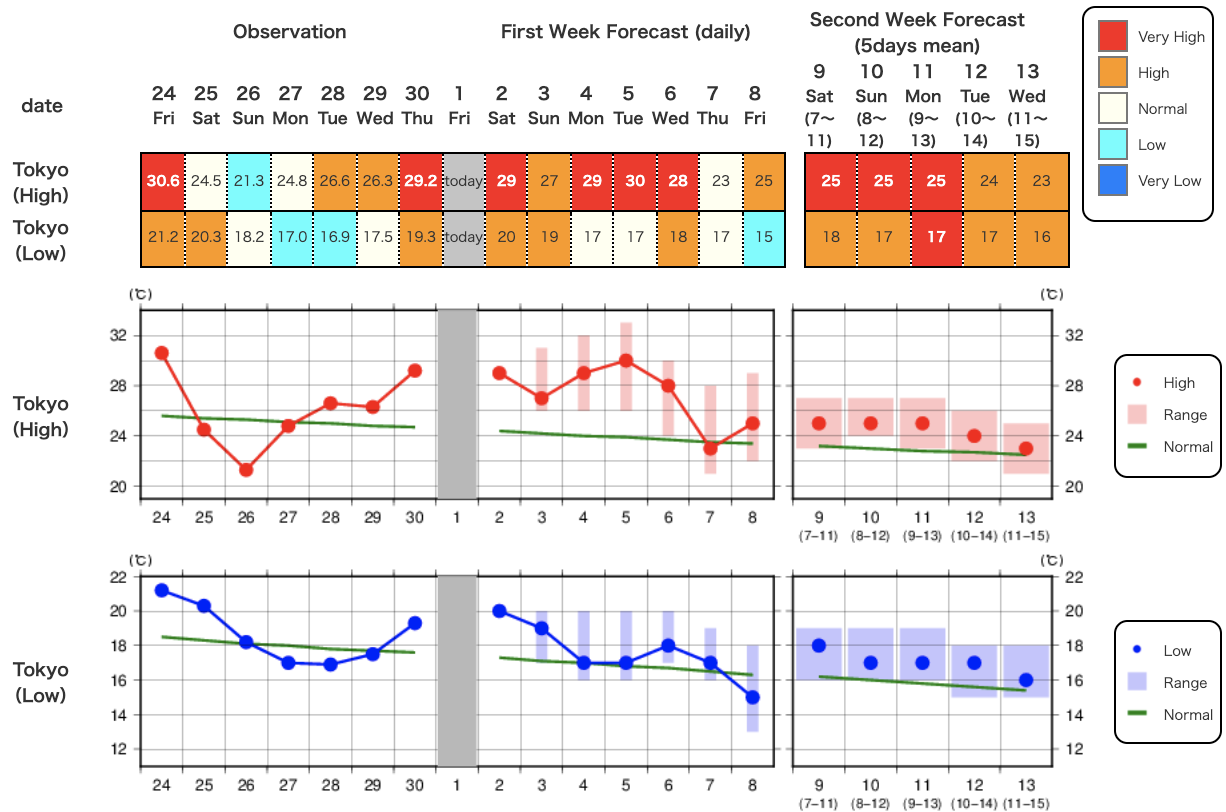
- Hokkaido: Higher than average temperatures until Oct. 6, then cooler weather
- Northern Japan/central Kanto region: warm, higher than average temperatures
- West Japan/Okinawa, Amami region: hot and humid; higher than average temperatures
ONE-MONTH SEASONAL FORECAST (OCT. 2 ~ NOV. 1)
NEWS: POWER MARKETS
| No. of operable nuclear reactors | 33 | Electricity Price | Friday, Oct. 1 | % Change WoW | ||
| restarted | 10 | JEPX 24-Hour Spot | ¥10.02/ kWh | +14.4% | ||
| in operation today | 9 | TOCOM Oct. baseload (Tokyo area) | ¥8.70/ kWh | +5.1% | ||
Source: JANSI and JAIF, JPX, and JEPX, as of Oct 1, 2021
Cheaper daytime electricity on the cards as METI wants more client options
(Nikkei, Sept. 27)
- METI is considering forcing utilities to offer subscribers the option of cheaper electricity during periods of maximum sunlight to better utilize surplus electricity from solar farms.
- Currently, output restrictions mean that solar generators are often unable to generate maximum output during sunny periods. In 2019, output from solar farms was restricted on 74 days of the year for this reason.
- SIDE DEVELOPMENT:
ANRE studies ways to limit curtailment of renewable energy output
(Japan NRG, Sept. 30)- The Agency of Natural Resources and Energy is studying new mechanisms to improve day-to-day control over supply and demand electricity balances in order to allow for wider use of variable renewable energy.
- Among the measures are more efficient curtailment procedures, having more renewable energy capacity available online to create a faster response, decreasing the minimum power generation levels for thermal and biomass plants, using more storage batteries, and increasing power transmission bandwidth.
- ANRE plans to finalize its studies and recommendations by the end of 2021.
- CONTEXT: Curtailment of solar and wind capacity in some regions is wasting as much as two-thirds of output on certain days, as well as costing operators profits.
JERA to invest $1.58bn in Philippine utility Aboitiz
(Nikkei Asia, Sept. 27)
- JERA will invest $1.58 billion in the top Philippines utility, Aboitiz Power. The Japanese LNG importer and power utility will own about 27% of Aboitiz.
- Philippines is a fast-growing power market, and it’s transitioning away from coal to cleaner fuels. Aboitiz has just 4.6 GW of power capacity today, but expects to double that by 2030 with almost 50% of the new total coming from renewable sources.
- JERA said it will offer the Philippines utility both its thermal power and clean energy experience, for example switching coal generation to ammonia.
- JERA said it believed that LNG or renewable energy alone cannot drive decarbonization effectively in the Philippines.
- CONTEXT: Philippines is also a growth market for LNG, which opens opportunities for JERA to secure a solid customer base.
Japan Wind Development submits plans for 500 MW offshore wind farm in Yamagata
(New Energy Business News, Sept. 27)
- Japan Wind Development published the environmental assessment manual for the Yusa Offshore Wind Power Project, which aims to create 500 MW of capacity via fixed bottom turbines off the coast of Yamagata prefecture.
- Construction would start in April 2026 and operations in April 2028.
- The project would be spread across an area of 3,420 ha. with 36 to 46 turbines (9.5 MW to 15 MW) installed.
TEPCO bids to build a 396 MW offshore wind project in Happo Town / Noshiro zone
(New Energy Business News, Sept. 28)
- TEPCO Renewable Power (TEPCO RP) plans to develop an offshore wind farm with a maximum capacity of 396 MW in Yabine-cho, Akita prefecture. It submitted an environmental assessment report for the project on September 27.
- The project area is about 46 km2 off the coast of Happo Town and Noshiro City. A maximum of 26 wind turbines with an output of 9,500 kW to 18,000 kW would be installed.
- Construction is scheduled to begin in or after fiscal 2026 and operation is scheduled to start in or after fiscal 2027.
Vena Energy seeks to build onshore wind farm in Aomori prefecture
(New Energy Business News, Sept. 30)
- Vena Energy plans to develop a wind power plant in Sannohe Town, Aomori prefecture. The company has submitted an environmental assessment report on September 22, which notes that the project will have a maximum capacity of 64.5 MW.
- The project area is approximately 883 hectares in the town of Sannohe and the village of Shingo. The maximum number of wind turbines to be installed is 20, ranging from 4,200 kW to 5,500 kW. Construction is scheduled to start in May 2026, with operation to begin at the end of April 2028.
Tokyo Gas and partners sell 240 MW gas-fired power station in Japan
(Nikkei, Sept. 30)
- The gas-fired Yokosuka Power Station, jointly owned by Tokyo Gas, Shimizu, and TEPCO subsidiary Tokyo Electric Generation, was sold to Kyoto-based Fbit Communications for an undisclosed sum.
- The station is currently idle, but has a nominal output of 240 MW.
- The station will give recently-established electricity retailer Fbit more control over the price it pays for electricity during times of peak demand.
TEPCO wins contract to develop Laos project
(Jiji, Sept. 24)
- A consortium led by TEPCO Power Grid signed an agreement with the Japan International Cooperation Agency to lead a project to improve the management of Electricite Du Laos Transmission Company (EDL-T), the entity responsible for electricity transmission in Laos.
- EDL-T is faced with an urgent need to sell its high-tension transmission division, sign electricity purchase agreements with nearby countries, and formulate a strategy and business plan to bolster its transmission business.
Chugoku Electric and Ecostyle collaborate on solar power purchasing
(Kankyo Business, Sept. 27)
- The Chugoku Electric Power Company is partnering with Osaka-based Ecostyle to provide services that allow operators of remotely-located solar farms to use Chugoku Electric’s network to virtually transmit electricity generated to their own facilities.
- Known as ‘power purchasing agreements’, such services are an important weapon for commercial operators trying to reduce carbon footprints.
Fukushima orchards not receiving promised compensation
(Mainichi Shimbun, Sept. 18)
- Orchard operators whose reputation was damaged by the Fukushima nuclear disaster get less compensation than TEPCO initially promised,
- In some cases, the amounts of compensation offered are nearly 10 times less than promised.
- TEPCO changed the formula used to calculate compensation to orchards in 2019 to one based on the average market price for fruit in the five years before the accident.
TEPCO needs to get serious about reform
(Nikkei editorial, Sept. 25)
- CONTEXT: The Nikkei is Japan’s most influential business media.
- Restarting the Kashiwazaki-Kariwa plant in Niigata prefecture is vital as TEPCO misses out on ¥50 billion of annual revenue. This money is needed to fund Fukushima’s rebuild and compensate those affected by the disaster.
- TEPCO’s lax attitude to safety betrays the trust of the Niigata community.
- The drop in morale in the company, exemplified by similar compliance breaches regarding seismometers at Fukushima, is cause for concern.
NUCLEAR REACTOR NEWS ROUND-UP:
- NRA to inspect Kashiwazaki Kariwa NPP after failure of anti-terrorism measures
(Niigata Nippo More, Sept. 30)- CONTEXT: TEPCO submitted a report to NRA on Sept. 22 after a series of safety breaches of the site’s anti-terrorism measures.
- NRA concluded that the operator’s report was insufficient, and that it will conduct a full-scale inspection itself. The inspection will last more than a year.
- NRA chair Fuketa criticized TEPCO’s report as superficial and lacking specificity. Fuketa was skeptical if the implementation of the actions outlined in the report will translate into an improved corporate culture.
- This may delay the restart schedule for Unit 7.
- SIDE DEVELOPMENT:
TEPCO discovers more faulty filters in Fukushima water processing system
(Tokyo Shimbun, Sept. 27)- TEPCO announced it discovered the failure of 32 of the glass fiber filters in the advanced liquid processing system (ALPS), which treats irradiated water at the site of the wrecked Fukushima nuclear plant.
- Earlier inspections revealed that 29 filters had failed.
- TEPCO will investigate the cause and conduct inspections for the other 200 facilities at the Fukushima site.
- SIDE DEVELOPMENT:
Taiwan to send expert team to review Fukushima treated water release plan
(Focus Taiwan News Channel, Sept. 27)- Taiwan’s Atomic Energy Council (AEC) to send expert team to review plans to discharge treated radioactive water into the ocean.
- Japan agreed to this and is discussing the visit date with the Taiwan side.
- While Taiwan is not part of the IAEA expert team that will conduct its review in December, AEC says the inspection will be done according to IAEA standards.
- SIDE DEVELOPMENT:
Japan’s nuclear hydrogen reactor (HTTR) finishes new safety regulation upgrades
(Tokyo Web News, Sept. 30)- Japan Atomic Energy Agency (JAEA) completed safety regulations upgrades at the High-Temperature Test Reactor (HTTR) in Oarai, Ibaraki prefecture.
- JAEA will conduct joint research at the reactor, which can also be used for hydrogen production, together with six countries starting from Jan. next year.
NEWS: OIL, GAS & MINING
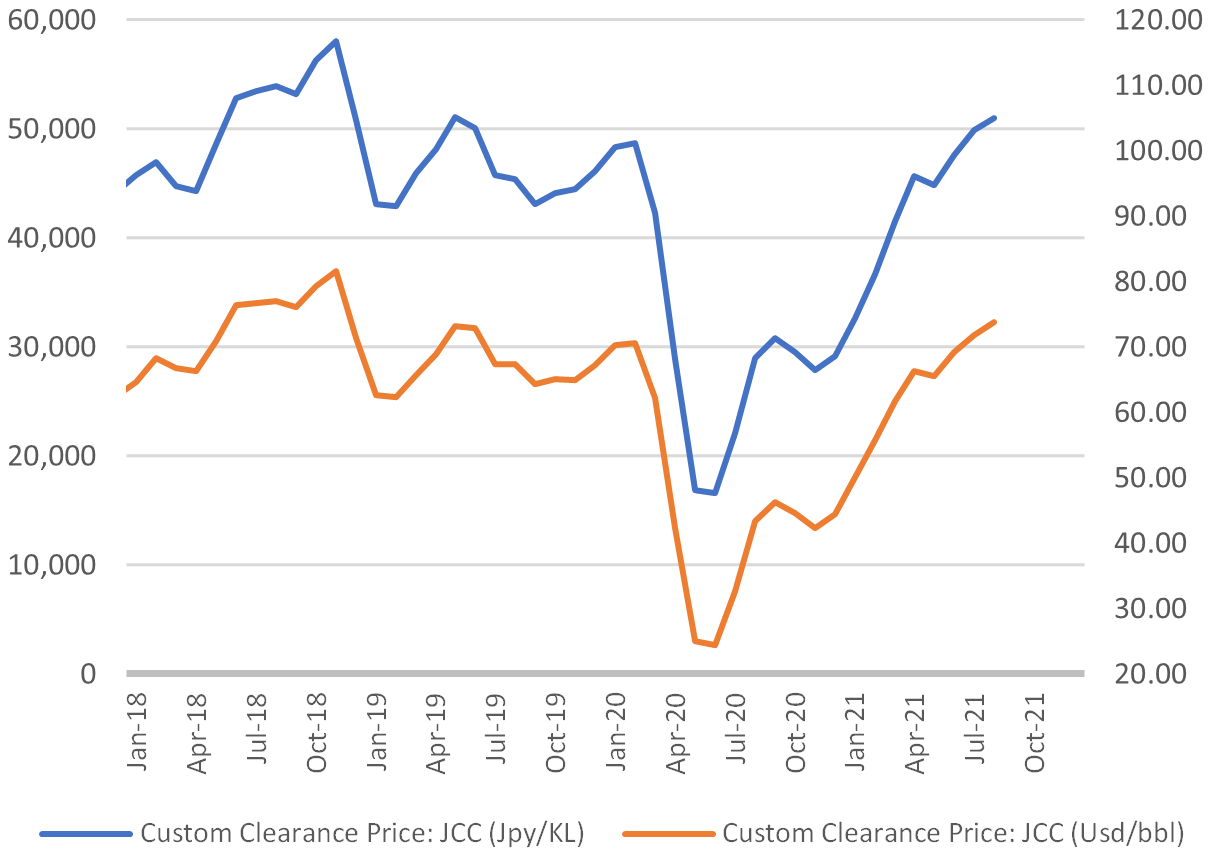
Japan Oil Price: $73.76/ barrel
Japan (JLC) LNG Price: $9.90/ mmbtu
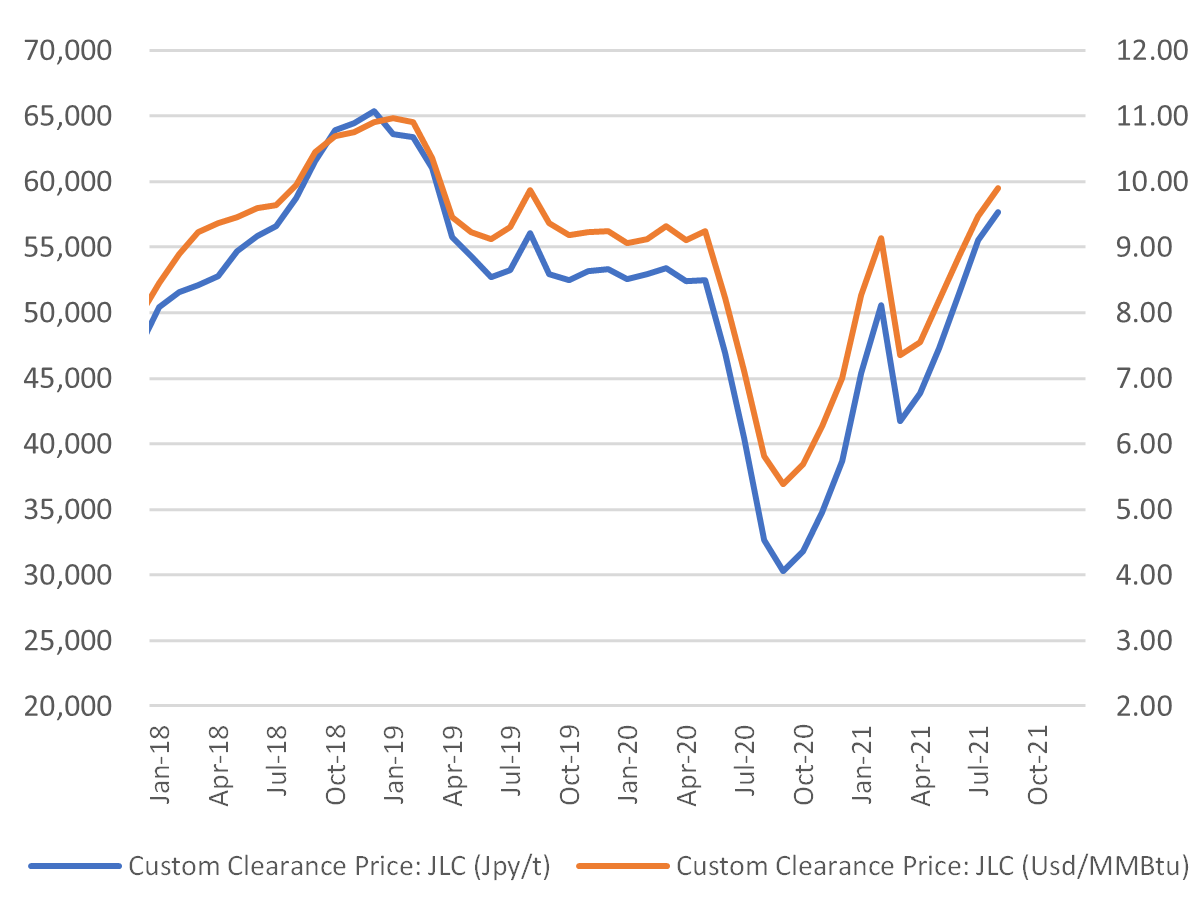
Japan continues to show appetite for small LNG cargoes from Africa
(Japan NRG, Sept. 30)
- Japan continued to buy small LNG volumes from African sellers after losing suppliers from Peru LNG in May due to production issues.
- In August, Japan imported 65,368 tons of LNG from Egypt and 62,419 tons from Nigeria, after buying 67,582 tons from Guinea in June.
- CONTEXT: Japan seldom takes such small import volumes, the equivalent of one ship cargo, preferring to work with regular sellers on a series of deliveries.
- Imports from Peru amounted to 533,846 tons over January-April this year, and totaled 626,668 tons in 2020.
- Japan’s biggest LNG supplier is Australia, followed by Malaysia. Twelve countries sold 6.3 million tons of LNG to Japan in August.
Oil: market for spot contracts dries up
(Nikkei, Sept. 28)
- The volume of oil spot contracts traded on the Tokyo Commodity Exchange this year to August fell over 90% on the same period last year.
- The COVID pandemic is not the only reason for the slump.
- Restructuring in the petrochemical sector caused a dramatic reduction in the volume of discount petroleum commodities released to the market.
- Consolidation in the industry means that all supply is now controlled by ENEOS Holdings, Idemitsu, and COSMO Energy Holdings.
Drones to monitor gas pipelines
(Nikkan Kogyo Shimbun, Oct. 1)
- Saibu Gas Holdings will commence a feasibility study into the use of drones to inspect gas pipelines.
- The utility operates over 140 km of high-pressure pipelines, which are currently inspected physically by personnel.
- Saibu already deploys drones in other areas of its operation, and says the technology improves efficiency.
ANALYSIS
BY TAKEHIRO MASUTOMO
Choice of Mr. Kishida as Japan’s Next Leader Means
A Step Back from Drastic Changes in Energy Policy
Japan will not ditch nuclear, and the energy mix will continue to be diversified: those are the key signals from last week’s ruling party leadership race that produced Japan’s next prime minister.
The win by former foreign affairs minister Kishida Fumio was a vote against radical shifts in current energy policy, rejecting both anti-nuclear and renewables-sceptic candidates. The strong focus on social equality in Kishida’s platform also suggests that his approach to the energy transition would prioritize affordability and seek to avoid major job losses and other disruptions.
Outgoing PM Suga lasted only a year in the job, but his surprise announcement that Japan will move to decarbonize is certain to continue. Suga’s Green Growth Strategy championed the development of an offshore wind sector, while expanding on earlier hydrogen policies and urging faster transitions to clean energy for manufacturers.
While Suga’s main tenets will stay, Kishida’s immediate challenge will be to bridge the ideological rifts that have dogged Japan’s energy debate over the past year. He won’t have much time to accomplish that. The latest Basic Energy Plan, now in public review, is due for Cabinet approval in mid-October. Also, key global forums such as the G20 in Rome and COP26 in Glasgow are only weeks away.
Most importantly, Kishida will soon face a general election. He’ll want to keep all sides hopeful. Even if he attends COP26, his message is more likely to be aspirational than concrete.
Industry Friendly
Kishida was born into a political family in Tokyo. Both his father and grandfather had close ties to the “Kochikai” faction in the ruling Liberal Democratic Party (LDP) that prioritizes the economy, and which has links to the METI predecessor, Ministry of International Trade and Industry (MITI). Kishida has led this mid-sized faction since 2012.
It is also noteworthy that Kishida’s bureaucrat-turned-politician father was once appointed as chief of the state SME Agency. Kishida himself has often advocated for SMEs and industrial sectors. His constituency (Hiroshima, 1st District) is located near the HQ of automaker Mazda. Tellingly, he had an arranged marriage with a former Mazda employee.
Between 2012-2017, Kishida served as Foreign Minister in PM Abe’s Cabinet, and later he was assigned as chairperson of the LDP’s core Policy Research Council, suggesting that he has an understanding of a number of fields. Still, his key political ambitions have long remained unclear.
His first book, Kishida Vision, published in 2020, gave some glimpses of policy direction and a brief outlook on energy. “In the future, renewable energy sources such as offshore wind, geothermal, and solar power should be the main sources of power, and dependence on nuclear should be reduced,” Kishida wrote. This position would later deviate from the one he took during the LDP race.
In the book, he also called for Japan to become a leader in environmental issues. From an industrial policy perspective, he argued that Japan should contribute to the world by developing technologies for electricity storage, hydrogen, CCSU, and new materials with low environmental impact such as gallium nitride, a compound used for semiconductors. Kishida also said he believes the government should invest in these areas.
Kono Vs Anyone-But-Kono
As the four candidates vied for leadership of the LDP, a surprisingly large portion of their debates and media coverage centered on energy policy. In part, this was because frontrunner Kono Taro had been openly anti-nuclear throughout his career, while supporting maximum use of renewables, an unusual position in a party that had always stood behind nuclear.
Rival candidate Takaichi Sanae took an almost opposite stance to Kono. The former home affairs minister, promoted by former PM Abe, strongly backed more use of nuclear tech while casting doubt on the extent to which Japan should embrace variable renewable sources such as solar.
This debate extends beyond electricity. Japan’s nuclear policy includes support for the nuclear fuel cycle – the idea that used fuel can be recycled many times before expiry. However, this vision has proved challenging to achieve technically, as well as very expensive. It also involves the handling of plutonium, a material that can be deployed in weapons. For all that, the nuclear fuel cycle is a technological and security issue that binds Japan and the U.S. Raising questions about this inside the LDP has been almost taboo. And so Kono’s opposition to nuclear power, which he somewhat dialed back during the campaign, raised concerns not only among those involved in nuclear energy.
It’s telling that Takaichi managed to grow support as the campaign went on partly based on her rhetoric around nuclear energy.
As Kono and Takaichi clashed over nuclear and renewables, Kishida kept the middle ground. Kishida vowed he would proceed with the restart of nuclear plants across the nation and he defended the nuclear fuel cycle, but also stressed his backing for the maximum deployment of renewable energy, particularly regarding R&D into storage batteries.
Kishida even declared that his administration would put forward a “national strategy for nuclear energy”, and lent support for new nuclear technologies, such as SMRs.
The reason Kishida’s stance was more accommodating on nuclear than in his 2020 book seems largely due to who supported his election.
Business-connected LDP heavyweight Amari Akira publicly welcomed Kishida’s entry into the race. Of the 20 lawmakers needed to officially launch a leadership bid, Kishida got the support of current METI minister Kajiyama and other junior MPs known for energy and nuclear expertise.
Kishida gained ballots from the top two fractions, which are largely under the control of former PM Abe and his longtime ally and deputy PM, Aso Taro.
Big business also backed Kishida, or at least anyone but Kono. Keidanren’s chairman voiced his support for Kishida before the campaign even began. The President of Toyota, who also heads the Japan Automobile Manufacturers Association, made skeptical comments about the pace of the EV rollout that seemed like a veiled dig at Kono.
Energy industry groups, such as the Federation of Electric Power Companies, openly spoke of “any candidate but Kono”, while former top METI executive Imai Takaya, now an adviser to Mitsubishi Heavy Industries, reportedly joined Kishida’s camp as a policy advisor and pushed a message to the business world that Kono will dismantle Japan’s nuclear industry.
Kono’s renewables-first position was painted as an unbalanced vision for Japan’s energy grid and one that could disrupt electricity supply. Kishida won for his portfolio approach.
Of course, the view of LDP members, and even big business executives, is not the same as that of the general public. Still, recent opinion polls show anti-nuclear sentiment is waning since the post-Fukushima period when it spurred mass street demonstrations.
In a recent poll for the left-leaning newspaper, Asahi Shimbun, 48% of respondents said the next prime minister should denuclearize the energy sector, while 40% said this is not necessary.
While local governments make the final decision on reactor restarts, many will look to the prime minister and his government for a sense of direction.
So far, Kishida’s reported picks for his Cabinet suggest state backing for pro-nuclear policies will remain and probably accelerate. Aspirations to grow other non-fossil-fuel sources will also remain.
On Oct. 8, Kishida will deliver a general policy speech in the Diet. At the same juncture last year, Suga announced the commitment to decarbonization.
Until Kishida secures a majority for his party in a general election, however, he is more likely to say that various options can be considered for Japan’s future energy policy.
See next page for a table of energy platforms of the top three candidates in the LDP race.
KONO TARO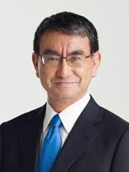 | KISHIDA FUMIO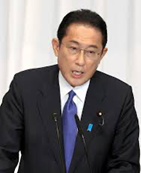 | TAKAICHI SANAE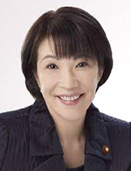 | ||
| Anti-nuclear energy, renewables advocate | Business friendly, status quo candidate | Nationalist, pro-nuclear, renewables skeptic | ||
| Original stance on nuclear power | Phase out nuclear power; abolish the nuclear fuel cycle | Gradually reduce reliance on nuclear energy | Promote wider use of nuclear energyConsider merging Japan’s nuclear assets
Invest in SMR and fusion reactors | |
| Stance on nuclear during the campaign | Allow the restart of existing reactorsAbolish nuclear fuel cycle
No new reactor construction | Promote the restart of existing reactorsCautious on building new reactors
Maintain nuclear fuel cycle system Invest in development of SMRs Need to make a national nuclear strategy | Need new reactors to replace old onesDevelop fusion reactors as a national project
Against ocean release of “Fukushima” water | |
| Original stance on renewables | It’s a cheaper energy sourceNeed to bolster power grid
Pro-reform of energy system | Should be the primary energy source | Solar may be potentially harmfulWill promote biomass | |
| Stance on renewables during the campaign | Renewables are the top priorityDevelop storage batteries
Strengthen power grid Promote off-shore wind | Maximize the use of renewablesDevelop hydrogen and storage batteries | Solar and wind are unreliableNeed to form a single Environment and Energy Agency
Carbon tax should be an option | |
| Support for 2050 net-zero target | Yes | Yes, but possibly with variation in approach | ? | |
| Would modify latest Basic Energy Plan? | Wanted more positive wording around renewables target | ? | Yes, to lower the renewables targets | |
| Political Allies | Suga, Koizumi, Ishiba, (Aso) | Amari, Kajiyama, (Abe), (Aso) | Abe |
Source: Candidate’s books and campaign materials, media reports
ANALYSIS
BY SAKI ISETANI
Japan Seeks a New Cement Recipe to Tame Major CO2 Emitter
As the main raw material for concrete, cement is responsible for 4% of Japan’s total CO2 emissions. To tackle the issue and improve the industry’s green credentials, Japan is switching to a new recipe that promises to suck up more CO2 than it emits.
Several groups of private Japanese companies and scientific institutions recently developed new cement and concrete techniques that create material from CO2, or that absorb it. One such innovative cement, developed by Taisei Corp, claims to lock up to 170 kg of CO2 per cubic meter of concrete, which gives the material a negative carbon footprint.
Together with applying carbon capture systems, the government hopes such innovations will accelerate the decarbonization process of domestic construction firms, which lately has been slowing.
The roadmap for greening cement is part of the broader “Environment Innovation Strategy” that METI launched in January 2020, and which aims to leverage low-carbon emission technologies in heavy-emitting sectors.
Source: Japan Cement Association
Background
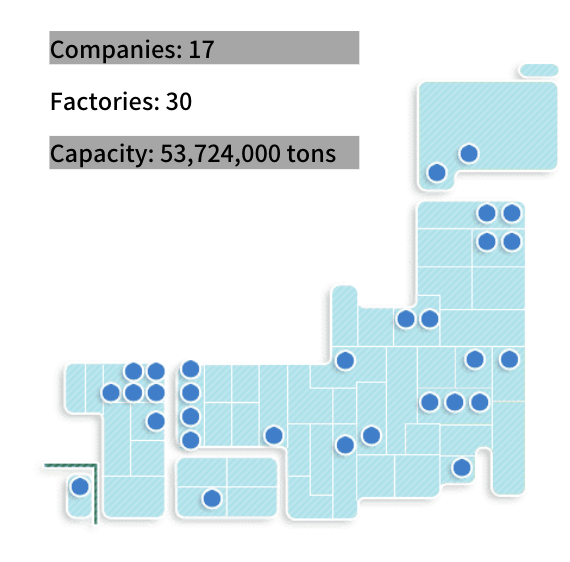
As of 2021, Japan has 30 cement factories, with an annual cement clinker production capacity of about 53.7 million tons. The Kanto district is the nation’s largest cement production center, with six plants.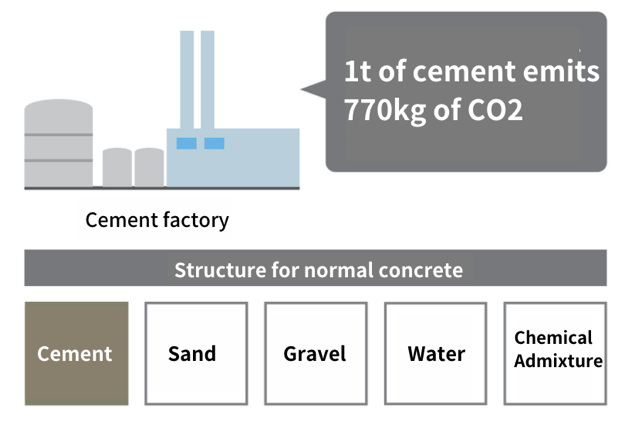
Source: The Japan Federation of Construction Contractors
Why decarbonize cement?
After power-generation and steelmaking, cement production is one of Japan’s largest CO2 emitters. In 2014, the country’s annual concrete shipments were around 90 million cubic meters. Since concrete production generates up to 300 kg of CO2 per cubic meter, the annual CO2 emissions were around 27 million tons.
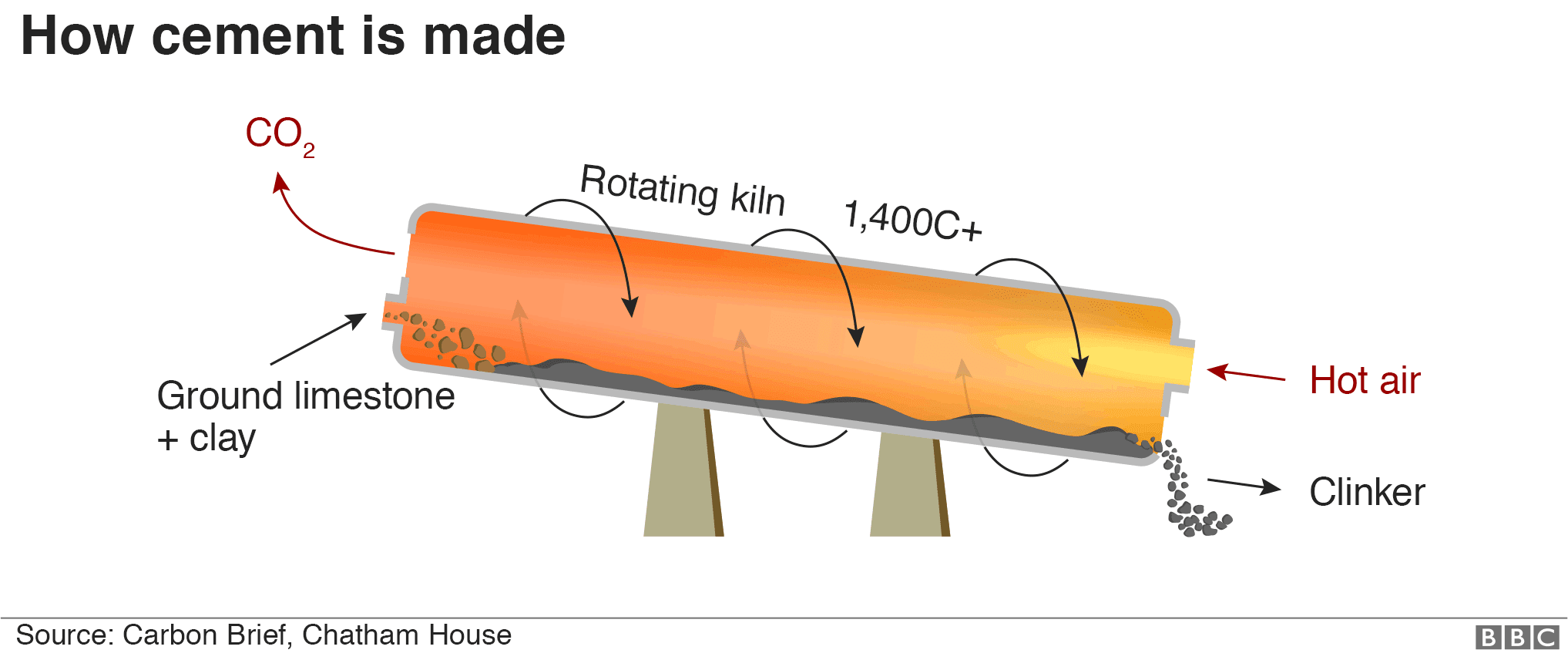
About 60% of these emissions appear during the “calcination” reaction, in which limestone (CaCO3) is broken down into CO2 and calcium carbonate (CO3) to produce “clinker”. The rest are energy-related emissions, mainly from the electricity needed to power the manufacturing process.
As such, the bulk of cement’s decarbonization will be found in applying green technology to its production process, especially during the firing of limestone.
Targets and achievements
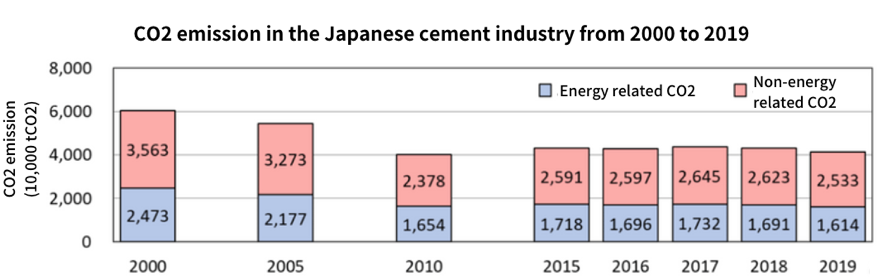
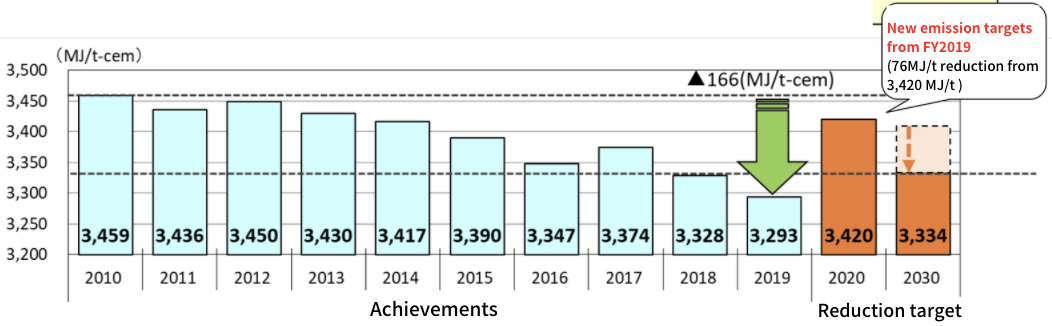
The current targets, as set by the industry, are very conservative. Progress on both energy efficiency and CO2 reductions has been slow in recent years. After slashing emissions by roughly 33% from 2000 to 2010, the industry has done little in the last 10 years to further reduce CO2 levels. Power consumption is also down just 3.7% since 2010.
According to the Japan Federation of Construction Contractors, their industry seeks a 40% cut in emissions, over FY2013 levels, possible at some point between the early 2030s and 2040. The net-zero emissions target is FY2050.
| Japan Cement Industry CO2 emission | |
| FY2000 | 60,360,000 tons |
| FY 2019 | 41,470,000 tons |
Source: Japan Cement Association
Source: METI
Given the slow pace of the industry’s internal change, government is stepping in to take action. In June, METI listed the country’s top seven emitting sectors and started to draft a detailed FY2050 decarbonization roadmap for each. Cement was one of the seven.
As a result, a more ambitious METI plan for decarbonization is expected. While the numerical targets are not yet known, the drivers for this change are clear: new green technology for making cement and CCUS.
Re-making cement
One of the most promising new technologies is the “C4S” system developed by Taiheiyo Cement, Tokyo University, and Hokkaido University with support from NEDO. The “Calcium Carbonate Circulation System for Construction” aims to make concrete that can be classified as carbon-neutral.
The technology, which was announced earlier this year, utilizes CO2, concrete waste, and water to make concrete. The CO2 is captured from the atmosphere and recycled into calcium carbonate, with concrete waste used to solidify its state. The result is called CCC (calcium carbonate concrete), which can be used in construction.
Since CCC can be recycled many times over, it not only reduces emissions but also limits the volume of resources required for cement-making, and also helps with waste management. The latter in particular is a major issue for Japan, which replaces and renovates buildings relatively quickly compared to other countries, thus generating large volumes of concrete and cement waste. Utilizing that waste for new construction would be a significant business opportunity, as well as a decarbonization solution, according to NEDO.
If half of Japan’s current concrete production is replaced with CCC, by 2050 the industry’s annual CO2 emissions could be down by 30 million tons. Furthermore, 6.2 million tons of CO2 could be stored inside construction materials each year.
The private sector leader of the CCC project, Teiheiyo Cement, has pledged to invest ¥100 billion over this current decade to decarbonize the cement sector. The company’s goal is for its own CO2 emissions to drop 10% by FY2025.
Taiheiyo is also cooperating with businesses outside of the cement sector. For example, it’s working with JFE Steel and trading house Sojitz to produce calcium carbonate via carbon capture technology.
Re-making concrete
Another approach is being test by construction major Taisei Corp., which recently developed a carbon recycling technology known as “T-eConcrete/Carbon-Recycle”. This captures CO2 emitted during the manufacturing process and uses the by-product of steel (blast furnace slag) to fix the gas as a carbonate.
Conventional concrete generates up to 300 kg of CO2 per cubic meter of emissions. Taisei claims that its new technology can capture up to 170 kg of CO2. While the production process emits some CO2, the net amount is a negative 55 kg of CO2 per cubic meter thanks to the CO2 fixation process.
Overall, Taisei’s technology promises to cut emissions associated with concrete by about 80%.
Replacing cement with industrial by-product
Of course, another major advantage of Taisei’s concrete is utilization of materials that would normally be classed as factory waste.
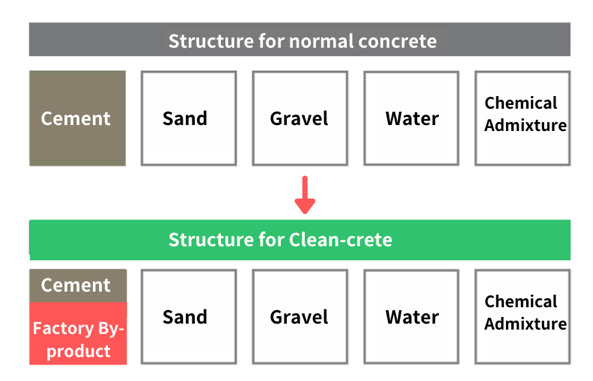
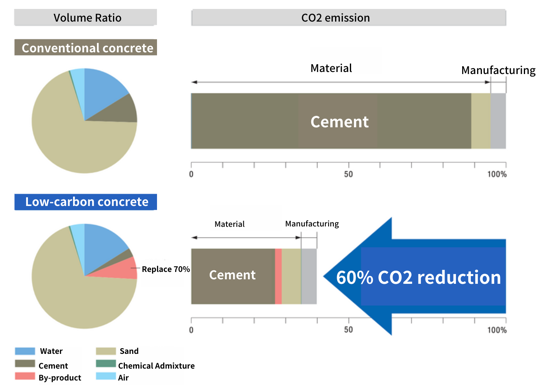
Rival construction major Obayashi Corp. has taken the idea further and developed the country’s first commercially available concrete that replaces part of the cement input with blast furnace slag. The company is marketing the low-carbon product as “Clean-Crete” (In Japanese: クリーンクリート).
Source: Japan Federation of Construction Contractors
Since “Clean-Crete” is sold as a mixed cement under the JIS standard, it can be produced in the same way as ordinary concrete and at the same price. The manufacturing process still emits 100 kg of CO2 per cubic meter, but this is 60% less than for conventional concrete.
Obayashi has already used the low-carbon material in Japan, including at a waste treatment center in Miyagi prefecture.
Concrete that uses zero cement
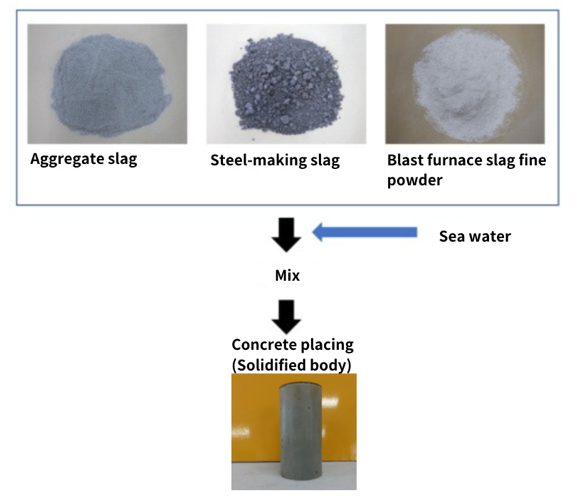
While “Clean-Crete” reduces emissions, a new concrete developed by Okumura Civil Engineering and Space K. eliminates them almost completely by avoiding cement altogether.
The companies earlier this year announced a successful test to solidify granulated furnace slag, the non-metallic by-product of iron-making, and proved that it has the same strength as concrete. The process mixes granulated slag, steelmaking slag and blast furnace slag fine powder as a binder. The ingredients are kneaded with seawater to produce a solidified body.
Source: Nikkei xTECH
Okumura’s entirely new material, which is still in the latter stages of testing and will take time to reach the market, is part of the great drive in materials innovation infusing the construction sector today.
Given the long timeframe for this breakthrough, the first stages of Japan’s decarbonization roadmap for the cement industry will most likely rely on low-carbon rather than zero or even negative carbon materials. Many of the latter are far from a mass rollout due to manufacturing and cost issues.
The industry is calling on METI and the government to provide incentives for the wider use of low-carbon cement, which inevitably will initially be used only by the larger construction firms.
Still, the interaction between steelmaking and the cement industry to reuse waste from the former, to make clean products for the latter, bodes well for the future of Japan’s top emitting sectors. It might just be a perfect example of one man’s trash becoming another man’s treasure.
GLOBAL VIEW
BY JOHN VAROLI
Below are 10 important and interesting energy developments from last week as monitored by the Japan NRG team because of their potential to impact energy supply and demand, as well as prices.
Brazil
Enphase Energy, Inc., a leading supplier of microinverter-based solar-plus-storage systems, has targeted Brazil’s growing solar industry as a lucrative opportunity. Starting this month, the company will sell microinverters to residential and small commercial installers across Brazil. As of July, Brazil had about 10.3 GW of solar, or about 1.46% of the country’s total power capacity, more than double the 2018 level. Enphase says it has sold 34 million microinverters across the globe, and said they’ve been adapted to Brazil’s hot tropical climate.
China
An unusually high number of blackouts has hit the country’s northeastern industrial regions. Demand for Chinese products is rising rapidly as the world recovers from the Covid pandemic and local factories have dialed up their power needs. However, the mining of coal has slowed thanks to Beijing’s new rules to transition toward carbon neutrality by 2060. China relies on coal for more than half of its total energy mix.
El Salvador
The country is harnessing energy from a volcano in order to mine Bitcoin, a pet project of President Nayib Bukele. While the total amount mined only had a value of about $269, this was the world’s first successful demonstration of volcano-powered bitcoin mining. A video on the event had more than 2.3 million views. In June, the President Bukele said he had instructed the state-owned geothermal electric company, LaGeo SA de CV to “come up with a plan to offer facilities for Bitcoin mining with very cheap, 100% clean, 100% renewable, 0 emissions energy from our volcanos.”
ESG
The global banking industry is reaping record profits from underwriting ESG-related bond sales, Bloomberg data show. In 2021, banks earned about $3.6 billion in fees from organizing sales of corporate and state bonds that are instruments of green, social or sustainable development. That profit is more than double the $1.6 billion that global banks have made so far this year from issuing debt for fossil-fuel companies. Last year, a total of about $750 billion of ESG-related bonds were issued, far surpassing the $468 billion issued in all of 2020.
India
Virescent Infrastructure, a Indian renewable energy platform sponsored by U.S. private equity firm KKR, set up India’s first renewable energy infrastructure investment trust. The Virescent Renewable Energy Trust raised INR4.6 billion ($62 million) from a group of foreign and domestic investors. KKR set up Virescent in October 2020 to acquire renewable energy assets in India.
LNG
Asian LNG prices hit a record-high on intense global competition for the fuel. The Japan-Korea Marker benchmark for spot LNG surged to $34.47 per mmbtu. European gas prices also set records. In the run-up to winter, prices are surging across the globe as power companies seek to bolster inventories. Meanwhile, other energy sources, such as coal, are also in short supply. Europe’s energy shortages seem to be driving the global LNG rally.
Nuclear
Tesla CEO Elon Musk threw his support behind nuclear power, saying he was “surprised by some of the public sentiment against nuclear…. I’m not saying we should build a whole bunch of nuclear plants, but I don’t think we should shut down ones that operate safely.” Musk singled out Germany, which now must rely more on coal-fired power plants after it decommissioned its nuclear power plants. Nevertheless, Musk added that “large sustainable power-generation developments, primarily wind and solar” are crucial to meet rising global energy demand.
Oil
The benchmark Brent Crude hit a three-year high, reaching $79.56 in midweek. The jump in oil prices comes after hurricanes shut down production in the Gulf of Mexico in the past month. The rally also reflects the economic rebound from the “re-opening” of many global economies after pandemic-induced restrictions and lockdowns. Goldman Sachs forecast Brent to trade around $80 to $90 at year-end.
Russia
Natural gas supplies via the country’s Yamal-Europe gas pipeline fell by more than half, according to data from grid operator Gascade. State-controlled Gazprom, however, tried to reassure European markets by saying the reduction was temporary. Flow in the pipeline was down by more than half at one point during the week. Some European governments complain that Gazprom is weaponizing gas deliveries to exert pressure on EU countries.
UK
The government committed a major U-turn and re-opened the visa process on a temporary basis for overseas truck drivers as a shortage of gasoline threatened to bring the world’s fifth largest economy to a halt. Hundreds of army troops are also being trained urgently to drive trucks to alleviate a shortage of both fuel and food and other supplies around the country. In the last week of September, many gasoline stations nationwide closed due to fuel shortages, which sparks panic buying and long lines at service stations. Major oil companies said there was no shortage of the fuel in the UK but claimed they did not have enough drivers to make the deliveries.
EVENTS CALENDAR
A selection of domestic and international events we believe will have an impact on Japanese energy.
| February | Approval of Fiscal 2021 Budget by Japanese parliament including energy funding projects;CMC LNG Conference |
| March | 10th Anniversary of Fukushima Nuclear Accident;Smart Energy Week – Tokyo;
Quarterly OPEC Meeting; Japan LPG Annual Conference; Full completion of all aspects of the multi-year deregulation of Japan’s electricity market; End of 2020/21 Fiscal Year in Japan; |
| April | Japan Atomic Industrial Forum – Annual Nuclear Power Conference;38th ASEAN Annual Conference-Brunei;
Japan LNG & Gas Virtual Summit (DMG)-Tokyo Three crucial by-elections in Hokkaido, Nagano & Hiroshima – April 25th |
| May | Bids close in first tender for commercial offshore wind projects in Japan;Prime Minister Suga to visit the U.S. |
| June | Release of New Japan National Basic Energy Plan-2021;G7 Meeting – U.K.
Presidents Biden and Putin are due to meet at a summit in Geneva Forum for China-Africa Cooperation Summit (Senegal) |
| July | Tokyo Metropolitan Govt. Assembly Elections;Commencement of 2020 Tokyo Olympics |
| August | METI committee approves draft of Japan’s 6th Basic Energy Plan |
| September | Ruling LDP Presidential Election;UN General Assembly Annual Meeting that is expected to address energy/climate challenges;
IMF/World Bank Annual Meetings (multilateral and central banks expected to take further action on emissions disclosures and lending to fossil fuel projects); End of H1 FY2021 Fiscal Year in Japan; Japan-Russia: Eastern Economic Forum (Vladivostok)-tentative |
| October | Potentially, Japan’s 2021 General Election (or it may be in November);Hydrogen Ministerial Conference in conjunction with IEA
METI Sponsored LNG Producer/Consumer Conference; Innovation for Cool Earth Forum – Tokyo Conference; Task Force on Climate-Related Financial Disclosure (TCFD) – Tokyo Conference; G20 Meeting-Italy |
| November | COP26 (Glasgow);Asian Development Bank (‘ADB’) Annual Conference;
Japan-Canada Energy Forum; East Asia Summit (EAS) – Brunei |
| December | Asia Pacific Economic Cooperation (APEC) Forum – New Zealand;Final details expected from METI on proposed unbundling of natural gas pipeline network scheduled for 2022. |
Disclaimer
This communication has been prepared for information purposes only, is confidential and may be legally privileged. This is a subscription-only service and is directed at those who have expressly asked K.K. Yuri Group or one of its representatives to be added to the mailing list. This document may not be onwardly circulated or reproduced without prior written consent from Yuri Group, which retains all copyright to the content of this report.
Yuri Group is not registered as an investment advisor in any jurisdiction. Our research and all the content express our opinions, which are generally based on available public information, field studies and own analysis. Content is limited to general comment upon general political, economic and market issues, asset classes and types of investments. The report and all of its content does not constitute a recommendation or solicitation to buy, sell, subscribe for or underwrite any product or physical commodity, or a financial instrument.
The information contained in this report is obtained from sources believed to be reliable and in good faith. No representation or warranty is made that it is accurate or complete. Opinions and views expressed are subject to change without notice, as are prices and availability, which are indicative only. There is no obligation to notify recipients of any changes to this data or to do so in the future. No responsibility is accepted for the use of or reliance on the information provided. In no circumstances will Yuri Group be liable for any indirect or direct loss, or consequential loss or damages arising from the use of, any inability to use, or any inaccuracy in the information.
K.K. Yuri Group: Oonoya Building 8F, Yotsuya 1-18, Shinjuku-ku, Tokyo, Japan, 160-0004.