
JAPAN NRG WEEKLY
OCT. 18, 2021
JAPAN NRG WEEKLY
Oct. 18, 2021
NEWS
TOP
- Political parties reveal energy stance a head of general election; all agree carbon pricing is needed; divided on nuclear, coal
- Japan to tighten tech regulation for solar power plants; a spate of accidents at small PV installations spurs more regulation
- Japan’s power prices jump to highest since January on fuel costs; the rally remains sporadic with breakouts in select regions
ENERGY TRANSITION & POLICY
- METI compares biomass feedstock GHG emissions; U.S. sorghum comes in as worst import solution; Philippines coconut shells best
- Japan hosts multiple conferences as part of Tokyo Beyond Zero week; we profile key forums and the main talking points
- Environment Ministry awards CCUS contract to Kawasaki Heavy
- Daikin, Toyota lead charge to develop energy-efficient motors; Daikin to build air conditioners without rare earth metals.
- Tokyo city to issue green bonds aimed at retail investors; INPEX to sell its first ever green bonds for renewable projects
- Platts starts global ammonia price assessments including Japan
- Japan’s Solar Frontier exits solar panel manufacture … [MORE]
ELECTRICITY MARKETS
- Japan’s home lumber output jumps to 48-year high on biomass expansion; but aging forests hinder decarbonization efforts
- Goldman helps ENEOS with unit sale strategy to secure JRE bid
- Osaka Gas and Iberdrola to develop 600 MW offshore wind farm; Osaka Gas pursues 400 MW offshore wind project in Akita area; Obayashi seeks to develop 600 MW Niigata offshore wind project
- Companies get creative to enlist municipalities to support solar
- Tokyo startup says cold fusion could be future heating solution
- Japanese investors fire-up 1.2 GW gas-fired plant in Ohio
- NUCLEAR REACTOR WRAP: Kyushu stops unit for maintenance
- Ruling party chief Amari advocates for SMRs … [MORE]
OIL, GAS & MINING
- Japan’s August LNG stocks rise to highest since October 2020
- JAPEX takes delivery of its first “carbon neutral” LNG cargo
ANALYSIS
JAPAN’S UPSTREAM OIL AND GAS FIRMS RELUCTANTLY PONDER NET-ZERO
While European oil firms are going for ‘green’ full steam ahead, and their American counterparts are aiming for a milder ‘blue’, Japanese oil companies still aren’t certain about the ‘color’ of their energy transition. The net-zero debate amongst most fossil fuel energy giants appears pretty much been settled, but the conversation in Japan’s oil and gas sector remains muted. Many in the industry believe that holding onto hydrocarbon resources is the best approach, regardless of trends elsewhere.
What’s more, some at the state-backed companies are confused how net-zero commitments square with other national energy security objectives.
VIETNAM’S LNG GREEN SHOOTS GIVE HOPE
FOR JAPAN’S INDUSTRY AND GEOPOLITICS
Japan may have lost its position as the biggest LNG importer to China, but opportunities in Vietnam showcase how the country will likely retain its leading role in the industry. Over the past year, several Japanese firms signed deals cumulatively worth close to $9 billion to invest in Vietnam’s LNG and LNG-to-power sector. As well as providing technology and financing for gas-based energy systems in a region where coal is still king, Japan is playing a pivotal geopolitical role in helping Vietnam and other SE Asian economies offset China’s growing hegemony.
GLOBAL VIEW
IEA chief Birol says world needs to triple renewables investments to avoid price volatility. Hyundai unit to start hydrogen fuel cell production. Putin says Russia will go carbon neutral by 2060. Steel plant closures in Europe. Netherlands plans exits from coal and nuclear. Details on these and more in our global wrap.
WEATHER OUTLOOK
Cold wave ends around Oct. 21-23 nationwide.
JAPAN NRG WEEKLY
PUBLISHER
K. K. Yuri Group
Sponsored
Editorial Team
Yuriy Humber (Editor-in-Chief)
Tom O’Sullivan (Japan, Middle East, Africa)
John Varoli (Americas)
Regular Contributors
Mayumi Watanabe (Japan)
Daniel Shulman (Japan)
Takehiro Masutomo (Japan)
Art & Design
22 Graphics Inc.
SUBSCRIPTIONS & ADVERTISING
Japan NRG offers individual, corporate and academic subscription plans. Basic details are our website or write to subscriptions@japan-nrg.com
For marketing, advertising, or collaboration opportunities, contact sales@japan-nrg.com
For all other inquiries, write to info@japan-nrg.com
OFTEN USED ACRONYMS
METI The Ministry of Energy, Trade and Industry
MOE Ministry of Environment
ANRE Agency for Natural Resources and Energy
NEDO New Energy and Industrial Technology Development Organization
TEPCO Tokyo Electric Power Company
KEPCO Kansai Electric Power Company
EPCO Electric Power Company
JCC Japan Crude Cocktail
JKM Japan Korea Market, the Platt’s LNG benchmark
CCUS Carbon Capture, Utilization and Storage
mmbtu Million British Thermal Units
mb/d Million barrels per day
mtoe Million Tons of Oil Equivalent
kWh Kilowatt hours (electricity generation volume)
NEWS: ENERGY TRANSITION & POLICY
General election energy policies of main parties
(Alterna, Oct. 8)
- CONTEXT: Ahead of the October 31 general election, Alterna conducted a survey of major political parties (LDP, Komeito, Constitutional Democratic Party (CDP), Japan Restoration Party (Nippon Ishin no Kai), and the Japan Communist Party) to gather their stand on energy and environmental issues.
- On lowering GHG emissions by FY2030 (compared with FY2013 levels):
LDP – by 46% - Komeito – by 46%
CDP – by 55% or more
Japan Restoration – 100% by 2050
Communists – by 54% to 63% - On the energy mix by FY2030
LDP: RE – 36%-38%; Nuclear – 20%-22%; Coal – 19%; Other fossil fuels – 22%; Hydrogen – 1%
Komeito: same as above but with emphasis on researching how to get the RE component higher than 38%
CDP: RE – 50%, other (mainly LNG) – 50%; phase out nuclear
Japan Restoration: a realistic scenario that does not lead to industry going elsewhere
Communists: CDP: RE – 50%, fossil fuels (mainly LNG) – 50%; nuclear and coal at 0 - All parties agree on the need for carbon pricing.
- LDP is the most positive on the impact from energy efficiency.
- SIDE DEVELOPMENT:
Japan’s big business lobby calls for both renewables and nuclear utilization
(Kankyo Business, Oct. 11)- The Japan Federation of Economic Organizations (Keidanren) issued a public comment on the draft of the 6th Basic Energy Plan, stating that the government should “clearly state it will work to introduce the maximum amount of renewable energy to make it a main power source, based on the basic premise of S+3E,” while also bringing down the cost of renewables to European and U.S. levels.
- The Keidanren also advocated building nuclear power plants to replace current aging reactors and altogether new nuclear power plants, as well as for more efforts to be made on decarbonized fuels such as hydrogen and ammonia.
- The group praised the balanced, portfolio approach of the current Plan, but noted that it lacks concrete measures to deal with rising energy costs and issues related to stable supply of energy.
TAKEAWAY: All the political parties show strong support for renewables, which should assuage some of the doubts around the country’s direction on the issue. The energy strategies of the opposition are less clear, but it is interesting that all of them seem to support a strong reliance on LNG, something that the new Basic Energy Plan seems to repeal. In this case, it feels like politics are not in line with policies.
METI to tighten regulation around solar plants by March 2022
(Japan NRG, Oct. 13)
- METI will tighten regulation around solar power plants by setting new guidelines and expanding the scope of the Electricity Business Act to include projects below 50kW.
- New guidelines for solar power facilities on steep slopes, agricultural land and floating solar stations will be set by March 2022. These will spell out technical requirements to prevent corrosions, collapse of structures, electric shocks, fire and other issues.
- CONTEXT: In the past six months, 58 incidents were reported at smaller solar projects of 50 kW or less. They are not currently covered by power safety regulations.
GHG emissions of biomass feeds under microscope at METI
(Japan NRG, Oct. 8)
- METI held discussions with biomass industry associations around GHG emissions from fuel raw materials. These revealed a wide range of emissions of more than 8 times.
- Coconut shell from the Philippines has the lowest emissions at 15.6 grams/MJ, while sorghum feed imports from the U.S. were the highest at 133.9 g/MJ.
- CONTEXT: Transport emissions of imported feedstock account for over half of total emissions for 9 out of 13 feeds. The ratio was as high as 96% for Indonesian Benkowan seeds and rice husk pellets from Myanmar.
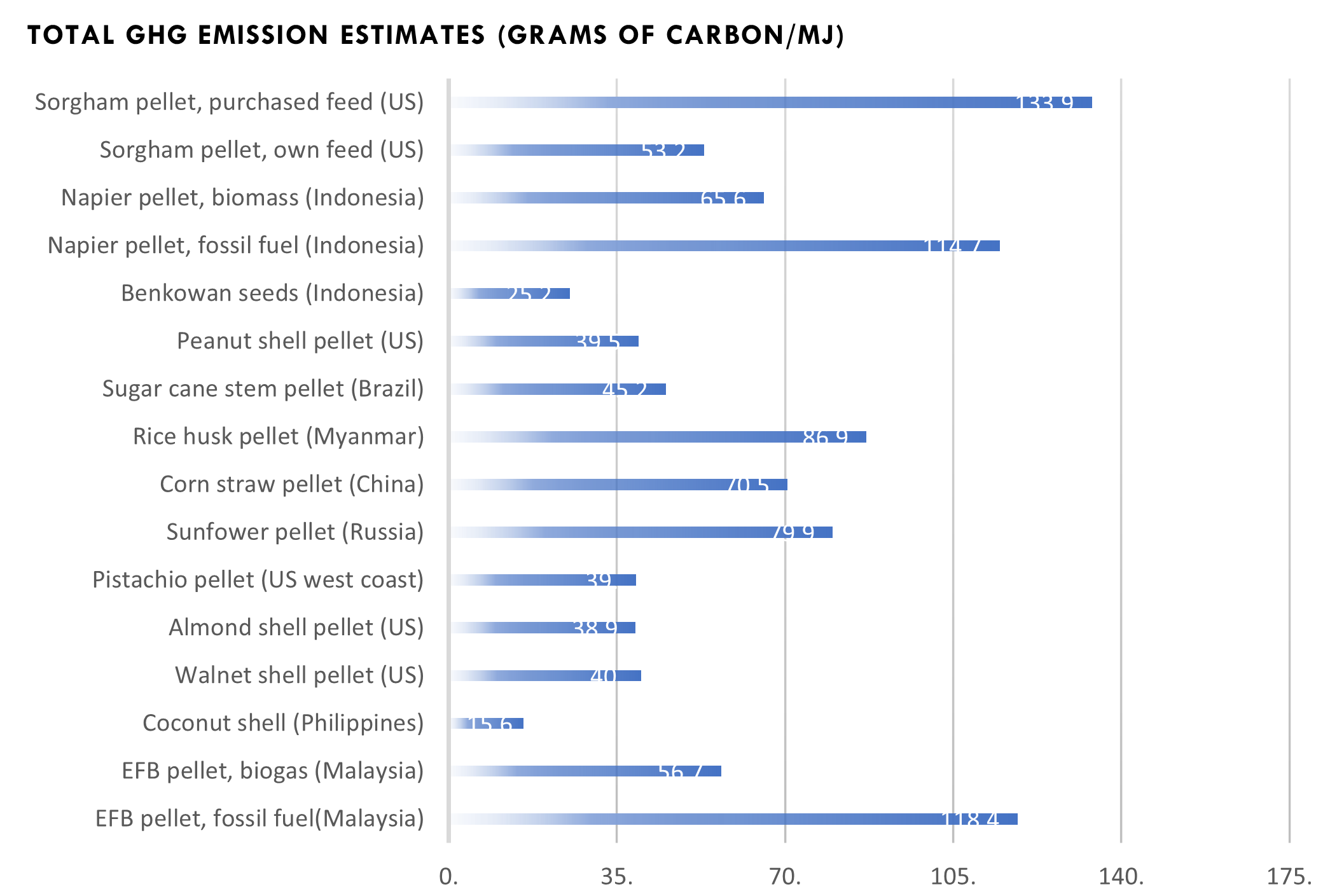
Source: METI data
ANRE holds hearing on submarine power cable installation project
(Japan NRG, Oct. 14)
- The Agency of Natural Resource and Energy (ANRE) held a hearing on plans to install an 8-GW high-voltage direct current (HVDC) submarine cable grid.
- This network would connect Hokkaido and the main Honshu islands at an estimated cost of over ¥1 trillion.
- Mitsubishi Corporation and Japan Bank for International Cooperation delivered presentations on how such projects are financed overseas. Promotion and Research Institute for Ocean Economics, J-Power, and Eurus Energy reported on the progress of the project feasibility studies.
Japan Hosts “Tokyo Beyond Zero” Week (Oct. 4-8)
- METI hosted eight international events on energy transition.
- Some we reported on last week, five more are listed below.
- SIDE DEVELOPMENT:
Japan hosts first international fuel ammonia conference
(Japan NRG, Oct. 6)- METI hosted its first international ammonia conference, drawing 1,500 online attendees including officials from the International Energy Agency (IEA), Indonesia, and potential ammonia producers Saudi Arabia, Norway, and Australia.
- Ammonia is expected to reduce the carbon footprint of existing thermal power plants in Asia and could be used as ship fuel.
- Japan will outline supply chain issues with the private sector and aims to present solutions at next year’s conference, METI said.
- During the event Japan’s IHI, Malaysia’s TNB Power Generation, and Petronas Gas and New Energy signed a cooperation agreement on ammonia co-firing.
- CONTEXT: Petronas has strong ties with Japan. IHI has designed Petronas LNG tanks, and Petronas is one of the key LNG suppliers to Japan. Aside from co-firing, the project opens up possibilities of re-using legacy LNG infrastructure for ammonia supplies.
- SIDE DEVELOPMENT:
Japan hosts Hydrogen Energy Ministerial Meeting
(Japan NRG, Oct. 4)- Business leaders and representatives from 29 jurisdictions shared progress in developing hydrogen ecosystems during a Hydrogen Energy Ministerial Meeting hosted by METI.
- The IEA reported that the global capacity of electrolyzers has doubled over the last five years and could potentially rise to 8 million tons in 2030. It’s at 50,000 tons now.
- The IEA added that the world should aim for 80 million tons of electrolyzer capacity by the decade’s end, meaning governments must set quotas for hydrogen in public procurement, cooperate to establish global standards and regulations, and spur trade in hydrogen.
- Companies including ENEOS, Asahi Kasei, Toyota Motor, Air Liquide and ThyssenKrupp discussed issues in building up hydrogen supply chains.
- SIDE DEVELOPMENT:
ICEF 2021 focuses on digital, systems integration, nuclear, food, and negative emissions
(Japan NRG, Oct. 7)- The 8th Innovation for Cool Earth Forum (ICEF 2021) focused on digital technology, systems integration, nuclear power, food systems and negative emission technologies.
- The forum forecasts that
- “Green by digital” will be a game changer for energy management;
- Energy system integration will optimize energy supply and demand;
- Nuclear will play a role via small modular reactors (SMRs) and other advanced reactors;
- Greenhouse gas (GHG) emissions from food systems can be mitigated by procedural changes in production-distribution;
- Negative emission technologies will be essential to neutralize GHG emissions in the hard-to-abate sectors, thus requiring continuous investment to reduce cost of these technologies.
- SIDE DEVELOPMENT:
Clean energy R&D conference points to the need for a common “carbon” language
(Japan NRG, Oct. 8)- Scientists and researchers gathering at the third RD20 clean energy R&D conference pointed out the need to develop a common language for key concepts such as carbon footprint, life cycle and sustainability, METI said.
- The conference was hosted by the Japanese National Institute of Advanced Industrial Science and Technology (AIST).
- Participants agreed on the need to develop standards and common metrics for analysis and energy technology impacts, and common terminology around carbon.
- SIDE DEVELOPMENT:
TCFD disclosure commitment expands to 2,529 organizations
(Japan NRG, Oct. 5)- The Task Force on Climate-related Financial Disclosures (TCFD) reported during its third summit meeting that the disclosure initiative has spread to 2,529 organizations worldwide, an increase of 1,096 organizations from last year. Of that total, 509 were from Japan.
- Panel participants called for better SCOPE 3 emission measurements, and said it’s not realistic to expect every business will reach full carbon neutrality. A shift to low carbon business models may be more realistic.
Environment Ministry awards CCUS contract to Kawasaki Heavy, JCOAL
(Japan NRG, Oct. 12)
- The MoE awarded Kawasaki Heavy Industries and JCOAL a contract to run bilateral carbon capture, utilization and storage field projects in the U.S.
Daikin and Toyota Motor lead charge to develop more energy-efficient motors
(Asia Nikkei, Oct. 14)
- Daikin is developing software to adjust the voltage and frequency of electricity fed into motors to improve their efficiency. While the practice of such adjustments is common, Daikin’s software will make changes in increments of tens of microseconds.
- The goal is to minimize the amount of energy that dissipates as heat instead of driving motor rotation.
- Toyota Motor is testing a proprietary magnet in its motors that uses cerium and lanthanum in addition to neodymium, a rare-earth element typically found in high-grade magnets. The new design is expected to reduce energy loss by 40% and electricity consumption by 4%.
- Toyota hopes to apply the technology to air conditioning units, electric cars and more.
- CONTEXT: Given the ubiquity of motors in factories, transport, and elsewhere, shaving even a few percent could make a GW-level impact on the nation’s total electricity needs.
- SIDE DEVELOPMENT:
Daikin to build air conditioners free of rare earths
(Asia Nikkei, Oct. 10)- Daikin will almost completely phase out the use of rare-earth metals in its air conditioners by fiscal 2025 to avoid rising costs and potential procurement issues since China controls a large chunk of the world’s supply of the materials.
- Growing demand for rare earths used in electric vehicles and wind turbines has fueled concerns that prices will rise.
- CONTEXT: Rare earth metals such as dysprosium and neodymium are used for magnets inside motors to improve heat resistance and performance.
Tokyo City to issue ¥10 billion in green bonds aimed at retail investors
(Kankyo Business, Oct. 12)
- The Tokyo Metropolitan Government said it will sell ¥10 billion in green bonds targeted at individual investors. The offering period is from November 19 to December 6.
- This will be the fifth green bond issue from the city since its inaugural offering in 2017. The issuances are done around this time of the year.
- Proceeds from the sale will be used to add solar power to metropolitan government facilities, park maintenance, and maintenance of coastal protection facilities (seawalls, etc.).
- The bonds will be denominated in Australian dollar with a 5-year maturity. Interest rates will be announced in November.
- SIDE DEVELOPMENT:
INPEX to issue its first green bonds
(Kankyo Business, Oct. 11)- Oil and gas company’s first such issuance to total ¥10 billion with proceeds going to renewable energy projects and others that will improve the environment.
Idemitsu’s Solar Frontier unit withdraws from PV business
(Smart Japan, Oct. 13)
- Idemitsu Kosan said its wholly-owned subsidiary Solar Frontier would stop manufacturing photovoltaic panels next year.
- Solar Frontier will concentrate on engineering, procurement, construction, operation and maintenance services for solar farms.
- CONTEXT: This marks the exit from solar panels manufacture of another major domestic player, leaving Japan with few producers in the field.
Mitsui studying wave power project in Mauritius
(Kankyo Business, Oct. 12)
- Mitsui Corporation said its proposal for a feasibility study into wave energy in Mauritius was approved by METI.
- The project will deploy generation units developed by UK-based Bombora Wave Power in selected sites around Mauritius to assess their performance and ability to reduce CO2 emissions.
- Mitsui committed to environmental initiatives in Mauritius following its Wakashio container ship accident in July 2020 that led to an oil spill.
Platts launches global ammonia assessments
(Company statement, Oct. 12)
- S&P Global Platts launched ammonia cargo price assessments in Asia, Europe and North America, effective Oct. 12, 2021.
- Already established for use in agricultural markets and with global trade at around 19 million mt, ammonia is increasingly viewed as a potential fuel for power generation, bunkering and as means of transporting converted hydrogen.
- Platts daily ammonia cargo price assessments are for cargoes for the following: CFR Far East Asia, including major ports that can accommodate ammonia cargoes in China, Japan, South Korea, and Taiwan; CFR Northwest Europe, for major ports that can accommodate ammonia cargoes in Belgium, Germany, the Netherlands, and northern France; and for CFR U.S. Gulf Coast, for major ports accommodating ammonia cargoes in the USGC region with basis port Tampa, Florida.
- The assessments are in U.S. Dollar, and published in both metric ton (mt) and Million British Thermal Unit (MMBtu). They are cash prices, net of any credit.
MHI throws hat into carbon capture ring
(Nikkei X-Tech, Oct. 13)
- Mitsubishi Heavy Industries is investing in carbon capture technology and pledged to become a global leader in this sector.
- The company says that while costs associated with CO2 capture plants can run into the tens of billions of yen, its proprietary CO2NTAIN technology allows operators to save costs by up to 30%.
- Typically, carbon capture plants consist of a cooling tower, an absorption tower and a desorption tower, and can isolate CO2 with a purity of 99.9%.
- While Mitsubishi’s carbon capture plants target fossil fuel and biomass fired power stations, the company plans to market the technology to shipbuilders, steelworks, waste incineration plants and operators of gas engines.
- Mitsubishi says the carbon capture market will be worth ¥10 trillion in 2050.
Shin Nippon to look at carbon capture in volcanic rock
(New Energy Business News, Oct. 7)
- Shin Nippon Biomedical Laboratories signed an agreement with Kyushu University to research the potential of CO2 capture and storage technology.
- SNBL operates a geothermal power plant in Kyushu that generates around 10 GWh annually.
- The parties will study the feasibility of sequestering CO2 in volcanic rock in geothermal areas, thereby promoting carbon mineralization, a process in which CO2 reacts with alkaline-earth oxides to form stable carbonates.
Toyoda Gosei invests in waste-heat-to-power developer
(Electronic Device Industry News, Oct. 14)
- Automotive component manufacturer Toyoda Gosei invested in EthermoGentech, which makes thermoelectric systems that can generate electricity from waste heat that’s a by-product of component production.
- EthermoGentech is developing a slimline thermoelectric generator that can be wrapped around pipes to efficiently convert waste heat to electricity.
Aizawa platform will give wind turbines extra height
(Nikkei X-Tech, Oct. 13)
- Concrete manufacturer Aizawa has designed a 40-meter concrete platform for supporting wind turbine towers.
- The additional height transforms a conventional 80 m turbine into a 120 m one, enabling it to be fitted with larger blades and generate more electricity, while avoiding transport costs associated with extra high steel towers.
- The platform will be trialed in Fukushima.
Air Water pioneers environmentally friendly hydrogen plant
(Newswitch, Oct. 12)
- Toda Kogyo and Air Water began working on a system to isolate hydrogen from methane without producing CO2.
- The system uses a highly-activated iron catalyst and temperatures of around 700°C to convert methane into hydrogen gas and carbon nanotubes that can also be sold as a useful byproduct.
- Toda and Air Water plan to make this commercially viable by 2026.
- The project was commissioned by the New Energy and Industrial Technology Development Organization.
NSG builds storage battery in Canada
(New Energy Business News, Oct. 13)
- As part of efforts to reduce its net carbon footprint, glass manufacturer NSG installed a 10 MWh storage battery in Ottawa, Canada in partnership with U.S.-based Convergent Energy and Power.
- By supplying the grid at peak times, the battery reduces the load on peaking plants, which tend to produce higher CO2 emissions than other plants.
- This is the first time NSG participated in such an initiative overseas.
One-Dot News:
- NYK Bulk Project transported wind turbine blades and towers from the ports of Dalian and Jiangyin in China to the port of Nanao in Ishikawa prefecture using the new heavy-lift vessel Katori, which was built by Jinling Shipyard. Katori is equipped with two 400-ton cranes, and can lift 800 tons of cargo (New Energy Business News, Oct. 11)
- Chinese EV makers are taking advantage of the slow entry by Japanese firms into the electric commercial truck and bus segments and are starting to fill the market in Japan with their product; logistic firms among those making large orders for EV trucks (Nikkei, Oct. 11)
- Tokyo Gas and Thai state-backed energy company PTT will set up a joint venture to enter the on-site energy business involving LNG supply in Thailand; fuel efficiency also part of the deal (Company statement, Oct. 5)
- The National Institute of Advanced Industrial Science and Technology (AIST), Toyota Motor, and Toyota Central R&D Labs have started joint research on four themes, including in-vehicle solar power generation systems and the use of hydrogen (Kankyo Busines, Oct. 12)
- Chubu Electric has invested in a fund established by Counterpart Ventures, a Silicon Valley venture capital that focuses on startups in the field of SaaS (software as a service) (Nikkan Kogyo, Oct. 14)
- Shipping firm Iino Lines agreed with Mitsui & Co. on scheduled deliver of ammonia as the company looks to put into service ships that can run on the fuel from 2023 (Reuters, Oct. 15)
WEATHER OUTLOOK
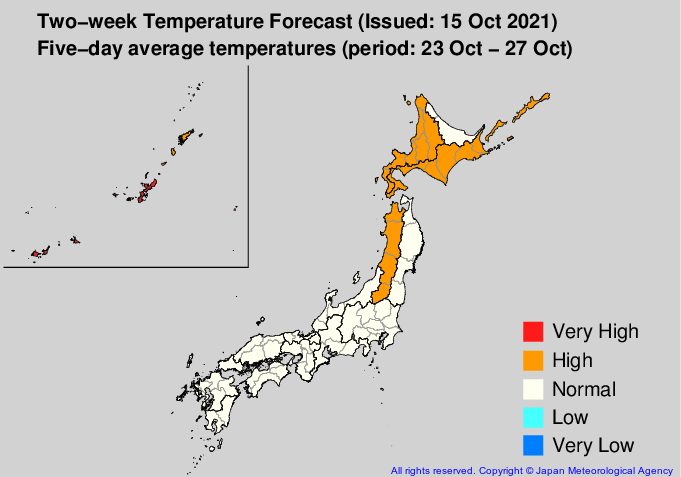
TWO-WEEK TEMPERATURE FORECASTS (OCT. 15 ~ OCT. 27)
Nation-wide
Tokyo area
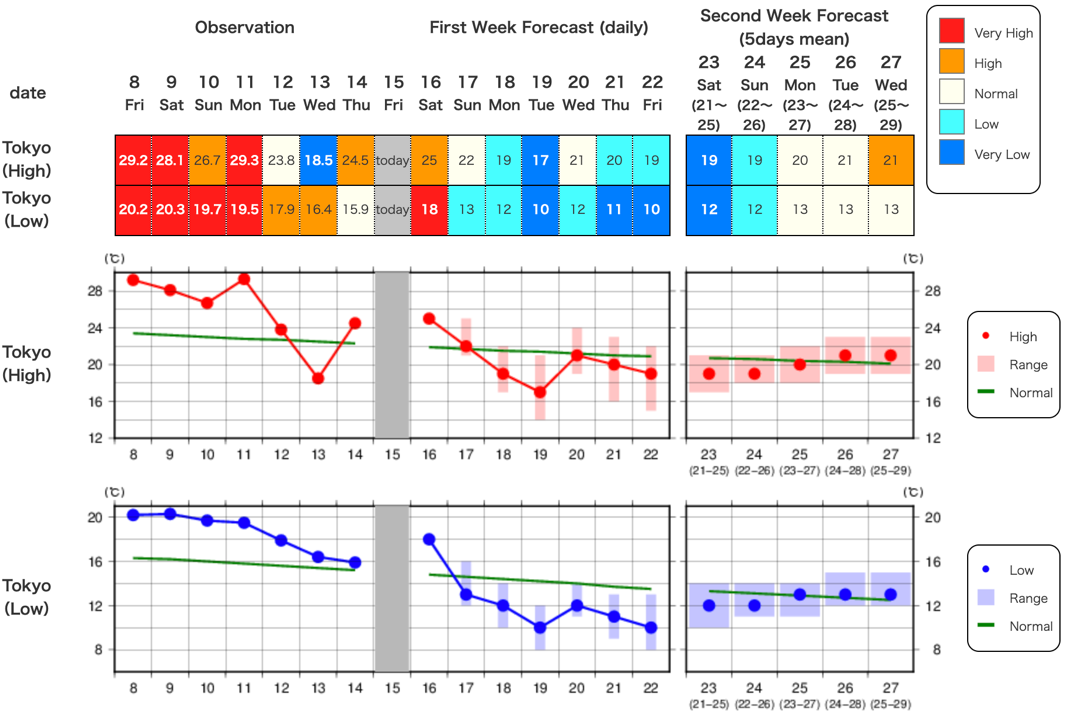
- North Japan: A cold wave until Oct. 23, then a rise in temperature from Oct. 25.
- East/West Japan, Amami region: Cold wave until Oct. 24, then return to average temperatures.
- Okinawa: Average temperatures until Oct. 21, then a slight uptick.
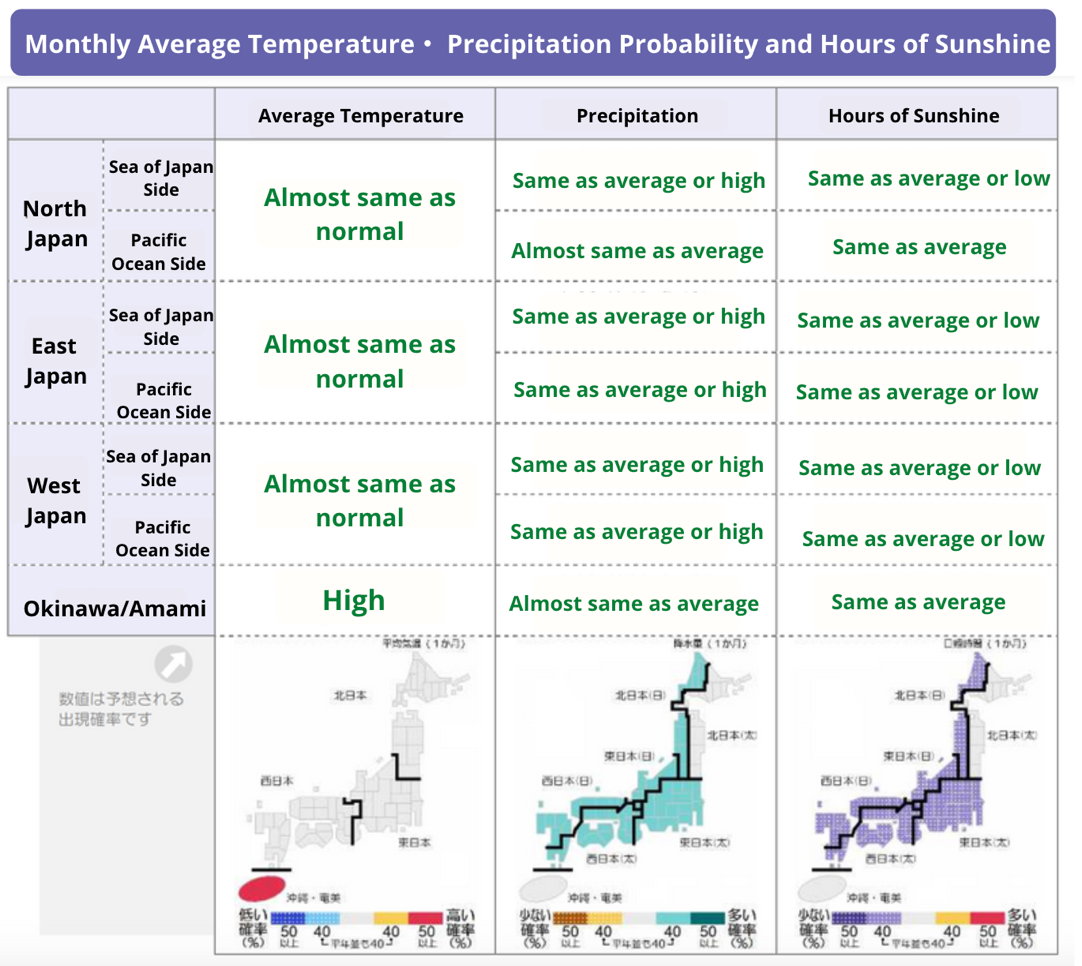
ONE-MONTH SEASONAL FORECAST (OCT. 16~ NOV. 15)
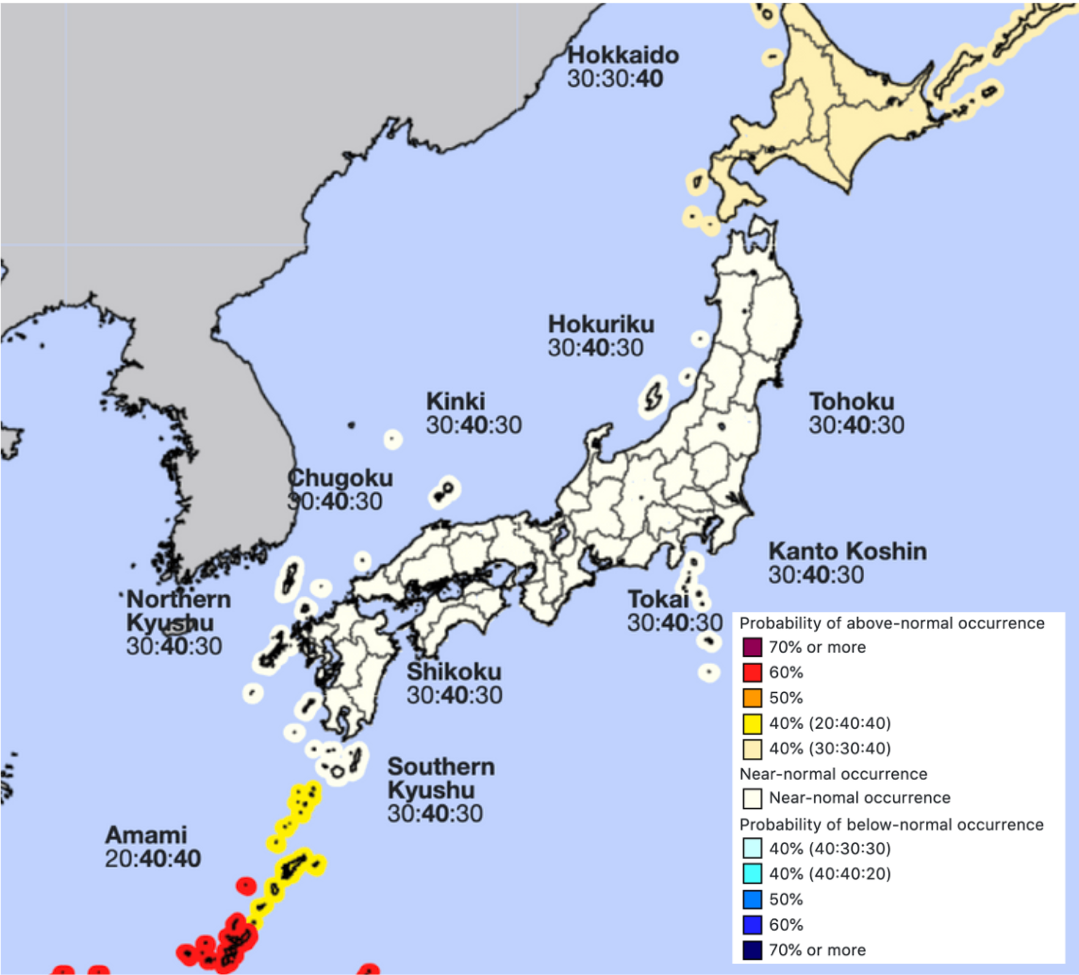
NEWS: POWER MARKETS
|
No. of operable nuclear reactors |
33 |
Electricity Price |
Friday, Sept 24 |
% Change WoW | ||
|
Of which |
restarted |
10 |
JEPX 24-Hour Spot |
¥12/ kWh |
-1% | |
|
in operation today |
8 |
TOCOM Oct. baseload (Tokyo area) |
¥11.07/ kWh |
+9.6% | ||
Source: Company websites, JANSI and JAIF, as of Oct 17, 2021
Japan’s power prices jump to highest since January on fuel costs
(Japan NRG, Oct. 17)
- The electricity price on the JEPX day-ahead wholesale spot market jumped to ¥16.41/ kWh on Oct. 12, the highest since Jan. 24, 2021.
- The nine-month high comes after a recent run up in power prices to reflect the high fossil fuel prices around the world.
- While most of Japan’s LNG, coal and oil is purchased on long-term contracts, many of those reflect to a degree the global prices for the commodities, albeit with a lag. Utilities also purchase some cargos of the fuel on the spot market to adjust to their demand and weather conditions.
- So far, the rally in electricity prices in Japan has been sporadic rather than linear. The jump on Oct. 12 was followed by a drop off in the following week.
- JEPX prices are down WoW for the last five days.
- SIDE DEVELOPMENT:
Fear of power shortage for this winter with no resolution for the rising LNG price
(Senkaku, October 2021 edition)- Major power companies are saying that “this winter won’t be that harsh” but the power demand and supply for this winter is in trouble. If demand is higher than expected, most likely stock will run short.
- LNG fills the gap if Japanese power demand is higher than supply. During the last harsh winter, LNG was short, and prices shot up.
- Major power utilities have no choice but to purchase LNG even if the price goes up to secure supply. They blame new market entrants for a lack of balance in the system, but the latter blame the utilities for poor planning, especially with maintenance schedules.
- The METI is not fond of issuing power saving demands, which inconvenience citizens, so this is a measure of last resort.
- Japan is facing another winter without sufficient power reserve.
- SIDE DEVELOPMENT:
Tohoku Electric shuts down oil-fired station for heavy maintenance
(Niikei, Oct. 12)- Tohoku Electric is conducting a major overhaul and inspection of its Higashi-Niigata thermal power plant in anticipation of an electricity demand surge in midwinter.
TAKEAWAY: The January price spike still prey on the minds of many in the industry and METI. It’s early in the winter season to judge whether the winter of 2020/2021 will repeat itself. However, near-term weather forecasts (see the Weather section) suggest milder temperatures will soon return for the rest of this month.
Japan’s output of lumber jumps to 48-year high on biomass expansion
(Asia Nikkei, Oct. 10)
- Japan last year used its highest rate of domestically produced lumber since 1972 to meet demand from the country’s growing biomass power sector.
- Total Japanese lumber production increased 0.5% in 2020 to 31.15 million cubic meters. In the same year, production of wood fuel, including for biomass power plants, increased 28.8% in to 8.93 million cubic meters. Supply of imported timber fell 15%.
- The domestic wood industry association says more lumber demand is needed to promote the cycle between planting trees and utilizing them.
- SIDE DEVELOPMENT:
Aging forests likely to hinder Japan’s decarbonization efforts
(Asia Nikkei, Oct. 15)- Old trees detract from disaster prevention and CO2 absorption effects
- Japan’s Forestry Agency estimates that the absorption of carbon dioxide by forests in Japan reached a recent peak of 52 million tons in fiscal 2014 and dropped about 20% to 43 million tons in fiscal 2019.
- The absorption of carbon dioxide is considered to hit a ceiling when the growth of trees stabilizes after they become older than 40 years.
Goldman helps ENEOS with unit strategy to win a high bid for JRE
(Senkaku, October 2021 edition)
- CONTEXT: This is a magazine article that purports to offer insights on how ENEOS emerged as the winner on the recent bidding for Japan Renewable Energy, a solar and wind developer started by and largely owned by Goldman Sachs. ENEOS said last week that it completed the deal to buy JRE from current owners including Goldman Sachs for about ¥200 billion.
- ENEOS seeks to delist construction subsidiary NIPPO Corp using a complex scheme that would allow it to retain control.
- ENEOS has said it will tie up with Goldman Sachs to delist NIPPO. Goldman will purchase shares via a tender offer from minority shareholders. Then ENEOS will sell its shares to NIPPO, but maintain its position as the parent company by investing in a special-purpose company owned by Goldman.
- The deal structure should help ENEOS earn ¥170 billion. An oversea securities executive says that “this is a part of a backdoor deal” that also involves Japan Renewable Energy.
- Toyota and ENEOS were the main candidates for JRE, but Toyota was due to withdraw from the process. Goldman wanted to make ensure ENEOS would will buy JRE for a fair price, despite Toyota’s exit, and therefore assisted ENEOS with the NIPPO situation.
Osaka Gas and Iberdrola plan to develop 600 MW offshore wind farm
(New Energy Business News, Oct. 11)
- Osaka Gas and Iberdrola Renewables Japan will develop an offshore wind farm near Karatsu City, Saga prefecture, with an output of up to 600 MW.
- The environmental assessment calls for an area of 27,000 hectares to hold no more than 75 bottom-fixed wind turbines, each with 8 MW to 15 MW of output.
- The construction period is expected to be about three years.
- Iberdrola said the project has a new certificate of consideration procedure because the estimated area has been expanded.
Ministry submits opinion on Osaka Gas-led 400 MW offshore wind project
(New Energy Business News, Oct. 13)
- MoE submitted its opinion on the environmental assessment of the offshore wind power project near Lagoon City, Oga City and Akita City in Akita prefecture planned by Osaka Gas, Mitsui & Co., United Planning and Northland Power Development Services Japan.
- The opinion calls for avoiding or minimizing the impact on wildlife from turbines and also for special consideration for the residences, schools, and other facilities in the vicinity of the project.
- The project, which will have a maximum output of 400 MW, involves the installation of 26 to 42 wind turbines, each with an output of 9.5 MW to 15 MW, in coastal areas. It requires approximately 5,421 hectares of space and the construction period is expected to be 36 months.
Obayashi seeks to develop 600 MW offshore wind project in Niigata
(New Energy Business News, Oct. 14)
- Obayashi Corporation is planning to develop offshore wind power generation off the coast of Murakami and Tainai cities in Niigata prefecture. On September 30, Obayashi released the environmental assessment report for the 600 MW project.
- The project would take up about 97 km2 and operate 40 to 53 bottom-fixed wind turbines.
Companies look for creative solutions to get license to build more solar
(Mainichi Shimbun, Oct. 12)
- Solar farms are gaining a reputation as a nuisance in some parts of the country because they create visual pollution and encourage deforestation.
- Some businesses are attempting to change this by partnering with local bodies to find sites where solar farms can have a positive impact. In Kyoto, for example, Kyocera partners with local construction companies to cover unused agricultural land with photovoltaic panels, making it more difficult for wild boars to cause damage.
Cold fusion could be future heating solution
(Nikkei X-Tech, Oct 12)
- Tokyo-based start-up Green Planet will collaborate with major boiler manufacturer Miura on a system that would use cold fusion to provide heat.
- Green Planet’s prototype nickel copper and hydrogen-based system comprises multi-layered copper and nickel microfilms encapsulated in hydrogen. Green Planet says that when heated, the system outputs more energy than was put into it.
- Green Planet achieved a coefficient of performance of over 12 in the lab. (The system outputs 12 times more energy than was input initially.)
U.S. gas plant with Japanese investments fires up in Ohio
(Denki Shimbun, Oct 15)
- The South Field Energy natural gas-fired power plant in Ohio began commercial operation on Oct. 5. Idemitsu and the Kyushu and Chugoku Electric own stakes in the 1.2 GW plant.
LDP Chief Amari advocates small modular reactors
(Nikkei, Oct 12)
- In an interview, LDP Secretary General Amari Akira advocated replacing Japan’s aging nuclear reactors with small modular reactors (SMRs).
- While SMR technology is still under development, the reactors are said to be safer, and take less time to construct than conventional reactors.
- Amari said if Japan is to rely on nuclear energy for a portion of its electricity supply, then it needs to entertain the idea of replacing existing reactors with more advanced technology.
NUCLEAR REACTOR NEWS ROUND-UP:
- Kyushu Electric shuts Sendai NPP United 1 for maintenance
(MBC News, Oct. 17)- On the morning of the 17th, the No. 1 reactor at Kyushu Electric’s Sendai NPP stopped generating electricity and entered a routine inspection, with plans to begin a regular and a special inspection the following day.
- The stoppage is part of scheduled maintenance work and has to be done every 13 months. However, the facility will also reach 40 years of operating life in three years, after which it will need to get a license extension.
- To prepare for the application to extend the reactor’s 40-year term, Kyushu will conduct a special inspection to check deterioration of reactor vessel and other key plant components.
- Kyushu Electric says that it will decide whether to apply for an extension based on the results of the special inspection.
- SIDE DEVELOPMENT:
Defect found at Ikata NPP’s tank valve used for storing cooled water
(NHK, Oct. 8)- A defect was found at the tank valve of Ikata NPP Units 3 (Shikoku Electric), which is used for storing cooled water during an emergency.
- The utility says this will have no impact on operation and is now investigating.
- SIDE DEVELOPMENT:
NRA examines Tomari NPP’s volcano measures for first time after six years
(NHK, Oct. 15)- NRA has started to examine safety measures at Tomari NPP (Hokkaido Electric) in case of volcanic activity. This is a key criterion for the plant’s restart.
- This comes 5 years 8 months since the same issue reviewed by the regulator.
- Earlier this month, NRA began examining Tomari NPP’s new tsunami measures.
- CONTEXT: Tomari NPP’s safety review is among the longest in the recent history of Japan’s nuclear power industry. However, the restart of reviews of certain key areas suggests there may be a new impetus to complete the task.
- SIDE DEVELOPMENT:
Kyushu Electric finishes periodic inspection at Genkai NPP Unit 1
(Saga Shimbun, Oct. 9)- Kyushu Electric finished its 6-month periodic inspection of the Genkai NPP Unit 1 that started in April. A similar inspection at Unit 2 was due to end on Oct. 15.
Tokyo Gas completes sale of gas-fired power plant to electricity retailer
(New Energy Business News, Oct. 13)
- Tokyo Gas, Shimizu Corporation, and Tokyo Electric Power Company have transferred all outstanding shares of Tokyo Gas Yokosuka Power to power retail company F-Bit Communications.
- Tokyo Gas Yokosuka Power is a 239.7 MW gas turbine combined cycle power plant that began operation in 2000.
- Together with the Shin-Nakasode Power Plant (Chiba Prefecture, gas combined cycle power plant, 110 MW output) acquired in FY2020, F-Bit Communications now owns more than 300MW of its own power supply.
NEWS: OIL, GAS & MINING
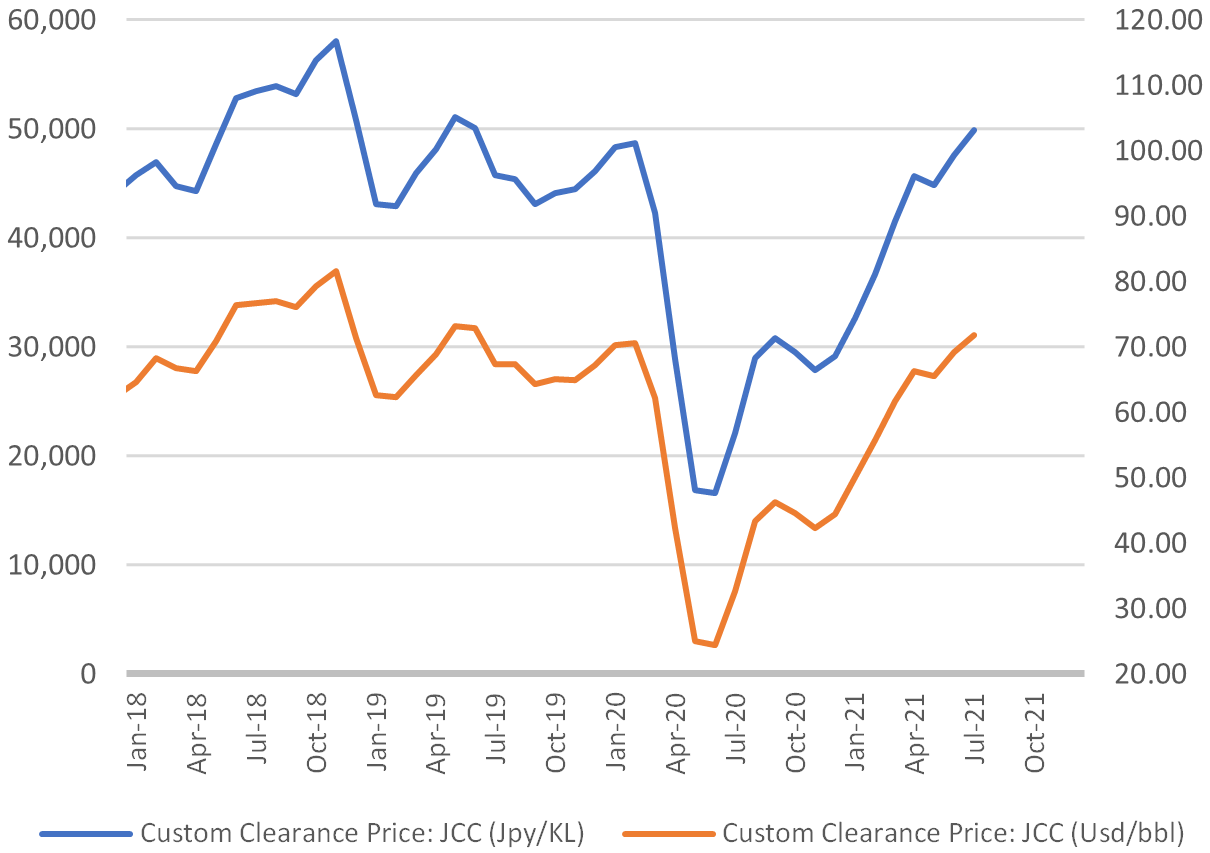
Japan Oil Price: $71.72/ barrel
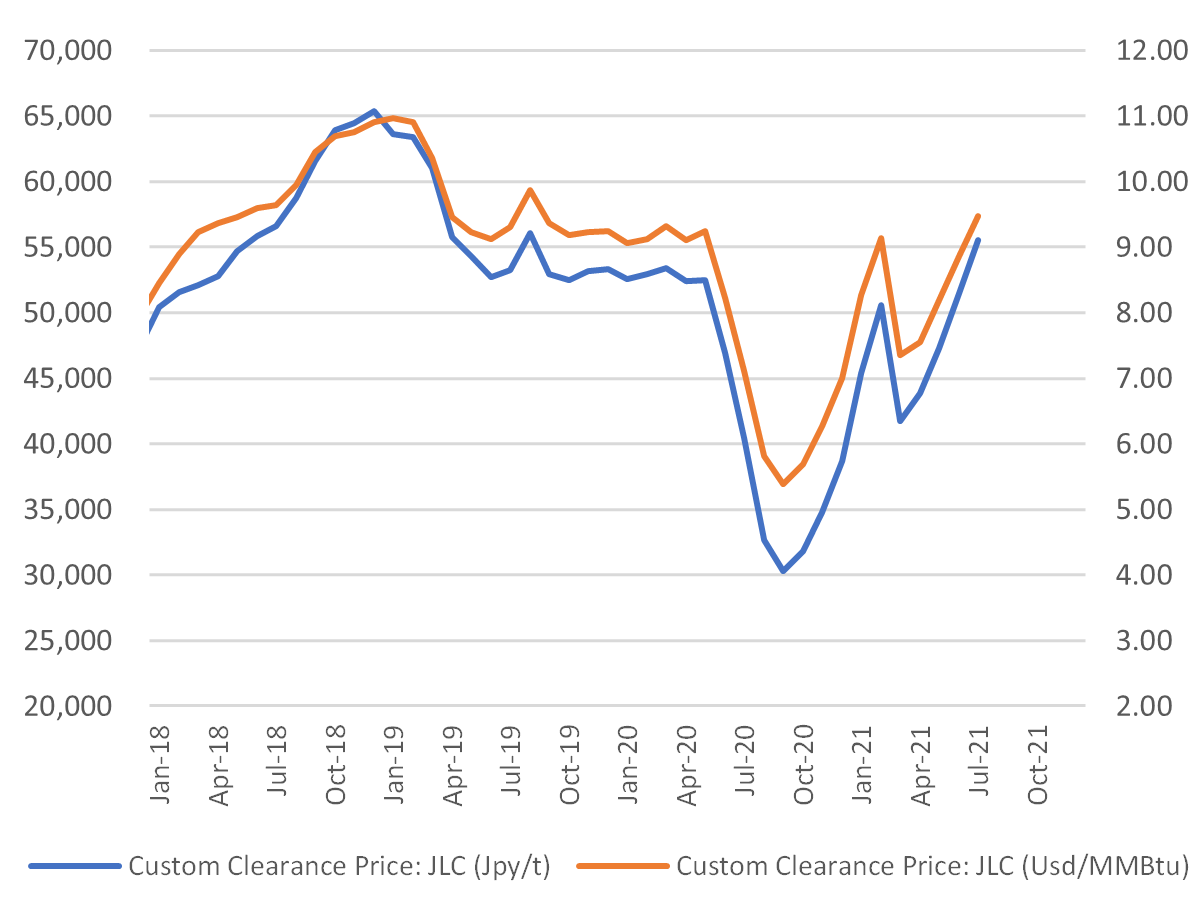
Japan (JLC) LNG Price: $9.47/ mmbtu
Japan’s August LNG stocks rise to highest level since October 2020
(Japan NRG, Oct. 15)
- Japan’s LNG stocks at the end of August stood at 205,655 tons, rising above the 200,000-ton mark for the first time this year, according to METI data. This was still 8% down YoY.
- Stocks were last above 200,000 tons in October 2020.
- Stocks typically rise in the second half of the year ahead of the peak demand month in January.
- Data shows demand is picking up. August gas shipments to local consumers were up 7.9%, YoY, to 286,321 tons. Shipments to the power sector jumped 16.1% to 28,387 tons; to the city gas sector up 3.7% to 161,309 tons; and to the petrochemical sector up 15.5% to 54,574 tons.
JGC and INPEX reach settlement over claims related to Ichthys LNG cost overruns
(Company Statement, Japan NRG, Oct. 15)
- JGC Corporate, which led the engineering and construction work on INPEX’s Ichthys LNG project in Australia, said it settled a dispute with the latter over claims related to cost overruns.
- INPEX made a legal claim against the JV that was contracted to complete the project. The JV consisted of JGC, Chiyoda Corp and KBR.
- The issue flared up after subcontractors on the project requested additional payments to cover their increased costs.
- A final settlement was reached on Oct. 15, 2021 and all related arbitration proceedings have now been dropped.
- JGC said losses related to this settlement were already recorded as provision in the first quarter ending June 30, 2021 and no additional loss will be recorded.
- CONTEXT: The Ichthys project became the most expensive in LNG space at the time after delays during construction and cost blowouts. Its final cost climbed above $45 billion from the initial $34 billion estimate.
JAPEX receives its first “carbon neutral” LNG cargo
(Gas Energy News, Oct. 11)
- JAPEX said it took delivery of its first “carbon neutral” LNG cargo at the Soma LNG terminal in Fukushima prefecture. The LNG is offset CO2 credits. Diamond Gas International, a wholly owned subsidiary of Mitsubishi Corporation, is the supplier.
- JAPEX plans to sell and carbon neutral gas to six wholesale natural gas suppliers: Echigo Natural Gas, Ojiya City, Obihiro Gas, Shinhata Gas, Shirane Gas, and Tomakomai Gas.
- JAPEX said it will continue to offer “carbon-neutral” LNG and gas to customers such as factories and city gas companies. The company will also look into selling CO2 credits purchased directly by JAPEX in combination with LNG procured from overseas.
INPEX and ENEOS bounce back but not enough
(Diamond, Oct. 14)
- Both INPEX and ENEOS reported significant increases in revenue in the three months to June compared with the previous year.
- INPEX saw sales rise nearly 80%, while ENEOS reported a 44% increase. Still, for both companies the sales are about 11% below pre-pandemic levels.
ANALYSIS
BY MAYUMI WATANABE
Japan’s upstream oil and gas firms reluctantly ponder net-zero
While European oil firms are going for ‘green’ full steam ahead, and their American counterparts are aiming for a milder ‘blue’, Japanese oil companies still aren’t certain about the ‘color’ of their energy transition.
The net-zero debate amongst most fossil fuel energy giants appears pretty much been settled, but the conversation in Japan’s oil and gas sector remains muted. Many in the industry believe that holding onto hydrocarbon resources is the best approach, regardless of trends elsewhere.
Nevertheless, Japanese companies need to accept and observe the country’s new carbon neutrality law, even if there’s a lack of clarity about the details. As it stands, many in Japan’s oil and gas sector, which is led by several state-backed companies, wonder in which direction they should pivot (if at all) amid the seemingly contradictory national security objectives.
This has led to mixed messages, in both strategies and actions, from Japanese upstream firms. They are also paying close attention to U.S. energy giants, waiting to see whether they’ll carve out a new course in the energy transition, or eventually succumb to their European peers’ renewables-first environmental agenda.
Regulatory framework shapes climate strategies
Strategies are often impacted by local regulatory frameworks. For example, European energy firms seek to present themselves as carbon neutrality leaders partly because the European Council very much wants to assume leadership in international climate-related policymaking.
On the surface, Japan’s upstream firms have made similar strides. Between January and May 2021, Idemitsu, Japan Petroleum Exploration (JAPEX), Inpex, Cosmo Oil, Fuji Oil, and Osaka Gas announced carbon neutrality goals. Most of these announcements, however, paint only a general outline of direction toward a goal almost three decades away.
The vagueness owes something to the policy and legal framework in Japan. The country recently wrote the national 2050 carbon neutrality commitment into an existing law, and the amendments to Global Warming Countermeasures Act won Parliament approval on May 26, 2021. However, those changes take effect only in April 2022, nine months after the Climate Law enforcement in the EU in July 2021.
The delay and the ambiguous legal environment have convinced Japanese oil and gas companies simultaneously to hold onto most fossil fuel resources but also launch projects around carbon capture and a few in renewables.
JAPEX sold out of Canadian oil sands at a loss of more than $800 million earlier in the year, then joined a $100 million fund that invests in solar power in Japan and a separate mid-size biomass power plant development. But the company continues to expand its LNG business after completing the Soma LNG Terminal in northern Japan. JAPEX took delivery of its first “carbon neutral” LNG cargo earlier in October.
Inpex last week announced its exit from a heavy crude project in Venezuela and has committed to investing in renewable energy projects after raising ¥10 billion (~$88 million) in its inaugural green bonds. But the company’s biggest earners remain the LNG and gas-related projects.
Many upstream firms in Japan are curious to see what direction the U.S. peers will take. The country still has no overarching climate law and, thus, major players are experimenting with different approaches. ExxonMobil’s focus is on carbon capture, utilization and storage, hydrogen and biofuels, but not on solar or wind power. Chevron is diversifying into solar, offshore wind, geothermal, biomass and biofuels.
The proposed CLEAN Future Act, as well as the growing power of climate activist investors, may steer U.S. upstream companies in yet other directions.
|
Japan |
EU |
US | |
|
Law name |
Act to Promote Global Warming Countermeasures |
Climate Law |
CLEAN Future Act (proposal) |
|
Enforcement |
April 2022 |
July 2021 |
Introduced to House Energy and Commerce Committee in March 2021 |
|
New requirement |
Companies to disclose emissions data online/ Municipalities to plan shift to renewables |
Implement sector-specific roadmaps |
All retail electricity suppliers to obtain 100% clean electricity by 2035 |
|
Compliance review |
Future ministry ordinances to determine reporting obligations |
Member states to review progress every five years and adjust actions accordingly |
Energy Secretary to submit annual report to Congress until 2026 |
|
Interim 2030 target |
None |
2030 target to cut greenhouse gases by 55% from 1990 levels |
2030 target to cut greenhouse pollution by 50% from 2005 levels |
|
Penalties for incompliance |
¥300,000 ($2,700) fine penalty for fraud reporting |
The European Commission is entitled to take appropriate measures |
$25,000/ day fine during the period of fraud or misleading reporting |
|
Next steps |
Government ordinances and sector-specific regulations |
Setting 2040 reduction goals |
Congress passage of the bill |
Oil majors fall into line
In Europe, Climate Law debates intensified in 2019, and major oil and gas companies quickly fell into line. In December 2019, Repsol pledged carbon neutrality, followed by BP in February 2020; Royal Dutch Shell in April, and Total in May and ENI in May 2021. The law finally passed in June 2021.
In the U.S., following the start of Congressional debates on the CLEAN Future Act, ExxonMobil and Chevron announced multi-billion-dollar investment plans for CCUS. ExxonMobil supports net zero by 2050, but its reduction targets are for 2025: to slash upstream emissions by 15-20%; methane by 40-50%; and flaring by 35-45%.
Chevron’s reduction goals for 2028 are — 40% GHG cuts for oil, 26% for gas and 53% for methane, all from 2016 levels. NextEra Energy plans to cut carbon emissions 67% by 2025 from an adjusted 2005 baseline. Duke Energy said as early as September 2019 that it was aiming for carbon neutrality by 2050.
Different impacts of laws
The impact of the new laws in Japan and the EU varies, and company behavior reflects that.
A number of European energy majors said they are proactively working with all stakeholders to shift to greener energy and advocate net zero policies to business partners and customers. The action suggest European firms may become relatively minor players in fossil fuels as soon as 10-15 years from now.
Japanese upstream firms are less sure that heading for the exit on fossil fuels is the right way to go and their commitments to carbon neutrality are more modest than those made in Europe. What’s more, the companies do not see it as their sole responsibility to respond to the decarbonization trend, instead describing it as a collective effort between national government, municipalities, and the private sector.
Incidentally, the collective approach is written into the second article of the amended Global Warming Countermeasures Act as the law’s basic objective.
“We don’t aim to completely shift away from oil and gas, but we aim to achieve a carbon neutral society through CCUS and other technologies,” JAPEX said in a statement. INPEX said it believes the energy transition will be driven by developing innovation and new business models to meet customer needs.
In short, the top two Japanese oil and gas exploration companies remain committed to future fossil fuel supplies. And looking at some of Japan’s other national targets, that makes sense.
Despite the commitment to phase out sales of new vehicles with combustion engines after 2035 and emissions cuts, the Japanese government has kept in place a goal of the country being 40% self-sufficient in oil and gas by 2030. In 2016, that ratio was 27.4%, which suggests more investment is needed not less.
Where the strategies of Japanese upstream firms will likely change is the nature of the oil and gas assets they target. The portfolios may rebalance away from hydrocarbon projects with high CO2 content to those with less or with a strong “carbon neutral” element. The latter may be achieved through the installation of carbon capture or offsets, or both.
In the meantime, the upstream firms will hope that their project management know-how and, importantly, their exploration technologies can be leveraged for
wind, geothermal and biomass power generation. How much the Japanese regulatory framework pushes them to get serious about renewables remains to be seen.
Non-Fossil-Fuel Energy Investments of Oil Exploration Companies
|
CCUS applications |
Non-fossil fuels |
Other renewable investment | |
|
INPEX |
|
|
|
|
JAPEX |
|
|
|
|
BP |
|
|
|
|
ExxonMobil |
|
|
|
|
Chevron |
|
|
|
ANALYSIS
BY TIM DAISS
Vietnam’s LNG Green Shoots Give Hope for
Japan’s industry and Geopolitics
Japan may have lost its position as the biggest LNG importer to China, but opportunities in Vietnam showcase how the country will likely retain its leading role in the industry.
Over the past year, several Japanese firms signed deals cumulatively worth close to $9 billion to invest in Vietnam’s LNG and LNG-to-power sector.
As well as providing technology and financing for gas-based energy systems in a region where coal is still king, Japan is playing a pivotal geopolitical role in helping Vietnam and other Southeast Asian economies offset China’s growing hegemony.
Ideally, Vietnam would rely on local gas fields and spend less on the billion-dollar LNG infrastructure it’s currently planning. However, due to territorial conflicts, the full rollout of LNG could help Vietnam avoid regional tensions while building energy ties with Japan and other allies based on shared security needs.
The big naval standoff over gas
As of today, Vietnam has no LNG infrastructure in operation. Even though the country relies on natural gas for about 1/6th of its energy mix, supply has traditionally come from domestic gas fields. By the middle of this decade, however, that supply is expected to wane.
Exploration for new gas fields has proved a challenge. At least twice in the past three years, state-run PetroVietnam and its foreign partners have been forced by China to stop exploring for gas off Vietnam’s coast as vessels from Asia’s biggest nation stared down that of their neighbors, threatening action. Beijing claims the waters as its own, even though the offshore gas resources sit within Vietnam’s UN-mandated 200-nautical mile exclusive economic zone.
Beyond a political backlash, this has created a growing energy crunch for Vietnam. The country already relies on coal for more than half its energy supply and is forecast to face brownouts and rolling blackouts due to gas shortages, mostly in its more populous southern region.

While the Covid-19 pandemic temporarily put the issue on pause due to lockdowns, the reopening of Vietnam’s economy threatens to strain the power system and put a lock on further economic growth.
Rosneft Vietnam offshore platform in South China Sea. Source: Rosneft
That’s why Vietnam started planning for future gas supply that won’t have to depend on offshore fields. The country’s first LNG import terminal is due for completion as early as 2023.
That’s just the start. Vietnam has as many as 22 approved LNG-to-power project proposals of varying sizes, which will be included in the Power Development Plan VIII 2021-2030 due to be finalized and published later this year.
For such a large LNG-fired system, Vietnam will need to create strong infrastructure and this is where many Japanese firms have started to invest.
Standout Deals
- Tokyo Gas and trading house Marubeni signed a MoU to build an LNG regasification terminal and a 1,500 MW capacity LNG-fired power plant in Vietnam’s northern province of Quang Ninh, some 200 kilometers northeast of Hanoi. Total project cost: about ¥212 billion (~$2 billion).
- Under another MoU, Marubeni will invest ¥143 billion in the O Mon 2 combined cycle gas turbine plant in Vietnam’s southern city of Can Tho in the Mekong Delta. The developers hope to raise 80% of total investment from loans secured by the Japan Bank for International Cooperation (JBIC), Nippon Export and Investment Insurance (NEXI), and Asian Development Bank (ADB).
- JERA, Japan’s top utility and world’s largest LNG buyer, is tying up with ExxonMobil to invest ¥550 billion to build a large-scale LNG import terminal and adjacent gas-fired power station at Haiphong, a coastal city 80 kilometers north of Hanoi.
Mixed messages
Despite losing its status as the world’s biggest LNG importer to China this year, Japan’s plans for Vietnamese investments play a key regional role, one that is recognized by its allies. In fact, JERA’s project with Exxon is described by the companies as being part of the Japan-U.S. Strategic Energy Partnership, which supports energy access and investments for sustainable economic development and energy security.
Earlier this month, the U.S. and Japan were also involved in setting up of another regional energy initiative, this time in concert with Australia and South Korea. The private sector-led Asia Natural Gas and Energy Association (ANGEA) was touted by METI officials as a way for the four countries to share their knowledge of LNG, renewables and conservation with other Asian governments to help accelerate their energy transition.
The ambivalent status of LNG in the U.S. since the arrival of President Biden’s administration, however, has also set off mixed messages. Despite ongoing work around that Japan-U.S. Strategic Energy Partnership, before an Aug. 31 meeting with then Prime Minister Suga U.S. special climate envoy John Kerry told media that Japan should not be promoting LNG in Southeast Asia, but instead focus on renewable energy.
How realistic or welcome Kerry’s message will be in Tokyo or Hanoi remains to be seen.
Competition for new ground
Of course, Japan is not the only player vying for Vietnam LNG contracts. South Korean firms offer stiff competition, and U.S. companies also are trying to strike more LNG deals in Vietnam.
The deeper issue for all overseas players is the as-yet uncertain regulation, which together with other local market obstacles could “separate enthusiastic LNG project sponsors from the finish line,” said Thu Vu, an energy finance analyst with the Institute for Energy Economics and Financial Analysis.
Simply put, since LNG is still a fledgling sector in Vietnam a fully developed regulatory system is not in place. Some current laws set out basic principles in the country’s oil and gas sector, while LNG itself is addressed only in imprecise pieces of legislation and governmental policy and decree. This results in varying interpretations by the judiciary, the prime minister’s office and other governmental agencies.
Firms entering Vietnam not only have to navigate complicated approval processes on the national level, but also on the provincial level where authorities have the power to postpone, or even cancel project proposals at their whim. Japanese firms, however, seem familiar with Vietnam’s existing framework of older laws and precedents to encourage private investment as well as its risk allocation structure.
Nonetheless, prime ministerial intervention remains a critical step in order to put together and flesh out existing laws. Due to recent increases in approved LNG-to-power project proposals in the country, the need for a more developed regulatory framework is gaining momentum.
The danger for foreign investors is that state-run energy companies, including PetroVietnam, its subsidiary PVGas, EVN (Vietnam’s largest power company) and others, could push back in order to stick to existing policy and decree. Maintaining the status quo helps these state-run players retain both political and even operational control in some cases.
In January, Hanoi finally implemented a new Public Private Partnership law designed to attract more foreign investment in its LNG sector. However, it didn’t add to the existing legal framework, but merely tried to clarify it.
Going forward, Japanese energy firms will continue investing across the LNG value chain not only in Vietnam but also in most of Southeast Asia, especially as they engage in more secondary LNG trading and on the spot market to take advantage of inflated prices.
The recent rally in global gas and LNG prices remains a worry not only for Japan, but for Vietnam and all regional players. Also, it might dampen enthusiasm from Southeast Asian governments, thus delaying Vietnam’s LNG ambitions more than any lack of legal clarities.
GLOBAL VIEW
BY JOHN VAROLI
Below are some of last week’s most important international energy developments monitored by the Japan NRG team because of their potential to impact energy supply and demand, as well as prices. We see the following as relevant to Japanese and international energy investors.
Energy transition/ Energy crisis
Clean energy investment must triple in the next decade in order to avoid high volatility in global energy markets, said Fatih Birol, International Energy Agency director. While current investment in oil and gas does correspond with net zero GHG emission goals, renewable energy investment is only at a third of the required level. This year, annual global energy investment will be $1.9 trillion, but only $370 billion will be spent on new sources of renewable power. “The longer this persists, the greater the risk of further sharp price swings and increased volatility,” said Birol.
ESG/ Finance
Mark Carney, the former Bank of England governor and now head of ESG and impact investing at Brookfield Asset Management, said he faces resistance to his efforts to end financing of new oil, gas and coal exploration projects. Many banks prefer targets based on research by the United Nation’s International Panel on Climate Change (IPCC), which is not binding and allows continued fossil fuel financing. In April, Carney set up the Glasgow Financial Alliance for Net Zero, which is supported by about 300 financial institutions with assets of $90 trillion.
ESG/ Finance
Billionaire hedge fund manager Chris Hohn excoriated the financial industry over its support of fossil fuels. Co-founder of the Children’s Investment Fund Foundation, Hohn sent a proposal to the Bank of England, the European Central Bank, the European Banking Authority and the U.S. Financial Stability Oversight Council to establish stricter capital requirements for carbon-intensive lending, and to require banks to improve climate-related disclosures.
Europe/ Energy crisis
CEOs of major European utilities, such as Enel, Orsted, Vattenfal and EDP, appealed to EU governments to avoid “short-sighted political measures” such as Spain’s windfall tax on utilities, which they claim violates EU law. About 20 EU states have emergency plans to mitigate the social cost of high energy prices, such as temporary tax cuts and subsidies to poor households. However, except for Spain, no member state has yet imposed profit tax on utilities.
South Korea/ Hydrogen
One of the world’s leading automative parts companies, Hyundai Mobis, will invest $1.1 billion to build two factories in Korea for hydrogen fuel cell production — one in the city of Incheon and the other in Ulsan. Mass production is scheduled to begin in 2023, and once fully operational annual production is estimated at 100,000 hydrogen fuel cells. Hyundai Mobis is a subsidiary of Hyundai Motor Group.
Netherlands/ Coal and Nuclear
The country will exit coal power by 2030, and nuclear power by 2033. In the midterm, by 2025, the Netherlands will reduce coal-fired energy capacity to 3.2 GW. By 2030 the goal is to reduce GHG emissions 49% compared to 1990 levels by heavily penalizing GHG emitters. Meanwhile, biopower capacity will increase almost threefold, from 1.2 GW today to 3.1 GW by 2030. The Netherland’s last remaining nuclear reactor, with 482 MW of capacity, will shutter by 2033.
Russia/ Gas
With the Arctic warming rapidly, President Vladimir Putin said his country will aim for carbon neutrality by 2060, adding that natural gas, hydrogen and ammonia will play a greater role in the country’s energy mix. He also denied accusations of Russia deliberately limiting gas supplies to Europe to drive up prices, and said Moscow is meeting all requests for gas supplies. He urged European customers to sign long-term contracts — for two decades or more — to secure additional gas supplies, rather than buy via spot markets.
Steel/ Energy crisis
ArcelorMittal, the world’s largest steelmaker, halted production at some plants due to soaring energy costs. The company felt forced to implement “short selective production pauses” at some electric arc furnaces, but said this won’t impact production volumes and its ability to meet demand. ArcelorMittal annually produces about 40 million tons of steel in Europe, a quarter of which goes to the construction industry.
UK/ Energy efficiency
Only about 13% of UK homeowners plan to improve home energy efficiency in the next five years, according to the Energy Efficiency Infrastructure Group (EEIG), which unites leading industry and consumer groups, think tanks, environmental NGOs, as well as major engineering, energy and construction businesses. However, the EEIG also said its research shows citizens will accept further government intervention, and one possible solution is to give incentives to cheaply build more energy-efficient homes with the help of new tax measures.
UK/ Hydrogen
Renewable Energy Systems and Octopus Energy, one of Britain’s largest energy suppliers, will invest £3 billion in hydrogen plants in the UK by the end of the decade. The companies will develop, own and operate hydrogen plants powered by renewable energy. In related news, Protium said it will open a green hydrogen project on Teesside in 2026, and this will include up to 40 MW of electrolysis capability, developed in two phases, including hydrogen storage. The facility’s output will go to local manufacturers.
EVENTS CALENDAR
A selection of domestic and international events we believe will have an impact on Japanese energy.
|
February |
Approval of Fiscal 2021 Budget by Japanese parliament including energy funding projects; CMC LNG Conference |
|
March |
10th Anniversary of Fukushima Nuclear Accident; Smart Energy Week – Tokyo; Quarterly OPEC Meeting; Japan LPG Annual Conference; Full completion of all aspects of the multi-year deregulation of Japan’s electricity market; End of 2020/21 Fiscal Year in Japan; |
|
April |
Japan Atomic Industrial Forum – Annual Nuclear Power Conference; 38th ASEAN Annual Conference-Brunei; Japan LNG & Gas Virtual Summit (DMG)-Tokyo Three crucial by-elections in Hokkaido, Nagano & Hiroshima – April 25th |
|
May |
Bids close in first tender for commercial offshore wind projects in Japan; Prime Minister Suga to visit the U.S. |
|
June |
Release of New Japan National Basic Energy Plan-2021; G7 Meeting – U.K. Presidents Biden and Putin are due to meet at a summit in Geneva Forum for China-Africa Cooperation Summit (Senegal) |
|
July |
Tokyo Metropolitan Govt. Assembly Elections; Commencement of 2020 Tokyo Olympics |
|
August |
METI committee approves draft of Japan’s 6th Basic Energy Plan |
|
September |
Ruling LDP Presidential Election; UN General Assembly Annual Meeting that is expected to address energy/climate challenges; IMF/World Bank Annual Meetings (multilateral and central banks expected to take further action on emissions disclosures and lending to fossil fuel projects); End of H1 FY2021 Fiscal Year in Japan; Japan-Russia: Eastern Economic Forum (Vladivostok)-tentative |
|
October |
Potentially, Japan’s 2021 General Election; METI Sponsored LNG Producer/Consumer Conference; Innovation for Cool Earth Forum – Tokyo Conference; Task Force on Climate-Related Financial Disclosure (TCFD) – Tokyo Conference; G20 Meeting-Italy |
|
November |
COP26 (Glasgow); Asian Development Bank (‘ADB’) Annual Conference; Japan-Canada Energy Forum; East Asia Summit (EAS) – Brunei |
|
December |
Asia Pacific Economic Cooperation (APEC) Forum – New Zealand; Final details expected from METI on proposed unbundling of natural gas pipeline network scheduled for 2022. |
Disclaimer
This communication has been prepared for information purposes only, is confidential and may be legally privileged. This is a subscription-only service and is directed at those who have expressly asked K.K. Yuri Group or one of its representatives to be added to the mailing list. This document may not be onwardly circulated or reproduced without prior written consent from Yuri Group, which retains all copyright to the content of this report.
Yuri Group is not registered as an investment advisor in any jurisdiction. Our research and all the content express our opinions, which are generally based on available public information, field studies and own analysis. Content is limited to general comment upon general political, economic and market issues, asset classes and types of investments. The report and all of its content does not constitute a recommendation or solicitation to buy, sell, subscribe for or underwrite any product or physical commodity, or a financial instrument.
The information contained in this report is obtained from sources believed to be reliable and in good faith. No representation or warranty is made that it is accurate or complete. Opinions and views expressed are subject to change without notice, as are prices and availability, which are indicative only. There is no obligation to notify recipients of any changes to this data or to do so in the future. No responsibility is accepted for the use of or reliance on the information provided. In no circumstances will Yuri Group be liable for any indirect or direct loss, or consequential loss or damages arising from the use of, any inability to use, or any inaccuracy in the information.
K.K. Yuri Group: Oonoya Building 8F, Yotsuya 1-18, Shinjuku-ku, Tokyo, Japan, 160-0004.