
JAPAN NRG WEEKLY
OCT. 25, 2021
JAPAN NRG WEEKLY
Oct. 25, 2021
NEWS
TOP
- Cabinet approves Basic Energy Plan and the 46% emissions cut pledge ahead of COP26; Japan’s program for event also unveiled
- Japan says LNG stocks adequate for winter, but warns utilities to be proactive; METI also warns of LNG market tightness from 2028
- Kansai Electric to build liquid CO2 terminal as part of a national CCUS pilot project around its coal power plant
ENERGY TRANSITION & POLICY
- Japan to start measuring carbon in fuel made from recycled CO2; govt. fund drafts roadmap for development of such recycled fuels
- METI offers over $300 million to carbon absorption cement tech
- Steel, petrochemical green transition govt. roadmaps published
- 50 Japanese firms agree to start disclosing emissions figures
- Mitsubishi Corp vows to invest ¥2 trillion in emission reductions
- ANA to offer businesses certificates of CO2-free travel via SAF
- Toyota to build its first U.S. battery plant, investing $3.4 billion
- Tokio Marine to help companies analyze decarbonization costs
- Hitachi Zozen, Renova mull green ammonia in Laos … [MORE]
ELECTRICITY MARKETS
- Mitsubishi Heavy reports 99.8% CO2 recovery at Norway project; Co. also pioneers ship-based carbon capture at sea
- Sumitomo Finance, West H to add 200 MW of solar in a PPA deal
- Osaka Gas starts PPA business and vows to add 100 MW of solar
- RWE, Osaka Gas plan for a 900 MW offshore wind plant in Aomori
- JERA to exit cogeneration in Thailand; starts ammonia co-firing
- NUCLEAR REACTOR WRAP: number of operating units drops to 7
- Mitsubishi Materials finds breakthrough heat technology…[MORE]
OIL, GAS & MINING
- PM Kishida raises concern about crude prices; will lobby oil states
- Japan LNG imports in Sept. down 17% YoY; China, Korea buy more
- Kyushu Power, INPEX agree with Thai oil firm on joint LNG strategy
- Toho Gas to supply “carbon neutral” LNG to auto and steel makers
ANALYSIS
RAW MATERIALS PRICE INFLATION DAMPENS
JAPAN’S NEW FOCUS ON RENEWABLES
Japan’s effort to boost renewables capacity over the course of this decade is falling prey to inflation. Energy and commodity prices have surged this year on the back of government spending around the world. Now that rise in raw materials is starting to filter into the cost of solar in Japan too. There’s been a substantial jump in panel prices recently, according to government officials that oversee renewable energy development. Last week, solar polysilicon prices jumped to their highest in a decade.
For PM Kishida’s government, rising power costs is also a political concern.
OVERVIEW OF JAPAN’S AGRIVOLTAIC INDUSTRY:
SUN IS SHINING ON A NEW WAVE OF INTEREST
With access to land proving tricky, many developers are turning to agrivoltaic (solar panels on top of farm land) as the new business model. Traditionally, farming was a no-go area for Japan’s bureaucrats and any idea that might even slightly lower food production rates was dismissed. But the attitude at government level is changing as it faces the need to quickly boost solar and accepts that agrivoltaic systems could bring in a second income for farmers. With many Japanese farm lands lying abandoned due to poor economics, this could prove a solution not only in terms of energy.
GLOBAL VIEW
Saudi Arabia commits to net-zero emissions by 2060. China secures major LNG supply deals with U.S. firms. Rio Tinto wants to move its aluminum smelters to solar and wind power. France plans new nuclear facilities to power hydrogen manufacture. Oil firm profits could jump by more than 1,000% this year. Details on these and more in our global wrap.
WEATHER OUTLOOK
Higher-than-average temperatures nationwide.
JAPAN NRG WEEKLY
PUBLISHER
K. K. Yuri Group
Editorial Team
Yuriy Humber (Editor-in-Chief)
Tom O’Sullivan (Japan, Middle East, Africa)
John Varoli (Americas)
Regular Contributors
Mayumi Watanabe (Japan)
Daniel Shulman (Japan)
Takehiro Masutomo (Japan)
Art & Design
22 Graphics Inc.
Sponsored
SUBSCRIPTIONS & ADVERTISING
Japan NRG offers individual, corporate and academic subscription plans. Basic details are our website or write to subscriptions@japan-nrg.com
For marketing, advertising, or collaboration opportunities, contact sales@japan-nrg.com
For all other inquiries, write to info@japan-nrg.com
OFTEN USED ACRONYMS
METI The Ministry of Energy, Trade and Industry
MOE Ministry of Environment
ANRE Agency for Natural Resources and Energy
NEDO New Energy and Industrial Technology Development Organization
TEPCO Tokyo Electric Power Company
KEPCO Kansai Electric Power Company
EPCO Electric Power Company
JCC Japan Crude Cocktail
JKM Japan Korea Market, the Platt’s LNG benchmark
CCUS Carbon Capture, Utilization and Storage
mmbtu Million British Thermal Units
mb/d Million barrels per day
mtoe Million Tons of Oil Equivalent
kWh Kilowatt hours (electricity generation volume)
NEWS: ENERGY TRANSITION & POLICY
Cabinet approved Basic Energy Plan and emissions cuts strategy ahead of COP26
- The Cabinet convened for a special meeting despite the disbanding of parliament ahead of the Oct. 31 general election to approve the draft 6th Basic Energy Plan and also the Nationally Determined Contribution (NDC) that Japan will make toward cutting its emissions.
- The Cabinet decision came just ahead of Japan’s participation in a G7 Trade Ministers meeting (Oct. 22), the G20 Rome Summit (Oct. 30-21), and COP26 Climate Summit (Oct. 31 to Nov. 12).
- As expected, the Plan was passed seemingly without any major changes. That means the role of renewables is increased to 36-38% of the power mix by FY2030; nuclear keeps its share; fossil fuels will need to be scaled back by half; and, ammonia or hydrogen will enter the mix for the first time.
- To many, this power mix means Japan will have to rely heavily on a big capacity boost from solar power over the rest of the decade while also making a push to restart as many reactors as it can.
- The Cabinet’s approval of the NDC document means that the emissions cuts previously announced by then Prime Minister Suga will also remain. The country will seek to reduce CO2 levels 46% by FY2030 compared with FY2013.
- As expected, the NDC plan shows that JCM (Joint Crediting Mechanism) will play a significant role in helping Japan reach its target. This effectively means that as much as a quarter of Japan’s CO2 reductions will come from projects completed by Japanese firms in countries other than Japan.
- Major reductions are also seen for Japan’s housing sector, especially in residential buildings.
- Japan NRG will discuss some of these issues around the NDCs and emissions on this Thursday’s webinar: “COP26: Preview and Expectations”.
- SIDE DEVELOPMENT:
- Japan submits final NDC document to UNFCC (click for link)
- SIDE DEVELOPMENT:
- Cabinet approves 2030 energy plan, doubling renewables, but details are few
- (Nikkei, Oct. 22)
- SIDE DEVELOPMENT:
- Japan announces COP26 presentation programs
- (Japan NRG, Oct. 18)
- The MoE announced presentation programs for COP26 in Glasgow.
- Presenters include the National Institute for Environmental Studies and the Sasakawa Peace Foundation that will address resilience against climate change; Japan International Cooperation Agency on aid to developing nations; the MoE on tracking Paris Agreement initiatives; METI on joint credit mechanism and carbon neutrality roadmaps; and universities on net zero scenarios.
- The presentations will be held at the Japan pavilion, which will also exhibit zero-emission turbines, fuel cells, CCU concrete, plastic recycling, satellite climate data collection, CCU and advanced data systems prepared by 14 companies and three organizations. There will also be online virtual exhibitions that feature recycling, new materials and life styles.
Methanation Council to measure carbon of recycled carbon
(Japan NRG, Oct. 19)
- The Methanation Council of Government and the Private Sector will set up a task force to measure carbon impact of fuel re-produced from carbon. The 30 Council members is comprised of academics, state ministry officials, and experts from energy, power, automotive, trading, steelmaking, shipping and shipbuilding companies. The council is headed by professor Hirotaka Yamauchi of Hitotsubashi University.
- The carbon from recycled carbon fuel should be recognized by the Intergovernmental Panel of Climate Change (IPCC) inventory, and establishing measurement methodologies is required, the Council said. The Carbon Capture and Reuse Study Group estimates that carbon emissions from liquefied recycled carbon, or methanation, used as ship fuel, were 27 grams CO2/ MJ, compared to 90g/ MJ for liquefied hydrogen derived from fossil fuel, 85 g/ MJ for high-sulfur fuel oil, and 20g/ MJ for biogas.
TAKEAWAY: This will be a world first — measuring the carbon emission of recycled carbon fuel, a METI official told Japan NRG. Policymakers abroad, however, are skeptical about the potential of recycled carbon, compared to hydrogen, which is seen as the more promising green source of energy, the official said.
Green Innovation Fund WG drafts roadmaps for recycled carbon fuel development
(Japan NRG, Oct. 21)
- A Green Innovation Fund working group drafted roadmaps for developing synthetic fuel, sustainable aviation fuel (SAF), synthetic methane and green LPG to achieve 2050 carbon neutrality goal, METI said on Oct. 21.
- Synthetic fuel combines CO2 with green hydrogen, and is suited for commercial and aviation vehicles that require high energy volumes. The goals are to establish manufacturing technologies to realize 55 kg carbon/km efficiency, to run 500 barrels/day pilot plant by 2030 and to commercialize it by 2040.
- There will possibly be various SAFs using available local resources such as ethanol and biomass. The aim is by 2030 to fly planes fueled by SAF at a cost of ¥100/ liter.
- Synthetic methane is a promising source of heat required by industrial plants. Pilot methanation plants have started to run and breakthrough processes should be established by 2030. It will be commercialized by 2040.
- The blue and green hydrogen plants could be leveraged to produce green LP gas. Construction will commence in 2025-2028, and the goal is to produce 1,000 ton/ year of green LP gas by 2030.
METI opens Green Innovation Fund applications for developing CCU cement, concrete
(Japan NRG, Oct. 15)
- On Oct. 15, METI began accepting Green Innovation Fund applications to develop carbon capture and utilization technologies for concrete and cement production.
- The government will provide up to ¥35.94 billion for emission cuts and new materials that can fix carbon, reduce cost of CCU concrete production, establish methods to measure carbon fixation and standardize them. It will also provide ¥20.84 billion to capture all CO2 generated from calcium carbonate used in the cement production process and reuse the captured carbon as carbonate.
- Applications close on Nov. 29 and the results will be announced in January.
METI panel drafts green technology roadmaps for steel, petrochemical sectors
(Japan NRG, Oct. 15)
- A METI study group on industry roadmaps to promote transition finance has drafted technology roadmaps toward full carbon neutrality for the steel and petrochemical sectors. The roadmap milestones comply with Paris Agreement goals, and is intended as guides for the financial sector that engage with heavy emitters.
- The roadmaps also identify technology options the companies can take for the short and medium terms before reaching full neutrality in 2050. The panel is drawing the roadmaps for the two sectors, as well as for power, gas, oil, cement and paper manufacturing.
- Major transition technologies for the steel sector include developing a new iron reducing agent called ferro-coke, made from low-grade iron ore and coal, capturing and separating gases in the blast furnaces and recycling them, establishing hydrogen steel manufacturing process, and removing impurity from low-grade scrap electrically.
- The petrochemical technology evolutions include upgrades in the naphtha crackers to decarbonize the heat sources and the reuse the gases released.
- By March 2022, the study group will release roadmaps for the five other sectors.
- CONTEXT: Ferro-coke will replace coke made of coal only by 30%. A mixture of 30% ferro-coke and 70% coking coal is expected to cut emissions in the ironmaking process by 10%. Over half of 800 billion tons of iron ore deposits worldwide are low grade ores of less than 50% iron. Standard steel-grade iron ore contains 58-62% iron. Steelmakers have developed technologies that make use of the low-grade resources, mostly as a cheaper source of pig iron rather than an iron reduction agent.
- Share of carbon emissions, FY 2019 (power/energy excluded)
Corporations agree to disclose emissions figures
(Nikkei, Oct. 15)
- A group of 50 companies including Toshiba, Sony, and, notably, ANA, agreed to share information on CO2 emissions as part of a scheme to enable corporations to quantify the total carbon emissions associated with goods and services provided, taking into account all supply chain stages.
- The companies established the ‘Green Digital Consortium’, whose membership also includes the likes of Amazon Web Services Japan and major construction company Takenaka.
- The consortium will be administered by the Japan Electronics and Information Technology Industries Association.
Mitsubishi to invest ¥2 trillion in emissions reductions
(New Energy Business News, Oct. 19)
- Mitsubishi Corporation released its investment policy for energy transition.
- In addition to zero-net GHG emissions by 2050, the policy includes a new goal for the company’s emissions to fall to half of 2020 levels by 2030.
- To achieve this, Mitsubishi will divest from some thermal power generation, convert other thermal power plants to hydrogen or ammonia cofiring, transition its mining, manufacturing, and logistical operations to renewable energy, establish virtual power plants, and optimize its supply chain.
- The corporation’s Power Solution Group will invest heavily in data and AI-based solutions for optimizing electricity supply and demand. Mitsubishi is expecting demand for these services to grow significantly in coming years.
- CONTEXT: The trading house is one of Japan’s biggest companies and has a huge influence on the energy and commodity, as well as power markets. Furthermore, it’s investment amount is the same as the size of the government’s Green Innovation Fund.
ANA starts offering companies certificates to show their travel is low-carbon via SAF
(New Energy Business News, Oct. 18)
- All Nippon Airways (ANA) said it will start to offer companies certificates to show that their business travel is not contributing to emissions through the rollout of a special low-carbon fuel program.
- The “SAF Flight Initiative: For the Next Generation” aims to reduce CO2 emissions in air transportation through the use of sustainable aviation fuel (SAF). Companies will be able to sign a contract with ANA to show that the fuel used for their cargo transport or employee business trips was low carbon. The premiums from such contracts will support ANA in its efforts to decarbonize operations and expand the production and use of SAF across industries.
- The certificates will come from a third-party organization.
- Also, companies that sign on for the program will be listed in ANA media as a SAF Flight Initiative partner, and will be provided with a corporate symbol and other materials to show that they are promoting efforts to reduce CO2 emissions through the use of SAF.
- The initiative is meant to substantially reduce CO2 emissions from employee business trips and cargo deliveries. So far, Nippon Express, Kintetsu Express, and Yusen Logistics have announced their participation in the program.
Toyota to build its first U.S. battery plant, investing $3.4 billion by 2030
(Asia Nikkei, Oct. 18)
- Toyota Motor said it will build a U.S. plant to make batteries for electric cars and other vehicles, part of roughly $3.4 billion in battery-related investments to be made in the American market through the end of the decade.
- The Japanese automaker will establish a new company for the battery plant with group trading house Toyota Tsusho. The venture, which will be 90% owned by Toyota, will aim to begin production in 2025.
Tokio Marine to help companies analyze decarbonization costs
(Asia Nikkei, Oct. 19)s
- As early as FY2022, Tokio Marine and Nichido Fire Insurance will launch a service that calculates the financial risks companies could face from environmental regulations abroad, helping businesses better plan their strategies to fight climate change.
- While there already are services that predict losses from floods and other natural disasters triggered by climate change, one that accounts for government regulation is rare.
- The Japanese insurer will partner with Risilience, a British risk assessment firm specializing in climate change, on the endeavor.
- Clients will be able to instantaneously ascertain the potential financial hit from building a new factory or office in a particular country or region by plugging in factors like output capacity, floor space and suppliers. The model will account for changes in specific local policies, like a new carbon tax or an end to fossil fuel subsidies.
- In addition, the service can also predict how environmental boycotts and other issues could squeeze sales.
Hitachi Zosen, Renova mull manufacture of green ammonia in Laos
(Kankyo Business, Oct. 20)
- Hitachi Zosen and Renova plan to manufacture green ammonia in Laos using a high-pressure polymer electrode membrane electrolysis (PEM).
- Hitachi Zosen has been marketing the hydrospring PEM system since 2000, and has so far installed some 30 systems internationally.
- Renova is already involved in the development of renewable energy sources, both in Japan and the rest of Asia.
Marubeni to produce green ammonia in Oman
(Kankyo Business, Oct. 18)
- Marubeni agreed with Omani petrochemical company OQ SAOC to collaborate on the production of green hydrogen and green ammonia in Salalah, in southern Oman.
- Marubeni plans to grow this into a sustainable hydrogen and ammonia value chain that harnesses green hydrogen and ammonia produced using the Middle East’s abundant renewable energy reserves.
INPEX and Osaka Gas to build large scale methanation plant
(Kankyo Business, Oct. 18)
- INPEX and Osaka Gas will build one of the world’s largest methanation plants in a proof of concept study.
- The project was commissioned by NEDO.
- The plant will be able to synthesize 400 normal cubic meters of methane per hour using renewably-generated electricity.
- The required CO2 will be sourced from the Minami-Nagaoka gas field. Methane synthesized will supplement natural gas produced at INPEX’s Koshijihara Gas Plant.
- The parties plan to upscale to a 60,000 N㎥/h commercial operation.
Oji Paper pioneers biofuel-fired coking furnace
(New Energy Business News, Oct. 20)
- Oji Paper successfully converted a coking furnace in its Mishima factory to run on a blend of biogas, natural gas, and fuel oil.
- The conversion reduces annual fuel oil consumption by 40%, lowering annual CO2 emissions by over 30,000 tons.
- The biogas is generated by the anaerobic fermentation of byproducts from kraft pulp production in a “Bioimpact” system supplied by Sumitomo Heavy Industries Environment.
Takuma and Nippon Paper collaborate on carbon capture
(New Energy Business News, Oct. 18)
- Waste management specialist Takuma and Nippon Paper were tapped by NEDO to investigate the potential of carbon capture (CC) utilization and storage systems for biomass fueled generation plants.
- The trial will draw on Takuma’s expertise in refuse incineration and biomass power generation.
- Typically, CC plants have an absorption tower and a regeneration tower.
- CO2 recovered can be used to manufacture cement or syngas, sold in liquid form to industry, or sent to underground storage.
Coal addiction could be the undoing of Japan’s manufacturers
(Diamond, Oct. 21)
- Many major manufacturers, including Nippon Paper and Nippon Steel, operate their own coal-fired power plants, on which they are heavily reliant.
- In fact, it was not electricity generators but the steelmaking, papermaking, and chemical industries that took the greatest umbrage to the government’s announcement to phase out inefficient coal-fired power stations by 2030.
- If Nippon Steel is forced to shut down the inefficient coal-fired power stations that provide over 90% of its electricity needs, it will have to purchase an estimated 27 TW hours on the market, which at current market prices represent an annual cost of over ¥500 billion. This absolutely dwarfs and wipes out Nippon Steel’s ¥11 billion annual profit.
- Mitsubishi Corporation, Mitsui & Co, and Tokyo Gas are among those trying to win a piece of the market to decarbonize Japan’s manufacturing sector, and are expected to exploit the sector’s current woes.
- Among options for operators of coal-fired power stations trying to reduce their carbon footprint are biomass cofiring, a relatively cost inefficient option, and the replacement of existing power stations with LNG fired stations that offer lower running costs but requires enormous capital investment.
How do Japan’s largest corporations score on ESG goals?
(Toyo Keizai, Oct. 18)
- For the fourth year running, insurance giant Sompo Holdings topped a list of 200 major corporations ranked by performance against environmental, social, and corporate governance (ESG) goals.
- Sompo Holdings worries that it’s exposed to the effects of climate change, which brings more natural disasters and thus, higher costs for insurers.
- Omron, J. Front Retailing, Fuji Film Holdings and KDDI also ranked highly.
- Japan Exchange Group and Tobu Railway both received low scores.
Low-carbon hell: the companies left behind in the race to decarbonize
(Diamond, Oct. 20)
- We ranked 100 top Japanese corporations in terms of ability to compete in a low-carbon environment. Scores are based on current CO2 emissions and financial position.
- J-Power ranked worst on the list, with a competitiveness index of 3.1.
- Fellow energy companies Chugoku Electric, Idemitsu Kosan, COSMO Energy Holdings, and Tohoku Electric didn’t do much better, with scores of 4.4, 7.0, 9.2, and 9.8.
- Shipping giants Kawasaki Kisen and NYK were ranked 5th and 17th worst for competitiveness, receiving scores of 4.9 and 12.2, respectively.
- Airlines fared better, with ANA and JAL ranked 22nd and 31st, respectively.
- Not all energy companies received poor scores: Chubu Electric ranked 92nd, with a score of 1236, while Toho Gas ranked 87th, with a score of 424.
Why Toyota won’t give up on fuel cells
(President, Oct. 21)
- While the rest of the automotive industry turns its attention to EVs, Toyota stubbornly pursues hydrogen-fueled fuel-cell vehicles such as its Mirai.
- Hydrogen remains expensive. While the Nissan Leaf reports fuel costs around ¥2/ km, for the Mirai it’s nearly ¥9 — not much less than a gasoline-powered vehicle.
- With filling stations still few and far between, and the price of hydrogen fuel around ¥1100/ kg, many believe hydrogen vehicles will die out as EVs become more dominant.
- One major advantage of hydrogen vehicles, however, is their long-range compared to EVs. Trucks and buses are good candidates for hydrogen as they operate on set routes, making the scarcity of filling stations less of an issue.
- Toyota launched a hydrogen bus model in 2018.
One-Dot News:
- Siemens Gamesa to open Japan office in 2022, register a local company, to expand in the growing local wind market; Russell Cate will lead the Japan branch (New Energy Business News, Oct. 22).
- MC Retail Energy, a unit of Mitsubishi Corporation, enters the supply-demand adjustment market from this month and hopes to meet demand for better forecasts for the renewable energy space (Kankyo Business, Oct. 22)
- Yanmar conducted the world’s first 70 MPa high-pressure hydrogen refueling of a ship using a demonstration test boat equipped with a fuel cell system, and conducted a navigation test on a route connecting the planned site of the Osaka-Kansai World Exposition with tourist spots along the city’s coast (New Energy Business News, Oct. 18).
- Mitsubishi HC Capital has invested in Universal Hydrogen, a U.S. venture engaged in the development of hydrogen storage capsules for hydrogen aircraft and hydrogen-powered powertrains (hydrogen engines). The company has also signed an MOU with Universal Hydrogen to collaborate on the establishment of a hydrogen value chain. The venture aims to remodel existing aircraft to fly on hydrogen (Kankyo Business, Oct. 20).
- METI began accepting applications in the second round of a new plan to foster cooperation between businesses and regional communities on the promotion of renewable energy sources; projects fulfilling the criteria can use the scheme’s official logo, as well as be eligible for support from METI (Kankyo Business, Oct. 19).
- Tokyo Gas started preparing for a demonstration of methanation using bioreactors in collaboration with Synthetic Gestalt, a Tokyo-based startup that develops artificial intelligence (AI) to support drug discovery, as well as the Tokyo Institute of Technology. The goal is to develop improved methane-producing bacteria that will speed up the reactions. Demonstration tests are slated for the latter half of this decade. (Gas Energy News, Oct. 18)
WEATHER OUTLOOK
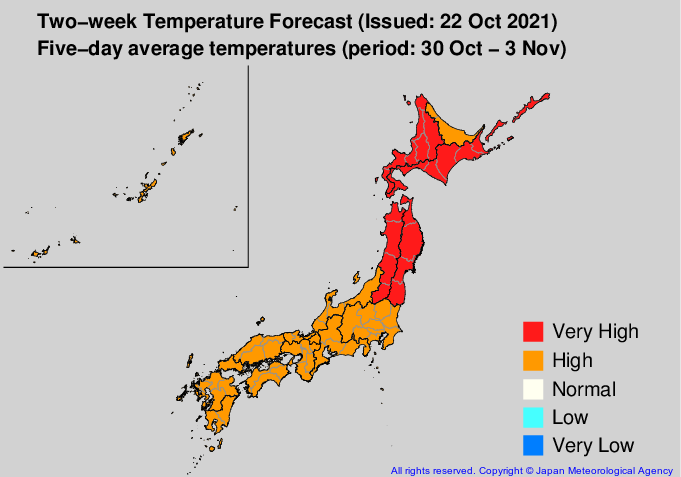
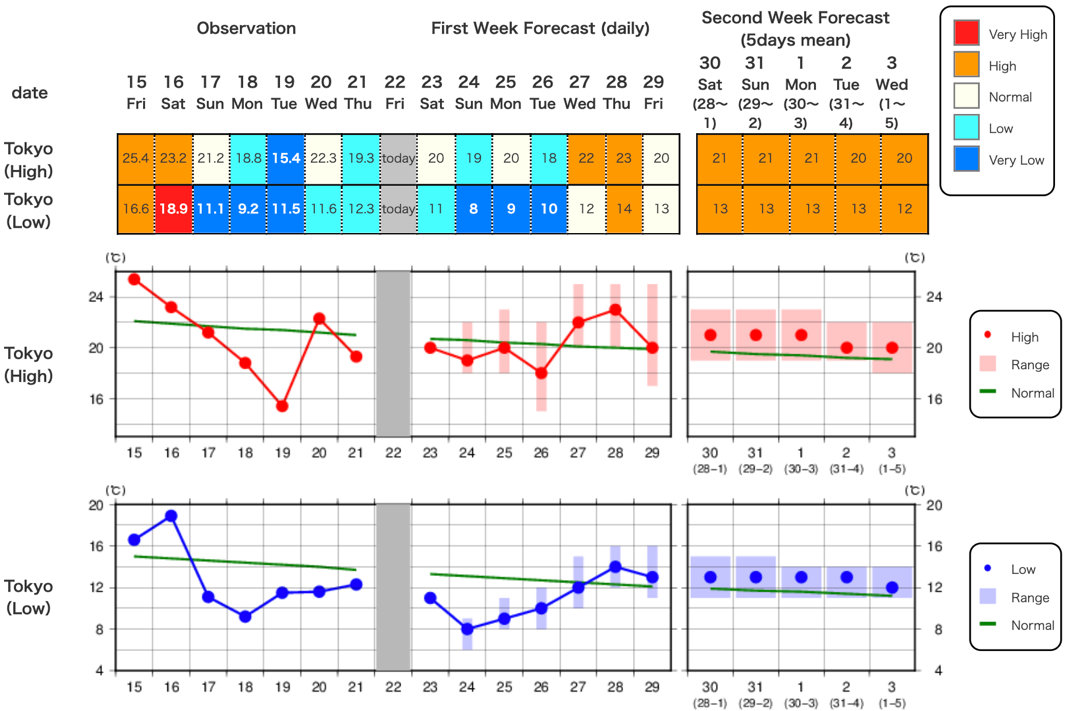
TWO-WEEK TEMPERATURE FORECASTS (OCT. 22 ~ NOV. 3)
Nation-wide
Tokyo area
- Hokkaido/North Japan: Very high temperatures for the next 2 week.
- East/West Japan/Okinawa: Higher than average.
- Amami region: Very high temperatures from Oct. 29.
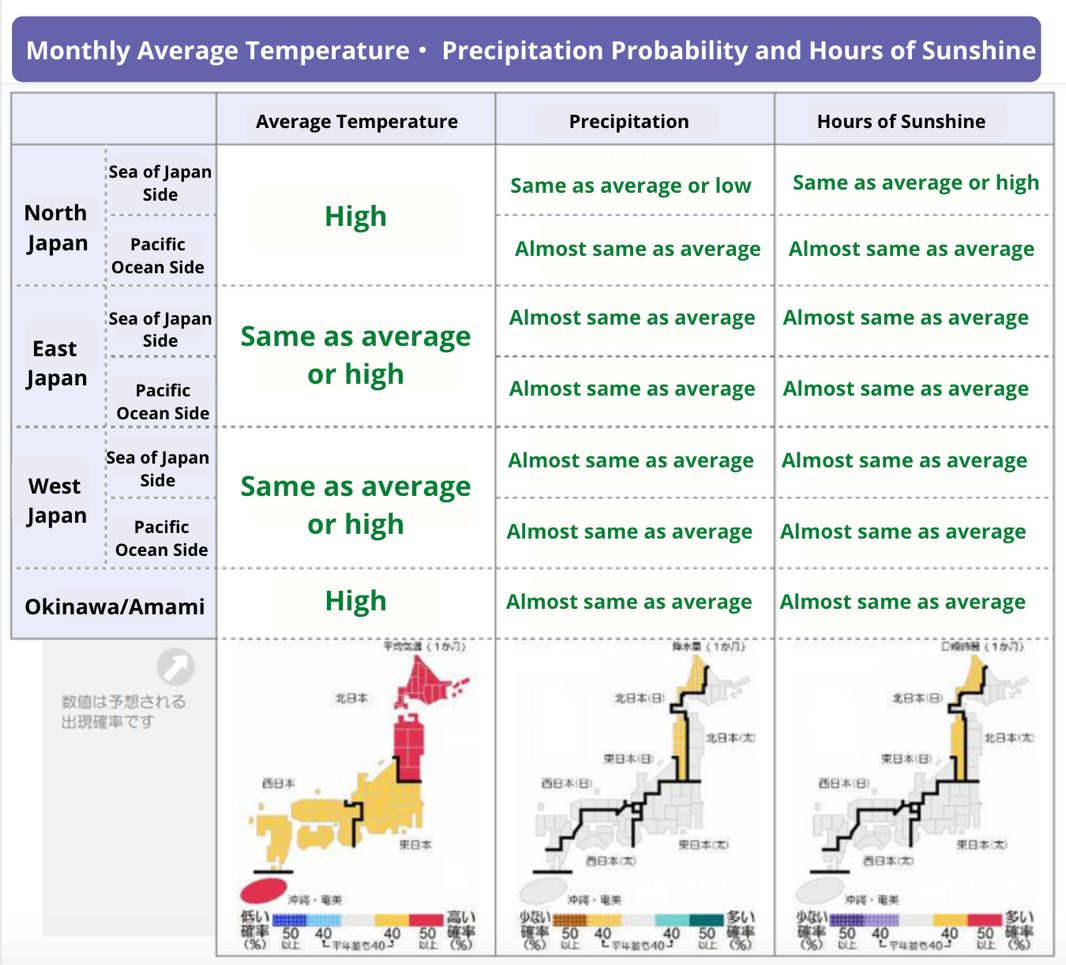
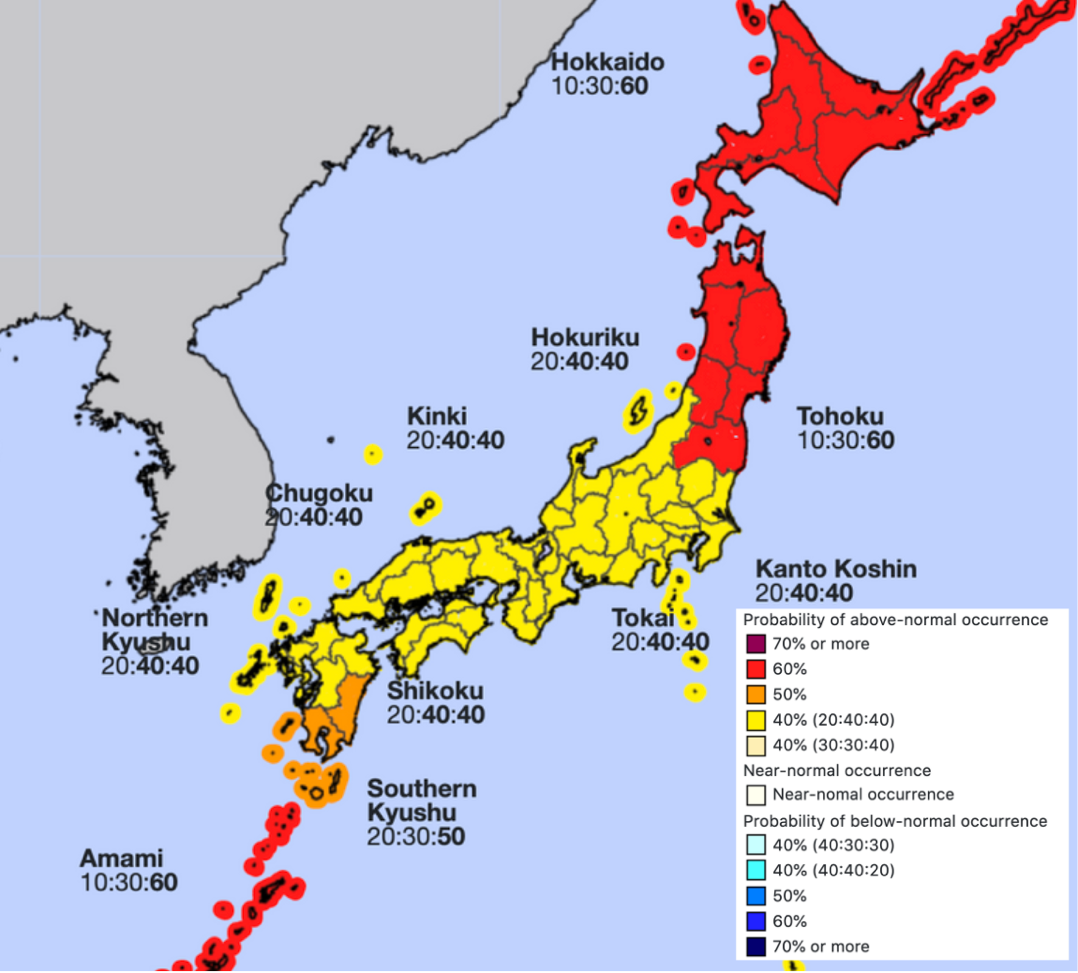
ONE-MONTH SEASONAL FORECAST (OCT. 23~ NOV. 22)
NEWS: POWER MARKETS
| No. of operable nuclear reactors | 33 | Electricity Price | Friday, Oct 22 | % Change WoW | ||
| Of which | restarted | 10 | JEPX 24-Hour Spot | ¥15.45/ kWh | +28.7% | |
| in operation today | 7 | TOCOM Nov. baseload (Tokyo area) | ¥20.12/ kWh | |||
Source: Company websites, JANSI and JAIF, as of Oct 24, 2021
Japan says LNG stocks adequate for winter, but warns utilities against complacency
(Japan NRG, Oct. 21)
- METI asked power and gas suppliers, as well as upstream companies and trading houses that import LNG, to be certain there’s sufficient LNG supplies on hand to safeguard against power plant incidents, and to share supplies in cases of emergencies.
- As of mid-October, the LNG stocks of power companies stood at a five-year high of 2.3 million tons, up 0.7 million tons from a year ago.
- Speaking at a government and industry meeting, energy agency commissioner Hosaka said that with the current level of LNG inventories Japan should be able to avoid a tight supply-demand situation even if the weather turns colder than usual, “as long as the companies continue to procure as planned”.
- Hosaka warned, however, that there is still a possibility that the supply and demand of electricity will become more severe due to an unexpected increase in demand or a large-scale power supply problem.
- The meeting was held for the first time to ensure a stable energy supply for this winter. From the private sector, participants included Ikebe, Chairman of the Federation of Electric Power Companies of Japan (FEPC); Onoda, President of JERA, Morimoto, President of Kansai Electric.
- FEPC’s Ikebe expressed his view on the recent rise in the spot price of LNG, saying, “each electric power company procures LNG mainly through long-term contracts, so there is no prospect of a fuel shortage at least at this point.”
- SIDE DEVELOPMENT:
- METI warns LNG supply will tighten in seven years without new projects
- (Japan NRG and Denki Shimbun, Oct. 22)
- Over the longer term, METI forecasts a potential LNG shortage beyond 2028 as the number of new gas fields starts to decline in 2026. Serious energy panics, comparable to last winter, are possible.
- METI was citing a study by Japan Oil, Gas and Metals National Corporation (JOGMEC), that says if no final investment decisions (FID) are made for new LNG projects in the near future the market will be much tighter after 2028.
- Nishizawa, Managing Executive Officer and CEO of Mitsubishi Corporation’s Natural Gas Group, said at the industry meeting: “The more we rush to become carbon neutral, the more LNG demand will increase in the short to medium term. At the same time, we are under strong pressure to decarbonize, and upstream investment is becoming challenging.”
- Nishizawa called on the government to provide the public and the international community with appropriate information on the situation.
Kansai Electric to build liquified CO2 terminal to test carbon capture at coal plant
(Denki Shimbun, Oct. 21)
- Kansai Electric will build a liquefied carbon dioxide (CO2) shipping terminal at its Maizuru Power Plant (coal, 900 MW x 2 units). Japan CCS, the nation’s public-private carbon capture research entity, will be a partner in the project.
- The power utility plans to use an absorbent to carry out a CO2 capture test at its coal power plant. The ¥16 billion project, which is also backed by NEDO, will also involve the development of a CO2 liquefaction and storage system suitable for long-distance, mass transportation, including by ship.
- About 10,000 tons of CO2 per year will be transported by ship to a CO2 storage site at Tomakomai City, Hokkaido.
- The consortium of Japanese companies, as well as state entities like NEDO, will run the project for six years, until FY2016, and use the experience to advance the practical application of the carbon capture, utilization and storage (CCUS) system.
- CONTEXT: Kansai Electric has worked for years with large engineering firms in Japan to jointly develop solid absorbents for CO2. It is currently involved with Kawasaki Heavy Industries and the Research Institute of Innovative Technology for the Earth (RITE) to test solid absorbent materials that could be economically viable for CO2 recovery tech.
TAKEAWAY: For major power utilities and the government, this is probably one of the most important R&D projects. It’s no secret that many in the Japanese power sector would like to continue running thermal power plants instead of exiting the space for new energy alternatives. How many coal-fired plants Japan will have 10 to 20 years from now is still uncertain, but as Japan NRG reported in the Aug. 10, 2021 issue, capacity is still growing and is expected to hit 55.4 GW by FY2024. Thus, the demonstration at Maizuru station is very important for utilities and METI officials, who want to make CCUS commercially viable.
- For a more detailed look at Japan CCS and the Tomakomai CCS project, see the Feb. 8 issue.
- SIDE DEVELOPMENT:
Mitsubishi Heavy reports 99.8% CO2 recovery at Norway test project - (Denki Shimbun, Oct. 20)
- At a facility in Norway, a unit of Mitsubishi Heavy Industries achieved a CO2 recovery rate of up to 99.8% in an experiment on CO2 recovery from exhaust gas.
- The company said this is the highest rate recorded globally, and that it recovered CO2 from the exhaust of a gas turbine using its proprietary CO2 absorbent, KS-21.
- Given the high rate of recovery, which exceeds that of other absorbents trialed, MHI has decided that its absorbent is ready for commercialization.
- CONTEXT: Mitsubishi Heavy conducted the experiment at the Mongstad CO2 Recovery Technology Center in Norway, one of the world’s largest experimental CO2 recovery facilities. The company used a technology jointly developed with Kansai Electric.
- SIDE DEVELOPMENT:
- Mitsubishi pioneers carbon capture at sea
- (Jiji, Oct. 22)
- Mitsubishi Shipbuilding (part of Mitsubishi Heavy) says its prototype ship-based carbon capture (CC) plant was successfully deployed on a ship at sea.
- The CO2 isolated was over 99.9% pure.
- The trial is part of the Carbon Capture on the Ocean project, which is jointly pursued with certification body ClassNK and financially supported by METI.
Sumitomo Finance, West H sign 200 MW power contract for two years
(New Energy Business News, Oct. 21)
- SMFL Mirai Partners, a subsidiary of Sumitomo Mitsui Finance and Leasing, and a unit of West Holding have signed an agreement for solar power generation and power supply under an off-site PPA model.
- Under the agreement, West Holdings will secure and own the land, obtain various permits and licenses for the power generation, design and construct the power plant, and then perform maintenance and management services.
- SMFL Mirai Partners will own the power generation facilities, conduct the power generation business under non-FIT conditions, and sell all of the power generated to West group.
- The power plants will be set up on abandoned and vacant land throughout Japan, except for Hokkaido, Okinawa, and remote island areas.
- The first phase of the project is to start power generation at several power generation facilities in November. The project will gradually expand its scope to include 100 MW of power capacity in the first year, and eventually hopes to double that utilizing 2,000 sites aound the country.
- SIDE DEVELOPMENT:
- Sumitomo Mitsui Finance and Shuzen Energy buy 6 Kyushu solar plants with ¥36 FIT
- (New Energy Business News, Oct. 21)
- SMFL Mirai Partners and Shizen Electric Power have jointly acquired six solar power plants already in operation in the Kyushu and Chugoku regions.
- The power plants have a total output of 12,337 kW and are expected to generate 14.68 million kWh per year. The main projects are those with a sales price of 36 yen/kWh.
Osaka Gas and partner start PPA business and vow to install 100 MW of solar by FY2024
(Gas Energy News, Oct. 18)
- Daigas Energy, a unit of Osaka Gas, and Yamazen, a trading company specializing in machine tools and housing equipment, signed an alliance agreement by which the firms will start a PPA (direct contracting) business for solar power generation.
- The goal is to install 100 MW of solar panels at 200 locations nationwide by end of FY2024, which would result in an annual power output of 100 million kWh.
- The solar panels will be installed on the roofs of factories and stores. The firms will offer consumers a deal under which they won’t have to pay any costs up front. Instead, a fee would be based on the amount of electricity generated by the panels and consumed on-site by the clients.
- The power contracts will run for 15 to 20 years.
- There will also be an optional service to install storage batteries.
- Daigas will be in charge of engineering and maintenance, as well as billing. Yamazen will take care of sales, directly meeting with manufacturer clients.
Osaka Gas, RWE plan for 900 MW offshore wind plant in Aomori
(New Energy Business News, Oct. 21)
- Osaka Gas, Mitsui & Co., and RWE Renewables are planning to develop an offshore wind farm off the coast of Tsugaru City, Aomori prefecture. The partners released an environmental assessment report for the project, which outlines plans for a capacity of up to 900 MW.
- The project is expected to be implemented in the Sea of Japan off the coast of Aomori (southern part), which is classified as a “promising area” by the government. It will have an area of approximately 95 km2.
JERA to sell cogeneration business in Thailand for about $56 million
(Denki Shimbun, Oct. 20)
- JERA will sell all of its shares in a cogeneration business in an industrial park in Thailand. The buyer, Eastern Power Group, will pay approximately ¥6.4 billion ($56 million). The sale is scheduled to be completed in fiscal 2021.
- The cogeneration business involves assets in the Ladkrabang Industrial Estate (120 MW) and Bangpu Industrial Estate (240 MW) near Bangkok. The buyer is a Thai firm engaged in printing and renewable energy.
- JERA is rebalancing its portfolio and raising funds for other investments.
- SIDE DEVELOPMENT:
- JERA starts co-firing of ammonia at coal plant in Japan
- (Denki Shimbun, Oct. 20)
- JERA started co-firing of ammonia at its coal-fired Hekinan power plant in Aichi prefecture on a test basis.
- The test is held at Unit 5 with a co-firing rate of 0.02%. It will run for about six months until March 2022 to examine the conditions required for a co-firing burner.
- JERA plans to run the world’s first large-scale use of ammonia at a major commercial coal-fired power plant in FY2024. The company plans to run 20% co-firing at Unit 4 (1 GW) of the Hekinan plant.
Nippon Life invests ¥9 billion in renewable energy infrastructure
(Kankyo Business, Oct. 21)
- Nippon Life invested $80 mln in a renewable energy investment fund operated by Sun Life Financial, via U.S. subsidiary Nippon Life Global Investors Americas.
- The Canadian-based fund invests in solar farms, storage batteries and other such renewable energy infrastructure.
Mitsubishi Materials finds waste heat tech that could supply 2.4% of Japan’s power
(New Energy Business News, Oct. 20)
- Mitsubishi Materials Corporation (MMC), in collaboration with a research group led by Associate Professor Mitsuharu Enoki of the Graduate School of Information Science and Engineering at the University of Electro-Communications, has found that filling heat transfer tubes with sintered aluminum fiber, which is an aggregate of fibers made of aluminum, enables heat recovery from fluids with unprecedentedly high efficiency.
- Using the approach means 20 times higher thermal efficiency.
- The technology is expected to be applied to heat recovery in environments with low temperature differences, for example, to recover waste heat below 200 degrees Celsius that is currently disposed of in factories, or to recover cold heat from LNG that is transported at around -200 degrees Celsius.
- The amount of waste heat energy below 200 degrees Celsius that is dumped into the atmosphere in Japan is said to be equivalent to about 2.4% of Japan’s total power generation.
Sekisui Chemical system boosts energy self-sufficiency
(New Energy Business News, Oct. 19)
- The residential building arm of Sekisui Chemical will launch a new energy management system aimed at residential customers that controls roof mounted solar panels, water heaters, lighting, and electric vehicle batteries.
- Sekisui claims the new system will enable consumers to become self-sufficient for up to 73% of energy needs. Surplus electricity generated during sunny periods is automatically used to heat water and recharge electric vehicles.
NUCLEAR REACTOR NEWS ROUND-UP:
- Kansai Electric to shut down Mihama nuclear plant due to delay in anti-terrorism measures
- (Nikkei, Oct. 20)
- CONTEXT: In June, Mihama NPP Unit 3 (Kansai Electric) became Japan’s first nuclear plant to resume operation beyond the 40-year limit.
- The regulator will shut down Unit 3 reactor for 13 months from Oct. 23 to complete anti-terrorism upgrades, which have been delayed.
- The regulator aims to bring the plant back online from October 2022.
- SIDE DEVELOPMENT:
- NRA to inspect the 4 active faults at Shika Unit 2 nuclear power plant
- (Nikkei, Oct. 14)
- At its regular meeting with NRA, Hokuriku Electric explained there are four active faults underneath the Shika Unit 2 reactor, and nine geological faults in total.
- The utility and NRA have come to a mutual agreement to conduct an on-site inspection for the four active faults.
- The inspection date is yet to be decided.
- SIDE DEVELOPMENT:
- NRA to inspect Kashiwazaki Kariwa nuclear plant on Oct. 26 and 27
- (Niigata Nippo More, Oct. 22)
- CONTEXT: On Oct. 20, NRA accepted TEPCO’s audit plan at Kashiwazaki Kariwa nuclear plant after a series of breaches of the site’s anti-terrorism measures.
- NRA to conduct full-scale audit on Oct. 26 and 27.
NEWS: OIL, GAS & MINING
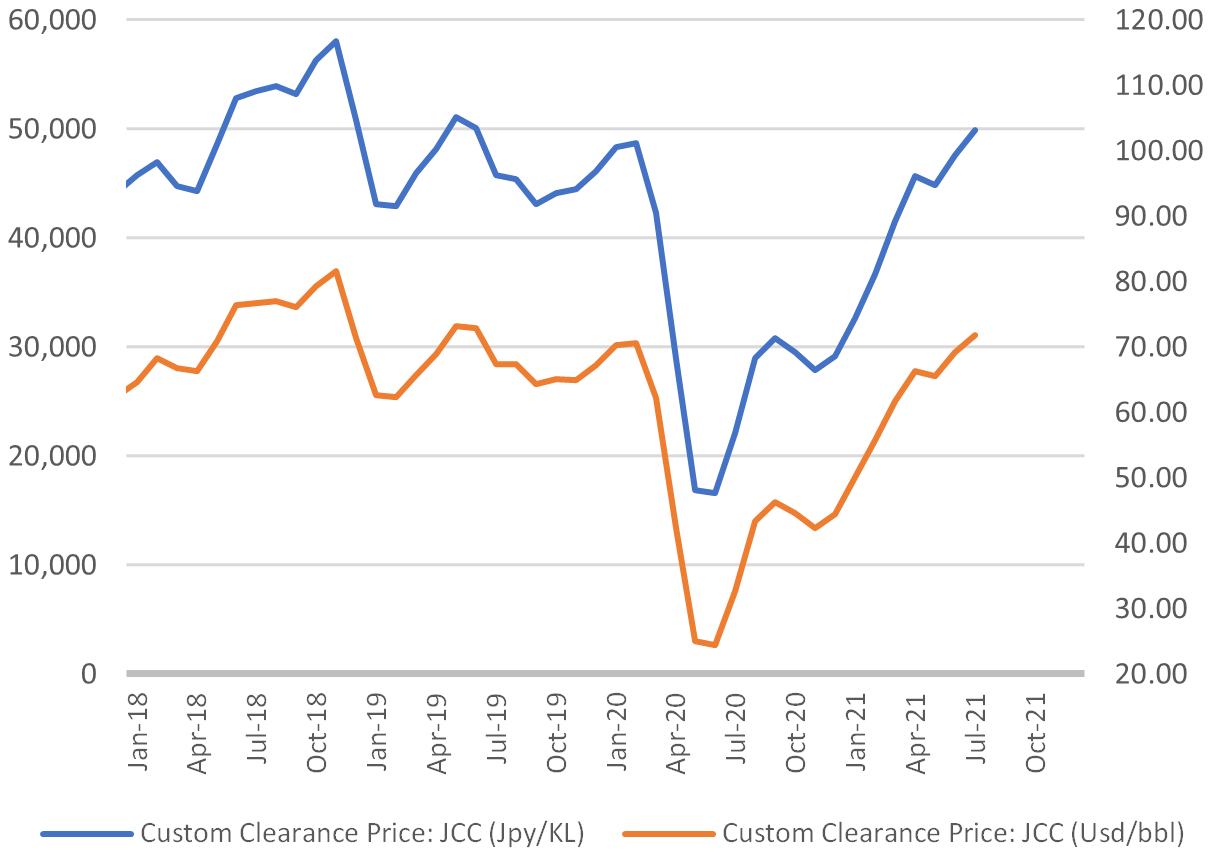
Japan Oil Price: $71.72/ barrel
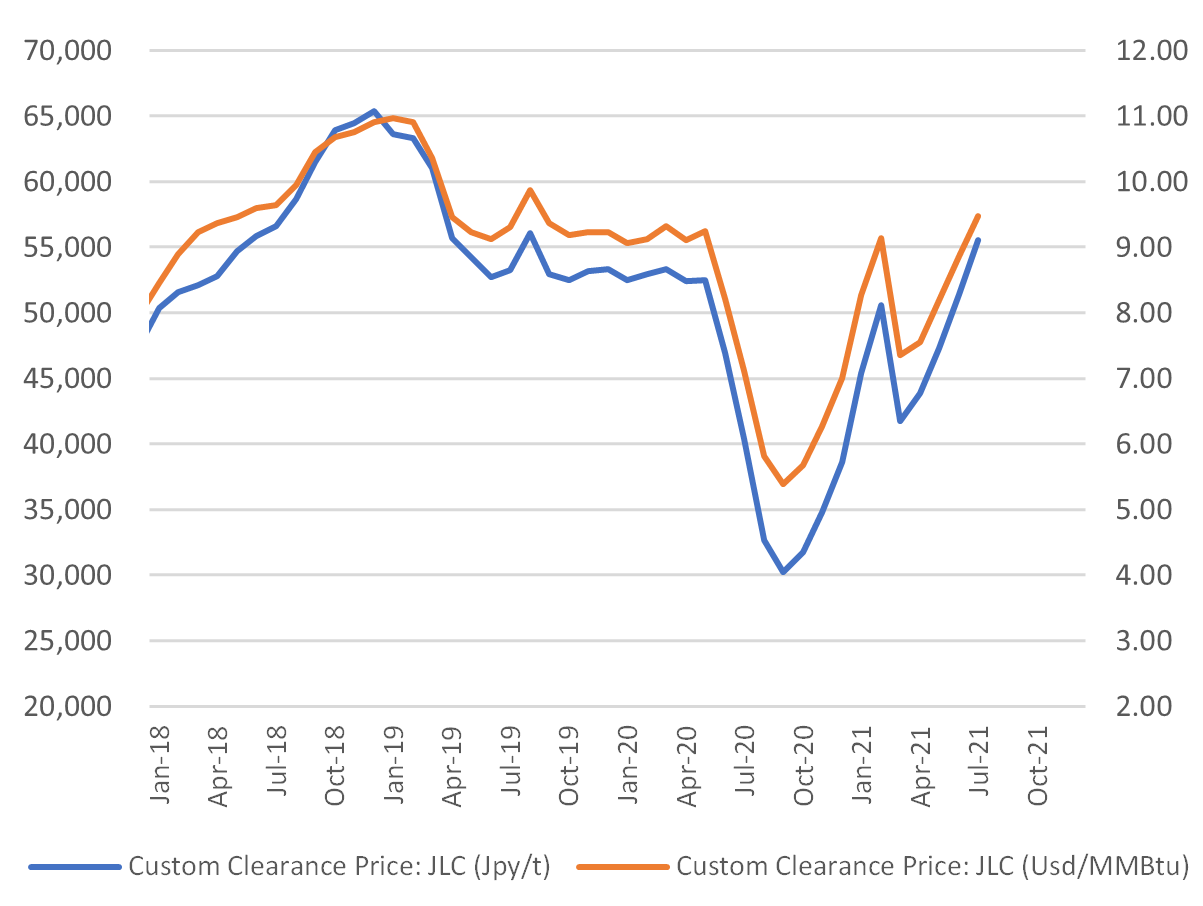
Japan (JLC) LNG Price: $9.47/ mmbtu
Prime Minister raises concern about crude price
(Yahoo News, Oct. 20)
- The price of crude oil futures traded on the Tokyo Commodity Exchange hit a three-year high on Oct. 18. PM Kishida instructed the Cabinet Secretary and four related ministries to continue to monitor the price of crude and mount an agile response to support industries with high exposure to crude prices.
- CONTEXT: PM Kishida has also indicated that Japan will lobby Saudi Arabia, UAE and other oil nations to boost output.
Japan imports 5.4 million tons of LNG in Sept, down 16.8% on-year
(Japan NRG, Oct. 20)
- Japan imported 5.4 million tons of LNG in September, down 16.8% from a year ago, according to preliminary trade data. August imports were 5.8 million tons. Thermal coal imports were 10 million tons, up 17.8%, while crude oil imports were 12.8 million kiloliters, up 15.1%.
- CONTEXT: Japan’s January-September LNG imports rose 3.6% on-year to 56.8 million tons, which was marginal compared to a 23% rise in China and 22% in South Korea. China imported 6.8 million tons of LNG in September, up 19% year on year. January-September imports totaled 58.5 million tons, up 23% year on year. South Korea imported 3.7 million tons of LNG in September, up 28%, and 34.4 million tons over January to September, up 22%.
- China’s coal imports surged to 33 million tons in September, up 76% from a year earlier. It imported a total of 251 million tons from January to September, up 9.5%.
LNG imports in northeast Asia (million tons)
| September 2021 | Y-on-Y change | Jan-Sep 2021 | Y-on-Y change | |
| Japan | 5.4 | -17% | 56.8 million tons | 3.6% |
| China | 6.8 | 19% | 58.5 million tons | 23% |
| South Korea | 3.7 | 28% | 34.4 million tons | 22% |
Kyushu Power, INPEX sign contract with Thai oil firm to cooperate in LNG purchasing
(Yomiuri Shimbun, Oct. 20)
- Kyushu Electric signed a memorandum of understanding (MOU) with INPEX and a subsidiary of Thailand’s state-run National Petroleum Corporation (NPI) to cooperate in the procurement and supply of LNG.
- The companies will share information on LNG inventories, optimize supply and demand, study the mutual use of LNG carriers, jointly purchase LNG and develop an LNG sales business.
- Kyushu Electric hopes to improve its ability to respond to energy crises by strengthening such international cooperation.
Toho Gas to supply “carbon neutral” LNG to auto parts and steel makers
(Denki Shimbun, Oct. 22)
- Toho Gas reached an agreement with nine companies, including Aisin and Aichi Steel, to supply “carbon neutral” city gas; emissions will be offset with credits.
- The contract periods vary from two to 10 years, with supply starting this month. The total amount of gas to be supplied during the contract period will be about 80 million cubic meters (about 60,000 tons of LNG), and the total amount of CO2 emissions to be reduced by the nine companies is expected to be about 200,000 tons.
- With the latest agreement, Toho Gas has expanded its number of “carbon neutral” gas clients to 16 companies.
- INPEX is the original supplier of the LNG. The source of the credits is Verra, a non-profit in the U.S.
ANALYSIS
BY CHISAKI WATANABE
Raw Materials Price Inflation
Threatens to Dampen Japan’s New Renewables Focus
Japan’s effort to boost renewables capacity over the course of this decade is falling prey to inflation. Energy and commodity prices have surged this year on the back of spending by many governments to alleviate the effects of the pandemic, as well logistical bottlenecks and power shortages.
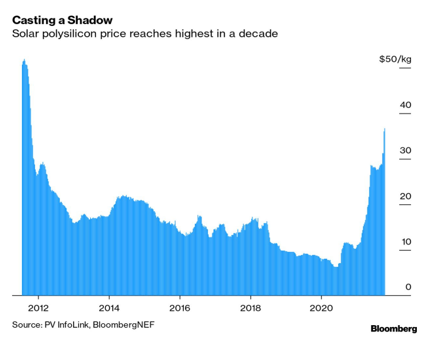
The rise in raw materials prices is starting to filter into the cost of solar in Japan after a substantial jump in panel prices recently, according to government officials that oversee renewable energy development. Solar polysilicon prices jumped to the highest in a decade last week.
The increase comes at a time when solar development in Japan is at a crossroad. The government’s latest energy vision places a big bet on solar power in part due to its short installation time and a record of falling costs over the prior decade. But central government plans have bumped against increasing local opposition, that, among other factors, centers on perceived space constraints.
Evidence of rising costs for solar and wind developments is also a political concern. Newly anointed Prime Minister Kishida Fumio is leading the ruling party to a general election on Oct. 31 with promises that include a greater eye on affordability and wealth redistribution.
Indexed prices for solar PV module, silicon, glass and other commodities, 2020-2021
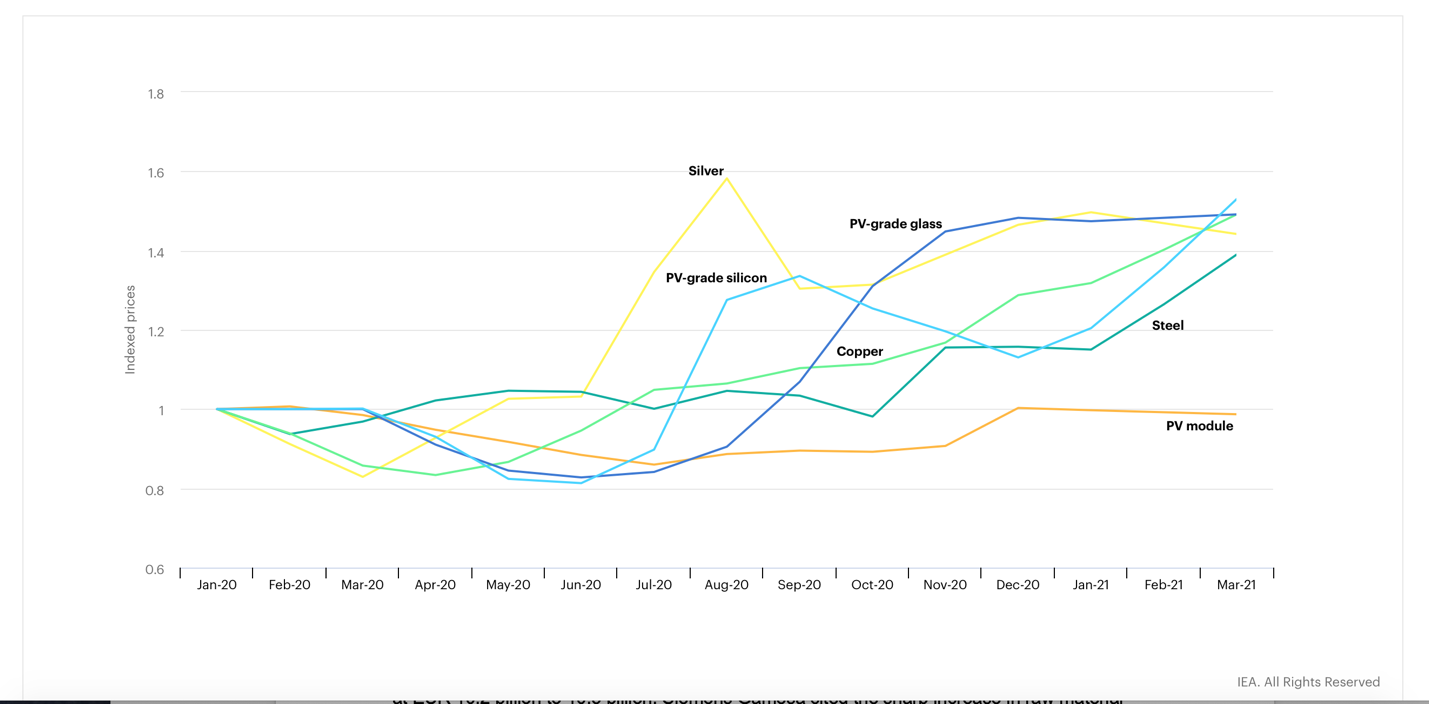
Source: IEA
Global chain of events
Following the recent announcement by Idemitsu’s Solar Frontier subsidiary that it will cease to make solar panels there are few domestic manufacturers left to sound the alarm. But, the rise in costs has not gone unnoticed by the government.
“Solar panel prices (in Japan) are up by 10% to 30% due to a shortage of semiconductors and an increase in the costs of polysilicon and others,” a METI official told a task force meeting on renewable energy in September. “We will closely monitor the situation to see if this is a long-term trend or just temporary.”
After years of falling PV module costs, the outlook is uncertain. To be sure, rising material prices are not a Japan-only problem. This casts a shadow on solar and wind projects all around the world, and according to the International Energy Agency (IEA), it is due to the industry’s unique sourcing structure.
The supply chains for clean energy technologies can be more complex and less transparent compared with fossil fuel supply, the IEA said in a report earlier this year. The supply of raw materials that clean energy tech heavily relies on –- especially copper, nickel and lithium – is more geographically concentrated than oil or natural gas. For some materials, just one country, China, dominates all aspects of the supply chain from mining and processing to refining.
Ironically, China’s efforts to curb energy use to reduce emissions have led to power shortages now affecting manufacturers of components for renewable energy projects. This summer, the Chinese government ordered manufacturing regions such as Yunnan, Fujian, and Xinjiang, all major producers of silicon metal, as well as Guangdong and Jiangsu, to cut energy use. This forced local factories to halt or significantly reduce production.
For countries like Japan, which rely on imports for nearly all their raw materials, and now also on imports for most solar panels and wind turbines, this has created major challenges. Prices of silicon metal, used in solar panels and semiconductors, hit a record of more than $10,000 per ton in late September. Silicon prices rose 300% over just two months, according to Bloomberg.
Copper is another key metal for renewable energy as it’s a highly efficient conductor of electricity and heat. Copper hit a new high earlier this month and supply disruptions in major producer countries are also a factor.
Metal prices have been on the rise partly due to “anticipation that the energy transition away from fossil fuels will result in sizable increases in demand,” according to a World Bank report.
Solar farms use copper for solar cells, cabling, and inverters. It’s used in the turbine generator, transformers, and gearbox for wind power. The material is also widely used in underground and subsea cables, and electric motors and batteries.
Goldman Sachs already nicknamed copper “the new gold,” and forecasted that the green transition will increase demand between 600% to 900% by 2030 from 2020 levels, while stressing that the market is not ready for this kind of jump.
The hike in non-ferrous metals prices will have a significant impact on Japanese manufacturing. Some are starting to agitate against rapid shifts to green tech.
“Overly drastic efforts to decarbonize will trigger a panic in the global economy. Absorbing costs at this price level is not possible. We’ll see a series of price increase being passed on to end-consumers starting next year,” one industry source told Japan’s Diamond magazine this month.
The bigger picture
Impacts are felt in other parts of the world. The Solar Energy Industries Association in the U.S. said in a quarterly report that system prices rose both on quarter and on year for the first time since 2014, when Wood Mackenzie started benchmarking data for the industry lobby.
“Ongoing supply chain constraints and commodity price increases began to have a significant impact on solar prices during the second quarter of 2021,” according to the association. “The most significant price increases have come from higher input costs (steel, aluminum, etc.) and elevated freight costs.”
Top global wind turbine makers have also been impacted by the new prices. In August, Denmark’s Vestas cut its full-year revenue guidance, citing cost inflation in transportation and raw materials. In July, Siemens Gamesa adjusted its guidance for 2021 and issued a second profit warning in less than three months. Siemens Gamesa cited the sharp increase in raw material prices and increased costs for a new product.
In April, the World Bank said the increase in commodity prices should taper off next year, but since then most energy-related commodities have only gone up and energy shortages in China have fueled the rally.
What’s more, several basic factors make a dip in raw material costs less likely. For example, wind turbines continue to expand their size and capacity, requiring more materials such as steel. While the energy output from each kilogram of metal may be increasing, the expectations for the volume of clean tech necessary to meet emission reduction targets are also.
The sudden surge in raw materials will likely shed more light on how they’re sourced. Child labor concerns frequently surround reports on the Democratic Republic of Congo, which has half the world’s known deposits of cobalt, a key metal for EVs and batteries. NGOs have also issued warning reports about mining’s impact on indigenous communities and concerns about environmental impact.
The ESG aspect of raw material supply chains is still an issue rarely mentioned in Japan. But, with commodity price inflation starting to be recognized, it’s only a matter of time until the issue broadens to consideration of the “green” credentials of the supply chain.
Table 1: Materials Important for Renewable Energy Power Generation
| Use | Prices | Outlook | |
| Copper | Solar cells, wind turbine generator, underground and subsea cables | Boosted by falling inventories and supply disruptions in Peru and Chile | Demand will increase especially for EVs and renewable power generation. Goldman Sachs projects that copper will average $9,675/t in 2021, $11,875/t in 2022, $12,000/t in 2023 before a material step-up to $14,000/t in 2024 and $15,000/t in 2025. |
| Aluminum | Widely used in cables and wires as cheaper and lighter alternative to copper. Also used in solar panel frames and EVs (chassis, frames, body panels) | Rose 9% in the first quarter and increased 50% in March from April 2020 on surging demand for vehicles and other manufactured goods and a pickup in construction activity | In China, the largest producer of aluminum, local authorities are increasingly limiting capacity expansion to achieve the country’s emissions reduction targets as producing aluminum is energy intensive. Prices are projected to increase about 29% this year but fall 7% in 2022. |
| Nickel | EV batteries, utility-scale storage batteries, electrolyzers for hydrogen production | Rose by more than 10% in the first quarter, after registering double-digit growth in two previous quarters on strong demand from China’s stainless steel sector and rapid recovery of nickel use in EV batteries | Prices are projected to average almost 20% higher in 2021 and drop in 2022 |
| Zinc | Rust and corrosion proof, zinc is used in the coatings for wind turbines | Rose more than 4% in the first quarter, after double-digit increases in the previous two quarters on robust Chinese infrastructure demand, rebounding global auto output, and surging demand for consumer durables | Prices are forecast to increase 19% in 2021, before falling 11% next year as production picks up and Chinese demand tapers amid the scaling back of stimulus measures. |
| Steel | Most important material for wind power – used in turbines. Also used for support structure for solar | Rose about 2.5 times to $1,300 per ton for hot-rolled sheet by early 2021 compared with mid-2020, according to IHS Markit. Extremely cold weather disrupted the collection of scrap and delivery of ore and scrap in Europe and North America in the first quarter. China’s emissions restrictions in key steel producing provinces also tightened global steel supply | Steel prices are expected to start declining from the third quarter of 2021 through the end of 2021, according to IHS. Asia and Europe will see the drop in prices sooner than the U.S. |
| Silicon | Solar panels | Prices tripled in the course of this year due to output reduction from accidents in Xinjiang province in China in the summer of 2020. In June, the U.S. announced a ban on imports from a Chinese silicon maker in Xinjiang, accusing the company of forced labor. | The supply shortage of silicon that boosted prices earlier this year will not improve very much but module prices probably won’t rise any further, according to Solar Power Europe’s outlook. |
Source: Commodity Outlook report by the World Bank, media reports
ANALYSIS
BY DANIEL SHULMAN
PRINCIPAL
SHULMAN ADVISORY
Overview of Japan’s Agrivoltaic Industry:
Sun’s Shining on a New Wave of Interest
Japan’s new energy strategy seeks to have solar rise to 15% of the power mix, more than double the current level. But with access to suitable land proving difficult, many solar developers are turning to the “agrivoltaic” business model as a way forward.
The commissioning of solar PV plants on agricultural land is a sensitive topic in Japan. On the one hand, the country has a low self-sufficiency rate for food production and any moves that could decrease farm yields has traditionally been a political no-go.
On the other hand, the area taken up by agriculture has decreased by 28% since 1958 due to the sector’s worsening economics. Installing solar panels on agricultural land would offer farmers a second income that might revive some abandoned acres.
The government too seems to finally be on board with the economic and environmental benefits of agrivoltaics and recently relaxed regulation to accelerate developments.
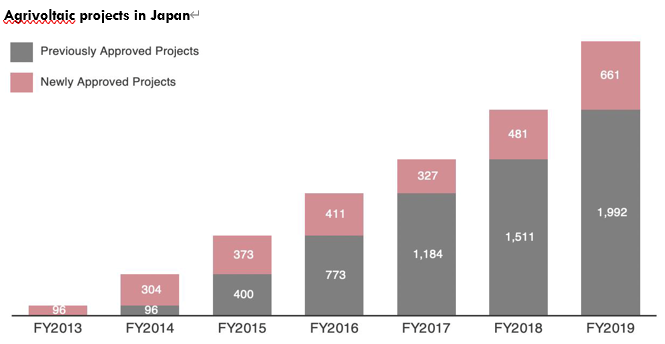
Agrivoltaic projects in Japan
Source: METI
Status report
By the end of FY2019 there were 2,653 agrivoltaic projects, for approximately 670 MW of capacity, covering 742 hectares of agricultural land in Japan.
These projects were commissioned under the feed-in-tariff (FIT) program. The government budgeted ¥1.4 billion to support agrivoltaics in FY2020. The market is expected to keep growing to 4 GW installed capacity by 2030, according to the consultancy firm RTS.
Many companies are collaborating with universities on agrivoltaics R&D, including Chiba Ecological Energy, West Energy Solution and Looop. More Japanese corporations such as ENEOS and Minna Denryoku have also made public their interest in this market.
Getting approval to develop an agrivoltaic system is only half of the hurdle, as the authorization can be revoked during the project’s lifetime. The land under an agrivoltaic system must continue to be cultivated successfully for the solar component to remain in operation. System owners must submit the crop yields every year.
Previously, the Ministry of Agriculture, Forestry and Fisheries (MAFF) carried out a review of the projects every three years and approval for business continuity was based solely on the yields from the underlying farmland. If they were at least 80% of the average yields in the area, the project passed.
In 2018, that review process was extended to every 10 years. And, in April 2021, MAFF even relaxed the 80% criteria for projects installed on degraded agricultural land. In those cases, MAFF will only verify that the land is being cultivated but will not impose a yield requirement.
Despite the easing of the rules, the risk associated with an agriculture + solar projects is not small. Solar developers know it’s essential to build a solid partnership with the person or company cultivating the land to ensure that yields are within MAFF targets.
How to set up a project
To develop an agrivoltaic system an application must be filed with the local agricultural affairs committee to convert the status of the targeted piece of land. Here the focus is also on the impact of the solar PV installation on farming activities. The following data must be submitted:
- Plan for the agrivoltaic system
- Plan for farming under solar panels
- Expectation of impact on farming with supporting data and a specialist opinion
- If the agrivoltaic system owner and farmer are not the same person, a document is required to certify that both parties agree the installer must bear the removal costs at the end of the system’s life
The applications can be submitted at any time and are usually reviewed within a month. About 88% of 340 applications were approved in 2018 based on a survey of agricultural affairs committees.
For assets larger than 10 MW, an environmental impact assessment is necessary. MAFF also requires a study of water drainage to ensure damage won’t occur to nearby agricultural water channels.
While the application process might not be a major hurdle, the opposition of local communities is more likely to impair project development.
A survey of agricultural affairs committees in 2018 found that about 18% of respondents thought that agrivoltaic farming would spoil the landscape. Local governments and farmers are also concerned that agrivoltaic development might cause the decline of agriculture and accelerate the collapse of rural communities.
In the same survey, about 59% of respondents answered that they didn’t think it possible to properly cultivate crops under solar panels, and 48% thought agrivoltaic wasn’t necessary.
A recent case study in Omaesaki city, Shizuoka prefecture, illustrates this opposition. About 80% of local households opposed a recent agrivoltaic project and the city intends to enact an ordinance restricting solar PV installation.
Like recent developments of solar utility assets, it is now crucial for developers to convince local communities of the project benefits.
Costs and impact on crop yields
If agrivoltaic systems come with a higher EPC cost than standard PV systems due to the panels’ elevated position (some mention a 50% increase in racking costs), their operation and maintenance costs can be substantially cheaper (possibly up to a factor of eight) due to the maintenance of the land already performed for farming purposes.
The crops must meet a minimum yield and also bring financial revenues close enough to their original value. It is also explicitly required that the agricultural land be restored to its initial form at the system’s end of life.
According to a MAFF study, close to 65% of the agrivoltaic projects change the type of agriculture in order to meet the constraints imposed by the PV system. MAFF conducted a series of studies in FY2018 and FY2019 and found that blueberries and kiwi fruits did not show any production impact from the introduction of agrivoltaic systems.
In contrast, edamame beans yield loss didn’t make it a good candidate. The results for tea varied, with less leaves but each leaf heavier than under conventional farming conditions.
Crops that don’t require much sunlight, such as tea, rice, taro, sweet potato, cabbage, Chinese cabbage, lettuce, mitsuba, grapes, peaches, pears, strawberries, onions, asparagus, eggplants, peas, and Japanese gingers are well suited for agrivoltaic cultivation.
The financial impact on farming can be contained, and the project’s feasibility comes down to the monetization of the solar asset. MAFF is worried, however, that larger scale development of agrivoltaics could have an impact on local markets for some crops.
Case studies
To overcome local opposition, some developers emphasize the value they bring to local communities. For example, West Energy Solution guarantees farmers the revenues out of the solar projects that it builds for them.
FIT, a developer of green energy power systems for private investors, developed an agrivoltaic project on a wheat field in Akitakada City, Hiroshima prefecture. The power is used by a nearby hydroponic greenhouse, which reduces power procurement costs and adds environmental value to the crops, which they hope will boost sales.
Oikos Tenryu in Hamamatsu City, Shizuoka prefecture, is reviving tea cultivation using agrivoltaics. Several fields had been neglected due to the local aging population and lack of workers. They partly subsidize the agricultural production with profits from solar assets, hiring workers and fostering tea cultivation.
Agrivoltaic assets are also used for power retail, and this business model will likely be more common in the future with the end of the feed-in-tariff. Chiba Okido Agrivoltaic Plant was commissioned in 2019 in a collaboration between Chiba Eco Energy and Shimizu Corporation. The plant is owned and managed by Shimizu, while Chiba carries out the farming. The power generated is sold through a retailer belonging to the Shimizu Group.
Going forward
Though financial impact on farming is limited, local opposition remains a major hurdle for agrivoltaic development. Having local partners that can navigate the intricate relations with the farming community is vital, even more so than for regular solar projects. The 10-year license evaluation is a major risk and a serious partner to manage farming operations is a must.
An additional risk is the FIT’s impending end, which further complicates the financial planning of agrivoltaics and regular solar projects. It’s clear that developers and asset owners will need to review and change their business model from April 2022 since PV systems at 50 kW capacity or above will be subject to the new feed-in-premium pricing model and/or PPAs.
Despite the risks, the future of Japan’s agrivoltaic market looks bright. The fact that major domestic corporations like Shimizu are entering the field adds lobbying muscle for further easing of regulations and overall state support.
MAFF’s budget requests for next fiscal year are another bullish signal for the burgeoning market. The ministry’s wish list for a 16% budget increase is led by initiatives to encourage a reduction of agriculture’s carbon footprint and a national net-zero target for 2050. Offsetting emissions from crop cultivation with solar panels could prove the final tipping point for an agrivoltaic revolution.
GLOBAL VIEW
BY JOHN VAROLI
Below are some of last week’s most important international energy developments monitored by the Japan NRG team because of their potential to impact energy supply and demand, as well as prices. We see the following as relevant to Japanese and international energy investors.
Carbon capture/ Exxon
Exxon will invest $400 million to expand carbon capture (CC) at its LaBarge natural gas and helium fields in Wyoming, enabling annual CC of up to 1 mln tons. Currently, an estimated 6-7 mln tons of CO2 are already captured yearly at LaBarge, a total that represents about 20% of all the carbon now captured on earth. The new additional CC project is expected to begin operations in 2025.
Energy transition/ Rio Tinto
Mining giant Rio Tinto will invest $7.5 bln through 2030 to slash carbon emissions by half. The main focus will be its flagship iron ore business in Western Australia, where 1 GW of solar and wind energy will be built. Funds will also modernize the company’s Australian aluminum smelters to run on renewable energy, which will require 5 GW of solar and wind power. Those smelters account for about 10 mln tons of the company’s annual 31.5 mln tons of carbon emissions.
Europe/ Green hydrogen
Chemicals giant INEOS will invest more than €2 bln to build electrolysis plants that will make green hydrogen. Over the next 10 years the first plants will be built in Norway, Germany and Belgium, with others planned in the UK and France. Over the course of this decade, the EU plans to have as much as 40 GW of electrolysis capacity for green hydrogen manufacture installed. Currently, Europe’s figure is less than 0.1 GW.
France/ Pink hydrogen
France will build two “nuclear hydrogen mega-factories” by 2030 as part of a five-year clean energy program. President Macron wants France to be a leader in zero-carbon energy production. Anti-nuclear voices criticized the plan, saying it will create nuclear waste and therefore cannot be labeled as fully “green”. Macron has also backed the development of new small modular reactor (SMR) nuclear tech and claimed that this will provide reliable decarbonized baseload power. Macron’s plan focuses on the trio of nuclear, hydrogen and renewable energy.
Oil/ Record profits
This year, European and U.S. oil firms might see profits rise as much as 720% and 1,300%, respectively, according to Refinitiv. Despite this historic windfall, the oil majors aren’t expected to increase investment in upstream production due to calls by the International Energy Agency (IEA) to invest more in renewable energy. Global oil and gas investment could drop to $365 bln this year, according to Rystad Energy, compared to $475 bln in 2019 and $740 bln in 2014.
Saudi Arabia/ Energy transition
Saudi Arabia announced that it will aim for net zero greenhouse gas emissions by 2060 and will invest more than $180 billion to meet that goal. One of the world’s top oil producers will not, however, abandon oil in the coming decades, it said.
The country will, however, start a gradual shift in its energy strategy. One small aspect of that will be the conversion of an oil rig in the Persian Gulf into a luxury resort with three hotels. Known as The Rig, it’ll also have a ferris wheel, roller coaster, water slides, theaters, and scuba diving. The Rig consists of several platforms spanning 50,000 sq/feet, and will be the world’s first vacation spot on an old oil rig.
UK/ Green investment
Billionaire Bill Gates will invest £400 million in green hydrogen, long-term energy storage and sustainable aviation fuels in the UK. The partnership is “a boost to the UK’s vision of a green industrial revolution,” said Prime Minister Boris Johnson during his government’s Global Investment Summit, which led to pledges of £9.7 billion of investment for the British economy.
UK/ Nuclear
The UK plans a new nuclear power plant at Sizewell in Suffolk, which already has two nuclear stations. Sizewell’s A station was decommissioned in 2006. The proposed Sizewell C station would generate 3.2 GW of electricity. Another part of the UK’s transition to clean energy includes offering households £5,000 to scrap old gas boilers and install low-carbon alternatives by 2035.
United States/ LNG
U.S.-based Venture Global LNG signed three long-term deals totaling 5 mln tons with China, more than doubling the country’s annual LNG imports from the U.S. The gas will be sourced from Venture’s new project in the state of Louisiana. In related news, Poland’s state-run energy company, PGNiG, signed a 20-year deal with Venture Global for 2 mln tons of LNG yearly. Poland seeks to lessen dependence on Russian gas, which accounts for 2/3 of Poland’s total gas imports.
Wind/ Energy transition
The amount of wind blowing across the Earth can easily meet global electricity demand, according to a study by Professors Rebecca Barthelmie and Sara Pryor at Cornell University in New York. They say that investing in wind energy generation will reduce global warming by 0.3 to 0.8 degrees Celsius by 2100. Wind energy generation capacity grew by only 14 percent annually from 2006 to 2020.
EVENTS CALENDAR
A selection of domestic and international events we believe will have an impact on Japanese energy.
| February | Approval of Fiscal 2021 Budget by Japanese parliament including energy funding projects;
CMC LNG Conference |
| March | 10th Anniversary of Fukushima Nuclear Accident;
Smart Energy Week – Tokyo; Quarterly OPEC Meeting; Japan LPG Annual Conference; Full completion of all aspects of the multi-year deregulation of Japan’s electricity market; End of 2020/21 Fiscal Year in Japan; |
| April | Japan Atomic Industrial Forum – Annual Nuclear Power Conference;
38th ASEAN Annual Conference-Brunei; Japan LNG & Gas Virtual Summit (DMG)-Tokyo Three crucial by-elections in Hokkaido, Nagano & Hiroshima – April 25th |
| May | Bids close in first tender for commercial offshore wind projects in Japan;
Prime Minister Suga to visit the U.S. |
| June | Release of New Japan National Basic Energy Plan-2021;
G7 Meeting – U.K. Presidents Biden and Putin are due to meet at a summit in Geneva Forum for China-Africa Cooperation Summit (Senegal) |
| July | Tokyo Metropolitan Govt. Assembly Elections;
Commencement of 2020 Tokyo Olympics |
| August | METI committee approves draft of Japan’s 6th Basic Energy Plan |
| September | Ruling LDP Presidential Election;
UN General Assembly Annual Meeting that is expected to address energy/climate challenges; IMF/World Bank Annual Meetings (multilateral and central banks expected to take further action on emissions disclosures and lending to fossil fuel projects); End of H1 FY2021 Fiscal Year in Japan; Japan-Russia: Eastern Economic Forum (Vladivostok)-tentative |
| October | Hydrogen Ministerial Conference in conjunction with IEA;
METI Sponsored LNG Producer/Consumer Conference; Innovation for Cool Earth Forum – Tokyo Conference; Task Force on Climate-Related Financial Disclosure (TCFD) – Tokyo Conference; G20 Meeting-Italy; Japan’s 2021 General Election |
| November | COP26 (Glasgow);
Asian Development Bank (‘ADB’) Annual Conference; Japan-Canada Energy Forum; East Asia Summit (EAS) – Brunei |
| December | Asia Pacific Economic Cooperation (APEC) Forum – New Zealand;
Final details expected from METI on proposed unbundling of natural gas pipeline network scheduled for 2022. |
Disclaimer
This communication has been prepared for information purposes only, is confidential and may be legally privileged. This is a subscription-only service and is directed at those who have expressly asked K.K. Yuri Group or one of its representatives to be added to the mailing list. This document may not be onwardly circulated or reproduced without prior written consent from Yuri Group, which retains all copyright to the content of this report.
Yuri Group is not registered as an investment advisor in any jurisdiction. Our research and all the content express our opinions, which are generally based on available public information, field studies and own analysis. Content is limited to general comment upon general political, economic and market issues, asset classes and types of investments. The report and all of its content does not constitute a recommendation or solicitation to buy, sell, subscribe for or underwrite any product or physical commodity, or a financial instrument.
The information contained in this report is obtained from sources believed to be reliable and in good faith. No representation or warranty is made that it is accurate or complete. Opinions and views expressed are subject to change without notice, as are prices and availability, which are indicative only. There is no obligation to notify recipients of any changes to this data or to do so in the future. No responsibility is accepted for the use of or reliance on the information provided. In no circumstances will Yuri Group be liable for any indirect or direct loss, or consequential loss or damages arising from the use of, any inability to use, or any inaccuracy in the information.
K.K. Yuri Group: Oonoya Building 8F, Yotsuya 1-18, Shinjuku-ku, Tokyo, Japan, 160-0004.