
JAPAN NRG WEEKLY
NOV. 22, 2021
JAPAN NRG WEEKLY
Nov. 22, 2021
NEWS
TOP
- PM Kishida unveils a ~$700 bn economic stimulus package
with subsidies for gas at the pump, security measures, batteries - Japan to release oil from national reserves for the first time; coordinated action with the U.S. may come as early as this week
- Utilities trial power curbs to conserve LNG fuel amid high stocks;
JERA invests $2.5 bn in American LNG to secure future supplies
ENERGY TRANSITION & POLICY
- Govt. decided to postpone new carbon pricing plant to FY2022
- More than 250 companies in Japan commit to net-zero: survey
- Honda is first Japan carmaker to mandate CO2 cuts for suppliers
- METI revises schedule for project to develop Alaska’s hydrogen
- Mitsui OSK to double funding for decarbonization to $3.5 bn
- Idemitsu to study green hydrogen/ammonia project in Australia
- Tasmania ammonia export to Japan shown as feasible… [MORE]
ELECTRICITY MARKETS
- Japan’s spot electricity price jumps to highest since January 22
- Shikoku Electric gets final approval for restart of Ikata nuclear unit
- World-first: CO2-free electricity generated from natural gas
- First Japanese storage battery to debut in Europe’s power market
- Osaka Gas in capital alliance with Dutch VPP developer JEDLIX
- Japan’s Wind Power Association grows to over 500 members
- Shikoku Electric to invest in one of Japan’s top biomass projects
- NUCLEAR REACTOR WRAP: TEPCO downplays water impact
- Chubu Electric to build solar farm for offsite PPA client [MORE]
OIL, GAS & MINING
- METI unveils crude oil subsidy as top refiner Idemitsu is unable to keep absorbing crude oil price increases; but, no tax breaks on gas
- Japan’s October LNG imports fall to lowest monthly total this year
- JERA CEO Onoda advocates for diversification of LNG supply
- Idemitsu buys carbon credits to offset emissions from oil transport
- ENEOS sells its first shipment of “carbon neutral” LNG
ANALYSIS
CLEAN ENERGY AGENDA SPREADS, BUT JAPAN’S OIL AND GAS UPSTREAM FIRMS STICK TO STRATEGY
Coal is often painted as the biggest climate problem, but another campaign born at COP26 now seeks to phase out oil and gas. Japan’s upstream firms have yet to feel the pressures faced by their peers in Europe and the U.S. and enjoy easy access to capital. But the global trend may start to catch up with them as anti-oil advocates hamper new developments in regions where Japanese firms are active. The upstreamers hope that new developments in CCUS and carbon offsets will help. But will that be enough?
JAPAN AUTOMAKERS PLAN GLOBAL EV CHARGE
VIA LITHIUM BATTERY INVESTMENTS IN INDIA
Tesla and Chinese automakers have built a commanding lead in electric vehicles, but Japan’s companies are already plotting their comeback, and it lies via India. By the end of this year, Suzuki Motor, Toshiba and Toyota-backed Denso hope to begin commercial output at India’s first lithium-ion battery plant with an eye of later launching local production of EVs for the domestic market and export. Trial production has already started.
The India-Japan EV strategy is also drawing in other partners such as Brazil, which can offer access to some of the battery raw materials and tech.
GLOBAL VIEW
The Biden administration wants to investigate oil firms over price fixing. Netherlands plans an “exit tax” for Shell. EU carbon prices set a record. Chile wants to pipe its solar power across the ocean to China. Trafigura says we cannot decarbonize so quickly. Qatar and the Azeris discuss offshore wind. Details on these and more in our global wrap.
WEATHER OUTLOOK
A cold spell in the east, but heat in Japan’s north.
JAPAN NRG WEEKLY
PUBLISHER
K. K. Yuri Group
Sponsored
Editorial Team
Yuriy Humber (Editor-in-Chief)
Tom O’Sullivan (Japan, Middle East, Africa)
John Varoli (Americas)
Regular Contributors
Mayumi Watanabe (Japan)
Daniel Shulman (Japan)
Takehiro Masutomo (Japan)
Art & Design
22 Graphics Inc.
SUBSCRIPTIONS & ADVERTISING
Japan NRG offers individual, corporate and academic subscription plans. Basic details are our website or write to subscriptions@japan-nrg.com
For marketing, advertising, or collaboration opportunities, contact sales@japan-nrg.com
For all other inquiries, write to info@japan-nrg.com
OFTEN USED ACRONYMS
METI The Ministry of Energy, Trade and Industry
MOE Ministry of Environment
ANRE Agency for Natural Resources and Energy
NEDO New Energy and Industrial Technology Development Organization
TEPCO Tokyo Electric Power Company
KEPCO Kansai Electric Power Company
EPCO Electric Power Company
JCC Japan Crude Cocktail
JKM Japan Korea Market, the Platt’s LNG benchmark
CCUS Carbon Capture, Utilization and Storage
mmbtu Million British Thermal Units
mb/d Million barrels per day
mtoe Million Tons of Oil Equivalent
kWh Kilowatt hours (electricity generation volume)
NEWS: ENERGY TRANSITION & POLICY
PM Kishida unveils Japan’s second-largest stimulus package at ¥78.9 trillion
(Japan NRG, Nov. 20)
- On Nov. 19 Prime Minister Kishida announced a ¥78.9 trillion (~$700 billion) stimulus package, the second largest in Japan’s history.
- It’s due to be approved by the Cabinet on Nov. 26 and by parliament before the end of the year.
- The package contains some limited positive elements for Japan’s energy complex, but lacks substance around energy transition infrastructure despite coming a week after PM Kishida attended the COP26 climate conference in Glasgow.
- The $700 billion package includes central government expenditure of $300 billion, local government stimulus, and loan programs. A previous package announced in April last year amounted to ¥48 trillion ($420 billion).
- The new stimulus is equivalent to 10% of Japan’s GDP. The government expects the funding should boost GDP by 5.6%.
- Cumulative Japanese fiscal stimulus since the outbreak of Covid in Q1 2020, including this most recent announcement, amounts to almost 30% of GDP, or $1.5 trillion. By comparison the two stimulus bills introduced by President Biden in the U.S., the Infrastructure and the Build Back Better Bills, amount to $3 trillion.
- The latest Japanese package includes:
- ¥5/ liter subsidy for gasoline wholesalers to keep prices below the important ¥170/ liter retail threshold at the pump;
- $10 billion university endowment fund to strengthen supply chain resilience;
- $5 billion develop the semiconductor and AI industries;
- $5 billion for a new fund to bolster Japan’s economic security;
- $1 billion to subsidize cutting-edge battery factories;
- $7.5 billion for defense-related items such as missiles and aircraft, the first time such expenditure was included in a supplementary budget.
- The budget also outlines a ¥15 trillion, five-year plan for the National Resilience initiative, which seeks to install measures to improve critical infrastructure, including energy, in order to deal with natural disasters and to digitize.
- The full budget for 2022 is expected to be drafted next month.
TAKEAWAY: The stimulus tries to please the broader public, business and society, including with some cash handouts as PM Kishida and the ruling LDP look ahead to the Upper House elections next summer. However, the stimulus does not seem to put as much emphasis on providing relief for retail from the more expensive energy input costs, or mention much about the need to revamp the power grid in order to accommodate a greater reliance on variable renewable energy sources, as per the Basic Energy Plan. Given the accelerated timetable to decarbonize post Glasgow, Japan will need to put as much emphasis on energy/emissions counter-measures as is currently being afforded in the battle with Covid-19.
Japan may release of oil from national reserves for the first time
(Jiji News, Nov. 20)
- PM Kishida confirmed that his government is considering a release of crude oil from the nation’s strategic reserves in response to soaring oil prices. This would be a first for Japan.
- Some oil was released into the market from Japan’s private stockpiles in 2011 in response to the deteriorating situation in Libya.
- The PM said the government is considering whether tapping into the national reserves can be done from a legal standpoint.
- Kishida also noted that Japan may cooperate with the U.S. and other concerned countries on the oil release.
- The U.S. has asked other major oil consumers such as Japan and China to make a release from national stockpiles in order to coordinate action.
- CONTEXT: Japan’s oil stockpiling law allows for reserves to be used only at a time of supply constraints or natural disasters, but not as a tool to lower prices. However, the government believes there’s currently a surplus in the domestic stockpile.
- SIDE DEVELOPMENT:
Oil release decided, due this week in concert with U.S.
(Yomiuri Shimbun, Nov. 21)- The government will go ahead with a release of oil from stockpiles to cope with high oil prices.
- The U.S. and Japan seek to announce the release of oil reserves by the end of the week in a coordinated action.
- The Biden administration has been in talks with Japan, South Korea and other countries on the oil market move.
- CONTEXT: As of the end of September, the national stockpile was equivalent to 145 days of domestic consumption. The Oil Stockpiling Law stipulates that the national stockpile must be at least 90 days’ worth of imports.
TAKEAWAY: As oil prices surge, and the yen weakens, the cost of imports starts to rise rapidly. For a country that imports most of its food and nearly all of its energy, that’s a sure-fire way to see general living standards drop as food and energy (and transport) inflation works its way into the economy. Amazingly, the consumer price index in Japan remains unphased for now, the same as always, But, more specific gauges reveal a different picture. Wholesale inflation hit a four-decade high in October because of global logistics failures and rising commodity costs. The index that measures the prices that companies charge each other for goods and services was up 8% YoY in October, according to Bank of Japan data.
Japan has already asked some Middle East suppliers to raise crude output, but individual countries are beholden to OPEC+ decisions. So, this time PM Kishida is playing the political card (in cooperating with the U.S.). The big unknown is how effective the measures will be. Unless the oil release is done in a sustained way, it’s hard to see an impact on prices beyond the first few days after the announcement.
Carbon tax postponed
(Sankei Shimbun, Nov. 13)
- The govt. will postpone a new carbon pricing plan until after FY2022.
- The plan is opposed by industry, with the Keidanren calling for caution so as not to negatively impact industry.
- Experts criticized the plan, saying it could delay efforts to help businesses recover after the Covid 19 pandemic and high oil prices.
- Japan was criticized at the recent COP26 for failing to present a roadmap for divesting from coal-fired power generation.
More than 250 companies in Japan commit to net-zero: survey
(Asia Nikkei, Nov. 17)
- More than 250 Japanese corporations pledged to attain net-zero GHG emissions or better, according to a Nikkei survey.
- More than half were made this year with an eye on COP26.
- The Nikkei received responses from 846 Japanese companies about how they plan to contribute to UN sustainability goals.
- 246 companies pledged to be carbon neutral. Another 21 have a “carbon negative” commitment to remove more than they produce.
- Out of these 267 companies, about 79% set goals for 2050 or later. About 43% plan to achieve targets in the 2030s.
- Also, 377 companies track the GHG output of their suppliers.
- SIDE DEVELOPMENT:
Honda sets net-zero target for entire supply chain
(Nikkei, Nov. 16)- Automaker asks main suppliers to cut carbon emissions 4% annually versus 2019 levels.
- Honda is the first Japanese automaker to mandate long-term emissions reduction target to its suppliers.
METI revises Alaska methane hydrate project schedule
(Japan NRG, Nov. 17)
- METI revised development schedules of methane hydrate in sandy sediments. Together with the U.S. National Energy Technology Laboratory, METI will determine if project sites in Alaska have enough reserves. The goal is to develop methane hydrate as sources of ammonia and hydrogen. If a site has reserves that can output 50,000 m2/day and if total reserves exceed 10 billion m2, then the project can be profitable.
- Domestic exploration had been on hold due to problems with the state-owned exploration vessel Tansa. The prospecting phase will be delayed by a year, to 2022, and the research and development of mining technologies to 2023. Nevertheless, methane hydrate mining can go ahead in 2023-2027, as stated in the 2030 Basic Energy Plan.
- Separately, The National Institute of Advanced Industrial Science and Technology will conduct prospecting surveys for surface methane hydrate in the Sea of Japan.
- CONTEXT: Methane hydrate is a form of natural gas, but it’s not clear if its exploration is subject to a ban in some jurisdictions. A METI official told Japan NRG it hasn’t started drilling, hasn’t determined the technologies to be used, and hasn’t measured carbon emissions during extraction.
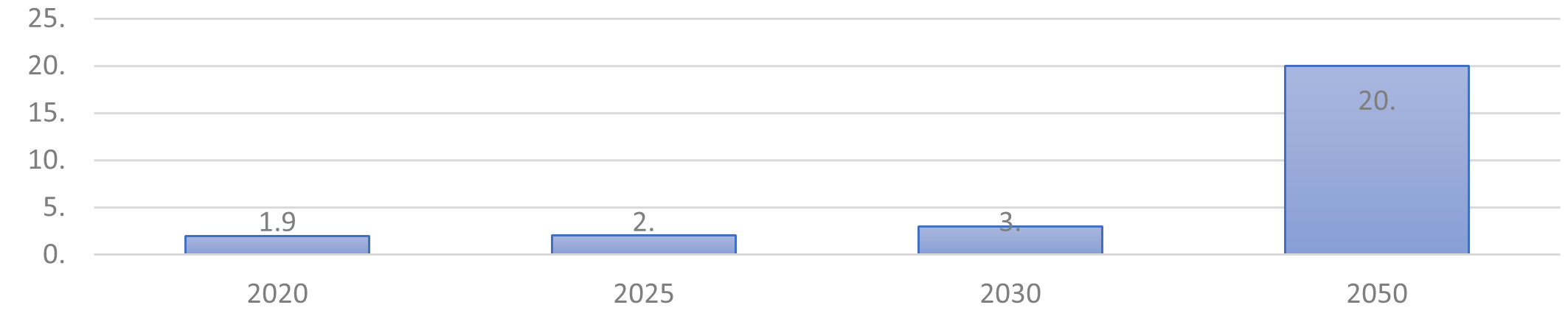
- Japan produced 1.93 million tons of hydrogen mainly from oil refineries in 2020. It aims to supply 2 million tons in 2025; 3 million tons in 2030; and 20 million tons in 2050.
Japan’s hydrogen supply goal (million tons)
Shipper Mitsui O.S.K. to double funding for decarbonization to $3.5 billion
(Asia Nikkei, Nov. 20)
- Shipping company Mitsui O.S.K. Lines will invest around ¥400 billion ($3.5 billion) in decarbonization efforts over three years, almost twice the previous three-year plan, President Hashimoto said in an interview to Nikkei.
- The firm will use a significant increase in cash flow from the current shipping boom globally to finance the plan, which includes a shift toward operating vessels that use LNG as fuel rather than the more polluting fuel oil.
- CONTEXT: Mitsui O.S.K. plans to own 90 LNG-powered vessels by 2030.
- Mitsui O.S.K. is also investing in green ammonia. There is not enough global production to employ ammonia to fuel ships at this moment, but the company feels sure that this is the future trend and wants to get ahead of rivals.
- The company announced in May that it would resume transporting ammonia for the first time in half a decade. It is expected to invest in new production and storage facilities, with an eye on markets like Australia, Russia and the Middle East.
- Mitsui O.S.K. will also consider producing and exporting ammonia derived from natural gas. “We will look into ammonia-related mergers and acquisitions as well,” Hashimoto said.
Idemitsu to study green hydrogen and ammonia project in Australia
(Sekiyu Tsushin, Nov. 17)
- Idemitsu Renewable Development Australia Pty, a unit of Idemitsu, is working with the Port of Newcastle and Macquarie Group on a green hydrogen and ammonia project at the Port of Newcastle, Australia.
- The parties signed an MoU to jointly study the feasibility of exporting and bunkering green hydrogen and ammonia at the Port of Newcastle.
- The project will commercialize the use of green electricity at the port and the production, storage, transportation, sale, and export of green hydrogen and ammonia from 2024. The plan includes export to Japan.
Export of ammonia from Tasmania to Japan seen as feasible
(Denki Shimbun, Nov. 16)
- Woodside Petroleum, Australia’s largest energy company, completed a feasibility study on ammonia production in Tasmania, in collaboration with Marubeni and engineering firm IHI. The study concluded that exporting ammonia to Japan is technically and commercially feasible.
- Woodside expects to make a final investment decision (FID) in 2023, followed by plant construction and commissioning by around 2025.
- The three firms conducted initial studies to produce green ammonia using renewable energy in Bell Bay, northern Tasmania, for export to Japan and other Asian countries. In the project’s initial phase, Woodside aims to produce 200,000 tons of ammonia per year.
- CONTEXT: Woodside is also conducting a feasibility study on ammonia production and export in Western Australia in cooperation with Kansai Electric, Hokuriku Electric, Marubeni and others.
Environment Ministry reports Japan’s contributions to Paris Agreement Rulebook
(Japan NRG, Nov. 15)
- The MoE reported how Japan contributed to the completion of the Paris Agreement Rulebook negotiations at COP26, proposing a mechanism to prevent double counting of carbon offset credits. It was also agreed that credits earned under the Kyoto Protocol Clean Development Mechanism system will be transferrable to the Paris Agreement mechanism. Japan’s delegation also called for uniform carbon measurement across the globe, which was included in the agreement.
- The Conference of the Parties of Paris Agreement (CMA) will continue to discuss the means to support countries reporting capabilities.
- CONTEXT: The Institute of Global Environmental Studies said unclear roles and responsibilities of key ministries and stakeholders, as well as a lack of human resources and experts who understand GHG inventory methodologies, are key challenges in Asia. Japan will help Southeast Asian nations develop carbon measurement capacities.
METI panel urges more data disclosure to grids ahead of 2024 capacity auction launch
(Japan NRG, Nov. 18)
- The METI sub-committee on basic electricity and gas policies urges more data disclosures to regional power grids ahead of a 2024 capacity auction launch. Following the launch of capacity auctions, retailers will be required to source supplies through auctions. Retailers need data on power generation and expected income to make comparisons among power suppliers. The sub-panel proposes requirements for regional grids to clarify power generation costs and sales costs in financial statements.
Japan-China Forum on Energy Conservation and Environment to be held on December 26
(Japan NRG)
- On Dec. 26, METI and China’s National Reform Development Commission will co-host the 15th Japan-China Forum on Energy Conservation and Environment. There’ll be presentations by government officials and business representatives, and panel discussions on: energy efficiency, zero-emission vehicles, hydrogen-powered clean electricity, and long-term bilateral relationships to promote water conservation and waste treatment. METI expects around 150 participants from the Japan side.
- CONTEXT: The Kishida government is drafting the Economic Security Bill that will regulate the use of Chinese products in Japan’s energy infrastructures. Despite such moves, the METI minister will make opening remarks at the Forum like last year.
Japan, US establish new framework to address climate change in Indo-Pacific
(Japan NRG, Nov. 15)
- METI Minister Hagiuda and U.S. Secretary of Commerce Gina M. Raimondo established the Japan-U.S. Commercial and Industrial Partnership (JUCIP) to strengthen the competitiveness, resiliency, and security of both economies; to address shared global challenges such as climate change; and to achieve prosperity and maintain a free and fair economic order, according to a joint statement.
Sinanen releases ‘solar carport’ for corporate clients
(Smart Japan, Nov. 18)
- Energy company Sinanen will launch ‘solar carports’.
- The carports are covered by solar panels, and can be sized to accommodate from a few cars to several hundred cars.
- A four car unit has thirty 360 W panels, with total output of nearly 11 kW.
- Sinanen set a goal of ¥2 billion annual revenue from the carports by 2025.
Mitsui Chemicals cuts emissions with sugarcane adhesive
(Nikkei, Nov. 17)
- Mitsui Chemicals wants to replace fossil fuels used to produce polyethylene and other plastics with more environmentally friendly alternatives.
- Mitsui was able to partially replace hydrocarbons used to make its adhesive polyolefin resin, Admer, with biomass derived from sugarcane.
- The CO2 emitted is offset by carbon fixed by photosynthesis.
J-Power to import Enviva biofuel
(Nikkei, Nov. 17)
- J-Power signed a MoU with U.S.-based biofuels manufacturer Enviva to source up to 5 million tons of wood pellets a year.
- They are reviewing transport, unloading, and storage arrangements.
- The pellets will be blended with coal used to fuel J-Power’s Isogo and Tachibana Bay power stations.
- Enviva has factories in 10 countries and currently manufactures over 6 million tons of pellets a year.
ENEOS partners with Kawasaki City on hydrogen economy
(Denki Shimbun, Nov. 19)
- ENEOS and Kawasaki City agreed to develop a hydrogen economy.
- The agreement will enlarge the network of hydrogen pipelines connected to Eneos’ refinery in Kawasaki.
- Their cooperation is part of a NEDO-sponsored study to assess the feasibility of a hydrogen supply network on the Kawasaki waterfront.
One-Dot News:
- Japan Renewable Energy (JRE) began construction of its first solar power plant with storage batteries, to be situated in Inashiki City, Ibaraki Prefecture, starting operation in January 2022. (Kankyo Business, Nov. 18)
- Iwatani Corp will issue green bonds in December to raise ¥10 billion for hydrogen fueling stations, a first in Japan. (Kankyo Business, Nov. 16)
- TEPCO Energy Partners launched a service to match small businesses with providers to help businesses market, expand sales channels, and cut costs; One of the services will be to help businesses save energy. (Denki Shimbun, Nov 18)
WEATHER OUTLOOK
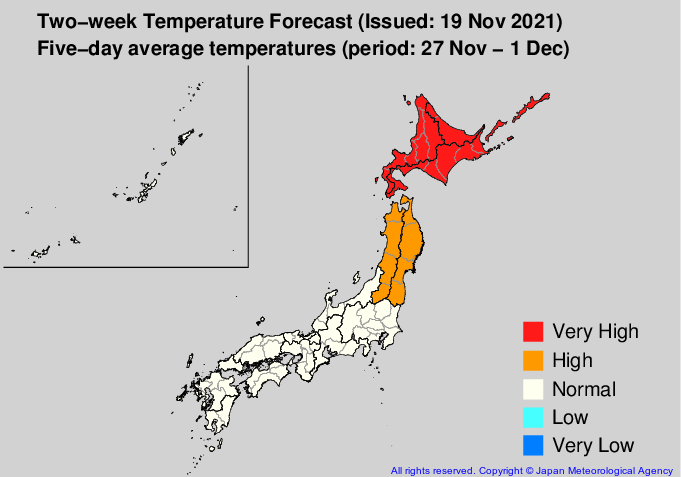
TWO-WEEK TEMPERATURE FORECASTS (NOV. 19~ DEC. 1)
Nation-wide
Tokyo area
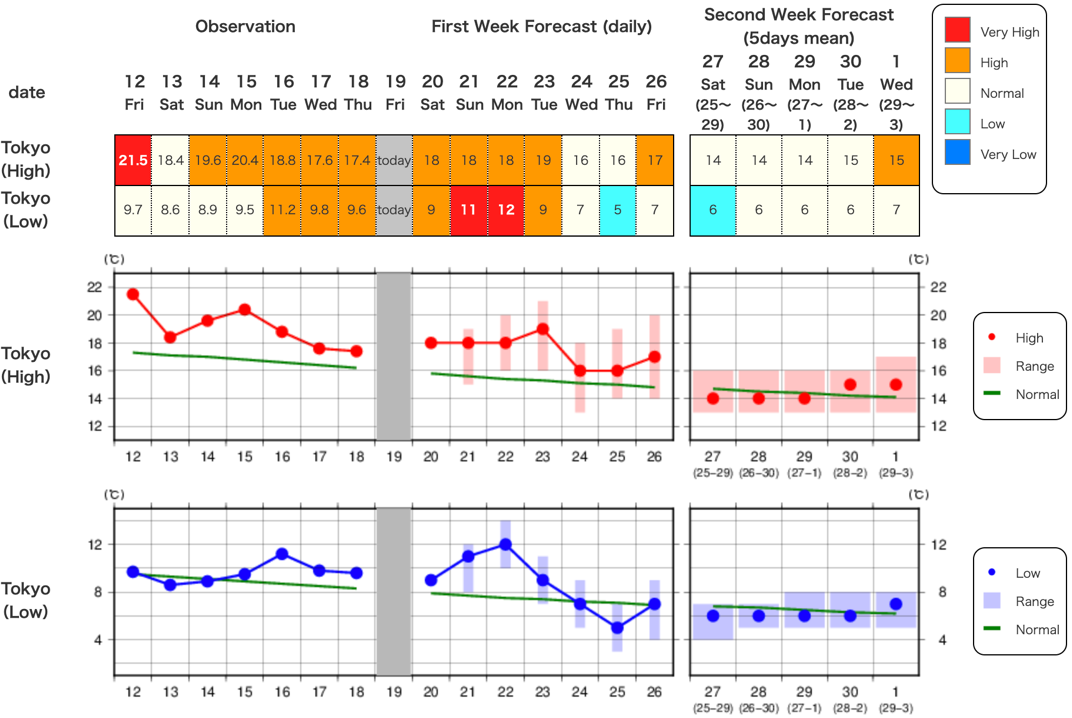
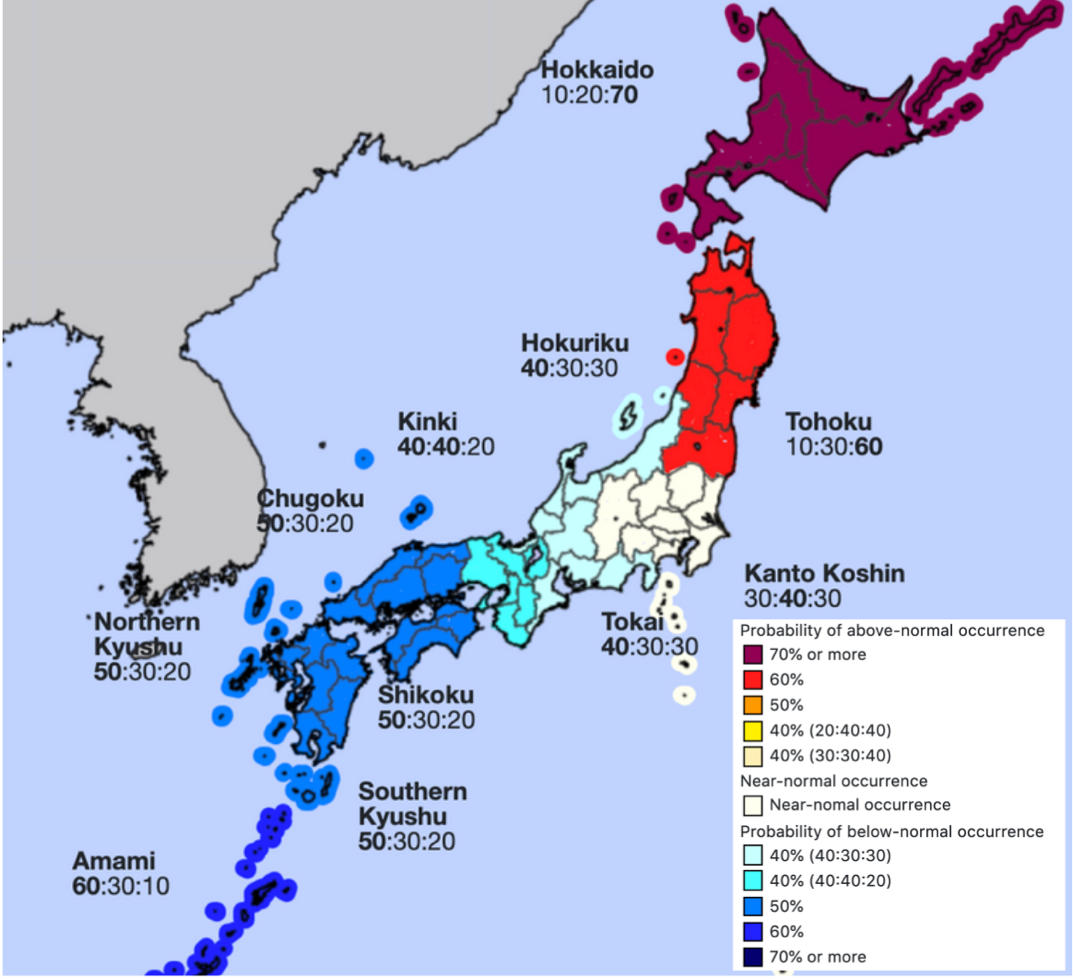
- North Japan: Very high temperatures from Nov. 27.
- East/West Japan: Cold until Nov. 25, then back to average temperatures.
- Okinawa/Amami region: Very cold temperatures from Nov. 22.
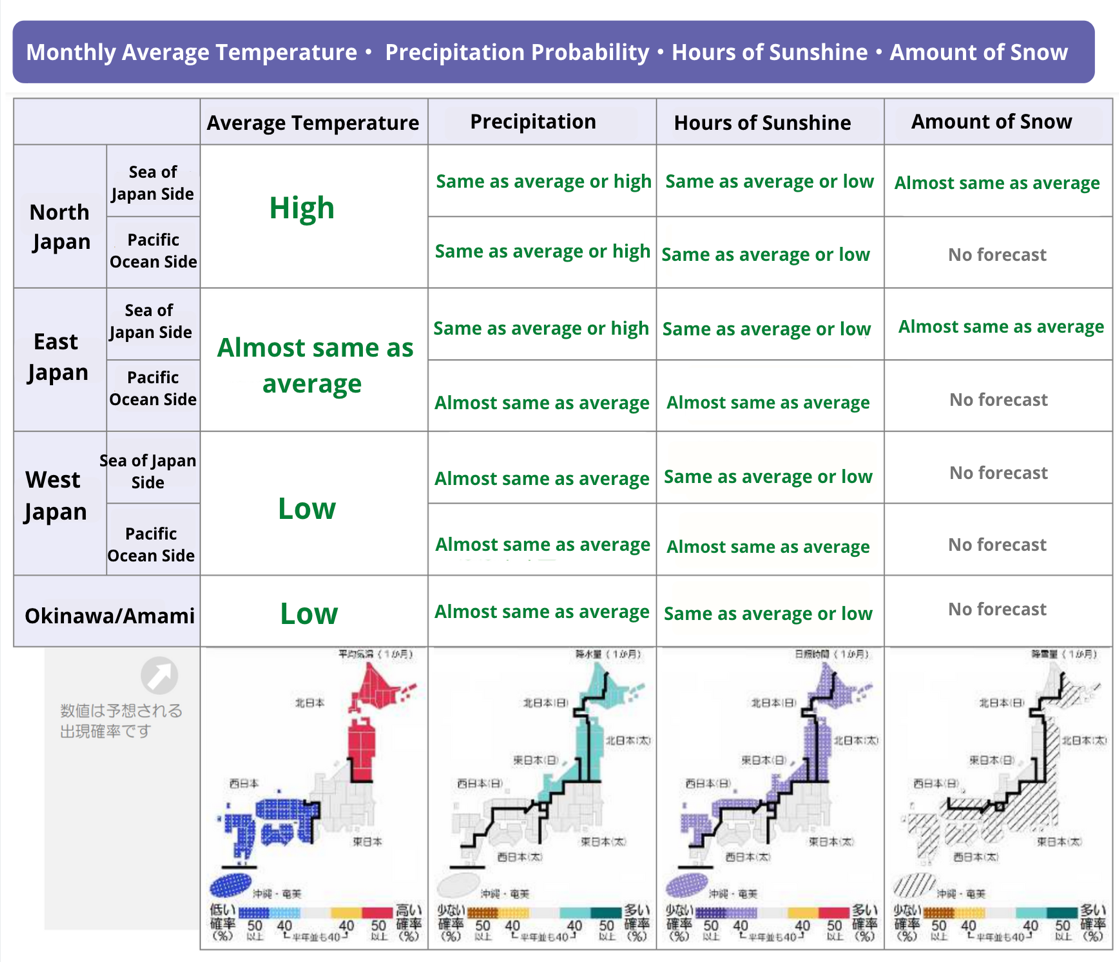
ONE-MONTH SEASONAL FORECAST (NOV. 20~ DEC. 19)
NEWS: POWER MARKETS
| No. of operable nuclear reactors | 33 | Electricity Price | Friday, Nov 19 | ||
| Of which | restarted | 10 | JEPX 24-Hour Spot | ¥ 18.99/ kWh | |
| in operation today | 7 | TOCOM Dec. baseload (Tokyo area) | ¥25.46/ kWh | ||
Source: Company websites, JANSI and JAIF, as of Nov. 20, 2021
Spot Electricity price jumps to ¥30.62/ kWh on JEPX on Nov. 22
- Price is for today, Monday, as quoted by JEPX
- Highest level since Jan. 22, 2021
- A 62% jump from the Monday a week earlier
Utilities trial power curbs to conserve LNG fuel even as stocks remain high
(Japan LNG, Nov. 19)
- Some Japanese power utilities are taking measures to curb power output at thermal power plants that run on natural gas in order to conserve stocks of LNG ahead of the winter peak period, Chairman of the Federation of Electric Power Companies of Japan, Ikebe Kazuhiro, said.
- Storage is limited and the issue can’t be solved by buying many additional cargos, said Ikebe, who is also president of Kyushu Electric.
- Meanwhile, METI released the latest information about LNG stock levels as Japan heads into the winter. Power utilities’ reserves are at 2.2 million tons as of Nov. 15, up by 0.6 million tons from the same time last year and which was the highest in the last five years.
- Stock levels fell to 2.07 million tons in late Oct. due to strong power demand.
- CONTEXT: Japan’s LNG imports in Oct. were down YoY and on-month, the lowest monthly total this year.
- SIDE DEVELOPMENT:
METI reports mid-November LNG stocks of 2.2 million tons
(See Oil & Gas News section for details)
TAKEAWAY: Ikebe’s comments remind us there’s a limit to how much Japan can stock up on LNG in advance. The fuel is hard to store and without dedicated underground gas storage facilities, such as in Europe, Japan is always 2-3 weeks away from running out of fuel without replenishment.
We’ve written before about building underground gas storage in Japan. It’s costly and geologically problematic. Thus, the latest strategy is to pursue the wider rollout of LNG infrastructure in Asia and a more fluid market, allowing countries to exchange supplies. However, it’s less clear how that will work if a cold snap hits north Asia. China, South Korea and Japan are the biggest LNG buyers and users. It’s hard for other Asian nations to “offset” that volume in times of real need.
In that context, it’s not surprising to hear that JERA has invested $2.5 billion in the Freeport LND Development. Japan’s biggest LNG importer seeks to help Freeport expand its plant with a fourth production line; the investment is a way to guarantee that these new volumes could head to Japan in times of tight supply or emergency, rather than to Europe or elsewhere. The lesson from the last year that many in Japan have taken is that long-term contracts should remain the foundation of the LNG industry.
- SIDE DEVELOPMENT:
JERA invests US$2.5 billion in American LNG
(Nikkan Kogyo Shimbun, Nov. 16)- JERA will invest an additional $2.5 billion in U.S.-owned Freeport LNG.
- The investment took the form of the Global Infrastructure Partners’ purchase of a 25.7% stake in Freeport.
- After the acquisition, Freeport LNG will be 63.5% owned by the founders, 25.7% by JERA, and 10.8% by Osaka Gas.
- The acquisition will be funded by a portion of JERA’s cash and deposits of about ¥480 billion, as well as by borrowing. The investment is expected to contribute more than ¥10 billion to net income as of 2025.
Shikoku Electric gets final approval for reactor restart at Ikata nuclear plant
(NHK, Nov. 19)
- Governor Nakamura of Ehime Prefecture told Shikoku Electric that he approves the restart of Unit 3 reactor at the Ikata Nuclear Power Plant, and he wants the company to make safety a top priority.
- Shikoku Electric President Nagai Keisuke said the utility will announce the reactor restart schedule on Nov. 22.
- CONTEXT: Unit 3 at Ikata NPP was shut for maintenance in Dec. 2019, but then faced various technical and operation issues. One of its emergency standby staff often left his post without permission.
- The governor met with the utility’s president and gave the green light to bring the facility online when satisfied by results site inspections.
TAKEAWAY: This is an important restart in terms of bringing more baseload capacity online ahead of winter’s peak power demand. After the recent closure of two reactors, one in Kansai and one in Kyushu, this will stabilize “gains” made by the nuclear industry in the last year in terms of bringing more plants back online.
But this is not a major move in the broader nuclear debate. Japan has two types of reactors: ones with approval to restart and did at some point in the last five years; and those not in operation for about a decade. The Ikata NPP facility belongs to the former, so switching it back on is relatively easy. How restarts fare with the latter group will be the real litmus test for Japan’s nuclear revival.
Project uses Toshiba equipment to make world’s first CO2-free power from natural gas
(Japan NRG, Nov. 16)
- U.S. clean energy firm NET Power delivered CO2-free electricity derived from burning natural gas to the ERCOT grid (Texas). This is a world-first.
- NET Power which uses Toshiba equipment, including the turbine, pioneered a technology that combusts natural gas with pure oxygen instead of air; using the resultant supercritical CO2 (instead of steam) to generate electricity. That CO2 is captured at the source.
- The technology claims zero CO2 emissions, and avoids other GHGs.
- NET Power has a 50 MW test facility in La Porte, Texas.
- NET Power works with clients worldwide to develop utility-scale NET Power plants, with initial projects to come online in the next five years. All CO2 captured will be permanently stored or utilized.
- CONTEXT: One of NET Power’s key investors is 8 Rivers, a firm that’s developing CCUS technology and which signed an alliance accord with JX Nippon Oil Exploration, part of the ENEOS Group, earlier this month.
TAKEAWAY: This is another solution that relies on carbon capture and storage (CCS), or that and a recycling component. However, it also allows for gas infrastructure to stay in place. Over two-thirds of GHG emissions from natural gas come at combustion, so NET Power’s technology promises a major lifeline for the gas and thermal power industries over the mid to long term.
While NET Power utilizes Toshiba components it doesn’t yet have Japanese firms among investors. That may change going forward. One of NET Power’s investors, 8 Rivers, recently connected with ENEOS.
First Japanese storage battery to be built in Europe’s power market
(New Energy Business News, Nov. 18)
- Nippon Koei to build a 100 MWh grid storage battery in Leuven, Belgium. Construction to be completed by end of 2022; the battery will have an output of 25 MW and a capacity of 100 MWh.
- This is the first time a Japanese company enters Europe’s grid power storage business, starting with development and construction.
- With this project, Nippon Koei seeks the know-how to develop it into a power generation, transmission and distribution business in Japan.
- Nippon Koei Energy Europe (NKEE), a Dutch subsidiary of Nippon Koei, and Germany’s Aquila Capital Holding that focuses on renewable energy assets, will invest in Ruien Energy Storage.
Osaka Gas invests in Dutch Virtual Power Plant developer
(Gas Energy News, Nov. 15)
- Osaka Gas invested in JEDLIX, a Dutch company engaged in the VPP (Virtual Power Plant) business using EVs in Europe, and signed a capital alliance agreement. The investment is about several hundred million yen.
- With this project, Osaka Gas will participate in Europe’s supply and demand adjustment market. The knowledge gained will help the company participate in Japan’s supply and demand adjustment market.
- JEDRIX remotely controls EV batteries owned by individuals. The adjusted power generated through this process is offered to the supply and demand adjustment market. The company bundles EVs in seven countries to provide supply and adjustment capabilities.
Wind Power Association in Japan surges to over 500 members
(Nikkei, Nov. 17)
- Membership of the Japan Wind Power Association (JWF) reached 500.
- The industry group is promoting the installation of 45 GW of offshore wind capacity by 2040, in line with the top end of government plans.
Shikoku Electric invests in biomass
(Yomiuri Shimbun, Nov. 18)
- A consortium that includes Shikoku Electric and major engineering company Shinko Denso will build one of Japan’s largest biomass generation plants on a 44,000 square meter site in Shikoku.
- The 75 MW plant, due to begin operation in 2025, will burn 320,000 metric tons of imported wood-based fuel annually.
- Electricity generated will be sold for ¥24 per kWh.
Chubu Electric to build solar farm for client via offsite PPA
(Kensetsu Tsushin Shimbun, Nov. 19)
- Chubu Electric Power Miraiz signed an off-site power purchasing agreement with automotive manufacturer Tokai Rika.
- Chubu will build a solar farm to supply Tokai’s electricity needs.
- The farm will occupy a 14,000 square meter site in Nagano and have a nominal output of 1.2 MW.
NRA says unhappy with Hokuriku Electric’s Shiga NPP audit
(Nikkei, Nov. 17)
- The Nuclear Regulation Authority began an on-site audit of Unit 2 of the Shiga nuclear power station, operated by Hokuriku Electric, due to the discovery of an active fault nearby.
- The NRA will inspect core samples and hear from the plant operator. NRA officer Ishiwatari said he’s satisfied with some of the audit’s findings, but was unhappy with others.
NUCLEAR REACTOR NEWS ROUND-UP:
- TEPCO says environmental impact from release of Fukushima water to be minimum
- (Asahi Shimbun, Nov. 18)
- TEPCO said data simulation of its release plan of treated radioactive water suggests a very small impact on the environment, marine life, and humans.
- The plan is fiercely opposed by fishermen, residents, and Japan’s neighbors, including China and South Korea.
- According to the simulation, radiation levels of seawater right above the release point increased slightly but quickly fell to normal levels. Exposure to radioactivity was lower than international safety levels.
- Tritium, which TEPCO says is not harmful in small amounts, showed a slight rise within 2-3 kilometers from the plant during the simulation.
- SIDE DEVELOPMENT:
U.N experts review plans for release of Fukushima plant water
(Asahi Shimbun, Nov. 16)- An expert team from the International Atomic Energy Agency (IAEA) arrived in Japan to assess plans to release treated radioactive water into the sea from the damaged Fukushima nuclear plant. The team will meet Japanese officials to discuss the release.
- Japan requested help from the IAEA to ensure the discharge meets international safety standards and to gain international understanding.
- SIDE DEVELOPMENT:
Third on-site inspection at Onagawa nuclear after repeated trouble
(Kahoku Shimpou, Nov. 16)- Miyagi Prefecture, Onagawa town and Ishinomaki town held its third on-site inspection after 7 workers were sickened by hydrogen sulfide leaked at the Onagawa nuclear plant (Tohoku Electric) in July. This is the third on-site inspection this year.
- Prior to the inspection, the operator said the main cause of the hydrogen sulfide leakage was accumulation of sludge.
- This is not the only issue. In August, smoke was detected from the incinerator room.
- SIDE DEVELOPMENT:
MOX fuel from France arrives at Takahama nuclear power plant
(The Mainichi, Nov. 17)- A ship carrying uranium-plutonium mixed-oxide (MOX) fuel from France arrived at Takahama nuclear power plant (Kansai Electric) to be used for its No.3 and 4 reactors. It’s the third such shipment since the 2011 Fukushima nuclear disaster.
- The reactors currently use MOX fuel for pluthermal power generation.
Marubeni buys rights for US sensors to boost grid monitoring in Japan
(Nikkei, Nov. 17)
- Marubeni signed an agreement with U.S.-based LineVision giving it exclusive rights to sell overhead line monitoring solutions in Japan.
- LineVision’s system uses non-contact sensors to detect if power lines are sagging, as well as monitor and project power loadings in real time.
- The system promises to extend the life of transmission infrastructure, as well as boost grid capacity.
Itochu increases investment in Japanese power retailer
(Nikkei, Nov. 17)
- Itochu Corp increased its stake in Tokyo-based i-Grid Solutions to 20%. In addition to offering virtual power plant services, the company uses AI to project electricity demand.
Toda starts operating Brazilian wind farm
(Nikkan Kogyo Shimbun, Nov. 18)
- A wind farm in north Brazil owned by Toda Corporation began operations.
- With eight 118 m turbines, the farm has a capacity of 28 MW.
NEWS: OIL, GAS & MINING
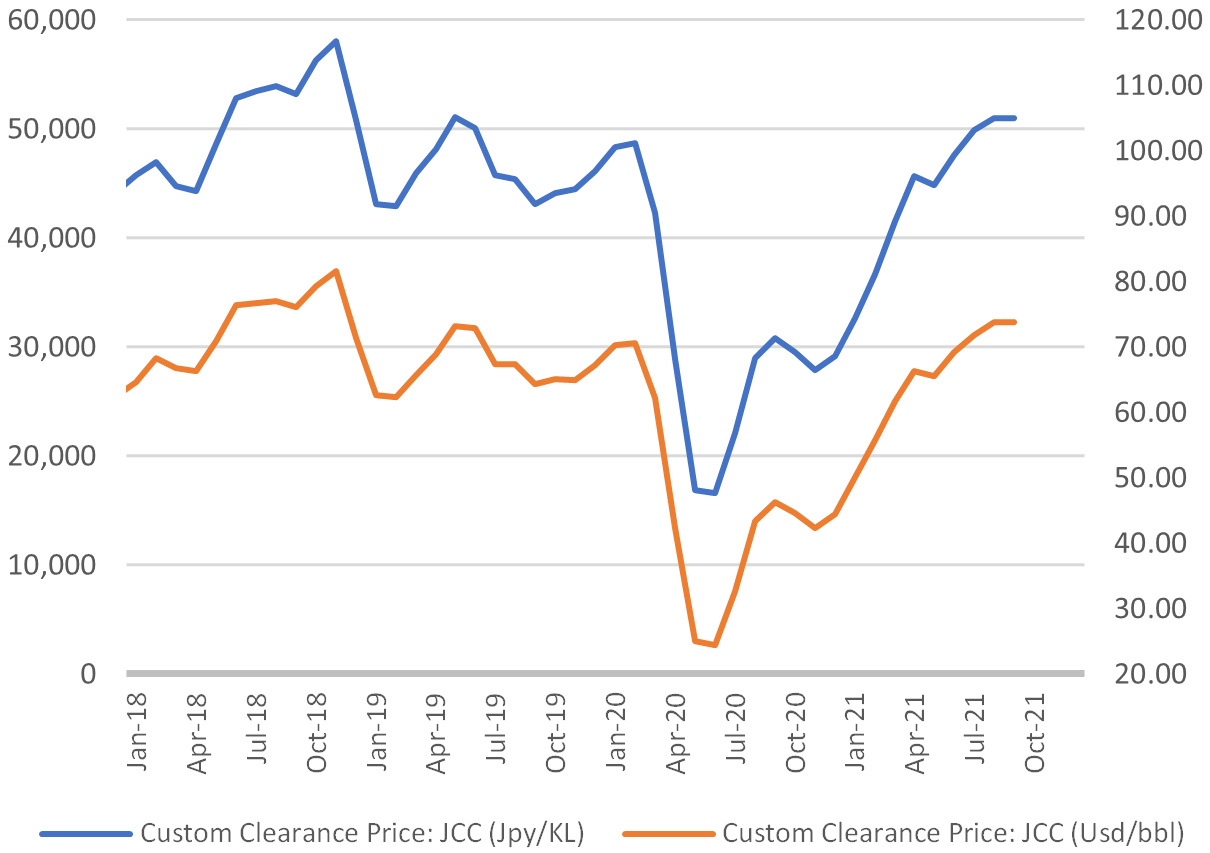
Japan Oil Price: $73.81/ barrel
¥ $
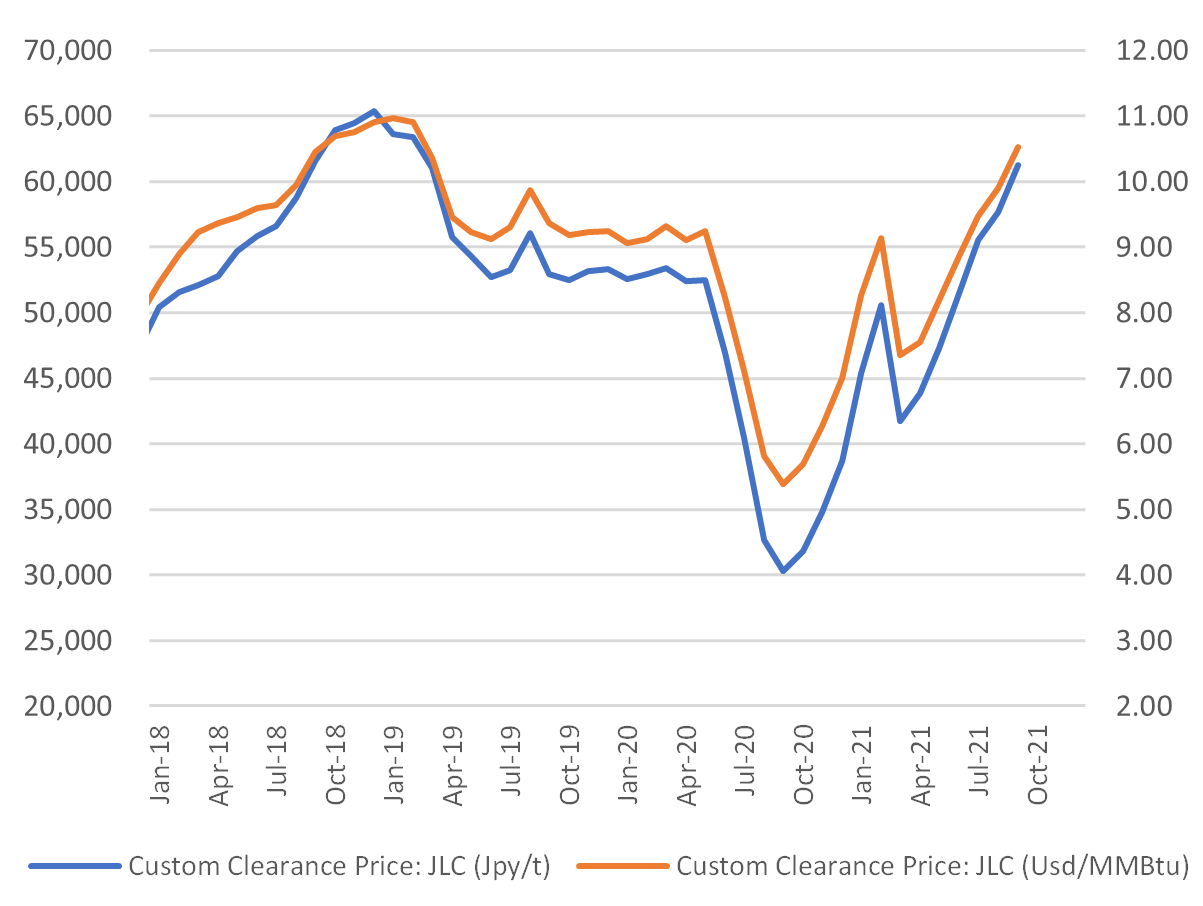
Japan (JLC) LNG Price: $10.52/ mmbtu
¥ $
METI unveils crude oil subsidy
(NHK, Nov. 16)
- METI Minister Hagiuda said a new stimulus package will include subsidies for petroleum companies to offset high crude prices.
- Under the plan, when high crude prices cause retail gasoline to exceed ¥170 per liter, the retailer will get a subsidy of up to ¥5 per liter.
- The subsidy is designed to prevent oil companies from passing on high crude prices to the consumer.
- The plan would initially be funded out of the Covid response budget.
- SIDE DEVELOPMENT:
Idemitsu says can no longer absorb crude oil price increases
(Sekiyu Tsushin, Nov 19)- Idemitsu Kosan will increase the price of its hydrogenated petroleum resin line, I-MARV, by ¥40 per kilogram.
- Idemitsu is no longer able to absorb higher crude prices and facility maintenance costs without raising prices.
- SIDE DEVELOPMENT:
Government denies tax breaks on gasoline will be reintroduced
(Jiji, Nov. 16)- Chief Cabinet Secretary Matsuno said reactivation of a ‘trigger clause’ by which taxes on petrochemical products can be lowered when gasoline prices are high is inappropriate; because it would induce consumers to put off purchases until after the new tax rate took effect.
Japan’s October LNG imports fall 22.1% on-year to 4.6 million tons
(Japan NRG, Nov. 17)
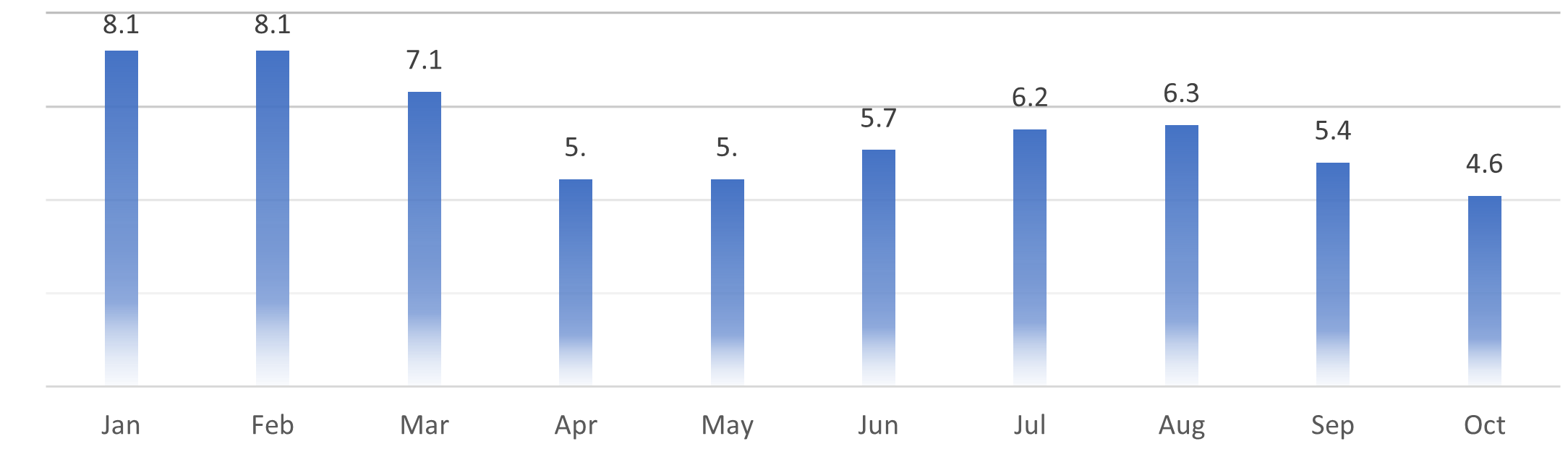
- Japan’s LNG imports in October fell 22.1%, YoY, to 4.6 million tons, according to preliminary customs data. Imports were also down from 5.4 million tons a month earlier and marked the lowest so far this year.
- October thermal coal imports were 10.1 million tons, up 9.9%, while crude oil imports were 11.5 million kl, down 0.6%.
- SIDE DEVELOPMENT:
METI reports mid-November LNG stocks of 2.2 million tons
(Japan LNG, Nov. 18)- LNG stocks of power utilities were 2.2 million tons as of Nov. 15, METI said.
- This is an increase of 0.6 million tons over the same time last year and the highest in the last five years. Stocks fell to 2.07 million tons by late October due to strong power demand.
2021 LNG Imports (in million tons) by Month
JERA CEO advocates for diversification of LNG supply
(Nikkei, Nov. 17)
- Regarding last winter’s power crisis, JERA CEO Onoda Satoshi said that in addition to major power retailers such as TEPCO, many other power users purchase electricity on the wholesale market. Last winter’s power shortage was exacerbated by the fact that demand data for these users was not available and therefore not reflected in projections.
- Onoda says JERA learned from the experience, and will model demand more precisely this year. JERA may also maintain higher levels of inventory.
- Onoda predicts continued high petrochemical prices for the near future.
- He sees a role for LNG as a transitional fuel as the world strives to reduce GHGs, and predicts demand will increase in the decade’s second half.
- Onoda says the amount of time needed for LNG shipments and the fact that the fuel can’t be stored for long periods means it’s difficult to react rapidly to demand blips and supply issues in Europe. JERA is investing in Asia in order to diversify supply, he said.
Idemitsu buys carbon credits to offset emissions from oil transport
(Denki Shimbun, Nov. 15)
- Idemitsu Kosan said it offset CO2 emissions from transporting crude oil between Japan and the Middle East using carbon credits. This applies to one round trip voyage of a large crude oil tanker fueled by heavy oil.
- About 10,000 tons of CO2 emitted on the voyage were offset.
- The carbon credits were purchased by Idemitsu Asia. The purchase price was not disclosed.
ENEOS sells first shipment of carbon neutral LNG
(Denki Shimbun, Nov. 19)
- ENEOS sold its first carbon-neutral LNG to Matsue City Gas Bureau.
- All CO2 emissions from the LNG production, processing and combustion were offset with carbon credits from forestry conservation initiatives.
Who stands to benefit from the commodities boom?
(Diamond, Nov. 15)
- A record year for commodity prices, with aluminum hitting 13-year highs; crude oil and nickel recorded seven-year highs.
- Strong EV demand has copper prices remaining buoyant for the near future.
- An analysis of the CRB commodities index suggests the 10 companies that stand to benefit most from the commodities boom are COSMO Energy Holdings, INPEX, Sumitomo Metal Mining, IHI, Komatsu, Hitachi Construction Machinery, Marubeni, Okuma, Nippon Steel, and Open House.
ANALYSIS
BY MAYUMI WATANABE
As Clean Energy Rises
How will Japan’s Oil and Gas Upstream React?
Much of the world’s focus at the COP26 climate summit was on coal. But another campaign against fossil fuels gained momentum during the event, and that one promises to be more uncomfortable for Japan’s government and big energy firms than the conversation over coal.
The summit served as the backdrop for the formation of the Beyond Oil and Gas Alliance (BOGA). Among signatories are countries such as Denmark, France, Sweden, and New Zealand, while the state of California and Canada’s Quebec also joined. BOGA’s aim is to “limit” new sources of oil and gas while acting to “phase out” existing production.
Japan did not sign up to BOGA. But while the country’s top 10 firms involved in finding new sources of oil and gas may breathe more easily than counterparts in Europe and the U.S., BOGA and other campaigns to stymie hydrocarbon development cannot be easily dismissed. For one, BOGA members have a voice in some of the areas in which Japanese firms currently operate.
While the government continues to support a target for Japan to be more “self-sufficient” in terms of access to oil and gas resources it’s unlikely that upstream firms will face trouble with accessing finance. However, COP26 confirmed that all industries must now grapple with the challenge of reducing emissions and striving toward net-zero targets. No sector will feel the pressure greater than the upstream operations of oil and gas firms, which account for almost two-thirds of the industry’s greenhouse gas emissions.
Managing international pressure
The lifeblood of any large-scale resource development is financing, which can come either from the markets or directly from banks. While both avenues are becoming tricky for western energy firms, Japanese counterparts are, relatively speaking, in a sweet spot.
Most of the top 10 upstream companies – INPEX, JAPEX, JX Nippon Oil and Gas Exploration, Idemitsu, Cosmo Energy, Mitsui Oil Exploration, Marubeni, Mitsubishi, Sumitomo, and Itochu – have foreign stakeholders, which should mean they’re under similar scrutiny as Exxon, Chevron or Shell. But, in reality, Japan’s Foreign Exchange and Foreign Trade Act, limits that potential pressure by preventing direct foreign influence over decision-making in energy companies.
This leaves most market financing options open for Japan’s upstream firms. In addition, Japanese banks have promised to continue providing the financing. However, they have added a condition: projects should not have a negative environmental or social impact.
So far, the banks’ vague stipulation has been met with equally general proposals to clean up the industry. Most of them seem to propose either deploying carbon offset credits or carbon capture storage and utilization (CCUS).
For example, in the last year Mitsubishi has supplied “carbon neutral” LNG to Toho Gas and JAPEX, as did Mitsui to Hokkaido Gas. INPEX, JX and JAPEX are conducting several CCUS trials around the world. And, INPEX and JAPEX are running CCUS pilot projects in Niigata and Hokkaido in northern Japan. In comparison, U.S. upstream counterparts have operated CCUS on a commercial basis for decades.
The problem is that neither of the two solutions are universally accepted as “green”. And as the force of the international environmental lobby mobilizes, Japan and its upstream firms will need to start showing more ambition and more creative solutions.
Once idealistic measures become the norm
When in 2002 Costa Rica became the first country to ban upstream projects it was a sort of fairy tale unicorn that could afford to take such seemingly utopian measures due to its small size and scant industry. For almost two decades, no one else followed suit.
Fast forward to 2021. In January, incoming U.S. President Biden banned all new drilling on federal land. Then in May, the International Energy Agency (IEA) proposed a ban on all new oil and gas exploration. In July, Greenland decided to cease new oil and gas exploration licenses, and last month, the European Union proposed to ban fossil fuel exploration in the Arctic region.
For their part, the World Bank and the European Bank for Reconstruction and Development said they’ll end financing of upstream oil and gas in 2022. Asian Development Bank made a similar commitment earlier this year.
According to findings by the Institute for Energy Economics and Financial Analysis, more than 80 major banks, insurance firms and asset managers are now restricting lending to the oil and gas industry, including drilling in the Arctic.
Jurisdictions that have banned oil and gas explorations
| Year of decision | Japanese upstream activities | |
| Costa Rica | 2002 | — |
| France | 2017 | — |
| Belize | 2018 | NPO trainings |
| Ireland | 2018 | — |
| New Zealand | 2018 | Mitsui Oil Exploration holds licenses in two blocks |
| Denmark | 2020 | JOGMEC/INPEX/JAPEX/JX/Mitsui consortium withdraw from Northwest Block 9 exploration in 2018 |
| Portugal | 2020 | — |
| Greenland | 2021 | — |
| Spain | 2021 | — |
| Quebec, Canada | 2021 | — |
| European Union | Calls for a ban in the Arctic region | Mitsui/JOGMEC hold 10% of Novatek Arctic LNG2 project |
| Other moves: UK | Closed public consultation on North Sea exploration in May 2021 |
|
For now, the developments are not having a strong impact on Japan’s upstream investments, which had focused on the Middle East, Southeast Asia and North America. And while the EU aims to ban Arctic upstream activities, the Arctic LNG2 project, operated by Russia’s Novatek, starts production in 2023. Japanese companies hold a 10% stake in the project.
Non-binding ban
The changing landscape is catching some Japanese government officials by surprise. While the formation of BOGA was expected, a METI official told Japan NRG that the IEA’s statement in May to ban upstream activities after 2021 came as a shock.
“This was an unprecedented move and has triggered reactions,” he said, though maintaining it won’t impact Japan’s fossil energy strategy for now since it’s not binding. “The IEA is merely presenting one of many options for achieving carbon neutrality in 2050; the IEA is making a suggestion,” he said.
Japan, however, is bound by its Basic Energy Plan, an official manifesto to local and international communities. The plan says 31% of the country’s primary energy supplies in 2030 will be sourced from oil and 18% from gas.
In addition, the plan targets 50% of oil and gas imports to be sourced from Japanese-owned projects, up from the previous goal of 40%. The 2019 ratio was 34.7%. The METI official also clarified that Japan hasn’t officially commented on IEA’s suggestion, thereby leaving the country leeway when it comes to new upstream investment.
“What’s important is achieving the carbon neutrality goal, rather than details of varied approaches,” he said.
Some Japanese banks have pledged to terminate financing of new coal power plants, but none have committed to end upstream oil and gas financing. Only in some cases have they decided not to finance oil sands and Arctic projects that have negative environmental and social impact.
If international scrutiny and pressure hamstring private Japanese banks in providing project financing, the government can step in and provide the money. Toward that goal, METI is seeking a ¥64 billion budget for upstream oil and gas for the coming fiscal year, up 24% from the current one. While ¥64 billion is not a huge amount considering that Japanese upstream investment totals ¥2-3 trillion annually, the 24% hike sends a strong message that support is not waning despite global pressure for decarbonization.
In addition, Japan is ramping up national efforts on upstream exploration at the local level. In 2019, the country launched an exploration vessel called Tansa that analyzes the structure of the seabed that may lead to the discovery of potential new oil and gas fields, as well as deposits of critical mineral resources.
The survey will cover an area of 500,000 km and is expected to be completed in 2028. The government plans to offer the prospecting data to the private sector in order to move the launch of such projects forward.
Bank financing policies
| Upstream oil and gas | Coal power plants | |
| Japan Bank of International Cooperation | Finance projects for energy security | Finance clean energy transition |
| Development Bank of Japan | Rigorously review Arctic and oil sands projects | End to new plants, but will finance clean energy transition projects |
| MUFJ | Rigorously review Arctic and oil sands projects with social and environmental impacts | End to new coal plants but will consider CCUS, co-firing and other clean technologies |
| SMFG | Rigorously review Arctic, oil sands, shale and pipeline projects | End to new or capacity ramp up projects |
| Mizuho | Rigorously review Arctic and oil sands projects | End to new coal plants |
The cost of making clean oil and gas
Of course, there is another way to read the energy events of this year. In the next year or two the pressure on upstreamers across the globe could well ease as the public begins to recognize that the recent spike in oil and gas prices is in large part the result of a lack of investment in the upstream, thus leading to the current tightening of supplies.
While the International Energy Forum reported that 2020 global capital expenditures on oil and gas were down 34% YoY, a closer look at the data reveals that in the first half of 2021, the number of oil and gas deals were up about 70%, but deal values were down 51%. Projects may have become cheaper, but decarbonization costs are inflating overall expenditures.
If there’s no additional upstream investment then by 2030 global oil production will drop 50%, to 40 million barrels/day from the present 80 million barrels/day, according to Boston Consulting Group.
In this context, both policy makers and captains of industry in Tokyo are naturally very concerned. Maintaining a stable and sufficient energy supply has long been one of the key aims of Japanese governments over the past century. If push comes to shove, Tokyo will easily choose energy security over international decarbonization goals that might lead to unpredictable consequences.
ANALYSIS
BY SHEHA RANI
Japan Automakers Plan Global Charge in EVs
Via Lithium Battery Investments in India
Tesla and Chinese automakers have built a commanding lead in the electric vehicle market, but Japan’s firms are already plotting their comeback, and it lies via India.
By the end of this year, Suzuki Motor, Toshiba and Denso hope to begin commercial output at India’s first lithium-ion battery plant with an eye of later launching local production of EVs for the domestic market and export. Trial production started in late August.
This Japan-India cooperation goes beyond simply manufacturing a new type of vehicle. The investment is part of a wider strategy to work together in battery R&D, and includes building a supply chain for battery raw materials. It also plays into the broader role Japan seeks to play in India’s energy transition, from assisting in coal-to-gas switching and renewables to projects in energy efficiency and other clean tech.
The joint focus on EVs is also drawing in other partners such as Brazil, which can offer access to some of the battery raw materials and associated technologies, as well as a large consumer market.
Building bridges
Closer ties between India and Japan emerged over the last decade in part thanks to former Prime Minister Abe’s belief in the geopolitical alliance between the two as a way to counter China’s growing influence. The two nations formed an energy dialogue, which became almost an annual meeting between ministers, working groups and academics, as well as industry representatives.
In fiscal year 2020-21, Japanese investment in India was $2.3 billion, the fifth largest foreign injection. India is also the biggest recipient of Japan’s official development assistance (ODA), with $2.7 billion in 2019, more than double that of the next country, according to the Donor Tracker initiative.
From the Japan-India Energy Dialogue meetings emerged a plan to build a test facility for Li-on batteries and then expand that to a commercial venture. Construction of that first commercial facility started in 2017. Then PM Abe and his India counterpart Narendra Modi attended the cornerstone ceremony and vowed to bolster cooperation in zero-emission vehicles.
The $700 million plant, in Gujarat state, at the Hansalpur campus, is due to finish construction and start commercial production of Li-on batteries for EVs and hybrids by the end of this year. The facility is owned by TDS (Toshiba Denso Suzuki) Lithium-Ion Battery Gujarat Private Limited.
Suzuki, which has operated in India for 37 years and which owns a controlling stake in the country’s largest automaker, Suzuki Maruti, owns 50% of the battery venture. Toshiba holds another 40% and Denso the rest. Toshiba contributes through its expertise in battery cell technology; Denso with its experience in modules and battery-monitoring integrated circuits; while Suzuki is in charge of manufacturing processes. The Gujarat state government acts as the local partner.
The batteries from the JV will be introduced into Suzuki India’s electric two-wheelers, and by the middle of the decade EVs models developed for the local market. The partners target an output of 30 million Li-ion batteries annually by 2025, the equivalent of 1 GWh capacity.
Finding a way back into competition
For Toshiba, in particular, the India market offers a route back into global competition in batteries. The company has sold rechargeable lithium-ion batteries since 2008, but like most of its domestic peers lost pace in the EV transition and market share to Chinese and South Korean rivals.
In January 2021, however, Toshiba opened a $144 million rechargeable lithium-ion batteries manufacturing facility in Yokohama. The company has also partnered with trading house Sojitz and Brazil’s CBMM in order to commercialize next generation Li-on batteries that utilize niobium titanium oxide (NTO) as the anode material. NTO has double the energy density of regular Li-on batteries, which typically rely on graphite.
Toshiba hopes that its new JV in Gujarat and the work with CBMM will bring sales in major markets of India and Brazil, while kickstarting its re-emergence as a top player in the clean energy space. Global production of Li-on batteries alone is projected to more than double over the next five years.
Tesla is currently the market leader in EV batteries, with a capacity to produce about half a million battery packs per year at its Gigafactory in Nevada, U.S. China dominates the rest of the market, with contributions from India and Japan at a low base.
However, as India’s auto market grows, Japan is betting that together with allies it could challenge Chinese dominance. In 2018, India overtook Germany as the world’s fourth-largest car market.
Meanwhile, India’s government said last month that it aims to have EV sales account for 30% of private cars, 70% of commercial vehicles and 80% of the two- and three-wheelers by 2030, citing an immediate need to decarbonize the transport sector. More Japanese firms are likely to follow in the footsteps of the Suzuki-Toshiba-Denso venture.
This summer, Nissan Motor revealed it started a feasibility study to build a Gigafactory for EV batteries in India. The company wants to announce a new EV roadmap for India in the near future and a local battery production hub may be part of that, according to a local executive.
As part of the pitch to Japanese firms, India also stressed its interest in helping build supply and processing raw materials for clean energy technology, according to a report last year that was backed by the Federation of Indian Chambers of Commerce and Industry and posted by the Japan Chamber of Commerce and Industry.
Diversity of commodity supply is a growing issue for both countries, with China the dominant provider of several core raw materials, such as certain rare earth metals.
Conclusion
One battery manufacturing facility will not challenge China’s top position in the EV and adjacent markets, but it does show how Japan is building alliances on a commercial and geopolitical level to strengthen its energy technology credentials.
The potential to grow this cooperation in batteries into full-scale EV production and export could also help fuel progress in power storage, which is an area where both Indian and Japanese governments want to see further development before committing more strongly to a transition away from burning fossil fuels for electricity.
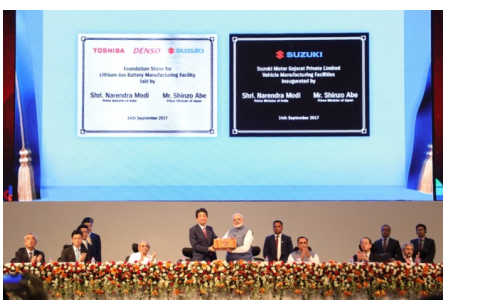
Cornerstone laying ceremony of lithium-ion battery plant in Gujarat, India held on Sept. 14, 2017 in presence of then Japan’s Prime Minister Shinzo Abe and India’s Prime Minister Narendra Modi. Source: Suzuki Motor Corporation, Japan
GLOBAL VIEW
BY JOHN VAROLI
Below are some of last week’s most important international energy developments monitored by the Japan NRG team because of their potential to impact energy supply and demand, as well as prices. We see the following as relevant to Japanese and international energy investors.
Azerbaijan/ Renewables
Azeri Energy Minister Parviz Shahbazov and Qatar’s Nebras Power CEO Khalid Mohammed Jolo met in Baku to discuss renewable energy projects in Azerbaijan. Among the topics discussed, Azerbaijan and Qatar said they hope to cooperate in wind energy, especially offshore projects.
Chile/ Solar power
Chile plans a 15,000 km underwater cable to send energy to China, utilizing its cloudless Atacama Desert along the Pacific coast to source solar power. The generated electricity would be shipped during Chile’s day, which is China’s night; and would be highly useful when summer in Chile, which is winter in China.
Europe/ Carbon prices
Carbon prices rose to a record high, above €69 a ton on forecasts that COP26 will lead to more active markets for emissions. The EU Emissions Trading System, which sets the price for emitting 1 ton of carbon, finished the week at €69.1 a ton, more than double the price of carbon at the year’s start.
Fossil fuels
CEO Jeremy Weir of trading house Trafigura, which each day handles about 6.4 million barrels of crude oil and products, said decarbonization can’t happen at the “flick of a switch” and oil will be needed for some time to come. Weir added that Trafigura will continue to trade coal because emerging nations need this fuel.
Germany/ Wind-to-hydrogen
Eight more companies joined the AquaVentus consortium to develop a 10 GW offshore wind-to-hydrogen project. Membership is now 79, including Japanese utility J-Power and Hitachi ABB Power (recently rebranded as Hitachi Energy). The wind turbines will be installed in the North Sea by 2025. A pipeline will transport about 1 million tons of green hydrogen to mainland Germany starting in 2035.
Germany/ Gas
Certification of the Nord Stream 2 pipeline was temporarily suspended by the state energy regulator, igniting a rise in European gas prices. The regulator said approval wasn’t yet possible because the pipeline owners, led by Kremlin-controlled Gazprom, had set up a German subsidiary that wasn’t properly incorporated.
Hydrogen fuel cells
Motor vehicle parts supplier Bosch is betting on hydrogen fuel trucks. From 2021 to 2024, the company will invest €1 billion into hydrogen fuel cell technology. The EU green hydrogen market is estimated to grow 65 percent annually through the end of the decade, by which time it will be worth over £34 billion.
Kazakhstan/ Oil
Lukoil inked a new deal with Kazakhstan’s oil and gas giant, KazMunayGaz, to join the Kalamkas-Sea and Khazar projects that have estimated reserves of over 2 billion barrels of oil in shallow waters of the Caspian Sea. Shell left the $5 billion project in 2019. Lukoil has been a major player in Kazakhstan since the mid 1990s.
Netherlands/ Shell
Shell was threatened with an “exit tax” after deciding to move its residency to the UK. The Dutch Green Party will expedite a bill to create the “exit tax” to punish companies leaving for jurisdictions with more favorable tax regimes. Parliament might debate the new tax ahead of a Shell shareholders meeting on Dec. 10.
South Korea/ Offshore wind
Norway’s Equinor and Korea East-West Power (EWP) signed an MoU to build 3 GW of offshore wind power using new floating technology developed for Korean waters. Together with Korea National Oil Corporation (KNOC), Equinor and EWP are already developing the 200 MW Donghae floating offshore wind project near a Korean gas field.
Saudi Arabia/Green hydrogen
A planned floating industrial city will run on renewable energy. This net-zero Saudi settlement, called Oxagon, will be home to “the world’s largest green hydrogen project”. It’ll have 7 industries including sustainable energy, autonomous mobility, and digital manufacturing, all to be powered by renewable energy.
USA/Gasoline prices
President Biden asked the FTC to investigate major oil companies, including ExxonMobil and Chevron, for price-gouging amid rising gasoline prices. Biden pointed to the fact that the two “largest oil and gas companies. . .” were planning “billions of dollars of stock buybacks and dividends”.
UK/ Energy transition
Clean energy utility SSE rejected activist hedge fund Elliott Management’s calls for a break-up, and will instead sell minority stakes in its electricity networks to boost investment in “net zero” infrastructure. Toward that goal the company unveiled a £12.5 billion investment plan to support decarbonization. By 2030, SSE plans to deliver over a quarter of the UK’s proposed 40 GW offshore wind.
EVENTS CALENDAR
A selection of domestic and international events we believe will have an impact on Japanese energy.
| February |
Approval of Fiscal 2021 Budget by Japanese parliament including energy funding projects; CMC LNG Conference |
| March |
10th Anniversary of Fukushima Nuclear Accident; Smart Energy Week – Tokyo; Quarterly OPEC Meeting; Japan LPG Annual Conference; Full completion of all aspects of the multi-year deregulation of Japan’s electricity market; End of 2020/21 Fiscal Year in Japan; |
| April |
Japan Atomic Industrial Forum – Annual Nuclear Power Conference; 38th ASEAN Annual Conference-Brunei; Japan LNG & Gas Virtual Summit (DMG)-Tokyo Three crucial by-elections in Hokkaido, Nagano & Hiroshima – April 25th |
| May |
Bids close in first tender for commercial offshore wind projects in Japan; Prime Minister Suga to visit the U.S. |
| June |
Release of New Japan National Basic Energy Plan-2021; G7 Meeting – U.K. Presidents Biden and Putin are due to meet at a summit in Geneva Forum for China-Africa Cooperation Summit (Senegal) |
| July |
Tokyo Metropolitan Govt. Assembly Elections; Commencement of 2020 Tokyo Olympics |
| August | METI committee approves draft of Japan’s 6th Basic Energy Plan |
| September |
Ruling LDP Presidential Election; UN General Assembly Annual Meeting that is expected to address energy/climate challenges; IMF/World Bank Annual Meetings (multilateral and central banks expected to take further action on emissions disclosures and lending to fossil fuel projects); End of H1 FY2021 Fiscal Year in Japan; Japan-Russia: Eastern Economic Forum (Vladivostok)-tentative |
| October |
Potentially, Japan’s 2021 General Election; METI Sponsored LNG Producer/Consumer Conference; Innovation for Cool Earth Forum – Tokyo Conference; Task Force on Climate-Related Financial Disclosure (TCFD) – Tokyo Conference; G20 Meeting-Italy |
| November |
COP26 (Glasgow); Asian Development Bank (‘ADB’) Annual Conference; Japan-Canada Energy Forum; East Asia Summit (EAS) – Brunei |
| December |
Asia Pacific Economic Cooperation (APEC) Forum – New Zealand; Final details expected from METI on proposed unbundling of natural gas pipeline network scheduled for 2022. |
Disclaimer
This communication has been prepared for information purposes only, is confidential and may be legally privileged. This is a subscription-only service and is directed at those who have expressly asked K.K. Yuri Group or one of its representatives to be added to the mailing list. This document may not be onwardly circulated or reproduced without prior written consent from Yuri Group, which retains all copyright to the content of this report.
Yuri Group is not registered as an investment advisor in any jurisdiction. Our research and all the content express our opinions, which are generally based on available public information, field studies and own analysis. Content is limited to general comment upon general political, economic and market issues, asset classes and types of investments. The report and all of its content does not constitute a recommendation or solicitation to buy, sell, subscribe for or underwrite any product or physical commodity, or a financial instrument.
The information contained in this report is obtained from sources believed to be reliable and in good faith. No representation or warranty is made that it is accurate or complete. Opinions and views expressed are subject to change without notice, as are prices and availability, which are indicative only. There is no obligation to notify recipients of any changes to this data or to do so in the future. No responsibility is accepted for the use of or reliance on the information provided. In no circumstances will Yuri Group be liable for any indirect or direct loss, or consequential loss or damages arising from the use of, any inability to use, or any inaccuracy in the information.
K.K. Yuri Group: Oonoya Building 8F, Yotsuya 1-18, Shinjuku-ku, Tokyo, Japan, 160-0004.