
JAPAN NRG WEEKLY
NOV. 29, 2021
JAPAN NRG WEEKLY
Nov. 29, 2021
NEWS
TOP
- Offshore wind project tenders facing delay to early 2022; results of Akita area tenders held up by need to conduct govt. interviews
- Four major utilities warn about low gas stockpiles ahead of winter; power supply tightest in 10 years; energy shortages look likely
- JERA signals it won’t renew its biggest LNG deal with Qatar over lack of flexibility in terms; 5.5 million tons of fuel on the line
ENERGY TRANSITION & POLICY
- Japan to double EV subsidies to be on par with Europe and U.S.; Nissan to make 50% of global car sales electric or hybrid by 2030
- EV batteries: Sumitomo MM creates cheap way to recycle material
- METI sets standards for biomass sustainability certification agency
- Japan and Vietnam sign joint plan for 2050 carbon neutrality
- Asahi Kasei plans 2025 debut for giant green hydrogen facility
- Tokyo Gas consortium to produce green methane in Malaysia
- Taiyo Oil to research biojet fuel that uses hydrogen bacterium
- ¥160 bn earmarked for smart city projects next year … [MORE]
ELECTRICITY MARKETS
- Power grids change JEPX margin cost formula to reflect LNG cost
- Energy Agency fears split in power markets causing inefficiencies
- Chubu Electric says renewables to make up 20% of mix by 2030
- Tokyo Gas plans small-engine LNG plant to better balance power
- JERA CEO says Asia’s conditions are less suitable to renewables
- NUCLEAR REACTOR WRAP: Ikata NPP due to restart on Dec. 6
- RWE and Kyushu Electric plan new offshore wind project in Akita
- Grapes and solar: new agrivoltaic facility launched in Fukushima
- Fukushima: underground ice wall may be melting … [MORE]
OIL, GAS & MINING
- NIKKEI OPINION: Oil release likely to have limited benefits
- Japan refiners get ready to make more fuel oil for power generation
- ENEOS to sell $1.7 bn stake in UK oil field, exiting all UK assets
ANALYSIS
JAPAN’S FIRST-EVER RELEASE OF STRATEGIC OIL STOCKS BLENDS INFLATION FEARS WITH GEOPOLITICS
In a historic move, Prime Minister Kishida committed to release 4.2 million barrels of oil from Japan’s strategic oil reserves as part of a global campaign by major consumers led by the U.S. There are several reasons behind this. In part, it’s a diplomatic gesture from a newly appointed premier seeking to curry favor with U.S. President Biden while demarcating the power balance between the PM’s office and METI. But the oil release is also an important signal from Japan’s government that the era of deflation may be coming to an end; or, at the very least, put on pause.
KISHIDA’S PLAN FOR ASIA’S ENERGY TRANSITION: TURN COAL INTO HYDROGEN
Prime Minister Kishida has vowed that Japan will lead Asia’s energy transition based on an obscure $100 million program created earlier this year by his predecessor. It proposes to help switch the Asian coal power plants to burning hydrogen. For such a large target the number seems small. However, Kishida has made several other “climate finance” based pledges that offer much larger amounts. Although details are scant, it seems that the larger budgets may also be allocated to the above goal. Kishida government’s plan to transform thermal generation in Asia from coal to hydrogen is starting to emerge
GLOBAL VIEW
Brazil now has 20 GW of wind energy. Bill Gates startup to build second experimental nuclear reactor. Denmark’s Vestas reports cyberattack. Portugal shuts its last coal-fired power plant. Australia plans 6 GW green hydrogen project for the Japan / South Korea market. Details on these and more in our global wrap.
WEATHER OUTLOOK
Higher-than-average snowfall forecast for eastern and western Japan this winter.
JAPAN NRG WEEKLY
PUBLISHER
K. K. Yuri Group
Editorial Team
Yuriy Humber (Editor-in-Chief)
Tom O’Sullivan (Japan, Middle East, Africa)
John Varoli (Americas)
Regular Contributors
Mayumi Watanabe (Japan)
Daniel Shulman (Japan)
Takehiro Masutomo (Japan)
Art & Design
22 Graphics Inc.
Sponsored

SUBSCRIPTIONS & ADVERTISING
Japan NRG offers individual, corporate and academic subscription plans. Basic details are our website or write to subscriptions@japan-nrg.com
For marketing, advertising, or collaboration opportunities, contact sales@japan-nrg.com
For all other inquiries, write to info@japan-nrg.com
OFTEN USED ACRONYMS
METI The Ministry of Energy, Trade and Industry
MOE Ministry of Environment
ANRE Agency for Natural Resources and Energy
NEDO New Energy and Industrial Technology Development Organization
TEPCO Tokyo Electric Power Company
KEPCO Kansai Electric Power Company
EPCO Electric Power Company
JCC Japan Crude Cocktail
JKM Japan Korea Market, the Platt’s LNG benchmark
CCUS Carbon Capture, Utilization and Storage
mmbtu Million British Thermal Units
mb/d Million barrels per day
mtoe Million Tons of Oil Equivalent
kWh Kilowatt hours (electricity generation volume)
NEWS: ENERGY TRANSITION & POLICY
Japan to double EV subsidies to be on par with Europe and the U.S.
(Asia Nikkei, Nov. 23)
- Japan will double the incentive to buy an electric vehicle to ¥ 800,000 (about $7,000), on par with similar measures in Europe and the U.S., and subsidize charging infrastructure.
- About ¥37.5 billion ($329 million) for such subsidies are marked in the supplementary budget for fiscal 2021.
- The subsidy program also will cover plug-in hybrids and fuel cell vehicles, while other hybrids remain excluded.
- CONTEXT: Electric vehicles made up less than 1% of new passenger autos sold in Japan last year.
- The MoE raised the subsidies to ¥800,000 last fiscal year, but to qualify buyers had to guarantee that all their electricity would come from renewable sources, a costly and difficult prerequisite.
- Fuel cell vehicles will be eligible for incentives of up to 2.5 million yen, though the difference in price from similarly sized gas-fueled cars will factor into the calculation.
- The government spending will also support the expansion of charging station network to 150,000 by 2030 from about 30,000.
- SIDE DEVELOPMENT:
Nissan to make 50% of global car sales electric and hybrid by 2030
(Asia Nikkei, Nov. 25)- Automaker to invest 30% more for EVs and plant refurbishment over next decade
- SIDE DEVELOPMENT:
EV batteries: Cheaper way to recycle material developed in Japan
(Nikkei Shimbun, Nov. 24)- Sumitomo Metal Mining will start recycling cobalt, lithium and other key materials from used electric vehicle batteries, employing a cost-competitive proprietary process to extract high-grade metals. The company hails the process as the first of its kind.
- These materials are used in cathodes of lithium-ion batteries, the most common type of battery in electric vehicles, and global demand for them is only expected to grow.
- Sumitomo Metal’s breakthrough could bolster Japan’s domestic supply of these materials, benefiting the country’s EV battery makers.
- Sumitomo Metal plans to bring a recycling facility online in Japan by 2023. It will have the capacity to process 7,000 tons of batteries a year — enough to extract 200 tons of cobalt, which is sufficient for 20,000 EVs.
TAKEAWAY: Unlike most other nations, Japan continues to lend support to fuel cell vehicles (FVCs) and hybrids because they are heavily favored by Toyota Motor. The decision to promote EVs more actively suggests that Toyota and other domestic auto makers are now much closer to rolling out a range of EV models and need support in winning over the Japanese market.
The move also reflects a need for Japan to act more urgently in EVs if its auto industry is to remain competitive globally. Sales of EVs in Europe, China and in the U.S. are orders of magnitude higher than in Japan. All three are crucial markets for Toyota, Nissan, Honda and others. While the predicament remains of how to build an industry eco-system in Japan around the electric engine, there is little time to deliberate.
Toyota’s concerns about how “clean” Japan’s electricity remains are fair. But stalling on the move to EVs can only hurt its global position.
METI sets standards for biomass sustainability certification agency
(Japan NRG, Nov. 22)
- METI plans to require agencies that assess the sustainability of biomass energy projects to obtain ISO17011 certifications as a proof that they are impartial and have consistent assessment methods. All three certification agencies – RSPO, RSB and GGL, that conduct the assessment for biomass power projects in the Feed-in-Tariff system, have cleared the ISO17011 standards. Agricultural Resource Certification Council, MSPO and ISCC are potential certification bodies currently under review.
- Some 28 agricultural resources were proposed as potential biomass fuel resources. In 2018, the Power Tariff Committee decided edible resources can’t be used as fuel. In 2019, the Committee determined that coconut, peanut, sunflower seed and other nut shells could be used for biomass power generation as they were not edible. In order to be integrated into the FIT system, their lifecycle GHG also needs to be assessed. The lifecycle assessment methodology will basically follow the EU approach.
- Decisions have been pending on the use of rice and grain straws, corn straw pellet, sorghum, unused coconut parts, and 17 other feeds for power generation.
TAKEAWAY: The biomass fuel definition still creates conflicts with the food supply chain as some potential energy feeds are used as animal feeds. Almond and walnut shells, which have been approved as fuel, have been used for livestock feed production. The bigger issue is with rice and grain straws that are used more extensively in animal feeds. In 2021, the Japanese husbandry sector was hit with straw supply crunch as supplies from China declined due to COVID manpower shortages.
Japan and Vietnam sign joint corporation plan for 2050 carbon neutrality
(Japan NRG, Nov. 25)
- Japan’s MoE and Vietnam’s Ministry of Natural Resources and Environment will strengthen cooperation on efforts toward carbon neutrality by 2050, which will include an emission reduction roadmap applying the Asia Pacific Integrated Model (AIM) adapted by the Intergovernmental Panel on Climate Change (IPCC), enhancing city-to-city collaboration, improving inventory assessment, monitoring, evaluation and reporting systems, joint development of Joint Credit Mechanism (JCM) carbon-offset projects, transfer CCUS, hydrogen and carbon recycling technologies, support development of domestic carbon trades in Vietnam, and others.
- The countries will organize the second Japan-Vietnam Environment Week on Dec. 14-27 2021, where businesses will discuss future joint initiatives online.
- CONTEXT: AIM is different from METI’s energy transition roadmap and analysis. METI’s approach looks into how different sectors can reduce carbon and finance energy transition strategies. AIM assesses energy transition scenarios on GHGs. AIM’s analysis includes land usage changes such as deforestation.
Asahi Kasei plans 2025 debut for giant green hydrogen plant
(Nikkei, Nov. 24)
- Asahi Kasei plans one of the world’s largest hydrogen plants.
- To be completed in 2025, the plant will produce hydrogen through the electrolysis of water made using renewably energy.
- Asahi Kasei aims to achieve a production cost of ¥330 per kilogram, around one third of current levels.
- Japan’s government projects the global market for hydrogen production facilities will be worth ¥4.4 trillion by 2050.
- SIDE DEVELOPMENT:Japan and Europe lead research into green ammonia(Nikkei, Nov. 25)
- Asahi Kasei and JGC Holdings are building a pilot green ammonia plant in Fukushima that’ll produce several tons of ammonia per day starting 2024.
- A look at patents for ammonia production technologies shows that many are owned by Japanese manufacturers and universities.
- Mitsubishi Heavy Industries, Toyota, the Tokyo Institute of Technology, and Nippon Shokubai rank among the top 10 holders of ammonia related patents filed internationally between 2003 and 2017.
Tokyo Gas consortium to produce green methane in Malaysia
(Nikkan Kogyo Shimbun, Nov. 26)
- A consortium comprising Tokyo Gas, Sumitomo Corporation, and state-owned Petronas is making a feasibility study for a project to produce green methane in Malaysia for transport to Japan.
- The methane would be synthesized from CO2 and green hydrogen, which would be produced by the electrolysis of water using renewably generated electricity and shipped to Japan in liquid form.
- CONTEXT: The process is known as methanation and it can utilize existing LNG and gas infrastructure. It was covered in detail in the June 7, 2021 edition of Japan NRG.
¥160 billion earmarked for smart city projects
(Sankei News, Nov. 19)
- The government agreed to allocate ¥146 billion of the 2021/22 supplementary budget on initiatives to create smart cities.
- Also, ¥20 billion will go towards developing next generation cellular technologies to replace 5G.
- ¥50 billion is allocated for submarine cables and other digital infrastructure.
- ¥90 billion is allocated to quantum key distribution, a cryptographic protocol.
TAKEAWAY: Smart cities will be one gateway to usher in new and alternative energy technologies, so it is worth watching their budget. A lot of the transformation that Japan’s energy system requires depends on going digital with meters, sensors, and digitalization. The data will be used to carve out energy efficiencies and introduce more complex energy systems that consist of batteries and variable renewables, as well traditional power generation stations.
Another line item of note is for submarine cables. The final plan and estimate for a network of underwater cables to bring offshore wind energy from norther to central Japan is due in spring 2022. Further development of that plan and its implementation will require funds, and it seems that the government is already preparing to disperse them.
Kansai Electric joins CO2 transport project
(Nikkei, Nov. 20)
- Kansai Electric (KEPCO) will join Itochu Corporation, Nippon Steel and others to work on a feasibility study for transporting liquefied CO2 by ship.
- KEPCO will capture about 10,000 metric tons of CO2 annually from the emissions of its Maihama power plant.
- The CO2 will then be liquefied on-site and shipped to Hokkaido in a specially designed vessel.
- The study is sponsored by NEDO and will run until 2026/27.
Chuo Electric starts green power service for flat owners with EVs
(Nikkei, Nov. 24)
- Chuo Electric launched a service to enable EV owners in apartment buildings to charge cars using renewably generated electricity.
- Chuo will install charging units in building parking lots.
- While more homeowners in Tokyo are installing EV charging points, apartment buildings with charging points are still rare.
- Demand for EVs is projected to grow in Tokyo in light of a bylaw banning the sale of non-hybrid petrol vehicles from 2030.
Taiyo Oil starts joint research on biojet fuel production using hydrogen bacteria
(Kankyo Business, Nov. 19)
- Taiyo Oil said it has signed a joint research agreement with the University of Tokyo’s bio-venture company, UCDI Corp, to produce isobutanol, a raw material for bio-jet fuel.
- UCDI has developed a special hydrogen bacterium, which grows using H2 as a catalyst and CO2 as an organic component. UCDI also has the technology and patent for producing isobutanol, a raw material for biofuels, from CO2 using its hydrogen bacteria.
- The joint research will combine UCDI’s fundamental technology with Taiyo Oil’s expertise in oil refining to develop technology for the demonstration of SAF (Sustainable Aviation Fuel) production from hydrogen and carbon dioxide.
Renewables causing serious electricity surpluses
(Nikkei X-Tech, Nov. 22)
- In many countries, electricity surpluses from solar farms and other renewable energy suppliers have led to investment in storage systems.
- The U.S. market for such systems quadrupled in 2020, and will triple this year. Nikkei X-Tech estimates total capacity in the U.S. at 800 kWh.
- In addition to chemical storage systems such as batteries, gravity-based systems, capacitors, compressed-air based systems, and even ‘liquid air energy storage’, in which surplus electricity is used to liquefy air, are all considered as future storage options.
One-Dot News:
- Itochu, Kyuden Mirai, and Tokyu Land Corp plan to build a 50 MW biomass power plant in Tahara City, Aichi Prefecture; it will use imported wood pellets as fuel (Kankyo Business, Nov. 19)
- Sumitomo Real Estate said it offer a plan that allows individual tenants in an office building to buy electricity from renewable energy (Kankyo Business, Nov. 19)
- INPEX, the largest oil exploration and production company in Japan, has issued its first green bond in the amount of ¥10 billion to expand renewable energy business with a focus on wind and geothermal power generation. (Dempa Publications, Nov. 23)
- Kansai Electric and Tokyo Gas agreed to ally in the virtual power plant (VPP) business; the two will work to diversify the procurement of demand response (DR) resources. The firms are also considering joint entry into the supply and demand adjustment market and the establishment of a JV for the VPP business line. (Denki Shimbun, Nov. 22)
WEATHER OUTLOOK
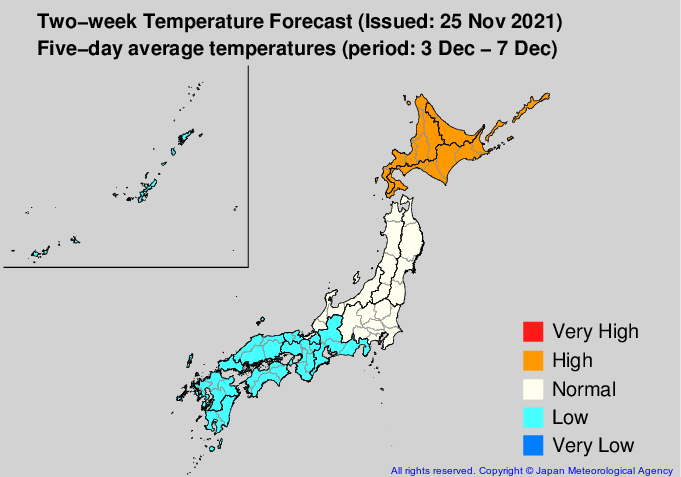
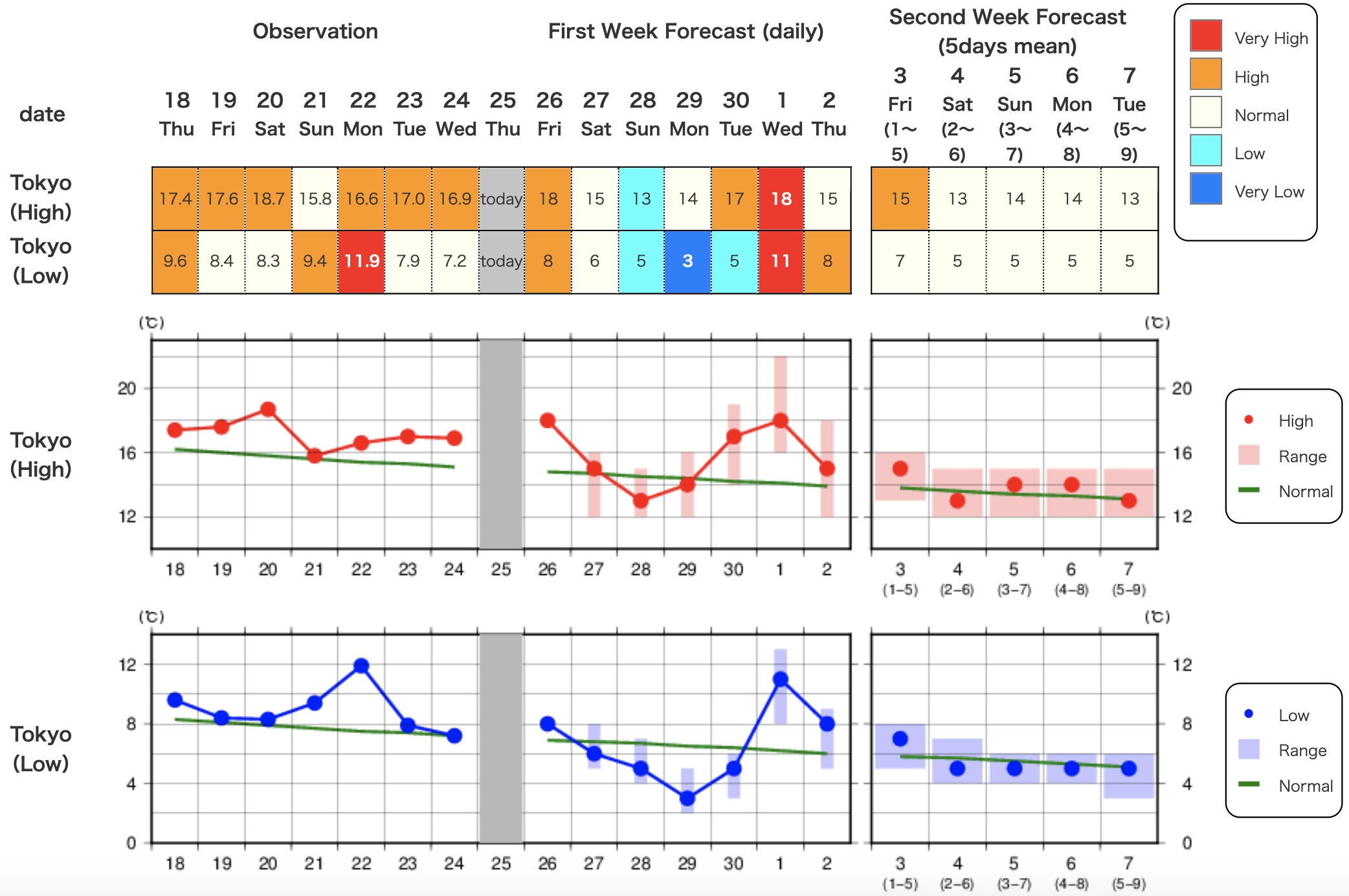
TWO-WEEK TEMPERATURE FORECASTS (NOV. 25~ DEC. 7)
Nation-wide
Tokyo area
- North Japan: Very high temperatures from Nov. 29.
- East/West Japan: High temperatures until Nov. 30, then back to average/slightly cold.
- Okinawa/Amami region: Very cold temperatures from Dec. 1.
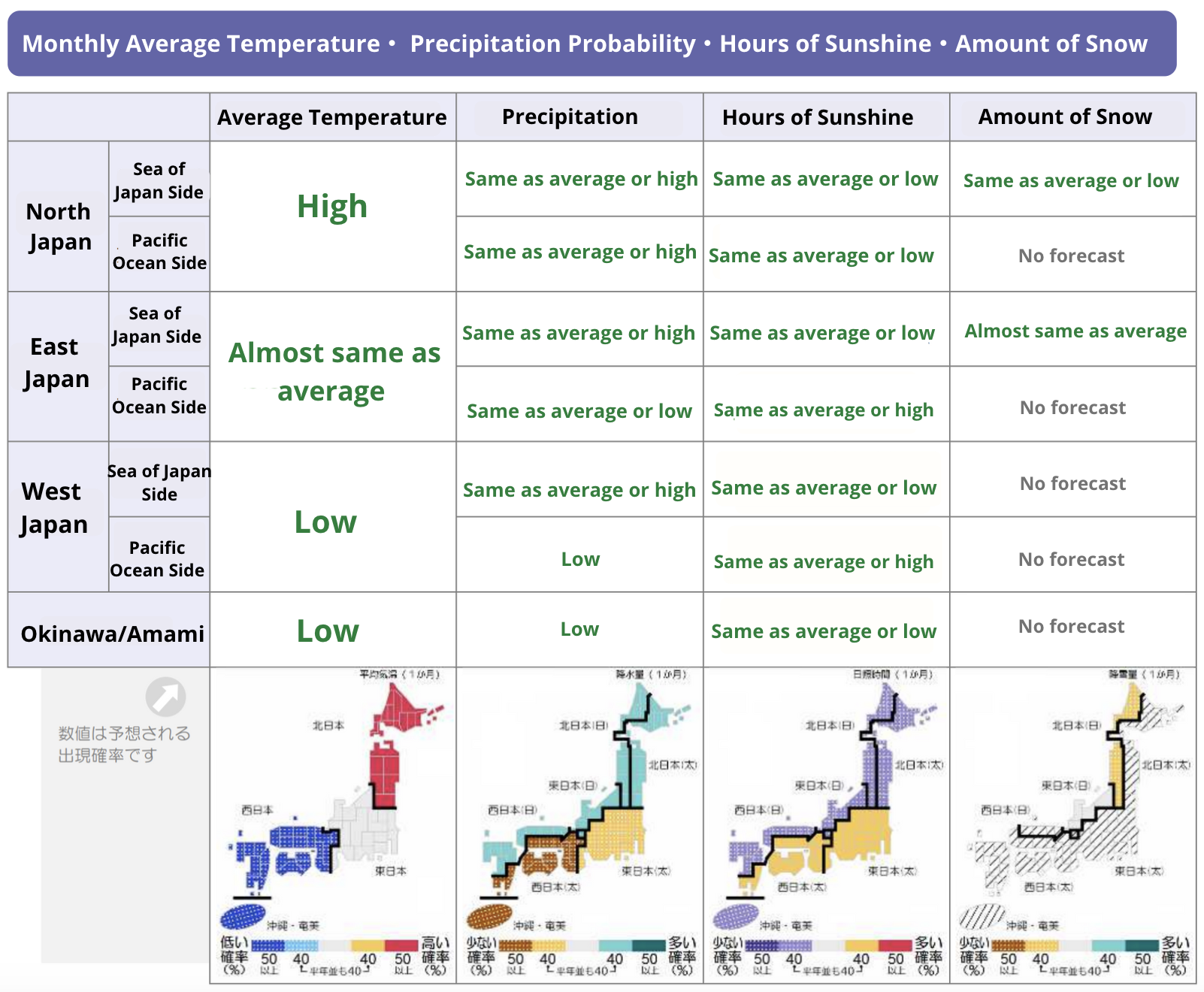
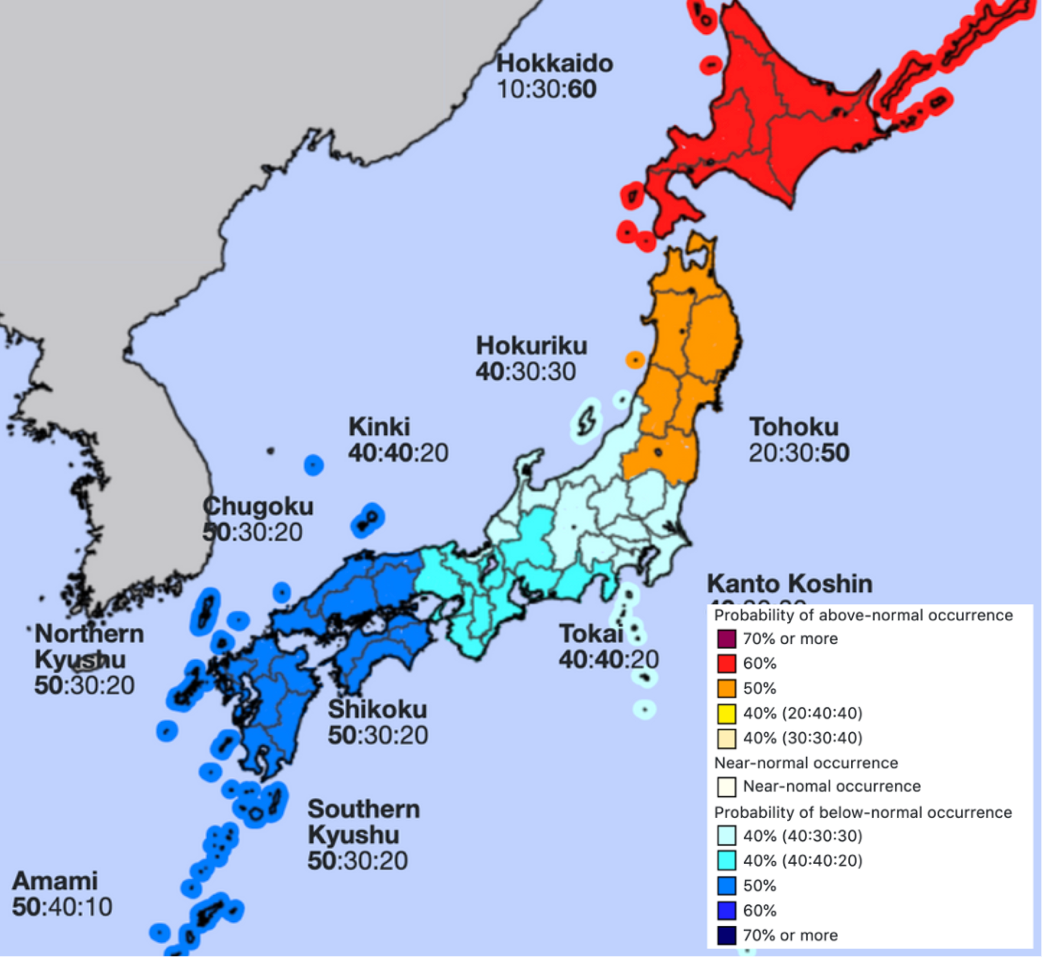
- Winter Forecast: Japan’s Meteorological Agency (JMA) said it expects higher-than-average snowfall in eastern and western Japan for December to February.
ONE-MONTH SEASONAL FORECAST (NOV. 27~ DEC. 26)
NEWS: POWER MARKETS
| No. of operable nuclear reactors | 33 | Electricity Price | Friday, Nov. 26 | % Change WoW | ||
| Of which | restarted | 10 | JEPX 24-Hour Spot | ¥19.77/ kWh | +4.11% | |
| in operation today | 7 | TOCOM Dec. baseload (Tokyo area) | ¥29.46/ kWh | +15.71% | ||
Source: Company websites, JANSI and JAIF, as of Nov 26, 2021
Offshore wind farm tender likely to be delays
(Akita Sakigaki Shimpo, Nov. 24)
- The decision on who will win the first three offshore wind tenders in northern Japan has been delayed. This concerns the areas known as “promotion zones” for offshore wind power generation.
- The government initially planned to announce a decision in Oct. or Nov. But interviews with interested parties around economic benefits have not yet been completed, at least with the Akita Prefecture governor and authorities.
- It is widely believed the selection will be delayed until the beginning of 2022.
- Officially, the government has not clarified if it has started the interview stage. According to one government officer, the interviews are not in progress at this time.
- There are multiple bidding parties for each area, so the interview stage may take longer than expected; the same is true for the evaluation of submitted documents.
- The national government will pick winners based on a 240-point scale. Of that, 40 points is allocated for coordination with the local community and economic ripple effects, and the opinions of local governors will need to be taken into consideration.
- Akita Prefecture Governor Satake said on Nov. 22 that the prefecture had only just received the materials prepared by each bidder regarding their planned measures to contribute to the region and the local economy. As such, the prefectural authorities have not yet had time to examine all the content and formulate their opinion, he said.
- METI declined to say whether the offshore wind tender process is delayed.
- CONTEXT: The three sea areas in question are:
- Noshiro City, Mitane Town and Oga City
- Yurihonjo City, north
- Yurihonjo City, south
- A further tender is being held for the right to develop offshore wind projects off the coast of Chiba Prefecture, central Japan.
TAKEAWAY: Given the high volume of interest in Japan’s first commercial offshore wind power tenders, this delay is not a surprise. The emphasis on economic benefits to the region is also something that has become more and more emphasized with the arrival of Prime Minister Kishida. Still, the government cannot afford to let the tender process slide too much. Both the 2030 power mix targets and the credibility of the offshore wind industry in Japan depend on this.
Four major power utilities warn about lowering gas stockpiles
(EnergyShift, Nov. 25)
- Chugoku Electric, Kyushu Electric, Hokuriku Electric, and Shikoku Electric may soon run out of LNG. Shortages are due to unusually warm weather and a number of problems at coal-fired power plants.
- All the generators are limiting output until Dec. 1 to conserve fuel.
- Shortages bode ill for winter, forecasted to be Japan’s coldest in a decade.
- All four power utilities expect demand for electricity to reach over 96% of generation capacity in February.
- SIDE DEVELOPMENT:Power supply at tightest level in 10 years(Toyo Keizai, Nov. 27)
- METI’s projection that electricity demand in TEPCO’s service area in Feb. 2022 will exceed supply capacity sent shockwaves through the industry.
- While generators scrambled to boost capacity, they were unable to achieve the 3% recommended buffer.
- A few days of unseasonably cold weather or a few power plants going off-line would force power cuts in February.
- The phasing out of coal-fired power plants, according to zero-net GHG emissions goals for 2050, has only made the situation more serious.
- SIDE DEVELOPMENT:Prepare for an energy crisis(Toyo Keizai, Nov. 19)
- Japan’s energy market is preparing for a perfect storm caused by global energy shortages.
- Energy shortages may result in power cuts or factory shutdowns.
TAKEAWAY: The narrative on gas stockpiles seems to have shifted very rapidly from Japan’s industry and officials being quietly confident to ringing the alarm. There seem to be several reasons for this:
The latest meteorological forecast (See the Weather section) suggests that snow fall will be larger than expected and central and western region forecast to have colder-than-normal temperatures in the winter months.
Japan’s stockpiles are small relative to consumption and with no way to store LNG beyond 2-3 weeks, the difference between multi-year-high stockpiles and shortages is not so large.
METI’s urging to utilities that they must top up stockpiles to keep them as high as possible has resulted in the big companies procuring more cargos at the inflated prices on the spot market. Since utilities are not able to immediately pass on those higher costs to consumers playing the role of energy security guardian works against the companies’ financial interests. It is no surprise then that Tohoku Electric and JERA announced last week that they would stop supplying the wholesale electricity market with power at marginal costs. What’s more, JERA also said it will stop buying additional spot cargos for winter months after securing 2 million tons on the spot market.
Bottom line: The government wants the big power firms to play the role of energy security guarantors, but the market penalizes them for the same. METI will likely need to adjust the market mechanisms to align national security incentives with industry needs.
Power grids change JEPX marginal cost formula to fully reflect spot LNG price trends
(Japan NRG, Nov. 24)
- Tohoku Electric and JERA plan to change the formula for marginal power generation cost used for spot electricity trades on Japan Electric Power Exchange (JEPX). This will directly reflect LNG spot price fluctuations to marginal cost.
- Previously, the marginal cost reflected weighted average prices of long-term LNG contracts and spot prices, Tohoku Electric said. By changing the formula, power generation costs incurred from the use of additional LNG supplies will be adequately reflected in the calculations. Such additional supplies are secured from the LNG spot market and other means.
- JERA revised its power supply contracts with Tokyo Electric Energy Partners, effective November, and will directly trade power supplies for the Tokyo area in the spot JEPX market. Like Tohoku Electric, in its marginal cost, JERA plans to reflect the cost of sourcing additional LNG supplies from the spot market and other means.
- This will be implemented following approval by the Electricity and Gas Market Surveillance Commission.
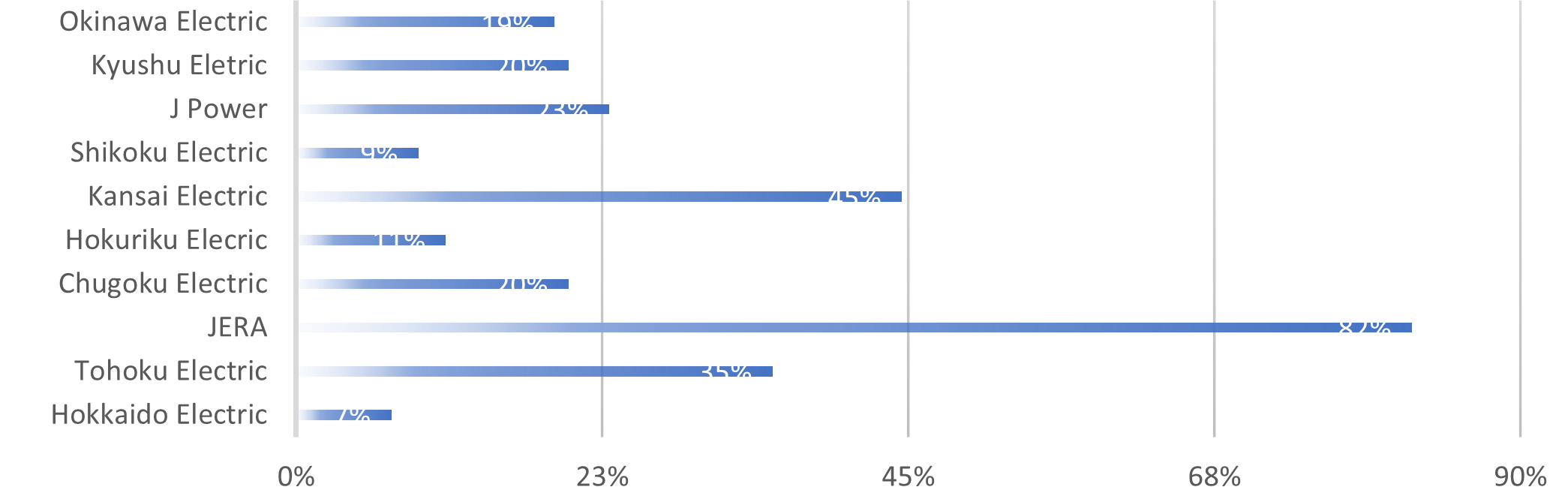
- Major Power Utilities: % of LNG in the power, 2020
Energy Agency fears split in power market between old and new generators
(Denki Shimbun, Nov. 24)
- The Agency for Natural Resources and Energy seeks ways to enable retailers to more efficiently procure additional capacity when needed.
- There are fears that if the renewables market continues to develop independently of traditional power generators, competition between renewable and traditional producers at times of tight supply could create inefficiencies in the market as a whole, calling into question the role of the energy spot market managed by Japan Electric Power eXchange (JEPX).
- The Agency will hold a series of meetings between representatives of JEPX, the Transmission and Distribution Grid Council, and OCCTO (the Organization for Cross-regional Coordination of Transmission Operators) to debate the issue, referring to case studies from overseas.
Chubu Electric says renewable energy will make up 20% of its power mix by 2030
(Asahi Shimbun, Nov. 25)
- Chubu Electric announced a goal to increase the share of renewable energy in its power mix to around 20% by 2030, or 3.2 GW of capacity. That’s only slightly higher than its previous aim for “about 19%”.
- Renewables already make up 16% of the mix for the utility based in the central region of Japan.
- While Chubu Electric acknowledges the trend toward decarbonization, it remains committed to thermal power even while aiming to half its CO2 emissions by FY2030 (compared to FY2013 level).
- The company president did say at the presentation of the revised strategy that Chubu Electric believes that it is “reaching the limit” on developing own power sources and wants to work with others on future projects.
Tokyo Gas plans small-engine LNG plant to better balance power shortages
(Nikkei, Nov. 25)
- Tokyo Gas plans a small-scale LNG-fired power station in Chiba.
- The thermal power station will have dozens of small gas engines that can be started more rapidly. Batteries of gas engines are also more efficient at partial loads, as the number of engines operating can be varied as needed.
- The Jan. 2021 power shortages were a factor in approving this plant.
JERA CEO says Asia’s conditions less suitable for renewable energy
(Toyo Keizai, Nov. 27)
- JERA’s CEO, Onoda Satoshi, says the utility is testing 20/80 ammonia/coal blends at thermal power stations. If scrubbers can handle higher NOx emissions from ammonia fuel, then blended fuel will be used in the network.
- When asked about plans to divest from coal, Onoda said there’s more than one way to ‘climb a mountain’ (decarbonizing), and noted that Asian nations’ shorter days, milder winds, and less developed transmission infrastructures make them less suited to renewable energy than Europe.
- Onoda said thermal plants would remain essential in order to compensate for the variations in output associated with renewable energy.
- SIDE DEVELOPMENT:
Coal not going away says head of Japan’s power utilities group(Nikkei, Nov. 24)- Federation of Electric Power Companies chair Ikebe Kazuhiro said Japan will remain reliant on coal for its energy needs.
- Commenting on the recent COP26 with its calls for a reduction in coal and other fossil fuels, Ikebe said every country should pursue decarbonization in a way suited to its circumstances.
- Ikebe said the FEPC was investing in ammonia co-firing, which would help not only Japan but also other nations to reduce carbon emissions.
Grapes and solar: New agrivoltaic farm starts operation in Fukushima
(Fukushima Minyu Shimbun, Nov. 20)
- Fukushima-based Nihommatsu Farming Solar unveiled a 1.9 MW solar generation facility on the site of abandoned farmland in Sasaya, Nihonmatsu City.
- The 6-ha site will be used to cultivate four tons of grapes and other crops, as well as generate solar power from about 9,500 panels placed 2 meters above ground.
- The electricity will be sold to Tohoku Electric.
Wind turbine installation vessel unveiled
(NHK, Nov. 23)
- Shimizu Corp unveiled a ship to install offshore wind turbines.
- The ship is 142 m long and 50 m wide; the on-board crane can lift up to 2,500 metric tons.
- The ship, which will be completed next year, cost ¥50 billion.
RWE and Kyushu Electric unit plan offshore wind farm in Akita prefecture
(New Energy Business News, Nov. 26)
- Kyuden Mirai Energy and RWE Renewables Japan are planning to develop an offshore wind farm near the town of Happo, Akita Prefecture, with a maximum output of 360 MW.
- The two submitted an environmental assessment report for the project, entitled “Offshore Wind Farm Project off the Coast of Happo Town and Noshiro City, Akita Prefecture”.
- The project area is approximately 32.2 km2 off the coast of Happo Town and Noshiro City, and is designated as a promotion area under the Renewable Energy Marine Use Law.
NUCLEAR REACTOR WRAP
- Ikata nuclear to restart in December
(NHK World Japan, Nov. 22)- Shikoku Electric will restart its Ikata No.3 reactor on Dec. 2, claiming it has the understanding of the local government.
- Power transmission will begin four days later, and commercial operations will resume on Jan. 4. This is the first time in almost 2 years since the plant went offline for regular inspections in Dec 2019.
- Since then, the operator has been hit by scandals, including when a control rod was mistakenly removed from the reactor, and another in which an individual on emergency standby went off duty without permission.
- The operator has already laid out measures to prevent recurrences and will do its utmost to recover the trust of local residents and maintain safe operations.
- SIDE DEVELOPMENT:
Japan court reject bids to stop the restart of Tokai Daini nuclear plant
(NHK News, Nov. 24)- The Tokyo High Court dismissed a petition from residents seeking a provisional injunction to stop the restart of Tokai Daini nuclear plant’s No.2 reactor (JAPC).
- Residents said the NRA’s calculation to measure earthquake resistance was incorrect and that the Tokai Daini reactor was vulnerable to major earthquakes. However, the court accepted the operator’s earthquake measures.
- SIDE DEVELOPMENT:
Full inspection takes place at Kashiwazaki Kariwa Unit 7 after incomplete safety-upgrades
(NHK News, Nov. 25)- TEPCO conducted a full inspection at 20,000 places at its Kashiwazaki Kariwa No.7 reactor after admitting it hadn’t finished part of the safety-upgrades, contradicting earlier claims that safety measures were completed in January.
- In June, the company confirmed that fire-prevention work was not finished at 76 places, including installation of fire detectors and work to block water leaks.
- The full-scale inspection will last until Feb 2022.
- SIDE DEVELOPMENT:
Robots to probe Fukushima Daiichi nuclear plant from January
(NHK World News, Nov. 25)- In mid-January, TEPCO plans to send submersible robots inside the containment vessel of the damaged Fukushima Daiichi nuclear reactor.
- The company will use six robots to locate and measure the debris through ultrasonic devices and to collect small amounts of samples.
- The probe is part of efforts to remove molten fuel debris from the meltdown caused by the 2011 earthquake.
Fukushima: underground ice wall may be melting
(Tokyo Shimbun and NHK, Nov. 25-26)
- TEPCO revealed that a barrier of frozen earth used to prevent contaminated ground water under the Fukushima plant from leaching into the surrounding area appears to have melted in places.
- TEPCO plans to sink metal pipes into the area to stop the groundwater flow.
- CONTEXT: Tokyo Electric pours coolant water at minus 30 degrees C into wall pipes.
- TEPCO says the temperature rose to 13.4 C on the mountain side of No.4 reactor’s building. The temperature is above freezing since mid-Sept.
- So far, there’s been no change in water levels around the reactors.
- SIDE DEVELOPMENT:
Japan offers fishermen $260m compensation for Fukushima water release
(NHK, Nov. 26)- Japan plans a fund of about ¥30 billion ($260 million) to help the fishing industry if demand plunges due to the planned release of treated water from the Fukushima nuclear facility into the sea.
- The fund is part of efforts to minimize any negative impact on the fishing industry when treated water starts to be released in about two years.
NEWS: OIL, GAS & MINING
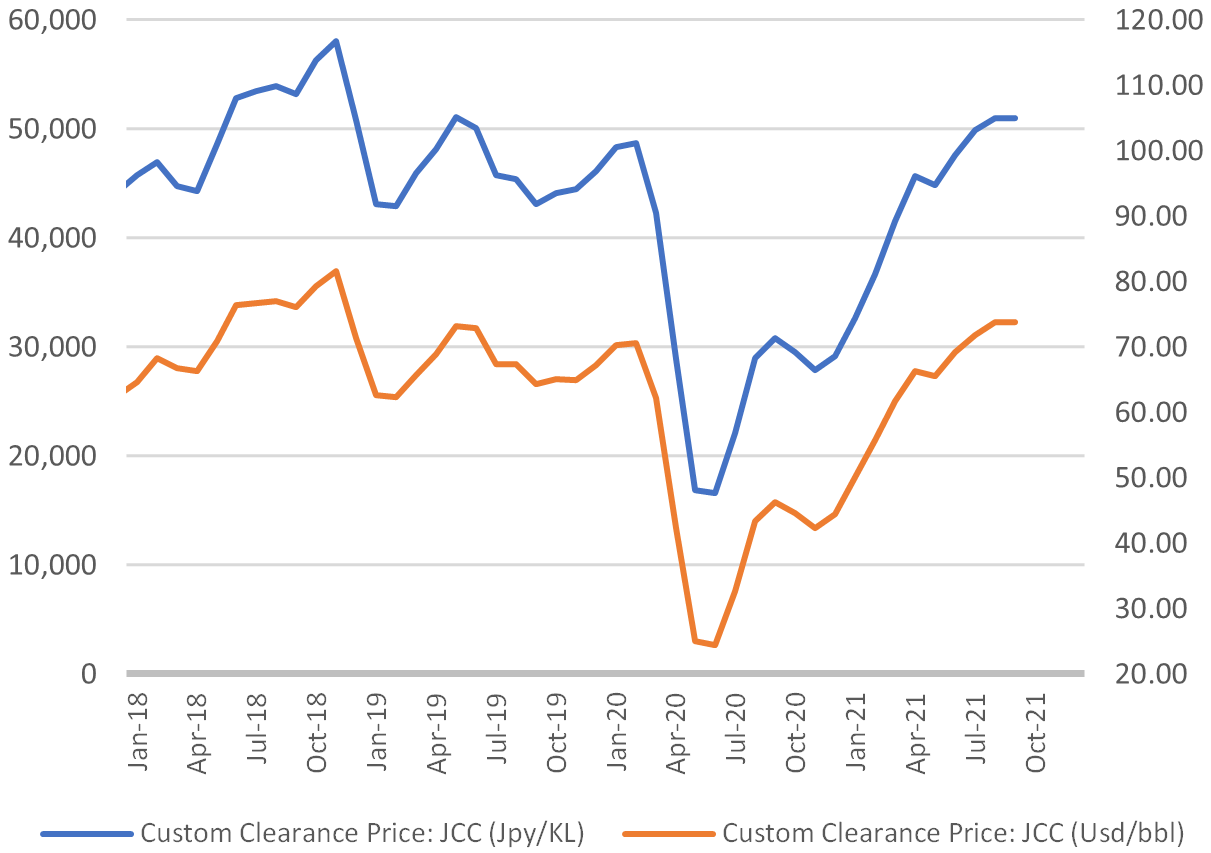
Japan Oil Price: $73.81/ barrel
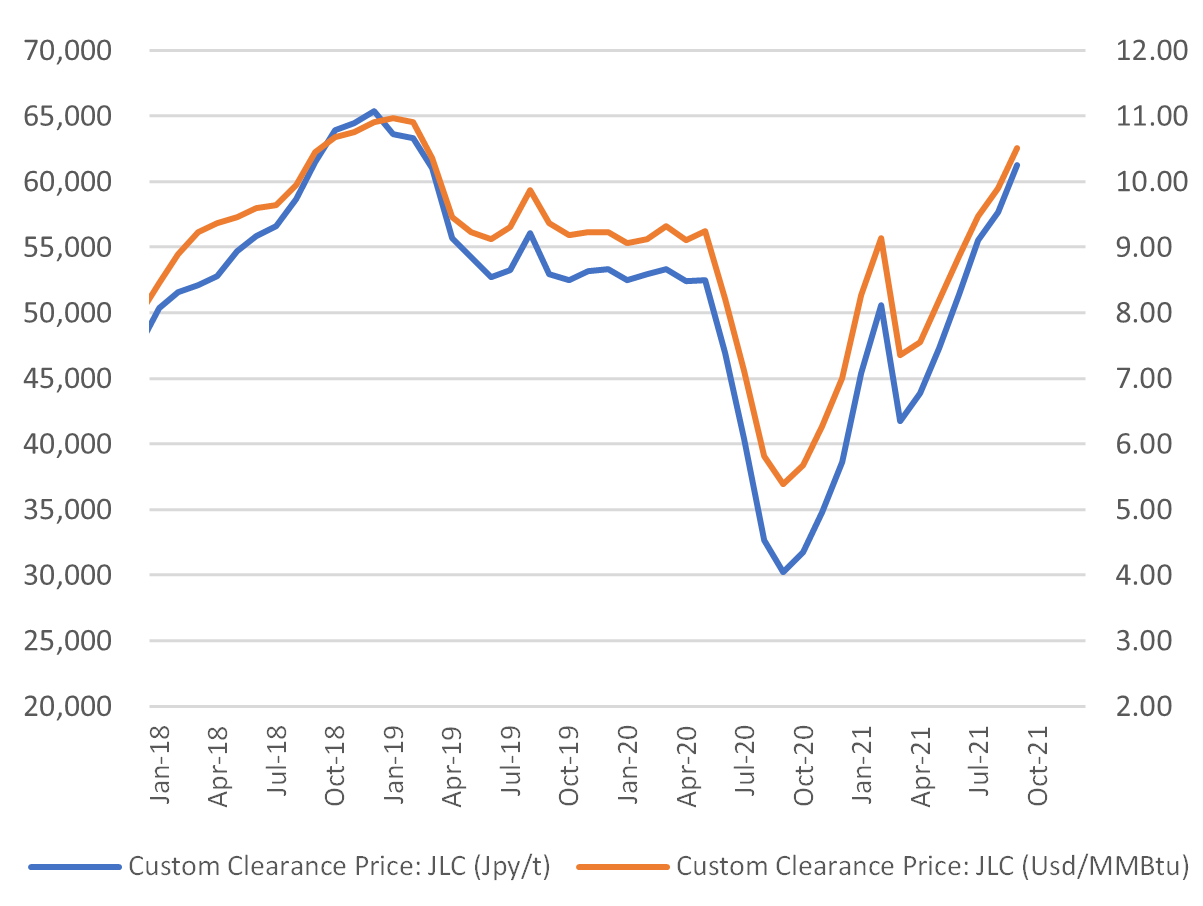
Japan (JLC) LNG Price: $10.52/ mmbtu
JERA signals it won’t renew its biggest long-term LNG supply deal with Qatar
(Jiji, Reuters, LNGInfo, Nov. 26)
- JERA, Japan’s top LNG importer, signaled it won’t renew a long-term LNG supply contract with Qatargas that involves about 5.5 million tons of the fuel a year. That’s almost 20% of the import volumes procured each year by the Japanese company.
- The contract with the Qatargas I LNG facility expires in December 2021.
- JERA CEO Onoda said he’d like to create a more balanced supply portfolio with greater flexibility, and that continuing with a large, fixed contract is difficult in today’s more global LNG market that’s also facing decarbonization pressures and liberalized electricity prices.
- Onoda added that JERA is not considering any other contracting with Qatar at present. There is a “mismatch” between what JERA seeks and the terms presented by the Qatari supplier.
- Current contracts expire after a 25-year term, and pricing is said to be close to oil parity.
- Onoda concluded that Qatar remains an important gas producer and that JERA is interested in ammonia and hydrogen projects in the Middle East.
TAKEAWAY: This may be one of the biggest upheavals in the LNG market in years. It also comes in the same week that JERA announced it will stop offering electricity on the Japanese wholesale market at marginal prices. The company will instead sell power at a price that better reflects the cost of fuel. See the Power Section for more details.
Almost certainly the sticking point between JERA and Qatar is the so-called destination clause. Qatar insists that its cargoes be delivered to Japan and not redirected elsewhere. This allows Qatar to control the flow of its long-term deals with multiple buyers in Asia.
For buyers, destination clauses are more than an inconvenience. The pandemic and extreme weather events show that fuel demand can change quickly and dramatically. Japan believes the best way to navigate this is by building a more fluid and liquid Asia-wide LNG market in which various countries and companies can exchange / trade cargoes to respond to current needs.
Japan has walked away from major LNG suppliers in the past over the same issue. Imports from the UAE are lower in recent years, likely due to the supplier country’s preference for destination clauses in contracts.
The situation is exacerbated when one considers that JERA is also a major electricity generator and retailer. If the company can’t have more flexibility in fuel procurement and risk-hedging, it will take losses either at the fuel stage or during sales of the end-product (electricity).
Clearly, Japan’s government and JERA prefer to maintain their clout in the LNG market through large-volume offtake deals. However, this is a gamble that JERA likely has to take. Only a week earlier, JERA agreed to invest $2.5 billion in the Freeport LNG project in the U.S., which likely offers the Japanese company greater flexibility on long-term supply.
Oil release likely to have limited benefits
(Nikkei opinion, Nov. 22)
- CONTEXT: This is an opinion piece in Japan’s biggest business daily.
- Japan cooperated in a release of strategic oil reserves to cool the market.
- While the government relaxed reserve requirements on private operators in 1991, 2005 and 2011, it never before released strategic reserves.
- However, such releases may discourage oil producing nations from increasing supply, thus actually increasing the price of crude.
- The yen is also projected to weaken further against the U.S. dollar in coming months, thereby counteracting any benefits from a crude oil release.
- SIDE DEVELOPMENT:
Petroleum Association of Japan says state measures aimed at curbing oil price rise
(Denki Shimbun, Nov. 26)- (PAJ) Chairman Sugimori Tsutomu (also the Chairman of ENEOS) said that the oil industry is concerned about the recent rise in crude oil prices just as economic activities resume in earnest after the end of the state of emergency in Japan.
- Sugimori said he believes the recent measures included in the government’s economic stimulus package are not measures to lower prices, but to curb their rise.
- He also tried to play down the release of oil from the national stockpile. “The replacement of oil types itself is something we do every year.
TAKEAWAY: See the Analysis section for a full story on the oil reserves release.
Japan refiners get ready to make fuel oil for power generation
(Reuters, Nov. 25)
- Japanese refiners are dusting off unused supply chains for fuel oil and getting coastal vessels and storage tanks ready after receiving requests from electric utilities to supply more fuel oil this winter amid a global crunch for power generation fuels.
- CONTEXT: Oil-fired generation is on the wane in Japan, but still makes up 3% of the nation’s mix. It is seen as an emergency go-to resource when other power plants are not available.
ENEOS to sell $1.7 billion stake in UK oil field in further shift to renewables
(Asia Nikkei, Nov. 27)
- JX Nippon Oil and Gas Exploration, a unit of ENEOS, said it has agreed to sell 100% of subsidiary JX Nippon Exploration and Production (U.K.) to British company NEO Energy Upstream UK.
- The price will be based on the unit’s $1.66 billion valuation, adjusted for factors including debt and working capital. The Japanese company will unload all of its U.K. assets with the sale.
- JX Nippon owns a roughly 25% stake in the oil and gas fields involved in the U.K. deal, which can produce the equivalent of roughly 30,000 barrels of oil per day, according to the company.
- ENEOS is selling coal and oil interests and putting the proceeds into renewable energy and carbon capture and storage projects.
ANALYSIS
BY TOM O’SULLIVAN
Japan’s First-Ever Release of Strategic Oil Reserves
Blends Inflation Concerns with Geopolitics
In a historic move, Prime Minister Kishida has committed to release 4.2 million barrels of oil from Japan’s strategic oil reserves as part of a global campaign by major consumers led by the U.S.
There are several reasons behind the first ever dip into Japanese oil stocks that’s unconnected to war or a natural disaster. In part, it’s a diplomatic gesture from a newly appointed premier seeking to curry favor with President Biden while demarcating the power balance between the PM’s office and METI.
The oil release is also an important signal from Japan’s government that the era of deflation may be coming to an end; or, at the very least, put on pause.
Two decades of deflation has helped mask a loss of almost a third of the Japanese consumers’ spending power. In the last decade, that has coincided with an increase in the basic power bill and surcharges.
With inflation back, Kishida’s government knows that it will find consumers much more attuned to energy prices, especially as they start to affect food costs. For a country that relies on imports for over 90% of its primary energy and over 60% of its food, the fate of the oil price – and its closely related natural gas price – extends to national security considerations.
Details of the release
The announced tentative releases (barrels of oil) in other countries were as follows:
- U.S.: 50 million;
- India: 5 million;
- China: 7.3 million;
- South Korea: Up to 5 million;
- UK: 1.5 million
The total amounts to 70 million barrels, less than one day of global oil consumption.
For Japan, the world’s fifth-largest oil consumer and the fourth-largest crude oil importer, the size of the release is slightly more significant. The country imports the equivalent of about 3 million barrels per day (mbpd), though imports were down to the 2.5 mbpd level and below last year due to Covid.
The oil is expected to be released in a phased manner through March 2022.
METI currently has over 140 days of oil reserves (280 million barrels); the private sector has 90 days of reserves (170 million barrels); and Japan also has offshore oil reserves in the UAE and Saudi Arabia. JOGMEC (profiled in the Nov. 15 Japan NRG edition) typically manages Japan’s oil reserves on behalf of METI and conducts tenders for releasing national inventories of metals into the domestic market. Details of the metals tenders are not publicly disclosed.
Japan has occasionally released oil stocks from the private reserves in the past. The last release was in 2011 during the Libyan civil war, as well as following the Great East Japan Earthquake earlier that year. The 2011 release by members of the International Energy Agency (IEA) following the situation in Libya amounted to 60 million barrels and had limited impact on oil prices.
Contrasting narratives between PM’s Office and METI
A release from the national stockpiles, however, will be a first. But this is something that METI, the ministry in charge of the oil and gas sector, is loath to do, considering it potentially damaging to relations with major Middle East oil suppliers and privately arguing it would be an infringement of the Oil Stockpile Act that stipulates such releases should be done only in times of emergency.
As a first release from national reserves, METI also warned that the procedures for this are not yet in place. That means the date of the oil auctions, the exact volumes, and mechanisms will need to be decided in concert with the actions of other governments.
In contrast, Kishida’s Chief Cabinet Secretary Matsuno guaranteed that Japan’s actions will be compliant with the Stockpile Act and said that the move is vital to provide price stability during economic recovery from the pandemic.
Matsuno confirmed that via both METI and foreign ministry channels Japan is talking to several OPEC+ nations to urge an increase of output. He also pointed to the sectors that the government is particularly keen to support through the oil release: agriculture and fishery.
While the Chief Cabinet Secretary noted that in case the oil producing countries retaliate by limiting their currently planned output increases, both he and METI were keen to also present the oil stockpile release in a more ordinary light.
Every year, Japan refreshes the stocks by selling older oil reserves and bringing in fresh barrels. This time, the release is simply bringing forward an annual routine action, a METI official said.
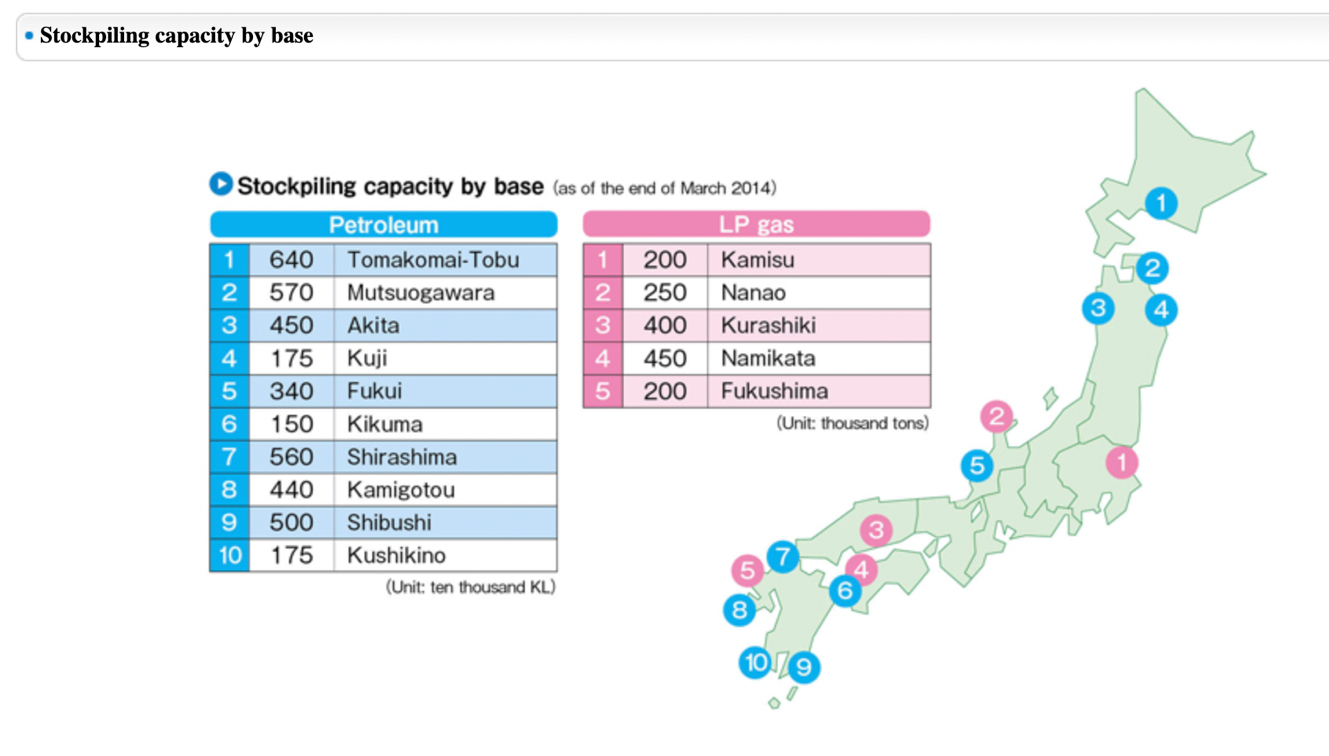
Kishida hopes to get ahead of inflation
While Kishida’s interest in pursuing the oil release helps to improve relations with President Biden, for whom this exercise has prime domestic importance, and it allows the new premier to assert control over METI, a ministry that traditionally held the biggest influence over Japanese energy policy, there are other issues at play.
Source: Bank of Japan
Source: Oilprice.com
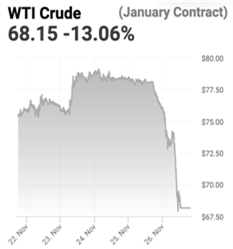
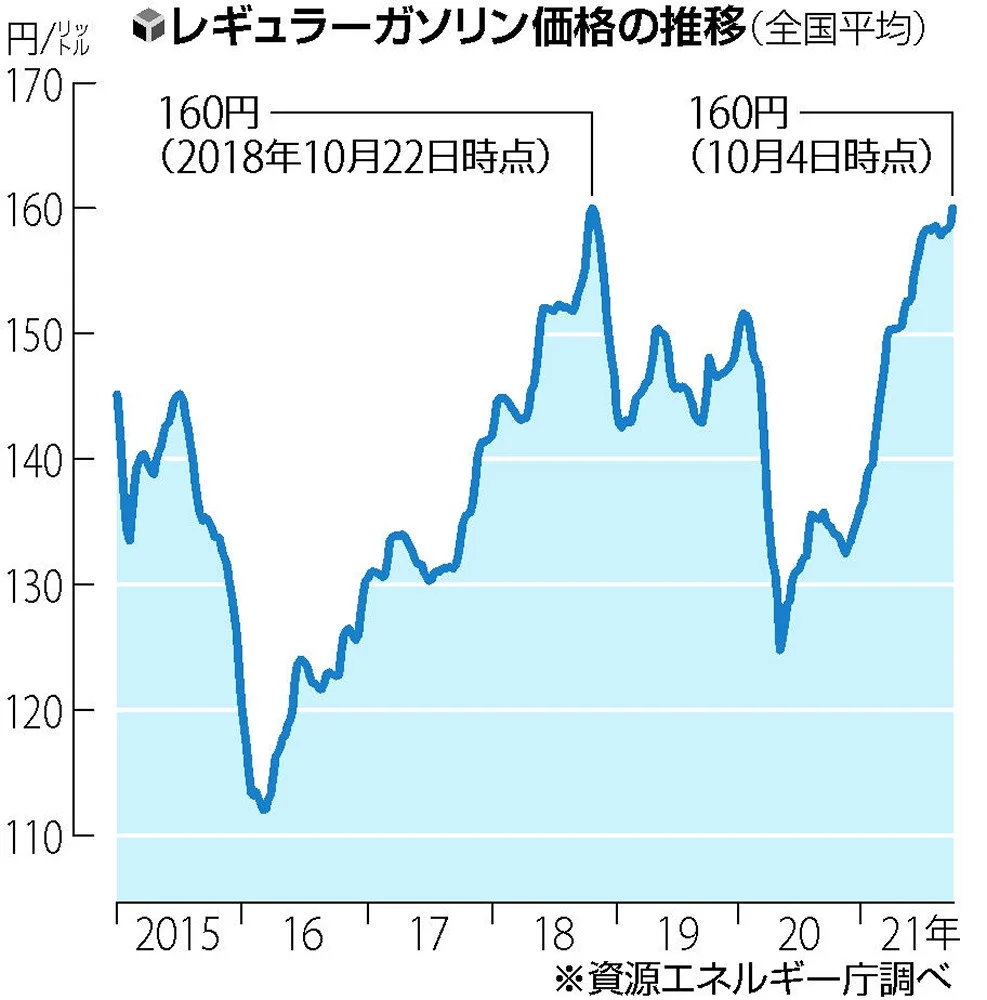
Prices at the pump in Tokyo have increased for 10 straight months and exceeded ¥170/ liter recently as the country’s state of emergency was lifted and global oil prices rose to over $80 a barrel.
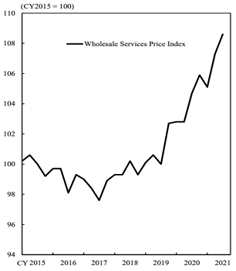
Inflation is affecting all major economies including the U.S. where CPI now exceeds 6% for the first time in 30 years. But, in Japan, producer price inflation hit a four-decade high in October driven in part by higher energy costs. In the same month, the prices that businesses charge each other for services rose to the highest since November 2001, BoJ data shows.
An $80 oil price costs the average Japanese household an extra ¥28,000, while oil at $90 would push that figure to ¥33,000, according to Yomiuri Shimbun calculations.
The recent trend for a weaker yen will also push up energy costs, and immediately translate into food costs, which are primarily driven by imports.
Japanese food producers, the farmers and fishermen, would also suffer outsized damage from rising gasoil prices and yen weakness. The average farming household income is just ¥1.14 million/ year; for fishing households: ¥1.12 million, both less than a quarter of the national average. Most are small family businesses and the people work several jobs.
That’s what makes the agriculture and fisheries sectors key demographics for Kishida in the fight against inflation. They are also traditionally the biggest supporters of the ruling Liberal Democratic Party.
Japan Gasoline Prices (in yen)
Source: Yomiuri Shimbun
Kishida has committed his government to creating a new type of inclusive capitalism, which seeks more wealth distribution in addition to economic growth.
A targeted oil stocks release would not cover much of Japan’s total demand, but it would be significant volumes for the nation’s primary food suppliers. Agriculture and forestry fuel consumption was close to 149,000 kl (equivalent to about 0.94 million barrels) in 2019, mainly in the form of kerosene and diesel. For fisheries it was 404,000 kl (about 2.54 million barrels), mainly as bunker fuel.
Should the oil release reach these sensitive and vulnerable industries, Kishida may consider the measure a success, even if the impact on the oil price is negligible.
Oil market response
Oil prices were almost unchanged after the release announcements. Oil producing countries will meet this week on Dec. 2, and Saudi Arabia and the UAE, which are two of Japan’s largest oil suppliers, are thought to be the only countries that could potentially lift production to reduce oil prices. OPEC+, which includes Russia, was slated to increase oil production on Dec. 1 by 400,000 bpd as part of an attempt to meet rising demand. However, the group is said to be considering the cancellation of the output increase.
Since taking office, President Biden has had no contact with Mohammad Bin Salman, the Crown Prince of Saudi Arabia.
U.S. crude declined almost 7% on Friday, Nov. 6, to a two-month low on news that a new Covid-19 variant, labeled Omicron, was discovered in South Africa.
ANALYSIS
BY MAYUMI WATANABE,
YURIY HUMBER
Kishida’s Plan for Asia’s Energy Transition: Turn Coal into Hydrogen
During his appearance at the COP26 summit, Prime Minister Kishida vowed that Japan would take the lead in Asia’s energy transition. His proposal was based on an obscure $100 million program created earlier this year by his predecessor. It proposes to help switch the region’s coal power plants to hydrogen, among other measures.
The announcement sheds some light on Kishida’s energy strategy for Asia, hinting at which technologies will benefit. It also highlighted the new PM’s overall shift in policy emphasis away from a green economy that’s primarily based on renewables to one that is “clean”; in other words, an economy based on hydrogen and the CO2 cycle, as well as renewables.
While that $100 million number seems small for a region that relies so heavily on coal and where most of the new capacity is planned, during his speech in Glasgow the PM also gave other, much larger numbers that the nation is willing to make available for “climate finance” in Asia. Interestingly, at least one of those financial aid pledges refers to a new climate initiative of which, so far, there is no public record.
With details on the bigger financing numbers few and far between, it is worth looking at the mission statement of the $100 million program to understand where Japanese efforts will be directed over the next five to 10 years.
The nuance of Kishida’s comments
As some European delegates called for a total phase out of fossil fuel energy at COP26, the overall message from Japan’s delegation was that thermal power has a role to play in a zero-emissions world. Kishida’s speech in Glasgow began by mentioning the spread of solar power, but concluded that other “clean” sources also need to be maintained in order to balance out this greater rollout of variable renewable energy.
“For stable management of frequencies, it is important to make use of legacy thermal power plants by reducing their emissions to zero…. To transform fossil power plants to ammonia-hydrogen-driven zero-emissions plants, Japan will develop $100 million worth of innovative businesses,” Kishida said.
Based on these comments, it seems the money would go to Japanese R&D efforts to reduce CO2 emissions at thermal plants to zero. In short, the immediate beneficiaries would be the top machinery firms such as Mitsubishi Heavy Industries and IHI Corp.
However, when looking at the $100 million program that Kishida referred to, the Asia Energy Transition Initiative (AETI), a more nuanced picture emerges.
What is the AETI framework?
AETI was announced in May 2021 to support the energy transition in Asian countries. It specifically targeted countries that form the ASEAN group and offered to:
- Draw energy transition roadmaps
- Organize transition financing
- Provide up to $10 billion of financing to renewables, energy conservation and LNG projects
- Develop pilot studies around offshore wind, ammonia/ hydrogen combustion and co-firing
- Share CCUS technologies
- Train decarbonization experts
What is clear from the above is that AETI is a funnel through which a lot of the bigger investments by Japanese firms in Asia could be made. It also has the broad reach to cover technologies from renewables to alternatives (hydrogen) to the CO2 cycle (carbon capture). AETI does not seek to phase out fossil fuels; for example, it sees new LNG infrastructure as part of the decarbonization process.
The AETI mission principles fit with METI’s outlook for Asia’s energy transition. The ministry believes that as the region’s energy demand increases, oil and gas will have vital roles in supporting economic growth and assuring supply stability. Japanese officials note that besides the carbon reduction pledges, ASEAN nations are also committed to reducing the number of their people living in poverty through economic growth.
As such, METI notes that AETI looks to support transition roadmaps that are diverse and adapted to each individual country. In practice, this means adopting a stance that not every nation can tap renewable energy on a large scale. For places like Singapore, for example, hydrogen and LNG could be more suitable solutions due to the nation’s position and geography.
Finally, AETI’s mission also states the belief that for energy transitions to succeed, the solutions need to be affordable. These above principles were confirmed at the first AETI meeting, dubbed “the Asia Green Growth Partnership Ministerial Meeting” of energy ministers on October 4.
Countries participating in that first meeting stretched beyond ASEAN and included Australia, Bangladesh, Brunei, Cambodia, India, Indonesia, Iran, Iraq, Kazakhstan, Kuwait, Laos, Malaysia, Philippines, Qatar, Singapore, Saudi Arabia, Sri Lanka, Thailand, the UAE, the U.S., and Uzbekistan.
The IEA, and the Economic Research Institute for ASEAN and East Asia (ERIA) also attended. New Zealand, which has banned upstream oil and gas exploration, did not.
Which companies benefit from AETI
The $100 million number is essentially going to be funding that is made available from the newly formed ¥2-trillion ($17.4 billion) Green Innovation Fund that’s administered by NEDO under the aegis of METI.
The financing is supposed to be spent on R&D for technologies that support low-cost production of either blue or green ammonia, as well as power plant equipment that can work based on this clean-burning gas.
The period of investments for the Green Innovation Fund is a maximum of 10 years. This fits with the 2030 timeframe by which METI wants to have ammonia deployed as a co-firing fuel at thermal power plants.
Japan’s industry forecasts, however, are more optimistic and suggest that the transition to ammonia or hydrogen will start within the next five years.
Mitsubishi Heavy Industries (MHI) is developing 40 MW turbines that work solely on ammonia and plans to commercialize the technology by 2025. Its domestic peer IHI says it currently has small gas turbines that already allows co-firing with 70% ammonia.
MHI also expects within two years to deliver a ship designed to carry multiple gases, including ammonia. Kawasaki Heavy will test the world’s first hydrogen carrier this year.
Of course, putting all the new ammonia and hydrogen related technology into practice at thermal plants around Asia, as well as funding all the other directions that AETI talks about, will require much more than $100 million.
A joint study by J-Power and Japan Science and Technology Agency puts the cost of building one 600 MW co-firing power generation unit, based on a 20% ammonia fuel mix and storage facilities for the gas, at ¥25 billion ($217 million).
ASEAN had 84 GW of installed coal-fired capacity in 2019. The cost of shifting that to ammonia based on the example above would run to $30 billion.
This is where Kishida’s larger financial promises made at COP26 come in.
Tip of the finding iceberg
During his COP26 address, Kishida said Japan would offer $10 billion over five years as part of an Innovative Financial Facility for Climate in partnership with the Asia Development Bank.
At present, there is no online record of such a facility on government websites. In the original Japanese text of Kishida’s speech, the facility is not even given a specific name, although it does appear capitalized in the English translation. The Asia Development Bank also does not mention such a scheme on its website.
Curiously, the AETI initiative also mentions a $10 billion figure, which (as noted above) is supposed to go towards “financial support for renewable energy, energy efficiency, LNG and other projects.”
It’s unclear if Kishida was referring to this same $10 billion in his Glasgow speech, but he did say that the amount would be a top-up to a $60 billion commitment made by Japan in June. That pledge was made by his predecessor, PM Suga, at the G7 leaders meeting in Cornwall. It was referred to at the time by the Ministry of Foreign Affairs as a ¥6.5-trillion “assistance to adaptation” program that would last from 2021 to 2025.
The June pledge is also alluded to in a June MoE report, which describes it as borne from an April U.S.-Japan meeting between Suga and President Biden, and which by the time of the Cornwall G7 meeting became a commitment to help countries “move away from unabated coal-fired power generation”, among other issues.
Taken as a whole, the above suggests that a major part of the bigger climate financing mentioned by Kishida will be directed towards helping Asian nations cut emissions at coal-fired plants, and that is likely to take the form of initially co-firing and later a full switch to ammonia/ hydrogen fuel. The investment would cover the cost of building out hydrogen and ammonia infrastructure in the ASEAN and broader Asia region.
Of course, Asian projects in carbon capture, storage and recycling projects that relate to Japanese technology and investments will also likely be supported as yet another pathway to “clean” thermal power. Japanese trading houses such as Mitsubishi, Marubeni and others, as well as energy firms such as JERA are large investors in fossil fuel plants in Asia and would benefit from Kishida’s climate financing.
At $100 million, Japan’s commitment to move Asia away from coal seems small. At $70.1 billion, however, the numbers start to make more sense.
GLOBAL VIEW
BY JOHN VAROLI
Below are some of last week’s most important international energy developments monitored by the Japan NRG team because of their potential to impact energy supply and demand, as well as prices. We see the following as relevant to Japanese and international energy investors.
Australia/ Renewables
Kallis Energy Investments proposed a 6 GW wind and solar development in South Australia that would provide electricity to produce green hydrogen for export, with focus on Japan and South Korea. The project, named Moolawatana Renewable Hydrogen Project, would cover 1,000 square kilometers; the solar and wind farm would each have 3 GW capacity.
Australia/ LNG
Woodside Petroleum and BHP Group agreed on a $12 billion plan to develop Australia’s offshore Scarborough natural gas field and to expand the Pluto LNG plant to process the fuel. The first cargo is planned for 2026. The deal, which transforms Woodside into a top 10 global independent oil and gas company, is part of a $40 billion deal whereby Woodside will absorb BHP’s petroleum assets. BHP shareholders will own 48% of the new entity.
Bill Gates/ Nuclear power
The tech billionaire’s nuclear start-up, TerraPower, will build a second experimental nuclear reactor together with the U.S. government. The $170 million Idaho-based project will be 80% funded by the Department of Energy to explore the use of molten chloride as a coolant. This comes a week after TerraPower announced its first experimental nuclear reactor, a $4 billion project with 50% funding from Biden’s infrastructure plan.
Brazil/ Wind power
With 50 MW of new wind capacity coming online, Brazil reached a milestone, hitting the 20 GW mark of total wind capacity, a 10-fold increase since 2013. Wind is now Brazil’s third largest source of electricity, with more than 750 wind farms in operation, which together have more than 10,000 wind turbines. Brazil’s northeast region hosts about 90% of the country’s total installed capacity.
Denmark/ Cyber security
Wind equipment major Vestas Wind Systems was victim of a cyber security incident, possibly a ransomware attack. The company didn’t provide details, only saying “that parts of Vestas’ internal IT infrastructure and data were compromised”. Several IT systems were shut down as a precaution, but Vestas’ manufacturing, construction and service teams continued operations.
Italy/ Renewables
Europe’s biggest utility, Enel, will spend up to €210 billion by 2030 to develop green energy, with such capacity increasing to a total of 129 GW, thus reducing carbon emissions by 80%. The company plans to be carbon-free by 2040. One of the world’s largest green energy groups, Enel will exit coal and gas generation by 2027 and 2040, respectively. It will exit its gas retail business by 2040.
Ireland/ Wind-to-Hydrogen
Enterprize Energy plans a $10 billion wind farm off Ireland’s coast to power a green hydrogen production facility. The 4 GW offshore wind farm will supply a 3.2 GW onshore green hydrogen project. While the offshore farm will be built in deep waters, Enterprize doesn’t plan floating foundations but instead will use articulated wind columns that allow turbines to tilt in the waves.
Portugal/ Coal
Portugal shut its last coal plant, becoming the fourth EU country to do so. The milestone comes nine years ahead of schedule; Portugal originally planned to end coal by 2030. Belgium, Austria and Sweden are the other three European countries to have already ended the use of coal for power generation.
Serbia/ Nuclear power
Serbia might scrap a 25-year-old moratorium on nuclear power development as it seeks to end reliance on coal, which accounts for 68% of its energy mix. Serbia might buy a stake in an existing regional nuclear power plant, or build its own small modular nuclear plant. Large nuclear power plants cost over €10 billion, but the country’s national debt must remain below 60% of GDP.
U.S./ Oil reserves
In a coordinated move with China, Japan, South Korea and the UK, the U.S. ordered the release of 50 mln barrels of oil — about 2.5 days of total U.S. consumption — to take place over the coming months. Initially, this effort to drive down oil prices, which have doubled in the past year, backfired as the Brent crude benchmark rose to $82.3 on the news. However, by the weekend, Brent was trading in the range of $72-$73 a barrel on news that a new Covid-19 variant was a concern.
U.S./ Fossil fuel divestment
Boston will divest city funds from the fossil fuel industry, joining New York, New Orleans, Los Angeles, and Seattle. Boston won’t invest in any company that derives more than 15% of revenue from fossil fuels, which is roughly $65 million of the city’s $2 billion portfolio. There is also a 2025 deadline for full divestment.
UK/ Electricity
Bulb, the UK’s seventh largest heating provider with 1.7 million customers, is bankrupt, but the government will provide £1.7 billion so that customers continue to receive electricity and gas through April. Bulb joins 25 other British suppliers that folded this year, accounting for more than half the country’s market. The rising cost of gas, combined with price caps on tariffs, means operators now face losses as they supply energy at below cost.
EVENTS CALENDAR
A selection of domestic and international events we believe will have an impact on Japanese energy.
| February | Approval of Fiscal 2021 Budget by Japanese parliament including energy funding projects;
CMC LNG Conference |
| March | 10th Anniversary of Fukushima Nuclear Accident;
Smart Energy Week – Tokyo; Quarterly OPEC Meeting; Japan LPG Annual Conference; Full completion of all aspects of the multi-year deregulation of Japan’s electricity market; End of 2020/21 Fiscal Year in Japan; |
| April | Japan Atomic Industrial Forum – Annual Nuclear Power Conference;
38th ASEAN Annual Conference-Brunei; Japan LNG & Gas Virtual Summit (DMG)-Tokyo Three crucial by-elections in Hokkaido, Nagano & Hiroshima – April 25th |
| May | Bids close in first tender for commercial offshore wind projects in Japan;
Prime Minister Suga to visit the U.S. |
| June | Release of New Japan National Basic Energy Plan-2021;
G7 Meeting – U.K. Presidents Biden and Putin are due to meet at a summit in Geneva Forum for China-Africa Cooperation Summit (Senegal) |
| July | Tokyo Metropolitan Govt. Assembly Elections;
Commencement of 2020 Tokyo Olympics |
| August | METI committee approves draft of Japan’s 6th Basic Energy Plan |
| September | Ruling LDP Presidential Election;
UN General Assembly Annual Meeting that is expected to address energy/climate challenges; IMF/World Bank Annual Meetings (multilateral and central banks expected to take further action on emissions disclosures and lending to fossil fuel projects); End of H1 FY2021 Fiscal Year in Japan; Japan-Russia: Eastern Economic Forum (Vladivostok)-tentative |
| October | Potentially, Japan’s 2021 General Election; Hydrogen Ministerial Conference in conjunction with IEA METI Sponsored LNG Producer/Consumer Conference; Innovation for Cool Earth Forum – Tokyo Conference; Task Force on Climate-Related Financial Disclosure (TCFD) – Tokyo Conference; G20 Meeting-Italy |
| November | COP26 (Glasgow);
Asian Development Bank (‘ADB’) Annual Conference; Japan-Canada Energy Forum; East Asia Summit (EAS) – Brunei |
| December | Asia Pacific Economic Cooperation (APEC) Forum – New Zealand;
Final details expected from METI on proposed unbundling of natural gas pipeline network scheduled for 2022. |
Disclaimer
This communication has been prepared for information purposes only, is confidential and may be legally privileged. This is a subscription-only service and is directed at those who have expressly asked K.K. Yuri Group or one of its representatives to be added to the mailing list. This document may not be onwardly circulated or reproduced without prior written consent from Yuri Group, which retains all copyright to the content of this report.
Yuri Group is not registered as an investment advisor in any jurisdiction. Our research and all the content express our opinions, which are generally based on available public information, field studies and own analysis. Content is limited to general comment upon general political, economic and market issues, asset classes and types of investments. The report and all of its content does not constitute a recommendation or solicitation to buy, sell, subscribe for or underwrite any product or physical commodity, or a financial instrument.
The information contained in this report is obtained from sources believed to be reliable and in good faith. No representation or warranty is made that it is accurate or complete. Opinions and views expressed are subject to change without notice, as are prices and availability, which are indicative only. There is no obligation to notify recipients of any changes to this data or to do so in the future. No responsibility is accepted for the use of or reliance on the information provided. In no circumstances will Yuri Group be liable for any indirect or direct loss, or consequential loss or damages arising from the use of, any inability to use, or any inaccuracy in the information.
K.K. Yuri Group: Oonoya Building 8F, Yotsuya 1-18, Shinjuku-ku, Tokyo, Japan, 160-0004.