
JAPAN NRG WEEKLY
DEC. 6, 2021
JAPAN NRG WEEKLY
Dec. 6, 2021
NEWS
TOP
- GE-Hitachi wins first Japan-related order for new nuclear reactors; Canadian utility orders the JV’s Small Modular Reactor (SMR) unit
- Government to centralize all early offshore wind surveys to speed up project rollout, ease burden on residents and lower final costs
- Kansai Electric joins JERA, Tohoku in linking power prices to LNG; rising cost of fuel will greatly influence Japanese electricity prices
ENERGY TRANSITION & POLICY
- Main opposition party leader drops call to abolish nuclear power
- Japan’s final energy consumption, energy emissions dropped YoY
- First non-fossil certificate auction logs 1,929 GWh of transactions
- METI’s Ammonia Task Force to propose global standards in 2022
- Japan to expand scope and reach of JCM carbon offset program
- Tokyo Gas, Mitsubishi to scour U.S., Australia for “green” methane
- Toyota to make entire western Europe model range CO2-free
- Osaka Gas, JCOAL to test hydrogen from biomass … [MORE]
ELECTRICITY MARKETS
- JERA aims to enter Japan’s electricity futures market by April
- Solar auction price average drops to ¥10.31; J-Power wins bids to build its first large-scale solar plants amid energy transition plans
- All major power and gas utilities to raise rates from January
- Japanese PV panel shipments up 11% amid interest from factories
- Shikoku Electric’s Ikata nuclear plant’s Unit 3 brought back online
- Taisei Corp to develop floating offshore wind tech with Hokkaido
- JERA buys into 300 MW onshore wind project in the U.S.
- Bankruptcy threat hangs over Japanese retailers this winter
- Hitachi to provide system for power capacity market … [MORE]
OIL, GAS & MINING
- METI to tighten watch over LNG stocks as consumption rises
- Japan’s October LNG imports slump; due to pick up later
- Hokkaido Gas buys 500,000 tons of CO2 offsets from INPEX
- Mitsubishi Chemical to divest from all petrochemical businesses
ANALYSIS
JAPAN MAKES BELATED BET ON NEXT-GENERATION NUCLEAR TECH (SMR) TO REVIVE INDUSTRY TRUST
After a decade of uncertainty, Japan is taking small steps back into nuclear energy development. While most politicians say Japan will gradually decrease reliance on nuclear power and shift to other CO2-free energy sources, a consensus is forming around the need to restart R&D programs for next-generation nuclear tech, such as the Small Modular Reactor (SMR). In FY2022, state funding for such programs is due to jump to its highest level in years. The hope is that new nuclear tech will bolster energy security and create decarbonization pathways other than renewables. The trend would also synchronize Japan with the U.S.
KEY GOVT. INFRASTRUCTURE PROGRAM DUE TO SEND TRILLIONS TO ENERGY-RELATED PROJECTS
Prime Minister Kishida has announced a record ¥55 trillion ($488 billion) fiscal stimulus. A lot of this huge package will go towards energy and related infrastructure. One of the core targets is called “National Resilience,” an integrated program that has been in place since 2014.
Due to climate change and the increase in extreme weather events, the program is vital to introducing energy efficiency and more modern and clean power management systems. It will also help to digitize the nation’s energy infrastructure, opening up new decarbonization paths across multiple sectors.
GLOBAL VIEW
Australia passes law to kickstart offshore wind development. Bill Gates leads largest ever private investment into nuclear fusion. Equinor to exit Irish operations. Shell considers investment in Libya oil and solar projects. Wind is now Turkey’s biggest power source. Details on these and more in our global wrap.
WEATHER OUTLOOK
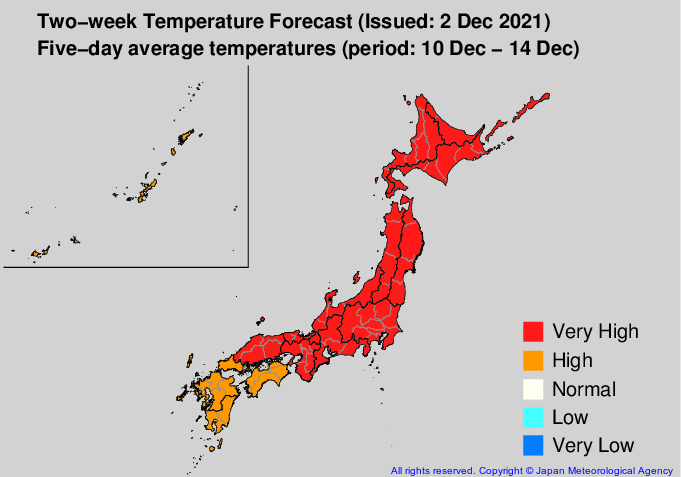
Very high temperatures expected for most of the country from Dec. 6-7.
JAPAN NRG WEEKLY
PUBLISHER
K. K. Yuri Group
Editorial Team
Yuriy Humber (Editor-in-Chief)
Tom O’Sullivan (Japan, Middle East, Africa)
John Varoli (Senior Editor, Americas)
Regular Contributors
Mayumi Watanabe (Japan)
Daniel Shulman (Japan)
Takehiro Masutomo (Japan)
Art & Design
22 Graphics Inc.
Sponsored
SUBSCRIPTIONS & ADVERTISING
Japan NRG offers individual, corporate and academic subscription plans. Basic details are our website or write to subscriptions@japan-nrg.com
For marketing, advertising, or collaboration opportunities, contact sales@japan-nrg.com
For all other inquiries, write to info@japan-nrg.com
OFTEN USED ACRONYMS
METI The Ministry of Energy, Trade and Industry
MOE Ministry of Environment
ANRE Agency for Natural Resources and Energy
NEDO New Energy and Industrial Technology Development Organization
TEPCO Tokyo Electric Power Company
KEPCO Kansai Electric Power Company
EPCO Electric Power Company
JCC Japan Crude Cocktail
JKM Japan Korea Market, the Platt’s LNG benchmark
CCUS Carbon Capture, Utilization and Storage
mmbtu Million British Thermal Units
mb/d Million barrels per day
mtoe Million Tons of Oil Equivalent
kWh Kilowatt hours (electricity generation volume)
NEWS: ENERGY TRANSITION & POLICY
Government to handle early offshore wind surveys to ease burden on developers
(Japan NRG, Nov. 30)
- A METI subcommittee proposed that data collection and surveys conducted in the early stages of offshore wind power project be conducted by the government in order to accelerate the process. Centralized surveys already happen in some European countries to speed up project roll out.
- The METI experts proposed to collect wind and meteorological data, undersea geography, bandwidth required to transport electricity, and other basic data that will be shared among project bidders.
- Under the current system multiple developers conduct the same surveys, which also places a burden on local fishermen, who have to adjust their operations.
- The Japan Wind Power Association urged METI to implement the centralized surveys as soon as possible, since it takes as long as three years to collect meteorological data.
- The government’s centralized system should also lower project development costs.
- CONTEXT: Japan aims to develop offshore wind power capacity from almost zero today. The Nagasaki Goto City floating offshore wind project is ready to start after a local consortium won the tender uncontested. Tenders for another four projects are underway.
GE Hitachi wins first order for new small nuclear reactor from Canada
(Nikkei, Dec. 3)
- GE Hitachi, a joint venture focused on nuclear power, said it won its first reactor order since 2008 to supply a small modular reactor to Ontario Power Generation, one of Canada’s leading utilities. The amount of the deal was not disclosed.
- CONTEXT: GE Hitachi is a JV between Japan’s Hitachi and General Electric of the U.S.
- According to Hitachi, this is the first time that a business associated with a Japanese entity has won an order for a small modular reactor (SMR).
- SMRs, such as GE Hitachi’s BWRX-300, can be built faster than conventional reactors, with claims they are also theoretically safer. Their core can be cooled by water convection alone without pumps, and the amount of radioactive material in the reactor is lower than with larger units.
- Ontario Power plans to file for a permit next year to build up to four BWRX-300s, with the first completed in 2028 at the earliest.
TAKEAWAY: Our lead article in the Analysis section explains the history, context and future of SMRs in Japan.
Main opposition party leader candidates support limited nuclear reactor restarts
(Asahi Shimbun, Various, Nov. 27)
- Hopefuls in the Constitutional Democratic Party leadership race, Izumi Kenta and Ogawa Jun’ya, both expressed support for restarting idle nuclear reactors, distancing themselves from calls to abolish nuclear power.
- Izumi said the govt. should consider keeping open a few select plants that satisfied the most stringent safety criteria as an emergency backup.
- Fellow candidates Osaka Seiji and Nishimura Chinami oppose restarts, saying Japan must shut its nuclear power stations as soon as possible.
- CONTEXT: Izumi Kenta won the contest and is now leader of the CDP.
Japan’s final energy consumption and energy emissions dropped last year
(Kankyo Business, Nov. 30)
- The Agency for Natural Resources and Energy says that Japan’s total energy consumption in the 2020/2021 fiscal year fell 6.6% YoY, while total CO2 emissions fell 6.0% YoY, and were nearly 17% below 2013 levels.
- While renewable energy sources increased for the eighth consecutive year, Japan’s energy self-sufficiency rate fell 0.8%, YoY, to 11.2%.
First non-fossil certificate auction logs 1,929 GWh
(Japan NRG, Nov. 29)
- Japan’s first non-fossil power certificate auction for consumers had a transaction volume of 1,929 GWh, Japan Electric Power Exchange said. 118 business consumers and brokers participated.
- The auction started in response to growing concerns among consumers that they need clean power certificates to meet carbon-neutrality goals. The certificates under the Feed-in-Tariff scheme were sold in this first auction.
- Power retailers held separate auctions ahead of the consumer one: a non-FIT renewable certificates auction on Nov. 24 and a non-FIT non-renewable certificate auction on Nov. 25. Turnovers were the lowest in the last two years — 1,846 GWh for the renewable certificates and 3,130 GWh for non-renewable certificates.
- The consumer transactions averaged at ¥0.33/kWh, although there were settlements as high as ¥1.6/kWh. The retailer auctions settled at ¥0.6/kWh.
- Following the success of the first consumer auction, METI will design a scheme allowing consumers to buy renewable power certificates directly from the power generators through the JEPX platform.
- Non-fossil power certificate auction result:
| Auction types | Certificate types | Volumes | Prices |
| Consumer | FIT non-fossil power certificates | 1,929 GWh | Average ¥0.33/kWh (¥0.3-¥1.6/kWh) |
| Power retailers | Non-FIT renewable power certificates | 1,846 GWh | ¥0.6/kWh |
| Non-FIT non-fossil power certificates | 3,130 GWh | ¥0.6/kWh |
- CONTEXT: The low turnover of the auctions (also dubbed “compliance auctions”) reflects the confusion over the system changes with the launch of the consumer auction. The low volumes may trigger higher volumes in the future, as retailers have non-fossil power supply targets to achieve before the March 2022 deadline.
- Japan’s total power consumption is roughly 60-70 TWh/month.
Ammonia Task Force to propose global ammonia standards in 2022
(Japan NRG, Nov. 30)
- The Ammonia Task Force, that will be comprised of METI, the Clean Fuel Ammonia Association (CFAA) and government banks, will be set up in December to draft global ammonia standards to be announced in the second half of 2022.
- The CFAA is comprised of 150 companies and research institutes including European, Australian and U.S. firms. The task force will define “low-carbon ammonia”, approaches to measure carbon intensity in the supply chain, methods of offsetting carbon, as well as others. A draft proposal will be published in Q2 of 2022 before formerly presented at the International Fuel Ammonia Conference in the second half of the year.
- This year, Japan has started pilot runs of 20% ammonia co-firing plants, which will last four years. Key technology challenges are to develop a burner that reduces NOx emissions and effectively controls heat. Upon establishing the technologies, Japan will promote them as international standards to be discussed at the CFAA and the ISO. Japan will also spread co-firing technologies to Southeast Asia. If 10% of the region’s coal plants are replaced by 20% ammonia co-firing facilities, ¥500 billion worth of investment opportunities will be created, METI estimates.
- Japan has a goal, to secure by 2030, nearly 3 million ton/year ammonia supplies at ¥10/NM3, which is lower than LNG prices. To speed up financing decisions for potential projects overseas, Japan will help Asian countries set sector-wide energy transition goals. The long-term goal to 2050 is to develop power plants wholly running on ammonia combustion and to secure a supply of 30 million tons/year.
- CONTEXT: Japanese firms have made a major step forward in the transport of hydrogen for building the global hydrogen supply chain. ENEOS has launched test runs of transporting fossil-fuel derived grey hydrogen from Brunei to Japan using methyl cyclohexane (MCH) technologies. The trial will last until 2023. It will also launch similar initiatives in Queensland, Australia. The development of the Japanese MCH technology will further boost investment into blue ammonia, according to Argus.
Japan to boost JCM following Paris Rulebook agreement
(Japan NRG, Nov. 30)
- The MoE and METI will spread the scope of the Joint Credit Mechanism (JCM) carbon offset framework following the Paris Rulebook agreement at COP26. The initiatives include expanding bilateral JCM partners which stand at 17 countries, explore larger and diverse projects, and negotiate with the International Civil Aviation Organization to include JCM credits in the CORSIA carbon offset mechanism.
- Separately, METI will start profiling the “top league” companies that will be inaugural participants of the carbon exchange to be launched in 2022.
Tokyo Gas, Mitsubishi to Consider Carbon-Neutral Methane Projects in the U.S., Australia
(Kankyo Business, Nov. 30)
- Tokyo Gas and Mitsubishi Corporation said they will jointly start a feasibility study on the establishment of a supply chain for synthetic methane produced from green hydrogen (i.e., derived from renewable energy and CO2) in LNG exporting countries such as North America, Australia, the Middle East, and Asia.
- The companies aim to introduce “carbon-neutral methane” that will contribute to the decarbonization of city gas.
TAKEAWAY: Just a week ago, Tokyo Gas teamed up with Sumitomo Corporation, a trading house rival to Mitsubishi, and Malaysia’s state-owned Petronas to conduct a feasibility study on a project to produce “green” methane in Malaysia for export to Japan. This is clearly the new hot topic for Japanese companies in the gas space and it is worth paying close attention to how this business idea will develop in 2022.
For Japanese gas companies, the appeal of “green” methane is that it can use existing LNG infrastructure. That is why Tokyo Gas is initially looking at methane production in countries that already supply Japan with LNG.
Toyota to make Western European lineup carbon-free by 2035
(Asia Nikkei, Dec. 4)
- Toyota Motor plans to sell only vehicles that do not emit carbon dioxide in Western Europe by 2035, aiming to stay competitive as environmental regulations there tighten.
- The world’s biggest automaker will apparently switch to electric vehicles and fuel cell vehicles to keep this promise — a major shift from a strategy long centering on hybrid vehicles.
- SIDE DEVELOPMENT:
Nissan to invest nearly $18 billion to speed EV rollout
(Asia Nikkei, Nov. 30)- Nissan Motor plans to invest ¥2 trillion ($17.6 billion) over the next five years to accelerate its EV business, as the race to tap surging demand for greener cars heats up.
- Although Nissan helped pioneer the sector when it launched its Leaf car in 2010, only 2% of its newly sold vehicles in the fiscal year through March 2021 were pure EVs.
- By 2026, Nissan aims to have EVs comprise more than 55% of total sales in Japan, and 40% in China; for the U.S., the EV goal is to account for 40% of total sales by 2030.
- SIDE DEVELOPMENT:
Suzuki wants to be the Tesla of connected mini-cars
(Asia Nikkei, Dec. 2)- All its mini-cars will be connected vehicles by 2025
- Japanese automaker to offer remote monitoring
Osaka Gas and JCOAL to build test plant to generate power and hydrogen from biomass
(Nikkan Kogyo Shimbun, Nov. 29)
- Osaka Gas and the Japan Coal Frontier Authority (JCOAL) will build a test plant to generate power, CO2 and high-purity hydrogen from biomass. The plant starts operations in Osaka from fiscal 2023.
- The plant will consume biomass fuel at a rate of 300 kWh/hour and produce 35 m3 of hydrogen, 30 kWh of electricity, and 0.1 ton of CO2.
- The plant’ scale will be expanded tenfold after fiscal 2025 to a commercial level size.
- This is the world’s first demonstration of the process from biomass fuel.
- Once sales of the power generated and of the CO2 are taken into account, the facility will produce hydrogen at the same price or lower than with electrolysis. The CO2 would be sold in liquid form or as dry ice.
- If combined with carbon capture, the technology would qualify as BECCS and could even qualify as “negative emission tech”.
- The test plant was commissioned by NEDO.
Cost of lithium-ion batteries to rise again next year
(Nikkei, Dec. 1)
- Bloomberg NEF believes the average price of lithium-ion batteries, an important component in the manufacture of EVs, will rise again in 2022.
- It predicts next-year prices of around $135/ kWh.
- In 2021, the average price of lithium-ion batteries fell 6% YoY.
Idemitsu to research sorghum cultivation to grow biomass fuel
(Sekiyu Tsushinsha, Dec. 1)
- Idemitsu Kosan will begin joint research with shipper NYK Line and the University of Tokyo’s Graduate School of Agricultural and Life Sciences on the cultivation of sorghum, a plant for biomass power generation.
- Idemitsu will use its idle land (0.25 hectares) at the Ensham coal mine in Queensland, Australia, to conduct the research.
- Sorghum is a plant that can be burned with coal in a power plant. Replacing some of the coal with sorghum is expected to cut GHG emissions.
- Idemitsu sees increasing demand for co-firing of coal with biomass.
- Part of the grass family, sorghum can be harvested in about three months, making it possible to harvest multiple times a year. It is drought-resistant and highly adaptable to the environment. It does not compete with food cultivation.
Tokyo Gas to invest about ¥2 trillion in decarbonization activities by 2030
(Gas Energy News, Nov. 29)
- Tokyo Gas President Uchida unveiled the company’s decarbonization roadmap for the next decade. The company will focus on both gas and renewables, and will invest around ¥2 trillion in growth areas including decarbonization by 2030.
- Tokyo Gas wants to boost its renewables capacity to 6 GW by 2030.
Hitachi creates ultra-rapid charger for electric vehicles
(Nikkei XTECH; Dec. 1)
- Hitachi created a prototype of an ultra-rapid charger for EVs.
- Hitachi Astemo created the world’s first 800V inverter for mass-produced EVs.
- Hitachi expects that ultra-rapid chargers for EVs will expand worldwide.
Geothermal boom opportunity for Japanese companies
(NHK, Dec. 1)
- Many countries, including Indonesia and Ethiopia, are reevaluating geothermal energy as a source of electric power. Modern generation technologies can generate electricity at lower temperatures using pentane and ammonia as refrigerants.
- Japan possesses the world’s third largest geothermal reserves, after the U.S. and Indonesia; Japanese manufacturers have a 60% share of the global market for geothermal turbines.
- Many of Japan’s geothermal reserves, however, remain untapped; it’s only 10th in the world in terms of installed generating capacity.
- Last year, the Japan International Cooperation Agency won a tender to build a small-scale geothermal power plant in Ethiopia. JICA wants to use the lessons learned on the project to build bigger plants in the future.
Mitsui Fudosan to convert all new properties in Japan to ZEB and ZEH, boost solar
(Kankyo Business, Nov. 30)
- Real estate company rases its greenhouse gas (GHG) reduction target for fiscal 2030 from 30% (compared to fiscal 2019) to 40%.
- All its new buildings in Japan to achieve ZEB/ZEH level environmental performance by FY2030.
- To expand its solar business by about five times to 380 million kWh/year.
Marubeni may invest in radiative cooling
(Morningstar, Dec. 3)
- Marubeni agreed to collaborate with Osaka Gas to develop that company’s proprietary material, Spacecool. Spacecool uses the principle of radiative cooling to reduce surface temperatures by up to 6° C without using energy.
- The material might be sold in Japan and abroad for use on LPG tankers, storage tanks, and transport trucks, as well as freight wagons, grain ships, and silos.
Kyushu distiller to run company fleet on sweet potatoes
(Nikkei, Nov. 29)
- Distiller Kirishima Shuzo pledged to become carbon neutral by 2030.
- The company began using potato-based bio waste from the soju distillation process to create methane, which is then used to generate electricity.
- Kirishima is gradually replacing its 130 company cars with EVs. Eventually all will be powered by electricity generated from bio waste.
YKK housing to feature power to gas technology
(Nikkei, Dec. 2)
- YKK Group unveiled the newest addition to its energy-efficient housing development in Toyama and dubbed “Passive Town”.
- The development will comprise 90 wooden framed apartment buildings and use power-to-gas technology to convert hydrogen to electricity.
- The hydrogen will be produced by renewable energy.
Solar panel cleaning robot helps Middle Eastern generators
(Nikkei, Dec. 3)
- A robot made by Matsuyama-based Miraikikai for cleaning sand and other deposits from solar panels has begun commercial operation in the UAE.
- The manufacturer plans to roll the robot out in Japan next year.
One-Dot News:
- Cosmo Oil Marketing and Cosmo Energy Holdings join forces with REXEV, which develops and operates EV car-sharing and energy management systems. (Sekiyu Tsushin, Dec. 2)
- This month, Chubu Electric will issue ¥30 billion of 3-year and ¥20 billion of 5-year domestic bonds to institutional investors. The funds will be used for safety measures at the Hamaoka Nuclear Power Plant and upgrades of aging power transmission and distribution facilities. (Denki Shimbun, Dec. 3)
- Mitsubishi Heavy Industries has an order for a compact CO2 recovery system for a biomass power plant in Hiroshima. The equipment will have a recovery capacity of 300 kg/ day and will go into operation in June 2022. This will help the Saifu Shinto Biomass Power Plant, in the northwestern part of Hiroshima City, become “carbon negative.” (Denki Shimbun, Dec. 2)
- Eurus Energy sells part of its wind power business in the Netherlands (New Energy Business, Dec. 1)
Canadian Solar aims to build 82 MW solar plant in Kami, Miyagi Prefecture to start operation in December 2024. (New Energy Business News, Dec. 2)
ENEOS and the City of Yokohama signed an agreement to establish a hydrogen supply chain in the region. They’ll develop hydrogen pipelines along the Keihin coastal area. (Kanaloco, Nov. 29)
WEATHER OUTLOOK
TWO-WEEK TEMPERATURE FORECASTS (DEC. 2~ DEC. 14)
Nation-wide
Tokyo area
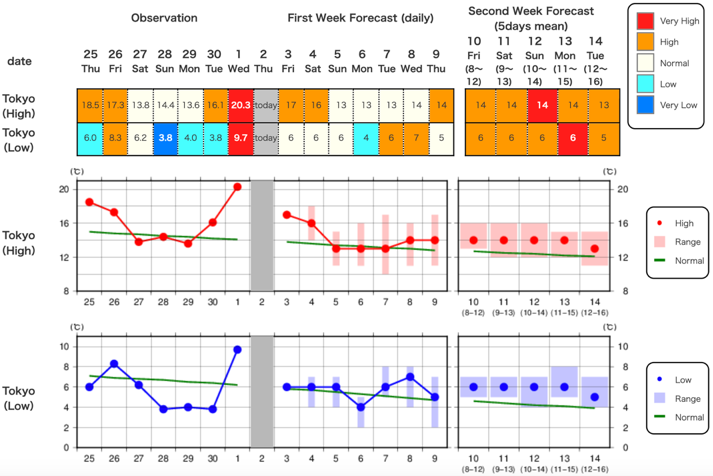
- North Japan: Very high temperatures from Dec. 7.
- East Japan/Kinki/Chugoku Region: Very high temperatures from Dec. 6.
- Shikoku/Kyushu/Okinawa/Amami Region: Higher-than-average temperatures from Dec. 7.
ONE-MONTH SEASONAL FORECAST (DEC. 4~ JAN. 3)
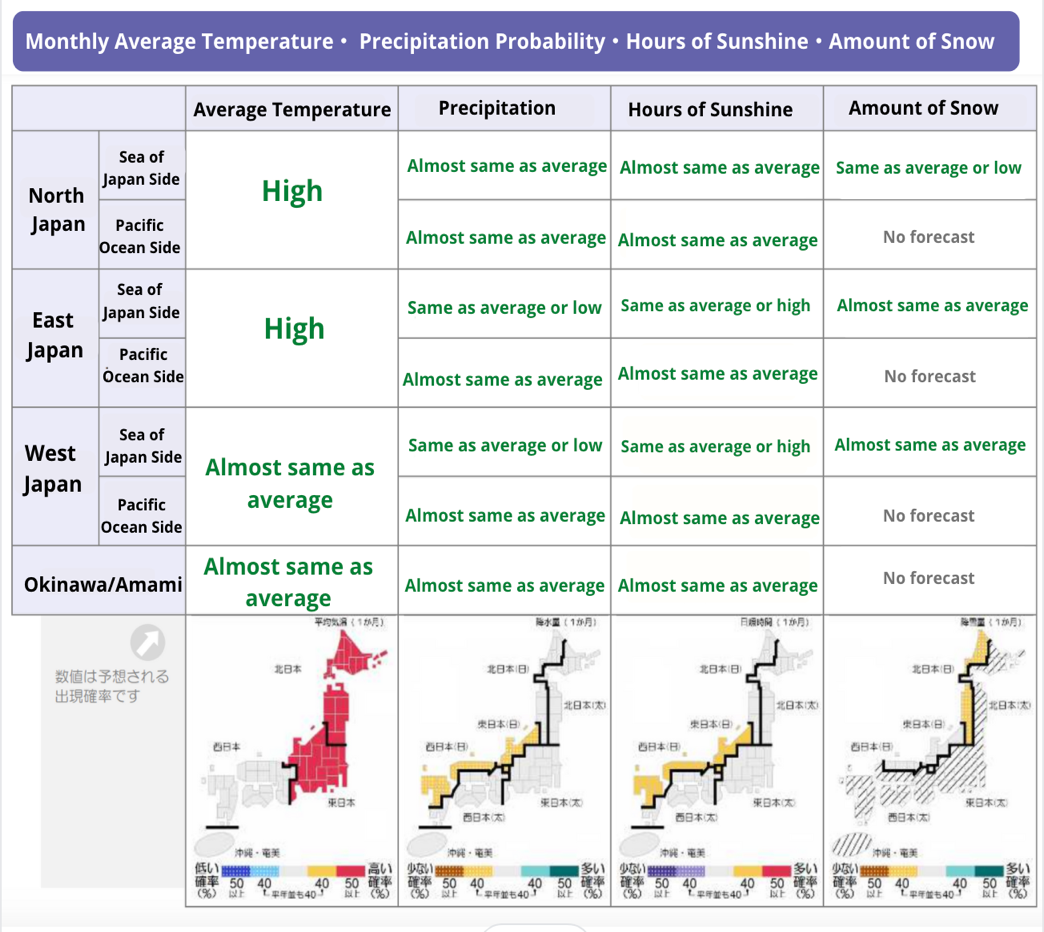
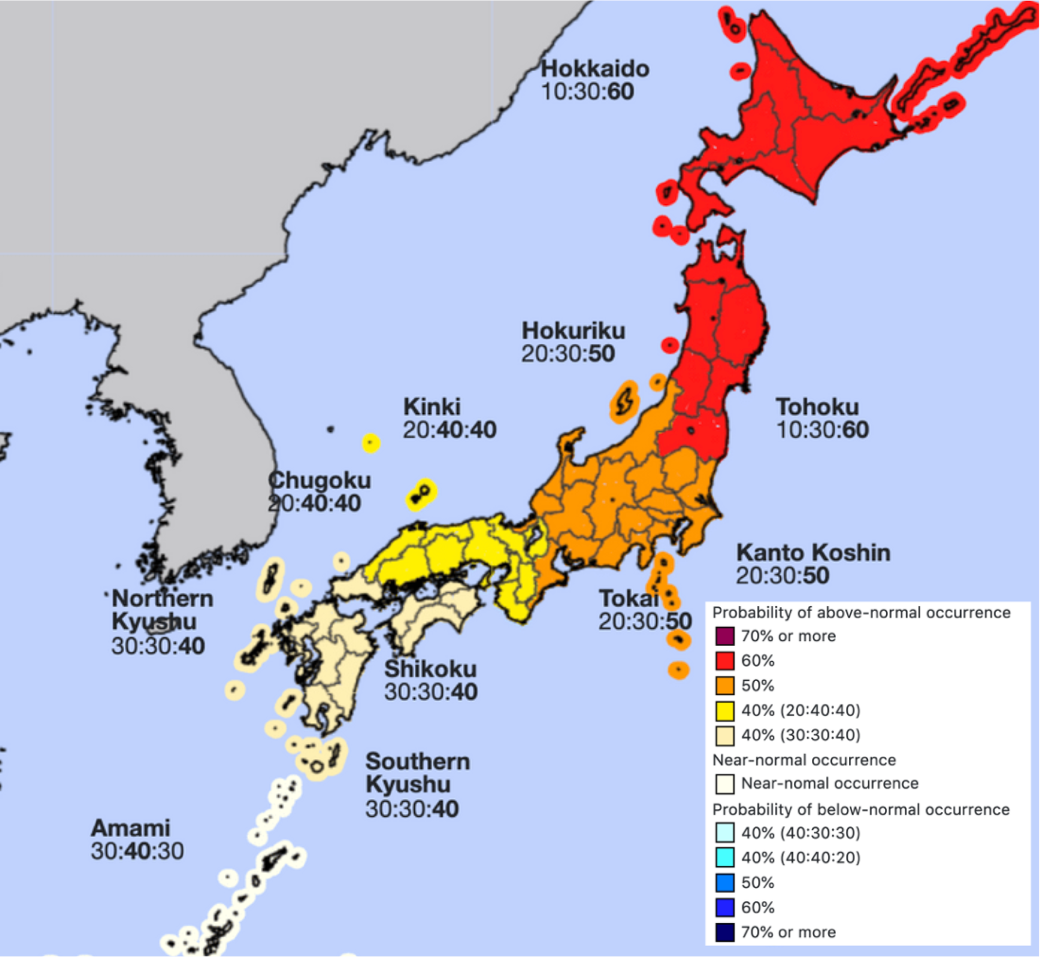
NEWS: POWER MARKETS
| No. of operable nuclear reactors | 33 | Electricity Price | Friday, Dec. 3 | % Change WoW | ||
| Of which | restarted | 10 | JEPX 24-Hour Spot | ¥17.52/ kWh | -11.4% | |
| in operation today | 8 | TOCOM Dec. baseload (Tokyo area) | ¥22.50/ kWh | -23.6% | ||
Source: Company websites, JANSI and JAIF, as of Dec 5, 2021
Kansai Electric joins JERA and Tohoku Electric in linking power price to LNG costs
(Japan NRG, Dec. 1)
- Japan’s second-largest regional power utility joined its peers, JERA and Tohoku Electric, in an effort to change the wholesale market electricity pricing structure.
- Kansai Electric will “review” the marginal cost approach to bidding prices on the JEPX spot market. In effect, it will stop pricing electricity in relation to long-term LNG and other fuel supply contracts, and will instead allow the price to reflect the costs associated with buying fuel on the spot market.
- Company: “This revision will avoid or reduce fuel constraints and supply-demand crunches by reflecting the actual procurement situation in our bidding prices on the JEPX spot market and by issuing appropriate price signals to the market.”
TAKEAWAY: For power companies, this change is not only fair but vital because while they’re asked by METI to secure more LNG and coal on the spot market to meet any national shortfalls; the utilities aren’t compensated for the extra costs this incurs.
From another perspective, however, the change moves Japan’s power market back towards the older, pre-liberalization system in which big power utilities can focus on energy security over economics and get compensated no matter how much they pay for LNG. And, like in the older system, METI is the main driver.
The difference now is that utilities have less incentive to sign long-term LNG contracts, exposing Japanese power prices to closer correlation with global gas price trends.
JERA says considering joining power futures market before April
(Jiji, Nov. 26)
- As of September, only one major Japanese power company was actively trading electricity futures: Tohoku Electric. Now, JERA says it will join the power derivatives market before the end of this fiscal year (in March 2022).
- “We’re looking at trading channels such as TOCOM, EEX and CME Group in the U.S.,” said JERA.
- In addition to the above, Hokkaido Electric and Hokuriku Electric have started to use third-party brokers to hedge themselves on the power derivatives market.
TAKEAWAY: With about 90% of the trading volumes in Japan’s power futures currently on the EEX, it’s most likely that JERA will join Tohoku Electric in trading on that exchange. However, since rival TOCOM is owned by the Japan Exchange Group, METI is keen for Japanese companies to also trade there.
Solar auction prices average ¥10.31/ kWh; J-Power to build its first large projects
(Kankyo Business, Nov. 30)
- In the latest (10th) round of bids for commercial solar power capacity with an output of 250 kW or more, based on the Feed-in Tariff (FIT), the weighted average winning price was ¥10.31/ kWh.
- Close to 250 MW of capacity was auctioned and an upper limit of ¥10.50/ kWh was in place. There were 81 winning bids, with the lowest price ¥10.23. The highest winning bid was ¥10.40.
- CONTEXT: In the previous round of capacity auctions held in August, the lowest bid was ¥10.28 and the highest winning bid was ¥10.73. The weighted average bid price was ¥10.60.
- There were 218 solar generation facility plans submitted in the latest auction.
- Among the notable winners was electricity wholesaler J-Power, which won bids for two solar power projects (Kitakyushu City, Fukuoka Prefecture, and Himeji City, Hyogo Prefecture) for a total of about 32 MW in capacity. These are the company’s first large-scale solar power projects in Japan. Both power plants are scheduled to start operation in 2024.
- SIDE DEVELOPMENT:
J-Power hastily transitioning to wind as coal prices surge
(Nikkei opinion, Nov. 30)- J-Power’s share price took a battering as investors worry about its aging and underutilized power stations and coal’s rising price.
- About 80% of the electricity sold by J-Power is generated from coal.
- While coal was always seen as a cheap option in the electric power industry, this is no longer the case.
- CEO Watanabe Toshifumi says rising coal prices have eaten into the utility’s margins. The spot price of Australian coal recently hit $170/ metric ton.
- To turn its ship around, J-Power must make renewables a top priority. The best option is to leverage the expertise gained in establishing its 500 MW of land-based wind capacity, and to bid for Japanese offshore wind tenders.
All major power and gas utilities to raise rates from January
(Mainichi Shimbun, Nov. 27)
- The 10 major electric power companies and the four major city gas companies will raise electricity and gas rates from Jan. 2022 due to rising prices for crude oil and LNG.
- Compared to earlier this year, all electricity and gas companies raised prices more than 10%, increasing burdens on households. In the Tokyo and Chubu areas, prices are up by 20%.
- This is the fifth consecutive month of power and gas price increases across the board.
- The largest rate increase for a standard household will be in Okinawa, followed by Chubu and Tokyo. Hokkaido Electric will raise rates the least.
JERA buys into 300 MW onshore wind capacity project in the U.S.
(Company statement, Dec. 2)
- JERA will join the El Sauz Wind Power Project in Texas, and concluded a stock purchase agreement with Apex Clean Energy Finance to acquire a 100% share in the project.
- The project will build, own, and operate a 300 MW onshore wind farm. Construction begins in early 2022 with operation to start in the last quarter of the year.
- CONTEXT: In 2020, JERA established JERA Renewables NA to develop renewable energy projects in the U.S. The El Sauz project will be its first in operation.
- JERA will expand its renewables business, aiming to reach 5 GW capacity by 2025.
PV panel shipments up 11% in Q3
(Nikkei, Nov. 29)
- The Japan Photovoltaic Energy Association said Japanese manufacturers shipped 1.4 GW of PV panels to domestic buyers in Q3.
- This is an 11% increase YoY
- While shipments of panels destined for large solar farms only increased 2% YoY, shipments for factories and public buildings increased 35% YoY.
Taisei Corp to develop floating offshore wind technology together with city in Hokkaido
(New Energy Business News, Nov. 29)
- Taisei Corporation and the city of Muroran, Hokkaido, will work together to develop floating offshore wind power technology and other offshore wind power-related industries in Muroran Port with the aim of achieving carbon neutrality by 2050.
- The partnership will develop floating offshore wind power technology at the Port of Muroran, the development of offshore wind power-related industries in Muroran City, as well as net-zero goals through the use of renewable energy and hydrogen.
- The Port of Muroran near the coast of Hokkaido and the Tohoku region is one of the warmest ports in Hokkaido with little snowfall, which minimizes impact on operations.
Bankruptcy Threat Hangs Over Japan’s Pressured Power Market
(Bloomberg, Nov. 30)
- Japan’s spot electricity price at seasonal high on pricey fuel
- Retailers could be hit again this winter, Looop executive says
TEPCO RP commences floating turbine trial
(Nikkei, Dec. 2)
- TEPCO Renewable Power says its experimental tetra-spar floating wind turbine, located off the coast of Norway, began operating.
- In the next 3 to 5 years, TEPCO RP will analyze the performance of the 3.6 MW turbine, built in cooperation with Royal Dutch Shell and others, with a view to establishing floating offshore wind farms in Japan.
NUCLEAR REACTOR NEWS:
Reactor restarted at Ikata nuclear power plant
(NHK World, Dec. 2)
-
- Shikoku Electric booted up its Ikata Unit 3 reactor after nearly two years of closure due to a series of troubles.
- The operator plans to restart commercial operations on Jan. 4.
- SIDE DEVELOPMENT:
Anti-terrorism plan for Tokai Daini nuclear plant approved
(NHK World, Dec. 1)- The NRA approved the anti-terrorism plan for the Tokai Daini nuclear power plant. Work on more safety measures is expected to continue until Dec 2022.
- The plant will be shut if anti-terrorism measures are not completed by October 2023. The operator has yet to draw up an evacuation plan.
- Dates on when the plant can go back online remain unclear.
- SIDE DEVELOPMENT:
Kyushu Nuclear committee to discuss extension of Sendai nuclear reactor ahead of the 40-year operation deadline
(Yahoo News, Nov. 30)- The governor of Kagoshima Prefecture will add four new members, who are all anti-nuclear, to its Kagoshima Nuclear Committee that discusses the safety of the Sendai nuclear power plant (Kyushu Electric).
- The committee will discuss the operation extension for the Sendai plant ahead of its 40-year operation deadline.
- SIDE DEVELOPMENT:
Ishikawa’s Nuclear Safety & Security Commissions conduct on-site inspection at Shika NPP
(Nippon News Network, Dec. 2)- The Nuclear Safety and Security Commissions (NSSC) in Ishikawa Prefecture made an on-site inspection at Shika nuclear power plant (Hokuriku Electric).
- In November, NRA also conducted an inspection of the site’s active fault.
- This will decide whether there’s an active fault at the site.
- SIDE DEVELOPMENT:
Hamaoka needs to prepare for 23-meter tsunami
(NHK, Nov. 29)- Chubu Electric Power Company revised its top projection for tsunamis, in case a magnitude 8 or 9 quake hits its Hamaoka nuclear power station.
- The utility previously estimated the maximum height of a tsunami resulting from such a quake at 20.3 meters.
- The revised projection is a tsunami at 22.5 meters high, slightly more than the seawall surrounding the station.
- SIDE DEVELOPENT:
Nuclear watchdog says TEPCO may miss discharge deadline
(Kumamoto Nichinichi Shimbun, Dec. 2)- Nuclear Regulation Authority chair Fuketa Toyoshi said the government and TEPCO were running out of time to begin discharging, in early 2023, the treated water from the site of the Fukushima nuclear disaster.
- TEPCO has yet to submit a proposal to the NRA for the release.
- Fuketa urged TEPCO to submit by year’s end to give the NRA time to field feedback from interested parties and review the proposal.
SymEnergy, Chugoku to collaborate on biomass plants
(Nikkei, Dec. 2)
- Kobe-based SymEnergy will partner with the Chugoku Electric to establish a network of biomass fired generation plants. SymEnergy envisages a number of small plants, each with output of between 500 kW and several MW.
- The plants will be fueled by timber scrap from local logging operators.
Hitachi to provide system for Japan’s power capacity market
(Nikkei; Nov. 30)
- Hitachi will provide the system to the Organization for Cross-regional Coordination of Transmission Operators (OCCTO), which monitors Japan’s power supply and demand.
- The company will begin collecting fees in FY2024.
- The capacity market ensures that sufficient capacity is available to power companies. It was introduced to prevent the risk of delayed investment in future power.
The “Evil” Coal-Fired Power Plants
(Bunshun magazine, Dec. 2 edition)
- CONTEXT: This is a column by one of the most well-known TV journalists and personalities in one of Japan’s best read tabloid magazines. The author is Ikegami Akira, who regularly hosts education-based TV programs.
- At the end of COP26, the UK government’s Alok Sharma apologized that the event did not deliver an agreement to end coal.
- But England has only 4 coal-fired power units. Japan has 150 and it relies on coal-fired power for 32% of its electricity. This leaves Japan with no option but to continue using thermal plants.
- Japan will continue to be criticized abroad, but it can’t easily turn off coal-fired power because of its low cost and raw materials security. Currently, coal prices are up, but in the long run coal is cheaper than oil and natural gas. Supply of the latter two is also heavily reliant on the Middle East. Coal can be imported from multiple countries.
- There are lots of conversations about phasing out coal plants, but the agreement at COP26 was to phase out the coal plants that have no emission reduction measures in place. Japanese coal-fired plants have high energy efficiency and relatively low CO2.
- In reality, Japan will not need to entirely stop the usage of its thermal plants. Whether other countries accept this or not is another issue.
NEWS: OIL, GAS & MINING
Japan Oil Price: $76.81/ barrel
¥ $
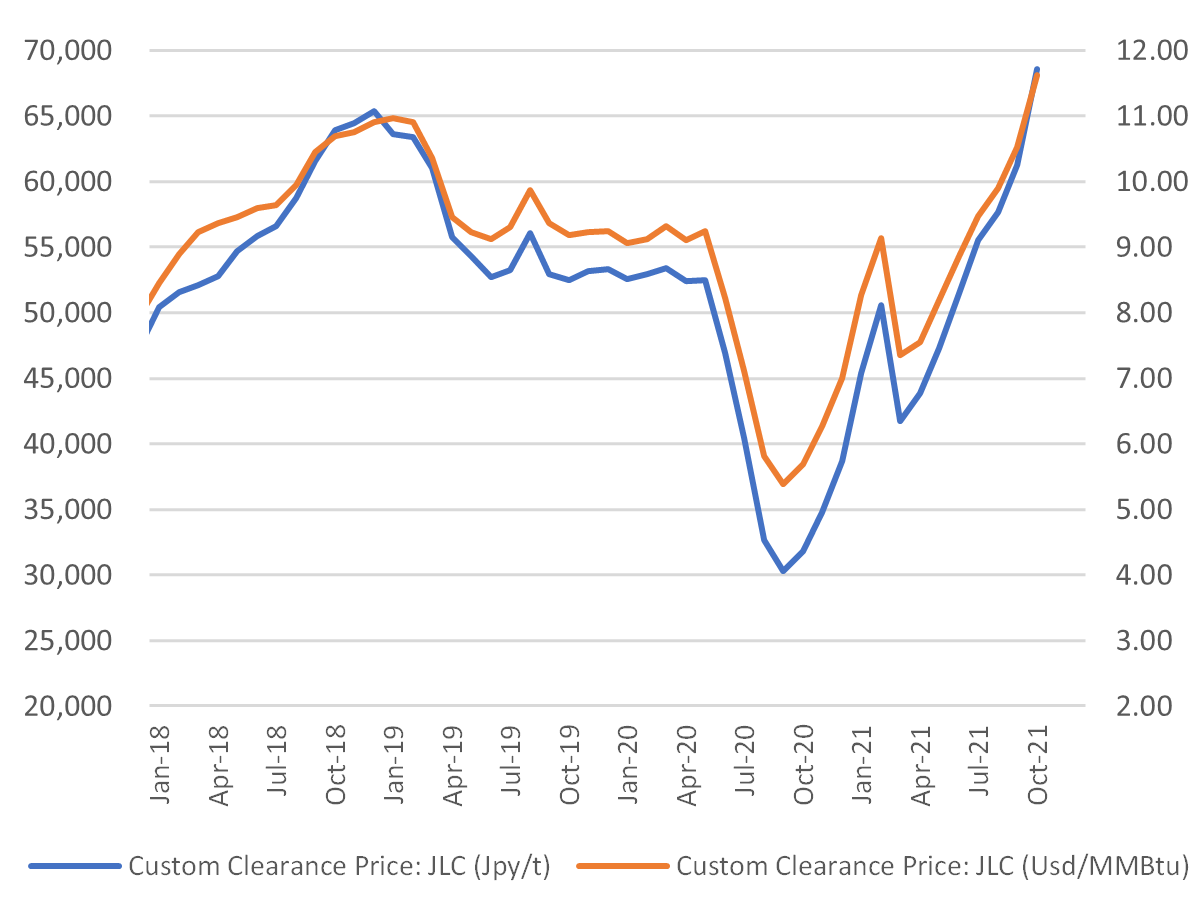
Japan (JLC) LNG Price: $11.61/ mmbtu
¥ $
METI to tighten watch over LNG stocks as consumption rises
(Japan NRG, Nov. 29)
- METI will tighten watch over LNG stocks by raising the frequency of gas stock reporting required by the regional grids, and to extend the stock reporting requirement to smaller power operators using LNG, on the back of gas consumption rise. The operators will report gas stocks once a week rather than twice a month. The smaller power operators are typically gas utilities and oil refineries.
- In November, regional grids in Chugoku, Kyushu, Hokuriku and Shikoku reported a rise in their LNG consumption due to unplanned outages of coal-fired power plants. Two large coal power plants of 1-1.5 GW, owned by J-Power, were closed over September to November, which also resulted in the higher LNG consumption.
- METI also said as of Nov. 15, nationwide LNG stocks stood at 2.2 million tons, higher than both the same time last year and the last five-year average. The ministry is closely monitoring LNG stocks to safeguard against potential winter demand hikes.
- LNG stockpiles may have edged slightly higher to 2.3 million tons by Nov. 28, according to Bloomberg.
- CONTEXT: As Japan increases solar power generation capacity, vulnerability during winter increases. Currently, solar’s share of power generation is 7-8%, and METI plans to double it to 15% by 2030 to reduce GHG emissions. In the Tokyo area, where supply is most critical, solar’s share reaches 25% during sunny day time in winter, but this source is lost when bad weather hits.
- Japan has committed to reduce LNG’s and coal’s share in its energy supplies, but will keep them in the mid-term: LNG to 20% in 2030, from the current 37%; and coal to 19%, from the current 32%.
Japan’s Oct LNG imports slump, but will pick up later in the year
(Japan NRG, Nov. 29)
- Japan’s October LNG imports fell to 4.6 million tons from 5.4 million tons in the previous month, but METI said the volumes will increase in coming months.
- October imports were 4.6 million tons. Imports from major producers Australia, Russia and Indonesia fell from September.
- Kyushu Electric sourced one additional cargo for early December delivery, while Chugoku Electric asked its supplier to advance some term shipments. Due to technical problems, over Sept-Nov, Kyushu shut its 700 MW coal-fired power plant and Chugoku Shute two coal plants with combined capacity of 331 MW. As a result, their LNG consumption rose over planned volumes. All three coal plants had restarted by Nov. 29.
Hokkaido Gas buys 500,000 tons of CO2 offsets from INPEX
(Denki Shimbun, Dec. 2)
- Hokkaido Gas acquired 500,000 tons of CO2 credits from INPEX, enough to offset the annual CO2 emissions of approximately 500,000 of its city gas customers. The amount paid by the gas company was not disclosed.
- The CO2 credits will be used to almost completely offset the CO2 emissions from city gas supplied to households.
- The carbon credits are certified by a third-party organization and relate to environmental conservation projects around the world.
Mitsubishi Chemical Holdings to withdraw from petrochemical interests
(NTV News, Dec. 1)
- Mitsubishi Chemical Holdings will divest from its petrochemical and carbon operations by March 2024, and seeks buyers.
- The company plans a round of major restructuring that will focus on EVs, healthcare and other growth markets.
- The number of companies in the Mitsubishi Chemical Holdings group worldwide will be reduced to about 300 from the current 600 or so.
Saibu: Novatek to funnel LNG through Kyushu terminal
(Nikkei, Dec. 1)
- Saibu Gas reached an agreement with Russian gas producer Novatek to transport Arctic LNG to the Hibiki gas terminal in Kyushu using icebreakers before transferring the fuel to smaller ships destined for Chinese ports.
- 140,000 metric tons of LNG will be shipped annually starting 2024.
ANALYSIS
BY SAKI ISETANI
Japan Makes Belated Bet on Next-Generation Nuclear Tech
To Revive Trust in Industry Amid Net-Zero Urgency
After a decade of uncertainty, Japan is taking small steps back into nuclear energy development. The first fruits were evident this past week, when GE Hitachi Nuclear Energy became the first Japanese company to get an order to build a small nuclear reactor for a foreign power utility.
While most politicians say Japan will gradually decrease reliance on nuclear power and shift to other CO2-free energy sources, a consensus is forming around the need to restart R&D programs for next-generation reactors.
In FY2022, government funding for such programs is due to jump to its highest level in years. The hope is that next-generation nuclear tech will bolster energy security and create decarbonization pathways other than renewables. The trend would also synchronize Japan’s efforts in nuclear with the strategy of major allies such as the U.S.
Even until recent months, discussing a nuclear revival and the building of new reactors was seen as too sensitive a topic for politicians. But the mood has shifted, in a process that began before the recent election of Prime Minister Kishida.
Still, for nuclear energy to regain wider appeal in Japan, overcoming strong public opposition, the industry knows that it must show how lessons were learned from the 2011 Fukushima disaster and that the technologies proposed today are safer, more effective, and less cumbersome to build / manage than earlier plants.
Nuclear’s supporters in government and business believe the answer lies in technology known as the Small Modular Reactor (SMR).
What is an SMR?
The International Atomic Energy Agency (IAEA) defines an SMR as a reactor with a capacity of up to 300 MW or less, which is one-third of a conventional nuclear reactors. SMRs have three features – small size, modular, and multi-purpose.
- Size – the small size allows the reactor to remove heat by natural circulation of the coolant, unlike large reactors that must be cooled by pumps during an accident.
- Modular – an SMR requires manufacturing an entire reactor as a prefabricated unit, which are then assembled on-site, thus enabling better quality control and shorter construction time, and reduced construction costs.
- Multi-purpose – Other than generating electricity, the SMR can help with hydrogen production, thermal energy, remote energy sources, and the healthcare industry.
Tailwind in policy
In its 6th Basic Energy Plan announced in October, the nuclear power target is around 20-22% of Japan’s total energy mix by FY2030. Currently, it’s around 6%. So, just how is Japan going to make up that difference between today’s paltry output and ambitious future targets?
Toward that goal, Japan will develop SMR technology by supporting R&D at home and strategic projects with overseas partners. As a first step, in 2019, METI, together with MEXT (Ministry of Education, Culture, Sports, Science and Technology) and JAEA (Japan Atomic Energy Agency) launched the NEXIP (Nuclear Energy X Innovation Promotion) initiative to support Japanese and American corporate development of innovative nuclear technologies.
On the corporate side, Hitachi and GE have teamed up via their GE Hitachi Nuclear Energy venture to develop SMRs for the North American market. GE Hitachi will also enter the Canadian market by teaming up with Canada’s OPG. Further, in April 2021, Japan’s engineering major, JGC, announced its entrance into the SMR market by investing $40 million in U.S. startup NuScale Power. This was followed by IHI Corp. announcing a $20 million investment in NuScale.
Recently, Japan’s biggest heavy machinery maker, Mitsubishi Heavy, also announced a prototype for a small PWR-type SMR unit.
Global Context
Globally, more than 70 SMR units are being developed. This past week, GE Hitachi Nuclear Energy (GEH) received an order for a 300-MW SMR from Ontario Power Generation, a leading Canadian electric utility. This is GEH’s very first order, making it the first Japanese company to build an SMR for commercial use. Four units will be built, with the first to be completed in 2026.
Nevertheless, the U.S. has the lead with 17 SMR units under construction. Russia is another top contender, with the world’s first floating SMR operating since May 2020. Other nations are also catching up. In the UK, Rolls Royce is developing a SMR reactor, to begin commercial operation in 2029. France also recently announced an investment of €1 billion for SMR development.
President Biden’s $1.2 trillion infrastructure plan earmarks $21.5 billion for clean energy research to develop next-generation technologies in order to help reach net-zero emissions by 2050. While $8 billion will go for green hydrogen, as well as more than $10 billion for carbon capture and industrial emission reduction, approximately $2.5 billion will be invested in the Advanced Reactor Demonstration Program (ADRP) that is developing SMRs.
Overcoming deep-rooted opposition
Japan’s Green Growth Strategy, published in December 2020, was one of the first documents in the net-zero era in the country to mention a role for next-generation nuclear reactors. The document highlighted SMRs as among the most promising technologies.
While SMRs have been in development in the U.S. for about 10 years, Japan is a relative newcomer to this area, having put most R&D programs for new nuclear reactors on hold in the wake of the 2011 Fukushima nuclear accident.
Post Fukushima, Japan shut many reactors and increased its share of fossil fuels in the energy mix. This has proven to be both costly and untenable since Japan recently declared its aim for net-zero carbon emissions by 2050. It’s increasingly clear that such pledges are impossible to fulfill without nuclear power. Even the newly elected leader of the left-leaning opposition, the CDP, said last week that he supports some nuclear restarts to meet climate goals.
To show the public that this time it’s different, the nuclear industry understands that it must show how important lessons have been learned from past mistakes.
In the case of the Fukushima disaster, many of the problems stemmed from the failure of backup systems. Cut off from the grid after a major earthquake and tsunami, the Fukushima Dai-Ichi plant turned to its emergency diesel generators but they were already submerged
In the wake of the accident, more focus has been placed on developing nuclear tech that doesn’t require additional cooling or auxiliary power supply during an emergency. And this is where those that back SMRs say the technology is a game-changer. Most of their safety systems are passive.
How bright is Japan’s SMRs future?
While Japan aims to increase its share of nuclear power as outlined in the Green Growth Strategy, current policies mainly help projects in which Japanese companies are participating to produce SMRs for foreign markets.
For over 10 years, discussions about new nuclear construction, or the building of new reactors on existing nuclear sites, have not progressed at all in Japan. As recently as April, then METI Minister Kajiyama reiterated that Japan doesn’t yet plan on building new nuclear reactors, including SMRs.
Since the arrival of Prime Minister Kishida, however, the new government seems more inclined to discuss the issue. During the LDP election campaign in September, Kishida said, “Going forward, it will be important to secure technologies such as SMRs and small fusion reactors.”
While Kishida avoided making a direct statement about the construction of new nuclear reactors, in October, he emphasized that restarting nuclear reactors is a “No. 1 priority”. He also said that once reactors reach their operation license limit, it may be possible to replace them or build new reactors.
For now, any Japanese SMR development will likely remain centered around cooperation with major U.S. firms and government agencies. Still, this will have the effect of drawing more Japanese energy companies into the SMR eco-system.
As the domestic SMR eco-system begins to develop and strengthen, a future Japanese government will have all the infrastructure in place to seamlessly alter its nuclear policy should public opinion be more favorably inclined.
TOP JAPAN-U.S. SMR PROJECTS
NuScale Power
At its laboratory in the State of Idaho, NuScale Power is developing a pressurized water reactor (PWR)-based SMR, which comprises multiple reactor modules installed in an underground pool. In case of an accident, the underground pool allows the reactor to be naturally cooled without the need for operators, resulting in improved safety.
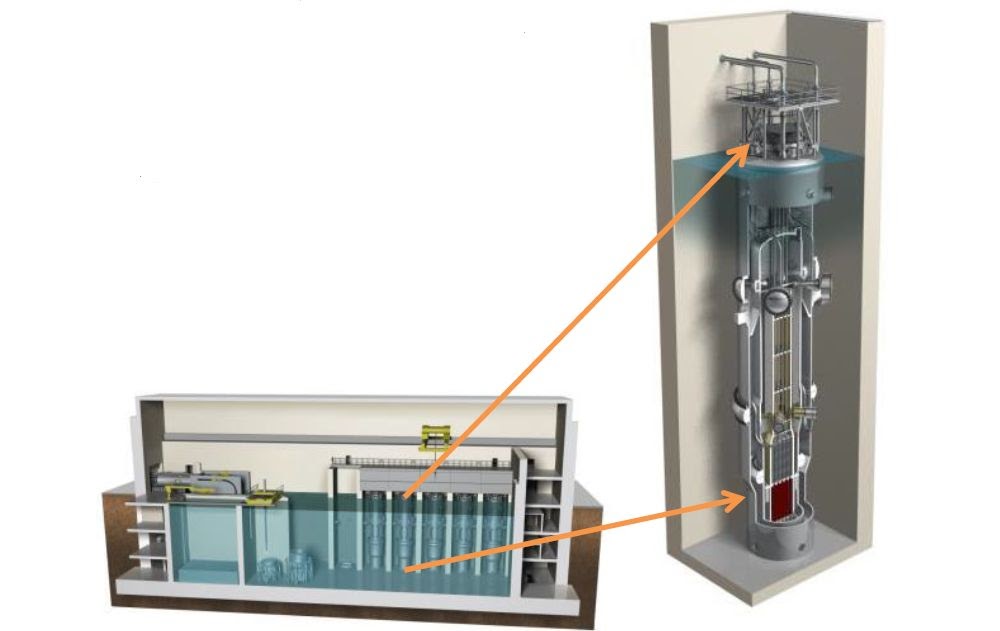
Source: NuScale Power
Each module is connected to an independent turbine generator and condenser that’s capable of generating about 77 MW of electricity, which is about 1/20 of the conventional PWR-based reactors. NuScale plans to combine the 12 individual power modules to generate a total capacity of 924 MW.
In August 2020, this became the first SMR to receive design certification from the U.S Nuclear Regulatory Commission, and commercial operation is expected in 2029. Construction will take about three years, much shorter than conventional reactors, which usually take about seven years.
z As the domestic SMR eco-system begins to develop and strengthen, a future Japanese government will have all the infrastructure in place to seamlessly alter its nuclear policy should public opinion be more favorably inclined.
GE- Hitachi Nuclear Energy
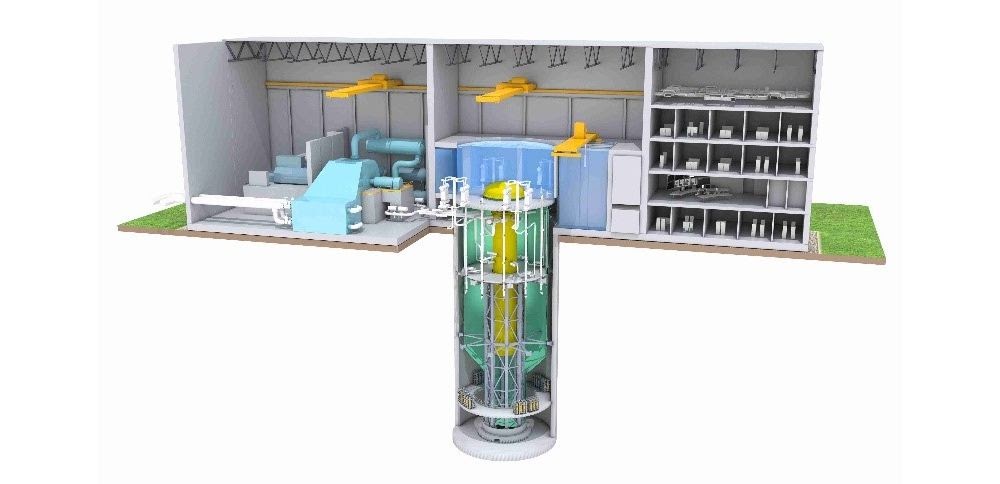
Source: GE Hitachi Nuclear Energy
A different type of SMR is being developed by GE Hitachi Nuclear Energy’s labs in both Japan and the U.S. The documents for a safety review of the 300-MW Boiling Water Reactor (BWR)-based SMR, known simply as the BWRX-300, have already been submitted to American authorities. Pending a positive decision, the first BWRX-300 will soon be built in the U.S.
One of BWRX-300’s main features is its low electricity cost, less than ¥10/ kWh, almost comparable to conventional coal-fueled power plants.
In December, GE Hitachi Nuclear said it will build its BWRX-300 in Canada by collaborating with Canada’s Ontario Power Generation (OPG). OPG will deploy the SMR at its site in Darlington, the the only site in Canada currently licensed for new nuclear. Site preparation will begin in the spring of 2022. It is currently undergoing a Canadian Nuclear Safety Commission pre-licensing Vendor Design Review (VDR). GE Hitachi says Japan’s first commercial SMR could be completed as soon as 2028.
Mitsubishi Heavy Industries
This company’s 300-MW PWR-type SMR will have a steam generator and a primary coolant loop (large diameter piping) embedded inside the reactor to help circulate the water, enabling the reactor to cool without any pump. By using a simple design, construction costs are estimated at ¥200 billion per module, less than half the cost of large-scale nuclear reactors built in Japan before the 2011 earthquake.
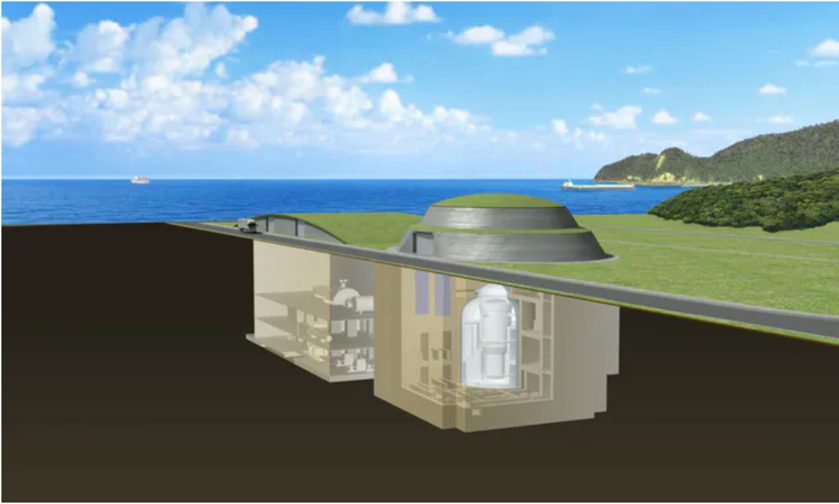
Source: Mitsubishi Heavy Industries
Mitsubishi Heavy aims to develop this innovative SMR design so that it not only acts as a power supply for micro-grids but can also be mounted on a ship, which makes it a good solution for remote communities and act as a temporary power supply in disaster areas.
In June, the company began internal discussions around the initial design. While few details have been released, on land the reactor is most likely to be developed as an underground structure. Takaichi Sanae, the LDP Policy Research Council chairperson under the new Kishida administration, has said that SMRs should be located underground for security reasons.
Mitsubishi Heavy aims to commercialize its design by 2040.
Summary of SMR technology in Japan and the U.S.:
| Mitsubishi Heavy Industries | Hitachi / GE | NuScale | Conventional Nuclear reactors | |
| Characteristics | PWR | BWR | JGC Holdings and IHI to invest | PWR or BWR |
| Output | 300 MW | 300 MW | 77 MW per module
(12 module in total) | 1,000-3,000 MW |
| Construction cost | ¥200 billion | ¥70 ~ 80 billion | ¥290 billion | ¥500 billion ~ 1 trillion |
| Electricity cost
(per kWh) | around ¥10 | Less than ¥10 | ¥5~7 | More than ¥10 |
Source: Nikkei
ANALYSIS
BY CHISAKI WATANABE AND
ANDREW DEWIT
PROFESSOR OF ENERGY POLICY
SCHOOL OF ECONOMIC POLICY STUDIES
RIKKYO UNIVERSITY, TOKYO
Kishida Government Vows to Bolster National Resilience:
Infrastructure Program to Send Trillions to Energy-Related Projects
On Nov. 19, Prime Minister Kishida announced a record ¥55 trillion ($488 billion) fiscal stimulus. A lot of this huge package will go towards energy and related infrastructure. One of the core targets is called “National Resilience,” an integrated program that has been in place since 2014.
Most observers initially dismissed National Resilience as merely a misleading rubric for the ruling Liberal Democratic Party to throw money at its core rural supporters. However, it’s become clear that the program isn’t another iteration of Japanese pork barrel politics. The fact is that Japan’s infrastructure — from its 716,466 bridges to its 10,645 tunnels and over 179,000 kilometers of transmission lines — is aging and in need of repair and upgrades.
Climate change and the increase in extreme weather events is making the situation even more urgent. In consequence, Japan’s National Resilience program has been adopted by all the prefectures and – as of November – by 1,457 of the country’s 1,741 cities, towns, and villages.
Japan’s resilience-building solutions are not predicated on the “hard” investments in concrete and steel that embodied the 20th century construction state. In power, water, and other utilities, the government is investing heavily in “soft” approaches, including digital technology for better monitoring and forecasting, real-time and user-friendly risk communication, integrated governance, and the dissemination of business continuity planning.
Indeed, Japan’s soft approaches are paying off in helping realize the decentralized and distributed soft energy and soft water paths advocated by Amory Lovins and other experts.
Kishida’s “bold overhaul”
Days after taking office in October, Kishida’s maiden policy speech pledged to improve the nation’s infrastructure and work on preventing natural disasters and strengthen national resilience. Accordingly, his recently released economic package designates “National Resilience” as one of the four main pillars.
This boils down to a ¥15 trillion infrastructure program, called “the five-year acceleration measures for disaster prevention/mitigation and national resilience.” It was launched earlier this year under the previous government led by Suga, and is continued by Kishida.
A sense of urgency around disaster risk reduction infrastructure readiness has always been an issue in postwar Japan, but it became even more of a focal point following the 2011 Fukushima earthquake. In December of 2013, the government passed a law on national resilience to acknowledge the impact that frequent typhoons, earthquakes and other natural disasters were having on key services and utilities.
The government’s annual spending for resilience-related projects has been on an upward trend. The money is earmarked for measures to make buildings more quake-resistant, ensure energy and water supply in times of disaster, and improve road networks, among other areas.
As we see in the figure on budgets from 2014 to 2021, the base expenditure of just under ¥4 trillion has increased slightly over the years, exceeding ¥4 trillion in 2020. Since 2018, the initial budgets were supplemented by trillion-yen increments from the 2018-2020 emergency plan.
The emergency component is now even more ramped-up by the 2021-2025 five-year emergency plan’s ¥15 trillion total. The total spent on National Resilience exceeded ¥5 trillion in 2018 and rose to ¥7.45 trillion in 2020. Initial numbers for 2021 indicate a base of ¥4.4 trillion, topped up by at least ¥1.85 trillion for the five-year component in addition to supplemental spending. The data for the 2022 fiscal year are as yet unclear, since budget negotiations are ongoing. A safe guess is that the total will be over ¥7 trillion.
Japan’s National Resilience-Related Budget (in trillions of yen)
Source: The Japanese government
As to the new ¥15 trillion, five-year plan, its funds include state and local budgets as well as private investments from 2021 through 2025. This use of emergency spending and supplementary budgets reflects both the ongoing intensification of climate and other challenges, plus the effort to shift Japan’s fiscal process towards more of a multi-year framework.
Spending breakdown
Importantly, the five-year acceleration plan has three focus areas with a total of 123 measures. These reflect recognition of the need to prioritize spending, since the enormity of Japan’s infrastructure issues cannot be addressed all at once. Progress is monitored via key performance indicators that assess the current state of infrastructure resilience and other parameters, and then set annual goals for addressing vulnerabilities.
| FOCUS AREAS | Number of measures | Budget
in trillion yen | |
| 1 | Counter-measures for typhoons and floods, and large-scale earthquakes | 78 | 12.3 |
| (1) Measures to prevent and minimize damages to people’s lives and assets | (50) | ||
| (2) Measures to maintain transportation networks and lifelines, to support national economy and people’s lives | (28) | ||
| 2 | Improving aging infrastructure and shifting to preventive maintenance | 21 | 2.7 |
| 3 | Acceleration of digitalization | 24 | 0.2 |
| (1) Digitalization of national resilience measures | (12) | ||
| (2) Improvement on forecasting, collection and dissemination of disaster-related information | (12) | ||
| Total | 123 | 15 |
- Counter-measures for typhoons and floods, and large earthquakes:
The government is giving priority to flood control with plans to build levees, expand the width of rivers, and speed up various other efforts by five years. The works are due to be completed by 2045. Direct energy-related spending will include burying power lines. This measure was deemed urgent after October 2019 Typhoon Faxai hit Chiba Prefecture and knocked down about 2000 utility poles and transmission towers, causing a regional blackout and multiple road closures.
In a sharp contrast to peer countries in Asia and Europe, nearly all Japan’s transmission infrastructure is above-ground. The figures for Metropolitan Tokyo and Osaka City are merely 8% and 6% respectively.
National Resilience planners have already buried 2,400 kilometers of the most at-risk transmission lines, and aim at 4,000 more kilometers by 2025. Money will also flow to measures that strengthen power grids and install more solar panels and storage systems at the 78,000 schools and other public facilities designated as evacuation centers in times of disaster.
- Improving aging infrastructure and shifting to preventive maintenance:
To improve river control, old facilities such as water sluice gates and pipes will be replaced and refurbishments made to 300 dams built 30 or more years ago. Shifting to preventive maintenance can cut the cost of repair and replacement by 30 percent by starting repair work before malfunctions and troubles occur.
- Acceleration of digitalization
Though small in budget allocation, digitalization of infrastructure is also a big focus of the five-year acceleration plan. The government plans to foster the standardization of critical data collection and dissemination, and devise common platforms. The aim is to facilitate sharing infrastructure-related data between the central and local governments, as well as companies, to better evaluate the vulnerabilities of infrastructures and hence bolster disaster readiness.
One example of data aggregation is upgrading water-network sluice gates and drainage pump sites nationwide so that they can be controlled remotely. The application of digital technologies, such as 3-D data for maintenance and construction, is another area where soft investments are automating situational awareness, reducing energy demand, and helping Japan cope with a dire shortage of people.
Improving disaster prevention tech is another focus of digitalization. National Resilience investments have helped finance the multi-parameter phased array weather radar that can measure precipitation potential and other items, providing advanced warning of torrential rains and other extreme weather. Since atmospheric rivers are increasingly bringing torrential rains to Japan, the government plans to build on these assets for yet more precise forecasting with longer durations. The five-year program also plans to improve the Data Integration and Analysis System (DIAS), thus providing more and better data for devising solutions to climate change and disasters.
The government aims to improve systems using satellites and drones to collect and analyze data from disaster-hit ports for quick recovery.
Solar developments in elevated areas
The Ministry of Land, Transport and Tourism and Infrastructure, which is in charge of much of Japan’s resilience-related projects, is setting aside ¥1.7 billion from the supplementary budget for inspections and emergency construction work in elevated land areas. This comes after a large-scale mudslide last July near the city of Atami, Shizuoka Prefecture that caused 26 deaths and ¥3.2 billion in damages.
With a number of solar developments in remote, elevated areas facing a difficult path to completion since the Atami mudslide, such public works could help the government and industry reassure residents about safety.
Japan’s spending on resilient infrastructure is quite large compared with other developed economies, and is important to follow. Cynical dismissals of it as mere pork-barrel spending have been quietened by repeated bouts of extreme weather and seismic surprises. Japan has been doing resilience for several years, learning a lot in the process.
This pathbreaking work should help Japanese companies build on least-cost and integrated technologies that could be offered abroad. In fact, on Nov. 24 Japan’s NTT, Mitsubishi Electric, and 11 other heavyweight firms announced their intent to form a National Resilience consortium called “CORE” to work with national and subnational governments and other stakeholders.
Their CORE project will deepen the linkage between hard and soft technologies, potentially accelerating Japan’s productive use of real-time data on all hazard parameters to manage energy systems as well as reduce demand.
In the context of the acceleration of extreme weather events and the imperative of resilient decarbonization, Japan’s National Resilience is opening new business opportunities for technologies that meld adaptation and mitigation in a collaborative, community-based framework.
GLOBAL VIEW
BY JOHN VAROLI
Below are some of last week’s most important international energy developments monitored by the Japan NRG team because of their potential to impact energy supply and demand, as well as prices. We see the following as relevant to Japanese and international energy investors.
Australia/ Offshore wind
Parliament passed the Offshore Electricity Infrastructure Bill, which will allow energy companies to develop the wind potential off Australia’s 16,000-mile coastline. Planned projects include the Star of the South, Sun Cable and the Marinus Link transmission line. In 2025, Star of the South will start building 2.2 GW of offshore wind.
Bill Gates/ Nuclear fusion
Bill Gates and hedge fund Tiger Global Management, along with 30 other investors, will sink $1.8 billion into Commonwealth Fusion Systems to develop nuclear fusion. This is the largest private investment ever in nuclear fusion, which CFS wants to commercialize and bring to the grid by the early 2030s.
China/ Offshore wind
State Power Investment Corp (SPIC) connected two new offshore wind farms near Guangdong province to the state grid: the 315 MW Jieyang Shenquan project and the 600 MW Zhanjiang Xuwen project. This raises SPIC’s share of China’s total installed clean energy generation capacity to 60%, up from 43% five years ago. SPIC claims to be the world’s top renewables power operator, with more than 100 GW of installed capacity.
Finland/ Offshore wind
Wind farm developer OX2 and the Bank of Åland will develop the Noatun offshore wind farm project near Finland’s Åland Islands off the coast of Stockholm. The project will consist of about 250 wind turbines that will provide 20 TWh of electricity annually, meeting the needs of four million households in Sweden and Finland.
France/ Solar
TotalEnergies plans France’s largest solar project, the 55 MW Gien site in Lorient. The project comprises 126,000 PV panels spread over 75 hectares and it will produce around 64 GWh per year, enough to meet the annual electricity needs of 38,000 people. TotalEnergies will operate and maintain the plant.
Ireland/ Gas
Equinor will end operations in Ireland and sell its stake in the Corrib gas field to its partner, the Canadian oil and gas company, Vermilion Energy. Corrib is about 80 km off the Irish coast in 350 meters of water. Equinor’s 36.5% stake will sell for about $434 million. Vermilion will now have a 56.5% stake in Corrib.
Libya/ Oil and Gas
In the same week when Royal Dutch Shell announced its exit from the Cambo oil project in the North Sea, the company also said it might return to Libya to develop new oil and gas fields. The plan also includes developing a solar energy project south of the Sirte Basin. Shell plans to cut oil output by up to 2% a year by 2030 and invest more in renewables.
Opec+/ Oil
The Opec+ countries will increase delivery of another 400,000 b/d, a move that’s seen as a “win for the White House ” which has been struggling with gasoline price rises. Saudi Arabia agreed to keep increasing monthly crude oil production following talks with the Biden administration to improve the strained relationship between the two allies.
Scotland/ Nuclear
After 46 years in operation, EDF’s Hunterston B Reactor 3 has terminated operation and its Reactor 4 will shut down in January, ending nuclear power generation at North Ayrshire. Scottish lawmakers took the decision because they were convinced that leaks from the nuclear plants are an imminent threat.
Turkey/ Wind
Wind power is now the country’s largest source of electricity generation, accounting for about 179,000 MWh out of a total of 792,000 MWh of daily national electricity output. This means that wind power has about 22% share of Turkey’s total power. Installed wind power capacity reached 10,585 MW, making it Turkey’s second-largest renewable energy capacity after hydropower.
UK/ Green hydrogen
BP plans a green hydrogen facility, with production of 60 MW starting in 2025. By 2030, the facility, known as HyGreen Teesside, will produce up to 500 MW of hydrogen. A final decision on the project is expected in 2023. BP is already building a blue hydrogen project at Teesside, which is the UK’s leading hydrogen hub.
U.S./ Offshore wind
As part of a national plan to develop 30 GW of offshore wind energy by 2030, a wind farm will be built off the coasts of Rhode Island and Long Island, able to power 10 million homes. In total, seven offshore wind farms will be developed along the east and west coasts of the U.S. as part of President Biden’s plan to modernize infrastructure and fight climate change.
EVENTS CALENDAR
A selection of domestic and international events we believe will have an impact on Japanese energy.
| February | Approval of Fiscal 2021 Budget by Japanese parliament including energy funding projects;
CMC LNG Conference |
| March | 10th Anniversary of Fukushima Nuclear Accident;
Smart Energy Week – Tokyo; Quarterly OPEC Meeting; Japan LPG Annual Conference; Full completion of all aspects of the multi-year deregulation of Japan’s electricity market; End of 2020/21 Fiscal Year in Japan; |
| April | Japan Atomic Industrial Forum – Annual Nuclear Power Conference;
38th ASEAN Annual Conference-Brunei; Japan LNG & Gas Virtual Summit (DMG)-Tokyo Three crucial by-elections in Hokkaido, Nagano & Hiroshima – April 25th |
| May | Bids close in first tender for commercial offshore wind projects in Japan;
Prime Minister Suga to visit the U.S. |
| June | Release of New Japan National Basic Energy Plan-2021;
G7 Meeting – U.K. Presidents Biden and Putin are due to meet at a summit in Geneva Forum for China-Africa Cooperation Summit (Senegal) |
| July | Tokyo Metropolitan Govt. Assembly Elections;
Commencement of 2020 Tokyo Olympics |
| August | METI committee approves draft of Japan’s 6th Basic Energy Plan |
| September | Ruling LDP Presidential Election;
UN General Assembly Annual Meeting that is expected to address energy/climate challenges; IMF/World Bank Annual Meetings (multilateral and central banks expected to take further action on emissions disclosures and lending to fossil fuel projects); End of H1 FY2021 Fiscal Year in Japan; Japan-Russia: Eastern Economic Forum (Vladivostok)-tentative |
| October | Potentially, Japan’s 2021 General Election; Hydrogen Ministerial Conference in conjunction with IEA METI Sponsored LNG Producer/Consumer Conference; Innovation for Cool Earth Forum – Tokyo Conference; Task Force on Climate-Related Financial Disclosure (TCFD) – Tokyo Conference; G20 Meeting-Italy |
| November | COP26 (Glasgow);
Asian Development Bank (‘ADB’) Annual Conference; Japan-Canada Energy Forum; East Asia Summit (EAS) – Brunei |
| December | Asia Pacific Economic Cooperation (APEC) Forum – New Zealand;
Final details expected from METI on proposed unbundling of natural gas pipeline network scheduled for 2022. |
Disclaimer
This communication has been prepared for information purposes only, is confidential and may be legally privileged. This is a subscription-only service and is directed at those who have expressly asked K.K. Yuri Group or one of its representatives to be added to the mailing list. This document may not be onwardly circulated or reproduced without prior written consent from Yuri Group, which retains all copyright to the content of this report.
Yuri Group is not registered as an investment advisor in any jurisdiction. Our research and all the content express our opinions, which are generally based on available public information, field studies and own analysis. Content is limited to general comment upon general political, economic and market issues, asset classes and types of investments. The report and all of its content does not constitute a recommendation or solicitation to buy, sell, subscribe for or underwrite any product or physical commodity, or a financial instrument.
The information contained in this report is obtained from sources believed to be reliable and in good faith. No representation or warranty is made that it is accurate or complete. Opinions and views expressed are subject to change without notice, as are prices and availability, which are indicative only. There is no obligation to notify recipients of any changes to this data or to do so in the future. No responsibility is accepted for the use of or reliance on the information provided. In no circumstances will Yuri Group be liable for any indirect or direct loss, or consequential loss or damages arising from the use of, any inability to use, or any inaccuracy in the information.
K.K. Yuri Group: Oonoya Building 8F, Yotsuya 1-18, Shinjuku-ku, Tokyo, Japan, 160-0004.