
JAPAN NRG WEEKLY
DEC. 13, 2021
JAPAN NRG WEEKLY
Dec. 13, 2021
NEWS
TOP
- Japan’s 2020 carbon emissions fall to lowest since 1990;
sizeable drop from previous year led by the energy sector - METI calls on major power utilities to limit thermal output; new rules due to help lessen curtailment of renewable energy
- Panel designing Japan’s carbon credits exchange starts work, notes need to resolve issues around global integration
ENERGY TRANSITION & POLICY
- Japan’s thermal plants significantly cut emissions due to upgrades
- Japan, China, S. Korea ministers agree on eight climate initiatives
- Tariff committee asks to exclude small geothermal plants from FIP
- Japan, U.S., EU, Australia, Canada hold forum on critical materials
- Local governments cite cost as barrier to more renewables: survey
- Japan-Sweden venture unveils world’s first LNG + battery ship
- MHI working with U.S. partner on underground hydrogen storage
- Nippon Paper invents wood-based battery with no lithium, cobalt
- Shimizu Corp turns office building into giant battery … [MORE]
ELECTRICITY MARKETS
- JERA decommissions 2.4 GW of aging thermal power capacity
- Itochu plans to build 5,000 mini solar plants nationwide by 2025
- Solar power developers are hit by rising PV prices, late deliveries; meanwhile, future of local solar panel industry hangs by a thread
- INPEX invests in Dutch developer of 860 MW offshore wind farm
- Mitsui OSK partners with Scotland’s Flotation on offshore wind
- Fukushima engineers stranded overseas as Japan shuts borders
- Business calls for quick restart of Shimane No. 2 nuclear reactor
- Renewable Japan wind project meets with opposition … [MORE]
OIL, GAS & MINING
- JERA buys Australia gas field state from Santos for $300 million
- Japan to substantially cut corporate tax for major gas utilities
- Govt. sells shares in MOECO oil unit to Mitsui for $630 million
- ENEOS unit expands ties with Indonesia’s Pertamina to include CCS
ANALYSIS
WHAT THE NET-ZERO STRATEGIES OF TRADING HOUSES REVEAL ABOUT JAPAN’S TRAJECTORY
A good bellwether for industrial Japan is the nation’s trading houses. The top seven firms in the sector have all unveiled net-zero targets for 2050 and signaled plans to stop new investments in coal. But their decarbonization strategies are not seeking to phase out fossil fuels completely.
While offering trillion-yen plans to lower emissions, firms like Mitsubishi Corp. continue to invest in new opportunities in gas and oil. Meanwhile, the trading firm sector’s vision for EVs and batteries contains quite different approaches.
ELECTRICITY RETAIL FIRMS SET UP BY MUNICIPALITIES SEEK TO REMAKE LOCAL ENERGY MARKETS
Once Japan’s power market fully opened up in 2016, private companies and investors were not the only ones to rush in. A growing trend has emerged of municipalities setting up their own, local electricity retail firms to supply power to government buildings, and in some cases, the broader community.
This trend has accelerated in the past two years and in the near future over 100 such firms may be operating. This could support decarbonization. But it also raises several complicated issues.
GLOBAL VIEW
China begins second round of 100 GW renewables plan. Saudi Aramco CEO warns against hasty energy transition. RWE wins offshore wind tender that pays money to the government. AIA Group sells out of coal. ConocoPhillips sells out of Indonesia oil and gas.
Details on these and more in our global wrap.
WEATHER OUTLOOK
High temperatures to persist until mid-December.
JAPAN NRG WEEKLY
PUBLISHER
K. K. Yuri Group
Editorial Team
Yuriy Humber (Editor-in-Chief)
Tom O’Sullivan (Japan, Middle East, Africa)
John Varoli (Senior Editor, Americas)
Sponsored

Regular Contributors
Mayumi Watanabe (Japan)
Daniel Shulman (Japan)
Takehiro Masutomo (Japan)
Art & Design
22 Graphics Inc.
SUBSCRIPTIONS & ADVERTISING
Japan NRG offers individual, corporate and academic subscription plans. Basic details are our website or write to subscriptions@japan-nrg.com
For marketing, advertising, or collaboration opportunities, contact sales@japan-nrg.com
For all other inquiries, write to info@japan-nrg.com
OFTEN USED ACRONYMS
METI The Ministry of Energy, Trade and Industry
MOE Ministry of Environment
ANRE Agency for Natural Resources and Energy
NEDO New Energy and Industrial Technology Development Organization
TEPCO Tokyo Electric Power Company
KEPCO Kansai Electric Power Company
EPCO Electric Power Company
JCC Japan Crude Cocktail
JKM Japan Korea Market, the Platt’s LNG benchmark
CCUS Carbon Capture, Utilization and Storage
mmbtu Million British Thermal Units
mb/d Million barrels per day
mtoe Million Tons of Oil Equivalent
kWh Kilowatt hours (electricity generation volume)
NEWS: ENERGY TRANSITION & POLICY
Japan’s 2020 carbon emissions down to lowest since 1990
(Japan NRG, Dec. 10)
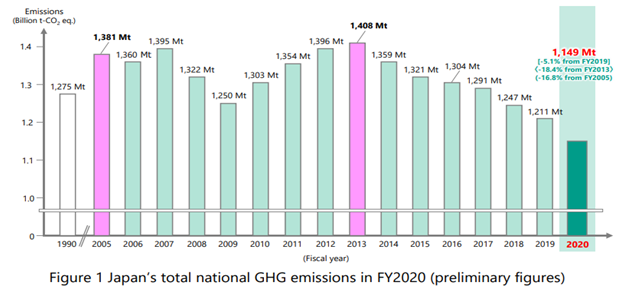
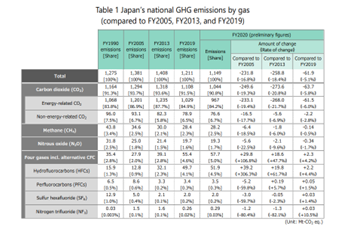
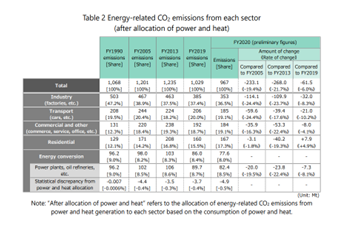
- Japan released 1.15 billion tons of carbon in fiscal 2020 ending in March 2021, down 5.1% from the previous term; the lowest since records were taken in 1990.
- In 2020 emissions dropped 18.4% from 2013 levels; down 16.8% from 2005.
- CONTEXT: Japan’s fiscal 2030 emissions reduction pledge is based on fiscal 2013 as its benchmark. That year Japan had no nuclear power plants operating and usage of fossil fuels was at elevated levels.
Thermal power plants claim 10 million tons of CO2 were cut due to upgrades
(Japan NRG, Dec. 6)
- A power plant operators association said its members cut over 10 million tons of CO2 in fiscal 2020 thanks to upgrades at members’ thermal power stations.
- The Council of Electric Utilities for Low Carbon Society (ELCS), which is comprised of 65 power operators that account for about 75% of power generated in Japan, said that in April 2020 to March 2021 its members released 328 million tons of carbon, a decrease of 17 million tons.
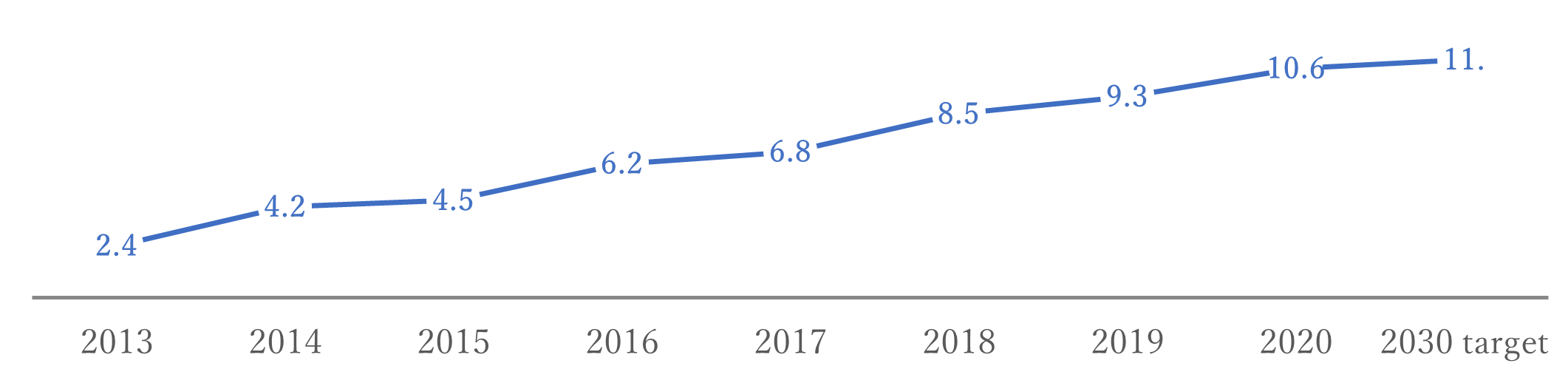
- Of the cuts, 10.6 million tons were thanks to the launch of a high-performance thermal power plant and to improving heat efficiency at two other plants.
- An ELCS official also told a METI sub-panel that early restarts of nuclear power plants are vital to achieve greater emission cuts in Japan.
- Carbon cuts at thermal power plants achieved from improved better operating procedures and upgrades
- CONTEXT: In 2021, in April and in November, two IGCC plants were brought on-stream in Fukushima. Launch of an integrated coal gasification fuel cycle (IGFC) plant is planned for 2025.
TAKEAWAY: According to the International Energy Agency, no matter how advanced the technology, a coal power plant without CCS or the means to mitigate emissions should be phased out. For the moment, Japan is not entirely following that principle.
METI said previously that a 1 GW IGCC, or an A-USC coal plant at a 70% run rate, emits 4.4 million tons of CO2/ year, compared to over 5 million tons for older coal-fired technology. An IGFC plant is expected to emit 3.6 million tons under the same conditions.
METI panel for designing carbon exchange kicks off
(Japan NRG, Dec. 8)
- The nine-member carbon credit framework panel that will design Japan’s carbon exchange, set to launch in 2022, held its inaugural meeting.
- The panel will hold interviews with trading houses, energy companies, financial institutions and exchanges, and it will issue a report to be made public in spring 2022.
- Panel chairman, Professor Arimura Toshi of Waseda University, warned that price discovery on the exchange will be slow as Japanese companies aren’t under any obligation to cap and trade emissions. Japan also needs to open its programs globally to stay relevant. Points raised by other panel members included:
- The exchange mechanism will likely incentivize suppliers but less so consumers; will buyers reach out for just any offset credits?
- Each credit type has its own market; there is stronger interest in credits from projects that absorb carbon rather than from those that claim to reduce it;
- Is market-driven “carbon neutrality” compatible with the IPCC definition? The term “carbon neutrality” should not be used for carbon trading;
- The exchange should have options to hold auctions in the absence of price signals in lackluster trading;
- Clarity is lacking on what exactly are voluntary credits, absorption/reduction of carbon, and the links between corporate reduction efforts and nationally determined contributions (NDC);
- Japan’s voluntary credits are negligible internationally and need to develop.
- CONTEXT: Japan’s powerful business lobby, Keidanren (Japan Business Federation), opposes a hike in the greenhouse warming tax and placing caps on emissions, claiming this potentially deters competitiveness. The Kishida government has so far closely followed the voice of big business.
Offset credits issued and retired in Japan
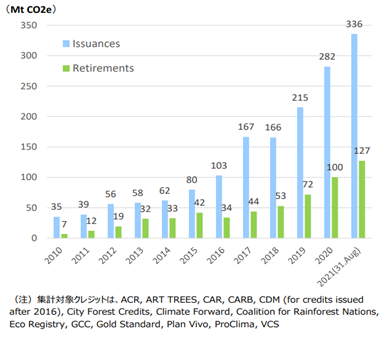
Source: Mizuho Bank
PM confirms 46% GHG target for 2030; net-zero by 2050
(Sekiyu Tsushin, Dec. 8)
- As the Diet convened on Dec. 6, Prime Minister Kishida reiterated his commitment to reduce GHG emissions 46% by 2030, achieve carbon neutrality by 2050, and deregulate to boost investment in renewables.
- The PM cited plans to electrify infrastructure, upgrade the grid, install more battery storage, and convert thermal plants to run on ammonia or hydrogen.
- The government plans to turn climate action into a growth industry.
Japan, China and S. Korea Environment Ministers agree on eight climate action initiatives
(Japan NRG, Dec. 7)
- The environmental ministers of Japan, China and South Korea agreed on eight climate action programs at the Triparty Environment Ministers Meeting (TEMM) on Dec. 7. The initiatives include stronger monitoring of acid rain and other air pollution, carbon neutrality policy, green economy development, promotion of zero-waste cities, sharing bio diversity best practices, and more.
- The ministers also shared plans to end state funding of coal plants overseas.
- In April, South Korea said it will end state financing of overseas coal plants, followed by Japan in June, and China in September. Domestic phase-out plans were not discussed.
- The ministers will meet online again on Dec. 17 for the “trilateral business round table”, although businesses are not invited.
- Domestic coal power phase out plans of the three countries:
|
Installed capacity |
Phase out plans | |
|
Japan |
48 GW |
To cut coal power share to 26% by 2030 (6th Basic Energy Plan) |
|
South Korea |
36 GW |
To close all plants whose 30-year life cycle expires by 2034 (9th Basic Energy Plan) |
|
China |
1,040 GW |
To limit coal consumption over 14th Five Year Plan (2021-2025) and phase it down by the 15th FYP period (Nationally Determined Contribution) |
METI committee proposes to exclude geothermal plants under 1 MW from FIP scheme
(Japan NRG, Dec. 8)
- The Power Tariff Committee under METI proposes to exclude geothermal plants under 1 MW from the 2024 Feed-in-Premium scheme due to high costs; 90% of existing plants have capacity of less than 1 MW.
- Plants over 1 MW are 60% more cost efficient than the smaller ones.
- Capital cost of geothermal plants in Japan (in millions of yen per kW of capacity)

- CONTEXT: Japan’s current geothermal capacity is 0.6 GW. The 2030 goal is to expand it to 0.7-1 GW, generating 3.4 TWh. The 2021 Feed-in-Tariff geothermal rates are ¥26-40/ kWh. In comparison, power rates in the U.S., which has six times more capacity, are about ¥8/ kWh.
TAKEAWAY: While the Tariff Committee’s proposal would exclude small 10 kW plants at hot spring resort hotels, geothermal heat used for home air conditioning is supported under the zero-emission home (ZEH) program. Experts have urged expanding the use of geothermal resources beyond power generation.
Japan is believed to hold over 6 GW of geothermal energy potential, the third largest in the world, but 80% of possible sites are located inside natural park zones. The MoE plans to relax rules to allow development surveys in such protected areas.
Japan, US, Australia, Canada and EU hold 12th Critical Material and Mineral Conference
(Japan NRG, Dec. 9)
- The main topics this year were battery, power generation and motor technologies and recycling. The conference is held annually.
- Below is the agenda of recent editions of the conference
|
12th (2021) |
Battery, power generation and motor technologies and recycling |
|
11th (2020) |
Japanese rare earth industry and issues surrounding critical minerals used for EVs, policies of respective jurisdictions on critical resources |
|
10th (2019) |
Technology and material development initiatives; global renewable industry trends |
|
9th (2018) |
Critical material flow and supply risks; development of materials using critical materials; circular economy, and critical resources required for EVs and renewables |
|
8th (2017) |
Supply chain analysis; role of critical minerals in circular economy; material development that affects demand of critical materials; role of critical materials in EVs |
Trading companies scramble to adapt to greener Southeast Asia
(Nikkei Business opinion, Dec. 8)
- Southeast Asian nations have pledged carbon neutrality, casting doubt over Japanese trading companies’ fossil fuel ventures in that region.
- To survive in this new environment, Japanese trading companies must form alliances with local energy corporations such as Malaysia’s Petronas, Thailand’s PTT, and Indonesia’s Pertamina.
TAKEAWAY: For a detailed look at what Japan’s trading houses are doing to decarbonize, check the Analysis section of this report.
Local governments cite cost as barrier to boosting renewables: Survey
(Dream News, Dec. 8)
- Yano Research Institute’s survey of municipal governments that pledged to become carbon neutral by 2050 found that over 80% said the cost of installing renewables facilities is a problem.
- Over 70% had difficulty finding or acquiring suitable sites.
- Over 60% had installed roof-mounted PV panels; only 37% had installed biomass-fired generation facilities.
Japan-Sweden venture takes delivery of world’s first LNG+battery fueled vessel
(Kankyo Business, Dec. 6)
- United European Car Carriers (UECC), a joint venture between Nippon Yusen (NYK Line) and Swedish shipbuilder Wallenius Lines, said it has taken delivery of the world’s first hybrid car carrier that combines LNG fuel and batteries.
- The vessel, named AUTO ADVANCE (gross tonnage 35,667 tons), is the first in a series of three ordered by UECC from China’s Jiangnan Shipbuilding. It is also the world’s first LNG-fueled car carrier to adopt a battery hybrid system to further improve fuel efficiency. The vessel will be used in Europe.
- According to NYK, the conversion to LNG fuel and the installation of a battery hybrid system are expected to reduce Sox emissions by about 90%, NOx emissions by about 85%, and CO2 emissions by about 25% compared to conventional heavy oil-fired vessels.
Underground hydrogen storage solves energy challenges
(Nikkei X-Tech, Dec. 7)
- In partnership with U.S.-based Magnum Development, Mitsubishi Heavy Industries is working on a project to store 150 GW hours’ worth of energy in the form of hydrogen gas in an underground cavern carved into salt.
- The site is in the State of Utah and will begin operations in 2025.
- Compressed hydrogen will be stored at depths of more than 1,000 meters.
- This approach offers low-cost, long-term storage in an environment that is less prone to leaking than tanks on the surface.
- The hydrogen will be pressurized to between 10 and 30 mega-pascals to prevent the cavern walls from caving in.
Nippon Paper invents wood-based battery
(Nikkei, Dec. 6)
- Nippon Paper successfully used a wood-based battery to power a light bulb.
- The company hopes to use the technology to develop commercially viable drone and smart phone batteries by 2023 and 2030, respectively.
- The battery doesn’t require lithium, or rare metals like cobalt.
Shimizu turning office buildings into giant batteries
(Nikkei Business, Dec. 8)
- Construction company Shimizu installed a network of hydrogen tanks in its Hokuriku office.
- The tanks contain a titanium-iron storage alloy that enables them to hold 1,350 m3 of hydrogen, equivalent to 1,000 times the tanks’ volume.
- Surplus electricity generated by roof-mounted solar panels powers a hydrogen generator that can produce up to 10 m3 of hydrogen per minute.
- The hydrogen passes through a 100-kW fuel cell, converting to electricity.
Tokyo University start-up sees future in hydrogen-oxidizing bacteria
(Nikkei, Dec. 10)
- A start-up founded by Tokyo University students engineers bacteria that can convert hydrogen and CO2 into proteins that form the precursors for bio jet fuel, plastic, and even artificial meat.
- The startup is cooperating with Sumitomo Chemical, as well as several major foodstuff and beverage manufacturers.
Kawasaki Heavy invents low-NOx gas turbine for hydrogen co-firing
(Morningstar, Dec. 8)
- Kawasaki Heavy Industries developed a ‘dry low emission’ (DLE) gas turbine that had low NOx emissions even when fired on a 40:60 blend of hydrogen and LNG.
- DLE technology enables combustion temperatures to be kept low, thereby reducing emissions, without the need to inject water or steam.
Japanese consortium starts Vehicle-to-Home charging experiment
(Denki Shimbun, Dec. 7)
- Kansai Electric, Idemitsu Kosan, and Sumitomo Electric Industries announced the start of a V2H (Vehicle-to-Home) recharging and discharging experiment.
- The three companies have conducted experiments to stabilize the power grid and create benefits for users by recharging vehicles during times when electricity demand and unit prices are low.
- In light of the tight supply and demand of electricity last winter, the companies plan to control remotely the discharging of electricity during periods of high demand and high unit prices.
- The aim is to use this system as a VPP (Virtual Power Plant) resource for electric vehicles (EVs) in general households, with no loss of usability.
One-Dot News:
- Shipping firm Kawasaki Kisen Kaisha signed a marine biofuel supply contract with BP after conducting a test voyage using marine biofuel. The shipper’s car carrier sailed on marine biofuel from BP last month. Biofuel is an alternative fuel that is said to reduce CO2 emissions by about 80-90% over its life cycle compared to conventional fossil fuels. (Kankyo Business, Dec. 6)
WEATHER OUTLOOK
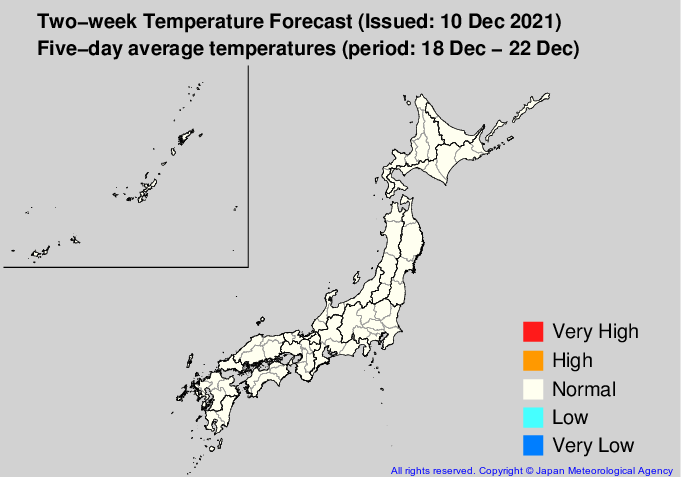
TWO-WEEK TEMPERATURE FORECASTS (DEC. 10~ DEC. 22)
Nation-wide
Tokyo area
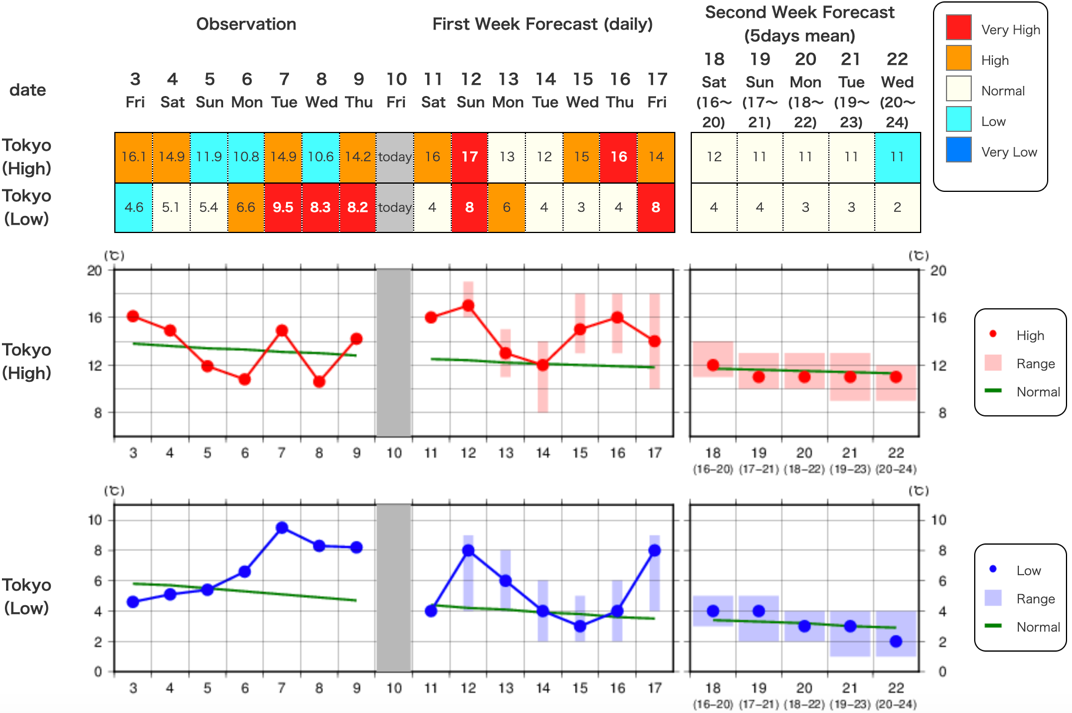
- North/East/West Japan: Very high temperatures until Dec. 17, then back to average.
- Okinawa/Amami Region: Higher-than-average temperatures until Dec. 16, then back to average.
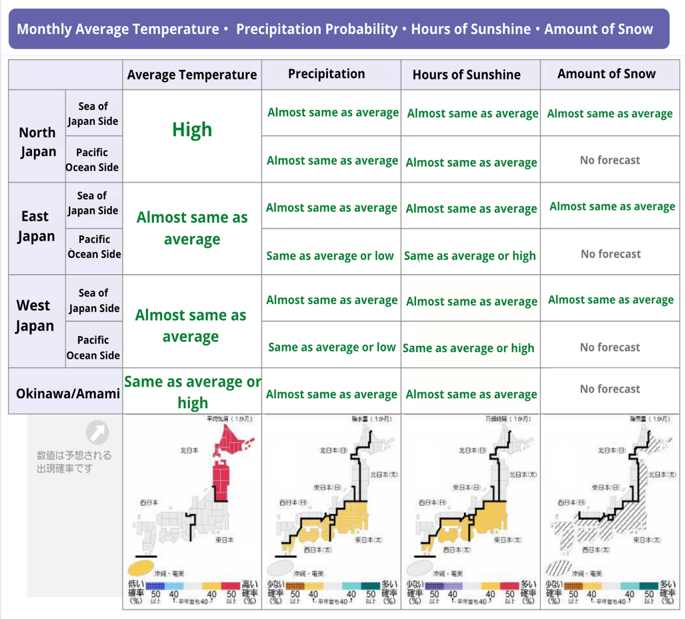
ONE-MONTH SEASONAL FORECAST (DEC. 11~ JAN. 10)
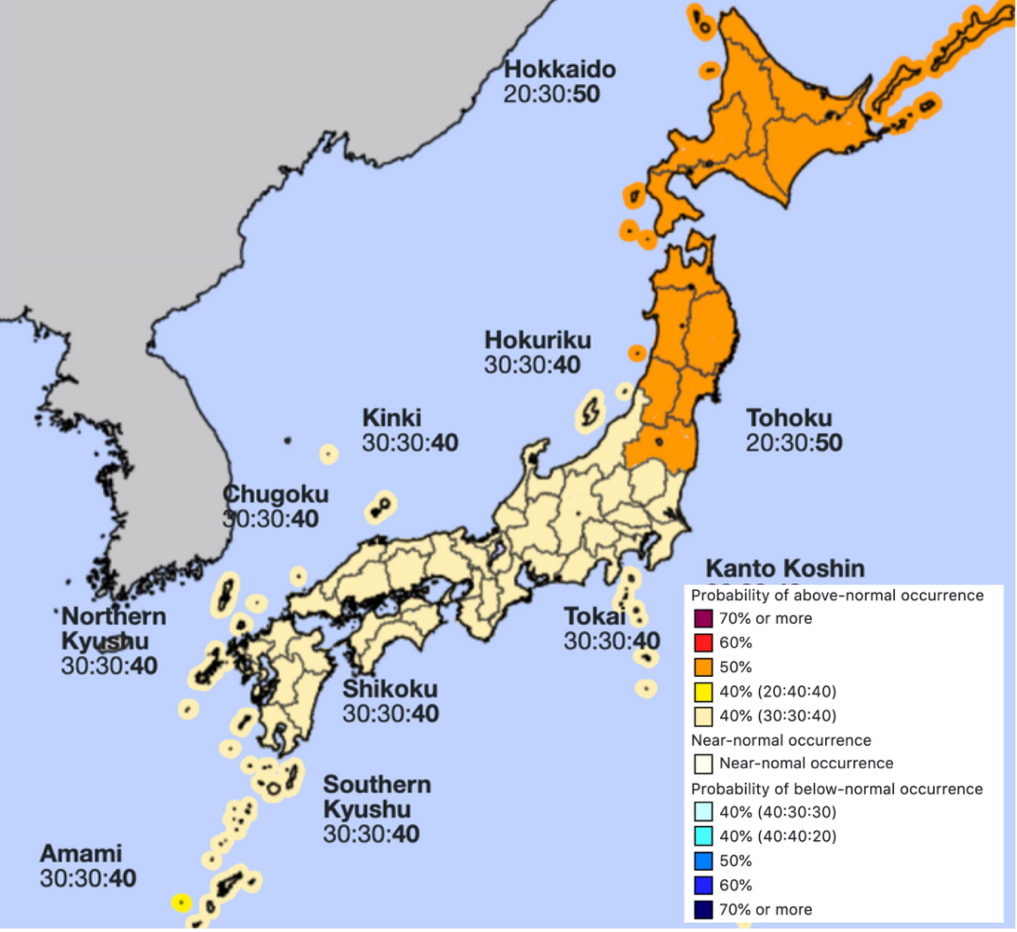
NEWS: POWER MARKETS
| No. of operable nuclear reactors | 33 | Electricity Price | Friday, Dec. 10 | % Change WoW | ||
| Of which | restarted | 10 | JEPX 24-Hour Spot | ¥18.17/ kWh | +3.71% | |
| in operation today | 8 | TOCOM Dec. baseload (Tokyo area) | ¥21.76/ kWh | -3.29% | ||
Source: Company websites, JANSI and JAIF, as of Dec 10, 2021
METI calls on utilities to limit thermal output
(Nikkei, Dec. 7)
- METI is beefing up rules that require operators of gas and coal-fired plants to limit output at times of high output from renewable facilities.
- This will stop renewably-generated energy from being wasted.
- Previously, operators of thermal plants could be ordered to limit output to 50% of capacity. Under the new rules, METI could instruct generators to limit output to 30%, or even 20%, of capacity.
- This is part of efforts to turn renewables into a main source of electricity.
- Based on METI statistics, limiting output from some major thermal plants to 20% of capacity will free up around 1.5 GW of transmission capacity.
TAKEAWAY: The idea that major power utilities should be ordered to stop prioritizing their big thermal and nuclear power plants for grid access and curtailing energy from the smaller renewables developers was promoted much earlier this year under then Prime Minister Suga. This order seems to be a continuation of the same policy and therefore should not come as a major surprise. However, at a glance, it looks like a loss for the big power utilities, the EPCos, which sought to show that the overall cost of electricity and the system’s stability would be undermined if their large power facilities were forced to curtail at the expense of renewables capacity.
It’s interesting to note that this change comes after some large domestic non-electricity companies entered the industry over the last six to 10 months. This will be a corporate strategy story as well as a technical grid story worth monitoring over the next few years.
JERA shuts down 2.4 GW of aging thermal power capacity
(Nikkei, Dec. 7)
- JERA decommissioned Units 1 through 4 (capacity 2.4 GW) at its Anegasaki plant.
- The LNG-fired plant is in Chiba and generated electricity for over 40 years.
- Units 5 and 6 haven’t been decommissioned, but neither is operational. JERA will restart Unit 5 in January to avert winter power shortages.
- In 2023, JERA will modernize the site with state-of-the-art equipment.
Itochu plans to build 5,000 mini solar plants nationwide by 2025
(Asia Nikkei, Dec. 10)
- Itochu Corp. plans to build 5,000 small solar power plants across Japan by 2025 and market the electricity to companies seeking green power options. The total capacity may be around 500 MW.
- In November, Itochu invested in Clean Energy Connect, a solar power developer in Japan. The companies plan to acquire idle land across the country for the mini solar farms. The electricity generated will be bundled and supplied to companies on 20-year contracts known as power purchase agreements (PPA).
- The electricity will cost similar to the current level of the feed-in tariff.
- This project could make Itochu one of the biggest retailers of electricity from renewable sources in Japan. Currently, there is a shortage of electricity from renewable sources as companies seek to lower their CO2 footprint.
- CONTEXT: The pace of introduction of new renewables capacity in Japan has slowed as the tariffs that guarantee developers a certain fee for the power have dropped over the years.
Solar generators hit by price increases, delays
(Mega Solar Business, Dec. 9)
- Two thirds of solar operators surveyed by the Japan PV Planner Association said they’re paying at least 15% more for solar panels than last year.
- The higher prices impacted utilization of the FIT plan, with some saying they had filed fewer FIT applications.
- 46% of respondents said they waited less than one month for solar panel deliveries; 35% waited over three months for deliveries, while 28% said their suppliers would not even commit to a delivery date.
- SIDE DEVELOPMENT:
Local solar panel industry hanging by a thread
(Nikkei XTech, Dec. 8)- Top PV panel manufacturer Solar Frontier will end production in Japan.
- The move reflects tough conditions for Japanese production, including low margins, artificially low market prices, and a lack of state support.
- Solar Frontier is the latest manufacturer to stop operations in Japan.
- In 2000, Japan supplied half of the world’s demand for solar panels.
- Japan was overtaken by Europe in 2007, and then in 2009 by China, which now dominates the global market.
INPEX invests in Dutch offshore wind
(Nikkei, Dec. 7)
- INPEX acquired a stake in offshore wind developer Dutch Green Energy from Mitsubishi Corporation, and will acquire an additional stake.
- The wind farm, operated by Dutch Green Energy, has 860 MW capacity.
- INPEX believes it can turn its expertise in offshore oil and gas operations to apply in offshore wind power generation.
Shipper Mitsui OSK partners with Scotland’s Flotation Energy on offshore wind in Japan
(Kankyo Business, Dec. 7)
- Mitsui O.S.K. Lines (MOL) said it will collaborate with Scotland’s Flotation Energy to develop offshore wind power facilities in Japan.
- Flotation Energy has developed the world’s largest floating offshore wind farm. Most recently, the company won the preferential negotiation rights for a 480 MW Morecambe implantable offshore wind power project in the UK.
- The company also has plans for multi-stage 2 GW offshore wind power project off the coast of Niigata Prefecture.
- Mitsui OSK said it hopes to work with Flotation Energy in Asian markets including Japan.
Fukushima engineers stranded overseas as Japan shuts borders
(NHK, Dec. 8)
- Japan’s border closure amid fears about the Omicron variant has stopped the arrival of a team of foreign engineers scheduled to visit the Fukushima disaster site to operate debris retrieval robots.
- Authorities do not know when the engineers will be allowed in.
- The International Research Institute for Nuclear Decommissioning in Tokyo stands by its plan to remove debris from the reactor core next year.
- SIDE DEVELOPMENT:
NRA chairman warns Spring 2023 treated water release deadline under pressure
(Asahi Shimbun, Dec. 9)- Chairman of the Nuclear Regulation Authority (NRA), said that if TEPCO does not submit plans for new facilities to be built for the release of treated Fukushima water before the end of this year, it will be difficult to start releasing the water in spring of 2023.
- CONTEXT: TEPCO’s water release plans are being delayed by the preparatory work around the construction of an undersea tunnel to allow for the water discharge to take place one kilometer offshore.
Will LNG shortage mean higher gas/power bills?
(Motohashi Keiichi, Energy Shift, Dec 8)
- Most of Japan’s LNG is purchased on long-term contracts, so utilities are less vulnerable to volatility in LNG spot markets in Asia and Europe.
- However, strong demand in China and India means that the global LNG supply is likely to remain tight until 2030.
- These factors, combined with the phasing out of coal-fired power stations, mean that Japanese power and gas bills are unlikely to fall. Consumers can expect gas and power tariffs to remain high.
NUCLEAR REACTOR WRAP
- 1,800 piles unchecked at Kashiwazaki Kariwa after damage from the 2007 Earthquake(NHK, Dec. 9)
- CONTEXT: Last month, TEPCO found damage at eight reinforced concrete piles supporting the foundation of a facility next to a building housing the No.6 reactor. The damage may have been caused by the 2007 Niigata earthquake.
- There are 1,800 other piles that remain unchecked.
- TEPCO won’t inspect the remaining piles, explaining that the exact cause of damage is still unknown.
- SIDE DEVELOPMENT:
A worker injures at Tomari nuclear power plant
(Hokkaido Shimbun, Dec. 4)- A worker inspecting equipment at the turbine building of Hokkaido Electric’s Tomari Unit 3 plant broke his elbow and suffered bruises on his hips and knee.
- The worker lost his balance when he tried to remove the metal floor.
- The Unit 3 reactor is under inspection; the operator will investigate the cause.
- SIDE DEVELOPMENT:
Local federation group request for a quick restart of the Shimane Unit 2 reactor
(FNN Prime Online, Dec. 7)- The Chambers of Commerce and Industry of eight cities in Shimane Prefecture requested the Governor to act on the restart of the Shimane Unit 2 reactor.
- The reactor has already passed the NRA safety examination.
Renewable Japan wind project meets fierce opposition from local residents
(Nagoya Broadcasting Network, Dec. 7)
- Mie Prefecture already ranks fifth in Japan for number of wind turbines.
- Renewable Japan’s new project will see 60 turbines, 180 m high, built there.
- The proposal has been met with hostility by residents who fear the wind farm will create visual pollution, foul waterways, and threaten local birdlife.
- A meeting witnessed an angry encounter between locals and developers.
Families of Atami victims charge landowner with murder
(Asahi Shimbun, Dec. 6)
- Police received an official criminal complaint from family members of victims of the Atami landslide. They charged the hillside plot owner with murder.
- The site of the landslide is adjacent to a solar farm.
NEWS: OIL, GAS & MINING
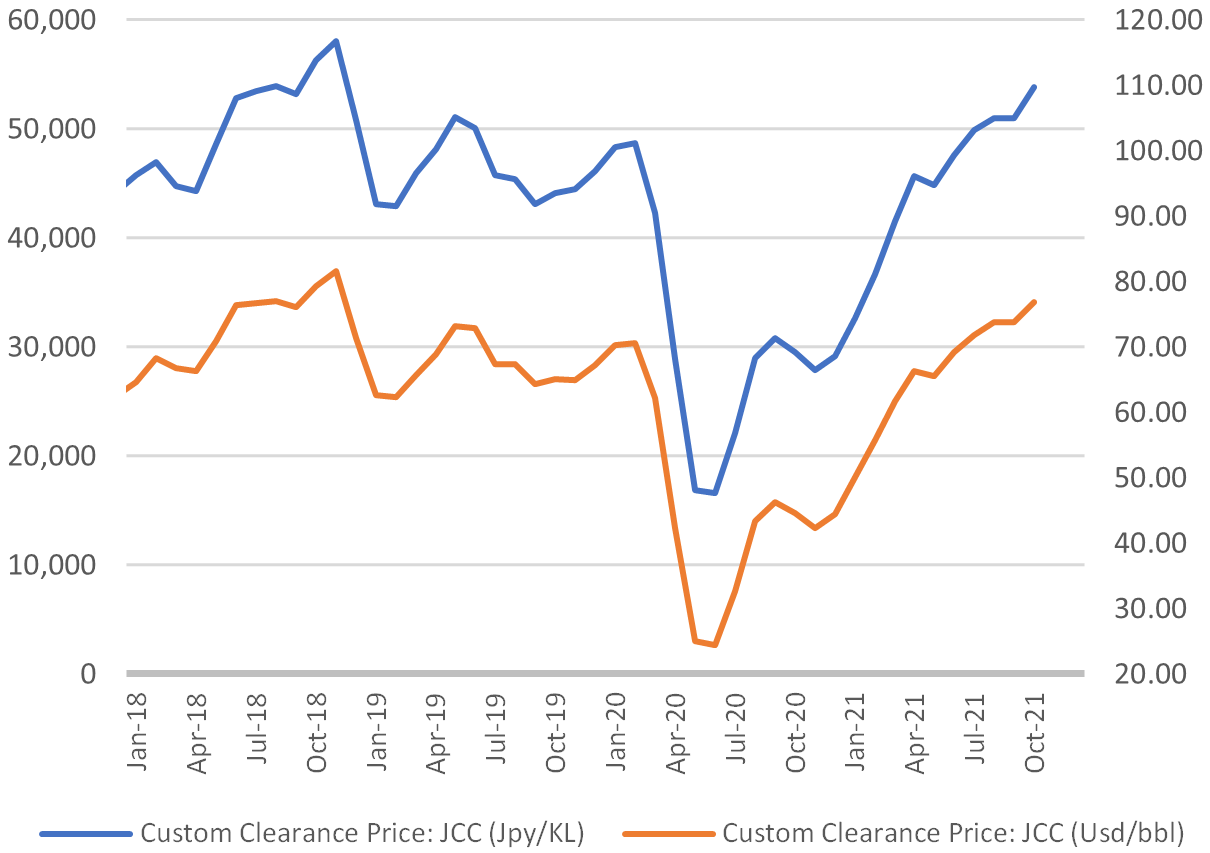
Japan Oil Price: $76.81/ barrel
¥ $
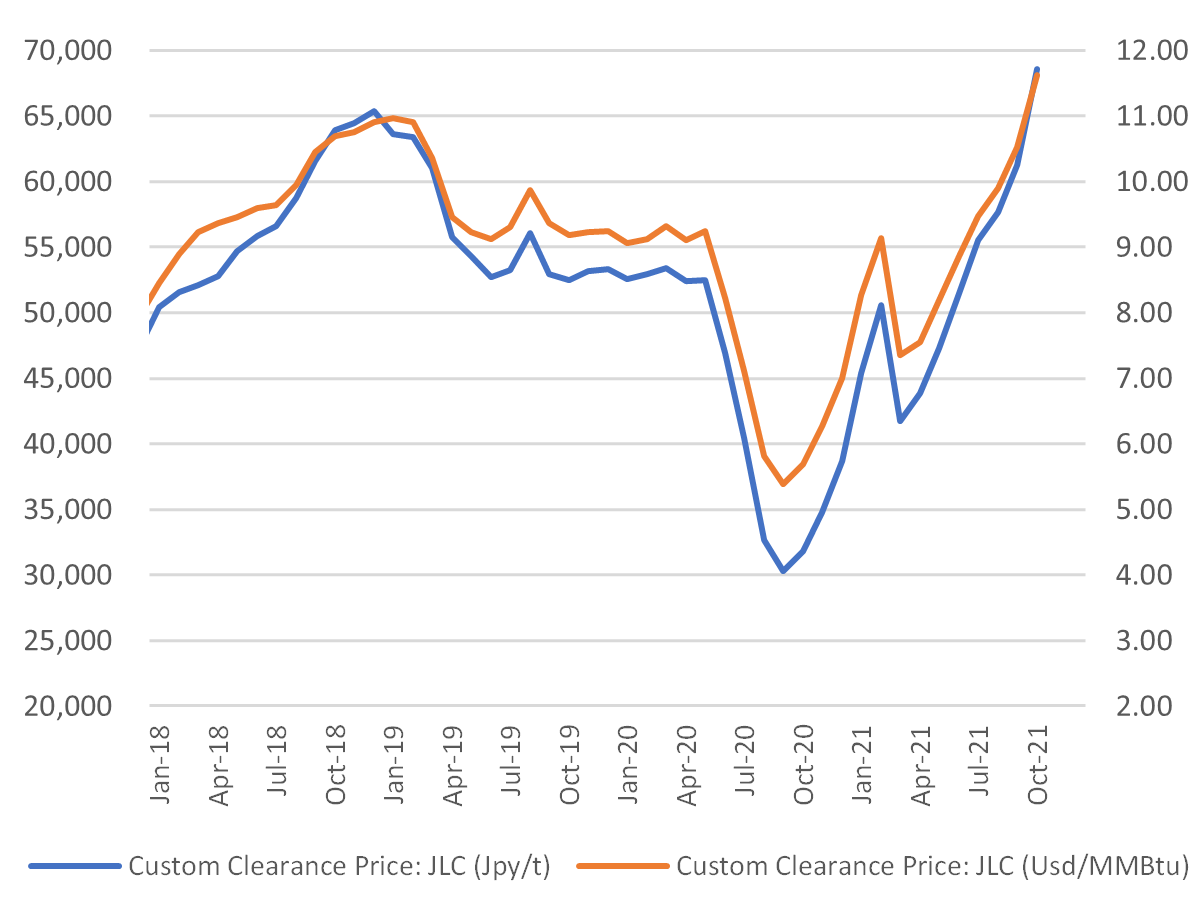
Japan (JLC) LNG Price: $11.61/ mmbtu
¥ $
JERA acquires stake in Australian gas field for $300 million
(Nikkei, Dec. 8)
- JERA agreed to pay $300 million for a 12.5% interest in the Barossa gas field from Australian energy company Santos.
- Barossa begins production in 2025; JERA will receive 430,000 tons of gas per year.
- JERA will use some of the gas for its Japanese operations and sell the remainder to customers, but not on long-term contracts.
Government to substantially reduce corporate business tax on gas companies
(Jiji Press, Dec. 8)
- The government and ruling party decided to substantially reduce the corporate business tax for major gas companies deeming them to be more affected by the liberalization of the gas market than regular firms. This change will be in the ruling LDP’s tax reform plan for next year.
- This will affect three companies: Tokyo Gas, Osaka Gas, and Toho Gas.
- The current taxation system is based on revenue from gas sales, but the new system will factor in wages paid to employees and size of corporate capital. Forty percent of the taxable amount will reflect factors other than sales.
- SIDE DEVELOPMENT:
Toho Gas on charm offensive
(Denki Shimbun, Dec. 10)- Toho Gas has a new promotion in which subscribers to the website receive the chance to win up to ¥10,000 worth of prizes and vouchers every month.
- Toho Gas says the promotion will make services more attractive to subscribers and encourage new ones to sign up for its website.
Govt. sells shares in MOECO oil unit to majority owner Mitsui for $630 million
(Denki Shimbun, Dec. 6)
- Mitsui & Co. said it will acquire an additional 20.03% stake in Mitsui Oil Exploration Co. (MOECO) from METI for ¥71.6 billion (~$630 million).
- Mitsui’s stake in MOECO will increase to 94.2% and help the trading firm make the oil exploration firm a wholly owned subsidiary.
- MOECO works on oil and natural gas deposits mainly in offshore Thailand.
- Mitsui hopes to expand its geothermal power generation business by taking advantage of MOECO’s expertise in exploration and other areas, as well as to establish a geothermal power plant in Thailand.
- Mitsui also sees MOECO’s expertise as valuable to build CCUS (carbon dioxide capture, utilization and storage), hydrogen and ammonia businesses.
ENEOS unit expands agreement with Indonesia’s Pertamina to include CCS
(Sekiyu Tsushin, Dec. 8)
- JX Nippon Oil & Gas Exploration, a unit of ENEOS Group, has recently re-signed an MOU with Indonesia’s state-owned oil company Pertamina to include carbon capture and storage (CCS).
- The new MOU is expanded to cover the entire energy sector and also allows for joint production of hydrogen and ammonia from natural gas using CCS technology.
- JOGMEC is also involved in the Pertamina energy dialog together with JX Nippon.
ENEOS refineries soon to be autonomous
(Newswitch, Dec. 6)
- ENEOS developed an AI-based system that eliminates the need to station human operators at petrochemical plants.
- The system was recently tested at a butadiene extraction plant in Kawasaki.
- ENEOS has been looking for ways to completely automate its refineries.
ANALYSIS
BY MAYUMI WATANABE
A Review of the Net-Zero Strategies of Japanese Trading Houses
A good bellwether for industrial Japan is the nation’s trading houses. These ultimate conglomerates span hundreds of industries, products and geographies, and they carry a historic mission to secure Japan’s raw materials and sources of energy.
With that in mind, the actions and words of Japan’s top seven trading houses over the last six months are highly indicative of the country’s overall net-zero strategy. All seven quickly unveiled net-zero targets for 2050 and signaled plans to stop new investments in coal.
Several, including Mitsubishi Corp. and Toyota Tsusho, unveiled trillion-yen spending plans on decarbonization, and most added carbon capture and storage (CCS) and ammonia/hydrogen supply chain building to their to-do list.
This push into clean energy, however, won’t come at the expense of all fossil fuel investments. While new coal fields and power plants are off the menu, interest in new gas (and LNG) projects remains healthy, with the caveat that CCS solutions should be an option. Oil divestments are “replaced” with other oil assets that offer lower carbon intensity or better economics.
The strategies of the seven majors are not in sync in all fields. For example, in EVs and batteries the approaches are diverse.
Getting ahead of the trend has kept Japan’s trading houses in business for centuries. Their latest actions indicate that while new energy systems are being assembled and scaled up, existing hydrocarbon infrastructure (in some form) will retain a significant role for several more decades.
History’s big wins
No investor wins big every time and the trading houses have had big misses too, but the group known as sogo shosha in Japanese have notched up several famous hits. For example, the trading houses invested heavily in Australian coal in the 1970s, securing fuel not only for Japan but for China’s economic surge that started the 1990s.
The group also moved into power and water utilities, a more conservative investment, a decade before the last commodity rally wound down.
Once the Japanese government pledged to decarbonize in late 2020, the traders moved quickly to make net-zero commitments for 2050. Mitsubishi Corp. said it would allocate ¥2 trillion to decarbonization over this decade, and Toyota Tsusho set its budget for the same at ¥1.6 trillion.
In reality, the seven largest trading houses – Mitsubishi, Marubeni, Mitsui, Sumitomo, Toyota Tsusho, Itochu, and Sojitz – made inroads into clean energy years ago with investments in solar, wind, biomass, storage, AI-driven electricity system management and other technologies.
Despite that, the traders never abandoned their fossil fuel assets and it looks like they are also cautious about letting them go now.
Coal exit scenarios
| No new thermal coal mining assets | No new coal-fired power plants | Timeframe to divest from thermal coal | Plans for coking coal used for steel | |
| Mitsubishi | ✔ | ✔ | Sold mines in 2019 | NA |
| Marubeni | ✔ | ✔ | To halve coal power by 2025 and phase out by 2050; Sold all mines in 2016 | NA |
| Mitsui | ✔ | ✔ | Exit coal power by 2030 | Continue current engagements to supply steel raw materials |
| Sumitomo | ✔ | ✔ | Exit coal power plants in the 2nd half of 2040’s; coal mines by 2030 | NA |
| Itochu | ✔ | ✔ | Sole coal power plant currently on sale; coal mines exit by March 2024 | NA |
| Toyota Tsusho | ✔ | ✔ | NA | NA |
| Sojitz | ✔ | ✔ | Exit coal mines by 2030 | Divest mines by 2050 |
Coal does not phase out easily
In the past six months, the seven largest trading houses said they will not be acquiring new thermal coal assets or investing in new coal-fired power plants. The timeline to phase out their existing assets in the field, however, has been set over the next one to two decades.
Itochu is likely to achieve the first complete withdrawal from coal-fired power generation, as it has interests in only one Indonesian plant that is currently on sale. Mitsui aims to divest from its coal power projects by 2030, while Marubeni and Sumitomo plan to do so in 2040-2050. Mitsubishi and Marubeni do not own any stakes in thermal coal mines. Itochu seeks to sell its mining projects by March 2024, and Sojitz and Sumitomo by 2030.
Divesting coal assets does not entirely mean the end of the coal business. Among the trading houses, only Sumitomo said it won’t enter into any contracts to construct coal power plants. It is not clear if the others are retaining the options to engage with construction, consulting and other contract work with coal plants.
The companies will continue to trade coal. So long as Japan continues to run coal-fired power plants, they will have a role in the coal value chain as typically Japanese power plant operators do not directly import coal to avert risks.
Japanese steelmakers are developing hydrogen steel that does not require coking coal. Nippon Steel has claimed the technology will make the company carbon neutral by 2050. However, the trading houses have not incorporated hydrogen steel into their decarbonization strategies, showing uncertainties over the successful development of such “revolutionary technologies”.
Only Sojitz has clearly committed to exit from coking coal mines by 2050. Meanwhile, Mitsui clearly said it won’t move away from coking coal supply chains because it’s not seeing any decrease in demand. While western countries increase usage of steel scrap that won’t require coking coal, demand will increase in Southeast Asia and India, Mitsui says, justifying its position.
In other fossil fuels, Sojitz plans to sell all oil assets by 2030. Other trading houses plan to rebalance oil and gas asset portfolios to improve their competitiveness. Mitsui, Mitsubishi, and Itochu said they will seek new LNG projects with low environmental impact as they have the mission to secure Japan’s energy supplies.
Renewable expansion plans
| Mitsubishi | To double renewable capacity to 660 MW in 2030 |
| Marubeni | To raise share of renewable power generation to 20% from 15% by 2023 |
| Mitsui | To raise share of renewable power generation to 30% from 14% by 2030 |
| Sumitomo | To raise share of renewable power generation to 30% from 20% by 2030 |
| Itochu | To raise share of renewable power generation to 20% from 14.5% by 2030 |
| Toyota Tsusho | To expand global renewable capacity to 4.9 GW by March 2024 from 3.4 GW |
| Sojitz | Renewable accounts for 30% of power in 2020 |
Net-zero growth pipelines
The trading houses plan to increase activity in renewables, CCUS, ammonia, hydrogen, and zero emission vehicles.
In CCUS, Mitsui has invested in Storegga Geotechnologies in the UK and Fairway Methanol in the U.S. Mitsubishi signed a strategic partnership with Swiss-based South Pole and Denbury in the U.S. Marubeni acquired a stake in the UK’s Carbon Clean Solutions.
Itochu and Toyota Tsusho, rather than acquiring companies, are partnering with them. Since 2010, Sojitz has been running a CCS project with Canada’s Saskatchewan Power Corporation. The companies are also involved in ammonia and hydrogen research projects and supply chain construction frameworks.
The trading houses hold a common vision that zero-emission cars will drive up demand for battery metals, copper and aluminum. However, they have varied approaches.
Toyota Tsusho is building an integrated battery supply chain that comprises raw materials and battery parts, battery manufacturing, battery-based infrastructures such as charging stations, and recycling of spent batteries and auto parts.
Mitsubishi focuses on upstream copper, aluminum and battery metal investments. It runs copper and aluminum smelting operations globally, and upstream copper concentrate and bauxite resources will raise efficiency of their value chains.
Itochu has limited exposure to nonferrous metal production and has been more downstream focused. It started to run a pilot battery recycling plant that recovers nickel, cobalt and lithium from spent batteries and plans to commercialize it. Sumitomo, Mitsui and Marubeni eye both upstream and recycling investments.
Keeping options open
Judging by the strategies of the trading houses, the net-zero trend still contains plenty of risks. One is that every company trying to decarbonize simultaneously will lead to price inflation for clean energy assets. Another is that the buy-in from local communities can be as tricky for renewable energy developments as for those in fossil fuels.
Also, an expert with the MoE notes that the government is fielding multiple complaints from firms that feel unable to proceed with renewable energy projects due to opposition from local communities.
A further risk is that the clean tech of today will be challenged or significantly improved upon by R&D in the future.
For business conglomerates that have survived in one form or another since the 16th century, their approach to energy transition could be summarized as “trust but verify”. And that means maintaining a broad portfolio that can be regularly adjusted and modernized.
ANALYSIS
BY DANIEL SHULMAN
PRINCIPAL
SHULMAN ADVISORY
The Complex Business of
Japan’s Municipality-Owned Power Retailers
Once Japan’s power market fully opened up in 2016, private companies and investors were not the only ones to rush in. A growing trend has emerged of municipalities setting up their own, local electricity retail firms to supply power to government buildings, and in some cases, the broader community.
This trend has accelerated in the past two years, and there were 40 municipally-owned power retailers at the end of FY2020. By May 2021, that number was 75, and it might exceed 100 if all the municipalities that answered a 2018 survey from Hitotsubashi University and Asahi Shimbun follow through.
In theory, this gives local governments greater control of their electricity supply and helps to promote further decarbonization. Japan’s central government has strongly supported this trend, with METI, MoE and the Ministry of Agriculture, Forestry and Fisheries (MAFF) among the cheerleaders.
The results so far, however, raise questions. Lacking size and the necessary talent to operate such businesses, some of the municipally-owned power companies have run into trouble.
The goal
For municipalities, these ventures have multiple purposes. The first is to help in decarbonization. Encouraged by METI, the municipalities want to promote the local consumption of power generated at local plants.
This is intended to increase the consumption of CO2-free energy, while reducing pressure on the transmission and distribution network since the electricity stays in the same branch of the grid. The idea also syncs with METI’s broader goal of promoting the development of micro-grids that best suit local power needs.
As of September 2021, 464 municipalities accounting for 112 million residents have pledged to reach net-zero CO2 emission by 2050. A recent survey of municipality-owned retailers showed that 85% launched operations in order to help tackle global warming.
The second major goal is local economic revitalization. By developing and running these businesses, municipalities expect to boost local employment, develop local industries, and lower power costs of public facilities. For example, Himi City in the Hokuriku area partners with local solar PV installers for rooftop installation work. It also focuses on signing PPAs with local energy producers.
Hamamatsu City local power producer and supplier, Hamamatsu Shin Denryoku, was established to increase the self-sufficiency rate of power consumption and revitalize the local economy. It procures power mainly from local PV and biomass (waste) plants and covers 80% of its demand with local production. It supplies power to public facilities, private companies, households, and all public elementary and junior high schools. The city also offers subsidies for solar power generation and home EV chargers.
The third goal is to finance social programs for residents. The retailer can also offer special prices for some residents. Himi City offers reduced prices for senior citizens and families with children. Shonan Power in Odawara uses profits to support a soccer team, art programs, environmental improvement, businesses, and etc
The concept of grid resilience in case of natural disaster was also mentioned by 57% of respondents. Chiba Mutsuzawa Energy is one example of this. Following a major typhoon in September 2019 that left most of the local area in the dark, the firm kept powering some of its public facilities and welcomed residents for shelter.
Structure and Business strategy
A 2020 survey showed that local government investment in these businesses is on average 54% of the total capital. Local energy companies, financial companies, and other partners account for 17%, and non-local companies 29%.
The municipalities usually partner with energy companies that can either help with the procurement of local renewable power or have the operational know-how. For example, Himi City partnered with Hokuriku Electric; and Karatsu City in Kyushu partnered with a local gas company and with Shizen Energy Group.
Some major regional utilities are worried that this could lead to lower revenue. Hokuriku Electric and Shikoku Electric, for example, are exploring partnerships with municipalities to maintain some involvement with clients and offer new services.
Municipalities usually lack the know-how to run retail operations and most of these companies outsource some functions. Local energy procurement from renewable and FIT assets is only 36% on average. Most procure the rest of their power from a third party, usually the same company that provides the balancing operations.
For example, Shin Denryoku Oita signed a PPA with five PV plants in Oita and two in Kumamoto to secure 11 MW of capacity, 30% of their total power procurement. Of the remaining power, 30% comes from the JEPX spot market and 40% comes from major regional utilities.
Surveys show that the next step is to supply power to local companies and residents, and in rare cases to go beyond the municipality itself. Osumi Peninsula’s Smart Energy was funded by Kimotsuki Town in Kagoshima Prefecture, and it seeks to introduce the “Stadt Werke” system, in which a public company runs public facilities and transportation in the area.
Kimotsuki Town’s population is only 15,000, and it invited four cities and five towns to join the project. The profits will introduce small generators at schools, rent electric bikes to tourists, and set up charging bases for cyclists.
Government Support
METI, MOE and MAFF all offer subsidies for the development of municipality-owned power retailers. METI’s subsidies total ¥3.47 billion, and go towards supporting the creation of micro-grids for up to two-thirds of the total cost. This funding applies only to public-private partnerships.
MOE focuses on regional decarbonization, subsidizing businesses in which local government is involved or which are funded by citizens and that promote decarbonization. The yearly budget is ¥100 million; since 2018, 16 companies have received this subsidy.
MAFF fosters sustainable systems and the revitalization of agricultural, fishery, and mountain areas by introducing renewable power. It helps with consulting and business matching between renewable power generators, retailers, and consumers in agricultural, fishery, and mountain areas.
Hurdles Faced by Municipalities
While the concept grows more popular, many municipalities lack the resources or know-how. The small scale of the business, supplying power only to public facilities, and a poor understanding of the business, can quickly lead these retailers into the red.
Risk management is another issue – some retailers were hit hard during last winter’s JEPX spot price spike crisis. Also, some residents of Ikoma City requested the city to be audited as the power procured through Ikoma Civic Power turned out to be more expensive than under previous contracts. Their request was declined.
Miyama Smart Energy in Fukuoka Prefecture expanded its business rapidly and started selling power nationwide. However, it was badly hit by last winter’s crisis and posted heavy losses. This was on top of previously reported governance problems.
In Nobeoka City, Miyazaki Prefecture has been talking of establishing a retail company continues for three years. Some local councilors and businesses oppose the idea, fearing it will be unprofitable.
Despite support from the government, it is often unclear who benefits from the creation of these companies. The impact on the development of micro-grids and the increase in local consumption of locally-produced power is not yet well demonstrated.
The next big test for the municipal-owned firms may come this winter. While their mission is well received and for the most part supported, these new power retailers will need to survive the upcoming winter peak in order to be called a success.
GLOBAL VIEW
BY JOHN VAROLI
Below are some of last week’s most important international energy developments monitored by the Japan NRG team because of their potential to impact energy supply and demand, as well as prices. We see the following as relevant to Japanese and international energy investors.
Australia/ Offshore wind power
Alinta Energy, the Hong Kong-owned electricity generating and gas retailer, plans a $4 billion, 1 GW wind farm off the coast of Victoria province to help power the Portland aluminium smelter. It would be one of Australia’s first smelters powered 100% by renewables.
China/ Renewable energy
China began the second development round of its 100 GW desert renewable energy project. Proposals are now accepted by the National Energy Administration; each project must have at least 1 GW capacity, with construction starting in 2022 and completed by 2023. The first desert projects were launched in October.
Denmark/ Offshore wind power
Germany’s RWE beat out Denmark’s Orsted, the world’s biggest offshore wind developer, to build a $2.4 billion, 1 GW wind farm. Dubbed “Thor”, it will be the world’s first offshore wind farm built with payments to the state. Once operational, possibly in 2026, RWE will pay the Danish state until it reaches a cap of 2.8 billion Danish crowns ($426 million).
Fossil fuels/ investments
Saudi Aramco’s CEO, Amin Nasser, called for more investment in fossil fuels. Speaking at the World Petroleum Congress in Texas, Nasser said the transition to clean fuels was “deeply flawed” and there’s a possibility of “energy insecurity, rampant inflation and social unrest as prices become intolerably high.”
Hong Kong/ Fossil fuel divestment
Insurance giant AIA Group, which manages a portfolio of $286 billion, sold off $10 billion in coal-related investments, ending its exposure to that industry. AIA joins many other insurers seeking to decarbonize portfolios. In summer, 15 major insurers pledged to bring their portfolios to net-zero GHG emissions by 2050.
Indonesia/ Oil and gas
ConocoPhillips will sell its assets in Indonesia for $1.36 billion to local energy company, Medco Energi Internasional. The asset in question is a 54% stake in Indonesia Corridor Block Production consisting of two oil fields and seven gas fields, and a 35% share in the Transasia Pipeline Co.
Saudi Arabia/ Natural gas
A group led by BlackRock will invest $15 billion to buy a 49% stake in a new company that has 20-year leasing rights to pipelines that carry Saudi Aramco’s gas across the country. BlackRock and partners outbid EIG, Italian infrastructure firm Snam, and China’s state-backed Silk Road Fund Co.
Saudi Arabia/ Renewable energy
The Energy Ministry plans to build 10 GW in renewable energy capacity in the next four years. The Ministry also said the kingdom’s current renewable capacity is about 900 MW, accounting for only 1% of the country’s total power.
Solar power/ China/ U.S.
The U.S. and China will account for 57% of new solar capacity by 2030, adding 151 GW and 437 GW, respectively, according to a report by Fitch Solutions. The U.S. will remain the second largest solar market behind China, with solar’s share of its power mix increasing from the current 3.3% to 9% by 2030.
Switzerland/ Commodities trading
Trafigura posted record profits of $3.1 billion, double the previous period, (in the year to September). Revenue rose 57% to $231 billion on higher commodity prices and increased trading volumes. The company traded a daily average of 7 million barrels of oil and petroleum products, up 25%, YoY.
U.S./ Oil and net-zero
Exxon Mobil aims to achieve net-zero GHG emissions in the Permian basin by 2030. The new target is part of the company’s effort to reduce upstream GHG emissions 40% by 2030, compared to 2016 levels. Exxon also plans to eliminate routine flaring at its Permian basin operations by the end of 2022.
U.S./ LNG
Following high global natural gas demand, deliveries to LNG export terminals surged to record levels at the end of November, topping 12 Bcf/d. In related news, construction of the Jordan Cove LNG terminal in Oregon is officially terminated. For years, the project had stalled due to regulatory and commercial problems.
EVENTS CALENDAR
A selection of domestic and international events we believe will have an impact on Japanese energy.
| February | Approval of Fiscal 2021 Budget by Japanese parliament including energy funding projects;
CMC LNG Conference |
| March | 10th Anniversary of Fukushima Nuclear Accident;
Smart Energy Week – Tokyo; Quarterly OPEC Meeting; Japan LPG Annual Conference; Full completion of all aspects of the multi-year deregulation of Japan’s electricity market; End of 2020/21 Fiscal Year in Japan; |
| April | Japan Atomic Industrial Forum – Annual Nuclear Power Conference;
38th ASEAN Annual Conference-Brunei; Japan LNG & Gas Virtual Summit (DMG)-Tokyo Three crucial by-elections in Hokkaido, Nagano & Hiroshima – April 25th |
| May | Bids close in first tender for commercial offshore wind projects in Japan;
Prime Minister Suga to visit the U.S. |
| June | Release of New Japan National Basic Energy Plan-2021;
G7 Meeting – U.K. Presidents Biden and Putin are due to meet at a summit in Geneva Forum for China-Africa Cooperation Summit (Senegal) |
| July | Tokyo Metropolitan Govt. Assembly Elections;
Commencement of 2020 Tokyo Olympics |
| August | METI committee approves draft of Japan’s 6th Basic Energy Plan |
| September | Ruling LDP Presidential Election;
UN General Assembly Annual Meeting that is expected to address energy/climate challenges; IMF/World Bank Annual Meetings (multilateral and central banks expected to take further action on emissions disclosures and lending to fossil fuel projects); End of H1 FY2021 Fiscal Year in Japan; Japan-Russia: Eastern Economic Forum (Vladivostok)-tentative |
| October | Potentially, Japan’s 2021 General Election; Hydrogen Ministerial Conference in conjunction with IEA METI Sponsored LNG Producer/Consumer Conference; Innovation for Cool Earth Forum – Tokyo Conference; Task Force on Climate-Related Financial Disclosure (TCFD) – Tokyo Conference; G20 Meeting-Italy |
| November | COP26 (Glasgow);
Asian Development Bank (‘ADB’) Annual Conference; Japan-Canada Energy Forum; East Asia Summit (EAS) – Brunei |
| December | Asia Pacific Economic Cooperation (APEC) Forum – New Zealand;
Final details expected from METI on proposed unbundling of natural gas pipeline network scheduled for 2022. |
Disclaimer
This communication has been prepared for information purposes only, is confidential and may be legally privileged. This is a subscription-only service and is directed at those who have expressly asked K.K. Yuri Group or one of its representatives to be added to the mailing list. This document may not be onwardly circulated or reproduced without prior written consent from Yuri Group, which retains all copyright to the content of this report.
Yuri Group is not registered as an investment advisor in any jurisdiction. Our research and all the content express our opinions, which are generally based on available public information, field studies and own analysis. Content is limited to general comment upon general political, economic and market issues, asset classes and types of investments. The report and all of its content does not constitute a recommendation or solicitation to buy, sell, subscribe for or underwrite any product or physical commodity, or a financial instrument.
The information contained in this report is obtained from sources believed to be reliable and in good faith. No representation or warranty is made that it is accurate or complete. Opinions and views expressed are subject to change without notice, as are prices and availability, which are indicative only. There is no obligation to notify recipients of any changes to this data or to do so in the future. No responsibility is accepted for the use of or reliance on the information provided. In no circumstances will Yuri Group be liable for any indirect or direct loss, or consequential loss or damages arising from the use of, any inability to use, or any inaccuracy in the information.
K.K. Yuri Group: Oonoya Building 8F, Yotsuya 1-18, Shinjuku-ku, Tokyo, Japan, 160-0004.