
JAPAN NRG WEEKLY
JAN. 24, 2022
JAPAN NRG WEEKLY
Jan. 24, 2022
NEWS
TOP
- Tokyo Gas CEO mulls buying into renewables company as utility refocuses strategy to tap into new sectors where it could lead
- Japan startup develops ammonia process to rival Haber-Bosch; new technology able to boost output x10 and will be ready soon
- Japan close to launch of its first offshore gas project in 32 years; nation seeks to boost energy security despite net-zero trend
ENERGY TRANSITION & POLICY
- PM Kishida outlines how net-zero works with his economic vision and calls for doubling of investments in decarbonization
- JERA says ammonia co-firing costs likely to exceed renewables; vows to start testing co-firing at the level of 50% by FY2028
- METI to introduce auctions for bottom-fixed offshore wind in 2023
- Results of recent offshore wind auction spark fierce panel debate
- Govt. publishes renewables capacity auction terms for this year
- Construction firm to get carbon credits from energy-saving homes
- Ministry seeks bids to help commercialize tidal power generation
- Steelmaker JFE to be first manufacturer to issue transition bonds
ELECTRICITY MARKETS
- Biggest jump in power bill in 40 years not enough for utility firms
- Power aggregation system to launch in April 2022
- Japan, Western firms compete for floating offshore wind business; Marubeni group wins right to develop giant project in Scotland
- Renova loses 70% of market value after offshore wind tender flop
- Pumped hydro running at capacity as grid struggles with volatility
- JAPEX’s 75 MW biomass project gets ¥2.5 bn syndicated loan
- Weathernews to provide API for solar power generation forecasts
OIL, GAS & MINING
- Iwatani to issue clean energy credits that will be allowed to trade
- JAPEX to invest in a northern Vietnam LNG terminal
- INPEX secures Angola oil field stake, sells smaller assets
- Toho Gas to use waste cold energy from LNG to run salmon farm
ANALYSIS
JAPAN SEEKS TO FIX EXCESS RENEWABLES OUTPUT DILEMMA TO CURB GREATER CURTAILMENT TREND
A model for how Japan may evolve as it relies more on renewables can be found in the southwestern region of Kyushu. The area has seen renewables capacity expand at over 30% a year. Yet the quick growth has also created a major challenge: excess electricity at certain times of the day is currently wasted. At times of surplus, some power plants are asked to cut output. To date, solar has been the most frequently curtailed renewable source. This is more than just a local issue. Kyushu’s conundrum will soon spread nationwide.
DOMESTIC HYDROGEN AMBITIONS MAY RELY
ON JAPAN’S NEXT-GEN NUCLEAR TECHNOLOGY
A decade before the world became familiar with the color-based terminology of hydrogen, especially the green and blue versions, Japan’s strategy for producing the clean-burning gas rested on nuclear. After the Fukushima accident, the domestic nuclear-powered hydrogen program was frozen, but it’s now making a comeback. Last year, the High Temperature Engineering Test Reactor (HTTR) in central Japan was restarted after a 10-year hiatus. It represents the world’s most advanced example of its kind and is gaining attention and interest from other countries.
GLOBAL VIEW
Scotland auctions off plots for 25 GW in offshore
wind capacity. ExxonMobil sets a net-zero GHG goal. Serbia terminates Rio Tinto plans to develop a lithium mine. Italy spends billions subsidizing residential power and gas bills. Reliance Industry to invest in 100 GW of green energy. China’s Three Gorges seeks to be world’s top offshore wind operator. Details on these and more in our global wrap.
EVENT CALENDAR FOR 2022
Key political and business events in Japan and abroad.
JAPAN NRG WEEKLY
PUBLISHER
K. K. Yuri Group
Editorial Team
Yuriy Humber (Editor-in-Chief)
John Varoli (Senior Editor, Americas)
Tom O’Sullivan (Japan, Middle East, Africa)
Regular Contributors
Mayumi Watanabe (Japan)
Daniel Shulman (Japan)
Takehiro Masutomo (Japan)
Art & Design
22 Graphics Inc.
Events

SUBSCRIPTIONS & ADVERTISING
Japan NRG offers individual, corporate and academic subscription plans. Basic details are our website or write to subscriptions@japan-nrg.com
For marketing, advertising, or collaboration opportunities, contact sales@japan-nrg.com
For all other inquiries, write to info@japan-nrg.com
OFTEN USED ACRONYMS
METI The Ministry of Energy, Trade and Industry
MOE Ministry of Environment
ANRE Agency for Natural Resources and Energy
NEDO New Energy and Industrial Technology Development Organization
TEPCO Tokyo Electric Power Company
KEPCO Kansai Electric Power Company
EPCO Electric Power Company
JCC Japan Crude Cocktail
JKM Japan Korea Market, the Platt’s LNG benchmark
CCUS Carbon Capture, Utilization and Storage
mmbtu Million British Thermal Units
mb/d Million barrels per day
mtoe Million Tons of Oil Equivalent
kWh Kilowatt hours (electricity generation volume)
NEWS: ENERGY TRANSITION & POLICY
Tsubame BHB to commercialize new ammonia production technology in 2024
(Japan NRG, Jan. 19)
- Tsubame BHB developed a new ammonia production technology that’s ready for commercial use in 2024.
- This electride catalyst-based low temperature, low pressure manufacturing system replaces the traditional Haber-Bosch process, said Watanabe Masahiro, the company president. The technology will be ready in 2024 and will be licensed to manufacturers.
- The Haber-Bosch process has potential output of up to 1.2 million tons/ year, but the new system allows up to 10 million tons/ year.
- The ammonia is produced in a 300-400° C and 3-5 MPa environment, compared to 400-500° C and 20 MPa for the Haber-Bosch process. Manufacturing costs may be cut by 15% for large plants.
- Tsubame BHB was founded in 2014 by Tokyo Institute of Technology scholars, Mitsubishi Chemical, Ajinomoto and NYK.
- CONTEXT: Government ammonia cost target is ¥15-20/ Nm3.
TAKEAWAY: Like Toyota Motor’s fuel cell vehicles, the electride catalyst uses expensive metals that impact production costs. Toyota reduced platinum consumption to slash costs. Tsubame needs to make similar efforts because supply of the metals may not be enough when it comes to rolling out the technology to produce billions of tons of ammonia.
PM Kishida to integrate energy transition programs into new capitalism strategy
(Japan NRG, Jan 18)
- Prime Minister Kishida said at a clean energy conference that green transition programs will be integral to his new capitalism plans. It involves not just energy supply changes but demand side changes that affect industry structures, lifestyles and municipalities.
- The METI minister will work with the MoE and the Ministry of Land, Infrastructure and Transport to come up with energy transition plans. Other ministries and agencies, including the newly created digital agency and the economic security minister, will also contribute.
- CONTEXT: The head of METI and staff from all ministries attended the METI meeting on carbon neutrality and green transformation, which is unusual.
- SIDE DEVELOPMENT:
Kishida calls for doubling of public and private investments in decarbonization
(Kankyo Business, Jan. 19)- In his first policy speech in parliament this year, PM Kishida emphasized “a major transformation of the entire economy and society” toward net-zero in 2050. He also said climate change “condenses the negative aspects of capitalism, such as the failure of markets due to excessive emphasis on efficiency, the lack of sustainability, and the environmental gap between rich and poor countries.”
- Kishida called for a doubling of public and private decarbonization investment.
- Other focuses are power transmission infrastructure, storage batteries, non-carbon power sources such as renewable energy, hydrogen and ammonia, innovative nuclear power, and nuclear fusion. He also mentioned financing, and carbon pricing.
TAKEAWAY: Kishida’s approach to carbon neutrality is energy focused and more centralized compared to the previous government. Kajiyama, the METI minister under PM Suga, was deeply committed to energy issues, attending major energy meetings notably when coal power was discussed. Hagiuda, the current METI minister, is expected to actively engage in speeding up ammonia and hydrogen co-firing, developing supply chains and setting up a framework to finance them.
Ammonia co-firing costs likely to be higher than renewables: JERA
(Japan NRG, Jan. 19)
- As ammonia production costs rise, generating power at coal-ammonia co-firing plants will likely cost more than renewables, JERA told the METI panel on green transformation.
- Ammonia co-firing costs are forecast at above the ¥19.6/ kWh FIT for biomass, but below the ¥29/ kWh FIT rate for fixed-bottom offshore wind. Ammonia costs, and building production facility costs, will comprise over half of co-firing costs.
- CONTEXT: Some experts suggest adding nuclear and ammonia/hydrogen co-firing to the FIT system currently applied to renewables.
- SIDE DEVELOPMENT:
JERA vows to start testing 50% ammonia co-firing by FY2028
(Gas Energy News, Jan. 17)- JERA plans to start more than 50% ammonia co-firing at its Hekinan thermal power plant (Aichi Prefecture) by FY2028. JERA and IHI Corp. will jointly develop and implement an ammonia co-firing burner. In addition, JERA will work with Mitsubishi Heavy Industries to develop a dedicated ammonia burner suitable for coal boilers.
- Both projects were adopted as Green Innovation Fund projects by the New Energy and Industrial Technology Development Organization (NEDO).
- JERA will test to see which burner is efficient and then remodel the Hekinan power plant, which is currently testing technology for 20% ammonia co-firing.
METI to introduce auction for fixed-foundation offshore wind power in 2023
(Japan NRG, Jan. 17)
- Since recent project auctions show the market is more competitive, METI plans to introduce FIT auctions for the fixed-foundation offshore wind in 2023.
- The three project auctions last year settled at ¥11.99-17/ kWh, below the ¥29/ kWh ceiling rate set by the government. METI plans to roll over the 2024 FIT rate of floating offshore wind power at the 2023 level of ¥36/ kWh.
- There’s only one floating platform operator with a 2 MW project in Goto City, Nagasaki Prefecture. A second, 16.8 MW project also in Goto, is expected to start operation in 2023.
- CONTEXT: Fixed-foundation wind platforms in the UK have been running at a rate of ¥5-6/ kWh thanks to development of large wind turbines of over 150-meter diameters. That is less than half the level of the winning bids from last year.
METI panel experts divided on offshore wind auction rules
(Japan NRG, Jan. 17)
- METI’s Power Tariff Committee is divided on the three offshore wind auctions that resulted in the Mitsubishi-Chubu Electric consortium winning.
- During the Jan. 17 panel meeting on renewable tariff rules, Nihon University professor, Ando Munetomo, said the results were regretful as single group dominance will hamper healthy industry growth, limiting the number of experienced companies.
- Matsumoto Toshihiro of Tokyo University disagreed, saying that Japanese companies can enter the market by partnering with experienced overseas project operators; opportunities are open to build up track records. The Mitsubishi consortium sweeping the three auctions does not mean it will dominate the power market; offshore wind is only a small part of it. Changing auction rules, so that multiple parties win at the expense of higher bids, will skew the selection process.
- CONTEXT: The Power Tariff Committee sets renewable power auction rules, which indirectly impact the power station auctions, which are determined by a separate working group of METI and the Ministry of Land, Infrastructure and Transport.
TAKEAWAY: As covered in last week’s Analysis section, the auction results are going to remain a contentious subject for quite some time since so many of the competitors missed out. The question is, will the sour grapes hurt the current projects and impact new developments? One angle that critics of the auction results may take is to say that the winning bids were clearly below cost and that is a form of price dumping, which infringes on the second article of the Antimonopoly Act. However, what the Act mostly does is it bans the dominant operator from abusing its position to limit competition. In which case: are the construction of power facilities and power generation separate markets? And should offshore wind power supplies be in the same category as thermal power?
Committee overseeing renewable capacity auctions sets out terms for this year
(New Energy Business News, Jan. 19)
- METI’s Procurement Price Calculation Committee presented a draft of the bidding system for FY2022, which starts in April 2022.
- Commercial solar: the price ceiling to be announced in advance and bids to be for 250 kW and up; auctions will be held four times this year.
- Onshore wind: 1.3 million kW will be solicited for projects of 50 kW or more; additional bids will be accepted if capacity exceeds 1.7 million kW; the price cap will be the higher of the weighted average bid price of the initial bid or ¥15/ kWh.
- Biomass: will cover general woody and other materials of 10,000 kW or more, and liquid fuels of all sizes; the upper limit price will remain undisclosed.
- The bidding schedule is: April 18 for solar, and Sept. 5 for onshore wind and biomass.
Construction firm wins approval for carbon credits based on energy saved at its homes
(New Energy Business News, Jan. 19)
- Daito Trust Construction received approval to convert CO2 emission reductions from energy-saving homes it sold to be certified as credits under the domestic J-credit system.
- This is the first permission to register credits based on the category: “New construction of energy efficient housing or retrofitting work to make housing more energy efficient”.
TAKEAWAY: This is very significant — a firm saves energy and then is allowed to use those savings to offset other business lines. Some may argue this isn’t entirely fair, but it does produce a net-positive for the environment.
Ministry opens competition to find entities to commercialize tidal power
(New Energy Business News, Jan. 20)
- In FY2022, the MoE will select an entity to implement the “Project for Establishing a Model for Decarbonizing Local Communities through Tidal Power Generation”. The proposal submission deadline is Feb. 4, and a decision will be made in early March.
- The project’s budget will be ¥650 million in FY2022, and aims to commercialize tidal current power generation systems that have high potential in areas such as remote islands.
METI extends review period of palm oil’s sustainability for one more year
(Japan NRG, Jan. 17)
- METI extended the review period on sustainability of palm oil as a biomass fuel by one year, to March 2023. Started in 2018, the review won’t be extended.
- In addition to establishing sustainability, the biomass fuel must clear the carbon emission threshold of 180 grams/ MJ, and operators need to reduce fuel consumption by 50% by 2030.
METI launches experts panel on sustainable storage battery system
(Japan NRG, Jan. 21)
- METI started a new panel on sustainable storage battery systems, composed of scholars and industrial bodies. Demand for storage batteries is skyrocketing globally but there are technological, sustainability and human rights challenges to address.
- Storage capacities, energy efficiency and safety mechanisms need to improve, and costs and carbon need to go down, a METI official told the inaugural meeting.
- The panel will publish an interim report in mid–year and launch new initiatives, such as carbon footprint reporting and disclosure rules. Last year, the Japan Automobile Manufacturers Association started collecting spent lithium–ion batteries for reuse.
Chips and batteries: Japan to amp up supply chains with subsidies
(Asia Nikkei, Jan. 17)
- The Japanese govt. will set up a program to assist companies developing chips, large-capacity batteries and other key materials to ensure a steady supply of strategic products.
- This comes after U.S.-China trade tensions and the pandemic exposed vulnerabilities in Japan’s supply chains.
- The government will identify a list of items that merit subsidies. Rare-earth metals and pharmaceuticals will be included. The program will be up and running by FY2025.
- Companies will first submit plans for research or production facilities to be screened. Approval will require a guarantee to continue production for a certain period, steps to protect proprietary technology, and promises of stable supply to the domestic market.
Developers demand construction companies disclose emissions
(Nikkei Xtech, Jan. 13)
- As corporations step up efforts to reduce their carbon footprint, including emissions by suppliers, property developers are putting pressure on construction companies to disclose emissions figures.
- Construction company Taisei Corp. developed an AI-based system that creates emissions profiles for building sites based on security footage.
- By counting the number of concrete pump trucks, crawler cranes, pile drivers, and garbage collection trucks entering a building site, the system automatically estimates total emissions.
Steelmaker JFE to issue first transition bonds among Japan’s manufacturers
(NHK, Jan. 20)
- Major steelmaker JFE Holdings will issue ‘transition bonds’ to finance technologies to improve steelmaking energy efficiency and make steel parts for EV motors.
- The bond issue will take place in the coming financial year.
- JFE aims to raise around ¥30 billion ($260 million).
Toray hydrogen separation module halves energy use
(Nikkei X-Tech, Jan. 20)
- Toray unveiled a system for separating hydrogen from CO2 and other gases.
- Advances in membrane permeability mean that Toray’s module does not require prefiltration of inlet gases. This reduces energy consumption by over 50%.
- The module is compact, with a footprint one quarter the size of existing systems.
- The hydrogen yielded is 98% pure.
Tokyo City and power retailer Looop to set up $100 mln sustainable energy fund
(Kankyo Business, Jan. 20)
- Power retailer Looop will establish a “Sustainable Energy Fund” with Tokyo to promote renewable energy power plants and clean energy supply bases, such as hydrogen stations. The fund’s target size is more than ¥10 billion and its duration until 2037.
- As a limited partner, the Tokyo Govt will invest ¥1 billion in the fund, and invite a range of private companies for the remainder of the fund’s capital.
- In November 2021, the Tokyo Govt invited applications to establish a sustainable energy fund to develop green finance and build a decarbonized society. Two companies applied.
Tokyo Gas partners with Yokohama City to test methanation development
(Kankyo Business, Jan. 21)
- Tokyo Gas signed an agreement with Yokohama City to demonstrate methanation, a process that produces methane (CH4) through the reaction of CO2 and hydrogen. The idea is to test production and utilization of hydrogen and carbon-neutral methane.
- In March, a demo begins at the Tokyo Gas Yokohama Techno Station in Tsurumi Ward.
- It’ll test the capacities and challenges of water electrolysis and methanation equipment using solar-powered energy.
Kansai Electric to test smart pole tech that wirelessly charges smartphones
(Kankyo Business, Jan. 18)
- Kansai Electric started a demonstration experiment of smart poles in Yumeshima, the site of the Kansai World Expo 2025 in Osaka. The poles are a generic name for multi-functional poles equipped with communication base stations, Wi-Fi, cameras, etc.
- The test will verify energy supply to the poles from solar generators, the wireless recharging of smartphones, and the performance of Wi-Fi functions, as well as the durability of poles against salt and wind damage.
- From March, the company plans to evaluate the performance of charging drone batteries using non-contact power supply.
Sojitz selected for Australia green hydrogen project
(New Energy Business News, Jan. 17)
- Sojitz was selected to participate in the MoE’s third-country hydrogen collaboration project. The trading house will start a demonstration project to produce green hydrogen in Australia and ship it with fuel cell ships to the island nation, Republic of Palau.
- Dainippon Consultants and CS Energy of Australia are also involved in the project which will run for three years from FY2021 to FY2023.
- Green hydrogen will be produced using solar power in Queensland, and used via fuel cells in small vessels that are expected to spread the use of hydrogen in island countries.
Marubeni to start green hydrogen project in South Australia
(New Energy Business News, Jan. 17)
- Marubeni Corporation will start a demo project to make green hydrogen from renewable energy sources in South Australia, transport it to Indonesia using hydrogen storage alloys, and utilize the hydrogen in fuel cells at an industrial park near Jakarta.
- The MoE selected it as one of the projects to receive subsidies. Marubeni is keen to tap into surplus renewables electricity generated in South Australia, optimizing the use of water electrolysers and batteries via an energy management system.
- The plan is to have the hydrogen production facilities in place by January 2023, and to start transporting it to Indonesia later that year.
Japanese manufacturers lead race to mass produce PV cells
(Nikkei X-Tech, Jan. 19)
- The first company ever to mass produce PV solar cells was a Japanese start-up backed by major travel agent HIS.
- While manufacturers such as Toshiba and Panasonic lead global production of large PV panels, they face competition from China, Europe and the U.S.
- To ensure Japan remains competitive, government-backed NEDO aims to bring the cost of PV down to ¥15/ watt, below the generation cost for mass-produced silicon panels.
TAKEAWAY: Japan has not been a leader in the solar PV market for many years now, but it’s interesting that the Nikkei’s tech-focused media outlet paints a more positive narrative. In general, the public is more receptive of technologies in which the home companies are considered to be global leaders.
PV panel waste to skyrocket
(NHK, Jan. 14)
- CONTEXT: Concern about solar panel waste is a relatively new topic in mainstream Japanese media, but it has now reached even the national broadcaster, NHK.
- Solar panels, which took off in Japan from 2012, have a service life of 20 to 30 years. Experts forecast a steep increase in the number of panels discarded over coming years.
- With space at a premium, many operators are retiring older, less efficient panels early to replace them with more efficient models.
- Built to be robust, PV panels are costly and labor-intensive to recycle. Some generators abandon unwanted panels or even dump them illegally. Over 4000 metric tons of panels are discarded in Japan every year and tough rules must be introduced regulating their disposal.
- Marubeni will reprocess the glass component of panels into a soil additive for strawberry farmers.
Turbine supplier falsified test reports for 10 years
(Asahi Shimbun, Jan. 15)
- Steelmaker Akimoto Seiko, which supplies components for wind turbines, falsified around 10 years’ worth of physical properties test reports.
- CEO Takasaki says most components are likely to be affected, but he is unaware of any serious issues.
One-Dot Wrap
- Chubu Electric and OSCF submitted a planning stage environmental report for an onshore wind power generation project of up to 86 MW in Shinshiro City and Shitara Town, Aichi Prefecture. (Kankyo Business, Jan. 20)
- Euglena and JR Central will test next-generation biodiesel fuel on a regular HC85 series train to verify its impact on engine performance. Unlike conventional biodiesel fuels made of fatty acid methyl esters, Euglena’s next-gen biodiesel fuel is made of hydrocarbons, similar to light oil and other petroleum-derived fuels. (New Energy Business News, Jan. 21)
- ENEOS Holdings fully acquired shares in Japan Renewable Energy (JRE) Corp; At the time of the announcement last October, ENEOS was planning to acquire all of JRE’s shares, but decided to transfer 5% to a third party. (Sekiyu Tsushin, Jan. 18)
NEWS: POWER MARKETS

Tokyo Gas considering buying into renewable energy operator: CEO
(Diamond, Jan. 16)
- Tokyo Gas president Uchida Takashi commented on oil refining major ENEOS Holdings’ purchase of JRE Corp. While that company was out of Tokyo Gas’ reach due to its high price, “we are also considering approaches that would allow us to take a stake in a company that deals in renewable energy sources.”
- He noted that sourcing new locations for large-scale solar and other renewables plants is tough, and existing green energy facilities are competing with each other.
- A less competitive field for entry may be floating offshore wind power generation, Uchida said. Tokyo Gas took a stake in a U.S. start-up that is working to develop the technology to construct floating offshore wind power facilities at a low cost.
- CONTEXT: Last year, Tokyo Gas established TG Octopus Energy, a joint venture with Octopus Energy in the UK, as a power retail and services provider. It will employ personalized marketing to each client based on digital tools.
Power producers forced to absorb higher fuel costs, damaging profits
(Nikkei, Jan. 20)
- While legislation allows Japan’s major power producers to pass on increases in fuel costs to domestic subscribers, fuel procurement costs for March reported by Kansai, Chugoku and Hokuriku Electric are around ¥43,600 per kiloliter (fuel oil equivalent), which exceeds the maximum cost of ¥40,700 that can be passed on under the scheme.
- In many cases, power companies will have to absorb all increases above ¥40,700, which can’t be passed onto domestic subscribers on supply contracts entered into before the electricity market was deregulated in 2016.
TAKEAWAY: What’s even more amazing about this development is how much the power bills have grown in recent months. Data published by the Bank of Japan last week revealed that the household electricity bill jumped 13.4% in December, its biggest monthly gain since March 1981. That’s a 40-year record broken, and yet the power utilities are still out of pocket.
Power aggregation system to launch in April 2022
(Japan NRG, Jan. 19)
- To increase power availability during shortages and to store power when it’s redundant, METI will accept notifications by businesses launching demand response and power aggregator services. A draft ordinance will be made in February for consultation with industry, to be formalized in March.
- In the 2025 capacity auction, held October last year, 4.75 GW was provided for the aggregation scheme, up from 4.15 GW for 2024. Separately, METI will offer ¥13 billion in subsidies to businesses installing storage battery systems and electrolysis equipment for hydrogen production.
Floating offshore wind: Japanese and Western developers vie for lucrative contracts
(Nikkei, Jan. 18)
- While Japan leads the world in floating wind turbine technology, competitors have caught up, and Japanese corporations might lose their competitive edge.
- Platforms for floating wind turbines may be categorized into spar platforms suited to deep waters (employed by TEPCO RP), tension leg platforms (MODEC), expensive but relatively stable semi-submersible platforms (Hitachi Zosen, Tokyo Gas, Japan Marine United, Equinor), and barge platforms (BW Ideol).
- In early January, Norwegian energy giant Equinor revealed plans to build a large floating wind farm off Hokkaido’s coast. However, Equinor must submit a successful tender first.
- While some Japanese competitors are skeptical about Equinor’s chances, its entry into Japan’s market is a major challenge to local industry.
- Hokkaido’s mild winds and deep waters are suitable for floating platforms.
- Japan Wind Power Association said the country can accommodate 128 GW of fixed-bottom capacity, and 420 GW of floating capacity.
- Japan has stringent typhoon-proofing requirements on offshore wind turbines that can make tension leg platforms that require heavy anchoring cables less economic.
- The tendency of floating platforms to be installed in deep waters means they’re less vulnerable than fixed-bottom counterparts to tsunami damage. This superior resilience could see floating platforms gain an edge over fixed-bottom platforms, not only in Japan, but also in Southeast Asia.
- Despite the technology’s promise, the government has yet to establish long-term targets for floating platforms or offer support to shipbuilders looking to mass produce the platforms.
- The U.S., UK, Spain, and South Korea all plan ambitious floating wind projects, and Japan may soon be overtaken as No. 1.
- SIDE DEVELOPMENT:
SSE, MARUBENI and CIP win right to develop giant floating offshore wind farm in UK
(Company Statement, Jan. 17)- Renewable energy developer, SSE Renewables, along with Marubeni Corporation and Copenhagen Infrastructure Partners (CIP), won rights in ScotWind to develop one of the world’s largest floating offshore wind farms, off the east coast of Scotland, UK.
- The group won rights to 858 km2 of seabed in the E1 Zone off the Angus Coast, one of the largest lease areas offered in ScotWind by Crown Estate Scotland.
- The lease area has average water depths of 72 meters, making the site suitable for floating offshore wind turbines to deliver up to 2.6 GW of new installed capacity. When complete, Scotland will be a global leader in floating offshore wind technology.
Renova to focus on other strengths after failed wind bid
(Nikkei, Jan. 20)
- Renova’s failure to win a contract to build wind farms off Akita wiped out 70% of its share price, as the market reacted to the ¥25 billion of lost potential revenue.
- But some analysts aren’t pessimistic. Renova stands to earn significant revenue once solar and biomass projects currently under construction go online.
Pumped hydro running at capacity as grid struggles to smooth renewable volatility
(Nikkei, Jan 15)
- Kyushu Electric, which operates in an area known for solar farms, has seen its use of pumped hydro treble in comparison to 10 years ago. The same trend is seen in greater Tokyo and Hokkaido.
- However, the significant infrastructure costs associated with pumped hydro mean that most generators are hesitant to deploy the technology, and are therefore racing to install storage batteries or other alternatives.
JAPEX biomass project gets syndicated loan from Shoko Chukin Bank
(New Energy Business News, Jan. 18)
- Shoko Chukin Bank arranged a syndicated loan of ¥2.5 billion for MOT Research Institute, which plans to construct and operate a 75 MW woody biomass power plant in Shimonoseki City with JAPEX.
- Construction begins in June 2022 and will be operational in January 2025.
- CONTEXT: MOT Research Institute originated at Yamaguchi University; it provides consulting services in energy, food and biotechnology, and DX and AI solutions.
Weathernews starts to provide API for solar power generation forecast data
(Kankyo Business, Jan. 14)
- Weathernews, based in Chiba, provides an API for solar power generation forecast data using high-resolution 1-km mesh solar radiation forecasting. The firm says this AI-based tool can help utilities reduce imbalance risk.
- The service provides forecast data of solar power generation every 30 minutes and is suitable for electricity trading 72 hours ahead. It uses information such as the latitude and longitude of a solar plant, the output of the panels, and installation angle.
Regulator skeptical about nuclear reprocessing plant timeline
(Nikkei, Jan. 19)
- The Nuclear Regulation Authority described Japan Nuclear Fuel’s target for the completion of its Rokkasho reprocessing plant in Aomori as “extremely ambitious”.
- While JNF says it aims to complete the facility in the first half of the 2022/23 fiscal year, the approval process has been beset by hurdles.
- JNF has postponed the facility’s completion, originally scheduled in 1997, an astonishing 25 times.
Cancer sufferers sue TEPCO over disaster
(Tokyo Shimbun, Jan. 19)
- Six men and women aged 17 to 27 have sued TEPCO for damages arising from the Fukushima nuclear disaster. All six plaintiffs developed thyroid cancer, allegedly caused by radioactive fallout.
- The plaintiffs seek a total of ¥616 million in compensation. All plaintiffs have had thyroid surgery, and some saw cancer spread to their lungs.
- CONTEXT: Of 380,000 residents, 18 or under at the time of the accident, around 300 had been diagnosed with thyroid cancer—an incidence of nearly one in 1000. Pediatric thyroid cancer in the population is in the order of one in 1 million.
NEWS: OIL, GAS & MINING

Japan nears debut of first offshore gas project in 32 years
(Asia Nikkei, Jan. 18)
- Japan looks to develop its first new offshore natural gas field in over three decades.
- The project launches in March, with INPEX and state-owned Japan Oil, Gas and Metals National Corp. (JOGMEC); the latter will pay half the ¥33 billion ($288 mln) investment.
- The work will be more than 100 km off the coast of Shimane and Yamaguchi prefectures. It begins with exploratory wells. Full-scale production is expected to begin around 2032.
- This will be Japan’s first offshore gas field since 1990, and the first gas project anywhere in Japanese territory in 20 years.
Iwatani to issue clean energy credits to gas users
(Nikkei, Jan. 19)
- Under a plan by major gas distributor Iwatani, small businesses switching to LPG or natural gas from more carbon-intensive fuels will receive carbon credits that can be sold to other businesses or applied to gas bills.
- The plan will enable small and medium-sized enterprises to take advantage of carbon credits without the red tape.
- The credits are a part of the government’s J-credit scheme.
JAPEX investing in Vietnamese LNG terminal
(Nikkei, Jan. 17)
- JAPEX will invest an undisclosed sum in a project to operate an LNG terminal in northern Vietnam, the region’s first such terminal.
- The gas will be supplied to Vietnamese gas companies and industrial users.
- The 50,000 cubic meter terminal is scheduled to begin operating in 2025.
- The terminal’s capacity will eventually increase to 80,000 cubic meters.
INPEX secures Angola oil field stake, sells smaller assets
(Sekiyu Tsushin, Jan. 19)
- INPEX announced that its wholly owned subsidiary, INPEX Angola Block 14 Ltd., has secured a 49.99% stake in Angola Block 14 B.V. (a Dutch company).
- The Japanese firm will sell its indirect stakes in Angola’s Offshore Block 14 and the Rianzi oil field. INPEX’s stakes were 9.99% and 4.99%, respectively.
- INPEX is in the process of optimizing its asset portfolio.
Toho Gas uses waste cold energy from LNG to start a salmon farm
(Gas Energy News, Jan. 17)
- Toho Gas started a demonstration of land-based salmon farming at its Chita Midorihama Plant (Aichi Prefecture), using unused cold energy from LNG. This is the first time in Japan that a gas utility is involved in land-based aquaculture.
- Two large tanks with a capacity of 100 tons will be installed to cultivate about 3,200 salmon. This is a new way to utilize unused cold energy from LNG facilities.
ANALYSIS
BY CHISAKI WATANABE
Japan Seeks to Fix Excess Renewables Output Dilemma;
Curtailment of Green Electricity May Spread Nationwide
A model for how Japan may evolve as it relies more on renewables can be found in the southwestern region of Kyushu. The area has seen renewables capacity expand at over 30% a year. Yet the quick growth has also created a major challenge: excess electricity at certain times of the day is currently wasted.
Due to the intermittent nature of solar and wind energy, local grids are keen to retain traditional energy sources. At times of surplus, some power plants are asked to cut output. To date, solar has been the most frequently curtailed renewable source.
What’s more, Kyushu’s conundrum will soon spread to four more regions of Japan, according to government forecasts. Whether local grids curtail output from solar farms or other power sources, someone will be hit with financial losses. Both operators of renewables assets and older utilities that run thermal and nuclear plants are warning that curtailing their output would discourage future investments.
The ability to resolve the situation in Kyushu will prove vital in creating a roadmap that the rest of the country can deploy.
Curtailments started on islands
The intermittent nature of solar and wind energy means that the traditional way to deal with excess variable renewable energy (VRE) has been curtailment – a reduction in the output of a generator.
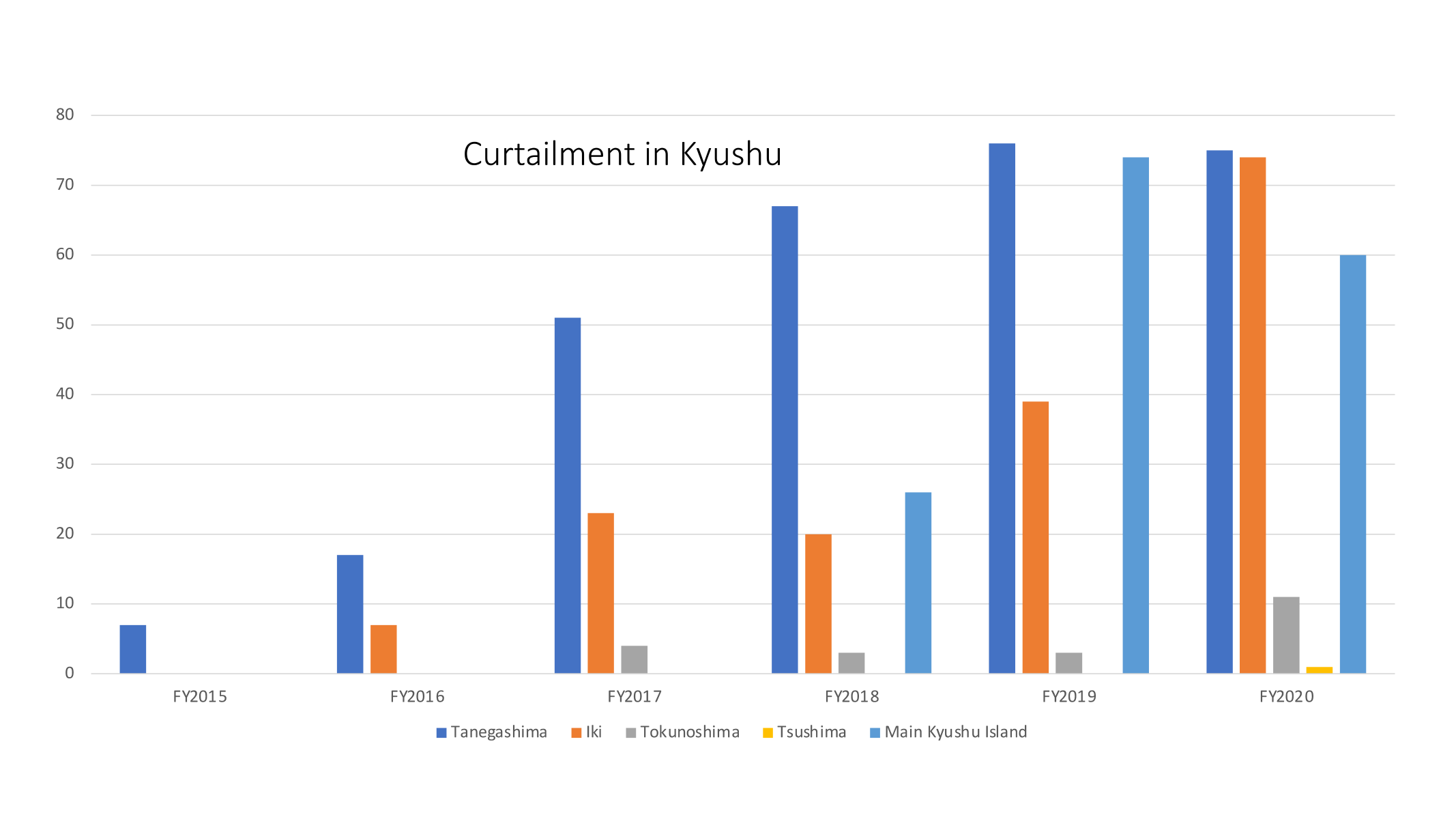
Curtailment of solar electricity started in the sunny southwestern Kyushu region after 2012 when a generous feed-in tariff (FIT) program brought a rush of solar developers.
It began on small islands with low power demand. The first curtailment occurred on May 5, 2015, on Tanegashima, with a population of just 27,000. It happened on two more islands in the years that followed. On Oct. 13, 2018, the first curtailment on Kyushu’s main island took place.
Since then, curtailment is a regular feature in Kyushu, especially in spring and fall when demand for air conditioners is low, or during holidays when factories are not operating.
According to METI’s rules, adjustments of output are made in the following order:
- Fossil fuel-powered plants (coal, oil and gas) and pumped-storage hydro plants
- Interregional connections
- Biomass power plants
- Solar, wind power plants
- Nuclear, hydro, and geothermal power plants
This rule for priority dispatching, according to METI, is set in accordance with the generation cost of each power source and technological differences. Nuclear, hydro and geothermal are categorized as “long-term fixed power sources.” METI says it is difficult to control their output quickly and frequently.
Curtailment can also happen due to local transmission constraints when there’s not enough transmission capacity to deliver renewable power to where there’s demand.
So far, curtailment has occurred only in Kyushu. But as other regions add solar and wind capacity, METI forecasts that the same issue will spread to Hokkaido, Tohoku, Shikoku and Okinawa regions.
Up to 730 million kWh of solar in Kyushu (equivalent of 5.2% of the region’s total renewables output) may be curtailed next fiscal year, which starts in April, METI says.
Estimates for curtailment in other regions
| Areas | Curtailment Volume | Equivalent to total renewable output |
| Shikoku | Up to 53.9 million kWh of solar | 1.1% |
| Tohoku | Up to 31.4 million kWh of solar | 0.33% |
| Hokkaido | Up to 1.4 million kWh of solar and wind | 0.35% |
| Okinawa | Up to 976,000 kWh of solar | 0.2% |
Source: METI
A loss-loss situation
Curtailment means financial losses for generating companies and lost opportunities to use energy from sources that don’t emit CO2. In order to remedy the situation, METI suggested during a meeting in December that curtailment focus should be turned from renewables to plants that run on fossil fuels Currently, operators of coal- and gas-fired plants can be ordered to limit output to 50% of capacity, but METI proposed dropping that to between 20% and 30%.
Major power utilities claim that this will cause technical stress on existing thermal power plants around the country, which would endanger energy security. What’s more, such low caps would make new investments in thermal power plants highly unlikely, says Ikebe Kazuhiro, chairman of the Federation of Electric Power Companies of Japan and CEO of Kyushu Electric.
The Kyushu region, where renewable capacity has increased about 31% on an annual basis since 2011, has 10.6 GW of solar and 630 MW of wind generation installed.
Beside curtailing renewables, Kyushu Electric is expanding its grid capacity to transmit excess solar power to Japan’s mainland. The utility has also installed a 50 MW (300 MWh) storage battery in Fukuoka Prefecture to absorb excess solar power.
The utility is also working to shift the electricity demand of industry and residents. It’s working with Tokyo Steel, which typically uses cheaper electricity at night and on weekends. Kyushu Electric notifies the steelmaker in advance when cheaper electricity becomes available during the day so that Tokyo Steel can shift production to factories in Kyushu from those elsewhere.
For residential use, the utility has partnered with SB Power, SoftBank’s electricity unit, to shift power demand for EVs and home appliances like washers and irons to daytime with some 18,000 households participating. Residents can earn points on gift cards for charging their cars and doing the laundry when there’s plenty of sunlight.
The bigger solutions
Larger-scale solutions are needed. METI proposed to revise the Energy Conservation Act to optimize power demand, which would introduce dynamic pricing. This is meant to shift demand to times when renewable energy is plentiful, partly dovetailing supply with lifestyle.
Hydrogen is also expected to play a key role absorbing excess renewable power. The Hibikinada waterfront area in Kitakyushu City is home to a total 160 MW of renewable capacity (solar, wind and biomass). A consortium of Fukuoka Prefecture, Kitakyushu City, IHI, ENEOS, Fukuoka Oxygen, and Kitakyushu Power has been working since 2020 to produce hydrogen from the local renewable sources and supply hydrogen through a pipeline at hydrogen stations. The three-year, 800-million-yen pilot project funded by the MoE aims to build a low-cost, carbon-free hydrogen supply chain.
In August, the government awarded funding from the Green Innovation Fund for three projects to develop technologies to produce hydrogen made with renewables. Among the recipients: Asahi Kasei, JGC, TEPCO, Hitachi Zosen, and Siemens Energy.
Of course, integrating intermittent electricity is an issue in many parts of the world and so far there seems to be no single winning formula. It is often addressed through a combination of technologies and policies.
Japan’s current share of VRE at 8.2% is a paltry amount compared with Denmark’s 58.5% and south Australia’s 46.6%, according to IEA data. In the case of Denmark, which transitioned to a higher VRE share over 20 years, flexible thermal power plants and interconnectors played a big role in the early stage of transition, according to a Danish Energy Agency report released last year.
For Japan, importing power from other countries is just not an option, while major owners of thermal power, like Kyushu Electric, tend to have little renewables capacity themselves and few incentives to sacrifice their output.
One of the government’s biggest CO2 reduction strategies, often mentioned in long-term energy strategy documents, talks of promoting lifestyle changes. Kyushu may show just how much flexibility there is in the demand side of Japan.
ANALYSIS
BY SAKI ISETANI
Think Pink: Japan’s Domestic Hydrogen Ambitions
May Rely on Next-Generation Nuclear Technology
A decade before the world became familiar with the color-based terminology of hydrogen, especially the green and blue versions, Japan’s strategy for producing the clean-burning gas rested on nuclear power. After the Fukushima accident, the domestic nuclear-powered hydrogen program was frozen, but it’s now making a comeback.
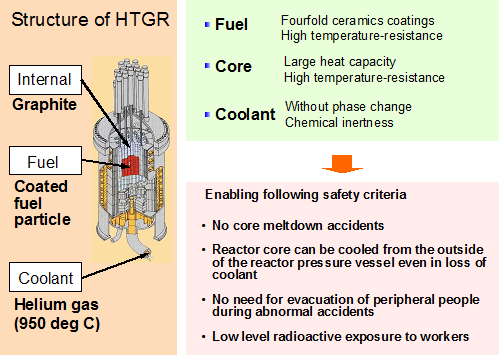
Last summer, the High Temperature Engineering Test Reactor (HTTR) in central Japan was restarted after a 10-year hiatus. The experimental reactor is cooled by helium, as opposed to water like most reactors in operation today. Its design both reduces risk and allows the technology to produce heat of around 950°C, enough for thermochemical manufacture of clean hydrogen.
Unlike Small Modular Reactor (SMR) technology, in which Japan is only starting to get involved, the HTTR facility represents the world’s most advanced operating example of the so-called high-temperature gas-cooled reactor (HTGR). As more and more countries consider HTGR technology, both for its increased safety and potential to make hydrogen, Japan’s experience is bringing in new international partnerships and commercial contracts.
Poland’s entire nuclear energy program, created to move the nation away from coal, is predicated on Japan’s HTGR designs and experience.
Domestically, the fate of the HTTR facility is even more crucial. It’s baked into the Basic Energy Plan and Japan’s concept for a hydrogen society, while the Green Growth Strategy describes it as a key technology for the development of large-scale hydrogen production by 2030. The tech is also an important vector for some of the big engineering firms, such as Mitsubishi Heavy Industries and Toshiba.
While the government has yet to voice support for new nuclear facilities, due to fears over voter pushback, the rebirth of nuclear as a hydrogen enabler may offer a path back to acceptance.
| What is a High Temperature Gas Reactor (HTGR)?
HTGR is a nuclear reactor that uses helium gas for its coolant and graphite (ceramic material) for its core structure to enable high-efficiency power generation at 1000°C, three times higher than that of conventional light-water reactors. Helium gas is an inert gas that does not bond with other molecules. Therefore, it does not cause chemical reactions no matter how high the temperature, avoiding the risk of hydrogen or steam explosions. HTGR is said to be safer than most of the reactors operating today since graphite, which has an enormous heat capacity, allows for slow temperature variation and enables the core to be cooled passively even in the loss of coolant, preventing core meltdown. Graphite cladding is heat resistant up to 2,500°C, which is twice as high as the temperature at the time of the Fukushima Dai-Ichi nuclear accident. |
The history
Japan’s HTGR development began in 1969, led by the predecessor of the Japan Atomic Energy Agency (JAEA). It researched nuclear heat utilization technology and irradiation of materials under high temperatures.
In 1991, the JAEA ordered the construction of the nation’s first HTTR, a research reactor with a thermal output of 30 MW, at the Oarai Research Institute in Ibaraki Prefecture. It sits 30 meters underground to protect it from tsunami and terrorist attacks, although the control room is at ground level.
Source: JAEA
The plant began operation in November 1998 and passed safety demonstration tests in 2002. It generated a temperature of 950°C for 50 consecutive days and continuously produced hydrogen for 150 hours from the heat, which is still considered to be the best performance from a HTGR unit.
In February 2011, the plant was shut down for planned inspection, but after the Fukushima disaster all operations were frozen while the facility was upgraded to comply with revised safety standards. It finally passed regulatory approval in June 2020 and restarted in July 2021. The plant was temporarily halted in October to complete its final inspection, a test of its safety at 100% output.
Following the restart of the HTTR plant, current METI minister Hagiuda, who was previously head of the Ministry of Education, Culture, Sports, Science and Technology (MEXT), said that he expects consistent progress in HTGR technologies to expand hydrogen production in the coming years. The technology is important to accelerate carbon neutrality among the various industries.
Today
As for the next step, the JAEA plans to restart the plant this month and rejoin international cooperation on HTGR research. This includes the Loss of Forced Coolant (LOFC) project, which is a safety verification test that’s been carried out in Japan since 2009 under the Nuclear Energy Agency (NEA) framework. NEA is part of the Organisation for Economic Co-operation and Development (OECD).
The first stage of the LOFC test was completed in 2010, when the HTTR showed it could cool naturally, without outside support or coolant, after power was shut down while the unit ran at 30% output. Now, Japan aims to complete a demonstration test of a shutdown from 100% output to test the reactor under more severe conditions.
Japan is also working to develop an advanced HTGR fuel for extended burn-up. The country was the first to create a commercial fuel fabrication facility for HTGR fuel, which is known as TRISO (Tri-structural isotropic)-coated fuel particle.
H is for hydrogen
While Japan’s HTTR design can work simply for power generation, since inception it’s been seen as a way to source cheap heat for hydrogen production using the Iodine-Sulfur process, through water dissociation. The process relies on strong acids.
The initial designs for HTTR were devised by Mitsubishi Heavy Industries, which also headed the construction. The company said recently that it is now working to develop hydrogen production technology and a helium gas turbine direct power generation system that will improve efficiency of the HTTR. MHI says these technologies will be the key for HTTR commercialization.
JAEA researchers told media this month that a hydrogen plant linked to the HTTR unit is slated to start production of the gas in 2026-27. With a heat output of 600 MW, an HTTR facility can produce enough fuel over 300,000 fuel cell vehicles for a year.
Other Japanese firms closely involved in HTTRs are Toshiba and Fuji Electric.
Hydrogen produced with the help of nuclear power is termed ‘pink’ to differentiate from the gas made from renewable energy sources (‘green’) or fossil fuels (‘grey’ and ‘blue’ if the emissions are captured and stored).
China stealing ahead?
While Japan’s nuclear R&D was shelved for a decade, China has sped up its development of HTGRs, creating a 10 MWt high-temperature helium-cooled test reactor (HTR-10) in the 2000s. The unit is a pebble bed-type reactor, which is based on German technology. Japan uses a block-type HTGR design.
The HTR-10 began operations two years after Japan’s HTTR. However, over the last 10 years, China has moved onto the next stage: operation of 200 MW high-temperature gas-cooled pebble-bed modular reactor (HTR-PM).
Commercialization of HTGRs is progressing in six municipalities in China, with three in Fujian and one each in Guangdong, Zhejiang, and Jiangxi provinces. China plans to build a commercial-size 1.2 GW HTGR by employing 12 100-MW HTR-PM reactors.
Although China is one step ahead towards commercialization of HTGR technology, it falls short in performance. The HTR-PM is only able to produce temperatures up to 750°C, which is 200°C lower than Japan’s HTTR. This lower temperature makes it difficult to achieve hydrogen production.
Future of Japan’s HTTR and international cooperation
When its domestic program was halted, Japan’s HTGR researchers turned to working with partners overseas. International cooperation remains important to further the rollout of HTGR technology globally, especially in countries new to nuclear energy, and the tech’s eventual commercialization.
In 2017, JAEA signed a memorandum with Poland’s National Center for Nuclear Research (NCBJ) for a commercialization of HTGR in Poland. While it could not act as a commercial entity to build the reactors in the European country, JAEA has acted as a scientific advisor and helped Poland set up its nuclear program from scratch.
From this January, JAEA will expand its joint research on the basis of HTTR to six countries, including France, Germany, and South Korea. The research will also be used to further development of hydrogen production.
GLOBAL VIEW
BY JOHN VAROLI
Below are some of last week’s most important international energy developments monitored by the Japan NRG team because of their potential to impact energy supply and demand, as well as prices. We see the following as relevant to Japanese and international energy investors.
Brazil/ Nuclear power
The Ministry of Mines and Energy will seek and identify sites for nuclear power plants that are planned to be operational by 2050. Brazil relies on hydropower for as much as 65% of its electricity. The country only has one nuclear power plant, Angra, which produces about 3% of the nation’s total energy.
China/ Electricity
Electricity generation might triple by 2060 to supply 60% of the country’s total energy as a way to reach net-zero, said Royal Dutch Shell, adding that Beijing must be more decisive on the clean energy front. China plans to reach peak emissions by 2030, but lacks a detailed zero carbon emissions roadmap for 2060.
China/ Offshore wind power
Three Gorges Corp will spend about $6.5 bln to build three offshore wind farms in the Guangdong province. Best known for hydroelectric dams, in the next three years the state-owned company plans to triple power output from wind turbines and solar panels to 80 GW. This would make it the world’s largest offshore wind operator.
India/ Renewables
Energy, telecom and retail conglomerate Reliance Industries, owned by billionaire Mukesh Ambani, will invest $80 bln in 100 GW of green energy capacity, aiming for net-zero emissions by 2035. This follows recent plans by Adani Group, owned by billionaire Gautam Adani, to invest $70 bln to become India’s and the world’s biggest renewable energy producer by 2030.
Italy/ Energy crisis
The government will spend as much as €4 billion to help consumers who are suffering from high energy prices. In the first quarter, Italians are facing electricity and gas bill hikes of 55% and 42%, respectively.
Serbia/ Lithium
Belgrade terminated plans by Anglo-Australian mining giant Rio Tinto to develop a $2.4 bln lithium mine that has the potential to be one of the world’s largest. The strategic metal is vital for many green technologies and modern devices. The news comes shortly after Australia deported Novak Djokovic, the world’s top tennis player, and a Serbian.
UK/ Offshore wind power
The £2 billion, 860-MW Triton Knoll offshore wind farm in the North Sea will be fully operational in March. With 90 Vestas turbines, each 164 meters high, it’s one of the world’s largest offshore wind farms. The project is 59% owned by Germany’s RWE; Japan’s Kansai Electric Power and J-Power have stakes of 16% and 25%, respectively.
UK/ Offshore wind power
With more than 70 bids from global energy companies and investment firms, the ScotWind leasing auction of seabed plots for offshore wind projects earned £700 million. The 17 projects have a total potential generating capacity of 25 GW, and cover 7,000 km2.
U.S./ Solar power
Clean energy company Intersect Power obtained federal approval for its 500-MW Oberon Solar Project on federal land in California. The project, which covers 2,700 acres, includes a battery storage system that can store 500 MW for up to four hours.
U.S./ Oil and net-zero
ExxonMobil set a net zero goal for GHG emissions at its oil and gas operations by 2050. The company previously resisted having a 2050 net-zero target, saying it didn’t have a realistic plan on how to achieve it.
2022 EVENTS CALENDAR
A selection of domestic and international events we believe will have an impact on Japanese energy
| January | OPEC quarterly meeting;
JCCP Petroleum Conference – Tokyo; EU Taxonomy Climate Delegated Act activates; Regional Comprehensive Economic Partnership (RCEP) Trade Agreement that includes ASEAN countries, China and Japan activates; Indonesia to temporarily ban coal exports for one month; Regional bloc developments: Cambodia assumes presidency of ASEAN; Thailand assumes presidency of APEC; Germany assumes presidency of G7; France assumes presidency of EU; Indonesia assumes presidency of G20; and Senegal assumes presidency of African Union; Japan-U.S. two-plus-two meeting; Japan’s parliament convenes on Jan. 17 for 150 days; Prime Minister Kishida visits Australia (tentative) |
| February | Chinese New Year (Jan. 31 to Feb. 6);
Beijing Winter Olympics; South Korea joins RCEP trade agreement |
| March | Renewable Energy Institute annual conference;
Smart Energy Week – Tokyo; Japan Atomic Industrial Forum annual conference – Tokyo; World Hydrogen Summit – Netherlands; EU New strategy on international energy engagement published; End of 2021/22 Japanese Fiscal Year; South Korean presidential election |
| April | Japan Energy Summit – Tokyo;
MARPOL Convention on Emissions reductions for containerships and LNG carriers activates; Japan Feed-in-Premium system commences as Energy Resilience Act takes effect; Launch of Prime Section of Japan Stock Exchange with TFCD climate reporting requirement; Convention on Biological Diversity Conference for post-2020 biodiversity framework – China; Elections: French presidential election; Hungarian general election |
| May | World Natural Gas Conference WCG2022 – South Korea;
Elections: Australian general election; Philippines general and presidential elections |
| June | Happo-Noshiro offshore wind project auction closes;
Annual IEA Global Conference on Energy Efficiency – Denmark; UNEP Environment Day, Environment Ministers Meeting – Sweden; G7 meeting – Germany |
| July | Japan to finalize economic security policies as part of natl. security strategy review;
China connects to grid 2nd 200 MW SMR at Shidao Bay Nuclear Plant, Shandong; Czech Republic assumes presidency of EU; Elections: Japan’s Upper House Elections; Indian presidential election |
| August | Japan: Africa (TICAD 8) Summit – Tunisia;
Kenyan general election |
| September | IPCC to release Assessment and Synthesis Report;
Clean Energy Ministerial and the Mission Innovation Summit – Pittsburg, U.S.; Japan LNG Producer/Consumer Conference – Tokyo; IMF/World Bank annual meetings – Washington; Annual UN General Assembly meetings; METI to set safety standards for ammonia and hydrogen-fired power plants; End of 1H FY2022 Fiscal Year in Japan; Swedish general election |
| October | EU Review of CO2 emission standards for heavy-duty vehicles published;
Chinese Communist Party 20th quinquennial National Party Congress; G20 Meeting – Bali, Indonesia; Innovation for Cool Earth TCFD & Annual Forums – Tokyo; Elections: Okinawa gubernational election; Brazilian presidential election; |
| November | COP27 – Egypt;
U.S. mid-term elections; Soccer World Cup – Qatar; |
| December | Germany to eliminate nuclear power from energy mix;
Happo-Noshiro offshore wind project auction result released; Japan submits revised 2030 CO2 reduction goal following Glasgow’s COP26; Japan-Canada Annual Energy Forum (tentative); Tesla expected to achieve 1.3 million EV deliveries for full year 2022 |
Disclaimer
This communication has been prepared for information purposes only, is confidential and may be legally privileged. This is a subscription-only service and is directed at those who have expressly asked K.K. Yuri Group or one of its representatives to be added to the mailing list. This document may not be onwardly circulated or reproduced without prior written consent from Yuri Group, which retains all copyright to the content of this report.
Yuri Group is not registered as an investment advisor in any jurisdiction. Our research and all the content express our opinions, which are generally based on available public information, field studies and own analysis. Content is limited to general comment upon general political, economic and market issues, asset classes and types of investments. The report and all of its content does not constitute a recommendation or solicitation to buy, sell, subscribe for or underwrite any product or physical commodity, or a financial instrument.
The information contained in this report is obtained from sources believed to be reliable and in good faith. No representation or warranty is made that it is accurate or complete. Opinions and views expressed are subject to change without notice, as are prices and availability, which are indicative only. There is no obligation to notify recipients of any changes to this data or to do so in the future. No responsibility is accepted for the use of or reliance on the information provided. In no circumstances will Yuri Group be liable for any indirect or direct loss, or consequential loss or damages arising from the use of, any inability to use, or any inaccuracy in the information.
K.K. Yuri Group: Oonoya Building 8F, Yotsuya 1-18, Shinjuku-ku, Tokyo, Japan, 160-0004.