
JAPAN NRG WEEKLY
JAN. 31, 2022
JAPAN NRG WEEKLY
Jan. 31, 2022
NEWS
TOP
- Govt. plans to drop tariffs for solar to ¥9.5/ kWh within a year;
first time for the Feed-in Tariff to be in single digit - METI estimates that 480 carbon capture sites needed by 2050 and vast investments; JOGMEC outlines its guidelines for CCS
- New law promises to open up electricity grid to battery storage; legislation seeks to clarify status of the technology in the system
ENERGY TRANSITION & POLICY
- Negative-emissions tech outside CCS to be reviewed by govt.
- METI to establish methanation carbon tracing task force by March
- Japan sets targets for sustainable aviation fuel to speed up rollout
- New EV battery recycling scheme and power saving targets for data centers part of govt. initiatives to lower carbon footprint
- Iwatani buys hydrogen equipment maker for close to $200 mln
- Mitsui OSK aims to bring wave power to Japan via the UK
- TEPCO, Kansai Electric win state funds for offshore wind R&D
- Nissan-Renault to share EV platform, batteries in $26 bln push
- Osaka Gas tests hydrogen process that’s cheaper than electrolysis
ELECTRICITY MARKETS
- Summer power shortages risk easing after plans to restart coal
- ENEOS, others plan fightback in next offshore wind tenders; fishery cooperatives enraged by Mitsubishi’s Akita bid
- Itochu, Renova, JERA submit plans for new offshore wind projects
- JAEA, Mitsubishi Heavy join Bill Gates-backed nuclear project
- Tokyo Gas seeks 1 GW of renewables in Europe with Danish plan
- Cosmo, Abu Dhabi’s Masdar partner in offshore wind, hydrogen
- Asahi Group to invest over ¥50 bln in renewable energy projects
OIL, GAS & MINING
- Japan to subsidize oil companies as gasoline prices hit ¥170/ liter
- “Carbon neutral” LNG market spreads to 107 consumers in Japan
- Japan’s LNG stocks fall 27% from December on colder weather
- ENEOS to shut down Japan oil refinery due to waning demand
ANALYSIS
THE BATTLE TO CUT JAPAN’S METHANE EMISSIONS
❶ GREENING THE RICE-FARMING SECTOR
Rice is Japan’s main crop and staple food. Paddy fields, where rice is grown, account for half of all arable land in the nation. They also generate about 43% of all the methane Japan emits, with volumes little changed in the last decade. By committing to decarbonization, Japan now has to find a way to reduce emissions of this potent greenhouse gas without hurting domestic food supply. The nation’s farmers have turned to new water management techniques in the quest to find the right balance between conservation and yields.
❷ IMPROVING LIVESTOCK DIETS
The way to net-zero’s heart lies through the stomach. That’s the conclusion researchers have found as they grapple with how to cut emissions from cattle and other livestock, which make the biggest contribution to Japan’s methane volumes after rice. Innovation in animal feed could improve the health of livestock, and should be an environmental boon. Several companies already see this as a business opportunity to export Japan’s farming techniques to other countries in Asia and elsewhere. Eating well has never been more important.
GLOBAL VIEW
In 2021, a record $755 bn was invested globally in the energy transition and EV sales rose 77%. China’s EV sales jumped 154%. German govt. wants 10 GW of onshore wind each year. LG’s battery business sets an IPO record. Oman opens 500 MW solar plant. Sweden starts “pink” hydrogen production at nuclear plant. Details on these and more in our global wrap.
EVENT CALENDAR FOR 2022
Key political and business events in Japan and abroad.
JAPAN NRG WEEKLY
PUBLISHER
K. K. Yuri Group
Editorial Team
Yuriy Humber (Editor-in-Chief)
John Varoli (Senior Editor, Americas)
Tom O’Sullivan (Japan, Middle East, Africa)
Regular Contributors
Mayumi Watanabe (Japan)
Daniel Shulman (Japan)
Takehiro Masutomo (Japan)
Art & Design
22 Graphics Inc.
Events

SUBSCRIPTIONS & ADVERTISING
Japan NRG offers individual, corporate and academic subscription plans. Basic details are our website or write to subscriptions@japan-nrg.com
For marketing, advertising, or collaboration opportunities, contact sales@japan-nrg.com
For all other inquiries, write to info@japan-nrg.com
OFTEN USED ACRONYMS
METI The Ministry of Energy, Trade and Industry
MOE Ministry of Environment
ANRE Agency for Natural Resources and Energy
NEDO New Energy and Industrial Technology Development Organization
TEPCO Tokyo Electric Power Company
KEPCO Kansai Electric Power Company
EPCO Electric Power Company
JCC Japan Crude Cocktail
JKM Japan Korea Market, the Platt’s LNG benchmark
CCUS Carbon Capture, Utilization and Storage
mmbtu Million British Thermal Units
mb/d Million barrels per day
mtoe Million Tons of Oil Equivalent
kWh Kilowatt hours (electricity generation volume)
NEWS: ENERGY TRANSITION & POLICY

METI plans to drop FIT price for solar to ¥9.5 within one year
(Nikkei, Jan. 28)
- METI plans to set the feed-in tariff (FIT) for utility solar at ¥9.5/ kWh in FY2023, down ¥0.5 from ¥10 set for FY2022. This will be the first time for the FIT to drop into single digits as the govt. seeks to encourage price competition.
- At its latest meeting, the Committee for Calculating the Procurement Price approved the draft of the purchase price for renewable energy by power source for FY2023. A formal decision will be made by the end of March.
- In FY2023, the price for residential solar power of less than 10 kW capacity will be reduced by ¥1, to ¥16.
- SIDE DEVELOPMENT:
Environment Minister calls for radical reform of solar assessment process
(NHK, Jan. 25)- Environment Minister Yamaguchi wants radical reform of the environmental assessment process used to vet large solar projects.
- He said some renewable energy operators fail to inform communities about their solar farms, resulting in hostility.
- The government will crack down on operators that don’t consider the environmental impact of their farms.
- Land-grading performed on solar farm sites commonly requires depositing a large volume of loose soil, creating the risk of landslides.
METI estimates 480 CCS sites needed by 2050
(Nikkei, Jan. 28)
- METI held its first discussion for a timeline to rollout underground carbon capture and storage (CCS) technology. METI estimates 240 million tons of CO2 will be stored per year by 2050, requiring 480 sites.
- The cost of drilling to create the storage is estimated at over ¥2.4 trillion. METI wants to establish a business environment for the technology as soon as possible.
- Each CCS site may hold about 0.5 million tons, according to METI, which supervised Japan’s first large-scale test of CCS in Tomakomai City, Hokkaido.
- CCS is far from commercialized in Japan; METI hopes to reach this by FY2030. Drilling cost for one land site is estimated at ¥5 billion; in the ocean at ¥8 billion.
- SIDE DEVELOPMENT:
JOGMEC publishes guidelines on how to calculate CO2 emission cuts for carbon capture
(Kankyo Business, Jan. 26)- Japan Oil, Gas and Metals National Corporation (JOGMEC) has developed and published two sets of draft guidelines for calculating CO2 emission reductions in CO2 capture and storage (CCS) projects, and LNG, hydrogen and ammonia production projects.
- The first guideline integrates everything from CO2 sequestration to CO2 emission reductions into a single document. The second one, on “GHG Emissions from LNG, Hydrogen, and Ammonia Production,” integrates multiple international standards and initiatives into a single consistent approach.
- Both guidelines are intended for use in JOGMEC’s various operations.
- CONTEXT: JOGMEC is the state-backed investor in many new Japanese energy projects, especially those at an early stage. Meanwhile, there are no common international standards for CCS projects and there are discrepancies over how to calculate the CO2 emissions associated with LNG cargos.
- SIDE DEVELOPMENT:
JOGMEC to participate in Australia CCS project, CarbonNet
(Kankyo Business, Jan. 28)- The CCS project is planned in Victoria, Australia. JOGMEC will contribute to the FEED (basic design) of the CCS project to be implemented by the local government, and promote the project’s commercialization.
- The project aims to remove 5 million tons of CO2 a year for 25 years.
- SIDE DEVELOPMENT:
JFE Engineering ties up with Ishii Iron Works to win carbon capture projects
(Kankyo Business, Jan. 28)- The two firms aim to win more orders for CCS facilities as well as receiving and storage facilities for ammonia and hydrogen.
METI considers negative emission tech outside of carbon storage
(Japan NRG, Jan. 21)
- METI plans to review the potential of negative emission technologies that can best leverage Japan’s geographical features and doesn’t require carbon storage space. They are: biochar, forestation, development of “super trees” that absorb more carbon, and enhanced rock weathering that can take advantage of forest resources.
- Technologies that can optimize ocean resources are: soil carbon sequestration, and alkalinization in biomass released into the seas. Direct carbon capture (DACCS) and bioenergy with carbon capture and storage (BECCS) are the main negative emission technologies in Western countries but they require massive storage space, which may not be suitable for Japan, a representative from NEDO told a METI panel on green innovation strategy.
TAKEAWAY: Views on Japan’s CCS potentials are divided. Some argue Japan has land space constraints and that offshore CCS will take time to develop, but others say Japan has storage potential of several billion tons. CCS, if developed, will primarily be used to store carbon from power generation. The METI scenario is to store 10% of carbon from power stations in CCS in 2050.
METI to establish methanation carbon tracing task force by March 2022
(Japan NRG, Jan. 24)
- METI will launch a task force by March to establish measurement, reporting and verification methodology to assess carbon emissions in the methanation process, which recycles carbon into fuel called synthetic methane, by reacting carbon with hydrogen.
- The task force aims to share its methodology and relevant guidelines internationally in order to be recognized by the IPCC and the GHG inventory methodology as a new approach to reduce carbon, to generate offset credits, and to be accounted for nationally determined contributions (NDC).
- The task force will be comprised of four engineering and decarbonization experts.
- CONTEXT: Five gas operators (Tokyo Gas, Osaka Gas, Toho Gas, Shizuoka Gas, and Seibu Gas) plan pilot methanation projects with a combined capacity of around 2,000 NM3/h.
TAKEAWAY: Methanation plants will require electricity. The availability of green hydrogen and low-cost renewable power will be the key to establishing this as a clean source of energy. Although Japan has abundant carbon from steel and other industrial plants, deploying the technology overseas may be a good option initially due to better availability of green hydrogen and cheaper renewables.
Government sets targets for sustainable aviation fuel
(Jiji, Jan. 25)
- The government wants targets for sustainable aviation fuel production. By 2030, 10% of fuel used by Japanese airlines must be sustainable.
- A government/private sector committee will be set up to include officials from METI, the Ministry of Land, Infrastructure, Transport and Tourism, fuel manufacturers, and airlines.
- While sustainable aviation fuel currently accounts for less than 1% of global demand, aviation is a carbon-intensive form of transport, so the transition to sustainable fuel has the potential to significantly reduce carbon emissions.
METI discussing EV battery recycling scheme
(Jiji, Jan. 21)
- METI wants to create a plan for recycling EV batteries.
- It would require manufacturers to calculate the lifetime CO2 footprint of their batteries from procurement to disposal.
- SIDE DEVELOPMENT:
METI to set energy conservation targets for data centers starting in FY2022
(Nikkei, Jan. 29)- Companies with bases in Japan will be eligible, and large companies will be required to receive subsidies to support the introduction of energy-saving equipment. The amount of data is increasing due to digitization, and the power consumption of data centers is rapidly expanding.
Iwatani buys hydrogen equipment maker for close to $200 million
(Nikkei, Jan. 28)
- Japan’s top hydrogen producer, Iwatani Corporation, will buy Tokico System Solutions, a maker of hydrogen filling equipment, from Polaris Capital Group. The purchase price is undisclosed, but is estimated to be less than ¥20 billion.
- There are only a few manufacturers of hydrogen filling equipment in Japan. Tokico Systems is also involved in the construction and maintenance of gas stations, which Iwatani expects will help it to reduce operating and construction costs of hydrogen stations in Japan and the U.S.
Mitsui OSK aims to bring wave power to Japan
(Merkmal, Jan. 24)
- Mitsui OSK Lines agreed with UK-based Bombora Wave Power in January 2021 to assess the potential for wave farms in Japan and the rest of Asia.
- Bombora used Mitsui funding to test its proprietary mWave membrane-style wave energy converter in Wales, and will further developing the technology.
- The two companies are assessing suitable Japanese sites for wave farms.
- In addition to mWave, Bombora is developing a technology known as InSPIRE which integrates offshore wind turbines with wave generators.
TEPCO, Kansai Electric win state green fund grants for offshore wind generation
(Jiji Press, Jan. 21)
- State research hub NEDO, which administers the ¥2 trillion Green Innovation Fund, selected the renewable energy unit of TEPCO, Kansai Electric and two other firms to receive subsidies in the field of offshore wind power generation.
- NEDO will subsidize development of wind turbine technology that can withstand typhoons and lightning strikes, hoping to export the technology across Asia, and technology development that lowers costs for floating wind turbines.
- Daido Metal Industries and others will get grants to develop wind turbines; TEPCO RP and Tokyo Gas for the development of floating wind turbine technology; and Kansai Electric for the development of operation and maintenance technologies.
Nissan-Renault to share EV platform and batteries in $26 bln push
(Nikkei Asia, Jan. 27)
- The alliance, which includes Mitsubishi Motors, will share resources and new solid-state batteries to bring down EV prices. They’ll have 35 models by 2030.
- Nissan is developing all-solid-state batteries and will market them by FY2028.
- SIDE DEVELOPMENT:
New Panasonic battery extends range by 20%
(Nikkei, Jan. 24)- Next year, Panasonic will begin mass production of a new model of lithium-ion battery, the 4680, that can extend EV range by 20%, to around 750 km.
- The new battery will be made at a new ¥80 billion plant to be built in Wakayama. Eventually, the plant will make nearly 10 GW hours’ worth of batteries every year, enough to equip 150,000 Evs.
- The 4680 will initially be supplied to Tesla.
- SIDE DEVELOPMENT:
Honda EVs to take part in Switzerland’s Vehicles-to-Grid energy management experiment
(Kankyo Business, Jan. 21)- Honda Motor Co. will join a V2G (Vehicle-to-Grid) energy management demonstration project in Switzerland that will use EVs as storage batteries. The experiment runs from September to December 2023, using 50 units of the “Honda e” EV, and 35 units of the auto maker’s bi-directional charger.
- The demonstration is run by Mobility, a Swiss car-sharing company. It is thought that EVs can contribute to stabilizing electric power by recharging in both directions and returning energy to the power grid when they are not in operation.
- This demonstration will be the first to introduce mass-produced vehicles compatible with the European CCS EV recharging standard and are capable of bi-directional recharging.
Japanese startup creates portable hydrogen-powered generator
(Asia Nikkei, Jan. 25)
- This spring, Japanese startup Scitem will start sales of a portable emergency power generation system fueled by replaceable hydrogen cartridges. The power generators are about the size of a briefcase.
Osaka Gas tests hydrogen process that aims to be cheaper than electrolysis
(Nikkan Kogyo Shimbun, Jan. 24)
- Osaka Gas showcased an experimental facility for chemical looping combustion (CLC) technology, which started operation at its R&D base in Osaka City in Dec. 2021. CLC allows for the simultaneous production of hydrogen, electricity and CO2 by circulating iron oxide in three reaction towers.
- By selling the electricity and CO2, Osaka Gas aims to produce hydrogen at a lower cost than if it were produced through electrolysis.
- The demonstration of CLC technology is a project commissioned by NEDO. Osaka Gas, which is working with JCOAL on the project, aims to build a commercial-scale CLC plant using biomass fuel by FY2025.
Marubeni partners with Thai sugar firm to develop materials for bioplastics
(New Energy Business News, Jan. 26)
- Marubeni and Mitr Phol Sugar Corp signed an MoU in the field of bio-based products and renewable energy in Thailand. They will develop raw materials for products such as biomass plastics, manufacture and packaging materials, and to develop and introduce renewable energy by using agricultural resources.
- CONTEXT: Mitr Phol Sugar is the largest sugar company in Thailand.
- Bio-based products made from renewable organic resources, such as plants, are biodegradable. The Bio-Circular-Green Economy is a Thai national strategy.
Keio University startup raises funds to pioneer sound wave power generation
(Kankyo Business, Jan. 26)
- Sound Power Generation, a start-up from Keio University that develops renewable energy-related technologies, has raised ¥150 million from the sale of new shares through a third-party allotment to Ando & Ma, Daiwa House Industry, and others.
- The funds will go to develop what the company calls the world’s first “wave power generation” technology, which could be combined with hydropower.
Kansai Electric developing wireless maritime charging for Expo 2025
(The Japan Maritime Daily, Jan. 28)
- Kansai Electric, or KEPCO, conducted a trial of wireless recharging technology aimed at electrically-powered ships.
- Okuto Yoshimasa of KEPCO’s Solutions division said wireless recharging is necessary to recharge electrically-powered ships while at sea.
One-Dot News
- Sapporo Breweries installed a solar power system based on a PPA at its Gunma factory site. The equipment consists of 1,072 solar panels. The contract starts in March, and annual power generation is expected to be 627,000 kWh, enough to reduce CO2 emissions by about 330 tons per year. Kansai Electric will be the PPA provider. (New Energy Business News, Jan. 24)
- Idemitsu Kosan started a demonstration test for energy management in homes, which optimally controls storage batteries, heat pump water heaters, and air conditioners in conjunction with wholesale electricity market prices. (Kankyo Business, Jan. 28)
- Toyota Tsusho and France’s CFAO, a group company, subscribed to a third-party allotment of new shares by Acceleron (UK), which operates a battery reuse and rebuild business in the UK and Kenya. (Kankyo Business, Jan. 21)
NEWS: POWER MARKETS
New law to open electricity grid to battery storage
(Nikkei, Jan. 27)
- As part of a package to support generators of renewable energy, METI is preparing legislation to force operators of transmission lines to allow storage batteries to feed the grid if the battery owner requests.
- The package also includes subsidies, as much as 50%, for purchases of storage batteries by renewable generators. The government earmarked ¥13 billion for storage batteries in its supplemental 2021/22 budget.
- Previously, ambiguity around the legal status of storage batteries meant prospective battery owners feared they might be denied grid access.
- The govt could order releasing stored power in time of electricity shortages. The changes will be submitted to the current parliamentary session.
TAKEAWAY: This could be one of the single most important developments in the power grid this decade. The technology is not yet there in Japan to make batteries a significant part of the power system, but with Tesla and Huawei making early moves to seize the market and domestic battery makers keen to be involved it’s a sector that will likely grow in leaps and bounds, also paving the way for a stronger VPP and other energy management tools.
- SIDE DEVELOPMENT:
TEPCO sets up battery unit to expand the business
(New Energy Business News, Jan. 28)- Tokyo Electric will establish a new “Storage Battery Business Office” as an organization to spread storage batteries in Japan and to promote the storage battery business. The new organization will have about 10 staff members.
Government says risk of summer power shortage is easing
(Japan NRG, Jan. 25)
- Power shortages during the peak summer demand season from July to September this year will ease with the restart of the 1 GW Taketoyo-5 coal power plant (JERA) on Aug. 5, METI said.
- The power reserve rate for Tokyo, Chubu and other five areas were forecast to dip below the 3% minimal threshold, but with the Taketoyo restart and more solar power volumes expected the rate is now seen holding above 3%.
- Power shortages might prevail in winter of 2023, as the preliminary forecast shows Tokyo and Chubu areas will have reserve rates of 0.9-2.6% over January-February of 2023. The final power supply and demand forecast will be released in February at the earliest.
SIDE DEVELOPMENT:
Two IGCC coal plants excluded from 2022 power plan
(Japan NRG, Jan. 25)- METI won’t include new capacities of integrated coal-gasification combined-cycle (IGCC) power plants in Nakoso and Hirono in the national power supply plan for the next fiscal year due to operational instabilities. The two IGCC plants, brought online last year, suspended operations several times in the past months due to glitches in pumps and other equipment.
- The two have a combined capacity of 1.68 GW and their energy efficiencies are 46-50%.
ENEOS, TEPCO prepare to fight back in second wind tender
(Nikkei, Jan. 25)
- ENEOS Holdings and TEPCO Holdings are among companies planning to participate in the second round of tenders for offshore wind projects.
- This time, the authorities are likely to focus on the competitiveness of tariff bids when allocating contracts.
- On Jan. 24, TEPCO informed a partner financial institution that it will rethink its strategy, because half of its projected profits would be wiped out by trying to match Mitsubishi’s recent bid (significantly below ¥20).
- However, a source at a major turbine manufacturer believes the Mitsubishi consortium is certain to win the upcoming tender.
- Nishikawa Shusaku, senior analyst at Daiwa Securities, says the Mitsubishi consortium will use 134 GE turbines to build the projects in the first tender, and likely ordered even more GE turbines, perhaps over 200. This would mean deep discounts, allowing the Mitsubishi consortium to make a rock-bottom bid in the next round of tenders.
- SIDE DEVELOPMENT:
Mitsubishi bid opens Pandora’s box as fisheries complain of unfair treatment
(Diamond, Jan. 27)- Fishing cooperatives in Akita were angry to learn of the winning low tariff bid by Mitsubishi Corp’s consortium in tenders to build offshore wind farms.
- Under an agreement with local fisheries, the cooperatives will receive 0.5% of revenue from electricity generated by wind farms over the next 20 years.
- Had the winning operator bid the maximum allowable rate of ¥29/ kWh, the cooperatives would receive nearly ¥11 billion over 20 years.
- Instead, they will now receive a mere ¥4.6 billion.
- In contrast, fisheries cooperatives in Chiba agreed to receive a flat rate of compensation in relation to wind farm development (also undertaken by Mitsubishi) and stand to receive nearly ¥12 billion over 20 years.
- However, the low tariffs are good news for consumers, as levies added to power bills to finance the FIT scheme will be lower.
TAKEAWAY: As often noted in Japan NRG, the offshore wind tenders are not just an issue for the players in that industry. Local governments and local interest groups have to have a strong buy-in – an issue METI has often stressed. The fact that Mitsubishi offered different compensation schemes for different fishing cooperatives shows that the schema for the offshore wind business model is still being trialed. This gives other players a chance to be creative for the next tenders. It would be a big risk for the government to award the next tender to the Mitsubishi-Chubu Electric alliance that won the three tenders last year.
Itochu submits plans to develop 494 MW offshore wind farm in Yamagata region
(New Energy Business News, Jan. 24)
- Itochu Corp. plans to develop an offshore wind farm off the coast of Yusa-machi, Akumi-gun, Yamagata Prefecture, with a maximum output of 494 MW, according an environmental assessment report for the project.
- Construction is due to begin in 2025, and commercial operation around 2028. The area off the coast of Yusa Town is classified as a “promising area” under the Act on the Utilization of the Sea for Renewable Energies.
- SIDE DEVELOPMENT:
Renova submits plans for a 400 MW offshore win project in Saga area
(New Energy Business News, Jan. 26)- Renova released an environmental assessment report for its offshore wind power project near Karatsu City, Saga Prefecture. The area is classified as “at a preparation stage” under the Renewable Energy Use of the Sea Act.
- The area is 14,280 hectares, and the maximum number of wind turbines to be installed is 42, each with an output of 9.5 to 15 MW. Four types of foundations are under consideration: monopile, jacket, suction bucket, and gravity.
- Construction is expected to last about three years.
- SIDE DEVELOPMENT:
JERA aims to develop 350 MW offshore wind project in Akita
(Denki Shimbun, Jan. 28)- JERA aims to develop a 350 MW offshore wind farm off the coast of Happo Town and Noshiro City in Akita Prefecture. The company sent notice to METI.
- The above sea area is accepting bids. It’s believed that Mitsubishi Corp., TEPCO Renewable Power (RP) and others are preparing to bid for the project.
- JERA plans to install a maximum of 30 wind turbines with an output of 12 MW to 15 MW each. The construction and operation periods are not yet decided.
Japan’s JAEA and Mitsubishi Heavy officially join Bill Gates-backed nuclear project
(Asia Nikkei, Jan. 27)
- The Japan Atomic Energy Agency and Mitsubishi Heavy Industries officially announced their participation in a nuclear project led by a U.S. startup co-founded by Bill Gates.
- The Japanese side signed an MoU with TerraPower to help construct a 345-MW prototype plant in the American state of Wyoming. The plant is due to come online in 2028 and is subsidized by the U.S. Energy Department.
- TerraPower’s technology uses liquid sodium as a coolant in a fast neutron reactor. Mitsubishi Heavy’s role is to help develop technology for swapping out fuel and equipment to detect fuel failures.
- CONTEXT: Fast neutron reactors create conditions to sustain fission chain reactions. Such a process consumes plutonium fuel more efficiently and also transforms long-lived nuclear waste into elements with shorter half-lives.
- Unlike fast-breeder reactors, fast neutron reactors like TerraPower’s do not produce more plutonium to avoid the risk of proliferation.
Tokyo Gas aims for 1 GW renewables in Europe by investing in Denmark project
(The Kensetsu Tsushin Shimbun, Jan. 28)
- In its first European renewables foray, Tokyo Gas will work with Danish energy supplier EWII.
- The companies plan to develop about 1 GW of renewable energy in Denmark and other Nordic countries by 2030, including existing assets.
- Also, Tokyo Gas will spend about ¥3 billion to buy a 50% stake of EWII Production, a unit of EWII, which owns and operates 10 onshore wind projects in Denmark with a total capacity of 54.5 megawatts (MWs).
Cosmo and Abu Dhabi’s Masdar to partner in offshore wind, other renewables and hydrogen
(Kankyo Business, Jan. 24)
- Cosmo Energy Holdings signed an MOU with Masdar, a renewable energy business in the UAE, to collaborate in offshore wind, hydrogen, and ammonia.
- The companies will explore renewable energy projects in Japan and elsewhere. They’ll look at trading in hydrogen and ammonia fuel, as well as opportunities in carbon capture, utilization and storage (CCUS) and storage batteries.
- The initial focus will be on wind power generation.
- CONTEXT: Masdar, also known as the Abu Dhabi Future Energy Company, is a subsidiary of Mubadala Investment Co. that focuses on renewables projects around the world. Cosmo’s energy transition from its core oil business is focused on wind power.
Asahi group to invest over ¥50 bln in renewables
(Kyodo; Jan. 21)
- Asahi Group Holdings will invest over ¥50 billion in renewable energy to cut carbon emissions 70% by 2030, over the 2019 level.
- The group’s previous target was to cut carbon 50% by 2030, over the 2019 level.
Chubu Electric becomes No. 4 utility to reflect spot LNG in electricity prices
(Denki Shimbun, Jan. 24)
- Chubu Electric will base wholesale market electricity sales (JEPX) on a mix of long-term and short-term fuel contracts, allowing costs from spot purchases to filter through.
- JERA, Kansai Electric and Tohoku Electric already adopted such practices.
New TEPCO EP plan promises savings for solar users
(Jiji, Jan. 21)
- TEPCO Energy Partner has a new plan to allow subscribers with roof-mounted solar panels to use surplus electricity generated in daytime to power water heaters.
- TEPCO says the plan will reduce energy bills to a level comparable to households that use gas water heaters.
NEWS: OIL, GAS & MINING

Government to subsidize oil companies as gasoline hits ¥170
(Mainichi Shimbun, Jan. 25)
- Head of METI Haguida Koichi said the govt. will subsidize oil companies.
- The move comes in response to high gasoline prices, which recently surpassed ¥170 per liter for the first time in over 13 years.
- Oil companies will initially receive a subsidy of ¥3.4/ liter of gasoline sold.
- The move is aimed at keeping gasoline prices down.
- The move doesn’t go far enough, says the opposition, urging the government to reinstate a scheme created in 2010 by the now defunct Democratic Party of Japan that reduced the gasoline tax from ¥54/ liter to around ¥29/ liter whenever prices exceeded ¥160/ liter.
- SIDE DEVELOPMENT:
Service stations fear gasoline subsidy will breed confusion
(Jiji, Jan. 26)- The government’s decision to subsidize gasoline companies to offset high prices was met with criticism from some service station owners.
- They say that because service stations set prices based on sales and inventory volumes, the subsidies might not affect the price at the pump.
- Others expressed concern that drivers would assume the price of gasoline was now capped at ¥170.
TAKEAWAY: Although the cost of crude oil keeps rising, retail prices at the pump will drop by ¥0.9/ liter from the last week of January thanks to the government subsidies. The three major oil refineries have all announced a first notable price drop in months, affecting a broad range of petroleum products.
Energy prices are a less sensitive election issue in Japan than, for example, in the U.S. However, the government is concerned about energy price inflation spreading to food produce, which is an area that could become top national news. With vital upper-house elections this summer, PM Kishida’s objective is to keep dissatisfaction to a minimum.
Carbon neutral LNG spreads to 107 consumers
(Japan NRG, Jan. 24)
- Carbon neutral LNG is quickly spreading among large consumers, to 107 companies from just a handful a year ago, according to the Japan Gas Association. Among 107 users, 64 were manufacturers.
- Tokyo Gas started its supply in 2019. As of December last year, around 40 gas utilities were supplying carbon neutral LNG. The gas is sourced from Australia, Malaysia and etc. The association plans to write guidelines that will define the methodologies to measure, verify and price carbon credits.
- Outside the gas industry, oil refiner ENEOS, which has a gas retail license, started sales in November 2021, and Hokuriku Electric Power this month.
- SIDE DEVELOPMENT:
Tokyo Gas to supply carbon-neutral gas to Juntendo University
(The Daily Engineering & Construction News, Jan. 28)- Juntendo University and Tokyo Gas will collaborate to supply carbon neutral gas to campuses as well as to hospitals affiliated with the University. By switching to carbon neutral gas, Juntendo will reduce CO2 emissions by around 6,500 metric tons per year.
TAKEAWAY: Japan NRG was among the first to report the emergence of this niche in Japan and its potential to grow. The debate over the environmental credentials of “carbon neutral” LNG and other fossil fuels continues globally, but in Japan it has been seized upon as a manageable, near-term solution that the sellers like to promote. We expect the sector to continue to grow but also develop in tandem with the upcoming voluntary carbon market in Tokyo.
Japan’s LNG stocks fall 27% from December
(Japan NRG, Jan. 29)
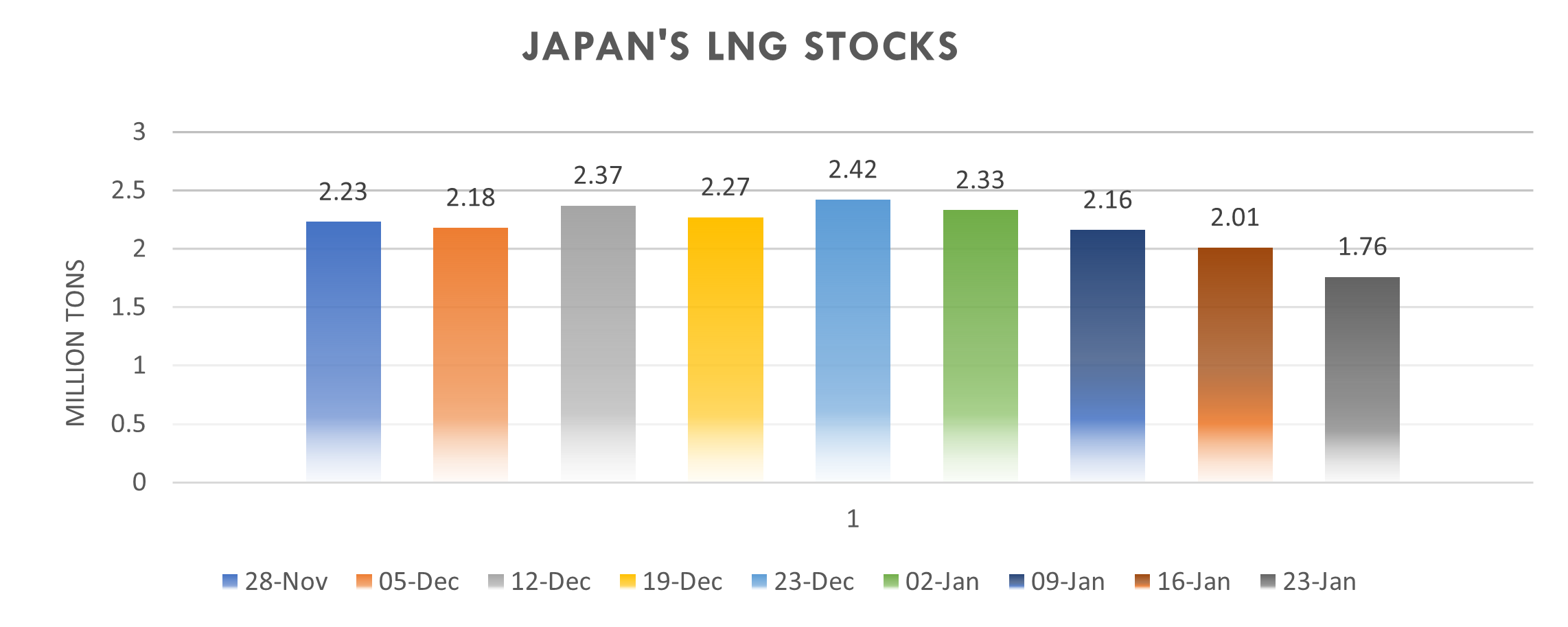
- Japan’s LNG stocks fell 27% from a month ago, to 1.76 million tons, according to METI. The Jan. 23 stocks stood at 1.76 million tons, compared to 2.42 million tons on Dec. 23, and 2.23 million tons on Nov. 28.
- The Jan. 23 level was higher than the year-ago stocks of 1.49 million tons and the four-year average of 167 million tons, METI data also showed.
Japan’s LNG imports from the US rise 50% in 2021
(Japan NRG, Jan. 28)
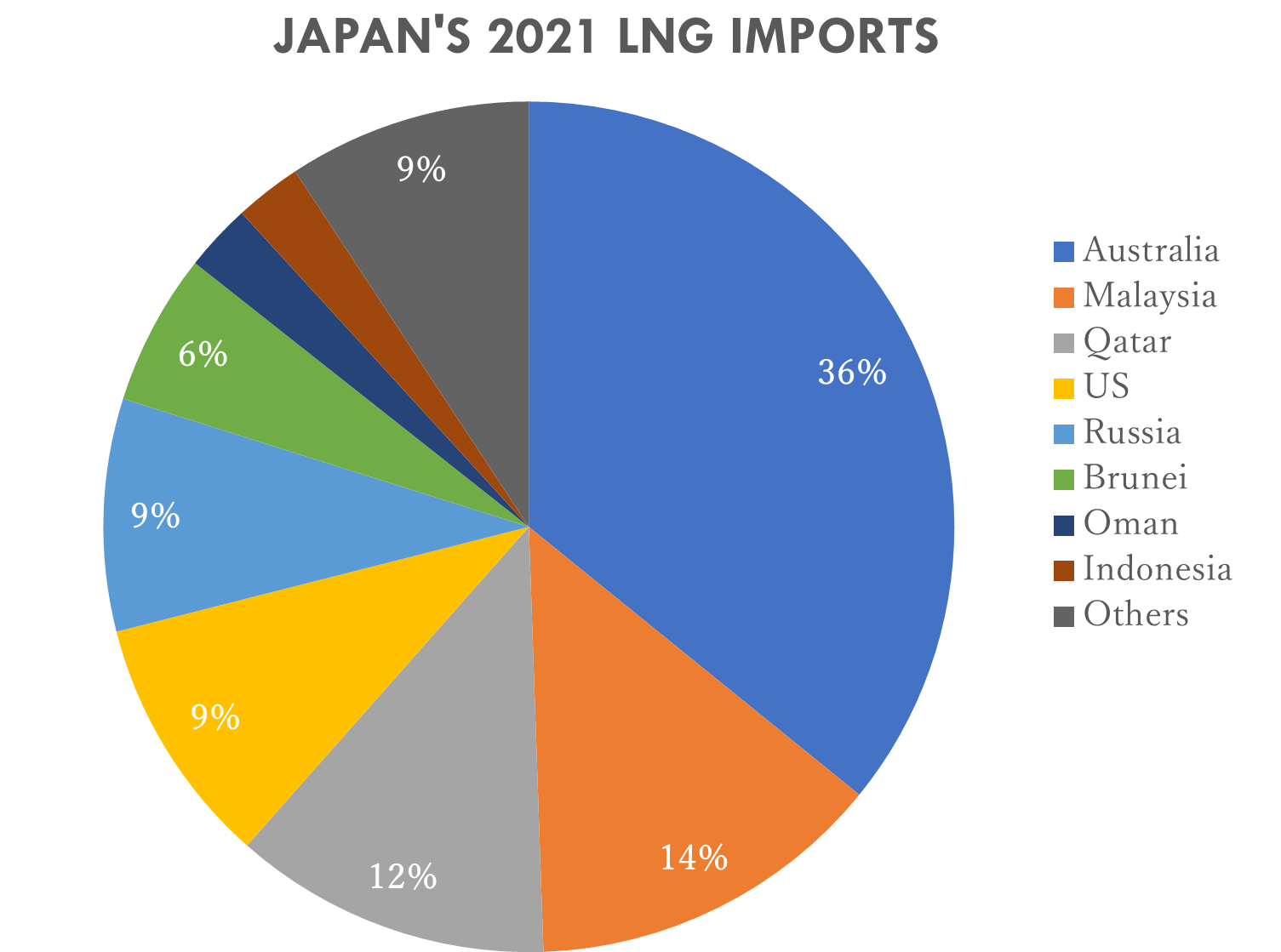
- Japan’s 2021 LNG imports from the U.S. increased 50%, to 7.07 million tons from 4.72 million tons, according to Japanese customs. The U.S. was the fourth largest import source, surpassing Russia.
- Imports from Australia were 26.63 million tons, down from 29.10 million tons a year ago.
- The imports totaled 74.32 million tons, flat from last year’s 74.46 million tons. The December imports were 7.03 million tons, up from 5.86 million tons in November.
ENEOS to shut down Wakayama refinery over low demand
(NHK, Jan. 25)
- ENEOS Holdings will close its Wakayama refinery late next year in response to falling demand for gasoline.
- ENEOS says that while closing the plant was a difficult decision, it’s necessary if the petrochemical company is to remain competitive.
- Locals fear the impact when the plant’s 450 workers are relocated.
- The refinery has been operating since 1941.
JGC and Norway’s Aker Solutions win engineering contract for Russia’s Yakutia LNG
(Various, Jan. 26)
- Engineering firm JGC Corp and Norway’s Aker Solutions will supply the front-end engineering design (FEED) for Russia’s Yakutia LNG project.
- The project will produce, process and export gas and condensate to Russia’s Far East and is planned at about 18 million tons of LNG per year in capacity.
- The final investment decision on Yakutia LNG will take place at the end of 2023. The commissioning of the first line at the plant is due around 2027.
Sumitomo Metal group says it developed world’s first lithium recycling technology
(New Energy Business News, Jan. 28)
- Sumitomo Metal Mining (SMM) and Kanto Denka Kogyo (KDK) developed the world’s first technology to recycle lithium compounds from used lithium-ion secondary batteries (LiBs) with high purity, and horizontally recycle them into battery materials. This enables recycling for lithium resources contained in LiB.
- Using KDK’s wet refining method, the new technology recycles lithium-containing slag generated in SMM’s secondary battery recycling process into a high-purity lithium compound that can be reused in LiBs.
- A pilot demonstration facility on a larger scale will start in FY2022.
Ukraine conflict will impact LNG imports
(Nikkei, Jan. 24)
- Japan depends on Russia for around 10% of its LNG needs.
- While LNG inventory is now high, the suspension of Russian imports could end in a repeat of last winter when shortages led to higher electricity prices.
- SIDE DEVELOPMENT:
OPINION: Divesting from Russian gas is not so simple
(Nikkei opinion, Jan. 25)- Japan, EU nations, and the U.S. are trying to reduce Russian gas consumption in the face of U.S. sanctions and potential conflict in Ukraine. Easier said than done, however, especially in the EU, which depends on Russia for 47% of its gas needs.
- Meanwhile, China’s gas consumption is increasing, and Russia hopes to sell more gas to Beijing; thus giving the U.S. less leverage over Moscow.
ENEOS starts second phase of robot delivery trial at service stations
(Sekiyu Tsushin, Jan. 25)
- ENEOS began the second phase of a trial to test the capabilities of the DeliRo delivery robot.
- More robots will be deployed over a wider area, even late at night.
- ENEOS plans to launch an automated delivery service as early as 2022/23 that will leverage its network of service stations.
- Labor shortages mean demand for delivery services is very high.
ANALYSIS
BY MAYUMI WATANABE and
SAKI ISETANI
The Battle to Reduce Japan’s Methane Emissions by 2030
Agricultural Sector Leads the Charge
For the past several decades, Japanese farmers have struggled with the effects of climate change, forced to alter planting and harvesting schedules to avoid typhoons. But now, the country’s farmers are going on the offensive, taking action to help slow climate change by cutting the agriculture sector’s greenhouse gas (GHG) emissions.
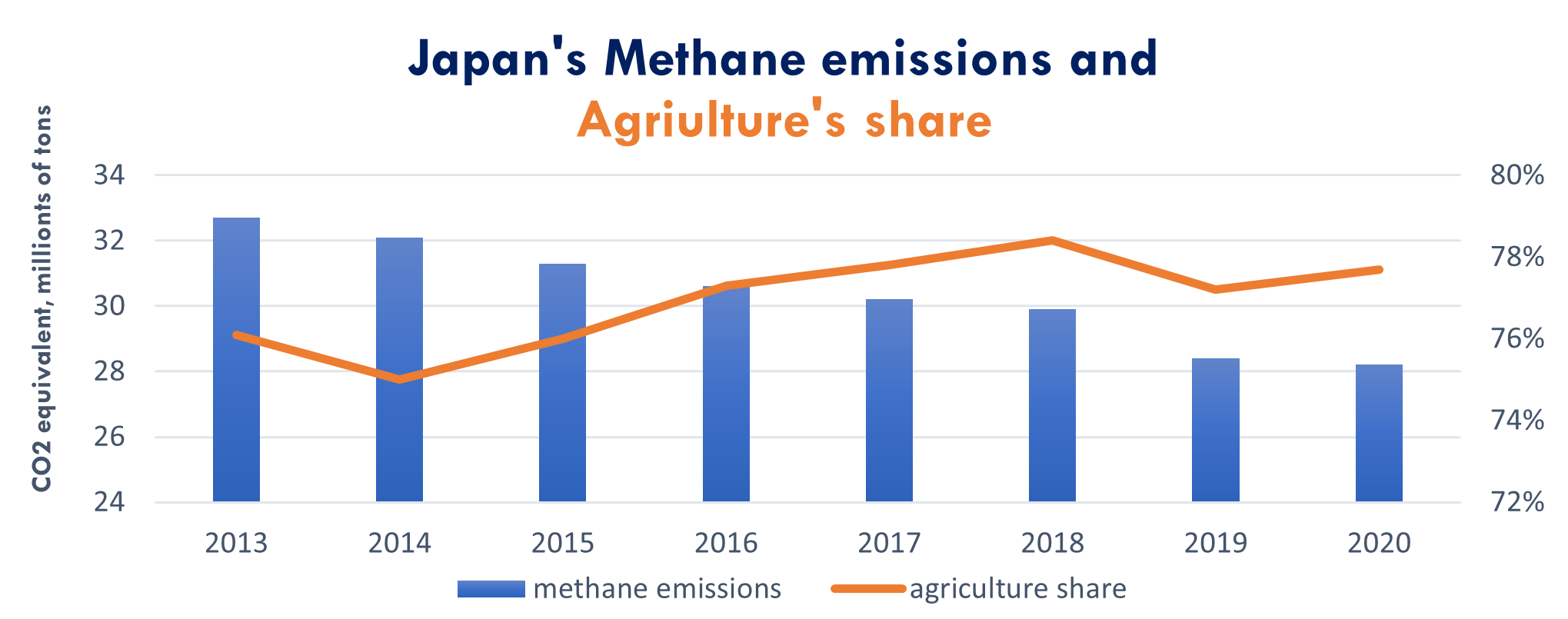
Methane is a major GHG in the agricultural sector. Japan’s methane release was 28.2 million CO2 equivalent tons in FY2020, with the agriculture sector accounting for 21.9 million tons of methane, or 78% of the nation’s total.
While most attention in climate conversations have centered on CO2, the potency of methane and its potential to cause even greater damage to the environment brought it more attention in the last year. During her opening remarks at COP26, EU Commission President Ursula von der Leyen said that methane reduction was the “lowest-hanging fruit”. That is, methane has a stronger warming effect on the atmosphere compared to a single molecule of CO2, and its reduction is a quick and easy way to reach the Paris Agreement global warming targets.
Two months before COP26, the U.S., and the EU initiated the “Global Methane Pledge” to cut global methane emissions 30% by 2030, over 2020 levels. Including Japan, 103 countries signed the pledge during COP26. However, the three top emitters China, Russia, and India didn’t sign, seriously weakening the initiative.
On a global level, Japan’s role in the methane emissions equation is minor, comprising 0.3% of the total. The U.S., the world’s fourth largest methane polluter, emits more methane by a factor of 23. Still, the solutions that Japan pioneers to cut emissions could be applied in many other countries, especially in Asia. On a global scale, methane emissions are up 262% from pre-industrialization levels, at 9,390 million tons of CO2 equivalent in 2020, according to the Global Methane Initiative.
Two steps forward, one step back
Japan has managed to reduce methane emissions 12% in the decade to 2020, owing to industrial waste treatment and other sectors, except agriculture. But agriculture-driven methane emissions have increased at the expense of cuts in other sectors, rising for three years in a row since 2018.
The biggest culprits are at the core of the nation’s diet: rice cultivation and cattle farming. To tackle their associated emissions, Japan is pursuing technology and methods that promise to cut methane volumes by 10-30%.
Of the 21.9 million tons in Japan’s methane emissions, roughly 50% come from rice fields, and 45% from livestock belching and manure.
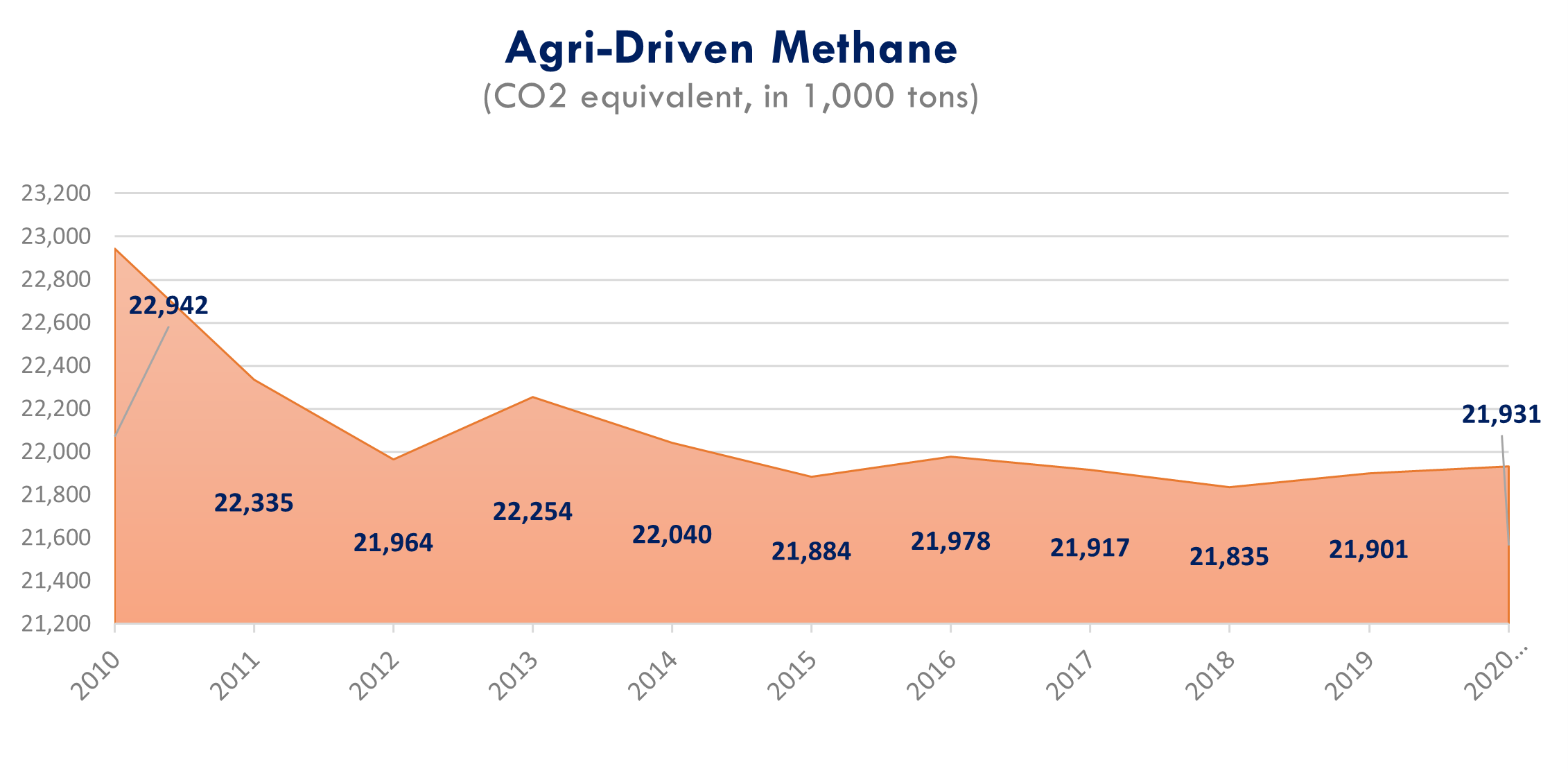
Agricultural methane emissions breakdown, 2010-2019
(1,000 CO2 equivalent tons)
|
2010 |
2011 |
2012 |
2013 |
2014 |
2015 |
2016 |
2017 |
2018 |
2019 | |
|
Total |
22,942 |
22,335 |
21,964 |
22,254 |
22,000 |
21,884 |
21,978 |
21,917 |
21,835 |
21,901 |
|
Belching |
8,202 |
8,154 |
7,953 |
7,737 |
7,543 |
7,534 |
7,481 |
7,494 |
7,465 |
7,563 |
|
Livestock manure |
2,481 |
2,472 |
2,429 |
2,368 |
2,325 |
2,322 |
2,282 |
2,290 |
2,290 |
2,328 |
|
Rice fields |
12,186 |
11,635 |
11,511 |
12,078 |
12,101 |
11,961 |
12,149 |
12,069 |
12,015 |
11,946 |
|
Heat treatment of agricultural waste |
74 |
73 |
71 |
72 |
70 |
67 |
67 |
64 |
65 |
64 |
Source: National Institute of Environmental Studies
Part I: Reducing Rice-Driven Methane
Rice is Japan’s main crop, covering half of arable land, and the country is the world’s 10th largest rice producer, with annual production of 7.8 million tons. In 2019, the Japanese rice sector generated 11.9 million tons of methane from 2.4 million hectares of paddy fields.
Data from the Japan International Research Center for Agricultural Science (JIRCAS) shows that methane accounts for 50% of rice field GHGs. Although the area of rice farming decreased 4% in the last 10 years, methane emissions held stable at around 12 million tons/ year.
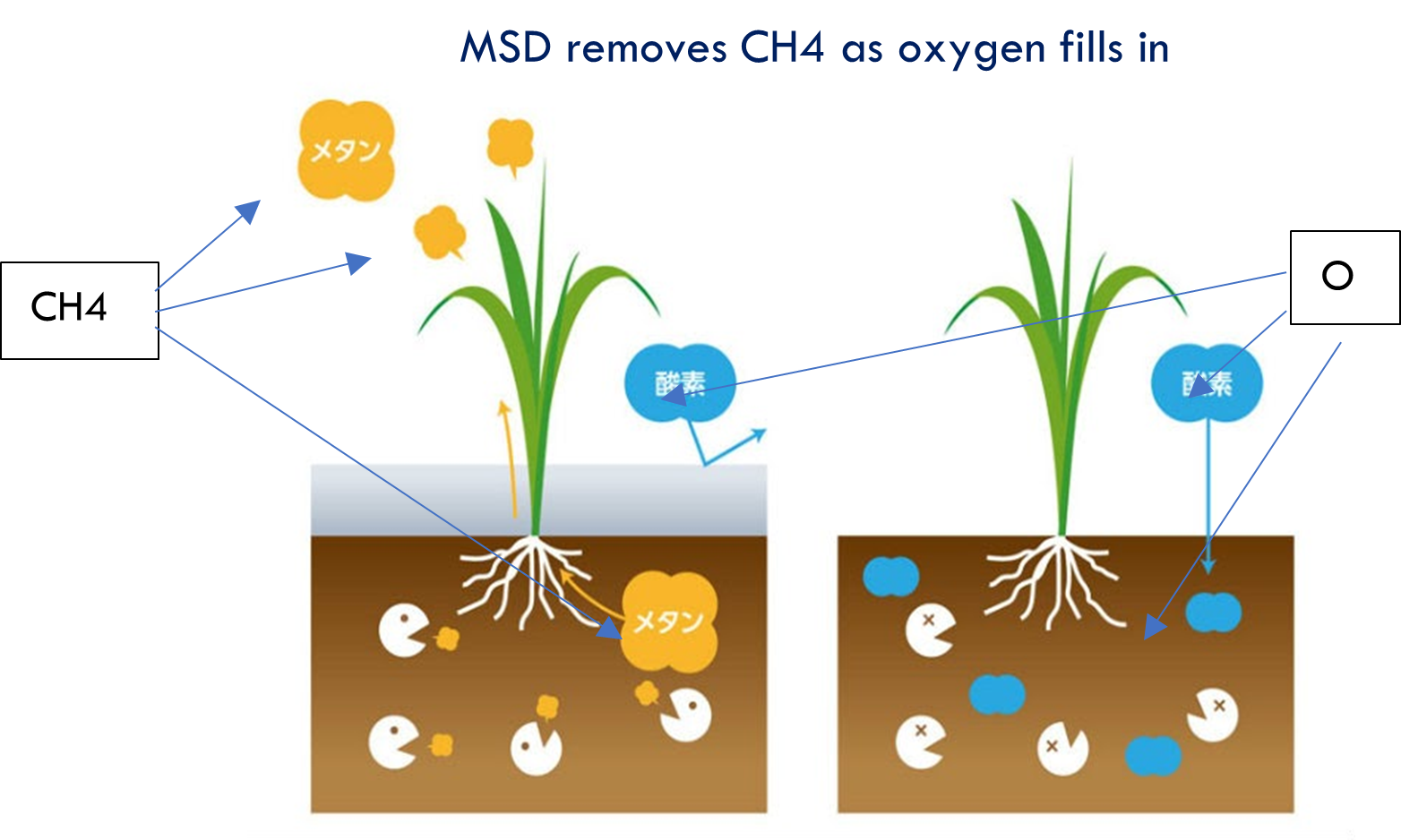
Methane is generated when farmers flood rice fields, precipitating a drop in oxygen levels, allowing microorganisms in the soil to flourish and produce large amounts of methane. Proper water management in the paddy fields is key to controlling methane. Mid-summer drainage (MSD), a traditional Japanese farming technique, reduces methane and temporarily removes irrigation water, typically for two to three weeks in June-July, before the rice heading date, causing the soil surface to crack.
Soil aeration lets oxygen enter the roots, suppressing the activity of methanogens, the bacteria that produce methane. If implemented at the right timing and duration, the technique can reduce methane volumes by up to 30%. In the image below, the diagram on the left shows a rice field without MSD. The water causes oxygen to decrease, allowing methanogens to increase. In the other diagram, on the right, water drainage allows oxygen to be supplied to the soil, decreasing the methanogens.
MSD removes CH4 as oxygen fills in
Source: Science Portal
The Agriculture Research Center in Fukushima was the first to study MSD’s impact on methane generation. Research showed that extending the period of MSD by one week led to a reduction in methane levels without impacting the crops.
To see if this could be applied to regions with varying soil types and climate, the National Agriculture and Food Research Organization (NARO) held a pilot in eight prefectures across Japan. The study showed that extending the mid-drainage period by a week reduced methane generation 30% compared to conventional mid-drainage.
Underground water level control system
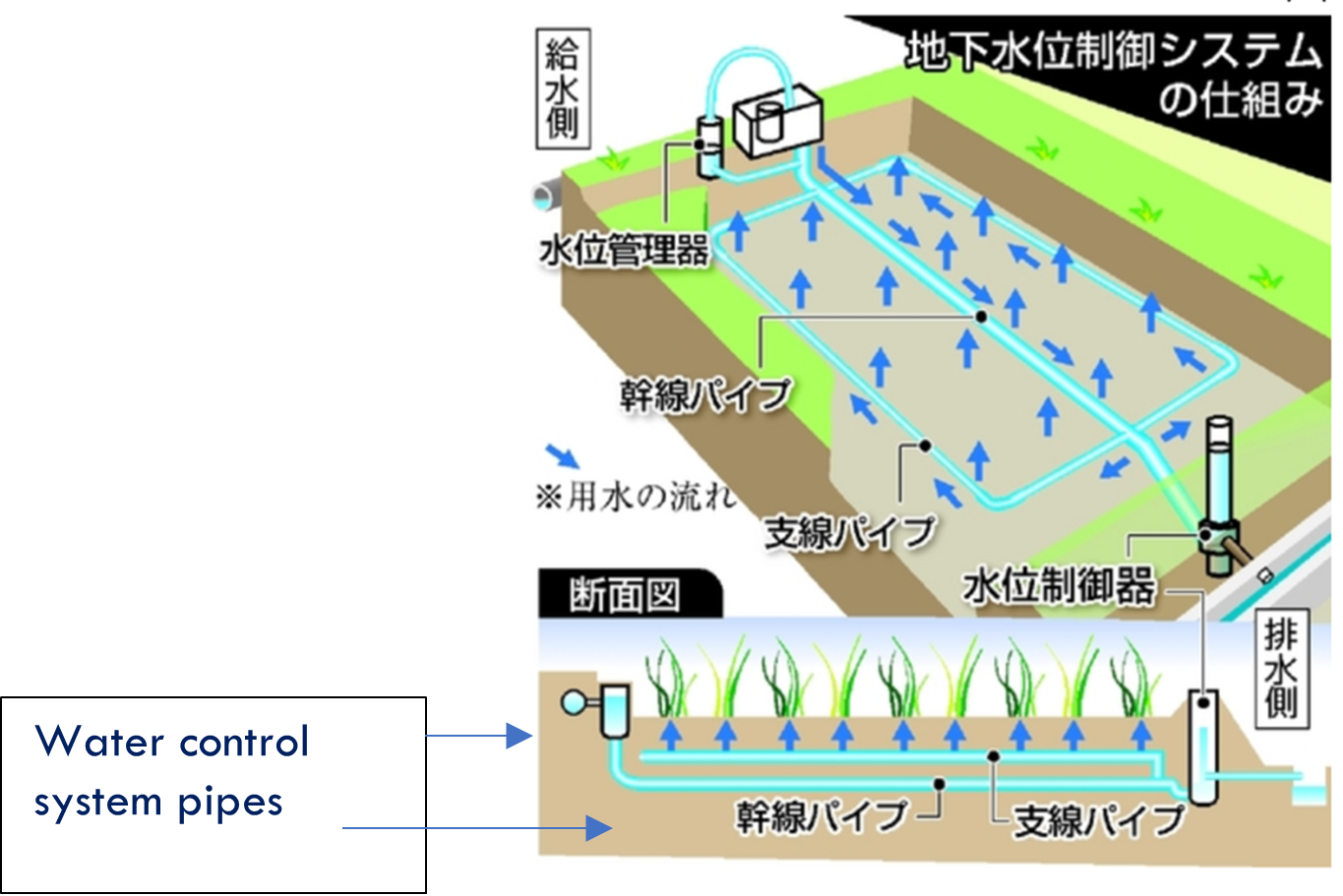
Meanwhile, the Niigata Prefecture has a new initiative to reduce methane emissions from rice fields. Known as the “underground water level control system”, the local government is currently researching its application for methane reduction. The system uses an Alternate Wetting and Drying (AMD) mechanism to reduce methane without negative impact on rice production yield and quality.
The system adjusts the water level in the soil by supplying and draining the water through pipes that run the entire paddy field. This system significantly reduces drainage time, which is key. A Meiji University study shows that underground water irrigation can reduce methane generation by about 30% compared to surface irrigation.
Source: Niigata Nippo
The “underground water piping system” was originally developed for increasing crop volume. The pipe that runs through the system helps to improve drainage, making it easier to manage water flow and improve work efficiency. Niigata is the country’s number one rice producing region, and if the technology is successfully implemented then it can be a big step in reducing methane. Niigata’s rice fields cover 119,200 ha, or 8% of the country’s total.
Part II: Tackling Methane from Cattle
Out of the global total of 1.5 billion, the Japanese cattle population is about 4 million, but they account for over 75% of Japanese livestock methane emissions – 9.9 million tons. Cattle are responsible for 7.5 million tons of methane from belching. Other major belchers – sheep and goats — are negligible in Japan. Cattle release over 45 million tons per year of manure, accounting for over 56% of domestic animal manure.
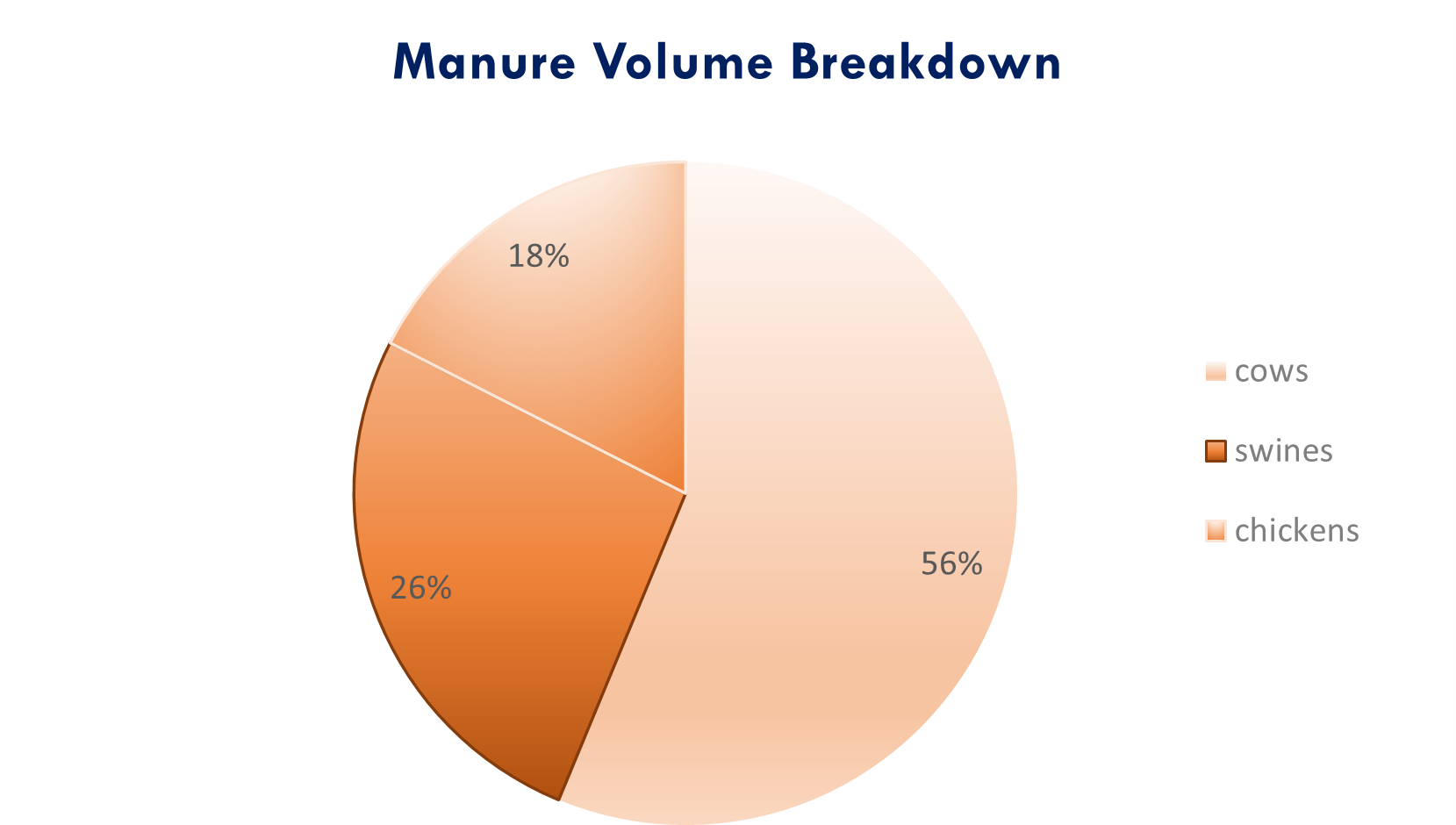
Cattle release methane while digesting food, and in Japan their average daily emission is 300-600 liters of methane, after eating 10-20 kg of feed. Dairy cows consume more feed and release more methane than beef cattle. Around 35% of Japanese cows are dairy, mostly Holstein Friesians originally from Europe.
Killing several birds with one stone
There are two approaches to cutting cattle methane: through improved feed and breeding. In Japan, the focus has been on developing new feeds with various functions. Apart from being healthy and nutritious, the feed provides protection from diseases and improves nutrient absorption.
In 2021, Japan had 55,900 dairy and beef farms, down 29% from 2013. These farms were short-handed and many closed due to an aging workforce. But feed manufacturers had to sell new products to increase their share in the shrinking market.
For decades, fatty acids were mixed with corn, soy beans and other feeds to improve digestion and speed up growth. The hydrogen in the cow’s stomach combines with fatty acids and cuts methane gas generation. This type of feed was generally marketed to improve health and growth rates, and was not labeled as methane-reducing.
According to pioneering food company Nichirei Corporation, which gives cattle a diet rich in fatty acids, the feed cuts methane gas by 10%. It also improves digestion, shortening the growth period and reducing feed costs.
In 2011, oil refiner Idemitsu launched Ruminap, a cashew nut shell liquid-based compound feed that cuts methane release by up to 20%. Research shows that coconut oil, cashew nut oil, apple acid, oleic acid, and ginkgo nut have methane reduction effects. In 2021, the Ministry of Agriculture, Forestry and Fisheries (MAFF) launched a subsidy program for cattle farms that use feed containing non-saturated fatty acid and calcium. As a result, inquiries for methane reduction feed increased, and some feed-makers shifted ingredients to non-saturated fatty acids from fatty acids.
The MAFF-led methane cutting initiative, however, has seen limited success due to the subsidy design. The money is provided to farms that directly deal with the feed manufacturers. “Feed brokers and traders were left out of the system, and as a result, only those that directly deal with the suppliers or advisors from the government know about it,“ one broker told NRG.
Another broker, however, argued that functional feeds are not made for mass marketing. Farmers need to try new feeds cautiously, monitoring the animal reactions. There’s no one-for-all solution. In the search for better solutions, Hokkaido University launched a program in 2021 to develop a revolutionary feed by 2050 that cuts dairy cow methane emission by 80%, while increasing milk production by 10%.
Conclusion
The 2030 agriculture sectoral goal is to cut 0.64-2.43 million tons of methane from the 2013 level of 22.2 million tons. In reducing carbon emissions in paddy fields, Japanese farmers prefer a more traditional approach, such as the application of Mid-summer drainage, a traditional farming method to reduce methane emissions.
For paddy fields, implementing techniques that maintain the quality of rice while achieving methane reduction is a top priority. In animal husbandry, the MAFF subsidy program encourages feed manufacturers and farmers to try new diets, but breakthrough solutions are yet to be found.
The planned 10-30% methane cuts, however, might not be ambitious enough to achieve Japan’s commitment to reduce methane 30% by 2030. The country needs to take bolder steps in the regulatory, policy and business fronts.
Motivation to do so might come from possible opportunities for Japanese businesses to apply these technologies and methods overseas. Idemitsu’s Ruminap is already exported to Asian countries. Japanese rice farming techniques could potentially spread to elsewhere in Asia – China, Vietnam and India – and this could be a major factor in efforts to mitigate the effects of global climate change.
GLOBAL VIEW
BY JOHN VAROLI
Below are some of last week’s most important international energy developments monitored by the Japan NRG team because of their potential to impact energy supply and demand, as well as prices. We see the following as relevant to Japanese and international energy investors.
China/ EV sales
In 2021, EV sales rose 154% YoY, to 3.3 million vehicles. Beijing aims for NEVs, including plug-in hybrids and hydrogen fuel cell cars, to account for 20% of total car sales by 2025; all internal combustion engine sales will be banned by 2035.
China/ Solar power
In 2021, distributed PV installations accounted for 29 GW of capacity, the first time such a figure exceeded more than 50% of the annual total (53 GW) of grid-connected solar capacity. This is a 10% rise over 2020’s total of 48.2 GW installed capacity.
Energy transition
In 2021, a record $755 billion was invested globally in the energy transition, a 27% rise over 2020, said BloombergNEF. Renewable energy garnered a record $366 billion, up 6.5%, while electrified transport, which includes EVs and related infrastructure, secured $273 billion. EV sales rose 77%. Only carbon capture and storage recorded a small decrease in investment.
Germany/ Wind power
New government plans call for building as much as 10 GW of onshore wind capacity each year until 2030. Also, the country’s offshore wind target rose to 30 GW by 2030. By comparison, Europe as a whole installed 11.8 GW of onshore wind in 2020.
Oman/ Solar power
The 500 MW Ibri 2 solar plant opened. The project is led by Saudi Arabia’s ACWA Power, which invested $417 million in the 1.5 million-panel plant. It will sell electricity to state-owned Oman Power and Water Procurement Company in a 15-year contract.
Scandinavia/ Wind power
Thanks to stormy weather across the region, wind power production in Nordic countries (Denmark, Norway, Sweden and Finland) hit a record high of 21.3 GW, according to Refinitiv Eikon. The previous record, set only last week, was 20.8 GW.
South Korea/ EV batteries
LG’s battery business set a record as the largest IPO in South Korean history. The $10.8 billion IPO gives the company a roughly $70 billion valuation, making it South Korea’s third largest company. A record 4.4 million retail investors placed $96 billion in bids.
Spain/ Hydrogen power
A consortium of 33 companies led by Spanish oil giant Repsol will invest €3.23 billion to promote hydrogen technologies and install 500 MW of green H2 capacity by 2025, and 2GW by 2030. This will account for half of the Spanish government’s 4 GW target.
Sweden/ Pink hydrogen
The Oskarshamn 3 nuclear facility, operated by a company owned by Uniper and Fortum, will soon start supplying ‘pink’ hydrogen to engineering and gas giant, Linde Gas, which will use the fuel “in the green transition of Swedish industry”. Uniper said its “ambition is to develop the growing market for hydrogen together with Fortum.”
UK/ Battery storage
Canadian company Amp Energy will build a battery portfolio in Scotland, to be operational in April 2024. It will have two 400 MW battery facilities, each providing 800 MW hours of energy storage capacity. The batteries will be the two largest of their kind in Europe.
U.S./ Natural gas
As part of the greater trend toward consolidation of the U.S. shale gas industry, Chesapeake Energy will spend $2.6 billion to buy Chief Oil & Gas. In 2021, there were $66 billion worth of such transactions in the industry in the wake of the Covid-induced energy crash.
U.S./ Nuclear power
Completing Georgia Power Company’s Plant Vogtle has doubled in cost to $30 billion; both units are six years behind schedule, said the Institute for Energy Economics and Financial Analysis. Cost overruns and “unreasonable construction schedules” are to blame.
2022 EVENTS CALENDAR
A selection of domestic and international events we believe will have an impact on Japanese energy
|
January |
OPEC quarterly meeting; JCCP Petroleum Conference – Tokyo; EU Taxonomy Climate Delegated Act activates; Regional Comprehensive Economic Partnership (RCEP) Trade Agreement that includes ASEAN countries, China and Japan activates; Indonesia to temporarily ban coal exports for one month; Regional bloc developments: Cambodia assumes presidency of ASEAN; Thailand assumes presidency of APEC; Germany assumes presidency of G7; France assumes presidency of EU; Indonesia assumes presidency of G20; and Senegal assumes presidency of African Union; Japan-U.S. two-plus-two meeting; Japan’s parliament convenes on Jan. 17 for 150 days; Prime Minister Kishida visits Australia (tentative) |
|
February |
Chinese New Year (Jan. 31 to Feb. 6); Beijing Winter Olympics; South Korea joins RCEP trade agreement |
|
March |
Renewable Energy Institute annual conference; Smart Energy Week – Tokyo; Japan Atomic Industrial Forum annual conference – Tokyo; World Hydrogen Summit – Netherlands; EU New strategy on international energy engagement published; End of 2021/22 Japanese Fiscal Year; South Korean presidential election |
|
April |
Japan Energy Summit – Tokyo; MARPOL Convention on Emissions reductions for containerships and LNG carriers activates; Japan Feed-in-Premium system commences as Energy Resilience Act takes effect; Launch of Prime Section of Japan Stock Exchange with TFCD climate reporting requirement; Convention on Biological Diversity Conference for post-2020 biodiversity framework – China; Elections: French presidential election; Hungarian general election |
|
May |
World Natural Gas Conference WCG2022 – South Korea; Elections: Australian general election; Philippines general and presidential elections |
|
June |
Happo-Noshiro offshore wind project auction closes; Annual IEA Global Conference on Energy Efficiency – Denmark; UNEP Environment Day, Environment Ministers Meeting – Sweden; G7 meeting – Germany |
|
July |
Japan to finalize economic security policies as part of natl. security strategy review; China connects to grid 2nd 200 MW SMR at Shidao Bay Nuclear Plant, Shandong; Czech Republic assumes presidency of EU; Elections: Japan’s Upper House Elections; Indian presidential election |
|
August |
Japan: Africa (TICAD 8) Summit – Tunisia; Kenyan general election |
|
September |
IPCC to release Assessment and Synthesis Report; Clean Energy Ministerial and the Mission Innovation Summit – Pittsburg, U.S.; Japan LNG Producer/Consumer Conference – Tokyo; IMF/World Bank annual meetings – Washington; Annual UN General Assembly meetings; METI to set safety standards for ammonia and hydrogen-fired power plants; End of 1H FY2022 Fiscal Year in Japan; Swedish general election |
|
October |
EU Review of CO2 emission standards for heavy-duty vehicles published; Chinese Communist Party 20th quinquennial National Party Congress; G20 Meeting – Bali, Indonesia; Innovation for Cool Earth TCFD & Annual Forums – Tokyo; Elections: Okinawa gubernational election; Brazilian presidential election; |
|
November |
COP27 – Egypt; U.S. mid-term elections; Soccer World Cup – Qatar; |
|
December |
Germany to eliminate nuclear power from energy mix; Happo-Noshiro offshore wind project auction result released; Japan submits revised 2030 CO2 reduction goal following Glasgow’s COP26; Japan-Canada Annual Energy Forum (tentative); Tesla expected to achieve 1.3 million EV deliveries for full year 2022 |
Disclaimer
This communication has been prepared for information purposes only, is confidential and may be legally privileged. This is a subscription-only service and is directed at those who have expressly asked K.K. Yuri Group or one of its representatives to be added to the mailing list. This document may not be onwardly circulated or reproduced without prior written consent from Yuri Group, which retains all copyright to the content of this report.
Yuri Group is not registered as an investment advisor in any jurisdiction. Our research and all the content express our opinions, which are generally based on available public information, field studies and own analysis. Content is limited to general comment upon general political, economic and market issues, asset classes and types of investments. The report and all of its content does not constitute a recommendation or solicitation to buy, sell, subscribe for or underwrite any product or physical commodity, or a financial instrument.
The information contained in this report is obtained from sources believed to be reliable and in good faith. No representation or warranty is made that it is accurate or complete. Opinions and views expressed are subject to change without notice, as are prices and availability, which are indicative only. There is no obligation to notify recipients of any changes to this data or to do so in the future. No responsibility is accepted for the use of or reliance on the information provided. In no circumstances will Yuri Group be liable for any indirect or direct loss, or consequential loss or damages arising from the use of, any inability to use, or any inaccuracy in the information.
K.K. Yuri Group: Oonoya Building 8F, Yotsuya 1-18, Shinjuku-ku, Tokyo, Japan, 160-0004.