
JAPAN NRG WEEKLY
FEB. 14, 2022
JAPAN NRG WEEKLY
Feb. 14, 2022
NEWS
TOP
- Japan agrees to divert some LNG cargos to help Europe in case of crisis over Ukraine; ships said to be already on the way
- Tokyo power grid again asks for help meeting power demand;
one-day snowfall mutes solar generation, causing shortages - ENEOS offshore wind pivot blown apart by Mitsubishi “benchmark”;
Oil refinery major bet big on renewables, but profit outlook sours
ENERGY TRANSITION & POLICY
- Cabinet approves new ¥20 billion fund to drive decarbonization
- IAEA to conduct on-site checks of Fukushima treated waste water
- Sumitomo Chemical project chosen as net-zero transition model
- Japan views solar farm on disputed islands as a Russian PR ploy
- INPEX vows to invest ¥1 trillion in decarbonization
- Nissan to end development of new gasoline engines
- Sumitomo Mitsui issues Japan’s first syndicated transition loan
- Japan’s wholesale prices shoot up for an 11th straight month
- Mitsui to invest in Canadian hydrogen production tech developer
ELECTRICITY MARKETS
- Hitachi, NTT to establish undersea cables based on direct current
- Renova looks to develop 450 MW offshore wind project in Chiba
- Ministry comments on RWE-Kyushu Electric plan for offshore wind
- Utilities set to profit from sale of power usage data
- Floating offshore platforms set to benefit local industries
- TEPCO asks Tokyo to recognize big-size hydro as renewable
- NTT Group to bolster smart energy business with reshuffle
OIL, GAS & MINING
- JERA’s Singapore unit increases LNG procurement volumes 37%
- Japan’s LNG stocks slightly down in the last week on cold weather
- ENEOS to appoint new CEO who will speed up restructuring
- Gasoline state subsidy ceiling already hit as oil prices keep rising
- JAPEX revises up financial forecasts based on high LNG prices
ANALYSIS
JAPAN STRUGGLES TO FIND BALANCE BETWEEN ESTABLISHED POWER SOURCES AND RENEWABLES
Like many countries, Japan has to juggle the current reality of power supply with its net-zero goals. While there’s no going back to the primacy of fossil fuels, Japan is taking small steps to resolve the immediate energy issues, while gambling on a lucky break in future technologies to meet CO2 reduction pledges. In June, the government plans to shed light on how the country can move forward in a more concrete way by publishing a new Clean Energy Strategy. This roadmap will need to motivate the disparate actors in the power system to work together and not allow issues of energy waste to develop while the nation clings on to short-term fixes.
INDUSTRY SECTOR REVIEW:
THE UPCOMING RISE OF GRID-SCALE BATTERIES
Despite the current legislative grey zone around batteries, the market for storage is already starting to take off. Early adopters in Japan have installed about 400,000 battery units as of FY2020, creating the sector almost from scratch in the last five years. Cumulative capacity in commercial and industrial applications could see the battery market more than double over the current decade, METI forecasts. What will help the sector really take off is clarification around the entirely new niche of freestanding batteries.
GLOBAL VIEW
Australia expects green hydrogen to reach price parity with blue hydrogen in five years. Norway to hold first offshore wind tenders. Saudi Arabia’s state PIF to issue green bonds. UK energy bills will jump a record 54%. The U.S. extends tariffs on imported solar panels.
Details on these and more in our global wrap.
EVENT CALENDAR FOR 2022
Key political and business events in Japan and abroad.
JAPAN NRG WEEKLY
PUBLISHER
K. K. Yuri Group
Editorial Team
Yuriy Humber (Editor-in-Chief)
John Varoli (Senior Editor, Americas)
Tom O’Sullivan (Japan, Middle East, Africa)
Mayumi Watanabe (Japan)
Events
Regular Contributors
Chisaki Watanabe (Japan)
Daniel Shulman (Japan)
Takehiro Masutomo (Japan)
Art & Design
22 Graphics Inc.
SUBSCRIPTIONS & ADVERTISING
Japan NRG offers individual, corporate and academic subscription plans. Basic details are our website or write to subscriptions@japan-nrg.com
For marketing, advertising, or collaboration opportunities, contact sales@japan-nrg.com
For all other inquiries, write to info@japan-nrg.com
OFTEN USED ACRONYMS
METI The Ministry of Energy, Trade and Industry
MOE Ministry of Environment
ANRE Agency for Natural Resources and Energy
NEDO New Energy and Industrial Technology Development Organization
TEPCO Tokyo Electric Power Company
KEPCO Kansai Electric Power Company
EPCO Electric Power Company
JCC Japan Crude Cocktail
JKM Japan Korea Market, the Platt’s LNG benchmark
CCUS Carbon Capture, Utilization and Storage
mmbtu Million British Thermal Units
mb/d Million barrels per day
mtoe Million Tons of Oil Equivalent
kWh Kilowatt hours (electricity generation volume)
NEWS: ENERGY TRANSITION & POLICY

Cabinet approves new ¥20 billion fund to drive decarbonization
(Japan NRG, Feb. 8)
- The Cabinet approved a new ¥20 billion fund to drive decarbonization.
- The Decarbonization Support Organization Co., Ltd. will use loans, investment and debt guarantee to support renewable energy, energy and raw material conservation and other projects. The MoE will have oversight.
IAEA to conduct on-site checks of Fukushima treated water release
(Japan NRG, Feb. 7)
- On Feb. 14-18, the IAEA will make an on-site inspection of Tokyo Electric Power Company’s plan to release treated water from the Fukushima plant into the sea. The inspection was postponed from December last year.
- TEPCO plans to release the water, which has had most radiation removed, from an underground tunnel that will stretch 1 km from the coast.
- The IAEA is expected to release its analysis in several months.
Sumitomo Chemical project chosen as transition role model for chemical sector
(Japan NRG, Feb. 7)
- METI selected Sumitomo Chemical’s power generation project as the role model of carbon neutrality transition for the chemical sector. The company plans to source loans to deploy LNG power generation at its plants which later will be upgraded to hydrogen co-firing.
Japan views solar farm on disputed islands as PR ploy
(NHK, Feb 7)
- A 250 kW solar farm on the island of Etorofu (Iturup), an island controlled by Russia but claimed by Japan, will soon begin feeding the grid.
- Russia rolled out tax breaks for infrastructure on the islands in a move that the Japanese say is calculated to cement Russia’s territorial claims.
TAKEAWAY: Feb. 7 was the “Northern Territories Day” in Japan, referring to the name the country used for the island chain called the Kurils by Russia. This report, underscores how much Russia and Japan relations center on politics. It also suggests the relations have somewhat worsened recently.
INPEX invests ¥1 trillion in decarbonization
(Nikkan Kogyo Shimbun, Feb 10)
- By 2030, INPEX will invest ¥1 trillion into hydrogen, CO2 reduction, renewables, carbon recycling, and forestry as part of a strategy to reduce its carbon footprint.
- The investment will be concentrated in projects in Japan, Southeast Asia, Australia, Abu Dhabi, and Europe.
- INPEX will now invest 70% of its resources in gas, up from 50%, and limit investment in oil to cost-efficient sites projected to begin producing quickly.
Nissan to end development of new gasoline engines
(Nikkei, Feb. 7)
- Nissan Motor will end development of new internal combustion engines in all major markets except the U.S. and focus on EVs, becoming the first major Japanese automaker to do so.
- The firm will continue to develop engines for hybrid vehicles and keep improving existing gasoline engine models.
Sumitomo Mitsui issues Japan’s first syndicated transition loan
(RIEF, Feb. 7)
- Sumitomo Mitsui Banking Corporation extended ¥18 billion in loans to finance LNG-fired power stations being built by Sumitomo Chemical.
- The power stations are located in Chiba and Ehime.
- The loans have a maturity period of 10 and 9 years, respectively.
- This is the first time a Japanese financial institution made a loan under the transition loans scheme created by METI.
- The bank will receive a grant from METI.
Japan’s wholesale prices shoot up for an eleventh straight month
(Kyodo News via Asia Nikkei, Feb. 10)
- Wholesale prices jumped 8.6% in January, YoY, due to higher energy and raw material costs and the weakening yen, according to Bank of Japan (BoJ) data. Wholesale prices are up for a 11th straight month.
- This follows an 8.7% increase in December, the second-highest on record.
- Many firms pass on higher costs to consumers by raising retail prices.
- Prices of petroleum and coal products are up 34.3%, YoY, on higher crude prices.
- CONTEXT: Wholesale prices impact consumer prices, on which core consumer inflation is measured. The BoJ has a 2% target for core consumer inflation.
Mitsui to invest in Canadian hydrogen production tech developer
(New Energy Business News, Feb. 9)
- Trading house Mitsui & Co. invested in Canada’s EKONA Power, a developer of next-generation technology for producing clean hydrogen.
- EKONA focuses on a technology that extracts hydrogen and solid carbon from methane, called methane pyrolysis. This can reduce CO2 emissions during production while keeping costs at the same level as conventional hydrogen production using steam reforming (i.e., from gas).
- Since most of the carbon is produced as solid carbon, EKONA’s technology does not require CO2 treatment, making it possible to produce clean hydrogen while utilizing existing natural gas and LNG infrastructure.
- Mitsui aims to develop a business based on EKONA’s technology for hydrogen production mainly in Japan.
Major dairy firm to install biogas facility to power its factory in Hokkaido
(Kankyo Business, Feb. 8)
- Megmilk Snow Brand Co., one of Japan’s largest dairy companies, will install a methane gasification facility at its Taiki Plant in Hokkaido as part of efforts to make new use of whey, a by-product of cheese production.
- Biomass, such as whey and residues, generated when recovering useful ingredients will be processed through methane fermentation; the entire amount of methane gas generated will be effectively used as energy for the plant.
- The firm will invest about ¥2.9 billion in the project, to start in the first half of FY2023; CO2 emissions will be cut by about 8,400 tons per year.
Yahoo owner Z Holdings says group to be carbon neutral by FY2030
(Kankyo Business, Feb. 7)
- Z Holdings said the “2030 Carbon Neutral Declaration,” in which the entire ZHD Group, including subsidiaries Yahoo, LINE, and ZOZO, will reduce GHG emissions to virtually zero by fiscal 2030.
- The company will join RE100, an international initiative that aims to achieve 100% renewable energy for electricity used in its business.
- CONTEXT: Z Holdings is owned by SoftBank, one of Japan’s biggest companies. Its portfolio includes one of Japan’s biggest e-commerce and communications platforms.
IHI and Taiheiyo Cement to develop methanation tech for cement production
(New Energy Business News, Feb. 10)
- IHI and Taiheiyo Cement will jointly develop a methanation technology suitable for cement production, synthesizing recovered CO2 into methane. The two won funding from the state’s Green Innovation Fund for the project.
- About 60% of CO2 emissions in cement manufacturing come from the calcination of limestone, the raw material. IHI and Taiheiyo hope to develop technology to efficiently recover this CO2 directly.
- IHI also plans to make a facility that would allow the recovered highly concentrated CO2 to be turned into heat energy for cement production.
IHI faces difficult financial situation with evaporating “ammonia” plan
(Zaiten, March 2022 edition)
- IHI president Ide Hiroshi says “ammonia fuel” can solve decarbonization. However, development just started, with no timeline for commercialization.
- Internally, staff do not take Ide’s words seriously because he is seen as a sales guy with no experience as an engineer. Most of IHI’s former presidents were engineers and there hasn’t been a sales person in charge for over 20 years.
- Ide was promoted as a compromise solution after a 2018 scandal over airplane engine maintenance put most engineering executives at loggerheads.
Kansai Electric and express bus firm partner on energy and mobility business
(Kankyo Business, Feb. 8)
- Kansai Electric and WILLER, a Japanese express bus company, will cooperate to develop next-generation mobility business.
- WILLER will study electrification of its “mobi” area mobility service; Kansai Electric will study optimization of mobility operations and energy supply, including use of renewable energy and development of charging methods.
- CONTEXT: Combining mobility and energy infrastructure is a major issue as Japan’s population declines and it’s harder to maintain rural communities.
One-Dot News
- Hitachi Power Solutions will provide AI and drone-powered wind turbine blade inspection, maintenance and repair service. This service will reduce regular equipment downtime by two-thirds. (New Energy Business News, Feb. 10)
- Nippon Yusen Kaisha (NYK) will acquire 10% of Ueno Trans-Tech, a domestic tanker operator in the Ueno Group. NYK and Ueno will develop a value chain for next-gen energy sources such as hydrogen and ammonia, as well as R&D for autonomous ships and zero-emission fuel carriers. (New Energy Business News, Feb. 10)
NEWS: POWER MARKETS

TEPCO again asks for help from other regions as snow cuts solar output
(Jiji, Feb. 10)
- On Feb. 10, TEPCO Holdings requested Chubu Electric and Kansai Electric to supply up to 800 MW of spare generation capacity as demand for electricity across TEPCO’s network threatened to outstrip supply.
- It’s the second time this winter that TEPCO Holdings has called on other utilities to supply it with electricity.
- Bad weather combined with low temperatures has caused output from solar panels to drop and demand for heating to increase.
TAKEAWAY: Tokyo power demand surpassed 52 GWh on the morning of Feb. 10, a big jump from about 46 GWh at the same time a day earlier, according to TESLA Asia Pacific analytics. Meanwhile, the snowy, overcast weather cut solar generation to 15% of what it was the previous day, Solcast data show.
For a close look at how these dynamics are playing out across Japan and the impact on the decarbonization process, see the deep dive in our Analysis section.
Hitachi, NTT to establish DC grid with undersea cable linking northern projects
(Nikkei, Feb 7)
- PM Kishida announced an upgrade to Japan’s electricity grid that will see Hokkaido and mainland Honshu linked by an undersea cable.
- It’s believed the cable will carry direct current, not alternating current.
- DC’s advantage is lower transmission loss over distances and more compatibility with renewables sources. However, this requires building infrastructure to convert DC to AC.
- According to NEDO, DC has a cost advantage over AC at distances above 50 km for undersea cables (800 km for terrestrial transmission lines).
- Hitachi Group has expertise in 800 kV DC transmission grids that carry electricity up to 2000 km. Hitachi HVDC Technologies CEO Nishioka Atsushi believes DC will eventually replace AC as the chief mode of long-distance transmission.
- NTT is investing in DC grid research that envisages small-scale grids that distribute locally-generated renewable energy over distances of a few kilometers.
ENEOS offshore wind pivot blown apart by Mitsubishi’s industry “benchmark”
(Zaiten, March 2022 edition)
- CONTEXT: In late December 2021, the government announced that the first three auctions for offshore wind power projects in Akita and Chiba prefectures were all won by groups consisting of Mitsubishi Corp and a unit of Chubu Electric. The lowest winning bid was ¥11.99/ kW.
- ENEOS Chairman Sugimori ordered the purchase of Japan Renewable Energy Corp. (JRE) from Goldman Sachs partly on expectations that the firm would win several offshore wind tenders.
- ENEOS expected to secure offshore wind power projects in Akita, Nagasaki and Hokkaido for a price in the upper ¥20 range. Based on that price level, ENEOS / JRE forecast paying off debts within 20 years. ENEOS President Ota and Chairman Sugimori believed JRE could see ¥50 billion free cash flow from 2030 and that wind generation will become the main source of earnings next decade.
- Goldman Sachs rushed to sell JRE fearing the offshore wind power boom would collapse. Goldman targeted ENEOS, Tokyo Gas, JERA, Kyushu Electric, Toyota, NTT and overseas funds and tried to get a ¥400 billion valuation for JRE (twice the eventual sale price).
- Most potential buyers withdrew due to Goldman’s quoted price. Toyota walked away because Goldman refused to give a detailed asset assessment.
- Now that the first offshore tender results are out, no one will buy JRE even for ¥100 billion, according to one market analyst.
- SIDE DEVELOPMENT:
JERA executive admits to shock seeing Mitsubishi wind tender offer
(Toyo Keizai, Feb. 10)- Yajima Satoshi executive officer speaks about JERA’s bids in some of the offshore wind tenders held last year.
- Yajima: “When I saw the scores of bidders, I was shocked. I had thought even the numbers we came up with would be shocking [to those involved in the event of a JERA victory], but I was wrong.”
- “Looking at the results, there was a huge gap between us and the second-place group. I am puzzled as to how we could have been so far behind.”
- “Maybe they did some kind of creative work regarding the retailing of electricity or environmental values.”
- JERA will need to review its strategy for future offshore wind tenders but will take a close look at them, Yajima said.
Renova looks to develop 450 MW offshore wind project in Chiba
(New Energy Business News, Feb. 9)
- Renova released an environmental assessment report for a planned offshore wind power generation project off the coast of Isumi City, Chiba Prefecture, that would house as many as 47 bottom-fixed turbines for a maximum total output of 450 MW. It’s expected to take two to three years to complete.
- The area is about 10,500 hectares in a zone designated as “promising ” under the Act on the Utilization of the Sea Area for Renewable Energies.
Ministry comments on RWE-Kyushu Electric plan for offshore wind project
(New Energy Business News, Feb. 7)
- MoE submitted its opinion on a plan by a unit of Kyushu Electric and Germany’s RWE to build a 360 MW offshore wind power project off the coast of Happo Town and Noshiro City, Akita Prefecture. The project would have a monopile type foundation structure.
- MoE called for minimizing environmental impact due to the shadows cast by the wind turbines, and the impact on birds due to collisions with equipment.
Utilities set to profit from power usage data
(NHK, Feb. 7)
- Major utilities, including TEPCO and KEPCO, will soon sell data on subscribers’ electricity usage to courier giant Sagawa and insurance company Sompo Japan.
- Electricity usage data can help identify consumer movements and travel patterns.
- Amendments to the Electricity Business Act will open the way for utilities to sell data on power usage with the consent of the subscriber from April.
- Third-party audits will aim to prevent information on individuals being divulged.
Floating offshore platforms to benefit local industries
(Nikkei, Feb. 7)
- The advent of floating offshore wind farms represents a significant business opportunity for Japan’s metalworking and shipbuilding industries.
- Floating platforms, which can weigh up to 2000 tons, are stabilized using giant anchors and chains, most of which are manufactured locally.
- Significant demand is also projected for specialized construction craft, such as Toda Corporation’s “Float Raiser”, which can eliminate the need to deploy large cranes.
- The Japanese government has set a target to see 60% of wind farm components manufactured in Japan by 2040.
TEPCO asks Tokyo to recognize big hydro as renewable energy
(Denki Shimbun, Feb. 9)
- The Tokyo Metropolitan Government held a meeting to discuss how to achieve its plan to cut the city’s CO2 by 50% by 2030 (compared with 2000). Six companies attended.
- TEPCO Energy Partner (EP) called for the addition of large-scale hydroelectric power to the list of sources classified as renewable energy in the city’s “Energy Environment Plan,” a document used to oblige utilities to set decarbonization targets and publish ongoing progress.
- TEPCO EP said non-fossil power sources including nuclear and highly efficient thermal generation are also important to achieve carbon neutrality. The company said it was not appropriate to require targets and publication of results only for renewable energy.
NTT Group to bolster smart energy business
(Kankyo Business, Feb. 9)
- NTT Anode Energy will take over and integrate power engineering and other related operations of NTT Facilities in order to strengthen and expand NTT Group’s smart energy business. This is scheduled to take place in July.
- Through this integration NTT Anode Energy will promote four business areas: “green power generation” (renewables); “regional grid” (local power); “customer energy” (decarbonization solutions) and “construction and maintenance.”
- The reorganization inside NTT is meant to help Japan’s dominant telco group focus more on developing its clean energy business.
NEWS: OIL, GAS & MINING

Japan offers to divert some of its LNG cargos to Europe
(Japan NRG, Feb. 10)
- METI minister Hagiuda said the government decided to divert some LNG to Europe in the event a crisis over Ukraine leads to supply disruption.
- Japan is the first country to respond to a request from the U.S. to help Europe in case natural gas supplies from Russia are disrupted.
- Hagiuda stressed that Japan would make sure it has enough LNG to meet domestic needs when allocating LNG cargoes to Europe.
- Several LNG ships are already heading to Europe and will arrive later in February, with more expected in coming months.
TAKEAWAY: PM Kishida has yet to meet President Biden, seen as a must for a strong Japanese leader. He is keen to show solidarity with Japan’s top ally as it should play well with the domestic audience ahead of the important upper-house elections in early summer. However, Kishida and Japan cannot afford to spare many LNG cargos, so the actual volumes it would send are negligible compared to the volumes Russia supplies to Europe by pipeline.
Interestingly, some Japanese LNG cargo is reportedly on route to Europe even though there are no reports of Russia not meeting contractual obligations to Europe. This is likely because there are a few “spare” LNG cargos in the system. But, if this is done because of state actor involvement, the rationale would be:
1) Japan’s LNG (slightly) boosts Europe’s local gas stockpiles, which helps to lower European gas prices as well as (slightly) improve energy security
2) A drop in European gas prices should lower Asian LNG prices and (maybe) help to begin the process of cooling broader energy prices
3) LNG that Japan can divert to Europe is (mostly) sourced from the U.S., where sellers are open to cargo resales in return for a share of the resale profits
Given the large gap in price between Japan’s long-term LNG contracts and the spot market in Europe, Japanese companies diverting cargo to the EU stand to make handsome profits.
This situation could help Japan advance what it has long advocated for in LNG markets: a regional network of LNG energy storage hubs. In theory, in time of need countries / companies could ask for urgent LNG deliveries from such hubs, rather than search for spare capacity among producers or buyers. The hub should appeal to security-conscious energy buyers, broadening LNG’s appeal. METI hopes that this would allow Japanese firms to continue being both major LNG buyers and re-sellers, while also strengthening the nation’s energy security.
- SIDE DEVELOPMENT:
JERA unit increases LNG procurement for trading
(Nikkan Kogyo Shimbun, Feb. 9)- JERA’s trading subsidiary in Singapore, JERA Global Markets Ltd., is increasing its presence in the market. In the current fiscal year, which ends next month, JERAGM has already procured about 4.1 million tons of spot LNG (63 vessels) by the end of January. That’s up from about 3 million tons in the previous year.
- This will also contribute to the profits of TEPCO and Chubu Electric, JERA’s shareholders.
- CONTEXT: JERA holds 67% of the shares in JERA Global Markets, while the trading subsidiary of France’s EDF holds 33%.
- JERA Global Markets has expanded its trading by taking advantage of price differences between Asia and Europe, and currently operates in four regions around the world. With TEPCO and Chubu Electric, two of the world’s largest users of LNG and coal, as buyers, JERAGM is in an advantageous position to “buy first and sell when we no longer need it.” Kasai Kazunori, CEO of JERAGM, said.
- JERAGM hedges almost all of its supply through futures trading, and uses JERA’s fleet of 12 tankers to flexibly change the destination of its cargoes depending on the situation.
- With Japan’s LNG demand set to decline over the years, “it is not enough for each company to buy separately. We need a logical solution,” Kasai said.
- Regarding the situation in Ukraine, Kasai said it is also an opportunity to review the LNG procurement strategy.
Japan’s LNG stocks at 1.63 million tons on Feb. 6
(Japan NRG, Feb. 9)
- Japan’s LNG stocks were at 1.63 million tons as of Feb. 6, slightly down from 1.67 million tons a week earlier.
- The stocks were 2.3 million tons at the end of February last year, and the end-February average of the last four years was 1.98 million tons.
ENEOS’ new CEO to speed up restructuring
(Jiji, Feb. 210)
- Executive VP and CDO Saito Takeshi will be appointed CEO on April 1.
- In addition to marketing, Saito is in charge of the EV division, established in 2021.
- Under Saito’s watch, ENEOS will accelerate a restructuring plan whereby fuel service stations offer a more diverse range of services.
- SIDE DEVELOPMENT:
ENEOS profit up nearly 400%
(Jiji, February 210)- On Feb. 10, ENEOS posted financial results for the nine months through December.
- Net profit was up 395%, YoY, on sales of ¥7.63 trillion.
Gasoline state subsidy ceiling hit as gas prices continue upward
(TBS, Feb 9)
- The average price of gasoline nationwide is now ¥171.2/ liter.
- The high price resulted in a new government subsidy to offset high gasoline prices being “maxed out” less than two weeks after its introduction. The Agency for Natural Resources and Energy announced on Feb. 9 that the subsidy would now be set at the maximum value of ¥5/ liter.
JAPEX revises up financial forecasts on LNG prices
(Nikkan Kogyo Shimbun, Feb. 10)
- JAPEX revised up its revenue and income forecasts for the fiscal year ending in March. Due to high LNG prices, revenue outlook was pushed up by ¥600 million to ¥235.7 billion. Operating income was revised down by ¥0.5 billion to ¥16.1 billion due to increased spot procurement caused by problems with LNG suppliers.
ANALYSIS
BY MAYUMI WATANABE
Japan Struggles to Find Balance
Between Established Power Sources and Renewables
Like many countries, Japan has to juggle the current reality of power supply with its net-zero goals. While there’s no going back to the primacy of fossil fuels, Japan is taking small steps to resolve immediate energy issues, while hoping for a lucky break in future “dream” technologies to meet its 2030 and 2050 reduction commitments.
Great challenges abound, however. For example, the expansion of renewable energy has resulted in transmission capacity bottlenecks, causing solar output curtailment. At the same time, moving to a system in which thermal power plays a supporting role to renewables throws up technical and economic issues.
In June, the government hopes to shed light on how those issues might be resolved by publishing a new Clean Energy Strategy. It will act as a roadmap for how to achieve the 46% carbon reduction from FY2013 levels Japan has promised, a vow based on a doubling of the renewables’ share and a halving of thermal capacity.
The Strategy will need to rally the entire energy sector so that disparate actors learn to work together. Without that spirit of cooperation, Japan faces an unnecessary waste of time and resources, and the clinging on to short-term fixes, such as extending the life of half-century old thermal units to survive peak demand periods.
Coal saves Tokyo, again
As the climate becomes more extreme, major population and industrial hubs like Tokyo and Chubu face stronger cold spells and summer heat. In recent years, these regions have weathered such periods largely thanks to coal and old gas plants.
One of the two thermal plants in Tokyo run by JERA, Japan’s biggest power utility, came online at the start of the 1970s. Two of JERA’s five stations in the Chiba region, next to Tokyo, have operated since the 1960s and 70s, while a third is already retired with plans for a replacement.
Without these plants that burn coal, gas and oil, lights would go off.
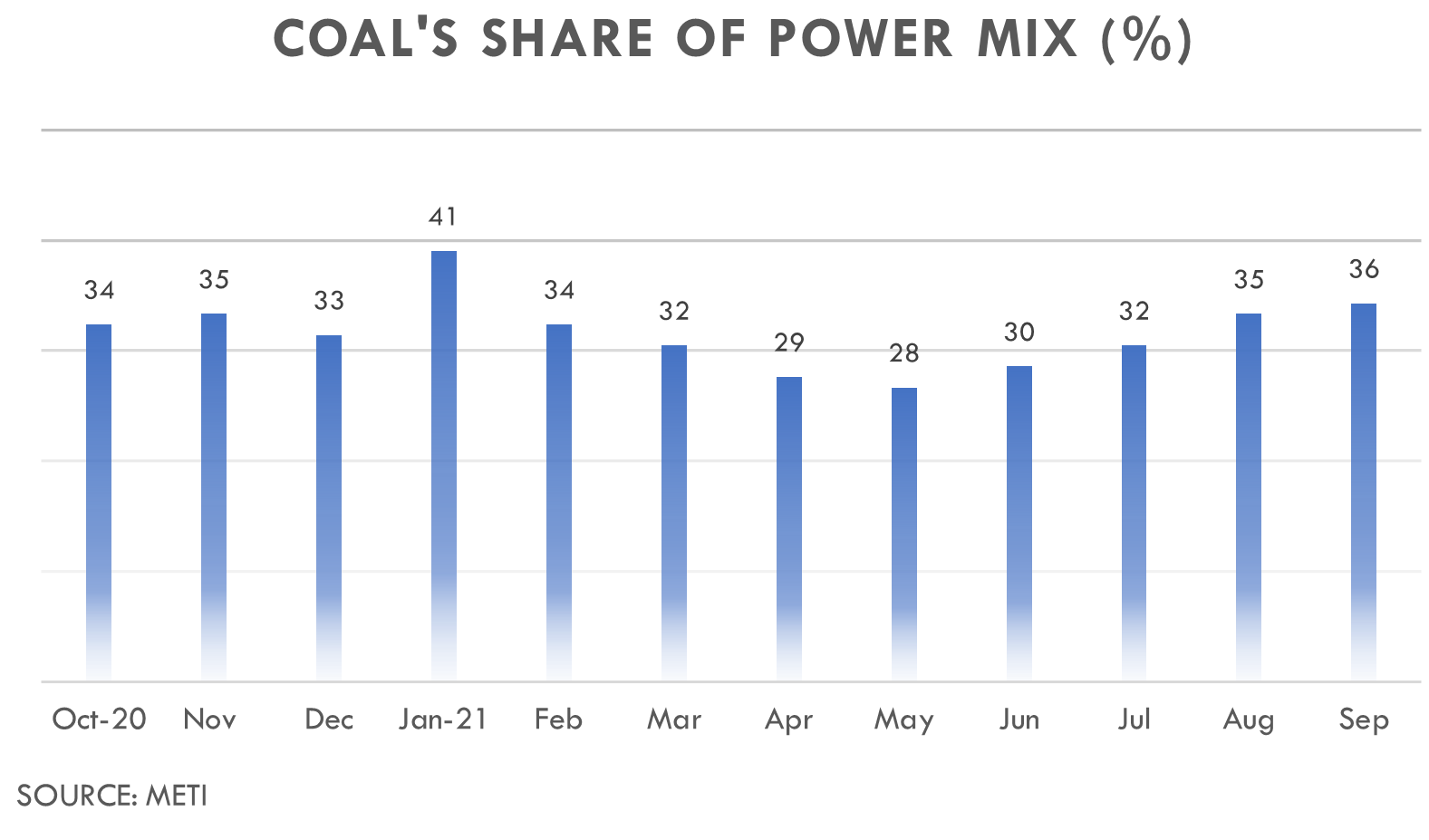
In January 2021, when Northeast Asian power utilities were scrambling for LNG supplies amid cold winter, Japan’s coal power usage rose to 41% of total power.
A cold snap hit Japan again last month. On Jan. 6, heavy snow blanketed Tokyo, driving power demand to a 14-year high. Capacity requirements hit 5.4 GW, above the forecasted worst-case scenario of 5.3 GW. Another snowfall in Tokyo last week, on Feb. 10, led Japan’s grid operator to ask two other regions to send Tokyo up to 800 MW of excess power during the day because peak demand pushed the local utility, TEPCO, to run at 96% capacity.
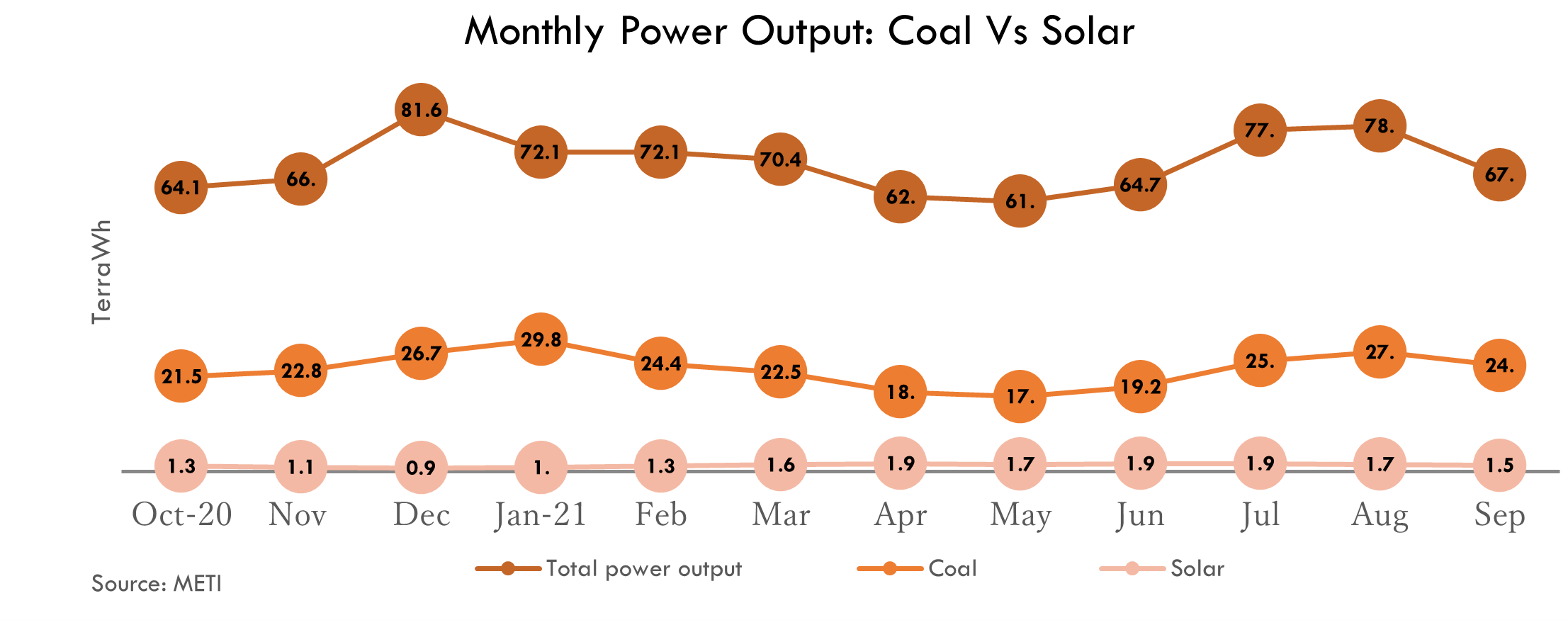
In all the above cases, power systems across several regions ramped up thermal output to avoid blackouts, with output from solar waning during snowfall. Yet, the segregation inherent in Japan’s grid means that even help from other regions is limited by the narrow volumes that can be moved nationwide.
Since the January 2021 LNG supply crunch, and because of it, METI is slowing plans to scrap thermal plants. Should utilities decommission aging equipment as standard, by 2030, Japan could lose 16.77 GW of thermal power. Most are oil-fired. Coal capacity, however, will increase by 1.87 GW by 2030.
2020-2030 thermal capacity change (GW)
|
Retiring capacity |
New installment |
Balance | |
|
Oil |
17.38 |
0 |
-17.38 |
|
LNG |
8.84 |
7.58 |
-1.26 |
|
Coal |
4.99 |
6.86 |
1.87 |
|
Total |
31.22 |
14.44 |
-16.77 |
Source: METI
METI’s actions to slow decommissioning may help for a few years, but no longer. Japan’s coal-fired plants alone could eat up the CO2 allotment for the power system in the 2030 emissions plan.
The other side of the problem
While METI tries to keep older thermal capacity afloat to meet today’s needs, national energy policy calls for a wider rollout of renewable energy. However, as more solar and other intermittent energy sources hook up to the grid, they are not integrated in an efficient manner.
Kyushu area is a good example. Since 2015, solar operators have been asked to cut output as the area’s power generation exceeded demand and transmission capacity. Kyushu Electric expects that from April 2021 to March 2022, some 580 GWh of solar power will be curtailed. The forecast for the next fiscal year is worse: 730 GWh of solar generation to be curtailed in Kyushu, about 440 MWh in Shikoku and 976 MWh in Okinawa. (See the Analysis section of NRG’s Jan. 24 issue for details.)
Without a solution, the trend of wasting energy will only exacerbate as Japan moves to establish an offshore wind industry, with licenses for 10 GW of capacity to be awarded by 2030. The most promising offshore wind zones are in Japan’s north, the Tohoku and the Hokkaido regions, which have no power shortages. In fact, the Hokkaido projects have yet to progress to tender stage because the regional power transmission operator says there’s no room in the local grid.
The solution for Kyushu, Tohoku and Hokkaido, is to send excess power to regions such as Tokyo and Chubu which face a dearth of energy. That will require expanding power transmission capacity, a process expected to take 10-15 years and require massive investments.
In the short-term, local grids in areas with excess electricity from renewables will ask thermal power plants to operate at lower run rates, giving solar and wind energy more space. Kyushu Electric reported that on May 3, 2021, when the area’s demand hit an annual low, thermal power accounted for just 13.2% of total daily output. For the month of May, thermal power’s share was 25%.
Solutions via a centralized grid
Power grid operators say the best way to harmonize disparities is on a central basis, rather than a micro or area basis. Kyushu Electric told METI that it plans to introduce a centralized transmission system in mid 2022 and this should reduce curtailment volumes by about 7%. Other grids will also centralize their network.
Grids typically inform solar companies about the need to curtail output at 17:00 the day before, but region-wide power output plans are updated early in the morning each day. This gives a regional grid operator better overview and time to react.
Dynamic pricing is another solution. Trials are underway for individual and corporate consumers to adjust their power demand in line with times of energy surplus.
Renewable expansion plan (GW)
|
2020 installed capacity |
2030 plan | |
|
Solar |
56 |
87.6 |
|
Onshore wind |
4.2 |
13.3 |
|
Offshore wind |
0 |
1.7 |
Source: METI
Japan bets on “dream” technologies
METI hopes technology can resolve the disconnect between thermal power-backed energy security and underutilized renewable resources. The biggest potential is seen in enhanced storage batteries and in utilizing redundant renewable power to make hydrogen, ammonia and synthetic fuel to be used for co-firing of coal power plants. These ambitions are supported by R&D financing from the Green Innovation Fund.
In June, PM Kishida is expected to announce a Clean Energy Strategy with more details on the above, building on the scenario stated in the 6th Basic Energy Plan.
Experts, however, warn that it’s risky to place the country’s future in technologies that don’t yet operate commercially. An example of how this can go wrong occurred just two years ago. METI placed much hope in Integrated Gasification Combined Cycle coal plants, which boasted 46-50% energy efficiency and were heralded as miracle technologies. Two IGCC plants came online in 2020 but following multiple technical issues in 2021 they were excluded from the 2022 power supply plan.
The goal that Kishida’s government wants to achieve with the Clean Energy Strategy is to cut power sector emissions to 219 million tons/ year, from the present 422 million tons/ year. But for that to happen the deeper underlying issue that has to be resolved is how the traditional energy system can work together with the new one that’s based on variable renewable energy.
Unless these two disparate systems can find a way to coexist and cooperate over the next 10-20 years, the overall goal of net-zero by 2050 will be nothing but a pipe dream.
ANALYSIS
BY DAN SHULMAN
PRINCIPAL
SHULMAN ADVISORY
The Upcoming Rise of Grid-Scale Batteries in Japan
Japan’s government recently hinted that it would seek to address the Achille’s heel of renewable energy from intermittent sources, such as solar and wind, by further opening up the power grid to batteries. As national energy strategy points to ever-increasing amounts of renewables in the power mix, the issue of balancing the grid is becoming much more important, both in order to accommodate more green electricity and for energy security.
Despite the current legislative grey zone around batteries, the market for storage is already starting to take off, partly driven by declining costs. Early adopters in Japan have installed about 400,000 battery units as of FY2020, creating the sector almost from scratch in the last five years. Cumulative capacity in commercial and industrial battery applications could see the market more than double over the current decade, METI forecasts show.
Still, while current and future uses are well-defined on paper, regulations are still being discussed especially around the entirely new niche of freestanding batteries. The latter could create new types of business models and players in the power market once their place in the system is defined.
Current and Future Use Cases Considered by METI
Market size and potential
The Japanese battery market stood at 9.6 GWh in FY2019 – 6 GWh in commercial and industrial buildings and factories; 2.4 GWh in residential; and 1.2 GWh integrated into power plants or freestanding. METI forecasts that the market will expand to 11.8 GWh in FY2025 and 24.2 GWh in FY2030.
METI expects that the reduction in battery costs will be a key driver of this growth. The ministry aims to reduce the installed cost of batteries in houses from ¥190,000/ kWh in FY2019 to ¥70,000/ kWh in FY2030. The target for installed costs in commercial and industrial buildings is ¥60,000/ kWh in FY2030, down from ¥240,000/ kWh in FY2019.
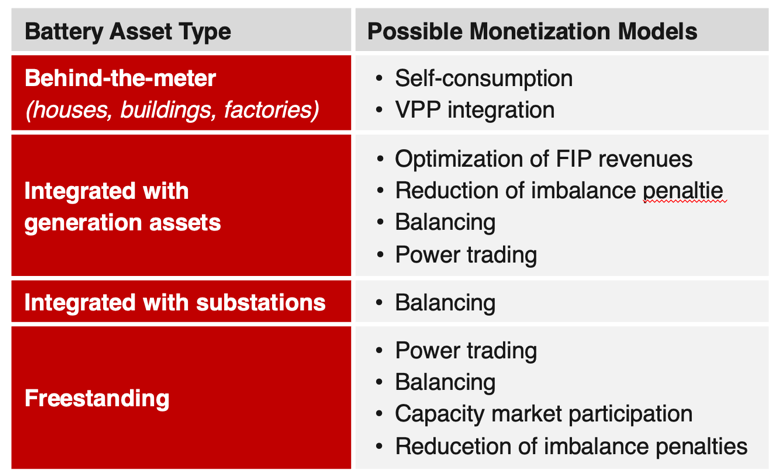
Currently, behind-the-meter batteries make up most of the installed capacity and are usually used to maximize local consumption of locally generated renewable energy, or as a back-up solution in case of emergency. METI expects the development of virtual power plants to aggregate such storage capacity and optimize its use at grid level.
Batteries have also been integrated into generating assets, particularly in Hokkaido, which mandates storage at large PV solar plants. In the Hokkaido grid, PV power plants of 2 MW or larger must ensure that the plant’s total output fluctuation (PV + battery) is less than or equal to 1% of the power plant capacity per minute. For example, for a 10 MW plant the power fluctuation must be within +/-100 kW/ minute.
New driver: FIP
Batteries integrated with generation assets might become more popular with the introduction of the Feed-in-Premium system starting in April 2022. Generators will have the opportunity to increase revenues under the FIP system by being savvy in how they trade power.
Onsite storage equipment would allow more flexibility in matching output with periods of high prices, making it attractive to investors. Under the FIP, generators are also responsible for balancing their systems, and storage assets could help to minimize imbalance penalties.
Power transmission companies have also been experimenting with integrating batteries in substations. According to METI, four pilot projects totaling 420 MWh are currently operating. We can, however, expect transmission firms to leverage the balancing market instead of investing in their own storage assets in the future.
Freestanding batteries are still mainly part of pilot projects with, for example, Sumitomo installing 600 kWh in Kagoshima Prefecture in 2015, or NEDO last year subsidizing a Sumitomo 2 MW installation in the U.S. In August 2021, Tesla announced a 6 MWh battery in Hokkaido to be commissioned in summer of 2022 – its first project in Japan.
More projects are expected. Some renewable energy developers are positioning themselves on the nascent market and developing valuation models or even applying for grid connection authorization from grid operators.
The government is keen to encourage freestanding battery development, allocating ¥13 billion in subsidies last November. These funds are expected to cover one-to-two thirds of installation costs. However, regulations regarding freestanding batteries have yet to be finalized by METI, which is holding back some developments.
Current Regulations for Freestanding Batteries in Japan
Under the current Electricity Business Act, large-scale batteries are treated as accessories of substations or power plants. In November 2020, METI launched a committee on “Spreading Stationary Power Storage Systems” to understand what policies or strategies the government further needs to accelerate the development of both the battery market and industrial competitiveness. Front-of-the-meter (FOM) batteries used to balance power in the grid are one battery type to be discussed.
The committee published an interim report on Dec. 27, 2021 that outlined revisions to the Electricity Business Law that says developers will need to obtain a generation license for freestanding battery assets, allowing the regulator to control output capacity in times of tight supply. Licensed battery owners will have to follow supply orders in times of need. The government is also considering new regulations to promote the future use of these batteries for storing renewable power surplus and for hydrogen production.
The wheeling charges for these assets will also follow a special rule. If owners notify grid operators prior to signing the contract, owners won’t pay a wheeling charge when receiving power from the grid. However, they will pay charges for any power losses due to battery conversion and when they supply power to the market. However, there was no mention of wheeling charge rules in the interim report.
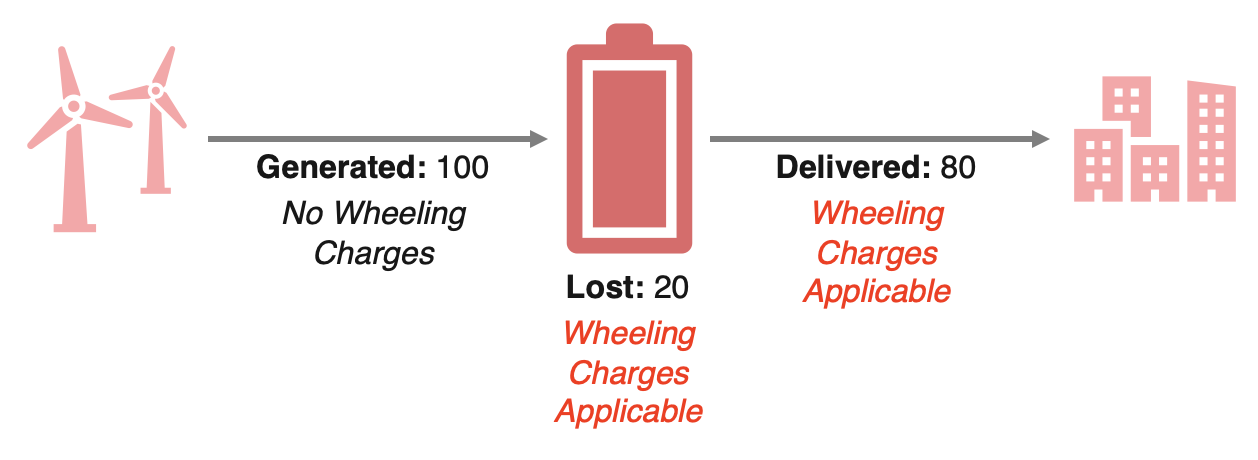
Regarding balancing requirements of the asset, conversion losses should be accounted for in the corresponding retail balancing group, while the output power will be part of the generation balancing group.

METI uses pumped hydro storage as a reference to decide on the regulations to be applied to freestanding batteries, so it is likely that these assets will also be allowed to participate in the same markets as pumped hydro, including the capacity market.
Given that regulations are still being finalized, grid operators are cautious over issuing connection licenses for freestanding batteries projects, with the exception, to some extent, of Hokkaido. We expect this to change once one of the major companies involved in pilot projects, or in advising METI, develops the first projects.
Interest despite uncertainty
In its latest reports METI highlights several topics that still need to be finalized regarding freestanding batteries. Amongst these are the clarification of the monetization of assets; a better understanding of the environmental value of using batteries in different markets; and setting the margins on the inter-regional connection capacity to account for battery use. Also, still to be settled are regulations on cost distributions between retailers and generators using the same asset, along with safety regulations.
It’s still difficult to create a clear quantitative business model for freestanding batteries, but more and more pieces of the puzzle are falling into place and the first assets are being developed. We expect an increase of project announcements and more companies to integrate these assets into business portfolios as soon as the fiscal year starts in April.
GLOBAL VIEW
BY JOHN VAROLI
Below are some of last week’s most important international energy developments monitored by the Japan NRG team because of their potential to impact energy supply and demand, as well as prices. We see the following as relevant to Japanese and international energy investors.
Australia/ CCS
Energy company Santos acquired depleted gas reservoirs that it will use to store as much as 100 million tons of CO2. Santos is building the Moomba carbon capture and storage project with Beach Energy. Operations start in 2024 and will capture 1.7 million tons of CO2 yearly.
Australia/ Hydrogen energy
A report on the green hydrogen industry predicts “exponential growth” for electrolysers in the near future. By 2027, Australia’s green hydrogen could reach cost parity with blue hydrogen, which is produced by natural gas.
Asia/ Natural gas
If natural gas becomes an energy outcast, Asia faces a massive decommissioning bill, claims the Institute for Energy Economics and Financial Analysis, adding that “62% of LNG import terminal capacity and 61% of gas-fired power capacity is unlikely to be built due to unfavorable fundamental project factors”. Asia has $358 billion of planned gas projects.
France/ Nuclear
In an effort to slash GHGs, President Macron pledged to spend €50 million by 2028 to build six new-generation nuclear reactors, with the option to build eight more by 2050. Nuclear energy already provides France with 70% of its total power, but that fleet of 56 reactors has aged considerably.
Norway/ Offshore wind power
Later this year the Scandinavian country will hold its first tender for bottom-fixed offshore wind power projects to be built in the southern part of the North Sea. The goal is to develop 1.5 GW of generation capacity.
Saudi Arabia/ Green investment
Fitch and Moody’s assigned debut ratings to the country’s $500 billion sovereign Public Investment Fund, which is preparing to invest at home and abroad, and to issue “green bonds”. Fitch gave a long-term default rating of A. Moody’s gave an A1 long-term rating.
Spain/ Renewables
The Catalan government’s 2050 energy roadmap calls for 12 GW of new renewables by 2030 — 5 GW of wind and 7 GW of solar. The region needs to build about 62 GW of installed capacity by mid-century to achieve full decarbonisation of its electricity system.
UK/ Energy crisis
The price cap on household energy bills will jump 54%, increasing £693 to £1,971 per year. Record rises in global gas prices are driving this inflation, and 22 million British households will be impacted. The government plans £9 billion in measures to mitigate the price hikes.
UK/ EV batteries
Glencore and Britishvolt will build a battery recycling plant. With scheduled completion in late 2023, the plant will be the first battery recycling facility in the UK for the two companies. It will have a processing capacity of at least 10,000 tons of lithium-ion batteries per year.
U.S./ Solar energy
Trump-era tariffs on imported solar panels were extended. However, double-sided panels for large projects remain exempt. Also, the amount of solar cells for solar panels that can be imported tariff-free has increased from 2.5 GW to 5 GW of capacity.
U.S./ Generating capacity
Almost 28 GW of new generating capacity was added to the grid in 2021, 12% more than 2020. However, 8.5 GW of capacity was retired in 2021. Wind and solar dominated the new power additions, accounting for 41% and 36%, respectively.
2022 EVENTS CALENDAR
A selection of domestic and international events we believe will have an impact on Japanese energy
|
January |
OPEC quarterly meeting; JCCP Petroleum Conference – Tokyo; EU Taxonomy Climate Delegated Act activates; Regional Comprehensive Economic Partnership (RCEP) Trade Agreement that includes ASEAN countries, China and Japan activates; Indonesia to temporarily ban coal exports for one month; Regional bloc developments: Cambodia assumes presidency of ASEAN; Thailand assumes presidency of APEC; Germany assumes presidency of G7; France assumes presidency of EU; Indonesia assumes presidency of G20; and Senegal assumes presidency of African Union; Japan-U.S. two-plus-two meeting; Japan’s parliament convenes on Jan. 17 for 150 days; Prime Minister Kishida visits Australia (tentative) |
|
February |
Chinese New Year (Jan. 31 to Feb. 6); Beijing Winter Olympics; South Korea joins RCEP trade agreement |
|
March |
Renewable Energy Institute annual conference; Smart Energy Week – Tokyo; Japan Atomic Industrial Forum annual conference – Tokyo; World Hydrogen Summit – Netherlands; EU New strategy on international energy engagement published; End of 2021/22 Japanese Fiscal Year; South Korean presidential election |
|
April |
Japan Energy Summit – Tokyo; MARPOL Convention on Emissions reductions for containerships and LNG carriers activates; Japan Feed-in-Premium system commences as Energy Resilience Act takes effect; Launch of Prime Section of Japan Stock Exchange with TFCD climate reporting requirement; Convention on Biological Diversity Conference for post-2020 biodiversity framework – China; Elections: French presidential election; Hungarian general election |
|
May |
World Natural Gas Conference WCG2022 – South Korea; Elections: Australian general election; Philippines general and presidential elections |
|
June |
Happo-Noshiro offshore wind project auction closes; Annual IEA Global Conference on Energy Efficiency – Denmark; UNEP Environment Day, Environment Ministers Meeting – Sweden; G7 meeting – Germany |
|
July |
Japan to finalize economic security policies as part of natl. security strategy review; China connects to grid 2nd 200 MW SMR at Shidao Bay Nuclear Plant, Shandong; Czech Republic assumes presidency of EU; Elections: Japan’s Upper House Elections; Indian presidential election |
|
August |
Japan: Africa (TICAD 8) Summit – Tunisia; Kenyan general election |
|
September |
IPCC to release Assessment and Synthesis Report; Clean Energy Ministerial and the Mission Innovation Summit – Pittsburg, U.S.; Japan LNG Producer/Consumer Conference – Tokyo; IMF/World Bank annual meetings – Washington; Annual UN General Assembly meetings; METI to set safety standards for ammonia and hydrogen-fired power plants; End of 1H FY2022 Fiscal Year in Japan; Swedish general election |
|
October |
EU Review of CO2 emission standards for heavy-duty vehicles published; Chinese Communist Party 20th quinquennial National Party Congress; G20 Meeting – Bali, Indonesia; Innovation for Cool Earth TCFD & Annual Forums – Tokyo; Elections: Okinawa gubernational election; Brazilian presidential election; |
|
November |
COP27 – Egypt; U.S. mid-term elections; Soccer World Cup – Qatar; |
|
December |
Germany to eliminate nuclear power from energy mix; Happo-Noshiro offshore wind project auction result released; Japan submits revised 2030 CO2 reduction goal following Glasgow’s COP26; Japan-Canada Annual Energy Forum (tentative); Tesla expected to achieve 1.3 million EV deliveries for full year 2022 |
Disclaimer
This communication has been prepared for information purposes only, is confidential and may be legally privileged. This is a subscription-only service and is directed at those who have expressly asked K.K. Yuri Group or one of its representatives to be added to the mailing list. This document may not be onwardly circulated or reproduced without prior written consent from Yuri Group, which retains all copyright to the content of this report.
Yuri Group is not registered as an investment advisor in any jurisdiction. Our research and all the content express our opinions, which are generally based on available public information, field studies and own analysis. Content is limited to general comment upon general political, economic and market issues, asset classes and types of investments. The report and all of its content does not constitute a recommendation or solicitation to buy, sell, subscribe for or underwrite any product or physical commodity, or a financial instrument.
The information contained in this report is obtained from sources believed to be reliable and in good faith. No representation or warranty is made that it is accurate or complete. Opinions and views expressed are subject to change without notice, as are prices and availability, which are indicative only. There is no obligation to notify recipients of any changes to this data or to do so in the future. No responsibility is accepted for the use of or reliance on the information provided. In no circumstances will Yuri Group be liable for any indirect or direct loss, or consequential loss or damages arising from the use of, any inability to use, or any inaccuracy in the information.
K.K. Yuri Group: Oonoya Building 8F, Yotsuya 1-18, Shinjuku-ku, Tokyo, Japan, 160-0004.