
JAPAN NRG WEEKLY
FEB. 21, 2022
JAPAN NRG WEEKLY
Feb. 21, 2022
NEWS
TOP
- Govt. panel on carbon pricing to delay proposals as METI considers what regulations are needed for carbon credits trading
- JERA announces tender for likely world’s top ammonia contract; competitive process will secure fuel for company’s power plants
- Japan edges closer to launch of its first Power-to-Gas project; local govt. reports on plans to begin test project later this year
ENERGY TRANSITION & POLICY
- Japan and Mongolia share carbon offset credits from solar plant
- METI to coordinate work on submarine power cable installation
- Japan to start artificial photosynthesis R&D to cut hydrogen costs
- Japan Stock Exchange to research Digitally Tracked Green Bonds
- In global first, Chiyoda transports hydrogen as MCH in a tanker
- Tokyo Gas and JERA line up issuances of transition bonds
- Toshiba uses renewables to produce raw materials for chemicals
- Railway firm to start testing Japan’s first hydrogen hybrid train
- 12 MW battery storage system to be added in Hokkaido area
ELECTRICITY MARKETS
- Offshore wind rivals complain to government over auction results
(Includes tables listing every bidder and prices offered) - ENEOS sells 5% of JRE Corp. to Sumitomo Mitsui Trust Bank
- JERA joins EEX Japanese electricity futures market trading
- Kansai Electric opens one of Japan’s largest biomass power plants
- Mitsubishi Heavy sets 2025 target for hydrogen co-firing turbines
- Ministry hopes solar subsidy will mean cheaper electricity in PPAs
- Eurus Energy plans large wind power project in Hokkaido
- TEPCO unit makes first overseas investment in renewables assets
OIL, GAS & MINING
- Japan’s January LNG import volumes fell by most in a decade
- Government to release further strategic oil reserves
- Japan to consider plan that would stockpile critical raw materials
- Sumitomo Metal Mining to triple battery cathode output
ANALYSIS
HOW MUCH HYDROGEN IS JAPAN MISSING OUT ON? WASTED GREEN ENERGY MAY BE PUT TO GOOD USE
If Japan were able to turn all excess renewable energy into hydrogen, it could fill the tank of almost 3 million fuel cell vehicles. That’s an idealized scenario, but it indicates just how much resource potential is wasted without a way to store energy from variable renewable sources such as solar and wind. Recently, several pilot projects launched in Japan seek a way to put “excess” electricity to good use. Unused renewable power to produce hydrogen could become a major net-zero option for Japan, while improving the balance of the power grid and opening up new technology export opportunities.
AUTO INDUSTRY MANAGES TO CUT EMISSIONS, BUT LOOKS TO HYDROGEN FOR FURTHER GAINS
CO2 emissions in Japan’s automotive industry, the nation’s top economic sector, have dropped for a fourth straight year. To achieve greater cuts, some companies are looking into an overhaul of their manufacturing processes with the introduction of hydrogen fuel systems. Hydrogen is expected to help manufacturers in a number of ways, including through its role in the methanation process. Several firms are due to announce new methanation applications this year. Still, doubts remain among insiders about how best to deploy hydrogen, while the debate over electrification vs hydrogen shows no sign of abating.
GLOBAL VIEW
Over $1.5 trillion was invested in coal in the last 10 years. France commits to 50 offshore wind farms. Australia now has most solar per capita. Saudi Arabia sets aside $80 billion for green projects. JERA-backed Aboitiz Power to add 600 MW of renewables this year. Details on these and more in our global wrap.
EVENT CALENDAR FOR 2022
Key political and business events in Japan and abroad.
JAPAN NRG WEEKLY
PUBLISHER
K. K. Yuri Group
Events
Editorial Team
Yuriy Humber (Editor-in-Chief)
John Varoli (Senior Editor, Americas)
Tom O’Sullivan (Japan, Middle East, Africa)
Mayumi Watanabe (Japan)
Regular Contributors
Chisaki Watanabe (Japan)
Daniel Shulman (Japan)
Takehiro Masutomo (Japan)
Art & Design
22 Graphics Inc.
SUBSCRIPTIONS & ADVERTISING
Japan NRG offers individual, corporate and academic subscription plans. Basic details are our website or write to subscriptions@japan-nrg.com
For marketing, advertising, or collaboration opportunities, contact sales@japan-nrg.com
For all other inquiries, write to info@japan-nrg.com
OFTEN USED ACRONYMS
METI The Ministry of Energy, Trade and Industry
MOE Ministry of Environment
ANRE Agency for Natural Resources and Energy
NEDO New Energy and Industrial Technology Development Organization
TEPCO Tokyo Electric Power Company
KEPCO Kansai Electric Power Company
EPCO Electric Power Company
JCC Japan Crude Cocktail
JKM Japan Korea Market, the Platt’s LNG benchmark
CCUS Carbon Capture, Utilization and Storage
mmbtu Million British Thermal Units
mb/d Million barrels per day
mtoe Million Tons of Oil Equivalent
kWh Kilowatt hours (electricity generation volume)
NEWS: ENERGY TRANSITION & POLICY

METI carbon pricing panel to delay proposal to March
(Japan NRG, Feb. 14)
- METI’s director of environmental economy office said the government proposal on carbon pricing will be delayed by a month. The expert panel interviewed companies in the energy, finance, aviation sectors and municipal governments and concluded that more time is needed since opinions were divided, including on:
- Separating National Determined Contribution credits from voluntary credits
- Will there be enough credit in supply and how to cope with shortages
- Certifying quality of overseas voluntary credits that have yet to complete corresponding adjustment process
- Rules for labeling of services and products offset by voluntary credits
- Exploring credits derived from new negative emission technologies and blue carbon
TAKEAWAY: Companies with 2050 carbon neutrality goals have been challenged with limited renewable supply, and recently, thin “carbon neutral” LNG supplies as demand has outstripped supply. Some fear Japan’s credits supply may not satisfy demand and the country needs to “import” voluntary credits.
There are new carbon absorption technologies, such as amine carbon absorbent developed by Kawasaki Heavy Industries. Methodologies to establish their carbon offset capacity are needed.
- SIDE DEVELOPMENT:
METI defines regulatory frameworks needed for carbon credit trades
(Japan NRG, Feb. 18)- METI defined the regulatory framework needed for trading voluntary carbon credits. The main features are:
- Trading platform such as an exchange
- Transparency on offset credit pricing
- Consumer-supplier matching mechanism, and quality assurance
- The offset credit market structure is rapidly changing with the increase of intermediary credit brokers, METI noted.
- CONTEXT: METI is under fire as Japan falls behind the U.S. and Europe in establishing a mechanism to monetize carbon neutrality innovations. Critics claim a lack of regulatory framework has a lot to do with it.
Carbon credits awarded to Japan, Mongolia
(Japan NRG, Feb. 14)
- A total of 35,419 tons of carbon offset credits were awarded to Japan and Mongolia for the launch of a 12.7 MW solar power plant in Mongolia, the MoE said. The credits were issued under the Joint Credit Mechanism. Japan’s share is 21,251 tons. The solar plant cuts 12,005 tons/year of carbon emissions. It became operational in June 2018.
JERA to Conduct Competitive Bidding to Procure Ammonia Fuel
(Company Statement, Feb. 18)
- JERA will hold an international bid for procurement of ammonia fuel, and sent a request for proposals to more than 30 companies.
- JERA is working on a project to demonstrate the use of ammonia fuel at the Hekinan Thermal Power Station, aiming to switch 20% of the fuel at Unit 4 to ammonia by the late 2020s. Given the steady progress of this demonstration project, JERA decided to consider ammonia fuel suppliers in parallel, and to conduct an international competitive bid with the following main conditions:
| Supply period | Long-term contract from FY 2027 into the 2040s |
| Quantity | Up to 500,000 tons per year |
| Delivery mode | FOB |
| Other | • CO2 is either not generated during ammonia production or is captured and stored.
• JERA has the opportunity to participate in production projects |
TAKEAWAY: The global ammonia market is about 200 million tons, but only about a tenth is available since the rest is utilized for fertilizer production. In that context, the volumes sought by JERA are enormous. This is possibly the largest such tender in the world.
The ammonia would be a second fuel at JERA’s coal-fired power plants. JERA wants ammonia co-firing to be at 20% within a decade.
Yamanashi prefecture to launch Japan’s first Power-to-Gas services
(Japan NRG, Feb. 14)
- The Yamanashi prefectural government told METI’s Clean Energy Strategy Conference that the country’s first power-to-gas (P-to-G) services will be launched this year. The prefecture, Toray and TEPCO will form a joint venture, Yamanashi Hydrogen Company (YHC), that will provide the services.
- YHC will use solar power generated at the 10 MW Komekurayama power station to produce hydrogen, which will be sold to hydrogen stations for FCVs and users of hydrogen-fueled boilers and other equipment. The three parties have conducted trial P-to-G service runs since 2016.
- CONTEXT: The Komekurayama power station generates 12 GWh/ year. Panasonic supplied solar modules and hydrogen fuel cells, Toray the membrane electrolysis assembly system, JSW the hydrogen storage tank, and Hitachi Zosen the electrolyzer.
TAKEAWAY: YHC is likely to cater to Greater Tokyo’s demand as Yamanashi has only a handful of hydrogen stations and less than 100 companies in the hydrogen business.
METI to coordinate government units for submarine power cable installation
(Japan NRG, Feb. 14)
- In spring, METI plans to release a plan defining ANRE and OCCTO roles in pushing submarine power cable installation to solve transmission bottlenecks. Proposed projects include connecting Hokkaido and Honshu islands with submarine cables to transfer Hokkaido’s excess power to high demand areas on Honshu Island.
- The METI plan will show which units have the oversight for conducting geophysical surveys, deciding cable routes, and more.
- In 2022, OCCTO is expected to finalize the national masterplan for increasing power transmission capacities both in trunk and local lines.
- CONTEXT: There’s a political push to speed up an increase in capacity. PM Kishida in his Jan. 17 policy speech said power transmission infrastructure is essential for his Clean Energy Strategy.
TAKEAWAY: This year, the grids will open their local network for non-firm connection with renewables generators, aiming to increase overall power supply. Depending on how connections are managed, capacity overflows could still result in renewable output curbs. The transmission capacity increase will lead to greater copper demand. Grids account for less than 10% of Japan’s copper wire demand, which is even smaller than automotive demand.
The Electrical Wire Manufacturers Association sees domestic demand rising modestly on renewable expansions to 670,000 tons in 2025, from the present 630,000 tons. If cable installation projects roll out speedily, demand will outperform this forecast.
Japan to kick-start artificial photosynthesis R&D hoping it will cut hydrogen costs
(Asia Nikkei, Feb. 18)
- Japan is preparing for a massive field test that will feature artificial photosynthesis, an emerging technology that is expected to help cut the cost of producing hydrogen domestically among other uses. The goal is to commercialize the tech by 2040.
- The University of Tokyo, Toyota Motor and Mitsubishi Chemical are among entities involved in a state-funded project to test the technology in 2030. NEDO will allocate ¥30 billion ($260 million) over this decade to the project.
- CONTEXT: Artificial photosynthesis mimics the natural process by using solar energy to generate clean-burning hydrogen. The result can also be combined with CO2 to make industrial chemicals that replace petroleum-based products.
- Japan leads the way in artificial photosynthesis thanks to promising patents.
Japan Stock Exchange to research “Digitally Tracked Green Bonds”
(Company statement, Feb. 14)
- Japan Exchange Group (JPX) is looking into raising funds via issuance of security tokens in the form of a “Digitally Tracked Green Bond”.
- JPX aims to switch 100% of the Group’s electricity consumption to renewables and achieve carbon neutrality by FY2024. JPX will invest in its own energy generation facilities, such as solar panels and biomass facilities. It’s considering raising some of the investment by issuing a Digitally Tracked Green Bond, which is the subject of the current research.
- A “Digitally Tracked Green Bond” utilizes blockchain to improve transparency of data and efficiency of data collection.
In global first, Chiyoda transports hydrogen as MCH by chemical tanker
(Kankyo Business, Feb. 15)
- Chiyoda Corporation achieved a major milestone: the world’s first marine transportation and delivery of hydrogen in the form of methylcyclohexane (MCH) by chemical tanker.
- The association is responsible for the production and supply of MCH from toluene and hydrogen in Brunei Darussalam as part of a demonstration project promoted by ENEOS.
- The MCH was produced in Brunei and transported to the port of Singapore, where it was stored in existing outdoor storage tanks for several months before being loaded onto a chemical tanker at the same port. The ship (DWT: 10,000-ton class mixed cargo) delivered the cargo to an ENEOS refinery on Feb. 4.
- Supply of MCH from Brunei to ENEOS by chemical tanker is set to continue.
Tokyo Gas and JERA in ¥25 billion transition bond issue
(Nikkei, Feb. 14)
- Tokyo Gas and JERA will issue ¥25 billion in transition bonds.
- The bonds will finance the development of low carbon fuels and the conversion of power plants to natural gas.
Marubeni may invest in Indonesian CO2 recovery
(Nikkei, Feb. 17)
- Marubeni signed an MoU with Indonesian state-owned energy company Pertamina concerning carbon capture and storage.
- The corporation will assess the feasibility of an initiative to recover biomass-derived CO2 (released during pulp manufacture) for sequestration in depleted gas fields and under impermeable layers of subterranean rock.
- Marubeni will make a final investment decision by end of FY2022/23.
- Marubeni might invest as much as $100 million in the project.
Toshiba succeeds in large-scale manufacturing of raw chemical materials using renewables
(Nikkei, Feb. 18)
- Toshiba succeeded in developing a technology for mass production of carbon monoxide, a raw material made from CO2.
- For an incineration plant that produces about 200 tons of CO2 a day, carbon monoxide can be processed in an area of about 2,000 square meters, equal to five basketball courts. Mixed with hydrogen, carbon monoxide can be used to make synthetic methane, jet fuel, and other fuels.
- This allows for CO2 emissions to be cut 80% compared to petroleum. With MoE support, the company hopes to improve the system and put it to use in 2025.
- SIDE DEVELOPMENT:
TEPCO RE and Toshiba gets Green Innovation Funds to develop offshore wind
(Dempa Publications, Feb. 18)- NEDO approved proposals from 12 companies including TEPCO RE and Toshiba Energy Systems Corporation (ESS) for a project to reduce the cost of offshore wind power generation. The funds from the state Green Innovation Fund will go to development of floating offshore wind systems that can help reduce the cost of wind power generation.
- Eight EPCos, Sumitomo Electric Industries and Mitsubishi Electric are part of the group.
Japan’s first hydrogen hybrid train gears up for trial runs
(Nikkei Asia, Feb. 19)
- JR East has launched Japan’s first hydrogen-powered hybrid train, which developed together with Hitachi and Toyota Motor.
- The company, formally East Japan Railway, will begin safety testing on the two-car Hybari train in late March. Plans are to start commercial service in 2030.
- Hybari runs off hydrogen fuel cells and batteries. The batteries store energy generated when the brakes are applied.
Mitsui O.S.K. to introduce ‘hard sails’ for ships to cut emissions
(Nikkei Asia, Feb. 18)
- Shipping company Mitsui O.S.K. Lines (MOL) is innovating with wind power to help propel its fleet. The firm is developing a “hard sail” system that will help reduce GHG as part of its efforts to meet net-zero emissions.
- A fiber-reinforced plastic sail, 52 meters high and 15 meters across, will allow MOL to cut GHG by about 5% on Japan-Australia routes and about 8% on journeys to the U.S. West Coast, according to the company.
12 MW battery storage system to be added in Hokkaido this year
(Kankyo Business, Feb. 14)
- Electricity retailer Mitsuuroko Green Energy plans to build a power storage facility in Kitahiroshima City, Hokkaido, to help stabilize the local grid system. Operation is due to start in December 2022.
- The power provided will install Tesla’s Megapack, a large-scale energy storage system with an output of 3,085.6 kW and a storage capacity of 12,192 kWh.
- Mitsuuroko Green Energy aims to enter new markets such as the supply and demand adjustment market and the capacity market as an aggregator business.
- CONTEXT: Aggregator businesses are businesses that effectively manage energy by bundling the electricity demand of consumers and distributed power sources such as storage batteries and private power generation facilities.
IHI Corp and Indonesian institute to research CO2 cuts by using farming waste as fuel
(Kankyo Business, Feb. 15)
- Engineering firm IHI Corp has started joint research with Indonesia’s National Bandung Institute of Technology to reduce CO2 emissions by effectively utilizing agricultural residue (waste) as biomass fuel.
- The two parties aim to achieve carbon neutrality, reduce the environmental impact caused by agricultural residue, provide a stable supply of biomass fuel to power plants, and increase the income source of farmers.
- IHI will conduct a survey focused on Java Island, which accounts for about 70% of Indonesia’s power generation. The company will also conduct experiments on biomass co-firing and technical studies on how to increase the co-firing rate.
Nippon Steel to test viability of Australian CCS project, send CO2 for storage
(Company statements, Feb. 14)
- Nippon Steel, Japan’s top steelmaker, will verify profitability of a CCS project after agreeing to capture, liquefy and transport 1 to 5 million tons of CO2/ year from its steel mills to deepC Store’s offshore multi-user floating CCS hub project, Cstore1 in Australia.
- Nippon Steel, together with deepC Store and its existing partners that include JX Nippon Oil & Gas, Kyushu Electric, Mitsui O.S.K. Lines, Osaka Gas, will conduct a study of the technical side of the process and assess its potential commercial terms.
- CONTEXT: DeepC Store says this will be the first floating multi-user CCS hub in Asia Pacific. It seeks to store 1.5 million and 7.5 million tons of CO2 per year.
Mitsui & Co. explores potential for CCS project in Russia
(Denki Shimbun, Feb. 17)
- Mitsui & Co. will jointly study potential carbon capture and storage (CCS) projects in Russia with a Gazprom subsidiary.
- The two firms will investigate suitable sites for CCS, including in depleted oil and gas fields in Sakhalin and Western Siberia, and consider options around storing CO2 transported from Russia and Japan. Projects related to blue hydrogen and ammonia production through gas reforming are also on the agenda.
- Mitsui and Gazpromneft, a unit of Gazprom, recently signed an MoU to cooperate in developing maritime technology for the transportation of CO2.
Tokyo University researcher discusses implications of revolutionary ammonia process
(Nikkei, Feb. 15)
- Ammonia is produced by the energy-intensive Haber-Bosch process that’s remained unchanged for nearly 100 years.
- Since 2005, University of Tokyo academic Nishibayashi Yoshiaki has worked on a “post-Haber Bosch” process that draws inspiration from nitrogen fixation in nature.
- In 2019, Nishibayashi became the first researcher to successfully synthesize ammonia from water and air using a molybdenum catalyst.
- He hopes the technology will encourage a paradigm shift that will see air, water and sunlight harnessed to provide energy.
IAEA inspects Fukushima site ahead of tritium discharge
(NHK, Feb. 16)
- An IAEA delegation that includes experts from China and South Korea visited the site of the Fukushima nuclear disaster to inspect arrangements for discharging water containing radioactive tritium into the sea.
- The delegation will issue a report on its findings later this year.
One-Dot News
- Toyota Motor’s first all-electric mass-market model will not be sold to consumers in Japan when it rolls out later this year. The automaker will focus on bigger markets with more established demand for electrics; the bZ4X sport utility vehicle will be offered to Japanese consumers only via a subscription service. (Asia Nikkei, Feb. 18)
- Railway operator JR Hokkaido unveiled a plan to bring net CO2 emissions for the entire group down to virtually zero by 2050; the company will promote energy conservation and renewable energy. (Kankyo Business, Feb. 15)
- Meiji Yasuda Life Insurance will invest ¥1 billion in TM Nippon Renewable Energy Fund 2021 managed by Tokio Marine Asset Management; the fund invests in renewable energy projects subject to the FIT system, and has assets of ¥12 billion. (New Energy Business News, Feb. 15)
- Trading house Itochu signed an exclusive distribution agreement for the Japanese market with Finland’s Neste Group, the world’s largest maker of fuels derived from renewables; it will start to supply Neste’s sustainable aviation fuel (SAF) at Haneda and Narita International airports in Tokyo. (New Energy Business News, Feb. 18)
- TEPCO Renewable Power (RP) decided to issue its second green bond this year; at present, the company expects to issue ¥20 billion of 5-year bonds, but the final amount will be decided later; proceeds will go hydropower plants and offshore wind developments in Japan, and hydropower assets abroad. (Denki Shimbun, Feb. 17)
NEWS: POWER MARKETS

Offshore wind rivals complain to the government over previous auction results
(Diamond, Feb. 18)
- CONTEXT: In late December 2021, the government announced the winners for the first three auctions for bottom-fixed offshore wind power projects in Japan. All three winning groups consisted of Mitsubishi Corp and a unit of Chubu Electric. The lowest winning bid was ¥11.99/ kW.
- Since the results were announced, rival offshore wind operators continue to lobby the government. First and foremost, the three auctions were clearly decided on price. Rivals claim the process is unfair because it favors companies with the most capital strength.
- When the auction system was originally devised, some asked for a minimum price, but METI balked at the idea.
- A few industry players ask if it’s fair for a single company to submit multiple proposals. In some cases, companies with capital ties bid in the same auction.
- Some industry players have asked for winning bids to include a detailed breakdown of the pricing structure. The government responded that this would harm the competitive position or other legitimate interests of the winning entity.
- METI minister Hagiuda said he’d like to see variety and will favor greater distribution in the future.
819 MW Yurihonjo City, Akita Prefecture
| Bidder | ¥/ 1 kWh offer | Price (grade out of 120) | Realistism of Business Case (grade out of 120) | Total Score (grade out of 240) |
| Mitsubishi Corp, C-Tech | 13.26 | 120 | 88 | 208 |
| JERA, J-Power, Equinor | 18.18 | 87.5 | 73 | 160.5 |
| Sumitomo Corp, TEPCO RE, JR East | 16.97 | 93.8 | 64 | 157.8 |
| JWD, Eurus Energy, Osted | 22.3 | 71.4 | 78 | 149.4 |
| Obayashi, Tohoku Electric, Northland Power | 26.95 | 59 | 68 | 127 |
479 MW Noshiro City, Mitane Town, Oga City project, Akita Prefecture
| Bidder | ¥/ 1 kWh offer | Price (grade out of 120) | Realistism of Business Case (grade out of 120) | Total Score (grade out of 240) |
| Mitsubishi Corp, C-Tech, Venti | 11.99 | 120 | 82 | 202 |
| JERA, J-Power, Equinor | 17.2 | 83.7 | 73 | 156.7 |
| Renova, Cosmo Eco Power, Tohoku Electric, JR East | 24.5 | 58.7 | 91 | 149.7 |
| Kyushu Electric, RWE | 18.4 | 78.2 | 66 | 144.2 |
| JWD, Eurus Energy, Osted | 22.99 | 62.6 | 78 | 140.1 |
391 MW Choshi City, Chiba Prefecture
| Bidder | ¥/ 1 kWh offer | Price (grade out of 120) | Realistism of Business Case (grade out of 120) | Total Score (grade out of 240) |
| Mitsubishi Corp, C-Tech | 16.49 | 120 | 91 | 211 |
| TEPCO RE, Osted | 22.59 | 87.6 | 98 | 185.6 |
Source: Diamond
ENEOS sells 5% stake in JRE Corp to Sumitomo Mitsui Trust Bank
(Company statements, Feb. 14)
- ENEOS and Sumitomo Mitsui Trust Bank (SMTB) will jointly invest in green power operator Japan Renewable Energy (JRE).
- SMTB acquired 5% of the JRE shares held by Forest S, a unit of ENEOS. The deal’s value was not disclosed.
- The bank will contribute to JRE with financial know-how in renewables.
- By FY2030, SMTB will invest ¥500 billion in infrastructure, including companies that contribute to decarbonization. The acquisition of JRE shares is part of this plan.
TAKEAWAY: While SMTB may well help JRE with the financial side, this move could also be interpreted as a step towards preparing JRE to go public.
JERA joins EEX futures market trading
(Company statements, Feb. 17)
- Japan’s biggest thermal utility became the latest participant to join the electricity futures marketplace operated by EEX.
- Other companies to join the trading recently include Global Engineering Co.
Kansai Electric opens one of Japan’s largest biomass plants
(Denki Shimbun, Feb. 18)
- KEPCO opened the 75 MW Kanda thermal power plant in Fukuoka.
- Using palm kernel shells as feedstock, it’ll be one of Japan’s largest biomass plants and the only KEPCO biomass plant not located within KEPCO’s service area.
- Electricity generated will be sold to local utility Kyushu Electric.
MHI sets 2025 hydrogen co-firing target for small and large turbines
(Company statement, Feb. 14)
- By 2025, Mitsubishi Heavy Industry will commercialize hydrogen-fueled gas turbines: 30% co-firing for large turbines and 100% co-firing for small and medium-sized turbines.
- To meet the target, in FY2023 the company will establish a “hydrogen park” for verification of technologies at its Takasago Machinery Works, Hyogo Prefecture.
Ministry hopes solar subsidy will mean cheaper electricity for PPA subscribers
(Kankyo Business, Feb. 14)
- The MoE is now accepting applications for its fifth round of solar subsidies from developers that sell electricity under on-site power purchase agreements.
- Operators of solar panels, or solar panels combined with storage batteries, are eligible to receive up to ¥60,000/ kWh of capacity.
- The MoE hopes generators will pass the savings on to consumers.
Eurus Energy plans large wind generation project in Hokkaido
(New Energy Business News, Feb. 18)
- Eurus Energy will develop the 120 MW Nukumi-Toyota Wind Power Generation Project near Wakkanai City, Hokkaido. An environmental assessment report was submitted.
- The project will have 25 to 30 wind turbines, covering 5,800 hectares. Construction will begin in March 2028 and operation to start in March 2031.
TEPCO’s green unit makes first overseas investment in renewables operator
(New Energy Business News, Feb. 18)
- TEPCO Renewable Power acquired 25% of Kencana Energi Lestari (KEL), a renewables company in Indonesia. This is its first investment in an overseas renewables operator.
- KEL is mainly in hydropower, and plans 200 MW of new hydropower projects and 500 MW of new renewables capacity in the medium to long term.
- TEPCO RP will use its hydropower know-how to boost KEL’s operations, and it also wants to build and operate new renewables projects in Indonesia.
Chugoku Electric’s Shimane NPP Unit 2 edges closer to restart
(Asahi Shimbun, Feb. 15)
- The mayor of Matsue City, where Chugoku Electric’s Shimane Nuclear Power Plant is located, will give consent to the restart of the No. 2 reactor. This is the first time a local government official has approved turning the facility back on.
- Shimane’s Unit 2 has been shut since Jan. 2012. In Sept. 2021, it passed the Nuclear Regulation Authority’s test for restarting operations. The operator then began to seek consent from Matsue City and Shimane Prefecture.
- The prefectural govt. will make a decision based on opinions of towns within a 30-km radius of the plant. A decision is expected in late March at the earliest.
TAKEAWAY: Japan has only 7 reactors online after Kyushu Electric idled two of its units for maintenance. Even a summer restart of the Shimane facility would not put the ratio of nuclear energy in Japan beyond where it has been in recent years. However, this would be a major psychological step for the industry since it would expand the number of utilities with nuclear stations online to four, the highest in close to a decade.
NEWS: OIL, GAS & MINING

Japan’s January LNG imports slump 15.8% YoY
(Japan NRG, Feb. 18)
- Japan imported 6.8 million tons of LNG in January, down 15.8% from 7.5 million tons a year ago, according to preliminary customs data. The imports were the lowest for the month of January since 2011. The December imports were 7 million tons. Japan’s LNG stocks stood at 1.78 million tons as of Feb. 13. The stocks were lower than last year’s 2.3 million tons and the four-year average of 1.98 million tons.
- Japan’s thermal coal imports were 10.5 million tons in January, down 1.3% YoY, while crude oil imports were up 4.7% to 13 million kiloliters.
Government to release further strategic oil reserves
(Asahi Shimbun, Feb. 16)
- METI will bring to market 0.6% of its total strategic oil reserves, equivalent to 260 million liters or 1.6 million barrels.
- The move follows a similar sale last year, and is part of a coordinated release by the U.S., India and other major oil consuming nations.
- The oil will be sold via tender on March 9 and delivered on and after April 20.
- As of the end of December, the Japanese government had 146 days of strategic reserves, which is well above its 90-day target.
JFC to finance procurement of critical raw materials and build stockpiles
(Jiji; Feb. 12)
- The government plans to submit an Economic Security Promotion Bill to parliament this month that will empower Japan Finance Corporation to finance the procurement of raw materials deemed critical to the nation’s security.
- If it’s difficult to secure stable supplies, the govt will stockpile such materials.
- The measures will target manufacturers of semiconductors, pharmaceuticals, rare earths, and other “specified important goods” certified by the government under the Promotion Law. JFC will loan funds to public and private financial institutions that do business with these companies to support their financing to strengthen supply networks.
Sumitomo Metal Mining to triple battery cathode output on EV demand
(Japan NRG, Feb. 15)
- In 2028-2030, Sumitomo Metal Mining (SMM) will increase output of nickel-based battery cathodes to 15,000 mt/month on strong demand for EV lithium-ion batteries. The first expansion phase — to 10,000 mt/month from 5,000 mt/month — will be completed in 2025.
TAKEAWAY: Global demand of lithium-ion batteries is generally seen to grow at a much faster pace thanks to EVs, although the outlook for Japan’s domestic battery production is unclear since its decline in 2018.
Toyota Motor and Panasonic are SMM’s major customers. Nickel-based battery cathodes are also used for solid-state lithium-ion batteries, and expected to be the next generation EV batteries.
SMM is the sole integrated nickel producer in Japan, running upstream nickel mining, nickel and cobalt smelting, as well as battery components production.
JX Metals invests in Israeli lithium-ion cell component startup
(Japan NRG, Feb. 14)
- JX Nippon Mining & Metals acquired shares in Addionics Limited, an Israeli technology startup focused on lithium-ion cell components. The company is developing multi-dimensional electrodes with porous structures that will increase energy output and reduce electrical resistance inside the cells.
- CONTEXT: Presently, Japan exports over half of its lithium-ion cell production. In China, the second largest buyer of Japanese cells, price rather than performance is the key market driver. Low-cost lithium iron phosphate batteries without cobalt have captured leading market shares despite their low performance in low temperatures.
Petroleum Association says subsidy is working
(Nikkan Kogyo Shimbun, Feb. 18)
- Petroleum Association chair Sugimori Tsutomu said a government subsidy to reduce price volatility was working, citing the fact that in the third week a ¥5 subsidy had translated into a ¥4.8 reduction in the average retail price.
- Sugimori said the government needs to be careful about how it will end the temporary subsidy.
- Commenting on the U.S. request to release strategic oil reserves, Sugimori said there was no way to tell what effect the first round had on the market.
ANALYSIS
BY CHISAKI WATANABE
Domestic Hydrogen Opportunities Beckon
If Japan Can Tame its Excess Renewable Energy Volumes
If Japan were able to turn all excess renewable energy into hydrogen, it could fill the tank of almost 3 million fuel cell vehicles. This is a calculation based on an idealized scenario, of course, but it indicates just how much resource potential is wasted without a way to store energy from variable renewable sources such as solar and wind.
Several pilot projects recent launched in the north and south of Japan seek a way to put the wasted electricity to good use. Using excess renewable power to produce hydrogen is a key decarbonization option for Japan because the process allows using more wind and solar power generation, rather than curtailing output at off-peak times.
Such imbalances in the power grid will only increase as Japan looks to expand the share of renewables to 36-38% by 2030, from about 18% in 2019. What’s more, harnessing excess power to produce hydrogen requires the development of new technologies, which could become a major export opportunity.
Pilots to the north and south
One of the larger projects is under way on the northernmost island of Hokkaido. Since August, a consortium including Hokkaido Electric, Kyocera and Air Water has been studying the feasibility of using power from offshore wind projects to make hydrogen, which could then be moved by pipeline to land and utilized as fuel for power generation, as well as via fuel cells for vehicles.
The project centers on a 100 MW offshore wind farm being built by Green Power Investment in Ishikari Bay. The pilot is among several projects supported by the METI-affiliated state research hub, NEDO[1], to identify model cases for large-scale hydrogen use in factories and ports.
The Hokkaido project taps into the potential of “green” hydrogen, which is produced by splitting water into hydrogen and oxygen using renewable power. The process uses an electrolyzer that has zero CO2 emission, unlike “gray” hydrogen derived from natural gas through the steam reforming process, or “blue” hydrogen in which the carbon generated from steam reforming is captured and stored.
Meanwhile, last year in Kyushu’s Fukuoka Prefecture, companies including IHI Corp, ENEOS, Fukuoka Oxygen and Kitakyushu Power started to test hydrogen production using an electrolysis-based energy management system that simultaneously controls multiple power sources, including those that burn waste.
Fukuoka’s Hibikinada area is home to about 160 MW of renewables, including solar and wind. The hydrogen will be transported to pipelines in the Kitakyushu Hydrogen Town project and local hydrogen fueling stations. The project is part of the MoE’s plan to produce a model for how to manufacture low-cost hydrogen using existing renewables sources.
Japan’s vision seeks take-up abroad
Japan was an early trailblazer in hydrogen technology, but government strategy has been preoccupied with securing this fuel from abroad rather than its manufacture at home. In part, the import-first approach was due to METI believing that domestic hydrogen would be too expensive and volumes too small to stimulate interest.
Development began to pick up pace about 2014 when METI saw the need to build a “hydrogen society”, envisioning the use of hydrogen as an energy source in its Basic Energy Plan. In 2016, METI’s revised Hydrogen and Fuel Cell Roadmap specified that power-to-gas (converting electricity from renewable energy sources into gas) was expected to become a solution to balance the rising volume of electricity from variable renewable sources. The following year, a national hydrogen strategy was put together, ahead of other countries.
- New Energy and Industrial Technology Development Organization ↑
The latest version of the Basic Energy Plan supports the supply and use of locally produced hydrogen to create models for a “hydrogen society.” While these roadmaps acknowledge the potential for green hydrogen, most strategies focus on hydrogen imports, such as liquified hydrogen produced via fossil fuel in Australia and then shipped to Japan.
So far, Japan’s numerical targets for green hydrogen call for reducing the cost and improving the efficiency of electrolyzers. Globally, as much as 88 GW (worth ¥4.4 trillion) of the equipment will be added every year through 2050. METI aims to reduce the system cost of electrolyzers by making them larger and focusing on export before expanding the market at home.
By 2030, Japan wants to reduce electrolyzer costs to ¥50,000/ kW, down from ¥200,000/ kW, and to improve water electrolysis efficiency to 4.3 kWh/ Nm3, from 5 kWh/ Nm3.
Japan expects to have 762 GWh of excess renewables output in the coming fiscal year. As a percentage of total consumption, that’s negligible. But turned into hydrogen at the efficiency levels METI seeks, that’s over 117 million Nm3 of hydrogen. Based on the fuel tank capacity of Toyota’s latest fuel-cell vehicle, the Mirai II, this equals about 2.84 million full tanks.
Global competition
So far, more than 30 countries have either developed or are preparing hydrogen strategies, according to the International Renewable Energy Agency (IRENA). Some EU countries plan to install electrolyzers to take advantage of cheap, abundant offshore wind power. In Belgium, the Hyport project is being reviewed by Port of Oostende, DEME Concessions and PMV, with a plan to install a 70 MW electrolyzer to make hydrogen from excess offshore wind power by 2025.
Large-scale renewables and hydrogen projects are also under consideration. Shell, Groningen Seaports, RWE, Equinor and Gasunie are studying the feasibility of the NortH2 project to produce hydrogen using electricity from a 10 GW offshore wind farm in the North Sea. They plan to store and transmit hydrogen to high-volume consumers.
H2 Energy of Switzerland plans to build an offshore wind power-to-hydrogen plant in Esbjerg, Denmark. Hydrogen will be used directly by fuel-cell trucks. The 1 GW plant, slated to start in 2024, will produce enough hydrogen for 10,000 trucks.
Old challenges remain
The challenge for Japan has always been to find a source of cheap renewables capacity. Now the push to develop large offshore wind power suggests that green hydrogen may become an option, though it may take years.
Last year, the government chose winners for its first commercial offshore wind power projects, to be operational between 2028 and 2030. In the meantime, the pilot project in Hokkaido should provide evidence that making hydrogen from excess power generation is viable.
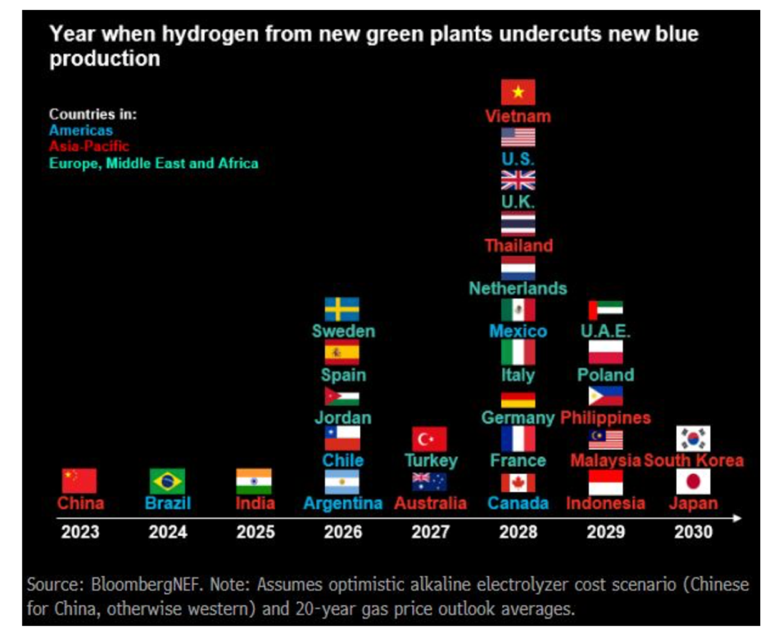
Taking the timescale of the offshore wind market into consideration, green hydrogen in Japan and South Korea might only become cheaper than blue hydrogen in 2030, says BloombergNEF. That’s considerably slower than China, which will see green hydrogen undercut blue hydrogen in 2023, thanks to its cheap electrolyzers, according to IRENA.
METI said that the geographic location of electrolyzers will also impact cost. If equipment is set up near the demand source, such as factories, there’ll be no cost required to transport hydrogen. However, if renewable electricity is transmitted to an electrolyzer with large capacity, hydrogen can be produced cheaper, but it must be transported, possibly raising overall cost.
One way to reduce cost is to bring users closer to fuel production. Given the high cost of long-distance hydrogen transport, it makes sense to relocate heavy energy users to areas with renewable sources. This would also support the government’s goal of regional revitalization.
Moving fuel or electricity over distance always leads to loss. The answer could be to double-down on what the government often says but rarely achieves: make local energy for local use. After all, with just a few thousand Toyota Mirai fuel cell vehicles sold in Japan to date, filling these tanks should not be the primary objective of the country’s hydrogen strategy.
ANALYSIS
BY MAYUMI WATANABE
Hydrogen to Drive Further Emission Cuts at Japan’s Auto Sector
As Companies Prepare for Methanation Rollout
CO2 emissions in Japan’s automotive industry, the nation’s top economic sector, have dropped for a fourth straight year. Now, to achieve greater cuts, some companies are looking into an overhaul of their manufacturing processes with the introduction of hydrogen fueled systems.
Hydrogen is expected to help Japanese manufacturers in a number of ways, including through its role in the methanation process. Several firms are due to announce new methanation applications later this year.
Still, doubts remain among industry insiders about how best to deploy hydrogen, while the endless debate over electrification vs hydrogen shows no sign of abating.
Earlier this month, representatives of key auto industry bodies met with the government to discuss progress in decarbonization in 2020 and the latest initiative. The good news was that both large car manufacturers and the even bigger auto parts industrial complex have seen positive momentum.
Below is a summary of the talks and background details.
Toyota Group initiatives
Toyota Motor Corporation is famous for its backing of hydrogen, but this support is usually painted as a one-dimensional strategy to sell more fuel cell-vehicles (FCVs). The automaker was the first to mass produce an FCV with the release of the Mirai sedan in 2014, and followed it up with the much-improved Mirai II in late 2020.
The Toyota Group, however, has pursued a much broader hydrogen-focused technological shift in which FCVs act as one of the stimuli for decarbonization. The group also leads an initiative to develop a zero-emissions hydrogen burner, which was developed together with Chugai Ro Co., and a solid oxide fuel cell-micro gas turbine (SOFC MGT), which would serve as the basis of a hydrogen power plant.
Toyota Industries, a components supplier for the Mirai, hopes to introduce hydrogen-powered forklifts at its Takahama plant in the coming months. The forklifts will run on green hydrogen produced onsite through electrolysis powered by rooftop solar. The shift to zero-emissions forklifts will have a sizable impact: a unit that runs on fossil fuels averages 3.23 tons of CO2/ year, according to Japan Industry Vehicle Association (JIVA).
The move to hydrogen-powered forklifts is not universally popular, however, even within the Toyota universe. Some engineers believe using solar panels to power electric forklifts would be more efficient. Others say FCVs are still best deployed in confined environments. With the current lack of hydrogen fueling infrastructure, “in-house” use of hydrogen at a factory complex is the most realistic, a metals supplier for the Mirai told Japan NRG.
National data shows that the auto industry’s concern is real. Japan’s 2017 Basic Hydrogen Strategy forecasts 500 hydrogen forklift units deployed nationwide by March 2021. In fact, there were 330 units in operation. Momentum will accelerate, however, according to industry discussions with the government, driven by greater focus on the climate and Japan’s declining population.
As labor shortages become more acute, demand for forklifts will rise, says a JIVA representative. Replacing older units is also a chance to shift the technology to fuel cell or electric machines. Japan should deploy 10,000 fuel-cell powered forklifts by 2030, according to METI’s targets.
Another hydrogen initiative pushed by the Toyota Group is methanation: a process through which carbon and hydrogen are converted into methane and water.
In April, Toyota Industries plans to launch a methanation facility at its plant. It will produce synthetic methane combining carbon generated during the regular manufacturing process with hydrogen. The resultant methane will be used to run plant equipment. Initial energy output will be at around 5 kWh.
Interest in methanation as an effective way to deploy carbon, creating clean heat with high calorific value, is spreading to Toyota Group’s lower tier component suppliers that work with aluminum. Heat comprises 70% of the Scope II emissions of auto component production, according to Japan Auto Parts Industry Association (JAPIA). A cogeneration system that uses methanation to recycle carbon should significantly cut end-point emissions.
While JAPIA declined to elaborate further, Japan NRG believes Aisin, a leading aluminum components maker and a member of the Methanation Council, is likely to start deploying methanation soon. Another is Denso, which has already built a pilot methanation system at its Yasugi plant.
2020 automotive emissions review
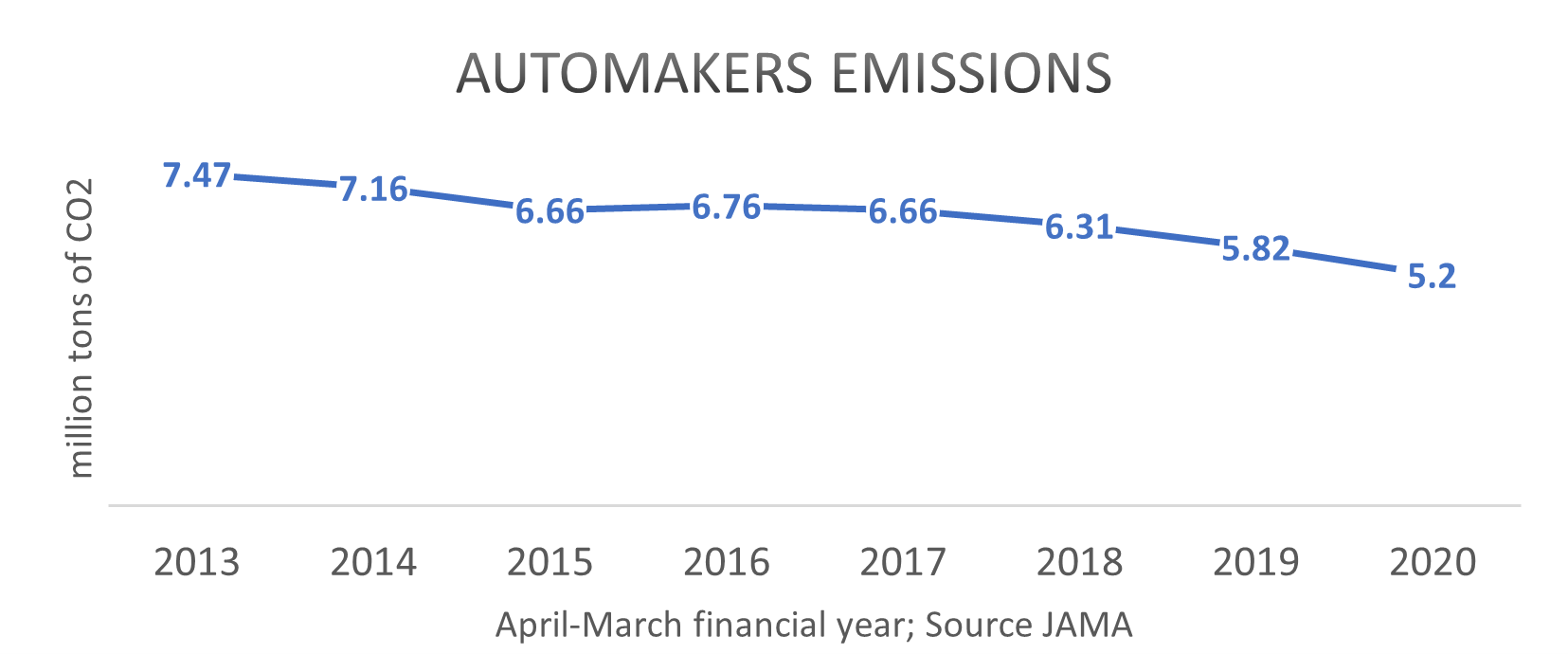
In 2020, the 14 Japanese automakers released 5.2 million tons of CO2 at their domestic plants, R&D centers and offices, down from 5.82 million tons a year earlier, Japan Automobile Manufacturers Association (JAMA) data show.
This decline was partly due to a drop in domestic vehicle output to 8 million units, from 9.5 million units in the same period the previous year. The rest was due to process improvements in gas-fired power generation, the blocking of air and steam leaks, and moving output to off-peak hours. Sector-wide initiatives included introduction of high-performance boilers, switching motors into inverters, and changing lighting systems to LEDs. Their 2020 renewable power consumption was a little over 400 GWh, almost flat from 2019.
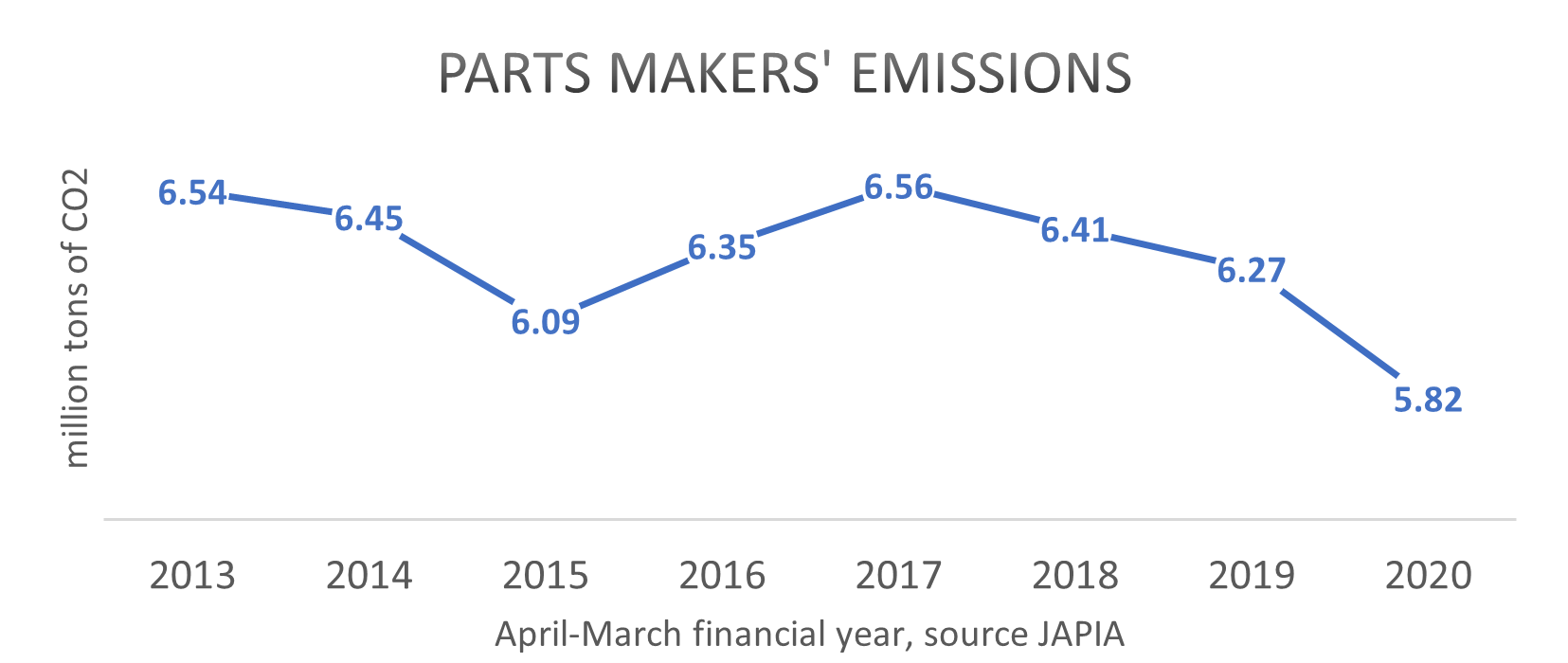
The 140 auto parts makers emitted 5.82 million tons of CO2 in 2020, down from 6.27 million tons a year earlier, also due to production declines. CO2 declines, however, were less than the sales drop, suggesting poor energy efficiency, JAPIA said.
Looking at the pre-Covid figures, both the automakers and auto parts companies are close to meeting their 2030 emissions targets: 6.16 million tons for JAMA and 5.62 million tons for JAPIA.
Future targets
In the context of the nation’s total GHG emissions, the automotive sector accounted for just 1% of the total in 2020, far below its GDP contribution. Still, the government is pushing the auto firms to go beyond their current process improvements and FCV/EV rollout. Production facilities need to review the energy consumption of the main equipment and consider reconstruction or overhaul, a government working group told industry representatives.
The future role of hydrogen in decarbonization also faces uncertainty. While the Toyota Group has been a pioneer in hydrogen R&D, and most recently in promoting methanation, the automaker has also joined the global race to scale up EV manufacturing; it significantly increased output targets and resources for battery-powered cars.
In terms of meeting consumer demand, that seems logical. Whether Toyota will continue to promote the broader hydrogen economy without FCVs at the center of auto sales is now a source of much speculation.
GLOBAL VIEW
BY JOHN VAROLI
Below are some of last week’s most important international energy developments monitored by the Japan NRG team because of their potential to impact energy supply and demand, as well as prices. We see the following as relevant to Japanese and international energy investors.
Algeria/ LNG
China’s Sinopec inked a $178 million deal with Algeria to build a massive 150,000 m3 LNG storage tank at the country’s gas export terminal of Skikda. Algeria has the world’s 10th largest natural gas reserves, it’s the world’s sixth-largest gas exporter, and exports nearly 60% of its output.
Australia/ Solar power
In 2021, 5.2 GW of solar power capacity was installed, giving Australia total solar capacity of 26.9 GW, which is more per capita than any other country. Small- and large-scale solar projects provide 13% of Australia’s total electricity supply.
Brazil/ Solar power
About $320 million will be invested to build a 532 MW solar project in the state of Rio Grande do Norte. Norway’s Scatec, Equinor and Hydro will lead development. The project will be operational in late 2023. Scatec sees Latin America as a key growth market and has a project pipeline of 2.1 GW in the region.
Chile/ Solar power
Solek Group will build and sell up to 200 MW of solar capacity to BlackRock’s Global Renewable Power Fund III. The PV portfolio consists of 28 solar projects. Chile will hold a power auction to contract 5,250 GWh annually for 15 years.
Financing/ Coal power
Despite net-zero pledges, more than $1.5 trillion was invested in the coal industry from Jan. 2019 to Nov. 2021. Banks financed 1,032 coal industry firms, said German environmental group Urgewald. Banks from six countries – China, U.S., Japan, India, UK and Canada – accounted for 86% of total coal financing.
France/ Offshore wind power
About 50 offshore wind farms totaling 40 GW of capacity will be built by 2050. France will invest €1 billion to develop new technologies such as floating wind. By 2028, France will hold tenders for about 8.75 GW of offshore wind capacity.
India/ LNG
Petronet LNG will invest $5.3 billion to expand domestically and buy stakes in international gas projects. Among these is the Dahej LNG import terminal in Gujarat, which will have an annual capacity of 22.5 million tons once its expansion is completed.
Netherlands/ Green hydrogen
RWE will develop a green hydrogen demonstration project in the North Sea. The “H2opZee” offshore project has an electrolyser capacity of 300 to 500 MW that can convert offshore wind power to hydrogen. Overall, RWE plans to build 2 GW of electrolyser capacity by 2030.
Philippines/ Renewables
This year, Aboitiz Power Corp. will build 600 MW of renewable energy capacity. By 2030, the company will spend $3.7 billion to grow its renewables capacity to 4.6 GW, which would be 50% of its total generation portfolio of 9.2 GW.
Saudi Arabia/ Energy transition
Assets worth $80 billion were transferred to the country’s sovereign wealth fund that will invest in green projects. Crown Prince Mohammed bin Salman wants the investment fund to have $1 trillion in assets by the 2026.
U.S./ Coal power
By 2030, Duke Energy will slash coal-fired capacity to less than 5% of total generation, with a complete exit by 2035. Duke owns about 16 GW of coal-fired capacity, 25% of its overall owned portfolio. Duke aims for 50% emissions reductions by 2030 and net-zero by 2050.
2022 EVENTS CALENDAR
A selection of domestic and international events we believe will have an impact on Japanese energy
| January | OPEC quarterly meeting;
JCCP Petroleum Conference – Tokyo; EU Taxonomy Climate Delegated Act activates; Regional Comprehensive Economic Partnership (RCEP) Trade Agreement that includes ASEAN countries, China and Japan activates; Indonesia to temporarily ban coal exports for one month; Regional bloc developments: Cambodia assumes presidency of ASEAN; Thailand assumes presidency of APEC; Germany assumes presidency of G7; France assumes presidency of EU; Indonesia assumes presidency of G20; and Senegal assumes presidency of African Union; Japan-U.S. two-plus-two meeting; Japan’s parliament convenes on Jan. 17 for 150 days; Prime Minister Kishida visits Australia (tentative) |
| February | Chinese New Year (Jan. 31 to Feb. 6);
Beijing Winter Olympics; South Korea joins RCEP trade agreement |
| March | Renewable Energy Institute annual conference;
Smart Energy Week – Tokyo; Japan Atomic Industrial Forum annual conference – Tokyo; World Hydrogen Summit – Netherlands; EU New strategy on international energy engagement published; End of 2021/22 Japanese Fiscal Year; South Korean presidential election |
| April | Japan Energy Summit – Tokyo;
MARPOL Convention on Emissions reductions for containerships and LNG carriers activates; Japan Feed-in-Premium system commences as Energy Resilience Act takes effect; Launch of Prime Section of Japan Stock Exchange with TFCD climate reporting requirement; Convention on Biological Diversity Conference for post-2020 biodiversity framework – China; Elections: French presidential election; Hungarian general election |
| May | World Natural Gas Conference WCG2022 – South Korea;
Elections: Australian general election; Philippines general and presidential elections |
| June | Happo-Noshiro offshore wind project auction closes;
Annual IEA Global Conference on Energy Efficiency – Denmark; UNEP Environment Day, Environment Ministers Meeting – Sweden; G7 meeting – Germany |
| July | Japan to finalize economic security policies as part of natl. security strategy review;
China connects to grid 2nd 200 MW SMR at Shidao Bay Nuclear Plant, Shandong; Czech Republic assumes presidency of EU; Elections: Japan’s Upper House Elections; Indian presidential election |
| August | Japan: Africa (TICAD 8) Summit – Tunisia;
Kenyan general election |
| September | IPCC to release Assessment and Synthesis Report;
Clean Energy Ministerial and the Mission Innovation Summit – Pittsburg, U.S.; Japan LNG Producer/Consumer Conference – Tokyo; IMF/World Bank annual meetings – Washington; Annual UN General Assembly meetings; METI to set safety standards for ammonia and hydrogen-fired power plants; End of 1H FY2022 Fiscal Year in Japan; Swedish general election |
| October | EU Review of CO2 emission standards for heavy-duty vehicles published;
Chinese Communist Party 20th quinquennial National Party Congress; G20 Meeting – Bali, Indonesia; Innovation for Cool Earth TCFD & Annual Forums – Tokyo; Elections: Okinawa gubernational election; Brazilian presidential election; |
| November | COP27 – Egypt;
U.S. mid-term elections; Soccer World Cup – Qatar; |
| December | Germany to eliminate nuclear power from energy mix;
Happo-Noshiro offshore wind project auction result released; Japan submits revised 2030 CO2 reduction goal following Glasgow’s COP26; Japan-Canada Annual Energy Forum (tentative); Tesla expected to achieve 1.3 million EV deliveries for full year 2022 |
Disclaimer
This communication has been prepared for information purposes only, is confidential and may be legally privileged. This is a subscription-only service and is directed at those who have expressly asked K.K. Yuri Group or one of its representatives to be added to the mailing list. This document may not be onwardly circulated or reproduced without prior written consent from Yuri Group, which retains all copyright to the content of this report.
Yuri Group is not registered as an investment advisor in any jurisdiction. Our research and all the content express our opinions, which are generally based on available public information, field studies and own analysis. Content is limited to general comment upon general political, economic and market issues, asset classes and types of investments. The report and all of its content does not constitute a recommendation or solicitation to buy, sell, subscribe for or underwrite any product or physical commodity, or a financial instrument.
The information contained in this report is obtained from sources believed to be reliable and in good faith. No representation or warranty is made that it is accurate or complete. Opinions and views expressed are subject to change without notice, as are prices and availability, which are indicative only. There is no obligation to notify recipients of any changes to this data or to do so in the future. No responsibility is accepted for the use of or reliance on the information provided. In no circumstances will Yuri Group be liable for any indirect or direct loss, or consequential loss or damages arising from the use of, any inability to use, or any inaccuracy in the information.
K.K. Yuri Group: Oonoya Building 8F, Yotsuya 1-18, Shinjuku-ku, Tokyo, Japan, 160-0004.