
JAPAN NRG WEEKLY
MARCH 14, 2022
JAPAN NRG WEEKLY
March 14, 2022
NEWS
TOP
- Japan does not plan exit from Russian oil & gas projects fearing
it won’t exert pressure on Russia but will worsen energy security - 11th anniversary of Fukushima disaster: nuclear future still unclear as PM Kishida’s administration yet to commit on the issue
- MHI to make ammonia-fired system that works at coal plants;
new technology seeks to satisfy cost, tech and security concerns
ENERGY TRANSITION & POLICY
- Govt. advisors say utilities should limit exposure to spot markets
- Japan bans export of oil refining equipment to Russia
- Agriculture Ministry to subsidize farmers in effort to lower fuel use
- Japan, Philippines to combat hydrofluorocarbon under JCM terms
- Japan begins first trials of tidal generation in a southwestern strait
- Kawasaki says test shipment of hydrogen from Australia a success
- Petronas and ENEOS to study hydrogen production in Malaysia
- Companies work on plan to produce hydrogen from cow dung
ELECTRICITY MARKETS
- Kansai Electric shuts one more nuclear reactor for maintenance
- Record low bids in latest solar capacity tender; but volumes lower
- Wind industry group asks govt. for more clarity on future tenders
- Ibaraki offshore wind farm to be completed ahead of schedule
- Shipper Mitsui OSK joins Orsted’s Taiwan offshore wind project
- Renewable Japan says O&M business now spans 1 GW of solar
- IHI unit to provide energy storage for 690 MW U.S. solar project
- Kansai Electric sets terms of ¥200 billion in hybrid bonds
OIL, GAS & MINING
- U.S. LNG project part-owned by Japan firms to boost output 60%
- Japan’s LNG stockpiles hit one-year low
- Exchange halts trading of nickel, key battery metal, on price jump
- METI begins releasing nation’s strategic oil reserves
- Japan buyers of materials from Russia, Ukraine turn to recycling
ANALYSIS
AS UKRAINE CONFLICT SPURS ENERGY UPHEAVAL JAPAN’S NUCLEAR POLICY DEBATE REIGNITES
Sanctions related to war in Ukraine are pushing up the cost of fossil fuels. As Kishida’s administration looks to forestall public anger over high power and fuel prices ahead of this summer’s elections, the debate over the nuclear plant restarts has again come front and center. External advisors are pushing the government to make a greater commitment to nuclear energy, according to recent meetings. Still, even within the pro-nuclear lobby there are deep divisions, including around the issue of energy security.
THE COST OF BREAKING ENERGY TIES WITH RUSSIA: JAPAN FACES AN EXPENSIVE DILEMMA
While the U.S. and Europe announced major pullbacks from trade and investment in Russian energy, both on a national and corporate level, so far Japan resists this course of action. Beyond geopolitical consequences, an unequivocal stand on Russian energy trade will incur major economic costs for Japan, which could run into tens of billions of dollars. It may also unintentionally disrupt European allies’ efforts to reduce their own reliance on Russia for energy commodities. With pressure to follow the U.S. not forthcoming, Japan mulls what a withdrawal from Russia assets will mean for the power balance in the broader Asia region.
GLOBAL VIEW
The EU unveils a plan to slash imports of Russian oil and gas. Canada to end state financing of a major oil pipeline extension. China to add 30 GW of non-hydro energy storage. Barbados defends new oil exploration. Huawei to build Africa’s largest solar PV and storage facility›. Details on these and more in our global wrap.
EVENT CALENDAR FOR 2022
Key political and business events in Japan and abroad.
JAPAN NRG WEEKLY
PUBLISHER
K. K. Yuri Group
Events
Editorial Team
Yuriy Humber (Editor-in-Chief)
John Varoli (Senior Editor, Americas)
Mayumi Watanabe (Japan)
Wilfried Goossens (Japan, Events)
Regular Contributors
Chisaki Watanabe (Japan)
Daniel Shulman (Japan)
Takehiro Masutomo (Japan)
Art & Design
22 Graphics Inc.
SUBSCRIPTIONS & ADVERTISING
Japan NRG offers individual, corporate and academic subscription plans. Basic details are our website or write to subscriptions@japan-nrg.com
For marketing, advertising, or collaboration opportunities, contact sales@japan-nrg.com
For all other inquiries, write to info@japan-nrg.com
OFTEN USED ACRONYMS
METI The Ministry of Energy, Trade and Industry
MOE Ministry of Environment
ANRE Agency for Natural Resources and Energy
NEDO New Energy and Industrial Technology Development Organization
TEPCO Tokyo Electric Power Company
KEPCO Kansai Electric Power Company
EPCO Electric Power Company
JCC Japan Crude Cocktail
JKM Japan Korea Market, the Platt’s LNG benchmark
CCUS Carbon Capture, Utilization and Storage
mmbtu Million British Thermal Units
mb/d Million barrels per day
mtoe Million Tons of Oil Equivalent
kWh Kilowatt hours (electricity generation volume)
NEWS: ENERGY TRANSITION & POLICY

War in Ukraine and impact on energy:
- Japan won’t exit Russia’s Sakhalin II LNG project, fearing impact
- (Nikkei, March 13)
- Mitsui & Co. and Mitsubishi Corporation are maintaining their policy of not exiting the Sakhalin II LNG project in Far East Russia, even after Shell announced its withdrawal. The Japanese side is concerned about stable supply and energy security should the trading houses walk away.
- METI spoke with trading house officials involved in energy, and the views are that a hasty withdrawal would be dangerous and only benefit Russia and China. METI believes that Sakhalin II is a very valuable asset.
- Japan’s government and trading houses have analyzed the risk of withdrawal and concluded that it will mean having to procure most of the lost volumes on the spot market, which could cost as much as ¥2 trillion extra and increase power prices.
- Japan has a similar view on other Russian oil and gas projects, though is very concerned about criticism from investors and the international community.
- CONTEXT: Sakhalin II is Russia’s first LNG project. Its proximity to Japan means cargos can arrive within three days, compared with two weeks for LNG ships from the Middle East and three weeks for U.S. deliveries.
- SIDE DEVELOPMENT:
METI Minister opposed to Sakhalin withdrawal
(Reuters, March 8)- METI minister Hagiuda questioned whether sanctions against Russia’s Sakhalin I and II oil and gas projects would be effective, saying he was opposed to an immediate withdrawal from the project.
- He said withdrawing from the project was one way of punishing Russia, but was worried that if Japan relinquished its stake in the project, then it’d be acquired by another country, with the result that Russia wouldn’t suffer.
Power and gas advisors say utilities should limit exposure to spot LNG
(Japan NRG, March 7)
- METI advisors for the basic power and gas policy working group said utilities should limit exposure to the LNG spot market in order to increase supply security. They praised the gas utilities that had locked 70% of supplies under long-term contracts and limited spot exposure to 30%. The contracts protect Japanese end-users from skyrocketing spot prices and supply crunch, and limited the rise in power rates. Japanese term buyers have been able to source LNG at less than $15/ MMBtu while spot prices surged to $60/MMBtu.
- Before the Ukraine crisis, Japanese buyers were urged to align with the trend to actively engage in spot trades, but this approach may not be right. One panelist noted that power utilities’ term ratio was lower than 70%.
- Procurement strategy review is needed as JOGMEC studies showed that gas supplies are not expected to increase until 2025 due to a lack of upstream investment, panelists said.
TAKEAWAY: Experts are divided on the (long vs short) term ratio levels. While one power and gas working group member said the 70% term ratio was reasonable, during the nuclear sub-committee meeting last week another panelist criticized the utilities for buying too much from the spot market.
Long-term contracts do not always guarantee supplies. For example, deliveries can be canceled due to natural disasters and wars. Familiarity with the quality of spot supplies and fast-changing trade practices could help buyers cope with force majeure risks.
Government bans export of refining equipment to Russia
(Nikkei, March 8)
- Japan followed the U.S. with export sanctions on oil refining equipment to Russia.
- The move is designed to strike a blow to the Russian energy industry, which is an important source of revenue for Moscow.
- Along with the U.S. and the EU, Japan expanded the list of Russian individuals and organizations whose assets would be frozen, including USM Holdings owner Alisher Usmanov.
MHI to develop ammonia-fired system that can be installed at coal plants
(Nikkei, March 12)
- Mitsubishi Heavy Industries will develop a new power system with 200 MW turbines fueled by ammonia. The system will not emit nitrogen oxide (NOx), a by-product of conventional ammonia power generation facilities.
- The system will allow a relatively easy conversion of existing coal plants to burning ammonia.
- The new turbines MHI will utilize part of the waste heat generated when ammonia is burned at 600 degrees, splitting into nitrogen and hydrogen. The latter will be recycled to power the gas turbine, while the heat will be used to break down ammonia.
- The new system will be commercially available in the 2030s, and is expected to cost 1/10th of the amount needed to install new hydrogen turbines.
TAKEAWAY: This could be a major R&D breakthrough if the parameters suggested at this moment hold up in testing facilities. The major problems of hydrogen-fired power have always been cost and difficulty in transportation.The major problems for ammonia as a power fuel have included supply and NOx emissions. MHI’s system seems to offer a solution, and allows a more straightforward shift from coal to clean-burning gas at thermal plants than the current co-firing strategy.
Still, this system will only be available a decade from now, which leaves time for other, more market-ready technologies to take market share.
Another encouraging factor is MHI’s claim that it could make smaller ammonia-fired turbines commercially available as soon as 2025. That would allow factories with captive coal-fired power plants to start making the switch already this decade.
Agriculture Ministry to subsidize farmers and wood processors to use less fuel
(New Energy Business News, March 8)
- The Ministry of Agriculture, Forestry, and Fisheries (MAFF) decided at the “Ministerial Meeting around Soaring Oil Prices” to introduce emergency measures to help farmers.
- Among these, the ministry will expand support for mushroom farmers who wish to install wood biomass boilers and wood processing companies that seek to add energy-saving equipment. Subsidies will support a switch to electric equipment when it contributes to energy saving.
- CONTEXT: Using woody biomass reduces the need to burn fuel oil.
- The government will also provide interest rates subsidies.
Japan, Philippines to combat hydrofluorocarbon under JCM framework
(Japan NRG, March 8)
- The environment ministries of Japan and the Philippines agreed to step up the joint fight against hydrofluorocarbon (HFCs) by assessing its collection and destruction under the Joint Credit Mechanism framework.
Japan begins first trials of tidal generation in southwest seas
(NNN News, March 9)
- In a first, Japan began trialing tidal generation technology in the Nagasaki area. The Naruseto Strait (奈留瀬戸) lies between Narusejima and Kugajima islands, west of Kyushu.
- The location was chosen because it has currents of over 3 meters per second. Tidal generation systems require currents of at least 1 m/s to generate electricity.
- The electricity generated is brought onshore by a 2 km undersea cable.
- The government partners with Kyushu Electric on the trial; it wants people to understand the potential of tidal generation.
- The output of tidal generation systems is more predictable than other renewables.
- There are a total of six straits in the Nagasaki region suitable for tidal generation.
Kawasaki Heavy says test shipment of liquid hydrogen from Australia is a success
(Reuters, March 8)
- Kawasaki Heavy Industries (KHI) and other Japan-based firms said that a pilot project to transport hydrogen produced from brown coal in Australia, carried in the world’s first liquefied hydrogen tanker, had proven technically feasible.
- The A$500 million ($364 million) project, led by KHI and backed by the governments of Japan and Australia in an effort to cut carbon emissions, was originally due to ship its first cargo a year ago but was delayed by the pandemic.
- The KHI-built Suiso Frontier tanker left Australia on Jan. 25 and arrived in Kobe, Japan, a month later. The hydrogen cargo was unloaded by the end of February.
- J-Power is in charge of producing the hydrogen for this project. Other partners include Shell, Iwatani Corp, Marubeni, Eneos and Kawasaki Kisen Kaisha.
Petronas and Japan’s ENEO to jointly study hydrogen production in Malaysia
(Company Statement, March 11)
- Petronas and ENEOS signed a joint feasibility study agreement to advance studies for a commercial hydrogen production and conversion project in Kerteh, Terengganu (Malaysia).
- The two will study the potential for low carbon hydrogen from PETRONAS’ existing facilities, the production of green hydrogen from a new hydro-powered electrolyser facility, and hydrogen conversion into methylcyclohexane (MCH).
- The facilities are projected to have a total hydrogen production and conversion capacity of up to 50,000 tons per annum by 2027 for export in MCH form to Japan, where the hydrogen will be distributed to Japanese industries through ENEOS’ refineries.
- Once onstream, the project could potentially be the first commercial scale hydrogen-to-MCH undertaking in the world. A Final Investment Decision is expected by the end of 2023.
Companies join to make hydrogen from cow dung
(New Energy Business News, March 11)
- Industrial gases producer, Air Water Hokkaido, and construction major Kajima Corp. established a JV to produce and sell hydrogen made from biogas derived from livestock manure. This will be Japan’s first such project manufacturing carbon-neutral hydrogen.
- The venture, Shikai Hydrogen Farm, will operate in Hokkaido’s Kawato region. It will make hydrogen for fuel cells to power vehicles and forklift trucks, as well as be transported in high-pressure containers to the town of Kaoi. Also, it will be packaged into fuel cells, and supplied to local factories for industrial use.
- Shikaoi Hydrogen Farm will get biogas produced through methane fermentation from the Shikaoi Environmental Conservation Center, one of the leading livestock manure processing facilities in Japan. This hydrogen production supply chain had been jointly tested by Air Water and Kajima since 2015.
Oil refiner Cosmo and Iwatani Corp partner in hydrogen service stations
(New Energy Business News, March 10)
- Cosmo Energy Holdings and Iwatani Corporation will collaborate in the hydrogen business. The two will review the potential to work together in the hydrogen refueling stations sector and engineering fields related to hydrogen production, as well as in operation of domestic receiving terminals.
- A JV focused on building and operating hydrogen service stations that targets fuel cell vehicles will be set up in 2022.
- CONTEXT: Cosmo uses hydrogen in the manufacturing process of petroleum products, while Iwatani is Japan’s leader in hydrogen production.
Plan approved for GE Hitachi Nuclear Energy to provide reactors for Poland
(NNA; Mar.9)
- The Polish monopoly regulator has approved a JV between major petrochemical company PNK Olen and chemical manufacturer Synthos.
- The JV is called Olen Synthos Green Energy and aims to build nuclear power plants in Poland that incorporate small modular reactors (SMR) and micro-modular reactors (MMR) supplied by GE Hitachi Nuclear Energy.
INPEX joins global CCS+ Initiative to create carbon credits framework
(Company Statement, March 9)
- INPEX has joined the CCS+ Initiative that’s developing a methodology for generating voluntary carbon credits from CCS/CCUS1 projects.
- The CCS+ Initiative aims to globally accelerate and expand CCUS business as a form of climate change response. The process was established by international oil and gas companies in collaboration with Verra, a US-based, non-profit voluntary carbon credit certification organization.
- INPEX aims to be a leader in the CCUS field by playing a central role in the realization of CCS hub2 businesses in Japan and overseas. By generating voluntary carbon credits using the CCS+ Initiative’s methodology, the company expects to increase the likelihood of realizing CCUS projects in the future.
One-Dot Wrap:
- In April, Kyushu Electric will begin manufacturing and selling battery packs for machinery using lithium-ion batteries for EVs (New Energy Business News, March 10)
- Toho Gas agreed with KYB, Kowa Kogyosho, CKD, and Meijo University to supply “carbon neutral” city gas that’s offset with CO2 credits; the four will be able to claim 70,000 tons of CO2 emissions reductions. (New Energy Business News, March 8)
- Mitsubishi Corporation’s retail power supplier said it will revise its electricity contracts starting April 1 in order to reflect current fuel prices. The retailer will remove the upper limit used to calculate the fuel cost adjustment, which effectively puts up prices. (Denki Shimbun, March 8)
NEWS: POWER MARKETS

OPINION: 11 years after Fukushima, Japan remains unsure on nuclear
(Mainichi Shimbun, March 11)
- CONTEXT: This is an opinion piece by Oka Daisuke, an energy policy writer with the daily.
- The nation’s energy plan was revised for the first time in three years, but state nuclear policy remained essentially unchanged. PM Kishida’s green energy strategy focuses on renewables and ammonia, and ignores nuclear.
- While nuclear energy supplied 25% of Japan’s electricity before Fukushima in 2011, this fell to just 4% in 2020. Nuclear is no longer a major power source.
- Some hoped the government’s commitment to carbon neutrality by 2050 would see new reactors built. But unlike the U.S. and France, which recently announced additional support for nuclear, Japan has yet to make such commitments.
- The government will find it hard to achieve its target of sourcing 20% of electricity from nuclear power stations by 2030.
- The government puts more hope in renewables. But, the increasing difficulty in finding new sites for solar farms suggests this target will also be difficult to achieve.
- The main question is: Can Japanese learn from Fukushima, move on, and agree on a new nuclear energy policy.
Kansai Electric shuts a reactor at the Ooi NPP for maintenance
(Jiji Press, March 9)
- Kansai Electric and the Fukui Prefecture said the Ooi Nuclear Power Plant Unit No. 4 will stop operation on March 11 and begin scheduled inspection and maintenance.
- The unit is due back online in about four months, in early August.
- The operator needs to upgrade the reactor to meet the latest anti-terrorism measures by Aug. 24 in order to continue operating. The company is confident it can meet this target.
Record low bids in latest solar FIT tender
(Smart Japan, March 8)
- Bids in the 11th round of solar energy tenders under the FIT were announced.
- Bids were accepted from solar facility operators with output of at least 250 kW.
- A record low bid of ¥8.99/ kWh was noted; average of all bids was ¥9.99/ kWh.
- While the government held tenders for a total of over 278 MW of capacity, bids received were less than 269 MW, a drop of over 60 MW compared to the last round.
TAKEAWAY: This is the first time when the average bids have dropped below ¥10/ kWh, which shows that at least for now solar prices continue to decline. While this is a testament to how hard the solar industry has fought to bring down costs, one concern will be what happens once the rising raw material prices start to filter into the calculations. It’s notable that the number of bidders and total capacity sought by participants has dropped, suggesting that further price declines will likely see a thinning of the number of industry players.
Wind Industry makes recommendations to government on future offshore wind auctions
(New Energy Business News, March 9)
- CONTEXT: Japan held its first commercial offshore wind tenders last year. The three areas for bottom-fixed turbines were all won by Mitsubishi Corporation and a unit of Chubu Electric group, which stirred up discontent among other wind industry players.
- The Japan Wind Power Association (JWPA), the industry’s biggest group, sent the government recommendations for future offshore wind tenders. The JWPA called for better information disclosure, saying many of its members are unsure as to how the government carried out its evaluation of bids.
- The JWPA also raised concerns that the government is allocating too much weight to the price offered by bidders, saying it does not fully value efforts put into working with the local communities. The industry lobby group said this could “hinder industrial development and supply chain construction.”
- The group wants its recommendations to be in place for the next offshore wind auction, for the Happo Town and Noshiro City, Akita Prefecture, the bidding for which has already started.
TAKEAWAY: Companies that put in years of work into building local relationships in the towns close to offshore wind projects are trying to swing the balance to their favor. That’s not to say Mitsubishi and its allies do not have cache in the regions. But, clearly some of their rivals clearly spent more resources on speaking with the local population and businesses. Since the government has often emphasized the need to “sell” renewables projects to the local communities, it can’t ignore such pleas from industry groups.
Ibaraki wind farm to be completed over a year early
(Nikkei, March 11)
- Ibaraki-based Wind Power Energy said a 160 MW offshore wind farm planned for Kajima port, Ibaraki, is now scheduled to begin feeding the grid in 2026/27.
- Completion was originally scheduled for 2028.
- The faster turnaround was made possible by a quicker environmental assessment.
Shipper Mitsui OSK to join Taiwan offshore wind project led by Orsted
(Kankyo Business, March 7)
- Shipping firm Mitsui O.S.K. (MOL) will join the 128 MW Formosa I offshore wind power project in Taiwan. The shipper will take over the shares in the project held by Australia’s Macquarie group.
- Mitsui OSK will take a 37.5% stake in a JV with Toho Gas and Hokuriku Electric. That venture owns 25% of the operating firm for Formosa I.
- The shipper also announced the establishment of a ¥10 billion fund together with Hokutaku, a Hokkaido company specializing in wind power equipment maintenance, in order to invest in offshore wind power generation projects in Japan.
- Mitsui OSK seeks to become a leader in floating offshore wind, a field in which it can use its experience with floating production and storage units, or floating storage and regassification units.
Renewable Japan operations and maintenance now spans 1 GW of solar
(New Energy Business News, March 7)
- Renewable Japan Co.’s operations and maintenance (O&M) business now covers more than 1 GW of solar power generation capacity. The company aims to expand this to 2 GW by 2025.
- As of March 1, Renewable Japan carries out O&M for 223 projects, including 56 external contracts with 425 MW of capacity.
- CONTEXT: O&M, which is shorthand for Operations and Maintenance, is the work to keep solar panels clean and running smoothly.
IHI unit to provide energy storage system for 690 MW U.S. solar project
(Company statement, March 7)
- IHI Terrasun Solutions, Inc., a U.S. subsidiary of Japanese heavy machinery major IHI, signed a 25-year agreement to provide energy storage solutions and lifecycle services for a large-scale solar power project in Nevada, U.S.
- The $1.2 billion Gemini Project will install a 690 MW solar array and couple it with a 380 MW AC battery storage system; it will feature over 1.8 million solar modules installed on about 6,500 acres of federal land and will produce enough clean energy to power the entire city of Las Vegas.
- IHI Terrasun Solutions took charge of system integration and lifecycle services.
Kansai Electric announces terms for ¥200 billion in 60-year hybrid bonds
(Denki Shimbun, March 7)
- Kansai Electric announced the terms and conditions for the issuance of hybrid bonds (general collateralized, unsubordinated bonds) in the form of a public offering.
- The first series will be for ¥90 billion; the second for ¥15 billion; and the third for ¥115 billion. The redemption date is March 2082. The interest rates vary from 0.8% to 1.259%.
Shizen Energy plans onshore wind power plant near Kyoto
(New Energy Business News, March 11)
- Shizen Energy plans to develop a 59 MW onshore wind power plant in the vicinity of Kyotango City, Kyoto Prefecture, according to an environmental assessment study released by the renewables company.
- The project area covers about 971 ha in Kyotango City, Mineyama Town, and Omiya Town. The 14-turbines project begins construction in January 2026. Test operations start in July 2029, aiming for full commercial scale from 2030.
ENEOS and Mizuho Leasing invest in solar farms
(Nikkan Sangyo Shimbun, March 11)
- ENEOS and Mizuho Leasing invested in four major solar farm projects in Aomori, Fukushima and Shimane prefectures, with combined output of 57 MW.
- ENEOS has 22 solar farms, 2 wind farms and 1 biomass- power station in Japan.
NEWS: OIL, GAS & MINING

U.S. LNG project partly-owned by Japan to boost capacity 60% to offset Russia risk
(Nikkei, March 10)
- Sempra Infrastructure will boost output at one of its LNG plants by 60% to about 19 million tons per year by 2027.
- The increase will be allocated to Europe and Asia exports as the regions look to offset reliance on Russian gas.
- The U.S. company’s plant in Louisiana, Cameron, will add approximately 6.75 million tons of capacity. It is already one of the largest LNG plants in the U.S.
- The Cameron facility is operated by Sempra, which also has a 50.2% stake in it. Japan’s Mitsui & Co., Mitsubishi Corporation, and NYK hold another 33.2%; France’s TotalEnergies has a 16.6% stake.
- SIDE DEVELOPMENT:
U.S. will not ask Japan to limit Russian oil imports: State Dept adviser
(Asia Nikkei, March 10)- Amos Hochstein, an energy security adviser to the U.S. Secretary of State Antony Blinken, said the U.S. does not expect Japan to follow the U.S. in banning Russian oil imports.
- SIDE DEVELOPMENT:
Osaka Gas CEO says all energy firms will be affected if Russian LNG supply cut
(Nikkan Kogyo Shimbun, March 11)- Osaka Gas President Fujiwara said there’s no energy company that won’t be affected if all Russian natural gas is embargoed, adding that it will lead to even higher oil prices and physical shortages.
- Oil at above $100 per barrel will hurt Osaka Gas income by about ¥4 billion next year.
- Osaka Gas procures only 4%, or 380,000 tons, of its LNG from Russia and could find alternative suppliers, Fujiwara aid.
Japan’s LNG stocks hit one-year low at 1.47 million tons
(Japan NRG, March 6)
- As of March 6, Japan’s LNG stocks hit their lowest this year, falling to 1.47 million tons. In 2021, end-March stocks were 2.41 million tons; the 4-year average is 2.19 million tons.
Exchange halts nickel trading on skyrocketing prices
(Exchange statement, March 8)
- The London Metal Exchange suspended trading of nickel futures on March 8 following a contract surge to $100,000/ ton from the March 7 trading levels of around $48,000 ton. The exchange also canceled all deals closed on March 8. Trading will resume no earlier than March 11.
TAKEAWAY: Pricing formulas of nickel sulfate and other EV battery materials incorporate monthly averages of LME futures. Prices of stainless steel, which is used for nuclear vessels, reactors and fuel containers, also factor in LME nickel price moves.
Russian news agency TASS reported that production and sales operations at Norilsk Nickel, the world’s leading nickel producer, are unaffected by the war. The company had earlier forecast the global nickel market to be in a surplus of 42,000 tons this year due to a 40% increase in Indonesian supplies that outpaces a 16% growth in demand.
METI begins releasing strategic oil reserves
(Reuters, March 10)
- METI began releasing strategic oil reserves in cooperation with other International Energy Agency member nations.
- Japan agreed to release 7.5 million barrels of oil, out of a total of 60 million barrels to be released by IEA members.
- The government temporarily reduced the legally mandated private sector reserve from 70 days to 66 days.
World depends on Russia and Ukraine for 70% of some rare commodities
(Nikkei, March 4)
- Russia’s invasion has stoked fears about the supply of rare commodities, such as palladium, 40% of which is produced in Russia, and neon, 70% of which is produced in Ukraine.
- Palladium is used in catalytic converters in cars, while neon is indispensable in lasers and other semiconductor applications.
- Vanadium and krypton are two other materials for which the world is highly dependent on Russia and Ukraine.
- Japanese vanadium importers are worried about the combined effect of the war and flight restrictions on supply, saying that while they’ll increase recycling to try and offset the fall in supply, this alone won’t be enough to satisfy demand.
- SIDE DEVELOPMENT:
Kansai region exposed to Ukraine crisis
(Sankei News, March 9)- A survey found that 65% of Kansai region businesses believe Russia’s invasion will adversely affect their business, compared to a national average of 61%.
- The disparity is noticeable amongst large corporations; 74% of those in Kansai say they’ll be adversely affected by the war, versus only 57% nationwide.
- The relative pessimism of Kansai businesses is due to a high concentration of manufacturers that trade with Russia and Ukraine, making them more exposed.
ANALYSIS
BY MAYUMI WATANABE
As Ukraine Conflict Spurs Energy Upheaval
Nuclear Policy Debate Reignites
Russia’s sudden and unexpected offensive against Ukraine is forcing a dramatic change in energy policy across the globe. Governments are trying to increase crude oil stockpiles and reviewing power supply chains, as well as trying to find ways to mitigate the fallout from rising energy prices that are incensing electorates.
The upheaval threatens to spill into political changes as a number of major industrialized nations, Japan included, face key elections this year. PM Kishida’s administration is trying to forestall popular anger by addressing self-sufficiency in key sectors — semiconductors, rare earths, food, and, of course, energy.
Toward that goal of energy self-sufficiency, the issue of nuclear power is once again front and center. Recent METI meetings with external advisors have ended with calls to increase nuclear power’s role in the energy mix. But METI will have to work hard to mitigate negative public sentiment towards the industry that lingers 11 years on from the Fukushima disaster.
In the midst of the highest inflation in decades, power utilities and METI are making the case for more restarts by arguing that nuclear plants can help to reign in rising electricity rates and avoid CO2 emissions that would be incurred were thermal plants to take their place. The pro-nuclear lobby, however, remains deeply divided on energy security definitions and dimensions.
While Japan hesitates over its next steps, it’s clear that more and more of the industrialized world is ready to back the nuclear bandwagon. Neighbors in Asia are starting to look more into nuclear technologies, which in itself presents tremendous export opportunities for Japan since it produces components used in advanced nuclear reactors.
Background: energy vulnerability
In 2019, Japan’s energy self-sufficiency was 12.1%, far below the 2010 figure of 20.2%. The decline’s main cause was the closure of nuclear power stations following the 2011 accident at the Fukushima Dai-Ichi station. In its heyday, nuclear accounted for a third of the nation’s power mix; by 2019 that figure was 4%.
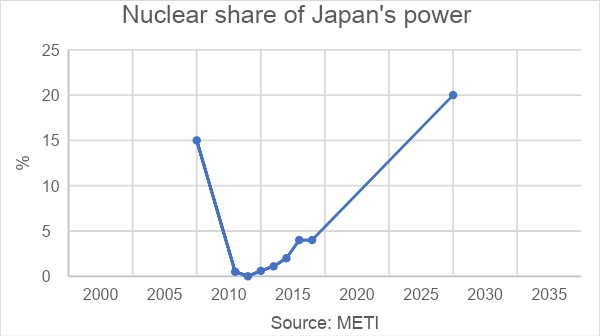
Since 2011, coal and gas stepped in to fill the gap, but net-zero policies enacted over the last two years and surging fossil fuel prices mean it has come time for a change. Tokyo will have to make hard and possibly unpopular decisions that will determine energy policy for decades to come. Failure to act would leave Japan vulnerable to power outages.
Russia pivot was Plan B
For decades, reducing Middle East energy dependency has been a top priority. And so, since the end of the Cold War, Russia has been seen as a source of energy supply to fall back on in case Middle Eastern sources failed.
While Saudi Arabia and UAE still account for over 70% of Japan’s oil imports, Russia’s oil import share is 4% and LNG 9%. While that might seem small and easily replaceable, Japanese experts warn the government not to give up on Russian supplies as the volatile Middle East region too could erupt in conflict. It has seen several major wars over the past three decades.
Ironically, the effort to reduce exposure to Middle East oil has turned into a major geopolitical risk. Russia is now that risk. Japan’s energy sector will have to digest the shock from decades of building up alternative supply channels aimed at improving national energy security.
“You could say that Russian gas has only a 9% share of Japanese imports and can be replaced. No, the issue is not swapping the origins of gas supply. Japanese firms have invested heavily into gas supply infrastructure [there] and that’s a big problem,” Kikkawa Takeo, a veteran METI energy advisor, told the ministry’s power and gas working group this month.
In addition to external challenges, METI is aware that there’s risk from within: chronic power shortages. In recent years, Japan’s business industrial areas have had to grapple with shortages in power capacity every winter and summer. A month ago, for example, private companies were yet again asked to turn on their generators in order to help supply the Tokyo area.
This situation cannot continue, and so the logical question arises: How to build new energy capacity quickly? In Japan’s case, the fastest technical solution would be to bring back online unused capacity. The nuclear sector offers the biggest untapped reserves: there are 33 reactors deemed to be operable, yet only five are online today. In total, 10 units have approval from both the regulator and the local authorities.
The problem is, Japan’s restart process is far from straightforward. Although the Nuclear Regulation Authority (NRA) has already approved 17 reactors for restart and is reviewing a further 8, some facilities have been subject to the checks for nine years now. Meanwhile, the permit from the NRA is no guarantee of the social license from the local authorities, without which traditionally no reactor can restart operations. Which brings us back to public opinion.
Apart from them, there are three more units classified as “under construction,” but in reality frozen in time by the Fukushima accident, the Japanese reactor fleet is aging.
By 2030, 26% of Japan’s nuclear capacity will be 60-years old, the current limit at which a nuclear facility can be operated. Even that requires a 20-year extension permit on top of the original 40-year licensing term. As reactors age, more upgrades and parts replacements are often required.
Status of 33 nuclear reactors
|
Operating (as of March 13, 2022) |
5 |
|
Shut down for maintenance |
4 |
|
Approved by regulator but without a final green light to start |
7 |
|
In review by regulator |
8 |
|
Yet to apply for NRA review |
8 |
Nuclear power’s potential
METI is touting other aspects of the nuclear industry’s growth potential. During a nuclear panel meeting on Feb. 24, it highlighted the self-sufficiency of the industry. While Japan imports uranium for nuclear fuel, that fuel could be recycled and reused under certain conditions.
Also, over 89% of components at Japanese nuclear plants built after 1975 are sourced locally. Despite all the post-Fukushima problems, Japan remains a leading nuclear R&D center. Hence, METI’s other sales pitch is that Japan’s export opportunities for advanced nuclear technologies are growing as countries, including those that don’t yet have nuclear plants, consider building reactors.
As developing economies seek to replace coal power with nuclear, the global nuclear plant market will quadruple to $400 billion by 2045, from the current $100 billion, says the IAEA and U.S. Nuclear Energy Institute.
Among the most promising advanced nuclear technologies are small modular reactors (SMR), high temperature gas reactors, and fast-neuron reactors. On Jan. 26, U.S.-based TerraPower — founded by Bill Gates, Japan Atomic Energy Agency, Mitsubishi Heavy Industries and Mitsubishi FBR Systems — signed an MoU to jointly develop sodium-cooled fast reactors. A formal agreement is expected in the coming weeks.
Also, last year, Japan’s JGC and IHI acquired shares of NuScale, a U.S. SMR project operator. “U.S. needs Japan’s support since it lacks components supply,” METI said.
Taking all the above into account, there’s reason to believe that Japan’s energy security is not as vulnerable as one might think. The main problem is more a lack of decisiveness at the top to make a firm decision either way and carry it out. The amebic process of restarting existing nuclear plants is a case in point.
While it’s true that Japan’s decentralized system of government limits how much PM Kishida can enforce, setting a clear national course will build momentum and help local authorities to rally around it.
The easiest thing is to do nothing. But if that persists, PM Kishida’s ruling party could face a summer upper house election in which energy inflation eroding household incomes – which he vowed to protect as he came into office in October 2021 – will become his political undoing.
ANALYSIS
BY YURIY HUMBER
The Cost of Breaking Energy Ties with Russia
While the U.S. and Europe announced major pullbacks from trade and investment in Russian energy, both on a national and corporate level, so far Japan resists this course of action.
Beyond geopolitical consequences, an unequivocal stand on Russian energy trade will incur major economic costs for Japan, which could possibly run into tens of billions of dollars. It may also unintentionally disrupt European allies’ efforts to reduce their own reliance on Russia for energy commodities.
PM Kishida’s administration seems unconvinced that a pullout from all energy projects in Russia and the termination of purchases of that country’s commodities would have a significant impact on President Putin – especially in terms of curtailing the war in Ukraine. Meanwhile, pressure from the U.S., EU or the G7 for Tokyo to take a hard line on Russian energy is not forthcoming due to issues closer to home.
Severe disruptions to the system of payments and global logistics could yet see Japan notably reduce Russian commodity imports. Yet, the concern in Tokyo is not only about the large cost to its own economy. Mid to long-term, this might strengthen China’s economy and energy security, creating a possible trigger for future disruptions.
Silver lining?
Last week, the U.S. announced a ban on imports of Russian oil and natural gas. The reaction from Japan’s PM was diplomatic: “President Biden is proceeding with this measure with the understanding that many of our allies are not in a position to participate.”
As Kono Taro, Kishida’s rival in the ruling party leadership election last year, summarized in a tweet: “Japan’s dependence of energy imports on Russia is oil 4%, LNG 9%, coal 11%; whereas the U.S. — 2%, 0%, 0%, accordingly.” While Kishida hinted Japan doesn’t feel obliged to follow the U.S., he stressed the importance of securing stable energy supplies. This could significantly impact the LNG market.
Last week’s EU announcement of a strategy to reduce dependence on Russian energy includes procuring additional imports of 50 bcm of natural gas a year via LNG imports. Some of the EU’s desired volumes may come as part of long-term deals with suppliers, but new global LNG capacity due online this year falls short of EU needs.
The Europeans will have to outbid Asian peers for the same limited number of cargos. It will push up the global price of LNG without immediately delivering more volumes, instigating a race to see which economy is the first to accept shortages and curtailments of industry.
In addition, this will price developing Asian economies, such as India and Bangladesh, out of the LNG market, leaving them to burn more coal and oil.
Cost of decoupling from Russian energy
By retaining investments in Russian oil and gas projects, Japan minimizes the need to go into the LNG spot market to secure additional supplies. If companies like Mitsui & Co., Mitsubishi Corp., JOGMEC and others pull out, then Japan would need to replace the 6.57 million tons of Russian LNG from elsewhere.
Japan’s investments are essentially guarantees for long-term supply contracts, and it would be inconceivable for Japanese firms to sell out of Russian oil and gas ventures but retain the LNG supplies.
Last year, Japan paid about ¥56,678/ ton of Russian LNG, which translates into about $9.74 per MMBtu. This is slightly less than the $9.86/ MMBtu that Japan paid for all of the LNG it imported in 2021.
Were Japan to secure the Russian 2021 volumes in the global market today, it would need to sign new long-term contracts or buy on the spot market. Either way, this would at least double the cost compared to last year. Asia’s JKM benchmark for LNG jumped to around $85 earlier this month, according to Bloomberg.
Assuming that Japan secured replacement for Russian volumes at $40 on average, it would need to pay close to $10 billion on top of its spending on Russian LNG last year.
The same calculation with coal – buying Russian volumes elsewhere at January 2022 prices, which are about 43% higher than the average that Japan paid for its imports in 2021 – means paying about $1.2 billion more.
Since LNG and coal make up about two-thirds of the country’s electricity mix, these premiums would translate into power prices. Electricity costs for consumers in Japan were 13.5% higher in January than a year earlier, while petroleum goods, including gasoline, were up 20.3% in the same period, according to government data.
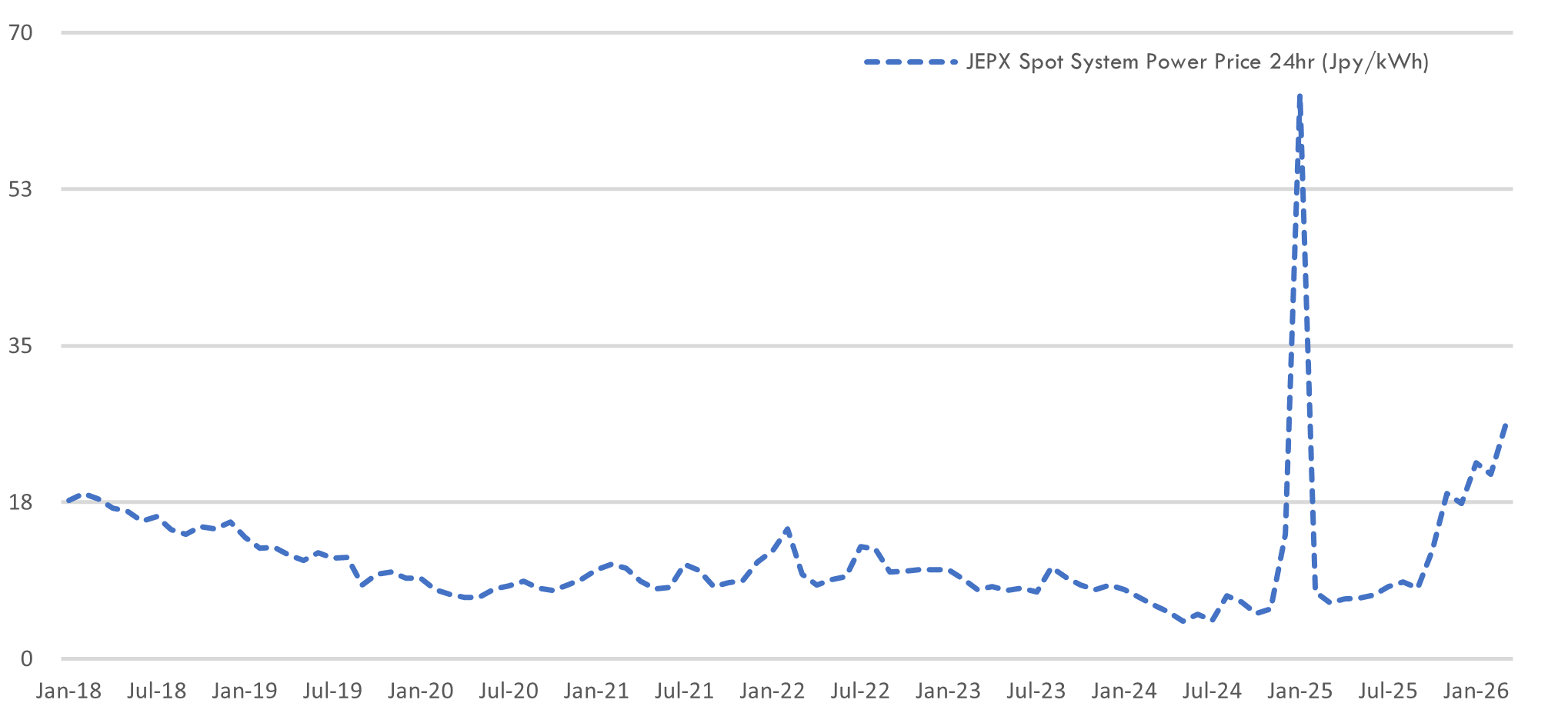
Japan’s Wholesale Electricity Price (JEXP)
Source: JEPX
For March 1-10, spot electricity prices on the JEPX wholesale market averaged ¥26/ kWh. That’s 30% higher than the February average and double that of six months ago.
A METI assessment of 2020 power generation costs indicated that LNG fuel amounts to about 60% of the electricity cost at a gas-fired power plant. In that year, the price Japan paid for imports of LNG averaged just $7.61/ MMBtu. Without long-term contracts to reign in the inflation in LNG costs, Japan’s power market would spike. Russian LNG volumes accounted for 9% of Japan’s total imports last year, but rose to 11.5% for January 2022.
For PM Kishida, who heads into Upper House elections in June on a platform to spread income equality, allowing a drastic price rise in gasoline, diesel, and electricity would be political suicide. In January, Japan’s core inflation was just 0.5%. But the more telling wholesale price index, which tracks the prices businesses pay each other, saw a 9.3% jump in February, a 12th straight increase and the fastest rate since 1981.
Any move, corporate or geopolitical, that causes further inflation will be vetoed by the national government, which has few options to dampen energy prices. The rollout of new renewables capacity faces land constraints and grid bottlenecks. The national government has little direct control over nuclear reactor restarts. And energy rationing ahead of a major election, especially after a pandemic-hit two years, is seen as the very last resort.
|
Commodity |
Latest Price in Japanese Yen |
Change YoY |
|
Crude oil (Japan import price) |
57,578/ barrel |
+76.5% |
|
LNG (Japan import price) |
82,027/ ton |
+80.7% |
|
Thermal Coal |
20,874/ ton |
+147.8% |
|
Regular gasoline (Monthly average) |
167.5 |
+22.0% |
|
USD to JPY rate |
115.28 |
+8.25% |
Source: Japan Customs Data, METI, MUFJ
What’s the upside?
Just as fuel costs feed into electricity prices, so the latter feed into the cost of products and services, and this is where Japan’s concerns become particularly strong. The country already famously has among the world’s highest power costs. Should its Russian LNG and coal volumes be lost, they will likely go to China, giving Chinese manufacturers a more secure and low-cost energy base.
Answering questions in parliament, METI minister Hagiuda summarized the government’s concerns in plain terms: “Our main concern is whether a third country might immediately take over [Japanese] investments. If Russia doesn’t feel the pain from sanctions, then it would be pointless.”
Japanese LNG Supply Contracts from the Sakhalin 2 oil and gas project in Russia
|
Contract Volume (Tons / Year) |
Start of Deliveries |
Contract Length |
Contact Basis | |
|
Tokyo Gas |
1,100,000 |
2009 |
2007-2031 (24Y) |
FOB |
|
JERA |
1,500,000 |
2009 |
2009-2029 (20Y) |
FOB |
|
Hiroshima Gas |
2,140,000 |
2009 |
2009-2028 (20Y) |
FOB |
|
Kyushu Gas |
500,000 |
2009 |
2009-2031 (22Y) |
DES |
|
Toho Gas |
500,000 |
2010 |
2009-2033 (24Y) |
DES |
|
Tohoku Electric |
420,000 |
2010 |
2010-2029 (20Y) |
FOB |
|
Saibu Gas |
650,000 |
2010 |
2014-2027 (13Y) |
DES |
|
JERA |
500,000 |
2011 |
2011-2026 (15Y) |
DES |
|
Osaka Gas |
200,000 |
2011 |
2008-2031 (23Y) |
FOB |
|
Japan Total |
4,999,000 |
Source: JOGMEC via Kakimi Yuka Index
GLOBAL VIEW
BY JOHN VAROLI
Below are some of last week’s most important international energy developments monitored by the Japan NRG team because of their potential to impact energy supply and demand, as well as prices. We see the following as relevant to Japanese and international energy investors.
Australia/ Wind and solar power
The Port Augusta Renewable Energy Park secured approval from the Australian Energy Market Operator and will soon begin production. Owned by Spanish renewable energy firm Iberdrola, this 317 MW project is Australia’s largest hybrid wind and solar farm.
Barbados/ Fossil fuels
Prime Minister Mia Mottley defended fossil fuel exploration off the island’s coast, insisting that oil and gas revenue is needed to finance the clean energy transition. Speaking at a Financial Times’ climate conference, she said zero emissions “doesn’t mean zero fossil fuels.”
Canada/ Fossil fuels
The state will end financing for an expansion of the Trans Mountain Pipeline that carries oil in western Canada. The Institute for Energy Economics and Financial Analysis says costs soared 70% in two years. Taxpayers paid $17 billion; and $8.8 billion is needed for completion. This $26 billion could have been used for renewables, adding 15 GW to Canada’s power mix, says the IEEFA.
China/ Battery storage
The National Energy Administration said that in 2021 battery production output for energy storage grew 146%. By 2025, China wants a non-hydro energy storage capacity of 30 GW. This is part of efforts to boost renewable power consumption and ensure grid stability.
EU/ Natural gas
Fossil fuel supplies from Russia will be slashed by two-thirds, or 100 bcm. Russia currently accounts for about 45% of total EU gas imports. The “REPowerEU” plan also calls for diversifying natural gas supply, and increasing renewable energy generation.
Germany/ Gas pipeline
The cancelled Nord Stream 2 gas pipeline will leave Germany’s Uniper with a €1 billion loss. This include €695 million in loans to Nord Stream 2, and €292 million in accrued interest payments. Also, there’ll be an annual loss of €100 million as Uniper forgoes future interest payments.
Ghana/ Solar power
Huawei Digital Power agreed with Meinergy to develop 1 GW of solar generation and 500 MWh of battery storage. Meinergy is a developer of projects in mining and solar PV. The project will be Africa’s largest solar PV and energy storage system. Currently, hydroelectric resources provide over 40% of Ghana’s electricity; the remainder is thermal generation.
India/ Coal
By 2025, the world’s largest coal-producer, Coal India, wants operations to reach net zero by switching to renewable energy and improving energy efficiency. However, this goal won’t extend to GHGs from burning the coal the company produces. India has about170 coal-fired power stations, accounting for about 75% of the country’s electricity generation.
Italy/ Wind power
As part of plans to reduce Russian gas imports, the government approved construction of six wind farms with a capacity of 418 MW. The parks will be located in the central and southern regions. Wind power currently accounts for about 7% of Italy’s energy mix.
Northeast Asia/ Gas prices
Spot benchmark Japan-Korea LNG prices hit a record high. April cargoes surged to $84.762 MMBtu on March 7, said S&P Global Platts, up from $47.297 on March 4. The record price is the equivalent of $492 a barrel of oil. Russia exported about 11.5 million tons of LNG to the Asia- Pacific last year, or 3% of total regional demand.
UK/ Nuclear power
The government asked the nuclear regulator to start the approval process for Rolls-Royce’s small-scale modular nuclear reactor (SMR) that can cut fossil fuels dependence and GHGs. Britain last year earmarked $546 million to fund development of the country’s first SMR.
U.S./ Green hydrogen
Green Hydrogen International (GHI) plans to create a green hydrogen hub in Texas. When completed it will be powered by 60 GW of solar and wind energy, making over 2.5 billion kilos of green hydrogen per year. Dubbed Hydrogen City, the project will be built in different areas. The first will be operational in 2026, and have 2 GW of production and two storage caverns.
2022 EVENTS CALENDAR
A selection of domestic and international events we believe will have an impact on Japanese energy
|
January |
OPEC quarterly meeting; JCCP Petroleum Conference – Tokyo; EU Taxonomy Climate Delegated Act activates; Regional Comprehensive Economic Partnership (RCEP) Trade Agreement that includes ASEAN countries, China and Japan activates; Indonesia to temporarily ban coal exports for one month; Regional bloc developments: Cambodia assumes presidency of ASEAN; Thailand assumes presidency of APEC; Germany assumes presidency of G7; France assumes presidency of EU; Indonesia assumes presidency of G20; and Senegal assumes presidency of African Union; Japan-U.S. two-plus-two meeting; Japan’s parliament convenes on Jan. 17 for 150 days; Prime Minister Kishida visits Australia (tentative) |
|
February |
Chinese New Year (Jan. 31 to Feb. 6); Beijing Winter Olympics; South Korea joins RCEP trade agreement |
|
March |
Renewable Energy Institute annual conference; Smart Energy Week – Tokyo; Japan Atomic Industrial Forum annual conference – Tokyo; World Hydrogen Summit – Netherlands; EU New strategy on international energy engagement published; End of 2021/22 Japanese Fiscal Year; South Korean presidential election |
|
April |
Japan Energy Summit – Tokyo; MARPOL Convention on Emissions reductions for containerships and LNG carriers activates; Japan Feed-in-Premium system commences as Energy Resilience Act takes effect; Launch of Prime Section of Japan Stock Exchange with TFCD climate reporting requirement; Convention on Biological Diversity Conference for post-2020 biodiversity framework – China; Elections: French presidential election; Hungarian general election |
|
May |
World Natural Gas Conference WCG2022 – South Korea; Elections: Australian general election; Philippines general and presidential elections |
|
June |
Happo-Noshiro offshore wind project auction closes; Annual IEA Global Conference on Energy Efficiency – Denmark; UNEP Environment Day, Environment Ministers Meeting – Sweden; G7 meeting – Germany |
|
July |
Japan to finalize economic security policies as part of natl. security strategy review; China connects to grid 2nd 200 MW SMR at Shidao Bay Nuclear Plant, Shandong; Czech Republic assumes presidency of EU; Elections: Japan’s Upper House Elections; Indian presidential election |
|
August |
Japan: Africa (TICAD 8) Summit – Tunisia; Kenyan general election |
|
September |
IPCC to release Assessment and Synthesis Report; Clean Energy Ministerial and the Mission Innovation Summit – Pittsburg, U.S.; Japan LNG Producer/Consumer Conference – Tokyo; IMF/World Bank annual meetings – Washington; Annual UN General Assembly meetings; METI to set safety standards for ammonia and hydrogen-fired power plants; End of 1H FY2022 Fiscal Year in Japan; Swedish general election |
|
October |
EU Review of CO2 emission standards for heavy-duty vehicles published; Chinese Communist Party 20th quinquennial National Party Congress; G20 Meeting – Bali, Indonesia; Innovation for Cool Earth TCFD & Annual Forums – Tokyo; Elections: Okinawa gubernational election; Brazilian presidential election; |
|
November |
COP27 – Egypt; U.S. mid-term elections; Soccer World Cup – Qatar; |
|
December |
Germany to eliminate nuclear power from energy mix; Happo-Noshiro offshore wind project auction result released; Japan submits revised 2030 CO2 reduction goal following Glasgow’s COP26; Japan-Canada Annual Energy Forum (tentative); Tesla expected to achieve 1.3 million EV deliveries for full year 2022 |
Disclaimer
This communication has been prepared for information purposes only, is confidential and may be legally privileged. This is a subscription-only service and is directed at those who have expressly asked K.K. Yuri Group or one of its representatives to be added to the mailing list. This document may not be onwardly circulated or reproduced without prior written consent from Yuri Group, which retains all copyright to the content of this report.
Yuri Group is not registered as an investment advisor in any jurisdiction. Our research and all the content express our opinions, which are generally based on available public information, field studies and own analysis. Content is limited to general comment upon general political, economic and market issues, asset classes and types of investments. The report and all of its content does not constitute a recommendation or solicitation to buy, sell, subscribe for or underwrite any product or physical commodity, or a financial instrument.
The information contained in this report is obtained from sources believed to be reliable and in good faith. No representation or warranty is made that it is accurate or complete. Opinions and views expressed are subject to change without notice, as are prices and availability, which are indicative only. There is no obligation to notify recipients of any changes to this data or to do so in the future. No responsibility is accepted for the use of or reliance on the information provided. In no circumstances will Yuri Group be liable for any indirect or direct loss, or consequential loss or damages arising from the use of, any inability to use, or any inaccuracy in the information.
K.K. Yuri Group: Oonoya Building 8F, Yotsuya 1-18, Shinjuku-ku, Tokyo, Japan, 160-0004.