
JAPAN NRG WEEKLY
MARCH 28, 2022
JAPAN NRG WEEKLY
March 28, 2022
NEWS
TOP
- Restarting power plants after March 16 quake will take months; Strain on Tokyo system led to historical call to conserve electricity
- Japan, France to freeze financing for Russia’s Artic LNG project as Japanese firms experiment with ways to replace Russian LNG
- Japan, U.S., UK lenders loan $1 bn to Kuwait to boost oil output; parties seek to cool high oil prices partly due to Russia sanctions
ENERGY TRANSITION & POLICY
- Govt. unveils framework for carbon credits use and categorization
- Japan to offer corporate PPA subsidies to stimulate solar rollout
- Govt. offshore wind working group tweaks future auctions process
- Antitrust lawyers, energy experts to study green competition law
- METI proposes carbon footprint data sharing for storage batteries
- Academics develop tech for generating power from nuclear waste
- Synthetic methane to account for 1% of city gas by 2030: utilities
- Idemitsu to test new ammonia process that promises to cut costs
- Osaka Gas, Tokyo Gas issue the sector’s first transition bonds
ELECTRICITY MARKETS
- Full restart schedule for plants taken offline by March 16 quake
- Half of the top power utilities to raise electricity rates in May
- Mayor of town near Shimane reactor gives support for its restart
- Govt. to change deadline, criteria of offshore wind power auction
- High energy prices drive power retailer to bankruptcy
- Marubeni, BP to partner in offshore wind and hydrogen in Japan
- Itochu plans 494 MW offshore wind power plant in the northeast
OIL, GAS & MINING
- Japan’s LNG stocks slip from a week earlier, below four-year avg.
- Japanese utilities pay top price for spot LNG in a bid to restock
- Top Japanese refiners plan to stop importing oil from Russia
- Steel prices surge to highest in a decade on rising materials costs
- ENEOS to withdraw from Myanmar gas extraction business
ANALYSIS
SHHH… DON’T TELL ANYONE, BUT JAPAN’S ABOUT
TO LAUNCH A NATIONAL CARBON EXCHANGE
Japan will soon unveil its first-ever national carbon pricing exchange, starting with a soft launch to ease the mechanism into business life. The exchange is expected to run a hybrid model, combining a voluntary cap-and-trade scheme with a platform for trading carbon credits.
Although lagging carbon trading developments in Europe by two decades, Japan’s government aims to create an international hub open to overseas players and credits. It will also allow for trade in both compliance and voluntary credits. The move could become one of the most important developments in Japan’s power industry since market liberalization, yet the fanfare around the launch has been toned down.
A LEADER IN SOLAR, JAPAN SEEKS SOLUTIONS TO RECYCLE AND PROLONG PV PANEL LIFESPANS
From strawberry farms to rooftops of convenience stores and factories, Japan is looking for novel ways and new technologies to put aging solar panels to good use. This is a daunting task since the amount of equipment nearing the end of its life cycle will soar in coming years. Japan has the third-largest solar capacity installed globally. While some first steps have been taken, solar recycling still needs to be developed in terms of technology and policy.
GLOBAL VIEW
Global rooftop solar PV capacity may double by 2025, says Rystad Energy. China’s new energy plan calls for shale oil & gas exploration, as well as renewables. Australia’s Fortescue sets ambitious green hydrogen output target. Equinor and Saudi Aramco outline new oil & gas targets. Details in our global wrap.
EVENT CALENDAR FOR 2022
Key political and business events in Japan and abroad.
JAPAN NRG WEEKLY
PUBLISHER
K. K. Yuri Group
Editorial Team
Yuriy Humber (Editor-in-Chief)
John Varoli (Senior Editor, Americas)
Mayumi Watanabe (Japan)
Wilfried Goossens (Japan, Events)
Events

Regular Contributors
Chisaki Watanabe (Japan)
Takehiro Masutomo (Japan)
Daniel Shulman (Japan)
Art & Design
22 Graphics Inc.
SUBSCRIPTIONS & ADVERTISING
Japan NRG offers individual, corporate and academic subscription plans. Basic details are our website or write to subscriptions@japan-nrg.com
For marketing, advertising, or collaboration opportunities, contact sales@japan-nrg.com
For all other inquiries, write to info@japan-nrg.com
OFTEN USED ACRONYMS
METI The Ministry of Energy, Trade and Industry
MOE Ministry of Environment
ANRE Agency for Natural Resources and Energy
NEDO New Energy and Industrial Technology Development Organization
TEPCO Tokyo Electric Power Company
KEPCO Kansai Electric Power Company
EPCO Electric Power Company
JCC Japan Crude Cocktail
JKM Japan Korea Market, the Platt’s LNG benchmark
CCUS Carbon Capture, Utilization and Storage
mmbtu Million British Thermal Units
mb/d Million barrels per day
mtoe Million Tons of Oil Equivalent
kWh Kilowatt hours (electricity generation volume)
NEWS: ENERGY TRANSITION & POLICY

METI panel proposes carbon credit categories and disclosure format
(Japan NRG, March 24)
- A METI panel for the carbon credit utilization framework proposes credit categories and attributes that must be disclosed to verify the accountability of the credits. In its Carbon Credit Report, the panel proposed to set four credit categories, as well as a disclosure framework of credits and how they’re offset. METI will present the report for public consultation in April-May, which will be open to international stakeholders. METI will accept comments in English.
- The report did not elaborate on what the new national carbon exchange will trade. It said, “Both players in the government and private sectors should pursue discussions toward creating a widely open carbon credit market, including the trades of internationally recognized voluntary credits.” Since it has put voluntary credits with corresponding adjustments in the same category as compliance credits, there’s a strong likelihood that voluntary credits clearing this requirement will trade on the exchange.
TAKEAWAY: See the Analysis section for the full story in context.
|
Categories |
Applications | |
|
Compliance credits (J-Credit, Joint Crediting Mechanism); overseas voluntary credits where corresponding adjustments have been applied |
Legally binding emission monitor/reporting/verification under Greenhouse Gas Act |
GX and low-emission procurement initiatives of national and local governments |
|
Domestic voluntary credits basis carbon capture and removal technologies |
GX and low-emission procurement initiatives of national and local governments | |
|
Overseas voluntary credits without corresponding adjustment, that have either Japanese investment or make use of Japanese technologies |
GX and low-emission procurement initiatives of national and local governments | |
|
Other local and overseas voluntary credits generated from consumer offset behaviors, etc. |
Other non-legally binding emission reduction initiatives | |
Japan to offer corporate PPA subsidies to stimulate further solar rollout
(Japan NRG, March 24)
- CONTEXT: Below is from a statement published on the website of a unit of Japan Photovoltaic Energy Association, a government backed agency.
- METI began accepting applications for corporate PPA subsidies to be implemented through a supplementary budget for fiscal 2021. A total of ¥13.5 billion has been set aside for the subsidies, which apply to solar projects that are outside of the feed-in tariff or feed-in premium schemes.
- Applications will be accepted for four weeks, from March 28 to April 22.
- The subsidies will cover up to one-half of the installation costs for new PV power generation facilities with an output of 2 MW or more. The facilities can be distributed across multiple sites.
- CONTEXT: Last year, MoE gave subsidies to 11 offsite solar corporate PPAs.
Offshore wind working group reaffirms Mitsubishi auction sweep after review
(Japan NRG, March 22)
- After a review of the tender process, the METI and MLIT offshore wind working group said the decision to award three offshore wind projects to the Mitsubishi-Chubu Electric consortium is justifiable. The group rejected the notion that the low bids of the Mitsubishi-Chubu consortium will discourage participation in future auctions.
- There were, however, some selection criteria that didn’t reflect the capacities of auction participants accurately, such as “the capacity to realize the project” and “the capacity to generate new supply chains in the domestic market.”
- To improve the process, all future auction participants will be required to show how their approach impacts local businesses and how the supply chain will be built.
Antitrust lawyers, energy experts will study green competition law
(Japan NRG, March 25)
- METI launched a new panel comprised of antitrust lawyers and energy economists to study possible amendments to the Anti-Monopoly Act to speed up decarbonization. The regulations should support business efforts to drive energy transition. The panel will discuss potential competition issues and organize processes to achieve a green society.
- The competition framework should continue to foster innovation. Large deals for the building production facilities and the decarbonization of supply chains should be encouraged, because such initiatives will contribute to net zero.
- The panel held its first meeting on March 25. Attorney Manabu Noda, a panelist and a former Japan Fair Trade Commission official, outlined practices that may conflict with Japanese competition regulations.
|
Practices |
Potential Anti-Monopoly Act issues |
|
Mergers |
Merger regulations |
|
Setting industry/sector standards and benchmarks; joint operations; partnerships among competing entities; joint R&D and logistics and joint procurement of raw materials |
Restraint of competition; Rules on joint initiatives |
|
Changes in procurement or business deals/adding decarbonization requirement to business contracts |
Exclusion and/or illegal binding terms; Abuse of superior position |
|
Cost sharing in the carbon neutral supply chain |
Abuse of superior position |
- The panelists will interview overseas experts in the second and third meetings in the next three months.
- Ohashi Hiroshi, a Tokyo University professor who serves the government power and gas sub-committees and working groups, was named the panel chairman.
TAKEAWAY: According to JERA, the costs of ammonia co-firing will be higher than renewables and won’t be able to compete. JERA claimed the costs of building ammonia production facilities and ammonia raw material procurement will comprise over half of total power generation costs. METI is pushing for the early roll-out of ammonia and hydrogen co-firing at thermal power plants to resolve power supply shortages, notably in Tokyo and Chubu areas while reducing their carbon footprint.
Most competition issues are about large companies abusing their bargaining power to win concessions from smaller businesses. Numerous complaints were filed to the Japan Fair Trade Competition by renewables, alleging the regional power grids of abusing their positions. There could be a number of cases with large manufacturers terminating contracts with small suppliers because their carbon footprints are high or because they don’t use renewable power, which may be more controversial than allowing joint initiatives among big manufacturers.
METI proposes carbon footprint data sharing for storage batteries
(Japan NRG, March 25)
- METI proposed two approaches to measure the carbon footprint of storage batteries that cover the entire supply chain, thus clearing competition regulations.
- The emission data from cathode, anode and other parts makers that’s passed to downstream manufacturers of batteries to automakers and other consumers could contain sensitive information.
- METI proposes a system in the government or third-party organization to collect emission and other relevant data, or to collect only the final emission figures from multi-layered suppliers.
- METI plans to set up a system equivalent to “the battery passport” in the EU, where companies in the supply chain share emission data.
Methanation Council releases interim report on recycled carbon counts
(Japan NRG, March 22)
- The Methanation Council stated in a report the approaches to avoid double counting of carbon cuts that could occur when recycling carbon to generate synthetic methane and when consuming the said methane.
- Japan, together with Australia, Norway, and the EU, are considering a new carbon count framework to apply to International Maritime Organization (IMO) members. This is in addition to the framework that aligns with the IPCC inventory methodology.
- According to the IPCC guidelines, synthetic methane carbon inventory will be counted at the site of consumption. Meanwhile, a separate standard is needed for counting carbon consumed on ocean-going vessels.
- Japan Iron and Steel Federation proposed “incentives” to both the producers and users of synthetic methane. To avoid “double counting”, the national carbon inventory and carbon release reports should be treated as separate systems, the federation proposed.
Chubu team develops technology for generating electricity from nuclear waste
(TV Tokyo, March 23)
- A team from Chubu University developed technology that uses gamma radiation to reduce magnetite particles suspended in water.
- In the presence of a magnetic field, the effect can be used to generate electricity.
- The process could harness radiation emitted by nuclear waste to generate electricity.
- As the process is only around 0.1% efficient, the team hopes to boost its efficiency.
Synthetic methane to account for 1% of city gas by 2030, say utilities
(Denki Shimbun, March 23)
- Tokyo Gas and Osaka Gas, two of Japan’s biggest utilities, said that synthetic methane will account for 1% of their city gas sales by 2030.
- Japan’s government aims for the cleaner gas to make up 90% of national consumption by 2050. Methanation is seen as the way to make the gas industry carbon neutral as it involves clean hydrogen.
- METI and ANRE issued a report on calculating CO2 emissions when synthetic methane is used. It confirmed that methanation can help decarbonize the gas industry, but more incentives are needed for a wider interest in the technology.
Idemitsu to test new ammonia manufacture process that halves cost
(Nikkei, March 24)
- Idemitsu plans to test a new method of making ammonia that promises to halve costs. The oil refining major is working with Toshiba, Nissan Chemical, and others to develop a large-scale production method for synthesizing ammonia directly from water and air by the end of 2024.
- The new approach relies on molybdenum as a catalyst and enables production at 20ºC and 1 atm (room temperature and pressure), much less than the current heat-intensive manufacturing process.
Osaka Gas to issue its first transition bonds
(Gas Energy News, March 21)
- Osaka Gas will issue its first transition bond, to the tune of ¥10 billion and for a 10-years term. After selecting a lead managing underwriter, the company plans to issue the bonds in May or later.
- The proceeds will be used for wind power projects in Wakayama Prefecture, Aomori Prefecture and Aomori Prefecture, and a natural gas supply project in Shikokuchuo City, Ehime Prefecture.
- Tokyo Gas was due to issue ¥20 billion in transition bonds this month.
- CONTEXT: Idemitsu also recently said it will issue transition bonds, potentially a first for the oil industry in Japan.
Japan’s top life insurer to invest ¥500 billion in renewables, green bonds
(Kankyo Business, March 22)
- Nippon Life Insurance Company, also known as Nissay, will establish an investment and loan facility to encourage corporate efforts to decarbonize. The company will invest ¥500 billion in renewable energy, green bonds, development of new technologies, and transition finance.
- Of the total, approximately ¥20 billion will go to a “decarbonization fund of funds,” ¥10 billion to a “decarbonization venture investment fund,” and ¥30 billion to a “renewable energy fund of funds”.
- Nissay has also set targets to reduce GHG from its asset portfolio by 2030.
Mihama nuclear reactor peripheral dismantling plan passes NRA review
(Japan NRG, March 23)
- The Nuclear Regulatory Authority approved Kansai Electric’s plan to dismantle the peripheral of its Mihama No. 1 and No. 2 nuclear reactors as the company refiled a more detailed plan. Kansai Electric plans to decommission the two reactors.
- The dismantling of the reactor peripherals will start in 2022, the reactor in 2036 and the plant building in 2042. NRA said the company’s first filing stated plans to dismantle the peripherals, but no further details were given. The revised filing elaborated on the deconstruction method and the estimated amount of metal and concrete scrap generated.
IAEA conducts second analysis of Fukushima waste water
(Japan NRG, March 24)
- On March 24, the IAEA visited TEPCO’s nuclear plant in Fukushima to take water samples from the Advanced Liquid Processing System for treating the contaminated water. They’ll be analyzed in the IAEA laboratory to verify TEPCO’s analysis. This is the second sampling since February. IAEA made a website dedicated to water review.
METI to reform national R&D systems
(Japan NRG, March 22)
- Starting in 2023, METI plans to reform the national R&D systems, changing the planning, financing, management, and evaluation of applications. The National Institute of Advanced Industrial Science and Technology (AIST) will set up a unit to attract private sector funds. Currently, the private sector contributes to 10% of AIST projects, which often involve large businesses. The new unit will seek partners from small and medium sized enterprises and startups, and will also manage intellectual property rights. METI will also change management and evaluation of R&D projects, introducing competition and incentive payments based on results, rather than processes. The Green Innovation Fund for decarbonization technology development functions on a competitive basis, and grants will be cut off if progress is slower than the agreed targets. This approach will be applied to other METI R&D projects in 2023.
- CONTEXT: Quantum computing and AI are the focus technologies, and their applications in energy include power distribution systems.
Tokyo Gas to boost investments 30% next year on renewables rollout
(Denki Shimbun, March 24)
- Tokyo Gas will boost spending 30% to ¥367.8 billion next fiscal year. Investment will go to renewables and overseas businesses.
- The gas utility expects electricity sales to grow 24.9% to 34.8 billion kWh next year as some smaller power retail firms leave the market or fold due to the volatility. Tokyo Gas expects to do more business in extra-high and high-voltage power, said Managing Executive Officer Sato Hirofumi.
Osaka Gas to study potential for methanation project in Singapore
(Denki Shimbun, March 22)
- Osaka Gas will begin a feasibility study for a methanation project in Singapore. The project will generate synthetic methane from hydrogen procured from inside and outside Singapore as well as CO2 collected internally. The gas would supply the local community through existing pipelines.
- The firm will study the economics of the project over the next six months.
- Local gas supplier, City Energy, will work with Osaka Gas on the study.
Idemitsu tests new asphalt using recycled CO2
(Sekiyu Tsushin, March 22)
- Idemitsu Kosan held a test paving of asphalt using synthetic calcium carbonate. The material was made using carbon recycling technology that synthesizes CO2 from boiler exhaust gas and calcium contained in concrete waste.
- By using synthetic calcium carbonate instead of crushed limestone, which is used as an asphalt mix material, the company said it can reduce CO2 on roads.
One-Dot Wrap:
- Hokkaido Electric and Tokyo-based Grid are developing technology to optimize thermal and hydroelectric power plants using AI optimization technology. The system will be in full-scale operation from 2025. (New Energy Business News, March 25)
NEWS: POWER MARKETS

Cold snap strains Tokyo grid and leads to first-ever call to conserve power
(Japan NRG, March 22)
- Tokyo’s grid operator, TEPCO, asked users to save power first on March 18 and again on March 22, when a cold snap caused a rare case of snow in Tokyo.
- As cold weather and snow hit Tokyo and the northern Tohoku region, TEPCO reported demand at 107% of supply at 2pm on March 22.
- The company received surplus electricity from four regions (Hokkaido, Chubu, Kansai and Tohoku), but still told users to save power and to expect blackouts. This was the first time such a message was broadcast for the Tokyo area.
- METI and TEPCO asked homes and workplaces to keep thermostats at 20ºC and turn off unnecessary lighting. Some companies sent workers home early. A steel mill halted work.
- Electricity prices more than doubled to ¥80/ kWh on March 22.
- The emergency power savings measure was relaxed the next day as temperatures went up. Support from grids outside of Tokyo resumed March 23.
- SIDE DEVELOPMENT:
Restart schedule for the six idled thermal power plants following Mar 16 earthquake
(Japan NRG, March 23)- 14 thermal power plants in the northeast of Japan halted operations following the March 16 earthquake; six plants with a combined 3.35 GW capacity still remain idle. Their restart schedules are as follows:
Operator | Plant name | Restart date | Damage |
|
Tohoku Electric |
1 GW Haramachi No. 1 reactor |
Early May |
Boiler, charcoal lifter units |
|
Tohoku Electric |
523 MW Shinsendai 3-1 reactor |
Early April |
Turbines |
|
Soma Energy Park |
112 MW Soma Coal Biomass Plant |
Not decided |
Coal loading; boiler and generator checks ongoing |
|
Sendai Power Station |
112 MW Sendai Power Station |
Not decided |
Boiler |
|
JERA |
600 MW Hirono thermal plant |
April-May |
Transformer |
|
Soma Kyodo Power |
1 GW Soma Kyodo Station |
Not decided |
Boiler, turbine units |
- Separately, a 600 MW No. 2 reactor at Isogo thermal power plant run by J-Power closed this week due to transformer problems.
- SIDE DEVELOPMENT:
Restarting knocked out power plants could take months
(Sankei Shimbun, March 22)- METI minister Koichi told the Diet that it could be weeks or even months before power plants knocked off-line by last week’s earthquake were operating again.
- SIDE DEVELOPMENT:
Power crisis is a sign of overly-optimistic modeling
(Tokyo Shimbun, March 23)- CONTEXT; This is an opinion by the Tokyo Shimbun editorial committee.
- On March 21, in response to forecasts for unseasonably cold weather, Japan’s government issued its first-ever power shortage warning to electricity consumers supplied by TEPCO and Tohoku Electric.
- Power supplies have been tight ever since a March 16 earthquake knocked several of Tohoku Electric’s power plants off-line.
- Cold snaps this time of year aren’t new. A harsh winter was forecasted; energy companies should be able to more accurately predict electricity shortages.
- If the warning had been issued half a day earlier, it would have been possible to conserve power by reducing train frequencies, shutting down production lines, and encouraging large employers to allow staff to work from home.
- Instead, the warning came hours before pumped hydro reserves were due to run out.
- METI and the Meteorological Agency must work more closely with power companies and private sector consumers to better manage power shortages.
- Smarter pooling of Japan’s energy resources, combined with cooperation between the public and private sectors on energy conservation, will ensure ample electricity.
- We also need to end once and for all any knee-jerk calls for more nuclear plants whenever there is a power shortage.
Half of big power utilities to raise electricity rates in May
(Asia Nikkei, March 22)
- TEPCO and four other Japanese power companies plan to raise electricity rates this May in a ninth straight month of hikes.
- The rising cost of LNG used as fuel for power plants is the main cause.
Mayor of town Shimane reactor gives tentative approval for restart
(Asahi Shimbun, March 25)
- The city of Unnan, Shimane Prefecture, has announced its intention to agree to the restart of Chugoku Electric’s Shimane Nuclear Power Plant Unit 2, stating at a city council meeting that “the current situation is unavoidable.
- The city presented its thoughts on the restart at the all-council meeting, stating that “until a stable supply of renewable energy is available, we have no choice but to rely on it on the basic premise of ensuring safety,” and that “the government and Chugoku Electric’s idea of reducing dependence on thermal power generation is reasonable.”
- The committee also called on the national government to quickly shift away from its dependence on nuclear power plants.
TAKEAWAY: Two of the three cities close to the NPP have now given their consent for a restart. The prefectural governor will make the final decision after all municipalities give their approval. The NPP has been offline for more than 10 years now with its restart delayed partly due to a reportedly strong distrust among the local population towards plant operator, Chugoku Electric.
If successful, the restart would see the first for a BWR type reactor since the Fukushima disaster. All the plants online today are PWR type units.
PM Kishida said last week that his government will back restarts as long as they are approved by the nuclear watchdog, whose standards he stressed are the highest in the world, and after local authorities give their consent.
- SIDE DEVELOPMENT:
Keidanren calls for urgent restart of nuclear plants
(Asahi Shimbun, March 22)- Referring to the government’s warning about power shortages, Keidanren chair Tokura Masakazu said that if Japan’s idle nuclear power plants were not promptly restarted, the outcome would be disastrous.
- Tokura said all idle plants that did not face safety issues or opposition from local residents must be restarted immediately to ensure sufficient supply.
- Tokura explained that the warning was triggered due to forecasts for surplus capacity falling below 3%, and said both private sector and individual consumers had to cooperate to conserve electricity.
Happou-Noshiro wind farm auction dates to change
(Japan NRG, March 18)
- In a bid to increase post-Ukraine conflict energy security, METI plans to change the deadline and criteria of the Happou-Noshiro wind farm auction to speed up renewable project launches. The auction opened on Dec. 10 and will close on June 10 this year.
- The offshore wind working group, a joint panel of METI’s power and gas committee and the Ministry of Land, Infrastructure and Transport’s port committee, began discussing the new deadline, reviewing standards and other details on March 22.
- There is no date when the decisions will be announced. METI will also advance selection of sites for additional offshore wind farms.
High energy prices drive power retailer to bankruptcy
(Nikkei, March 22)
- Fukuoka-based Hope Inc., which provides advertising and energy services to local bodies, said that subsidiary Hope Energy will file for bankruptcy.
- While Hope Energy supplies electricity to 5,000 public facilities; as of March 22, all agreements with transmission providers were terminated due to debt non-payment.
- High wholesale electricity prices forced Hope Energy to on-sell electricity at a loss.
- The company’s liabilities amount to around ¥30 billion.
Marubeni, BP partner in offshore wind, hydrogen in Japan
(New Energy Business News, March 25)
- Marubeni Corporation has signed a partnership agreement with the renewable energy subsidiary of British energy major BP for the joint development of offshore wind power in Japan and projects aimed at decarbonization, including hydrogen.
- As a first step, the two companies agreed that BP will take a 49% stake in a special purpose company wholly owned by Marubeni for the joint development of one offshore wind power project.
- The partnership was formed with BP Alternative Energy Investments Limited. In connection with this partnership, BP will establish a new offshore wind development team in Japan.
- CONTEXT: Marubeni is conducting environmental impact assessment procedures for projects off the coast of Ishikari City, Hokkaido, and off the coast of Yusa Town, Yamagata Prefecture (jointly with Kansai Electric).
Itochu plans 494 MW offshore wind plan in Yamagata
(New Energy Business News, March 24)
- MOE released its opinion on the environmental assessment report for the “Landing-type offshore wind power generation project off the coast of Yusa-machi, Akumi-gun, Yamagata Prefecture” planned by Itochu Corp. The report calls for avoiding or minimizing the impact on birds due to collisions with wind power generation facilities and obstructions to their migration.
- Itochu plans an offshore wind power project at maximum capacity of 494 MW, consisting of 52 turbines, each with an output of between 9,500 kW and 15,000 kW, to be installed in an area of approximately 3,420 ha. That area is categorized as a “promising area” under the Renewable Energy Sea Area Utilization Law.
NEWS: OIL, GAS & MINING

WAR IN UKRAINE:
- Japan and France to freeze investments in Russia’s Arctic LNG projects
(Nikkei, March 25)- Japan and France froze new investment in Arctic LNG 2 in Russia.
- Financial institutions can’t remit money to the project due to sanctions against Russia. Thus, the start of operations scheduled for 2023 may be delayed.
- This is the first freeze of new investments in Russian resources by Japan, which is reviewing its LNG procurement strategy.
- CONTEXT: Japan’s Mitsui & Co. and Japan Oil, Gas and Metals National Corporation (JOGMEC) have a combined stake of 10% in the $20 billion Arctic LNG 2 project led by Novatek and includes France’s TotalEnergies.
- Total said it won’t fund Arctic LNG 2 but will retain its concession. Even if it wanted to give up its stake, it would struggle to find a buyer outside of Russia.
- SIDE DEVELOPMENT:
Tokyo Gas mulls ways to replace Russian LNG in its portfolio
(Nikkei, March 24)- Tokyo Gas is studying options around potentially replace all of its Russian LNG imports: CFO Sato said.
- The gas company is proceeding with trial calculations for alternative procurement.
- Tokyo Gas is in contact with the government and if Japan makes the decision to stop buying Russian LNG then the company will comply. However, the company is concerned about security of supply and needs to have volumes to provide its customers, the CFO said.
- CONTEXT: ~10% of Tokyo Gas supplies come from the Russian Sakhalin II LNG project.
- SIDE DEVELOPMENT:
Future of Sakhalin gas at a crossroads in ‘wartime economy’
(Shukan Economist, Mar 29)- CONTEXT: Opinion by Shukan Economist editorial board member Kanayama Ryuichi.
- The CEO of a major Japanese gas company urges against going along with anti-Russian sanctions, saying that any interruption to the LNG supply from Sakhalin would drive some Japanese gas companies to insolvency.
- With President Putin threatening to nationalize the assets of businesses that pull out of Russia, this is a difficult call to make.
- Russia invaded Ukraine months after the EU declared natural gas a “clean” form of energy, thereby increasing reliance on Russia. Thus, this is also an energy war.
Japan’s March 20 LNG stocks slip to 1.68m tons
(Japan NRG, March 23)
- Japan’s LNG stocks stood at 1.68 million tons on March 20, down from 1.72 million tons a week ago. Stocks at the end of March last year were 2.41 million tons and the four-year average of end-March stocks were 2.19 million tons.
Japan pays highest price for LNG after quake pushes utilities to restock
(Bloomberg, March 25)
- Tohoku Electric purchased an LNG cargo for late April to early May delivery to Japan at about $39/ mmbtu, among the most expensive ever purchased by a Japanese LNG importer.
- The tender held by the utility for LNG specified that the cargo can’t come from Russia, the first time the country has been specifically banned in an LNG tender.
- The utility seeks additional gas supplies after several large coal-fired power plants were taken offline by the strong earthquake earlier this month.
- JERA, Japan’s top power producer, was another of the nation’s utilities to jump into the spot LNG market in March to secure extra cargos. Kansai Electric and Kyushu Electric may also seek to buy in the spot market.
TAKEAWAY: Dipping into the spot market to add extra LNG supplies isn’t a big deal for Japanese utilities, were it not for the situation in Europe. Depleted European reserves and fears that Russia will stop supplying the region with gas has pushed the EU and UK to rely heavily on spot LNG purchases. With global supply extremely tight, this means Japan and Europe are bidding against each other for the same fuel, promoting higher prices that cause economic troubles for both. One potential solution is for Europe to secure new long-term supply contracts, which would make it less reliant on the spot market. That is already starting to happen with the U.S. committing millions of tons of LNG to Europe. But unless or until other big suppliers such as Qatar sign deals with Europe, the spot market will remain very elevated and, as a result, Japan’s power prices will likely continue to trade at prices 3-5 times above the 5-year average.
Japan, U.S., U.K. lenders loan Kuwait $1bn to boost oil output
(Asia Nikkei, March 26)
- Kuwait asked Japan for support in lifting its oil production capacity. Japan responded with trade insurance that will now allow three of the nation’s top banks, together with U.S. and European lenders to loan $1 billion to Kuwait.
- Mizuho Bank, Sumitomo Mitsui Banking Corp. and MUFG Bank are making the loan to Kuwait Petroleum Corp., along with HSBC and JPMorgan Chase. Mizuho is expected to be the lead underwriter.
- METI Minister Hagiuda will meet with Kuwaiti Oil Minister Mohammed al-Fares soon to sign off on the deal.
- CONTEXT: Kuwait accounted for 8.4% of Japan’s energy imports in 2021.
Top Japan refiners plan to stop importing oil from Russia
(Asia Nikkei, March 23)
- ENEOS and Idemitsu are halting Russian crude oil imports after current contracts expire. The firms said sanctions on Russia have made it hard to conduct business, while they also face pressure to boycott the country.
- CONTEXT: Russian imports amount to 4% of Japan’s total last year.
- Oil from Russia contracted in February will still arrive in Japan, but after that ENEOS will switch sourcing to the Middle East.
- SIDE DEVELOPMENT:
Steel prices surge to highest in over a decade on rising materials costs
(Asia Nikkei, March 23)- As Russia’s invasion disrupts supply chains, prices in Japan for H-beams, lumber and other construction materials have soared to multiyear- and even record highs.
- Tokyo Steel Manufacturing’s H-beams hit their highest price in over 13 years. Stainless steel used in building roofs and walls reached a 14-year high.
- Russia and Ukraine accounted for roughly 11% of global steel exports in 2020.
ENEOS to withdraw from Myanmar gas extraction
(Nikkei, March 25)
- Oil refining major ENEOS will exit Myanmar’s natural gas sector due to criticism it’s funding the country’s military.
- ENEOS has been involved in the Yetagun gas field off the southern coast of Myanmar since 1991. Production started in 2000.
- ENEOS is invested in Yetagun via a JV with Japan’s government and Mitsubishi Corp. The latter said in February it will leave the project.
- The Yetagun gas field’s output has been declining. ENEOS hasn’t found a buyer to take over its stake in the field and will likely incur a loss from the exit.
PAJ head says gasoline ‘trigger clause’ would cause confusion
(Nikkei, Mar 22)
- Petroleum Association of Japan president Sugimori Tsutomu believes use of the ‘trigger clause’ (a gasoline tax relief scheme) to offset high prices will cause much confusion among consumers and suppliers; instead, he calls for more subsidies.
- Sugimori criticized the trigger clause’s inflexible nature, which would cause the price at the pump to fall by ¥25/ liter when retail prices exceeded ¥160.
ANALYSIS
BY MAYUMI WATANABE
Shhh… Don’t Tell Anyone, but Japan’s About to Launch
Its First-Ever National Carbon Exchange
Japan will soon unveil its first-ever national carbon pricing exchange, starting with a soft launch to ease the mechanism into business life. The exchange is expected to run a hybrid model, combining a voluntary cap-and-trade scheme with a platform for trading carbon credits.
Although lagging carbon trading developments in Europe by two decades, Japan’s government aims to create an international hub open to overseas players and credits. It will also allow for trade in both compliance and voluntary credits.
The move could become one of the most important developments in Japan’s power industry since market liberalization, assigning a value to emissions that should encourage businesses to lower their CO2 footprint and improve the economics for clean energy projects. And yet, the fanfare around the launch has been toned down.
With the war in Ukraine sending already high energy prices to record levels, the government has focused on near-term ways to rein in electricity and fuel costs, including via oil subsidies. It is wary of companies that perceive the new market as an additional burden.
In a league of its own
In February, METI opened applications to businesses interested in joining Japan’s first carbon credits exchange. With opinions on how this market should operate and what it should include very much divided among businesses and academia, the ministry decided on a soft launch from April 2022 and an easing-in period.
First, the initial wave of participants will focus on debating the practical rules and standards for the new institution. Trial run of credit trading would start this fall with a limited number of participants.
With the first part of launch crucial before full operations commence in April 2023, METI is banking on the first wave of exchange applicants to be companies that are especially strongly committed to climate action, and which are prepared to put in the effort to make the new market work. The first wave of companies will even have their own moniker: they will be known as members of the “Green Transformation (GX) League.”
These GX pioneers are expected to motivate peers and supply chain partners, spreading word about the initiative into the broader business sphere. Once the exchange opens fully in 2023, it will be open to all companies, not only the GX evangelists.
Few details about the exchange are known, other than that it’ll incorporate a variation of a cap-and-trade scheme and allow for trading credits forged not only in Japan but also abroad. This will help Japanese businesses with overseas assets to claim credits in cleaning up global operations.
A METI panel, formed in December to design carbon credit framework, did not provide further clarity. But in a March 24 report it said: “Both players in the government and private sectors should pursue discussions toward creating a widely open carbon credit market that will include trade in internationally recognized voluntary credits.”
The cream of the climate crop
The GX League is open to any business of any size in any industry. This includes overseas companies with activities in Japan. To join, companies need to disclose:
- Annual and 2030 reduction goals (a self-imposed “cap”), actual annual emissions; and if credits were used to achieve the goal, then the details
- Initiatives to create carbon-neutral supply chains, including support offered to upstream and downstream partners
- How their products and services contribute to carbon neutrality
- Engagement with civil society around carbon neutrality
At a recent briefing, a METI official behind the GX League stressed its open nature. He added that while the government won’t conduct checks to review how companies have met the above criteria, METI hopes other pressure mechanisms related to climate disclosure will lead companies to set ambitious “voluntary caps”.
Applications to the GX League close on March 31. In a bid to attract companies from every sector, METI sent invitations and information to all Japanese industry associations.
As of March 23, some 24 companies said they would join. These range from regional power grids and multinational financial groups to private consultancies. They are predominantly existing buyers and brokers of J-Credits, the Japanese state-administered carbon crediting system that has existed for over a decade but seen relatively little uptake.
Mitsuwa Holdings and Tokyo-based boost technologies told Japan NRG they plan to engage in the new market as J-Credit suppliers by starting forest conservation projects. Apart from Mizuho Financial Group, which has partnered with the International Finance Corporation, GX League companies have almost no exposure to voluntary credits.
In comparison, 320 companies have signed up for METI’s Zero Emission program, another carbon neutrality initiative that encourages companies to disclose their technologies used to reduce their CO2 footprint.
The muted response so far is due to the extensive engagement that METI requires of GX evangelists. They’re expected to get involved in “carbon rule-making in general,” which includes setting standards for “carbon offset” labels on consumer products, outlining an approach to blue carbon, and keeping current with new carbon capture technologies, and etc.
Companies are given the chance to become climate change ambassadors, communicating best practices to their customers and the wider world. In return, GX evangelists have the privilege to transform emission cuts into credits that they can monetize on the exchange. METI also promises to promote these companies to boost their profile in financial and labor markets.
Among potential perks, METI is considering giving GX firms preferential treatment in public tenders, grant applications and other government-run projects.
Unresolved issues
The vision for Japan’s carbon exchange is clear. METI hopes it will attract global green capital and high-quality voluntary credits from overseas; and that its published prices will have an impact beyond Japanese borders. To this end, the exchange will align closely with the decisions of the Taskforce on Scaling Voluntary Carbon Markets (TSVCM).
Mixing voluntary and compliance credits will see both Japan’s own J-Credits and Joint Crediting Mechanism (JCM) credits mingle with overseas contracts. METI, however, wants to see the evolution of a baseline-and-credit system, in which polluters can earn credits for cutting their CO2 emissions, even for those whose “baseline” emissions are not fixed.
Bringing this vision to reality is more complicated. Debates over what constitutes “high quality” voluntary credits continue, and not just in Japan. There’s also inadequate infrastructure to verify the quality of credits. How that will be resolved and who is responsible is also not clear.
Furthermore, Japan has yet to clarify the tax and accounting position of a carbon credit. Also, the METI panel has proposed to create four credit categories (see News section) and urged relevant parties to pursue further discussions.
Continued war in Ukraine, which has put into question the security of key commodities, means that many Japanese energy-intensive companies, notably the heavy emitters outside the power sector, may be wary of joining a new scheme in the near-term unless there are immediate benefits. Yet, the government knows that it can’t offer GX pioneers carte-blanche in rule-making and the power to create tradable credits without strong underlying evidence. Doing so would undermine trust in the new market.
Striking a balance will be tough. Yet pushing back decision-making is also not an option. The EU’s Carbon Border Adjustment Mechanism (CBAM) will become effective from 2023. That will expand the carbon pricing structures of the EU beyond its borders. If Japan fails to create its own platform, it will have to follow rules set elsewhere.
See next page for a table of the firms that have already signed up for the GX League.
“GX LEAGUE,” as of March 23
|
Company |
Industry |
Main carbon market roles |
|
Chugoku Electric |
Power utility |
Buyer |
|
J-Power |
Power utility |
Buyer |
|
Tokyo Electric |
Power utility |
Buyer |
|
Tohoku Electric |
Power utility |
Buyer |
|
Hokkaido Electric |
Power utility |
Buyer |
|
Shikoku Electric |
Power utility |
Buyer |
|
Panasonic |
Manufacturing |
Buyer |
|
Nomura Research Institute |
Consultancy |
Broker |
|
Believe Technology |
Consultancy |
Broker |
|
Boost Technologies |
Consultancy |
Broker |
|
Mizuho Financial group |
Finance |
Broker |
|
Hokuriku Bank |
Finance |
Broker |
|
Japan Exchange Group |
Finance |
Broker |
|
The Hokuriku Bank |
Finance |
Broker |
|
The Hokkaido Bank |
Finance |
Broker |
|
SMBC Financial Group |
Finance |
Broker |
|
Uhuru |
IT |
Broker |
|
Toko Electrical Construction |
Construction |
Buyer |
|
Harima Chemicals |
Chemicals |
Buyer |
|
Mitsuwa Holdings |
Gasoline, LP gas retailer |
Buyer |
|
iGrid Solutions |
Energy systems consultancy |
Broker |
|
Digital Grid |
Power brokerage |
Broker |
|
Forval |
IT |
Broker |
|
Aidemy |
Consultancy |
Broker |
ANALYSIS
BY CHISAKI WATANABE
As a Leader in Solar, Japan Seeks Solutions To Recycle
And to Prolong PV Panel Lifespan
From strawberry farms to rooftops of convenience stores and factories, Japan is looking for novel ways and new technologies to put aging solar panels to good use. This is a daunting task since the amount of equipment nearing the end of its life cycle will soar in coming years.
With installed solar capacity of 67 GW, Japan ranks third in the world after China and the U.S., according to the International Renewable Energy Agency. In 2020 alone, Japan added 8.67 GW of solar power that covered residential, commercial, industrial and floating PV systems.
Japan was a pioneer in the development of solar panels, and manufacturers such as Sharp and Kyocera led global production before Chinese competitors muscled their way into the market. Earlier installations in Japan were mostly residential, thanks to a government program started in 2009 to buy excess power from rooftop solar panels.
Then, the industry’s focus shifted to large-scale solar power plants after the feed-in tariff program began to boost the share of renewables amid growing calls for diversifying energy sources after the 2011 Fukushima nuclear disaster.
Solar recycling, however, still needs to be developed in terms of technology and policy. In 2016, the MoE released a guideline for panel recycling, reuse and disposal. The ministry followed up in May 2021 with a guideline that specifically promoted the reuse of solar panels.
The early 2030s will be critical
The lifespan of a solar panel is typically 20 to 30 years. However, an inverter, which converts the sun’s direct current power to alternating current so the solar electricity can be used in homes, might only last about 10 to 15 years.
Currently, most spent panels are sent to landfills. The New Energy and Industrial Technology Development Organization (NEDO) included the development of recycling technologies among the five key challenges to further expand solar power in its “NEDO PV Challenges 2020,” a solar development strategy. Panels with less degradation should be reused, while developing recycling technology is essential for end-of-life panels in order to recover valuable materials.
These days, since most panels in Japan still have many years before the end of their lifecycle, those panels that are dismantled have been damaged in disasters such as landslides and typhoons.
Still, in the early 2030s, Japan will start to see an increase in the number of PV panels at the end of their lifespan. According to a NEDO estimate, the total volume of spent panels will reach about 22,000 tons in 2030, peaking at about 170,000 to 280,000 tons in 2036, representing about 1.7% to 2.7% of the nation’s total industrial waste.
That industrial waste figure is no paltry amount, and it hammers home the fact that green energy also has its waste issues and potential negative environmental impact that must be confronted sooner rather than later.
Opportunity in old panels
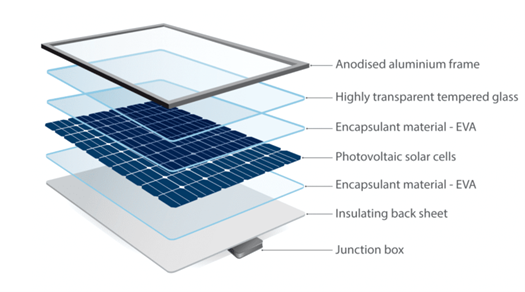
A solar panel is made of cells sandwiched between layers of glass and encapsulation film. Since the layers are tightly sealed to endure long-term outdoor use, it’s difficult to tear them apart. A typical module is 60% glass and 15% aluminum frame in weight, so the key to recycling is how to recover glass from other materials at low cost.
NEDO realizes there’s a need for a PV panel recovery plan to guide waste disposal companies. However, not all the recovered glass can be recycled, because some glass contains antimony and arsenic, which are used to improve the panel’s permeability.
For some companies, the coming surge in old panels means opportunity. The Japan Photovoltaic Energy Association has a list of companies that recycle solar panels. Currently, they total 32 in number, including Toshiba Environmental Solutions and ORIX Eco Service.
Source: Global Sustainable Energy Solutions
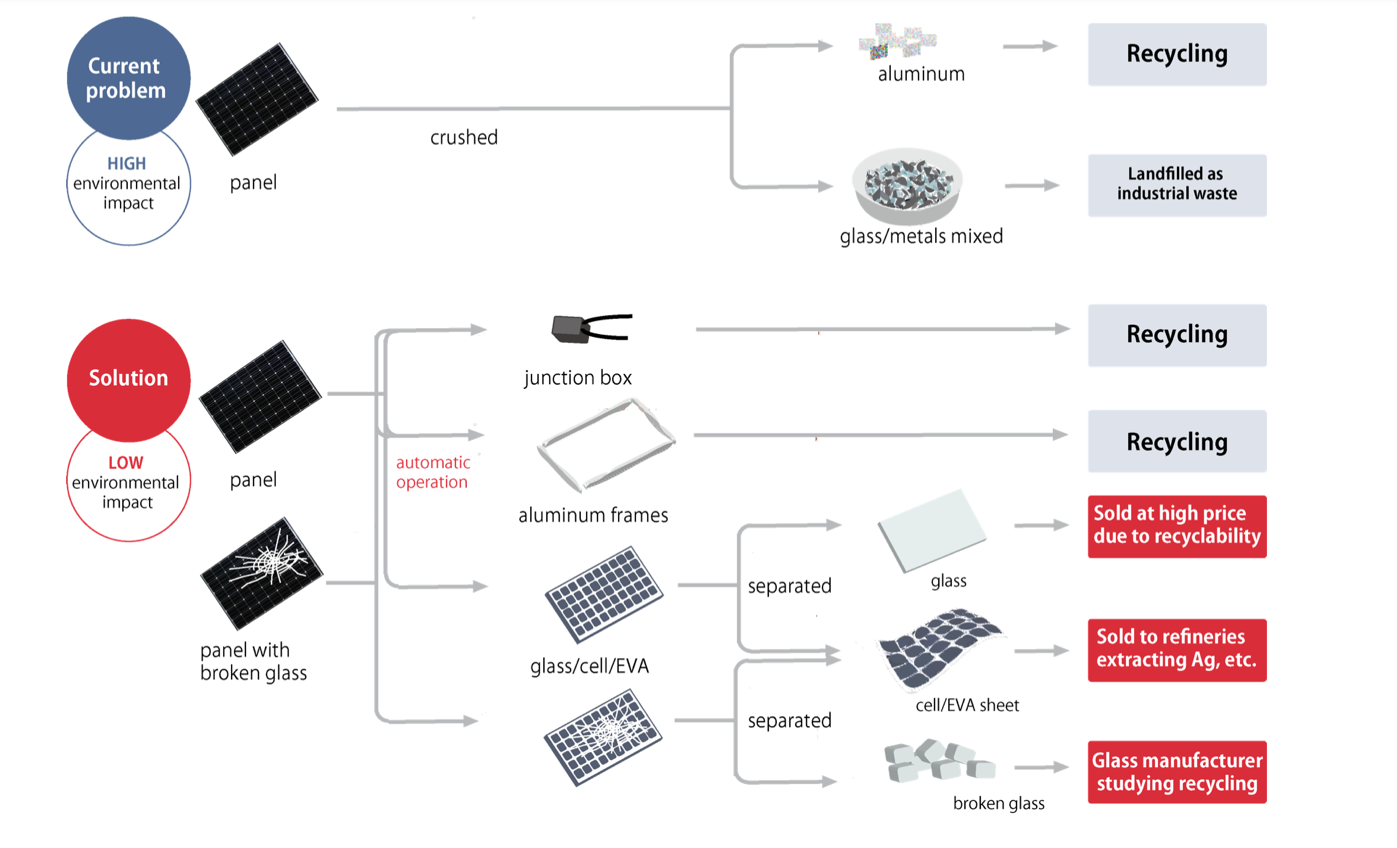
PV panels: workflow for recycling or reuse
Source: NPC
Solar panels can be dismantled to recover useful materials, or can enjoy a second life if deemed still safe to use. Here are some examples of what Japanese companies are doing to give old panels a second life or efficiently recover materials rather than send them to landfills:
REUSE
- ITES specializes in analysis and reliability evaluation. It’s developed a device to quickly evaluate if a panel is still good for power generation. This is important because the lack of effective and inexpensive ways to evaluate old panels has hindered reuse.
RECOVERY OF MATERIALS
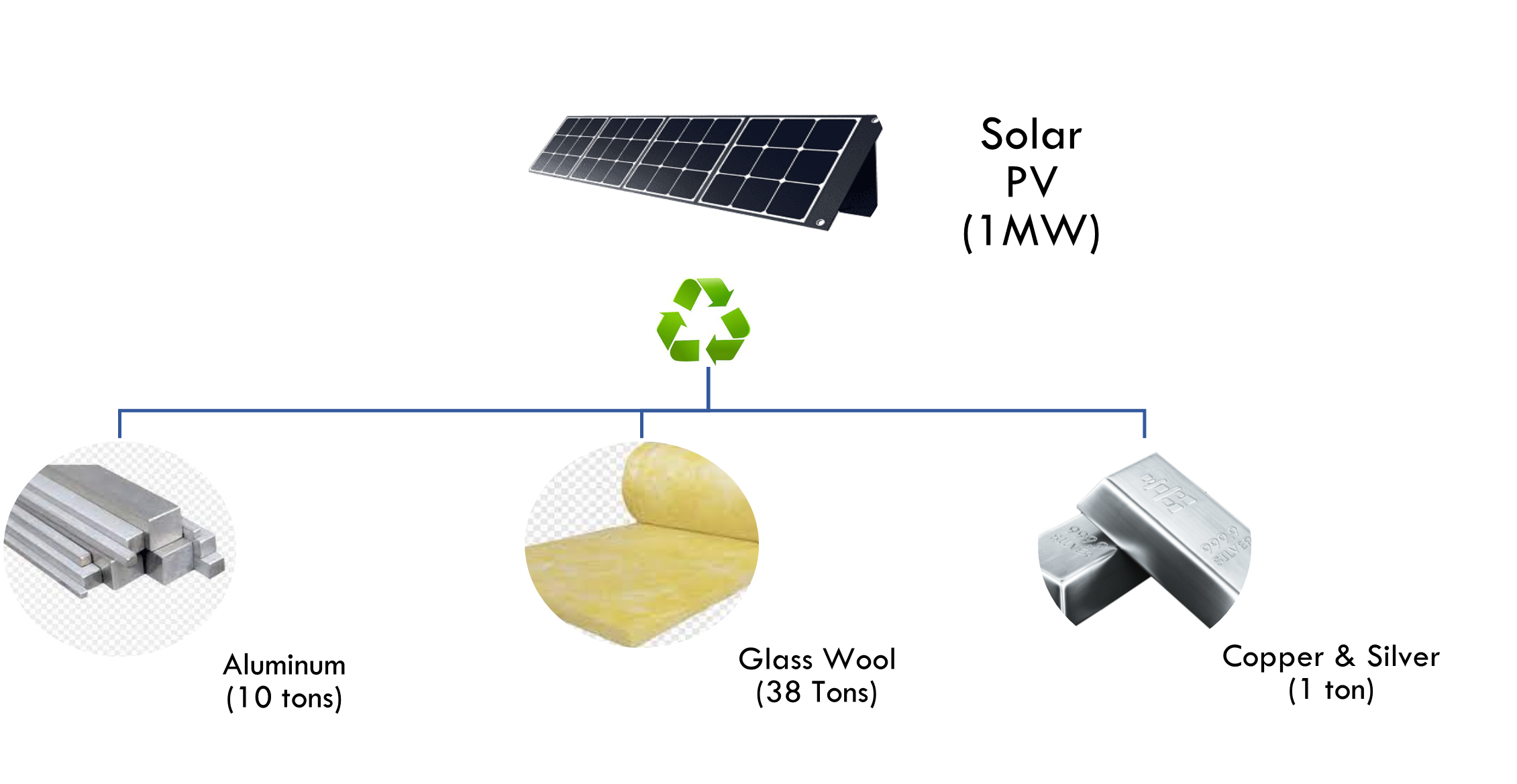
- Shinryo, a unit of Mitsubishi Chemical, is building a panel recycling factory slated to start operations in April. From 1 MW worth of solar panels, the factory can recover 10 tons of aluminum from frames; 38 tons of glass wool from glass; 1 ton of silver and copper from cells and copper wiring.
- Marubeni began a pilot project in June 2021 to recycle and reuse panels, and it’s also studying the use of glass recovered from used panels to grow strawberries. The recovered material is burned at high temperature to turn it into porous glass, which, when mixed with regular soil, improves water retention and ventilation.
- Niimi Solar Company obtained a patent for a machine that recovers materials from solar panels at a high recycling ratio using high temperature vapor (at 600 C or higher). It is the first machine to use vapor to dismantle panels.
- Solar Frontier said in 2021 that it was halting solar panel production, has been working to develop recycling technology with NEDO. The company aims to reduce the recycling cost to ¥3/ watt, regardless of the types of solar panels, and recycle more than 90% of materials in a panel. The company plans to start its recycling business as early as 2024 and initially to process about 30,000 panels a year.
INSURANCE
- Sompo Japan, an insurance company, began offering solar panel insurance that promotes reuse and recycling of PV panels. Under the provision, a solar power generator is matched with companies that check and determine the quality of panels damaged by natural disasters. If panels are found still usable, the cost of disposal is reduced.
State participation
In anticipation of the approaching peak years, some local governments are studying how to efficiently collect and recycle panels. Here’s a sample of measures taken by local and central governments:
- Saitama Prefecture, with Japan’s second largest residential solar capacity, did a pilot project in late 2021 to collect 400 panels free of charge. The goal is to determine the quality of a panel and study efficient ways of panel collection.
- In July, Fukuoka Prefecture began the nation’s first panel collection system. Companies that discard, transport and recycle solar panels share information on a cloud network regarding quantity, locations and types of panels for efficient recycling.
- The Tokyo Metropolitan Government set up a study group on panel recycling and it’ll soon release a report.
- In September, METI established guidelines for a reserve fund for solar panel disposal amid concerns about illegal dumping of panels at the end of their lifecycle. In response to the low rate of solar power generators that set aside money for disposal, the government revised the law to require them to pay into the program.
While there’s still a decade before Japan reaches a critical moment in solar panel recycling — due to the lifespan finale of a critical mass of PV panels in the early 2030s — the groundwork for tackling that problem needs to be established now. One solution, obviously, is to find ways to extend panels’ lifespan as much as possible.
In addition to that, Japan will have to further develop and hone plans and guidelines for recycling PV panels that have exhausted all possible usage. At the very least, such recycling efforts present an excellent business opportunity for both solar power companies and companies that focus on industrial waste.
Aside from the above financial considerations, however, the most important underlying issue at stake is that in order to be a truly green energy source, the solar power industry must confront its own waste issues and find sustainable solutions. If it doesn’t, then detractors will always ask — just how ‘green’ is solar energy?
Source: Recycle Tech Corp.
GLOBAL VIEW
BY JOHN VAROLI
Below are some of last week’s most important international energy developments monitored by the Japan NRG team because of their potential to impact energy supply and demand, as well as prices. We see the following as relevant to Japanese and international energy investors.
Australia/ Battery storage
AGL Energy received state approval for its 500 MW grid-scale battery, which will have up to four hours of storage, or a total of 2 GWh. The $763 million battery complex will be built in three stages running until 2024.
Australia/ Green hydrogen
Iron mining billionaire Andrew Forrest claims his newly-formed Fortescue Future Industries will produce 15 million tons of green hydrogen a year by 2030. Currently, only around 1 million tons of green hydrogen is produced in the world. Fortescue’s target requires about 200 GW of new wind and solar power capacity.
Brazil/ Wind power
Oil major Shell applied for environmental investigation licenses to build 6 offshore wind projects with total installed capacity of 17 GW. Brazil currently has about 21 GW of wind power capacity, ranking 7th in the world.
China/ Energy policy
As part of efforts to balance energy security with climate change goals, the 14th Five-Year Plan (2021-25) announced last week calls for increasing renewable energy sources and nuclear power production, but also promotes the exploration and development of shale oil and shale gas.
Germany/ Energy relief
A relief package worth about €16 billion was approved to ease the impact of rising energy costs on consumers. Measures include a three-month fuel price cut, as well as a temporary increase in the use of coal to generate energy.
Norway/ Renewable energy
Majority state-owned Equinor says renewables will power 10% of its energy output in 2030; oil and gas will make up the remaining 90%. The company plans as much as 16 GW of renewables capacity by 2030, up from 0.5 GW in 2020, and mainly due to new offshore wind capacity.
Saudi Arabia/ Fossil fuels
Aramco will allocate up to $50 billion in capital expenditure, primarily for the upstream sector for oil and gas. The company’s 2021 income more than doubled to $110 billion. Capital expenditure in 2021 was $31.9 billion.
Solar power
Rystad Energy expects global rooftop solar PV capacity to double by 2025, reaching 95 GW. Annual rooftop installations increased from 36 GW in 2017 to 59 GW by early 2022. China drove this growth – its rooftop installations rose from 19.4 GW in 2017, to 27.3 GW in 2021.
Vietnam/ LNG
South Korea’s Samsung C&T made a JV with Lilama to build one of Vietnam’s first LNG-powered energy stations. The $940 million deal calls for building two 750 MW plants — Nhon Trach 3 and 4 — in the province of Dong Nai. They will be operational by 2025.
U.S./ Renewable energy
The State of Virginia approved new solar and energy storage projects for Dominion Energy totaling almost 1 GW in capacity. In Oklahoma, the 356-turbine, 998 MW Traverse wind farm began operations. Meanwhile, California approved a 10-year plan to improve grid resiliency and meet clean energy targets, which will cost $2.9 billion. The plan calls for 2.7 GW of renewable energy capacity to be built each year.
U.S./ Natural gas
Plans for a 1.6 GW natural gas-fueled power plant in the State of Virginia were scrapped after six years of trying to bring the project to fruition. The developer, Chickahominy Power, blamed lobbyists from the renewable energy industry, and said it might relocate the project to Ohio.
Wind power
The ZEBRA (Zero wastE Blade ReseArch) consortium has produced the first prototype of its 100% recyclable wind turbine blade. The 62-meter blade is made with Elium® resin, which is known for recyclable properties and which is made by French chemical company, Arkema.
2022 EVENTS CALENDAR
A selection of domestic and international events we believe will have an impact on Japanese energy
|
January |
OPEC quarterly meeting; JCCP Petroleum Conference – Tokyo; EU Taxonomy Climate Delegated Act activates; Regional Comprehensive Economic Partnership (RCEP) Trade Agreement that includes ASEAN countries, China and Japan activates; Indonesia to temporarily ban coal exports for one month; Regional bloc developments: Cambodia assumes presidency of ASEAN; Thailand assumes presidency of APEC; Germany assumes presidency of G7; France assumes presidency of EU; Indonesia assumes presidency of G20; and Senegal assumes presidency of African Union; Japan-U.S. two-plus-two meeting; Japan’s parliament convenes on Jan. 17 for 150 days; Prime Minister Kishida visits Australia (tentative) |
|
February |
Chinese New Year (Jan. 31 to Feb. 6); Beijing Winter Olympics; South Korea joins RCEP trade agreement |
|
March |
Renewable Energy Institute annual conference; Smart Energy Week – Tokyo; Japan Atomic Industrial Forum annual conference – Tokyo; World Hydrogen Summit – Netherlands; EU New strategy on international energy engagement published; End of 2021/22 Japanese Fiscal Year; South Korean presidential election |
|
April |
Japan Energy Summit – Tokyo; MARPOL Convention on Emissions reductions for containerships and LNG carriers activates; Japan Feed-in-Premium system commences as Energy Resilience Act takes effect; Launch of Prime Section of Japan Stock Exchange with TFCD climate reporting requirement; Convention on Biological Diversity Conference for post-2020 biodiversity framework – China; Elections: French presidential election; Hungarian general election |
|
May |
World Natural Gas Conference WCG2022 – South Korea; Elections: Australian general election; Philippines general and presidential elections |
|
June |
Happo-Noshiro offshore wind project auction closes; Annual IEA Global Conference on Energy Efficiency – Denmark; UNEP Environment Day, Environment Ministers Meeting – Sweden; G7 meeting – Germany |
|
July |
Japan to finalize economic security policies as part of natl. security strategy review; China connects to grid 2nd 200 MW SMR at Shidao Bay Nuclear Plant, Shandong; Czech Republic assumes presidency of EU; Elections: Japan’s Upper House Elections; Indian presidential election |
|
August |
Japan: Africa (TICAD 8) Summit – Tunisia; Kenyan general election |
|
September |
IPCC to release Assessment and Synthesis Report; Clean Energy Ministerial and the Mission Innovation Summit – Pittsburg, U.S.; Japan LNG Producer/Consumer Conference – Tokyo; IMF/World Bank annual meetings – Washington; Annual UN General Assembly meetings; METI to set safety standards for ammonia and hydrogen-fired power plants; End of 1H FY2022 Fiscal Year in Japan; Swedish general election |
|
October |
EU Review of CO2 emission standards for heavy-duty vehicles published; Chinese Communist Party 20th quinquennial National Party Congress; G20 Meeting – Bali, Indonesia; Innovation for Cool Earth TCFD & Annual Forums – Tokyo; Elections: Okinawa gubernational election; Brazilian presidential election; |
|
November |
COP27 – Egypt; U.S. mid-term elections; Soccer World Cup – Qatar; |
|
December |
Germany to eliminate nuclear power from energy mix; Happo-Noshiro offshore wind project auction result released; Japan submits revised 2030 CO2 reduction goal following Glasgow’s COP26; Japan-Canada Annual Energy Forum (tentative); Tesla expected to achieve 1.3 million EV deliveries for full year 2022 |
Disclaimer
This communication has been prepared for information purposes only, is confidential and may be legally privileged. This is a subscription-only service and is directed at those who have expressly asked K.K. Yuri Group or one of its representatives to be added to the mailing list. This document may not be onwardly circulated or reproduced without prior written consent from Yuri Group, which retains all copyright to the content of this report.
Yuri Group is not registered as an investment advisor in any jurisdiction. Our research and all the content express our opinions, which are generally based on available public information, field studies and own analysis. Content is limited to general comment upon general political, economic and market issues, asset classes and types of investments. The report and all of its content does not constitute a recommendation or solicitation to buy, sell, subscribe for or underwrite any product or physical commodity, or a financial instrument.
The information contained in this report is obtained from sources believed to be reliable and in good faith. No representation or warranty is made that it is accurate or complete. Opinions and views expressed are subject to change without notice, as are prices and availability, which are indicative only. There is no obligation to notify recipients of any changes to this data or to do so in the future. No responsibility is accepted for the use of or reliance on the information provided. In no circumstances will Yuri Group be liable for any indirect or direct loss, or consequential loss or damages arising from the use of, any inability to use, or any inaccuracy in the information.
K.K. Yuri Group: Oonoya Building 8F, Yotsuya 1-18, Shinjuku-ku, Tokyo, Japan, 160-0004.