
JAPAN NRG WEEKLY
MAY 9, 2022
JAPAN NRG WEEKLY
May 9, 2022
NEWS
TOP
- U.S. and Japan to collaborate on “clean LNG” and CCUS as top officials from both sides launch new bilateral energy framework
- PM Kishida lends support to nuclear reactor restarts and alludes to the need to test the industry’s regulatory process
- Electricity prices jump to a five-year high with half the major power companies reporting financial losses last fiscal year
ENERGY TRANSITION & POLICY
- Japan minister slammed BlackRock’s approach to sustainability
- Tokyo government to put pressure on TEPCO over renewables
- IAEA approves Fukushima treated water ocean release plan
- Osaka Gas to create synthetic methane from household waste
- Japan to collaborate with Indonesia on bio-methane from palm oil
- Itochu explores hydrogen/ammonia projects in Malaysia
- Shizen Energy to develop one of Asia’s largest floating solar farms
- Japan and India jointly to create affordable EV charging standard
ELECTRICITY MARKETS
- Calls grow to allow negative electricity prices on Japan exchange
- Weak yen forces trading house Marubeni to exit electricity retail
- Hitachi to supply turbines for the Nagasaki floating wind project
- Invenergy, INFLUX submit plans for large offshore wind projects
- JERA to develop 1 GW of solar in partnership with West Holdings
- Renova plans to install up to 2 GW of offshore wind in Vietnam
- Penta-Ocean, Vestas chosen for Hibikinada offshore wind project
- Sumitomo takes leading role in Indonesian geothermal project
OIL, GAS & MINING
- Japan mulls lending financial support to boost U.S. LNG output
- Tokyo Gas CEO says ditching Russian LNG could imperil Japan
- Power utilities cut LNG use on prices, switch to more coal and oil
- Japan’s oil refineries are converting to new energy alternatives
- Critical minerals to account for 49% of energy trade in 2050: IEA
ANALYSIS
TOP INTERVIEW:
JAPAN’S LEADING RARE EARTHS EXPERT
Rare earth elements form the backbone of many clean energy technologies, from the batteries for electric vehicles (EVs) to components of wind power turbines and digital equipment that synchronizes operations.
Securing these key raw materials, however, is not easy. For one, China dominates the global supply chain at various steps of the production process, which has an impact both on logistics and geopolitics. What’s more, the supply of the various elements that make up the rare earths group is well below projected demand for the energy transition.
Japan NRG sat down with one of the pioneers of rare earths trading in Japan and President of K.K. Planet, KAWASAKI Yutaka. Kawasaki shared his outlook on the short-term and long-term supply of rare earths, and how the critical raw materials may impact Japan’s net-zero plans and decarbonization elsewhere.
JOBS IN JAPAN’S ENERGY SECTOR
This is the second installment in our new column, published at the start of every month, which looks at the trends in the labor market around Japan’s energy sector from both employer and jobseeker standpoints.
This week’s column examines the time it takes to fill a position at a company working in renewable energy in Japan, noting that current labor conditions favor those that move fast.
GLOBAL VIEW
U.S. lawmakers to debate a bill that would allow OPEC countries to be sued. Italy unveils subsidies against high energy prices. Finland cancels a Russian nuclear plant deal. Shell buys big in India. Indonesia seeks more geothermal capacity. And, France reverses course on U.S. LNG purchases. Details on these items and more in our global wrap.
JAPAN NRG WEEKLY
PUBLISHER
K. K. Yuri Group
Events
Editorial Team
Yuriy Humber (Editor-in-Chief)
John Varoli (Senior Editor, Americas)
Mayumi Watanabe (Japan)
Wilfried Goossens (Japan, Events)
Regular Contributors
Chisaki Watanabe (Japan)
Takehiro Masutomo (Japan)
Daniel Shulman (Japan)
Art & Design
22 Graphics Inc.
SUBSCRIPTIONS & ADVERTISING
Japan NRG offers individual, corporate and academic subscription plans. Basic details are our website or write to subscriptions@japan-nrg.com
For marketing, advertising, or collaboration opportunities, contact sales@japan-nrg.com
For all other inquiries, write to info@japan-nrg.com
OFTEN USED ACRONYMS
METI The Ministry of Energy, Trade and Industry
MOE Ministry of Environment
ANRE Agency for Natural Resources and Energy
NEDO New Energy and Industrial Technology Development Organization
TEPCO Tokyo Electric Power Company
KEPCO Kansai Electric Power Company
EPCO Electric Power Company
JCC Japan Crude Cocktail
JKM Japan Korea Market, the Platt’s LNG benchmark
CCUS Carbon Capture, Utilization and Storage
mmbtu Million British Thermal Units
mb/d Million barrels per day
mtoe Million Tons of Oil Equivalent
kWh Kilowatt hours (electricity generation volume)
NEWS: ENERGY TRANSITION & POLICY

Japan, US energy ministers agree to collaborate on clean LNG, sign MoC on CCUS
(METI statement, May 5)
- METI minister and the U.S. Department of Energy secretary agreed to collaborate on clean LNG supplies and signed a Memorandum of Cooperation on CCUS.
- The parties agreed LNG has a role in alleviating energy supply constraints and that the two governments will facilitate stable and cleaner supply of LNG with lower methane emissions.
- They’ll continue to promote renewables and small modular nuclear reactor (SMR) development and will launch a new bilateral framework called Clean Energy and Energy Security Initiative. The memorandum covers CCUS / conversion and recycling, CO2 removal technologies including direct air capture, and storage, as well as low-carbon hydrogen/fuel ammonia value chain.
State Foreign Minister Odawara slams BlackRock’s sustainability approach
(Japan NRG, April 27)
- Japan’s state Foreign Minister Odawara Kiyoshi criticized BlackRock for classifying LNG as a stranded asset. In his speech at the Asia Energy Security Seminar, Odawara said LNG is a valuable resource since it plays a role in the transition to net-zero. He wasn’t comfortable with overseas sustainability philosophies, naming BlackRock.
- IEA’s Tim Gould, who also spoke at the Seminar, appeased Odawara, saying every country has a unique situation and varied transition strategies.
- Odawara’s remark preceded a bilateral energy ministers meeting in Washington on May 4.
Tokyo government exercises shareholder right to pressure TEPCO
(Japan NRG, May 2)
- Tokyo government, which owns a 1.2% stake of Tokyo Electric Power Company Holdings (TEPCO), said it will exercise its shareholder right to secure stable power supply while supporting the expansion of renewables capacity. Tokyo is proposing to revise the company’s charter to add clauses elaborating on its commitment to power supply stability, by restarting idled power stations, securing fuel, maximizing expansion of offshore wind and other renewables, avoiding power rate hikes, and removing electric poles to prevent disasters.
- Tokyo also seeks a pact with TEPCO to guarantee supply stability, following earlier warnings from the national government that power supply will be tight in the coming summer and winter.
- CONTEXT: In 2012, Tokyo sought corporate charter changes to clarify TEPCO’s supply responsibilities. The company board rejected it, saying the charter is not meant to spell out operational level goals. Outside of Tokyo, TEPCO serves eight prefectures, where it has twice as many customers as in Tokyo.
- SIDE DEVELOPMENT:
TEPCO to triple carbon-neutral investments
(Denki Shimbun, May 2)- By FY2030 TEPCO will triple investment in carbon-neutral projects to ¥3 trillion, according to the company’s new business plan.
- In light of the growing importance of stable power supplies due to the expanding role of renewable energy, TEPCO said it aims to create more projects that produce green electricity for local communities.
- The company also plans to form more alliances with other companies with a view to restructuring the group.
IAEA Oks Fukushima waste water discharge plan
(IAEA statement, April 29)
- Following its first on-site review in February of Fukushima’s nuclear waste water, the IAEA concluded that TEPCO and METI have set up appropriate steps for the discharge planned for 2023.
- The review covered waste water properties, safety of water discharge systems, radiological environmental impacts, regulatory oversight, monitoring programs, occupational radiation protection, and etc. The IAEA will conduct more reviews in coming months to ensure the discharge is compliant to IAEA safety standards.
- SIDE DEVELOPMENT:
TEPCO getting ready to dig tunnel despite lack of approval
(Tokyo Shimbun, April 25)- TEPCO transported a tunneling machine to the site of the Fukushima Dai-Ichi nuclear power plant to dig an undersea tunnel for the discharge of treated water from the site.
- While the Nuclear Regulation Authority completed its review of TEPCO’s initial proposal, TEPCO has yet to submit a revised plan, which it must do before getting approval.
Osaka Gas to create synthetic methane from household waste
(Denki Shimbun, May 6)
- Osaka Gas is trialing a methanation process to synthesize methane from biogas (from sewage and household waste) and renewably-generated hydrogen.
- The trial, which has the backing of the MoE, will explore the potential of both bio-methanation and the (catalytic) Sabatier process to produce methane.
- In 2024, the experimental facility will be relocated to the 2025 World Expo site where the gas produced will be used to provide hot water.
Japan group joins with Indonesia’s Pertamina in clean LNG, bio-methane project
(Company statement, April 25)
- PT Pertamina, Osaka Gas, JGC Holdings and INPEX Corporation will consider the feasibility of a clean natural gas and LNG project in Indonesia involving the production of bio-methane1 from palm oil mill effluent (POME).
- CONTEXT: POME is known to contain large quantities of organic material resulting in significant methane emissions, more potent than those from CO2.
- This project would capture POME-derived greenhouse gas emissions by sequestering methane and converting it to biofuels.
- The companies will look at the potential to sell bio-methane/bio-LNG and bunker fuel locally and also to export it to Japan and/or other countries.
- The project is part of Japan’s Asia Energy Transition Initiative (AETI), a plan unveiled by the Japanese government in 2021 to help achieve sustainable growth and carbon neutrality in Asia.
Itochu to explore hydrogen/ammonia projects in Malaysia with local partner
(Company statement, April 25)
- Itochu Corporation and Malaysia’s Malakoff Corporation agreed to conduct a joint feasibility study for a hydrogen/ammonia project in the State of Johor, Malaysia during the Asia Green Growth Partnership Ministerial Meeting (“AGGPM”) 2022 Public-Private Forum, hosted by METI.
- The project involves the development of an ammonia receiving terminal and the decarbonization of coal-fired power plants owned by Malakoff by way of ammonia co-firing, as well as the development of a new combined cycle gas turbine power plants that utilize hydrogen.
- The project is also part of the Asia Energy Transition Initiative (“AETI”) supported by METI.
Shizen Energy to develop a 150 MW floating solar facility in Malaysia
(Company Statement, April 22)
- Shizen Energy and the Nusa Baiduri Consortium in Malaysia will study the local development of a floating solar facility with a capacity of 150 MW.
- An agreement to this affect was signed at the Asia Green Growth Partnership Ministerial Meeting (AGGPM) Public-Private Forum. This project is positioned as one of South East Asia’s largest floating facilities and in aligning with the Asia Energy Transition Initiative (AETI) promoted by the Japanese government.
- The Nusa Baiduri Consortium consists of Shizen Malaysia, the investor/developer, and Nusa Baiduri Sdn. Bhd the project owner/facilitator. The floating solar facility will be constructed at the Durian Tunggal Dam in Melaka, and the generated electricity will be provided to Syarikat Air Melaka.
Japan and India team up for affordable EV charging standard
(Asia Nikkei, May 7)
- Japan and India will join hands to develop an electric-vehicle charging standard for emerging markets, eyeing easy-to-build stations based on Japanese protocols that would slash installation costs by two-thirds.
- The CHAdeMO Association, the organization responsible for Japan’s charging standard, will work with India’s standards drafting committee, which includes such automakers as Mahindra Electric and Maruti Suzuki. The committee plans to submit a draft proposal to the Bureau of Indian Standards this year, aiming for official adoption as early as 2023.
IHI turbine to burn liquid ammonia
(Nikkei, April 27)
- IHI is developing a turbine that can burn liquid ammonia, thereby eliminating the need to convert ammonia to a gas before combustion.
- IHI says the technology will be ready for commercial release by 2027.
- The technology, which employs a novel burner structure, will drastically reduce the complexity and size of ammonia-fired generation plants.
Mitsui commits to distributed renewables
(Nikkei Business Daily, April 26)
- A new network of renewable solar and wind farms in India, to be built by ReNew Power with backing by Mitsui & Co, will guarantee subscribers a stable 24/7 supply of electricity.
- Comprising three wind farms, a solar farm and a power storage system distributed over a wide area, the $1.4 billion, 1.3 GW project will start supplying the grid as early as 2023.
- SIDE DEVELOPMENT:
Mitsui to produce ammonia in the U.S.
(Asia Nikkei, May 6)- Mitsui & Co. will produce ammonia in the U.S. through a joint venture with CF Industries Holdings, which will be set up in 2023. CF will take a 52% stake in the venture and Mitsui the rest.
- The JV will build a U.S. ammonia production facility by 2027, which will have an annual output capacity of 800,000 tons to 1 million tons, making it one of the world’s largest.
- The ammonia will be “blue”. In other words, the CO2 emissions from its production process will be captured and sequestered underground.
Japan builds first vertical agri-solar system
(PV Magazine, April 26)
- The Institute for Sustainable Energy Policies (ISEP) and EPC contractor Ryoeng Co. have built an agrivoltaic system with a vertical design in Nihonmatsu City, Fukushima Prefecture. The system is south-oriented, not west-east oriented as is usually recommended for vertical installations due to topographical restrictions.
Germany, Japan tap hydrogen to reduce Russia dependence
(Nikkei Asia, April 28)
- German Chancellor Olaf Scholz visited Tokyo and met with PM Kishida. Among a range of issues, he vowed to improve cooperation between the two countries in terms of hydrogen development. The German leader said hydrogen will fulfill the roles of natural gas and coal.
NEWS: POWER MARKETS

PM Kishida keen to restart nuclear reactors
(TV Tokyo Biz, April 26)
- PM Kishida said that restarting a single nuclear power plant in Japan would free up 1 million metric tons of LNG per year for the global LNG market.
- The PM said the regulatory framework must be tested to determine the extent it will allow reactor restarts.
TAKEAWAY: What is interesting in the PM’s pronouncement isn’t the call for nuclear reactor restarts, or even the framing of the issue as a way to “free up” LNG for the global market – and therefore send a message to European and American allies that Japan is doing its part to solve the issues thrown up by sanctions against Russia. The fact that PM Kishida is ready to discuss the role of the nuclear regulator is probably the most progressive statement by a Japanese politician in years. Since the dismantling of the previous regulator, which was seen as too close to the nuclear industry and directly under thumb of METI, an unwieldy system was created in which the new Nuclear Regulation Authority (NRA) can operate almost without limitations. One result of this is that safety reviews of some reactors are now in their nineth year with no end in sight. This is not the only barrier to nuclear plant restarts in Japan, but it is a big one. How far the PM is willing to wade into this sensitive issue is not yet clear, but the fact that he has mentioned it at all may is significant.
As our Data Book (distributed on May 6, 2022) showed, there are only four nuclear reactors operating in Japan right now. For Japan to lower its LNG consumption and meet 2030 net-zero targets, it likely needs five times that number online.
Some Monju residents unhappy about new reactor
(Mainichi Shimbun, May 5)
- A new experimental reactor is planned for the site of the defunct Monju reactor, which is being decommissioned after decades of problems.
- The experimental reactor will have an output of 10 MW, making it much smaller than the 71 MW Monju. It will also require a smaller staff to operate.
- Many local residents are unhappy, citing the Fukushima disaster and the presence of active faults under the Tsuruga Peninsula.
TAKEAWAY: Although recent polls show that for the first time in a decade more than half of the population seems to favor the restart of nuclear reactors to help cool electricity prices and improve energy security, construction of new nuclear facilities is still a very problematic topic in Japan.
Electricity prices at five-year high
(NHK, April 17)
- Electricity tariffs charged by Japan’s 10 major power companies are at a five-year high.
- In June, an average TEPCO subscriber can expect to pay ¥8,565 for electricity, an increase of ¥60 on the month before.
- Hokkaido Electric subscribers face the greatest hike, with the average power bill set to rise by ¥85 per month.
- SIDE DEVELOPMENT:
The case for abolishing the ¥0.01 minimum energy price
(Nikkei Energy Next, April 25) - CONTEXT: This is an opinion article by the Nikkei Energy Next electricity panel.
- While negative pricing isn’t allowed on the Japan Electric Power Exchange spot market, it is allowed on European markets.
- The media argues that an ability to set negative prices for electricity would help vitalize Japan’s energy market.
- This would require the abolition of the current minimum bid of ¥0.01/ kWh.
Half of major power utilities report losses on rising fuel prices
(Nikkan Kogyo Shimbun, May 3)
- Five of the 10 major power companies reported a net loss for the fiscal year ending March 31, 2022, while the remaining five also posted large decreases in profits. High fuel prices, a tight supply-demand situation in the power market, and the earthquake in March were the main causes, according to TEPCO President Kobayakawa.
- Tohoku Electric posted the second largest loss in its history, blaming a rule that delays the ability of utilities to pass on rising fuel prices to customers for several months.
- Outlook for this year is uncertain, both in terms of fuel imports and power demand recovery due to the pandemic. As such, nine of the 10 companies did not set earnings forecasts for this year. The only one that did, Kansai Electric, expects a net loss.
- SIDE DEVELOPMENT:
Chubu Electric vows to cut market purchases to zero
(Nikkan Kogyo Shimbun, May 2)- Chubu Electric plans to stop buying electricity from the wholesale market (JEPX) as much as possible in the current fiscal year in order to improve profitability.
- The utility procured 15% of its electricity volumes from the market and the high prices ate into profits. The utility posted a loss for the last fiscal year.
Weak yen forces Marubeni to pull out of electricity retail
(Diamond, April 29)
- Major trading company Marubeni is preparing to discontinue its electricity retail operation due to high fuel prices and a weak currency.
- Marubeni instructed some subscribers to find new suppliers and has even served some with legal termination notices.
- CONTEXT: In the past 12 months, 31 electricity retailers said they’re discontinuing operations.
TAKEAWAY: According to a recent survey by Tokyo Shoko Research, which asked more than 200 power retailers in the Japan market about the financial situation, more than half of the so-called “new electric power companies” reported losses for 2021, which is up from just under a quarter a year earlier. We are likely to see further market consolidation here over the coming year.
Hitachi to supply the turbines for Nagasaki floating wind farm project
(Japan Maritime Daily, New Energy Business News; April 27)
- CONTEXT: Last year, METI awarded a contract to build a floating wind farm off the Nagasaki coast to a consortium comprising Toda, ENEOS, Osaka Gas, INPEX, KEPCO, and the Chubu Electric.
- METI and the Ministry of Land, Infrastructure, Transport and Tourism (MLIT) have now approved the operating company’s plan for the 16.8 MW project.
- The farm’s eight 2.1 MW wind turbines will be supplied by Hitachi. They will employ a hybrid spar type, three-point mooring system.
- Construction is scheduled to begin in September 2022, and operation will start on January 1, 2024. The project will end on December 31, 2043.
- Kyushu Electric will retail all the electricity from the project.
Invenergy Wind to seeks to build 475 MW offshore wind project in Niigata
(New Energy Business News, April 25)
- Invenergy Wind submitted an Environmental Assessment Consideration Document for the “Offshore Murakami and Tainai City, Niigata Prefecture (Sea of Japan) Offshore Wind Power Generation Project”. The MoE gave its opinion on the assessment, asking for some adjustments.
- The project would install up to 50 wind turbines for a total capacity of 475 MW on approximately 9,360 ha offshore from Murakami and Tainai cities in Niigata Prefecture.
INFLUX plans an offshore wind farm that will exceed 1 GW of capacity
(New Energy Business News, May 6)
- INFLUX released the Environmental Assessment Consideration Report for the Ishikari City Coastal Offshore Wind Power Project, which may be as big as 1.032 GW. It would be situated along the coast of Ishikari City and Otaru City in Hokkaido.
- The project area is approximately 31,016 hectares, and a maximum of 108 wind turbines. Some of the turbines would be as big as 20 MW, using monopile or jacketed type foundations. The construction period has not yet been determined.
Suppliers worry about cost pressures after rock-bottom wind tender
(Shukan Economist, May 10)
- After a Mitsubishi-led consortium won a tender to build three wind farms in Akita and Chiba prefectures by offering tariffs between 1/2 and 1/3 of the maximum FIT tariff, project subcontractors said they’re concerned they’ll be expected to absorb the deep discounts.
- The turbines used will be sourced from GE, and will contain Toshiba nacelles.
- While GE offered a discount due to the large size of the order (134 turbines), it’s unlikely to offer any additional discounts. In fact, GE turbines for the Japanese market are priced between 20-30% higher than those for the EU.
- Reducing costs to European levels would require significant cost reductions in the domestic supply chain, and this is why suppliers are so worried.
- Turbine components and towers will eventually be sourced from, and maintained by, local manufacturers and steelmakers. But engineering, procurement and construction will go to a range of Kashima suppliers, including JFE Engineering, Penta-Ocean Construction, TOA Corporation and Fukuda Salvage & Marine, Hitachi, Mitsubishi Electric and Fuji Electric.
JERA to develop at least 1 GW of solar in partnership with West Holdings
(Company Statement, April 27)
- JERA and West Holdings will form a business alliance to develop solar power generation projects in Japan. JERA also concluded a share purchase agreement with a shareholder of West HD to acquire approximately 2.3% of the company’s outstanding shares.
- Based on an alliance agreement, the two will develop solar power projects for JERA at new sites and at former JERA power plant sites in Japan, with a total development target of at least 1 GW over 4 years through the end of FY2025.
- If all projects are built as planned, JERA will become one of Japan’s largest solar power generation producers.
- The two companies also agreed to consider JERA’s purchase of electricity generated by solar facilities owned and operated by West, and to explore joint solar power generation business opportunities for third parties in Japan and overseas.
- SIDE DEVELOPMENT:
JERA to help Bangladesh’s top power producer to decarbonize
(Company Statement, April 25)- JERA will help to produce a decarbonization roadmap for Bangladesh’s Summit Power and explore joint opportunities in this field.
Renova to install up to 2 GW of offshore wind capacity in Vietnam
(Nikkei, April 27)
- Renova signed an MoU with a subsidiary of state-owned PetroVietnam to cooperate on offshore wind projects in Vietnam.
- The parties will discuss the feasibility of deploying prototype floating platforms and eventually constructing a wind farm with an output of around 2 GW.
Penta-Ocean Construction selected as contractor on Hibikinada offshore wind project
(Company statement, April 26)
- Penta-Ocean Construction was selected as the preferred bidder for the construction of wind turbine foundations and marine civil engineering works in Kitakyushu Hibikinada Offshore Wind Farm Project (Developer: Hibiki Wind Energy Co., Ltd.)
In this project, a 220 MW large-scale wind farm (with 25 units of 9.6 MW turbines) is planned to be constructed in a 2,700-ha site within the port area of the Hibikinada district of the Port of Kitakyushu. - CONTEXT: This project will also feature Vestas wind turbines.
Sumitomo raises stake in Indonesian geothermal power project
(Company Statement, April 28)
- Sumitomo Corporation agreed to buy 15% of the Muara Laboh Geothermal Power Project in West Sumatra Province, Indonesia, raising it total stake to 50%.
- The power plant is owned and operated by PT. Supreme Energy, an Indonesian private developer, France’s ENGIE, and INPEX Corporation.
Toho Gas plans large biomass plant in Kyushu area
(Dempa Digital, May 3)
- Toho Gas began building a biomass-fired power plant in Yashiro (Kumamoto)
- Scheduled to begin feeding the grid in 2024, the wood-burning plant is rated at 75 MW.
- The Chubu Electric Power company has a 49% stake in the project.
NEWS: OIL, GAS & MINING

WAR IN UKRAINE:
Japan considers financial support to boost U.S. LNG output
(Nikkei, May 4)
-
- Japan will consider financial support to boost production of LNG in the U.S. as it seeks to lessen energy dependence on Russia.
- Senior Japanese officials will meet to advocate for expanded U.S. LNG production, and plan to increase investment in projects in the U.S. through JOGMEC.
- Last year, Japan imported 74.3 million metric tons of LNG — 8.8% came from Russia, while 9.5% came from the U.S.
- SIDE DEVELOPMENT:
Tokyo Gas CEO: ditching Russian LNG could imperil Japan firms
(Nikkei Business, April 28)- CONTEXT: This is an interview with Tokyo Gas CEO Uchida.
- Tokyo Gas has a take-or-pay contract with Russia’s Sakhalin 2 LNG project and withdrawing unilaterally would cause Japanese energy firms deep financial problems.
- Even if an announcement was made to exit the project, as Shell did, finding a buyer would be a long and tricky process.
- The government, and not individual companies, will make a final decision to exit from Russian oil and gas projects.
- Tokyo Gas imports LNG from 16 projects in six countries. It buys nearly all of its LNG on long-term contracts.
Power utilities cut LNG use, rely more on coal and oil
(Denki Shimbun, May 6)
- JERA and the eight other major power utilities that use LNG cut consumption of the fuel due to rising prices. Their LNG consumption fell below 40 million tons for the first time in 15 years.
- Meanwhile, coal consumption increased by 10.4%, and heavy oil consumption increased by 87.4% compared to a year earlier. Oil use was up for the first time in nine years.
- The biggest cut in LNG usage was at Kansai Electric (-37% YoY), which is believed to be due to the restart of nuclear reactors.
Japan’s oil refiners converting facilities to new energy projects
(Nikkei, May 3)
- Major oil wholesalers will convert refineries and former refinery sites into next-generation energy hubs. Idemitsu Kosan will establish an import terminal for ammonia fuel at its Tokuyama Refinery (Shunan City, Yamaguchi Prefecture) by 2025, and will spend ¥45.7 billion ($350 million) to produce sustainable aviation fuel, (SAF), at its flagship Chiba refinery. Mass production will start in 2026.
- Rival ENEOS plans to produce recycled aviation fuel (SAF) at its Negishi Refinery (Yokohama City) starting around 2025. ENEOS also plans to turn a shuttered Shimizu refinery in Shizuoka city into a hydrogen manufacturing and supply hub. The site will host a solar farm by 2024 that will generate electricity to produce green hydrogen.
- CONTEXT: Demand for petroleum products is declining.
As oil demand recovers, Mitsubishi and NYK to join offshore Brazil upstream
(Nikkan Kogyo Shimbun, May 2)
- Rising oil prices and demand recovery are increasing interest in Brazilian offshore oil development. Mitsubishi Corporation and NYK Line decided to participate in the operation of two new floating production, storage, and offloading (FPSO) vessels in Brazil in partnership with Dutch firm SBM Offshore.
- CONTEXT: An FPSO is a ship-like facility that takes in reservoir fluids produced from subsea oil fields, produces them as oil and natural gas, and transfers them to tankers.
- Mitsubishi and NYK will each own two FPSOs between January and March. MC and NYK acquired shares in the special purpose companies (SPCs) that own the two FPSOs from SBM Offshore. MC holds a 25% stake and NYK a 20% stake in both SPCs.
Critical minerals to account for 49% of energy trade in 2050: IEA
(Japan NRG, April 27)
- Critical minerals will account for 49% of energy trades in 2050, compared to 19% in 2019, Tim Gould, IEA Chief Economist told the Foreign Ministry forum. If the world moved to a net-zero scenario by 2050, the minerals will comprise the core of energy trades. If the shifts do not accelerate from the current pace, critical minerals’ share will still increase to 18%. Hydrogen’s share will increase to 35% in 2050 in the net-zero scenario, or 7% under a slower transition scenario, Gould said, speaking at the Asia Energy Security Seminar.
- CONTEXT: Growing demand for critical resources may outgrow IEA’s forecast as many governments will be updating their renewable energy strategies following the Ukraine war. The burgeoning demand will increase metal prices and cost of magnets used in renewable systems.
- Capital cost of onshore wind power stations is ¥270,000-280,000/ kW, and equipment accounts for roughly ¥48,000/ kW. One MW power station with a rare earth magnet (200 kg neodymium, 80 kg praseodymium, 50 kg dysprosium and 30 kg niobium) would require ¥18,000/ kW for rare earth raw materials alone at current prices.
Japan’s LNG stocks rise to 1.95 million tons
(METI Statement, April 27)
- Japan’s LNG stocks stood at 1.95 million tons on April 24, up from 1.76 million tons a week earlier and the highest this year. End-April stocks last year were 2.01 million tons and the four-year average was 1.9 million tons.
ANALYSIS
BY MAYUMI WATANABE
TOP INTERVIEW: Japan’s Leading Rare Earths Export
Japan NRG sat down with KAWASAKI Yutaka, President of K.K. Planet, to discuss the backbone of the clean energy revolution – raw materials. He discussed the missing links between stated carbon neutrality goals and realities, especially with respect to rare earth metals supply. Kawasaki is a pioneer of rare earths trading in Japan and provides expert views to state-backed Japan Oil, Gas and Metals National Corporation.
SHANGHAI LOCKDOWNS AFFECT WIND, BATTERIES SECTORS
Japan imports around 21,000 tons/year of rare earth elements, of which around 60% comes from China. How has the recent lockdown of Shanghai due to an outbreak of Covid infections impacted supplies?
The lockdown really hit supply of cerium and lithium metals and also magnesium, all of which are classified as dangerous goods, and need to be exported specifically out of Shanghai. Cerium and lithium metals affect nickel metal hydride and other battery supply chains. Presently, battery component makers appear to be coping by tapping into their stockpiles. But these are limited and we may see the impact [from lockdowns] soon.
Trading houses do not keep stocks of dangerous materials. Substitute supplies are not easy to find as they are not produced in India or Vietnam.
The good news is, there are soft signs of Shanghai authorities moving to relax the lockdown. Yesterday, our supplier told us they will start moving warehouse supplies for loading. Maybe the end of the crisis is near.
Learning from this experience, Japanese consumers will increase metal stocks. Still, these stocks are not easy to manage as they oxidize and their properties degrade. You cannot keep them for over a year.
The supply flow of dysprosium and neodymium, both of which are used for wind power station magnets, were not affected as much. Some supplies were loaded in Shanghai but they were effectively shifted to Tianjin and Xiamen.
Key raw materials for magnets include praseodymium, neodymium, dysprosium, and terbium. Energy applications account for around 20% of rare earth magnets. Wind power stations are the key magnet users but they may possibly be expanding to geothermal and hydro power. Magnets are also mounted in cars, PC hard disk drives and household appliances with energy saving features.
Also, prices have skyrocketed. Dysprosium costs $500/kg and terbium around $2,500/kg.
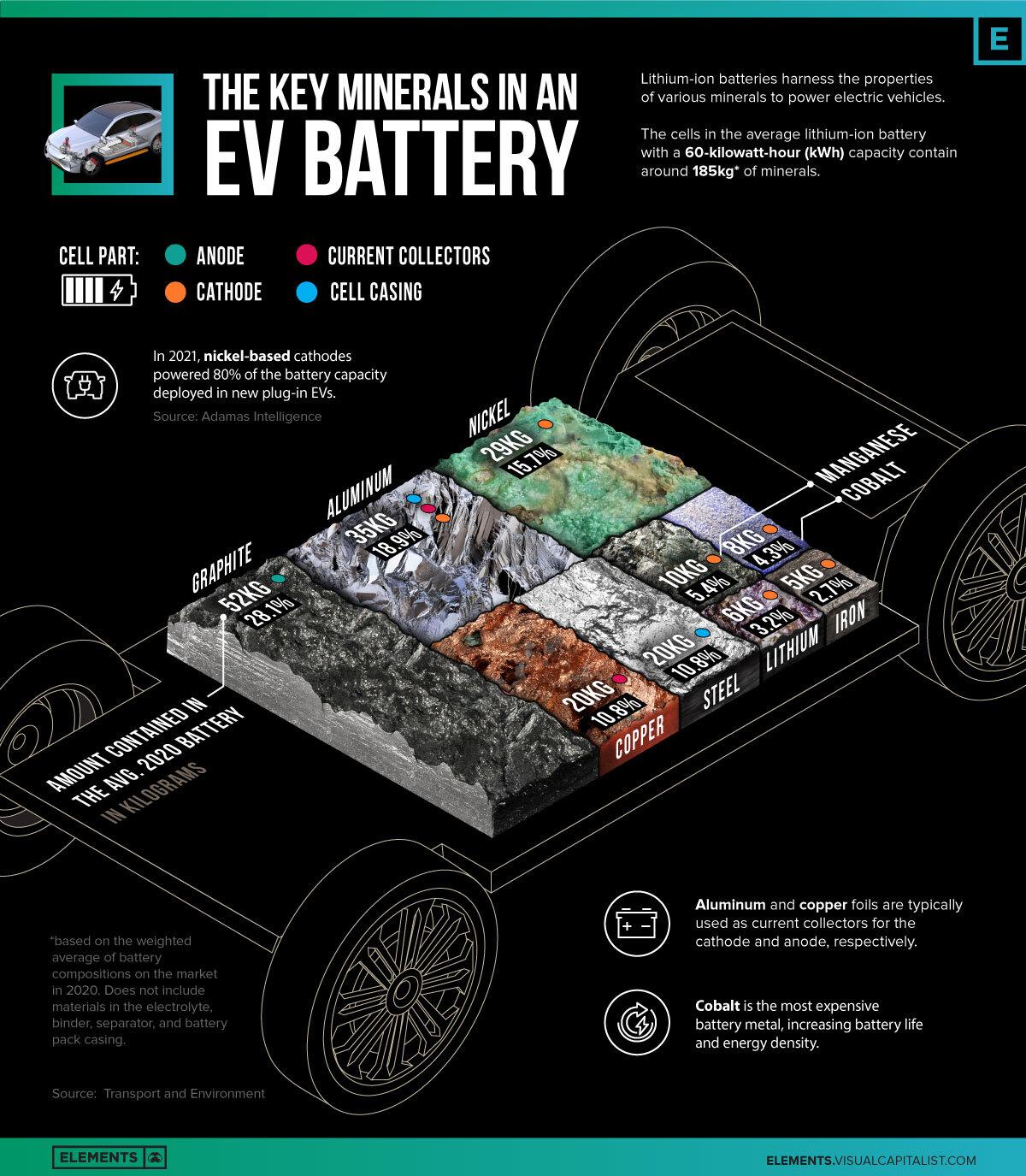
Source: Elements
DECARBONIZATION PLANS VS REALITIES
Japan’s national strategy is to build an offshore wind power industry almost from scratch and boost onshore wind capacity by 70% by 2030. Toyota plans to manufacture 3.5 million electric vehicles in 2030, from 15,000 units today. These plans alone would see Japan’s demand for rare earths surge 300 times within this decade. Will there be enough supply?
I am skeptical about the various net zero scenarios. Automakers’ plans require rare earths, as well as nickel, cobalt and lithium. Nothing can stop them from being ambitious, but I feel the automakers are talking about “zero carbon” without addressing the raw material supply issues. Securing raw materials has been the missing issue in their pronouncements.
The Ukraine war has elevated the debate around new energy. There are questions around how to secure power supplies to run EVs, how to secure gas for power generation, and so on. I believe many carbon neutrality plans will need to be modified and adjusted to reflect realities. For example, rather than a shift to EVs from vehicles that run on petroleum fuels, introducing more hybrid vehicles could be more realistic. The gap between resource reality and energy transition goals is far too wide right now.
There are other ways to fight climate change. Like, setting up solar and wind power stations in the no-entry zones in Fukushima, and making use of the power transmission lines that connected the Fukushima nuclear plants with Tokyo.
Do you know why magnets of scrapped hybrid vehicles are not collected for recycling? Because they are re-used as magnets. Instead of dismantling old wind power stations to recycle the metals, why not re-use the power station equipment? This way, there would be much less environmental impact.
JAPAN CANNOT MOVE AWAY FROM CHINA
While countries and companies are scrambling for limited supplies of energy raw materials, Japan’s long-term strategy seems to be to shift away from China. Is there evidence of this?
Neodymium leads in terms of China decoupling. There are increases in supplies from Australia and the U.S., and Russia too, although this cannot be factored into business scenarios. In my view, even if the war in Ukraine comes to an end, the U.S. will continue to sanction Russia, and Japan will not be able to sell goods that contain Russian raw materials.
However, Japan cannot completely break away from Chinese dysprosium and terbium supplies. China has the reserves, as well as the technologies to smelt and refine those ores.
Japan needs to diversify rare earth metal supplies, but it needs to rethink totally blocking Chinese supplies. Japan was able to come this far thanks to China supplying the required resources. I am 100% sure that a shift away from China is impossible. Japan relies on Chinese resources and this will not change. We need to think about working together.
There was a bilateral public-private business framework to discuss various aspects of rare earths (back in 2012). We need the bilateral framework to study, for example, rare earth applications. Japan has application technologies which China needs. China, like Japan, is shifting to EVs. China, like Japan, has been looking for rare earth reserves beyond its borders, because they may not have enough on their hands.
THE ROLE OF RECYCLING
How about recycling? Japan plans to become a global rare earth recycling hub.
Japan, and also China and Vietnam, have unveiled various recycling initiatives in the past decade or two. But the Japanese government has been late in this.
Recycling consisted of re-using scrap generated during rare earth metals processing and production. But we need to push for recycling from manufactured products, such as used magnets. This requires more work.
A proper recycling system has not yet been established because it’s difficult enough just to collect the used magnets. Who is going to dismantle a PC, take out the hard disk drives and take out the magnets? Or open up an air conditioner and scoop out the magnet? The routes to achieve this have not been set up.
Also, will it make economic sense to recycle? I believe in 2030, primary rare earths will remain the main source of supply. So, Japan needs to rethink how it can get along with and work with China.
RARE EARTHS’ CARBON FOOTPRINT
There are some concerns that more use of rare earth elements would increase our carbon footprint and environmental impact. What is your view?
There is no reliable data available at this point on emissions involved in the production of each kilogram of rare earths due to the complexity of the processes. Emission would also vary depending on the state of the mines and the end-uses.
JOBS IN JAPAN’S ENERGY SECTOR
BY ARTHUR (RIKU) OGAWA
Fast Movers Benefit the Most in a Tight Market
This year, Japan’s renewable energy labor market has retained its authentic trait of being largely candidate-driven. There is a shortage of candidates amid an abundance of job openings, in contrast to the situation in most developed economies with a strong renewable energy industry, such as the UK or Australia.
The market structure is not the only difference. There are other traits that are particular to Japan’s labor market, which are especially important for overseas companies to keep in mind as they expand locally:
-
- Low Candidate Visibility: The go-to platforms that provide candidates visibility are not yet widely used in Japan. Only about 3% of professionals in Japan are registered on LinkedIn. What’s more, the country has one of the lowest percentages of English speakers among developed economies.
- Long-Termism Culture: Japan is famous for its lifetime-employment labor market. While that was starting to shift in recent years, recent economic tailwinds have pushed back the shift with candidates again favoring stability.
- Older Demographic: Over 34% of the population is above 60, which is also the retirement age in most companies.
- Candidate-Driven Demand: There are about two jobs for each applicant on average, with the ratio rising to 10:1 in some of the emerging and dynamic industries.
- Brand Is King: Facing intense competition for top candidates, companies with well-represented brands, as well as those willing to accept high flexibility and act quickly, are the ones that tend to “beat the market”.
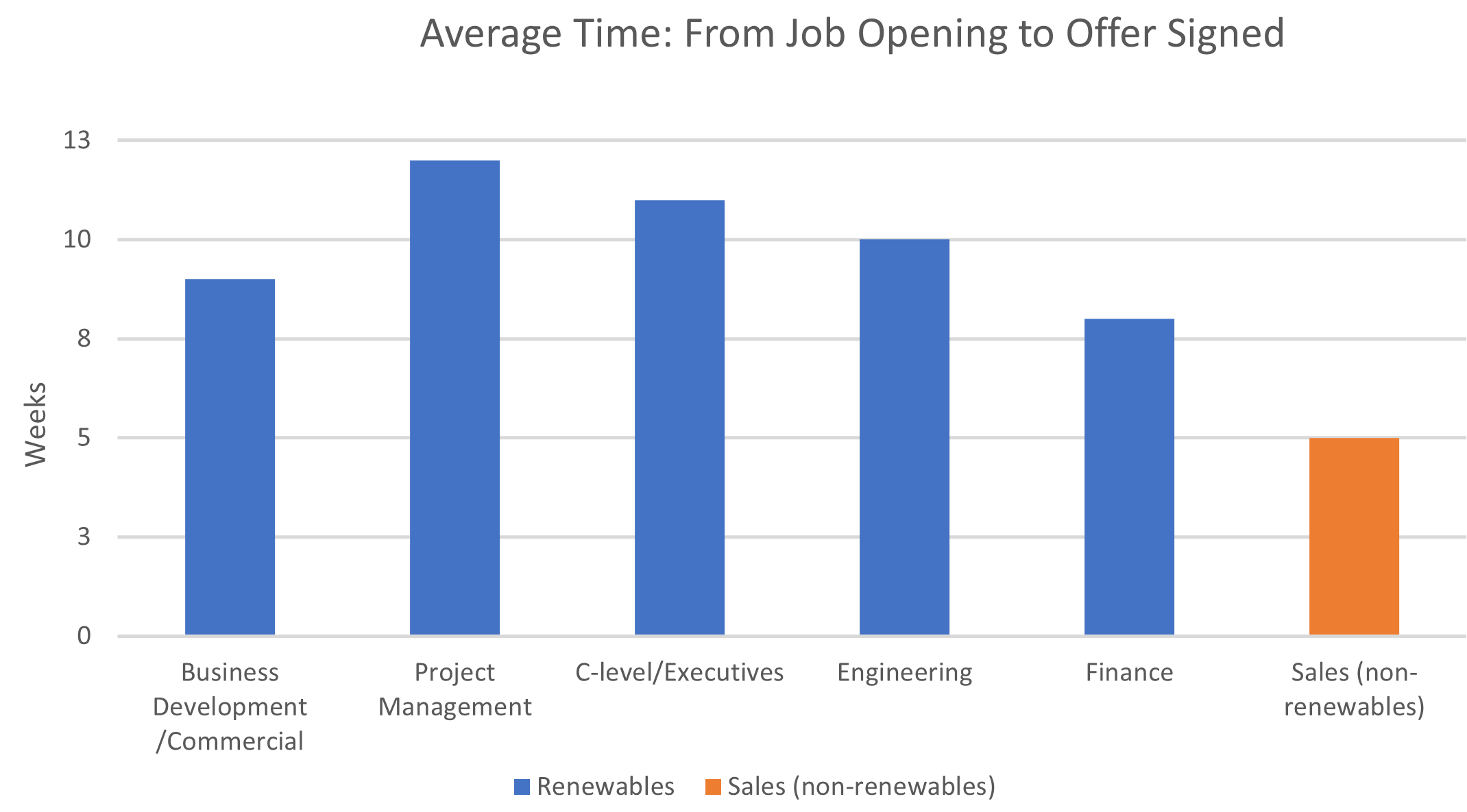
In the renewable sector it’s not unusual to see candidates with three or more competing offers. This makes it harder for employers to control hiring and onboarding. In addition, the interview process often drags on for weeks or months, which means those that act fast tend to be the ones that secure the best talent.
The chart on the next page shows the average time required to fill a position for a mid-level management / specialist and higher in Japan’s renewables sector. This includes positions with manufacturers, EPC contracts, developers, private equity funds and others, and it spans jobs in everything from offshore and onshore wind and solar to energy storage, ammonia and hydrogen.
For reference, there’s also the timeframe for hiring sales staff outside of the renewables sector.
About the author
Arthur (Riku) Ogawa is a Principal Consultant at Titan GreenTech, a Tokyo-based human capital and executive search firm with a focus on renewable energy and clean technology markets. Titan supports global companies with Japan market entry, as well as scale-up and key hiring.
GLOBAL VIEW
BY JOHN VAROLI
Below are some of last week’s most important international energy developments monitored by the Japan NRG team because of their potential to impact energy supply and demand, as well as prices. We see the following as relevant to Japanese and international energy investors.
Canada/ Renewable energy
S&P Global Market Intelligence reports that Canada added 5.56 GW of wind and solar power capacity in 2021. Most additions were in the Alberta province where a deregulated market for surplus power sales and emissions credit valuation and trade encouraged investment in renewables.
Energy/ Blockchain
The use of blockchain technology in energy markets might grow by $920 million by 2026, according to research by Technavio. Blockchain can help prevent failure in power grids. However, the high costs of implementing and maintaining the technology remain obstacles.
Finland/ Nuclear power
A consortium has canceled plans to build a Russian nuclear power plant. The Hanhikivi 1 project was controversial because Rosatom, the state nuclear company in Moscow, was both the supplier of the reactor and also the main shareholder, with a 34% stake.
France/ LNG
State-backed utility Engie signed a 5-year deal to buy LNG from Houston-based NextDecade, marking a major reversal. In November 2020, Engie suspended talks with NextDecade after the French government, a 24% shareholder, raised environmental concerns.
India/ Wind power
Envision Energy will build 2 GW of wind power capacity by 2024. The 596 wind turbines will be made in Envision’s local factory that’s still under construction. The company’s wind turbine design seeks to maximize energy produced from the low winds common in the country.
India/ Renewable energy
In a deal worth $1.55 billion, Shell will acquire Solenergi Power Private Ltd, the flagship company of Sprng Energy group, from UK-based Actis. Sprng Energy supplies solar and wind power to electricity distribution companies in India.
Indonesia/ Geothermal power
State energy firm PT Pertamina will invest $4 billion to double geothermal capacity over the current 700 MW by 2027-2028. The Energy Ministry says the country can potentially generate more than 28 GW of geothermal power, up from the current national total of 2.3 GW.
Italy/ Energy crisis
Italy approved a €14 billion support package to help vulnerable families and businesses with rising energy prices. A new windfall tax on energy company profits will fund the measures, which include a one-off cash payment of €200 for those with low incomes or pensions, as well as energy price subsidies for vulnerable families, and tax credits for businesses.
UK/ Oil
BP’s exit from Russia left the company with a $20.4 billion loss in Q1. BP wrote off its stake in energy giant Rosneft, the largest hit by any western oil and gas company following Russia’s invasion of Ukraine. Even so, due to rising global energy prices, BP’s Q1 profit was $6.25 billion, more than double the result for the same quarter last year.
U.S./ Solar power
State environmental regulators approved plans to build Sunnyside Solar Farm in Houston, soon to be the nation’s largest urban solar farm. Electricity will be generated by an array of 150,000 solar panels — enough to power 10,000 homes. It’s planned to be operational by July 2023.
U.S./ Oil policy
The American Petroleum Institute, a top U.S. oil and natural gas group, is protesting a bill in Congress that would make OPEC countries and its partners vulnerable to lawsuits for collusion on boosting petroleum prices. The NOPEC bill would give the U.S. Attorney General the power to sue oil-producing countries under anti-trust laws.
Disclaimer
This communication has been prepared for information purposes only, is confidential and may be legally privileged. This is a subscription-only service and is directed at those who have expressly asked K.K. Yuri Group or one of its representatives to be added to the mailing list. This document may not be onwardly circulated or reproduced without prior written consent from Yuri Group, which retains all copyright to the content of this report.
Yuri Group is not registered as an investment advisor in any jurisdiction. Our research and all the content express our opinions, which are generally based on available public information, field studies and own analysis. Content is limited to general comment upon general political, economic and market issues, asset classes and types of investments. The report and all of its content does not constitute a recommendation or solicitation to buy, sell, subscribe for or underwrite any product or physical commodity, or a financial instrument.
The information contained in this report is obtained from sources believed to be reliable and in good faith. No representation or warranty is made that it is accurate or complete. Opinions and views expressed are subject to change without notice, as are prices and availability, which are indicative only. There is no obligation to notify recipients of any changes to this data or to do so in the future. No responsibility is accepted for the use of or reliance on the information provided. In no circumstances will Yuri Group be liable for any indirect or direct loss, or consequential loss or damages arising from the use of, any inability to use, or any inaccuracy in the information.
K.K. Yuri Group: Oonoya Building 8F, Yotsuya 1-18, Shinjuku-ku, Tokyo, Japan, 160-0004.