
JAPAN NRG WEEKLY
MAY 16, 2022
JAPAN NRG WEEKLY
May 16, 2022
NEWS
TOP
- Japan to create $155 bln decarbonization fund for the power grid and other tech that could shrink the nation’s carbon footprint
- Russian oil imports will be phased out, PM Kishida says without giving specifics on dates, while companies start the adjustments
- Electricity futures trading hit record volumes in April on the TOCOM exchange after new feature was added
ENERGY TRANSITION & POLICY
- Japan’s first carbon emissions trading platform to be on the TSE
- Japanese industry group agrees on carbon accounting standards
- Ministry says it will subsidize bio jet fuel production from waste oil
- METI asks banks for better terms to SMEs affected by oil prices
- National CCS project data moves to JOGMEC as ENEOS and J-Power seek to create Japan’s first commercial carbon storage hub
- Japan PV group proposes new solar panel recycling framework
- JERA to cut emissions 60%, invest ¥1 tln in decarbonization
- Subaru to build Japan’s first electric vehicles (EV) factory
ELECTRICITY MARKETS
- First ever curtailment of renewable energy generation in Hokkaido
- Hokuriku Electric expands renewables capacity target in new plan
- Osaka Gas to develop 700 MW of solar in the U.S. and take stake in large Japanese solar power development company
- J-Power gets shareholder proposals to reduce coal exposure
- Chiba provides another candidate area for offshore wind projects
- Hokkaido to install hydrogen production unit to use surplus power
- JERA buys thermal power plants in the U.S. with eye on co-firing
- Steelmaker calls for faster restart of nuclear reactors in Japan
OIL, GAS & MINING
- Japan bans export of catalysts for oil refining, hydrogen to Russia
- Kyushu Electric launches new subsidiary for LNG trading
- Idemitsu exits Canadian uranium mine project; TEPCO stays put
- Tokyo Gas pulls out of the LPG sector after deal with Iwatani
ANALYSIS
MOMENT OF TRUTH NEARS FOR JAPAN’S REACTORS AMID NUCLEAR WASTE HEADACHE
With nuclear power generation gaining renewed attention in the race to decarbonize the energy sector, and the war in Ukraine causing energy prices to skyrocket, Japan is giving serious consideration to restarting its dormant nuclear reactors. Before a final decision is made, however, the fundamental question of how to manage nuclear waste needs to be resolved. Will it be recycled or disposed of entirely? With few reactors in operation, the issue of what to do with used nuclear fuel and other waste had receded into the background. Should restarts become a reality, the government will need to tackle this issue sooner rather than later.
WHAT IS A “GREEN” INVESTMENT? JAPAN STARTS NEW REGIONAL INITIATIVE TO GIVE ITS ANSWER
Going “green” means different things meanings to governments and businesses around the world. The latest policy developments in Japan confirm that it and its Southeast Asian allies’ vision of energy transition pathways diverge markedly from those animating Brussels, London and Washington.
Japan set the scene with a new international platform. At the end of April, Tokyo hosted the first edition of the Asia Green Growth Partnership Ministerial Meeting (AGGPM) Public-Private Forum. At the Forum, an influential new group set out the terms of what may qualify as a green investment in the Asian region.
GLOBAL VIEW
The EU will spend €195 billion to speed up renewables development. Gas prices surge on trouble with Russian gas deliveries to Europe. BlackRock says it will ignore some climate resolutions. Italy proposes setting up an oil buyers’ cartel. Hong Kong to build offshore wind farm. Details on these and more in our global wrap.
JAPAN NRG WEEKLY
PUBLISHER
K. K. Yuri Group
Events
Editorial Team
Yuriy Humber (Editor-in-Chief)
John Varoli (Senior Editor, Americas)
Mayumi Watanabe (Japan)
Wilfried Goossens (Japan, Events)
Regular Contributors
Chisaki Watanabe (Japan)
Takehiro Masutomo (Japan)
Daniel Shulman (Japan)
Art & Design
22 Graphics Inc.
SUBSCRIPTIONS & ADVERTISING
Japan NRG offers individual, corporate and academic subscription plans. Basic details are our website or write to subscriptions@japan-nrg.com
For marketing, advertising, or collaboration opportunities, contact sales@japan-nrg.com
For all other inquiries, write to info@japan-nrg.com
OFTEN USED ACRONYMS
METI The Ministry of Energy, Trade and Industry
MOE Ministry of Environment
ANRE Agency for Natural Resources and Energy
NEDO New Energy and Industrial Technology Development Organization
TEPCO Tokyo Electric Power Company
KEPCO Kansai Electric Power Company
EPCO Electric Power Company
JCC Japan Crude Cocktail
JKM Japan Korea Market, the Platt’s LNG benchmark
CCUS Carbon Capture, Utilization and Storage
mmbtu Million British Thermal Units
mb/d Million barrels per day
mtoe Million Tons of Oil Equivalent
kWh Kilowatt hours (electricity generation volume)
NEWS: ENERGY TRANSITION & POLICY

Japan to create $155 bln decarbonization fund for the grid
(Asia Nikkei, May 14)
- The government plans to create a ¥20 trillion ($155 billion) fund to promote investment in new power grid technology, energy-saving homes and other tech meant to shrink the country’s carbon footprint.
- Policymakers will seek to finance these investments with new sources of revenue, including a carbon tax and utility charges.
- The fund will help chemical plants, steel mills and other big industrial emitters switch to less carbon-intensive processes, and support supply chains for fossil fuel alternatives like hydrogen and ammonia. It will back production of car and storage batteries.
TAKEAWAY: PM Kishida is expected to unveil his clean energy strategy sometime in June or July. These news items appear to be leaks from parts of the strategy.
Under previous PM Suga, Japan set up the Green Innovation Fund, a ¥2 trillion, 10-year initiative that was meant to help fund the R&D behind the energy transition. It is administered by NEDO. This new fund appears to be 10 times larger and focused on bringing the R&D to life in more commercial-size projects. The focus on the grid should also be a very positive development.
Upper House passes Economic Security Act
(Parliament update, May 11)
- The House of Councilors passed the Economic Security Act, allowing the government to oversee procurement of power utilities and other basic service providers, and to protect the supply chain of critical materials such as rare earths and semiconductors. Within the next nine months, the government will issue ordinances to define the scope of legal oversight and critical materials.
TAKEAWAY: The measure will not only spur demand for locally recycled machineries and scrap, but also mergers and acquisitions of licensed waste-processing companies by trading houses that’ll be forced to scale down business with China.
Immediate impact on Chinese rare earth trading will be limited as various governments have been strictly monitoring trade flows in the past decade.
Japan to launch first exchange for carbon emissions trading
(Asia Nikkei, May 13)
- Japan Exchange Group together with METI, will establish the nation’s first market for trading carbon dioxide emissions. It will be hosted inside the Tokyo Stock Exchange (TSE), starting with a trial in September. Full-scale operation would start from around April 2023.
TAKEAWAY: Japan NRG reported this in the March 28, 2022 issue. Please check the Analysis section for all the details.
Industry agrees on carbon accounting standard
(Nikkei, May 11)
- A group of 74 Japanese companies, including NEC, Honda and Toshiba, have agreed to standardize CO2 emissions reporting.
- This will make it easier to calculate carbon emissions over the entire supply chain; the scheme will commence in July.
- These companies are considering alliances with European carbon monitoring groups.
Environment Ministry to subsidize SAF production from waste oil
(MoE statement, May 11)
- The MoE held an online tutorial of a new program for development of technologies to make sustainable aviation fuel (SAF) from waste oil and biomass The ministry plans to finance 20-30% of manpower, equipment purchases and other development costs. Applications close on May 30.
- CONTEXT: Companies eyeing SAF production have eyed used cooking oil and palm oil, alarming renewable operators and animal feed manufacturers that use the oil. The program aims to develop a new sustainable fuel supply chain using waste oil that’s not been recovered efficiently. One option is using cooking oil that can’t be used for animal feed, and another is oil found in industrial wastewater.
“National team” to support Rokkasho nuclear reprocessing plant
(Japan NRG, May 10)
- A “national team” of 400 engineers from power utilities, plant manufacturers and construction firms has formed to support construction of the Rokkasho nuclear reprocessing plant, a Japan Nuclear Fuel Ltd official reported to METI. The utilities are JNFL shareholders and customers.
- The plant, scheduled for completion this year, will be Japan’s first commercial nuclear fuel reprocessing facility. It will produce mixed oxide (MOX) plutonium fuel. Completion was delayed due to radioactive glass canister problems in 2007.
- The 400 external supporters are divided into safety and regulatory compliance teams. Utilities have also sent experts to train the on-site staff and to update safety plans to help clear regulatory reviews.
- CONTEXT: The smooth launch of Rokkasho is the first major step in the national nuclear fuel recycling plan. Its failure to clear safety standards will impact Japan’s nuclear energy scenario, which include launch of pluthermal generation by the power utilities, expansion of nuclear fuel storage capacity and reprocessing of MOX fuel.
TAKEAWAY: See this week’s Analysis section for a detailed report on how the nuclear waste issue will affect the restart of Japan’s Reactors.
METI asks banks to lower interest rates to support crude-hit businesses
(METI statement, May 11)
- METI has asked banks to lower interest rates and provide low or zero interest loans to small and middle size enterprises hit by crude oil price rise. The ministry also asked for flexibility in lending terms.
Japan Photovoltaic Energy Association proposes new panel recycling framework
(Japan NRG, May 12)
- The Japan Photovoltaic Energy Association proposed a panel recycling framework that involves solar panel importer and suppliers, power operators, waste collector and treatment businesses, local governments, and the national government. JPEA was speaking at a multi-ministry panel for resolving renewables and community conflicts. Under present recycling regulations, waste processing companies bear reporting responsibilities to municipalities. METI and MoE run separate subsidy programs to develop recycling technologies.
- Over half of the glass in the panels contain antimony, a toxic element that can’t be transported outside approved areas. Antimony is also found in PC and flat panel displays, but cost-efficient and safe technologies to separate the element from waste have not been developed. Antimony, like rare earths, is a critical resource whose reserves are concentrated in China.
TAKEAWAY: See also “As a Leader in Solar, Japan Seeks Solutions to Recycle And to Prolong PV Panel Lifespan” in the March 28 issue of Japan NRG.
Japan CCS transfers geographical data to JOGMEC for wider public access
(Japan NRG, May 11)
- Japan CCS, a joint venture of oil and gas upstreamers conducting geophysical surveys, transferred its proprietary data to state-run Japan Oil Gas and Metals National Corporation for wider access to companies planning carbon capture operations.
- Surveys will increase with JOGMEC launching CCS exploration in 2023.
- CONTEXT: METI says CCS feasibility studies need to start in 2023, at the latest, to be operational in 2030. CCS demand is forecast at 120-140 million tons/year, according to its interim report on long term CCS strategy.
ENEOS and J-Power to partner on carbon capture and storage (CCS)
(SankeiBiz, May 13)
- ENEOS and J-Power will implement carbon capture and storage on an industrial level.
- The two companies are surveying sites in West Japan suitable for CO2 sequestration, and aim to begin commercial operations in 2030. A final investment decision on the project is expected around 2026.
- The project will allow storage of CO2 recovered from oil refineries and thermal power stations operated by the two companies.
TAKEAWAY: This is an attempt to create Japan’s first commercial scale carbon capture and storage facility, building on the testing done at the Tomakomai CCS trial project, in which both ENEOS and J-Power are shareholders. If successful, demand will be strong and run far beyond the emissions of the two companies.
ENEOS and J-Power are also working on a joint project to extract hydrogen from biomass and store CO2 byproduct underground.
JERA pledges to cut emissions by 60% by 2035
(Nikkan Kogyo Shimbun, May 13)
- JERA’s CEO, Onoda Satoshi, pledged by 2035 to reduce the company’s Japanese CO2 emissions to 60% less than 2013 levels.
- JERA is accelerating blending ammonia and hydrogen with fossil fuels at thermal plants.
- Under a new, more aggressive roadmap, the company plans to switch to co-firing using blends containing over 50% ammonia (or over 30% hydrogen) by the mid-2030s.
- In light of the Ukraine crisis, Onoda said energy security concerns meant that efforts to cut carbon emissions would accelerate.
- SIDE DEVELOPMENT:
JERA to invest over ¥1 trillion in decarbonization and overseas
(Denki Shimbun, May 13)- JERA announced a new ¥1.4 trillion financial strategy for the four years from FY2022 to FY2025. About ¥1.2 trillion will be allocated to growth areas such as decarbonization and overseas power generation and fuel business.
- The company will also invest approximately ¥ 500 billion in domestic thermal power generation to replace and upgrade facilities.
- SIDE DEVELOPMENT:
JERA CEO says sending LNG vessels to Europe on government request
(Denki Shimbun, May 13)- In response to the government’s request to supply LNG to Europe, JERA CEO Onoda said: “In March and April, we sent a total of six vessels with approximately 400,000 tons of LNG to Europe. We are contributing to the stable supply of energy to Europe.”
- Onoda said JERA will continue to seek flexible procurement of LNG.
Solar panels to be mandatory for Tokyo houses
(Tokyo Shimbun, May 12)
- A committee appointed by the Tokyo Metropolitan government tabled a report that called for solar panels to be mandatory on all new houses.
- The recommendations will probably be law in 2022/23, pending residents’ feedback.
- The obligation to fit panels will rest with construction companies, rather than buyers.
- With a target more ambitious than the national government, Tokyo Governor Koike Yuriko pledged to reduce Tokyo’s GHG emissions by 2030 to under 50% of 2000 levels.
Subaru to build Japan’s first EV plant
(Nikkei Asia, May 12)
- Automaker Subaru will build a new EV plant, aiming to bring the factory online after 2027.
- Located near Subaru’s main factory in Ota, Gunma Prefecture, this facility would be Japan’s first newly-built plant to focus on EVs.
- Total investment is expected to be around ¥250 billion ($1.9 billion).
- SIDE DEVELOPMENT:
TDK to build $380m EV component factory in Japan
(Nikkei Asia, May 10)- Electronics manufacturer TDK will spend roughly ¥50 billion ($383 million) on a domestic factory to make parts for EVs.
- The new facility will make multi-layered ceramic capacitors and be located next to an existing plant in Kitakami (Iwate Prefecture). It will be up and running by the end of 2024.
Shipper Mitsui OSK and Trafigura to partner in biodiesel fuel supply
(New Energy Business News, May 12)
- Mitsui O.S.K. Lines (MOL) and trading firm Trafigura agreed to jointly study the establishment of a biodiesel fuel supply chain at auxiliary oil ports around the world.
- The aim is initially to supply ships operated by MOL’s Singapore unit MOL Chemical Tankers.
- The two parties already tested biodiesel fuel on MOL’s chemical tanker “NISEKO GALAXY” earlier this year. This kind of fuel can be used without changing the specifications of a ship’s existing diesel engine, and by blending it with conventional marine fuel oil at a ratio of approximately 30%. It is said to cut emissions by about a quarter.
Japanese group teams up to improve district cooling & heating with AI
(New Energy Business News, May 10)
- AI algorithm/product developer Araya, Sumitomo Corporation Machinex, Toho Gas, Nikken Sekkei, and Nikken Sekkei Research Institute have developed AI Chirei, a system that uses AI to solve problems in district heating and cooling management.
- The AI starts demonstration tests at a district in Nagoya city in May.
- CONTEXT: District heating and cooling in Japan has been introduced since the 1970s as a measure against air pollution caused by the country’s rapid economic growth, and currently there are 133 such facilities in Japan. However, it is difficult even for experienced operators to accurately predict conditions at the customer side and operate heat sources, so CO2 emissions reduction through renovation, including review of operation methods, is essential.
Joyo Bank to invest in renewables
(Nikkei, May 13)
- Joyo Bank will open a subsidiary to acquire solar farms and other renewable capacity.
- The new company, Joyo Green Energy, will invest in generation in Ibaraki Prefecture.
- In the mid-to-long-term this will also include biomass projects.
- Many local solar generators who sold electricity under the FIT scheme launched 10 years ago are now looking to sell their operations.
NEWS: POWER MARKETS

TOCOM power futures volume hits record high in April
(Exchange Statement, May 11)
- The volume of power futures contracts on the Tokyo Commodity Exchange hit a record high of 3,631 lots in April, more than double the 1,511 contract trades in March, despite power demand peaking off due to warmer temperatures. The exchange attributed the increase to the start of off-floor trading in April, as well as tighter supply in western Japan due to nuclear power plant maintenance schedules.
- Out of the 3,631 lots, 1,920 were for western Japan day time loads. Prices were down from March due to seasonal demand declines, but wholesale prices remained above ¥20/kWh, TOCOM said.
First ever curtailment of renewables in Hokkaido
(NHK, May 8)
- For the first time ever, to avoid overloads Hokkaido Electric Power Network limited the supply of renewably generated electricity to the grid.
- Up to 190 MW of solar and wind capacity was affected.
- The government is encouraging utilities to install storage batteries to make better use of renewably-generated electricity.
TAKEAWAY: See the Jan 24, 2022 edition of Japan NRG Weekly for details on the volume of curtailments in Japan and regions expected to be affected this year.
Hokuriku Electric expands its renewable energy target for 2030
(New Energy Business News, May 11)
- Hokuriku Electric has expanded its previously stated target for rolling out new renewable energy capacity. In its long-term vision for FY2030 formulated in 2019, the utility sought to add 2 GW of renewables over this decade. That has now been increased to more than 3 GW.
- The utility will consider further additions in hydro, wind, solar, and other energy sources both within its local region and outside.
Osaka Gas to develop 700 MW of solar in U.S. with local partner
(Denki Shimbun, May 12)
- Osaka Gas and Oriden Corporation, a U.S.-based renewable energy developer that’s part of Mitsubishi Heavy Industries, will develop more than 700 MW of solar power in the U.S.
- The two intend to begin construction of at least one solar power plant in fiscal 2024-25, with plans for one to five projects ranging from 150 MW to 350 MW in size.
- Oriden will be in charge of project development, while Osaka Gas will provide financial support, contributing to the majority of the costs.
Osaka Gas buys 1.2% stake in solar developer West Holdings
(Gas Energy News, May 9)
- Osaka Gas paid ¥2.4 billion for a 1.2% stake in West Holdings, a company involved in the development and construction of solar power generation facilities.
- The two also entered into a capital and business alliance for the development of a new non-FIT (Feed-in Tariff) solar power generation plant.
- Osaka Gas and West have collaborated in solar generation since March 2020.
- The business alliance includes the purchase of electricity by Osaka Gas from non-FIT solar projects and development of solar power plants on idle land in response to requests from Osaka Gas customers. The two firms will also collaborate in VPP (Virtual Power Plant) and DR (Demand Response) businesses.
J-Power gets shareholder proposals to reduce coal exposure
(Nikkei, May 11)
- U.K.-based Man Group, France’s Amundi and HSBC Asset Management jointly filed three climate-related shareholder proposals to J-Power, asking Japan’s biggest coal-burning utility to reduce reliance on the fossil fuel.
- J-Power, which owns at least 10 coal-fired power units in Japan, has an AGM next month.
- The filings mark the first case of institutional investor group-led engagement in a company’s decarbonization strategy in Japan. So far, such proposals have mainly come from climate campaign groups.
- The funds argue that J-Power’s current approach presents financial risks to shareholders and that it should set and disclose a business plan to cut GHGs.
Chiba provides another candidate area for offshore wind
(New Energy Business News, May 10)
- The national government asked Chiba Prefecture to suggest further areas that could be promising for developing offshore wind power generation. In response, Chiba suggested an area 10 km off the coast of Kujukuri Town, Yamatake City, and Yokoshibahikari Town.
- The target area will be narrowed down after discussions among the national and prefectural government, the related municipalities, and fishery-related parties.
- This is the third area Chiba has suggested for offshore wind power development, following Choshi City and Isumi City.
- Meanwhile, Fukui Prefecture also suggested an offshore area off Awara City.
Hokkaido Electric to install 1 MW-class hydrogen manufacturing system
(Kankyo Business, May 12)
- Hokkaido Electric will install a 1 MW-class hydrogen production system, capacity: 200 Nm3/ hour, in Tomakomai, Hokkaido. Construction will begin in August, and operation is scheduled to start in March 2023.
- The water electrolysis-based hydrogen production system is expected to absorb surplus electricity and output fluctuations of renewable energy.
- If effective, the utility hopes to expand the utilization of such systems to support the rollout of further renewables in Hokkaido.
JERA buys two thermal power plants in U.S., seeks to cut their carbon footprint
(Company Statement, May 13)
- JERA has bought two power assets with a total capacity of 1.63 GW in northeast U.S. from Stonepeak.
- The utility will seek to improve the operational efficiency of the Canal Thermal Power Station in Massachusetts and the Bucksport Thermal Power Station in Maine, which JERA said are significant sources of electricity in the local region during emergencies and peak times.
- The utility wants to pursue commercially viable decarbonization paths including low carbon biofuels in place of traditional fuels, as well as large scale renewable projects, blending hydrogen in gas turbines, and energy storage solutions.
Tokyo Steel calls for faster restart of nuclear reactors in Japan
(Bloomberg, May 12)
- Amid soaring energy costs, a major Japanese steel-maker is calling for a quicker restart of nuclear reactors that idled after the 2011 Fukushima disaster.
- Tokyo Steel Manufacturing, Japan’s biggest producer of steel made from scrap, said more nuclear power was essential to revive industry competitiveness that’s been hit by rising commodity prices and an increasing shortfall in electricity capacity.
Vena Energy, Shikoku Electric, and Toho Gas partner in offshore wind project
(Denki Shimbun, May 11)
- Renewable energy operators Vena Energy, Shikoku Electric, and Toho Gas will establish a consortium to bid on an offshore wind power project off the coast of Aomori Prefecture.
- The consortium will work via the Tsugaru Shichiri-Nagahama Offshore Wind Power Company, a special purpose company (SPC) set up by Vena Energy.
- The consortium is the eighth group to eye projects in the area. The Vena-led group plans to install 63 wind turbines with a maximum capacity of 600 MW. Preparations are already underway, including a briefing session for local residents in April. The consortium aims to launch the wind farm six to eight years after selection.
Influx plans onshore wind power plant in Miyagi area
(New Energy Business News, May 13)
- Influx Inc. plans to develop an onshore wind power project in Shichigajuku Town, Miyagi Prefecture. It will have a maximum output of 132 MW, hosting a maximum of 31 wind turbines over 3,198 hectares.
Corporate clients stranded as power companies go to the wall
(Nikkei X-Tech, May 11)
- While many businesses turn to cut-price start-ups for electricity, record wholesale prices on the energy market have driven many small energy suppliers out of business.
- All of Japan’s 54 largest “new” energy companies (those not operating power plants) that are still in business have stopped signing new business subscribers.
- There’s no indication when these companies might again accept new subscribers.
- This has left many subscribers stranded.
- Applications for a government scheme guaranteeing access to electricity and gas have soared, with 4,000 applications received since March.
NEWS: OIL, GAS & MINING

WAR IN UKRAINE:
PM Kishida says Japan preparing to cut Russian oil imports(NHK, May 9)
-
- Commenting on a recent G7 pledge to suspend or phase-out imports of Russian oil, PM Kishida said the government will begin discussing when to start reducing imports.
- The government will take into account current import levels.
- However, when asked about Japan’s stakes in the Sakhalin I and Sakhalin II projects, the PM said the government’s position to keep these remains unchanged.
- SIDE DEVELOPMENT:
Idemitsu to suspend Russian oil and coal exports
(NHK, May 10)- Idemitsu CEO Kito Shun’ichi said the company will stop Russian coal and oil imports in line with the government’s embargo.
- Russian oil currently accounts for around 4% of Idemitsu’s total imports.
- SIDE DEVELOPMENT:
Japan to ban exports of catalysts for oil refining, green hydrogen to Russia
(METI statement, May 13)- Effective May 20, Japan will ban exports of catalysts for oil refining, green hydrogen fuel, solar module manufacturing equipment, high-tech alloys used for weapons, semiconductor raw materials and more.
- CONTEXT: Gray or blue hydrogen and ammonia exports will not be banned.
TAKEAWAY: While in principle banning Russian oil imports, Japan will keep its interests in hydrocarbon developments there. That might seem like a contradiction, but oil purchase contracts elsewhere are easy to draw up with other suppliers in the giant global oil market. Having rights to develop hydrocarbon reserves, which is what Japan has in the Sakhalin I and II projects, is much more complex and expensive to procure. Such rights are, in theory, a guarantee of energy security and therefore worth more than a commercial procurement deal.
The other great consideration is what happens to the Russian rights should Japan relinquish them. After all, over decades Japan provided billions of dollars in financing and technological know-how to help bring Sakhalin projects online. This is no mean feat when you consider that oil wells at Sakhalin I, for example, are some of the longest in the world, in one case spanning 15 kilometers. Giving up the rights would potentially pass on the technology and ready-made production deposits to trade rival China for a pittance. Even if Japan cannot benefit from the oil and gas produced in Sakhalin, it will likely want to hold onto the rights to prevent them from becoming a big plus for China.
Kyushu Electric launches a new subsidiary for LNG trading
(Company Statement, May 11)
- The utility set up Q United Energy Supply & Trading Co. (QUEST), a subsidiary to procure LNG for the company and its clients.
- The company will supply LNG utilizing Kyushu Electric assets including LNG vessels and storage terminals.
Idemitsu exits Canadian uranium mine project, though TEPCO stays put
(Company Statement, May 10)
- Canada’s Cameco and Orano Canada Inc. agreed to Idemitsu’s 7.875% interest in the Cigar Lake uranium mine JV. Upon closing, Cameco’s ownership in the world’s largest high-grade uranium mine will increase by 4.522% to 54.547%, while Orano’s share will rise by 3.353% to 40.453%.
- TEPCO Resources Inc. retains the remaining 5% interest in the property.
Tokyo Gas exits the LPG sector as Iwatani takes its place
(Gas Energy News, May 9)
- Tokyo Gas will sell to Iwatani Corporation its 66.6% stake in Tokyo Gas Energy and its 49% stake in Tokyo Gas LPG Terminal.
- This marks Tokyo Gas’s withdrawal from the LP gas business.
- The sales amount was not disclosed.
- INPEX, which holds the remaining 33.4% stake in Tokyo Gas Energy, will also sell all of its shares to Iwatani. The share transfer is scheduled to be completed by June.
- CONTEXT: Iwatani is the industry’s largest player, supplying LP gas to 3.2 million households in Japan through direct and wholesale sales.
Japan’s LNG stocks rise to 2.02 million tons
(METI Statement, May 11)
- Japan’s LNG stocks stood at 2.02 million tons on May 8, up from 1.93 million tons a week earlier. The May 8 level was higher compared to end-May 2021 stocks of 1.94 million tons and the four-year end-May average of 1.98 million tons.
ENEOS announces stock buyback
(Minkabu, May 13)
- ENEOS will buy back 9% of its outstanding shares, currently worth over ¥100 billion.
- The news was well received by investors.
- ENEOS also released its projected consolidated sales for the year to March 2023.
- ENEOS projects a 7.2% increase in sales YoY.
ANALYSIS
BY MASUTOMO TAKEHIRO
Moment of Truth Nears for Japan’s Nuclear Waste Issue
With nuclear power generation gaining renewed attention in the race to decarbonize the energy sector, and the war in Ukraine causing energy prices to skyrocket, Japan is giving serious consideration to restarting its dormant nuclear power fleet.
Prime Minister Kishida has made clear his willingness to restart nuclear power plants, saying on April 26: “We must pursue how far we can go in restarting reactors within the current framework.” Before a final decision is made, however, the fundamental question of how to manage nuclear waste needs to be resolved. Will it be recycled or disposed of entirely?
Prior to the 2011 Fukushima earthquake and tsunami, nuclear power generation was a strategic priority, accounting for roughly 30% of Japan’s total electricity. The industry envisioned creating a system for recycling used fuel, but progress in this direction was slow. Meanwhile, used fuel rods piled up in short-term storage, threatening one day to reach capacity.
After the 2011 disaster, the country’s entire nuclear fleet was shut down. Even a decade on, of the remaining 33 nuclear reactors classified as operable only 10 have restarted. Today, just four units are currently online due to maintenance and facility upgrade works.
With few reactors in operation, the issue of what to do with used nuclear fuel and other waste receded into the background. Should restarts become a reality, however, the government will need to tackle this issue sooner rather than later.
MOX’s mojo still uncertain
There are two main approaches to spent nuclear fuel. One is sealing it inside safe containers, such as glass and cement, and stored out of harm’s way. Another view sees spent fuel as a resource to create new fuel rods since the vast majority of the energy potential remains untapped.
While most western countries have adopted the former approach, the latter vision for a circular nuclear economy is supported by just a handful of countries. Japan is one of them.
Utilizing recycled uranium, however, requires different technology to the one regularly deployed in Japan and elsewhere. For many years, building fast or breeder reactors was considered the best option. These units, as the name suggests, are theoretically able to unlock more of the energy potential of uranium than regular reactors, creating more energy than they draw.
No country, however, has succeeded in building an economic and efficient fast reactor. In 2016, the Japanese government decided to close its commercial-scale Monju fast nuclear reactor facility despite it barely operating after a long series of mishaps.
Japan’s nuclear strategy is built on the idea that nuclear fuel can be recycled. There are other ways to recycle nuclear fuel. One involves a series of steps including the extraction of uranium and plutonium from spent nuclear fuel and blending these components into a new so-called mixed oxide (MOX) fuel. Some regular nuclear reactors, with modifications, can run on MOX fuel.
To date, Japan has upgraded four of its reactors to be pluthermal. In other words, to run on MOX fuel that has a higher plutonium component. Many more units were due to be upgraded to run on MOX fuel, but before that Japan decided to set up its own spent fuel recycling facility.
This is where the Rokkasho Nuclear Fuel Reprocessing Facility in Aomori Prefecture comes in. Originally planned to open in 1997, the project has been delayed 25 years due to technical issues and additional construction work required by stricter regulations.
The sunk costs are huge, with construction alone already reaching ¥3 trillion. Industry experts believe the final cost will amount to ¥14.4 trillion, making MOX more expensive than conventional fuel. In the meantime, Japan has outsourced the reprocessing task, mainly to Britain and France.
MOX’s main selling point is recycling spent fuel, thus lessening the volume of nuclear waste that needs to be stored. Across Japan, 19,000 tons of spent nuclear fuel sit in swim pool-like facilities inside nuclear power plants. This is believed to be 80% of the total available storage capacity.
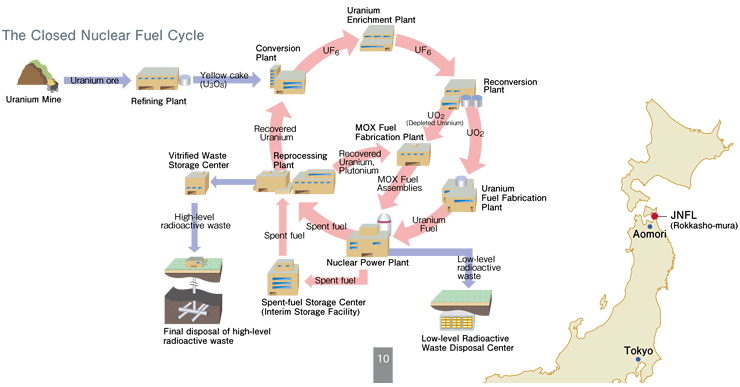
Source: The Federation of Electric Power Companies of Japan (FEPC)
Old promises
In 1995, Rokkasho agreed with nuclear utilities to start taking used fuel from their storage pools after 30 to 50 years. While Rokkasho’s launch has been delayed, the facility has about two decades to collect all the spent fuel rods if it is to honor those contracts. Given the plant’s current capacity, Rokkasho’s operator, Japan Nuclear Fuel Ltd., will struggle to process all of the envisaged volumes in that timeframe.
The issue flared up in the political arena last year during the LDP presidential election, a de facto race to pick the country’s next leader. PM Kishida seized the opportunity, defeating Kono Taro, who had promised to abandon nuclear fuel recycling. Kishida’s newly-established government has reiterated the nation’s commitment to recycling.
The support of local government is also crucial. The village of Rokkasho has a mayoral election in June. If politicians that support the recycling project are defeated, the country’s ability to keep its nuclear recycling vision alive may be quashed. That would accelerate the need to find a final site for direct nuclear waste disposal.
Remote villages volunteer for site selection
The government and power companies have plans to bury high-level radioactive waste underground at depths of 300 meters or more. The perennial issue has been: Where? The nuclear industry published standards for such a site in 2000. This was followed by a survey and a map identifying potentially suitable geological areas, published in 2017.
In 2020, two remote Hokkaido municipalities — Suttsu Town and Kamoenai Village — self-nominated as sites for the final disposal of high-level nuclear waste. This set off a two-year process of gathering preliminary data to confirm location suitability. That process is almost complete. Interestingly, both localities held elections in the last year, with project proponents winning.
Still, this is just the start. Selection of a final disposal site requires 20 years of geological and other investigation, as well as another 10 years for safety review and construction. It’s not clear if either Suttsu and Kamoenai will move to the process’ second phase (overview survey to examine the strata and bedrock) or third phase (detailed survey to set up an underground research facility).
Regional politics is one factor contributing to the uncertainty. While the idea has support at the locality level, it would need support from the regional governor. Current holder of that post, Suzuki Masanao, has expressed opposition to such developments. How future leaders of the two localities will act is also uncertain.
Separately, in Horonobe, another Hokkaido town, a deep geological survey is also underway. Three years ago, the utilities-funded-Nuclear Waste Management Organization (NUMO) said that an investigation of disposal technology to bury nuclear waste underground would be extended to 2028.
Last year, NUMO unveiled plans to drill to 500 meters underground, from the current 300 meters. Locals are concerned that testing will eventually lead to their location being asked to become the final disposal site.
What’s more, aside from spent fuel, Japan will soon have much more nuclear waste that needs storing. The decommissioning of Japan’s older reactors is expected to begin in the mid-2020s, which could result in about 480,000 tons of low-level radioactive waste. The Fukushima Dai-Ichi plant is another source of nuclear waste that currently has no home or defined disposal strategy.
Send nuclear waste abroad?
According to international treaties, radioactive waste should be disposed of in the country of generation. But Japan plans to deregulate waste disposal. Some large equipment that comes out of the decommissioning process, categorized as low-level nuclear waste, will be permitted for outsourcing to overseas disposal companies.
Last September, Asahi reported that this deregulation specifically applies to three types of equipment: steam generators, feed-water heaters and nuclear fuel storing and shipping casks. According to another report by Mainichi, in April 2020 a senior official at the U.S. Department of Energy asked METI to review Japanese regulations that prohibit disposal outside Japan.
During the conversation, the officer mentioned Utah-based Energy Solutions, the world’s largest nuclear waste disposal company. Apart from this, in 2019-2020 Canada also considered accepting Japanese nuclear waste. The New Energy Basic Plan, revised last October, clearly indicates that the government favors being able to move some low-level nuclear waste abroad, and change in regulation is in the offing.
For all the above, Japan’s path for nuclear fuel recycling and a final disposal site hasn’t become clearer over the past few years. Yet, the clock is ticking. In the end, political decisions always dictate Japan’s nuclear policy. The summer elections contested by PM Kishida may decide more than just the make-up of the upper house of parliament. They may decide the fate of the broader nuclear energy complex.
ANALYSIS
BY ANDREW DEWIT
PROFESSOR OF ENERGY POLICY
SCHOOL OF ECONOMIC POLICY STUDIES
RIKKYO UNIVERSITY, TOKYO
Creating the Asian Definition of a “Green” Investment:
Japan Leads a New Regional Initiative
Going “green” means different things to governments and businesses around the world. The latest policy developments in Japan confirm that it and its Southeast Asian allies’ vision of energy transition pathways diverge markedly from those animating Brussels, London and Washington.
Japan set the scene with a new international platform. At the end of April, Tokyo hosted the first Asia Green Growth Partnership Ministerial Meeting (AGGPM) Public-Private Forum. The event included speeches by energy-related officials from the 10 member states of the Association of Southeast Asian Nations (ASEAN), as well as Japan. It also featured announcements of ambitious business partnerships between Japanese and ASEAN companies in the fields of carbon capture and storage, ammonia, hydrogen and renewable energy.
But possibly the most impactful aspect of the Forum was the launch of the Asian Transition Finance Study Group’s (ATFSG) mid-term report on transition pathways. This grouping of Asian and global commercial banks is much more than another industry initiative. Led by Japan’s biggest financial player, MUFG, the Group is strongly backed by Japanese government agencies and has direct input from key stakeholders in the ASEAN. That includes the ASEAN Taxonomy Board and the Sustainable Finance Institute Asia.
The Group’s report, which is due to be followed by a final version in October, is essentially an outline of decarbonization strategies for Asia. Japan and its ASEAN partners make it clear they seek pragmatic and appropriate solutions for their region while also respecting global climate goals reflected in the Paris Agreement.
What the report represents
Global warming is accelerating, and the World Meteorological Association
warns we have a 50% risk of breaching 1.5 degrees within the next 5 years. Asia will powerfully shape what happens in those years and beyond, as it represents 60% of the global population, over half of all emissions, and 60% of global growth through to 2030.
Despite these big numbers, most countries in Asia have not set out specific decarbonization pathways, in contrast with the EU. Yet even the EU’s net-zero pathways are already complicated by pitfalls and potholes, as evinced by the crisis concerning Russia.
So the ATFSG’s work is crucial. Its report explicitly points to the EU’s much higher level of economic development and starkly different resource endowments. The ATFSG is committed to building on the European experience, but melds questions of sustainability with an emphasis on energy security, reliability of supply, and affordability. The result, judging by the mid-term report, will be decarbonization roadmaps quite unlike Europe’s.
Terms of Investment
Another reason the ATFSG cannot be ignored is its work on a regional green taxonomy. A taxonomy is essentially a rulebook to guide investments toward technologies that are deemed in line with climate goals, or simply “green”.
To some, this effort might seem superfluous, since the EU has already drafted such a green taxonomy. Its scope extends from climate mitigation and adaptation, through to the circular economy, and on into protecting and restoring biodiversity and ecosystems. For many, the EU’s taxonomy seemed on the cusp of becoming the essential manual for decarbonization, but it’s now under critical scrutiny after European Commission pragmatists added nuclear and low-emissions natural gas to the “green” list. This provoked fierce opposition that portends a very hot summer in the European Parliament.
However the EU’s internal debate concludes, Japan has been concerned that Europe’s taxonomy rules and related regulation won’t fit Asia realities. Asian partners generally agree that allowing EU definitions of “green” to become the global standard would hinder Asia’s economic development. Japanese policymakers have built on this sentiment and institutionalized work towards creating a taxonomy specific to Asia.
Japan’s initiative is not as rebellious as it sounds. After all, the EU’s taxonomy was only one of at least 26 in place or under development as of March 2022, according to Climate Bonds. Each taxonomy contains its own details on defining sustainable investment across the power, transport, mining and other sectors.
Proliferation of Green Taxonomies
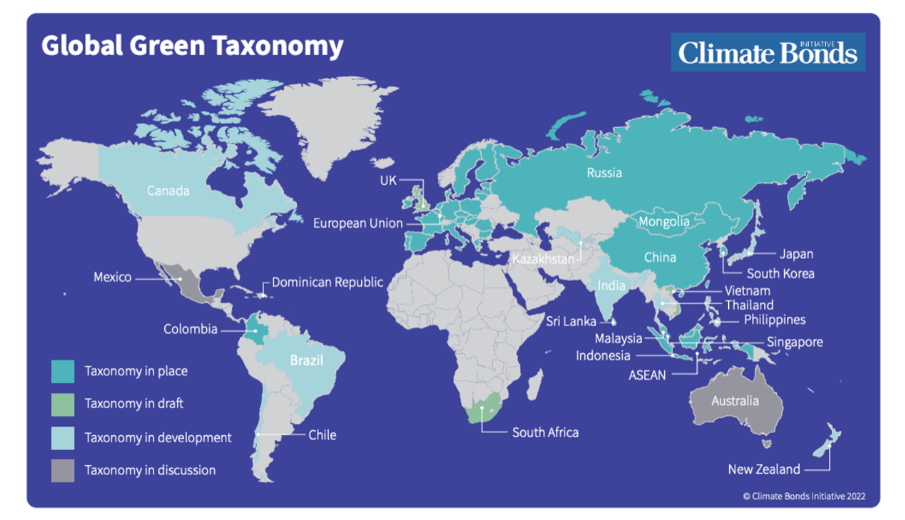
Source: Climate Bonds
Among the proliferating taxonomies, there are also attempts at harmonization. The EU and China, for example, seek to synchronize their respective approaches through a Common Ground Taxonomy. This initiative is complicated by quite dissimilar rules, such as those regarding social standards, not to mention China’s inclusion of nuclear but the exclusion of gas.
For the Japan-led ATFSG, similar challenges abound in trying to marry various national interests and characteristics. Still, there are areas where the region already shows wide agreement. In the emerging ASEAN+Japan taxonomy, carbon-capture is deemed a “green” investment. The reason is clear in light of the fact that a large fleet of comparatively new coal-fired power plants generates almost half of the Asia-Pacific’s electricity.
The regional average age of a coal plant in Asia is under 15 years, compared to the 30–40-year age of coal plant in the EU and U.S., according to the International Energy Agency (IEA), which regards carbon capture as an essential technology for achieving climate goals.
IEA’s research on Asian countries shows that the region is unlikely to retire those coal-fired assets for at least a couple of decades. The capital costs are far from being recovered and industry-heavy Asia needs ample 24/7 baseload power. Thus, incentivizing carbon-capture to cope with coal is deemed a regional imperative.
Average Age of Coal Plant, by Region
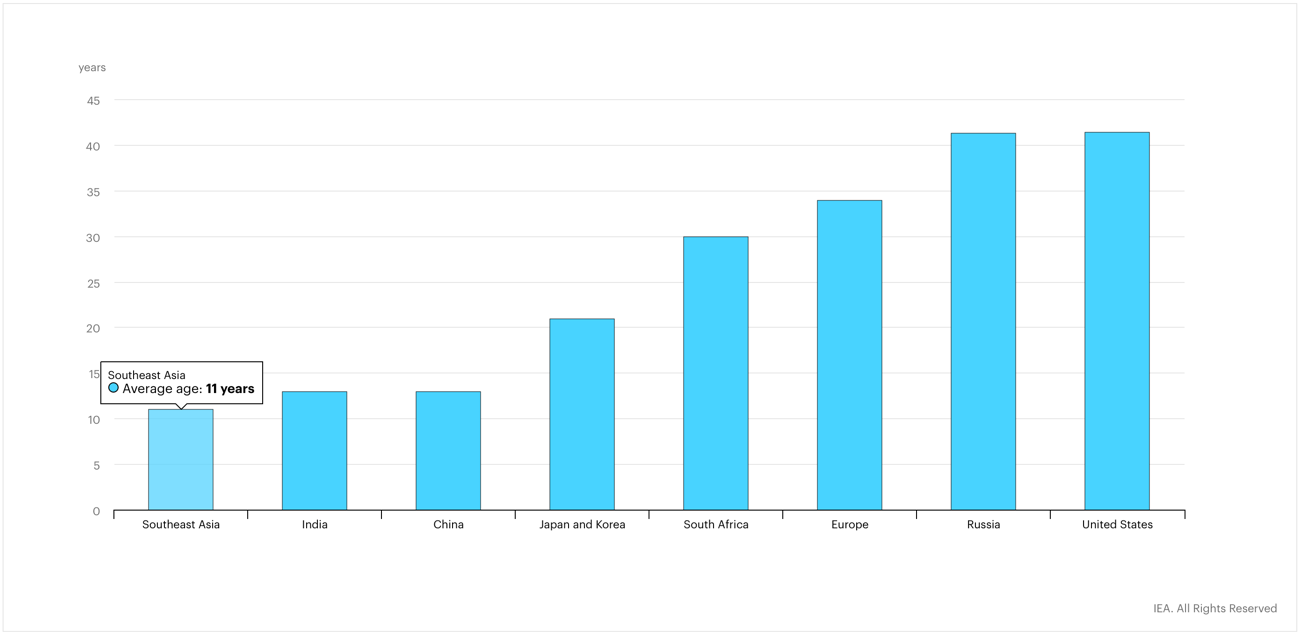
Source: IEA
The standard counter-argument to carbon capture is that it is unfeasible and that Asian countries should simply deploy more wind, solar and other renewables. Yet that assertion overlooks not only the hard fact of Asia’s very young coal plant but also the most recent outlook for renewables. The May 2022 IEA Renewable Energy Market Update forecasts that ASEAN installation of renewables will plunge from a peak of about 14 GW in 2020 to below 7 GW in 2022 and 2023. The report also points to elevated material costs and interest rates as potentially posing significant challenges in the years ahead.
Like it or not, Asia clearly needs a broad portfolio of decarbonization technologies.
Declining Renewable Deployment in ASEAN
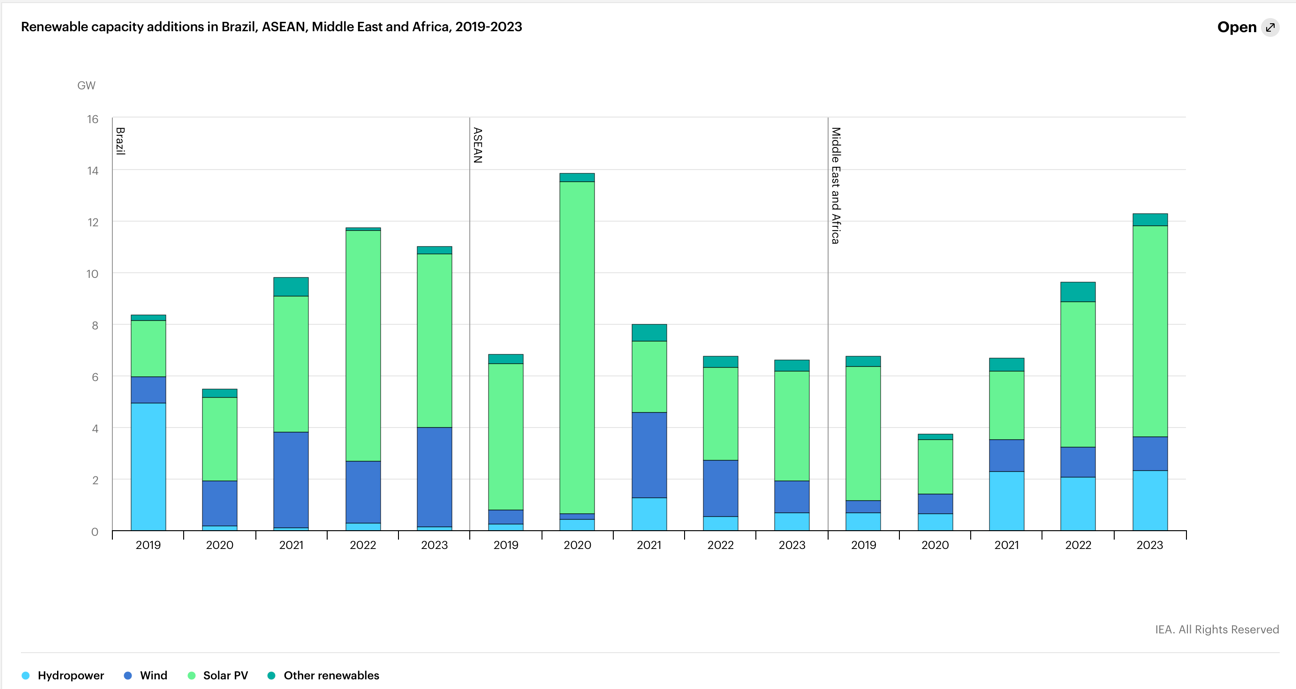
Source: IEA
Is more diversity always better?
There is a downside to the proliferation of taxonomies. As decarbonization prices rise due to commodity costs and interest rates, multiple taxonomies mean investors face extra costs due to onerous reporting requirements. Yet the ATFSG’s ASEAN+Japan initiative – together with other regional efforts – indicates that harmonization is being built from the bottom-up, reflecting necessarily diverse routes to decarbonization.
The scope for overall harmonization of these regional initiatives exists in the International Platform on Sustainable Finance (IPSF), under whose auspices the China and EU taxonomies are being harmonized. The IPSF was established in 2019 to achieve this overall goal of coordination. At present, it includes Japan, the EU, China, India, Indonesia, and other governments representing half the global population and 55% of both global GDP and global emissions.
Additional good news is that geopolitical inclusiveness and diversity are on the ascendant in policymaking within the IPSF. In 2022, Japan, the EU, and Switzerland began co-leading an IPSF working group on transition finance, with no announced end-date. Its agenda includes drafting recommendations for the G20 Sustainable Finance Working Group that meets in Jakarta next month under the Indonesian G20 presidency. In 2023, India will assume the G20 presidency. This “duplex of Asian G20 presidencies” is likely to drive Asian priorities into the work of harmonizing taxonomies and defining sustainability.
This diversity of institutions and technologies, if managed well, could increase the global buy-in for decarbonization through broader stakeholder consultation and R&D investment. The patent risk of watering-down decarbonization goals seems at least balanced by an expanding portfolio of financial tools and targets. Indeed, green bonds are already complemented by sustainable bonds, transition bonds, and other instruments to foster the multi-decadal, capital-intensive nature of decarbonization processes.
In short, the old policymaking adage of “never let the perfect be the enemy of the good” certainly applies to the work of making inclusive green taxonomies.
Conclusion
Defining green has gone from being dominated by Eurocentric ideals to a diverse global debate, which the ATFSG epitomizes. Asian influence over ESG rules and green taxonomies is likely to increase because of the region’s growing confidence and economic weight whereas the EU is hobbled by internal disagreements. A more Asian definition of green seems likely to increase support for multi-decadal energy transitions. This offers the exciting prospect of truly radical decarbonization innovations from the region.
GLOBAL VIEW
BY JOHN VAROLI
Below are some of last week’s most important international energy developments monitored by the Japan NRG team because of their potential to impact energy supply and demand, as well as prices. We see the following as relevant to Japanese and international energy investors.
California/ Offshore wind power
The California Energy Commission recommends building 3 GW of offshore wind by 2030, and more afterwards. By 2045, the state could produce up to 15 GW in offshore wind, surpassing New York’s target of 9 GW, the current largest long-term goal for any American state.
Coal/ Energy transition
The switch from coal to renewable energy doesn’t require natural gas as a “transition” fuel; high prices for gas and the declining cost of renewables, such as wind and solar power, make this possible, said a report by climate advocacy group TransitionZero. Also, in an interview with the Financial Times, U.S. climate envoy John Kerry warned not to return to coal after ending Russian energy supplies, saying the Ukraine war isn’t an excuse to renege on climate goals.
EU/ Energy transition
The EU will spend €195 billion to accelerate development of renewable power and energy conservation in order to end Russian fossil fuels dependency by 2027. For example, renewable energy projects will receive permits within a year, instead of the current two years.
EU/ Gas prices
Gas prices surged when Russia said it’ll cut shipments to Europe through a major pipeline. Gazprom said gas shipments are no longer possible through the Yamal pipeline after the Kremlin imposed sanctions on European gas companies, some former Gazprom units, as well as Europol Gaz, which owns the Polish part of the Yamal pipeline.
Fossil fuels/ Investments
BlackRock will probably ignore shareholder resolutions on climate change because short-term investment in fossil fuel production is needed to deal with the energy crisis. Proposals to stop financing fossil fuel companies, as well as to decommission assets or set targets compelling companies to reduce emissions in their supply chains, won’t be welcome.
France/ Solar power
Solar developer Lightsource bp is starting operations in France, aiming to set up a 1 GW pipeline of large-scale PV projects by 2026. President Macron’s government is committed to having at least 100 GW of solar by 2050.
Germany/ Wind power
Siemens Energy forecasts a €252 million net loss for Q2 due to problems at its wind turbine subsidiary, Siemens Gamesa. Last year, in the same period, the company had a €31 million profit. Siemens Energy said that 2022 financial results will be at the low end because of Siemens Gamesa, which has been hit by supply chain disruptions.
Global markets/ Energy pricing
Following a meeting with U.S. President Joe Biden to discuss global energy markets, PM Mario Draghi proposed creating a cartel of oil consumers. Draghi and Biden are unhappy with the structure of global energy markets and discussed ways of capping oil and gas prices.
Hong Kong/Offshore wind power
HK Electric announced plans to build a 600-hectare wind farm off Lamma Island that will consist of as many as 19 wind turbines. Annual electricity production is estimated to reach 150 MW.
Portugal/ Solar power
An array of 12,000 solar panels was installed atop the Alqueva dam reservoir that already has hydro-generating capacity of 256 MW. Built by the country’s main utility, EDP, when the solar facility is fully operational in July it’ll have a 5 MW capacity.
Russia/ Energy markets
Foreign Minister Sergei Lavrov said that Russia has enough buyers outside of Western countries for its energy resources. “Let the West pay more than it used to pay to the Russian Federation, and let it explain to its population why they should become poorer.”
2022 EVENTS CALENDAR
A selection of domestic and international events we believe will have an impact on Japanese energy
|
January |
OPEC quarterly meeting; JCCP Petroleum Conference – Tokyo; EU Taxonomy Climate Delegated Act activates; Regional Comprehensive Economic Partnership (RCEP) Trade Agreement that includes ASEAN countries, China and Japan activates; Indonesia to temporarily ban coal exports for one month; Regional bloc developments: Cambodia assumes presidency of ASEAN; Thailand assumes presidency of APEC; Germany assumes presidency of G7; France assumes presidency of EU; Indonesia assumes presidency of G20; and Senegal assumes presidency of African Union; Japan-U.S. two-plus-two meeting; Japan’s parliament convenes on Jan. 17 for 150 days; Prime Minister Kishida visits Australia (tentative) |
|
February |
Chinese New Year (Jan. 31 to Feb. 6); Beijing Winter Olympics; South Korea joins RCEP trade agreement |
|
March |
Renewable Energy Institute annual conference; Smart Energy Week – Tokyo; Japan Atomic Industrial Forum annual conference – Tokyo; World Hydrogen Summit – Netherlands; EU New strategy on international energy engagement published; End of 2021/22 Japanese Fiscal Year; South Korean presidential election |
|
April |
Japan Energy Summit – Tokyo; MARPOL Convention on Emissions reductions for containerships and LNG carriers activates; Japan Feed-in-Premium system commences as Energy Resilience Act takes effect; Launch of Prime Section of Japan Stock Exchange with TFCD climate reporting requirement; Convention on Biological Diversity Conference for post-2020 biodiversity framework – China; Elections: French presidential election; Hungarian general election |
|
May |
World Natural Gas Conference WCG2022 – South Korea; Elections: Australian general election; Philippines general and presidential elections |
|
June |
Happo-Noshiro offshore wind project auction closes; Annual IEA Global Conference on Energy Efficiency – Denmark; UNEP Environment Day, Environment Ministers Meeting – Sweden; G7 meeting – Germany |
|
July |
Japan to finalize economic security policies as part of natl. security strategy review; China connects to grid 2nd 200 MW SMR at Shidao Bay Nuclear Plant, Shandong; Czech Republic assumes presidency of EU; Elections: Japan’s Upper House Elections; Indian presidential election |
|
August |
Japan: Africa (TICAD 8) Summit – Tunisia; Kenyan general election |
|
September |
IPCC to release Assessment and Synthesis Report; Clean Energy Ministerial and the Mission Innovation Summit – Pittsburg, U.S.; Japan LNG Producer/Consumer Conference – Tokyo; IMF/World Bank annual meetings – Washington; Annual UN General Assembly meetings; METI to set safety standards for ammonia and hydrogen-fired power plants; End of 1H FY2022 Fiscal Year in Japan; Swedish general election |
|
October |
EU Review of CO2 emission standards for heavy-duty vehicles published; Chinese Communist Party 20th quinquennial National Party Congress; G20 Meeting – Bali, Indonesia; Innovation for Cool Earth TCFD & Annual Forums – Tokyo; Elections: Okinawa gubernational election; Brazilian presidential election; |
|
November |
COP27 – Egypt; U.S. mid-term elections; Soccer World Cup – Qatar; |
|
December |
Germany to eliminate nuclear power from energy mix; Happo-Noshiro offshore wind project auction result released; Japan submits revised 2030 CO2 reduction goal following Glasgow’s COP26; Japan-Canada Annual Energy Forum (tentative); Tesla expected to achieve 1.3 million EV deliveries for full year 2022 |
Disclaimer
This communication has been prepared for information purposes only, is confidential and may be legally privileged. This is a subscription-only service and is directed at those who have expressly asked K.K. Yuri Group or one of its representatives to be added to the mailing list. This document may not be onwardly circulated or reproduced without prior written consent from Yuri Group, which retains all copyright to the content of this report.
Yuri Group is not registered as an investment advisor in any jurisdiction. Our research and all the content express our opinions, which are generally based on available public information, field studies and own analysis. Content is limited to general comment upon general political, economic and market issues, asset classes and types of investments. The report and all of its content does not constitute a recommendation or solicitation to buy, sell, subscribe for or underwrite any product or physical commodity, or a financial instrument.
The information contained in this report is obtained from sources believed to be reliable and in good faith. No representation or warranty is made that it is accurate or complete. Opinions and views expressed are subject to change without notice, as are prices and availability, which are indicative only. There is no obligation to notify recipients of any changes to this data or to do so in the future. No responsibility is accepted for the use of or reliance on the information provided. In no circumstances will Yuri Group be liable for any indirect or direct loss, or consequential loss or damages arising from the use of, any inability to use, or any inaccuracy in the information.
K.K. Yuri Group: Oonoya Building 8F, Yotsuya 1-18, Shinjuku-ku, Tokyo, Japan, 160-0004.