
JAPAN NRG WEEKLY
MAY 30, 2022
JAPAN NRG WEEKLY
May 30, 2022
NEWS
TOP
- Japan proposes new offshore wind auction rules seeking to open the sector to greater competition and speed up capacity rollout
- Renewables capacity certified by FIT approaches 100 GW; solar continues to account for three-quarters of all green projects
- Russian parliament leader says Japan should exit Sakhalin projects as Moscow signals Tokyo’s “unfriendly” stance may affect supply
ENERGY TRANSITION & POLICY
- U.S. and Japan release statement on new climate change initiative
- PM Kishida to launch panel for ¥150 trn net-zero investment plan; government looks to issue economic transition bonds in summer
- Families told to watch one TV set as Japan turns to power saving
- China unseats Japan as ‘important partner’ in Southeast Asia: poll
- Major companies eye opportunities in Japan battery storage
- Top steelmakers hike prices and warn more increases to come
- Mitsubishi joins up with Hokkaido Electric on hydropower finance
- Itochu to make and sell blue ammonia and methanol in Canada
ELECTRICITY MARKETS
- METI panel studies ways to bolster Japan’s power futures trading
- Kansai Electric postpones reactor restart, tightening power supply
- Itochu to build 700 solar generation facilities for telco giant NTT
- Court rejects claim municipality cannot block new solar projects
- TEPCO sells out of Japan’s biggest wind power developer
- Invenergy submits plans for a third wind project in a month
- Osaka Gas seeks to develop small and medium-sized solar plants
- Pro-nuclear governor wins in Niigata, but TEPCO plant in trouble
OIL, GAS & MINING
- Mitsui, Mitsubishi review adding carbon capture to U.S. LNG plant
- PM Kishida criticizes China for gas exploration in East China Sea
- Japan’s LNG stocks drop but remain above average
- Hokkaido Gas starts retailing “carbon neutral” LNG to local firms
ANALYSIS
WITH G7 COMING UP, JAPAN’S ENERGY POLICY PRAGMATISM STARTING TO WIN OVER ALLIES
Over the past month or so, Prime Minister Kishida has hosted German Chancellor Olaf Scholtz, European Commission President Ursula von der Leyen and U.S. President Joe Biden. Each meeting’s headline has been the war in Ukraine, yet energy also formed a major part of the conversations. Indeed, the two issues are now finely intertwined. As G7 nations prepare for a meeting in the Bavarian Alps in late June, criticism of Japan for failing to announce a clear exit from coal has again picked up. And yet, after explaining Japan’s energy strategy in face-to-face meetings with peers, Kishida can feel confident ahead of his trip to Germany.
THE CHANGING ROLE OF JAPAN’S ELECTRICITY MARKETS AND EVOLUTION OF INTRADAY TRADES
Since April, the pricing scheme for renewables has changed (from FIT to FIP), encouraging operators to be more proactive in terms of introducing energy storage and facility optimization tools. The tariff shift could also have an impact on the power spot market. As Japan increases its reliance on variable renewable sources such as solar and wind, there is a growing need to manage power supply based on shorter time increments. This means the purchase instruments for electricity need to adjust also, allowing power to be acquired in smaller, more precise time slots.
GLOBAL VIEW
More than 50 global firms join First Movers Coalition to decarbonize heavy industry. U.S. market regulator cracks down on use of terms like “ESG”. India due to open a huge coal mine. Russia struggles to find buyers for some crude. High oil prices are bolstering Saudi Arabia’s sovereign wealth fund. Details on these and more in our global wrap.
JAPAN NRG WEEKLY
PUBLISHER
K. K. Yuri Group
Editorial Team
Yuriy Humber (Editor-in-Chief)
John Varoli (Senior Editor, Americas)
Mayumi Watanabe (Japan)
Wilfried Goossens (Japan, Events)
Events

Regular Contributors
Chisaki Watanabe (Japan)
Takehiro Masutomo (Japan)
Daniel Shulman (Japan)
Art & Design
22 Graphics Inc.
SUBSCRIPTIONS & ADVERTISING
Japan NRG offers individual, corporate and academic subscription plans. Basic details are our website or write to subscriptions@japan-nrg.com
For marketing, advertising, or collaboration opportunities, contact sales@japan-nrg.com
For all other inquiries, write to info@japan-nrg.com
OFTEN USED ACRONYMS
METI The Ministry of Energy, Trade and Industry
MOE Ministry of Environment
ANRE Agency for Natural Resources and Energy
NEDO New Energy and Industrial Technology Development Organization
TEPCO Tokyo Electric Power Company
KEPCO Kansai Electric Power Company
EPCO Electric Power Company
JCC Japan Crude Cocktail
JKM Japan Korea Market, the Platt’s LNG benchmark
CCUS Carbon Capture, Utilization and Storage
mmbtu Million British Thermal Units
mb/d Million barrels per day
mtoe Million Tons of Oil Equivalent
kWh Kilowatt hours (electricity generation volume)
NEWS: ENERGY TRANSITION & POLICY

U.S. and Japan release joint statement on climate change
(Government Statement, May 23)
- The U.S. and Japan pledged to provide up to $100 billion of climate finance to developing countries.
- The countries also pledged to divest from coal-fired power generation, decarbonize road transportation, and encourage more transparency for disclosure of climate-related information to investors.
- They’ll also cooperate more closely on renewable energy and energy storage technologies, carbon capture, and small modular nuclear reactors.
- The countries also committed to diversifying supply chains of critical minerals to support energy security and the transition to “clean energy”.
- SIDE DEVELOPMENT:
Coal holdout Japan faces pressure as G-7 rallies around energy goal
(Nikkei Asia, May 21)- As host and president of the upcoming G7 meeting, Germany is reaching out to all members for a coal exit target of 2030. Except for Japan, all expressed support. However, the U.S. asked for the deadline to be set in the mid 2030s.
- Japan does not want to set any firm commitments on coal.
- The U.S. sees a united G7 position on coal as helping to pressure China.
TAKEAWAY: Japan’s stance on coal-fired generation has morphed several times in the last three years, but it’s very much on the pathway to lower fossil fuel use. The issue for Japan isn’t so much coal but what comes next. There are several options in the works, but until they’re confirmed as viable alternatives, Japan is unlikely to make bold declarations. For more details, see this week’s Analysis section.
METI proposes offshore wind auction rule changes
(Japan NRG, May 23)
- METI has proposed revised judgment criteria for offshore wind auctions in response to calls for more clarity following the last auction in December that awarded three projects to more or less the same consortium (led by Mitsubishi Corp).
- There will now be two core assessment areas: the ability to complete the project, worth 80 points; and community relationships and impact, 40 points. Speedy plant launches were added to the ability criteria, weighing in with 20 points.
- Other ability categories are project foundation, management, and stable power supply, also 20 points each. This moves the weight from price competition (i.e., how much the project can help reduce power prices overall) to energy security. Community relations consists of building ties with municipalities, fishing communities and other local stakeholders; economic impact on the region and nationwide, is another aspect; each of these get a weighting of 10 points.
- METI elaborated on six possible approaches to determine project speed. It proposes to take into account how bidders scored in other categories in order to make a judgment on speed of delivery so as to avoid unrealistic plans receiving high ratings. The ministry endorses Plan 2α (see table).
- Other rule changes include a new 1 GW supply limit set on consortiums, and plans to disclose all bidder names and project overview data in the publication of auction results.
- The most recently launched offshore wind auction, for the 356 MW Happo Noshiro area in Akita prefecture, is now expected to close some time this year. This is later than the initial June 10 deadline announced in December 2021.
METI’s suggested ways to score well in speed of project delivery category, based on various scenarios
|
Base date for project |
1 Earliest date among the proposals (full 20 points awarded if launch is less than a year after the base date) |
2 Eight years after the auction date (20 points awarded if launch is three years earlier than the base date) |
3 March 2031 (20 points awarded to the bidder with the earliest launch date) |
|
α Bidders who scored low on other categories will automatically get 0 for speed |
* Gives incentive to early launches; * May overheat competition; * Filters questionable bidders |
* Has high visibility; * Filters out questionable bidders; * Aligns with the 2030 policy goal |
* Gives incentive to early launches; * Filters out questionable bidders; * Aligns with the 2030 policy goal |
|
Β Scores in other categories will weigh on speed assessment
|
* Gives incentive to early launches; * May overheat competition; * Filters out questionable bidders; * Speediest project may not necessarily earn full 20 points as the speed rating will depend on the scores in other categories |
* Has high visibility; * Filters out questionable bidders; * Speediest project may not necessarily earn full 20 points as the speed rating will depend on other categories’ scores |
* Gives incentive to early launches; * Filters out questionable bidders; * Speediest project may not necessarily earn full 20 points as the speed rating will depend on scores of other categories |
- CONTEXT: METI’s proposal is made in tandem with the Ministry of Land, Infrastructure, Transport and Tourism, which is the other major government stakeholder in the offshore wind industry.
TAKEAWAY: The thrust of the changes seems to be to make sure Mitsubishi Corp or any other company does not dominate in upcoming tenders. This guarantees that there will be a more diverse set of players in Japan’s offshore wind going forward. With the added incentives for fast movers, the government hopes that the industry will also accelerate their plans.
However, this is not to say that the industry is completely satisfied with the new rules, which are far from straightforward. Third-party advisors of auction rules are openly critical of the new “speed of delivery” category as offshore projects are long term projects with 30-year rights to occupy the sea area, and require six to eight years of preliminary surveys.
Equally, limiting each company’s potential capacity haul also limits the discounts they can potentially secure from bulk orders to both equipment makers and construction companies.
Rising costs and inflation suggest that new offshore wind auctions bids will be higher than the winning numbers from Mitsubishi. How much additional competition the new rules will induce is yet to be seen.
PM Kishida to launch panel to drive ¥150 trillion net zero, hints at new bonds
(Japan NRG, May 19)
- The government will establish a new panel to flesh out details for a way to spur ¥150 trillion in investments in the energy transition. As part of this, PM Kishida’s plan is to launch the government issue of ¥20 trillion in “GX economic transition” bonds this summer.
- The panel will draw roadmaps to issue the bonds, new schemes to expand hydrogen, ammonia and other non-fossil energies, push energy conservation, draw financial mechanisms for carbon exchange launch next April, and promote net zero economy in Asia.
- The ¥20 trillion bond is a financial package of unprecedented scope designed to fuel private sector investment in the next few years, which will have more continuity compared to annual government budgets.
- CONTEXT: As this is an “economic transition” bond and not the more established green bond, it would allow for the funds to go towards a range of sources that the Japanese government considers vital to the energy transition. That could include nuclear and even natural gas projects.
Japan joins First Movers Coalition
(METI statement, May 24)
- Japan joins the First Movers Coalition as a strategic partner, providing technologies to produce zero-carbon concrete, low carbon shipping fuel and other technologies to drive net zero economy.
Families Told to Huddle Around One TV in Japan Bid to Save Power
(Bloomberg, May 27)
- Japan’s government is ratcheting up calls for citizens to do anything they can to conserve electricity as the country faces a power supply crunch this summer.
- “Families should gather around a single television, and not use air conditioners in other rooms,” METI Minister Hagiuda said. “Families should do what they can to save electricity.”
- CONTEXT: Northern and eastern parts of Japan have a 50% chance of seeing hotter-than-normal temperatures from June to August, according to the Japan Meteorological Agency.
China unseats Japan as ‘important partner’ to top Southeast Asia poll
(Nikkei Asia, May 26)
- Belt and Road Initiative seen expanding Beijing’s influence in Southeast Asia.
- When asked which among the Group of 20 leading economies will be an “an important partner in the future,” 48% chose China, while 43% picked Japan. The two countries swapped places in the ranking from a 2019 poll that was also conducted by Ipsos, but commissioned by Japan’s foreign ministry.
Major companies eye opportunities in battery storage plans
(Nikkei Asia, May 25)
- Large-scale energy storage systems that link directly to Japan’s power grid are set to come online starting in 2023.
- By 2026, Sumitomo aims to build 100,000 kW of capacity across Japan; the first will come online in 2023 in Hokkaido City. Top oil refiner Eneos hopes to build a large battery system in Hokkaido City, to be operational in early 2024. Also, Orix will partner with Kansai Electric Power to debut a system in 2023.
- Battery storage is critical for effective operation of renewable energy sources while ensuring a stable power grid.
- However, Japan’s power grids have little excess capacity to handle electricity from storage batteries, and it will take as much as ¥4.8 trillion to double the country’s capacity, according to a government estimate.
Japan’s top steelmakers warn more price increases to come
(Bloomberg, May 27)
- Japan’s biggest steelmakers warned they’ll push for more price hikes due to rising raw material prices and energy costs. Nippon Steel promised to pass on the higher costs to clients soon so as to avoid losing profit. Domestic peer JFE Holdings has taken a similar stance.
- CONTEXT: The steelmakers have already boosted prices to record levels over the past year as prices for iron ore and coal surge.
- Nippon Steel will separately begin talks with customers to seek better terms for its value-added products such as lower-carbon steel.
TAKEAWAY: This will mean higher prices for new power infrastructure and generation facilities, with an outsized impact expected in wind turbine prices.
Governor attempts to allay concerns about solar scheme
(Tokyo Shimbun, May 27)
- Governor Koike Yuriko has rebutted claims of those opposed to plans to make solar panels mandatory on houses built in Tokyo.
- Many people on online forums are opposed, claiming the Tokyo government will be unable to properly dispose of the enormous numbers of solar panels once they’ve ended their useful lives.
- Koike says steps are being taken to ensure all old panels will be reused or recycled, and plans to discuss this with waste processing service providers.
Mitsubishi joins forces with Hokkaido Electric on hydropower financing
(AMP, May 24)
- Since November Hokkaido Electric (HEPCO) and Mitsubishi Corp have been collaborating on hydroelectric power in southern Hokkaido.
- In March, both signed an agreement with Sumitomo Mitsui Banking Corp and Hokuyo Bank to secure financing.
- The complexity and red tape over hydroelectric developments makes it difficult for lenders to ascertain project viability, with the result that project financing is seldom granted.
- HEPCO and Mitsubishi were able to secure financing for hydro projects planned for southern Hokkaido by pooling their expertise in construction, maintenance, and plant operation.
Itochu to Make and Sell Blue Ammonia and Blue Methanol in Canada
(Company Statement, May 24)
- Itochu Corp plans to manufacture and sell blue ammonia and blue methanol in Alberta, Canada, in partnership with the local unit of Malaysia’s national oil company Petronas, and Inter Pipelinem, a local infrastructure player.
- The three parties have completed a feasibility study and will move to the basic design within this fiscal year.
- This project aims to establish one of the world’s largest production and supply systems of blue ammonia and blue methanol. Sharing facilities to make the two will result in significant cost savings.
- Construction of ammonia and methanol facilities will begin in 2024, with commercial production slated to start in 2027.
- SIDE DEVELOPMENT:
Itochu to supply Etihad Airways with sustainable aviation fuel (SAF) in Japan
(Company Statement, May 27)- This is Itochu’s first deal to supply a non-Japanese airline with SAF in Japan. The fuel is produced by Finland’s Neste OYJ.
IHI leads group wins state funds for synthesis of ammonia from water and nitrogen
(New Energy Business News, May 26)
- IHI Corporation, Hokkaido University, Fukuoka University, the University of Tokyo, and metal electrode manufacturer De Nora Permelec won funding from state research hub NEDO to create technology that will directly synthesize ammonia from water and nitrogen.
- The project will run for two years through FY2023, with the aim of paving the way for nationwide application of the technology.
- CONTEXT: This is an attempt to make ammonia without using the traditional water electrolysis approach.
Toho Gas to build hydrogen production plant in Japan
(Kankyo Business, May 25)
- Toho Gas’s new hydrogen production line with a capacity of 1.7 tons per day by 2024 is planned for the Chita City, Aichi Prefecture site; it will use natural gas as feedstock.
NEWS: POWER MARKETS

FIT-certified renewable projects total approaches 100 GW of capacity
(Government Data Portal, May 13)
- As of the end of 2021, the number of projects certified for the Feed-In Tariff (FIT) in Japan almost reached 100 GW, according to METI’s Agency for Natural Resources and Energy.
- The total capacity includes:
- 8.67 GW of residential solar
- 67.68 GW of non-residential solar (10kW capacity or higher)
- 13.35 GW of wind
- 1.66 GW of small and mid-sized hydro
- 162 MW of geothermal
- 8.04 GW of biomass
- CONTEXT: The above refers to capacity that is both in operation and somewhere in the process of being built.
TAKEAWAY: Not all renewable energy capacity in Japan operates based on the FIT system, so this does not represent the total for the sector. The International Renewable Energy Agency data shows Japan already has just over 133 GW of green capacity installed, the six-largest in the world. That’s just 10 GW behind the next-ranked Germany, and within 30 GW of India and Brazil. China and the U.S. are the outright leaders in terms of installed renewables capacity, IRENA data show.
Ideas to boost power forward and futures trading
(Japan NRG, May 23)
- Power futures volume on the Tokyo Commodity Exchange surged in April, but futures as well as forward trades need to become more robust, said a METI study group on exchange platforms. Some ideas included requiring power operators to take positions in futures to effectively utilize them as a hedging mechanism, and include a clause on futures contracts in the power retailers’ guidelines.
Power retailers source 63.3 TWh of non-fossil power certificates in 2021
(Japan NRG, May 25)
- 56 power retailers nationwide sourced 63.3 TWh of non-fossil power certificates in April 2021 to March 2022. Out of the total, 30 TWh were from over-the-counter trades; 12.5 TWh from the market; and the rest came from third party sources.
Kansai Electric’s No.3 Takahama nuke restart postponed, tightening west Japan supply
(Japan NRG, May 25)
- Organization for Cross-Regional Coordination of Transmission Operators said Kansai Electric has postponed the restart of the Takahama No. 3 nuclear power, tightening power supply in west Japan. The 870 MW plant was supposed to restart on May 19 after closing on March 1. As a result, January power reserve rates in west Japan will fall to 1.3% from the previous forecast of 2.2%. The reserve rate will improve to 2.8% in February as Kyushu Electric’s 1.18 GW Genkai No. 3 nuclear reactor will restart on January 21.
Itochu to build 700 solar farms for NTT
(Nikkei, May 26)
- Itochu subsidiary Clean Energy Connect will build around 700 small-scale solar farms by 2023/24, with an investment of over ¥10 billion to supply carbon neutral electricity to major telecommunications provider NTT.
- The farms will have a total capacity of 700 MW and be situated on unused agricultural land and other suitable sites.
- Clean Energy Connect says that by making each farm small (around 100 kW) and using existing agricultural sites, they’ll be able to reduce the need to perform leveling and site preparation work.
- Most likely NTT will sign a 20 or 30-year purchasing agreement to acquire electricity generated by the farms at a pre-agreed rate.
Court throws out solar farm challenge
(Toyo Keizai, May 26)
- On May 25, Saitama District Court dismissed a claim by a solar developer that a Hidaka city bylaw prohibiting the building of solar farms on designated conservation reserves was unconstitutional.
- Solar developer TKM Development disputed the legality of a bylaw that requires obtaining permission from the mayor before constructing solar farms in designated reserves.
- Hidaka is one of a growing number of municipalities passing bylaws to limit solar farm construction amid concerns about landslides and visual pollution.
Toyota Tsusho buys full control of Japan’s largest wind developer from TEPCO
(Nikkei, May 26)
- Toyota Tsusho agreed to purchase TEPCO Holdings’ 40% stake in Eurus Energy Holdings, Japan’s largest wind energy developer, for ¥185 billion.
- The deal will make Eurus a wholly-owned subsidiary of Toyota Tsusho.
- As of June 2021, Eurus operated 770 MW of wind generation capacity, which is more than close rivals J-Power and Cosmo Energy combined.
TAKEAWAY: Rumors that TEPCO would sell out of the JV came out around November 2021, so it is no surprise that this was completed. It is likely that TEPCO lacks the funds to develop large new offshore wind projects outside of its own renewable unit. Meanwhile, Toyota Group has an interest in securing more green electricity for its auto and other factories.
Invenergy submits plan for large wind project in Iwate area
(New Energy Business News, May 23)
- Invenergy plans to develop onshore wind power generation in the vicinity of Kuji City, Iwate Prefecture. The maximum output will be 439.2 MW, according to the project’s environmental assessment report.
- The project area is 1,453.2 hectares around the administrative boundaries of Kuji City, Kudo Village, Kuzumaki Town, and Karume Town. The plan is to install 72 units of 6.1 MW turbines.
- The start of construction has not yet been determined, but commercial operation is planned to begin 49 months after the start of construction.
TAKEAWAY: This is the third large wind project that Invenergy has submitted for ministerial review in the last month. Altogether, those three projects alone would deliver over 1 GW of capacity.
Osaka Gas to develop smaller solar plants with Fuso Holdings unit
(Kankyo Business, May 26)
- Osaka Gas and a wholly owned subsidiary of Fuso Holdings signed an agreement to jointly develop and own small to medium-sized solar power plants. The two will create non-FIT solar projects on a scale of several tens of thousands of kW per year.
NYK partners with power transfer start-up
(Nikkei, May 24)
- NYK will invest an undisclosed sum in Tokyo-based start-up Power X.
- Power X is developing an autonomous ship to transfer energy generated by offshore wind turbines to the shore using batteries, thereby eliminating the need for undersea cables.
Hitachi launches system that promises to optimize power grid
(Company Statement; May 23)
- Hitachi launched ‘Lumada Inspection Insights’, which is an AI-based system that analyzes satellite images to identify faults in transmission grids and their causes.
- By enabling grid operators to monitor transmission infrastructure remotely, the system contributes to employee safety.
Latest security breach “not good at all” — Kashiwazaki plant chief
(Mainichi Shimbun, May 26)
- Kashiwazaki-Kariwa nuclear power plant manager Inagaki Takeyuki said new revelations that workers entered the premises with expired security passes had serious implications for the security of nuclear materials.
- The revelations are the latest in a series of scandals rocking the plant.
TAKEAWAY: The only active nuclear power plant owned by TEPCO continues to face an uncertain future. On the one hand, it could be a major source of power for the Tokyo region, which is facing capacity shortages in peak summer and winter seasons. But on the other hand, TEPCO cannot seem to stop the chain of mishaps at the site. The local pro-nuclear incumbent governor has just won re-election in Niigata Prefecture against an anti-nuclear candidate. However, local polls continue to be ambivalent on the public mood for a restart. Retaining state-controlled TEPCO at the helm of the nuclear plant may yet be the biggest challenge to the restart.
NEWS: OIL, GAS & MINING

Russian parliament leader says Japan should exit Sakhalin projects
(Russian Parliament Website, May 25)
- Vyacheslav Volodin, chair of the Russian parliament, called Japan an “unfriendly nation” and said it should exit its oil and gas investments in the country by selling them to state-owned Gazprom or companies from “friendly” nations.
- Volodin made the remarks after a report from the Audit Chamber chair Alexei Kudrin. Volodin said it’s questionable for Japanese firms to continue to profit from Russian resources.
- He named the Sakhalin-2 LNG project in particular, and called for a probe of foreign-owned assets from a patriotic standpoint. Kudrin said the Audit Chamber would review the issue.
TAKEAWAY: It is quite possible that the nationalistic remarks by Volodin are for the benefit of a domestic audience and the traditionally liberal-leaning Kudrin in particular. But it will set off alarm bells in Tokyo all the same. For more details, see this week’s Analysis section.
- SIDE DEVELOPMENT:
Japan should exit Sakhalin energy projects: Ukraine 1st deputy PM
(Nikkei Asia, May 25)- Ukraine’s first deputy prime minister Yulia Svyrydenko urged Japan to withdraw from the Sakhalin oil and gas projects, saying that “values” should take precedence over profit.
Mitsui and Mitsubishi consider adding CCS at the Cameron LNG plant in U.S.
(Company Statement, May 24)
- Mitsui and Mitsubishi Corporation joined a feasibility study to install a CO2 capture and storage (CCS) unit adjacent to the Cameron LNG plant in Louisiana. The aim is to decarbonize the facility’s LNG production.
- Sempra Infrastructure, the operator of Cameron, is leading the study.
- The project would involve capturing, transporting and storing up to 2 million tons of CO2 and other gases primarily from Cameron LNG each year. The total cost and timing have not yet been determined.
PM criticizes Chinese drilling in East China Sea
(Asahi Shimbun, May 21)
- PM Kishida Fumio expressed regret over reports that China has unilaterally embarked on renewed gas development in the East China Sea.
- The PM called for China to recommence negotiations in respect to its 2008 agreement with Japan regarding resource development in the area.
Japan’s LNG stocks fall to 1.99 million tons
(METI Statement, May 25)
- LNG stocks fell to 1.99 million tons on May 22, down from 2.04 million tons a week earlier. End-May stocks last year were 1.94 million tons and in the last four years, that figure averaged 1.98 million tons.
Russian crude oil comprises 3.5% of April imports, LNG 7%
(Customs Statement, May 27)
- Japan imported 0.49 million kiloliters of crude oil from Russia in April, accounting for 3.5% of the total imports of 14 million kl. Russian LNG imports were 0.4 million tons, or 7% of the 5.6-million-ton total.
Hokkaido Gas starts selling “carbon neutral” LNG to local businesses
(New Energy Business News, May 26)
- Hokkaido Gas started selling “carbon neutral” gas to commercial customers locally, citing offsets for the resultant CO2 claimed through forest conservation and other means.
ANALYSIS
BY YURIY HUMBER and
JOHN VAROLI
As G7 Readies to Meet, Japan’s Pragmatism in Energy Policy
Helps to Win Over Allies
Over the past month or so, Prime Minister Kishida has hosted German Chancellor Olaf Scholtz, European Commission President Ursula von der Leyen and U.S. President Joe Biden. Each meeting’s headline has been the war in Ukraine, yet energy also formed a major part of the conversations. Indeed, the two issues are now finely intertwined.
As G7 nations prepare for a meeting in the Bavarian Alps in late June, criticism of Japan for failing to announce a clear exit from coal has again picked up. And yet, after explaining Japan’s energy strategy in face-to-face meetings with his peers, Kishida can feel confident ahead of his trip to Germany.
Rather than playing defense, Kishida will likely seek to inject more pragmatism in the energy discussion, stressing the need for decarbonization pathways that win broader global support, especially in developing economies. With inflation at a 40-year high, rising food prices, and public mood in the U.S. turning more sanguine on the economy, the Japanese PM may find more sympathetic ears than ever.
Last week’s G7 energy and environment ministers gathering in Berlin, interpreted by some climate campaigners as a watershed moment for Japan, could be viewed through the same lens of pragmatism. The resultant communiqué is more aligned with Japanese policy than many imagine.
Growing confidence
A former foreign minister, Kishida has packed in a lot of international meetings of late. In addition to the above, he’s hosted national leaders from India, Australia, Singapore, Malaysia and Thailand just last week.
The thread of “clean energy” runs through all of those meetings, as does the mention of “balancing”, energy security, and flexibility in climate change that respects the geography and revenues of different countries.
While Kishida’s predecessor, Suga, leaned heavily towards a renewables-first policy, seeking to align Japanese policies to EU green initiatives, Japan’s current leader is determined to pick a more nuanced path. Kishida’s government emphasizes a balance between various energy sources; a balance between decarbonization and cost; and, a balance between adding new systems and upgrading existing ones.
It’s notable that Suga’s Environment Minister, Koizumi, spoke of being ashamed that Japan still consumes coal. Kishida’s Environment Minister, Yamaguchi, is less afraid to show his mettle; he recently responded to Germany’s call for the G7 to set a 2030 phase-out deadline for coal by noting that Germany itself is now burning more of it.
For all the barbs, Kishida’s meeting with Germany’s chancellor went off smoothly. In fact, Chancellor Olaf made a point of visiting Japan, not China, on his first Asia trip to counter a bias towards the latter from his predecessor Angela Merkel.
In terms of energy, Chancellor Olaf agreed with Kishida for the two nations to collaborate in green hydrogen.
The EU-Japan summit in Tokyo was equally positive. EC president von der Leyen announced plans to work with Japan on secure supply chains and infrastructure, which includes energy. She also took a moment to thank Kishida for helping to divert Japanese LNG cargoes to the European markets during the recent winter peak.
Meanwhile, President Biden’s visit concluded with a 19-point Japan-U.S. Climate Partnership that listed cooperation on a kitchen-sink of sectors which the two countries have steadily considered for a while. One new item, the Japan-U.S. Clean Energy and Energy Security Initiative (CEESI), offered few clues on concrete projects other than to confirm that:
- Japan and the U.S. see a future for nuclear energy
- Critical raw materials and their supply chains need to be considered more deeply
- Carbon capture, carbon pricing, and other means to abate or offset emitters are vital
- Renewables will be a major part of future energy systems
The collaborative mood was in contrast to the more prescriptive tone of U.S. Climate Envoy Kerry, who visited Japan in late August 2021.
Likewise, last week’s meeting of G7 energy and environment ministers, seen by some as the moment Japan agreed to a deadline to exit coal and a goodbye to new gas exploration, was more evolution than revolution. Japan’s strategy already envisions efforts to adapt coal and gas power plants to burn hydrogen or ammonia over the next 10-15 years. There’s also a strong push to introduce carbon capture and carbon offsets to transform “unabated” fossil fuel assets into “climate-neutral” facilities.
Elephant in the room
One topic that did not appear in public during Biden’s visit was Japan’s decision to remain invested in its Russian oil and gas projects. Japan has four major upstream investments in Russia. For example, over decades Japan has provided billions of dollars in financing and technological know-how to bring the Sakhalin 1 and 2 oil and gas projects online.
This has come at extraordinary cost, especially when you consider that oil wells at Sakhalin I, for example, are some of the longest in the world, spanning 15 kilometers. Giving up those rights would potentially pass on the technology and ready-made production deposits to rivals, most likely China, for a pittance.
Even if Japan cannot benefit from the oil and gas produced in Sakhalin, it will likely want to hold onto the rights to prevent them from becoming an advantage for rivals, again, with China foremost in mind.
METI and Kishida early on in the war in Ukraine spoke about the need to remain invested in Russian upstream in order to protect energy security. After the pullout from Russia by ExxonMobil and Shell, many looked to Japanese firms to reciprocate. This has not come to pass and looks unlikely without a dire set of circumstances.
From the Japanese viewpoint, financial and technical investments in Russian energy assets have not yet been recouped, while the supplies of gas in particular are in a delicate balance. If disrupted, Japan will be forced to compete with its allies in Europe for the same spot and long-term market volumes, pushing up gas prices, inflation and causing hardship especially in developing Asia.
Further, Japan’s expenses on energy would severely impact domestic power and gas utilities, some of which are already struggling. Expecting the same utilities to make vast investments in clean energy at the same time would be out of the question.
While none of Kishida’s prominent foreign visitors have asked Japan to embargo Russian gas or announce other sanctions against Moscow, Japan may face these disruptions all the same if nationalist voices within Russia gain clout.
Last week, Speaker of the Russian parliament, Vyacheslav Volodyn, claimed that Japan was earning profits from Russian energy projects while acting as an “unfriendly” nation. Volodyn suggested that Japan leave Russian assets or sell them to state-backed Gazprom.
The inflammatory remarks will have many in Japan’s government circles on edge. Tokyo will wonder if the episode is simply emotions or a carefully staged warning shot seeking to tame Japanese enthusiasm for carrying out its promises to phase out all Russian oil and coal.
If Moscow seriously wanted to hamper the Japanese economy, it could block exports of certain metals. Japan relies on Russia for about 35% of its palladium and 20% of its aluminum. Both are key metals for the auto sector.
Equally, kicking out the Japanese unilaterally would be a strategic failure for Russia. After all, which foreign investor would pay fair value for assets that can be seized by the state at any time international relations sour?
Conclusion
Today, the sanctions around Russian exports are often stated as the main reason to believe in an acceleration towards clean energy sources, especially the rollout of more renewable power. In the longer-term, that’s likely the outcome.
Yet in the immediate future, the cost of building clean energy will increase because existing systems are so entrenched in fossil fuels, as Tokyo’s investments in Russian hydrocarbons illustrate.
To mitigate a steep price shock for the energy transition, Kishida will feel emboldened to promote a gradual decarbonization of energy systems. For a country that relies on coal for over one third of its electricity, that can’t mean an exit from coal this decade.
As G7 leaders gather next month to spar over the deadlines for decarbonization targets, Japan will likely call for more concrete business and technical progress in green energy to be visible and proven before turning its back on fossil fuels and making a deeper commitment to a green energy transition.
ANALYSIS
BY DAN SHULMAN
PRINCIPAL
SHULMAN ADVISORY
The Evolution of Japan’s Intraday Electricity Market
Since April of this year, the pricing scheme for renewables has changed (from FIT to FIP), encouraging operators to be more proactive in terms of introducing energy storage and facility optimization tools. The tariff shift could also have an impact on the electricity spot market.
As Japan increases its reliance on variable renewable sources such as solar and wind, there is a growing need to manage power supply based on shorter time increments. This means, the purchase instruments for electricity need to adjust also, allowing power to be acquired in smaller, more precise time slots.
A platform for such trading already exists for more than a decade. The intraday market was created in 2009, four years after the setting up of day-ahead (spot) and futures electricity trading on the Japan Electric Power Exchange (JEPX). This intraday market was introduced to give both generators and retailers a last-minute opportunity to balance their demand and supply, and thus avoid penalties for failing to do so.
This is still mainly how it is viewed by market participants, and it is very much a smaller cousin to the main day-ahead wholesale electricity market.
However, new entrants to the Japan electricity sector see possible arbitrage opportunities between the two platforms, and also with the soon-to-be introduced additional balancing markets.
Japanese Power Markets and Players
Several exchanges offer trading instruments linked to the Japanese power market. EEX, TOCOM, and since the end of 2021, CME, all offer derivatives that have the JEPX day-ahead market as the underlying asset. Over 80% of traded volume takes place on EEX, although volumes on TOCOM have been increasing since the winter 2020 power crisis.
There have been different approaches to trading in the financial and physical markets, although liquidity is slowly rising in both. JEPX physical trading requires a generation or retail license, which has been a barrier to entry for several traders, leading them to focus on EEX products. On the other hand, most Japanese generators and retailers have paid little attention to futures trading and many still lack a sophisticated approach to managing market exposure risk.
This is changing, however, with METI advocating a better approach to risk management and encouraging Japanese players to use the derivative markets that are available. Volumes on TOCOM, EEX and JEPX have increased in 2021 compared to 2020 – with close to twice the volume traded for TOCOM, a six times increase for EEX, and twice the volume for JEPX.
TOCOM said its futures trading doubled from April 2022 on the previous month after the start of off-floor trading.
Several traders of financial derivatives, such as Macquarie, Yggdrasil and RWE, have obtained the required licenses to access JEPX and are considering sophisticated trading of physical power and the offering of related services.
While generators and retailers have been trading physical power on JEPX since April 2021, generators and transmission & distribution firms (T&Ds) have also had access to the balancing market’s replacement reserve for FIT (III-2), which falls between the day-ahead and the intraday markets (see table below).

Of these three markets:
- Day-ahead opens first, and bids are allowed until 10am on the day before delivery
- Balancing market (III-2), operated by the Transmission & Distribution Grid Council (TDGC), is open 12:00 to 14:00 on the day before delivery
- Intraday market then opens at 17:00 on the day before delivery and runs until gate close, or one hour before delivery for each 30-minute slot
The clearing mechanisms for day-ahead and intraday markets are different. Day-ahead is cleared on a single price auction basis, while intraday is cleared on a continuous basis. Block bidding is also allowed on the day-ahead market.
Balancing Group Reporting
Every generator and retailer, along with generation asset owners that provide power to through the grid, must perform balancing and regularly submit a report to OCCTO.
On top of annual monthly and weekly plans, they must submit a “previous day” plan by 12 noon the day before, as well as “same day” plans starting from 17:00 the previous day until gate close if changes occurred from the “previous day” plan. Submission coincides with the bid and clearing timings of the day-ahead, balancing, and intraday markets (see below).
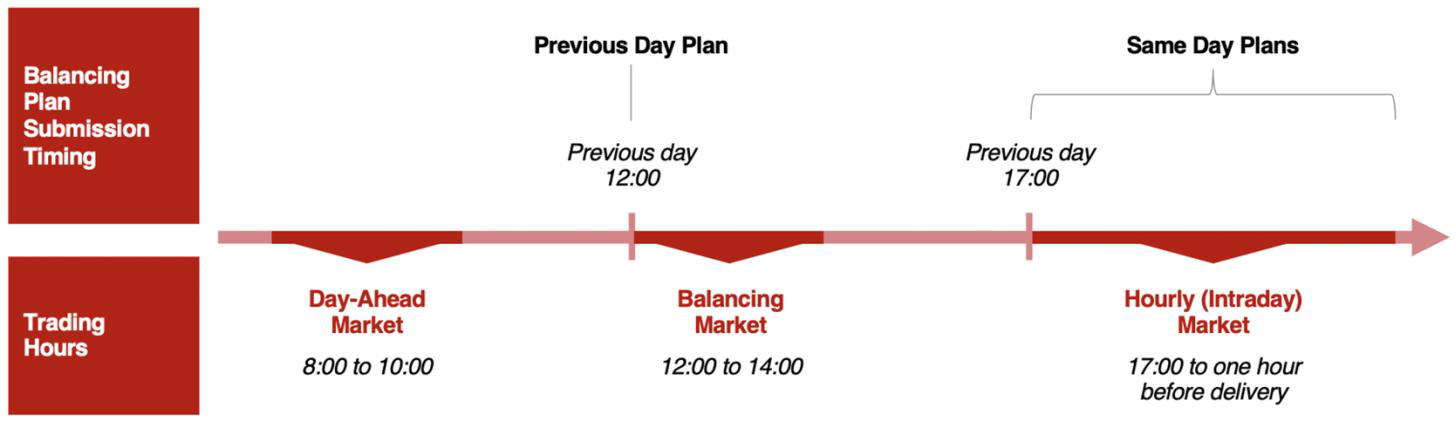
The “previous day” plan is submitted after the clearing of the day-ahead market while the “same day” plans are submitted until gate close, leaving the opportunity to trade in the intraday market before submitting the plan.
Intraday Power Market Applications and Possible Evolution
The intraday market is the last chance for generators and retailers to balance demand and supply plans before submission to OCCTO. The market’s original purpose was to be the last resort solution to balance power in case of a plant malfunction or a change in weather.
Most players still see this market as a balancing instrument and not a way to optimize their procurement costs or revenues. Its main application remains to cover for forecast mistakes in the balancing plans up to one hour before delivery for each 30 minute interval.
This “adjustment” usage translates into low trading volumes in the intraday market compared to the day-ahead market. In FY2020, 312 TWh were traded in the day-ahead market while only 8 TWh were traded in the intraday market – or just 2.5% of the total.
With the end of FIT and the introduction of FIP, renewable generators will have to meet balancing requirements that had previously been taken care of by T&Ds. These players will likely increase the volumes traded on the intraday market. The introduction of the aggregator license is also expected to bring new volumes to the market.
To address these changes and encourage thermal generators to meet market demand, METI is now discussing several changes to the intraday market. These include the introduction of a single price auction system with block bidding, alongside the continuous clearing system. This will make it easier to balance power from renewables and allow thermal asset operators to manage operations based on demand.
Looking Ahead
One point that’s missing from METI’s discussion is the possible development of arbitrage between the day-ahead and the intraday markets to optimize generators’ revenues and retailers’ procurement costs.
This is not yet a current use case of the intraday market, but several players are preparing for such an opportunity. As the volumes increase and the single price auction is introduced, opportunities for arbitrage will become more frequent.
As METI encourages the entry of foreign players able to provide risk hedging services and sophisticated trading operations in the market, this could change the way the intraday market is viewed by other players.
GLOBAL VIEW
BY JOHN VAROLI
Below are some of last week’s most important international energy developments monitored by the Japan NRG team because of their potential to impact energy supply and demand, as well as prices. We see the following as relevant to Japanese and international energy investors.
Decarbonizing industry
More than 50 major companies, including Microsoft and Ford, joined the First Movers Coalition that aims to decarbonize heavy industry and long-distance transport sectors responsible for 30% of global GHGs. They pledged to buy “green” steel, aluminum and other commodities by 2030. Japan’s sole representative is shipper Mitsui O.S.K. Lines, listed as a specialist in CO2 removal.
ESG crackdown
The U.S. Securities and Exchange Commission will require disclosure by investment funds that use terms in their names such as “ESG”, “sustainable”, or “low-carbon”. Global sustainable fund assets total $2.77 trillion, up from $1 trillion in 2019.
Germany/ GHGs reduction
By using recycled materials and carbon capture, the world’s No. 2 cement maker, HeidelbergCement, will slash CO2 emissions 50% by 2030, compared with 1990. Cement production is among the world’s most polluting industries.
India/ Coal
State-run Coal India will open one of its biggest coal mines — the new Siarmal mine in Odisha state. It’ll have a 50 million ton capacity when fully operational in about five years. A heatwave has driven up power demand, leading India’s government to delay plans to cut coal consumption.
India/ Oil refineries
April crude oil refinery throughput was 8.5% higher, at 5.27 mbpd, thanks to purchases of discounted Russian oil. Indian refiners are operating at an average rate of 104.51% capacity. They’re buying cheap Russian oil and exporting high-priced diesel to Europe, said Refinitiv.
Natural gas markets
With Europe’s natural gas reserves replenished and Russian supplies flowing, EU purchases of LNG will decrease in coming months. However, Asia’s LNG prices have increased, in part due to very hot temperatures in many countries. In May, China is expected to purchase its largest volume of LNG so far this year.
Russia/ Oil sales
Traders struggle to find buyers for about 62 million barrels of Russian crude, and a record amount sits in ships at sea, said data firm Vortexa. Most Russian crude is going to Asia, mainly India and China, while sales to Europe also increased ahead of a coming ban by the EU.
Saudi Arabia/ Fossil fuel profits
The Kingdom’s sovereign wealth fund is growing, thanks to huge profits from high fossil fuel prices. The Public Investment Fund, which finances national modernization projects, is one of the world’s strongest sovereign wealth funds, now with $620 billion.
Switzerland/ Commodities scandal
Commodity trader Glencore pleaded guilty to bribery and market manipulation, and will pay about $1.5 billion in fines. In the UK, the company was charged with bribes worth over $25 million in exchange for preferential access to oil operations in a number of African countries.
UK/ Energy crisis
Plans for a government windfall tax have caused shares in Britain’s major power companies to plummet. The government is under pressure to help households offset soaring prices as domestic energy bills are expected to jump more than 40% by end of this year.
U.S./ LNG exports
Venture Global will build one of the U.S.’s largest LNG export plants on Louisiana’s coast. The $13.2 billion project is the world’s largest new LNG project. When completed, it’ll supply more than 13 million tons of LNG a year, or about 15% of total U.S. export capacity.
2022 EVENTS CALENDAR
A selection of domestic and international events we believe will have an impact on Japanese energy
|
January |
OPEC quarterly meeting; JCCP Petroleum Conference – Tokyo; EU Taxonomy Climate Delegated Act activates; Regional Comprehensive Economic Partnership (RCEP) Trade Agreement that includes ASEAN countries, China and Japan activates; Indonesia to temporarily ban coal exports for one month; Regional bloc developments: Cambodia assumes presidency of ASEAN; Thailand assumes presidency of APEC; Germany assumes presidency of G7; France assumes presidency of EU; Indonesia assumes presidency of G20; and Senegal assumes presidency of African Union; Japan-U.S. two-plus-two meeting; Japan’s parliament convenes on Jan. 17 for 150 days; Prime Minister Kishida visits Australia (tentative) |
|
February |
Chinese New Year (Jan. 31 to Feb. 6); Beijing Winter Olympics; South Korea joins RCEP trade agreement |
|
March |
Renewable Energy Institute annual conference; Smart Energy Week – Tokyo; Japan Atomic Industrial Forum annual conference – Tokyo; World Hydrogen Summit – Netherlands; EU New strategy on international energy engagement published; End of 2021/22 Japanese Fiscal Year; South Korean presidential election |
|
April |
Japan Energy Summit – Tokyo; MARPOL Convention on Emissions reductions for containerships and LNG carriers activates; Japan Feed-in-Premium system commences as Energy Resilience Act takes effect; Launch of Prime Section of Japan Stock Exchange with TFCD climate reporting requirement; Convention on Biological Diversity Conference for post-2020 biodiversity framework – China; Elections: French presidential election; Hungarian general election |
|
May |
World Natural Gas Conference WCG2022 – South Korea; Elections: Australian general election; Philippines general and presidential elections |
|
June |
Happo-Noshiro offshore wind project auction closes; Annual IEA Global Conference on Energy Efficiency – Denmark; UNEP Environment Day, Environment Ministers Meeting – Sweden; G7 meeting – Germany |
|
July |
Japan to finalize economic security policies as part of natl. security strategy review; China connects to grid 2nd 200 MW SMR at Shidao Bay Nuclear Plant, Shandong; Czech Republic assumes presidency of EU; Elections: Japan’s Upper House Elections; Indian presidential election |
|
August |
Japan: Africa (TICAD 8) Summit – Tunisia; Kenyan general election |
|
September |
IPCC to release Assessment and Synthesis Report; Clean Energy Ministerial and the Mission Innovation Summit – Pittsburg, U.S.; Japan LNG Producer/Consumer Conference – Tokyo; IMF/World Bank annual meetings – Washington; Annual UN General Assembly meetings; METI to set safety standards for ammonia and hydrogen-fired power plants; End of 1H FY2022 Fiscal Year in Japan; Swedish general election |
|
October |
EU Review of CO2 emission standards for heavy-duty vehicles published; Chinese Communist Party 20th quinquennial National Party Congress; G20 Meeting – Bali, Indonesia; Innovation for Cool Earth TCFD & Annual Forums – Tokyo; Elections: Okinawa gubernational election; Brazilian presidential election; |
|
November |
COP27 – Egypt; U.S. mid-term elections; Soccer World Cup – Qatar; |
|
December |
Germany to eliminate nuclear power from energy mix; Happo-Noshiro offshore wind project auction result released; Japan submits revised 2030 CO2 reduction goal following Glasgow’s COP26; Japan-Canada Annual Energy Forum (tentative); Tesla expected to achieve 1.3 million EV deliveries for full year 2022 |
Disclaimer
This communication has been prepared for information purposes only, is confidential and may be legally privileged. This is a subscription-only service and is directed at those who have expressly asked K.K. Yuri Group or one of its representatives to be added to the mailing list. This document may not be onwardly circulated or reproduced without prior written consent from Yuri Group, which retains all copyright to the content of this report.
Yuri Group is not registered as an investment advisor in any jurisdiction. Our research and all the content express our opinions, which are generally based on available public information, field studies and own analysis. Content is limited to general comment upon general political, economic and market issues, asset classes and types of investments. The report and all of its content does not constitute a recommendation or solicitation to buy, sell, subscribe for or underwrite any product or physical commodity, or a financial instrument.
The information contained in this report is obtained from sources believed to be reliable and in good faith. No representation or warranty is made that it is accurate or complete. Opinions and views expressed are subject to change without notice, as are prices and availability, which are indicative only. There is no obligation to notify recipients of any changes to this data or to do so in the future. No responsibility is accepted for the use of or reliance on the information provided. In no circumstances will Yuri Group be liable for any indirect or direct loss, or consequential loss or damages arising from the use of, any inability to use, or any inaccuracy in the information.
K.K. Yuri Group: Oonoya Building 8F, Yotsuya 1-18, Shinjuku-ku, Tokyo, Japan, 160-0004.