
JAPAN NRG WEEKLY
JUNE 6, 2022
JAPAN NRG WEEKLY
June 6, 2022
NEWS
TOP
- Government tweaks plan to stress need for faster nuclear reviews as a way to potentially speed up restart of nation’s reactors
- METI lowers estimate for power reserve capacity in western Japan and warns power saving a must to survive summer peak demand
- Japan unveils breakdown of the ¥150 trn Clean Energy Strategy; spending on power fuel transition tops the list
ENERGY TRANSITION & POLICY
- Offshore wind operators unhappy with revised auction rules
- Power grids to work closer on nuclear reactor decommissioning
- Govt. aims to make Fukui a nuclear and hydrogen industry zone
- EU lawyer says Japan needs antitrust exemptions to hit net-zero
- JERA moves forward date of ammonia co-firing test in Japan
- Japan seeks to make world’s first fuel cell tractor and hydrogen-burning water heater; JR East targets first hydrogen hybrid train
- JAPEX starts feasibility study on carbon capture in Niigata area
ELECTRICITY MARKETS
- Power utilities to boost rates for businesses; gas firms raise prices
- Hokkaido court upholds injunction on a nuclear plant restart; Shimane governor supports restart of the local nuclear unit
- Kansai Electric plans to develop up to 620 MW of onshore wind
- Marubeni seeks to switch Japanese islet to solar+battery power
- CIP and partner plan a large offshore wind farm in Hokkaido area
- Orix scraps onshore wind project in southwestern Japan
- Pacifico Energy working on 120 MW solar facility in Yamaguchi
- New system can predict solar farm faults before they occur
OIL, GAS & MINING
- Cosmo Energy unit develops Japan’s first bio-certified diesel oil
- Furukawa Electric to start green LP gas test project
- Two more local firms begin retailing “carbon neutral” gas
- Japan’s oil refinery majors log record profits on high crude prices
- JGC wins contract to build petrochemicals plant in Saudi Arabia
ANALYSIS
UNDERSEA CABLE TECHNOLOGIES CAN BOOST JAPAN’S OFFSHORE WIND INDUSTRY
Japan identified offshore wind power as one of the core sectors to help cut the nation’s reliance on fossil fuels. As the nation starts to build the offshore wind sector almost from scratch, however, a number of technical challenges have become apparent. One is the knowledge and experience gap in power transmission systems. Simply put, Japan needs to accelerate R&D in technologies such as power cables. The kind of cables used locally to date are different to the lines that will be required to connect the 45 GW in offshore wind power projects the government envisions in the waters by 2040.
EVERY BIT COUNTS: JAPAN’S SUMMER POWER CRUNCH WILL REQUIRE DRASTIC MEASURES
Every May, METI urges the nation to conserve power ahead of the scorching summer heat, one of Japan’s two peak demand seasons. This year METI Minister Hagiuda took a step that the government usually holds until the very last: He aimed his power-saving message squarely at households. This is surprising considering that national elections are almost six weeks away. The minister was careful to note that “the country has sufficient power, but we need to stay alert in case of plant glitches and possible fuel shortages due to the conflict in Ukraine.”
JOBS IN ENERGY
How to retain talent in a hot labor market?
GLOBAL VIEW
Korean firms to build $1 bln of green hydrogen plants in the UAE. China boosts EV exports thanks to Europe sales. Russia stops gas supplies to Denmark. The EU to ban seaborne Russian oil imports. Renewables help to cut India’s coal use in May. Details on these and more in our global wrap.
JAPAN NRG WEEKLY
PUBLISHER
K. K. Yuri Group
Editorial Team
Yuriy Humber (Editor-in-Chief)
John Varoli (Senior Editor, Americas)
Mayumi Watanabe (Japan)
Wilfried Goossens (Japan, Events)
Regular Contributors
Chisaki Watanabe (Japan)
Takehiro Masutomo (Japan)
Daniel Shulman (Japan)
Art & Design
22 Graphics Inc.
SUBSCRIPTIONS & ADVERTISING
Japan NRG offers individual, corporate and academic subscription plans. Basic details are our website or write to subscriptions@japan-nrg.com
For marketing, advertising, or collaboration opportunities, contact sales@japan-nrg.com For all other inquiries, write to info@japan-nrg.com
Events


OFTEN USED ACRONYMS
METI The Ministry of Energy, Trade and Industry
MOE Ministry of Environment
ANRE Agency for Natural Resources and Energy
NEDO New Energy and Industrial Technology Development Organization
TEPCO Tokyo Electric Power Company
KEPCO Kansai Electric Power Company
EPCO Electric Power Company
JCC Japan Crude Cocktail
JKM Japan Korea Market, the Platt’s LNG benchmark
CCUS Carbon Capture, Utilization and Storage
mmbtu Million British Thermal Units
mb/d Million barrels per day
mtoe Million Tons of Oil Equivalent
kWh Kilowatt hours (electricity generation volume)
NEWS: ENERGY TRANSITION & POLICY

Upper House elections slated for June 22
(Nikkei, June 4)
- LDP Secretary General Mogi stated that the summer Upper House election “will definitely be announced on June 22. The election is expected to be held on July 10. This schedule assumes that the current Diet session, which ends on June 15, will not be extended.”
- The election period would normally last 17 days, with the public announcement on June 23, but since it coincides with the “Memorial Day in Okinawa,” it is expected to be moved up one day.
METI minister unveils clean energy strategy overview
(Japan NRG, May 31)
- METI minister Hagiuda unveiled an overview of the clean energy strategy for carbon neutrality. The New Capitalism Conference says that ¥150 trillion in investment is needed in the next 10 years to achieve carbon neutrality by 2050.
- During the energy transition Japan will drive industrial structural changes and invest massively in hydrogen, ammonia and other foundations of the future, Hagiuda said.
Breakdown of the ¥150 trillion, or around ¥17 trillion per year
|
Carbon neutral power/ |
¥5 trillion/ year |
Renewables, ammonia, hydrogen, storage batteries |
|
Carbon neutral manufacturing |
¥2 trillion/ year |
Decarbonizing processes, heat pump, cogeneration systems |
|
End use |
¥4 trillion/ year |
Energy efficient homes, buildings, cars |
|
Infrastructure building |
¥4 trillion/ year |
EV, digitization, power lines |
|
R&D |
¥2 trillion/ year |
Carbon recycling, nuclear, CCS, manufacturing process |
Wind operators speak up on proposed offshore auction rules
(Japan NRG, May 30)
- Eight wind power operators and Japan Wind Power Association expressed their views to the proposed offshore wind auction rules that are undergoing a revision. JWPA suggested changes in judgment criterion. It also suggested to directly reflect the views of community stakeholders, rather than the prefecture governors, in the community relationship criteria. JERA said measures to protect from natural disasters should be taken more into account, while Japan Wind Development urged the MoE and other government agencies to speed up the project rollout. Mitsubishi Energy Solutions said that too much emphasis on a speedy power generation launch may result in anti-competitive behavior. Several operators opposed the 1 GW limit for consortiums participating in multiple auctions. The operators were divided on METI’s request for comments on which should have greater weight: plans leading to the power generation launch, or post-launch plans.
- CONTEXT: Japan Wind Development warned that offshore wind projects have increased globally following the Ukraine war. Japan’s goal for 5.7 GW offshore capacity by 2030 is not large enough to attract the interest of equipment makers, since other countries have larger projects.
Power grids to work closer on nuclear decommissioning
(Japan NRG, May 30)
- Power grids will work together on nuclear decommissioning as 18 plants will enter the reactor dismantling phase for the first time. The decommissioning will start in a few years and low-radioactive contaminated material will be generated in the process.
- The government will develop safety standards for low-level radioactive waste, as well as build schemes for re-use of scrap metal that passed the nuclear clearance standards. Power grids will also study how they can conduct maintenance without closing the plants and spot component defects effectively.
- CONTEXT: METI said major decommissioning issues are limited by the financial muscle of the grids, a lack of space in the plant premise for decommissioning, and a lack of best practices knowledge base.
Promoting Fukui as nuclear industry zone
(Japan NRG, June 3)
- METI and Fukui Prefecture are promoting the Reinan region as a nuclear industry zone for setting up companies engaged in nuclear decommissioning and recycling plants of metal scrap from old nuclear reactors.
- SIDE DEVELOPMENT:
Japan’s nuclear hub meets to discuss a potential pivot to hydrogen
(Mainichi Shimbun, June 4)- A meeting was held in Tsuruga City, Fukui Prefecture, to discuss the creation of new industries in the areas where the prefecture’s nuclear power plants are located.
- The government presented a proposal that included the industrialization of nuclear decommissioning and the creation of a hydrogen supply base. Although no roadmap was presented, the proposal is expected to be finalized after minor revisions in the near future.
- Some participants called for the government to clearly state its policy on replacing aging reactors and on building new nuclear power plants.
- The 15-member council includes the national government, the prefectural government, one city and three towns where nuclear power plants are located, as well as the presidents of power companies, and university professors.
EU competition lawyer says anti-trust exemptions needed to push carbon neutrality
(Japan NRG, June 3)
- Brussels-based competition lawyer Maurits Dolmans told METI that lenient competition regulation is needed to push carbon neutrality, because the market alone can’t spur the necessary products and innovations.
- The EU revised its competition law so that sustainability-driven business collaborations that serve consumer collective interests are possible under a new framework called “sustainability agreements”.
- Dolmans said if Japan plans to introduce a similar scheme, by writing new guidelines that supplement the Anti-Monopoly Act, the competition authority needs to recognize that guidelines provide limited clarity in the application of Anti-Monopoly Act and visibility for the business community. The bottom line is, the Japan Fair Trade Commission should offer guidance to companies seeking sustainability-driven alliances.
- On June 3, METI will invite Dirk Middelschulte, global competition counsel for Unilever, to deliver a presentation.
TAKEAWAY: Companies approach the Japan Fair Trade Commission for guidance when planning mergers. While they’re encouraged to do this for joint R&D and pilot projects or forming associations, companies rarely do so since joint initiatives outside M&A don’t require regulatory approval. Guidelines would be the fast track approach to introduce the “sustainability agreement” scheme in Japan. While speedy rollout of hydrogen, ammonia and other net-zero projects, and competition framework supporting them are needed, regulatory oversights are still required over standardization of technologies and specifications, licensing of technologies essential to meet the standards, data firewall to prevent sharing of irrelevant business data, and a clear roadmap on how companies compete after completing the joint initiative.
Japan briefs South Korea on Fukushima waste water release
(Foreign Ministry statement, June 2)
- Japan held an online briefing for South Korean government officials regarding the Fukushima waste water release. It described the process that led to the Nuclear Regulation Authority’s decision to approve the release and the IAEA’s review.
- CONTEXT: Japan will be asking for more IAEA reviews of reactor decommissioning, fuel recycling and other nuclear initiatives to establish a positive reputation globally notably in treating low-level radioactive waste. As countries expand nuclear capacities, they will face challenges from waste treatment, which could open business opportunities for Japan.
JERA moves forward ammonia co-firing test in Japan
(Denki Shimbun, June 1)
- JERA and IHI decided to start the 20% co-firing of ammonia at the former’s Hekinan coal-fired power plant starting FY2023, a year earlier than previously scheduled.
- Initial tests for the technology have progressed well and JERA expects the installation of the necessary burners, piping and other equipment can be done quicker.
- CONTEXT: JERA plans to use ammonia for 20% of the fuel mix at Unit 4 (1 GW) of the Hekinan plant to demonstrate that it is viable as a commercial technology.
Tohoku venture starts biogas power generation project based on food waste
(Gas Energy News, May 30)
- Tohoku Biofood Recycling (TBFR) began full-scale biogas power generation at its food recycling plant in Sendai City. It has 780 kW of capacity, enough to make enough electricity to supply about 1,500 average households.
- The company collects food waste from Sendai station buildings and commercial facilities, uses it as fuel to generate electricity, which is then sold to Tohoku Electric for local distribution.
- TBFR is a JV between JFE Engineering, JR East, Tokyo Gas, and Tohoku Railway Transportation.
Osaka Gas issues first transition bond
(Denki Shimbun, May 30)
- Osaka Gas will have its first transition bond – a 10-year, ¥10 billion issue. Interest rate is 0.369%, with the spread over government bonds at 0.13%.
- Proceeds will be used for the Inan Wind Power Plant (26 MW, Wakayama Prefecture) and the Nobechi Mutsuwan Wind Power Plant (39 MW, Aomori Prefecture), and other renewable energy projects.
Euglena to sell biodiesel at gas station
(Nikkei, June 3)
- After a successful trial, major biofuels manufacturer Euglena will make its biodiesel line available to the general public.
- It will be sold at a gas station in Nagoya Port, priced at about ¥300/ liter.
- By 2025, Euglena plans to build commercial scale biofuels production.
JAPEX starts feasibility study on carbon capture and storage project in Niigata area
(Company Statement, May 30)
- Japan Petroleum Exploration Co. (JAPEX) plans to start a feasibility study for a hub & cluster type CCUS project that will connect CO2 emission source sites with a reservoir to store the carbon.
- The study will run for nine months until the end of February 2023. It will measure the potential for CCS in the Niigata East Port and its surrounding area, which has some options, including at JAPEX operating oil and gas fields.
- JAPEX is also working with Mitsubishi Gas Chemical Co. to study the potential for using surplus CO2 from the latter’s Niigata factory to manufacture methanol.
Kubota to release world’s first fuel cell tractor that runs on hydrogen
(Nikkei, June 1)
- Kubota will be the world’s first company to commercialize a hydrogen-fueled fuel cell vehicle (FCV) tractor in 2025.
- FCVs generate their own electricity, which means despite long hours of operation they do not require large on-board batteries.
- CONTEXT: Agricultural machinery accounts for up to 30% of the total GHG emissions from agriculture.
JR East, ENEOS to study how to create Japan’s first hydrogen hybrid train
(Kankyo Business, May 30)
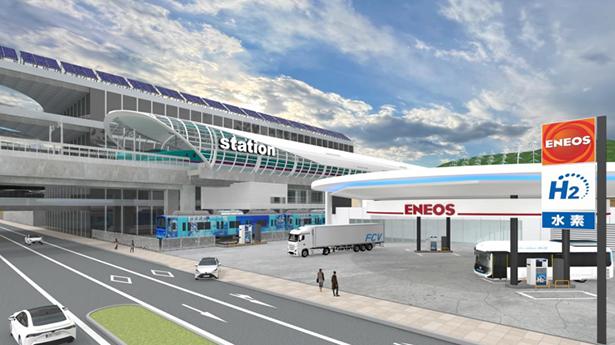
- East Japan Railway Company (JR East) and ENEOS will research the first hydrogen hybrid train in Japan, aiming to decarbonize the rail sector.
- The two will develop a hybrid train powered by hydrogen fuel cells and batteries. A hydrogen station will also be added to refuel not only trains but a variety of fuel cell mobility vehicles, including cars, buses, and trucks.
- The companies aim to introduce the system by 2030.
Source: JR East
Japan maker claims world’s first hydrogen-burning residential water heater
(Company Statement, May 30)
- Rinnai Corporation said it developed the world’s first 100% hydrogen combustion technology for residential water heaters. At this moment, it is a conceptual model.
- CONTEXT: Rinnai makes householder appliances that run on natural gas and other fossil fuels.
Kawasaki Heavy says it designed world’s first hydrogen-fueled marine boiler
(New Energy Business News, June 1)
- Kawasaki Heavy Industries completed the basic design of a hydrogen-fueled marine boiler, a world first. The design is similar to LNG-fueled marine boilers.
- Unlike small land-use hydrogen boilers, Kawasaki’s design accounts for the specific conditions of sea vessels, such as wave oscillation and space limitation.
- The boiler will be installed on a large liquefied hydrogen carrier, which is planned to be put into practical use in the mid-2020s.
TAKEAWAY: Kawasaki Heavy has staked its future on the shipment of hydrogen in liquid form, but this is a big risk as other methods of long-distance transport, such as via MCH or ammonia, are proving cheaper and more practical. Still, since it’s in the forefront of R&D into liquid hydrogen transport Kawasaki Heavy will benefit in some form as overall demand for the molecule grows.
Tokyo Governor says empty roofs should be used for solar
(TBS, May 27)
- The Tokyo Metropolitan Government will proceed with a plan mandating installation of roof mounted solar panels, not only on houses but also other residential buildings.
- All construction companies whose annual output exceeds 20,000 square meters of floor area will be required to participate. This will result in panels becoming mandatory on about half of Tokyo residential buildings.
- Governor Koike Yuriko says Tokyo does not have the luxury of open space suitable for large-scale solar farms, so must turn to rooftop panels.
Suzuki Motor to boost purchases of renewables in India
(Response, June 2)
- Suzuki Motor Gujrat (SMG) began purchasing electricity under an off-site corporate power purchase agreement.
- Under the agreement, major Indian renewables supplier ReNew Power has built over 17 MW of wind and solar capacity for the exclusive use of SMG.
Hitachi Metals and others launch platform to research magnets with EV applications
(JIJI.COM; May 31)
- The National Institute for Materials Science (NIMS) will work with four magnet manufacturers (Hitachi Metals, TDK, Daido Steel, and Shin-Etsu Chemical) on research to improve the performance of permanent magnets, which are increasingly in demand for EV motors and other applications.
- For the past decade, NIMS has researched magnet materials on behalf of the Ministry of Education, Culture, Sports, Science and Technology.
NEWS: POWER MARKETS

NUCLEAR REACTOR RESTARTS
- There is a tug-of-war in the nuclear space, with the result being a one-step forward, one-step back situation. Eventually, the national government’s more bullish stance on nuclear is likely to prevail and result in a higher number of reactors in operations than today. However, with the anti-nuclear community also strong, we expect their actions to intensify.
- As of today, there are just four reactors out of a possible 33 in operation in Japan.
Government revises plan to help improve nuclear restart process
(Nikkei Shimbun, June 4)
-
- The government included the phrase “rigorous and efficient review” with regards to the restart of nuclear power plants in the revised draft of the Basic Policy for Economic and Fiscal Management and Reform.
- Behind the inclusion of the phrase lies dissatisfaction within the government and the ruling party over the Nuclear Regulation Authority’s (NRA) review process. In some cases, it is taking many years for the NRA to review the restart of a reactor.
- In April, PM Kishida also mentioned “streamlining and improving the efficiency” of the nuclear review process.
- The revised policy also clearly states that nuclear power plants will be “utilized to the maximum extent possible,” a more aggressive stance than the policy adopted in 2021.
- SIDE DEVELOPMENT:
Hokkaido court upholds injunction against Tomari restart
(NHK, May 31)- The Sapporo District Court has upheld a petition filed on behalf of 1200 residents living near the Tomari nuclear power plant that called for an injunction against its restart.
- The court found that the plant did not meet tsunami-proofing requirements.
- This is the first time that a court issued an injunction against the restart of a nuclear plant on the grounds of tsunami risk.
- While the plaintiffs also petitioned for decommissioning the plant and nuclear fuel to be removed, this petition was not upheld by the court.
- Hokkaido Electric will appeal the decision.
- SIDE DEVELOPMENT:
Shimane Governor gives green light to nuclear restart
(NHK, June 2)- Shimane Governor Maruyama Tatsuya supports the restart of Unit 2 of the Shimane nuclear power station in Matsue.
- He cited the need to ensure electricity supply to support industry and jobs.
- Over 450,000 people live within a 30 km radius of the reactor; many would have to evacuate to neighboring prefectures in case of an emergency.
- The reactor is a boiling water reactor, the same type as reactor that was involved in the Fukushima nuclear disaster.
- SIDE DEVELOPMENT:
Zero-nuclear federation opposes reactor restarts
(Tokyo Shimbun, June 2)- The Federation of Promotion of Zero-Nuclear Power and Renewable Energy, which is advised by former PM Koizumi Jun’ichiro, has opposed calls from within the LDP to restart idle nuclear reactors.
- Koizumi said the nuclear reactors are effectively nuclear weapons aimed at Japan, and called for an end to nuclear power and more renewables.
- While surging energy prices have led to calls for more use of nuclear energy, the Federation called to be prudent. It cited the Russian attack on a Ukrainian nuclear plant and suggested Japan’s plants would also be vulnerable in the event of an invasion.
METI lowers estimate for power capacity reserves in western Japan
(Yomiuri Shimbun, May 28)
- METI’s latest forecast for power capacity reserves in Kansai and Chubu areas shows there’ll be little backup available this summer. The ratio will drop to just 3.1% in case of very hot weather.
- The government expected more nuclear reactors to restart in the Kansai area. Kansai Electric recently announced delays to its restart of Unit 3 at the Takahama nuclear power plant, initially expected to be online in May.
TAKEAWAY: See this week’s Analysis section for a full breakdown of the power crunch expected this summer.
Power utilities to boost rates for businesses; major gas companies to raise prices
(Jiji Press, May 27)
- The four major city gas companies (Tokyo, Osaka, Toho and Saibu) will raise prices in July, for the 11th month in a row.
- Seven of the 10 large power utilities have reached the limit by how much they can raise prices for consumers, but all will increase fees for corporations and businesses next month, including high-voltage and special high-voltage suppliers.
- The biggest household price hikes will be in the Tokyo region.
Kansai Electric plans to develop up to 620 MW in onshore wind capacity in Japan
(Kankyo Business, June 1)
- Kansai Electric began studying the development of five onshore wind power plants with a total capacity of 620 MW in Hokkaido and Miyagi Prefectures.
- The utility submitted environmental consideration reports to METI and requested opinions from the Governors of Hokkaido, Miyagi, and Yamagata Prefectures.
- The environmental considerations will be made public this month.
- One project is a 96.6 MW wind farm in Kawasaki Town, Miyagi Prefecture that would sit on 1,600 hectares, and use a maximum of 23 wind turbines.
Marubeni seeks to switch a Japanese island entirely to solar and battery power
(Company Statement, May 31)
- Trading house Marubeni will install solar PV systems on roofs and at parking lots on Amami Oshima Island at no initial cost for owners, and then sell the electricity to them based on long-term purchase agreements.
- Amami Oshima (Kagoshima Prefecture) isn’t connected to the national grid.
- CONTEXT: Remote islands mostly rely on thermal power due to its dispatchable mode of operation and cost, but this leads to high emissions. To date, the use of variable renewables on remote islands was seen as impractical as the weather can destabilize the supply-demand balance.
MoE submits opinion on CIP’s plans for a large offshore wind farm in Hokkaido
(New Energy Business News, June 1)
- MoE submitted its opinion on the Environmental Assessment Consideration Statement for the “Offshore Shimamaki Village Offshore Wind Power Project” planned by Hokkaido Offshore Wind Development Co. It calls for surveys, forecasts, and assessments based on expert advice regarding impact on birds.
- Hokkaido Offshore Wind Development is a JV between Copenhagen Infrastructure Partners (CIP) of Denmark and Mitsubishi Heavy Industries.
- The project will install up to 56 turbines with a total maximum output of 585 MW.
JFE and Chubu Electric start work on a 112 MW biomass plant
(New Energy Business News, June 2)
- Tahara Biomass Power GK – owned by JFE Engineering, Chubu Electric, Century Tokyo and Toho Gas – is building a 112 MW plant in Tahara City, Aichi Prefecture.
- The power plant will be one of the largest woody biomass-fired power plants in Japan, and is scheduled to start operation in September 2025.
- The plant will import wood pellets for fuel.
Orix scraps 147 MW onshore wind project in southwestern Japan
(New Energy Business News, June 3)
- Orix will discontinue the Oto Wind Power Project, an onshore wind farm with a maximum capacity of 147 MW planned in Shimanto City, Kochi Prefecture. The company cited insufficient wind conditions as the reason.
- The project had progressed to the environmental assessment methodology stage. Construction was scheduled to begin in January 2024.
Pacifico Energy plans a 120 MW solar plant in Yamaguchi area
(New Energy Business News, June 3)
- Pacifico Energy will build a 120 MW solar power plant in Shunan City, Yamaguchi Prefecture. The company released an Environmental Consideration Statement.
- The plant will be on a former golf course, about 190 ha, of which 101 ha would be for installation of solar cells and other equipment.
- The solar cells will consist of 221,000 crystalline silicon modules with an output of 545 W each. Storage batteries will also be installed.
- Construction is scheduled from October 2025 to November 2027.
Why TEPCO sold off its “tiger cub” renewables unit to Toyota Tsusho
(Diamond, June 1)
- CONTEXT: TEPCO sold its 40% stake in the wind power generation venture, Eurus Energy, to the other shareholder, Toyota Tsusho, for ¥185 billion. Eurus is one of Japan’s biggest renewable energy companies.
- Toyota Motor Group had been seeking to acquire TEPCO’s stake in Eurus since 2019. Toyota sought to acquire bigger access to renewable energy, which is seen as indispensable for its survival in the mobility business. Toyota was pressuring its affiliated trading house, Toyota Tsusho, to take full control of Eurus.
- TEPCO also wanted full control of Eurus, but its financials deteriorated due to the jump in fuel prices since the Ukraine war and the weak yen. There’s concern that state-backed TEPCO may fall into the red for the first time in a decade.
- Much of TEPCO’s debt is based on staying in the black. Its main lenders reached a limit on the loans they can extend. So TEPCO needed to sell Eurus shares to ensure it remained profitable.
- Other buyers interested in Eurus shares included JERA.
New system can predict solar farm faults before they happen
(Nikkei, June 1)
- Kanazawa firm Ryoki Kogyo developed an AI-based system that can predict malfunctions in the power conditioners used at solar farms.
- By warning before a fault arises, the system can maximize output and reduce the need for on-site maintenance.
- Power conditioners have a useful life of around 10 years.
Mitsui&Co, Osaka Gas to partner on offshore wind
(Nikkei, May 28)
- Mitsui & Co, Osaka Gas, Canadian-based Northland Power International Holdings, Akita-based United Purpose Management, and Akita University will partner on offshore wind technology.
- Investment in tuition and university-led research will help foster expertise in the field, as well as facilitating internships.
- CONTEXT: The four companies will form a consortium to build a 400 MW offshore wind project; an environmental assessment was submitted to METI and Akita Prefecture.
TEPCO Energy Partners establishes an “Off-Site Corporate PPA” electricity rate plan
(New Energy Business News, June 2)
- The plan is aimed at corporate customers seeking additional environmental value over the long term without having to own solar power generation facilities.
- The electricity and environmental value for the plan will be derived from TEPCO Energy Partner’s new solar power generation facilities.
Osaka biomass venture credits success to CEO’s vision
(Sankei, June 2)
- T1 Holdings supplies carbon-neutral electricity to the Osaka area using a 5.8 MW wood-fired generator.
- The 60,000 metric tons of wood chips used annually are sourced from trimmed branches and discarded wooden objects.
- The success owes to the vision of CEO Tono Hayato, who recognized the potential of carbon-neutral energy eight years ago following the 2014 earthquake and tsunami.
- With nearly 1 million tons of wood waste generated in the six prefectures of the Kinki region every year, there’s potential to boost output.
NEWS: OIL, GAS & MINING

Cosmo unit develops Japan’s first bio-certified diesel oil
(Sekiyu Tsushin, May 30)
- Cosmo Oil Lubricants, a group company of Cosmo Energy Holdings, has developed a diesel engine oil that contains more than 80% plant-derived oil.
- This is the first diesel engine oil in Japan to be certified with the biomass mark (i.e. it is made up of at least 80% biomass).
- Normally, burning lubricating oil creates CO2 emissions, but the plant-derived components in the new Cosmo product absorb CO2 in the growth process, thus reducing the disbursement of carbon into the atmosphere over the full life cycle.
- The new oil will go on sale in August. Engine tests show it has the same level of performance as the highest-grade synthetic diesel engine oils on the market.
Furukawa Electric to start green LP gas test project
(Gas Energy News, May 30)
- Furukawa Electric plans a demo project for green LP gas, which is produced without fossil fuels. NEDO sponsors part of the project through the Green Innovation Fund.
- The project aims to prove the commercial viability of green LP gas, made through synthesis, during this decade. Iwatani and Astomos Energy will help to distribute the gas produced during the test phase and to commercialize synthetic LP gas.
Two more local gas firms start retailing “carbon neutral” gas
(Gas Energy News, May 30)
- Hadano Gas and Akishima Gas started retailing “carbon neutral” (CN) gas, which is procured from Tokyo Gas.
- Hadano Gas began supplying CN gas to Hadano City Hall and Tokai University Shonan Campus on April 1. It’s a five-year contract. The amount supplied hasn’t been disclosed. Hadano Gas also switched to CN gas for the company building.
- Akishima Gas began supplying CN gas to Akishima City Hall in April. At the same time, the company switched all gas used at its office to CN gas\.
- CONTEXT: There are at least 53 city gas companies in Japan that have introduced or decided to introduce CN LNG and CN city gas.
Japan’s oil refinery majors log record profits on high crude prices
(Diamond, May 30)
- Amid soaring crude oil prices, the profits at all three major oil wholesalers for FY2021 reached record highs. ENEOS posted a profit of ¥537.1 billion; Idemitsu Kosan ¥279.5 billion, and Cosmo Energy ¥138.9 billion.
- Japan introduced subsidies for petroleum wholesalers in late January to combat high gasoline prices at the pump. The state allocated ¥1 trillion for this.
- The article argues that taxpayer funds are misused, lining the pockets of oil firms.
Japan’s LNG stocks rise marginally to 1.99 million tons
(METI data, June 1)
- Japan’s LNG stocks stood at 1.99 million tons on May 29, up from 1.97 million tons a week ago. The end-May stocks last year were 1.94 million tons and the end-May average of the last four years 1.98 million tons.
JGC Holdings wins contract to build petrochemical plant in Saudi Arabia
(Nikkei, May 30)
- JGC Holdings won a contract, worth about ¥300 billion, to build a petrochemical plant for Saudi Aramco.
- The plant is scheduled to be completed in 2025, and will separate crude oil from natural gas, as well as remove water and other impurities.
ANALYSIS
BY CHISAKI WATANABE
Undersea Cable Tech Can Boost Japan’s Offshore Wind Industry
Japan identified offshore wind power as one of the core sectors to help cut the nation’s reliance on fossil fuels. As the nation starts to build the offshore wind sector almost from scratch, however, a number of technical challenges have become apparent. One is the knowledge and experience gap in power transmission systems.
Simply put, Japan needs to accelerate R&D in technologies such as power cables. The kind of cables used locally to date are different to the lines that will be required to connect the 45 GW in offshore wind power projects the government envisions in the waters by 2040.
First, however, the government must determine which transmission infrastructure will need to be built or strengthened. After suffering setbacks in the past in developing domestic wind turbines, Japan is keen to avoid the same in technology that will deliver the electricity to consumers.
One type of grid technology gaining attention, and already receiving financing, is long-distance direct current (DC) transmission via undersea cable.
AC or DC?
Electricity is transmitted via either alternate current (AC) or direct current (DC) transmission lines. While each has strengths and weaknesses, DC is superior in long-distance transmission (50 km and longer for undersea cable). AC transmission has a power loss issue arising from “reactive power”, which reduces the capacity of cables.
In March 2021, METI launched a study group to address technical and commercial challenges of installing DC subsea cables for the transmission of offshore wind power. Since Japan’s offshore wind resources are mostly in Hokkaido, Tohoku and Kyushu, far from regions with high electricity demand, the DC system is expected to improve the grid resilience and promote inter-regional transmissions.
High Voltage Direct Current (HVDC) is not a new technology. The world’s first commercial HVDC system was set up in 1954 linking the island of Gotland to mainland Sweden using a submarine cable system. In 2009, Germany’s BorWin 1 project became the world’s first offshore wind farm using a 200 km HVDC cable connection (125 km subsea, 75 km on land).
In Japan, the DC system is used in a few regions, with only two examples of a DC connection via undersea cables, neither of which is used for the transmission of offshore wind power. The first is a 43 km transmission line between the northernmost island of Hokkaido and the main island of Honshu. The second is a 49 km line between Wakayama in west Japan and Tokushima on Shikoku Island.
Master plan for transmission
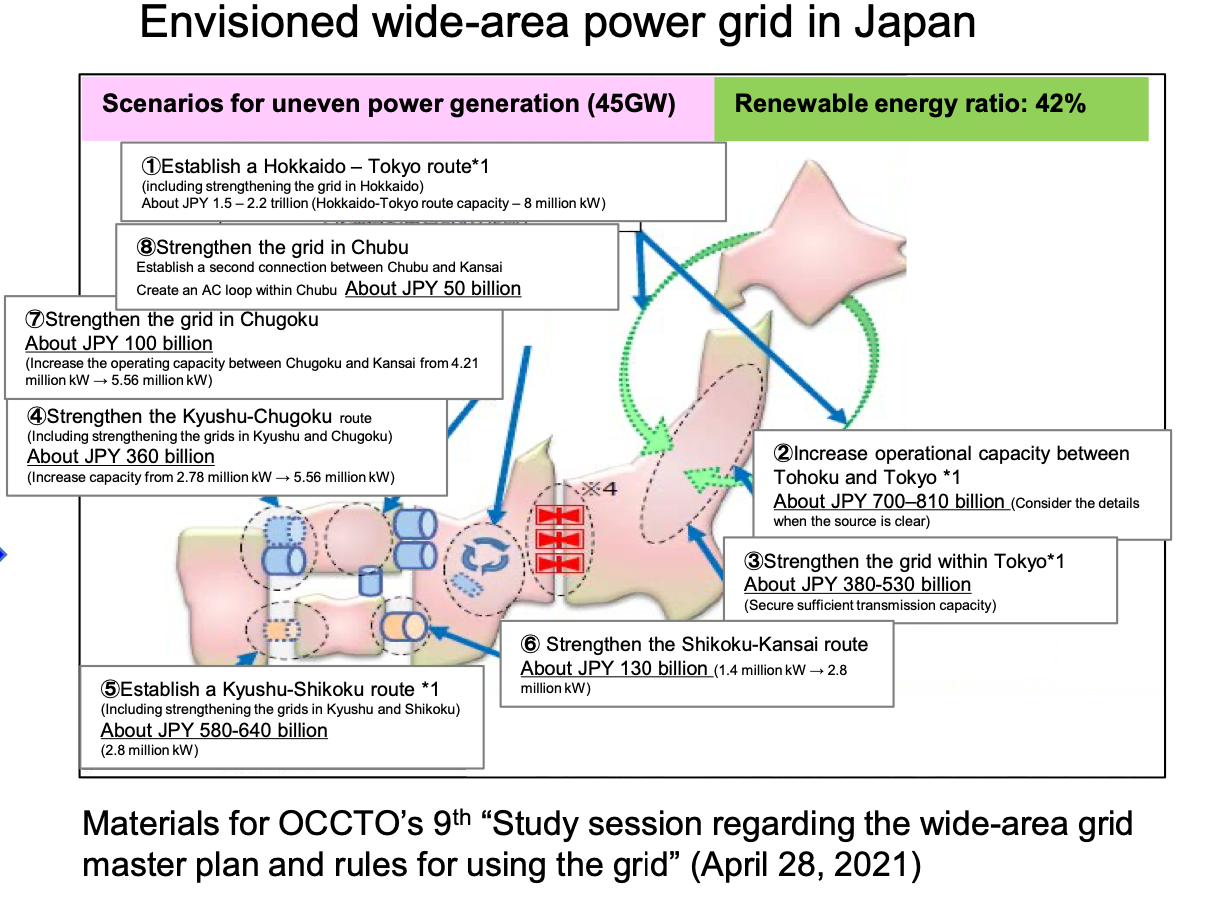
In May 2021, the Organization for Cross-regions Coordination of Transmission Operators (OCCTO), Japan’s grid monitor, released an interim master plan for nationwide transmission, identifying several routes for possible new construction, with an estimated cost of ¥3.8 ~ ¥4.8 trillion under the scenario of 45 GW offshore wind capacity.
One route would use HVDC undersea cables (8 GW) between Hokkaido and Tokyo with an estimated cost of ¥1.5 ~ ¥2.2 trillion. A large volume of renewable electricity to be produced in Hokkaido must be sent to the main island, and HVDC has an economic advantage in long-distance transmission compared with an AC connection, says OCCTO.
Source: Furukawa Electric
METI’s DC subsea cable taskforce has picked a group comprising the Promotion and Research Institute for Ocean Economics, J-Power Transmission Network and Eukote Energy (a subsidiary of Toyota Tsusho-owned wind developer Eurus Energy) to conduct a technical feasibility study.
The group examined DC transmission routes from Hokkaido to the mainland via undersea routes both the Sea of Japan and the Pacific Ocean, and in April 2022 described several challenges in a report. Below are some examples.
There is high demand globally for large-size vessels that can be used to lay undersea cables. So, it’s uncertain if they’ll be available for projects in Japan. Meanwhile, building a new vessel takes three to four years.
Based on the DC subsea cable taskforce’s review of various scenarios, Japan could aim to have undersea cables for offshore wind power facilities ready and operational between 2030 and 2036.
METI plans further study and allocated ¥5 billion to research long-distance DC transmission to measure the ocean depth, study geological structures, wind and wave conditions and prior uses.
|
Current status, track record |
Challenges | |
|
Manufacturing capacity and possible length of cable |
~ 50 km |
Manufacturing capacity needs to be expanded as it takes a long time to produce the required product with current capacity |
|
Cable-laying vessel load |
|
|
|
Connecting cables on the sea |
|
Take longer time in case of limited manufacturing capacity and vessel load |
|
Consultation with prior users |
Some experience at home with individual users |
Need mechanism to promote consultation with many stakeholders |
|
Permits (for construction, use of area) |
Some experience at home: consultation with and application to ministries and local governments |
Need mechanism to support application and consultation processes to deal with many authorities |
Source: METI
Advantage of near-shore wind farms
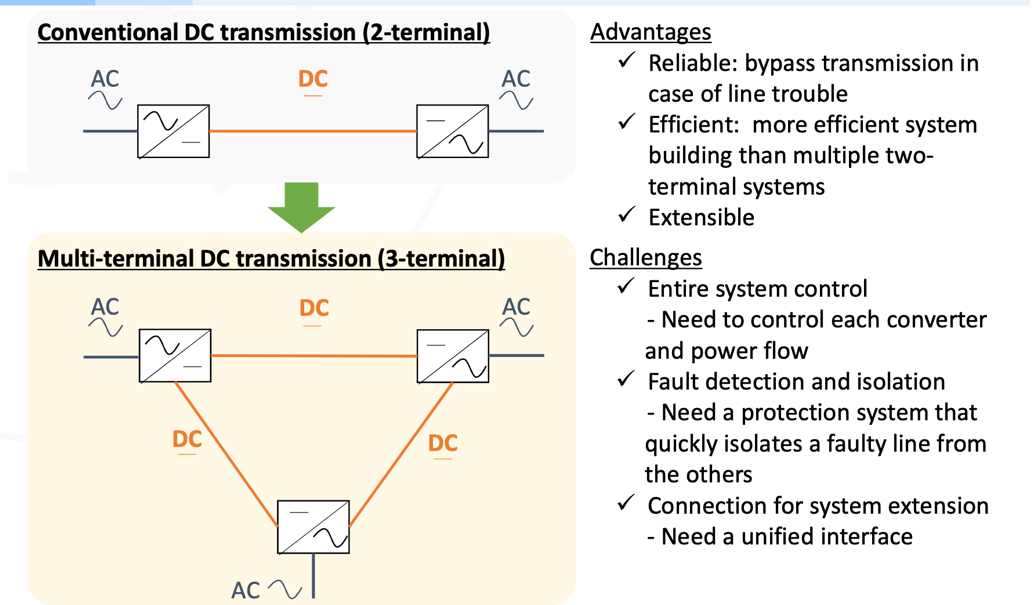
One option for Japan is to install turbines along the coast, not far from shore. That’s different from European offshore wind farms that are often far from coastlines. Using near-shore turbines could support the development of multi-terminal HVDC systems, something that is backed by The New Energy and Industrial Technology Development Organization (NEDO).
Multi-terminal HVDC systems can transmit electricity more efficiently by connecting multiple offshore wind farms with multiple onshore transformer stations and also linking offshore transformer stations with each other, NEDO says.
Source: NEDO
Japanese companies don’t have much experience in building DC transmission systems via undersea cables at home, but some have been active in overseas projects. The grid unit of Hitachi, which acquired the business from ABB several years ago, won an order to supply its HVDC systems to UK’s Dogger Bank offshore wind farm, one of the world’s largest.
Hitachi has the largest share as supplier of AC/DC converters for offshore HVDC and converter stations. Sumitomo Electric, a Japanese manufacturer of HVDC cables, earlier this year signed an MoU to work with Norway’s Seaway7 for offshore wind projects in Asia.
Takeaway
Even though Japan lags behind other major countries in offshore wind, the country has an opportunity to leapfrog to the front of the pack through making breakthroughs in certain parts of the technology and supply chain that boost efficiency. This will require coordinated action between government and the industry.
For example, regulations need to be revised so builders can use more globally standardized equipment to reduce cost and speed up installations. Though transmission is only a part of offshore wind development, if successful, HVDC subsea cable installations can be replicated in other parts of Japan and beyond.
ANALYSIS
BY MAYUMI WATANABE
Every Bit Counts:
Japan’s Summer Power Crunch May Require Drastic Measures
Every May, METI urges the nation to conserve power ahead of the scorching summer heat, one of Japan’s two peak demand seasons. This year METI Minister Hagiuda took a step that the government usually holds until the very last: He aimed his power-saving message squarely at households. This is surprising considering that national elections are almost six weeks away.
The minister was careful to note that “the country has sufficient power but we need to stay alert in case of plant glitches and possible fuel shortages due to the conflict in Ukraine.”
Just how little Japan’s power system has in reserve was highlighted in March when a strong earthquake in the northeast took more than a dozen coal, gas and hydropower plants offline. The Tokyo area narrowly escaped a blackout, thanks to frantic government calls to cut power consumption and pumped hydro storage facilities.
In the heat of summer, and its accompanying typhoon season, the potential for disruptions is higher than ever; at least 1 GW of capacity damaged by the March quake will remain under repair. Minister Hagiuda’s appeal is meant to ensure the public can shrink its power use quickly and be ready to do so multiple times.
How much power conservation can play a role in decarbonization will be put to a stress test over the next three to four months.
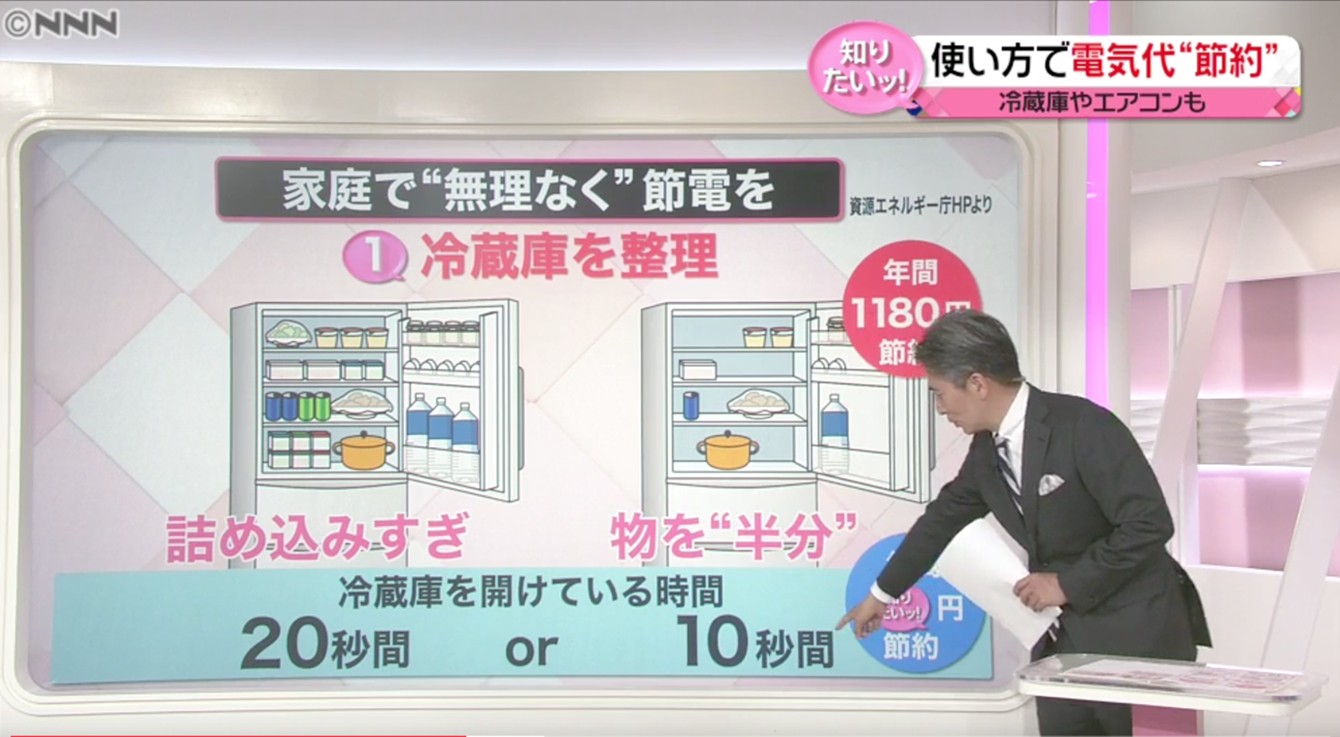
Source: NTV News
Government Appeal to Consumers
- Families should gather in one room, watch one TV set and turn one air-conditioner
- Switch off toilet seat warmers
- When going out, make sure to turn off the AC well before leaving
- Unplug your TV before you travel, unplug appliances when not in use
- Don’t overstuff the refrigerator, give your food some breathing space
Demand-response in real time
Japan’s response to critical power capacity shortages shortly after the earthquake in March allowed consumption to drop by 5 GWh in a matter of a few hours. Such a massive drop was more than expected, so it was inevitable that the government would again turn to demand-side measures during peak seasons.
The problem in March was the sudden nature of the warning despite availability of forecasts for a cold snap, which prompted criticism from business. This time, METI has decided to get ahead of the issue by setting the power saving alert for two days in advance.
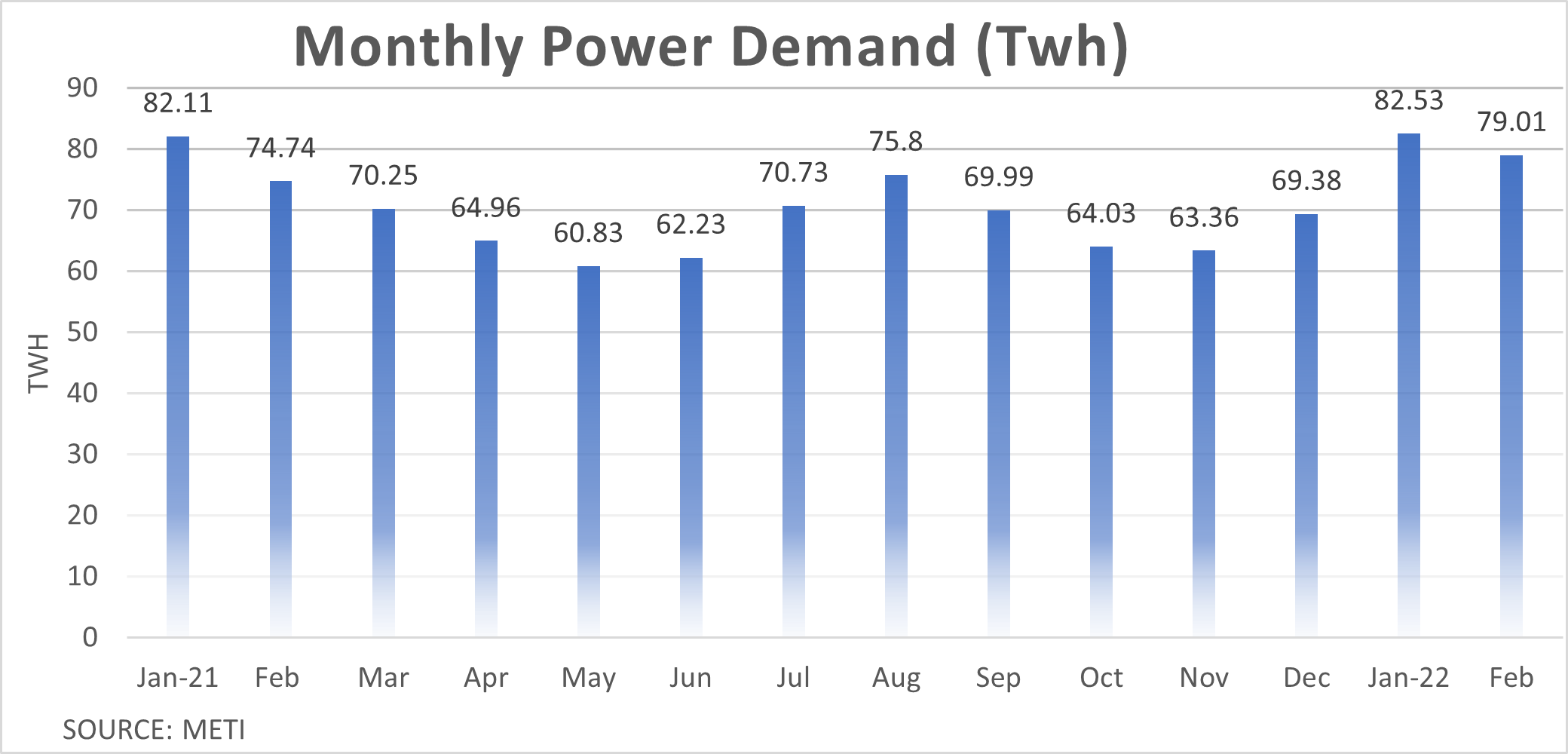
NOTE: The figures are sales logged by all licensed power operators in addition to regional grids, and do not include self-consumption
Japan’s power demand surges in January-February, then hits a low in May-June and finally climbs again in July. In Tokyo, May temperatures are typically 10-20°C. June temperatures hover in the range of 15-25°C. Some days are steamy, fetching above 24°C and making people switch on air conditioners. July sees more days with temperatures above 30°C. According to a Cross Marketing survey, 33.8% of households keep air-conditioners on the whole day.
Data from the Organization for Cross-Regional Coordination of Transmission Operators (OCCTO) showed household power consumption rose 2.2%, or 500 GWh in July 2020, from a year ago due to the spread of remote work.
This year temperatures have been volatile. In Tokyo, February-March temperatures were two to three degrees lower than last year. However, in May, Tochigi and Gunma prefectures near Tokyo hit record-highs of 35°C.
Weather forecast: scorching
The Japan Meteorological Agency forecasts this summer to be hot with the chance of July-August temperatures rising 40% above 30-year averages for most of Japan. A power demand surge is expected, yet the most recent supply-demand forecast from OCCTO shows the supply side reserve is threadbare: 4.1%-6.2% during July-September, with July the most critical.
Nationwide supplies are seen at 177 GW; demand at 170 GW, resulting in a reserve rate of 4.1%, according to OCCTO data. The forecast factored in supplies of 87 power operators with over 100 MW in capacity, and demand scenario based on the highest temperatures on record. It does not include possible additional supplies secured through auctions.
The 4.1%-6.2% reserve is above the 3% critical threshold METI seeks. However, utilities warn that reserve rates actually need to be near 10% to guarantee supply security. In March, before the accident, the reserve rate for Tokyo and Tohoku regions was 7.5%.
In July, Tohoku, Tokyo and Chubu will see reserve rates drop to 3.1%. This means Tokyo will have just 800 MW spare power generation capacity. If temperatures rise above 35°C or there’s a natural disaster, then shortages will ensue. The March quake knocked around 7 GW offline.
Borrowing spare capacity from other areas is an option, although throughput is limited to a couple gigawatt. But this year, aside from Hokkaido (north) and Okinawa (south), no area has a surplus.
On the edge
The METI minister said the government has done all it can to secure energy supplies, for example, forcing power operators to consult with METI before scrapping aging thermal power plants. It has kept a hawk eye on LNG stocks, requiring utilities to report their levels weekly. METI officials have engaged in bilateral talks with LNG and oil producing countries, urging output increases.
METI has also released oil stockpiles to cool fuel prices. Its efforts to restart nuclear reactors is a work-in-progress with mixed results.
Meanwhile, as the grid watchdog, OCCTO has received greater power to force utilities to cooperate. It was found, for example, that Tohoku and TEPCO grids didn’t share some essential data on interconnectors, affecting power flow between the two areas.
All these measures, however, have a limit. New supply, such as making rooftop solar compulsory on new buildings, backed by Tokyo and national governments, will take time to come into effect and make a difference.
So, the government is turning back the clock to 2011, when citizens were galvanized by the spirit of resilience to endure room temperatures of 28°C in order to save power.
People refrained from opening the fridge one too many times to combat damage from the 9.1 magnitude earthquake and 30-meter tsunami, and protest the use of nuclear power after the disaster at Fukushima.
How diligently Tokyo dwellers respond to the challenge this time, with the cause less clear and the timeline uncertain, will show the extent to which power saving can become a regular feature of life.
Power supply and demand forecast by area
|
July |
August |
September | ||
|
National |
Supply (GW) |
177.4 |
177.5 |
163.5 |
|
Demand (GW) |
170.4 |
169.3 |
153.9 | |
|
reserve rate |
4.1% |
4.8% |
6.2% | |
|
Hokkaido |
Supply (GW) |
5.7 |
5.3 |
5.1 |
|
Demand (GW) |
4.7 |
4.7 |
4.2 | |
|
reserve rate |
21.4% |
12.5% |
23.3% | |
|
Tohoku |
Supply |
1.4 |
1.5 |
1.4 |
|
Demand |
1.4 |
1.4 |
1.3 | |
|
reserve rate |
3.1% |
4.4% |
5.6% | |
|
Tokyo |
Supply |
5.9 |
5.9 |
5.5 |
|
Demand |
5.8 |
5.6 |
5.2 | |
|
reserve rate |
3.1% |
4.4% |
5.6% | |
|
Chubu |
Supply |
27.4 |
27.3 |
26.1 |
|
Demand |
26.6 |
26.2 |
24.7 | |
|
reserve rate |
3.1% |
4.4% |
5.6% | |
|
Hokuriku |
Supply |
5.3 |
5.3 |
4.8 |
|
Demand |
5.1 |
5.1 |
4.6 | |
|
reserve rate |
3.8% |
4.4% |
5.6% | |
|
Kansai |
Supply |
29.9 |
30 |
26.2 |
|
Demand |
28.8 |
28.7 |
24.8 | |
|
reserve rate |
3.8% |
4.4% |
5.6% | |
|
Chugoku |
Supply |
11.4 |
11.4 |
10.4 |
|
Demand |
10.9 |
10.9 |
9.8 | |
|
reserve rate |
3.8% |
4.4% |
5.6% | |
|
Shikoku |
Supply |
5.4 |
5.5 |
5.2 |
|
Demand |
5.2 |
5.3 |
4.9 | |
|
reserve rate |
3.8% |
4.4% |
5.6% | |
|
Kyushu |
Supply |
17.0 |
17.0 |
15.1 |
|
Demand |
16.4 |
16.3 |
14.3 | |
|
reserve rate |
3.8% |
4.4% |
5.6% | |
|
Okinawa |
Supply |
2.0 |
2.0 |
1.9 |
|
Demand |
1.6 |
1.6 |
1.6 | |
|
reserve rate |
28.2% |
22.3% |
19.7% |
Source: OCCTO
JOBS IN JAPAN’S ENERGY SECTOR
BY ARTHUR (RIKU) OGAWA
How to Retain Talent in a Hot Labor Market?
Finding the right talent is only one half of your hiring solution. Although Japan is still far behind other developed countries in terms of career switching, professionals here are becoming more active when it comes to considering new career opportunities these days.
If you are hiring now, or have a small team in which each person plays an important role, then below are the questions we encourage you to ask yourself:
- Is your market competitive/ ‘hot’?
- Is hiring a long-term investment or a temporary measure?
If your answer to both questions is “Yes” then a retention plan should be high on your hiring agenda.
Let’s sort out the definitions first. A market often becomes ‘hot’ because it’s new and emerging. Some obvious examples of highlight competitive and new areas in Japan’s energy:
- Offshore wind
- Hydrogen
- Battery/Energy storage
In this situation, just finding the right talent isn’t enough. It’s also important to make sure your search/hiring efforts pay off long-term. If you wish to secure the right hire, then start by understanding your future employees better. Below are the most common things candidates cite as a reason to change jobs.
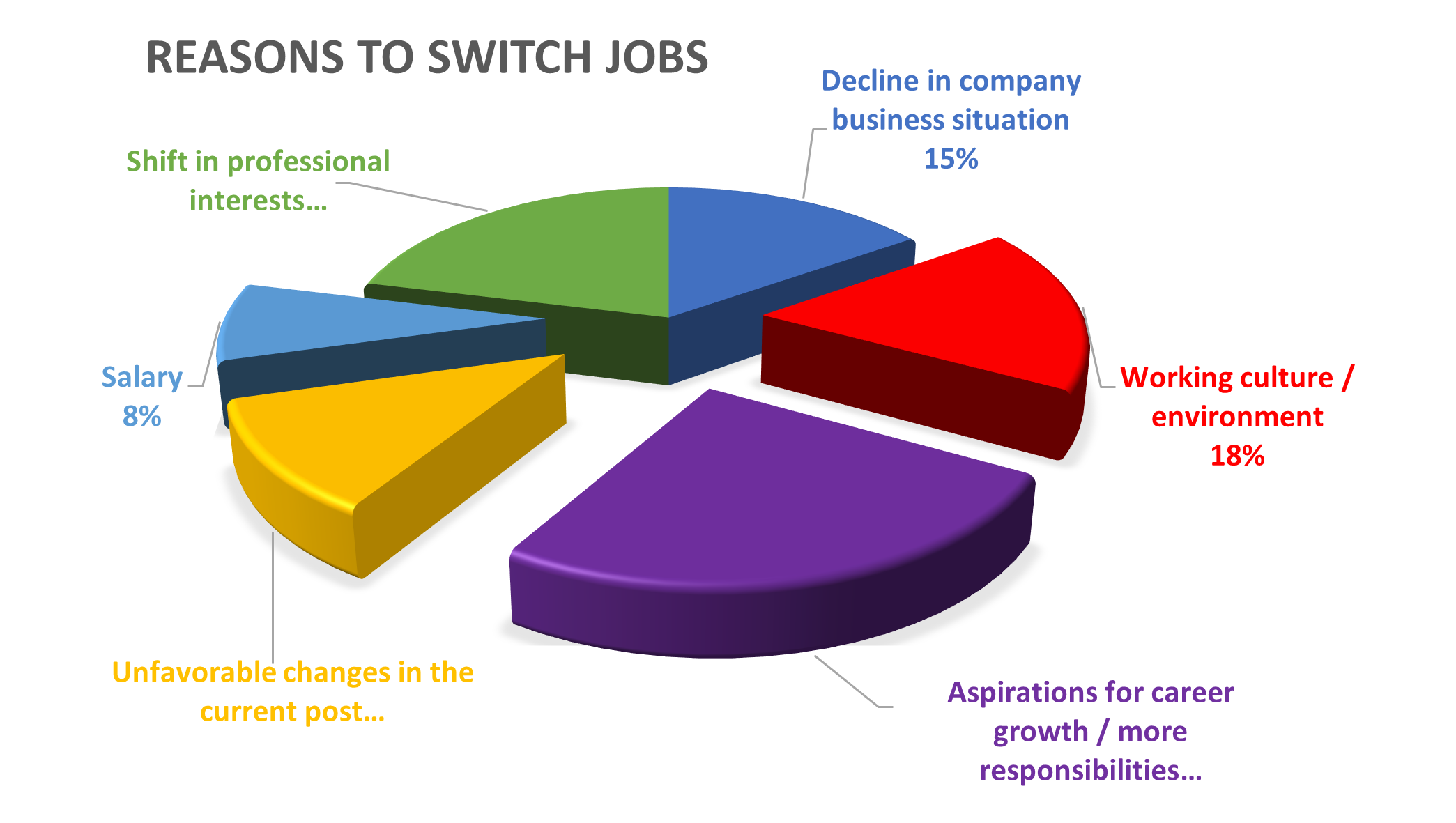
As the above chart shows, salary is often an important and a contributing factor to a person seeking to change jobs, but it’s rarely the main reason for leaving their current position.
In many cases, addressing some of the reasons above can help retain valuable talent for the long-term. Some solutions can be:
|
Work culture / environment |
Improve the work-life balance, team synergy, create an atmosphere of safety and trust |
|
Seeking career growth |
Work on a career plan with your employees, set clear targets and tangible timelines |
|
Salary |
Provide an annual raise or rewards based on certain achievements |
|
Unwelcome changes in current post |
If change is inevitable, then make it as smooth as possible and plan the timeline of the shift to reduce employee stress |
Ultimately, people will switch jobs when the number of reasons to do so outweigh those to stay in place. The best employers will take actions to tip the balance so that it is always in favor of the latter.
GLOBAL VIEW
BY JOHN VAROLI
Below are some of last week’s most important international energy developments monitored by the Japan NRG team because of their potential to impact energy supply and demand, as well as prices. We see the following as relevant to Japanese and international energy investors.
Australia/ Energy transition
Construction began at both ends of a new transmission network — the $2.3 billion Project EnergyConnect that will link renewables-rich South Australia with coal-dominated New South Wales. The 900 km network will help bring online about 2.5 GW of new wind and solar capacity, and it will improve grid reliability.
Chad/ Renewables
UK-based Savannah Energy will develop up to 500 MW of utility-scale renewables. The first project comprises 300 MW of solar and a battery energy storage system (BESS) that will provide power for the Doba Oil Project. It’s due to be operational in 2025.
China/ EVs
China’s car exports are increasing, and most are EVs sold to Europe. From almost nothing a few years ago, China exported about 500,000 EVs in 2021; its share of the EU market is surpassed only by Germany. As the auto market transitions to EVs, Europe might soon run a trade deficit with China in cars. By the end of 2022, there’ll be more than 27 million EVs on the road out of a global fleet of more than 1 billion cars.
Denmark/ Natural gas
Ørsted said Russia stopped gas supplies to Denmark after it refused Moscow’s ruble payments scheme. In previous weeks Moscow has halted gas supplies to Finland, Poland and Bulgaria also for refusing ruble payments. This week, gas was turned off to the Netherlands.
EU/ Oil ban
The EU will ban seaborne Russian oil imports. However, landlocked countries such as Hungary, can continue pipeline shipments. Germany and Poland will end pipeline purchases later this year; combined with the seaborne ban, Russian oil exports to the EU will decline by 90% by 2023. Russia produced about 10% of global oil supplies before the war.
Fossil fuel assets
University of Massachusetts’ researchers said that existing oil and gas projects worth $1.4 trillion could lose value if the world slashes carbon emissions through determined climate action. This would impact investments of $756 billion from pension funds and other sources.
Green steel
Iberdrola, Vattenfall, and Siemens Gamesa committed to 100% net-zero steel by joining the initiative, SteelZero, which is led by Climate Group in partnership with Responsible Steel. The main target is 50% low-emission steel by 2030, and to reach net zero by 2050.
India/ Coal and Renewables
Record renewable energy output reduced coal use in May, despite a 23% growth in power demand. Renewable energy’s share in India’s power output rose to 14% in May, up from 10% in April. Coal dropped to 72.4% of national generation, down from 76.8%. Coal’s share, however, was still higher than 70.9% in May 2021.
Oil prices
Higher oil prices are here to stay as the transition from fossil fuels will contribute to a coming economic “hurricane”, said Jamie Dimon, the long-time Chief Executive of JPMorgan Chase. “That hurricane is out there, down the road, coming our way,” Dimon said during an investor conference. “The chance of getting this right is virtually nil. I don’t think we remotely understand the complexity.”
South Korea/ Offshore wind
Norway’s Equinor plans to build 4-6 GW of offshore wind capacity. The first farm, known as ‘Firefly’, will have 800 MW of capacity, cover 58 sq/miles, and will be operational by 2029. Equinor is also in talks with South Korean firms to produce turbines and cables for the project. The country aims for renewables to account for 20-25% of the national power mix by 2030, up from the current 6.6%.
UAE/ Green hydrogen
Three South Korean firms — Korea Electric Power Corp, Samsung C&T Corp and Korea Western Power — will work with the United Arab Emirate’s Petrolyn Chemie to build a $1 billion green hydrogen and ammonia plant near the capital Abu Dhabi. Once built, the plant will produce up to 200,000 tons of green ammonia a year.
2022 EVENTS CALENDAR
A selection of domestic and international events we believe will have an impact on Japanese energy
|
January |
OPEC quarterly meeting; JCCP Petroleum Conference – Tokyo; EU Taxonomy Climate Delegated Act activates; Regional Comprehensive Economic Partnership (RCEP) Trade Agreement that includes ASEAN countries, China and Japan activates; Indonesia to temporarily ban coal exports for one month; Regional bloc developments: Cambodia assumes presidency of ASEAN; Thailand assumes presidency of APEC; Germany assumes presidency of G7; France assumes presidency of EU; Indonesia assumes presidency of G20; and Senegal assumes presidency of African Union; Japan-U.S. two-plus-two meeting; Japan’s parliament convenes on Jan. 17 for 150 days; Prime Minister Kishida visits Australia (tentative) |
|
February |
Chinese New Year (Jan. 31 to Feb. 6); Beijing Winter Olympics; South Korea joins RCEP trade agreement |
|
March |
Renewable Energy Institute annual conference; Smart Energy Week – Tokyo; Japan Atomic Industrial Forum annual conference – Tokyo; World Hydrogen Summit – Netherlands; EU New strategy on international energy engagement published; End of 2021/22 Japanese Fiscal Year; South Korean presidential election |
|
April |
Japan Energy Summit – Tokyo; MARPOL Convention on Emissions reductions for containerships and LNG carriers activates; Japan Feed-in-Premium system commences as Energy Resilience Act takes effect; Launch of Prime Section of Japan Stock Exchange with TFCD climate reporting requirement; Convention on Biological Diversity Conference for post-2020 biodiversity framework – China; Elections: French presidential election; Hungarian general election |
|
May |
World Natural Gas Conference WCG2022 – South Korea; Elections: Australian general election; Philippines general and presidential elections |
|
June |
Happo-Noshiro offshore wind project auction closes; Annual IEA Global Conference on Energy Efficiency – Denmark; UNEP Environment Day, Environment Ministers Meeting – Sweden; G7 meeting – Germany |
|
July |
Japan to finalize economic security policies as part of natl. security strategy review; China connects to grid 2nd 200 MW SMR at Shidao Bay Nuclear Plant, Shandong; Czech Republic assumes presidency of EU; Elections: Japan’s Upper House Elections; Indian presidential election |
|
August |
Japan: Africa (TICAD 8) Summit – Tunisia; Kenyan general election |
|
September |
IPCC to release Assessment and Synthesis Report; Clean Energy Ministerial and the Mission Innovation Summit – Pittsburg, U.S.; Japan LNG Producer/Consumer Conference – Tokyo; IMF/World Bank annual meetings – Washington; Annual UN General Assembly meetings; METI to set safety standards for ammonia and hydrogen-fired power plants; End of 1H FY2022 Fiscal Year in Japan; Swedish general election |
|
October |
EU Review of CO2 emission standards for heavy-duty vehicles published; Chinese Communist Party 20th quinquennial National Party Congress; G20 Meeting – Bali, Indonesia; Innovation for Cool Earth TCFD & Annual Forums – Tokyo; Elections: Okinawa gubernational election; Brazilian presidential election; |
|
November |
COP27 – Egypt; U.S. mid-term elections; Soccer World Cup – Qatar; |
|
December |
Germany to eliminate nuclear power from energy mix; Happo-Noshiro offshore wind project auction result released; Japan submits revised 2030 CO2 reduction goal following Glasgow’s COP26; Japan-Canada Annual Energy Forum (tentative); Tesla expected to achieve 1.3 million EV deliveries for full year 2022 |
Disclaimer
This communication has been prepared for information purposes only, is confidential and may be legally privileged. This is a subscription-only service and is directed at those who have expressly asked K.K. Yuri Group or one of its representatives to be added to the mailing list. This document may not be onwardly circulated or reproduced without prior written consent from Yuri Group, which retains all copyright to the content of this report.
Yuri Group is not registered as an investment advisor in any jurisdiction. Our research and all the content express our opinions, which are generally based on available public information, field studies and own analysis. Content is limited to general comment upon general political, economic and market issues, asset classes and types of investments. The report and all of its content does not constitute a recommendation or solicitation to buy, sell, subscribe for or underwrite any product or physical commodity, or a financial instrument.
The information contained in this report is obtained from sources believed to be reliable and in good faith. No representation or warranty is made that it is accurate or complete. Opinions and views expressed are subject to change without notice, as are prices and availability, which are indicative only. There is no obligation to notify recipients of any changes to this data or to do so in the future. No responsibility is accepted for the use of or reliance on the information provided. In no circumstances will Yuri Group be liable for any indirect or direct loss, or consequential loss or damages arising from the use of, any inability to use, or any inaccuracy in the information.
K.K. Yuri Group: Oonoya Building 8F, Yotsuya 1-18, Shinjuku-ku, Tokyo, Japan, 160-0004.