
JAPAN NRG WEEKLY
JUNE 13, 2022
TWO-YEAR ANNIVERSARY EDITION
JAPAN NRG WEEKLY
June 13, 2022
NEWS
TOP
- Possibility of rolling blackouts in winter looms as the government warns about negative power reserve ratio in the Tokyo area
- Interfering in nuclear regulator’s work a “big mistake,” says the watchdog’s former chief as he also slams the SMR trend
- Shortage of professionals may cause blackouts at renewables projects as absence of appropriate cadres takes toll
ENERGY TRANSITION & POLICY
- METI to write rules for power serviced by storage batteries
- Large businesses to report energy transition schedules from 2023
- Mitsui, ENEOS, ADNOC sign accord for UAE hydrogen supply
- Tokyo Gas, Shell study projects in CCUS, hydrogen, and syngas
- JERA, Tokyo Gas invest in one of world’s top CO2 storage hubs, while Marubeni and J-Power fund a separate development
- Chiyoda leads Japanese group in CO2 recovery trial
- Japan Exchange sets terms for Digitally Tracked Green Bonds
- Osaka Gas invests in Australian carbon credits
- Sharp sets efficiency record with flexible solar panel modules
ELECTRICITY MARKETS
- TEPCO to offer demand-response service to 450,000 households
- Kansai Electric shuts down nuclear reactor for maintenance
- Idemitsu, INPEX and Mitsui Oil to build new geothermal capacity; Chubu Electric and Renova among others exploring this sector
- New offshore wind auction rules may hurt industry development
- Tohoku Electric plans several wind projects in the Aomori area
- Kansai Electric submits plans for two wind farms in Hokkaido
- JAPEX, Maeda and others invest in 50 MW biomass power plant
- Tokyo Gas and UK’s Octopus expanding retail service nationwide
OIL, GAS & MINING
- Japan walks energy tightrope amid gas shortages
- LNG stockpiles rise to the highest level this year
- Iwatani secures stake in rutile miner to secure titanium alternative
ANALYSIS
PM KISHIDA OPENS STATE TAPS
TO HELP JAPAN MEET NET-ZERO TARGETS
Japan’s state funds for the energy transformation look set to get bigger and more numerous in the coming months as Prime Minister Kishida’s drive for a more active government role filters into policy. The PM’s Clean Energy Strategy is due this summer. Its early outlines and ministry announcements, as well as media leaks, suggest a surge in national spending to levels that, as METI describes it, “have no past comparison.” Japan needs $1.2 trillion for decarbonization over the coming decade to meet its 2050 net-zero goals, according to METI. The funds look set to flow through various channels and ministries.
MAJOR POWER UTILITIES START TO EMBRACE
SOLAR POWER’S PPA BUSINESS MODEL
After years of distrust in green energy pricing models, Japan’s major power utilities are warming to the business potential of renewables. Recently, a number of the big utilities, ventured into the realm of Power Purchase Agreements (PPAs) for the first time, testing a business model that offers to boost the adoption of solar power among Japanese business consumers. Two of the utilities recently got their first corporate PPA orders. Another has established a joint venture with a trading house to promote the PPA business.
GLOBAL VIEW
Experts warn OPEC’s ability to bring more crude oil to market is less than the drop in Russian exports. Posco warns of the costs of moving steel output to hydrogen. An accident at U.S. LNG terminal affects exports for a month. Wind energy hits record in Ireland. Trafigura says worst of global energy crisis yet to come. Details on these and more in our global wrap.
ANALYSIS INDEX 2020-2022
A table of the texts over the last 2 years. Separate file.
JAPAN NRG WEEKLY
PUBLISHER
K. K. Yuri Group
Editorial Team
Yuriy Humber (Editor-in-Chief)
John Varoli (Senior Editor, Americas)
Mayumi Watanabe (Japan)
Wilfried Goossens (Japan, Events)
Regular Contributors
Chisaki Watanabe (Japan)
Takehiro Masutomo (Japan)
Daniel Shulman (Japan)
Art & Design
22 Graphics Inc.
Events

SUBSCRIPTIONS & ADVERTISING
Japan NRG offers individual, corporate and academic subscription plans. Basic details are our website or write to subscriptions@japan-nrg.com
For marketing, advertising, or collaboration opportunities, contact sales@japan-nrg.com For all other inquiries, write to info@japan-nrg.com
OFTEN USED ACRONYMS
METI The Ministry of Energy, Trade and Industry
MOE Ministry of Environment
ANRE Agency for Natural Resources and Energy
NEDO New Energy and Industrial Technology Development Organization
TEPCO Tokyo Electric Power Company
KEPCO Kansai Electric Power Company
EPCO Electric Power Company
JCC Japan Crude Cocktail
JKM Japan Korea Market, the Platt’s LNG benchmark
CCUS Carbon Capture, Utilization and Storage
mmbtu Million British Thermal Units
mb/d Million barrels per day
mtoe Million Tons of Oil Equivalent
kWh Kilowatt hours (electricity generation volume)
NEWS: ENERGY TRANSITION & POLICY

Grid Transmission Council warns renewable operators of management shortfalls
(Japan NRG, June 6)
- Management shortfalls at some renewable operators connecting to the grid network are serious enough to cause blackouts, said the Transmission and Distribution Grid Council before the four-ministry panel studying community conflicts and the renewables sector. The Council reported technical errors in the connection process, absence of contactable on-site managers and cases of some renewable operators delaying construction, upsetting interconnection schedules. The panel launched in April and consists of METI and three ministries for infrastructure, agriculture and environment.
- CONTEXT: More businesses are installing their own power generators not only on roof tops but also with biomass, geothermal and other renewable systems that can connect to the grid.
- METI is likely first to tighten the rules for solar. Small solar power stations under 50 kW do not need to appoint a technical manager, and those below 5,000 kW are able to appoint external parties as managers.
- Transmission networks will become complex as connections with renewables increase. Solar and wind operators will be adding storage battery systems for connection. The transmission operators will need to find technical solutions to improve network resilience, because human errors are bound to increase with more parties interconnecting.
METI to write rules for power serviced by storage batteries
(Japan NRG, June 8)
- By the end of 2022, METI plans to set rules for supplying power from storage batteries, as solar and wind operators will be installing battery systems to store redundant power. METI’s tasks include designing mechanisms to reflect additional battery system costs on the feed-in-tariff and feed-in-premium rates, setting up systems to accurately measure the amount of electricity from power generators and storage systems, and deciding how storage batteries fit in the non-fossil fuel certificates and capacity auction schemes.
Large businesses to report energy transition schedules starting July 2023
(Japan NRG, June 9)
- Large businesses consuming over 1,500 kl of oil or the equivalent amount of energy annually will be required to report energy transition schedules starting 2023; the first deadline was set at July 31, 2023. This follows the Energy Conservation Act Amendments that passed parliament last month and will be enforced in April 2023.
Ex-chair of nuclear regulator says “big mistake” to intervene in watchdog processes
(Bloomberg, June 10)
- Nuclear Regulation Authority (NRA) former chairman Shunichi Tanaka, 77, said it was a “big mistake” for politicians in Japan to intervene in the watchdog’s processes despite criticism that the state agency was too slow.
- CONTEXT: Tanaka served as chair from the NRA’s founding in 2012 until 2017. PM Kishida recently said the regulatory review should be made more efficient.
- Tanaka noted that many Japanese nuclear reactors have yet to complete upgrades to bring their anti-terrorism measures in line with new regulations. Rather than focusing public attention on the regulator, politicians should canvass the public to be more supportive of reactor restarts.
- One of the longest NRA reviews is at the Tomari NPP in Hokkaido. Tanaka said the review was stuck because of an inability to determine if the facility stands on an active geological fault. That decision is based on views of outside experts, but the academics involved “cannot make a decision”.
- Tanaka also poured cold water on the idea that Japanese utilities might be interested in SMRs, saying that small and medium-sized reactors require the same safety levels as large units and the overall economics do not work.
Mitsui, ENEOS and ADNOC sign hydrogen agreement
(Company Statement, June 7)
- Mitsui, ENEOS and Abu Dhabi National Oil Corp signed a joint study agreement to produce blue hydrogen in the United Arab Emirates and export to Japan by converting the molecules into methylcyclohexane (MCH).
- The three will verify technologies needed to run a 50,000 tons/ year production facility, and will do a feasibility study on the potential to expand to commercial production of 200,000 tons/ year.
- In phase 1, by-product hydrogen generated in the Ruwais Industrial Area will be used. In phase 2, blue hydrogen will be produced from natural gas. METI minister Hagiuda attended the signing ceremony.
- CONTEXT: Japan is the largest buyer of ADNOC’s oil and gas, and ADNOC has businesses with all oil refiners and integrated trading houses. Cosmo Oil owns shares of ADOC, its upstream arm. Idemitsu and ADNOC signed a blue ammonia sales agreement last year.
Tokyo Gas and Shell to study projects in CCUS, hydrogen, syngas and more
(Company Statement, June 6)
- Tokyo Gas and a unit of Shell signed an MoU to study opportunities in synthetic gas, hydrogen, bio-methane and CCUS to develop new decarbonization solutions.
- For synthetic gas, Osaka Gas is also involved as a joint study partner.
- CONTEXT: Tokyo Gas has set a target of introducing synthetic gas equivalent to 1% of its total gas sales volume as of 2030.
JERA, Tokyo Gas invest in one of world’s top underground CO2 storage hubs
(Nikkei, June 9)
- JERA, Tokyo Gas and INPEX joined a ¥100 billion ($748 million) project led by Australian energy company Santos to store CO2 underground.
- In addition to CO2 as a byproduct of LNG production, the storage facility located near Darwin will also store CO2 shipped from Japan. The planned CCS plant could store up to 10 million tons of CO2 a year, aiming for operation around 2025.
- CONTEXT: This is billed as potentially the world’s largest carbon capture and storage project. At issue here is also the transport of CO2, which would need to be done in liquid form.
Marubeni and J-Power fund Glencore’s carbon storage project in Queensland
(Company Statement, June 8)
- Marubeni Corporation and J-Power will each fund A$10 million in Glencore’s CTSCo Carbon Capture and Storage (CCS) Project in Queensland, Australia. Both Japanese companies are long term joint venture partners in Glencore’s local mining operations.
- The CTSCo Project focuses on capturing CO2 from the Millmerran coal-fired power station and permanently storing it deep underground in a site 100km away.
- A comprehensive environmental impact assessment is in progress, with the aim of starting CO2 injection in 2025.
Chiyoda, JERA, RITE in CO2 recovery trial
(Nikkei, June 7)
- A consortium comprising Chiyoda Corporation, JERA, and the Research Institute of Innovative Technology for the Earth (RITE) began developing technology to absorb CO2 from exhaust gases emitted by gas-fired power stations, using solid media in the form of amines.
- Solid absorption media offer cost advantages over liquid counterparts.
- The consortium aims to perfect the technology by 2024.
Japan Exchange creates terms for issuance of Digitally Tracked Green Bond
(Kankyo Business, June 3)
- Japan Exchange Group has determined the terms and conditions for the issuance of “Wholesale Digitally Tracked Green Bond”, the first environmental bonds in Japan that will utilize blockchain and other digital technologies.
- The first set of issuances in Japan of these bonds will amount to ¥500 million, with each one for ¥100 million. The term of the bonds is one year, and the interest rate is 0.050% per annum. The funds raised will be used for capital investment in solar and biomass power generation facilities.
- JPX is collaborating with Hitachi, blockchain specialist BOOSTRY, and Nomura Securities to develop the new bonds.
- Earlier statement on the development from JPX: here.
Osaka Gas invests in Australian carbon credits
(Denki Shimbun, June 10)
- Osaka Gas invested in Australian Integrated Carbon, which specializes in “carbon farming”.
- The utility acquired a 16.7% stake in AI Carbon for an undisclosed amount.
- AI Carbon sells carbon credits from projects to regenerate native bush.
- Osaka Gas hopes to expand its use of carbon credits beyond Australia.
Newspaper investigation finds “ghost” carbon credit projects
(Nikkei Shimbun, June 11)
- A Nikkei investigation of forest-based carbon credits revealed “ghost projects” in the Central American region that have ceased operations, but whose certificates are still traded as if the project is current due to outdated databases.
- The newspaper identified such a project in southern Belize. In recent years, firms that have bought credit based on the project’s database include Japan’s JAPEX.
- CONTEXT: Carbon credits are coined when projects save the emissions of CO2 either by reducing output at facilities or preventing the emergence of new pollution sources. One category of credits is for protecting forests, but some say the quality of many forest-related projects is in doubt.
Turquoise’ hydrogen offers Japan new path to decarbonization
(Nikkei Asia, June 5)
- Japanese industrial machinery maker Ebara is working on a new method to produce “turquoise” hydrogen, hoping to commercialize it by 2026.
- Turquoise hydrogen is produced from methane contained in natural gas and biogas through a decomposition process called pyrolysis. Carbon produced in the process is in solid form, and not released into the atmosphere.
- The company has teamed up with the National Institute for Materials Science, Shizuoka University and materials maker Taiyo Koko. State-backed New Energy and Industrial Technology Development Organization commissioned the project.
- CONTEXT: Hydrogen can be classified as “green” — generated by using renewable energy sources; or “blue,” which involves extraction from fossil fuels and uses carbon capture and storage technology to lessen emissions. Green hydrogen production doesn’t generate CO2, but is costly due to the amount of energy required, and the difficulty of carbon storage facilities remains an obstacle to blue hydrogen. Turquoise hydrogen is attractive because of its lower-cost making the fuel without CO2 emissions.
Mitsubishi Heavy starts study of ammonia co-firing in Indonesia
(New Energy Business News, June 7)
- Mitsubishi Heavy Industries (MHI) started a feasibility study for ammonia co-firing at existing thermal power plants in Indonesia.
- Two initial facilities were selected: the 4,025 MW Suralaya coal-fired power plant and the existing gas-fired power plant in Suralaya. The study will focus on production, transportation, fuel consumption, and CO2 levels. It will also look into the establishment of a value chain linked to carbon capture.
- METI is supporting this initiative, which also involves Nippon Koei.
Experts call for legislative framework for solar panel recycling
(Denki Shimbun, June 9)
- An expert panel that includes METI representatives urged the government to take rapid action to regulate the recycling of solar panels.
- The number of solar panels discarded in Japan every year is projected to peak in the 2030s.
Sharp sets efficiency record with flexible solar panel
(ImpressWatch, June 6)
- Sharp successfully developed a flexible solar module that is 32.6% efficient, setting a new world record.
- The technology was developed thanks to a grant from the New Energy and Industrial Technology Development Organization.
- Weighing 580 g/m² the module is suited to EV and avionic applications.
ENEOS takes over NEC’s EV charging stations
(Kankyo Business, June 7)
- ENEOS has taken over part of the electric vehicle (EV) recharging service business of IT major NEC, taking over approximately 4,600 EV rechargers.
- The two companies have looked to collaborate in expanding EV charging networks and creating new related services. The two agreed that ENEOS will operate and manage the EV rechargers that NEC has operated to date, and that NEC will continue to provide the EV recharger operation and management system.
- Discussions around transferring all of NEC’s EV chargers to ENEOS continue.
Sony eyes ‘independent’ EV joint venture with Honda
(Nikkei Asia, June 6)
- The CEO of Sony Group said the company’s planned JV with Honda Motor may hold a public share offering as they prepare to develop EVs together.
- The JV will be formed by the end of 2022, and the first EVs sold in 2025.
- Sony will develop the car’s software and entertainment content, such as movies and music; Honda will provide the car’s hardware and safety features.
Itochu and INPEX introduce renewable diesel to Japan’s trucks
(Company Statements, June 7)
- INPEX and trading house Itochu Corporation, as well as their related companies, are cooperating to convert Japanese tank trucks to run on renewable diesel.
- Itochu will supply the fuel that’s made from renewable materials by Finland’s Nest OYJ, to INPEX Logistics. It will be pumped into 18 tank trucks that transport domestic crude and petroleum products in the Hokuriku and Koshinetsu regions.
- CONTEXT: Itochu is Neste’s distributor of green fuels in Japan.
Toyota develops portable hydrogen cartridge
(Company Statement, June 2)
- Toyota unveiled a prototype of a portable hydrogen cartridge that promises to facilitate the use of the fuel in its futuristic “woven city” development.
- The 40 cm long cartridge weighs around 5 kg when full.
Toho Gas to create hydrogen production plant in Japan
(Nikkan Kogyo Shimbun, June 7)
- Toho Gas will construct a hydrogen production line that will use natural gas as the feedstock at its Chita Midorihama Plant (Chita City, Aichi Prefecture). The investment is expected to be in the billions of yen. Output is expected to be 1.7 tons of hydrogen per day.
- The hydrogen will be compressed and shipped by tanker truck. The fuel is expected to be used for heat generation, such as in industrial furnaces and burners, as an industrial raw material, and for fuel cell vehicles (FCVs).
- The company also aims to expand the plant to receive imported hydrogen.
Nippon Steel eyes $1.1bn expansion for automotive steel in India
(Nikkei Asia, June 1)
- A JV between ArcelorMittal and Nippon Steel will spend roughly $1.1 billion to build advanced steel processing lines in India. The lines will be installed at AM/NS India’s plant in Gujarat state, and include a cold-rolling mill and a hot-dip galvanizing line. Production will start in 2024.
- There are plans to slash the facility’s carbon footprint. AM/NS aims to secure 250 MW from renewable sources, meeting an estimated 20% of its electricity needs. Full-scale generation is expected to begin in 2024.
Synthos applies to establish SMR venture with GE Hitachi
(NNA Europe; June 8)
- Poland-based Synthos Green Energy applied to establish a JV with GE Hitachi Nuclear Energy (GEH). If approved, the new entity would market GEH’s small modular reactor tech.
NEWS: POWER MARKETS

Possibility of winter rolling blackouts looms
(Japan NRG, June 7)
- In January-February, Tokyo area power reserve rates are forecast at -0.5-0.6%, when demand will outstrip supply. Also, 1.3-2.8% power reserve rates are forecast for Chubu, Hokuriku, Kansai, Shikoku, Chugoku and Kyushu areas.
- METI is studying the possibility of issuing orders that enforce power consumption cuts and is calling to prepare for possible rolling blackouts.
- METI will also take the lead in securing supply capacity and publicly soliciting companies to procure additional fuel.
TAKEAWAY: As reported in the May 23 and June 6 issues of Japan NRG, METI will be issuing alerts two days before a possible power crunch. The power forecast systems have been fully automated, making accuracy of input data — temperatures, humidity, daylight hours, precipitation, and infrastructure data — crucial. The conservation drive might lose steam if people feel the alerts are false alarms.
- SIDE DEVELOPMENT:
Government calls on consumers to conserve electricity
(Mainichi Shimbun, June 7)- Chief Cabinet Secretary Matsuno made a public plea on June 7 for citizens to conserve energy during summer.
- This is the first time since 2015 that the Japanese government has officially requested citizens to conserve power.
- Matsuno asked to reduce energy consumption without compromising their standard of living or business activity.
- Air-conditioners should be set at 28°C.
TEPCO to roll out demand-response services to 450,000 households
(Denki Shimbun, June 9)
- TEPCO Energy Partner (EP) will roll out Demand Response (DR) services to households subscribing to its free rate plans. The company expects up to 450,000 customers to participate in the DR service between July and September, when the supply-demand power balance will be tight.
- CONTEXT: DR services allow consumers to be compensated for reducing their power demand or shifting it from peak times to those with lower general demand. This helps to alleviate the strain on the electricity grid during peak periods.
Kansai Electric shuts down nuclear reactor for maintenance
(Company Statement, June 6)
- Kansai Electric will start the regular inspection and maintenance of Unit 4 at its Takahama NPP (PWR, 870 MW) on June 8.
- The facility is due to be offline for about five months, switching back online in late October, and resuming full-scale output in mid-November.
- During the inspection, ultrasonic inspection of the reactor vessel welds will be conducted, and ultrasonic thickness measurements will be made in the secondary system piping.
TAKEAWAY: Currently, Japan has just three nuclear reactors online, with only one in the heavily industrial Kansai region. This does not bode well either for electricity prices nor energy security. For comparison, Japan had nine nuclear reactors online during the peak July-August period last year. Even if one or two come back on soon, this would likely only benefit the Kyushu area as those facilities are the closest to restarts.
The Kansai area will feel the strain the most during this summer, followed by the Tokyo area. It is well within the realm of possibility that rolling blackouts will be instituted or more subtle messages communicated to major power users. In the meantime, Japan’s demand for LNG and coal will remain strong to fill in the gaps.
Idemitsu, INPEX and Mitsui Oil to build new geothermal power plant
(Company Statements, June 6)
- Idemitsu Kosan, INPEX, and Mitsui Oil Exploration will jointly develop a 15 MW geothermal power plant near Yuzawa City, Akita Prefecture, that’s due to begin operating in March 2027.
- Investment is estimated at ¥20 billion. Electricity from the Katatsumuri Yama Power Plant will be sold to Tohoku Electric Power Network at ¥40/ kWh for 15 years under the feed-in tariff (FIT) system.
- Development of the project started in 2011 with financing from the state-run JOGMEC Corp. Idemitsu and INPEX each hold a 42.5% stake in the company operating the project, and Mitsui Oil the rest.
- CONTEXT: The plant will be Idemitsu’s third and INPEX’s first geothermal facility in Japan.
Chubu Electric considers geothermal power developments at several locations in Japan
(Denki Shimbun, June 9)
- Chubu Electric group company, Sea Energy, is considering new geothermal power plants at several locations in Japan.
- One site is in an area known as the “Ootana district” in Takayama City, Gifu Prefecture, where the company has already received agreement from the local community. At the time of the preliminary survey, a power facility with an output of 10 MW was seen as feasible.
- If approved, the project will be the utility’s second geothermal plant following the Nakao station that’s jointly owned by Toshiba Energy Systems.
Renova and partners search for new geothermal resources in Hokkaido
(Kankyo Business, June 8)
- Renova, Daiwa Energy Infrastructure, and Mitsubishi Materials started a geothermal resource survey for a new geothermal power plant in the Keiyama area of Hakodate city, Hokkaido.
- Mitsubishi Materials has recently invested in the project development company.
- The survey period is scheduled from April 2022 to February 2023.
New offshore wind auction rules hurt long-term industry development
(Gendai, June 7)
- CONTEXT: This is a column by Testsu Machida, an award-winning freelance journalist and an outside director of Japan Post Bank.
- The proposed shift in offshore wind auction criteria favoring speed of execution over price will incur long-term damage to the development of the industry in Japan. It will inevitably lead to higher power prices.
- This turn of events worries not only Mitsubishi Corporation, winner of the first round of auctions, but also other players such as JERA, TEPCO Renewable Power, Kyuden Mirai Energy, and Sumitomo Corporation.
- The renewables industry’s reliance on FIT has blunted the cost-competitive edge of many players. Instead of trying to challenge Mitsubishi on price they pushed the government to alter the terms of future auctions, thus prolonging the life of a concessionary payment system that keeps them from reforming their high-cost structures. This is what has kept Japan’s renewables prices high.
- The government’s proposed new rules could be read as saying that any bid that offers a price below the auction reference price will receive full points in the price category, rendering further competition on cost pointless.
- The government review may be open for public comment as early as September.
- As a result of all the changes, bidding for the Happo Town and Noshiro City, Akita Prefecture area rights, scheduled for this month (June 2022), is now expected to be delayed by about one year.
Tohoku Electric plans 100 MW of onshore wind projects in Aomori area
(Kankyo Business, June 3)
- Tohoku Electric plans to participate in the 4 MW Ohnakadai Wind Power Project (Towada City, Aomori Prefecture), and the 94.6 MW Fukamochi Wind Power Project (Towada City and Shichinohe Town, Aomori Prefecture).
- Eco-Words has conducted a feasibility study for the projects. Tohoku Electric invested in the operating company.
- The Ohnakadai project is due to start operating in November 2024. The Fukamochi still requires a feasibility study with construction to begin in FY2026 and operation to begin in FY2030 or later.
Kansai Electric to develop large wind power project in Hokkaido
(New Energy Business News, June 8)
- Kansai Electric plans to develop a wind power project in the vicinity of Furuhira-cho, Hokkaido. The maximum output would be 268.8 MW, and the Environmental Assessment Consideration Report for the project name “Furuhira, Niki, and Yoichi Wind Farm Project” has been released.
- The wind farm would take up approximately 8,546 ha in Kodaira Town, Niki Town, Yoichi City, and Kyowa Town in Iwanai County, and involve 64 wind turbines. The construction period is expected to be about 36 months.
- Sojitz’s Otaru Yoichi Wind Power Plant and other projects are planned in the vicinity.
- SIDE DEVELOPMENT:
Kansai Electric plans 84 MW wind project in Hokkaido
(New Energy Business News, June 9)- Kansai Electric plans to develop a wind farm in Yubari, Hokkaido area. The maximum output would be 84 MW.
- The project area is approximately 2,794 ha in Yubari City and Kuriyama Town, Yubari County, where up to 20 wind turbines would be installed. The construction period is expected to be about 36 months.
- There are no wind power generation projects in the surrounding area.
Power Development wind projects received ministry opinion for revisions
(New Energy Business News, June 10)
- MoE submitted its opinion in response to the Environmental Assessment Brief for the “Wajima Wind Farm” planned by Power Development Co. The report calls for adequate prior explanation of environmental conservation measures and their effects.
- The project, with a maximum output of 90.3 MW, involves the installation of 21 wind turbines in Wajima, Ishikawa Prefecture.
JAPEX, Maeda and others invest in 50 MW biomass power plant
(Sekiyu Tsushin, June 8)
- JAPEX, Maeda Corporation, and others have invested in the Ozu Biomass Power project to construct and operate a 50 MW biomass-fired power plant that will run on wood pellets imported from overseas.
- The plant is expected to generate approximately 350 million kWh of electricity annually, all of which will be sold to Shikoku Electric Power under the FIT system.
Tokyo Gas venture with UK’s Octopus Energy expanding all over Japan
(Denki Shimbun, June 8)
- TG Octopus Energy, an electric power retailer jointly owned by Tokyo Gas and Octopus Energy of the U.K., has expanded the supply area of its service to households throughout Japan, excluding Okinawa Prefecture.
- The company will offer two types of plans: Standard Octopus, a standard plan, and Green Octopus, a plan that is essentially 100% renewable energy.
TEPCO apologizes to evacuees after legal defeat
(Nikkei, June 5)
- TEPCO formally apologized to plaintiffs in a class action against the utility.
- TEPCO acknowledged irrevocable damage caused to the plaintiff’s living conditions and hometowns, and disruption caused to their lives TEPCO lost its appeal against the plaintiff’s challenge, making the Sendai High Court’s decision in favor of the plaintiffs binding.
- TEPCO must now pay approximately ¥730 million in compensation.
NEWS: OIL, GAS & MINING

Government walks energy tightrope amid gas shortages
(Shukan Economist, June 14)
- A METI report says that in the event of a one in ten-year heatwave, demand for electricity in areas supplied by TEPCO and Chubu Electric will exceed 97% of capacity.
- The forecasts for winter are even more pessimistic: a one in ten year cold snap would see electricity consumption in areas supplied by TEPCO exceed capacity by over half a percent in January and February.
- METI is considering imposing restrictions on gas usage, which would be an unprecedented situation for Japan’s reticulated gas suppliers.
- Restrictions would be complex to enforce, however, as not all Japanese households are supplied by reticulated gas. Japan’s gas network is also highly decentralized and relies on a diverse range of suppliers.
- Around 10% of Japan’s LNG is sourced from Russia.
TAKEAWAY: Concern about gas shortages in Japan are rising after the accident at the Freeport LNG facility in the U.S., which account for 20% of the U.S. export capacity. The plant supplies Japanese buyers such as JERA and Osaka Gas, with the former’s supplies already affected according to media reports.
LNG stocks rise to this year’s high of 2.14 million tons
(Government Data, June 8)
- LNG stocks stood at 2.14 million tons as of June 5, the highest so far this year. They were 1.99 million tons a week earlier. The end-June stocks last year were 2.04 million tons. The five-year average of end-June stocks is 1.95 million tons.
Iwatani acquires a stake in rutile miner Nordic Mining
(Company Statement, June 7)
- Japan’s largest hydrogen producer, Iwatani Corp, acquired a stake in the Norwegian rutile miner, Nordic Mining, for ¥2.6 billion. Iwatani did not disclose the stake size. The companies also signed an off-take agreement where Iwatani takes 20,000 tons/ year, or 60% of Nordic Mining’s rutile ore production. Iwatani owns a rutile mine in Western Australia and Nordic Mining will be its second supply base.
- CONTEXT: Russia and former CIS countries have high shares in the global titanium supply chain, causing producers and consumers outside the Russian block to review procurement strategies. Iwatani has a unique approach as most other Japanese rutile ore buyers purchase from India.
- Rutile ore is smelted and processed into titanium metal used for piping systems of nuclear plants, aircraft bodies, and weapons. Chemical grade titanium dioxide has a property to absorb carbon and is used for carbon capture products.
ANALYSIS
BY YURIY HUMBER
Kishida Opens State Taps to Meet Japan’s 2050 Net-Zero Targets
Japan’s state funds for the energy transformation look set to get bigger and more numerous in the coming months as Prime Minister Kishida’s drive for a more active government role filters into policy.
The PM’s Clean Energy Strategy is due to be published this summer. Its early outlines and ministry announcements, as well as media leaks, suggest a surge in national spending to levels that, as METI describes it, “have no past comparison.” Japan needs to invest ¥150 trillion ($1.2 trillion) in decarbonization over the coming decade in order to meet its 2050 net-zero goals, according to METI.
The funds will flow through various channels and ministries, such as the MoE, which is finally setting up its own state corporation to direct financing towards clean energy and power conservation initiatives.
When Japan made its initial net-zero pledge in late 2020, a frequent criticism was how little government finance was set aside specifically for this task. Now, Kishida is set to turn on the taps in a big way.
Background
The initial net-zero pledge made by former PM Suga was soon followed by the Green Growth Strategy. The document outlined 14 sectors that need to grow or modernize in order to reduce Japan’s emissions, including the creation of an offshore wind industry.
The Strategy painted broad strokes and promised to establish key pillars such as guidelines for transition finance, regulatory reform in areas such as hydrogen, offshore wind, and batteries, as well as revitalized a dying discussion around carbon taxes / pricing. Indeed, many of these tenets have been built or are on the way.
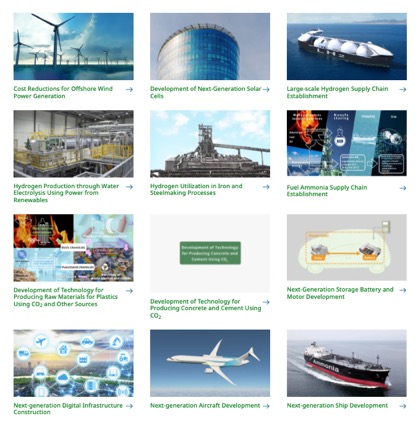
Yet, the money is where Suga’s policies felt weak. The Green Growth Strategy gave birth to a Green Innovation Fund. This ¥2-trillion, 10-year institution is now run by NEDO, under the auspices of METI, and pumps finance into the early-stage R&D of private companies. As a tool to push high-cost innovation into areas such as “green” steel, methanation, improved electrolyzers for making ammonia and so on, it has been arguably a success. But most of these innovations will likely begin their commercial life at the end of this decade if not later, and will need years to take root.
Kishida’s rush to turn the fiscal taps is about jump-starting projects and tech that can be applied sooner and at a bigger scale.
MoE’s got a brand-new fund
A good example of the specific nature of government spending under Kishida is a new state corporation established by the MoE. In contrast to the Green Innovation Fund, MoE’s excitingly titled Decarbonization Support Mechanism Corp will focus on products and services that have already reached the stage of commercialization, or are nearly there.

Source: NEDO
As the corporation provided financial and other support for projects that the private sector deems too risky to introduce otherwise, MoE will in effect be helping to scale up tech that needs the final push to succeed commercially.
Money will flow into floating offshore wind, non-FIT solar, biomass, hydropower, food and wood waste recycling, geothermal power, the circular economy, electricity conservation and afforestation projects. Funding methods will include equity participation, mezzanine finance, and debt guarantees.
The Decarbonization Support Mechanism will be officially set up in October 2022 and receive about ¥20 billion for its first year. The budget is expected to grow later and only half will come from government funds as it will be run as a public-private entity.
As Environment Minister Yamaguchi optimistically said, the MoE hopes it will support a much bigger scale of projects: “To achieve decarbonization we need to do everything in our capacity and in full force.”
Yamaguchi also expressed hope that the entity will help attract large amounts of ESG funds to Japan’s decarbonization initiatives, adding that whoever controls net-zero tech will control the next era of industrial development.
MoE’s new entity is expected to operate for 28 years; its current mandate runs to 2051. It will receive initial funds from the national fiscal investment loans (財政投融資) program and take over the energy conservation projects currently overseen by the state Green Finance Promotion Organization.
The ministry is reportedly already in talks with companies that may need financial support from the new entity. This is not an official pre-screening, but an information collection exercise, says the MoE.
State-backed finance tsunami
The above is only one of several public-private financing initiatives planned by Kishida. Others include setting up a functional carbon credits market, which officials hope will not only accelerate corporate efforts to cut emissions but also attract private money to decarbonization. The market’s current soft-launch phase is known as the GX (Green Transformation) League.
Another initiative is the government’s plan to issue Japan’s first debt specifically to fund decarbonization. The so-called green bonds market is already active in Japan and globally, and more than a dozen countries have sold green bonds to date. Kishida’s vision, however, is to set a broader mandate for the debt than a typical green bond, which is reserved for investments in renewable energy.
Kishida’s Clean Energy Strategy is likely to discuss three types of net-zero financing: Transition, Innovation, and Green, according to a work-in-progress outline presented by METI. The work of the Asia Energy Transition Initiative (AITI), covered by Japan NRG in the May 16 issue, will be closely connected with this.
In addition, Kishida wants Japan to pursue “GX Economic Transition Bonds” (temporary name, Japanese original: GX経済移行債). As much as ¥20 trillion of such bonds may be issued this summer. This money would then be channeled to areas such as hydrogen, ammonia and other non-fossil energies, as well as energy conservation. The idea is to provide more funding visibility than the annual nature of government budgets allows.
Non-fossil energy development could also include using the funds raised for investments in nuclear power, as that is already confirmed by Kishida as a necessary and CO2-free source for Japan.
Overseeing the bond issuance will be the GX Implementation Council, a new state panel that will seek to tie all of Kishida’s and his predecessors’ initiatives into a coherent strategy.
The financing figures and the number of funds, entities, and panels are proliferating under Kishida. It will be up to the PM to make the larger ecosystem work.
Net-zero investments needed per year in Japan, according to METI
|
Renewables |
¥2 trillion |
Energy efficient homes and buildings |
¥1.8 trillion |
|
Hydrogen / ammonia |
¥0.3 trillion |
Next-gen mobility |
¥1.8 trillion |
|
Battery manufacture |
¥0.6 trillion |
Infrastructure system expansion |
¥0.5 trillion |
|
Power conservation in manufacturing |
¥1.4 trillion |
Infrastructure for electric vehicles |
¥0.2 trillion |
|
Heat pumps, co-gen at industrial plants |
¥0.5 trillion |
Move to digital in broader society |
¥3.5 trillion |
|
Carbon recycling |
¥0.5 trillion |
Nuclear energy |
¥0.1 trillion |
|
Carbon neutral manufacturing |
¥0.1 trillion |
Realization of CCS |
¥0.6 trillion |
ANALYSIS
BY JAPAN NRG TEAM
Major Power Utilities Embrace Solar Power’s PPA Model
After years of distrust in green energy pricing models, Japan’s major power utilities are warming to the business potential of renewables. Recently, a number of the big utilities (EPCos), ventured into the realm of Power Purchase Agreements (PPAs) for the first time, testing a business model that offers to boost the adoption of solar power among Japanese business consumers.
The push into PPAs is led by Hokkaido Electric and Okinawa Electric, both of which have recently received their first corporate PPA orders. Also, Shikoku Electric has established a new joint venture with Sumitomo Corp to promote the PPA business model.
Corporate PPAs are a growing global trend. The scheme has emerged as an effective means to mobilize private sector capital in support of the energy transition, allowing renewable energy projects to progress while supplying green electricity for corporations eager to advance their sustainability goals.
With a typical duration of 10- to 25-years, corporate PPAs create a direct long-term power supply contract between an electricity generator and a large energy consumer, which is usually not involved in the energy sector; for example a Big Tech firm, or an industrial major, such as an aluminum producer.
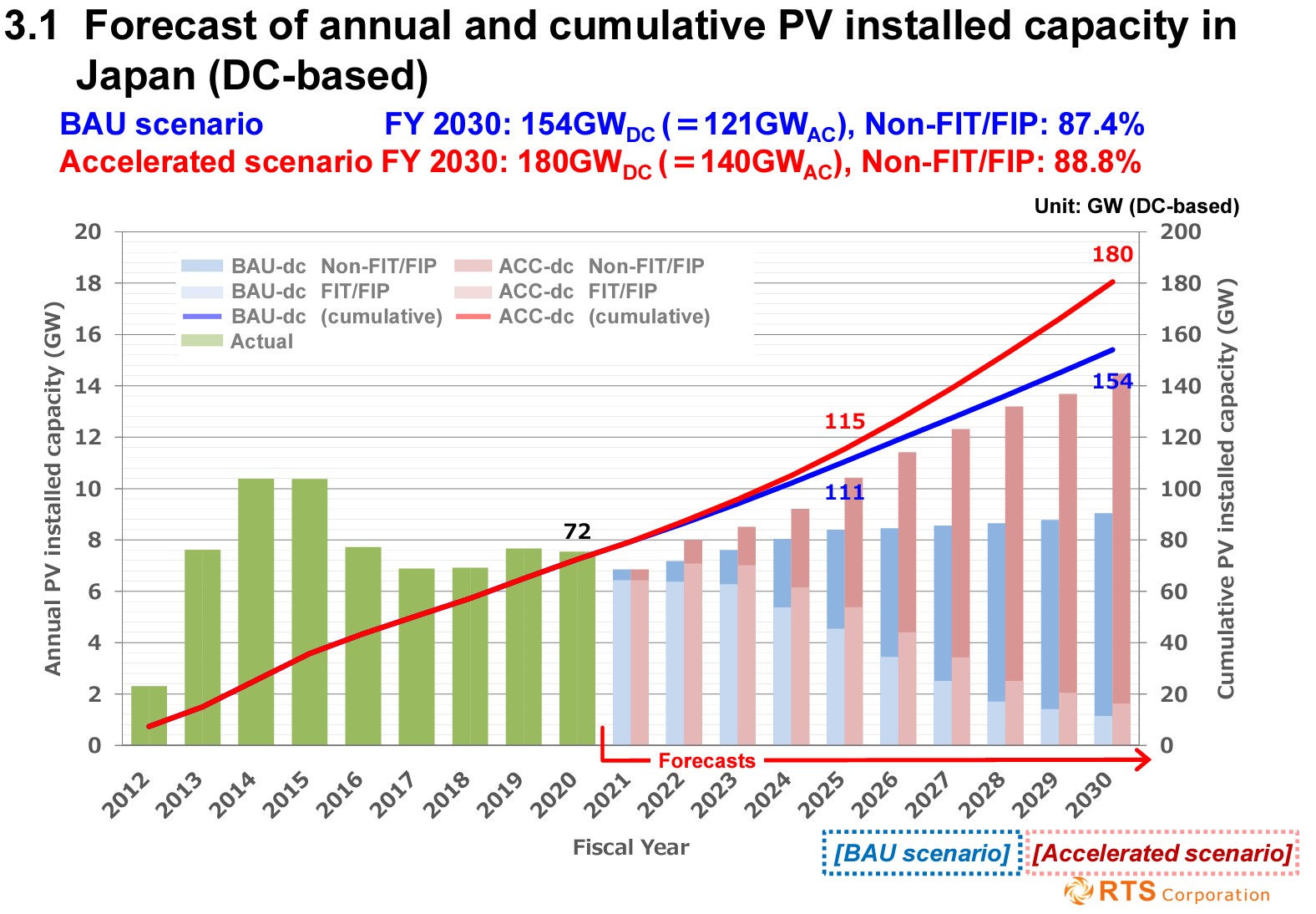
In 2021, corporations across the globe bought a record 31 GW of clean power through long-term PPAs, which was a 24% increase on the previous record of 25 GW set in 2020.
 Source: RTS Corporation
Steady long-term revenue and predictable returns
This April, Japan has started to phase out one of the first catalysts of the renewables revolutions in the country since 2012. The feed-in tariffs (FIT), which used to apply to nearly all renewable energy sources, will remain only for a small subset of projects that have yet to approach market competitive levels.
In FIT’s stead comes the more complex feed-in-premium (FIP) program, which encourages project operators to invest in other options such as battery storage to make up for a less lucrative fixed tariff for the initial installation.
The maturing renewables market, and the shift away from FIT, is encouraging renewable energy companies to explore other options to secure steady long-term revenue and predictable returns. PPAs offer just that.
In the case of Hokkaido Electric, the first solar PPA contract was signed last summer with the local unit of Japan’s top supermarket brand, AEON. The utility will own and install the solar facilities on AEON’s premises as a third party and supply the electricity they generate.
This arrangement allows the supermarket chain to access “captive” green electricity without making any initial investment. What’s more, Hokkaido Electric will handle the inspections of the PV installations and the renewals of ancillary and other equipment, reducing AEON’s administrative burden.
Hokkaido Electric struck a similar arrangement with another local supermarket chain, MaxValu, which has stores in a dozen cities and towns across the prefecture. So far, two MaxValu stores have been equipped with a total of about 660 kW of solar generation capacity.
At the other end of Japan, last month Okinawa Electric began operating a solar power system at Urasoe City Minatogawa Junior High School, the first such service for a local government in the nation’s most southern prefecture.
The 65 kW solar system supplies about 17% of the school’s electricity, resulting in an annual reduction of about 73 tons of CO2 emissions. In the event of a power outage due to a typhoon or other disaster, electricity will be supplied from onsite storage batteries.
PPAs for Big Data companies
Power systems at a school or other municipal facilities are small, but the potential for onsite power at IT hubs is much larger. Okinawa Electric and Okinawa New Energy Development are also working with NTT Data and its subsidiaries to provide green power solutions for Okinawa IT Shinryo Park (Uruma City, Okinawa Prefecture).
The IT hub created by NTT Data in 2014 has grown on the back of strong demand for BPO (Business Process Outsourcing), providing administrative support, expense reimbursement, and auditing services for a number of industries. It accounts for Okinawa’s largest concentration of IT companies and is expected to develop further as demand for IT and telco services rises.
Starting in December this year, NTT Data will also start to move Okinawa IT Shinryo Park towards carbon neutrality. Initial solar PV installations will serve two of the buildings onsite. Okinawa Electric will supply the equipment based on a third-party ownership model, and also set up a mixed woody biomass power generation facility.
A powerful trinity with help from Singapore
Some Japanese utilities are turning to overseas partners to help them introduce the PPA model in Japan.
In January, Shikoku Electric and Sumitomo Corp, together with Singapore-based Sunseap Group, launched Sun Trinity LLC. This venture’s remit is to develop and operate solar power projects in Japan under the PPA model.
In Singapore, Sunseap is developing various forms of solar PPAs, as well as pursuing the VPP, ESCO, and electric vehicle (EV) charging business opportunities. The company plans to bring a similarly comprehensive clean energy business model to Japan.
Capitalized at ¥10 million, Sun Trinity will target PPA solutions for corporations, municipalities, and other customers. It hopes to marry Sunseap’s technological capabilities and procurement know-how with Sumitomo and Shikoku Electric’s experience of the Japanese energy market.
The momentum for PPAs is growing. As large Japanese manufacturers worry about meeting their decarbonization goals or complying with requests by global clients to switch to green power, the demand for ample, secure electricity from renewable energy sources is leading many to inquire about PPAs.
For municipalities and the large utilities, not being able to offer a PPA option has become a major disadvantage. The former fear job losses should corporations switch factory locations to another part of Japan or even overseas; the latter could simply lose market share to more nimble and progressive competitors.
As EPCOs see their share of Japan’s electricity market drop below three-quarters of total, the big utilities know this is no time to resist change. As if net-zero targets were not enough, their future revenues are at stake.
Some of the material in this text is based on information from the Shin Energy Shimpo publication.
CORRECTION
There were a couple of typos in last week’s table on power supply and demand forecasts provided by OCCTO. We apologize and include the full corrected table below. The corrected data is highlighted.
Power supply and demand forecast by area
|
July |
August |
September | ||
|
National |
Supply (GW) |
177.4 |
177.5 |
163.5 |
|
Demand (GW) |
170.4 |
169.3 |
153.9 | |
|
reserve rate |
4.1% |
4.8% |
6.2% | |
|
Hokkaido |
Supply (GW) |
5.7 |
5.3 |
5.1 |
|
Demand (GW) |
4.7 |
4.7 |
4.2 | |
|
reserve rate |
21.4% |
12.5% |
23.3% | |
|
Tohoku |
Supply |
14.0 |
14.8 |
14.0 |
|
Demand |
13.6 |
14.2 |
13.3 | |
|
reserve rate |
3.1% |
4.4% |
5.6% | |
|
Tokyo |
Supply |
59.3 |
58.8 |
54.6 |
|
Demand |
57.5 |
56.3 |
51.8 | |
|
reserve rate |
3.1% |
4.4% |
5.6% | |
|
Chubu |
Supply |
27.4 |
27.3 |
26.1 |
|
Demand |
26.6 |
26.2 |
24.7 | |
|
reserve rate |
3.1% |
4.4% |
5.6% | |
|
Hokuriku |
Supply |
5.3 |
5.3 |
4.8 |
|
Demand |
5.1 |
5.1 |
4.6 | |
|
reserve rate |
3.8% |
4.4% |
5.6% | |
|
Kansai |
Supply |
29.9 |
30 |
26.2 |
|
Demand |
28.8 |
28.7 |
24.8 | |
|
reserve rate |
3.8% |
4.4% |
5.6% | |
|
Chugoku |
Supply |
11.4 |
11.4 |
10.4 |
|
Demand |
10.9 |
10.9 |
9.8 | |
|
reserve rate |
3.8% |
4.4% |
5.6% | |
|
Shikoku |
Supply |
5.4 |
5.5 |
5.2 |
|
Demand |
5.2 |
5.3 |
4.9 | |
|
reserve rate |
3.8% |
4.4% |
5.6% | |
|
Kyushu |
Supply |
17.0 |
17.0 |
15.1 |
|
Demand |
16.4 |
16.3 |
14.3 | |
|
reserve rate |
3.8% |
4.4% |
5.6% | |
|
Okinawa |
Supply |
2.0 |
2.0 |
1.9 |
|
Demand |
1.6 |
1.6 |
1.6 | |
|
reserve rate |
28.2% |
22.3% |
19.7% |
Source: OCCTO
GLOBAL VIEW
BY JOHN VAROLI
Below are some of last week’s most important international energy developments monitored by the Japan NRG team because of their potential to impact energy supply and demand, as well as prices. We see the following as relevant to Japanese and international energy investors.
Oil prices
The price of oil hasn’t stopped rising since Saudi Arabia and other producers pledged to boost output. Rapidan Energy Group believes that Opec+ will increase output by only 355,000 b/d in the next two months, which is a fraction of the 3 million b/d of oil supply that will be lost from sanctioned Russia in the second half of 2022.
Energy crisis
Jeremy Weir, CEO of Trafigura, the global commodity trading company, said that energy markets were in a “critical” state and the worst of the energy crisis is coming. “I really think we have a problem for the next 6 months . . . once it gets to these parabolic states, markets can move and they can spike quite a lot.”
Germany/ Green hydrogen
Hydrogen utility HH2E raised €12 million from investors including HydrogenOne backed by British tycoon Jim Ratcliffe. Modernizing Germany’s steel industry will be a priority, but given hydrogen’s high price, weaning German steel furnaces off coking coal will be expensive.
India/ Green hydrogen
Acme Cleantech Solutions will invest $6.7 billion to build a plant in the southern state of Karnataka, and which will annually produce 1.2 million tons of green hydrogen and ammonia. The proposed plant will be built in two phases over the next five years.
Ireland/ Wind power
Wind energy provided 34% of Ireland’s electricity in May, up 9% over May 2021, according to Wind Energy Ireland. This was the most wind power ever generated for Ireland in the month of May. Over the first five months of 2022, wind has provided 37% of Ireland’s electricity.
Qatar/ Natural gas
Exxon Mobil, TotalEnergies, Royal Dutch Shell and ConocoPhillips were chosen as partners in the expansion of the $30 billion North Field, which will boost Qatar’s LNG output 64% by 2027. The four oil majors are expected to have around 20-25% of the project’s offtake.
South Korea/ Green steel
Posco, the country’s worst polluter and world’s sixth-biggest steelmaker, warned that making its operations less polluting will benefit Chinese and Indian rivals. Posco wants to replace coal with hydrogen by 2050, but it estimates that decarbonizing will cost about $32 billion.
U.S./ Green hydrogen
The Department of Energy will provide a $500 million loan guarantee to finance The Advanced Clean Energy Storage project in Utah. When built, it will be the world’s largest facility to store green hydrogen and burn it as a fuel for the Intermountain Power Agency’s Renewed Project, a hydrogen-capable gas turbine, combined cycle power plant due to open by 2045.
U.S/ Natural gas
Freeport LNG, operator of one of the largest U.S. export LNG plants, will shut for at least three weeks after an explosion at its Texas Gulf Coast facility. Freeport provides around 20% of U.S. LNG. European gas prices surged on the news.
U.S./ Solar power
The Biden administration will allow 24 months of tariff-free imports from Cambodia, Malaysia, Thailand and Vietnam, which are major sources of equipment for U.S. solar installations. In related news, Biden will use the Defense Production Act to compel businesses to increase production of certain materials to improve output of solar panels, building insulation, and power grid transformers.
2022 EVENTS CALENDAR
A selection of domestic and international events we believe will have an impact on Japanese energy
|
January |
OPEC quarterly meeting; JCCP Petroleum Conference – Tokyo; EU Taxonomy Climate Delegated Act activates; Regional Comprehensive Economic Partnership (RCEP) Trade Agreement that includes ASEAN countries, China and Japan activates; Indonesia to temporarily ban coal exports for one month; Regional bloc developments: Cambodia assumes presidency of ASEAN; Thailand assumes presidency of APEC; Germany assumes presidency of G7; France assumes presidency of EU; Indonesia assumes presidency of G20; and Senegal assumes presidency of African Union; Japan-U.S. two-plus-two meeting; Japan’s parliament convenes on Jan. 17 for 150 days; Prime Minister Kishida visits Australia (tentative) |
|
February |
Chinese New Year (Jan. 31 to Feb. 6); Beijing Winter Olympics; South Korea joins RCEP trade agreement |
|
March |
Renewable Energy Institute annual conference; Smart Energy Week – Tokyo; Japan Atomic Industrial Forum annual conference – Tokyo; World Hydrogen Summit – Netherlands; EU New strategy on international energy engagement published; End of 2021/22 Japanese Fiscal Year; South Korean presidential election |
|
April |
Japan Energy Summit – Tokyo; MARPOL Convention on Emissions reductions for containerships and LNG carriers activates; Japan Feed-in-Premium system commences as Energy Resilience Act takes effect; Launch of Prime Section of Japan Stock Exchange with TFCD climate reporting requirement; Convention on Biological Diversity Conference for post-2020 biodiversity framework – China; Elections: French presidential election; Hungarian general election |
|
May |
World Natural Gas Conference WCG2022 – South Korea; Elections: Australian general election; Philippines general and presidential elections |
|
June |
Happo-Noshiro offshore wind project auction closes; Annual IEA Global Conference on Energy Efficiency – Denmark; UNEP Environment Day, Environment Ministers Meeting – Sweden; G7 meeting – Germany |
|
July |
Japan to finalize economic security policies as part of natl. security strategy review; China connects to grid 2nd 200 MW SMR at Shidao Bay Nuclear Plant, Shandong; Czech Republic assumes presidency of EU; Elections: Japan’s Upper House Elections; Indian presidential election |
|
August |
Japan: Africa (TICAD 8) Summit – Tunisia; Kenyan general election |
|
September |
IPCC to release Assessment and Synthesis Report; Clean Energy Ministerial and the Mission Innovation Summit – Pittsburg, U.S.; Japan LNG Producer/Consumer Conference – Tokyo; IMF/World Bank annual meetings – Washington; Annual UN General Assembly meetings; METI to set safety standards for ammonia and hydrogen-fired power plants; End of 1H FY2022 Fiscal Year in Japan; Swedish general election |
|
October |
EU Review of CO2 emission standards for heavy-duty vehicles published; Chinese Communist Party 20th quinquennial National Party Congress; G20 Meeting – Bali, Indonesia; Innovation for Cool Earth TCFD & Annual Forums – Tokyo; Elections: Okinawa gubernational election; Brazilian presidential election; |
|
November |
COP27 – Egypt; U.S. mid-term elections; Soccer World Cup – Qatar; |
|
December |
Germany to eliminate nuclear power from energy mix; Happo-Noshiro offshore wind project auction result released; Japan submits revised 2030 CO2 reduction goal following Glasgow’s COP26; Japan-Canada Annual Energy Forum (tentative); Tesla expected to achieve 1.3 million EV deliveries for full year 2022 |
Disclaimer
This communication has been prepared for information purposes only, is confidential and may be legally privileged. This is a subscription-only service and is directed at those who have expressly asked K.K. Yuri Group or one of its representatives to be added to the mailing list. This document may not be onwardly circulated or reproduced without prior written consent from Yuri Group, which retains all copyright to the content of this report.
Yuri Group is not registered as an investment advisor in any jurisdiction. Our research and all the content express our opinions, which are generally based on available public information, field studies and own analysis. Content is limited to general comment upon general political, economic and market issues, asset classes and types of investments. The report and all of its content does not constitute a recommendation or solicitation to buy, sell, subscribe for or underwrite any product or physical commodity, or a financial instrument.
The information contained in this report is obtained from sources believed to be reliable and in good faith. No representation or warranty is made that it is accurate or complete. Opinions and views expressed are subject to change without notice, as are prices and availability, which are indicative only. There is no obligation to notify recipients of any changes to this data or to do so in the future. No responsibility is accepted for the use of or reliance on the information provided. In no circumstances will Yuri Group be liable for any indirect or direct loss, or consequential loss or damages arising from the use of, any inability to use, or any inaccuracy in the information.
K.K. Yuri Group: Oonoya Building 8F, Yotsuya 1-18, Shinjuku-ku, Tokyo, Japan, 160-0004.