
JAPAN NRG WEEKLY
JULY 4, 2022
JAPAN NRG WEEKLY
July 4, 2022
NEWS
TOP
- Hottest June on record pushes power system to the brink with calls for power saving, but July supply picture looks healthier
- President Putin’s order threatens to kick out Japanese investors from Russian LNG project, but supply contracts not yet halted
- Tokyo adds stand-alone batteries to subsidies list, opening funding mechanisms for installation of the devices in the city
ENERGY TRANSITION & POLICY
- Govt. tightens regulation of solar farms on forest land
- METI to launch new agency to screen wind farm construction
- Tokyo Stock Exchange seeks firms to join trial carbon credit trades
- Shipper Mitsui OSK starts developing ammonia-fueled gas carrier
- Power-X to build one of Japan’s largest battery storage factories
- KEPCO explores hydrogen production via batteries, geothermal
- Mitsui and Petronas to study carbon storage off Malaysian coast
- MHI installs first compact CO2 capture system at biomass plant
ELECTRICITY MARKETS
- Energy agency says hydro and thermal capacity ready to restart
- JERA vows to avoid summer maintenance work at power plants
- Kansai Electric’s nuclear reactor discovers plumbing leaks
- ENEOS, Idemitsu stop accepting new corporate electricity clients
- Power, gas utilities to raise rates for 12th straight month in August
- Tokyo Governor demands TEPCO cuts tariffs through efficiency
- J-Power shareholders reject climate proposal at general meeting
- Tokyo Gas, Invenergy among firms planning new wind projects
OIL, GAS & MINING
- Russian LNG makes up about a tenth of Japan’s imports in May
- Japan’s self-sufficiency ratio for oil and gas drops slightly in 2021
- U.S. forms international metals alliance to counter China, Russia
- Canadian minister woos Japan investors to lithium, cobalt projects
- Japan, China vie for control of global standards in lithium industry
ANALYSIS
SMART LITTLE BOXES
SHAPING THE FUTURE OF ELECTRICITY USE
Largely a niche technology until now, smart meters are now expected to play an important role to control the demand-side of electricity as energy supplies get scarcer. In the face of a global energy crisis, the devices can play a small but critical role in Japan’s energy security and efforts to reach net-zero emissions by 2050. Simply put, the devices empower consumers, helping them to cut energy costs.
The rollout of smart meters in Japan is well under way, but their functionality is due to go up another notch in the near future.
ENERGY JOBS IN JAPAN:
HOW TO HIRE YOUR DREAM STAFF
Step one: accept that reality will be much more prosaic than the dream. That said, there are a number of good approaches to finding candidates for new hires in the Japan energy market. In this latest column on the labor market in Japan’s energy sector, we look at the merits and pitfalls of the various strategies, showing that a recruitment agency is not the only solution. We also consider a case study based on a recent experience by a major renewable energy developer in Japan.
GLOBAL VIEW
U.S. Supreme Court rules to clip wings of domestic environmental agency. China wants to be the Saudi Arabia of clean energy. Fund managers in the EU to halt distribution of non-ESG financial products. G7 leaders call for new fossil fuel projects. Norway switches oil supply from Asia to Europe. Philippines may give biggest gas field to local tycoon. Details on these and more in our global wrap.
EVENTS SCHEDULE
JAPAN NRG WEEKLY
PUBLISHER
K. K. Yuri Group
Editorial Team
Yuriy Humber (Editor-in-Chief)
John Varoli (Senior Editor, Americas)
Mayumi Watanabe (Japan)
Wilfried Goossens (Japan, Events)
Regular Contributors
Chisaki Watanabe (Japan)
Takehiro Masutomo (Japan)
Daniel Shulman (Japan)
Art & Design
22 Graphics Inc.
Events


SUBSCRIPTIONS & ADVERTISING
Japan NRG offers individual, corporate and academic subscription plans. Basic details are our website or write to subscriptions@japan-nrg.com
For marketing, advertising, or collaboration opportunities, contact sales@japan-nrg.com For all other inquiries, write to info@japan-nrg.com
OFTEN USED ACRONYMS
METI The Ministry of Energy, Trade and Industry
MOE Ministry of Environment
ANRE Agency for Natural Resources and Energy
NEDO New Energy and Industrial Technology Development Organization
TEPCO Tokyo Electric Power Company
KEPCO Kansai Electric Power Company
EPCO Electric Power Company
JCC Japan Crude Cocktail
JKM Japan Korea Market, the Platt’s LNG benchmark
CCUS Carbon Capture, Utilization and Storage
mmbtu Million British Thermal Units
mb/d Million barrels per day
mtoe Million Tons of Oil Equivalent
kWh Kilowatt hours (electricity generation volume)
NEWS: ENERGY TRANSITION & POLICY

Tokyo City adds stand-alone battery projects to list of potential subsidy targets
(Kankyo Business, June 24)
- The Tokyo Metropolitan Government added stand-alone battery installation to the list of projects that can receive subsidies from its “local production for local consumption” clean energy promotion.
- Applications will be accepted until March 31, 2023.
- The city’s promotion is focused on renewable energy and how to move Tokyo to be a “zero emissions” metropolis. With the addition of stand-alone batteries to the list, firms can apply for subsidies that cover as much as two-thirds of the costs of installing such facilities in places without storage.
Small solar farms in forests to be tightly regulated
(Japan NRG, June 27)
- The Forestry Agency plans tighter regulations for small solar farms situated on 0.5 – 1 hectare, as floods and landslide incidents increase, the agency told the multi-ministry panel for resolving community conflicts. In 2020, 1,749 out of 1,853 solar farms that cleared forestry regulatory approval were located on less than 1 hectare. The farms are required to set flood control facilities designed to last 10 years, but the agency plans to tighten it to 20-30 years. As 9% of flooding accidents occur during construction, the agency will study the financial background and technical track records of the operators before project approval.
- The multi-ministry panel also discussed a proposal to require all operators to hold community briefings ahead of the project launches, no matter how small the project. Presently, briefings are conducted on a voluntary basis. To facilitate recycling of solar panels, the body proposes requiring local and overseas panel makers to label all materials used. The proposals will be finalized in July.
- CONTEXT: New forest solar farms are declining as the developers shift to farm lands.
New wind farm construction screening body to launch in March 2023
(Japan NRG, June 29)
- METI will launch a new agency to screen wind farm construction plans in March 2023, following the energy-related bill amendments enacted on June 15. These call for the establishment of a new agency to review if wind farm construction plans meet safety and other standards ahead of the work launch. Details of the screening process will be finalized later this year and will be implemented in March 2023.
New panel on nuclear reactor decommissioning established
(Japan NRG, June 30)
- METI set up a new working group on nuclear reactor decommissioning to sort out issues regarding scrap metal generated from reactors and to find solutions, including funding. Professor Yamauchi Hirotaka of Musashino University will chair the ten-member working group composed of experts outside METI.
- CONTEXT: The working group will pool ideas to secure financial resources for decommissioning, which is not the same as deciding how the power utilities will split the costs. The group is not expected to discuss a framework to ship out reactor scrap and other materials overseas.
Tokyo Stock Exchange invites firms to join trials of carbon credit trading
(Kankyo Business, June 27)
- The Tokyo Stock Exchange (TSE) is accepting applications from companies for the carbon credit market test trading that begins in September. Any corporation may register.
- The exchange is working closely with METI to start carbon credit trial transactions. An outline of the trading system has been finalized and is now available online.
- The credits used for the trial transactions will be “J-credits,” a government certification scheme for CO2 emission reduction. The trading unit will be 1 ton of CO2.
TAKEAWAY: Japan NRG wrote a detailed account around the launch of the carbon trading market several times, most recently in the March 28, 2022 issue. The market is moving forward, though the real test will come once the trading begins and the volumes become apparent. If all goes well, full trading is expected to start in April 2023.
Shipper Mitsui OSK develops ammonia-fueled gas carrier
(Kankyo Business, June 28)
- Mitsui O.S.K. Lines (MOL) began development of an ammonia-fueled ocean-going liquefied gas carrier in collaboration with Mitsui E&S Shipbuilding and Tsuneishi Shipbuilding. The vessel is scheduled to be put into operation around 2026.
- The initial ship will be a medium-sized ammonia/LPG carrier equipped with a main engine that can also run on ammonia. The vessel will use part of the ammonia cargo for fuel, achieving net-zero CO2 emissions during the voyage.
Power-X to build one of Japan’s largest battery storage plants
(New Energy Business News, June 28)
- Power-X plans to build one of Japan’s largest storage battery assembly plants in Tamano City, Okayama Prefecture. With an annual production capacity of 5 GWh, equivalent to 10,000 storage batteries, the plant begins test production in 2023.
- In spring 2024 it will begin shipping quick EV chargers and stationary storage batteries.
Kansai Electric explores hydrogen production based on batteries, geothermal
(Denki Shimbun, July 1)
- Kansai Electric will begin a study in Hyogo and Kumamoto prefectures for a full-cycle hydrogen economy.
- In Hyogo, the company aims to establish a business model in which hydrogen is made using electricity from grid storage batteries on Awaji Island. Batteries with a capacity of 10,000 to 20,000 kWh could produce 150-400 nm3 of hydrogen/ hour
- In Kumamoto, it will utilize untapped geothermal resources near the existing Wakita geothermal power plant to produce green hydrogen.
- Each project will be tested for a year. Both projects are selected and supported by NEDO.
Mitsui and Petronas to explore carbon storage off Malaysian coast
(Asia Nikkei, June 30)
- Trading house Mitsui signed an MoU with Petronas to study the possibility of storing industrial CO2 emissions off the coast of the Malay Peninsula.
- Waters near the peninsula are easily accessible by ship from East Asia. CO2 emitted by factories and power plants in Japan, South Korea and Taiwan could be transported to areas with underwater oil and natural gas fields for storage, taking advantage of the wealth of seafloor data and existing facilities from hydrocarbon projects.
- The companies will study potential storage sites, shipping standards and routes. The aim is to compile the findings as early as this year.
Mitsubishi Heavy installs first compact CO2 capture system at biomass plant
(Company Statement, June 30)
- A unit of Mitsubishi Heavy Industries (MHI) began operation of a compact CO2 capture system at a 7 MW biomass power plant run by Taihei Dengyo outside of Hiroshima City.
- This is the first such system to go into commercial operation and offers carbon capture tech for smaller industrial operations. The system, based on a modular design, can capture 0.3 metric tons of CO2 per day, and fits into just 5 x 2 meters space.
- The CO2 captured from the plant’s flue gas will be used for growing vegetables at on-site greenhouses.
MHI Invests in Electric Hydrogen, a U.S. startup, to develop fossil-free hydrogen
(Company Statement, June 23)
- Mitsubishi Heavy Industries (MHI) invested in Electric Hydrogen (EH2), a clean hydrogen startup in Massachusetts, to develop cost-competitive, fossil-free hydrogen.
- MHI aims to diversify its hydrogen value chain, and joins a consortium of other investors in EH2 including Equinor, Amazon, Honeywell, and Rio Tinto.
- EH2’s patented approach to electrolysis is designed for high-volume, low-cost production at mass industrial operations.
NRA reports possible bid-rigging in a spent fuel research project
(Japan NRG, June 29)
- The Nuclear Regulation Authority reported there was possible incompliance in the awarding of a research contract to a private company in 2020. The research was on storage of spent nuclear fuel. The NRA asked one company to draft the project overview and used it when floating the tender. The company that wrote the overview was awarded the project. The NRA will conduct a probe on its tenders in the past five years and disclose the results in August.
Nuclear industry seeks accident resistant fuel
(Nikkei, July 1)
- Research is underway in several countries to develop a new type of fuel for nuclear reactors that is designed to melt more slowly in the event of a runaway reaction of the type seen after the Fukushima disaster.
- Such a fuel would slow the progress of any accident and also reduce the likelihood of a hydrogen explosion.
Toyota, Mitsubishi now call the shots amid energy industry shakeup
(Diamond, June 25)
- The Fukushima disaster and transition to green energy have drastically altered the landscape for Japanese electricity producers and consumers.
- In the “good old days”, TEPCO was king and commanded obedience from construction contractors, trading houses, and manufacturers that supplied it, so recall former TEPCO and Toshiba employees.
- TEPCO’s vast cash reserves even made the government beholden to it.
- This state of affairs was the product of a bottom-up approach to electricity pricing known as the fully distributed cost method that allowed TEPCO to pass on all costs associated with its operations to subscribers.
- More recently, however, the reorganization of the energy industry has seen control shift to major electricity users like Mitsubishi Corp, NTT, Amazon, Apple, and Toyota.
- These corporate clients are particular about the carbon footprint of the energy they use, and have significant clout in the industry.
- Generation is no longer the exclusive domain of the power companies either, as demonstrated by a recent government tender to build offshore wind farms that went to Mitsubishi.
Enechange to invest ¥30 billion to boost EV charge network in five years
(New Energy Business News, June 30)
- Enechange will invest ¥30 billion by utilizing subsidies and loans to reach its goal of installing 30,000 EV chargers nationwide by 2027.
- The company has partnered with over 50 companies to install EV chargers and will unveil a faster charger with double (i.e. 6 kW) the capacity of its original.
- CONTEXT: Currently, 99.7% of regular EV rechargers in Japan have a 3 kW output.
Kansai Airport to help JGC and partners collect used oil to make SAF
(Company Statement, June 29)
- Kansai Airport Group (which runs the Kansai, Osaka and Kobe airports) agreed to help gather supplies of waste cooking oil for engineering firm JGC and its partners that will utilize it as feedstock for sustainable aviation fuel (SAF).
- CONTEXT: JGC, Revo International, and Cosmo Oil aim to set up Japan’s first large-scale commercial production of SAF at Cosmo Oil’s refinery in Sakai City, Osaka Prefecture, that would bring supply online in 2025.
- The airport group will promote SAF to local restaurants, schools, hotels, and in-flight meal manufacturing plants operating in the three hubs that it runs.
Toshiba ties up with Swedish partners on hydrogen-fueled shipping
(Company Statement, June 22)
- Toshiba Energy Systems and Solutions and Echandia, a Swedish company that develops, manufactures and sells batteries and fuel cell systems for maritime applications, will explore a market for ships that use pure hydrogen fuel cell systems.
- The companies aim to respond to increased electrification of shipping in Europe.
- The goal is to develop a system equipped with Toshiba ESS’s pure hydrogen fuel cells.
Sumitomo Mitsui Bank ties up with Marathon Capital on ESG-related business
(Company Statement, June 28)
- Sumitomo Mitsui Banking Corporation (SMBC) entered into a strategic alliance with Marathon Capital of Chicago, U.S., for “collaboration in ESG-related space”.
- The two aim to offer clients more advanced ESG-related advisory services.
NEWS: POWER MARKETS

JAPAN HEAT
- Last week, temperatures in Japan broke several records. After a heat wave that saw parts of greater Tokyo reach 40ºC (104ºF), it turned out to be Japan’s hottest June since record-keeping began in 1875.
- With some power plants still offline due to repair work after the March 2022 earthquake in northern Japan, spare capacity was down to a bare minimum. It fell below the “red line” of 3% in the afternoon for several consecutive days last week. At a few time periods, it was forecast to be well below 1%, according to national grid monitor OCCTO.
- METI issued a power shortage warning for four straight days last week with regards to areas around Tokyo, urging households and businesses to save electricity. The government had to balance these with warnings about not stinting on air conditioning as some offices set the thermostat to 28ºC and heatstroke hospitalizations rose.
- Maximum highs are forecast to drop to 30ºC (86ºF) tomorrow, Tuesday, July 5.
In general, the business and household response was strong. Stores and factories shifted energy-intensive work to avoid the 3pm to 6pm power demand peaks. Many large manufacturers with in-house power plants pushed them to capacity to supply and also fed the grid. Heavy electricity users, such as steelmakers, suspended production at certain facilities during the peak hours. - The response was good enough for METI to cancel the power crunch warning on June 30. The alert is triggered when an area’s power reserve rate falls below 5%.
- The situation is set to improve in July as some power plants that were in repair and maintenance come back online. However, one of the nuclear reactors in the Kansai region that was due to restart at the start of July will now only do so towards the end of the month after pipeline issues were discovered. That and the accident at a coal power plant in the Fukushima area show how much the risk of trouble at generation facilities rises when the system is pushed to the limit.
- The quick takeaway here is that usually Japan would have more power plants online to deal with the summer heat. However, temperatures rose much earlier than usual (the rainy season ended a month earlier than average) and most of the generation that was due to come online to deal with heat was not yet ready.
- The other takeaway is: demand-response works. How the changes will impact the economy and how it will work over the long term is yet to be tested. Still, after the kinds of measures Japan and other countries undertook to contain a global pandemic, it is safe to assume that work patterns and consumer behavior can adjust.
- SIDE DEVELOPMENT:
Japan’s power supply to improve in July onward
(Japan NRG, June 30)- Japan’s power supply will improve in July and onwards as thermal power plants that were closed for maintenance will be brought online, and thanks to the early restart of Mihama No. 3 nuclear reactor. Plant maintenance was planned at many sites in June in order to brace for a power demand rise in July, but unexpected heatwaves in the last week of June pushed up energy demand to record levels. This triggered a power crunch alert in Tokyo. In July, the Tokyo area will have 5.63 GW more power supply as 14 plants restart from maintenance. The area’s power reserve rate forecasts improved to 3.7% from 3.1% in July; and 5.7% from 4.4% in August; and 6.2% from 5.6% in September.
Revised power reserve rate forecast (%)
| July | August | September | |
| Hokkaido | 21.4 | 12.5 | 23.3 |
| Tohoku | 3.7%
(previously 3.1%) | 5.7%
(previously 4.4%) | 6.2%
(previously 5.6%) |
| Tokyo | |||
| Chubu | |||
| Hokuriku | 3.7%
(previously 3.8%) | 6.4%
(previously 5.6%) | |
| Kansai | |||
| Chugoku | |||
| Shikoku | |||
| Kyushu | |||
| Okinawa | 28.2 | 22.3 | 19.7 |
- SIDE DEVELOPMENT:
7 GW of capacity to go back online by mid-July
(Denki Shimbun, June 29)- The Agency for Natural Resources and Energy said that a total of 7 GW of thermal and hydroelectric generation capacity will be added to the grid by mid-July, as power plants come back online after scheduled inspections.
- SIDE DEVELOPMENT:
JERA vows to avoid summer plant maintenance work in view of power crunch
(Company Statement, June 27)- JERA has a special plan to deal with a very tight electricity supply-demand situation this summer. The country’s biggest thermal utility told METI that it plans to:
- Avoid, wherever possible, thermal power plant repairs and inspections.
- Resume operation at aging Anegasaki Thermal Power Station Unit 5 (Chiba Prefecture) and Chita Thermal Power Station Unit 5 (Aichi Prefecture), both of which have been under long-term planned shutdown;
- Start operations from August at the newly-built Taketoyo Thermal Power Station Unit 5 (1.07 GW, Aichi Prefecture) and start trial operations at Anegasaki Thermal Power Station New Unit 1 (650 MW, due to expand to full commercial scale only in Feb. 2023);
- Procure more LNG through “flexible” purchases via subsidiary JERA Global Markets
- CONTEXT: This brings about 3.8 GW of capacity online this summer, although Unit 1 at Anegasaki won’t be working at full power.
- CONTEXT: JERA announced decommissioning the Chita thermal unit in March 2022.
Ohi nuclear restart delayed by three weeks
(Nikkei, June 27)
- Kansai Electric (KEPCO) said that the restart of Unit 4 of its Ohi nuclear power station will be delayed three weeks, after a routine inspection discovered plumbing leaks.
- The delay caused KEPCO to reduce July estimates of network surplus capacity by 0.8%, down to a mere 3%.
- The restart was initially scheduled in the early part of July but will now be pushed back to late in the same month.
- CONTEXT: The 3% network surplus capacity figure is considered a ‘red line’. In fact, power companies often say it should be 7%. But in today’s tough conditions that limit rests at 3%. Anything below that is quite dire.
ENEOS and Idemitsu stop accepting new corporate clients for electricity contracts
(Nikkei, July 1)
- Idemitsu Kosan and ENEOS have stopped accepting new contracts for corporate customers amid power shortages.
- CONTEXT: In the last year more than 100 power retailers have withdrawn from the market or gone bankrupt.
- Idemitsu relied on the electricity wholesale market to cover shortages to customers, but recently revised its sales plan to rely only on the electricity it generates itself.
- ENEOS has also stopped accepting new high-voltage and special high-voltage contracts for factories and businesses. The company is asking clients to accept price increases at the time of contract renewal; if it’s not accepted the contracts are terminated.
Four power utilities, three gas utilities to raise rates in August
(Nikkan Kogyo Shimbun, June 30)
- Of the 10 major power companies, four will raise rates in August based on the fuel cost adjustment system, which reflects fuel prices in electricity rates. These four include TEPCO (Tokyo) and Chubu Electric (central Japan).
- An average Tokyo area household will see its power bill jump by ¥247 to ¥9,118, a 12th consecutive month of price hikes. The bill would be ¥2,100 higher than a year ago.
- CONTEXT: The fuel price adjustment system is designed to reflect price fluctuations in LNG, coal, and crude oil, but the utilities can only pass through 50% of the price increase. Apart from TEPCO and Chubu Electric, all the power utilities have already hit the limit by which they can increase tariffs based on the fuel cost adjustment formula.
- Of the four major gas utilities, all apart from Tokyo Gas will raise prices for a 12th consecutive month. Tokyo Gas has hit the ceiling of its price adjustment already.
TAKEAWAY: Prices are up for a year. This also means food prices will climb, with reports from the government showing that basic fruit and vegetables like onions, for example, cost 92% more than a year ago. The government is lucky that the pandemic and other issues have distracted from the energy and food inflation. After the July 10 upper house vote, there’ll be a period without elections.
KEPCO promotes demand response scheme to domestic subscribers
(Nikkei, June 28)
- Between July and September, Kansai Electric will conduct an energy conservation promotion aimed at subscribers in Kansai and Greater Tokyo.
- Subscribers will be encouraged to install a smart remote control supplied by Yokohama-based company Nature that will enable KEPCO to remotely control air-conditioners and other appliances when power is scarce.
- Participants in the scheme are able to override the smart remote if desired.
- Nature says demand-response schemes are 30% more effective at limiting power consumption than schemes that rely on the subscriber to actively conserve electricity, such as those that involve email reminders.
Nakoso plant restarts but output still restricted
(TV Asahi, June 30)
- Unit 9 of the Nakoso coal-fired power plant in Ibaraki, which shut down in the early hours of June 30 due to a boiler malfunction, was restarted around noon, albeit at a max. output of 250 MW.
- Plant operators say it will take at least a week for output to be fully restored.
- The plant supplies subscribers on TEPCO and Tohoku Electric networks.
Tokyo Governor demands TEPCO to reduce tariffs
(FNN, June 28)
- During TEPCO’s annual shareholders meeting, Tokyo Governor Koike Yuriko demanded the utility reduce tariffs by increasing efficiencies.
- Koike also called on TEPCO to restart idle power stations, ensure it was able to procure adequate fuel, and maximize use of renewable energy.
- The Tokyo Metropolitan Government is TEPCO’s fifth largest shareholder.
- CONTEXT: According to TEPCO, power bills will be at the highest in more than a decade for August.
J-Power shareholders reject tough emissions proposal
(Nikkei, June 28)
- J-Power’s shareholders rejected a proposal from major shareholders that would see the utility implement more ambitious emissions targets.
- The proposal called for J-Power to implement an emissions plan compliant with the Paris Agreement. The main idea was that initiatives to combat climate change should be balanced with stability of supply.
- The shareholders behind the proposal include French asset management company Amundi, European institutional investors, and an Australian non-governmental organization.
- Less than 30% of shareholders voted in support of the proposal, far short of the 67% required.
Ministry gives opinion on Tokyo Gas consortium’s 500 MW offshore wind project
(New Energy Business News, June 28)
- The MoE submitted its opinion on the Isumi City Offshore Wind Farm Project planned by Chiba Offshore Wind Power Co., saying impact on seaweed beds and marine life should be avoided or minimized.
- The project envisages a 500 MW operation with 40 wind turbines in an area of 87 km2. Monopile or jacketed foundations are considered.
- Chiba Offshore Wind Power is a three-way venture between Tokyo Gas, Natural Power and Canada’s Northland Power.
Invenergy plans giant 311 MW wind power project in Hokkaido
(New Energy Business News, June 27)
- Invenergy plans to develop a 311 MW wind power project spread across Imagane-cho and other locations in Hokkaido.
- The project would cover about 8,000 hectares around Imagane Town, Yakumo Town in Futakai County, and Sesana Town in Kuto County, utilizing 51 turbines.
- The construction is expected to take four years.
Mitsubishi HC Capital affiliate plans onshore wind farm in Iwate area
(New Energy Business News, June 30)
- HSE, an Mitsubishi HC Capital affiliate, plans a 125 MW wind farm in Kuji, Iwate Prefecture.
- The project covers about 3,280 hectares, with up to 25 wind turbines.
- Invenergy’s Nishikuji wind farm and other projects are planned in the same area.
ProLogis vows to add 1 GW of solar and storage by 2025
(New Energy Business News, July 1)
- Logistics facilities developer ProLogis will add about 1 GW of solar power generation and energy storage systems by 2025.
- The company is installing EV charging and solar panels at its logistics centers. As of April 2022, it had 200 EV chargers and 325 MW of rooftop solar power.
Nagano City to set up a biomass-powered utility
(New Energy Business News, June 29)
- Nagano City will create a new municipal power company that’s focused on biomass energy. The firm will provide electricity from existing biomass plants and build new ones, supplying public facilities. Profits will be reinvested in zero-carbon projects.
- The new utility will be built thanks to a MoE subsidy.
- First, the city will conduct a survey on the idea’s feasibility. It will study the potential for new and existing local biomass power facilities.
NEWS: OIL, GAS & MINING
JAPAN ENERGY IMPORTS (BY COUNTRY)
(Government Data, June 29)
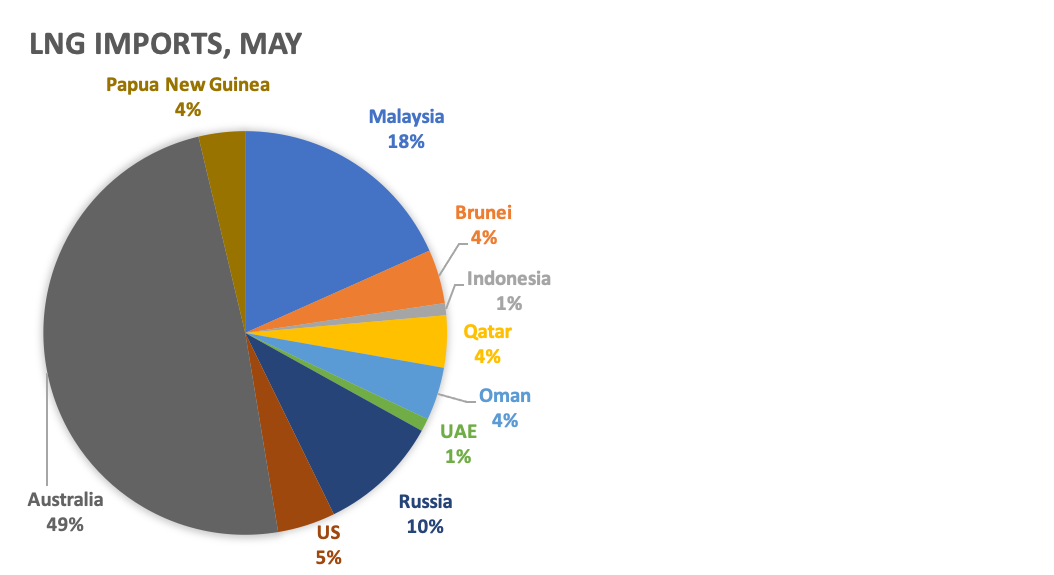
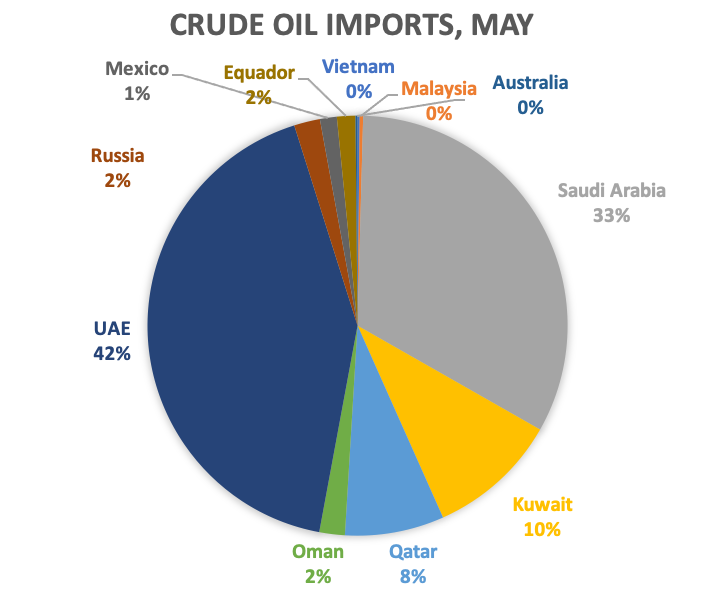
- Japan imported 0.56 million tons of LNG from Russia in May, accounting for 10% of its total imports of 5.76 million tons. Crude oil imports from Russia were 0.2 million kiloliters, or 2% of the 12.1 million kl total.
Putin orders the assets of Sakhalin 2 LNG project moved to a Russian entity
(Various media, July 1)
- Russian President Vladimir Putin signed an order that will see the Sakhalin-2 gas project transferred to a newly-established Russian entity.
- The move is interpreted as a retaliation against sanctions imposed over Russia’s invasion of Ukraine.
- It is still unclear whether the Japanese companies involved in Sakhalin-2 will be able to carry on their operations.
- CONTEXT: Japan’s trading houses Mitsui and Mitsubishi Corp have stakes of 12.5% and 10%, respectively, in the current entity that owns the Sakhalin 2 project.
- Putin’s order will take the assets from the current holding company, which is registered offshore, and move them to a Russian entity. In theory, Japanese and other foreign investors can apply to have their current equity stakes “re-instated” in the new company.
- The presidential order indicates that foreign investors have only a month to decide whether to apply to retain their stakes in the new Russian company. If they don’t, the assets will be seized by Russia, with payment made in rubles into Russian accounts that under current sanctions means the proceeds will never be recovered.
- PM Kishida said Japan is still planning its response. The impact on Japanese rights in the project are not yet clear, but the Japan side believes LNG deliveries from Sakhalin 2 should continue as per current contracts.
- METI minister Hagiuda said Putin’s order should not immediately halt LNG cargos from the project to Japan. However, Japan will now look to procure more LNG on the spot market, he said.
- Various Japanese politicians have voiced support for moving the nation away from its high reliance on natural gas.
- CONTEXT: Sakhalin 2 is the nearest LNG project to Japan, with cargoes delivered to Japan in two days. It supplies about 10% of Japan’s LNG.
- CONTEXT: The project is based on oil and gas exploration work conducted by Japanese firms for multiple decades prior to the creation of the Sakhalin 2 facility.
TAKEAWAY: Japan’s interest in the Sakhalin 2 project is based on a more substantial basis than equity in an operating company. There is a PSA (Production Sharing Agreement) in place since 1996, a special arrangement that applies only to a select few Sakhalin projects, and according to which Japan has rights to a certain percentage of the resources, based on certain conditions.
The question is, what is the value of that contract? President Putin has historically shown a willingness to rewrite rules and concoct roadblocks for businesses – until issues are resolved in the government’s favor. Japanese investors only need to cast their minds back to 2006, when the Sakhalin 2 project’s license was withdrawn due to “ecological issues”. Once Gazprom swooped in to buy 50% of the project from the foreign investors, all issues were resolved.
Given the context, Japanese trading houses and the government will be skeptical about this change of scheme. It comes days after Kishida became the first Japanese leader to attend a NATO summit. This shows that what Putin seeks from Japan is loyalty or at least neutrality. The ability of Japanese firms either to continue their ownership or to continue receiving LNG cargos is based on Japan’s attitude towards the Kremlin.
Also, Moscow will be aware that August is peak demand time for Japan, arguably when the country needs its LNG the most, and that a recent accident at a U.S. LNG export facility has drastically reduced options for Japan and other buyers in the market. Putin is trying to create a situation in which Japan has to consider its energy mix above the politics.
Still, history teaches us that the latest asset appropriation is likely to be only the first step in a longer chain of events. One of Putin’s goals may be to maneuver Japan so that it opens up a path to circumvent sanctions.
Even if Japanese firms accept the option of buying stakes in the new Russian entity, with all the associated governance risk, it is unlikely to be the last test the Kremlin sends their way. The chance of losing these new stakes will be extremely high as long as the two nations remain “unfriendly”.
Japan will surely try to retain a status quo, but should be preparing for a scenario in which the Sakhalin assets are all but lost. If that occurs, the same is likely to be true for all the other Japanese oil & gas investments in Russia, key among them the yet-to-open Artic LNG 2 project.
Moscow may well see the withdrawal of Japanese investors as a boon because it will then present the same assets to Chinese allies, an outcome that Tokyo dislikes the most.
We expect this situation to develop and grow in complexity.
Japan’s self-sufficiency ratio for oil and gas drops slightly from peak
(Kankyo Business, June 30)
- The ratio dropped to 40.1% in FY2021, from a record 40.6% a year earlier. METI said the decline was due to higher demand for oil and gas as the economy recovers from the pandemic, meanwhile the volumes produced by Japanese firms stayed the same.
- CONTEXT: The ratio refers to the percentage of oil and gas that Japan consumes or that it receives from investments Japanese firms have in overseas projects.
TAKEAWAY: Japan’s goal of improving oil and gas self-reliance to 60% by FY2040 has remained in place despite the nation’s net-zero commitments.
U.S. forms global metals alliance against China and Russia
(Reuters, June 30)
- The U.S. launched the Minerals Security Partnership (MSP), which is open to all countries committed to “responsible critical mineral supply chains to support economic prosperity and climate objectives”. The coalition includes Australia, Canada, UK, France and Germany; and in Asia: Japan and South Korea.
- The goal is to counter China’s dominance of many supply chains critical to clean energy technologies, such as lithium and rare earths. Since the Ukraine war, Russia, a major producer of nickel, aluminum and platinum group metals, has been considered a problematic trading partner.
- A previously highly globalized minerals supply network looks set to split into politically polarized spheres of influence. The concept of “friendshoring” – hosting of production in a friendly country – is leading the charge.
Canada tells Japan investors it has the lithium, cobalt critical for EVs
(Asia Nikkei, July 2)
- Canada’s Minister of Innovation, Science and Industry, Francois-Philippe Champagne, made a pitch to Japanese businesses ahead of a visit to the country that Canadian resources could cater to all the raw material needs for manufacturers. The country has rich resources in elements such as lithium, cobalt and manganese, needed for EVs, and can help Japanese firms cut emissions in their supply chains, Champagne said.
Japan, China vie for power in lithium standards
(Asia Nikkei, July 1)
- Nearly 100 Japanese companies, including Toyota Motor and Hitachi, will seek a bigger voice in lithium, a vital part of EV batteries and where China’s influence has grown.
- Over 15 countries, including Japan and China, will meet in autumn to discuss International Organization for Standardization (ISO) standards for battery material.
- Japan’s Battery Association for Supply Chain will take part in the conference. The association will consider preparing a Japanese proposal for standards.
- CONTEXT: Chinese battery makers offer products without cobalt, while Japanese rely on the costly metal. Chinese manufacturers could also lobby for standards that would force Japanese firms to spend additional resources to comply with.
LNG stocks drop to 2.15 million tons
(Government Data, June 26)
- LNG stocks stood at 2.15 million tons as of June 26, down from 2.29 million tons a week earlier. The end-June stocks last year were 2.04 million tons. The five-year average of end-June stocks is 1.95 million tons.
ANALYSIS
BY CHISAKI WATANABE
Energy Transition: Smart Little Boxes
Shaping the future of Electricity Use
Largely a niche technology until now, smart meters are expected to play an important role amid the need for demand-side control of power as Japan seeks to cut energy consumption in the face of the global energy crisis.
The devices can play a small but critical part of Japan’s efforts to reach net-zero emissions by 2050, as they empower consumers, helping them to cut energy costs.
If you live in Japan, chances are your home is already equipped with a smart meter. Their rollout began in 2014, and as of March 2021 smart meters numbered about 69 million. As of 2016, all high-voltage users (such as industrial enterprises) have been equipped with smart meters.
By March 2025 the government plans to complete installations for all low-voltage users (i.e., homes). Power transmission and distribution business operators are in charge of installations and no cost is incurred by users.
Among the manufacturers of smart meters used in Japan are Toshiba Toko Meter Systems, Osaki Electric, Mitsubishi Electric and Fuji Electric.
The existing smart meters, however, have been largely underutilized. That is in part because blackouts have been very rare in Japan and there has historically been little focus on demand-side control. That is about to change.
Pleading with the public
On March 22, the Minister of Economy, Trade and Industry Hagiuda pleaded with the public to save electricity in the Tokyo area amid power shortages triggered by an earthquake days before. A cold snap further exacerbated the situation. Consumers dimmed lights and turned off the heat, leading to an impressive reduction in electricity use to avert a blackout.
These types of extreme situations, however, may become more common. According to the Organization for Cross-regional Coordination of Transmission Operators (OCCTO), the reserve rate for electricity in July is expected to fall to 3.7% in all regions excluding Hokkaido and Okinawa That is a small improvement from an earlier forecast of 3.1% for some regions such as Tokyo, which is barely above the 3% mark that is seen as the minimum required rate for stable supply. The winter forecast is more dire, especially in Tokyo and Tohoku, with 1GW of capacity still lacking in case of a very cold winter.
Adding to the dilemma is uncertainty over fuel supplies as the global energy crisis intensifies. Tokyo has been urging everyone to consume less energy. On June 15, Prime Minister Kishida said that saving energy on the demand side is needed to have an immediate and significant impact on ensuring stable power supply.
Source: TEPCO
Remote data collection on consumption
Towards the goal of conserving energy, next-generation smart meters are being planned. The new devices will accommodate the expansion of distributed power generation, the integration of renewable electricity, expanded use of data and aggregators, and the progress in information and communication technologies.
Currently, smart meters allow power providers to remotely collect consumption data, thereby no longer requiring a monthly visit by a meter-reader to each house. The meter collects data on 30-minute power usage and can be connected to a home energy management system (HEMS).
While HEMS lets users conserve energy with access to data, installing one at home comes with a hefty price tag – as much as ¥200,000 (roughly $1,500). The current smart meters will be replaced after ten-year use, and starting in 2025 upgraded devices will be introduced.
A METI study group recently completed a report on next-gen smart meters and said that they should serve as a tool to push for digital transformation in the power industry. The new meters will have the following benefits features:
1) Increased resilience:
a. Usage data: In addition to the data recorded every 30 minutes, data will be recorded at 5 minutes intervals. This helps identify blackout locations.
b. Consumers can reduce power use by lowering the upper power limit in order to avoid planned outages in wide areas.
2) Expansion of renewables and promotion of decarbonization, stable demand and supply for the entire grids, and promotion of energy saving:
a. Recording usage data every 5 minutes from a small portion of users helps incorporate solar power, utilize AI and IoT, creating opportunities for new distribution businesses and operations of regional micro grids, allowing for more renewables.
b. Prepare for a possible switch to data recording at 15 minutes intervals from the current 30 minutes to help incorporate more renewables.
c. Accommodate multiple connection protocols so that multiple demand-side meters can be connected. This helps power users and businesses access data and adjust demand, allowing for more renewable energy into the grid.
3) Consumer benefits:
a. Allow the sending of data on gas and water use, along with electricity, to consolidate separate metering systems and reduce cost.
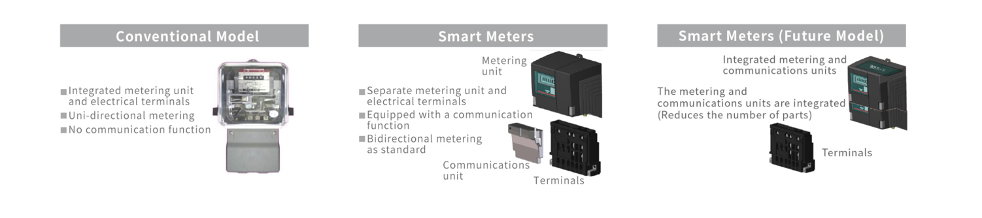
Updates will also include a revision of home smart meter specifications. Currently, TEPCO and seven other utilities use an all-in-one type for metering and data transmission, while Kansai and Kyushu use a unit that comprises two separate devices for these functions. The government plans to consolidate the two separate specifications in order to reduce cost, and the change may be extended to smart meters for high voltage users.
Until the next-gen devices gain widespread implementation, power users will have to rely on existing devices to contend with looming power shortages. Toward that goal utilities are offering programs to incentivize residential power users to save energy during peak hours.
For example, some companies offer customers “points” that can be redeemed for goods. But consumers may need to switch plans or pre-register to take part in the incentive programs. Financial benefits for customers from such incentive programs would be limited – TEPCO offers ¥5/ kWh, while Chubu Electric pays double that rate.
Rather than focusing on complicated efforts that will produce negligible cuts in power use and little benefits for consumer well-being, smart meters in Japan can bring about many benefits by improving demand-side control. These small devices have a huge role to play in the effort to decarbonize Japan by 2050.
JOBS IN JAPAN’S ENERGY SECTOR
BY ARTHUR (RIKU) OGAWA
How to Hire Your Dream Staff
As we all know, the labor market consists of two major parties:
– Companies that hire and employ talent
– Candidates that want to work in the companies
Quite often the first group is looking for a “dream candidate”, while the latter seeks a “dream career”. In theory, it’s best to aim high and to fine tune your expectations while exploring the market. In practice, it can be rather painful to change expectations because, for example, the best candidate or job available on the market right now may not reach one’s dream level.
Having said that, we should try to get as close as possible to the “dream”. But how?
Below is a chart of how, on average, the GreenTech/Renewable energy industry finds its best possible candidates and vice versa.
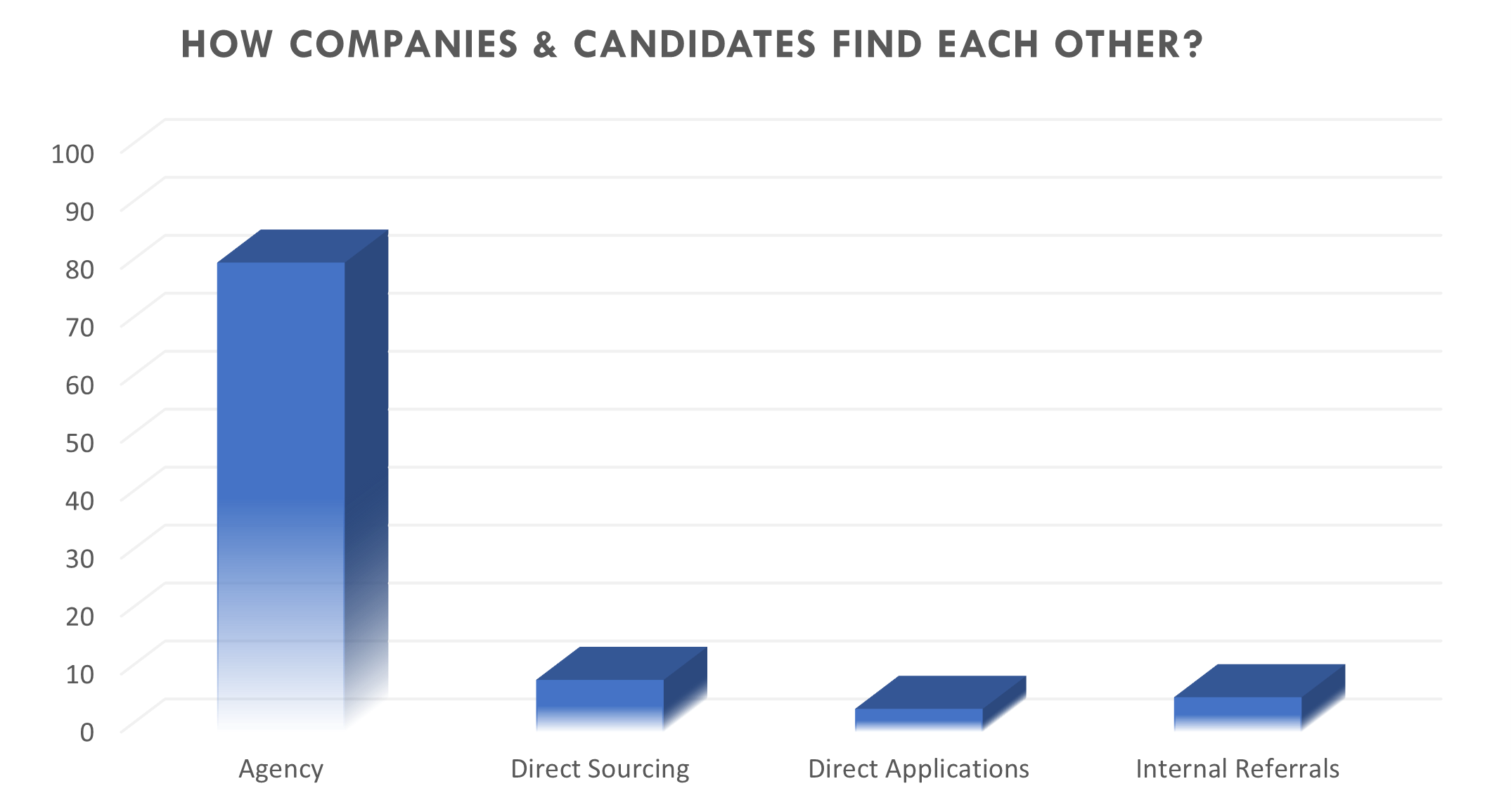
*Data sourced from 25 Renewable Energy companies in Japan, 2021
Pros/Cons for each of the above approaches
Recruitment agency:
+ Quickest solution, maximizing chances to succeed
+ Allows one to see most of the market and compare, thus minimizing the distance to your dream.
+ Comprehensive advice, helping to manage expectations
– Minor costs for the hiring company
– Difficulty to select the “right” agency
Direct Sourcing (using internal/company talent acquisition team):
+ More control over process for hiring companies
+ Less cost for companies
+ Access to some roles not publicly open
– Limited access to candidates for the hiring company
– Limited understanding of the market
– Difficulty in negotiation and influencing the hiring process for candidates
Direct applications:
+ Minimum cost for the hiring company
+ Minimum time required to apply (for candidates)
– Low success rate
– Low predictability and feedback
Internal referral/introduction:
+ Saves time for the role/candidate assessment
+ Often is a good match from the company culture perspective
– Limited access to the pool of jobs and candidates
– Complexity of the negotiation process
Case Study
Here’s a recent case illustrating some of the above. An overseas renewable energy developer had operated in Japan for a while, but found the hiring process on more time-sensitive positions to be stressful. The human resource (HR) department believed the issue may be with the two recruitment agencies it employed. So, for the next hires, HR managers decided to try a different approach.
This time, the company did not disclose its new position to any recruitment firms and instead looked to use the internal resources. While in-house HR looked at job boards and scouted on LinkedIn, the managers who needed to recruit new team members reached out to people in their social networks. Naturally, the latter process meant contacting ex-colleagues of the hiring managers.
After 2 months, the company had identified 5 candidates. But this is how the process unfolded:
- 3 candidates didn’t meet the expectations for the role
- 1 candidate proceeded through the interview process smoothly, until they suddenly informed HR that they had accepted a job offer from another company (HR had not been aware that this person was also interviewing elsewhere)
- 1 candidate was strongly recommended by one of the hiring managers (his ex-boss), and went as far as to engage with the hiring process, but eventually decided to stay at his current post
In that particular case, the renewables company felt that it lost control of the hiring process when it relied only on its network and online scouting, and came up with a new solution: It engaged different agencies to work on its job searches. Fortunately, it found its new staff within six weeks.
Takeaways
Recruitment is often an unpredictable process and gaining control of hiring depends on the approach each company feels comfortable with and which shows results.
Turning to a recruitment agency is likely to be the most efficient pathway, but for a one-off hire situation it can be hit and miss. Some agencies are really good at cross-functional and high-volume recruitment; others specialize in contract employment or niche/functional hires.
Unfortunately, there is no silver bullet, but testing several approaches can help a company better understand what works for them.
GLOBAL VIEW
BY JOHN VAROLI
Below are some of last week’s most important international energy developments monitored by the Japan NRG team because of their potential to impact energy supply and demand, as well as prices. We see the following as relevant to Japanese and international energy investors.
China/ Cleantech
The world’s biggest battery maker, Contemporary Amperex Technology, along with EV battery companies Tianqi Lithium and Huayou Cobalt, secured $10 billion to build EV infrastructure. China wants to be “the Saudi Arabia of clean tech hardware,” said Neil Beveridge at Bernstein in Hong Kong.
Europe/ ESG
More than two-thirds of asset managers in the EU are considering to halt the launch or distribution of financial products that don’t comply with ESG standards, according to a survey by PwC Luxembourg.
G7/ Energy policy
Some G7 leaders have called for new financing of fossil fuel energy projects. Italian Prime Minister Mario Draghi said there are short term needs for investment in gas infrastructure “in developing countries and elsewhere.”
Italy/ Solar power
Poland’s R Power Group plans over 1 GW of solar projects in Italy, and in the past month the company signed agreements with landowners for PV farms of more than 100 MW of capacity.
Netherlands/ Hydrogen power
The government will invest €750 million by 2031 to develop a national hydrogen transportation network. Gasunie, the country’s gas network operator, will manage the project, which will be partially completed by 2026.
Norway/ Oil
Equinor is selling crude to the EU instead of to Asia, where it exported about 100 million barrels in 2021. Norwegian crude has replaced Russia’s “Urals” grade at refineries in Germany, Poland, Sweden and Finland. In March, all of Equinor’s crude went to the EU; in March 2021, 60% went to Asia.
Philippines/ Natural gas
Billionaire Enrique Razon seeks control of the country’s biggest gas field, Malampaya, which produces 20% of the country’s power. The field’s service contract expires in 2024. However, it’s expected to produce more gas with new funding by Prime Infra, Razon’s investment company.
Russia/ Oil
Russia earned $20 billion from oil exports in May, as China and India boosted purchases thanks to major discounts. The “Urals” blend averaged $78.8 a barrel in May, up 12% from April. Before the Russian offensive in Ukraine, Indian imports of Russian oil were negligible due to high freight costs.
UK/ Energy crisis
The companies that own the UK’s electricity distribution networks face big cuts to profits after the energy regulator, Ofgem, said to invest more in maintenance and improvements. This would channel £21 billion to be spent on maintenance and boosting grid resilience.
U.S./ Climate crisis
The Supreme Court issued a ruling that constrains the EPA’s authority to reduce pollution from power plants. Republicans supported the ruling, as Senator Mitch McConnell said it limited the power of “unelected, unaccountable bureaucrats.” Speaker Nancy Pelosi (Democrat) said the court had decided to “let our planet burn.”
U.S./ ESG
BlackRock Inc. is unhappy with the SEC’s bid to force publicly traded companies to disclose GHG emissions because it will increase compliance costs. BlackRock, however, said it still advocates for sustainable investing and supports public companies voluntarily disclosing climate-related information.
2022 EVENTS CALENDAR
A selection of domestic and international events we believe will have an impact on Japanese energy
| January | OPEC quarterly meeting;
JCCP Petroleum Conference – Tokyo; EU Taxonomy Climate Delegated Act activates; Regional Comprehensive Economic Partnership (RCEP) Trade Agreement that includes ASEAN countries, China and Japan activates; Indonesia to temporarily ban coal exports for one month; Regional bloc developments: Cambodia assumes presidency of ASEAN; Thailand assumes presidency of APEC; Germany assumes presidency of G7; France assumes presidency of EU; Indonesia assumes presidency of G20; and Senegal assumes presidency of African Union; Japan-U.S. two-plus-two meeting; Japan’s parliament convenes on Jan. 17 for 150 days; Prime Minister Kishida visits Australia (tentative) |
| February | Chinese New Year (Jan. 31 to Feb. 6);
Beijing Winter Olympics; South Korea joins RCEP trade agreement |
| March | Renewable Energy Institute annual conference;
Smart Energy Week – Tokyo; Japan Atomic Industrial Forum annual conference – Tokyo; World Hydrogen Summit – Netherlands; EU New strategy on international energy engagement published; End of 2021/22 Japanese Fiscal Year; South Korean presidential election |
| April | Japan Energy Summit – Tokyo;
MARPOL Convention on Emissions reductions for containerships and LNG carriers activates; Japan Feed-in-Premium system commences as Energy Resilience Act takes effect; Launch of Prime Section of Japan Stock Exchange with TFCD climate reporting requirement; Convention on Biological Diversity Conference for post-2020 biodiversity framework – China; Elections: French presidential election; Hungarian general election |
| May | World Natural Gas Conference WCG2022 – South Korea;
Elections: Australian general election; Philippines general and presidential elections |
| June | Happo-Noshiro offshore wind project auction closes;
Annual IEA Global Conference on Energy Efficiency – Denmark; UNEP Environment Day, Environment Ministers Meeting – Sweden; G7 meeting – Germany |
| July | Japan to finalize economic security policies as part of natl. security strategy review;
China connects to grid 2nd 200 MW SMR at Shidao Bay Nuclear Plant, Shandong; Czech Republic assumes presidency of EU; Elections: Japan’s Upper House Elections; Indian presidential election |
| August | Japan: Africa (TICAD 8) Summit – Tunisia;
Kenyan general election |
| September | IPCC to release Assessment and Synthesis Report;
Clean Energy Ministerial and the Mission Innovation Summit – Pittsburg, U.S.; Japan LNG Producer/Consumer Conference – Tokyo; IMF/World Bank annual meetings – Washington; Annual UN General Assembly meetings; METI to set safety standards for ammonia and hydrogen-fired power plants; End of 1H FY2022 Fiscal Year in Japan; Swedish general election |
| October | EU Review of CO2 emission standards for heavy-duty vehicles published;
Chinese Communist Party 20th quinquennial National Party Congress; G20 Meeting – Bali, Indonesia; Innovation for Cool Earth TCFD & Annual Forums – Tokyo; Elections: Okinawa gubernational election; Brazilian presidential election; |
| November | COP27 – Egypt;
U.S. mid-term elections; Soccer World Cup – Qatar; |
| December | Germany to eliminate nuclear power from energy mix;
Happo-Noshiro offshore wind project auction result released; Japan submits revised 2030 CO2 reduction goal following Glasgow’s COP26; Japan-Canada Annual Energy Forum (tentative); Tesla expected to achieve 1.3 million EV deliveries for full year 2022 |
Disclaimer
This communication has been prepared for information purposes only, is confidential and may be legally privileged. This is a subscription-only service and is directed at those who have expressly asked K.K. Yuri Group or one of its representatives to be added to the mailing list. This document may not be onwardly circulated or reproduced without prior written consent from Yuri Group, which retains all copyright to the content of this report.
Yuri Group is not registered as an investment advisor in any jurisdiction. Our research and all the content express our opinions, which are generally based on available public information, field studies and own analysis. Content is limited to general comment upon general political, economic and market issues, asset classes and types of investments. The report and all of its content does not constitute a recommendation or solicitation to buy, sell, subscribe for or underwrite any product or physical commodity, or a financial instrument.
The information contained in this report is obtained from sources believed to be reliable and in good faith. No representation or warranty is made that it is accurate or complete. Opinions and views expressed are subject to change without notice, as are prices and availability, which are indicative only. There is no obligation to notify recipients of any changes to this data or to do so in the future. No responsibility is accepted for the use of or reliance on the information provided. In no circumstances will Yuri Group be liable for any indirect or direct loss, or consequential loss or damages arising from the use of, any inability to use, or any inaccuracy in the information.
K.K. Yuri Group: Oonoya Building 8F, Yotsuya 1-18, Shinjuku-ku, Tokyo, Japan, 160-0004.