
JAPAN NRG WEEKLY
JULY 11, 2022
JAPAN NRG WEEKLY
July 11, 2022
NEWS
TOP
- PM Kishida’s ruling coalition clinches overwhelming victory in Upper House elections, solidifying his position for several years
- Former PM Abe shot by gunman in unprecedented attack while street campaigning, shocking the nation
- Japan aims to demonstrate “carbon-neutral” ships by 2026 with a push to develop both hydrogen and ammonia fueled vessels
ENERGY TRANSITION & POLICY
- Govt. to reduce transmission costs for renewables generators
- Ministry publishes guidelines for sustainability-linked bonds
- Ex-METI official named to senior position at the nuclear regulator
- Car battery makers to measure carbon footprint of supply chains
- Battery lobby group urges commoditization of “black mass”
- METI announces supply chain subsidies with emphasis on wind
- Mitsubishi Gas, partner study Japan’s first clean methanol project
- ENEOS, others establish green fund to invest in renewables
- Govt. asks EV owners to keep them charged due to power crunch
ELECTRICITY MARKETS
- Nuclear energy a hot topic in run-up to Upper House elections
- Change to wind tender rules could hamper competition: Opinion
- Governor confirms opposition to Kansai Electric wind project
- J-Power stock rallies after divestment of two thermal power plants
- TEPCO chair Kawamura steps down after three years
- Governor speaks out on restart of Onagawa nuclear power plant
- Recent fires at power plants highlight vulnerability of the grid
- Power utilities paid less into Fukushima compensation fund citing poor financial results; more tax funds may be required
OIL, GAS & MINING
- Hiroshima Gas most at risk if Japan loses Sakhalin-2 LNG project
- INPEX stock gains on rising crude oil prices
- LNG stockpiles drop slightly, remain above average levels
- Hanwa reports decrease in consolidated assets on nickel volatility
ANALYSIS
JAPAN BOOSTS BUDGET FOR CO2 OFFSETS
FROM OVERSEAS PROJECTS
Japan is expanding its financial aid for overseas projects that cut emissions, hoping to secure even more credits from reducing CO2 volumes via bilateral agreements. The government has increased this year’s funding for the Joint Crediting Mechanism (JCM) by nearly a fifth to around ¥13.5 billion. The Mechanism allows Japan to support renewable energy and power conservation projects conducted by its companies in JCM-participating nations and claim part of the CO2 reduction as its own.
We look at some of the recent projects receiving the funding and assess their impact.
ABE’S ENERGY LEGACY:
EYE ON SECURITY, PAVED WAY FOR NET-ZERO
After the shocking assassination of former Prime Minister Abe Shinzo last Friday, July 8, in the western Japanese city of Nara, Japan NRG Weekly pays tribute to his legacy and reviews his impact on the country’s energy sector.
GLOBAL VIEW
The EU approved a law classifying gas and nuclear as “sustainable energy sources”. France says it will take full control of EDF. India imposes special tax on petrol and diesel exports. Qatar picks international partners for its giant LNG expansion. Russia’s Norilsk Nickel and Rusal discuss merger to create major multi-metal maker. Details on these and more in our global wrap.
EVENTS SCHEDULE
JAPAN NRG WEEKLY
PUBLISHER
K. K. Yuri Group
Editorial Team
Yuriy Humber (Editor-in-Chief)
John Varoli (Senior Editor, Americas)
Mayumi Watanabe (Japan)
Wilfried Goossens (Japan, Events)
Regular Contributors
Chisaki Watanabe (Japan)
Takehiro Masutomo (Japan)
Daniel Shulman (Japan)
Art & Design
22 Graphics Inc.
Events

SUBSCRIPTIONS & ADVERTISING
Japan NRG offers individual, corporate and academic subscription plans. Basic details are our website or write to subscriptions@japan-nrg.com
For marketing, advertising, or collaboration opportunities, contact sales@japan-nrg.com For all other inquiries, write to info@japan-nrg.com
OFTEN USED ACRONYMS
METI The Ministry of Energy, Trade and Industry
MOE Ministry of Environment
ANRE Agency for Natural Resources and Energy
NEDO New Energy and Industrial Technology Development Organization
TEPCO Tokyo Electric Power Company
KEPCO Kansai Electric Power Company
EPCO Electric Power Company
JCC Japan Crude Cocktail
JKM Japan Korea Market, the Platt’s LNG benchmark
CCUS Carbon Capture, Utilization and Storage
mmbtu Million British Thermal Units
mb/d Million barrels per day
mtoe Million Tons of Oil Equivalent
kWh Kilowatt hours (electricity generation volume)
NEWS: ENERGY TRANSITION & POLICY

PM Kishida’s ruling party clinches landslide
(Various reports, July 11)
- The ruling Liberal Democratic Party (LDP), led by Prime Minister Kishida, won the majority of the 125 seats contested in the Upper House elections yesterday. Together with its coalition partner, the Komeito, the bloc will hold the majority in in the upper chamber.
- The strong win increases the chance that the government will move to revise Japan’s 1947 constitution, which has not been amended since its introduction. Pro-reformers argue this is needed to fully acknowledge the existence and authority of the Self-Defense Forces in Japan, among other reasons.
- A record number of people voted in the Upper House election, according to government data.
- SIDE DEVELOPMENT:
Editorial: government needs to articulate direction on energy
(Nikkan Kogyo Shimbun, July 6)- CONTEXT: Nikkan Kogyo is the top paper for the manufacturing industry in Japan.
- METI’s decision to phase out coal-fired power stations was correct. After all, Japan is often singled out for reliance on coal and reluctance to commit to emissions targets.
- However, don’t forget the need to ensure a consistent electricity supply.
- Fossil fuel plants generate 32% of Japan’s electricity, and about half of this will soon be phased out.
- To ensure a sufficient electricity supply while keeping CO2 emissions low, Japan must make renewables the backbone of its electricity supply and restart idle nuclear plants.
- We should treat this as an opportunity to not only phase out coal-fired plants, but also to create a more resilient energy policy. To this end, the government should articulate nuclear power’s role and obtain more community support.
Former PM Abe killed by gunman during campaign speech
(Various reports, July 8)
- Former Prime Minister Abe Shinzo died after being shot on July 8 by a lone gunman during a street campaign rally.
- Abe, Japan’s longest-serving leader, was 67.
- Abe was shot at while delivering a street speech in the western city of Nara ahead of July 10’s Upper House election.
- The police arrested a 41-year-old man, identified as Nara resident Yamagami Tetsuya. He was reported to have previously served in the Maritime Self-Defense Force. He made his own gun.
- According to a police statement, the man revealed that he had a “grudge” against a certain group, and considered Abe to be connected to this group.
- Abe stepped down as premier in the summer of 2020, but remained a lower house lawmaker and leader of the biggest faction in the ruling party.
TAKEAWAY: Abe was one of the most influential politicians in Japan even after stepping down. He was not closely associated with energy matters, but has spoken frequently since 2020 about the need for Japan to embrace nuclear power once again. A short review of his impact on energy matters is in the Analysis section.
Japan aims to demonstrate carbon-neutral ships by 2026
(Asia Nikkei, July 7)
- The government is teaming up with local shipping lines and shipbuilders to develop new types of vessels fueled by ammonia or hydrogen. About ¥35 billion worth of state financial support is lined up over 10 years.
- The Ministry of Land, Infrastructure, Transport and Tourism is already working with private firms including Nippon Yusen, Kawasaki Kisen and Imabari Shipbuilding, Japan’s largest shipbuilder, to expedite the use of “zero-emission ships.”
- Kawasaki Heavy Industries and other concerns will develop hydrogen engines, ready for demonstration operations ub 2027. Meanwhile, Nippon Yusen and trading house Itochu are researching ammonia-fueled ships, which could start from 2026. Commercial operations are targeted for a few years after that.
Government to reduce transmission costs to renewable generators
(Nikkei, July 3)
- Minister of Economy, Trade and Industry Kajiyama Hiroshi announced that inefficient coal-fired power plants will be progressively phased out, signaling an increased focus on renewable energy.
- While generators face a flat fee of about ¥150/ kW for use of transmission lines, this is disadvantageous for renewable generators, which experience fluctuating output.
- METI aims to significantly reduce transmission costs faced by renewable generators.
- METI also will review rules for transmission line access to give renewable generators priority when supply outstrips capacity.
- The details will be determined with experts to ensure that the stability of electricity supply from thermal plants is not jeopardized.
MoE publishes sustainability-linked bond guidelines
(Government Statement, July 7)
- The MoE published sustainability-linked bond guidelines and updated green bond guidelines to reflect recent international trends. Sustainability-linked bond guidelines are designed to spur dialogs between bond issuers and buyers. The issuers show long-term sustainability targets and disclose achievements regularly. Updated green bond guidelines clarified the definition of green financing.
MoE to hold town meetings on Decarbonization Support Inc.
(Government Statement, July 7)
- The MoE will hold town meetings on the Decarbonization Support Organization Corporation, a newly established government-backed firm that will finance net zero projects. They will take place from July 20 to August 24 in key cities of Sapporo, Sendai, Nagoya, Osaka, Okayama and Kumamoto, but not in Tokyo, as its aim is to reach out to areas with limited financing. The firm launches officially in October.
- CONTEXT: The Decarbonization Support Organization Corporation supports services/products that have been commercialized, or nearly commercialized, which is different from METI’s Green Innovation Fund for developing new technologies. Japan NRG wrote about the new entity in detail in the July 13, 2022 issue.
Ex-METI Katayama Hiromu named Nuclear Regulation Authority chief
(Japan NRG, July 4)
- Former METI official Katayama Hiromu was named Nuclear Regulation Authority secretary general, replacing Ogino Toru. Katayama was deputy NRA secretary general and was a METI nuclear policy official. He was involved in combating the 2011 Fukushima disaster as a member of the Emergency Response Center.
- CONTEXT: Katayama and his two deputies are from METI, leading some to argue that NRA will now ease safety regulations. Katayama refuted the claims, saying it was purely a coincidence.
Car battery makers to measure carbon footprint of supply chains
(Japan NRG, July 7)
- METI will launch a pilot project to measure and collect carbon footprint data of car batteries. The project will run from August to February next year. The scope of measurement is raw materials, battery production, logistics and consumption, but not recycling. Recycled material will comprise raw materials. The carbon footprint of materials discarded in the production process will also be counted. The goal is to measure and trace the carbon footprint of EV batteries, but smaller batteries on hybrid vehicles can be included.
- CONTEXT: European carbon footprint initiatives are pushing Japan’s automotive and battery sectors, urging METI to make the study as expansive as possible to show Japanese battery products are compatible with European regulations.
Battery Supply Chain Council urges commoditization of “black mass”
(Japan NRG, July 7)
- The Battery Supply Chain Council developing battery standards is urging METI to help commoditize “black mass”, a compound recovered from used lithium-ion batteries.
- “Black mass” comprises nickel, cobalt and some manganese and lithium, and is generated after heating battery scrap. It’s traded locally, though in small volumes, due to an absence of cost-effective technologies to extract the elements from the compound. A technological breakthrough would increase demand for “black mass” and attract supply. Japan needs to establish standards so that “black mass” could trade in the open market like nickel and cobalt, said the Council’s managing director Morishima Ryuta.
TAKEAWAY: Volume and pricing issues must be resolved to realize a robust “black mass” market. Due to low EV sales in Japan, several more years are needed until there is sufficient scrap battery to recover “black mass” of several hundred tons per year. “Black mass” follows nickel and cobalt in terms of price, but the position of the London Metal Exchange as their price benchmark has become unstable.
JFE turns food waste into electricity
(Gas Energy News, July 6)
- JFE Engineering’s subsidiary, Shindenryoku Urban Energy, began generating electricity from hotel food waste, using a biogas generator.
- The electricity is purchased by the hotel, thus helping to keep its electricity footprint carbon neutral.
METI announces supply chain subsidies with emphasis on offshore wind
(New Energy Business News, July 6)
- METI has selected 85 projects worth approximately ¥97.4 billion for the third round of subsidies to promote domestic investment in supply chains. Among these is a strong focus on manufacturers of parts for offshore wind power generation, which accounted for 28 of the selected projects.
- Subsidy winners include TDK, for an investment in power generator parts in Chiba Prefecture; Mitsubishi Nagasaki Machinery & Engineering, for a project to build foundations in Nagasaki; and a ThyssenKrupp entity for generator parts in Fukuoka Prefecture.
Tokuyama and Mitsubishi Gas to study Japan’s first “clean” methanol project
(Kankyo Business, July 1)
- Tokuyama Corporation and Mitsubishi Gas Chemical will study setting up methanol production based on recycled CO2. The carbon will be captured from Tokuyama’s manufacturing facility in Yamaguchi Prefecture and used as feedstock for methanol.
- This would the first project in Japan to recycle CO2 into methanol. It would use CO2 and hydrogen generated from caustic soda production as raw materials, applying a methanol production technology newly developed by Mitsubishi Gas Chemical.
TAKEAWAY: For a detailed look at the rationale for methanol, see the Analysis section in our June 27, 2022 edition.
Daikin invests in U.S. battery startup
(Kankyo Business, July 7)
- Daikin Industries invested in TeraWatt Technology, a U.S.-based startup for next-gen lithium-ion battery technology.
- TeraWatt is attempting to increase the energy density of existing lithium batteries to boost the range and capabilities of EVs and drones.
Recycling “post-boxes” part of private/public initiative to cut waste
(Kankyo Business, July 6)
- A new project to reduce waste has seen several “post-boxes” for recyclables set up in Kanagawa.
- The post-boxes are designed to accept a variety of plastic packaging, toiletry and detergent packaging.
- Post-box users get tokens that can be used to buy goods at local stores.
- The Japan Science and Technology Agency and Keio University are participating in the project.
ENEOS and partners establish green energy fund
(Chemical Daily, July 7)
- Tokyu Land Corp, KEPCO, ENEOS and Renewable Japan established a ¥400 million fund to invest in renewable electricity generation.
- The fund aims to eventually amass assets of ¥400 billion.
Takuma to build 10 MW wood-fired power station in Hiroshima
(New Energy Business News, July 6)
- Plant engineer Takuma was commissioned to construct a wood-fired power station in Hiroshima by lumber producer Chugoku Mokuzai.
- Due to be completed in March 2025, the plant will be fueled by offcuts generated in lumber processing.
- Electricity generated will be sold to the grid under the feed-in tariff scheme.
Govt calls on EV owners to keep batteries charged amid power shortages
(IT Media Business, July 2)
- METI called on EV owners to use their batteries to store electricity at off-peak times.
- EV batteries can be used as a source of emergency power should power shortages lead to major outages.
NEWS: POWER MARKETS

Nuclear power hot topic in run-up to Upper House election
(Sankei News, July 2)
- Nuclear energy policy has become a hot topic in the runup to the Upper House elections on July 10 as electricity demand threatens to outstrip supply.
- The ruling LDP pledged to restart as many reactors as possible, as soon as safety requirements are cleared. This position is echoed by Japan Ishin, which called for idle plants to be restarted as soon as possible.
- The controversial NHK Party also says Japan should consider restarting its nuclear plants.
- LDP’s coalition partner New Komeito supports restarting idle plants, but stresses stringent safety checks and agreement amongst those living near nuclear stations. The Democratic Party for the People has a similar position.
- From the opposition, the Constitutional Democratic Party stressed ending reliance on nuclear power and ruled out the construction of new nuclear plants.
- The Japanese Communist Party called for immediate closure of all nuclear plants, as well as discontinuation of coal-fired power generation by 2030.
- Reiwa Shinsengumi called for placing all nuclear plants under state ownership and the immediate cessation of nuclear power generation.
- Meanwhile, the Social Democrats called for a plan to decommission all of Japan’s nuclear plants.
- SIDE DEVELOPMENT:
Less support for nuclear divestment as power shortages loom
(Mainichi, July 5)- In a survey of voters by Mainichi Shimbun, only 24% said Japan’s nuclear power plants should be promptly shut.
- This contrasts with surveys before the 2016 and 2019 Upper House elections in which 36% and 41% of respondents, respectively, said that Japan should not have nuclear power stations.
Change to wind tender rules could hamper competition: Opinion
(Nikkei X-Tech, July 4)
- CONTEXT: This is an opinion piece by staff writer Tanigawa Hiroto
- The government proposed changing the rules that govern awarding tenders for offshore wind farms. In the future, preference is likely to be given to bidders that complete environmental assessments earlier.
- However, this could penalize later entrants, thereby suppressing competition and increasing the cost of electricity.
- The proposed change is in response to the fact that all projects in recent tenders went to consortia led by Mitsubishi Corp.
Governor confirms opposition to Kansai Electric wind farm
(Kahoku Shimbun, July 5)
- Miyagi Governor Murai Yoshihiro spoke against a KEPCO plan to build a wind farm in the community.
- “Let me say clearly, that I am opposed to the project,” said Murai.
- This is the first time the governor stated his opposition.
- However, authority to approve the project lies with the national government, not the prefecture.
- Yoshihiro said it was “unfortunate” that the local community was powerless to stop the project.
J-Power stock rallies after sale of Chiba plants
(Trader’s Web, July 7)
- J-Power’s share price rebounded on July 7 in response to the sale of two LNG-fired power plants in Chiba to local energy startup Zero Watt Power.
- The plants sold for between ¥1 and ¥2 billion; they have a combined output of 210 MW.
- J-Power intends to divest from gas-fired power generation domestically to concentrate on renewables and coal.
TEPCO Chair steps down
(Denki Shimbun, July 7)
- Kawamura Takashi stepped down as TEPCO Holdings Chair, as his three-year tenure ended.
- Kobayagawa Tomoaki will stay on as CEO.
Decision on Onagawa NPP restart is down to safety—Governor
(Nikkei, July 7)
- Miyagi Governor Murai said the decision whether to approve the restart of Unit two at Onagawa nuclear power station would be based strictly on safety.
- Murai reassured reporters that the current pressure on electricity supplies would not influence the government’s decision.
Fukushima: energy companies pay less of compensation bill
(Asahi Shimbun, July 4)
- According to the Citizens Nuclear Information Center, Japan’s major power companies only contributed ¥134 billion to the Fukushima Daiichi compensation fund last year — ¥29 billion less than the year before.
- The government says the change is due to poorer financial results reported by power companies.
- If this continues, taxpayers will have to foot more of the compensation bill.
Fires at power plants highlight vulnerability of grid
(Nikkei, July 4)
- In the last few days fires have affected power plants in Niigata and Chiba.
- On July 2 a fire at JERA’s Chiba plant caused a 500 MW generator to shut down. JERA aims to have the generator operating by July 10.
- The system went into service in 2014 and is relatively new.
- The incident was followed by another fire at Tohoku Electric’s plant in Niigata on July 3.
- While the government is restarting mothballed power plants to avert power shortages, the older the plant, the more likely malfunctions can occur.
- Hot July weather will see electricity demand reach over 96% of capacity in the TEPCO network; a few more fires will jeopardize power supply.
- SIDE DEVELOPMET:
Fire at Tohoku Electric plant keeps turbine offline
(NHK, July 4)- A fire at a Tohoku Electric plant in Niigata on July 3 caused one gas turbine to shut.
- While the fire was quickly extinguished, the operator does not know when the turbine will return to service.
- Capacity in the damaged section has reduced by a third.
- Tohoku Electric said that despite the fire it still has sufficient reserves.
- SIDE DEVELOPMENT:
JERA’s Chiba plant restarts after oil fire
(Kyodo, July 6)- Unit 3 at JERA’s Chiba plant, which shut due to a fire, restarted on June 6.
- The fire, caused by an oil leak, broke out near a turbine steam valve.
NEWS: OIL, GAS & MINING

Loss of Sakhalin-2 potential catastrophe for Hiroshima Gas
(Diamond, July 5)
- President Putin signed an order on June 30 that transfers the Sakhalin-2 gas project, off the Sakhalin peninsula, to a new entity.
- Of the Japanese companies sourcing gas from Sakhalin-2, Hiroshima Gas is most exposed, with 48% of its supply from the gas field. At current spot prices, Hiroshima Gas will have to pay nearly ¥40 billion per year to replace the Sakahalin-2 gas.
- Toho Gas, Kyushu Electric, Tohoku Electric and Tokyo Gas are also significantly exposed to the project
TAKEAWAY: Putin will likely be keenly aware that Hiroshima Gas is the local gas utility in the area represented in parliament by current prime minister Kishida, offering another angle of leverage to Moscow.
INPEX rallies on higher crude futures
(DZH Financial Research, July 8)
- The INPEX share price rallied in response to the price of West Texas Intermediate crude futures climbing to $102.73/ barrel for August.
- The higher future prices are a response to the U.S. Energy Information Administration’s announcement of lower than anticipated gasoline inventory.
Hanwa reports a decrease in consolidated asset on nickel volatility
(Company Statement, July 1)
- Hanwa’s consolidated assets decreased by ¥112.7 billion on June 30 from March 2022 due to a fall in nickel futures.
LNG stocks drop to 2.11 million tons
(Government Data, July 6)
- LNG stocks stood at 2.11 million tons as of July 3, down from 2.15 million tons a week earlier. The end-July stocks last year were 2.26 million tons. The five-year average of end-July stocks is 2.03 million tons.
ANALYSIS
BASED ON MATERIALS
FROM SHIN ENERGY SHIMPO
Japan’s Budget for CO2 Offsets from Overseas Projects
Jumps by Almost a Fifth
Japan is expanding its financial aid for overseas projects that cut emissions, hoping to secure even more credits from reducing CO2 volumes via bilateral agreements.
The government has increased this year’s funding for the Joint Crediting Mechanism (JCM) by close to a fifth to around ¥13.5 billion. The Mechanism allows Japan to support renewable energy and power conservation projects conducted by its companies in JCM-participating nations and claim part of the CO2 reduction as its own.
The scheme has gained in importance in recent years as Japan has set more aggressive emission reduction targets for this decade to align with the pledges of other advanced economies.
According to Japan NRG calculations, the JCM scheme alone could account for a fifth to a quarter of the CO2 volumes the nation has vowed to eliminate by 2030. JCM also plays the role in supporting Japanese government’s commitment to help developing Asian and other economies move towards net-zero.
JCM’s Operating Scheme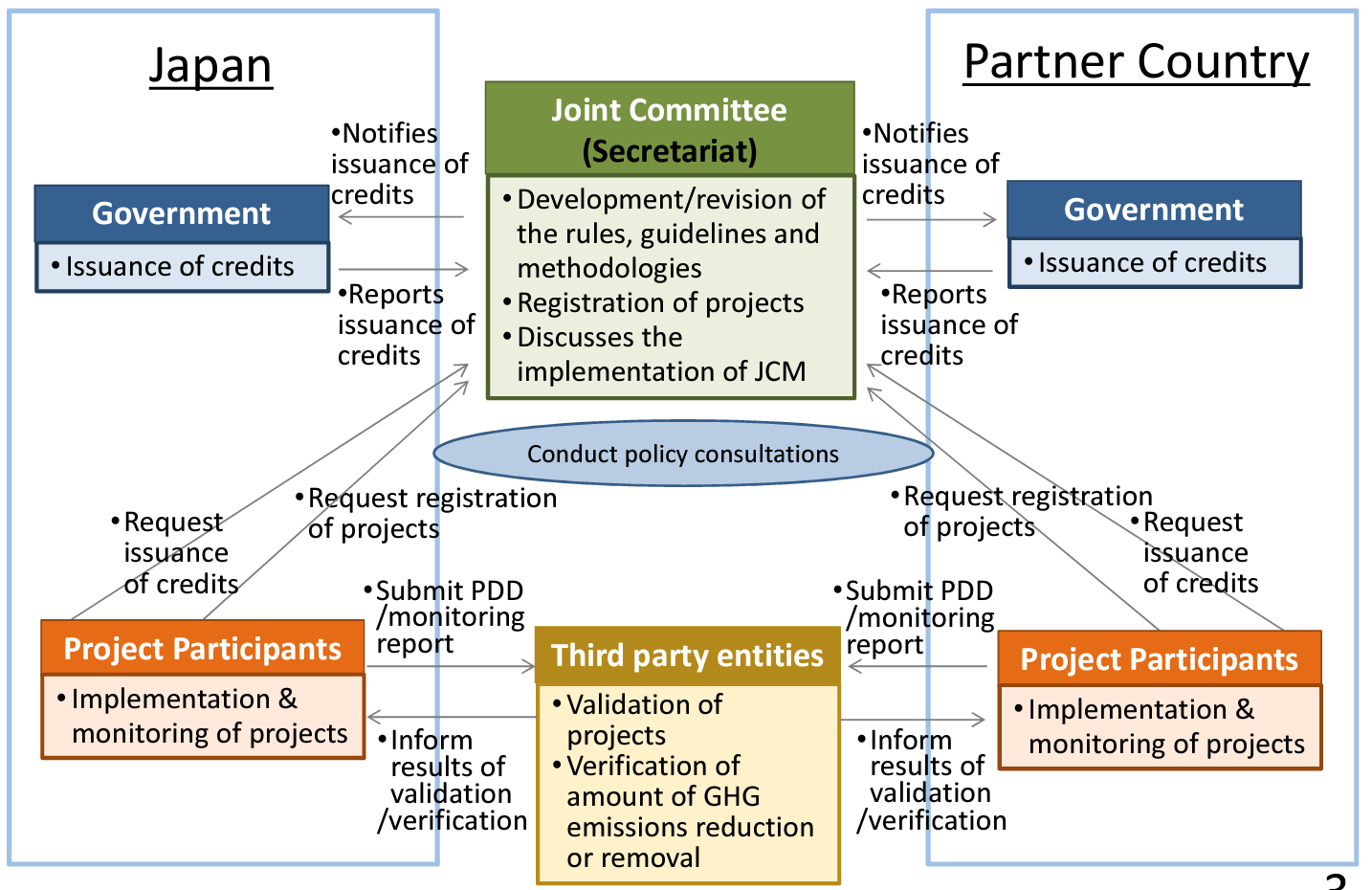
Source: Ministry of Environment
Background
JCM is a way for Japan to help provide developing countries with low-carbon technologies, products, systems, services, infrastructure, and other measures and solutions. The funding applies to projects in solar, hydropower, and geothermal energy, among others, as well as the installation of equipment to improve power efficiency. JCM covers IPP, PPA and other business models. Other initiatives in energy conservation are also being considered.
Meanwhile, Japan measures the GHG reductions achieved through the JCM-financed projects and counts them towards its own national emission cuts.
The scheme is in line with Article 6 of the Paris Agreement and, according to the MoE, contributes to the objective of the UNFCCC by facilitating global actions for GHG emission reductions or removals.
Japan estimates the potential for JCM to eliminate between 50 million tons of CO2 and 100 million tons of CO2 by 2030.
So far, 17 countries have signed bilateral agreements with Japan around JCM programs. These are (in order of joining the JCM): Mongolia, Bangladesh, Ethiopia, Kenya, Maldives, Vietnam, Laos, Indonesia, Costa Rica, Palau, Cambodia, Mexico, Saudi Arabia, Chile, Myanmar, Thailand, and the Philippines.
The JCM is managed and operated by a joint committee consisting of representatives from both countries. As of late September 2021, a total of 203 JCM-funded projects have been adopted.
Speeding up the funding
By September 2021, the JCM committee had selected 30 projects over two application rounds for funding. Of those, 26 were in Asia. In comparison, for the whole of the prior fiscal year 2020, only 22 Asian projects got the go-ahead.
With more projects being accepted, the funding commitments are rising. This fiscal year 2022, the budget for the JCM program was set at around ¥13.5 billion yen, an increase of about ¥2.11 billion, or 19% from FY2021. The budget was confirmed in March 2022, lending further support to Prime Minister Kishida’s pledge to bolster support for Asian energy transition initiatives.
The FY2022 first round of applications closed in mid-May.
Among the recently approved projects are plans by Kanematsu KGK and Thailand’s Blue Solar to install 35 MW of solar power generation and a 36 MWh energy storage system in the Thai Suphan Buri Province. It is the first of the JCM projects to support storage batteries in the Southeast Asian country.
The project will start to supply 44 GWh of electricity per year to the Thai national power utility, EGATT, from December 2022. It’s estimated to cut GHG emissions by around 13,000 tons of CO2 equivalent per year.
Kanematsu KGK, a machinery sales subsidiary in the general trading group Kanematsu, is a regular participator in JCM since 2018. It previously won funding for a solar power and high-efficiency refrigeration system for a food factory in Thailand, and also a 49 MW solar PV project in Vietnam’s An Giang province.
The Japanese firm’s four JCM projects are estimated to have removed 66,000 tons of CO2 equivalent in emissions.
Thai leasing scheme
Sumitomo Mitsui Finance and Lease’s local subsidiary in Thailand is applying the JCM scheme in another way. The unit is leasing solar power equipment to Japanese building materials retailer LIXIL’s production sites in Thailand.
SMFL Leasing (Thailand) helped LIXIL install rooftop solar at LIXIL’s Tostem Thai facility, helping to cut CO2 by approximately 2,200 tons per year.
Rooftop solar installations feature frequently among JCM’s projects. Kansai Electric recently claimed funding to help supply electricity to Lotte Vietnam after installing 1.25 MW capacity in PV panels on the roof of the latter’s factory. Construction is due to be completed this summer with Lotte committing to buy electricity on a 20-year contract. The project claims it will cut CO2 by 1,300 tons of CO2 equivalent a year. The Kansai power utility even set up a special Vietnam entity to facilitate the project.
Hydropower in Indonesia
Nix Co., a Japanese infrastructure developer, is using JCM to help finance a 6.2 MW mini hydropower project in Indonesia’s West Sumatra Province, which is scheduled to start operation around October 2022. The project is expected to reduce GHG emissions by 18,319 tons per year.
The hydropower project was being developed independently by an Indonesian company since 2013, but ran into technical and financial problems. Nix saw a chance to step in and revive the stalled project, buying a 75% stake in the project entity in late 2019 and then working to secure JCM funding.
The Japanese firm has added 3D and 4D modeling to simulate the construction and improve on the design and project management.
Conclusion
In recent decades, many Japanese manufacturers have offshored their production facilities to Southeast Asia, a trend that has only escalated since the onset of the Covid-19 pandemic as companies look to secure their supply chains.
This means a significant number of Japanese companies are now looking at energy improvements at their overseas assets and schemes like the JCM motivate them to invest in better emissions and power conservation.
Naturally, most of these projects are small in scale, as described above. Yet added together, they carry a notable CO2 reduction potential. At the current pace, it seems improbably that Japan will secure the 50-100 million tons of CO2 emissions cuts through JCM before 2030, but the expansion of the government’s budget allocation indicates it is willing to promote the scheme more widely and accelerate its adoption.
ANALYSIS
BY YURIY HUMBER
Abe’s Energy Legacy:
Focus on Security, but Paved the Way for Net-Zero
After the shocking assassination of former Prime Minister Abe Shinzo last Friday, July 8, in the western Japanese city of Nara (see the News section for details), Japan NRG Weekly pays tribute to his legacy and reviews his impact on the country’s energy sector.
Abe was often described as a politician who didn’t much care about the energy industry. If that was truly the case, then he nevertheless achieved a great deal.
During his time in power, Abe invested most of his political capital into changing Japan’s monetary and fiscal course, as well as on a series of reforms in free trade, the stock market, corporate governance, agriculture and tourism, just to name a few. He rarely tackled the big energy issues in public speeches.
Still, when taking over for his second stint as PM at the end of 2012, about 20 months after the Fukushima nuclear disaster, Abe maintained the course set by his political opponents in terms of supporting the wider rollout of renewable energy and shepherding the power and gas markets toward full liberalization.
Critics point to delays in liberalization as evidence that Abe favored the major utilities against industry newcomers, and paid too much lip service to blue chip firms. And yet, the opening up of these key sectors to greater competition was consistent with Abe’s broader free-trade and competition agenda. Furthermore, enacting change in the energy sector often tends to take longer than planned.
In contrast, the big power companies had cause for dissatisfaction with Abe’s leadership as he rarely voiced support for the nuclear industry. Abe was an astute reader of the public mood and, sensing strong anti-nuclear sentiment, he kept his stance low key for most of his second term in office (Dec. 2012 to Sept. 2020) – the longest for any Japanese PM. Then, within a year of leaving office, he went on to chair or advise groups that advocated for new nuclear plants.
For Abe, nuclear power represented both energy security and CO2-free electricity. The latter idea is rarely if ever credited to Abe. The plaudits go to his successor, Suga, who officially set Japan on a net-zero course in an October 2020 speech. Yet, Suga’s declaration was made just one month after Abe stepped down.
In fact, the plan to decarbonize Japan was set in motion during Abe’s time as PM, but was paused. Abe hesitated, since in the summer of 2020 he faced political scandals and failing health. He feared the onset of the Covid pandemic meant that Japan’s businesses and society would not accept a strong green message. By the time Suga decided to make the declaration, he had the benefit of having seen industrial rival China announce the same.
Abe’s penchant for viewing most issues via a security lens is also likely the reason for his well-publicized attempts to court an official peace treaty with Russia. Abe and President Vladimir Putin met at least 25 times and held about 10 official phone calls. After Russia’s sudden annexation of Ukraine’s Crimea peninsula in 2014, Japan’s sanctions were criticized as soft compared to those of western allies.
Japan relies on six countries in the Middle East for 93% of its crude oil, which is about 40-45% of the primary energy mix. Russia was considered a viable alternative for oil, natural gas, and other commodities, but geopolitical and governance issues made it a difficult investment destination for Japanese firms.
In return for Abe’s diplomatic efforts, Japan was considered a front-runner to help develop a new LNG project near Vladivostok or expand its Sakhalin oil and gas projects in Russia. While those plans did not proceed, Japan Oil, Gas, and Metals Corporation (JOGMEC) and Mitsui & Co. eventually took a 10% stake in the Russian Arctic LNG 2 project. Notably, the Japanese investment occurred after two Chinese companies bought in.
In the context of today, Abe’s efforts towards Russia are interpreted as a failure. The future of Japanese energy assets in Russia are highly uncertain. The breadth of Abe’s international relationship-building, however, means that some of what he sowed will surely result in a long-term gain. Japan’s close energy dialog with India and the ASEAN, and better engagement with Africa, are just a few of the green shoots to look out for in the future.
GLOBAL VIEW
BY JOHN VAROLI
Below are some of last week’s most important international energy developments monitored by the Japan NRG team because of their potential to impact energy supply and demand, as well as prices. We see the following as relevant to Japanese and international energy investors.
China/ Economic stimulus
Good news for the global economy. China intends to move forward the sale of about $220 billion in state bonds for the second half of 2022 (originally planned for 2023) in order to bolster fiscal stimulus and keep the economy on target for growth forecasts.
China/ EV Batteries
Tianqi Lithium, a supplier of components used in rechargeable batteries, held a secondary listing in Hong Kong. Bolstered by growing EV sales, the company raised $1.7 billion to fund expansion. The company debuted on the Shenzhen Stock Exchange in 2010.
EU/ Nuclear power and Gas
The EU approved a law classifying gas and nuclear as “sustainable energy sources”, which is in large part seen as a move to help end reliance on Russian gas supplies. Member states have until July 11 to object, but officials said it’s unlikely to be blocked.
France/ Nuclear power
The government will take full control of EDF, a nuclear energy power group that is grappling with high debt and production outages. The company also must process its biggest orders in decades for new nuclear reactors.
India/ Oil
The government imposed special taxes on petrol and diesel exports, accusing oil refiners of cashing in on high international prices while “drying out their pumps” at home. India’s biggest private refiners include Reliance Industries and the partly Rosneft-owned Nayara Energy, both of which are buying discounted Russian crude.
Indonesia/ Oil
State-owned Pertamina and Russia’s Rosneft will invest $22 billion in a refinery in East Java, as well as other projects to produce fuel and raw materials for the country.
Mexico/ Oil
State-owned Pemex opened its vast Dos Bocas refinery. Originally expected to cost $8 billion, it’s far over budget, now at about $12 billion. Dos Bocas is projected to produce 340,000 barrels daily.
Qatar/ LNG
In recent weeks, QatarEnergy announced JVs with five major international energy companies to develop the $29 billion North Field East. By 2026, Qatar’s annual LNG export capacity will increase from 77 million tons to 110 million tons, overtaking Australia as the second-biggest gas producer and only lagging behind the U.S.
Russia/ Metals
Metals giant Norilsk Nickel began talks with aluminum producer Rusal to create a $60 billion metals production behemoth that will be better positioned to withstand the impact of western sanctions on Russia.
Switzerland/ battery storage
A water battery that can store electricity equivalent to 400,000 electric car batteries began operating in Valais. With the ability to store and generate large amounts of hydroelectric energy, the battery will help stabilize power supplies in the country.
UK/ Energy transition
National Grid presented plans for a £54 billion upgrade to the national electricity network. It wants 50 GW of offshore wind by 2030, up from 10 GW currently and the new network would have capacity for an additional 23 GW. At full output this would meet about 67% of total electricity demand.
2022 EVENTS CALENDAR
A selection of domestic and international events we believe will have an impact on Japanese energy
| January | OPEC quarterly meeting;
JCCP Petroleum Conference – Tokyo; EU Taxonomy Climate Delegated Act activates; Regional Comprehensive Economic Partnership (RCEP) Trade Agreement that includes ASEAN countries, China and Japan activates; Indonesia to temporarily ban coal exports for one month; Regional bloc developments: Cambodia assumes presidency of ASEAN; Thailand assumes presidency of APEC; Germany assumes presidency of G7; France assumes presidency of EU; Indonesia assumes presidency of G20; and Senegal assumes presidency of African Union; Japan-U.S. two-plus-two meeting; Japan’s parliament convenes on Jan. 17 for 150 days; Prime Minister Kishida visits Australia (tentative) |
| February | Chinese New Year (Jan. 31 to Feb. 6);
Beijing Winter Olympics; South Korea joins RCEP trade agreement |
| March | Renewable Energy Institute annual conference;
Smart Energy Week – Tokyo; Japan Atomic Industrial Forum annual conference – Tokyo; World Hydrogen Summit – Netherlands; EU New strategy on international energy engagement published; End of 2021/22 Japanese Fiscal Year; South Korean presidential election |
| April | Japan Energy Summit – Tokyo;
MARPOL Convention on Emissions reductions for containerships and LNG carriers activates; Japan Feed-in-Premium system commences as Energy Resilience Act takes effect; Launch of Prime Section of Japan Stock Exchange with TFCD climate reporting requirement; Convention on Biological Diversity Conference for post-2020 biodiversity framework – China; Elections: French presidential election; Hungarian general election |
| May | World Natural Gas Conference WCG2022 – South Korea;
Elections: Australian general election; Philippines general and presidential elections |
| June | Happo-Noshiro offshore wind project auction closes;
Annual IEA Global Conference on Energy Efficiency – Denmark; UNEP Environment Day, Environment Ministers Meeting – Sweden; G7 meeting – Germany |
| July | Japan to finalize economic security policies as part of natl. security strategy review;
China connects to grid 2nd 200 MW SMR at Shidao Bay Nuclear Plant, Shandong; Czech Republic assumes presidency of EU; Elections: Japan’s Upper House Elections; Indian presidential election |
| August | Japan: Africa (TICAD 8) Summit – Tunisia;
Kenyan general election |
| September | IPCC to release Assessment and Synthesis Report;
Clean Energy Ministerial and the Mission Innovation Summit – Pittsburg, U.S.; Japan LNG Producer/Consumer Conference – Tokyo; IMF/World Bank annual meetings – Washington; Annual UN General Assembly meetings; METI to set safety standards for ammonia and hydrogen-fired power plants; End of 1H FY2022 Fiscal Year in Japan; Swedish general election |
| October | EU Review of CO2 emission standards for heavy-duty vehicles published;
Chinese Communist Party 20th quinquennial National Party Congress; G20 Meeting – Bali, Indonesia; Innovation for Cool Earth TCFD & Annual Forums – Tokyo; Elections: Okinawa gubernational election; Brazilian presidential election; |
| November | COP27 – Egypt;
U.S. mid-term elections; Soccer World Cup – Qatar; |
| December | Germany to eliminate nuclear power from energy mix;
Happo-Noshiro offshore wind project auction result released; Japan submits revised 2030 CO2 reduction goal following Glasgow’s COP26; Japan-Canada Annual Energy Forum (tentative); Tesla expected to achieve 1.3 million EV deliveries for full year 2022 |
Disclaimer
This communication has been prepared for information purposes only, is confidential and may be legally privileged. This is a subscription-only service and is directed at those who have expressly asked K.K. Yuri Group or one of its representatives to be added to the mailing list. This document may not be onwardly circulated or reproduced without prior written consent from Yuri Group, which retains all copyright to the content of this report.
Yuri Group is not registered as an investment advisor in any jurisdiction. Our research and all the content express our opinions, which are generally based on available public information, field studies and own analysis. Content is limited to general comment upon general political, economic and market issues, asset classes and types of investments. The report and all of its content does not constitute a recommendation or solicitation to buy, sell, subscribe for or underwrite any product or physical commodity, or a financial instrument.
The information contained in this report is obtained from sources believed to be reliable and in good faith. No representation or warranty is made that it is accurate or complete. Opinions and views expressed are subject to change without notice, as are prices and availability, which are indicative only. There is no obligation to notify recipients of any changes to this data or to do so in the future. No responsibility is accepted for the use of or reliance on the information provided. In no circumstances will Yuri Group be liable for any indirect or direct loss, or consequential loss or damages arising from the use of, any inability to use, or any inaccuracy in the information.
K.K. Yuri Group: Oonoya Building 8F, Yotsuya 1-18, Shinjuku-ku, Tokyo, Japan, 160-0004.