
JAPAN NRG WEEKLY
AUGUST 1, 2022
JAPAN NRG WEEKLY
Aug 1, 2022
NEWS
TOP
- Russia tells Japanese LNG buyers to pay via a Russian bank, but promises to keep deliveries in line with existing contracts
- Kansai Electric to restart Mihama reactor earlier than planned, easing concerns about a power crunch in western Japan
- METI minister also named as the first ever GX minister to speed up rollout of renewables and restart of nuclear facilities
ENERGY TRANSITION & POLICY
- JOGMEC compiles terms for financing of clean energy projects
- METI explores a new framework to fund nuclear decommissioning
- Tokyo institute claims major breakthrough in solid-state batteries
- BASF and Toda venture to boost Japan output of battery material
- Tokuyama to build next-gen electrolyzer manufacturing plant
- Ammonia catalyst developer raises ¥4 billion from Japan investors
- Mitsui and Cosmo partner to manufacture clean aviation fuel
- Japan funds venture that converts diesel trucks to hydrogen cells
ELECTRICITY MARKETS
- Utilities hike power tariffs again, reaching their increase limits
- Transmission firms demand more money to cover grid upkeep
- Vena Energy, Sumitomo plan large Niigata offshore wind farms
- Nikken Sekkei enters offshore wind services sector with surveys
- Toshiba to connect solar power farms and buyers via new system
- Chemical maker to phase out coal-fired plants in favor of biomass
- JERA posts first quarterly loss in three years on high fuel prices
- NYK Idemitsu to offer Asian coal plants AI-based system that cuts down on fuel use and CO2 emissions
OIL, GAS & MINING
- Japan imports of Russian crude drop to zero in June
- Japan sees seabed rare earth mining potential; mulls action plan
- Asian LNG prices hit a four-month high on Russian supply cuts
- Glencore strikes Japan’s most expensive coal supply deal
- METI to increase frequency of review for national oil stocks
ANALYSIS
EXCESS SOLAR AND WIND POWER MAY HOLD
KEY TO GRID BALANCING AND GREEN HYDROGEN
A project in central Japan aims to solve two key challenges for decarbonization within a single system. A trial led by Tokyo Electric and Yamanashi Prefecture is funneling “excess” power from renewables in order to create hydrogen. In the process, it is also helping to balance the local power grid. The demonstration is taking advantage of improvements in electrolyzer technologies. Should the project prove successful, the impact will also reverberate in the power market.
JAPAN CAUTIOUSLY EYES ALTERNATIVE
LNG SUPPLIES IN AFRICA
With uncertainty over future supplies of Russian LNG, Japan is considering alternatives. In the short-term, the government has turned to the U.S. and Australia, two of the world’s biggest LNG exporters and geopolitical allies, to boost deliveries. The longer-term solution, however, will be more complex.
Japan has always built its energy security based on diversity of supply. If deliveries of Russian LNG wane over the coming years, simply asking existing suppliers for top up volumes would undermine this security-conscious portfolio approach.
So, other regional opportunities are under review. Some are in Africa.
GLOBAL VIEW
Russia starts construction of nuclear plant in Egypt. European energy firms announce bumper profits. Gas prices volatile on Russia supply uncertainty. Greece to subsidize power bills. Nigeria moves forward with oil and gas export projects. China delivers first stage of a major coal plant in Turkey. Details on these and more in our global wrap.
EVENTS SCHEDULE
JAPAN NRG WEEKLY
PUBLISHER
K. K. Yuri Group
Editorial Team
Yuriy Humber (Editor-in-Chief)
John Varoli (Senior Editor, Americas)
Mayumi Watanabe (Japan)
Wilfried Goossens (Japan, Events)
Regular Contributors
Chisaki Watanabe (Japan)
Takehiro Masutomo (Japan)
Daniel Shulman (Japan)
Art & Design
22 Graphics Inc.
Events

SUBSCRIPTIONS & ADVERTISING
Japan NRG offers individual, corporate and academic subscription plans. Basic details are our website or write to subscriptions@japan-nrg.com
For marketing, advertising, or collaboration opportunities, contact sales@japan-nrg.com For all other inquiries, write to info@japan-nrg.com
OFTEN USED ACRONYMS
METI The Ministry of Energy, Trade and Industry
MOE Ministry of Environment
ANRE Agency for Natural Resources and Energy
NEDO New Energy and Industrial Technology Development Organization
TEPCO Tokyo Electric Power Company
KEPCO Kansai Electric Power Company
EPCO Electric Power Company
JCC Japan Crude Cocktail
JKM Japan Korea Market, the Platt’s LNG benchmark
CCUS Carbon Capture, Utilization and Storage
mmbtu Million British Thermal Units
mb/d Million barrels per day
mtoe Million Tons of Oil Equivalent
kWh Kilowatt hours (electricity generation volume)
NEWS: ENERGY TRANSITION & POLICY

Kishida names Haguida as GX minister, to speed up renewables and nuclear restarts
(Government Statement, July 27)
- PM Kishida has named METI minister Hagiuda as Green Transformation (GX) minister in charge of energy supply stability while driving decarbonization. The GX Council will write policies, specifically new frameworks to speed up renewables, power storage and conservation systems to brace for possible power shortage in winter and early nuclear restarts.
- The Council will explain to the public what these initiatives mean in the 10-year green transformation. The Council will also clarify details of five GX key policies.
- CONTEXT: Under Kishida, METI has become the focus of decarbonization policy rather than the MoE as this appointment indicates.
TAKEAWAY: For a detailed review of PM Kishida’s GX approach and minister Hagiuda’s appointment, see the Analysis section in next week’s report.
JOGMEC compiles terms for financing clean energy projects
(Japan NRG, July 28)
- Japan Oil, Gas, Metals National Corporation (JOGMEC) has compiled basic terms for financing CCS, hydrogen and ammonia in Japan and overseas.
- The projects are ideally large in size, and thus storage or output capacity will comprise a major criterion. CCS projects need to offer low-cost solutions and stable storage capacities, while ammonia and hydrogen projects are expected to enhance Japan’s energy security.
- The financing is expected to enhance Japanese business competitiveness. JOGMEC will provide loans, loan guarantees, investment, data, as well as practical support such as staff training.
METI explores a new framework to finance nuclear decommissioning
(Japan NRG, July 27)
- METI began to discuss the possibility of a new scheme to finance nuclear decommissioning to counter increased market competition and high fuel costs.
- Grids are required to build internal reserves to cover decommissioning costs but this system does not provide financial security as the use of the reserves has not been limited to decommissioning, said METI nuclear policy director Endo Ryota, speaking to the decommissioning working group. The group agreed that internal reserves are not sufficient and the country needs another framework to finance decommissioning.
- METI suggested a scheme similar to the Nuclear Reprocessing Organization of Japan (NuRO) that requires grids to make financial contributions to reprocess spent fuel.
- CONTEXT: Since the Fukushima accident, the number of reactors Japan has on the list for decommissioning has dramatically increased to 27 units as utilities phase out older facilities. The first decommissioning work is due to start in the next three years. The Japan Atomic Energy Agency is the only domestic body currently with experience in this field.
Study group finalizes measures to resolve community conflicts caused by renewables
(Japan NRG, July 28)
- A multi-ministry study group on community conflicts related to renewables has finalized new regulations, which will be open for public comment before enforcement.
- The group looked at four categories: 1) period before land development, 2) after development to operational stage, 3) decommissioning, and 4) issues relevant to all stages.
- Suggested restrictions include prohibiting operators that have not cleared the regulatory processes to sell power; setting up a new framework to check if all relevant regulatory requirements have been cleared when operators submit a construction plan to METI; and, synchronizing regulations that are currently under the oversight of different ministries.
- The study group was set up by METI, MoE, the Ministry of Agriculture, Forestry and Fisheries, and the Ministry of Land, Infrastructure, Transport and Tourism.
Tokyo Institute of Technology makes major battery breakthrough
(Mynavi Tech+, July 25)
- Researchers at Tokyo Institute of Technology and Tokyo University claim achieving a 2,800-fold reduction in the interfacial resistance exhibited by solid lithium batteries.
- The breakthrough was made possible by introducing a lithium phosphate buffer layer between the battery’s other layers.
- The team says this is a major step in improving solid-state battery technology.
BASF, Toda venture to boost Japan output of material for lithium-ion batteries
(New Energy Business News, July 25)
- The JV between the Japanese subsidiary of German chemicals major BASF and Toda Kogyo will increase output of cathode materials for lithium-ion batteries used in EVs at its Onoda Plant, Yamaguchi Prefecture.
- The expansion will be ready for the second half of 2024. With this investment, annual production of cathode materials will increase to 60,000 tons (equivalent to 45 GWh/ year in battery cell capacity) by 2025.
- BASF owns 66% of the BASF Toda Battery Materials venture and Toda the rest.
Tokuyama to build a next-gen electrolyzer manufacturing plant
(Company statement, July 26)
- Tokuyama Corp will open a manufacturing base for the early commercialization of alkaline water electrolyzers (AWEs) at its R&D hub in Yanai City, Yamaguchi Prefecture. This business will start by June 2023.
- The AWE splits water into hydrogen and oxygen when electrical power is applied to an alkaline solution and water. By absorbing excess renewable energy, it balances out fluctuations from variable power sources.
- Tokuyama’s AWE tech requires the world’s lowest level of power consumption and does not require large amounts of precious metals such as platinum.
TAKEAWAY: The optimal operation of AWE is crucial to make a hydrogen plant profitable. See this week’s Analysis section for details on how electrolyzer tech is deployed to balance the grid in a new test project in Japan.
Ammonia catalyst developer startup raises ¥4 billion from investors including INPEX, NYK
(New Energy Business News, July 27)
- Tokyo-based startup Tsubame BHB, which is developing catalysts that would work for small-scale ammonia production facilities, has raised about ¥4 billion through convertible equity-type stock acquisition rights.
- Investors include Idemitsu Kosan, INPEX, NYK Line, the Development Bank of Japan, and Sumitomo Mitsui Trust Bank.
- Tsubame BHB aims to commercialize small-scale, on-site ammonia production systems that work in low-temperature and low-pressure conditions. The company will use the newly raised funds to promote compact ammonia production equipment for local economies, and to develop new catalysts and processes for the clean-burning gas.
Mitsui and Cosmo cooperate on sustainable aviation fuel (SAF)
(Company Statement, July 28)
- Mitsui & Co and Cosmo Oil will jointly study using the technology of LanzaJet of the U.S. to establish a biofuel production facility for sustainable aviation fuel (SAF) in Japan.
- Cosmo has experience in jet fuel quality management and oil refinery product trading. Mitsui is an investor in LanzaJet and has ethanol procurement channels.
- The two companies aim to establish large-scale domestic SAF production at Cosmo refineries, using LanzaJet’s proprietary Alcohol-to-Jet* (ATJ) technology, which can make up to 90% of its product as SAF and convert nearly all of the carbon from the ethanol to hydrocarbon products.
- CONTEXT: Cosmo has pledged to increase its annual SAF production capacity to 300 million liters by 2030. The tie-up with Mitsui is expected to deliver 220 million liters of SAF by 2027/28.
Mitsui ties up with CF Industries to manufacture ammonia in the U.S.
(Company Statement, July 29)
- Mitsui & Co. and CF Industries will develop a clean ammonia production project in the U.S.
- The plan is to produce at least 1 million tons of clean ammonia per year in the U.S. Gulf of Mexico, with CF as the operational partner. The use of carbon capture tech is expected to reduce CO2 emissions by more than 60% compared to conventional ammonia production.
- CF will own 52% of the facility and Mitsui the rest. A final investment decision is expected in 2023, with production to start in 2027.
- CONTEXT: Mitsui is Japan’s biggest ammonia importer.
Japan hands out loan to support conversion of diesel trucks to hydrogen
(Kankyo Business, July 28)
- Tokyo-based i Labo received a loan from the Japan Finance Corporation to invest in technology that would convert existing diesel engines to hydrogen engines.
- The company says it will be able to conduct “hydrogenation conversion” for machinery including power generators, ships, heavy machinery, and construction equipment.
Mitsubishi Heavy, Boeing to work on hydrogen, SAF and other net-zero tech
(Company Statement, July 19)
- Mitsubishi Heavy Industries and Boeing will develop sustainable technologies – including hydrogen, electrification, sustainable materials, zero climate impact propulsion, and new aircraft design concepts, and commercialize sustainable aviation fuels (SAF).
- MHI and Boeing will study new feedstocks and technologies for SAF production, including in the area of green hydrogen and carbon capture.
- CONTEXT: The partnership comes three months after Kawasaki Heavy and Airbus announced a similar plan to decarbonize aviation with hydrogen fuel-based technology.
Hokuriku Electric joins Yokohama EV charging chain to develop network
(Kankyo Business, July 25)
- Hokuriku Electric and Yokohama-based EV charging chain, Your Stand, will work together to install and operate EV chargers in the Hokuriku region.
- Your Stand provides EV charging services to residential complexes in the Tokyo metropolitan, Chubu and Kansai areas. Hokuriku Electric does the same but for municipalities and corporate customers and wants to expand its offering to apartment complexes.
Nippon Steel to develop raw materials from recycled CO2 emissions via CCU
(Company Statement, July 22)
- Nippon Steel plans to use CCU (Carbon Capture and Utilization) technology to collect CO2 and process it into raw materials for valuable chemicals.
- A pilot project in Australia will synthesize raw materials from CO2 using the microbial process, which can be done under mild temperature and pressure.
- The goal is to convert waste emissions into medium-chain carboxylates (MCCs), which are important platform chemicals for various applications in the nutraceuticals and agriculture industries, and that can potentially be converted into fuels.
Toshiba, Sojitz, CBMM to test-drive new electric bus in Brazil
(Japan Metal Bulletin, July 22)
- In August, Toshiba, Sojitz, and Brazilian miner CBMM will test drive electric buses in Brazil that are mounted with new high-capacity lithium-ion batteries.
- The batteries use niobium titanium oxide as anodes, replacing graphite. The niobium compound could double battery capacity. Volkswagen will provide the test buses.
- CONTEXT: Niobium-contained steel is used for automotive exhaust systems, whose demand is declining as EVs do not require exhaust systems.
- CBMM is the world’s largest producer of niobium, a minor metal concentrated in Brazil. Because steel dominates niobium applications, Asian steel giants Nippon Steel, JFE Steel, Posco, Baowu, Taiyuan, and Anshan are among the minority shareholders.
Japan to loan Indonesia $320 million to complete hydropower project
(Nikkei Asia, July 27)
- Japan will loan Indonesia ¥44 billion ($320 million) to complete a hydroelectric plant.
- The pledge came during the visit of President Widodo to Tokyo. At a meeting with PM Kishida, he called for more Japanese investment in the industrialization of Indonesia’s natural resources, into EVs, and the Southeast Asian country’s new capital city.
Itochu joins with Korea’s Lotte Chemical on hydrogen and ammonia-related business
(Company statement, July 22)
- Trading house Itochu and South Korea’s Lotte Chemical will collaborate in the hydrogen- and ammonia-business, including transactions involving the latter, the utilization of ammonia infrastructure in Japan and Korea and joint investment in clean ammonia production facilities.
Murata Manufacturing aims to cut energy use by 20% with batteries and an AI system
(New Energy Business News, July 27)
- Murata Manufacturing installed an energy-saving system that combines an AI energy-saving control system and its container-type storage batteries at its HQ in Kyoto.
- From 2023 onward, the system will be installed at all sites, including production sites, to reduce the load on the power grid and help stabilize local power supply. Murata expects to cut power use at its HQ by 20% this fiscal year.
- Murata’s storage battery has a capacity of 407 kWh.
NEWS: POWER MARKETS

x
Kansai Electric gets ready to restart Mihama NPP Unit 3 reactor earlier than planned
(Denki Shimbun, July 29)
- Kansai Electric has completed the construction of a Specific Major Accident Response Facility at its Mihama NPP Unit 3 (PWR, 826 MW) earlier than planned.
- This will allow the utility to restart the facility on Aug. 12, earlier than the September timeframe that was previously under consideration.
- CONTEXT: The power company is operating three of its seven reactors as of now. All seven have been approved for a restart by the regulator, but still need to complete upgrades to comply with the new accident response measures.
- The current plan calls for Ohi NPP Unit 4 to be online from Aug. 10, Ohi NPP Unit 3 from December, Takahama NPP Unit 1 from May 2023, and Takahama NPP Unit 2 around June 2023.
- SIDE DEVELOPMENT:
Keidanren calls for early restart of nuclear power plants amidst Japan’s power crunch
(Nikkei; July 22)- At the summer forum held by Keidanren, Japan’s top business lobby, many business leaders were concerned about global disruptions in the supply chain for resources and food. Some, including Hitachi chair Higashihara, called for the government to help stabilize energy supply, including by an accelerated restart of nuclear power plants.
- Meanwhile, Tokio Marine Holdings chair Nagano said Japan should move aggressively to promote the use of ammonia, a clean-burning gas.
- At the summer forum held by Keidanren, Japan’s top business lobby, many business leaders were concerned about global disruptions in the supply chain for resources and food. Some, including Hitachi chair Higashihara, called for the government to help stabilize energy supply, including by an accelerated restart of nuclear power plants.
- Meanwhile, Tokio Marine Holdings chair Nagano said Japan should move aggressively to promote the use of ammonia, a clean-burning gas.
Utilities hike electricity tariffs again—TEPCO hits tariff cap
(Nikkei, July 28)
- On July 28, Japan’s 10 major utilities announced their electricity tariffs for September.
- Chubu Electric Power raised tariffs significantly; the average subscriber is now projected to pay an additional ¥364/ month.
- TEPCO’s tariffs, meanwhile, are now 50% higher than the base tariff reported to the government, meaning that TEPCO is unable to pass on any further cost increases to consumers, and rather must absorb these costs itself.
Transmission companies demand more money to cover costs
(Asahi Shimbun, July 26)
- On July 25, Japan’s 10 major electricity transmission companies announced their five-year business plans through 2027.
- The companies say that due to increased costs due to the need to maintain aging infrastructure and support higher levels of renewable energy, if current transmission tariffs remain unchanged, they will lose an average of ¥428 billion per year.
- The operators are demanding the government to increase the transmission tariff to which they are entitled by around 30%, which would translate to an increase in power bills of up to ¥480 per month for the average household.
- It is believed that a Ministry of Economy Trade and Industry expert panel will debate the demands before approving amendments to the current transmission tariff.
Vena Energy plans 600 MW offshore wind project in Niigata area
(New Energy Business News, July 26)
- Vena Energy plans to develop a 600 MW wind farm off the coast of Tainai City, Niigata Prefecture. The project area covers about 7,428 ha and extends 3 nautical miles from the coast.
- The project will deploy 40 wind turbines with either a monopile type or jacketed type foundation. Construction is expected to last about 4 years.
Sumitomo plans 700 MW offshore wind farm in Niigata area
(New Energy Business News, July 26)
- Sumitomo Corp plans a 700 MW wind farm off the coast of Tainai City, Niigata Prefecture. The area covers about 9,900 ha, and up to 53 wind turbines will be installed. Foundations are expected to be monopile, jacket, or gravity type. Taisei and Obayashi also plan offshore wind farms in the same area.
Eurus Energy plans another wind farm in Hokkaido
(New Energy Business News, July 25)
- Eurus Energy H released an environmental assessment for the “Soya Hills Wind Power Project”, a 156 MW development near Wakkanai City, Hokkaido.
- Construction will begin in April 2025; the plant should be operational in April 2028.
Engineering firm Nikken Sekkei enters offshore wind sector offering survey services
(New Energy Business News, July 27)
- Nikken Sekkei entered the offshore wind power business field via a business alliance with Geo Marine Service, which handles offshore wind power foundation design, and offers service for preliminary surveys, design, and certification for installation of power generation facilities.
- CONTEXT: In order to design and install an offshore wind power facility, it must be certified by the Nippon Kaiji Kyokai (NK), an NGO dedicated to safety of life and property at sea.
- Nikken Sekkei already has experience in the design of onshore wind power facilities, and in the design of offshore facilities such as Kansai International Airport. The new partnership with GeoMarine Services, a partner of Ireland’s Gavin & Doherty Geosolutions (GDG), will enable the company to conduct surveys and design offshore facilities that meet Japanese standards.
Toshiba to connect solar power generators and users through the new FIP system
(Nikkei, July 29)
- Toshiba Energy Systems will start a business that buys renewable energy from solar power plants using the new Feed-in-Premium program and resell it on the wholesale market and directly to consumers.
- As FIP was only launched in April, few companies currently use it. Toshiba aims to gain relevant know-how ahead of others.
- For its first project, starting in September, Toshiba will buy 700 kW worth of electricity at a fixed price from SMFL Mirai Partners, a subsidiary of Sumitomo Mitsui Finance and Leasing. SMFL is converting two solar facilities to FIP.
Chemicals maker to build biomass power plant to replace in-house coal-fired facility
(New Energy Business News, July 29)
- Tosoh Corp, a chemical and specialty materials maker, will spend ¥40 billion to build a 62 MW biomass power plant to provide in-house electricity at its Nanyo factory in Yamaguchi Prefecture. The plant will be operational in April 2026 and will take over from an aging coal-fired power generation facility.
- In addition to wood-based fuels, the new biomass plant will use waste-based fuels such as construction waste and RPF (solid fuel made from used paper and waste plastic).
- Tosoh aims to phase out coal-fired generation by 2030 and switch to biomass only.
JERA posts first quarterly loss in three years on high fuel prices
(Kyodo News, July 28)
- JERA, the power utility and LNG importer, posted a loss of ¥11.7 billion for the April to June period, compared to a ¥64 billion profit a year earlier. The deficit was due to higher LNG and coal prices.
- This is the company’s first quarterly loss in three years, when it first started publishing quarterly results.
No straightforward answers to energy problems in solar-heavy Kyushu
(Nikkei, July 25)
- CONTEXT: This is an opinion article by Nikkei columnist Yamamoto Natsuki.
- Despite boasting Japan’s highest percentage of renewable energy, as well as operational nuclear reactors, Kyushu continues to face power shortages in summer and winter.
- The closure of aging thermal plants means this power generates under 40% of Kyushu’s electricity. Meanwhile, half of coal and gas plants are over 30 years old and near the end of their useful lives.
- The unreliable nature of output from solar farms means that plants such as Kyushu Electric’s Shin-Oita gas-fired power station must be able to rapidly vary output to compensate for supply dips: the 14 units at Shin-Oita are cycled 2,000 times a year.
- To adapt to the new conditions, 80% of Kyushu’s thermal plants (by output) have been upgraded to allow precise output control. Even some coal-fired plants now have output lessened to a bare minimum.
- Technology to store surplus electricity is still in its infancy, and it remains unclear whether innovations such as hydrogen fired generation will ever become a reality.
- While addressing the current power shortage, the government also needs a roadmap that makes Japan’s energy mix more conducive to achieving emissions targets.
NYK Idemitsu to offer efficiency systems to Southeast Asian coal power plants
(Nikkei Asia, July 29)
- NYK Idemitsu Green Solutions will offer AI systems to coal-fired power plant operators in Southeast Asia to help them save fuel and lower emissions.
- The Tokyo company, jointly owned by Idemitsu Kosan and Nippon Yusen (NYK Line), runs a boiler operation control system, which automatically adjusts coal input based on steam pressure and other data readings. The result shaves off several percent off fuel consumption and CO2 emissions.
TEPCO releases robot probe findings
(NHK, July 28)
- TEPCO released the findings of its analysis of sediment at the bottom of unit one of the Fukushima Dai-Ichi nuclear power plant, believed to be fuel rod debris.
- A robot equipped with ultrasound surveyed 13 locations in the reactor’s containment vessel. The findings suggest that the sediment layer is between 30 cm and 1 meter thick, contains hollows, and was formed when debris fell from the center of the reactor.
TEPCO shareholders demand seizure of former directors’ assets
(TBS News Dig, July 22)
- In response to a Tokyo District Court decision ordering four former TEPCO directors to pay ¥13 trillion in compensation to TEPCO for failure to tsunami-proof the Fukushima-Daiichi plant, the TEPCO shareholders that brought the action have demanded TEPCO file a petition for the impoundment of the former directors’ assets so the proceeds can be used to compensate disaster victims.
- Shareholders say that if TEPCO doesn’t act, they’ll file a petition for the provisional seizure of the assets.
- CONTEXT: The former TEPCO directors have launched an appeal against the court decision.
NEWS: OIL, GAS & MINING

Russia tells Sakhalin-2 LNG buyers to use Russian bank for payments
(Nikkei, Asia Nikkei, NHK, July 30)
- Russia told Japanese importers of LNG its Sakhalin-2 project to make payments via a Russian branch of a European bank, seeking a way to shield Moscow energy revenues from sanctions, according to insiders.
- Sakhalin Energy Investment, the operator of the Sakhalin-2 LNG and oil project, began asking Japanese gas buyers this month to make such a change. At least one Japanese utility, Tohoku Electric, confirmed that it has already complied with the request. Others are still considering it.
- Payments can still be made in dollars and LNG deliveries will continue without interruption.
- Meanwhile, Japan has notified the U.S. that it plans to maintain its stakes in Sakhalin-2 even as Moscow changes the ownership of the project from an offshore company to a Russian entity. Ceding the rights would give a major benefit to Russia and a “third country”, METI minister Hagiuda said.
TAKEAWAY: At this stage, all parties seem interested in maintaining a status quo. While the Japanese ownership of the Sakhalin-2 project will continue to draw scrutiny in Russia and the West, the business side wants sales to continue. We see little economic or geopolitical reason for either party to walk away from the trade at this point.
- SIDE DEVELOPMENT:
Tokyo Gas will work with government on Sakhalin-2
(NHK, July 27)- Tokyo Gas said it will struggle if gas supplies from Sakhalin-2 were interrupted, because the field supplies 10% of their LNG requirements.
- Tokyo Gas will work closely with the government, industry associations, and other energy companies to ensure that the natural gas supply is not affected.
- SIDE DEVELOPMENT:
Chubu Electric estimates potential damages from disruptions of Russian LNG supply
(Asahi Shimbun, July 28)- Chubu Electric made an estimate of the financial impact on its operations should LNG deliveries from Russia’s Sakhalin-2 project be disrupted. The utility calculated potential losses of about ¥50 billion per year since it would need to procure replacement LNG volumes at a premium from the spot market.
- Chubu sees this as a big risk. However, should Russian LNG cargoes stop arriving, the company believes it will still be possible to procure some replacement volumes from sources other than the spot market, which would lessen the impact.
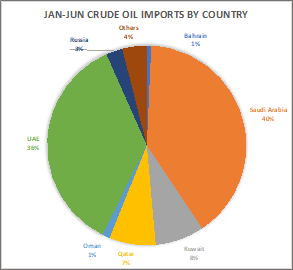
Japan imports zero crude oil from Russia in June
(Government Data, July 28)
- Japan did not import any crude oil from Russia in June, after importing 0.2 million kiloliters in May. During the first half of 2022, Japan imported 2 million kiloliters of Russia, accounting for 3% of the total imports.
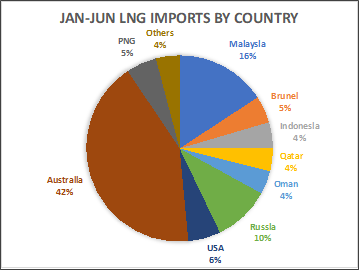
- Japan imported 0.6 million tons of LNG from Russia in June, accounting for 11% of total imports. Over January to June, imports from Russia were 3.7 million tons, or 10%.
- SIDE DEVELOPMENT:
No change in oil stockpile levels
(Japan NRG, July 28)- METI has no plan to change national and private sector oil stockpile levels, which are 90 and 70 consumption days, respectively. The recent release from the national stockpile following the Ukraine invasion was 5 days consumption volume and 7 days volume from private stockpiles. However, METI plans to increase review frequency, possibly every three years instead of every five years, to synchronize with the basic energy plan.
Japan sees seabed rare earth mining potential, mulls auction-based license system
(Japan NRG, July 27)
- METI published a review of its seabed mining strategy. Based on a pilot mining project that confirmed the potential a few years ago, the ministry is keen to move forward having discovered several resources in the seabed within Japanese territorial waters.
- As part of this strategy, the government plans to issue an ordinance to classify rare earth as “special minerals,” whose mining permits are issued via public auctions, rather than on a first-come-first-served basis. This should help move forward the development of rare earth metal mining underwater, according to METI.
- Japan’s list of “special minerals” (i.e. critical raw materials) includes copper, lead, iron and six other ores that can be mined from the seabed. These minerals are deemed essential to national economic security.
- Like the government’s offshore wind auctions, a third-party panel will run the selection process for rare earth mining tenders. Technological expertise will be the key criteria, rather than costs.
- METI is expected to make decisions on several underwater mining projects in the south of Japan overseen by JOGMEC by March 2023.
- CONTEXT: As no company in the world has a track record in seabed mining, the licenses are likely to be restricted to Japanese companies or Japan-led ventures. Geological data on the underwater mining areas is treated as confidential. However, high transparency in the seabed mining process is also required due to environmental concerns.
Asia Gas Prices Hit a Four-Month High on Russia Supply Cuts
(Bloomberg, July 28)
- Asia’s LNG prices surged to the highest level since the war in Ukraine began as Russia’s move to curb supply to Europe spurs global competition for the fuel.
- Japan’s Inpex purchased an LNG cargo for about $47 mmbtu, one of the priciest shipments ever for the nation, according to traders. Buyers in Japan and South Korea are rushing to secure shipments of the power plant and heating fuel to refill inventories for winter.
- The Japan-Korea Marker, the spot LNG benchmark for North Asia, surged above $45 mmbtu on Tuesday, the highest since early March, according to S&P Global.
Glencore Strikes One of Japan’s Most Expensive Coal Deals
(Bloomberg, July 27)
- Swiss trading major Glencore has agreed to supply coal to a Japanese customer at one of the highest prices ever paid by the nation. Nippon Steel will buy thermal coal for power generation from the trader at $375/ ton in a deal that lasts through March next year.
- The agreement is three times more expensive than similar deals struck last year. It is also one of the highest prices paid for coal by a Japanese firm, according to people familiar with the deal.
TAKEAWAY: In the last two weeks, Nippon Steel has made the most expensive LNG and coal supply deals in Japan’s modern history. It shows the steelmaker is concerned about electricity supply this winter. It also indicates that the price of steel, already up significantly in the last year, will continue to rise, increasing the cost of new energy infrastructure such as wind turbines and substations. The likelihood of high electricity prices for the long-haul is rising.
LNG stocks rise to 2.26 million tons
(Government Data, July 27)
- LNG stocks stood at 2.26 million tons as of July 24, up from 1.94 million tons a week earlier. The end-July stocks last year were also 2.26 million tons. The five-year average for this time of year is 2.03 million tons.
- CONTEXT: The figures represent the total of 10 grids’ stocks. Stocks of Nippon Steel, a consumer who reportedly purchased the gas at the record high price of $41/ mmbtu last week, are not included.
ANALYSIS
BY CHISAKI WATANABE
Excess Solar and Wind Power May Hold the Key for Grid Balancing And Green Hydrogen
A project in central Japan aims to solve two key challenges for decarbonization within one system. A trial led by Tokyo Electric (TEPCO) and the Yamanashi Prefecture will funnel “excess” electricity from renewables facilities in order to create hydrogen. In the process, it will help to balance the local power grid.
Intermittency is the well-known vulnerability of renewables such as solar and wind. It puts pressure on grid operators to balance out the fluctuations from solar and wind generation with other sources, such as thermal power and pumped hydro, which raises the overall cost of producing green electricity.
In times when demand drops below supply, this also means solar and wind facilities are asked to curtail output, wasting potential electricity volumes and hurting the financials of renewables projects.
Finding a way to harness that extra electricity in times of low demand was always considered a logical solution, but the technical and economic practicalities weighed against it. A recent shift in hydrogen production tech, however, is starting to offer a workaround, and TEPCO and its partners aim to prove that this can be deployed at scale.
If successful, the implications will also be felt in the power market.
Project details
Yamanashi’s involvement is no fluke. The prefecture was one of Japan’s early adopters of renewable energy and hydrogen technology, and it has articulated the goal of creating a “hydrogen and fuel cell valley” in order to woo businesses.
The prefecture and TEPCO built a 10 MW solar power plant that started operations back in 2012 in the Komekurayama area of Kofu City. The prefecture later added a 1 MW solar farm with the intention of utilizing it for research into a superconducting flywheel energy storage system.
In February this year, the municipality set up Yamanashi Hydrogen Co., Japan’s first power-to-gas (P2G) company. The prefectural government owns half the shares, with the rest split equally between TEPCO and Toray Industries, which is a maker of membranes for electrolyzers.
The new company will produce, transport, store and sell hydrogen derived from renewable power sources, as well as related services. The first part — production — is especially challenging, but if mastered it could accelerate the deployment of P2G systems throughout Japan and abroad, easing the concerns of intermittency of variable renewable energy sources.
The project is backed by METI as part of a broader study into how best to integrate renewables into the system, and it also involves Energy Pool Japan, a demand-response company in which TEPCO owns a 34% stake.
What unlocks the Yamanashi P2G project’s potential is a 1.5 MW PEM hydrogen electrolyzer to control the flow of solar power from the 10 MW solar facility.
Trials of electrolyzer technology for P2G projects in Japan
| Alkaline | PEM | |
| Manufacturers | Asahi Kasei (Japan), Hydrogenics (Canada), Thyssenkrupp (Germany), Nel (Norway) | Hitachi Zosen, Toray (Japan), ITM Power (UK), Hydrogenics (Canada), Siemens Energy (Germany), Nel (Norway) |
| NEDO pilot project | 10 MW (Fukushima) Toshiba, Tohoku Electric, Iwatani, Asahi Kasei | 2.3 MW (Yamanashi) Yamanashi prefecture, Toray, TEPCO, Takaoka Toko |
| Efficiency (Lower Heating Value) % | 63-70 | 56-60 |
| Cost (USD/kW) | $500 – $1,400 | $1,100-$1,800 (due to high cost of precious metals) |
| Lifecycle (hours) | 60,000 – 90,000 | 30,000 – 90,000 |
| Load Following Capability (used for balancing) | Small | Significant |
Source: METI
PEM vs Alkaline electrolyzers
There are two types of electrolyzers commercially available – the alkaline type, which has been around for about a century, and the polymer electrolyte membrane (PEM) technology, invented at General Electric in the early 1960’s. Of the two, the former has been the more widely used.
While Alkaline electrolyzers remain cheaper and easier to scale, PEM technology tends to be more suitable for compact units. More importantly, it’s expected to work well for grid balancing because, unlike alkaline units that need about an hour to start up, PEM electrolyzers can be turned on within seconds.
That quick response can capture the more frequent output changes in variable renewable energy facilities, which helps to balance the system, according to ITM Power, a UK manufacturer of PEM electrolyzers.
So far, most countries have deployed gas-fired power plants and pumped hydro to control output fluctuations from wind and solar. Yet as Japan adds more renewables capacity, it may struggle to balance the grid by those means alone due to cost and other issues. Hence, the focus has shifted to storage batteries, virtual power plants (VPPs), and demand-response measures.
A Danish project in 2020 concluded that PEM electrolyzers were able to ramp up and down in less than 10 seconds and could produce hydrogen from excess electricity of wind turbines.
Should the trials be equally successful at the Yamanashi P2G project, it will offer one more option for grid balancing and also help curb the rising rate of curtailments that Japanese solar and wind operators experience.
Impact on the power market
In 2024, the government plans to start trading frequency containment reserve (FCR; 一次調整力) on the Electric Power Reserve Exchange (受給調整市場, run by the Transmission & Distribution Gird Council).
Power sources that align with the FCR must be dispatched within 10 seconds and for over 5 minutes. The exchange was set up in 2021 for transmission system operators to source balancing power to stabilize the grid. It began with capacity trading called “replacement reserve (RR) for FIT” that can be dispatched in 45 minutes for 3 hours.
If the Yamanashi project achieves the same results as Danish trials, then PEM technology should be able to qualify P2G systems for the FCR.
Beyond stabilizing the grid, P2G electrolyzers can produce hydrogen for use by local industry and for transportation. The demand plurality for hydrogen improves the efficiency of variable renewable energy facilities even when the grid doesn’t need their output.
Conclusion
The Yamanashi project is an example of a partnership between the private sector and local government that can put innovation to practical use. Looking beyond the P2G trial, by March 2023 the prefecture plans to open a research institute at the Komekurayama solar site to study next-generation energy systems.
The high cost and slightly lower lifecycle of PEM tech compared to the more established alkaline electrolyzers means that the search for viable options to balance the grid needs to continue. The Yamanashi scheme suggests hydrogen production can be an option. But it may not be the only one.
ANALYSIS
BY KAYODE OLUWADARE
Japan Cautiously Eyes Alternative LNG Supplies in Africa
With uncertainty over future supplies of Russian LNG, Japan is considering alternatives. In the short-term, the government has turned to the U.S. and Australia, two of the world’s biggest LNG exporters and geopolitical allies, to boost deliveries. The longer-term solution, however, will be more complex.
Japan has always built its energy security based on diversity of supply. If deliveries of Russian LNG wane over the coming years, simply asking existing suppliers for extra volumes would undermine this security-conscious portfolio approach. After all, even deliveries from an allied nation can be prone to disruptions due to industrial accidents, extreme weather, and other issues.
So, even as Tokyo strengthens its energy relations with the U.S., the Japanese government is reviewing opportunities in other regions. One of those is Africa, which enjoys vast natural gas resources that are yet to be tapped.
Japan’s track record in energy investments in Africa is patchy. Tokyo’s biggest LNG bet on the continent is now frozen due to a local insurgency. And diplomatic ties built so carefully between Japan and Africa under the late PM Abe Shinzo have idled since the onset of the Covid pandemic.
But later this month is the 8th installment of the Tokyo International Conference on African Development (TICAD). The involvement of METI minister Hagiuda in the event suggests energy may be one of the key agenda items.
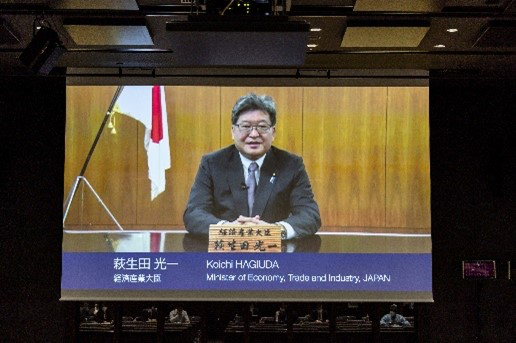
METI Minister Hagiuda addressing a TICAD preview event
Source: METI
Background and the short-term
Yesterday marked the deadline set by President Putin for foreign investors to pledge their commitment to a new Russian scheme for the country’s Sakhalin-2 LNG project, which supplies about 10% of Japan’s LNG volumes. So far, Japan’s government and investors have cautiously indicated a willingness to go along with Putin’s demands to transfer their stakes in the current project entity to a new Russian state holding.
However, the confidence that Russia will keep supplying LNG to Japan, now branded as an “unfriendly” nation, is shattered. Russia’s dwindling gas volumes to Europe indicate that politics not economics will dictate future trade.
This brings Tokyo’s focus back to scouring alternatives supply sources.
Japan already buys huge volumes from Australia, which accounted for almost half of all its LNG imports in May. The share of Malaysia grew to 18% in the same month to compensate for lower U.S. volumes in the same period. Meanwhile purchases from the Middle East gas giants like Qatar and UAE have waned in recent years due to the strict terms of their contracts.
In the near-term, Nigeria could grow as an LNG seller to Japan given its modest share of the Japanese total imports at just 1% last year. Nigerian LNG is currently expanding its production and export facility in Bonny, Rivers State, just as uptake from Chinese buyers has slowed due to high prices and lockdowns in the Asian nation.
Nigerian LNG greenlighted the expansion of its 22 million tons per year (MTPA) facility, the largest LNG export hub in Africa, in 2019. A further expansion is also in the plans to add Train 8 to what will soon be a seven-train production plant. Shell, Totalenergies and Eni are Nigerian LNG’s partners in the facility.
LNG Japan Corp. (a JV between trading houses Sojitz and Sumitomo) has announced its interest in the Nigerian LNG plans.
Also, the recent passage of Nigeria’s much awaited Petroleum Industry Act promises a new wave of investments in the country’s gas sector. The immediate beneficiaries of these foreign investments will be the $29 billion Brass LNG and Olokola LNG export projects.
Kansai Electric has been among the most active Japanese utilities in Africa’s LNG markets, buying from Nigeria, Equatorial Guinea, Algeria and Egypt.
Mid-term
While Nigeria is the continent’s biggest holder of natural gas reserves with 207 trillion cubic feet (tcf), followed by Algeria and Senegal, Japan had staked its LNG investment strategy in Africa based on the No. 4 gas resource owner, Mozambique.
With 100 tcf, Mozambique’s potential is not small. It’s about twice those of Norway, the world’s No. 8 and Europe’s largest gas producer. It’s also almost 40% larger than the proven gas reserves of Canada.
While Africa’s top three gas countries sit in the northwest of Africa, within pipeline reach of the major European markets, Mozambique’s location on the southeast cost of the continent makes it attractive for LNG exports to Asia.
In 2020, Japan’s government and private sector agreed to a joint financing plan totaling ¥1.5 trillion (about $14.5 billion at the time) to develop Mozambique’s Rovuma Basin, which holds most of its natural gas. The $20 billion Mozambique LNG project, led by TotalEnergies, is projected to export 12.8 MPTA of LNG mainly to the Asian market.
The Mozambique project attracted Japan’s top banks. The syndicate of lenders include the Japan Bank for International Cooperation (JBIC) and the top-three private sector banks MUFG, Mizuho, and Sumitomo Mitsui. Mitsui & Co. and Japan Oil, Gas and Metals National Corp. (JOGMEC) agreed to buy a 20% share in the development, which was expected to start production in 2024.
Last year, however, an insurgency in Mozambique’s northern region of Cabo Delgado stopped all work. TotalEnergies hopes that construction will resume in mid 2023. If that optimistic scenario materializes, the first LNG might be shipped in early 2026.
Longer-Term
In 2011-2019, Africa accounted for 41% of the world’s new gas discoveries, and BP predicts that natural gas production in Africa will expand 80% by 2035. With increasing natural gas discoveries across the continent, Africa is set to become an important natural gas investment destination in the coming years.
The African Coalition for Trade and Investment in Natural Gas (ACTING) projects that a new round of approvals for LNG export projects in sub-Saharan Africa could see an addition of 74 MTPA of export capacity by 2030.
The increase in the region’s LNG export capacity will depend on the fate of Mauritania’s 10 MTPA BirAllah LNG project, Senegal’s 10 MTPA Yakaar-Teranga LNG project and the expansion of brownfield LNG projects in Nigeria, Mozambique and Angola.
Africa’s lack of suitable infrastructure, however, as well as political instability and terrorism, currently make it a high-risk source. Even in peacetime, increasing gas production will be tough without a concerted and significant investment in pipelines, storage capacity, or processing facilities.
As such, the biggest chance for success for local Japanese investments will likely come when Japan’s field service and engineering firms also get involved. In the case of the TotalEnergies-led Mozambique LNG project, for example, Japan’s Chiyoda is part of the consortium in charge of building the liquefaction trains. In a separate LNG project in Mozambique, led by ExxonMobil, Japan’s JGC Corp. is one of the top contractors, while Mitsubishi Heavy Industries is due to supply gas turbine and compressor units.
Two more Japanese oil and gas services firms with a strong position in Africa are Japan Drilling Company (JDC) and MODEC (Mitsui Ocean Development & Engineering Co.). JDC has been active in the exploration and development of gas fields in West Africa, Central Africa and Egypt, while MODEC received a Front-End Engineering Design (FEED) project in Senegal in 2019 for the construction of a floating platform (EPSO).
Despite these inroads into the Africa market, concerns remain whether Japan has the risk appetite to pursue new LNG projects in a continent where business conditions are often at the mercy of capricious bureaucrats and mercurial leaders. In light of the current difficulties dealing with Moscow, however, the challenges in Africa might be deemed more acceptable.
GLOBAL VIEW
BY JOHN VAROLI
Below are some of last week’s most important international energy developments monitored by the Japan NRG team because of their potential to impact energy supply and demand, as well as prices. We see the following as relevant to Japanese and international energy investors.
Egypt/ Nuclear power
Work began on unit 1 of the El Dabaa nuclear power plant, about 320 km northwest of Cairo. It’s the first of four Russian-made VVER-1200 reactors. Moscow will also train personnel and conduct plant maintenance for the first 10 years of operation.
Europe/ Energy profits
Norway’s Equinor and Spain’s Iberdrola announced huge profits. Equinor will return $3 billion to shareholders on Q2 earnings of $17.6 billion, up threefold YoY. For combined Q1 and Q2, Iberdrola, which is Europe’s largest utility, posted a profit of €2.08 billion, a 36% YoY rise, on revenues of €24.4 billion
Europe/ Natural gas
This week, the European benchmark TTF contract soared to €222.5 MW/h, before slipping to €202.5, equivalent to an oil price of $380 a barrel. Citing technical issues, Gazprom further reduced Nord Stream gas flows, delivering only 33mln c/m daily to EU members, roughly 20% of capacity. This jeopardizes the bloc’s goal to fill 80% of storage before winter.
Germany/ Natural gas
After weeks of negotiation, the government finalized a plan to rescue gas importer Uniper with a €15 billion bailout, the biggest in German history. The government will take a 30% stake in Uniper, reducing the share of its Finnish parent, Fortum, to 56% from nearly 80%.
Greece/ Power subsidies
The government will spend about €1 billion to subsidize power bills in August. Like nearly all other EU countries, Greece’s consumers are facing a sharp rise in power bills driven by sky-rocketing gas prices amid the conflict between Russia and NATO.
Hydrogen power
BP and Iberdrola will build “advantaged hydrogen production hubs… integrated with renewable power” in Spain, Portugal and the UK, with a total capacity of up to 600,000 tons per year. That volume will require roughly 6 GW of electrolysers
Nigeria/ Oil
TotalEnergies began production in the Ikike field that’s expected to deliver 50,000 barrels of oil equivalent daily by end 2022. In related news, the government is improving security in the Niger Delta and plans to reopen the Trans Niger pipeline to increase gas exports to Europe.
Portugal/ Power storage
Iberdrola launched its €1.5 billion ‘Tâmega Gigabattery’, a renewable energy complex including pumped hydro with an energy storage capacity of 40 GWh. It will increase Portugal’s grid power capacity by 6%.
Portugal/ Solar power
Oil and gas company Galp acquired a further 25% of solar energy company Titan in a €140 million deal, to take full ownership. Titan was set up as a JV with Spain’s ACS. Its portfolio includes 1.15 GW solar farms in Spain and other projects with a 1.6 GW capacity at different phases of development.
Turkey/Coal power
Unit 1 of the 1.32 GW Hunutlu coal-fired power plant is operational. The $2.2 billion plant is China’s largest investment in Turkey. When a second unit opens in the autumn, the power volume generated will equal the needs of the capital, Ankara.
Turkey/ Nuclear power
Work began on unit 4 of Akkuyu NPP, Turkey’s first nuclear power plant. Under an agreement signed with Russia in 2010, Rosatom is building four VVER-1200 reactors under a BOO (build-own-operate) model. Construction of units 1-3 began in April 2018, April 2020 and March 2021, respectively. Unit 1 starts operations in 2023.
2022 EVENTS CALENDAR
A selection of domestic and international events we believe will have an impact on Japanese energy
| January | OPEC quarterly meeting;JCCP Petroleum Conference – Tokyo;
EU Taxonomy Climate Delegated Act activates; Regional Comprehensive Economic Partnership (RCEP) Trade Agreement that includes ASEAN countries, China and Japan activates; Indonesia to temporarily ban coal exports for one month; Regional bloc developments: Cambodia assumes presidency of ASEAN; Thailand assumes presidency of APEC; Germany assumes presidency of G7; France assumes presidency of EU; Indonesia assumes presidency of G20; and Senegal assumes presidency of African Union; Japan-U.S. two-plus-two meeting; Japan’s parliament convenes on Jan. 17 for 150 days; Prime Minister Kishida visits Australia (tentative) |
| February | Chinese New Year (Jan. 31 to Feb. 6);Beijing Winter Olympics;
South Korea joins RCEP trade agreement |
| March | Renewable Energy Institute annual conference;Smart Energy Week – Tokyo;
Japan Atomic Industrial Forum annual conference – Tokyo; World Hydrogen Summit – Netherlands; EU New strategy on international energy engagement published; End of 2021/22 Japanese Fiscal Year; South Korean presidential election |
| April | Japan Energy Summit – Tokyo;MARPOL Convention on Emissions reductions for containerships and LNG carriers activates;
Japan Feed-in-Premium system commences as Energy Resilience Act takes effect; Launch of Prime Section of Japan Stock Exchange with TFCD climate reporting requirement; Convention on Biological Diversity Conference for post-2020 biodiversity framework – China; Elections: French presidential election; Hungarian general election |
| May | World Natural Gas Conference WCG2022 – South Korea;Elections: Australian general election; Philippines general and presidential elections |
| June | Happo-Noshiro offshore wind project auction closes;Annual IEA Global Conference on Energy Efficiency – Denmark;
UNEP Environment Day, Environment Ministers Meeting – Sweden; G7 meeting – Germany |
| July | Japan to finalize economic security policies as part of natl. security strategy review;China connects to grid 2nd 200 MW SMR at Shidao Bay Nuclear Plant, Shandong;
Czech Republic assumes presidency of EU; Elections: Japan’s Upper House Elections; Indian presidential election |
| August | Japan: Africa (TICAD 8) Summit – Tunisia;Kenyan general election |
| September | IPCC to release Assessment and Synthesis Report;Clean Energy Ministerial and the Mission Innovation Summit – Pittsburg, U.S.;
Japan LNG Producer/Consumer Conference – Tokyo; IMF/World Bank annual meetings – Washington; Annual UN General Assembly meetings; METI to set safety standards for ammonia and hydrogen-fired power plants; End of 1H FY2022 Fiscal Year in Japan; Swedish general election |
| October | EU Review of CO2 emission standards for heavy-duty vehicles published;Chinese Communist Party 20th quinquennial National Party Congress;
G20 Meeting – Bali, Indonesia; Innovation for Cool Earth TCFD & Annual Forums – Tokyo; Elections: Okinawa gubernational election; Brazilian presidential election; |
| November | COP27 – Egypt;U.S. mid-term elections;
Soccer World Cup – Qatar; |
| December | Germany to eliminate nuclear power from energy mix;Happo-Noshiro offshore wind project auction result released;
Japan submits revised 2030 CO2 reduction goal following Glasgow’s COP26; Japan-Canada Annual Energy Forum (tentative); Tesla expected to achieve 1.3 million EV deliveries for full year 2022 |
Disclaimer
This communication has been prepared for information purposes only, is confidential and may be legally privileged. This is a subscription-only service and is directed at those who have expressly asked K.K. Yuri Group or one of its representatives to be added to the mailing list. This document may not be onwardly circulated or reproduced without prior written consent from Yuri Group, which retains all copyright to the content of this report.
Yuri Group is not registered as an investment advisor in any jurisdiction. Our research and all the content express our opinions, which are generally based on available public information, field studies and own analysis. Content is limited to general comment upon general political, economic and market issues, asset classes and types of investments. The report and all of its content does not constitute a recommendation or solicitation to buy, sell, subscribe for or underwrite any product or physical commodity, or a financial instrument.
The information contained in this report is obtained from sources believed to be reliable and in good faith. No representation or warranty is made that it is accurate or complete. Opinions and views expressed are subject to change without notice, as are prices and availability, which are indicative only. There is no obligation to notify recipients of any changes to this data or to do so in the future. No responsibility is accepted for the use of or reliance on the information provided. In no circumstances will Yuri Group be liable for any indirect or direct loss, or consequential loss or damages arising from the use of, any inability to use, or any inaccuracy in the information.
K.K. Yuri Group: Oonoya Building 8F, Yotsuya 1-18, Shinjuku-ku, Tokyo, Japan, 160-0004.