
JAPAN NRG WEEKLY
AUGUST 8, 2022
JAPAN NRG WEEKLY
Aug 8, 2022
NEWS
TOP
- Tokyo urges firms to proceed with Russian LNG project, but asset writedowns suggest business uncertainty around Sakhalin-2
- Siemens Gamesa gets first Japan order for offshore wind turbines to equip a Hokkaido project due to start in the near future
- Govt. begins discussion on hydrogen safety rules, setting up a platform from which to develop the industry at home and abroad
ENERGY TRANSITION & POLICY
- State agency plans for fast reactors to be operational in the 2040s
- Japan Gas Association shares details of its emergency plans
- Used cooking oil export prices surge to be on par with palm oil
- Public submissions favor solar roof law in Tokyo
- Shimizu Corp. builds low-cost green hydrogen demo plant
- Osaka Gas and Hyundai increase collaboration in hydrogen
- Euglena reveals production process of its algae-derived SAF
- Boeing to open sustainability research center in central Japan
ELECTRICITY MARKETS
- Unable to pass on higher fuel costs, power utilities report losses
- Kansai Electric delays restart of Mihama NPP unit citing water leak
- Rapid growth in local public support for restart of Hamaoka NPP
- Hokkaido and Tokyo areas hit high prices for baseload power
- Several utilities restart signing new contracts for business users
- West, Osaka Gas and JR Kyushu to build solar around rail lines
- Shell ready to bring power forecasting to Japan market via West
- Heavy rain in Tohoku area halts 520 MW of hydropower capacity
- Tokyo Gas signs its first PPA for solar power under the FIP system
OIL, GAS & MINING
- Osaka Gas reports ¥80 billion loss over LNG terminal fire
- LNG stockpiles rise slightly, keeping above five-year average
- Toyota-Panasonic battery venture gains vital U.S. lithium supply
- Japan-Sino nickel-cobalt venture starts production in Indonesia
ANALYSIS
KISHIDA’S NEW NET-ZERO HQ, THE GX COUNCIL, PREPARES TO FLEX ITS MUSCLES
Soon after winning the Upper House election, Prime Minister Kishida began to forge ahead with his new policies. Energy is one of the top priorities, and Kishida is already moving aggressively to implement significant changes that will solidify Japan’s energy transition strategy through the end of this decade. Like the U.S. and the Eurozone, Japan hopes to chart a path to net-zero through large-scale, multi-year investments. This will be led by a new public-private forum, the GX Council, which is backed by METI. The initial lineup of GX councilors has been revealed. Details of the 10-year decarbonization plan are expected shortly.
ENERGY JOBS IN JAPAN:
WHY EVERYONE NEEDS AN EXIT STRATEGY
The best advice for someone joining a new company is to make sure they have an exit strategy. That probably sounds odd since companies and professionals usually aim for long-term commitments. But in today’s fast-changing market, creating an exit strategy is both an important security consideration and a way for staff to take greater control of their career, which means being proactive in acquiring new skills.
We review how an exit strategy can help professionals and employers, and look at case studies in the market today.
GLOBAL VIEW
China to invest $22 billion in UHV power lines to connect remote regions. Energy trader Glencore reports record profits. India may surpass China as world’s biggest buyer of key minerals. OPEC agrees a tiny oil production increase. Solar capacity is forecast to rise by 30% this year. Details on these and more in our global wrap.
EVENTS SCHEDULE
JAPAN NRG WEEKLY
PUBLISHER
K. K. Yuri Group
Events
Editorial Team
Yuriy Humber (Editor-in-Chief)
John Varoli (Senior Editor, Americas)
Mayumi Watanabe (Japan)
Wilfried Goossens (Japan, Events)
Regular Contributors
Chisaki Watanabe (Japan)
Takehiro Masutomo (Japan)
Daniel Shulman (Japan)
Art & Design
22 Graphics Inc.
SUBSCRIPTIONS & ADVERTISING
Japan NRG offers individual, corporate and academic subscription plans. Basic details are our website or write to subscriptions@japan-nrg.com
For marketing, advertising, or collaboration opportunities, contact sales@japan-nrg.com For all other inquiries, write to info@japan-nrg.com
OFTEN USED ACRONYMS
METI The Ministry of Energy, Trade and Industry
MOE Ministry of Environment
ANRE Agency for Natural Resources and Energy
NEDO New Energy and Industrial Technology Development Organization
TEPCO Tokyo Electric Power Company
KEPCO Kansai Electric Power Company
EPCO Electric Power Company
JCC Japan Crude Cocktail
JKM Japan Korea Market, the Platt’s LNG benchmark
CCUS Carbon Capture, Utilization and Storage
mmbtu Million British Thermal Units
mb/d Million barrels per day
mtoe Million Tons of Oil Equivalent
kWh Kilowatt hours (electricity generation volume)
NEWS: ENERGY TRANSITION & POLICY

Tokyo GX Week to start on Sept 26
(Government Statement, Aug. 1)
- Tokyo GX Week, renamed from the previous Tokyo Beyond Zero Week, will run from Sept. 26 to Oct. 7. In addition to conferences on carbon neutrality covering natural gas, carbon recycling, hydrogen, ammonia, CCUS, financing and renewables, an inaugural conference on green transformation (GX) will be held on Oct. 7. The LNG producer consumer conference, now in its 11th year, will be held on Sept. 29; hydrogen ministers meeting on Sept. 26; ammonia conference on Sept. 28; and Asia green growth partnership ministers meeting on Sept. 26.
State agency plans for fast reactors to be operational in the 2040s
(Aug. 1, Denki Shimbun)
- Later this year, the Agency for Natural Resources and Energy will launch the Assessment Committee for Fast Reactor Technology, and will look at the merits and challenges in putting fast reactors into use in the 2040s.
- In December 2018, the Agency released a 10 year-term Strategy Roadmap for Fast Reactors.
TAKEAWAY: Japan’s official position is “There is neither a plan to replace nor build new nuclear reactors locally”. However, METI has already started work on developing fast reactors that could be ready in the 2040s. This might indicate that below the surface, the country is moving to restore its nuclear industry. This would be one reason PM Kishida has appointed the METI Minister Hagiuda to also serve as the Green Transformation (GX) minister. See the Analysis section for a deeper look at this issue from a policy perspective.
- SIDE DEVELOPMENT:
Mitsubishi micro reactor could run for 25 years without refueling
(Nikkei X-Tech, June 10)- Mitsubishi Heavy Industries is developing a “micro reactor” that is a mere two meters long and 1 meter in diameter. It won’t use a liquid coolant.
- The reactor will generate around 500 kW of electricity – over 1000 times less than the output of a typical nuclear reactor. It will be able to run for 25 years without refueling.
- The reactor should be in service by around 2040, and says applications could include emergency backup and power supplies for isolated regions.
Discussion on hydrogen safety rules begins
(Japan NRG, Aug. 5)
- METI launched a panel to set hydrogen safety rules and standards, now spread out among laws on high-pressure gas safety, gas and electricity businesses. The regulatory framework was aimed for fuel cell vehicles, and a major revamp is required to cover the entire hydrogen supply chain from production, transport, storage and consumption.
- The panel, headed by Yokohama State University professor Miyake Atsumi, will compile an advisory report by February 2023.
- Japanese regulation covers gas that measures over 1 MPa of pressure, while the threshold is over 3 MPa in other countries. Several experts said that Japan’s and overseas safety standards need to synchronize for efficiency.
- CONTEXT: Many hydrogen pilot projects involving Japanese companies are held overseas because of tight regulations at home. For example, Japan’s current rules mandate that the distance between hydrogen storage bases and power generating facilities should be twice that used for LNG storage bases, which is not realistic. Also, hydrogen power generation units need to station three certified engineers, which constrain operators that want to set up smaller stations across multiple locations.
- Regulations should aim to prevent massive hydrogen leakage and other incidents, and identify other priority safety issues. The present rules spread out among several regulatory frameworks need to be streamlined, panel members also said.
- CONTEXT: Around 700 tons/ year of hydrogen are supplied to fuel cell vehicle service stations. While it’s clear that demand will grow rapidly, METI said the challenges of setting safety rules can’t depend on analysis of past incidents but need to build scenarios on forecasts. On the other hand, METI is keen to establish safety rules that could be used by other countries.
TAKEAWAY: The issue of regulation for the hydrogen industry was brought up by many of the speakers at last week’s Japan Energy Summit. As the ammonia and hydrogen production, transport and utilization technologies emerge, it will be up to Japanese regulators to make sure the regulations are taken that keep the country’s progress on track.
Gas Association shares emergency plans
(Japan NRG, Aug. 5)
- The Japan Gas Association (JGA) has delegated various emergency responsibilities to its members if, for example, it’s confronted by a dramatic decrease in LNG imports.
- City gas operators will share resources with each other and possibly with power grids. If supply is cut drastically over a longer period and can’t be covered by resource-sharing, then the pipeline network operators will collect data from LNG suppliers. Gas retailers will collect demand-side data and inform customers.
- The supply demand balance will be measured weekly and on the basis of regional gas networks rather than each operator or municipal jurisdictions.
- The JGA also suggested a gas version of the power demand-response scheme, which gives merit points to industrial users that reduce consumption from year-ago levels.
- CONTEXT: Gas sharing faces infrastructure issues. The networks aren’t interconnected. The operators may not have enough LNG ships for local transport.
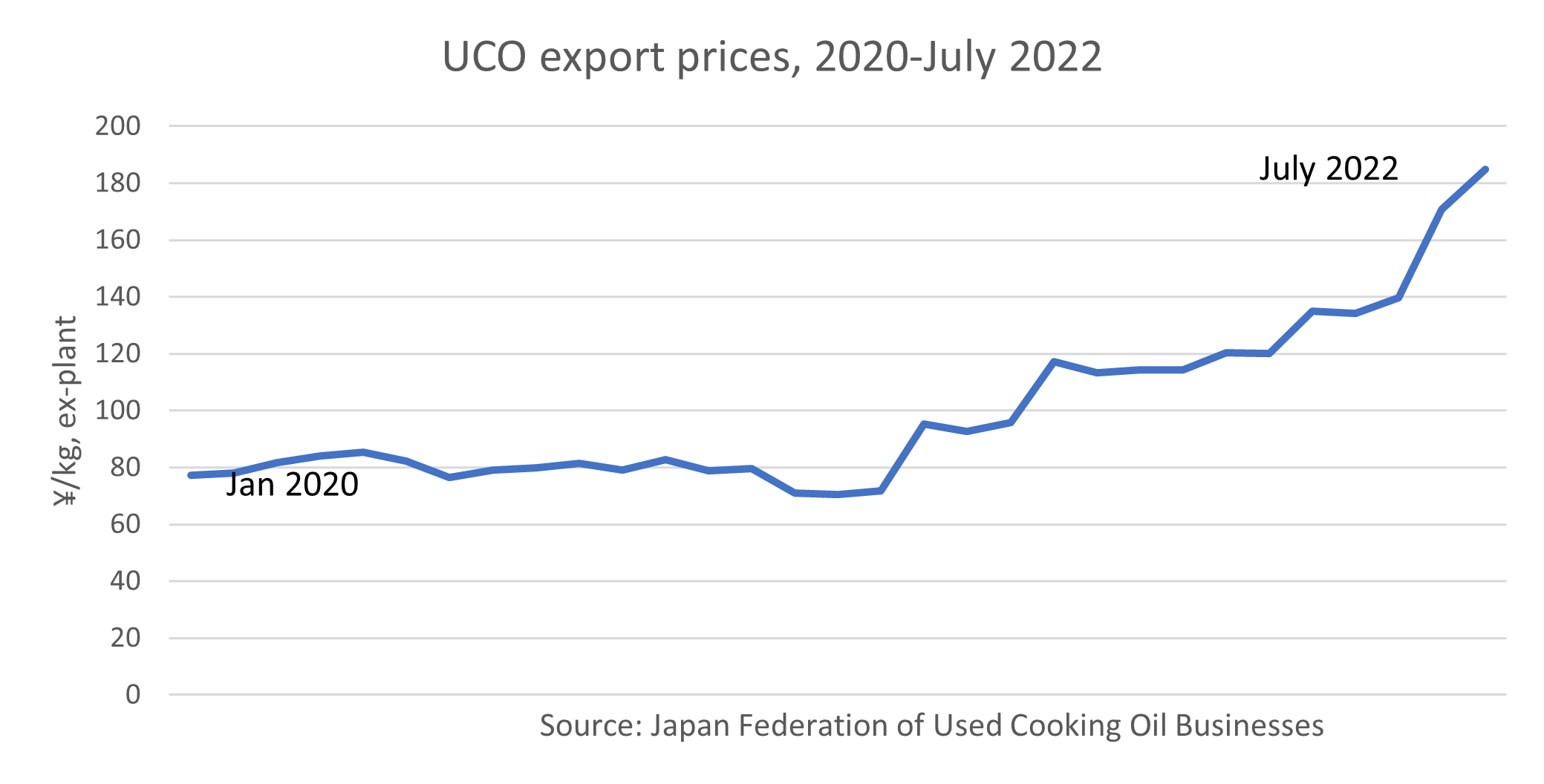
Used cooking oil export prices surge to be on par with palm oil in July
(Japan NRG, Aug. 3)
- Prices of Japan’s exports of used cooking oil (UCO) were ¥184.8/ kg ex-plant in July, according to the Japan Federation of Used Cooking Oil Businesses
- The prices were at par with virgin palm oil trading at roughly ¥130-200/ kg CIF.
- UCO export prices were ¥170.8/ kg in June and were ¥92.6/ kg a year ago.
- CONTEXT: Palm oil is used for biomass power generation; UCO for biodiesel and aviation fuel. Palm oil prices have eased recently as Indonesia cut the monthly oil reference price last month.
TAKEAWAY: For a comprehensive look at how used cooking oil prices impact on the energy sector, see the Analysis section in the May 23, 2022 Weekly.
Public submissions favor solar roof law in Tokyo
(Mainichi Shimbun, Aug. 5)
- The Tokyo Metropolitan government released the survey results for its proposal to make solar panels mandatory on new residential dwellings.
- 56% support the proposed bylaw, while 41% are opposed.
- Young people were more likely to support the bylaw.
Shimizu Corp. builds low-cost green hydrogen demonstration plant
(Kankyo Business, Aug. 1)
- Shimizu Corporation has set up a demonstration plant that uses low-cost green hydrogen production technology in Kokonoe-cho, Oita Prefecture, and will begin operations this month.
- The plant will utilize geothermal heat and biomass resources such as wood, and will conduct demonstration tests with the goal of reducing CO2 emissions during production to less than 1/10th of commercial hydrogen and production costs to less than 1/3rd of water electrolysis hydrogen that employs solar power.
- MoE is supporting the project, which will operate continuously for approximately 25 days three times between August and December.
Osaka Gas and Hyundai increase collaboration on hydrogen
(Nikkei, Aug. 3)
- Osaka Gas subsidiary Daigas Gas and Power Solutions strengthened ties with Hyundai Rotem Company (HRC) over the manufacture and sale of hydrogen, opening the door to sales of hydrogen systems by HRC outside South Korea.
Euglena unveils production process of Susteo, algae-derived SAF
(Toyo Keizai, Aug 3)
- Biofuel producer Euglena unveiled production processes of Susteo, biodiesel containing oil derived from algae
- The company grows algae called euglena and licenses biofuel production technologies from Chevron Lummus Global and ARA to extract oil from the algae. Output is 5 barrels/day but capacity will expand in 2025. Susteo is 10-20% algae oil and 80-90% used cooking oil.
- Hiroshima-based automaker Mazda uses 100% algae fuel for competing in car races.
METI, Boeing expand cooperation ; Boeing to open sustainability research center in Nagoya
(Government and Company Statements, Aug. 1)
- METI and Boeing agreed to expand their 2019 memorandum of cooperation on next-gen aircrafts to explore sustainability solutions. METI will identify Japanese companies with relevant technologies. Boeing will open a sustainability research center in Nagoya focused on sustainable fuels, electric/hydrogen propulsion, robotics, digitization and carbon fiber composites.
- Boeing will also join the ACT FOR SKY consortium to promote Japan-made SAF.
- CONTEXT: Consumers hope that new market players will diversify and stabilize SAF supplies, which hinge on availability of used cooking oil and vegetable oil resources. Euglena’s Susteo, Japan’s best known SAF, comprises 10-20% of oil from algae called euglena, and 80-90% of used cooking oil. Other SAF producers include IHI that uses algae; a group made of Mitsubishi Power, JERA and Toyo uses wooden biomass. Quality storage of the oil, which degrades over time, as well as the oil’s impact on the aircraft components after repeated use, are some of the safety issues to clarify. Biofuel typically features higher viscosity than fossil fuel.
China and Japan trade blows over tritium release
(NHK, Aug. 3)
- China criticized the Japanese government’s decision to discharge tritiated water stored on the site of the Fukushima disaster into the sea, saying that the peaceful use of nuclear energy must not come at the expense of health or the environment.
- The Japanese government responded by saying that the concentrations of radioactive material in the discharged water are well below the maximum allowed, and based on science.
- The comments were made during a debate of the Non-Proliferation Treaty at the UN.
NEWS: POWER MARKETS

Siemens Gamesa got first order of offshore wind turbine in Japan
(Denki Shimbun, Aug. 1)
- Siemens Gamesa Renewable Energy won its first order for offshore wind turbines in Japan. At Ishikari Bay New Port, Hokkaido, Siemens Gamesa will install 14 units for a 112 MW offshore wind power project.
- The developer is Green Power Investment (GPI); operation starts in late 2023.
- CONTEXT: Siemens Gamesa’s predecessor company, Siemens, started the wind business in Japan in 1999 and has since installed more than 1 GW of onshore wind turbines.
TAKEAWAY: Only a few weeks ago, Japan’s top business newspaper, Nikkei, ran a story suggesting that Siemens Gamesa and Vestas were ready to abandon plans to build local wind turbine assembly plants because the Japanese market was not looking as promising as it once seemed. This was a reference to Mitsubishi Corp, and its preferred wind turbine vendor GE, winning all the fixed-bottom offshore wind project tenders last year. So, Siemens Gamesa securing its first order in Hokkaido is significant. The European manufacturer will hope that this is an indication that Japan’s market really will accommodate a number of offshore turbine makers.
Unable to pass on higher fuel costs, power companies report quarterly loss
(Nikkei, Aug. 2)
- Seven of Japan’s 10 major power companies reported losses for Q2.
- The poor performance is because the utilities, which include Kansai Electric and TEPCO, maxed out the ability to pass on higher fuel costs to users under a 1996 fuel surcharge scheme.
- Some utilities, including Tohoku Electric, responded by increasing base tariffs or doing away with caps on fuel surcharges.
- It now costs an average of ¥101,000 to import a ton of LNG, double a year ago.
Kansai Electric delays restart of Mihama NPP Unit 3 citing a water leak
(Company Statement, Aug. 3)
- The utility in western Japan said it will delay the restart of the Mihama NPP Unit. 3 reactor due to a water leak discovered two days earlier. As the cause is still under investigation, the timeline of restart is now undecided.
- The leak was contained and no radiation exposure occurred.
- CONTEXT: The reactor was slated to restart around Aug. 10-12. The utility said just a week earlier that it brought forward the date from September to help ease a power crunch in the Kansai region.
TAKEAWAY: The utility recently turned on two more reactors, which are now ramping up generation to full volume. In total, it should have three reactors to manage the August demand peak. After Mihama No. 3 goes back online, one more unit is due for a restart in December.
Rapid growth in support for reactor restart amongst Hamaoka residents
(Asahi Shimbun, Aug. 1)
- A survey of residents in three municipalities near the Hamaoka NPP reveals a rapid increase in support for the reactor’s restart.
- In Kakegawa, 36% are against the reactor’s restart, while 33% are in favor.
- Last year, 45% were opposed to the reactor’s restart, and only 29% were in favor.
- Kakegawa Mayor Kubota Takashi attributed the change to a lobby campaign by Chubu Electric and that a growing portion of the population is too young to remember Fukushima.
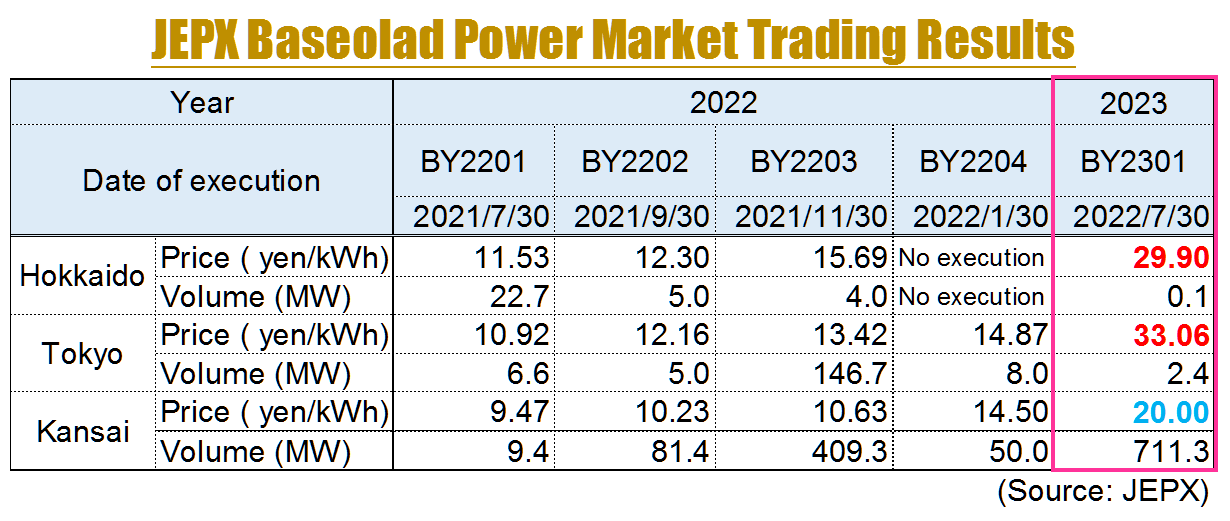
Hokkaido and Tokyo areas hit high price for baseload power, Kansai remains low
(Denki Shimbun, Aug. 5)
- JPEX released the result of the 2022 baseload power market. While the price of Hokkaido and Tokyo areas were ¥29.90/ kWh and ¥33.06/ kWh, almost 2.5 times higher than 2021, Kansai was ¥20/ kWh, which is only 38% higher than 2022.
- As importantly, the trading volume of Hokkaido and Tokyo areas were very small, just 0.1 MW and 2.4 MW, respectively.
- High gas and coal prices raise the high baseload power price. Kansai area secured over 700 MW of trading volume, mainly due to the planned restart of Units 1 and 2 of the Takahama NPP.
- The baseload market trade is held four times per year; the next one is on Sept. 30, 2023.
Several major power utilities restart signing of new contracts for extra high voltage power
(Denki Shimbun, Aug. 2)
- Hokkaido, Hokuriku, Kansai and Chugoku power utilities announced the restart of signing new contracts for high voltage and extra high voltage customers. Power supply will be offered to such customers from April 2023 based on regular price tables.
CONTEXT: After the power market was liberalized in April 2016, many customers changed power suppliers to new entrants. However, due to a surge in fuel prices, and unseasonable hard weather, some of the new players have gone bankrupt or exited the market. This led to a flood of applications from industrial and commercial clients to return to the major power utilities, which the latter could not process all at once. So, the utilities froze applications for a while.
TAKEAWAY: Most new entrants to the Japan power retail market don’t have their own power source and rely on the market for supply and resale. The recent market volatility makes this strategy untenable. A shakeout of power retailers may continue if they can’t secure enough supply at stable costs.
- SIDE DEVELOPMENT:
TEPCO to raise price of power for industrial users from next April
(Denki Shimbun, Aug. 1)- TEPCO announced power price hikes for high voltage and extra-high voltage customers from April 2023 as the utility seeks to cover losses stemming from rising fuel costs.
- CONTEXT: This tends to be mostly industrial users.
West Holding and Osaka Gas to develop solar on land next to JR Kyushu rail lines
(New Energy Business News, Aug. 2)
- West Holdings, Osaka Gas, and JR Kyushu will start a joint project to develop a small- to medium-scale non-FIT solar power plants on idle land owned by the rail company next to its routes.
- Turning idle land along railway lines into solar projects is also being studied by the Ministry of Land, Infrastructure, Transport and Tourism.
- The three firms already set up a joint venture earlier this year. West will develop the solar plants, while Osaka Gas will oversee supply and demand management, and keeps the environmental value derived from the assets. The electricity will be supplied to stations on the JR Kyushu network.
- SIDE DEVELOPMENT:
West Holding and Shell to partner in non-FIT renewable energy projects and retail
(New Energy Business News, Aug. 4)- West Holdings and Shell Japan signed a letter of intent regarding services for non-FIT renewable energy power generators and retail electricity providers. The two will provide services such as sophisticated power generation forecasting, optimization, imbalance mitigation and distributed energy resource (DER) control.
- In December 2021, Shell signed a Letter of Intent with INNOWATTS, a U.S. company, for grid edge solutions for distributed energy. The U.S. firm’s forecasting technology, which utilizes AI and machine learning, will be used for the forecasting and other services Shell intends to roll out in Japan.
- In addition, Shell will form a “generation balancing group” to settle generation imbalance (difference between planned and actual demand), and the entire group will work on simultaneous equivalence of power plan values, enabling power generators and retail providers to reduce the risk of imbalance occurring.
Influx plans 132 MW onshore wind power project in Miyagi
(New Energy Business News, Aug. 3)
- Influx Inc. plans to develop a 132 MW onshore wind project in Miyagi Prefecture, near the town of Shichigasuku.
- The project will take up an area of approximately 3,198 ha. and house 31 turbines. Construction is scheduled to begin in June 2025, and the project is expected to be operational after 36 months.
Heavy rains halt 520 MW of hydropower operated by Tohoku Electric
(Denki Shimbun, Aug. 5)
- Heavy rain on Aug. 3 caused damage to 61 hydro power plants run by Tohoku Electric. At 13:00 on Aug. 4, hydropower plants with a total capacity of 520 MW across Aomori, Iwate, Akita, Yamagata, Fukushima and Niigata prefectures halted operation.
- Power supply was disrupted for 800 households in Yamagata, Fukushima and Niigata prefectures. Getting to the plants to fix them was difficult because of flooding.
Tokyo Gas signs its first PPA for solar power under the FIP system
(Kankyo Business, Aug. 4)
- Renova signed a power purchase agreement (PPA) with Tokyo Gas for the direct sale of electricity generated at a newly developed solar power plant. The two companies plan to trade up to 13,000 kW by the end of FY2023.
- CONTEXT: The contract is the first for Tokyo Gas to purchase power that includes power from solar plants certified under the FIP system. This contract is Renova’s first PPA with an single corporation.
- Under the terms of the agreement, Tokyo Gas will purchase electricity and non-fossil value from Renova’s newly developed non-FIT and FIP solar power plants in the service areas of Tokyo Electric Power Grid and Chubu Electric Power Grid for 20 years.
Erex buys J-Power’s stake in coal power plant to convert it into a biomass facility
(Kankyo Business, Aug. 3)
- Erex Corp. acquired all shares held by J-Power (64%) in the Itoigawa Power Plant, a joint project between J-Power and Pacific Cement.
- Erex plans to convert the station into a co-firing or entirely biomass fired power generation unit. This will be the developer’s first non-FIT power generation project.
Kansai Electric waste may stay in Fukui area after all
(Shukan Economist, Aug. 1)
- Kansai Electric has yet to confirm where it will store its nuclear reactor waste.
- With little time left until the December 2023 deadline for finding a storage site, it seems likely that the waste will be stored in Fukui Prefecture, where its reactors are located.
- Since the 1990s, the Fukui government has maintained that it will never allow waste generated by its many nuclear reactors to be stored within the prefecture.
- An earlier proposal to send the waste to an intermediary storage facility in Aomori was shelved after it met with vehement opposition from the mayor of Mutsu.
- According to local Fukui media, despite rumors that the waste will be taken to an island in the Seto Inland Sea, a local councilor said that efforts to ship the waste out of the prefecture have failed.
- There is speculation that the Fukui government will be forced to backtrack on its no-waste stance and allow the waste to be stored locally, in exchange for compensation.
JNFL delays start of Japan’s first used nuclear fuel processing plant yet again
(Denki Shimbun, Aug. 1)
- Naohiro Masuda, CEO of Japan Nuclear Fuel (JNFL) said the start of the Spent Nuclear Fuel Reprocessing Plant will be postponed from 1H/ FY2022, due to prolonged screening by the Nuclear Regulation Authority (NRA).
- Construction on the Plant began in 1993, and the start was slated for 1997. However, completion has now been postponed at least 26 times.
NEWS: OIL, GAS & MINING
Russia’s Sakhalin-2 LNG project latest update:
- CONTEXT: Russian media reports that the government will register a new operating company for the Sakhalin-2 project in the town of Yuzhno-Sakhalinsk, the regional center of Sakhalin Island. It will be run by the head of the current project operating company, Sakhalin Energy Investment.
- State gas company Gazprom will retain its 50% stake in the project.
- SIDE DEVELOPMENT:Japan government urges Mitsui and Mitsubishi to proceed with new Russian entity(Nikkei, Aug. 5)
- CONTEXT: Japan imports 9-10% of its LNG from Russia, which mostly comes from Sakhalin-2.
- METI minister Hagiuda asked the two private Japanese companies invested in Russia’s Sakhalin-2 LNG project to “think positively” about proceeding along with Moscow’s plans to restructure the assets under a new Russian business entity.
- Hagiuda promised that Japan’s public and private sectors will work together to “protect the interests of Japanese companies and ensure a stable supply of LNG.”
- Russia’s conditions for the Japanese firms to join the new Russian entity are still not clear, but Tokyo is so far not aware of requests for additional investment or costs.
- The two Japanese trading houses have acknowledged their plans to cooperate with the government in making their final decision.
- SIDE DEVELOPMENT:Mitsui, Mitsubishi slash value of Sakhalin-2 stakes by $1.66bn(NHK, Aug. 2)
- Mitsui & Co. and Mitsubishi Corp., the two private Japanese firms invested in the holding company of the Sakhalin-2 project, slashed the asset value of their stakes by a combined ¥217.7 billion ($1.66 billion) amid uncertainty over their ownership in the project.
- Mitsui’s value reduction was ¥136.6 billion; Mitsubishi’s was ¥81.1 billion.
- SIDE DEVELOPMENT:Shipper Nippon Yusen books ¥17.8 billion charge related to Sakhalin-2(Asahi, Aug. 3)
- Nippon Yusen, also known as NYK Line, posted an extraordinary loss of ¥17.8 billion related to the Sakhalin-2 development project in the Russian Far East. The firm is responsible for transporting the project’s LNG.
- The company reviewed the future earnings of the project and the asset value of the two LNG carriers that transport the fuel, taking into consideration the possibility that the supply from Sakhalin-2 may become unavailable in the future.
- The company also revealed that it had acquired a stake in a Russian shipping company that jointly owned the LNG carrying vessels.
Osaka Gas reports ¥80 billion loss over terminal fire
(Asahi Shimbun, Aug. 1)
- Osaka Gas expects a ¥79.5 billion loss due to a fire at a Texas LNG export terminal in June.
- While the terminal is scheduled to restart at reduced capacity in October, it is expected to take until the end of the year to fully restore capacity.
- From the terminal, Osaka Gas and JERA annually import 4.6 million metric tons of LNG, equivalent to 6% of Japan’s total demand.
LNG stocks rise to 2.28 million tons
(Government Data, Aug. 3)
- LNG stocks of 10 power grids stood at 2.28 million tons as of July 31, up from 2.26 million tons a week earlier. The end-July stocks last year were also 2.26 million tons. The five-year average for this time of year is 2.03 million tons.
Toyota-Panasonic battery venture gains U.S. lithium supply
(Asia Nikkei, Aug. 1)
- An electric vehicle battery venture owned by Toyota Motor and Panasonic Holdings has struck a deal to access lithium from a U.S. mine held by Australian firm Ioneer.
- Ioneer plans to start production of lithium from the Rhyolite Ridge project in Nevada in 2025.
- Under the agreement, the Toyota-Panasonic venture Prime Planet Energy & Solutions will receive 4,000 tons of lithium carbonate annually over five years.
Japan-Sino nickel-cobalt JV starts production in Indonesia
(Company Statement, Aug. 1)
- Japanese-Chinese joint venture QMB New Energy Materials in Indonesia started battery-grade nickel-cobalt compound production after almost a three-year delay.
- The plant has an annual capacity to process 30,000 tons of nickel and 2,400 tons of cobalt. A second plant with capacity for 20,000 tons of nickel and 1,600 tons of cobalt will start later this month.
- Hanwa has an 8% stake in the project and the rest is owned by Chinese firms.
TAKEAWAY: In 2022, Indonesia is expected to increase annual nickel production capacity by over 300,000 tons as new plants come online. Capacity expansion is seen to continue into 2023 on the back of battery demand. It’s uncertain if supply increases will ease nickel prices back to 2018 levels of around $10,000/ ton, down from current levels about $20,000/ ton. The project reached a formal agreement in 2018 and long-term investment plans may be based on market prices at the time, meaning that at current nickel prices the project may break earlier than forecasted.
ANALYSIS
BY MASUTOMO TAKEHIRO
New GX Council Prepares to Flex its Muscle
Soon after winning the Upper House election, Prime Minister Kishida began to forge ahead with his policies. Energy is one of the top priorities, and Kishida is already moving aggressively to implement significant changes that will cement Japan’s energy transition strategy through the end of this decade.
Like the U.S. and the Eurozone, Japan hopes to chart a path to decarbonization through large-scale, multi-year investments. On July 22, at a summer forum held by the country’s biggest business group, the Keidanren, Kishida announced his plan for a new ministerial post to “present a 10-year roadmap for decarbonization and increase corporate predictability,” while reiterating that Japan’s 2050 carbon neutrality goal “must be pursued”.
A new ministerial position for the green transformation (GX) was established, along with a so-called GX Council to report directly to the PM’s Office. Kishida also pledged that Japan “will prepare an unprecedented support framework that will catalyze long-term massive investment by the private sector”.
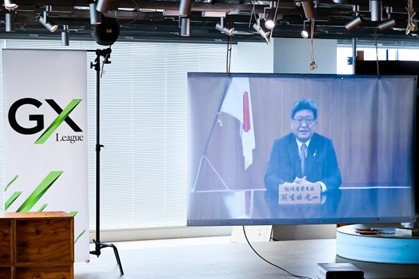
Five days later, on July 27, the current Minister of Economy, Trade, and Industry (METI), Hagiuda Koichi, was tapped to simultaneously serve as the newly-created GX Minister. Whether Hagiuda remains in charge when Kishida names a new Cabinet, which is expected on Aug. 10, is unclear. Either way, the conflation of the METI and GX roles is revealing about the way Kishida wishes to proceed.
Kishida put METI in charge of GX, but will current ministry Hagiuda lead both?
Source: METI’s social media
Setting policy priorities
The GX Council convened the same day that it was announced. It quickly divided important policy tasks among ministries such as METI, the MoE and the Ministry of Finance.
The Council consists of 13 members including the heads of Chubu Electric, the Keidanren, and other business leaders. Among them is a top expert in Southeast Asian studies, which reflects Kishida’s interest in promoting Japan’s net-zero agenda in collaboration with the region. Kishida’s decarbonization strategy, for example, includes plans for an “Asian Zero Emission Community” that involves Indonesia, Vietnam, Thailand, and others.
The PM also stressed the importance of synchronizing a solution to the short-term energy crisis and the promotion of medium- and long-term decarbonization activities. Toward that goal, Kishida instructed the GX Council to clarify which items require political decisions and which require institutional support.
The Council seeks to maximize the use of energy conservation, renewables, and storage batteries to create a stable power and gas system, while also moving forward with the restart of nuclear power plants.
The concept for Kishida’s GX emerged in May, when he hoped to convince the public and private sectors to invest ¥150 trillion ($1.1 trillion), which is equivalent to 30% of Japan’s GDP, in fields related to decarbonization over the next 10 years. Details and the timetable for this is expected later this year.
The GX plan calls for developing next-gen power grids, improvements in chemical and steel manufacturing processes, and the expansion of storage battery production. Other areas will address everything from renewable energy and EVs, to energy-efficient housing, CCUS, and R&D of next-gen nuclear reactors.
Financing
Given GX’s high investment targets, there’s an urgent need to create new financing channels for decarbonization. But the inaugural meeting didn’t discuss the institutional design of potential GX bonds. Since the government intends to pass bills for the GX strategy in next year’s Diet session, discussion over fiscal resources must be done before the end of 2022.
One proposal, made by the ruling LDP in the election campaign for the Upper House, is to make an inaugural issue of ¥20 trillion ($148 billion) in “GX Economic Transition Bonds”. In the future, carbon pricing and other fiscal methods may be used to yield subsequent funds.
While more than a dozen countries have already issued green bonds, Japan has been slow to act. The GX bonds would be more aligned with Japan’s decarbonization strategy, in that proceeds would not be limited to renewable energy projects. However, creating a new financial instrument is always tricky and requires time.
The bonds considered by the Ministry of Finance are called ‘bridging bonds,’ a scheme similar to the ‘reconstruction bonds’ issued after the 2011 earthquake and tsunami. Such ‘bridging bonds’ require financial resources to be secured in advance.
Other means of raising capital are needed, with carbon pricing considered. A nationwide carbon credits exchange is in the process of launching. Other means include a carbon tax and an existing surcharge on electricity bills that currently supports the feed-in tariff (FIT) for renewable energy projects.
In other words, the burden will likely fall on businesses and households. Meanwhile, some experts suggest ordinary taxes should be levied as a more straightforward option. There is concern that the investment targets are overly ambiguous. Unlike the green bonds issued by Germany and other countries, the criteria for GX-like transition bonds are loose.
By deliberately choosing to create the new GX category instead of selling green bonds that are common overseas, Japan may find its investor pool limited. Some funds have a mandate limited to green investments and may question the inclusion of coal and ammonia co-firing projects in the decarbonization agenda.
The conservative business daily, Yomiuri, Japan’s biggest newspaper, also warned against issuing GX bonds “simply to support companies” and thereby launching a spending craze. An even more divisive issue for international investors may be the use of GX bond proceeds to finance nuclear power.
It’s unclear whether financing from the government’s bonds will extend to nuclear, but media reports suggest that Kishida is considering the construction of new nuclear plants. While the PM supports restarting Japan’s existing reactors in the face of high electricity prices, the topic of new nuclear construction is incredibly sensitive. Yet even as Kishida weighs up how much he will direct his GX strategy towards new nuclear facilities, the Keidanren is already calling on national investments in nuclear fusion.
Later this week, Kishida is expected to reshuffle his Cabinet, clarifying who will lead the GX initiative as METI and GX minister. The incumbent, Hagiuda, has high standing within the ruling LDP and was one of the closest allies of recently murdered PM Abe. However, certain media speculation around Hagiuda may push Kishida to make a change.
More importantly, Kishida is also expected to unveil a new Clean Energy Strategy before the end of 2022, which should flesh out the various GX initiatives that have filtered into the public arena so far and place them in a coherent narrative.
The time to back up the political hype around GX with a detailed plan has come. Kishida now has a chance to set Japan’s energy course in practical terms for the rest of the decade.
COLUMN: ENERGY JOBS IN JAPAN
BY ANDREW STATTER
Why You Need an Exit Strategy When Joining a New Company
The title of this article must certainly sound odd. If you’re about to accept an offer to start work at a company then shouldn’t you be committed to that decision and not thinking about how to leave? Well, that’s not entirely true. In fact, it’s a good idea to think about an exit strategy from the very start.
Here’s how an exit strategy can help you make clearer, more informed decisions and deal with challenges in your new position.
The energy market today is very different than 10 years ago when it was dominated by giant power utilities, Fortune 500 manufacturers, and behemoth trading houses. Today we see a very different corporate landscape. Small retailers with innovative solutions are gaining share in a deregulated marketplace, multinational developers are building major renewable assets as the energy transition accelerates, and venture capital startups are making faster inroads in battery technology than yesterday’s dinosaurs.
The reality of this diversified, rapidly changing marketplace is that not every player is going to be a leader; nor will they survive three years from now, not to mention in five years. There’s a higher risk today than ever before that a company will fail, go bankrupt, become uncompetitive, or pull out of the market. Does this sound depressing? We hope not. We think it’s exciting.
Today, more than ever, energy industry professionals have the chance to create value for themselves as professionals. By taking control of your career, you have the ability to expose yourself to and embrace new ideas, technologies, and methodologies, and therefore increase your knowledge, skills and overall market value as a professional.
Let’s look at a job change within the same industry (i.e., moving from a power utility doing offshore wind to a global wind project developer); or, from a traditional battery manufacturer to a startup that develops new battery tech:
- Does the company operate differently from your current organization?
- Does the team include people from diverse backgrounds?
- Does each have an area of particular expertise (say, engineering talent, data from global projects, patents and intellectual property, advanced investment know-how to structure complex deals, etc.)?
- Are there few strata between yourself and high-level decision makers?
- Will they pay you more than your current salary?
If you’re answering ‘Yes’ to three or more of these questions, chances are you’ll learn more in that new job than if you stay in your current/old job. If it’s a ‘No’, then that job probably is not a good opportunity!
Exit strategy
Regardless of the company, there’s a chance that in the future an exit event will occur that makes you want to or need to leave:
-
-
- At a utility, you might be pushed into a role outside your interest;
- At a global developer, if they’re unsuccessful they may leave Japan;
- At a battery start-up, their technology could fail;
- At a traditional battery maker, their technology could become obsolete.
-
When this exit event occurs, any new opportunity will depend on how much value you’ve recently created in yourself. So, do everything possible to learn from more qualified people, be exposed to new technologies, and be eager to embrace new procedures and methodologies. All this helps to increase your benchmark salary and value as a professional.
In general, the confidence you gain by having a “ready” exit strategy shouldn’t be underestimated. Any new role you take will have challenges. There’s no such thing anymore as an easy and safe job. Having an exit strategy gives you the confidence to know that tackling these challenges opens up more doors in the future, regardless of whether you and the company succeed. This puts responsibility for your future in your hands, as opposed to relying on your company will take care of you until retirement.

Source: Unsplash
Examples in the market today
Every company except Mitsubishi Corp. lost the Round 1 offshore wind auctions last December. But this is not a loss for the people who rivaled Mitsubishi in the bidding. In fact, those involved in the losing bids are now in high demand across the industry!
Over the last month, Titan introduced clients to three professionals who had experience in developing Round 1 projects. As some light was shed on changes for Round 2, these professionals lost confidence in their organization’s chance of success and decided to look for a stronger player.
On behalf of these three, all of our introductions resulted in job interviews, with 50% of those resulting in employment offers. Two out of 3 received multiple offers, allowing them to select the firm that they thought was the best match for their personal situation.
Another area where we see this phenomenon is in power trading. Again, this is a developing and growing area in Japan, which has led to a situation of high demand, low supply of qualified professionals. This opens up opportunities for those in adjacent fields, such as commodity trading at a gas utility or a trading house. Take on the challenge today, learn quickly, and you could become one of the few people in the market with this unique experience that’s also in high demand. This will help secure your career, not just your job.
As an agency, the most common question we get about people who’ve spent 15 to 20 or more years in one organization remains: ‘Is this person capable of learning new things and methods?’.
Simply experiencing change is in itself a measure of growth and therefore creates personal value.
Beware, however. Job hopping too much (defined by joining and leaving before achieving anything noteworthy) will most likely decrease your value as a professional.
More on this in a later Energy Jobs in Japan column….
Andrew Statter is Partner and head of Titan GreenTech, a Tokyo-based human capital and executive search firm with a focus on renewable energy and clean technology markets.
GLOBAL VIEW
BY JOHN VAROLI
Below are some of last week’s most important international energy developments monitored by the Japan NRG team because of their potential to impact energy supply and demand, as well as prices. We see the following as relevant to Japanese and international energy investors.
Azerbaijan/ Solar power
A number of banks led by the EBRD approved a $114 million investment for a 230 MW solar project developed by Masdar Azerbaijan Energy, which is fully owned by Abu Dhabi Future Energy Company. Masdar’s Garadagh Plant is Azerbaijan’s first privately owned, utility-scale solar project.
China/ Power grid
The State Grid will invest about $22 billion in the second half of 2022 in ultra high voltage (UHV) power transmission lines. Construction of eight new UHV projects will connect China’s far western regions — where solar, wind and hydropower plants are mainly located — to the major cities.
Energy/ Record profits
Glencore’s profits more than doubled to a record in 1H/2022. A strong performance in its coal business accounted for nearly half of its record $18.9 billion in earnings, beating its 2021 half-year record and the $18.4 billion expected by analysts.
EU/ Russia/ Diesel fuel
Monthly imports of Russian diesel increased more than 20% in July, reaching almost 700,000 barrels a day, which is a 22% increase YoY, according to Vortexa, a tanker tracking group. This reveals the EU’s difficulty in entirely forgoing Russian energy supplies.
Germany/ Solar and wind power
Solar systems with a total capacity of 574 MW went online in June, bringing the country’s new solar in the first half of 2022 to 3.2 GW. New onshore wind power, however, slowed in June as wind turbines with a total capacity of 200 MW joined the grid. In the first six months of 2022, new onshore wind in Germany reached 1 GW.
India/ Strategic minerals
Ten years from now, India could eclipse China as the world’s leading buyer of strategic minerals, according to Dambisa Moyo, the global investor and economist, citing China’s debt and demographic challenges, which will become “incredibly problematic”. India’s population will surpass China’s this year.
OPEC/ Oil output
Together with allies, OPEC agreed to its smallest oil production increase ever, of just 100,000 barrels a day, or 0.1% of global demand. Experts see this as a snub to presidents Biden and Macron after the two met Saudi Arabia’s crown prince Mohammed bin Salman separately in recent weeks.
Philippines/ Battery storage
Ingrid Power Holdings, a JV of ACEN Corp. and Axia Power Holdings Philippines Corp., will build a 270 MW battery energy storage system. It will charge from the grid when there’s excess energy and electricity marginal prices are low. Then, the stored energy will be sold to the grid during high-power demand and electricity prices.
Russia/ Energy investments
President Putin issued a decree banning investors from ‘unfriendly countries’ – those that support sanctions on Russia – from selling shares in energy projects and banks. The decree takes effect immediately and concerns selling assets in production sharing agreements, strategic entities, energy equipment manufacture, as well as other projects.
Solar power
Solar capacity will grow 30% globally this year, with double-digit growth expected in 2023 to 2025. “We are on track to install 250 GW of solar capacity this year; more than the installed capacity of a number of EU countries,” said Rob Barnett, a Bloomberg clean energy analyst. China leads the world in solar and plans to double its total solar panels this year.
UK/ Energy prices
Energy consultancy Cornwall Insight warned that households will continue to struggle with soaring electricity and gas bills, and it forecasts that Britain’s yearly energy price cap will remain above £3,000 on average until “at least 2024”.
2022 EVENTS CALENDAR
A selection of domestic and international events we believe will have an impact on Japanese energy
|
January |
OPEC quarterly meeting; JCCP Petroleum Conference – Tokyo; EU Taxonomy Climate Delegated Act activates; Regional Comprehensive Economic Partnership (RCEP) Trade Agreement that includes ASEAN countries, China and Japan activates; Indonesia to temporarily ban coal exports for one month; Regional bloc developments: Cambodia assumes presidency of ASEAN; Thailand assumes presidency of APEC; Germany assumes presidency of G7; France assumes presidency of EU; Indonesia assumes presidency of G20; and Senegal assumes presidency of African Union; Japan-U.S. two-plus-two meeting; Japan’s parliament convenes on Jan. 17 for 150 days; Prime Minister Kishida visits Australia (tentative) |
|
February |
Chinese New Year (Jan. 31 to Feb. 6); Beijing Winter Olympics; South Korea joins RCEP trade agreement |
|
March |
Renewable Energy Institute annual conference; Smart Energy Week – Tokyo; Japan Atomic Industrial Forum annual conference – Tokyo; World Hydrogen Summit – Netherlands; EU New strategy on international energy engagement published; End of 2021/22 Japanese Fiscal Year; South Korean presidential election |
|
April |
Japan Energy Summit – Tokyo; MARPOL Convention on Emissions reductions for containerships and LNG carriers activates; Japan Feed-in-Premium system commences as Energy Resilience Act takes effect; Launch of Prime Section of Japan Stock Exchange with TFCD climate reporting requirement; Convention on Biological Diversity Conference for post-2020 biodiversity framework – China; Elections: French presidential election; Hungarian general election |
|
May |
World Natural Gas Conference WCG2022 – South Korea; Elections: Australian general election; Philippines general and presidential elections |
|
June |
Happo-Noshiro offshore wind project auction closes; Annual IEA Global Conference on Energy Efficiency – Denmark; UNEP Environment Day, Environment Ministers Meeting – Sweden; G7 meeting – Germany |
|
July |
Japan to finalize economic security policies as part of natl. security strategy review; China connects to grid 2nd 200 MW SMR at Shidao Bay Nuclear Plant, Shandong; Czech Republic assumes presidency of EU; Elections: Japan’s Upper House Elections; Indian presidential election |
|
August |
Japan: Africa (TICAD 8) Summit – Tunisia; Kenyan general election |
|
September |
IPCC to release Assessment and Synthesis Report; Clean Energy Ministerial and the Mission Innovation Summit – Pittsburg, U.S.; Japan LNG Producer/Consumer Conference – Tokyo; IMF/World Bank annual meetings – Washington; Annual UN General Assembly meetings; METI to set safety standards for ammonia and hydrogen-fired power plants; End of 1H FY2022 Fiscal Year in Japan; Swedish general election |
|
October |
EU Review of CO2 emission standards for heavy-duty vehicles published; Chinese Communist Party 20th quinquennial National Party Congress; G20 Meeting – Bali, Indonesia; Innovation for Cool Earth TCFD & Annual Forums – Tokyo; Elections: Okinawa gubernational election; Brazilian presidential election; |
|
November |
COP27 – Egypt; U.S. mid-term elections; Soccer World Cup – Qatar; |
|
December |
Germany to eliminate nuclear power from energy mix; Happo-Noshiro offshore wind project auction result released; Japan submits revised 2030 CO2 reduction goal following Glasgow’s COP26; Japan-Canada Annual Energy Forum (tentative); Tesla expected to achieve 1.3 million EV deliveries for full year 2022 |
Disclaimer
This communication has been prepared for information purposes only, is confidential and may be legally privileged. This is a subscription-only service and is directed at those who have expressly asked K.K. Yuri Group or one of its representatives to be added to the mailing list. This document may not be onwardly circulated or reproduced without prior written consent from Yuri Group, which retains all copyright to the content of this report.
Yuri Group is not registered as an investment advisor in any jurisdiction. Our research and all the content express our opinions, which are generally based on available public information, field studies and own analysis. Content is limited to general comment upon general political, economic and market issues, asset classes and types of investments. The report and all of its content does not constitute a recommendation or solicitation to buy, sell, subscribe for or underwrite any product or physical commodity, or a financial instrument.
The information contained in this report is obtained from sources believed to be reliable and in good faith. No representation or warranty is made that it is accurate or complete. Opinions and views expressed are subject to change without notice, as are prices and availability, which are indicative only. There is no obligation to notify recipients of any changes to this data or to do so in the future. No responsibility is accepted for the use of or reliance on the information provided. In no circumstances will Yuri Group be liable for any indirect or direct loss, or consequential loss or damages arising from the use of, any inability to use, or any inaccuracy in the information.
K.K. Yuri Group: Oonoya Building 8F, Yotsuya 1-18, Shinjuku-ku, Tokyo, Japan, 160-0004.