
JAPAN NRG WEEKLY
AUGUST 15, 2022
JAPAN NRG WEEKLY
Aug 15, 2022
NEWS
TOP
- PM Kishida shakes up Cabinet with new METI and MoE ministers, though policy focus is said to be largely unchanged
- New METI minister confirms Japan to stay in Russian LNG project citing importance to national energy security
- Ministry to study impact of biodiesel on ship safety as Japan looks to roll out new guidelines for marine biofuels next year
ENERGY TRANSITION & POLICY
- METI releases nuclear power development roadmap as panel urges more communication with the regulator on new tech
- J-Credit carbon program expands its offset methodologies
- Tokyo City to improve financial support for electric vehicles
- TEPCO studies plan to build a floating nuclear power station
- State agency to improve profitability of pumped storage hydro
- Shipper to convert LNG tugboat into ammonia-fired vessel
- Hitachi Zosen, JAXA report success in solid state battery trials
- Trucking consortium develops heavy-duty hydrogen engine
ELECTRICITY MARKETS
- Power tenders: fewer bidders, higher prices, more failures
- Chubu Electric raises price of the last-resort power supply
- Osaka firm plans to build 100 solar farms for Mitsubishi Corp
- ENEOS and TotalEnergies create JV to build renewables in Asia
- Kyushu Electric returns reactor at the Genkai NPP to full operation
- Tohoku Electric, Tokyo Gas power venture exits retail business
OIL, GAS & MINING
- Gasoline prices rise for the first time in six weeks
- INPEX seals new “carbon-neutral” LNG deal with domestic buyer
- Sumitomo Metal Mining forecasts 28% nickel price fall
- LNG stockpiles rise well above five-year average
- Mitsui trading house sells Australian coking coal interests
- Idemitsu, INPEX see profits rising on high energy prices
ANALYSIS
The Analysis section will return next week, after the Obon holidays.
THE LONG READ
TEPCO MAY TAP ITS FIRST FEMALE CEO,
SEEKING A POSITIVE AMONG MULTIPLE ISSUES
TEPCO’s business continues to deteriorate. Earnings are down massively, YoY. The prospect of several corporate actions to raise funds for the Fukushima cleanup are looking slim. So, some of the bureaucrats in charge and top company officials believe a new direction is required. One aspect of this would be the appointment of the company’s first female CEO.
This long summary of a piece from one of the business monthly magazines explains the issues and the potential solutions put on the tables.
GLOBAL VIEW
Germany to boost coal imports for power plants. Shell invests big in Indian renewable energy. Gas prices in Europe are up five-fold, YoY. International oil firms divest from troubled Niger Delta region. Concern mounts around the fate of Europe’s biggest nuclear power plant, which is in Ukraine, amid heavy fighting.
Details on these and more in our global wrap.
EVENTS SCHEDULE
JAPAN NRG WEEKLY
PUBLISHER
K. K. Yuri Group
Events
Editorial Team
Yuriy Humber (Editor-in-Chief)
John Varoli (Senior Editor, Americas)
Mayumi Watanabe (Japan)
Wilfried Goossens (Japan, Events)
Regular Contributors
Chisaki Watanabe (Japan)
Takehiro Masutomo (Japan)
Daniel Shulman (Japan)
Art & Design
22 Graphics Inc.
SUBSCRIPTIONS & ADVERTISING
Japan NRG offers individual, corporate and academic subscription plans. Basic details are our website or write to subscriptions@japan-nrg.com
For marketing, advertising, or collaboration opportunities, contact sales@japan-nrg.com For all other inquiries, write to info@japan-nrg.com
OFTEN USED ACRONYMS
METI The Ministry of Energy, Trade and Industry
MOE Ministry of Environment
ANRE Agency for Natural Resources and Energy
NEDO New Energy and Industrial Technology Development Organization
TEPCO Tokyo Electric Power Company
KEPCO Kansai Electric Power Company
EPCO Electric Power Company
JCC Japan Crude Cocktail
JKM Japan Korea Market, the Platt’s LNG benchmark
CCUS Carbon Capture, Utilization and Storage
mmbtu Million British Thermal Units
mb/d Million barrels per day
mtoe Million Tons of Oil Equivalent
kWh Kilowatt hours (electricity generation volume)
NEWS: ENERGY TRANSITION & POLICY

Govt shakeup: new ministers named to lead METI and MoE
(Japan NRG, Aug. 10)
- PM Kishida named ex-METI official Nishimura Yasutoshi as METI and GX Minister, and Nishimura Akihiro as Minister of Environment, effective Aug. 10.
- METI minister Nishimura started his career as a METI official in 1986 (then Ministry of International Trade and Industry / MITI), and served mainly in economic areas such as the Economic Planning Agency and the Ishikawa prefectural government, retiring in 1999.
- Nishimura pledged to follow his predecessor in supporting the Sakhalin 1 and 2 natural gas projects in Russia. He also said he’ll work with companies participating in Japanese-Russian economic projects that stalled after the Ukraine war began.
- Other policy priorities as instructed by Kishida include Fukushima waste water released into the ocean, nuclear power development, combating high oil prices, strengthening supply chains, and winter power supply stability.
- CONTEXT: According to Denki Shimbun, the previous METI minister Hagiuda had voiced a strong desire to stay in office, but was moved to the party position of Chairman of the Policy Research Council. Hagiuda expressed great regrets about leaving office mid-way through a lot of key issues, but stressed that he would still be committed to energy policy from his new position.
- Meanwhile, Saito Tetsuo was renamed as Minister of Land, Infrastructure, Transport and Tourism, Nomura Tetsuro as Minister of Agriculture, Forestry and Fisheries, and Akiba Kenya as Minister of Fukushima Reconstruction.
- CONTEXT: Aside from the Sakhalin oil and gas projects, Japan has a number of accords with Russian companies that predate the February invasion of Ukraine. METI has signed an MoA with firms including Rosneft, Novatek and Gazprom on carbon capture, hydrogen and ammonia.
Transport Ministry to study impact of biodiesel on ship safety and components
(Japan NRG, Aug. 8)
- From Aug. 7 to Sept. 6, the Ministry of Land, Infrastructure, Transport and Tourism (MLIT) will study the impact of biofuel on ship safety and components. A 12,700-ton Ro Ro ship carrying cars will be powered by biofuel mixed with low sulfur fuel oil.
- Fuel with 10% and 24% biodiesel content will be studied, with focus on its stability as well as impact on components while the ship travels from the south to the north of Japan. MLIT plans to write safety and usage guidelines of biofuels for ships by the end of March 2023.
TAKEAWAY: Biodiesel adaptation has been picking up in aviation and marine transport this past year on the back of international emission cut requirements. Mitsui OSK Lines, NYK and other shipping companies are conducting their own analysis of biodiesel for various ships, including ships that are completely fueled by biodiesel.
METI releases nuclear power roadmap
(Japan NRG, Aug. 9)
- METI proposed a roadmap for nuclear power. According to this document, the highest priority is the advanced light water reactor (LWR) technology, which will be built and put into action by the mid 2030’s. The reactors will have improved safety features from current LWRs but since they leverage many of the existing technologies and domestic supply chains, they can be rolled out faster and with more certainty.
- The start of high-pressure gas reactor construction is planned in the early 2030’s with operations set for the late 2030’s.
- Small modular reactor (SMR) technologies will be built in the late 2030’s and start operating in the early 2040’s.
- Fast reactor construction will start in the early 2040’s and have units in operation in the late 2040’s.
- SIDE DEVELOPMENT:
Nuclear panel urges more communication with regulator on advanced technologies
(Japan NRG, Aug. 9)- METI’s sub-committee on nuclear energy urged more communication with the Nuclear Regulation Authority on technological advances of new reactor types, such as advanced light water reactors and small modular reactors.
- To facilitate the introduction of new technologies, the authorities should start writing regulations and be open to establishing new types of regulatory systems such as issuing certificates of conformity.
- The NRA’s engagements with its overseas peers will also help Japan’s nuclear industry to globalize, the panel said in its draft interim report on advancing new nuclear technologies. The NRA reports to the MoE.
J-Credit expands offset methodologies
(Government Statement, Aug. 10)
- The carbon credit J-Credit has expanded its credit issuance methodologies to include energy management systems as a means to earn credits. Forestation credit assessment methodologies were amended to encourage forest credits.
GX financing study group launched
(Government Statement, Aug. 10)
- METI, the MoE, and Financial Services Agency launched a 13-member GX financing study group to strengthen climate change financing that’s expected to be ¥150 trillion in the next 10 years.
- The panel is headed by Prof. Ito Kunio of Hitotsubashi University, and it seeks ways to attract ¥150 trillion from the public and private sectors, to establish new assessment criteria on corporate engagements in climate change, as well as to design schemes to encourage private investment into major climate change initiatives.
- The panel will publish recommendations in early December.
Tokyo Metropolitan Government to Improve Financial Support for EVs
(Aug. 8, Auto Prove)
- The Tokyo Metropolitan Government will give financial support of up to ¥750,000 for buying an EV and other related green measures; the goal is to stimulate popularization of EVs, Vehicle to Home(V2H) systems and solar systems.
- The buyer can get a ¥450,000 subsidy for the car. If one has a contract to use electricity produced from renewable energy at home, ¥150,000 is added; and if one installs a solar system, another ¥150,000 is added. Therefore, the total subsidy adds up to ¥750,000.
- This support from the Tokyo Metropolitan Government aims to facilitate the introduction of BEVs, solar systems and V2H systems, to ward off the risk of power crisis.
LDP members meet to support nuclear power
(Aug. 8, Denki Shimbun)
- Some 35 LDP members who support the need to replace nuclear power plants met to discuss new construction and replacement of existing nuclear power plants.
- This was the first meeting since September 2021. Local heads of Fukui Prefecture – where the Mihama and Ohi nuclear power plants are located – called for political support for replacement and new construction.
- Lower House member Ms. Tomomi Inada, the head of Nuclear Replacement Diet Members, will try to lead the discussion at the Green Transformation Committee (GX Committee). Also, Lower House member Mr. Akira Amari, the top adviser of Nuclear Replacement Diet Members, noted that “I can find no reason why not to replace old nuclear power plants with state-of-the-art and much safer plants”.
TEPCO Plans 1.1 GW Floating Power Plant with BWR Tech
(Aug. 12, 2022, Denki Shimbun)
- The Council on Competitiveness-Nippon (COCN), an NGO led by TEPCO’s Anegawa Takafumi, will study the building of a floating NPP based on BWR technology. Commissioning would be no earlier than the first half of the 2030s.
- The floating NPP would be moored 30 km offshore, and the electric power sent to land via undersea cable. As most components are completed before construction, costs would decrease compared with building an onshore NPP. Output is expected to be 1.1 GW.
- In case of an accident, the reactor would be cooled by the surrounding seawater. Moreover, people won’t be directly impacted.
TAKEAWAY: The BWR technology (used at the Fukushima NPP) was a leading reactor type in the 20th century. Today, however, BWRs are not built anywhere in the world except Japan. Therefore, TEPCO seeks new opportunities for BWR producers, Toshiba and Hitachi, in order to maintain this technology; these floating reactors being such an effort.
JAEA delays completion of Fugen decommissioning by 7 years
(Aug. 8, NHK)
- The Japan Atomic Energy Agency, which was in charge of development of advanced nuclear power plants such as the prototypes – Monju Fast Breeder Reactor and Fugen Advanced Thermal Reactor – will delay Fugen’s decommissioning from 2033 to 2040.
- This is needed for added safety in dismantling the main components, which is planned to begin from 2023.
TAKEAWAY: JAEA, which began as Japan’s only general research and development organization for advanced nuclear technology, is handling the decommissioning organization of Monju and Fugen. Monju started development in 1968, and Fugen in 1970, but both reactors could not start commercial operation.
State agency to improve profitability of pumped storage hydropower
(Aug. 8, Denki Shimbun)
- As of 2020, Japan has 42 units with a total output of 27.5 GW of pumped storage hydropower plants operating.
- While pumped storage hydropower plants are Japan’s best measure to adjust the gap between electric power supply and demand, many are aging and need support. Therefore, the Agency for Natural Resources and Energy began studies to improve their profitability.
- The Working Group in the Advisory Committee for Natural Resources and Energy proposed plans to support power companies, such as developing a business model of balancing power supply and demand.
- The life-span for moving parts of pumped storage hydropower plants are 50 years. In 2030, however, 2.5 GW of capacity (accounting for almost 10% of total output) will be more than 60 years old. By contrast, pumped storage hydropower plants are needed only at peak times. Therefore, it’s difficult to maintain the cost of pumped storage hydropower plants with the sales of power generated.
TAKEAWAY: Before market liberalization, major utilities could cover the cost of maintaining pumped storage hydro from the retail price of electricity. That does not seem to work under the current conditions. So, a new approach is required to motivate the upkeep of those facilities.
NYK to convert LNG tugboat into ammonia vessel
(Company Statement, Aug. 9)
- NYK was awarded a contract by Shin-Nippon Kaiyosha to convert its 272-ton LNG tugboat into an ammonia tugboat by replacing the engine.
- The reconstruction will start in 2023 and the converted tugboat will be operational in 2024 in Yokohama port.
- The project is a part of the state-funded Green Innovation program to develop ammonia-fueled ships.
- SIDE DEVELOPMENT:
NYK in biofuel trial
(Chemical Daily, Aug. 8)- NYK is partnering with Astomos Energy to trial maritime biofuels. The project is led by the Singaporean Maritime and Port Authority via a non-profit entity named GCMD.
- While biofuels offer advantages, such as compatibility with existing engines and infrastructure, there’s still insufficient data on these fuels’ performance.
- Biofuel production can also be relatively carbon-intensive, so there’s a need for greater transparency in the supply chain.
Hitachi Zosen, JAXA report successful all solid-state battery operation in space
(Company Statement, Aug. 5)
- Hitachi Zosen and Japan Aerospace Exploration Agency (JAXA) reported the world’s first operation of all solid-state batteries (ASSB) in space.
- The trial showed the ASSB runs in temperatures ranging from minus 40° C to 120° C, and that its properties are stable.
- The battery dimensions were 65 mm by 52 mm by 2.7 mm, weighing 25 g, and battery capacity was 140 mAh.
- CONTEXT: Hitachi Zosen ASSB uses Nickel oxide (NiO), cobalt oxide (Co2O3), manganese oxide (MnO2) and other transition metal oxides for cathode, graphite for an anode and a sulfide-based solid as an electrolyte.
Trucking company consortium develops hydrogen engine
(Company Statement, Aug. 9)
- A consortium of Tonami Holdings, Waseda University, Tokyo City University, and LP gas retailer Hokusan K.K. jointly developed a hydrogen truck engine.
- The consortium will conduct endurance tests in October.
- The project was funded by the MoE.
INPEX to join Australian hydrogen venture
(Denki Shimbun, Aug. 10)
- INPEX will participate in a feasibility study to produce hydrogen in New South Wales, Australia, and to this end signed a MoU in July with energy company AGL.
- Osaka Gas will also participate.
- By utilizing the site of a disused coal-fired power station and related transmission infrastructure, AGL aims to encourage hydrogen industry companies to establish a presence in the Hunter Valley region.
Toyota’s ‘Woven City’ could open in 2024
(Jido Unten LAB, Aug. 6)
- Toyota’s futuristic ‘Woven City’ might open in 2024.
- Situated in a former Toyota factory in Shizuoka, the project will serve as a testing ground for a range of state-of-the-art mobility and IoT services.
- ENEOS is the first company to announce involvement in the venture, which will supply hydrogen to power the community’s vehicles and fuel cells, in addition to hydrogen pipelines and hydrogen generators.
Mitsubishi Heavy in first transition bond issue
(Kankyo Business, Aug. 9)
- On Aug. 5, Mitsubishi Heavy Industries announced its first ever issue of transition bonds.
- Mitsubishi plans to issue ¥10 billion worth of 5-year bonds in Sept.
- Funds raised will be invested in development of hydrogen gas turbines, ammonia co-firing technology, hydrogen production, hydrogen reduction steelmaking, CO2 collection and storage, and other environmentally-friendly technologies.
Energy transition fraught by vulnerability
(Gas Energy News, Aug. 8)
- CONTEXT: This editorial was written by Tokyo University Institute of Industrial Sciences lecturer Ogimoto Kazuhiko.
- While many countries are transitioning to sustainable forms of energy, the complete replacement of existing infrastructure with renewables will take some time.
- These efforts have been hampered by shortages of natural gas in recent years due to a string of accidents and Russia’s invasion of Ukraine.
- The situation in the U.S. and EU differs greatly from Japan. The U.S. has ample reserves of coal, oil and gas, while Europe has a widespread underground gas storage network that’s capable of holding nearly 20% of annual supply.
- Japan stores gas in super-cooled tanks that only hold around two weeks’ worth of supply.
- The number of long-term LNG supply contracts secured by Japanese energy companies is falling, and this increases the likelihood that they’ll be either forced to pay a premium for gas, or will be outbid by competitors, causing energy shortages.
- Even if Japan makes it through the winter without energy shortages, the future of decarbonization is challenging. Solar and wind energy are plagued by variable output; conversely, the output from nuclear and geothermal sources cannot be readily adjusted.
- When you change your travel plans, you book your new accommodation before canceling your original booking to make sure you do not end up with nowhere to stay. In the same way, when tackling immediate energy challenges, we must be smart enough to overcome the vulnerabilities associated with transformation.
NEWS: POWER MARKETS

Power tenders: fewer bidders, higher prices, more failures
(Aug. 9, Denki Shimbun)
- In large part due to declining profit margins, fewer bidders participate in power tenders in the Tokyo, Chubu and Kansai areas. Also, unsuccessful tenders with absolutely no bidders have increased sharply. While only a few percent of all areas were unsuccessful with no bidders in January to March 2021, that figure rose to 52% in the Tokyo area / 68% in the Chubu area / 90% in Kansai for the period January to March 2022.
- When power tenders are unsuccessful, power supply terms are then decided by negotiation. However, public tenders of power suppliers need to show transparency. So, when these tenders fail, officials find themselves in a predicament.
- New power producer and supplier entrants are also in a dire predicament. For example, Hope Energy was the top bidder in 2021 and went bankrupt in March 2022. The company used to be a very cheap supplier and won many power tenders.
Chubu Electric Raises the Price of Last Resort Power Supply
(Aug. 10, CBC TV / Chubu-Nippon Broadcasting TV
- Due to the sharp rise in the price of fuels, as of September, Chubu Electric will raise the price of the Last Resort Power Supply.
- This is a relief measure for commercial customers who can’t secure power supply after switching from conventional power companies. Therefore, Chubu Electric set the price of Last Resort Power Supply as 20% higher than for usual commercial customers.
- The price of Last Resort Power Supply is now cheaper than usual for commercial customers. Therefore, Chubu announced a revision of the Last Resort Power Supply.
- CONTEXT: After this article was written, the regional power companies (except Okinawa Power) announced a hike in pricing for the Last Resort Power Supply starting in September 2022.
Eikoh to build solar farms for Mitsubishi
(Nikkei, Aug. 10)
- Osaka-based Eikoh, which is best known for office automation services, plans to build 100 solar farms by 2025 with a total capacity of 80 MW.
- The farms will be situated on wasteland and hilly sites.
- Once completed, the farms will be sold to Mitsubishi Corp, although maintenance will be performed by Eikoh.
- Eikoh has partnered with solar specialists Lucid Management.
- The electricity will be sold to corporate clients such as Amazon and Lawson.
ENEOS in Asian solar development
(Sekiyu Tsushin, Aug. 9)
- ENEOS established a 50/50 JV with TotalEnergies that aims to build 2 GW of renewable capacity globally within five years; over 300 MW of which will be in Japan.
- The new company will sell renewably-generated electricity to clients in Japan, India, Thailand, Vietnam, Indonesia, the Philippines, Cambodia, Singapore, and Malaysia.
J Power, Idemitsu plan Australian pumped hydro ventures
(Nikkei, Aug. 7)
- Together with energy developer Genex, J Power plans to build a hydroelectric power station in a former gold mine in Queensland in 2024. The station will be Australia’s first new pumped hydro plant in 40 years.
- Idemitsu Kosan is considering a pumped hydro station in Australia, also in a shut mine.
Unit 4 of Genkai NPP returns to full operation
(Aug. 10, Denki Shimbun)
- Kyushu Electric announced that unit 4 of the Genkai NPP (total output 1.18 GW) returned to full operation.
- Genkai #4 stopped operation for periodic inspection in late April 2022. Originally the restart was scheduled for late September 2022, but since the extensive summer heat increased power demand, the restart was moved to July 13.
Tohoku Electric and Tokyo Gas power retail venture pulls out of the market
(Nikkei, Aug. 9)
- Synergia Power, a jointly-owned subsidiary of the Tohoku Electric and Tokyo Gas, will discontinue electricity retail operations at the end of November.
- Synergia decided this in response to skyrocketing global coal and LNG prices, which have been compounded by a weak yen.
- Synergia launched in 2015 and currently supplies over 1,200 commercial subscribers.
- CONTEXT: The company ranks as the 9th largest supplier of high voltage and 5th largest supplier of extra high voltage contracts.
Finding home for nuclear waste biggest issue for Kansai Electric, says CEO
(Asahi Shimbun, Aug. 9)
- In his first press conference as CEO of Kansai Electric, Mori Nozomi said finding a site for nuclear waste is the utility’s biggest issue faced, and one that would be solved by the end of 2023.
- While there’s been no progress to find a waste storage site, Mori said KEPCO as the firm is also known, will keep its promise to find a solution by the end of 2023.
- The Fukui government previously said it won’t allow Unit 3 of the Mihama NPP to restart until KEPCO provided a list of potential waste storage locations.
NEWS: OIL, GAS & MINING

Minister reassures on Sakhalin, hints at reactor restarts
(Nikkan Kogyo Shimbun, Aug. 11)
- Newly appointed METI Minister Nishimura Yasutoshi said Japan will maintain stakes in the Sakhalin-2 LNG project, citing its importance to national energy security.
- Describing nuclear energy as a low-carbon source of baseload electricity, Nishimura said the government seeks the support of communities near reactors for restarts.
- Discussing the need for cheap and reliable energy to facilitate Japan’s green transformation, Nishimura said PM Kishida instructed him to look at ways to avert electricity shortages in winter, including increasing the use of nuclear energy.
Gasoline prices rise for first time in six weeks
(Jiji, Aug. 10)
- METI said that as of Aug. 8 gasoline was retailing for ¥170.1/ liter, which is ¥0.2/ liter higher than the month before.
- In reflection of falling crude prices, on Aug. 11 the subsidy paid to petrol companies by the government was reduced from ¥37.7/ liter to ¥31.4/ liter.
Sakata to buy carbon-neutral gas from INPEX
(Gas Energy Shimbun, Aug. 8)
- Sakata Natural Gas signed a MoU to purchase carbon-neutral LNG from INPEX.
- While the gas will initially be used to supply Sakata’s own offices and facilities, the company eventually intends to market the gas to commercial subscribers.
Sumitomo Metal Mining forecasts 28% nickel price fall
(Company Statement, Aug. 8)
- Sumitomo Metal Mining forecasts nickel prices to average at $9.50/lb ($21,280/ton) in July-March 2023, down 28% from the $13.17/lb posted in April-June 2023.
- China’s COVID lockdowns might decrease electronics-related demand, although decarbonization demand is little impacted, the company said in its earnings report.
- Although April-June nickel production edged down, profit from smelting operations surged 148%, YoY, to ¥56 billion, thanks to higher prices
- CONTEXT: Cobalt prices have slumped from this year’s high in March. Lithium holds near record high levels, fueling concerns about its impact on battery productions.
LNG stocks rise to 2.3 million tons
(Government Data, Aug. 10)
- LNG stocks for 10 power grids stood at 2.3 million tons as of Aug. 1, up from 2.27 million tons a week earlier. The end-Aug. stocks last year were 2.43 million tons. The five-year average for this time of year is 1.85 million tons.
Mitsui sells Australian coking coal interests
(Jiji, Aug. 12)
- Mitsui & Co will sell its 20% share in Australian coking coal producer Stanmore SMC.
- Mitsui’s stake is worth about ¥50 billion.
- The sale is scheduled to take place in March 2023.
INPEX hits Korean shipper with $970 million lawsuit for delayed commissioning of FPSO
(Korea Times, Aug. 14)
- Daewoo Shipbuilding & Marine Engineering (DSME) said it has been hit with a $970 million suit by INPEX after the Korean firm delayed delivery of a floating production storage and offloading (FPSO) vessel, as well as due to manufacturing defects.
- The Japanese oil firm submitted a request for arbitration to the International Chamber of Commerce.
- The FPSO was delivered to INPEX operations in Australia in 2019.
Idemitsu profits more than double on higher oil prices and fuel sales
(Sekiyu Tsushin, Aug. 12)
- Idemitsu Kosan reported its Q2 financial results.
- Sales were ¥2.2 trillion, up from the ¥1.3 trillion in the same period last year.
- Profits were up to ¥233 billion, compared to last year’s ¥111 billion.
- Profit on fuels and oils increased by ¥28 billion, which was helped by a 42% YoY increase in jet fuel sales and a 2% increase in gasoline sales due to hot weather.
INPEX upwardly revises profit estimate
(Nikkei, Aug. 8)
- INPEX expects a ¥1.3 trillion consolidated operating profit for the year to December 2022 — a 92% increase, YoY.
- The estimate is over ¥200 billion higher than an earlier estimate made in May.
- The optimistic projection is attributed to high crude prices and a weak yen.
THE LONG READ
TEPCO may tap first female CEO to distract from failing IPO and Fukushima
(Zaiten, August edition)
- CONTEXT: Zaiten is a monthly magazine that reports on business and politics, offering a snapshot of the nuances and chatter behind the scenes.
- TEPCO’s business continues to deteriorate. The company posted a 97% profit decline last fiscal year, its lowest income in a decade. It only escaped a net loss thanks to an unexpected gain from part-ownership of JERA.
- Chairman Kobayashi is angry that TEPCO is failing in its mission to earn the funds needed to decommission its Fukushima nuclear facilities.
- The Tokyo regional utility must bear ¥16 trillion in costs related to the Fukushima accident, which means annually raising ¥500 billion. In reality, the utility has only met this target once, in FY2017.
- In April, TEPCO President Kobayakawa said he planned to launch new structural reform and have more collaborations. However, few inside the company trust in President Kobayakawa, since all such efforts in past years have failed:
- TEPCO Energy Partners, the electricity retailer, was due to be acquired by ENEOS or Tokyo Gas, but both rejected the deal after seeing the debts and the constant outflow of customers
- TEPCO Renewable Power’s valuation has fallen drastically this year and it canceled IPO plans after losing out in last year’s offshore wind auctions; its bid for the project off of Choshi City, Chiba Prefecture, was considered a shoe-in, and the pre-condition to the renewable unit’s sale of shares to the public
- JERA has also shelved IPO plans due to soaring fuel costs and the timing of the equity placement is now uncertain
- Plans to create an alliance of Japan’s four nuclear majors (TEPCO, Chubu Electric, Toshiba and Hitachi) have floundered and are not even mentioned inside TEPCO
- TEPCO President Kobayakawa said that “the business environment surrounding our company does not allow for optimism.”
- In fact, TEPCO had to resort to selling all of its shares in Eurus Energy, one of Japan’s largest renewables companies, to the other major shareholder Toyota Tsusho. The ¥18.9 billion recovered from the sale will cover just 1% of the expected costs of the Fukushima cleanup, but it also spoiled TEPCO’s chance to develop a strong presence in renewable energy, according to internal company chatter.
- Now, there are not enough people or know-how left at TEPCO to develop renewables. Instead of taking full control of Eurus Energy from Toyota and making it the core of the TEPCO Renewable Power subsidiary, the Tokyo utility has taken quick profit to plug its financial woes.
- The troubles are taking their toll on the reputation of President Kobayakawa. Selected by METI in April 2017 as the youngest ever TEPCO chief, he lost respect with some of the staff after seeming to go into hiding in times of crisis. Insiders point to the major power outage of Sept. 2019 in Chiba and the quake in March 2022 as times when the power capacity ran dangerously close to running out. Instead of leading from the front and speaking in public, Kobayakawa is said to have remained in his office, panicking.
- Voices inside TEPCO and METI are starting to call for a change of president and believe it could happen next year.
- A candidate that seems to have support among some METI bureaucrats is Nagasaki Monoko, a female executive who’s nicknamed “Princess Peach”. Officials think that a change of the guard at the company will lift the mood and arrest sliding employee morale. They also believe that a female CEO at TEPCO could gather some public support.
- One reason METI wants a more favorable public sentiment towards TEPCO is because it is clear that only a new injection of public funds will revive this zombie company. As the first female president of TEPCO, Nagasaki would deflect from public concerns.
- Takashi Shimada, secretary to PM Kishida, has been at the heart of TEPCO restructuring since the firm was nationalized. His great plan to save TEPCO involves funneling public money via a state-backed fund, the Innovation Network Corporation of Japan (INCJ), to acquire and delist Toshiba, and then merge it with TEPCO. This would combine nuclear assets required to carry out the Fukushima cleanup work.
- Still, it is unclear if TEPCO has the energy or momentum to carry out such an ambitious plan. It’s likely that Shimada’s great plan will end up with another taxpayer bailout.
PROFILE:
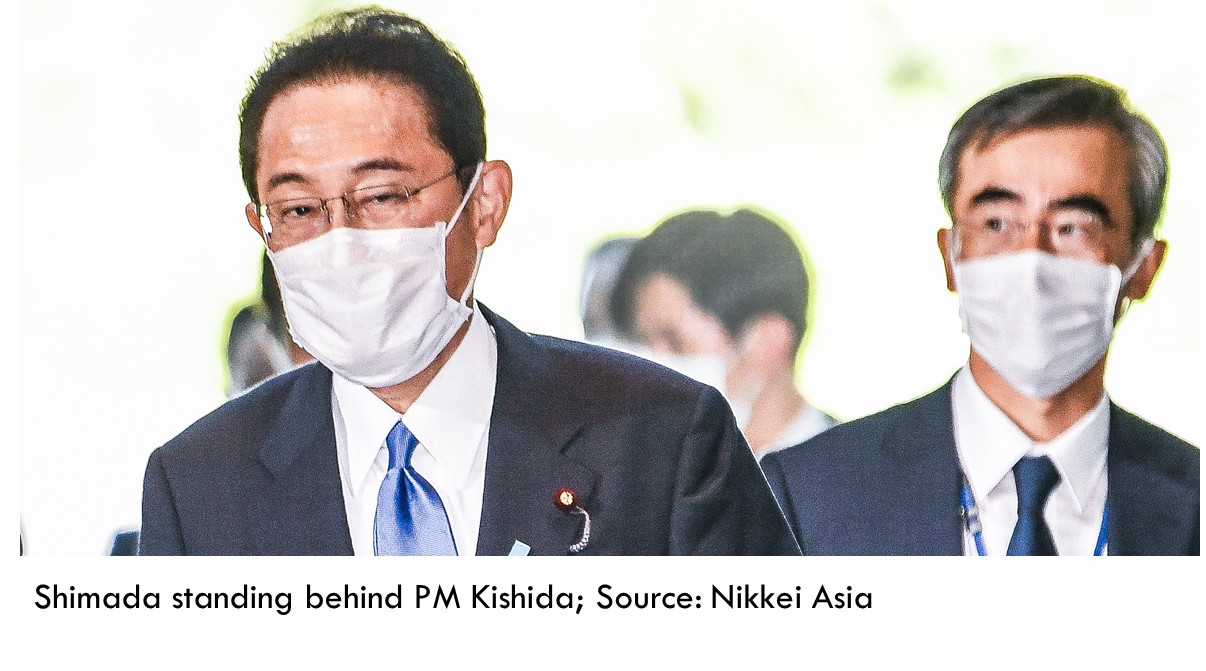
Shimada (62), is PM Kishida’s chief secretary and right-hand man. He is a former METI bureaucrat, which makes it unusual for him to be in a top government role so close to the PM. His nickname is said to be “Captain” due to his long career as key political insider and appointee.
The secretary’s role is to coordinate all government ministries and take the lead in policymaking.
Shimada had served as a secretary to the late Kaoru Yosano, then minister of international trade and industry (METI’s predecessor ministry). He was with Yosano as he continued his career as minister of economic and fiscal policy, chief cabinet secretary and finance minister. Yosano retired in 2012.
When the Fukushima nuclear accident occurred in 2011, Shimada approached Deputy Chief Cabinet Secretary Yoshito Sengoku, who was in charge of the TEPCO issue in the DPJ administration, through Yosano. Later, Shimada was transferred to TEPCO as an executive officer, promoted to be in charge of organizational reform. He also became an advisor to the Support Organization for Nuclear Damage Compensation and Decommissioning, and has been consistently involved in energy policy since then.
He strongly backs a restart of nuclear power in Japan because he believes it can correct some of the issues that have emerged in the country’s power market since its liberalization. Shimada believes that more nuclear power in Japan will improve the country’s energy security and lower electricity prices.
(Sources: Zaiten, Nikkei, Asia Nikkei)
GLOBAL VIEW
BY JOHN VAROLI
Below are some of last week’s most important international energy developments monitored by the Japan NRG team because of their potential to impact energy supply and demand, as well as prices. We see the following as relevant to Japanese and international energy investors.
Australia/ Clean energy metals
Mining and energy giant BHP made a $5.8 billion cash offer for Oz Minerals to boost sourcing for clean energy metals such as copper and nickel. The unsolicited bid, however, was rebuffed. Oz’s board said it “significantly” undervalued the company. Morgan Stanley said investors in Oz will “weigh the offer against expectations” of copper’s long-term price.
Germany/ Coal imports
About 32 million tons more of steam coal will be imported in 2022, up from 27 million tons last year, said Germany’s coal importers group. Australia, South Africa, Indonesia and Colombia are cited as potential coal suppliers.
Germany/ Energy crisis
The national economy might lose over €260 billion in added value by 2030 due to the Ukraine war and high energy prices, according to the Institute for Employment Research. Germany’s price-adjusted GDP will be 1.7% lower in 2023 and about 240,000 fewer people will be employed.
India/ Renewable energy
Shell finalized its $1.55 billion deal with Actis Solenergi to acquire 100% control of Solenergi Power and with it, the Sprng Energy group of companies. These solar and wind assets will triple Shell’s renewable capacity and help deliver on its Powering Progress plan for net-zero emissions by 2050.
Natural gas/ Global markets
The battle between Asia and Europe to secure gas supplies could lead to more price surges. Natural gas prices in Europe are up almost five-fold, YoY. “We’re seeing a scramble to secure LNG cargoes through the end of this year and into 2023,” said the CEO of an Asian gas company, Reuters reported.
Nigeria/ Oil
Four oil fields run by ExxonMobil will be sold to local producer Seplat Energy for $1.28 billion. More international companies are expected to divest from the country’s troubled Niger Delta region. Due to pipeline vandalism and theft, Nigeria struggles to meet its OPEC production quota of 1.8 mbpd.
Norway/ Electricity
Norway might curb electricity exports to the EU if water levels for its hydropower plants remain low. The government will prioritize refilling reservoirs when water levels are below seasonal averages. Norway is one of Europe’s biggest electricity exporters, often selling via cables to the UK, Germany, Netherlands and Denmark
Romania/ Green hydrogen
Romania will hold an auction to fund construction of 100 MW of green hydrogen production. The EU approved €149 million to finance the project, which is part of Romania’s €2.9 billion national Recovery and Resilience Plan to develop green hydrogen infrastructure, including electrolysers and energy storage.
UK/ Energy bills
Annual household energy bills are expected to peak at about £4,420 next spring, says Cornwall Insight, adding that the price cap could rise 80% from the current annual average of £1,971 to £3,582 in October. The cap might then jump to £4,266 in January, eventually peaking at £4,427 in April 2023.
Ukraine/ Nuclear power
Europe’s largest nuclear power plant, in the city of Energodar, is the scene of fighting. In an effort to dislodge the Russian occupational force, the Ukrainian military has been shelling the city and sending in kamikaze drones. The attacks intensified after Russia announced plans to annex the entire Zaporozhye Region.
U.S./ LNG
Top U.S. gas exporter, Freeport LNG, retracted the force majeure it declared after an explosion in June at its main export terminal on the Gulf of Mexico. Buyers now face a collective loss of up to $8 billion as they scramble to source alternative supplies at high spot market prices.
2022 EVENTS CALENDAR
A selection of domestic and international events we believe will have an impact on Japanese energy
| January | OPEC quarterly meeting;
JCCP Petroleum Conference – Tokyo; EU Taxonomy Climate Delegated Act activates; Regional Comprehensive Economic Partnership (RCEP) Trade Agreement that includes ASEAN countries, China and Japan activates; Indonesia to temporarily ban coal exports for one month; Regional bloc developments: Cambodia assumes presidency of ASEAN; Thailand assumes presidency of APEC; Germany assumes presidency of G7; France assumes presidency of EU; Indonesia assumes presidency of G20; and Senegal assumes presidency of African Union; Japan-U.S. two-plus-two meeting; Japan’s parliament convenes on Jan. 17 for 150 days; Prime Minister Kishida visits Australia (tentative) |
| February | Chinese New Year (Jan. 31 to Feb. 6);
Beijing Winter Olympics; South Korea joins RCEP trade agreement |
| March | Renewable Energy Institute annual conference;
Smart Energy Week – Tokyo; Japan Atomic Industrial Forum annual conference – Tokyo; World Hydrogen Summit – Netherlands; EU New strategy on international energy engagement published; End of 2021/22 Japanese Fiscal Year; South Korean presidential election |
| April | Japan Energy Summit – Tokyo;
MARPOL Convention on Emissions reductions for containerships and LNG carriers activates; Japan Feed-in-Premium system commences as Energy Resilience Act takes effect; Launch of Prime Section of Japan Stock Exchange with TFCD climate reporting requirement; Convention on Biological Diversity Conference for post-2020 biodiversity framework – China; Elections: French presidential election; Hungarian general election |
| May | World Natural Gas Conference WCG2022 – South Korea;
Elections: Australian general election; Philippines general and presidential elections |
| June | Happo-Noshiro offshore wind project auction closes;
Annual IEA Global Conference on Energy Efficiency – Denmark; UNEP Environment Day, Environment Ministers Meeting – Sweden; G7 meeting – Germany |
| July | Japan to finalize economic security policies as part of natl. security strategy review;
China connects to grid 2nd 200 MW SMR at Shidao Bay Nuclear Plant, Shandong; Czech Republic assumes presidency of EU; Elections: Japan’s Upper House Elections; Indian presidential election |
| August | Japan: Africa (TICAD 8) Summit – Tunisia;
Kenyan general election |
| September | IPCC to release Assessment and Synthesis Report;
Clean Energy Ministerial and the Mission Innovation Summit – Pittsburg, U.S.; Japan LNG Producer/Consumer Conference – Tokyo; IMF/World Bank annual meetings – Washington; Annual UN General Assembly meetings; METI to set safety standards for ammonia and hydrogen-fired power plants; End of 1H FY2022 Fiscal Year in Japan; Swedish general election |
| October | EU Review of CO2 emission standards for heavy-duty vehicles published;
Chinese Communist Party 20th quinquennial National Party Congress; G20 Meeting – Bali, Indonesia; Innovation for Cool Earth TCFD & Annual Forums – Tokyo; Elections: Okinawa gubernational election; Brazilian presidential election; |
| November | COP27 – Egypt;
U.S. mid-term elections; Soccer World Cup – Qatar; |
| December | Germany to eliminate nuclear power from energy mix;
Happo-Noshiro offshore wind project auction result released; Japan submits revised 2030 CO2 reduction goal following Glasgow’s COP26; Japan-Canada Annual Energy Forum (tentative); Tesla expected to achieve 1.3 million EV deliveries for full year 2022 |
Disclaimer
This communication has been prepared for information purposes only, is confidential and may be legally privileged. This is a subscription-only service and is directed at those who have expressly asked K.K. Yuri Group or one of its representatives to be added to the mailing list. This document may not be onwardly circulated or reproduced without prior written consent from Yuri Group, which retains all copyright to the content of this report.
Yuri Group is not registered as an investment advisor in any jurisdiction. Our research and all the content express our opinions, which are generally based on available public information, field studies and own analysis. Content is limited to general comment upon general political, economic and market issues, asset classes and types of investments. The report and all of its content does not constitute a recommendation or solicitation to buy, sell, subscribe for or underwrite any product or physical commodity, or a financial instrument.
The information contained in this report is obtained from sources believed to be reliable and in good faith. No representation or warranty is made that it is accurate or complete. Opinions and views expressed are subject to change without notice, as are prices and availability, which are indicative only. There is no obligation to notify recipients of any changes to this data or to do so in the future. No responsibility is accepted for the use of or reliance on the information provided. In no circumstances will Yuri Group be liable for any indirect or direct loss, or consequential loss or damages arising from the use of, any inability to use, or any inaccuracy in the information.
K.K. Yuri Group: Oonoya Building 8F, Yotsuya 1-18, Shinjuku-ku, Tokyo, Japan, 160-0004.