UK selects Japan partner to develop new type of nuclear reactor; state atomic energy agency to help with Britain’s HTGR program
Govt vows to train 30,000 battery engineers this decade as Japan seeks to boost competitiveness in growing energy sector
TEPCO power retailer drops into negative net worth for first time, potentially affecting its access to wholesale electricity trading
ENERGY TRANSITION & POLICY
METI seeks to expand GX League membership before year end
Govt launches working group to study CCS legal framework
Rules over scrap block development of decommissioning business
METI mulls support for Kansai Electric’s hydrogen hub in Hyogo
Idemitsu-led group to create 1-million-ton ammonia supply chain
MHI wins contract to design carbon capture for a Scottish utility
MoE asks for 13% boost to next year’s budget to pursue net-zero
Toyota, Honda announce massive EV battery plant plans
Sumitomo, Lotte to produce hydrogen using clean electric heat
ELECTRICITY MARKETS
First baseload power trading for 2023 sees volumes explode
August solar auction quiet as FIT-to-FIP switch has firms cautious
TEPCO Power Grid invests in first ever UK-Germany power link
Kansai Electric draws up zero-carbon roadmap, includes hydrogen
Eurus Energy, Japan Wind, and Green Power among companies submitting plans for new wind power projects around the country
Tesla vows to install over 300 of its Powerwall battery systems
West Group sells nine solar projects to asset manager Sparks
TEPCO mulls flooding Fukushima plant to recover fuel debris
OIL, GAS & MINING
Japanese utilities announce new LNG contracts with Sakhalin-2
LNG stocks show notable rise, stay well above five-year average
INPEX, JOGMEC and Mitsubishi to check CCS potential in Niigata
INPEX looks for storage for its Australian LNG project emissions
ANALYSIS
TOYOTA HAS NOT GIVEN UP ON GASOLINE; AUTOMAKER SEEKS GREEN VERSION OF THE FUEL
Tesla’s long-fought victory over established auto giants in the proverbial ‘beauty contest’ held by global equity markets has finally convinced the world that the electric engine is the future. Now, Japan’s national transportation roadmap also embraces the notion that gasoline-fueled vehicles will disappear from car showrooms by 2035. Despite this, Japan’s top auto maker hasn’t given up on gasoline. Toyota Motor has a vision for a carbon-neutral gasoline automobile.
The move might be dismissed by critics as a stubborn refusal to accept the EV shift. Yet, Toyota’s efforts also point to an uncomfortable truth: Even if Japan shifts all new car sales to EVs and fuel cell vehicles (FCVs) this decade, CO2 reductions will be too small to hit the nation’s own targets.
ENERGY JOBS IN JAPAN: FIRST HIRE LOCALLY? DON’T PANIC
The September installment of our regular column looks at effective ways to plan for making first hires in Japan, and how the local approach differs from global HR strategies. Tips on how to choose reliable recruiting partners in Japan are also included.
GLOBAL VIEW
China is maximizing its coal use and reselling LNG to the EU. Gazprom has halted gas deliveries to France’s top gas supplier. German industries are halting production on energy shortages. Global offshore drilling is on the rise. Singapore may get a 100% hydrogen-fired power plant. Soaring costs may delay UK battery plans. Details on these and more in our global wrap.
EVENTS SCHEDULE
JAPAN NRG WEEKLY
Events
PUBLISHER K. K. Yuri Group
Editorial Team Yuriy Humber (Editor-in-Chief) John Varoli (Senior Editor, Americas) Mayumi Watanabe (Japan) Wilfried Goossens (Japan, Events)Regular Contributors Chisaki Watanabe (Japan) Takehiro Masutomo (Japan) Daniel Shulman (Japan)
METI The Ministry of Energy, Trade and Industry
MOE Ministry of Environment
ANRE Agency for Natural Resources and Energy
NEDO New Energy and Industrial Technology Development Organization
TEPCO Tokyo Electric Power Company
KEPCO Kansai Electric Power Company
EPCO Electric Power Company
JCC Japan Crude Cocktail
JKM Japan Korea Market, the Platt’s LNG benchmark
CCUS Carbon Capture, Utilization and Storage
mmbtu Million British Thermal Units
mb/d Million barrels per day
mtoe Million Tons of Oil Equivalent
kWh Kilowatt hours (electricity generation volume)
NEWS: ENERGY TRANSITION & POLICY
UK selects Japan as partner to develop new type of nuclear reactor
(Nikkei, Sept. 3)
The UK government selected the Japan Atomic Energy Agency (JAEA) and other organizations to develop a high-temperature gas-cooled reactor (HTGR). The UK aims to build this new type of nuclear reactor in the early 2030s to demonstrate the viability of the technology.
JAEA will begin preliminary studies on the basic design and cost of power generation in cooperation with the National Nuclear Laboratory and Jacobs, a UK nuclear power company.
CONTEXT: Japan is one of the global leaders in HTGR technology and has a home design that’s known as the HTTR. These reactors use helium gas to cool their cores instead of water.
SIDE DEVELOPMENT: METI Minister: change in nuclear policy accords with Strategic Energy Plan (Mainichi Shimbun, Aug. 26)
METI Minister Nishimura said the change in the government’s nuclear policy is consistent with the Strategic Energy Plan; decreasing “the level of dependence on nuclear” by improving energy conservation and developing renewable energy.
Nishimura pledged to lower nuclear’s share in the total power mix, from 30% before the Fukushima disaster to 20-22% in 2030.
The first Strategic Energy Plan dates to 2003; the latest was published in October 2021.
METI seeks to expand the GX (green transformation) League, accepting new membership until Dec 28. The GX League comprises companies volunteering to be decarbonization role models and participate in the carbon exchange and its rule making. 440 companies joined the GX League in March. They will start trading offset credits on a trial basis later this year, before the formal exchange launch next April.
CONTEXT: Experts designing the exchange mechanism have said the trades may take off slowly. More GX members possibly generate stronger turnover.
SIDE DEVELOPMNENT: MoE to discuss decarbonization, carbon pricing at GX Council (Denki Shimbun, Sept. 1)
The Working Group for Transformation to a Carbon Neutral Society under the MoE is discussing local decarbonization initiatives and carbon pricing, and will submit its findings to the GX Implementation Council.
The Working Group is also in charge of the Clean Energy Strategy at the MoE, to which they submitted a midterm report in May 2022.
The second GX Council held on Aug. 24 2022 discussed GX carbon pricing and the need to share GX investment with other Asian countries. The MoE is disputing some of the approach.
TAKEAWAY: While the GX initiative is hosted by the Cabinet Office, METI gained more public attention in this space recently due to proposed changes to nuclear policy. The MoE has historically challenged METI on climate change and energy issues and now it’s doing the same over how to implement GX.
METI launched a study group, headed by Prof. Takeda Kuninobu of Osaka University, on the legal framework for carbon capture and storage (CCS) businesses. The 17-member working group includes people from oil, gas, power and paper manufacturing associations, JOGMEC, lawyers, and the financial sector
In upcoming meetings it will identify the capture business scope and required regulatory framework, liabilities and safety obligations of CCS operators and exports of CO2.
Separately, a 13-member study group focused on sustainability issues of CCS businesses was launched, and led by Prof. Otsuka Tadashi of Waseda University.
Government vows to train 30,000 battery engineers
(Nikkei, Aug. 29)
METI will train 30,000 battery engineers by 2030 to increase Japan’s competitiveness in the rechargeable battery sector.
While Chinese and South Korean manufacturers have a growing share of the battery market, METI wants to see domestic manufacturers meet 20% of global demand.
METI aims to increase the annual global production of Japanese battery manufacturers tenfold by 2030, to 600 GW hours.
METI said storage battery strategy goals are to establish 150 GWh of national production capacity and 600 GWh globally by 2030; and securing manpower of 22,000 people to make the batteries, and 30,000 people in the raw material supply chains.
To boost the pool of professional workers, METI, along with the Ministry of Education, state research institutes, universities, Panasonic, GS Yuasa, Prime Planet and battery industry associations, has co-launched Kansai Storage Battery Resource Center. From 2024, vocational schools in the Kansai area will offer storage battery courses designed by National Institute of Advanced Industrial Science and others.
CONTEXT: Panasonic, GS Yuasa, Prime Planet are EV players, which suggests the consortium is automotive-focused.
METI said storage battery strategy goals are to establish 150 GWh of national production capacity and 600 GWh globally by 2030; and securing manpower of 22,000 people to make the batteries, and 30,000 people in the raw material supply chains.
To boost the pool of professional workers, METI, along with the Ministry of Education, state research institutes, universities, Panasonic, GS Yuasa, Prime Planet and battery industry associations, has co-launched Kansai Storage Battery Resource Center. From 2024, vocational schools in the Kansai area will offer storage battery courses designed by National Institute of Advanced Industrial Science and others.
CONTEXT: Panasonic, GS Yuasa, Prime Planet are EV players, which suggests the consortium is automotive-focused.
Fukui Prefecture urged METI to relax rules on the reuse of materials from decommissioned nuclear power plants with radiation levels below 0.01 microsieverts and cleared safety standards.
The reuse of scrap metal from decommissioned plants is currently limited to power operators, to identify its further destination. Fukui said the wider reuse of materials with negligible levels of radioactivity is indispensable in developing the decommissioning business as an industry.
CONTEXT: Relaxing rules for decommissioned plant waste destinations will require strategies in conjunction with the steel sector, the main users of scrap. Any easing will have an impact overseas since Japan is Asia’s leading exporter of scrap steel, and scrap is increasing in demand for low-emission steel. Even before the Fukushima disaster, Japanese scrap yards strictly monitored radioactive levels, which is why no country banned imports of Japanese steel raw materials after the quake.
Power plants could jointly study with steelmakers the wider reuse of decommissioned materials for decarbonization. For example, molybdenum-nickel-chrome alloy is used for reactor pressure vessels and more recently, hydrogen absorption and storage systems.
METI mulls support for hydrogen hub at Himeji
(Government Statement, Aug. 26)
Two METI working groups – Hydrogen Policy and Decarbonizing Fuel Policy – both under the Advisory Committee for Natural Resources and Energy, unveiled plans to support companies developing hydrogen and ammonia supply chains.
It’s understood that all steps of the supply chain need support, from manufacturing and transportation to storage. METI wants to subsidize the gap between the cost of hydrogen/ ammonia and fossil fuels.
Kansai Electric showed its plan to develop a major ammonia hub at Himeji City, Hyogo Prefecture. KEPCO wants to mix hydrogen with LNG at its Himeji No. 1 and Himeji No. 2 Thermal Power Plants, starting around 2030.
Hydrogen’s potential to substitute other fuels in Japan
Source: METI
Type
Usage example
Potential Demand
Remarks
Transportation
Fuel Cell Truck
6,000,000 tons
Total amount needed for large and small trucks
Inland Vessel
1,110,000 tons<
Liquid hydrogen may act as substitute for heavy oil
Power Generation
Hydrogen Power Generation
5,782,000 to 6,672,000 tons
Accounting for 10% of power generation
Industry
Heat demand
34,000,000 tons per year
Calculated from the final energy consumption of industry
Chemical
6,950,000 tons
A substitute for 100% of ethylene
Steel
7,000,000 tons
100% hydrogen reduction
Idemitsu-led group to create 1-million-ton ammonia supply chain in Japan
(Company Statement, Aug. 30)
Oil refiner Idemitsu Kosan, Tosoh, Tokuyama, and Nihon ZEON plan to establish a carbon-free ammonia supply chain for over 1 million tons at the Shunan Complex, Yamaguchi Prefecture.
The storage facility at Idemitsu Kosan’s Tokuyama Plant will be developed as a supply base, and various ammonia infrastructure will be reviewed so that the output target can be hit by 2030.
CONTEXT: The Shunan Industrial Complex produces a wide variety of materials, including chemical raw materials, chemical products, steel, cement, and fine chemicals.
Mitsubishi Heavy wins contract to design carbon capture at Scotland power plant
(Company Statement, Aug. 30)
Mitsubishi Heavy Industries was awarded a Front End Engineering Design (FEED) contract relating to a gas turbine combined cycle (GTCC) power plant and a CO2 capture plant planned at the Peterhead Power Station in Aberdeenshire, Scotland.
For the execution of the FEED, MHI partnered with Worley and Técnicas Reunidas. S.A. The Peterhead facility is run by SSE and Equinor.
The plant is expected to capture up to 1.5 million tons of CO2 a year, which will be sequestered underground in the North Sea.
MoE asks for 13% boost to next year’s budget to pursue regional net-zero
(Kankyo Business, Sept. 1)
MoE’s budget request for FY2023 is ¥741.4 billion, a 13% YoY increase. The ministry aims to double the amount of grants for promoting regional decarbonization and renewable energy projects to ¥40 billion yen.
Tunisia became the 19th nation to join the bilateral carbon credit framework Joint Credit Mechanism (JCM), a market offset mechanism under the Paris Agreement.
Automaker to start production between 2024 and 2026. About ¥400 billion will be for the Japan plant. Competition is intensifying as automakers seek to produce and secure their own batteries, a key component of EVs.
This will be Honda’s first EV battery plant. The shift to electric vehicles is expected to move forward rapidly in the U.S., and Honda wants to secure a local battery supply.
Construction will begin in 2023 with a goal of starting mass production in 2025.
Starting October, Toyota will double production at the Ishihama plant of bipolar nickel hydride batteries for hybrid vehicles to 40,000 units/ month.
The Kyowa plant with 20,000 units/ month capacity has been operational since May 2021
Bipolar nickel hydride batteries consist of metal components that act as cathode on one side and anode on the other; thus saving space. The simple module reduces electrical resistance, yielding higher output
CONTEXT: Nickel hydride batteries typically use nickel hydroxide as cathode, hydrogen absorbing alloy as anode, and alkaline solution as electrolyte. Rare earth yttrium may be used for treating hydrogen.
Sumitomo and Lotte to produce hydrogen using clean electric reactor
(Company Statement, Aug. 24)
Sumitomo Corp, Syzygy Plasmonics, Lotte Chemical and Lotte Fine Chemical will test a fully electric chemical reactor for clean hydrogen production. It will go online in the second half of 2023 at Lotte Chemical HQ in Ulsan, South Korea.
CONTEXT: The traditional thermal cracking of ammonia uses high heat and pressure to convert it to hydrogen gas. The heat is generated by burning fossil fuels; this makes ammonia cracking carbon intensive. Using fully electric reactors gives hydrogen producers a way to reduce or eliminate reliance on combustion as the energy source.
Syzygy developed reactor technology that uses light from ultra-high-efficiency LEDs to power chemical reactions. Sumitomo is an investor in Syzygy.
Japan to establish test production of methanol from recycling of plastic waste
(Kankyo Business, Aug. 26)
Kobe Steel, Mitsubishi Gas Chemical Co., and others started a demo project aimed at establishing Japan’s first technology to synthesize methanol from gas obtained by gasifying plastic waste. The project aims to establish a recycling system for plastics.
MoE partly funds the project that’s important both for its recycling component and the potential to create a stable supply of environmentally friendly methanol.
CONTEXT: Waste plastics are difficult to recycle due to purity issues and are often disposed of by incineration or into a landfill.
The project will run until March 2024 and is in partnership with Osaka Prefecture and Sakai City. The assumption is that 45,000 tons of methanol can be produced from 60,000 tons of waste plastic, cutting CO2 emissions by about 100,000 tons compared to conventional methanol production.
Shipper NYK invests in developer of green energy from garbage
(New Energy Business News, Aug. 30)
NYK invested in Sendai-based startup Sustainable Energy Development, which supplies energy from unutilized resources such as combustible waste in cities.
The startup is developing the ISOP System that uses subcritical water treatment technology to decompose combustible waste and other organic materials to make products such as biofuels. The system will generate energy from feedstock such as garbage, sludge and organic waste.
NYK hopes that the ISOP system will be installed on ships.
Rail operator seeks to eliminate CO2 emissions from diesel trains with biofuel
(Kankyo Business, Aug. 30)
JR West, the rail operator covering the Osaka area, started testing next-generation biodiesel fuel, aiming for full-scale use in FY2025.
The tests will look at engine performance, driving, and long-term impact over the next three years. Biodiesel will be mixed with diesel, starting with 5% and will rise to 100%.
CONTEXT: This is Japan’s first railroad operator to conduct a long-term running test using 100% next-gen biodiesel fuel. JR West expects the switch to biodiesel to virtually eliminate CO2 emissions from its diesel trains (about 55,000 tons in FY2021).
The project is supported by the Ministry of Land, Infrastructure, Transport and Tourism.
EV Motors Japan secures investment from Kansai Electric
(Nikkei, Aug. 31)
Kyushu-based EV Motors Japan secured ¥600 million from investors, including KEPCO.
EV Motors Japan manufactures commercial EVs.
Air Liquide and Itochu to roll out 24-hour hydrogen stations
(Nikkei, Aug. 29)
France’s Air Liquide will partner with trading house Itochu to build a network of 24-hour hydrogen filling stations across Japan.
The first will open in Fukushima in 2024 and then mostly along the Shinkansen route.
While the government set a target of opening 1000 hydrogen stations by 2030, the failure of fuel cell vehicles to grow in popularity, and the high cost of establishing such stations, is why there are only 160 hydrogen filling stations nationwide.
The Itochu/Air Liquide stations will take advantage of state subsidies and reduce costs by sharing car washes and other facilities with adjacent Itochu NX fuel stations.
ZEB with energy storage system results in 8% GHG cuts at Hazama Ando
(Japan NRG, Sept. 1)
Hazama Ando’s pilot zero emission building (ZEB) in Tsukuba has resulted in a 8% cut in greenhouse gas release in 2020, the company said.
The Tsukuba ZEB is comprised of a cogeneration system and a 2 kW-1.2 MWh sodium-sulfide storage battery system that stores and supplies power to its major sites in Tokyo via TEPCO’s transmission lines
Higher self-sufficiency of power resulted in lower GHG emissions.
Hazama Ando’s Scope 3 emissions were 2.4 million carbon tons in the year ending March 2021, down 3.2 million tons, YoY.
The JV, to be owned 66.7% by Nidec and 33.3% by FREYR Battery, will produce semi-solid lithium-ion batteries developed by the latter for grid-class storage systems.
The hydro-powered battery plant will be located in Norway
NEWS: POWER MARKETS
Negative net worth of TEPCO’s power retailer could impact trading
(Nikkei, TBS, Aug. 28)
TEPCO Energy Partner, the electricity retailer that’s part of the TEPCO group, has found itself in excess of its liabilities by approximately ¥6.7 billion as of the end of June. With LNG and coal prices rising, profits have deteriorated.
This is the first time since the retailer was founded in 2015 that it has recorded negative net worth.
The retailer’s procurement of electricity from the wholesale market may be affected, and the parent company has entered into an arrangement to underwrite a capital increase to resolve the situation.
CONTEXT: JEPX, the operator of the wholesale market, requires trading members to maintain a minimum net worth of ¥10 million in order to have access to the trading.
TAKEAWAY: This is a potentially destabilizing situation for the power market unless TEPCO Holding moves quickly to inject capital and retain its retailer’s trading qualifications. The extreme price spike of January 2021 was largely due to the actions of another TEPCO group electricity retailer.
PPS under pressure to secure electricity for 2023
(Aug. 27, Nikkei)
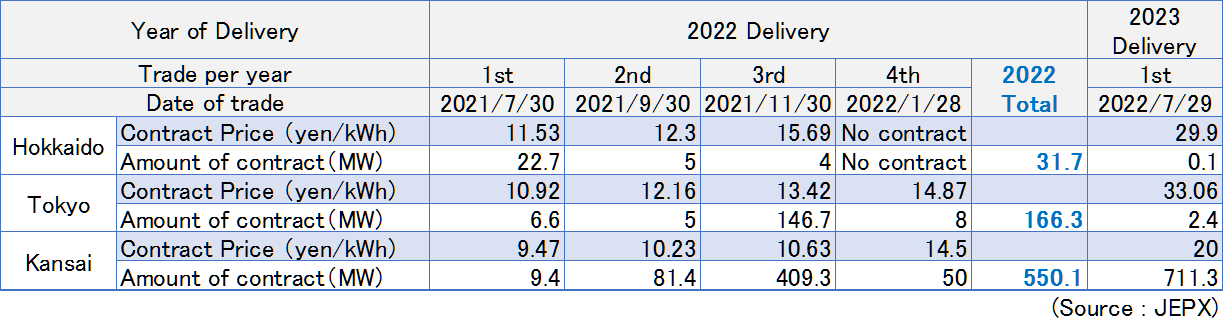
In the first trade of baseload power for 2023 delivery on the Japan Electric Power Exchange (JEPX), the Kansai region’s contracted electricity was 711.3 MW, which is 76 times more than the traded electricity for 2022 (9.4 MW).
The contract prices of Hokkaido (¥29.9/ kWh) and Tokyo (¥33.06/ kWh) were higher than Kansai (¥20/ kWh).
In case PPS(Power Producer and Suppliers) can’t supply contracted electricity to customers, they need to pay a high penalty to regional power companies. Due to the tight electricity demand and supply, the PPSs rushed to buy power on the baseload market.
CONTEXT: Japan’s baseload market started in 2019, and is held four times a year, to trade baseload electricity for the following year. While sellers are regional electric power companies who operate nuclear, coal, hydro and geothermal power stations, the buyers are PPS who mainly operate natural gas power stations.
The August solar power auction had 28 bidders for a total of 26 MW, down from 44 bidders in the previous June auction. There were 10 bidders for a 14 MW total under the Feed-in-Premium (FIP), which increased from 5 bidders/129 MW in June, and 18 for Feed-in-Tariff (FIT) for 12 MW, down from 39 bidders/25 MW.
CONTEXT: The number of bidders surged to a record high of 273 in the last March auction, but then slumped afterwards. Power operators wanted to sell under the FIT scheme and retreated to wait-and-see as large operators shifted to FIP in April. This is not unusual as FIT in its early stage drew single-digit participants. The next auction will be in November.
TEPCO Power Grid signs SPA in the first ever UK-Germany Power Link
(Company Statement, Aug. 26)
TEPCO Power Grid, Inc. (“TEPCO PG”) entered into a share purchase agreement with the shareholders of FI1 Limited via its subsidiary TEPCO Power Grid UK Limited. The purpose is to acquire FI1, which has minority stakes in the company that is building and will later operate the first ever UK-Germany power link.
This NeuConnect Interconnector Project will be the second global power transmission investment for TEPCO PG following the Triton Knoll offshore electricity transmission project announced in Nov. 2021.
NeuConnect, with a capacity of 1.4 GW, will see two new HVDC converter stations built in southeast England and in north Germany, connected by 700 km of subsea cables.
Kansai Electric also acquired an 18.3% share of NeuConnect.
Kansai Electric draws up zero-carbon roadmap
(Zaiten, October 2022 edition)
Following the government’s carbon neutrality goals, Kansai Electric (KEPCO) drew up a ‘KEPCO Group Zero Carbon Roadmap’, setting 2030 as a midway point, and more targets up to 2050.
The three main pillars of the initiative are demand-side, supply-side and hydrogen.
By 2030, KEPCO aims to reduce CO2 emissions from power generation, through various services that replace CO2-free electricity menus such as ‘energy saving’, ‘electrification’ and ‘energy creation’. The plan is to reduce CO2 emissions by 7 million tons, equivalent to 30% of the expected reduction in the entire Kansai area.
The company will focus on offshore wind power, which has great development potential, and overall renewable energy development.
Zero-carbon fuel co-firing is planned by 2030, and dedicated co-firing by 2050. Coal-fired power plants will also be studied for zero-carbon fuel co-firing. The plan is to prepare for building a hydrogen supply chain.
Eurus Energy Holdings to develop 192 MW wind farm at Tarumi City
(Minami Nippon Shimbun, Aug. 27)
Eurus Energy Holdings, Japan’s largest wind energy developer, plans to build a 192 MW wind farm in Tarumi City (Kagoshima Prefecture). There’ll be 32 wind turbines (4 to 6 MW each) covering a total area of 2,500 ha.
Each wind turbine will stand 85 to 105 meters tall, with a blade diameter of 120 to 160 meters. Nagashima Wind Farm is Kagoshima’s largest, with a total output of 50.4 MW.
Eurus will exclude the national park area from its 600 MW wind park in the Hakkoda Mountains of Aomori Prefecture, due to opposition from environmental groups.
CONTEXT: Early in August TEPCO sold its 40% stake in Eurus to Toyota Tsusho Corp for ¥118.4 billion. Toyota Tsusho now is 100% owner.
Japan Wind Development plans 128 MW wind power project in Iwate
(New Energy Business News, Aug. 29)
Japan Wind Development released an environmental assessment for the onshore 128 MW Yono Wind Power Generation Project in Iwate Prefecture. The start is set for Feb. 2028.
The project area is about 2,840 ha, and will house 31 wind turbines. Japan Renewable Energy’s Nosouke Pass wind project is planned nearby.
Green Power Investment plans 230 MW wind farm in Iwate
(New Energy Business News, Aug. 30)
Green Power Investment plans a 230 MW wind farm in Morioka City, Iwate Prefecture. The company released an environmental assessment for a site of 5,388 ha in Morioka City, Iwaizumi City, and Kuzumaki Town; it will have 38 to 55 turbines.
Operation will begin 33 months after the start of construction.
Tesla Japan to install more than 300 Powerwall units
(Denki Shimbun, Aug. 30)
Tesla Japan said it has deployed more than 300 units of its Powerwall battery system on Miyakojima Island. The company deployed Powerwall with Nextems, a firm co-funded by Okinawa Electric, for use as part of a virtual power plant (VPP) starting in 2021.
While Tesla has already deployed Powerwall across the country, the Miyakojima project is the first that’s being utilized for a VPP.
The number of installed Powerwall systems will rise to 400 by end 2022, and 600 by end 2023. From 2024, Tesla plans to roll out the VPP structure that utilizes Powerwalls across Okinawa.
100-hectare solar farm proposed for Sendai
(Goo News, Aug. 29)
Yokohama-based Smart Farm plans a 50 MW solar farm in a national forest near Sendai.
The farm will occupy 100 ha, and could supply the grid starting in 2024.
Despite central government support, residents are worried about environmental impact.
Japanese group led by Erex invests in Taiwanese floating solar developer
(Company statement, Sept. 1)
Erex Corp, JA Mitsui Leasing, Chuo Nippon Land & Building, and the Taiwanese subsidiaries of Kyudenko Corp and Manies Group invested in WG Manies Solar Energy Co., a Taiwanese developer of solar power and aquaculture. WG Manies’ sites were certified as special zones for an integrated aquaculture and solar power generation project. This would see solar panels installed on top of aquaculture ponds that grow shrimp and clams.
The electricity will be sold to the Taiwan Power Company under FIT.
Developer West Group sells nine solar plants to Sparks Group
(New Energy Business News, Sept. 1)
West Energy Solutions, part of West Group, will sell nine solar plants with a total capacity of 23 MW to the Sparks Group through a newly-established special purpose company. The nine plants are in Chiba, Okayama, and Kumamoto prefectures.
A Sparks’ fund will invest in one of the solar plants and another subsidiary will manage the project over the FIT period of 19 years.
The deal size wasn’t disclosed.
JERA to restart retired coal plants amid electricity pinch
(Tokyo Shimbun, Sept. 1)
Tokyo Power Grid and other transmission providers secured an additional 2.6 GW of capacity for the winter.
About 2.4 GW is the result of JERA restarting decommissioned thermal plants.
This will take pressure off all regions except for Hokkaido and Okinawa.
J-Power to study biomass in Vietnam
(Company Statement, Aug. 26)
Electric Power Development Co, also known as J-Power, agreed to work with Vietnam Forestry Corporation (Vinafor) to develop the biomass business in Vietnam, including power generation and fuel production.
Vinafor is a state-owned forestry corporation that manages about 43,000 ha of forests.
TEPCO may flood Fukushima plant to recover debris
(Kahoku Shimpo, Sept. 2)
TEPCO is considering turning the Fukushima reactor buildings into giant tanks in an effort to retrieve molten fuel rod debris.
TEPCO describes the flooding approach, which has the advantage of reducing exposure to radiation, as novel and promising.
However, turning the entire plant into a series of watertight tanks will be both technically challenging and expensive, and will add to the ¥8 trillion cost of decommissioning.
NEWS: OIL, GAS & MINING
Kyushu Electric and Hiroshima Gas secure gas from Sakhalin-2
(Denki Shimbun, Sept. 2)
Kyushu Electric announced a new LNG supply contract with Sakhalinskaya Energiya (SA), the new operator of Sakhalin-2. The amount and contract price are not disclosed.
Also, Hiroshima Gas agreed with SA to buy 210,000 tons of LNG from Sakhalin-2.
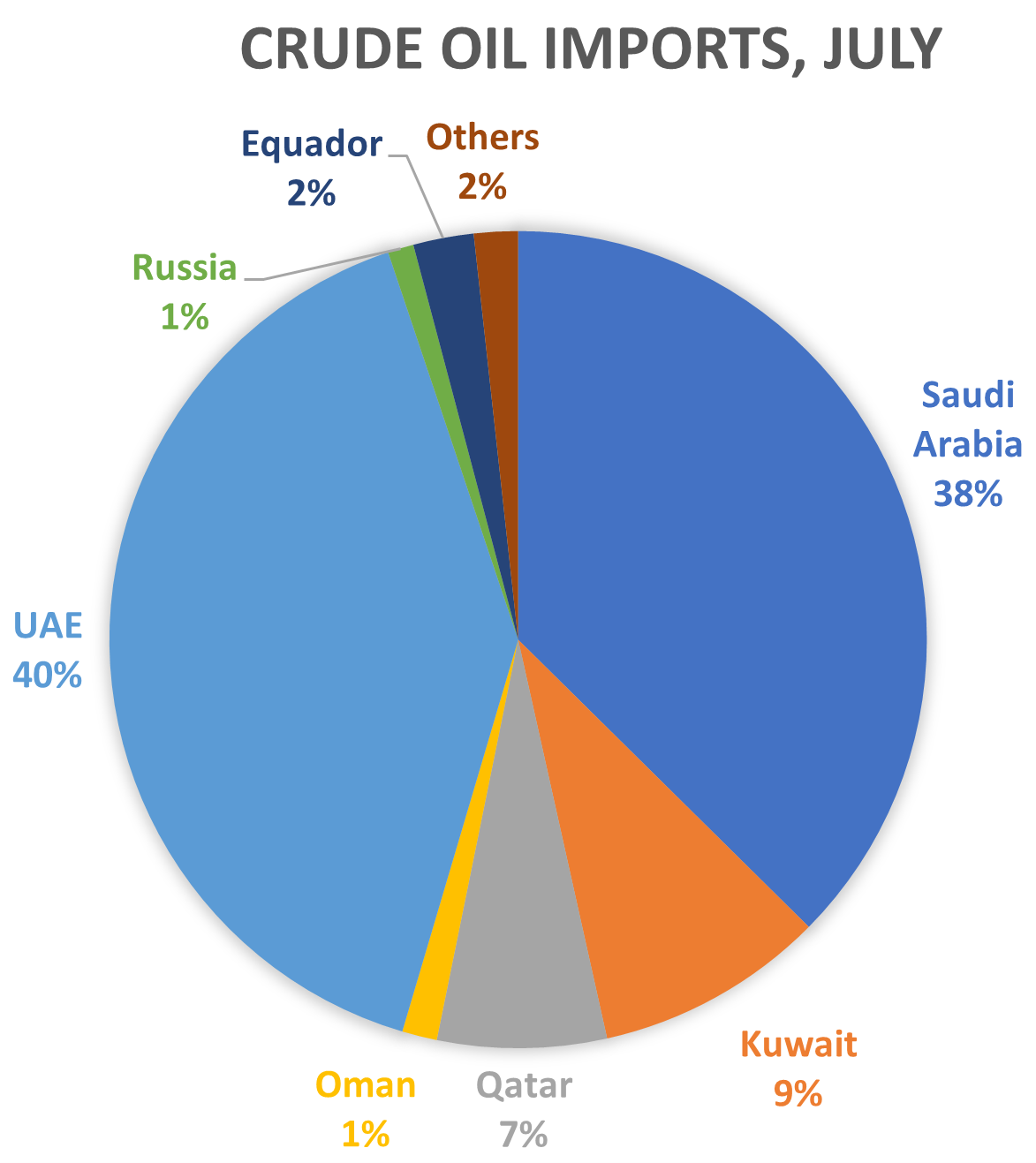
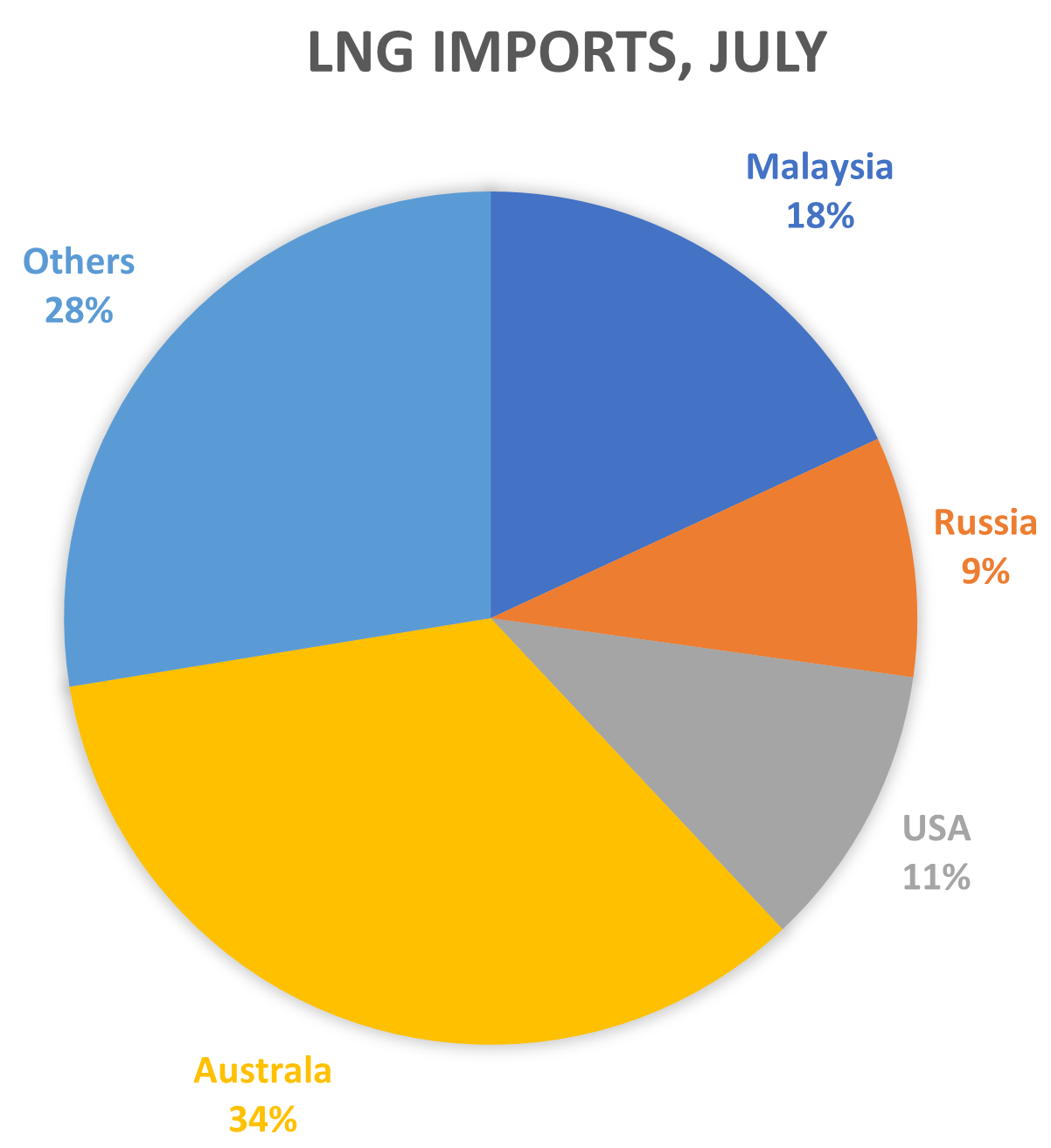
Japan imported 0.56 million tons of LNG from Russia in July, accounting for 9% share of the total 6.16 million tons imported. July crude oil imports from Russia were 0.1 million kiloliters, accounting for 1% of the total imports of 11.5 million kl.
LNG stocks of 10 power grids stood at 2.63 million tons as of Aug. 28, up from 2.46 million tons a week earlier. The end-August stocks last year were 2.43 million tons. The five-year average for this time of year is 1.85 million tons.
INPEX, JOGMEC and Mitsubishi Gas to check on CCS potential in Niigata area
(Company statement, Sept. 2)
INPEX, Mitsubishi Gas Chemical Co and Japan Oil, Gas and Metals National Corporation (JOGMEC) started to review the potential for subsurface CO2 storage in old oil and gas fields of Niigata Prefecture.
The group will test the potential for CCS by reviewing two-dimensional seismic survey data and making a geological evaluation of the Kitakambara area in Niigata.
SIDE DEVELOPMENT: INPEX to explore potential storage site for CO2 from its Australian LNG project (Company statement, Aug. 24)
Australia’s Northern Territory is promising for the geological storage of CO2. The local water depth ranges between 30 and 75 meters.
The site could serve as a CCS for emissions from INPEX’s nearby Ichthys LNG project.
SIDE DEVELOPMENT: INPEX sells Gulf of Mexico oil and gas field to Occidental (Company statement, Sept. 1)
INPEX sold its 10.1% stake at the Lucius Field in the U.S. Gulf of Mexico to Occidental Petroleum, Murphy Exploration and Eni. INPEX joined the project in June 2012.
The company is optimizing its global portfolio, but won’t disclose the deal’s size.
ANALYSIS
BY MAYUMI WATANABE
Toyota Has Not Given Up on Gasoline: Automaker Plans to Develop “Green Gasoline”
Tesla’s long-fought victory over established auto giants in the proverbial ‘beauty contest’ held by global equity markets has finally convinced the world that the electric engine is the future. Now, Japan’s national transportation roadmap also embraces the notion that gasoline-fueled vehicles will disappear from car showrooms by 2035.
Despite the current EV juggernaut that’s been bolstered by the global energy crisis, one company hasn’t given up on gasoline. Welcome to Toyota Motor’s vision for a carbon-neutral gasoline automobile.
The bold move by Japan’s largest car company might be seen by many as an industry dinosaur refusing to accept the glorious EV future. Historically, Toyota has favored hydrogen-powered fuel cell autos or hybrids over EVs.
Yet, Toyota’s vision points to an uncomfortable truth, at least in the domestic auto market. Even if EVs and fuel cell vehicles (FCVs) do replace internal combustion engine cars in the showroom this decade, the reduction in transport emissions will be small. In fact, too small to hit the sector’s national targets.
So, does Toyota’s shift of net-zero focus from engine type to fuel make sense? The path to “green gasoline” is not as far-fetched as it sounds.
Source Toyota Motor
“Green gasoline union”
In 2020, Japan’s transportation emissions were 185 million tons. The 2030 goal is to cut that to 146 million tons, and to end all sales of new gasoline-fueled cars by 2035. But the government has been one-sided in its approach to carbon neutral driving. It has focused on breakthrough vehicle development, while fuel has been neglected. The general attitude has been to leave that to suppliers overseas.
Replacing fossil fuel vehicles with EVs and FCVs will contribute only 16% of the required emission reduction, and more measures are required to meet the 2030 goal, according to another government study. Well, here comes Toyota hoping to make a breakthrough carbon neutral gasoline after giving birth to hybrid and hydrogen vehicles.
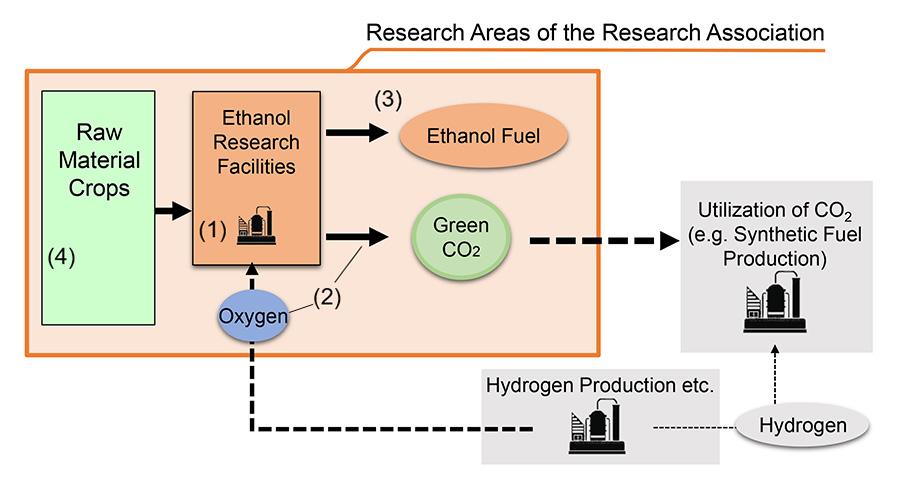
On July 1, five Toyota group companies – Toyota Motor, Toyota Tsusho, Daihatsu Motor, Suzuki Motor, and Subaru, along with oil refiner ENEOS – set up a partnership called the Next Generation Green CO2-free Fuel Technology Research Union.
Mazda and Hino Motor, also Toyota affiliates but focused on diesel vehicles, won’t participate. So, the venture earned the nickname “green gasoline union”. Its goals are:
To develop large-scale production systems of secondary bioethanol as a potential gasoline substitute
To reuse carbon generated in bioethanol production and by-product oxygen from hydrogen production, and set up “carbon/oxygen capture and utilization” systems
To identify issues that bioethanol would face on driving mechanism and design efficient powertrain systems
To establish methods of forecasting fuel output from feedstock data
To discover efficient crops for bioethanol raw materials, and establish harvest volume forecast methods using soil analysis
Termite intestines boost biofuel
The green gasoline union’s laboratory will be located in the Okuma township in Fukushima Prefecture, which has been hosting biomass projects growing napier grass that absorbs radioactive caesium, as well as dent corn, sorghum, erianthus and rye.
Toyota Motor and ENEOS are cellulose ethanol pioneers. Toyota developed XyloAce, a yeast that boosts ethanol production efficiency. XyloAce comprises saccharomyces cerevisiae yeast, commonly used for wine production. Termite intestine genes were combined with the yeast to turn fermentation-inhibiting substances, such as acetic acid, into ethanol. This increased production.
Meanwhile, ENEOS has been exploring low-cost feedstock. Together with Toppan Printing it runs an ethanol pilot plant using scrap paper. Their goal is to establish a continuous process that recycles the feed and yeast over and over, which improves costs. (See “Paper Ethanol: A bioethanol game changer?” in the June 20, 2022 issue of Japan NRG).
Shiomi Masato of Japan’s UCO Business Federation told Japan NRG that the green gasoline union initiative is positive for the sustainable development of green fuel. Unlike other fuel producers, the union won’t use recycled oil.
Used cooking oil (UCO) has become the key raw material for biodiesel and recently sustainable aviation fuel (SAF), as well as marine fuel. UCO supply constraints may dampen bioenergy development, he warned, citing that Japan’s UCO exports are rising rapidly, although the country has a limited supply of 0.4 million tons/ year.
Challenges: costs and regulations
Observers say Toyota and ENEOS have good proprietary cellulose ethanol production technologies, but they need to develop it further to reach commercialization. Perhaps the two will combine their systems for further impact. However, one researcher says this may prove technically difficult because Toyota’s yeast doesn’t react with ENEOS’ scrap paper feed. The latter contains little xylose that activates the Toyota-type yeast.
What’s more, production costs are blocking commercialization of scrap paper ethanol, which are estimated to be ¥120-200/ liter, excluding capital and paper collection/ sorting costs. Gasoline retail prices are ¥150-160/ liter, at historically high levels.
The country’s restrictions on genetic engineering are also an obstacle. Toyota’s high performance XyloAce yeast is not cultivated in Japan. Production and use of gene recombined yeast are not impossible, but they’re tightly regulated. In 2019, Toyota instead signed a XyloAce production licensing deal with U.S.-based Lallemand.
Sawa Issey of Nippon Environment Energy Development (NEED) told Japan NRG that he was excited by the bioethanol as well as the “bioenergy carbon capture and utilization” process to produce synthetic e-fuel. He estimates that it will take over ten years to reduce the cost of e-fuel production to marketable levels, adding that bioethanol could be the bridge fuel until that happens.
Despite challenges, expectations on green gasoline are mounting. Japan’s bioethanol consumption is expected to be 0.5 million kiloliters in 2022, which is only 1% of the total gasoline demand of 45 million kiloliters. According to NEED, Japan could achieve its 2030 transport emission targets by meeting its EV shift target and introducing E10, gasoline with 10% ethanol.
Annual E10 carbon reduction estimate by vehicle type
Gasoline vehicles
2.84 million tons
Hybrid vehicles
1.1 million tons
Plug-in-hybrid vehicles
0.08 million tons
Total
4.02 million tons
Source: NEED
Toyota is not alone in pursuing the decarbonization of fuel for cars. The Nissan Global Foundation has been funding research on crop-derived fuel for decades. Its past projects include researching jatropha curcas plants for producing biofuel, photosynthesis for application in power generation, and the central place of ferns in Japanese forests.
Overall, such private sector activity in green fuel development is crucial since the Ministry of Land, Infrastructure, Transport and Tourism, which has oversight for car safety, appears to have little interest. Its skepticism might be understandable given the fact that the government has seen many biomass projects fail. But if Japan is to meet its 2050 net-zero emission goals then the ministry will need commercial-ready evidence that compels it to overcome its doubts.
COLUMN: ENERGY JOBS IN JAPAN
BY ARTHUR (RIKU) OGAWA
First Hire in Japan? Don’t Panic
It’s hardly a secret that hiring / recruitment in Japan is just as unique as the local culture, and very much in contrast to how things are done in the rest of the world. This of course means there’s going to be pitfalls and challenges, but also opportunities and advantages.
In this column, I’d like to shed some light on how to be most effective when you make your first hire in Japan or plan to take your team to the next level.
Acknowledge differences
There are many examples of companies rushing into Japan with a recruitment approach that worked well for years in other countries but not here. Sure, some companies get lucky from time to time, but, unfortunately, more often than not those efforts end in failure and disappointment, and lead to frustration.
So, what are those differences?
Candidate-centered market (vs. Client-centered). On-spec, quality Japanese professionals will hardly ever apply to a job posting, even if they are interested in it. Talent in Japan will start with a list of questions about the company and the job even before they’re willing to speak with you. There are generally dozens of similar companies/agencies reaching out to them daily with the exact same opportunities. Why wouldn’t these candidates be choosy?
Leadership and English abilities. While there’s bilingual, charismatic and experienced talent in Japan, the fact is that it’s a scarce resource. Unless you are happy to splash the cash at them and adjust to their wish list, you might want to lower your expectations.
Speed. Unlike the points above, as an employer you can impact the hiring speed, as well as the time necessary for candidates to decide and join your team. But this will take some time. My advice has been the same for the last several years, once you have met a good candidate – don’t wait until you meet five like him/her. Instead, move forward quickly. Otherwise, someone else will. Seize the day!
Recruitment agencies. Although the general flow will be similar to what you experience overseas, contract details will be different. For example, fee rates are significantly higher in Japan (it’s not uncommon to see contracts with 35% – 40% fees!); and these are often applied to the entire salary package, not just base salary.
One case from a couple of years ago illustrates the above. A mid-size UK company that had recently expanded to Asia and some European countries also decided to enter the Japan market. It followed the same recruitment model as in other countries, paying a global agency under a fixed fee (25% of base salary) and planned to make its first two hires in Japan within six months. To their surprise, it received zero response via job boards and was introduced to just two candidates via the agency, both of which promptly received offers from competitors already present in Japan.
When after the months the company decided to contact with a few Japan-based agencies. They found out that no agency was willing to go below 30% of total salary package as their fee. In the end, the company was able to hire one of the two staff it targeted, but found itself reworking its entire recruitment strategy for Japan. The time it lost also, unfortunately, cost the firm both moment and delayed their market entry/product launch for several months.
Choose a reliable recruiting partner
Usually, global companies entering the Japan market are utilizing both internal (HR overseas) and external (recruitment agencies) resources. Some hiring managers, however, prefer directly working with recruitment agencies. There’s not a one-for-all solution, but I’ll list some basic differences that could, hopefully, help you to navigate the recruitment minefield and help to choose from the list of hundreds of recruitment agencies out there.
Globally branded recruitment firms with an army of recruiters in all major countries. I’ll omit their names to avoid free advertisement and only focus on the pros/cons. One of the obvious pros will be volume. Usually, big firms will have a high volume of activity/performance, especially for the junior or mid-level positions. The downside is that you won’t always have a specialist for the field that you’re hiring for and, if so, you’ll likely end up rummaging through a pile of CVs trying to find your on-spec candidate.
Overseas agencies located overseas that are hiring for the Japan market. Often such agencies have been working with you in other countries and see Japan business as an important, but a secondary field. They’d often have a good understanding of your global culture and requirements set by the HQ. However, most don’t have a foot on the ground, having a limited presence in Japan and access to a broader candidate pool.
Japan-based, industry specialized agencies. There’s not a big number of those, but such agencies are able to deliver quality and results. Having said that, often such agencies are more focused on senior level hiring and a particular industry or limited niches within one industry.
If you’re in the beginning of your business journey in Japan, then working with two or three trusted recruitment partners is highly recommended to meet your needs.
Just make sure to choose wisely and set the expectations right!
Arthur (Riku) Ogawa is a Principal Consultant at Titan GreenTech, a Tokyo-based human capital and executive search firm with a focus on renewable energy and clean technology markets.
GLOBAL VIEW
BY JOHN VAROLI
Below are some of last week’s most important international energy developments monitored by the Japan NRG team because of their potential to impact energy supply and demand, as well as prices. We see the following as relevant to Japanese and international energy investors.
China/ LNG
While domestic coal use reached a record high, China is reselling surplus LNG to the EU, which led to its LNG imports growing 60%, YoY, in the first half of 2022, said analytics firm Kpler. The EU’s import of 53 million tons of LNG surpassed imports by China and Japan.
France/ Energy crisis
On Sept. 1, citing a payment dispute, Gazprom halted gas deliveries to Engie, France’s biggest gas supplier. The Russian state-owned company said it hadn’t “received full payment for the gas supplied to Engie in July under existing contracts”.
Germany/ Energy crisis
German industries of all sizes and types are stopping production due to high energy prices. Economy Minister Robert Habeck said efforts to reduce gas consumption weren’t enough and that “the industries in question aren’t just being restructured but are experiencing a rupture.”
Offshore drilling
Global offshore energy investment will rise 27% to $173 billion in 2024, reversing a decade of decline, said Rystad Energy. Offshore production sites are more expensive to build than onshore, but once operational they can turn profits at lower prices.
Qatar/ Blue ammonia
QatarEnergy will build the world’s largest ‘blue’ ammonia plant, which is expected to come online in Q1 2026 and to produce 1.2 million tons/ year. The Ammonia-7 project will cost $1.16 billion to build, and will capture and sequester 1.5 million tons of CO2 a year.
Russia/ Foreign divestment
ExxonMobil said it will fight the Kremlin’s decree to bar foreign companies from selling stakes in certain projects until the end of 2022. Exxon said it was “transitioning” its operations at the Sakhalin-1 oil project to another company.
Russia/ Oil cap and Gas suspension
The G7 agreed to a price cap on Russian oil, to be implemented simultaneously as the EU’s embargoes on Russian oil – Dec. 5 for crude and Feb. 5 for refined products. Moscow threatened not to sell to countries supporting the price cap. Also, soon after the oil cap was announced, Russia indefinitely suspended gas flows through the Nord Stream 1 pipeline, saying it was due to a technical issue.
Singapore/ Hydrogen
Keppel will build a $540 million, 600-MW “hydrogen-ready” natural gas power plant that might one day run on 100% hydrogen. The facility is expected to be online by the end of June 2026 and is located on Jurong Island.
UK/ EV batteries
Soaring energy costs will significantly delay plans by Britishvolt to manufacture batteries at its future £3.8 billion gigafactory. The company wants to build a domestic EV industry and avoid relying on Asian companies.
UK/ Energy profits
Britain’s gas producers and electricity generators could make excess profits of up to £170 billion over the next two years, Bloomberg reported. The Finance Ministry, which is preparing a £37 billion energy support package for households, disputes the report.
Ukraine/ Nuclear power
An IAEA delegation arrived at the contested Zaparozhye Nuclear Power Plant, Europe’s largest NPP, which is under Russian military control, facing frequent Ukrainian shelling. IAEA director Rafael Mariano Grossi said his inspectors will remain at the NPP.
2022 EVENTS CALENDAR
A selection of domestic and international events we believe will have an impact on Japanese energy
January
OPEC quarterly meeting;
JCCP Petroleum Conference – Tokyo;
EU Taxonomy Climate Delegated Act activates;
Regional Comprehensive Economic Partnership (RCEP) Trade Agreement that includes ASEAN countries, China and Japan activates;
Indonesia to temporarily ban coal exports for one month;
Regional bloc developments: Cambodia assumes presidency of ASEAN; Thailand assumes presidency of APEC; Germany assumes presidency of G7; France assumes presidency of EU; Indonesia assumes presidency of G20; and Senegal assumes presidency of African Union;
Japan-U.S. two-plus-two meeting;
Japan’s parliament convenes on Jan. 17 for 150 days;
Prime Minister Kishida visits Australia (tentative)
February
Chinese New Year (Jan. 31 to Feb. 6);
Beijing Winter Olympics;
South Korea joins RCEP trade agreement
March
Renewable Energy Institute annual conference;
Smart Energy Week – Tokyo;
Japan Atomic Industrial Forum annual conference – Tokyo;
World Hydrogen Summit – Netherlands;
EU New strategy on international energy engagement published;
End of 2021/22 Japanese Fiscal Year;
South Korean presidential election
April
Japan Energy Summit – Tokyo;
MARPOL Convention on Emissions reductions for containerships and LNG carriers activates;
Japan Feed-in-Premium system commences as Energy Resilience Act takes effect;
Launch of Prime Section of Japan Stock Exchange with TFCD climate reporting requirement;
Convention on Biological Diversity Conference for post-2020 biodiversity framework – China;
Elections: French presidential election; Hungarian general election
May
World Natural Gas Conference WCG2022 – South Korea;
Elections: Australian general election; Philippines general and presidential elections
Germany to eliminate nuclear power from energy mix;
Happo-Noshiro offshore wind project auction result released;
Japan submits revised 2030 CO2 reduction goal following Glasgow’s COP26;
Japan-Canada Annual Energy Forum (tentative);
Tesla expected to achieve 1.3 million EV deliveries for full year 2022
Disclaimer
This communication has been prepared for information purposes only, is confidential and may be legally privileged. This is a subscription-only service and is directed at those who have expressly asked K.K. Yuri Group or one of its representatives to be added to the mailing list. This document may not be onwardly circulated or reproduced without prior written consent from Yuri Group, which retains all copyright to the content of this report.
Yuri Group is not registered as an investment advisor in any jurisdiction. Our research and all the content express our opinions, which are generally based on available public information, field studies and own analysis. Content is limited to general comment upon general political, economic and market issues, asset classes and types of investments. The report and all of its content does not constitute a recommendation or solicitation to buy, sell, subscribe for or underwrite any product or physical commodity, or a financial instrument.
The information contained in this report is obtained from sources believed to be reliable and in good faith. No representation or warranty is made that it is accurate or complete. Opinions and views expressed are subject to change without notice, as are prices and availability, which are indicative only. There is no obligation to notify recipients of any changes to this data or to do so in the future. No responsibility is accepted for the use of or reliance on the information provided. In no circumstances will Yuri Group be liable for any indirect or direct loss, or consequential loss or damages arising from the use of, any inability to use, or any inaccuracy in the information.
K.K. Yuri Group: Oonoya Building 8F, Yotsuya 1-18, Shinjuku-ku, Tokyo, Japan, 160-0004.
NEWS
・UK selects Japan partner to develop new type of nuclear reactor; state atomic energy agency to help with Britain’s HTGR program
・Govt vows to train 30,000 battery engineers this decade as Japan seeks to boost competitiveness in growing energy sector
・TEPCO power retailer drops into negative net worth for first time, potentially affecting its access to wholesale electricity trading