
JAPAN NRG WEEKLY
SEPT. 12, 2022
JAPAN NRG WEEKLY
Sept. 12, 2022
NEWS
TOP
- METI launches new public-private council on hydrogen vehicles as sales in the sector dry up, falling far short of state targets
- Nuclear regulator vows to improve but chief rejects criticism that agency alone is responsible for delay in bringing units back online
- JERA partners with Germany’s Uniper on LNG and clean ammonia seeking to coordinate efforts on securing supply from the U.S.
ENERGY TRANSITION & POLICY
- METI cautious over “anti-nuclear” Kono joining the Cabinet
- Ministry proposes larger state role in city gas supply
- MoE asks localities to help create database for wind assessments
- Japanese firms move towards testing of solid-state batteries
- Iwatani, Obayashi run Japan’s first test of liquid hydrogen for heat
- Azerbaijan, Moldova join Japanese carbon credits mechanism
- Tokyo mandates solar panels for new detached households
- Itochu to work with Sasol on green ammonia project in Africa
ELECTRICITY MARKETS
- Power price occasionally hit ¥200/ kWh ceiling this summer: JEPX
- Mitsubishi, Kajima tussle over rising cost at offshore wind projects
- Weak yen adds to burdens at Japanese utilities
- Corporations scramble for solar panels as energy prices soar
- Influx, Mitsui-RWE group plan offshore wind projects in Chiba
- Chubu Electric eyes more offshore wind projects after Akita win
- ENEOS partners with Shizuoka Gas in local rooftop solar venture
- Financing in place for Japan’s top offshore wind and storage hub
- Toshiba and Marubeni to enter electricity balancing market
OIL, GAS & MINING
- Osaka Gas plans to supply “carbon-neutral” LNG to households
- INPEX to stop exploration for new domestic oil and gas deposits
- LNG stocks rise slightly; well above the five-year average
- Mitsui OSK and partners seek to create Japan LNG bunkering hub
ANALYSIS
EAST-WEST NUCLEAR DIVIDE
AMONG ISSUES KISHIDA’S GX SEEKS TO SOLVE
It’s a Tale of Two Regions when it comes to nuclear power in Japan. In the West, the atom continues to generate electricity at close to pre-Fukushima levels. In the East, there’s the Big Nuclear Freeze.
Although nuclear facilities across Japan vary by age, reactor technology, operator, and even years spent in the crosshairs of the regulator, nothing divides the ones online from those gathering dust as much as geography. The nearest operating reactor to Tokyo is 330 kilometers (204 miles) away.
What will PM Kishida’s GX nuclear stance change?
PROFILE: NGK INSULATORS
FUTURE BATTERY SUPERSTAR OR MESSY OUTLIER?
So far, most attention around batteries has focused on lithium-ion technology, which is widely used today but faces a real challenge in terms of inadequate supply and price for lithium metal. One Japanese company believes it has a better alternative.
NGK Insulators is a century-old ceramics maker. It is hardly a well-known brand, though it excels in niche areas. The firm has also developed a battery tech that promises to be the ultimate low-cost energy storage solution. We review its viability.
GLOBAL VIEW
California issues power alert as heat results in record AC demand. Coal prices hit another peak. EU and UK grapple with ways to tackle soaring energy costs for consumers. Nigeria says LNG exports hampered by security issues. Details on these and more in our global wrap.
EVENTS SCHEDULE
JAPAN NRG WEEKLY
PUBLISHER
K. K. Yuri Group
Editorial Team
Yuriy Humber (Editor-in-Chief)
John Varoli (Senior Editor, Americas)
Mayumi Watanabe (Japan)
Yoshihisa Ohno (Japan)
Wilfried Goossens (Events, global)
Regular Contributors
Chisaki Watanabe (Japan)
Takehiro Masutomo (Japan)
Art & Design
22 Graphics Inc.
SUBSCRIPTIONS & ADVERTISING
Japan NRG offers individual, corporate and academic subscription plans. Basic details are our website or write to subscriptions@japan-nrg.com
For marketing, advertising, or collaboration opportunities, contact sales@japan-nrg.com For all other inquiries, write to info@japan-nrg.com
Events
OFTEN USED ACRONYMS
METI The Ministry of Energy, Trade and Industry
MOE Ministry of Environment
ANRE Agency for Natural Resources and Energy
NEDO New Energy and Industrial Technology Development Organization
TEPCO Tokyo Electric Power Company
KEPCO Kansai Electric Power Company
EPCO Electric Power Company
JCC Japan Crude Cocktail
JKM Japan Korea Market, the Platt’s LNG benchmark
CCUS Carbon Capture, Utilization and Storage
mmbtu Million British Thermal Units
mb/d Million barrels per day
mtoe Million Tons of Oil Equivalent
kWh Kilowatt hours (electricity generation volume)
NEWS: ENERGY TRANSITION & POLICY

METI launches new council on hydrogen for vehicles
(Government statement, Sept. 8)
- METI launched a public-private sector council on hydrogen-driven vehicles; 21 representatives from the automotive, logistics, retail and energy sectors are participating; A chairman hasn’t yet been appointed.
- The council seeks cross-industrial solutions to accelerate hydrogen-fueled vehicle use.
- As of August, 160 hydrogen service stations are in operation and 18 are under construction; As of July, 7,418 fuel-cell cars and 120 fuel-cell buses were on the road.
- 2025 goals are 200,000 FCVs and 320 hydrogen service stations.
- SIDE DEVELOPMENT:
Toyota’s hydrogen-fueled vehicle sales slump to 10 vehicles in August
(Japan Automobile Dealers Association Data, Sept. 6)- Toyota’s domestic fuel-cell vehicle sales numbered just 10 in August, according to JADA’s data. The company sold 28 EV vehicles during the month.
- Toyota’s January-August FCV sales totaled 640 vehicles, down from 2,081 vehicles in the same months last year.
TAKEAWAY: Japan is falling behind its hydrogen strategy goals. In 2020, 40,000 hydrogen-fueled vehicles were supposed to be on the road, instead of just 5,170 that there are today. There’s a wide gap between Toyota’s sales figures and the 2025 national target to increase FCVs to 200,000.
NRA to improve inspection processes
(Government statement, Sept. 7)
- The Nuclear Regulation Authority said it will improve inspection processes. The NRA will clarify items for inspection in advance and will be more flexible with scheduling; will increase on-site inspections and clarify standards and guidelines.
- NRA also urged companies to provide complete data to speed the process.
- CONTEXT: Last month, PM Kushida called for more nuclear power reactors to come back online to help alleviate the energy crisis. This requires greater cooperation between government agencies and utilities.
- SIDE DEVELOPMENT:
NRA chief rejects need to shorten inspection period
(Sept. 7, Kyodo)- Fuketa Toyoshi, head of the NRA, said there’s no need to reduce the time to complete an inspection for nuclear restart approval. This was a counterargument to criticism aimed at the agency that only 10 reactors have restarted 11 years since the Fukushima disaster.
- Power companies asked the NRA to host more meetings for reactor restart screening, but Fuketa said that: “As the contributing factor of delay is the poor reaction of the power companies, increasing meetings would not help with early restart”.
TAKEAWAY: There is an obvious contrast between the statement issued by the NRA and the comments of its chief. One way to explain this is to remember that Fuketa is due to step down soon. As detailed in the June 27, 2022 issue of Japan NRG, Fuketa’s five-year term is almost completed. On Sept. 22, he will be succeeded by Yamanaka Shinsuke, a regulator the power industry believes is more amenable to their point of view. Before he leaves, however, Fuketa wants to protect his legacy and push back against the political and commercial forces attacking the NRA. His arguments are that restart delays are due to utilities not providing the agency with necessary data. Utilities argue that the data requests are not always necessary or feasible. Who will win this debate will become clearer once Fuketa’s successor is in place.
METI cautious over “anti-nuclear” Kono joining the Cabinet
(Sentaku, September 2022 edition)
- METI is nervous about the inclusion of two leading members of the bipartisan parliamentary group ‘Zero Nuclear Power’, Digital Minister Taro Kono and Science Minister Keiko Nagaoka, in the reshuffled cabinet.
- After the Upper House election, METI planned to move quickly to restart nuclear power stations, extend the operational period of reactors, and build new nuclear plants to tackle power shortages.
- PM Kishida leans towards nuclear power’s return, but there’s a big risk that the Cabinet will oppose this idea. Kono has been given the role of minister in charge of consumer affairs and is in a position to criticize high electricity prices. Kono has taken a public stand on various issues since his appointment, and a senior METI official fears he will do the same with energy.
- METI Minister Nishimura is known for lacking familiarity with power system administration and being too talkative, even regarding confidential information. Both nuclear and Sakhalin-2 are sensitive issues. METI officials are worried that Nishimura is not “good enough” to take on Kono and can’t keep secrets.
METI proposes larger state role in city gas
(Japan NRG, Sept. 6)
- METI proposed expanding the state’s role in city gas supply and will establish a new framework, similar to that for the power sector.
- Like in the power sector, Japan Oil Gas and Metals National Corporation (JOGMEC) may source the gas for city gas operators when in need.
- City gas operators and big consumers discuss conservation in times of extreme tightness and implement measures on mutual consent.
- The METI minister has the authority to order power consumption cuts, but this authority won’t extend to city gas.
MoE asks localities to send info on offshore wind environmental assessment process
(Kankyo Business, Sept. 8)
- MoE launched a public call for information from localities around environmental impact assessments for offshore wind power projects. This relates to areas designated as “promotion areas” or “promising areas”. The deadline is Oct. 7.
- The ministry aims to collect information on areas where offshore wind power is expected to be installed, and to provide the compiled information to operators and local governments from a database. This should streamline the environmental impact assessments.
Japanese firms move towards testing of solid-state batteries
(Asia Nikkei, Sept. 9)
- Solid-state batteries are seen as a potential game changer in electric cars. Some Japanese companies are nearing the phase of testing these next-generation power sources.
- A Nippon Steel unit plans to launch a testing service near Osaka by March 2023, which will extend as far as building prototypes based on designs provided by battery makers. A unit of Oki Electric Industry will begin offering reliability testing this month, focusing first on batteries for electronics and later on EVs.
- Testing will become important as the batteries make their way into electric vehicles. Their quality, safety and reliability will determine EV’s overall performance.
- SIDE DEVELOPMENT:
Japan raises concern over U.S. eligibility rules on EV subsidies
(Asia Nikkei, Sept. 9)- Requirement of North America assembly will exclude most Japanese models. New METI minister Nishimura voiced this concern with Commerce Secretary Gina M. Raimondo during a visit to the U.S.
Iwatani, Obayashi test Japan’s first use of liquid hydrogen as cold heat for buildings
(New Energy Business News, Sept. 6)
- Iwatani Corporation and Obayashi Corporation will be the first in Japan to jointly test the use of liquefied hydrogen as cold heat for buildings.
- The test will take place at the Iwatani Hydrogen Technology Laboratory (Amagasaki City, Hyogo Prefecture). Various means, methods, and applications will be developed for the test, including using cold water for air conditioning, cooling water for laboratory equipment, and ice thermal storage.
- CONTEXT: Liquefied hydrogen is hydrogen gas liquefied at -253°C.
(Government statement, Sept. 7)
- Azerbaijan is the 20th and Moldova the 21st country to join the joint credit mechanism (JCM), a bilateral carbon credit mechanism under the Paris Agreement.
- CONTEXT: The two countries have low carbon footprints. Azerbaijan’s share of global GHG emissions is 0.16% and Moldova, 0.03%.
JERA director resigns to take up post with U.S. Dept. of Energy
(Company statement, Sept. 9)
- JERA announced that one of its directors, David Crane, resigned. He was appointed Director of the Office of Clean Energy Demonstrations (OCED) at the U.S. Dept of Energy (DOE), effective Sept 6.
Tokyo mandates solar panels for new detached households
(Prime Online, Sept. 9)
- Starting April 2025, the Tokyo Metropolitan Government will mandate installation of solar panels for all newly detached houses. This goes for major construction companies and not the owners.
- The Tokyo Government has been promoting solar, with panel installation subsidies and building leases for solar at home with no initial cost. The Govt says this is Japan’s first compulsory rule for solar panel installation.
Itochu to work with Sasol on Green Ammonia Project
(Denki Shimbun, Sept. 5)
- Itochu signed an MOU to develop green ammonia projects with South Africa’s Sasol. Green ammonia is made of hydrogen produced by renewable energy.
- The two will jointly study the development of an ammonia supply chain including a green ammonia production facility that Sasol plans in Northern Cape province. The study will include an export-oriented project of green ammonia for power applications, bunker fuel, and more.
Rokkasho completion date pushed back again
(Asahi Shimbun, Sept 8)
- Japan Nuclear Fuel told the Aomori government that the Rokkasho nuclear fuel reprocessing plant won’t be completed in the first half of FY2023 as planned.
- In January, the NRA said the scheduled completion date was “very ambitious”.
- This is the 26th delay since construction began in 1993; a series of problems caused project costs to balloon from ¥760 billion to ¥3.1 trillion.
- A director at a major power company criticized the latest delay, saying Rokkasho was holding the nuclear industry back at a time when the government was trying to promote nuclear energy.
- The Federation of Electric Power Companies said if Japan’s nuclear fuel industry is to have a future, then Rokkasho, which already stores 3,000 tons of spent fuel rods, must start reprocessing.
TAKEAWAY: Rokkasho’s role is enrichment of uranium, reprocessing of spent nuclear fuel, temporary storage of nuclear fuel materials and waste returned from overseas reprocessing plants, disposal of low-level radioactive wastes, and fabrication of MOX fuel. With so many functions hanging on this facility, and so much time and money already spent, this plant is very much in the too-big-to-fail category.
- SIDE DEVELOPMENT:
Mutsu City imposes new tax on storage of used nuclear fuel
(Sept. 6, To-o Nippo)- The Ministry of Internal Affairs and Communications approved Mutsu City’s request for a new tax on spent nuclear fuel of ¥620/ kg.
- This tax will generate revenue of over ¥100 billion for Mutsu City (Aomori Prefecture), which is home to the Recyclable-Fuel Storage Center (RFSC) built by TEPCO and Japan Atomic Power Company (JAPC).
- Used nuclear fuel produced at TEPCO and JAPC plants and sent to the RFSC will be stored in steel containers until sent to the reprocessing facility at Rokkasho. The RFSC will be inspected by the NRA, and is expected to start operation in FY2023.
TAKEAWAY: As there is no location selected as the site for the final storage of nuclear waste, the material will be kept at the RFSC in Mutsu City for now. Thus, this new city tax is a sort of consolation money from TEPCO to the city. Also, the Aomori Prefecture governor wants additional taxes.
Why we should extract uranium from seawater
(JB Press, Aug. 22)
- CONTEXT: This article is by Canon Institute for Global Studies director Sugiyama Taishi.
- While uranium ore deposits are finite, enough of the radioactive metal is dissolved in seawater to meet humanity’s uranium needs for 60,000 years.
- Japanese research into extracting uranium from seawater was suspended after the 2011 Fukushima disaster, but recent high energy prices and ambitious emissions targets mean Japan should invest in the technology again.
- Generation of electricity from uranium extracted from seawater is about ¥2/ kWh, more costly than generating electricity from mined ore.
JAIST team boosts lithium-ion battery capacity
(Nikkei X-Tech, Sept. 5)
- Researchers at the Hokuriku-based Japan Advanced Institute of Science and Technology have developed an anode manufacturing technology that inexpensively boosts the capacity of lithium-ion rechargeable batteries.
- By replacing conventional nano silicon particles with micro silicon, the technology reduces expansion and contraction upon charging and discharging.
NEWS: POWER MARKETS

Power prices hit price cap of ¥200 due to extreme heat: JEPX
(JEPX report, September edition)
- JEPX reported that power futures hit the ¥200/ kWh price cap for the Tokyo Area in 10 time slots on Aug 3. The Tohoku Area saw ¥200/ kWh pricing for all 10 slots.
- The Tokyo area reached ¥200/ kWh on June 29 (four straight slots), and on July 1 (six slots continuously).
- On Aug 3, the Tokyo area’s power demand reached 58,880 MW for the first time in 12 years, because the temperature soared over 36 degrees Celsius.
TAKEAWAY: Such extreme prices make it almost impossible for new relaters, also known as Power Producer and Suppliers (PPSs) to supply their customers. Thus, the number of consumers who switched back from PPSs to the major regional power utilities is up by a factor of 80 compared to a year earlier (35,435 switches Vs 438).
Mitsubishi and Kajima tussle over who will accept losses from offshore wind projects
(Diamond, Sept. 6)
- The article says that already thin profit margins for the three offshore wind projects won by consortia led by Mitsubishi Corp have been eroded by rising resource costs. Now, the trading house and its major general contractor, Kajima Corp, are wrangling over who will swallow the additional cost burden. Mitsubishi wants the contractor to bear a portion of the losses.
- Kajima teamed up with Dutch marine engineering giant Van Oord on the construction work for the three projects in Akita and Chiba Prefectures. Kajima is also responsible for the construction of Marubeni’s first commercial offshore wind power projects in Akita City and Noshiro City, Akita Prefecture.
- The Japanese construction firm has built up a large pipeline of orders from the offshore wind power sector. But higher material costs, yen depreciation, and soaring transport expenses are driving up the construction price tag for projects like those led by Mitsubishi by at least 30%.
Weak yen adds to burden of Japanese utilities
(Yomiuri Shimbun, Sept. 8)
- The yen hit the 144 per USD mark in Tokyo on August 7 for the first time in 24 years. With the yen at a historic low, the corporate earnings of utilities are under further pressure due to rising cost of raw materials import.
- Exporters in the Kansai region benefited from the yen’s depreciation in the past, but those benefits have waned as production bases were relocated overseas.
Kansai Electric expects a loss of ¥75 billion this fiscal year due to the weak yen. It estimates that a one yen depreciation increases costs by ¥8 billion.
Corporations scramble for solar panels as energy prices soar
(Kochi Shimbun, Sept. 5)
- A weak yen and high fuel prices have led to a rapid increase in the number of commercial users installing PV panels to offset electricity costs.
- The semiconductor shortage, however, has businesses fighting over tight supply.
- A local supermarket chain, which says its monthly power bill is more than ¥100 million, plans to install 54 kW of solar capacity in December.
- The company said while it will be difficult to recoup this investment under the feed in tariff (FIT) scheme, by having stores use the electricity they generate, it’s possible in about seven years.
Influx plans giant offshore wind project in Chiba area
(New Energy Business News, Sept. 6)
- Influx Inc. plans to develop an offshore wind farm off the coast of Isumi City, Chiba Prefecture that may be as large as 696 MW, according to its Environmental Assessment Consideration Report.
- The project area is approximately 290 km2, which would house between 35 and 74 turbines. Some turbines may be as large as 20 MW. The developer may use monopile, jacketed, or gravity type turbine installations.
- The area off the coast of Isumi City is organized as a “promising area” under the Renewable Energy Sea Area Utilization Law, and Green Power Investment, Natural Power, Japan Renewable Energy, and Renova are also conducting assessment procedures there.
- SIDE DEVELOPMENT:
Group led by Mitsui and RWE plan offshore wind project in Chiba area
(New Energy Business News, Sept. 7)- Mitsui, RWE Renewables, Osaka Gas, and K&O Energy Group seek to develop a landing-type offshore wind farm off the coast of Isumi City, Chiba Prefecture that may be as large as 495 MW, according to its Environmental Assessment Consideration Report.
- The project area is approximately 9,590 ha, which would house between 33 and 42 turbines, the biggest of which would be 15 MW. Monopile, jacketed, and gravity-type foundations are envisioned.
Chubu Electric eyes more offshore wind projects after Akita win
(Nikkan Kogyo Shimbun, Sept. 7)
- Chubu Electric, which has a stake in the Akita Offshore Wind Farm (Akita City), plans to develop more than 2 GW of renewable energy by around 2030.
- CONTEXT: A unit of Chubu partnered with Mitsubishi Corp to win all three major offshore wind tenders held by Japan last year.
- After the Akita win, Chubu Electric plans to develop large-scale projects with a total output of several hundreds of thousand kilowatts.
- Japan’s national goal for offshore wind is not yet even built halfway, according to Chubu Electric’s renewables unit.
- Chubu Electric is moving forward with new onshore wind, biomass, and geothermal power plants, as well as increasing power from hydroelectric plants. Few sources, however, can be developed on a large scale like offshore wind, which is why it’s “indispensable” for the utility.
Pattern Energy inks financing for Japan’s largest offshore wind and storage project
(Company Statement, Sept. 9)
- Pattern Energy Group and its affiliate, Green Power Investment Corp, completed the financing and began construction on the 112 MW Ishikari Offshore Wind project in Hokkaido. Commercial operations start in December 2023.
- The project in Ishikari Bay will feature battery storage with 100 MW x 180 MWh of capacity. Hokkaido Electric will buy all the generated power on a 20-year PPA.
- Financing comes from MUFG Bank, Sumitomo Mitsui Banking, Mizuho Bank, Development Bank of Japan, Societe Generale, Shinsei Bank, and etc.
- CONTEXT: The developer says this will be Japan’s largest combined offshore wind and power storage facility, with 14 Siemens Gamesa 8 MW turbines.
ENEOS partners with Shizuoka Gas in local solar power venture
(Kankyo Business, Sept. 5)
- ENEOS, Suzuyo Shoji, and Shizuoka Gas set up a joint venture to support consumption of solar power locally.
- The new company will install solar power generation equipment on rooftops of homes and stores at an initial zero-cost for clients. The power will go to the customers, while surplus electricity will be used for large-scale storage batteries and hydrogen stations in Shizuoka City.
- The joint venture, Shimizu Solar Energy, is 50.1% owned by ENEOS, 24.95% by Suzuyo Shoji, and 24.95% by Shizuoka Gas.
Toshiba Energy Systems to enter electricity balancing market
(Nikkei; Sept. 7)
- In collaboration with Marubeni Power Retail Corp, Toshiba Energy Systems & Solutions Corp (TESS) will launch a service for power companies to supplement electricity volumes when it’s likely their supply won’t suffice to meet demand.
- Japan’s balancing market was established in April 2021.
- Launched on Sept. 9, TESS’ service will be available in Tokyo and eight prefectures, before expanding around the country.
TEPCO Renewable plans ¥30 billion green bond issue
(Nikkei, Sept. 8)
- TEPCO Renewable Power will issue ¥30 billion in 5-year green bonds to finance hydroelectric power, offshore wind, and other renewable infrastructure.
- The bonds will pay 0.85% interest.
Utilities tight-lipped on MOX cost
(Mainichi Shimbun, Sept. 1)
- Recent scandals raise questions about MOX fuel produced in France.
- While Kansai Electric dismissed safety concerns over a shipment of French-produced MOX fuel that arrived in Fukui in November, KEPCO refused to reveal how much the utility paid, citing contractual obligations.
- Former U.S. Asst Secretary of State Thomas Countryman said MOX fuel – made from reprocessed plutonium and uranium – is 8x more expensive than uranium.
- Japanese power companies remain tightlipped about the profitability of generating electricity from MOX fuel.
TEPCO provides details for undersea tunnel to release Fukushima treated water
(Kyodo, Sept. 6)
- TEPCO disclosed details on work for an undersea tunnel to release treated water from Fukushima Daiichi NPP. It will be 16 meters below sea level, with a total length of 1 km. The plan is to release treated water starting in spring 2023.
- TEPCO will dilute the treated water with the Advanced Liquid Processing System (ALPS), which is more than the level required according to national standards.
- TEPCO has local government approval; work began on Aug 4.
Another victim joins Fukushima cancer suit
(Sankei Shimbun, Sept. 2)
- A woman in her 20s who developed thyroid cancer after the Fukushima disaster has joined six other plaintiffs seeking damages from TEPCO.
- The trial, which began in May, focuses on if there’s a causal relationship between the plaintiffs’ radiation exposure and their cancer.
- TEPCO says the radiation exposure was too low to cause cancer.
NEWS: OIL, GAS & MINING

JERA to work with Uniper on LNG and clean ammonia from the U.S.
(Company statement, Sept. 5)
- JERA signed an MoU with Uniper Global Commodities and Uniper Global Commodities North America to procure LNG and clean ammonia from the U.S.
- The MOU will improve stability of LNG supply in both Japan and Germany, through cooperation between the two companies.
- JERA and Uniper seek to optimize their respective LNG portfolios for supply to Japan and Germany and to improve long-term supply stability.
- The two also see potential sizable demand for clean ammonia in their respective home countries and are collaborating to facilitate large-scale clean ammonia production projects in the U.S.
- CONTEXT: JERA, with its partner ConocoPhillips, is studying plans on the U.S. Gulf Coast to produce hydrogen and convert it into clean ammonia to be supplied to JERA and Uniper, with the aim of increasing ammonia supply for use in Europe, and in the future, in Japan and across Asia.
Osaka Gas to supply carbon-neutral gas to households
(Denki Shimbun, Sept. 9)
- Osaka Gas began supplying carbon-neutral city gas to newly built condominium tenants in the Kansai region. Combined with an electricity rate plan derived from renewable energy sources, residents can reduce CO2 emissions from their energy use to virtually zero.
- This is the first time carbon-neutral city gas is offered to Kansai region users.
- The offer targets new condominiums, with ENE-FARM fuel cells in each room.
INPEX to discontinue explorative drilling of domestic oil and gas offshore
(Sankei Shimbun, Sept. 2)
- INPEX will stop test drilling of oil and gas offshore in the Yamaguchi and Shimane prefectures. This was the first natural gas discovery in 30 years.
- They drilled 3,440 meters under the ocean floor, but the field isn’t commercially viable. Another drill point might be considered.
- Japan produces natural gas in Hokkaido, Niigata, Akita, Chiba and Miyazaki prefectures, but needs to import almost all natural gas as LNG.
LNG stocks rise to 2.65 million tons
(Government data, Sept. 7)
- LNG stocks for 10 power utilities stood at 2.65 million tons as of Sep. 4, up from 2.63 million tons a week earlier. The end-September stocks last year were 2.46 million tons. The five-year average for this time of year is 1.94 million tons.
Success in LNG bunkering trial
(Japan Maritime Daily, Sept. 9)
- Together with the Tomakomai port authority, Mitsui OSK Lines and JAPEX used a portside LNG tanker to fuel an LNG-powered tugboat in a trial.
- They seek to leverage this “truck to ship” fueling technology to make Tomakomai — a port that sees significant ferry, tanker, and container traffic — a hub for LNG bunkering operations.
ANALYSIS
BY YOSHIHISA OHNO
East-West Nuclear Divide Among Challenges
Kishida’s GX Agenda Seeks to Tackle
It’s a Tale of Two Regions when it comes to nuclear power in Japan. In the West, the atom continues to generate electricity at close to pre-Fukushima levels. In the East, there’s the Big Nuclear Freeze.
Although the nuclear units across Japan vary by age, reactor technology, operator, and even years spent in the crosshairs of the industry regulator, nothing divides the ones online from those gathering dust as much as geography. The nearest operating nuclear plant to Tokyo is 330 kilometers (204 miles) away.
Last month, Prime Minister Kishida vowed to support the restart as many as 17 reactors by next summer. That’s more than half of the operable units at the country’s disposal. But as things stand, there won’t be a restart of a nuclear generator east of the Kansai border for at least another 16 months.
This matters because the restart of more nuclear facilities is one of the government’s core routes to easing Japan’s power shortages. Yet with the volume of electricity able to move between East and West Japan very small, nuclear energy’s impact on power supply and prices for the Tokyo, Chubu Tohoku and Hokkaido regions may be severely limited.
Kishida’s determination
Soon after the second meeting of Kishida’s GX (Green Transformation) Implementation Council, the PM announced a fundamental shift in nuclear policy. Citing a change in the global oil and gas markets since the Russian invasion of Ukraine, Kishida said Japan will need to secure stable energy supplies in order to continue the clean energy transition.
The premier noted that the power balance is especially poor in Japan’s eastern regions that include the capital. Kishida warned that such imbalances, among other factors, could slow the GX agenda, delaying the rollout of more renewables, upgrade of the power grids, and the adoption of energy storage and offshore wind.
In other words, without a stable power system today and in the near term, Japan risks failure to reach its 2050 carbon neutrality goals. The government’s solution to secure energy supplies for the winter and years after is, largely, to re-engage with nuclear generation.
Beyond the 10 reactors already restarted, Kishida said he wants to help other units that have the regulator’s safety approval to reach the starting line. The Nuclear Regulation Authority has officially approved 17 units for a restart.
Realistic review of the situation
In addition to Kishida’s comments, a more detailed overview of the nuclear policy was distributed by the new METI and GX minister Nishimura via a document titled “The Recreation of Energy Supply Security for Japan.”
This is what it proposed:
- This winter: ensure nine nuclear units are online
Kishida’s plan will try to coordinate maintenance schedules of already restarted reactors to keep 9 reactors online this winter during the peak demand period. All these units are in West Japan. Therefore, this policy won’t alleviate the power crunch in East Japan.
| Already Restarted Nuclear Reactors | ||||
| East or West | Type | Reactor | Utility | Output (MW) |
| West | PWR | Sendai #1 | Kyushu | 890 |
| West | PWR | Sendai #2 | Kyushu | 890 |
| West | PWR | Genkai #3 | Kyushu | 1,180 |
| West | PWR | Genkai #4 | Kyushu | 1,180 |
| West | PWR | Ikata #3 | Shikoku | 890 |
| West | PWR | Takahama #3 | Kansai | 870 |
| West | PWR | Takahama #4 | Kansai | 870 |
| West | PWR | Ohi #3 | Kansai | 1,180 |
| West | PWR | Ohi #4 | Kansai | 1,180 |
| West | PWR | Mihama #3 | Kansai | 826 |
| Total | 9,956 | |||
- Support restart of regular-approved units
After the industry regulator, the NRA, gives its approval for a restart, a reactor needs to get a green light from the local authorities. This is not a legal mandate, but is the way the industry operates in Japan. The social license dispersed by the municipality and prefecture is seen to be vital in showing the public’s support for nuclear facilities.
At the moment, of the 17 units approved for restart by the NRA, seven need a local green light and of those, four are in the East. Should all of these restart, East Japan would get an additional 5.46 GW of capacity, which would be enough to avert a crunch in the Tokyo area during peak demand times.
Currently only two of the above (Takahama Units 1 and 2) are planned to come online by next summer. Of the East-based reactors, the earliest due online is Onagawa NPP’s Unit 2 in February 2024. The situation around TEPCO’s Kashiwazaki Kariwa units is the most complex as the utility needs to meet additional requirements on top of its equipment review due to a string of scandals around security.
Similarly, Shimane NPP needs additional approvals, while J-Atomic Power’s Tokai NPP is not scheduled to complete safety upgrades until September 2024.
| Reactors approved for restart by NRA but not local authorities | |||||
| Region | Type | Reactor | Utility | Expected Restart | Output (MW) |
| East | BWR | Onagawa #2 | Tohoku | Feb 2024 | 825 |
| East | ABWR | Kashiwazaki Kariwa #6 | Tokyo | ? | 1,356 |
| East | ABWR | Kashiwazaki Kariwa #7 | Tokyo | ? | 1,356 |
| West | PWR | Takahama #1 | Kansai | Jun 2023 | 826 |
| West | PWR | Takahama #2 | Kansai | Jul 2023 | 826 |
| West | BWR | Shimane #2 | Chugoku | ? | 820 |
| East | BWR | Tokai No. 2 #2 | JAPC | ? | 1,100 |
| Total | 7,109 | ||||
- Replace aged reactors
METI’s document stated the need to replace aging reactors. That was another drastic policy change as the idea was entirely denied just three months earlier at a government meeting in Fukui Prefecture, home to 15 reactors.
Luckily, Fukui’s large reactor fleet and the jobs and revenue that comes with that put local authorities in a pro-nuclear mindset. So, the Fukui Governor saw the policy change as a positive. Soon after, the Mayor of Takahama City in Fukui, which hosts a namesake NPP, visited the METI Minister to push forward the replacement agenda. Another local mayor, for Mihama City, also made supportive comments.
This indicates that the building of new reactors on the sites of aged units seems most likely to proceed first in Fukui. The chair of a local economic federation had petitioned for just this with METI and its Agency for Natural Resources and Energy during a visit prior to the GX Council meeting.
- Construct advanced nuclear reactors
METI’s plan also called for the construction of new reactor technologies (covered in detail in the Aug. 22, 2022 edition of Japan NRG). The sites and operators for these are not yet clear. However, given that the three main technologies to be deployed are advanced PWR, High Temperature Gas-cooled Reactors (HTGRs) and Small modular reactors (SMRs), we can make an educated guess.
PWR technology is currently only used in West Japan and on the northern island of Hokkaido. The latter is unlikely to host new nuclear plants as the island is a net energy seller with big plans for offshore wind projects. Of the three utilities with PWRs in the West, Kansai Electric seems the most likely operator based on local grid balance issues.
A small 30-MW HTGR has operated in Ibaraki Prefecture since 1998. The operator, Japan Atomic Energy Agency (JAEA), was recently announced as a partner for the UK’s program to build gas-cooled reactors in the country. The UK government assumes it can build and start a local HTGR in the early 2030s. JAEA would likely seek to build another HTGR in Japan around the same time or earlier, and would probably use the same site in Ibaraki.
There are no details for SMRs, but Japanese media has speculated that one of the first units could be built at Kansai Electric’s Mihama or Takahama or Ohi NPP stations to replace their aging units. Another firm with interest in the technology appears to be Chubu Electric.
With the nuclear divide so stark in Japan, it’s hard to imagine new unit construction in the East. Yet, unless Kishida manages to revive the use of nuclear power more evenly around the country, the nationwide energy system could remain unbalanced for much of this decade.
ANALYSIS
BY MAYUMI WATANABE
Profile: NGK Insulators, Future Battery Superstar or Messy Outlier?
A shift to using weather-dependent energy sources like solar and wind requires ample and reliable power storage. So far, most attention has focused on lithium-ion batteries to fill that role, but the challenges there include inadequate supply and the price of lithium metal. One Japanese company, however, believes it has a better alternative.
NGK Insulators is a century-old ceramics maker headquartered in Nagoya, the city that’s also home to Toyota Motor. Unlike the automaker, NGK is hardly a well-known brand. It excels in niche areas such as porcelain insulators for power lines and sensors for engine exhaust, but it also has developed battery tech that promises to be the ultimate low-cost energy storage solution.
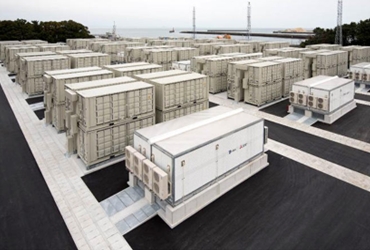
What’s more, NGK’s sodium-sulfur (NAS) storage battery is not just a concept. NGK has succeeded in installing 700 MW/ 4,900 MWh (output/ capacity) of its tech at home and abroad. The UN’s Industrial Development Organization even offers NGK and its sodium-sulfur batteries their own page on its website, rating this as one of the world’s most prominent sustainable technology platforms.
With batteries sorely needed to develop new businesses such as power aggregation, Virtual Power Plants (VPP) and more, NGK’s offering should be a shoe-in for success. Comments from end-users, however, indicate a more nuanced picture for NAS batteries. And despite their premise, NGK is struggling to turn a profit from the business.
A century of innovation
NGK Insulators is the world’s sole producer of commercial scale NAS storage batteries. The company claims it’s the only type of large-scale energy storage tech that can be installed anywhere and used for both power plants and substations, catering to industrial, commercial and residential clients alike.
NGK was founded in 1919 as a spin-off of a tableware and technology company now known as Noritake. In the early 20th century, Noritake split off its sanitary division into a separate business. One part became Japan’s top toilet maker, Toto, while another was carved out again as NGK Insulators.
NGK focused on producing ceramic insulators to meet electrification demand, then branched off into spark plugs, water systems and other businesses. In 1984, it made a strong push in energy storage, partnering with TEPCO to develop a new kind of battery system that would balance out the rapid growth in energy demand.
The concept of NAS was originally outlined by Ford Motor in the late 1960s, but went nowhere. TEPCO wanted to see if it could replace hydropower stations as a way of balancing power supply and demand.
NAS uses sulfur in the battery cathode; sodium, an alkali element similar to lithium, in the anode; and a ceramic electrolyte. The battery mechanism is akin to lithium-ion units. Sodium ions flow between the cathode and anode in the electrolyte to release electricity.
TEPCO was drawn to the concept since its energy storage potential was four times that of lead storage batteries. The utility worked with NGK for 20 years, long after most in the U.S. and Europe abandoned the concept. In 2002, the Japanese partners succeeded in bringing NAS tech to a commercial level and installed the first system at TEPCO facilities. The following year, NGK Insulators launched a battery manufacturing line with an output capacity of 60,000 kW/ year.
To date, NGK says it has installed a total capacity of 4,900 MWh in 250 locations across 10 countries.
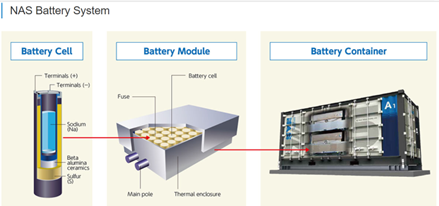
Source: NGK Insulators
NAS battery raw materials
One main feature of NAS batteries is the low cost of key ingredients – sulfur, sodium and alumina powder are in abundant supply. What’s more, the supply of sodium metal is quite secure since MSSA, the world’s largest manufacturer based in France, is owned by Nippon Soda, a Japanese company.
| NAS battery costs | Lithium-ion battery costs |
| Sodium metal: $300-350/ ton Alumina: $400/ ton Magnesium oxide: $2,000-$3,000/ ton | Lithium carbonate: $70,000/ ton
Nickel: $20,000/ ton Cobalt: $70,000/ ton |
In total, the storage cost for lithium-ion batteries amounts to ¥200,000/ kWh, while for NAS it’s ¥25,000/ kWh, says energy storage system integrator Renove Station. Also, the carbon footprint of NAS units is low compared to lithium-ion batteries as most supplies can be sourced in Asia. Nickel, cobalt and lithium, however, have to travel from mines in Africa or South America to processing plants in China and elsewhere before arriving in Japan.
Poor financial performance
NAS systems have an energy density three times those of lead batteries, high charge/ discharge efficiency of 75-90%, and a long operating life of 15 years or 4,500 cycles. That’s attracted strong interest in NAS tech as nations seek to improve energy storage options. It has not, however, translated into outright business success for NGK.
Despite the battery boom, nearly ¥3 billion in sales from NAS batteries accounts for less than 1% of NGK’s total revenue. Further, the pandemic-induced disruption of global supply chains sent the NAS business unit into the red.
Operating loss of NGK’s energy and industry segment
| Year (April to March) | Operating loss |
| 2019 | ¥5.4 billion |
| 2020 | ¥4.9 billion |
| 2021 | ¥1.4 billion |
| 2022 (forecast) | ¥2.9 billion |
While NAS batteries are a low-cost solution for customers, NGK barely reaps financial rewards, partly because of the high operating and maintenance costs. NAS requires a constant environment of above 300 °C. Because it uses sodium, classified as a toxic substance, anyone in possession of over 2 kg must report to authorities. It’s also flammable when in contact with moisture or steam and releases toxic gas.
After suffering a well-publicized fire incident in 2011, NAS technology has been improved to prevent fire from spreading. NGK also added advanced safety features such as remote surveillance systems and developed container-packed NAS battery systems to speed up installations.
But some users remain nervous. Energy storage systems are vital in times of emergency, so there’s little tolerance for equipment risk.
To improve trust, NGK is changing its approach to work closely with NAS battery users after installation, essentially partnering with them as an operator of power supply. It has formed joint ventures with utilities such as Ena Electric Power and Chubu Electric Miraiz.
The ceramics maker now needs to move quickly to boost returns while helping more end-users adopt NAS technology. With so many new battery technologies on the horizon and vast funding pouring into the sector, there’s always a chance the market will find a new ultimate low-cost battery solution.
The world’s largest energy storage system in Buzen, operated by Kyushu Electric
Major storage battery installations in Japan, by regional grid operator
| Hokkaido Electric | Minami Hayakita 51MWh | Redox flow | April 2022 |
| Tohoku Electric | Minami Soma 40MWh | Lithium ion | 2016 |
| Sadogashima 5MWh | NA | From 2024 | |
| Send
ai 20MWh | Lithium ion | 2015 | |
| TEPCO | 192MW | NAS | 2002 |
| Kansai Electric, Orix | Kinokawa 113MWh | Lithium ion | 2024 |
| Kyushu | Buzen 300MWh | NAS | 2016 |
| Kyushu/NTT Anode/Mitsubishi | Tagawa 4.2MWh | Lithium ion | 2023 |
| Chubu Electric Miraiz/ NGK Insulators | Komaki 17.2 MWh
Chita 14.4 MWh | NAS | 2022 |
Large NAS units installed in Japan
| Size | Year of operation starts | Details | |
| Toho Gas | 69.6 MWh | 2025 | Located in Tsu |
| Tokyo metropolitan water supply management | 290 MWh | 2002 | Compliments renewable energy systems |
| Rokkasho village | 34 MW, MWh data not available | 2008 | Compliments a wind farm |
| Tanegashima Space Center | 14.4 MWh | 2021 | Emergency backup power |
| Yamaichi Electric | 2.4 MWh | 2021 | Compliments 670 kW solar power system |
| Hazama Ando Corporation | 1.2 MWh | 2020 | Pilot zero emission building project in Tsukuba, ends in 2023 |
| Mitsui Fudosan | 12.96 MWh | 2015 | Kashiwa City project; also uses lithium ion batteries for storage |
GLOBAL VIEW
BY JOHN VAROLI
Below are some of last week’s most important international energy developments monitored by the Japan NRG team because of their potential to impact energy supply and demand, as well as prices. We see the following as relevant to Japanese and international energy investors.
Brazil/ Renewable energy
The country added 650 MW of new power capacity last month. Renewables accounted for 98%, with solar farms responsible for 57% of the total added in August; wind farms accounted for 34%.
California/ Energy crisis
A heatwave pushed electricity demand to record highs, and the state extended emergency action to conserve energy. The heatwave is a record for September, with the threat of blackouts as people crank up the AC to stay cool.
Coal prices
Asian thermal coal prices hit a record high, driven by growing demand in Europe after the region banned Russian imports. The Australian benchmark for high-quality physical coal hit a record $438.94/ ton on Sept. 2, up from $433.24 the previous week.
Egypt/ Green ammonia
Saudi Arabia’s Alfanar signed a MoU with Egypt to build a $3.5 billion green ammonia facility. The project will use renewable energy sources to produce 500,000 tons of green ammonia from 100,000 tons of green hydrogen every year.
EU/ Energy crisis
Member states are urged to tax revenues of non-gas electricity producers when prices exceed €200/ MWh, which is now the EU average, and 10 times higher than the average for the past 10 years. Excess revenues will be redistributed as relief to companies and households. Wholesale electricity prices have soared because they’re pegged to the price of gas, whether or not the electric power is produced with gas or by other means.
Germany/ Energy crisis
Non-gas electricity producers will face a windfall tax. The money will help finance a new €65 billion relief package to combat high energy bills. Also, Germany will keep two nuclear power plants available as a last resort to get through the winter.
Metals/ Energy crisis
Eurometaux called on EU member states to take action to preserve their strategic electricity-intensive industries and prevent permanent job losses, adding that the energy crisis is an “existential threat to the future of Europe’s metal smelters”. Eurometaux has 26 company members including Glencore, Aurbubis, and Norsk Hydro.
Nigeria/ Natural gas
Oil Minister Timipre Sylva said his country will send more LNG to Europe next winter, but security issues are delaying deliveries. Nigeria will build a pipeline that will go through Algeria on its way to Europe. The project will cost about $10 billion.
Spain/ Renewable energy
Repsol will sell a 25% stake in its exploration and production business to U.S. investment group EIG for $4.8 billion. Spain’s biggest oil company is raising funds for renewables investments. EIG is one of the private equity industry’s biggest oil and gas investors.
UK/ Energy crisis
New PM Liz Truss proposed a £150 billion energy plan that includes a package to protect households and businesses from rising prices. Household energy bills would be capped at about £2,500 for the next two winters. The current cap is £1,971.
2022 EVENTS CALENDAR
A selection of domestic and international events we believe will have an impact on Japanese energy
| January | OPEC quarterly meeting;
JCCP Petroleum Conference – Tokyo; EU Taxonomy Climate Delegated Act activates; Regional Comprehensive Economic Partnership (RCEP) Trade Agreement that includes ASEAN countries, China and Japan activates; Indonesia to temporarily ban coal exports for one month; Regional bloc developments: Cambodia assumes presidency of ASEAN; Thailand assumes presidency of APEC; Germany assumes presidency of G7; France assumes presidency of EU; Indonesia assumes presidency of G20; and Senegal assumes presidency of African Union; Japan-U.S. two-plus-two meeting; Japan’s parliament convenes on Jan. 17 for 150 days; Prime Minister Kishida visits Australia (tentative) |
| February | Chinese New Year (Jan. 31 to Feb. 6);
Beijing Winter Olympics; South Korea joins RCEP trade agreement |
| March | Renewable Energy Institute annual conference;
Smart Energy Week – Tokyo; Japan Atomic Industrial Forum annual conference – Tokyo; World Hydrogen Summit – Netherlands; EU New strategy on international energy engagement published; End of 2021/22 Japanese Fiscal Year; South Korean presidential election |
| April | Japan Energy Summit – Tokyo;
MARPOL Convention on Emissions reductions for containerships and LNG carriers activates; Japan Feed-in-Premium system commences as Energy Resilience Act takes effect; Launch of Prime Section of Japan Stock Exchange with TFCD climate reporting requirement; Convention on Biological Diversity Conference for post-2020 biodiversity framework – China; Elections: French presidential election; Hungarian general election |
| May | World Natural Gas Conference WCG2022 – South Korea;
Elections: Australian general election; Philippines general and presidential elections |
| June | Happo-Noshiro offshore wind project auction closes;
Annual IEA Global Conference on Energy Efficiency – Denmark; UNEP Environment Day, Environment Ministers Meeting – Sweden; G7 meeting – Germany |
| July | Japan to finalize economic security policies as part of natl. security strategy review;
China connects to grid 2nd 200 MW SMR at Shidao Bay Nuclear Plant, Shandong; Czech Republic assumes presidency of EU; Elections: Japan’s Upper House Elections; Indian presidential election |
| August | Japan: Africa (TICAD 8) Summit – Tunisia;
Kenyan general election |
| September | IPCC to release Assessment and Synthesis Report;
Clean Energy Ministerial and the Mission Innovation Summit – Pittsburg, U.S.; Japan LNG Producer/Consumer Conference – Tokyo; IMF/World Bank annual meetings – Washington; Annual UN General Assembly meetings; METI to set safety standards for ammonia and hydrogen-fired power plants; End of 1H FY2022 Fiscal Year in Japan; Swedish general election |
| October | EU Review of CO2 emission standards for heavy-duty vehicles published;
Chinese Communist Party 20th quinquennial National Party Congress; G20 Meeting – Bali, Indonesia; Innovation for Cool Earth TCFD & Annual Forums – Tokyo; Elections: Okinawa gubernational election; Brazilian presidential election; |
| November | COP27 – Egypt;
U.S. mid-term elections; Soccer World Cup – Qatar; |
| December | Germany to eliminate nuclear power from energy mix;
Happo-Noshiro offshore wind project auction result released; Japan submits revised 2030 CO2 reduction goal following Glasgow’s COP26; Japan-Canada Annual Energy Forum (tentative); Tesla expected to achieve 1.3 million EV deliveries for full year 2022 |
Disclaimer
This communication has been prepared for information purposes only, is confidential and may be legally privileged. This is a subscription-only service and is directed at those who have expressly asked K.K. Yuri Group or one of its representatives to be added to the mailing list. This document may not be onwardly circulated or reproduced without prior written consent from Yuri Group, which retains all copyright to the content of this report.
Yuri Group is not registered as an investment advisor in any jurisdiction. Our research and all the content express our opinions, which are generally based on available public information, field studies and own analysis. Content is limited to general comment upon general political, economic and market issues, asset classes and types of investments. The report and all of its content does not constitute a recommendation or solicitation to buy, sell, subscribe for or underwrite any product or physical commodity, or a financial instrument.
The information contained in this report is obtained from sources believed to be reliable and in good faith. No representation or warranty is made that it is accurate or complete. Opinions and views expressed are subject to change without notice, as are prices and availability, which are indicative only. There is no obligation to notify recipients of any changes to this data or to do so in the future. No responsibility is accepted for the use of or reliance on the information provided. In no circumstances will Yuri Group be liable for any indirect or direct loss, or consequential loss or damages arising from the use of, any inability to use, or any inaccuracy in the information.
K.K. Yuri Group: Oonoya Building 8F, Yotsuya 1-18, Shinjuku-ku, Tokyo, Japan, 160-0004.