
JAPAN NRG WEEKLY
OCT. 11, 2022
JAPAN NRG WEEKLY
Oct. 11, 2022
NEWS
TOP
- PM Kishida vows “unprecedented” measures to ease power rates while accelerating renewables, batteries and backing nuclear
- More power retailers exit the business citing high spot prices and global market turmoil; METI to review spot market dependency
- Malaysian LNG exporter declares force majeure after pipeline leak potentially leaving Japan short of several cargos per month
ENERGY TRANSITION & POLICY
- COP27 focus will turn to helping developing economies: IGES
- METI to set up a regulator for nuclear reactor decommissioning; ministry also seeks new law to expand lifespan of reactors
- Japan to launch group for resource recycling, circular economy
- MoE says it will fund innovative carbon neutral projects
- Global hydrogen ministerial meeting agrees on 2030 output plans
- Toyota logs sales of 29 fuel cell vehicles in Japan in September
- Mitsui and Denmark’s Maersk to study a new methanol venture
- Japanese firms study CCS projects in Indonesia and Malaysia
ELECTRICITY MARKETS
- Govt. plans to revise offshore wind tender rules mired in debates
- TEPCO, Cosmo among developers planning major wind projects
- OCCTO asked to design decarbonized power auction system
- Baseload power auctions attract more bidders, less suppliers
- Sumitomo Corp joins giant hydropower project in Indonesia
- Tohoku Electric chief mulls building new nuclear reactors
- Chugoku Electric turns positive on restart of its nuclear facility
- Chubu Electric affiliate starts operation of first geothermal plant
OIL, GAS & MINING
- Japan sees Middle East having lower blue ammonia cost than U.S.
- Tokyo Gas to sell minority stake in several Australian LNG projects
- Tohoku Electric agrees LNG contract with new Sakhalin-2 owner
- Shizuoka Gas and Toho Gas seek to expand into Thai market
ANALYSIS
JAPAN’S FUSION FUTURE – SIGNIFICANT
PROGRESS BUT MANY YEARS AWAY
As nuclear power returns to the good graces of corporate and political leaders in Japan and the U.S., nuclear fusion is gaining more attention as a potential carbon-free energy source. Fusion projects appearing in recent years remain experimental, but there’s hope within the industry that a major breakthrough could happen within the decade.
Thanks to advances in AI and electronics, nuclear fusion is no longer a physics problem but more of an engineering one. Thus, large sums of money are being invested.
WHAT’S IN A NUMBER?
THE IMPACT OF ANRE’S THERMAL CAPACITY ERROR
On Sept 15, the Agency of Natural Resources and Energy reported that its data on available thermal power capacity this decade was way-off. The agency had underestimated the total capacity scheduled to shut down by 2030. The errors amount to 16.52 GW of thermal capacity that won’t be available by 2030. What’s more, the admission was made a week before state auctions for power capacity. The extent of the error, and its timing, raised questions. Was it intended to influence markets and policies, or purely a human miscalculation?
GLOBAL VIEW
U.S. vows not to curb natural gas exports. OPEC and Russia approved large oil production cuts. France seeks to become a world leader in hydrogen. China turns on the world’s largest flow battery. Brazil picks Vestas for its largest wind farm. One of Australia’s states makes a highly ambitious commitment to renewables. Details on these and more in our global wrap.
JAPAN NRG WEEKLY
PUBLISHER
K. K. Yuri Group
Editorial Team
Yuriy Humber (Editor-in-Chief)
John Varoli (Senior Editor, Americas)
Mayumi Watanabe (Japan)
Yoshihisa Ohno (Japan)
Wilfried Goossens (Events, global)
Regular Contributors
Chisaki Watanabe (Japan)
Takehiro Masutomo (Japan)
Art & Design
22 Graphics Inc.
Events
SUBSCRIPTIONS & ADVERTISING
Japan NRG offers individual, corporate and academic subscription plans. Basic details are our website or write to subscriptions@japan-nrg.com
For marketing, advertising, or collaboration opportunities, contact sales@japan-nrg.com For all other inquiries, write to info@japan-nrg.com
OFTEN USED ACRONYMS
METI The Ministry of Energy, Trade and Industry
MOE Ministry of Environment
ANRE Agency for Natural Resources and Energy
NEDO New Energy and Industrial Technology Development Organization
TEPCO Tokyo Electric Power Company
KEPCO Kansai Electric Power Company
EPCO Electric Power Company
JCC Japan Crude Cocktail
JKM Japan Korea Market, the Platt’s LNG benchmark
CCUS Carbon Capture, Utilization and Storage
mmbtu Million British Thermal Units
mb/d Million barrels per day
mtoe Million Tons of Oil Equivalent
kWh Kilowatt hours (electricity generation volume)
NEWS: ENERGY TRANSITION & POLICY

Kishida pledges unprecedented measures to ease power rate hikes
(Japan NRG, Oct. 3)
- In a speech to the Diet, PM Kishida pledged “unprecedented” measures to ease the impact of power rate hikes on households and businesses.
- He wants to secure energy supply, accelerating renewables and energy conservation. Taking advantage of a weak yen, he’ll encourage domestic semiconductor and storage battery output.
- The measures include ways to curb inflation, one of the three key goals. The other two are wage hikes, and investment and reforms for growth.
- The prime minister also promised to tackle the nuclear issue head-on to strengthen energy security, and also called for accelerating initiatives such as carbon pricing and the Asia Zero Emission Fellowship before the end of this year.
Time needed before effects of economic package are felt: Nikkei
(Nikkei, Oct. 1)
- PM Kishida announced a plan to offset rises in power bills.
- Even if in place by year’s end, time is needed for impact.
- METI plans measures to smooth spikes in electricity prices by spring.
- METI says the cost of electricity might increase an additional 20-30% next year.
- SIDE DEVELOPMENT:
LDP pledges to reverse rise in power costs
(Tokyo Shimbun, Oct. 2)- LDP policy chief Haguida Koichi says households now pay 20% more for electricity than last year.
- The govt must at least go halfway in reversing this trend, said Haguida.
- If achieved, this would mean a ¥1,000 reduction in the average TEPCO subscriber’s monthly power bill.
COP27 to focus on global goal to help developing economies
(Japan NRG, Oct. 4)
- The main agenda for COP27 in Egypt next month includes hammering out specifics of the global goal on adaptation (GGA), said Kanagawa-based Institute of Global Environmental Strategies (IGES) that’s affiliated with the MoE.
- Developing nations and Japan, the EU, U.S., Canada and Australia have conflicting views on GGA.
- COP27’s host, Egypt, is expected to support developing nations hit by climate change, and to help them secure food and water.
- Japan promised an adaptation fund of $14.5 billion through 2025, from the govt and private sectors.
METI to set up a decommissioning regulator
(Japan NRG, Oct. 5)
- METI plans to set up a regulator dedicated to nuclear decommissioning that will manage scrappage steps taken by power operators, to identify and resolve common issues, and oversee decommissioning spending.
- Among the possible candidates for this function are the Nuclear Reprocessing Organization of Japan (NuRO), Nuclear Damage Compensation and Decommissioning Facilitation Organization (NDF), and Nuclear Waste Management Organization of Japan (NUMO).
- METI will narrow the roles of the new body, its governance, disclosure and other rules, and clarify the roles of the govt and power operators.
TAKEAWAY: Under present rules, power companies each accumulate their own funds for decommissioning, which is estimated to cost ¥50 billion to ¥80 billion (from $350 million to $550 million) per reactor. The high number of reactors set for decommissioning since the Fukushima accident, however, makes the task a challenge for any single operator. A new regulator would act as a central body to collect funds and manage the process. The government hopes that taking a national approach would help to smooth out the financial and technical issues related to such a mass-scale decommissioning of facilities.
- SIDE DEVELOPMENT:
METI seeks new law on max nuclear reactor lifespan
(Jiji, Oct. 6)- METI wants to extend the maximum service period for nuclear reactors beyond 60 years. The present rule states that the basic lifespan is 40 years, but this can be extended to 60 years. However, as Japan faces a power crunch, METI aims to have more capacity available by retaining the older reactors in service.
- Among the 27 reactors that are still within their 40-year limit, only 10 have restarted.
- CONTEXT: After the Fukushima disaster, Japan introduced stricter safety standards limiting nuclear reactor operations to 40 years. But an additional 20 years is possible if safety upgrades are made and a reactor passes screening by regulators.
TAKEAWAY: A decision on reactor operating permit is likely by the year end, judging by comments from METI minister Nishimura and earlier statements by Kishida.
METI launches study group on circular economy and resource recycling
(Japan NRG, Oct. 5)
- METI launched the Study Group to Design Growth Oriented Circular and Self-Sufficient Economy, which will meet seven times by March 2023.
- The group comprises 12 members, from Seven & i, Panasonic, Asahi Kasei, Kao, PNB Paribas, IBM Japan and other companies.
- It will address increasing global demand for critical raw materials and how Japan could cope with unexpected supply disruptions.
- 53% of industrial waste is recycled, and 17% non-industrial; so, there’s room for improvement.
TAKEAWAY: With oversight for energy and natural resources, METI can trigger more dynamic action compared to other ministries whose circular economy initiatives are limited to municipal levels and research. The newly formed group represents sectoral leaders but doesn’t include the industrial waste recycling sector that comprises small private businesses.
MoE to fund innovative carbon neutral projects
(Japan NRG, Oct. 6)
- The MoE will fund research for aluminum dross waste recycling, zero emission greenhouses, temperature difference power generation, use of chicken manure as energy, and more, as a part of its Regional and Multi-Sectoral Carbon Neutrality Research and Development Program.
- A panel will decide the amount of funding for each project.
Hydrogen energy: agreement to supply 90 million tons by 2030
(Japan NRG, Oct. 7)
- The Hydrogen Energy Ministerial Meeting agreed on action to reach an annual production of 90 million tons of green and low-carbon footprint hydrogen in 2030.
- The meeting on Sept 26 was attended by senior officials from 30 countries and organizations, including 15 ministers.
Toyota logs 29 FCV sales in Sept
(Japan Automobile Dealers Association data, Oct. 6)
- Toyota sold 29 fuel cell vehicles in September, an increase from 10 last month, according to the Japan Automobile Dealers Association
- JADA also reported sales of two imported FCV during the month, which could be Hyundai’s NEXO model.
- CONTEXT: Competing against Toyota’s Mirai was F-Cell by Mercedes, but this model was available only on lease. NEXO could be Mirai’s first serious rival. Hyundai has a unique marketing strategy, to sell NEXO online only.
TAKEAWAY: Industry observers blame the lack of hydrogen service stations and the cost of hydrogen for the limited appeal of FCVs. Some drivers also point to Mirai’s “untrendy” interior design, compared to the luxury NEXO.
Mitsui & Co mulls Singapore methane venture
(Japan Maritime Daily, Oct. 6)
- Mitsui & Co agreed with Denmark’s Maersk to perform a feasibility study to supply Singapore with maritime methanol.
- Supported by the Singapore Maritime Port Authority, the study will focus on the port’s logistical and legal requirements for fueling and fuel storage.
- Maritime methanol is seen as a green alternative to usual fuels.
Chiyoda considers study with Pertamina on CCS in Indonesia
(Denki Shimbun, Oct. 5)
- Chiyoda Corp will work with PT Pertamina on a feasibility study for the capture, transportation, and storage of CO2 produced as a by-product from a dimethyl ether (DME) production plant in Tanjung Enim, Indonesia.
- This is a step forward from the MoU that Chiyoda and Pertamina signed on Jan 18, 2022 to cooperate on decarbonization.
- The annual CO2 capture amount will be ~1 million tons; a total of 20 million tons over 20 years, which will be emitted from the Tanjung Enim plant.
JX and JGC Holdings in Malaysian CCS study
(Sekiyu Tsushin, Oct. 6)
- JX Nippon Oil & Gas Exploration and JGC Holdings signed a MoA with Malaysia’s Petronas to study carbon capture and storage.
- The study runs until April 2024, and will look at logistics of establishing a CCS supply chain to enable CO2 recovered in Japan and other countries to be shipped to Malaysia for injection into underground reservoirs.
Mitsubishi Electric to start marketing of GHG-free vacuum circuit breaker
(Japan NRG, Oct. 5)
- Mitsubishi Electric will start selling 72.5 kilovolt vacuum circuit breakers which do not use Sulfur hexafluoride (SF6 gas), in North America. Instead of SF6 gas, the SF6 gas-free vacuum switchgear uses vacuum valve for arc extinguishing.
- California is now strengthening regulation for environment-unfriendly SF6 gas, and other states will follow. Mitsubishi Electric will make SF6-free circuit breakers at their U.S. subsidiary in Pittsburgh.
TAKEAWAY: SF6 is the most potent GHG. Because of its unique dielectric properties, utilities rely heavily on SF6 in electric power systems for voltage electrical insulation and current interruption. Over a 100-year period, SF6 has been 22,800 times more effective at trapping infrared radiation than CO2. Thus, a small amount of SF6 can have a significant impact on climate change.
Toshiba to make highly efficient electrolysis electrodes for hydrogen production
(Company statement, Oct. 7)
- Toshiba said it developed large-scale production technology for electrodes with high efficiency in Power to Gas (P2G), while reducing iridium use to just 1/10th.
- P2G uses electrolysis to convert renewable energy into hydrogen, for storage and transportation. Polymer Electrolyte Membrane (PEM) electrolysis is seen as a highly promising method, since it reacts quickly to power fluctuations and is highly durable. However, PEM uses iridium, one of the rarest of all metals, as the catalyst in electrodes.
- Toshiba is aiming for commercialization in FY2023.
- SIDE DEVELOPMENT:
Toshiba gets order for Geoportable Geothermal System in the Philippines
(Company statement, Oct. 4)- Toshiba partnered with Bac-Man Geothermal, a subsidiary of Energy Development Corporation, for the Tanawon 20 MW Flash Geothermal Power Plant Project. EDC is the Philippines’ largest 100% Renewable Energy Company.
- Tanawon is one of the Joint Crediting Mechanism (JCM) projects set up by Japan’s MoE. Mizuho-Toshiba Leasing will act as representative for the JCM and will be responsible for calculation and reporting.
- CONTEXT: Geoportable is a geothermal power generation system developed by Toshiba ESS for small scale geothermal power generation with up to 20 MW capacity. This system is designed to be installed in a limited area where a usual power generation system would be difficult.
TAKEAWAY: The Philippines has been developing geothermal power since the 1970s and has the world’s largest geothermal capacity after the U.S. and Indonesia. In its 2040 energy plan, the Philippines plans to increase renewable energy to 20% of the national total; with more than 50% of all renewable power, or 52.8 GW, generated from geothermal sources.
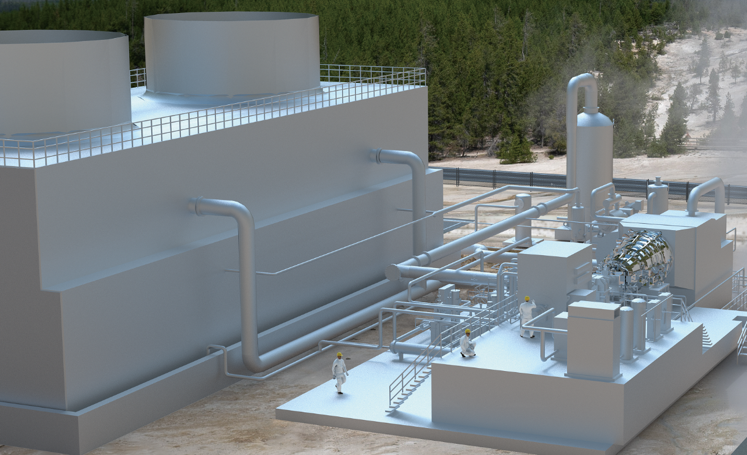
GXP-X Type Geothermal Steam Turbine
Hitachi’s new battery hybrid Blues train: Hitachi Rail CEO would like to expand into France
(Toyo Keizai; Oct. 2)
- Hitachi revealed its battery hybrid Blues train at InnoTrans 2022, and will deliver 43 of them to Italian train operator Trenitalia.
- Hitachi Rail CEO Andrew Barr says the trains can be sold in other EU countries such as France.
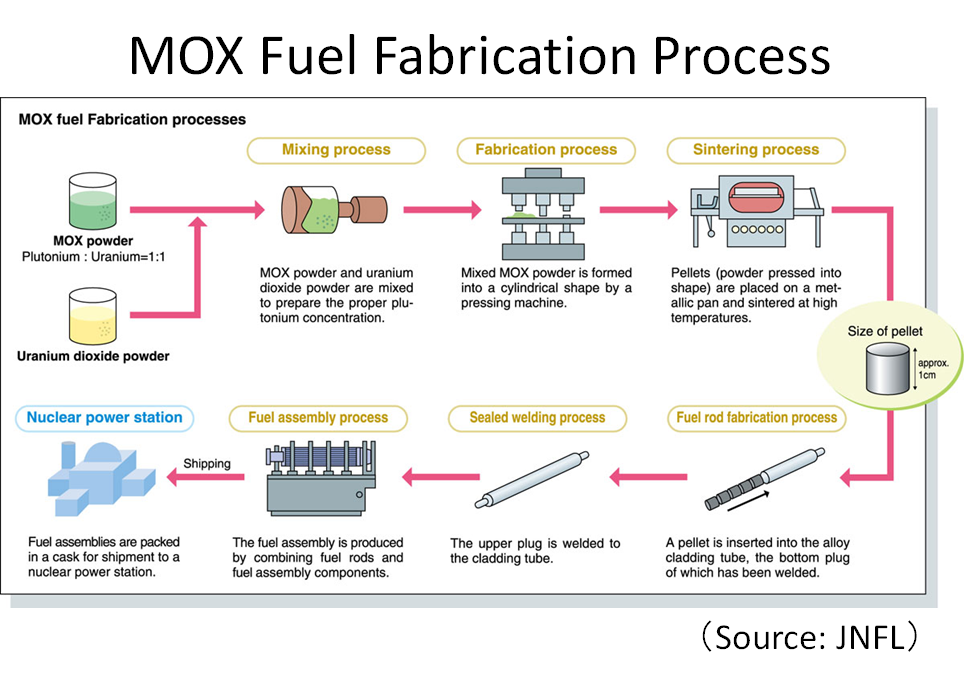
JNFL restarts construction of MOX fuel production plant
(Denki Shimbun, Oct. 4)
- Japan Nuclear Fuel Limited (JNFL) restarted building the country’s first MOX fuel fabrication plant for domestic light-water reactors (PWRs and BWRs). It’s located in Rokkasho, Aomori Prefecture.
- The plant is a key facility for Japan’s nuclear fuel cycle.
- Mitsubishi Heavy Industries (MHI) supplies fuel rod production.
TAKEAWAY: This plant began construction in October 2010, and was slated for completion in 2015. But following the Fukushima disaster, construction stopped. Now, JNFL plans completion in FY2024, almost 10 years behind schedule.
Sojitz signs accord to help develop green hydrogen supply in western Europe
(Company statement, Oct. 3)
- Trading house Sojitz Corp. signed an MoU with European bulk liquid storage company, Rubis Terminal Infra SAS and Spanish infrastructure investment company, Reganosa Asset Investments to conduct a feasibility study for the development of a green hydrogen supply chain in Europe.
- Reganosa is developing a green-hydrogen production facility in Galicia, in northwest Spain. Its initial phase will be operational in 2025.
NEWS: POWER MARKETS

More power retailers go bankrupt or exit the business
(Denki Shimbun, Oct. 6)
- On Sept 21, FPS said it will exit the low voltage power retail business. FPS, a part of the GLP Group, took over the service from bankrupt F-Power in April and continued to supply electricity. Now, it will only provide power retail for high voltage and extra high voltage businesses.
- On Sept 4, Shizen Energy reported exiting the power retail business. At that time, Ishikawa Electric also began bankruptcy proceedings.
- To date, six PPSs have declared bankruptcy (Hope Energy, Infini, Gujo Energy, IS Energy, FT Energy and Ishikawa Electric), and many others, such as Lpio or West Electric Power, got out of the electricity retail business.
TAKEAWAY: More than 10% of all PPS (power producer and supplier) had either stopped working in the electricity retail market as of June this year, either due to exiting the business or bankruptcy, according to the latest Teikoku Databank survey.
In the past, without any warning some PPSs announced stopping power supply, leaving customers in the lurch. While the majority of PPS have conducted business in a proper manner, such incidents have dented the reputation of independent power suppliers in the market. Also, METI has been critical of companies that exited the sector in a disorderly manner and may look to tighten the rules around retail licenses going forward.
- SIDE DEVELOPMENT:
METI to study ways to disclose power retailers’ dependency on spot supply
(Japan NRG, Oct. 4)- METI will study ways to disclose power retailer dependency on spot supply sources, to improve visibility of near-term fuel requirements of power operators.
- Reducing uncertainties allows adequate fuel procurement.
- Data will be processed to conceal sensitive details.
- METI will also study how fragmented power markets – spot, futures, and forward delivery – can complement the other and the bi-party term contracts.
METI plans to revise offshore wind tenders still hotly debated despite public survey
(New Energy Business News, Oct. 3)
- METI carried out a survey of market participants to ask for feedback on the current system for offshore wind power capacity auctions. The results are in, and based on the more than 1,000 responses from 151 parties, the ministry plans to revise its plans for the auctions.
- The survey showed that most respondents were concerned about the scoring system and points allocation, while the second most pressing issue was the speed at which public bids are evaluated.
- The ministry’s expert panel is deciding between at least three proposals to speed up the rollout of offshore wind capacity. These include offering a decreasing number of points in the evaluation for bidders who offer later start of operations and setting a base date according to which the different bids would be graded.
- There are also strong debates among experts on whether to limit or not the number of auctions that a bidder can participate in.
- Another area under examination is whether the use of base ports overlap between different projects and sea areas. Most experts also want the number of base ports to increase.
- Further, there is no agreement among experts on whether to set a base price.
- SIDE DEVELOPMENT:
TEPCO plans 400 MW offshore wind project in Akita area
(New Energy Business News, Oct. 3)- TEPCO Renewable Power plans to develop a 400 MW offshore wind project off the coast of Oga City, Lagata City, and Akita City, Akita Prefecture.
- The project area is approximately 55 km2 off the coast, which is under preparation to be designation as an offshore wind promotion area.
- The project proposes eight variations and is open to using different foundation types. Construction would start in 2026 or later, and operation in 2030 or later.
- SIDE DEVELOPMENT:
Cosmo plans an offshore wind farm as big as 1 GW
(New Energy Business News, Oct. 4)- Cosmo Eco Power plans to develop an offshore wind farm off the coast of Shimamaki Village, Hokkaido, with capacity expected to be as large as 1 GW. The area is considered to be “at a certain stage of preparation” under the Renewable Energy Sea Area Utilization Law.
- The project area would reach 16,330 hectares, housing as many as 100 wind turbines. Development is envisioned in water depths shallower than 50 to 200 meters, and both a landing type and a floating type foundation structure are considered.
- A joint venture between Copenhagen Infrastructure Partners (CIP) and Mitsubishi Heavy Industries is also conducting assessment procedures in the same area.
METI taps OCCTO to design and run decarbonized power auction system
(Japan NRG, Oct. 5)
- METI tapped the Organization for Cross-regional Coordination of Transmission Operators. (OCCTO), which manages grid interconnection, to design the structure and operation of the Long Term Decarbonized Power Source Auction.
- The new auction system, to be launched in 2023, will encourage long-term investments into clean power sources such as hydrogen/ ammonia co-firing.
- Under METI’s proposal, the ministry’s advisory panel will review OCCTO’s plan, and OCCTO will run the new auction.
Baseload power auction attracts more bidders, less suppliers; Prices surge
(Japan NRG, Oct. 4)
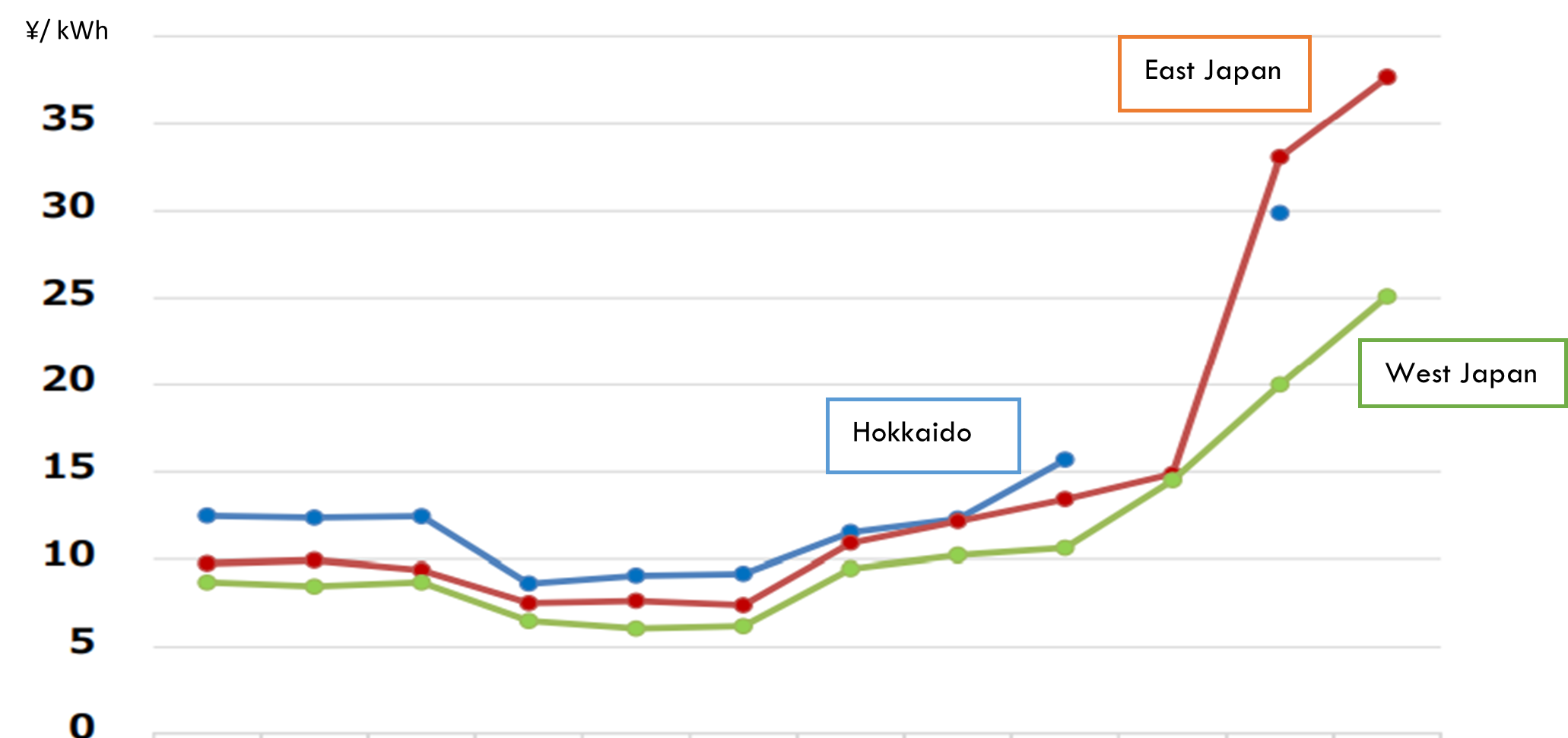
- The Sept 30 baseload power auction attracted more bidders and fewer suppliers, resulting in higher price levels; the offer volume decreased 38.6%, YoY, while bids were up 50.6%. 1,850 GWh were transacted, surging from 790 GWh a year ago.
- East Japan settled at ¥37.67/ kWh, triple from a year ago; West Japan settled at ¥25.11/ kWh, up 150%. No settlement was made for the Hokkaido area.
- Baseload power auctions are held four times a year. This was the second auction this year for power to be supplied in 2023. Baseload power comprises nuclear, coal, geothermal and hydro power.
Historical baseload auction results
Sumitomo Corp joins giant hydropower project in Indonesia
(Asia Nikkei, Oct. 6)
- Trading house Sumitomo Corp. will work with an Indonesian partner of Power Construction Corp. of China to jointly develop a hydroelectric power station estimated to cost $17.8 billion on the island of Borneo.
- The 9GW Kayan Cascade project is part of China’s Belt and Road Initiative. Sumitomo is joining the hydropower project was launched by Kayan Hydro Energy.
- This would be the largest hydropower station in Southeast Asia if fully completed.
- Sumitomo has yet to decide how much it will invest in the project.
Chugoku Electric Shows off Shimane Unit 3
(Denki Shimbun, Oct. 7)
- Chugoku Electric invited media to Shimane NPP Unit 3, to show the reactor’s primary containment vessel and the safety measures of the Advanced Boiling Water Reactor (ABWR).
- The construction of Shimane NPP Unit 3 was almost finished in 2011, but then the Fukushima disaster hit and the facility was idled.
- The NRA began a review of Shimane Unit 3 on Sept 29 for the first time in 4.5 years. Chugoku Electric is confident that a restart is possible soon.
TAKEAWAY: Shimane Unit 3 is a large reactor with 1,373 MW of capacity. It’s been more than 10 years since it generated electricity. Unit 1 (460 MW) shut for decommissioning in April 2015, so only Unit 2 (820 MW) is available. The cost of maintaining equipment for many years without any revenue is such that a restart decision is likely sooner rather than later.
Tohoku Electric considers building new nuclear reactors
(Tohoku Broadcasting, Oct. 1)
- Higuchi Kojiro, president of Tohoku Electric, wants his company to be involved in the development of a new nuclear reactor.
- First, the restart of existing reactors is needed and then construction of new units could come from the 2030s, he said.
- He said that nuclear technology is needed to maintain the stable supply of electricity, and to achieve carbon neutrality.
TAKEAWAY: Tohoku Electric operates three nuclear reactors at Onagawa NPP (Miyagi Prefecture) and one at Higashi-dori NPP, but none have restarted. At the Higashi-dori site, installation of four units was planned (two for Tohoku Electric, and two more for TEPCO) but only Tohoku’s unit 1 began operation.
All Tohoku Electric’s stations deploy BWR, the same family of reactor technologies as at the Fukushima NPP.
Chubu Electric affiliate starts operation of first geothermal power plant
(Nikkei, Oct. 6)
- In December, Chubu Electric will begin operating its first geothermal power plant in the Okuhida hot spring village in Takayama, Gifu Prefecture. It is rare for the locals to agree to the construction of a geothermal facility due to fears of impact on hot springs. Chubu Electric has ensured the project will be beneficial to both parties, and will supply hot spring water free of charge to the local inns.
- This may be Japan’s first case for “coexistence” in a hot spring area.
- The plant will be operated by a new company, Nakao Geothermal Power. Chubu Electric will own 45% and Toshiba Energy Systems 55%.
- The plant will start operation on Dec 1. With an output of approximately 2 MW, it can supply power to approximately 4,000 households.
Hitachi Metals to source 13 MW under purchasing agreement
(JIJI press, Oct. 6)
- TEPCO Ventures and Hitachi Metals plan to build one of Japan’s largest private solar farms in Kumagaya (Saitama), with a 10 MW capacity.
- Hitachi Metals also plans a 3 MW farm for Moka (Tochigi).
New green energy firm for Mie
(Asahi Shimbun, Oct. 1)
- In partnership with Toho Gas and Mie’s Suzuka City, JFE Engineering’s subsidiary Urban Energy set up a new energy company, Suzuka Green Energy, that will sell electricity generated from burning refuse to public facilities.
- When combined with other initiatives, SGE reduces the annual carbon footprint of 47 local facilities by 9,000 metric tons, rendering them carbon neutral.
NEWS: OIL, GAS & MINING

Malaysian LNG exporter declares force majeure after pipeline leak
(Reuters, Oct. 7)
- Malaysia LNG, which is an entity controlled by state-owned Petronas, declared force majeure on LNG supplies to customers after a leak was found on one of its key pipelines.
- The leak on the Sabah-Sarawak Gas Pipeline on Sept. 21 will hamper the ability of the southeast nation to meet its LNG export contracts, including two-three cargoes a month to Japan.
- Prices for LNG in Asia rose about 10% on the news, according to Platt’s JKM LNG price assessment.
- CONTEXT: Major buyers from Malaysia include Toho Gas, Tokyo Gas and JERA. Mitsubishi Corp. owns a stake in Malaysia LNG.
- SIDE DEVELOPMENT:
Japan to provide up to $900 mn loan to JERA to buy LNG
(Bloomberg, Oct. 6)- Japan will provide a public-private loan worth as much as ¥130 billion ($900 million) to JERA, the biggest power producer, to buy LNG and avoid fuel shortages this winter.
Middle Eastern blue ammonia costs seen at $335-339/ ton
(Japan NRG, Oct. 3)
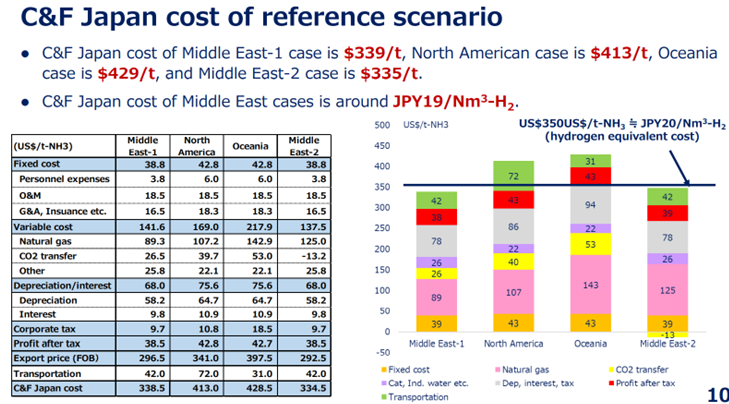
- The costs of producing and transporting blue ammonia to Japan from the Middle East were estimated to be $335-339/ ton, compared to $413/ ton for U.S./Canada origins and $429/ ton for Oceania.
- The Middle East has low costs for LNG and labor.The Middle East has two base scenarios: natural gas price at $2.5/ mmbtu if purchased from global spot markets, and $3.5/ mmbtu for long-term purchase contracts. From the 21st year of operation, costs are expected to fall to $266-270/ ton for the Middle East, $337/ ton for the U.S./Canada and $352/ ton for Oceania.
- The Public-Private Task Force for Fuel Ammonia Supply Chain did the study.
Major ammonia projects nearing production phase
|
Companies |
Location |
Production capacity |
Production launch |
|
Mitsui, ADNOC, GS Energy, etc. |
UAE |
1 million tons/ year |
2025 |
|
Itochu, Petronas |
Canada |
NA |
2027 |
|
Woodside |
Perth, Australia |
1,500 tons/ day |
2027 |
|
Mitsubishi Corp, Denbury |
U.S. |
1 million tons/ year |
2025-2030 |
|
Mitsubishi Corp, Shell |
Canada |
165,000 tons/ year |
2025-2030 |
|
Saudi Aramco |
Saudi Arabia |
11 million tons/ year |
2030 |
TAKEAWAY: It is curious to note that one country not included in the study is Indonesia, which hosts numerous blue/green ammonia projects in the feasibility study stage. However, the study seems a starting point rather than an exact roadmap for future LNG contracting trends.
Tokyo Gas to sell stake in 4 Australian LNG projects
(Asia Nikkei, Oct. 7)
- The utility will sell the stakes to a unit of U.S. private equity firm EIG.
- Tokyo Gas holds a minority interest in five LNG projects in Australia, including in Woodside Energy’s Pluto LNG. The sale of four of them is estimated at several hundred billion yen.
- Proceeds from the sell-off will be reallocated to growth sectors, such as renewables and hydrogen.
- Tokyo Gas said the sale will have no impact on its LNG procurement.
Tohoku Electric signs LNG supply accord with Sakhalin 2
(Nikkei, Sept. 30)
- Tohoku Electric agreed on LNG supplies with the Russian entity that now controls the Sakhalin-2 project in the Far East.
- Before Russia’s invasion of Ukraine, Tohoku Electric depended on Sakhalin 2 for about 10% of its LNG, or 420,000 metric tons annually.
Shizuoka Gas and Toho Gas expand to Thailand
(Gas Energy News, Oct. 3)
- Shizuoka Gas and Toho Gas expansion into the Thai market was performed via TST Energy Invest, that’s 51% owned by Shizuoka Gas and 49% by Toho Gas.
- Shizuoka Gas also holds a 49% stake in the Thai Japan Gas Network, established by major CNG supplier Scan Inter Public.
LNG stocks slip to 2.67 million tons
(Government data, Oct. 5)
- LNG stocks of 10 power grids stood at 2.67 million tons as of Oct. 2, down from 2.71 million tons a week earlier. METI first reported last week’s stock at 2.69 million tons, but corrected the figure.
- The end-October stocks last year were 2.07 million tons. The five-year average for this time of year is 1.84 million tons.
Sumitomo Metal Mining reduces stake in Philippines nickel miner
(Company statement, Oct. 3)
- Sumitomo Metal Mining, a key shareholder of Coral Bay Nickel Corp in the Philippines, sold its 5.625% share to Nickel Asia Corp, for $26 million
- Coral Bay is a JV of Sumitomo and Nickel Asia Corp, owned 84.375% by Sumitomo and 15.625% by Nickel Asia following the transaction
TAKEAWAY: The deal reflects Nickel Asia’s growth ambition; but it will have limited impact on Japan’s nickel and cobalt supplies.
ANALYSIS
BY JOHN VAROLI
Japan’s Fusion Future – Significant Progress but Many Years Away
As nuclear power returns to the good graces of corporate and political leaders in Japan and the U.S., nuclear fusion is gaining more attention as a potential carbon-free energy source.
The fusion energy projects appearing in recent years remain experimental, but there’s hope within the industry that a major breakthrough could happen within the decade. While nuclear power requires splitting atoms, nuclear fusion requires their combination, the same process by which the sun produces energy when hydrogen atoms fuse to become helium.
Thanks to advances in AI and electronics, nuclear fusion is no longer a physics problem but more of an engineering one. Thus, large sums of money are being invested. North America is leading the charge to develop fusion power, but Japan’s engineering companies are determined to be a part of this revolution.
Earlier this year, Prime Minister Kishida mentioned nuclear fusion as part of his clean energy strategy, which allows startups in the field to claim state financial support. Then, on Sept. 13, Sanae Takaichi, the Minister of Economic Security, said the government will soon formulate a detailed strategy to develop nuclear fusion power.
Technical challenges
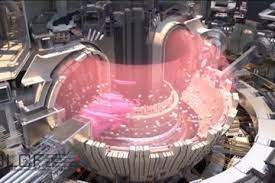
Soviet scientists pioneered nuclear fusion 70 years ago, creating the tokamak, considered by many as the leading device for a fusion reactor. To quote from a U.S. Department of Energy text: “A tokamak is a machine that confines a plasma using magnetic fields in a donut shape that scientists call a torus.”
Fusion energy centers on a reaction fueled by hydrogen isotopes — deuterium and tritium — that produce about 4x times the energy per unit mass of a standard uranium nuclear fission reaction. In December 2021, a tokamak in the U.K. set a record for fusion power. The Joint European Torus (JET) produced 59 megajoules of energy, double the record it set in 1997.
Private companies, however, are researching new technologies to build smaller, cheaper and often simpler fusion devices.
“Some key challenges are tritium breeding and handling, and materials,” said Dr. Melanie Windridge, CEO of Fusion Energy Insights. “Tritium is one of the fuels for most approaches, but not all. It doesn’t exist naturally so needs to be made in the fusion device. The challenge is that fusion machine environments are very hostile and damaging to materials; commercial devices will need to run for a long time, so better and stronger materials are required, particularly to shield components against neutrons that are produced.”
To achieve fusion the fuel must be heated to tens of millions of degrees Celsius and then confined in a state of plasma, which is the hard part. Poor confinement means heat leaks out. In the end, you want to get more energy out than was put in, which is where everyone has failed so far. And, which is what scientists are still striving to achieve.
North America races ahead
According to the Fusion Industry Association in Washington D.C., about 30 companies are working on nuclear fusion, and some hope to have a commercially-viable and functional fusion reactor in the 2030s.
Toward that goal, in 2021 about $3.4 billion was invested into nuclear fusion R&D. One of the leaders is Commonwealth Fusion Systems, which raised $1.8 billion and is backed by Bill Gates and Google. CFS hopes to have a fusion energy prototype in 2025 and thinks it can produce electricity for the grid by the end of the 2030s.
“The plasma needs to make more energy than it took to create it; the system needs to generate more electricity than it takes to operate it; and a power plant based on the technology needs to be able to operate at a profit,” said Ryan Umstattd, vice-president at Zap Energy, summing up the challenge.
Vancouver-based General Fusion received $130 million from billionaire Jeff Bezos and hedge fund Segra Capital Management. Seattle-based Helion Energy raised $500 million from tech investor Sam Altman and others. Zap Energy, which includes Shell as an investor, aims to build a nuclear fusion plant in the 2030s — each power module a few square meters and designed at 50 MW of capacity.
In California, TAE Technologies has raised $1.2 billion since 1998 and $250 million in a round this summer led by Google, Sumitomo Corp of Americas, and Chevron’s VC division. TAE aims to build commercial scale fusion reactors in the Asia-Pacific region in the 2030s. TAE also partners with Japan’s National Institute for Fusion Science.
Japanese startups join the fray
For 37 years Japan’s nuclear fusion program has centered around JT60 and its successor, the JT60SA, (short for Japan Torus-60). This magnetic fusion program is run by the Naka Fusion Institute of the Japan Atomic Energy Agency (JAEA).
The NFI is a partner in the International Thermonuclear Experimental Reactor (ITER) in France that includes nearly 30 countries. Slated for a 2025 completion, ITER will cost about $22 billion and be the world’s largest magnetic confinement plasma experiment and tokamak fusion reactor.
In the past few years, however, Japan’s private sector has been more active. One of its most exciting innovations is the “helical magnetic confinement” to stably confine high-temperature plasmas developed by Tokyo-based startup Helical Fusion. The firm was founded in October 2021 with backing from Sony, as well as Naruke Makoto, ex-president of Microsoft Japan. Among its top officials are scientists from the National Institute of Fusion Science.
Helical Fusion co-founder and CEO Takaya Taguchi says the helical method’s advantage is long-term operation. The tokamak has a plasma duration of 1,000 seconds, while the Large Helical Device has demonstrated over 3,000 seconds and achieved 100 mln ºC, so the plasma quality is very high. Helical Fusion plans to realize a commercially-viable fusion reactor by 2040 for electricity supply to factories or small islands, but not for the grid.
Another local leader is Kyoto Fusioneering, founded in 2019. To date, KF has raised ¥1.7 billion from investors including DBJ Capital, Kyoto University Innovation Capital, and JIC Venture Growth Investments.
KF partners with the UK’s Atomic Energy Authority, recently joining its STEP Program to design and build a commercial scale prototype fusion plant by 2040. KF is responsible for the conceptual design of in-vessel components.
At the end of March, Japan’s first laser nuclear fusion company, EX-Fusion raised ¥130 million in a pre-seed round led by ANRI, a Tokyo-based VC firm, along with Osaka University Venture Capital, to develop fusion reactor components. EX-Fusion seeks to commercialize laser-powered nuclear fusion reactors.
With this process, energy is obtained by using a high-power laser to compress a mixture of deuterium and tritium to high density and heat it to high temperature, causing nuclear fusion. EX-Fusion founder Kazuki Matsuo is the world record holder for fast ignition type of reaction.
In addition to startups, major corporations are also getting involved. In July, Mitsubishi Heavy Industries delivered equipment to the Rokkasho Fusion Institute to demonstrate the safety of the ‘blanket’ that’s a component in the reactor’s inner wall and extracts the heat generated. It will be used as Japan’s Test Blanket Module for ITER.
While it’s hard for both scientists and outside observers to discern which fusion energy technology will eventually succeed – if any – the nuclear fusion landscape is a wide open field with many exciting innovations appearing every year. Many surprises are in store, possibly from researchers unknown as of today and working outside of the main scientific and startup ecosystem.
“The Tom Edison and Nikola Tesla types are the wild cards,” said fusion inventor John T. Sullivan, CEO and founder of Marjo Engineering in the U.S.
As some scientists quip — nuclear fusion reactors are still many years away, but it’s important that we keep an ion them. More power to them.
Source: ITER
ANALYSIS
BY MAYUMI WATANABE
Great Miscalculations:
The Impact of ANRE’s Error in Available Thermal Capacity
On Sept 15, the Agency of Natural Resources and Energy reported that its data on available thermal power capacity this decade was way-off. The agency had underestimated the total capacity scheduled to shut down by 2030, and overcounted the new capacity planned to come online.
The errors amount to 16.52 GW of thermal capacity that won’t be available by 2030, which is equivalent to 16 nuclear reactors. What’s more, the admission was made a week before state auctions for power capacity in 2026.
The extent of the error, and its timing, raised questions. Was this announcement intended to influence markets and policies, or purely a human error?
Industry observers say the miscalculation won’t have an immediate impact on markets, but will push METI and ANRE to take bold action to rectify the massive capacity gap. This could be done by slowing the decommissioning of aging thermal capacity, a process made easier by a recent regulatory change.
Another option is that METI could speed up the rollout of its co-firing agenda, pushing more coal and gas-fired plants to also burn hydrogen or ammonia.
Both options, however, have drawbacks.
ANRE’s mistake
On March 25, 2021, ANRE reported to a sub-panel on basic power and gas policies that in 2016-2020 Japan lost 1.02 GW of thermal power derived from facilities that burn oil, LNG and coal, and was projected to lose another 4.41 GW over 2021-2025 and 8.81 GW over 2026-2030.
During 2016-2020, 15.53 GW of new capacity came online, while 16.55 GW was idled permanently, resulting in a 1.02 GW net loss. On Sept 15, however, ANRE corrected those figures: Japan lost 1.74 GW in 2016-2020, as was now expected to lose 17.8 GW in 2021-2025, and another 11.22 GW in 2026-2030.
The data errors occurred when the grids were changing their plant shutdown schedules. Generation capacity that was initially taken offline for a short period, but later categorized as requiring permanent closure, was not counted. Errors were made when determining the time of decommissioning of old capacities, ANRE explained.
One power market analyst believes the debacle is purely the result of a human error that came about simply because a second pair of eyes were not ordered to check the figures.
Unit: GW
|
Capacity loss |
New installations (previous figured in red) | |
|
Scrapped capacities (previous figured in red) | ||
|
2016-2020 |
1.74 (1.02) |
14.99 (15.53) |
|
16.72 (16.55) | ||
|
2021-2025 |
17.8 (4.41) |
11.93 (14.44) |
|
29.73 (18.85) | ||
|
2026-2030 |
11.22 (8.81) |
2.28 (0) |
|
13.60 (8.81) |
No impact on capacity auction
There is a similar brush off of the mistake by operators taking part in capacity auctions – one of the subsets of the Japanese power market.
Power capacity auctions for 2026 started on Sept 20 and closed on Oct 4, only one business day after the error was announced. Sept 19 was a public holiday. During the auction, the participants were required to file their available capacities for April 2026 – March 2027.
Power operators and observers said the ANRE figures would have a negligible impact as auction participants don’t use that data to build market scenarios.
While ANRE’s figures are nationwide totals, capacity auctions are broken down into nine geographical areas. ANRE collects and makes forecasts for installed capacities of major regional grids, while the auctions are for basic capacities in operation.
Power operators report their business plans, including anticipated capacities in operation, to the Organization for Cross-Coordination of Transmission Operators (OCCTO). So, auction participants use OCCTO’s data.
As an example: ANRE undercounted the country’s installed thermal capacity by 2.41 GW for 2026-2030, but this didn’t trigger changes in the figures the operators had reported to OCCTO.
One auction participant said her company was not at all affected by changes in the ANRE figures. Changes in current market conditions are too significant, making the error issue negligible, she said.
Where to expect impact
Several sources said the main concern was how METI policies will now change in order to make up for the miscounting. They anticipate difficulties in decommissioning thermal power plants, especially if the decisions were for economic and not technological reasons.
METI has some leeway in this since a recent regulatory change gives the ministry power to screen all power facilities’ decommissioning plans.
Bureaucrats could also ask utilities to accelerate plans to install new capacities.
The most likely scenario, however, is that METI will seek to speed up the rollout of co-firing of hydrogen/ ammonia at thermal plants. Co-firing could become a way to legitimize thermal expansion, some experts remarked. Co-firing technologies are still in their infancy, however.
Speed up co-firing
Japanese utilities have plans to introduce hydrogen/ ammonia co-firing as the government has mandated it to represent 1% of total national power generation by 2030. The various projects, however, are progressing at different speeds.
Chugoku Electric was the first to conduct a trial run of ammonia/ coal co-firing at its Mizushima plant in 2017. The company is now exploring other venues after making the decision to scrap the plant in 2023.
JERA plans trial runs of ammonia-coal co-firing at the Hekinan No. 4 station in 2023. Kansai Electric plans to launch a hydrogen-LNG co-firing trial at its Himeji plant in 2025 and commercialize operations in 2030.
Others have stated their co-firing ambitions as a part of a long-term strategy to be carbon neutral but haven’t elaborated.
|
Grid |
Co-firing type |
Plant |
Schedule |
|
Hokkaido Electric |
Ammonia/ coal |
Tomato Atsuma |
NA |
|
JERA |
Ammonia/ coal |
Hikinan No. 4 |
Trial from 2023 |
|
Tohoku Electric |
NA |
NA |
Trial from 2024 |
|
Kansai Electric |
LNG/ hydrogen |
Himeji No. 1, No. 2 |
Trial from 2025 |
|
Chugoku Electric |
Ammonia/ coal |
Mizushima No. 2 (to be scrapped in 2023) |
NA |
As the government becomes more involved in speeding up co-firing initiatives, state planners need to set up day to day policy making for the sector, Kansai Electric told a METI hydrogen panel recently. In order to reduce the cost of hydrogen power generation to the current level of gas-fired capacity, it’s necessary to reduce the former’s running costs, as well as the expenses from gas conversion, storage, and land and marine transportation.
To achieve the above, KEPCO urged closer coordination among the three relevant policymaking departments in METI: the one responsible for decarbonized capacity auction systems; one dealing with hydrogen imports and storage bases; and another charged with establishing global supply chains.
A KEPCO spokeswoman clarified to Japan NRG that if the three divisions do not synchronize well, then power operators will suffer financially as the overall cost of hydrogen/LNG co-firing will not decrease.
New data mechanism needed
As part of efforts to prevent these errors from happening again, ANRE plans to establish a new mechanism so that the data will run through multiple layers of checks before publication and will be managed digitally as much as possible.
Following recent amendments to the Electricity Business Act, power operators will also be required to consult with the government regarding any thermal capacity decommissioning plans, and this system should allow more accurate future capacity forecasting.
The data error incident will have a ripple effect beyond ANRE’s internal working. The agency claims that the error has not caused any changes in its decisions or altered the outlook that Japan will lose thermal capacities over the coming years and needs to secure replacements. The incident only endorses its long-standing view that the loss of thermal capacities will have a critical impact on the nation’s energy supply.
In the end, other METI or ANRE departments may get involved in the search for additional power capacity that could be available this decade. This likely opens the door to greater attention on renewables and nuclear.
GLOBAL VIEW
BY JOHN VAROLI
Below are some of last week’s most important international energy developments monitored by the Japan NRG team because of their potential to impact energy supply and demand, as well as prices. We see the following as relevant to Japanese and international energy investors.
Australia/ Coal and renewable energy
Queensland, One of Australia’s top coal-producing states, plans to source 70% of its energy from renewables by 2032, and 80% by 2035; its previous target was 50% by 2030. Also, coal-fired power plants will be converted to renewable hubs by 2035 as part of a A$62 billion ($40 billion) clean energy plan.
Brazil/ Wind power
Vestas will equip South America’s largest wind farm – Engie’s 846 MW Serra de Assuruá project in Bahia. It will use 120 Vestas V150-4.5MWs. Engie has an option to buy another 68 by year’s end. The wind farm will come online in late 2024.
China/ Battery storage
China switched on the world’s largest flow battery, a 100-MW, 400-MWh vanadium flow battery installed in Dailan that offers low-cost energy storage without using lithium. China plans that compressed air energy storage (CAES) will handle nearly a quarter of all its energy storage by 2030.
Europe/ Energy crisis
Two EU commissioners said Germany’s energy relief package “raised questions” and it’s necessary to avoid a race for subsidies. Germany is under fire since it announced a “protective shield” for businesses and consumers struggling with soaring energy costs.
Europe/ Wind power
Siemens Gamesa will cut 3,000 jobs, mostly in Europe; and almost half in Denmark and Germany. Soon, more cuts will be made elsewhere in global operations. Siemens Gamesa employs 27,000 worldwide
France/ Hydrogen energy
Electrolyser makers McPhy, Genvia, Elogen and John Cockerill will build gigafactories as part of a €2.1 billion state program to make France a world leader in hydrogen energy. Recipients will also invest a total of €3.2 billion of private money.
OPEC/ Oil production cut
Russia and OPEC approved production cuts of 2 mln barrels/ day, infuriating the White House before important midterm elections in November. Oil prices are now around $90 a barrel, down from $120 in early June.
Poland/ Natural gas
The 900-km Baltic Pipe project began sending gas to Poland from Norway via Denmark. A JV of Denmark’s Energinet and Poland’s GAZ-SYSTEM, the pipeline has capacity to transport 10 bcm of gas a year to Poland.
U.S./ LNG exports
The White House won’t curb natural gas exports as part of plans to alleviate the EU’s energy gas shortages. A total of 87 LNG cargoes departed from U.S. ports last month, carrying 6.3 m/t of LNG, slightly more than the 6.25 m/t in August.
U.S./ Renewable energy
Brookfield Renewable will acquire Scout Clean Energy for $1 billion and possibly invest $350 million. Scout owns over 1,200 MW of operating wind assets, and a pipeline of over 22,000 MW of wind, solar and storage projects across 24 states.
U.S./ Wind power
Dominion Energy may exit an offshore wind project if the state’s performance guarantee remains. The planned $9.8 billion wind farm off the coast of Virginia would be the state’s largest energy project and the largest wind project in the U.S.
2022 EVENTS CALENDAR
A selection of domestic and international events we believe will have an impact on Japanese energy
|
January |
OPEC quarterly meeting; JCCP Petroleum Conference – Tokyo; EU Taxonomy Climate Delegated Act activates; Regional Comprehensive Economic Partnership (RCEP) Trade Agreement that includes ASEAN countries, China and Japan activates; Indonesia to temporarily ban coal exports for one month; Regional bloc developments: Cambodia assumes presidency of ASEAN; Thailand assumes presidency of APEC; Germany assumes presidency of G7; France assumes presidency of EU; Indonesia assumes presidency of G20; and Senegal assumes presidency of African Union; Japan-U.S. two-plus-two meeting; Japan’s parliament convenes on Jan. 17 for 150 days; Prime Minister Kishida visits Australia (tentative) |
|
February |
Chinese New Year (Jan. 31 to Feb. 6); Beijing Winter Olympics; South Korea joins RCEP trade agreement |
|
March |
Renewable Energy Institute annual conference; Smart Energy Week – Tokyo; Japan Atomic Industrial Forum annual conference – Tokyo; World Hydrogen Summit – Netherlands; EU New strategy on international energy engagement published; End of 2021/22 Japanese Fiscal Year; South Korean presidential election |
|
April |
Japan Energy Summit – Tokyo; MARPOL Convention on Emissions reductions for containerships and LNG carriers activates; Japan Feed-in-Premium system commences as Energy Resilience Act takes effect; Launch of Prime Section of Japan Stock Exchange with TFCD climate reporting requirement; Convention on Biological Diversity Conference for post-2020 biodiversity framework – China; Elections: French presidential election; Hungarian general election |
|
May |
World Natural Gas Conference WCG2022 – South Korea; Elections: Australian general election; Philippines general and presidential elections |
|
June |
Happo-Noshiro offshore wind project auction closes; Annual IEA Global Conference on Energy Efficiency – Denmark; UNEP Environment Day, Environment Ministers Meeting – Sweden; G7 meeting – Germany |
|
July |
Japan to finalize economic security policies as part of natl. security strategy review; China connects to grid 2nd 200 MW SMR at Shidao Bay Nuclear Plant, Shandong; Czech Republic assumes presidency of EU; Elections: Japan’s Upper House Elections; Indian presidential election |
|
August |
Japan: Africa (TICAD 8) Summit – Tunisia; Kenyan general election |
|
September |
IPCC to release Assessment and Synthesis Report; Clean Energy Ministerial and the Mission Innovation Summit – Pittsburg, U.S.; Japan LNG Producer/Consumer Conference – Tokyo; IMF/World Bank annual meetings – Washington; Annual UN General Assembly meetings; METI to set safety standards for ammonia and hydrogen-fired power plants; End of 1H FY2022 Fiscal Year in Japan; Swedish general election |
|
October |
EU Review of CO2 emission standards for heavy-duty vehicles published; Chinese Communist Party 20th quinquennial National Party Congress; G20 Meeting – Bali, Indonesia; Innovation for Cool Earth TCFD & Annual Forums – Tokyo; Elections: Okinawa gubernational election; Brazilian presidential election; |
|
November |
COP27 – Egypt; U.S. mid-term elections; Soccer World Cup – Qatar; |
|
December |
Germany to eliminate nuclear power from energy mix; Happo-Noshiro offshore wind project auction result released; Japan submits revised 2030 CO2 reduction goal following Glasgow’s COP26; Japan-Canada Annual Energy Forum (tentative); Tesla expected to achieve 1.3 million EV deliveries for full year 2022 |
Disclaimer
This communication has been prepared for information purposes only, is confidential and may be legally privileged. This is a subscription-only service and is directed at those who have expressly asked K.K. Yuri Group or one of its representatives to be added to the mailing list. This document may not be onwardly circulated or reproduced without prior written consent from Yuri Group, which retains all copyright to the content of this report.
Yuri Group is not registered as an investment advisor in any jurisdiction. Our research and all the content express our opinions, which are generally based on available public information, field studies and own analysis. Content is limited to general comment upon general political, economic and market issues, asset classes and types of investments. The report and all of its content does not constitute a recommendation or solicitation to buy, sell, subscribe for or underwrite any product or physical commodity, or a financial instrument.
The information contained in this report is obtained from sources believed to be reliable and in good faith. No representation or warranty is made that it is accurate or complete. Opinions and views expressed are subject to change without notice, as are prices and availability, which are indicative only. There is no obligation to notify recipients of any changes to this data or to do so in the future. No responsibility is accepted for the use of or reliance on the information provided. In no circumstances will Yuri Group be liable for any indirect or direct loss, or consequential loss or damages arising from the use of, any inability to use, or any inaccuracy in the information.
K.K. Yuri Group: Oonoya Building 8F, Yotsuya 1-18, Shinjuku-ku, Tokyo, Japan, 160-0004.