
JAPAN NRG WEEKLY
OCT. 24, 2022
JAPAN NRG WEEKLY
Oct. 24, 2022
NEWS
TOP
- Cabinet approves tough new powers to ration gas, which allows the state to limit consumption and help to procure LNG
- State electricity subsidy to mirror gasoline scheme, offering utilities the funds to reduce consumer power bills
- Govt. eyes balance between renewables growth and community interest and sets up new group to tackle the issue
ENERGY TRANSITION & POLICY
- Ministries submit draft revision of offshore wind bidding system
- LP gas won’t be added to the energy cost relief package
- Japan and Brunei make joint energy transition statement
- Honda and GE successfully test jet engine that runs on 100% SAF
- Japan starts first project to make liquid bio methane from manure
- Li-on battery components market will double in five years: Yano
- TEPCO and Pertamina explore green hydrogen and ammonia
- Toshiba develops tech to convert CO2 into valuable materials
ELECTRICITY MARKETS
- Overall market share of independent power producers falls
- Power reserve forecast for summer 2023 encouraging: OCCTO
- Ministry says nuclear restarts could help combat weak yen
- Kansai Electric suspends significant LNG-fired capacity expansion
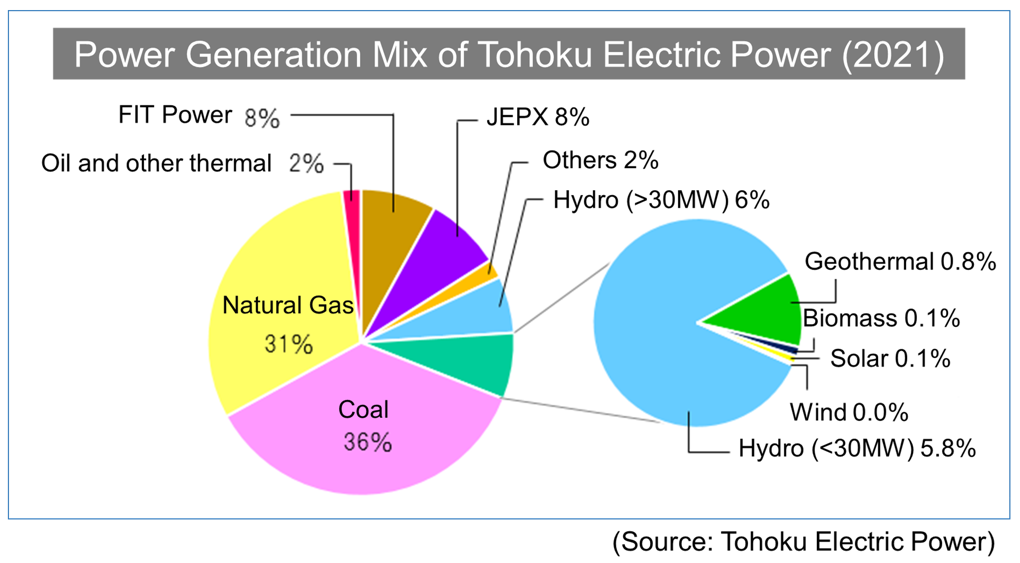
- Tohoku Electric says oil-fired power now more economic than gas
- ENEOS CEO vows to continue renewables M&A despite weak yen
- Kyushu Electric speeds up restart of nuclear reactors
- Pacifico Energy plans 140 MW solar project in western Japan
OIL, GAS & MINING
- Gas, power sectors to revise LNG guidelines to facilitate sharing
- METI minister asks Saudi Arabia to secure crude oil supplies
- Petroleum Association chair forecasts near-term oil price increase
- Japan’s LNG, coal imports fall, but crude and LPG volumes rise
- Sumitomo Metal forecasts nickel deficit to narrow next year
ANALYSIS
QUITTING RUSSIAN COAL:
JAPAN STRUGGLES TO MAKE GOOD ON ITS PLEDGE
Six months ago, Prime Minister Kishida vowed that Japan would ban Russian coal imports, aligning the nation with G7 allies in sanctions over the war in Ukraine. Actually following through with the order, however, is proving complicated. Japan’s purchases of Russian coal are down almost 40% since April. While imports fell significantly in the months after Kishida’s statement, volumes increased in summer. By August, Russian coal imports recovered to more than two-thirds of the level a year earlier. As western allies seek to disengage from Russian energy, the realities of doing so are hitting hard.
SUSTAINABLE AVIATION FUEL
STUCK ON THE RUNWAY, WAITING FOR TAKEOFF
Aviation accounts for over 2% of mankind’s emissions, more than other transportation systems such as trains or sea vessels. As such, it has become key to the international effort to decarbonize transport, and Japan has eagerly embarked on a strategy to clean up its air travel by switching planes to sustainable aviation fuel (SAF), which is a green replacement for traditional kerosene-based jet fuel. In Japan, SAF production is still in its infancy. Several manufacturers and trading firms are eager to get into the sector, seeing strong demand from Japanese airlines.
GLOBAL VIEW
Ecuador blames oil spill on vandals causing damage. Germany decided to keep its reactors on for a little longer. Norward inches closer to all-EV goal. Heavy fighting continues around Ukrainian nuclear plant. Qatar warns Europe about gas shortages next winter.
Details on these and more in our global wrap.
JAPAN NRG WEEKLY
PUBLISHER
K. K. Yuri Group
Events
Editorial Team
Yuriy Humber (Editor-in-Chief)
John Varoli (Senior Editor, Americas)
Mayumi Watanabe (Japan)
Yoshihisa Ohno (Japan)
Wilfried Goossens (Events, global)
Regular Contributors
Chisaki Watanabe (Japan)
Takehiro Masutomo (Japan)
Art & Design
22 Graphics Inc.
SUBSCRIPTIONS & ADVERTISING
Japan NRG offers individual, corporate and academic subscription plans. Basic details are our website or write to subscriptions@japan-nrg.com
For marketing, advertising, or collaboration opportunities, contact sales@japan-nrg.com For all other inquiries, write to info@japan-nrg.com
OFTEN USED ACRONYMS
METI The Ministry of Energy, Trade and Industry
MOE Ministry of Environment
ANRE Agency for Natural Resources and Energy
NEDO New Energy and Industrial Technology Development Organization
TEPCO Tokyo Electric Power Company
KEPCO Kansai Electric Power Company
EPCO Electric Power Company
JCC Japan Crude Cocktail
JKM Japan Korea Market, the Platt’s LNG benchmark
CCUS Carbon Capture, Utilization and Storage
mmbtu Million British Thermal Units
mb/d Million barrels per day
mtoe Million Tons of Oil Equivalent
kWh Kilowatt hours (electricity generation volume)
NEWS: ENERGY TRANSITION & POLICY

G7 Climate Ministers to meet April 15-16 in Sapporo
(Japan NRG, Oct. 21)
- The G7 Climate, Energy and Environment Ministers Meeting will be held April 15-16 (2023) at the Sapporo Prince Hotel in Hokkaido.
- METI minister Nishimura said the key agenda is to balance energy security, economic growth and climate challenges.
New METI group seeks to balance renewable growth and community interests
(Japan NRG, Oct. 17)
- METI launched a group on balancing renewable capacity growth with community demands to regulate operators. It’s the heir to a joint four-ministry panel that focused on tensions between operators and local communities.
- Chaired by Professor Yamauchi Hirotaka of Hitotsubashi University, the panel’s eight other members are academics, as well as one lawyer and one brokerage firm executive.
- Four members served on the state panel that disbanded this month.
- CONTEXT: The previous state panel focused on regulations for forestry development and ways to spot non-compliance. The new group will address the need to grow renewable capacity while addressing community concerns.
TAKEAWAY: Group member Oozeki Takashi of the National Institute of Advanced Industrial Science and Technology, who also served in the previous panel, cited the need to better train operators. Many are heavily dependent on engineering contractors and unable to make technology decisions. Increasing the liability of operators with regulations could defeat plans to expand renewable capacity. So, this is a step taken to help the industry’s less tech-savvy operators improve.
Ministries submit draft revision of offshore wind public bidding system
(New Energy Business News, Oct. 18)
- METI and the Ministry of Land, Infrastructure, Transport and Tourism (MLIT) have presented a draft revision of the public bidding system for offshore wind power projects after a period of expert discussions.
- The new proposal adds criteria for promptness evaluation, disincentives and penalties for delays, bidding restrictions, and timing for the announcement of third-party committee members.
- The criteria will take into account the fastest possible start of operation based on the period of availability of each base port, while assuming consistency with the energy mix targets for FY2030.
- The bidding limit is currently set only for offshore Happo Town and Noshiro City, Akita Prefecture; offshore Oga City, Ligata City, and Akita City, Akita Prefecture; offshore Murakami City and Tainai City, Niigata Prefecture; and offshore Eshima, Saikai City, Nagasaki Prefecture, which are scheduled to go to tender during FY2022.
- In the public auctions for FY2023, if total grid capacity of an area exceeds 1 GW, adding some form of bidding restrictions will also be considered. The results of FY2022 tenders will be also play a role in determining the need or otherwise for restrictions.
- SIDE DEVELOPMENT:
Ministry working group suggests reviewing offshore wind projects based on port plans
(New Energy Business News, Oct. 17)- A working group for offshore wind power jointly run by METI and the Ministry of Land, Infrastructure, Transport and Tourism (MLIT) suggested to rate offshore wind project bids based on the ports developers plan to use. Officials seeks to avoid overloading ports due to “overlapping” projects.
- CONTEXT: When bidding is conducted simultaneously in several nearby offshore wind promotion areas, there is a possibility that the stated base ports may overlap. For example, two of the areas in the next round of auctions are located nearby in Akita Prefecture and would likely require the use of Noshiro Port and Akita Port as base ports.
- In case of overlap, ministry experts suggested not approving plans for both zones at the same time. This gives priority to plans that do not overlap.
TAKEAWAY: The export group suggestions are quite complex and include various conditions. The main goal, however, seems to be to avoid logistical bottlenecks that would delay nearby projects from keeping to schedule.
METI minister won’t include LP gas in energy cost relief plan
(Japan NRG, Oct. 21)
- METI minister NIshimura said that while there are requests to include LP gas in the electricity and gas price-hike relief plan, LP gas prices rose only 9.7%, which is moderate compared to city gas and electricity.
- Nishimura added that LP gas suppliers are small and medium-sized enterprises; and he was doesn’t want to affect their business.
- The govt is studying how to reduce power and gas charges for consumers by decreasing fuel adjustment fees and making the cut visible in bills.
- CONTEXT: LP gas charges are around 5-10% higher than city gas, resulting in some consumers shifting to all electric homes. LP gas is primarily used in rural areas that don’t have city gas pipeline systems.
Japan and Brunei make joint energy transition statement
(Japan NRG, Oct. 17)
- METI and the Prime Minister’s Office of Brunei said that reducing renewable energy costs and storage systems, hydrogen, combined-cycle gas turbines (CCGT) and CCS/CCUS are key technology areas for decarbonization.
- Bilateral discussions will formulate energy transition roadmaps in Brunei.
Honda and GE successfully test jet engine that uses 100% SAF
(Kankyo Business, Oct. 20)
- Honda and GE Honda Aero Engines, a 50-50 subsidiary of General Electric (GE), have successfully tested the HF120 turbofan engine, which is 100% powered by Sustainable Aviation Fuel (SAF).
- SAF, which is made from plants and waste oil, has been attracting attention as a means of reducing CO2 emissions in aviation. GE Honda Aero Engines states that this test “confirmed the possibility of using 100% SAF” in anticipation of the future evolution and spread of aviation fuels.
TAKEAWAY: Please see the Analysis section for a deep dive into the condition of the SAF market in Japan.
Air Water starts Japan’s first production of Liquified Bio Methane from manure
(Kankyo Business, Oct. 20)
- Air Water Inc. began production of Liquefied Bio Methane (LBM) derived from livestock manure for the first time in Japan. On October 13, the first shipment was made from the Center Plant in Obihiro City, Hokkaido, which processes biogas into LBM, to the Tokachi Main Plant of Yotsuba Dairy in Sapporo City.
- The Tokachi facility will conduct a demonstration test of using LBM as an alternative fuel to liquefied natural gas (LNG), and work to establish a series of supply chain models.
- If all of the approximately 360 tons of LBM produced annually at the Center Plant were used instead of LNG, CO2 emission reduction would run to 7,740 tons per year, and the GHG reduction rate would be more than 60%.
Yano Research forecasts LiB components market to more than double by 2025
(Japan NRG, Oct. 20)
- Yano Research Institute forecasts the global lithium-ion battery components market will double to $89.98 billion in 2025 from $42.48 billion in 2021.
- The 2022 market is valued at $59.81 billion, up 40.8% from 2021 on higher raw material prices.
- Car batteries will drive growth but demand for small devices will slow after 2022.
- Components include separators, electrolytes, anodes and cathodes.
TAKEAWAY: LiB replacements for small devices are beginning to emerge. Maxell plans commercial production of ceramic-based all-solid-state-batteries for medical devices in March 2023.
TEPCO and Indonesia’s Pertamina to explore green hydrogen and ammonia
(Japan NRG, Oct. 18)
- At the G20 State-owned Enterprises International Conference, Tokyo Electric and Pertamina Power Indonesia signed an agreement on development of green hydrogen and green ammonia.
- Pertamina’s geothermal power generation technology will join forces with TEPCO’s hydrogen production to achieve cost-competitive green hydrogen and green ammonia production and transportation.
- Indonesia has the world’s second largest geothermal energy potential, reaching 24 GW. Pertamina, through its subsidiary, Pertamina Geothermal Energy, operates geothermal capacity of up to 672 MW in six areas.
Toshiba tech can convert CO2 into valuable materials with electrolysis
(Company Statement, Oct. 19)
- Toshiba has developed “Power to Chemicals/P2C”, which uses electricity from renewable energy sources, to break down CO2 into CO, and combine it with H2 to produce chemicals, synthetic fuels, etc. One example is sustainable aviation fuel (SAF), for which there’s much demand globally as the industry decarbonizes.
- Through a project initiated by the MoE, Toshiba is promoting P2C and researching specific social functions.
- Toshiba will exhibit P2C technology in the Japan Pavilion at the 27th UN Climate Change Conference of the Parties (COP27) Nov 6-18.
Marubeni launches Qatar’s first large-scale solar plant
(PV Magazine, Oct. 19)
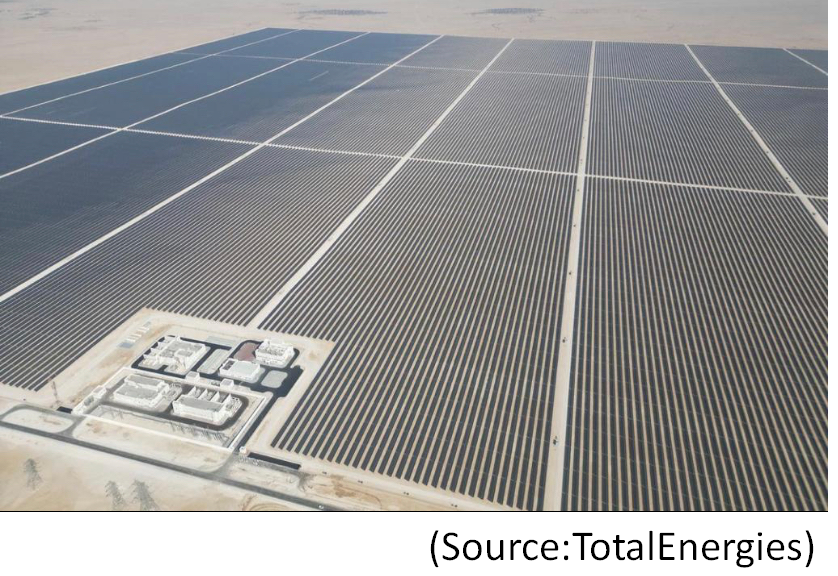
- Together with QatarEnergy and TotalEnergies, Marubeni switched on the 800 MW Siraj-1 solar plant near Doha. This is Qatar’s first large-scale solar plant.
- Siraj-1 is equipped with two million Longi Hi-MO 4 bifacial modules mounted on single-axis trackers, and features a semi-automated cleaning system.
- The $467 million park is 60%-owned by the utility and 40% by the French-Japanese consortium. It will sell power under a 25-year power supply deal for QAR 0.0571/ kWh.
The Siraj-1 800 MW Solar Plant in Qatar
New regulation for next-generation reactors in the works
(Denki Shimbun, Oct. 20)
- NRA Chairman Yamanaka said new regulation for next-gen reactors will be ready within a year or two. This refers tor new reactors based on APWR / ABWR technology.
- However it will take much longer to do the same for SMRs and other reactor technologies.
TAKEAWAY: Yamanaka’s statement backs up METI policy. Last month, GH Hitachi and Mitsubishi Heavy Industries disclosed their next-gen reactors, both based on ABWR / APWR. The relatively quicker and easier path to bringing online reactors based on the tried and tested ABWR and APWR indicates that Japan’s appetite for other technologies is actually small. For all the talk about SMRs in and outside the country, as well as Japan’s vaunted high-temperature gas-cooled technology, the leadership seems more interested in getting capacity online than making breakthroughs.
7-Eleven plans 1,200 green outlets by 2023
(Nikkei, Oct. 18)
- In order to slash CO2 emissions to half of 2013/14 levels by 2022/23, 7-Eleven Japan designed a new store format that features three times the usual solar generation capacity, in addition to other energy-saving features.
- The convenience store industry produces 1% of Japan’s electricity consumption.
Kyushu Electric earns ¥20 billion from carbon credits in two years
(Nikkei, Oct. 14)
- Kyushu Electric says it earned a total of ¥19.6 billion from the sale of carbon credits over the last two financial years.
- Over 50% of electricity generated by Kyushu Electric comes from non-fossil sources, giving the company more “non-fossil fuel certificates” than other utilities.
- Kyushu Electric invests revenue from the sale of carbon credits to grow renewable capacity, as well as improve safety at nuclear power plants.
Government wants reports on carbon footprints of vehicle batteries
(Nikkei, Oct. 15)
- In partnership with other governments, METI is formulating a set of rules for assessing the lifetime carbon footprints of batteries used in EVs, hoping to establish an international standard by 2024.
- The International Energy Agency says that after travelling 200,000 km, a typical 40 kWh vehicle battery accounts for about 20 tons of carbon emissions, of which 70% are emitted in the course of generating electricity to charge the battery.
J-Power in green bond issue
(Nikkei, Oct. 17)
- J-Power announced its third “green bond” issue on Oct 17.
- It will raise between ¥10 and ¥20 billion that will be used to finance land-based wind farms in Japan, as well as other renewable projects.
NEWS: POWER MARKETS

Details of proposed power subsidy revealed
(FNN, Oct. 19)
- Multiple sources confirm that the government might introduce a monthly electricity subsidy worth up to ¥2,000 per household.
- While it would be administered with payments to utilities, steps will be taken to ensure that power bills showed explicitly the value of subsidies applied.
- All households will be eligible; the subsidy might be introduced in January.
(Japan NRG, Oct. 17)
- In June 2022, independent power producers had a 19.9% power market share, down from 21.3% in March.
- Their share in low-pressure power serving households, offices and small business facilities rose to 25.7% from 23.4%, and high-pressure power to industrial facilities was down to 24.7% from 27%.
- The number of power retailers nationwide decreased to 732 companies at the end of September, down from 743 at end-April.
OCCTO releases prelim 2023-24 power reserve rate forecast
(Japan NRG, Oct. 19)
- Power reserve rates are forecast to hold above 4% in summer 2023, except for the Tokyo area in July, said the Organization for Cross-Regional Coordination of Transmission Operators.
- Reserve rates in the Tokyo area are seen at 3.3%, above the critical threshold of 3% but still limited in extra supplies. The rates are expected to improve to 4.2% in August and to 4.4% in September.
- The Chubu area, which has strong demand, is forecasted at 4.3% in July, 5.5% in August and 4.4% in September.
- The eight other areas will be well supplied, with the reserve rates holding mostly above 11% during the three-month period.
- December 2023 to March 2024 winter month reserve rates are forecast in the range of 4.9% to 22.1%.
Minister advocates nuclear restarts to combat weak yen
(Nikkei, Oct. 18)
- METI Nishimura said that restarting Japan’s idle nuclear power stations is a good way to combat the weak yen.
- The reduction of LNG imports would improve Japan’s balance of payments deficit, said Nishimura.
- CONTEXT: The yen hit a 32-year low against the U.S. dollar on Oct. 21. Since Japan relies on imported fossil fuels for the majority of its primary energy and electricity, this has dramatically increased the cost of power.
Kansai Electric suspends 1.5 GW expansion at Gobo thermal plant
(Japan NRG, Oct. 20)
- Kansai Electric suspended expansion of its Gobo thermal power plant in Wakayama Prefecture that envisaged a new LNG-fired power plant.
- In its METI filing in March for its power supply plan, the company wanted to expand the Gobo plant by 1.5 GW.
Tohoku Electric says oil-fired plants now perform better than old gas capacity
(Denki Shimbun, Oct. 20)
- Tohoku Electric said high LNG prices are making oil-fired capacity more economic. As such, the utility decided to bring forward a decision to decommission two LNG units, the Minato-1 and Minato-2, (both 350 MW), at the Higashi – Niigata Thermal Power Plant.
- The units were idled in March and will now be dismantled.
- While oil-fired capacity is performing better, the utility also said it will need to extend the shutdown of the aged Akita power plant unit 4 (600 MW), from March 2023 to July 2024, because of age and wear.
TAKEAWAY: Oil-fired plants are traditionally more costly and dirtier than gas-fired power plants. However, as Tohoku Electric heavily relies on thermal generators, it has switched to burning more oil to generate electricity to save on costs.
ENEOS President vows to continue renewables M&A, despite weak yen
(Financial Times, Oct. 17)
- Despite a weakening yen, ENEOS President Saito wants to invest in renewables globally, seeing potential in Australia, Southeast Asia and the Middle East.
- Saito also said Japan needs to accelerate in hydrogen and carbon capture to play a major role in net-zero goals. ENEOS is also keen to acquire assets in the hydrogen industry.
- CONTEXT: ENEOS acquired Japan Renewables Corp. last year from Goldman Sachs in one of the biggest M&A deals in the domestic solar sector.
Kyushu Electric speeds up end date of review for Units 3 and 4 at Genkai NPP
(Company Statement, Oct. 18)
- Kyushu Electric will move up the schedule for review of Units 3 and 4 at the Genkai NPP. The end date will be changed from Jan 20, 2023 to Dec 17, 2022 (34 days) for Unit 3; and Feb 23, 2023 to Feb 16, 2023 (7 days) for Unit 4.
- Both reactors will end power generation from Jan 21, 2022 for Unit 3 and Sept 12, 2022 for Unit 4, respectively.
- Before the next restart, Kyushu Electric will also complete special facilities for anti-terror measures. The construction of facilities related to these upgrades is now expected to be completed faster than expected, so the restarts are moved up as a result.
TAKEAWAY: Both Units 3 and 4 at the Genkai NPP are 1.18 GW reactors, so this restart will save about 2 million tons of LNG or equivalent in oil and coal. Also, it will greatly improve Kyushu Electric’s financials, allowing the utility to resell some of its LNG cargos at a time when the weak yen hampers imports of fossil fuels.
- SIDE DEVELOPMENT:
Kansai Electric to restart Takahama NPP’s Unit 4 on Nov. 18
(Company Statement, Oct. 20)- A day after the announcement, Kansai Electric reported problems with a pressurized relief valve that will need further investigation, and which are likely to delay the restart beyond the earlier announced plans.
Pacifico Energy plans 140 MW solar project in Mie area
(New Energy Business News, Oct. 17)
- Pacifico Energy plans a 140 MW Hakusan Sangano Solar Power Project in Tsu City, Mie Prefecture, with a planned start of operation in 2028.
- The project area under review covers approximately 120 hectares, utilizing a former golf course site.
- The solar cells to be installed are 545W crystalline silicon. In addition, storage batteries are also under consideration.
- Construction is scheduled to begin in 2026.
Influx and Tokyu Land plan onshore wind projects in northern Japan
(New Energy Business News, Oct. 21)
- Influx plans to develop an onshore wind farm in the vicinity of Shiroishi City, Miyagi Prefecture. The project area is approximately 1,490 ha in Shiroishi City and Kunimi Town, Fukushima Prefecture, where up to 19 turbines with a single unit output of 4,200 kW will be installed. Construction is scheduled to begin in January 2026, with commercial operation scheduled 42 months later.
- Tokyu Land is planning a 91.5 MW wind project in Ishikari City, Hokkaido. The project area is approximately 751 hectares, and a maximum of 15 wind turbines with outputs ranging from 4,300 kW to 6,100 kW each will be installed. Operation is scheduled to begin 28 months after the start of construction.
Tohoku Electric buys another 10% in Indonesian geothermal player
(New Energy Business News, Oct. 20)
- Tohoku Electric acquired an additional 10% stake in Supreme Energy Rantau Dedap, an Indonesian geothermal power company in which TEPCO is participating as an equity investor. Tohoku Electric’s stake is now 20%. The seller was ENGIE.
- Together with Marubeni, the utility has been operating a geothermal power plant with a rated output of 98.4 MW in South Sumatra province since the end of 2021.
- As a result of this deal, Marubeni holds 27.4% in the project, ENGIE 27.4%, Supreme Energy of Indonesia 25.2%, and Tohoku Electric 20%.
Toshiba wins contract to build geothermal micro-plant in Philippines
(Nikkei, Oct. 17)
- Toshiba Energy Systems won a contract for a geothermal power plant on Luzon.
- The 20 MW plant, which will begin feeding the grid in November 2024, will be built quickly and on a site that might otherwise have been deemed unsuitable.
TEPCO and Hitachi Zosen to produce decommissioning equipment
(Fukushima Broadcasting, Oct. 20)
- Tokyo Electric and Hitachi Zosen established “Toso Mirai Decommissioning” to produce equipment needed for decommissioning. TEPCO owns 75% of this company, Hitachi Zosen owns 25%.
- The new company will supply 10 units of fuel casks per year for Fukushima NPP.
- Construction will begin on the grounds of Fukushima NPP in 2023, and operation is expected to start in 2025.
TAKEAWAY: While Fukushima (No. 2) NPP had little damage from the 2011 earthquake, unlike its neighboring No. 1 plant, it was also put on the decommissioning list in consideration of Fukushima Prefecture resident concerns. This new company might be a way to utilize the plant and contribute to the local economy.
NEWS: OIL, GAS & MINING

Cabinet approves tough new powers to ration gas
(Nikkan Kogyo Shimbun, Oct. 17)
- The Cabinet approved an amendment to the Gas Business Act, enabling the government to order major users of reticulated gas to limit consumption, as well as giving JOGMEC the power to procure LNG to supply the reticulated network.
- The new powers are intended as a last resort in the event of gas shortages.
- The amendment will be submitted to the Diet in the current session, and come into force within two months of promulgation.
Gas and power sectors to revise LNG crunch guidelines to facilitate sharing
(Japan NRG, Oct. 17)
- City gas and power utilities will revise guidelines for LNG supply crunches, to facilitate sharing of gas when supplies run very low.
- The gas and power companies typically share through swap deals to adjust inventories.
- In January 2021, Tokyo Gas, Saibu Gas, Toho Gas and Osaka Gas offered supplies when power grids faced shortages.
- The changes will facilitate supply sharing both at the regional and national levels.
- ANRE will mediate the sharing arrangement, since a data firewall may be required between parties competing in markets.
- CONTEXT: Power utilities’ LNG stocks stood at 2.52 million tons as of Oct. 16, and gas utilities’ stocks were 2.54 million tons as of end-August.
- SIDE DEVELOPMENT:
Government mulls greater regulation of LNG to pool resources
(NHK, Oct. 15)- The government is discussing requiring LNG importers to file regular reports on reserve size, so that any surplus could be reallocated to those facing shortages.
- The government may also require electricity and gas utilities that share LNG tanks and pipelines to voluntarily pool resources with nearby operators.
METI Minister Nishimura asks Saudi Arabia to secure supply of crude oil
(Denki Shimbun, Oct. 21)
- METI Minister Nishimura had his first online meeting with Saudi Arabia’s Energy Minister Prince Abdulaziz bin Salman.
- Nishimura asked to secure the supply of oil. Both reaffirmed the need to strengthen cooperation on investment in development of renewable energy, decarbonized fuel and carbon recycling.
- In 2020, Japan imported 42.5% of its crude oil from Saudi Arabia.
Petroleum Association chair says oil price will rise again
(Japan Maritime Daily, Oct. 20)
- Petroleum Association chair Kito Shun’ichi said that the price of Dubai crude is falling gently from its peak.
- But, Kito believes crude will rise again, citing Russia possibly reducing output; and added that the global economic crisis will cause oil prices to fall.
- Kito believes the price of oil will stay in the $85 to $100 range in the near future.
- SIDE DEVELOPMENT:
Petroleum Association denies claims that oil companies pocket subsidies
(San-in Chuo Shimpo, Oct. 20)- Petroleum Association chair Kito Shun’ichi denied the Finance Ministry’s claims that some service stations failed to pass on state fuel subsidies to customers.
- Kito called on the government to be more precise in monitoring.
LNG stocks rise to 2.52 million tons
(Government data, Oct. 20)
- LNG stocks of 10 power grids stood at 2.52 million tons as of Oct. 16, up from 2.49 million tons a week earlier. The end-October stocks last year were 2.07 million tons. The five-year average for this time of year is 1.84 million tons.
Japan’s LNG, coal imports fall, crude oil and LPG rise
(Government data, Oct. 19)
- Japan’s September LNG and thermal coal imports fell from a year ago, but those of crude oil and LPG rose.
- LNG imports were 5.3 million tons, down 1.6%; thermal coal imports were 9.5 million tons, down 4.3%.
- Crude oil imports were 13.5 million kiloliters, up 5.1%, while LPG imports were 0.8 million tons, up 14.4%.
Sumitomo Metal Mining forecasts nickel deficit to narrow in 2023
(Yahoo news, Oct. 19)
- Japan’s sole nickel miner Sumitomo Metal Mining forecasts a global nickel deficit of 63,000 tons in 2023, narrowing from 108,000 tons in 2022 as Indonesian supply increases.
- Battery-grade nickel demand is expected to be 0.41 million tons in 2022, and 0.5 million tons in 2023.
- Global demand will be 2.92 million tons this year, and 3.13 million tons forecasted for 2023.
ANALYSIS
BY FELIPPO PEDRETTI
Quitting Russian Coal:
Japan Struggles to Make Good on its Promise
Six months ago, Prime Minister Kishida vowed that Japan would ban Russian coal imports, aligning the nation with G7 allies in sanctions over the war in Ukraine. Actually following through with the order, however, is proving complicated.
Japan’s purchases of Russian coal are down almost 40% since April. While imports fell significantly in the months after Kishida’s statement, volumes increased in summer. By August, Russian coal imports recovered to more than two-thirds of the level a year earlier.
As western allies seek to disengage from Russian energy, the realities of doing so are hitting hard. The global coal market is in an extreme flux. Prices have jumped to unbelievable records, and that hasn’t even dampened demand as nations including Japan look to coal to guarantee power and heating this winter amid natural gas shortages.
While Russia boosts energy sales to China and India, though at discounted prices, the leverage of G7 allies is diminishing. Japanese utilities have certainly engaged with providers elsewhere to potentially replace Russian coal volumes, but logistics and coal grades are not easily interchangeable.
So, can Japan make good on Kishida’s pledge?
Devil in the details
When Kishida promised that Japan will phase out Russian coal imports he omitted one crucial detail: Timing. There’s no deadline, allowing Japanese buyers to work out a solution with exporters from Australia, Indonesia and Canada, etc, on their own schedule.
Another thing that will be difficult to replace is geography. Russian coal can reach Japan within three days. The longer routes from Southeast Asia or North America, as well as elevated oil and freight prices, will raise the total cost of energy.
Currently, Japan is the world’s third-largest coal importer, and about 60% of its total is thermal coal used to generate electricity at power plants, in the cement industry, and as fuel for boilers. The rest is coking coal used to make steel.
In 2021, Russia supplied 12% of Japan’s total thermal coal imports (13.88 million tons), making it the second largest provider after Australia (81.67 million tons, 73% of the total). Russia also supplied 8% of Japan’s coking coal imports (5.85 million tons), the third most, trailing only Australia (37.78 million tons, 54%) and Indonesia (12.62 million tons, 18%).
Russian imports fell significantly in May and June this year, compared with month-earlier and year-earlier figures. But they revived after that. In the five months of data available since April, total coal imports from Russia decreased 38%.
Japan’s total coal imports from Russia (tons)
|
2022 |
2021 | |
|
April |
1,407,594 |
1,559,935 |
|
May |
991,452 |
1,746,073 |
|
June |
765,421 |
1,891,364 |
|
July |
1,061,851 |
1,772,561 |
|
August |
1,136,952 |
1,687,656 |
|
September |
na |
na |
|
TOTAL |
5,363,270 |
8,657,589 |
Japan imports far more thermal coal from Russia than the fuel for steelmaking. Thus, Russian imports are a factor in the domestic power price, though smaller than that played by LNG.
Data shows a much heavier drop in Japanese imports of Russian coking coal than for its thermal cousin. In April through August, coking coal imports dropped 62% YoY. Instead, Japan has relied on more supply from Indonesia and Canada. Australian coking coal volumes remained steady on a YoY basis.
For thermal coal, the story is different. Russian volumes are down just 31%, YoY. The buying dropped precipitously in late spring, but rebounded in late summer, indicating the fewer options available to Japan and the fact that much overseas volume is based on long-term contracts.
Price is one more reason why Japanese utilities failed to diversify significantly from Russian suppliers. Coal reached nearly $400/ ton in August (up 260%, YoY), rising to around $430/ ton in September. Japan spent about ¥609.97 billion on coal imports in May (up 276%, YoY), which ballooned to ¥876.12 billion (up 241%, YoY) in August.
Industries hit hard
Japan’s imports from Russia are mainly of low-ash, high-calorific value coal. That’s not easy to replace for sectors that require a certain coal quality and grade and that can’t afford to pay any price to secure the material. One example is the construction industry, which is already hurting from a broader surge in raw material costs.
Another sector struggling to adapt is cement manufacturing. About half of the coal used in Japan’s cement industry, where thermal coal heats the limestone, is of Russian origin. This is the case for Taiheiyo Cement and Sumitomo Osaka Cement.
With coal prices above $400/ ton and transportation costs high, prices of ready-mixed concrete surged in July 2022, reaching a record ¥16,000/ m3 in the Tokyo area. UBE-Mitsubishi Cement raised its prices by ¥3,000/ ton from October. Taiheiyo Cement adopted a new strategy, using a surcharge that reflects fluctuations in the cost of coal.
Japan’s steel sector, which is also reliant on Russian coal to fire its blast furnaces, has been more successful at shifting to alternative suppliers. It’s come at a cost, however.
|
Coking Coal |
Thermal Coal | ||||
|
2022 |
2021 |
2022 |
2021 | ||
|
April |
204,210 |
338,364 |
1,008,222 |
1,069,075 | |
|
May |
128,000 |
391,406 |
665,549 |
1,133,467 | |
|
June |
187,550 |
351,491 |
502,021 |
1,250,047 | |
|
July |
116,300 |
371,028 |
879,141 |
1,301,421 | |
|
August |
59,695 |
371,028 |
1,077,257 |
1,240,671 | |
|
September |
na |
na |
na |
na | |
|
TOTAL |
697,777 |
1,825,338 |
4,132,190 |
5,994,681 | |
Source: Ministry of Finance
Coal bidding wars?
The closest alternatives to Russian coking coal in the Asia-Pacific region are in Australia. In July, Australian mining giant Glencore signed an all-time high deal with Nippon Steel ($375/ ton FOB through March 2023), and in October it made an even more lucrative deal with Tohoku Electric ($395/ ton FOB for Oct 2022-Sept 2023). Such contracts are almost triple 2021 levels, reported Sxcoal.
The contracts between Australia’s Glencore and Japanese companies could be considered as the benchmark for East Asia.
Some analysts expect that China’s and India’s increased purchases of Russian coal will keep prices robust. But while their purchases rose dramatically from February to July, they fell in August, indicating that a plateau in their appetite has been reached.
As for Japan, the coming winter will be a major challenge. Forecasts suggest that temperatures will be below average, forcing Japan to buy large quantities of LNG and high-energy coal. Japan will have to directly compete with countries ranging from South Korea to the EU, possibly leading to a bidding war similar to the one in the LNG market.
Limit on economic pressure
That situation would support the currently elevated power prices in Japan at least until the end of the winter demand peak, continuing to exert inflationary pressure on the rest of the economy. With the likely future rise in coal prices (and, consequently, the cost of other materials like steel and cement), the cost of new construction – including new power generation facilities – will rise.
Japan’s ability to exert further economic pressure on Russia through a reduction in its energy imports seems to be reaching its limit. Imports of Russian oil are already down to 1% of total. Part-subsidizing Japanese gasoline prices has cost the government an estimated ¥3.2 trillion this year.
Japan’s commitment to Russian natural gas has survived President Putin’s abrupt restructuring of the Sakhalin-2 LNG project in which Mitsubishi and Mitsui trading houses sit as investors. If Japan is unable to further replace Russian thermal coal with alternative suppliers or other forms of power, the scope for further pressure remains narrow. In fact, there may be a temptation to pause or even relax energy sanctions against Russia.
In the immediate future, Kishida’s government faces the need to support vulnerable sectors of the population and economic sectors to ward off energy poverty and a slump in the construction industry, among others.
The complex intertwining of strategic geopolitical decisions between Japan and its western partners, and the need to show solidarity on Ukraine, means Kishida will stay the course promoted by Washington. But should the war escalate, and the U.S. call on further action against Moscow, Tokyo’s ability to deliver substance and not just rhetoric will be limited.
ANALYSIS
BY YOSHIHISA OHNO
Sustainable Aviation Fuel (SAF):
Stuck on the Runway, Waiting for Takeoff in Japan
Aviation accounts for over 2% of mankind’s emissions, more than other transportation systems such as trains or sea vessels. As such it has become key to the international effort to decarbonize transport, and Japan has eagerly embarked on a strategy to clean up its air travel by switching planes to sustainable aviation fuel (SAF).
SAF is a green replacement for traditional kerosene-based jet fuel, and it’s made from sources such as sugarcane in Brazil, waste gas in China and corn in the U.S. According to BloombergNEF, U.S. demand for SAF will grow by 12.1 billion liters each year through 2030.
In Japan, SAF production is still in its infancy. Several manufacturers and trading firms are eager to get into the sector, seeing strong demand from Japanese airlines. ANA Holdings and Japan Airlines, the nation’s top two players, both set targets to employ SAF to meet 10% of their fuel needs by 2030.
The pace of progress, however, remains slow. After three years of pandemic-hit business, airlines are wary of passing on the higher costs that come with SAF. The key to bringing those costs down may lie with strategic government support.
State support for SAF
The International Civil Aviation Organization has set two goals for the sector: carbon neutral growth from 2020 onwards, and 2% annual fuel efficiency improvement through 2050. Also, the International Air Transport Association (IATA) approved a resolution to reach net-zero carbon emissions by 2050.
Implementation of these goals in Japan is led by the government but in close cooperation with the private sector. Three state entities are charged with implementing policies on aviation fuel – METI, the MoE, and the Ministry of Land, Infrastructure, Transport and Tourism (MLIT).
On Sept 1, the MLIT issued a roadmap for the decarbonization of aviation fuel, reiterating the government target set in December 2021 to replace 10% of conventional aviation fuel with Sustainable Aviation Fuel (SAF) by 2030.
Should that come to pass, Japanese airports could need between 2.5 billion liters and 5.6 billion liters of SAF by 2030.
The MoE is more concerned with streamlining the SAF supply chain, such as raw material procurement; and ethanol production from glycation and gasification / fermentation of waste. The MoE is financing research to identify challenges for practical usage of SAF, as well as a small plant to ferment combustible waste into ethanol, for production of SAF and plastic.
Connecting public policy with private action is NEDO, the state research hub. In April, NEDO awarded ¥114 billion ($916 million) in grants for SAF and other green fuels. Of that, Idemitsu Kosan received ¥29.2 billion for a five-year project to develop a SAF supply chain using alcohol-to-jet technology.
Idemitsu’s goal is to convert 180 million liters of ethanol into 100 million liters of SAF; that facility is expected to begin operations in 2026. A second facility will be online by 2030, boosting SAF production to 500 million liters per year.
On Sept 14, NEDO opened a center on Ohsaki-Kamijima Island, Hiroshima Prefecture to research Carbon Capture and Storage, but it also seeks to develop SAF made from algae. On Oct 5, METI held the Japan-U.S. Ethanol Workshop, which primarily discussed use of alternative fuels in automobiles, and pledged to back the usage of bioethanol for SAF.
Private sector initiatives
Some Japanese SAF initiatives have involved Finland’s Neste, the world’s leading SAF supplier. In October 2020, Neste teamed up with trading house Itochu to set up a supply chain for the green fuel in Japan. This partnership facilitated Neste’s first SAF Asian delivery. The two now supply domestic and international airlines with SAF at Haneda and Narita airports.
This past May, Itochu announced a sales contract with Neste SAF to supply Etihad Airways in the United Arab Emirates. This month, Itochu and Neste said they’ll supply SAF to Chubu Centrair International Airport (Aichi Prefecture) and Kansai International Airport (Osaka) until at least the first half of 2023.
The emerging SAF sector is also drawing in Japan’s engineering and oil refining majors. In March, heavy machinery maker IHI Corp signed a MoU with Singapore’s A*STAR’s Institute of Sustainability for Chemicals, Energy and Environment (ISCE) to launch a Joint Centre for Research and Development. The goal is to accelerate carbon solution projects, including SAF.
In April, ENEOS and TotalEnergies announced a study to assess SAF production at ENEOS’s Negishi refinery in Yokohama, which, if approved, might begin production in 2025.
In July, Mitsubishi Heavy Industries signed a MOU with Boeing to establish an R&D facility in Japan to develop SAF and advance electric and hydrogen aircraft technology. The two will study new feedstocks for SAF production, including green hydrogen. Boeing is committed to flying its planes on 100% SAF by 2030.
Engineering firm JGC Holdings and petroleum wholesaler Cosmo Oil plan to work with waste plastics or biomass such as algae and wood chips to create a locally made commercial SAF product by 2025, with manufacturing expected to take place in Osaka.
Finally, in September, algae-fuels specialist Euglena scored a first when it supplied domestically produced SAF to a facility at Narita Airport. Euglena refueled using “SUSTEO”, which is made of edible oil and Euglena oil extracted from microalgae.
International cooperation
The difficulty in sourcing raw materials for SAF and strong R&D in the field in the U.S. has led Japanese firms also to partner with American companies.
LanzaJet, a startup backed by Bill Gates’ climate-focused Breakthrough Energy Ventures, counts Mitsui & Co. as a shareholder. The startup is building its first SAF plant in the state of Georgia, which expects to begin production next year, doubling total annual Amercian SAF capacity to 34 million liters. A future SAF facility with LanzaJet technology in Japan has also been discussed by Mitsui.
According to LanzaJet, its SAF emits 85% less pollutant than current aviation fuel. That ability to significantly reduce CO2 is drawing in sizable investment. With patrons such as Gates on board, LanzaJet secured a cheap loan worth $50 million from the Microsoft Climate Innovation Fund (which includes the BlackRock Foundation) and $14 million from the U.S. Department of Energy. About $200 million to build the plant will come from shareholders, such as Mitsui & Co., British Airways and Shell.
Green premium
With plenty of projects on the horizon and government support across multiple ministries, SAF should develop briskly. And yet, meeting even the 10% ratio goal by 2030 will be difficult without further reduction in SAF manufacturing costs.
This is far from a Japan problem. As Gates wrote in his notes last week, this is an issue faced by the industry in general. “I call the difference in price between current technology and the clean alternative the ‘Green Premium’… and it needs to be near, at, or below zero” [to get companies on board].
Air travel in 2022 is already at price levels well above those experienced by consumers in recent years, so passing on the costs of SAF will prove problematic. As such, Japanese airlines are trying to gauge interest for “CO2-neutral” flying from corporates, whose fares might subsidize SAF use.
Beyond that, state subsidies will be required to support a broader SAF rollout. That move may be unpopular. After all, not everyone flies. But after years of subsidizing fossil fuels, the government could argue that it’s time to switch those subsidies to low-carbon alternatives.
GLOBAL VIEW
BY JOHN VAROLI
Below are some of last week’s most important international energy developments monitored by the Japan NRG team because of their potential to impact energy supply and demand, as well as prices. We see the following as relevant to Japanese and international energy investors.
Australia/ Battery storage
The government will support two transmission projects to interconnect regional grids and increase use of renewable energy. “Rewiring the Nation” is a AU$20 billion initiative to modernize the electric grid. In related news, Akaysha Energy, owned by BlackRock, was awarded the 1.4 GWh ‘Super Battery’ contract in New South Wales.
Ecuador/ Oil spill
The operator of the OCP oil pipeline said that damage by vandals caused a spill in the country’s Amazon region. The company said it “managed to control the incident and begin cleanup operations,” but did not specify how much crude had spilled. The OCP pipeline can carry up to 450,000 barrels/ day.
Germany/ Nuclear power
Chancellor Olaf Scholz decreed that all three of the country’s remaining nuclear power plants will continue operating to April 2023. Berlin had planned to shut down the three NPPs by Dec 31.
Italy/ Qatar/ Natural gas
Oilfield contractor Saipem signed a $4.5 billion contract with Qatargas. This is the company’s largest offshore contract ever. The deal services the North Field Production Sustainability Offshore Complexes Project in Qatar’s northeast coast.
Norway/ EVs
By the end of 2023, Oslo will become the first capital city with an all-electric public transport system, as part of its goal to become the world’s first emissions-free city by 2030. The plan calls for diesel buses to be replaced by 450 electric ones.
Qatar/ Natural gas
Energy Minister Saad al-Kaabi warned that while this winter Europe will have sufficient natural gas for power and heating, next winter will be “much worse”, as reserves will be depleted, adding that the energy crisis could last to 2025.
Russia/ Oil dispute
ExxonMobil accused the Kremlin of “expropriation” of its largest oilfield in the country, claiming that its stake in the Sakhalin-1 oil and gas project was “unilaterally terminated” and that the field was transferred to a domestic operator.
U.S./ Oil production
Shale billionaire Harold Hamm will take total control of Continental Resources, valuing its equity at about $27 billion. Hamm said this will give the company freedom to explore for more oil and “to help secure America’s energy independence”.
U.S./ Biogas
BP will acquire Houston-based biogas producer Archaea Energy that processes organic waste from landfill sites and the farming industry to make gas. The $4 billion deal will increase BP’s biogas supply by 50% and provide a pipeline of more than 80 projects that could quintuple volume by 2030.
UK/ North Sea oil and gas
The North Sea Transition Authority will award more than 100 oil and gas licences, covering 900 locations for exploration. Greenpeace called the decision “possibly unlawful” and will consider taking legal action.
Ukraine/ Nuclear power
Heavy fighting was reported at the Zaporozhye Nuclear Power Plant in Energodar. Russian troops occupy the city, and Ukrainian forces directly across the Dnipro River are trying to retake it. The 5.7 GW plant is Europe’s largest and in the world’s top 10.
2022 EVENTS CALENDAR
A selection of domestic and international events we believe will have an impact on Japanese energy
|
January |
OPEC quarterly meeting; JCCP Petroleum Conference – Tokyo; EU Taxonomy Climate Delegated Act activates; Regional Comprehensive Economic Partnership (RCEP) Trade Agreement that includes ASEAN countries, China and Japan activates; Indonesia to temporarily ban coal exports for one month; Regional bloc developments: Cambodia assumes presidency of ASEAN; Thailand assumes presidency of APEC; Germany assumes presidency of G7; France assumes presidency of EU; Indonesia assumes presidency of G20; and Senegal assumes presidency of African Union; Japan-U.S. two-plus-two meeting; Japan’s parliament convenes on Jan. 17 for 150 days; Prime Minister Kishida visits Australia (tentative) |
|
February |
Chinese New Year (Jan. 31 to Feb. 6); Beijing Winter Olympics; South Korea joins RCEP trade agreement |
|
March |
Renewable Energy Institute annual conference; Smart Energy Week – Tokyo; Japan Atomic Industrial Forum annual conference – Tokyo; World Hydrogen Summit – Netherlands; EU New strategy on international energy engagement published; End of 2021/22 Japanese Fiscal Year; South Korean presidential election |
|
April |
Japan Energy Summit – Tokyo; MARPOL Convention on Emissions reductions for containerships and LNG carriers activates; Japan Feed-in-Premium system commences as Energy Resilience Act takes effect; Launch of Prime Section of Japan Stock Exchange with TFCD climate reporting requirement; Convention on Biological Diversity Conference for post-2020 biodiversity framework – China; Elections: French presidential election; Hungarian general election |
|
May |
World Natural Gas Conference WCG2022 – South Korea; Elections: Australian general election; Philippines general and presidential elections |
|
June |
Happo-Noshiro offshore wind project auction closes; Annual IEA Global Conference on Energy Efficiency – Denmark; UNEP Environment Day, Environment Ministers Meeting – Sweden; G7 meeting – Germany |
|
July |
Japan to finalize economic security policies as part of natl. security strategy review; China connects to grid 2nd 200 MW SMR at Shidao Bay Nuclear Plant, Shandong; Czech Republic assumes presidency of EU; Elections: Japan’s Upper House Elections; Indian presidential election |
|
August |
Japan: Africa (TICAD 8) Summit – Tunisia; Kenyan general election |
|
September |
IPCC to release Assessment and Synthesis Report; Clean Energy Ministerial and the Mission Innovation Summit – Pittsburg, U.S.; Japan LNG Producer/Consumer Conference – Tokyo; IMF/World Bank annual meetings – Washington; Annual UN General Assembly meetings; METI to set safety standards for ammonia and hydrogen-fired power plants; End of 1H FY2022 Fiscal Year in Japan; Swedish general election |
|
October |
EU Review of CO2 emission standards for heavy-duty vehicles published; Chinese Communist Party 20th quinquennial National Party Congress; G20 Meeting – Bali, Indonesia; Innovation for Cool Earth TCFD & Annual Forums – Tokyo; Elections: Okinawa gubernational election; Brazilian presidential election; |
|
November |
COP27 – Egypt; U.S. mid-term elections; Soccer World Cup – Qatar; |
|
December |
Germany to eliminate nuclear power from energy mix; Happo-Noshiro offshore wind project auction result released; Japan submits revised 2030 CO2 reduction goal following Glasgow’s COP26; Japan-Canada Annual Energy Forum (tentative); Tesla expected to achieve 1.3 million EV deliveries for full year 2022 |
Disclaimer
This communication has been prepared for information purposes only, is confidential and may be legally privileged. This is a subscription-only service and is directed at those who have expressly asked K.K. Yuri Group or one of its representatives to be added to the mailing list. This document may not be onwardly circulated or reproduced without prior written consent from Yuri Group, which retains all copyright to the content of this report.
Yuri Group is not registered as an investment advisor in any jurisdiction. Our research and all the content express our opinions, which are generally based on available public information, field studies and own analysis. Content is limited to general comment upon general political, economic and market issues, asset classes and types of investments. The report and all of its content does not constitute a recommendation or solicitation to buy, sell, subscribe for or underwrite any product or physical commodity, or a financial instrument.
The information contained in this report is obtained from sources believed to be reliable and in good faith. No representation or warranty is made that it is accurate or complete. Opinions and views expressed are subject to change without notice, as are prices and availability, which are indicative only. There is no obligation to notify recipients of any changes to this data or to do so in the future. No responsibility is accepted for the use of or reliance on the information provided. In no circumstances will Yuri Group be liable for any indirect or direct loss, or consequential loss or damages arising from the use of, any inability to use, or any inaccuracy in the information.
K.K. Yuri Group: Oonoya Building 8F, Yotsuya 1-18, Shinjuku-ku, Tokyo, Japan, 160-0004.