Japan among nations to offer Indonesia $20 bn to decrease coal generation and shift to cleaner energy sources
Officials review rule changes to improve renewable development that doesn’t conflict with local community issues
Japanese oil refineries post record interim profits thanks to high energy prices and a weak yen
ENERGY TRANSITION & POLICY
Japan looks set to shelve plans for a carbon tax during 2023
METI outlines the three main options for reactor life permitting
Govt switches nuclear strategy to support component makers
Ministry forecasts SAF demand to grow six-fold later this decade
Japan looks to Thailand for bioethanol that avoids clash with food
Saudi-Japan ministerial meeting held ahead of Crown Prince visit
METI launches new panel to develop distributed energy systems
Officials propose carbon storage licensing system
JX Nippon and 8 Rivers ally to accelerate hydrogen projects
ELECTRICITY MARKETS
Law change delays capacity shutdown, expands JOGMEC powers
Rules tightened for FIT projects with an output of over 50 kW
Onshore wind tender results announced; Tokyu Land wins big
Hitachi develops world’s first power grid gear free of SF6 gas
Hitachi Energy, Equinor join forces for grid, renewables business
Influx Inc. plans massive offshore wind farm in Shizuoka area
Renewable Japan mulls entry into Italy’s solar market
Pacifico Energy to develop 120 MW solar plant on golf course
OIL, GAS & MINING
Chevron and JERA to produce fuel ammonia in Australia
Gas stations to go green, but ICEs face bleak future: Opinion
LNG stocks rise slightly, staying comfortably above 5y average
Odawara City govt forms green alliance with gas companies
ANALYSIS
CARBON MARKET IN JAPAN OPENS NEW OPPORTUNITIES FOR FIRMS OVERSEAS
In late September, the Tokyo Stock Exchange (TSE) launched a trial run of Japan’s first nationwide carbon credit trading system. The mechanism, based around voluntary credits, is still quite new and trying to find the right balance between stringent application and optimal terms that will attract a wide swathe of corporates in Japan. Even at this stage, however, one thing seems clear. The start of carbon trading in Japan will open up a number of opportunities for overseas companies. We look at what the world’s No. 3 economy could offer in the CO2 credits space.
ENERGY JOBS IN JAPAN: THE SLOW SHIFT TO DIVERSITY IN THE INDUSTRY
Diversity is certainly not the strongest aspect of Japan’s labor market. There is a long history of local tradition, work culture and institutions that have inhibited the shift from a uniform working class to one that’s more diverse. Disparities are still evident in the gender, age, nationality and contract status of workers. And, the energy sector is among the least advanced from a diversity standpoint. But things are starting to change. Our latest Energy Jobs in Japan column looks at what firms could do to improve their standing.
GLOBAL VIEW
U.S. is ready to discuss “loss and damage” at COP27. Senegal pushes rich nations to deliver on climate funding and accept a role for natural gas. Brookfield to take over major Australian energy firm. Discounts for Russian LNG are disappearing. Iberdrola sets ambitious renewables and grid targets. Details on these and more in our global wrap.
JAPAN NRG WEEKLY
PUBLISHER K. K. Yuri Group
Editorial Team Yuriy Humber (Editor-in-Chief) John Varoli (Senior Editor, Americas) Mayumi Watanabe (Japan) Yoshihisa Ohno (Japan) Wilfried Goossens (Events, global)
METI The Ministry of Energy, Trade and Industry
MOE Ministry of Environment
ANRE Agency for Natural Resources and Energy
NEDO New Energy and Industrial Technology Development Organization
TEPCO Tokyo Electric Power Company
KEPCO Kansai Electric Power Company
EPCO Electric Power Company
JCC Japan Crude Cocktail
JKM Japan Korea Market, the Platt’s LNG benchmark
CCUS Carbon Capture, Utilization and Storage
mmbtu Million British Thermal Units
mb/d Million barrels per day
mtoe Million Tons of Oil Equivalent
kWh Kilowatt hours (electricity generation volume)
NEWS:ENERGY TRANSITION & POLICY
Japan looks set to shelve plans for a carbon tax
(Asia Nikkei, Nov. 8)
Govt hoped to include a carbon emissions tax into FY2023 tax reform, but has put the move on hold due to the difficult economic climate. This puts the onus to raise funds for decarbonization on instruments like a surcharge in the electricity bill and the issue of green bonds. PM Kishida’s govt wants to launch its own version of a green debt program called Green Transformation (GX) bonds.
Details of the GX bond issuance will be hammered out by the end of this year, Finance Ministry Suzuki said. The govt needs to submit a bill related to GX bonds to parliament in January.
Japan, U.S. and other rich nations to offer Indonesia $20 bn to move away from coal
(Bloomberg, Nov. 11)
Details to be published at the G20 meeting in Bali this week after Biden-Widodo talks. An Indonesian minister confirmed that the deal will be worth at least $15 bn.
The money will via the Just Energy Transition Partnership, the program created last year to deliver similar aid to South Africa. The idea is to help finance Indonesia’s actions to close excess fossil fuel generation capacity and limit future coal-fired projects. This is seen as important to support the development of renewable energy in the country.
CONTEXT: Indonesian officials have previously mentioned the figure of $600 bn as necessary to phase out all coal generation and transition to renewables capacity.
ANRE proposes rule changes to resolve community conflicts with renewables operators
(Japan NRG, Nov. 10)
ANRE proposed changes in regulations to the working group on community conflicts. It includes requirements related to the approval to obtain property, communication with the community, and the liability of project owners.
Since obtaining all property and development approvals before applying for a power business license is not realistic, ANRE suggested narrowing the necessary approvals to those in the forestry, housing and disaster prevention fields.
Meetings with residents will be required for plants of over 50 kW in capacity, and the govt won’t allow the resale of renewable projects that don’t comply with the rules.
The liability of project owners and the outsourcing of tasks to third-party contractors will be clearly written in regulations.
CONTEXT: The proposal followed the working group’s interviews with solar, wind, geothermal, hydro and biomass power operators on Oct 25.
TAKEAWAY: ANRE and panel members stressed the need to be strict in granting operational permits in the absence of certain regulatory approvals, because damages to the environment after the start of construction are difficult to recover. Currently, operators must file a statement that says they plan to obtain relevant approvals. The most effective sanction is possibly a refusal by grid companies to connect those project operators that have a conflict with the local community.
SIDE DEVELOPMENT: Opposition to solar farms grows over safety fears (Kobe Shimbun, Nov. 7)
A new solar development on a steep hill overlooking a residential area in Himeji is drawing the ire of locals. They’re worried the panels, some of which are only 10 meters from houses, could slide in the event of heavy rains.
In 2020, plans to build a 9.2 ha solar farm in nearby Takarazuka were shelved after 4,000 residents signed a petition in opposition.
According to the Institute for Sustainable Energy Policies in Tokyo, over 160 cases of local opposition to solar developments were recorded by end 2021.
METI ponders three options for nuclear reactor lifetime extension
(Denki Shimbun, Nov. 9)
The Nuclear Subcommittee of the Advisory Committee for Natural Resources and Energy hosted a meeting to discuss life extension of nuclear reactors.
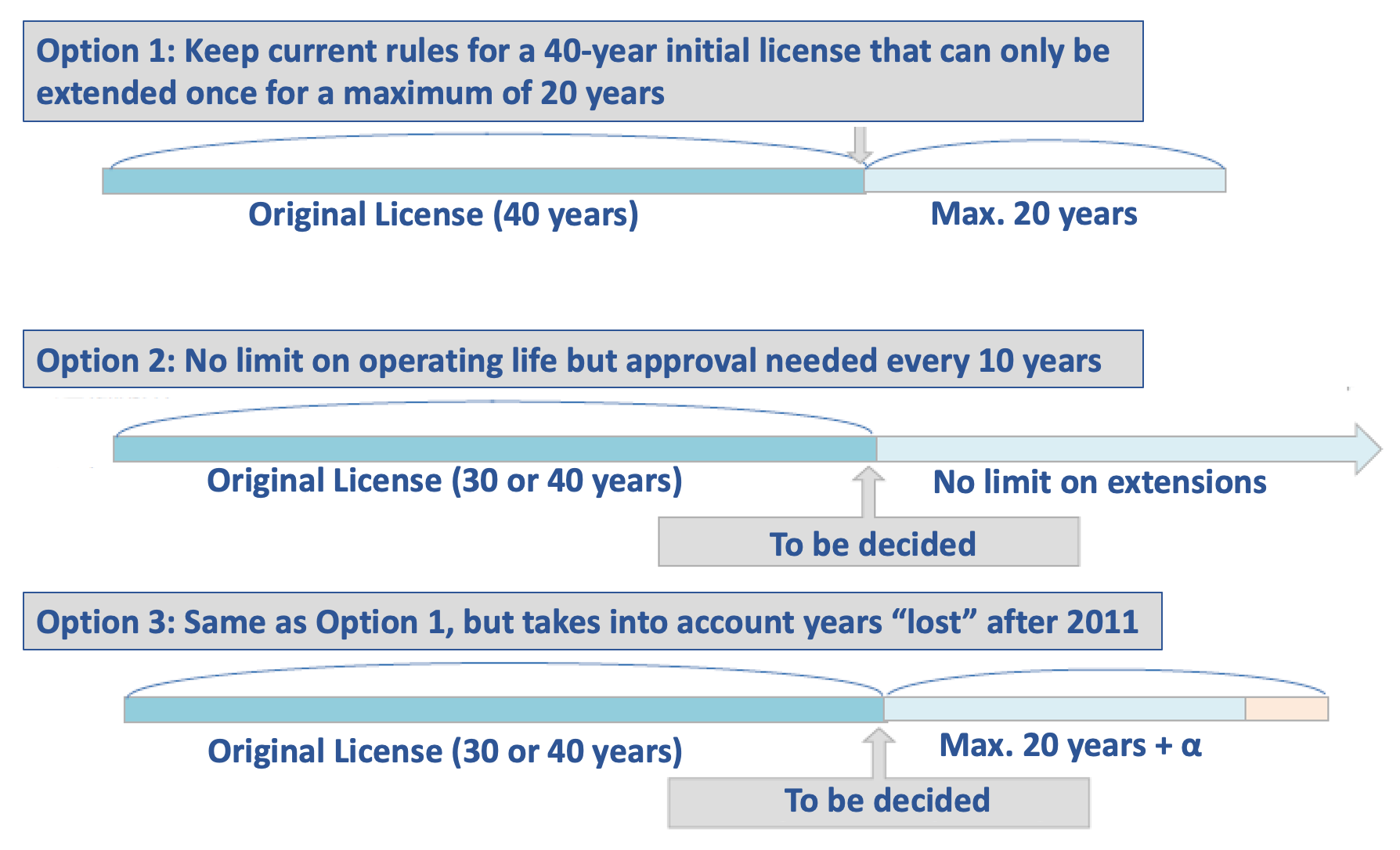
METI reviewed three options:
1) maintain the status quo (40 years, with one extension for a max of 20 years based on NRA approval).
2) a 30-year operational life followed by 10-year extensions, based on site and equipment inspections every decade. There’s no limit to reactor lifespan.
3) use option 1, but discount the years spent idle due to the Fukushima disaster. For example, a facility such as Kyushu Electric’s Sendai NPP, which was only offline for about four years after the Fukushima accident, would see its operating life capped at 64 years.
METI will decide the issue by the end of 2022.
TAKEAWAY: Readers may recall that a Sankei newspaper item about a week ago had announced that Option 2 of the above was already decided on by the NRA, the industry regulator. Technically, the regulator is independent of METI and reports directly to the Cabinet Office. But it does need to work in tandem with METI, and the ministry is after all the final decision maker in terms of policy. For now, METI is laying out the various options and waiting for feedback. The ministry used the meeting to reference other countries’ experience in the field, pitching the UK’s model (no final limit, but a review every 10 years) against the U.S. example (a finite life span split between an initial license and extensions).
The ministry could go with Option 2, but may decide that strategically Option 3 is better. The latter allows METI to avoid being accused of diluting rules for an industry that still splits the public mood. It also makes it more likely that new reactors will be built – if only to replace aged units. That’s important from the govt’s point of view since construction of new nuclear facilities can stimulate a broader industry revival. Both METI and PM Kishida’s office will be monitoring public opinions very carefully on this issue before announcing the final decision.
Source: METI
METI to support component suppliers instead of reactor suppliers
(Denki Shimbun, Nov. 11)
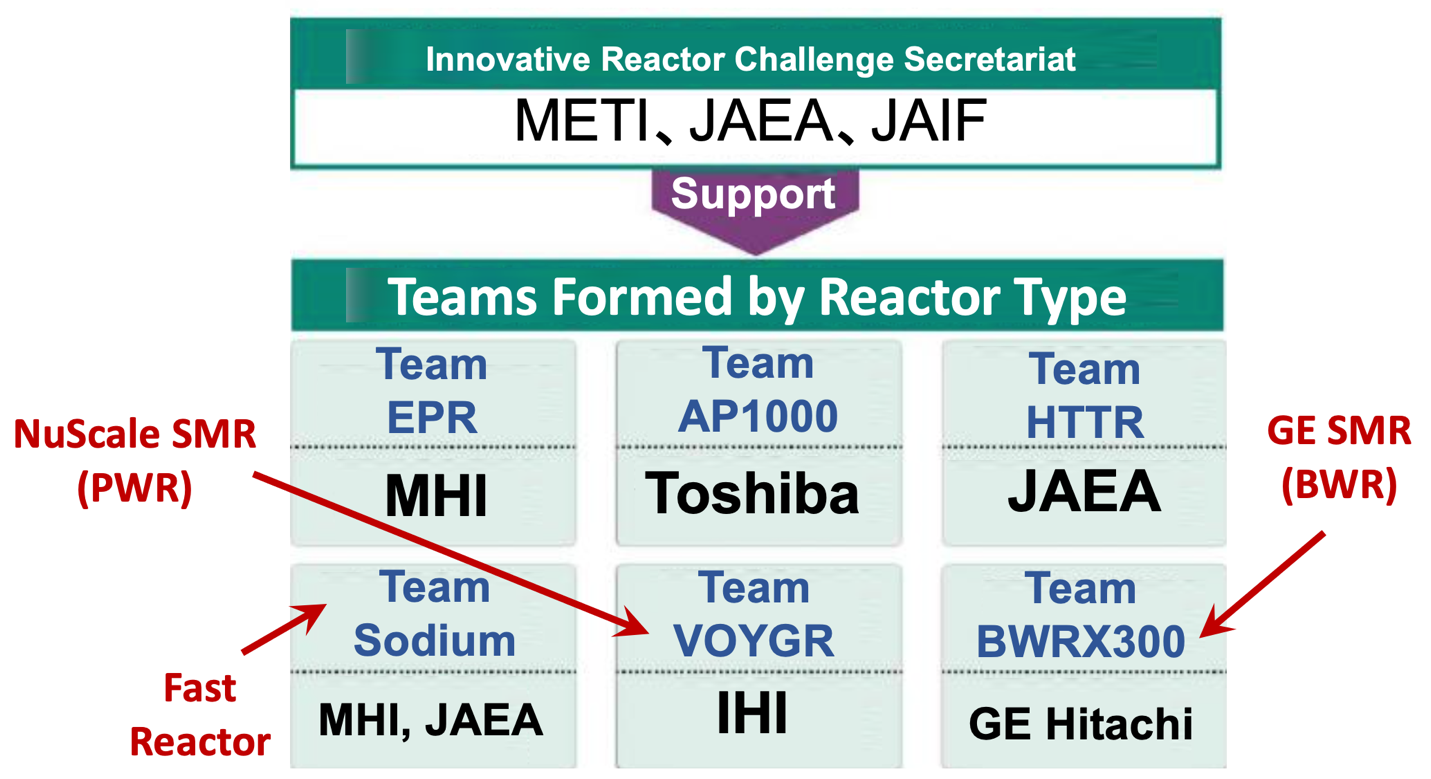
Instead of helping BWR / PWR reactor suppliers, METI’s Agency for Natural Resources and Energy (ANRE) will support component manufacturers for innovative reactors such as SMRs or HTTRs.
Groups will be set up with companies and research institutes according to reactor type, and an international marketing campaign will support Japanese-made components.
This is a major shift from METI’s policy to date which centered on supporting the top nuclear plant suppliers such as Toshiba, Hitachi, and MHI. Component makers that stand to benefit include IHI and JGC.
TAKEAWAY: For the first time since the Fukushima disaster, Japan has updated its nuclear policy to include building new NPPs and developing innovative reactors. But it will take a long time to start construction of new NPPs. In the meantime, this policy is one way to keep up with international competitors of innovative reactors.
METI’s new framework to support development of innovative reactors
Source: Denki Shimbun
MLIT forecasts SAF demand to grow six-fold from 2025 to 2030
(Japan NRG, Nov. 7)
A survey by the Ministry of Land, Infrastructure, Transport and Tourism (MLIT) airlines showed that demand for sustainable aviation fuel (SAF) will expand from 0.3 million kiloliters in 2025 to 1.71 million kl in 2030.
Airlines SAF demand forecast (million kl)
Domestic flights
International
Total
2025
0.22
0.08
0.3
2026
0.34
0.15
0.49
2027
0.54
0.38
0.92
2028
0.75
0.52
1.27
2029
0.82
0.67
1.49
2030
0.88
0.83
1.71
Source: MLIT
SIDE DEVELOPMENT: JGC and Cosmo set up a new firm to produce Japan’s first domestic SAF line (Company Statement, Nov. 8)
JGC Holdings, Cosmo Oil, and Revo International established a new company, Saffaire Sky Energy, to oversee the first domestic large-scale production of SAF (sustainable aviation fuel). The venture aims to supply approximately 30,000 kiloliters of SAF annually from 100% waste cooking oil in Japan.
Construction of the SAF production facility is due to begin in the summer of 2023 at Cosmo Oil’s Sakai Refinery (Sakai City, Osaka Prefecture), with completion seen by the end of 2024. Commercial operations will begin in the second half of 2024 or early 2025.
The facility will also produce bio-naphtha, a raw material for bioplastics, and biodiesel.
Japan looks to Thailand for bioethanol that doesn’t fuel food insecurity
(Asia Nikkei, Nov. 4)
Sumitomo Corp. trading house will back an ethanol project in Thailand that claims it will be the first in Asia not to impact food stocks. Sumitomo is working with Global Green Chemicals, a subsidiary of Thai petrochemical group PTT Global Chemical. The two wish to engage in commercial production of bioethanol made from bagasse, which is left over after sugarcane is crushed for its juice.
CONTEXT: Bioethanol is seen as a potential additive or even alternative to petroleum products for automobile fuel and aviation fuels. It can also be used as a raw material to manufacture plastic. Critics, however, say land used to grow crops for fuel eats into farmland available for food production.
Sumitomo’s Thai plant is expected to be built by 2025. Production volumes are not yet decided.
Sixth Japan-Saudi Vision 2030 ministerial meeting held in Tokyo
(Japan NRG, Nov. 8)
The sixth meeting in Tokyo was attended by senior METI and Foreign Ministry officials and the Saudi Minister of Investment Khalid Al-Falih. They called for expanding ties in areas ranging from energy to non-energy.
TAKEAWAY: Crown Prince Mohammed Bin Salman will visit Japan on Nov 19.
METI launches new panel on distributed energy systems
(Japan NRG, Nov. 7)
METI launched a new study group on next-gen distributed energy systems that will plan strategies that will make fuller use of EVs, storage batteries, residential rooftop solar and other systems closer to consumers.
The panel, headed by Professor Hayashi Yasuhiro of Waseda University, has 13 members consisting of scholars and officials from power grids and aggregators. The panel will hold four more meetings until March.
TAKEAWAY: The new panel is likely to propose the launch of a new “Distributed Power Source Market”.
SIDE DEVELOPMENT: METI, MoE to co-host Distributed Energy Platform conferences (Japan NRG, Nov. 10)
From December to March next year, METI and MoE will co-host Distributed Energy Platform, a series of conferences on clean energy issues.
Energy developments at local levels will be the key theme, and there’ll be sub-themes for each month: EV and power distribution for December; roles of municipalities and businesses for January, hydrogen and heat energy for February, and role models for community-based distributed energy systems for March. The events are open to the public.
The sign-up link is here.
TAKEAWAY: Economic divides among municipalities are growing more stark, as rural areas struggle to keep industries alive on the back of farms closing on higher fertilizer, animal feed and other costs. Plans to use livestock manure for biomass power have been abandoned.
ANRE proposes carbon storage licensing system
(Japan NRG, Nov. 8)
ANRE proposed a new licensing system for carbon storage operations. It will consist of a prospecting license and a storage license.
The licenses will be granted to Japanese citizens only.
Not more than two storage licenses will be issued in one area, which will cover 15 to 350 hectares.
A storage license will be in perpetuity, without time limits.
A prospecting license will be for four years and can be renewed only twice.
Govt to promote heat-insulating glass windows
(Japan NRG, Nov. 8)
The MoE, METI and MILT will promote use of heat-insulating window glass in homes to achieve 70% residential carbon reductions by 2030.
70% of Japanese homes do not have heat insulating windows.
The govt plans to subsidize up to half of the costs needed to replace windows.
TAKEAWAY: Low carbon houses need to find a balance with other housing requirements such as measures to protect against earthquakes, floods, typhoons and moisture endurance. Heat-insulating windows are heavy and if installed on the second floor could might cause issues for the bottom floor, such as making it difficult to open doors.
JX Nippon and 8 Rivers ally to accelerate hydrogen and power decarbonization
(Japan NRG, Nov. 9)
JX Nippon Oil & Gas Exploration Corp, a subsidiary of ENEOS, and 8 Rivers Capital (based in Durham, North Carolina) will collaborate globally on decarbonization of power and hydrogen generation.
The deal allows 8 Rivers to scale its clean energy business worldwide, leveraging JX’s global operations, expertise and decarbonization goals to accelerate deployment of zero-emissions power and hydrogen.
JX has several CCUS projects, such as a CO2 injection pilot test in Vietnam and the Petra Nova CCUS at a thermal power plant in Texas.
8 Rivers has pioneered clean hydrogen and ammonia technology. It’s also the inventor of a zero-carbon power generation system commercialized by NET Power, in which 8 Rivers is a co-owner.
Major Japanese energy companies to hold cleantech event in California on Nov 16
(Japan NRG, Nov. 12)
On Nov 16, the Plug and Play Tech Center in Silicon Valley, California will host some of Japan’s leading energy companies, including INPEX, Osaka Gas, ENEOS, Idemitsu, Chubu Electric, and Acario (Tokyo Gas).
The event’s goal is to inform cleantech startups about opportunities in Japan’s energy sector, and also to allow the startups to pitch their technologies.
Startups attending include Sinai Technologies, gigElev, TAE Technologies, Alpha Ring, and OCOchem.
The event is supported by NEDO and the Japan External Trade Organization.
NEWS:POWER MARKETSLaw amendments delaying plant shutdowns take effect
(Japan NRG, Nov. 7)
Power operators will have to consult METI before making decisions on the decommissioning of power capacities; this is effective Nov 14, and follows amendments to the Electricity Business Act earlier this year.
Operators will inform METI at least nine months before a planned decommissioning.
Also effective Nov. 14, the scope of JOGMEC will expand to cover CCS, hydrogen, ammonia, geophysical surveys for offshore wind projects, and it will make investments into domestic rare metal projects, as well as those overseas.
CONTEXT: Previously, power operators did not need METI authorization to close old plants. The new system aims to slow the dismantling of thermal power plants. Around 30 GW of such capacity will be taken offline, while 12 GW of new capacities will be brought online from 2021 to 2025, resulting in a net loss of 18 GW of thermal capacity.
TAKEAWAY: ANRE pointed out the need to help operators retain thermal plant staff and fuel procurement channels, in addition to the revised regulatory framework to slow decommissioning.
METI tightens regulations on FIT for renewables with output over 50 kW
(Denki Shimbun, Nov. 10)
The working group for sustainable energy use and coexistence with communities, which is under the auspices of METI’s Advisory Committee for Natural Resources and Energy, presented a plan to strengthen regulations for new renewable energy sites that have more than 50 kW capacity.
Under FIT law, renewables developers are “expected to make an effort” to explain their project to the community. However, as tensions between developers and communities increase, METI seeks tougher limits on new FIT projects.
Rooftop solar panels and installations less than 10 kW are not required to engage with the community. But those with more than 10 kW but less than 50 kW have to publicize their activity, other than hosting explanatory meetings.
Offshore wind areas to switch from FIT to FIP tariff system
(New Energy Business News, Nov. 8)
Public bids for the sea areas off Happo Town and Noshiro City, Akita Prefecture, were suspended in March due to changes in the offshore wind public bidding system. Under the previous schedule, it was assumed that FIT certification would be obtained in FY2023 and transition to the FIP system would be made in FY2024. Now, with public solicitation suspended, it is decided that the switch will be made directly to FIP.
A written survey was conducted on the status of participation in the public offering under the FIP system among the 9 companies that applied for information in the area. Of those, fours said they plan to participate and three said they would not. Some firms voiced concerns about the FIP system. Despite this, officials intend to allow only the FIP system.
In setting the upper supply price limit, the IRR will be set at 10%, the same as in the first public offering.
Onshore wind tender results announced by OCCTO
(New Energy Business News, Nov. 8)
On Nov. 4, OCCTO announced the results of the second bidding round for onshore wind power generation. Successful bids came in for about 1.29 GW of the 1.3 GW on offer.
The lowest bidder was Shiraishi Obara Onshore Wind Power LLC (Influx Corp.) with a bid for 79.8 MW at ¥14.80/ kWh. The weighted average bid price was ¥15.60/ kWh, and the highest bid was ¥16.00, which was also the cap.
The total number of successful bids was 30. Tokyu Land won the largest number of bids with seven. Also, Japan Renewable Energy won six projects, and Green Power Investment won two projects, including the largest single one with 151.2 MW of capacity.
On the same day, the results of the fifth round of bidding for biomass power were also announced, but there were no bidders.
Hitachi Energy develops world’s first SF6-free power grid gear
(Denki Shimbun, Nov. 11)
Hitachi Energy will provide the world’s first sulfur hexafluoride (SF6) free, 420t kV gas-insulated switchgear (GIS) technology and modular prefabricated grid connection solution. It will be installed at TenneT’s power grid in Germany, helping that grid operator to achieve carbon neutrality goals.
The innovative “EconiQ” 420 kV GIS uses a game-changing technology that eliminates SF6 with scalable solutions for the lowest possible carbon footprint.
CONTEXT: This installation will avoid nearly 2,300 kg of SF6, equivalent to removing CO2 emissions of 11,300 passenger vehicles per year.
TAKEAWAY: The U.S. EPA says SF6 is 22,800 times more effective at trapping infrared radiation than an equivalent amount of CO2 over a 100-year period. SF6 is also a very stable chemical, with an atmospheric lifetime of 3,200 years.
Hitachi Energy and Equinor join forces to accelerate grid upgrades, renewables
(Company statement, Nov. 8)
Hitachi Energy and Equinor will collaborate globally on electrification, renewable power generation and low-carbon initiatives.
The two will standardize base designs for high-voltage DC and AC transmission systems to connect offshore wind farms and Equinor’s production facilities to mainland power grids.
The agreement covers Hitachi Energy’s digital twin for high-voltage DC (HVDC) and power quality solutions.
TAKEAWAY: DC power transmission technology has been led by EU companies such as Siemens or ABB, but Hitachi is now taking the lead. As for other Japanese suppliers, the power transmission businesses of Toshiba and Mitsubishi Electric tried to unite, but the merger soon came undone. Hitachi has soared past both companies. Soon, this sector might be led by Hitachi and Chinese companies.
Ibaraki developer to operate 160 MW offshore wind project at local port
(New Energy Business News, Nov. 7)
Wind Power Energy, a developer based in Ibaraki Prefecture, was selected as the operator of a 160 MW offshore wind power project at the port of Kashima in the area.
The project area is approximately 11.7 km2 of which a little more than half will be used to install the turbines. Onshore construction will begin in November 2023, site work in July 2024, and operation in April 2026.
Influx plans 625 MW offshore wind farm in Shizuoka area
(New Energy Business News, Nov. 10)
Influx Corp. plans to develop an offshore wind farm off the coast of Hamamatsu City, Shizuoka Prefecture. The maximum capacity would be 625 MW.
The project area is approximately 21,107 ha, and a maximum of 66 turbines would be installed. Water depth is estimated between 20m and 200m, with the landing type foundation considered for the shallower areas, and a floating type design for depths of more than 50m.
Pacifico Energy plans 120 MW solar plant in Yamaguchi area
(New Energy Business News, Nov. 8)
Pacifico Energy filed an environmental impact report for a 120 MW solar power plant in Shunan City, Yamaguchi Prefecture.
The project area would span approximately 190.7 ha, of which 74.7 ha, or 39.17% of the total, will be covered by panels. The solar farm would occupy land that was formerly a golf course.
A maximum of 221,000 crystalline silicon solar panels will be installed, each with an output of 545 W. In addition, storage batteries will be installed.
Construction is scheduled to take 25 months, from October 2025 to November 2027. Commercial operation is planned to start at the end of December 2027.
Renewable Japan mulls entry into Italy’s solar market
(Company Statement, Nov. 2)
Renewable Japan Co. will review the potential to acquire rights to solar power projects in Italy. Initial review focuses on 8 MW of capacity. A decision will be made in the first half of 2023.
CONTEXT: The company currently has one overseas project, a 21.6 MW (Spain) solar power plant in operation that was acquired in September 2022.
NEWS:OIL, GAS & MINING
Energy companies report record profits
(Tokyo Shimbun, Nov. 10)
Idemitsu Kosan and Cosmo Energy Holdings reported record interim profits, the result of soaring global energy prices combined with a weak yen.
Idemitsu had a net profit of ¥281 billion through September, a 97% increase YoY; Cosmo reported a net profit of ¥95 billion, an 83% increase YoY.
Both also reported record turnover through September, as did ENEOS Holdings.
Chevron and JERA to produce fuel ammonia in Australia
(Company Statement, Nov. 8)
Chevron and JERA will explore co-development of fuel ammonia production in Australia. They’ll conduct a feasibility study to be completed in 2023.
As part of their focus across the hydrogen value chain – including production, export, and transportation – Chevron and JERA will also study liquid organic hydrogen carriers (LOHC) in the U.S.
Opinion: Gas stations want to be green but gas vehicles face bleak future
(Sekiyu Shimbun, Nov. 11)
CONTEXT: This is an opinion piece by the Sekiyu Shimbun (“Oil Newspaper”) editorial team.
Idemitsu Kosan unveiled its “Green Apollo station” — a gas station with a wooden roof. Idemitsu plans to open 30 such stations by 2025/26.
By 2035, the govt will require all vehicles sold to be either EV or hybrid. (In Tokyo Prefecture, the deadline is 2030.)
In the context of a future fleet that consists of hybrids, plug-in hybrids, fuel-cell vehicles, synthetic fuel vehicles, and purely electric cars, it remains to be seen if consumers will continue to support liquid fuels.
The liquid fuel vehicle market represents the sole avenue by which gas station operators can utilize their filling station infrastructure. What will happen to them as consumers transition to EVs?
SIDE DEVELOPMENT: October sales of imported EVs more than double (Japan Automobile Dealers Association data, Nov. 7)
Sales of imported EVs in October more than doubled to 1,416 units from last year’s 618. Total EV sales were 1,953, up 21.7% from 1,605 a year ago. EVs had 1.1% of total passenger vehicle sales.
Fuel cell vehicles logged 79 sales, up from 51 a year ago.
LNG stocks rise to 2.52 million tons
(Government data, Nov. 9)
LNG stocks of 10 power grids stood at 2.52 million tons as of Nov. 6, up from 2.5 million tons a week earlier. The end-November stocks last year were 2.16 million tons. The five-year average for this time of year is 1.95 million tons.
ENEOS apologizes for sexual harassment scandal, promises reform
(Nikkan Jidosha Shimbun, Nov. 11)
ENEOS Holdings CEO Saito Takeshi apologized for a sexual harassment scandal that saw his predecessor Sugimori Tsutomu stand down abruptly in August. Saito expressed anger at Sugimori’s failure to uphold the company’s high ethical standards.
ENEOS demanded Sugimori pay legal fees incurred by the company, and has withheld some of his compensation.
Saito announced new processes for appointing and dismissing company officers.
Odawara City govt forms green alliance with gas companies
(PR Times, Nov. 11)
Odawara City will work with Odawara Gas and Tokyo Gas on sustainability.
The three will collaborate on educating residents on green energy. Teams of experts will be dispatched to solve local energy challenges.
Odawara was selected as a model region to implement decarbonization initiatives under a government-backed plan.
ANALYSIS
BY CHRISTOPHER ROMANS FOUNDER JUPITER ADVISORS
New Opportunities in Japan’s Emerging Carbon Credit Markets
In late September, the Tokyo Stock Exchange (TSE) launched a trial run of Japan’s first nationwide carbon credit trading system. The mechanism, based around voluntary credits, is still quite new and trying to find the right balance between stringent application and optimal terms that will attract a wide swathe of corporates in Japan.
Even at this stage, however, one thing seems clear. The start of carbon trading in Japan will open up a number of opportunities for overseas companies.
As the world’s No. 3 economy, with a strong manufacturing base and deep pockets, Japan offers a highly attractive market. Unlike most of the 100-plus nations that announced net-zero pledges and ambitious targets to reduce emissions, Japan baked its commitments into law. Domestic companies are also major players in western tech supply chains and conscious of the stringent climate targets that they’ll need to adopt to retain their positions.
Currently, the potential to generate carbon credits in Japan is limited; a domestic-only focus for credits would make the TSE market too expensive and illiquid. This is why the government has signaled that over time carbon credits forged overseas must play a significant role on the TSE trading platform.
Should foreign companies and project developers be optimistic about accessing the Japanese market to sell their credits? In my view, the answer is yes, and the situation will only get better in time.
Background The trial phase of the TSE’s carbon trading platform is due to run until February 2023. The creation of this system is heavily supported by METI and is one of the core tenets of Prime Minister Kishida’s GX (Green Transformation) decarbonization vision.
Over 100 companies have agreed to participate in the trial, with over four times that number involved in the broader conversation around carbon trading market rules and practicalities. This pilot process is dubbed by METI officials as the GX League.
Bureaucrats hope that by keeping the trading voluntary and allowing the rulemaking discussions to be led by corporates and civil society, the outcome will be acceptable to private companies, which have traditionally rejected carbon credits as a burden on their business.
If the pilot project wins a sufficient response, then a full carbon credit trading system may launch in April 2023.
Reasons for optimism This situation is positive not only for Japan but also for businesses outside the country that could offer carbon credits in Tokyo. There are three key reasons to believe this will happen.
1) Many leading technology firms insist on decarbonizing supply chains. Apple is perhaps the most aggressive, with a commitment to carbon neutrality in its supply chain by 2030. Many of Apple’s components are made in Japan and those producers will have to demonstrate compliance. Apple is not alone, though. Other tech titans such as Microsoft, Google, and Facebook are similarly committed to squeezing CO2 out of their respective supply chains.
2) Next, there’s an increase in the imposition of carbon border adjustments by major economies. The largest so far is the European Union, which is implementing a mechanism that will likely take effect in 2026. Canada is studying such a mechanism and the U.S. considered it briefly as part of a larger tax code reform. The EU plan probably won’t be realized without other major economies implementing such mechanisms.
3) Japan’s voluntary carbon market won’t stay voluntary forever. The government, as a matter of policy, tends not to rush head first into policy shifts that have major implications for the economy. Rather, it prefers a slow and methodical approach, such as the introduction of a voluntary plan. A similar approach was taken with corporate governance reforms.
With the carbon trial for the TSE, METI seeks to understand that this mechanism really works, that companies want to use it, and that it’s effective before a mandated economy-wide rollout is given the green light.
Details to consider Given this outlook, what considerations should foreign companies and project developers think about when looking at selling their offsets in Japan? Three key points can be helpful.
First, know the methodology. Currently, credits sold on the TSE conform to methodologies outlined in the domestic J-Credit system, which is Japan’s oldest local carbon credit mechanism. As you design a project, you must understand how it will score under these metrics and not simply those outlined by prominent western groups such as the American Carbon Registry. The various carbon credit systems are not necessarily complementary. Integrating the J-Credit analysis paradigm into project design at an early stage is crucial to success.
Second, know the kinds of credits that companies want. These instruments come in a huge variety that relates to how the CO2 was offset or the carbon benefit was generated or validated. It’s crucial to be familiar with the types of credits that Japanese firms want to procure to meet customer demand. Also, it’s vital to know what types of credits trade the most. It’s not worth listing on the TSE only to find out that your particular flavor of credit does not hold appeal or value for the market.
Finally, build awareness. There will come a time when demand for credits will be sufficiently high such that simply listing on the TSE will be enough to attract dealmaking. Until then, developers should invest time into building awareness of their activities among potential buyers. Japanese firms are unlikely to risk purchasing a credit that they don’t fully understand when there are domestic alternatives that they have successfully used in the past. Therefore, it’s necessary to engage potential buyers on the nature and quality of a new credit so they can make informed purchasing decisions.
The expansion of carbon trading onto the TSE is an exciting opportunity to access a large and increasingly willing pool of capital. This will drive a host of decarbonization projects globally and raise efforts in Japan to cut local emissions. With careful analysis, engagement, and execution, non-Japanese project developers can find success in helping Japan meet its ambitious 2050 goals.
Christopher Romans is the Founder & Principal Advisor at Jupiter Advisors, which helps firms unlock business opportunities in Japan. Prior to Jupiter he oversaw external government relations at Mitsubishi Heavy Industries America and was a Foreign Service Officer at the U.S. Department of State.
COLUMN: ENERGY JOBS IN JAPAN
BY ARTHUR (RIKU) OGAWA
Diversity vs. Uniformity: An Honest Conversation
In highly-diverse societies such as the United States or Europe, talk of “diversity” in the labor force has been around for a long time. In Japan, the issue is rather different, to put it mildly.
Diversity is certainly not the strongest aspect of Japan’s labor market. There is a long history of local tradition, work culture and institutions that have inhibited the shift from a uniform working class to one that is more diverse.
You will notice a certain dispersion in the male – female, or foreigner – Japanese, employee ratio for various sectors of the economy. What you see in the construction industry will obviously contrast with the apparel sector; while the taxi business will exhibit a stark contrast compared to the hospitality sector.
If we put aside the recent upheavals caused by Covid-19, then we noticed that over the past decade various sectors of Japan’s economy have clearly exhibited a tendency towards more diversity. Today, there are many more young leaders, female employees, foreign nationals, as well as gender identity individuals working than just a few years ago.
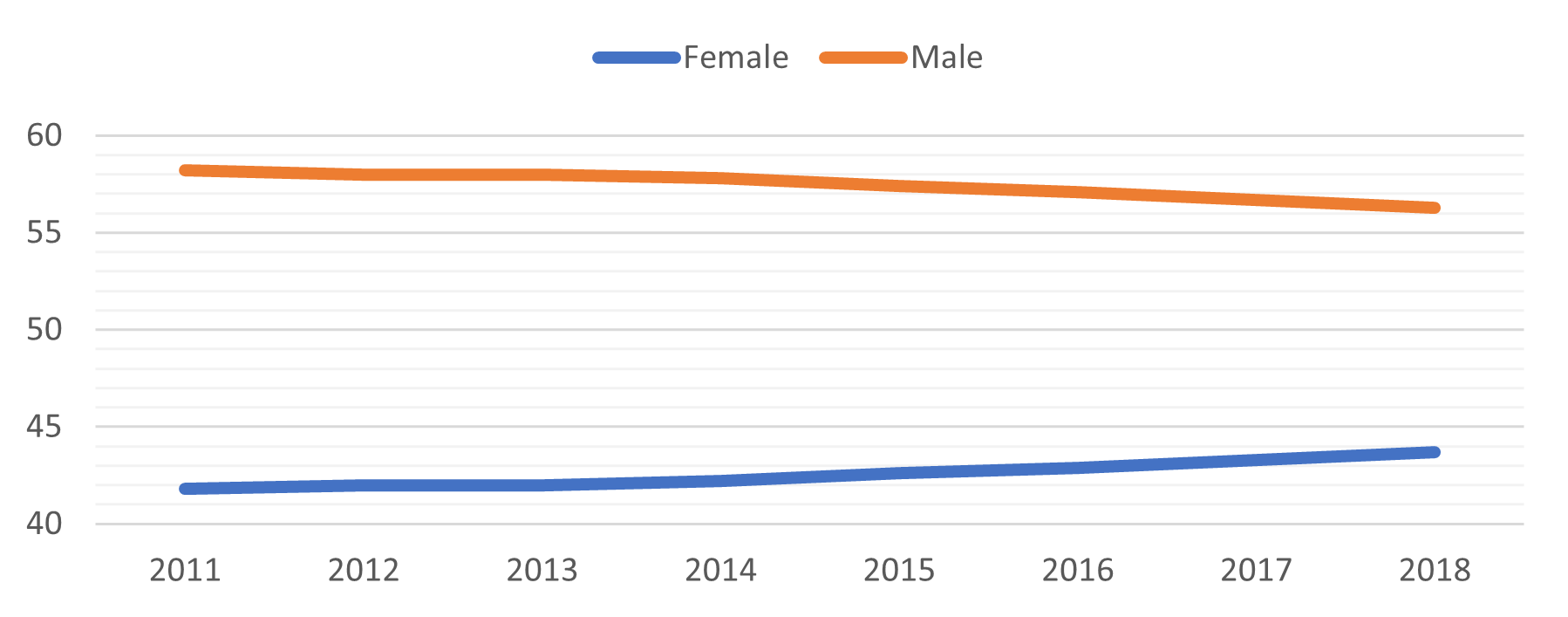
The problem, however, is that (as demonstrated in the graph below) this process is proceeding at a glacial pace and the situation is still far from ideal.
Percentage in the Labor Force
Source: Ministry of Health, Labour and Welfare report (2018)
Japan’s energy market and, particularly, the renewable energy sector, is not an exception. According to official statistics, females make up just 14.3% of the labor force in the electricity, gas, heat supply and water sectors (as of 2019). In such sectors, the difference in diversity from company to company becomes even more conspicuous.
Less diverse and agile organizations risk being labeled as maru-dome, which signifies that they are “too domestic”, “old fashioned” and dominated by overly conservative, male-only leaders. Recruitment agencies hear such descriptions from their network of candidates on a daily basis.
Here are a few case studies that are indicative of the changing and challenging labor market in terms of diversity and perceptions. Recently, Company A invited a young female candidate to the first, supposedly “casual” interview. The lady met with 3 interviewers, all male, in their late 40s-early 50s. They posed a list of classic, official interview questions, while providing very little information from their side.
Not surprisingly, the candidate left with the impression that Company A has a very traditional work culture, which means it is a male dominant, hierarchy-based organization, where staff are expected to remain until retirement.
Another example involves a company where HR by default required three resumes: a short and an extended version of the Japanese resume, plus an English one. This is despite the fact that the hiring manager is a fluent English speaker and competing companies only require an English resume for the same position. It’s common to see some excellent candidates lose interest based on that requirement alone. If the job application process is so rigid and traditional, what are the chances the rest of the company’s processes are modern and efficient?
Corporate culture is hard to change without inspiring role models. To attract such caliber of talent, however, requires a willingness to do things differently, overcoming entrenches attitudes and thought patterns.
Despite some underlying risks, a diverse and inclusive environment helps create a more healthy, efficient, and hence, competitive business. Companies that fail to do so, not only miss out on abstract benefits, but often risk getting hit by a very tangible loss.
So, what can business do about it?
Since every organization is different, there’s no magic solution. However, as a first step you can definitely raise awareness internally and encourage employees’ attention to the issue of diversity. Perhaps some companies can clearly state internally or externally that they have goals to reach a certain level of females or young people within their leadership teams. Others might promote workshops for their employees or hold “awareness weeks”.
Hire or nurture your own role models! You can either hire externally or empower someone internally. For example, one of the global energy companies that’s long been established in Japan only had Japanese men in its leadership team. But this company was very glad to find an overseas born female leader to join their team. She became a role model for other, more junior, female employees in the organization. Meanwhile, another company approached this matter by promoting internally a young, energetic and prominent employee.
Set a clear goal and move forward withsmall steps. Diversity doesn’t happen in a day and requires long-term commitment to the goal and effort. We’ve seen some companies set up a system in which at least one of their three job interviewers are female. Similar targets can be set for gender diversity of candidates called up for the first interview. Still other companies have created quotas for underrepresented groups of employees to make them more visible and more likely to seize their opportunity to shine.
Slowly but surely, diversity is winning over the “old ways”. But as far as Japan is concerned, a lot more work can and needs to be done. The benefits of change are sure to follow.
GLOBAL VIEW
BY JOHN VAROLI
Below are some of last week’s most important international energy developments monitored by the Japan NRG team because of their potential to impact energy supply and demand, as well as prices. We see the following as relevant to Japanese and international energy investors.
COP27/ US U.S. Climate envoy John Kerry tells the COP27 UN climate conference in Egypt that his country is ready to discuss “loss and damage” issues (i.e. consequences of human-induced climate change and reparations to countries that have suffered from the impact).
Africa/ Climate change and natural gas
At the G20 in Bali, Senegal President Macky Sall, who holds the chairmanship of the African Union, will push for rich nations to fulfil annual pledges of $100 billion to combat climate change. He’ll also promote the idea of natural gas as a transition fuel. Senegal will become a gas producer next year.
Australia/ Energy takeover
Brookfield Asset Management and EIG Global Energy Partners will take over one of Australia’s largest energy companies, Origin Energy, a LNG developer. The A$18.4 billion deal has been called a “once in a generation” opportunity.
Bahrain/ Natural gas
Bahrain made two natural gas discoveries, but their size isn’t yet clear. The two unconventional gas reservoirs are located under the existing onshore gas-producing fields of Al-Khuf and Al-Onaiza.
Egypt/ Wind power
The UAE’s leading energy company, Masdar, signed an MoU with Infinity Power and Hassan Allam Utilities to develop 10 GW of wind power. The project is part of Egypt’s Green Corridor initiative and will contribute to renewable energy making up 42% of the national energy mix by 2035.
Germany/ Coal power
A coal-fired power plant in North Rhine-Westphalia that was expected to close in December will keep running to provide energy for companies on the site. The power plant is owned by Evonik, one of Germany’s largest chemical companies.
India/ LNG purchases
Industrial customers are buying less LNG due to high prices and seek alternatives. Storage tanks at Dahej and Hazira LNG import terminals are near maximum capacity and scheduled deliveries may need to be delayed.
Netherlands/ Offshore wind power
RWE will build a 700 MW offshore wind farm in the North Sea. The project won’t get subsidies on the energy produced. The wind farm will be operational by 2026 and will provide around 6% of Dutch electricity consumption.
Russia/ LNG sales
Russian LNG suppliers are selling cargoes in Asia at close to spot market prices, indicating that fears of sanctions on Russia’s exports have lessened. Earlier this year, buyers in Asia purchased LNG from Russia at steep discounts amid concerns about potential sanctions.
Spain/ Energy transition
Iberdrola will invest €47 billion in electricity networks and renewable energy production over the next two years. Half will go to networks in Britain, Brazil, Spain and the U.S. Since 2020, the company has invested €30 billion, and a further €65-75 billion is planned for 2026 to 2030.
Turkey/ Renewable energy
International Holding Co acquired a 50% stake in Kalyon Enerji for $490 million. The deal includes solar power projects in the Karapınar and Gaziantep regions and a wind farm in Ankara. The deal is one of IHC’s largest renewables acquisitions ever.
UK/ Qatar/ LNG expansion
Qatar Energy and ExxonMobil are investing heavily to boost capacity at their South Hook LNG terminal in Milford Haven (Wales). The import terminal will be modernized to allow it to handle about 25% more imported LNG.
2022 EVENTS CALENDAR
A selection of domestic and international events we believe will have an impact on Japanese energy
January
OPEC quarterly meeting;
JCCP Petroleum Conference – Tokyo;
EU Taxonomy Climate Delegated Act activates;
Regional Comprehensive Economic Partnership (RCEP) Trade Agreement that includes ASEAN countries, China and Japan activates;
Indonesia to temporarily ban coal exports for one month;
Regional bloc developments: Cambodia assumes presidency of ASEAN; Thailand assumes presidency of APEC; Germany assumes presidency of G7; France assumes presidency of EU; Indonesia assumes presidency of G20; and Senegal assumes presidency of African Union;
Japan-U.S. two-plus-two meeting;
Japan’s parliament convenes on Jan. 17 for 150 days;
Prime Minister Kishida visits Australia (tentative)
February
Chinese New Year (Jan. 31 to Feb. 6);
Beijing Winter Olympics;
South Korea joins RCEP trade agreement
March
Renewable Energy Institute annual conference;
Smart Energy Week – Tokyo;
Japan Atomic Industrial Forum annual conference – Tokyo;
World Hydrogen Summit – Netherlands;
EU New strategy on international energy engagement published;
End of 2021/22 Japanese Fiscal Year;
South Korean presidential election
April
Japan Energy Summit – Tokyo;
MARPOL Convention on Emissions reductions for containerships and LNG carriers activates;
Japan Feed-in-Premium system commences as Energy Resilience Act takes effect;
Launch of Prime Section of Japan Stock Exchange with TFCD climate reporting requirement;
Convention on Biological Diversity Conference for post-2020 biodiversity framework – China;
Elections: French presidential election; Hungarian general election
May
World Natural Gas Conference WCG2022 – South Korea;
Elections: Australian general election; Philippines general and presidential elections
Germany to eliminate nuclear power from energy mix;
Happo-Noshiro offshore wind project auction result released;
Japan submits revised 2030 CO2 reduction goal following Glasgow’s COP26;
Japan-Canada Annual Energy Forum (tentative);
Tesla expected to achieve 1.3 million EV deliveries for full year 2022
Disclaimer
This communication has been prepared for information purposes only, is confidential and may be legally privileged. This is a subscription-only service and is directed at those who have expressly asked K.K. Yuri Group or one of its representatives to be added to the mailing list. This document may not be onwardly circulated or reproduced without prior written consent from Yuri Group, which retains all copyright to the content of this report.
Yuri Group is not registered as an investment advisor in any jurisdiction. Our research and all the content express our opinions, which are generally based on available public information, field studies and own analysis. Content is limited to general comment upon general political, economic and market issues, asset classes and types of investments. The report and all of its content does not constitute a recommendation or solicitation to buy, sell, subscribe for or underwrite any product or physical commodity, or a financial instrument.
The information contained in this report is obtained from sources believed to be reliable and in good faith. No representation or warranty is made that it is accurate or complete. Opinions and views expressed are subject to change without notice, as are prices and availability, which are indicative only. There is no obligation to notify recipients of any changes to this data or to do so in the future. No responsibility is accepted for the use of or reliance on the information provided. In no circumstances will Yuri Group be liable for any indirect or direct loss, or consequential loss or damages arising from the use of, any inability to use, or any inaccuracy in the information.
K.K. Yuri Group: Oonoya Building 8F, Yotsuya 1-18, Shinjuku-ku, Tokyo, Japan, 160-0004.
NEWS
・Japan among nations to offer Indonesia $20 bn to decrease coal generation and shift to cleaner energy sources
・Officials review rule changes to improve renewable development that doesn’t conflict with local community issues
・Japanese oil refineries post record interim profits thanks to high energy prices and a weak yen