
JAPAN NRG WEEKLY
NOV. 21, 2022
JAPAN NRG WEEKLY
Nov. 21, 2022
NEWS
TOP
- METI proposes extending trial phase of carbon credit trading, saying more time is needed to prepare industry
- Japan needs standard to define “low carbon hydrogen”, says association, citing overseas examples
- Close to 8 GW of solar capacity may lose license by spring as the govt enforces new rules that encourage prompt construction
ENERGY TRANSITION & POLICY
- Japan’s package for ‘loss and damage’ centers on warning system
- Chemical sector outlines hydrogen volumes it needs to go green
- Mitsui asks for government support to develop blue ammonia
- JOGMEC and INPEX to demo clean hydrogen with CCU in Japan; also, JOGMEC revises its name to specify energy security role
- Govt wants large cargo consignors to file 2030 net-zero targets
- Euglena and Tokyo govt to promote use of biofuels
- Japan strengthens green ties with loans for Indonesia at G20
- Hitachi Zosen plans to test NAS storage battery in the Maldives
ELECTRICITY MARKETS
- PPA-based, roof-mounted solar takes off in Kyushu areas
- Retailers up prices for households selling surplus solar energy
- Cosmo Energy offers EV leases bundled with green electricity
- Mitsubishi Clean Energy CEO takes lessons from Europe on FIP
- Tokyo Gas-led group interested in Akita offshore wind project
- Mitsui and partners plan Niigata area offshore wind development
- Sumitomo to build one of Egypt’s biggest wind farms
- Toshiba mulls Kansai Electric tie-up for battery storage business
OIL, GAS & MINING
- Record orders for LNG tankers on concerns about Russian gas
- Japan and Thailand establish mutual LNG exchange pact
- Idemitsu makes successful takeover of TOA Oil
- October coal imports fall, while LNG and oil volumes rise
ANALYSIS
A CASE STUDY IN LOCAL ENERGY:
ONE TOWN’S FAILED DREAMS OF BIOMASS
Over the past decade Japan has vigorously promoted biomass energy as a clean and renewable form of energy. But since the start of the war in Ukraine this goal has acquired added urgency. If all goes according to plan, Japan hopes it will be able to replace Russian crude oil imports, which pre-war met approximately 4% of the nation’s needs, with biomass energy. Obstacles abound, however, and there’s reason to be uncertain that these goals can be met.
We look at the experience of one town in rural Japan and why its ambitions in biomass have so far struggled to yield fruit.
CAN JAPAN’S SOLAR BOOM BE REVIVED?
THE SHIFT TO SMALLER, SUBSIDY-FREE PROJECTS
Japan’s solar industry enjoyed stellar development in the early part of last decade thanks to a state program to buy renewable power at a premium and a supply chain built around domestic companies with world-leading technologies. All that helped to strongly boost solar capacity within a decade and make Japan the third-largest solar market behind China and the U.S. Over the last year, however, the vibrant pace of development has slowed, even as the government made a further doubling of nationwide solar capacity by 2030 the bedrock of its decarbonization strategy. What needs to happen to revive the boom?
GLOBAL VIEW
COP27 concludes, accepting calls for the creation of a “loss and damage” fund. General Motors says EV business to turn a profit in 2025. Key U.S. LNG player delays restart of exports. IEA expects Russian oil output to fall. France to allocate more cash to nuclear plant maintenance. Details on these and more in our global wrap.
JAPAN NRG WEEKLY
PUBLISHER
K. K. Yuri Group
Events
Editorial Team
Yuriy Humber (Editor-in-Chief)
John Varoli (Senior Editor, Americas)
Mayumi Watanabe (Japan)
Yoshihisa Ohno (Japan)
Wilfried Goossens (Events, global)
Regular Contributors
Chisaki Watanabe (Japan)
Takehiro Masutomo (Japan)
Art & Design
22 Graphics Inc.
SUBSCRIPTIONS & ADVERTISING
Japan NRG offers individual, corporate and academic subscription plans. Basic details are our website or write to subscriptions@japan-nrg.com
For marketing, advertising, or collaboration opportunities, contact sales@japan-nrg.com For all other inquiries, write to info@japan-nrg.com
OFTEN USED ACRONYMS
| METI | The Ministry of Energy, Trade and Industry | mmbtu | Million British Thermal Units | |
| MOE | Ministry of Environment | mb/d | Million barrels per day | |
| ANRE | Agency for Natural Resources and Energy | mtoe | Million Tons of Oil Equivalent | |
| NEDO | New Energy and Industrial Technology Development Organization | kWh | Kilowatt hours (electricity generation volume) | |
| TEPCO | Tokyo Electric Power Company | FIT | Feed-in Tariff | |
| KEPCO | Kansai Electric Power Company | FIP | Feed-in Premium | |
| EPCO | Electric Power Company | SAF | Sustainable Aviation Fuel | |
| JCC | Japan Crude Cocktail | NPP | Nuclear power plant | |
| JKM | Japan Korea Market, the Platt’s LNG benchmark | JOGMEC | Japan Organization for Metals and Energy Security | |
| CCUS | Carbon Capture, Utilization and Storage | |||
| OCCTO | Organization for Cross-regional Coordination of Transmission Operators | |||
| NRA | Nuclear Regulation Authority | |||
| GX | Green Transformation |
NEWS: ENERGY TRANSITION & POLICY

MoE unveils aid package for loss and damage from climate change
(Government statement, Nov. 20)
- At COP27 the Environment Minister announced Japan’s aid program to help reduce loss and damage from climate change.
- The program includes disaster preparedness, relief and risk insurance, forecasting tools, best practices and other knowledge sharing.
- Rather than offering new financing schemes, the ministry offered to set up an early warning system through a public-private partnership. The system would work with the UN’s existing early warning system initiative, MoE said.
TAKEAWAY: The UN Climate Conference has just concluded with a tentative agreement reached between developed and emerging economies, as noted in our Global Wrap. That agreement is largely about new financial assistance to developing nations affected by climate change. In contrast, Japan’s offer in regards to “loss and damage”, published earlier on in COP27, was largely discussing existing programs and new systems that will be built by Japanese firms.
METI proposes extension of “trial phase of carbon pricing”
(Japan NRG, Nov. 14)
- METI proposed to the panels for green transformation and carbon neutral energy to extend the trial phase of carbon pricing because industries aren’t ready for full launch. “Carbon pricing may have negative impacts on our economy without an understanding on how it impacts Japanese competitiveness,” METI said.
- METI suggested 2026, the year after the UN review of National Determined Contributions of each country, as the new timeframe for full introduction of carbon pricing, which will combine an emission trading plan and other measures.
- MoE told the panelists that the carbon tax, which METI opposes, is still an option.
- CONTEXT: PM Kishida’s government has said that Japan needs ¥150 trillion in investments this decade to decarbonize, which is larger than the ¥140 trillion plan set out by the European Union.
TAKEAWAY: Originally, the carbon trading that started in trial mode on the Tokyo Stock Exchange was supposed to be fully operational in April 2023. This was always an overly ambitious target, driven more likely by political considerations. Japan is due to host the G7 next year and PM Kishida likely wanted to announce that the country has successfully set up a carbon trading system that will drive decarbonization. However, a delay to the original timeline was evident a few weeks ago after the latest meeting of the GX panel chaired by PM Kishida. That meeting called for FY2026 as the deadline for the creation of “full-fledged trading” of carbon credits in Japan.
It’s clear that carbon trading as it stands at the moment is too disorderly to be rolled out on a broader scale. At worst, a quick national rollout would debilitate businesses and cause a pushback against the instrument. One of the challenges today is how to integrate the different types of credits. While each represents one ton of CO2 equivalent, the sector and efforts made to cut that ton of emissions vary wildly. To find some form of common ground, METI is joining forces with the MoE and the Ministry of Agriculture, Forestry and Fisheries to design a hybrid carbon pricing system that combines an emissions trading scheme and payment charges.
Japan Hydrogen Association proposes “low carbon hydrogen” standard
(Japan NRG, Nov. 16)
- Since hydrogen of various colors have emerged, the Japan Hydrogen Association (JH2A) proposed to METI a standard for “low carbon hydrogen”.
- Low carbon hydrogen will emit less than 3.4 kg of carbon/ kg, and its carbon value represents emissions from well-to-gate, covering Scope 1 and 2, and some aspects of Scope 3 emissions.
- JH2A plans a review after five years to reflect technological advances.
TAKEAWAY: This standard is in line with the EU’s Renewable Energy Directive. Aligning with the JH2A moves, the Clean Fuel Ammonia Association (Japan) plans to revise its low-carbon ammonia standard, which stands at 0.84 ton of CO2/ ton of ammonia and applies to gate-to-gate release.
International “low carbon hydrogen” standards
| EU Renewable energy directive | 3.4 kg CO2/kg |
| EU Taxonomy for sustainable finance | 3 kg CO2/kg |
| UK low carbon hydrogen standard | 2.4 kg CO2/kg |
| U.S. Inflation Reduction Act, clean hydrogen production standard | 0-4 kg CO2/kg |
Chemical sector needs 3.5m tons/ year of hydrogen to go green
(Japan NRG, Nov. 16)
- The chemical sector needs between 3.5 to 4.6 million tons/ year of hydrogen for its fossil fuel sources to be completely replaced by the molecule, the Japan Chemical Industry Association told METI panels on hydrogen and ammonia.
- 4.6 million tons of hydrogen is required if ethylene production remains at around 6 million tons/ year, and 3.5 million tons needed if output was cut by 25%.
- 22-29 million tons/ year of ammonia is needed for it to replace fossil fuels.
- CONTEXT: The sector consumes over 6 million tons/ year of coal, 3.8 million kiloliters of oil and 3.8 bcm of gas.
TAKEAWAY: The Association said its survey of chemical companies showed investment to drive carbon neutrality will amount to ¥9.7 trillion, more than its previous ¥7.4 trillion forecast, and almost at par with the investment required by the steel sector.
Mitsui asks for government involvement to support blue ammonia
(Japan NRG, Nov. 16)
- Mitsui, Japan’s largest ammonia supplier with a 60% market share, told METI panels on hydrogen and ammonia policies that government involvement is required in three areas to propel building of blue ammonia supply chains.
- Mitsui proposes a first-movers support program to drive new projects, financial support to suppliers to meet consumers’ price requirements, and active JOGMEC involvement to discover new CCUS sites.
TAKEAWAY: METI plans to support an international ammonia and hydrogen supply chain, but it noted that different support programs are required for building them locally. On reference price points to provide subsidies, METI proposes using the coal price as a reference for ammonia and the LNG price for hydrogen, due to a lack of established benchmarks. This may drive reporting agencies Argus, S&P among others to engage closer with the hydrogen and ammonia communities, to spread their pricing data.
JOGMEC and INPEX to demo clean hydrogen and ammonia with CCU in Niigata
(Company statement, Nov. 15)
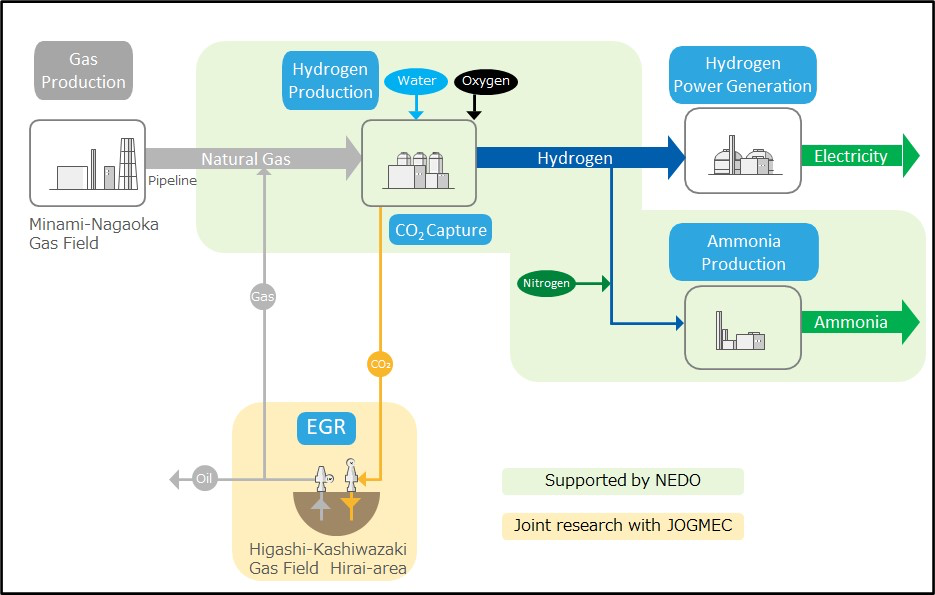
- JOGMEC and INPEX began a demo in Kashiwazaki-city, Niigata Prefecture, to produce clean hydrogen and ammonia, along with CO2 storage and utilization.
- The gas from INPEX’s field in Minami-Nagaoka is sent to the Hirai area in the Higashi-Kashiwazaki gas field, and is used to produce hydrogen and ammonia.
- The CO2 from the production process will be separated, captured, and injected into a depleted gas reservoir in the Hirai area.
- SIDE DEVELOPMENT:JOGMEC updates name to include energy security dimension(Company Statement, Nov. 14)
-
- Old name: Japan Oil, Gas, and Metals Corporation
- New name: Japan Organization for Metals and Energy Security
- Change reflects the state company’s greater role in procuring energy for Japan through added responsibilities in geological surveys for offshore wind development, investments in hydrogen, fuel ammonia, and carbon capture and storage, and domestic processing of rare metals.
Clean hydrogen and ammonia production at Kashiwazaki City
Source: INPEX
(Government statement, Nov. 14)
- The MoE and UAE’s Ministry of Climate Change and Environment signed an agreement on climate change, air quality management, waste management, biodiversity, and other areas of environmental protection.
- CONTEXT: A consortium led by Itochu is building a 194 MW power plant in Dubai that will be fueled by household and industrial waste generated in the city.
METI wants large cargo consignors to file 2030 decarbonization goals
(Japan NRG, Nov. 16)
- METI plans to ask cargo consignors that shipped over 30 million tons in 2021 to file their 2030 decarbonization goals and report on progress annually from 2024.
- The goals will include the target percentage share of “non-fossil fuel vehicles” used to transport cargoes and installation of charging stations on their premises.
- Details of biofuel and efuel vehicles will be discussed separately.
- CONTEXT: The national goal is to introduce 5,000 large electrified trucks in the 2020’s, and 150,000 EV charging stations and 1,000 FCV charging stations by 2030.
TAKEAWAY: “Non-fossil fuel vehicles” is a new concept that comprises EV, FCV, PHEV, but also biofuel and synthetic efuel vehicles, which are different from the former in that they are not primarily based on battery power. Discussions continue on whether to include HV (hybrid vehicles) among the non-fossil fuel transport.
Vehicle classifications
| Electrified vehicles | EV, FCV, PHEV, HV |
| Non-fossil fuel vehicles | EV, FCV, PHEV, biofuel/synthetic efuel vehicles, HV (?) |
Vehicle decarbonization goals
| Vehicles less than 8 tons | Trucks over 8 tons | |
| 2030 | Electrified vehicles share of new car sales at 20-30% | 5,000 electrified vehicles |
| 2040 | All new car sales will be either electrified or non-fossil fuel vehicles | To be set in 2030 |
LDP asks GX Council not to uniformly limit lifetime of nuclear reactors
(Denki Shimbun, Nov. 16)
- An LDP parliamentary group to promote sustainable power supply submitted a suggestion to the GX Implementation Council to make the replacement and construction of next-gen reactors a matter of national nuclear policy.
- They are against a uniform limit of 40 or 60 years for all reactors, and want to decide each individually. The group said the uniform limit was “non-scientific”.
Euglena and Tokyo govt to promote the use of biofuels
(Corporate statement, Nov. 18)
- Euglena signed a contract with the Tokyo Metropolitan govt on a biofuel promotion project.
- Tokyo is promoting the reduction of electricity consumption, and to generate electricity at home, as well as to store electricity.
- Euglena uses their biofuel “SUSTEO” as an alternative for fossil oil in various cars, and also began a public awareness campaign for biofuel.
- SIDE DEVELOPMENT:
Euglena supplied SAF for PM Kishida’s airplane
(Alterna, Nov. 15)- Euglena provided its SAF product, “SUSTEO”, for two government aircraft, the first case in Japan.
- The planes flew PM Kishida to the ASEAN Summit in Phnom Penh, the G20 Paris Summit in Bali, and to the APEC Summit in Bangkok.
Japan strengthens green ties with Indonesia at G20
(Various sources, Nov. 15)
- Japan agreed to provide loans of up to $500 million to help Indonesia introduce more renewable energy and expand its power grid. This was announced after a meeting between PM Kishida and President Joko Widodo.
- The accord is part of Kishida’s Asia Zero Emission Community program that allies Japan’s net-zero pathways with those of other Asian countries.
- The cooperation with Indonesia spans solar, wind, hydrogen and ammonia, and is seen as helping Japanese companies export their related tech to the Southeast Asian country.
- CONTEXT: Indonesia considers stopping new coal power plant construction from around 2025.
Mitsui plans to find sites for carbon storage in Asia-Pacific region
(Asia Nikkei, Nov. 16)
- Trading house Mitsui wants to secure sites in the Asia-Pacific region and elsewhere to store as much as 15 million tons of CO2 a year.
- The trading house wants to set up a supply chain by 2035 that would transport emissions captured at Japanese factories and power plants to oversees sites for storage.
- CONTEXT: CO2 can be stored in oil and natural gas fields that have run dry. But Japan has few such sites.
Hitachi Zosen plans to test NAS storage batteries in Maldives
(Kankyo Business, Nov. 14)
- Hitachi Zosen was selected by MoE to conduct a demonstration project in the Republic of Maldives to build a seawater desalination system using solar power generation and NAS storage battery technology.
- The Republic of Maldives is currently using diesel power generation for seawater desalination.
- The project is scheduled to run from October 2022 to the end of January 2024.
NEWS: POWER MARKETS

7.76 GW of solar power capacity may lose license
(Japan NRG, Nov. 15)
- Some 66,973 solar power stations with a total capacity of 7.76 GW will lose their licenses at the end of March 2023 for failing to meet facility installation deadlines.
- If operators prove construction works are in progress, or have started connecting to the grid by Feb 28, then they qualify for extensions.
- CONTEXT: Last year METI announced changes to the FIT permit rules that seek to eliminate a situation in which operators simply sit on an older, high-priced FIT contract without moving forward with the work.
TAKEAWAY: Changes to FIT rules caused consternation to the solar market last year and for a while froze the financing for many projects that had yet to start the construction work. It also put additional pressure on developers that had yet to secure a grid connection – a process that’s largely in the hands of the local grid company. Despite the above, the overall aim of the ministry was of benefit to the solar market’s longer-term development: Officials tried to cancel high-price FIT permits acquired by firms for the sake of speculation and resale.
Once “dormant” licenses issued when the FIT rates were much higher are canceled, the solar market should rebalance and give a more accurate picture of the domestic solar industry. For an in-depth review of the latter, see this week’s Analysis section.
PPA-based, roof-mounted solar takes off in Kyushu
(Nikkei, Nov. 15)
- More and more companies in Kyushu and Okinawa, including JR, Mitsui Fudosan, and the town of Tagawa, are utilizing power purchasing agreements to mount solar panels on their roofs.
- Under the PPA, the property owner pays zero for installation but commits to purchasing electricity generated at a flat rate for a period, usually 15 years.
- Tariffs under PPAs are a few yen cheaper than standard commercial tariffs.
- Land suitable for solar farms is increasingly scarce, resulting in a significant increase in the number of roof mounted panels.
Retailers raise prices for rooftop solar households amid struggle to secure volumes
(Denki Shimbun, Nov. 17)
- High wholesale market prices are pushing electricity retailers to secure more volumes from households with rooftop solar as the volume of green electricity in the market remains tight.
- CONTEXT: Households that installed solar panels form 2012 were offered high guaranteed prices for their surplus volumes to encourage more supply of green power to the market. However, those FIT-based prices were only for 10 years and many of the contracts are expiring.
- With the current FIT prices less than a quarter of where they were a decade ago, households saw their income from selling surplus power drop. But the shortage of volume in the market is pushing power retail companies to offer households a better deal.
- Starting Nov 8, Tokyu Power increased its offered price from ¥10.9/ kWh to ¥12/ kWh for households in the Tokyo area. From August, Marubeni Power Retail had a hike of ¥1/ kWh in all areas.
TAKEAWAY: There is a continuous migration of Japanese corporates to green electricity, at least for part of their purchasing volumes. This is sucking up power volumes faster than green electricity projects come online. Mizuho Financial Group, for example, recently announced plans to switch its power contracts at 200 domestic locations to green electricity in order to cut its corporate GHG footprint. Mizuho is one of the top three financial groups and runs energy-intensive data centers. While such a big client switching to green power is good business for a firm like Cosmo Energy, which provides Mizuho with electricity, it also necessitates a hunt for new sources of clean energy. For now, this is helping the households that installed rooftops get a better deal at least for the surplus power they can sell.
Cosmo offering EV leases bundled with green electricity
(Nikkei, Nov. 16)
- Cosmo Energy Holdings began marketing packages that bundle leases on EVs with carbon-neutral electricity sourced from wind farms.
- Prospective clients include major banks and local governments.
- The venture will allow Cosmo to utilize its existing network of gas stations while also transitioning to a lower-carbon business model.
Mitsubishi Clean Energy takes lessons from Europe on the FIP market
(Nikkei, Nov. 17)
- The CEO of Mitsubishi Clean Energy, Fujii Takao, said that under FIT renewable generators could sell the electricity they generated at good rates, so they only needed to concentrate on developing more capacity.
- Under the new FIP program tariffs fluctuate with the market, complicating revenue forecasts. This can make lenders reluctant to finance renewable projects, said Fujii.
- Mitsubishi acquired a 60% stake in Irish energy company ElectroRoute, and will use the expertise it gains from the deal in the Japanese renewables market.
- Fujii says Japanese operators can learn much from European counterparts about controlling output, selling products, and meeting consumers’ expectations.
- Fujii attributes the weak bidding on the FIP market to lower subsidies (the result of reductions in generation costs) and the need for operators to assume risks related to fluctuations in market prices, which makes many cautious. It’s a challenging market for operators that lack relevant expertise, he says.
Tokyo Gas, Marubeni to develop offshore wind farm in Akita area
(New Energy Business News, Nov. 18)
- Tokyo Gas and trading house Marubeni are planning to develop an offshore wind farm with a maximum output of 400 MW near Oga City and off the coast of Akita City, Akita Prefecture.
- The area of the project area is approximately 53 km2. The number of turbines to be used ranges from 33 units with a single unit output of 12 MW to 27 units with a single unit output of 15 MW.
- CONTEXT: Osaka Gas, Cosmo Eco Power, and TEPCO also plan to develop in this area, and public bidding is expected to begin by the end of 2022.
Mitsui, Osaka Gas, and RWE plan offshore wind project in Niigata area
(New Energy Business News, Nov. 15)
- Mitsui, Osaka Gas, and RWE Renewables plan to develop an offshore wind farm with a maximum capacity of 700 MW the area off the coast of Murakami City and Tainai City, Niigata Prefecture.
- The project area is expected to be open to public bidding by the end of this fiscal year and measures approximately 94 km2.
- The group envisioned that between 44 and 54 turbines will be installed. Should all proceed as planned, construction will begin in FY2028, and operation will commence in FY2030.
Sumitomo to build one of Egypt’s biggest wind farms
(Nikkei, Nov. 15)
- Sumitomo agreed to build a 500 MW wind farm in eastern Egypt that will begin feeding the grid in 2025. The farm will be one of Egypt’s largest.
- Sumitomo has a 40% stake, with the remaining held by UAE-based renewables operator AMEA Power.
Trailstone will trade Japanese power futures on the EEX
(Company statement, Nov. 8)
- Trailstone Group based in Austin, Texas, opened its first office in Asia and began trading Japanese power futures on the European Energy Exchange (EEX).
- Trailstone will offer renewable energy risk management and a variety of renewable energy products including route to market PPAs, imbalance risk management services and corporate PPA products.
Toshiba considers tying up with Kansai Electric for battery storage business
(Jiji Press, November 17)
- Toshiba said it started reviewing a business alliance with Kansai Electric Power Company (KEPCO) in the storage battery business.
- The two companies believe the battery market will grow due to the decarbonization trend, and aim to expand services that utilize Toshiba’s battery deterioration diagnosis technology.
JAEA outlines new research reactor to replace decommissioned Monju reactor
(Denki Shimbun, Nov. 16)
- Speaking to a consortium of stakeholders, the JAEA explained plans for the new research reactor at the site of the decommissioned Monju Fast Breeder Reactor.
- The consortium is composed of JAEA, Kyoto University and Fukui University, along with local governments and companies.
- The new reactor will be mid-sized, with less than 10 MW output.
TAKEAWAY: Monju was slated to be the core facility of Japan’s nuclear policy. It started generation in August 1995, but due to a sodium leak stopped in December that year; a decision on decommissioning was made in December 2016.
Tokyo Gas, Marubeni in Vietnamese thermal venture
(Gas Energy News, Nov. 14)
- PetroVietnam Power, Tokyo Gas and Marubeni set up a company in Vietnam to handle the entire power process, from delivery of LNG to electricity generation.
- The company will build a new LNG terminal with an annual capacity of around 1 million metric tons, as well as a 1.5 MW LNG-fired power station scheduled to begin operation in 2027.
Enfinity Global appoints Shuichi Kishida as CEO for Japan
(Company statement, Nov. 8)
- U.S. based renewable energy company, Enfinity Global, appointed Shuichi Kishida as CEO for Japan.
- Prior to joining Enfinity Global, Mr. Kishida was president of SkippingStone Japan, an energy consulting firm.
- Earlier this year, Enfinity Global acquired a 250 MW solar PV portfolio in Japan worth $1 billion.
NEWS: OIL, GAS & MINING

Record orders for LNG tankers as energy companies seek alternatives to Russian gas
(Nikkei, Nov. 13)
- Global orders for LNG tankers so far this year already exceed the total for 2021.
- In addition to the transition to low carbon fuels, uncertainty over the future of piped Russian gas is also a contributing factor.
- NYK CEO Nagasawa said if the natural gas pipeline between Russia and the EU were to shut completely, then a fleet of 100 additional tankers would be required to transport Europe’s annual demand of 120 million metric tons.
- Recently, a JV between NYK and Kawasaki Kisen ordered 12 LNG tankers for Qatar Energy, and Mitsui OSK Lines plans to order seven.
Japan and Thailand establish mutual LNG exchange in times of need
(NHK, Nov. 16)
- METI minister Nishimura and Thai Deputy Prime Minister Spattanaporn agreed to establish a framework for mutual exchange of LNG when supply and demand become tight, amid rising concerns over stable energy supplies.
- Minister Nishimura visited Bangkok to attend the APEC (Asia-Pacific Economic Cooperation) Ministerial Meeting.
- The two governments agreed also to jointly participate in LNG projects.
- Nishimura said after the meeting: “LNG market is in a very tight situation, and there is a global struggle for supply. We wish to take all possible measures to ensure stable supply through cooperation between our two countries” and other Asian nations.
Idemitsu announces successful takeover of TOA Oil
(Sankei Shimbun, Nov. 16)
- Idemitsu made a successful takeover bid for TOA Oil and the target company will now delist from the stock exchange.
- The purchase will cost Idemitsu ¥19.5 billion.
- Before the bid, Idemitsu held a stake in TOA, but the new structure will enable faster decision-making.
JOGMEC, Cosmo, and Abu Dhabi Oil test of a new sludge reduction technology
(Company Statement, Nov. 18)
- JOGMEC, with Cosmo Oil and Abu Dhabi Oil, will develop a sludge volume reduction (SVR) technology that recovers useful oil from sludge in storage tanks, enabling a 50% or more SVR compared to conventional technology.
- Sludge is the mixture of oil, water, and solid material at the bottom of crude oil storage tanks. Usually, sludge is discharged from tanks during overhaul inspections and disposed of as industrial waste.
- JOGMEC, Cosmo Oil, and Abu Dhabi Oil have been working since 2016 to develop a technology to separate sludge into useful oil, water and solid material using a centrifugal separator that converts the recovered oil back into crude oil.
October coal imports fall, while LNG and oil rise
(Government data, Nov. 17)
- Japan’s thermal coal imports in October fell 9% YoY, to 9.1 million tons. LNG imports were up 9.9% to 5.1 million tons, and crude oil was also up 9.9% to 12.6 million kiloliters. LPG imports plunged 10.1% to 0.7 million tons.
LNG stocks stay flat at 2.52 million tons
(Government data, Nov. 16)
- LNG stocks of 10 power grids stood at 2.52 million tons as of Nov. 13, unchanged from a week earlier. The end-November stocks last year were 2.16 million tons. The five-year average for this time of year is 1.95 million tons.
JGC Awarded FEED Contract for Floating LNG Project in Nigeria
(Company statement, Nov. 18)
- JGC was awarded a contract for the front-end engineering and design (FEED) of a floating liquified natural gas (FLNG) project in Nigeria, in partnership with French engineering company Technip Energies.
- JGC will be responsible for the LNG production facilities design, while Technip will be responsible for the hull and the mooring system.
ANALYSIS
BY MAYUMI WATANABE
A Case Study in Local Energy: One Town’s Failed Biomass Dreams
Over the past decade Japan has vigorously promoted biomass energy as a clean and renewable form of energy. But since the start of the war in Ukraine in February this goal has acquired added urgency due to the U.S.-led sanctions meant to punish Russia.
If all goes according to plan, Japan hopes it will be able to replace Russian crude oil imports, which pre-war met approximately 4% of the nation’s needs, with biomass energy.
Obstacles abound, however, and there’s reason to be uncertain that these goals can be met, unless Tokyo takes the necessary action to resolve labor shortages, and consistently generates large volumes of feedstock that are required to build a strong supply chain. The labor-intensive biomass sector requires a sizable workforce.
Also, there are a myriad of issues to tackle on the municipal level; from securing the necessary permits, to earning approval from cautious and reluctant local residents who are concerned about changes in their lifestyle.
Ironically, the same local resistance that plagued Japan’s nuclear power industry for decades is now increasingly a problem for renewables operators, including biomass energy firms. Local residents are naturally concerned that new large-scale projects might disrupt their lives.
Take the case of Mihama in Aichi Prefecture, central Japan. At first, a decade ago, the town of 22,700 residents was eager to leverage its prospering agriculture sector in order to develop a biomass economy. Those efforts, however, eventually floundered as hopes turned into disappointments and enthusiasm in the local community withered. The result is a cautionary tale for innovative renewable energy companies.
Power from manure
Located south of Nagoya, and surrounded by calm seas and hills, Mihama’s economy has long rested on commercial fishing and agriculture, especially its fruit farms. The area has hot and humid summers, and mild winters.
Mihama attempted to transform into an incubator for biomass/biogas processing firms that wanted to develop energy from waste. In 2012, Aichi Prefecture launched its “Zero Emission Strategy” to reduce GHG levels and at the same time foster new industry growth. The main idea was to utilize untapped biomass resources such as waste from food processing and households, as well as wood and bamboo chips, and livestock manure.
Mihama was selected as one of the sites to test a power generation system fueled by methane that’s derived from livestock manure. Local pig farm, Suzuki Yoton, offered land for a facility and Ebara Manufacturing agreed to provide processing equipment.
Studies showed that 199,500 tons of dairy cow manure collected in Mihama and nine neighboring towns could generate 5.98 GWh of power, which is enough to power about 1,383 households. Mihama alone was generating over 60,000 tons/ year of livestock manure.
Power generation potential of manure
| Dairy cow | Meat cattle | Swine | |
| Supply volume | 199,500 tons | 100,400 tons | 97,800 tons |
| Power generated | 5.98 GWh | 5.02 GWh | 5.87 GWh |
Source: Nagoya Industrial Science Research Institute
However, these plans went nowhere. Feasibility studies concluded that the installation and operating costs were too high. There was a lack of scalability options to bring the costs down through volume. And so, the largess of Mihama’s manure supply was left unused. The project was suspended and removed from the Aichi Zero Emission strategy.
Local opposition derails another biomass project
Another chance to develop biomass appeared in 2013. This time, the plan was to use human waste for power generation. Mihama planned to introduce a centralized sewer system, which meant a constant supply of biomass feed.
Since 1952, Mihama has had running water, but the town lacked a sewer system. Even in the 1980’s many newly-built homes had no flushing toilets. Instead, toilets were connected to septic tanks in the backyard. Waste processing firms collected this household waste.
In 2014, the town mayor proposed a sewer system. Tokyo backed the plan with advice to trim building costs, but the town still had to foot the bill. Fierce local opposition, however, turned the project into a contentious issue in the 2015 mayoral election. The incumbent lost and the sewer project was scrapped.
Why were residents opposed? Many felt that the sewer system’s ¥1 billion price tag was unjustifiably high. After all, the town’s annual budget is just ¥7 billion. In addition, there was little demand to upgrade the sewer system. As one resident said about her septic tanks, which have automated sanitation features: “We invested in our system, and it was a good investment. This technology is amazing.”
Bamboo blues
Another struggling biomass enterprise in Mihama is biochar production that makes use of bamboo. To protect their crops, farmers have to cut down the bamboo that grows wildly and rapidly. Bamboo waste can be heat-treated and made into biochar, and then used as fertilizer.
The biochar production process releases CO2, about 50% of the biomass, but the remaining carbon content becomes indefinitely stable and remains in the ground for centuries, slowing GHG emissions. The technique has been used by Mihama farmers for generations.
Unfortunately, the effort to continue the tradition has faltered and only a few farms today continue with it. Despite support from the MoE, the number of farms applying the technique has failed to increase.
The problem is establishing a stable supply chain. “Bamboo is everywhere, but the scrap feed for biochar needs to be of a certain size and condition, requiring enormous labor,” said another farmer. Since there are no financial incentives, at best some retired farmers might make biochar for workshops and other events that happen once every two or three years.
Inflation puts green energy on back-burner
Today, Mihama residents say they have bigger problems to consider than how to introduce more renewable energy through biomass. The local agricultural sector has been severely hurt by rising inflation.
But when the focus returns to green energy, biomass will struggle to attract local attention after so many false starts over the years. Locals in Mihama say they lack the volume and manpower to make biomass energy a local reality. A local waste processing firm executive believes the town needs to have an area as big as Hokkaido to make a biomass industry work.
As such, Mihama feels it has no choice but to look elsewhere. So far, the town hosts over 200 small solar power stations, mostly below 50 kW. They’re primarily in the Okuda district, just three kilometers from the troubled Minamichita solar site. (See the Oct 31 issue of Japan NRG, “Burned by the sun: Learning from a local solar conflict”)
The realistic renewable options left are solar and on-shore wind, which also face community opposition, the waste processing executive said. Unless a breakthrough biomass feed or effective carbon pricing mechanism emerges and supports bio-energy initiatives in small towns, the future of the sector in towns like Mihama is bleak.
If PM Kishida’s government is serious about promoting biomass as an alternative green fuel for power and transport, support needs to arrive in small towns like Mihama and not just in national strategy documents and targets.
ANALYSIS
BY CHISAKI WATANABE
Can Solar Be Revived? The Shift to Smaller, Subsidy-Free Projects
Japan’s solar industry enjoyed stellar development in the early part of last decade thanks to a state program to buy renewable power at a premium and a supply chain built around domestic companies with world-leading technologies.
All that helped to strongly boost solar capacity within a decade and make Japan the third-largest solar market behind China and the U.S. Over the last year, however, the vibrant pace of development has slowed, even as the government made a further doubling of nationwide solar capacity by 2030 the bedrock of its decarbonization strategy.
Under METI’s Basic Energy Plan, solar is supposed to account for 14~16% of the national power mix by the decade’s end. The annual capacity additions that are needed to reach that target, however, look unlikely to materialize due to a number of factors.
Basic numbers
Currently, Japan has about 66 GW in solar capacity. For the 2030 Basic Energy Plan to be achieved, the installed and operational solar capacity needs to reach as much as 118 GW. That means about 52 GW of solar, or roughly 7 GW per year, need to be added through 2030. Japan has installed 7 GW or more in solar capacity only once in the last five years, according to IEA data.
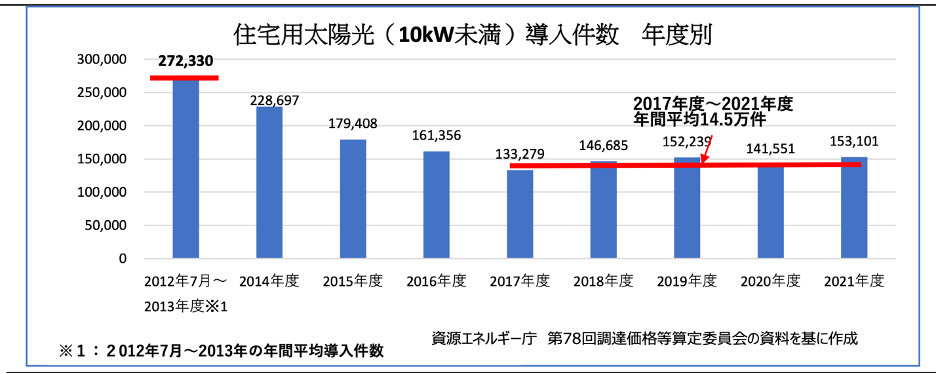
A recent presentation by the Japan Photovoltaic Energy Association to a METI committee suggests there’s reason to be concerned. Annual installations of new residential rooftop solar have nearly halved and now average 145,000 homes. This compares with an average of 272,000 additional homes between July 2012 and FY2013.
The number may drop further as housing starts are expected to fall in response to Japan’s declining population.
Residential solar (Less than 10kW) Installations by year
Source: METI
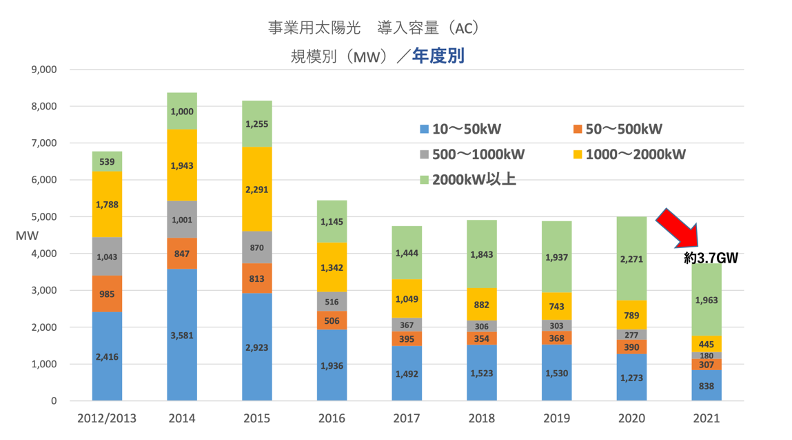
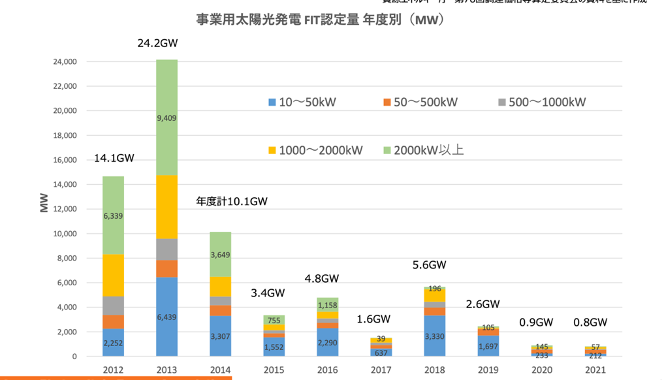
For non-residential solar (10kW and more), new installations in FY2021 totaled 3.7 GW, a 25% drop from the prior year. Approved annual capacity also has been on the decline, with just 0.8 GW added in FY2021.
If these downward trends continue, Japan’s annual solar installations for non-residential could drop below 2 GW. This could discourage solar project developers, leading some to exit the market due to a perceived lack of growth potential. This would then make it even more difficult to achieve the cost reductions that are needed to make the industry self-sufficient, reports JPEA.
Utility-scale solar installation capacity (AC) each year (2012 to 2021)
Utility-scale solar capacity that was approved by FIT
Mounting challenges
Japan’s solar industry expanded quickly after July 2012 with the introduction of the feed-in tariff (FIT) program, which pays a premium to renewable power producers. At its peak in FY2014, the program helped Japan install 9.4 GW of solar.
As the tariff rates declined, however, and suitable locations for utility-scale solar became harder to find, the number of installations has likewise deflated. METI estimates that just 4.6 GW of solar (residential and utility scale) was added in FY2021.
Prices and land access are not the only issues.
Japanese manufacturers such as Sharp, Kyocera and Panasonic led early development of solar panels and had large global market shares. Sharp, for example, was the world’s top solar panel maker until 2006. But Chinese and Taiwanese rivals expanded and by 2012 no Japanese manufacturer made the Top 10; their combined global share dropped to 9% that year and slid to a paltry 1.2% by 2018, according to NEDO PV Challenges.
Last year, Panasonic and Solar Frontier announced plans to exit panel manufacture by March 2022 and June 2022, respectively. As a result, during FY2021 90% of panels in Japan were imported, JPEA data show.
Cost: According to METI, the domestic cost of solar generation is on a downward trend. Still, at ¥12/ kWh it’s more than double the global average.
Local Oppositions: The introduction of FIT led to a rapid solar expansion. This race to grab a high-priced FIT permit led some developers to exploit woodland, mountainous areas and other sites ill-suited to large-scale solar installations. This created a pushback as residents started to oppose new projects and called for tighter environmental rules. So far, more than 200 of the 1,771 local governments have introduced ordinances to regulate development of renewable projects.
Room for optimism
Despite the challenges, JPEA believes Japan has room to claim 125 GW of solar by 2030. RTS, a Japanese solar research company, is even more optimistic: Should the industry win more support and accelerate, then 140 GW can be in operation by 2030.
To get there, solar developers are moving away from large utility-scale projects, which would typically convert a site such as a golf club, to more compact facilities with an obvious and direct link to the end users of the electricity.
By around 2025, the share of solar not reliant on the FIT or its successor, the feed-in premium (FIP) mechanism, will surpass those projects that rely on the tariffs, according to RTS. This is due to a surge in business interest for direct contracts, such as the power purchase agreement (PPA).
Under the FIP, power generators sell electricity at a premium to wholesale prices. The PPA, or third-party ownership, model allows corporate users to lock in supplies from specific generation facilities, which are sometimes located on their premises. This secures both power and price, while reducing buyers’ carbon footprint and not burdening them with ownership of the solar assets.
Another growth area for solar is privately owned buildings, a segment that is expected to more than double in installation volumes. There are further gains for solar to be made on rooftops of public buildings, incorporated in key infrastructure facilities such as airports and roads.
With greater awareness of climate issues and financial incentives, RTS expects new residential rooftop solar installations to more than triple to 1.7 GW a year by FY2030. One of the drivers for rooftop capacity is local regulation.
The Tokyo Metropolitan Government is working on legislation obliging builders to install rooftop PVs on new homes. Kawasaki City is looking into similar plans.
Meanwhile, the central government is trying to regulate solar sites in unfit locations, hoping to avoid friction with rural populations, and make it more difficult to develop solar farms on slopes and in forests.
Some municipal governments are also creating specific zones for renewables. At a recent JPEA solar symposium, Kazuya Inoue, an MoE official for climate change issues, said local acceptance is key: “We will do more with local governments and power generators.”
In the face of extreme weather events, and high power and energy prices due to Japan’s need to import fossil fuels, solar developers see a way to argue that installing panels can both stabilize prices and add resilience to local energy systems.
Still, with most solar panels manufactured abroad, Japan could do more to make the case that its solar output is based on the local-production for local-consumption principle.
To win the hearts and minds of more local residents and governments, METI needs to show that adding solar capacity is not just another bullet point on a bureaucratic agenda but a real step towards energy independence and resilience for Japan.
GLOBAL VIEW
BY JOHN VAROLI
Below are some of last week’s most important international energy developments monitored by the Japan NRG team because of their potential to impact energy supply and demand, as well as prices. We see the following as relevant to Japanese and international energy investors.
COP27/ Emerging economies
COP27 concludes with an agreement in principle to create a “loss and damage” fund that will transfer financial assistance to developing countries hurt by climate-related disasters. Emerging economies have asked for such a fund for over a decade.
Australia/ Renewable energy
Fortescue Future Industries will partner with Windlab on the North Queensland Super Hub, which will generate more than 10 GW of wind and solar power. The project will start producing power by 2027.
China/ Oil
China National Petroleum Corp, Sinopec and CNOOC signed purchasing deals worth more than $66 billion with global energy giants during the 5th China International Import Expo (CIIE) in Shanghai.
COP27/ India
India found support for its proposal for a global phase-out of all fossil fuels, as opposed to the narrower deal at COP26 to phase out coal only. However, by the end of COP27, the Indian proposal was still absent from the cover decision.
EU/ Russian oil ban
The EU expects to have regulations ready in time for the start of a G7 plan to cap the price of Russian crude oil on Dec 5. Russian oil products will be banned from Feb 5. The measure aims to punish Moscow for the war in Ukraine.
France/ Nuclear power
This year, about half of the country’s ageing nuclear fleet (56 reactors) were shut due to corrosion, summer heat waves or postponed maintenance. To help rectify the situation, EDF and Credit Agricole signed a €1 billion loan for the maintenance of nuclear power plants and to extend their operating life beyond 40 years.
Germany/ LNG
The first of four floating storage and regasification units, which can import 5 bcm of LNG per year, was completed by Uniper on Nov 15 in the North Sea coastal town of Wilhelmshaven.
Renewables/ Private investment
Private equity firm Carlyle Group formed a unit, Telis Energy, to build solar and other renewable energy plants. Carlyle plans a project pipeline of 10 GW by 2030. Since late 2018, the group has invested around $1.2 billion in renewables.
Russia/ Oil
Russian oil output is set to fall by 1.4 mbpd in 2023 after an EU ban on its seaborne crude exports takes effect on Dec 5, said the IEA. The move will create more uncertainty for oil markets and add to pressure on prices, including diesel.
U.S./ LNG
Freeport LNG blamed safety valve deficiencies and operating procedures as the root cause of a pipeline explosion that shut its Texas plant on June 8. The company didn’t indicate when the plant, which accounts for 20% of U.S. LNG exports, would restart.
U.S./ Solar energy
South Korea’s Hanwha Solutions will invest billions of dollars in building its own solar supply chain in the U.S. Its Qcells unit is assessing sites in Texas, Georgia and South Carolina for facilities to make solar components.
U.S./ EVs
General Motors said its EV portfolio will be profitable in 2025, when it expects more than $50 billion from sales of 30 EV models. That will be more than a fifth of the company’s $225 billion total revenue. By 2024 GM plans to make 400,000 EVs.
2022 EVENTS CALENDAR
A selection of domestic and international events we believe will have an impact on Japanese energy
| January | OPEC quarterly meeting;
JCCP Petroleum Conference – Tokyo; EU Taxonomy Climate Delegated Act activates; Regional Comprehensive Economic Partnership (RCEP) Trade Agreement that includes ASEAN countries, China and Japan activates; Indonesia to temporarily ban coal exports for one month; Regional bloc developments: Cambodia assumes presidency of ASEAN; Thailand assumes presidency of APEC; Germany assumes presidency of G7; France assumes presidency of EU; Indonesia assumes presidency of G20; and Senegal assumes presidency of African Union; Japan-U.S. two-plus-two meeting; Japan’s parliament convenes on Jan. 17 for 150 days; Prime Minister Kishida visits Australia (tentative) |
| February | Chinese New Year (Jan. 31 to Feb. 6);
Beijing Winter Olympics; South Korea joins RCEP trade agreement |
| March | Renewable Energy Institute annual conference;
Smart Energy Week – Tokyo; Japan Atomic Industrial Forum annual conference – Tokyo; World Hydrogen Summit – Netherlands; EU New strategy on international energy engagement published; End of 2021/22 Japanese Fiscal Year; South Korean presidential election |
| April | Japan Energy Summit – Tokyo;
MARPOL Convention on Emissions reductions for containerships and LNG carriers activates; Japan Feed-in-Premium system commences as Energy Resilience Act takes effect; Launch of Prime Section of Japan Stock Exchange with TFCD climate reporting requirement; Convention on Biological Diversity Conference for post-2020 biodiversity framework – China; Elections: French presidential election; Hungarian general election |
| May | World Natural Gas Conference WCG2022 – South Korea;
Elections: Australian general election; Philippines general and presidential elections |
| June | Happo-Noshiro offshore wind project auction closes;
Annual IEA Global Conference on Energy Efficiency – Denmark; UNEP Environment Day, Environment Ministers Meeting – Sweden; G7 meeting – Germany |
| July | Japan to finalize economic security policies as part of natl. security strategy review;
China connects to grid 2nd 200 MW SMR at Shidao Bay Nuclear Plant, Shandong; Czech Republic assumes presidency of EU; Elections: Japan’s Upper House Elections; Indian presidential election |
| August | Japan: Africa (TICAD 8) Summit – Tunisia;
Kenyan general election |
| September | IPCC to release Assessment and Synthesis Report;
Clean Energy Ministerial and the Mission Innovation Summit – Pittsburg, U.S.; Japan LNG Producer/Consumer Conference – Tokyo; IMF/World Bank annual meetings – Washington; Annual UN General Assembly meetings; METI to set safety standards for ammonia and hydrogen-fired power plants; End of 1H FY2022 Fiscal Year in Japan; Swedish general election |
| October | EU Review of CO2 emission standards for heavy-duty vehicles published;
Chinese Communist Party 20th quinquennial National Party Congress; G20 Meeting – Bali, Indonesia; Innovation for Cool Earth TCFD & Annual Forums – Tokyo; Elections: Okinawa gubernational election; Brazilian presidential election; |
| November | COP27 – Egypt;
U.S. mid-term elections; Soccer World Cup – Qatar; |
| December | Germany to eliminate nuclear power from energy mix;
Happo-Noshiro offshore wind project auction result released; Japan submits revised 2030 CO2 reduction goal following Glasgow’s COP26; Japan-Canada Annual Energy Forum (tentative); Tesla expected to achieve 1.3 million EV deliveries for full year 2022 |
Disclaimer
This communication has been prepared for information purposes only, is confidential and may be legally privileged. This is a subscription-only service and is directed at those who have expressly asked K.K. Yuri Group or one of its representatives to be added to the mailing list. This document may not be onwardly circulated or reproduced without prior written consent from Yuri Group, which retains all copyright to the content of this report.
Yuri Group is not registered as an investment advisor in any jurisdiction. Our research and all the content express our opinions, which are generally based on available public information, field studies and own analysis. Content is limited to general comment upon general political, economic and market issues, asset classes and types of investments. The report and all of its content does not constitute a recommendation or solicitation to buy, sell, subscribe for or underwrite any product or physical commodity, or a financial instrument.
The information contained in this report is obtained from sources believed to be reliable and in good faith. No representation or warranty is made that it is accurate or complete. Opinions and views expressed are subject to change without notice, as are prices and availability, which are indicative only. There is no obligation to notify recipients of any changes to this data or to do so in the future. No responsibility is accepted for the use of or reliance on the information provided. In no circumstances will Yuri Group be liable for any indirect or direct loss, or consequential loss or damages arising from the use of, any inability to use, or any inaccuracy in the information.
K.K. Yuri Group: Oonoya Building 8F, Yotsuya 1-18, Shinjuku-ku, Tokyo, Japan, 160-0004.