Japan to resume wind auctions in December with revised rules, but last year’s big winner won’t be among the bidders
Emissions from energy use rise for first time in eight years on the back of a post-pandemic economic recovery
Power and gas prices for households set to rise again as Tokyo calls for energy saving and govt looks at restricting gas use
ENERGY TRANSITION & POLICY
METI to create carbon fee linked to carbon credits trading system
Govt agency drafts CCS cost reduction roadmap to 2050
Ruling party mulls support for higher ethanol content in gasoline; Nagoya trader due to be first in Japan with a 7% ethanol product
Experts suggest penalty system for incompliant renewables firms
ANRE proposes non-fossil fuel ratio targets for industrial sectors
Japan group to research massive floating offshore wind turbines
Mitsubishi-led group keen to produce synthetic methane in U.S.
MHI to test ammonia co-firing at Taiwan thermal power plant
ELECTRICITY MARKETS
Renewable energy electricity exceeds 20% for the first time
Tokyo, Tohoku areas may face power shortage in January
Antitrust officials mull high penalties for power utilities in “cartel”
Mitsui and partners plan large offshore wind plant in Chiba area
Osaka Gas and West mull joint opportunities in storage batteries
Toda sets up Brazil subsidiary to build 94 MW of onshore wind
Social media users criticize Tokyo’s mandatory solar panels bylaw
Toshiba, Marubeni launch rock thermal energy storage pilot plant
OIL, GAS & MINING
Japan warns long-term LNG contracts sold out until 2026
LNG stockpiles rise significantly above five-year average
Toyotsu Lithium completes Japan’s first lithium processing plant
Toho Gas buys firm in Vietnam to retail gas to industrial users
ANALYSIS
JAPAN: ENERGY DINOSAUR OR INNOVATOR?
For most of the past decade Japan has been a favorite punching bag of the activist wing of the environmental movement. Almost each year, for example, the Climate Action Network (CAN) bestows an infamous ‘award’ upon Japan. The most recent barb came on Nov 10 when CAN presented Japan with its satirical honor, “Fossil of the Day”, at COP27. Does Japan really deserve this?
METI SEES RE’S TROUBLE IN COMMUNITIES AS KEY CHALLENGE TO MEET NET-ZERO
Historically, Japanese officials have a proud record of steering the domestic power industry along the lines written in national policy and strategy. Bureaucrats paved the way for Japan to harness its hydro resources. In 2012, a newly minted FIT program started a boom in solar generation. But a decade in, progress has stalled. There are many factors behind the recent slowdown in solar. METI bureaucrats have determined that perhaps the main one is: They lost control of the conversation.
GLOBAL VIEW
Brazil remains committed to biofuels. China inks $60 billion in natural gas deals, and plans to sell assets in the U.S. $160 billion is needed for the U.S. and EU to overcome China’s EV battery dominance.Italy’s Enel will sell €21 billion in assets. The G7’s proposed price cap on Russian oil will have little impact. Details on these and more in our global wrap.
JAPAN NRG WEEKLY
PUBLISHER K. K. Yuri Group
Editorial Team Yuriy Humber (Editor-in-Chief) John Varoli (Senior Editor, Americas) Mayumi Watanabe (Japan) Yoshihisa Ohno (Japan) Wilfried Goossens (Events, global)
New Energy and Industrial Technology Development Organization
kWh
Kilowatt hours (electricity generation volume)
TEPCO
Tokyo Electric Power Company
FIT
Feed-in Tariff
KEPCO
Kansai Electric Power Company
FIP
Feed-in Premium
EPCO
Electric Power Company
SAF
Sustainable Aviation Fuel
JCC
Japan Crude Cocktail
NPP
Nuclear power plant
JKM
Japan Korea Market, the Platt’s LNG benchmark
JOGMEC
Japan Organization for Metals and Energy Security
CCUS
Carbon Capture, Utilization and Storage
OCCTO
Organization for Cross-regional Coordination of Transmission Operators
NRA
Nuclear Regulation Authority
GX
Green Transformation
NEWS: ENERGY TRANSITION & POLICY
2021 emissions from energy consumption rise for the first time in eight years
(Japan NRG, Nov. 22)
Carbon emissions from energy consumption were 980 million tons in April 2021-March 2022, rising 1.2% YoY on the back of the post Covid recovery, METI said. The emissions were down 20.7% from 2013.
Total power generation increased 3.2% to 132 tWh, while 0.46 kg of CO2 were released per kWh of power, down 3.1% YoY. The fossil fuel share of the power mix was the lowest since 2011.
The energy self-sufficiency rate was 13.4%, up 2.1%.
CO2 from energy consumption
CO2 million tons
Change from 2020
Businesses
559
+3.8%
Households
153
-8.3%
Transport
187
+1.0%
Energy Transition
82
+3.6%
TOTAL
980
+1.2%
Power supply breakdown
Fossil fuel (excluding biomass)
72.9%
Nuclear
6.9%
Renewables
20.3%
METI to introduce carbon fee linked to complementary carbon credit trading
(Japan NRG, Nov. 24)
Following last week’s announcement to delay the “full-scale launch” of carbon trades to 2026, METI said the state will have oversight over emission caps and will set up a system to monitor cuts, instead of leaving them entirely to “voluntary efforts” of market participants.
METI will introduce a system requiring importers of fossil-fuel to pay a “carbon fee” that’s linked with an exchange-traded carbon price. The “fee” will start small, and its first adherents will benefit. Meanwhile, existing GHG tax burdens will be reduced over time.
TAKEAWAY: The GX League credit trading, which is in a trial phase, may require a major overhaul before 2026 because it’s not clear what the current prices represent. The exchange often reports trades of an “undefined J-credit” or an “undefined domestic credit,” which might not be reliable references.
SIDE DEVELOPMENT: MoE launches Article-6 partnership joined by 67 nations and organizations (Government statement, Nov. 17)
The MoE launched the Article 6 Implementation Partnership joined by 67 nations and organizations including the U.S., the UK, Germany, Australia, Canada, Italy, New Zealand, Switzerland, Brazil, India and Thailand.
The goal is to promote an understanding of Article 6 rules on carbon credit mechanisms, sharing experiences on authorization, technical support for international registry and reporting, and etc.
TAKEAWAY: The Paris Agreement Article 6 rule book aims to advance implementation of high integrity carbon markets by coordinating international capacity building efforts. Bilateral offset mechanisms, such as Japan’s JCM and Swiss Klik systems, were criticized as “potential carbon leakage”, but it’s gaining traction globally.
ANRE drafts CCS cost reduction goals
(Japan NRG, Nov. 22)
ANRE drafted CCS cost reduction goals based on studies by the state-run Research Institute of Innovative Technologies for the Earth (RITE). The long-term goals are to reduce capture costs 75% by 2050, carbon transport costs by 35-40%, and storage costs by 13-21%.
The figures will be revised as technologies develop.
Costs by ton of CO2
Present
2030
2050
Separation, capture
¥4,000
¥2,600
¥1,000 or less
Pipeline transport (20 kilometers)
¥2,600
¥2,600
¥1,600
Ship transport (1,100 km)
¥9,300
¥9,300
¥6,000
Onshore storage
¥6,200
¥6,200
¥5,400
Offshore storage
¥6,900
¥6,900
¥5,400
TAKEAWAY: Operational costs mean investments and jobs for municipalities hosting CCS. According to RITE, CCS projects in Canada and Norway with a 1 million ton/ year capacity led to investments ranging from ¥13-135 billion, 2,000-10,000 new jobs, and carbon tax cuts.
Competition in carbon separation and collection technologies is key to cutting costs, Mitsubishi Corp said in a presentation to ANRE. While businesses seek state financing for all stages, ANRE proposes the government take a role in developing large liquefied CO2 carrier ships, pumps and storage site monitoring, and geophysical surveys.
Ruling party mulls supporting the raising of ethanol content in cars
(Japan NRG, Nov. 24)
The Federation of LDP Members to Promote Domestic Biofuel and Synthetic Fuel held a session to promote domestic biofuel and synthetic fuel. Both PM Kishida and former PM Suga are supreme advisors for the Federation.
Akira Amari, chairman of the Federation and a former METI minister, noted that by promoting biofuel Japan can contribute to carbon neutrality by using internal combustion vehicles (ICVs), thus not requiring a switch to EVs.
Issei Sawa, the President of Nippon Environmental Energy Development (NEED) pointed to cases in other countries, where the ethanol blending rates are much higher at 10% to 15%. Japan has among the lowest rates of 1.7% equivalent, because ethanol is used only for the base material of ethyl tertiary butyl ether (ETBE).
Sawa noted that in case Japan decides to use E10, the supply of ethanol would be guaranteed by mainly importing from the U.S. and Brazil. He also said biofuel is important for energy security.
TAKEAWAY: Specialists say that E10 could be implemented in Japan if there is strong political support. The caliber of politicians backing this development suggests that such support is indeed coming.
SIDE DEVELOPMENT:Nakagawa Bussan to market E7 gasoline(Japan NRG, Nov. 24)
Nagoya-based oil products trader Nakagawa Bussan plans to market bioethanol blended E7 gasoline (7% ethanol), in addition to E3 gasoline.
The company began E3 gasoline sales in 2011 and sold over 150,000 kiloliters from November 2020 to October 2021.
TAKEAWAY: Nakagawa Bussan would be the first company to commercialize E7 supplies in Japan. Sales launch date and other details were not immediately available.
Working group on renewable conflicts to set up a new penalty on incompliant operators
(Japan NRG, Nov. 25)
The working group on renewable energy conflicts with communities will set up a new penalty system that will improve operator compliance and encourage them to modify operations in the early phases.
Incompliant operators will be required to pay a fee until they’re fully compliant. A new organization will be set up to collect and manage the fees.
Serious offenders will have to refund all payments received under the feed-in premium (FIP) or feed-in tariff (FIT) systems, and their licenses will be canceled.
ANRE proposes non-fossil fuel ratio targets for cement, automotive sectors
(Japan NRG, Nov. 22)
ANRE proposed a new energy efficiency target called the non-fossil fuel target for carbon intensive industries. The cement sector is urged to increase the non-fossil fuel ratio to 28% by 2030, up from today’s 21%; and the auto sector 59%, up from 27%.
Potential non-fossil fuel sources for cement include biomass, wastes, hydrogen and ammonia, as well as fuel cells, biomass, solar, wind, and storage battery systems using recycled car batteries.
Grey ammonia is not a non-fossil fuel, unless there’s a clear transition roadmap to clean ammonia.
CONTEXT: Currently, emission cuts are voluntary efforts in each sector, although METI annually reviews reduction progress and the sector’s 2030 goals. Measurement metrics, however, are not consistent across sectors.
TAKEAWAY: Industries are exploring the use of any available energy source, such as plastic wastes, sea and river water heat, and snow; the challenge is how to effectively measure their energy levels.
Council of advisers lists hydrogen and offshore wind for investment toward GX
(Denki Shimbun, Nov. 22)
METI, MOE and the Financial Services Agency co-hosted an advisory council “study group to supply finance for the GX of Industry”.
The group set three fields: Energy, Manufacturing, and Product as investment for GX. The plan is to provide long-term financial support, from both public and private sources, to develop and implement technology.
Hydrogen and offshore wind were listed as an investment target for GX.
TAKEAWAY: Japan is encouraging companies to invest in hydrogen and offshore wind, so this announcement sends a message of support for those sectors.
Papua New Guinea becomes 25th nation to join JCM
(Japan NRG, Nov. 18)
Papua New Guinea joined the Joint Credit Mechanism framework, allowing Japan to transfer carbon credits in accord with Paris Agreement rules.
CONTEXT: The 25 countries in JCM are all non-Annex I parties determined to be vulnerable to climate change under the definition of UNFCCC. There are around 150 non-Annex I parties. Japan’s goal is to invite 30 partner countries to JCM by 2030.
TAKEAWAY: Malaysia, Singapore, Nepal, India and China are major non-Annex I parties in Asia but have not yet joined JCM.
Japan group starts research on massive floating wind turbines
(Asia Nikkei, Nov. 24)
Construction firm Toda and Osaka University will explore building floating offshore wind platforms that are three times larger than current ones.
The research involves developing a structure that can support huge floating turbines with an output of 12 to 15 MW. Experiments will start in 2025. A smaller 10 MW-class unit may be ready by 2024.
CONTEXT: Floating turbines are more complex and expensive than those fixed to the sea floor. Japan’s deep waters make floating technology important for the future development of the offshore wind power industry. Toda also leads the consortium of eight Japanese companies that won the rights to create Japan’s first commercial floating offshore wind project off the coast of Nagasaki Prefecture. There is currently one 2 MW turbine in the water, operated by Toda, and it sells electricity to the grid.
Mitsubishi Corp led group looks to produce synthetic methane in the U.S.
(Nikkan Kogyo, Nov. 25)
Mitsubishi Corporation, Tokyo Gas, Osaka Gas, and Toho Gas are reviewing a project to produce synthetic methane in the U.S. using hydrogen derived from renewable energy, and to export it to Japan.
The final investment decision will be made in 2025, and production could start in 2029. Project outline sees the potential for Japan to import 130,000 tons of synthetic methane per year from the start of the next decade.
A candidate site for the production is an LNG project in Louisiana, in which Mitsubishi is an investor. Renewable energy may be developed by the consortium themselves or acquired from local suppliers. The basic project design should be ready in 2024, though the companies involved will seek state subsidies to support the development.
CONTEXT: If realized, this will be the world’s first project to produce synthetic methane from hydrogen and CO2.
TAKEAWAY: Recently, Japan’s gas industry association has called for a renaming of the synthetic methane or methanation as “e-methane”, to make the product stand out more. There is clearly a lot of industrial interest in Japan, especially from the gas community, in seeing a shift to e-methane as it would help retain most of the existing infrastructure. However, concerns remain about how to measure the CO2 involved and the economics.
Mitsubishi Heavy to Test Ammonia Co-Firing in Taiwan
(Company Statement, Nov. 17)
Engineering major agreed with Taiwanese state-owned firm Taiwan Power Company (TPC) to conduct a study on introducing ammonia co-firing at the Linkou Thermal Power Plant in Linkou District, New Taipei.
CONTEXT: The Linkou Power Plant is located approximately 20 km west of central Taipei. It comprises three supercritical coal-fired boilers and steam turbines supplied by MHI, with a total capacity of 2.4 GW.
Phase 1 through 2025 will be a basic study of ammonia co-firing at a 5% ratio. Later, that ratio will rise to 20% by around 2030.
SIDE DEVELOPMENT:Sumitomo Corp to with with Indonesian power utility PLN on the energy transition (Company Statement, Nov. 17)
The trading house and P.T. Perusahaan Listrik Negara (PLN), a state-owned power company in Indonesia, inked a deal to jointly study the development of new renewables projects and the early transfer and retirement of existing coal-fired power plants.
CONTEXT: Indonesia relies mostly on coal-fired generation but has set 2060 as its net-zero deadline.
PLN aims to increase the ratio of renewable energy power generation projects from 20% in 2020 to 30% by 2035 on an equity capacity basis, and will study new projects through a collaboration with Sumitomo.
TAKEAWAY: MHI and Sumitomo are among the Japanese firms seeking to export the nation’s decarbonization technology and strategy to Southeast Asia. MHI has also recently signed an MoU with Thailand’s largest power producer, Electricity Generating Authority of Thailand (EGAT), to study clean power generation, hydrogen, carbon capture, utilization and storage (CCUS) technologies.
Yamaha Motor to switch to plant-based resin for marine transport
(Kankyo Business, Nov. 18)
Yamaha Motor will start to use a plant-derived cellulose nanofiber reinforced resin for its marine products in 2024. This is the world’s first practical application of a bio-based material in transportation equipment parts.
The material will be used for engine parts of watercraft and sport boats (some of the 2024 models). In the future, Yamaha expects to use the material in a wide range of other products, including motorcycles. The material is jointly developed with Nippon Paper Industries.
The resin is produced by kneading and dispersing cellulose nanofiber, a biomass material that utilizes wood resources, into polypropylene and other resins. Compared to existing resin materials, the new resin is 25% lighter. It also is also easy to recycle.
TAKEAWAY: Though small-scale and seemingly minor, these kinds of replacements of materials will be one of the biggest factors behind the shift away from fossil fuels.
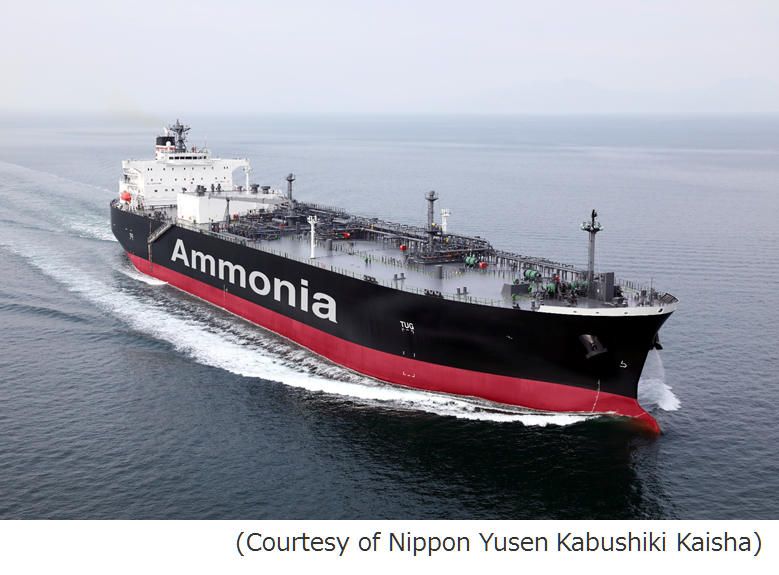
JERA might order mega-tankers to carry ammonia
(Nikkei, Nov. 21)
JERA, Mitsui OSK Lines, and NYK are discussing the use of two or three super tankers to transport ammonia for use in coal-fired power stations.
If the proposal goes ahead, shipments would begin in 2027/28.
Each tanker would cost around $95 million and carry up to 60,000 metric tons of ammonia, making the tankers among the world’s largest.
While JERA is experimenting with coal/ ammonia blends that have about 20% ammonia, it aims to make 50-50 blends commercially viable by the early 2030s.
JAEA to start R&D in Poland for design of HTGR research reactor
(Denki Shimbun, Nov. 24)
JAEA and the National Center for Nuclear Research (NCBJ), Poland’s largest research Institute, will cooperate on R&D for HTGR technology.
In 2017, JAEA signed an MoC in the field of HTGR technologies with NCBJ, as part of a strategic partnership between Japan and Poland.
Poland hopes that HTGRs can replace fossil fuel-power plants and help decarbonize many industries.
Tokyo schools unveil solar power pavement
(PR Times, Nov. 17)
The Toa Road Corp has installed solar power pavements manufactured by Wattway at two elementary schools in Tokyo.
Toa says the revolutionary panels can be driven over by trucks without suffering a decline in generating capacity.
Toa says it hopes the initiative will encourage children to learn about the climate crisis and renewable energy.
Oil refiner ENEOS launches EV charging service
(New Energy Business News, Nov. 25)
ENEOS has launched an electric vehicle (EV) charging service. In addition to the 6,100 regular chargers that ENEOS took over from NEC in June 2022, ENEOS plans to install more than 1,000 quick chargers by FY2025 and several thousand by FY2030.
ENEOS currently has 100 quick chargers. In addition to service stations, the company will also install quick chargers at car dealerships, commercial facilities, and convenience stores.
Carbon-neutral data center for Hokkaido
(Gas and Energy News, Nov. 21)
In 2026, Tokyu Land Corp, Hokkaido Electric, and IT consultants Flower Communications plan to open a 10,000 square meter data center.
The ¥16 billion center in Ishikari (Hokkaido) will run entirely on carbon-neutral electricity.
Ishikari will be one of the first municipalities to embrace carbon-neutral electricity.
Marubeni signs a MoU with Vietnam’s EVN
(Corporate statement, Nov. 25)
Marubeni signed an MoU with state-owned power utility EVN to work on decarbonizing Vietnam’s economy.
EVN and Marubeni will study carbon emission reduction of thermal power plants in Vietnam, as well as development of biomass, ammonia, and hydrogen.
Marubeni is the first company to sign an MoU with EVN on decarbonization.
NEWS: POWER MARKETS
Japan to resume wind auctions in December, but Mitsubishi will not
(Diamond, Reuters, Japan NRG, Nov. 26)
In December, Japan is poised to resume public auctions for offshore wind power projects in four new areas, for a total of 1.8 GW.
Revised rules will apply for the upcoming auction: giving higher evaluation scores to operators that submit earlier start-up dates, setting a 1 GW limit on the bids one consortium can win; and all bids below the market level will receive the same score on the pricing criteria, to discourage throat-cut price competition.
It seems, however, that Mitsubishi Corporation, which won all three of the major offshore wind auctions last year, will not participate this time. The trading house put a small notice put in the Official Gazette (Kanpo) on Nov. 11 that said its relevant group company will not take part in the bidding for the projects in Happo Town and Noshiro City, Akita Prefecture.
Mitsubishi initially planned to bid, but auction rule changes seem to prevent the company from taking all of Akita area projects. What’s more, the economic and geopolitical situation that has developed this year has pushed up the cost of large offshore wind projects and Mitsubishi fears the profitability of its existing projects might be compromised.
SIDE DEVELOPMENT: Akita governor asks for more details in Noshiro-Mitane-Oga offshore wind project (Japan NRG, Nov. 21)
The governor of Akita Prefecture, a host site of the Mitsubishi consortium’s offshore wind farm, requested clarity for the dimensions and methods, and to keep local stakeholders informed of details.
The governor also mentioned the other wind farms in operation in the area and that the consortium needs to assess how they would be impacted.
Wind power turbines have caused radio-wave interference in some parts of Akita and the governor asked the operator to take appropriate measures.
CONTEXT: The governor’s opinions are a part of the regulatory process and public disclosure of project details. Mitsubishi consortium’s proposed Noshiro-Mitane-Oga wind farm will be a 479 MW project slated to begin operation in 2028. The Mitsubishi consortium was awarded the project along with the Yurihonjo and Choshi projects in the December 2021 auction, triggering complaints and auction rule changes.
TAKEAWAY: Authorities are tightening renewables regulations, and Akita Prefecture, a host of four major offshore wind projects, is no exception. From April 2022, new environmental impact assessment rules have taken effect. Wind farms over 10 MW need to conduct the assessment, which is stricter than the MoE rule that says projects below 37.5 MW are exempt.
Power and gas prices set to rise again as Tokyo calls for energy saving
(Japan NRG, Jiji, Nov. 27)
At least six major power companies, including TEPCO, will apply to METI soon to ask for an increase in the household tariffs. Meanwhile, Tokyo Gas plans to raise gas prices for residential consumers over a six-month period starting in May. Tohoku Electric is the first power company to lodge an application. It is appealing for the ministry to green-light an average increase of about a third from April 2023. Most of the smaller EPCOs plan a similar application.
METI usually takes about four months to review tariff changes, which indicates that price increases would come in April or May. Gas increases for businesses are likely to be delayed until 2024. TEPCO’s application will likely come later than the rest.
The government will introduce a ¥7/ kWh subsidy for electricity from January to cover the increase in rates in the spring. However, the increases sought by the power utilities would exceed the subsidy amounts.
Households pay electricity based on regulated tariffs and so-called free rates, which power firms can revise on their own.
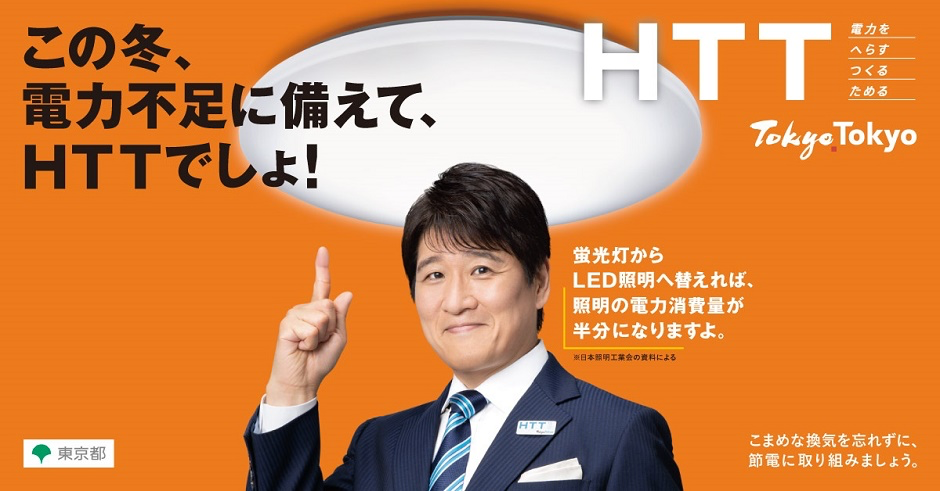
Meanwhile, Tokyo has rolled out an energy savings campaign titled “HTT” this winter. This calls for people to reduce consumption, save on energy use when possible, including by wearing sweaters and other warm clothing indoors, and look for ways to cut electricity use in general, such as by switching to LED lighting.
SIDE DEVELOPMENT: ANRE proposes restricting gas supplies to 3,300 big users during shortage (Japan NRG, Nov. 22)
In times of extreme shortage ANRE proposes restricting gas supplies to big consumers of over 0.5 million m3/ year, or 3,300 consumers. This follows Gas Business Law amendments passed by parliament on Nov 11.
The public will be notified of supply restrictions one month in advance. The METI minister will either issue advice or an order that penalizes incompliance. The law doesn’t state who will be subject to restriction.
TAKEAWAY: PM Kishida plans a stimulus that will support large end-users to the tune of ¥30/ cubic meter and reduce electricity bills. Although supply restrictions are for extreme emergencies, it will still be odd if some users continue to enjoy discounts.
Renewable energy electricity exceeds 20% for the first time
(TV Asahi, Nov. 22)
According to recent statistics, renewable sources supplied 20.3% of Japan’s total electricity in 2021, up 0.5% YoY.
While electricity generated by fossil fuel plants fell by 3.5% to 72.9%, Japan’s total carbon emissions rose 1.2% to 980 million tons due to increased gasoline use.
Nuclear power stations provided 6.9% of Japan’s total electricity use in 2021, up 3% YoY.
Tokyo, Tohoku areas may face power shortage in January; utilities start collaboration
(Japan NRG, Nov. 21)
ANRE warned the Tokyo and Tohoku areas may go short of power in January if hit by extreme cold spells , although power reserve rates stand at 4.1% and above the 3% critical threshold. Tokyo’s reserve rate is seen at 3.3% in July.
On Nov 11-16, gas and power utilities in each area met to share LNG supply plans and details of facilities to avoid problems when sharing gas supply.
Reserve rate forecast (%)
Dec
Jan
Feb
Mar
Hokkaido
14.4
7.9
8.1
12.1
Tohoku
9.2
4.1
4.9
11.5
Tokyo
Chubu
7.4
5.6
6.5
Hokuriku
Kansai
Chugoku
Shikoku
Kyushu
Okinawa
44.5
33.1
34.4
56.6
CONTEXT: Regional utilities building a LNG-sharing framework is a low-intensity plan. If a fuel shortage becomes serious, ANRE will engage with utilities to share supplies.
Japan Fair Trade Commission mulls high penalty to grids on alleged cartel charge
(NHK, Nov. 26)
The Japan Fair Trade Commission is considering imposing administrative penalties on Chubu Electric, Chugoku Electric, Kyushu Electric and Kansai Electric, which are accused of ‘cartel charges’. If the penalty is imposed then the amount could be tens of billions of yen.
Starting in 2018, the grids allegedly restrained competition for corporate users by dividing up geographic market boundaries among themselves in what was supposed to be a fully liberalized market.
CONTEXT: Last year, the JFTC conducted two dawn raids which included Toho Gas. However, Toho Gas was not included in the media report possibly because it’s not facing charges, or it may have applied for leniency and surcharge fees were reduced.
TAKEAWAY: Cartel cases with wide social impact are given to prosecutors’ offices to file criminal charges. The prosecutors can issue prison sentences and fines, while JFTC’s authority is limited to “surcharges”, a type of penalty that is not entirely a “fine”.
The grids may have escaped criminal charges but will likely face shareholder complaints on corporate governance. Many companies facing cartel charges have appealed their cases to courts, in order to avoid shareholder suits against the companies and their directors.
According to some media reports, the alleged cartel is believed to have operated until at least the summer of 2020 and involved largely “extra high-voltage electricity” for large factories and “high-voltage electricity” for businesses.
Mitsui and partners plan 495 MW offshore wind plant
(New Energy Business News, Nov. 24)
MoE submitted an opinion on the offshore wind project planned by trading house Mitsui and others off the coast of Isumi City, Chiba Prefecture. The ministry is concerned about the impact on marine organisms.
The project could be as big as 495 MW, installing between 33 and 42 wind turbines. Monopile, jacketed, and gravity-type foundations are under consideration.
Mitsui’s partners include RWE Renewables, Osaka Gas, and K&O Energy Group.
Osaka Gas and West Holding mull joint opportunities in storage batteries
(New Energy Business News, Nov. 24)
Osaka Gas and West Holdings signed an MoU to jointly study new opportunities in the storage battery field, both for grid balancing and to work alongside renewable energy facilities.
This is part of a capital and business alliance the two companies signed in April 2022.
Toda sets up Brazil subsidiary to build 94 MW of onshore wind power
(New Energy Business News, Nov. 25)
Toda Corporation established a local subsidiary in Brazil, Toda Energia 2, and launched a project to generate and sell 94.40 MW of onshore wind power in Pedro Avelino, in the northeastern state of Rio Grande do Norte, aiming to start operation in August 2024.
This project is positioned as a second phase of a 27.72 MW development started in Areia Blanca in the same state in September 2021.
The wind turbines will be 5.9 MW units manufactured by NORDEX. With a local subsidiary, Toda plans also to trade green power certificates I-REC and carbon credits.
Toshiba, Marubeni launch rock thermal energy storage tech pilot
(PV Magazine, Nov. 23)
Toshiba, Marubeni and Chubu Electric started a pilot rock thermal based storage facility at Toshiba’s facility in Yokohama.
Next, they’ll build a larger facility with a 500-kWh capacity. The goal is to launch commercial projects.
The MoE supports the project to promote rock-based thermal energy storage.
CONTEXT: With a thermal capacity of approximately 500 kWh, a steam turbine can be expected to generate approximately 100 kWh of electricity.
Social media users criticize solar power bylaw
(Livedoor, Nov. 21)
The Tokyo Metropolitan govt announced a ¥30 billion support package for the construction industry in advance of a new bylaw that will make solar panels compulsory on many houses and apartments built in and after 2025/26.
In addition to subsidizing panel costs, the funds will go to product development and to improve construction techniques.
The announcement has been criticized on social media; many posted that Tokyo pressured the Kanagawa govt into implementing a similar bylaw, and complained that since Tokyo set a precedent other prefectures will likely follow.
NEWS: OIL, GAS & MINING
Japan warns long-term LNG contracts sold out until 2026
(Bloomberg, Nov. 21)
Japan said competition for LNG will be more intense until 2026 because all available supply for long-term contracts has been sold. Long-term deals lock in volumes for buyers and offer stable and predictable pricing.
Inadequate investment has led to a shortage of new supply, METI said.
CONTEXT: JERA, Japan’s top LNG buyer and thermal power generator, said it has sufficient LNG supplies for this winter.
LNG stocks rise to 2.61 million tons
(Government data, Nov. 24)
LNG stocks of 10 power grids stood at 2.61 million tons as of Nov 20, up from 2.51 million tons last week. On Nov 13, METI reported stocks were at 2.52 million tons, but then corrected the figure. The end-November stocks last year were 2.16 million tons. The five-year average for this time of year is 1.95 million tons.
Toyotsu Lithium completes Japan’s first lithium processing plant
(Japan NRG, Nov. 16)
Toyotsu Lithium completed a 10,000 tons/ year lithium hydroxide plant in Fukushima Prefecture. The company didn’t comment on its commercial launch.
The Fukushima plant will use lithium carbonate produced at its plant in Argentina as feedstock for lithium hydroxide. It has a 17,500 tons/ year capacity of carbonate; much of its production will be shipped to Japan.
The company might build hydroxide plants overseas on the back of strong demand. The Argentinian plant is expanding capacity to 42,500 tons/ year.
CONTEXT: Toyotsu Lithium is owned 75% by Australian miner Allkem, and 25% by Toyota Tsusho. Japan’s annual lithium hydroxide demand is 30,000 tons/ year. 95% of lithium mined globally are converted either into carbonate or hydroxide.
TAKEAWAY: Toyota has been raising self-sufficiency of critical raw materials by making upstream investments through Toyota Tsusho in the last ten years. Nissan, Honda and Mazda groups are less active upstream.
Key Toyota Tsusho investments
Lithium
Salar de Olaroz (Argentina)
Rare earths
Orissa refinery (India), Dong Pao (Vietnam)
Nickel
Strategic partnership with BHP (Australia)
Cobalt and other rare metal recycling
Metal Do (Japan)
Oil companies establish SAF subsidiaries with eye on government target
(NHK, Nov. 24)
Cosmo and JGC established subsidiaries to produce sustainable aviation fuel (SAF) to help meet the national target of 10% green aviation fuel by 2030.
Cosmo will start producing SAF at its Sakai refinery in 2024/25. JGC will work with Mitsubishi Estate to collect restaurant cooking oil to produce SAF.
Idemitsu Kosan also plans SAF production in 2026 using biomass feedstocks.
While SAF produces around 80% less net carbon emissions than traditional jet fuel, it’s about 10 times more expensive, making cost reduction a priority.
Toho Gas to sell natural gas for industrial use in Vietnam
(Denki Shimbun, Nov. 21)
Toho Gas to sell natural gas for industry in Vietnam, by investing in Phuc Sang Minh Trade Engineering Services (PSE).
Toho Gas will purchase a 40% stake from Vo Phuong Trinh, an official at PSE.
This is a first for Toho Gas investing in a foreign business all by itself; its first business in Vietnam.
ANALYSIS
BY JOHN VAROLI
Japan: Energy Dinosaur or Innovator?
For most of the past decade Japan has been a favorite punching bag of the activist wing of the environmental movement. Almost each year, for example, the Climate Action Network (CAN) bestows an infamous ‘award’ upon Japan for its use of oil, gas and coal, which account for more than half of the national energy mix.
The most recent barb came on Nov 10 when CAN presented Japan with its satirical honor, “Fossil of the Day”, at the UN climate change conference in Egypt, (COP27), accusing Tokyo of not taking sufficient measures to promote green energy and combat climate change.
“The Japanese government is making huge efforts to export false solutions,” stated CAN, also criticizing Prime Minister Kishida for not attending the leaders’ summit, saying, “Maybe he was too busy promoting false solutions in Japan?”
Those accusations of “false solutions” were likely a reference to Japan’s policy of developing and exporting a technology that would over time allow coal plants to also burn ammonia. This approach would prolong the use of such plants while gradually cutting GHG emissions as clean-burning ammonia takes over from coal. Activists, however, want the coal-powered stations closed entirely and now.
Ironically, the CAN ‘award’ came on the same day when Chinese officials at COP27 unabashedly announced plans to expand the nation’s already massive fleet of coal-fired power plants. While Beijing also promotes wind and solar generation, it reportedly plans another 270 GW of coal-fired capacity, more than any country has installed today.
The last time China won the “Fossil of the Day” award was in 2013.
PR stunts such as the Fossil award are designed to grab headlines and exploit sensational photo ops — a person dressed as a dinosaur handed the ‘award’ to someone acting for the Japanese ‘delegation’. That image was widely disseminated in global media, creating the false impression of Japan as an energy ‘dinosaur’.
Does Japan really deserve this disparaging treatment? The facts tell a more complex story – Tokyo continues to push forward with numerous renewable energy projects and cleantech innovations. Certainly, much more needs to be done, but the highly industrialised and resource-poor Japan is making important strides to advance the clean energy agenda.
Green innovations
During COP27 and over the past few weeks, Japanese agencies and companies had plenty to boast of. Let’s recap. First, Tokyo Governor Koike introduced a plan to build a supply chain for green hydrogen, including trunk lines for imports, and she also presented Tokyo’s 2050 decarbonization plan.
Meanwhile, half a world away, during the Reuters energy transition conference in Houston, JX Nippon Oil & Gas Exploration (an ENEOS subsidiary) signed with 8 Rivers Capital (North Carolina) for global collaboration on decarbonization of power systems and hydrogen power generation.
Also at the conference, a speaker from the U.S. Department of Energy praised Japan for pioneering the bi-directional battery for EVs. Developed by Tsubaki in Osaka, the eLINK is a vehicle-to-everything (V2X) compatible charging system that connects EVs with buildings and power grids (V2G). It’s seen as a game changer for the entire energy industry; in effect turning EVs into mobile storage batteries whose power can be recalled to the grid at any moment for any purpose.
Then, the following week, on Nov 16, some of Japan’s leading energy companies, including INPEX, Osaka Gas, ENEOS, Idemitsu, Chubu Electric, and Acario (Tokyo Gas) held a cleantech event at the Plug and Play Tech Center in Silicon Valley in California to promote opportunities in Japan’s energy sector.
The above is just a small sampling of Japan’s ‘green’ credentials in the past few weeks, and it calls into question the narrative of Japan as a plodding and moribund energy dinosaur facing extinction.
In line with its 2050 carbon-neutral plans, the country’s energy policy calls for solar, wind and other renewable energy to account for 36-38% of the electricity mix by 2030, double the level of a decade of 2020. Coal-generated power is expected to drop to 19% of the power mix, from the current 26%. Gas use would be halved to 22% of the total.
The country is setting up an offshore wind power sector from scratch and aims to take the global lead in floating turbine technology.
Outside of electricity, Japan is using state funds to support R&D into lower energy use in homes and buildings; the elimination of coal use in steelmaking; lower CO2 emissions from cement; and better energy efficiency among the population.
Progress is clearly being made. Is it fast enough? For the more radical wing of the clean energy movement, it’s not.
During COP27, activists found support from the U.N. General Secretary António Guterres, who unleashed an emotional and gloomy barrage: “We’re in the fight of our lives, and we’re losing… our planet is fast approaching tipping points that will make climate chaos irreversible. We’re on a highway to climate hell with our still foot on the accelerator.”
Reality bites
As the repercussions of Russia’s invasion of Ukraine and the sanctions related to it took hold, most nations turned their attention to energy security. Japan has always stated energy security as its biggest concern and it has cause to do so.
According to METI, Japan’s energy primary self-sufficiency rate is 11%, much lower than in any other G7 country (U.S: 106%; Canada: 179%; UK: 75%; France: 55%; and Germany: 35%). Therefore, any immediate withdrawal from fossil fuel projects without an alternative in place would hurt Japan tremendously.
While activists can enjoy pulling off satirical antics, energy executives must deal with the reality of providing clients and the global community with affordable and reliable energy supplies. The Houston energy conference questioned making speed the only focus of the energy transition.
“We need economic security and sustainability while decarbonizing,” said Alan Armstrong, CEO of Williams, a U.S. natural gas processing and transportation company. “We need to provide affordable energy; let’s come up with solutions that deliver lower emissions in an economically sustainable way.”
The emphasis here is on “economically”, and Armstrong suggested that natural gas is a way to lower emissions right here, right now. Gas, however, must confront the malignant label of “fossil fuel”.
Former head of BP, Bob Dudley, chimed in that: “I thought the [Russian] invasion would accelerate the energy transition. But now we see the opposite. We need natural gas.”
Such words are a balm on the soul of many METI bureaucrats, and underscore the fact that sarcastic accusations and mockery aimed at countries deemed ‘dinosaurs’ – because they must grapple with energy security – does not advance the global energy transition. Instead, it only heightens mistrust.
As countries decarbonize there’ll be different options in different places. There isn’t a one-solution-fits-all. As Japan makes its own way toward net-zero, the “fossils” it leaves behind are memories of a not-so-terrible past, not signposts for the future.
ANALYSIS
BY YOSHIHISA OHNO AND YURIY HUMBER
METI Sees Trouble With Local Communities A Key Challenge to Meeting Japan’s 2050 Net-Zero Goal
Historically, Japanese officials have a proud record of steering the domestic power industry along the lines written in national policy and strategy. Bureaucrats paved the way for Japan to harness its hydro resources; develop its coal; then shift to crude oil and nuclear; and pioneer the mass transport of a super-chilled molecule that’s now critical to the nation’s electricity grid.
At first, this prowess seemed to transfer to the age of renewables. In 2012, a newly minted FIT program started a boom in solar generation. But a decade in, progress has stalled, all at a time when the latest government Basic Energy Plan points to a further doubling of renewables capacity this decade. This year’s heightened energy security concerns also suggest more effort on the renewables front is necessary.
There are many well-documented factors behind the recent slowdown in solar. Yet, upon examination, METI bureaucrats have determined that perhaps one of the main ones is: They lost control of the conversation.
Mass-scale construction of infrastructure involves a complex dialog between stakeholders, including local governments, citizens, utilities and others. When Japan’s power industry was covered by less than a dozen companies that took care of everything from fuel to electrons and delivery to the client’s socket, METI could guide that conversation. Yet the nature of solar and wind power, with hundreds of small and medium-sized players involved, and the market’s 2016 liberalization, has created a very different set of circumstances that perhaps caught officials by surprise.
We need to talk
At first glance, Japan’s energy policy machine has performed as usual to further the goal of decarbonization first announced by former PM Suga in October 2020. A new Basic Energy Plan was formed; it set out an ambitious target to double the role of renewables, as per the national agenda; and a plethora of committees, panels and working groups sprang up to ensure that Japan had the various roadmaps necessary to reach net-zero.
When Kishida took the prime minister’s office about a year ago, he mostly kept Suga’s policies in place. Perhaps the most notable tweak has been the renaming of the net-zero agenda as “Green Transformation” or “GX”.
Yet as the control center for the GX revolution, the GX Council, picks up the pace of its meetings and adds ever more promises of new tools and finances, the pace of change on the ground has slowed. In large part that’s because much of what the government wants to do actually relies on the actions of other stakeholders, such as local governments, citizens, grid planners, and project developers. This is as true for nuclear restarts as it is for the construction of new renewables capacity.
Kishida’s answer has been to set up a new government panel: the “Working group for sustainable use and coexistence with community”, which sits under METI’s Advisory Committee for Natural Resources and Energy.
While the creation of yet another working group might sound like the last thing that the renewables sector needs, this platform could prove quite important.
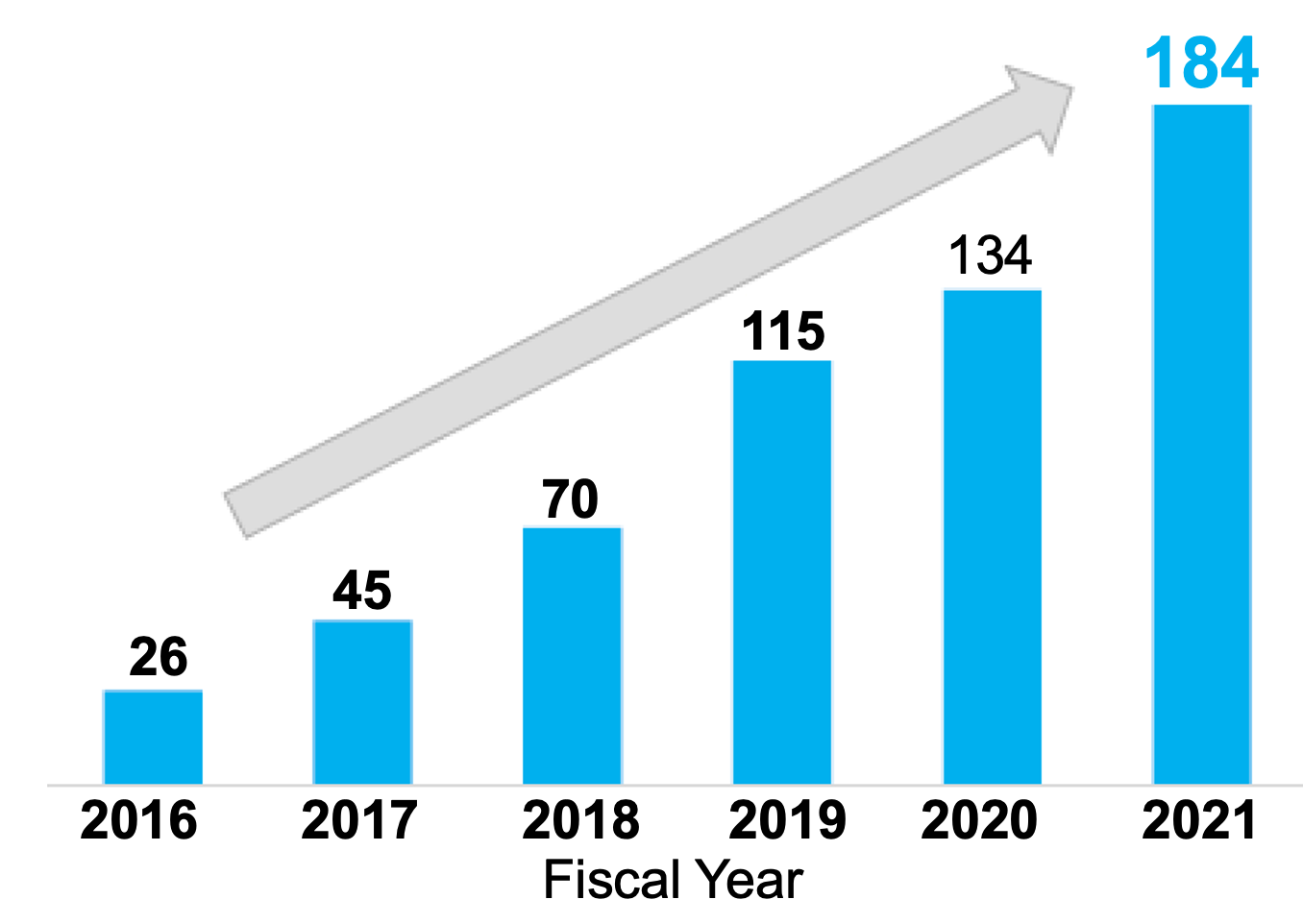
Over the last ten years, solar capacity has jumped by a factor of 12. Inevitably, it has involved both reputable firms and those with less scrupulous motives. In some cases, projects were rushed, built on land not appropriate for construction, or simply without adequate local consultation. The number of renewables projects which, according to METI, are classed as “troubled cases” has jumped from 26 in 2017 to 184 in 2021.
As the volume of troubled cases grows, and readily available land for new developments shrinks, tensions between developers and local stakeholders are spilling over into the communities and the pages of national newspapers.
The new working group comes in as an independent arbiter to unravel these knots.
Troubled cases of RE projects are up sevenfold since 2016 Source: METI
The grid strikes back Some of the issues that affect citizens in rural communities were detailed by Japan NRG in the Oct. 31 and Nov. 21 reports this year. But there are other causes of friction.
Before power market liberalization, Japanese power utilities controlled both electricity generation and transmission. Since 2016, these business units have been split, but in many cases, they remain within the same holding structure. For example, TEPCO Power Grid is part of TEPCO Holding, which also owns a thermal power generation business (TEPCO Fuel & Power) and a green energy company (TEPCO Renewable Power).
So, while TEPCO Grid performs the role of an independent electricity network operator for the Greater Tokyo area, it has to balance the needs of two TEPCO generation companies with those of other local power providers. Furthermore, the renewables unit of TEPCO is competing with other solar and wind developers in the area for grid connection and capacity.
Grid operators claim that balancing the output of a high number of small, distributed energy assets, the output of which is hard to forecast in advance, is becoming more and more technically challenging. But the situation is further exacerbated by failures of communication.
Power transmission and distribution firms claim that some solar developers do not follow requests to stop generation when requested to do so for network maintenance. This leads to higher grid costs because maintenance work or new construction has to be conducted after dark, when solar panels are inactive, triggering staff over-time fees and other costs.
Current regulation is not able to force a generator to stop or curtail output. It can only be made as a request.
Also, renewables developers are more likely to diverge from their project schedule, which is submitted to the local grid to say when the power capacity will be available.
According to a report by the Transmission & Distribution Grid Council, developers of renewable energy facilities registered 473 changes to their project schedule in the three years through 2021. Transmission firms only made 31 changes in the same period.
Solar, wind and biomass developers often have a good reason to alter their schedules due to issues with land acquisition, financing, or equipment. Grid operators, however, like to plan long-term and appear less flexible to respond to changes.
Green local government Inadequate local government resources and know-how in dealing with renewables projects is another issue slowing new RE capacity. In 2019, Tokyo-based developer Blue Capital Management won permission to build a 28.8 MW solar project at Kannami town in Shizuoka Prefecture. The plan was to lay 100,000 solar panels in an intermountain area.
In November 2022, however, the prefectural assembly questioned the project, saying that an appropriate local river survey had not been done. The project was greenlighted by the town as it passed the Urban Planning Act, but the officials in charge are now being questioned. As a result, the developer is being asked to redo the river survey and revise part of their plans in order to prevent possible flooding in the area.
Some municipalities are also asking developers to have additional meetings with local governments and citizens to avert future disruptions. For example, Okazaki City in Aichi Prefecture requires developers to meet with the mayor before construction starts, and hold meetings with local residents at least three times.
As a result, renewables projects take longer to complete. That’s why a better work flow is required to manage the conversation between industry and local stakeholders.
It won’t be an easy task to create a smoother process that municipalities across Japan can adopt. Still, METI is optimistic. The deadline for its new working group to come up with a solution is the end of the year.
GLOBAL VIEW
BY JOHN VAROLI
Below are some of last week’s most important international energy developments monitored by the Japan NRG team because of their potential to impact energy supply and demand, as well as prices. We see the following as relevant to Japanese and international energy investors.
Brazil/ Biodiesel
The new government reaffirmed support for biodiesel fuel and will keep the blending mandate at a higher level than currently. A decision by the previous government to keep the mandatory biodiesel blend in diesel at 10% until March 31 will be revoked.
CO2 emissions
About 36.6 billion tons of CO2 will be emitted globally this year from coal, natural gas and oil, slightly more than the previous record in 2019, a 1% increase, reports the Global Carbon Project. China leads with 32% of total emissions, the U.S. with 14%, and the EU and India, both with 8%.
China/ Assets sale
CNOOC seeks to sell $2 billion of its assets in the U.S. due to concerns over sanctions. CNOOC owns shale assets onshore and stakes in fields in the Gulf of Mexico. These concerns might impact CNOOC assets in the North Sea and Canada.
China/ Natural gas
China signed $60 billion in LNG deals with Qatar Energy. Each year starting in 2026, and lasting for 27 years, Sinopec will receive 4 million tons of LNG annually. This will be China’s longest LNG supply contract and one of the largest in volume.
EVs/ Batteries
The U.S. and EU must invest $160 billion by 2030 to cut dependence on China for EV batteries, said Goldman Sachs. China produces 75% of the world’s batteries and dominates production of their materials and components.
Italy/ Energy transition
Enel will sell €21 billion in assets to cut debt of nearly €52 billion. The company will focus on six core countries in the EU and U.S. to develop renewable energy. It will sell its natural gas assets in Spain and withdraw from Argentina and Peru.
Natural gas/ Price cap
Intercontinental Exchange warned the European Commission that a natural gas price cap could destabilize the entire market. Energy traders that rely on the Dutch TTF futures market face an 80% rise in insurance payments to secure deals.
Netherlands/ Hydrogen power
The government has a €22 million subsidy plan for hydrogen refueling stations for trucks. Expected to start in early 2024, the subsidy will apply if both a filling station is built and the trucks purchased.
Russia/ Oil price caps
The G7’s proposed price cap of $65-$70 a barrel on Russian oil will have little immediate impact on Moscow’s revenues, because it’s in line with what Asian buyers are now paying, said a Reuters report.
UK/ Battery storage
Europe’s largest energy storage system began operating near Hull. The site can store enough electricity to power 300,000 homes for two hours. The facility was developed by Harmony Energy using technology made by Tesla.
Ukraine/ Power blackouts
The state energy utility said damage to infrastructure from Russian attacks meant that “the vast majority of electricity consumers were cut off”; some major cities, such Kiev and Lvov, are mostly in the dark. Rolling blackouts will continue until March.
2022 EVENTS CALENDAR
A selection of domestic and international events we believe will have an impact on Japanese energy
January
OPEC quarterly meeting;
JCCP Petroleum Conference – Tokyo;
EU Taxonomy Climate Delegated Act activates;
Regional Comprehensive Economic Partnership (RCEP) Trade Agreement that includes ASEAN countries, China and Japan activates;
Indonesia to temporarily ban coal exports for one month;
Regional bloc developments: Cambodia assumes presidency of ASEAN; Thailand assumes presidency of APEC; Germany assumes presidency of G7; France assumes presidency of EU; Indonesia assumes presidency of G20; and Senegal assumes presidency of African Union;
Japan-U.S. two-plus-two meeting;
Japan’s parliament convenes on Jan. 17 for 150 days;
Prime Minister Kishida visits Australia (tentative)
February
Chinese New Year (Jan. 31 to Feb. 6);
Beijing Winter Olympics;
South Korea joins RCEP trade agreement
March
Renewable Energy Institute annual conference;
Smart Energy Week – Tokyo;
Japan Atomic Industrial Forum annual conference – Tokyo;
World Hydrogen Summit – Netherlands;
EU New strategy on international energy engagement published;
End of 2021/22 Japanese Fiscal Year;
South Korean presidential election
April
Japan Energy Summit – Tokyo;
MARPOL Convention on Emissions reductions for containerships and LNG carriers activates;
Japan Feed-in-Premium system commences as Energy Resilience Act takes effect;
Launch of Prime Section of Japan Stock Exchange with TFCD climate reporting requirement;
Convention on Biological Diversity Conference for post-2020 biodiversity framework – China;
Elections: French presidential election; Hungarian general election
May
World Natural Gas Conference WCG2022 – South Korea;
Elections: Australian general election; Philippines general and presidential elections
Germany to eliminate nuclear power from energy mix;
Happo-Noshiro offshore wind project auction result released;
Japan submits revised 2030 CO2 reduction goal following Glasgow’s COP26;
Japan-Canada Annual Energy Forum (tentative);
Tesla expected to achieve 1.3 million EV deliveries for full year 2022
Disclaimer
This communication has been prepared for information purposes only, is confidential and may be legally privileged. This is a subscription-only service and is directed at those who have expressly asked K.K. Yuri Group or one of its representatives to be added to the mailing list. This document may not be onwardly circulated or reproduced without prior written consent from Yuri Group, which retains all copyright to the content of this report.
Yuri Group is not registered as an investment advisor in any jurisdiction. Our research and all the content express our opinions, which are generally based on available public information, field studies and own analysis. Content is limited to general comment upon general political, economic and market issues, asset classes and types of investments. The report and all of its content does not constitute a recommendation or solicitation to buy, sell, subscribe for or underwrite any product or physical commodity, or a financial instrument.
The information contained in this report is obtained from sources believed to be reliable and in good faith. No representation or warranty is made that it is accurate or complete. Opinions and views expressed are subject to change without notice, as are prices and availability, which are indicative only. There is no obligation to notify recipients of any changes to this data or to do so in the future. No responsibility is accepted for the use of or reliance on the information provided. In no circumstances will Yuri Group be liable for any indirect or direct loss, or consequential loss or damages arising from the use of, any inability to use, or any inaccuracy in the information.
K.K. Yuri Group: Oonoya Building 8F, Yotsuya 1-18, Shinjuku-ku, Tokyo, Japan, 160-0004.
NEWS
・Japan to resume wind auctions in December with revised rules, but last year’s big winner won’t be among the bidders
・Emissions from energy use rise for first time in eight years on the back of a post-pandemic economic recovery
・Power and gas prices for households set to rise again as Tokyo calls for energy saving and govt looks at restricting gas u