
JAPAN NRG WEEKLY
DEC. 12, 2022
JAPAN NRG WEEKLY
Dec. 12, 2022
NEWS
TOP
- Japan starts Russian crude price caps but excludes Sakhalin-2 project citing its importance to energy security
- Power retailers to declare reliance on spot market to aid LNG demand forecasting at major power utilities
- More than 20% of new power market players called it quits; Lacking own generation, they were hit hard by JEPX price hike
ENERGY TRANSITION & POLICY
- Govt subsidies for power, gas bills get parliamentary approval
- METI officially passes new rules on nuclear reactor permitting
- Power operators group reports continuous cut in emissions
- Gas industry tells lawmakers synthetic fuels are cost competitive
- Agency solicit feedback on plan to use more bioethanol in cars
- Japan officials discuss hydrogen with Chinese, EU counterparts
- Kansai Electric, Kawasaki Heavy mull sea transport of hydrogen
- Tokyo governor optimistic about solar perovskite venture
- IHI wins order for unit from steelmaker planning hydrogen switch
ELECTRICITY MARKETS
- Transmission firms ordered to cut cost increase by about a third
- Utilities tell METI: we cannot cut costs internally anymore
- New power federation chief to be distanced from cartel scandal
- JERA and NEC launch test JEPX trading based on DR tools
- Retailer owned by Tohoku Electric, Tokyo Gas files for bankruptcy
- Pacifico Energy receives govt feedback on 140 MW solar project
- Eurus Energy plans large offshore wind project in Chiba area
- High fuel prices are also impacting the renewables markets
OIL, GAS & MINING
- METI officially announces launch of strategic LNG reserve
- LNG stockpiles rise again, remain well above 5-year average
- Mitsubishi Materials to develop process to recycle Li-on batteries
- INPEX and JOGMEC join study for CCS project in Australia
ANALYSIS
POWER IN WATER – JAPAN’S NEW SOLAR FRONTIER
OF FLOATING SYSTEMS
Amid trouble securing land for future projects, some are looking to a new frontier to kickstart the rollout of new solar capacity. Floating solar systems hold untapped potential. Inland water surfaces are not the only spaces. The Tokyo Metropolitan government will create a fund that includes support for offshore solar system development. This is also part of a grand future-city planning project to leverage new energy tech in the Tokyo Bay to showcase multiple energy, sustainability and automation initiatives.
METI EMBRACES THE VPP
AS A TOOL IN THE ENERGY TRANSITION
As Japan seeks to accelerate the rollout of green energy, METI concluded that one bottleneck that clearly must be dealt with is how to better balance power demand and supply. A greater penetration of variable power sources has strained the ability of grid operators to balance the electrons in the system with actual demand. The solution that has the bureaucrats most excited of late is the use of optimization tools like Virtual Power Plants (VPPs).
GLOBAL VIEW
Mining billionaire Andrew Forrest acquired CWP Renewables for A$4 billion. Sigma Lithium is expanding lithium production in Brazil in a bid to be one of the world’s largest lithium producers. In California, the first sale of offshore wind rights drew $757 million in bids, with Europeans dominating. China will continue to import large quantities of crude oil from Gulf countries. South Korea’s POSCO Group will invest $40 billion in Australia to develop hydrogen power. Details on these and more in our global wrap.
SAVE THE DATE
Meet Japan Power
Jan. 25, 2023
details to follow
JAPAN NRG WEEKLY
PUBLISHER
K. K. Yuri Group
Events
Editorial Team
Yuriy Humber (Editor-in-Chief)
John Varoli (Senior Editor, Americas)
Mayumi Watanabe (Japan)
Yoshihisa Ohno (Japan)
Wilfried Goossens (Events, global)
Regular Contributors
Chisaki Watanabe (Japan)
Takehiro Masutomo (Japan)
Art & Design
22 Graphics Inc.
SUBSCRIPTIONS & ADVERTISING
Japan NRG offers individual, corporate and academic subscription plans. Basic details are our website or write to subscriptions@japan-nrg.com
For marketing, advertising, or collaboration opportunities, contact sales@japan-nrg.com For all other inquiries, write to info@japan-nrg.com
OFTEN USED ACRONYMS
| METI | The Ministry of Energy, Trade and Industry | mmbtu | Million British Thermal Units | |
| MOE | Ministry of Environment | mb/d | Million barrels per day | |
| ANRE | Agency for Natural Resources and Energy | mtoe | Million Tons of Oil Equivalent | |
| NEDO | New Energy and Industrial Technology Development Organization | kWh | Kilowatt hours (electricity generation volume) | |
| TEPCO | Tokyo Electric Power Company | FIT | Feed-in Tariff | |
| KEPCO | Kansai Electric Power Company | FIP | Feed-in Premium | |
| EPCO | Electric Power Company | SAF | Sustainable Aviation Fuel | |
| JCC | Japan Crude Cocktail | NPP | Nuclear power plant | |
| JKM | Japan Korea Market, the Platt’s LNG benchmark | JOGMEC | Japan Organization for Metals and Energy Security | |
| CCUS | Carbon Capture, Utilization and Storage | |||
| OCCTO | Organization for Cross-regional Coordination of Transmission Operators | |||
| NRA | Nuclear Regulation Authority | |||
| GX | Green Transformation |
NEWS: ENERGY TRANSITION & POLICY

Economic package passes parliament; Govt to subsidize power and gas bills
(Government statement, Dec. 6)
- PM Kishida said the economic package to combat inflation and high energy prices will take effect immediately following parliament approval, and consumers will see reductions in power and gas bills from January.
Power operators group reports continuous reduction in emissions
(Japan NRG, Dec. 5)
- The Electric Power Council for a Low Carbon Society (ELCS), which has 64 power operators as its members, reported 327 million tons of CO2 emissions in April 2021 to March 2022.
- This translates as 0.436 kg of carbon per kWh. The 2030 national goal is 0.37 kg CO2/ kWh.
- Non-fossil fuel power had 27.9% share of the total power generation.
- CONTEXT: There are over 1,400 power operators nationwide but ELCS claims its members generate 90% of the country’s power. The group files emission reports to METI annually, as a part of the voluntary carbon reduction initiative undertaken by major industrial sectors. Power operators do not use credits to offset carbon emissions.
TAKEAWAY: CO2 per kWh has continuously declined since the ELCS was set up in 2015. However, thermal power generation efficiency declined marginally this year due to unplanned operations of older plants to balance variable renewable output.
| 2013 (estimate) | 2015 | 2017 | 2018 | 2019 | 2020 | 2021 | |
| Power sold (tWh) | 870.3 | 831.4 | 828.5 | 803.6 | 776.4 | 746.9 | 750.3 |
| Carbon emissions
(million tons) | 493 | 441 | 411 | 372 | 345 | 329 | 327 |
| Kg CO2/kWh | 0.567 | 0.531 | 0.496 | 0.463 | 0.444 | 0.441 | 0.436 |
METI officially passes nuclear reactor extension rules and next-gen replacement plan
(Denki Shimbun, Dec. 9)
- At the Nuclear Energy Subcommittee on Nov 8, the recently approved nuclear policies were confirmed for inclusion in the GX Council.
- The operation extension for nuclear reactors will be restricted to “40 + 20″. Also, decommissioned reactors will be replaced by new and innovative reactors.
- The official entity charged with gathering funds from utilities for decommissioning will be based on the Nuclear Reprocessing Organization (NuRO).
TAKEAWAY: It would be very difficult to build nuclear reactors at new sites in Japan in the current climate. Therefore, the industry wants to install new reactors at existing nuclear stations by replacing old models with next-gen technologies.
Gas industry tells lawmakers synthetic fuels can compete with green alternatives
(Japan NRG, Dec. 8)
- Members of the ruling LDP held a session to study the use of domestic synthetic fuel. The gas industry presented the case for Japan to support the development of non-fossil synthetic fuels such as “e-methane”.
- CONTEXT: E-methane is methane synthesized from hydrogen and CO2. When the CO2 is delivered through carbon capture and added to hydrogen it creates a new synthetic fuel. The latter still emits CO2 when burned, but if these emissions are again captured and reused to make new e-methane it creates a closed loop system in which no additional CO2 is created. In that sense, the technology is said to approach “carbon neutral”.
- Tokyo Gas, Osaka Gas and Mitsui O.S.K. Lines introduced the e-methane concept to the lawmakers as one way to decarbonize the gas industry.
- Tokyo Gas said that compared to imported fuel made from renewable energy, e-methane can be cost competitive. Also, while ammonia, liquified hydrogen and MCH all need huge investment to build new infrastructure, synthetic fuel can use existing LNG ports.
TAKEAWAY: There are several issues to consider here. A significant portion of LNG that Japan imports is used for heating and cooling rather than power generation. Japan spent several decades building a gas infrastructure network, which is relatively new. Scrapping it entirely for a heating/cooling system based on electrification would be very expensive. So, the gas industry is keen to promote an approach based on adaptation of existing assets. Shipping companies and even Japan’s space agency, JAXA, also see value in this approach, but it will draw critics too. Discussions around this technology are likely to expand going forward.
Energy Consumption Breakdown for Consumers and Industry
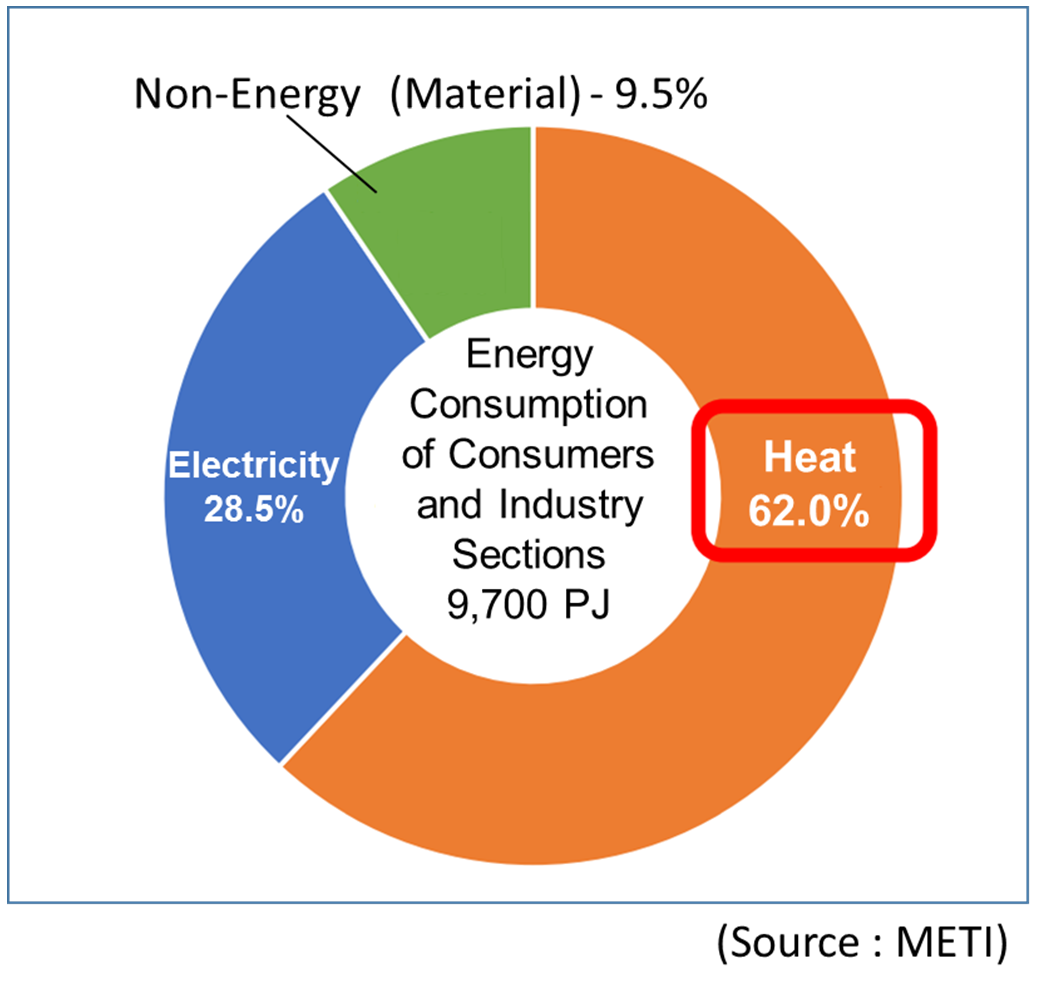
Source: METI
ANRE to solicit public feedback on 2023-2028 bioethanol consumption goal
(Japan NRG, Dec. 6)
- In December, ANRE plans to solicit public feedback on the bioethanol consumption plan and goal for 2023-2027.
- For 2018-2022, oil refineries targeted bioethanol consumption of 0.5 million kiloliters/ year blended in refined oil products. To further increase this in the mobility sector, vehicle fuel and other safety standards need reviews.
- The proposed 2023-2028 target for next-generation bioethanol derived from cellulosic and other materials is 10,000 ethanol equivalent kl/ year. This is based on the idea of raising the bioethanol blending rate for vehicle fuels to 10% from the present 3%.
TAKEAWAY: Under the Act of Advancement of Energy Supply Structures, targets are set on energy suppliers’ non-fossil supply mix. The targets are often misunderstood as “caps”. It’s not forbidden to exceed non-fossil fuel mix targets while adhering to current safety standards.
METI to introduce notification system for CCS projects
(Denki Shimbun, Dec. 5)
- METI discussed the domestic legal system for CCS (carbon capture and storage). The ministry wanted to set up a prior notification system for new CCS businesses, rather than a license system; this would lower the entry barrier and, officials hope, spur more projects.
- If a few companies become local monopolies, a license system would be applied.
TAKEAWAY: While the ministry’s official goal is to have competition in all sectors for the sake of fair business practice and as a means to reduce prices, the transfer to CO2 is a large infrastructural undertaking that may well benefit from consolidation. In that sense, it would be similar to the transmission sector in electricity, which is considered to be a natural monopoly. Thus, the more likely end result will be a license system for CO2 transfer.
METI, China’s Development Reform Commission hold decarbonization dialog
(Government statement, Dec. 7)
- Senior METI officials and China’s National Development Reform Commission met online for a policy dialog on decarbonization that started last year.
- METI spoke on the national clean energy strategy, and NDRC presented the 24th five-year plan. Officials exchanged views on hydrogen and ammonia projects.
- CONTEXT: JERA will launch test runs of a 20% ammonia-coal co-firing system at a 100 MW plant in 2023, which will be expanded to 50% or more by 2028. China Energy Investment Corp has reportedly succeeded in 35% ammonia co-firing at a 40 MW pilot plant in the Shandong province this year.
TAKEAWAY: The next policy dialog is scheduled for the end of 2023. This is important to agree on international standards, both technical and carbon footprint methodologies. Power generation efficiency and costs are keys to make the technologies competitive, and depend on the development of combustion burners.
METI to develop hydrogen with European Energy Commissioner
(Denki Shimbun, Dec. 5)
- METI Minister Nishimura and EU commissioner for energy Kadri Simson signed a memorandum to develop hydrogen, especially for technology exploitation and establishment of a hydrogen market.
- Simson said due to the supply instability and the rise in natural gas prices, she’ll discuss how to stabilize the energy market, and the transition to hydrogen.
- This is their second meeting. During the previous session in September, they agreed to establish the “EU – Japan Green Alliance” for hydrogen and LNG.
Kansai Electric and Kawasaki Heavy to cooperate on sea transport of hydrogen
(Denki Shimbun, Dec. 5)
- Kansai Electric and Kawasaki Heavy Industries agreed to develop technology for the sea transport of liquified hydrogen.
- By 2030, Kansai Electric plans a supply chain for hydrogen at Himeji City, Hyogo Prefecture; one key link is sea transport.
- Kawasaki Heavy developed the world’s first vessel to carry liquified hydrogen; test runs were made on a route between Japan and Australia.
- Building vessels and ports takes 4 to 5 years, so Kansai Electric must start work by the mid 2020s to begin operating the hydrogen supply chain by 2030.
Idemitsu starts review of green ammonia production in Australia for export
(Kankyo Business, Dec. 2)
- Idemitsu will conduct a study to produce and export green ammonia from Abbot Point Port in Australia. Local partners are Energy Estate and CS Energy.
- Called Hydrogen North Queensland (HyNQ), the project seeks to produce up to 500,000 tons of ammonia annually. Exports to Japan will also be explored.
- The study will examine the technical, environmental and economic standpoint of producing hydrogen using renewables and also for creating desalination facilities in order to use seawater as a water source.
Tokyo governor optimistic about perovskite venture
(Newswitch, Dec. 6)
- The Tokyo Metropolitan government is supporting the development of next-gen perovskite PV cell technology at Sekisui Chemical with a plan to commercialize the tech in 2025.
- Perovskite film will be mounted on the lids of Tokyo oxidation ponds to evaluate their performance and durability. The thin, light nature of perovskite film makes it suitable for many applications.
- The film is also made chiefly from iodine. Japan accounts for 30% of the world’s iodine production.
Chiba may get carbon-neutral industrial complex
(Company statement, Dec 8)
- Iwatani, Ube Materials, KH Neochem, COSMO, JFE Steel Corp, JNC Corp, Denka, Maruzen Petrochemical, UBE Elastomer, and Yokogawa Electric Corp signed a memorandum to develop a carbon-neutral industrial complex in Chiba.
- The complex would comprise newly-built plants for the capture, recycling, subterranean storage, and transport of CO2, in addition to pipelines.
- It would also have hydrogen pipelines to supply chemical and petrochemical plants, as well as steel works, wind and solar farms, and storage batteries.
- The parties aim to complete a feasibility study on the venture by around 2030, with a view to making the site completely carbon neutral by 2050.
Toyota Tsusho-led group to build carport-style solar park in Sendai Airport
(New Energy Business News, Dec. 9)
- Toyota Tsusho, Tokyu Real Estate, and Tohoku Electric are constructing a carport-style solar power plant in the parking area at Sendai Airport. The project is approved by MLIT, which will subsidize half of the cost.
- The plant will start operation in April 2023 and will cover 20% of Sendai Airport’s passenger terminal building power demand. The area has 576 parking spaces.
- The panels are manufactured by Canadian Solar and the power conditioners by Huawei. Maeda will be in charge of construction.
IHI wins order for methanation device from steelmaker that plans to switch to hydrogen
(New Energy Business News, Dec. 8)
- IHI group received an order for a methanation device for a test blast furnace planned by JFE Steel. The device will be the world’s largest and is part of a project under NEDO’s Green Innovation Fund to develop an iron/ steel making project that uses hydrogen instead of fossil fuels.
- IHI expects to make further progress in this technology in the next two years and looks to commercialize it by 2030.
Marubeni to study decarbonization options for EVN Vietnam Electricity Group
(New Energy Business News, Dec. 6)
- Marubeni and EVN Vietnam Electricity Group (EVN) signed an MoU to research decarbonization, including how to lower emissions at existing thermal power plants and develop renewable energy, biomass, ammonia and hydrogen.
- Marubeni is the first company to sign an MoU with EVN on decarbonization.
NEWS: POWER MARKETS

Power retailers to declare reliance on spot market to help with regional LNG forecasts
(Denki Shimbun, Dec. 5)
- METI has decided to disclose the spot market dependency ratio of power retailers in each area in order to help major power producers forecast future LNG demand. Data from small providers, including procurement plans, sales plans, and spot market bids, will be released.
- CONTEXT: Before power market unbundling, vertically integrated utilities could predict LNG demand because they knew how much fuel they needed to cover local power needs. Today, former regional monopolies serve only about 80% of the market and sell a portion of their volumes on the wholesale (JEPX) market. There are several hundred firms licensed to retail electricity in Japan and most of them procure their electricity on JEPX.
- Govt committees will discuss and evaluate the risk hedging efforts of retailers, as well as the public disclosure of hedging ratios.
TAKEAWAY: Former regional monopolies claim that without visibility of demand in the wholesale power market they are at a disadvantage. These firms, also known as EPCOs, procure LNG, coal and other fuels to generate most of their power. These fuels tend to be bought on long-term contracts that lock in buyers at certain price levels. EPCOs want to know more precisely how many power retail firms are reliant on the JEPX market that they supply. However, power retailers not related to EPCOs are reluctant to disclose their rate of dependence on the JEPX as it’s part of their business strategy. Previously, METI backed the retailers, but record LNG prices and the reluctance by EPCOs to commit to new long-term LNG contracts is swaying govt officials to support the major power producers.
Transmission companies ordered to lower their cost increase by 30%
(Denki Shimbun, Dec. 9)
- At the Dec 8 meeting of the Electricity and Gas Market Surveillance Commission ten transmission companies were ordered to lower their cost increase demands by more than 30%. The initial price increase was submitted in July.
- The 10 companies forecast annual revenue of about ¥4.7 trillion yen over the five year period (from 2023 to 2027). Their current revenue is ¥4.5 trillion.
- Power grid companies such as TEPCO PG or Chubu PG said this will severely impact their finances as they have already factored in the ability to reign in costs through internal efficiency improvements. The companies expect higher spending due to an increase in the renewal rate of aging facilities and more utility poles, as well as grid upgrades to meet net-zero and resilience goals.
TAKEAWAY: The govt has introduced a revenue cap for transmission companies and this is its first use. The goal is to manage budgets so that grids have enough capital to invest in upgrading the grid to incorporate more renewables. However, grid companies also need to update aging infrastructure and say costs in general are rising faster than their budgets.
Utilities to METI: “Cost increase is beyond corporate efforts”
(Denki Shimbun, Dec. 9)
- Major power utilities (EPCOs) met with the Electricity and Gas Market Surveillance Commission (EGC) to discuss their application to increase power prices for households.
- Top management said that in order to maintain a stable supply of electricity, they need to increase prices. The CEO of Okinawa Electric complained that his company had its worst loss ever this year.
- Committee member Professor Matsumura said that price increases that are based on rising fuel cost should be approved to ensure the country’s power businesses can sustain themselves.
TAKEAWAY: Although Japan(s power market has been deregulated in stages, many aspects of pricing and other areas are still ultimately under the control of METI.
New Federation chair likely to be far removed from cartel scandal
(Shukan Economist, Dec. 5)
- As the Federation of Electric Power Companies prepares to appoint a new chair in April, KEPCO CEO Mori is seen as a top contender.
- Insiders believe that recent allegations of cartel behavior mean that candidates from Chubu Electric, which is accused of colluding with Toho Gas, have been excluded from consideration.
- While KEPCO is one of the utilities accused of forming a cartel, Mori was recently in charge of the technical side of its operations, meaning that he would have had no knowledge of such conduct.
- SIDE DEVELOPMENT:
Cartel allegations come at a difficult time for Chugoku Electric
(Asahi Shimbun, Dec. 3)- Chugoku Electric projects a loss of over ¥200 billion for the year to March.
- The forecast takes into account heavy fines expected to be imposed by the Japan Fair Trade Commission in relation to alleged cartel activity.
- Before the allegations, the utility was already expecting a ¥139 billion loss.
- Some senior employees said the allegations could not have come at a worse time as its clients are unlikely to accept further power price increases.
JERA and NEC launch JEPX electricity trading test based on demand-response tools
(Company Statement, Dec. 1)
- JERA and NEC launched a demonstration project to trade electricity on JEPX while also using demand-response mechanisms.
- NEC will use AI to predict the demand for solar facilities (3.2 MW) and batteries (500 kW) installed at its Abiko Verification Center, taking into account event and weather information. Surplus power generated will be traded by JERA on JEPX.
- As NEC looks for ways to optimize revenue from its power facilities, JERA will test the system’s ability to reduce imbalance risks.
More than 20% of new power market players withdrew from power business
(Denki Shimbun, Dec. 8)
- According to data company Teikoku Databank, the number of new power market players going bankrupt or withdrawing from the business is increasing.
- While the total number of new power market players as of April 2021 was 706; 146 companies have since faced bankruptcy or withdrawn from power retail. This means that more than 20% of industry newcomers have already pulled out from power retail.
- The downturn is due to the sharp increase in the wholesale electricity price and its rising volatility since 2020. Most new market players did not own their own power generation.
TAKEAWAY: In many industries, a downturn brings on a wave of industry consolidation. Power retailers, however, own few assets and thus carry little residual value unless their customer contracts are in-the-money. In this sense, there is little incentive for stronger market players to buy the business of struggling rivals.
- SIDE DEVELOPMENT:
Power retailer owned by Tohoku Electric and Tokyo Gas enters bankruptcy
(Kankyo Business, Dec. 6)- Synergia Power filed for bankruptcy with the Tokyo District Court.
- The company was established in October 2015 as a JV between Tohoku Electric and Tokyo Gas. The company sells high-voltage and special high-voltage power in the Kanto region and had about ¥40 billion in revenue last fiscal year.
- Total liabilities amounted to about ¥13 billion. Its debt exceeded company assets for two straight years due to soaring wholesale power prices.
Mie Prefect asks Pacifico Energy to protect butterflies at 140 MW solar project
(New Energy Business News, Dec. 8)
- Mie Prefecture Governor submitted his opinion on a 140 MW solar project planned on a former golf course. The opinion asks the solar developer to consider the impact on the gifu butterfly and other local species.
- Construction is set to begin in 2026 and operations in 2028. The project will cover about 120 hectares and use about 256,000 crystalline silicon modules. The addition of storage batteries is also under consideration.
Eurus Energy plans 450 MW offshore wind project in Chiba
(New Energy Business News, Dec. 7)
- Eurus Energy Holdings plans a 450 MW offshore wind power project off the coast of Kujukuri in Chiba Prefecture.
- Kujukuri-oki is classified as a “promising area” under the Act on the Utilization of Renewable Energy Sea Areas.
- The project area is about 3,700 ha, and up to 30 wind landing type turbines will be installed. Construction will be 2 to 3 years
High fuel prices impact renewables market
(Newswitch, Dec. 2)
- The high price of renewably-generated electricity is forcing commercial subscribers, especially small to mid-sized businesses, to revert to legacy utilities.
- Even the Kanagawa govt was stymied in its switch to renewable providers: a tender failed to attract bidders because the maximum set for bids was too low.
- In November over 43,000 users subscribed to electricity start-ups were being supplied with electricity under a government plan to protect consumers whose power providers had shut operations.
- Small businesses don’t need to meet shareholder ESG expectations; incentives are required to encourage them to use renewably-generated electricity.
Businesses innovate to cope with rising power prices
(Nikkei Business, Dec. 5)
- Rising electricity prices have challenged the prevalent belief among Japanese businesses that basic services and infrastructure would remain cheap forever.
- Some businesses are forced to switch from providers of renewably-generated electricity to legacy utilities to cut costs. Shizen Energy’s commercial tariffs are now more than double those charged by Kyushu Electric.
- Other businesses installed energy management systems to optimize use, and ensure total power consumption does not exceed a set maximum value.
- Other businesses turn to PPAs that enable subscribers to reduce their electricity bills without investing in generation infrastructure.
NEWS: OIL, GAS & MINING

Japan starts Russian crude price cap but excludes Sakhalin-2
(Japan NRG, Dec. 5)
- Japan imposed a $60/ barrel price cap on crude oil imports from Russia, effective Dec 5, but excluded Sakhalin-2 production citing it as vital to energy security.
- Crude condensate is a byproduct of LNG production. If the price cap is applied to Sakhalin-2 project condensate, Russia may stop LNG output, aggravating the present gas supply crunch, Japan has argued.
- Japan has stopped imports from the Sakhalin-1 project, METI said.
- CONTEXT: Sakhalin-1 is mainly a source of oil for Japan, while Sakhalin-2 mostly sends LNG to the country.
METI officially announces launch of strategic LNG reserve
(Japan NRG, Dec. 6)
- METI has officially announced the launch of a strategic LNG (SBL) reserve to deal with any emergency disruptions in supply. The reserve will be sourced from a new category of suppliers called licensed SBL operators, which will consist of companies with LNG supply track records of over 3.6 million tons/ year.
- JOGMEC will set up and run the SBL fund to subsidize SBL operators, which are required to make a refund if they make financial gains from sales to the reserve.
- CONTEXT: SBL is for low-intensity emergencies and it falls under the framework of the Economic Security Promotion Act passed in May. In extremely dire situations, the state will directly purchase LNG.
TAKEAWAY: In a bid to retain Japan’s dominant position in the global market, METI also aims to increase the LNG trading volume by Japanese companies, such as increasing sales to non-Japanese parties.
LNG stocks rise to 2.63 million tons
(Government data, Dec. 8)
- LNG stocks of 10 power grids stood at 2.63 million tons as of Dec 4, up from 2.52 million tons a week earlier. METI reported earlier that the Nov 27 stocks were 2.53 million tons but revised the figure. The end-December stocks last year were 2.34 million tons. The five-year average for this time of year is 1.84 million tons.
Mitsubishi Materials to develop leaching processes to recycle lithium-ion batteries
(Company statement, Dec. 2)
- Mitsubishi Materials and metal recyclers Envipro and VOLTA will develop chemical leaching processes to recycle lithium-ion batteries.
- CONTEXT: In general, chemical leaching is less energy intensive than heat treatment of spent batteries that’s employed by other battery recyclers.
TAKEAWAY: Recyclers will be fighting over limited supplies of spent batteries as EVs have so far had limited success in Japan.
INPEX and JOGMEC join for feasibility study of CCS in Australia
(Denki Shimbun, Dec. 7)
- INPEX and JOGMEC will start a feasibility study for a CCS project at Bonaparte Basin, Australia.
- INPEX co-acquired interest in a lot suitable for CCS together with Woodside Energy and Total. INPEX holds a 33% stake in the project.
- The study will run until September 2025. The idea is that a CCS facility capture and store CO2 emitted from INPEX’s Ichthys LNG facility.
Hitachi Metals will develop EV motor with less rare earths from China
(Nikkei Asia, Dec. 9)
- Hitachi Metals is developing a motor for EVs that uses a lot less rare earth metals, the bulk of which Japan imports from China. Such a motor would boost supply chain resilience.
- CONTEXT: China controls as much as 90% of the global market in certain rare earth metals. Naturally, China prioritizes its own consumption ahead of exports and also blocked exports to Japan during territorial tensions between the countries.
- Hitachi Metal wants to make magnets that utilize iron oxide instead of rare earths such as neodymium. This would drop the overall cost of the motor.
ANALYSIS
BY MAYUMI WATANABE
Power in Water – Japan’s New Solar Frontier of Floating Systems
Amid trouble securing land for future projects, some municipalities and developers are looking to a new frontier to kickstart the rollout of new solar capacity. Floating solar systems hold tremendous untapped potential.
This issue is not about marginal gains. Japan has enough inland water surfaces to support close to 40 GW of floating solar capacity, concluded the state research hub, NEDO. Most of the nation’s 154,000 agricultural reservoirs and 3,000 dams remain “untapped”.
Inland water surfaces are not the only spaces to be tapped. The Tokyo Metropolitan government recently moved to create a fund that includes support for offshore solar system development. The investment is also part of a grand future-city planning project that will leverage new energy tech in the Tokyo Bay to showcase multiple energy, sustainability and automation initiatives.
“Cutting-edge renewable energy” is one of the three core themes of the Tokyo Bay eSG Project this year. Under this umbrella, city officials promise to demonstrate the first sea-based floating solar farm in the country. But what impact will it have on the domestic solar industry?
Pioneers in floating solar systems
Japan’s solar power generation capacity hit 78 GW at the end of 2021, one of the world’s largest. Yet to achieve the nation’s 2030 decarbonization targets that capacity needs to climb to 108 GW, according to official estimates. Meanwhile, readily available land is running short.
Given Japan’s high mountain and forest cover, the idea of exploiting some of the water surfaces for solar generation was always attractive. In 2007, the Japan Water Agency installed the world’s first floating solar system in a reservoir in its Aichi branch site to test new renewable energy tech, as requested by the Environment Ministry. The system, with a capacity of just 90 kW, was dismantled in 2012 after studies were completed.
The private sector took over development and presently floating installations around Japan number about 300 MW in total, according to manufacturers’ estimates. There is no official government data on floating solar power systems.
This is roughly 10-20% of global installations. French manufacturer Ciel Terre has the strongest system supply track record with over 50% of the Japanese market share. Other key system suppliers are one of Japan’s largest construction companies, Sumitomo Mitsui Construction Corp (SMCC), as well as Kyoraku, Ibiden, Takiron and Reservoir Solar.
Currently, Japan’s largest floating solar site is the 13.7 MW system in the Yamakura Dam in Chiba Prefecture, owned by Kyocera TCL Solar. Most systems are sized below 3 MW and are installed in reservoirs in western Japan with a water depth of 2 to 5 meters. Developers in the Hyogo Prefecture are particularly keen to develop floating solar systems.
In November, the Tokyo government announced it will fund the country’s first initiatives to test-run larger floating solar systems in Tokyo Bay, where larger installations are possible. The city will offer grants of ¥10-¥30 million, as well as access to the Tokyo Bay offshore site until March 2025. The projects were separately awarded to SMCC and Tokyu Land Corp.
SMCC told Japan NRG that its key objective is to develop larger floating solar power systems for dams and hydro power plants. The national government is studying possibilities to expand the hydro power station capacities by evolving them into hybrid hydro and floating power stations.
Floating solar systems operating in deeper water and in fluctuating water pressure will be in demand. In addition to solar facility performances, Tokyu Land Corp will test drone systems to remotely monitor the floating panels, as well as storage batteries connected to the floating system.
Challenges for larger systems
The main advantage of floating systems as opposed to land-installed systems is the shorter time to operational stage, and thereby less costs, since they do not require reshaping or flattening of land. Reservoirs are mostly owned by municipalities, which also makes negotiations easier.
However, floating system operators say that running costs were higher than anticipated because one can’t just walk over to the panels to clean them or remove any clutter. They need to hire specialists, who are limited in number.
Floating solar systems generally boast power efficiencies that are 5-10% higher than land installed systems because water prevents overheating of the panels. However, they suffer unexpected decline in power generation, resulting from bird manure, dirt, sands and limescale smearing on the panels. Wooden and other debris could damage the system.
For floating power systems of over 10 MW, maintaining clean panels is a bigger task. These structures can be floating on deeper water of 50 meters or more. “We want to find solutions to these issues in Tokyo Bay,” said a SMCC official.
Anchoring the floating structure is another challenge. Tidal forces are stronger offshore. Tide levels change often, and together with gusty winds it could have disastrous effects. Due to Typhoon Faxai in 2019, the Yamakura Dam floating solar station was forced to close and it took nearly two years to restore itself from damages.
Other concerns include the impact on biological diversity because the panels will block the sunlight. In offshore facilities, sea shells that cling on floating equipment and ropes could weigh down the system, affecting panel angles.
While collecting data and exploring solutions to these issues, SMCC plans to pursue the potential of the floating solar power system as a mobile emergency system. “The system could be transported to areas that require power,” one official described.
SMCC plans to install a 50 kW floating system in a space of around 200 square meters. The system will comprise products of three manufacturers including their own, to test power efficiency and other parameters while arranging the panels in various angles.
Vague commercial roll out path
Despite a potential for 38.8 GW of new power sources, the path to rollout the large-scale floating solar systems is vague. Companies say they’re speeding up development to hit the national 2030 renewable and emission cut targets, but don’t yet have specific target dates on commercialization of offshore systems.
The Tokyo Bay projects are the first stepping stones and it’s too early to set future goals. So far, the Tokyo government has no plan to take the offshore projects to another level after March 2025. “We will have new programs in the years to come and at this point of time, no one is sure if renewables will be included,” a Tokyo official said.
Results from the Tokyo Bay study may provide helpful hints on identifying locations well suited for large floating structures and the data that’s necessary to collect to make the assessment. For example, Ibiden Engineering, which has installed a 1.9 MW floating system in Kinuura reservoir with 7,680 panels, said that the system maintenance efforts are limited to monthly patrols and panels being cleaned when there is visible dirt. But another operator said more intense maintenance is required. Each site has different features and risk elements.
The idea of developing hybrid hydro-solar power generation systems and equipping dams with solar power stations is still at a conceptual stage, said MLIT officials. Thus the large floating systems are unlikely to multiply in the next few years, but once the policies defining how and where to promote them are written, it could spread quickly, one official said.
The findings from the Tokyo Bay projects are of interest to various stakeholders including municipalities that own large reservoirs, factories in bay-side industrial zones, and real estate developers that own bay side properties. Ultimately, this showcase initiative is likely to have ripple effects at commercial and national policy levels.
ANALYSIS
BY YOSHIHISA OHNO
METI Embraces the VPP as a Vital Tool in the Energy Transition
As Japan seeks to accelerate the rollout of green energy, METI has concluded that one bottleneck that clearly must be dealt with is how to better balance power demand and supply. And the solution that has the bureaucrats most excited of late is the use of optimization tools like Virtual Power Plants (VPPs).
Weather-dependent sources like solar and wind make up the bulk of Japan’s renewables output, which exceeded 20% of the nation’s total electricity volume for the first time last year. A greater penetration of variable power sources has, however, strained the ability of grid operators to balance the electrons in the system with actual demand. As a result, more and more areas around the country are asking solar farms to curtail output at certain times for the sake of grid stability.
In the past, Japan’s energy planners looked to other generation sources to provide the balance, but METI officials have noticeably shifted their attention to digital and system optimization options. These include treating a fleet of electric vehicles (EVs) as a local grid balancing tool. Another is harnessing VPPs to aggregate a large number of power units and then functioning as an intermediary between them and the wholesale electricity market.
Ultimately, according to a TEPCO Power Grid proposal to METI, the installment of VPPs can stimulate the creation of local, sustainable energy marketplaces that offer new revenue options for developers while helping regions meet their carbon neutrality goals.
What is a VPP?
VPP is a cloud-based system that functions as an intermediary between distributed energy resources (DERs) – such as wind farms, rooftop solar, batteries and fuel cells – and the wholesale electricity market. Many DER owners are too small or isolated to participate in the market directly. When connected via IoT equipment, they become part of a larger “power plant” system that uses algorithms to improve each unit’s performance and trades electricity on its behalf.
In this sense, a VPP is an ‘Internet of Energy’ that taps existing networks to tailor electricity supply and demand services for a customer. The bidirectional data exchange between various power units and the VPP provides real-time data on consumption, storage levels, and spare capacity. This in turn maximizes value for both the end-user and the utility as the software reacts quickly to ever-changing demand.
The VPP’s control system stores all the data needed to calculate optimal operation schedules. In this way, a VPP is more flexible and more efficient that a conventional generation facility acting on its own. The system’s downside is it requires complicated IT and infrastructure, as well as secure communications.
Reverse flow of electricity from downstream to upstream is increasing
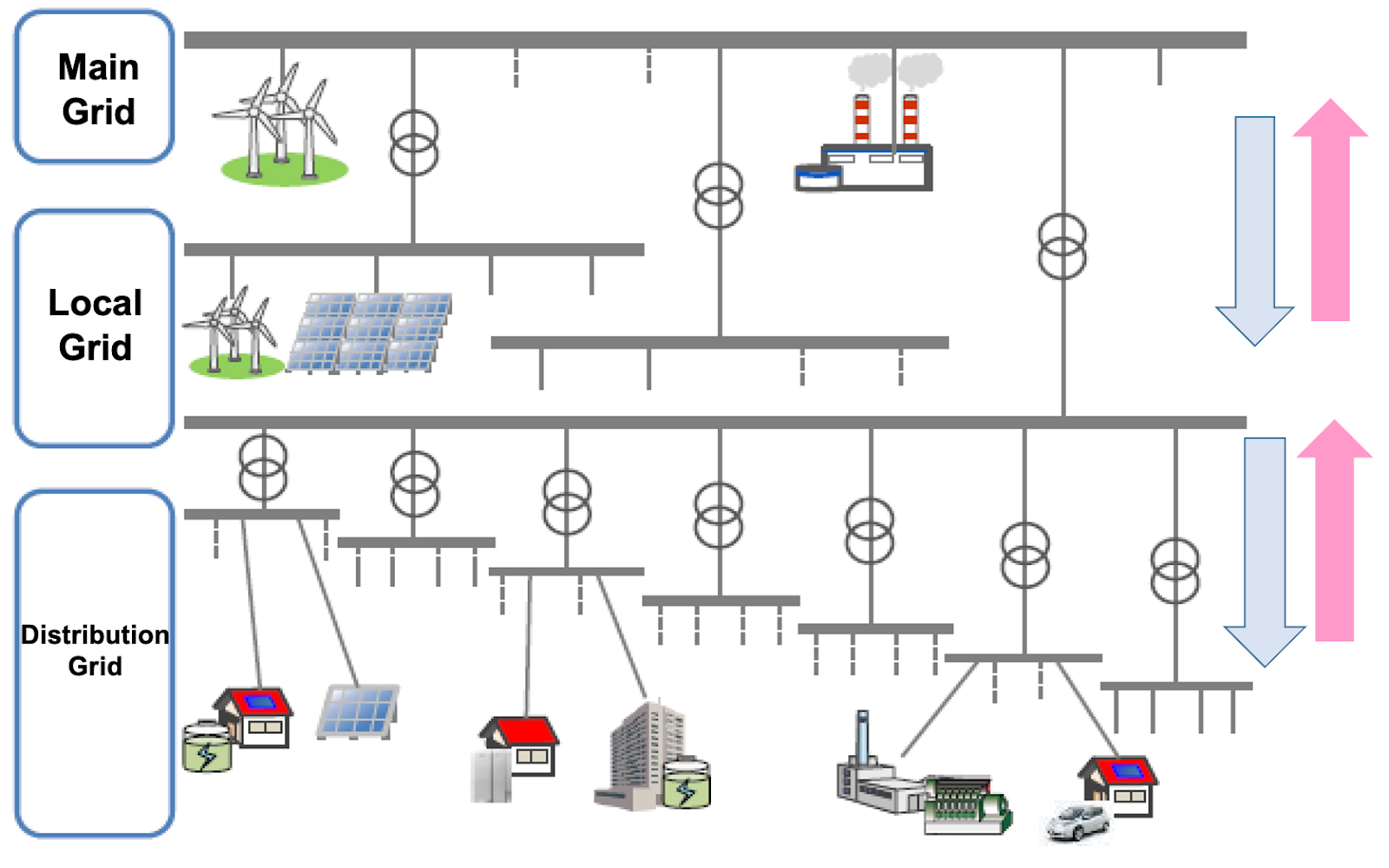
Source: METI
Background to VPP in Japan
METI had toyed with developing VVP technology in Japan before. It subsidized several test projects in the aftermath of the 2011 Fukushima disaster, which forced a number of nuclear and thermal power stations offline, thus raising concerns about relying solely on centralized large-scale power plants.
Due to its ITC-first nature, VPP development attracted mostly domestic players from the online and telecommunications space, such as NTT Data, Rakuten Energy, and SB Energy, although some construction and financial firms also showed interest.
In January 2016, METI also established the Energy Resource Aggregation Business Forum (ERAB), a cooperative platform between the government and private sector. In the same year, Toshiba launched a two-year VPP trial in cooperation with TEPCO and Yokohama City, testing IoT-controlled storage batteries as an emergency power source. As a result, the engineering giant claimed in 2019 that it was able to start offering a commercial-scale VPP system based on multiple battery groups.
Developers like Toshiba looked to the creation of a balancing market, which opened in 2021, to help provide a financial basis for installing VPPs. The balancing market indeed launched and has spread nationwide. VPP usage has yet to follow.
New impetus
There is a renewed impetus in the VPP space from METI. On Nov. 7, the ministry hosted its first “Review Session for a Next-Generation Distributed Power System” to find ways to improve the supply-demand balance from the increasing DER cohort.
Two “commissioners” joined this session, including executive officers of power transmission companies affiliated with TEPCO, Chubu, Kansai, and Kyushu Electric, as well as new market players, and academics.
A second meeting quickly followed on Nov 28 to discuss how EVs can also function as storage batteries for the power grid and thus play a role in balancing the market. The panel suggested that EV batteries could even be used to adjust voltage in addition to soaking up the surplus volumes generated by renewables. EV batteries would then be discharged back into the grid as needed.
Japan has pioneered some of the technology involved in such operations. Using EVs to take and return power to the power grid requires what is known as bi-directional capability. It has been pioneered by Osaka-based Tsubaki, which developed eLINK – a vehicle-to-everything (V2X) compatible charging system that connects EVs with buildings and power grids (V2G).
However, there is a drawback to relying on EVs in Japan at this moment. EV sales in Japan have been slow. In FY2021, just 54,730 new units were sold in the country, an increase on the 34,480 EVs sold in FY2020 but well below the rates of China, the U.S and Europe.
This makes more system-wide solutions such as VPPs attractive. Conditions for some of the components of a VPP business are also improving. This year, METI clarified the status of standalone batteries, which will be licensed going forward as power transmission facilities. Previously, the status of standalone batteries was something of a gray area.
A legal framework for aggregator systems was also unveiled this year, while the introduction of next-gen smart meters is just a couple of years away.
Furthermore, the growth in size and liquidity of various power markets, such as the balancing and the capacity markets, as well as the launch of the FIP system, are also helping to improve the revenue streams for a VPP-based business.
TEPCO’s innovative solution
The grid company responsible for the greater Tokyo area has a further suggestion that could well find favor with the government. Dr. Hiroshi Okamoto, the Executive Vice President and CTO at TEPCO Power Grid, made a presentation at METI’s Nov. 7 meeting titled “The way to profitably is to employ local DERs for decarbonization and to benefit the local community”.
One of the most esteemed power system engineers in Japan, Dr. Okamoto believes that DERs can be leveraged to resolve issues many local communities face, such as a decline in the labor force, and a shrinking of transport, medical and welfare services. VPPs would automate the operational control of many small local power sources while stimulating investment in better infrastructure and digital solutions.
He suggested setting up a new “Local DER Market” that would trade both power capacity and volumes, as well as the environmental value of “green” electricity. With a local market place catering to local power users, there is also potential to lower grid congestion and improve the accuracy of supply-demand balancing.
At root, what TEPCO Grid is suggesting is a way to make DERs better integrated into the Japanese grid and more profitable, which in theory should spur more investment in new renewable energy facilities. Should the idea win support from other market players and officials on METI’s panel, it could kickstart a real commercialization of VPP systems in Japan.
Outline of a Local DER Power Trading Market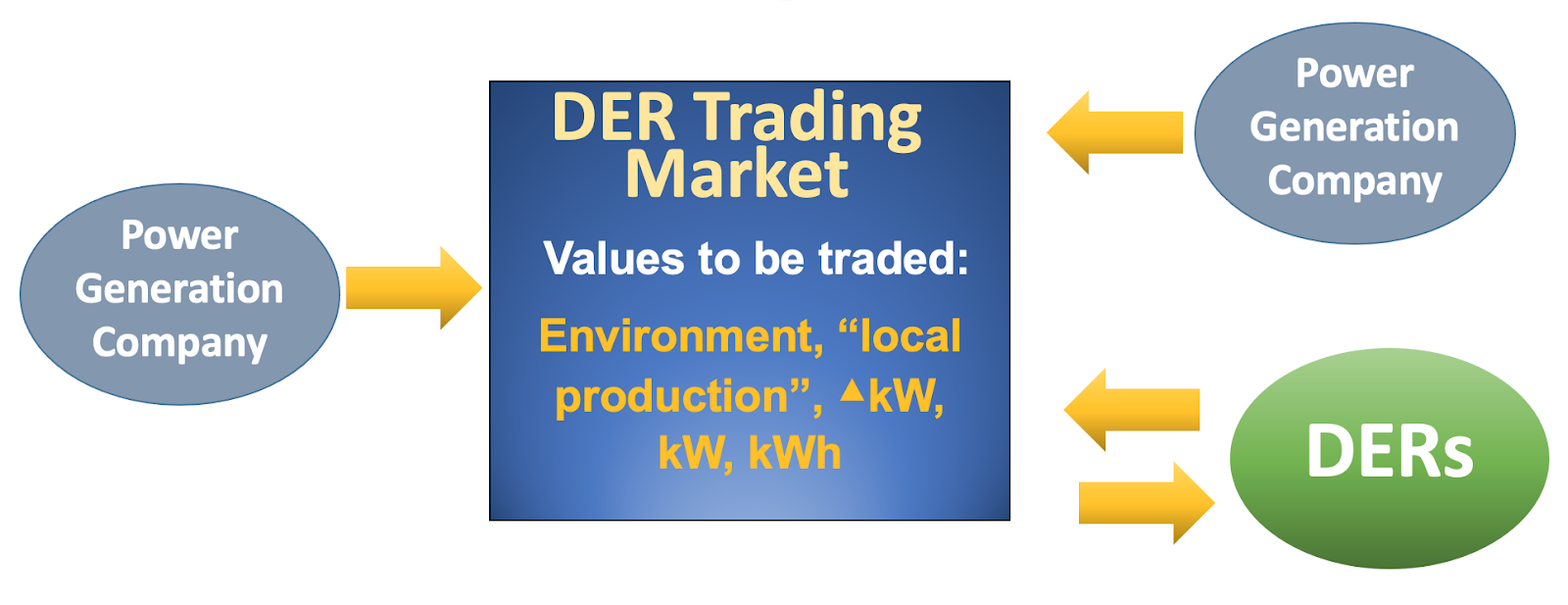
Source: TEPCO Power Grid via METI
GLOBAL VIEW
BY JOHN VAROLI
Below are some of last week’s most important international energy developments monitored by the Japan NRG team because of their potential to impact energy supply and demand, as well as prices. We see the following as relevant to Japanese and international energy investors.
Australia/ Renewable power
Mining billionaire Andrew Forrest’s energy company, Squadron, acquired CWP Renewables from Switzerland-based Partners Group for A$4 billion. Forrest is now the leading player in Australia’s renewable energy sector.
Brazil/ Lithium mining
Toronto-listed Sigma Lithium is expanding lithium production at its Grota do Cirilo Project that could triple total annual output to over 100,000 tons of lithium carbonate by 2024, making it one of the world’s largest fully integrated lithium producers.
California/ Offshore wind power
The first sale of offshore wind rights drew $757 million in bids. Winners of the five leases were European companies such as Norway’s Equinor, Germany’s RWE, and Ocean Winds — a JV between France’s Engie and Portugal’s EDP Renewables.
China/ Yuan fuel payments
China will continue to import large quantities of crude oil from Gulf countries, expand LNG imports, strengthen upstream oil and gas cooperation, transportation and refining, and carry out yuan settlements on the Shanghai Petroleum and National Gas Exchange, Xi said at the China-GCC summit.
Coal mines
Glencore plans to shut 12 coal mines over the next 12 years even though the Swiss-based mining and trading house is expected to generate about $16.7 billion from coal sales this year.
Congo/ Corruption settlement
Glencore will pay $180 million to the Republic of Congo to cover corruption charges. The settlement means Glencore has this year paid over $1.66 billion to countries around the world over corruption allegations.
EU/ Natural gas
In November, EU countries cut gas demand by 24% below the five-year average even as temperatures grew colder. This shows that the bloc is reducing reliance on Russian energy.
Germany/ Natural gas
Commodity trading house Trafigura signed a four-year, $3 billion loan partly supported by Berlin to help supply natural gas to Securing Energy For Europe (Sefe), formerly Gazprom Germania.
Russia/ Oil tankers
Shipping broker Braemar said that Moscow, which relies heavily on foreign tankers to transport its crude, has added more than 100 ships this year to its fleet, through direct or indirect purchases. The goal is to skirt western sanctions.
Russia/ Natural gas
TotalEnergies won’t exit the Yamal LNG project, a source told Reuters, after the company decided to take a $3.7 billion write-off on its stake in the Russian natural gas company Novatek.
South Korea/ Hydrogen power
POSCO Group will invest $40 billion in Australia to develop hydrogen power; $28 billion in hydrogen power production and $12 billion in green steel.
UK/ Coal power
The government approved the first coal mine in 30 years, inciting protest from environmental groups. The £165 million mine will provide coking coal for use in steel production rather than for generation in thermal power plants.
2022 EVENTS CALENDAR
A selection of domestic and international events we believe will have an impact on Japanese energy
| January | OPEC quarterly meeting;
JCCP Petroleum Conference – Tokyo; EU Taxonomy Climate Delegated Act activates; Regional Comprehensive Economic Partnership (RCEP) Trade Agreement that includes ASEAN countries, China and Japan activates; Indonesia to temporarily ban coal exports for one month; Regional bloc developments: Cambodia assumes presidency of ASEAN; Thailand assumes presidency of APEC; Germany assumes presidency of G7; France assumes presidency of EU; Indonesia assumes presidency of G20; and Senegal assumes presidency of African Union; Japan-U.S. two-plus-two meeting; Japan’s parliament convenes on Jan. 17 for 150 days; Prime Minister Kishida visits Australia (tentative) |
| February | Chinese New Year (Jan. 31 to Feb. 6);
Beijing Winter Olympics; South Korea joins RCEP trade agreement |
| March | Renewable Energy Institute annual conference;
Smart Energy Week – Tokyo; Japan Atomic Industrial Forum annual conference – Tokyo; World Hydrogen Summit – Netherlands; EU New strategy on international energy engagement published; End of 2021/22 Japanese Fiscal Year; South Korean presidential election |
| April | Japan Energy Summit – Tokyo;
MARPOL Convention on Emissions reductions for containerships and LNG carriers activates; Japan Feed-in-Premium system commences as Energy Resilience Act takes effect; Launch of Prime Section of Japan Stock Exchange with TFCD climate reporting requirement; Convention on Biological Diversity Conference for post-2020 biodiversity framework – China; Elections: French presidential election; Hungarian general election |
| May | World Natural Gas Conference WCG2022 – South Korea;
Elections: Australian general election; Philippines general and presidential elections |
| June | Happo-Noshiro offshore wind project auction closes;
Annual IEA Global Conference on Energy Efficiency – Denmark; UNEP Environment Day, Environment Ministers Meeting – Sweden; G7 meeting – Germany |
| July | Japan to finalize economic security policies as part of natl. security strategy review;
China connects to grid 2nd 200 MW SMR at Shidao Bay Nuclear Plant, Shandong; Czech Republic assumes presidency of EU; Elections: Japan’s Upper House Elections; Indian presidential election |
| August | Japan: Africa (TICAD 8) Summit – Tunisia;
Kenyan general election |
| September | IPCC to release Assessment and Synthesis Report;
Clean Energy Ministerial and the Mission Innovation Summit – Pittsburg, U.S.; Japan LNG Producer/Consumer Conference – Tokyo; IMF/World Bank annual meetings – Washington; Annual UN General Assembly meetings; METI to set safety standards for ammonia and hydrogen-fired power plants; End of 1H FY2022 Fiscal Year in Japan; Swedish general election |
| October | EU Review of CO2 emission standards for heavy-duty vehicles published;
Chinese Communist Party 20th quinquennial National Party Congress; G20 Meeting – Bali, Indonesia; Innovation for Cool Earth TCFD & Annual Forums – Tokyo; Elections: Okinawa gubernational election; Brazilian presidential election; |
| November | COP27 – Egypt;
U.S. mid-term elections; Soccer World Cup – Qatar; |
| December | Germany to eliminate nuclear power from energy mix;
Happo-Noshiro offshore wind project auction result released; Japan submits revised 2030 CO2 reduction goal following Glasgow’s COP26; Japan-Canada Annual Energy Forum (tentative); Tesla expected to achieve 1.3 million EV deliveries for full year 2022 |
Disclaimer
This communication has been prepared for information purposes only, is confidential and may be legally privileged. This is a subscription-only service and is directed at those who have expressly asked K.K. Yuri Group or one of its representatives to be added to the mailing list. This document may not be onwardly circulated or reproduced without prior written consent from Yuri Group, which retains all copyright to the content of this report.
Yuri Group is not registered as an investment advisor in any jurisdiction. Our research and all the content express our opinions, which are generally based on available public information, field studies and own analysis. Content is limited to general comment upon general political, economic and market issues, asset classes and types of investments. The report and all of its content does not constitute a recommendation or solicitation to buy, sell, subscribe for or underwrite any product or physical commodity, or a financial instrument.
The information contained in this report is obtained from sources believed to be reliable and in good faith. No representation or warranty is made that it is accurate or complete. Opinions and views expressed are subject to change without notice, as are prices and availability, which are indicative only. There is no obligation to notify recipients of any changes to this data or to do so in the future. No responsibility is accepted for the use of or reliance on the information provided. In no circumstances will Yuri Group be liable for any indirect or direct loss, or consequential loss or damages arising from the use of, any inability to use, or any inaccuracy in the information.
K.K. Yuri Group: Oonoya Building 8F, Yotsuya 1-18, Shinjuku-ku, Tokyo, Japan, 160-0004.