METI sets 2028 target to introduce carbon surcharge as part of a widescale revamp to tax oil and other fossil fuel companies
Wind developers concerned about shortage of EU turbines as big projects in Europe tie up resources of local manufacturers
Govt plans to expand carbon credits mechanism to private sector; Joint Crediting Mechanism (JCM) to be the basic framework
ENERGY TRANSITION & POLICY
Japan plans to build 8 key hydrogen/ammonia supply bases
LDP wants replacement of nuclear reactors in GX statement
Nuclear regulator wants additional approval system for reactors
Govt to build solar panel database to promote more recycling
Tokyo to host first Asia Zero Emissions Community ministers talks
Japan to share risk with financial players investing in green tech
Toyo to convert Indonesia’s spare fertilizer into ammonia fuel
MHI to study ammonia co-firing at coal power plant in Chile
Toyota and Thailand’s CP to produce hydrogen from farm waste
ELECTRICITY MARKETS
Transmission firms now allowed to select power source on “merit”
Kawasaki Heavy mulls Japan hydrogen-fired power plant by 2030
Mitsubishi group gets METI permit for three offshore wind farms
Solar farms of certain size to require governor’s approval in Nara
MLIT pledges 2.3 GW of renewable energy at airports by 2030
Kansai Electric restarts 1.18 GW nuclear unit in time for winter
Influx, JRE among firms submitting plans for new wind projects
Toshiba enters the business of running geothermal power plants
OIL, GAS & MINING
SAVE THE DATE
Meet Japan Power
Jan. 25, 2023
details to follow
Idemitsu says will cut oil refining capacity by a third this decade
Russia says Japan will get Siberian LNG starting late next year
LNG stockpiles of power utilities rise slightly WoW
Copper surplus may expand into 2023, says Japan’s top producer
ANALYSIS
BATTERY SECTOR ROADMAP SAYS: JAPAN NEEDS MORE PLANTS, MORE MONEY, MORE PEOPLE
With a focus on lithium-ion chemistry and all-solid-state technologies, METI’s Battery Industry Strategy sees domestic firms creating more battery capacity by 2030 than is being installed globally today. The Strategy details not only the volumes, but also estimates the investments required to set up component and unit manufacturing, and the money needed for the procurement of raw materials. The challenges to delivering such a vision are grand, such as the need to reduce the domestic price of electricity.
ENERGY JOBS IN JAPAN: THE IMPORTANCE OF STABILITY
In the U.S. about 73% of new graduates ranked job stability as their top priority when choosing an employer. In Japan, this prioritization of stability is nothing new. The country’s belief system still promotes the premise of lifetime employment. Also, social status is often linked to the prestige of your company’s name, much more than your job title or income. To illustrate the importance of social status, some time ago one of our clients shared an interesting story…
GLOBAL VIEW
Argentina secured $689 million from Brazil’s state bank, BNDES, to finance the second stage of a natural gas pipeline. President Putin wants to increase gas supplies to Asia, particularly China. EU wind turbine makers will face a tough 2023. To keep the lights on, Berlin has spent an unplanned €440 billion on energy this year. India approves building 10 more reactors. Details on these and more in our global wrap.
JAPAN NRG WEEKLY
PUBLISHER K. K. Yuri Group
Editorial Team Yuriy Humber (Editor-in-Chief) John Varoli (Senior Editor, Americas) Mayumi Watanabe (Japan) Yoshihisa Ohno (Japan) Wilfried Goossens (Events, global)
New Energy and Industrial Technology Development Organization
kWh
Kilowatt hours (electricity generation volume)
TEPCO
Tokyo Electric Power Company
FIT
Feed-in Tariff
KEPCO
Kansai Electric Power Company
FIP
Feed-in Premium
EPCO
Electric Power Company
SAF
Sustainable Aviation Fuel
JCC
Japan Crude Cocktail
NPP
Nuclear power plant
JKM
Japan Korea Market, the Platt’s LNG benchmark
JOGMEC
Japan Organization for Metals and Energy Security
CCUS
Carbon Capture, Utilization and Storage
OCCTO
Organization for Cross-regional Coordination of Transmission Operators
NRA
Nuclear Regulation Authority
GX
Green Transformation
NEWS:ENERGY TRANSITION & POLICY
Govt takes action to expand JCM for private sector
(Japan NRG, Dec. 13)
By March 2023, MoE and METI will issue guidelines to encourage private sector activity in the Joint Crediting Mechanism framework, a govt official told Japan NRG.
This will explain the process that enables projects fully funded by the private sector to be recognized under the JCM framework and to be awarded carbon offset credits.
JCM projects include private sector projects that receive state development aid.
CONTEXT: There are 25 countries participating in the JCM, generating over 210 projects. Japan is committed to expand JCM to 30 countries and to generate 100 million CO2 equivalent tons of JCM-derived credits by 2030.
TAKEAWAY: Opening the JCM system to projects wholly financed by the private sector will expand its scope significantly, helping the country reach its 2030 credit goal. Presently, international companies can’t take active roles in government-funded JCM projects and the guidance should be of great interest to many multinational businesses.
METI: Emissions trading to launch in 2026, “GX surcharge” in 2028, allowance auction in 2033
(Japan NRG, Dec. 14)
Starting in 2028, METI wants to introduce a carbon pricing plan that will see charges imposed on oil companies, trading companies, and other importers of fossil fuels. This carbon surcharge will be called a “GX surcharge”.
The govt will release details about the plan at a GX meeting later this month.
Also, Japan’s biggest emitters will be encouraged to participate in an emissions trading plan to begin in 2026; but electricity companies that use fossil fuels may not be charged for their emissions until around 2033.
A GX League carbon trading platform, launched in Sept as a pilot, will move to “phase 2 of voluntary trading” in 2023 and will remain voluntary until the next phase in 2026.
In phase 2, participants are expected to generate a large volume of voluntary credits.
To spur growth, the govt plans to spend ¥20 trillion in the next 10 years on non-fossil energy development, structural changes in industry, and resource recycling. The state money will trigger private sector investments that are expected to reach ¥150 trillion.
CONTEXT: The GX Council, which reports to the PM, is also making GX policy proposals.
TAKEAWAY: As is now usual, at the end of the year METI launches a flurry of major announcements that could play a big impact on future developments. This latest 100-page document is a blockbuster of data and policy. There are details on GX fundraising and spending that may become more important in 2023. Japan NRG will continue to review the changes and offer commentary as the situation develops.
METI plans to build 8 key hydrogen/ammonia supply bases
(Japan NRG, Dec. 12)
METI plans to build three large and five medium-sized hydrogen/ammonia supply facilities nationwide over a 10-year period.
The three large bases will serve major cities and five more will be built across Japan.
The Green Innovation Fund will finance feasibility studies, front-end engineering designs and building of tanks, pipelines and other infrastructure.
CONTEXT: METI’s scenario, which is described in the interim report of ammonia/hydrogen fuel policy panels, is to start ammonia/hydrogen power generation by 2030 while cutting supply costs to fuel their applications. The state will provide financing and regulatory support to accelerate building the supply chain.
TAKEAWAY: METI seeks speedy infrastructure solutions, but technologies from well-to-gate are still developing. One panel member said there may be other technologies, such as synthetic fuels, with superior properties to ammonia/hydrogen; all possible options need to compete.
The other issue that may slow down the development of these bases is the need for local buy-in. Technically, local governments are supposed to lead the formulation of the base plans, though it will undoubtedly be industry players that help to draft them.
LDP members want the replacement of nuclear reactors in the year-end GX statement
(Denki Shimbun, Dec. 14)
The LDP’s Federation for Promoting Replacement of Nuclear Reactors met with MoE Minister Nishimura to request a safety review for reactor replacements.
The MPs want the conclusion of the GX Council at the end of this month to be approved in a Cabinet meeting. That would essentially see the 6th Basic Energy Plan amended and augur in the 7th Basic Energy Plan.
The MPs want permit extension for aged nuclear reactors to be coupled with approvals for replacement units. This would not necessarily mean that an old unit is replaced with a new one at the same site. The operator would be free to build a new unit at a different site that it owns.
TAKEAWAY: Lawmakers and the industry are keen to make sure that the decommissioning of aged reactors does not deplete the overall nuclear capacity. Also, it may be easier logistically to have new construction ongoing at one site while there are decommissioning works at another.
SIDE DEVELOPMENT: Public supports extension of nuclear reactor operating life: Poll (NHK, Dec. 13)
A poll by public broadcaster NHK showed that 45% of the public support, and only 37% oppose, plans to extend the operating period of NPPs while also developing and building next-gen reactor technology. Another 18% of respondents were undecided.
Opposition is clustered among the elderly, women, and supporters of opposition parties.
Nuclear regulator asks for additional approval rights outside of operating license terms
(Asahi Shimbun, Dec. 15)
The current nuclear operating life permit system gives out a 40-year permit for a new reactor, which can be augmented by a further 20 years upon review. However, the industry regulator, NRA, wants an additional approval system to be put into place under which reactors are reviewed every 10 years starting from 30 years in operation.
Under the new system, a “long-term facility management plan” that outlines both the operator’s policies and the results of equipment inspections must be submitted.
The NRA wants to start the new system soon.
TAKEAWAY: Operating nuclear facilities within all the rules and regulations is already a highly bureaucratic and labor-intensive task. Utilities must submit some 10,000 pages of documents to the NRA for restart approvals of each reactor unit. Introducing a new system will add to the workload on both the utility and regulator side. And while the regulator is willing to let the operators submit their documents ahead of time to allow for an adequate period, the possibility that a facility is taken offline because of inadequate paperwork or additional questions from the NRA is not small.
The introduction of a new system will likely make the nuclear industry seem safer in the eyes of the public, which is important at a time when operators and the government seek approval to move forward with construction of new nuclear facilities. However, there are 17 reactors in Japan that have already passed the 30-year mark. If they are all subjected to additional reviews, something is sure to slow down. That will be either the restart of existing units, the review of older units for life extensions, or the formulation of rules for next-generation technologies. The size of the NRA’s staff seems too small to cope with all the above at the same time.
METI is to build database to promote recycling of solar panels
(Denki Shimbun, Dec. 16)
ANRE will build a database of solar panel products to accelerate the recycling of discarded units.
Recycling of used panels is regulated by waste management law, but not enough product data has been provided so far to facilitate waste disposal services. In some cases, the recycling method isn’t clear due to a lack of information about source materials.
ANRE plans to build a database by manufacturer and model numbers that will clarify both the components of the unit and the recycling treatment methods. This information will be given to waste disposal companies.
TAKEAWAY: METI expects that the disposal of solar panels could peak in the second half of 2030s. Therefore, METI is now preparing for that period of mass disposal.
Japan to host first ministerial meeting of the Asia Zero Emissions Community
(Asia Nikkei, Dec. 15)
On March 4, 2023, Japan is due to host the first meeting of energy ministers from Australia and the Southeast Asian nations.
METI minister Nishimura will attend the Tokyo meeting, which is intended to build on the government’s Asia Zero Emission Community concept.
CONTEXT: Japan and the U.S. are leading a $20 billion agreement with Indonesia to cut its reliance on coal-fired power. This model could be used for other Asian countries.
Japan will share risk with financial institutions to invest in new green technologies
(Denki Shimbun, Dec. 14)
METI, the Financial Services Agency and MoE said they’ll share the risk with private financial companies to develop technologies for decarbonizing.
The govt will promote “blended finance” to mobilize private sector finance towards sustainable development.
TAKEAWAY: Blended finance for green energy technology is supposed to function like the current role performed by NEDO and NEF (New Energy Foundation). But as those state organizations are under a ministry (such as METI or MoE), a new cross-sectoral financial mechanism needs to be established to develop innovative green technologies.
Toyo Engineering to convert fertilizer ammonia to green fuel in Indonesia
(Denki Shimbun, Dec. 13)
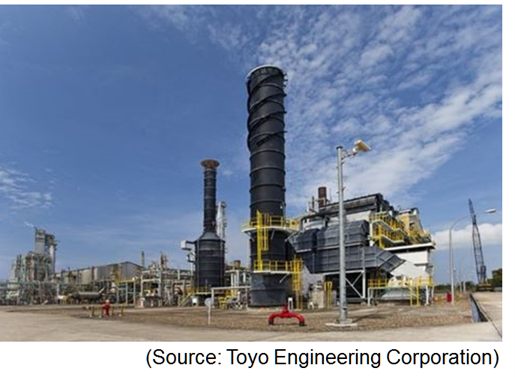
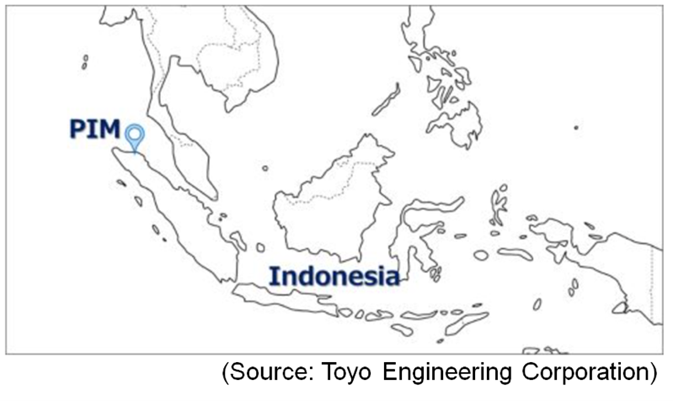
In Indonesia, Toyo Engineering will convert ammonia made for fertilizer use into green fuel. The ammonia will be supplied by Pupuk Indonesia Holding Co. (PIHC).
While PIHC’s annual ammonia production capacity is 7.3 million tons, about 1.2 million tons is surplus due to a decrease in natural gas production. Toyo Engineering will convert this surplus into fuel for co-combustion at coal-fired power plants or for shipping. The conversion will use energy from renewable sources.
Toyo Engineering has designed 86 ammonia plants worldwide, which amounts to more than a 10% share of all ammonia plants globally.
TAKEAWAY: In May 2022, METI tapped Toyo Engineering to do a feasibility study for green ammonia production in collaboration with PIHC. Thus, this collaboration seems to have been planned thanks to METI oversight.
Pupuk Iskandar Muda (PIM) fertilizer plant
IHI starts feasibility study to produce ammonia in Malaysia
(Denki Shimbun, Dec. 16)
IHI concluded a MoU with Gentari Hydrogen, a subsidiary of Petronas’ clean energy entity, to evaluate the feasibility of the production and sale of green ammonia made from electricity generated by solar power.
The plan is to build a plant with 200,000 tons/ year production capacity, starting in 2026. The green ammonia might be used for power generation and shipping fuel.
The green ammonia would be used in Malaysia, and also exported to Japan and other Asian countries.
MHI to study ammonia co-firing at coal power plant in Chile
(Company statement, Dec. 7)
Mitsubishi Heavy Industries signed an MoU with Chile’s Guacolda Energía to conduct a feasibility study for ammonia co-firing at a 758 MW coal-fired power plant in Huasco, Atacama Region, approximately 700 km north of the capital city of Santiago.
MHI had previously supplied the boiler, steam turbine, and other core facilities for this plant.
A two-phase study through 2026 will give a detailed plan for demonstration of 30% co-firing.
Toyota and Thailand’s CP Group to produce hydrogen from farm waste
(Company Statement, Dec. 14)
Toyota Motor will collaborate with Charoen Pokphand Group, Thailand’s biggest business group by revenue, on a project to turn farm waste into hydrogen fuel.
The Japanese company is keen to show other options for clean transport outside of EVs.
The two companies will make hydrogen using biogas. This will then go into fuel cells for new delivery trucks that CP will deploy in its operations.
Toyota and CP will also study ways to improve the efficiency of logistics through connectivity technology.
Euglena mulls $1 billion biofuel refinery in Malaysia for SAF
(Nikkei Asia, Dec. 15)
Japanese biotech startup Euglena is studying whether to build a biofuel refinery in Malaysia with local state-run oil company Petronas and Italian energy multinational Eni.
The refinery would produce sustainable aviation fuel and biodiesel fuel using waste oil, a type of algae known as euglena, and other forms of biomass.
The investment decision is expected in 2023, with the refinery’s completion planned for 2025; Euglena would acquire 30% of the $1 billion, 730,000 kiloliter/ year project.
Mitsui mulls $550 million bioplastics factory in the U.S.
(Asia Nikkei, Dec. 14)
Trading house Mitsui is considering building one of the world’s largest bioplastics factories in the southeastern U.S, with investment estimated at $550 million.
Mitsui has an MoU with U.S. chemicals firm Petron Scientech to explore a JV.
CONTEXT: Bioplastic is plant-based as opposed to traditional plastic, which is made using crude oil. The proposed bio-PET plastics factory would have an annual capacity of 400,000 tons and could start in 2025. This would significantly boost global bio-PET capacity and complement current recycling efforts by beverage makers.
Tokyo solar bylaw prompts vigorous debate
(Tokyo Shimbun, Dec. 12)
Liberal Democratic Party members in the Tokyo Metropolitan assembly criticized a proposed bylaw mandating solar panel installment on roofs of new residential buildings.
They say that the panels will only bring Tokyo 0.4% closer to its pledged emissions target, and the government has a responsibility to make residents aware of this.
The regional political party Tomin First countered by saying that in addition to environmental benefits, the panels bring financial benefits; the average household using a 4-kW system could save about ¥1.5 million over 30 years.
One-Dot Wrap
Nidec has established Nidec Energy, a JV with FREYR Battery, a Norwegian semi-solid-state lithium-ion battery manufacturer. The JV will start mass production in Norway in 2025 with the aim to produce battery modules and packs of 8 GWh or more per year from 2027, and to expand mass production to 12 GWh per year by 2030. (Company statement)
JERA and Zenobē Energy, a U.K.-based EV fleet and battery storage specialist agreed to jointly explore battery storage projects in two northeastern U.S. power markets, New York and New England. (Company statement)
Two Japanese firms, Toko Tekko and Sekigahara Works, agreed to develop a domestic davit crane for use in the maintenance of offshore wind power generation equipment in Japan, with commercialization scheduled for FY2023. (Kankyo Business)
Vestas will supply turbines for the Hibiki Wind Energy’s 220 MW offshore plant in the Kitakyushu-Hibikinada area. Penta-Ocean and Nittetsu Engineering will head the turbine foundation and marine construction; J-POWER Hitech will lead onshore electrical work. The project is owned by Kyushu Electric, J-Power and others. (New Energy Business News)
Iwatani Corp and a company that’s part of Sumitomo Electric Industries Group have jointly developed a “hydrogen co-firing burner” that can switch the co-firing ratio of hydrogen and city gas/LP gas in steps from 0 to 100%. The product is for use in industrial furnaces (drying furnaces, heating furnaces, deodorizing furnaces, sintering furnaces, etc.). (Kankyo Business)
Cosmo Oil, JFE Steel, and nine other companies will conduct a study on how to introduce carbon neutrality in the industrial complexes in the Goi and Soga districts of Ichihara City, Chiba Prefecture. (Kankyo Business)
NEWS:POWER MARKETS
Transmission companies now allowed to select power sources aiding renewables
(Denki Shimbun, Dec. 15)
Starting Dec 21, transmission companies will change the system to select which electricity can be allowed on the power grid. Under the new rule, more renewable energy should be allowed to enter the grid.
CONTEXT: This could also lead to lower electricity prices assuming that the renewables sources are providing cheaper power than thermal stations.
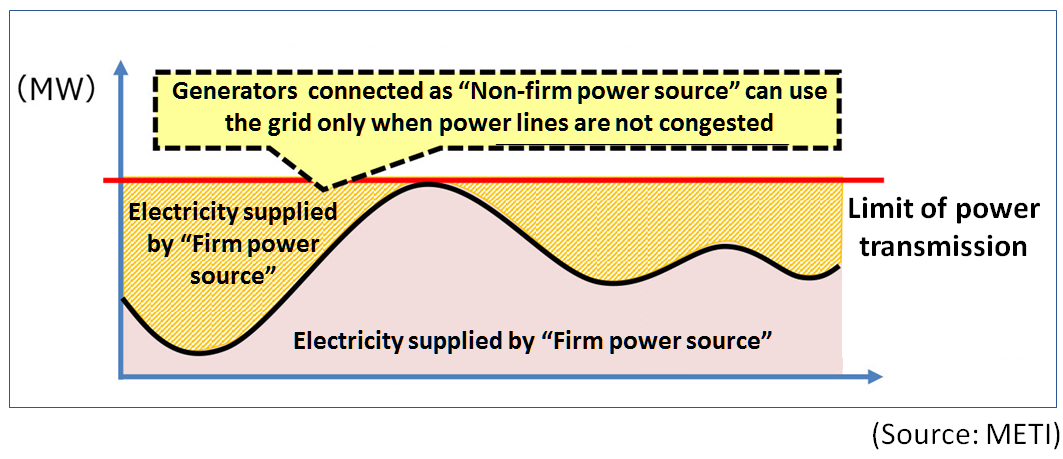
Under the current rule, some renewables operators are only able to secure a “non-firm” grid connection. This means that when the power system is adequately supplied, these generators are asked to curtail output.
Under the new rule, grid operators can select electricity using a “merit order” system, which ranks output based on cost and, in some cases, emissions levels.
TAKEAWAY: The new approach is described as the Japanese version of the “Connect and Manage” system, which allowed more generation capacity to connect to the grid before the transmission network was upgraded. Under this new system, the discretion of grid operators would increase.
Non-firm Grid Connection Mechanism
Kawasaki Heavy mulls hydrogen-fired power plant in Japan by FY2030
(New Energy Business News, Dec. 14)
Kawasaki Heavy Industries is considering a 100 MW hydrogen power plant. The firm will run a study and environmental assessment; construction might start in FY2027.
The plant’s location, its fuel source and business plan are yet to be decided.
Kawasaki Heavy is willing to invest about ¥50 billion in the plant by FY2030. The firm raised its forecast for sales related to the hydrogen business to ¥400 billion in FY2030.
The engineering major has agreed with Germany’s RWE to study the world’s first 100% hydrogen-fueled power generation using a 30 MW-class gas turbine. A demonstration operation may start by the end of 2024.
Japanese wind developers concerned about shortage of offshore wind turbines from EU
(Denki Shimbun, Dec. 16)
Japanese wind developers are concerned that EU offshore wind suppliers will miss delivery deadlines due to the spate of new large-sized offshore wind plants in the EU. For example, the world’s largest offshore wind farm is Hornsea 2 (1.39 GW), which started operation in September in the North Sea.
In Japan, planned wind farm output in Chiba and Akita are 391 MW and 479 MW, much less ambitious and lucrative than the EU market. Thus, Japan worries that EU suppliers such as Siemens Gamesa or Vestas won’t deliver the promised equipment on schedule.
SIDE DEVELOPMENT: METI officially licenses Mitsubishi consortium’s three offshore wind farms (Government statement, Dec. 13)
METI licensed the Mitsubishi consortium operating offshore wind farms in Akita and Chiba prefectures for a period of 30 years, until October 2042.
The output of each wind turbine increased from 12.6 MW to 13 MW.
Construction will start in 2025-2026, and the turbines to be operational in 2028-2030.
TAKEAWAY: According to the consortium’s regulatory filing, the wind turbines will be built more than 10 meters below sea level to protect marine resources in shallow waters. Furthermore, the group will be discrete in selecting the sites for the installation to preserve biodiversity in the area.
Nara area to ask all solar developers of a certain size to get governor’s permission
(New Energy Business News, Dec. 16)
Nara Prefecture is seeking public comments on a draft ordinance that would mandate all solar developers of facilities with an area of 5,000 m2 or more to ask for permission from the Nara governor.
The ordinance also requires operators to do an environmental survey, publicize project plans, hold public meetings, and respond to any comments made during those meetings.
MLIT pledges to develop 2.3 GW of renewable energy at airports by 2030
(Denki Shimbun, Dec. 15)
The MLIT announced its “Basic policy to decarbonize the aviation industry”.
One 2030 goal is for sustainable aviation fuel (SAF) to comprise 10% of consumed aviation fuel.
Another is to have 2.3 GW of renewable energy capacity at 97 domestic airports.
Kansai Electric restarts Unit 3 at Ohi NPP
(Company statement, Dec 15)
Kansai Electric said it will restart Unit 3 at the Ohi NPP on Dec 16. The 1.18 GW unit was under regular inspection since late August and also completed the update of its anti-terrorism facilities.
The unit will be running at full power by Jan. 12, 2023.
Influx plans 600 MW offshore wind farm in Saga area
(New Energy Business News, Dec. 13)
Influx Corp plans to develop an offshore wind farm up to 600 MW in capacity off the coast of Karatsu City, Saga Prefecture. Construction will take about three years.
The area is 143 square km, with up to 64 wind turbines to be installed. Three types of foundations are being considered: monopile, jacket, and gravity type.
Renova, Kansai Electric and others have projects in the nearby area.
JRE plans onshore wind farm in Kagoshima area
(New Energy Business News, Dec. 13)
Japan Renewable Energy Corp. plans to develop a 51.6 MW wind power project in Kimotsuki Town, Kagoshima Prefecture.
The project area is about 1,765 ha, and will house up to 12 wind turbines. Construction will start in 2026, operations in 2028.
SIDE DEVELOPMENT: JRE to switch Nagano solar plant from FIT to FIP system (Company statement, Dec. 12)
Japan Renewable Energy will switch its Omachi Solar Power Plant in Nagano Prefecture from the FIT system to FIP after concluding a power purchase agreement (PPA) with JRE Trading, a wholly-owned subsidiary.
JRE will buy all power from the plant, which began operation in April 2022, and assume the additional risks associated with the FIP system, such as generation imbalance (i.e. the difference between planned and actual power generation volumes).
Toshiba runs its own geothermal power plant for the first time: Seeks increase demand
(Nikkei Business; Dec. 13)
Nakao Geothermal Power Plant, a JV between Toshiba and Chubu Electric, began operating a 2 MW facility after 10 years of troubled development that ran up a ¥4.5 billion budget. The JV seeks to marry geothermal power with hot-spring tourism, which has always been a difficult matter in Japan.
Since 1966, Toshiba has delivered geothermal equipment, but this is its first geothermal plant operation. Toshiba has a 55% stake in the JV which has an FIT contract.
Although Japan forecasts that geothermal energy will account for a mere 1% of the country’s electricity mix in FY2030, geothermal is a valuable domestic power source considering current geopolitical and global energy demand/supply woes.
Toshiba is keen to pursue more geothermal power opportunities in Japan and abroad.
Kansai Electric might launch VPPs across Japan
(Denki Shimbun, Dec. 15)
President Mori of Kansai Electric said his company is pondering to establish a subsidiary to develop the VPP business.
It would utilize DERs such as solar or batteries to develop new VPP projects across Japan, in cooperation with other companies.
SIDE DEVELOPMENT: KEPCO wants to keep rates low for domestic subscribers: CEO (Jiji, Dec. 15)
CEO Mori is opposed to asking the govt for permission to raise rates; he wants to avoid making households pay more for electricity.
This is in contrast to KEPCO’s competitors, which seek to raise rates by up to 45%.
Commenting on plans to relax the moratorium on new nuclear power plants, Mori said new NPPs require significant investment, and it’s very important that they be profitable. Mori seeks state financial support for such projects.
Nippon Steel and partner get order to build offshore wind power plant in Fukuoka
(Kankyo Business, Dec. 15)
Penta-Ocean Construction and Nippon Steel Engineering secured an order to build a 220 MW offshore wind power plant near Kitakyushu City, Fukuoka Prefecture.
The project will use a “jacket-style” foundation structure, the first of its kind in Japan, to install 25 large 9.6 MW wind turbines over an area of 2,700 ha.
Construction is set to begin this fiscal year; operation to start in 2025.
Tokyo Gas to issue ¥19.8 billion in transition bonds
(Denki Shimbun, Dec. 15)
Tokyo Gas is preparing to publicly offer two hybrid debt issues (subordinated debt with warrants) that will raise a total of ¥19.8 billion to pay for transitional measures.
The bonds will initially pay 0.74% annual interest, later switching to a floating rate.
The bonds mature in 2082, but early redemption is possible at Tokyo Gas’ discretion.
JFTC throws book at power companies
(Toyo Keizai, Dec. 17)
The Japan Fair Trade Commission notified Chubu Electric, Chugoku Electric and Kyushu Electric that it intends to fine them a total of over ¥100 billion for restraining free trade on the electricity market.
Kyushu Electric says it was informed that the JFTC found evidence of collusion with other utilities to hold rates stable, and that a fine of ¥2.7 billion was deemed appropriate.
The scandal came at a bad time for Chugoku Electric, which days before requested METI to approve a rate increase of 31% for customers on legacy (pre-deregulation) plans.
A spokesperson for Chugoku claimed that the rate increase was unrelated to antitrust fines, and that fines would not be passed on to subscribers.
Kansai Electric was granted leniency and is exempt from fines, but its role in the cartel raises questions over statements by former CEO Morimoto Takashi that his resignation in April was unrelated to a JFTC raid last year.
Morimoto’s replacement, Mori Nozomu, is also likely to be tainted by the scandal.
TAKEAWAY: As of Dec 15, the JFTC has not issued formal decisions on the alleged cartel case, following its Dec 1 letter to the companies informing them they were under cartel charges. The actual amount of the penalties and details of leniency applications have not been disclosed yet.
NEWS:OIL, GAS & MINING
Idemitsu vows to cut oil refining capacity by a third, switch facilities to clean fuels
(Jiji Press, Dec. 16)
President Kito of Idemitsu Kosan said the oil refining major plans to cut its capacity to 650,000 barrels per day by FY2030, a drop of 300,000 barrels from the FY2022 level.
The company is transforming to support clean energy, he said, and will focus on next-generation energy and materials. Its Chiba Works facility will switch to sustainable aviation fuel (SAF) while the Tokuyama Works will become an ammonia supply base, he said.
By the end of this decade, fossil fuels will account for less than half of Idemitsu’s profits from over 90% today, he said. The company also wants to show that it can turn a profit from the transformed production bases even if their volumes are not large in scale.
Equally, Idemitsu plans to switch its 6,200 affiliated gas stations nationwide into bases that provide EV charging, car sharing, and act as marketplaces for energy produced locally for local consumption.
Russia says Japan will get Siberian LNG starting late 2023
(Chosun Online, Dec. 15)
Russian media report that the country’s Arctic LNG-2 project will begin producing at the end of 2023, and LNG will be supplied to Japan.
The project comprises a total of three plants, each with an output of 6.6 million tons.
The first of these will go online at the end of 2023, while the other plants will go online in 2024 and 2026, respectively.
While France’s Total and Mitsui & Co both invested in the project, Total plans to progressively withdraw its investment in light of U.S. and EU sanctions on Russia.
LNG stocks rise to 2.68 million tons
(Government data, Dec. 15)
LNG stocks of 10 major power utilities stood at 2.68 million tons as of Dec 11, up from 2.63 million tons a week earlier. The end-December stocks last year were 2.34 million tons. The five-year average for this time of year is 1.84 million tons.
Japan’s Nov LNG, coal and LPG imports fall, oil rises
(Government data, Dec. 15)
Japan imported 5.55 million tons of LNG in November, down 5.4% from a year ago; 8.5 million tons of thermal coal, down 18.5%; and 0.87 million tons of LPG, down 3%. Crude oil imports were up 8.1% YoY, to 13.2 million kiloliters.
TAKEAWAY: Due to high LNG stocks in Japan and also in Europe, as well as warmer winter temperature forecasts in some areas and more nuclear plants operational, analysts say spot LNG demand peaked in August. However, demand could spike again depending on politics, weather and unexpected supply disruptions.
Copper surplus to expand in 2023 on slowing China demand: PPC forecast
(Japan Metal Bulletin, Dec. 13)
Japan’s largest copper producer, Pan Pacific Copper, sees easing copper supplies in 2023 on the back of slowing demand in China, while high prices drive up production.
The global market will have 358,000 tons of surplus copper in 2023, expanding from 298,000 tons of surplus in 2022, according to PPC.
Copper now trades at above $8,000/ ton, compared to pre-COVID of $5,000-6,000/ ton.
TAKEAWAY: The International Copper Study Group, an organization of copper producers, also forecasts a 155,000 tons surplus for 2023, after seven deficit years. China’s slowing copper appetite may put downward pressure on other commodities including battery metals.
ANALYSIS
BASED ON MATERIALS PUBLISHED IN SHIN ENERGY SHINPO
Road to Japan’s Battery Future: METI Sets Goals for Developing the Burgeoning Industry
When officials drafted Japan’s new national energy strategy last year, the development of storage batteries was seen as a longer-term process, more a 2050 than a 2030 issue. That view, however, was strongly upgraded this year, with more urgency and KPIs put on the sector.
METI’s Battery Industry Strategy is nothing if not a grand vision. With a focus on lithium-ion chemistry and all-solid-state technologies, the Strategy sees Japanese firms manufacturing more battery capacity by 2030 than is being installed globally today.
The Strategy details not only the capacity. It also estimates the investments required to set up the component and unit manufacturing, the money needed for the procurement of raw materials, and the scale of human resources that should be involved. The 30,000 people that METI says will be needed to operate the enlarged battery supply chain is only about 40% fewer than Japan’s entire nuclear power industry.
The challenges to delivering such a vision are equally grand. Among them, ironically, is the need to deliver on reducing the domestic price of electricity.
Strategy by numbers With the spread of renewable energy and electric vehicles (EVs), Japan needs to secure a bigger storage battery manufacturing base. METI’s Storage Battery Industry Strategy promises that the government will take the lead in ensuring this happens rather than leaving investment in facilities and the upstream (raw materials) to the private sector.
The Strategy sets out several goals:
Establish a domestic manufacturing base for 150 GWh of storage batteries and materials by 2030 at the latest
Ensure that Japanese companies produce 600 GWh of batteries globally by the end of this decade, giving them a 20% market share
Increase domestic production capacity of automotive batteries to 100 GWh as soon as possible
Accelerate R&D so that Japan recovers its global share in the market for next-gen of batteries and has full-scale output of all-solid-state Li-on batteries by around 2030
Attract about 30,000 workers throughout the storage battery supply chain by 2030
Promote the reuse and recycling of batteries and their materials
Expand the use of renewable energy
Reduce the cost of electricity
For comparison, the cumulative capacity of stationary Li-ion battery storage systems shipped in Japan was around 2.6 GWh in FY2019, rising to 3.5 GWh in FY2020, and about 4.4 GWh in FY2021.
Show me the money Dreaming big is important, but METI understands that one reason Japanese battery makers lost market share to Chinese and South Korean rivals was due to scale. Chinese firms, in particular, quickly added capacity in the dominant liquid Li-on tech thanks to strong state support.
This time, the government is keen to share the investment burden, which it expects to be around ¥3.4 trillion, to expand the manufacturing base to 150 GWh. That number assumes the need for ¥1.3 trillion to build up the raw materials and components supply chain and ¥2.1 trillion for the manufacturing base.
Industry has not been shy to ask for greater state involvement. The Battery Supply Chain Council (BASC), a new industry group set up in April 2021, is asking the government to subsidize two-thirds of key investments. The group, which counts battery manufacturers, suppliers, and automakers among its more than 100 members, says that such a contribution is a must if Japan is to get to the same starting line as its top competitors.
Nowhere is state support more urgent than upstream. BASC says that the U.S. government contributed the bigger portion of investments that domestic firms made to secure lithium resources in South America and Australia. In Japan, public money accounts for just 10% of total funds.
To attempt a global production capacity of 600 GWh of batteries, Japanese firms would need to secure vast quantities of critical raw materials. The investment in nickel alone would be about ¥1.3 trillion (150,000 tons); for lithium – ¥680 billion (320,000 tons).
To get Japan to the same “starting line” as other nations, BASC says the state must invest ¥1.3 trillion over five years. The estimate for adding 450 GWh of capacity overseas is about ¥10.2 trillion.
Challenges
The government set target prices of ¥70,000/ kWh for residential energy storage systems and ¥60,000/ kWh for commercial/industrial energy storage systems by FY2030 as levels at which capital investments can be recovered through the revenue that these systems generate.
However, arguably the biggest challenge is creating a good environment for the battery industry to thrive. The sector is energy intensive and needs both low electricity prices and a thriving market for renewable energy in order to be sustainable. This makes the expansion of renewables in Japan a key factor in improving the industrial competitiveness of the domestic battery players.
Equally, the carbon footprint of battery manufacture will become an important competitive factor in the global market. For now, Japan’s power mix is still tilted towards fossil fuels.
Battery makers will need access to cheap land and green electricity that’s not only competitive on a domestic level but which can go head-to-head with industry peers abroad. While the cost of solar PV generation has dropped in the last decade, Japan’s levels remain close to double those in Europe.
Solutions to the above can be found in one of the 12 case studies selected by the government as part of a project to “support the introduction of grid storage batteries, as part of the accelerated rollout of renewable energy.” The companies behind the projects will test various business models for batteries, pooling revenues from the capacity market (kW value), the wholesale / spot market (kWh value), and the electricity balancing market (△kW value + kWh value).
The economics of battery manufacturing and storage battery use in Japan are still evolving, but at least now there’s a sense of urgency. This is a watershed moment for Japan to regain its global leadership in the sector.
Companies due to receive grants to introduce grid use storage batteries
Company Name
Location
Pacifico Energy
HokkaidoFukuoka Prefecture (Kyushu)
ENEOS
Hokkaido
Eurus Energy Holdings
HokkaidoFukuoka Prefecture (Kyushu)
Hokkaido Electric
Hokkaido
J.I.G. Holdings Co.
Oita Prefecture (Kyushu)
Toho Gas Co.
Mie Prefecture (Kinki area)
Kansai Electric, ORIX
Wakayama Prefecture (Kinki area)
Global Engineering
Iwate Prefecture (Tohoku area)
Sumitomo Corporation
Hokkaido
NTT Anode Energy
Fukuoka Prefecture (Kyushu)
Kanden Energy Solutions
Miyagi Prefecture (Tohoku area)
Source: Shin Energy Shinpo
ANALYSIS
BY ANDREW STATTER
Establishing an Image of Stability and Commitment to Attract Talent
Last week a report was published in the U.S. stating that 73% of new graduates ranked job stability as their top priority when choosing an employer. Among the leading factors for this are the current inflation and rising living costs, as well as the widespread belief that a recession is on the horizon.
People are not merely looking at whatever job might be on offer right now. Rather, they wish to see how their career will develop and grow internally over a 5 to 10 year timeframe.
In Japan, this prioritization of stability is nothing new. The country’s belief system still promotes the notion of lifetime employment. Also, social status is often linked to the prestige of your company’s name, much more than your job title or income.
To illustrate the importance of social status, some time ago one of our clients shared an interesting story. They were hiring a young, talented business developer from one of Japan’s most prestigious employers – a top-tier trading house. The new company offered the man a more senior position and a higher salary.
In the end, the young candidate accepted the offer. However, he did ask to delay the start date because he was due to wed soon. At the time of the ceremony, his family wanted to claim the boasting rights associated with employment at a top trading house.
For multinational companies hiring in Japan, understanding these cultural nuances is critical. In today’s volatile market, with a fast-changing energy landscape and global economic uncertainty, demonstrating a stability within your firm, and your brand’s commitment to the Japan market is paramount.
Let us dig into some specifics.
GK vs KK
A corporate entity in Japan can be set up as either a GK (Godo Gaisha) or KK (Kabushiki Kaisha). Both are limited liability companies and a suitable option to establish a local subsidiary. A GK is typically easier to set up with lower reporting requirements, has a cheaper registration and less requirements for shareholder meetings, reporting, and etc.
From a Japanese perspective though, a GK is seen as a lesser form of commitment. Having a KK in Japan is a clear demonstration of taking one’s business seriously and planning to be here for the long term.
Shared office vs own space
We can argue that Covid-19 has changed the landscape on this issue. However, traditionally an office in a shared space such as Regus or WeWork was seen as a temporary measure. Hence, an indication that a foreign business was only planning a temporary sojourn in Japan. Long-term office space, rental contracts and build outs are expensive here. However, making such investments is also seen as a statement of intent.
Attitude to local partnerships
Newer, less known names in the conservative energy industry can gain brand recognition by association. Secure a partnership with a Mitsubishi or Itochu, not to mention financing from a major Japanese bank, and your credibility will soar.
On the other hand, if you come to Japan demonstrating an attitude that your technology, business plan, track record, etc are superior to local options, or demand that you sell your tech without a local partnership, you’ll be met with high levels of doubt from potential employees. Building credibility will be an uphill battle.
Local hire vs expat leadership
This is the toughest! Japanese employees (and business partners) disdain those global firms that enter the market with an expatriate leader whose only mandate is to copy the blueprint of [insert country here] locally. Therefore, our firm often advocates choosing a Japanese person to be the country manager.
This demonstrates not only a commitment to Japan, but it’s also a clear sign of trust that the local talent pool can deliver, which in turn attracts more talent in the mid-lower levels. You can certainly hire a non-Japanese, or expatriate for this role. However, in that case, selecting someone who brings industry connections, and most importantly cultural understanding and sensitivity, can make or break your other talent attraction efforts.
Examples in the offshore wind industry:
Here are some examples that best illustrate the points made above.
Earlier this year, our firm helped one Japanese professional, a man in his mid 30s at a major oil and gas firm, to change career for the first time. He was interested in offshore wind, and so he met with a handful of companies. He received a lot of interest, but his final choice was not the biggest of the firms in contention. His new employer, however, had the following:
A Japanese country leader from a top trading house, plus a well connected Japanese advisor who could leverage his network of partners and financiers – akin to the value of a board member;
A strong, multi-project partnership with a major Japanese energy conglomerate over multiple bidding rounds;
Their own office space, set up as a KK;
A previous track record of hiring from major Japanese utilities, the EPCOs.
Another case was when a European energy giant entered the Japanese offshore wind market quite late, establishing an entity here well after the results of Round 1 auctions came out last December. Though this could be seen as a disadvantage, they made certain strategic decisions that made them a prospective employer of choice for many Japanese professionals:
Set up a KK and established an office in a prime location, close to important and influential partners, METI etc.;
Hired a foreign country manager who has lived in Japan for a long time, traded with Japan for over a decade, speaks decent Japanese, and has excellent local cultural knowledge;
Established partnerships with top-level Japanese partners in a respectful manner, bringing humility, technical expertise and options to work on projects also outside Japan.
Overall, Japan has always been seen as a long-term investment in terms of business development. The talent market is exactly the same. That’s why offering long term prospects in your firm will often help you acquire the best people.
Andrew Statter is Partner and Head of Greentech at Titan Consulting.
GLOBAL VIEW
BY JOHN VAROLI
Below are some of last week’s most important international energy developments monitored by the Japan NRG team because of their potential to impact energy supply and demand, as well as prices. We see the following as relevant to Japanese and international energy investors.
Argentina/ Gas pipeline
Argentina secured $689 million from Brazil’s state bank, BNDES, to finance the second stage of a natural gas pipeline in the Vaca Muerta shale region. The first stage, which will link Vaca Muerta with the area near Buenos Aires, will be finished in June 2023.
China/ LNG tankers
Three Chinese shipyards won about 30% of this year’s record orders for 163 new gas carriers, boosting that nation’s market share in a sector usually dominated by South Korea.
Coal demand
Global coal consumption is set to rise to an all-time high this year, rising 1.2% and exceeding 8 billion tons; the previous record was set in 2013. In India, coal demand saw a 7% increase. In Germany coal-powered generation output rose 13.3% YoY.
ESG
Facing strong criticism over its climate change policies, HSBC will cut direct financing and advisory ties to new oil and gas fields and coal projects. However, the decision does not restrict financing of energy companies with plans to expand.
Germany/ Energy crisis
To keep the lights on, Berlin has spent an unplanned €440 billion on energy this year due to the Ukraine war and anti-Russian sanctions. That’s the cumulative total of government bailouts and efforts to prop up the country’s energy system, according to a Reuters report.
India/ Nuclear power
In addition to 11 reactors under construction, the govt approved building ten 700 MW pressurized heavy water reactors. Also approved were five sites for future NPPs. India’s current nuclear power capacity of 6.8 GW will increase to 22.5 GW by 2031.
India/ Renewable energy
In 2023, India might attract up to $10 billion investment in renewable energy, said Kaku Nakhate, Bank of America’s head for India. “People take us seriously. That’s why we’re seeing more sustainability funds that want to invest in India,” she said.
Norway/ Natural gas
Germany’s Wintershall Dea, along with Petoro and Sval Energi, will invest $800 million to develop the Dvalin North offshore gas field on the Norwegian shelf. Its ‘boe’ volume is estimated at 84 million, most of it natural gas.
Oil prices
Goldman Sachs slashed its oil price forecasts for 2023, expecting a market surplus. OPEC, however, disagrees and forecasts global oil demand rising by 2.25 million bpd in 2023, about 2.3%. OPEC cited the Chinese economy opening up as it relaxes its zero-COVID policy.
Russia/ Gas exports
President Vladimir Putin wants to increase gas supplies to Asia, particularly China. He also called to set prices for gas sales to the EU using an electronic platform “in the next few months… to determine the final price for our European consumers”.
Wind power
EU wind turbine makers will face a tough 2023 due to Chinese competition and higher production costs. Top EU manufacturers, including Siemens Gamesa, Vestas and Nordex, are running at a loss, with a return to profitability not expected soon.
U.S./ Shale oil
In January, oil output from the Permian shale basin is set to reach a record 5.6 million bpd, but the increase is a mere one-third of September’s rate. The rise will be about 37,000 bpd, the smallest gain in seven months, according to the EIA.
2022 EVENTS CALENDAR
A selection of domestic and international events we believe will have an impact on Japanese energy
Regional Comprehensive Economic Partnership (RCEP) Trade Agreement that includes ASEAN countries, China and Japan activates;
Indonesia to temporarily ban coal exports for one month;
Regional bloc developments: Cambodia assumes presidency of ASEAN; Thailand assumes presidency of APEC; Germany assumes presidency of G7; France assumes presidency of EU; Indonesia assumes presidency of G20; and Senegal assumes presidency of African Union;
Japan-U.S. two-plus-two meeting;
Japan’s parliament convenes on Jan. 17 for 150 days;
Prime Minister Kishida visits Australia (tentative)
February
Chinese New Year (Jan. 31 to Feb. 6);Beijing Winter Olympics;
South Korea joins RCEP trade agreement
March
Renewable Energy Institute annual conference;Smart Energy Week – Tokyo;
Japan Atomic Industrial Forum annual conference – Tokyo;
World Hydrogen Summit – Netherlands;
EU New strategy on international energy engagement published;
End of 2021/22 Japanese Fiscal Year;
South Korean presidential election
April
Japan Energy Summit – Tokyo;MARPOL Convention on Emissions reductions for containerships and LNG carriers activates;
Japan Feed-in-Premium system commences as Energy Resilience Act takes effect;
Launch of Prime Section of Japan Stock Exchange with TFCD climate reporting requirement;
Convention on Biological Diversity Conference for post-2020 biodiversity framework – China;
Elections: French presidential election; Hungarian general election
May
World Natural Gas Conference WCG2022 – South Korea;Elections: Australian general election; Philippines general and presidential elections
June
Happo-Noshiro offshore wind project auction closes;Annual IEA Global Conference on Energy Efficiency – Denmark;
Japan to finalize economic security policies as part of natl. security strategy review;China connects to grid 2nd 200 MW SMR at Shidao Bay Nuclear Plant, Shandong;
Czech Republic assumes presidency of EU;
Elections: Japan’s Upper House Elections; Indian presidential election
August
Japan: Africa (TICAD 8) Summit – Tunisia;Kenyan general election
September
IPCC to release Assessment and Synthesis Report;Clean Energy Ministerial and the Mission Innovation Summit – Pittsburg, U.S.;
Japan LNG Producer/Consumer Conference – Tokyo;
IMF/World Bank annual meetings – Washington;
Annual UN General Assembly meetings;
METI to set safety standards for ammonia and hydrogen-fired power plants;
End of 1H FY2022 Fiscal Year in Japan;
Swedish general election
October
EU Review of CO2 emission standards for heavy-duty vehicles published;Chinese Communist Party 20th quinquennial National Party Congress;
G20 Meeting – Bali, Indonesia;
Innovation for Cool Earth TCFD & Annual Forums – Tokyo;
Germany to eliminate nuclear power from energy mix;Happo-Noshiro offshore wind project auction result released;
Japan submits revised 2030 CO2 reduction goal following Glasgow’s COP26;
Japan-Canada Annual Energy Forum (tentative);
Tesla expected to achieve 1.3 million EV deliveries for full year 2022
Disclaimer
This communication has been prepared for information purposes only, is confidential and may be legally privileged. This is a subscription-only service and is directed at those who have expressly asked K.K. Yuri Group or one of its representatives to be added to the mailing list. This document may not be onwardly circulated or reproduced without prior written consent from Yuri Group, which retains all copyright to the content of this report.
Yuri Group is not registered as an investment advisor in any jurisdiction. Our research and all the content express our opinions, which are generally based on available public information, field studies and own analysis. Content is limited to general comment upon general political, economic and market issues, asset classes and types of investments. The report and all of its content does not constitute a recommendation or solicitation to buy, sell, subscribe for or underwrite any product or physical commodity, or a financial instrument.
The information contained in this report is obtained from sources believed to be reliable and in good faith. No representation or warranty is made that it is accurate or complete. Opinions and views expressed are subject to change without notice, as are prices and availability, which are indicative only. There is no obligation to notify recipients of any changes to this data or to do so in the future. No responsibility is accepted for the use of or reliance on the information provided. In no circumstances will Yuri Group be liable for any indirect or direct loss, or consequential loss or damages arising from the use of, any inability to use, or any inaccuracy in the information.
K.K. Yuri Group: Oonoya Building 8F, Yotsuya 1-18, Shinjuku-ku, Tokyo, Japan, 160-0004.
NEWS
・METI sets 2028 target to introduce carbon surcharge as part of a widescale revamp to tax oil and other fossil fuel companies
・Wind developers concerned about shortage of EU turbines as big projects in Europe tie up resources of local manufacturers
・Govt plans to expand carbon credits mechanism to private sector; Joint Crediting Mechanism (JCM) to be the basic framework