
JAPAN NRG WEEKLY
JAN. 16, 2023
JAPAN NRG WEEKLY
Dec. 16, 2023
NEWS
TOP
- Top Japan and U.S. officials promise to strengthen cooperation in clean energy; with particular focus on nuclear energy
- Japan pushes back Fukushima’s treated water discharge, from spring to summer of 2023; equipment will be ready in June
- India’s Adani Group and Japan’s Kowa to sell green hydrogen as the two companies agree to partner across several energy areas
ENERGY TRANSITION & POLICY
- Japanese battery startup raises new funds from Shikoku Electric
- Tesla Japan cuts prices on high-end car models by up to 10%
- JR West to switch all diesel trains to biofuel around end of decade
- INPEX to invest in Dutch carbon capture startup
- JFE Steel wins “blue” carbon credits for seaweed bed project
- Mitsui Fudosan wins carbon credit certificates for Hokkaido forests
- Ammonia catalyst startup wins first commercial order from INPEX
- GE Hitachi applies to UK to approve design for new SMR reactors
- Shipper Mitsui OSK signs Japan’s first transition-linked loan
ELECTRICITY MARKETS
- Ennet ranks top among Japan power retailers outside of EPCOs
- No end in sight for rising power prices; utilities seek 40% hikes
- Tokyo faces tight electricity supply in 2023 as malfunctions surge
- Kansai Electric brings restarted 1.18 GW reactor to full capacity
- JFE Engineering secures order for a CCS facility in Kansai
- Toshiba talks with component makers on domestic wind turbines
- Toshiba develops AI assistant for pre-market electricity trading
- JERA, MHI to test ammonia co-firing at a Thai coal power plant
OIL, GAS & MINING
- Fallout from China blocking Japan visas may crimp supply chains
- Indonesia reaffirms ban on copper concentrate exports
- Hokkaido Gas to refuel LNG-powered ferries starting in 2025
- LNG stockpiles drop but still almost 50% higher than average
ANALYSIS
JAPAN UNVEILS ENERGY TRANSITION ROADMAP
BUT NUCLEAR POWER SHIFT GRABS THE HEADLINES
Japan has published the draft of a new national decarbonization strategy. The Basic Policy to Implement a Green Transformation (GX) will, in effect, become Japan’s top energy and climate roadmap. While the document covers the costs, volumes and timelines for 22 industrial sectors, it is item No. 16 that drew almost all the attention: the plan to build new nuclear reactors in Japan. This marks a major reversal of policy over a decade since the Fukushima accident.
MoE’S GOT A BRAND NEW FUND:
ENTITY TO SUPPORT REGIONAL DECARBONIZATION
Two years ago, METI set up a ¥2-trillion Green Innovation Fund (GIF) to support early-stage R&D to help Japan meet its 2050 net-zero ambitions. Now, that effort is getting a further boost with a new fund that will pool cash from the private sector with state support and direct them to regional projects. The Ministry of the Environment (MoE) has created the Japan Green Investment Corp for Carbon Neutrality (JICN), which will play an important though different role within the government’s net-zero strategy.
GLOBAL VIEW
A wrap of top energy news from around the world.
EVENTS SCHEDULE
A selection of events to keep an eye on in 2023.

JAPAN NRG WEEKLY
PUBLISHER
K. K. Yuri Group
Events
Editorial Team
Yuriy Humber (Editor-in-Chief)
John Varoli (Senior Editor, Americas)
Mayumi Watanabe (Japan)
Yoshihisa Ohno (Japan)
Wilfried Goossens (Events, global)
Regular Contributors
Chisaki Watanabe (Japan)
Takehiro Masutomo (Japan)
Art & Design
22 Graphics Inc.
SUBSCRIPTIONS & ADVERTISING
Japan NRG offers individual, corporate and academic subscription plans. Basic details are our website or write to subscriptions@japan-nrg.com
For marketing, advertising, or collaboration opportunities, contact sales@japan-nrg.com For all other inquiries, write to info@japan-nrg.com
OFTEN USED ACRONYMS
|
METI |
The Ministry of Energy, |
mmbtu |
Million British Thermal Units | |
|
MOE |
Ministry of Environment |
mb/d |
Million barrels per day | |
|
ANRE |
Agency for Natural Resources and Energy |
mtoe |
Million Tons of Oil Equivalent | |
|
NEDO |
New Energy and Industrial Technology Development Organization |
kWh |
Kilowatt hours (electricity generation volume) | |
|
TEPCO |
Tokyo Electric Power Company |
FIT |
Feed-in Tariff | |
|
KEPCO |
Kansai Electric Power Company |
FIP |
Feed-in Premium | |
|
EPCO |
Electric Power Company |
SAF |
Sustainable Aviation Fuel | |
|
JCC |
Japan Crude Cocktail |
NPP |
Nuclear power plant | |
|
JKM |
Japan Korea Market, the Platt’s LNG benchmark |
JOGMEC |
Japan Organization for Metals and Energy Security | |
|
CCUS |
Carbon Capture, Utilization and Storage | |||
|
OCCTO |
Organization for Cross-regional Coordination of Transmission Operators | |||
|
NRA |
Nuclear Regulation Authority | |||
|
GX |
Green Transformation |
NEWS: ENERGY TRANSITION & POLICY

Economic package passes parliament; Govt to subsidize power and gas bills
(Government statement, Dec. 6)
- PM Kishida said the economic package to combat inflation and high energy prices will take effect immediately following parliament approval, and consumers will see reductions in power and gas bills from January.
METI and U.S. issue statement on energy collaboration
(Government statement, Jan. 9)
- METI Minister Nishimura met with U.S. DoE Secretary Granholm in Washington D.C. to discuss global energy security, strengthening of cooperation in clean energy, and the importance of the energy transition. Other topics included energy efficiency, nuclear, geothermal, and hydrogen and ammonia.
- Nuclear energy featured high in the joint statement as the two sides agreed to work jointly on next-generation reactor technology, including SMRs, to be utilized in both counties. The U.S. and Japan also agreed to seek opportunities for next-gen reactor construction in third countries.
- The two parties reaffirmed the importance of renewable energy development under the Japan-U.S. Clean Energy and Energy Security Initiative (CEESI) established in May 2022. The two countries plan technical meetings on adaptable power grid systems and joint workshops on offshore wind and geothermal technologies.
- CONTEXT: The statement echoes METI’s recent moves to push next-gen nuclear tech. Also, from April 2023, state energy company JOGMEC will be involved in geothermal, CCUS, hydrogen and other clean energy projects overseas.
TAKEAWAY: Energy cooperation between the two countries encompasses many sectors but it is LNG and nuclear that seem to have the most traction of late. The prominent discussion of joint efforts in the nuclear power field in particular augurs some near-term developments, possibly with U.S. reactor vendors winning contracts domestically and / or abroad and Japanese firms involved as component suppliers.
Japan delays ALPS treated water discharge from spring to summer of 2023
(Yomiuri Shimbun, Jan. 13)
- Japan confirmed that the release of treated water from the Fukushima Daiichi NPP into the ocean will be delayed from spring to summer of 2023.
- In April 2021, the government decided on a plan for TEPCO to release the treated water into the ocean after diluting it to reduce the concentration of tritium well below the percentage permitted by national regulations.
- The equipment to release the treated water will be ready in June 2023, so the release is expected to start in July 2023.
TAKEAWAY: More than 1.32 million tons of treated water is stored in over 1,000 units of large tanks at the Fukushima NPP. On Dec 23, TEPCO stated the criteria of indemnification for the local fishing community for reputational damage due to the planned treated water discharge.
- SIDE DEVELOPMENT:
PM Kishida explains Japan’s new nuclear policy to IEA director
(Denki Shimbun, Jan. 11)- PM Kishida met with IEA director Fatih Birol to discuss the G7 Summit in Hiroshima in May, and how the IEA can support government responses during Japan’s G7 presidency.
- PM Kishida told Executive Director Fatih Birol that Japan is increasing the role of nuclear power in its GX policy through reactor restarts and also developing emerging energy alternatives including hydrogen and ammonia.
- Discussions also focused on advancing energy transitions in developing economies, particularly within Asia, and how Japan can bridge diverse regional interests.
TAKEAWAY: Both the meetings of PM Kishida with the IEA director and METI Minister Nishimura’s meeting with the U.S. Energy Secretary can be seen as a kind of update of Japan’s energy policies to key global stakeholders. One of the top messages is that Japan is embracing nuclear energy again.
Adani Group and Kowa to jointly sell 1 million tons of green hydrogen per year
(Kankyo Business, Jan. 6)
- Kowa Company, a Japanese specialized trading company and manufacturer based in Nagoya, will partner with India’s Adani Group to promote green ammonia sales and other carbon neutral operations.
- The two aim to sell 1 million tons of green ammonia per year by 2028. The two have an MoU to establish a JV in Singapore to handle green ammonia and its derivatives, such as fertilizer and methanol, produced mainly from renewable energy produced in India. Sales focus will be on Asia, particularly Japan and Taiwan.
- Also, the two companies wish to collaborate on ammonia co-firing studies, on building electric tugboats that run on next-generation fuels and lithium batteries, and jointly produce next-generation solar modules.
Battery startup Power-X raises funds from Shikoku Electric; total raised now ¥9.9 bln
(New Energy Business News, Jan. 11)
- Power-X, a storage battery venture, raised an additional ¥2.7 billion from Shikoku Electric, bringing total funds raised to ¥9.9 billion. This will go to make storage battery products at PowerBase, a factory under construction in Tamano City, Okayama Prefecture, and for R&D.
- Investors include JA Mitsui Leasing, Sompo Japan Insurance, and Shoei Kisen.
- In 2022, Power-X began pre-orders for its super-quick EV charger and for its large stationary storage batteries. It had cumulative pre-orders for 3.3 GWh by the end of 2022.
TAKEAWAY: PowerBase will be one of Japan’s largest storage battery factories, with an annual production capacity of 5 GWh. Test production begins this year, followed by the shipment of EV quick chargers, stationary storage batteries, and other products in spring 2024.
Tesla Japan cuts prices of EV Models 3 and Y
(Japan NRG, Jan. 6)
- Tesla Japan has cut prices of high-end EV models “3” and “Y”, by up to 10% or ¥0.8 million, effective immediately.
- CONTEXT: Tesla has no production base in Japan and imports from its Shanghai plant. The price cuts reflect the weaker U.S. dollar and Tesla’s attempts to improve customer engagements following delivery delays caused by lockdowns in China.
TAKEAWAY: Nissan raised EV prices on higher costs. Tesla’s decision aims to drive up sales. But it will still impact price negotiations of various phases in the battery supply chain. The buyers will use the Tesla price cut to negotiate for lower prices.
Japan’s JR West to switch all diesel trains to biofuel around 2030
(Asia Nikkei, Jan. 12)
- West Japan Railway, known as JR West, will swap all its diesel trains to run on biofuel by around 2030. The trains run mostly on local lines.
- The company, however, is challenged by the cost of biofuel, now higher than diesel. Japan’s railroad operators emitted about 9.93 million tons of CO2 in 2019, according to government data. Diesel railcars account for only 5% of this total.
- Tokyo-listed biofuel firm Euglena and trading houses are expected to provide the biofuel.
INPEX to invest in Dutch carbon capture startup, CarbonOrO
(Denki Shimbun, Jan. 12)
- INPEX took a stake in CarbonOrO, a Dutch startup developing carbon capture technology.
- INPEX will use CarbonOrO’s technology for CCUS and methanation projects.
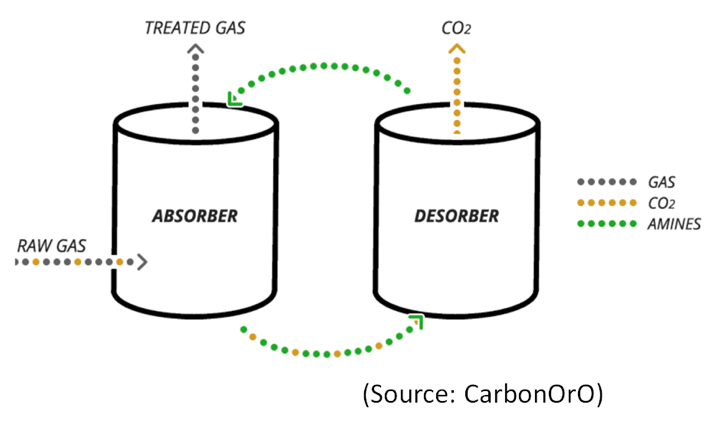
- CarbonOrO uses a proprietary amine solvent to capture CO2 from gasses. Application is in CO2 removal for CCUS and in upgrading biogas/landfill gas.
JFE Steel wins “blue” carbon credits for seaweed bed project to absorb CO2
(Company statement, Jan. 10)
- JFE Steel received “blue” carbon credit certification (J-Blue Credit) for a project that uses seaweed to absorb CO2.
- Between 2013 and 2018, the steelmaker created a 3.6-hectare reef-like seaweed bed using recycled steel slag products in the waters off Iwakuni City, Yamaguchi Prefecture. The project absorbed about 80 tons of CO2 between 2018 and 2022 and attracted fish species.
- This is a joint effort with a local fishery cooperative and the Ube National College of Technology. It’s the first time such varied partners have cooperated on such a project.
- CONTEXT: Blue carbon refers to the CO2 absorbed and fixed by organisms living in the ocean.
Mitsui Fudosan secures carbon credit certificates based on its forests in north Japan
(Kankyo Business, Jan. 11)
- Realtor Mitsui Fudosan said it received third-party certification from the Forest Stock Association for its 5,000 ha of forests in Hokkaido, which contribute to biodiversity conservation and annually absorb 21,315 tons of CO2.
- This certification system (Forestock Certification) was established by the Japan Forestry Managers Association in 2009. It certifies forests after third-party assessment of the CO2 volumes they absorb and biodiversity impact, among other factors.
- The forests in question are owned by Minato Estate, a member of Mitsui Fudosan Group.
Japanese ammonia catalyst startup wins first commercial order from INPEX
(Nikkan Kogyo, Jan. 11)
- Tsubame BHB, a start-up at the Tokyo Institute of Technology, has an order from INPEX for a commercial on-site ammonia synthesis plant, which will be installed in a natural gas to hydrogen production plant. This is the first commercial order for Tsubame BHB.
- INPEX is building a blue hydrogen demo plant in Kashiwazaki City, Niigata Prefecture with an output of 700 tons. A portion of this will be used to produce 500 tons of ammonia per year. Production is scheduled to begin in August 2025.
GE Hitachi to submit GDA application for its BWRX-300 SMRs to UK
(Denki Shimbun, Jan. 13)
- GE Hitachi Nuclear Energy submitted a generic design assessment (GDA) application for its BWRX-300 SMR to British authorities.
- The company plans to deploy BWRX-300 SMRs, and has signed memorandums and contracts with companies in Canada, Czechia, Poland, UK, U.S. and Sweden.
- BWRX-300 is a 300 MW SMRbased on BWR technology that both GE and Hitachi have extensive record of building in many countries.
TAKEAWAY: In the UK, Rolls-Royce recently completed an assessment review into potential options for deploying their PWR-based SMR power stations. Therefore, the UK might be one of the world’s first countries to develop both BWR and PWR type SMRs.
Development Bank of Japan to invest in U.S. renewables fund
(Company statement, Jan. 5)
- The Development Bank of Japan (DBJ) will invest in the Excelsior Renewable Energy Investment Fund II to tap into solar and wind power projects in the U.S., as well as those related to storage, CCS and green hydrogen.
- The fund is run by Excelsior Energy Capital, which was established in June 2017. DBJ was an early seed investor for the company’s first fund.
- The Japanese state bank says this will help to improve its know-how in renewables.
Shipper Mitsui OSK signs Japan’s first transition-linked loan with Sumitomo Mitsui Bank
(Kankyo Business, Jan. 10)
- Mitsui O.S.K. Lines (MOL) signed Japan’s first transition-linked loan as part of a global credit commitment line with Sumitomo Mitsui Banking Corporation (SMBC).
- The 5-year loan isn’t tied to a specific vessel; the maximum amount is ¥60 billion.
- A commitment line is a contract in which the bank agrees to provide a loan at the customer’s request within a predetermined period and amount limit.
- MOL has a Transition Finance Framework in place and has obtained a third-party evaluation by DNV Business Assurance Japan as to its eligibility.
Japan, Europe lead in global race for hydrogen patents
(Asia Nikkei, Jan. 10)
- The top players in hydrogen-related patent registration are in Japan and Europe, but firms in South Korea and China are speeding up innovation in this sector, according to a joint study by the European Patent Office and the IEA.
- From 2011 to 2020, Japan was the leading country in hydrogen patents, at 24% of the world total. EU members held a total 28% share. The U.S. was next with 20%.
- Toyota was the top company in the list. Honda and Panasonic were in the top five.
JGC awarded EPC contract for clean hydrogen/ ammonia project in Niigata
(Denki Shimbun, Jan. 11)
- JGC was awarded a contract for construction of ground facilities in INPEX’s demonstration “Kashiwazaki Clean Hydrogen/Ammonia Project”.
- The project calls for the engineering, procurement, construction (EPC), and the commissioning of facilities in natural gas pre-treatment, hydrogen production, carbon capture and injection, ammonia storage and offloading, power generation, utilities, and facilities connected to wells in the Hirai gas field area.
- CO2 generated during hydrogen and ammonia production will be injected into a depleted reservoir nearby, by utilizing CCUS.
Panasonic, Omron release vehicle-to-home (V2H) solutions
(Nikkei, Jan. 13)
- Panasonic and Omron will release “vehicle-to-home” (V2H) charging systems this year.
- It allows households to use power from their EV battery to power household appliances.
- However, their rival, Nichikon, has a 90% market share, and is building a new factory.
- Japan still lacks an industry standard for V2H systems.
Saudi Arabia and Japan’s Chitose Group to cooperate on bio-product development
(New Energy Business News, Jan. 11)
- The Chitose Group reached an agreement with the Saudi Ministry of Investment, to help the country develop and produce bio-products (fuels, foods, pharmaceuticals, supplements, plastics, etc.) that utilize microorganisms, algae, and animal cells.
- The project is part of a public-private collaboration called “Japan-Saudi Vision 2030”.
Mitsubishi Corp to start delivery business utilizing ENEOS gasoline service stations
(Company statement, Jan 5)
- Mitsubishi and ENEOS will establish a JV using the latter’s gas stations to set up a logistics and delivery service. ENEOS has over 12,000 stations across Japan.
- With each station functioning as both a last-mile distribution point and temporary storage facility, the companies promise to shorten delivery times. It would also cut the burden on drivers and lower costs.
NEWS: POWER MARKETS

Ennet tops ranks of Japanese power retailers outside major utilities in latest survey
(Gas Energy News, Jan 9)
- The Agency for Natural Resources and Energy (ANRE) announced data on electricity sold by each retailer in August 2022. Ennet Corp was first with 1.66 million MWh, up 12% YoY. The company is owned by NTT Anode Energy, Tokyo Gas and Osaka Gas.
- Tokyo Gas was second with 1.19 million MWh, up 10% YoY; ENEOS was third with 0.87 million MWh, up 7%; and SB Power was fourth with 0.76 million MWh, up 24%.
- Idemitsu Kosan had one of the biggest YoY drops; it ranked 12th after a 36% decline.
Tokyo faces tight power supply in 2023 as thermal plant malfunctions near record high
(Asia Nikkei, Jan. 10)
- TEPCO (Tokyo area) and Chubu Electric (Nagoya area) expect tight power supply in 2023 with reserve generation capacity due to remain below 5% over the next 12 months.
- This winter’s capacity reserve for the Tokyo area has improved from the initial forecast for a negative number thanks to the restart of old power plants. Still, METI and OCCTO see difficulties during the summer peak this year.
- Keeping old thermal power plans online longer than planned to provide backup has led to an increase in unscheduled unit shutdowns. During the first 10 months of 2022, that number was 182, which is more than all of 2021 and a near record.
No end in sight for rising power prices; hikes could be up to 40%
(47 News, Jan. 9)
- While the government’s new electricity subsidy kicks in this month, Japan’s major power utilities plan further tariff hikes.
- The five utilities that applied for permission to increase tariffs all plan increases of around 30 to 40%, with Hokuriku Electric planning a 45% tariff increase.
- Historically, the size of tariff increases has varied by region, with the average TEPCO subscriber now paying over ¥2500 per month more for electricity than they did two years ago. Compare that to ¥1000 for KEPCO subscribers.
- Around the country, consumers try to conserve electricity to keep power bills down.
Kansai Electric restarted Ohi NPP’s unit 3; bringing 1.18 GW of capacity online
(Denki Shimbun, Jan. 13)
- Kansai Electric restarted regular operation of Ohi Nuclear Power Plant unit 3, (1.18 GW).
- Unit 3 stopped operation in August 2022 for periodic inspection, and restarted on Dec 18.
TAKEAWAY: The NRA gave permission to restart seven reactors of Kansai Electric, and five units are now fully operational (Mihama unit 3, Ohi units 3 and 4, Takahama units 3 and 4). Takahama units 1 and 2 were allowed to restart, but are now being inspected.
KEPCO and ENEOS switch on 63 MW solar farm in Kansai
(Nikkan Kogyo Shimbun, Jan. 9)
- A 63 MW solar farm in Hyogo, in which both KEPCO and ENEOS invested, has begun supplying the grid.
- Electricity generated is sold under the FIT (feed-in tariff) plan.
- The 820,000 m² plant is the third-largest in Kansai to operate under the FIT scheme.
JFE Engineering inks EPC order for CCS facility from Kansai Electric
(Denki Shimbun, Jan. 12)
- JFE Engineering secured an order for the procurement and construction of CCS equipment at Kansai Electric’s Maizuru coal-fired plant.
- The project is a verification test for marine transportation led by NEDO. The companies involved include Itochu, Japan CCS, ENAA and Nippon Steel.
- The CCS unit will capture and store 10,000 tons of CO2 per year, and will start operation in late 2024.
Toshiba ESS ties up with component makers on domestic offshore wind turbines
(Denki Shimbun, January 13)
- Toshiba Energy Systems is steadily building a domestically produced supply chain for offshore wind turbines.
- The company called for component suppliers to domestically produce the rear frame of the nacelle and the electrical cabinet that houses the control panel. Around 30 firms have submitted applications.
- Toshiba is in talks with General Electric, with which it partners on wind turbines in Japan, to be allowed to supply its own transformers, switchgear and generators.
Toshiba develops AI assistant for pre-market electricity trading
(Company statement, Jan. 12)
- Toshiba developed an AI system to help pre-market transactions for renewable energy aggregators. It calculates optimal timing and volume of bids in pre-market as an extension of the AI system to help operators improve transactions.
- To optimize client trading and revenues, Toshiba AI uses the latest power generation and price forecasts, as well as results of past market transactions.
TEPCO EP stops accepting new applications for “Hydro Only” power retail plan
(Denki Shimbun, Jan. 11)
- TEPCO Energy Partner, the retail company for electricity and gas, will stop new applications for “Aqua Energy 100”, which is a price plan according to which the client gets electricity made solely from hydro sources.
- TEPCO EP started “Aqua Energy 100” in June 2017, as a power retail plan to purchase electricity contributing to the environment. The price of “Aqua Energy 100” used to be about 20% more expensive than usual power prices.
- As fuel prices hiked, “Aqua Energy 100” became cheaper than the usual power retail menu. Therefore, TEPCO EP stopped accepting new applications. However, customers who originally used “Aqua Energy 100” can continue this service.
Kanagawa government seeks retailer for locally-produced power
(Nikkan Kogyo Shimbun, Jan. 12)
- The Kanagawa government invites applications from electricity retailers interested in marketing renewably-generated electricity produced by local power stations, as part of an initiative to encourage consumers to use locally-produced renewable electricity.
- The successful applicant will win the right to market the electricity for a five-year period.
- The four renewable plants operated by Kanagawa have a combined output of 7 MW.
INPEX establishes presence in Jakarta amid increased geothermal focus
(Daily Jakarta Shimbun, Jan. 13)
- INPEX’s geothermal development subsidiary opened an office in Jakarta.
- INPEX seeks to play a larger role in running its Indonesian plants, as well as considering new ventures.
- INPEX manages geothermal plants in Muara Labuh and Rantau Dedap.
JERA and MHI to start mixed combustion of ammonia up to 20% at coal plant in Thailand
(Japan NRG, Jan. 13)
- JERA signed an MoU with MHI, Mitsubishi Corp, and Thailand’s Electricity Generating Public (EGCO Group), for the use of 20% of ammonia at a coal-fired power plant.
- The companies will develop a hydrogen and ammonia supply chain in Thailand, study opportunities for the local introduction of Carbon Capture, Utilization and Storage (CCUS) and assess the feasibility for ammonia co-firing at a plant in which EGCO owns 50% of shares.
- The mixture of ammonia is planned at the BLCP Power Station, a 1.44 GW coal fired power plant located in Rayong, Thailand.
- JERA is working to establish the technology for ammonia 20% co-firing at the Hekinan Thermal Power Station, and is working with MHI to conduct demo projects aimed at achieving a more than 50% co-firing ratio.
TAKEAWAY: The BLCP Power Station, also known as Map Ta Phut power station, was built by MHI in 2007. As MHI has built many thermal power plants in Thailand, the company is expected to receive more such projects in the country.
NEWS: OIL, GAS & MINING

Fallout from China blocking visas for Japanese citizens
(Japan NRG, Jan. 10)
- China suspended issuance of visas to Japanese and South Korean nationals in retaliation for COVID restrictions introduced in the two countries.
- Many businesses were planning to resume travels to China this quarter, to conduct on-site checks and other activities suspended due to China’s COVID control policy. The visa block will slow efforts to recover crippled supply chains.
- Rare earth and other raw material traders say that Chinese restrictions have been limited to visas, and customs clearance of Chinese exports to Japan remains normal.
TAKEAWAY: Generally, Japanese businesses are not expecting the spat to extend beyond visa restrictions. Their underlying concerns are the pandemic’s impact on the Chinese economy.
Indonesia reaffirms copper concentrate export ban this year
(Jakarta Globe, Jan. 10)
- The Indonesian president plans to ban the export of copper concentrate in mid 2023 following a ban on bauxite exports, despite the recent WTO decision that its nickel ore export ban violates the global trade rule.
- CONTEXT: Copper concentrate is lightly processed copper ore that is refined into copper metal and power cables. Indonesian concentrate accounts for around 15% of Japanese imports. Mitsubishi Material presently runs the Gresik copper smelter in Indonesia; some are used for nuclear components, but are not subject to the export ban.
TAKEAWAY: Indonesia plans to roll out the bauxite export ban first, and assess its impact, before moving to copper, rather than banning the two at once. Its nickel ore export ban since 2020 has attracted Chinese investments into the country. It’s unclear if the bauxite ban will have the same effect on Indonesia’s bauxite-alumina-aluminum supply chains. China can buy bauxite from Russia.
Hokkaido Gas to refuel LNG-powered ferries starting in 2025
(Nikkei, Jan. 12)
- Hokkaido Gas and JAPEX agreed to commence refueling services for LNG-powered ferries operated by MOL Ferries in Hokkaido in 2025.
- LNG-powered ferries have 25% lower CO2 emissions than conventional ferries.
- This is Hokkaido Gas’ first foray into LNG refueling.
ENEOS executives outline plans for 2023
(Sekiyu Tsushin, Jan. 12)
- In a New Year address, ENEOS CEO Saito Takeshi said the company faces many challenges, including technical problems at refineries, a sluggish market for chemical products, and higher electricity procurement costs.
- Saito’s deputies stressed ENEOS’ commitment to launch new, high-added value businesses, including drone-based refinery inspections and mobile app-based services.
- Other officials outlined ENEOS’ plans to invest in hydrogen technology.
- ENEOS projects that hydrogen, not electricity, will be the predominant means of propulsion for trucks and buses in future.
- SIDE DEVELOPMENT:
ENEOS divests from logistics provider Maruwn
(L News, Jan. 10)- JX Nippon Mining & Metals purchased ENEOS’ 38% stake in logistics provider Maruwn.
- JX is now Maruwn’s largest shareholder.
- Maruwn provides fuel tankering and other services.
LNG stocks at 2.48 million tons on Jan 8
(Government data, Jan. 12)
- LNG stocks of 10 power grids stood at 2.48 million tons as of Jan 8, down from 2.55 million tons a week earlier. The end-January stocks last year were 1.8 million tons. The five-year average for this time of year is 1.69 million tons.
TAKEAWAY: Japan Meteorological Agency forecasts lower than typical temperatures in north Japan and higher temperatures in the rest of Japan in Jan to mid-Feb. The Lanina phenomenon that causes lower sea temperatures is expected to subside by the end of this quarter.
ANALYSIS
BY YOSHIHISA OHNO
Japan Unveils Energy Transition Roadmap
But Nuclear Shift Grabs the Headlines
At the end of 2022, Japan published the draft of a new national decarbonization strategy. The Basic Policy to Implement a Green Transformation (GX) will, in effect, become Japan’s top energy and climate roadmap.
While the document covers the costs, volumes and timelines for 22 industrial sectors, it is item No. 16 that drew almost all the attention: the plan to build new nuclear reactors in Japan. This marks a major reversal of government policy over a decade since the Fukushima accident after which even discussing it was political taboo.
To be sure, the word “nuclear” is almost entirely absent from the slide dedicated to the change. Instead, the GX roadmap refers to “innovative next-generation reactors”, tacitly acknowledging the size of the state policy leap in the last 12 months.
Laying Fukushima’s ghosts to rest is only a part of the strategy, and one that officials say has become overblown in the media. Potentially more significant is the clear support for carbon pricing, a detailed commitment to carbon capture and storage, and the emphasis placed on hydrogen and battery sectors.
For all the industrial, financing and technical details crammed into the strategy, Prime Minister Kishida’s Cabinet faces a tricky task, that of convincing the broader public that GX is not just about bringing Japan’s dormant nuclear power units back online.
GX status
The Basic Policy to Implement a Green Transformation (GX) was published on Dec 22 after five meetings of the GX Implementation Council, an entity personally led by Kishida to drive change in the country’s energy strategy.
The draft document was opened to public comments for one month starting Dec 23. A final version is due to be approved by the Cabinet next month, after which it is expected to play a central role in promoting the shift to a low-carbon future.
The roadmap covers three periods: the short term (until 2025), the mid-term (until 2030), and the long-term (until 2040 and 2050). It offers a glimpse of how Japan’s officials see the development of the renewables sector, what decarbonization steps are planned for the steel, chemicals, maritime and air transport and other areas, and why investment in carbon recycling for synthetic fuels and power grids are important.
Here are a few points of interest:
-
- ¥20 trillion in investments from the public and private sector are slated for solar, wind, geothermal, hydro and bio energy over the next 10 years
- ¥11 trillion to be spent on upgrading the grid to help accommodate a bigger share of renewables; This includes building energy storage facilities and power lines to connect the northern isle of Hokkaido with mainland Honshu
- ¥7 trillion or more to go into the hydrogen and ammonia sectors over the next 10 years, both in public and private money, so as to secure 3 million tons of hydrogen equivalent by 2030; By 2050, Japan wants hydrogen supply to hit 20 million tons and ammonia 30 million tons
- ¥34 trillion or more of public and private investment over the next 10 years to support the auto industry’s net-zero shift; From ~2035, new car sales are EVs or run on other non-fossil fuels
- ¥5 trillion of investments to support aviation’s shift to carbon neutrality and ¥3 trillion for the marine industry to do the same by developing vessels that run on SAF or ammonia
Nuclear’s return to favor
The most dramatic narrative, however, belongs to nuclear power, which wasn’t visible in the early stages of the GX program. Before the war in Ukraine set off a chain of global energy crises, no senior figures in the Japanese government ever suggested more than a gradual and cautious restart of existing nuclear reactors.
The March 2011 catastrophe at the Fukushima Dai-Ichi NPP shutdown most nuclear facilities and equally scared a number of European countries, such as Germany and the Netherlands, into announcing plans to close their plants.
As recently as the start of 2022, doubt, indecision and ambiguity persisted among lawmakers on the issue of nuclear energy, despite a growing sense that reactors may need to play a prominent role in any future net-zero scenario.
Last year’s concerns about energy supplies, especially of LNG imports, changed things. With Europe desperate to secure quick alternatives to Russian pipeline gas, LNG prices jumped to historic highs and available volumes dried up. PM Kishida realized that the only way to de-escalate intense bidding over finite LNG supply in the short term was to restart more reactors and fall back on coal. It helped that a wave of international support for a nuclear revival swept the globe.
METI saw a chance to persuade the public to reverse their anti-nuclear sentiment, carefully steering government discussions to that end. But it still needed a vehicle.
On taking over as prime minister in October 2021, Kishida inherited his predecessor’s energy strategy. Seeking to make his own mark, he started to promote the term GX, mirroring the DX (digital transformation) initiative that was started by his predecessor, Suga Yoshihide. A new government body, the GX Implementation Council, was set up with Kishida at the helm.
The Council held its first session on July 27, 2022, setting out its goal to enact policy to accelerate the clean energy transition. Kishida noted that Japan won’t be able to achieve its GX goals without finding solutions to the current energy crisis. For that, Kishida called on using policies to support additional reactor restarts and retaining nuclear power as one of the tools to help meet GX goals.
Two days later, METI’s Innovative Reactor Working Group issued a roadmap for innovative reactors with highly improved safety, suggesting for the first time in over a decade that Japan would consider building new nuclear facilities.
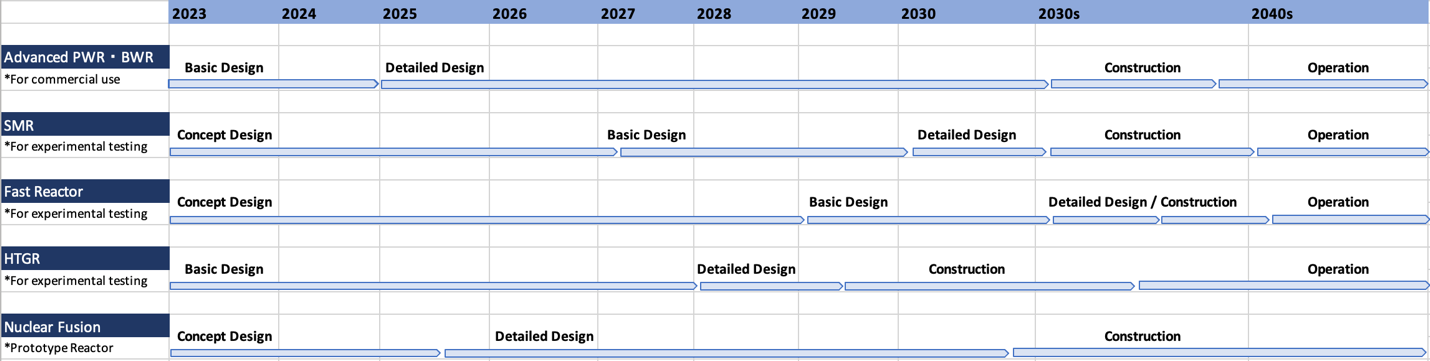
The Group’s outlook included more innovative nuclear reactor tech gaining traction overseas, such as SMRs, but noted that in the most immediate future Japan should build reactors based on the BWR and PWR technologies it has employed for decades, albeit with improved designs. Using familiar reactor tech should allow for new construction at the start of the 2030s, with operations slated for the latter part of the decade.
Source: METI
Two steps forward, one step back
Today, it seems as if the return to nuclear energy was linear and swift. But even after METI’s working group floated the idea of building new reactors, the ministry’s official position of gradual restarts but no new construction didn’t change. In fact, on Aug 2, then METI Minister Hagiuda reiterated that “the government has no intention to replace or build new NPPs.”
The struggle within government and bureaucracy intensified. On Aug 4, the Federation of LDP Members for Promoting Replacement of Nuclear Reactors held an emergency meeting of the Diet’s general assembly. A resolution was passed to promote building new reactors on the site of old units that need replacing. The group’s chair, Tomomi Inada, asked to use the word “replacement” to describe new construction and to include this in the GX program.
This was the turning point. During the second session of the GX Council on Aug 24, the issue of developing and building next-gen reactors as replacements for aging units came up. The Council also advocated to extend the operational period of existing, idled units.
Extending the lifetime of existing reactors can help operators recoup investments. But it could also delay the construction of new units. Seeing the contradiction, the industry quickly lobbied to keep extensions minimal, covering only the amount of years the facilities were idle after the Fukushima accident.
For the next two GX Council sessions, on Oct 26 and Nov 29, the main agenda focused on carbon pricing, emissions trading, low carbon measures for industries (steel, chemical, cement, vehicles, etc) and finance. Nuclear policy barely featured.
Finally, at the Council’s fifth session on Dec 22, METI issued a draft for the Basic Policy to Implement a Green Transformation (GX). As per the July working group’s suggestions, it calls for support of a number of next-gen reactors, but the immediate focus is on the improved versions of existing technologies in use in Japan.
Over the coming months, METI is ready to support the restart of reactors already approved by the NRA but waiting on the green light from local governments (units 1 and 2 of Takahama NPP; unit 2 of Onagawa NPP; unit 2 of Shimane NPP; Kashiwazaki Kariwa NPP and Tokai No. 2 NPP). Also, METI wants to see reactors that are still under NRA review progress to the next stage.
With new sites for NPPs highly unlikely, the main result of the GX strategy for nuclear power will be the replacement of decommissioned reactors with next-generation reactors. Until those new units are built and operational, current facilities will need to restart and cover electricity demand.
ANALYSIS
BY CHISAKI WATANABE
MOE Sets Up New Green Investment Fund
With Eye on Regional Decarbonization Projects
Two years ago, METI set up a ¥2-trillion Green Innovation Fund (GIF) to support early-stage R&D to help Japan meet its 2050 net-zero ambitions. Now, that effort is getting a further boost with a new fund that will pool cash from the private sector with state support and direct them to regional projects.
In late 2022, the Ministry of the Environment (MoE) created its own green fund. Though much smaller than GIF, the Japan Green Investment Corp for Carbon Neutrality (JICN) will play an important though different role within the government’s net-zero strategy.
The focus on local activities is noteworthy. Most of GIF’s funds go to large companies, the bulk of which are headquartered in Tokyo. JICN’s activities will support local initiatives, empowering municipalities all over the country to find and fund carbon neutral projects. The fund’s work should dovetail with the MoE’s 100 Areas that Lead in Decarbonization, a kind of nationwide clean cities program.
The overall scope of JICN won’t just be limited to regional projects. Unlike METI’s focus on early-stage research, JICN will also support technologies that are close to reaching commercial reality. This will have tangible implications for the rollout of EV charging networks, the cleaning of supply chains and other decarbonization pathways.
Key facts
Launched in October 2022 as a public-private fund, JICN will invest and provide loans for projects that help achieve net-zero carbon emissions targets by 2050. The fund will be active until the end of FY2050.
JICN has a founding capital of ¥20.4 billion, half of which was invested by 82 private companies and banks, with the rest coming from the Ministry of Finance’s Fiscal Investment and Loan Program (FILP).
The government could add another ¥9.8 billion to the fund by April and the MoE is requesting a further ¥40 billion from the FILP for the next fiscal year. It also wants ¥20 billion in five-year government guarantees so that JICN can raise funds in public markets.
Below is a breakdown of the 82 private sector investors. JICN’s founders are the Development Bank of Japan, Mizuho Bank, Sumitomo Mitsui Banking Corp, and MUFG Bank.
Organizational structure
The fund was set up following revisions to the Act on Promotion of Global Warming (地球温暖化対策推進法) that took effect in July 2022 and started operations on Oct 28. At the inaugural meeting, Environment Minister Nishimura said he wants the fund to lead in implementing the national policy to attract ¥150 trillion of public and private investments into decarbonization efforts over the next 10 years.
57 financial institutions
|
Govt-affiliated (3) |
Development Bank of Japan, Shinkin Central Bank, Norinchukin Bank |
|
City banks (3) |
Mizuho Bank, Sumitomo Mitsui Banking Corp, MUFG Bank |
|
Trust bank (1) |
Sumitomo Mitsui Trust Bank |
|
Regional banks (47) |
Hokkaido Bank, Hokuriku Bank, the Bank of Yokohama, |
|
Securities firm (1) |
Nomura Holdings |
|
Other financial institutions (2) |
Japan Post Bank, Aozora Bank |
25 businesses
|
Energy (7) |
Chubu Electric, Kansai Electric, JERA, Toho Gas, |
|
Steel (1) |
Kobe Steel |
|
Chemicals (2) |
Sekisui Chemical, Showa Denko |
|
Machinery/ electronics (5) |
Kubota, Hitachi Zosen, JFE Engineering, Azbil, Suzuki |
|
Transportation (1) |
East Japan Railway Company |
|
Construction/ housing (4) |
Toda Corp, Nishimatsu Construction, Penta-Ocean Construction, Sumitomo Forestry |
|
Glass/ ceramics (2) |
NGK Insulators, Taiheiyo Cement |
|
Distribution (1) |
Seven & i Holdings |
|
Communications (2) |
NTT, KDDI |
Source: MoE
Minister Nishimura’s remarks coincide with the government’s push for the “green transformation” (GX) of Japan’s economic, social and industrial structures. The ¥150-trillion figure is the umbrella for an array of programs and initiatives that the government wants to promote to wean Japan off fossil fuels.
The president and CEO of JICN is Tayoshi Yoshihiko, a former bank official who served as a member of the board for the MoE-controlled Green Finance Organization. JICN has taken over many of the functions performed by the Green Finance Organization, which was founded in 2013 by the MoE to fund regional low-carbon society projects.
Still, JICN is much more than a name upgrade. Nearly a decade in operation, its predecessor invested only ¥18.4 billion in 37 projects, mostly in wind and biomass power generation. The remit of JICN, however, is much broader than renewable energy. Below are some of the sectors that will fall within its scope.
1. Reduction of CO2 from energy sources
- Power and heat supply
- Renewable electricity (i.e., solar, wind, small hydro, biomass, geothermal)
- Renewable heat
- Co-firing of biomass and ammonia at thermal power plants
- Production and sale of biomass fuels
- Residential
- Zero Energy Houses (ZEH)
- Energy saving, solar panels, storage batteries
- Agriculture/Food
- Solar-sharing
- Energy saving freezers containing no chlorofluorocarbon
- Transportation
- EV and charging/ discharging devices combined with renewable energy
- Decarbonized vessels
- Carbon neutral ports and airports
- Supply Chains
- Decarbonization-related products, services, the manufacturing and sale of material and parts
- Renewable energy supply, energy storage facility for hydrogen and others
- Microgrids and other distribution businesses to maximize the use of renewables
- Office/ commercial buildings
- Zero Energy Buildings
- Installations of equipment to use onsite solar power (i.e., carports)
- Energy efficiency improvement
- Decarbonization of factories (i.e., electrification, equipment upgrades)
2. Reduction of CO2 from non-energy sources
- Recycling of plastic, development of alternative materials
- Upgrade of manufacturing processes for cement and other industries
- Shift to biogas (methane fermentation) when upgrading waste incineration plants
- Reduction of methane emissions from farming
3. Increasing GHG sinks
- Revitalization of the forestry industry, cultivation of fuels on abandoned farmland, development of green infrastructure
4. Investment in companies that provide finance to businesses above
New Fund’s Scope of Support
Source: JICN
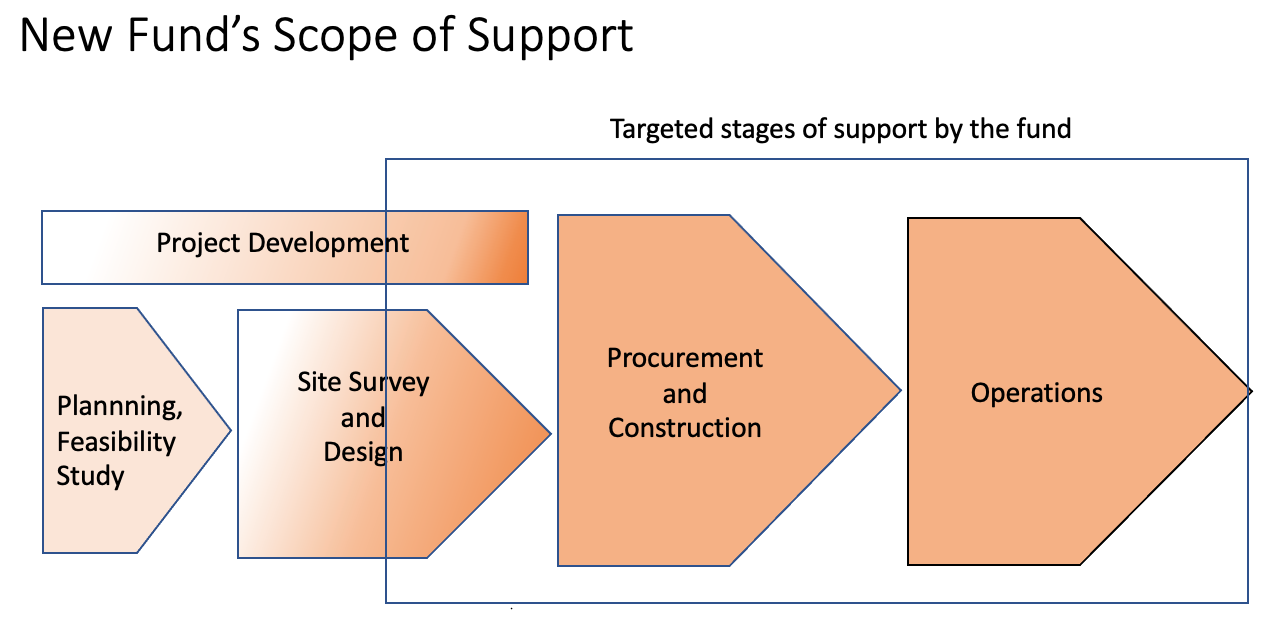
The fund will target projects in the later stages of development, that have completed a feasibility study and began design and site inspections; or those that have advanced to the procurement, construction, and operation stage. Also, it’s looking into how to support startups and other types of organizations.
Decisions on investment will be made by the fund’s Decarbonization Committee. The role of JICN is not limited to equity financing. Also, it can offer mezzanine financing and debt guarantees. While JICN will set out more detailed definitions and requirements for its investment targets, it says projects eligible for support need to address three key aspects:
- Policy: the project must contribute to creating a decarbonized society through action that cuts emissions and increases carbon sinks;
- Profitability: the project needs to prove that investment can be recouped;
- Management: the project must be led by an ambitious operator(s) with plans to expand the business model further and build on it.
Another green finance tool
JICN is one of several government green financing vehicles, all of which sit within the national GX strategy. The best-known include METI’s GIF, as well as recent plans by the government to issue ¥20 trillion in bonds under a new category that it calls “GX economy transition bonds”.
Still, the cadre of firms already signed up for JICN suggests that the fund will be more than just another state vehicle. Its role is to enact the national decarbonization agenda at a local level by disseminating know-how about green finance in the regions. In turn, that should accelerate more net-zero projects nationwide, benefiting both local governments and businesses with a regional presence.
JICN and the MoE’s “100 Areas that Lead in Decarbonization” program can act as a “twin-turbo engine” to steer decarbonization investments toward regional development, says a former senior MoE official, adding that local knowledge of energy transition financing could improve with experience.
While Kishida’s GX strategy has dominated headlines in recent months, it will come down to smaller programs such as JICN that will make sure the GX vision becomes reality.
GLOBAL VIEW
BY JOHN VAROLI
Below are some of last week’s most important international energy developments monitored by the Japan NRG team because of their potential to impact energy supply and demand, as well as prices. We see the following as relevant to Japanese and international energy investors.
China/ Crude demand
Crude import quotas were boosted as the world’s largest crude importer prepares to meet higher domestic demand. As of this week, China issued a combined 132 MMT of quotas for crude imports in 2023, compared to 109 MMT at the same time last year.
Finland/ Offshore wind
Sweden’s Vattenfall set up a joint venture with state-owned Metsahallitus to build the country’s first large offshore wind farm. The €3 billion project will have a capacity of 1.3 GW.
Germany/ Offshore wind
Siemens Energy and Spain’s Dragados Offshore won a €4 billion contract to build two converter systems for offshore wind energy grid connections. This will be Siemens Energy’ largest offshore grid connection order to date.
German/ Solar power
Photovoltaic leasing firm Enpal is close to securing €215 million in equity, seeking to expand and meet increasing demand for residential solar power. The new financing brings the firm’s valuation to about €2.2 billion.
Italy/ Natural gas
Energy group Eni and gas grid operator Snam inked a €405 million deal under which Snam acquired a stake in Eni’s assets in various companies managing the gas networks between North Africa and Italy.
Solar Power
Growth in the U.S. solar industry will slow in 2023, but EU and Asian markets are poised for growth, SolarEdge’s CFO Ronen Faier told investors at a Goldman Sachs conference. He cited high prices and regulatory uncertainties in the U.S. as factors.
Sweden/ Rare earth metals
State-owned mining company LKAB said it discovered Europe’s largest deposit of rare earth metals needed for the energy transition. However, it could take 10 years before the raw materials are delivered to market.
UAE/ Decarbonization
ADNOC will allocate $15 billion by 2030 aiming to reduce its carbon intensity by 25% and grow its carbon capture capacity to 5 million tons. Investments will be made in clean power, CCS and electrification.
UK/ Wind power
In 2022, wind farms accounted for a record 26.8% of the nation’s electricity, up from 21.8% in 2021. But gas-fired power plants remained the leading power source, according to National Grid data.
U.S/ Pollution control
New York State will set an annual pollution cap on industry, aiming to lower emissions and generate $1 billion a year. Major emitters will purchase permits when selling polluting fuels. The proceeds will cover utility bills, transportation costs, and decarbonization programs.
2023 EVENTS CALENDAR
A selection of domestic and international events we believe will have an impact on Japanese energy
Disclaimer
This communication has been prepared for information purposes only, is confidential and may be legally privileged. This is a subscription-only service and is directed at those who have expressly asked K.K. Yuri Group or one of its representatives to be added to the mailing list. This document may not be onwardly circulated or reproduced without prior written consent from Yuri Group, which retains all copyright to the content of this report.
Yuri Group is not registered as an investment advisor in any jurisdiction. Our research and all the content express our opinions, which are generally based on available public information, field studies and own analysis. Content is limited to general comment upon general political, economic and market issues, asset classes and types of investments. The report and all of its content does not constitute a recommendation or solicitation to buy, sell, subscribe for or underwrite any product or physical commodity, or a financial instrument.
The information contained in this report is obtained from sources believed to be reliable and in good faith. No representation or warranty is made that it is accurate or complete. Opinions and views expressed are subject to change without notice, as are prices and availability, which are indicative only. There is no obligation to notify recipients of any changes to this data or to do so in the future. No responsibility is accepted for the use of or reliance on the information provided. In no circumstances will Yuri Group be liable for any indirect or direct loss, or consequential loss or damages arising from the use of, any inability to use, or any inaccuracy in the information.
K.K. Yuri Group: Oonoya Building 8F, Yotsuya 1-18, Shinjuku-ku, Tokyo, Japan, 160-0004.